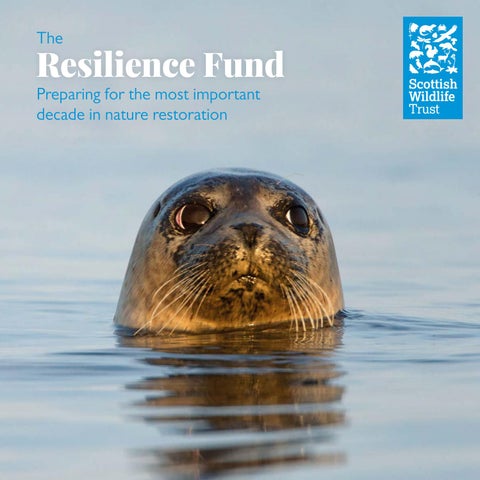
The
Resilience Fund Preparing for the most important decade in nature restoration
2021 will be a crucial year for nature: the year when the UK will host the UN Climate Change Conference (COP26) and the year that the UN Decade on Ecosystem Restoration begins.
© Jon Hawkins Surrey Hills Photography
To mark this turning point for nature conservation, and ensure we are in the strongest possible position to rise to the challenges ahead, we have established the Scottish Wildlife Trust Resilience Fund.
Imagine a Scotland where wildlife and people flourish side by side. Where the natural world cleans our air, purifies our water and protects us from flash floods and heat waves. Where our native species thrive and where everyone can connect with nature. But today, Scotland’s climate and biodiversity face a serious crisis. Whole ecosystems are at risk. Weather patterns are shifting, seasons altering, habitats disappearing. We must step up to the challenges ahead, but we can’t do it without your support.
Sadly, despite the backing of our members and supporters, the crises we face are worsening, and as Scotland’s leading nature conservation charity, it is vital that we increase our investment in nature before the damage already caused becomes irreversible.
How will the Resilience Fund help? With your support, the Resilience Fund will focus on three main areas:
1
Ensure Climate Resilience
Our planet is warming at a faster rate than any time over the last 10,000 years. Climate change is already impacting how we manage our wildlife reserves; the Resilience Fund will enable us to:
Control Invasive Non-Native Species (INNS) Climate change helps INNS thrive and outcompete native plants and animals. Our battle to eradicate plants including Japanese knotweed and Himalayan balsam has never been more important.
10-12
new non-native
species
establish in the UK each year
Future proof reserves Landslips, flooding and erosion require us to raise, re-route and reconstruct pathways, boardwalks and bridges, securing people’s access to nature. We maintain over
150 miles
of paths on wildlife reserves
across Scotland Adapt to survive We must adapt our management techniques in the face of increased rainfall and more frequent storm events - installing new dams in damaged peatbogs and strengthening eroding riverbanks.
2
Build connections and increase diversity People are happier and healthier when they connect with nature – simply spending time outdoors brings a host of benefits for our physical and mental health. We want everyone to have the opportunity to enjoy the rewarding experiences that our natural world can provide. We will:
Reach out
1 in 9 of
every species in Scotland’s ecosystems is at
risk of extinction
Nature should be enjoyed by everyone, regardless of background, gender or ethnicity. By removing any barriers to connecting with wildlife, we can also discover fresh ideas and new ways of tackling the biodiversity crisis – together.
Ensure young peoples’ voices are heard Our Young Leaders Initiative helps the Trust engage with young people across Scotland whilst providing careerbuilding skills and experiences for those involved.
Our
Young Leaders comprise a team of 12 representatives aged 20-30 who champion our
work
Inspire and empower Later in the year, we will be launching an exciting new engagement campaign to encourage people to take action for nature within their communities across Scotland.
3
Promote Nature-Based Solutions Nature must play a pivotal role in combatting the challenges we face. As well as advocating nature-based solutions at government levels, we will continue to provide exemplars on our wildlife reserves. With your help, we will continue to:
Protect woodlands As well as sheltering a myriad of Scotland’s wildlife, our native woodland management helps reduce flooding and prevent landslips.
1 in every 11 homes
in Scotland is at risk of damage caused by
floods
Nurture Meadows Wildflower meadows are one of our most threatened habitats. We will continue to deliver a conservation grazing regime to encourage healthy ecosystems in which bees, butterflies and a range of other pollinators can thrive.
food
Every third mouthful of we eat depends on
pollinators
Restore peatlands Healthy peatbogs support internationally important biodiversity, capture carbon and reduce flood risk; when damaged they emit greenhouse gases. We help our peatbogs recover by blocking old drainage ditches, removing encroaching scrub and felling misplaced plantations. The
carbon
stored in Scottish peatbogs is equivalent to
140 years’ worth of
Scotland’s total annual greenhouse gas emissions
How to support the Resilience Fund Our members and supporters have been helping us deliver outcomes for nature for over 50 years. With global focus on COP26 and the UN Decade on Ecosystem Restoration, there has never been a more urgent time to restore and protect our natural world. Acting as champions for Scotland’s nature, we can help combat climate change, protect vulnerable species and create more resilient, healthier wild places – but we can only succeed by working together.
© Lynne Newton
By making a donation to the Scottish Wildlife Trust Resilience Fund, you can help us adapt to the challenges and new opportunities ahead.
If you would like to pledge your support, please donate to the Resilience Fund today at scottishwildlifetrust.org.uk/thefund or call us on 0131 312 4700 If you would prefer, you can return the enclosed donation form to our freepost address: FREEPOST RSTC-UEBT-AZKR Scottish Wildlife Trust Harbourside House 110 Commercial Street Edinburgh EH6 6NF
if...
just one in every forty of our members pledged the price of a cup of coffee each week to the Fund, together by the end of the UN Decade on Ecosystem Restoration, we could invest an additional £1.3 million towards the future of Scotland’s natural world. Any donation to the Resilience Fund, no matter the size, will go towards protecting and enhancing Scotland’s wildlife and wild places for years to come.
scottishwildlifetrust.org.uk/thefund
Resilience
© Alexander Mustard/2020VISION
[noun] the capacity to recover quickly from difficulties
The Scottish Wildlife Trust is a Scottish registered charity (charity number SC005792) and a company limited by guarantee and registered in Scotland (registered number SC040247). Registered address: Harbourside House, 110 Commercial Street, Edinburgh, EH6 6NF.
scottishwildlifetrust.org.uk