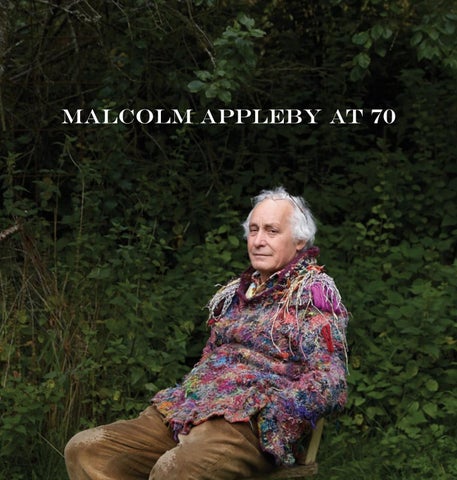
MALCOLM APPLEBY AT 70
MALCOLM APPLEBY AT 70 6 – 30 january 2016
16 Dundas Street, Edinburgh EH3 6HZ tel 0131 558 1200 email mail@scottish-gallery.co.uk www.scottish-gallery.co.uk Front cover: Photograph of Malcolm Appleby by David Eustace, 2015 Left: Detail of the Glenmorangie Beaker, 2015. Engraved silver
2
3
FOREWORD The Scottish Gallery is honoured to celebrate Malcolm Appleby’s 70th birthday which marks over 50 years of a creative tour de force. Malcolm Appleby has dedicated his artistic practice primarily to engraving and pushing the boundaries of metalwork; constant experimentation has made him a master of his craft and in 2014 he received an MBE for his outstanding contribution to the arts. This birthday exhibition sets out to provide a snapshot of Malcolm’s current work. The Gallery has been associated with Malcolm Appleby since the 1970s; the many facets of his work has brought joy to many, each piece sold marking the beginning of a journey of discovery around this senior artist. Professor Elizabeth Moignard’s essay provides us with further insight into his studio practice and career and we are grateful to the contemporary photographer David Eustace who has allowed us to use three images of Malcolm taken from his Friends and Artists portfolio. Last but not least, The Gallery is indebted to Philippa Swann, Malcolm’s wife who, amongst many other things, is the lifeblood of Malcolm’s business and whose many photographs of his work grace these pages. Christina Jansen
Left: Malcolm Appleby by David Eustace, 2015
4
Malcolm Appleby at 70 This year invites us to celebrate fifty years of the engraving and fine metalwork of the master craftsman Malcolm Appleby: there is plenty to admire and to rejoice about in response to that invitation, and to reflect on too. Malcolm’s biography on page 40 shows us much of the justification for the maker’s reputation and the recognition his work and career have deserved and won; we can see a substantial number of important public commissions, exhibitions, and awards, including his recent MBE and his Lifetime Achievement Award from the Hand Engravers’ Association of Great Britain. But this is in many ways the scaffolding, and the content which is implied by his biography is what underwrites and at least partially explains the evolution of a remarkable body of work over those fifty years.
Malcolm was born in Kent, and trained, given his obvious talent, in a series of respected art schools in the south east of England, finishing with the RCA in 1968, followed by the award of the Littledale Scholarship by the Goldsmiths’ Company – a promising foundation. From our point of view now, though, it was the move to Scotland in 1969 and the setting up of his first studio in Crathes which mark the beginnings of a lifetime of work which has always had its roots in his instinctive sense of connection with the place he inhabits. This feeds the enduring love of nature, and the commitment to its conservation, and also the evident sense of social duty to the humans who operate in it too. Now based in Perthshire, he and his household are living and working in one of the oldest inhabited landscapes in Scotland, and his sense of being embedded in its natural environment is an enduring element in his aesthetic. A persistently enquiring mind, and the courage to experiment provide many of the drivers which make that emotional base produce some extraordinary work, beautiful, amusing, challenging, sometimes all at once. Carving and engraving are the techniques most closely associated with Malcolm’s work, and we might view this as a starting point in looking at the way in which his oeuvre
naturally involves both the creation of large-scale publicly commissioned work, and smaller and more intimate and domestic desirables, including jewellery. The early years in Scotland were spent completing commissions, engraving guns and experimenting with new approaches to the craft, not least using a hammer and chisel, resulting later in the bolder graphics we see on many of his bigger pieces. I first became aware of Malcolm’s work in the 1970s and 1980s at The Scottish Gallery: what I was seeing then was usually relatively small pieces of fine jewellery, already evidence of an experimental and imaginative approach to metal and colour. In the early nineties, I acquired a very clever neckpiece from The Scottish Gallery exhibition Chain Reaction – an assemblage of sizeable flat hammered silver links with an interlinked gold system: Malcolm and Philippa noticed it on my first visit to their house; I have worn it ever since with pleasure.There are a number of equally remarkable necklaces in this exhibition (page 20-21) including hammered, stamped and one sensational mixed metal necklace set with diamonds (page 15).These all display that bold view of metal and colour which so characterise his experimental approach to his material, and the determination to make it work in a well-made and designed object.
5
Glenmorangie Beaker, 2015 Britannia silver, part gilt H7 x D7.3 cms
6
Otter and Waterlilies Bangle, 2015 Silver cast version of Banchory Bangle W2.2 to 3 cms
7
At the same time, though, I was becoming increasingly aware of his work on a larger scale, including some important public commissions and museum pieces; these visibly provide not only space for the experimental, but also crystallise much of Malcolm’s particular ethical practice in approaching public art. The commitment to nature is evident, but equally a sense of duty to make political, and often satirical comment. Some of this underlies one of my favourite pieces: the cup he produced for the 500th anniversary of the London Assay Office, which traced the changing form of its leopard mark with jokes and an evident love and observation of cats, but also with a commentary on service and stability. The Hurricane George bowl of 2007 matured this ethos by referring to Hurricane Katrina’s destruction of New Orleans, both a climatic disaster on a monumental scale and a human catastrophe; President George W Bush, as Malcolm puts it, ‘played golf while New Orleans drowned. So George appears in the eye of the storm – in the centre of the bowl, but his eyes will never meet yours.’ The table centre-piece commissioned for the Millennium collection at Bute House addresses a more local issue with as much passion, from a more celebratory angle. The original fluid design on unrolling paper led to a silver sculpture which confronts the viewer with the coastline of Scotland undulating adaptably along the table, accompanied by coastal stack-like candlesticks like the Old Man of Hoy, and flower holders which lie offshore as islands. The sense that the Scottish government should be for the whole of our beautiful Scotland, not just its urban centres, is a serious part of the message. Engraving includes lettering, of course; words make messages and points easier to make, and here Malcolm’s part in the long tradition of political satire and commentary in art emerged most recently, perhaps in his Catch Phrase series (page 36-37), in which he picks up on famous mantras such as ‘the big society’ and emphasises their hollow ring by engraving them on a beaker.The invitation to deliver the Glenmorangie lecture at the National Museum of Scotland in 2015 generated the Glenmorangie Beaker (page 5). This takes, as Malcolm says, a ‘deliberately different approach to lettering, street graffiti-style meets Celtic, combined with
straight line illusion engraving – there has only been one beaker engraved like this one. It is a riot of line and light.’ Nature and nurture, and social duty: probably the evolution of the Banchory Bangle encapsulates this best. This annual commission began in 1976 to raise funds with RSSPCC (now Children 1st), and its first gold edition, made from publicly contributed scrap gold, was auctioned at the Touch of Tartan Ball in Aberdeen to celebrate 21 years of Malcolm Appleby in Scotland. Later editions were replicated by casting in silver, and so have had a wide circulation after an annual raffle at the Ball, and a reputation both as an important piece of charity work and as wearable folk art. In many ways they are an indicative marker of Malcolm’s ethos and practice: a piece of fine and often humorous observation, produced with attention to detail and generosity of spirit for a serious purpose. The bangles have exhibited flowers, birds, fish, and one year, cats with fish in their bellies, licking their lips with long curly tongues. The 2015 version features an otter and waterlilies (see opposite). Malcolm has collaborated with many other charities, creating fund-raising pieces for them, most recently the RSPB Scotland’s Capercaillie conservation and sparrow projects. The collaborative instinct has often grown from a mixture of technical experiment and practical necessity; an early experiment evolved from engraving discs which could be raised to form bowls via carving in low-relief migrated to a point at which the metal so treated could be shaped with a mallet, usually by Peter Musgrove, who is one of the earliest in a series of collaborators who have been an essential part of Malcolm’s evolving practice over some 40 years. These and related experiments would always be revisited, revised and improved, and eventually lead, among other things to the surfaces which are enamelled by Jane Short.The need to collaborate has been intensified in recent years by a major commission that will take several years at least to complete. This has meant working with other makers to allow Malcolm to continue to design and make more new pieces. The invention of different ways of making, not least a parallel development from his early practice of firing precious metal onto engraved steel (page 27), has led recently to several
8
Enamelled Beakers and Bowls, 2015
9
chiselled and engraved brooches (page 27) and vessels which show off the real ‘Malkie’s mixes’ of metal and colour which so characterise his experimental approach to his material. The series of hand-raised and enamelled beakers, Tectonic, Arctic and Antarctic, Magma and Acid Rain made with Jane Short, reiterating his environmental concerns, explodes here in spectacular surfaces and magnificently loose design, full of passion and colour. The two Tectonic beakers, recently acquired by the Goldsmiths’ Company, were exhibited in the Silversmiths’Art at the National Museum of Scotland, and there are several examples from the Short-Appleby partnership in this exhibition and I particularly admire the hot off the bench Storm Force 10 Bowl (page 11). Other new works are the striking rectilinear brooches (page 34), of a recent experiment with electroforming: Malcolm designs and starts the work, and his associate Karen Wallace continues the process by creating an illusion of changing light with straight line engraving to reflect a three-dimensional form. A visit to the Applebys’ Christmas shop in late October is an annual treat: it involves a drive via the Trossachs into Perthshire through a landscape full of autumn tones, in which the cattle grazing on the slopes of Ben Lawers are the same colour as the bracken surrounding them.This year I was further rewarded by a dusting of snow on the tops, and a misty pink sunset on the way home. At the end of the run, an enchanting yellow house fronting a smallholding full of fascinating birds and plants, patrolled by Silver the cat. Malcolm, Philippa and their daughter May make every visitor welcome in a domestic environment full of wonderful things – textiles, ceramics, prints, and of course Malcolm’s studio and its produce, now displayed, on a tremendously brutalist assemblage from garden timber in the new, and successful, studio extension. This allows for an easier wander through into the workshop to see more as work in progress or stored treasures. Sharing both enjoyment and knowledge of process and design is a key part of the experience. As ever, I look forward to seeing Malcolm himself, often wearing that interpolated palimpsest of a sweater, punctuated by silver buttons and other add-ons, welcoming, generous, and full of shared information, often with a quick demonstration, about his working processes.
Two years ago The Scottish Gallery hosted the exhibition Passing it On. It featured work by Malcolm, his apprentice and some of his contemporary peers who have gained knowledge, insight and experience in his workshop. The heart of the exhibition explored the art of engraving, a familiar willingness to experiment with mixing media, and a broad range of visual idioms. It also provided a vivid insight into Malcolm’s annual engraving workshop, long respected as an event fired by the passion for the technique and the high degree of skill which he passes on.The provision of an environment in which all this can develop is something which becomes very evident on a visit to the house, and the new extension will enhance it. A comfort zone full of willingness to share both enjoyment and knowledge of process and design is a key part of the experience; working there is a very special thing, precisely because it happens in a warm and essentially domestic place. That there is a serious business underlying and supporting the household is of course true, but it has never stood in the way of that welcoming and generous atmosphere which makes being there so special – the visitor is a valued friend. I have even got close enough to Silver to be allowed to scratch her head. Elizabeth Moignard
10
Arctic and Antarctic Beakers, 2015 Enamel, Britannia silver H10.5 x D7 cms enamel by Jane Short signed and dated on base Malcolm Appleby 5.3.15 JS
11
Storm Force 10 Bowl, 2015 Enamel, cast sterling silver approx W15 x D10.5 cms enamel by Jane Short signed and dated on base Malcolm Appleby 27.10.15 JS
12
His work doesn’t accept limitations. It reaches out; it makes comments on the kind of world we live in. • Edward Lucie-Smith
Nova Series - Engraved Enamel Brooches, 2014 Enamel by Jane Short approx H4 x W3 cms to H7.5 x W6 cms signed and dated on underside Malcolm Appleby JS KW
13
14
Spirals Earrings, 2011 Sterling silver, mixed coloured golds D3 cms
15
Bubble Wrap and Diamond Necklace, 2010 Sterling silver, mixed coloured golds, diamonds,18ct white gold links L40 cms
16
Acid Rain Beaker, 2015 Enamel, chainsaw-cut engraving, Britannia silver H7.5 x D7 cms enamel by Jane Short signed and dated on base Malcolm Appleby 9.8.15 JS
17
Beaded Bowl, 2008 Britannia silver, 18ct gold beads approx H7.2 x D13 cms
18
Crystal Textured Tumbler Bowl, 2013 Fine silver, part gilt H6.5 x D9 cms
19
there is nothing more to the left, right or bottom of this shot
Group of Crystal, Spiral and Star Textured Tumbler Bowls, 2013-2014 Fine silver, part gilt H6.5 to 7.5 cms, D8 to 10 cms
20
Chains Gold zigzag 18ct yellow and white gold (far left), Oval links necklaces, various designs, sterling silver
21
Triple Oval Links Necklace, 2013 Sterling silver, hammer textured L58 cms
22
Emerald, pearl, 18ct gold earrings, 2014 L5.5 x W1.5 cms
23
Rings, 2010-2013 Silver, 18ct gold with emeralds, green sapphire and aquamarines
24
Cast Spiral Bowl Series, 2011 Britannia silver, cast from engraved disc and raised, part gilt H6.3 x D10.5 cms
25
Damascus Ellipse Iolite Brooch, 2000 18ct gold, Iolite H2.7 x W6.2 cms
26
Detail of Iron and Gold-fired Discus, 1970 Private Collection
27
He has the magician’s trick of transforming the humble into something rich and strange. • Sarah Drury, The Collector, 2006
Nebula Series - Iron and Gold Brooches, 2014 Iron, coloured golds mix, silver fittings, some engraved approx H3.5 x W5.7 cms to H6 x W8 cms signed and year dated Appleby KW
28
Dove Brooches Sterling silver, 18ct gold detail, aquamarine, pink sapphire H3.5 x W5.5 cms
29
Iron and Gold Belt Buckles, 2012 Iron, coloured gold with platinum beads signed M Appleby, 2012 upper: H4.7 x W6.7 cms lower: H4.6 x W6 cms
30
24ct Gold Owl, 1969 Impression struck from steel die Private Collection
31
Owl Pendants Silver cast versions of Owl Medals from D3.7 to D4 cms
32
Silver Banchory Bangles, from 1996 from top: Sparrows in a Holly Hedge (2014), Flowers of the Forest (2012), Big Scroll (2013), Butterfly (2010), Owl (2001), Primrose with gold beads (2006), King Bee (2003) Sterling silver cast versions of Banchory Bangles
33
Vortex Bangles, 2015 Sterling silver cast and engraved bangles, signed M Appleby
34
Ice Brooch Series, 2015 Engraved silver, silver and gold signed M Appleby KW approx H5 x W6 cms
35
Vortex Brooch Series, 2015 Electroformed fine silver signed Appleby approx H6 x W4 cms to H9 x W8 cms
36
Likened to concrete poetry, Appleby’s characteristic interlaced lettering makes a witty visual play on jargon and political noise. • Philippa Swann
37
Catchphrase Beakers, 2012-2015 Engraved Britannia silver, part gilt from H4.5 to H7.5 cms
38
Curved Tricorn Bowl, 2011 Engraved Britannia silver, part gilt H11 x W23.5 cms
39
Malcolm Appleby’s versatility as a silversmith and metal engraver is matched by imaginative use of line and form. Much of the inspiration for his engraving is drawn from the landscape of the Scottish Highlands. • Silver From Scotland, 1997
40
Dr Malcolm Appleby, MBE Designer Engraver Silversmith • Goldsmith • Jeweller Education AND awards 1946 Born Beckenham, Kent 1961-1968 Beckenham School of Art, Ravensbourne College of Art & Design, Central School of Arts & Crafts, Sir John Cass School of Art, and the Royal College of Art 1969 Littledale Scholar, Worshipful Company of Goldsmiths 1997 Inches Carr Trust Crafts Bursary 2000 Doctor of Letters, Honorary Degree awarded by Heriot-Watt University, Edinburgh 2003 Fellow, Master of Engraving, Bishopsland Educational Trust 2014 Awarded MBE for services to hand engraving and heritage crafts 2015 Lifetime Achievement Award, Hand Engravers Association, Great Britain Studios 1963 West Wickham, Kent 1969 Crathes, Kincardineshire 1996 Grandtully, Perthshire Selected Solo and Museum Exhibitions 1998 Malcolm Appleby Designer & Engraver, Aberdeen Art Gallery & Museum 2006 Malcolm Appleby Precious Statements, Goldsmiths’ Hall, London 2008 Silver: Made in Scotland, National Museums Scotland, Edinburgh 2012 Malcolm Appleby Maker, The Scottish Gallery, Edinburgh 2014 Passing It On, The Scottish Gallery, Edinburgh 2015 The Silversmiths’ Art, National Museums Scotland, Edinburgh 2016 Malcolm Appleby at 70, The Scottish Gallery, Edinburgh Selected Commissions 1969 Engraved orb, Prince of Wales’ coronet (with Louis Osman), Worshipful Company of Goldsmiths Model of Moon (gift to first moon astronauts), with Louis Osman 1978 King George VI Diamond Stakes Trophy, De Beers 1971-1977 Chess Set, Collingwood of Conduit Street 1976 First of annual engraved bangles, The Banchory Bangle, for Children 1st, Aberdeen 1978 Cup commemorating 500 years of the London Assay Office, Worshipful Company of Goldsmiths
41
1985 Seal for the Board of Trustees,Victoria & Albert Museum, London 1986 Raven Gun for Tower of London, Royal Armouries 1988 Condiment Set for 10 Downing Street, The Silver Trust 1989 Standing Cup and Cover, National Museums Scotland, Edinburgh 1994 Charger, Cockerel Bowl, Worshipful Company of Goldsmiths 1998 Medal for the Museum of Scotland, National Museums Scotland, Edinburgh 1999 Sculptural Table pieces for Bute House, residence of the First Minister of Scotland, Incorporation of Goldsmiths of the City of Edinburgh Millennium Casket (18ct white gold) Worshipful Company of Goldsmiths, London 2000 Silver Teapot and Beaded Bowl, Perth Art Gallery & Museum 2005 The Trafalgar Medal, celebrating 200 years, Sim Comfort Associates 2007 Hurricane George large shallow bowl (for Cutting Edge exhibition, National Museums Scotland) Design for 150 Years Celebration Book,Victoria & Albert Museum, London 2009 Modern Nautilus or Loving Cups, George Heriot School Trust, Edinburgh 2012 Medal for XXXII Fidem Art Medal Congress, University of Glasgow 2014 Pair of Candlesticks for St Giles’ Cathedral, Edinburgh 2014 Fundraising Capercaillie Design for RSPB Scotland’s Conservation Capercaillie campaign Public Collections include Aberdeen Art Gallery & Museums Ashmolean Museum of Art & Archeology, University of Oxford Birmingham City Art Gallery British Museum, London Fitzwilliam Museum, Cambridge Goldsmiths’ Company, London The Hunterian, University of Glasgow National Museums Scotland, Edinburgh Perth Museum & Art Gallery Royal Armouries, Tower of London Victoria & Albert Museum, London
Cascade of bluebells in Grandtully. Photograph: Philippa Swann
42
Malcolm now lives in a purpose built workshop and home, designed to his own specification. It stands in 9 acres of ground; some now cultivated with tatties and vegetables, a wonderous array of herbs, and a young orchard. Living above the shop allowes him to be flexible and indulge his incredible energy and dedication to his craft. The Post Office is nearby, the travelling bank visits weekly, and the proximity of the A9 gives easy access to all points North and South… An air of contentment and tranquility pervades, but Malcolm is not to be found relaxing. The work continues apace, constantly developing and progressing… • Christine Rew Aberdeen Art Gallery & Museums Malcolm Appleby, Designer and Engraver, 1998
Photograph: David Eustace, 2015
43
44
Malcolm Appleby wishes to thank all the other makers who help him create his designs, all his friends and clients and The Scottish Gallery for being so supportive over the years, and especially to Philippa who maintains a gyroscopic control over the workshop and creates such inspiring photographs of their life’s work. • Stewart Moar, Jeweller Kevin Allen, Silversmith Peter Musgrove, Silversmith Charles Bell, Wood turner and engineer Niagara Falls Casting (UK) Ltd Stephen Bishop, Silversmith Theresa Nyugen, Silversmith Graham Fuller, Jeweller Mharit Hulbert, Student Jane Short, Enamel artist Michael Lingard, Gunmaker Callum Strong, Student Ryan McClean, Silversmith Karen Wallace, Jeweller & Engraver Ane Meneses, Silversmith Stephen Wood, Gilder Andrew Metcalfe, Silversmith Published by The Scottish Gallery to coincide with the exhibition MALCOLM APPLEBY AT 70 6 – 30 January 2016 • Exhibition can be viewed online at www.scottish-gallery.co.uk/malcolmappleby • ISBN: 978-1-910267-31-8 • Designed by www.kennethgray.co.uk Photography by Philippa Swann, David Eustace, The Scottish Gallery May Appleby modelling work on p14 & 23 Printed by J Thomson Colour Printers • All rights reserved. No part of this catalogue may be reproduced in any form by print, photocopy or by any other means, without the permission of the copyright holders and of the publishers.
16 Dundas Street, Edinburgh EH3 6HZ Tel 0131 558 1200 Email mail@scottish-gallery.co.uk www.scottish-gallery.co.uk Right: Phoenix belt buckle, 2010, H4 x W7 cms Phoenix belt buckle test plate for Phoenix Gun Back cover: detail of Phoenix Gun, 2012