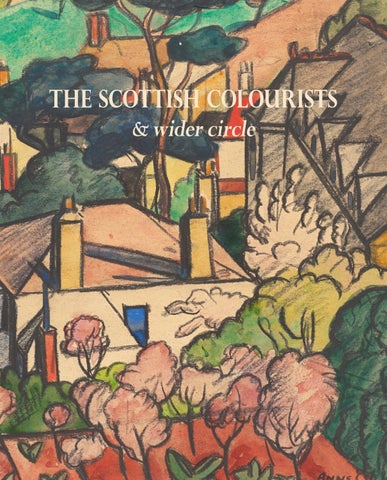
The Scottish Colourists & wider circle
i
ii
The Scottish Colourists
& wider circle
16 Dundas Street | Edinburgh | EH3 6HZ | 0131 558 1200 | scottish-gallery.co.uk
Merle Taylor, S.J. Peploe, Denis & Margaret Peploe, Jessie M. King and Willy Peploe at La Rotonde, Paris, 1924 iv
AN ENDURING CIRCLE
B
ehind the celebrated lives of The Scottish Colourists lies a rich circle of family, friendship, collectors and shared creativity.
The Scottish Colourists remain among the most internationally recognised figures in Scottish art. Behind the familiar quartet of Samuel John Peploe (1871–1935), John Duncan Fergusson (1874–1961), Francis Campbell Boileau Cadell (1883–1937) and George Leslie Hunter (1877–1931) lies a fascinating network of friendships, partnerships, family ties and creative exchanges which helped shaped the wider story of modern Scottish painting. The Scottish Colourists and Wider Circle celebrates both the four artists and the wider community which enriched, challenged and sustained them.
of Oil and Water-Colour Painting, Design and the Applied Arts at 16 rue de la Grande Chaumière, close to the Luxembourg Gardens. Nearby was Peploe’s studio on Boulevard Raspail. Recalling these years in his book Three Scottish Colourists, T.J. Honeyman described how the Peploes spent their evenings in the company of Fergusson, Anne Estelle Rice and a wide circle including the sculptor Jo Davidson, Roffy the poet and La Torrie, mathemetician and aviator. E.A. Taylor and Jessie King became frequent companions of the Peploes’, while figures such as Michael Sadler, John Middleton Murry and Katherine Mansfield would occasionally join them. Margaret Peploe later remembered that, At every meal there were arguments on every subject. It was great fun listening. After leaving Paris at the outbreak of war, the Peploes would later visit Jessie M. King and E.A. Taylor when they settled in Kirkcudbright.
Paris, the south of France, Iona and Edinburgh form the backdrop to many of the paintings, drawings and works on paper gathered here: places where ideas, colour and companionship flourished. The artistic dialogue between Peploe and Fergusson in particular was transformative. Their shared years in France, working in Royan, Paris and later the Mediterranean, opened Scottish painting to a bold modernity rooted in colour, rhythm and structure. Fergusson’s immersion in the Parisian avant-garde and Peploe’s shift towards Fauvist brilliance after 1910 reveal artists responding to the great artistic changes of the period, and also to one another.
Another significant figure in this circle is Anne Estelle Rice (1877–1959). She was one of the great American modernist painters of her generation and shared with Fergusson a period of intense artistic and personal exchange in Paris between 1905 and 1913. These artists absorbed and contributed to the dramatic shifts of the French avantgarde, exhibiting, publishing and living in the crucible of modernism. Rice spent the autumn of 1913 in Cassis alongside Fergusson, S.J. and Margaret Peploe, where painting, conversation and experiment intertwined.
Paris inevitably became a place of friendship, debate and creative exchange. Among those drawn to the city were artists and designers Jessie M. King (1875-1949) and E.A. Taylor (1871-1951), who established their Atelier
1
COLOUR The Palette of S.J. Peploe 6 June - 4 October 2026 ADMISSION FREE 2
3B St Mary St Kirkcudbright DG6 4AA OPENING HOURS Tues - Sun: 10am - 5pm
S.J. Peploe Margaret Morris (1891-1980) met Fergusson in 1913, becoming his lifetime partner and and one of the defining creative spirits of twentieth-century Scotland. Fergusson’s world of rhythm, movement and colour found a natural counterpart in Morris’s revolutionary dance practice. Their partnership sustained each other artistically and emotionally through decades of change, travel, and reinvention.
remarkable legacy which continues to shape our understanding of Scottish art today. Collectors play a vital role in the story of every artist. Through our relationships with artists, estates, families, and collectors, we continue to help build collections that preserve artistic achievement and carry it forward for future generations.
Equally important is S.J. Peploe’s son, Denis Peploe (1914–1993). As an artist, he forged a distinct artistic path from his father, and his contribution to the preservation and championing of S.J. Peploe’s legacy after the Second World War cannot be overstated. Alongside his mother, Margaret, he helped ensure that Peploe’s reputation was endured for future generations.
i
This exhibition arrives at a moment of renewed celebration of S.J. Peploe’s artistic output through a major exhibition at Kirkcudbright Galleries, curated by Amanda Herries, which brings together over seventy paintings and works on paper. The Scottish Gallery Press was commissioned to produce a new S.J. Peploe publication, which reflects accessible scholarship, beautiful design and sharing Scotland’s artistic heritage with a wider audience.
This exhibition also acknowledges Guy Peploe’s contribution to The Scottish Gallery and wider understanding of Scottish art in the year of his retirement. Over more than four decades, his scholarship, eye and personal understanding of the Scottish Colourists have shaped exhibitions, collecting and appreciation of their work. Few artistic legacies are as intertwined with a gallery as that of the Peploe family and The Scottish Gallery. The relationship stretches back to the purchase of S.J. Peploe’s A Gypsy Queen in 1898 and his first solo exhibition with The Gallery in 1903. More than a century later, this unique relationship between artist, family and The Scottish Gallery endures, its continuity across generations representing a distinctive and lasting contribution to Scotland’s cultural heritage.
Today, the work of the Scottish Colourists feels more relevant than ever. Their lives were dedicated to art: to beauty, experimentation, friendship and loyalty. They created a body of work which remains vivid, optimistic and human. Our exhibition includes paintings and drawings from the Peploe family which have never been publicly exhibited. Together, these works invite us into the world of the Scottish Colourists.
The Scottish Gallery remains the only surviving gallery to have represented all four Colourists during their lifetimes; a
CHRISTINA JANSEN
3
deepfake invitations
4
Left: Selection of Scottish Colourist invitation cards from The Scottish Gallery Archive Photograph: The Scottish Gallery at 26 South Castle Street, c.1940s © Historic Environment Scotland Clockwise from top: S.J. Peploe, J.D. Fergusson, G.L. Hunter and F.C.B. Cadell The Scottish Colourists, published by The Scottish Gallery Press, 2025
THE SCOTTISH COLOURISTS i
5
THE SCOTTISH COLOURISTS & THE SCOTTISH GALLERY S.J. Peploe
his practice moved towards modernism and Dott struggled to accept the radical expressionist work the artist brought back from Paris after his move in 1910. However, the younger partner of the firm George Proudfoot, and subsequent directors, continued their support for the artist. From the early 1920s, The Gallery held a joint contract with Alexander Reid in Glasgow to buy work directly from the artist; an arrangement that allowed Peploe to remove himself from the the commercial world and concentrate on his painting, particularly his new subject of Iona and the magnificent rose and tulip paintings of his maturity. Solo exhibitions were held in 1922, 1923, 1924, 1927, 1934, 1936 (Memorial) and The Scottish Gallery has held numerous notable solo exhibitions subsequently including the artist’s 150th anniversary in 2021.
In November 1898, the partners of Aitken Dott & Son bought the painting A Gypsy Queen by S.J. Peploe. Two years before, senior partner Peter McOmish Dott had formed The Scottish Gallery to identify the picture-dealing part of the firm as distinct from the other businesses – architectural supplies, artist's materials, framing, gilding and other services – and determined to represent the best of contemporary Scottish painting. The purchase of Peploe’s painting initiated a close relationship between the firm and the artist, then aged twenty-seven. McOmish Dott was a wholehearted admirer of Peploe’s early paintings, and a show was arranged for January 1903, which was a commercial and critical success. Peploe held a second exhibition in 1909, but from then
Above: The Scottish Gallery window display at 26 South Castle Street, c.1951
6
J.D. Fergusson
In oil, his earlier work is characterised by rich medium, broad-brush marks and is high in tone, unlike the more sonorous works of Peploe and Fergusson’s early Edinburgh years. His next exhibition with The Scottish Gallery was not until 1932, at a time when picture sales were in decline due to the Great Depression. Cadell had always been comfortable to be his own agent, using the artist-run Society of Eight for many of his exhibitions of new work, and on Iona, where he spent every summer after The Great War. There he set up a daily exhibition of the fruits of his labour, his manservant Charles Oliver acting as sales agent, selling to the many wealthy summer visitors, like David Russell of Markinch and George Service of Cove.
J.D. Fergusson exhibited with The Scottish Gallery in 1923. The exhibition included both small-scale sculpture he had produced over the preceding few years and his Highland series of oil paintings, which represented the artist’s engagement with his native landscape and culture. Twenty years before, he had been one of the purchasers of work from his friend S.J. Peploe’s first exhibition with The Gallery, but in the intervening years he had looked to London and then Paris for his commercial and spiritual existence. It would only be after his second flight from the continent, in the face of WWII, that Scotland would take the central place in his work and thoughts. Fergusson was a paragon of the bohemian life and one of the major contributors to British modernism – uncompromising, Modernist and brilliant. A Memorial exhibition was held for Fergusson at The Scottish Gallery in 1961, and numerous exhibitions have been held since.
G.L. Hunter In April 1924, Alexander Reid and The Scottish Gallery signed a joint contract with G.L. Hunter and his first solo exhibition at The Scottish Gallery was held in the autumn. This was a momentous year for The Colourists which saw the exhibition Les Peintres de l’Écosse Moderne at the Galerie Barbazanges in Paris, featuring Peploe, Fergusson, Hunter and Cadell. It was also a productive time for Hunter, who worked in Fife, on Loch Lomond and in a Glasgow studio for most of the next three years. From 1928, Hunter was living mostly in the South of France, based in Saint-Paul-de-Vence, but he continued to send work back to The Gallery.
F.C.B. Cadell F.C.B. Cadell first exhibited with The Gallery in 1909, and his second in 1910 showcased his Venetian paintings. The visit to Venice had been productive and represented (as with Peploe and Fergusson in Royan in the same year) his full engagement with a personal impressionism in which colour was used for direct expressionist purpose. His was a precocious early career, brilliant in watercolour, encouraged by Arthur Melville.
7
GUY PEPLOE MY LIFE IN ART
I joined The Scottish Gallery in December 1983 as a gallery assistant, though in many ways the path there had been laid much earlier. I grew up in Edinburgh in an artist’s household with my father Denis (1914–1993), my mother Elizabeth, and my sister Lucy, where art was part of everyday life. My father’s studio was out of bounds unless we were invited in, sometimes to pose. The smell of oil paint and turpentine, along with a strong sense of creative possibility, are among my earliest memories. I went on to study History of Art at Aberdeen, but I had already been immersed in that world. Our home on the south side of Edinburgh was filled with paintings and objects, including works by my grandfather Sam Peploe (1871–1935) and his great friend Bunty Cadell (1883–1937), and I grew up knowing many of my father’s contemporaries from Edinburgh College of Art such as John Houston (1930–2008), Elizabeth Blackadder (1931–2021), David Michie (1928–2015), Robin Philipson (1916–1992) and William Baillie (1923–2011). Most of them lived nearby in Newington, and it felt natural for me to pursue a career in the art world. Before formally joining The Gallery, I had already spent time there researching the archive while preparing an S.J. Peploe exhibition in 1985. This was the first exhibition opened in June at the new Gallery of Modern Left: Guy Peploe at The National Gallery, London, 2025 Right: Guy Peploe illustrated by Iain McIntosh in 44 Scotland Street by Alexander McCall Smith
Art at Watsons College. I had the honour of conducting the late Queen around the show. Soon after, Bill Jackson, then senior partner of The Gallery, oversaw the firm’s incorporation as a limited company, and at just twenty-four, I became a Director. At that time, The Gallery had recently moved from its long-standing home on Castle Street to 94 George Street, while retaining its workshops in Rose Street Lane where gilders, framers and conservators were based. The front shop was let to Millers Graphics, which sold artists’ materials, and many people in Edinburgh still referred to the business as Aitken and Dott. This name dated back to the firm’s founding in 1842, although by 1900 The Scottish Gallery had become its defining identity, focused on contemporary art. The art world of the mid-1980s was very different from today, with no internet or social media, and auction houses largely serving the trade at a relatively modest cost. That decade brought rapid change, with growing interest and rising values,
Guy Peploe with William Jackson and Anne Price, c.1983
particularly for the Scottish Colourists, which became a central area of interest for me. Art fairs, once limited in number, began to expand significantly, opening the market to a wider audience. Through The Gallery, I participated in more than a hundred art fairs in cities including London, Los Angeles, Chicago and New York, as well as York, Manchester, Bath and Glasgow. The art market became increasingly competitive, and The Gallery sought to grow by securing artists on exclusive contracts. An ambitious expansion into London around 1990 placed pressure on the business and led to a period of retrenchment back to Edinburgh. By then I was Managing Director, working with a strong team including Robin McClure, Iain Barnet and Amanda Game. A renewed exhibition programme, revisiting important artists and movements from the Gallery’s history, helped return the business to profitability during the 1990s. We later moved from George Street to Dundas Street, helping establish The Gallery as a centre for contemporary galleries in Edinburgh. Over the following decades the building was developed into the adaptable and refined space it is today. In 2016, I stepped back from my role as Managing
10
Director, allowing a new phase of leadership to develop while I continued to contribute behind the scenes. Since then, I have remained closely involved, offering insight into the art market and supporting the team in an advisory capacity rather than a front of house role. Under the leadership of Christina Jansen, a creative team continues to deliver an ambitious programme that has grown in scope in the digital age while remaining focused on The Gallery’s core artistic aims. The Scottish Gallery is unique and the Peploe name has been associated with it since the late 1890s. The history of The Gallery runs alongside that of Scottish art, and its exhibitions have made a significant contribution to the cultural life of the country. For me, it has been a career shaped by remarkable people, from artists and curators to collectors and visitors, many of whom have become friends as well as clients. Now, as I retire from active duties, I am pleased to continue my association with The Scottish Gallery as a consultant, maintaining a long-standing relationship with a place that has defined my working life. Guy Peploe, 2026
Clockwise from top: Guy Peploe with the Queen at Gallery of Modern Art at Watsons College, 1985; Guy Peploe at The Scottish Gallery c.1990; Guy Peploe at Kirkcaldy Art Gallery with Joe McTaggart, Michael Portillo and a journalist, early 1990s; Guy Peploe with Elizabeth and Denis Peploe at his father’s solo exhibition at The Scottish Gallery, 1985.
11
The Scottish Colourists Samuel John Peploe (1871–1935) John Duncan Fergusson (1874–1961) Francis Campbell Boileau Cadell (1883–1937) George Leslie Hunter (1877–1931)
12
p14 p34 p48 p58
The Wider Circle Jessie M. King (1875-1949) Anne Estelle Rice (1877–1959) Margaret Morris (1891–1980) Denis Peploe (1914–1993)
13
p68 p72 p76 p82
S.J. Peploe in the Luxembourg Gardens, c.1911
14 14
Samuel John Peploe (1871–1935)
Samuel John Peploe was born in Edinburgh and trained at the Trustees Academy, later continuing his studies in Paris at the Académie Colarossi and Académie Julian. Early in his career he absorbed the influence of the Dutch masters, particularly Frans Hals, developing a confident, fluid oil technique and a restrained, tonal approach to still life, landscape and portraiture. He first exhibited at The Scottish Gallery in 1903, where his refined sense of colour and presentation was already evident. Regular visits to France, especially Normandy and Paris, proved decisive. Around 1910, while working in Paris and in close contact with artists such as J.D. Fergusson, Peploe underwent a profound stylistic shift. His work moved towards a more modern language, characterised by heightened colour, stronger structure and simplified forms. Influenced by Cézanne and the broader currents of PostImpressionism and Fauvism, he began to explore bold, expressive palettes while maintaining a careful sense of balance and design.
Following his permanent return to Scotland in 1913, Peploe continued to refine this synthesis of colour and structure. During the First World War years he painted extensively in southwest Scotland, producing landscapes of increased solidity and structure. In the 1920s he reached a mature phase, creating some of his most celebrated still lifes and landscapes. His subjects ranged from carefully arranged tabletop compositions to the luminous coastal scenery of Iona in the west of Scotland, as well as further work in the south of France, in Cassis or Antibes. A central figure among the Scottish Colourists, Peploe exhibited regularly in Edinburgh, Glasgow and London, and later internationally. Though a private and reserved individual, he was highly respected by fellow artists and collectors. By the time of his death in 1935, his work had entered major public collections, including the Tate and French national collections, securing his reputation as one of the most important figures in early twentieth century Scottish painting.
15
Peploe made several self-portraits before the First War. This is the earliest known and is likely painted around 1895. The photograph of S.J. Peploe in the Luxembourg Gardens, c.1911 features an image of the artist with some similarities to the painting. The suit, bow tie and pince-nez, high forehead and unruly hair are shared. While not ambitious in scale nor scope, the painting has a direct power, perhaps dashed off before he started a more formal studio subject, it has a truth and immediacy and honesty that is associated with all the best self-portraits. The few other very early works that have survived are painted with the same controlled flourish using an oily vehicle for the pigment and limited colour. The painting was retained by the artist and eventually gifted to his son Willy when his widow Margaret divided the family pictures in 1944. It has thence come to the present owners by descent.
S.J. Peploe (1871-1935) 1. Self Portrait, c.1895 oil on canvas, 32 x 23 cm ILLUSTRATED: S.J. Peploe, The Scottish Gallery Press, 2026 The Scottish Colourists, The Scottish Gallery Press, 2025 PROVENANCE: The Artist’s Estate Willy Peploe and thence by descent
Merle Taylor, S.J. Peploe, Denis & Margaret Peploe, Jessie M. King and Willy Peploe at La Rotonde, Paris, 1924
painting. Peploe and Jessie M. King moved within overlapping artistic circles for many years, particularly through their mutual connections to Paris and then Kirkcudbright and the wider Scottish artistic community which flourished there during the First World War and beyond. During the War years Peploe spent significant periods in south-west Scotland where the creative presence in Kirkcudbright of King and Taylor made the town an important haven for artists, designers and writers.
This striking portrait, painted towards the end of S.J. Peploe’s career, is believed to depict Merle Taylor (1909-1985), the daughter of the artist and designer Jessie M. King (1875–1949) and her husband, the painter and designer E.A. Taylor (1871-1951). The sitter bears a notable resemblance to King herself and given Peploe’s personal approach to portraiture, the painting strongly suggests a friendship or family connection. Peploe did not take portrait commissions; his figure paintings were either of family or professional models. Portrait of a Girl has remained within the artist’s studio collection and has never previously been exhibited publicly, reinforcing the sense of intimacy and personal connection surrounding the
S.J. Peploe (1871-1935) 2. Portrait of a Girl, c.1928 oil on canvas, 45.5 x 41 cm signed lower right PROVENANCE: The Artist’s Estate Denis Peploe and thence by descent
The portrait belongs to Peploe’s late figure painting, combining structural assurance with a refined emotional sensitivity. The young sitter is presented with quiet confidence, her strong bone structure emphasised through decisive linear accents around the eyebrows, eyes and nose. Peploe’s handling of paint remains fresh and modern, with subtle flashes of Fauvist green and mauve enlivening the flesh tones and shadows. These unexpected colour notes animate the surface and reveal the enduring influence of expressionism. Particularly captivating is the treatment of the sitter’s gleaming hair, which frames the face with sculptural clarity and contrasts beautifully against the more delicate tonal passages of the skin. She holds a relaxed gaze. The portrait is both elegant and modern, the portrait reflects Peploe’s ability to balance formal structure with intimacy.
S.J. Peploe (1871-1935) 3. Woman’s Head, c.1904 sanguine on paper, 23 x 19 cm signed lower left PROVENANCE: The Artist’s Estate Denis Peploe and thence by descent
S.J. Peploe (1871-1935) 4. Woman with Hat, c.1925 Conté on paper, 26 x 19 cm signed lower right PROVENANCE: The Artist’s Estate Denis Peploe and thence by descent
There is a family story of how S.J. Peploe used to draw a pig, blindfolded, without lifting the pen from the paper, before putting in the tail with a flourish. Drawing was enormously important to him; the cutting edge of his skill, and he practised incessantly. He filled sketchbooks as he combed the countryside looking for subjects. The drawings which are preparatory for paintings, are very often framed on the page, with his pencil or Conté pen, to suit a format of canvas or board, and there might be several sketches on a page. Although no very early work survives, it is known that Peploe drew all his life. In the early 1890s, he worked with pastel on coloured paper, describing a farmyard, a girl
at a dressing table, or Newhaven fisherwives, as in a splendid drawing in the Kirkcaldy Collection. These rare works are suggestive of an earlier period influenced by Whistler. His first exhibited work, prosaically titled Charcoal Drawing, in the Glasgow Institute in 1896, shows that from the start he saw fit to exhibit drawings. His first two exhibitions at The Scottish Gallery, in 1903 and then in 1909, included as many drawings as paintings. He would carry a sketchbook with him wherever he went making quick, sharply observant drawings of street life in Edinburgh and Paris. With a few deft strokes of his Conté he could capture the essence of a moment, or the character of a stranger.
S.J. Peploe (1871-1935) 5. Boy and Girl, c.1920 Conté on paper, 17.8 x 11.5 cm EXHIBITED: S.J. Peploe Drawings, The Scottish Gallery, Edinburgh, 1994, Cat. 1 ILLUSTRATED: Guy Peploe, S.J. Peploe, Mainstream Publishing, 2000 Guy Peploe, S.J. Peploe, Lund Humphries, 2012
S.J. and Margaret Peploe’s son Willy, was born in Royan in the Charente-Inférieure on 29 August 1910 during this period of residence in France. Willy and then Denis, born four years later, became regular subjects for drawing and occasional painting: playing, reading or at rest. These works are among the most personal images he produced, conveying the quiet affection of a father observing the everyday life of his family.
S.J. Peploe (1871-1935) 6. Willy, c.1910 oil and pencil on paper, 15.5 x 18 cm signed lower left ILLUSTRATED: S.J. Peploe, The Scottish Gallery Press, 2026 PROVENANCE Collection of Sir Patrick Ford; Gordon Small Antiques; Terry Brodie-Smith, Edinburgh
Iona held a profound importance for S.J. Peploe throughout the 1920s and early 1930s. The Hebridean island offered the artist a great variety of subjects in shifting Atlantic light: the sand and rocks of the North End, the views north across the Strand of the Monks to Mull, the whitewashed cottages, the village and ancient sites. Tigh Shee is depicted from the hill above, the harvest in, and all bathed in a soft, late summer Hebridean light. The architecture is simplified into planes of colour, while the light carries across the surface with a freshness and immediacy that reflects the artist painting directly before the motif. Like many of Peploe’s finest Iona paintings, the work balances observation with abstraction, transforming a specific place into something timeless and enduring. This painting has never previously been exhibited and remained in the Peploe family collection, carefully kept by Denis Peploe as a memory of those summers
S.J. Peploe (1871-1935) 7. Tigh Shee, Iona, c.1925 oil on board, 37.5 x 45.5 cm signed lower right PROVENANCE: The Artist’s Estate Denis Peploe and thence by descent
spent together on the island. During these visits, the Peploe family would stay on Iona, with Denis sometimes helping his father carry his painting paraphernalia across the machair to a find a place to paint. In the summer, Iona was full of regular visitors, including collectors of pictures, whose arrivals departures and lives were of intense interest to Bunty Cadell, S.J. Peploe’s close friend, known as ‘himself’, or ‘The King of Iona’. Cadell’s Iona subjects are more varied than Peploe, and he did paint his version of this view. For Peploe, Iona represented companionship, artistic renewal and spiritual ease. Removed from the pressures of Edinburgh and Paris, the island became a place of intense concentration and shared creativity. The annual journey west formed part of the rhythm of family life, but also of artistic production: the summer harvest from Iona would sustain exhibitions and studio work throughout the following year.
28
Buddha is a painting with a distinct, enigmatic presence unlike anything else the artist painted. Its tonality and relatively cool palette: soft grey, black and white with notes of blue and green led to a previous dating to the late twenties when Peploe eschewed the strong palette of the previous decade, linking the painting to still lives including Still life with Chops (Aberdeen Art Gallery). However, it seems more likely that the painting belongs with several works, also limited in colour made between1919-1921, for example Boy Reading (RSA Diploma Collection) and Old Duff (Glasgow Museums). It has in common with these works a broad but smooth application
of paint which is in contrast with the more impastoed works of the late twenties. The subject of the Buddha would have appealed to a painter with a strong spiritual side, the object a subject for contemplation, the cool setting an entirely appropriate rendition of inner peace and contentment. An alabaster Buddha (acquired from Whytock & Reid in Edinburgh) is still in the possession of the artist’s family and was painted by both Cadell and Denis Peploe. A smaller sculpture with a coloured Pandit hat is in the same collection and is depicted here, over ‘life’ size.
S.J. Peploe (1871-1935) 8. Buddha, c.1920 oil on canvas, 54 x 49 cm signed lower right EXHIBITED: S.J. Peploe, Scottish National Gallery of Modern Art, June 1985, Cat. 114 PROVENANCE: The Artist’s Estate Denis Peploe and thence by descent
Still life with Tulips belonged to the late Elizabeth Peploe and was painted around 1930-31, in the final years of the artist’s life, when his painting style became increasingly expressive and freely painted. Here, Peploe has moved beyond the carefully balanced formalism of his earlier compositions towards something looser and more immediate, allowing paint, colour, and rhythm to animate the surface. The painting is particularly striking for its rich interplay of objects, pattern, and colour. Rather than isolating the bouquet against a restrained background, Peploe creates a layered and highly decorative composition in which flowers, ceramics, fabric and tabletop exist in dynamic conversation with one another.
S.J. Peploe (1871-1935) 9. Still Life with Tulips, c.1930 oil on canvas, 45.5 x 41 cm signed lower right PROVENANCE: The Artist’s Estate Denis Peploe and thence by descent
The palette is at once bold and nuanced, combining deep reds, soft mauves, warm ochres, and vivid passages of blue and green. These colour relationships create a heightened decorative intensity while maintaining the harmony that defines Peploe’s finest work. From the late twenties, bouts of ill-health interrupted the hard work which had characterised the painter’s studio life. Still life with Tulips is likely to have been painted in the artist’s last Edinburgh studio on the corner of Queen Street and Castle Street where he had moved in late 1931 in a spirit of optimism. Another similar tulip painting, now in the collection of Aberdeen Art Gallery, was found on his easel after he died.
Teapot and French Novels belongs to the final phase of S.J. Peploe’s career, a period in which texture, a more tonal approach and a rich impasto are evident. The still life subject is still composed with the same rigour as before but the choice of material to be deployed has shifted: pewter, pears and apples, once a crusty loaf or in another work some chops on the butcher’s paper are preferred over oranges, blue and white china, and flowers. The same teapot is used in Still life with Plaster Cast, (SNGMA), a traditional Brown Betty and its rich dark glaze anchors the composition tonally while also introducing a play of reflection and surface. The books laid out across the studio table are reflected into the curved body, while glimpses of the studio interior and tall window light appear within the polished glaze. This subtle play between object and reflection gives the painting a quiet complexity, transforming a domestic still life into a meditation on looking itself.
What is striking is how deliberately Peploe has stripped away many of the motifs most associated with his earlier still life. There are no exuberant flowers, oriental fans, drapery, or arrangements of fruit. Instead, he presents a restrained and highly personal interior built around his own possessions: his teapot and French novels connected to art and literature. The painting also carries a particularly important relationship with The Scottish Gallery. Peploe’s connection with The Gallery stretched across decades and has formed one of the defining artist-gallery relationships in Scottish art. Teapot and French Novels was last exhibited in The Scottish Gallery’s 150th Anniversary Exhibition in 1992, a fitting inclusion which underlined both the significance of the work and the enduring bond between Peploe and The Gallery that championed him throughout his career.
S.J. Peploe (1871-1935) 10. Teapot and French Novels, c.1931 oil on canvas 38 x 46 cm signed lower left EXHIBITED: 150th Anniversary Exhbibition, The Scottish Gallery, 1992, Cat. 67 PROVENANCE: Bourne Fine Art, Edinburgh
John Duncan Fergusson (1874–1961)
John Duncan Fergusson was born in Leith, Edinburgh, and educated at the Royal High School. After briefly considering a medical career, he turned to painting and by the late 1890s was in Paris, studying in the Louvre and encountering Impressionism at first hand. His early development was shaped in part by his friendship with S.J. Peploe, sharing a concern for tonal harmony, confident brushwork and strong design. Fergusson exhibited regularly in London and Scotland, establishing a reputation for his vigorous handling of paint and rejection of academic finish. In 1907 he settled in Paris, where exposure to the Fauves and the wider avant garde led to a decisive shift in his work. His palette became more vivid and his compositions increasingly focused on rhythm, movement and structure, as seen in works such as Rhythm, 1911. Deeply engaged with Parisian cultural life, he drew inspiration from cafés, dance and the Ballets Russes, often subordinating subject matter to formal concerns.
The First World War disrupted his career, and after the conflict he worked mainly in London, maintaining a close association with the dancer Margaret Morris, whose influence reinforced his interest in the human figure and movement. In the 1920s he expanded his practice to include Scottish landscape, developing a more structured approach influenced by Cézanne, while continuing to exhibit widely in Britain and internationally. Fergusson returned periodically to France but settled in Glasgow in the late 1930s, where he became an important influence on younger artists. Although never fully aligned with official institutions, he played a key role in the development of modern art in Scotland, founding the New Art Club in 1940. He continued to paint into later life, and by his death in 1961, was recognised as a central figure in British modernism and a leading member of the Scottish Colourists.
34
H
e wore good tweeds, honeycoloured, a long pale blue muffler the colour of his eyes which lit up as he grasped both my hands in his. His deep Scottish voice mumbled like a Highland burn in spate. Fergus was both glamorous and benevolent, more like a distinguished actor than a painter. Eileen Cassavetti, J.D. Fergusson: Hats and Headgear, Perth, 2013
Photograph: Tom Johnson for Highland Park
35
J.D. Fergusson in his Paris studio, 1910 Courtesy of Culture Perth & Kinross Museums & Galleries
Piccadilly Circus, Night is a small, vibrant panel and an important early example of Fergusson’s impressionism. He had worked on panel, on the spot, for some years, mostly in Edinburgh. In the proceeding years he made yearly visits to the Pas de Calais, often to Paris-Plage, Le Touquet sometimes with his friend S.J. Peploe. In 1907, he moved to Paris and continued to paint street scenes at night, recalling this earlier London example. Piccadilly was described by Charles Dickens Jr as ...the great thoroughfare leading from the Haymarket and Regent-street westward to Hyde Park-corner, is the nearest approach to the Parisian boulevard of which London can boast. The Circus lost it circular form in the 1880s with the remodelling of the Regent Street Quadrant and the building of Shaftesbury Avenue. By the end of the 19th Century, it was the heart of theatre land, the brilliantly lit hub it remains today. The
Alfred Gilbert statue of Anteros surmounts a fountain forming the Earl of Shaftesbury Memorial. Its delicate form is captured brilliantly by Fergusson with a few deft strokes grounding the location, highlighted against the lights of the buildings beyond. The bustle of humanity, indications of horsedrawn cars, the dirty gas light, all convey the atmosphere of excitement and the theatrical character of the architectural setting. This connected with the painter’s sense of possibility and change: a new century, the Edwardian era, new freedoms for artists willing to engage and respond. Dr James Ritchie, an important Edinburgh collector many of whose paintings are now held in the National collection, bought several paintings in Glasgow accompanied by Fergusson himself who, as Dr Ritchie recalled, paused in front of each work and said Good Fergusson.
J.D. Fergusson (1874-1961) 11. Piccadilly Circus, Night, 1902 oil on panel, 18 x 22 cm signed and dated verso EXHIBITED: Baillie Gallery, London, 1908, cat. 36; J.D. Fergusson: Paintings 1898-1957, T.R. Annan & Sons, Glasgow, 1957, Cat. 7 PROVENANCE: Dr James Ritchie, thence by descent; National Gallery of Scotland, Edinburgh
The Draw of Paris | J.D. Fergusson
P
aris is simply a place of freedom. Geographically central, it has always been a centre of light, learning and research… a place where people like to hear ideas presented and discussed; where an artist of any sort is just a human being...
A
lways carry a small, cheap sketchbook, a very soft pencil, and make quick, rough sketches of anything around you; never correct a sketch, just make another; don’t try to make a good drawing, you won’t – or by accident, you may! Just keep at it, you are training your eye to see and your hand to respond.
J.D. Fergusson (1874-1961) 12. Artist at Rest, c.1909 Conté on paper, 21 x 12.5 cm
J.D. Fergusson (1874-1961) 13. Self Portrait with Bow Tie, c.1909 Conté on paper, 21 x 12.5 cm
J.D. Fergusson (1874-1961) 14. Elegance, c.1909 Conté on paper, 12.5 x 21 cm
J.D. Fergusson (1874-1961) 15. Portrait of a Woman in a Hat, c.1909 Conté on paper, 21 x 12.5 cm
J.D. Fergusson (1874-1961) 16. l’Apéro, c.1909 Conté on paper, 21 x 12.5 cm
J.D. Fergusson (1874-1961) 17. La Danseuse Orientale, c.1909 Conté on paper, 21 x 12.5 cm
J.D. Fergusson (1874-1961) 18. The Dancers, c.1909 Conté on paper, 21 x 12.5 cm
J.D. Fergusson (1874-1961) 19. Anne Estelle Rice, c.1909, Conté on paper, 21 x 12.5 cm
J.D. Fergusson (1874-1961) 20. Le Chapeau Cloche, c.1909 Conté on paper, 21 x 12.5 cm
In August 1913, Fergusson was in Cassis with his partner Anne Estelle Rice, accompanying S.J. Peploe, his wife Margaret and their son Willy. It was both artists’ first visit to the South of France and their choice of the small fishing village near Marseilles may have been inspired by the many French painters who had worked there before, including Paul Signac. It was Fergusson who recalled persuading Peploe to accompany him after seeing a poster with the name ‘Cassis’ on it near his Paris Studio. Fergusson recalled in 1945 in his Memories of Peploe that at first he thought it would be too hot for ‘Bill,’ but he decided to take the risk. We arrived to find it quite cool and Bill didn’t suffer at all. We had his (third) birthday there and after a lot of consideration chose a bottle of Château Lafite instead of champagne. Lafite now always means to me that happy lunch on the verandah overlooking Cassis bay, sparkling in the sunshine. As in Royan three years before, both painters worked chiefly on panel and both made many sketches, particularly of the harbour and its traffic of schooners. It may have been a difficult time for Fergusson and Rice who were to separate shortly; Fergusson had already met Margaret Morris in
the spring when she had brought a troupe of her dancers to Paris to perform at the Marigny Theatre. Fergusson, whose Paris studio had been demolished, decided to stay in the south. By Christmas, he was renting a little house at Cap d’Antibes where he persuaded Morris to join him and where they spent the summer of the next year before the outbreak of War forced their return to London. The group stayed in the Hotel Panorama, which forms the backdrop to the portrait, with its distinctive round pediment on the façade and screened verandah below. Peploe painted the same view when he returned with Willy, Denis and Margaret in 1924. By 1931, Fergusson was seeking greater structure and solidity in his compositions. The simplified forms and underlying geometry of the composition recall the influence of late Cézanne, while the paint is applied in short, directional brushstrokes and a restrained palette. Working from memory and sketches rather than direct observation, Fergusson captures the serenity and quiet beauty of Margaret Peploe.
J.D. Fergusson (1874-1961) 21. Margaret and Willy Peploe at Hotel Panorama, Cassis, 1931 oil on canvas, 61 x 56.5 cm signed verso PROVENANCE: Gifted to Margaret Peploe by J.D. Fergusson, thence by descent
Francis Campbell Boileau Cadell (1883–1937)
Francis Campbell Boileau Cadell was born in Edinburgh and attended The Edinburgh Academy. He trained in Paris and later in Munich. Early exposure to French painting, particularly the work of the Impressionists and Post-Impressionists, shaped his artistic development, encouraging him to develop his own personal style of Impressionism. A keen, discerning sense of design is apparent in later still life and interior paintings and his strength in colour distinguishes him in Scottish modern painting.
A decisive element in Cadell’s development was his engagement with landscape, particularly through his visits to the island of Iona, which he first visited in 1912. After the First World War, he returned frequently, finding in the island a subject that allowed for a more direct and elemental response to nature. The shifting light, white sands and vividly coloured waters encouraged a brighter palette and a simplified approach, in which sky, sea and land are reduced to essential forms and harmonies of colour.
Cadell exhibited regularly in Edinburgh, Glasgow and London, becoming known for his refined interiors, still lifes and portraits, often characterised by elegant compositions and a sophisticated handling of light and surface. His work combined a decorative sensibility with a strong structural awareness, balancing bold colour with clarity of form.
Cadell’s Iona paintings stand among his most celebrated works, reflecting both an immediate response to place and a disciplined concern for composition. Influenced in part by Cézanne, he sought to express the underlying structure of the landscape. His annual visits to the island became central to his practice and social life, providing both artistic inspiration, a sense of purpose, and the patronage of the summer visitors.
48
F.C.B. Cadell on Iona, c.1929
This elegant and psychologically nuanced portrait depicts Herman Macdonald, younger brother of the painter William ‘Spanish’ Macdonald, himself memorably once portrayed by Cadell as a matador. Little is known about Herman beyond his close association with Cadell and the Edinburgh artistic society, though he appears several times in the artist’s work, including in The Poet, chosen by Cadell as his Diploma Work upon election to the Royal Scottish Academy and now in the RSA collection. An inscription on the verso of Chapeau gives the subtitle: Herman
the fine etcher. Cadell captures his friend’s likeness with a sidelong look and half smile, posed in hat and coat in front of a mirror in an intimate, charming portrait. Painted with remarkable economy and assurance, Chapeau exemplifies Cadell’s ability to fuse portraiture, decoration and modern design into a singular and highly personal visual language. The painting also offers a poignant glimpse into the intimate friendships and creative circles that sustained the artist throughout his life.
F.C.B. Cadell (1883-1937) 22. Chapeau, c.1912 oil on canvas, 45 x 36.5 cm signed lower left; signed and title inscribed verso (‘Herman the Fine Etcher’ inscribed verso) PROVENANCE: The Artist’s Estate Denis Peploe and thence by descent
This delicate early drawing by Cadell captures a young woman in profile, her dark hair and headdress carefully described with sensitivity and precision. Executed around 1900, when Cadell was still at the beginning of his artistic career, the drawing already reveals his instinctive understanding of elegance, character, and visual drama. The central focus is the sitter’s striking gold earring set with a diamond shaped stone and suspended pearl. The girl is drawn in profile, turned away from the artist as if unaware of being observed. The pencil is delicate but swiftly deployed, as brilliant and refined as a drawing by his contemporary Augustus John (1878-1961)
French Gypsy can be compared with S.J. Peploe’s early depictions of Jeannie Blyth, the flower seller and model who appeared in several paintings and works on paper. Both artists were drawn to sitters who lived outside conventional Edwardian society, using them as subjects through which to explore beauty, freedom, individuality, sensuality and mood. This drawing offers a fascinating glimpse of Cadell before the emergence of the fully formed Colourist style for which he would later become celebrated.
F.C.B. Cadell (1883-1937) 23. French Gypsy, c.1900 pencil on paper, 20.3 x 15.2 cm signed lower left EXHIBITED: Colourist Drawings, The Scottish Gallery, Edinburgh, 1989, Cat. 4
Painted in 1914, this fresh and freely handled watercolour captures Cadell’s earliest response to Iona, the Hebridean island that would become one of the defining places of his artistic life. Rapidly executed and filled with light, the work conveys the immediacy of direct observation, with washes of soft turquoise, pale mauve and luminous blue evoking the distinctive ‘Pacific’ colouring of Iona’s sea and sky. Mull appears faintly in the distance, dissolved into atmosphere, while the white sands and translucent water create the sense of a landscape suspended between reality and memory. The date of the painting is particularly poignant. At the outbreak of the Great War, Cadell enlisted for military service, joining the Argyll and Sutherland Highlanders as an enlisted soldier. He saw active service and was twice wounded after initially being deemed unfit for service. The summer visit to Iona may have been his last opportunity to paint the landscape and seen in this context, the painting carries an added emotional resonance: perhaps a final encounter with beauty, stillness and freedom before the unknown future of war.
Even at this early stage, Iona clearly offered Cadell something personal. The island’s extraordinary light, green machair, brilliant waters and white sands provided an escape from the social whirl of Edinburgh. Here, he could paint with spontaneity and emotional openness. The looseness of the watercolour, its fluid brushwork and abbreviated forms suggest an artist responding instinctively to place, employing his early, impressionism with a blottist, watercolour technique. Cadell would return to Iona in 1919 after the War and, from 1920 onwards, the island became central to the shared artistic journeys of Cadell and S.J. Peploe. Together they painted there regularly throughout the 1920s, each finding within the island a renewed sense of clarity and purpose after the desolation of the War years. Iona, sitting luminous within its white basin of sand and sea, became for both artists a place of restoration, companionship and artistic liberation.
F.C.B. Cadell (1883-1937) 24. Iona, 1914 watercolour on paper, 37 x 44 cm signed and dated lower right EXHIBITED: The Scottish Gallery, Edinburgh, 1956 PROVENANCE: William Macaulay, former Director of The Scottish Gallery
56
This powerful, stylised head study has been thought to depict the Edinburgh boxer Manuel ‘Kid’ Abrew who had his first professional bout in 1933. His younger brother, also a boxer, lost his eyesight and in mid life sat for the artist Maggie Hambling. With the date uncertainty, it has been suggested that the sitter of this and other studies and paintings by Cadell, is the father of the boxers. Cadell had a lifelong enthusiasm for boxing and sport more broadly, and several sporting sitters allowed him to engage with contemporary ideas of masculinity, athleticism and modern identity in the years following the First World War. The sitter’s downward gaze and calm self-possession create an atmosphere of
introspection rather than performance. The sculptural quality of the head is emphasised through the elegant profile and carefully observed structure of the cheekbone, brow and jawline. Particularly striking is the treatment of the hair, rendered through rapid directional strokes which heighten the graphic immediacy of the composition. The directness of the drawing reveals Cadell at his most instinctive as a draughtsman. Unlike the highly finished interiors and society portraits for which he was celebrated, works such as this demonstrate the artist’s ability to capture character with the lightest means. The pared-back simplicity of the sheet gives it a distinctly modern quality, placing emphasis on line and structure.
F.C.B. Cadell (1883-1937) 25. Head Study, 1920s Conté on paper, 32 x 28 cm signed lower right EXHIBITED: The Scottish Gallery, Edinburgh, 1906
58
George Leslie Hunter (1877–1931)
After the First World War, Hunter expanded his subject matter to include landscape, particularly in Fife, where he responded to the light and atmosphere with an increasingly free and expressive technique. The 1920s were his most productive years, supported by dealers and collectors and marked by regular exhibitions in Scotland and London, as well as abroad. He also spent extended periods in France, where the colour and vitality of the south further enriched his palette.
George Leslie Hunter was born in Rothesay and emigrated with his family to California as a teenager. He was largely self taught, but worked hard and had abundant natural talent. He left his parents orange farm as a teenager and immersed himself in the bohemian life of San Francisco. There he worked as an illustrator and painter, drawing inspiration from the city’s streets, theatres and markets. A formative trip to Paris in 1904 exposed him to Post-Impressionism, though his early work retained a strong individual character.
Hunter exhibited alongside Peploe, Cadell and Fergusson, and was widely admired for the strength and immediacy of his painting. Despite periods of success, he remained a fragile and restless figure, and his later years were affected by ill health. He continued to work with ambition and intensity, producing still lifes and landscapes of striking vitality. By his death in 1931, his work had secured a lasting place within Scottish modern art.
The destruction of his studio in the San Francisco earthquake of 1906 forced his return to Scotland, where he gradually established himself as a painter. Moving between Scotland, London and Paris, he focused primarily on still life, developing a vigorous style marked by rich colour, bold handling of paint and dark tonal grounds. His breakthrough came with the support of the Scottish art dealer Alexander Reid, who exhibited his work in Glasgow in 1913 and helped secure his reputation.
Cover of Introducing Leslie Hunter, by T.J. Honeyman, 1937, Faber and Faber, London
59
George Leslie Hunter stayed in California when his family returned to Scotland in 1898. He was already determined to be an artist and moved to San Francisco, the town Robert Louis Stephenson called the Smelting pot of the races. Someone else described it as Montparnasse with sixshooters. Hunter found studio digs in one of the terraces overlooking the panorama of the bay. Years later Hunter recalled his time with great affection, getting a square meal at the Hotel de France or Lola’s for fifteen cents, drawing constantly, finding his subjects in the music halls, street markets and theatres of China Town. He worked hard, joining the Californian Society of Artists – what Hunter’s biographer T.J. Honeyman called the Salon des Refusés of San Francisco, though it is not recorded that he ever sold a painting. He did derive an irregular income from commissions from newspapers and magazines and befriended the writers Bret Harte and Jack London for whom he also made illustrations. Hunter made a trip to Paris in 1904, returning via New York where he briefly kept a studio. He
came back to hard work and the prospect of an exhibition. All hopes were dashed when his studio was destroyed in an earthquake on the 18th of April 1906. Hunter was out of town, but was left with no more than the clothes he wore and the contents of his weekend bag. Our drawing may well be one of those acquired from S.S. White of Philadelphia by Honeyman after the artist’s death. White had met Hunter in Paris in 1904 and acquired sketches. The title may well be original although it is not recorded that Hunter visited New Orleans. Instead, the subject may represent a commission most likely for a book illustration. The dominant male figure is strikingly similar to the illustration which is plate 4 in Honeyman’s Introducing Leslie Hunter entitled The Luck of Roaring Camp from Bret Harte’s story of 1868. The drawing has a strong narrative element and is typical of Hunter’s best early work; strong, direct, dramatic and highly skilfully handled medium.
George Leslie Hunter (1877-1931) 26. The Flower Market, New Orleans, c.1900-04 watercolour, white chalk and Conté on paper, 29 x 23 cm signed lower left EXHIBITED: The Scottish Colourists: Radical Perspectives, Dovecot Studios, Edinburgh, 2025; travelling to The Arc, Winchester, 2026
Hunter’s Storm, Lower Largo, Fife belongs to one of the most accomplished phases of his career, after his return from the avant-garde circles of Paris and London when he turned renewed attention to the East Neuk of Fife. Lower Largo offered a subject perfectly suited to his mature style: a working harbour where sea, sky, boats, and stone quays could be transformed through colour and movement. Here, he captures the drama of an incoming storm, the small fishing boats tossed across
the foreground by the wild tide, their vivid reds, oranges and blues set against the restless white water and turquoise greens of the sea. Energetic brushwork animates the surface building a thick impasto. By the mid 1920s, Hunter was widely recognised as one of the leading figures in Scottish painting. Works such as Storm Lower Largo, Fife demonstrate how he absorbed the lessons of impressionism to produce an original, powerful landscape vision.
George Leslie Hunter (1877-1931) 27. Storm, Lower Largo, Fife, 1925 oil on canvas, 50 x 60.5 cm signed lower right EXHIBITED: The Fine Art Society Ltd, London, 1971; The Scottish Gallery & Ewan Mundy Fine Art Ltd, Duke Street, London, 2018 ILLUSTRATED: The Scottish Colourists, The Scottish Gallery Press, 2025 T.J. Honeyman, Three Scottish Colourists, Thomas Nelson and Sons Ltd, 1950, plate II
George Leslie Hunter was a brilliant and instinctive draughtsman, and his late watercolours possess a freedom and immediacy that sit alongside the finest achievements of his oil painting. The east coast of Scotland, and Fife in particular, became an important source of inspiration during the later years of his career. The fishing villages and harbours of the East Neuk offered subjects rich in atmosphere, structure and working life, while the changing coastal light allowed Hunter to explore colour and line with remarkable spontaneity. In Harbour Scene, Largo, painted around 1919, Hunter captures the bustling reality of a working harbour rather than a picturesque coastal view. Lobster creels, ropes, rigging, and harbour equipment crowd the
composition, while fishermen move amongst the boats preparing gear and working along the quay. The scene is animated by labour and movement, reflecting the reality of the fishing communities that still shaped much of the east coast economy during the interwar years. The palette is unmistakably Hunter’s. Warm rust reds, ochres, dusty pinks, and pale sea blues evoke both the weathered surfaces of the harbour and the soft maritime light of Fife. Watercolour and pencil offered Hunter a sense of liberation at a time when much of the commercial expectation surrounding his work rested upon oil painting. The medium allowed him to work quickly and experimentally, capturing sensation and movement with extraordinary fluency.
George Leslie Hunter (1877-1931) 28. Harbour Scene, Largo, c.1919 watercolour and pencil on paper, 44 x 54.5 cm signed lower left ILLUSTRATED: The Scottish Colourists, The Scottish Gallery Press, 2025 EXHIBITED: Three Scottish Colourists Exhibition, The Scottish Arts Council, 1970, Cat. 42
In Drying the Nets, Hunter turns away from the harbour to a quieter scene: fishing nets hanging beside cottages beneath an expansive east coast sky. Beneath the apparent simplicity of the scene lies a composition of remarkable subtlety. The first sensation is one of movement. Broad sweeps of blue-grey cloud press dramatically across the sky, suggesting strong coastal wind moving in from the sea. The entire composition seems animated by this invisible force. The hanging nets sway heavily beside the house, nothing is perfectly straight or horizontal and even the loose grasses and fencing appear shaped by the salt air and exposed conditions of the coast. Hunter structures the composition with great intelligence, preventing the composition from becoming static or picturesque.
George Leslie Hunter (1877-1931) 29. Drying the Nets, c.1920 watercolour and pencil on paper, 40.8 x 52.5 cm signed lower right EXHIBITED: The Fine Art Society Ltd, London, 1971
Jessie M. King, c.1900 Image courtesy of Kirkcudbright Galleries
68
Jessie M. King (1875-1949)
Jessie M. King was one of Scotland’s most celebrated designers and illustrators of the early twentieth century, associated with the Glasgow Style and the wider Celtic Revival movement. Alongside her husband, the painter and designer E. A. Taylor (1874– 1951), she shared a longstanding friendship with S. J. Peploe, his wife Margaret, and their sons, Willie and Denis. The families became especially close during the years both couples lived in Paris between 1910 and 1913, and the friendship continued throughout their lives. Their children, including the Taylors’ daughter Merle, also remained closely connected. Although best known for her book illustrations and decorative designs, Jessie M. King was also an accomplished ceramic artist. Her finely painted plates, bowls, and vases, often characterised by imaginative design and colour, became an important part of her artistic practice. Over the years, S.J. Peploe and Margaret received numerous gifts from Jessie, including handpainted plates, serving platters and vases, reflecting the warmth of their friendship and mutual admiration between the families. Margaret, Willy and Denis Peploe with Merle Taylor and friends at the British Red Cross Fundraising Pageant, Kirkcudbright, September, 1918
69
During the First World War, Peploe painted in Kirkcudbright on several occasions, strengthening his ties to the artistic community there, and he returned frequently to Dumfries and Galloway throughout the 1920s. Jessie M. King was a central figure in the cultural life of Kirkcudbright. One story from around 1920 recounts Peploe taking part in one of her pageants, dressed as the Pied Piper and leading children through the streets of the town. A recently rediscovered family photograph appears to capture this occasion, showing Margaret Peploe, Willie and Denis Peploe, and Merle Taylor all in costume, offering a rare glimpse into the warmth, humour, and creativity of this artistic friendship.
70
Jessie M.King (1875-1949) Hand decorated tea plates gifted to Kirkcudbright Galleries, 2026
Anne Estelle Rice (1877–1959)
Anne Estelle Rice was an American painter closely associated with the circle of the Scottish Colourists, particularly through her relationship with J.D. Fergusson. Born in Pennsylvania, she trained at the Pennsylvania Academy of the Fine Arts before establishing herself as a successful illustrator. In 1905 she moved to Paris, where immersion in the avant garde transformed her practice. Her partnership with Fergusson, from around 1907 to 1913, was one of mutual artistic development, as both responded to the radical shifts of PostImpressionism and Fauvism. Rice exhibited widely in Paris and London, including at the Salon d’Automne, to which she was elected a member, and at the Baillie Gallery, where she held successful solo exhibitions. By 1910 she was being described in the American press as a leader of a new movement in painting, and her work was given prominent positions in major exhibitions. At the same time, she undertook ambitious decorative commissions, producing large-scale mural panels for the Wanamaker department store in Philadelphia.
Her painting developed a distinctive modern language, characterised by bold, unmodulated colour, strong contour lines and an emphasis on rhythm and surface design. Through her involement with the periodical Rhythm between 1911 and 1913, she contributed to a wider Anglo-American avant garde that included Fergusson, writers such as Katherine Mansfield, and leading European artists. This placed her at the centre of a progressive cultural network that extended beyond painting into literature and performance. Although her association with Fergusson and the Scottish Colourists situates her within their wider circle, Rice is recognised as a major modernist artist in her own right. In the years before the First World War she was widely exhibited and critically acclaimed across Europe and America, and her work formed part of the international dialogue that defined early twentieth century modernism. Her career, later overshadowed, is now increasingly reassessed, revealing an artist whose contribution was both independent and central to the development of modern painting.
72
Anne Estelle Rice, S.J. and Willy Peploe and J.D. Fergusson, Cassis, 1913
Likely dating from Anne Estelle Rice’s visits to Looe, Cornwall, in 1917–18, this striking work on paper belongs to a relatively littleknown period in her career. It may also be one of the artist’s celebrated coloured drawings exhibited at the Burlington Gallery, London, in May 1918, where Rice showed alongside J.D. Fergusson, S.J. Peploe, Margaret Morris and other leading figures of British modernism. Looe, with its steep streets, tightly clustered houses and busy fishing harbour, has offered Rice a rich source of visual material. Rather than producing a descriptive record of the town, she transforms the scene into a carefully orchestrated arrangement of colour, line and pattern. Strong dark outlines organise the composition into interlocking planes of rooftops, walls, and pathways, while broad passages of colour flatten and simplify the forms. This approach recalls the colour-print convention seen in the modern watercolour exhibitions of the period, where black outlines and flat masses of colour were employed to create bold decorative effects. Rice handles these devices with remarkable confidence, producing an image that is both structurally rigorous and visually vibrant. At the heart of the composition lies a small but compelling blue window. In a picture
Anne Estelle Rice (1877-1959) 30. View from the Balcony, Looe, Cornwall, c.1917 mixed media on paper, 23 x 29 cm signed lower right
animated by warm earth tones, soft pinks and sunlit ochres, this concentrated note of cobalt blue immediately captures the eye. The surrounding architecture directs viewer towards it through a carefully balanced rhythm of walls, rooftops, and passages. Whether the window references the room in which Rice herself was staying cannot be known, but its presence introduces a dramatic dimension to the work. Windows often function as thresholds between private and public worlds, between observation and experience, and here the blue opening becomes a point of quiet focus within the lively geometry of the townscape. Looe also occupies an intriguing place within the wider circle of artists associated with Rice. In 1926, S.J. Peploe and his wife Margaret visited the Cornish fishing town, perhaps encouraged by Rice’s own enthusiasm for the area, although no paintings from the trip are known today. The connection serves as a reminder of the close personal and artistic relationships that linked many of the leading figures of British modernism during this period. Rarely seen and exceptional in quality, this work highlights Anne Estelle Rice’s outstanding confidence and originality as an artist.
Margaret Morris and J.D. Fergusson, Glasgow, 1950s Image courtesy of The Fergusson Gallery, Perth & Kinross Council
76
Margaret Morris (1891–1980)
Margaret Morris was a dancer, choreographer, artist and teacher, and a pioneering figure in the development of modern dance in Britain. Born in London, she trained from an early age but rejected the constraints of classical ballet, developing instead a freer, more expressive approach to movement. In 1910, she opened her first school in London, and over the following decades formalised her ideas into the Margaret Morris Movement, an innovative system that united dance, design, music and physical training through principles of rhythm, harmony and natural motion.
Her understanding of movement, rhythm and bodily expression resonated strongly with his long-standing interest in dynamic form, while their shared belief in a modern artistic language created a rich dialogue between dance and painting. Together they collaborated on theatre productions, costume designs and stage settings, reinforcing the close relationship between their respective disciplines. Alongside her work in dance, Morris was also an accomplished visual artist, working in painting, design and illustration. Her artistic practice reflected many of the same principles that informed her choreography, exploring pattern, line and spatial rhythm across different media. After settling in Glasgow in 1939, she became a significant force in Scottish cultural life, founding the Celtic Ballet Club in 1940 and contributing to the vibrant artistic community that developed around Fergusson and the New Art Club. Through her teaching, performances and publications, she helped establish Scotland as an important centre for progressive approaches to movement and artistic education.
Her work placed her at the centre of influential avant-garde circles in London and Paris, bringing her into contact with leading writers, artists and intellectuals including George Bernard Shaw, Ezra Pound and Wyndham Lewis. Morris’s practice extended beyond performance into teaching, theory and publication, and she championed dance as both an artistic and therapeutic discipline, anticipating later developments in movement education, physiotherapy and physical wellbeing. Morris first met J.D. Fergusson in Paris in 1913, and their partnership became both personal and artistic, lasting for the remainder of their lives. Far more than a muse or model, she was a significant creative force in her own right and an important influence on Fergusson’s thinking.
Morris’s legacy reaches beyond the history of dance alone, encompassing a wider vision of creativity in which movement, art and personal expression were fundamentally connected.
77
It is tempting to assume this dynamic drawing came after Morris began her long-term relationship with J.D. Fergusson, shortly before the start of the Great War. They were in France in the early months of 1914, at La Petit Farandole on Cap d’Antibes before being forced back to London when War was declared. This rare drawing reveals Morris’s understanding of movement and rhythm; qualities that would come to define her revolutionary dance practice. Executed with economy, the composition is constructed through fluid sweeping lines which animate both horse and figure, transforming the subject into an exploration of motion and balance rather than simple observation. In this small-scale work, Morris reduces the scene to essential rhythmic forms.
Margaret Morris (1891-1980) 31. Man with Horse and Cart, 1916 Conté on paper, 11 x 17.5 cm PROVENANCE: The Artist’s Estate Denis Peploe and thence by descent
Margaret Morris dancers, c.1932
This vibrant and highly stylised work belongs to the theatrical world created by Margaret Morris during the early 1920s, when dance, design and modernism merged into a single expressive language. A pioneering dancer, choreographer and artist, Morris sought to move beyond the rigid conventions of classical ballet, developing instead a fluid visual and physical vocabulary rooted in rhythm, movement, and natural form. The fantastical figure in Sarcasms appears suspended in motion, its swirling pink ribbons and curling forms echoing both modern dance and the decorative linearity of Art Nouveau. The elongated limbs and flowing organic shapes create a sense of continuous movement across the page, transforming the body into a lyrical arrangement of line and colour. Pencil
outlines provide structure and energy, while delicate watercolour washes lend the work a theatrical lightness and improvisatory charm. Although created several years after the influential modernist journal Rhythm ceased publication, the drawing retains the spirit of Fergusson and Margaret Morris’s earlier avant-garde circle. Fergusson had served as art editor of Rhythm between 1911 and 1913, promoting a new modern aesthetic centred on energy, freedom, and the rhythms of contemporary life. Morris’s work shares this same sensibility, transforming the figure into an expressive vehicle for motion, emotion, and design. Sarcasms reveal Morris’s singular ability to unite drawing, costume, and choreography into a sophisticated modern vision of movement and performance.
Margaret Morris (1891-1980) 32. Sarcasms, 1921 pencil and watercolour on paper, 23.5 x 19 cm EXHIBITED: Margaret Morris Centenary Exhibition, Cyril Gerber Fine Art, Glasgow, 1991, Cat. 8
Denis Peploe (1914–1993)
Denis Peploe was born in Edinburgh, the second son of S.J. Peploe, and grew up in a household immersed in art, literature and music. Through his upbringing he was closely connected to his father S.J. Peploe and their circle, including figures such as J.D. Fergusson and F.C.B. Cadell, yet his professional life was shaped more directly by his contemporaries and colleagues in Edinburgh. From an early age he was exposed to the world of the Scottish Colourists and their circle, accompanying his father on painting trips to Iona and the south of France. Although influenced by this upbringing, he developed an independent artistic identity, later acknowledging his father’s example while remaining cautious of direct comparison. He studied at Edinburgh College of Art in the 1930s, where he showed early promise, winning scholarships that allowed him to travel and study in Paris and Italy. Exposure to European modernism, including the School of Paris, informed his early work. His career was interrupted by the Second World War, during which he served with distinction, an experience that shaped his outlook and delayed his emergence as a painter. After the war, Peploe returned to Scotland and began to establish himself through exhibitions, notably with The Scottish
Above: Denis Peploe ‘painting’ on Iona, c.1923 Left: Denis Peploe c.1936 Photograph courtesy of the Wilhelmina Barns-Graham Trust
Gallery. His early post-war work ranged from still life and figuritive painting to landscape, often reflecting contemporary influences such as Surrealism, before settling into a more personal language. The landscapes of the west of Scotland, particularly Wester Ross and the Highlands, became central to his practice, offering subjects that combined structure, atmosphere and emotional resonance. Peploe’s painting is characterised by a direct and physical engagement with his subject, adapting technique to circumstance, from richly worked impasto to more restrained tonal handling. While his work shares certain concerns with that of his father, particularly in still life, it is marked by a broader modernist awareness and a willingness to explore a wide range of stylistic approaches in response to the demands of each subject.
David McClure, Denis, 1962, Conté on paper, 55 x 37 cm
A late resurgence of exhibitions in the 1980s brought renewed recognition of his achievement, revealing a body of work of considerable strength and individuality.
Alongside his practice as a painter, Peploe was a respected teacher at Edinburgh College of Art, where he influenced a generation of younger artists. He worked within a rich artistic and literary milieu, his circle including painters such as William Gillies, Robin Philipson and John Houston, and poets of the Scottish Renaissance including Sydney Goodsir Smith, Hugh MacDiarmid and Norman MacCaig. A private and modest figure, he exhibited relatively little for much of his career, focusing instead on teaching and painting.
Although inevitably linked to the legacy of the Scottish Colourists, Denis Peploe stands as a significant artist in his own right. His work reflects a lifelong commitment to painting as a personal and responsive act, grounded in observation yet informed by the broader developments of twentieth century European art.
83
The most likely date for this ambitious, sumptuous still-life painting is immediately after the war. The painting has strong similarities to those exhibited at ECA following his post-diploma studies, but it bears the Denis P signature he adopted to avoid any sense that he was trading on the family name. However, several motifs seem directly borrowed from the still life of his father: the tulips arranged in multiple containers, the angled tabletop with drapery hanging over the edge, and the choice of apples and pears are all found in the work of Peploe père in the mid- to late 1920s. Denis Peploe had returned from the war without having lifted a brush for six years and inevitably looked back to what he had painted as a student in the mid-1930s, and
Denis Peploe (1914-1993) 33. Still Life with Tulips, c.1948 oil on canvas, 62 x 62 cm signed lower left painting of portrait verso
to his father’s example - a father whose early death in 1935 he was likely feeling keenly once again as he returned to Edinburgh to consider his future. But there is no lack of brio or commitment in this painting - it is full of energy at a time of change.
Above: Denis Peploe, Diploma Exhibition, Edinburgh College of Art, 1936 Wilhelmina Barns-Graham, William Gear and Denis Peploe. Edinburgh College of Art, c.1936 Photograph courtesy of the Wilhelmina Barns-Graham Trust
After the War, Denis Peploe regularly based himself in Plockton, staying with his friends Torquil and Isobel Nicholson while painting across the West Highlands. The sea lochs stretching south to Loch Hourn, north to Loch Torridon, and through the inner reaches of Loch Carron, together with the remote peaks of Applecross and Torridon, and the sudden shifts of squall and sunlight, became the enduring subjects of his work, first in watercolour and gouache, and later in oils.
This dramatic watercolour from the 1940s, made near Plockton, belongs to a distinctly Northern European expressionist tradition, recalling Munch and Nolde. Its mood and handling stand in marked contrast to the warmer, more elegiac vision of Iona painted by his father. Low Tide, Loch Carron was submitted to the annual exhibition of the RSW (Royal Scottish Society of Painters in Watercolour), an important fixture in the Scottish art calendar where artists presented some of their finest work in the medium.
Denis Peploe (1914-1993) 34. Low Tide, Loch Carron, c.1947 pencil and watercolour on paper, 40.5 x 55.5 cm PROVENANCE: Royal Scottish Society of Painters in Watercolour, Edinburgh
Kirkcudbright occupied a special place in Denis Peploe’s life. Rich in family associations, his father, S.J. Peploe, had painted there before him, while the wider artistic community of Kirkcudbright had been shaped by Jessie M. King and E.A. Taylor. Growing up within this network of friendships and creative exchange, Denis inherited an artistic legacy and a connection to one of Scotland’s most vibrant artistic communities. Following six years of military service during the Second World War, Denis returned to painting and renewed his links with Kirkcudbright. Around 1950, and possibly again in 1951, he travelled south to teach at the Kirkcudbright Summer School.
Denis Peploe (1914-1993) 35. Kirkcudbright, c.1950 pencil and watercolour on paper, 44.5 x 59.5 cm signed lower left
These visits placed him within a continuing tradition of artistic exchange in the town, where teaching, discussion and painting remained central to its cultural life. Unlike the sunlit decorative brilliance often associated with his father’s generation, Denis’s Kirkcudbright is quieter, more introspective and structurally grounded. The curving street (possibly St Cuthbert’s Street) draws the eye inward through a carefully balanced arrangement of whitewashed houses, slate roofs and chimneys beneath a restless sky. Executed in pencil and watercolour, the composition combines strong architectural drawing with fluid washes, giving the townscape solidity and depth.
In the late forties, close friends of Denis Peploe, Torquil and Isobel Nicolson, moved from Edinburgh to the Old Manse, Plockton and an ancient caravan in the garden became a regular holiday destination for Peploe, often joined by Sidney Goodsir Smith and the French painter Grégoire Michonze. From here, the dramatic mountain landscape became the artist’s most significant subject. When family arrived in the late fifties, they came too, and Lucy and Guy remember evenings lit by gaslight, foraging for berries and fungi, and the occasional wash in the ‘big house’. The
village provided spectacular views across the loch to the mountains of Torridon and Applecross, while trips on the Nicolsons’ yacht, The Rodney, allowed access to more remote places in which to set up an easel. In oil or watercolour, Peploe recorded the dark, brooding crags and troubled waters, with weather changing by the hour and a harsh urgency informing the painting. A sense of awe, of the sublime, inhabits these works, so far removed from the relative gentility of the Lowlands and the mastery over the subject evident in the studio.
Denis Peploe (1914-1993) 36. Landscape, Ross and Cromarty, c.1949 pencil and watercolour on paper, 45 x 60 cm signed lower right EXHIBITED: Royal Scottish Society of Painters in Watercolour, Edinburgh PROVENANCE: The Artist’s Estate
Denis Peploe’s close friend from his student days, John Guthrie, grandson of the painter Sir James Guthrie, moved to Cyprus after the War to run a hospital. Denis became a frequent visitor to Belapais, above Kyrenia in Northern Cyprus, where John and his wife Vivian, daughter of the painter John Duncan, made their home. The palette recalls the sunlit Mediterranean colours of Dufy and Matisse, yet here becomes almost pyrotechnic. The tight harbour, castle and steep escarpment are rendered in loose geometric forms, animated by bold streaks of primary colour. This is Denis Peploe’s own response to the Mediterranean, just as S.J. Peploe had responded to the light and colour of France a generation earlier.
Denis Peploe (1914-1993) 37. Kyrenia Harbour, Cyprus, 1951 oil on canvas, 48.5 x 58.5 cm signed lower right PROVENANCE: The Artist’s Estate
Painted around 1984, this bold and richly textured still life belongs to the period when Denis Peploe began exhibiting with The Scottish Gallery, encouraged in part by his son Guy Peploe, who had recently joined the firm. The moment marked a renewed public engagement with Denis’s work and, more broadly, a recognition of his place within one of Scotland’s artistic dynasties.
S.J. Peploe, Still life with Bananas, c.1906, oil on panel, 26.5 x 35 cm
The painting carries a subtle and affectionate dialogue with the work of his father, S.J. Peploe, whose still lifes helped redefine modern Scottish painting in the
Denis Peploe (1914-1993) 38. Still Life with Bananas and Flowers, c.1984 oil on canvas, 51 x 66 cm signed lower right PROVENANCE: The Artist’s Estate
first third of the twentieth century. Bananas first appeared in Peploe’s work in 1907, their curved forms and exotic associations becoming symbols of modernity, cosmopolitanism, and bold decorative colour. Imported into Britain in increasing quantities from the late Victorian period, bananas were unavailable during WWII and Denis recalled travelling to Britany shortly after Armistice to start to paint again and revelling the availability of bananas, buying a whole bunch. Denis P’s Still Life with Bananas and Flowers possesses a muscular physicality and expressive immediacy. Built up with thick passages of paint applied using a palette knife, the surface is richly worked and tactile. This still life quietly acknowledges continuity as well as independence. As the son of one of the great Scottish Colourists, Denis understood the still life tradition intimately, and here he pays tribute through reinvention. The result is a personal meditation on inheritance and painting itself: a still life that belongs unmistakably to Denis Peploe while gently echoing the visual language of his father.
The Scottish Colourists | S.J. Peploe Discover two beautifully produced publications from The Scottish Gallery Press celebrating the life, work and legacy of the Scottish Colourists. The Scottish Colourists and S.J. Peploe are elegant small-format hardback books, richly illustrated throughout and featuring original texts by Guy Peploe and The Scottish Gallery. Drawing on our extensive archive and the Gallery’s long-standing relationships with the artists and their families, these publications offer an engaging introduction to four of Scotland’s most celebrated painters. Beautifully designed and highly collectable, each hardback publication is priced at £14.95 + p&p.
96
S.J. Peploe
i
THE SCOTTISH COLOURISTS i
Published by The Scottish Gallery to coincide with the exhibition: The Scottish Colourists and Wider Circle 2 - 25 July 2026 Exhibition can be viewed online at: scottish-gallery.co.uk/thescottishcolourists ISBN: 978-1-917803-27-4 Designed and Produced by The Scottish Gallery Printed by Pure Print With special thanks to Susan Moore for her expertise. Front cover: Anne Estelle Rice, View from the Balcony, Looe, Cornwall, c.1917, cat no 31 Inside front cover: S.J. Peploe, Still Life with Tulips, c.1930, cat no 9 Inside back cover: Denis Peploe, Landscape, Ross and Cromarty, c.1949, cat no 37 All rights reserved. No part of this catalogue may be reproduced in any form by print, photocopy or by any other means, without the permission of the copyright holders.
99