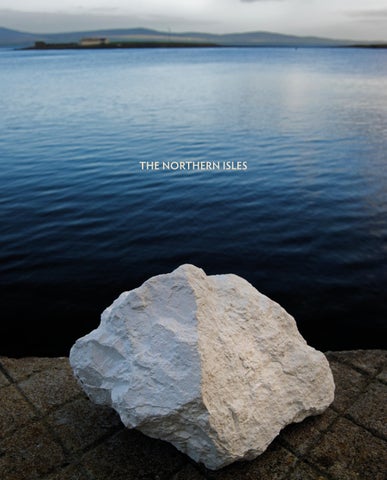
THE NORTHERN ISLES
i
ii
THE NORTHERN ISLES ORKNEY | SHETLAND | SKYE
16 Dundas Street | Edinburgh | EH3 6HZ | 0131 558 1200 | scottish-gallery.co.uk
Lerwick, Shetland
iv
The Elemental Pull of the North The Northern Isles, Orkney and Shetland, have long held a magnetic pull for artists, writers, and travellers drawn to the meeting place of land, sea, and sky. These archipelagos, cast into the North Atlantic are places where light performs continual theatre and where the line between human endeavour and nature feels both robust and fragile in equal measure. The Northern Isles is an exploration of how these islands continue to inspire both artists rooted in their landscape and those who have journeyed north to encounter them.
on the islands, those who have made them home, and others who have undertaken residencies and research in these unique settings. The exhibition is not only about geography but about dialogue: between place and person, between past and present, and between artists whose circles overlap and intertwine. Artists are not islands. Like the concentric ripples cast by a stone in water, the relationships among them expands outward; friendships, influences, and shared experiences unite them all. Included in the exhibition is painting, printmaking, furniture, jewellery, ceramic, and sculpture, each medium reflecting the rich language, shared history, and distinctive palette of the Northern Isles. Among these are remarkable examples of historical Orcadian and Shetlandic chairs, whose craftsmanship and form echo the resourcefulness of their makers and are unique to the islands. I am deeply grateful to all the artists for creating new work and for their generosity in sharing their continuing exploration of these northern landscapes and cultures.
Over the past few years, I have travelled to Orkney and Shetland on several occasions, returning most recently in the depths of winter and again during the long days of the summer solstice. Each visit reinforces the extraordinary contrast of these places: the Orcadian and Shetlandic light is, quite simply, unlike anywhere else. Orkney is suffused with calm, a light that settles with quiet assurance. Shetland is sharper and more volatile, shifting by the minute, lending the landscape a quality of survival and resilience. Both islands are otherworldly.
The Northern Isles also honours artists of previous generations whose vision helped to shape our contemporary understanding of The North. Artists for whom isolation, weather, and time were not obstacles but partners in creation.
Although united by the sea, the islands have distinct geographies and cultures. Orkney’s low, fertile land, scattered with prehistoric monuments like Skara Brae and the Stones of Stenness, speaks to millennia of habitation and continuity. Shetland, by contrast, is more rugged and elemental, its cliffs, stacks, and inlets a reminder of continual negotiation with the North Atlantic. Both island groups have deep Norse roots, having been part of the Scandinavian world until the fifteenth century, and that inheritance of independence and outward-looking connection still pervades island life today. The people of both archipelagos have long balanced self-reliance with community, craft, and an unbroken awareness of the natural forces surrounding them.
In bringing together all these artists, I hope to convey how profoundly the islands invite contemplation. They are places that resist the noise of modern life, reminding us of the scale of nature and our smallness within it. Standing on an Orkney shore or at the edge of a Shetland cliff, one feels both insignificant and infinitely connected. The artists in The Northern Isles articulate this paradox. Through their art, we are reminded that these ancient places are much bigger than us, yet through art we find a universal language that bridges that vastness.
The Northern Isles brings together artists who respond to this environment, those who were born
Christina Jansen
1
Croft House Museum, Shetland
Shetland’s Story Through Its Small Museums
On my visit to Shetland last year, I was deeply humbled and impressed by the power and vitality of its small museums. The Shetland Museum and Archives, the Croft House Museum and the Shetland Textile Museum are living expressions of the island’s resilience, creativity and memory, shaped and cared for by people who are profoundly connected to the place they call home.
museum’s collection and demonstrations by local craftspeople show how technical, delicate and labour-intensive these traditions are. The Shetland Museum and Archives reflect Shetland’s traditions and contemporary life. Its collections reflect the relationship between people, land and sea. Fishing, boatbuilding, farming, domestic crafts and everyday objects reveal a way of life shaped by necessity and an intimate knowledge of the environment.
The Croft House Museum, presented as it would have appeared in the 1870s, offers an immediate sense of how closely life was tied to the land and to survival. The low thatched roof, the peat fire, the box beds and the byre connected to the living space show how families used every available resource to endure severe weather and make the most of limited fertile land. The knowledge, skill and ingenuity required to survive in such conditions form a central part of Shetland’s story.
At a time when energy use and sustainability are common topics of discussion, Shetland provides a reminder that living in harmony with the elements requires a completely different vocabulary and attitude. The sea is a lifeline, the land is precious, and the home must be a place of security against unpredictable weather.
While Shetland experienced some of the same economic and social pressures that marked the wider Highland Clearances, the islands did not undergo the large-scale, systematic removals seen in many mainland regions. Distinct Norseinfluenced land traditions, geography and the nature of island agriculture meant that although hardship, landlord pressure and instances of displacement occurred, the traditional crofting lifestyle remained more continuous here than on mainland Scotland. This continuity is visible today in the landscape, the patterns of settlement and the strong sense of identity preserved in local memory.
What makes these museums especially powerful is the passion and generosity of the people who run them. Many are volunteers or members of long-established island families. Their stewardship comes from personal connection. Conversations with them bring the collections to life. They share stories not only of objects but of lived experience. The small museum becomes a conduit between visitor and local community, a place where history feels immediate and alive. These museums taught me that survival on Shetland is embedded in the small details of everyday life. The croft, the loom, the peat fire, the knitted garments, the boats, the close proximity to the sea and the constant need for resourcefulness inform a unique culture. They also taught me that craft, history, and community remain central to the island’s identity today. The small museums of Shetland are not only preserving the past. They are celebrating the spirit of the present and offering inspiration for the future.
The Shetland Textile Museum, housed in the historic Böd of Gremista, celebrates a heritage that is both beautiful and practical. Shetland has long been recognised for its textiles, particularly Fair Isle knitting and fine lace. These are not merely decorative arts. They were essential garments for warmth, trade and survival. Wool was one of the island’s most valuable resources and the skill involved in spinning, knitting and weaving was developed over generations. The
Christina Jansen
3
In Shetland, the croft, the loom and the knitted garment remain threads that bind past and present, preserving a unique culture shaped by resilience and community.
Croft House Museum, Shetland
4
Shetland Textile Museum, Lerwick
Megumi Barrington Uenoyama, Warebeth, Orkney
6
List of Artists Megumi Barrington Uenoyama (b.1979)
Orkney
Anne Bevan (b.1965)
Orkney
Ingrid Budge (b.1967)
Orkney
Ruth Brownlee (b.1972)
Shetland
Samantha Clark (b.1967)
Orkney
Victoria Crowe (b.1945)
Orkney
Kate Downie (b.1958)
Shetland
Peter Davis (b.1953)
Shetland
Laura Drever (b.1981)
Orkney
Roland Fraser (b.1968)
Orkney/ Shetland
Kevin Gauld (b.1980)
Orkney
Andrea Geile (b.1961)
Mainland/ Orkney
Grace Girvan (b.1981)
Mainland/ Orkney
Gail Harvey (b.1954)
Shetland
Rod Kelly (b.1956)
Shetland
Janette Kerr (b.1959)
Shetland
Diana Leslie (b.1971)
Orkney
Bet Low (1924-2007)
Orkney
Alex Malcolmson (b.1955)
Shetland
Richard Rowland (b.1944)
Shetland
Ron Sandford (b.1937)
Shetland
Sigurd Smith (b.1991)
Orkney
Patricia Shone (b.1962)
Isle of Skye
Frances Walker (b.1930)
Orkney
Sylvia Wishart (1936-2008)
Orkney
7
Megumi Barrington Uenoyama (b.1979)
I am a Japanese artist who is based in Orkney. My work reflects both my Japanese heritage, my interest in the landscape and the natural history of Orkney. The essence of Orkney’s magic is silence, loneliness, and the deep marvellous rhythms of sea and land, darkness and light George Mackay Brown (1921-1996). This quote encapsulates the unique atmosphere of Orkney, emphasising the powerful interplay of natural elements and a sense of isolation that contributes to its captivating character. My work explores the everyday rhythms of daily life and nature, exerting their influence on Orkney’s landscape, taking inspiration from the seasonal changes in the flora and fauna. I often apply gold leaf to my work to represent my memories, respect for, and reflections about Japan. Gazing at the beautiful moon and water in Orkney, I quietly recall and think of Japan with a sense of calm nostalgia.
When I first moved to the UK, I was immersed in my new culture, but over time I have come to acknowledge and respect all the different aspects of my life, and to bring them together in harmony. I am also trying to do this in my work. Curiosity and enthusiasm are my main motivations to explore my creative practice. I begin by enjoying rhythmic mark making, line drawing, Japanese calligraphy and photographing moments that captivate me during everyday life in Orkney. Printmaking is currently the most important element of my creative practice. Each printmaking process needs patience, technical attention and concentration in balance together so that I calm my excitement and work with a steady focus in a positive manner. But printmaking processes also allow me to experiment and to embrace unexpected results, capturing my respect for the rhythm, atmosphere, and motifs of each theme.
8
Photograph: Tom Johnson for Highland Park
9
1. Willow Road, 2025 copper plate etching and aquatint 28 x 38 cm
2. Orkney Pipe Bands, 2025 copper plate etching and aquatint 28 x 38 cm
RSPB Hobbister, Orkney
12
Woodcut in progress
3. Himawari Basket, 2025 Japanese woodcut 22.5 x 15 cm
4. Salmon, 2025 Sumi ink on paper 56 x 102 cm
5. Orkney Chair, 2025 copper plate etching 38 x 28 cm
6. Making an Orkney Chair, 2025 copper plate etching and aquatint 28 x 38 cm
Anne Bevan (b.1965)
Anne Bevan’s practice often turns to the sea, to what lies beneath the surface: the unseen, the submerged, the hidden stories and forgotten histories. Her ideas unfold through sculpture, photography, and video, drawing on a deep curiosity about how we experience and imagine the world around us. Born and based in Orkney, Bevan’s work is deeply rooted in her island environment. The rhythms of tide and weather, the patterns of erosion and renewal, and the traces of human and geological time are recurring motifs in her art. She studied at Edinburgh College of Art, where she first began to explore the intersection between sculpture, photography and moving image, and later returned to Orkney, where the
proximity of land and sea continues to shape her creative and intellectual outlook. Living within sight and sound of the water, she draws on this daily closeness to the marine world as both subject and metaphor. Collaboration is central to her approach. Bevan has worked alongside archaeologists, anthropologists, geologists, marine scientists, writers, filmmakers, and musicians. These interdisciplinary dialogues open up fresh ways of thinking about our relationship with place and the environment, connecting disciplines as fluidly as the tides themselves. Her projects often evolve through longterm partnerships and residencies, creating space for exchange between art, science, and storytelling.
7. Light Erratic I, 2025 digital print, edition of 30 60 x 42 cm
#. title
17
In Inuit and Innu traditions, labradorite, known as Firestone, is associated with the northern lights and ancestral spirits. Transported across the Atlantic, it took on new meanings and values in Europe, becoming prized as a semi-precious gem. Its presence in Orkney tells a story of movement and displacement, of materials and people carried by ocean currents and human endeavour alike. The stone’s shifting play of light mirrors transformations of scale, perspective, and meaning as objects travel between landscapes and cultures. Light Erratic traces these connections between people, stone, sea, and sky through sculpture, film, photography, and sound collage.
Land displaced A necessary balance on the water Carries spirits with the stone Prismatic dancers Freighted beyond memory and Refracted into new alignments Light erractics Poem by Mark Edmonds Bevan’s current project, Light Erratics, is a collaboration with archaeologist Mark Edmonds. It focuses on a remarkable haul of labradorite boulders brought to Orkney as ballast in the late 19th century. Named after the Labrador coast of Canada, this stone shimmers with a striking iridescence, flashes of blue and green that echo the Aurora Borealis.
18
8. Light Erratic II, 2025 Jesmonite, aluminium leaf H36 x W33 x D30 cm (variable)
Ingrid Budge (b.1967)
Orcadian artist Ingrid Budge creates quietly powerful and atmospheric works that explore the boundaries between photography, painting, and printmaking. Her practice centres on alternative and experimental photographic processes, particularly those that do not rely on a camera. Working with light-sensitive materials, expired photographic papers, and varying dilutions of chemicals, she abstracts familiar forms of the Orkney landscape to express its ever-changing character. Budge’s imagery often evokes the elemental drama of Orkney’s coastlines and skies, where weather and light shift constantly across the horizon. Her work captures fleeting sensations rather than fixed scenes: the movement of clouds over the sea, reflections in pools of water or glass, the textures of derelict buildings, and the quiet tension between land and air. Through these processes, she translates the physical and emotional experience of being within the landscape into visual form. She frequently works outdoors, exposing light-sensitive paper directly to the elements to create unique camera-less prints, and later continues the process in the darkroom, refining the interaction of chemistry, time,
and light. Her experiments include lumen printing, cyanotypes, pinhole photography, wet-plate techniques, Polaroid emulsion transfers, chemigrams, and photoetching. Each process reveals a different language of mark-making, echoing the rhythms and unpredictability of the natural world she observes. Budge was born and educated in Orkney, and after a period of study in Edinburgh she returned home, where she continues to live and work. Deeply connected to the islands, her art reflects both a sense of place and a personal dialogue with Orkney’s unique atmosphere. Her practice is as much about observation and patience as it is about experimentation, capturing moments of transformation where light, land, and sea briefly align. The works presented in The Northern Isles were made with a particular emphasis on the meeting of sky and land, using camera-less techniques to capture traces of light and weather. They reveal Budge’s continuing fascination with the alchemy of photographic materials and her sensitivity to the landscape that has shaped her life and art.
20
21
9. Land and Sky I, 2025 unique chemigram 11.5 x 16 cm
10. Land and Sky IV, 2025 unique chemigram 11.5 x 16 cm
11. Land and Sky II, 2025 unique chemigram 11.5 x 16 cm
12. Loch Reflections, 2025 unique chemigram 11.5 x 16 cm
Ruth Brownlee (b.1972)
Ruth Brownlee is one of Shetland’s foremost contemporary painters, known for her expressive depictions of the island’s elemental landscape. Her paintings capture the dramatic weather, shifting light and restless sea that define life at the northern edge of Scotland. Born in Edinburgh and trained at Edinburgh College of Art, Brownlee has lived and worked in Shetland for over two decades. From her studio in South Mainland, she paints the ever-changing moods of the Atlantic, transforming raw experience into paintings that are both personal and profoundly rooted in place. Shetland’s wildness lies at the heart of her practice. The island’s long horizons, sudden storms and fleeting bursts of sunlight are subjects she returns to again and again. Brownlee often works outdoors, sketching and painting directly in the landscape before developing larger works in her studio. Her painterly language is instinctive and physical, using layered acrylic and mixed media to evoke the texture of land and sea. Brushstrokes, scrapes and glazes echo the weather’s force; paint is pushed and pulled across the surface much as wind and tide shape the islands themselves. Living in Shetland offers a constant reminder of nature’s power and fragility. The sea can be tranquil or threatening within moments, and Brownlee’s paintings hold this duality, moments of serenity framed by turbulence. The intimacy of her response to place has led many to describe her work as both contemporary landscape and personal diary. Each painting is a reflection of time
spent outdoors, an attempt to translate the sensory experience of salt air, cold rain and sudden light into colour and form. Brownlee’s palette often mirrors the muted tones of the northern environment: greys, umbers and deep blues, offset by the sudden brilliance of sunlit gold or silver. Her compositions balance abstraction and observation; some verge on pure atmosphere, others retain the outline of cliffs or the line of a breaking wave. The results are paintings that feel alive, moving between stillness and storm. Although Shetland remains her primary subject, Brownlee’s work speaks to a bigger audience. Her exhibitions across Scotland and beyond reveal an artist whose themes of isolation, endurance and renewal resonate universally. To viewers from elsewhere, her paintings offer a window into a place where human life feels small against the scale of sea and sky. For Shetlanders, they hold something more intimate, a recognition of home and belonging rendered with honesty and respect. Ruth Brownlee’s paintings celebrate Shetland’s powerful contrasts: light and dark, calm and chaos, permanence and change. Her work affirms the continuing importance of the Northern Isles in Scotland’s visual culture, not as a remote periphery but as a vital centre of creative energy. For those who know Shetland, her paintings speak directly of its presence. For those who do not, they offer a vivid introduction to a landscape where the where the elemental and the human meet. elemental and the human meet.
24
13. Clearing Autumn Skies, Quendale, 2025 mixed media on canvas board 40 x 40 cm
Detail from Ruth Brownlee’s Studio, Shetland Right: Beach at South Mainland, Shetland
26
27
14. December Gales, Westside Shetland, 2024 mixed media on board 40 x 40 cm
15. North Sea Gale, Burra, 2025 mixed media on canvas board 40 x 40 cm
Samantha Clark (b.1967)
Samantha Clark is a visual artist and writer coach based in the Orkney Islands. Shaped by Orkney’s weather, sky and, above all, water, her recent paintings invite us to notice how water in its many forms permeates everything, as we inhabit a world in constant motion. Originally trained as a tapestry weaver, her thirty-year practice has moved through drawing, installation, video and public commissions, with painting as her primary focus today. She studied at
Birsay Headland Orkney Photograph: Anne Bevan
Edinburgh College of Art, the Belgrade Academy of Fine Arts and the Slade, holds an MA in Environmental Philosophy and a PhD in Creative Writing, and completed a 30-metre mural for The Balfour Hospital in Kirkwall in 2019. Her first book, The Clearing, was published by Little, Brown in 2020, and she received the inaugural RSA MacRobert Trust Art Award for Painting in 2023.
30
In her Orkney studio, Clark finds a refuge in the quiet rhythm of painting. Her practice centres on being fully present to the unfolding moment: the surface, the paint, and the gradual emergence of form. Working instinctively, she allows each painting to shift and evolve, discovering a different sense of time that deepens with every mark. The slow, repetitive process becomes a way of holding the complexity of the world without seeking to explain
or resolve it. Her paintings are in direct conversation with the land, water and wind of the Northern Isles. They open outward into the landscape while reflecting an interior world, tracing a fine balance between joy and loss, stillness, and motion. Clark searches for a kind of peace amid the beauty and uncertainty of modern life; her practice is a quiet momentum that carries forward into an unknowable future.
31
16. The Wave, 2025 acrylic and brass leaf on aluminium panel 110 x 180 cm
17. Dawn, 2025 acrylic and brass leaf on cradled board 51 x 61 cm
18. Dusk, 2025 acrylic on cradled board 51 x 61 cm
19. Lunar Corona, 2025 acrylic on cradled board 51 x 61 cm
20. Immersion, 2025 acrylic and brass leaf on cradled board 51 x 61 cm
Victoria Crowe (b.1945)
was therefore the thing to explore as I was always aware of how the daylight was either struggling to assert itself or heralding the early darkness with sunsets around 3.30pm. I went in time for the full moon, in the early part of the month, so that I could work with night skies and the luminosity of moonrise. I worked in Stromness for a couple of nights to see the moon and sky reflected in the water of Hamnavoe. At the residency in Birsay, the moon rose in the east-facing window of the studio. This gave me several nights to study and paint the brilliance, subtlety, and colour of moonlight on fastmoving clouds when the land was enveloped in winter darkness. Occasionally, tiny lights from dwellings and car lights flared on distant fields, but everything was dominated by the moonlight above, within the vast distances of the sky. In spring of 2023, I began a series of monotypes and prints at the Edinburgh Printmakers workshop. Over the years that I have observed landscape, these recent starting points have offered me new possibilities by heightening my perception of the liminal power of light.
In 2022, I visited Orkney as part of the RSA and Pier Arts Centre Residency award, looking specifically at the contrasting light around the summer and winter solstices. The residency and resulting work from this were completely out of the usual studio routine, a very different subject matter of vast sky, land and sea, with a focus on the changing light. Starting points, things from the beginning, source material, may not always look or sound much, but they contain the rich germ of evolving ideas. These are essential working tools for the artist, putting down the initial response, the first intention, and groping towards an external realisation of the experience with all its complex overlays of memory and association. Materials were an assortment of pre-primed paper, sketchbooks, fluid media like ink and watercolour, enabling me to work quickly and respond to the many new starting points that Orkney presented me with. I enjoyed the process of that period of discovery. My first trip to Orkney was in June 2022, at the point of solstice. The second part of the residency was made five months later, in November, when there were just six hours of daylight. The darkness
Victoria Crowe, Low Winter Sun The Scottish Gallery, 2023
38
21. Threshold Between Sky and Sea, Known and Unknown, 2023 oil on linen 88 x 102 cm
Victoria Crowe at Birsay, Orkney Photograph: Ken Gray
40
22. Stone Pavement, Yesnaby, 2024 watercolour and ink on paper 29 x 38 cm
23. Brough and Sky Above, 2022 acrylic on paper 20 x 30 cm
24. Shielded Sky, 2022 oil on canvas 20.5 x 24 cm
25. Night Reflection, 2024 stone and plate lithograph with monotype 38 x 51 cm
26. Midnight Dawn, 2024 stone and plate lithograph with monotype 38 x 51 cm
Kate Downie (b.1958)
veiled washes of colour, whereas I am perhaps more responsive to the raucous play of the wind & water upon this rugged land. Happily, we had much in common; our shared experience as artists, our mutual appreciation of certain painters who had altered our sense of what painting could be, how they interpreted the land through their vision: Helen Frankenthaler, Morris Louis, Georgia O’Keeffe, those mid-20th Century pioneers of open spaces and imagination. There we were, made tiny by the grand craggy cliffs, walking and talking art and the pleasure of moving amongst this giant land: the turf of Silwick’s eroded edges with plunging depth to our left and the brave calligraphic grasses clinging to the tops of the vast rocky shard-islands as the tides swirled below.
In August 2025 I travelled with my partner by rail and ship to the archipelago of Shetland for the first time to meet with fellow artists and explore the contrasting geology and grasslands of this beautiful place. Towards the end of our Shetland journey, we visited Peter Davis, the watercolourist nonpareil, who kindly guided us to the edge of his walkable land. We found ourselves teetering upon the cliffs at Silwick absorbing the full sun and the shimmering blue infinity of the ocean, keenly feeling the heady risks, the contrasts of substance and absence beneath our feet. Peter confessed his preference for wilder days of storm and ambiguous light filtered through cloud and fleeting weather patterns which he expresses so beautifully in his
46
47
There we were, made tiny by the grand craggy cliffs, walking and talking art amongst this giant land..
Silwick Edge, Shetland Photograph: Michael Wolchover 48
49
27. Silwick Edge I, 2025 watercolour and collaged ink painting on paper 100 x 52 cm
28. Silwick Edge II, 2025 watercolour and collaged ink painting on paper 100 x 52 cm
Peter Davis (b.1953)
in 2023 elected him as a member (RSW).
For more than forty years, Peter Davis has pursued a singular vision through the medium of watercolour, exploring the delicate intersection between artistic intent and the elemental forces of nature. His work, deeply rooted in the landscapes of the Northern Isles, conveys not only a sense of place but also an emotional and philosophical engagement with the natural world.
Davis’s career is shaped by both discipline and instinct, qualities essential to mastering watercolour’s mercurial nature. You just go with the flow and learn to handle the mistakes better. In this, Davis acknowledges the impossibility of total control over a medium that mirrors the very conditions he paints: shifting, unpredictable, and alive. For Davis, watercolour is the most natural of all painting media. Comprised simply of pigment, gum arabic, and water, it embodies the same dualities that define the northern landscape, stillness and movement, clarity, and opacity, calm and turbulence. As the water evaporates and leaves pigment on the paper’s surface, the process itself becomes a metaphor for weathering, for the quiet endurance of the land beneath the passage of wind and rain.
Born in North Shields, Davis studied art and design at Northumberland College of Education, graduating in 1975. After teaching in Cumbria, he moved north to Orkney in 1981, where he established his own gallery and began his lifelong dialogue with the islands’ light and weather. A decade later, he settled in Shetland, where the raw edge of sea and sky became central to his art. Since retiring from teaching in 2013, Davis has devoted himself entirely to painting. His contribution to the medium has been recognised by the Royal Scottish Society of Painters in Watercolour, who awarded him the John Busby Award for excellence in contemporary watercolour, and
Unlike oil or acrylic, which allow correction and reworking, watercolour is a medium of irreversibility. Each wash and brushstroke records a decision, a fleeting moment of perception. In Davis’s hands, this immediacy
52
Westerwick, Shetland 53
northern landscapes where weather, time, and memory converge, that his art feels most at home. His paintings invite contemplation. The viewer senses movement, waves shifting, mist lifting, the slow drift of light, within the stillness of the image. His works remind us that the landscape is never static, that what we see is always in transition.
becomes an act of mindfulness. His paintings capture not just the appearance of a scene but the sensation of being within it; the shifting weight of cloud, the glint of light on wet stone, the vibration of air before a storm. Although his work is often inspired by specific places in Orkney and Shetland, Davis resists literal representation. He writes of seeking the uncertain balance between abstraction and reality, a phrase that encapsulates his approach. His landscapes hover between recognition and evocation: familiar yet dreamlike, tangible yet dissolving into the atmosphere. The Northern Isles have long offered Davis an inexhaustible source of visual and emotional stimulus. The relationship between land and sea, the mutable skies, and the clarity of light all feed into his work. It is in the
Davis does not dramatise the northern environment; he listens to it. The restraint of his compositions, the whispering tonal shifts, and the meditative clarity of his approach reveal a painter who has learned from both the discipline of teaching and the freedom of weather. In the subtle interplay of water and pigment, Peter Davis captures something enduring: the spirit of the Northern Isles themselves, poised between stillness and flow.
54
29. Simmer Dim, 2025 watercolour on paper 50 x 70 cm
30. Swuml, 2024 watercolour on board 21 x 29.5 cm
31. Fooster, 2025 watercolour on paper 50 x 70 cm
Laura Drever (b.1981)
gleam through the surface, creating a sense of depth, movement and time within the work.
Laura Drever is an Orcadian artist whose work arises from a profound engagement with her native landscape, experienced through the act of walking, looking and remembering. Born in Kirkwall, she studied Drawing and Painting at Edinburgh College of Art, graduating in 2003 with First Class Honours. For more than two decades, she has explored Orkney’s shifting light, hills, and coastline, developing an intimate understanding of the islands’ rhythms and their continually changing atmosphere.
Drever’s paintings are not straightforward depictions of place but reinterpretations that balance recognition and abstraction. Her compositions distil the essence of Orkney’s landscape into fields of tone, rhythm and shifting light. The white of the canvas often plays an active role, suggesting air and distance while inviting the viewer to complete the image through their own perception. The result is work that conveys both the solidity and transience of the northern environment.
Her practice begins outdoors, where she spends long periods walking and observing the terrain, the movement of weather, colour and the flight of birds. These experiences are then recalled and reimagined in the studio. Drever rarely works from direct sketches or photographs, preferring to translate memory and sensation into paint through a process that is as meditative as it is physical. Layers of colour are applied and reworked, sometimes veiled and sometimes allowed to
Many of her titles draw on Orcadian dialect and Norse-derived place names, which anchor her paintings in a strong sense of locality while also introducing an element of poetry and layered meaning. Language and landscape remain intertwined.
58
59
Laura Drever in her Studio, Kirkwall, Orkney
In addition to her own practice, Drever plays an active role in Orkney’s creative community, supporting local art initiatives and sharing her experience with other artists. Her paintings, drawings and prints speak of a lifelong relationship with place and the patient observation of light and weather. In the context of The Northern Isles, her work offers a contemporary interpretation of the northern landscape: one that is deeply rooted in the experience of being within it, alive to its changeability, and open to its quiet revelations.
Over time, Drever’s work has become more ambitious in both scale and expressive energy. Her larger canvases heighten colour and movement, while smaller works often form sequences or clusters that share a rhythm of line and motif across several pieces. This compositional approach gives her exhibitions a cumulative energy, echoing the experience of walking through the islands and encountering the landscape in motion. Her artistic influences include Sylvia Wishart, a fellow Orcadian painter (pages 176-183) whose sensitivity to light and place resonates strongly with Drever’s approach, as well as Wilhelmina Barns-Graham and Bet Low (pages 120-123), whose work combines abstraction with the geography of the Scottish islands.
Smoogro: Location along the coastal walk from Waulkmill to Orphir Hesta: Location along the coastal walk from Birsay to Costa
60
61
32. Smoogro, 2025 oil on canvas 100 x 100 cm
33. Hesta, 2025 acrylic and ink on fabrino paper 48 x 47 cm
66
Tom Kent, David M. Kirkness using a Weaving Loom, Orkney Library & Archive
The Orkney Chair
The Orkney chair is one of the most recognisable pieces of Scottish vernacular furniture, originally valued not for style but for practicality. Made in a (mostly) treeless landscape, its distinctive high straw back offered essential protection from wind and cold, using driftwood for the frame and tightly coiled oat straw shaped entirely by the maker’s eye. Marram or bent grass secured the coil to the uprights, creating a strong, insulating barrier. Early chairs often had solid, boxed-in seats designed to block draughts and reflect heat from the fire. Some included small drawers for storing documents, a bible, or even a bottle of whisky. Hooded versions - heidit stuls - provided even greater shelter, and the chairs came in sizes from child to larger domestic versions, with occasional rocking examples. Though now highly collectable, with examples in the V&A, London, Orkney chairs began as functional household objects shaped by climate, resourcefulness, and local craftsmanship.
Hooded Orkney Chair, c.1890 (cat.34) In the exhibition, we have an example of a full-size hooded Orkney chair with an under-seat drawer, dating to circa 1890. The form is closely aligned with the late nineteenth century designs popularised by the Kirkwall chairmaker David Munro Kirkness, whose workshop played a pivotal role in standardising and commercialising the Orkney chair. Key features include the enclosed hooded back rising above a straw weave, characteristic scrolled arms, square legs with stretchers, and a finely constructed drawer beneath the seat. The patina on both wood and straw is consistent and well-aged, lending visual unity to the piece. The presence of original finish wear, repair history in matching timber, and overall craftsmanship suggest a high-quality example of the late Victorian Orkney tradition.
34. Hooded Orkney Chair, c.1890 wood with straw back H140 x W64 x D60 cm 35. Shetland Chair, c.1780 elm and pine H94 x W56 x D43 cm
68
This Shetland chair is a fine example of the vernacular chair making tradition of Shetland, a form that remained largely unchanged from the early 18th through to the early 20th century. Its frame and panel, or wainscot construction, together with the shaped cresting rail and pincer arms, recalls 17th century designs that persisted in the Northern Isles and Scandinavia long after they had fallen out of fashion elsewhere.
necessity of using whatever was available, often driftwood or timber salvaged from maritime vessels. The low seat height is typical of Northern Isles furniture and is thought to relate to crofting life. Many crofts lacked a proper hearth, relying instead on a simple roof vent for smoke escape; by sitting low, occupants could remain below the smoky layer that filled the upper air of the dwelling. Moreover, as tables were rare and utensils were often placed on the floor, a low seat proved more practical for daily use.
The use of mixed timbers reflects the scarcity of wood in Shetland and the
69
36. Boarded Orkney Chair, c.1850 pine H111 x W66 x D43 cm
This rare boarded Orkney chair predates the more familiar woven examples. While sharing features with lambing chairs found elsewhere in Britain, such as those from Lancashire, it possesses a distinctly Northern Isles character, with related examples recorded in Shetland and Scandinavia. The enclosed wings and high back, together with the solid panelling below the seat, derive from medieval seating forms designed to shield the sitter from cold and draughts in simple croft interiors. These chairs were often used during the lambing season, placed in barns to allow crofters to keep vigil over their ewes. Typically made by a local wright for everyday use, such chairs are notable for their plain, unadorned appearance. The late collector Peter Powell captured their character perfectly when he observed that it invites you to sit in it, but in a Presbyterian sort of way. A very similar example, held by the Orkney Farm and Folk Museum, Kirbuster, is illustrated in Bernard D. Cotton’s Scottish Vernacular Furniture, where he notes that such boarded chairs display less exacting constructional details than those found in the straw backed chairs. Locally, these Orkney chairs were known as heided stuls.
Roland Fraser (b.1968)
Roland Fraser creates sculptural furniture and relief panels that merge fine art with traditional craftsmanship. His work is rooted in a profound respect for materials and the histories they contain. Using timber salvaged from old furniture, farm buildings, and found structures, Fraser assembles new forms from fragments marked by time, use, and human presence. My wooden constructions are a synthesis of assemblage, collage, and craftsmanship. I choose pieces that bear the traces of past lives, the wear of surfaces, the ghost of a missing hinge or lock, the residue of human touch. These marks give the material an almost totemic quality. For The Northern Isles, Fraser has created a modern Orkney Panel Chair, inspired by surviving examples from the 19th century. The chair incorporates found wood from the coastal settlements of Cellardyke and Portobello, its surfaces burnished by age and salt air. The faded blue-green and brown patination, once the standard colours for fishing vessels, carries the memory of the ocean itself. Designed to enclose the sitter and provide shelter from the harsh, windy
climate of the Northern Isles, the chair continues a local tradition of functional beauty. A curious and enduring feature of these chairs is the drawer beneath the seat, whose purpose has been described variously by Orcadians as storage for tools or the family Bible. Perhaps the most evocative account is that they were presented as marriage chairs, the drawer filled with water so that the bride and groom could sit in turn while having their feet bathed by relatives, a ritual gesture of welcome and renewal. Fraser’s reimagining of this form honours both the craftsmanship and folklore of the islands. His work combines the precision of a restorer, the imagination of a fine artist, and the sensitivity of a musician, balancing rhythm, texture, and history in a single, unified composition. Roland Fraser is also a musician, comparing his process to composing, balancing rhythm, tension, and harmony. His constructions invite the viewer to read the language of wood not as static matter, but as a living record of use, memory, and transformation.
37. Orkney Chair, 2025 salvaged pine, with original 19th-century painted finish H113 x W67 x D50 cm
73
Kevin Gauld in his Kirkwall Studio, Orkney
74
Kevin Gauld (b.1980)
The Gents Orkney Chair (cat. 38) illustrated overleaf is one of two traditional strawbacked chairs that I am showing in The Northern Isles. Together, these works represent the two main styles of Orkney chair that are still made in the islands today. The illustrated chair is the more well-known, iconic style of Orkney chair. Its high, enclosed back gave an Orkney crofter maximum shelter during harsh winter nights. Traditionally, the frames of Orkney chairs were made from whatever wood could be scavenged or repurposed - timber washed up on the shore or any usable offcuts. This example is made from Scottish ash, a wood with a long history in Scotland for making functional and beautiful objects. With many ash trees now falling victim to ash dieback, the idea of scavenging for suitable material has a new relevance when constructing Orkney chair frames today.
unique chair, where both the timber for the frame and the straw for the back was grown in Orkney. An Orkney creepie complements an Orkney chair perfectly. This sturdy stool epitomises Scottish vernacular furniture, historically an essential piece in a croft where space and resources were scarce. An all-purpose object, it was used for sitting on while milking a cow or sitting by the fire but could just as easily function as a small table or workbench. Its enduring form often features a hole in the top so that it can be easily carried from one task to another. Alongside the making of Orkney chairs, making creepies highlights the resourcefulness of Orkney crofters and how they defined furniture in the Northern Isles as both practical and beautiful. As a teenager I started making things from cuttings of wood that I scavenged from a few different sources. That instinct has never left me. From the furniture that I make today, I always have pieces of wood left over, and I continue to make things from these offcuts, just as I did when I started over thirty years ago. The wooden-based baskets that I make grew from that approach. They are not only designs that make use of these cuttings but also help preserve the heritage techniques used for stitching straw. Each basket is individual and has a link, through its wooden base, to something else that has been made within my studio.
The second chair (not illustrated) is the fanback style, which is thought to be an earlier form of Orkney chair. Its frame requires less wood, but the curved shape of the back still gathers around the sitter and provides shelter and warmth within an Orkney croft. Early Orkney chairs were always made from whatever local timber could be sourced, and a shipwreck often provided a good supply of wood and other materials. The frame for this fan-back chair is made from a locally sourced sycamore tree which, when looked at closely, offers beautiful character. It is a
75
38. Gent’s Orkney Chair, 2025 Scottish ash, oat straw and seagrass H107.5 x W57.5 x D64 cm
Kevin Gauld’s Kirwall Studio, Orkney
Andrea Geile (b.1961)
Orkney has held a special place in my life since my first visit in the early 1990s. What began as a trip to visit friends has grown into a lasting source of fascination that continues each time I return to the islands. In 2024, I was delighted to receive the Stephen Palmer Travel Bursary Fund to undertake a research trip to Orkney Mainland. The aim was to study coastal and marine plant environments. I had the fantastic opportunity to view the Magnus Spence Herbarium Collection at the Stromness Museum, particularly its remarkable collection of 390 seaweed specimens. Local artist friends joined me on coastal walks and foraging trips, and during these visits to the seashores I began to form ideas inspired by the shapes and colours of the tidal zone. Back in the studio, these impressions evolved into a new series of cube sculptures, each block representing an element of the environment, whether natural or human made. Once stacked, they create a complete landscape, a reflection of Orkney’s balance between nature and human presence. My next trip to Orkney is already planned, and I look forward to once again being challenged and inspired by Orkney’s unpredictable, ever-changing conditions.
78
79
Andrea Geile at work Photograph: Sandra Beckefeldt
39. Wild Walk, 2025 hand-cut Corten steel, metal, cast iron H81 x W23 x D23 cm 40. Heading to the Ness, 2025 hand-cut steel, resin, gouache H111 x W26 x D26 cm 80
Grace Girvan (b.1981)
I grew up on South Ronaldsay, the southernmost island in Orkney that is connected to the mainland by the Churchill Barriers. My childhood was spent on a farm, surrounded by open space and the outdoors. My grandparents lived very close by, and if there weren’t cattle in the fields, we would head straight across to visit them. Otherwise, we would take the road, which passed by the beach. That beach became an important place for us; we would often go there to search for Groatie Buckies (arctic cowries), smooth pebbles, and to watch the curious seals basking on the rocks.
I use transparent enamels in soft blues, greens, and greys on silver. The silver beneath creates a luminous glow through the enamel, echoing Orkney’s unique light. By matting the surface of the enamel, the colours take on a watercolour-like softness, reminiscent of the landscapes I love. The pebbles themselves are always left unaltered, flat, smooth, and with naturally regular edges. I feel it is more honest to use them exactly as they are. Recently, I have been embracing their variety, celebrating the different hues and textures that reflect Orkney’s rich geology.
When I return to Orkney now, what strikes me most is the vastness of the sky. The land is relatively flat and there are very few trees, so the sky feels endless. The special quality of the light, combined with that great sense of space, is something I treasure deeply. The beach I most often return to is Chapel Point, the same one we used to visit on the way to my grandparents’ house. The pebbles there are perfectly formed, flat, smooth, and need no cutting, polishing, or shaping. I use them exactly as I find them, in their natural state.
When I am in Orkney now, I am more intentional. I try to slow down, to absorb the landscape, the light, and the colours that inspire me. I take photographs, I collect pebbles, and I let those experiences feed into my designs. Collecting pebbles has also become a family ritual. My parents often join me, and they have an excellent eye for the shapes I am looking for. When I work with certain pebbles, I remember who picked them up, or I recall the exact beach where I found them. That connection to my family, to place, and to memory feels as important as the physical material itself. I am still excited every time I find a new pebble; their beauty never ceases to amaze me.
As a child, I was far more interested in finding Groatie Buckies than pebbles. They can be hard to spot, so my mum would sometimes help us by finding one, marking a large circle in the sand around it, and leaving it for us to discover. I also remember my cousin once finding an almost perfectly spherical pebble. We were so fascinated by it that we played with it like a ball at our grandparents’ house.
Some of my favourite places to collect include the beach at Chapel Point, Newark or Dingieshowe in Deerness, and the beach at the fourth Churchill Barrier on South Ronaldsay. Each of these places holds its own sense of discovery and connection to home.
In my work, I aim to translate the colours, light, and calmness of Orkney into jewellery.
82
83
Grace Girvan outside her studio, Burntisland, Fife
Newark Bay, Orkney
84
The pebbles there are perfectly formed, flat, smooth, and need no cutting, polishing, or shaping. I use them exactly as I find them, in their natural state.
41. Scatter Brooch, 2023 Orkney pebbles and silver H6.5 x W4.5 cm
86
Glimpse Holm, Orkney
42. Rockpool Necklace, 2025 Orkney pebbles and silver L50 cm
What strikes me most is the vastness of the sky… the special quality of the light, combined with that great sense of space, is something I treasure deeply.
Bay of Skail, Orkney
88
43. Overlap Necklace, 2025 Orkney pebbles, large Shetland pebble (from the St Ninian tombola) enamel and silver L55 cm
Gail Harvey (b.1954) sparkles bouncing into cliff shadows and find myself wondering, can paint convey this smoky quality of inner lit darkness?
At the end of my first year at the Glasgow School of Art, I came to Shetland in 1973. I spent the summer packing kippers in a fish factory in Lerwick. On days off, my friend and I would head out of town to explore. We walked and hitched lifts across miles of single-track roads. These narrow and winding routes linked distant corners and turn offs and everywhere felt truly remote. We met so many friendly people. Families took us in, fed us and were so kind. Looking back, my fondest memories are of the people, their open generosity, daft sense of humour, enthusiasm and resourcefulness, all of which I really admired.
Alongside the daydreaming there are daily walks and sometimes swims in the sea. I love this immersion in the weather and waves. It is a constant reminder of the full force and energy of nature. In my studio I am always trying to balance this wilder power with the more delicate, fleeting moments of light. I love paint for its surprises, the way it behaves unexpectedly, much like the light outside can still surprise me after all these years.
That summer of 1973 turned out to be one of the last precious glimpses of Shetland before the oil era.
The large oil paintings take time. I am always looking for a way in, a sense of where the work wants to go. It can be a real mystery how a direction emerges. At times it begins to take on a personality of its own, and I cannot force it. It is important that the painting echoes the natural world outside and has breathing space.
Shetland pulled me back and I returned with my husband Robert to live here in 1988. I have stayed and worked in the same spot for thirty-seven years. It feels like a dream, so many years watching the light and weather shift and play around me. I daydream a lot. I will be watching sea
My aim is always to find a simple, intuitive flow between paint, light, weather and sea.
90
View frrom Gail Harvey’s studio, Shetland
91
92
Scousburgh, Shetland Left: Gail and Yogi
93
44. Clearwater, 2023 oil on canvas 150 x 170 cm
45. Winter Surf, 2025 oil on canvas, 70 x 120 cm
46. Gannet Flying, Winter, 2024 mixed media 20 x 20 cm
47. Flying Spray, 2025 oil on canvas 107 x 117 cm
48. Flowing, 2025 mixed media 25 x 30 cm
49. Winter Sun, c.2016 mixed media 93 x 100 cm
50. Inside the Wave, 2025 mixed media 25 x 30 cm
51. Light on the Water, 2025 mixed media 25 x 30 cm
52. Rockpool with Sky Reflections, 2025 mixed media 25 x 30 cm
53. Shoreline, 2025 mixed media 25 x 30 cm
Rod Kelly (b.1956)
his enduring fascination with the sea and his ability to translate movement, light, and life into precious metal. His practice is about dedication, craft, and place - a lifelong dialogue between the maker, the material, and the elements.
Master silversmith Rod Kelly creates work that carries the quiet rhythm of time and tide. Living and working by the sea in Shetland, he draws daily inspiration from the shifting light, weather, and wilderness around him. It can’t help but feed in, he says, because my studio overlooks the sea and the sea changes every day.
A graduate of the Royal College of Art, Rod Kelly has worked for over four decades, creating ecclesiastical and civic silver for institutions such as St Paul’s Cathedral, New College, Oxford, and No. 10 Downing Street. His work is held in major public collections including the V&A, the National Museum of Scotland, and the British Museum. Kelly is a Liveryman of the Worshipful Company of Goldsmiths’, a Freeman of the City of London, and founder of the South House Silver Workshop Trust, which supports and mentors young silversmiths from his studio on Muckle Roe.
Kelly’s pieces are entirely handmade using traditional silversmithing techniques, the metal chased slowly into form with great patience and precision. His creative process begins with research, drawing, and the study of textures in stone, wood, and nature, gradually building towards a balanced, harmonious design. For The Northern Isles, Kelly has created Fishy Beaker, a silver vessel chased in low relief with swirling fish, inlaid with pure gold and finished with a gilt interior. It reflects
104
Rod Kelly at Muckle Roe, Shetland
105
106
54. Fishy Beaker, 2025 silver and gold H10.5 x Ø8 cm
Janette Kerr (b.1959)
My paintings emerge from responses to sound and silence within the landscape; they explore movement and the rhythms of sea and wind, swelling and breaking waves, the merging of spray with air, advancing rain and mist, glancing sunlight – elements that seem to touch on something intangible.
headlands and wind-swept waters. Her process reflects this: My process of making paintings involves extremes and instabilities: peripheries and promontories – places of rapid change and shifts, both physically and meteorologically. Over the past fifteen years Jeanette Kerr has focused primarily on Shetland and the far north, travelling to remote and weatherworn places including Norway, Svalbard, Iceland and Greenland. Immersion is central to her practice: walking, observing, and making work en plein air as a way of understanding and responding to landscape before returning to the studio.
Janette Kerr’s work captures the shifting, transitory nature of the sea and weather. Her paintings are grounded in direct experience, an engagement with the raw, ever-changing forces of nature. Kerr studied fine art (completing a PhD in Fine Art at the University of the West of England in 2005) during which she deepened her thinking around the making of work in extreme and mutable landscapes. She also taught fulltime as a lecturer in painting, printmaking and drawing at the City of Bath College from 1980 to 1993, which helped shape her commitment to process, pedagogy and the dialogue between observation and material. Over the years, Kerr has held roles of institutional leadership (including serving as President of the Royal West of England Academy between 2011-2016) and she remains an Honorary Academician of the RSA, Edinburgh.
I have tried to embed myself within the landscape and culture of Shetland, exploring its historical relationship with the sea – through its fishing traditions, stories and lived realities – and to engage with oceanographic ideas through conversations with Norwegian scientists studying the unpredictable nature of waves and wind across shared waters. The landscapes I draw from are full of histories and memories, of people and natural forces, reflecting a continual mutability of place. Janette Kerr divides her time between Shetland and Somerset. She exhibits regularly across the UK, and her work is represented in private and public collections nationally and internationally.
Described by Brian Fallon, Chief Critic of the Irish Times, as ‘the best painter of the sea in these islands,’ Kerr has long been drawn to the edges of land and sea, to exposed
108
109
55. A Blinkie Day 2, Huxter, Shetland, 2025 oil on gesso panel 25.5 x 25.5 cm
56. Cold Wind - Sea Heaping Up, Shetland, 2025 oil on canvas 65 x 95 cm
57. Lünabrak, Voe of Dale, Shetland, 2025 oil on gesso panel 20 x 25.5 cm
58. Under a Skumie Sky, Brindister Voe, 2025 oil on gesso panel 30 x 40 cm
Diana Leslie (b.1971)
I was born in Orkney. I went to the Glasgow School of Art and graduated in Drawing and Painting in 1998. My second subject was printmaking. Orkney stayed with me while I wasn’t here. So I came back in 2006 to live and work as an artist. Landscape has become a big subject for me. I paint Orkney outside. The wind and dynamic light are energies which make me happy; they fly by while the mass is going nowhere. I move between source material depending on the weather, painting flowers, drawing from other artists, drawing from collaborations which make me see things differently. I’m content with the idea that if I represent my here and now it has some currency. And painting has a magical property. It can hold on to energy and strange things like freedom, even when the artist is long gone. Diana Leslie
she continued to refine her skills at The Prince’s Drawing School in London before returning to her native Orkney in 2006 to establish her studio in Stromness. The landscapes, light and weather of the islands have remained her enduring source of inspiration.
Diana Leslie, born in 1971 in Orkney, is an artist whose practice encompasses painting, printmaking and drawing. After completing her studies at the Glasgow School of Art,
Leslie explores how painting can capture energy and spirit, translating the fleeting qualities of light, motion and atmosphere into enduring images that reflect both place and presence.
114
Her work is rooted in observation and she often paints outside, responding directly to the conditions of wind and shifting light. These elemental forces animate her compositions, bringing to her paintings an immediacy and vitality that reflect the unique character of the islands. Her imagery often includes local flowers, gardens, townscapes and shorelines, revealing both the human presence within the landscape and the artist’s personal connection to it.
59. Carnations and Cards, 2025 oil on paper 27.5 x 46.5 cm
60. The End of the Tulips, 2025 oil on paper 24 x 42 cm
61. Orchid and Nasturtium, 2025 oil on paper 35 x 46 cm
62. Yesnaby, 2025 oil on paper 22 x 44 cm
63. The Merlin, 2025 oil on paper 45 x 21 cm
119
Bet Low (1927-2007)
Bet Low was a painter best known for her deceptively simple watercolours of Scottish landscapes. She also produced expressionist drawings of post-war Glasgow, portraits, atmospheric oil paintings and, later, finely detailed and haunting pencil drawings.
in its cosmopolitan atmosphere, surrounded by actors, writers, folk singers and artists. Living in a cold room on Sauchiehall Street, she supported herself through odd jobs at Unity Theatre and illustration work for periodicals, while painting portraits of actors and stage crew. In 1946, she joined the Clyde Group of Writers and Artists, whose manifesto was to take art to the people. She helped to organise exhibitions and poetry readings across Glasgow and produced evocative street drawings that now serve as a historical record of the time.
Born in Gourock, she developed an early love for landscape and the sea. At Greenock Academy, she showed talent in both art and music, winning the Rankin Art Prize. In 1942, she entered the Glasgow School of Art, where one of her tutors was David Donaldson, later the Queen’s Limner in Scotland. Among her friends were Benno Schotz, Joan Eardley, Stanley Baxter, Jack Gerson and Ian Hamilton Finlay.
Low exhibited with the Society of Scottish Independent Artists, had paintings accepted by the Royal Glasgow Institute, and took part in shows at the New Art Club, founded by J. D. Fergusson and Margaret Morris. They became friends and mentors, supporting her and other independent artists. In 1956, she joined them in organising the first open-air exhibitions on the railings of Glasgow’s Botanic Gardens.
After art school, she spent three months at Hospitalfield, Arbroath, under the guidance of James Cowie, who encouraged her interest in literature, drama, poetry, politics and philosophy—an intellectual curiosity that remained with her throughout her life. Low briefly attended teacher training college at Jordanhill but found the experience uninspiring. A chance encounter with Stanley Baxter led her to Glasgow’s newly formed Unity Theatre, where she became involved with rehearsals and never returned to teaching. Unity Theatre shared a building with the Refugee Centre, and Low thrived
Low joined the Glasgow Group Society in the mid-1960s and exhibited regularly with them. In 1985, the Third Eye Centre, Glasgow, held a major retrospective exhibition of her work. Edited extract from Bet Low’s Obituary, The Herald, 2007.
120
64. Glimps Holm from Burray I, c.1980 watercolour on paper 20 x 26 cm
From the late 1960s, Bet Low’s connection with Orkney became central to her life and work. In 1967, she and her husband, the journalist Tom Macdonald, bought a small cottage at Lyness on the island of Hoy. Although she continued to live and work in Glasgow, the landscape of Hoy, with its vast horizons and ever-shifting light, came to define much of her later painting. In Orkney, Low’s style evolved towards a language of quiet reduction and poetic clarity. The complex, urban expressionism of her early Glasgow work gave way to a restrained, contemplative approach in which land, sea and sky were distilled into broad tonal fields and simple geometric divisions. The Orkney paintings, often made from sketches and notes developed later in her studio, convey a deep sense of stillness and space. Her island works reflect an intuitive understanding of the northern light, luminous, spare and at times austere and an emotional connection to place that transcends literal description. Critics have observed that in these works Low achieved a balance between abstraction and observation, creating landscapes that are both profoundly personal and universally resonant. She spent many summers on Hoy, where her friendship with the poet George Mackay Brown led to a collaborative poster poem: Orkney, the Whale Islands. The Orkney period marked a culmination of her lifelong engagement with landscape, culminating in paintings that remain among the most meditative and distinctive in modern Scottish art.
65. Approaching Storm, c.1977 oil on canvas 75 x 75 cm
Alex Malcolmson (b.1955)
the worn and weathered was ingrained in most Shetlanders, particularly those, like my parents, who grew up on a croft and although much diluted I still carry that sensibility with me to this day.
I grew up in Shetland before the discovery of North Sea oil, at a time when traditional ways of life - crofting, fishing, and seafaring - had remained largely unchanged for generations. Like many Shetlanders, my family came from this background. I was raised in Lerwick, close to the harbour and the constant comings and goings of boats, but I spent as much time as possible with relatives on a croft.
My constructions often contain repurposed elements - not only for their practicality, but for the history and character they bring. If an old box or bit of timber, particularly a part of a boat, has a history and the patination of time, it can bring something that energises the work and can shift the direction of a piece in a way that a newly modelled element rarely can.
Summer holidays were spent cutting peats, working with sheep, tarring the roof, and making hay. On a croft, very little was wasted, repairing and repurposing materials was a normal part of life. Although in the 1950s and 60s this might not have been so critical, within living memory it had been necessary for survival. That ethic of making do, of finding value in
After studying at Edinburgh College of Art, I returned to Shetland to work as a peripatetic art teacher, travelling between schools across the islands. It was enjoyable and challenging, but creatively limiting, and
124
Alex Malcolmson at Vaila, Shetland
after a few years I moved on. In the 1970s, Shetland offered relatively few opportunities - creative or otherwise - so I returned to Edinburgh becoming a curator, and later opened my own gallery in Harrogate. I ran it full-time for 25 years and continue to do so in a more limited way. Though I haven’t lived in Shetland for over forty years, it remains central to my work. Most of my ideas originate there, and I return regularly to reconnect and replenish. The birds, the shoreline, the maritime environment and artefacts - all are embedded in my visual memory and continue to inform the things I make. Original works of art didn’t figure much in Shetland households, although a croft house could well have had a pierhead painting or a ship diorama - a prized possession, a
125
memory of voyages and a ship which may have taken the owner around the world. While I’ve spent much of my life immersed in fine art, I’ve always been drawn to objects created outside that sphere - the work of individuals, sailors perhaps, whose names are usually unrecorded but were able to make works that possess a quiet, functional beauty. These influences sit alongside a longstanding admiration for the work of artists such as Friedrich, Picasso, Wallis, Cornell, and Nicholson. I’ve also been fortunate to have the guidance and friendship of contemporary artists whose work I deeply respect, including Mark Hearld, Will Maclean, John Maltby, and Guy Taplin.
66. Harpoon Log, 2023 mixed media box construction H52 x W43 x D9 cm
67. Diver with Fish, 2025 carved, constructed and painted wood H24 x W60 x D19 cm
68. Lapwing, 2025 carved, constructed and painted wood H44 x W30 x D10 cm
69. Scottish Zulu: 60 degrees North, 2025 mixed media box construction H36 x W30 x D9 cm
70. Celestial Navigation, 2025 mixed media box construction H43 x W43 x D8 cm
71. Raven and Egg, 2025 carved, constructed and painted wood H50 x W65 x D20 cm
Richard Rowland (b.1944)
Richard Rowland has worked from his studio on the Westside of Shetland since 1998. He trained in London at the Sir John Cass Art School and the Camden Institute, choosing to specialise in etching in 1986. Since then, he has exhibited regularly in London and Shetland.
Anderton built Vaila Hall, a six-bedroom mansion, as his summer residence. The island remains a place of quiet beauty and continuity, where history, craftsmanship, and the natural world intersect. The sheep on the Isle of Vaila are bred to sustain the historic use of the land and to preserve the traditional colours of their fleece. Organic methods are used to ensure animal welfare and to protect the fragile island environment. The breeding ewes and rams are pure Shetland, with the single exception of a platinum Gotland. The local Sandness Mill, less than ten miles away by sea and road, processes the fleeces into simple, naturally coloured blankets, woven in one classic size.
Richard works with traditional techniques and materials first used by Rembrandt in the 17th century, enhanced by aquatint, a process later developed to create tone. He works predominantly in monotone, though some recent prints explore the challenge of colour. His etchings are deeply rooted in the landscape and light of the islands he calls home. The weathered textures, elemental forms, and shifting light of Shetland’s coastline are reflected in his finely balanced compositions. Over the years, the islands’ atmosphere and heritage have become central to his subject matter, inspiring works that balance precision, patience, and sensitivity to place.
It is this shared dedication to material authenticity, place, and process which forms the essence of Richard Rowland’s artistic vision. His work celebrates the craft traditions of Shetland through a medium that demands patience, precision, and a deep engagement with the natural world.
Richard and his wife, the art dealer Dorota Rychlik, run Vaila Fine Art in Lerwick and lived for more than three decades on the nearby island of Vaila, an idyllic place reached by a ten-minute boat trip from the Shetland mainland.
Bressay Lighthouse is an etching that captures the quiet strength and isolation of the structure that marks the entrance to Lerwick Harbour. It distils the essence of Shetland’s light and weather, balancing sharp contrasts of tone with delicate gradations of grey. The lighthouse, stark against sea and sky, becomes both subject and metaphor: a symbol of endurance and human presence within the vast northern landscape.
Vaila has a long and layered history, home to Neolithic tribes and Norwegian Viking chiefs over the past four thousand years. In the 1890s, the Yorkshire mill owner Herbert
132
72. Bressay Lighthouse, c.2017 etching and aquatint 20 x 29.5 cm
Founded in 1981, Jamieson’s Spinning Mill in Sandness is Shetland’s only commercial woollen mill. It completes every stage of yarn production under one roof, including grading, scouring, dyeing, blending, carding, spinning, and weaving. The mill produces 100% pure Shetland yarn, sustaining a heritage of craftsmanship and supporting local crofters who have raised native Shetland sheep for generations. Its woven tweeds and blankets embody the same integrity and respect for tradition that underpin Richard’s own work.
73. Sandness Mill III, 2015 etching and aquatint 20.5 x 24.5 cm
74. Sandness Mill I, 2012 etching and aquatint 49 x 58.5 cm
Ron Sandford in his studio, Yell, Shetland
136
Ron Sandford (b.1937)
artistic approach, blending architectural precision with Chinese and Japanese aesthetics.
Ron Sandford draws with unwavering discipline - every single day - as he has done for most of his life. It’s not just a routine, but a way of seeing, of being present, of understanding and honouring the world around him. His presence in Shetland - like his practice - is generous, thoughtful, and quietly profound. This is a celebration of a lifetime of drawing, of looking, of giving shape to the spirit of places we might otherwise never have seen.
In 2002, after a visit to Shetland, Sandford relocated his family to Cullivoe in Yell, where he experienced a profound sense of personal and artistic freedom. Immersed in the local landscape and culture, he began capturing his surroundings with his signature combination of meticulous observation and creative expression.
Ron Sandford, born in 1937 in Greenock, is a distinguished British artist, celebrated for his architectural drawings and distinctive style. He studied at the Glasgow School of Art in the etching and engraving department under Philip Reeves and later at the Royal College of Art in London in the graphic design department with Edward Bawden. Over the course of his career, Sandford taught at St Martin’s School of Art, the Central School of Art and Design, Brighton Art College, and the Royal College of Art. His mastery of architectural detail led to collaborations with leading graphic designers and cultural institutions, including the V&A Museum, London. His time living and working in Hong Kong further shaped his
Drawing is at the centre of Sandford’s world, everything is created by hand, from direct observation, using simple tools; pen, ink and watercolour, with the occasional linocut print. A visit to his studio and home in Cullivoe is testament to this, his art and life are inextricably bound by this fundamental approach to his practice. He continues to draw with daily discipline and unwavering intent. Ron Sandford has been the subject of a solo exhibition Spirit of Places at Shetland Museum and Archive, 2025. Texts from Mike McDonnell and the publication to accompany Ron Sandford, Spirit of Places, Shetland Museum and Archives, 2025.
137
Sumburgh Head, the southernmost tip of Shetland’s mainland, is a place where the North Sea and Atlantic meet. High cliffs drop sharply into deep water, seabirds sweep the air in wide, effortless arcs, and the lighthouse stands exposed to every shift in weather, from brilliant clarity to enveloping haar. Sandford understands the coastline of Shetland with a cartographer’s intimacy. The lighthouse appears as a resilient companion to the precipitous landscape, a quiet counterpoint to the elemental forces that define this remarkable headland.
75. Back of Sumburgh Head, Shetland pen, ink and watercolour on paper 68 x 87 cm
76. Wheelbarrow pen, ink and watercolour on board 42 x 59 cm
77. Chapel Yell pen, ink and watercolour on paper on board 39 x 56 cm
Standing sentinel at the entrance to Lerwick Harbour, the Bressay Lighthouse occupies a unique threshold between settlement and open sea. The lighthouse, steadfast but never imposing, is a point of orientation and welcome: a reminder of Shetland’s long maritime history.
78. Lighthouse pen, ink and watercolour on paper 47 x 58.5 cm
Outside Ron Sandford’s studio, Yell, Shetland
144
79. Rams pen, ink and watercolour on board 43.5 x 58.5 cm
Bluemull Sound is a narrow stretch of tidal water between Yell and Unst. Known for its fast-running tides, shifting colours, and the constant movement of ferries and fishing boats. It embodies the connection between islands, a working waterway alive with purpose and rhythm. Sandford captures the Sound not simply as a scenic vista but as a vital artery of island life, where weather, tide, and community intersect. The expanse of water feels both vigorous and familiar, shaped by countless crossings and long observation.
80. Peerie Hairst, Bluemull Sound pen, ink and watercolour on board 46 x 59 cm
81. Brief Respite I linocut print 51.5 x 61 cm
82. Lobsters II linocut print 49.5 x 70 cm
83. In a Boatie Hoose I pen, ink and watercolour on paper 36 x 39 cm
84. On Papil Ness pen, ink and watercolour on paper 28 x 41 cm
154
155
Ron Sandford’s studio, Yell, Shetland
Sigurd Smith (b.1991)
Orkney’s landscape, its changing light, its history, and its moods. Through this he has developed a distinctive visual voice that continues to evolve.
Sigurd Smith’s drawings and mixed-media works grow from a personal and intuitive response to place. Instead of presenting literal depictions, he distils Orkney’s elemental drama, including its weather fronts, landmasses, and sea horizons, into bold and atmospheric compositions. His recent work uses a limited palette of black, grey and metallic tones to create a visual language that feels both ancient and contemporary. He moves between drawing, painting, and printmaking, and often incorporates analogue techniques such as 35mm slides to break down imagery and create abstraction and ambiguity.
Sigurd Smith is an Orcadian artist whose practice is engaged in the landscapes, weather and shifting atmospheres of the Orkney Islands, where he was born and continues to live. He graduated from Orkney College UHI in 2014 with a BA in Fine Art and Textiles. Since then, he has played an active role in the cultural life of the islands, including contributing to the digitisation of the Gunnie Moberg Archive and co-founding the Móti Collective with other Orkney-based art graduates. His work has been exhibited across the islands, including in the Pier Arts Centre’s Orkney and the Artist series, where he presented the exhibition Islands: Impromptus.
The resulting works offer a powerful sense of the Northern Isles. They present the landscape as something lived in, remembered and reimagined, rather than depicted in a traditional way. Sigurd’s practice is a continuing conversation with
156
Sigurd Smith at his studio, Orkney
85. Aftermath, 2025 acrylic, ink, charcoal and graphite 25.5 x 33 cm
86. Blue Winter, 2025 acrylic, ink, charcoal and graphite 25.5 x 33 cm
87. Clearing, 2025 acrylic, ink, charcoal and graphite 25.5 x 33 cm
88. Dark Giant, 2025 acrylic, ink, charcoal and graphite 25.5 x 33 cm
89. Distance, 2025 acrylic, ink, charcoal and graphite 25.5 x 33 cm
90. Golden, 2025 acrylic, ink, charcoal and graphite 25.5 x 33 cm
Patricia Shone (b.1962)
Beinn na Caillich, Skye Photograph: Simon Larson
164
165
Patricia Shone (b.1962)
Patricia Shone outside her studio, Skye Photograph: Shannon Tofts
Patricia Shone lives and works on the Sleat Peninsula on Skye. Like artists from Orkney and Shetland, her practice is deeply shaped by the landscape around her. Her work evolves from a strong sense of connection to the land, its people, and the traces they leave across it. Shone’s work is hand formed from solid pieces of clay. Texture and how something feels in the hand is primary; clay is a physical connection with the world, and a visceral process trying to reveal the inexpressible. The mineral nature of clay reflecting the formation and weathering of land as well as the passage of humans across the surface. Her work is grounded by the controlled forms of functional vessels, liberated from those constraints by broken, textured surfaces. Referencing the land, climate and communities of the Highlands, her work seeks to express tension and balance between the container and its contents.
91. Ruptured Land Jar, 2024 saggar fired stoneware, iron glaze, small gold lustre detail H22 x ø18 cm photograph: Shannon Tofts
167
Frances Walker, Orkney, c.1981 Photograph: John Cumming
Frances Walker (b.1930)
The Parish of Birsay, in Orkney, is open to the Atlantic. Sea-gales lash its shores in winter. The pounding shapes and reshapes an everchanging sculpture of rock and sand, Frances Walker arrived in the relative calm of summer when the light is long and the sea rhythms more predictable. The area offers much to excite a visual response. Having frequently visited and done much of her work in the Western Isles and lived and taught there, Frances did not find the environment an alien one. Cliff, rock, sand, seaweed, stone and the many greens of grass and weed were noted in sketch form or as finished drawings.
Frances Walker is one of Scotland’s most distinguished artists. Born in Kirkcaldy in 1930, she studied at Edinburgh College of Art and after teacher training took up a post as sole art teacher for all schools in Harris and North Uist in the Western Isles. This experience engendered in her a life-long love of wild and desolate places and since then she has chosen to depict remote landscapes, her compositions usually based on coastal reaches, craggy rocks and deserted beaches. The works in this exhibition were inspired by a trip to Shetland in 1970 with Logan Air to make their 1971 calendar, and a trip taken in 1981 on a two month Scottish Art Council Bursary to Birsay, Orkney which led to an exhibition at the Pier Arts Centre in Orkney and Peacock Printmakers in Aberdeen in 1983.
Erlend Brown, 1983
169
92. Summer Evening Oronsay, 1968 watercolour on paper 31 x 52 cm
93. Sand, Stones and Sea Orkney, 1983 oil on canvas 120 x 151 cm
94. At Gurness, 1981 gouache on paper 24.5 x 32 cm
95. Low Tide at Birsay Bay, 1981 pastel on paper 33 x 48 cm
96. Low Tide at the Brough, 1983 screenprint 58 x 79.6 cm
97. Birsay Shore and Brough, 1983 lithograph 44.5 x 39.5 cm
Sylvia Wishart (1936-2008) Among the artists who shaped twentieth century Scottish art, Sylvia Wishart holds a distinct and enduring position. Her work is inseparable from the Orkney landscape that defined her life and imagination. At a time when many of her contemporaries sought recognition in mainland Scotland or abroad, Wishart remained rooted in Orkney, painting what she knew with a rare and unhurried intimacy. The result is a body of work that stands quietly apart, meditative, luminous and profoundly local, yet resonant far beyond Orkney’s shores.
her precision of line and the affectionate observation that marks all her art. Her friendship with the poet George Mackay Brown was both personal and creatively formative. The two shared a deep connection to Orkney’s landscape, language and history, as well as a spiritual outlook rooted in their shared Catholic faith. Through Brown, Wishart encountered a poetic vision of place that affirmed her own instincts, that the landscape and everyday life could open onto the universal. Their conversations on faith, art and daily life in Stromness shaped her sense of purpose.
Born in Stromness in 1936, Wishart attended Stromness Academy, where she was taught by Ian MacInnes, and was encouraged by both him and Stanley Cursiter, the Orcadian painter and former Director of the National Galleries of Scotland, to pursue her artistic talent further. After leaving school at seventeen, she worked in the local Post Office for two years before enrolling at Gray’s School of Art in Aberdeen in 1955. At Gray’s she flourished, developing the technical assurance and visual discipline that would underpin her later paintings.
Wishart’s art is often described in relation to two homes: the house in Stromness that overlooked Hoy Sound, and The North House in Rackwick, Hoy, which she bought and restored in the late 1960s. Each was both a vantage point and a refuge, offering different kinds of solitude and light. In Stromness she painted the harbour, the windows of houses along the pier, and the calm or turbulent sea. In Hoy she found a wilder grandeur, the cliffs, sea spray, and the austere croft at the edge of the land. The paintings made at Rackwick capture the elemental force of the place: weathered stone walls, the shifting greys of sea and cloud, and the warm glow of a lamp against the windowpane.
Following postgraduate study, Wishart spent several years teaching art in Orkney, Aberdeenshire and Lewis, before returning to Gray’s as a lecturer. She taught there for almost two decades, dividing her time between the art school and the Orkney landscape that continued to draw her back. During this period, she produced a series of finely observed drawings of the islands for J. & W. Tait Ltd., later published as Orkney Drawings 1968–1977. These works, depicting lighthouses, crofts and harbours, reflect
Her work from this period shows an increasing refinement of tone and restraint of gesture. Her technique, layering and scraping back the paint to expose veiled traces beneath, created a delicate surface that seemed to breathe with the atmosphere of the islands. Light, in her hands, became a form of empathy, both illuminating and
176
Sylvia Wishart at Heatherybraes, c.1990. Photograph: Keith Allardyce
177
dissolving what it touched.
flashes of crimson or blue. Her handling of paint was physical yet delicate, her compositions pared to essentials. Critics have described her mature style as a kind of transcendental realism, an art concerned less with depiction than with presence. Her paintings are not simply views of Orkney, but contemplations on light, matter and time.
In 1970 Wishart moved into new premises on Victoria Street in Stromness, which later became part of the Pier Arts Centre, the gift of Margaret Gardiner to Orkney. Wishart worked closely with Gardiner during the formation of the Centre, contributing to its vision and helping with its early development. It was, for her, both a professional homecoming and a continuation of the sense of community that had long sustained her work.
Recognition came gradually. She was elected an Associate of the Royal Scottish Academy in 1993 and became a full Academician in 2005. In 2011, three years after her death, the Pier Arts Centre mounted The Lamp in the Seaward Window: The Art of Sylvia Wishart, a major retrospective that travelled to the RSA in Edinburgh and other venues. The exhibition confirmed her significance as one of the most distinctive painters to emerge from Orkney, an artist whose quiet persistence and fidelity to place produced work of lasting resonance.
During the late 1970s she established her final home and studio, Heatherybraes, at Outertown near Stromness. The house looked across Hoy Sound and the Pentland Firth towards the same cliffs and islands she had painted from Rackwick. From this vantage she produced a series of late works remarkable for their intimacy and poise. Her statement, written in 1991, captures her approach:
Wishart’s art offers a vision of the world in which observation and emotion are inseparable. Her paintings hold a deep respect for the physical facts of landscape, stone, water and weather, but they also speak of human presence: of seeing, remembering and belonging. In both Stromness and Hoy she found not only subjects to paint but the conditions of a life in which art and place became one.
I live on a hill looking out across the Pentland Firth. The sea is rarely at peace and the light and seasons ever changing. I am of course influenced by this moving picture in front of me. These paintings, often centred on the motif of a window, are both outward and inward looking. They balance the tangible world of sea and sky with the quiet interior of her home: a vase, a lamp, a bird’s reflection on glass. The boundary between inner and outer becomes porous, a meditation on perception itself.
Today her work stands as a testament to the power of attention, to an art that grows out of looking long and lovingly at what is near at hand. In the stillness of her interiors and the soft gleam of her horizons, Sylvia Wishart gave enduring form to the spirit of the islands she called home.
Throughout her career, Wishart’s palette remained subdued: soft greys, ochres and muted greens, enlivened by occasional
178
98. Rackwick Hoy, 1967 oil on canvas 68.5 x 104 cm
99. Stromness, 1967 oil on board 44.5 x 66 cm
100. Norwegian Boats, Kirkwall Harbour, c.1968 oil on board 83 x 56 cm
101. Slip to the Copinsay, c.1974 oil on canvas 63.5 x 122 cm
The view from Holm over towards Glimps Holm, Lamb Holm and Hoy, Orkney Photograph: Grace Girvan
184
185
Published by The Scottish Gallery to coincide with the exhibition: The Northern Isles 8 January - 28 February 2026 Exhibition can be viewed online at: scottish-gallery.co.uk/thenorthernisles ISBN: 978-1-917803-13-7 Designed and Produced by The Scottish Gallery Photography courtesy of Christina Jansen Printed by Pure Print Front cover:0Anne Bevan, Light Erratic I, 2025 (detail) Inside front cover: Gail Harvey, Winter Surf, 2025 (detail) Right: Ireland, Shetland All rights reserved. No part of this catalogue may be reproduced in any form by print, photocopy or by any other means, without the permission of the copyright holders.
187
188