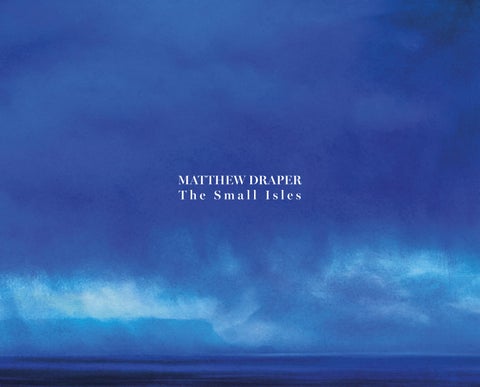
MATTHEW DRAPER The Small Isles
MATTHEW DRAPER The Small Isles Eigg · Muck · Rum · Canna
16 Dundas Street | Edinburgh | EH3 6HZ | 0131 558 1200 | scottish-gallery.co.uk
MEDITATIONS ON LIGHT For the many who travel there, the landscapes of Scotland’s west coast are often described as timeless, yet their defining characteristic is one of perpetual change. Clouds gather from the Atlantic, rain veils distant islands and inlets, and fleeting shafts of light appear and disappear within moments. It is this transience that lies at the heart of Matthew Draper’s artistic practice. For many years Draper has been drawn to the western edge of Scotland, exploring the coastlines of Ardnamurchan, Skye and Moidart in search of subjects. Travelling the winding roads, often aboard his campervan, he became increasingly captivated by the chain of islands visible from both north and south. Eigg, Rum, Muck and Canna, collectively known as the Small Isles, emerged as a recurring focus. These distinctive landforms act simultaneously as barrier and stage, catching weather systems before landfall, their outlines often silhouetted against a lowering sun. Returning again, Draper searched for viewpoints that would best reveal the character and drama of the islands, spending long periods exploring the coast around Glenuig, Loch Ailort and Arisaig.
Patience has always been central to Draper’s practice. He speaks of “constantly going back to those places”, often enduring disappointing grey conditions before witnessing the extraordinary. One particularly productive visit followed countless false starts. After hours of rain and heavy cloud, “within the space of an hour, everything opened up”. Such moments underpin much of the work in this exhibition. Piercing crepuscular rays, illuminated rainstorms and luminous clouds move across the compositions as active forces, shaping both the structure and mood of the landscape. Light remains Draper’s principal concern, but here it assumes a different character from much of his recent work. He searches for what he describes as the ‘magical hour’ between day and night, returning in some respects to earlier cityscapes and haar-filled twilight scenes. They occupy that transient moment where daylight begins to fade and colour intensifies before yielding to night. Using only pastel, Draper’s mastery of the medium allows him to build surfaces of remarkable depth and complexity. Through layering, erasing, sanding and reapplying pure colour he creates atmospheric
effects that balance delicacy and drama. Draper has spoken of consciously rethinking his approach to colour, experimenting with heightened colour relationships. Brilliant yellows collide with deep violets and blues, creating an intensity that pushes beyond straightforward observation. As he explains, these pastels are ultimately “emotional reactions to the landscape”; not records of what was seen but attempts to convey what was felt. This exhibition marks Matthew Draper’s first major solo exhibition since 2021. Evolving over an extended period of research, observation and studio practice, it brings together a remarkable body of work that reflects both the maturity of his vision and the mastery of his medium. We are delighted to welcome Draper back to The Scottish Gallery with an exhibition that confirms his standing as one of Scotland’s most compelling contemporary landscape artists, and one that reminds us, with extraordinary force, of the transformative power of light, weather and place. TOMMY ZYW
THE SMALL ISLES For two years, I have been absorbed in a new body of work centred on one of the most remote and elemental corners of the British Isles: the archipelago known collectively as the Small Isles. Located between the Scottish mainland and the Isle of Skye, these islands have become the subject of an extensive project of research which has taken me away from my Edinburgh studio repeatedly, along single-track roads and onto ferries, in pursuit of dramatic light and evolving weather systems. I work in chalk pastel and charcoal, media I use for their immediacy and their capacity to hold both softness and subtle tonal shifts within the marks I make. Some of the new works are ambitious in scale, extending to nearly six feet in length, allowing the landscape they depict to seem to open out around the viewer. This scale feels appropriate to the subject. The Small Isles are places defined by open space: wide skies, long sightlines across water, and weather systems that arrive and dissolve with startling speed. While the smaller works are equally descriptive, the intention behind the larger, more panoramic drawings is to create an image that the viewer feels able to walk into, becoming as absorbed in the unfolding drama as I was when I witnessed it in the landscape.
The project began, as so much of my work does, with travel. Over the course of two years, I made repeated research trips to the islands in my campervan, using it as both transport and base – a mobile studio parked wherever the light and terrain allowed. This way of working is central to how I begin and how I allow a body of work to evolve. Rather than visiting once and working from photographs and memory, I return to the same places across different seasons, times of day and weather conditions, building a direct and accumulated experience of the landscape rather than relying on a single fixed image.
Each trip added another layer to my understanding of the islands: the way light falls differently on the basalt cliffs of Canna; the way Rum’s dramatic mountain skyline holds cloud and mist in a manner entirely its own; the way Eigg’s landscape constantly shifts under weather moving in from the Atlantic.
Drawing happens directly in the landscape. I work outdoors in front of the subject, gathering visual information first-hand in my sketchbook or on smaller pieces of paper that I can carry and hold. At this stage, I am interested in the specific quality of a particular light, the structure of a hillside, or the movement of clouds over water. This is not simply reference-gathering in the conventional sense; it is closer to research in the truest sense of the word: an accumulation of observed fact and felt experience. The information gathered outside is later reconstructed in my Edinburgh studio. The charcoal drawings made outdoors become references as I work into the large-scale, resolved pieces that form the exhibition. The studio allows for a degree of concentration and control that is not possible on site - the chance to build up chalk pastel and charcoal in layers, push the tonal range further, and resolve a drawing sufficiently to convey the drama and atmosphere demanded by the subject. Weather is not incidental to this body of work; it is vital to my description of the islands. My principal concern, however, across this project and much of my wider practice, is light in the landscape: the way it moves across terrain and objects, transforming a view from moment to moment. On the Small Isles, this behaviour is inseparable from the weather that produces it. Because of this, a significant part of each research trip was spent simply waiting. I describe the process
as chasing the weather: watching forecasts, reading the sky, positioning myself in a location and then holding there. Sometimes I would wait for hours, or overnight in the van, for the particular atmospheric conditions that might generate the dramatic and beautiful image I was looking for. For this process to work, I need to be patient and disciplined. It is fundamental to my practice, because without this willingness to wait I would be unable to make resolved drawings that convey a genuine sense of place. The scale of many of the pieces draws the viewer into the landscape, while chalk pastel and charcoal allow me to move between the softest, most diffused light and the deepest, most saturated dark, mirroring the extremes of weather that the islands themselves produce. Taken together, the Small Isles works represent a sustained and patient act of looking. They are the product of a rigorous engagement with a landscape over time, not a single encounter, but many, across seasons and conditions, on foot and from the van, in wind and rain and sudden, unexpected sun. What emerges is not simply a set of pictures of the Small Isles, but an extended response to light and weather: how they move, how they change, and how they can transform a remote Hebridean hillside into something extraordinary. MATTHEW DRAPER
1. All is Calm, a View of Eigg from Loch Ailort, 2026 pastel on paper, 104.5 x 155 cm
2. All is Calm, The Small Isles from Loch Ailort, 2026 pastel on paper, 20 x 46.5 cm
3. Deluge, 2026 pastel on paper, 22 x 50 cm
The islands are exposed to fast-moving Atlantic systems, and it is precisely this instability that interests me: the low, raking light that breaks beneath a retreating storm; the luminosity produced when sunlight strikes wet rock after rain; the heavy, bruised skies that can make a headland or stretch of water suddenly appear monumental. MATTHEW DRAPER
4. Before Twilight, a View of Eigg, Rum and Canna, 2026 pastel on paper, 60 x 126 cm
5. Dusk, a View of Eigg, Rum and Canna Part 5, 2026 pastel on paper, 22.5 x 30 cm
6. Dusk, a View of Eigg, Rum and Canna Part 1, 2026 pastel on paper, 27 x 42 cm
7. (20.40) 26.7.2025, 2026 pastel on paper, 22.5 x 30 cm
8. (20.52) 26.7.2025, 2026 pastel on paper, 55.5 x 121 cm
9. Cloudburst Part 1, 2026 pastel on paper, 81 x 165 cm
10. Cloudburst Part 2, 2026 pastel on paper, 60 x 126 cm
11. Dusk, a Nocturnal View of Eigg and Rum, 2026 pastel on paper, 32 x 47 cm
12. (20.49) 26.7.2025, 2026 pastel on paper, 27 x 59 cm
13. Saturated, 2026 pastel on paper, 28 x 50 cm
14. Nocturne, with Eigg, Rum and Loch Ailort, 2026 pastel on paper, 83 x 135 cm
Alongside the large pastel drawings, I am exhibiting a group of smaller charcoal works that occupy a particular place within the project. Made in the studio using the drawings and information gathered in the landscape, their purpose was to deepen my understanding of the subject: to examine how light was behaving, how a headland held its form against a changing sky, or how a particular weather condition affected the landscape. They became a way of thinking through the subject and a means of translating the quicker sketches made outside into the larger, resolved works. In that sense, they are not preparatory sketches but finished pieces in their own right. The large-scale pastel works could not have developed without this process of looking, testing and understanding. MATTHEW DRAPER
15. Cloudburst Part 6, 2026, charcoal on paper, 19 x 27 cm 16. Cloudburst Part 10, 2026, charcoal on paper, 24 x 36 cm
17. Passing Showers, 2026 pastel on paper, 22 x 50 cm
18. Cloudburst Part 9, 2026, charcoal on paper, 24 x 36 cm 19. Cloudburst Part 5, 2026, charcoal on paper, 17 x 34 cm
20. Fading Light, a View of Eigg and Rum, 2026, charcoal on paper, 15 x 35 cm 21. Cloudburst Part 4, 2026, charcoal on paper, 19 x 27 cm
22. Illuminated, a View of Eigg and Rum, 2026, charcoal on paper, 15 x 21 cm 23. Rays and Rain Part 3, 2026, charcoal on paper, 21 x 34 cm
24. Crepuscular, a View of Eigg, Rum and Canna, 2026 pastel on paper, 60 x 125 cm
The drama in my work is not invented or exaggerated after the fact; it is observed, waited for and then translated as honestly as I can. The result is a body of work that is atmospheric in the most literal sense, concerned with atmosphere as a physical and visual phenomenon, while also being atmospheric in mood: brooding, luminous and immersive. MATTHEW DRAPER
25. Rays and Rain, a Nocturnal View of Eigg and Rum, 2026 pastel on paper, 60 x 126 cm
26. Dusk, a View of Eigg, Rum and Canna Part 6, 2026 pastel on paper, 27 x 42.5 cm
27. Twilight, 2026 pastel on paper, 84.5 x 155 cm
28. Nocturne, with Eigg and Rum, 2026 pastel on paper, 22.5 x 45.5 cm
29. Dusk, a View of Eigg, Rum and Canna Part 2, 2026 pastel on paper, 79 x 107.5 cm
30. Nocturne, with A Hint of Rain, 2026 pastel on paper, 60 x 126 cm
31. Fading Light, a View of Eigg and Rum, 2026 pastel on paper, 22 x 50 cm
32. Passing Rays, a View of Eigg and Rum, 2026 pastel on paper, 25 x 61 cm
33. Illume, Eigg, Rum and Canna from Loch Ailort, 2026 pastel on paper, 79 x 107.5 cm
34. Rays and Rain Part 4, 2026 charcoal on paper, 16 x 48 cm
35. Cloudburst Part 3, 2026, charcoal on paper, 24 x 36 cm 36. Cloudburst Part 8, 2026, charcoal on paper, 19 x 27 cm
37. Last Light, 2026 pastel on paper, 22 x 50 cm
38. Passing Rays, a View of Eigg, Rum and Canna Part 1, 2026 pastel on paper, 60 x 126 cm
39. (21.10) 26.7.2025, 2026 pastel on paper, 79 x 107.5 cm
40. Dusk, a View of Eigg, Rum and Canna Part 4, 2026 pastel on paper, 27 x 42 cm
41. Squall, 2026 pastel on paper, 22 x 50 cm
42. Dusk, a View of Eigg, Rum and Canna Part 3, 2026 pastel on paper, 41 x 60 cm
43. (20.05) 26.7.2025, 2026 pastel on paper, 22 x 50 cm
44. (21.15) 26.7.2025, 2026 pastel on paper, 71 x 150 cm
45. Nocturne, with Eigg, Rum and Canna, 2026 pastel on paper, 31 x 73 cm
46. Nocturne N.03, with Eigg and Rum, 2026 pastel on paper, 60 x 126 cm
Matthew Draper (b.1973) 1973 Born in Stone, Staffordshire. 1991–1992 Walsall College of Art. 1992–1995 Falmouth College of Arts, BA (Hons) Fine Art. 2011 Elected member of The Pastel Society UK. 2016 Elected Professional Member, Visual Arts Scotland. 2018 Elected Professional Member, Scottish Society of Artists. SELECTED SOLO EXHIBITIONS 2026 The Small Isles, The Scottish Gallery, Edinburgh. 2024 The Road to Arisaig, Browns Gallery, Inverness. 2022 Kitchen Window, The Scottish Gallery, Edinburgh. 2021 Light and Air, The Scottish Gallery, Edinburgh. 2019 Firth Forth, Fidra Fine Art, Gullane, East Lothian. 2019 Sound of Raasay, The Scottish Gallery, Edinburgh. 2018 Sublime Adventures, Browns Gallery, Tain. 2017 Small Works, Fidra Fine Art, North Berwick. 2016 Amongst the Clouds, The Scottish Gallery, Edinburgh. 2015 From Metropolis to Wilderness, Lemon Street Gallery, Truro. 2014 Eilean a Cheo, Open Eye Gallery, Edinburgh. 2013 Northern Light, Lemon Street Gallery, Truro. 2012 Time Lapse, Open Eye Gallery, Edinburgh. 2011 New Pastels, Beaux Arts, Bath. 2010 Festival Exhibition, Open Eye Gallery, Edinburgh. 2009 Nocturnes, Beaux Arts, Bath.
2009 In Series, Lemon Street Gallery, Truro. 2008 Luminism, Open Eye Gallery, Edinburgh. 2007 January Light, Lemon Street Gallery, Truro, Cornwall. 2006 Time and Place, Beaux Arts, Bath. 2006 Seven Hills, Open Eye Gallery, Edinburgh. 2005 Nostalgia, Lemon Street Gallery, Truro, Cornwall. 2004 Panorama, Beaux Arts, Bath. 2004 Old Town, Open Eye Gallery, Edinburgh. 2002 Atmosphere and Twilight, Open Eye Gallery, Edinburgh. 2000 Night Life, Open Eye Gallery, Edinburgh. 1999 The Reynolds Gallery, Edinburgh. SELECTED COLLECTIONS Art in Healthcare, Edinburgh. Caledonian Hotel, Edinburgh. Canford School, Wimborne Minster. City of Edinburgh, City Art Centre. The Edinburgh Academy. Falmouth Art Gallery. Glasgow Museum and Art Gallery, Kelvingrove, Glasgow. The New Gallery, Walsall. Paintings in Hospitals Scotland. Walter Scott and Partners, Edinburgh.
Published by The Scottish Gallery to coincide with the exhibition: Matthew Draper The Small Isles 29 October – 21 November 2026 Exhibition can be viewed online at: scottish-gallery.co.uk/matthewdraper ISBN: 978-1-917803-37-3 Designed and Produced by The Scottish Gallery Printed by Pure Print Artwork photography by John McKenzie. Studio photography by Donald Provan. Outdoor photography by Alexandra Black. Front cover: Rays and Rain, A Nocturnal View of Eigg and Rum, 2026, (Cat. 25) All rights reserved. No part of this catalogue may be reproduced in any form by print, photocopy or by any other means, without the permission of the copyright holders.
THE
SCOTTISH
GALLERY
CONTEMPORARY ART SINCE 1842 16 DUNDAS STREET • EDINBURGH EH3 6HZ +44 (0) 131 558 1200 • mail@scottish-gallery.co.uk • scottish-gallery.co.uk