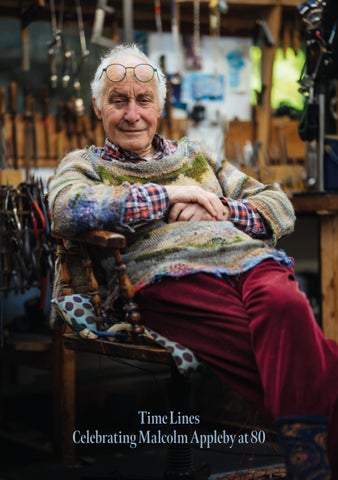
Time Lines Celebrating Malcolm Appleby at 80
Time Lines Celebrating Malcolm Appleby at 80 September 2026
16 Dundas Street | Edinburgh | EH3 6HZ | 0131 558 1200 | scottish-gallery.co.uk
Detail from Malcolm’s studio
Time Lines | Celebrating Malcolm Appleby at 80
Malcolm was one of the very first artists whose studio I visited when I joined The Scottish Gallery back in 1997. Nearly three decades later, that sense of wonder has never diminished. Every visit leaves me spellbound, not simply by the quantity of work that has been created since the last time, but by the originality of it. Malcolm is a world-class craftsman and artist, and there is simply no one like him. Widely regarded as one of the world’s finest living gun engravers, his range across metalwork, silversmithing and jewellery is astonishing. What makes Malcolm exceptional is not only his technical mastery, but his imagination. He has developed a unique language in metal that continues to inspire everyone who encounters it. His work can be playful, witty and full of life, while at the same time carrying a seriousness and depth that is rare. Everything he makes has an intensity of looking and a standard of unparalleled craftsmanship. Born in Kent in 1946, Malcolm moved to Scotland in 1969, establishing his first workshop at Crathes Station in Aberdeenshire before making his home in rural
Perthshire, near Aberfeldy, where he and his wife, Philippa Swann, have lived and worked for more than thirty years. Together they have created far more than a studio. They have carefully rewilded the surrounding land, nurturing a remarkable haven for wildlife and a place where making and living are inseparable. Time Lines reflects so much of Malcolm’s practice; it speaks of the engraved line, cut patiently by hand over decades. It speaks of the lines of the landscape that surround his studio and continue to shape his imagination. It speaks of family, friendships and collaborations built over a lifetime, and of time itself, not as something that passes, but as something invested in looking, making and sharing. Malcolm has spent a lifetime encouraging us to look more closely. Butterflies, moths, lichens, birds, hedgerows, leaves and wildflowers appear throughout his work, not simply surface decoration but careful observation. Malcolm and his wife Philippa live with an acute awareness of the fragility of the natural world. They make do
extraordinary works in precious metals, Malcolm has always believed exceptional craftsmanship should be accessible. Alongside major commissions there have always been affordable pieces that invite new collectors into his world. Even as the cost of precious metals continues to rise, Malcolm remains inventive, adapting materials and techniques without compromising the quality of his work.
and mend, they care for the land around them, and they quietly witness the changes taking place in the environment they know so intimately. Today, perhaps more than ever, Malcolm’s work reminds us that what appears abundant is increasingly vulnerable. The Scottish Gallery has never sought to define Malcolm through one signature object or commission. Instead, our exhibitions have always reflected whatever has captured his imagination at that particular moment. His output is staggering. One day it might be a deeply engraved silver bowl, the next a gold pendant alive with colour, a mixed-media beaker, a new series of moth inspired work, or a die-struck silver button. Although he creates
His achievements are recognised internationally, and his work is held in museum collections throughout Britain and beyond, including the Victoria & Albert Museum, the Royal Armouries, National Museums Scotland and Aberdeen Art Gallery. Outstanding commissions range from the Condiment Set for 10 Downing Street and the Sculptural Centrepiece for Bute House, to the Orb for the Coronet of Charles, then Prince of Wales. He was appointed MBE in 2014 for services to hand engraving and heritage crafts, later receiving an Honorary Doctorate from Heriot-Watt University and election as a Fellow of the Royal Society of Edinburgh. Yet awards have never been what motivates Malcolm. The next idea has always been far more interesting than the last success. Just as important is what Malcolm has given back. This year marks the 49th Banchory Bangle, created annually since 1976 to raise funds for Children First. It is one of the longest-running artistic charitable
initiatives in Scotland and has become a symbol of generosity, imagination, and community. It is fitting that Aberdeen Art Gallery is also marking Malcolm’s 80th year with a celebration of the Banchory Bangles. Generosity also runs through Malcolm’s studio. His annual Engraving Symposium has inspired generations of makers, bringing together artists from different disciplines to experiment, learn and exchange ideas. Collaboration has always been fundamental to his practice. Malcolm has never believed creativity happens in isolation. Working with Malcolm is a joy. He is generous, curious, and passionately dedicated to what he does. Every studio visit teaches me something new. Every exhibition reveals another facet of his imagination. Every conversation leaves me looking at the world a little more closely. Time Lines is not a retrospective. It is a celebration of an artist whose imagination continues to evolve, whose curiosity remains undiminished, and whose unique language in metal continues to speak with originality, humanity, and hope. He is a craftsman of extraordinary talent. I don’t believe we will ever see another artist quite like him. Happy 80th Birthday, Malcolm.
Malcolm’s studio, Perthshire
Portrait of Malcolm at his home in rural Perthshire by Emilia Barclay, 2026
silver
Left: A selection of Bowls and Beakers, engraved silver, part gilt, H6-7 x D7-9cm Above: Bone Box, silver, bone, gold catch detail, H4 x W8 x D7.5 cm designed and engraved by Malcolm Appleby, fabricated by Peter Musgrove
Time Lines | An Interview with Malcolm Appleby
I’m sitting upstairs in Malcolm Appleby’s study, which he calls the “rifle range.” It is a long gallery shape, a little like being in a ship. The study is full of character: books line the walls, there are layered rugs underfoot, and a patchwork tartan quilt sits nearby. Malcolm has just recently returned from Aberdeen Art Gallery, where he gave a talk celebrating his 80th year and life as an artist. He tells me that the first question came from an eight year old, who asked when he first made a piece of jewellery. It is a deceptively simple question and a perfect place to begin.
soldered together quite crudely with lead solder. His tutors thought the results were terrible, but as he says, “what I did find was that ladies liked them. And I liked ladies. And the two things went together rather nicely.” At this stage, his work did not belong to any established style. He describes himself as simply finding things out. Engraving, however, entered his practice soon afterwards. Initially, Malcolm had been
Malcolm recalls being around sixteen or seventeen at art school. At the time, his course was focused on drawing, painting and graphic design. There was very little actual making involved. But at home, he had created his own workshop in the loft of his family house. “There was no insulation, it was freezing cold in winter and boiling hot in the summer,” he says. “And I used to go to jumble sales and buy things, old alarm clocks and things like that, and break them up.” There, he began making what he called jewellery. He would dismantle these objects and use the brass and cog wheels to construct pieces,
Malcolm’s home and studio in Perthshire, 2026. Photographs: Philippa Swann
more seriously, spending time at Ravensbourne College and later at the Central School of Arts and Crafts. There, he became the only full time student in an engraving department otherwise designed for apprentices on day release. Under the guidance of tutor Fred Fryer, Malcolm pursued a largely self-directed education. He combined engraving with life drawing and printmaking, making full use of the school’s facilities. From an early stage, he was setting his own direction.
Entrance to Malcolm’s studio
designing patterns for guns on paper, designs that bore little resemblance to traditional gun engraving. He showed these to members of the trade, who were largely uninterested. However, when he took his drawings to a firm of gunmakers in Soho, John Wilkes, he encountered a more receptive audience among the younger generation. They asked him if he wanted to become an engraver. In truth, he had not considered it, he saw himself as a designer, but he recognised the opportunity. “I knew if I said no, the door would close on me,” he recalls. “So I pretended and said yes. And I’m very glad I did.” This marked a turning point. He began learning engraving
“I was setting my own course from about sixteen or seventeen,” he says. “That was quite different from the norm.” One of his early major works, The Cherubim That Guards the Gates of the Garden of Eden, a large, engraved steel plate featuring a complex, fantastical composition, took around nine months to complete. The imagery combined elements of animals and mythology, inspired partly by visits to the Natural History Museum. The work demonstrated both his ambition and his willingness to pursue unconventional approaches. London in the 1960s provided a vibrant context for this period of development. Malcolm recalls it as a time of freedom and experimentation. “It was rags to riches in moments,” he says. At the same time, he was working within the gun trade, a world he found both fascinating and restrictive. It was highly traditional
Malcolm Appleby, The Cherubim That Guards the Gates of the Garden of Eden engraving, 1966, 42 x 58 cm
and closely guarded. While it provided valuable technical experience, it also reinforced his desire to move beyond it. Alongside engraving, he began to develop jewellery, often working collaboratively with other makers. This experience taught him the importance of shared skills and working together, something that continues to remain central to his practice. A significant turning point came when he decided to leave London. He was offered the chance to rent a house near Crathes in Scotland for £2 a week while the owner was away. He accepted immediately.
He spent time exploring the surrounding area by bicycle, discovering the landscape that would become central to his life and work. Soon afterwards, he purchased a disused railway station for just over £1,600 and established his workshop there. Living conditions
“I wanted to get out of London,” he says. “I wanted to be where the art was, and for me that was not in London.” Photograph: Philippa Swann
Silver Ovals Single Link Chain, L51 cm. Photograph: Gabriela Silveira
were extremely basic. There was no running water and he had to carry water from next door. His workshop was in the waiting room, open to the elements at first. Despite this, Malcolm continued to take on significant commissions while beginning to establish his own independent practice in Scotland. One of the ways he did this was by developing more accessible pieces alongside major commissions. His silver buttons, now highly sought after, emerged from his exploration of die sinking. “You can make these big, expensive pieces,” he reflects, “but the pleasure you get from something small is no different.” By creating small engraved dies and using a press, he was able to produce repeatable pieces of high quality at more affordable prices. This balance between exclusive work and accessible pieces became central to his practice. Experimentation has always been key. One particularly important breakthrough came when he began firing gold onto steel, a process he developed himself through trial and error. “I didn’t know what I was doing,” he admits. “I just tried it.” The results, initially appearing as failure, revealed themselves through chemical cleaning to be something entirely new. Nature has always been fundamental to Malcolm’s way of seeing the world, and to his work. He recalls childhood memories of the 1950s with extraordinary vividness. “Our road was suburban houses,” he says, “but across the road there was a hayfield. And it was full of butterflies. Absolutely full of them.”
The hay grew taller than the children running through it, and the field was alive with meadow browns, blues and countless other species. “They were just everywhere,” he says. At night, his mother would leave the bathroom window open with the light on. “And it would be full of moths. It doesn’t happen now.” That sense of abundance has all but disappeared. “There’s nothing like what there was in the 1950s,” he says. “It’s gone.” He remembers the arrival of agricultural chemicals and their visible impact. “I saw blackbirds with green froth coming out of their beaks,” he recalls. “Things were dying in front of you.” Now living in rural Perthshire with his wife Philippa Swann he is deeply aware of what remains and what is at risk. “We can’t save the world,” he says. “We’ve got twelve acres. That’s not enough. But we’re doing what we can.” This environmental awareness runs through his work, where natural forms, spirals and organic patterns recur again and again. In recent years, Malcolm has embraced Instagram, which he describes as a modern form of printmaking. “It’s instantaneous,” he says. “A way of putting an image out there straight away.” Now in his eightieth year, Malcolm continues to work regularly. His pace has slowed, but not his curiosity. “I’m still thinking,” he says. “I’m still doing it.” What drives him remains unchanged. The act of making, of turning something into something else. “If I didn’t make it, it wouldn’t exist.”
silver
Enamelled Scoops, electroformed silver, enamelling by Ann Little, H2 x W5.5 x D6.5 cm Maple Leaf Beakers, electroformed silver, enamelling by Ann Little and Jane Short, H7 x D7 cm
Top: Nut/Heart Engraved Locket Pendant, silver, gold, black pearl, H3.5 x W3 cm Right: Rock ‘n’ Scroll Dark and Pale Sapphires Ring, oxidised silver, 18ct and 22ct gold Below: Cat’s Eye Black Quartz Flower Ring, silver, engraved setting, 18ct gold
Pearl Pendant, 18 & 22ct gold, south seas cultured grey coloured pearl – shown with a labradorite beaded necklace, Photograph: Gabriela Silveira
Left: Iron Fired Sapphire Brooch, with Malkie mix golds, engraved and signed, H7 x W8.5 cm Photograph: Gabriela Silveira Above: Ruby Jewel Brooch, 22ct gold setting, 18ct gold, black diamonds, engraved silver, H8.2 x W6.5 cm
From left: Rock ‘n’ Scroll Opal and Sapphire Ring, oxidised silver, 18ct and 22ct gold Rock ‘n’ Scroll Ruby, Black Opal & Sapphires Ring, oxidised silver, 18ct and 22ct gold Hearts and Stars Bangle, die struck silver, H5 x W6.4 x D2.2 cm Photograph: Gabriela Silveira
From Clockwise: Selection of Rock ‘n’ Scroll Rings, oxidised silver, 18ct and 22ct gold Cloud Brooch, oxidised silver, H4.5 x W6.5 cm
Above: Ethiopian Opal Pendant, iron, 22ct gold, silver, H7 x W3.5 cm Black Star Sapphire Pendant, iron, 22ct gold, oxidised silver, H4.5 x W2.5 cm Lightning Ridge Opal Pendant, iron, 18ct and 22ct gold, H5 x W2.5 cm Right: Philadelphus Flower Earrings, engraved silver, 18ct gold, H6.5 cm Iron and Gold Fired Circular Pendant with Pearl, on a turquoise beaded necklace, D4 cm Photograph: Gabriela Silveira
Top to bottom: Peruvian Opal and Amber ‘Ear Wings’ Earrings, silver, 18ct gold, H4.5 x W4 cm Peruvian Opal, Gold and Silver Earrings, Ø1.4 cm Aquamarine Trillion Rabbits & Flowers Ring, silver, 18ct gold Walk in the Woods Necklace, silver, aquamarine, Peruvian opal, L86 cm Photograph right: Gabriela Silveira
Detail: Walk in the Woods Necklace, silver, amber, carnelian, L69 cm Black Pearl and Carnelain ‘Ear Wings’ Earrings, silver, 18ct gold, H5 x W3.5 cm
Oval Lapis Lazuli Brooch, engraved gold and platinum, H4.5 x W5.5 cm Small Oval Enamel Brooch, silver, gold, enamelling by Jane Short, H3.2 x W4 cm Ice Brooches, engraved silver and gold, H3.5-4 x W5.8-6.5 cm
Above: Pollarded Oak Tree Brooch, 18ct and 22ct gold, engraved and oxidised silver, H7.3 x W7 cm Sun Jewel Brooch, 18ct gold, silver, sunstone oval cabochon, H5 x W6 cm Opposite: Carnelian Sideways Oval Silver Chain, L56 cm Modelled by Misun Won with Stanley. Photograph: Gabriela Silveira
Rings from top: Watermelon Tourmaline Ring, silver, 18ct gold Amethyst Ivy Leaves Ring, oxidised silver Lavender Sapphire Ring, silver, 18ct and 22ct gold Gold Damascus Ring, 18ct yellow and white gold
Selection of die-struck silver rings set with semi precious stones and gold details Photograph: Gabriela Silveira
Selection of Banchory Bangles Photograph: Gabriela Silveira
Since 1976, Malcolm Appleby has created a unique Banchory Bangle each year in support of the charity Children First. The tradition began at the Banchory Show and continued at his Crathes Station home and workshop. To mark his 21st year in Scotland he made the first 18ct gold bangle. Now every design begins as an original hand engraved master from which others are produced. He continues the tradition from his house and workshop, situated in rural Perthshire, drawing on the flora, fauna and folklore around him, often with a mischievous twist or quiet reflection on life in the countryside. In many of the designs, Malcolm engraves details on the inside, known only to the wearer.
Left: Wren and Ivy Brooch, silver, H2.5 x W5 cm Photograph: Gabriela Silveira Above: Wren and Ivy Brooch, 18ct gold, sunstone, diamond, H2.5 x W5.5 cm Owl Bangle, silver, 3.5 x 6.8 cm
moths
Left: Moth Brooches and Pendant, silver and bronze, H3-4.5 x W5-6 cm Above: Scarab Beetle Pendant, grey star sapphire, silver, 18ct gold, H3 x W1.5 cm Dragonfly Buckle, cast bronze, H3.5 x W5 cm Time Flies Cufflinks, silver, 18ct gold, Ø2 cm
Paisley Scroll Bowl IV, electroformed silver, enamelling by Jane Short, H6 x Ø9 cm
Dr Malcolm Appleby MBE FRSE Born in Kent in 1946, Malcolm Appleby studied at Beckenham School of Art, Ravensbourne, the Central School of Art, Sir John Cass School of Art and the Royal College of Art before moving to Scotland in 1969. Following almost three decades at Crathes Station in Aberdeenshire, he established his home and studio in rural Perthshire, where he continues to live and work with his wife and creative partner, Philippa Swann. Internationally recognised as one of the world’s foremost engravers, Malcolm’s practice spans engraving, silversmithing, goldsmithing, jewellery, medals and printmaking. His work is celebrated for its unique language in metal, technical innovation and enduring connection to the natural world. Major commissions include work for The Goldsmiths’ Company, The Silver Trust for 10 Downing Street, National Museums of Scotland, Bute House, St Giles’ Cathedral Edinburgh, The Royal Armouries, and the Crown Jewels, Tower of London (engraved orb for the Coronet of Charles, then Prince of Wales). He was appointed MBE for services to hand engraving and heritage crafts. He received an Honorary Doctorate from Heriot-Watt University, Edinburgh in 2000, and was elected a Fellow of the Royal Society of Edinburgh in 2021. Public Collections include: Aberdeen Art Gallery The Ashmolean Museum, Oxford The British Museum, London The Fitzwilliam Museum, Cambridge The Goldsmiths’ Company, London The Hunterian, University of Glasgow National Museums Scotland Perth Museum The Royal Armouries, Tower of London The Crown Jewels, Tower of London Victoria & Albert Museum, London
Published by The Scottish Gallery to coincide with the exhibition: Time Lines | Malcolm Appleby at 80 September 2026 Exhibition can be viewed online at: scottish-gallery.co.uk/malcolmappleby ISBN: 978-1-917803-33-5 Designed and Produced by The Scottish Gallery Photography by Philippa Swann, Emilia Barclay, Alex Robson & The Scottish Gallery Front cover: Portrait of Malcolm Appleby by Emilia Barclay, 2026 Inside cover: Selection of Walk in the Woods bracelets and precious rings, 2025 Photograph: Gabriela Silveira Inside back cover: Ringlet on Thistles. Photograph: Philippa Swann Back cover: Galleon Brooch with Black Pearl, oxidised silver, 18ct gold, 6.5 x 6 cm Photograph: Gabriela Silveira All rights reserved. No part of this catalogue may be reproduced in any form by print, photocopy or by any other means, without the permission of the copyright holders and of the publishers.
16 Dundas Street | Edinburgh | EH3 6HZ | 0131 558 1200 | scottish-gallery.co.uk