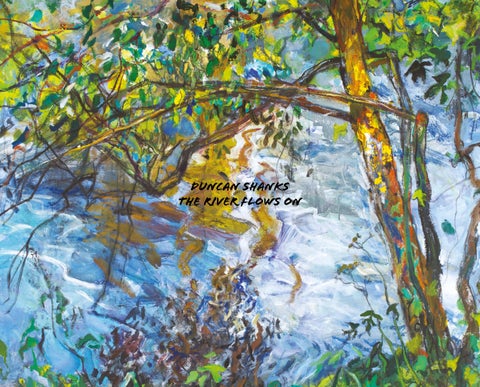
DUNCAN SHANKS THE RIVER FLOWS ON
DUNCAN SHANKS THE RIVER FLOWS ON DECEMBER 2026
16 Dundas Street | Edinburgh | EH3 6HZ | 0131 558 1200 | scottish-gallery.co.uk
THE RIVER AND THE SELF
“...art is a manifestation of emotion and emotion speaks a language that all may understand,” so says the narrator in Somerset Maugham’s The Moon and Sixpence, his novel which explores the idea of the painter genius. In his latest body of work, The River Flows On, Duncan Shanks makes no apology for engaging with the natural world around him as a conduit for exploring heartfelt, subjective experience. This experience is marshalled by what he calls ‘factual drawing’ from which ‘abstract improvisation’ may flow. But this is not a predictable, dry process and by his own poetical account published in the following pages Shanks will use the springboard of ‘the polarities of temperament’ to drive violent, frenzied passages of painting which may lead to surprising resolutions. The initial marks made by the painter inside the rigid structure imposed by the proportions of his canvas or sheet of paper might reference the solidity of stone or trees or an iron gate and dictate an improvisational direction through which the original motif may be torn apart and recreated, over months or even years.
For Shanks, the constantly changing river and the sky above are a compelling paradigm for his own evolving emotional life: the sublime power of the river in spate, destructive in force and flood, is a message of our own transience. Other times its mesmeric calm allows the artist to observe the flow of the water against the uprights of the branches dipping down into the stream. The quiet haiku after the symphony of the tempest. There is a sense that the artist is part of the river: its flow, its unpredictability, its darkness. In watching the river we do not turn our heads and follow the body of water; we look into the movement and across it, a passive recognition that it moves for ever but our understanding is from a fixed perspective. But in his endless reconsiderations of natural phenomena, Shanks brings us closer, at least, to a joyful reconciliation. GUY PEPLOE
THE RIVER FLOWS ON Back in the 1950s, the influential American critic Clement Greenberg maintained that “nature was exhausted as a subject for serious painting” and this became the accepted view of the art world. For me, this created a freedom, outwith the constraints of fashion, to produce stylistic hybrids with the contradictory approaches of factual drawing and abstract improvisation, moving between the actual and the abstract and vital in my recent exploration of the river and the clouds that float above it. Running parallel with the seen, recorded drawings, which start the process, is the challenge of finding a paint language which recreates the physical experience of a natural happening. My paintings are always based on a subjective experience. I live by the river and in the past few years I have spent as much time on my riverbank as the robin and the wren. The river has been a life force for me in troubled times. In the past I have given expression to its wild destructive force as it thunders past, flooding my riverside path, but perhaps due to the isolation of the pandemic, a more contemplative feeling has spread across my studio wall, for despite its constant motion at times, the river can also create a mesmeric calm. This change of emphasis is echoed in Wilhelm Müller’s poem “On the river”, which Schubert sets
in his song cycle Winterreise. “You who rushed along so heartily You gleaming wild river. How still you’ve become You don’t say goodbye.” Though Müller’s river is stilled by ice and reflects the mood of the dejected lover, there is an emotional link to my drifting autumn leaves, which for me, evoke the passing of time and loss. By my seat at the riverside, a young birch tree and a sycamore hang over the water. I have become fascinated by the horizontal movement of the water against the still verticals of the trees and how to create movement and stasis with paint. Long periods of exploration and analytical study build up many layers of paint on my papers, as ideas are tried and rejected. In painting the reflections of the overhanging branches and floating autumn leaves, papers were cut to produce a vertical format, which became integral to their content, and the flattening of the picture space let me explore the expressive power of mark-making without the complication of traditional perspective. Painting the skies which colour the river has become an equally absorbing obsession. The sources of the recent cloudscapes are a series
of drawings recording the gradual expanding mass of a huge cumulonimbus cloud, which in an hour’s drawing, produced a thunderstorm, a soaking and a sequence of speedy notes, unresolved and open to painterly intention and imagination in the studio. Like these drawings from nature, I look to keep my studio paintings open to change and discovery. They can take several seasons and sometimes years to reach a conclusion, which often takes me by surprise, coming out of indecision, mess and muddle. At times the polarities of temperament can produce chaos in the physical act of painting, when failure to create the excitement of the source with a slow, considered approach drives an explosion of tachiste energy in abstract flurries of paint across the paper. The destruction of the image and the risk of failure are forgotten in the mindless movement as the media magically reveals the elusive transience of riverbank and river. “All was a-shake and a-shiver, glints and gleams and sparkles, rustle and swirl, chatter and bubble” So says the Mole, when he first sees the river in Kenneth Grahame’s The Wind in the Willows. The swirls and chatter can bring me calm, when I am anxious, vitality, when I am dull and many unanswered questions still to be explored. DUNCAN SHANKS
1 My River, mixed media on paper, 50.5 x 100 cm
2 Slow Water, mixed media on paper, 56 x 76 cm 3 The Riverside Path, mixed media on paper, 56 x 72 cm
4 Spring Blossom, mixed media on paper, 35 x 100 cm 5 Cherry Blossom, mixed media on paper, 35 x 100 cm
6 Flood, Dog and Duck, mixed media on paper, 38 x 50.5 cm 7 Passing Storm, Autumn, mixed media on paper, 56 x 76 cm
8 High Water, mixed media on paper, 48 x 48.5 cm
9 Summer Sun, mixed media on paper, 115 x 122 cm
10 Autumn Glow, mixed media on paper, 79.5 x 121 cm
11 Winter Sunlight, mixed media on paper, 35 x 100 cm 12 Roaring River at Full Tilt, mixed media on paper, 57 x 77 cm
13 Autumn Flow, mixed media on paper, 33.5 x 100 cm 14 The Wave, mixed media on paper, 70 x 100 cm
15 Autumn Sun, mixed media on paper, 24 x 70 cm 16 Signs of Autumn, mixed media on paper, 80 x 121 cm
17 Autumn Gold, mixed media on paper, 103 x 122 cm
18 Winter Trees, mixed media on paper, 56 x 77 cm
19 Mist, mixed media on paper, 55 x 70.5 cm 20 Morning Mist, mixed media on paper, 88 x 88 cm
21 Rocky Stream, mixed media on paper, 56 x 76 cm
22 Meditation, mixed media on paper, 122 x 76.5 cm 23 Reflections, mixed media on paper, 152 x 109 cm
24 Floating Past, mixed media on paper, 121 x 80 cm 25 A Drift in Time, mixed media on paper, 122 x 76.5 cm
26 Flood Water, mixed media on paper, 50 x 49.5 cm 27 Nature Untamed, mixed media on paper, 56 x 76 cm
28 Movement, mixed media on paper, 29.5 x 20 cm 29 Free Flow, mixed media on paper, 67 x 56 cm
If it be in dusk, when like an eyelid’s soundless blink, The dewfall hawk comes across the shades to alight Upon the wind-warped upland thorn
30 The Dewfall Hawk, mixed media on paper, 37 x 35 cm
31 Hedgerow and Track, mixed media on paper, 28 x 38.5 cm 32 Checking the Sheep, mixed media on paper, 70 x 87 cm
33 Cold Blows the Winter Wind, mixed media on card, 57 x 81.5 cm
34 The White Cat, mixed media and collage on paper, 28 x 31.5 cm 35 Cornfield, mixed media on paper, 42.5 x 75 cm
36 Evening Walk, mixed media on paper, 56 x 76 cm
37 Winter Walk, mixed media on paper, 41 x 118 cm
38 Baying at the Moon, mixed media and collage on paper, 61 x 77 cm
39 Cloud Watching, mixed media on paper, 56 x 76 cm
40 Cloud of Unknowing, mixed media on paper, 70 x 94 cm
41 Approaching Storm, mixed media on paper, 50 x 70.5 cm
42 Midnight Moon, mixed media on paper, 122 x 153 cm
43 Wren, mixed media on paper, 56 x 66 cm
Duncan Shanks (b.1937) Duncan Shanks was born in Airdrie in 1937 and studied at Glasgow School of Art from 1955 to 1960. During his Post Diploma year he was awarded a travelling scholarship which enabled a visit to Italy. On his return to Glasgow he joined the Art School staff where he lectured until 1979, before leaving to concentrate on painting full-time. Duncan’s first solo exhibition was hosted by Stirling University in 1974. Since then he has exhibited worldwide with notable public exhibitions including Falling Water at Talbot Rice Gallery, Edinburgh in 1988, Patterns of Flight at Wrexham Art Centre in 1991 and Poetry of Place at the Hunterian Museum and Art Gallery in Glasgow, which coincided with the bequest of the entirety of his sketchbooks to their collection in 2013. Shanks is a member of the Royal Scottish Academy, the Royal Glasgow Institute and Royal Society of Painters in Watercolour. He has been the subject of thirteen solo exhibitions at The Scottish Gallery; his most recent, The Riverbank, was the Edinburgh Art Festival exhibition for 2022. In October 2026 The Hunterian presents Duncan Shanks: The Unseen Journey, an intimate view of an artist continually rethinking how landscape can be observed, remembered and transformed through paint, revealing the unseen journey behind the finished work.
Public Collections Arts Council Collection, London City Art Centre, Edinburgh Dumfries and Galloway Council Dundee Art Galleries and Museums Collection East Dunbartonshire Council The Fleming Collection Glasgow Life Museums Glasgow Museums Resource Centre Glynn Vivian Art Gallery Collection, Swansea Government Art Collection Highland Council The Hunterian, University of Glasgow Lillie Art Gallery, Glasgow Low Parks Museum, South Lanarkshire Royal Scottish Academy of Art & Architecture, Edinburgh Southbank Centre, London South Lanarkshire Council The Stewartry Museum, Kirkcudbright University of Edinburgh University of St Andrews
Published by The Scottish Gallery to coincide with the exhibition: Duncan Shanks The River Flows On 26 November - 23 December 2026 Exhibition can be viewed online at: scottish-gallery.co.uk/duncanshanks ISBN: 978-1-917803-40-3 Designed and Produced by The Scottish Gallery Printed by Pure Print Artwork photography by John McKenzie. Cover: Summer Sun, 2025, mixed media on paper, 115 x 122 cm (Cat. 9.) Inside back: Wren, 2024-26, mixed media on paper, 56 x 66 cm (Cat. 43.) All rights reserved. No part of this catalogue may be reproduced in any form by print, photocopy or by any other means, without the permission of the copyright holders.
THE
SCOTTISH
GALLERY
CONTEMPORARY ART SINCE 1842 16 DUNDAS STREET • EDINBURGH EH3 6HZ +44 (0) 131 558 1200 • mail@scottish-gallery.co.uk • scottish-gallery.co.uk