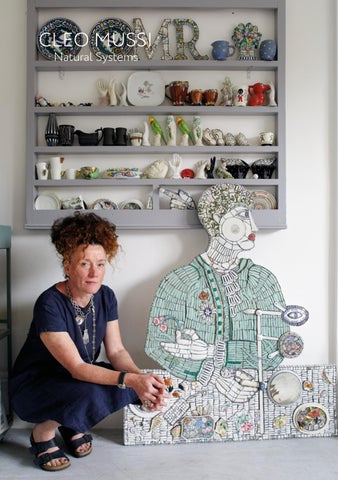
CLEO MUSSI Natural Systems
CLEO MUSSI Natural Systems November 2026
16 Dundas Street | Edinburgh | EH3 6HZ | 0131 558 1200 | scottish-gallery.co.uk
Introducing the World of Cleo Mussi Part Library, Part Laboratory
Cleo Mussi is a remarkable artist who has made the practice of mosaic entirely her own. Over the years, she has created a world and a visual language unlike any other, bringing together history, folklore, science, observation and imagination in works that are instantly recognisable as hers alone. The Scottish Gallery is delighted to present Natural Systems, where Mussi leads us into a rich exploration of plants, flowers and biodiversity while examining our relationship with the natural world. Culminating years of research, collaboration and observation, this body of work reflects her delight in making connections, uncovering stories and revealing the extraordinary within the seemingly ordinary. At the heart of Mussi’s practice is transformation. Working with discarded, blemished and forgotten ceramics, she rescues and reinvents fragments of tableware that might otherwise end their lives in landfill. In doing so, she creates a kind of circular economy in clay, giving new purpose and meaning to objects whose histories remain embedded in their surfaces. A single work can comprise fragments from dozens of plates, each shard carefully selected, precision handcut and marshalled into place.
The recognisable patterns, motifs and memories carried by domestic ceramics are central to the power of her work. Salvaged eighteenth-century Staffordshire, nineteenth-century porcelain, twentieth-century Wedgwood and everyday household objects might sit alongside industrial ceramics, alphabetised letters and decorative fragments. Mussi’s studio is as fascinating as the subjects she explores. Resembling part archive, part library and part laboratory, it houses an extraordinary collection of ceramic fragments accumulated over many years. Shelves of domestic objects, drawers of alphabetised letters and carefully organised collections of colour and pattern await their future role within a work. Nothing is wasted. Every fragment is preserved for its potential to contribute to a new narrative. This instinct to collect, catalogue and connect mirrors the systems of classification and organisation that underpin her work.
Natural Systems is an ongoing fascination Mussi has with the natural world. Carl Linnaeus, the Swedish botanist whose work laid the foundations for modern taxonomy, appears as a central figure, guiding a broader exploration of naming, classification, folklore and seasonal ritual. Recent collaborations with florists and
flower farmers have further informed her interest and exploration into horticulture and biodiversity. Mussi approaches these subjects with humour, generosity and curiosity, creating works that are at once decorative and playful. Beneath the beauty of the mosaics lie questions of environmental responsibility, consumption, cultural exchange and ecological interconnectedness. Often tongue-in-cheek and sometimes quietly provocative, Mussi encourages us to look
closely at the systems that shape our lives and to reconsider the value of what we discard, overlook or take for granted. Piece by piece and fragment by fragment, Mussi reminds us that every object carries a story and that knowledge is often found through unexpected connections and that the natural world remains far more extraordinary than we might first imagine. CHRISTINA JANSEN
1 Head Gardener’s Branch with Dove and Secateurs, 2024 reclaimed tableware on plywood, H100 x W27 x D2.5 cm. 2 Gravity, 2026, reclaimed tableware on plywood, H24 x W21 x D2.5 cm
Natural Systems
It has been some 10,000 years since our Neolithic ancestors discovered the benefits of harnessing the earth’s fecundity, enabling communities to settle and thrive in chosen locations. Ever since, humanity has invested time and effort in understanding, cultivating and shaping the natural world. Generations of herbalists, healers, alchemists, astronomers, plant hunters and scientists accelerated this exploration, observing, classifying and naming every aspect of animate and inanimate nature. This exhibition grows out of more than a decade of research into horticulture, botanical biodiversity and our personal connections with plants. It celebrates not only the extraordinary diversity of the natural world, but also the meanings, folklore and seasonal traditions that people have attached to plants throughout history. At the heart of the exhibition stands Carl Linnaeus (1707-1778), the Swedish botanist and father of modern taxonomy, who formalised the system by which organisms are named and classified into kingdom, class, order, family, genus and species.
His Systema Naturae, first published in 1735, remains the foundation of modern biological classification, though some of its ideas have since evolved or been challenged. Through mosaic and ceramic works, Natural Systems explores the interconnected worlds of plants, people and place. I am fascinated by the ways flowers and plants act as markers of the seasons, carriers of memory, and witnesses to human movement across landscapes and generations. Their journeys echo our own: through migration, cultivation, medicine, ritual and everyday life. Taking the form of a lunar calendar, the exhibition moves through the cycle of a year, celebrating the quiet dormancy of winter, the tentative emergence of spring, the exuberance of summer and the abundance and wisdom of autumn. Together these works create a landscape shaped by observation, classification and wonder, evoking the timeless rhythms that continue to connect us to the natural world. CLEO MUSSI
3 Lithia, For the Love of Summer, 2024, reclaimed tableware on plywood, H27 x W41 cm additional element H17 x W18 cm.
4 Yule, Love in Winter, 2024, reclaimed tableware on plywood, H27 x W41 cm additional element H17 x W18 cm.
5 Snow Moon with Ice Moon Shadow Goddess, 2024, reclaimed tableware on plywood Ø42 x D2.5 cm; goddess H24 x W15 x D2.5 cm. 6 Winter Vase with Winter Bells, 2026, reclaimed tableware on plywood H100 x W33 x D2.5 cm.
7 Ave, Dove, 2026, reclaimed tableware on plywood, H32 x W40 x D2.5 cm 8 Autumn Basket with Fruitfulness, 2021, reclaimed tableware on plywood, H72 x W101 x D5 cm.
Recent collaborations with florists and flower farmers have informed Natural Systems, an exhibition that explores my fascination with the language of plants, their symbolic meanings, and their role as markers of the seasons. Through this work I celebrate both botanical diversity and our enduring relationship with the natural world. My research initially led me to Theophrastus (371-287 BC), who is considered the father of Botany and who gave plants simple names and valuable descriptions to the forms and structures that he observed, including phyla, derived from the Greek boy’s name Phyllon meaning leaf. These Latin words were a starting point for a number of connecting works and ideas: phyllon (leaf), phylogeny (evolutionary history), phylum (biological classification), and phyllosilicates (the clay minerals that form the basis of my mosaic practice). Underpinning them all is photosynthesis, nature’s original ‘magic trick’. Giving life to all living things; where sunlight and water are transformed leaving oxygen as a by-product, capturing carbon into the humus and rocks and thus stabilising our blue planet. These connections eventually led me to the central figure in this exhibition: Carl Linnaeus (1707-1778), the Swedish botanist whose Systema Naturae (1735) established the foundations of modern taxonomy. Linnaeus formalised the modern system of naming organisms into kingdom, class, order, family, genus and species. Within my mosaic work I hone in on the minutia of the detail, as if looking through Carl Linnaeus’s microscope, hunting and sorting and manipuLating the details to tell his stories and the stories of flowers, their symbols and meanings, colloquial nicknames within traditional seasonal ceremonies, folk traditions and folklore. CLEO MUSSI
9 Carl Linnaeus with Units, 2021, reclaimed tableware on plywood, H120 x W102 x D5 cm
10 All Heal, Mizzletoe and Label, 2024, reclaimed tableware on plywood, H35 x W28 x D2.5 cm. 11 Deadman’s Fingers and Fungi Label, 2024, reclaimed tableware on plywood, H30 x W23 xD2.5 cm.
12 Conscience, Hand with Bee and White Feather I, 2024, reclaimed tableware on plywood, H34 x W26 x D3 cm 13 Conscience, Hand with Bee and White Feather II, 2024, reclaimed tableware on plywood, H34 x W26 x D3 cm
14 King of Flowers, Peony, 2026, reclaimed tableware on plywood, H30 x W18 x D2.5 cm 15 Everlastings, Chrysanthemum, 2026, reclaimed tableware on plywood, H29 x W19 x D2.5 cm
16 Weed? In the Eye of the Beholder, 2022, reclaimed tableware on plywood, H48 x W17 x D2.5 cm 17 Weed in the Hand, 2022, reclaimed tableware on plywood, H49 x W22 x D2.5 cm
18 Bumble Bee, 2026, reclaimed tableware on plywood, H28 x W22 x D2.5 cm. 19 Summer Love, 2026, reclaimed tableware on plywood, H15 x W13 x D2.5 cm 20 Easter Rose, Narcissus, 2026, reclaimed tableware on plywood, H20 x W8 x D2.5 cm
21 Lughnasa Sun, 2026, reclaimed tableware on plywood, Ø53 x D2.5 cm
22 What’s in a Name, Rosa Canina, Love, 2024, reclaimed tableware on plywood, H34 x W26 x D3 cm
23 Spring Vase with Bumble Bee, 2024, reclaimed tableware on plywood, H100 x W33 x D2.5 cm 24 Summer Vase with Moths, 2024, reclaimed tableware on plywood, H100 x W33 x D2.5 cm
25 Summer Garland, 2026, reclaimed tableware on plywood, H45 x W37 x D2.5 cm.
26 Mabon, Autumn Equinox, Equal Light, 2024, reclaimed tableware on plywood, H39 x W48 x D2.5 cm.
27 Blue Moon with Blue Moon Goddess, 2024, reclaimed tableware on plywood Ø42 x D2.5 cm; goddess H34 x W12 x D5 cm.
28 Frost Moon with Frost Moon Goddess, 2024, reclaimed tableware on plywood Ø40 x D2.5 cm; goddess H34 x W13 x D7 cm.
29 Flower Moon with Flower Moon Goddess, 2024, reclaimed tableware on plywood Ø42 x D8 cm; goddess H32 x W12 x D7 cm
30 Bee’s Vivi with Ivy Label, 2024, reclaimed tableware on plywood, H40 x W29 x D2.5 cm 31 Money in Both Pockets and Honesty Label, 2024, reclaimed tableware on plywood, H34 x W34 x D2.5 cm 32 Winter Bells, Snowdrop, 2026, reclaimed tableware on plywood, H27 x W18 x D2.5 cm.
33 Pneuma; Breath, Spirit, Vital Soul, 2026, reclaimed tableware on plywood, H52 x W42 x D2.5 cm
34 Strawberry Moon with Double Trouble Moon Goddess, 2024, reclaimed tableware on plywood Ø42 x 7 cm; goddess H30 x W15 x D6 cm 35 Phrenological Head Gardener, 2025, reclaimed tableware on plywood, H37 x W30 x D2.5 cm
CLEO MUSSI (b.1965) Cleo Mussi rescues, re-invents and marshals intricately, precision hand-cut shards of ceramic into a new life, creating contemporary stories with a lightness of touch, layers of reference and dark and humorous twists. Cleo gives a new lease of life to discarded, blemished and forgotten tableware that would otherwise end up in landfill, creating a circular economy in clay. The recognisable and sentimentally familiar elements inherent in everyday tableware would never sit side-by-side in a museum archive or collection, but for Mussi they have equal value. Elements from salvaged 18th century Staffordshire, 20th century Wedgwood, and 17th century Meissen sit alongside 1960s Woolworths: Homemaker, 21st century Bridgewater, granny flowers and industrial chemistry utensils. There is no hierarchy within the content and the gleaned detail that presents itself, and seemingly disparate elements all jostle for position. Preloved and discarded becomes re-loved and re-told. Cleo ‘draws’ with ceramic, creating life-size figurative characters exploring our floral landscape, botanical colloquial folklores and connection to the seasons. They also reflect our current economic, environmental and political modern dilemmas - both tongue-incheek and deadly serious. The work explores what it is to be human in the 21st century, forming interwoven, familiar and yet otherworldly works. Cleo’s career has evolved over the last 40 years encompassing one-off artworks for exhibitions and themed touring national shows as well as smaller series pieces. Recently she has collaborated with florists and flower farmers, creating captivating, decorative, political and humorous multilayered, life-sized botanically-influenced installations. Cleo has pieces in private collections all over the world and has created commissions for hospitals, schools, arts centres and public spaces throughout the UK including the BBC Asian Network in Leicester and John Lewis Partnership in Solihull. In 2023, Cleo created a life-size portrait of Greta Thunberg for the Fries International Museum of Ceramics in The Netherlands. In 2022, she was selected as an Award Artist for the British Ceramics Biennial in Stoke-on-Trent. Cleo has also published a 200-page illustrated book Mussi Mosaic Manufactory documenting many of her works to date.
16 Dundas Street | Edinburgh | EH3 6HZ | 0131 558 1200 | scottish-gallery.co.uk
Published by The Scottish Gallery to coincide with the exhibition: Cleo Mussi Natural Systems 29 October - 21 November 2026 Exhibition can be viewed online at: scottish-gallery.co.uk/cleomussi ISBN: 978-1-917803-38-0 Designed and Produced by The Scottish Gallery Photography by Cleo Mussi, Carmel King and Article Studio All rights reserved. No part of this catalogue may be reproduced in any form by print, photocopy or by any other means, without the permission of the copyright holders and of the publishers.
36 Worm Moon, 2024, reclaimed tableware on plywood, Ø42 x D5 cm (detail) 37 Insecta with Label, 2025, reclaimed tableware, H10 x W12 x D5 cm; label H6 x W13 x D0.75 cm. 38 Pisces with Label, 2025, reclaimed tableware, H9 x W10 x D2 cm; label H6 x W13 x D0.75 cm