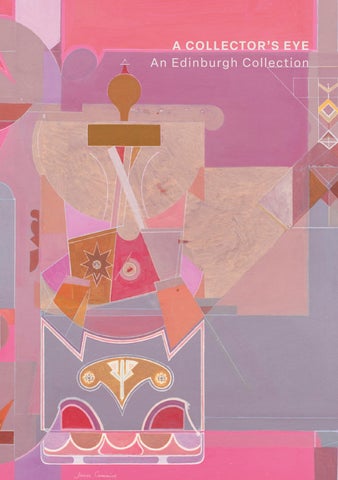
A COLLECTOR’S EYE An Edinburgh Collection
16 Dundas Street | Edinburgh | EH3 6HZ | 0131 558 1200 | scottish-gallery.co.uk
MANY OF THESE PAINTINGS FIRST PASSED THROUGH THE WALLS OF THE SCOTTISH GALLERY. IT IS THEREFORE A PARTICULAR PLEASURE TO WELCOME THEM BACK, NOT SIMPLY AS PAINTINGS FOR SALE, BUT AS OLD FRIENDS RETURNING HOME.
The David McClure (cat. 16) takes pride of place in the Edinburgh living room, where it has long been the centrepiece of the family’s collection.
A William Drummond Bone (cat. 1) presides over the mantelpiece in the family’s elegant Edinburgh dining room.
A COLLECTOR’S EYE An Edinburgh Collection
Some collections are carefully built; others simply grow through a lifetime of looking, visiting and living with art. This is one of those collections. Over many years, this Edinburgh family became familiar faces at The Scottish Gallery. They returned for Festival exhibitions, Christmas Shows and solo exhibitions, taking pleasure in discovering artists, renewing friendships and quietly acquiring works that would become part of their home. Alongside this, they were regular visitors to the Royal Scottish Academy Annual Exhibition and other important exhibitions across the city, making art an integral part of family life rather than an occasional pursuit. There was never a predetermined plan. The collection evolved naturally, each painting chosen because it resonated with a particular moment, an artist they had come to know, or simply because
they loved living with it. The result is a collection that reflects personal taste rather than fashion. Well-known names sit comfortably alongside artists whose work deserves to be rediscovered, each painting carrying its own story and becoming part of a family’s shared history. Many of these paintings first passed through the walls of The Scottish Gallery. It is therefore a particular pleasure to welcome them back, not simply as paintings for sale, but as old friends returning home. We are deeply grateful to the family for entrusting their private collection to us and allowing us to share it once again. As these paintings begin the next stage of their journey, we hope they will bring the same pleasure, companionship and sense of discovery to a new generation of collectors as they have to this family for so many years.
The Scottish Gallery
A COLLECTOR’S EYE
WILLIAM DRUMMOND BONE BRIGITTE BRONDUM-NEILSEN F.C.B. CADELL DAVID COOK JAMES CUMMING SIR WILLIAM GILLIES JOHN HOUSTON WILLIAM JOHNSTONE SIR WILLIAM MACTAGGART DAVID MCCLURE JOHN MACLAUCHLAN MILNE JAMES MORRISON DENIS PEPLOE HAMISH REID SAX SHAW ADAM BRUCE THOMSON EDWARD WRIGHT
WILLIAM DRUMMOND BONE (1907-1979)
William Drummond Bone was a Scottish painter and teacher whose distinguished career was closely associated with Glasgow School of Art. Born in Ayr, he studied drawing and painting at the School from 1928 to 1931, followed by a year of postgraduate study and a travelling scholarship that took him to continental Europe. In 1935, he joined the teaching staff, remaining at the School for more than three decades and becoming Senior Lecturer in charge of first and second year studies in 1948. Working in both oil and watercolour, Bone is known for his expressive landscapes of the Scottish countryside,
especially Ayrshire and the west coast. His paintings, characterised by confident draughtsmanship, vigorous brushwork and an instinctive response to light and atmosphere, often depict farmland, moorland and mountain scenery. He also produced notable wartime watercolours and occasional portraits and still lifes. Bone exhibited regularly at the Royal Scottish Academy throughout his career. He was elected Member of the Royal Scottish Society of Painters in Watercolour in 1950 and became an Associate of the Royal Scottish Academy in 1969.
1 Landscape with Houses, 1978 oil on board, 61 x 76 cm signed lower right EXHIBITED Annual Exhibition, Royal Scottish Academy, Edinburgh, 1979, cat.100
F.C.B. CADELL (1883-1937)
Francis Campbell Boileau Cadell was born in Edinburgh and attended The Edinburgh Academy. He trained in Paris and later in Munich. Early exposure to French painting, particularly the work of the Impressionists and PostImpressionists, shaped his artistic development, encouraging him to develop his own personal style of Impressionism. A keen, discerning sense of design is apparent in later still life and interior paintings and his strength in colour distinguishes him in Scottish modern painting. Cadell exhibited regularly in Edinburgh, Glasgow and London, becoming known for his refined interiors, still lifes and portraits, often characterised by elegant compositions and a sophisticated handling of light and surface. His work combined a decorative sensibility with a strong structural awareness, balancing bold colour with clarity of form.
A decisive element in Cadell’s development was his engagement with landscape, particularly through his visits to the island of Iona, which he first visited in 1912. After the First World War, he returned frequently, finding in the island a subject that allowed for a more direct and elemental response to nature. The shifting light, white sands and vividly coloured waters encouraged a brighter palette and a simplified approach, in which sky, sea and land are reduced to essential forms and harmonies of colour. Cadell’s Iona paintings stand among his most celebrated works, reflecting both an immediate response to place and a disciplined concern for composition. Influenced in part by Cézanne, he sought to express the underlying structure of the landscape. His annual visits to the island became central to his practice and social life, providing both artistic inspiration, a sense of purpose, and the patronage of the summer visitors.
2 Iona, 1914 watercolour on paper, 37 x 44 cm signed and dated lower right EXHIBITED The Scottish Gallery, Edinburgh, 1956 PROVENANCE William Macaulay, former Director of The Scottish Gallery
DAVID COOK (B.1957)
Cook was born in 1957 in Dunfermline and studied at Duncan of Jordanstone College of Art, Dundee, from 1979 to 1984. His talent was recognised early, winning first prize at the Royal Scottish Academy Student Exhibition in 1983. During the 1990s, Cook travelled extensively, painting in Turkey and the Balearic Islands before spending three months in Southern Africa in 1997 at the invitation of the Everard Read Gallery. Throughout this period, he repeatedly returned to Seagreens in the northeast of Scotland, staying in a nearby cottage at Benholm, a favourite retreat of fellow artists Alberto Morrocco and Ian Eadie. Shortly after returning from Africa, he secured the tenancy of Seagreens and, in 2004, made it his permanent home.
3 Wild Snow and Rain, c.2009 oil on board, 61 x 78 cm signed lower right EXHIBITED Kilmorack Gallery, Beauly
That enduring connection to place lies at the heart of Cook’s painting practice. From the high fields around his home and studio he has observed the changing seasons year after year; the first daffodils of spring, the wildflowers of summer, luminous autumn skies and the bleak drama of winter. This intimate knowledge of landscape gives his paintings their immediacy, honesty and emotional depth. In this painting Cook looks out from the fields above Seagreens towards an approaching winter squall. Cook captures the moment dark clouds blot out the sun while its hidden light ignites the storm; casting a fiery glow across the sky. His brushwork is direct and energetic, conveying the movement, atmosphere, and elemental power of the landscape with remarkable urgency.
JAMES CUMMING (1922-1991)
James Cumming occupies a distinctive place in twentieth-century Scottish art. Born in Dunfermline, he studied at Edinburgh College of Art before his education was interrupted by service with the RAF Volunteer Reserve during the Second World War. A travelling scholarship after graduation took him to the Isle of Lewis, where the landscape inspired his celebrated Hebridean paintings and established a lifelong fascination with structure, place, and the underlying order of the natural world. As both artist and teacher, Cumming continually challenged conventional approaches to painting. His work evolved from landscape towards a highly personal abstract language, drawing inspiration from geometry, archaeology and scientific imagery. Renowned for his meticulous draughtsmanship and subtle command of colour, he became one of Scotland’s most original and
intellectually adventurous painters, while influencing a generation of younger artists through his teaching at Edinburgh College of Art and Hospitalfield. In Perfume Jars, Montreux, Cumming transforms a familiar arrangement of vessels into an intricate orchestration of colour, line and geometry. The perfume bottles themselves become points of departure rather than the subject, dissolving into a carefully balanced composition of translucent planes, architectural forms and luminous pinks, mauves, and soft blues. Shapes overlap and intersect with remarkable precision, creating a painting that invites the eye to wander slowly across its surface, discovering new relationships with every viewing. Despite its abstraction, the work retains a quiet sense of still life, where carefully observed objects have been distilled into a composition of rhythm, harmony, and light.
4 Perfume Jars, Montreux, 1985 acrylic on aluminium panel, 51 x 61 cm signed lower middle/left EXHIBITED Roger Billcliffe Fine Art, Glasgow; Festival Exhibition, The Scottish Gallery, Edinburgh, 1985, cat.41; Mixed Summer Exhibition, The Scottish Gallery, Edinburgh, 2004
SIR WILLIAM GILLIES (1898-1973)
William Gillies enjoyed a lifelong relationship with The Scottish Gallery and was one of our most popular exhibiting artists. For many years, visitors were greeted by a browser of his original watercolours, which were modestly priced. Gillies believed that paintings should be admired and collected by everyone, whatever their budget, and this simple display introduced countless collectors to his work. It remained a familiar feature of The Gallery until the early 1980s, encouraging the quiet habit of buying a watercolour to live with rather than simply admire. The three watercolours in this Edinburgh collection reflect places that were familiar favourites for Gillies. His home at Temple in Midlothian and the rolling countryside of the Scottish
5 Hangingshaws, c.1951 watercolour on paper, 25 x 45 cm EXHIBITED The Scottish Gallery, Edinburgh, 1952
Borders provided an endless source of inspiration throughout his career. Whenever possible, he could be found outdoors, sketchbook and paintbox in hand, believing that painting directly from nature was the best discipline an artist could have. Through years of observation, he came to know every changing season, shifting light and subtle variation in the landscape. There is a quiet honesty to Gillies’s work that continues to resonate today. These modestly scaled paintings are beautifully observed, capturing the character of the Scottish Borders but also the pleasure of looking closely. It is easy to understand why generations of collectors have returned to his work, and why these watercolours have been such a cherished part of this family’s home and collection.
SIR WILLIAM GILLIES (1898-1973)
6 Border Valley, 1961 watercolour on paper, 25.5 x 35.5 cm signed and dated lower right
7 Back of the Houses, Temple, 1949 watercolour on paper, 48 x 63 cm signed lower right; title and date inscribed verso EXHIBITED The Scottish Gallery, Edinburgh, 1951
JOHN HOUSTON (1930-2008)
John Houston was born in Buckhaven, Fife and studied at Edinburgh College of Art, where he met Elizabeth Blackadder. The two married in 1956 and shared a lifelong partnership centred around art, travel, and daily studio practice. The sea remained one of Houston’s deepest and most enduring subjects. The coastline of Fife, with its shifting tides, harbours, beaches, and changing weather, provided him with a lifelong source of inspiration. Returning repeatedly to the same stretches of coast, Houston developed a highly personal painterly language through which landscape became both observed reality and emotional experience. Houston exhibited regularly with The Scottish Gallery and his work remains closely associated with The Gallery’s commitment to modern Scottish painting. Working with vigorous brushwork and tactile surfaces, Houston sought not simply to describe landscape, but to convey its energy, instability, and emotional power. Today he is recognised
8 Edge of the Lake, c.1969 oil on board, 26 x 34 cm signed lower left EXHIBITED The Scottish Gallery, Edinburgh
as one of the defining figures of modern Scottish painting, combining painterly freedom with an enduring attachment to the Scottish landscape and to the daily practice of art. In 2005, Houston was honoured with a major retrospective at the Scottish National Gallery of Modern Art; recognising a lifetime devoted to painting and his position as one of Scotland’s most important modern artists. Edge of the Lake dates from Houston’s visit to Wisconsin in 1969 at the invitation of a patron from the Johnson Wax family. Invited to paint the spectacular autumn landscape around Lake Owen, Houston produced several large canvases on site and returned to Scotland with sketches that continued to inspire his work. The unfamiliar Midwestern landscape, with its low horizons, vast skies, and dense woodland, prompted a fresh way of seeing. In Edge of the Lake, brilliant autumn foliage is rendered in rich, expressive colour and vigorous brushwork, while the dark treeline and expansive sky evoke the distinctive atmosphere of the Wisconsin lakes.
JOHN HOUSTON (1930-2008)
Houston travelled to Harris throughout his career, but his first visit came in 1974, accompanied by his wife and fellow painter Elizabeth Blackadder and, for part of the trip, David Michie. He later described the challenge of conveying Harris’s immense skies while maintaining the compositional structure of his paintings. Looking to American artists such as Willem de Kooning for inspiration, Houston reflected: “I felt the paintings were just going to be loose bits of painting and would collapse unless I had that structure. I saw that this was
something that de Kooning has achieved. And, as well as being keen on some of those American painters, I had also been doing a lot of large watercolours on Japanese paper in which the colour bled away. That softness combined with the structure suggested a way of working.” Houston’s Harris paintings of the mid-1970s are among the most reductive of his career, distilling the landscape to its essential elements. In this painting, he captures the last light of day illuminating a brooding sky and sea.
9 Storm over the Sea, Harris, c.1974 oil on canvas, 51 x 61 cm signed lower left; artist’s name and title inscribed verso
WILLIAM JOHNSTONE (1897-1981)
William Johnstone was a pioneering Scottish abstract painter and one of the most influential figures in twentiethcentury British art education. Born into a farming family in Denholm in the Scottish Borders, he retained a lifelong connection to landscape, weather and the elemental structures of nature, which became central to his art. After service during the First World War, Johnstone studied briefly at Edinburgh College of Art before travelling to Paris, where he encountered Cubism and the work of leading European modernists. By the 1930s he had become one of Britain’s earliest and most committed abstract painters, rejecting descriptive realism in favour of rhythm, gesture and formal relationships. Although radical in appearance, his work remained deeply rooted in the landscape and natural forces of the Borders. Johnstone was equally significant as an educator. He became Principal of
Camberwell School of Arts and Crafts in 1938 and led the Central School of Arts and Crafts from 1947 to 1960. There he championed experimental teaching inspired by Bauhaus principles and assembled an exceptional staff that included Alan Davie, Patrick Heron, Eduardo Paolozzi, Victor Pasmore and William Turnbull. He was awarded an OBE in 1954. In 1960, Johnstone returned to the Borders, where he resumed farming and concentrated on painting at Marchlands. This period produced some of his most expressive and assured work. The Scottish Gallery’s 2012 exhibition Marchlands, curated by Christina Jansen, contributed to a major reassessment of Johnstone’s career, bringing together significant paintings, archival material and new scholarship. Today he is recognised as a foundational figure in Scottish modernism and a transformative force in British art education.
10 Border Landscape, 1960 watercolour on paper, 22 x 35 cm artist’s initials lower right EXHIBITED William Johnstone - Paintings, The Scottish Gallery, Edinburgh, 1992, cat.38
WILLIAM JOHNSTONE (1897-1981)
11 Untitled Abstract, c.1960 ink and watercolour on paper, 36 x 48 cm artist’s initials lower right EXHIBITED William Johnstone - Paintings, The Scottish Gallery, Edinburgh, 1992, cat.41
12 Study of Christ at the Temple, 1949 pen on paper, 33 x 20.5 cm artist’s initials lower right EXHIBITED William Johnstone - Paintings, The Scottish Gallery, Edinburgh, 1992, cat.11
SIR WILLIAM MACTAGGART (1903-1981)
Born in Loanhead, near Edinburgh, Sir William MacTaggart was the grandson of the landscape painter William McTaggart (1835–1910). He studied at Edinburgh College of Art from 1918 to 1921, at the same time as William Gillies, and travelled to Paris after graduating. He was a founding member of the 1922 Group and in 1927, he joined the exclusive Society of Eight whose members included Colourists F.C.B. Cadell and S.J. Peploe and began, ahead of his contemporaries, a successful exhibition career at The Scottish Gallery from 1929. A sumptuous painter in oils, he was instinctively an expressionist and romantic painter. His outlook shifted dramatically after visiting the Edvard
Munch exhibition at the Scottish Society of Artists in 1931 (he eventually married the Norwegian curator, Fanny Aavatsmark) and again after studying Rouault in Paris in the 1950s. From his home and studio in Edinburgh’s Drummond Place in the New Town, some of his best-known works offer a still life, framed by a window, looking east towards Bellevue Church. MacTaggart was president of the RSA from 1959– 1969 and was knighted for his services to art in 1962. From 1951, MacTaggart and his wife travelled the short distance to the Johnstounburn Hotel at Humbie for the Christmas Holidays. East Lothian and the Borders became a favourite landscape and the inspiration for some of his most engaging work.
13 Valbonne, c.1975 oil on board, 30.5 x 35.5 cm EXHIBITED Christmas Exhibition, The Scottish Gallery, Edinburgh, 1975, cat.35 14 Harvest, 1967 oil on board, 31 x 41 cm signed and dated lower left EXHIBITED Christmas Exhibition, The Scottish Gallery, Edinburgh, 1967, cat.74
DAVID MCCLURE (1926-1998)
David McClure was one of the outstanding Scottish painters of the post-war generation. He emerged from Edinburgh College of Art in the early 1950s alongside a remarkable group of artists including James Cumming, William Baillie, John Houston, Elizabeth Blackadder and David Michie. Together, they helped shape what became known as the Edinburgh School: a generation defined by strong draughtsmanship, expressive colour and a renewed confidence in painting. McClure’s early career developed within an exceptionally rich artistic climate. Edinburgh was home to influential teachers and exhibiting societies, while The Scottish Gallery was presenting the work of established figures such as Anne Redpath, William Gillies and William MacTaggart, alongside younger artists including Joan Eardley and Robin Philipson. McClure soon joined this company, holding his first solo exhibition with The Scottish Gallery in 1957. Travel played a vital role in the formation of his mature style. Following a year spent painting in Florence and Sicily, McClure absorbed the colour, light and
structure of Mediterranean painting, qualities that remained central to his work. By the late 1950s, he was teaching at Duncan of Jordanstone College of Art in Dundee alongside his close friend Alberto Morrocco, contributing to the college’s reputation as one of Scotland’s great centres of painting. Throughout the 1960s, McClure was included in important surveys of contemporary Scottish art, helping to define the character and ambition of the Edinburgh School. His 1969 Edinburgh Festival exhibition at The Scottish Gallery marked a high point in his relationship with The Gallery and confirmed his position as one of the leading painters of his generation. McClure’s work is distinguished by its luminous colour, patterned surfaces and intimate subject matter. Still lifes, interiors, landscapes and family scenes are transformed through a rich painterly language that balances observation with imagination. His paintings remain deeply admired for their warmth, intelligence and unmistakable sense of joy in the act of painting.
15 Pale Poppies, 1975 oil on board, 30.5 x 35.5 cm signed and dated lower right; signed and title inscribed verso EXHIBITED Christmas Exhibition, The Scottish Gallery, Edinburgh, 1975, cat.64
DAVID MCCLURE (1926-1998)
David McClure returned repeatedly to Sicily throughout his career, captivated by the brilliance of Mediterranean light and the timeless character of its fishing villages. Boats at Aspra belongs to this mature period, where observation is transformed through colour, rhythm, and expressive brushwork. In the middle ground, three fishing boats rest on the shore, their dark hulls and tall masts creating a strong architectural framework against the clustered white and pinkwashed houses beyond. Rather than describing the scene in a literal way, McClure builds the composition
through broad planes of colour and energetic brushstrokes. Rich reds, mauves, and ochres evoke the warmth of the evening light, while flashes of blue and white animate the boats and draw the eye across the canvas. The result is a painting that conveys not only a place, but the atmosphere, warmth and quiet vitality of a Mediterranean harbour. Exhibited at The Scottish Gallery in the 1989 exhibition Figure, Flowers and Landscape, this important oil exemplifies McClure’s remarkable ability to balance bold design with the spontaneity and joy that characterise his finest work.
16 Boats at Aspra, c.1989 oil on canvas, 71 x 91.5 cm signed lower right EXHIBITED Figure, Flowers and Landscape, The Scottish Gallery, Edinburgh, 1989, cat.30
JOHN MACLAUCHLAN MILNE (1885-1957)
John Maclauchlan Milne is often referred to as the fifth Scottish Colourist, and indeed his work and life have strong connections to his better-known contemporaries. Although largely selftaught as a painter, Milne developed a highly individual response to PostImpressionism, characterised by brilliant colour, expressive brushwork and a confident handling of light. It is his French paintings, however, that most clearly reveal the artistic affinities he shared with Peploe, Hunter and Cadell. He married Winifred Milne (née Clark), the daughter of a Dundee greengrocer, in Edinburgh in July 1911. Following their divorce in July 1946, he married Elsie Mackellar, the daughter of a music
17 Figures on a Shore watercolour on paper, 27 x 37 cm signed lower right 18 Figures Fishing on a Canal watercolour on paper, 27 x 37 cm signed lower left
teacher from Paisley, the following month. The couple had met on Arran, at Corrie, around 1939–40. Milne spent time living at Lavardin in the Loir-et-Cher region, one of France’s most beautiful villages, and travelled extensively throughout France during the 1920s. His Paris scenes, together with paintings made at Saint-Tropez and nearby Ramatuelle on the Côte d’Azur in 1924, rank among his finest achievements. Like Fergusson, he enjoyed a long and productive career, and his many paintings of the hills, villages and harbours of Arran, where he settled at the outset of the Second World War, remain a distinctive and important part of his artistic legacy.
JAMES MORRISON (1932-2020)
James Morrison was one of Scotland’s most distinguished landscape painters, celebrated for his understanding of place, atmosphere and light. Born and raised in Glasgow, he studied at Glasgow School of Art between 1950 and 1954 before establishing himself as an independent artist. His early paintings recorded the changing urban landscape of post-war Glasgow, capturing the city’s tenements, streets and architecture with remarkable sensitivity.
as well as the tidal waters and wide skies of the Montrose Basin. Morrison also found inspiration in Glen Esk and Montreathmont Forest, while later spending increasing amounts of time on Scotland’s west coast, particularly around Achiltibuie and Assynt. The mountains of Suilven, Quinag, Canisp and Stac Pollaidh, together with the Summer Isles, Achnahaird Bay and Loch Assynt, inspired some of his most celebrated late works.
A decisive turning point came in 1958 when Morrison and his wife Dorothy moved to the fishing village of Catterline on the Kincardineshire coast. There he discovered the subjects that would sustain him for the rest of his career. The sea, cliffs and farmland of the Mearns, together with the rhythms of the fishing community, led him away from urban subject matter towards landscape painting. From Catterline his attention expanded inland to Denhead Farm and the surrounding countryside, where the structure of fields, horizons and weather became central to his work.
Painted on 23 May 2002, this panoramic view looks down Loch Broom, possibly from near Achduart, just south of Achiltibuie, where Morrison was a frequent visitor from the 1980s onwards. On cloudy days Morrison checked the weather forecast and set out in the direction which offered best potential. This view looks south-east towards the narrowing of the loch, depicting towering clouds gathering overhead as a fleeting sunshine illuminates the water towards Ullapool, whilst the Munro peaks above Inverlael remain in shadow beyond. The weather in the north-west Highlands can change with remarkable speed as Atlantic fronts sweep in from the west, and Morrison masterfully captures this ever-shifting atmosphere through the transient interplay of cloud, rain, and light across the landscape.
In 1965, the family moved to Montrose, where the landscapes of Angus became his enduring subject. He painted the farmland around Farnell, Kinnell, Bonnyton, Carcary, Fithie and Balgove,
19 Brighter in Loch Broom, 23.v.2002 oil on gesso board, 86.5 x 152.5 cm signed and dated lower right EXHIBITED James Morrison - New Paintings, The Scottish Gallery, Edinburgh, 2002, ex.cat.
DENIS PEPLOE (1914-1993)
Born in Edinburgh, Denis Peploe was the second son of the Scottish Colourist S.J. Peploe. While he inherited his father’s sensitivity to colour and structure, he forged a distinctive artistic identity through a lifelong engagement with the Scottish landscape. After studying at Edinburgh College of Art and serving during the Second World War, he returned to painting with renewed purpose, finding enduring inspiration in the west coast of Scotland. A regular exhibitor with The Scottish Gallery from 1947 onwards, his landscapes became celebrated for their strength of design, poetry and sense of place. Colonsay Loch belongs to a series of paintings inspired by the island of Colonsay in the Inner Hebrides, lying to the west of Jura and Islay. Looking across one of the island’s sheltered sea
lochs, Peploe simplifies the landscape into interlocking planes of land, water and sky. The small boathouse in the foreground anchors the composition, while the deep blue water leads the eye towards the rounded hills beyond. The painting is built on a beautifully restrained harmony of blues, greens and earthy ochres, creating a calm, contemplative atmosphere that is unmistakably Scottish. There are echoes of S.J. Peploe’s instinctive understanding of tonal relationships, yet Denis’s vision is his own. Less concerned with brilliant colour than with the underlying structure of the landscape, he captures the quiet permanence of the Hebrides through carefully balanced forms and an economy of means that rewards prolonged looking.
20 Colonsay Loch, c.1985 oil on canvas, 51 x 51 cm signed lower left EXHIBITED Denis Peploe - Oil Paintings, The Scottish Gallery, Edinburgh, 1988, cat.39
BRIGITTE BRØNDUM-NIELSEN (1917-1994)
21 Gruinard Bay, 1982 watercolour on paper, 28 x 53 cm signed and dated lower right; title inscribed verso EXHIBITED Scottish Society of Women Artists 58th Annual Exhibition, cat.27
HAMISH REID (1929-2005)
22 Church in Winter, 1965 pen and watercolour on paper, 34.5 x 54.5 cm signed and dated lower right EXHIBITED Royal Scottish Society of Painters in Watercolour, c.1985
SAX SHAW (1916-2000)
Sax Shaw was born in Berry Brow, Yorkshire, in 1916 and trained at Huddersfield School of Art before choosing to study at Edinburgh College of Art, where he found a thriving stainedglass department. Though offered a place at the Royal College of Art, London, Shaw was drawn to Edinburgh’s commitment to architectural design and contextual craftsmanship. Following wartime service as a conscientious objector, he returned to Edinburgh College of Art and began working in theatre design, tapestry, and stained glass, often in collaboration with his wife, Maisie Mallinson. His subsequent appointment in 1953 as Director of Weaving at The Edinburgh Tapestry Company (now Dovecot Studios) marked the beginning of a radical shift in British tapestry, as Shaw championed a modern, expressive use of texture, narrative, and abstraction.
23 The Sgùrr of Eigg, 1970 watercolour on paper, 54.5 x 72.5 cm signed and dated lower right EXHIBITED Torrance Gallery, Edinburgh, 1983
As a teacher at Edinburgh College of Art from 1948 to 1981, and as a visiting lecturer across Scotland, Shaw shaped generations of designers and stained-glass artists. Shaw’s work ranged across disciplines – tapestry, stained glass, mural painting, mosaics, church furnishings, watercolour, and costume design, yet his voice remained unmistakable; playful, rigorous, spiritual, and deeply embedded in the life of buildings and spaces. Painted wet-on-wet, this painting captures the sun breaking through the moving weather above the isle of Eigg, likely painted from Arisaig. Shaw uses the fluidity of the medium to evoke the shifting effects of weather and light, while the composition is underpinned by Shaw’s strong sense of design that gives the painting both structure and balance.
ADAM BRUCE THOMSON (1885-1976)
Adam Bruce Thomson was one of Scotland’s most accomplished painters in watercolour, admired for his exceptional draughtsmanship and sensitive understanding of light. A lifelong teacher at Edinburgh College of Art and an influential figure within Scotland’s artistic community, he was equally at home painting architecture, landscape and still life. His watercolours combine careful observation with remarkable freedom, balancing structural precision with a fresh, spontaneous touch. Leaderfoot Viaduct spans the River Tweed near Melrose in the Scottish Borders. Completed in 1863, its elegant red sandstone arches rise above one of Scotland’s most beautiful river valleys,
with the Eildon Hills beyond. Although no longer carrying trains, the viaduct remains one of the great landmarks of the Borders and has inspired generations of artists. In this lively watercolour, Thomson celebrates both the monumentality of the engineering and its harmony with the surrounding landscape. The soaring arches rhythmically frame glimpses of the valley beyond, while fluid washes of colour and expressive brushwork convey the changing light and atmosphere of an autumn day. Rather than recording every architectural detail, Thomson captures the enduring character of the place, where nature and human ingenuity are inseparable.
24 Viaduct, Leaderfoot, c.1970 watercolour on paper, 32.5 x 27.5 cm signed lower left EXHIBITED Christmas Exhibition, The Scottish Gallery, Edinburgh, 1975, cat.3
EDWARD WRIGHT (1912-1988)
Edward Wright was an English painter, typographer and graphic designer whose career bridged the worlds of fine art, architecture and visual communication. Born in Liverpool, he initially trained as an architect before turning to painting, printmaking and graphic design. Following the Second World War he settled in London, where he worked in publishing, advertising and education while developing a practice that rejected distinctions between art and design. During the early 1950s, Wright became a member of the influential Independent Group, whose interdisciplinary approach helped shape post-war British modernism. At the Central School of Arts and Crafts he taught alongside Anthony Froshaug, Nigel Henderson and Eduardo Paolozzi; fostering an experimental approach to graphic design and visual culture. He later taught at the London
College of Printing, the Cambridge University School of Architecture and the Royal College of Art, where he influenced a generation of designers and artists. Wright’s work ranged from painting and printmaking to typography and architectural lettering. He designed the catalogue for the landmark exhibition This Is Tomorrow at the Whitechapel Gallery in 1956 and created lettering for a number of important public commissions, including the foundation stone for Churchill College, Cambridge, and the Flaxman lettering system for New Scotland Yard’s revolving sign. A signatory of Ken Garland’s First Things First manifesto in 1963, Wright remains recognised as a pioneering figure in post-war British graphic design, whose innovative approach dissolved traditional boundaries between artistic disciplines.
25 Watercolour I, 1962 watercolour on paper, 45 x 38 cm signed lower right and dated lower left
26 Watercolour II, 1963 watercolour on paper, 43.5 x 38 cm signed lower right
EXHIBITED Arts Council of Great Britain, London, 1985
EXHIBITED Arts Council of Great Britain, London, 1985
Published by The Scottish Gallery to coincide with the exhibitions: A Collector’s Eye An Edinburgh Collection 3 - 26 September 2026 Exhibition can be viewed online at: scottish-gallery.co.uk/anedinburghcollection ISBN: 978-1-917803-35-9 Designed and Produced by The Scottish Gallery Photography by John McKenzie Front cover: James Cumming, Perfume Jars, Montreux, 1985 acrylic on aluminium panel, 51 x 61 cm (Cat. 4) All rights reserved. No part of this catalogue may be reproduced in any form by print, photocopy or by any other means, without the permission of the copyright holders and of the publishers.