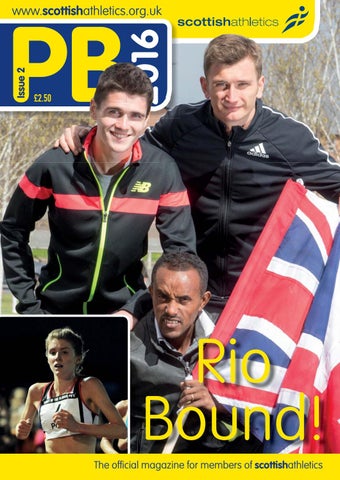
Issue 2
PB £2.50
2016
www.scottishathletics.org.uk
Rio Bound! The official magazine for members of scottishathletics
sportscotland.org.uk nationalagencyforsport @sportscotland
WINS
ADVERT
Sport: whether you’re participating, volunteering or spectating, it’s enjoyable, exciting and sociable. Not only is it good for your health, JVUÄKLUJL HUK ^LSSILPUN P[ HSZV adds millions to Scotland’s economy. So we’re all winners.
scottishathletics 05 Chief Executive Mark Munro 06 News 08 Chairman Q&A Ian Beattie 10 Loughborough 12 Picture Special - District Champs 14 Coaching Conference 16 Paralympics Countdown 18 PB Interview: Brendan Foster 19 PB Interview: Liz McColgan-Nuttall 20 Trio for Rio 23 London Marathon 24 National Road Relays 25 Scottish 5k / Lillebaelt Half Marathon 26 Grassroots: Aberdeen AAC 28 Grassroots: Club Leaders Conference 29 Grassroots: #peoplemakeathletics 30 Grassroots: Lindsays Trophy 32 Grassroots: Forres Harriers 33 Grassroots: Teviotdale Harriers 34 Education: Mindset 36 Education: Social Media 38 Ultra Running
The ofďŹ cial magazine for members of scottishathletics www.scottishathletics.org.uk
in this i
04 Contacts
ssue...
Issue 2
PB2016
t Run. V, Grea uson, T h is tt Mullins , Sco l Ferg Downie Lyle, Michae ay, Dr Sophie . il h P , s rr ia es taff Harrier r y, Mar rew Mu ff Holm am, Je tman, Mark D elde, Dr And rs, Teviotdale o, Susan Egels d A e v r w te ie h r e n S r ig T u , a i n W M a H a g rk es rm Tse Jake C, Forr thy, Ma rk Shea Potter, rek Hawkins, orth AA r Paul McCar Run 4 It vin, Ma tchart, Beth N e a k D G c , y o s b D , fn ctions. rs), , Gif awkin thon w Bu : Bob pic sele graphs eattie, Andre all, Callum H nock Harriers viotdale Harrie h Ness Mara m to ly o O h p rate nB For -Nutt ilmar s (Te s, Loc s celeb wees: Ia Colgan AAC, K Bruce Hughe ritish Athletic Hawkin k Inter vie Foster, Liz Mc rs, Aberdeen , e B r te , e a 7 D g d 01 n rie art Bath elde an ndon 2 Brenda ettleston Har n dell, Stu , Movelat, Lo gai Tew e d h s a S T W , : hearma s s n s b Clu awkin Mark S H : Gordo and, Lindsay y s b r m u to to ll u o h Ca Contrib rs: sportscotl Brit – p lmes as se as first Jeff Ho e y n li b e h Adverti r n. finis ictu hearma rathon Main p Mark S s London Ma hotos: P y b r e r v e o Front C to of Beth Pott awkins crosse H ho Inset p Page: Callum ts n te Con
air Love Manager Alasdh l Events .org.uk Nationa 6 796 14 athletics 07584 love@scottish ir. a h alasd
fin ic Sport Ian Mir d – Paralymp ea Event L 0 rg.uk 343 41 letics.o 07827 @scottishath n fi ir ian.m cDonald – East Jamie M lub Manager lC .org.uk Nationa 0 199 thletics 37 ottisha sc 07776 @ ld a cdon jamie.m
cott Allan S ach tice Co Appren rg.uk 5 392 1 0 letics.o 4 2 078 ttishath tt@sco co .s n a all ing al Runn creation itchell and Re d n a Billy M tl f jogsco Head o 8 .org.uk 634 19 ottishathletics 07801 sc @ ll e ch billy.mit obison ator R Carol dministr rship A Membe 1 .org.uk 2 3 7 76 thletics 0131 4 ip@scottisha h rs membe rchbold e Clair A ministrator d A ts n Eve 5 kk 76 733 thletics.org.u a 0131 4 scottish events@
ill on loper (H Patters nt Deve Malcolm 18 Coach Eve 20 Impact g) rg.uk Runnin letics.o 6 506 78 n@scottishath 9 o 0773 rs e .patt malcolm ment unro Develop Mark M O & Head of letics.org.uk E C th a Interim scottish unro@ mark.m
ger ldie Jim Go ucation Mana Ed Coach 3 3 rg.uk 7 506 letics.o 07739 @scottishath ie ld o .g jim er ns ent Offic Jo Steve hip Developm rs e b Mem leave) ternity (on ma 1 39 734 5 1 3 1 .uk 0 3 180 45 ishathletics.org 07903 o sc tt s@ n ve jo.ste trator Adminis Dennis Joanne and Executive g .org.uk Coachin 8 athletics 76 732 0131 4 nnis@scottish e .d e n joan – North ollison anager Julie M l Club M Nationa 2 639 .org.uk thletics 59 ottisha 07818 ison@sc ll o .m e juli
ollard Mark P ce Manager an Perform 2 980 .org.uk thletics 10 07584 ard@scottisha ll o .p rk ma rdine ns Peter Ja ommunicatio fC Head o 4 .org.uk 6 868 1 thletics 07885 ine@scottisha rd ja r. te pe loper s Hawkin ch Event Deve Robert 8 Coa 1 0 2 ct Impa nce) .uk (Endura 9 875 tics.org 17 ishathle 07903 s@scott in k w a robert.h Harkins Rodger f Coaching ro o ct e ir .org.uk D 8 080 68 ottishathletics 07983 s@sc in rk a h rodger. er/Club nt Offic alcolm nt Developme M a n o Sh me Recruit Officials er ic Para Off 8 4 39 73 .org.uk 0131 5 2 567 3 athletics 8 1 3 scottish 077 @ lm o alc shonam Officer d Press ord yf tions an a ic Sue G n u Comm Digital 0 39 735 0131 5 7 574 .org.uk 03 athletics 07880 scottish @ rd o sue.gyf
ulawnik Lena Z dministrator k A cs.org.u Finance scottishathleti @ ce n fina 6 76 733 0131 4 on McMah – West Lindsay lub Manager C l a rg.uk n Natio 8 letics.o 4 6 796 ttishath 07918 cmahon@sco m lindsay. nnett lson-Be e Nicho ator in tr Lorra is in Adm Welfare 0 k 39 732 cs.org.u 0131 5 scottishathleti @ welfare ett itjer ime) n-Benn Fran Sn Officer (part-t icholso r ve rraine N Administrato .ukk o rg L .o cs Executi 3 ti ance rg.uk 76 732 ishathle Perform 0 letics.o 3 3 0131 4 .snitjer@scott 7 6 7 ttishath a 0131 4 ceteam@sco francesc n s) a hrow perform loper (T nt Deve urray Hugh M 18 Coach Eve 0 2 Impact 2 .org.uk 081 12 ottishathletics 07983 ay@sc rr u .m h hug
Ritchie ager Darren an ance M rm o rf e P .org.uk 5 507 42 ottishathletics 07825 @sc ie ch it .r darren s Service llan usiness Dawn A inance and B fF Head o 2 rg.uk letics.o 080 92 07983 n@scottishath a ll .a dawn istrator e Admin Financ k 36 3 7 6 7 cs.org.u 0131 4 scottishathleti @ finance
07885 868164
Chief Executive Nigel Holl Director of Strategy and Partnerships UK Athletics
@nigelholl
L
aunching the Stirling Scottish Marathon at the end of May, it was very satisfying to hear two previous Chairmen of scottishathletics, an Olympic Silver Medallist, a broadcaster and athletics events guru to all recognise and praise the impact of Scottish athletes on the British and World stage. That recognition from Liz McColganNuttall, Brendan Foster, Mark Hollinshead is fantastic, and scottishathletics as the governing body, was recognised also for our contribution. Elsewhere is this edition, Brendan is fulsome in his praise. Such words are lovely – maybe slightly premature ahead of Rio selections for both Olympics and Paralympics - but also needs sharing. That is because I know who deserves the credit for the impact, who deserves the recognition, and who deserves to look at themselves in the mirror every day and say ‘We Performed When It Counted’. It is a simple list: athletes (of course), coaches, clubs, parents, officials, teachers, physios . . . and no doubt others. A list of people who maybe do not get the recognition that they deserve when our stars perform – but without whom we wouldn’t
have stars in the first place. As I write, I leave the employment of scottishathletics soon and, by now, Mark Munro will have taken on the role of Interim Chief Executive. Mark deserves this opportunity and I know you will support him fully. He has headed up our development team fantastically well and the club support programmes have been driven by Mark – with huge impact. I look back over six years in post as Chief Executive with the greatest feeling actually being one of awe and respect. There have been wonderful moments like Hampden through the summer of 2014; London in 2012; the annual pilgrimage to Callendar Park for the National XC; Indoor events at the Emirates Arena and before that the Kelvin Hall. But those are not the personal highlights I take away. The ‘stand out’ reflections (and there are lessons as well) are of how the culture has shifted in those six years; how the family of athletics in Scotland – especially our club siblings – has embraced challenge, embraced opportunity, embraced one clear agenda, and bluntly got on with it and made it happen.
Mark Munro Interim Chief Executive Scottish Athletics
@SALDevelopment First of all, I’d like to thank Ian as Chair and the Board for backing me in the interim Chief Executive Officer role, it’s a great privilege and I look forward to working with, and supporting the Board, the commissions, the athletics community and the staff over the months ahead. I’d also like to thank Nigel for his support over the past five years and wish him the best of luck in his new role with UK Athletics.
It’s a very exciting time for the sport in Scotland with the European Championships, Rio Olympics and Paralympics nearly upon us, as well as host of off-track events this summer. There is a high interest in potential successes from our athletes and it’s a great opportunity for the sport to capitalise on this high media interest. In terms of the business and development of the sport, the direction and strategy are clear: we will continue to build on the existing work and ensure clubs sit at the
You have risen to the challenge of ‘legacy’ and set an example other clubs in other sports cannot match. You have grown the sport, you have grown events. You are giving headaches to officials because of the size of entries and the length of days – across all disciplines. Most significantly, of course, you have grown people – athletes, coaches, officials, volunteers - into those roles but also offered experiences that have changed lives. The most significant summer ahead – potentially record numbers of Scottish athletes selected for Team GB – is not an accident. I believe it is a result of the family - starting with the our clubs - setting that culture which then grows with the athletes along the pathway. So I move on to endeavour to take those lessons, those reflections, and the Scottish culture and passion to a wider UK remit. As I do, I salute you. I salute our clubs. You make it happen. Please ensure that is always the case. *Finally, I have been so fortunate for the support around me; from the Chairman Ian Beattie; the Board; our Commissions; the fabulous and committed staff team; our partners – especially sportscotland, Commonwealth Games Scotland and UKA, and the various local authority and trust partners across Scotland. Those partnerships are key to governing bodies, and therefore key to a CEO. Thank you to all and my best wishes for the future. Nigel
heart of what we do. I firmly believe we need to continue to strengthen key areas within the sport, whether that’s events, performance programmes or development projects for clubs, coaches and officials, they are all crucial to the sport moving forwards.
There are also a number of projects in the pipeline and we will certainly look to update you on these as the season progresses. Finally, I’d like to wish everyone taking part in the sport the best of luck for the remainder of the summer, and a special good luck to those athletes and their coaches representing GB (and Scotland) in the upcoming major events. Mark
scottishathletics
5
Keep up to date with all the stories @www.scottishathletics.org.uk
NEWS
Butchart lands Muir record
C
oach Derek Easton never tired of telling Andrew Butchart about the exploits of Nat Muir – until one wet afternoon in Holland, that is.
‘Others can still spoil the party for me, I guess, but I definitely think that for the likes of myself and Eilish, who is in the same situation, we’ve take away one of the barriers.
The Central AC athlete eclipsed one of Scotland’s longest standing track and field records at the IAAF Challenge meeting in Hengelo on the same afternoon as the Loughborough International.
‘The race was fast and I knew with about 800m to go that I’d get the National record. It wasn’t the worst feeling in the world, I must admit!
News of Butchart’s 5000m time swept around the Paula Radcliffe Stadium that afternoon and indeed the athletics community in Scotland via our social media channels.
‘My coach, Derek, talks about Nat a lot to me because he’s from that era and trained with him. It is ‘Nat Muir did this’ and ‘Nat Muri did that’ so I know how much it means to people for that record to go.’
Easton trained with Muir on occasion in the past with the Shettleston Harriers athlete, a perennial National XC winner, having clocked 13.17.9 for 5000m back in 1980.
All of this and a wee bit of Brian Whittlestyle one-shoe legend, too.
Butchart took more than four seconds off that time with 13.13.30 in the Netherlands, despite running the last lap with one shoe, and was absolutely thrilled to get the record. And impress coach Easton. ‘Nat Muir’s record had been around for a very long time,’ said Andrew. ‘I didn’t think about it California a couple of weeks ago when I went close but my coach and I did say last week that if the race in Holland was as fast as we thought it might be, then there may well be a chance to PB and take the Record. ‘Getting the second Olympic qualifier was the priority, however. We couldn’t really see another race opportunity between now and Birmingham to get a second one but now I can go there with the pressure off in terms of chasing the time.
‘Before you ask, I had them tied properly – nice and tight – at the start,’ he said, with reference to losing a shoe like Whittle once did when representing GB. ‘But it was wet and the rain seemed to loosen them as the race went on. It wasn’t quite like running in flip-flops but it was getting to be a problem. ‘With 400 to go I looked down the right shoe was completely loose and my heel was in danger of coming free. I just had to kick that one off and away and get on with it. I was thinking ‘this isn’t the best time for this to be happening’. But you just get on with things, don’t you? Now Birmingham looms and the Olympic trials over 5000m with the Scot having two standards. ‘I’m still not there yet,’ he added, at the Great Run launch of the Scottish Stirling
Marathon. ‘There are lots of athletes in the UK who are in a similar position to me so it is all a matter of getting top two at the trials. Mo Farah is going already then there is me, Andy Vernon and Tom Farrell, all going for two spots. ‘I am confident and right now I guess I am in a good position. Those guys haven’t run the time this year yet so if we ran it right now then I would be confident.’
I
nverness Harriers and Highland Disability Sport athlete, Paul Davidson, has been selected for the Great Britain Team to compete at the INAS European Athletic Championships in Ankara, Turkey between June 28 and July 3
Davidson, a 400m specialist, was originally booked to go to the Gothenburg Games with his club and has now had to withdraw from the trip to Sweden following his selection. Owen Miller and Nathan Fleetwood were also selected.
A
s the end of the first year of the scottishathletics Club 20:20 Project approaches, we’re pleased to announce that seven new clubs have been added to the existing group of 25 clubs for the year ahead.
The new additions are: Gala Harriers, Chirnside Chasers, Cumbernauld AAC, Nairn AAC, Caithness AAC, Motherwell AC and Bellahoustoun Harriers.
The purpose of this project is to work with athletics clubs in Scotland that are proactive in their development, to help them to modernise, reflecting best practice around governance, development and delivery – ultimately implementing business models and practices within their club. It provides a programme of bespoke support to club leaders. The existing clubs in the programme are: Aberdeen AAC, Ayr Seaforth AC, Bellahouston Road Runners, Central AC, Kilmarnock Harriers & AC, Edinburgh AC, Falkirk Victoria Harriers, Fife AC, Garscube Harriers, Giffnock North AAC, Helensburgh AAC, Inverclyde AC, Kilbarchan AAC, Lasswade AC, Law & District AAC, Livingston AC, North Ayrshire AC, Orkney AC, Pitreavie AAC, Shetland AAC, Shettleston Harriers, Springburn Harriers, Team East Lothian, Victoria Park City of Glasgow AC, Whitemoss AAC
6
PB 2016 | ISSUE 2
#TrioforRio
S
cotland’s #TrioforRio headline the British Athletics team for the half marathon Team Cup at the European Athletics Championships in Amsterdam, Netherlands on 6-10 July. Callum Hawkins, Tsegai Tewelde and Derek Hawkins, as well as Alyson Dixon, who are all due to represent Great Britain at the Olympic Games over the full 26.2miles, have targeted a Team medal winning performance in the half marathon at the European Championships as the perfect way to prepare for Rio. Susan Partridge joins the selection to make it four Scots in the 12-strong team overall for the trip to Holland. The European Championships will provide Shettleston athlete Tewelde, who is coached by John Mackay, with his British team debut. Kilbarchan AAC athletes Callum and Derek, coached by father Robert, view the event as the right preparation for Rio and for Derek it is a return to GB duty after a four-year absence. Partridge suffered Rio qualification disappointment at the London Marathon – she was a DNF for the first time in 15 marathons in her career – but is highlyranked at the half for 2016 and will be determined to seize the opportunity in Holland.
All at scottishathletics firmly congratulates these athletes and their families and coaches on being selected for a major championships. It is also great for the clubs involved in their development over a number of years to see the fruits of the labours of their volunteers. European Championships in Holland July 6-10 Men’s Team: Callum Hawkins, Tsegai Tewelde, Derek Hawkins, Dewi Griffiths, Scott Overall, Jonathan Hay. Women’s Team: Alyson Dixon, Tina Muir, Charlotte Purdue, Gemma Steel, Susan Partridge, Lily Partridge. *Luke Caldwell was also selected by GB for the European Cup 10,000m event (which was due to take place as PB went to press).
Picture by Mark Shearman
Rio now a reality for Beth
B
eth Potter has revealed how tunnel vision – and more than ten years as a swimmer - helped her become an Olympian The Scottish National XC champion clinched her Rio place with two superb 10,000m runs, one in California and then a second at the Highgate Night of the 10Ks meeting that was the British Athletics trial. Potter finished second Brit on the evening to Jessica Andrews and, having already secured the qualifying standard in America, that was enough to book her place for a first Olympic experience. ‘I was very nervous for Highgate because it was such a tense occasion,’ said Beth, who clocked 32.05.04 in London. ‘I had the qualifying time with a PB run of 32.03.45 from California so in that sense at least I didn’t need to chase the time. But with people like Jo Pavey, Kate Avery and Jessica Andrews all involved, I had to be sure of that top two finish. ‘It was really important not to sit off anything or wait for something to happen. I felt I mostly made the right decisions in the race at the right moments and it was an ‘honest race’ as the times proved (with both Potter and Andrews inside the GB qualifying standard). ‘I couldn’t afford to think about people like Jo and Kate. They are top athletes and have done very well at 10,000m in the past but I felt I had to make sure I was covering everything close to the front of the race. ‘It worked out well in the end although I was still very nervous indeed over the final three or four laps.
‘To be honest, it is taking some time to sink in that I am going to Rio. I’m a teacher and all the kids at school kept asking me constantly ‘Miss, are you going to Rio?’. It’s been really nice to tell them I’ve made it! ‘Highgate has been a good venue for me because a couple of years ago I was second to Jo and got the qualifying time for the Commonwealths and the Europeans. It is always a great event.’ Potter has a swimming background after starting in the pool at the age of five. Top Scottish cyclist, Katie Archibald, was one of her club-mates at Milngavie and Bearsden Swimming Club. ‘I started at around five and was with Milngavie and Bearsden SC from about the age of seven right through to just before starting Uni – so around 17 or 18,’ she said. ‘Katie was involved and two guys who made the Scotland swimming team for Glasgow 2014, Calum Tait and Jack Thorpe. I think it definitely helped my fitness over those years, although I was racing a lot as well.’ With Jessica Andrews not eligible, Potter picked up the British Champs gold medal on the night. That followed on neatly from Rhona Auckland’s gold success a year earlier and a silver for Beth back in 2014. Mark Mitchell gave the best performance by a Scot in the men’s division at Highgate with the Forres Harrier at 30.23.13 in his first outing at 10,000m on the track.
@scotathletics scottishathletics
7
PB Interview
Chairman Q and A
It’s been an exciting time on Ian Beattie’s watch as Chairman so far... now he believes solid foundations will ensure future remains bright IAN BEATTIE has confirmed he will remain as Chairman of scottishathletics for a second four-year term, following his arrival in 2012. The ultra runner is chief operating officer of legal firm Lindsays in his day job and a passionate supporter of athletics in Scotland 24/7. We felt the time was right for PB magazine and Ian to chat about his role and what lies ahead for the organisation and the sport...
Q
Ian, you’ve been in post now as Chairman of scottishathletics for four years now. Why did you accept the post and, with your background within the sport as a runner and with a number of clubs, what did you feel you could contribute? At the time the vacancy arose, I was halfway through my second term on the sportscotland board, where I was Vice Chair and chaired the Audit Committee. Athletics was my main sport, however, and the opportunity to take on the Chair post at scottishathletics was one I found really exciting; particularly with the London Olympics and Glasgow Commonwealth Games on the horizon. I had been a member of various Scottish athletics clubs for more than 20 years, so felt I understood how the sport worked. I had also been on the scottishathletics board before, between 1998 and 2002. Perhaps more importantly, I had quite a lot of experience of chairing various organisations in my business life, so felt I could use my skills in that area to make a positive contribution.
Q
It has been a hectic spell, with the Commonwealth Games in 2014 always likely to be a highlight. What has pleased you about the progress of the sport in Scotland these past four years? The 2014 Commonwealth Games in Glasgow was indeed a huge highlight. I was satisfied with the medal tally of four (sportscotland had set us a target of more than two medals), but felt more encouraged about the potential of some of the athletes we could see coming through. When I took on the role in 2012, Herald journalist Doug Gillon had suggested we would do well to win any medals at all in Glasgow and had described my role as ‘perhaps not mission impossible but certainly mission very difficult’. But I knew there had been a lot of work done before I arrived, and we were never going to make any excuses about the Games
8
PB 2016 | ISSUE 2
coming too early; we just got on with it and tried our best to provide an environment where the athletes and coaches could succeed.
Q
Think we recall one of your early comments as Chair being a desire to ‘pull together the various different elements of a multi-faceted’ sport. You wanted to try and bring some unity of purpose, believing that would be beneficial for athletes, coaches, clubs, officials and volunteers. How would you assess impact in that sense? I am delighted at the way people across all of scottishathletics are working together more and I think it is one of the most important factors in helping us improve our overall performance as a sport. The development work in clubs has been terrific and reflects a huge amount of effort from the athletes, coaches, officials, and other volunteers within those clubs, often in partnership with the staff at scottishathletics. Communication of what is going on has improved considerably and has helped develop a culture that is honest and open. I think there is now a recognition that all of us in scottishathletics want the same thing – a hugely successful, highly performing sport in all areas – and that we will be much more successful if we work together in an atmosphere of mutual respect.
Q
You have now agreed to serve another four-year term as Chair (with Leslie Roy re-elected as President for another four years at the last AGM in September 2015). Why did you want to continue?
number of years, but which took a few years to get everything in place. We have now put down some strong foundations for the future, and I expect to see scottishathletics perform at a very high level in the years ahead. So while there’s continuity there on the board, there will be change internally with Nigel Holl leaving the role of chief executive (after six years) and heading south, (as did former Director of Coaching Stephen Maguire). How do you see the future for scottishathletics as a governing body with that change? And can having ‘friends in high places’ at UK Athletics perhaps be helpful? I am very sorry to be losing Nigel and think he has played a massive role in improving scottishathletics during his six years in the post. However, one of the attributes of good CEOs like Nigel is that they understand the importance of putting good structures and processes in place, which mean that the success of the organisation is not dependent on any single individual. I think we are in good shape as an organisation and would expect Nigel’s successor to build on his achievements. In terms of Nigel’s new role at UKA, I am sure he will do very well and I have no doubt, too, there will be benefit to us in having another ‘friendly face’ at a senior level in the UK governing body.
Quite simply, because I enjoy the role and love being part of scottishathletics at this level.
The UKA relationship is an important one for us, and during my term in office I have been very pleased at the way this relationship has developed and strengthened. scottishathletics is viewed very positively at UK level – it is no coincidence that both Stephen Maguire and Nigel have been offered senior roles there – and I think ultimately that can only be of benefit to us.
While we have seen some really positive things happen in the last four years, I am convinced that there is a lot more to come in the years ahead.
Q
Results don’t happen overnight, but take many years of hard work. Swimming is an excellent example of a Scottish sport that has performed at a high level for quite a
In a wider context, how do you see the future for athletes towards the top end of the sport? There’s a hectic programme looming with Olympics, London 2017, World Indoors in Birmingham 2018, Gold Coast 2018 Commonwealth Games, European Championships this year and again in
PB Interview
Chairman Q and A
Pictures by Mark Shearman & Bobby Gavin
2018, and the European Indoors coming to Glasgow in 2019? It’s an exciting time for our top end athletes and it is really positive to see an increasing number of Scottish athletes becoming realistic contenders for places in UK teams. To see Scottish-based athletes fill all three places in the men’s marathon team for Rio was superb and I am confident there will be quite of few other Scots joining them. Of course, there is still a lot of hard work ahead for all of our athletes, and they will need to ‘Perform When It Counts’ at the Olympic trial and beyond. But, at this moment, the signs are very encouraging. But we must not forget that the performances we are seeing now are the result of many years of hard work and did not happen overnight – it is one of the reasons why all of the development work going on in our clubs is so important.
Q
The Lindsays Cross Country Season has been a successful partnership over the past couple of years with the legal firm where you are CO0 backing the most significant cross country events – with the National XC in particular showing remarkable growth and
inclusion. Is that a good example of clubs ‘buying into’ one of the key goals of the governing body; with more athletes getting out to compete? The National Cross Country Championship has always been one of my favourite days in the running calendar. Although I am now a bit further back in the field than I was a few years ago, I still love everything about the event; in particular the camaraderie that the event generates, with so many club athletes giving their all regardless of the weather or the conditions. There must have been more than 3,000 people this year at Callendar Park, which is more than most Scottish football matches that day. The increase in numbers taking part in recent years has been great to see and is a real credit to the work being done at clubs all over the country. Wearing my Lindsays hat, we have been really pleased with our involvement in the National Cross Country season, and are delighted to support a series that provides such great opportunities to take part for people of all ages, across the whole of the country.
Q
We know the marathon is one of your passions. How much enjoyment did this year’s London Marathon performances by Scottish athletes give you and how much do you think that ‘feelgood factor’ has a wider effect across the sport? I found watching the London Marathon a very emotional experience this year. To have three Scottish athletes run sub 2.13 at the Olympic trial was an outstanding achievement, and I am sure there is even more to come from all of them. There is no doubt in my mind that performances like that give a boost to the entire Scottish athletics community and provide a great motivation to others to improve their performances. I was particularly pleased for everyone at Kilbarchan AAC and Shettleston Harriers. Both are clubs which have done a lot of tremendous work over the last few years and are two of our leading ‘Club Together’ clubs. It is great to see their hard work recognised by having their athletes selected to be part of the British Olympic team in Rio.
scottishathletics
9
Loughborough International
Select bunch savour Loughborou W
hen Director of Coaching Rodger Harkins started mulling over plans for the Scotland team for Loughborough International, the match itself wasn’t a huge priority. In recent years, Scotland’s strength for this event has been diluted via selections for opponents like the hosts, Loughborough University, GB and NI Juniors and British Universities. With Scots available for those four teams, plus guest places, the whole weekend now demands a different approach: one where opportunities for athletes and coaches to gain important experience is paramount and one where individual performances can be assessed. So it proved again this year on a weekend when there were top Scots drawn to events elsewhere like Highgate, Hengelo and Rabat to stretch resources for the team, who duly finished seventh. Nonetheless, we tallied up 10 PB performances and event wins (including guest races) for six Scots on a day when the ‘Perform When It Counts’ message was uppermost in many minds. Athletes like Jake Wightman, Mark Dry, Chris Bennett, David Smith and perhaps one or two others had the Olympic trials on their minds – with the European Championships in Holland another realistic
goal for some of those who competed at Loughborough. For other, younger athletes this was a chance to step-up a level and see if they could cope with wearing a Scotland vest. Quite a few did that in spades. Wightman, representing the host university, took command of the Men’s 1500m from the bell and clocked 3.40.86 to win. ‘It was a bit quicker than I thought it might be and it was good to get the win since this is my last year as a student athlete with Loughborough,’ said Jake.
clocked 10.65 to win one of the 100m Guest races. He said: ‘I am gutted with that wind speed. That would have been my first PB since 2012. But I know it is there.
‘Now I just want to get ready for the British Trials and see if I can get that Olympic standard at 3.36.20. The European Champs one is there, too, at 3.38.50 so there’s lots to aim at - but time is counting down to Birmingham.’
‘I needed a change after being in Aberdeen for six years and now I am working in central Scotland and training in Glasgow. Being coached by Chris Baillie helps.’
David Smith was another winner in the high jump match at 2.21m, while Chuxx Onya won the triple jump with a PB of 15.47m. Remarkably, he did that on his first jump before succumbing to injury. It was a decent day for Scottish sprinters, a few frustrations with wind speeds notwithstanding. Cameron Tindle ran a quick 200m in GB colours for 20.75, although the +4 definitely helped! Beth Dobbin set a legal PB at 23.82 in the 200m. And Jenna Wrisberg ran a PB of 11.79 in the 100m Match to finish seventh. That run also takes her to second on the all-time list for U20. ‘I’m delighted because one of my goals was to get under 12,’ said Giffnock North AAC athlete Jenna, who is coached by her dad, Alan. ‘I felt good coming into the race and as I crossed the line I was pretty sure I’d managed a PB. But it was brilliant to see that 11.79 on the Results sheet. ‘I am still at high school so am doing exams at the moment. I’ve tried to do a big of studying here this weekend but it is not that easy when your mind is on representing Scotland.’ Sprint hurdler Heather Paton was another to PB, getting under 14 seconds for the first time with 13.86.
10
PB 2016 | ISSUE 2
Aberdeen AAC athlete Stephen Dunlop
Sinclair Patience threw for Scotland for the first time, 30 years his dad featured in the discus at the 1986 Commonwealth Games, but didn’t manage to improve his shot PB. Two athletes who really performed when it counted were Ben Stevenson in the 3000m and Stacie Taylor in the 3000m steeplechase. Ben clocked 8.06.32 and said: ‘My PB was in a British League match at 8.15 and I was pretty confident I could break it. There were guys in there who have run sub eight minutes so to get third in the race and a PB
Loughborough International
gh experience
Stacie Taylor in the steeplechase - Pictures by Bobby Gavin
means an awful lot. ‘I ran well in Manchester over 5000m for a 14.13 PB last weekend and took that form to Loughborough. I’m delighted to represent Scotland and my coach, John Pentecost, pointed out to me that I’ve now had three in three disciplines in 2016 with the Armagh Road Race and a late call-up to the Home Countries International XC.’ Tulsa-based Stacie, the Kilmarnock Harrier and Glasgow School of Sport developed athlete, took more than 10 seconds off her PB and finished second place for Scotland in the Women’s steeplechase. In the Women’s pole vault, Anna Gordon’s GB debut was cut short through injury after clearing 3.75m. Courtney MacGuire also cleared that height while Henrietta Paxton, competing for Loughborough, was at 4.10m to win her event.
In the women’s 800m, Emily Dudgeon was second in 2.03.36; Katy Brown was fifth in 2.05.24 and Mhairi Hendry was sixth in 2.05.72. Jamie Bowie did well for GB as part of a 4 x 400m guest international lineup which was won by the British men. Among those athletes guesting who were pleased with their performances would have been young 400m runner Lewis Brown; 1500m runner Jemma Reekie and Seniors Anthony Young and Martin Lipton. Kelsey Stewart wore two vests in one day – racing for Scotland at 400m and in the 4 x 400m relay for GB and NI.
Mark Dry was second in the hammer competition, wearing a Loughborough vest, with 73.72m as Chris Bennett threw 73.32m. Rachel Hunter was fourth in the Women’s hammer with 60.96m. ‘It is frustrating because I feel pretty good otherwise but I’ve a few more comps and some training to do now before the Olympic trials at the end of June,’ said Dry. ‘Myself and Chris Bennett have current standards for the Euro Champs in Holland so that is very much a target, as well as Rio.’
scottishathletics
11
District Champs Hundreds of athletes proved competition is what they train for by taking part in the scottishathletics District Champs at three venues in May. Friday night action was introduced in Inverness as the North District joined the West and East for what has become a two-day event. And we were fortunate to have superb photography from all three locations as Phil Downie covered the action in the North, Bobby Gavin took in the West event at Kilmarnock and Steve Adam captured East performances at Grangemouth. We think you will agree they gathered images of terriďŹ c quality and we share a few of those here with many thanks to Bobby, Steve and Phil for their efforts.
12
PB 2016 | ISSUE 2
Picture Special
District Champs
Picture Special
scottishathletics
13
Coaching Conference
‘We must try and ensure coaches are doing the right things with athletes at the right time for their stage of development’ Rodger Harkins escribed by our visiting guest coaches last year as ‘one of the best governing body coaching conferences in Europe’, scottishathletics will once again be hoping to replicate previous success with a world class line-up for 2016.
D
August this year.
Last year saw keynotes, seminars, practical sessions and workshops led by a number of international level coaches including: Boo Schexnayder, Jonas Tawiah-Dodoo, Vesteinn Hafsteinsson and Phil Moreland. There was also input from UK Athletics Performance Director, Neil Black, as well as contributions from a number of Scottish coaches.
*Further guest coaches will be announced as they are confirmed, please visit the conference page on the website (http:// www.scottishathletics.org.uk/coaches/ coach-cpd/national-coaching-conference/ )
The dates for 2016 have been confirmed as September 24/25 at the Emirates Arena in Glasgow, and once again, Scottish coaches will receive a heavily subsidised price for the weekend’s programme. To date, several guest coaches have been confirmed including; Vern Gambetta - Vern is recognised internationally as an expert in training and conditioning for sport having worked with
At the conference, Robert will give a presentation on training for the marathon and coaching Callum and Derek Hawkins to the Rio Olympic Games.
a number of years, specialises in coaching multi-events and is also the co-founder of USA Track & Field coach education programme. Vern will start the conference by delivering a keynote presentation, along with a number of sessions on athletic development. Martin Bingisser – Martin Bingisser calls himself ‘the ambassador of hammer throwing’. Martin is the Swiss champ, coach, former University of Washington all-American, and founder of HMMR Media website. Through his website, Martin offers a wide range of training resources, commentary, and news about the throwing events from their hosted blogs. Martin‘s blog offers a look at training for the hammer throw and other athletic events through his experience working with other world-class coaches.
world class athletes and teams in a wide variety of sports. He is a popular speaker and writer on conditioning topics having lectured and conducted clinics in Canada, Japan, Australia and Europe. Vern’s coaching experience spans 39 years at all levels of competition. Vern is considered to be the ‘Founding Father’ of functional sports training and is world renowned for his work in the physical development of athletes. He has coached and lectured internationally for
14
PB 2016 | ISSUE 2
At the conference Martin will deliver a number of sessions on the conditioning for throws and the technical development of the hammer. At the conference, Martin will be teaming up Vern to perform a live podcast on coaching in athletics.
Rodger Harkins, Director of Coaching is looking forward to what’s in prospect for coaches once again this year. ‘I feel 2016 is a pivotal year for Scottish athletes and coaches and valuable lessons will be learned from the major championships (European Championships, Olympics & Paralympics),’ said Rodger. ‘Our ambition is certainly to continue to have more senior athletes represented at championships but the important message for coaches is that we must ensure coaches are doing the right things at the right time for athletes based on their stage of development. ‘Coaches will gain a great insight into the core competencies required for athletes at each stage of the pathway and will be provided with good information around technical and physical development of athletes as well as how to plan effectively” ‘Coaches can choose from a range of breakout sessions across the weekend that are relevant to their event group and stage of athlete development.
Robert Hawkins – is the National Coach mentor for scottishathletics for middle distance/endurance.
Places are limited at the conference, so to book your place please visit the conference home page on the website.
Robert coaches at Kilbarchan AC, where he coaches a number of athletes including his sons Callum and Derek Hawkins. Robert has recently, and more notably, successfully coached both Callum and Derek to the London Marathon in April, where not one but both athletes gained GB selection for the forthcoming Olympic Games in Rio in
The cost of the conference for scottishathletics coach members is £30, and £130 for non-members. For further information please contact Darren Ritchie (National Coach Development Manager) at darren.ritchie@ scottishathletics.org.uk
EMIRATES ARENA, GLASGOW 24 & 25 SEPT 2016
Paralympics Countdown
Maria Lyle
How Maria could be a poster girl for Brazil
T
here’s a bit of Maria Lyle craves the life of an ordinary teenager. A bigger part of her would rather be an extraordinary
one.
At 16, she has lived with diplegic cerebral palsy in her legs almost all of her life, a debilitating disorder which dictates how she lives her life but she steadfastly refuses to let rule it. With running, though, has come validation, confidence, belief, a feeling of self-worth overpowering those who cruelly devalued her life as a kid. But most of all, running and winning has brought hopes and dreams. None more so than the ones which will put a Paralympic medal from Rio on the mantelpiece come September. Discovering her talent eight years ago after being stunned to be the last kid standing in a bleep test set by her PE teacher mum Susan at school, Maria has defied a disease which hampers her mobility and coordination to take giant strides in the world of para athletics, holding world records, winning European golds, world silvers. Now the top of the mountain beckons in the shadow of Christ the Redeemer in Brazil - and the endearing fourth year pupil from Dunbar Grammar School has an eyewatering dedication to scale it. After a training camp in Brazil, Maria is now preparing for the IPC European Champs in June in Italy, the European Paralympic Championships in June in Italy and the Paralympics in the autumn, she took time out of her schedule to give mailsport an insight into a life less ordinary. ‘Before running, I wasn’t very confident,’ she admitted. ‘I didn’t have much going for me. I had been diagnosed with CP and lived with it since I was two. ‘But one day in a PE lesson my mum was taking, we were doing the multi-stage fitness test - the bleep test - and I surprised a few people and managed to complete it. I was last person standing, and I thought ‘Oh, this could be my thing’ ‘I was about eight at the time, and I started running with my parents, then about 10 when I started doing disability competitions. But it wasn’t until I was really seen by the GB people that I actually thought it could be
16
PB 2016 | ISSUE 2
serious.
see a lot in me.
‘I got my classification, which is something you need to get as well, and it took off from there.’
‘But my friends all helped me along. And me running proved them wrong.
The changes in her life, the expert support available through Team GB, the funding coming from National Lottery and other backers, they’ve all made a difference. Her mum and fitness fanatic dad Raymond have noted the difference in her day to day movements and co-ordination, although her CP still retains a grip on her range of movements which will be with her for life. The biggest boost, however, has been far less discernible to the naked eye - and a heart-rending level of self-awareness in a girl in her mid-teens only makes the impact of what she says next more acute. ‘Before this,’ she sighed, ‘people had a perception of me as being quite stupid, a bit dumb, a bit slow - nothing really there. That’s hard to take. ‘And it wasn’t really the other kids. Kids are accepting of you for who you are. It was actually more the teachers and the adults you’d be around in school who just didn’t
‘It said to me, ‘I’ve actually got something decent about myself, something good.’ I even got into the school team at the time as well, more for distance, like 800m and cross country, and that was something I never thought I could do. Wearing the school T-shirt, running in the race, not coming last… it felt good.’ After earning her T35 classification - the T’s for track, the 3 relates to her CP, and the 5 is the severity of it, T35 being the worst affected of the ambulatory athletes, with T31-34 those in wheelchairs - Maria started setting her world on fire with her times in the 100m and 200m, beating world bests as early as 12 and 13 before European glory at 14 in Swansea. Now she is trying to juggle a schedule which gives her a fighting chance of passing her exams and getting herself in the perfect shape for the summer. ‘School’s still not my favourite place,’ she laughed. ‘I do struggle, but my mindset from running can be transferred to my daily life.
Maria Lyle
Paralympics Countdown IPC championships in Qatar at the end of 2015 for a pic, Maria pulled them from a drawer in the unit under the TV. The notion of silver showing off that you’re one of the elite not being on display may seem overly humble - and that’s the perfect word to describe her - but she admits it’ll be a different story for Rio. She grinned: ‘I dream. Rio has been an aim for me for six years, I’ve had my eyes on it since I could run. ‘Will I do it? Paralympic sport is different because lots of new athletes appear; it’s a developing sport, but I’m hoping to medal. And if I had one of them, that would be on display for everyone to see!’ She’s coy about the competition she faces but an Australian teenager, Isis Holt, was the victor at the worlds in Doha, taking her world record, having come into the T35 race from a different categorisation.
‘I need discipline to get through the schedule. it’s mad, but it’s organised, and you know the expectations you need to have of yourself and the commitment you need to make . ‘Even just to be meeting my coach, Tabo Huntley, down near Liverpool, needs commitment from me and especially from my family, who have been massive for me. Their commitment is unbelievable. Not just in terms of driving me around, but actually doing my training with me. ‘And my sister Anna puts up with a lot as well – she’s not into running so she can get a bit fed-up with it ruling the rest of our lives!’ Asked to dig out her recent medals from the
She admitted: ‘It’ll be hard because she’s a very good athlete and we have different strengths. All I can do is try my best; I can’t really worry about her. I can only run my own race.’ Which also serves as a metaphor for her life - one which she is determined to lead as normally as possible. She said: ‘It’s hard to do normal things just now between training and school-work, but when I get the chance I like doing what everyone else does. It’s nice talking about other stuff. ‘The CP does affect your life, though. I can’t walk as far, I get tired quickly with my legs, my movement is restricted so simple tasks that most people don’t need to think about are a challenge for me.
You can’t do much to help it. You can stretch, losses the muscles, but CP’s not curable so you just need to suck it up and deal with it. But I’ve lived with it since I was two ands I was diagnosed. ‘You adapt, and when you’re on a team with other Para athletes you actually think ‘I’m quite lucky, the way I am’. You see how everyone else adapts to their disabilities. it’s inspiring. ‘Guys who have lost their legs in the army, it’s awful, but the way people turn their lives around, running in the Invictus Games, being part of a team. You can learn a lot from everyone around you.’ *Maria is one of 1300 athletes funded by The National Lottery so they can train full-time and access world-class coaching facilities and medical support. As well as funding Road to Rio athletes every week National Lottery players raise over £34 million for arts, heritage, charity, community projects and grassroots sports clubs and facilities across Scotland and around the UK. Find out where your money goes at lotterygoodcauses.org.uk Version of this article first appeared in the Sunday Mail. Reproduced with thanks to Gordon Waddell. *As PB went to press, Maria was one of three Scots named by British Athletics for the IPC European Championships. These take place in Italy from June 10 to 16 and the young sprinter will be joined by thrower Jo Butterfield and long jumper Stef Reid in the GB and NI squad. Maria made her mark at Swansea two years ago at the last IPC European Champs when she won the 100m and 200m gold.
“It said to me, ‘I’ve actually got something decent about myself, something good.’ “
scottishathletics
17
PB Interview
Brendan Foster
A
flying visit to Scotland in lateMay saw Brendan Foster promote the Stirling Scottish Marathon. Or installed as the new Celtic manager, depending on which radio station you listen to. It was a case of mistaken identity, and not one but two Brendans, when Foster was mentioned in dispatches about the Parkhead job . . . as (of course) Brendan Rodgers was installed as Ronny Deila’s successor. What was unmistakeable, however, in conversation with the English athletics legend, Olympian and BBC commentator was his unstinting admiration for recent performances by Scottish athletes, supported by their coaches and clubs. We were speaking at the Wallace Monument in Stirling and it is abundantly clear this summer’s Olympics could witness something pretty special for athletics in Scotland. Monumental, even. ‘I think it is fantastic to have so many athletes already on the team (four) and others looking good for the trials,’ said Brendan. ‘If you look at it simply on the endurance side of things then I am thinking we could see Scots representing GB at the Olympics in 400m Hurdles, 800m, 1500m, 5000m, 10000m and the marathon. To have such a strong force in athletics in Scotland at the moment reflects really well on athletes, coaches and clubs. ‘I’ve never seen that kind of Olympic representation - or potential Olympic representation - before in my lifetime and it is great to see. It just looks so strong. ‘In fact, if I was an English athlete at the moment I would be thinking ‘the Scots are taking a lot of the places!’ The Geordie was smiling as he made that remark and his own Scottish memories include competing at Edinburgh 1970 as his first major championships. But, with his Great Run role as well as BBC commentating, he’s anything but stuck in
Scotland fostering the right team spirit the past. Foster also echoed another truism – nobody who qualifies for Rio will be an ‘overnight sensation’ because athletics does not work like that. ‘This current crop of Scottish athletes can be role models for the next generation and that’s what works well for the development of the sport,’ he said. ‘You have had great athletes in the past like Liz McColgan-Nuttall who I believe was the best of the lot. ‘But if we think about the ones around now, you have young people what have emerged from the ranks. Some of them were maybe inspired by the likes of Liz and now it is happening across a number of distances. ‘I don’t think Scottish athletes will just be participating at the Olympics - I think you will have contenders in there. You could be looking at some serious performances and let’s hope so because that is great for Britain and great for Scotland. ‘Almost every single one of them has been involved in our Great Run events down the years and that gives me a lot of satisfaction and pride. Whether that is just being at the Great Edinburgh XC as a youngster or someone like Callum Hawkins racing the Great North Run and the Great Scottish Run then it is good to have given them a platform.
18
PB 2016 | ISSUE 2
“This current crop of Scottish athletes can be role models for the next generation” -Brendan Foster
‘So I have to say that, as a company, we feel a connection with them. ‘I’d stress that nobody is a surprise or a new name. It takes years and years of hard work to get anywhere near Olympic selection to be frank. ‘Overnight sensations just do not happen in an Olympic sense or in distance running. It takes a long-term strategy - from athletes and coaches as well as a governing body for this kind of thing to come to fruition. ‘Hopefully what is happening now can form an impetus for the next wave of young athletes, who may already be at a club
Liz McColgan-Nuttall
PB Interview
‘Eilish can better my times...’ Liz McColgan-Nuttall
I
t is quite a statement from a triple Olympian and regular major medallist.
But Liz Mccolgan-Nuttall firmly believes that her daughter, Eilish, can ultimately be a ‘better athlete’ than she was – or at least take down some of her PBs. Such a scenario looked unlikely a couple of years ago, it has to be said, and arguably even more so during an injury-hit 2015 for the now former steeplechaser. The switch to the flat looks promising, though, and mum and coach Liz is convinced 2016 is just the start of exciting times for Eilish. Literally.
at the age of 12 or 13. If they can be supported, and the coaches get backing from scottishathletics and other bodies, then there should be a great future ahead. ‘You need more support because other sports do get more. I think athletics definitely deserves more support and you have to keep knocking on doors.’ Great Run have backed the Edinburgh XC and the Great Scottish Run for a number of years and next May will see their first marathon event take place – as the opening event in a British Marathon Series. ‘We’ve three big events now in Scotland with the Great Edinburgh XC at the start of the year and the Great Scottish Run event in the autumn in Glasgow – and now with this marathon event in Stirling in May 2017,’ said Foster. ‘We’re delighted to stage a marathon for the first time in Scotland. It is part of a new British Marathon Series but it will definitely be the most beautiful one, given the scenery around Stirling! ‘I think with those three events in Scotland we’re helping to raise the profile and promote the sport and hopefully that has a knock-on effect right across the spectrum of the sport. ‘Our ambition would certainly be to have the Stirling Scottish Marathon televised. We will let you know more about that when it happens . . .
‘She is getting close to some of my times from the past and I have every confidence she will beat them – because she can be a better athlete than me,’ said Liz. ‘You want every athlete you coach to reach their peak and their potential. And Eilish has been nowhere near her potential in recent years, for all sorts of reasons. ‘I said all along I felt she was a 5000m and 10,000m runner but she was happier doing the steeplechase because it was the easier option. Sometimes it takes something like what happened to her in terms of injuries for the event change to come about. It forced her to make choices. ‘The steeplechase did lead her to winning British titles and making the Olympics and World Champs – all of which was good for her experience. But she doesn’t have 5000m and 10,000m experience as yet – and it is different, you have to learn how to race. ‘If she gets to Rio then brilliant but we still see this as a building step year in many ways after such a long injury lay-off. I am delighted the way she is performing. She is only running once a day at the moment – she cannot do two sessions yet – and she has only been running since January. ‘I have every confidence she is in the right event now and I think she can reach a really good level in that. ‘ Having been to the Olympics on three occasions herself, Liz can certainly offer advice to the likes of Callum Hawkins, Tsegai Tewelde, Derek Hawkins and Beth Potter – the Scots already confirmed for Brazil. ‘It is the start of the game in terms of their Olympic experience,’ she said.
‘They are well experienced when it comes to being on British teams, going to big events and so on – they have been to events like the Euro Cross, World Cross, World Half and so on. And that will help them for this summer. They know the drill. ‘But it is Rio so it will be pretty warm I would think and I guess there will be a lot of preparation for the conditions themselves in Brazil. It will be tough. ‘There will be a bit of trial and error involved and they will learn things about themselves and about marathon running via these Olympics. ‘They are young for marathon and there shouldn’t be too much expectation on them. We want Callum and Derek to go there, learn from it and then really build on for the next Olympics or even the Commonwealths in two years in the Gold Coast. ‘So, whatever way you look at it, this year is a great opportunity for them.’ McColgan-Nuttall was speaking at the launch of the Scottish Stirling Marathon and is thrilled with recent performances. ‘It is exciting for the sport in Scotland that so many are making the breakthrough,’ she said. ‘Athletes and coaches are picking up on the role models at the top and, with support behind them from the governing body, that can help them go a long way. ‘I’m a runner and I’m Scottish so to come back here once in a while and see what’s happening is a good feeling. The likes of Derek and Callum ran really good times in London and now Andrew Butchart has taken a record which stood for 36 years from Nat Muir. Well done to them and others making an impact.’ With thanks to Great Run for photos.
scottishathletics
19
#TrioforRio
Brothers are our ‘Boys fo W
hen the Scottish media descended on the Emirates Arena only a couple of hours after the announcement of the GB Men’s marathon team at the end of April, there was a fair degree of focus on Tsegai Tewelde’s remarkable story. It was understandable; it is not every Olympics that a refugee who sought asylum via an international cross country event reaches the ultimate level in British athletics by making the team for an event like Rio. Throw in Tsegai’s very personal story of surviving a landmine incident as a young child, his adoption by Shettleston Harriers and sundry other issues and the headlines were both obvious and richly deserved. Neither, however, could it be described as remotely commonplace for two Scottish brothers to make Team GB’s track and field selection for the Olympics - with Ian and Peter Stewart some 44 years earlier believed to represent the last occasion back in 1972. And, even then, Peter actually didn’t make it to Munich because of sciatica. Aside from that bare statistic about running brothers, it is well worth noting that the Hawkins duo have been on something of a journey themselves. Sunday 24 April in London was by no means a fluke and nor was it anything which can remotely be described as an ‘overnight success’. Dad and coach Robert, as well as mum Sandra, assuredly know different. In that regard, a quick glance at their ‘Power of 10’ profiles confirms a very obvious suspicion. Derek made it to Rio some 15 years after his first recorded race on that site over 1500m in Ayr in May 2001 – at the age of 12. Some three years later, a 12-year-old Callum appears in the records for the first time at a ‘Central Section’ event in Coatbridge – again racing 1500m. So that’s 15 years for Derek and 12 for Callum – who is younger by three years – for a combined 27-year journey to Olympic selection. Nobody said it would come easy. Derek, for his part, occasionally recalls how in one of his first cross country races
20
PB 2016 | ISSUE 2
for Kilbarchan AAC he was with their B team and finished seventh out of eight selected athletes. There’s a moral in there somewhere for those making their first steps in the sport right now, surely. In fairness, both enjoyed a fair degree of youth success and Derek won the London Mini Marathon event back in 2004 at U15 level – fully a dozen years before a run across the same streets of the capital propelled him to Rio. ‘From the way training was going, I felt Callum was the favourite between us going into it,’ said Derek. ‘Over the last year, Callum’s been the most consistent male endurance road runner in Britain. It’s good to have him to train with, especially the last six months, where he’s really kicked on. ‘He had two great half-marathon runs in the spring that’s showed how good he is. To be able to hang onto his coattails has been really good. ‘Actually, if I am honest, there was one session I remember where I think I was four minutes behind him. I couldn’t get near him that day. ‘So there probably was a bit of preparation about the fact that one of us would make it, and the other wouldn’t. But I ran well under the qualifying time and was thrilled to get the selection from GB. ‘It is four years since I wore a GB vest at cross country and 2.12.52 was my first PB in the marathon since my opening one in Germany three and half years earlier.’ Another popular misconception would be that these are two full-time athletes in the manner of Mo Farah. Training camps in Colorado have been
funded by scottishathletics via a link-up with marathon coach Steve Jones, and there have been a couple of British Athletics trips, too. For the likes of former National Endurance coach, Mike Johnston, and Mark Pollard, as well Stephen Maguire (former Director of Coaching) and Rodger Harkins, there’s been plenty of faith and time invested along the way. Physio support from the Institute of Sport has been very helpful, too. But Callum attends the University of West of Scotland to study mechanical engineering and Derek still works in a supermarket. ‘I’m working part-time but I’ve also got an online coaching business, HawkinsRunning, which is slowly gathering momentum.’ said Derek. ’I also work part-time in Morrison’s, who have been really supportive, and allowed me to go to altitude trips several times a year.
‘What comes easy won’t last. What lasts won’t come easy.’
#TrioforRio
or Brazil’
‘As for the coaching, I had one guy, a client, who ran 2.31 at London which was a nine minute PB – so it was great to get a text from him later in the day.’ Yet, despite all the hurdles and all the miles, the Hawkins duo join the likes of the Murray brothers and the Brownlies in GB Olympic folklore. Decent company to be in? Derek, typically modest, responded: ‘They are the two best triathletes in the world, where basically you’ve got to beat your brother to win the Olympic title. ‘If we can relate to that fine, but at the same time, we can’t possibly understand what they are going through.’ For Callum, London was another significant highlight but the full athletics community in Scotland can’t fail to have noticed his star rising over the past two years. After racing at the Commonwealth Games, he was fifth in the Euro Cross U23 in Bulgaria at the end of 2014. Since then, there have been fine performances at the Scottish 5K Champs (course record), the Great North Run, the Great Scottish Run, the Great Edinburgh XC, a Paris half marathon and the World Half Marathon Champs. Callum’s consistency augurs well for the future. ‘I’ve been running since I was eight years old,’ he said.
Photos by Jeff Holmes and Mark Shearman ‘It’s a process that’s been going on for a long time. It’s just the last year I’ve made the jump and the training has been specific. Maybe the change to marathon has suited me more. I’ve progressed at senior level.
who is at the same level as you are, rather than pushing it all yourself. We don’t knock too many lumps out of each other in training and we don’t push each other beyond the limit where it can be detrimental.
‘I’ve been a good Junior but this is Senior athletics at elite level. It has helped going to Colorado a couple of times for altitude camps and I’m grateful to scottishathletics for that support.
‘It has spurred me on to beat his times and hopefully it does the same for Derek.’
‘And having a brother like Derek is a bonus, too. Growing up we never really had too many direct competitions, just because of the age gap. Or when Derek got injured, I was running well, or when I was injured, Derek was running well. So this is the first time that we will both be going for the same goal. ‘It’s always good to have one of your rivals
Within a day or so of the GB Rio announcement, news broke from Estonia on their women’s marathon selection . . . featuring female triplets. Safe to say that isn’t going to rain on the parade for two boys from near Paisley who battled the elements for almost three decades cumulatively to become Brothers for Brazil.
scottishathletics
21
#TrioforRio
MARATHONMAN E
ight years ago, Tsegai Tewelde sought asylum in Scotland, too scared to return to Eritrea where he and five of his teammates feared they would be tortured and forced into military service as a punishment for not placing higher in the World Cross event in Edinburgh. The scars of that decision are as evident as the one on his forehead which serves as a reminder of the day a landmine exploded near him when he was just eight, killing his friend and leaving him with a body studded with shrapnel. Fully 17 years on from that incident, the Shettleston Harriers athlete has been selected to represent Great Britain at the Rio Olympics this summer, after he followed fellow Scot and top-finishing Briton Callum Hawkins over the line at the London Marathon. It is a welcome high in a life that has been dealt a long list of lows. ‘Sometimes, I used to ask them why they did it,’ says John Mackay, secretary of Shettleston Harriers. ‘And they probably couldn’t answer it. But imagine not seeing your family for a long time. He had a young brother who died and he couldn’t go back. Imagine not being allowed to go to your brother’s funeral.’ Tewelde has spoken to his parents and his siblings, sharing the joy of his achievement. ‘Yes, they are very proud that I am going to the Olympics,’ he said. ‘I do keep in touch with family and friends. But I don’t get involved in the politics. London was my first marathon – before
22
PB 2016 | ISSUE 2
that I wasn’t so keen. I preferred to run half marathons and 10ks. ‘But the people at the club, people like John, were pushing me to run the marathon. So I tried it. They gave me such moral support in training that I began to enjoy it. It’s quite hard to say what I might achieve at the Olympics. All I can do is try my best and give everything. ‘Top 20? I would like to get a better result. But I don’t know. For me, it’s about working. If I work harder than the other guys, I can get a better result, I believe.’ Tough though the marathon will be in Rio, a run in the South American sun may be a stroll in the park compared to the past few years. As well as adapting to a new home, a foreign culture and language, Tewelde has also had to deal with unwanted souvenirs from the country of his birth, which hindered his running for a while before, in the past year, he started delivering the results his coaches had always believed possible. ‘He had to get shrapnel removed from his chest because he’s still got some there from the mine,’ said Mackay. ‘So he has been through a lot. It’s a tribute to him, his inner strength and his ability. We knew the marathon was the best event for him, so we encouraged him and helped him. ‘As a club, we’re so grateful to them for coming to us. Because of them, we’ve won lots of titles and they’ve won lots of titles. I think it was a boost for Scottish athletics – and I think Callum and Derek will tell you that. Photos: By Jeff Holmes and Mark Shearman
‘I think these superb athletes arriving was a wake-up call. People (other athletes) have said to me that they decided to work harder because these boys arrived. ‘We’ve got a long, long history of welcoming people from maybe disadvantaged backgrounds. I’ve been about for a long time in athletics and culturally, multi-culturally in the case of our club, it has changed so much. ‘Glasgow is a different city. And I’m glad to hear Tsegai say that Glasgow is a welcoming city. Because I think it is. And I think the Commonwealth Games showed what a great city of sport we are. ‘What a weekend that was in April. The European Indoor Championship announce that they’re coming to Glasgow – and we get three Scots into the Olympic marathon. ‘You wake up and think to yourself what a dream this is for the club and for the boys who have achieved this.
London Marathon
n o h t a r a M Marathon Lon don n o d er Lon y’s Lesle
head torch sh
ines ligh
lv i s a t on
cottish Marathon Champs silver medallist Lesley Pirie has revealed how stepping up her training and coaching advice helped her strip 11 minutes off her PB.
S
me and, although it is remote coaching because I don’t see him very often, it has helped having a bit of guidance. I was running 80 to 90 miles a week in the winter.
The VP-Glasgow athlete took second place in the Scottish Champs behind champion Freya Ross as the event was this year staged within the Virgin Money London Marathon.
‘I’ve two young children and work as well so most of my running was done very early on winter mornings with a head torch.
D
‘Inverary jogscotland are supportive and I know a few of the folk there but I’m not really free for training at the nights at this stage in my life. I will hopefully get involved in that when the kids are a bit older and they can come along as well.’
The T46 athlete from Fife, who is coached by Ron Morrison, made another big leap in performance terms as he took more than three minutes off his PB to record 2.37.28 for fifth place in the IPC World Marathon Cup as he once again represented GB in the English capital.
Callum Hawkins, Tsegai Tewelde and Derek Hawkins commanded all the headlines en route to GB selection in the English capital that day. They landed Scottish individual medals in a 1-2-3 at the top of the British race and arguably never before has the Scottish Champs seen a day quite like it. Robbie Simpson, in his first marathon attempt, took fourth place in the men’s race with his 2.15.38 an excellent debut. Robbie, in fact, had been suffering from food poisoning only a few days before the London race but ultimately his time was just eight seconds outside the qualifying standard being asked for Team Scotland for the next Commonwealth Games in Gold Coast 2018 (although the marathon qualifying period is not yet open). So Simpson could well be a contender for Gold Coast and it is to be hoped that both Susan Partridge, who dropped out of a race for the first time in her career in her 15th marathon, and Ross will continue over the next year or so with Australia as a goal. But what about Pirie? At the age of 35, she openly admits she feels guilty she didn’t give her running her full attention in younger years but it remains to be seen if she can be inspired by the likes of Hayley Haining. The pair were team-mates in Denmark for Scotland at the Lillebaelt Half Marathon. ‘I didn’t expect to run as well as I did in London and nor was I expecting a medal,’ said Lesley, a working mother of two who lives in Inverary and clocked 2.41.04. ‘I ran 2.52 in Manchester last year so I’m very pleased to have taken so much time off that for a PB. I was injured for three months after Manchester last year and, probably frustrated at missing out on my running for that time, I went at it quite hard in training thereafter. ‘I also joined VP-Glasgow and Graham Smith became my coach. He has helped
Scottish Marathon Championship rules dictate that club vests must be worn for the team medals and that has been taken into account in the compilation of the team results. Freya recorded 2.37.52 as she completed a marathon for the first time in four years following her return after a number of injury problems. So it was gold success on the team front for Edinburgh AC in the Men and Fife AC in the Women’s race with the cumulative times (rather than positions) the scoring system for the Scottish Marathon Champs. Edinburgh AC also took the bronzes in the Women’s race.
erek Rae must wait and hope for a place in Rio – after a fine run in the London Marathon.
Rae ran 2.40.40 some 12 months earlier and, on that occasion, his PB had improved by four minutes - so it is not difficult to see all the hard work by Derek paying off now. Paralympic selection is a complex process, however, which depends on world rankings in category and also overall team size. But Derek can now harbour significant Rio hopes. All will be revealed in July. Scottish Marathon Champs Results: Men’s team: 1 Edinburgh 7:53.50 Neil Renault 2:23.31, Joshua Arthur 2:37.35, Keith Dunlop 2:52.44; 2 Hunters Bog Trotters 7:56:34 Patryk Gierjatowicz 2:24:00, Dave Ward 2:36:57, Michael Taylor 2: 55.37; 3 Bellahouston Road Runners 8:16.54 Russell Whittington 2:43.54, Greig Glendinning 2:45.05, Robbie Hayman 2:47.55. Women’s team: 1 Fife AC 9:23.30 Katie Jones 2:58:02; Hilary Ritchie 3:12.34; Alison McGill 3:12.54; 2 Carnegie Harriers 9:26.26 Joanna Murphy 3:04.45, Gail Murdoch 3:09.23; Kirstin Lownie 3:12.34; 3 Edinburgh AC 9:43.32 Tanya shields 3:04.23, Elaine Davies 3:17.39, Nicki Gibon 3:21.30 Vets Men: 1 Jeremy Rossiter (Skye & Lochalsh) 2:29.41; 2 Stephen Allan (Kirkintilloch) 2:38.11; 3 David Cole (Cambuslang) 2:39.08 Vets Women: 1 Marie Baxter (Garioch) 2:57.22; 2 Gail Murdoch (Carnegie) 3:09.23; 3 Yana Thandrayen (Portobello) 3:11:26.
scottishathletics
23
National Road Relays
Livingston
Cambuslang men savour #cleansweep
R
onhill Cambuslang Harriers savoured the finest afternoon in their 68-year history as a prominent force in Scottish athletics – with a helping hand from ‘Doctor Kyle’ No fewer than 16 athletes from the Glasgow-based club went home from the National Road Relays clutching gold team medals as Ronhill Cambuslang enjoyed a ‘#cleansweep’ on the men’s side as they won the Senior race as well as retaining their Masters and V50 titles. Junior doctor, Kyle McLellan, guided them home on the final leg of the six-stage Senior Men’s race from silver medallists Central AC and third-placed Inverclyde AC. McLellan for his part did well to hold off the threat on the last leg – at the end of a 63-hour working week at Ninewells Hospital in Dundee and in his first race for three months. No wonder Cambuslang were as quick off the mark on social media as they were on the West Lothian course with the celebratory tweet: ‘There will be dancing in the streets of Ronhill’. That phrase, of course, being a variation on an old line about Raith Rovers. Central AC took the Women’s race for the second time in three years as they reasserted themselves thanks to the return to fitness of a strong quartet – all of whom have had injury or illness over the past 12 months or so. Edinburgh AC had to settle for silver there with bronze medallists Aberdeen AAC thrilled to medal at this event for the first time in 25 years. ‘It is a very special day for the club and a unique achievement to have 18 men across three teams at Seniors, Masters and V50s picking up gold medals, said Dave Cooney, Ronhill Cambuslang president, with the event enjoying the biggest entry fields in 24 years under the auspices of scottisthathletics.
‘We’re naturally delighted for all at the club – I think this proves we have significant depth. In terms of the Seniors, we felt we had a well-balanced team. There are never any guarantees in athletics in terms of podium places; our Masters and V50s have won this title the past few years but you still have to do it all again on the day. ‘They stepped up to the plate once again and, in the main race, it was a great performance by all the boys. Kyle McLellan was on the last leg and he is a junior doctor in Dundee – I believe he’s worked a 63-hour week prior to the race! In fact he has not
24
PB 2016 | ISSUE 2
raced since the inter-Counties at the start of January because of his work commitment but we’re hoping now to have him for the English 12-Stage.’ There was sadness at Ronhill Cambuslang over the weekend, too, with sympathies extended to the family and friends of former member, Jim Fitzpatrick. ‘I’d like to dedicate our success at Livingston to the memory of a member of ours who died on Saturday,’ added Dave. ‘Jim Fitzpatrick was with us from the mid1960s to the early 1980s and he was one of the sponsors of our Down By The River 10K races.’ Central and Inverclyde ate into the lead that Ryan Thomson had handed over to McLellan – but not enough to change the medal order. Cambuslang won it by 24 seconds with 2.16.12. GB international hill runner Douglas (Inverclyde) was the fastest long leg at 28.41. ‘I knew Central were closing, and could see Dale Colley at times with Andy Douglas running very strongly too, but thankfully I just had enough to hold them off,’ said ‘Doctor Kyle’, with the other winning team members being Iain Reid, Stuart Gibson, Craig Jardine and Robert Gilroy. ‘I’ve had a lot of work commitments and it means I’ve missed a few races so my preparation wasn’t ideal but it was a great team performance for us to win it.’ Cambuslang took the Masters race for the sixth year in a row from Kirkintilloch Olympians and Bellahouston Road Runners and their V50 men’s team just held off Shettleston for a fourth successive title in that category. Central AC’s winning Women’s team was Morag MacLarty, Fiona Thompson, Lyndsey Morrison and Jenn Wetton. They saw off the challenge of an Edinburgh AC team that included Maddie Murray plus Rachael and Laura Dunn. ‘I am pretty certain it is the first time the four of us have run together as a team,’ said Central’s Wetton. ‘We’ve all been in teams here over the years but in different selections. Earlier in the week we didn’t really have any expectation.
We though maybe bronze medals would be a decent achievement. ‘So we have surprised ourselves a wee bit really. We could have run better than we did, if I am honest, but we’ve all been out for varying lengths of time over the last year or more. Morag is only just back in training after five months out. ‘There was a period, I think last November, when we virtually didn’t have a Senior Women’s team at the East League and that’s not like Central. ‘So we are delighted to be back on top of the podium and win this one again. We were champions in 2014 but Lothian RC won it last year – with Edinburgh having beaten us narrowly in 2013. Gala Harriers Masters are dominant often at Livingston and this year was no exception. The team of Fiona Dalgleish, Kate Jenkins, Fiona Shepherd and Jennifer Forbes took the golds for the fourth year in a row with Edinburgh AC landing silvers and Bellahouston Harriers in third. The V50 golds were won by Motherwell AC.
Road Running
Scottish 5k Champs
M
and Kerry-Liam Wilson (Ronhill Cambuslang) made it an amazing six-in-row for the Men with 15.20.
The ‘MM double act’ were the headline acts in fine conditions on the Edinburgh coast. We made it there was an 80 percent turnout in terms of those entered and racing and also just over 240 runners who broke the 19-minute barrier for 5K.
Edinburgh AC athlete Maddie, guiding her club to Team race success with 16.07, took Morag MacLarty’s course record of 16.14 and it was the Central AC athlete who was closest to her on the night with 16.31, with Jenn Wetton in third place in a 16.34 PB. All three athletes posted standards in our Road Race Grand Prix.
addie Murray broke the Scottish 5K Champs course record at Silverknowes in May - and Mark Mitchell won his first road race title, to add to others in track and cross country over the past few years.
Steph Pennycook and Jonny Glen picked up U20 titles once again and it was a busy night for Pennycook at the podium – as she landed a team bronze for Senior Women and team gold for U20 Women. The Masters titles saw Garscube’s Lesley Chisholm gather in another National title
‘I really enjoyed it and I am thrilled with a course record here,’ said Maddie. ‘I’ve run at Silverknowes once or twice in the Parkrun but this was totally different. Being in the same race with all the guys helps push you on and I think that was a factor in terms of the time. ‘Also, I’m not used to road racing so I didn’t really have an idea of how far or how close Morag was behind me – so I kept forcing myself on. In terms of the 1500m, the European Championships qualifying standard is 4.08 so I’d like to think that is a realistic type of goal for me.’ Edinburgh won the team race with Maddie backed up by Rachael and Laura Dunn with
Central AC second and Fife AC third. Mitchell was also a clear winner in 14.32, although the margin of victory this time was 10 seconds. He saw off the challenge of silver medallist Dermot Cummins (Corstorphine AAC), who was at 14.42, and Cameron Milne (Central AC) at 14.44, to take his first national title on the road. The three medallists landed B standards for the Grand Prix cash by getting under 14.45 Central AC won the Men’s race from Inverclyde AC and Corstorphine AAC. Pennycook won the U20 women’s title with an impressive 16.34 (the same time as Wetton) as she took gold from Fife AC clubmate Annabel Simpson and VP-Glasgow’s Gillian Black. Glen was home in 14.56 to replicate last year’s Men’s U20 win from silver medallist Aidan Thompson (Central AC) and Elisha de Mello (Edinburgh Uni Hare and Hounds).
Lillebaelt Half Marathon
S
cotland opportunities at international level are important to scottishathletics - and athletes and coaches - so it was good to see another road race restored to the calendar in May. The Lillebaelt Half Marathon in Denmark has been a happy hunting ground from raiders from Scotland in the past and it was so once again this year.
Difficult conditions - a heatwave and strong winds proved the toughest of all combinations on the Lillebaelt coastal route - made PBs impossible but nonetheless there were no fewer than five ‘top four’ finishes. Commonwealth Games marathon runner Hayley Haining made a welcome return to international competition with the women’s runner up spot in 78:48 while her two team-mates were making their international debuts. Lesley Pirie took third place in the women’s contest in 81:50 while Jenny Bannerman was fourth, recording 88:39 in her first half
marathon. This gave the Scottish women 18th, 34th and 72nd places overall in an event which attracted over 11,000 entrants. At the front of the field, Andrew Douglas and 2010 marathon contender in Delhi, Martin Wiliams, were in an early leading group of four. Douglas was still in second place with three miles to go but in the end had to settle for third in 69:02. Williams finished fourth in 71: 28 in a race which saw five Scots on the prize podium. However, the other story of the afternoon was the heat which turned out to be even worse than forecast and dominated the thoughts of the athletes after the race on May 7. ‘I knew it was going to be tough the
moment I crossed the starting line and I felt quite dried out even by 1K,’ said Haining. ‘There was also a wind although that actually helped to cool us down in places but the heat was really intense in sheltered areas. But, in the absence of a decent time, I’m happy enough to have got second place and I’ll keep plugging away.’ Douglas was also content with his placing in the conditions. With thanks to Charles Bannerman
scottishathletics
25
Grassroots Athletics
Aberdeen AAC
‘We do things differently now . . . ’ A global communications company once used the caption ‘the future’s bright, the future’s orange’. However, in Scotland’s north-east it might just be that in athletics terms the future’s . . . red and white. Could it be that Aberdeen AAC’s on-going successes continue well into the future? Aberdeen AAC has a rich history and tradition in the sport, having produced many top quality athletes over the past 60 years. Recent athletes leading the way include Zoey Clark (400m and relay), Kelsey Stewart (400m/800m), Michael Ferguson (endurance) and Myles Edwards (endurance). Last year, the men’s team bridged a lengthy gap to triumph in the scottishathletics Men’s League (track and field) which was a fantastic achievement and further underlined recent development. Coupled with National championship medal success, this was significant in helping Aberdeen land the 2015 ‘Club of the Year’ award in track and field. The club, which currently has around 400 members, has embraced the modern era in relation to club and coach development and are one of several Scottish clubs leading the way in creating a modern club relevant for today. Aberdeen AAC club were one of the first clubs to join the scottishathletics Club Together programme in 2011 and have also been heavily involved in shaping the Club 20:20 modernisation project which provides business and legal support to clubs. They also piloted our new Physical Preparation courses.
26
PB 2016 | ISSUE 2
The club are based at arguably the best training and competition facility in the country and their strong partnership with the Aberdeen Sports Village (ASV) has seen them developing a wide range of projects with them, including a disability centre as well as a large Run, Jump and Throw programme.
Most recently, ASV have invested into the club’s new paid positions. The Club has recently appointed Brian Pahlmann as Club Manager and Ruth Watson as Pathways Development Officer. Both roles are 18 hours per week and will support the ongoing development of the club for future years. These roles are seen as pivotal in helping the Aberdeen AAC’s volunteers and coaches to develop in the areas of business modernisation, and coach and athlete development. Coaching in the event groups is strong, most notably with Joyce and Ken Hogg continuing to develop a number of Scottish and GB international endurance athletes over recent years. Joyce is actually the club’s Coach Coordinator and, along with others, has been instrumental in ongoing coach development support within the club. Recently, the club, in partnership with scottishathletics, delivered a series of physical preparation courses for all coaches in the club (Athlete Development & Physical Preparation levels 1 and 2) and have worked up a 2 year plan with scottishathletics and the North East of Scotland Athletics Partnership to deliver ongoing coach development opportunities at ASV.
They have also been very successful in recruiting new technical officials and have also delivered a series of workshops locally. Aberdeen AAC have been particularly good at developing a strong events programme which enables athletes in the north east of Scotland to compete in numerous open graded meetings. The club’s organisational skills and commitment have been rewarded in the last few years with the national track and field championships being hosted at ASV as well as the Celtic Games International event. In March, the club were also announced as a partner in the Altis project following the decision of US-based company Altis to establish a presence in the city. Altis, which takes its title from the original name for Olympia where the first Olympic Games were held, is headed by globally renowned coach John Godina. Aberdeen based coach Eddie Mckenna, whose athletes include Commonwealth Games relay runner Clark, has been one of the driving forces behind the project as well as another former athlete, Duncan Mathieson. Mark Davidson, former international athlete and Club President, has been a key driver within the club in recent years and has been reflecting on developments within the club. Mark said: ‘ ‘We’ve always done it that way’’. That is a worn-out phrase and Aberdeen AAC may have been as guilty as many within athletics in Scotland for using it for far too long.
Grassroots Athletics
‘Over the last few years we have made changes and the club should be congratulated for taking a forward-looking perspective and being brave enough to embrace change. scottishathletics have played a key role in supporting us through these transformations. Not everything has gone smoothly but we learn from these setbacks and keep moving on. ‘I feel we are now slowly beginning to see the results of our efforts, whether that be our athletes on the track, our coaches at training, our officials at meetings or our parents volunteering. Everyone has a part to play and a voice to be heard. ‘There are exciting prospects at what our new partnership with Altis will bring to the club. It is hoped this will be another catalyst for continued development and improvement. ‘We used to do it that way. We do it differently now’’. Without a doubt, this is a club going places. Watch this space! For further information on club activities please visit www.aberdeenaac.co.uk or contact Brian Pahlmann, Club Manager at info@ aberdeenaac.co.uk
‘Trying to follow Rhona’s example motivates you’ Michael Ferguson
R
hona Auckland may be a few thousand miles away from Aberdeen for much of the season – but the GB international’s striking example is still having an influence over Grampian athletes. That’s the view of emerging Aberdeen AAC Senior, Michael Ferguson, as he echoed a view previously expressed by Myles Edwards in the scottishathletics media channels. ‘Ken and Joyce Hogg are great coaches and when you see what they achieved with someone like Rhona Auckland then it really motivates you to listen and to follow their advice,’ said middle distance runner Ferguson. ‘Rhona is over in America now but everyone is well aware of the progress she has made over the past couple of years. I think it is inspirational for many athletes in Scotland and not just within this area. ‘Within Aberdeen AAC as a club, we are getting a bit of strength in depth now. There were youngsters in the age groups getting fourth and fifth place finishes and teams picking up medals at the National XC.’ ‘Then, come the Home Countries International XC, there were a few athletes from the North and from Grampian who won Scotland selection and that was good to see. ‘I’ve been coached by Ken and Joyce five or six years now, with them guiding my dad prior to that.
‘I did the 400m at one stage and that was really coming from Ken’s point of view that if you have a bit of speed you can add mileage as you get older and move up the distances. It is more about 1500m and 3000m for me on the track.’ Ferguson was one of those selected by Scotland for the Home Countries – after an excellent fourth place finish at the National XC. On his return to Callendar Park, he finished a creditable eighth with the host nation taking silvers in the Senior Men’s race. ‘I had a really good run at the National XC to finish fourth and I was pretty pleased on the day,’ added Michael. ‘But I must admit that, going into the race, I wasn’t thinking about coming back to Falkirk for the Home Countries International! ‘We probably were thinking that selection was out-with my reach and to be honest it was only when travelling back home on the Saturday that I remembered and thought fourth place might give me a shout. ‘I was delighted when contacted and asked if I wanted to be considered. I had represented Scotland before at both Celtic Nations and Home Countries but to get my first Senior vest was pleasing.’ * As we went to press, Michael had improved his 1500m PB to 3:45.27
scottishathletics
27
Grassroots Athletics
Does your club have the right leadership to stay out in front? National Club Leaders Conference 2016
O
ver the past couple of years, scottishathletics has hosted the National Club Leaders Conference – with last year following on from the initial gathering in 2014.
Now the event is firmly established on our calendar and we’re already making places for the 2016 conference. Again, it will be linked in with the same day as the scottishathletics Annual Awards at the Hilton Hotel in Glasgow – hopefully giving delegates at the Club Leaders Conference the chance to stay-on for the dinner in the evening should they so wish. Date: Saturday 29 October 2016 Venue: Hilton Hotel, Glasgow Times: 9.30am – 3.30pm (followed by annual awards dinner at same venue) Cost: FREE to scottishathletics affiliated club members/£50 non-affiliated Once again, there will be a strong emphasis on leadership and club management for clubs with case studies and best practice sharing being amongst the key focal points for the day.
There will also be the introduction this year, of a mini Club Clinic, where clubs can book in 20-minute slots with our partners GBSport to discuss any pressing issues or areas of interest for the club. This option will be available throughout the day. scottishathletics staff will also be demonstrating some of the latest free software tools available to clubs. The finalised list of presenters will be on the website in due course but topics for this year’s conference will include, amongst others: *Club case studies of good practice *Employing staff *Developing good club leadership *Developing good club management practice *Club governance & legal options
28
Ewen Cameron, Chairman, Motherwell AC ‘It was a great conference; we felt the content and speakers were excellent. It has raised our awareness in a few areas that we need to address as priorities, and the support that has subsequently been offered via scottishathletics has been fantastic.’ Jill O’Neill, Committee Member, Garscube Harriers To book your place early please contact Mark Munro, Head of Development, at mark.munro@scottishathletics.org.uk
*Planning *Financial management for clubs *Marketing and Communication *Coach development & talent development
PB 2016 | ISSUE 2
‘Thank you for a fantastic Club Leaders Conference. Every aspect was a great success and the content, quality of speaker and venue were first class. We’ll certainly be using the insight gained today to develop aspects within our club.’
*Facilities management
@SALDevelopment
Grassroots Athletics
Kilmarnock Harriers
#peoplemakeathletics council-organised Run, Jump and Throw clubs. Last year, she gained her Coaching Assistants qualification and now helps with our disabled section one evening and coaches our mainstream sessions two evenings per week. Natasha does not live locally, but such is her commitment that she happily makes a long and indirect journey by public transport to attend the club. She is also an enthusiastic volunteer in other areas working with youth groups and with East Ayrshire Vibrant Communities.
Janice Millar - won STV volunteers award
A
Now, thanks to her drive and enthusiasm, has grown and has taken on its own momentum. She also runs a Jogscotland group ‘Janice’s Joggers’ in her local village.
Kilmarnock Harriers are therefore doubly delighted that the contributions of two of their volunteer members have been recognised nationally.
On top of all of this, Janice is a regular volunteer at club events – when she’s not running herself, that is! In short, the kind of stalwart volunteer upon whom clubs like Kilmarnock Harriers truly can rely.
In December 2015, Scottish Television announced the winners of the RBS Finding Scotland’s Real Heroes competition - and Janice Millar was named as Sporting Volunteer Of The Year.
Then, in March this year, YouthLink Scotland, the national agency for youth work, presented Natasha Kerr with two prestigious awards.
ll good clubs know the value of their volunteers. They are the lifeblood of our sport and without them, events would not function and young athletes could not mature, develop and improve.
Janice only took up running in her 50s, after recovering from breast cancer in an attempt to shed weight caused by her treatment. Janice initially joined in as one of the pack but it wasn’t long before her irrepressible personality meant she was leading the group. Currently she is a jog leader on Wednesday evenings, which was initially for parents whose kids were training on the track.
Initially she was named as ‘Volunteer Of The Year’ and then subsequently was crowned as ‘National Youth Worker of the Year’. Natasha first came to the club as an athlete at the Cumnock satellite club. Ever keen to help, she then started taking the register and helping the coaches on an informal basis.
As someone who has witnessed Natasha’s development, Lindsay McMahon, scottishathletics National Club Manager said: ‘Having known Natasha for a number of years, it really has been great to see her progress as an athlete to then become a valued member of Kilmarnock Harriers coaching team. ‘She has shown a big commitment with her volunteering and she richly deserves the award for of ‘National Youth Worker of the Year’.’ Kilmarnock Harrier club president Jim Young put it this way. ‘The achievements of these two ladies epitomises the commitment in time and effort that underpins the role and character of being a volunteer in athletics. ‘We as a club are proud and indeed honoured to have them as members and volunteer coaches.’
As her confidence built, Natasha also started to volunteer at the one of the
‘Natasha Kerr has shown a big commitment with her volunteering and she richly deserves the award for ‘National Youth Worker of the Year’.’ Lindsay McMahon
@KillieHarriers
scottishathletics
29
Grassroots Athletics
Lindsays Trophy
Eilish presents Giffnock with Lindsays Trophy
E
ilish McColgan took time out from her determined bid to qualify for a second Olympics to present the Lindsays Trophy for cross country participation in Scotland to 2016 winners, Giffnock North AAC. The Glasgow-based club topped a table prepared by scottishathletics tallying the number of finishers by clubs at three major National XC events at Cumbernauld, Bellahouston Park and Falkirk across the 2015-16 season. Giffnock North had more than 200 athletes finish those three events – the National Relays, the National Short Course champs and the National XC itself – and that was enough to win from second-placed Edinburgh AC, with their tallies 217 and 166 respectively. Ronhill Cambuslang Harriers, another Glasgow club, were third with 158 finishers in a trophy that is backed by Scottish Cross Country Season sponsors, legal firm Lindsays. The agreement also includes Lindsays offering scottishathletics members and clubs an exclusive package of legal services which will result in further investment in the club network. McColgan, three-times British champion and GB international, is also supported by Lindsays and is hoping to overcome injury to compete at the Rio Olympics in 2016 and with two qualifying standards for the 5000m now needs a top two finish at the British Champs in Birmingham next month to make Team GB and NI.
in fact won her first British title in that discipline back when she was 13 years of age, was on hand at Giffnock’s training night at Williamwood High School to present the trophy and meet athletes and coaches. She was joined by Ian Beattie and Claire McCracken of Lindsays. ‘We are delighted at the success of our partnership with scottishathletics through our sponsorship of the Scottish Cross Country Season,’ said Ian, Chief Operating Officer of Lindsays and also scottishathletics Chairman. ‘I am particularly pleased for everyone involved at Giffnock North AAC; they are a fantastic club who have done a lot of great work in developing athletes of all ages, and fully deserve their success in winning the Lindsays Trophy.
Top ten for the Lindsays Trophy (Finishers per Club across 3 Events) 1
Giffnock North AAC
217
2
Edinburgh AC
166
3
Ronhill Cambuslang Harriers
158
4
Garscube Harriers
142
5
Central AC
137
6
Falkirk Victoria Harriers
129
7
Corstorphine AAC
128
8
Kilbarchan AAC
126
9
VP-Glasgow
110
Inverclyde AC
109
Eilish, who is a fan of cross country and
30
PB 2016 | ISSUE 2
10
‘I look forward to continuing our sponsorship of the 2016-17 Cross Country Season, and it will be interesting to see who will follow Edinburgh AC and Giffnock North AAC in winning the trophy.’ Bernie Campbell, head coach with Giffnock North AAC, said: ‘We are delighted to win the Lindsays Trophy and it is a nice feather in the cap for the club. ‘We’ve had a big commitment to the National Cross Country events over the past season and to get more than 200 finishers reflects well on athletes and their coaches. ‘There’s a really good club spirit at Giffnock at the moment and, although this is obviously a cross country specific award, I feel sure the whole club will feel proud and we’ve folk doing good things in jumps, sprints and throws as well.’ Eilish McColgan believes that cross country is a fundamental part of athletics. ‘My first experience of running and the reason I decided to go along to an athletics club was my involvement in the local primary school race – I absolutely loved it,’ she said. ‘It is not always the ideal day for most people - cold and wet while running miles over muddy hills - but weirdly enough I enjoyed it. It was the first time I had competed at an individual sport and I was in control. ‘I loved the feeling of being completely exhausted at the end and knowing I couldn’t have given an ounce more of effort.My first ever British Title actually came from cross country as an U13.’
15
%HQH¿W \RXr club as we invest in the athletics club network
%
Lindsays is an awardwinning Scottish law ¿UP WKDW FRPELQHV KLJK levels of service with legal expertise to tailor the best SRVVLEOH RXWFRPHV DQG results for you, your IDPLO\ RU \RXU EXVLQHVV
Scottishathletics Club Offer: If you use our services, we will give 15% of our final fee for any work undertaken by us back to your club. Our offer applies to the following services: t Residential Property Sales and Purchases t Family Law and Divorce t Wills and Powers of Attorney t Executries t Employment Law Services Please quote Athletics15 when you get in touch
marketing@lindsays.co.uk Edinburgh 0131 229 1212
Glasgow 0141 221 6551
www.lindsays.co.uk Dundee 01382 224112
North Berwick 01620 893481
Grassroots Athletics
FORRES Harriers
Forres Harriers
Forres Harriers
Red letter days . . . T
o say it was a decent winter for Forres Harriers would probably be an understatement. Or, indeed, that Anna Macfadyen is a young athlete showing a wee bit of promise. The two statements are linked, of course, because Macfadyen’s emergence in the U17 age group in road and cross country events has significantly helped bring the Highland club’s name to the fore. Mark Mitchell and Kyle Greig have probably been the two names most associated with Forres Harriers over the past few years but it’s clear something is stirring in the town. On the club website, Forres Harriers introduce themselves this: ‘Forres is a small market town situated on the Moray Coast approximately 26 miles east of Inverness. The Harriers are a small friendly running club with around 140 members of various ages and abilities.’ Those mere details hide a club on the rise and Saturday 27 February at Callendar Park was definitely a red letter day on the calandar for the club, who wear red vests. Anna Macfadyen’s victory at U17 level gave them their first ever National medallists in the female rnaks while Mitchell picked up bronze in the Senior Men’s race, behind Andrew Butchart and Andy Douglas, to give Forres two medallists on the same day.
an amazing achievement for a small club from the north to have come away with two medals at a National event.’ Three weeks after that, a return to Callendar Park provided another memorable moment for the club. Anna had been picked to run for a Scottish Schools Over-17s team in the Home Countries XC International U20 Women’s race. To the surprise of many on the day, Macfadyen came home in third place for a bronze medal as she edged out two athletes who had been selected for Scotland. Doug Cowie, one of the club coaches, told scottishathletics: ‘We are so proud of Anna and that was a brilliant run! We thought she had the run of her life in Birmingham at the Inter-Counties (4th at U17 level) – but I think this was even better. She’s still only 16. ‘Her family are all into running and her dad, Gary, is club captain at Forres. Her mum, Susan, also attends sessions regularly. They give her great backing and that kind of family support is so important for young athletes.
athletes. If they can see what she’s doing then hopefully they will want to copy that.’ Mum Susan said: ‘It has been quite a few weeks after winning the National XC here. She trains with the club three times a week and does a bit more – once with the school and on her own.’ *Only a few weeks before the National XC, Forres proved they were just as good at staging events as competing in them. For the second time in recent years, the town’s Grant Park played host to the Scottish Masters XC Champs with a power of organisational work put in by Doug Cowie, Paul Rogan and their team of volunteer helpers. As if they didn’t have enough to do, Cowie and Rogan were also on the start-line to race that January day and indeed Doug picked up a silver medal in the M60 championship.
@ForresHarriers
‘Anna is working very hard in her training and she’s now a role model for younger
Young Ben Cameron was fourth that day in the U13 race – only two seconds off the bronze medal – while Senior athlete, Moira Davie, was inside the top 20 with 17th place. Kyle Greig was 20th in the Men’s Senior Race to make the overall ‘score’ five Forres athletes landing top 20 places in their races. Ben, for his part, soon picked up a Scottish Schools title at Irvine with macfadyen also a gold medallist that day. On the National XC performances, Susan McRitchie said: ‘It was a fantastic day of running for Forres Harriers club with just rewards for a winter of hard training. It was
32
PB 2016 | ISSUE 2
Anna Mcfadyen : Bronze at Home Countries International (Photo by Steve Adam)
Grassroots Athletics
Teviotdale Harriers
Teviotdale Harriers
T
eviotdale Harriers have been around on the athletics scene in Scotland for well over a century – with the Hawickbased club proud of their 1889 start date. A couple of years ago, however, they were nowhere to be found at National events like the Road Relays in Livingston. All that has started to change and we asked the club’s BRUCE HUGHES to tell PB magazine about the Teviotdale revival . . ‘From the mid 1980s to the early 1990s, Teviotdale Harriers were a name synonymous with the Scottish Road Relay Championships. We had six top ten finishes and a few fastest leg runners. The famous maroon and white vest from the Scottish Borders town of Hawick definitely left its mark on this National competition. In the 24 years since we finished fifth, however, the Harriers have competed on only three occasions. Have we turned a corner, now, though? We have just raced for the second year in a row and this time we were represented by two teams. The weeks prior to the Livingston race were filled with questions. Who would be running? For which team? Which leg would we run? (The short leg was always popular . . . ) A time trial was even contested to decide team lineups. We’ve moved from not competing to meticulously preparing for the event! It was all worth it. Both teams were a mix of youth, experience and, how can I put it, ‘experienced experience’. The ‘A’ team, comprising of Andy Goodair (fastest short leg), Rory Anderson, Derek Scott, Greg Walker (fastest long leg), Alan Inglis and Bruce Hughes finished a credible 28th. This followed on from last year’s 33rd . . that’s definitely progress!
At a recent time trial, personal bests were being smashed all over the place
The ‘B’ team also gave a great account of themselves. Kyle Potts, Ryan Law, Alex ‘Coach’ Corbett, Andrew Gibson, Scott Watson and Alister Biggar brought the hypothetical baton round in 50th position. As a club, Teviotdale Harriers have a thriving junior section, with more than 50 kids regularly turning up for junior training night on Wednesdays. Revamped at the start of this season, it seems to already be paying dividends. At a recent time trial, personal bests were being smashed all over the place. Split into three training groups and under the careful tutelage of coaches Alan Inglis, Alan Coltman, Paul Lockie, Lauren Corbett and her dad, Alex, the future looks bright. I suppose the trick will be, as with so many other clubs, keeping these youngsters involved right through the age groups. The hard work of a dedicated committee, the commitment of the coaches, volunteers and parent helpers all contribute towards Teviotdale Harriers continuing in local, district and national events like the Road Relays. Last year, as a club we spoke about this event and all agreed we really should be represented. It’s a national competition with the chance to race against some of Scotland’s top runners.
The National Road Relays at Livingston definitely has its own distinctive atmosphere and as a spectator, or waiting runner, you are never bored. It’s strangely compelling. It can take roughly anywhere between 2 hours 15 minutes to well over the 3 hour mark. The runners come and go all the time though and you see some great battles up to the line. Nobody wants to let their team-mates down. With two teams competing from Hawick this year, with the excitement and enjoyment that generated, ‘rumours’ are already circulating we may be represented in the women’s event for the first time ever come 2017. Prepare yourself, Livingston Teviotdale Harriers will be back.’
@TeviotHarriers scottishathletics
33
Education
Mindset
Learn to Perform When It Counts Chartered sport psychologist, Dr Paul McCarthy, works with athletes, amateur and professional, as well as businesses at home and abroad, to win under pressure. He has spent the past 15 years supporting athletes, writing books and publishing refereed journal articles on topics in sport psychology. He is especially interested in the psychology of concentration and emotion in sport performers. He is based in Glasgow, Scotland. You can find out more about him and his work at www.drpaulmccarthy.com
P
eople who have become experts in music, sport and other performance fields have spent at least 10,000 hours practising their profession.
@DrPaulMcCarthy
Eilidh Doyle (Child) worked with a sports psychologist in the countdown to Glasgow 2014
Professional athletes spend thousands more hours practising; yet compete with one another a mere fraction of this time. Regrettably, professional athletes only earn their status and income when they compete with each other. Researchers have long since known that most successful professional athletes are also the best prepared psychologically for competition. These athletes cope with the strain of competition and excel under pressure. Several reasons explain this circumstance and we shall explore three reasons in this article. First, many athletes do not know how to build psychological plans for training and competition. Second, many athletes believe they ought to deal better with the psychological challenges they face in competition without support from others even though they see physiotherapists to aid their recovery from injury. Finally, athletes rarely address instances of crooked or unhelpful thinking when they prepare for competition. For example, mind-reading happens when athletes believe they know what others are thinking: ‘They only asked me to join the relay team because they couldn’t find anyone else.’ Some athletes even try fortune-telling before races: ‘It’s no use me trying, I’ll never be able to win if I don’t make a good start.’ These instances of unhelpful thinking also carry an emotional effect triggering disruptive feelings such as anxiety, anger, guilt, hurt,
34
PB 2016 | ISSUE 2
‘...we learn to win under pressure by working psychologically and physically to improve our performances.’
Mindset
Education
Your Mind, Your Choice! ‘It’s nothing you don’t already know; it’s simply what you don’t already do - that’s the difference between understanding and doing’ envy and shame. To explain, athletes’ anxious feelings about competition descend from their unhealthy beliefs about competition. They witness a sensed threat or real threat in competition. A sensed threat might be demanding that they win, expecting to perform skilfully or avoiding all harsh remarks from a coach. A sensed threat differs from a real threat because it does not exist physically – we create this threat through our thinking and imagining. Not only does anxiety emerge with unhealthy beliefs but also these beliefs affect how we think and behave. If you are anxious about a forthcoming race, for instance, your thoughts might fill with ‘what if’ scenarios: ‘What if I don’t perform well?’ or ‘What if I fall hurdling?’. These can prompt you to avoid the race or seek constant guarantees and encouragement from your coach. Successful professional athletes use three practical psychological strategies to prepare purposely for competition. *1 They work collaboratively with a sport psychologist to uncover specific psychological needs and address them systematically. They work together over several months to produce the psychological changes the athlete seeks. *2 Their coaches arrange practice conditions that simulate the conditions they will face in competition allowing the athletes to learn best when they practice as they intend to perform. They follow a simple performance cycle to plan practice sessions, perform with focus and review their practice plans afterwards.
*3 Successful professional athletes develop ways to think and feel better about competition.
‘When the gun goes off...you have to be ready both in body and mind’
If we do feel anxious about competition we begin by identifying whether we are anxious (unhelpful) or concerned (helpful). When we feel anxious we under-estimate our ability to cope with the threat rather than realistically appraising our ability to cope with the threat. Thinking anxious thoughts builds the threat in your mind. This threat can spiral out of control so people avoid it or withdraw mentally from it using superstitions or tranquillise their feelings with other substances (e.g., food or alcohol). It’s better to think sensibly about the threat you sense and keep a realistic picture in your mind. Your thoughts will be more helpful and you can face your threat and deal with it productively rather than using superstitions or substances to overcome it.
Photo by Steve Adam
To summarise, we learn to win under pressure by working psychologically and physically to improve our performances. We manage our thoughts and feelings better with practice so they work for, rather than against, us in competition. Working with a qualified sport psychologist helps you to achieve these goals, faster. If we were baking a cake we would follow a recipe and include all necessary ingredients. Similarly, performing to our potential means following the recipe for success and including all the necessary ingredients. These ingredients are: psychological, physical, technical, tactical and lifestyle. Now could be the time rewrite your recipe for success to win under pressure.
scottishathletics
35
Education
Social Media
Stay safe online A
s technology develops, the internet and its range of services can be accessed through various devices including mobile phones, computers and game consoles. Although the internet has many positive uses, it provides the key method for the distribution of indecent images of children. Furthermore, social networking sites, chat rooms and instant messaging systems are increasingly been used by online predators to ‘sexually groom’ children and young people. In addition, electronic communication is being used more and more by young people as a means of bullying their peers. All adults working with young people in athletics are asked to adhere to the following best practice guidelines which form part of the scottishathletics/ British Athletics Welfare Policy. To be clear: scottishathletics will investigate any ‘coach’ who is not adhering to best practice in communication with young people.
General Good Practice It is inappropriate for adult coaches to communicate on a one to one basis with athletes under the age of 18 years by: • text message; email; instant messaging or through social networking sites All electronic communication by the above methods should include (where possible) a copy to a third party, e.g. copy to the relevant safeguarding officer and/ or the parent. Coaches should also limit all electronic communication to athleticsrelated matters. It is advisable to always send a group message rather than single messages to one athlete. For U16 athletes, parental consent is required for communication between the adult and the young person. For U18 athletes, parents should be informed and aware of the communication between the coach and young person. All coaches, staff, volunteers, parents and members should always behave responsibly and respectfully when online or texting. They should not post or discuss unfavourable comments about coaches, athletes, any helper or volunteer, parents or clubs.
36
PB 2016 | ISSUE 2
Text Messages Text messages should NOT the preferred method of communication between adults and young people. However where they are used, they should be group (bundled) messages and should always be copied into the relevant safeguarding/ welfare officer.
Emails Emails are a positive and simple method of communication between coaches and young athletes and groups are easy to set up. Group emails are preferred, although in the case of an email to one person, a copy must be sent to the relevant safeguarding officer.
Social Networking Coaches should NOT have athletes under the age of 18 as their ‘friends’ on social networking sites when the primary reason for the relationship is athletics and they have a position of trust in relation to that young person. Should a young person in your club request to become a named friend on your social networking page or request that you become a named friend on their page you should decline if any of the below apply: • You are in an athletics position of responsibility in respect of that child. • You hold a position of trust and responsibility in the athletics club. • Your contact with the child is through an athletics club and the parent/guardian of the child does not give their consent to such contact. The social network site should never be used as a medium by which to abuse or criticise club members or other clubs and to do so would be in breach of the scottishathletics/ British Athletics Codes of Conduct and therefore subject to disciplinary action. Coaches are advised to consider carefully what they post as some comments can be seen by friends of friends. This also applies to comments left on other people’s pages and the sharing of photographs. Consider your position as a role model in this area.
Club Facebook Group Clubs using Facebook as a forum for members are advised to use a closed group.
They should only accept members of the club as members of the group. This must be stated on the group and the group must be set up for that reason. Coaches are reminded that ALL social networking websites are restricted to people aged 13 years and over, this restriction must be adhered to.
Club Facebook Page A Facebook Page can be set up for the club to promote its activities to the wider community, all members must be aware that this Page is visible to all users.
Reporting concerns In the event of an athlete showing a coach a text or instant message, image or email that is considered to be inappropriate for a child to have, the coach must inform the appropriate welfare officer, either at club or scottishathletics national level. If a young person is concerned with anything they have seen on the internet they are advised to speak to their welfare officer. Whether you are a child, young person, parent or carer, familiarise yourself with our five tips for young people to stay safe online 1. Stop and think before you post messages online. Cyber-bullying includes sending hurtful messages, name calling, making threats, using abusive language or targeting someone because they are different. 2. Never give out your personal details online (eg. phone number; address; bank details; your real name on sites where you are only known by a different username). 3. Remember - if you haven’t met someone in person, they are a stranger. Never arrange to meet people you don’t know. 4. Don’t go into adult chat rooms. How can you be sure who you are talking to? 5 If you see something on a website that upsets you, turn off the screen and tell an adult you trust. You can also call ChildLine on 0800 1111.
Pr ou d to
Clear out? Or work out?
Sp on so r
It’s your move. When you’re getting back into sport, don’t let sprains, strains and stiffness hold you back. We can support you with pain relief like no other – our unique formula delivers a clinically proven anti-inflammatory exactly where you need it.
A unique formula for
Ask your pharmacist for Movelat. Available without prescription from pharmacies nationwide.
Pain relief like no other
www.movelat.co.uk
Always read the label
Dr. Andrew Murray
Ultra Running
Keeping the wolves from the door: with the huskies
W
hat does it feel like to be an international ultra runner racing in . . . Outer Mongolia? Scotland ultra international, Dr Andrew Murray, explains. ‘When the opportunity arose to run the inaugural Genghis Khan Ice Marathon, I knew I had to do it. ‘Outer Mongolia has the lowest density of human habitation on earth so I wasn’t quite sure what to expect but when we arrived, it was spectacular. ‘You don’t realise quite how amazing these places are until you visit them and the Mongolian people were ridiculously welcoming. Everywhere we went, they offered us traditional Mongolian food like fermented mare’s milk and snacks that were essentially rotten cheese.They had such a fantastic generosity of spirit. ‘The marathon was run along the Tuul gol river – it was 21km along the river and into the hills and then 21km back. The conditions for the marathon were actually really good – we’d been expecting temperatures of -40C but it was only -34C and there was almost no wind which made it a little easier. ‘The fact that I’d run in very cold conditions before helped me. Mongolia was colder than when I raced in Antarctica but felt warmer than when I was at the North Pole.
us and we could hear wolves howling and saw their tracks in the snow but we didn’t actually see any. We had huskies with us so they kept the wolves away. I finished in first place in 3 hours 7 minutes, which I was pleased with. ‘A couple of days after the marathon, I ran from Genghis Khan’s birthplace to the modern day capital of Mongolia, Ulan Bator. I took the original route that he used when he was forming his empire all those years ago. ‘It was 104km to Ulan Bator so I set off just before sunrise. It was -47C when I started, which was very, very cold but when the sun came up, it reached a pleasant -30. The cold was a real challenge for the guys who were driving my support vehicle though because every time the vehicle stopped, it would completely freeze over and they had to use a butane blowtorch to heat the diesel back up. ‘Genghis Khan was born in the Khentii mountains and, when I was running, I saw all of the huge, deep gorges carved into the rock. Then you get to Ulan Bator which is built-up and industrial and is exactly like any normal city, which is pretty amazing to see when you’ve just come from the wilderness.
‘There were all sorts of animals around. There were eagles and huge vultures above
‘The long run took me almost 11 hours and I finished just after sunset. I was totally wiped-out at the end.
38
‘It’s not only the physical exertion that’s
PB 2016 | ISSUE 2
tough to contend with but also the mental fatigue. It’s very draining mentally because there’s a lot of factors that you don’t normally have to contend with; you’re constantly thinking about not getting lost, trying to keep warm and trying to eat enough which is tricky because your food freezes very quickly. ‘It wouldn’t be accurate to say that I enjoyed it 100%, there were definitely times when I considered stopping but I was able to block those thoughts out by remembering that I’ve fought through worse conditions before. ‘For me, going on these expeditions is about challenging myself and testing what I’m capable of but I’m also looking to enjoy it. I was able to see an incredible part of the world and interact with a completely different culture. ‘And I also learn things about myself when I do these expeditions; achieving success is so much about getting your head together and fully committing to the challenge because if you’re not there mentally then your legs will tell you no. *Dr Andrew Murray is a Sports and Exercise Medicine doctor who works for the University of Edinburgh. A version of this article first appeared in the Herald magazine. With thanks to Susan Egelstaff
Dr. Sophie Mullins
Ultra Running
Meet Sophie Mullins, Scotland 100k International and Champion
S
ophie Mullins had been running for four years when, in 2012, she was diagnosed with mastocytosis and told she would never run again. She won her first race a year later. She won another two local races and was part of Fife AC’s gold medal-winning team at the Scottish Marathon Championships in 2013. Despite having completely changed her lifestyle to allow her to compete with mastocytosis, Sophie was faced with a second challenge when, at the end of 2013, she was also diagnosed with early inflammatory arthritis.
medication which mediates the effects of mast-cell degranulation [the process whereby the cells produce the allergic reaction]. That doctor said there was a possibility that I could run again, but probably not competitively. Each time I was a little better when I went back to see him, and I pushed and pushed, saying ‘Can I try?’, and eventually he said yes.’ So running can harm you?
But 2014 began well when she won the Bupa Great Winter Run over the hilly Edinburgh course and further progress since then saw her win a first Scotland vest for the Anglo Celtic Plate and collect the Scottish 100K title, in her first outing at that distance. What is best thing about Running? ‘The best thing about running is the feeling of freedom and adventure exploring random trails on my long runs. Some of them lead to burrows, others open out to amazing vistas. ‘ Tell us about your conditions? ‘By the end of 2011 I’d gone from running as a reasonably competitive club runner and gradually improving, to having several races which went very, very wrong. ‘I couldn’t quite understand what was happening, and I got sicker and sicker. By the end of the year I wasn’t running at all. ‘By the following June I was walking maybe up to a couple of hundred metres and that was me exhausted. I was diagnosed on 5 June 2012 and told by the doctor, who had never come across the condition before, that running was too dangerous and I shouldn’t do it. ‘I pushed him on that and he said ‘Well maybe one day, if your condition is very stable, you may be able to go for a bit of a jog’. And I walked out of there in floods of tears. ‘I eventually saw a consultant who had heard of the condition, and started
‘Acutely yes, but there’s no suggestion that it can do chronically. If I get it wrong, which I did when I ran a ten-mile race - I think now I’d never start the race, or pull up if I feel unwell. Whilst some people can get away with running when they’re not particularly well, I can’t. ‘There are other people with the condition who run a little bit, but as far as I know I’m the only competitive runner with the condition. The research I’ve read suggests they have no idea what triggers one patient to stay with a milder version of the condition for their lifetime and what makes other people develop a more aggressive version. ‘Even if in years to come it’s discovered that by running competitively and running hard and running the distances that I have shortened . . . . or caused some sort of problem for myself in the future, I wouldn’t change. Because this is what I love doing. ‘I would rather be in that situation looking back and thinking ‘I’ve fulfilled my potential’, than to maybe have an extra ten years of life but not have the experience and the memories that I’m developing.’ Living in Scotland has been good for you? ‘I loved just being outside and running around, then through university I gradually did less and less. When I came up here for my PhD in 2007, I signed up for a marathon, then started to train, and was encouraged to join Fife AC. I didn’t have a background in competitive running at all, but gradually I got faster and just absolutely loved it.
‘During the week I usually train before work. Monday, Wednesday and Friday I probably get up around half-five, then we train on the track Tuesdays and Thursdays with Fife AC. Saturday and Sunday my weekend is running - doing the runs, recovering from the runs, and then washing all the running kit. ‘I want to run for as long as I can and as well as I can. I’ve ticked off two of my biggest ambitions - one was to run a subthree marathon, which I’d always wanted to do before I got ill. Up to that point the fastest I’d done was 3:25. If I’d said I could do a sub-three there was a lot of scepticism. ‘National representation was another thing that I really wanted to do. Perth (Anglo Celtic Plate) was the first time I did it. ‘It never crossed my mind that I should run for England, because when I lived there I was never a runner. My development as a runner has been with FIfe AC and within Scottish Athletics. Apart from being the country of my birth, England hasn’t really contributed to my development as a runner in any way.’ Who is your sporting idol? ‘Mo Farah is my inspiration. Haile Gebrselassie is my idol. I met him before a race last year and he was an absolute gentleman.’ Away from your sport, what other sports do you take part in? ‘I enjoy cycling and used to ski and horse ride before I filled all my time with running ’ * WIth thanks to Stuart Bathgate of the Herald, who interviewed Sophie.
scottishathletics
39
World ParaAthletics Championships 14 - 23 July IAAF World Championships 4 - 13 Aug
1.5 million tickets available with 1 million priced at ÂŁ35 or less
Register for ticket updates at: london2017athletics.com
/officialLondon2017
@London2017
@officialLondon2017