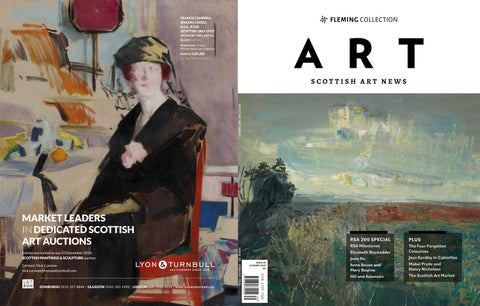
FRANCIS CAMPBELL BOILEAU CADELL R.S.A., R.S.W. (SCOTTISH 1883-1937) INTERIOR: THE LADY IN BLACK [DETAIL] Provenance: From a Private American Collection
Sold for £189,200 inc. fees 04 June 2026
SCOTTISH ART NEWS
MARKET LEADERS IN DEDICATED SCOTTISH ART AUCTIONS Entries are invited to our 03 December 2026 SCOTTISH PAINTINGS & SCULPTURE auction Contact: Nick Curnow nick.curnow@lyonandturnbull.com
EDINBURGH 0131 557 8844 | GLASGOW 0141 333 1992 | LONDON 020 7930 9115 | www.lyonandturnbull.com
ISSUE 39 SUMMER 2026 £3
RSA 200 SPECIAL
PLUS
RSA Milestones Elizabeth Blackadder Josie Ko Anne Bevan and Mary Bourne Hill and Adamson
The Four Forgotten Colourists Joan Eardley in Catterline Mabel Pryde and Nancy Nicholson The Scottish Art Market
Specialist art tours Take a tour of Ayrshire's Dumfries House, designed by Robert and John Adam, and discover one of the most complete collections of furniture from omas Chippendale's early Director period and the finest collection of Scottish rococo furniture in existence. Dumfries House, which is run by The Prince's Foundation, is also proud to display a group of paintings by Scottish masters on loan from the Fleming-Wyfold Art Foundation.
Dumfries House, Cumnock, Ayrshire KA18 2NJ www.dumfries-house.org.uk 01290 425 959
SCOTTISH ART NEWS
DIRECTOR’S NOTE
FEATURES
2
29
eodore Albano
NEWS 6
News eodore Albano Rachael Cloughton
RSA SPECIAL 1o
14
e Milestones at Made the RSA Colin Greenslade Elizabeth Blackadder: A Life in Colour Neil Cooper
18
Josie KO Greg omas
22
Celebrating Together Sandy Wood
26
Shimmering: Anne Bevan / Mary Bourne Shalmali Shety
33
37
Joan Eardley: e Sea at Caterline Keava Macmillan RSA New Contemporaries: Looking Back Jen Mclaren e Forgoten Colourists James Knox
41
Relative Ties Harriet Loffler
43
Earth Maters Susan Mansfield
REGULARS 46
Private View Sara Stevenson
48
Art Market Susan Mansfield
52
Recent Acquisitions Lena Kammerer
55
Scotish Art News Online Lena Kammerer
Cover Image Joan Eardley, Field of Barley by the Sea. Image © the Eardley estate. All rights reserved, 2026 DACS. Image courtesy of e Fleming Collection
Scottish Art News The Fleming-Wyfold Art Foundation E: scottishartnews@flemingcollection.com For more information and postal address see www.flemingcollection.com Scottish Art News is published annually by the Fleming-Wyfold Art Foundation, London.
EDITORIAL Director Theodore Albano Editor Rachael Cloughton Editorial assistance Paul McLean Design Lizzie Cameron Print Elle Media Group
ADVERTISING Director Theodore Albano E: info@flemingcollection.com
© Scottish Art News 2026. All rights reserved. No part of this publication may be reproduced, copied or transmitted in any form or by any means without the written permission of the publisher. Scottish Art News accepts no responsibility for loss or damage of unsolicited material submitted for publication. Scottish Art News is published by the Fleming-Wyfold Art Foundation but is not the voice of the Fleming Collection or the Foundation. All images copyright of the artist or artist’s estate unless otherwise stated. Every effort has been made to trace the copyright holders and obtain permission to reproduce this material. Please do get in touch with Director Theodore Albano with any enquiries or any information relating to this image or the rights holder.
The Fleming-Wyfold Art Foundation pursues a programme of cultural diplomacy furthering an understanding and appreciation of Scottish art and creativity through exhibitions, events, publishing and education. The Foundation also owns the finest collection of Scottish art outside institutions comprising over 700 works from the seventeenth century to the present day. The Foundation has established a ‘museum without walls’ strategy using its collection to initiate exhibitions of Scottish art across the UK. It is a registered charity in England and Wales (No.1080197).
ISSUE 39 / SUMMER 2026 THEODORE ALBANO, DIRECTOR’S NOTE
How does one measure a year? One can become lost in the daily challenges which turn to monthly projects and then yearly ambitions. Writing the Director’s Note in the annual printed edition of Scottis Art Newi offers a moment to pause, to remind and refresh myself of the last year’s accomplishments, read new and exciting scholarship, and regroup for the year ahead. is issue of Scotish Art News is a particularly exciting one as it has been organised in partnership with the RSA to mark the organisation’s bicentenary year. e RSA’s director, Colin Greenslade, shares with us some of the key milestones that have shaped the organisation over the last 200 years (read more, page 10), and head of collections Sandy Wood highlights some of the lesser-known partners contributing to the RSA200 partner programme, Celebrating Together (read more page 22). We are proud to be among the 100-plus partner’s involved in this ambitious, nationwide project, with the presentation of Joan Eardley: e Sea at Caterline at the Granary Gallery in Berwick-upon-Tweed this summer (read more page 29). e 2025/2026 year has been a tremendously exciting and productive one for the Fleming Collection in all aspects, from new exhibitions and new partnerships to new acquisitions. 2025 saw our exhibition Scotish Colourists: Radical Perspectives open at Dovecot Studios in Edinburgh, bringing in a record-breaking 20,000 visitors. We were also fortunate to have our is Fragile Earth Scotish environmental show at the University of Stirling’s Pathfoot Building for over a year. e exhibition was atended by First Minister John Swinney and used as a pedagogical tool for many different departments of the university. By the time you are reading this, Joan Eardley: e Sea at Caterline will have opened in Berwick-upon-Tweed (until 11 October) and the second presentation of Scotish Colourists: Radical Perspectives will be running at e Arc, Winchester (until 16 September). We are so excited to bring works by the Scotish Colourists and their circle to a new audience in England. is presentation of the show includes a superb painting of suffragete Una Dugdale by Ethel Wright, described by the Fleming Collection’s curator emeritus James Knox as one of the ‘forgoten colourists’ (read more page 37). 2 | ART
‘We continue to support new graduates through our RSA New Contemporaries bursary, which was awarded to GSA-graduate Oli Turner this year’ 2
1
e Fleming-Wyfold Art Foundation remains commited to supporting emerging artists, curators and researchers through bursaries and fellowships. I am hugely proud to announce our inaugural Fleming Collection Research and Curatorial Fellowship, co-founded and funded with the Paul Mellon Centre (read about it on page 8). is opportunity will allow some of the best emerging curators and researchers to conduct new scholarly investigations and contribute to advancing the scholarship of British art history. We continue to support new graduates through our RSA New Contemporaries bursary, which was awarded to GSA-graduate Oli Turner this year (read more page 9).
Building and taking the collection in new directions is always at the forefront of my mind. Since our last edition we have added some fascinating works, including three photographs from the 1980s by landscape photographer Peter Catrell, a protégé of legendary British artist Faye Godwin. Additionally, we managed to acquire a rare 1949 painting by avant-garde artist William Gear (read about this acquisition on page 4). Plans and partnerships are always developing, so stay abreast of our activities online. I look forward to another year of bringing forward excellent scholarship and exhibitions. eodore Albano, director, Fleming-Wyfold Art Foundation 3
‘The Fleming-Wyfold Art Foundation remains committed to supporting emerging artists, curators and researchers through bursaries and fellowships. I am hugely proud to announce our inaugural Fleming Collection Research and Curatorial Fellowship cofounded and funded with the Paul Mellon Centre’
1 Portrait of eodore Albano, director of the Fleming Collection. Image © e Fleming Collection 2 Peter Catrell, Burnt Tree Circle, Roslin Glen, Lothians, Scotland, 1990. Image courtesy of the artist. Image © e Fleming Collection 3 Peter Catrell, Shot Crow, Lothians, Scotland, 1987. Image courtesy of the artist. Image © e Fleming Collection 4 First Minister of Scotland, John Swinney, visits the Fleming Collection exhibition is Fragile Earth at the University of Stirling. Image courtesy of the University of Stirling
4
Scottish Art News | DIRECTOR’S NOTE | 3
Fleming Collection News
e Fleming Collection acquires significant post-war work by Scotish avant-garde artist William Gear William Gear RSA (1915–1997) enjoyed a long and productive artistic career that spanned the beter part of six decades. e Fleming Collection’s newly acquired work, ‘Interieur Forme Blanche’ (1949), was made at an important turning point in European history, a time of flux and change which is worth exploring through an understanding of Gear, his life and his influences. Born to a coal mining family in Methil, Fife, Gear was a talented artist from a young age and his work was accepted into the Annual Exhibition of the Royal Scotish Academy at just 18. In 1937, shortly afer finishing his studies at Edinburgh College of Art, Gear received a scholarship to spend a year studying abroad. He started in Paris where he
had been stored for safekeeping at Marienburg Castle. Gear’s duties also included promoting the work of avant-garde German artists by arranging a series of contemporary art exhibitions. Upon viewing the contents of one of the ‘degenerate art’ portfolios stored at the castle, Gear staged the popular public exhibition Modern Prints, containing these works along with other woodcuts by the German Expressionists. Gear was also a member of the international commitee commissioned to design a memorial at the Bergen-Belsen concentration camp. Gear visited the camp and was so deeply moved by the experience that it affected his later work. Afer being demobilised from the MFAA in 1947, Gear moved back to Paris to begin what would be one of the most productive and important
alongside paintings by Jackson Pollock. He eventually returned to live in the UK in 1950 and continued to exhibit both at home and internationally until his death in 1997. ‘Interieur Forme Blanche’ is a wonderful legacy of this period of mutual creativity and international influence. Gear, whose work ranged across different forms of abstraction, felt at his heart he was a landscape painter. is intriguing painting combines different influences; it has an almost organic cubist form spreading out of solid blocks of colour, reminiscent of stainedglass windows which the CoBrA artists were very interested in. It is a strange amalgamation of a landscape painting, pure abstraction and still life. Gear had come out of the war, absorbed continental modernism and was close to CoBrA’s interest in instinct, myth, children’s art, raw mark-making, and
‘The Fleming Collection’s newly acquired work, ‘Interieur Forme Blanche’ (1949) was made at an important turning point in European history, a time of flux and change which is worth exploring through an understanding of Gear, his life and his influences’
1
4 | ART
studied under the ground-breaking French artist Fernand Léger, then continued to Italy, the Balkans, Greece and Istanbul. at year would become one of his major formative experiences and would inform Gear’s thinking, broad-mindedness and interest in global art trends for the rest of his life. In early 1940, shortly afer the start of World War II, Gear was called up for service with the British Army’s Royal Corp of Signals where he served in North Africa and the Middle East. Afer VE day in 1945, Gear joined the Monuments, Fine Arts and Archives (MFAA) Branch of the Control Commission for Germany, or, as they were more widely known, e Monuments Men. As a monuments officer in Hanover, Gear oversaw the return of artworks from the Berlin state art collections, some of which
periods of his artistic career. It was here that Gear met the avant-garde artists of the CoBrA group, named afer their respective Northern European cities; Copenhagen, Brussels and Amsterdam. e three cities were formerly under Nazi occupation and emerged from World War II surrounded by devastation and tragedy. For the artists associated with CoBrA, the styles of art that had existed before the war, particularly geometric abstraction, were a dead language that failed to communicate the realities of post-war life. Instead, the group produced spontaneous, rebellious artworks inspired by a range of ideas, including the work of children and outsider art. Gear exhibited with them in Amsterdam and Paris in 1949 and, in the same year, his work was shown in New York
anti-academic energy. But Gear is always more structured than some of the CoBrA painters, as can be seen in this painting. Gear’s work from this period is testament to his international sensibility, though he remained throughout his life a proud Scotsman. He acted as a serious player in the growing modernist scene in Paris and ‘Interieur Forme Blanche’ gives us a window into that exciting time.
Scottish Art News | NEWS | 5
On Loan
Sekai Machache Deep Divine Sky 2 (2021)
Where to see works from the Fleming Collection this year . . .
Mabel Nicholson (nee Pryde) e Artist’s Daughter, Nancy, as Harlequin (c.1910) Relative Ties: Mabel Nicholson, Nancy Nicholson, EQ Nicholson and Louisa Creed Until 6 September Murray Edwards College, University of Cambridge
Eduardo Paolozzi Newton Measuring the World (1991) e Art of Observation Until 7 August Pathfoot Building, University of Stirling In 1997, Eduardo Paolozzi (1924–2005) unveiled a 12-foot bronze sculpture of Sir Isaac Newton in the courtyard of the new British Library in London. e work references William Blake’s 1795 satirical colour print, which imagines Newton trying to plot the immensity of the universe with a pair of compasses. e British Library sculpture was preceded by many small experimental models, including a bronze maquete held by the Fleming Collection, now on loan to the University of Stirling. It appears in the exhibition e Art of Observation which explores the dependence of scientists and anatomists on the power of art to give a legible visual form to knowledge. stir.ac.uk
Ian Fleming Sun Sang (1969)
Relative Ties brings together works by four women from the celebrated Nicholson family: Mabel Nicholson, Nancy Nicholson, EQ Nicholson and Louisa Creed. e exhibition explores how creativity is woven together through three generations of women artists, starting with Mabel (1871–1918), who frequently painted her children as a way to combine her role as a mother with her life as an artist. Mabel’s painting of her daughter, ‘e Artist’s Daughter, Nancy, as Harlequin’ has been loaned from the Fleming Collection for the show. Read more, page 41.
Another work by Sekai Machache from the Fleming Collection, ‘Deep Divine Sky 2’, is on loan to the Saatchi Gallery. e work, also shot in the Flow Country, but this time at sunset, appears in an ambitious exhibition exploring the influence of the sun and the moon on creativity, curiosity and belief throughout human history. Also on loan from the Fleming Collection is Ian Fleming’s (1906–1994) ‘Sun Sang,’ a richly painted landscape with a shimmering sun shining over yellow fields. saatchigallery.com
Samuel John Peploe A Vase of Pink Roses (c.1925) Colour: e Palete of SJ Peploe Until 4 October Kirkcudbright Galleries, Kirkcudbright Two vibrant still life paintings by the celebrated Scotish Colourist artist SJ Peploe (1871–1935) from the Fleming Collection appear in Kirkcudbright Galleries this summer. Painted in the mid 1920s, when Peploe’s practice was focused almost exclusively on landscapes and still lifes, they join over 60 works by the artist in the exhibition Colour: e Palete of SJ Peploe.
murrayedwards.cam.ac.uk
Sekai Machache Light Divine Sky 2 (2021) Earth Maters Until 1 November Inverleith House, Royal Botanic Garden Edinburgh
Zimbabwean-Scotish artist Sekai Machache’s (b.1989) photograph ‘Light Divine Sky 2’, held by the Fleming Collection, is displayed in the exhibition Earth Maters at Inverleith House. e show marks the 300th birthday of Edinburgh-born geologist James Huton and appears alongside works by over 30 artists ‘seeing soil through art’. Machache’s photograph was taken in the Flow Country in the Scotish Highlands, a site of a major ecological conservation project, reviving the ecosystem of the peatlands in efforts to reduce carbon emissions. Read more, page 43. rbge.org.uk
6 | ART
Both on show at e Sun and e Moon: Art Inspired by the Celestial Until 8 September Saatchi Gallery, London
Edward Hornel e Bellman (1886) Wilhelmina Barns-Graham e Blue Studio (1947) Wilhelmina Barns-Graham 24 October 2026–11 April 2027 Tate St Ives A major retrospective exhibition dedicated to Wilhelmina Barns-Graham (1912–2004) takes place at Tate St Ives later this year, charting eight decades of the artist’s incredible career. Included
in the show is ‘e Blue Studio’ from the Fleming Collection, painted in the late 1940s in Barns-Graham’s studio in St Ives. e painting explores the treatment of form and pictorial space; the contents of the studio tip forward, towards the viewer, emphasising the flatness of the painted surface and foretelling Barns-Graham’s future exploration of full abstraction. tate.org.uk/visit/tate-st-ives
e Fleming Collection has also agreed a long-term loan of ‘e Bellman’ by Edward Hornel (1864–1933) to Kirkcudbright Galleries. is early portrait was painted shortly afer the artist’s training at the Académie des Beaux-Arts in Antwerp and the influence of modern trends in European painting are evident, with vigorous paint capturing the town’s bellringer Francis Harris. kirkcudbrightgalleries.org.uk Scottish Art News | NEWS | 7
2
e Fleming-Wyfold Art Foundation announces Dr Anne Daffershofer as the inaugural winner of its cosponsored curatorial and research fellowship in conjunction with the Paul Mellon Centre e winner will use the Fleming Collection’s extensive holdings to conduct new research into works in the collection and the surrounding scholarship, curate a small exhibition in the Paul Mellon Centre’s new display
room and co-ordinate subsequent programming around the exhibition. e inaugural winner is Dr Anne Daffershofer, contemporary art historian, writer and curator, who in a condensed plan for her proposed work says: ‘e Fleming Collection traces important parts of the Scotish landscape tradition: from Romantic painters to the Glasgow Boys or the Colourists. Yet certain landscapes remain frequently overlooked; the edges, boundaries and in-between spaces that do not replicate the dominant aesthetic of overwhelming vistas and supposed wilderness. reshold Lands in Scotish Art proposes to identify and reconsider such threshold lands in works held by the Fleming Collection. ‘While “untouched” or “wild” landscapes ofen produce a more distinct, emotional reaction and conservation efforts, edgelands and other threshold lands can contain surprisingly high levels of biodiversity and ecological resilience. at is why it is urgent to develop visual and critical languages that highlight and pay
atention to threshold landscapes of various kinds. e display is conceived around juxtaposition: placing works from different times in dialogue in order to surface unexpected resonances and frictions, opening the question: what are threshold lands, where can we find them and why do they mater now?’ e fellowship gives a wonderful opportunity to emerging curators and researchers to hone their skills and expand upon new ideas. e selection process was made through open application, shortlisting of applicants, then choosing the winner. Based in London and part of Yale University, the Paul Mellon Centre (PMC) is a research centre and educational charity, a place for conversation and community, for questioning and discovery. It supports the generation of ideas and promotes the sharing of knowledge about British art to create beter understandings of the past, present and potential futures. e PMC does this through grants, programming events and activities, publishing, assembling resources for research and creating networks. (TA)
‘The fellowship gives a wonderful opportunity to emerging curators and researchers to hone their skills and expand upon new ideas’
1 William Gear, Interieur Forme Blanche, (1949). Image © e Fleming Collection 2 Peter Catrell, Where the Brahamaputra Meets the Clyde, series 4, Image courtesy of the artist. Image © e Fleming Collection 3 Installation view of work by Oli Turner at New Contemporaries 2026 at the RSA. Photo by Julie Howden
8 | ART
3
e Fleming-Wyfold Art Foundation awards Glasgow School of Art graduate Oli Turner the 2026 RSA New Contemporaries Bursary e Fleming-Wyfold Art Foundation has a track record of supporting emerging artists through bursaries run in conjunction with the Royal Scotish Academy’s New Contemporaries exhibition. Now in its 17th year, the annual show offers a unique opportunity to see some of the most promising talent in Scotland in one single, large-scale exhibition. e £1500 Fleming-Wyfold Art Foundation New Contemporaries Award is awarded to a painter, draughtsperson or sculptor at the exhibition to support their continued practice. Fleming Collection director eodore Albano has chosen multidisciplinary artist Oli Turner as this year’s winner. Standing at the threshold of sculpture, photography, found object and conceptual practices, Turner’s work asks the viewer to hover at this liminal precipice and engage with the work in different ways. Her recent work focuses on the ritual landscapes of the British Isles,
particularly neolithic sites in Scotland, barrows, standing stones and other places. Accompanying large standing stone sculptures are quiet portraits of the barrows and stones themselves. Turner’s creations also explore deeper questions of ecology, our historical relationship with the land and our spiritual and metaphysical inner and outer worlds. On selecting Turner as the award winner, eodore Albano says: ‘e first thing that struck me about Oli’s work was the monumentality of her standing stones. It took me a litle while to realise the actual layered depths that were going on in each stone. I was just really impressed with her process.’ Turner hails from the Yorkshire Dales where she has always had a strong connection to the landscape. ‘I was always processing the environment and thinking about the ages of the land,’ she says. ‘Also with scale; for example, I loved the idea that a hag stone (stones ofen thought to be viewing tools for the spiritual world) could be transformed into a standing stone and vice versa. I’d ofen go out with my camera and record all these amazing sites.’
Turner recently graduated from Glasgow School of Art’s fine art photography course and praises the freedom it allowed, not pigeonholing her as a certain type of artist. She has been the recipient of several other awards, including the Visual Arts Scotland Graduate Award and the SaltSpace Graduate Award, and recently enjoyed a month-long residency in partnership with the esteemed Pier Arts Centre in Orkney. (TA) Find out more about Oli Turner’s work at oliturner.org Watch director eodore Albano announce the winner of the 2026 Fleming-Wyfold Art Foundation Award at the RSA New Contemporaries
Scottish Art News | NEWS | 9
1941
THE MILESTONES THAT MADE THE RSA COLIN GREENSLADE
During WWII and the 1941 annual exhibition, the Academy gives over a room to 40 Polish soldiers who are artists-in-exile in the UK. is leads to a particularly supportive review in e Scotsman with the intimation that this will be the first opportunity in a lengthy partnership between the nations. is did indeed herald a new outlook of internationalism for the Academy and, following the war, the Academy steered ahead in making European connections. In 1948, the Academy shows its first international exhibition for the Edinburgh Festival, Pierre Bonnard and Edouard Vuillard, touring from the Arts Council of Great Britain. is development resulted in many subsequent exhibitions by significant international artists and a continued connection with Europe through travel awards and bursaries such as the RSA John Kinross Scholarship. In the 21st century, there has been a reconnection with Poland and its artists through dialogue with the Consulate General of the Polish Republic in Edinburgh and contacts made via Prof Richard Demarco HRSA and the Adam Mickeiwicz Institute, Warsaw.
27 May 1826 e Scotish Academy of Painting, Sculpture, and Architecture is founded in Edinburgh at Stewart’s Rooms, Waterloo Place. e 13 founding Academicians consist of 11 painters, one architect and one sculptor. ere are nine Associates (all painters) and three Associate Engravers. e founding aims are: •
To present an annual exhibition open to all artists of merit
•
To create an academy of fine arts instructing students at no charge
•
To form a library and collection devoted to the fine arts
•
To support less fortunate artists through charitable funds
•
To elect eminent honorary members
2
1850s is decade marks the initiation of the National Gallery of Scotland. Having lobbied for Scotland to have its own National Gallery, the Academy is integral to its formation. As a result, the Academy transfers significant works from the RSA Collections to the newly formed National Gallery to begin the nation’s collection. Sir Joseph Noel Paton RSA designs the Academicians’ Medal in 1853. e medal is struck and is available to all Academicians to the present day. For 2026, a small, limited edition silver medal using Paton’s original design is being struck to coincide with the bicentenary of the Royal Scotish Academy.
4
As the Royal Scotish Academy celebrates its bicentenary, director Colin Greenslade shares ten pivotal moments that transformed the organisation over the last 200 years Being asked to pick just ten milestone moments in a 200-year history is no mean feat! Of course, I can look back at my 24 years with the Academy and find ten points just from that period alone. However, I have to go further into the past and try to imagine what the Academy saw as definitive ways to develop and review their activities based upon the original aims. is is what we still do today. As the first director at the Royal Scotish Academy, I am fully aware that I, along with the RSA team and the body of today’s Academicians, are custodians of the continuing development of a great Scotish institution which enables and supports artists and architects of all ages and at all stages of their careers.
10 | ART
1910 1
1830s e Academy moves from rooms at Waterloo Place to the Royal Institution on e Mound in 1835. It remains on this site – via the Royal Institution, e National Gallery and then e Royal Scotish Academy – to the present day. In 1838, the newly invested Queen Victoria bestows a Royal warrant to the Scotish Academy and thereafer it is known as the Royal Scotish Academy (RSA).
Afer refurbishment of the former Royal Institution building by a 1910 Order of Westminster (and following e National Galleries of Scotland Act 1906), the Academy is given a permanent home, with occupancy rights for administration offices and exhibition galleries in the newly renamed Royal Scotish Academy. In recognition of this, and as part of the agreement, the Academy transfers another significant body of valuable works from their own collection to the National Galleries of Scotland.
3
Scottish Art News | RSA SPECIAL | 11
2003
5
1973 Sir William Gillies PPRSA bequeaths his estate to the Academy. Already having numerous significant bequests, the Academy invests the proceeds of the estate and establishes the RSA Sir William Gillies Bequest. Subsequent bequests follow and their investment portfolios continue to assist the Academy to support and promote Scotish art and architecture to this day, including, most recently, the RSA Blackadder Houston Bequest. e investment portfolios, alongside the Academy’s ability to earn income, enable it to remain as an independent and self-financing charity.
e Academy returns to e Mound afer the threeyear refurbishment of the RSA galleries. e Academy commissions a review ‘Changing Landscapes’ which seeks to revitalise and reorder its activities for a 21st century audience. e resulting discussions pave the way for a new vision for the Academy and a reworking of its constitution. is saw a tweak of name to e Royal Scotish Academy of Art & Architecture and enabled fine artists in all media to be elected as Members. e former Associate status for new Academicians was removed and elevation to full Academician is now no longer capped nor a lengthy process. e inaugural exhibition of this new spirit is a retrospective of works by American abstract expressionist, Helen Frankenthaler HRSA. e Academy has continued to review and expand on its opportunities for artists, now disbursing in the region of £500,000 annually.
7
2 35th Annual Exhibition, 1861 3 Kate Downie RSA, View of RSA building, 2025 4 Magdalena Abakanowicz, King Arthur’s Court, part of 10 Dialogues
8
2009 From the earliest beginnings of teaching life drawing in the 1830s, through to the Life School at Edinburgh College of Art and the subsequent Student Competition and travel prizes, the RSA Student Exhibition was developed in 1974. In 2009, this project was refocused towards new graduate practice and exhibitors were invited by personal selection from the Scotish degree shows. RSA New Contemporaries has become the most important platform for new graduates to showcase with their peers from across Scotland. Eagerly awaited by all, the energy of this exhibition cuts an impressive swathe into our annual calendar and many rising stars of the art world find their feet here. Also in 2009, the RSA Residencies for Scotland programme launches with a supportive web of residency funding and opportunities for artists with partner venues across the country.
1987
2026
e Academy presents the Saatchi Art of Our Time exhibition in Edinburgh which includes Anselm Keifer, Susan Rothenburg, Andy Warhol and Richard Wilson to name but a few. is ground-breaking show spurs the Academicians to imagine the future of the Academy and how to revitalise its importance for the approaching 21st century.
e Academy celebrates its bicentenary with more than 100 partners across Scotland. With exhibitions and events happening over the entire year, this project will be the largest celebration of Scotish art ever presented. Details of our gallery programme, including a new overview exhibition with Joyce W Cairns PPRSA – our first female President – and also an exhibition by Dame Barbara Rae RA RSA (following in the Antarctic footsteps of Sir Ernest Shackleton) can be found alongside our partner venues programmes at our website.
6
12 | ART
1 RSA Academicians Signing Book
‘The Academy presents the Saatchi Art of Our Time exhibition in Edinburgh which includes Anselm Keifer, Susan Rothenburg, Andy Warhol and Richard Wilson to name but a few’
5 Robbie Bushe RSA. 2023 recipient of the RSA Blackadder Houston MidCareer Painting Award. Photo © Helen Pugh 6 Richard Wilson, Installation shot, Gallery VIII, Art of Our Time exhibition showing Richard Wilson’s work 20:50, 1987 7 Helen Frankenthaler poster, 2003 8 Academy Late 2025. Performance by Ellis Ludlow during New Contemporaries 2025, photo Andy Catlin 9 Birthday celebrations begin in the gallery. Artwork Ross Sinclair RSA (Elect) Images all courtesy of the RSA
9
Colin Greenslade is director of e Royal Scotish Academy of Art & Architecture.
Find full details of the Academy’s bicentenary programme at royalscottishacademy.org/rsa200 Scottish Art News | RSA SPECIAL | 13
Elizabeth Blackadder: A Life in Colour NEIL COOPER
A new exhibition at Dovecot Studios explores Elizabeth Blackadder’s fascination with colour, through paintings, drawings, tapestries and rugs. Head of Dovecot’s Tapestry Studio, Naomi Robertson, believes the show offers a unique chance to challenge perceptions of Blackadder’s work By the time Elizabeth Blackadder RSA (1931–2021) became the first woman elected to the Royal Scotish Academy in 1972, the Falkirk-born painter and printmaker had already carved out a unique oeuvre of vibrant landscapes and still lives focused on flowers and objects. Some of this has been channelled into the tapestries and rugs featured in Elizabeth Blackadder: A Life in Colour, a new exhibition of Blackadder works that puts these textiles in dialogue with paintings and drawings by the artist from the RSA collection. Marking five years since Blackadder’s death, the exhibition at Dovecot Studios in Edinburgh, where the textile works were made, aims to show off Blackadder’s vivid use of colour in her visual language.
1 14 | ART
Scottish Art News | RSA SPECIAL | 15
‘I think sometimes at a first glance, her paintings can appear like delicate still lifes,’ Robertson observes. ‘But actually, once you start to examine the work, you can see her use of colour, detailed composition and the distinct objects she collected during her travels’
2
e artist’s relationship with Dovecot dates back to 1966, when ‘Still Life, Tulips’ (1966) was her first tapestry work. Since then, Dovecot has collaborated with Blackadder on a total of 31 tapestries and five rugs. ese include ‘Eastern Still Life’ (1980) and ‘Cats at Play’ (1995). Since her death, the relationship has continued with ‘Flowers and Black Cat’ (2023) and ‘Red Still Life – Dragon Fruit and Oysters’ (2023). e newest addition to Blackadder’s canon is ‘e Red Bouquet’ (2026), a hand-tufed rug inspired by the 1975 painting of the same name. Made by Dovecot’s team of weavers, the newly finished work will receive its public premiere at the exhibition. ‘It’s very exciting to show a new work,’ says Naomi Robertson, Dovecot’s head of Tapestry Studio. ‘As with all the works on show, “e Red Bouquet” demonstrates the strength of colour in Elizabeth Blackadder’s work. e red flowers in the piece are bold, and the patern and composition are interesting. Sometimes we’re looking at something that is a bit more abstract rather than purely pictorial.’ In Robertson’s time at Dovecot, 23 tapestries of Blackadder’s work have been made. ‘We worked on some large projects, as well as private commissions,’ Robertson says. ‘Blackadder was a very quiet, unassuming woman, but she knew what she wanted. She would talk us through the designs and was involved throughout the weaving process. ‘As weavers, it is essential to build trust with an artist who is handing their work to us. Ofen relationships are built over years, and the more that you work with someone, the more comfortable they feel to let their work go, knowing that it is in good hands with the Dovecot weavers.’ 16 | ART
3
When Robertson joined Dovecot Studios in 1990, there was already a long-established relationship between Blackadder and the weaving team. ‘We have created more tapestries with her than any other artist in Dovecot’s history, which I think speaks volumes about our collaboration,’ she says. e relationship also charted the development of Blackadder’s practice and a recognition of the understated power in her work. ‘I think sometimes at a first glance, her paintings can appear like delicate still lifes,’ Robertson observes. ‘But actually, once you start to examine the work, you can see her use of colour, detailed composition and the distinct objects she collected during her travels. I was lucky enough to visit her studio once and spot some of the items, like her fans and boxes, that reappear throughout her work.’ is is evident throughout the Dovecot exhibition, which features a range of more than 30 paintings, screenprints and etchings by Blackadder alongside several tapestries. e paintings span decades, from ‘Still Life with Mexican Angel’ (1964) and ‘Still Life with Indian Cloth No. 11’ (1967), right through to Japanese inspired works such as ‘Still Life with Kimono, Kyoto’ (2002) and ‘Still Life with Fan’ (2013). ‘I think her paintings translate beautifully into tapestry,’ says Robertson. ‘Exploring watercolour offered a different approach, which was an exciting direction for the studio. It’s not a medium that’s traditionally adapted in this way. When translating her work into tapestry, it was about capturing that delicacy of the watercolour without making the work feel too heavy, so you still retain all that movement within the background and the painterly marks.
Robertson adds: ‘Unfortunately, she never saw the latest pieces we created, which is a real shame. But I believe she would have loved the bold use of colour and our exploration of her work from a different perspective and celebrating another side of her practice.’ As the popularity of Blackadder’s work runs on apace in all forms, A Life in Colour provides a unique opportunity to bask in the spare intricacy and deceptive complexities of her work. ‘I think it’s the chance to re-examine her work as well as the perceptions that people have of it,’ says Robertson. ‘Blackadder is known for her painted flowers, cats and delicate compositions, some of which will be included in the exhibition. But there was this daring and punchy side to her that people may be less familiar with. She wasn’t afraid of using colour and she could use it well.’ Neil Cooper is a writer and critic based in Edinburgh. Elizabeth Blackadder: A Life in Colour 20 June–14 November Dovecot Studios 10 Infirmary Street, Edinburgh, EH1 1LT T: (0)131 550 3660 | dovecotstudios.com Open: Monday to Friday noon–3pm, Saturday 10am–5pm
‘Blackadder is known for her painted flowers, cats and delicate compositions, some of which will be included in the exhibition. But there was this daring and punchy side to her that people may be less familiar with. She wasn’t afraid of using colour, and she could use it well’
1 Dovecot Studios afer Elizabeth Blackadder, Red Still Life - Dragon Fruit and Oysters, 2023 2 Dovecot Studios afer Elizabeth Blackadder, Still Life with Chequered Box, 2023 3 Dovecot Studios afer Elizabeth Blackadder, e Red Bouquet, 2026 All images courtesy of Dovecot Studios
Scottish Art News | RSA SPECIAL | 17
‘Growing up, going to art galleries was not part of my culture. I saw art on the street, in the form of public monuments.’ Josie KO is talking about the background to her large-scale sculptural practice, which involves making Black female bodies, ofen constructed from everyday craf materials such as papier-mache and gliter, unavoidably visible. ey are also, in the best sense, confrontational, staring down at viewers from magisterial heights, in bold colour and shape. Graduating from Glasgow School of Art in 2021, KO has made significant work for Glasgow International 2024, the 2025 British Ceramics Biennial in Stoke-On-Trent and for Quench Gallery in Margate, where her solo exhibition Mekle Lippis was held in 2025. ‘As a research-based artist, my practice manifests from an interest in archival texts, specifically looking into pre-colonial histories,’ she says. ‘I search for sightings and whisperings of Black existence across the diaspora which challenge the narrative that Blackness in Britain (and specifically Scotland) is recent.’ Her new challenge is to respond to the archive of the Jardine Sisters, two mixedheritage women who studied at GSA in the early 1900s, as part of a Reid Gallery commission to mark 200 years of the Royal Scotish Academy. e show, opening at the GSA-run gallery in September and curated by Jenny Brownrigg, will also feature works by the sisters themselves. Bridget ‘Jet’ Jardine (1881–1964) was born in Helensburgh, Scotland, while Aeta Jardine (1886–1969) was born in Georgetown, Demerara, now part of Guyana on the northern tip of South America. is far-flung location is explained by their Glaswegian father Charles Kennedy Jardine’s job as founding editor of e Demerara Chronicle. e siblings’ childhoods were thus strung between Scotland and the wider Caribbean region, reflecting the grim realities of Dutch and British plantation-based economies, yet not quite capturing the complexity of the sisters’ own identities. rough their father, Jet and Aeta were direct descendants, six generations removed, of Scipio Kennedy (c.1694–1774), an enslaved and later freed African who lived at Culzean Castle in Ayrshire from around 1710 until 1774. His birth name is unknown, but Scipio was probably born in Guinea and sold into slavery at the age of five or six. Bought by a Scotish sea captain in the Caribbean, the boy was gifed to the captain’s daughter, potentially as a page, then transported to her new husband John Kennedy’s estate in Culzean. Freed by Kennedy in 1725, Scipio went on to marry and father eight children with a local woman, Margaret Gray, living in the local area as a weaver – and probable smuggler – until his death.
GREG THOMAS
JOSIE KO
As part of the RSA 200 celebrations, Josie KO responds to the complex history of the remarkable mixedheritage Jardine Sisters in a new commission at the Reid Gallery
1 18 | ART
2
As part of the general reckoning over the last decade with the histories of enslavement bound up in Scotish historical properties, Scipio has become relatively well-known, at least compared to the thousands of other enslaved African children who faced the same tribulations. Indeed, in September 2023, Culzean Castle hosted a two-day symposium reflecting on his connection to the estate. Still, the fact that so much about Scipio remains occluded reflects the ongoing struggle to reveal hidden histories of Black Scotish culture. Responding to these blind spots is a mainstay of KO’s practice: ‘I believe Scipio is a hidden figure in Scotish history, revealing that the presence of Black people in Scotland is not new.’ e sisters, by contrast, remain a more enigmatic and liminal presence in the history of Black Scots. ‘eir history is so complex, full of changes in social class and wealth,’ KO reflects. ‘It causes me to think of Scotish identity in a new way.’ Photographs to be included in the GSA exhibition suggest that the sisters could have ‘passed’ (in the parlance of Black cultural responses to structural racism): perhaps even to themselves. ey claimed descendance from a wealthy wing of the Jardine family and may not have known of their lineage from Scipio. Yet they remain the first recorded female mixed-race artists to study at the institution. Scottish Art News | RSA SPECIAL | 19
It helps that the sisters’ work is delightful, much of it comprising sumptuous, warmth- filled landscapes – suggesting the influence of the Glasgow Boys and post-impressionism – depicting both Scotland and the Caribbean (from 1907–10 Jet, Aeta and their mother visited Trinidad and Demerara several times). ere are also still lives, figurative studies and illustrations of figures from folklore and mythology, such as goblins and fauns, which have a hint of Celtic revival-era romance about them. e exhibition will also include the launch of a newly compiled sketch diary by Aeta Jardine, ‘A Year in Glasgow 1908’, which gives an intriguing glimpse into middle-class Glaswegian culture during the Edwardian era, in the crisp, illustrative pen-and-ink cartoon style of the time. is text has been compiled by Caroline Palmer, an anthropologist and garden writer based in Wales, who is the great-niece of Aeta. KO’s commission will respond, in particular, to the life of Scipio, utilising her by now wellestablished approach of constructing large sculptural monuments and installations. ‘I’m interested in exploring his life in Scotland,’ the artist says. ‘How he became a free Black African man, integrating with working-class Scotish communities and starting a textile business.’ Indeed, the show will touch on the branches of the family between Scipio and the Jardine sisters, most of whom remained tied by class and lack of wealth to Culzean and Glasgow, until the opportunities afforded by education allowed Charles to establish his newspaper business across the Atlantic. e hidden dimensions of Scipio’s story are a perfect fits for KO’s modus operandi, which involves working with archives to reveal hidden histories of Blackness, or to dream up possible ones. Her doubleheader show with Kialy Tihngang at Glasgow International 2024, fir gorma, proposed a speculative history involving enslaved north Africans brought to Ireland and the Hebrides who escaped and set up a clan on an uncharted Scotish isle. We can look forward to similar fantastical manifestations and imaginings at the Reid Gallery in September. As KO herself puts it: ‘My work transports people into confronting and exciting new worlds.’
3
5
6
Greg omas is a critic and editor based in Glasgow. Josie KO 19 September–31 October Reid Gallery e Glasgow School of Art, 164 Renfrew Street, Glasgow, G3 6RQ T: (0)141 353 4500 | gsaexhibitions.co.uk Open Monday to Saturday 10am–4.30pm
20 | ART
4
1 Josie KO, e Chimney Princess, Ceramic Biennial, Stoke on Trent, 2025
4 JS Jardine, Coming nearer, (1908-1930). Image courtesy of Caroline Palmer
2 Josie KO, Fir gorma, 2024, © Glasgow International. Photographed by Eoin Carey
5 JS Jardine, Aberfoyle, unsigned, 1915-1920
3 Josie KO, Monument, mixed media installation (2021)
6 Josie KO, Mekle Lippis, 2024 © Collective Gallery
Scottish Art News | RSA SPECIAL | 21
SANDY WOOD
More than one hundred arts organisations have programmed activities to celebrate the RSA’s bicentenary across Scotland and far beyond. Sandy Wood, RSA head of collections, highlights some of the lesserknown partners marking this major milestone Over the last 200 years, the artists and architects associated with the Royal Scotish Academy (RSA) have connected to places and communities all over Scotland and further afield. As the nation’s oldest surviving independent artist-run institution, the support and promotion of Scotland’s cultural heritage remains as close to its heart as it did when a group of 23 artists and one architect met to establish the Academy on 27 May 1826. Today, through exhibitions, scholarships, residencies, awards and prizes, the RSA funds artists in Scotland to the tune of around £500,000 every year. So, to mark its momentous birthday in 2026, the RSA wanted to look out and connect with all the people, places and stories across Scotland that have made the RSA, and Scotish art and architecture, what it is today. e partnership project, RSA200: Celebrating Together, was designed to be widely accessible, embracing the past, present and future and connecting as many diverse venues as possible in a year-long celebration. It has grown to include 116 partners (at last count) and is the largest project of its kind ever mounted in the UK. ere are so many exciting things to discover over the whole of 2026, in Scotland, England, France, Spain and as far afield as South Georgia in the Southern Atlantic. For Scotish Art News, we are featuring six of our lesser-known Scotish partners to shine a light on the breadth and depth of the project here at home.
Gairloch Museum’s partnership for RSA200 marks a historic first collaboration between the RSA and this award-winning Highland venue. e exhibition RSA Select will form a major showcase staged across the museum’s upper and lower galleries. is landmark event brings together a prestigious
gairlochmuseum.org
1
John Gray Centre, Haddington In the bustling market town of Haddington, the John Gray Centre is a vibrant cultural hub housing East Lothian’s archives, library and a five-star museum. e museum offers an immersive journey through county history, from the Stone Age to the modern era. Its innovative displays use sensory exhibits to explore local themes of agriculture, fishing, and industry. East Lothian connects various renowned Scotish artists across history and Sir William Gillies was born in Haddington itself. e county’s permanent collection includes many notable works and at the John Gray Centre you’ll find paintings on permanent display by William Darling McKay RSA, William Marshall Brown RSA and John Bellany HRSA. In 2023, the centre partnered with the RSA to host a local iteration of William Gillies: Modernism and Nation and it is to Bellany, another of East Lothian’s famous artist sons, that their atention turns to as part of RSA200, in the first exhibition celebrating him in his home county since his death. Curated by Sandy Moffat RSA and Helen Bellany, it focuses on Bellany’s origins and features unseen early paintings and work on loan from the RSA collections. During the exhibition, live conservation of Bellany’s iconic painting ‘e Harvester’ will be taking place in the gallery, returning this early masterpiece to its past glory: an event not to be missed. johngraycentre.org
22 | ART
2
Gairloch Museum
roster of contemporary artists, including Anne Bevan RSA, Philip Braham RSA, Samantha Clark, Kate Downie RSA, Paul Furneaux RSA, Janete Kerr HRSA, Marian Leven RSA, Frank McElhinney and Frances Walker RSA. It promises to be a delight for locals and visitors to Wester Ross as the artworks engage in a special dialogue with the museum’s unique architecture. A former Cold War antiaircraf bunker, Gairloch Museum was redesigned by LDN Architects, and the repurposed ‘concrete box within a box’ was named Art Fund Museum of the Year in 2020, cited for its radical transformation of a semi-derelict space into a lightfilled cultural hub. With RSA Select, the museum continues its legacy of ambitious artistic programming, following past successes like the Ulaidhean / Treasures collaboration with the Society of Scotish Artists. Partnering with venues such as Gairloch Museum helps bring Scotland’s national artistic excellence into the context of its Highland heritage, celebrating the RSA and its artists and making them accessible to remote audiences.
‘Partnering with venues such as Gairloch Museum helps bring Scotland’s national artistic excellence into the context of its Highland heritage, celebrating the RSA and its artists and making them accessible to remote audiences’
e Wyllieum, Greenock e Wyllieum, adjoined to Greenock Ocean Terminal, is dedicated to the legacy of George Wyllie RSA. Designed by Richard Murphy RSA, the purpose-built gallery is a striking addition to the Clyde waterfront and serves as a permanent home for Wyllie’s archive, exploring his journey from a customs and excise officer to a pioneer of Scotish contemporary art. For RSA200, the Wyllieum is hosting the landmark exhibition George Wyllie: From the Clyde to Sarajevo & the Venice Lagoon. Curated by RSA Past-President Arthur Watson PPRSA, the show illustrates how Wyllie – an artist who initially operated on the periphery of the establishment – was embraced by the RSA and its academicians. Expanding this celebration, the gallery is also showing Falling Rising, a solo exhibition by newly elected academician Claire Barclay RSA. Barclay fondly remembers Wyllie’s distinctive teaching visits to Glasgow School of Art, and in making new work specially in response to e Wyllieum, bridges Wyllie’s legacy with contemporary practice. Furthermore, e Wyllieum has shown work by RSA New Contemporary Antony Lucchesi and, in September, they will show the RSA200 Moving Image Programme. Curated by Ronald Forbes RSA, it features multiple film packages from
notable Scotish artists including Rachel Maclean RSAN (Elect) and Dalziel + Scullion RSA, and was designed to make RSA200 even more accessible outwith gallery contexts. As a single venue, e Wyllieum’s RSA200 partnership encapsulates the breadth of the celebrations and shows the RSA’s evolving role in supporting innovative, socially engaged practice across Scotland’s diverse artistic landscape. wyllieum.com
3 Scottish Art News | RSA SPECIAL | 23
An Lanntair, Stornoway
RSA200 Art for Health
4
Planning for Celebrating Together began as early as 2021. In the two years from 2024, we met with prospective partners from across the country to promote the project and spread the word. e enthusiastic interest and feedback throughout this vital seeding process is part of what helped us envision the project’s success. e value of these personal connections also inspired prospective partners to work together in ways not considered before. e newly formed Scotish Healthcare Collective is a special example of these sub- partnerships and is realising the project RSA200: Art for Health. Running through to 2027, two exhibitions of visual artworks by RSA academicians and award winners, curated from regional health board and national art-in-health collections, will tour to hospital and healthcare setings in Edinburgh, Larbert, Glasgow, Stranraer, Stirling, Dundee, Greenock and Aberdeen. is unique project takes the RSA story out from the gallery, giving new audiences a chance to engage with and appreciate visual art by creating uplifing and healing clinical environments for patients, visitors and NHS staff. Art is shown to have a powerful and improving benefit in these environments and this is evidenced in the diverse collections built up by hospitals and healthcare trusts in Scotland. An issue in the past has been aligning gallery spaces with collections, as ofen the two are not found together in the same building. By bringing seven healthcare trusts together for RSA200, the Scotish Healthcare Collective is breaking new ground. While we don’t want audiences to have to go to hospital, the project is creating access to transformative art and experiences for those who do in the RSA’s bicentenary year and beyond.
An Lanntair, meaning ‘e Lantern’ in Scotish Gaelic, was established in 1985 in Stornoway’s former Town Hall. In 2005, the centre underwent a radical evolution, moving to a purposebuilt facility designed by Ric Russell RSA (Elect) and Nicoll Russell Studios. Overlooking Stornoway harbour, this striking contemporary building serves as a lighthouse for Hebridean culture, housing a cinema, auditorium and a world-class art gallery dedicated to exploring the intersection of Gaelic heritage and international contemporary practice. As part of RSA200, An Lanntair is building on past partnerships with the RSA, such as Window to the West, by showcasing an exciting and varied programme. Two major exhibitions by contemporary academicians, What Lies Beyond by Keith McIntyre RSA and Uisge: Water by John Mackechnie RSA are complemented by local artist Fraser MacBeath’s exhibition Aghaidh Ris An Achadh: Facing the Field. A winner of the RSA Benno Schotz Prize at the Royal Scotish Academy’s 197th Annual Exhibition, his work examines cultural change and depopulation in his home in the Outer Hebrides. An Lanntair has a long history of celebrating artists connected to the Gàidhealtachd and Gaelic heritage and in June will premiere the new theatre show Capturing the Light by Lewis singer-songwriter Elsa McTaggart. e great granddaughter of William McTaggart RSA, Elsa’s performance will then air at the 2026 Edinburgh Fringe, bringing this new story of one of Scotland’s most famous Gaelic artist sons to an international audience.
7
Friends of the Sivell Murals, Aberdeen e beauty of Celebrating Together is the diversity of the partners involved, from the likes of V&A Dundee and the National Galleries and National Museums of Scotland to small volunteer-run organisations such as Cupar Museum and Heritage Centre and the Friends of the Sivell Murals. e Friends of the Sivell Murals is a dedicated advocacy group focused on the preservation and promotion of the extraordinary mural cycle at the former Aberdeen University Students’ Union. Painted by Robert Sivell RSA and his students between 1938 and 1953, these murals are a masterpiece of mid-century figurative art. Sivell, who served as the head of painting at Gray’s School of Art, led a team including future academicians like Alberto Morrocco RSA and Gordon Cameron RSA, creating a narrative that explores themes of education, war and human endeavour across the walls of what was once the student union bar. As part of RSA200, the Friends have organised a special exhibition at the Sutie Centre for Teaching & Learning in Healthcare and Aberdeen Central Library, titled Lessons from a Remarkably Well-Illustrated Anatomy Textbook. e project highlights the intersection of art and science, focusing on the medical textbook Anatomy of the Human Body and the amazing illustrations in it by Morrocco and Cameron. e influence of this book was immortalised by RSA Past-President Joyce W Cairns PPRSA in her painting ‘e Patient’, in the University of Aberdeen’s collections. e work of groups like the Friends of the Sivell Murals ensures that ofen-hidden treasures are rediscovered, preserved and remain a central part of the conversation surrounding the RSA’s 200-year role in Scotish art and artistic training.
lanntair.com
5
artinhealthcare.org.uk
sivellmurals.org.uk
Sandy Wood is head of collections at the Royal Scotish Academy.
‘The beauty of Celebrating Together is the diversity of the partners involved, from the likes of V&A Dundee and the National Galleries and National Museums of Scotland to small volunteerrun organisations such as Cupar Museum and Heritage Centre and the Friends of the Sivell Murals’
1 John Gray Centre with Alexander Wood RSA. Image courtesy of RSA 2 Gairloch Museum. Image © Marc Atkins 3 From the Clyde to Sarajevo. Image © Garth Ivan 4 Art for Health, Bellfield Centre. Image courtesy of Scotish Healthcare Collective 5 An Lanntair. Image © John Maher 6 Elsa McTaggart, Capturing the Light. Image © Ralph Tonge 7 Joyce Cairns, e Patient, (2009). Image © e artist. Image courtesy of University of Aberdeen
Find out more about RSA 200: Celebrating Together at royalscotishacademy.org/rsa200/celebrating-together
6 24 | ART
Scottish Art News | RSA SPECIAL | 25
Shimmering: Anne Bevan / Mary Bourne As part of RSA 200, artists Anne Bevan and Mary Bourne take inspiration from the sea for their joint exhibition, Sstmmertng
SHALMALI SHETTY 26 | ART
1
In their stillness, natural inanimate elements possess something profoundly sacred, their dense material form carrying deep time, ecological memory and ancestral presence. Anne Bevan RSA (Elect) and Mary Bourne’s RSA upcoming exhibition Shimmering builds on this sense of wonder and inquisitiveness through a poetic reading of the sea and its surrounding environment. ‘Shimmering’ as a concept is influenced by the writings of filmmaker and poet Margaret Tait, and anthropologist Deborah Bird Rose, who uses the term to describe interconnected human and more-than-human relations, where boundaries are fluid and life is understood as mutually and continually changing. Curated by Kirsten Body, the exhibition will open at Inverness Museum & Art Gallery later this year. Bevan and Bourne have known each other since the mid-1980s, having studied together at Edinburgh College of Art. Although their careers have moved in different directions, both their practices engage with the ecologies of Scotland’s north coast and islands. Furthermore, the period of preparation for this exhibition has enabled a thoughtful exchange of ideas between them. As they continue to plan the exhibition staged across two gallery spaces, they offer a glimpse into how it is going to take shape. Anne Bevan sits by the window, overlooking the shimmering turquoise blue seas of Stromness in the distance. Living and working within Orkney’s local community, her practice is informed by participatory and interdisciplinary research, involving collaboration with archaeologists, marine energy researchers, scientists and creative practitioners working across environmental and technological fields. rough this, she explores how scientific knowledge and material objects intersect with the political, economic and technological contexts that shape possible futures. Her current work focuses on marine energy devices tested in real sea conditions around Orkney, where a worldleading centre for marine renewable technologies has operated for around 20 years in her former school building. rough visits to the FloWave tank at the University of Edinburgh, a large-scale facility that simulates controlled marine environments for research, she engages with early wave energy experimental prototypes such as ‘Salter’s Ducks’, invented by Professor Stephen Salter (1938–2024) in the 1970s. For the upcoming exhibition, Bevan aims to re-centre her studio practice through a body of work that includes film, sculpture and archival print material. e film work explores objects in water in states of partial visibility, where they appear as shadows, glimpses, or shimmerings. ese ideas will be extended into sculptural works and plaster casts of objects which will act as material counterparts placed against the filmed environments. ‘I want to continue thinking about objects in the water and the traces, shadows, glimpses, shimmerings of these objects,’ she explains. ‘I’m interested in making people go to another, dreamy world with film, and then you see these actual objects . . . from that other world.’ She also intends to bring together archival scientific reports of early experimental prototypes, printed datasets and flow charts, continuing to explore how scientific information, physical objects and local ways of working can overlap in practice.
She describes that much of the work will remain a ‘blueprint’, deliberately in-progress, and edgy in its unfinished state’. As Bevan speaks, she presents a small pebble-like clay object held between her fingers, pierced with fine holes and designed to shimmer as it moves against the light. e sculpture, to be displayed in an underlit cabinet, recalls both microscopic biological forms, as well as planetary and cosmic elements. She then handles a plaster-cast ballast stone, hand-painted in blue pigments referencing sea, sky and mineral tones, describing how ballast carried across the Atlantic in the 19th century between North America and Orkney led to deposits of the semi-precious mineral labradorite in the Holms islands of Stromness. Labradorite carries particular significance in Inuit cosmology, where it is associated with the aurora borealis and revered as a material possessing ancestral spirits. is history folds back into Bevan’s own biography through her upbringing in a historic house in Stromness built by one of those captains who crossed the Atlantic and named afer Hopedale in Labrador. rough this, Bevan acknowledges the colonial histories embedded in these transatlantic maritime exchanges, including missionary activity, displacement and disease.
‘For the upcoming exhibition, Bevan aims to re-centre her studio practice through a body of work that includes film, sculpture and archival print material. The film work explores objects in water in states of partial visibility, where they appear as shadows, glimpses, or shimmerings’
is sense of memory and ancestral offering is carried into the heavy, cold basalt votive birds that Mary Bourne has recently finished sculpting and polishing. As she holds one in her palms, she recalls a childhood memory of holding delicate and warm tern chicks with the faint quiver of heartbeat, while her father checked them for ticks. Growing up in Aberdeen, Bourne’s early life was shaped by her father’s scientific career as a seabird ornithologist involved in large-scale surveys, including early national studies of nesting colonies around the British coast. Birds, migration and ecological movement became part of an everyday and imaginative landscape for her that extended beyond human-made borders and imposed national divisions. Following her father’s death in 2021, Bourne was faced with sorting through more than 50 years of his scientific archives, journals, research papers and international publications. Among these, she found a series of haunting photographs: bird wings splayed open by human hands;
Scottish Art News | RSA SPECIAL | 27
preserved skins stuffed with coton pushing out through the eye sockets; trays of specimens bound at the feet and labelled, in arrangements that recall ritual sacrifice and offering. e relationship between the living and its aferlife in preserved form has become one of the central themes in Bourne’s sculptural practice and her ongoing exploration of mortality, embodiment and human intervention within the natural world. ‘It relates to the energy of life and everywhere that energy is seen as shimmering,’ says Bourne. ‘at is the title of our show because it ties together the difference between the shimmer – the quiver of life – and then the absence of that, which you shouldn’t think of as an absence but as a potential of return.’ Having lived in Dufown for over 30 years, Bourne reflects on the changing conditions of rural life, shaped by policy change, agricultural systems and developments such as wind farms that continue to transform both landscape and local economies. Working closely with material and environmental relationships, her work explores how ecology, labour and lived experience are connected in ways that are ofen overlooked or misunderstood from urban perspectives. is concern with place and material context carries into the forthcoming exhibition, where she will present a selection of diploma works from the early 1990s alongside new sculptures informed by her father’s archive and her ongoing engagement with geological materials. e new works
incorporate locally sourced stone from Scotish quarries and industrial remnants, including Caithness flagstone, Scotish basalt and quartz. ese materials are chosen to reflect Bourne’s interest in how layers of sediment and volcanic mater hold embedded histories, as well as for their ancient physical properties and embodiment of deep geological time: physically still and removed from life, akin to the votive bird. Shalmali Shety is an independent curator and writer based in Glasgow and working between the UK and India. Shimmering: Anne Bevan / Mary Bourne 22 August–17 October Inverness Museum & Art Gallery Castle Wynd, Inverness, IV2 3EB T: (0)1349 781730 | highlifehighland.com Open Tuesday to Saturday 10am–5pm
1 Anne Bevan RSA (Elect), Light Erratic, 2024. Image courtesy of the artist
JOAN EARDLEY: THE SEA AT CATTERLINE
2 Mary Bourne RSA, Reflection Pools, 2024. Image courtesy of the artist
KEAVA MACMILLAN
1
A new show at Berwick’s Granary Gallery highlights paintings from Joan Eardley’s years at Caterline on the Aberdeenshire coast. Historian Keava McMillan explores what drew a lesbian painter to live, work and create in this isolated fishing village
2 28 | ART
Scottish Art News | FEATURES | 29
e artist Joan Eardley RSA (1921–1963) first visited the northeast coast of Scotland in 1951. She wrote to her mother: ‘I have quite fallen for it, both the sea and the country behind.’ She spent an increasing amount of time in the fishing village of Caterline over the next decade, painting the small cotages, the windswept fields and the vast coastline. e vivid seascapes she produced in these final years defined her short life and career. In ‘Wild Sea’ (1958) she transports the viewer to a clifop overlooking the horseshoe bay which offers litle protection to the village she made her home. She sculpted muted tones onto her board, capturing the brutality of the storms she waited for and her fishermen neighbours dreaded. She shows us many of the places in the village that she repeatedly returned to paint: the shingle beach, the rocks, and the exposed salmon bothy. Vivid hints of cool blue beneath the sea menace the chalky warmth of the cotages. including her first studio, the Watchie, a barnacle on the clifop directly across from her easel.
‘She shows us many of the places in the village that she repeatedly returned to paint: the shingle beach, the rocks, and the exposed salmon bothy. Vivid hints of cool blue beneath the sea menace the chalky warmth of the cottages’
She painted this view not far from her first home in Caterline, 1 South Row. e cotage was basic, lacking running water, plumbing, flooring and a watertight roof. is proved no obstacle to Eardley. With her friend and fellow artist Angus Neil (1924–1992), she waterproofed the roof with abandoned canvases and adopted the mice that lived in the space before her. In many ways, her living conditions mirrored those of the cotage’s inhabitants in the previous century. However, the life she created for herself as a single, working woman was distinctly modern. Many of the most striking portraits of Eardley herself were taken by her companion, the photographer Audrey Walker. rough Walker’s lens we see Eardley at home as an artist and as a villager. Combined with the leters Eardley wrote daily, some of which are archived at the National Library of Scotland, Walker gifs us a glimpse into the artist’s working life. Sometimes she is a formidable figure, facing off against the sea in front of her easel. At other times, she writes about village gossip or is pictured siting with friends outside her cotage. Painting outdoors on the scale and intensity at which Eardley worked was manual labour and she dressed accordingly. While post-war urban fashions for women circled 30 | ART
back to femininity, she sported cropped hair, corduroy trousers, thick boots, and shirts or smocks. Eardley’s approach was equal parts practical and non-conformist, a combination that upset her mother when she saw her daughter pictured in the newspaper in trousers and on a motorcycle. Regardless, she forged her own path which reflected her work and life. Eardley was, in contrast to her early biographers, unperturbed by her sexuality and frank when speaking to close friends. ‘Well, being a lesbian in itself isn't a thing to worry me,’ she wrote to her friend Francis Stephens. Relationships between women were not criminalised in the same way as those between men, meaning that lesbian lives ofen slipped between the cracks of societal scrutiny. However, midcentury atempts to decriminalise homosexuality resulted in a heightened, and generally hostile, awareness of queer lives from the public and media. Despite this pressure, queer women continued to find and support each other. Many, like Eardley’s openly lesbian aunt Sybil Morrison, found community in cities like London. Others, like Eardley, made a home for themselves in a small place. Caterline was a litle, rural community. In the 19th century, the village’s isolation was a cause of concern for state and church authorities who were anxious about smuggling and unmarried couples thriving away from their watchful eye. Eardley’s appearance, motorcycle, cohabitation with Neil (an unmarried man) and work as a painter were already a curiosity. Some of her neighbours were aware of her relationships with other women but this did not appear to impact her participation in village life.
2
3
What bothered Eardley was not being a lesbian but being alone. Her most intimate companion, Walker, was happily married, previous romantic relationships had interfered with her painting, and her cohabitation with Neil was complicated by his illness and intensity. She regarded her happiness and artistic success as interlinked and had no interest in cultivating misery in either sphere. Walker remembers that ‘she so longed for a right wee home, and was so happy when there was a wee person there’ which allowed her to ‘do some of her best work.’ Eardley was highly aware that her contemporaries’ artistic practices were sustained by their partnerships; by a partner who took on the cleaning, cooking and care work that underpins the work of a married painter. A ‘wee person’ was for her painting as much as for herself. Eardley may have writen to Walker about her desire for a relationship but a vibrant lesbian dating pool was not among Caterline’s many charms. A tutoring gig at Hospitalfield in Arbroath was initially a maddening interruption to her Caterline painting life in 1960. e talents of a couple of the students were some consolation, and she reported to Walker ‘there is a girl who is really rather good’. e painter Lilian ‘Lil’ Neilson (1938–1998) was at the very beginning of her career when she met Eardley at Hospitalfield. Eardley was approaching the peak of her career, preparing for her second solo show in Edinburgh and with her first in London on the horizon. It was 1962 before Neilson gained and accepted an invitation to stay in Eardley’s new (furnished, plumbed and electrified) cotage at No. 18: ‘If you find the place stimulating you could stay a bit.’
eir relationship spanned the final year of Eardley’s life though. As Eardley was only 42, neither of them were aware that their time together was limited. However, there was an urgency to the seascapes she produced in the early 1960s in the lead-up to her London show. Many of these pictures were painted outside, working side-by-side with Neilson. Eardley, who captured the likenesses of Glasgow children in her Townhead studio with vivacity, chose not to include people in her paintings of north-east Scotland. e lack of figures fixes an image of her as a solitary being, working alone in dialogue with the ocean and the grasses. is image, while romantic, is not entirely accurate. Eardley had a rich community of neighbours and artists in the village. Lovers, friends and family visited and she also acquired Mrs Cat, who was . . . a cat. In the final months of her life, she was cared for by Neilson and her friends. Amid the chaos of grief, artworks and politics afer Eardley’s death, Neilson stayed in the village. She spent the next decade painting outdoors in Caterline without Eardley. ere are affinities between their work from the 1960s, in the shared fascination with the sea and the interest in texture. Neilson’s unique grasp of light and excellent draughtsmanship was obscured by a critical reception more interested in her connection to Eardley. Histories of queer artists ofen focus on an escape from a provincial family home, with the artist finding personal and professional fulfilment in an exciting larger city. is is an alluring, and ofen accurate, narrative but one which elides the potential freedoms contained within a small place. Eardley gravitated to rural Scotland, spending time with Walker in the Scottish Art News | FEATURES | 31
Scotish Borders and working alongside Margot Sandeman on Arran. Even her studio in Townhead was in a tight-knit community, far from the suffocating orbit of the Glasgow art world. e anonymity of the city offered protection to some, but others flourished in isolated areas free from the surveillance of society and the pressures of the market. Some, like Eardley, setled on the periphery, occupying the role of the artist who was both an insider and an outsider. Caterline was not only a home, workplace and source of material for Eardley’s paintings but almost a creative collaborator. Elements of the shore, sea and grasses cling to her works from this period. e same views are repeated, each with renewed curiosity. Eardley did not see her subjects as finite: ‘I hardly ever move from one spot. I do feel the more you know something, the more you can get out of it.’ Her Caterline works hold a power and urgency that still captivate contemporary viewers. eir planes of colour and wild strokes are laid open to future generations to draw from. Like Caterline itself, they are an inexhaustible source.
4
Keava McMillan is a cultural historian and a lecturer in Gender History at the University of Glasgow Joan Eardley: e Sea at Caterline 6 June–11 October Granary Gallery e Maltings, Dewar's Lane, Berwick-upon-Tweed, TD15 1HJ T: (0)1289 330 999 | maltingsberwick.co.uk Open: Wednesday to Sunday 11am–4pm
RSA NEW CONTEMPORARIES
1 Joan Eardley, Wild Sea (c. 1958). 2 Joan Eardley, Rag and Bone Shop, Glasgow (Unknown)
LOOKING BACK
3 Joan Eardley. Winter Sea III (1959). 4 Margot Sandeman, Two Painters in a Landscape 5 Joan Eardley. Summer Storm (c. 1958). All images © the Eardley estate. All rights reserved, 2026 DACS. Images courtesy of e Fleming Collection
5
32 | ART
1
From 2014 to 2018, e Fleming-Wyfold Art Foundation awarded an artist exhibiting at the RSA New Contemporaries with a £14,000 bursary and year-long programme of mentoring. Jen McLaren meets some of those award winners and discovers how the prestigious prize helped them pursue many different creative paths
JEN MCLAREN
Scottish Art News | FEATURES | 33
2
George Ridgway is an artist, researcher and ecological surveyor based in London. He graduated from Glasgow School of Art in 2015. Ridgway’s interests lie at the intersections of sound studies, ecology, architecture, ecological justice and practices of commoning. His work aims to create systems of meaning that communicate alternative forms of orientation, interconnectedness and intimacy within the context of an ecologically damaged planet. Ridgway won the Fleming-Wyfold RSA New Contemporaries Bursary in 2016, being described by the panel as ‘one of the most innovative artists who is engaging with performance, musical composition and drawing’. ‘It was an uter shock,’ he says. ‘I heard my name and didn’t put two and two together. I remember not being able to believe that people had appreciated the work I had made in such a moving way.’ Ridgway says the prize was an incredibly special moment in his life, providing mentoring and a new, external perspective into his practice and direction. ‘It allowed me to devote a significant portion of my time into my practice which, afer leaving university and navigating work and labour dynamics, provided a cushion from the precarity of making art.’ e prize also afforded him the time and means to apply for numerous residencies across Scotland and Europe and to meet and work with arts organisations that shaped his outlook and mode of working. Ridgway went on to undertake a masters degree at the Centre for Research Architecture at Goldsmiths, London, and he was studying when the pandemic hit in 2020. During this period, he began bat surveying in Dorset which opened up a new world, providing the opportunity of work and research which has been influential to his practice 34 | ART
ever since. ‘It really was the beginning of my interest in considering different ways of listening to human and non-human life, and inaudibility,’ he explains. In recent years, Ridgway has been involved in several exhibitions and projects. A particularly significant residency was North AiR : Expanding Entanglements, which enabled him to spend time in Finland at three different residency programmes involved in ecologically sensitive practices and modes of working. His masters degree in research architecture was also key to the development of his practice. ‘is was an incredible opportunity which transformed the way I approach the world and practices of making. It developed a politically charged spatial research approach within my practice and a focus around intersections of sound and ecology.’ Ridgway is currently involved in a residency at R-Urban, a botom-up strategy in east London, where he has a studio space and is working around themes of urban ecology habitat creation. ‘I’ve been working on a lecture and performance I made for Reveil 2026 – a live audio streaming project of the dawn chorus – where I gave a talk about fin whales and sonic representations. I’m working towards delivering a performance on eco-acoustic listening technologies at an upcoming conference, exploring visuality and extraction,’ he says. Ridgway is also preparing to redesign a solar-powered sound system he created some years ago for an exhibition in Glasgow. ‘I’m interested in trying to create collective opportunities for listening in off-grid spaces,’ he adds. instagram.com/georgeridgway
3
Franco-Scotish artist Camille Bernard graduated from Glasgow School of Art in 2016 and is now based in Uzerche, France. ere, she works on figurative oil paintings that create an evolving narrative around the relationships between the human body and the landscape. ‘emes of community, transformation and adaptability run through the work, expressed through emotive human forms, as well as landscapes that are both gentle and unsetling within a narrative seting,’ she explains. ‘rough these series of paintings, I explore transitional spaces – ecotones, zones of passage, thresholds – where emotional states are projected into the living world, and where the human figure maintains a fragile balance with its environment.’ Bernard won the Fleming-Wyfold RSA New Contemporaries Bursary in 2017 for her narrative paintings and films. ‘Afer graduating from art school, I was unsure how to find a sustainable balance working as an artist, both financially and logistically,’ she says.’ Overwhelmed, this led her to consider stepping away from making art altogether. ‘e work I created for the RSA New Contemporaries exhibition felt, in many ways, like it might be the last I could produce for a while. Receiving the award came as an incredible surprise and honour.’ Bernard says that moment was a turning point that gave her the confidence and support she needed to continue to commit to her practice – a precious opportunity for a young artist. ‘It fundamentally shifed my perspective and helped solidify my decision to pursue art as a long-term path,’ she adds. e prize provided essential financial support, enabling Bernard to sustain herself, rent
a studio and purchase the materials needed to pursue her bursary project. ‘is allowed me to focus on my studio practice and develop a more structured approach to my work. rough the bursary, I had the opportunity to participate in the two New Scotish Artists group exhibitions in London at DRAF [now the Roberts Institute of Art] and at e Cello Factory, which, alongside valuable visibility, also offered me a sense of perspective and a goal in the making of the project.’ Bernard describes the pandemic as a ‘complex and worrying time’ which made her realise the importance of collective support. She lef Paris and moved to Uzerche, a rural town in France, where she set up her studio within the collaborative association-led project, La Calade. ere, she shares a space with artists, artisans and researchers and has since been invited to present work in solo exhibitions in public art centres including Nid at the CAC Brétigny in 2022 and Seuil at La Tôlerie in Clermont-Ferrand in 2023. Bernard has also shown work in various collective exhibitions including DS Galerie (Paris), Sweet Tooth (Zurich), Norito Gallery (London) and Standpoint Gallery (London). She is currently represented by Sissi Club gallery in Marseille, where she has had solo exhibits, and some of her paintings have been bought by and included in public collections at the FRAC-Occitanie Montpellier and the FRAC-Île-de-France. Bernard will present a new solo show at the Treignac Projet in Treignac, France, between July and September 2026. instagram.com/camille_bernard_artist
Scottish Art News | FEATURES | 35
4
Hannah Mooney graduated from Glasgow School of Art in 2017 and won the Fleming-Wyfold RSA New Contemporaries Bursary in 2018 for her landscapes and still lives inspired by the strength, energy and beauty of nature. Now based in her native Ireland in County Mayo, Mooney continues to paint still lives and landscapes in oil. ‘Since my return to Ireland in 2020, most of my work explores landscapes and coastal areas nearby such as Clew Bay, the Nephin mountain range and various parts of Sligo,’ she explains. Mooney was extremely touched and surprised to win the award in 2018. ‘Prior to the degree show and New Contemporaries, I wasn’t very confident and didn’t have a post-graduation plan. Receiving the award gave me confidence, hope and self-belief. I felt very fortunate and privileged. Not many of my contemporaries were able to continue their creative pursuits afer graduating or had anything to work towards. I was both excited and a bit overwhelmed by receiving the award and having another exhibition to work towards in London, in addition to a solo show at e Scotish Gallery, Edinburgh, in the same year. e prospect of becoming a full-time artist became very real.’ e RSA New Contemporaries exhibition was followed by a group show at e Cello Factory in London where Mooney presented 20 paintings: ‘is was my first time exhibiting in London. It was a fantastic experience and made me less apprehensive and more motivated to create work for the two solo shows ahead. It is difficult to list all of the ways in which the Fleming-Wyfold award helped me. It changed my life in many positive ways.’ Overall, the award enabled Mooney to continue working afer university and gave her a reason to focus and dedicate time to painting. ‘It was a year of creative nourishment, in which I questioned how I would like to develop professionally as an artist.’
36 | ART
Shortly afer her second solo show at e Scotish Gallery, she travelled to Florence on the RSA John Kinross Scholarship, returning with renewed enthusiasm. Continuing to work with e Scotish Gallery, she also began working on a solo show with David Messum Fine Art. ‘e Scotish Gallery staff encouraged me to pursue what I was interested in and thus helped me become a more independent person and painter. ey supported me in my move from Scotland to Ireland and helped me establish a career in Scotland,’ she explains. In addition, Mooney started working with Irish galleries such as Gormleys Gallery and e Trinity Gallery in Dublin. In recent years, she has taken part in multiple group exhibitions in both Scotland and Ireland. Mooney has been offered a solo show by Gormleys Gallery and has been selected for the Main Exhibition of e Boyle Arts Festival at King House in County Roscommon, exhibiting works in July 2026. e charity Art in Healthcare has selected three of her paintings for the exhibition Breathing Space, running at e Park Gallery, Falkirk, between August and October 2026. ‘At the moment ,I am working on a series of still life and landscape paintings; both of these painting genres remain as prevalent themes in my painting. With time and experience, I have grown more passionate about these genres and remain grateful to e Fleming-Wyfold Art Foundation for supporting me at the beginning of my career, when I needed it most.’
JAMES KNOX
The Forgoten Colourists Afer a record-breaking run at Dovecot Studios in Edinburgh, the Scotish Colourists: Radical Perspectives exhibition heads to Winchester this summer, with a new loan shining a light on four female artists whose contribution to the movement had been all but forgoten
Jen McLaren is an arts writer based in Dundee e Fleming-Wyfold Art Foundation continues to support new graduates at the RSA with a £1500 New Contemporaries Award, given to an exhibiting artist each year. Read about the 2026 award winner Oli Turner on page 4. hannahmooney.co.uk 1 Hannah Mooney, Evening Sky, Caher Pier, 2024. Image courtesy of the artist 2 George Ridgway with former FlemingWyfold Art Foundation director James Knox (lef) at the RSA New Contemporaries in 2016. Image courtesy of Glasgow School of Art 3 Camille Bernard, Paumes (Eclos), Paumes (Distance), and Paumes (Atente), (2024). Installation view from the artist’s solo exhibition Les Méandres, at the gallery sissi club in Marseille, 2025. Photo by Ilyana Cleret. Image courtesy of the artist
e foundation of the colourist movement was forged in Paris in the years prior to World War I and at the heart of SJ Peploe and JD Fergusson’s circle in France were a group of female artists whose achievements have been largely overlooked. But the opening of the Scotish Colourists: Radical Perspectives exhibition at e Arc in Winchester this summer provides a fresh opportunity to celebrate their talent. e trigger for this re-examination of their origin story is the loan from a private collection of one of the key works in the 1912 rhythmist exhibition in London. at show was the platform for Peploe and Fergusson and their female co-radicals, Anne Estelle Rice and Jessica Dismorr, to fight back against their deliberate exclusion from Roger Fry’s contemporaneous post-impressionist exhibition. e loan in question (page 38) is Ethel Wright’s cuting-edge swagger portrait of leading suffragete, Una Dugdale, who in 1912 had
scandalised the patriarchy by refusing to ‘obey’ her husband in their marriage vows. Its inclusion at Winchester reunites for the first time since 1912 the work of Rice, Dismorr and Wright, three outstanding female artists. e trio were hailed at the time as fearless exemplars of contemporary painting, inspired by the likes of Matisse and Derain, who were known as the wild beasts (Les Fauves) for their savage approach to colour. e following year, the fourth of the forgoten female colourists, Margaret Morris, joined Fergusson in Paris, although her contribution as a painter only came into focus – not unlike George Leslie Hunter’s trajectory – in the postwar years. Now, for the first time in the Scotish Colourists’ curatorial history, which stretches back over 100 years, the four forgoten colourists, all of whom – remarkably for the period – were women, can be saluted.
4 Hannah Mooney, Scardaune II, 2023. Image courtesy of the artist
Scottish Art News | FEATURES | 37
Ethel Wright e Music Room, Portrait of Una Dugdale (c.1912)
Jessica Dismorr Landscape with Figures (1911–12) Sheffield Museums
Private Collection Trained at the Académie Julien in Paris, Ethel Wright’s career as a conventional portrait painter was radicalised by her growing commitment to the suffragete movement. Her 1908 portrait of its leader, Emily Pankhurst, now in London’s National Portrait Gallery, was followed four years later by her depiction of militant suffragete Una Dugdale, who had been arrested, gone on hunger strike and been force fed for the cause. Furthermore, in 1912 she had caused public scandal when she refused to ‘promise to obey’ her husband in their marriage vows. Wright (c.1866–1939) expresses Dugdale’s audacity that same year with a bravura swagger portrait applied in a high-octane palete of complementary colours, red and green (a suffrage colour) set against the simplified geometry of the furnishings. By so doing, she achieves a sense of both control and abandon. e gilded screen in the background may allude to the furious male politicians debating in the House of Commons over women’s suffrage. e following year, Dugdale published a polemical pamphlet Love and Honour Not Obey with a cover illustration by Wright of Dugdale wearing a bridal garland. In 1928, the year that universal suffrage was achieved, the Church of England introduced alternative wording – ‘to love and cherish’ – to the marriage vows. e painting’s inclusion in the rhythmist show, along with five other works including a landscape and still life, was most likely due to the acute eye of Wright’s acquaintance, the critic Michael Sadleir. He was co-editor of the niche art journal Rhythm, where Fergusson was art editor, and provided the creative platform for the exhibition.
38 | ART
Jessica Dismorr (1885–1939) trained at the Slade School of Fine Art before moving to Paris where she atended the Académie de la Palete where JD Fergusson taught. He went on to commission graphics by her for Rhythm magazine. Her radical credentials are evident in this powerful fauve work which reveals the influence of Paul Gauguin. Dismorr was a member of the Rhythm Group before later becoming one of the leading painters in Wyndham Lewis’ vorticist movement which expressed the mechanisation of the rapidly changing modern world. Ever innovative, her later paintings were abstract. Dismorr ended her life in 1939 on the eve of World War II.
Anne Estelle Rice Cote d’Azur (c.1915) Culture Perth & Kinross Museums & Galleries Born in Pennsylvania and trained at Pennsylvania Academy of Fine Arts, Anne Estelle Rice (1877–1959) started her career as a fashion illustrator, which brought her to Paris in 1905 with her journalist colleague, Elizabeth Dryden. Her meeting with Fergusson in 1907 at the resort of Le Touquet led to an intense romantic and artistic relationship, which fed into one another’s work. eir stylistic similarities are apparent in ‘Cote d’Azur’, which features painterly blocks of colour and defined outlines.
Anne Estelle Rice Seascape with Sailing Boats (c.1912) University of Hull Art Collection In the first issue of Rhythm magazine in 1911, Michael Sadleir, the influential critic and curator, hailed Rice as the ultimate fauve painter: ‘Whether it is sunlight or moonlight she is painting, figures or landscape, or boats on water, there is the same sense of surging design, the same bravery of colour, the same sincerity of vision.’ Rice had recently had a solo exhibition at the cutingedge Baillie Gallery in London and was being recognised in Britain for her visionary work. Sadleir helped stage and curate the rhythm show.
Scottish Art News | FEATURES | 39
Margaret Morris Portrait of Flossie Jolley (1924) e Fleming Collection Born in London, Margaret Morris’ RSA parents (her father was an artist) encouraged her to paint and draw from an early age. is natural talent was subsumed by her career as a leading contemporary dancer, choreographer and teacher. Taking a troupe to Paris in 1913, Morris (1891–1980) met Fergusson. It was a coup de foudre and they became lifelong partners. ey never married, nor had children, wishing instead to concentrate on their vocations. Her relationship with Fergusson was one of creative equals, he in turn designing sets and helping her run the dance company. Flossie Jolley was one of the original members of Morris’ first touring company. A critic described Jolley’s duet with another dancer as ‘gentle zephyrs blowing across the stage in veils of blue and grey’. Morris remained a creative force throughout her life and at the age of 81 trained the dancers of the experimental musical Hair when it opened in Glasgow in 1972.
Margaret Morris Red Bowl (c.1920) Culture Perth & Kinross Museums & Galleries Morris’ career as a painter was encouraged by Fergusson and is reflected in her stylistic debt to him in this fauve-inspired still life.
R E L AT I V E T I E S Georges Banks Portrait of Katherine Mansfield Rhythm magazine (1912) e Fleming Collection Although not one of our four forgoten colourists, graphic artist and caricaturist Georges Banks (1885–1953) was a key member of Fergusson’s creative circle at Rhythm magazine. Her caricature of the aspirant writer, Katherine Mansfield, deputy editor of Rhythm, was exhibited in the rhythmist exhibition along with other work. e daughter of an Edinburgh lawyer, Banks adopted a male pseudonym in homage to the 19thcentury female novelist, George Sand, and was known to adopt male clothing. Fergusson wrote on her death: ‘She was part of a kind of life which may never again be as wonderful, and it took people like Georges Banks to make it wonderful.’ Even more so than her female peers, Banks has been totally forgoten.
A Cambridge exhibition tracing the work of four women from the celebrated Nicholson dynasty features a pivotal work from the Fleming Collection: ‘e Artist’s Daughter, Nancy as Harlequin’ by family matriarch, Mable Pryde. In an extract from a new publication accompanying the show, curator Harriet Loffler sheds fresh light on Mabel and Nancy’s lives
HARRIET LOFFLER James Knox is Curator Emeritus of e Fleming Collection Scotish Colourists: Radical Perspectives 13 June–16 September e Gallery at e Arc Jewry Street, Winchester, SO23 8SB T: (0)3707 796 833 | hampshireculture.org.uk/ gallery-arc-winchester Open: Monday to Saturday 9.30am–5pm, Sunday 11am–5pm 40 | ART
Nancy Nicholson was born on 13th September 1899 at Chaucers House in Woodstock, Oxfordshire, to the artists William Nicholson and Mabel Pryde. Nancy was their third child following her brother Ben in 1894, Tony in 1897 and Kit who was born afer Nancy in 1904. In both of her parents, she was able to witness how to live an artistic life. Her mother Mabel was an accomplished artist whose atmospheric interior paintings capture quiet and tender figures set against a series of inky backgrounds. Her father William was a successful society painter who was frequently commissioned to make portraits of leading figures of the day. William and Nancy worked on illustrated books together and his pioneering woodcuts undoubtedly inspired Nancy in her block printing designs. In their Apollo article from 2001, Tim Nicholson and Sophie Bowness state that William was ‘unquestionably the strongest artistic influence’. I’d like to widen this father/daughter axis of influence to consider the matrilineal line of Mabel and to look laterally to her siblings to help us to explore an expanded sense of sisterhood. Mabel trained at Bushey Art School in Hertfordshire, one of very few art schools to admit women at this time, under the tutelage of Hubert von Herkomer who established the school in 1883 and where over 500 students studied during a period of 21 years. With the arrival of her first child Ben in 1894, the demands of motherhood meant that her studio practice waned. In her recently published book on Mabel Nicholson, Lucy Davies cites the string of visits to Dieppe, on the coast of Normandy, together with an array of artists, that may have been the prompt for Mabel to return to her art making between 1905–1907. Whilst living at the Grange in Rotingdean, Mabel Scottish Art News | FEATURES | 41
secured an exhibition at the Chenil Gallery in 1912 where she successfully sold ‘Kit in the Glass with Nancy and Sammy’, a work now lost but that sold for the equivalent of £20,000 today. It was with these earnings that Mabel commissioned Sir Edwin Lutyens to design a studio towards the back of the garden at the Grange. e studio has survived albeit as a storage space for the local primary school. You can just about glimpse the north facing window that featured in her paintings via a community centre to the rear of the Grange. Mabel’s children frequently featured in her paintings; she found herself miserable when apart from them, so by incorporating them into her art she could combine her work as an artist with her role as a mother. In the painting ‘e Artist’s Daughter, Nancy as Harlequin’ (1910) we see a solitary Nancy, wearing a harlequin suit. As a family closely connected to the London theatre scene, the allure of fabric, costume and dress persisted in Nancy’s practice, and in 1929 she founded the textile printing and design company, Poulk Press. Mabel’s influence can be traced further in her insistence on paying her children when they sat for her paintings – instilling in them a sense of equality from a very early age and the opportunity, in Nancy’s case, to purchase some chickens! e story goes that aged 8, Nancy declared herself a suffragist. At the age of 14 she submited a design for the front cover of Vogue; although the design was never used in print, she was incensed when she was only paid half the fee due to being a minor. Mabel provided Nancy with a strong role model of a woman who could combine and sustain an artistic life with also being a mother. Whilst Nancy didn’t follow her mother in making paintings, her fabrics have a particularly painterly quality and her preparatory drawings and sketches demonstrate her rare technical skill for illustrating and art making. e impression Mabel lef on Nancy was something she tried to impress onto her own daughter, Catherine, in encouraging her to pursue a career as a painter. At the age of 17, Nancy joined the land army and greatly enjoyed working as an agricultural labourer near St Ives in Cornwall as well as in Huntingdonshire. It was through her brother Ben that Nancy first met Robert Graves and corresponded during his time at the Front. In January 1918 they were married at St James’ Church, Piccadilly. Nancy was 18 and Robert was 22. She adored her land army uniform so much that she changed out of her silk wedding dress in favour of it for the evening part of her wedding. ‘Auntie’s Skirts, e End’ (1918) is a diminutive painting of a family member, possibly her aunt Netie Pryde who ran a small school from her house in Bedford Park. e figure wears a voluminous gingham skirt that fills almost all of the picture plane. is work has been dated to 1918, a particularly difficult year that saw the death of her mother Mabel in July at the age of 47 from Spanish influenza, followed two months later by the death of Nancy’s brother Tony, aged 20. He was killed during the First World War on 5 October whilst fighting in the Pas de Calais area near Grévillers. ere is a photograph of them all taken in June 1918, a month before their lives would change immeasurably. Two years afer her mother died, Nancy and
42 | ART
EARTH MATTERS SUSAN MANSFIELD 2
her brother Ben organised an exhibition at the Goupil Gallery in London that included ‘e Artist’s Daughter, Nancy as Harlequin’. According to the art historian Alice Strang ‘almost everything we know about her career stems from that’.
Art and science come together in a new exhibition at Inverleith House which explores, expands and traces the themes of 18th-century Edinburgh geologist James Huton’s influential work
Harriet Loffler is director of the Women’s Art Collection at Murray Edwards College, e University of Cambridge. Relative Ties: Mabel Nicholson, Nancy Nicholson, EQ Nicholson and Louisa Creed, published by Yale Books to coincide with the exhibition of the same name, is out now. Relative Ties: Mabel Nicholson, Nancy Nicholson, EQ Nicholson and Louisa Creed Until 6 September Murray Edwards College, Huntingdon Road, Cambridge, CB3 0DF T: (0)1223 762295 | murrayedwards.cam.ac.uk/ womens-art-collection Open: Daily 10am–6pm
1 Mabel Nicholson (nee Pryde) (1871-1918), e Artist’s Daughter, Nancy, as a Harlequin (c. 1910). Image © e Fleming Collection 2 Mabel Nicholson (nee Pryde), Nancy with Rabbit, (c. 1909). Private Collection. Image courtesy of Patrick Bourne & Co
Looking out of the windows of Inverleith House, across the lawns of the Royal Botanic Garden Edinburgh, you can make out the ridges of Salisbury Crags where James Huton, the father of modern geology, studied the rocks and pondered the age of the planet. It’s just one of the many ‘echoes through time’ in the venue’s current exhibition, Earth Maters. e show, which runs until November, marks the tercentary of Huton’s birth with an ambitious interweaving of contemporary art, craf and design, archival material and present-day earth science. at the house was a private home in Huton’s day, which he might even have visited, is another echo through time. Curator Susanna Beaumont, of Design Exhibition Scotland, read a biography of Huton shortly afer she moved to Edinburgh. ‘I think he’s under-known here and under-celebrated. So this exhibition is about celebrating him, but also celebrating contemporary art and contemporary practices, and how artists can help you see and understand the world.’ e themes of Huton’s career are traced, explored and expanded through the work of 30 modern and contemporary artists and makers, from Joan Eardley RSA and Wilhelmina BarnsGraham HRSA to Alberta Whitle RSA Elect, Ilana Halperin RSA and Tania Kovats. A long time in the making, the show began with an open call and a number of new commissions. If there is a visual starting point, it is in the work of John Clerk of Eldin (1728–1812), Huton’s friend and travelling
companion, who created the illustrations for his masterwork, e eory of the Earth. Clerk and Huton met as medical students and travelled together to the key sites Huton studied: Glen Tilt, Jedburgh, Siccar Point. Clerk’s original drawings were lost for nearly 200 years until they were rediscovered in 1968 at his ancestral home, Penicuik House. e drawings are a direct inspiration for some of the contemporary commissions in the show, including Louise Bennet’s hand-painted textiles, ‘e Unconformities’, and Tania Kovats’ ‘Book of Earth’, the pages of which are painted on colourful printed maps from the Soil Survey of Scotland. In the first gallery upstairs, the show starts to dig deeper into the business of soil. Amy Porteous, exhibition producer for the Botanics and co-curator of the show, says: ‘Everything we do at the Botanics is underpinned by soil but we don’t actually talk about it very much. By and large, soil remains quite hidden while people are focused on the trees and the flowers. is work really gets to the heart of soil and how it works.’ Constanza Dessain’s ‘Studio Compost’ works are made using cyanotype chemicals and kitchen waste, decomposing in real time. Stefanie Ying Lin Cheong, a jeweller by training, has transformed a helping of Glasgow back-garden soil by illuminating the tiny criters in it using precious metals, and Stevi Benson presents intricate large-scale tracings in hand-cut paper of the mycelial networks in the earth beneath our feet. Scottish Art News | FEATURES | 43
formation made with decreasing sizes of eroded rocks from the Fife coast. e still life photographs of Fiona Young echo the ‘memento mori’ themes of Dutch still lifes. Carol Rhodes’ painting ‘Airport Hotel and Airport’ is a succinct reminder of the modern world’s encroachment on green space. Some of the paintings have an elegiac tone, from Alberta Whitle’s ‘e soil reclaims her children’ to Clare Woods’ fallen flower petals in ‘Today and Tomorrow’. And perhaps there’s a similar tone to paintings such as Wilhemina Barns-Graham’s ‘September, Orkney’, with its patchwork of fields, and Joan Eardley’s ‘July Fields’ which seems to buzz with life and – though the artist might not have used the term herself – biodiversity. ‘ere are some prety grim facts about soil health globally, and the rate of soil degradation around the world,’ says Porteous. ‘But soil can be repaired, it can be restored. We hope people will leave feeling hopeful, having read about some of the things we are doing here in the Botanics, knowing a bit more about the things they can do. If Huton taught us anything it’s about the perpetual cycle of earth’s recreation.’ Susan Mansfield is an arts journalist based in Scotland Earth Maters Until 1 November Inverleith House Royal Botanic Garden, Inverleith Row, Edinburgh, EH3 5LR T: (0)131 248 2849 | rbge.org.uk Open: Daily 10.30am–4.30pm
2
1
e next room explores peat, once burned widely as a fuel and radically reconsidered in recent years as an important resource for carbon storage. ‘It’s incredible that up until the 1960s, Scotland was planning to build two power stations solely fuelled by peat,’ says Beaumont. ‘Now we see it’s vital to storing carbon and there’s talk about peat restoration, so in 60 years our whole understanding of peat has completely changed.’ e room features a peat stack made by ceramicist Crunch Willoughby, clay sculptures of peat-cuting tools by Aberdeen-based Kevin Andrew Morris and Sekai Machache’s majestic photograph, ‘Light Divine Sky II’. Made in the Flow Country in Caithness and Sutherland, which is now a UNESCO World Heritage site, the work – on loan from the Fleming Collection – weaves together questions of black identity, colonial legacies, hidden histories and environmental concerns. Running throughout the show is the theme of earth as material. Large-scale clay vessels from Maria McStay, a recent Edinburgh College of Art graduate, feature clay mixed with crushed rock from the Gullane coast. Ilana Halperin’s woodblock print is made with pigment from Huton’s Borders farm, while ‘Earth Becoming’, a series of lidded vessels by Viv Lee and Jonathan Wade, is made from local clays collected while on a residency at the Hugo Burge Foundation near Duns. 44 | ART
Glasgow-based Kelly Murray has constructed a curved bench from clay-rich earth mixed with straw, which visitors can sit on. Porteous says: ‘I think this work does an amazing job of drawing atention to the waste of earth. In Scotland, we put 700,000 tones of earth into landfill every year. It’s lovely to think of Kelly going to skips and building sites collecting soil to build with. Soil isn’t inert, it’s a living thing. It’s not a concept many people have nowadays, but I hope Earth Maters is going to change that.’ Edinburgh-based ceramicist George Perry has created a range of tableware called Hutonware for the show, inspired by the vessels Huton himself might have used to eat and drink. ‘He was a very modest chap,’ explains Beaumont. ‘ere is a portrait of him by Raeburn and he’s not wearing a wig; he’s wearing his farmer’s garb. When I’m trying to fathom why he might be less well known than he should be, I think about the kind of man he was. He talked to his friends but he wouldn’t have been on Instagram!’ ere’s much which could be said about the concerns over land use and soil degradation in the world today, but the show touches on it only gently. Artists Becky Litle and Tom Morton look at coastal erosion in ‘River of Earth’, a spiral
‘The themes of Hutton’s career are traced, explored and expanded through the work of 30 modern and contemporary artists and makers, from Joan Eardley and Wilhelmina Barns-Graham to Alberta Whittle, Ilana Halperin and Tania Kovats’
3
1 Earth Maters, installation image of Light Divine Sky 2 by Sekai Machache
3 Earth Maters, installation image of work by Viv Lee and Jonathan Wade
2 Louise Bennets with one of three pieces from e Unconformities
All images courtesy of e Royal Botanic Garden Edinburgh. Images by Ruth Clark
Scottish Art News | FEATURES | 45
SARA STEVENSON
PRIVATE VIEW With the publication of her book, Hill & Adamson’s Fisherwomen and Men of the Firth of Forth, cultural historian Sara Stevenson highlights a striking image taken in the 1840s that was part of the first ever social documentary series of photography
In the 1930s, when the Royal Scotish Academy was 100 years old, the German philosopher and polymath Walter Benjamin wrote an extended piece on the work of Scotish academician, David Octavius Hill. Benjamin singled out a photograph taken in the 1840s, which he knew as ‘A Newhaven Beauty’. His text focused on two things: the woman herself and the way such a picture may express the essence of photography. Benjamin wrote of the image: ‘Her eyes cast down with such indolent, seductive modesty, there remains something that goes beyond testimony to the photographer’s art, something that cannot be silenced, that fills you with an unruly desire to know what her name was, the woman who was alive there, who even now is still real and will never consent to be wholly absorbed into art. And I ask, “how did the beauty of that hair, those eyes, beguile our forebears: how did that mouth kiss, to which desire curls up senseless as smoke without fire”.’ Benjamin presented the world with a secular icon – an object, not a subject. However, ‘A Newhaven Beauty’ was just one of 130 images, involving 200 figures (women, men and children). ey were taken between 1843 and 1847 by the partners, David Octavius Hill and Robert Adamson, assisted by Jessie Mann, working with Henry Fox Talbot’s calotype photography. is was the first negative/positive process made on good drawing paper, capable of printing hundreds of images from one negative, and able to disseminate the same picture across the world: publication and communication. In 1844, Hill and Adamson advertised six albums, starting with ‘e Fishermen and Women of the Firth of Forth’. ey carried their equipment down from their Calton Hill studio to Newhaven to take the photographs. is gives the pictures their natural seting and light. We do know the name of ‘e Beauty’. She is Elizabeth Johnston Hall, who married in 1842, and the ring on her finger is prominently displayed. She was not a passive or generalised model. She was one of the Newhaven fisherwomen, known at the time for their hard work, confidence and beauty, their fine singing voices and their distinctive dress. e photograph was not a single image – she appears in other photographs and, magically, among the discarded negatives, in which her hand has moved, and she has turned her head to look at us and smile.
e whole work is the first ever social documentary series of photography, with no effective parallel until the end of the century. Photographers, fisherwomen and men worked together to give us the visual account of an admirable, hard-working community thriving in circumstances of great economic and social difficulty. We know from contemporary records who they were and what they did. e character of the images stems from the sympathy established between them and the artists, and it is this that gives them their powerful strength, communicating today as it did at the time.
Sara Stevenson is a cultural historian who was chief curator in charge of the photography collection at the National Galleries of Scotland. She is now retired and an independent scholar. e image of Elizabeth Johnston Hall, and associated calotypes are the subject of a new book by Sara Stevenson, Hill & Adamson’s Fisherwomen and Men of the Firth of Forth, published by Studies in Photography 2026, a partnership project with RSA200. Five selected images are available as museum-quality prints including Elizabeth Johnston Hall. studiesinphotography.com
‘The whole work is the first ever social documentary series of photography, with no effective parallel until the end of the century’
1 David Octavius Hill and Robert Adamson, Elizabeth Johnston Hall smiling, modern print from a failed negative taken between 1843 and 1847, Special Collections, Glasgow University Library
1
46 | ART
Scottish Art News | REGULARS | 46
Scottish Art News | FEATURES | 47
1
If the art market is a barometer for the times in which we live, the needle is currently hovering over uncertainty: we’re not in the midst of a downpour, but the sunny, stable weather of a few years ago is behind us At the top end of the market, things remain strong. In October 2025, at Christies, Peter Doig’s 1994 painting ‘Ski Jacket’ sold for £14,270,000, perhaps aided by the fact that its sister painting, also called ‘Ski Jacket’, was part of his Turner Prize show and is in the Tate collection. A second picture in the same sale, ‘Country Rock’, sold for £9,210,000. No other Scotish artist comes close to Doig on price, but the Scotish Colourists continue to atain the highest prices for a group of artists. ‘It’s clear to say the Scotish Colourists continue to dominate the Scotish art market,’ says Alice Strang, associate director and senior fine art specialist at Edinburgh-based Lyon & Turnbull. ‘Especially when you have a beautiful painting with great provenance and great exhibition history.’ e headliner at Lyon & Turnbull’s flagship Scotish sale on 4 December was SJ Peploe’s ‘Iceland Poppies’ which sold for £302,600. Marking 100 years since their first sale of a colourist painting, their June sale will feature a group of Scotish Colourist works, with FCB Cadell’s ‘Interior: e Lady in 48 | ART
Black’, JD Fergusson’s ‘Busy Day, Princes Street’, and Peploe’s ‘e White Dress’. Another Peploe headlined Bonhams Scotish sale on 20 May. ‘Still Life with Roses, Apples and Oranges’ sold for £381,400 despite being described as unfinished, and a second painting, ‘On the Beach, Paris-Plage’, fetched £121,050, comfortably exceeding its guide price of £60,000–£80,000. However, a third Peploe, ‘Daffodils in a Glass Bowl’, a more experimental modernist work, failed to sell, reflecting what is an increasingly variable picture. In March at Sothebys, a painting of boats at Royan by Fergusson sold for £76,800, soaring above a guide price of £20,000–£30,000, and ‘Place de l’Observatoire’, a Parisian scene by Fergusson fetched £75,800 at Lyon & Turnbull in December. Prices seem to be on the rise, too, for John Maclauchlan Milne, sometimes called ‘the Fifh Colourist’, with the sale of his painting ‘Straits’ at Bonhams in May for £19,200. Further highlights of the Lyon & Turnbull December sale included ‘e Peacock’ by EA Hornel,
a contemporary of the Glasgow Boys, for £43,040, and a striking nude, ‘e Mirror’, by Stanley Cursiter, which was shown at the Society of Scotish Artists exhibition in 1913, selling for £53,120. However, the triumph of the day was Agnes Miller Parker’s ‘e Horse Fair’, which sold for £176,600. e 1928 painting is one of a handful of works Miller Parker painted while exploring vorticism and cubism, and was shown in National Galleries Scotland’s important Modern Scotish Women exhibition in 2015. Alice Strang described it as ‘an exceptional example of British modernism which happened to be painted by a Scotish woman. It shows the continued strengthening of the market for Scotish women artists.’ ‘Girl in a Straw Hat’ by Glasgow Girl Stansmore Dean sold for £12,700 in the same auction. Joan Eardley’s drawings are becoming increasingly sought afer: ‘Man Reading’ sold for £4096 at Bonhams in October. ere were strong sales for two flower paintings by Anne Redpath from the early 1960s at Sothebys: ‘Marguerites’ which fetched £25,600 and ‘Mixed Flowers’ for £23,040. Two paintings by Dame Barbara Rae, ‘Palavayu 2’ and ‘Palavayu 3’, sold for £8320 and £8960 respectively at Bonhams. In March at Christies, a 2024 painting by Caroline Walker, ‘Imaginative Play 1’, sold for £215,900. Christies also saw strong sales for major works from the 1950s by Scotish painter William Scot: ‘Orange Still Life with Figure’, which sold for £247,650 in March, and ‘Blue and White’ fetched £431,800. While there is a sofening in the Victorian market, a charming work from the early 20th century, such as ‘A Hopeful Forecast’ by Robert Gemmell Hutchison, showing a woman golfer peering at a barometer, can still do well. It fetched £38,400 at Bonhams in May. However, the overall picture is mixed. Of the Jack Vetriano paintings coming up for auction since the artist’s death in March 2025, for example, some have sold well, such as ‘Homage to Fontana’, which fetched £30,240 at Lyon & Turnbull, but other works failed to sell. e changeable picture continues into the gallery sector. At the end of 2025, the longestablished Roger Billcliffe Gallery in Glasgow closed its doors. Announcing his retirement, Billcliffe spoke of the decline of the area around Sauchiehall Street since the pandemic and ‘the demise or relocation of many of the businesses which made our area of the city centre so vibrant’. Richard Ingleby of Edinburgh’s Ingleby Gallery, which represents a broad portfolio of artists (including many Scots) mainly to international collectors, said: ‘ere is a definite cooling of things.
‘No other Scottish artist comes close to Doig on price, but the Scottish Colourists continue to attain the highest prices for a group of artists’
2
3
Scottish Art News | REGULARS | 49
People are making decisions, particularly at certain levels, much more slowly. Certain artists are continuing to do really well. Other things that might have done well four to five years ago are struggling. At the top end, things are holding their place. New talent coming through always has energy and excitement around it. What is problematic is the middle, and in times of uncertainty the difficult middle expands.’ He said the gallery has enjoyed success with its Instalments series, a platform for showing smaller selections of work by emerging artists. Scotish artist Brandon Logan has gone on to have a solo show in the main gallery and is beginning to atract international interest, having recently been shown by Ingleby at Art Basel Hong Kong. More recently, ECA graduate Charlene Scot enjoyed a very successful Instalments show. Christina Jansen, managing director of e Scotish Gallery, said that the effects of political and economic decisions can always be felt in the art market. ‘In 2025, we were halfway through a decade which felt like it had brought two or three decades worth of change: the pandemic, the war in Ukraine, the cost of living crisis and inflation. I feel like I haven’t stopped running. I was looking forward to a more stable platform in 2026. en Trump invades the Middle East. It would be nice if we could just catch a break.’
1 Peter Doig, Ski Jacket. Image courtesy of Christies
Galleries, like many other businesses, face steeply rising costs for transport, energy and materials. ‘We can sell things, that’s not the problem [but] we have so many barriers,’ says Jansen. ‘Costs of exporting have gone through the roof. We haven’t even begun to see the impact of inflation. We’re already seeing a few panicky things out there. Auction results are patchy and that’s how it’s going to be this year. Sometimes you’re going to win and sometimes you’re going to lose.’
2 SJ Peploe, Iceland Poppies. Image courtesy of Lyon & Turnbull 3 Agnes Miller Parker, e Horse Fair. Image courtesy of Lyon & Turnbull 4 Stanley Cursiter, e Mirror. Image courtesy of Lyon & Turnbull 5 SJ Peploe, Still Life with Roses, Apples and Oranges. Image courtesy of Bonhams 6 Joan Eardley, Man Reading. Image courtesy of Bonhams 7 Caroline Walker, Imaginative Play. Image courtesy of Christies
7
4
5 50 | ART
6 Scottish Art News | REGULARS | 51
1
2
Across Scotland, museums and galleries have expanded their collections through a multitude of significant acquisitions, including works that engage with Scotish histories and identities as well as contemporary concerns LENA KAMMERER
52 | ART
Following a mesmerising solo exhibition that opened at Tramway in Glasgow late last year, Glasgow-based multidisciplinary artist Rae-Yen Song (b.1993), whose practice ‘serves as a long-term exercise in self-mythology as a survival tactic’, has seen an earlier work, ‘song dynasty ○○○’ (2021), acquired by the Arts Council Collection. e installation takes the form of a structured sculptural costume designed to be worn collectively by five family members, containing fabrics belonging to the artist’s grandmother and ceramics from their parents. It investigates ‘the concept of the family as a hybrid organism, a “safe space” or “armour” for surviving hostile environments’. Alona Pardo, director of the Arts Council Collection, describes the acquisition as a reaffirmation of the organisation’s ‘commitment to acquiring ambitious work by some of the most exciting artists working across the UK today’.
artists such as Joan Eardley, Elizabeth Blackadder and Robert Colquhoun, as well as of those of international renown, such as David Hockney, Paula Rego and Georges Braque. Dawn Henderson, arts officer at Gracefield, says: ‘It is an honour to look afer these works and share Eric’s passion for art collecting and the joy it can bring over a lifetime.’
4
of preserving collective memories through more enduring forms than ephemeral materials like leaflets, posters and ticket stubs.
6
e Art Collection at the University of Stirling has recently acquired ‘Icelandic Tapestry: Fire and Ice’ (2011) by artist and teacher Sam Ainsley (b.1950). Supported by funding from the National Fund for Acquisitions and the Art Fund, the acquisition marks a significant addition to the collection, according to head of University Collections, Sarah Bromage. Ainsley, who has long been fascinated by maps and mapping, presents a map of Iceland, with stitching lines painted beyond its borders, tracing paterns of emigration and immigration. At its centre, a distorted map of Scotland highlights connections between the two countries, while a thumbprint evokes a sense of belonging. ‘Icelandic Tapestry’ will be on display at the University of Stirling from September 2026 to August 2027, with its acquisition complementing the forthcoming exhibition and public engagement programme centred around the theme of topography.
Meanwhile, in securing 67 prints by Scotish artist Peter Doig (b.1959), the National Galleries of Scotland (NGS) has, for the first time, acquired an artist’s complete print output to date, while also ensuring that one edition of all future prints will enter the national collection. Renowned for his dreamlike landscapes that blur the boundaries between memory and observation, Doig’s work draws on personal experiences, popular culture and art history. is monumental 5 Further north, a work by acquisition, made possible through contemporary artist Susie Dalton has NGS’s long-standing partnership with entered the collection of Aberdeen the Contemporary Art Society (CAS) and Archives, Gallery & Museums with the CAS Great Works Scheme supported funding from the National Fund for by the Sfumato Foundation, significantly Acquisitions. ‘Reasonable Wear and strengthens the representation of one of Tear’ (2023) was created by casting the the most influential figures of Scotish final remaining parts of the Beach contemporary art in a public collection. Ballroom’s dancefloor in bronze. A selection of Doig’s prints is currently Dalton’s practice centres on the on display at Modern One in Edinburgh. materialisation of memory and draws on the methodologies of archaeology and 3 A similarly significant and anthropology. In this work, she examines sizeable acquisition has enriched the how the experiences of gigs, dances and collection of the Gracefield Arts Centre social gatherings are preserved. e in Dumfries. Gracefield has received Beach Ballroom, established in 1929 as a the largest single bequest from the public events venue, holds a significant collection of art lover and collector Eric place in Aberdeen’s cultural history. Robinson (1930–2024), facilitated by Dalton seeks to capture the social the Art Fund. Comprising 77 works, it connections embedded within the includes artworks by notable Scotish space, highlighting the importance
7
In a first for Paxton House in the Scotish Borders, the Paxton Trust has acquired five contemporary works by multimedia artist Billy Gérard Frank. is significant addition to the collection, made possible through the National Fund for Acquisitions, the Art Fund, and private donations, includes a set of four screenprints, ‘Colonial Imagery No. 1–4’ (2025). ese works connect the transatlantic slave trade with the Paxton Trust’s collections, drawing on 18th-century events and figures to offer a contemporary retelling of Ninian Home’s role as Lieutenant-Governor of Grenada, as well as his position as the second owner of Paxton House and an enslaver and plantation owner. e fifh work, ‘Palimpsest Tales: Spun From Sea and Memories – Sonnet No. 2’ (2022), is a photograph depicting a costumed figure performing Shakespeare Mas, a part of Grenada’s annual carnival, from Frank’s art film. Dr Fiona Salvesen Murrell, curator of Paxton House, says: ‘Acquiring these exceptional works of art by Frank adds dynamic and meaningful dimensions to the Paxton Trust’s collections by illuminating the histories of individuals and communities impacted by transatlantic slavery.’ Lastly, in a similar effort to broaden historical perspectives through art, the Surgeons’ Hall Museums in Edinburgh have commissioned and acquired a painting by figurative painter Kirstin Mackinnon as part of their Women in Surgery project (2025–2026), which seeks to increase the representation of women within the collection. Funded by the Art Fund and the National Fund for Acquisitions, ‘Eleven Surgeons’ (2025) portrays recipients of the Hunter–Doig medal, awarded to outstanding female fellows and members of the Royal College of Surgeons in recognition of excellence in the surgical profession. Named afer pioneering surgeons Alice Mabel Headwards-Hunter and Caroline Doig, the award has been conferred on nine
surgeons to date, all of whom are present in the portrait alongside the award’s namesakes. Mackinnon was selected for the commission on the strength of her strong compositional proposal, as well as her own research into gender imbalance in the art sector, which demonstrated an understanding of the challenges facing women in surgery and an awareness of the importance of representation within the collection.
1
2a
2b
Scottish Art News | REGULARS | 53
1 Rae-Yen Song, Song Dynasty ○○○ (2021). Image courtesy of Arts Council Collection 2a Peter Doig, Painter, Poet (2017). Image courtesy of National Galleries of Scotland
Keep up to date with Scotish Art News on our website and social media channels
2b Peter Doig, Lapeyrouse Wall (Fernandes). Image courtesy of National Galleries of Scotland 2c Peter Doig, Boat Cave (Saut d’Eau) (2014). Image courtesy of National Galleries of Scotland 3a Albert Dürer, Revelation St. John (c. 1498). Image courtesy of Gracefield Arts Centre
3a
2c
3b Alison Wat, Last Supper. Image courtesy of Gracefield Arts Centre 3c Graham Sutherland, Pelican (1953). Image courtesy of Gracefield Arts Centre 3d Paula Rego, Young Predators. Image courtesy of Gracefield Arts Centre
3b
3c
4 Sam Ainsley, Icelandic Tapestry - Fire and Ice (2011). Image © University of Stirling Art Collection
3d
5 Susie Dalton, Reasonable Wear and Tear (2023). Image © Aberdeen Archives, Gallery & Museums. Purchased with support from the National Fund for Acquisitions 6a Billy Gerard Frank, Colonial Imaginary No 1 (2025). Image © Paxton Trust. Purchased with support from the National Fund for Acquisitions 6b Billy Gerard Frank, Palimpsest Tales - Spun From Sea and Memories - Sonnet No 2 (2022) Image © Paxton Trust. Purchased with support from the National Fund for Acquisitions 7 Kirstin Mackinnon, Eleven Surgeons (2025). Image courtesy of Surgeons’ Hall Museums. Purchased with support from the National Fund for Acquisitions
5
4a
work of the Fleming Collection, it also highlights articles from Scotish Art News, exhibitions recommended by the Fleming Collection and updates on where works from the collection can currently be viewed. Sign up at flemingcollection.com/ scotish_art_news
INSTAGRAM On Instagram, we cover the latest developments in the Scotish art world. We regularly spotlight remarkable works from the Fleming Collection alongside contemporary artists who have lived or worked in Scotland and who stand out through their bold and innovative practices. Followers can also enjoy previews of some of the country’s most exciting and visually striking exhibitions, as well as exclusive behindthe-scenes glimpses into the Fleming Collection: from the way we work to the projects and activities that shape what we do. instagram.com/fleming_collection
FACEBOOK If you are an art lover, our Facebook page is the perfect place to stay connected. We keep our followers updated on what happens in the world of Scotish art, as well as where they can see works from the Fleming Collection up close, whether on loan to institutions or featured in temporary exhibitions. Our Facebook community is lively and engaged, and we greatly value the feedback, thoughtful discussions and personal reflections shared by our followers on Scotish art past, present and future. facebook.com/flemingcollection
WEBSITE On our website, you’ll find exclusive content including exhibition reviews, in-depth commentary, book reviews, artist profiles and engaging interviews with leading voices from Scotland’s art community. rough these features, we delve deeper into the stories behind exhibitions, artworks and the artists themselves, offering readers perspectives and insights that go beyond the headlines. Visit regularly to stay informed and inspired by the latest developments at the Fleming Collection and across the wider art world. flemingcollection.com
SCOTTISH ART NEWS With such a vibrant and diverse art scene on our doorstep, deciding what to see – and what to make time for – can be a challenge. On our Scotish Art News website, we regularly publish round-ups of the most talked-about and unmissable exhibitions taking place across Scotland and beyond. rough detailed, carefully curated content, we help you discover the shows worth seeing and the books worth reading, while also offering insight into the ideas and perspective of the artists and curators behind them. flemingcollection.com/scotish_art_news
NEWSLETTER Our bi-weekly newsleter provides subscribers with a regular and carefully curated round-up of the latest happenings in Scotland’s art community. Packed with exciting announcements and insights into the 6a
54 | ART
6b
7
Scottish Art News | REGULARS | 55
Here are five excellent online articles worth checking out from our wonderful team of contributing writers A State of Mind Susan Mansfield sat down with Germanborn artist Reinhard Behrens on the 50th anniversary of the creation of his imagined country of ‘Naboland’, marked by e Scotish Gallery exhibition, 50 Years Of Naboland. Behrens traces the origins of Naboland back to a toy submarine he found on a beach in North Frisia, Germany, in 1974, and to a Turkish newspaper he read the summer afer, in which the only word legible to him was ‘Naboland’. e combination of both incidents ultimately sparked the creation of the fictional country that has framed his life’s work. Mansfield meets Behrens at his family home in Pitenweem, alongside his wife Margaret Smyth, where he describes Naboland as ‘less a possible geographical space, more a kind of state of mind.’
Interview: Bugarin + Castle on bringing Shame Parade to Venice Lena Kammerer spoke with the artist duo Bugarin + Castle, composed of Davide Bugarin and Angel Cohn Castle, who are representing Scotland this year at the 61st Venice Biennale. Curated by Mount Stuart Trust and commissioned by Scotland + Venice, the duo’s multilayered project uses the idea of the parade as a framework through which to explore complex emotional legacies surrounding shame, sound and voice. Drawing on queer histories, Scotish archives and Filipino cultural heritage, the work brings together a rich and diverse range of influences. Kammerer met with the artists as they prepared for the opening of the Scotish Pavilion, discussing the varied source material that shaped the exhibition and tracing its origins back to a silent cemetery in North Manila.
56 | ART
e Secrets of Painting: Interview with writer and artist Lachlan Goudie Scotish artist, writer and broadcaster Lachlan Goudie’s new book, e Secrets of Painting, atempts something close to impossible: tracing the history of art from horses painted on the walls of Chauvet Cave in France around 36,000 years ago to a futuristic scene in California where digital artist Refik Anadol creates art with the help of AI. Susan Mansfield speaks with Goudie about how he approached this ambitious project. He tells the story of art through 20 masterpieces from around the world by exploring not only how these works were created, but also atempting some of the techniques himself. Goudie reflects on the scale of the undertaking: a fiveyear process that began with six months immersed in the entirety of art history, including two years during which he stepped away from painting to focus fully on writing.
Scotish Art in the Long Century: e Industrial Age 1800–1914 A similarly ambitious and landmark undertaking, this time focused specifically on Scotish art, has been realised by the editors of a new four-volume anthology tracing the transformation of Scotish art during the 19th century. Scotish Art in the Industrial Age 1800–1914 presents the industrial age as fundamental to the development of Scotish art itself. e collection has been compiled by an editorial team including Frances Fowle, who was initially approached by the London-based publisher Routledge about the project, alongside John Morrison, Freya Spoor and Elizabeth Cumming. ‘We all feel it is a very important project and one that will benefit future generations because there is nothing else like it,’ says Fowle.
From the Earth: Conversation with artist and curator Siobhan McLaughlin London-based producer, curator, writer and researcher Jelena Sofronijevic interviewed Glasgow-based artist and curator Siobhan McLaughlin to discuss her practice, which uses textiles and gathered earth pigments to create paintings, prints and installations. McLaughlin’s work is currently featured in Extraction, a group show at Jupiter Artland, alongside works by Carol Rhodes, John Latham, John Gerrard and Marguerite Humeau. In their conversation, McLaughlin expands on her understanding of Scotland’s ‘derelict land’ and discusses her efforts to both examine and challenge the romanticisation of Celtic landscapes, a perspective that she argues has ofen obscured the land’s ecological, social and cultural significance. Read full versions of these articles and many more at flemingcollection.com/ scotish_art_news