
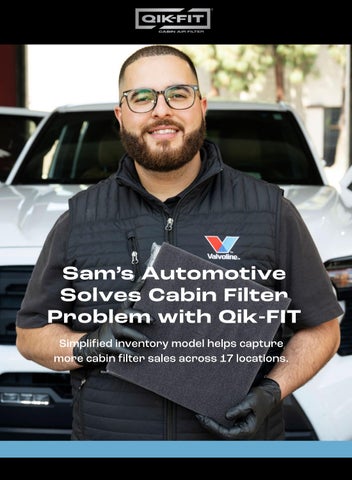
Simplified inventory model helps capture more cabin filter sales across 17 locations.

Growth comes easily to Omar Mawazini. Managing it efficiently is another story.
From a base in Southern California, Mawazini has quickly built a sizable footprint in the quick lube industry, operating 17 Valvoline Express Care locations alongside a Castrolbranded store, car washes, and a full-service repair facility. His ambition is to reach 30 locations within the next year. At that scale, even small inefficiencies don’t stay small for long.
Inventory, in particular, has become one of the most persistent challenges.
“One of the biggest inefficiencies I deal with is inventory,” Mawazini says. “You make one or two wrong decisions, and you can swing your inventory spend by thousands of dollars.”
For operators managing multiple locations, inventory isn’t just a purchasing function, it’s a balancing act between capital, consistency, and customer experience. Too much inventory ties up cash. Too little means missed opportunities. And with dozens of part numbers required to support the cabin air filter category alone, even well-run systems can break down under the weight of SKU complexity.
Mawazini understands that dynamic firsthand. His business operates within the Valvoline Express Care model, where independent owners leverage national branding and support while maintaining control over their operations and financial performance. That independence has allowed him to experiment, adapt, and refine how his stores operate as he scales.
What sets Mawazini apart, however, is not just his growth, it’s the lens through which he views the business. Before expanding in automotive, he spent time in the quick-service restaurant (QSR) world, an experience that continues to shape how he thinks about efficiency, throughput, and standardization.
“We are a QSR business now, quick service retail,” he says. “Our job is to get the most opportunity in front of the customer in the shortest amount of time.”
In the restaurant business, that philosophy translates into simplified menus, standardized processes, and products designed for speed and consistency. In automotive service, Mawazini sees a different reality, one defined by fragmentation.
“McDonald’s sells the same patty. You just double it, triple it, change the presentation,” he explains. “In our world, everything is a different part number.”
That contrast became particularly clear in the cabin air filter category. Before adopting the Qik-FIT premium cabin air filter system, his stores managed a wide range of SKUs, each tied to specific vehicle applications. The system required careful forecasting, disciplined ordering, and constant monitoring. Even then, it was far from perfect.
“You can buy the wrong thing and sit on it for a year,” he says. “That’s dead weight.”
The operational impact extended beyond the balance sheet. When a customer agreed to a cabin filter replacement, fulfillment wasn’t always guaranteed. If the correct part wasn’t on hand, staff were
forced to source it, called “hotshotting,” from local parts retailers, often introducing delays that undermined the quick-service model.
“If you have to call a parts house and wait 30 to 40 minutes, you lose the sale,” Mawazini says. “That’s the difference between making profit and not.”
His introduction to Qik-FIT came through a visit to AAPEX and a recommendation from his supplies distributor Service Champ (servicechamp.com/p/QIKFIT1), but the appeal was immediate.
The concept of a single, universal cabin air filter SKU capable of covering the majority of vehicle applications, aligned closely with the standardization principles he had seen in other industries.
“As soon as I saw it, I thought, this is brilliant,” he recalls.
Still, Mawazini approached the opportunity pragmatically. Rather than deploying it across all locations at once, he tested the product in a single store. The approach was straightforward: stop ordering traditional filters from outside vendors and rely on Qik-FIT for applicable vehicles. Within a week, the results were difficult to ignore.
“They went through the whole case in about a week,” he says. “That’s when I knew this makes sense.”
What followed was a broader rollout and a fundamental shift in how his team approached the cabin air filter category.
“I eliminated 80% of my cabin filter inventory,” he says.
In its place was a simplified system

Now we can offer it on every car.
We always have a solution.”
Omar
Mawazini, Owner and operater of 17 Valvoline Express Care, Castrol-branded store, car washes, and repair facility.
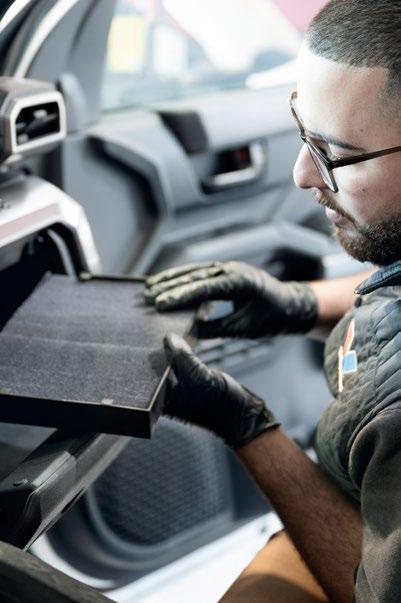
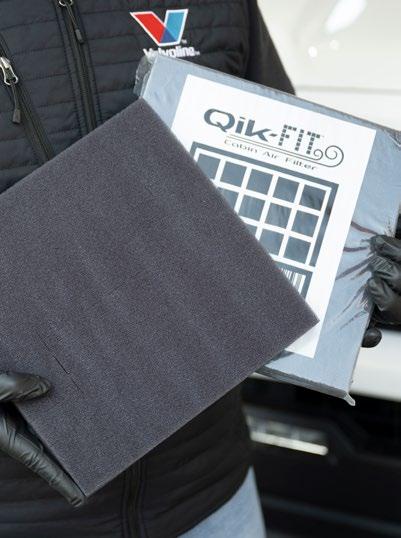
Engineered foam filtration that meets and outperforms paper-pleated filters.
built around a single product that could be ordered predictably, stocked consistently, and deployed across locations with minimal friction. Instead of managing dozens of SKUs, Mawazini’s team could now adjust inventory levels based on store traffic, ordering the same product in varying quantities depending on demand.
“I can order 10 for a slower store or 20 or 30 for a busier one,” he explains. “It’s the same product. I don’t have to think about it.”
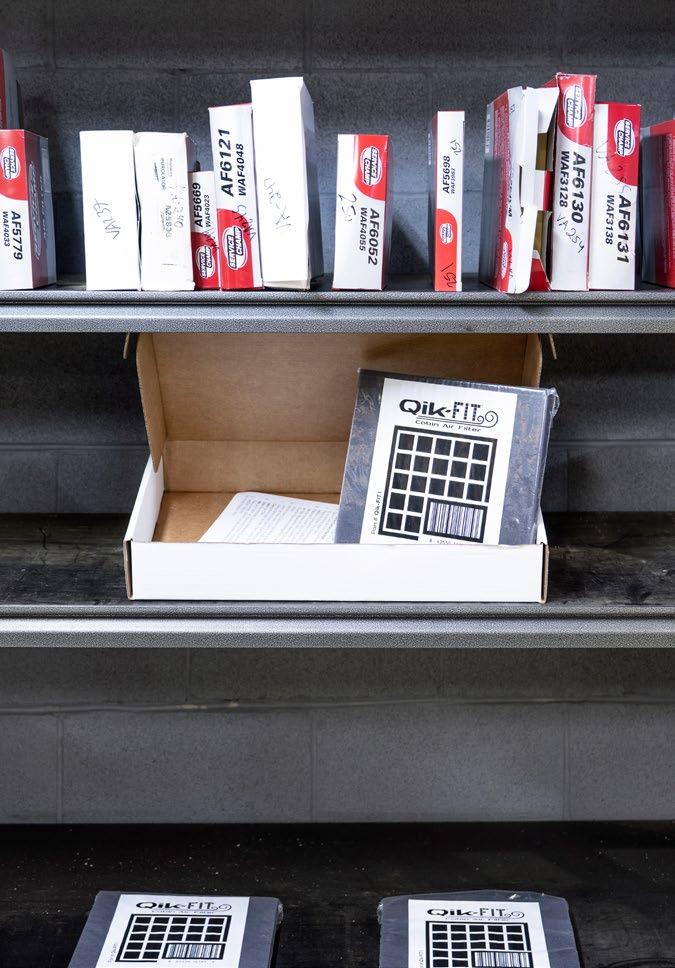
The physical impact was equally noticeable. Shelving once filled with slow-moving filters has been repurposed, freeing up space and reducing clutter in backroom areas.
“It went from multiple shelves to basically empty shelves we use for other things now,” he says.
Capturing the Sale in a QSR Model More importantly, the shift has changed how his teams approach sales. With a reliable, on-hand solution available for the majority of vehicles, service technicians no longer hesitate to present the service.
“Now we can offer it on every car,” Mawazini says. “We always have a solution.”
In a business built around speed, that consistency matters. The ability to act immediately, without waiting on parts or breaking workflow, aligns directly with the QSR-style model he believes the industry is moving toward.
“You don’t have time to wait on parts,” he says. “The customer loses interest. The sale disappears.”
For Mawazini, the biggest impact of Qik-FIT isn’t just performance, it’s consistency in capturing the sale across every location.
In a traditional model, cabin air filter sales depend on having the exact part number in stock. When it’s not available, the opportunity is often lost, or delayed long enough that the customer declines. Qik-FIT changes that dynamic.
“Now we can offer it on every car,” Mawazini says. “We always have a solution.”
That shift expands the number of vehicles eligible for a cabin air filter replacement, turning what was once a conditional sale into a consistent part of the service process. Instead of relying on inventory availability, technicians can confidently present the service knowing they can fulfill it immediately.
For a multi-store operator, the impact compounds quickly. Capturing even a small number of additional sales per day, per location, creates meaningful revenue growth across the system, while bringing consistency to a category that has traditionally been unpredictable.
While adoption expands across the industry, Mawazini notes that operators often evaluate solutions like Qik-FIT through different lenses, particularly when it comes to unit cost. Traditional paper-pleated filters can be purchased at a lower upfront cost, which naturally invites comparison.
For Mawazini, however, the evaluation goes beyond the cost of a single unit. “You’re not just buying a filter. You’re managing inventory,” he says.
From his perspective, the broader economics include how often products are used, how long they sit on the shelf, and how consistently they support completed sales.
Inventory that turns slowly or not at all can quietly impact profitability over time. “Inventory that sits is just wasted money,” he adds.
For Mawazini, the decision to move away from traditional paper-pleated filters wasn’t just about simplifying inventory, it was about improving how the product performs in realworld conditions. From a technician standpoint, the differences show up immediately.
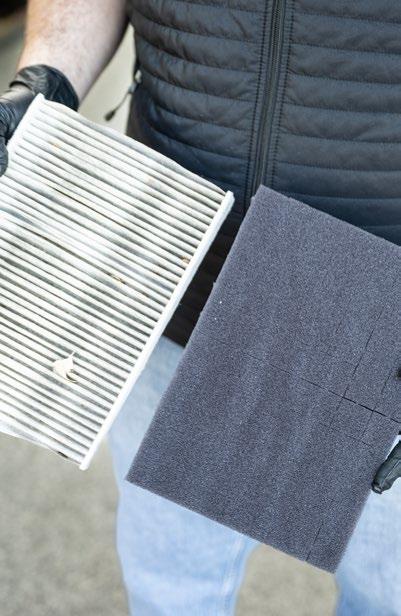
“Once you start using it, you see how it behaves,” he says. Compared to paper filters, which can restrict airflow as they load up with debris, Mawazini has observed more consistent airflow and fewer odorrelated issues with Qik-FIT in service.
“We’ve seen fewer smell complaints and better overall performance,” he notes.
For Mawazini, the difference ultimately comes down to how the product performs over time. “Once you see it side by side, it’s hard to go back to paper,” he says. “The airflow is better, it holds the debris better, and it just makes more sense for how these systems are supposed to work.”
There are also practical advantages in day-to-day shop environments. Traditional filters, packaged in cardboard boxes, can be vulnerable to moisture, oil contamination, and general handling in busy bays. By contrast, Qik-FIT’s plastic wrap packaging holds up better in realworld conditions, reducing the likelihood of damaged or unusable product.
Technicians have also noticed a difference during removal and replacement. With paper filters, dust and debris can easily disperse
Less inventory. More control. Better results.
when the filter is pulled, while Mawazini says the foam structure tends to retain contaminants more effectively.
For operators evaluating a change, Mawazini sees the shift as less of a risk and a change that aligns better with the realities of modern quickservice operations.
The Qik-FIT Premium Universal Cabin Air Filter System is available exclusively through a Groove Technologies partnership with leading automotive aftermarket distributor Service Champ. To place an order, visit servicechamp.com/p/ QIKFIT1 or call 800-221-0216.
ONE SIMPLE SYSTEM. PROMOTED RIGHT. SOLD EVERY DAY.