• Exp lai n th e four fu n ct io n s of management.
• Describe di fferent ki n ds of ma n ag e rs.
• Exp lai n th e maj or ro les and subro les t hat ma n agers pe rform in t h eir jobs
• Exp lai n w h at com p anies look for in managers.
• Discu ss the to p m istakes tha t manage r s make in their jobs
• Describe t h e t rans i t ion that emp loyees go th roug h w h en t hey a re promot ed to mana g ement.
• Exp lai n h ow and why compa ni es can create compet itive adva n tage t hrou g h peop le.
fl MANAGEMENT IS . . .
After you fi nish th is c h apter, go to PAGE 21fo r STUD YTO OLS
Manag eme nt issu e s a re f un d a m en t a l t o any orga ni z a ti on: How d o
we p la n t o ge t things d one, organi z e th e com p any t o be effi c ie nt
an d e f fec t ive, lea d an d mo tiva t e em p loyees, an d p ut con t ro l s in p lace to m ake s u re o u r p l ans a r e fol l owe d and o u r goal s m et? Good
m anageme nt is basic t o sta r ting a b usiness, growing a bu s in ess, and
m aintaining a bu s iness a f ter it has a chieve d so m e m easure of success .
T<> understand h<>,v i1n p <>rtan t good 111anage111e nt is , think a bout this Sears, <>ne <>f the <> ldest retailers in the Uni ted S tates, has lost 8 10 45 billio n si nce 2011. Recent results a re just as bad Sears l<>st $1.1 billi<>n in 2015 and closed 562 sto res. In 2016, it lost $2.25 billion and closed 200 stores. In 2017, it plans to clo se another 250 stores 1 \ • Vithout the $10 .4 billio n it raised fr<>n1 selling Lands End clothing, Sears H<>rn e t<>,vn and Outle t St<>res, 3 27 pro6 table Sears stores and its C raftsrnan too l b ran d (to Sta nl ey Bl ack & D ecker), Sears ,vould be Sling fo r bankrup tcy.
R<>be1t Futte rm an, CEO <>f RKF, a retail leasing and co nsulting co111pany, said, "Retai lers invest in th eir best stores and refurbi s h then1, they don 't sell then1. "2
Ah , bad managers and bad management. Is it a ny wonder that compani es pay 1nanagement cons ultan ts nearly $210 b illi<>n a year for advice on basic 111anagemen t issues such as h<>,v to <>utperfonn co111 petit<>rs t<> earn cust<>1ners' busin ess, lead people effective ly, <>rganize the c.~>mpany effic.iently, and manage large-scale projects an d proc:esses ?3 This textbo<>k ,viii help you understand sorne
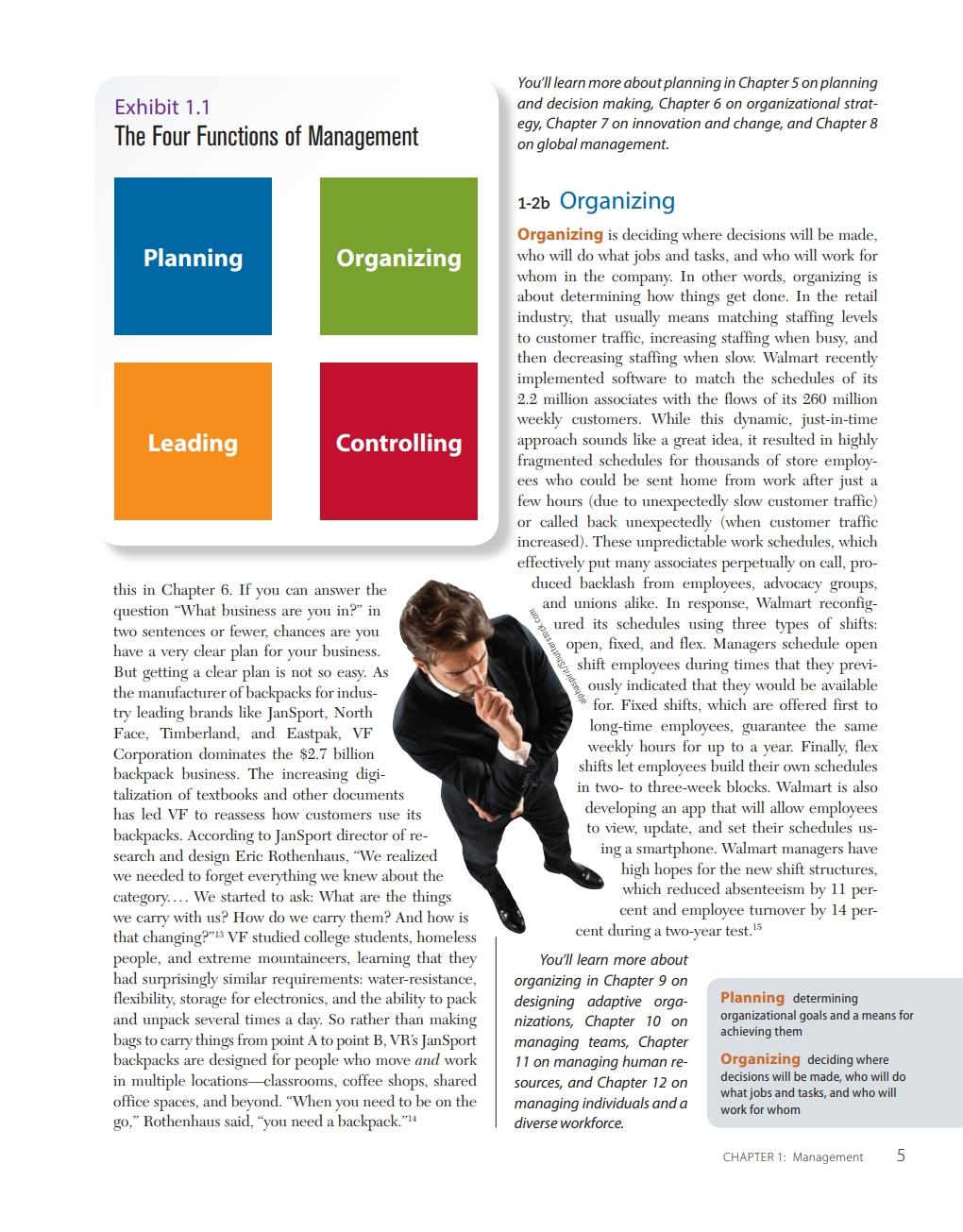
The Four Functi ons of Mana gemen t
thi s i n Chapter 6 I f you can anS\ver the question 'What business a r e you in?" in hvo sentences or fe"'e•~ chances are you have a ve ry clear p lan fo r your busi ness. But getting a clear plan is not so easy As the 1nanufach1 r er of backpacks for industry leading brand~ li ke JanSpo ,t , No1th Face, Ti1nberland, and Eastpak, VF Corporation dominates the $2.7 billion backpack bus iness. T he increasing digitalization of textbooks an d other documents has led VF to reassess ho,v cus to1ners use its backpacks. Acc..~>rdi ng to JanSport director of research and design Eric Rothenhaus, "\ Ve r ealized ,ve needed to fo rget eve rything ,ve k-ne,v about the category We s ta1ted to ask: \ Vhat are the things ,ve calT)' "~th us? Ho,v do we carry tl1em? And ho,v is that changing?" 13 VF st u ch ed coll ege studen ts, honie less peop le, and extreme mountaineers, lean1ing that they had su 111 risingly s in1ilar r equirernents : , vater- r es istance, fl exibili ty, storage for e lectron i cs, and the ability to pack and unpack seve ral times a day. So rather than n1aking bags to carry things frorn point A to poi nt B, VR's JanSpo1t backpacks a r e designed for p eople " ' ho 1nove and , vork in multip le locations-classroonis, coffee shops, shared office spaces, and beyond. "\ Vhen you need to be on tl1e go," Rotl1enhaus sai d , "you need a backpac k. "14
You' ll learn more abo ut planning i n Chap ter 5 on planning and decision making, Chap ter 6 on organizationa l stra tegy, Chapter 7 on i nnovation and change, and Chapter 8 on global management.
1-2b Organizing
Organizing is deci ding wher e decisions ,vill be ,nade, , vho , vill do ,vha t jobs and tasks, and who ,vill ,vork for , vho1n in the company. I n other ,vords, organizi ng is about deterrnining ho,v things get done. I n the re tai l industry, tha t usually means 1natch i ng st affing levels to custo1ner trafHc, increasing s taffing ,vhen busy, and then decreas ing staffing , vhen s k1,v. Wal1nart r ecently irnp lernented sofhvar e to match tl1e schedules of i ts 2 .2 million associates ,vith the fl o,vs of i ts 260 n1illion ,vee kly custo1ners. \.Vhile this dyna1n ic, just- in - ti 1ne approach sounds like a great idea, i t resulted in highly fragmen ted schedules for thousands o f store e1np loyees , vho coul d be sent home from ,vo rk after just a fe,v hou r s (due to une>.-pectedly sk1,v custorner traffi c) or called back une>.pectedly (when customer traffic i ncreased) T hese unp r edictab le ,vo rk schedu les, which effectively pu t many assoc iates p e r pe tually on call, produced backlash from employees, advocacy g r oups, % and unions ali ke I n response, \ Valrnart reconfigi~ ured i ts schedules using three types of shifts : \ open, fhed, and flex. Managers schedule open \ shift ernp loyees du 1ing times tl1a t they p revi~-i., ously indicated tl1a t tl1ey ,vould be availab le for. F ixed shifts, ,vhich a r e offered first to long- tirne employees, guarantee the same " 'eekly hours for up to a year. Finally, flex sh ifts let e1np loyees build their o ,vn schedules i n hvo- to three -,veek b loc ks . Walma 1 t is also developing an app that ,vill allo,v emp loyees to vie,v, update, and se t tl1eir schedu les usi ng a smar tphone. Walma1 t 1nanage rs have high hop es for the ne,v shift structu r es, ,vhich reduced absen teeism by 11 percent and e inp loyee tu n1<:iver by 14 percent during a hvo-year test. 15
You'll learn more about organizing in Chapter 9 on desi gni ng adaptive organ i zations, Chapter 7O on managing teams, Chapter 77 on managing human resources, and Chapter 72 on managing i ndi viduals and a d i verse workforce
Planning deter min ing organ i zatio nal goa ls and a means for ach ievi ng them
Organizing decid ing w here deci sio ns will be made, who wi ll do what j obs a nd t asks, and w ho will w o rk for whom
PTER 1: Manageme nt
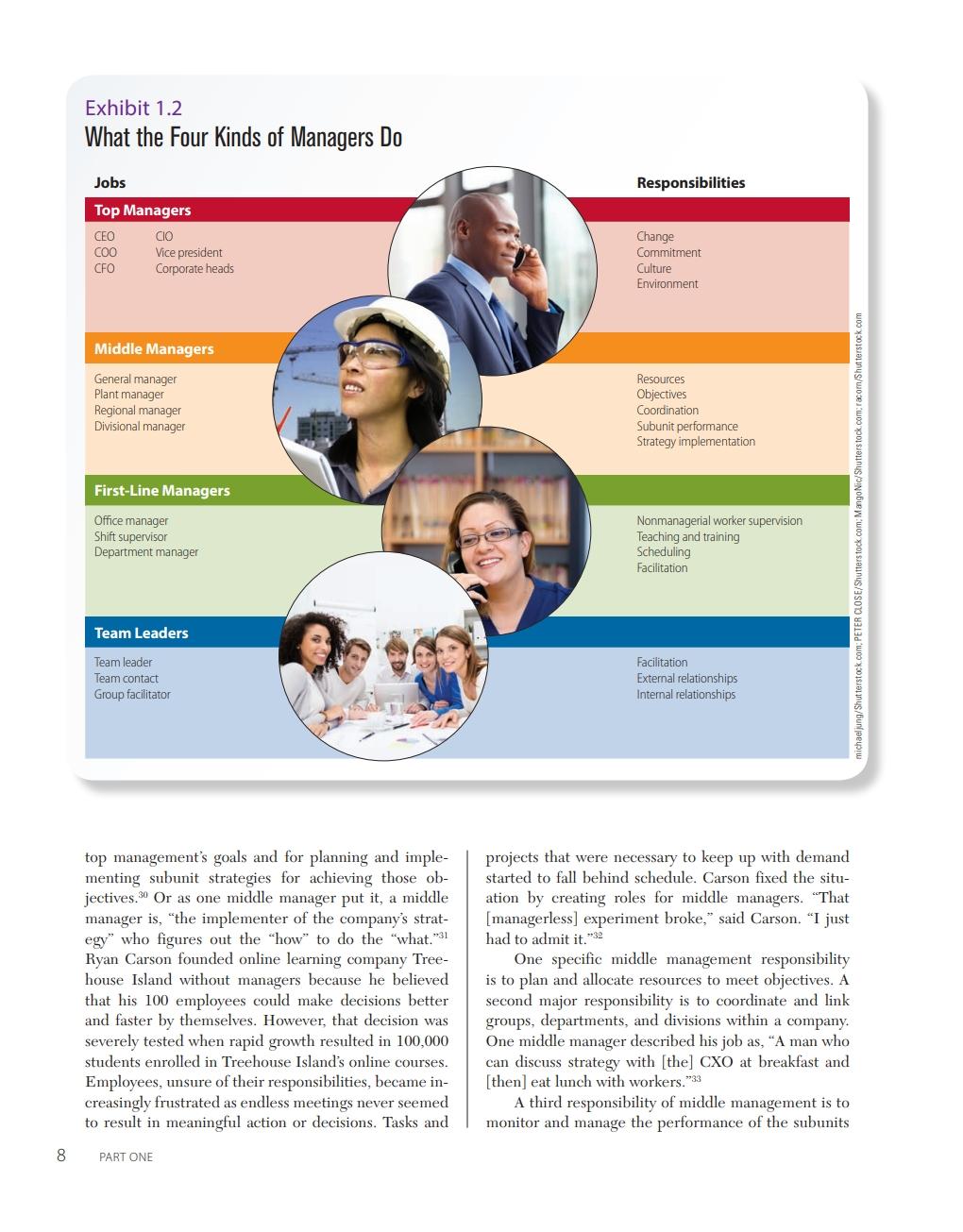
What the Fou r Kinds of Ma nagers Do
Jobs
CEO
coo
CFO
Vice pr~ident
Corporate heads
General manager
Pla nt manager
Regional manager
Divisional manager
First-Line Managers
Office manager
Sh ift supetvisor
Department manager
Tea m leader
Tea m contaa
Group facili tator
top 1nanagernent's goals and fo r planning and i1nple1nenting subunit sti ategi es for achievi ng those obj ectives 30 Or as one middl e rnanager pu t it , a middl e manager is , "the irnp lementer of the company's strategy" \vho figures out th e "how" to do the "what."3 1 Ryan Carson founded onlin e lea rn i ng <X>n1pany Treehouse Is l and ,vithou t 1nanage rs because he believed that his 100 en1p loyees could make decis ions better and fas te r by themsel ves. However, that decis ion \vas severe ly tested when rapid gn>\vth resul ted in 100,000 s tuden ts en r o ll ed in Treehouse Isl an d 's on line courses. E 1nployees, unsu re of their responsibil i ties, beca1ne increasingly fn)Stra ted as end less rneetings never see ined to r esul t in 1nean i ngful action or d ecis ions. Tasks and
Respo n si bil it ies
Change
Commi tmen t
Culture
Environment
Resources
Objectives
Coordination
Subu nit performance
Strategy imp lementation
Nonmanage<ial worker supervision
Teach ing and training
Schedu ling
Faci lita tion
Facilita tion
Ext ernal relationsh ips
Internal relationsh ips
p r ojects that ,vere necessary to keep up ,vith dernand start ed to fa ll beh i nd schedu le. Carson fix ed the siru · ation by c reating ro les for middle managers. "Tha t (1nanage rl ess) eiq>eri1nent b roke," sai d Carson. "I jus t had to admit i t."32
One speci fi c middl e 1nanage 1nent responsibi li ty is to plan and allocate resou r ces to mee t objectives. A second n1aj or respons ibili ty is to coordinate and link g r oups, departmen ts, and d i visi ons \vi thi n a G'(>Jnpany. One rniddle 1nanager descri bed his job as, "A man \vho can discuss stra tegy ,vi th (the) CXO at brea kfast and (then ] eat l unch \vi th workers."33
A th i rd responsibility of middl e 1nanagernent is to 1noni to r and manage the p e rforn1ance of the subun i ts
and individual 1n a nage rs ,vho repo rt to then1. Finall y, middl e rnanager s are also respon s ibl e fo r in1pl erne nting the changes or st ra tegi es genera ted by top 1nanagers . Why? Beca us e th ey' r e closer to th e 1nanage rs and ernp loyees ,vho ,vork on a dai ly bas is ,vi th supp l iers to effective ly and effici en tly d e live r the corn pan y's p r oduct or service . In s hort, they' re closer t o th e peop le ,vho can b es t so lve prob le 1ns and i mp len,e nt solu tion s . Ho,v i1nportant a re 1n i ddl e manage rs to company p e rfonnan ce? A st udy of n ea rly 400 vi d eo -gan,e cornpanies co nducte d at the Un i ve rsity of Pe nnsy lvania's vVharton Schoo l of Busin ess found tl1a t middl e n,anagers' effective ness accounted fo r 22 percent of th e d iffe re n ces in p e rformance acr oss cornpan i es In fact, middl e manage rs ,ve re th r ee tirn es as irnpo r tant as the video -gam e d es ign ers ,vho d eve lop garne characters and story lin es Professo r Ethan Moll ick, ,vho conducte d the study, sai d that mi ddle n,anage rs are the key to "rnaking sure the p e opl e a t the bottom and th e top [of the organization] are getting ,vhat they nee d.''34
As fo r Tree house I s land, reve nu e is up , th e numb e r of ins tructional vi d eos has i n c r eased , and r es ponse tin, es to stud e n t questions have been cut in half. According to te ach e r Craig D e nni s, things a r e "light yea rs b ette r" ,vith rn i dd le rnanage rs i n place. 35
1-3c First- Line Managers
First-line managers hold pos ition s such as of6ce ,nanage r, s hi ft supen~sor, or d e part1n e n t rnanage r. Th e p ri rnary res pons ibility of firs t- lin e rnanage rs is to 1nanage th e p e r fonnan ce of e ntJ),- level ernp loyees ,vho are dir ectly res pon si ble for producing a company's goods and seMces. T hus, fi rst- lin e managers are th e only manage rs ,vho don 't s upeMse oth e r 1nanagers. Th e respo nsibiliti es of Hrs t-lin e rnanage rs includ e rnon i to ri ng, teac hi ng, and short- te n n planning
First- lin e 1nanage rs e ncou r age, rnon i tor, and re ,vard th e p e rformance of their worker s Fir s t- lin e 1nanage rs are also r esponsib le for teac hi ng e ntry- leve l e 1np loyees ho,v to do thei r jobs Th ey also make d e tail e d sch e dules and ope rating p lans based on rniddl e 1nanagement's in te rm e diate - r ange plans. I n contrast to th e long- te rm p lans of top rnanagers ( th r ee to five years out) and tl1 e in te r m e diate plans of 1n i ddl e manage r s ( six to e igh teen 1nontl1s out), firs t- lin e manage rs e ngage in p lans and actions tl1at typically produce r es u lts ,vi tl1in hvo ,vee ks.36
Consider the typ ical convenience s tore 1nanager ( e .g , 7- E leven ) ,vho starts tl1 e day by d riving past co1npetitors' s to r es to insp ec t their gasoline prices and th e n checks the outsi d e of his or h e r store fi:> r anything that 1nigh t need maintenance, such as burn ed -out lights or
signs, o r r es tocking, s uch as ,vindshi e ld ,vash e r fluid and paper towels . Th e n co1nes an i nsid e check, ,vh e r e th e n,anager d e te rrnin es ,vha t nee ds to be don e fo r that day. (Are th e r e e nough donu ts and coffee for breakfast or e nough sand"~ches fo r l unch ?) Afte r th e clay is p lanned, tl1 e manage r tu r ns to ,vee ke nd orde rs . Afte r accounting for th e ,vea tl1 e r ( hot or cold ) and th e sales t re nds a t th e sa1ne ti me last year, th e rnanage r rnakes su re th e store "~II have e nough beer, soft d1inks , an<l snack foods on hand. Finally, th e n,anage r looks seven to ten days ahead for hi1ing n eeds Becaus e of strict hiri ng procedures ( basic math tests, drug tests, and backgr ound checks), i t can take that long to hire n e,v e mployees Said one convenience store rnanage r, " I have to continually in te rvi e,v, eve n if I a 1n fully staffed "37
1-3d Team Leaders
First-line managers
respon si b le for t rai ni ng and sup ervi sing t he performa nce of non manageria l employ ees who are d irect l y responsible for producing t he com pany's p roduc t s or serv ices
Team leaders man agers respon si b le for faci lit at ing team acti vi ties t oward goal acco mpl ish ment
T h e fouith kind of rnanager is a te am leade r This re lative ly n~v kind of manage me nt job d evelope d as co1npanies shifte d to self- rnanaging tearns , ,vhich, by d efini tion, have no forrnal supervisor In traditional 1nanage 1n e nt hi e nuclu es, fi.rst -lin e manage r s are responsi ble for the p e rfor1nance of non1nanage1 i al e1nployees and have th e autho 1ity to hire and fire ,vorke r s, make job assignn, e n ts, and control reso u rces. I n tlus ne ,v sti11Gture, the teams thernse lves perforrn n early all of th e func ti ons pe rforme d by fi rst-line n,anage rs under traditional hi erarchies . 38 Team leaders a r e p r irnaril y res pons ib le for facilitating team ac tivit ies t<i,vard accon1plishing a goal. This do es n 't n,ean tea 1n l e ade rs a r e
r espons i b le fo r tea 1n perforrnance. T hey aren ' t. The tean1 is. So how do tea1n leade rs help thei r teams accon1 p lish their goals? Avinoa1n No,vogrods ki , CEO at C larizen, a sofhvar e corn p any, says, " Grea t l eaders ask the r ight questions. T hey recogn i ze ... that a team is rnuch better at figuring out the ans,vers .u39 Tearn leaders hel p their tearn rne1nbers p l an and schedul e ,vork, l ea rn to solve p r ob lerns, and ,vork effec tively ,vith each other. 1'1anage1nent consu l tan t Fran klin Jona th says, "T he idea i s fo r the tean1 leader to be at the se r vi ce of the g rou p ." It shou ld be clear that the tea 1n 1nembers o,vn the outcome. The leader is there to bring i n te ll ectual , e1no tional , and sp i ri t ual resources to the tean1. T hrough his or her act ions, the leader shou ld be ab l e t o show the o thers ho, v t o think about the ,vork that they're doing in the contex t of thei r lives It's a tall order, bu t the best teams have such leade rs." 0
Relationshi p s arnong tearn men1bers and behveen different teams are crucial to good team per fr>rrnance and must be ,ve il rnanaged by tearn leade r s, ,vho are respons ible fo r fos te 1ing good rel ationsh i ps and add r essing prob lematic ones ,vithin their tea1ns . Getting along ,vith others is much more i n1 p o 1tant in tearn s t ruc tures because tea1n 1nernber s can't get work done ,vithout the he lp of tea1nrnates Clarizen CEO Avinoarn No\vogrods ki agrees, sa)>ing, " I nnovation is crea te d wi th people , vho you r espec t. It \vill never happen i n a group of peop le ,vho ha te each other If you ,van t to have i nnovation within your cornpany, you need to have a cul ture of respect u,n And, No\vogrods ki adds, that starts wi th the tean1 leader " If you respect other people, they' ll r espect you "42 In other ,vor ds , tean1 leade rs need to foster civil behavior based on poli teness , respect, and positive regard. Fo r t wo decades, P rofessor Christine Porath has studi ed the effects of ,vork"Place i ncivi li ty. She stress tha t leaders set the tone for their teams: "A s tudy of cross - functional product tean1s reveal ed that , vhen lead ers ti·ea ted 1nen1bers of their tearn , veil and fairly, the tearn 1nernbe rs ,ver e 1no re productive i ndividuall y and as a tearn. T hey also \vere 1no r e li ke ly to go above and beyond thei r job requiren1en ts. It all s ta r ts at the top. \ ~/hen leaders are c ivil, i t i ncreases per fo rmance and c r eativity, alJo\vS for ear ly mis take detection and the initiative to take actions , and reduces e 1notional exhaustion."43
Tea1n leaders ar e a lso responsib le fo r rnanaging exter nal re lationshi p s Tea1n leaders act as the bridge or liaison behveen thei r tearns and other teams, depa1 tments, and divisions i n a company. For exarnp le, if a 1ne1nber of Tearn A <X>1nplains abou t the quali ty of Team B's , vor k, Tearn A's leader is responsib le for solving the
prob le1n by initiating a 1neeting \vith Tea1n B's leader Together, these tearn leader s are responsib le fo r getting n1ernber s of both tean1s to ,vor k together to solve the prob le1n. If it's done right, the prob lern is solved ,vithou t involving <X>mpany n1anage 1nent o r bla1n i ng 1nernbers of the other tean1. ._,
I n surn1na1)', because of these c ,itical differences, tearn leaders ,vho don 't un derstand ho,v thei r roles are different fron1 those of traditional 1nanager s often st111ggle i n their jobs
You will learn more about teams i n Chapter 10
• MANAGERIAL ROLE S
Although all fou r types of n1anage rs engage in planning, o rganizing, leading, and controlling, if you ,ver e to follo,v them around du1ing a typical day on the job, you \vou ld probably not use these terrns to describe ,vhat they actually do Rather, , vhat you'd see are the vali ous roles 1nanage rs p lay. Professor Henry Min tzberg follo,ved five A1nerican CEOs , shado\ving each for a , vee k and analyzing thei r n1ail, thei r conversations, and their actions He concluded that 1nanager s fulfU l three major roles \vhile per fonn i ng thei r jobs- in te1personal, info n national, and decisional 45
I n other ,vor ds, n1anage rs tal k to people, gathe r and give i nforrnation, and rnake decisions. Furthermor e, as sho,vn i n Exhib it 1. 3, these th r ee major roles can be subdh>ided into 10 subro les.
Let's examine each major role- 1-4a interpersonal roles, 1-4b informational roles, and 1-4c decisional rolesand their 70 subroles
1-4a Interpersonal Roles
More than anything e lse, 1nanagemen t jobs a r e peop le - i n tensive. \ ¥hen asked about he r experience as a fi rst - tin1e CEO , Ki1n Bo\ve r s, CEO of CS T Brands, said, " \ Ve have 12,000 e1nployees. [ So, ) I spend a lo t of tirne out i n the fi e ld \vi th the in."46 Esti 1nates vary with the leve l of 1nanagement, but n1ost 1nanage rs spend behveen hvo -th i r ds and fou r- fift hs of thei r tin1e in face - to - face cornmunication ,vi th others 41 I f you' r e a loner, or i f you cons i der deal ing \\>ith p eop le a pain , then you 1nay no t be cu t ou t for rnanage1nen t ,vork. I n fu l f illing the i n terpersonal r o le of management, 1nanage r s p e rforrn th r ee subroles: figurehead, leade r, and l iaison.
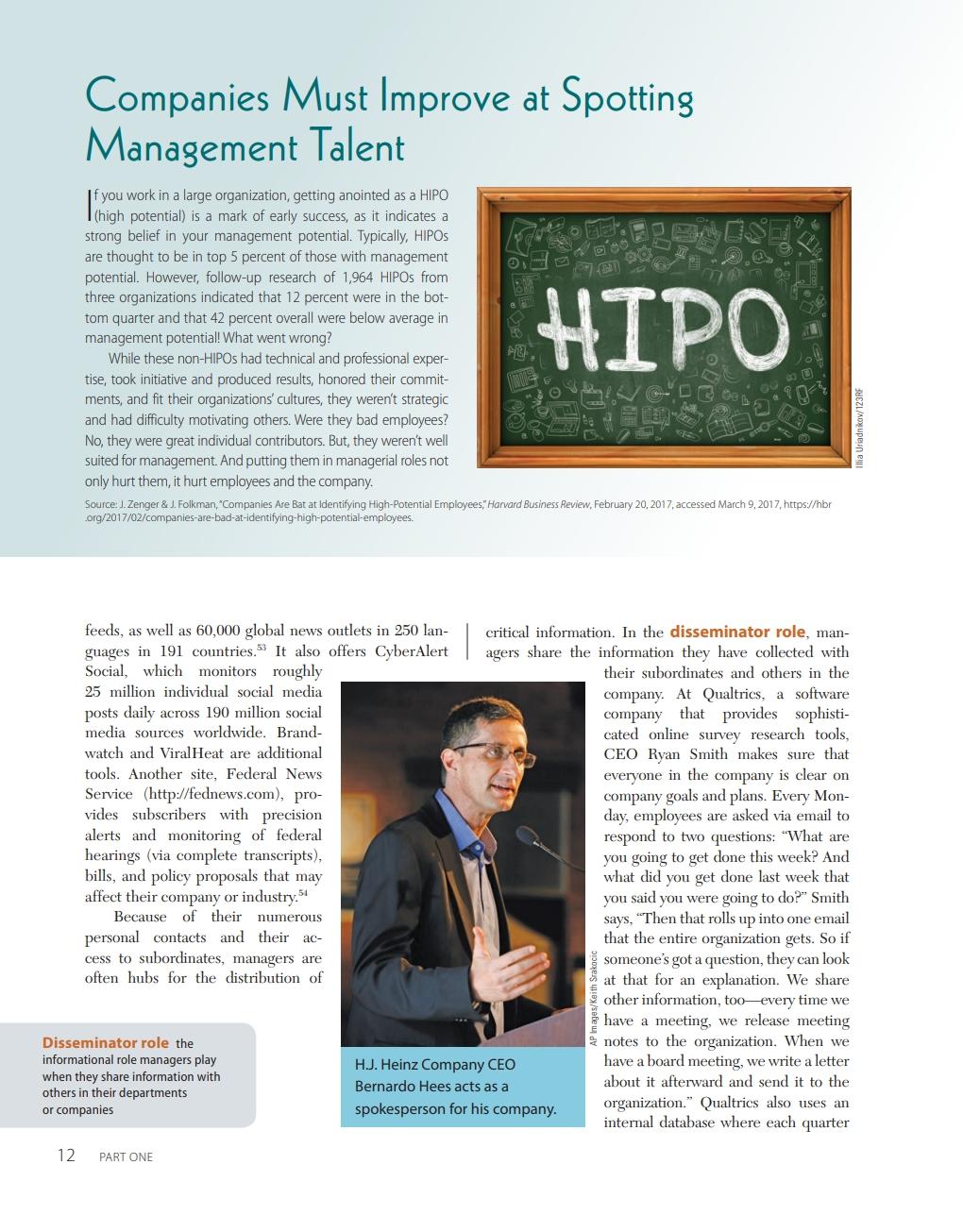
Companies Must Improve at Spotting Management Talent
If you work in a large organization, getti ng anointed as a HIPO (h igh potential) is a mark of early success, as it ind icates a strong bel ief i n your management potential. Typically, HIPOs are thought to be in top 5 percent of those with management potential. However, follow-up research of 1,964 HIPOs from three organizations ind icated that 12 percent were in the bottom quarter and that 42 percent overall were below average in management potential! What went wrong?
Wh ile these no n-HIPOs had technical and professional expertise, took initiative and produced results, honored their commitments, and fit their organizations' cultures, they weren't stra teg ic and had difficulty motivating others. Were they bad employees? No, they were great individual contributors. But, they weren't well su ited for management. And putting them in ma nagerial roles not only hurt them, it hurt employees and the compa ny
Source: J. Zenger & l Folkman, ·companies Are Bat at Identifying High·Potential Employees:Harvard
feeds , as ,veil as 60,000 g lobal news ou tle ts in 250 languages i n 19 1 countri es. 53 It also offers CyberAlert
c ri tical infonnation. In the disseminator role, rnanagers shar e the infonnation they have collecte d "~th Social, ,vhich mon i tors rough ly 25 miluon individual soci al 1nedi a posts daily across 190 rnilhon social 1nedia sou r ces ,vorld"~de. Brand,vatch and ViralHeat are additional too ls. Another s ite, F ederal Ne,vs Service ( http :// fedne,vs corn ), p rovides subscri bers "~th p r ecis ion alerts and 1nonitoring of fede r al hearings ( ~a complete tran sc ripts), bills , and pou cy proposals that n,ay affect their co1npany o r i ndustry. 54
Because of their nurnerous pe rsonal c:,~)n tacts and their access to su bordinates, managers a r e often hubs for the distribution of
Disseminator role th e
i nfo rmati o n al rol e m anagers pl a y w h en th ey sh are i nfo rm at i on w i t h o
thei r subonhnates and others in the c.,~)rnpany. At Qualtiics, a sofuvare cornpany tha t pro,~des sop histica te d on un e survey r esearch tools, CEO Ryan Srnith makes su r e tha t eve•)'One i n the con,pany is dear on cornpany goals and p lans Eve•)' Monday, ernployees are asked ~a ern ail to respond to two questions : 'Wha t are you goi ng to get don e this \veek? And what did you ge t clone last ,vee k tha t you said you " 'ere going to do?" S1n i th says, "Th en that r olls up into one ernail that th e e ntire organization gets. So if } so ,neone's got a question , they can look at that fo r an e,.-pfana tion. We s hare othe r info rmation , too--eve•)' tirne ,ve j have a meeting, \ve release meeting :'i notes to the organization. \¥hen ,ve have a board rneeting, ,ve ,vrite a le tter about it afte rward and send it to the o rganization." Qualtrics also uses an inten1al database ,vhere eac h quarter
Business Review. February 20, 20 17. accessed March 9, 20 17, https://hbr
HJ. Heinz Company CEO Bernardo Hees acts as a spokesperson for his company.
e 1np loyees e nte r th ei r p lans for 1neeting the c.·on1pany's objectives Thos e p lans are then rna<le visi b le to everyon e e lse at Qualtiics.55
In contrast to the dissemina to r r ole, in ,vhich managers clistribute info r mation to e1n p loyees insi<le th e co 1npany, rnanager s in the spokesperson ro le share in fonnation ,vith p eop le outside th ei r departrnents or companies. One of th e most cornmon ,vays tha t CEOs act as spo kespeop le for their companies is speaking at annual m eetings and on confe r e nce calls ,vith s hareholde r s o r boards of d i r ectors CEOs also se rve as sp okesp eople to th e media ,vhen thei r <.,~)1npanies are in vo lved in n1ajor ne,vs sto 1ies. After Foxconn Tec hnology Gr oup , best kno,vn as the 1nanufacturer of App le iPhon es, paid $3.88 billion fo r a 60 percent o,vner s hi p of Sharp, the maker of home appliances, document S)'Sterns (1nul tifu nctional p1in ters and copiers), robotics and 1V/audioequipment, n e,v CEO Tai Jeng-,vu , ,vho became CEO as part of the takeove1~ announced , " lvly mi ssio n as the leader of Shar p is to turn around this co1npany ,vithou t any fu1th e r <le lay."56 \ .Yith losses of more than $2 billion a year, Mr. Tai a lso indi cated that Sharp ,vou ld restructure and tha t layoffs ,vould be need e d to r e duce costs. Tai said tha t Sha111 ,vould also seek to cance l li censing deals, i n ,vhich Sha111 had licensed i ts na 1ne to other co1npanies , pe r1nitting th em to se ll consu 1ner e lectronics, such as 1Vs, using Sha1p's b r and narne. Tai said, "\ .Ye ,van t to po lish Sha1p's brand value by ourselves and 1nake i t sh i ne g lobally. "57
1-4c Decisiona l Ro les
Mi ntzbe rg found that ob taining and sharing information is not an en cl i n i tself. Ob taini ng an<l s haring inli:>r mation "~th peop le inside and outs id e the G~)rnpany is useful to 1nanager s because i t helps them make good d ecis ions. Ac<.,~)r<ling to Mintzb e r g, 1nanager s engage in four deciskinal subroles : entre pre neur, clistu r ban ce handl e r, r esou rce allocator, and negotiator.
In the entrepreneur role , rnanagers adapt the1nselves, thei r subordinates, and thei r uni ts to cha nge. Fa ced ,vith near ze r o in ter est ra tes, g lacially sk>,v eco no 1nic g ro,vth , and an agi ng custo 1ne r base, Oga ki Kyo ri tsu Bank ( O KB) in Ogaki, Ja pan , has been forced to innovate to g r o,v its bus iness. Pres id ent Takashi Tsuc hiya says, "\ .Yi th th ese i nte r est r ates , you might ma ke 1no r e rnoney se llin g 10 O KB c hocolates instead of 1nanaging a rnilli on yen ( abou t US $8,600) i n depos its. "5 s O KB choc.·olates? Yes, and a n O KB farm ,
O KB r i ce , an <l OKB radio stu<li o Legally, O KB can't run those busin esses, so i t pays th em t o use the O KB b r and nam e. To e ncourage custo1ner gro\\>th , 0 KB uses r oule tte, dice, pinball and s lo t mach in es to d ispense cash a\\>ards ,vhen custo1ners n1ake depos its or ,vi thdra,vals Sa)'S Tsu ch iya, "\.Ve' re not a bank, ,ve' re a se r vice co1n pan y. I f you' r e goi ng to go to the bank, it shou ld be fun." 59
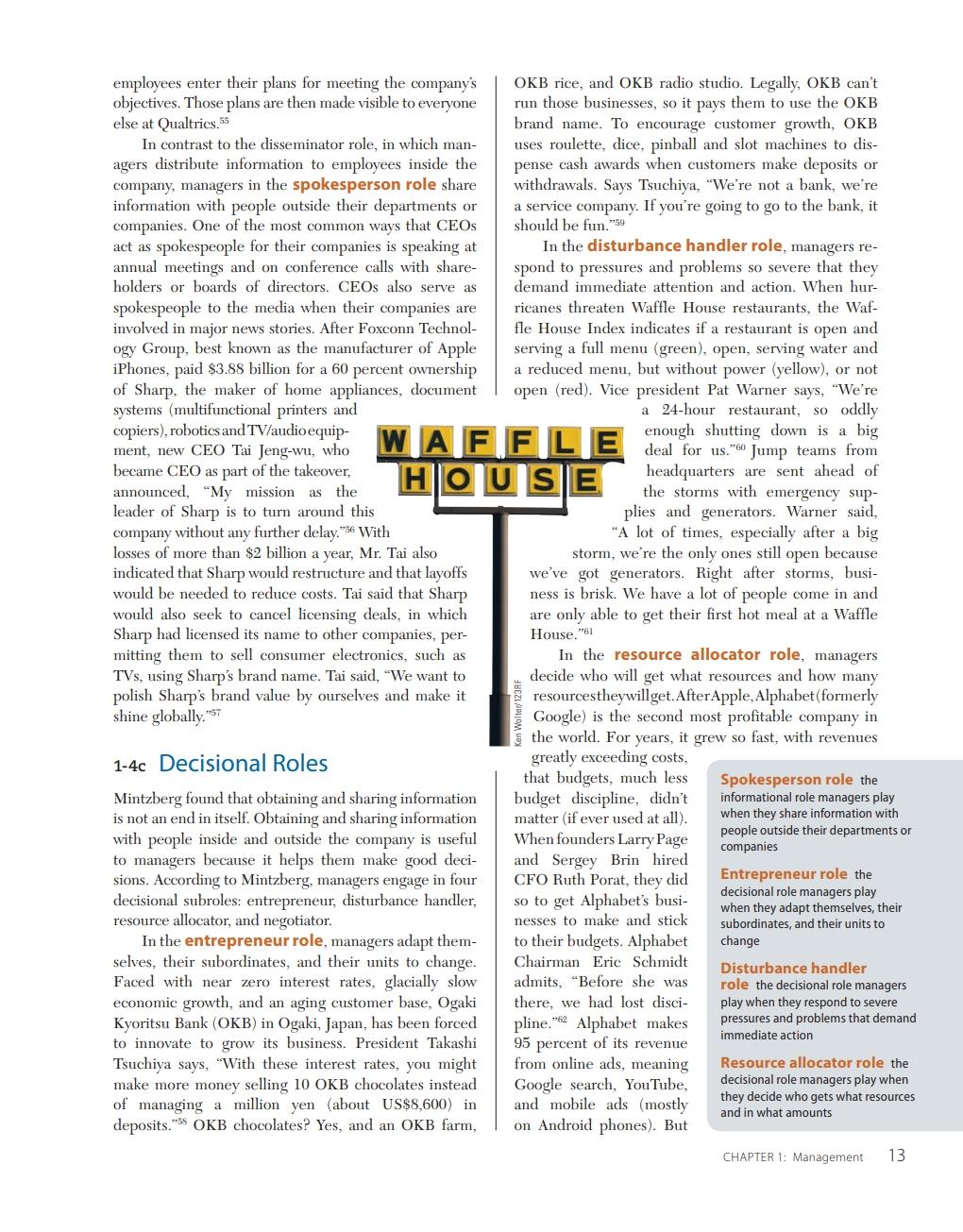
I n the disturbance hand ler role , 1nanagers respond to pressu res and proble1ns so seve re tha t they d ernand i1nn1ecliate attention and action. When hurr i canes threaten \.Vaflle House r estaura nts, th e \.Vaffl e Hous e Ind ex indicates i f a r es ta urant i s open a nd serving a fu ll n1enu ( green ), open , serving ,vate r and a r e duced 1nenu, but ,vi thou t po,ve r (ye ll o,v), or no t open ( r e d ) Vice p resident Pat \ Va rn e r says, "\ .Ye're
L ESE
a 24 - hour res t aurant , so oddly e nough shutt ing do,vn i s a big deal for us." 60 J ump tearns from headquar t ers are se nt ahea<l of the storms " ~th eme rgency suppli es and gen e r ato r s . Wa r ne r said, " A lot of t imes, especially after a big sto rrn , ,ve' r e the only ones sti ll open because ,ve' ve go t gener a tors. Rig ht afte r s torn1s, busin ess is br is k. \ .Ye have a lo t of peop le come in and a r e on ly ab le to ge t thei r firs t ho t n1eal at a Waflle House ."61
In the resource allocator ro le, n1anager s d ecid e ,vho ,vill ge t ,vha t resources a nd ho,v 1nany El r esou r ces they">il Ige t. After Apple, Alphabet ( fonn e r ly "' j Google) is the second most p rofi tab le cornpany in :) the ,vorld. For yea rs, i t g r e,v so fast , ,vi th r eve nu es grea tly exceecli ng costs, that budge ts, n1uch less budget d iscipline , d i dn't 1natte r ( if eve r used at all ). \ .Yhen founders Lan)' Page and Se r gey Brin hir e d C FO Ruth Porat, they did so to get Al ph abet's bus inesses to make and stic k to thei r budge ts. Al ph abe t Chai r man Eri c Schmid t adrn i ts, " Befo r e she ,vas there, ,ve had lost disc ip li n e "i;e Alphab e t n1akes 95 p e rcent of i ts r even ue from online ads, rneaning Google sear ch, YouTub e, and rnobile ads (1nostly on Android phones) Bu t
Spokesperson role the i nfor mat ional role ma nagers p lay when th ey sha re i nfo rmatio n with people out side t heir depar tm ents or compa nies
Entrepreneur role t he deci siona l ro le ma nagers play when th ey adapt themse l ves, th eir subord inates, and t heir uni ts t o ch ange
Disturbance handler role the dec isional role ma nage rs p lay w hen they respond to severe p ressures and prob lems t h at dema nd immediate actio n
Resource allocator role t he deci siona l ro le managers play when th ey decide who gets what reso u rces and in what amount s
1: Management
in th e rest <>f Alphab e t ( Nest th e rm<>s tats, Go<>g le Ve n tures, Go<>g le Fib e r), e xpe ns es fa r e xceed re ve n ues
So P<>rat is i nstill i ng d iscip line by cutting bu dg e ts, by app rovi ng vide o con fe re nces rath e r than bu s in es s trave l, by c hargi ng th e busin ess units for using Alphabe t's fun c ti <>ns (l ega l, human resou rce s, an d public relati<>ns ). C hai n nan Schn, idt says, "T he cos t c utting is re al , and i t's th e right th i ng to be d<>n e, and i t's drive n by [ P<>ra t]."63
In th e negotiator role , manage rs neg<>tia te sch e dules, pr<>j ects, g<>als, <>u t<X>ln es, res<>u rces, an d e mpl<>yee raises T,ve nty <>f th e US 's largest co,npan ies, includi ng Ame ri can E;,,11ress , IB M, Marriott, S he ll Oil, and Ve ,iz<>n Com1nun ic ati<>ns, have form ed th e He alth Tran s fo rmati<>n Allian ce ( HTA) to negotia te l<>,ve r d111g and me dical costs Ke vin C<>x, c hi e f hurnan re s<>u rce ofl1c.-e at Ame ri can E;,,-p ress, says, " Eve n th e m<>s t s uc.-cess fu l co,npan ies ,v<>n't be ab le to affo rd th e risi ng c<>s ts <>f he al th care i n th e not too distan t future."64 At a tirn e ,vh e n he alth care spe ndi ng is in c re asi ng 6 to 8 pe rce n t pe r year, th e HTA expects to l<>we r d 111g c <>sts by . 15 pe rce nt for th e i r 6 ,nilli <>n e1npl<>yees. Kyu Rh ee, IB ~1l's ch ie f he al th <> fHce r says, "T his is th e g r<>up that's pa)~ng th e bill \ .Ye' re n<>t wai ting li:1r th e publi c sect<>r to come up with th e s<> lution-,ve have th e s kills and e;,,-p e rti se t<> d o thi s <>u rse lves "65
• WHAT COMPAN IES LOOK FOR IN MANAGERS
I didn't ha ve the s li ghtest idea ivhat 1ny j ob wti~. I tv alked in g igglin g arid lau g hin g because I had b een pronu>ted arid had 110 idea what prin c iple.~ o r st yle to b e g uided by. After the fi rst day , I f elt like I had n,n into a brick wall. ( Sales Representati ve # 1)
Negotiator role the decisio nal role ma nagers play when they negotiate schedules, p rojects, goals, outcomes, resou rce s, and employee raise s
Technical skills the specialized procedure s, tech niques, and knowledge required to get the job do ne
Sudde nly, I f o und rnyself sayiri g, boy, I can 't b e respons ible for getting all that r e venu e I cu1n 't ha ve the t i1ne
Sudde nly yo u' ve g ot t o g o froni [taking care of] you,-self and s ay
now 1'1n th e ,nanage r, arid what does a manage r do ? It takes awhile thinkin g about i t for it to r eally hit yo u ... a manager gets things don e throu g h oth e r peo ple . That 's a ve ry, venJ hard t rans ition t o rnake ( Sales R e presentative #2 )66
T he preceding state me nts ,ve re rnad e by hvo star s al es re pre se ntative s , vho, on th e bas is of th e ir su p e ri or p e rli:1nnance, ,ve re pr<>rnote d to th e posi ti<>n of s ales manage r. At first th ey did no t feel c <>nfid e n t a bou t th e ir ability to d<> t he ir jobs as 1nanage rs Li ke 1n<>s t ne,v 1nanage rs, th e se s al es n,anage rs s udde nl y re alize d tha t th e kno, vle d g e, skil ls, and abiliti es tha t le d to su c cess e arly in th e i r c aree rs ( and , ve re pr<>babl y re sp<>ns ible f<>r th e ir promotion in t<> th e ranks of rnanage m e n t) ,vou ld not nece ss ari ly he lp th e m succeed as ,nanage rs . As sal es re pres e n tatives, th ey ,ve re respons i bl e <>n ly f<>r managi ng th e i r o,vn pe rf<> n nance . Bu t as sales ,n a nage rs, th ey ,ve re no,v d ire ctly responsib le fi:1r sup e rvising all <>f th e s al es re presen ta tives in t he ir sal es te r ri tori es. F urth e rn,o re, th ey ,ve re n<>,v d i re ctl y aL'C(>untab le fo r ,vh e tl1 e r those s al es re p res e ntatives a c hi e ve d th e ir sal es g<>als If pe rf<>rmanc e in n<>n1n a nage ri al jobs dves n' t ne c essar il y p re pare you for a manage rial j<>b , th e n , vhat doe s i t ta ke to be a manage r ?
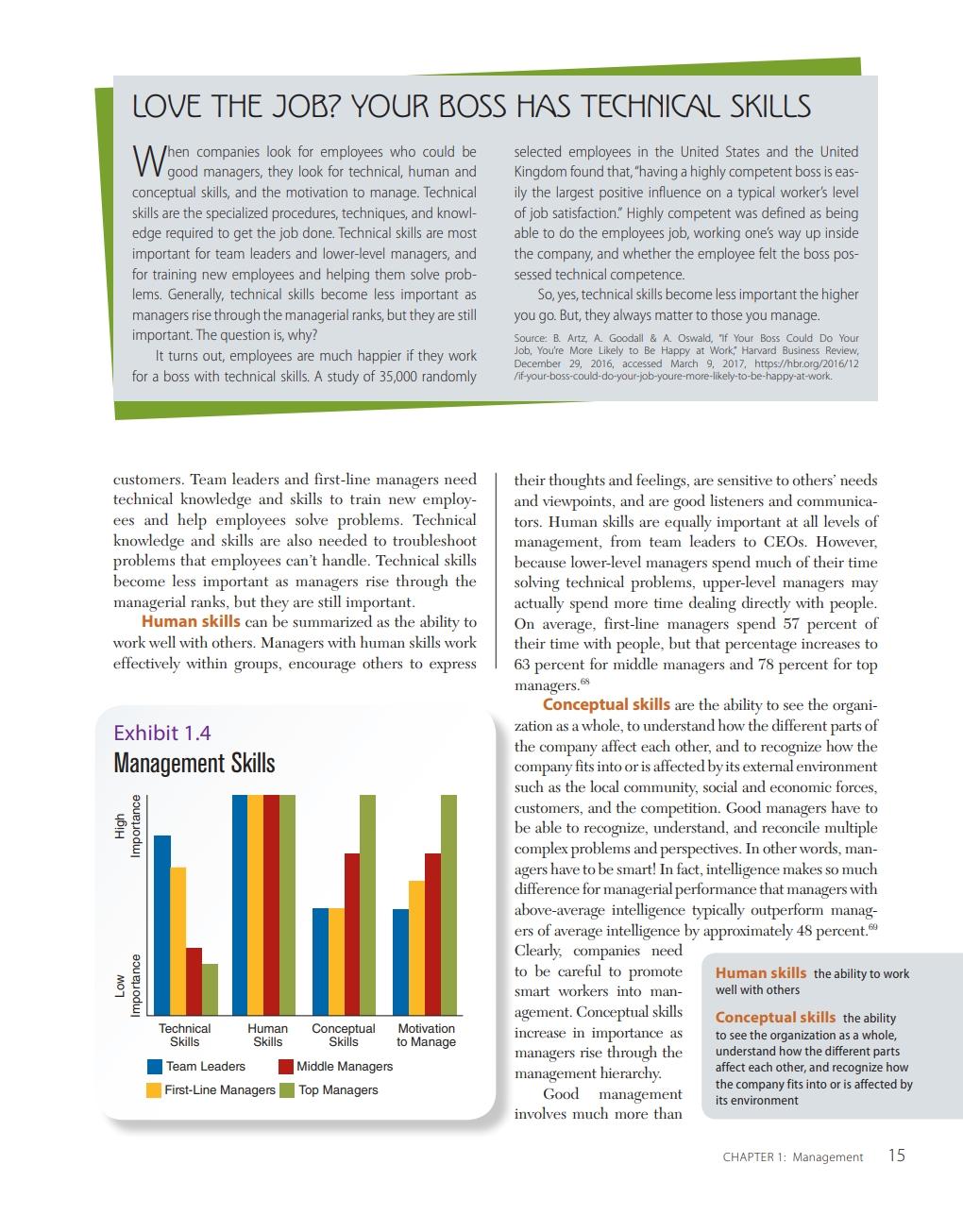
Wh e n Lompan ies lo<>k for e rnpl<>yees ,vho ,v<>uld be go<KI rnanagers , they lcx1k li:1r i ndividuals ,vho have te ch nical skills, hu1nan skill s, con ceptual s kills, and th e nu:> tiva ti<>n to ,nanage.67
Exhibi t 1.4 shows th e re lati ve i1npo1tance of tl1ese f<>u r s kills t<> th e j<>bs of te a,n le ade rs , fustline rnanage rs, 1n iddle manage rs , and top manage rs.
Technical skills are th e sp e cialize d proce d ures, tech niques, and k"Tlo,v le dge require d to ge t tl1 e j ob d<>n e F<> r th e sal es rnanage rs d esc ribe d pre viously, te chni cal skills i nvolve th e abili ty to find ne,v s al es p rosp ec ts, d e ve lop acc urate sal es p itc hes base d <>n c usto,n e r
• needs, and close sal es F <>r a nurs e s up e rvis<>r, i techni c al s kills i nclude be i ng able t<> i nse rt an I V <> r <>pe ra te a c rash cart if a pati e n t g <>es i nto >" cardiac a r rest.
Tec hn ical skills are 1nost i mportant fo r te am le ade rs and lo\\•e r- le ve l manage rs be cause th ey sup e rvise th e ,v<>rke rs ,vho produ ce p rodu c ts o r se rve
LOVE TH E JOB? YOUR BOSS HAS TEC HNICAL SK ILLS
When companies look fo r employees who cou ld be good managers, they look fo r technical, h uman and concept ual ski lls, and the mot ivation to manage. Technical ski lls are t he special ized procedu res, techniques, and knowledge requi red to get t he j ob done Tech nica l ski lls are most import ant fo r team leaders and lower-level managers, and for traini ng new employees and help ing t hem solve p roblems . Generally, tech nica l ski lls become less i mpo rtan t as ma nagers rise through the managerial ranks, bu t they are sti ll import ant. The questio n is, why ?
It turns out, employees are much happ ier if they work for a boss wi t h techn ical ski ll s A study of 35,000 randomly
selected employees i n the Un ited Sta tes and the United Kingdom found t hat, 'having a highly competent boss is easily the largest posit ive influence on a typ ical worker's level of j ob sati sfaction · Highly competent was defi ned as bei ng able to do t he employees job, worki ng one's way up inside the compa ny, and whet her t he employee fel t t he boss possessed tech nical competence.
So, yes, techn ica l ski ll s become less importa nt t he higher you go. But, they always matter to t hose you ma nage.
Source: B. Artz., A Goodall & A Oswald, 1( Your Boss Could Do Your Job, You're MOf'e Likely to Be Happy at Work; Harvard Business Review, December 29, 2016, accessed March 9, 2017, https:/lh br org/2016/ 12 /if-your·boss-<:ould-do-your-job-youre-more-likety-to·be-happy-a t-work
custom e r s. Te an, le ade rs and first -li ne ,nanage rs n ee d t e chni cal kno, vle dge and skills to train ne w e mployees and h e l p e mployees solve probl e rns . Te chni c al kno,v le dge and skill s are al so need e d to troub le shoot prob l e 1ns that e 1nployees can ' t handl e . Te chnical skil ls b e corn e le ss irnportan t as 1nanage r s r is e th rough th e 1nanage rial ranks , but th e y a r e sti ll i1n p o rtan t
Human skills can be surn1narize d as th e ability to ,vork ,ve il ,vith oth e r s . Manage r s ,vith hurnan skills , vork e ffe ctive ly ,vithin g r oups , e nc.1:>urage oth e rs to e »-pre ss
Exhibit 1.4 Ma nag ement Skills
th e ir thoughts and feeli ngs , a r e s e nsitive to oth e rs' needs and ,~ ev,poi nts , and are good liste n e rs and comrnunicators. H uman s kills are e qually irnpor tant at a ll leve ls of n,anage ,n e nt, fro ,n t e am le ade r s to CEOs Ho,ve ve r, b ecaus e lowe r-le ve l 1nanage r s sp e nd 1nuch of th e i r ti ,n e so lving te chnical p robl e ms , upp e r- leve l 1nanager s rnay a c tually spe nd mo re ti n, e d e aling dire ctly "~th peop le. On ave rage, first - lin e rnanage rs s p e nd 57 p e r ce n t of th e ir tin, e ,vith peop le, bu t th at pe rce n tage incre ase s to 63 p e rcent for middl e ,nanage rs and 78 p e rcent fo r top manage rs.6!1
Conceptua l ski lls are th e ability to see the o rganiza ti on as a ,vhol e, to unde r stand ho,v th e diffe re nt parts of th e company af fect e ach oth e r, and to re cognize ho,v th e con,pany fi ts i n to o r is affe cte d b y i ts e »te m al e nvironrn e n t such as the local c.1:llnrnunity, social and e cono1ni c forces, custorn e rs , and th e c.1:>rnpe ti tion. Good manage rs have to b e abl e to r e cognize, unde rstand, and re c.1:incil e mu ltip le con,pl ex prob le ms and per spe d:ive s. In oth e r , vords, 1nanage rs have to be sma1t! In fac.t, inte llige nc.-e 1nakes so much c:liffe re nce for n1anage 1ial p e rfor mance tha t manage rs ,vith above -ave rage i nte llige nce typic.-ally outpe rfor m 1nanage r s of ave r age i n te llige nce by approxi1na te ly 4S p e r ce nt.Gl
Cl early, G'Ompanie s n eed to be care ful to pro1note sma1t ,vor ke rs i nto rnanage 1n e nt. Conceptual skills incr ea se in i1npo1tan ce as manage r s 1ise th rough th e manage me nt hie rarchy. Good manage rn e nt involve s ,nuch n,ore than
Human skills the abi li ty to w o rk w ell w ith oth er s
Conceptua l skills the ability t o see the organi zat i o n as a w hol e, u ndersta nd how the d iffere nt parts affect each oth er, and recog nize how the co mpa ny fits into or i s affected by its environ ment
Another Random Scribd Document with Unrelated Content
CRADLE SONG
B RAPHAEL PATKANIAN
(1830–1892)
Mother
Sweet slumber now creeps o’er thee slow, Sweet breezes rock thee to and fro: My baby sleeps, so soft and low
With sweetest songs I’ll sing oror. 1
Baby
O Mother dear, thou art unkind
My sleepless eyes so long to bind.2
Anon I’ll rest, and sleep resigned;— Release me now, sing not oror.
Mother
Why dost thou shed those tears that flow Down thy sad cheeks with pearly glow?
Thou’lt break thy heart with sobbing so,— Whom wilt thou have to sing oror?
Baby
At least my hands and feet unbind— My tender limbs are all confined; That gentle sleep my eyes may find, Then tie me in, and sing oror
Mother
That tongue of thine is passing sweet, Yet with thy yards I cannot mete. Thou wilt not sleep, but at thy feet Wouldst have me sit, and sing oror.