MOMENTS

With
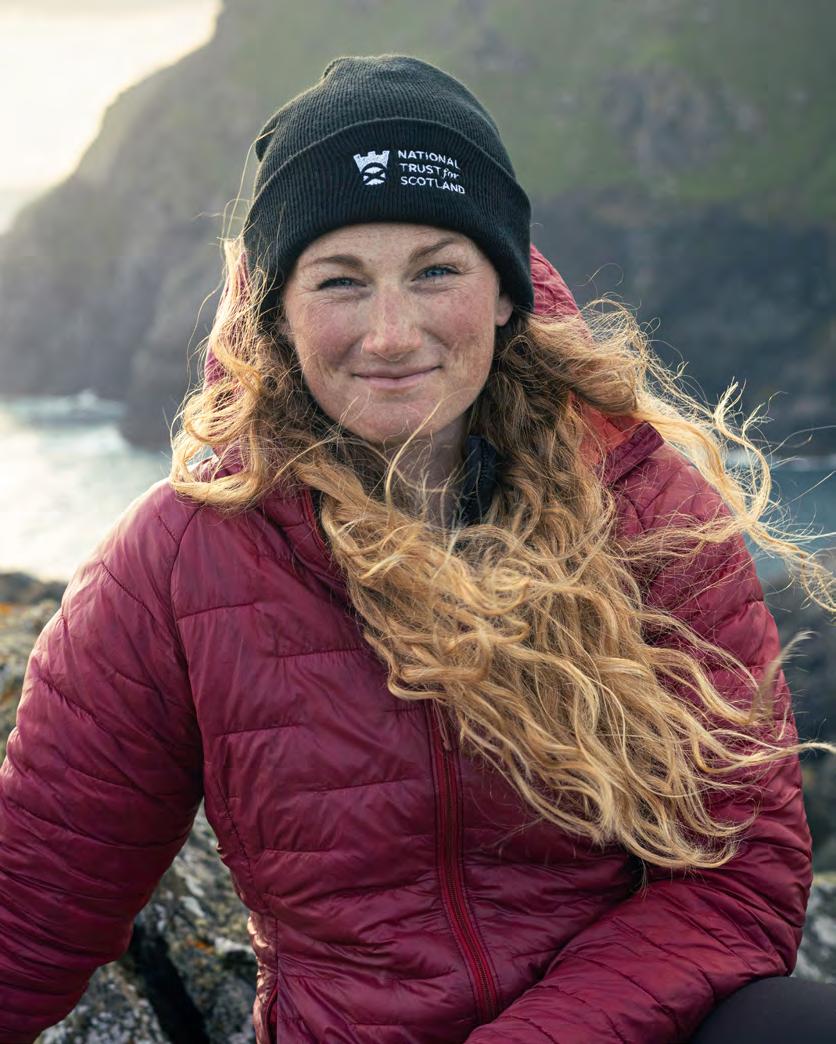
my background as a veterinarian,
I’ve always been driven by a deep care for animals, wildlife
and the natural world.
Alongside this, my adventures and work as an advocate for nature and our oceans have taken me around Scotland’s remarkable coastline and islands: places like St Kilda, Canna, the Treshnish Isles and St Abb’s Head. In each of these extraordinary locations, I’ve seen first-hand both the breathtaking beauty of our marine environments and the very real challenges they face. What has been just as striking though is the dedication of the people who give their time to protect and share these places.
To all of you volunteering with the National Trust for Scotland, thank you. Your passion, commitment and generosity make it possible for these landscapes, stories and habitats to be cared for and experienced by so many.
Whether you are welcoming visitors, protecting wildlife, conserving collections, or helping bring history vividly to life, your contribution truly matters, and it doesn’t go unnoticed. You are often the first connection people have with these special places, and the lasting impression you create helps inspire care and respect for Scotland’s natural and cultural heritage.
It’s clear that the time, energy and heart you invest goes far beyond the practical tasks you carry out. You are helping to build deeper connections between people and the places they cherish, encouraging others to value and protect them for the future. It’s a privilege to share in this collective effort, and I hope the stories in this edition of Volunteer Moments remind you just how valued and inspiring your work is, not only to those who visit, but to all of us who care so deeply about Scotland’s heritage.
Enjoy reading.
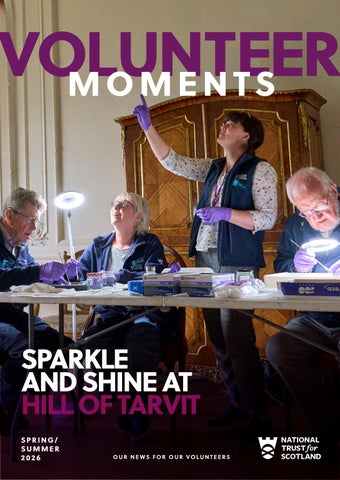
Sandie Allison, Visitor Services Supervisor, shares a story about challenges, team work and dedication.
I had my eye on the Drawing Room Chandelier at Hill of Tarvit since starting in my role in 2020. The beautiful 19th-century copy of a Louis XVI chandelier has been waiting patiently on my project list to be deep cleaned for some time.
The decades of dust and tobacco stains had reduced the once shining centrepiece to Robert Lorimer’s homage to French elegance into a dull shadow of lifeless yellow, sprinkled with grey. It was overlooked and ignored by visitors and the electric bulbs were doing more to highlight rather than mask the now opaque droplets.
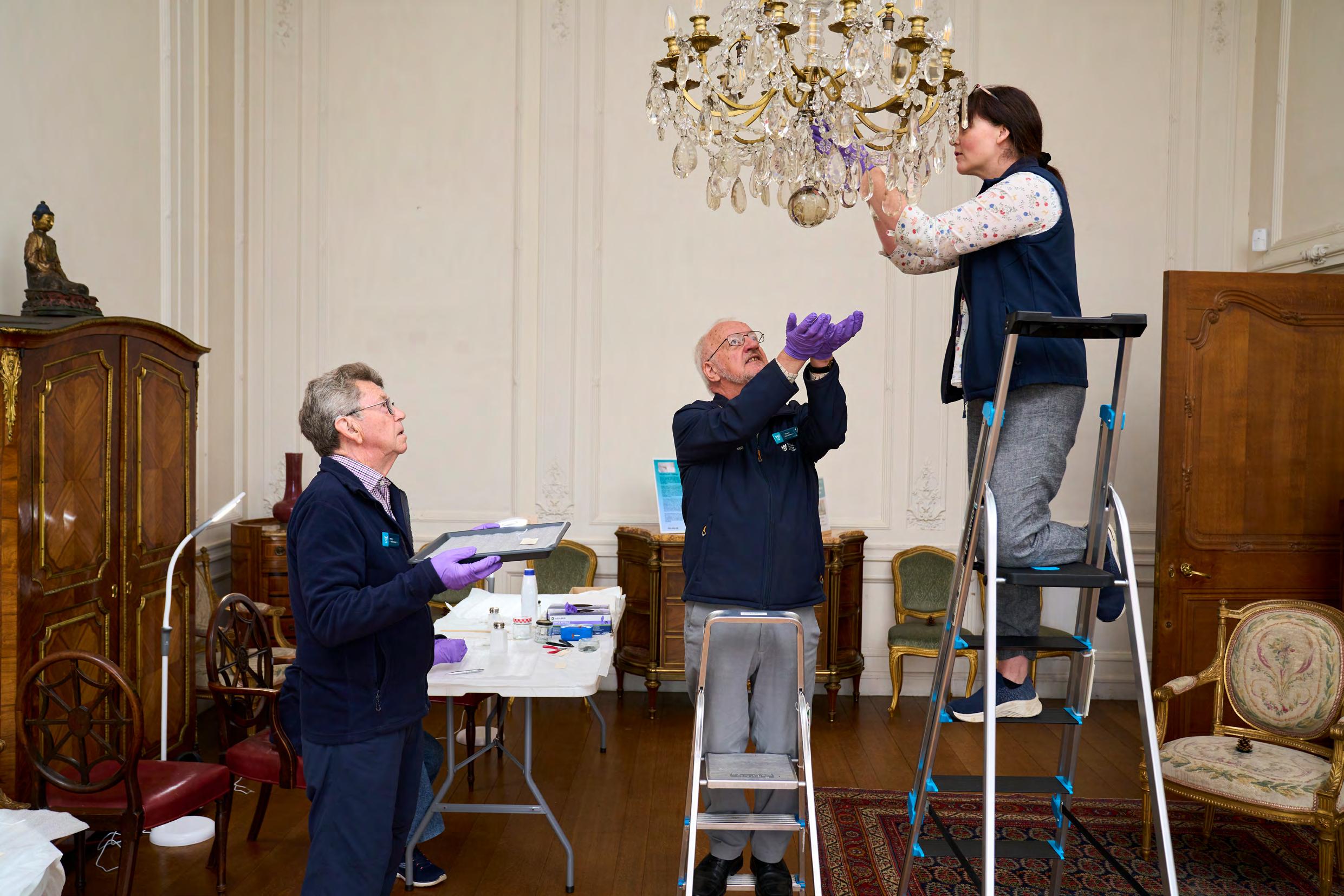
Cleaning a chandelier, following museum best practice, is no easy task, especially when it is huge, extremely heavy and all the chains and droplets have been wired into place rather than using traditional hooks and pins. Access and deciphering the rats’ nest of wiring were going to be the biggest challenges. We needed a mobile access tower, a lot of time and patience, and this is all before we get to the fact that my team and I had never re-pinned or wired chandelier droplets before!
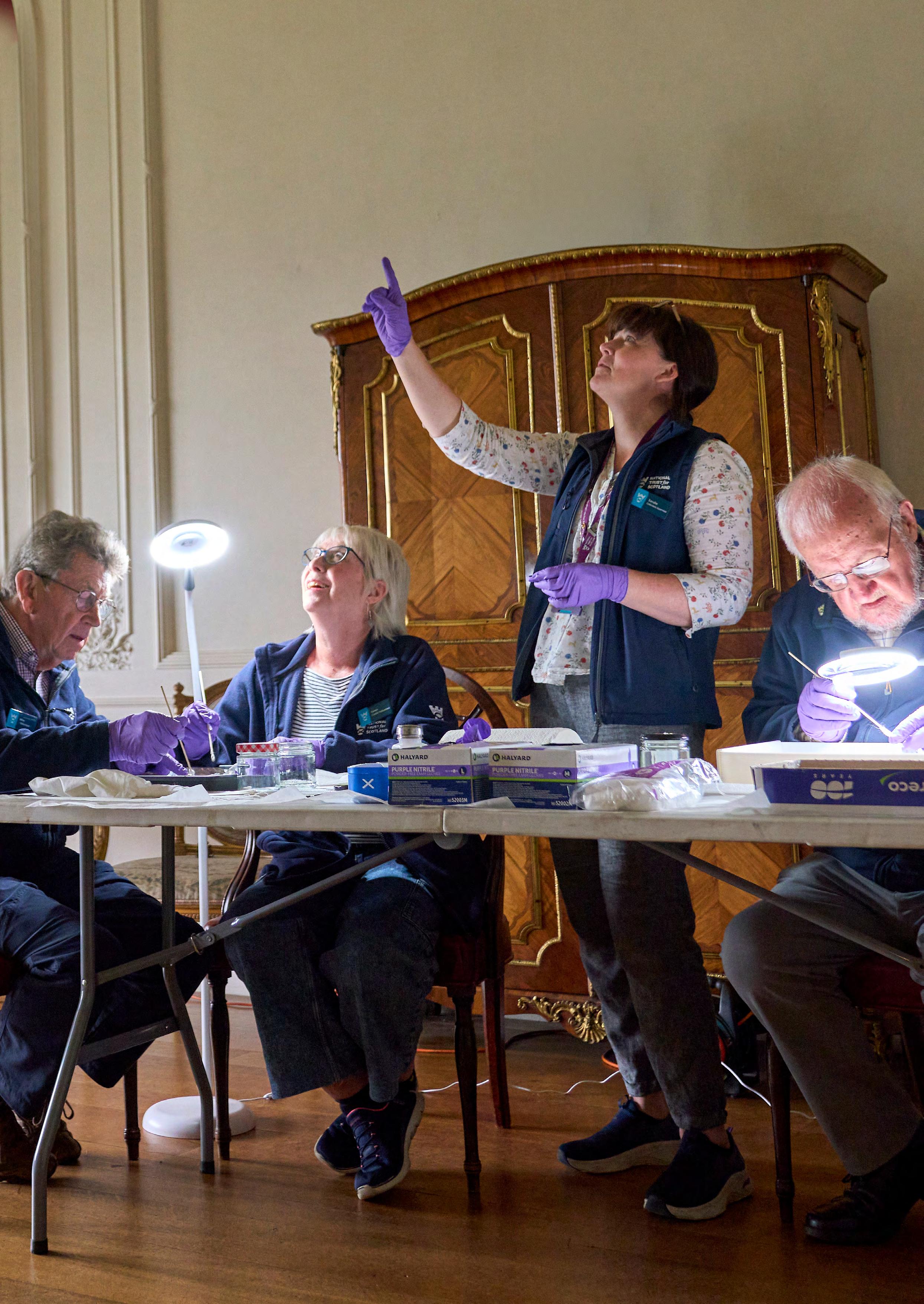
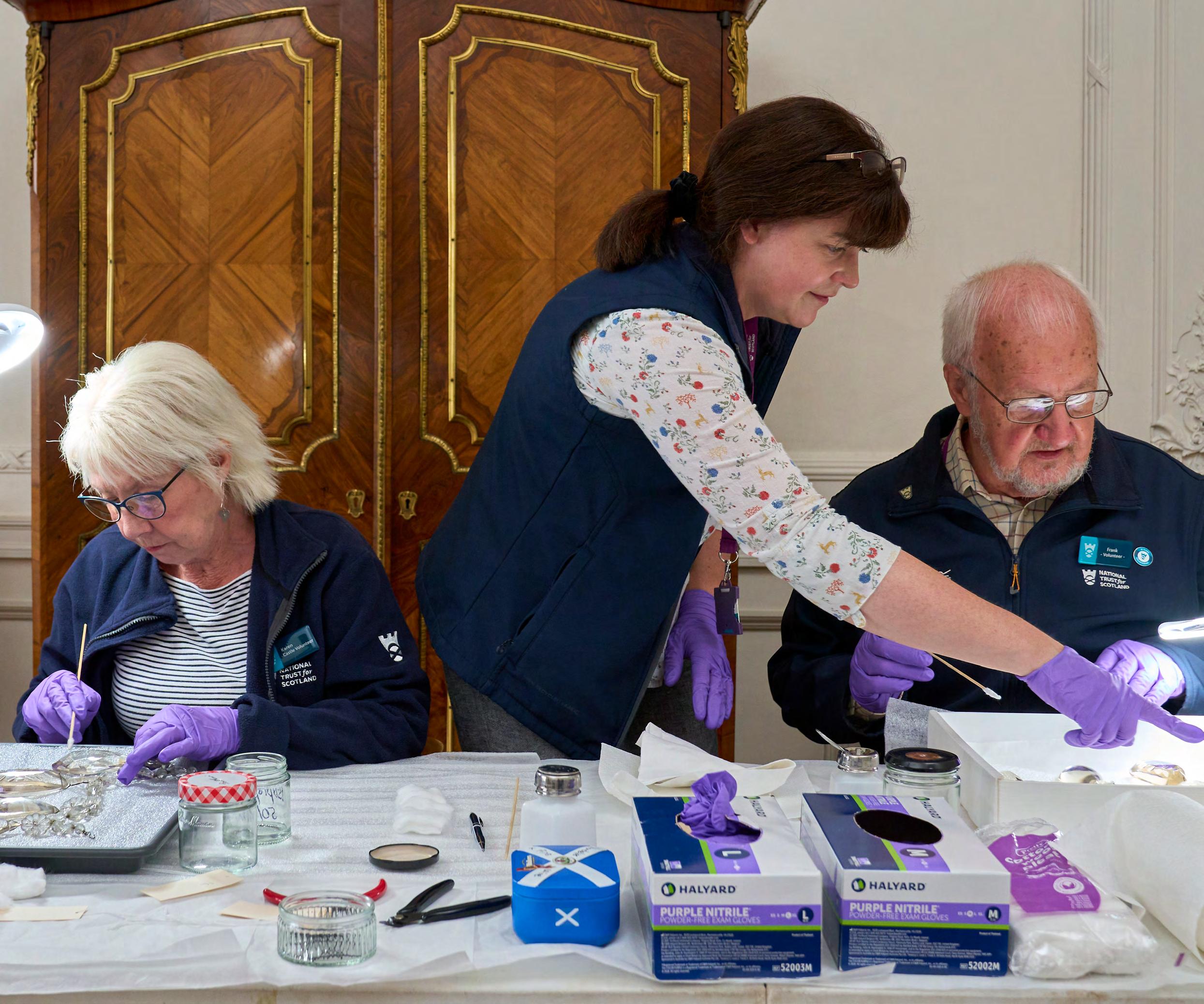
We needed to learn the intricate techniques of chandelier construction. We watched videos of how to pin and wire droplets. We also purchased second hand chains and crystals for practice pieces, and we all spent several hours re-pinning them and perfecting our technique. It is daunting trying to bend tiny pins into perfect curls and loops with several pairs of eyes watching, whilst we talk about plaster ceilings, and wax lyrical about Robert Lorimer’s design schemes. This, however, pales in comparison to clipping free and removing heavy glass sways and chains whilst contorting your body on an access tower to reach the inner column of the chandelier, all under the gaze of visitors as they collectively hold their breath.
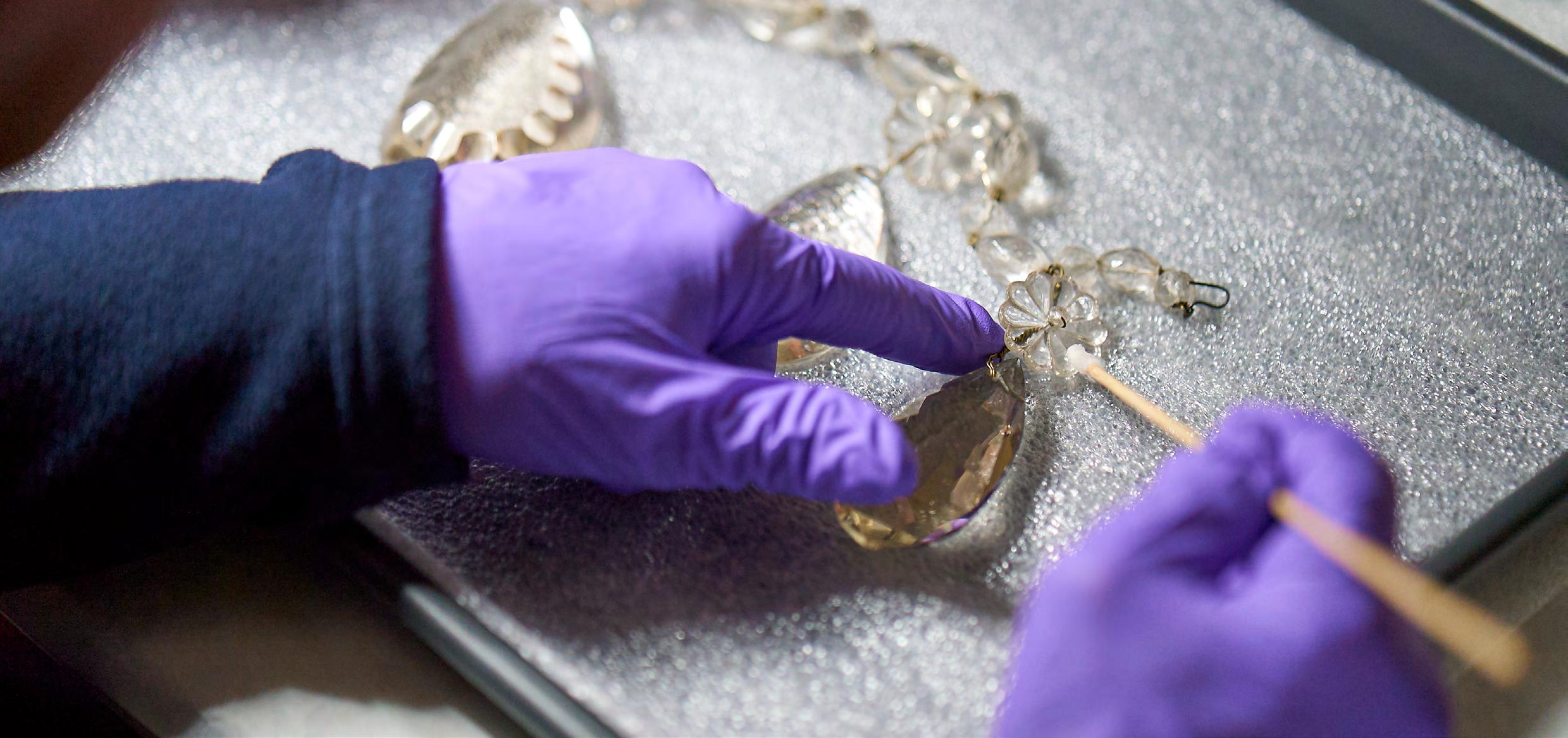
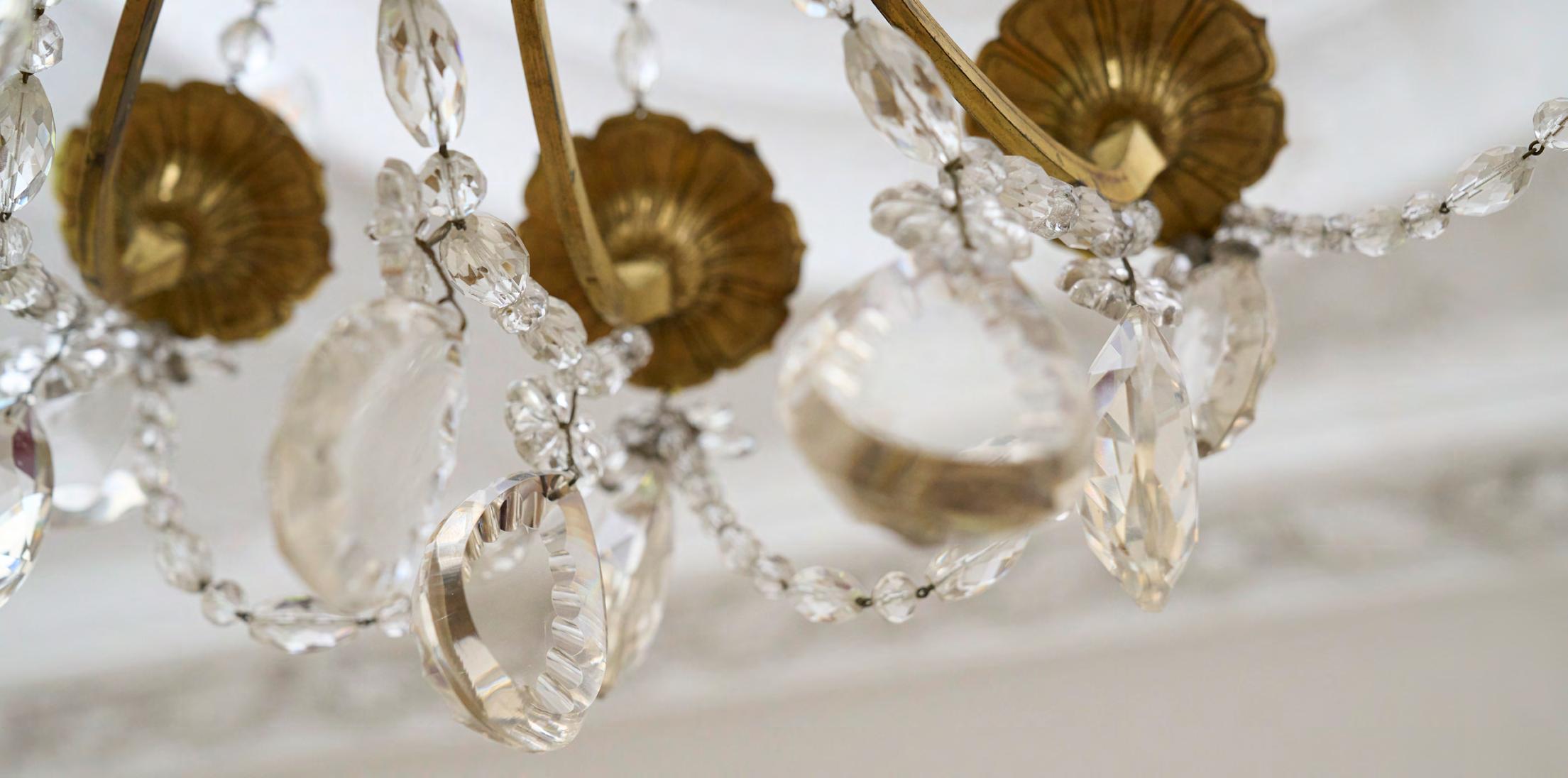
On a highly positive note, it has been so worth the effort. Slowly revealing gleaming surfaces has given everyone a huge sense of satisfaction. The chandelier looks amazing, it sparkles and refracts the light as originally intended and I am sure Beatrice, for whom the Drawing room was designed, would be thrilled. It now grabs one’s attention when entering the room and shows off Robert Lorimer’s decorative scheme to perfection.
To make a programme like this happen was a real team effort. It is not just the physical cleaning of the chandelier droplets, but facilitating the works, helping move equipment, arranging schedules to allow members of staff to attend, and providing the transport for our mobile access tower. Plus, lots of assistance from our lovely collections care volunteers.
... just how much concentration the work required. The challenge was to maintain a steady hand and stay focused on the intricate details.
Meet volunteers Karen, Mike and Frank who made this project possible
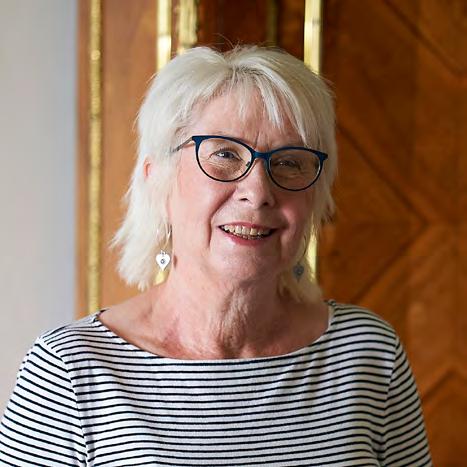
Karen Nicholson Karen has been volunteering with the Trust since 2022. She first joined Hill of Tarvit as a Room Guide and then joined the Collections Care volunteer team that winter and has helped with the winter collections care programmes across our three properties in Fife, Falkland Palace and Kellie Castle every year since. Karen also now acts as a Room Guide at Kellie Castle.
“Having helped with the winter clean and discovered how much I enjoy being hands-on with the collection, I was keen to be part of the chandelier cleaning project. It felt like a special opportunity to contribute in a more meaningful way.
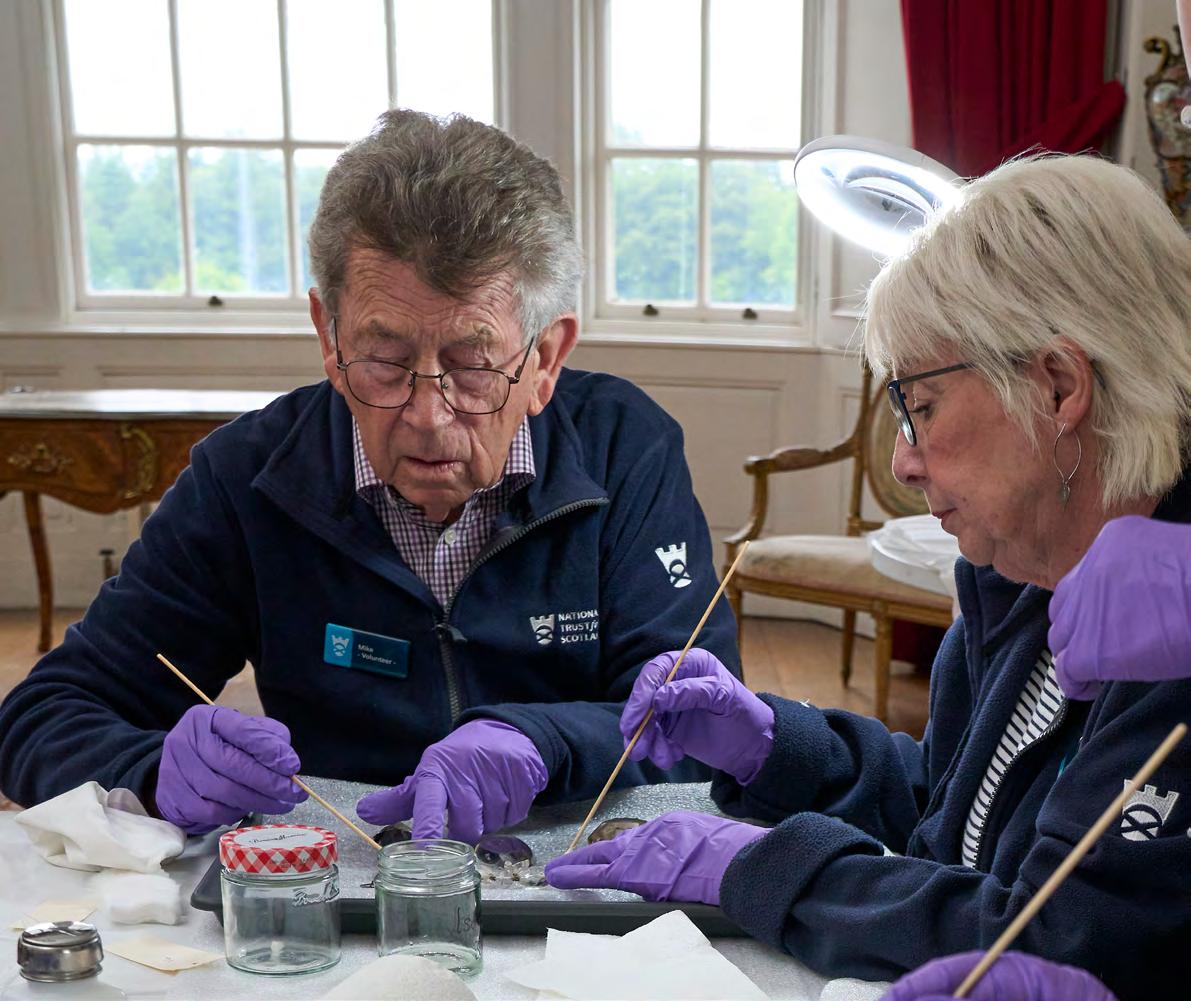
“What I quickly realised was just how much concentration the work required. The challenge was to maintain a steady hand and stay focused on the intricate details. Even making the tools for the job turned out to be part of the learning experiencecreating our own cotton buds is certainly a skill in its own right, with varying degrees of success at first!
“Working alongside the specialist team was incredibly inspiring. I was in awe of their skill, patience and calmness, and the high standards they set throughout the project. I really valued their guidance, even when it meant pointing out the specks of dust I had missed.
It all added to the sense of care and precision that the work deserves. I felt genuinely privileged to be invited to take part, and I was made to feel very welcome as part of the team.
“Seeing the chandelier restored to its full sparkle was hugely rewarding. Everyone needs a bit more sparkle in their lives, and I’m proud to have helped contribute to the wow factor in the Drawing Room.
“I love being a Trust volunteer. Whether I’m room guiding, welcoming visitors at reception, or getting involved in hands-on projects like this, it’s all part of something bigger. For me, it’s about honouring the memory of the Sharpe family by lovingly and skilfully caring for the collection at Hill of Tarvit and helping ensure it can be enjoyed for years to come.”
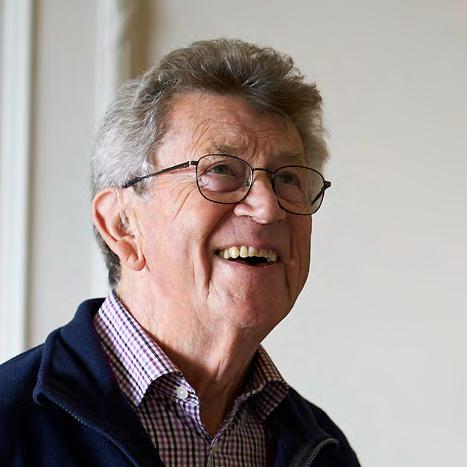
Mike started volunteering with the Trust in 2024 as a Room Guide and joined the Collections Care Team during his first winter season, volunteering at Kellie Castle and then Hill of Tarvit to help us keep the collections in great condition. Mike brings enthusiasm and cheer to every session!
“Being involved in the cleaning and restoration to something close to its former glory - of the Louis XVI–style chandelier was, quite literally, a highlight of my season. Alongside my usual volunteering, it offered a rare chance to contribute to the care of one of the mansion’s most striking features.
“What drew me in initially was the opportunity to work as part of a team and to learn something completely new. I quickly discovered just how complex the task was. Joining partway through the conservation project, it became immediately apparent that disassembling and later reassembling the chandelier was a careful and highly skilled process.
“With excellent instruction from the conservation team, I learned how to handle and clean the many individual components. Using cotton wool buds dipped in specialist cleaning solutions was entirely new to me, and it has given me confidence for any
I feel a real sense of pride in having been involved in conserving such a beautiful and significant piece.
similar tasks in the future. Seeing each cleaned piece restored to its place, fitted with newly prepared hooks, and comparing its renewed brilliance with those still awaiting attention was incredibly satisfying.
“I particularly enjoyed the shared experience of working alongside others: learning different techniques, observing how each person approached the task, and building skills together. For me, being part of a team always makes the work more rewarding.
“I feel a real sense of pride in having been involved in conserving such a beautiful and significant piece. Experiences like this not only deepen my appreciation for the collection but also allow me to bring these stories to life for visitors, helping them connect more meaningfully with the history and craftsmanship of Hill of Tarvit.”
Frank Jensen
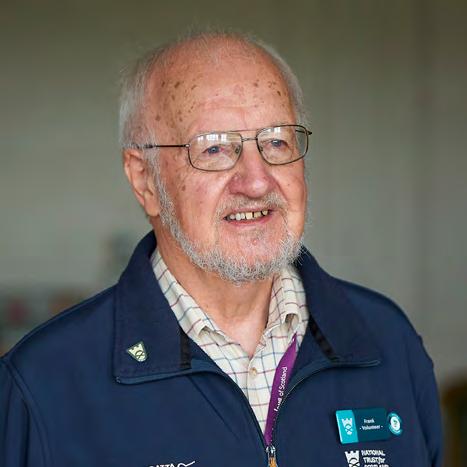
Frank has been helping to look after the collection for a number of years now, winding clocks and helping the property team with presentation through 2018-2019. His knowledge of Tarvit is second to none. Frank adores the paintings at Tarvit and helped research Mansion House Masterpieces, developing this into a specialist tour for the property.
“I’ve had the pleasure of volunteering at Hill of Tarvit for over thirteen years now, first as a Room Guide and then as a Tour Guide. For nine of those years I’ve also been involved with conservation cleaning. Nowadays, I prefer to take on less active cleaning roles and so helping clean the chandelier was both an ideal task for me as well as something new and different.
I could see the difference immediately – the clarity of the glass was striking. It was like watching a conservator removing centuries of varnish from an Old Master and seeing its true colours.
“We practised on pieces of glass from the storeroom first, but cleaning that first sway and pendants from the chandelier itself was something special.
... it’s always good to engage visitors with the story of Hill of Tarvit ... to play a small part in the conservation of the House...
“The actual cleaning process was made much easier by means of the illuminated magnifying lenses and it is always an interesting learning experience working alongside a Trust conservation team.
“When I walk into the Drawing Room now, I try to imagine how the chandelier would have sparkled and reflected all the light and colours of the room when, 115 years ago, the original owners of the house, the Sharp family, were entertaining their guests.
“As a volunteer, it’s always good to engage visitors with the story of Hill of Tarvit and its people and also to play a small part in the conservation of the House and its contents. When I look at the shiny, newly cleaned chandelier, I will be able to boast to myself: I did a (tiny, tiny) bit of that!”
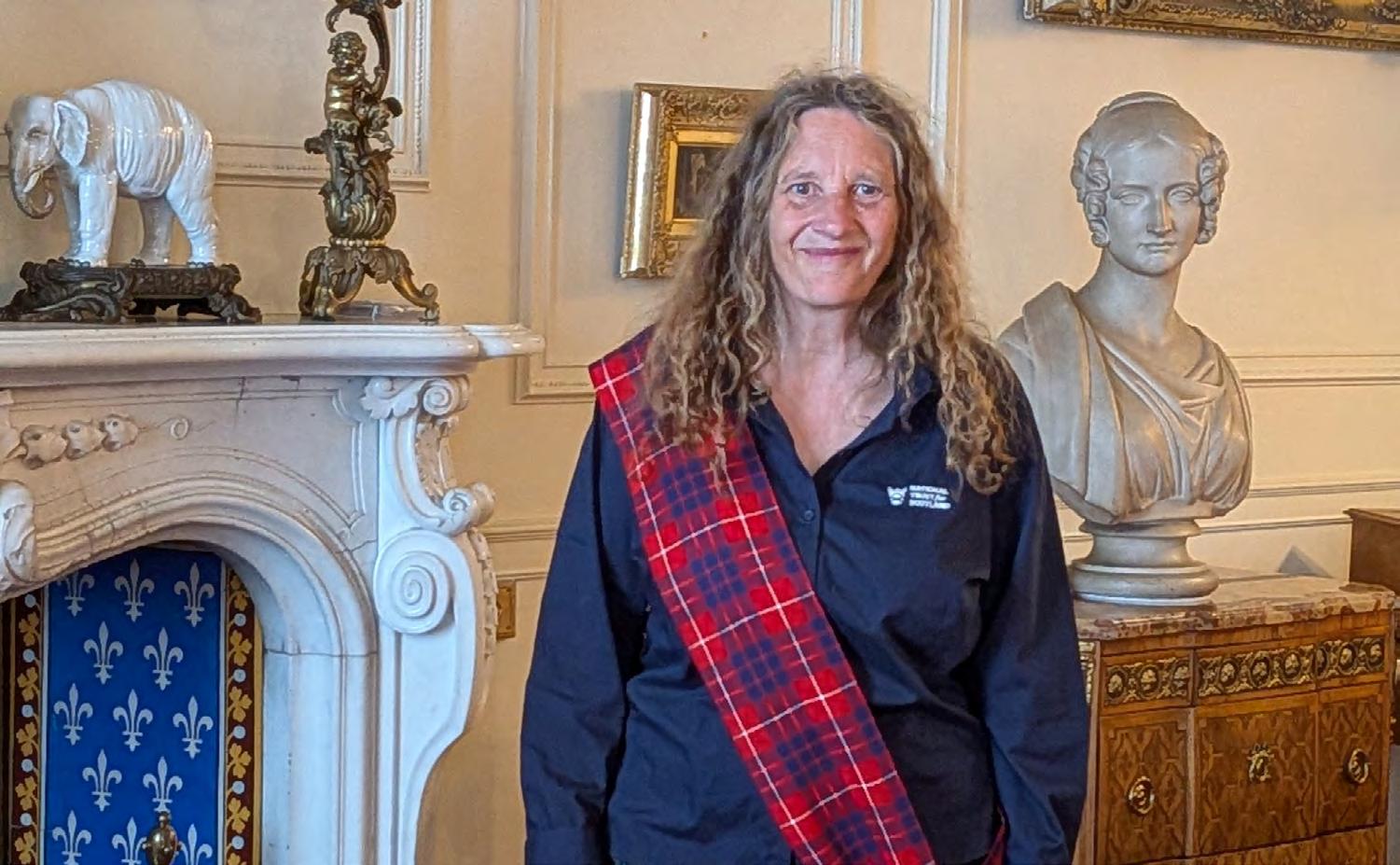
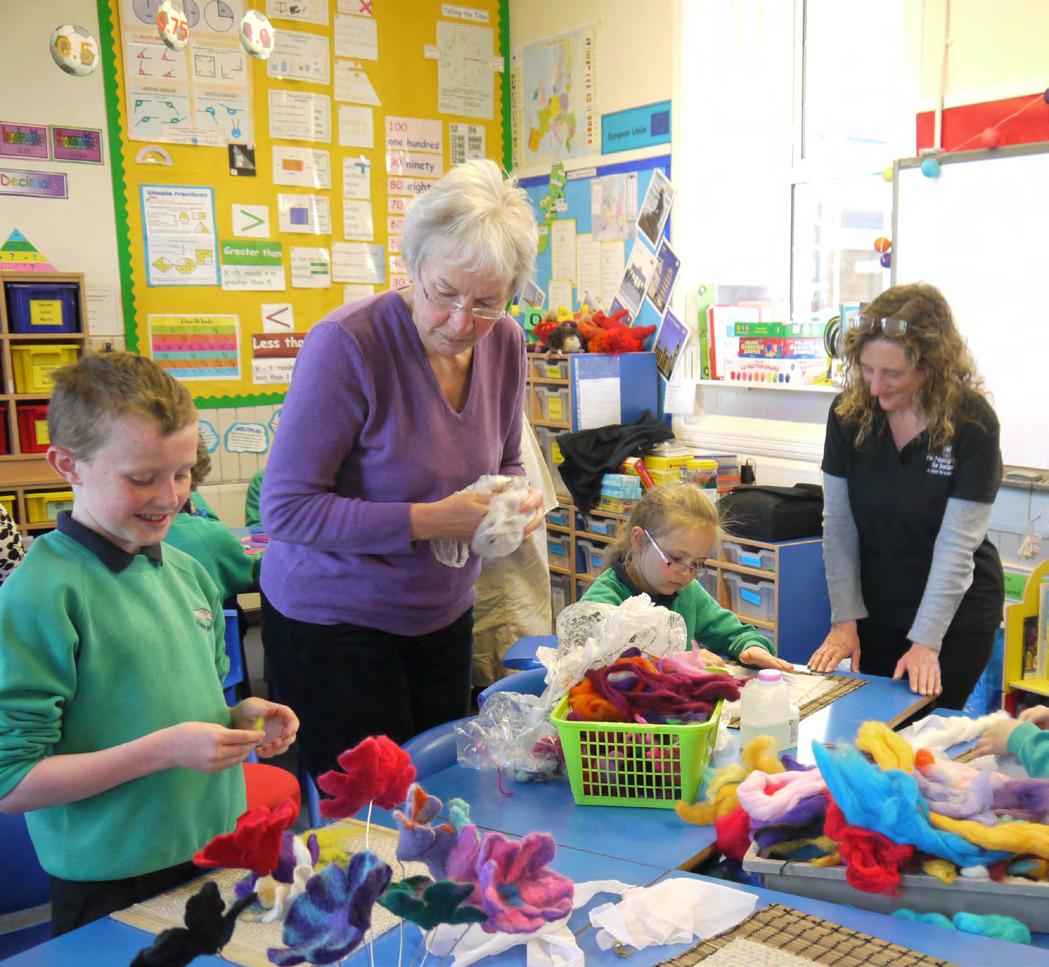
Sue Mills has been helping at Brodick since 1997. She joined as a Visitor Services Assistant in the cafe at the time when it was in the castle, at the same time she also volunteered as a ranger.
Over the years Sue has had a varied career with us, moving into the shop and being dedicated to memberships and gift aid before moving back up to the castle as a guide.
As Sue continued to develop, she then added in supporting the then Education Supervisor whilst still guiding before eventually taking on that role fully about 4 years ago. In the time Sue was guiding and supporting the Education Supervisor she also worked with Collections Care in the winter months when the castle was closed.
Sue has taken part in many wonderful events and activities over the years but particularly since she took the role of Education Supervisor working closely with the Formal Learning Network and our local community. Some events that Sue supported over the years:
• Wool and Woods, where the local community came together and knitted or crocheted forest animals to sit around our beautiful gardens.
• Together with many of the local schools Sue supported local poppy making which were then all displayed on our lawn.
• Mercat Tours visited us and worked with Sue who wrote a monologue of the ‘Grey Lady’, a former servant at the castle who became romantically involved with a Cromwellian soldier and became pregnant with their child.
Then outcast by the family it was said that, whilst pregnant she jumped off the Quay at Wineport and drowned. The Grey Lady’s spirit has been with us since. Sue performed her monologue in the Bavarian Summerhouse - reportedly hundreds of visitors came to watch trailing down the paths as they would not all fit inside!
• Last summer Sue supported local school children to take part in an archaeological dig. It happened on the lawn outside the Battery which is the oldest part of the castle. The best part is that the school children found some objects themselves, one was a coin!
Last month our wonderful gardens team organised a tree dedicated to Sue in our garden to recognise her contribution to the castle as Sue stepped down from the role of Education Supervisor at the end of the summer season last year, to return once again to working as a guide in the castle.
What a wonderful experience to be volunteering and what a gift! Think about all the goodness, positive input, energy and skills volunteers bring every day, all year to the National Trust for Scotland.
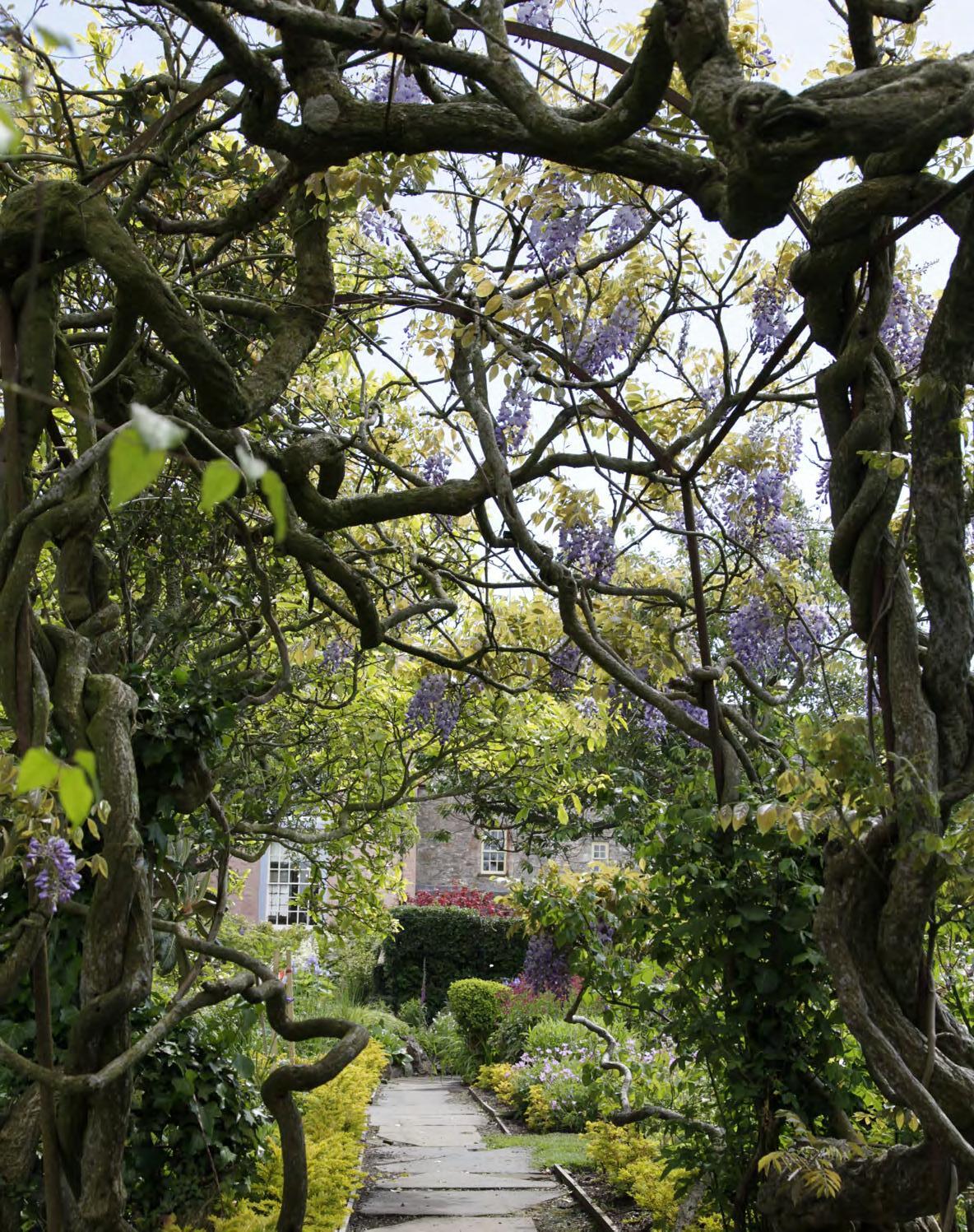
Our gardens are special living places, where nature meets human craftmanship, in various ways and forms. Vibrant horticultural displays, majestic trees in grasslands or proliferous food growing places, they gather people to work and spend time together. When volunteering, we go through all the seasons of the garden and see things grow and change all year round. This experience gives the very tangible and lovely feeling to be part of that continuity of life.
Caring for a living place which needs us in order to thrive is demanding but exciting and deeply rewarding. You will find this in the contemplation of the flowers you grow and plant, or whilst you see baby birds fledging from the nest made in the topiaries.
But a garden is certainly not all about plants and there is a lot to bring to other jobs for those who like gardens but are not so green fingered. For example, joinery and decorating to ironmongery to stonework, small mechanical repairs… there is something for everyone.
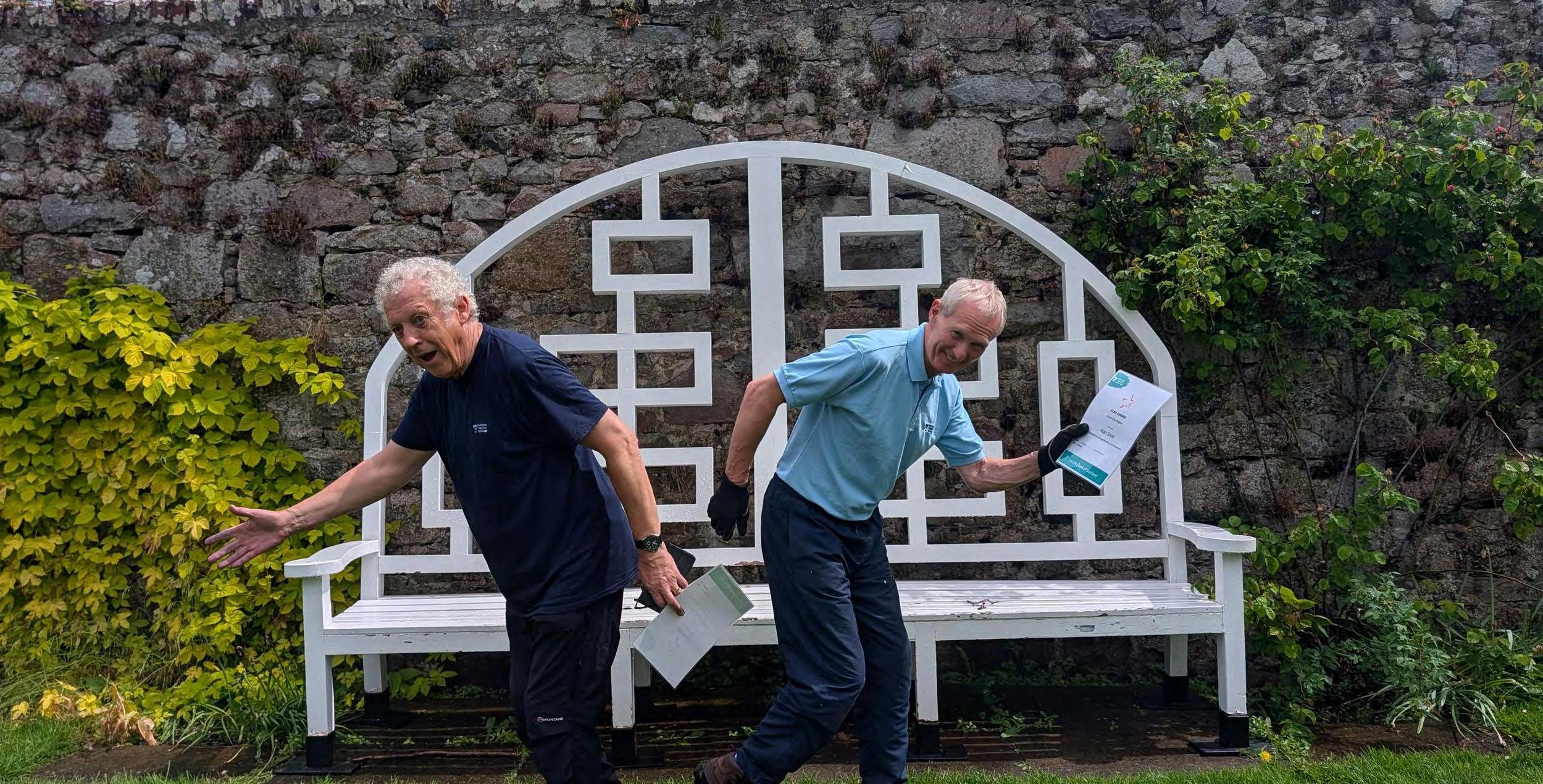
Meet Alan and Alex
Alan joined the garden team in 2022 as a retired joiner-glazier, and Alex is a garden volunteer with a 20 year-long service. Together they have delivered an impressive amount of work and helped us maintain the equipment and structures of the garden. So far, they have delivered a wooden bridge, built some cold frames, repainted the bothy, repaired dozen of benches, made planters… the list is long.
They make a fantastic duo. Their kindness, self-drive and sense of humour matches their skills. Their human contribution also brings a lot to the team. This spring, Alan and Alex received the North East Star Award for outstanding contribution to garden maintenance equipment and structures.
The garden is not just a place with plants, features and paths: it’s a living world that people make and grow. Without our garden volunteers, we wouldn’t be able to keep them alive.
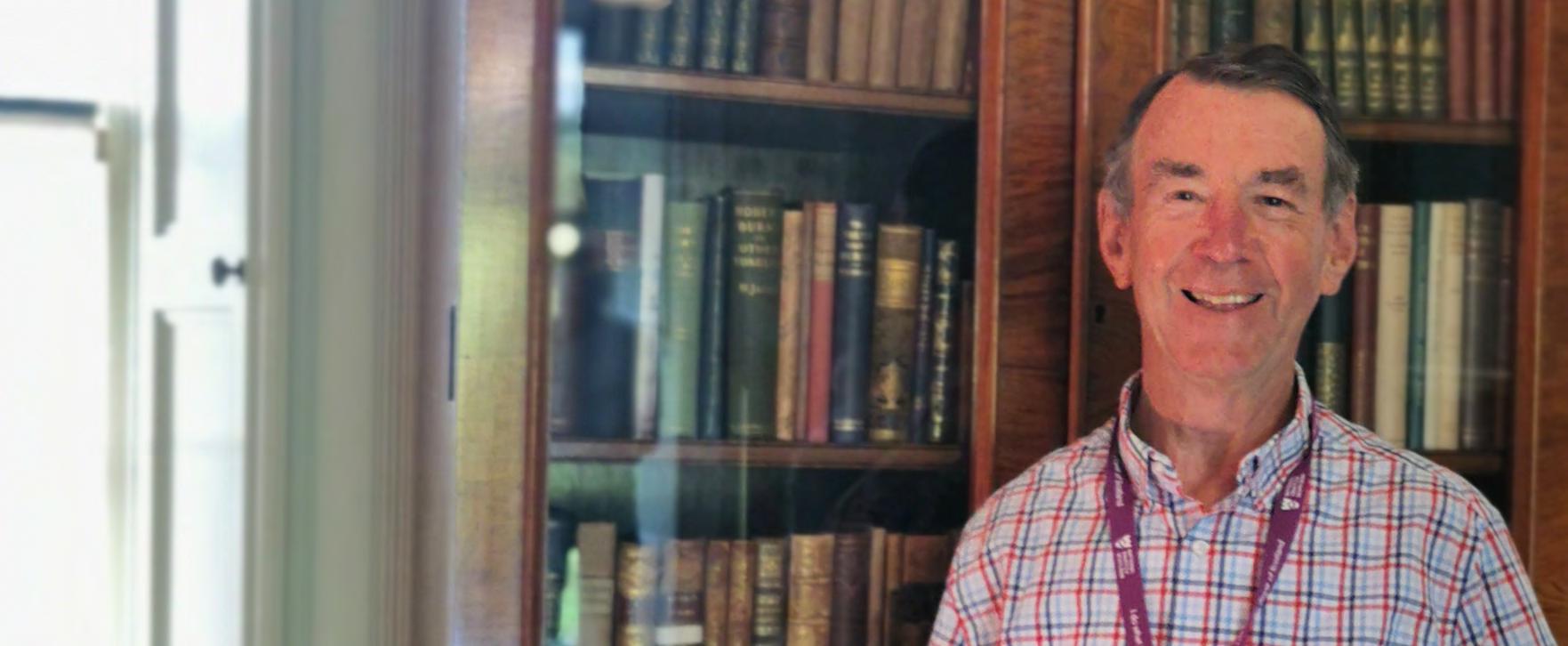
After retiring from the RAF in 2001, I started a liberal arts degree course in Scottish Studies at Glasgow University’s Crichton Campus in Dumfries. At the end of the third year, we had to undertake a two-month placement at a location of our choice.
This coincided with the period of a multi-million pounds project for the refurbishment of Broughton House and I could not have timed it better. When I arrived, the house was completely empty and two months later, on 1 April 2005, it was ready to reopen its doors to the public. During that time, I had the opportunity to learn about the various aspects of the house, its history, architecture, art collection and, most importantly, its incredible book collection. I came to realise the cultural significance of the property for the town and also about E. A. Hornel’s major contribution to Scottish art.
As part of the placement, I had the privilege of interviewing Jay Charters who had worked in the house as a maid for three years, starting in 1935. I took her on a tour of the house and had great fun listening to her stories and to her opinions on the rooms the project had ‘ruined’ and those which were just as she had remembered them.
So, one way or another, I built up a substantial knowledge of the house and its garden and just wanted to share that with visitors. My favourite part of volunteering is trying to impart my enthusiasm for the property. This can be a wonderful two-way process as I try to elicit as much information about, and from, them and hopefully enhance their visitor experience.
I came to realise the cultural significance of the property for the town and also about E. A. Hornel’s major contribution to Scottish art.
There are so many aspects of the house that I enjoy telling visitors about but I would have to single out Hornel’s book collection and especially those relating to Robert Burns which ranks as one of the finest in the world. I also like to talk about the busts in the gallery. They are often overlooked which seems a shame to me as they each add something to an understanding of the Hornel story.
I take great pleasure in talking about the artist-inresidence Ewan McClure and his work. I have been following his progress and development as an artist for over thirteen years and was instrumental in getting him first installed as an artist-in-residence in 2009-10. I am sure Hornel himself would be delighted to see his studio being brought to life by such an accomplished artist.
My favourite item in the house has got to be the first edition of Burns’ Poems, Chiefly in the Scottish Dialect,’ otherwise known as the ‘Kilmarnock’ edition, because there are only around 70 known copies in the world out of the 612 originally printed. It is wrapped in acid free archival packaging and stored in our specially designed, environmentally controlled archive store.
My favourite part of volunteering is trying to impart my enthusiasm for the property.
I also like the Japanese Kakemono in the Exhibition Room which Hornel brought back from his trip in 1893. I recently received a description of the actual scene depicted and where it fits into the longer tale known as The Eight Dog Chronicles involving the adventures of eight fictional warriors, the Satomi brothers. It is a wonderful reminder of the strong influence which Japan had in Hornel’s life.
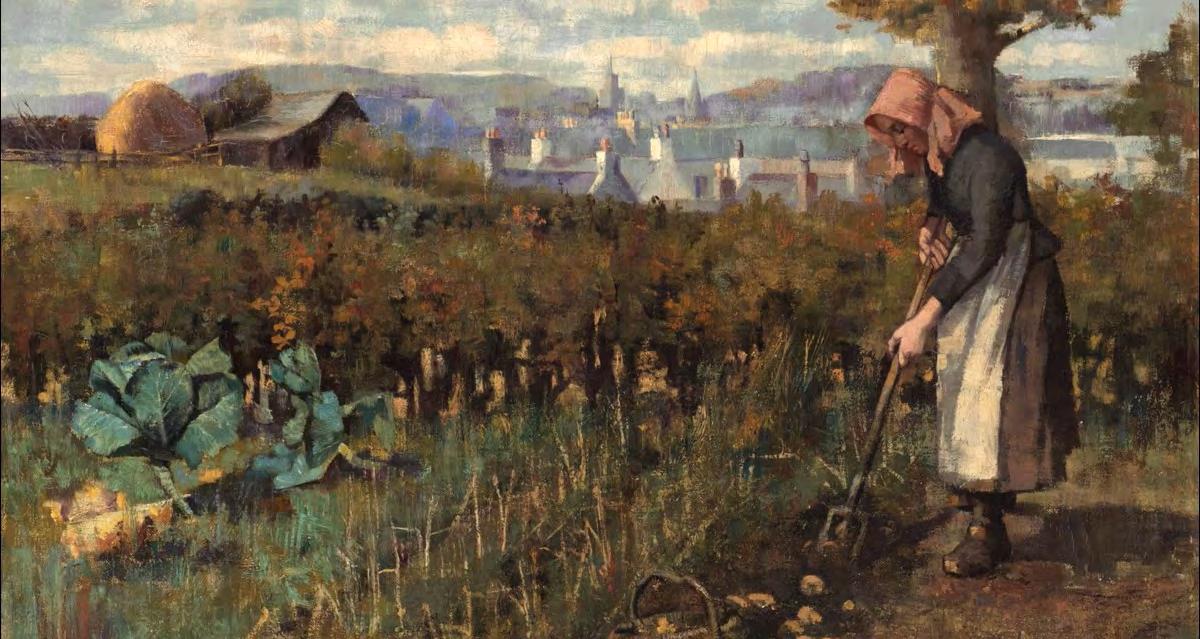
In terms of paintings, my favourite has to be ‘Harvesting’ in the dining room, partly because it is a rare, early Hornel piece, painted just as he was joining the ‘Glasgow Boys’ group, but also because the Friends of Broughton House and Garden group, of which I am the Chairman, was instrumental in acquiring it.
By Stuart Maxwell, Regional Director, Edinburgh & East
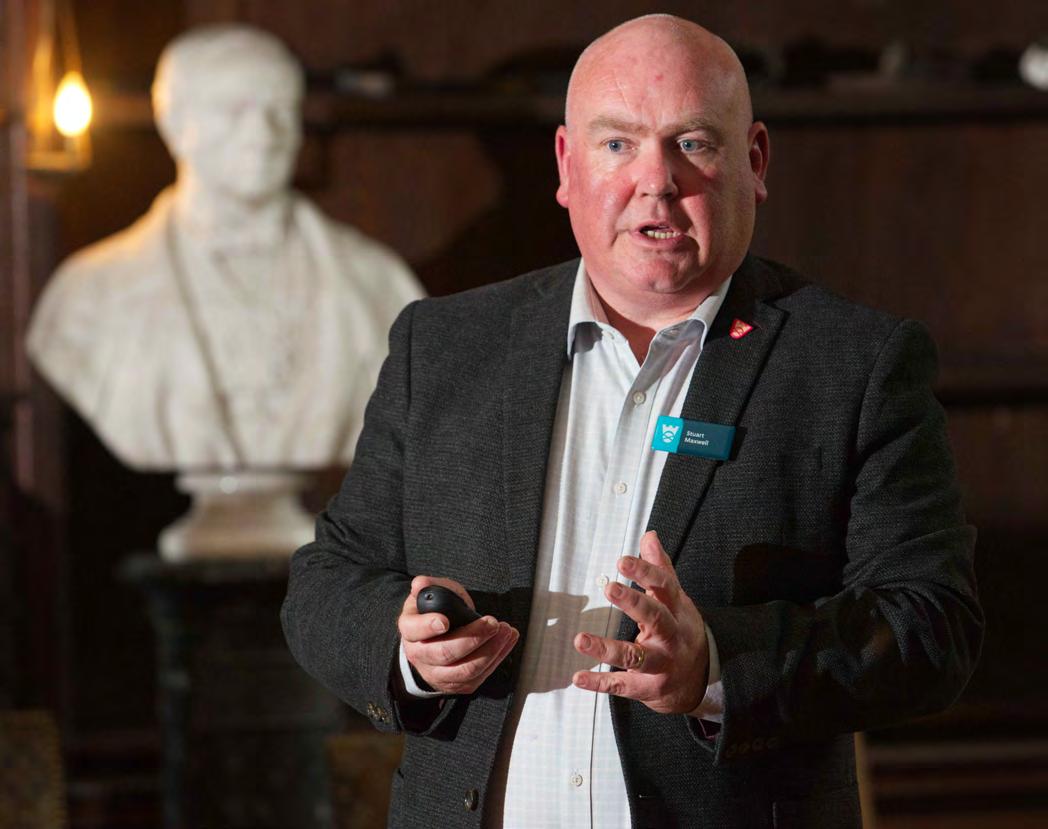
In my role as Regional Director for Edinburgh & East, I lead a diverse portfolio of historic places, landscapes and visitor experiences.
The teams bring together conservation, community engagement, commercial activity and innovation to ensure these special places are cared for while remaining relevant and welcoming for future generations.
Every day across the region, I have the privilege of seeing how people come together to make a difference - whether through large-scale conservation projects, small but impactful improvements, or the simple, human connections that bring our places to life. Recently, this has been especially evident in the breadth of activity across Edinburgh & East, where teams and volunteers alike are balancing care for our heritage with fresh ideas that connect more people to it.
I am delighted for the opportunity to share some of the region’s highlights this summer with you, our volunteers.
At Newhailes, momentum is building behind the Centenary Garden project. This ambitious vision has been shaped through close collaboration with colleagues and the support of our fundraising teams, and we’ve been fortunate to receive a remarkable £500,000 anonymous donation - an inspiring show of confidence in what we’re creating together.
Newhailes is enjoying a vibrant summer. Following a successful pilot, the Playful Summer programme, delivered in partnership with Hill of Tarvit, offers families and young visitors plenty of opportunities to get outdoors and connect with the site in new ways.
Across the wider region, important conservation work continues to safeguard our places.
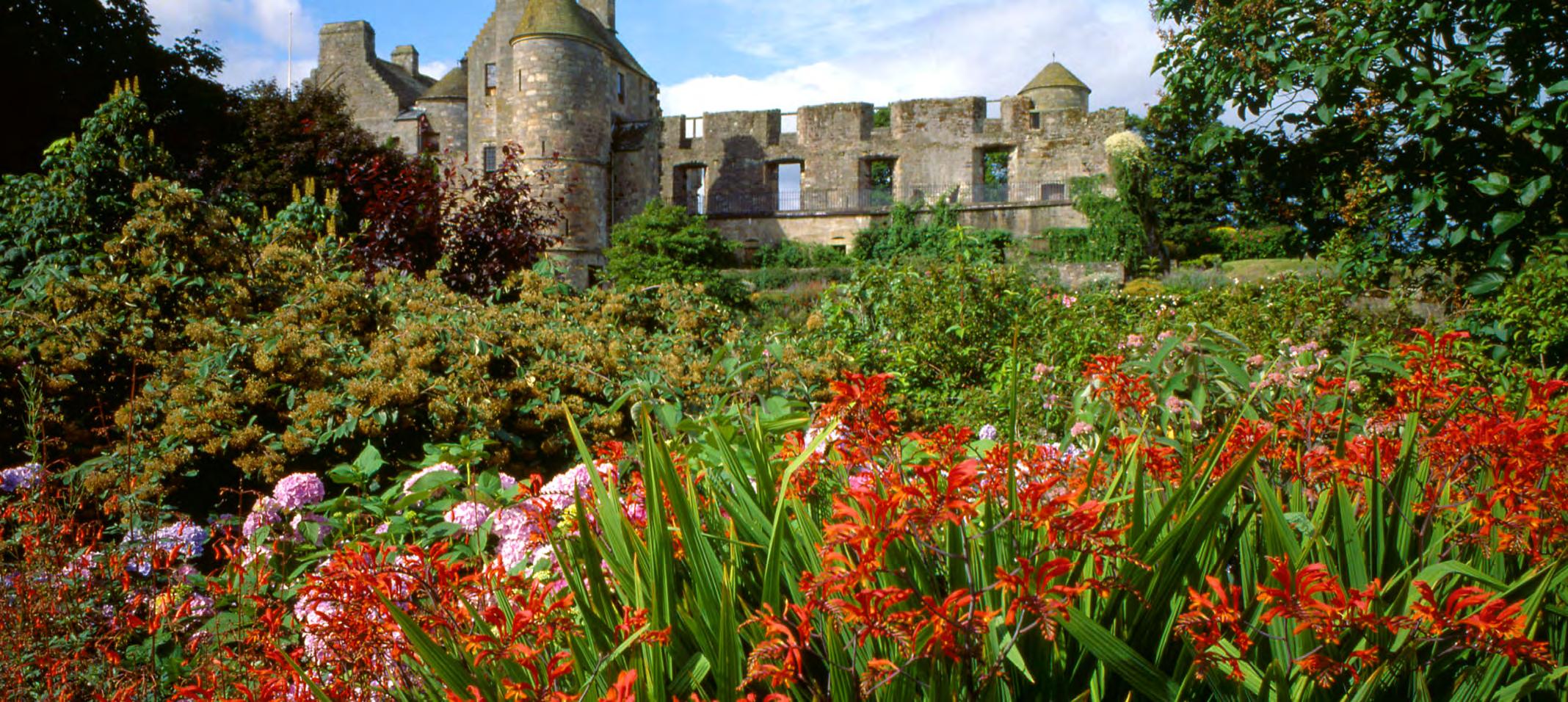
Across the wider region, important conservation work continues to safeguard our places. At Inveresk Lodge, essential repairs addressing long-standing damp issues are nearing completion, marking a significant milestone. In Fife, early planning is underway for a coordinated programme of roof and stonework repairs at Falkland Palace, ensuring its future for generations to come.
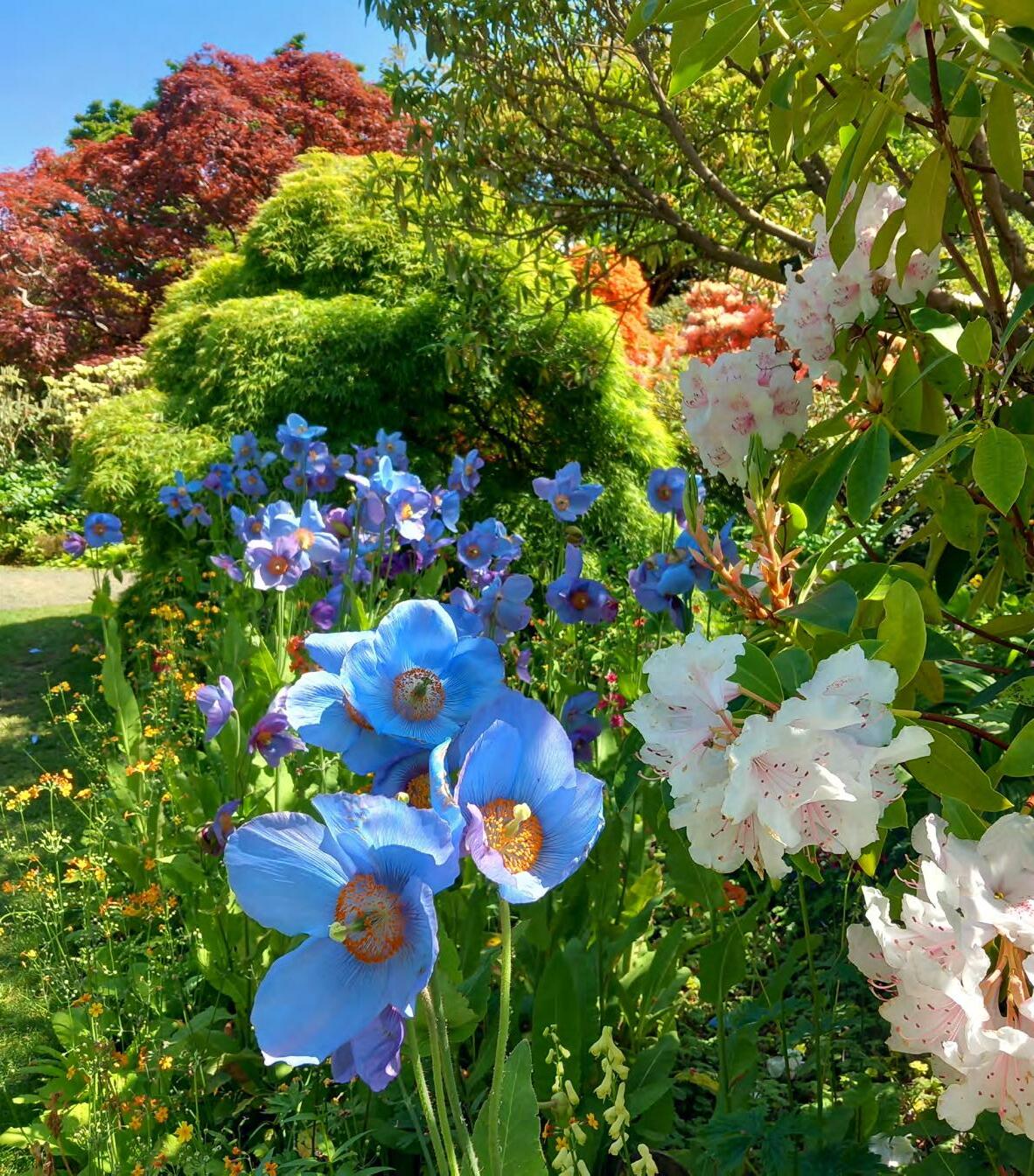
Our gardens are also shining at this time of year. Branklyn’s renowned meconopsis displays are drawing strong interest. At The Hermitage, the team has delivered a record number of weddings, highlighting how our special places can create meaningful moments while supporting sustainable income.
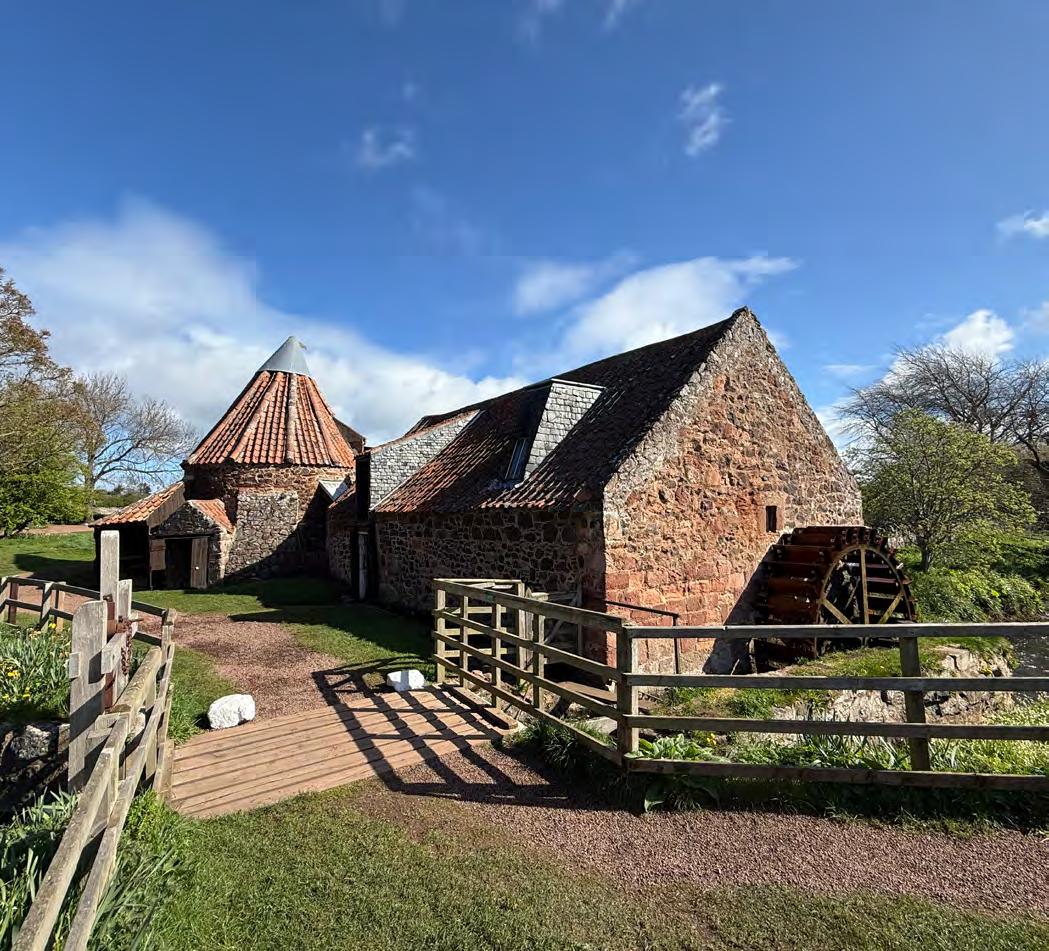
Volunteers and teams have also helped raise the profile of our places through events and media. Preston Mill’s appearance on Landward reached a wide audience, with a fantastic contribution from the team on site. In Melrose, the Borders Book Festival once again brought people together for a major cultural event, delivered with dedication and expertise by colleagues and volunteers.
Looking ahead, we’re making steady progress on a number of strategic projects. Work to reopen No. 5 Charlotte Square is progressing well, with scaffolding now removed to reveal the restored building and allow the next phase of redevelopment to begin. This includes construction of a new north extension and the installation of a lift, helping to improve access and ensure the property can welcome people again in the future.
What stands out most, however, is the people behind all of this. Across the region, I see staff and volunteers sharing ideas, supporting one another and bringing passion to everything they do. It’s this collective effort - this willingness to go above and beyond, that makes such a difference.
I feel incredibly fortunate to work alongside such dedicated individuals. Whether restoring historic buildings, welcoming visitors, leading events or caring for our landscapes, every contribution matters. Together, we’re not only protecting what makes these places special. We’re ensuring they continue to inspire, support and bring people together for years to come.
Volunteers and teams have also helped raise the profile of our places through events and media.
Here’s a look at some of the Trust’s biggest priorities –important projects that will shape our future and rely on support from teams across the organisation, including volunteers.
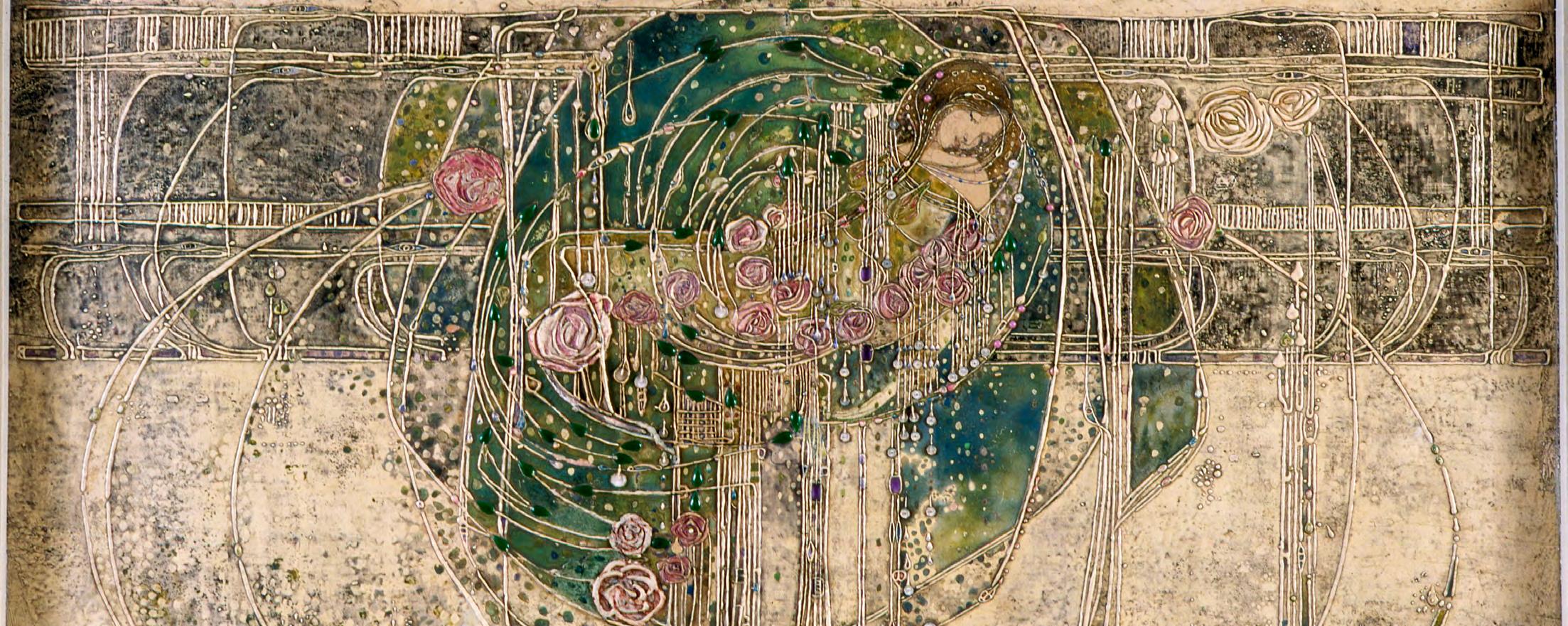
The National Trust for Scotland has received an anonymous £625k donation for the Mackintosh Illuminated project, marking a major milestone in the future of one of Scotland’s most ambitious cultural heritage projects. The significant contribution arrives as we began vital fundraising for Mackintosh Illuminated ahead of Charles Rennie Mackintosh’s birthday on 7 June, a positive step towards the fundraising target of £14million for the £20million project. The project is also generously supported by the players of The National Lottery through £1.1 million in development support from The National Lottery Heritage Fund.
Mackintosh Illuminated is a major conservation, engagement and fundraising project centred around two of Glasgow’s publicly accessible Mackintosh sites – The Hill House in Helensburgh and The Mackintosh Tearooms on Sauchiehall Street, Glasgow. The project also seeks to deepen public understanding
of Mackintosh and Margaret Macdonald Mackintosh, and their immense artistic contribution, creative partnership and influence that helped shape the Glasgow style. The donation represents one of the largest private gifts ever received by the Trust and the largest received by the project to date, arriving at a pivotal moment in the Mackintosh Illuminated journey, as development work continues across conservation, interpretation, audience engagement and long-term sustainability planning.
The gift came as work to conserve the Hill House is gathering pace, with the pioneering work to remove its damaging roughcast now complete. At The Mackintosh Tearooms on Sauchiehall Street, housed within Catherine Cranston’s original building where she commissioned Charles Rennie Mackintosh and Margaret Macdonald to create and design their celebrated interiors, work is also underway to strengthen interpretation, visitor engagement and future programming. These developments will help position the Tearooms as a key cultural destination within the ongoing regeneration of Sauchiehall Street and Glasgow city centre.
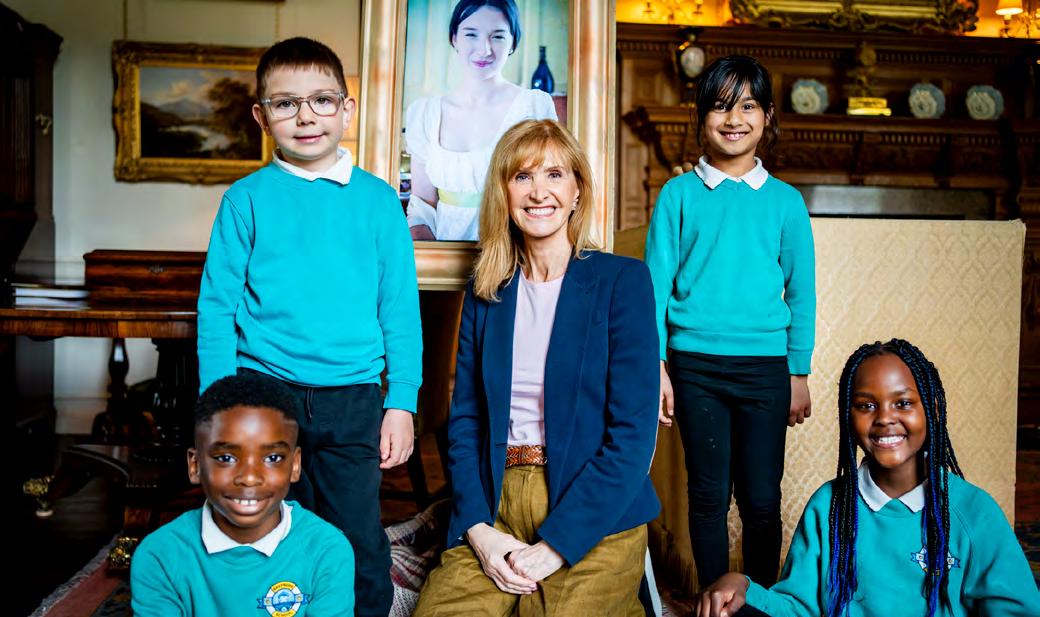
The Trust announced ambitions to deliver its flagship educational programme, Timesliders, at new locations in the North East, including the extension of an access fund to support pupils who face barriers to taking part.
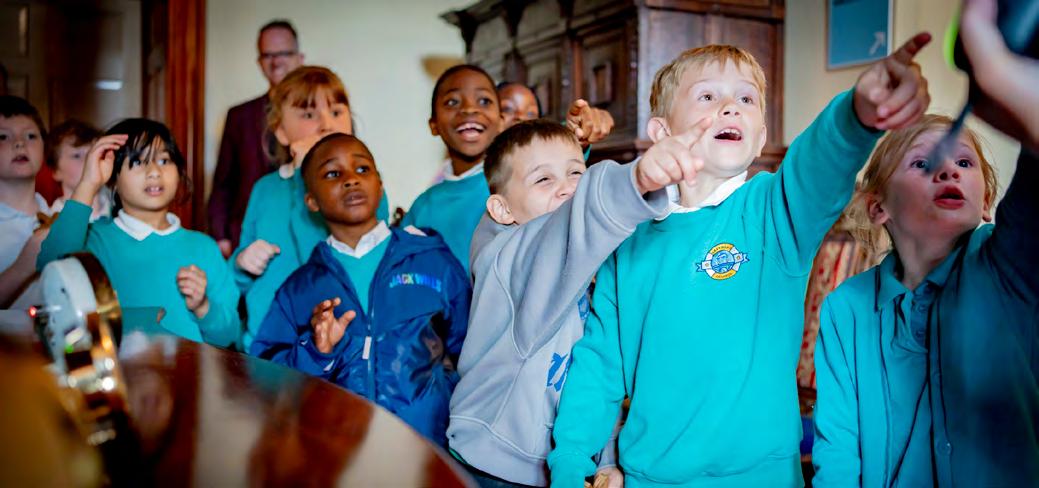
Since the launch of the Timesliders programme at Drum Castle, Aberdeenshire in 2025, pupils across the region have engaged with the castle’s history though classroom activities, interactive storytelling, outdoor learning and collaborative puzzle-solving. The multi-touch-point programme has been designed to complement the school curriculum. Free family day events have given pupils the opportunity to return to Drum Castle, Garden & Estate with friends and family.
Earlier this summer, we launched our Membership Strategy. It is intended to help shape how we think about, prioritise and deliver membership across the Trust. It provides a clear direction and focus for how we grow and champion membership over the next five years, taking us to our centenary and running alongside the second half of the Trust’s current 10-year strategy.
Shaped by our 2024 Membership Review and informed by a feasibility testing phase in 2025, this strategy is built on extensive insight, collaboration and shared ambition across the organisation. The strategy focuses on three priorities: Grow membership, Deliver membership, Champion membership. Together, these will help us build a stronger membership community, with an ambition to reach 415,000 members by 2031.
The 2025-26 programme ran between April – June 2026 and was fully booked, with 690 pupils participating from 15 schools. We are now preparing to open access to the programme to schools and educators across the wider North East region.
15th-century Inverurie tower house, Castle Fraser, and 18th-century Montrose country house, House of Dun, along with Drum Castle, are the three chosen locations for the expansion of the programme. These places have been selected for their potential to open access to the widest cohort of primary age pupils, and to deliver new and unique experiences connecting learners to Scottish history.
The Trust’s Chief Executive Phil Long and President Jackie Bird visited Drum Castle, Garden & Estate to experience Timesliders alongside pupils from Greyhope School and Community Hub, who are participating through the access fund.
Volunteers play an important role in bringing this vision to life. By creating memorable experiences and sharing the stories of our places, you help inspire people to visit, join and support the Trust.
Read the Membership Strategy
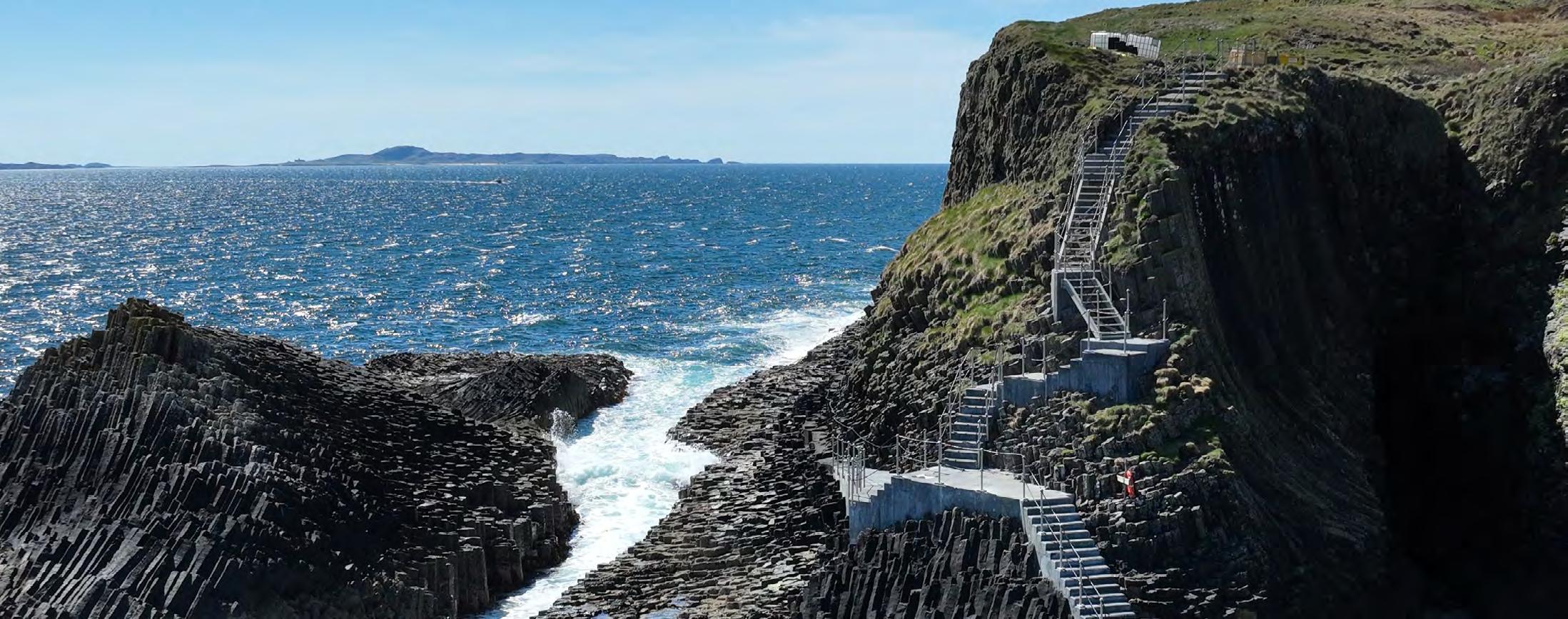
We celebrated the 40th anniversary of the island of Staffa coming into our care with the completion of a major infrastructure project and an exciting upcoming season for visitors to the world-famous National Nature Reserve. Staffa came into our care in 1986 as a gift from John Elliott Jr. of New York, in honour of his wife Elly’s birthday. Fifteen years later, in 2001, Staffa was designated as a National Nature Reserve.
The island is a Site of Special Scientific Interest, sits within the Loch na Keal, Isle of Mull National Scenic Area, and the sea around Staffa is a marine protected area and special area of conservation, so it is an important place for both nature conservation and for tourism, with visitor numbers growing in recent years. This increase in visitation has led to the Trust investing in significant repair works to infrastructure that was more than three decades old and no longer suitable for the volume of people coming each year. Over autumn and winter, we replaced the staircase to the upper island and puffin colony to make it wider, stronger, less steep, and
more able to withstand extreme weather events. Repairs and improvements were also made to the first section of path towards Fingal’s Cave, one of the island’s key draws with its famous hexagonal rock columns.
Last year, we undertook a nine-month programme of work to install a new landing jetty. The new access infrastructure has reduced congestion when arriving and leaving the island and together these improvements make it safer and easier for people to explore all that Staffa has to offer. This year, that offer includes an array of wildlife and nature to explore.
Vital nature conservation on Staffa is supported by its team of rangers who monitor species and habitats, maintain conservation infrastructure, and importantly, manage disturbances to vulnerable wildlife. A Trust study on the nearby island of Lunga in 2024 found that the combination of ranger presence and barriers to create distance between visitor and breeding puffins led to fewer disturbances to the colony that season, demonstrating a measurable impact from ranger intervention.
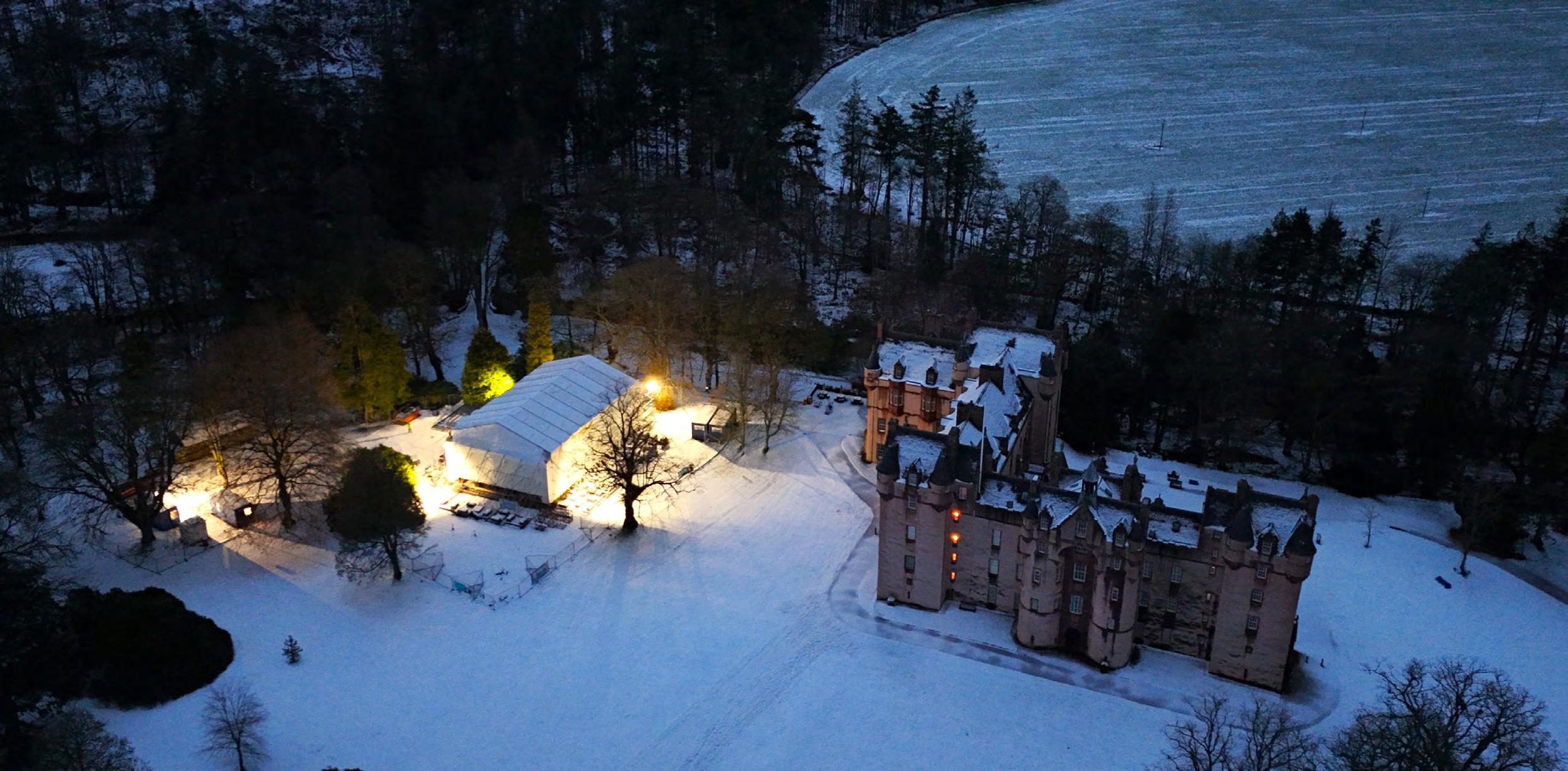
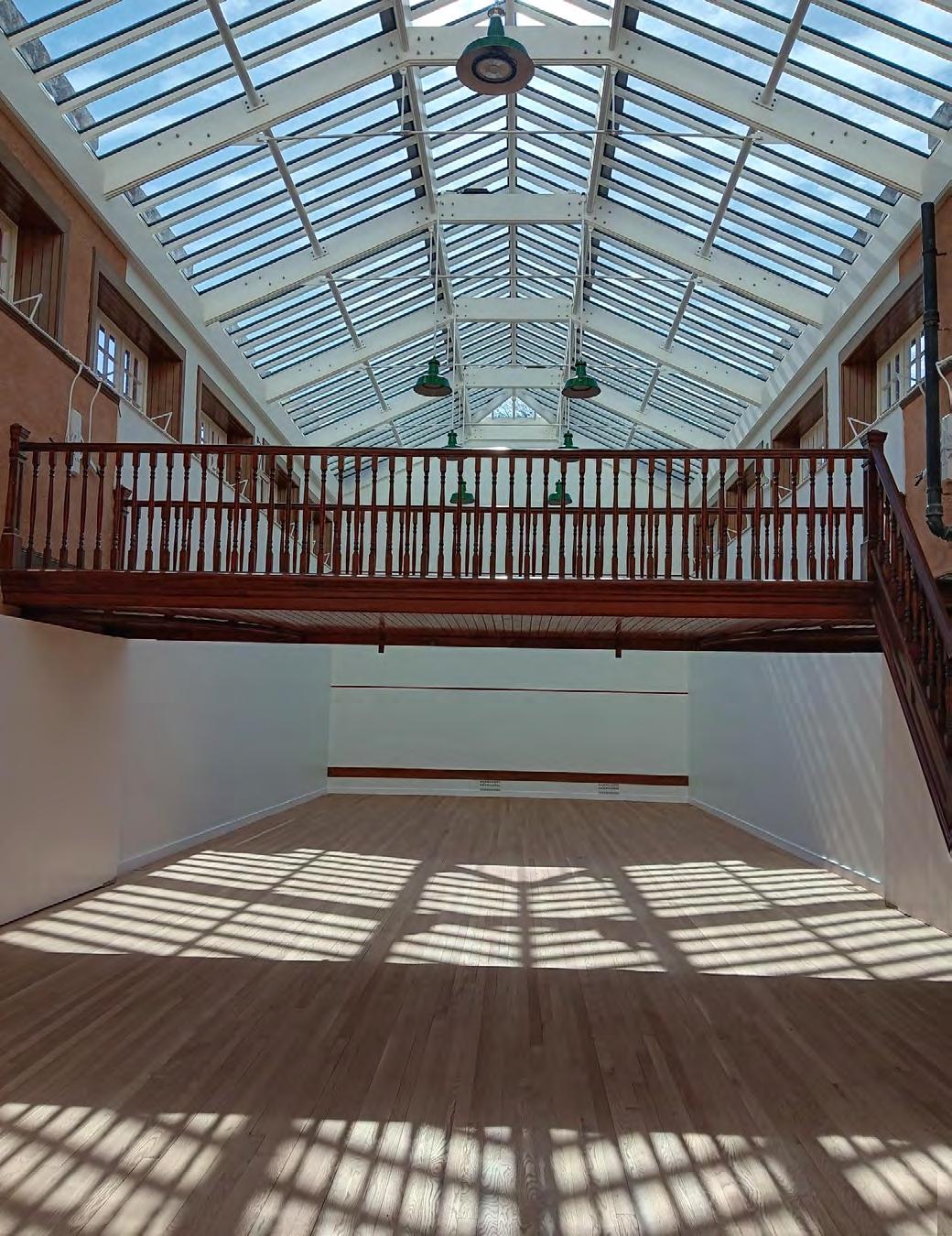
The Racquets Court is a B-listed building, constructed in 1903 by the steel and iron tycoon, Lord Leith, the then owner of Fyvie Castle. Originally known as the “Playhouse”, the building features a glazed roof over the racquets court, with a wooden viewing gallery and reception area for observing play. An adjoining lower structure features a unique wooden skittles alley. The space was intended for sport, relaxation and enjoyment and since acquisition in 1984, the Trust has utilised the space for functions and events, a business that has historically thrived at the property.
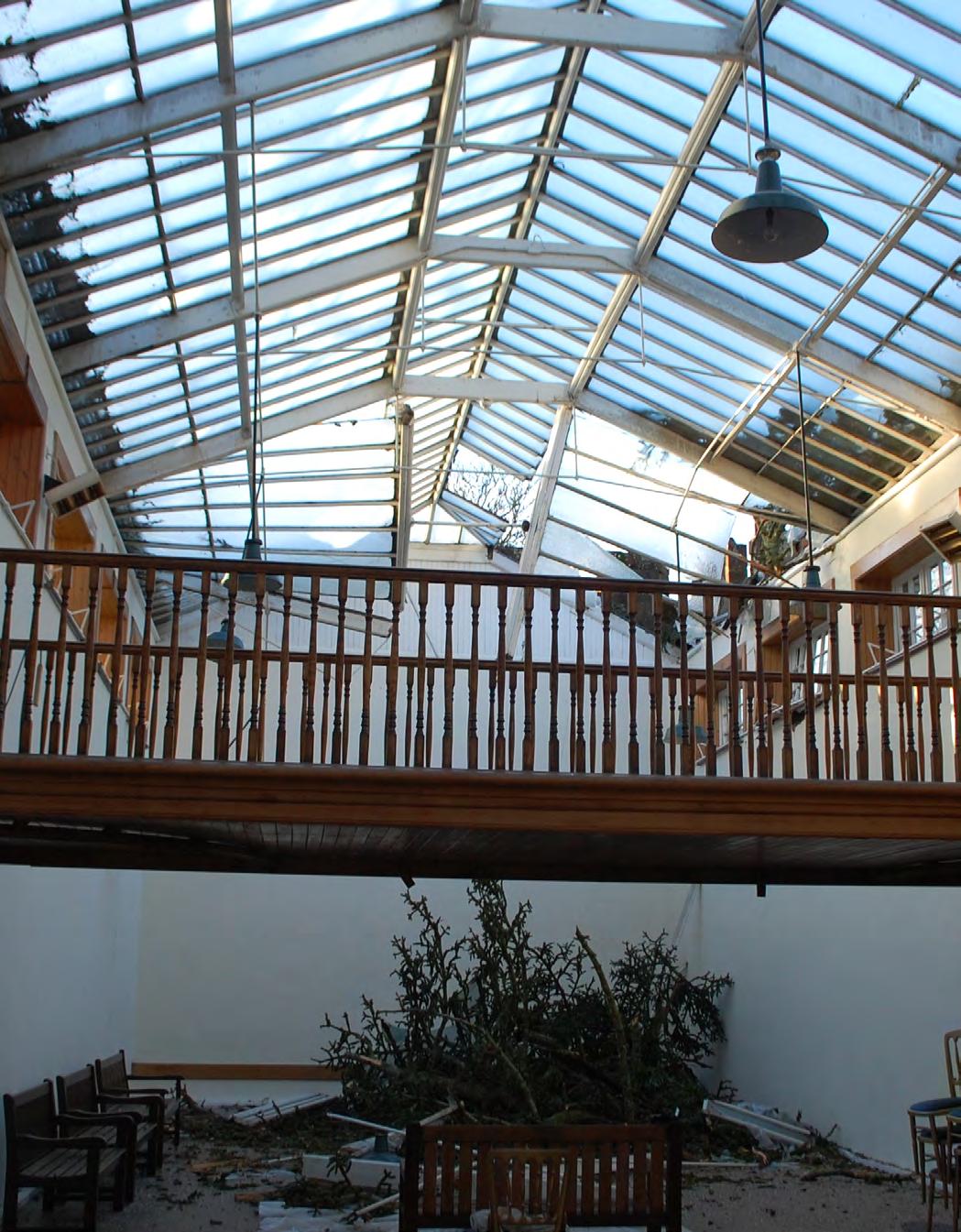
The Racquets Court building, alongside the castle, has been shrouded in a tent for the past 2 years following damage by a falling tree during Storm Otto in February 2023. It caused substantial damage to the roof structure and masonry walls and windows. Further damage was caused as the building stood open to the elements for a couple of weeks, before the tent could be erected.
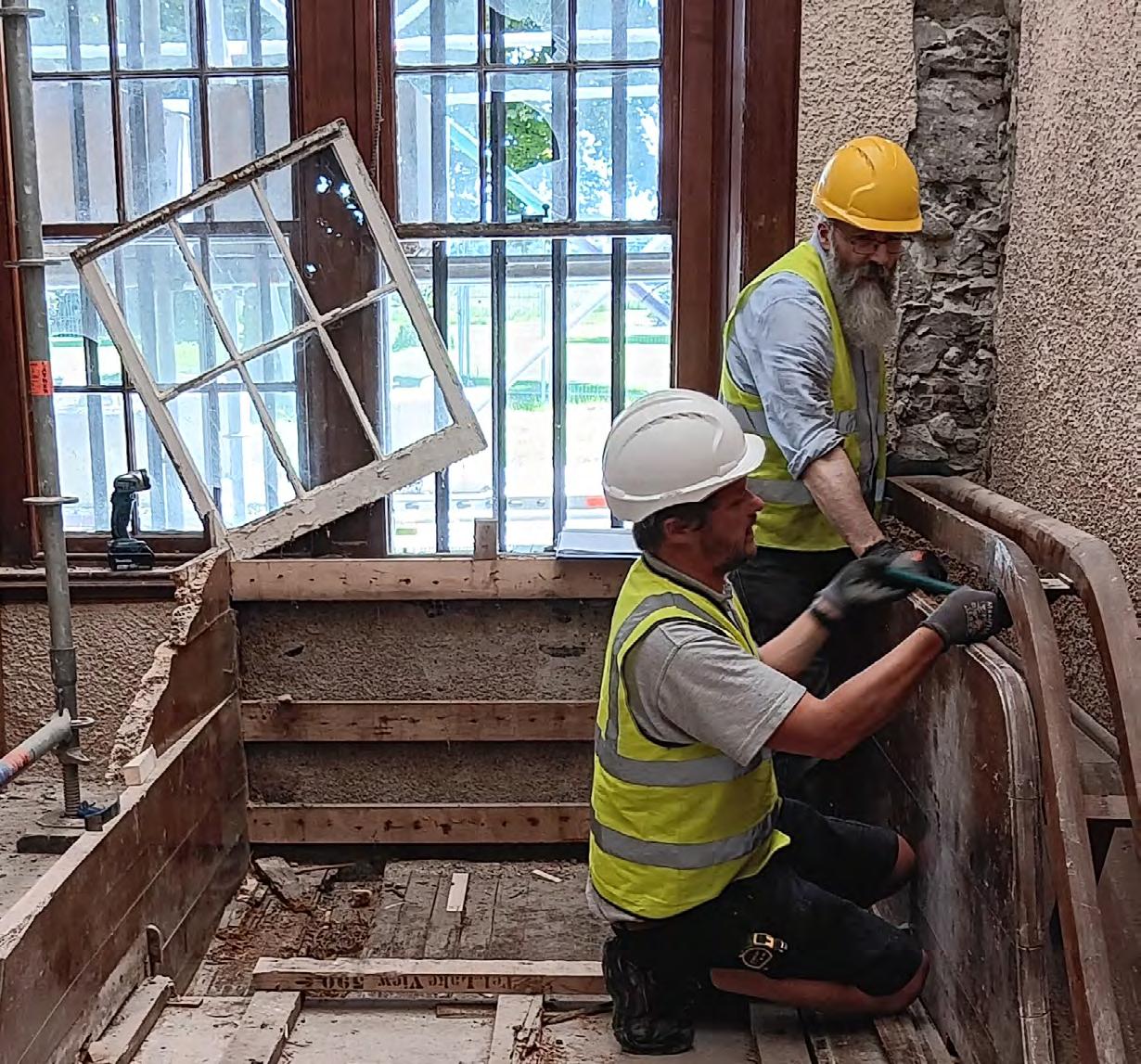
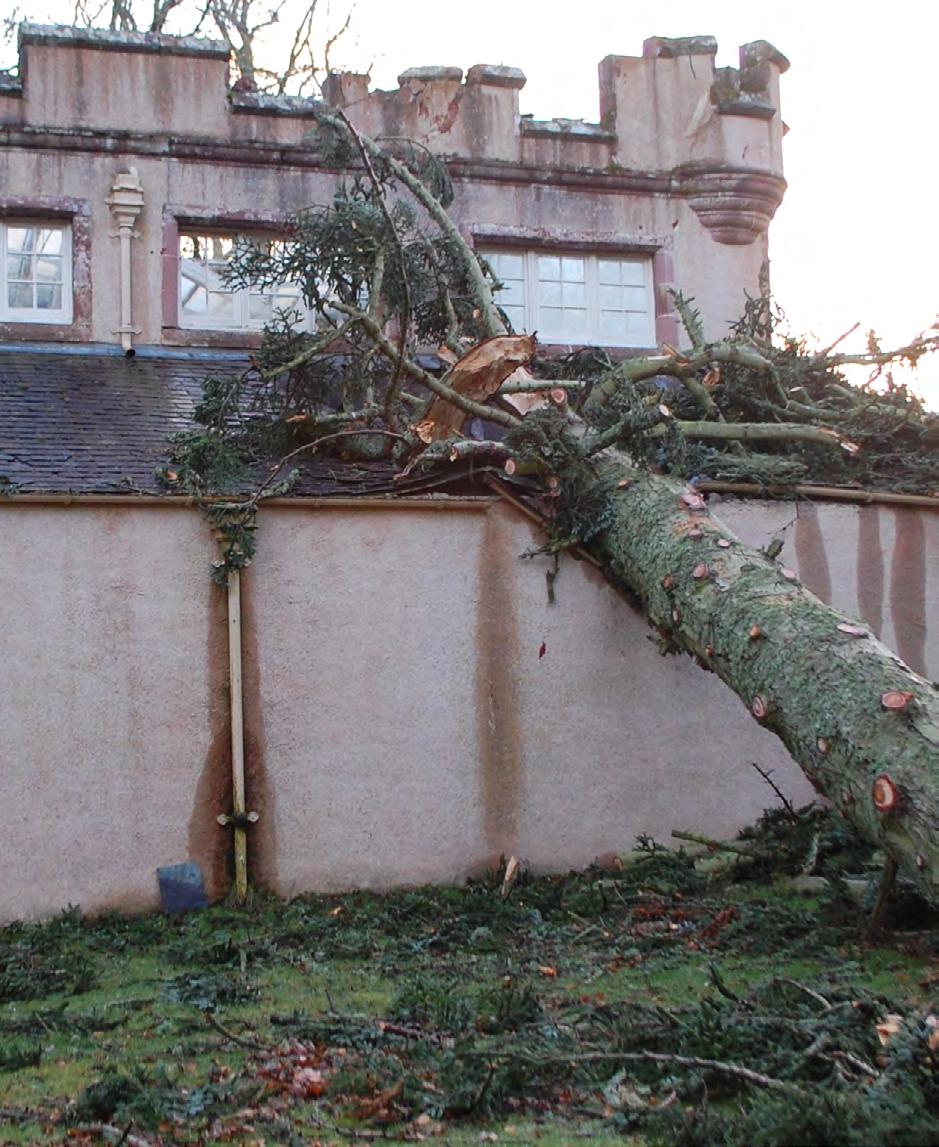
We launched an emergency plan to stabilise and make the building safe for repair work to begin. Defective and rusted railway tracks that had been used as window lintels were removed from inside the masonry walls and replaced with new steel beams designed to hold the stone crenelations above. The roof trusses that hold the glass roof were re-designed to emulate the original trusses and support double-glazed panels of glass which will provide protection to the interior against heat-loss during the winter and heat-gain during the summer.
The skittles alley that runs the 21m length of the building was carefully removed from site and moved to a furniture restorer’s workshop in Cumbria. The lifting of the floor revealed evidence of water damage and some clues to the origins of the alley. While the original skittles and balls go on display, replica balls are being made by a local wood-turner’s club, so the alley can be restored to its original use.
We are looking forward to engaging with visitors and opening up for commercial events again, supporting income for the Trust and showcasing what we achieved with this complex repair project.
Brodick’s ‘rare and outstanding’ royal summerhouse conserved
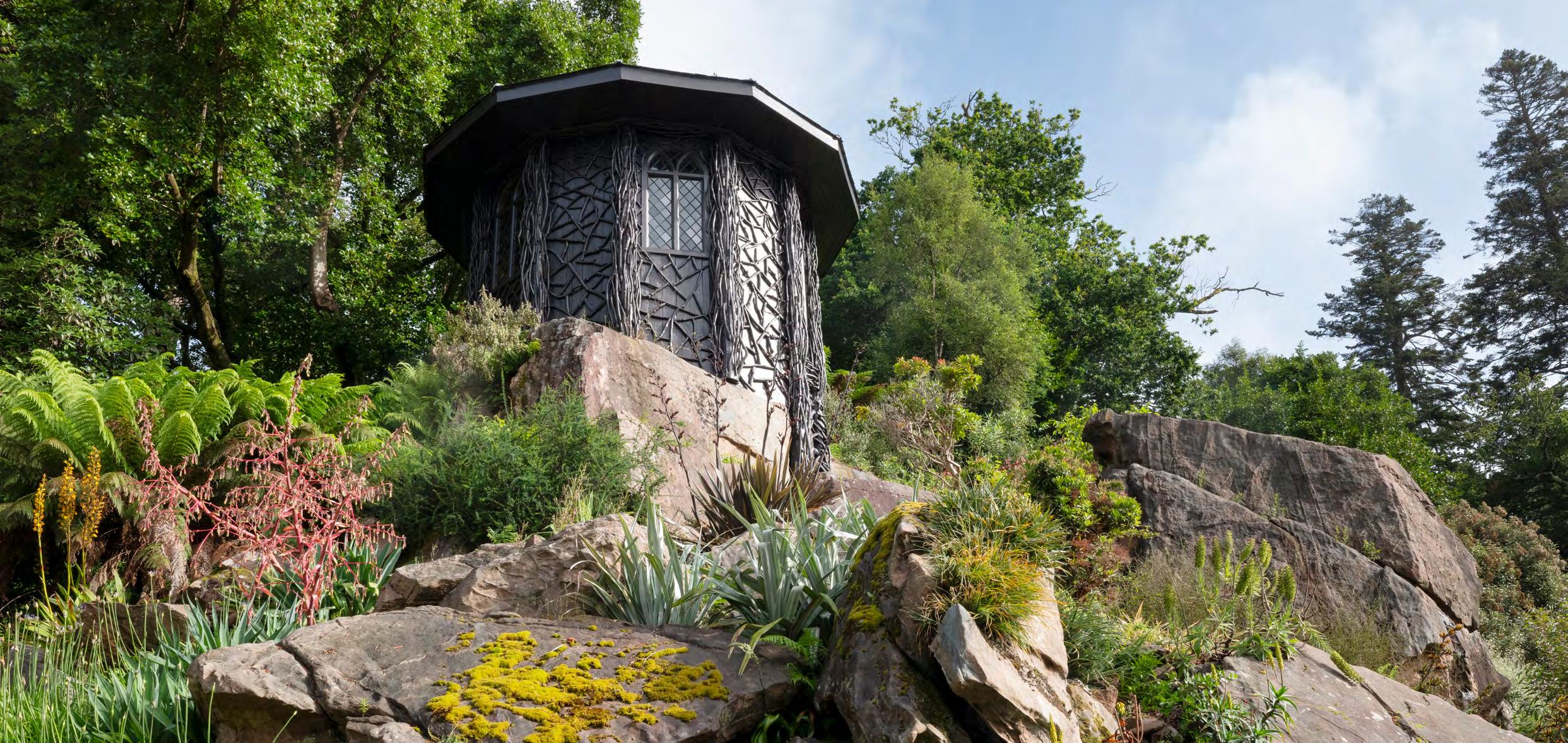
A Bavarian-style rustic summerhouse, built in the mid19th century as a wedding gift for the Princess Marie of Baden, has reopened following conservation works at Brodick Castle.
A striking feature on the coastline of the Isle of Arran, a UNESCO Global Geopark, the restored summerhouse is the grandest, and the only surviving, of four summerhouses built for Princess Marie in the gardens of Brodick Castle following her marriage to William the 11th Duke of Hamilton. The marriage elevated the social standing of the Hamiltons, as Princess Marie was cousin to Louis-Napoleon Bonaparte and wellconnected across Europe.
The summerhouse is built into the sandstone rockface and offers spectacular views over Brodick Bay. Rustic summerhouses were a very fashionable addition to the homes of the wealthy at the time of its installation, though very few examples now remain.
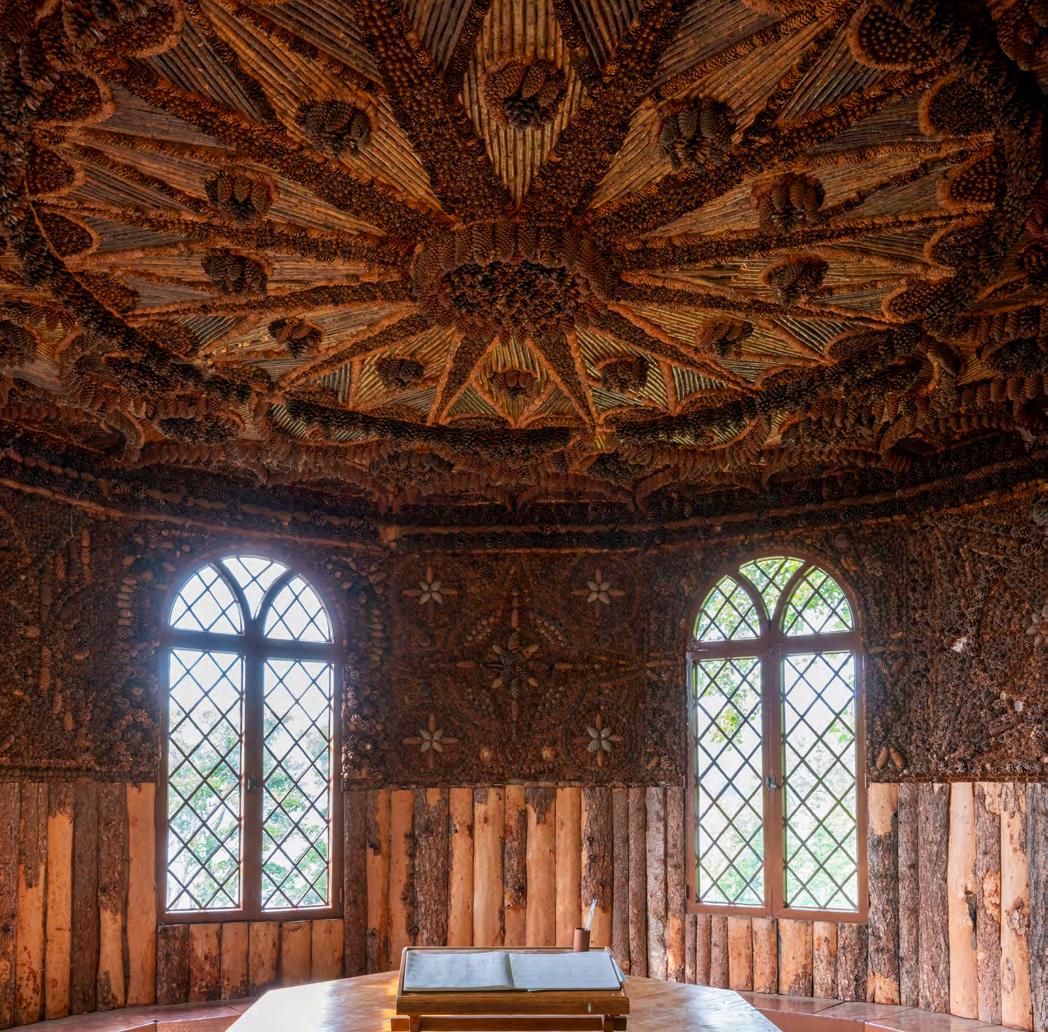
Conservation works on the summerhouse included maintenance of the rhododendron stem decoration, replacement of heritage glass in the windows, the addition of latches on the windows, and repairs to the slate facetted roof. Plans are underway to repair the original interior ceiling, which is decorated with pinecones, the work of Bavarian craftsmen.
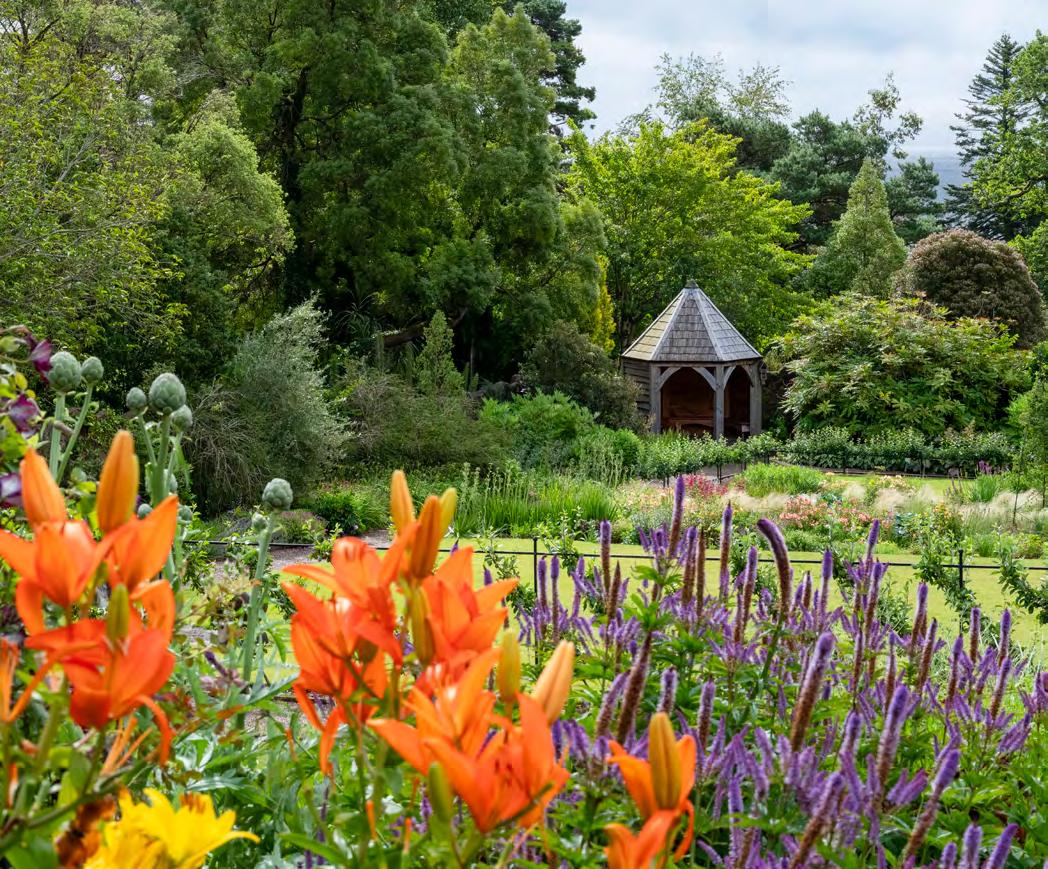
The conservation of the summerhouse is part of wider developments in the gardens of Brodick Castle & Estate ahead of the summer season. Children can take part in new monthly adventure trails in the park and explore the Isle and be Wild playpark, which has recently reopened after refurbishment. Visitors can enjoy the scenery from a new viewing point in the gardens and music from the local pipe band, brass band and music school throughout the castle grounds each month. Another of the summerhouses was reinstated to the walled garden in 2022, replacing a shelter built in the 1980s.
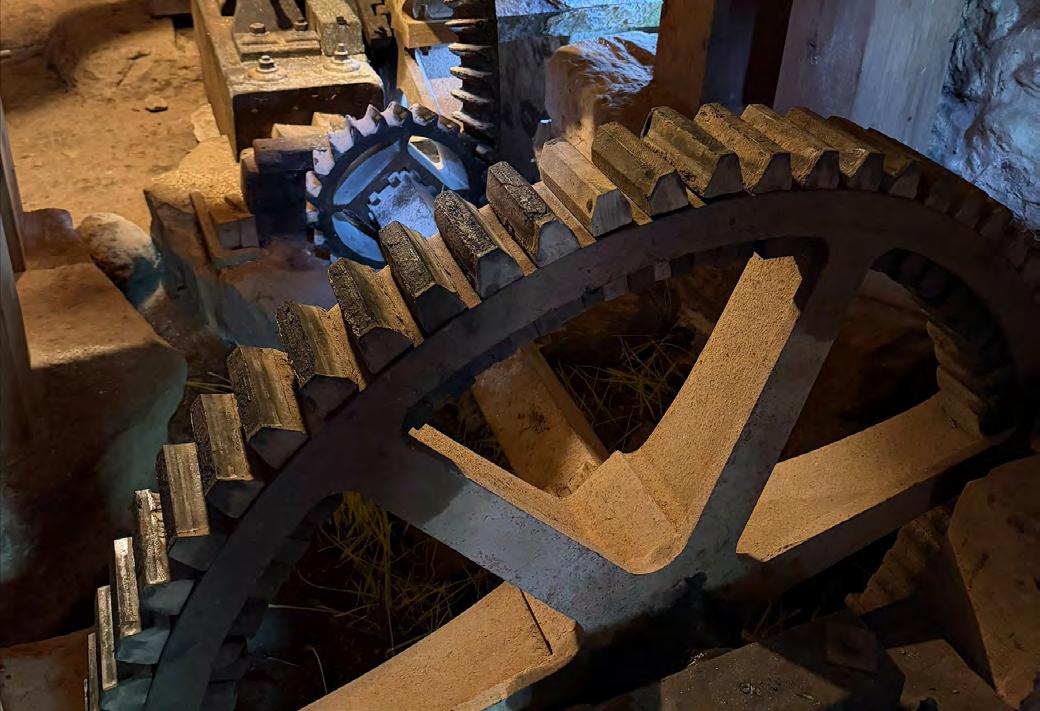
and dressing the French Burr millstones, visitors can now see the mill back in action on tours for the first time in over 30 years.
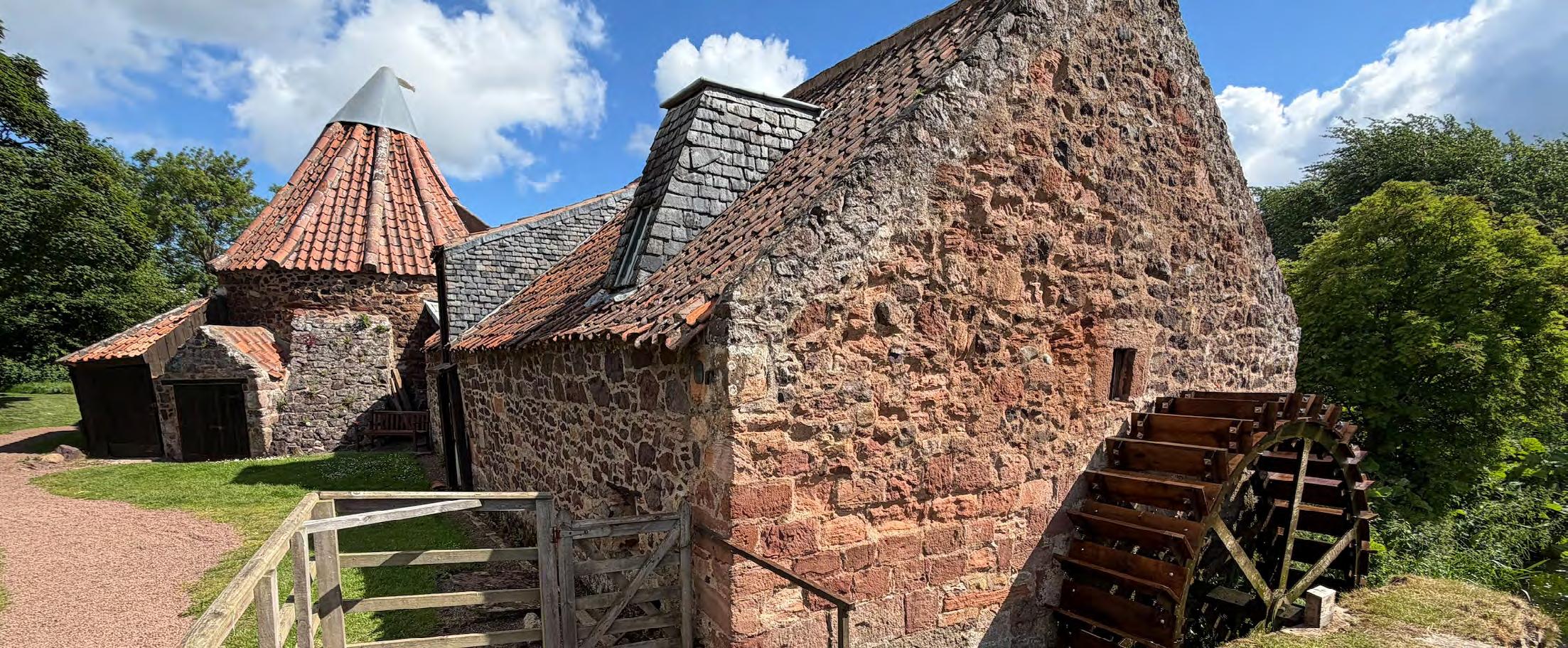
The millstones of Preston Mill are grinding again and providing milling demonstrations for the first time in 30 years following a series of conservation works undertaken by the National Trust for Scotland. The current mill structure was built in the 18th century but the earliest surviving record of mill repairs taking place at the site in East Linton dates to 1598.
There are indications that a mill might have existed on this site in the 13th century, meaning that oatmeal and other grains may have been milled in this very location for 800 years. Preston Mill is renowned for its unique lean, which was caused by subsidence of the kiln building that is now supported by external stone buttresses. Made of local volcanic stone, the mill came into the care of the Trust in 1950 and was operated commercially until 1959. The current River Tyne-powered waterwheel was installed in 1909, and following a series of repairs to the waterwheel and sluice, as well as important conservation work to the pit wheel and upright shaft foot bearing; realignment of the millwork; new foot bearings to grindstone-spindles; coating the wooden teeth in the great spurgear;
The catalyst for this work was a generous donor whose initial support made it possible for the project to progress, and it would not have happened without them. Donor generosity has previously supported Preston Mill when other recent repairs were partially funded by fans of Outlander. Preston Mill featured in the first season of the hit TV series when it was transformed into the mill on the Fraser estate of Lallybroch, which lead character Jamie Fraser repairs while visiting his family home.
... Preston Mill when other recent repairs were partially funded by fans of Outlander.