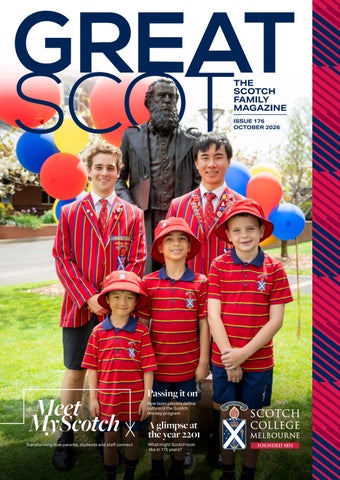
THE SCOTCH FAMILY MAGAZINE ISSUE 176 OCTOBER 2026
Meet MyScotch Transforming how parents, students and staff connect
Passing it on How team players define culture in the Scotch Hockey program
A glimpse at the year 2201 What might Scotch look like in 175 years?
1
Great Scot is the official publication of Scotch College, Melbourne
Produced by Scotch College 1 Morrison Street, Hawthorn 3122 Victoria, Australia (03) 9810 4321 greatscot@scotchcollege.vic.edu.au www.scotch.vic.edu.edu
Old Scotch Collegians Association www.oscanet.com.au 2
FOLLOW US
@scotchcollegemelbourne @scotchcollegemelbourne @scotchcollegemelbourne
CONTENTS 5
NEWS 6 8
12
FROM THE CHAPLAIN
Slowing down on Tiwi
Toasting a new tradition: Clan & Claret
FEATURES 20
A glimpse at the year 2201
24
What is a legacy?
22 26
28
30 34
36
The evolution of the Scotch curriculum The traditions that make Scotch, Scotch ‘Extra-ordinary’ hobbies 175 Facts: Part 2
The Masculinity Project Building readers for life
AROUND THE GROUNDS 38
A soccer rivalry in full bloom
42
An onstage revolution Les Misérables
46
Art meets industry
40
50
Passing it on
Foundation Day Concert rocks Hamer Hall Prize pieces: Principal’s Acquisitive Art Prize Away from home but never alone
FOUNDATION 52
Respecting history while supporting the future
56
Recycle, reuse, repurpose, reimagine
54
Why giving matters: From the Foundation President
ARCHIVES 58
60
OSCA
The Founder
The men who made a farm into a school
62
A conversation with Leigh McGrgeor (SC1956)
66
1st Hawthorn Scouts celebrate 100 years
64
68
68
The people we are becoming: From the Chaplain
18
48
PRIZE PIECES
Truth in an age of answers: From the Principal Meet MyScotch
44
48
Investing in Scotch’s future: From the Chairman
14
16
12
Welcome to Great Scot
Great Scot | Issue 176 | 2026
WELCOME
70
72
A new era of support for our Young Old Boys: From the OSCA President What a night! OSCA Annual Dinner Three Berwick nonagenarians
ANZAC Day at Villers-Bretonneux
74
The long way round
78
OSCA Clubs
76
82 87
88
Going off script
Scotch Family Events
The 25 oldest-known living Old Boys Obituaries
OSCA ANNUAL DINNER
3
Great Scot | Issue 176 | 2026
4
WELCOME
That balance between tradition and progress is evident throughout these pages.
Welcome to Great Scot As Scotch celebrates 175 years, this edition of Great Scot offers an opportunity to reflect not only on our history, but also on the values that continue to shape our community. Whilst the world around us has changed dramatically since the school’s foundation, the qualities that define a Scotch education, character, community and a commitment to something greater than oneself, remain as relevant today as they were in 1851. Indeed, one of the hallmarks of any great institution is its ability to evolve with the times whilst remaining steadfast in its purpose and values. One of the stories that particularly resonated with us in this edition explores what a group of our youngest boys imagine Scotch might look like 175 years from now. Their ideas are imaginative, optimistic and, at times, amusing. Yet beneath their predictions lies a confidence that the school will continue to adapt and grow whilst remaining true to its foundations.
Great Scot | Issue 176 | 2026
It serves as a timely reminder that every generation of Scotch boys contributes to the next chapter of our story and that the decisions we make today will help shape the future of the school for years to come.
We celebrate cherished school traditions that have connected generations of students, whilst also highlighting initiatives that seek to strengthen our community in new ways, including the launch of the MyScotch app and communications platform. Similarly, the story of our longstanding partnership with Tiwi College reflects the value of meaningful relationships and learning from others. Features on sustainability and financial stewardship remind us that we also have a responsibility to future generations and that good stewardship requires us to think beyond the present moment. Ultimately, the strength of any school community is measured by its people. Between the creativity on display in our student art exhibitions and performing arts program, and the leadership demonstrated by our student leaders and School Captain Charlie through the development of a masculinity project, the stories in this edition of Great Scot reflect young people engaging thoughtfully with the world around them. They do so with the support of dedicated staff, families and Old Boys whose ongoing contribution helps make Scotch the vibrant and connected community it is today. We hope you enjoy this edition of Great Scot and the many stories it shares of the people, traditions and experiences that continue to define Scotch College 175 years on. As we celebrate this significant milestone, it is worth reflecting not only on how far the School has come, but also on the responsibility we all share in preserving and strengthening the values that will guide Scotch into its next chapter.
5
Great Scot | Issue 176 | 2026
Scotch is embracing some of the most significant long-term opportunities in its recent history, guided by a commitment to educational excellence, responsible stewardship and the wellbeing of future generations. Mr Hamish Tadgell (SC 1985) SCHOOL COUNCIL CHAIRMAN
TAKE A FIRST LOOK AT FAIRHAVEN
6
In April 2025, we released our Lighting the Way Strategic Plan, which set out our vision for “forming enlightened learners of good character committed to shaping a better future”. During 2026, School Council and the Executive have undertaken a comprehensive review of the College’s infrastructure and campus requirements to support this vision. A key initiative is the establishment of a residential outdoor education program for Year 9. In 2023, we announced the purchase of Fairhaven, a 175-acre property near Mallacoota in Eastern Victoria. Since then, significant progress has been made in developing both the curriculum and the campus design. This work has required great care and sensitivity to the site, its cultural heritage and, most importantly, the developmental needs of our students. In the coming months, we intend to apply for town planning approval and, subject to receiving it, finalise our plans and move towards construction. The proposed campus will support a Year 9 experience that brings together academic learning, outdoor education, service and community living in
*Architectural concepts only
the unique natural environment of Far East Gippsland. Some initial concepts are shown on this page, and in the video available on the School’s website. We believe Fairhaven has the potential to be a truly transformational educational experience and an important addition to the Scotch offering. It will provide boys with the time and space to build resilience, independence, self-awareness and a stronger sense of responsibility to others. The establishment of Fairhaven reflects the same long-term thinking that has shaped Scotch throughout its history: creating opportunities that prepare boys not only for school, but for life.
Great Scot | Issue 176 | 2026
Fairhaven will create greater flexibility in how the College utilises its existing facilities and will support modest enrolment growth over time. This will assist the College in maintaining highquality programs, supporting strategic initiatives and meeting the ongoing costs of maintaining and improving our facilities. Beyond this, there are no further plans to increase our student body.
We have also continued work on the Hawthorn campus master plan, bringing together stakeholders and experts to establish an integrated and responsible framework for the College’s development over the coming decades. This work is guided by a simple principle: to ensure that future generations inherit a school that remains true to its purpose while continuing to evolve to meet changing educational needs. Fairhaven represents one of the most significant investments in the College’s future since the School Council decided to purchase the Hawthorn Glen Estate in 1915. That was, at the time, a bold decision to build a school “out in the sticks” during the First World War, at a time of great uncertainty. We are the custodians of this rich inheritance, and the College’s current decisions build on that same foresight. Delivering on these aspirations requires careful planning, disciplined financial management and an intergenerational perspective. Scotch’s approach has always been to “hasten slowly”: balancing ambition with prudence and ensuring that decisions made today serve current needs and those who will follow. The School is also keenly aware of the financial pressures many families continue to face.
We remain committed to managing expenditure and fee increases responsibly while preserving the strength, quality and character of a Scotch education.
While facilities and programs are important, the College’s greatest asset remains its people. Exceptional teachers and professional staff are at the heart of every Scotch boy’s experience, and attracting, supporting and retaining outstanding staff will remain a central priority for the School. As has always been the case at Scotch, philanthropy will play a vital role in bringing our aspirations to life. School fees alone do not cover the full cost of a Scotch education. The facilities and opportunities enjoyed today would not have been made possible without the foresight and generosity of those who came before us. As an independent school, we receive no recurrent State or Federal Government capital funding for the development of our buildings and grounds. The continued support of our community therefore remains essential in enabling us to invest in the experiences, programs and facilities that enrich the lives of our students. In early 2027, we will share further details of Fairhaven with the Scotch community and launch a capital campaign through the Foundation. Bringing Fairhaven to life will depend on major gifts, significant contributions and many smaller acts of generosity. Every gift matters, and every donor becomes part of a long tradition of supporting future generations of Scotch boys. If Scotch is to remain the “best of schools and dearest”, it must continue to plan carefully and invest thoughtfully for the future. We do so with confidence because of the enduring commitment of the Scotch Family and the strong tradition of stewardship that has shaped our College for more than 175 years. Hamish Tadgell Chair of Scotch College Council 7
Truth in an age of answers
Advancing our curriculum in the age of artificial intelligence
Recently, I was trying to make a minor change to a restaurant booking. Like many businesses today, the restaurant had introduced an AI-powered phone system that, on paper at least, promised convenience and efficiency. In practice, after several frustrating attempts, the system could not accommodate my request. Eventually, I asked to speak with a person, and within moments the matter was resolved.
Dr Scott Marsh PRINCIPAL
Artificial intelligence is advancing rapidly and, in time, perhaps that same system will handle such requests effortlessly. Yet the encounter left me reflecting on why the human had succeeded where the machine had failed. The staff member could picture the restaurant, anticipate how the evening might unfold and weigh possibilities beyond a prescribed set of instructions. The difference was not access to information, but the capacity to interpret a particular situation, exercise judgement and respond to reality as it was. The experience reminded me that the challenge facing our boys in the years ahead will not simply be learning how to use increasingly sophisticated technologies, the deeper challenge will be learning how to exercise judgement in a world where information is abundant but wisdom remains elusive.
8
More information, less certainty As part of Lighting the Way, this year we have embarked upon a significant review of our curriculum, not to pursue the latest educational fashion or redesign learning simply because technology is changing. Rather, the review asks a deeper and more enduring question. What kind of people do we hope our education will form? At Scotch, our purpose is to form enlightened learners of good character, committed to shaping a better future, while advancing learning that appreciates beauty, pursues goodness and discerns truth. As we pursue these strategic aspirations, artificial intelligence invites us to revisit some of education’s most enduring questions.
Good schools have always thought carefully about what knowledge matters, what is worth teaching and how learning contributes to a life well lived. The rise of AI does not diminish these questions; rather, it elevates them.
9
Great Scot | Issue 176 | 2026 When information is readily available and answers can be generated almost instantaneously, the challenge is no longer simply acquiring knowledge, but understanding why it matters and developing the judgement and wisdom to distinguish truth from falsehood. Seen in this light, artificial intelligence does not make knowledge less important; it reminds us why knowledge matters. Education has never been simply about recalling facts. Knowledge provides the framework through which we interpret the world, evaluate competing claims, recognise bias and test assumptions. Our boys cannot meaningfully evaluate an historical argument without some grounding in history, nor assess a scientific claim without an understanding of science. Knowledge alone does not guarantee truth, but without it the search for truth becomes significantly harder. From information to wisdom Perhaps one consequence of our information-rich age is that the distinction between information, knowledge and wisdom has become less clear. Information tells us what is happening, knowledge enables us to make sense of it, and wisdom helps us determine how we ought to respond. Running through all three is the pursuit of truth, the desire to understand reality as it is, rather than merely as we wish it to be. While access to information has increased dramatically, our appetite for truth has not necessarily grown with it, nor has it made us wiser, kinder or more discerning. Much of what reaches us through digital platforms is designed to capture attention rather than deepen understanding, rewarding speed, novelty and reaction over patience, context and reflection. 10
The task of schools is therefore not simply to provide access to information, but to help young people evaluate claims, test assumptions and distinguish truth from falsehood. More than this, a good curriculum should cultivate a hunger for truth, the patience to pursue it beyond the thirty-second clip, the humility to question what is convenient or sensational, and the courage to follow evidence even when it unsettles our assumptions. This does not require a choice between knowledge and broader capabilities. The two are deeply connected, even though contemporary educational discussion has sometimes presented capabilities as alternatives to deep knowledge. These challenges have helped sharpen the purpose of our curriculum review and clarify why knowledge remains essential. As we examined educational research and consulted with staff, our boys, universities and industry leaders, we were repeatedly reminded that creativity, critical thinking and sound judgement do not develop in a vacuum. The ability to think well depends upon having something worthwhile to think about. Creativity provides a powerful example. It is often presented as something separate from knowledge, yet the opposite is usually true.
The world’s great scientists, artists and innovators did not create by ignoring what was already known. Rather, they built upon deep understanding and then saw possibilities that others had overlooked.
The close relationship between knowledge, creativity and truth informs our approach to curriculum at Scotch. We remain unapologetically committed to academic excellence, and the purpose of our review is not to diminish rigour but to strengthen it. We want our boys to develop deep knowledge and intellectual confidence while learning to connect ideas across disciplines, apply their understanding in authentic contexts and engage thoughtfully with questions that resist easy answers. As our review progressed, it became increasingly apparent that questions of curriculum ultimately lead to questions of human formation. The most important questions raised by artificial intelligence are not ultimately technological, but human. As machines become more capable of retrieving information, generating content and solving certain problems, schools must become even more intentional about cultivating wisdom, judgement, character, creativity, empathy and the capacity to discern truth. These qualities matter not merely because they help our boys succeed, but because they help them live well. They shape how we respond to complexity, relate to others and determine what is worthy of pursuit.
The question is therefore not simply what our boys know, but who they are becoming and whether they can determine which answers are true, worthwhile and worthy of pursuit. As the Apostle Paul reminds us, ‘Everything is permissible, but not everything is beneficial’ (1 Corinthians 10:23). The challenge facing our boys is not simply deciding what can be done, but what ought to be done. In this sense, artificial intelligence does not diminish the importance of education; it reminds us that schooling is concerned not merely with transmitting knowledge, but with forming people capable of using it wisely and well. The importance of truth extends beyond individual character and decision-making. Democratic societies depend upon citizens who care about truth, who can distinguish evidence from assertion and who are willing to listen, deliberate and revise their views. When information is sensationalised, stripped of context or treated primarily as entertainment, our shared civic life becomes more fragile. The task of schools is therefore not simply to help young people recognise truth, but to cultivate in them a desire to seek it, value it and live by it. Education and the pursuit of truth Cultivating this commitment to truth is part of the enduring purpose of education. For our boys, this means developing the knowledge to understand the world, the judgement to evaluate competing claims and the character to live wisely in light of what they discover. Truth is therefore not simply an answer to be identified, but a commitment that shapes how we understand the world, relate to others and decide what is worthy of pursuit.
This formative work is not deferred until adulthood. Although schools are often said to prepare young people for life, I have never been entirely comfortable with that expression, because school is already part of life itself. The books studied, questions explored, friendships formed, challenges encountered and habits developed are not rehearsals for some future existence. They actively shape who a young person becomes. More than that, they influence how young people understand the world, relate to others and live each day in the present. Every lesson deepens a boy’s understanding of the world, while conversations, successes and setbacks contribute to the formation of character, resilience, responsibility and selfknowledge. Seen in this way, curriculum matters profoundly because it reflects what a school believes is worth knowing, worth valuing and ultimately worth becoming.
Great Scot | Issue 176 | 2026
In this sense, creativity is not an alternative to knowledge but a product of it. Grounded in truth, creativity has the power to solve problems, enrich lives and shape a better future.
This conviction is deeply rooted in Scotch’s history. Since its foundation in 1851, the College has sought to develop both intellect and character, placing academic excellence alongside questions of meaning, purpose and contribution. Our Scottish Enlightenment heritage reflects a confidence that learning can improve society, while our Christian heritage reminds us that education must engage not only the mind but also the soul. Together, these traditions provide enduring foundations for responding confidently to the possibilities and challenges ahead. What will endure As we advance our curriculum, it may be tempting to focus primarily on the technologies shaping the future. Artificial intelligence will undoubtedly become more sophisticated, but the central challenge of education will remain unchanged. We must help our boys distinguish truth from falsehood, wisdom from folly and substance from appearance. What has changed is not the importance of that task, but its urgency. Our boys do not lack information. They need the knowledge, judgement and character to decide what to trust, what to question and how to act. This enduring need for truth, wisdom and judgement sits at the heart of our curriculum review. Every meaningful human endeavour depends upon an honest understanding of reality, for we cannot solve problems we do not understand, build relationships upon illusion or contribute wisely to a world we have not learned to see clearly. Perhaps that is why Scotch’s aspirations feel especially relevant in an age of artificial intelligence. Long after today’s technologies have been surpassed, the world will still need people who can appreciate beauty, pursue goodness and discern truth. If we can cultivate those qualities in our boys, we will have done more than prepare them for the future. We will have helped form both the young men they are today and the men they will become. Our hope is that they will be people of wisdom, character and purpose who hunger for truth, recognise and value it, and seek to live well in the world.
11
Great Scot | Issue 176 | 2026
The people we are becoming
Rev Doug Campbell
SCHOOL CHAPLAIN
12
Ephesians 4:15-16 Rather, speaking the truth in love, we are to grow up in every way into him who is the head, into Christ, 16 from whom the whole body, joined and held together by every joint with which it is equipped, when each part is working properly, makes the body grow so that it builds itself up in love.
One of the great questions of education is not simply What will our students know? but Who will they become? Schools rightly celebrate academic achievement, artistic accomplishment, and sporting success. These are important pursuits that help young people develop their gifts and prepare for future opportunities. Yet character education reminds us that there is something even more fundamental at stake. Education is not only about what a student achieves; it is also about the kind of person he becomes.
MESSAGES
A simple truth of life is that we become like the people we walk alongside. Character is formed in community. Parents, teachers, coaches, mentors, and friends all play a part in shaping who we are. We learn not only through formal instruction but also through observation and imitation. We absorb habits, attitudes, and values from those around us. This insight has long been recognised within the Christian tradition. The New Testament rarely imagines growth as a solitary pursuit. Rather, maturity emerges as people serve, encourage, and walk together. As Paul writes in Ephesians, the body “builds itself up in love, as each part does its work.” In many ways, character education is about precisely this: helping young people become men whose lives strengthen the communities to which they belong, and whose character contributes to the flourishing of others. We are not created to live in isolation. Character grows best in communities where respect, accountability, encouragement, and service are valued. Schools provide countless opportunities for this kind of formation. A classroom is not simply a place where information is exchanged. It is also a place where students learn together patience, integrity, humility, and perseverance. Likewise, a sporting team teaches commitment, self-control, resilience, and the willingness to place the success of the group above personal recognition. Participation in music, drama, leadership, or service programs similarly develops habits that shape character for life. Each of these character forming experiences are done in community. At Scotch, the importance of community is woven through many aspects of College life. House activities foster belonging and healthy competition. Sporting programs encourage teamwork and mutual support. Service initiatives help students look beyond themselves and engage with the needs of others. Through these experiences, boys learn that character is not merely demonstrated in moments of personal success but in the ways they contribute to the communities of which they are a part. Indeed, the culture of a school is largely the sum of the character of its members. A school marked by respect is made up of people who choose to treat one another with dignity. A school known for kindness exists because individuals practise kindness in ordinary interactions. A school that values responsibility depends upon students, staff, and families embracing responsibility for their actions.
Culture is often discussed as though it were an abstract concept, but in reality it grows through countless daily choices. It is formed when a student includes someone who is feeling isolated. It is strengthened when mistakes are acknowledged honestly and forgiveness is modelled. It is reflected when boys compete fiercely yet graciously, celebrating success without arrogance and accepting disappointment without bitterness. These seemingly small moments often have a greater influence than we realise. They shape not only individual character but also the experience of those around us. They create environments in which people can flourish.
Great Scot | Issue 176 | 2026
Often, when we speak about character and ‘character education’, we think of it as purely a personal matter. We describe someone as honest, courageous, disciplined, or kind. These qualities certainly belong to individuals, but character is never merely individual. Our character affects those around us. It shapes friendships, families, teams, workplaces, and communities. The virtues we cultivate do not remain private possessions; they become contributions to the common good.
One of the privileges of working at Scotch is witnessing the way these qualities emerge over time. Character is rarely formed in dramatic moments. More often, it develops through consistent habits practised over many years. The student who learns responsibility in Year 5, leadership in Year 9, and service in Year 12 is gradually becoming the adult he will one day be. This brings us to an important question of legacy. Every student leaves something behind. Long after examination results have been filed away and sporting records have been surpassed, people remember the impact others had on their lives. They remember those who showed kindness, demonstrated integrity, encouraged a friend through difficulty, or helped build a positive culture. The strong tradition of Old Collegians is a reminder that the influence of a school extends well beyond graduation. The enduring legacy of an educational community is not found only in the accomplishments of its members, impressive though those may be. It is also found in the character they display as citizens, leaders, neighbours, colleagues, and friends.
“
As educators, parents, and mentors, we naturally hope that young people will achieve great things. Yet perhaps an even greater hope is that they will become people whose character enriches every community they enter.
”
Character and community cannot be separated. The people we become shape the communities we build, and the communities we build help shape the people we become. For that reason, character education remains one of the most important tasks of any school. It is ultimately an investment not only in individual lives but also in the flourishing of the wider community. That is a legacy worth leaving.
13
Great Scot | Issue 176 | 2026
At the heart of the platform is a personalised experience for every student, parent and staff member. Whether accessing MyScotch via desktop or mobile, each user is presented with a dashboard tailored to their role and needs.
Meet MyScotch Effective communication sits at the heart of a strong school community. Whether it is helping students stay organised, enabling staff to work collaboratively or ensuring parents have timely access to the information they need, communication plays a vital role in the Scotch experience. The all-new MyScotch is transforming the way students, parents and staff access information, connect with one another and engage with school life. While many members of our community will remember the previous MyScotch portal, the new platform is far more than an update. Built from the ground up, it delivers a more intuitive, personalised and connected experience for parents, students and staff. The new MyScotch combines a desktop platform built on the Schoolbox framework with a dedicated mobile app powered by Inklass from Compass Education. Together, they provide a central hub that brings the School’s communications, services and digital systems together in one place.
14
For students, the dashboard provides quick access to their profile, House or Form, year group and the information most relevant to their stage of schooling. Parents can view key information relating to their son, including timetables and academic reports, while staff benefit from a customised experience designed around their day-to-day needs. MyScotch also creates dedicated community spaces across every aspect of School life. Students, parents and staff can easily navigate to Junior School, Senior School and Boarding pages, as well as year level, House and boarding house communities. Dedicated pages for academic departments, co-curricular activities and student services, including libraries, health centres and wellbeing support, ensure information is organised, easy to find and relevant to the audience it serves. Perhaps the most significant benefit for parents is simplicity. Everyday tasks that once required phone calls, emails or searching through multiple systems can now be completed in seconds. Student absences can be logged instantly through the platform, key school contacts are always close at hand, and services such as the tuckshop can be accessed directly through MyScotch. Parents can also communicate with teachers and other staff members through the platform, making it easier than ever to stay connected with their son’s life at Scotch. Another major advantage is the consolidation of systems. Rather than navigating multiple websites, apps and logins, students and staff can now access many of the School’s digital tools through a single-entry point. For parents, the experience is even more streamlined, reducing the need to manage multiple apps while ensuring important information remains accessible in one location. Canvas remains the School’s Learning Management System and can be accessed directly through MyScotch, with the School continuing to review future opportunities to further integrate its digital ecosystem. The launch of MyScotch also marks a significant shift in the way Scotch communicates with its community. For several years, The Torch has served the School well, helping bridge a gap in our communications systems and providing a central source of information for families. As MyScotch becomes established, however, our communications model will continue to evolve.
NEWS
Great Scot | Issue 176 | 2026
Rather than waiting for a weekly newsletter, families can now receive information as it becomes available, when it is most relevant and useful. Importantly, MyScotch has been designed to reduce information overload by ensuring parents, students and staff only receive content that is relevant to them. News can be delivered through app notifications, a daily digest email or customised notification settings, allowing everyone to choose an experience that best suits their preferences. The launch of MyScotch has been supported by extensive planning and collaboration between the ICT and Communications teams. A comprehensive implementation program has included training resources, video tutorials and both online and in-person support opportunities for parents. Students have been introduced to the platform through classroom training and continue to have access to ongoing support from the ICT team. While still in its early stages, MyScotch is already simplifying how students, parents and staff access information and connect with School life. More than simply a new app or portal, it represents a significant step forward in the way Scotch communicates. By bringing together the many facets of School life in one place, MyScotch is strengthening the partnership between School and home, reducing complexity and supporting the sense of belonging that has always been central to the Scotch experience.
MyScotch at a glance • Personalised dashboards for students, parents and staff • Desktop platform and mobile app • Personalised news and notifications • Instant absence reporting • Timetables, calendars and academic reports in one place • Junior School, Senior School and Boarding community pages • Dedicated House, year level and co-curricular pages • Libraries, health centres and wellbeing resources • Daily digest email option • One location for key school systems and services • Fewer apps, fewer logins, less complexity • SPA, clubs and auxiliary pages coming soon!
15
NEWS
Toasting a new Clan & tradition: Claret Our 175th anniversary year has provided many opportunities for the Scotch community to come together, and Clan & Claret revived a tradition many had been eager to see return: a dedicated evening for the fathers, grandfathers and father figures of Scotch. Held on a winter’s evening in the warmth of the Boykett Room, the event was a celebration of friendship, conversation and good company. In true Scotch fashion, guests were welcomed by the stirring sound of the pipes, setting the tone for a distinctly Scotch occasion. Over pre-dinner drinks, old friends caught up, new connections were made and the atmosphere of the evening quickly took shape. Guests then took their seats, where conversations continued among former classmates and fathers brought together through their sons and their connection to Scotch. Russell Howcroft (SC 1983) hosted a conversation with fellow Old Boy and former Victorian Premier, The Hon. Jeff Kennett AC (SC 1965). Drawing on his experiences in public life, as well as founding Beyond Blue and helping transform the national conversation around mental health, Jeff reflected on some of the challenges facing Victoria today, sharing insights into leadership, public service and the changing nature of the issues confronting both the state and society more broadly. His reflections were thoughtful and often humorous, prompting plenty of laughter throughout the room. Questions from the audience added further depth to the conversation, resulting in an engaging exchange that continued to spark discussion well into the evening.
16
A shared meal and an impressive collection of wines brought along by guests added to the atmosphere. From cherished cellar selections to the occasional magnum, there was no shortage of laughter, conversation and spirited discussion as the evening unfolded. As the night progressed, guests lingered long after the formal proceedings had concluded, enjoying the opportunity to spend time together in the relaxed surroundings of the Boykett Room. Conversations flowed easily between year groups and generations, reflecting the strong bonds that continue to connect members of the Scotch community. By evening’s end, it was clear that Clan & Claret had struck a chord, providing a relaxed and enjoyable occasion for the fathers, grandfathers and father figures of Scotch to come together and celebrate the friendships and connections that are such an important part of our community. Clan & Claret was also a reminder of the important role fathers, grandfathers and father figures play in the lives of our boys. Just as strong relationships help boys thrive, the connections formed between families contribute to the sense of belonging that sits at the heart of Scotch. The evening not only strengthened existing friendships but also reinforced the partnership between families and the School, helping to build the community that supports and shapes each generation of boys.
17
Slowing down on Tiwi Year 10 Students Visit the Tiwi Islands For ten Year 10 students, a trip to the Tiwi Islands at the beginning of Term 3 was the perfect way to kick off the second half of the year. There was sunshine, plenty of football and more than a little fishing, but it was also a chance to step into a community very different from their own and see a part of Australia that many never have the opportunity to experience firsthand.
Accompanied by Head of Psychological Services Nick Clark and Senior Teachers Nick Miller and Diana McNamara, the boys began their journey with two nights in Darwin before boarding a small charter flight to the Tiwi Islands, where they would spend the next five days immersed in life at Tiwi College.
“
That plane is small,’ says Diana, ‘It also flies much lower than a regular commercial flight, so those whose eyes were still open after take-off were treated to an unforgettable view of the spectacular coastline and waterways that make Tiwi unlike anywhere else in Australia.
”
Scotch sends multiple groups of students to Tiwi at different times each year, and at the heart of these trips is the opportunity to spend time alongside Tiwi College students of all ages, building connections through shared experiences rather than formal activities. Friendships formed over conversations, meals, football matches and long stretches of time simply spent together.
“Here, it’s always noisy, there, it’s quiet” - Frosty
“Lost in the moment” - Sinners
“The island of smiles and reptiles!” 18
- Imme
“I’ve a connection with people I never even knew existed!” - Shack
NEWS
Games with Tiwi students became a regular part of the week and, as anyone familiar with school trips knows, sport has a way of bringing people together quickly. The football was often played against a backdrop of music, golden sunsets and spectacular moonrises, with the wider community gathering for dinner beforehand. Those simple moments often became the highlights. Yet for all the fun of the week, Diana believes the most important lessons lay elsewhere. ‘The boys didn’t just experience the highlights reel of life as a young Indigenous person in a remote community,’ she explained. ‘Yes, there was plenty of fun, laughter, fishing and footy. But they also came face to face with the harder truths. The same Tiwi boys who welcomed our group with such warmth, who laughed with them, fished with and played footy alongside them, often return home to frightening family circumstances and face limited health, education, career and financial opportunities. None of that was hidden from, or lost on, our boys’. Rather than hearing about those differences in a classroom, the boys encountered them through real relationships and real conversations.
‘They have come home with a renewed sense of gratitude for the lives they enjoy,’ Diana said, ‘but also with a deeper awareness that life doesn’t begin on an equal footing for everyone’. It is a perspective that is difficult to gain from a textbook. Spending time in another community, listening to people’s experiences and seeing life through a different lens allowed the boys to develop a deeper understanding of both the similarities and differences that shape the lives of young Australians. One of the unexpected joys of the trip was its simplicity. There are no phones allowed on this trip, which seemed to encourage the boys to throw themselves fully into all that was happening around them. Instead, evenings were often spent filling visual diaries with sketches and paintings, playing cards or simply talking. One afternoon, beside a creek, Nick Miller recited poetry while the boys simply closed their eyes and listened. ‘More than once, I woke before sunrise to find a couple of boys already outside, quietly sketching the sunrise! Entirely of their own accord’, says Diana. By the time the group returned home on the second Friday of term, they carried with them new friendships and a deeper appreciation of life in a part of Australia that can feel very distant from Melbourne. It’s clear from years of successful trips that Scotch’s partnership with Tiwi College enriches everyone involved, staff and students from both schools, and is something that we look forward to continuing for years to come.
“I sketched each night, and I didn’t even know I could draw!” - Shack
“Friendliest people you’ll ever meet” - Bruno
Great Scot | Issue 176 | 2026
The group learned how to craft spears, fished using hand lines and enjoyed cook-ups on the riverbank, eating fish and mud crabs caught only moments earlier. They travelled across the islands by four-wheel drive, gaining a sense of both the beauty and isolation of the landscape, and visits to local art galleries introduced them to artistic styles and techniques unique to the Tiwi people.
“I leave Tiwi but Tiwi will never leave me” Pedders
“I forgot how to use my phone!” - Finn
19
Great Scot | Issue 176 | 2026 In 175 years, Scotch will have lots of new playgrounds for us to play in. There will be slides and ladders that help you go to all the classrooms. – Martin
Scotch will be like new. It will have skyscrapers in red, blue and gold to show the Scotch colours. – Alfred It will be like a castle. There will be flags on top that blow in the wind. We will learn on iPads. – Alfie
A glimpse at the year 2201
What will Scotch look like in 175 years…a quick word from our Prep visionaries
The school will be made out of diamonds. It will be sparkle in the sun. – Brendan
There will be rockets that launch into space. They will be our classrooms. We will learn next to the stars and the sun. – Max 20
FEATURES There will be a huge crystal. God will talk to Dr Marsh and help him make good decisions. Dr Marsh will give crystals to all the Scotch boys who are respectful and responsible. – Leighton
There will be crayons and coloured pencils in every classroom. We will celebrate 350 years with balloons and gold confetti. – Charles
The sun and the sky will shine down on Scotch but all the buildings will be different. They will be different colours and have lots of different tables and chairs to learn. – Jack
Scotch will have 3D printed animals that fill the schoolgrounds. In 175 years, there will be treehouses in all the trees and lots of areas to play and feel happy. – Flynn
I think there will be a big playground right in the middle of Scotch. It will have a big slide and monkey bars and tunnels for everyone to play in. – Jasper
Scotch will be rich in 175 years. It will look like a mansion made out of gold. – Ray
In 175 years, Scotch will be like a city. There will be toys for everyone. We will give out toys to all the kids. – Harry
In 175 years Scotch will be like a giant park. There will be tall trees and gardens and it will be full with nature. – Harris
I think Scotch will have new buildings and maybe cobwebs because it will be old so old in 175 years. – William 21
FEATURES
The evolution of the Scotch curriculum When Scotch College opened as the Melbourne Academy in 1851, Victoria had only recently separated from New South Wales to become the colony of Victoria. The gold rush was just beginning and the new colony was considering what education was needed to support its future.
22
From the beginning, the answer extended beyond academic achievement. “Since its foundation, Scotch’s educational vision connected individual development with responsibility to the wider community,” Vice Principal - Head of Teaching and Learning Kristy Irwin says. “There has always been an emphasis on service. I think that’s something we’ve continued as a school. We’re focused on looking outward and considering how we serve others.” The Reverend James Forbes, one of the most influential figures in the development of education in the Port Phillip District, believed schools had a responsibility to form character as well as impart knowledge. Together with a committee considering advanced education for the colony’s young people, he proposed a broad curriculum encompassing English, writing, arithmetic, bookkeeping,
FEATURES
“From the outset, Scotch embraced a holistic approach to education. It sought to develop young men academically. but also with a greater purpose,” Kristy says. “How could education help serve the community?” That purpose has remained consistent, even as the subjects taught at Scotch have changed considerably. The early curriculum reflected the Scottish ideal of a liberal education, combining intellectual rigour, moral development and practical knowledge. Students studied Latin and Greek alongside surveying, navigation, bookkeeping and practical science. Under Alexander Morrison, Principal from 1857 to 1903, science assumed a more prominent place. By 1873, Scotch had separate chemical and physical laboratories, with students studying subjects including electricity, magnetism, zoology, physiology, light, heat and chemistry. The curriculum also began offering greater specialisation, with senior students able to follow pathways in classics and modern science. “A willingness and capacity to respond to change has been a recurring feature of Scotch’s educational history” Kristy says. “Intellectual pursuits remained fundamental, but the curriculum evolved in response to the emerging needs in Australia, Victoria and the local community” That responsiveness became particularly apparent in the early 20th century. Agriculture was introduced in 1926, followed by wool-classing in 1927, giving students practical knowledge connected to Australia’s rural industries. Art, music and drama later gained greater prominence, while the postwar years brought increased recognition of different abilities, interests and pathways. Programs designed to support students with diverse learning needs were established during Richard Selby Smith’s principalship eventually developed into the College’s Education Support Unit and later again into our current Centre for Learning. The curriculum continued to look beyond the school and Australia. Russian was introduced in 1965, followed by Australian History, General Mathematics, Indonesian and Legal Studies. In 1970, the School Orchestra and Choral Group toured South-East Asia, fostering connections between young Australians and their regional neighbours. “That was quite innovative compared with most schools,” Kristy says. “It wasn’t only reflected in the languages being taught, but also in programs that connected boys with the wider world.” Technology brought another significant shift. Computer Science was introduced in 1986, before being known in later years as Information Technology, Information Systems and Software Development. The introduction of the VCE in 1990 also reshaped the curriculum, while new electives and specialist subjects gave students greater choice. By the end of the century, Scotch offered more than 30 VCE subjects.
Today, technology is again prompting schools to consider what students need, particularly as artificial intelligence changes how people learn and work. “There’s an interesting tension,” Kristy says. “Industry expects students to understand and use AI, while schools are also being encouraged to reduce reliance on devices.” For Scotch, the answer is not to reject technology or allow it to dominate every lesson. Instead, its use should be deliberate.
Great Scot | Issue 176 | 2026
geography, history, mathematics, natural philosophy, natural history, classical and modern languages, and religious education.
“It’s about intentionality. When does technology enhance learning and when is a different approach more effective?” In her own classes, students may use digital resources for research, presentations or independent practice, but much of their classroom learning takes place through discussion, handwriting, printed texts and direct interaction. Technology remains a valuable tool for differentiation and access to resources, but it should not displace the sustained attention and human engagement that meaningful learning requires. This discernment will become increasingly important as artificial intelligence develops. Kristy believes that strong disciplinary knowledge will matter more, not less, as AI develops. Students need a secure foundation of knowledge to effectively evaluate AI-generated information,” she says. “They need the expertise to recognise inaccuracies, ask discerning questions and make informed judgements about what they encounter.” AI can help students test ideas, refine processes or summarise information, but it cannot replace the knowledge required to determine whether its outputs are reliable. The challenge for schools is therefore to help students use new tools confidently while continuing to develop concentration, intellectual independence and depth of knowledge in each discipline. That balance reflects a much longer pattern in Scotch’s history. Subjects have appeared, disappeared and evolved. New technologies have reshaped classrooms, while changing social and economic needs have influenced what students learn. Yet the central question has remained much the same: what knowledge, skills and character will young people need to engage thoughtfully with the world and contribute to it. “Scotch has a strong tradition of looking ahead while remaining grounded in its educational purpose,” Kristy says. “To this day we’re still asking how can we equip students with the knowledge, skills and dispositions they will need to navigate change, exercise sound judgement and contribute meaningfully to the wider community.
23
Great Scot | Issue 176 | 2026
What is a legacy? Have you ever started something knowing, almost for certain, that you would never see it finished? I recently heard a story about a 90-year-old man who was still carefully planting and tending a fruit tree. When someone asked him why he would bother, knowing it would take years before the tree bore fruit, his answer was simple: someone else would one day enjoy it.
Dr Ruben Setiawan
SENIOR SCHOOL TEACHER
Earlier this week, I had the privilege of hearing Eric Agyeman speak at our school. Drawing from his own experiences, Eric challenged our boys to have the courage to stand up against bullying or injustice. He may never know whether a boy sitting in that room will remember his words years from now, but one day, when it really matters, one of them will find the courage to stand beside someone who needs it. Antoni Gaudí devoted much of his life to the Sagrada Família in Barcelona, knowing he would never see it completed. He died in 1926. A century later, others are still carrying forward the work he began. This year marks our school’s 175th year, and I am reminded of our own founder, the Reverend James Forbes. He worked towards establishing the school but died less than two months before the Melbourne Academy, which would become Scotch College Melbourne, opened its doors in Spring Street on 6 October.
24
Lin-Manuel Miranda, in his masterpiece Hamilton, asks:
“
What is a legacy? It’s planting seeds in a garden you never get to see.
”
I think that line connects all these stories beautifully. The old man planting a fruit tree. Eric encouraging our boys to stand up against injustice and bullying. Gaudí working on a church he would never see completed. Rev Forbes laying the foundation for a school he would never see open. Legacy is simply doing our part faithfully, knowing that someone else may one day pick up where we left off, nurture what we planted, and eventually see the fruit of our labour.
Great Scot | Issue 176 | 2026
At Scotch, as we continue developing our approach to character education, our Principal, Dr Scott Marsh recently put it this way:
“
A character education gives young men a language to work through difficult situations.
I really like that idea.
”
Character education is not simply telling young people to ‘be good’. It is giving them a language — and hopefully the habits and wisdom — to recognise what is happening when life becomes complicated. To think about courage, respect, responsibility, reverence, compassion and justice. In November this year, our school will host the Australian Character Education Alliance Summit. I believe this is our way to contribute to what will one day become our legacy. To faithfully plant what we can. To live out the character we hope to see in our students. To teach, encourage and model what is good — even knowing that we may never see where all those seeds eventually grow. Someone else may one day pick up where we left off. Someone else may water what we planted. Someone we will never meet will one day enjoy the fruit. That, I think, is a legacy worth leaving.
25
Great Scot | Issue 176 | 2026
The traditions that make Scotch, Scotch Ask an Old Boy about Scotch traditions and chances are he’ll start listing them off on his fingers. Over the course of 175 years it is only natural that traditions will form, and, while some have been part of school life for decades and others are comparatively recent, each has become a part of Scotch life, and what makes Scotch, Scotch. The Torch Ceremony, the Haggis Ceremony and the singing of Loch Lomond are just three of those popular and prized traditions that connect the school to its history, its Scottish heritage and the Scotch Family. And what could possibly be more Scottish than a Haggis Ceremony? The Haggis Ceremony typically takes place during OSCA and Valedictory Dinners, as well as at events including the OSCA President's Dinner and class reunions interstate and abroad. Escorted by two pipers, two guards and the chef, the haggis arrives before the MC performs Robert Burns’ poem Address to a Haggis. Glasses of Athol Brose, made from oats, honey and whisky, are used to cheer around the room. 26
For a newcomer to the school, the procession might seem a rather odd affair, with such a kerfuffle over the arrival of a meat dish. As James Mitchell wrote in A Deepening Roar, “It was directed at entertaining Australians rather than reviving Scottish usage.” Behind the spectacle, however, lies a series of symbolic traditions that point to the deeply anchored values of the school. Andrew Wilson (SC 1978), a member of School Council, explained that Burns was “a poetic genius and pioneer of the ideals of human equality”. Although Address to a Haggis is, at face value, a comic poem about food, underneath it is a class-conscious political satire that praises everyday food, rejects pretentiousness and gives voice to ordinary people. The tradition therefore exists not purely for entertainment or tradition’s sake, but to connect Scotch to its Scottish heritage, what the Scots brought to Victoria and the reasons the school was founded, with its emphasis on nonelitist education for all. But before Year 12 boys witness this for perhaps the first time at their Valedictory dinner, they will first partake in a slightly more serious ceremony. The Torch Ceremony commemorates graduating students on their last day at Scotch. It is a symbolic farewell to the boys, a passing of the torch to those who will follow, and a reminder of the school’s everlasting support of them as members of the Scotch Family.
FEATURES
Dr John Mathew (SC 1953) recalled that the first Torch Ceremony was first held in 1953 and was Herb Engel’s idea. The torch passed through Memorial Hall between boys who were planning to leave the school, before Herb re-took it and snuffed it out. Several contemporaries also remember ceremonies in 1953 and 1954, confirming that 1953 appears to have been the first. Today, two torches are lit by Scotch’s youngest Year 7 students before being passed to departing staff and then relayed among departing Year 12s. Dion Whitfield (SC 2022), 2023 School Captain, described carrying the torch as a reminder that what boys take from Scotch extends far beyond what they learn in the classroom. “It is the friendships, experiences, values and lessons that shape who you become. At the end of your Scotch journey, you carry that learning with you into whatever comes next.” As part of Scotch College’s coat of arms, the torch represents the pursuit of learning. The flame passed between each boy embodies the Scotch spirit and values
that remain within each student beyond his departure from the school gates. Those in attendance sing the traditional College songs, including College Anthem, College Song, Boating Song, Forty Years On and, more recently, Loch Lomond. While the Torch and Haggis ceremonies reach back many decades, one of Scotch’s most popular traditions is comparatively recent. Loch Lomond became part of school life after then-Chair of Council David Kemp (SC 1958) asked then-Director of Music Dr John Ferguson to inject a greater Scottish element into the 2012 Foundation Day Concert.
Great Scot | Issue 176 | 2026
This particular ceremony is often erroneously conflated with the torch relay held during Scotch’s 1951 centenary. That relay was created by Herbert Alexander Engel (SC 1911–15, staff 1921–56), with a flaming torch made for the occasion and carried from Scotch’s original site, past its other sites, to the present school.
John wrote A Scottish Medley, which included Loch Lomond alongside several other Scottish songs. To his surprise, the boys latched onto Loch Lomond more than any other song in the medley. The following year, they kept singing it despite it not being on the program. John struck a deal with them that, if they learnt every other song for that year’s concert, he would add Loch Lomond. They did so, the song went into the concert, and the rest is history. “The boys sang Loch Lomond at every opportunity,” John recalled. It became popular at the Old Boys’ Dinner, Valedictory Dinner and major sporting events. John later put forward a case for it to become an official school song. This was agreed, with then-Principal Tom Batty observing that it was appropriate because “it came from the boys”.
27
FEATURES
Great Scot | Issue 176 | 2026
‘Extraordinary’ hobbies Our students and wider community would be familiar with many staff members at Scotch, but obviously what is shown constitutes only a few parts of their character. Intrigued by their passions outside of the school, we spoke with three members of the Scotch community whose hobbies extend well beyond the classroom, from Irish Dancing and aviation to independent music. Year 5 teacher Elizabeth Walker shares a passion for Irish Dancing that she started at a young age and, after a 17year hiatus, has rekindled with her hobby, passing down the love of the dance to her daughter in the process. “I just remember being four years old and just dropped at a hall on a Saturday morning” she says. For three hours every Saturday morning, Elizabeth trained in both soft shoe (which emphasises graceful movement, light footwork and dancing on the toes) and hard shoe (which is the more recognisable style popularised by Riverdance, featuring powerful rhythms, intricate footwork and percussive sounds).
28
However, in 1995, at the age of 17, Elizabeth hung up her shoes since “Irish dancing wasn’t very popular, a bit daggy, with everyone doing Jazz Ballet until ‘Riverdance’ made it spectacular.” Her break lasted until the age of 34, even though she never completely severed the ties: “I still found myself jigging around my house, doing steps on yard duty or up and down supermarket aisles!”
The arrival of her daughter was eventually the catalyst to fully rekindle with her passion. “I was sort of helping a little bit. Next minute, I’m back in there and 12 months later, I was competing in Kalani Island at the World Irish Dance Association competition, doing seven hours a week training!” Through the World Irish Dance Association, Elizabeth travelled to compete all over Australia and internationally, including in Maastricht, Netherlands, and Killarney, Ireland, where she finished tenth in her category. Many of the skills required for Irish Dancing are those we want to inculcate in our students: discipline, memory and determination. During the Year 5 Camp this year, Elizabeth performed in front of her students who were not only amazed but tried to emulate the spirit of Irish Dancing: “Their feet were going like a million miles an hour!” Like dancing, anyone who has ever worked on a school campus will know the role of a daily organiser requires precision, commitment and composure. Little do people know that perhaps one of the reasons why Elli Burdan remains so tranquil lies in her unusual hobby that requires total control, cool nerves and organisation: flying planes. “Flying was something that I’d always wanted to do, but I had put it aside as a dream,” Elli explains. A trial flight from her children changed everything.
“
It was the most incredible experience I’d had, and with my family’s encouragement, I took the plunge and spent the time (and money) learning how to fly.
”
After two years of working towards her goal while balancing flight lessons, study and full-time teaching, Elli achieved her Private Pilot License. “It is such an incredible experience to be able to set off from Essendon airport and fly around the country. I’ve even flown to airports to have a cup of coffee from a roadside van at the country airstrip, to fly home again just because I can!”
That passion eventually led her into completing an acrobatics course in the aircraft. “Knowing how to control your aircraft if it ever gets into a sticky situation is pretty important I feel.” Not to mention “the extreme thrill of putting a plane into a spin towards the ground, only to fix it and fly back out of it every time, with precision.”
Great Scot | Issue 176 | 2026
For Elli, the rewards are impossible to replicate elsewhere. “Some of the images you see when you’re up in the air are just amazing, and make you realise just how beautiful this country is and how lucky we are.” She also delights in “the ability to manipulate such an amazing piece of machinery and marvel at the scientific concepts that keep it up there in the air.”
Creativity takes a different form for Travis Velthoven, Technician of Design and Technology, who not only writes all the songs for his indie rock band Big League, but also manages the group, booking concert dates, dealing with logistics and fronting the band on stage as the lead singer. Humourously describing himself as a combination between “a tradie and a handyman for the Design and Technology department”, Travis discovered his passion for music during his teenage years when “rock and roll saved [his] life”. Working in a CD store enabled Travis and his wife Marie to bond over their shared passion for music, jamming together and building the confidence to write songs until Marie’s proposal dropped: “
“ ”
If you wanted to form a band, I’ll form one with you.
In addition to relative chart success, in the last two years, the band has started to sell out small venues as headliners: “people are starting to show up, and the cupboard full of records that I thought I’d never sell are starting to move.” He also sees strong parallels between music and education: “Our students know what they want to do, but they don’t know how to apply it in a real world, and that’s where they need the adults to get involved.” Travis’ refreshing perspective is an inspiration to our students, since the end-goal is not measured by success, but the joy and person he has become in the process. “Find pleasure in the things that you can control, the life you have, and the things you know. If you can find yourself in that, it’s a beautiful thing, and you’ll be a much happier person. Trying to be the star in your own show, we’re all a bit guilty of that. Being less worried about what you should be doing and indulging in the things that you’re passionate about is super important.”
29
FACTS
With 175 years of history, Scotch has gathered more than its fair share of stories and curiosities. We shared 87 and a half with you in the first 2026 edition of Great Scot, and we hope you enjoy the next 87 and a half below! 93
88.
89.
90.
91.
92.
93.
30
While still a Scotch staff member, Murray Ross (Ross) Campbell played the bagpipes in the recording of well-known crowd anthem of ‘You’re the Voice’ by John Farnham. Congratulations to Daryl Emmerick for submitting the correct answer and winning a $50 voucher!
One of the last known images of the Howitzer given to Scotch in 1921 was taken near the Melville Oval in 1946 or 1947 by Geoffrey William Baker. Despite the belief it was used to increase the height of the levee bank, several searches with radar and imaging machines have failed to find it. Brighton and Caulfield Grammar Schools’ cannons have been dug up in recent years. Music teaching dates from at least 1859 when visiting vocal music teacher Walter Bonwick and instrumental teacher Charles Bial (from Lower Silesia) taught Scotchies. German, English, Chemistry and History teacher George Wood (Staff 18981915) wrote “The School Song” (1908) in response to a call in the April 1908 Scotch Collegian for a school song. Scotch’s first dedicated music area was a tiny room included in the gym in 1921 (now the Keon Cohen Dining Hall). George Archibald Emmett Adams (SC 1899) wrote the million-selling “Bells of St Mary’s” which has appeared in movies including The Godfather.
94.
Bagpipes were rarely heard at Scotch until 1946 when Thomas Page Cook, father of Geoffrey Page Cook (SC 194045) donated pipes and drums to start the Pipe Band.
95.
Ian David Munro (SC 1975-80), pianist and composer, has performed in more than 30 countries and became the only Australian to win the Grand Prix at the Queen Elisabeth Competition for Composers in Belgium
96.
The 4th XVIII football team was nicknamed ‘The Iron Men’, after its coach and Physics teacher Oswald John Wilton Ferres (Staff 1946-69) whose students equated ‘ferrous’ with ‘Ferres’.
97.
The Quadrangle tree was named by Scotchies as‘Topsy’ after the memorable head of hair sported by beloved tuckshop lady Nora Marie Penelope Rockfort ‘Topsy’ Kniebusch (Staff 192956).
98.
Tall thin Chemistry teacher William Rotherham Jamieson (Staff 1909-48) was affectionately called ‘Tort’.
99.
Known as ‘Spray’ Macneil was the Rev. Alexander Rowan Macneil DSO MC and Bar (SC 1907-11, Chaplain 1925-34) for running together the words ‘Let us pray’.
100. At 6’ 4.5” tall (194cm), Keith Livingstone Eliott was naturally known as ‘Tiny’ or ‘Shorty’ Elliott. 101. Ronald Sydney Bond (Staff 1946-85) was nicknamed ‘Chesty’ Bond the day he was introduced in Assembly when a boy noted his resemblance to the character used to promote Bonds clothing and yelled out ‘Chesty!’
102. In the Senior School, where she was the only female teacher, Violet Woolcock (Staff 1936-60) was affectionally called ‘Aunty Vi’ 103. Philanthropy at Scotch began before its birth. The Misses Mure of Scotland put up £200 to cover any shortfall in paying the salary of inaugural Principal Robert Lawson for the first two years. 104. Although the government gave each church denomination land for a school, the fledging Melbourne Academy (as Scotch was then called) needed funds for the building, which were raised by parents and supporters. The new site opened on Eastern Hill opposite the future Fitzroy Gardens in 1854. 105. Then on the fringe of Melbourne, the new school faced virgin land to the east on which the boys played their games, watched by the Wurundjeri people from their camps. 106. Scotch boys from this period took up boomerang throwing as a hobby. 107. Military drill began during the Lawson period (1851-56) as a prelude to Cadets starting in 1884. 108. Robert Lawson took the original student records with him after resigning in 1856 to start a new school. They have not been found. 109. In the absence of original student records, it is therefore impossible to know the names of all Scotchies or the total number of Scotchies
NEWS
Pictured: Wesley boys arrive at Scotch during WWII
110
110. Principal Alexander Morrison arrived at Scotch as Principal aged only 28. 111. Principal Morrison took over a school with boys in it but no records of who they were. On 3 August 1857 he recorded the details of all the boys he found in his new school. 112. James Donaldson Law (SC 1855-58) was the first boy to present himself to be recorded in the new Scotch admissions register and liked to say that he was the first student. He became General Manager of the Bank of Victoria (18891914). 113. Principal Morrison received Scotch’s revenue instead of a salary. He grew the school to make it profitable, paying for new buildings including the first Chemistry and Physics laboratories in an Australian school (1873). 114. A member of the 1875 1st Football team (then called the 1st XX) was the future Sir George Baillie, the third Baronet of Polkemmet 115. Rowing in the winning 1876 1st Crew (then called the 1st IV) was the future Sir Robert Alexander Baillie (SC 1870-77) (SC 1870-75), the fourth Baronet of Polkemmet, who succeeded his brother George 116. When John Gardiner was the first to settle on the Wurundjeri land of Scotch’s future Hawthorn campus, he grew potatoes on the future St Kevin’s College side of Kooyongkoot Creek (now Gardiner’s Creek) and grazed cattle on the future Scotch side of the creek
117. Scotch donated land to the Hawthorn City Council for a monument to John Gardiner on Glenferrie Road. The 1935 plaque commemorates Gardiner’s first house being on Scotch’s hill, but debate among historians also suggests the first house was on Toorak Road or even near Church Street, Hawthorn 118. The Fifth Earl of Stradbroke – for four days – was the Rt Hon. William Keith Rous (SC 1921-23). 119. When Melbourne Grammar School and Wesley College’s sites were taken over for army use in World War II, Scotch offered to accommodate both schools. 120. Wesley was based at Scotch in 1942 and 1943 with the school day divided in half with one doing classes and the other sport before swapping over. 121. Contrary to popular belief, Wesley did not build the Green Grandstand and two timber buildings in Morrison Street and later gift them to Scotch. They were built by the government for £5000 and in 1944 Scotch bought them from the government for £1500. 122. Contrary to popular belief, there is no secret tunnel from the Chapel to the Senior School. 123. During World War II there were slit trenches dug around the school, muslin pasted over windows and blackout precautions put in place, but no air raid shelters – or secret tunnels. 124. Contrary to popular belief, Scotch did not pass up on the opportunity to buy all the land up to Riversdale Road when it bought the Hawthorn site in 1915.
120
The only land being offered was the Hawthorn Glen estate – the land to the north was subdivided with houses on many blocks. 125. Scotch was offered 17 acres of land to the south in 1919 but rejected it as it had enough and knew that land was flood prone. It became the site of the Kooyong Lawn Tennis Club. 126. Scotch inaugurated the Head of the River with a written challenge handdelivered to Melbourne Grammar School on 17 June 1868. 127. Scotch won the first Head of the River, is the only school to have competed in every Head of the River, and has won it the most, winning its 50th race this year. 128. Robert Rutherford Macpherson (SC 1867-72) rowed in the winning 1872 crew and played football in the 1872 1st XX. He was a colourful personality who may have inspired the squatter in Banjo Patterson’s song ‘Waltzing Matilda’, having explained the meaning of ‘waltzing Matilda’ to Patterson during a visit to Bob’s Dagwood Station in 1895. 129. In the September 1956 holidays Scotch skiers at Mount Buller found Melbourne Grammar School skiers there. Races were arranged that Scotch won. Scotch won again in 1957 and in 1958 when the competition expanded for the inaugural Bruce Wenzel Unofficial Inter-School Challenge Trophy. The 1956 races spawned the Victorian Interschools Snowsport Championships, believed to be the world’s largest inter-disciplinary Snowsports event.
31
136. The earliest confirmed First Nations’ Scotch boy was Charles Wyllie Johnston (SC 1935-46), a 1946 Probationer, and a member of the 1946 1st XVIII and Athletics team.
143. Scotch boys participated in the Salk antipolio vaccine trial in 1956, helping lead to the eradication of the disease that had killed or permanently paralysed many children.
137. After Ellerslie George ‘Lee’ Clayton (SC 1924) died in the Yarra River on 18 November 1924, School Council Chairman Sir John MacFarland offered £1000 for concreting if Scotch boys excavated the swimming pool. Senior School classes were rostered to dig after school for several weeks and the pool opened in November 1926.
144. Entered at Scotch as Gervys Alexander Hanna was Gervys Rignold Alexander Hazlitt (SC 1897-98), born with the surname Hannay and known as Gerry, Australia’s 89th Test cricketer. He left Scotch to attend Haileybury College when it gave his mother a job.
138. Scotch and Melbourne Grammar School played the first Public School game of rugby union in Victoria on 11 August 1932. Scotch won.
134
130. Opened as the Melbourne Academy, the earliest known reference to it as The Scotch College was in The Argus of 19 September 1855 but the names were interchangeably used for several more years. 131. Scotch and Geelong Grammar School played the first Public School cricket match in Victoria on 26 February 1858. Following Scotch’s win, former Scotch boys George (SC 1852-56 and 1859-61) and John Tait (SC 1852-56 and 1859) left GGS to return to Scotch to play cricket. 132. Scotch is the Australian school that has produced the most Australian Test cricketers with 11: Test cricketers Nos 18, 32, 43, 62, 64, 67, 89, 120, 160, 191 and 229. 133. George Alexander (SC 1867) played in the first Test Match on English soil at The Oval in 1880. 134. Joseph Darling (SC 1883-84) attended Scotch in conjunction with attending Prince Alfred College, Adelaide. He was Captain of the Australian Test cricket team between 1899 and 1905, suggested a rule change to make clearing the boundary worth six, became a Tasmanian politician and had 15 children. 135. Scotch’s first House Sports day (now Family Day) was held at the MCG on 12 October 1917
32
139. Scotch has produced four Wallabies: Nos. 688, 725, 730 and 807. Ewen James Andrew McKenzie (SC 1977-83) was only the second born-and-raised Victorian Wallaby after ‘Weary’ Dunlop and played in the winning 1991 World Cup team. 140. Scotch’s first boatshed, built in 1923, was washed away in the great flood of 1 December 1934 that lapped the steps of Memorial Hall and dumped a piano and a wooden shed on the grounds.
145
145. Jack Darcy Ison (SC 2022-25) is Scotch’s 186th and most recent AFL player 146. Old Geelong Collegian Bram McLeod taught at Scotch for one year. In 1990 he convinced his student - boarder Drew Cameron Ginn (SC 1989-92) - to try rowing and was the first to coach him. Drew was in the drought-breaking 1992 Head of the River crew and won three Olympic Gold medals and one silver medal for rowing. 147. Old Scotch Collegians have received more Companions of the Order of Australia (AC) – Australia’s top civic honour - than students from any other school.
140
141. The Gardiners Creek levee bank was built in 1940 and has been built up many times since then. 142. The 1937 polio epidemic claimed one Scotch victim with the death of Henry Donald Mackay Mann (SC 1937-38). The Junior School was shut for weeks, and the Foundation Day Concert was cancelled (also in 1949) as was Speech Night. In Term 3, 1937, McMeckan House became the junior boarding house to group together and protect younger boys who were at greatest risk from polio. It remained the junior boarding house for almost 30 years.
148. A study of the 1988 edition of Who’s Who revealed its entries had more Old Scotch Collegians than students from any other school. 149. Having built the Hawthorn Junior School and fundraised to build the Hawthorn Senior School, money ran dry for a cricket pavilion. In a precursor of Family Day, the preceding two days and the 1922 House Sports were a Carnival used by the boys to raise £2203, 9 shillings and 9 pence for a temporary cricket pavilion. 150. In 1963 at least one Scotchie considered the ‘temporary’ 40-year-old pavilion Scotch’s prettiest building, but others said the only reason it was still standing were the thousands of white ants holding it up and it was demolished that year.
151. Saved from the pavilion demolition was its famous clock, which was to be reused. Put into ‘safe’ storage, it vanished and has never been found. 152. The ‘Scotch Family’ concept is attributed to Principal Colin Oswald Healey (1964-75) and Bursar Kenneth Frederick Field (1953-85) to increase parental involvement. In 1966 Healey organised a parent-teacher function and invited parents and Old Boys to attend the ‘Scotch Community Weekend’ incorporating House Sports (now Family Day).
163
153. The first parent auxiliary was the Junior School Mothers’ Association (1935) which campaigned for hot showers, traffic lights on Glenferrie Road, better tuckshop food and sex education.
160. 11 Scotchies left to attend MGS in its first year, 1858. At least 193 Scotchies have left to attend MGS, at least 133 Grammar boys have come to Scotch: 16 have bounced backwards and forwards between the schools.
170. Clement Lyon Meadmore (SC 1938-42) is shared with Geelong College (GC 1942-44) as a world-renowned sculptor. His massive aluminium, steel and bronze sculptures feature throughout Australia, the USA and Japan.
161. The first of 64 Xavier boys known to have attended Scotch was Major Charles Napier Finn OBE (SC 1892) who landed at Gallipoli on the second day.
171. Notable artists include watercolourist Charles Gregory (SC 1860), painter and sculptor Charles Douglas Richardson (SC 1864-65) who won prizes at London’s Royal Academy, Australian Impressionist Theodore Brook Hansen (SC 1883), Changi prisoner and chronicler Vaughan Murray Griffin (SC 1916-19), Op Art painter John Vickery (SC 1918-21), ceramicist Ivan Junior McMeekin OAM (SC 1928-30) and international watercolourist Robert Albert William Wade OAM (SC 1946-49).
162. At least 823 Jewish boys have attended Scotch, the earliest known being Thomas Gates James (SC 1857-58), who vanished on an expedition into central Australia in or about 1863.
154. The Scout Mothers’ Auxiliary was founded in 1956 to initially help raise funds to build the Rowan Macneil Scout Hall in 1957. This led to the Scotch Building Fund being registered with the Tax Department.
163. Boarders are still called to meals by the ringing of the Tickell Bell. Brought back from China by Captain Frederick Tickell CMG (SC 1870-75), who led the Victorian Naval Contingent in the Boxer Rebellian, from at least 1904 it hung in the Dining Hall at Scotch in East Melbourne. Two of the many rifles he brought back are displayed in the Scotch Museum.
155. The Scout Mothers’ Auxiliary founded the Swap Shop in 1970 to support Scotch’s 1st Hawthorn Scout Group. 156. Cecily Muriel Tulloch was the daughter of Old Boy Sir Arthur Dean (SC 1907-10), the mother of four Scotchies and the first woman on the Scotch College Council (1975-79).
169. At least 84 Old Boys became Presbyterian Ministers (some of them later became Uniting Church Ministers) with at least 18 becoming Moderators. The Rev. Gordon George Powell AM KCSJ (SC 1926-29) was a particularly influential Presbyterian Minister.
164. At least seven boarders are known to have attended Scotch in its first year.
157. Jean Margaret Harris OBE taught Biology at Scotch (1927-33) and became VicePrincipal (1934-35) and Principal of MLC in Adelaide (1936-68).
165. Records for the 19th century do not necessarily denote boarders, but at least 6,702 boys have boarded at Scotch.
158. Ada Mary a’Beckett CBE founded the Free Kindergarten Movement in Melbourne and was the inaugural Head of Biology at Scotch (1921-36).
166. Due to a lack of funds, a ‘temporary’ Dining Hall was built cheaply with wood in 1925 for boarders – and did service until 1971. One day during a meal in the 1930s a well-disguised motorcyclist rode in through one door, through the hall, and out the other.
159. Ada’s uncle Edward a’Beckett (SC 185258) left Scotch to become the first boy enrolled at Melbourne Grammar School (MGS) on 7 April 1858.
167. Scotch has had seven Premiers: Sir George Houstoun Reid CMG GCMG (SC 1854-58, New South Wales; also Prime Minister 1904-05), William Shiels (SC 1862-66, Victoria 1892-93), Vaiben Louis Solomon (SC 1866-67 South Australia 1899), Sir Harry Lawson), John Alfred Cain (SC 1947-48, Victoria 1982-90), Jeffrey Gibb Kennett AC (SC 1954-65, Victoria 1992-99) and James Alexander Bacon AC (Tasmania 19982004).
150
168. The record for brothers at Scotch is nine: the sons of Sir Benjamin Benjamin. He paid Scotch fees every year from 1865 to 1900.
172
172. Commercial artist Rupert Clarence Kwan Hing (SC 1923) designed the famous Redheads matchbox, modelled on his redheaded wife, Elizabeth Anne Gilmour. 173. Principal Alexander Morrison announced his retirement but died at home at Scotch on 31 May 1903 aged 74. His successor, Dr William Still Littlejohn, announced his retirement, but died at home at Scotch on 7 October 1933 aged 74. 174. Due to the esteem in which they held him, Xavier boys joined Morrison’s funeral cortege to the Boroondara Cemetery. 175. The future Littlejohn Memorial Chapel site was chosen by Littlejohn along with Council Chairman Sir Arthur Robinson (SC 1884-87) on a cold wet day. Littlejohn became sick on that day and never recovered. The Chapel is named for him and his ashes rest inside it. 33
WATCH THE MASCULINITY PROJECT HERE:
Great Scot | Issue 176 | 2026
The
MASCULINITY Project
What does a good man look like? It is a question School Captain Charlie Zelouf has spent much of 2026 exploring. Through the development of a studentled masculinity project, workshops with younger year levels and now a documentary film, Charlie has sought to move the conversation beyond what young men should avoid and towards the values, behaviours and character traits they can actively aspire to. For many years, conversations about masculinity have centred on what young men should avoid. Don’t behave like this. Don’t follow that example. Don’t listen to those voices. But for Charlie and a group of student leaders supporting the Scotch Expectations portfolio, an important question remained unanswered: if we’re moving away from outdated concepts of masculinity, what are we moving towards? That question sits at the heart of a new student-led project that has been developed over the past several months. Created by students, for students, the initiative aims to encourage thoughtful conversations about character, responsibility and the values young men can aspire to.
34
“The reason that we wanted to start it was that, as students in the school and as young men moving into the world, we noticed there’s a lot of discussion about what boys shouldn’t become,” Charlie explained. “What seemed to be missing was a discussion about what we should look up to.” Rather than delivering another lecture, Charlie and a small team of prefects set out to build something more collaborative. Through Scotch Expectations, they developed and delivered workshops for students in Years 8, 9 and 10, focusing on three themes they identified as central to good character: respect, integrity and leadership. The workshops were intentionally student-led. Members of the Scotch Expectations portfolio worked closely with House Captains, Vice Captains and Middle School prefects, equipping them to facilitate conversations with younger students. “The idea was that students would learn from people they already knew and respected,” Charlie said. “We wanted it to feel like we were working together rather than someone standing at the front telling you what to do.” The Year 8 workshop focused on respect, exploring respect for self, others and the wider environment. Year 9 students examined comparison and the importance of measuring personal growth against themselves rather than against others. For Year 10 students, the discussion centred on leadership and the idea that leadership often reveals itself in small moments rather than formal positions.
Great Scot | Issue 176 | 2026
“Our message was that leadership isn’t about wearing a badge or being the loudest person in the room,” Charlie said. “It’s choosing not to be a bystander. It’s the small moments where you step up and include someone or help others feel heard.”
Instead of defining masculinity by what it is not, the project encourages students to focus on qualities they can actively develop. “When we were younger, we would often hear people say, ‘Don’t look up to this person’ or ‘Don’t follow that idea’,” he said. “But then you leave wondering why. We wanted to go deeper than that. If you understand positive traits such as respect, integrity and leadership, you can better recognise why negative influences are harmful”. Drawing on his passion for filmmaking, Charlie decided to channel his skills into a film that could be shared with students this year and beyond. The documentary, which has been shown to students in tutor groups, captures both the thinking behind the project and the workshops themselves. After viewing the film, one student said "The video was amazing! I truly loved how you tackled difficult topics, and embraced what is a difficult topic to confront at an all-boys school. It truly touched and inspired me to be a man with courage and strength to be myself." Importantly, the film is not intended to be the final word on the subject.
“We don’t want the conversation to end when the film finishes,” Charlie said. “We want it to spark further discussion.” That goal shaped not only the content of the documentary but also the way it was filmed. Scotch alumnus and filmmaker Nick Finster (SC 2020), partnered with Charlie on the project and said the visual approach was carefully considered from the outset. “One of the most important aspects has been in our interviews,” Nick said. “We wanted the visual style to reflect the kind of conversation we were trying to create. We deliberately chose a more relaxed, open composition rather than something that felt overly formal or accusatory.”
That approach influenced everything from the framing and lighting to the way interview participants were positioned on screen. “The documentary isn’t about telling people what masculinity should look like,” Nick said. “It’s about listening to different perspectives within the community. So it was important that the filmmaking itself created a space where people felt comfortable being honest and reflective.” The film features a mix of student and staff voices, reinforcing the idea that conversations about character and identity are most valuable when they involve multiple perspectives. For Nick, the experience of returning to Scotch and working alongside current students was particularly striking. “Having had the opportunity to work with Charlie on it, it’s not only prompted me to have conversations with my own friends, but I’ve also been really struck by how thoughtful and aware the current students are, not only of themselves, but of their wider community,” he said. “From working with the students, there seems to be a real willingness to openly engage with these conversations, which is really encouraging to see.” That willingness is perhaps one of the project’s most significant achievements. Rather than shying away from complex topics, students have embraced the opportunity to explore them together, asking meaningful questions about character, responsibility and the kind of people they hope to become. Charlie sees that as an important shift.
“If we want the conversation around masculinity to change, then we need to change the question,” he said. “Instead of asking, ‘What’s wrong with masculinity?’, we’re asking, ‘What does a good man look like?’” 35
Great Scot | Issue 176 | 2026
Building readers for life
Claire Stubbings
DIRECTOR OF LEARNING P-6
36
In the Junior School, we want our boys to be readers. More than that, we want them to be thoughtful, discerning and capable readers who think critically and communicate effectively. Whilst reading for pleasure enriches lives and opens doors to worlds of imagination, the importance of reading extends significantly further. Reading proficiency and broader literacy skills underpin success across all areas of learning and are closely linked to achievement and opportunity well beyond the school gates.
Reading is what research describes as a ‘biologically secondary’ skill. Unlike oral language which develops naturally through exposure and interaction throughout early childhood, reading is a relatively recent human construct, not an innate ability, and must be taught explicitly. While spoken and written language are closely connected, they are distinct from one another. Written language is an agreed system of symbols used to represent sounds, words and ideas; one of the central purposes of the early years of schooling is to equip children with the knowledge and skills required to crack this code and to lift meaning from the page with increasing accuracy, fluency and understanding. Research has shown that the most effective way to equip children to master the alphabetic code of English is through explicit instruction in systematic synthetic phonics. Through this, students learn letter-sound correspondences, building proficiency to decode increasingly complex words. As decoding becomes increasingly automatic, students have more cognitive capacity to attend to understanding what they read. Learning to read English
To address the multiple components of effective reading instruction, we have developed the Junior School Reading Spine, a collection of picture books and novels spanning Prep to Year 6. The Reading Spine is designed to provide boys with a progressive experience of rich literature. In Junior Primary, boys explore selected picture books, while from Semester Two in Year 2 onwards, students engage with a shared novel each term. These texts are chosen for their literary quality, rich vocabulary, thought provoking themes, strong characters and capacity to extend students thinking about the world around them.
however requires more than mastering letter-sound relationships alone. Whilst systematic synthetic phonics remains the most effective way to teach the foundations of reading, English is a particularly complex language. Shaped by the eventful history of invasion and conquest of the British Isles, English has inherited words, spelling and pronunciation from many languages, meaning lettersound relationships can be complex. English is what is known as a morpho-phonemic language, where spelling reflects not only pronunciation but also meaning. Morphemes, including prefixes and suffixes, represent units of meaning and influence spelling patterns. In many instances, words which may appear irregular can be better understood when their origins are known. Consider words such as psychology or daughter whose spelling reflects their language of origin rather than simple pronunciation alone. Effective readers therefore must master more than secure decoding skills – they need a broad vocabulary, an understanding of word components, background knowledge, fluency and the ability to comprehend complex texts. Reading comprehension is a product of both accurate word recognition and strong language comprehension – successful readers must develop these skills concurrently. In the Junior School, our approach to reading instruction encompasses phonics, morphology and etymology, explicit vocabulary instruction, fluency practice and the teaching of comprehension strategies. Through explicit instruction, we aim to ensure every boy develops the knowledge, skills and confidence required for lifelong literacy.
Great Scot | Issue 176 | 2026
We believe these essential pillars of reading are most effectively developed within meaningful contexts. Engaging with rich literature provides opportunities to apply skills, build knowledge, deepen vocabulary, develop comprehension and foster a lasting love of reading.
The Reading Spine creates the context and meaningful opportunities for boys to think deeply, discuss ideas, build knowledge and engage with complex texts over an extended period. Through shared reading, boys learn about meaning making, questioning and considering different perspectives. They grapple with significant themes and ideas, from care of the natural world, to historical events, identity, belonging, friendship, courage and service to others. To support boys’ deep engagement, teachers explicitly teach vocabulary, build relevant background knowledge and guide students in making connections between texts and their growing understanding of the world. An emphasis on complex texts and knowledge-rich curriculum is particularly important in today’s world of increasingly fragmented, transactional digital content. While this is a function of the increasingly online environment, students also require opportunities to sustain engagement with longer texts, complex ideas and sophisticated language. Through the Reading Spine, boys learn to navigate layered meaning and build the foundational knowledge that supports comprehension and develops critical thinking skills vital to engaging thoughtfully in an increasingly information saturated world. Through the Junior School Reading Spine, we bring together the essential components of effective reading instruction within the meaningful context of rich literature. Our aim is to develop boys who read widely, think deeply and engage thoughtfully with the world around them. In doing so, we seek to foster thoughtful, discerning and capable readers who experience the lifelong benefits and pleasures of reading.
37
Great Scot | Issue 176 | 2026
A soccer rivalry in full bloom With more than 300 boys pulling on a Scotch soccer jersey each week, there is plenty to be excited about across the program of 23 Scotch teams.
38
Teacher in Charge of Soccer Luke Carey says one of the great strengths of the sport is its ability to cater for every type of player, whether boys are chasing APS success or simply looking to enjoy the game with friends. ‘Soccer continues to be one of the largest participation sports at Scotch, and that’s something we’re incredibly proud of,’ he says. ‘We want every boy to feel they have a place in the program while also providing opportunities for those who aspire to compete at a very high level.’ The 2026 season has been another strong one for Scotch Soccer. Across all teams, boys have embraced the challenge of representing the school, with encouraging development both on and off the field. At First Team level, the program has continued to build momentum under the leadership of Manager Patrick Crossey and Coach Hudson Messenger. Luke says a clear coaching philosophy, greater use of video analysis and a consistent approach across age groups have helped strengthen the program’s foundations.
AROUND THE GROUNDS
A highlight of the season for our Firsts players was retaining the Rose and Thistle Cup against Melbourne Grammar, one of the most anticipated fixtures on the calendar. The Rose and Thistle Cup is an annual match played between the two schools, with the name stemming from the Rose of England (symbolising Melbourne Grammar School) and the Thistle of Scotland (symbolising Scotch College). The First Team produced a composed 3-1 victory to continue a remarkable winning streak in the annual contest. The side also recorded impressive wins against Wesley and Caulfield, reflecting a playing style built around possession, discipline and teamwork. That success has been underpinned by a group of players who have spent several years together within the First Team environment. Led by Captain Dylan (Year 12) and Vice-Captain Hamish (Year 12), the squad has developed a culture centred on accountability, connection and hard work. ‘Having been part of the First Team squad since Year 9, soccer at Scotch has been a constant through my time here, a place where I’ve been able to develop not just as a player, but mature alongside a group of boys I now consider close mates’, says Dylan. For Dylan, some of his strongest memories extend well beyond match day.
‘From pasta nights before games to the grind of preseason training, there’s a camaraderie in this squad that makes every early morning and every session worth it.” The Rose and Thistle Cup remains particularly significant to Dylan as well. ‘This year’s 3-1 win meant we retained the title for a 12th consecutive year, a streak that speaks to the standard this program has built and sustained long before any of us arrived.’
Great Scot | Issue 176 | 2026
‘We’re seeing boys develop a really strong understanding of the way we want to play, and that’s creating continuity as they move through the program,’ he says.
While First Team success attracts attention, Luke is equally passionate about the development happening throughout the broader program. Guided by Director of Coaching Aaron Symons, training focuses on technical skill, tactical understanding and game awareness, while ensuring boys continue to enjoy being part of the sport. ‘We want boys to improve, but just as importantly we want them to love coming to training, love being part of a team and love representing Scotch,’ Luke says. The continued support of PASS (Parent Auxiliary for Scotch Soccer) has also played an important role in the program’s growth, helping fund new VEO video analysis technology as well as supporting community events throughout the season. As the program continues to evolve, Luke believes the future is bright. ‘We’ve got great coaches, fantastic support from families and, most importantly, a large group of boys who genuinely love the game,’ he says. ‘If we can continue to build on that, there are plenty of exciting opportunities ahead.’
39
Great Scot | Issue 176 | 2026
Passing it on A generation of team players defines the culture in the Scotch Hockey program. There is something particularly satisfying about watching a Year 7 boy pick up a hockey stick for the first time and, a few months later, seeing him confidently control the ball, understand the game and play his part in a team. For Dr Rose Humberstone, Teacher-in-Charge of Hockey, that progression is one of the great rewards of the Scotch Hockey program. It is also a fitting reflection of what the program is built around: improvement, enjoyment and, above all, playing for one another.
40
AROUND THE GROUNDS
At the other end of the program, it was wonderful to watch the First XI come together and play some really exciting hockey. ‘To have lost only one game this season is an outstanding achievement, but just as pleasing has been the quality of hockey they have played and the way they have played for one another,’ says Rose. Following such a victorious season, the First XI found themselves in a sensational Grand Final. After falling behind 2-0, Scotch fought back to level the score at 2-2, setting up a tense finish as play surged from end to end. With just 10 seconds remaining, Emerson (Year 12) landed the winning goal to secure a thrilling victory and claim a third consecutive APS premiership. Captain Occy (Year 12) and Co-Vice Captains Zac (Year 12) and Emerson have all been part of the First XI since Year 9 and have now played in Scotch’s three consecutive premiership-winning teams. Their experience stretches back even further, to the heartbreak of 2023, when Scotch lost to Melbourne Grammar in the final and watched their opponents celebrate their own third consecutive premiership. ‘To have gone from coming so close that year to now winning three consecutive premierships, is pretty remarkable,’ Rose says.
For these boys, however, the journey has not only been about collecting premierships. They have experienced the highs and lows of elite school sport together and now have the chance to pass those lessons on to the younger players coming through the program.
Behind that development is a coaching group with a strong connection to the school and the game. Many of the coaches are Old Boys who came through Scotch Hockey themselves, while others have played or coached at state or national level.
Occy says that sense of shared purpose is what makes the Scotch Hockey community so exceptional.
For several years, the program has also benefited from the leadership of Director of Hockey Coaching Jeremy Edwards. A former Kookaburra and current Tasmanian Tiger, Jeremy brings extensive playing experience to his role, along with a genuine enthusiasm for developing the next generation of players. His influence extends across the program, working with both the boys and the coaches who support them.
‘Hockey at Scotch is something very special,’ he says. ‘Having played in many of our teams, and having spoken to many of the boys, I have come to the conclusion that at Scotch, the most prominent feature of our hockey program is the unanimous drive in our boys to perform for each other.’ For Rose, watching the development of team spirit, camaraderie and learning from one another across the cohort is one of the most rewarding aspects of her role. ‘We want every boy to leave a training session a little better than when he arrived, whether he is playing in Year 7, improving in the 9/10 program or representing the First XI,’ she says. ‘What makes me proudest is the support, care and encouragement the hockey boys show one another’. Occy has seen that culture develop over his years in the program. ‘Whether it is for personal improvement, for our teammates, or our coaches, the boys are always pushing themselves to be the best they can be,’ he says. ‘Having seen many years of improvement across the firsts, I can say it is always the most enjoyable when everyone plays as a team.’
Great Scot | Issue 176 | 2026
‘Some arrive at their first training session with their stick still wrapped in cellophane and a sparkling new mouthguard, not quite knowing what to expect’, Rose says. ‘Within a few weeks, however, they are hitting and trapping the ball with growing confidence and skill. By the end of the season, they are beginning to understand tactics and game play and, importantly, are learning how to apply their individual skills within a team.’
There is also the hope that the boys will continue to play long after they leave Scotch. Hockey, after all, can become a sport for life. Former Scotch teacher Libby Moore is a wonderful example, continuing to play every week and even representing Victoria at the Over 70s National Masters Championships. Rose hopes that every boy who comes through the program feels that hockey is somewhere he belongs: a place where he can be challenged and improve, but also have fun, stay active and build friendships. The Montgomery Club, the hockey parents’ group, plays an important part in that community. From Saturday morning BBQs to the beginning-ofseason Welcome event and end-ofseason Presentation Night, the Club gives families from across the different year levels an opportunity to come together and support the program. As Occy puts it quite succinctly, the enjoyment truly comes when ‘everyone plays as a team’.
41
An onstage revolution: For those lucky enough to secure a seat for this year’s Senior Production of Les Misérables, it was clear from the opening moments that this was something special. With every performance sold out, a company of 120 students from Scotch College and Lauriston Girls’ School brought one of musical theatre’s most ambitious works to life, earning standing ovations and widespread praise from audiences. Long before opening night, students understood the significance of the opportunity. For many of the senior boys, Les Misérables would be the only musical they would perform in during their time at Scotch. Some even began singing lessons well before auditions were announced, determined to be involved. Head of Drama and show director Hayley Sandpearl said there was a strong sense of purpose throughout the rehearsal process, particularly after students missed the opportunity to perform a major production the previous year.
42
“They had waited for this, and they were incredibly focused on what they wanted to achieve,” she said. Beginning rehearsals at the start of the year, cast, crew and orchestra devoted months to tackling the scale and complexity of the production. What made the achievement even more remarkable was that every aspect of the performance was student-led, including the 25-piece orchestra. Musical Director David Musk described the all-student orchestra as one of the highlights of the production. “Twenty-five in the orchestra, all students from Scotch and Lauriston, and they were just fantastic,” he said. The technical demands behind the scenes were equally impressive. Hundreds of lighting cues had to be managed throughout the season, while
Great Scot | Issue 176 | 2026
46 microphones connected performers and orchestra. During the curtain call, audiences were given a glimpse of the scale of the operation as backstage crew members streamed onto the stage in what seemed an endless procession. Their work included moving large set pieces, coordinating quick costume changes and keeping performances running smoothly. The production also showcased the depth of talent across the company. Hayley noted that many cast members could easily have performed multiple roles, while students embraced the mature themes, emotional demands and vocal challenges of the well-known musical. Among the many memorable moments were powerful renditions of Stars and Empty Chairs at Empty Tables, the latter made especially moving through carefully choreographed staging, lanterns and the appearance of Marius’ fallen friends. For younger students, the production provided a unique opportunity to work alongside senior performers. Year 7 student Xavier, who played Gavroche, said one of his favourite aspects was meeting students from different year levels and both schools.
“
I really enjoyed being part of a production,” he said. I can’t wait to be involved in more productions at Scotch
”
Hayley said it was particularly pleasing to see the way senior students welcomed younger cast members into the company.
“
It is a culture built on collegiality, trust and belonging,” she said.
”
That sense of community extended beyond the performers. Students from Drama, Music and Technical Production worked closely together throughout the year, creating an environment where every contribution mattered. The production also offered lessons that reached well beyond the stage. Hayley said students experienced the reality of working towards a fixed deadline.
“
It brings students together,” he said. “They become so close.
”
As the final curtain fell, there was a mixture of pride, relief and emotion from a company that had spent months bringing Victor Hugo’s story to life. More than simply staging a successful musical, the students demonstrated what can be achieved through commitment, collaboration and a shared belief in one another’s capabilities. Or, as audiences discovered night after night, young performers are often capable of much more than we expect.
“It’s something adults must adhere to in life and the deadline of a show is unmoveable like no other. It just must be done and the hard work must be put in.” For many involved, the friendships formed throughout rehearsals became just as important as the performances themselves. David reflected on the emotional connection that develops as students work together towards a common goal.
43
Foundation Day Concert
s k c roHamer Hall
Hamer Hall came alive on September 8 as the Scotch community gathered for the 2026 Foundation Day Concert celebrating 175 years of Scotch College. Bringing together hundreds of boys across the many ensembles in the Music Department as well as the massed singers in Years 10-12. Despite hardly having the time to look back at this major event in the Scotch calendar, Dr Karen Heath, our new Director of Music, articulated her focus around three clear questions that drove her approach: “What do we do that’s going to best serve the students who are putting themselves on that stage? How do we best serve the community that is in attendance? How do we best serve an authentic message of unity?” Despite the scale of the event and following in the steps of her predecessor Dr John Ferguson, Karen described the event as “a fantastic, joyous experience”, which is a sign of success in itself. Additionally, rather than feeling nervous on the night, in her own words, Karen was “focused”, thanks to the meticulous preparations that took place behind the scenes and her remarkable team, notably Naomi Chiu whose “brain is fit for NATO” and helped with the logistical success. 44
In the lead up to the big night, Scotch boys, with a whole range of musical abilities, undertake a series of rehearsals, which in itself can pose a challenge. Karen explained her decision to engage with them through positivity and respect: “When they walked into the space, they had my respect automatically. They didn’t have to earn it.” Additionally, the accessible chosen repertoire, combined with revisiting and reinforcing select passages, since “rote learning is not a dirty word” enhanced students’ participation. Moreover, Karen helped our boys’ to see beyond the regular rehearsals and to keep their eyes on the bigger picture, enticing them with this alluring proposal: “It could be one of the best nights of your life. So stay positive.” When quizzed upon any unexpected performances or moments that surprised her on the night, Karen unequivocally answered with the students’ performance of You’re The Voice which “became much more meaningful than what I actually imagined it
Finally, Karen reflected on one of the concert’s special highlights: the Scotch 175th Medley, composed by MSO conductor Nicholas Buc (SC 1999) and specially commissioned to mark the School’s 175-year history. When briefing Buc on the piece, Karen asked him to incorporate elements of Scottish Gaelic and create something that reflected “Scottish heritage with Australian contemporary culture.”
One particularly memorable moment came when piper Nick (Year 12) and didgeridoo player Harry (Year 10), who were meant to perform separately, found their parts overlapping. Many attendees later told Karen how meaningful it was to hear “the representatives of our two major cultures of Scotland and Australia” sounding together. Karen described it as “a happy accident”, but for many in the audience it captured the spirit of the evening perfectly. The response from the community has been warm: One Old Boy, who has attended many Foundation Day Concerts described it simply as “by far the best”, praising its musical variety, student engagement and inclusion of Indigenous culture. Another audience member reflected on the concert’s “thoughtfulness, creativity and care”, describing an evening whose prevailing tone was one of joy and whose message of unity was “powerful and timely”.
Great Scot | Issue 176 | 2026
would be.” One of her favourite memories was hearing the massed clapping rhythm fill Hamer Hall and the repeated chorus that became liberating for the students who were “singing their hearts out”, not to mention the very powerful message of the song, telling them: “You have to do this. This is actually your job. It will be your job to be our custodians, to speak up.”
45
Great Scot | Issue 176 | 2026
Art meets industry Scotch’s partnership with external art and design groups For the past four years, Scotch College has partnered with Monash University Museum of Art (MUMA) to create meaningful opportunities for students to engage with contemporary art and the people who make it. What began as a conversation between Scotch Head of Art Yudha Scholes and MUMA Senior Educator Melissa Bedford in 2022 has evolved into a rich educational partnership that continues to broaden students’ understanding of creativity, artistic practice and the many pathways available within the creative industries. At a time when young people are considering an increasingly diverse range of possibilities after school, opportunities to connect classroom learning with the wider creative community are more important than ever. Through workshops, artist visits, excursions and hands-on projects, students have been able to engage directly with contemporary artists and gain insights that simply cannot be replicated in a traditional classroom setting.
46
According to Yudha, the collaboration has helped shift perceptions about what studying the arts can lead to. ‘We have partnered with MUMA for several years and Melissa and the team have already helped us shift the culture at Scotch to seeing Creative Arts as a viable option for students to dream of pursuing,’ he said. Over the course of the partnership, students have worked with a number of respected Australian artists and arts practitioners. Experiences have included visits from Professor Callum Morton and Atong Atem, as well as workshops led by Kerrie Poliness and Vera Möller. These opportunities have given students direct access to practising artists and contemporary artistic practice, allowing them to explore creative processes firsthand while gaining a deeper understanding of the possibilities that exist beyond school. For Melissa, one of the most significant outcomes has been seeing students engage thoughtfully with the ideas that contemporary art can provoke. She says ‘It is a privilege to facilitate conversations that encourage students to engage with contemporary artists while developing attentiveness, inquiry and critical thinking around important issues and ideas’.
The partnership is built on a shared belief that young people benefit from direct experiences with artists, curators and cultural institutions. Engaging with art in this way helps students develop cultural literacy while exposing them to different ways of thinking about the world and their place within it. These experiences can be particularly valuable for aspiring creatives, who are able to see potential career pathways taking shape before them, but Melissa notes that the benefits extend well beyond the arts. Creative thinking, she says, ‘can be applied across a wide range of disciplines’. The enthusiasm shown by Scotch students has also been a defining feature of the partnership. Through workshops, discussions and collaborative projects, students have not only observed artistic practice but actively participated in it, creating genuine exchanges with visiting artists and educators. One particularly memorable project was led by artist Vera Möller in 2025. Working with Scotch students, she developed a sculptural installation inspired by biodiversity, sustainability and the marine habitats of the Mornington Peninsula. Reflecting on the experience, Möller highlighted the value of helping students see a connection between their own lives and artistic practice. ‘I want students to see how I go out and do rockpooling or photography on the coast and then they see that my life is not that removed from their own, and they can then start to participate and share with me as well,’ she said. Melissa believes the success of the partnership comes from creating impactful and memorable learning opportunities that encourage students to wonder, imagine and explore new ways of making and doing things in the world. Another opportunity our students have to engage with industry professionals is through modular home industry leader Prebuilt, which has hosted design classes for Scotch students at its Kilsyth factory for the past 12 years. Students are fascinated to discover that contemporary modular buildings are often stronger, faster to construct, and significantly more sustainable than those built using traditional methods. Visiting the design studio and touring the factory, where large-scale projects are designed, built, and shipped to their final locations, opens students’ eyes to innovative solutions for complex design challenges. We are deeply grateful to the team at Prebuilt for their generosity and for the warm welcome they extend to our students on every visit. As Scotch continues to strengthen its connections with leading cultural institutions, the partnership with these professionals demonstrates the value of learning beyond the school gates. By bringing together motivated teachers, contemporary artists and curious students, these collaborations enrich the educational experience.
47
Great Scot | Issue 176 | 2026
Prize pieces
VIEW THE FULL EXHIBITION GALLERY HERE
Winner, Senior School Section
Principal’s Acquisitive Art Prize
Creative pursuits are highly encouraged on the Scotch campus. They’re found in sketchbooks and art studios, in the media classroom, on stage and in the countless ways students learn to translate ideas, observations and emotions into visual form. The annual Senior School Principal’s Acquisitive Art Prize celebrates those creative pursuits by encouraging all students, regardless of whether they find themselves undertaking an art class, to submit a piece in response to a given theme. This year’s exhibition provided us with a striking collection of student artworks under the idea of From the Hand to the Heart: 175 Years of Creativity at Scotch. The exhibition brings together works that reflect skill in a variety of creative mediums, including photography, paint, sketching and clay. As Head of Art Yudha Scholes encourages, art is not always something to be solved or decoded. The most rewarding experience often comes from slowing down and allowing an artwork to reveal itself over time. A colour, a texture, a shape or a gesture can spark a memory, an emotion or a moment of reflection before a single explanation is read. In this way, art becomes less about finding the “right” answer and more about finding a personal connection. On the following pages, we are pleased to showcase these three winning works, each offering its own unique perspective on 175 Years of Creativity at Scotch.
48
Semisi (Year 12) Charcoal, Confessions
This artwork explores the lifelong search of St. Augustine for truth and the redirection of his desires towards the truth. Through symbols drawn directly from his Confessions, it depicts his struggles with pride, sin, and misplaced loves which contrast with his intellectual pursuit of knowledge and his eventual conversion. The tragic passions of pagan works, through the death of Dido in the Aeneid which he loved in his youth, clash with the steadfast faith of Christianity, symbolised through his mother St. Monica. Holding aloft his flaming heart, he displays his fervent desire for truth, as well as his passionate grief, shame, and sorrow. In his other hand a pen, displaying how he transformed this heart into his Confessions, private, personal, dedicated as a prayer to God, such that his emotions permeated from the page to pierce the heart of readers 1600 years later.
AROUND THE GROUNDS
Great Scot | Issue 176 | 2026
Winner, People’s Choice Award
Enoch (Year 12)
Acrylic on canvas, Lights of Homeland I explored a Hong Kong night scene inspired by memories of my hometown. Relating to my heart, it reflects my personal heartfelt connection to the city and the nostalgia I feel when remembering the neonlit streets and minibus journeys that were a regular part of my life. Through the glowing lights, reflections, and atmospheric colours, I wanted to capture both the energy of Hong Kong at night, and the emotions associated with these memories, creating a scene that feels meaningful and familiar to me.
Winner, Middle School Section
Andy (Year 8)
Digital drawing, The Ocean Between Thought and Hand In this artwork, creativity begins as emotion and transforms into expression, responding to the topic From the Heart to the Hand. I drew myself as the pianist playing a melody in the peaceful sunset, while the floating symbols of music, literature, art, sport, and discovery reflect the many creative paths students have explored throughout Scotch’s 175 years of history. The flowing, dreamlike images suggest that creativity is never motionless nor controlled, but constantly evolving through imagination and experience. By connecting various themes of our school, the artwork celebrates how generations of students have turned passion, ideas, and emotion into meaningful creations shared with the wider world.
49
Great Scot | Issue 176 | 2026
Moving away from home is a big step. For some boys, it means leaving a rural property they’ve known their whole lives. For others, it’s their first time sharing a room, managing their own schedule or navigating life in a city. Understandably, those first few weeks can feel a little daunting. But ask boarders what helped them settle in and the answer is usually pretty simple: the people. For Thomas (Year 9), making friends quickly was one of the biggest factors in feeling at home.
“
I think living with all your friends has really brought some new connections,” he says. “It’s helped me thrive and become a better person.
”
That’s one of the unique things about boarding. Friendships aren’t limited to the classroom or lunchtime. They’re built over dinner, during prep, on the walk back from sport and through the countless small moments that happen in between. Whether it’s a game of pool, table tennis or simply hanging out after school, Thomas says there’s always something happening, and before long, the unfamiliar starts to feel pretty familiar. Coming to Melbourne from regional Victoria was a significant change, but he says having other boys around him made the transition much easier.
Top left: Ruben with his father. 50
Great Scot | Issue 176 | 2026
“There were always people around me to help,” he says. “I felt really welcome.”
“When I was in Year 7, I had a really good mentor,” Reuben says. “He helped me fit in a lot. I could talk to him about anything.”
A boy’s journey to the Hill often starts years before they move to our Hawthorn Campus. This may be from the first tour prior to application or meeting Scotch staff out on regional visits, boarding expos or international information sessions.
Now in a senior year himself, he’s doing the same for younger boarders.
For Reuben (Year 11), the nerves started well before he arrived. Despite following in his father’s footsteps as a Scotch boarder, he remembers being uncertain about what lay ahead. “I was quite nervous about coming to Scotch because I didn’t know anyone there,” he says. Fortunately, he didn’t have to figure it all out alone. Prior to arriving at Scotch, new boarders take part in an orientation weekend held each December and led by boarding staff and student leaders. The weekend begins with a welcome lunch for boys, families and staff before moving into a full schedule of activities, campus tours, sport and an introduction to the rich history and traditions of the School. When boys arrive for their start with us the following year, they often reflect on how the orientation weekend has helped by making friends prior to starting at Scotch along with getting to know the staff and facilities. They also take part in a second induction weekend during the first weekend of term, featuring team-building activities, a trip down Glenferrie Road to organise their Myki cards and a day at Adventure Park in Geelong. The focus is on keeping the boys engaged, connected and active as they settle into life at Scotch. By providing plenty of opportunities to build friendships with both new and returning boarders, the program helps create a sense of belonging and keeps homesickness at bay during those important first weeks away from home. When the boys arrive at the start of the year, they become part of the New Student Mentor Program, meeting weekly with their mentor throughout Term 1. Every new boarder is paired with a current student mentor who writes a personal card welcoming them to The Hill. It is a simple, perhaps old-fashioned gesture, but one that helps boys feel connected and supported from the moment they join the boarding community.
“ ”
You’re more than mates really,” he says. “You’re almost family.”
Of course, settling in isn’t just about making friends, learning a new routine plays a big role too. For Thomas, the structured nature of boarding has helped him stay organised while also building confidence in everyday life. “I’ve definitely become more independent,” he says. Doing laundry, managing study, keeping a room tidy and balancing commitments all become part of the boarding experience. They’re small things individually, but over time they add up. If a boy is struggling with a subject, there are tutors. If he’s finding things challenging personally, there are staff and housemasters. If he simply needs someone to talk to, chances are there’s a friend nearby. “If I’m ever having trouble with work or I’m feeling down, I’ve got all my mates close by,” says Reuben. Yes, boarding provides opportunities, routines and independence. But underneath it all is a strong sense of community. Boys arrive from different towns, different backgrounds and, in some cases, different countries. “The community in boarding is really amazing,” Thomas says. And while leaving home is never easy, that’s often what helps new boarders find their feet: knowing they’re surrounded by people who are going through exactly the same thing.
51
FOUNDATION
Great Scot | Issue 176 | 2026
Respecting history while supporting the future The Scotch College Foundation has had a busy year, with philanthropy supporting scholarships, sporting facilities, heritage projects and opportunities for the wider Scotch community.
The Foundation President’s Dinner also marked the launch of an appeal for new electronic scoreboards across Scotch’s outdoor sporting facilities. Forbes Society member and East Melbourne Glen Chapter Chair Ken Jasper (SC 1955) pledged $150,000 to the project, on the condition that the Scotch Family matched his contribution dollar for dollar.
At the Foundation President’s Dinner and Annual General Meeting in May, more than 150 Foundation members, donors, volunteers and friends gathered to hear updates on the year’s work and the projects currently underway.
The appeal has since reached more than $275,000 towards its $300,000 target. The new scoreboards have been installed at Meares Oval, Melville Oval, the Junior School Oval, Montgomery Sports Field, the Rugby Pitch and the McKendrick Soccer Pitch..
One of the evening’s highlights was an interview with Christian Johnston (SC 1990), who reflected on his time at Scotch, his career in investment banking and the scholarship that helped open doors for him. Christian has since established and endowed the Christian Johnston General Excellence Scholarship, providing future students with access to the same kind of opportunity he received. The evening also featured three current Year 12 scholarship recipients, who spoke about their experiences at Scotch, including the confidence, friendships and opportunities they have gained. 52
A new sporting tradition was established in 2026 with the inaugural Morrison Cup, contested between Scotch College and Geelong College. The Cup draws on a much older connection between the schools through brothers Alexander and George Morrison. Alexander became Scotch’s second Principal in 1857, while George became the founding Principal of Geelong College in 1861. The schools’ football rivalry began even earlier: on 20 August 1868, Geelong College challenged Scotch to a match, with the contest nine days later ending in a draw.
Great Scot | Issue 176 | 2026
Top left and above: Photos from the EMG Winter Luncheon and Foundation President's Dinner
The rivalry is now one of Australia’s oldest school football rivalries. The inaugural Morrison Cup was won by Scotch and, as a perpetual trophy, will now form part of the sporting calendar for future generations. The Foundation is also supporting a number of projects connected to Scotch’s 175th anniversary. These include a bronze statue of founder Rev. James Forbes, restoration of Robert Lawson’s monument, a heritage trail through the Hawthorn campus and the installation of the Centenary Gates. History was also the focus of the 2026 EMG Winter Lunch, where Scotch Archivist Paul Mishura presented an entertaining history of Scotch to 125 EMG members and partners. His presentation covered key decades in the School’s history and included plenty of audience participation. Among those attending was Rev Bill Morgan (SC 1934), who, at 110 and a half, was the oldest EMG member present. Through the generosity and commitment of our donors, the Scotch College Foundation can act on these projects and initiatives for the betterment of our boys and the wider Scotch community. As we close out our 175th year, we thank everybody who has been involved in our celebrations and look forward to continuing our philanthropic efforts into the next quarter-century.
53
FOUNDATION
Why giving matters The Scotch College Foundation continues to play a vital role in strengthening the future of our school, and it has been particularly pleasing to witness the enthusiasm and generosity of our community in recent months.
Paul Aberdeen (SC 1986)
FOUNDATION PRESIDENT
54
One of the highlights of the year was the recent Foundation President’s Dinner, which brought together Foundation members, donors, Old Boys, parents and friends of Scotch in a wonderful celebration of community and philanthropy. The evening provided an opportunity to acknowledge the remarkable impact of philanthropy across the School and to reflect on the difference that generations of supporters have made to the lives of Scotch students. Most importantly, it reinforced the spirit of connection and shared purpose that continues to underpin the Foundation’s work.
The dinner also provided the ideal setting to launch our latest fundraising appeal for new electronic scoreboards. These scoreboards will enhance the experience of students, players, families and visitors across a range of sports and community events, while providing a modern and lasting addition to the College’s sporting facilities. Ken Jasper (SC 1955) is thanked in particular for his commitment to double every donation made to this project. We are grateful for the strong, early support the appeal has received and look forward to sharing further updates with the community in the months ahead as we approach our target of $300,000. Donations are tax deductible for this project via the Australian Sports Foundation.
Another significant milestone for the Foundation has been the welcoming of our 2,000th member, Jad and Olivia Hamzi. They attended one of the school’s 175th anniversary events, a soiree held in New York. Their decision to join the Foundation represents far more than a membership number. It reflects a growing commitment by members of our community to help preserve and advance the Scotch experience for future generations. On behalf of the Foundation Board, I warmly thank Jad and Olivia and welcome them to a network of supporters whose collective generosity continues to make a profound difference. As part of our commitment to engaging more effectively with our members and supporters, we are excited to announce the launch of the Foundation eBulletin. This new publication will provide regular updates on Foundation activities, highlight the impact of philanthropy, celebrate donor stories and keep our community informed about opportunities to become involved. I am also pleased to welcome Yogita Gupta to the Scotch College Foundation Board. Yogita brings extensive professional experience, fresh perspectives and a strong commitment to education and community. We are delighted to have her join the Board and look forward to her contribution as we continue to advance the Foundation’s mission.
Looking ahead, excitement is building across the entire Scotch community as we approach the School’s 175th birthday on 6 October. This remarkable milestone provides an opportunity not only to celebrate our rich history, but also to consider the legacy we wish to leave for future generations. A key feature of the celebrations will be the Community Giving Day, which will seek to raise funds for five special heritage gifts to the School. These projects will honour our past while enriching the experience of generations of Scotch boys yet to come. The need for philanthropy has never been greater and neither has the opportunity to make a lasting impact. As we celebrate 175 years of Scotch College, I encourage all members of our community to take part in the celebrations, support the Community Giving Day, and help ensure that the traditions, values and opportunities that define Scotch continue to flourish well into the future. Left to right: Jad and Olivia Hamzi, 2000th member of the Scotch College Foundation; John Kaminsky, Kerry Jelbart and Jill Kaminsky; newest board member Yogita Gupta, second from right; Foundation President's Dinner attendees
55
A school uniform plays an important role in the daily life of any Australian student. Between shirts, ties, jumpers, blazers, socks, trousers and sports uniforms, the number of items quickly adds up. At Scotch alone, if each student owns just one of each core uniform item, the College community accounts for more than 15,000 individual pieces of clothing.
So when a school transitions to a new uniform, an important question emerges: what happens to the old ones?
Recycle, reuse, repurpose, reimagine A new life for old uniforms 56
Rather than seeing thousands of unwanted uniform items end up in landfill, we set out to give them a second life through a combination of reuse, recycling and repurposing. The result is a sustainability initiative that has transformed old jumpers into woollen picnic blankets, provided uniforms to schools and charities in several countries, and prevented hundreds of kilograms of textile waste from entering landfill. Scotch has a growing commitment to sustainability and responsible stewardship, and this project aligns with the College’s commitment as outlined in the Strategic Plan under Championing Progress. The most visible outcome has been the transformation of former Scotch jumpers into a limited series of picnic blankets created as part of the College’s 175th anniversary celebrations.
FOUNDATION
Creating the blankets involved a lengthy process. Recovered fibres from the jumpers were first blended with premium Australian wool to produce a yarn that could meet the mill’s quality standards. The wool then moved through a series of stages including carding, spinning, winding, dyeing, warping and weaving before the finished fabric was milled, dried and completed by hand. The final blend uses 20 per cent recycled fibre and 80 per cent new wool, allowing the blankets to maintain their strength and durability while incorporating material from the original jumpers. Waverley Mills is currently the only Australian mill producing yarn with recycled wool fibre, making the Scotch project an example of textile circularity in practice. The decision to create blankets was deliberate. Unlike many commemorative items, a quality wool blanket has a practical use across all stages of life. It might be taken to Athletics Day, packed for a family picnic, used at sporting events or passed between generations as an heirloom. In that sense, the blankets serve both as a sustainability initiative and as a way of preserving a small piece of the College’s history. While the blanket project became the flagship initiative, it was only one part of a much broader effort to keep uniforms in use.
Additional donations were also provided to Good Sammy, a Perth-based charity that supports people through employment opportunities and community programs. Not every item could be worn again, but that did not mean it became waste. Scotch has also partnered with Australian textile recovery company Upparel to recycle garments that were no longer suitable for reuse. During the fourth quarter of FY26 alone, the initiative prevented 471 kilograms of textiles from being sent to landfill. According to Upparel, this also prevented an estimated 1,649 kilograms of greenhouse gas emissions.
Great Scot | Issue 176 | 2026
More than 1,900 woollen jumpers were collected and processed through a partnership with Waverley Mills in Tasmania. Operating in Launceston for more than 150 years, Waverley Mills is Australia’s last remaining woollen mill to both spin yarn and weave textiles on site.
The recovered materials are broken down into fibre and used to create new products. Some become FillUP, a recycled textile filling used in items such as cushions and soft toys. Others are compressed into UPtex, a material used in packaging, signage, construction products and homewares.
By finding opportunities to reuse wearable items, recycle wool into new products and repurpose damaged textiles, Scotch has ensured that very little of the old uniform has gone to waste. For students, parents and Old Boys, the fundamental achievement here is finding ways for materials staying in use for longer and these everyday items being given a second life.
Many items that remained in good condition were donated to organisations and schools both within Australia and overseas. Through the generosity of Scotch families and community members, uniforms have been sent to schools and charities in Zimbabwe, Cambodia, Papua New Guinea and India, where they can continue serving their original purpose.
57
ARCHIVES
Great Scot | Issue 176 | 2026
The Founder
The Reverend James Forbes founded the school that became Scotch College.
No contemporary record of his date or place of birth exists. The son of Peter and Margaret (nee Clark) Forbes, the family Bible retrospectively records in James’ handwriting that ‘The Rev. J. Forbes was born at Bogend in the parish of Leochel Cushnie, Aberdeenshire, 4th April 1813’. The earliest contemporary record is of his baptism on a page headed '1813'. ‘Forbes April 4. Peter Forbes in Bogend and Margaret Clark his wife had a son baptised named James.’ That day was a Sunday, suggesting his baptism coincided with the weekly church service. Bogend is a farm on rolling green hills on part of the estate of Sir William Forbes (no relation). The ‘New Braes’ farmhouse where James’ family lived still exists. James was locally educated by a Mr Humphrey, then in Aberdeen, and finally at King’s College at the University of Aberdeen, where James studied mathematics and theology, leaving with a Master of Arts (1836).
58
For three years he was an assistant at a boys’ school at Colchester, England, where he realised the sacred duty of a teacher, and an evangelical Anglican minister helped him understand the gospel. James was ordained at Glasgow on 29 June 1837 then sailed to Australia with other ministers and teachers. Landing in Sydney, James was sent to Melbourne and gave his first service on 3 February 1838. Another Presbyterian minister, the Rev. James Clow, was already in Victoria, and his daughter Helen became James Forbes’ wife on 15 August 1845. Their sons James (1847-98) and Charles (1851-1901) both died childless. Charles entered Geelong College in 1864. Their daughters Margaret Jane Forbes (1846-1905) and Helen Forbes (1850-1925) married Robert Chirnside (of Werribee Park) and Alexander Thomson Creswick (SC 1865-66, MGS 1870-71) respectively.
Dark-complexioned, lithe and slightly above medium height, James’ health was never robust, but it improved as he rode horses to country parishes.
Some of James’ comments on education included: ‘It must be regarded as the great remedy for the ills of the body politic, the basis on which must be mainly rested all hopes of its amelioration, and of its future generations being better than the present.’ ‘… any system of instruction which merely conveys knowledge is grievously defective. ‘Knowledge’ it has been said, ‘is power’; but knowledge without principles only makes man more powerful for evil … education of man’s moral part is the only education that can make him useful… upright in his conduct; in short, a good citizen and a good man’.
Great Scot | Issue 176 | 2026
Their many descendants include James Forbes’ great-greatgreat grandson John Halliday (SC 1986-95) and great-greatgreat-great grandson Edward Hills (SC 2017-25).
In 1850, in response to James’ written plea, the Free Church of Scotland agreed to ‘send out an accomplished Teacher to take charge of an Academy for instruction in the higher branches of science and literature and in which young men might pursue their … studies with a view … to the Ministry’. The boys’ school was to be ‘open and accessible to all’.
Serving briefly in Geelong, James returned to Melbourne and in 1839 became minister of Scots Church that doubled as Scots Church School, Collins Street. The school prospered and was visited weekly by James. It had several First Nations students. James supported efforts to help First Nations people, decrying their mistreatment and murder. When the Disruption of 1843 occurred in the Church of Scotland, many evangelical ministers broke away to form the Free Church of Scotland. Forbes supported the dissenters and in 1846 he gave up his £350 stipend (the most paid to any colonial Presbyterian minister), church, school and the manse he had built. He was largely responsible for the 1847 creation of the Free Church of Australia Felix and in 1848 he opened the John Knox Church and John Knox School in Swanston Street. James also supported the Baptists’ Merri Creek Aboriginal School and a Presbyterian boarding school at Buninyong.
Inaugural Principal Robert Lawson and his wife Isabella departed London on 15 June 1851. James’ health was failing, and on 11 August or 12 August 1851 (death notices have both dates, but 12 August is generally accepted) he died of what was believed to be tuberculosis at home at the John Knox Church manse. The Lawsons arrived on the evening of 10 September 1851. The Melbourne Academy opened on 6 October 1851. Scotch’s 1911 Diamond Jubilee history recognised James as prominent in the school’s founding. The 1921 history named Robert Lawson as ‘the founder of the Melbourne Academy’. The 1926 history called the founder ‘the Rev. John Forbes’. The 1952 history finally got it right. With the 1985 opening of the Scotch College Archives there was renewed interest in Scotch’s overlooked founder. In the 1989 reorganisation of the House system, Forbes House was created. In 2005 the final stage of the James Forbes Academy was opened. On 9 October 2026 a statue of the founder, James Forbes, was gifted to the school by a grateful Scotch Family.
In 1840 James and others had an unrealised vision for creating a secondary college, Port Phillip College, led by a Protestant headmaster, but open to all. In 1842 he convened two committee reports into the state of education and compared it unfavourably with that in Tasmania, finding less than half of Melbourne’s children attended school.
59
The men who made a farm into a school While many people have been and continue to be responsible for Scotch’s magnificent buildings and grounds, this article tells the stories of some significant men who helped make a rundown farm the beautiful and inspirational school of today. Leading the deputation of Old Scotch Collegians’ Club (OSCC) members attending the School Council meeting of 18 October 1911 was its President William Cattanach CMG (SC 1879-80). They told the Council that Scotch had to leave East Melbourne to flourish. Realising the importance of Old Boy input, the Council increased the number of Old Boy places on it. 60
William was a foundation member of the OSCC in 1895 and its President (1910-11 and 1919-29), a foundation Old Scotch Collegians’ Association council member (OSCA; 1913-18) and a School Council member from 1915 until his death on 20 July 1932. His water, infrastructure and local council knowledge greatly assisted the purchase and development of Scotch at Hawthorn. William left the residue of his estate of almost £15,000 to Scotch for a hall or boarding house named Cattanach Hall or Cattanach House. As Scotch needed neither, his bequest grew until almost entirely financing the Principal’s residence in 1965. Incorrectly named The Terrace, in 2017 it was belatedly renamed Cattanach House. Sir Arthur Robinson KCMG (SC 1884-87) devoted his life to Scotch despite being MLC for Dundas (1900-02), MHR for Wannon (1903-06) and Melbourne South (1912-25). Born on 23 April 1872, he was a solicitor at Arthur Robinson & Co and a company director of companies including Ford, International Harvester and AMP. Credited with undocumented private negotiations that secured the 1915 purchase of Hawthorn Glen for Scotch, Sir Arthur was a foundation OSCA Council member (1913-17 and 1921-43) and President (1923-26 and 1928-43). From 1919 he chaired the Scotch College War Memorial Buildings Fund to raise £50,000 for the Senior School. Sir Arthur personally corresponded with every donor. Serving the School Council from 1922 (Chairman, 1935-45) until his death on 17 May 1945, Sir Arthur oversaw the move from East Melbourne and the first two Hawthorn building phases of 1917-25 and 1935-39. These included the Senior School, boarding houses (Arthur Robinson House was named for him in 1938), the gym (now the Keon-Cohen Dining Hall), Chapel and Mackie Hall (replaced by the James Forbes Academy). Scotch owes Sir Arthur an enormous debt. The third building phase was funded by major fundraising appeals in 1962 and 1965 and Cold War-inspired government funding. Major projects included the Main Oval pavilion, the Biology and Art Building, the library and common room (now the Randall Building) and the General Science Laboratory and Craft Rooms. Principal Colin Oswald Healey OBE (1964-75) made decisions that later helped transform Scotch. Born on 13 April 1911, he was generally conservative yet had some modern ideas. Successfully changing the Presbyterian Church’s position against receiving government funding, he pushed the Council to proactively fundraise against the threat of reduced government funding.
Colin wanted parents more informed and involved. In 1966 he arranged the first parent-teacher social gathering and instituted an annual newsletter. He invited parents and Old Boys to the 1966 House Sports, which he called the Scotch Community Weekend: the first Family Day. Colin encouraged the 1971 creation of Great Scot by OSCA, which made the Scotch Family (a concept created by Colin and Bursar Kenneth Frederick Field) more aware of Scotch’s activities. He proposed what became the Scotch Parents’ Association. Colin died on 11 October 1993. Healey appointed Chemistry teacher Peter Leonard Crook (1967-2001). Born on 24 May 1939, Peter worked in the Foundation (1979-2001) and pioneered Australian school fundraising techniques. The fourth main building phase included the Lithgow and Language Centres, the Randall Building and the James Forbes Academy. Peter raised $34 million and grew the corpus from $45,000 to more than $9 million, developing a blueprint followed by other school Foundations. He died on 1 September 2025.
Great Scot | Issue 176 | 2026
Born on 17 May 1863, William was town clerk of Flemington, Kensington and Essendon and then a foundation commissioner (1906-15) and chairman (1915-32) of the State Rivers and Water Supply Commission.
Working in tandem with Peter and with Principals Gordon Donaldson AM and Tom Batty was Michael Bennett Robinson AO (SC 1945-55). The grandson of Sir Arthur Robinson, Michael was equally passionate about Scotch. Born on 19 December 1938, Michael was a solicitor in his grandfather’s firm, and a busy company director and board member. Michael was a Foundation board member (1980-94 and 1997-2017) and President (1993-96 and 200817), an OSCA Council member (1981-95) and 1989 President and School Council member (1986-2006) and Chairman (1995-2006). He is the only person to have led all three bodies. Michael often walked around Scotch and enjoyed reminding parents that the facilities their boys enjoyed were due to the generosity of those in the past. Michael was adept at getting consensus. His leadership transformed the school with new buildings replacing some of those from his grandfather’s tenure. In launching the Sir Zelman Cowen Centre for Science campaign in 2014 Michael suggested that reaching the Foundation’s target of $20 million for the $40 million project was probably impossible. Not only was the target reached, but Michael played a significant personal role in achieving it. He died on 19 March 2019, leaving behind a school that is a living monument to his passionate belief in it.
Colin contacted Arthur ‘Lyn’ Knight, governing director of the National Fund-Raising Council of Australia (NFRC) for advice on fundraising for the 1976 Science Building (now demolished). Colin was Principal of Sydney Grammar School when Knight taught there. The NFRC advised that a Foundation should be established and in 1973 Scotch established what is understood to be the first Australian school Foundation. 61
Great Scot | Issue 176 | 2026
A conversation with Leigh McGregor Old Boy, former OSCA Executive Director, sportsman and community leader
Scott Montgomery (SC1985) OSCA EXECUTIVE DIRECTOR
Few Old Scotch Collegians have maintained such a long and varied connection with Scotch as Leigh McGregor (SC 1956). From the football and cricket fields to his legal career, leadership of both Old Scotch sporting clubs and 14 years as OSCA’s first full-time Executive Director, Leigh’s contribution has been grounded in a deep affection for the school and its people. Q: You were appointed OSCA’s first fulltime Executive Director in 1988, taking over from Garth Tapp. Why was there a need for a full-time person at that point? A: I had to make a big decision at the time, and David Crawford was one of the people who encouraged me to take it on. It certainly wasn’t the money, because it wasn’t particularly well paid. I felt there were things that needed doing. Great Scot was an important part of that. I had the first black-and-white paper copy and was keen to develop it into an official, full-colour magazine. I also wanted to build on the reunions and develop OSCA’s overseas connections, including in places such as London and Hong Kong.
62
Q: Looking back, what are your strongest memories of your years at Scotch, and how did they shape the person you became? A: My years at Scotch were very important in my upbringing as a student, and they served me well. I was able to take responsibility for my various activities, particularly in relation to the Old Boys. I think that sense of responsibility stayed with me. The friendships were important too. People such as Robert Rouch (SC 1955), Peter Joyce (SC 1955) and Brian Connor (SC 1955) remained friends long after we left School. Q: You successfully balanced a legal career with leadership roles in cricket, football and OSCA. How did you manage your time? A: I must have had organisational skills! I worked hard, but I was also fortunate to be involved in things I enjoyed. I think if something matters to you, you find the time for it. I was fortunate to receive life membership of both the Old Scotch Cricket Club and the Old Scotch Football Club, which meant a great deal to me.
OSCA NEWS Q: How has the culture of Old Scotch Collegians changed since you first became involved, and what do you hope remains the same?
A: I had played both sports at Scotch, so being involved in the clubs was a natural progression. I played Firsts in both football and cricket. I was a batsman and loved fielding in the covers, where I was fortunate enough to be credited with a few run-outs.
A: The development of overseas connections was particularly important. Old Scotch wasn’t just about people living around Melbourne; there were Old Boys all over the world. But I hope the underlying connection remains, that people still have a love for the school, maintain their friendships and want to contribute.
The clubs were very different in those days. Finance was a major challenge because we were amateur clubs. Players paid an annual fee and a couple of dollars on match day, while the mums and girlfriends helped raise money through stalls, pies and even hat parades. Q: Of all your sporting achievements, which gives you the greatest sense of pride? A: I’ve always been proud of my involvement in both football and cricket, but the opportunity to contribute beyond simply playing was particularly important. I coached the Old Scotch reserves to premierships in 1969 and 1973, and later had the opportunity to lead the Football Club. But the friendships and the people you meet through sport are probably what stay with you longest.
Great Scot | Issue 176 | 2026
Q: You were President of both the Old Scotch Cricket Club and the Old Scotch Football Club. What did those roles mean to you?
Q: Family has clearly been an important part of your life. What has family life taught you? A: Your children and grandchildren are all different, and they will take their own paths. You just hope they take something from their experiences and perhaps come back and contribute in their own way. I also think maintaining friendships is important. Don’t be afraid to hang on to your friends and keep in touch with them. If you’re overseas or have a problem, those are often the people you can trust and rely on. Q: When people look back on your life and contributions, what do you hope they remember most? A: I suppose I’d like people to remember that I loved the school. I’ve never really left Scotch, and I’ve always wanted to remain involved. If I’ve been able to encourage other Old Boys to become involved and give them a role to play, then I’m pleased about that.
Above: First edition of Great Scot in new colour format, developed by Leigh McGregor, featuring Scott Montgomery’s grandfather, Bob Montgomery (SC 1922) on the front cover with Grade 2 student Edward Consett (SC 1999). Left: Leigh McGregor and Scott Montgomery 63
OSCA NEWS
Great Scot | Issue 176 | 2026
A new era of support for our Young Old Boys OSCA continued to celebrate the school’s 175th anniversary with a series of events that brought the Scotch Family together and strengthened the connections that are the beating heart of our community.
Matthew Guthridge (SC 1991) OSCA PRESIDENT
In May this year, 535 Old Boys gathered at Leonda for the OSCA Annual Dinner— a remarkable turnout and a fitting celebration of 175 years of Scotch. There was a wonderful energy in the room, and the evening was a powerful expression of the Cardinal Thread: the enduring connections between Old Boys, and the sense of belonging that continues long after our school days have ended. Our keynote speaker, Craig Drummond (SC 1978), Chairman of the Australian Football League and Transurban Ltd., was exceptionally well received, adding to an evening that captured both the heritage and contemporary spirit of the Scotch community. That sense of connection extends well beyond Melbourne. In 2026, OSCA Executive Director Scott Montgomery (SC 1985) and Principal Dr Scott Marsh hosted events with Old Boys and their families in London, New York, Singapore and Hong Kong, with more than 110 alumni, students and staff attending the events. The London dinner was particularly memorable as it coincided with the School’s UK and Spain tennis tour, allowing touring students and staff to connect with alumni overseas, while the New York soirée was generously hosted by Shaun Chalmers (SC 2000) and his wife Fiona. These gatherings are an important part of building a genuinely global Scotch
64
Family—one in which Old Boys can remain connected to the school and to one another, wherever life takes them. Closer to home, more than 600 Old Boys have participated in reunions and regional Scotch Family events throughout the year. In August, I had the pleasure of attending the annual Scotch Family Sydney Dinner at The Royal Sydney Golf Club. Events were also held in Adelaide and Perth during September. It was wonderful reconnecting with old friends and learning about the careers our Old Boys have forged in the harbour city. From major gatherings to smaller opportunities to reconnect, these events reinforce a simple but important idea: the Cardinal Thread does not end when a student leaves Scotch. It continues throughout life, strengthened by shared experiences, friendships and a common connection to the school. The momentum we have is encouraging. Across Melbourne and around the world, Old Boys are engaging, reconnecting and bringing their families into the Scotch community. It is a sign of an Association that is increasingly active, connected and outward-looking—and of a Scotch Family that is embracing the opportunity to build on 175 years of history while looking confidently to what comes next.
A community-based approach to wellbeing While connection remains at the heart of OSCA’s work, our five-year strategy also recognises another important responsibility: supporting Young Old Boys as they navigate the transition from School into the next stage of their lives. Whilst this is an exciting time for many, the first five years out of school represents one of the highest-risk windows for developing mental health issues. During this time, young people shift away from structured school routines into unstable environments like university, trade training, or the workforce. Many experience mental health challenges that may remain unseen, often carried in quiet isolation. As a community, we have a responsibility to acknowledge this reality with candour, care, and purposeful action. That responsibility has helped shape the OSCA Wellbeing Program—an initiative grounded not in a clinical or reactive model, but in the strength of community. At its heart is a simple but powerful idea: mates looking out for mates. We know that young men can be reluctant to seek formal professional help, particularly when they are struggling. Yet they are often more willing to speak with someone they trust—a friend, teammate, colleague, or Old Boy who understands their world. To turn that opportunity into action, OSCA is giving Young Old Boys Mental Health First Aid (MHFA) training. The school has already seen encouraging results from equipping cohorts of senior students with these skills, and OSCA worked closely with the school and the YOBs Committee to pilot this approach last year.
We are now extending the program into our Young Old Boy networks, building an active and visible cohort of informed peer leaders. These young men will possess the confidence and foundational skills to recognise the earliest signs of disengagement, initiate an informal yet supportive conversation, and, where appropriate, help guide a mate towards accessing professional care. They are not being asked to become counsellors or clinicians. Rather, they are being equipped to do something simpler, but potentially more powerful: recognise, ask, listen, and refer. Ultimately, the OSCA Wellbeing Program is about strengthening the Cardinal Thread in a practical and meaningful way. We want every Young Old Boy to know that he belongs to a community that will look out for him—and that looking out for one another is a shared responsibility. The OSCA Wellbeing Program represents an important component of our Towards 2030 strategic vision. It reflects our ambition to move beyond a network that simply keeps people connected, towards a community connected by purpose, responsibility and care.
Connection matters—but its greatest value is what we do with it. I want to acknowledge and thank Scott Montgomery, Mark Tolson (SC 1973) and Teddy Webster (SC 2017) from the OSCA Council, together with the YOBs Committee, the School’s Wellbeing Team and the Old Scotch Football Club (OSFC), whose guidance and support have been instrumental in bringing this initiative to life. Scotch has always been defined by its people and their willingness to support one another. By ensuring our youngest Old Boys are equipped, and backed by professional pathways, we ensure the Cardinal Thread remains an unbreakable safety net for every member of our OSCA family. If you would like to know more about how to access the program, how to get more involved in mentoring our schoolboys & YOBS or be involved in our YOBS Life after Scotch program please see: oscaconnect.com.au
65
OSCA NEWS
Great Scot | Issue 176 | 2026
100
1st Hawthorn Scouts years celebrate On Friday 31 July 2026, past and present members of the 1st Hawthorn (Scotch College) Scout Group gathered at Kooyong Lawn Tennis Club to celebrate the 100th anniversary of the Group.
The evening was an opportunity to reflect on a century of the Group’s history and, more importantly, on the enduring impact this experience has had on the generations of young people who have passed through it. While Scouting may be associated with tents, camps and adventurous journeys, the experience offers much more: opportunities to develop leadership, resilience, responsibility, teamwork and service. Photographs displayed throughout the evening provided a glimpse into the Group’s history, including a Scout camp as early as 1929 and the opening of the Scout Hall at Scotch in 1957. Uniforms, equipment and activities have changed considerably over the decades, but the Group’s fundamental purpose has remained remarkably consistent: giving young people opportunities to challenge themselves, take responsibility and learn through experience in ways that cannot always be replicated in a classroom. The continuity of the Group was particularly evident in the people gathered for the celebration.
66
Former Scouts and Leaders including John Steele (SC 1950), David Hall (SC 1954), Jim Scotford (SC 1966) and former Group Leader Chris Taylor, remain connected to 1st Hawthorn decades after their own Scouting years. For them, their involvement was clearly more than an extracurricular activity during their time at Scotch; it became an experience that continued to influence their lives. Perhaps no one better represents this enduring connection than Robert Evans (SC 1977), who has spent the past 44 years as a 1st Hawthorn Venturer Leader. Across four decades, Rob has helped generations of young people develop from inexperienced Scouts into confident and capable young adults. Some have subsequently returned as Leaders themselves. Alastair Troedel (Queen’s Scout) (SC 1991) as the current Assistant Boroondara District Commissioner and Elliott Lodge Trustee, is one such example. This passing of knowledge and experience from one generation to the next is central to the strength of the Group. Those who once benefited from the guidance of others often return to provide the same opportunities to those who follow. The celebration also included representatives of the current generation, with Venturers and Year 12 students Angus Ingram and Alan Chalmers sharing their experiences. Angus spoke about his Adventurous Journey, a three-night, Venturer-led expedition undertaken as part of the requirements for the King’s Scout Award, the highest youth award in Australian Scouting. Their involvement was a reminder that the history of 1st Hawthorn is not simply something to be remembered; it continues to be written.
OSCA NEWS
Great Scot | Issue 176 | 2026
After 100 years, the Scout Group’s greatest legacy is not its buildings, camps or archives, but its people. Thousands of young people have passed through 1st Hawthorn and carried something of their experience into their lives, workplaces and communities. The centenary celebration was therefore more than a look back at 100 years of the 1st Hawthorn (Scotch College) Scout Group. It was a recognition of the enduring connections created through the Group, and a reminder that the traditions established generations ago continue to shape the young people, who will carry its story forward. Campbell (Year 12)
67
OSCA NEWS
WATCH BILL'S MESSAGE HERE
2026 OSCA ANNUAL DINNER
What a night! More than 500 members of the Scotch Family community gathered on Friday 29 May for the 2026 OSCA Annual Dinner, marking a milestone celebration of 175 years of Scotch College and the enduring strength of its Cardinal Thread. A special sense of occasion filled the room as Old Boys and members of the wider Scotch Family came together to honour the Scotch’s rich history. The evening opened in stirring fashion with the entrance of the Old Scotch Pipes and Drums, setting the tone for a night steeped in tradition, reflection and camaraderie. Guests were treated to a dynamic program with MC, Dugald McWilliams (SC 1990), whose energy and humour carried the evening. A highlight of the evening was the traditional Calling of the Years – Gus Hawthorne (SC 1954), aged 91, was the oldest Old Boy in the room. The audience was also privileged to hear from Scotch’s oldest Old Boy, Bill Morgan (SC 1934), aged 110, who appeared via a pre-recorded video message. The formalities continued with Charlie Veitch (SC 2019) performing a spirited Address to a Haggis. OSCA President Matthew Guthridge (SC 1991) then spoke about OSCA’s vital role in supporting Old Boys through networking, reunions and initiatives such as the “Life After School” program, with a renewed focus on mental health support to ensure alumni “thrive beyond the school gates.” 68
Guest of Honour, Craig Drummond (SC 1978), shared reflections on his time at Scotch, including his early experiences as a boarder and the sacrifices his family made to support his education. Now Chairman of Transurban, the Australian Foundation Investment Company and the Ian Potter Foundation—and recently appointed Chairman of the AFL Commission—Drummond offered insights into leadership, risk-taking and community. He also spoke candidly about the importance of family, noting that the most significant decision in life is “who you come home to.” Scotch College Principal, Dr Scott Marsh provided an update on the College, highlighting recent achievements including Scotch’s first APS Athletics win in 48 years and the introduction of the Morrison Cup, celebrating the shared heritage between Scotch College and Geelong College. He also reinforced the importance of student wellbeing and mental health initiatives, before energising the room with his rendition of I’m Gonna Be (500 Miles), accompanied by bagpipes—an uplifting finale that had the entire audience on its feet. As the formal program concluded, guests enjoyed the traditional singing that closed the evening, before settling into a relaxed atmosphere of drinks, conversation and reconnection. The night provided Old Boys with the opportunity to rekindle friendships, share memories and celebrate the enduring bonds formed through their time at Scotch. The 2026 OSCA Annual Dinner was a fitting tribute to 175 years of Scotch College. The evening honoured the past while reinforcing the strength and unity of its community for generations to come. Photographs from the night are now available on OSCAConnect.
69
OSCA NEWS
David Yoffa
School sportsman to medical pioneer Born on 12 February 1934, David Yoffa is the youngest of Berwick’s three Old Scotch nonagenarians. He attended Scotch College from 1942 to 1951 and built a strong sporting record during his time at the School.
Three Berwick nonagenarians In the south-east of Melbourne, leafy and picturesque Berwick boasts three Old Scotch boys over the age of 90 years. Their stories differ, but one thing they share is a great love of Scotch which came to light in interviews with our scribe, Neil Lucas (SC 1963). David Yoffa (1951), Don Moyes (1950) and John Steel (1949) followed very different paths after leaving Scotch College, but all remain closely connected to the School and its wider community.
70
Yoffa played in the First XVIII for three years as a winger or half-forward, served as wicketkeeper in the Second XI in 1951 and represented Scotch in Combined Sports competition for three years in the hurdles. His success in athletics continued after school. Competing in hurdle events, he finished second in Victorian State Championships at both Sub-Junior and Junior level. He represented Old Scotch Athletic Club and later Melbourne University Athletics Club, while also playing football for University Blues alongside Mick Eggleston for six years before spending a season with Old Scotch. After graduating from Melbourne University in medicine, Yoffa trained through the Royal Australasian College of Surgeons and attained his Fellowship of the Royal Australasian College of Surgeons (FRACS). At the Royal Melbourne Hospital, he joined a team working on kidney transplantation using a new immunotherapy drug and became involved in liver transplantation research. A research fellowship at Cambridge University followed, where his interests shifted towards urology. He later practised at Prince Henry’s Hospital and The Alfred before entering private practice in Dandenong, where he worked until retiring in 1998. Today, Yoffa remains active through competitive bridge, participating in online tournaments and events at the Berwick Bridge Club.
OSCA NEWS
Record-breaking cricketer and community advocate
Born on 7 March 1932, Don Moyes is the oldest of Berwick’s Old Scotch nonagenarians. He attended Scotch College from 1945 to 1950, representing the School in the First Hockey Team and Second XI cricket side. Cricket became a lifelong pursuit. Moyes enjoyed considerable success in the Suburban Churches Cricket competition and represented Victoria in interstate tournaments. One of his most notable performances came at Tingalpa, Queensland, on 27 December 1956. With South Australia chasing 99 runs in its second innings, Moyes claimed all 10 wickets for one run as the side was dismissed for 17. He later played cricket and hockey with Old Scotch teams and continued his cricket career with Berwick Cricket Club. Among his favourite memories was a match against Mentone Grammar in which Berwick needed four wickets in the final over to secure an outright victory. Moyes took a hat-trick and four wickets in five balls to secure the result.
By the time he retired from active cricket at age 71, he had recorded seven hat-tricks. Moyes also toured overseas watching Test cricket and played with the Crusaders, a Melbourne-based organisation that develops young cricketers through mentoring, competition and international tours. His interest in the game led to correspondence with Sir Donald Bradman, whom he met on several occasions. Away from sport, studies in taxation accounting at Swinburne led to a career in merchant banking and taxation accounting. He also served as Founding Chairman of the Over 50s Friendly Society and later stood unsuccessfully for a position in the Senate. Today, Moyes continues to follow cricket closely and regularly attends AFL matches to support Carlton.
John Steel
Educator, explorer and environmental researcher Born on 5 October 1932, John Steel attended Scotch College from 1944 to 1949. Rather than pursuing competitive sport, Steel joined the Scotch Scouts after then-Principal Dr Gilray told students that “any boy who does not join the cadets, scouts or social service is a humbug”. His involvement with the 1st Hawthorn Scout Group continued well beyond his school years. He later joined Koomerang, the Scotch College Ski Club, and the Old Scotch Rover Crew, which was led by Old Boy Professor Thomas Cherry (1914), later Sir Thomas Cherry. When Cherry retired, Steel became leader of the Rover Crew, a role he held for 22 years. After school, he joined AMP and later completed a Bachelor of Arts at La Trobe University. During university vacations, he worked with the Victorian Summer Outward Bound School on the Bogong High Plains and eventually became its director. In 1972, while completing his final year at La Trobe, Steel was appointed Officer in Charge of the Australian National Antarctic Research Expedition on Macquarie Island. The role involved a 13-month posting overseeing research and datagathering programs in a range of scientific fields. Returning to Melbourne, Steel completed both a Diploma of Education and Bachelor of Education while teaching in an innovative middle-school program at Kingswood College. Rather than returning to Antarctica for a second posting, he undertook research into youth and adventure education for the Australian Scout Association. During this period, he received a Menzies Scholarship to study experiential education across the United Kingdom, Europe, Asia and the United States. His later career took him to Traralgon, where he served as Executive Officer – Economic Development for the Latrobe Regional Commission. While living in the Latrobe Valley, Steel completed a Master of Education at Monash University. His thesis, Scouting in Adversity, examined scout groups established by AIF Padre Rowan Macneil in Changi Prisoner of War Camp during the Second World War. Macneil had founded the 1st Hawthorn Scout Group while serving as chaplain at Scotch College in 1926. During retirement, Steel completed the construction of a house at Loch Sport on the Gippsland Lakes and has remained active with Koomerang, the Old Scotch Bushwalking Club and the Old Scotch Heritage Club. He continues to participate in bushwalking, skiing and mountaineering activities both within Australia and overseas.
Great Scot | Issue 176 | 2026
Don Moyes
Great Scot | Issue 176 | 2026
ANZAC Day at Villers-Bretonneux Three Old Scotch Collegians played prominent roles in this year’s ANZAC Day Cup at VillersBretonneux, one of the most significant sites in Australia’s First World War history. Jake Kelly (2013), a former AFL player with Essendon and Adelaide, attended the event as co-coach. Julian Beard (2013) represented the team on the field, while Jack McIntosh (2012) officiated as boundary umpire in both the men’s and women’s matches.
For McIntosh, the tour carried a direct family connection. His greatgrandfather, John McIntosh, father of Old Boy Colin McIntosh (1945), served in the 44th Battalion of the 3rd Division under Sir John Monash throughout his military service.
The group travelled as part of AFL Europe, an organisation focused on growing Australian football across the continent through participation, development programs and international competitions. Their visit centred on ANZAC Day commemorations and included attendance at the dawn service at the Australian National Memorial in VillersBretonneux.
During the dawn service, McIntosh sat beside another member of the football delegation whose relative had also served in the 44th Battalion and was killed on the Western Front. More than a century after their ancestors fought in the same unit, their descendants stood together in remembrance at VillersBretonneux.
Players and officials also visited key battlefield sites including Adelaide Cemetery, Le Hamel and Pozières, locations closely associated with Australia’s service on the Western Front during the First World War. At Le Hamel, the group reflected on the leadership of Sir John Monash (1881), who commanded Australian forces during one of the war’s defining battles. They also visited the Sir John Monash Centre, which documents Australia’s experience on the Western Front through the stories of those who served. The ANZAC Day Cup against France formed the sporting focus of the tour. The men’s team was narrowly defeated, while the women’s side recorded a convincing win. Throughout VillersBretonneux, reminders of Australia’s wartime contribution remain visible. Melbourne Street runs through the town, while a sign in a local primary school playground bears the message: “Do not forget Australia.”
72
Beard also traced personal ties to the region. Three of his direct ancestors served in and around VillersBretonneux during the First World War, including a greatgrandfather and two greatgreat uncles. One of those relatives, Jack Roland Beard of the Australian Army Medical Corps, was stationed in the nearby town of Daours, where he became close to a local family. After the war, he returned to Daours and married the family’s daughter in 1921. In a coincidence spanning 105 years, Julian Beard, McIntosh and Kelly were themselves billeted with a local family in Daours during the tour. The visit concluded with a dinner hosted by residents who accommodated players and officials throughout their stay. The gathering reflected the relationship between VillersBretonneux and Australia, forged when Australian forces liberated the town on 25 April 1918, three years after the Gallipoli landing. For the Old Boys involved, the tour brought together sport, service and community, reinforcing the connection between Scotch College and those who have served.
OSCA NEWS
73
The long way round If you had told the Scotch College Class of 1972 that their futures involved African lion tracking, German linguistic mastery, and global energy market design, they might have asked for the name of your fiction writer. Andrew Leslie
Yet, fifty-four years later, Richard Ruskin, Andrew Leslie, and David Lipshut have proven that time, distance and differences are not obstacles to a Scotch connection! A linguist, an adventurer, and a strategist
The three boys first met in their early years of school, Andrew and David lived near one another and walked home together from Grade 3. Richard had previously been part of a roster carpool arrangement between their mothers for school pickup. Like many school friendships, the trio drifted as the gravity of adulthood took hold. Andrew and David went fifty-one years without a face-to-face meeting; Richard and David had a fifteen-year hiatus before reconnecting over a coffee that turned into joint safaris guided by Richard himself, and travels for David and his wife Jan to incredible places such as South America and Antarctica.
Richard Ruskin
Today, the three men couldn’t be further apart geographically or professionally. Andrew traded the Melbourne suburbs for the horizons of Germany. Originally lured by music, he found his true vocation in the intricacies of the German language, where he now works as a translator and proofreader. Despite the switch to languages, he remains a man of rhythm, keeping up with the likes of choir singing and playing the clarinet. Richard, meanwhile, turned a childhood fascination with his godparents’ home movies into a life of high-stakes adventure. As a professional safari guide and tour operator, he spends months of the year in Africa, leading walking safaris and training guides.
David Lipshut 74
“I have had many Old Scotch Boys on my safaris, some I remembered, some I didn’t—but all were great company”, he says. Richard is also a keen wildlife photographer and sells his images to raise money for ‘Women for Women in Africa’, an Australian-based charity he is deeply involved with. When he isn’t staring down a leopard in the bush, he’s likely practising karate, a fifty-year discipline that keeps him grounded.
Great Scot | Issue 176 | 2026
Then there is David, the self-proclaimed “average student” who became a global expert in the complex world of utility markets. At 18 he followed his brothers into accounting. “But I liked uncharted waters and searched for opportunities that fulfilled me” he shares. After a career that took him across the globe with Accenture, he has traded the boardroom for the fairway. Now retired, living on a golf course near Barwon Heads, his days are filled with Collingwood matches, travel, and the delightful chaos of picking up grandchildren from school. A half-century hiatus
Despite a world of differences, the ultimate reunion took place last year in Würzburg, Germany. As they sat together in the heart of Bavaria, Richard noted that “Meeting up with Andrew and talking about our school days was not only fascinating but also so enjoyable. He has the most amazing memory of anyone I have met; it was as if the last 50 odd years had only been a short time, and all three of us were thoroughly enjoying catching up, we just slotted in without any hesitation”. When they look back at those days on Scotch grounds, a few memories stand out. Chickens released in assembly, Saturday morning detentions, and the infamous day Headmaster Tapp burst into a classroom and emptied a rubbish bin onto the floor to illustrate a point. “Apparently we had somehow been negligent in maintaining cleanliness on the school grounds”, Andrew remembers. David recalls a moment with teacher Harold Blenkiron (1924) at the end of 5th Form following a decision to switch classes. “I think Mr Blenkiron had seen me as his great hope for a student who could get an ‘A’ in 6th Form, and that would please him as it was to be his last year of teaching. When I told him of my decision I think he almost cried. That has stayed with me for 55 years”. This may have been for the best however, as Richard recalls Blenkiron’s unusual disciplinary flair, “He meted out mathematical punishments (1,2,3,4,5,6,7,8,9 cubed and prove by long division). It still makes me smile”.
For Richard, Scotch provided a certain “useful arrogance”, the confidence to push ahead when others said his dreams were impossible. For David, it was the discovery that effort delivers rewards, a lesson learned while fighting for a spot in 3rd Form French [DL – FYI, the class was officially known as “3 French A” as there was also a 3 French B]. And for Andrew, who had ironically chosen Latin and French at school, it was a slow-burn appreciation; he admits he more of less “coasted” through school and university without much sense of direction and it was only once he became interested in German that he finally found his true vocation. “It was long after I left school that I came to realise what a good education we had at Scotch,” he says. Changing paths
David’s foray into installing burglar alarms eventually led him to the top of global consulting. Andrew’s music studies pivoted into a lifelong love affair with German grammar. Richard, who once only knew he liked “sports, girls, and animals,” ended up becoming one of very few professional Australian safari guides, working in Africa.
Although none of the three ended up where their 18-year-old selves predicted, this is as much a story of friendship as it is of finding your footing in a world of many opportunities. Whether they are “solving the world’s problems” over dinner in Malvern East or reminiscing in a German town square, Scotch bonds are always there. As David puts it, the intervening years did nothing to diminish the friendship—they just gave them better stories to tell when they finally caught up.
75
Great Scot | Issue 176 | 2026
Going off script Anyone who has appeared on stage will know that moment of uncertainty when a script memorised word for word or choreography rehearsed to perfection suddenly bears little resemblance to what is unfolding in front of you. Someone says their line too early, your prop is mysteriously missing from the table and one of the mics is emitting a high frequency squeal. In these moments, you must trust yourself and your fellow performers to fill in the blanks. The show must go on! For three Young Old Boys, learning the art of adaptation has extended well beyond the Geoffrey McComas stage. Charlie Veitch (SC 2019), James Talbot (SC 2024) and Sam Collingwood (SC 2020) each found their way into Drama at Scotch and, in different ways, have followed
76
it beyond the school gates. Charlie is building a career in Melbourne’s independent theatre scene, James is studying acting in Los Angeles and Sam is pursuing his craft in New York. None of them followed the path they expected to take when they were in Year 12, and that might be the most interesting part of their stories. For Charlie, the uncertainty of a creative career has meant learning to make his own opportunities. After graduating from Scotch in 2019, he completed a Bachelor of Fine Arts (Theatre) at the Victorian College of the Arts, surrounded by artists working across different disciplines and bringing very different perspectives to their work.
Left to right: Charlie Veitch appears in TheatreWorks performance of Soldier Boy, James Talbot in Los Angeles, Sam Collingwood in an onstage performance
Like many other actors Charlie aspires to one day work on screen or on stages with the likes of the Melbourne Theatre Company, however he is cautious to keep his expectations grounded. ‘In this industry there’s just so many talented artists and not enough jobs to match, so for me it’s really important to stay open and adaptable to the unique unexpected opportunities.’ That approach has helped him stay focused on what he genuinely enjoys about the work, rather than becoming too concerned with how large or prestigious the next opportunity might be.
‘As long as I’m doing Now, between auditions, writing projects the thing with artists and freelance acting, he has found that I admire, regardless staying creatively engaged matters just as much as waiting for the next of the stage size, I’m opportunity. happy,’ he says. ‘I need to keep busy and find ways to feel like an artist with autonomy even when the industry isn’t throwing opportunities my way,’ Charlie says.
James knows something about uncertainty, too. When he left Scotch, he knew he wanted to act, but he did not know exactly in what capacity or location that would look like.
‘When I was in Year 12 I was nervous about what my future held. Where I would go, how good I would be, how it would all turn out,’ James says. ‘I didn’t realise how much of a perfectionist I was only two years ago. I couldn’t have predicted the road I’ve taken now, even if I had a crystal ball’.
After applying to conservatories in Australia and overseas, he landed callbacks in both London and the USA and eventually committed to study at the Stella Adler Studio in Los Angeles to pursue his dream of film acting.
‘My only non-negotiable was that I had to be doing Drama somewhere,’ he says. ‘I’ve now made so many dear friends from all over the globe, and I think the thing that separates me now from me then is that I don’t fear change anymore.’
Drama is one of those unique professions in which growth professionally and personally are somewhat synonymous. ‘I think everybody should get up on stage at least once in their lives. It requires a level of self-belief and vulnerability that, when you get comfortable with it, gives you a confidence that allows you to pursue life relentlessly and to the fullest’, says James.
After graduating Scotch, Sam studied Politics, Philosophy and Economics at the Australian National University, spent a semester on exchange in Cologne, Germany and travelled through Europe before eventually making his way to New York. He is now studying acting at the Terry Knickerbocker Studio, focusing on the Meisner Technique. The core goal of this technique is for actors to stop focusing on themselves and instead react instinctively to their scene partners, “living truthfully under imaginary circumstances”. Looking back, Sam sees the unexpected turns in his journey as some of its most valuable parts, despite sometimes feeling a strong desire to be in control of outcomes impossible to control. ‘It did not turn out as I expected, and I wouldn’t have it any other way,’ he says.
‘Being willing to step into unchartered territory with openness has created so much opportunity and invaluable life experiences.’ Moving overseas can be a daunting experience, but by embracing his new community and learning from all the people he has met over the past six years has been insurmountable to his success. ‘There is no roadmap to creative and artistic pursuits, and that’s okay! Taking the time to figure it out, without feeling like you’re behind or stagnating has allowed me space for opportunity and significant growth in my journey’.
All three boys remember their time in Drama at Scotch as the place where they began to develop the confidence needed for their post-school pursuits.
Great Scot | Issue 176 | 2026
That willingness to keep going even in the face of doubt, is something all three boys have experienced, although Sam’s route to acting has perhaps been the least straightforward of the three.
It was a Year 11 production of Almost, Maine that became a turning point for Charlie. It was the first time he realised that theatre could be more than something he enjoyed at school. It could be something he wanted to pursue seriously. For James, it was the opportunities made available to him through the Drama program that made the most impact. ‘The great thing about the program at Scotch is it’s all there for you, right now. I know for certain that without Drama, I would not be anywhere near the person I am today, and I promise I’m not exaggerating!’, he says. Sam says ‘Embracing Drama at school gave me a voice I was not aware I had and allowed me so much self-discovery and confidence. My experience in Drama at Scotch felt like a space of play and freedom. Especially in the fast-paced and demanding nature of VCE, I found it liberating to step into a space where I could express myself in an uninhibited way, and above all do the thing I love to do.’ Perhaps that is one of the most useful things Drama can teach. You learn to prepare without expecting everything to go perfectly. You learn to work with other people, to be vulnerable in front of them and to make a choice even when you are not completely sure it will work. Most importantly, you learn that changing direction does not mean you have lost the plot, and, as each of them has discovered, sometimes the best parts are the ones you never planned for. 77
Clubs OLD SCOTCH ATHLETIC CLUB
Old Scotch Athletics Club (OSAC) has enjoyed another successful APSOC Cross Country season, with athletes of all ages competing strongly and continuing the club’s proud tradition of distance running excellence. A season highlight came at the Victorian Half Marathon Championship, where Tom Bowers claimed the Athletics Victoria title for the second consecutive year, confirming his status as one of the state’s leading distance runners. He was well supported by Ben Beischer, who finished fourth, while Rory Vial impressed with a strong 16th place in his debut half marathon. The OSAC Division 2 team, comprising Bowers, Beischer, Lachie Stewart and Ant Rickards, secured third place, the club’s best team result of the season.
OSAC athletes also performed exceptionally well at the Australian Cross Country Championships in Ballarat. Competing against the country’s best runners, James Hall produced a standout performance to win the Under 14 title. Mike Simm finished fifth in the Under 15 race, with Alex Rajan (Year 8) placing 22nd. In the Under 20 event, Conor Sullivan finished 10th and Luke Bodle 28th. In the Open race, Tom Bowers placed 18th, Ben Beischer 40th and Rory Vial 60th, while Anne Martin was first home in the Women’s 55+ category.
Finally, we also wish Pat Kroschel and Wil Katic every success as they head to the United States to pursue both academic and athletic opportunities, proudly representing OSAC on the international stage. Rev Doug Campbell Old Scotch Athletic Club
The club’s junior athletes continued their success at the Victorian All Schools Cross Country Championships. James Hall won the Under 14 3km title, while Mike Simm (4th, U15 4km) and Luke Bodle (8th, Open 6km) recorded top-ten finishes. Strong top-20 results were also achieved by Rory Boyd, Alex Rajan, Phoebe Grant and Izzy Bisko.
OLD SCOTCH BOWLS CLUB
The Old Scotch Bowls Club celebrated the end of another successful bowling season with its annual end of season social event bringing together members, partners and guests for an afternoon of friendship laughter and reflection. Held in a warm and relaxing atmosphere of the MCC Bowls Clubrooms the gathering was a fitting way to celebrate a season that once again highlighted the strong spirit and camaraderie that have long been the hallmarks of the club. Members enjoyed the opportunity to connect away from the green share stories from the season just completed and welcome guests who were able to experience first hand the special sense of community that exists within Old Scotch. A highlight of the afternoon was the presentation of the clubs’ annual awards. The prestigious Manson Russel Oxley Jones shield for best bowler was awarded to Rodger Tallent in recognition of an outstanding season. The runner up McKinley Wilson Award resulted in a tie shared by Bill Mc Naughton and Rodney Taft reflecting the consistently high standard 78
The club also celebrated a major milestone on 24 October at the OSAC Centenary Dinner, commemorating 100 years of Old Scotch athletics.
achieved by both members throughout the year. During the afternoon thanks were extended to all who contributed throughout the season and in the organisation of the luncheon including committee members volunteers and players whose time and enthusiasm ensures the club continues to thrive. Glasses were raised in toasts to the King and Australia and the Old Scotch Bowls Club. The end of year social event once again demonstrated that the Old Scotch Bowls Club is about far more than sporting competition, it is about fellowship, tradition and maintaining a lifelong connection with Old Scotch. The Club is keen to welcome new members both existing bowlers and other members of the Scotch family who would like to stay active and make new friends, just give me a call and we will provide all the information. For more information about our club, please contact me on 0411 253 633 or david.tennent@bigpond.com David Tennent (SC 1957) Secretary, Old Scotch Bowls Club
OSCA COLLEGIANS
The Old Scotch Collegians Freemasons Lodge was formed on 23 November 1925, and recently celebrated its 100 years anniversary, with a Centenary Banquet held at Freemasons Victoria on Wednesday 1 April 2026, with over 60 people in attendance. The Grand Master Peter Henshall and his wife graced us together with Scotch College representatives, Hamish Tadgell (SC 1985) (Chairman of the School Council), Scott Montgomery (SC 1985) (Executive Director OSCA) and John Jeffrey (SC 1969) (OSCA Club’s representative). The Haggis was piped in and the ceremony was performed with great merriment by David Gibbs (SC 1967). An updated history of the Lodge was presented, and Ian Thomson (SC 1955) gave an abbreviated report on the Lodges history, including the strong ties that bonded the Lodge and the School. Mark Raynor (CEO) of Wombat Housing and Support Services gave an interesting talk on what they are doing. It is a non-profit community-based organisation and has been providing a range of free services to single people and families at risk of homelessness for over 30 years. A raffle for Wombat Services raised $520 on the night. The evening finished with Hamish Tadgell and our Worshipful Master Dan Orr cutting the cake with a ceremonial sword and the singing of Auld Lang Syne.
On a more sombre note, The Lodge lost two of our oldest members in the last few months. Brian Morris (SC 1946) passed away at 96 years, a stalwart of the Lodge. Our oldest member and one of the very oldest Scotch Old Boys, Maurice Smith recently passed away at 102 years. Morrie left Scotch in 1942 and within a few months was in Canada training as Allied Aircrew on Lancaster bombers. Interestingly, he became the co-pilot to Western Bate (SC 1941) flying over Germany. His service to the Lodge was remarkable as was his service to returned Jewish servicemen. The History of the Lodge can be found on the OSCA Website.
Above: David Gibbs (SC 1957) preparing to ‘Coup de Grace’ the Haggis Top: The Masonic apron of Wor. Bro. Dr. A.J.W. Philpott
OLD SCOTCH FOOD AND WINE CLUB
On a cold winters night in July, the Old Scotch Wine & Food Club gathered under the hospitality of Jed Hawkins (SC 2001) at Eden Espresso in Malvern and explored the wonderfully diverse wine portfolio from Wild Duck Creek Estate. We were entertained by the wonderful Kate, who took us on a journey from Harlequin Pipcoul Blanc to Ducks and Drakes Cabernet, all while enjoying a wonderfully curated menu of oysters and 18 hour smoked brisket from Jed. It was a remarkable way to enjoy the Melbourne winter. The Wine & Food club has regular dinners and tastings that cater for all members of the Scotch family by providing food & wines experiences in a convivial atmosphere. For more information about the club, please contact the President Brendan Herron: oswfc@outlook.com 79
OLD SCOTCH RUGBY AND SCRUM CLUB Great Scot | Issue 176 | 2026
Scotch Rugby’s Annual Lunch at Kooyong Lawn Tennis Club brought together 115 past players, families and friends to celebrate the history, community and future of the program. The room reflected the strength of the Scotch Rugby connection, with players represented from every decade from the 1950s through to the current First XV, including this year’s Captain, Vice-Captain and several senior players. MC Peter Findlay (SC 1990) opened the afternoon by reflecting on the rich history of rugby at Scotch, before former School Chaplain Graham Bradbeer delivered Grace with an ode to the game. Jason Andrew (SC 1990), in his role as President of Rugby Victoria, spoke about the importance of creating strong pathways and opportunities for young players across Victorian rugby. Guest speaker Ewen McKenzie (SC 1983), former Wallaby and World Cup winner, shared reflections from his rugby journey, including the lessons of commitment, humility, work ethic and resilience. The players who put in the extra work 35 years ago are still highly motivated for success today. His message strongly aligned with what Scotch Rugby seeks to build: young men of character who strive to be their best, contribute to their team and leave the program better than they found it. Then go on to pursue continuous growth and excellence. A highlight of the afternoon was an amazing performance by current 1st XV front rower Semisi Vaea, who sang from the school production of Les Misérables. The raffle was won by Year 7 parent Simon Pitt (SC 1993), who took home a bottle of Penfolds Grange 2014 - the same year Scotch last won a Premiership. L-R: Dave Walker, Phillip (Phil) Mylecharane (SC 1961), Phil Mollison (SC 1965), Wayne Jonas (SC 1965), Ian Mylecharane (SC 1965), James Nicol (SC 1965)
As Scotch Rugby looks ahead to its 95th Anniversary next year, the lunch reinforced the spirit behind Project 2032: creating an environment where every player can thrive, and where one Scotch boy may one day represent the Wallabies or Australia at the Olympics by 2032. Jason Potoi Andrew President, Old Scotch Rugby Club & SCRUM Club
OLD SCOTCH HERITAGE CLUB
Recently the Old Scotch Heritage Club held an Open Day at the Littlejohn Memorial Chapel to mark the 90th anniversary of the Official Opening of the Chapel held in October 1936. Attendees had the opportunity to visit all parts of the Chapel before David Brown, Dean of Students, entertained with an organ recital. School Archivist Paul Mishura followed with an illustrated talk about the background to the planning, financing and construction of the Chapel during times of economic hardship. After Paul’s presentation the Rev Bill Morgan (SC 1934), aged 110, led the group in prayer. In October 1936 Bill attended the official opening of the Chapel by Bill Littlejohn’s widow. Morning tea followed in the foyer of the JFA. 80
Pictured above: Paul Mishura, Neil Lucas, Rev Graham Bradbeer, Alex Sloan. Seated Rev Bill Morgan Right: David Brown plays the Chapel Organ
Old Scotch Pipes & Drums (OSPD) has recently completed a very successful 2025/26 competition and public engagement season. The local competition results included the Grade 3 band placing 2nd overall at the Daylesford, Ballarat and Haileybury competitions, in conjunction with winning the respective drum corps trophies. The highlight was the band winning the 2026 Victorian Championships and then being named as the overall Champion Grade 3 Band for the 2025/26 Competition Season. Added to this, the band travelled to Brisbane in July to compete in the Queensland Pipe Band Championships where it achieved a solid 3rd place and won the coveted Grade 3 Drum Corps Trophy. Great results overall for OSPD in only its second year in Grade 3!
For our newly minted Grade 4B band, OSPD competed in the Selection of Marches (SOM) element at the Ballarat and Haileybury competitions – with a 3rd place achieved at Haileybury. The band went on to play their SOM and Medley element for the first time in competition at the 2026 Victorian Championships. A great achievement for the 4B band! Overall, outstanding results all round which will set both bands up well for the 2026/27 competition season and beyond!
These are exciting times for OSPD, so please stay tuned for more news over the coming months. For any questions about joining, supporting or sponsoring the band, please contact OSPD President - Bruce Webb (SC 1979) on 0411 364 255; or OSPD Pipe Major - David Forbes (SC 1979) on 0403 266 145. Bruce Webb (SC 1979) President, OSPD
Great Scot | Issue 176 | 2026
OLD SCOTCH PIPES AND DRUMS
This year, the band also performed at communitybased events, including the annual Melbourne ANZAC Day March, the Croydon RSL ANZAC March and Service, the Cancer Council’s Relay for Life, the Melbourne Tartan Festival Parade and the OSCA Annual Dinner, amongst many others. Members also perform for weddings, funerals and other community-based events.
OSPD Grade 3 band - 2026 Queensland Pipe Band Championships
OSPD Grade 4B band - 2026 Victorian Pipe Band Championships
OSPD Grade 3 band - 2026 Queensland Pipe Band Championships – winning Drum Corps
OSPD, Grade 3 Winners - 2026 Victorian Pipe Band Championships
81
Scotch Family
Class of 2026 Mothers’ Day Breakfast FRIDAY 8 MAY
82
A wonderful morning spent with the Class of 2026, their mothers, and a sprinkling of grandmothers who gathered at Leonda By The Yarra for a memorable breakfast. OSCA’s Scott Montgomery (SC 1985) hosted the proceedings and gave an insight into the network and opportunities beyond the Monash gates.
Special guest, Sandra Dick, Past Scotch College parent/Scotch Foundation shared a tale or two about life as a mum, marathon runner and bequest manager for the school’s Foundation.
Fiona and I genuinely enjoyed hosting and
the night came together really well. I felt it really cemented the camaraderie and
friendship amongst the Old Boys in New
York. Dr. Marsh’s comments echoed how unique the Old Boys network is. People
here have been blank with disbelief when
told that we hosted a sizeable function for Alumni and family for a prep school in Melbourne.
- Shaun Chalmers (SC 2000)
New York Soiree THURSDAY 9 JULY
The call went out to our New York Community to assist with this year’s 175th Anniversary celebrations. OSCA was delighted to receive the call from Shaun Chalmers (SC 2000), a resident in Manhattan. Shaun and his wife, Fiona, insisted that they host the occasion and the Soiree invite was extended far and wide. Over forty-five were greeted with a Scottish Piper in full regalia and the sounds of Scotland. The group were treated to fine home-cooked food and local wine with a quartet of musicians playing in the background. Scott Montgomery (SC 1985) and Scott Marsh gave an update on the school to the interest of the guests. A stunning night.
83
London Dinner
Celebrating the school’s 175th anniversary, over sixty-five members of the Scotch Family gathered in London at the East India Club. A very memorable and historic evening of connection and Scotch Spirit, highlighted by the presence of 20 current students and staff, Tony Glover, Karen Kimber and Scott Montgomery, who attended as part of their UK /Spain tennis tour. We were delighted to have as our special guest Mr Tom Batty, former Principal, who proposed the Toast to the school, along with updates from home by School Chairman, Hamish Tadgell (SC 1985) and Principal, Scott Marsh.
Sydney 175 Dinner
On Thursday 6 August, members of the Scotch Family gathered at The Royal Sydney Golf Club for the 2026 Scotch Family Sydney Dinner, celebrating 175 years of Scotch College and the enduring connections that bring our community together. The evening was a wonderful opportunity to reconnect with old friends and fellow Old Boys, while reflecting on Scotch’s rich history and looking ahead to the future. Guests heard from Scotch College Archivist Paul Mishura, who shared some of the significant moments from the School’s 175year history, followed by a School update from Principal Dr Scott Marsh on the School’s priorities, plans and vision for the years ahead.
MONDAY 22 JUNE
1
THURSDAY 6 AUGUST
84
A big thank you to everyone who joined us in Sydney and helped make the evening such a memorable celebration of the Scotch Family.
3
4
5
6
Bendigo Dinner
Continuing the year’s theme, we gathered for the annual Scotch Family Bendigo dinner at Mackenzie Hall in the heart of town to celebrate the school’s 175th anniversary. We were delighted to welcome Principal Dr Scott Marsh, who provided an update on Scotch, along with John Mann (SC 1960), who told a few stories from his days at school and proposed the toast to his old school. Peter Hyett (SC 1980) again rallied the boarders from the Class of 1980 and welcomed guests, with Rowan Grosbie-Goold (SC 1984) reciting the ode to the Haggis. Terrific to have Sandra Dick, Foundation, Sam Rimmer Admissions and Lawson Waser- Director of boarding attend the night.
OSCA Business Breakfast
On Wednesday 5 August, OSCA welcomed members of the Scotch Family to Zinc at Federation Square for the annual Business Networking Breakfast, a highlight of the OSCA calendar that brings together Old Boys and the wider Scotch Family for a morning of insightful discussion and connection. Attendees heard from Andrew Irvine, current Scotch parent and Group Chief Executive Officer and Managing Director of NAB, who shared his perspectives on the forces shaping the Australian economy and global business environment. The discussion was hosted by Martin Barr (SC 1996), Director of Government Affairs for BP, whose engaging conversation with Andrew explored leadership, decision-making, and the opportunities and challenges facing organisations today.
FRIDAY 31 JULY
WEDNESDAY 5 AUGUST
85
Great Scot | Issue 176 | 2026
Class of 2026 Father's Day Breakfast
FRIDAY 4 SEPTEMBER
86
Another great morning spent with the Class of 2026, their fathers, and a sprinkling of grandfathers who packed Kooyong TC for an entertaining breakfast. OSCA’s Scott Montgomery (SC 1985) hosted the proceedings and gave an insight into the OSCA Clubs that await parents and boys next year. Special guest, Peter Montgomery (SC 1987) shared stories about life as a Police Officer in the Victorian Police Force.
25 oldest
Great Scot | Issue 176 | 2026
The
known living Old Boys
(as of 23 October 2026)
1.
Rev. William Morgan, b. 23 October 1915. 1935 School Captain. Aged 111
2.
Herbert Neil Kelly, b. 10 November 1924. Aged 101
4.
Bruce McKenzie Crowl, b. 1 September 1925. Aged 101
6.
Dr Robert Ian Gillies, b. 10 October 1926. 1944 Prefect. Aged 100
3.
5.
7.
8. 9.
Donald Albert Howarth, b. 26 December 1924. Aged 101
Douglas Skinner Anderson, b. 5 May 1926. Aged 100
Dr David Malcolm McLaren, b. 10 October 1926. 1943 Prefect. Aged 100
12.
Benjamin Ogle, b. 3 November 1927
14.
15.
16.
23.
24.
25.
known living Old Boy
Rev. David Charles Stuart Smith, b. 8 January 1928 Dr William Noel Gordge, b. 15 January 1928
William Graeme Philip AM, 1947 School Captain, b. 20 June 1928
22.
younger than the oldest
Yusuke Murakami, b. 8 December 1927
19. 21.
months and one day
Colin Kingston McIntosh, b. 3 December 1927
Ian David Joseph, b. 28 January 1928
20.
2021 - 105 years, five
Frank Edward Gibson, b. 2 August 1927
17. 18
Chao-Hong b. 1 April
Geoffrey Miller Robertson, b. 18 January 1927
Leslie Thomas Marshall, b. 12 July 1927
13.
boy is Oscar Myles
John Arthur Pickworth MBE, b. 18 December 1926
10. 11.
The youngest Scotch
Keith Lloyd Garlick, b. 5 February 1928
Barry Howard Exton, b. 13 August 1928
David Garth Cooper, b. 28 September 1928 Lindsay Gordon Baglin, b. 2 March 1929
Dr George Alister Freeman, b. 11 March 1929
David Frank Menzies, b. 14 March 1929
Graham Curnick Long b. 11 April 1929
87
Great Scot | Issue 176 | 2026
FOR THE SCHOOL’S FULL OBITUARY POLICY, SCAN HERE
Obituaries Deaths of Old Boys or former staff members of which Scotch is aware are listed here. Obituaries for the names in italics below appear on the following pages of this edition.
Enquiries are welcome about Great Scot obituaries. Please contact the Scotch Archivist Paul Mishura on 9810 4470 or paul.mishura@scotch.vic.edu.au. Tributes and photographs should be emailed to Paul: paul.mishura@scotch.vic.edu.au, or mailed to: Great Scot Obituaries: Scotch College, 1 Morrison Street, Hawthorn Vic 3122.
INDEX AITCHISON, Douglas William Johnstone
CHERRY, Colin Stirling (’49). Born 19
ALLEN, Robert Stanley (’52). Born 7
CHRISTIE, Colin Stewart (Staff 19702003). Born 10 March 1943, died 1 August 2026
DUKE, Alexander William (’60). Born 8 June 1946, SC 1960-63, died 23 May 2026
BERTRAM, John Walter (’59). Born 23
CHRISTIE, David Stewart (Staff 19702003). Born 10 March 1943, died 1 August 2026
20 March 1932, SC 1946-48, died 21 February 2025
(’45). Born 22 Apri 1927, SC 193345, died 20 June 2026 at Noosa, Queensland
March 1934, SC 1946-51, died 14 March 2025 at Montville, Queensland February 1941, SC 1949-58, died 25 August 2025
BLAIR, William Ross ('51). Born 9 November 1934, SC 1946-51, died 15 October 2026 BLANDFORD, Ian Geoffrey (’68). Born 7
September 1950, SC 1963-68, died 6 October 2026
BOYKETT, Colin Peter Hebbert (’53). Born 20 December 1936, SC 1943-53, died 2 February 2026 BROWN, Arthur Harley (’46). Born 2
February 1929, SC 1943-46, died 27 August 2026
FITZPATRICK, Kenneth Noel (’49). Born
FRASER, John Ellis (’51). Born 4 June
COHEN, Norman Samuel (’56). Born 17
FULLER OAM, Dr John Arthur (’46). Born 17 February 1930, SC 1941-47, died 22 May 2026
February 1960, SC 1980-83, died 5 June 2026 April 1939, SC 1951, died 14 November 2025
COUCH, Richard Paul (’55). Born 1
October 1938, SC 1950-56, died 11 July 2026
CROW, Murray Alexander (’45). Born 15
August 1928, SC 1934-45, died 22 July 2026
1939, SC 1951-55, died 6 August 2026
DANCE, Robert Henry (’53). Born 9 December 1935, SC 1946-51, died 4 July 2026
CAMERON, Bruce Malcolm (’76). Born
DARBYSHIRE, John (’53). Born 3 March
CAMPBELL, Major Geoffrey Graeme (’64). Born 1 August 1947, SC 1959-64, died 14 November 2025 in South Australia
13 May 1933, SC 1949-51, died 7 June 2026
CLOSE, Geoffrey William (’83). Born 6
BRUSE, Alexander Fyfe (’57). Born 4 May
25 November 1958, SC 1973-75, died 5 September 2025 at St Leonards, New South Wales
88
December 1932, SC 1944-47, died 27 June 2025
DRUMMOND, Donald James (’50). Born
1937, SC 1950-52, died 19 August 2025 DAY, Trevor Lanyon (’49). Born 30 August
1932, SC 1946-48, died 2 October 2025
DODGSHUN, Alan Graham (’52). Born 3 January 1934, SC 1946-52, died 20 May 2026
1934, SC 1948-50, died 19 June 2026
GALLACHER, Barrie Norman (’62). Born 31 December 1945, SC 1960-62, died 30 May 2026 GOULD, William Ronald (’49). Born 21
September 1932, SC 1947-50, died 23 June 2026
GOW-BROWN, Graeme Robin (’51). Born 17 January 1934, SC 1946-49, died 24 December 2025
GRANCARIC (later GRANT), Richard (’85).
Born 13 December 1966, SC 1981-84, died 11 October 2026
GRAY, Geoffrey Russell (’48). Born 11
June 1931, SC 1945-47, died 26 June 2026
GRIFFITH, Charles Hunter (’57). Born 11
October 1939, SC 1953-56, died 19 June 2026 at Ipswich, Queensland
MACKINNON, Robert James (’50). Born
STEPHENS, Robert John (’61). Born 14
HARKNESS, Dr Andrew James Latham
MALKIN, Ian Robert (’60). Born 1 August 1943, SC 1951-60, died 7 July 2026
STEWART, Frank Charles (’51). Born 29
November 1956, SC 1969-73, died 6 July 2026
(’63). Born 20 November 1946, SC 195363, died 31 July 2026
HAWKSLEY, James William (’53). Born
15 February 1936, SC 1949-53, died 24 April 2026 on Hope Island, Queensland
HOLLINGWORTH AC AO OBE, Rt Rev. The
Hon. Dr Peter John (’52). Born 10 April 1935, SC 1947-51, died 19 May 2026 at the Epworth Hospital, Richmond
HUGHES , David John (’45). Born 29
January 1929, SC 1942-46, died 18 July 2026
24 October 1932, SC 1946-49, died 4 November 2025
McCRACKEN OAM, Geoffrey Charles Alan (’65). Born 3 September 1947, SC 1954-65, died 23 July 2026 MILLAR OAM, Hugh Simpson (’47). Born
4 October 1930, SC 1940-48, died 24 February 2026
MORRIS OAM, Charles Henry (’44). Born
1 July 1928, SC 1943-45, died 21 August 2026
MOULDS AO, Dr Robert Francis
ILES-CRAWFORD (nee Moore), Carole
Westland (’61). Born 24 May 1944, SC 1956-61, died 23 August 2026
JACKSON, Hazel Laurie (Staff 1978-83).
OLIVER, Charles Anthony Harrie (’50). Born 7 April 1934, SC 1943-45, died 15 July 2025 at Brisbane, Queensland
Ann (Staff 1979-94). Born 24 August 1936, died 20 May 2026
Born 24 July 1939, died 29 June 2026
ONG, Soo Kit (’53). Born 27 January
October 1944, SC 1958-61, died 22 March 2025 at Wellington, New Zealand
September 1934, SC 1948-50, died 6 May 2026
TOWNSEND, Richard Philip (’58). Born 1 August 1941, SC 1953-57, died 12 June 2026 WALKER, Edward George (’56). Born 21 April 1939, SC 1953-56, died 28 June 2026 WALTER, Richard Jeremy (’57). Born
15 March 1940, SC 1952-56, died 6 September 2026
WATSON, Malcolm James (’70). Born
20 July 1953, SC 1960-70, died 16 September 2026
WATKINS, Phillip Arthur (’61). Born 17
November 1944, SC 1958-61, died 11 May 2026
SC 1936-40, died 31 July 2026
1933, SC 1951-53, died 4 June 2025 at Kuala Lumpur, Malaysia
JONES, Jeffery (’53). Born 29 September
PERMEZEL, Roger Stephen Evans (’66).
KIDMAN, Hugh Samuel (’57). Born 11 March 1940, SC 1952-56, died 22 July 2026
PHILIP, Ross Armour (’56). Born 25 July
KING, John Beresford (’53). Born 30 March 1937, SC 1948-53, died 25 June 2026
POULTER, Dr Sydney James Haylock
KIRSNER, Dr Richard Louis Graham (’54).
RAMSEY, Malcolm McHugh (’70). Born
27 November 1952, SC 1958-71, died 23 September 2026
WILSON, Ralph (’46). Born 1 July 1929, SC 1943-47, died 20 May 2026
KNOX, Ian Robert (’52). Born 23 April
RENN, Bruce (’63). Born 14 August 1945,
WOODARD, John Stuart (’53). Born 21
LAWSON, Bruce Calder (’53). Born 23 May 1936, SC 1950-52, died 4 October 2025
ROBERTS, Noel Alexander (’67). Born 12 October 1949, SC 1963-67, died 8 July 2026
WOODHOUSE, Dr Anthony Dillon (’53).
LESTER, John Michael (’51). Born 31
ROLLAND, John Maitland (’59). Born 17
LESTER, Robert Henry Clifford (’56). Born
29 August 1938, SC 1946-56, died 4 July 2026
ROSS, John Bruce McKechnie (’52). Born 11 April 1935, SC 1949-51, died 29 July 2026
LIM, Wei Shen William (’06). Born 3
SHANNON, Ian Hugh (’51). Born 25
LOVE, Robert Erskine (’52). Born 15
SIMON, Michael Richard (’73). Born
JENKINS, Rex (’44). Born 22 April 1926,
1936, SC 1950-51, died 5 February 2026 at Boulder, Western Australia
Born 19 September 1937, SC 1944-55, died 29 June 2026 1936, SC 1948-52, died 10 May 2026
October 1934, SC 1948-52, died 23 June 2026
January 1988, SC 2001-06, died 5 June 2026 January 1935, SC 1946-52, died 29 May 2026
Born 21 July 1949, SC 1961-66, died 2 July 2026 1938, SC 1952-57, died 23 May 2026 at Manilla, Philippines (’59). Born 5 July 1941, SC 1954-58, died 16 October 2025
SC 1958-62, died 2 June 2026
February 1942, SC 1950-60, died 8 June 2026 at Caringbah, New South Wales
September 1933, SC 1943-50, died 7 August 2025 at Robina, Queensland
Great Scot | Issue 176 | 2026
HANSEN, Philip John (’74). Born 10
WIDMER, Philip Norman Blair (’66). Born 17 February 1949, SC 1961-66, died 12 September 2026 WILKINSON, Richard Edward (’50). Born 18 July 1933, SC 1947-50, died 17 June 2026 WILLIAMSON, Richard Edward (’50). Born 18 July 1933, SC 1947-50, died 17 June 2026 WILMOT, Geoffrey Kenneth (’58). Born
28 November 1940, SC 1953-58, died 7 May 2026
January 1936, SC 1945-51, died 18 April 2026
Born 15 July 1936, SC 1949-53, died 1 September 2026 WOODS, Mervyn Allan (’65). Born 27 February 1946, SC 1961-65, died 6 June 2026 WOODSIDE, Campbell Robert Hanna
(’67). Born 9 September 1950, SC 196267, died 21 May 2026 at Griffith, New South Wales
1 November 1956, SC 1962-73, died 1 July 2026
89
Great Scot | Issue 176 172 | 2026 2025
and interested mind was never still, whether reading biography, history, or a prospectus. Peter attended Old Boys’ dinners in Perth or, when possible, in Melbourne, and books about Scotch graced his bookshelves.
BOYKETT, Colin Peter Hebbert (SC 1953) Peter’s son Tim (Scotch College, Perth), wrote:
Peter was born at Melbourne on 20 December 1936, the son of Kenneth Hebbert and Margaret Nancy (née Davidson) Boykett. He attended Scotch from 1943 to 1953. Aged 10, Peter missed most of the school year with polio, rendering him unable to walk for months. Despite this, he became a successful sprinter and coxed the 1953 1st VIII. One of 15 Boyketts at Scotch, including brothers John (SC 1939-48), David Hebbert Boykett (born 19.8.1934, SC 1940-52, died 10.2.2016) and Graeme (SC 1950-61), Peter’s connection with Scotch began with his great uncle George Shaw (born 25.3.1871, SC 1881-87, died 11.6.1953). Trained as a fitter and turner at Nylex, Peter attended Caulfield Technical College and worked for Worldwide Mining. He moved to Perth, Western Australia, in 1970 as mining was booming. On 5 May 1966 Peter married Sylvia Ruth Sherlock at Scotch. Sons Tim (1968) and Rich (1970) were born in Melbourne with David (1974) and Robert (1977) born in Perth. Peter worked as a hotel outfitter, leading to importing cane furniture. He soon ran cane retailing businesses in Perth. Shanghai Shed was filled with treasures from southeast Asia. Several horticultural businesses followed, building on a lifelong love of plants and propagation. Peter’s successful collection of businesses rewarded him with interesting problems, delightful customers, and a wide range of business partners. His son Robert took on the import side of the cane business and Peter sold the rest of the businesses. Peter’s curious 90
In 2025 Peter moved into a care home, where the conviviality, exercise and good food brought him back to flourish, walking a kilometre along the beach. He died at Perth on 2 February 2026 after a weekend spent with many loved ones. Peter is survived by his wife Sylvia, four sons, three daughters-in-law and five grandchildren, over whom he doted. Over the last few months, Peter never ceased to remind us that ‘I’ve had a wonderful life.’
CAMERON, Bruce Malcolm (SC 1976) Bruce’s brother-in-law, Phillip Bridie, Camberwell Grammar School (1976) wrote:
Bruce was born at Mentone on 25 November 1958, the son of artist and engraver Donald James Gray Cameron (born 4.7.1927, SC 1943, staff 1972-78, died 3.5.2018) and Audrey Smith. Also at Scotch were Bruce’s great uncles Leslie James Gray (born 23.12.1877, SC 189194, died 29 May 1967) and Herbert John Gray (born 26.6.1885, SC 1899-1902, died 2.7.1956). After leaving Haileybury College (1971-72), Bruce attended Scotch from 1973 to 1975. Energetic and sociable, he represented Lawson-MacFarland in athletics and did Scouts (1973) and Sea Scouts (1974–75). A keen sportsman, Bruce played cricket and football every year, reaching the 3rd XI and 3rd XVIII in 1975. He was cheeky, forthright, but of high conduct and never afraid to speak up.
On 13 January 1976, during summer holidays, Bruce suffered a catastrophic C5/C6 spinal injury while swimming at Tawonga. His sister Deidre resuscitated him on the riverbank, saving his life. Bruce spent eleven months in the Austin Hospital Spinal Unit, where many Scotch boys and staff visited him regularly. Messages of support from the Scotch Common Room were greatly appreciated by Bruce. Although enrolled in 1976, he did not return to Scotch for Year 12. Determined to continue his education, Bruce attended Swinburne Institute of Technology in 1977, then La Trobe University, graduating with a Bachelor of Economics (1980). He completed a Graduate Diploma in Data Processing at Caulfield Institute of Technology (1981) and became a CPA (1986). Bruce worked for the Commonwealth Bank in graduate, corporate and institutional banking roles (1982-94). In 1995 Bruce founded Easy Access Australia, a pioneering accessible tourism guidebook and consultancy. He published two editions, contributed to Lonely Planet and Rough Guides, and co-authored a United Nations report on barrier-free tourism. He lectured at Western Sydney University, University of Technology Sydney, Ryde TAFE and Le Cordon Bleu, inspiring students with his expertise and lived experience. On 5 January 2024 Bruce married Dr Aila Khan at Hunter’s Hill. He died of mesothelioma on 5 September 2025 at Royal North Shore Hospital, Sydney. Bruce is remembered for his resilience, generosity, and lifelong advocacy for accessible tourism.
OBITUARIES
CROW, Murray Alexander (SC 1945) Geoff Hindle (SC 1960) wrote:
Murray was born at Kooyong on 15 August 1928, the son of Robert and Linda Blanche (nee Moore) Crow. He attended Scotch from 1934 to 1945. A member of the Swimming team (1944, 1945 Vice-Captain) and 1945 2nd XVIII, Murray was 1945 Lawson House Captain (with colours in all sports) and a 1945 Probationer. World War II ended on his 17th birthday, school was dismissed and Murray and his classmates joined celebrations in the city, replacing school ties with Murray’s father's ties. One of nine Crows of his generation at Scotch, others included Murray’s brother Robert Bruce Crow (born 5.2.1923, SC 1929-39, died 21.3.2019) and cousins Rev. Archibald Paterson Crow (born 1.7.1920, SC 1934-38, staff 1965-85, died 25.8.2012) and Thomas Leslie Crow (born 23.8.1931, SC 1942-50, 1950 Captain, died 18.1.2020). Also at Scotch were his uncle John Avon Crow (born. 6.10.1893, SC 1914-15, died 17.8.1893) and son Russell Norman Murray Crow (born. 3.10.1955, SC 1966-74, died 29.10.2023). From 1946 Murray studied building and construction at RMIT then worked as construction director in the family company for 25 years. He managed construction of prominent buildings including the Harold Holt Swimming Pool. In 1972 Murray joined Doug Shears, a rural focused entrepreneur as a director in construction and development projects including relocating Uncle Toby’s manufacturing business from Sydney into new premises in Wodonga. In retirement Murray consulted to the Shears companies and Berri Limited. At Scotch on 9 February 1952 Murray married Barbara Aletha Tanner. Their daughter Adele was Invergowrie Homecraft Hostel’s last head girl. Barbara died on 15 March 1989.
A popular member of the Old Scotch Tennis Club for over 30 years, Murray remained a capable player into his early nineties. He said, ‘our Scotch education gave us a knowledge and interest in history, science, commerce and faith…it continues to be the foundation for a rich and fulfilling life’. He died at East Burwood on 22 July 2026.
the Alfred Hospital, where Rosemary Lynette Patterson was finishing her nursing training. They married at Scotch on 20 May 1960 and had three children, Suzanne, Caroline, and Robert. Jim bought his first pharmacy in Rosemary’s hometown, Bairnsdale, where he served on the Bairnsdale Home and Hospital board, was an elder of the Presbyterian Church, and a member of the local Apex Club. Jim played for the Goon Nure cricket club and for the local football team.
Great Scot | Issue 176 172 | 2026 2025
Murray married Mrs Judith Dororthy (nee Lee) Butterworth on 12 September 1992 at the Assemblies of God Harvest Church, Dandenong. Between them they had six children, 16 grandchildren and seven great grandchildren.
When Jim’s health deteriorated the family returned to Melbourne, where he became the Chief Pharmacist for the Victorian Hospitals Association, and later Chief Pharmacist at the William Angliss Hospital. With his brother Denis, Jim moved to the Gold Coast at the end of 1978, purchasing a pharmacy in Palm Beach. Jim joined the local Rotary Club, which became a significant part of his life and led to lifelong friendships. He also owned pharmacies in Labrador, Australia Fair, and Southport.
HAWKSLEY, James William (SC 1953) Jim’s daughter, Caroline Moore, wrote:
Jim was born on 15 February 1936 at St Lawrence private hospital, Chatswood, New South Wales, the son of Robert Edward and Ida Melba (nee Woodhouse) Hawksley. He attended Artarmon Public School, then Sydney Church of England Grammar School (Shore; 1948-49) and Scotch (1949-53). Also at Scotch were his brothers Robert Terence Hawksley (born 25.12.1933, SC 1949–51, died 23.9.2019) and Denis (SC 1956–59) and brothers-in-law, Peter Henry Patterson (born 12.8.1936, SC 1950–52, died 15.1.1978), David (SC 1955–58), and John Patterson (SC 1959–60). Jim loved his time at Scotch and threw himself into sport. He played in the 1953 2nd XI and the 1952 and 1953 1st XV. He also enjoyed cadets and on Friday mornings boarded the tram to school in his kilt while carrying a rifle. Completing National Service at Puckapunyal, Jim followed his elder brother, Terry, into pharmacy. He completed his final year of pharmacy at
Jim loved poetry, song, and people and he was funny. He always managed to make us laugh, regardless of the situation. On 24 April 2026 Jim died on Hope Island, Queensland. He was a much-loved husband, father, grandfather, and friend.
HUGHES, David John (SC 1945) David’s sons, Ian and Andrew, wrote:
David was born on 29 January 1929 at Balwyn, the only child of Julian (Bill) and Doris Evaline (nee Reid) Hughes. He attended Scotch from 1942 to 1946, rowing in the 1945 and 1946 3rd VIII and playing in the 1946 1st XV. Other Scotch relatives included cousins John Charles Morton (born 30.11.1924, SC 1938-40, died 13.2.2003) and Peter Barker (SC 1954-57) and first cousin twice removed, Luke Swain (Year 12). 91
OBITUARIES On 28 January 1956 David married Junee Melisande (Bunty) Austin at Scotch.
Great Scot | Issue 176 172 | 2026 2025
David had a cadetship at Dunlop Rubber, later receiving degrees in Mechanical Engineering (RMIT) and Economics (Adelaide University). David worked for Riley Dodds (Melbourne), Kelvinator (Adelaide), MIM Holdings and, finally, Evans Deakin (Brisbane). In the 1950s David was a Captain in the Citizen Military Force (CMF). He refereed rugby in Adelaide in the 1960s, and played tennis, squash and golf, remaining fit and active until his final years. He remained heavily involved in the community, including through the Liberal Party, the Presbyterian Church, Neighborhood Watch and Probus. David and Bunty travelled extensively around the world, sharing their love of exploration and adventure. Bunty and David had sons Ian (1958) and Andrew (1961) and grandchildren Emily (2001), Cooper (2002), Meghan (2003) and Bianca (2005). Scotch’s influence on David extended deeply into later generations: Ian attended Scotch College, Adelaide, before moving to Queensland, Emily and Meghan attended Scotch Oakburn College (Tasmania) and then Sunshine Coast Grammar (Queensland) and Cooper attended Brisbane Boys College. David’s years at Scotch, and the friendships he made there, were sources of enormous pride. He considered it ‘the greatest school in Australia’ – attending Old Boys’ reunions until well into his 80s and enjoying its successes until his last days. On 18 July 2026 David died at Twin Waters, Queensland, with Bunty, his sons and grandchildren by his side. We remember him as the rock of our family, disciplined and devoted, maintaining impeccable standards, but with kindness, humour and love. A true Scotch ‘gentle man’ - of whom we will be forever proud. He leaves loving relatives in Melbourne, including the Hughes, Slifirski and Swain families.
92
RAAF Medical Reserve (1982-85), Honorary Surgeon to Old Boy and Governor General of Australia, Sir Ninian Stephen (SC 1940) in 1983 and President of the Australian Otolaryngology Society (1993-95). Colleagues considered Hugh a trail blazer in otolaryngology and in 2018 he was awarded the OAM ‘For service to medicine, particularly to otolaryngology’.
MILLAR OAM, Hugh Simpson (SC 1947) Hugh’s son Rob (SC 1975) wrote:
Hugh was born on 4 October 1930 at Fairfield, the son of Dr Thomas Glass and Marion Rene (nee Bryce) Millar. He attended Glamorgan (1936-39) before attending Scotch from 1940 to 1948. Hugh was 1942 Captain of the Junior School, a 1947 Probationer and a 1948 Prefect. In 1948 he was a Sub-Lieutenant in the Cadet Corp, Vice-Captain of the 1st XI and played at full forward in the 1st XVIII.
Hugh’s most passionate hobbies were tennis at the Royal South Yarra Tennis Club, and fishing, which was often an adventure with friends who explored much of outback Australia, frequently driving in convoy. Hugh died on 24 February 2026 at Knox Private Hospital, Wantirna.
Also at Scotch were Hugh’s sons Rob (SC 1967-75) and Thomas Andrew Millar (born 23.7.1963, SC 1969-80, died 7.10.1995) and Rob’s twins, Harry (SC 2009-12) and Charlie (SC 2009-14). Hugh Matriculated with First Class Honours in Chemistry and Physics. He attended Ormond College at Melbourne University (1949 –54), graduating with a Bachelor of Medicine and Bachelor of Surgery. During residency training at Royal Melbourne Hospital (1955-56) Hugh met the love of his life, Melitza Douglas (Mitzi) Hamilton, and, after a whirlwind romance, they married at Scotch on 8 February 1957. In addition to their sons they had two daughters, Mitzi-Jane and Penelope. Hugh completed a Diploma in Otolaryngology and in 1960 travelled to England to complete postgraduate studies at Oxford University. He then followed in his father’s footsteps as an otolaryngologist (ear, nose and throat or ENT specialist). He travelled the world as a lecturer and demonstrated surgical procedures in hospital theatres to teach trainees. In 1967 Hugh became a Life Governor of the Royal Eye and Ear Hospital. He was Senior Otolaryngologist at Royal Melbourne Hospital (1971-90), a Group Captain in the
POULTER, Dr Sydney James Haylock (SC 1959)
Jim’s classmate and friend Geoff Stephens (SC 1959) wrote: Dr Sydney James Haylock ‘Jim’ Poulter was born at the Airlie Maternity Hospital, Ivanhoe on 5 July 1941, the son of Sydney James Alfred and Hazel May (nee Morrison) Poulter. He attended Ivanhoe Girls [sic] Grammar School and East Ivanhoe State School before attending Scotch from 1954 to 1958 as a member of Gilray House. Also at Scotch were Jim’s son Cameron (SC 1980-82) and nephews Andrew (SC 1974-79) and Jonathan Vandersluys (SC 1978-81). On 8 December 1962 Jim married Barbara Florence Nagel at Scotch. Barbara died on 10 May 2022. Jim became a social worker. His family settled on the Yarra River at Templestowe in 1840, forging enduring friendships with the local First Nations community. From these relationships grew a lifelong exchange of knowledge which informed
OBITUARIES
He worked closely with Elders and community custodians, producing more than 30 books on First Nations’ history and heritage, including First Nations-themed children’s books. Jim first proposed the possibility of a link between marngrook and the origins of Australian Football – opinions that have remained strongly divided. In retirement Jim continued giving talks to schools and community groups, driven by his belief that understanding our shared past helps build a more respectful and united future. In retirement Jim served as a Councillor of the City of Doncaster and Templestowe (now Manningham Council) in the 1980s. His impact extended far beyond the council chambers. Jim tirelessly worked as an Aboriginal Studies tutor and columnist of Birrarung Stories in the Warrandyte Diary. In 2018 Jim became the second person to receive the Keys to the City for his contribution to Reconciliation Manningham and as a member of the Manningham University of the Third Age (U3A). A lifelong athlete, Jim competed at the Doncaster Athletics Track where he held a club record in pole vault and continued training well into his 80s. Jim died suddenly at Melbourne on 16 October 2025. He is survived by his children Joanne, Cameron, Samantha and Rick.
John grew up on the farm with his older siblings, Donald, Katherine and June, until it was requisitioned during World War II. His parents moved to Melbourne and John attended the Spring Street Central School (Malvern), then Scotch from 1949 to 1951. He played football and rowed in the winning 1951 3rd VIII. Among other Scotch relatives were John’s brother Donald William Ross (born 3.9.1923, SC 1937-40, died 11.4.1996), brothers-in-law John McLean Bennett (born 4.4.1932, SC 1943-48, died 10.8.2018) and David Bennett (SC 194753), Cameron and Young cousins, son Clyde (SC 1972-76), Quick nephews, and grandson Arran Starr (SC 2014-17). Initially dairy farming and pea-growing with his brother at Kongwak, John then worked at Brash’s music store in Melbourne as a television salesman. In 1956, John met Paula Rutherford Bennnett and they married at Scotch on 7 February 1959. In addition to Clyde, John and Paula had Catherine, David and Alexandra. John then pursued a business career, starting as a builder and timber merchant. He ran his own building company, Maddison Homes and Ross-Timber and Trading Company, for many years. In 1975, John started Ross-Hunt Pty Ltd, trading as Ross-Hunt Real Estate, initially from his mother’s house, then in three offices in Hamilton Street, Mont Albert and Norfolk Road prior to its current location in Union Road, Surrey Hills. John’s daughter, Alexandra Starr and his granddaughter, Rosie Starr, joined him in the business. John pursued parallel business interests, including building a Channel 10 studio, a plant nursery at Campbellfield and a sheep farm at Pyramid Hill. John’s chief business preoccupation in his later years was Pyramid Salt Pty Ltd.
ROSS, John Bruce McKechnie (SC 1952)
John’s daughter, Catherine Ross, wrote: John was born on 11 April 1935 at Tocumwal, New South Wales, the son of Donald John Ross (born 20.8.1894, SC 1910-12, died 1.10.1974) and Charlotte McKechnie, the owners of ‘Woperana’ sheep station.
John continued to run Pyramid Salt and the farm, as well as overseeing Ross-Hunt until the age of 91. He died on 29 July 2026 at the Boort Hospital, Boort, after a brief illness. John is survived by his wife, Paula, his four children and eight grandchildren.
STEPHENS, Robert John (SC 1965)
Great Scot | Issue 176 172 | 2026 2025
Jim’s writings and teachings. Jim’s passion for truth-telling about Australia’s First Peoples was unmatched.
Robert’s brother Geoff (SC 1959) wrote:
Robert (known as Bob) was born on 14 October 1944 at Kew, the son of Frank Parker and Verona Constance ‘Rona’ (nee Fromholtz) Stephens. Bob attended Mont Albert Central School then attended Scotch from 1958 to 1961. He played in the 1961 1st XVIII and was a member of the 1960 and 1961 Athletics teams. Bob was 1961 Gilray House Captain and a 1961 Probationer. Also at Scotch were Bob’s brother, Geoff (SC 1954-59), cousins Paul Anthony Jenkins (born 25.7.1945, SC 1958-62, died 31.3.1985) and Bryan Jenkins (SC 195962) and his nephew, Michael Stephens (SC 1988-93). At Melbourne University Bob graduated with a Bachelor of Economics and was later awarded a Master of Economics at The London School of Economics. In 1967, with Scotch friends Alastair Christie and Ian Rehfrisch, Bob made an overland trip from Bombay (now Mumbai) to London including trekking across Nepal. Bob married a New Zealand girl, Alison Margaret Hall, in Wellington on 22 October 1977. They had three children, Andrea, Cielle and Gregory and three granddaughters. An Associate Professor in the School of Government at Victoria University, Wellington, Bob taught there for 35 years and was widely published on social policy and poverty related issues. He researched the nature and extent of poverty and was a respected public policy expert. Bob left a legacy of work dedicated to alleviating poverty. On retirement, Bob continued being a keen bushwalker and runner together with a great love of birds. Bob died on 22 March 2025 at Wellington, New Zealand. 93
Upcoming events calendar Scotch College Events
Head of the River 20 March 2027 Cordner Eggleston Cup 7 May 2027
Foundation Day Concert 7 September 2027
Family Day 11 September 2027 Cadet Parade and Tattoo 20 October 2027 Class of 2027 Valedictory Dinner 21 October 2027
Foundation Events
EMG Easter Chapel Service 17 March 2027 Foundation AGM & President’s Dinner 13 May 2027
EMG Winter Luncheon 11 June 2027
EMG Christmas Luncheon 10 December 2027
OSCA Events
OSMaD 'Titanic' Opening Night 4 December 2026 Don Macmillan Cocktails 10 March 2027 Cordner-Eggleston Cup Luncheon 7 May 2027
OSCA Annual Dinner 28 May 2027
VSHCF Gala Dinner 17 July 2027
OSCA Business Breakfast 11 August 2027
OSCA AGM & President's Dinner 10 November 2027
2027 OSMaD Opening Night 26 November 2027
OSCA Reunions
40 Year Reunion 19 February 2027
10 Year Reunion 26 February 2027 5 Year Reunion 12 March 2027
20 Year Reunion 19 March 2027
50 Year Reunion 5 November 2027
60 Year Reunion 19 November 2027 30 Year Reunion 19 November 2027
1 Year Reunion 24 November 2027
70 Year Reunion 26 November 2027