THE SCOTCH FAMILY MAGAZINE ISSUE 166 SEPTEMBER 2022
A JOYOUS AND MINDFUL EDUCATION
CONTENTS 1 EDITOR
42 DRAMA
2 CHAIRMAN
44 MUSIC
4 PRINCIPAL
50 SPORT
6 CHAPLAIN
56 BOARDING
8 FEATURES
57 FOUNDATION
16 JUNIOR SCHOOL
68 OSCA
21 MIDDLE SCHOOL
86 WHAT THEY’RE DOING NOW
22 UPPER SCHOOL
90 SCHOOL HISTORY
23 SENIOR SCHOOL NEWS
96 OBITUARIES
2 TOM BATTY’S FAREWELLS Staff and student final celebrations
16 NEW ZEALAND SKI TRIP School excursions as bonding opportunities
THE SCOTCH FAMILY MAGAZINE ISSUE 166 SEPTEMBER 2022
is the official publication of Scotch College, Melbourne. Publisher Scotch College 1 Morrison Street, Hawthorn 3122 Victoria, Australia Phone: (03) 9810 4321 Email: greatscot@scotch.vic.edu.au www.scotch.vic.edu.au ABN 86 852 826 445 Print Post Approved PP100008172
View Old Scotch Collegians' Association news and updates at: www.oscanet.com.au Like us on Facebook Scotch College and OSCA
Editorial contributors Christophe Taylor, David Ashton, Paul Mishura, Scott Montgomery, Tim Shearer. Editor Christophe Taylor (03) 9810 5140 email: christophe.taylor@scotch.vic.edu.au
24 GRANDPARENTS’ DAY 2022 A welcome return for this very special event
Assistant Editor David Ashton (03) 9810 4489 email: david.ashton@scotch.vic.edu.au Art Direction and Production Lisa Sheard (03) 9810 4443 email: lisa.sheard@scotch.vic.edu.au Photography James Grant, Kevin Juggins, Lisa Sheard, Scotch College students, staff, parents and community.
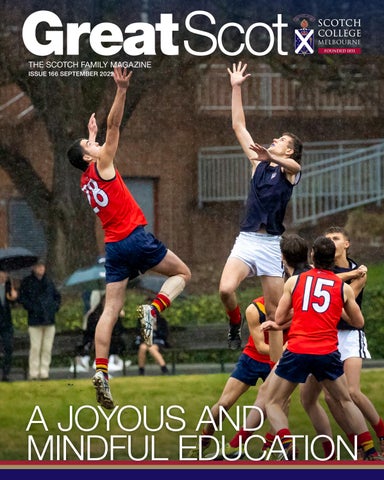
28 FRONT COVER: THE RUCKMEN FLY FOR THE BALL IN THE CORDNER-EGGLESTON CUP. BACK COVER: JUNIOR SCHOOL SUPPORTERS AT THE CORDNER-EGGLESTON CUP.
CORDNER-EGGLESTON CUP A joyous moment for the Scotch and MGS communities
EDITORIAL
Just as in the title of the Middle School Drama production Puffs or Seven Increasingly Eventful Years at a Certain School of Magic and Magic, in this edition of Great Scot, there seems to be a desire to keep a certain pandemic unnamed, as much as possible, mindful of our return to a new norm with shifting paradigms. More than ever, being mindful – in the sense of being aware of the world around you and the role you play within it – constitutes a vital quality in helping our students to untangle the ever-increasing amount of information they are subjected to. Indeed, our Scotch boys are faced with the central paradox that in this digital age of easily accessible data, they need to decipher through material even more carefully in order to become mindful of what truly matters. In 1946, Dr Colin Macdonald Gilray OBE MC (Principal 1934-53) mentioned in the Annual School Report the need ‘to inculcate consideration and respect for others, to guard [boys] against propaganda by training in clear thinking, to convey certain standards of value through the very sharing in the common life of the School, and to promote reverence through regular worship.’
Written in a post-war Australia, Dr Gilray’s awareness of the dangers of misinformation still resonates in a post-lockdown society (not to conflate the two). Undeniably, it is through the common values embedded within the Christian ethos of our School, as well as the activities that tie us together as a family, that our boys will be best equipped to appreciate and assess the world around them. Through these pages, you will be able to read first-hand brilliant accounts of our students’ mindful experiences such as Dion Whitfield and Noah McCaig sharing why National Reconciliation Week is of such importance, Christopher O’Connell recounting his remarkable Public Speaking feats or Euan McLean’s encounter with Director-General of National Intelligence, Andrew Shearer (’83), sharing eye-opening world perspectives. Moreover, after two years of being unable to fully express themselves, it is not only vital to listen to our young ones’ awareness and understanding of society, but also to allow them to do so in good humour. One just needs to walk around the School to quickly observe how joyous their educational experience is. Be it the New Zealand Ski Trip, the 24-Hour Hike, the array of musical concerts, the return of the Tattoo or the Cordner-Eggleston Cup, which adorns the front cover, these experiences combined to help our Scotch boys to look at their lives with a positive mindset. I also note from the Archives section how Graham Whitford’s (’56) sense of humour back in 1956 has pervaded through time and adorns the current Keon-Cohen Dining Hall. Another great example of how a joyous approach contributes to a sense of community and camaraderie that has lasting benefits.
As a result, these anodyne moments also lay the foundations of future engagements within our boys’ communities as leaders and agents of change, such as those shared within these pages from the Scotch Foundation and OSCA. You will read about the extraordinary achievement in securing scholarships in perpetuity for three Indigenous students, as explained by Tim Shearer ('85), as part of the Rioli Family Indigenous Scholarship, the return of the much-loved OSCA Annual Dinner, the Year 12 Mother and Son Breakfast run by OSCA at Kooyong Tennis Club or the many OSCA clubs’ reports. If more proof was needed of how mindful our Scotch Family is, just read the incredible achievements by some of our Old Scotch Boys such as Dr Graeme Lister (’61) who after a career in the lighting industry, now plays guitar around New York jazz joints, or from the Obituaries section, the remarkable legacy of Professor Brian Fowell Buxton AM (’56) whose influence on the development of cardiac surgery, particularly throughout Asia, still lives on. Therefore, hand in hand those notions of being joyous and mindful help define the Scotch spirit: an acute sensitivity to those from the outside world combined with a joyous satisfied mind that nourishes our individual soul and collective aspirations; a harmony we can all aspire to. Briefly, as I take over the editorial role of Great Scot, I would like to thank my predecessor Durga Kamte for her extraordinary devotion over nine years, ensuring that our school magazine is of the highest quality. I hope you enjoy this current edition.
60
70
93
FOUNDATION FUNDRAISING The successful launch of the Rioli Family Indigenous Scholarship
OSCA’S ANNUAL DINNER Australia’s Director-General of National Intelligence as our special guest
THE CARTOONIST VS THE TUCKSHOP Graham Whitford returns to Scotch
CHRISTOPHE TAYLOR EDITOR GREAT SCOT
www.scotch.vic.edu.au Great Scot 1
CHAIRMAN
MR ALEX SLOAN ('71) SCHOOL COUNCIL CHAIRMAN
STRIKING THE RIGHT BALANCE THE LUSH GROUNDS OF SCOTCH. DR SCOTT MARSH AND HIS WIFE ANNA, DAUGHTER STELLA AND SON DENZEL
After 14 years of committed and exemplary service, the Scotch community officially farewelled Principal Tom Batty at a function on Friday 17 June. The occasion, held in the Memorial Hall, provided a very fitting opportunity for many in the community, closely associated with the Batty family, to thank Tom and Lee personally for their devotion to the cause and their unwavering commitment to the welfare of the College. On Monday 20 June, School Council was delighted to be able to announce the appointment of Dr Scott Marsh as Scotch’s 10th Principal, commencing in January 2023. As with any transition of leadership, such as Scotch is about to undertake, there is a judgment to be made as to the qualities required by the incoming leader to meet the challenges that may exist at the particular juncture. In Council’s assessment at the current time and following an extensive stakeholder consultation process, our School is in very good shape but needs to continue to develop and innovate in a rapidly-changing world.
2 Great Scot Issue 166 – September 2022
Scotch requires a leader at this time who will recognise and respect the traditions of the School, which have underpinned its 171-year history, while identifying development opportunities to ensure an educational offering appropriate to equip boys for the environment into which they will emerge. Another way to express this is to say that we seek evolution not revolution. There is a balance to be struck at this time, which respects the critical importance of our Scotch traditions but can find an appropriate context for them as we adapt to the rapidly-changing circumstances of our world. In Dr Marsh, Council is confident we have identified a leader who has the experience, the skills and commitment required at this time. With over 30 years of experience in education, the last six years in a principal role, Scott understands the demands he will face in taking up his new assignment. Interestingly, the enrolment at William Clarke College, his previous employer, at around 1900 students from Prep to Year
12, closely matches the current enrolment at Scotch. Importantly Scott has also had direct experience of a boarding environment, having held the position of Director of Music and Assistant Boarding House Master at The King’s School, Parramatta. Combined with Scott’s highly relevant experience base, there is very clear evidence of an individual who is thoughtful, innovative and flexible in his approach. While tackling his career responsibilities as a teacher through to his role as a principal, Scott has expanded his thought horizons through a Master’s in Education and subsequently a Doctorate of Philosophy in Education. He has developed a vision for education that encourages innovation, independent thought, excellence and a sense of service, along with inclusivity and respect for all members of the community. The third quality I referred to earlier was commitment. Without doubt the role of Principal at Scotch demands a 24/7 mindset in order to deal with the demands placed on the individual. Scott and his wife Anna, daughter Stella and son Denzel, have
committed themselves enthusiastically to taking up residence on campus, to enable Scott to give the role his all. In addition, Denzel has been enrolled into Year 10 at Scotch, commencing in 2023. There is one other quality that Council found compelling, and that is Scott’s lifelong passion for music. Having played with the Sydney Symphony Orchestra, among others, and having his original Bachelor’s degree in Music Education, Scott deeply appreciates what it takes to team together to create a well-orchestrated outcome. This quality shone through strongly during the recruitment process. Council believes we have found an experienced, skilled and committed individual with a strong team orientation. We also believe we have identified someone who, with Council, can strike the right balance as we define and shape the next era in Scotch’s exciting future.
www.scotch.vic.edu.au Great Scot 3
PRINCIPAL
MR ROB MCLAREN ACTING SCHOOL PRINCIPAL
‘IT IS A PLEASURE AND PRIVILEGE TO BE PART OF THE SCOTCH COMMUNITY’ ACTING PRINCIPAL ROB MCLAREN SPEAKS TO GREAT SCOT Following the resignation of Tom Batty and prior to the arrival of Scotch’s tenth Principal, Dr Scott Marsh, Vice Principal Rob McLaren has taken the reins as Acting School Principal. Great Scot Editor, Christophe Taylor, interviewed Mr McLaren, first asking about his career in education.
ABOVE RIGHT: GREAT SCOT EDITOR CHRISTOPHE TAYLOR AND VICE PRINCIPAL ROB MCLAREN
The Scotch Community would be very familiar with you, Rob, but they might not necessarily know about your career in education. Would you mind telling us a bit about the pathway that led you to becoming Acting Principal of Scotch College? My teaching career commenced in 1979 when I was appointed to a teaching position at The Geelong College. After spending six years there, and a short two-year stint at Melbourne Grammar School, Dr Gordon Donaldson appointed me to a Mathematics position at Scotch College, commencing in 1987. I have remained at Scotch since then. Over the years, I have been fortunate to have held a number of senior positions: Head of Year, Head of Middle School, Head of Upper School, and most recently Vice Principal. The gap between the departure of Mr Tom Batty, and the arrival of the tenth Principal of Scotch College, Dr Scott Marsh, has seen me step into the role of Acting Principal for the remainder of the year. Scotch College enjoys a tremendous reputation across Australia and internationally. How would you define the essence of what makes Scotch so special? The elements that go together to make Scotch the special place it is are rich and varied. Scotch College is built on strong foundations. The School’s foundational principle, the inherent dignity of each individual, and its connection with the Presbyterian Church of Victoria, provide the values and traditions on which everything we do is based. There is a strong sense of belonging and community at Scotch. On staff, there is a lovely mix of people who have had long and distinguished careers at the School, who maintain connections to the past and promote the values and traditions of the School, and young staff, who are just starting out on their teaching journeys. The teaching staff is extremely well supported by the
4 Great Scot Issue 166 – September 2022
hard-working and friendly non-teaching staff, all of whom provide great support for the boys and teachers. The Memorial Hall, which can be thought of as the School’s spiritual home, where boys assemble three times a week, reinforces the community aspect of the School, and allows the achievements and successes of the boys to be celebrated in front of the wider School community. The achievements of our boys, whether it be in a sporting event, an Olympiad competition, an exchange program, or in one of the many extension opportunities on offer, on the world’s stage, have certainly enhanced our reputation as a leading educational institution. Over the past few years, the School has been at the forefront of educational initiatives and when responding to societal requirements, the School has had the confidence to initiate change and implement new programs, rather than wait to see what others are doing. Over the years, how have pedagogies and culture changed to allow for students to enjoy their learning experience? Scotch has become a more intimate and outward looking school during my time. There is now greater focus on individual care, the new House and Form structure providing opportunity for each boy to be better known as a learner. Boys have been challenged to take more control of their own lives and think more about their place in the world, seeing diversity as an opportunity to learn from others. An important aspect of this learning is that boys have been given a stronger voice, raising issues that impact on them and other members of the community. Boys now have far greater choice in what they learn. The introduction of electives, which provide staff opportunity to teach their particular area of interest, and allows boys to explore options and find interests and passions, has strengthened the connection each boy has to his learning. As boys have become better known, this has allowed staff to provide each boy with the appropriate level of support and challenge. That teaching and learning has become more individualised, allows boys to enjoy success and become more connected to their learning. Boys also feel more comfortable and confident when confronted with new learning,
as they know they will be appropriately supported as they grapple with the material at hand. The trust that exists between a staff member, who knows that boy as a learner, and the boy, provides the impetus for new learning and taking academic risks. Are there any particular anecdotes or special occasions that personally stand out over the years which you could share with us? By attendance at sporting events, concerts, plays, public speaking and debating competitions over the years, I have been blessed to witness some amazing performances from the boys. It would be unfair to single out one or two examples, but it is certainly the case that the achievements of the boys never cease to amaze me, especially when you consider the breadth of activities in which some of them are involved. After such an illustrious career, what still motivates you every day when arriving within our sanctuary in Hawthorn? Arriving at Scotch each day, I walk into the most beautiful of settings. The grounds and buildings are just beautiful, especially when the sun is glistening off the Main Oval, and are a credit to our Maintenance and Ground staff. Once at school, I become part of a supportive, committed and friendly community. It is a pleasure and a privilege to be part of the Scotch community. We are blessed with an outstanding staff, all of whom are prepared to give of themselves for the benefit of the boys, and the boys are equally appreciative of what the staff provide for them. The interactions that you have with colleagues or boys, many of which you cannot predict, that provide humour, greater insight into the individual’s character and values,
and a stronger sense of belonging, provide new experiences and challenges. The fact that each day is different, and in some ways, unpredictable, is one of the appealing aspects of the role. The classroom environment provides greater opportunity for these interactions to take place, and one of the most enjoyable aspects of the role is being able to interact with boys in a Mathematics class, where, hopefully, I am able to play some part in the development in a boy’s understanding of Mathematics, allowing him to see the intrinsic beauty of the subject. Despite your busy schedule here at Scotch, what are some of your passions or hobbies you like to indulge in during your downtime? When time permits, golf and bridge become the order of the day. Of course, the day must start and finish with a walk in the park with the dog – not really a hobby, more of a requirement, but certainly a time to unwind, relax and switch off. Everyone likes to know people’s favourites, so if you would kindly indulge, could you tell us your most cherished: • Book: East of Eden, and currently thoroughly enjoying Wildland by Evan Osnos • Musician: very much mood dependent (anyone from Bach to Ed Sheeran via Dave Brubeck and Johnny Flynn) • Film: The Castle and The Detectorists (TV) – there are many ways to lead a life • Painter: Joseph Mallord William Turner or Jeffrey Smart (Masters of Light and Stillness) • Sportsperson: Roger Federer How do envisage the future of education at Scotch? The world in which this and future generations, of Scotch boys enter will be totally different to the one we encountered. This generation of students will be confronted with the challenge of diminishing natural resources, climate change, wealth imbalance, and the increase in the global population which will bring with it greater migration, urbanisation and increasing social and cultural diversity. www.scotch.vic.edu.au Great Scot 5
It is important to ensure that we provide the knowledge, skills, attitudes and values that will enable our boys to thrive and shape their world. I believe the tenets of a broad liberal education, allowing boys to explore, find things that they are good at, and then allowing them time to immerse themselves in such activity, will provide them with the ability to take control of their own lives, but also contribute positively within society. Part of this process will be to ensure the learning of each boy is as individualised as possible, that each boy is provided with sufficient opportunities to find and develop those things he finds interesting and is good at, that achievements are celebrated and appropriately affirmed, and that he encounters, and interacts with, people from different backgrounds, cultures and societies.
Finally, which message or words of advice would you like to convey to our current students? You only get one shot at your educational journey. It is important you make the most of your opportunities. I encourage you to try something new, whether it be a new subject or an extracurricular activity, to give 100 per cent effort in all that you undertake, to take a risk, to avail yourself of an opportunity to experience another culture, to read as much as you can to ascertain the world view of others, to find humour in all that you do (the world needs more of it), and at some stage, each day, to take time to linger, whether it be sitting under a tree reading a book, listening to a piece of music, or while doing something else that brings you joy, and let the world wash over you for a brief moment.
CHAPLAIN
TRULY MINDFUL AND JOYOUS REV DOUG CAMPBELL SCHOOL CHAPLAIN
KNOWING GOD’S LOVE AND BEING MINDFUL OF OTHERS IS TRULY LIBERATING On receiving the theme for this edition of Great Scot – ‘A joyous and mindful education’ – I stopped a while and thought it over. While this particular Scotsman actually knows the meaning of ‘joyous’ and even at times has experienced it despite the regular failures of my football and rugby teams, I was a little unsure of the meaning of ‘mindful’. My dictionary initially offered the traditional definition of ‘mindful’ as being an adjective that means to be ‘conscious or aware of something or someone’. However, it also suggested a definition that has become perhaps the dominant one this century – ‘focusing one's awareness on the present moment, especially as part of a therapeutic or meditative technique.’ Being mindful and the promotion and practice of mindfulness has entered every sphere of life from the personal to the corporate world. In a busy and multitasking age where everyday life may feel overwhelming, being mindful offers the individual a means by which to find inner peace and calm, and a way to regain focus in the midst of constant distraction.
6 Great Scot Issue 166 – September 2022
It is unquestionable that people need and desire true rest and renewed focus, especially in our media age. Young people, faced with constant and daily messaging, are particularly vulnerable to electronic distraction and as a result experience the lack of rest and peace. This decline in mental health was exacerbated during lockdown when schooling was held online. Indeed, a recent report from the UK suggested that those students, who had engaged in school-led mindfulness programs to manage feelings and develop resilience, had benefited from the practice. While some students experienced a short-term improvement in perceived wellbeing, thanks to the course, sadly the majority of students had found the whole process boring. Interestingly, the report noted that those who had benefited most from the mindfulness were teachers who experienced a reduction in stress and the feeling of burnout. Like all new programs and techniques, the jury is out. It is noticeable that the newer definition of ‘mindful’ is a subtle but real change from being aware of an external situation or the issues facing other
people to an inner reflection on the self and personal wellbeing. Perhaps we should stop a moment and wonder what we are in danger of losing by simply being mindful of our own selves and our own situations. The use of ‘mindful’ in the Bible appears in significant passages. They are worth considering. In Psalm 8:3-4, we read – ‘When I consider your heavens, the work of your fingers, the moon and the stars, which you have set in place, what is man that you are mindful of him, the son of man that you care for him?’ This passage, which is quoted in the New Testament in the book of Hebrews (2:6), is quite astounding. Compared to the majesty of all creation, which is an expression of God’s own majesty, the position of humans seems so very frail and insignificant. Humans are so inconsequential in comparison, we should be rightly ignored and overlooked. However, God we are told is mindful of us. Instead of dismissing us, God actively remembers us and cares for us. In this context, ‘mindful’ has a compassionately purposeful ring to it. The picture here is of God actively moving towards the object of his memory, and doing so in love and concern. In the midst of the vastness of the universe, God is mindful, not of Himself, nor his angels, but us. In Mary’s Magnificat (Luke 1:46-49), we read – ‘And Mary said: “My soul glorifies the Lord and my spirit rejoices in God my Saviour, for he has been mindful of the humble state of his servant. From now on all generations will call me blessed, for the Mighty One has done great things for me -- holy is his name.”’ Mary offers a hymnic response of praise to the Lord God who had chosen her to carry and give birth to the promised anointed child and future deliverer of God’s people. Mary praises God and comments that instead of choosing any other woman in history, he had chosen her. God had been mindful of her. The Greek word translated ‘mindful’ is the compound verb ἐπιβλέπω and means ‘to notice and pay special attention to’. God had deliberately looked upon this young, teenage woman from a modest and humble home, living in a small, insignificant rural town in the middle of a backwater region of the Roman Empire. The Son of the Most High will be born to this girl whom God has graciously looked upon with interest, care and love. In response to this special attention, Mary responds in wonder and true joy. The pressures of the modern age are perhaps as great as they have ever been. Our students regularly share some of the pressures they are facing. For many, there seems to be no escape from the stresses as they live their lives in the flesh and digitally. They are aware of their need to relax and are open to the possibility
that mindfulness techniques may positively play a part in helping them cope. However, we are as anxious for the young men of Scotch to nurture and develop the ability to see beyond themselves and their own feelings and pressures, and consider the needs and situations of others. In an age that has seen an increase in individualism and isolation, the world needs people with the ability to mindfully focus away from the self. To know God’s love and concern for us and being mindful of others is truly liberating and a source of true and lasting joy. We are a delight to the Almighty and he is eternally mindful of us. As God sees value in us, may our boys grow in wonder and joy in this truth and thus see the innate value of others, and seek to help them in their particular need and experience this joy for themselves.
In the midst of the vastness of the universe, God is mindful, not of Himself, nor his angels, but us.
www.scotch.vic.edu.au Great Scot 7
FEATURES
A FITTING FAREWELL TO TOM ABOVE, RIGHT: FIVE FORMER SCHOOL CAPTAINS PERFORM. LEFT TO RIGHT: JACK FOWLES (2010), WILL DIXON (2020), TOM GOODWIN (2012), NICK BERNARDO (2013), LACHLAN STRATHMORE (2016) BELOW, LEFT, MICHAEL WAUGH PERFORMS HIS SONG FOR A MOMENT, ACCOMPANIED BY JACOB MCGUFFIE
BELOW, SECOND FROM LEFT: NIK TSOURVAKAS (SCHOOL CAPTAIN, 2021) BELOW, SECOND FROM RIGHT: THE HON DR DAVID KEMP AC (’59), FORMER CHAIRMAN OF THE SCHOOL COUNCIL BELOW, RIGHT: MRS LEE BATTY
8 Great Scot
On the photos on this page, many would recognise that contagious smile that epitomises Tom Batty so well and whose legacy, as many mentioned during his last weeks on campus, includes providing Scotch College with a certain humanity and warmth. Despite the cold weather, there was also much warmth to the proceedings that took place on 17 June as characterised by the beautifully lit Memorial Hall that beguiled any guest from the onset. Inside, there was a tremendous sense of camaraderie among the Scotch Family as members of the School Council, staff past and present, OSCA and Foundation members and many other guests were happy to be reunited, with familiar faces all sharing their feelings on the significance of the moment: the departure of a much-respected member of our community. Tom Batty’s farewell cocktail celebration started with great panache thanks to a remarkable rendition of a medley of David Bowie songs by no fewer than five former School Captains:
AND LEE BATTY Nick Bernardo ('13), Will Dixon ('20), Jack Fowles ('10), Tom Goodwin ('12) and Lachlan Strathmore ('16), who belted out the classic tunes, including one of Tom’s favourites, Starman, arranged by Nick Buc (‘99) and conducted with his usual precision by Andrew Hunter (Deputy Director of Music). Then followed speeches from School Council Chairman Mr Alex Sloan (‘71), who thanked Tom and Lee for their years of service to Scotch, followed by the Honourable Dr David Kemp AC (’59), who also thanked the Battys for their devotion to Scotch. He mentioned the many transformations the School underwent in the Batty era, such as buildings and facilities designed with an explicit educational purpose or the changes to the pastoral care of the Scotch student. Rob McLaren (Acting Principal) took the opportunity to express, on behalf of the staff and Scotch community, his gratitude for the many years working alongside Tom. As the Hall was buzzing with many taking opportunities
Great Scot 9
FEATURES 1.
2.
3.
to have a quick chat or share a last drink and best wishes with both Tom and Lee, James Nguyen (’12), known as jqn (his poet moniker), took to the stage to perform a poem he wrote as a tribute to Tom, followed by staff member Michael Waugh, accompanied by guitarist Jacob McGuffie, who sang his song For a Moment. During the evening, many gifts were offered to Tom and Lee: a painting by Angela Kani George depicting the Piltati rock holes of the Pitjantjatjara country, a large totem pole crafted in the Tiwi Islands and a photo-book of Tom’s 14 years at the School, all signs of the affection and gratitude expressed to the Battys over the years, culminating in these last few weeks. And finally, Tom took to the stage to thank everyone in attendance and beyond, paying particular tribute to the staff, teaching and non-teaching, and thanking all those who had worked hard to make the evening so enjoyable. After a few final conversations, with the Scotch community already reminiscing about the Batty years, and with perhaps a hint of melancholy, time had come to say farewell and for guests to leave the glorious Memorial Hall. There were smiles all around, similar in spirit to Tom’s contagious smile, imprinted in our collective memory.
5.
11.
10.
6. 7.
8.
10
9.
1. WILL DIXON (SCHOOL CAPTAIN, 2020) 2. JACK FOWLES (SCHOOL CAPTAIN, 2010) 3. COCKTAIL DRINKS INSIDE MEMORIAL HALL 4. SCHOOL COUNCIL CHAIRMAN, ALEX SLOAN (’71) 5. NICK MARKS (SCHOOL CAPTAIN, 2019) AND TOMMY LIVADARAS (SCHOOL CAPTAIN 2022) 6. SCHOOL COUNCIL CHAIRMAN ALEX SLOAN (’71), FORMER COUNCIL CHAIRMAN DAVID CRAWFORD AO (’61), MRS MAUREEN CRAWFORD, LEE BATTY, TOM BATTY 7. SCOTCH’S DIRECTOR OF SPORT, STUART POWELL, TOM BATTY, STUART’S FIANCEE, ERIN 8. LACHLAN STRATHMORE (SCHOOL CAPTAIN, 2016) 9. MRS ANNE MARIE KEMP, CHARLES KEMP (SCHOOL CAPTAIN, 2011), FORMER COUNCIL CHAIRMAN HON DR DAVID KEMP AC (’59) 10. PETER FINDLAY (SCHOOL CAPTAIN, 1990), SCOTT MONTGOMERY (’85), MRS NATASHA CAMUGLIA, MR JOHN CAMUGLIA 11. JAMES NGUYEN (’12) 12. FORMER SCOTCH STAFF MEMBER CHRIS HAYES, TOM BATTY, FORMER SCOTCH VICE PRINCIPAL, IAN SAVAGE
4.
MR BATTY LEAVES THE STAGE..
12.
www.scotch.vic.edu.au Great Scot 11
FEATURES
TOM BATTY’S FINAL ASSEMBLY: THE BATON IS PASSED On 22 June, students gathered for a very special event in the life of the School: the final Assembly of Scotch College’s ninth Principal, Tom Batty. After our pipers led and escorted Tom and Lee Batty into the Memorial Hall, the College Anthem was sung followed by the School Chaplain, Doug Campbell, leading the congregation into the Prayer of Thanksgiving. Tom then delivered his farewell address to the boys, with an emphasis on reminding them that it is their School and for them to make the most of the opportunities offered. Students made some presentations, with Sam Price (Year 6) speaking on behalf of the Junior School and offering two Preps books to Tom and flowers to Lee. School Vice Captain Leon Fei then addressed the Assembly on behalf of the Senior School and offered a book to Tom as Euan Maclean (Year 12) offered more flowers to Lee. The torch, depicted on the School’s coat of arms, represents many values including learning, enlightenment and renewal. The Centenary Torch, originally used in the School’s centenary relay in 1951, has passed through the hands of generations of boys and staff. The flame is a symbol of the eternal Scotch spirit that resides in all those who depart; it is like a baton changing hands between the generations. It represents change but it also symbolises the values instilled at Scotch and hopefully retained forever by the departing boy or teacher. Tom first held this torch at his installation in the Chapel on 14 July 2008. Fourteen years later, Dion Whitfield (Year 12) lit the torch and passed it to Tom Batty, who held it for a final time, before it was passed on to James Gregory (Year 6) and extinguished to await the arrival of the tenth Principal, Dr Scott Marsh. To conclude, everyone sang Loch Lomond before our Chaplain gave a final Prayer of Farewell and Benediction. After a few final remarks, Tom Batty left the Memorial Hall echoing with the sound of The Clash’s London Calling, played from his own device, a final reminder of his personal touch and perhaps a happy reminder of future endeavours and possible encounters in the Northern Hemisphere.
12 Great Scot
www.scotch.vic.edu.au Great Scot 13
FEATURES
NATIONAL RECONCILIATION WEEK: REFLECTION AND EXPLORATION TWO INDIGENOUS STUDENTS INTERVIEWED DURING ASSEMBLY For Aboriginal and Torres Strait Islander peoples, Australia’s colonial history is characterised by devastating land dispossession, violence and ongoing racism. National Reconciliation Week (NRW) is a time for all Australians to learn about our shared histories, cultures and achievements and to explore how each of us can contribute to achieving reconciliation. A reconciled Australia would see Aboriginal and Torres Strait Islander children have the same life quality, chances and choices as non-Indigenous children. At a Memorial Hall Assembly during NRW, two of our Indigenous students, Dion Whitfield and Noah McCaig, both of Year 12, shared a conversation with me. I asked
14 Great Scot Issue 166 – September 2022
DION WHITFIELD (LEFT) AND NOAH MCCAIG
the boys about where they are from, and highlighted, in our very multicultural society, how lucky we are to engage with the oldest living continuous culture in the world, that of Indigenous Australians. The significance of the land on which our School is now built was discussed, as well as the importance of Welcome to or Acknowledgement of Country. NICK CLARK – SENIOR SCHOOL PSYCHOLOGIST & TEACHER IN-CHARGE OF THE INDIGENOUS PARTNERSHIP PROGRAM
‘BE BRAVE, MAKE CHANGE AND TAKE MEANINGFUL STEPS’ Reconciliation is about strengthening relationships between us as Aboriginal and Torres Strait Islander peoples and nonIndigenous peoples, for the benefit of all Australians.
In 2022, the theme for National Reconciliation Week (27 May-3 June) was ‘Be Brave. Make Change’ – a challenge to all of us to Be Brave and tackle the unfinished business of reconciliation so we can Make Change for all. Having said that, what can we do as individuals and members of the Scotch community to create a more just, equitable and reconciled Australia? Know that we all have a role to play when it comes to reconciliation, and in playing our part, we collectively build relationships and communities that value Aboriginal and Torres Strait Islander peoples, histories, cultures, and futures. It is clear that we have to listen to and give a voice to Aboriginal people. This includes upholding the ancient customs, traditions and ways of life that have ensured Aboriginal peoples’ survival on this continent for over 60,000 years. For example, the Acknowledgement of Country is an opportunity for everyone to show respect for traditional owners and the continuing connection of Aboriginal and Torres Strait Islander peoples to country – it establishes a respectful relationship, which is the first step towards reconciliation. Moreover, there are also sustainable land use practices that we can all benefit from. Australia’s Indigenous community cared for country by using land management that worked with the environment. When Europeans arrived, they brought farming practices suited to an environment very different to Australia, that in the long term caused erosion and salinity. Nowadays there is growing adoption of these practices to repair the damage done by European farming. One such example is the use of traditional Aboriginal fire management, where selecting what areas to burn, when, and how often, is part of Indigenous knowledge of the land – something that has ensured the survival of Aboriginal people on this continent for over 60,000 years. So we invite you to Be Brave, Make Change and take meaningful steps towards reconciliation for our community. NOAH MCCAIG AND DION WHITFIELD – BOTH YEAR 12
THE 24 HOUR HIKE: A MOST ENJOYABLE ENDEAVOUR SORE FEET, HIPS AND KNEES, BUT GREAT MEMORIES
SHARED EXPERIENCE IS WHAT IT’S ALL ABOUT
As my second attempt at the 24 Hour Hike, I knew what was in store: sore feet, sore hips and knees, sustained lack of sleep, and probably hardest of all, minimal mental transition time to process the end of a school day and the commencement of this extraordinary endeavour. The stages and sections have now blurred into each other so long after the event, but two strong memories remain. First, walking a brisk couple of extra kilometres around 2am on some flat, seemingly interminable road – we had turned off our head torches to appreciate the moonlight and consequently did not see the reflective glare as we marched straight on past the marker designating the turn off. Second, walking straight past – in broad daylight – the left-hand turn about an hour after sunrise and subsequently adding about four (credit-less) kilometres to our total. This matutinal blunder was more perturbing than its nocturnal forbear, since when we returned to the actual turn-off (thanks to the trusty blue dot on Emma’s phone) there was the road, clearly marked, winding off to the left with very obvious signage. The mind boggles – well, definitely when it has not slept – and I suppose this is just evidence of the ineffective nature of human perception in a semi-somnolent state. Notwithstanding the irritation of walking bootless kilometres which would not be recognised in our total, the 24 Hour Hike was once again a most enjoyable endeavour; the glorious 100km benchmark again proved elusive, somewhat closer than in 2021, but ultimately still out of reach. It still stands in my perception, beckoning, mirage-like, but hopefully one day attainable.
The 24-Hour Hike challenges boys both physically and mentally. Year after year, boys scramble in their applications to be one of the 120 participants in the hike. The incredible challenge has stood the test of time, as it continues to be one of the most enjoyed Scotch traditions. I am one of those boys who gets drawn back to it every year. It never sounds appealing: 24 hours straight, through sore legs and heavy eyelids, and yet I returned to the hike this year for the third time. I think the hike’s success lies in the experience shared with the friends walking beside you. However far you walk, there is always someone to have a chat to or spur you on to the next checkpoint. A tight race up the front saw eight boys clear the 100 kilometre mark. However, all the boys participating this year rallied together and raised $55,541.59 to support impoverished people in India. This is a brilliant representation of the team effort brought to this loved Scotch event. OLLO COATES – YEAR 11
ALICE KEMP – SENIOR SCHOOL STAFF
15
JUNIOR SCHOOL
MR TOM SAVILL HEAD OF JUNIOR SCHOOL
MIRROR, MIRROR ON THE WALL – AM I THE FAIREST OF THEM ALL? JUNIOR SCHOOL BOYS’ MULTIPLE MOMENTS OF MINDFULNESS
16 Great Scot Issue 166 – September 2022
Mindfulness is a term that has permeated society in recent times. It is a concept and practice that schools throughout the world have engaged with, linked curriculum related activities to and embedded within the school day. In its simplest form, ‘mindfulness’ can be considered as an individual being conscious and accepting of their present state. If achieved, it becomes a valuable and rewarding endeavour. Each week, boys in the Junior School enjoy and engage in multiple moments of mindfulness, helping them better understand their present state and supporting them with their own individual growth journeys. While many educational institutions have taken steps to explicitly reference and draw attention to ‘mindfulness’ in their timetables (e.g., at events or within their lesson planning), this is not an approach that the Junior School feels it has needed to take. In the Junior School, mindful opportunity is more subtly woven into everyday elements of our boys’ daily experience. At Scotch we are very much cognisant of the benefits of ‘mindful’ moments, regularly reflecting on such opportunity for the boys (and staff). This is particularly the case when focused on the boys’ learning. Mindfulness could be considered as looking into a mirror, effectively reflecting on oneself. Helping the boys look into a mirror and reflect on their current state has enormous benefits for learning and social/ emotional regulation. However, there can be some challenges associated with such efforts. When looking in the mirror at ourselves, we sometimes descend into a comparative mindset and look for fault. We may ask ‘Am I the fairest of them all?’. We can often reflect on the negative first before looking at the positive. Effective mindfulness activities can help shift this narrative, promoting the positive. While much of the narrative relating to mindfulness might often be interpreted as stepping away from challenge, I believe it is an active reflective process which can benefit boys during moments of challenge. The boys of the Junior School understand the importance of reflective practice in their learning and
throughout their time at school. For instance, they learn the benefit of re-reading and editing their work. The simple act of re-reading helps put them in the moment, or present, and gives them an opportunity to process what they have written. On the pastoral front, Junior School boys often engage in activities which focus on relationship building. Occasionally, relationships break down and restorative conversation, assisted by teachers, can help the boys reflect on the moment and uplift themselves individually while also repairing the relationship itself. Each of these reflective endeavours can, I believe, be considered as a moment of mindfulness. These moments exist when boys are considering their present state, improving awareness and engaging with their feelings, meeting challenges and moving forward. Within the Junior School the boys spend time understanding the challenges associated with their learning. Often, we reference how difficult it is to begin a new learning journey and step outside of one’s comfort zone. Normalising such struggle helps boys in
moments of reflection. When they look into the mirror at such a moment, we would hope they recognise that it is normal to find the task difficult and that they might ask the mirror ‘Am I doing my best? ’ or ‘What can I do next to help myself?’. Rather than focusing on a comparison with others (‘Am I the fairest of them all?’), we encourage the boys to analyse their own individual progress and celebrate all gains, however small they might be at the time. These small moments of ‘mindfulness’ accumulate to contribute to a greater feeling of self-belief and resilience. Primary-aged students require concrete, explicit and tangible activity to help cement their understanding. Their engagement in prayer and hymn singing during Assemblies is a prime example of more palpable mindful enterprise. However, one could argue that the small, regular and accumulative mindful elements engaged in each day will also have a profound impact on each individual over time.
www.scotch.vic.edu.au Great Scot 17
JUNIOR SCHOOL
Interview:
AMY ROGERS HEAD OF LIBRARY Amy commenced her teaching career in 2002 in Christchurch, New Zealand. She taught for two years before moving to the United Kingdom. It wasn’t long before she was given the opportunity to teach at Orchard House School in Chiswick, London. From classroom to the sport field, Amy moved to Notting Hill as a PE teacher before she returned to New Zealand. Amy then found her calling in boys’ education in 2008, working at Medbury Independent School in Christchurch. Amy’s love of travel and adventure resulted in a move to Melbourne. Through 2010 Amy worked as an Emergency Teacher here at Scotch, primarily in Prep and also the Library. Amy was energetic, adaptable and capable; a perfect fit for Scotch. Her value was recognised in 2011 with a full-time ongoing teaching position. Amy taught in Prep, Grade 2, and Grade 1. After maternity leave and two beautiful children, she progressed from part-time teaching in the Library to the Head of Library role in 2018. Amy has overseen a total refurbishment of the Harbig Library and brought effervescent life to library programs and classes. Students respond readily to her humorous anecdotes and reviews. Amy’s genuine love of literature and her infectious
18 Great Scot Issue 166 – September 2022
enthusiasm have encouraged a significant increase in borrowing. It’s a pleasure to work with Amy; her passion for books, golf and fashion make her a popular and vital part of the Junior School. DEBORAH PARKINSON – LIBRARIAN After all these years of service to Scotch, what is your favourite corner of the School and why? My favourite corner of the School is the Junior School library space. Every day I come to work, I feel blessed to have the best view in the School, looking out over the grounds all the way to the CBD. It is my dream work space and my dream job. What advice would you give our VCE students as they embark on a life outside Scotch? The advice I would give VCE students as they embark on life outside Scotch would be to travel and seek out as many life experiences as possible. My years overseas were full of crazy adventures in Nepal, India, rafting into Alaska, travelling around Europe, living in Turkey and so many other opportunities which shape how you see the world and how other cultures live. The privilege of being able to experience these things when you are young and curious is truly life-changing.
What do you like about your job? As Head of the Junior School Library I love building relationships with all the students from Prep to Year 6 and also the opportunity to work closely with staff to support them with high-quality literature for their classroom programs. Reading has been a passion of mine from an early age, and being surrounded by books is a dream come true. The Junior School boys have such a passion for literature, and the opportunity to go on their reading journeys and foster their interests is a privilege. Also being part of such a fantastic Junior School staff makes coming to work every day a joy. The laughter, teamwork and fun we all have together is wonderful. What has been your biggest challenge over your years at Scotch? The biggest challenge has been, like all teachers, switching to a remote learning style of teaching and juggling the pressures of a small house and young family at home during those times. It was challenging but really rewarding, organising and running a Literature Festival online. The parents and siblings were able to share in the enjoyment of the author/illustrator workshops, along with the boys, and it ended up being a wonderful experience during the limited experiences available during COVID. I was lucky that I had a subject area that easily lent itself to remote learning.
CANBERRA 2022 CAMP – ‘A PHENOMENAL EXPERIENCE’
YEAR 6 BOYS REFLECT ON THEIR SCHOOL CAMP TRIP TO CANBERRA – 6 TO 9 JUNE VISITING FAMOUS SITES During our school camp trip to Canberra, we visited many famous sites which included Parliament House. This was one of the highlights during our trip to Canberra. One of the many remarkable things we got to experience while in Parliament House was passing a bill. During our simulation of passing a bill, we had certain people play different roles. One boy was Prime Minister, while others were Deputy Prime Minister, Speaker, Leader of the Opposition, Shadow Ministers, government backbenchers, opposition backbenchers and the Serjeant-at-Arms. One of the most significant items in the House of Representatives is the Mace, the tip of which always points towards the government side. In the end we got to act out the whole process of passing a bill. WILLIAM NGUYEN and YUSUF MOHAMMED
PARLIAMENT HOUSE This experience was like no other. The boys got to have a try at what being in parliament is really like. It was exciting and fun as we debated against each other. The topic was ‘Should the government make Wi-Fi free on public transport?’ The debate was intense, with many good points. We pretended that we were actually in the House of Representatives. We learned how a bill is passed and how to address the speaker. WINSTON CHEN and JAMES LUK
THE MUSEUM OF AUSTRALIAN DEMOCRACY AT PARLIAMENT HOUSE We walked into the lavish, rich green room, staring at the black rod. Questions emerged about our government’s complex history. We sat on kingly furniture, which once held politicians of great
status. There, equidistant from both sides of the house, was a decades-old throne, decorated with the British coat of arms. This emblem contained a majestic unicorn and a regal lion. We were captivated by the history and beauty bound in this room; It truly was a wonderful experience! THOMAS DOAN and AARON SHEN
VISITING CANBERRA Canberra was a great experience for all of the Year 6 boys. One of the key experiences was touring the inside of Parliament House. Parliament House taught us how the inside of the Senate and the House of Representatives work. After seeing the Upper and Lower Houses in person, we practised debating against each other. Many of us sat on the government benches, some sat with the opposition, and a couple sat as individuals. We both sat on the opposition side, and we both agreed that we put up a good argument, and rejected the new bill that debated the value of free Wi-Fi on public transport. Overall, Parliament House was a joyful experience that we will both remember. KEVIN SUI and JUN GARDINER
PRIME MINISTER FOR A DAY The definite highlight of my Canberra was the tour of Parliament House. When we entered, I was immediately shocked at the sheer size of it. After strict airport security-like checks we entered the building. The architecture was neo-Greek with floor to ceiling. After ascending a marble staircase we got to the maze-like second floor. We journeyed through to a room where we found the golden mace situated on the table, which is a symbol of order. We had to pick a
www.scotch.vic.edu.au Great Scot 19
JUNIOR SCHOOL
Prime Minister and much to my joy I was chosen. Then we had to simulate a debate on a tax on sugar. It was great fun and I would most definitely have this joyful and educational experience again. I might even aim for Parliament when I am a big. YEVAN NAVARATNE
AT THE AUSTRALIAN WAR MEMORIAL One very significant event on the Canberra trip for Year 6 was the visit to the Australian War Memorial. At the memorial, the students learnt important lessons about multiple wars, especially World War I and World War II. We were also taught about what life was like for soldiers in the trenches and stories about certain soldiers, and some dogs who fought in wars. We visited the roll of honour and were taught about some significant soldiers and entered the tomb of the unknown Australian soldier and reflected on the many soldiers from
wars who will always be remembered. DECLAN COGLEY
A PHENOMENAL EXPERIENCE The Canberra trip, which was a phenomenal experience for all the boys in Year 6, was filled with educational experiences ranging from Questacon to the Parliament House. The boys had a spectacular time staying with their friends and embracing the beautiful scenery of Canberra. They learnt a lot of things such as the history of coins, the Australian Government, the two great wars, and the history of our capital city, Canberra. We both learnt a lot about Australian history and how our government is run. We had a joyous and mindful experience by getting educated at Parliament House and having an enjoyable time at Questacon. We also really liked the National Dinosaur Museum and the enthusiastic paleontologists. LUCAS LEE and WILLIAM WANG
GROWTH OF SCOTCH BOYS
ACKNOWLEDGING AND REINFORCING OUR BOYS’ RELATIONSHIPS The Junior School teaching and nonteaching staff created a variety of enquiry opportunities for our boys to challenge male stereotypes. The classroom and specialist teachers worked in collaboration to create moments for our boys to acutely critique what they view, what they read, and of course what they do as boys. Curriculum and co-curriculum activities were unified around the skills needed to fortify the boys’ character development, as well as identifying their families’ values and ideas around masculinity. A leading feature of our approach was acknowledging and reinforcing the caring
20 Great Scot
and positive relationships that our boys already foster with each other, their teachers, their families and the wider community. The work with the Junior School boys was informed by the Victorian Department of Education’s Resilience Rights and Respectful Relationships Program. It served as a catalyst to educate and skill the boys in the development of respectful relationships, and to critique their own behaviours, perceptions and stereotypes. TREMAINE PAVLOVSKI – COORDINATOR, GROWTH OF SCOTCH BOYS, JUNIOR SCHOOL
MIDDLE SCHOOL
MS KATRINA STALKER HEAD OF MIDDLE SCHOOL
HORIZONS WIDEN FOR OUR MIDDLE SCHOOL BOYS
BOYS PRESENT CONFIDENTLY TO THEIR PEERS MATTHEW CHEN AND LUCA PELOSI – YEAR 7
In Year 8, our boys have the opportunity to broaden their horizons and to explore all that is on offer at school while they have the time in their schedules to do so. There were opportunities for exploration within the Extension Studies Program, the Year 8 Big Ideas Lectures and within each form as they each presented a topic of their own choosing to the Year 8 cohort. At the time of writing, three of the forms had presented. The boys of Form 8TG presented first on the topic of polar explorer Ernest Shackleton, recounting the amazing journey of survival he led in one of the harshest environments on Earth. The bravery, teamwork, skill, resilience and leadership shown by Shackleton and his team were explored. The audience was encouraged to be in awe of the character shown by the group of men and to take inspiration from the story. The boys of Form 8AH retold the story of the Thailand cave rescue, where young boys from a soccer team became stranded when torrential rain trapped them deep within a cave system. Form 8AH boys explored the selflessness, bravery and teamwork of the rescuers, posing the question: ‘would you put yourself in danger to save someone else?’ The boys of Form 8OM explored the nuclear plant meltdown at Chernobyl. Their presentation was based on the Cold War and the nuclear race. It included why the meltdown happened, the effects of nuclear radiation and how the local people had to rapidly escape, as they became displaced from their homes as refugees. They asked the audience to imagine what it would be like to be suddenly removed from your home, leaving your possessions and your life behind and never being able to return. All boys in each form contributed to the presentations. They put the information into a
PowerPoint format, prepared their speeches well and presented confidently to their peers. Each presentation was excellent and very well received by the cohort. As well as broadening the boys’ knowledge of the world in which they live, the program aims to encourage cooperation and teamwork and to build confidence in preparing and delivering presentations. The Year 8 presentations work in conjunction with the Big Ideas Lectures, the latest of which was on sexuality, with a focus on respect and consent. The question was posed to the boys: ‘How can you be a positive force in your social circles to promote ideas of respect and understanding around sexuality?’ The boys were encouraged to be mindful of the School’s foundational statement of respecting the inherent value of the individual. This lecture was delivered by a Police Liaison Officer, whose message was to be respectful when the boys participated in any online forum. In Term 3, Matthew Chen won the Year 7 Declamation Competition in a tightly contested event, with Luca Pelosi a close second. All the boys delivered interesting speeches. The topics ranged from political to environmental issues, drawing inspiration from famous people such as Martin Luther King, Muhammad Ali, Julia Gillard and Solli Raphael (We Can Be More). They were well delivered and thoughtprovoking speeches for which the boys deserve high praise. The Year 8s also made excellent speeches, with Samuel Ek achieving first place, narrowly from Arjun Khurana. Watching each boy’s presentation and seeing their peers listen and engage during the program has demonstrated the boys’ awareness of a wide range of issues and their growing ability to present confidently to their peers. www.scotch.vic.edu.au Great Scot 21
UPPER SCHOOL
MR TIM RAYNER HEAD OF UPPER SCHOOL
CHOOSING AN EDUCATIONAL PATHWAY While I would not say that every boy in the School welcomed the return of Semester Examinations in June, it was evident that a great many boys rose to the challenge and did their best. A testament, perhaps, of the perseverance and willingness to put the COVID years behind them. With Year 11 having examinations covering six days, and Years 9 and 10 having examinations covering four days, it is a time when all parties need to be focused and organised. Organising a schedule, writing papers, and supervising over 700 boys, after a two-year hiatus, was a challenge. Mr Woolacott, Dean of Studies, was front and centre in ensuring the whole experience worked like clockwork, but the boys did their part too; arriving on time and following our expectations to the letter. Our Centre for Learning (CFL) also played an important role in supporting boys. Without the care and diligence of our CFL staff, led by Ms Herbert, many boys would not get the opportunity to perform on a level playing field. Such experiences, for teachers and boys alike, make the holidays that little more fulfilling and enjoyable! Another certainty of school life is subject selection, and having the opportunity to choose an educational pathway is extremely important. Semester 2 brings opportunities for boys to select their subjects of interest and find a pathway that could lead to a university course or occupation. Being a big school does bring certain advantages in regards to the large suite of subjects we can offer. In Years 9 and 10, the choice of elective subjects is very broad, from Robotics to Philosophy, Renaissance and Reformation to Environmental Science – there really are lots of subjects to choose from, and boys are encouraged to explore subjects that take their fancy. It also means boys are exposed to a variety of teachers, with differing teaching styles, as well as working with boys they may never have spoken to before. This broadening of experiences is beneficial for future learning as it builds resilience and flexibility. Of course, our curriculum dictates that we have a core number of subjects that all boys have to study. In Years 9-10 all boys have to study English, Mathematics, a language, and History, as well
22 Great Scot Issue 166 – September 2022
SEMESTER 2 BRINGS OPPORTUNITIES FOR BOYS TO SELECT THEIR SUBJECTS OF INTEREST
as Christian Education and Physical Education. The latter two subjects are a School requirement throughout a boy’s time at Scotch. Again, due to the fact we are a large school that values languages, we offer boys the choice of Indonesian, Chinese, French, German and Italian. In fact, 31 per cent of Year 12 boys studied a VCE language at Scotch last year. At Victorian Certificate of Education (VCE) level, a requirement when choosing subjects is that one subject has to be an English subject, which includes English, Literature, English as an additional Language (EAL) and English Language. No wonder getting the right advice from teachers and Careers practitioners is important – there are so many choices, but also the broader requirements for studying at VCE level do need explaining, which is why we put a good deal of time into providing information to families and boys. We encourage boys to select subjects they enjoy, but also to select subjects they find both challenging and interesting. If they do that, then they are at least on the road to doing their best, and that’s as much as we can ask.
NEWS
GREAT SKIING AND WONDERFUL CAMARADERIE
THE 2022 SCOTCH NEW ZEALAND SKI TRIP WAS AN EXHILARATING SKIING AND BONDING EXPERIENCE Nearing the conclusion of the Term 2 holidays, myself and 30 other boys from Years 9-12 indulged in a snow trip to New Zealand that can only be described as extraordinary. Even with the outrageous 2am wake-up and trek down to the Tullamarine airport, it was clear all of us were eager to get to New Zealand and hit the snow, especially considering quite a few of us had not been to the snow in a few years. It was immediately apparent when we landed in the new country how gorgeous it was. There were picture-perfect sights surrounding us in every direction, and it was impossible for us not to get out our phones and snap some pictures to send to our friends and families at home – not to make them jealous or anything. These splendid views were not a rarity on this trip, as almost everywhere we went, we were met with dazzling sights and spectacles. The first day, of course, was just us getting comfortable in the surprisingly comfy lodges that we would be staying in for the week. The tour guides for the trip
were incredibly efficient in guiding us to our destinations as well, the first of which was Queenstown itself. We all got ourselves acquainted to the town we would be staying in for a week by walking through its lively streets and visiting its interesting shops, which may or may not have included KFC for most of us. A main highlight for most of the boys, I’m sure, was the luge, which we undertook next. What an experience. The gondola ride up beforehand was amazing, too, but all that was going through our heads as we zipped down the narrow tracks was how awesome the luge ride was, even if our hands did almost freeze off. Now for the main event – the five action-packed days on the slopes. The first two took place on the Remarkables, while the final three were on Coronet Peak. The atmosphere on both mountains was indescribable: beautiful views and powdery snow in every direction. Thanks to the incredibly skilled instructors, and of course the teachers at
our aid, getting back into the swing of things was quick, and soon we were all bossing the slopes and having the times of our lives. Coming off four years void of skiing, I myself was quite rusty compared to a lot of my talented peers, but another great thing about this trip was the opportunities for camaraderie that sparked out on the slopes. My friend Morgan and everyone else in my group greatly helped me get better, and ski and build confidence when skiing on some of the harder runs, which I am sure occurred in many of the other groups. Whether it was the exhilarating jet boat ride that happened on the fourth day, or the night time riding that gave off an even more tranquil vibe than skiing in the day, moments of bonding among the groups were always occurring throughout the trip. Thanks to all of this I can confidently say the 2022 Scotch New Zealand trip is my favourite experience at Scotch to date, and I cannot recommend it enough. SUREN JAYASEKERA – YEAR 10
www.scotch.vic.edu.au Great Scot 23
NEWS
YEAR 9 OUTDOOR EXPEDITION CAMP: CHALLENGING BUT REWARDING
The first camp of the year is always a big challenge, especially when you have spent the past two years in lockdown. The Year 9 Outdoor Expedition camp (6-8 April) was no exception. After two months of preparation in which we learnt how to set up a tent, cook in a Trangia stove and swim while fully clothed, along with other necessary camping knowledge, everyone was excited. On the first day, the bus dropped us off at Cape Otway. With a 5.3km hike ahead of
us, we had to make haste, yet despite the elements being against us, we managed to make it to the campsite with enough time to set everything up for our first night; and after a questionable night’s sleep and a quick breakfast, we were off again. The second day started with an unmistakably beautiful hike along some of the Great Ocean Walk’s most scenic locations, starting with spectacular ocean views and ending at the mouth of the 148km-long Aire River.
The weather couldn’t have been nicer for the final night. The moon was bright, and the wind had died down, so after some lovely supper and majestic music provided by Monsieur Marquet, we were off to sleep. The following day concluded our hike in incredible fashion, as a sunrise cruise on inflatable canoes tested our muscles. After that we almost all fell asleep on the four-hour bus ride back home, after an unforgettable trip with a fantastic group. WILLIAM HAYWOOD – YEAR 9
SCOUT ADVENTURE CAMP – TEAMWORK, RESILIENCE AND MATESHIP The Scout Adventure Camp was a muchneeded break from the monotony of the pandemic. All the boys got out in nature and I think that they all enjoyed the fresh air. Not only were the grounds of the Elliott Lodge facility near Healesville beautiful, but we also experienced independence and leadership. Through many activities that involved teamwork and resilience, not to mention the Scout skills such as knotwork and cooking, we all formed bonds of mateship. This culminated in a giant rope bridge which the Year 7 and 8 Scouts built over the creek. All new Scouts then crossed the bridge in a symbolic act that evening as a part of their investiture to Scouts. This was followed by a most enjoyable bonfire. The next Scout camp at the end of Term 3 is something I’m really looking forward to! MATTHEW CHEN – YEAR 7
24 Great Scot Issue 166 – September 2022
AN EXCURSION INTO THE DARK UNDERBELLY OF MELBOURNE Relating to our current unit of study, Crime and Punishment, we began a walking tour to learn about the notorious Melbourne gangs of the early 1900s and to hear the stories of John ‘Snowy’ Cutmore and Leslie ‘Squizzy’ Taylor, including their final epic showdown, where they confronted each other, as Cutmore was lying ill in bed, in a vicious shootout.
EXCELLENT OzCLO OUTCOMES AT STATE AND NATIONAL LEVELS
After this, we explored the Old Melbourne Gaol, where the highlight for most was to learn about the stories of many prisoners and their inevitable journey to the gallows, including Ned Kelly. Additionally, we were locked in an old cell without lights or a window to experience the harsh environment criminals encountered – most likely to encourage us to not follow in their footsteps!
Scotch’s team of Alex Truong, Leonardo Wang, Zian Shang and Daniel Zou (all of Year 11) participated in OzCLO, the Australian Computational and Linguistics Olympiad, and in the state round we qualified to proceed to the national round by coming third in Victoria. This was the third time our team has participated in OzCLO. After qualifying, we then sat the national round at the University of Melbourne and competed along with all the other Victorian teams. It was a fun and valuable experience in which we met many likeminded people, and received a bronze medal. The Olympiad features difficult problems set in a wide variety of languages from
AN EXHIBIT IN THE OLD MELBOURNE GAOL
SAM STEELE – YEAR 9
around the world. Students are required to use logic and creativity to understand and solve problems about real life languages, sometimes spoken by only a few hundred or thousand speakers. The appeal of linguistics lies in both the challenging problem-solving and the fun of deciphering and learning the workings of a new language. The questions always cover a vast variety of cultures and languages, whether they are based around a native language or from a community in an entirely different part of the world. OzCLO opens the doors to just a few of the countless languages that the world has to offer. DANIEL ZOU – YEAR 11
SPIRITED, RESPECTFUL AND ENJOYABLE CHESS On the first Wednesday of Term 3, chess players from the Melbourne University Chess Club made their way to our very own atrium at the centre of the Lithgow Building to engage in an inaugural competition. Each sat poised at their boards – eight esteemed Melbourne University chess players dressed in university colours – ready to take on any of the 20-30 Scotch boys (or even staff members) who fancied their chances. It was a fantastic event! Throughout lunchtime, the building was
filled with the clatter of chess pieces carrying the hopes and strategies of players seeking to outsmart their opponents. There was much laughter and a great sense of satisfaction. While some Scotch boys tasted victory, our more experienced tertiary opponents overall had the better of us on the day. It was nevertheless a brilliant opportunity for Scotch students to meet and compete against players from the university chess club. Competition was spirited, respectful and above all – thoroughly enjoyable. The Scotch Chess
Committee sees great value in this initiative and hopes to make the Scotch-Melbourne University Chess Tournament an annual event, open to chess players at all levels. CHRISTOPHER LIM – YEAR 10
www.scotch.vic.edu.au Great Scot 25
NEWS
PROJECT COORDINATOR, ROTARY CLUB OF BALWYN, MR BRIAN MATHIESON, WITH RONAN AHL - YEAR 11
CHRISTOPHER O'CONNELL OF YEAR 11 WITH THE CHAIR OF THE ROTARY CLUB OF RICHMOND'S AINGER PECK AWARD, MR BEN HOSKING ('57)
‘THROW YOUR HAT IN THE RING AND TRY PUBLIC SPEAKING’ In these articles, two Year 11 Scotch boys – Christopher O’Connell and Ronan Ahl – outline what they love about Public Speaking. Christopher describes it as ‘the ability to speak clearly and concisely … to articulate your ideas with a definable message’; while to Ronan it is ‘an art which allows people (…) to turn our voice into something bigger’. Both boys have excelled in a variety of Public Speaking competitions and as the articles reveal, they enjoy and greatly benefit from the opportunities this activity provides for them. Ronan has a message for all Scotch boys: ‘I encourage you to throw your hat in the ring and try Public Speaking’.
Nonetheless, it was an incredible experience. I conversed with fellow students from many countries, including Canada, China, India, Greece and the USA. I enjoyed debating, as well as the Impromptu Speaking category, in which contestants presented a five-minute speech with no notes after two minutes of preparation. I made it to the finals after giving speeches about stoicism, the origin of the potato chip and addressing a fake audience of McDonald’s shareholders. I was grateful to be placed second in the After Dinner Speaking category and 18th overall in the world.
LOCAL, NATIONAL AND INTERNATIONAL ACHIEVEMENTS
THE BEAUTY AND POWER OF PUBLIC SPEAKING
Public Speaking equips you with lifelong skills – the ability to speak clearly and concisely, to consider what would be most interesting and persuasive to your audience and to articulate your ideas with a definable message. This year I was fortunate to progress to the finals in several competitions, which was very rewarding. A highlight was the Australian Individual Debating and Public Speaking Championship, where I was placed fifth nationally and qualified for the Australian team in the world championship. Other interesting competitions included the Victorian Curriculum and Assessment Authority’s Plain English Speaking Award, for which students use simple language exclusively, and the Ainger Peck Award, which emphasises the presentation of a speech above the content itself. I am also grateful to have participated in and won the Year 11 House Public Speaking Competition. I have enjoyed being involved in Scotch’s Public Speaking program and am grateful for the opportunities it has provided me and so many other students. The World Individual Debating and Public Speaking Championship comprises four categories: Debating, Impromptu Speaking, After Dinner or Persuasive Speaking, and Interpretive Reading. One hundred and fifty high school students from across the globe represented their nations in this event. I was grateful to be selected as one of 10 Australian team members after my fifth place in the national competition. We would have travelled to Toronto, Canada, however due to travel restrictions the competition was conducted online.
Public Speaking is an art which allows people – like you and me – to turn our voices into something bigger. It allows us to influence, and be influenced, to inspire, and be inspired and perhaps even to change the world for the better. This year, I had the privilege of representing my House and Scotch in Public Speaking. In the Littlejohn Chapel, I joined fellow competitors from Year 11 in the Inter-House Public Speaking Competition to explore ‘the Power of Hope’ and its impact on our world. Such a competition not only represented the pride of each House, but importantly brought our year together to consider the beautiful force of hope, which so intricately yet imperceptibly embraces our society from all angles. I also represented Scotch at the Rotary Four Way Public Speaking Competition – in which competitors were asked to consider their own topic of choice through the lens of four guiding moral criteria, outlined by the international Rotary Four Way Test. In the true spirit of making a difference through speaking, I was able to raise $1000 for charity through the competition. The beauty of Public Speaking is the journey on which every new topic takes you. It’s the people you meet, the ideas you explore and the perspectives you hear that will go on to influence your life. Our voice is one of the most powerful tools we have in a world that is built upon increasing argument and opinion. To all Scotch boys: I encourage you to throw your hat in the ring and try public speaking.
26 Great Scot Issue 166 – September 2022
CHRISTOPHER O’CONNELL – YEAR 11
RONAN AHL – YEAR 11
THE CADET TATTOO RETURNS CANCELLED IN 2020 AND 2021, THE TATTOO WAS STAGED SUCCESSFULLY THIS YEAR
Leadership within the Cadet Unit is vital, both for the efficient functioning of the unit, and to ensure the boys enjoy their time as cadets, and get the most out of their experience. The Cadet Tattoo is one of the major events on the Scotch Cadet Unit’s calendar, and the 2022 Tattoo was scheduled for Friday 3 June. The 2020 and 2021 Tattoos had been cancelled due to COVID-19 restrictions which cast their shadow over the 2022 celebration, with doubts persisting about the feasibility of staging such an event. The return of the Tattoo also posed many challenges for the leaders of the Cadet Unit. Every Tattoo requires many hours of rehearsal with procedures that can be perceived as slightly tedious for the younger cadets. However, the Tattoo’s primary purpose is to remember those who have served and are serving our nation. Stressing this important message to the impressionable young men of our unit became one of our main priorities, along with finding ways to encourage and motivate them.
COVID has negatively impacted the Cadet Unit. Numbers fell away in 2020 and 2021, meaning that in 2022, the unit is the smallest it has been in recent memory. Furthermore, the Year 10 and Year 11 cadets lacked experience in Tattoo procedure, placing added pressure on the entire unit during rehearsals. It also impacted the sergeants’ and corporals’ leadership abilities, as well as the officers’ ability to be role models for the younger year levels. But, despite their lack of Tattoo experience, the Year 11s were extraordinary in their enthusiasm to teach the cadets the required drill and the specific movements needed during the service. As the night of the Tattoo approached, absences due to flu and COVID were a constant challenge, and cancellation remained a possibility. Nonetheless, the Tattoo did go ahead, and on the night the entire Cadet Unit demonstrated its resilience and devotion to the event, and to their fellow cadets. Particular mention should be made of the efforts of CCUO Hamish Devonshire (Year
12), Sgt Jeremy Gray (Year 11), Cpl Max Mudge (Year 10), and the members of the catafalque party. With all the challenges the Tattoo presented to us as cadet leaders, we knew that the key to the event’s success was motivating each individual to do his very best, so that each boy would become a positive example to his peers. We found this was the best way to maintain discipline and morale, particularly during the repetitive drill movements. Through all the hurdles we have encountered in our journey as leaders of the Scotch College Army Cadet Unit, we have learnt much from both our peers and our amazing staff members, who have always been the backbone of the unit. We eagerly look forward to what lies ahead in the remainder of the year. UCUO PRITHVI ETTA and RSM THOMAS DEVONSHIRE – BOTH YEAR 12
www.scotch.vic.edu.au Great Scot 27
NEWS
YEAR 9 RETREATS – WHAT THEY NEED, AT
THE RIGHT TIME
Our Year 9 Retreat Program serves to mark a moment of personal awareness and development in our boys. Within the context of being newly welcomed into the Upper School House community, we present them with a range of activities and ideas that put the tools of identity formation in their hands. Over two days, they listen to stories from presenters, Old Boys and staff on character, learning from mistakes, setting goals, interpersonal skills and finding their place in the Scotch community. Students camp in tents, hike, learn circus tricks and solve puzzles that require no small measure of teamwork. It is run by our Christian Education staff and Chaplains, and therefore informed by our Christian faith and ethos, but uniquely adopted into the culture of each House through the respective Heads of House, Tutors and Year 11 representatives. It has grown to become not just a helpful developmental and social experience for boys, but a formative influence on the culture of Scotch. Gus McAndrew of Year 9 described the retreat as ‘a nice break from the busy school life’. He said: ‘It provided me and my mates with the opportunity to enjoy being in the wonderful outdoors. It was a fulfilling experience with great talks from Old Boys and activities that helped bond us as a House and a year level. I think it was a very helpful and important part of my years at Scotch so far.’ DAVID ASSENDER – CHAPLAIN
28 Great Scot Issue 166 – September 2022
www.scotch.vic.edu.au Great Scot 29
NEWS
GRANDPARENTS’ DAY 2022 – The 2022 Year 7 Grandparents’ Day was a very special event, as COVID had caused it to be postponed for a month, and there was a chance it would have to be cancelled. But it did go ahead, and it was a wonderful opportunity for grandparent/grandson fellowship. Here are two Year 7 boys’ impressions of the day. Everyone was thankful and excited for the time together and had big smiles under their umbrellas on the wet morning in May. My grandparents travelled an hour from
30 Great Scot
the Mornington Peninsula and were very impressed by the brilliant performance of the Orchestra and Band in the Ian Roach Hall which kicked off the event. Playing tour guide for my grandparents, we comprehensively explored the School, chatting as we went. My Grandad, Neil Gordon, attended Wesley College, and reflected on the many times he played hockey against the Scotch first team and how different the Montgomery pitch and stand were from the plain grass pitches of that time.
He said that the School was considerably different and had many more buildings. My Nana, Lorraine Gordon, told me about her career in teaching and was impressed by the warmth of the teaching staff and students, particularly the friendliness between the boys of different year levels. Both my grandparents thought the Sir Zelman Cowen Centre for Science was world class and inspiring, but I was most excited to show them my favourite new Scotch addition, the Keon-Cohen Dining Hall.
A truly memorable event We sadly said our goodbyes at the Boykett Room as they enjoyed a light lunch and a chance to chat with friends. It was a truly memorable day, cherished by both the boys and grandparents alike. ALEXANDER ANG
Grandparents’ Day was a wonderful opportunity to show our grandparents around the School. It was amazing to hear their stories about their school and how it has changed from when they were younger.
As we showed them around, they were excited to see all the wonderful facilities that we have at Scotch College. The first area we went to was Memorial Hall. As we walked around, we slowed down and admired the scene of this historic hall. Next, we went to the Sir Zelman Cowen Centre for Science and wandered around. They commented on how modern it looked, and we questioned each other about what the mosaic in the middle was meant to symbolise.
Overall, Grandparents’ Day was an awesome way to show the grounds, buildings and people in the Scotch College community. Everybody loved exploring the school premises and seeing where we like to play, work and do sport. Our grandparents thoroughly enjoyed this experience and loved us giving them the tour. My grandparents’ names are June (my mum’s side) and Pat (my dad’s side). JACKSON MCLEOD
Great Scot 31
NEWS
ABOVE: JULIE ARLISS – TEACHER AND AUTHOR. ABOVE MIDDLE: LIAM KENNEALLY AND ZAC REID – YEAR 12. ABOVE RIGHT: EUAN MACLEAN – YEAR 12.
THRIVING MINDS JUNIOR PHILOSOPHY CONFERENCE
On Friday 22 July, students from all over Victoria flocked to the Boykett Room for the Thriving Minds Junior Philosophy Conference. Over the course of the day, speaker Julie Arliss would entertain and educate students on a wide range of philosophical ideas, and run engaging and stimulating conversations and debates. Because nothing wakes you up like Quantum Theory, first up on the day was a mind-warping talk delving into superposition and entanglement. Students were given 15 minutes to digest the information before some ethics. We discussed in groups of about eight, a set of arguments for veganism put forward in the book Animal Liberation by Australian philosopher Peter Singer, before regrouping to discuss our stances on the
issues. Judging by the number of meat pies and sausage rolls purchased during the ensuing lunchtime, Singer’s arguments were unconvincing to many! After lunch, students enjoyed another lecture, this time discussing the nature of Justice, Truth, and Beauty. Are there objective standards by which to measure these things, or are they simply a matter of opinion? To finish off an exciting day with a bang, Scotch debating captain Euan Maclean took on Julie Arliss in a debate over whether free will exists. Students were then offered a chance to come up to the lectern and give their stance. Overall, a very engaging, entertaining and educational day! CONOR SULLIVAN – YEAR 9
TOPICS OF PHILOSOPHICAL ENQUIRY On Thursday 21 July an eager group of philosophically-inclined students had the privilege of attending the Thriving Minds Philosophy and Big Ideas Senior Conference held at Scotch. We heard from Julie Arliss on varying topics of philosophical enquiry, ranging from issues of political saliency, such as the laws and ethics of abortion, to Oxbridge interview questions
32 Great Scot Issue 166 – September 2022
and the ethics of eating animals. We had the privilege of being presented with new and at times radically different ideas. We later had the opportunity to hear the mellifluent speech of Dr Andrew Pinsent via Zoom, as he queried the origin of mathematics and whether it was discovered or invented. The day concluded with a debate questioning the ability of science
to effectively replace religion, after which students had an opportunity to rebut arguments and present thoughts of their own. Among many other students I thoroughly enjoyed the conference and found it stimulating and thought-provoking. ZAC REID – YEAR 12
GLOBAL PERSPECTIVES ON GEOPOLITICAL CHALLENGES
TOP: EDDIE SHEARER, EUAN MACLEAN (BOTH YEAR 12), MRS NARELLE SHEEZEL, MR ANDREW SHEARER (’83), MR FRANK MAGUIRE, WILLIAM BUCKLEY (YEAR 12) BOTTOM: ANDREW SHEARER (’83) WITH US PRESIDENT JOE BIDEN
On 27 May we were delighted to welcome Andrew Shearer (‘83) to the School, who spoke to Senior School boys in the Fraser Smith Theatre about his role as Director-General of the Office of National Intelligence. Mr Shearer spoke in depth on the AUKUS deal, struck between Australia, the UK and the USA last year, having been a key figure in the deal’s development and the negotiation process. He also spoke about the geopolitical challenges facing Australia’s region, including China’s growing influence on nations such as the Solomon Islands, as well as the growing threat of war over the sovereignty of Taiwan. The insights Mr Shearer provided were thoroughly interesting for all students, as well as for many teachers. Delivering frank and upfront answers to challenging questions posed by students, he provided a detailed account of his career in the Australian Public Service and in intelligence, prompting many students to consider the possibility of such a career. Andrew Shearer’s speech and the question and answer session were memorable. To hear from someone with such a deep knowledge and understanding of Australia’s position on the global stage was a fantastic extension of the School’s Australian and Global Politics Programs. With the world and our region shaken by recent events in the South China Sea, Mr Shearer’s visit has proved to be even more relevant. As a student body we thank him for his time. EUAN MACLEAN – YEAR 12
www.scotch.vic.edu.au Great Scot 33
NEWS
A CELEBRATION OF ALL THINGS READING Every year the Senior Library runs the Best Books for Boys night – a celebration of all things reading. The Geoffrey McComas Theatre is a terrific venue for this evening, giving it a sense of occasion with more than 150 parents and boys in attendance. Library and teaching staff, students and parents came together to talk about and celebrate books that inspired their reading habits. They spoke about new young adult stories
that would appeal to, and interest the boys in Years 7 and 8. This year’s speakers included Mr Taylor, teacher of English and Literature, Mr Kearney, Head of English and Mr Palamara, Librarian, who talked about great reads like Anita Heiss’ Race for Reconciliation and Astrid Scholte’s fantasy thriller League of Liars. Ahead of the evening, boys at both year levels participated in a book review competition. Prizes were given for students’
outstanding book reviews, and there was even some dressing up as characters. After the presentations and the awarding of prizes, the guests moved to the Atrium for supper and to the Library to borrow from the extensive supply of new and favourite books. Parents and boys browsed enthusiastically, and boys were eager to borrow from the piles of books on display. It was indeed a celebration of all things reading! WILMA KURVINK – HEAD OF LIBRARY
MAX ORLOFF – YEAR 12, EVELYN ARALUEN, STELLA PRIZE WINNER 2022 AND PETRUS KLOPPERS – YEAR 12
IN CONVERSATION WITH A POET The Scotch Stella Society is a space where students engage with texts longlisted for the Stella Prize, which recognises the best books, fiction and non-fiction, written by Australian women. The prize’s aim is to help promote Australian women’s writing and support a more equitable representation in the arts. As Stella Society members, not
34 Great Scot Issue 166 – September 2022
only do our Scotch boys broaden their reading pool, but they also meet authors and gather regularly to share their views on the issues raised by these contemporary writers. On 12 May, the Stella organisation hosted Australian poet, literary editor and 2022 Stella Prize winner, Evelyn Araluen, in conversation in the Wheeler Centre at the State Library of Victoria, attended by two Scotch Stella Society members, Max Orloff and Petrus Kloppers (both of Year 12). Petrus wrote: My immediate impression of Evelyn was that of intelligence, not just a two-dimensional concept such as being plainly smart, but rather, Evelyn displayed an incredible and precise nature of intelligence. From her poetry alone, I understood Evelyn’s unfathomable tenacity for research and acquiring and unearthing a depth of knowledge. However, being given the opportunity to hear Evelyn unpack the concepts of her work in such minute detail and with such astounding clarity, truly portrayed her mastery of language and the knowledge she attained. From Evelyn’s first word to her last, she exuberated a diligent and sharp intellect which she was glad to share. The sheer quality of education Evelyn provided in such a short time has, without doubt, significantly impacted my life and views. PETRUS KLOPPERS – YEAR 12
TOP PHOTOS, LEFT TO RIGHT: FORMER PRINCIPAL TOM BATTY WITH NED PARNHAM’S MOTHER, MRS JENNIFER EASTON; MRS EASTON ADMIRES THE HONOUR BOARD ARTWORK; TOM BATTY SPEAKS AT THE HONOUR BOARD INSTALLATION; THE FLYNN BROTHERS (SILVERSMITHS)
PARNHAM AWARD HONOUR BOARD INSTALLED ABOVE: THE EXTENDED PARNHAM FAMILY. BOTTOM: NED PARNHAM’S BROTHER, ANGUS PARNHAM (’19) AND NED’S COUSIN, THOMAS HUNT (’19) (LEFT, REAR), AND SCOTT MONTGOMERY (’85) (RIGHT, REAR) TOGETHER WITH SOME OF NED’S CONTEMPORARIES FROM THE CLASS OF 2015.
An honour board installed on the interior south wall of the Keon-Cohen Dining Hall will record for posterity the names of boys who have received the Ned Parnham Award. The award goes annually to a boy in Years 7-11 who demonstrates true Scotch Spirit, by challenging things that need challenging and supporting things that need supporting. The Ned Parnham Award is perpetuated appropriately with a sculpture of southern eagle rays, which is on permanent display in the Keon-Cohen Dining Hall. As a young boy, Ned was fascinated with sea creatures, especially stingrays of all varieties. The names of all award winners are recorded as part of the sculpture, and a replica of the award is presented to each year’s recipient. Now the names of award winners will also be recorded on the honour board. The honour board was launched on 15 June, in a ceremony attended by members of Ned Parnham’s family. The award was first granted in 2020.
www.scotch.vic.edu.au Great Scot 35
NEWS
RESPECTFUL RELATIONS DAY AND DENIM DAY HELP DEVELOP THE WHOLE PERSON
CONVERSATIONS IN SAFE AND STRUCTURED ENVIRONMENTS
The important role that schools play in the development of the whole person can never be underestimated. At Scotch, the hope that our students grow to be caring, kind and compassionate adults underpins everything that we do. To this end, activities and explicit teaching of skills and capabilities that promote healthy relationships have become an integral part of Scotch life. The Year 10 Respectful Relationships Day and Denim Day were two important events in Semester 1 that saw student leaders play an active role in supporting other students to have a greater awareness and understanding of the factors that drive unhealthy relationships, gender inequality and sexual violence. With the assistance of teaching staff, the Year 10 boys, along with MLC girls, participated in Respectful Relationship Day, where students in small groups were provided with activities to develop strategies to create and maintain positive relationships and to promote gender equality. Similarly, Denim Day, led passionately by some of our Year 12 students, addressed the issues that give rise to sexual violence. In age-appropriate, safe discussion groups, our students explored the factors that drive gender violence and how we as a society can ensure greater safety for all, through the creation of healthier social and sexual relationships. For some students, discussions of these issues can be challenging. Having conversations like these, however, in safe and structured environments, has great benefits in developing our students as they navigate their way through future relationships at school and beyond. MELANIE PIVA – COORDINATOR, GROWTH OF SCOTCH BOYS, SENIOR SCHOOL
36 Great Scot Issue 166 – September 2022
Here are two students’ views of Denim Day and Respectful Relationships Day: Denim Day is an international event seeking to address the problem of sexual violence, with a particular focus on eradicating the stigma of victim-blaming in cases of sexual assault. The day remembers a high profile 1998 rape trial, where the Italian Supreme Court overturned a guilty verdict. The court determined that the victim of the rape must have consented, since her jeans were too tight to take off by herself, implying consent. Both this year and last, Scotch boys have dressed in denim for a day, raising money for local charities tackling sexual and domestic violence. This year, alongside Denim Day, more than 40 Year 12 boys led
PYSANKY FOR PEACE
discussions in groups from Years 7-12 about sexual violence, victim blaming and gender inequality. On the whole, boys across all year levels engaged in these conversations positively, and many Year 12 ‘discussion leaders’ reported promising and productive conversations with the younger boys. Certainly, as a school and society, we have a long way to go in tackling gender inequality and sexual violence. However, starting these conversations is an important step in progressing to a more just and equitable world. LIAM KENNEALLY – YEAR 12
Respectful Relationships Day granted both Scotch boys and MLC girls a prominent insight into developing and maintaining good relationships with those around us. As for
me, I much enjoyed having the chance to meet different people and being able to gain an insight into different gender stereotypes. Jane Gilmore presented a fascinating presentation on gender equality and the ways in which sexuality and sexual behaviour can be portrayed throughout the media. The Elephant Ed workshops unpacked some consent strategies and enabled us to understand what is and what isn’t OK. Brent Sanders spoke to us about what constitutes sexual harassment through to indecent and sexual assault. Ultimately, Respectful Relationships Day – led by student facilitators – enabled us to work closely with our peers in unpacking consent, conflict and gender stereotypes. WILL MARTIN – YEAR 10
ON LEFT OF TABLE: PAUL FAYLE, NATALKA KOSTRABY, MARY KOSTRABY. ON THE RIGHT, LYNDA LIM
A pysanka (Ukrainian: писанка, plural: pysanky) is a Ukrainian Easter egg, inscribed with traditional Ukrainian folk designs using a wax-resist method. This art has been passed down through generations of Ukrainians and now shared with the Scotch community. Over the Easter break, members of the Scotch community gathered to celebrate Easter, learn about the ancient art and create their very own pysanka. The Hutsuls (people of the Carpathian Mountains in western Ukraine) believe that the fate of the world depends upon the pysanka. As long as the egg writing custom continues, the good will exist. If, for any reason, this custom is abandoned, evil will overrun the world. May we continue this tradition and pray for peace in the world. NATALKA KOSTRABY – HEAD OF FORBES HOUSE
www.scotch.vic.edu.au Great Scot 37
NEWS
VISITING ARTISTS SHARE INSPIRATION FOR SENIOR STUDENTS AND STAFF
RHETT KILNER WORKS WITH YEAR 8 BOYS
Senior Scotch Art students have been fortunate to work with several artists this year as part of our Artist-in-Residence program. Rhett Kilner and Mark Mason have visited the department and worked closely with many classes, as well as demonstrating their own artistic techniques; while artists Ken Duncan, Callum Morton and Atong Atem have engaged our senior students with artists' talks. Rhett Kilner is a practising fine art printmaker as well as running a successful fashion printing business. He predominantly worked with Year 8 classes, passing on tips and helping students to screen-print their own designs onto T-shirts. Mark Mason returned as a practising pottery artist to the Art Department after retiring as the Head of Art in 2018. He shared his skills and passion for throwing clay on the pottery wheels in very popular workshops with many of our students. We are grateful for the Ken Field fund which supports our Artists-in-Residence program, as well as the generosity of our resident artists, who inspire the students and staff with their skills and determination. ‘The highlight would definitely be the pottery, where I made two small Japanese teacups with assistance from a professional potter, Mr Mason, who helped me develop my pottery skills and complete my project to a satisfying standard.’ THOMAS MARRIOTT – YEAR 9
38 Great Scot
THEIR SKILLS ‘In Term Two, under the guidance of Rhett Kilner, who is an experienced Australian designer, the Year 8 boys discovered the process of making a T-shirt and ended up creating their very own custom-made T-shirts. With this task, we were free to create any design we’d like, but the design had to be in one colour. I chose a ramen stencil as it was unique and practical, but it also reminded me of my love of Korean ramen. The process to create our T-shirt involved designing our prototype, then sketching on stencil paper, cutting out our stencil and then finally screen-printing it on our T-shirts with a squeegee. This was an enjoyable project for all of the Year 8s, as it was rewarding and fulfilling to wear a T-shirt which we can be proud to have made.’
ABOVE: MARK MASON HELPS TO DEVELOP THE BOYS' POTTERY SKILLS
BRENDAN TEOH – YEAR 8
NEW EXHIBITION – KEN FIELD VIRTUAL GALLERY OF ART The latest exhibition in the Ken Field Virtual Gallery of Art is now available to view on your computer or personal device. See Artist-in-Residence Rhett Kilner’s detailed and whimsical imagery in the virtual gallery, which makes you feel as if you are on the Scotch grounds. Search for Ken Field Virtual Gallery; or to go directly to the exhibition scan the QR code above or go to: https://artspaces.kunstmatrix.com/en/exhibition/10283586/ artist-in-residence-2022-rhett-kilner YUDHA SCHOLES – HEAD OF ART
www.scotch.vic.edu.au Great Scot 39
STAFF IN PROFILE to the beautiful buildings, manicured gardens, warm greetings from colleagues and the buzz of young students, I reflect on how lucky I am. My role as Executive Assistant to the Vice Principal, also involves working with some of the Senior Management team who are all focused, passionate and dedicated to the education and growth of boys. Daily duties encompass managing the Vice Principal’s calendar, correspondence, calls from parents, staff and the general public, taking minutes of meetings and speaking to visitors, staff and boys who come to the office. In addition, I am involved in the placement of student teachers from various universities, as well as booking daily Casual Relief Teachers. My liaison role involves good communication and diplomacy, while reflecting my respect for the traditions at Scotch.
Interview:
LILLIANE WHITE EXECUTIVE ASSISTANT TO THE VICE PRINCIPAL Let’s start by finding out about your background prior to working at Scotch. Would you mind telling us a bit about yourself? My earlier working life centred around the corporate world and included stints in textiles/fashion, public relations, engineering, a booksellers’ association, senior recruitment and the travel industry. A highlight of that time was organising a huge publishers/booksellers’ dinner and trade fair at the World Trade Centre – a hectic and wonderful event, with exhibitors and visitors from all over Australia. I am married to a teacher which kindled my passion for the many aspects of education. We have two children and five grandchildren. In the late ’90s, for about four years, our family was involved in retailing – running a gourmet bakery in Buninyong, about 11 kilometres from Ballarat. That was our ‘tree change/mid-life’ crisis period, and as you can imagine, it was an almost 24 hours a day commitment, seven days a week; plus, we also supplied cafes and delis around the area. We had a good team of bakers, pastrycooks and shop staff. The children assisted around their school commitments, but experienced country life and enjoyed extra sports activities. Although we all worked very hard, we did enjoy a host of country fairs, hospitality and sporting events, and we still have many friends in Ballarat. It was a relief, however, to return to Melbourne and take up a more leisurely lifestyle; to return to local schools and resume our professional careers. Could you tell us about your role and the activities you have previously or currently been involved with at Scotch? I commenced working at Scotch in 2001 which was a huge year as it was the School’s sesquicentenary. Arriving at school every morning,
40 Great Scot Issue 166 – September 2022
What generally constitutes some of the highlights of your week and keeps on motivating you? I am lucky to share the office with Belinda and Priscilla, who job share, and we work as a team to meet the myriad challenges that arise on a daily basis. While working happily together we manage to have some laughter each day. Over the years, I have been able to attend concerts, musicals, debates, plays, and art exhibitions at Scotch, and I never cease to be amazed by the depth of talent among the boys and the wonderful staff involved in producing these events. It is a stimulating workplace and I particularly enjoy conversations with other staff in the Common Room or around the School. It is great to learn about their families, experiences, educational ideas and travels. I really enjoy attending the Book Club held in the Library once or twice a term, organised by Michelle Sweeney, a welcoming host and font of knowledge about books and authors. In these thoughtprovoking sessions it is interesting to learn about my colleagues’ literary selections and how they have related to the numerous stories. I always feel I would like to take away an armful of books, but I know that time would be against me ever reading them all. The library, with its wonderful team, is certainly one of my favourite places in the School. On a personal note, would you mind sharing some of your passions and hobbies? Over the years my husband and I have had the opportunity to travel extensively, and we will soon be heading overseas again to Scandinavia, Eastern Canada and the Great Lakes region of the USA to catch up with friends. While COVID has put the brakes on attending international film festivals and art exhibitions, we look forward to resuming these interests without all the constraints. Everyone loves a good story, so are there any particular anecdotes or memories that you could share with us? With regard to one memorable event, among many, I can recall a cool, yet dry evening when the School held the annual Cadet Tattoo. As the cadets assembled on the Main Oval, the lights dimmed and the piper commenced a mournful tune bathed in a spotlight outside the chapel; I literally felt the hairs on the back of my neck stand up. The cadets were exemplary in carrying out the many military exercises. This was followed by the Head of the Army then mingling with guests, but spending a great deal of time talking to the boys. It was a mesmerising evening.
What generally constitutes some of the highlights of your week and keeps on motivating you? As my current role requires me to spend many hours on my computer organising daily and weekly calendar events, the biggest highlight is entering the classroom. For me, teaching still fascinates and motivates me to continue working with the young minds of the students in our care. On a personal note, would you mind sharing some of your passions and hobbies? I have a young Labrador puppy which keeps me outdoors on weekends; she really loves her walks and adventures, walking up and down new streets and parklands. I also enjoy travelling overseas but sadly COVID has put a hold on this particular vice for a while.
Interview:
STEVE DE DOMENICO ACADEMIC COORDINATOR – STUDIES
Everyone loves a good story, so are there any particular anecdotes or memories that you could share with us? As I have an Italian background I always wanted to work somewhere in Europe; while growing up household conversations would often include places with strange and exotic names. My wife and I decided to pick up sticks and move overseas for a while and we both found ourselves living and teaching in the city of Valencia, Spain. I worked at an international school 20 kilometres out of the city centre in a small village by the Mediterranean and she worked at the city Polytechnic University. During our stay of four and a half years we managed to travel each and every opportunity we could and got to experience a wonderful time while abroad. The Spanish way of life is special and something that I will always cherish.
Let’s start by finding out about your background prior to working at Scotch. Would you mind telling us a bit about yourself? I finished my undergraduate degree, having completed a Bachelor of Applied Science – Mathematics (RMIT). Following this I undertook both a Diploma in Education (VUT) and a postgraduate Bachelor of Education – Physics at La Trobe University in order to commence teaching. I ‘cut my teeth’ at Our Lady of the Sacred Heart in Bentleigh and have taught ever since. Other schools in Melbourne that I have worked at include Melbourne Girls’ Grammar and Marcellin College. Could you tell us about your role and the activities you have previously or currently been involved with at Scotch? During my 15 years at Scotch College I have undertaken a wide selection of activities, which include McMeckan Boarding House Tutor (six and a half years), Head of Fleming House (12 years), Academic Coordinator – Studies (current), Team Manager – 1st Soccer (three years), as well as stints in both the Year 10 Outdoor Activities and the Year 11 Immersion Programs. In addition, I have participated in the Argentina Hockey Tour and the Germany/Bavaria Soccer Tour.
www.scotch.vic.edu.au Great Scot 41
DRAMA LEFT TO RIGHT: OLIVIA SPENCER, JAMES TALBOT, ANH LY, CHRISTINA CLEMOW
YEARS 9 AND 10 PLAY HITS THE BOARDS AFTER TWO YEARS OF CANCELLATIONS
BELOW, LEFT COLUMN, DOWNWARDS: ALEXANDER ROBERTS, NED COX, ANH LY, OLIVIA SPENCER. RIGHT COLUMN, DOWNWARDS: FELIX CATFORD, CHRISTINA CLEMOW, CHARLOTTE HEDGES, CHARLIE WARNER
PUFFS: AN EXHILARATING FEEL-GOOD STORY Back at the beginning of COVID-19, when I was an innocent Year 8 student, I didn’t think twice about the headlines about this newfound virus (as I did not fully comprehend that it had the ability to change so much of our lives). The Year 8 cast for the Scotch production of The Wizard of Oz was cancelled, and we felt what, for many of us, would have been the first real impact of the pandemic. A fresh new year and a fresh new school drama production: Lord of the Flies. I rushed to the audition more excited than ever. What followed is what you would expect: we began the production process and neared what would be my first onstage performance at Scotch, and weeks before this grand moment, it happened again – cancelled. Despite still being able to record a final performance to an empty theatre, something felt drastically missing, something I would not realise until one year later with 2022’s Years 9 and 10 play: Puffs; or Seven Increasingly Eventful Years at a Certain School of Magic and Magic (19-21 May). At first hearing about Puffs (a parody of the well-known Harry Potter series of books and films) I believe that much of the cast was sceptical of whether a parody could hold up on its own, and how well it would be received by the audience. We nervously anticipated seeing an audience for the first time. However, as production began and we all slowly found our feet in the characters that we would come to know so well, something clicked and the story of Puffs became one to which I grew a deep connection. As silly as the story may seem (it is a deliberately comedic retelling of the well-known books) I found my understanding of it deepen with each run-through, as its themes of belonging and that
42 Great Scot
42 Great Scot
CENTRAL CHARACTER: BEN DALLALANA
SAM MANDERSON AND CHARLIE WARNER
simple desperation to want more in life, became more and more apparent to me. There was nothing like being able to finally come together and bring together a life-breathing and exhilarating feel-good story. It was wonderful to play to a lively and loving audience. It was an experience that I won’t forget. I don’t think I could ever replicate that same sense of achievement and pure unbridled joy I felt as I walked up onstage for my final bow on our opening night. When I saw the cheering crowd and the grins that stayed glued to every cast member for the remainder of the night, we all knew we had achieved something that would hold a special place in our hearts. NED COX – YEAR 10 PHOTOGRAPHY: JAMIESON KANE CHARLIE WARNER
JAMES TALBOT
Great Scot 43
MUSIC
PERFORMANCES TO FULL HOUSES SHOW THAT MUSIC IS VERY MUCH ALIVE AT SCOTCH
MUSIC – A RETURN TO THE STAGE
It has been wonderful to return to performing this year. The Autumn Concert Series was superbly attended, and the boys played well – despite being a bit rusty through lack of ensemble practice. The season comprises three concerts and features some 500 performers across 15 ensembles. Term 2 continued with the Symphony Orchestra’s Winter Concert. This is the Symphony Orchestra’s largest concert,
44 Great Scot Issue 166 – September 2022
THE 5 PIANO PROJECT PLAYING MARS FROM THE PLANETS BY GUSTAV HOLST AT THE PIANO FESTIVAL SENIOR SCHOOL CONCERT ON 5 JUNE.
because it is purely the orchestra with no other ensembles. The concert opened with Sibelius’ timeless classic, Finlandia. This was followed by a performance of the Oboe concerto in One Movement by Eugene Goossens (a quintessential English work, written for his brother, Leon). Edward Song L.Mus.A. Distinction (Year 11) was the soloist for this demanding work, and he played brilliantly.
As this was to be Mr and Mrs Batty’s last concert, we maintained the English theme with Elgar’s great Enigma Variations. The orchestra played this exceptionally difficult work very well, and a recording of the performance was broadcast across the world, as we had successfully auditioned to perform for the biennial conference of the International Society of Music Education. The entire work was featured at the (virtual)
conference. We intend it to form part of the orchestra’s repertoire in its forthcoming trip to Europe in January. The biennial Piano Festival was the brainchild of our former Head of Keyboard Studies, Teresa Lavers. The tradition has been continued by her successor, Elaine Chin, who produced an exceptional program of events. The principal guest artist was the Australian composer and pianist, Ian Munro,
www.scotch.vic.edu.au Great Scot 45
MUSIC
STAFF PIANISTS META SANTOSO AND LACHLAN REDD PLAYED RACHMANINOV’S PIANO SUITE NO. 1 DURING THE PIANO FESTIVAL.
ROCK QIAO PLAYS LE COUCOU BY DAQUIN DURING THE PIANO FESTIVAL
5 GRAND PIANOS
who is an Old Boy of the Class of 1980. Ian has enjoyed a wonderful international career, performing concertos in some 30 countries. One of the festival highlights is the Concerto Concert, and this year it featured one of our own piano staff, Meta Santoso, in an assertive and thoughtful performance of the Piano Concerto No 2 by Shostakovich. Ian Munro is a champion of composers who have been unjustly neglected, and
46 Great Scot Issue 166 – September 2022
he had reconstructed a piano concerto by Ernest Hutcheson. Hutcheson was born in Melbourne, but was sponsored to Europe at a young age to further his studies. He enjoyed an exciting career in Europe before leaving ahead of World War I and settling in the USA, where he became President of the famed Juilliard School in New York. Ours is believed to be the first performance of the concerto since its debut in Berlin more than
a century ago. The concertos were ably accompanied by Pro Musica, an orchestra comprising staff and other professionals and some advanced students. In addition to the concerto concert, there were recitals by staff and students, including a performance of Holst’s The Planets arranged for five pianos! There were lectures by visiting experts, including a physiotherapist, Catherine
WIND QUINTET: WILLIAM ASHLEY (FLUTE), JUSTIN TAN (OBOE), RYAN ZHANG (CLARINET), JACKY DAI (HORN), JASON KREISNER (BASSOON)
Etty-Leal who specialises in music-related injuries. Piano technician Gary Beadell enthralled the boys by practically dismantling a piano and explaining how it works. Other presentations were given by the Indonesianborn virtuoso, Kevin Suherman, and staff member, Victoria Bilogan. Ian Munro gave masterclasses and also an intriguing lecture exploring the relationship between certain piano works and trains!
STRING QUARTET: KANE SHUM, SCOT FAN, WILLIAM CHEAH (VIOLA), JOSHUA ICASIANO (CELLO)
Great Scot 47
MUSIC
BAROQUE ENSEMBLE, DIRECTED BY ADAM MERANGE; BRANDENBURG CONCERTO NO 5
EDWARD SONG PERFORMING THE OBOE CONCERTO BY EUGENE GOOSSENS
An annual musical highlight is the Chamber Music Dinner, convened by Anne Brisk. Thirteen ensembles performed, ranging from a baroque ensemble (tutored by Adam Merange) which performed Bach’s Brandenburg Concerto No 5, to piano trios, string quartets, a wind quintet and a brass ensemble. Chamber music is the most valuable instrumental training of all, and the students and staff take it very seriously,
48 Great Scot Issue 166 – September 2022
IAN MUNRO ('80) GIVING A SEMINAR
ANDREW HUNTER CONDUCTING THE CHAMBER CHOIR
JOHN FERGUSON WITH THE SYMPHONY ORCHESTRA
achieving some outstanding performances of very demanding music. The event has been running for more than 20 years and is always fully booked. The Music Auxiliary is to be credited for transforming the David Yu Family Foyer into a magical venue. Term three is always very full. Many of the boys performed either on stage or in the pit for the superb production of West Side Story in July. There were also three
other concerts, all of which included Junior School boys – the Strings Concert, the Choirs Concert and the Bands Concert. All of the concerts performed to totally full houses, and showed that music at Scotch is very much alive. At the time of writing, the annual Music Camp is a few days away. This year, because of the risk of COVID, we are staging the camp at Scotch, rather than
have boys sharing cabins at a rural location. This, of course, is the final preparation for the Foundation Day Concert that had to be cancelled in 2020 and 2021, and we hope that it will be a truly special event – particularly for the Year 12 boys. You will be able to read all about it in the next issue of Great Scot! JOHN FERGUSON – DIRECTOR OF MUSIC PHOTOGRAPHY – JOHN FERGUSON, BEN FERGUSON (’12)
SPORT
2.
FURTHER STEPS TOWARDS NORMALITY FOR OUR COMMUNITY
AT LAST: A FULL WINTER OF SPORT 1.
The first full winter sport season for three years has taken place and quite obviously our boys have enjoyed every minute of it. The welcome return of the familiar sounds of sirens, whistles, cheers and groans, matched with the vibrant colours of team uniforms, were further steps towards normality for our community. The 3000 plus spectators attending the Cordner-Eggleston Cup game only cemented this feeling. The 2022 season will be remembered for years to come for its renewed appreciation of our winter sports. On the field, the boys gave of their best, while our parents and broader community were welcomed back in great numbers. Our teams tried very hard, and while we may have hoped for more success at open level, it is fair to
50 Great Scot Issue 166 – September 2022
3.
4.
say that all involved were happy to be back playing and representing the School. Hockey was our best performed sport, with our teams consistently winning across the age groups. The 1st XI finished third overall with some consistently strong performances. While only a young team, they played with great maturity and balance between attack and defence. The season highlight was the final game against a similarly matched Wesley. Our boys were challenged, but steadied to win 6-1 in a fierce contest. The cross country squad looked to build on the 2021 success of a joint premiership with Wesley. While we struggled to reach this great height, our boys were highly competitive and raced strongly.
5.
The lack of depth hurt the overall APS placings, with a final position of fourth awarded to Scotch. We did win several medals at the State Cross Country Championships, which included the under 15 and under 18 teams winning silver medals and the under 17 team winning gold. Bart Leeton (Year 8) won the under 15 age group, while Rory Vial (Year 10) finished sixth and Nathan Munro (Year 12) eighth in the under 17 and under 18 age groups respectively. The Scotch gymnastics program enjoyed its most successful season in many years. We won the Wesley Invitational event in July and were the aggregate school champions at the Victorian interschool event in late August. The squad also won the ‘Spirit’ Cup for its outstanding conduct and camaraderie. Mackenzie Allen (Year 12) led our football program with great passion and enthusiasm and was a standout performer on the field. The team played a competitive brand, built on defensive pressure and run. Early wins against Geelong Grammar School, Geelong College and Carey Grammar School put the squad in a strong position. But while we competed well against stronger opposition, unfortunately we fell narrowly short. A five-point loss to eventual co-premiers Brighton Grammar School in the penultimate round was our best game. Wearing the new white clash strip for the first time in an official APS game, our boys hit the lead in the final minutes, but to the opposition’s credit they stepped up when it counted most, kicking a late goal and then doing enough to hang on. The Cordner-Eggleston Cup, played on our Main Oval, was an epic encounter in trying conditions, with both Scotch and Melbourne Grammar alternating control of the game. Scotch eventually took their opportunity in front of goal and won the game by 10 points. The heavy conditions did not deter a large crowd from attending the game, with both schools appreciative that this unique fixture could be played for the first time since 2019. Our fencing squad performed exceptionally throughout the season in the Schools Leagues competition. We had 115 boys train and compete as well as hosting the final three events. At the conclusion of the seven events, Scotch was named the best performed senior secondary school and also finished second in the junior secondary competition. Spencer Kelsey (Year 12) came second and Daniel Fernando (Year 12) third in the overall senior secondary events. The Soccer 1st XI enjoyed some ups and downs throughout the season but ultimately finished on a high. We came sixth, with three wins, four losses and two draws. The team retained the Rose and Thistle Cup with a dramatic 2-2 draw against Melbourne Grammar and won the Pelman Cup with a 5-1 victory against Peninsula Grammar. The basketball 1st V had a similar season, finishing with four wins and six losses. An amazing come-from-behind victory playing away at Xavier will be remembered for years to come, as the team wore the opposition down with great defence and eventually hit the lead for the first time in the final minute. The large crowd made for an amazing atmosphere and our boys held their nerve to salute.
1. COOPER LORD WATCHING THE BALL CLOSELY INTO HIS HANDS FOR THE 1ST XVIII. 2. THE CROWD ON THE EDGE OF THEIR SEATS IN THE THRILLING CORDNER-EGGLESTON CUP MATCH. 3. EMERSON MARSHALL TRAPS THE BALL IN A 1ST XI HOCKEY GAME. 4. SCOTCH BOYS IN ACTION IN THE FENCING VICTORIA FIXTURES HELD IN THE GLENN CENTRE. 5. THE 1ST XI HOCKEYTEAM LINES UP AGAINST XAVIER. 6. CROSS COUNTRY CAPTAIN NATHAN MUNRO LEADING THE WAY.
The rugby community celebrated the 90th anniversary of the sport at Scotch with a full set of rugby union games on the Main Oval against Melbourne Grammar on 28 May. The boys relished the day, winning the Ewan Mackenzie Shield for performances across all age groups. The feature game saw our 1st XV defeat Melbourne Grammar 43-7 and win the Colin Bell Trophy. A large crowd witnessed some of the best ball handling and team play in recent years, with Lachlan Moen (Year 12) scoring an impressive hat-trick of tries. During the season the team contended well, but ultimately fell short of a top four finish. The fifth versus sixth position final against Haileybury was a fitting conclusion to the season, as our boys fought out a hard earned 31-27 victory.
Great Scot 51
SPORT
1. STIRLING KEOGH PASSES THE BALL THROUGH IN THE 1ST XV RUGBY GAME ON THE MAIN OVAL 2. JAKE PHILLIPS WARMING UP BEFORE A 1ST XVIII FOOTBALL MATCH 3. NOAH SIOLIS WITH BALL IN HAND FOR THE 1ST V BASKETBALL TEAM 4. CAPTAIN OF FOOTBALL MACKENZIE ALLEN TAKING A BIG GRAB AGAINST BRIGHTON GRAMMAR
4.
5. ROBERT BARBER PASSES OFF TO ALEXANDER STONE IN THE ALL SCHOOLS CROSS COUNTRY RELAYS
1.
5.
2.
Eight Scotch boys were selected in APS representative teams to take on the AGS in late August in their respective sports. Mackenzie Allen was named Captain of the APS football team, with William Townsend the Vice Captain. Ethan Li was Vice Captain of the badminton team. The other APS winter sport representatives were: basketball – Hayden Loader (Year 12); cross country – Nathan Munro (Year 12), Thomas Kluckow (Year 11); hockey – Ben Graven (Year 11); soccer – Luke Vickery (Year 11) . We thank all involved for making this winter season such a memorable one. I take this opportunity to farewell our Year 12 boys who have made a great contribution to the School’s sports program and wish them well for their future pursuits. We hope they continue their journey in sport and have successful senior careers. The School now turns its attention to the spring season, with athletics and water polo having their first fixtures in three years. STUART POWELL – DIRECTOR OF SPORT 3.
52 Great Scot
SCOTCH BOYS EXCEL IN SPORT FINE PERFORMANCES INSIDE AND OUTSIDE THE APS SCHOOL SPORTS PROGRAM It has been most pleasing to see Scotch boys enjoying success outside of our traditional school sports program. For example, six boys gained selection in the APS representative sports teams and several others performed strongly in a myriad of sports outside of school. While Scotch provides significant opportunity for our boys to excel, it has been great to see these additional programs enhancing their development. The School certainly recognises that these opportunities often act as pathways to higher levels of accomplishment. In the APS representative program, Mackenzie Allen and William Townsend were selected as Captain and Vice Captain respectively of the APS football team. Both boys performed admirably but unfortunately their team lost to the AGS by 54 points. The APS cross country team enjoyed success, with a comprehensive victory at the Yarra Valley course in wet and trying conditions. Nathan Munro (Year 12) and Thomas Kluckow (Year 11) performed well, readily adapting to the difficult conditions. Hayden Loader (Year 12) was part of a highly competitive APS basketball team, which fell two points short of the AGS in an epic encounter. The APS hockey team won 4-2, with Ben Graven (Year 11) playing a key role in the game. Luke Vickery (Year 11) was part of a nail-biting 1-1 draw in the soccer match. Unfortunately the APS badminton team was comprehensively defeated, although Ethan Li (Year 12) was deservedly recognised as Vice Captain of the team. Equally impressive is what has been achieved by our boys away from school. We have had many boys represent the state or perform exceptionally at representative level: • Louis Emmett (Year 9) was part of a successful under 15 Victorian Metro basketball team, which won the national championship. • Jagga Smith and Caleb Nancarrow (both of Year 11) were selected in the All Australian under 16 football team. Jagga was Captain of the second-placed Vic Metro squad and Caleb was a key member of the Gold Coast Suns’ academy squad. • Zach Hutchings (Year 12) won the national three metre diving competition for under 16-18 year olds in Sydney. • Ben Fergusson (Year 9) was selected in the under 15
ABOVE, LEFT: LOUIS EMMETT AND RIGHT, ALEX JONES (BOTH OF YEAR 9)
Victorian state football team, which finished third in the School Sport Australia Football Championships. • Emerson Hodder (Year 10) was selected in the under 16 Victorian hockey team. • Eric Zhuang (Year 10) was selected in the under 18 Victorian golf team. • Jimmy Suttle (Year 11) was selected in the under 18 Victorian water polo team. • William Watkins (Year 9) was selected in the under 15 Victorian water polo team. • Cooper Stanley (Year 11) represented Anglesea at the National Life Saving Championships on the Gold Coast. • Toby McOmish, Tiernan Lim Joon, Dominic Tsui (all of Year 12), Harry Hay (Year 11), Eric He and Hamish Robson (both of Year 9), represented their respective clubs at the Australian Age Swimming Championships • Nathan Munro (Year 12), Rory Vial (Year 10) and Bart Leeton (Year 8) were selected to represent Victoria in the National Cross Country Championships in Adelaide at the end of August. • In judo, Alexander Ginaylo (Year 8) won the senior boys’ national and state title, while earlier in the year, Alex Jones (Year 9) won the Victorian championships in the cadet and junior men age groups and Kaito McDonald (Year 7) won silver in the senior boys’ age group. After the last two difficult years, I believe these boys deserve acknowledgement for their commitment and persistence. We wish them the very best in their future sporting pursuits, both within our school program and beyond it. STUART POWELL – DIRECTOR OF SPORT
Great Scot 53
SPORT
CORDNER-EGGLESTON CUP RETAINED AFTER A TIGHT TUSSLE Scotch retained the Cordner-Eggleston Cup with a narrow win over traditional rivals Melbourne Grammar School in an exciting match on the Main Oval on 11 August. As the grey clouds gathered and the drums announced the arrival of the dark blue army of Melbourne Grammar boys on Monash Drive, Scotch’s own ‘Red Army’ made their energetic entrance in large numbers, bagpipes blaring, from the other end of the Main Oval. It was quite a sight to then witness both clans charge onto the field, flags hoisted, facing each other in the pouring rain, ready for this ultimate clash which constitutes the Cordner-Eggleston Cup. In typical Melbourne fashion, as the match progressed, the rain cleared and the sun broke through, offering the players and the high number of attendees a welcome respite on what turned out to be a lovely afternoon.
54 Great Scot Issue 166 – September 2022
SCENES FROM THE MEMORABLE 2022 CORDNEREGGLESTON CUP
In a low-scoring, very tight tussle, with the result in doubt until near the very end, Scotch prevailed by 10 points. Final scores: Scotch 6.9.45 defeated Melbourne Grammar 5.5.35. Scotch’s goalkickers were Connor Ferguson (2), Harry Scott, Jagga Smith, Caleb Nancarrow and William Townsend. Best players were Jake Phillips, Harry Scott, Connor Ferguson, Oliver Iser and Mackenzie Allen. At the Cordner-Eggleston Pre-Match Luncheon, held in the Cardinal Pavilion’s Boykett Room, 151 members of the Scotch and Melbourne Grammar communities enjoyed a magnificent lunch, during which they were addressed by Rodney Eade, Hawthorn quadruple premiership player and successful AFL coach, who is now Scotch’s Director of AFL Coaching. Great Scot 55
BOARDING
BOYS, BUILDINGS AND BOARDERS
This year has been a busy one for construction on the Hill. Over the summer, a village sprang up on the dining hall lawn, to allow the decanting of the Year 12s of McMeckan and School Houses from the old backblocks. These boys have embraced their new digs and the unique experience they will have in their final year of boarding. Demolition and subsequent construction is progressing well on the new senior wings. This will give the boys a larger room and much better study space, with natural light flooding in through the new ‘pods’ where their study desks will be located. Communal spaces are also prioritised to provide an opportunity for the boys to relax or work in small groups, as they navigate the demands of essay deadlines and busy SAC schedules. The lower level of each wing will become the new residences for the Deputy Heads of House and their families. This will mean that
56 Great Scot Issue 166 – September 2022
TOP LEFT: THE ORIGINAL LAUNDRY BEING PREARED FOR TRANSFORMATION TOP CENTRE: YEAR 12 BOARDERS IN THEIR TEMPORARY ACCOMMODATION TOP RIGHT AND MAIN IMAGE: ARCHITECTS’ RENDERS OF THE NEW BOARDING CENTRE
the houses will have book ends of supervision, with the Heads of House residing in the main housing complex. This term work has commenced on the ‘Retreat’, located on the site of the old laundry, which has now been moved next to the dining hall. This building will contain a welcome centre for parents where they can freshen up after a long drive to drop off their sons, a hotel-style gymnasium, meeting areas, and an alfresco area for informal gatherings. It will be a tremendous new addition to further enrich boarding life. While buildings are important, it is those who occupy them who set the culture and tone, to ensure the boarding community continues to be inclusive and prosperous. ANDREW ARGENT – ACTING DEAN OF BOARDING
FOUNDATION
ASSOC. PROF. DOUG LORDING AM ('64) PRESIDENT OF THE SCOTCH COLLEGE FOUNDATION
THE BROAD AND VARIED SCOPE OF SCOTCH’S SCHOLARSHIP PROGRAM On 12 May I had the pleasure of hosting the Scotch College Foundation President’s Dinner. At the dinner, it was my privilege to launch the Tom Batty Scholarship, an important recognition of the outstanding contribution Tom has made to the School. From the Foundation’s point of view, it was acknowledgement of his willing involvement with the School’s fundraising activities, in particular his passion for creating a learning environment that will sustain us for years to come, and his support of our various scholarship programs. For me, the evening was further enhanced by hosting a table with my wife Liz, Tom and Lee Batty, and with three families who illustrated the virtues of our scholarship program. David Copolov (‘68) was supported by then Principal Colin Healy to complete the last two years of his secondary education at Scotch, when things became difficult for his family. Professor Copolov has gone on to be one of our highest achieving medical practitioners: a clinician, researcher, teacher, administrator and mentor to many in his field of psychiatry, and in academic medicine more broadly. I had met Kien and Lang Quach, Vietnamese ‘boat people’, when their son Tim (’98) was at school with our son, James. Tim was awarded a PhD in the field of organic chemistry and is now with a private research group in Boston, where he has been an integral member of a team that has developed a novel mechanism for drug absorption, through the small intestinal lymphatics. Although Tim couldn’t attend the dinner, his parents were thrilled to be back at the School. Also with us were Sorin Zota (’13) and his father, Chris. They came from Romania when Sorin was three years of age. Sorin was one of Tom’s first scholarship picks, and he spoke eloquently about what this had meant to him and how it has positioned him for a career in the finance industry. Diverse scholarship recipients, diverse careers – all a product of the generosity of those who have contributed to the funding of our scholarships. Unfortunately, COVID became my companion several days before the Rioli Family Indigenous Scholarship launch dinner, and I had to watch from afar. I’ve always understood the importance of our scholarship program, but my own experiences in the last few months have reinforced that view considerably.
Shortly after the Rioli night, I found myself in Arnhem Land, country of the Yolngu people, the traditional owners. This is a vast, remote and sparsely populated area in the north-east of the Northern Territory. It is one of the largest Aboriginal-owned reserves in Australia, one in which the Yolngu have maintained a vigorous traditional culture. We were grateful to be welcomed to their country and impressed by their passion for life. A few months earlier I was in Darwin, meeting with seven aboriginal men, all working in the field of men’s health. We were trying to map a pathway for understanding better how to deliver health services to men in the community. Four of these men had PhDs, and the discussion was robust, open and honest. No messing about with these highly educated and articulate men. I thought the future of men’s health was in good hands. Just before writing this article, like many, I watched Q+A with Stan Grant moderating a discussion with an all-Indigenous panel on the merits of the upcoming referendum seeking an Indigenous voice in parliament. We were shown how dignified people conduct themselves in a vigorous debate. We all need to be able to understand the world around us and to know what to influence and how to do so. Our scholarship program offers a diverse group of boys this opportunity. As far as our Indigenous program is concerned, this is a two-way street: we all learn from each other. So, thank you to all those who contributed to the Rioli Family Indigenous Scholarship event – you have impacted the education of all Scotch College boys. The funding of the Rob Smith Indigenous Scholarship by the Cripps Foundation was a well-deserved accolade for Rob, who plays a major role in the welfare of our Indigenous students, and our thanks go to Amy Tennent and the Foundation for making this possible. Our Foundation’s 49th AGM preceded the President’s Dinner, at which I acknowledged the retirement of three of our board members; Kirsten McLeod, Michelle Zheng and Mandy Andrianakos. All three have made significant contributions to Scotch College through their contributions to the Foundation board. Hamish Whitehead (’92) and Wilson Lai were elected to the board. I also thanked our Executive Director, Tim Shearer (’85), and the Development Office staff for their continuing enthusiasm in driving the Foundation during what was another difficult COVID year.
www.scotch.vic.edu.au Great Scot 57
DEVELOPMENT
TOGETHER, EVERYONE ACHIEVES MORE MR TIM SHEARER ('85) DIRECTOR OF DEVELOPMENT, FOUNDATION EXECUTIVE DIRECTOR
GUESTS AT THE RIOLI FAMILY INDIGENOUS SCHOLARSHIP LAUNCH DINNER
THE SCOTCH FAMILY’S GREAT CONTRIBUTION TO THE INDIGENOUS PROGRAM Since 2006 Scotch has welcomed Indigenous students to the School on scholarships. To date, 26 have graduated with their VCE to leave Scotch and pursue a variety of paths. These scholarships, which more often than not include tuition and boarding, have been funded by the Australian Government, via Abstudy, the Australian Indigenous Education Foundation (boarders only), the School and our community. The scholarship program has evolved from its infancy, where Cyril Rioli (’07) was the first recipient – and was the sole Indigenous student at Scotch at the time – to today, when 10 Indigenous students attend Scotch at any one time.
At the conclusion of the successful $20M capital campaign for the Sir Zelman Cowen Centre for Science in 2016, the Foundation, through the work of the Development Office, sought to endow the Indigenous Scholarship Program in a manner similar to the other array of Foundation scholarships (academic, boarding, music), whereby the fees associated with delivering the education are generated annually, and predictably, from endowed funds which are held in trust by the Foundation and invested under the School’s Investment Committee’s watchful eye. To achieve this, an amount of $8M was required – $2M to cover the recurrent annual costs from 2017 until
58 Great Scot Issue 166 – September 2022
2025, leaving $6M in endowed funds. I am delighted to report that, thanks to the extraordinary generosity of our community, this target has been achieved. The fundraising campaign culminated on Thursday 26 May, when the extraordinary generosity of our matching donors stimulated our community to commit $2M in support of the Rioli Family Indigenous Scholarship. The School, and the Scotch College Foundation, are indebted to the Rioli family for associating their name with this scholarship, which will forever open the doors to Scotch to Indigenous boys from around Australia. We were honoured that Shannon Rioli (’09) and his family flew down from Darwin to be with us. Shannon’s addresses at Junior and Senior School assemblies and at the dinner, were highlights of the many activities. It was also wonderful hosting Dean and Dan Rioli at the event. The 24 hour online campaign was launched at a dinner at Leonda by the Yarra on 25 May, at which Dean Parkin was guest of honour. It was wonderful to see a full attendance celebrating the occasion, including many of our past, and all of our present Indigenous students. The announcement of the Rob Smith Indigenous Scholarship, thanks to an extraordinarily generous commitment from the Cripps Foundation, was another highlight of the evening. No-one has done more for the Indigenous Program at Scotch, or for the students individually and collectively, than Rob, and for him to be honoured in such a way is so deserving and fitting. (Articles about the Rioli Family Indigenous Scholarship Dinner and the Rob Smith Indigenous Scholarship appear in the Foundation section of this issue.) Sam Hunt (’92) and the members of the Scotch College Foundation Indigenous Scholarship Fundraising Committee are sincerely thanked for the colossal contribution that they have made over the past six years to achieving this legacy outcome. They have been an absolute pleasure to team with. I take opportunity to sincerely thank each and every member of the Scotch Family who have invested either their time or their treasure in this most worthwhile campaign, which will open the doors to Scotch for Indigenous students in perpetuity. Together, everyone achieves more!
FOUNDATION AGM AND PRESIDENT’S DINNER – BACK ‘LIVE’ AFTER THREE YEARS
LEFT: TOM BATTY WITH BARBARA HOLDER. BELOW: GUESTS AT THE FOUNDATION PRESIDENTS' DINNER
TOM BATTY SCHOLARSHIP LAUNCHED AT THE PRESIDENT’S DINNER With his usual enthusiasm – and something of a sense of relief – Scotch Foundation President Doug Lording AM (’64) welcomed Scotch Family members to the Foundation’s annual general meeting on Thursday 12 May. The Cardinal Pavilion’s Boykett Room was the venue for both the AGM and the President’s Dinner which followed. It was the first ‘in person’ AGM and President’s Dinner for three long years, due to the effect of COVID-19. At the AGM, Doug acknowledged the work of the Foundation Board and the Development Office under Executive Director, Tim Shearer (’85). Doug also acknowledged Board members who had retired during the past year – Kirsten MacLeod (eight years’ service), Mandy Andrianakos (11 years) and Michelle Zheng (seven years), and gifts were presented. Wilson Lai and Hamish Whitehead (’92) were elected to the board, and Michael Sim (’79), James Ho (’88) were re-elected, all for three-year terms. With the AGM swiftly concluded, Tim Shearer (’85) welcomed guests to the dinner, acknowledging the wonderful service of Tom and Lee Batty to Scotch. Graham Bradbeer said grace, and Doug Lording announced the official launch of the Tom Batty Scholarship. Doug introduced Scotch scholarship recipient Sorin Zota (’13), who spoke of his joy, as a 13 year old, when a letter arrived offering him a scholarship to Scotch. Ten years earlier, he and his parents had arrived from Romania, with the family having to sell their apartment just to buy plane tickets. Sorin said Tom Batty had twice enabled him to access educational opportunities he otherwise would not have been
afforded. As well as the scholarship: ‘In Year 12, [Tom] kindly agreed to be my reference for the Tuckwell Scholarship at the ANU – and I’ve no doubt that his words carried a lot of weight with the scholarship’s founders, Old Scotch parents Graham and Louise Tuckwell.’ He said it was heartwarming to hear of the launch of this new scholarship, ‘in honour and recognition of Tom, a Principal who has had such a positive impact on the school community, through his approachability, good humour, generosity, and wisdom.’ ‘As someone who has benefited immensely from the scholarship program at Scotch, I’m very proud to see the School and its Foundation continue to enable boys – who would otherwise be unable to attend – to gain such a wonderful education … I can’t wait to see the Tom Batty Scholarship and its recipients thrive.’ Tom Batty’s keynote address focused on the richness brought to the School by scholarship recipients such as Sorin, whose valuable contribution to Scotch life over the decades would be missed were it not for the scholarships they had received. Doug Lording thanked Tom Batty and officially launched the Tom Batty Scholarship. Tim Shearer explained to guests how they could support the scholarship. The response was emphatic – $285,000 in commitments was secured, completing the $800,000 fundraising effort to endow a full scholarship in perpetuity. All who supported this special project are sincerely thanked for their generosity.
www.scotch.vic.edu.au Great Scot 59
FOUNDATION
RIOLI FAMILY MEMBERS ON HAND AS CAMPAIGN BEGINS
THIS IMAGE: DEAN RIOLI, SHANNON RIOLI (’09), MAURICE RIOLI (’20), DANIEL RIOLI, MADENA JAFFER (MAURICE’S PARTNER), ALBERTA KERINAIUA (MAURICE’S MOTHER). BELOW: CURRENT SCOTCH INDIGENOUS STUDENTS
INDIGENOUS SCHOLARSHIP CAMPAIGN LAUNCHED WITH FLAIR AT LEONDA On Wednesday 25 May, for the first time in nearly three years, there was a pulsating throng of Scotch people packing out Leonda by the Yarra. But it was not, as in the past, for the OSCA Annual Dinner – that came two nights later at the same venue. This gathering of the clan was to launch the 24 hour fundraising campaign for the Rioli Family Indigenous Scholarship. It was wonderful that Rioli family members – Dean, Daniel, Shannon (‘09) and Maurice (‘20) – were there to give practical support to the cause. At 8pm the 24 hour appeal to raise $2 million to endow three Indigenous Scholarships in perpetuity in the Rioli family name
60 Great Scot
GUEST OF HONOUR, DEAN PARKIN
SHANNON RIOLI, LACHIE JOHNSON, TODD GARNER, JOEL GARNER, JIMMY GADSDEN (FRONT), JAMARRA UGLE-HAGAN, JHDARA JONES, FLETCHER JOHNSTONE
SHANON RIOLI
went live and funds immediately started rolling in. By 11pm as the evening drew to a close, $400,000 had been reached, leaving $1.6 million to be raised in 21 hours – a target which, if not achieved, would require all donations to be refunded. Some highlights of a memorable night at Leonda included: • A panel discussion with current and past Scotch Indigenous students, chaired by Dr Rob Smith, Director of Scotch’s Indigenous Program. Year 12 students Dion Whitfield and Noah McCraig spoke about the pathways that were opening for them as a result of their Scotch education. Dion said it was an ‘easy
JOEL GARNER, JHDARA JONES
decision’ to come to Scotch despite having to be away from family and friends. • Shannon Rioli interviewed by Dr Rob Smith. It was a special day for Shannon, as he was welcomed back to Scotch from Darwin for the first time since he left the School in 2009. Earlier in the day he had eloquently addressed both Junior and Senior School Assemblies. • An inspiring address by Dean Parkin, Director of From the Heart, an organisation which is campaigning for an Aboriginal and Torres Strait Islander voice to Parliament to be enshrined in the
Great Scot 61
FOUNDATION
1.
3.
Constitution. Describing himself as ‘an evangelist for education’, Dean, who is from the Quandamooka people of Minjerribah (North Stradbroke Island) in Queensland, shared his views on how Indigenous people are well aware that education is the key to the future. Dean’s own parents placed the highest priority on education for Dean and his siblings. Although he had the greatest respect for his father, who was a coal miner, Dean set his horizons higher. He has a Bachelor of Arts (Politics and Journalism) from the University of Queensland and a Graduate Certificate in Education
2.
1. DR ROB SMITH. 2. DR KARYN MATOTEK AND DR MARK SANTINI (’79) 3. DEAN PARKIN. 4. LYNTON AND LYNETTE WILLIAMS; GREG AND LINETTE HOSKING. 5. JAMES ORLOFF, CAMERON BERTALLI, ROHAN
SUTHERLAND (’85). 6. DION WHITFIELD AND NOAH MCCAIG. 7. TIM SHEARER {’85), ROGER GILLESPIE (’68), SAM HUNT (’92), BRETT HUCKER. 8. JENNY RICHARDS, GEORGIA ELLIOTT, RACHEL LANG, NARELLE LEWIN, AMY TENNENT.
4.
9. JHDARA JONES. 10. ED ALLEN (’85), SUSIE AND RICHARD HUME (’87). 11. SCOTT MONTGOMERY (’85) AND SANDRA DICK. 12. JOEL GARNER (’17) AND JAMARRA UGLE-HAGAN (’20) .
5.
6.
62 Great Scot
7.
8. 10.
9.
from the University of Melbourne. • A live auction conducted by John Morrisby of Jellis Craig, which raised $15,000. The major item in the auction was a Ben Shearer watercolour painting valued at $5000 which was auctioned for $12,000. • The announcement of a $1 million donation to the Scotch College Indigenous Scholarship Fund by the Cripps Foundation, to perpetually endow the Rob Smith Indigenous Scholarship. An article about the scholarship appears elsewhere in this section of Great Scot.
11.
During the 24 hours following the launch of the fundraiser at 8pm on 25 May, volunteers were kept very busy in the fundraising centre, located in the Cardinal Pavilion’s Boykett Room. The great news is that the final tally of $2,126,992 has ensured that three Indigenous scholarships will be endowed perpetually at Scotch. The School is honoured that the Rioli name will be forever associated with Scotch through this scholarship, which will open the doors to Scotch for Indigenous students from around Australia.
12. Great Scot 63
FOUNDATION
JHDARA JONES ('16), DR ROB SMITH AND JY SIMPKIN ('16)
SCHOLARSHIP HONOURS INDIGENOUS PROGRAM DIRECTOR, DR ROB SMITH
GENEROUS DONATION ENDOWS NEW INDIGENOUS SCHOLARSHIP At the Rioli Family Indigenous Scholarship campaign launch dinner on 25 May, enthusiastic applause greeted the announcement of a magnificent $1 million donation to endow the new Rob Smith Indigenous Scholarship, named in honour of the long-serving Director of Scotch’s Indigenous Program. The very generous donation was made by the Cripps Foundation, which has had a track record of providing transformational philanthropic support to institutions across the globe for 60 years. The Scotch Foundation is most grateful to the Cripps Foundation, and in particular to its Chair, Ms Amy Tennent, who is the mother of Harry, in Year 8 at Scotch, and Freddie (Year 6). Following the huge success of the Rioli Family Indigenous Scholarship 24 Hour Giving Appeal, the Scotch College Indigenous Scholarship Program is now fully endowed in perpetuity, meaning that forever up to 10 Indigenous students will be able to attend Scotch at any one time, thanks to the generosity of our community. The Foundation thanks the Indigenous Scholarship Fundraising Chair (and Foundation Board member) Sam Hunt ('92) and his committee for their commitment to achieving this outcome. At the launch dinner, the warmth of the applause greeting the announcement of the Rob Smith Indigenous Scholarship also reflected the dinner guests’ appreciation of the appropriateness of naming the scholarship in Dr Rob Smith’s honour. Rob has been the Director of Scotch’s Indigenous Program since 2003. The program began when Rob, Scotch’s Teacher-in-Charge of Football, wholeheartedly supported by then Principal Dr Gordon
64 Great Scot Issue 166 – September 2022
Donaldson, arranged a football tour to Darwin and Bathurst Island in 1996. The tour was highly successful, and tours have taken place since then, only interrupted in recent years by the pandemic. The success of the tours led to the setting up of a more formalised program to enable Indigenous boys to access a firstclass education while recognising their cultural connections. They would be encouraged and mentored to enable them to reach their full potential academically and in extracurricular activities. That was the genesis of Scotch’s scholarship-based Indigenous Program. By the end of 2022, 30 Indigenous students will have graduated from Scotch with their VCE. Rob Smith says this is the key point. ‘Having completed Year 12, our Indigenous students have taken up a wide variety of roles,’ he said. ‘For example, it’s very pleasing that a number of them are working in aboriginal youth justice areas, helping Indigenous young people who are struggling for various reasons.’ Rob said that while he was delighted and honoured to have had a scholarship created in his name, the success of the Indigenous Scholarship Program was the result of a true team effort. ‘It’s come about through the support of the whole school community,’ he said. ‘Lots of good people have worked together, including Tim Shearer and the Scotch Foundation, boarding and day school staff, and Indigenous and non-Indigenous students, with the program led from the top by Tom Batty. So many people right across the board have embraced the concept.’
A CHAPEL SERVICE IN THE BOYKETT ROOM
1.
3.
EMG MEMBERS ENJOY HYMNS, READINGS, A SERMON AND HOT CROSS BUNS Seventy members of the East Melbourne Glen Chapter and guests gathered in the Cardinal Pavilion’s Boykett Room on 5 April to sing hymns, hear Bible readings and listen to an inspiring sermon by OSCA Chaplain, Graham Bradbeer. For the first time the Easter Chapel Service was not conducted in the Littlejohn Memorial Chapel: under COVID restrictions, visitor numbers are limited on the school campus. Instead, the Boykett Room was chosen as an ideal venue for EMG members and guests to participate in the service and stay on to enjoy hot cross buns, coffee, and of course, fellowship. Graham Bradbeer’s sermon, entitled ‘Too good to be true?’ looked at aspects of Jesus’ life, death on the cross and resurrection through the eyes of the contemporary witnesses, women as well as men. Oldest attendees at the service were two 95 year olds: former Scotch teacher, David Scott (’44) and David Honybun (’45), both of whom were born on 2 July 1927! The Bible readings were from Luke’s gospel, read by EMG Chairman, Ken Jasper AM (’55) and Director of Development, Tim Shearer (’85). The hymns – Jerusalem, How Great Thou Art and When I survey – were ably accompanied by Steve Manders (’73) on the piano. The chapel service was well organised by Foundation Coordinator, Rebecca Mortimer and Bequest Manager, Sandra Dick.
2.
4.
5.
6.
1. KEN JASPER AM (’55) 2. GRAEME BOYKETT (’61), DAVID ASHTON (’65) 3. STEVE MANDERS (’73) 4. GEOFF HINDLE (’60), DOROTHY DINNER 5. GRAHAM BRADBEER, KEN JASPER AM (’55), LEIGH MCGREGOR (’55), TIM SHEARER (’85) 6. BILL MCNAUGHTON (’54), PAUL DINNER (’51) 7. DAVID SUTHERLAND (’52) 8. (SITTING) DAVID HONYBUN (’45), (STANDING) DAVID SMITH (’47), DAVID HONYBUN (’79), DAVID SCOTT (’44)
7.
8. Great Scot 65
FOUNDATION
CLOCKWISE, FROM TOP LEFT: DAVID (’56) AND LESLEY FERGUSON. JILL MILES, DAVID HUGHES (’60), DAVID MILES (’62), DIANA HUGHES. WILL MACTIER (’53). SCHOOL CAPTAIN TOMMY LIVADARAS, DAVID TENNENT (’57) BELOW: ALEX SLOAN (’71), KEN JASPER AM (55), ALEX FORREST (‘58), ANDREW WILSON AFSM (’78)
WINTER LUNCHEON ON A REAL WINTER’S DAY BACK TO THE CARDINAL PAVILION AFTER A TWO-YEAR BREAK
66 Great Scot Issue 166 – September 2022
Despite a chilly day of blustery winds, 130 East Melbourne Glen Chapter members and guests gathered in the Boykett Room on Wednesday 15 June for the EMG Winter Luncheon. COVID had caused the cancellation of the 2020 and 2021 Winter Luncheons, so all present were delighted to get together again for this, the second EMG function for 2022. They relished the opportunity to enjoy fine food and wines, as well as a jolly good chat. Foundation Executive Director, Tim Shearer (’85) welcomed guests and introduced EMG President Ken Jasper (’55). Ken, a former McMeckan and Arthur Robinson House boarder, warmed up the audience with the tale of how, as Littlejohn House Music Captain, he got together an eclectic collection of boarders – anyone with any musical ability at all was drafted in – and to their surprise and delight, they won the House music competition. It was a first for Littlejohn House. Guest speaker Professor Hugh Taylor AC (’64), the Harold Mitchell Professor of Indigenous Eye Health at the University of Melbourne, spoke about his career, spicing his address with plenty of anecdotes and amusing incidents. Among Hugh’s research interests have been blindness prevention strategies, infectious and corneal causes of blindness and the development of health policy. Currently he is focusing on Indigenous eye health and the elimination of trachoma, with notable successes. In 2001, Hugh received a Companion of the Order of Australia award (AC). In a very productive career, Hugh has written 30 books and reports and more than 700 scientific papers. Scotch Foundation Coordinator, Rebecca Mortimer, and Bequest Program Manager, Sandra Dick were the organisers of this most successful luncheon.
ABOVE: DAVID BROADBENT, JOHN PILKINGTON, PROF HUGH TAYLOR AC, JOHN SCOTT, IAN MARCHMENT – ALL OF THE CLASS OF ‘64 LEFT: BARRIE GALLACHER (’62), DR MARGOT YEOMANS, PROF NEVILLE YEOMANS AM (’59) RIGHT: SCOTT MONTGOMERY (’85), BRYAN KEONCOHEN AM QC (’62), SANDRA DICK, DAVID TEMPLE (’63) BELOW LEFT: BILL (’63) AND DIANNE SIDES BELOW RIGHT: ALLAN (’62) AND JENNY LAWTON, NOELENE AND HUGH WILSON (’65)
Great Scot 67
OSCA
IT’S GREAT TO BE BACK! Executive Director back in action at OSCA House MR SCOTT MONTGOMERY ('85) OSCA EXECUTIVE DIRECTOR
SCAN QR CODE TO LISTEN TO THE TOM BATTY PODCAST
ABOVE: TOM BATTY WAS A GREAT GUEST ON THE OSCA PODCAST. BELOW: WILL DIXON ('19), PHILIP WRIGHT ('69), CAROLINE TAYLOR AND SCOTT MONTGOMERY ('85).
68 Great Scot Issue 166 – September 2022
The past seven months have been eventful and I am very grateful for the support I have received from family, friends and my colleagues here at Scotch. I am blessed to have this community care, with special thanks to Philip Wright (’69 – Acting Executive Director), Caroline Taylor (OSCA Events), Will Dixon (’19 – Communications) and Tim Shearer (’85 – Foundation Executive Director), plus many others who have been able to keep the OSCA events and engagement machine ticking over. In short, I’ve endured a decent stint in hospital, I’ve completed rehabilitation at Epworth and I’m currently building back my strength at the gym. It’s great to be back at School at my desk in OSCA House and engaged in our activities. However, I am conscious that I must listen to the advice of the doctors and maintain a steady pace, knowing that recovery from cardiac arrest is a 12-month plus journey. The OSCA Annual Dinner in late May was a huge success with over 450 in attendance at Leonda. (An article about the Annual Dinner appears elsewhere in this section of Great Scot.) All the traditions and sense of occasion were back in full, with exceptional speeches from our guests Andrew Shearer (’83) and outgoing Principal Tom Batty. The OSCA team did an amazing job nailing this event, and it was great to be able to come along simply as an ‘Old Boy customer’ and enjoy the occasion. How good was Bill Morgan (’34) at 106 years of age, with his wonderful ‘Giving thanks’! What a gem he is: his weekly calls to me in recovery mode have been amazing. Principal Tom Batty departed at the end of Term 2. His farewell cocktail party in Memorial Hall was a very moving and memorable occasion. With so much on in those final days, Tom still found time to be our guest on the OSCA Podcast, in what was to be one of his final appearances for the School. Tom was very relaxed, and gave great insights into his time here as Principal. It really was a privilege to have captured these thoughts with him. On your next walk or drive in the car, I do encourage you to take a listen (see scan code). Nothing stops at OSCA, as we press on with an events program packed with reunions and community engagements for the second half of the year. Watch out for OSMaD’s The Scarlet Pimpernel in December.
MR ANDREW WILSON ('78) OSCA PRESIDENT
OSCA’S FACE-TO FACE REVIVAL GATHERS MOMENTUM Successful Annual Dinner sets the tone
ALLAN WILSON (‘54), ANDREW WILSON (‘78), TOM WILSON (‘08), WILLIAM WILSON (‘12)
This year apprehension became relief and then delight as OSCA’s Annual Dinner marked a return to normality. Forced last year to a late cancellation, the dinner this year proceeded at arguably its best yet. The evening ran like clockwork. The Young Old Boys were again major attenders and were book-ended by Bill Morgan (‘34) at age 106. Bill then stole the show as he flawlessly ‘gave thanks’. The haggis procession was accompanied by the full Old Scotch Pipes and Drums band in OSCA/Scotch tartan kilts, and Matt Douglas (‘11) delivered perhaps our best Address to a Haggis yet. Andrew Shearer (‘83) as Australia’s Director General of National Intelligence delivered an outstanding address, as did Tom Batty in his final month as Principal. A further feature was the premiere viewing of the Our Cardinal Thread video clip. The online feedback is worth reproducing: out of 200 responses the overall ratings were 10/10 (37 per cent), 9/10 (35 per cent), 8/10 (20 per cent) and 7/10 (6 per cent). A debt is owed to the organising committee – especially James Adams (‘05), Philip Wright (‘69) and Caroline Taylor – who continually strive for excellence. Revival of our familiar person-to-person and face-toface events continues, with multiple reunions and branch events. In some cases, people are ‘out of the habit’, and COVID-19 still causes last-minute withdrawals, but numbers are solid and the atmosphere upbeat. Sydney is worth singling out. In last year’s survey the number of responses from NSW was disproportionately high (10 per cent of that of Melbourne’s) and strong interest was expressed in catering for Old Boys from outside Melbourne. Thus, the Sydney branch event in March stimulated initiatives to better integrate Melbourne and Sydney together. This included a Sydney Old Boy joining an OSCA committee. Some of the Sydney Old Boys also saw an opportunity to reach out to Scotch’s 10th Principal, Dr Scott Marsh, in their mutual hometown. Their subsequent small get-together gave Dr Marsh an early experience of, and welcome by, the Scotch Family, and proffered an alternative view about how ‘football’
at Scotch might be defined. It also provided another example of ‘make your own OSCA’ – that OSCA is what we all make it, not just what emanates from the office. While we celebrate the return of in-person activity, OSCA’s digital presence, spurred by the pandemic, continues to grow. OSCA’s committees continue to meet almost entirely via Zoom, and this has made participation easier to integrate into busy lives and longer distances within Melbourne and beyond. In that digital arena OSCA was awarded first place in the marketing section of EducatePlus’s annual excellence awards. This is significant recognition of the work done with OSCA Live and The OSCA Podcast early in the pandemic by Scott Montgomery, Lachie Strathmore, Will Dixon, Caroline Taylor and others. In 2013 OSCA celebrated its centenary, marked in part by publishing With a Keen but Loving Eye: a centenary history of the Old Scotch Collegians’ Association 19132013. In recognition that much has happened during the subsequent decade, and that sources become less available and harder to interpret over time, OSCA has now commissioned some top-up work. It’ll stay unpublished for now but will support future historical research nicely. Before closing I would like to welcome back Scott Montgomery and give special thanks to Caroline Taylor, Will Dixon ('19), Philip Wright (‘69) and Tim Shearer ('85) for the extra support they have each given OSCA this year. Philip – already OSCA Treasurer – stepped into Scott Montgomery’s shoes at very short notice. OSCA is most fortunate that they have all been so dedicated and capable. As this is my final post in Great Scot I take the opportunity to congratulate Stephen Webster (’73) who has been elected as OSCA President to take effect from OSCA’s AGM in November. Over the years Stephen has served as President of the Cardinal Club and Chair of OSCA’s Clubs and Societies Committee, and for the past four years as Vice President of OSCA itself. He brings a strong understanding of OSCA and a strong commitment to it; he is sure to lead OSCA well. I myself look forward to continuing to work towards OSCA’s objectives in other ways.
www.scotch.vic.edu.au Great Scot 69
OSCA
ABOVE: MATT DOUGLAS (’11) PERFORMS ADDRESS TO A HAGGIS TOP LEFT: STANDING: ALASTAIR GRAHAM (’15), TIM SHEARER (’85), JOHN KENNEDY MLA, TOMMY LIVADARAS (’21), PHILIP WRIGHT (’69), RYAN LUKE (’15) SITTING: TOM BATTY, ANDREW SHEARER (’83), ANDREW WILSON AFSM (’78), ALEX SLOAN (’71), REV DR JOHN WILSON.
AN INTELLIGENCE DIRECTOR IN OUR MIDST: OSCA ANNUAL DINNER 2022 GUEST OF HONOUR’S ADDRESS HIGHLIGHTS THE DINNER’S COVID-DELAYED RETURN
70 Great Scot Issue 166 – September 2022
BELOW, LEFT PHOTO: TIM SHEARER (’85), ARTIST AND FORMER SCOTCH STAFF MEMBER, BEN SHEARER, TOM BATTY; MIDDLE PHOTO: JOHN JEFFREYS (’69), HON DR DAVID KEMP AC (’59), PETER JOYCE (’55); RIGHT PHOTO: OSCA PRESIDENT ANDREW WILSON AFSM (’78) BELOW: YOUNG OLD BOYS IN FULL VOICE
Take an intimate group of more than 450 diners, put them together at Leonda by the Yarra, add an appropriate mix of great food and wonderful fellowship, complement all this with an intriguing guest of honour address, and you have just some of the elements which combined to fashion a memorable 2022 OSCA Annual Dinner. It was great to be back at Leonda after a three-year hiatus, and to be warmly piped in by a large Old Scotch Pipes and Drums contingent in Leonda’s forecourt. The ‘farin’’ was superb – the mandatory haggis, followed by a delectable main course of 12-hour cooked beef cheek, which was very well accompanied by wines from Wanted Man, Devil’s Corner and Tamar Ridge. Welcoming guests, OSCA President Andrew Wilson (’78) spoke of the Cardinal Thread – the idea and feeling that draws the Scotch Family together – and acknowleged a video explaining the concept. He said the Scotch Family tartan, launched in 2021, is available and was being worn by many Old Boys and Old Scotch Pipes and Drums members at the dinner. Andrew proposed the toast to the School. The Calling of the Years – in which, decade by decade, Old Boys stand, and then sit as their decade is called, culminated in great applause for the four oldest Old Boys at the dinner – Bill Phillip (‘46), David Purvis (‘44), Keith Weymouth (‘44), and Scotch’s oldest known living Old Boy, the legendary Bill Morgan (‘34), 106 years old.
CLOCKWISE FROM TOP LEFT: A LINE-UP OF DINERS RESPLENDENT IN THEIR KILTS. BILL MORGAN (’34) PRESENTS ‘GIVING THANKS’. LEFT TO RIGHT: ANDREW CRAWFORD (’89), JONATHAN LONG (’89), PETER FINDLAY (’89), BEN JAMES (’89), STEWART COLLINGWOOD (’90), ROBERT BRUCE (’88), TOM ANGLISS (’89), RICHARD LONG (’89) GUEST OF HONOUR ANDREW SHEARER (’83)
Diners listened in respectful silence and rapt admiration as Bill presented a wonderful ‘Giving thanks’, which was greeted with sustained applause. Matt Douglas (’11) performed Address to a Haggis with appropriate Scottish flair. Guest of honour, Andrew Shearer (’83), Australia’s DirectorGeneral of National Intelligence, surprised the audience by revealing that Scotch has produced quite an array of spies – or more properly, those with a career in intelligence – which Andrew described as ‘the world’s second oldest profession’. Intelligence, he said, is woven through our national story. Even our most illustrious Old Boy, General Sir John Monash (SC 1877-81) worked for a period in intelligence, and many Old Boys played key intelligence roles during World War II. An example was Robert Swan (‘33) who worked in great danger behind enemy lines. Other Old Boys held roles in intelligence after World War II. Modern day examples are Andrew Shearer's own role, and that of Paul Symon AO (’78), who is Director-General of the Australian Secret Intelligence Service. Andrew said the role of intelligence continues to be vital in a variety of areas, not least by disrupting terror networks, as we enter the most dangerous international environment for many years, and Scotch Collegians will continue to play their part in intelligence roles. Young Old Boy Teddy Webster (’17), introducing Tom Batty, thanked him for his leadership over 14 years, saying that the values
young Old Boys have acquired during their time at Scotch are a tribute to Tom’s positive influence on their lives. Thanking OSCA for its support during his tenure, Tom said education enables young people to take control of their lives, and Scotch is committed to relational learning, unearthing interests which can be nurtured to become passions. He said Scotch’s remarkable staff have helped to turn educational philosophy into reality, with the boys at the centre of it all. The songs lifted Leonda’s rafters – The College Song, The Boating Song, 40 Years On, The College Anthem, Loch Lomond and Auld Lang Syne, under the baton of Scotch’s Director of Music, John Ferguson. Fortified at the end of the evening by petits fours, cheese and biscuits, guests mingled and stories flowed long into the night. The long-awaited dinner was hugely successful. Thanks go to Philip Wright (’69), Caroline Taylor, Scott Montgomery (’85) and Will Dixon (’19) of the OSCA Office; James Adams (’05), Chair of the OSCA Events Committee, MC Tristan Foenander (’04), the Rev Bill Morgan (’34) for Giving Thanks; participants in the Haggis Ceremony, led by Matt Douglas (’11) and Major (AAC) Peter Reardon; Music Director, John Ferguson, and the Old Scotch Pipes and Drums.
www.scotch.vic.edu.au Great Scot 71
OSCA
CONGRATULATIONS TO THE SIX SCOTCH FAMILY MEMBERS WHO ARE KNOWN TO HAVE RECEIVED AWARDS IN THE 2022 QUEEN’S BIRTHDAY HONOURS. HERE ARE THEIR NAMES AND THE CITATIONS FOR THEIR AWARDS.
QUEEN’S BIRTHDAY HONOURS, 2022 1.
OFFICER OF THE ORDER OF AUSTRALIA (AO) 1. The Hon Edvard Donald William (Will) Alstergren AO QC (SC 1968-71) Chief Justice Alstergren received his award for distinguished service to the judiciary and to the law, and to sport as an administrator, coach and athlete.
MEMBER OF THE ORDER OF AUSTRALIA (AM) 2. Mrs Robyn-Lee Erskine AM (past parent) Mrs Erskine received her award for significant service to accountancy and to professional associations. 3. Mr Ross Stewart MacDiarmid AM (past parent) * Mr MacDiarmid received his award for significant service to public administration and to the community through a range of roles. 4. Professor Clare Louise Scott AM (past parent) Professor Scott received her award for significant service to gynaecological oncology.
6.
MEDAL OF THE ORDER OF AUSTRALIA (OAM) 5. Mr Stanley Arthur Gyles OAM (past parent) Mr Gyles received his award for service to rugby union. 6. Mr Bruce McKinley Wilson OAM (’62) Mr Wilson received his award for service to athletics.
4.
72 Great Scot
2.
5.
* Image not shown
6.
9.
11.
A VERY SUCCESSFUL EVENT AT LEONDA ON 4 MAY 2022
MOTHER AND SON BREAKFAST
1.
www.scotch.vic.edu.au Great Scot 73
OSCA
SAM FOLLOWS IN TWO SETS OF FOOTSTEPS Making his AFL debut at Marvel Stadium on 6 August, Sam Darcy (’21) showed some of the form that led to him being taken at pick number two by the Western Bulldogs in the 2021 AFL Draft. Sam had 10 possessions and took eight marks, after being sent into defence where he played on Fremantle Dockers veteran, Matt Taberner. Unfortunately, Sam’s efforts and those of his teammates were not enough to prevent the Dockers winning the match by 19 points. Sam, who is 19, had been selected for his AFL debut after good performances in the VFL, including 20 disposals and 14 marks against Werribee on 30 July. The Bulldogs have high hopes that Sam (208cm) will develop into a
consistent marking tall player in defence. He is a third generation Bulldog, with both his father, Luke – a former All-Australian and club best and fairest – and grandfather David, having previously represented the club. Last year Sam had an excellent APS season, kicking many goals up forward and playing in the ruck. He won the 1st XVIII best and fairest award as well as the Excellence in Sport Award. He also performed well for the Oakleigh Chargers in the NAB League and for Vic Metro in the national championships. Sam is the 180th Old Scotch Collegian to play VFL/AFL football.
SUMMER OF CRICKET APPROACHES Another season is just around the corner for the Old Scotch Cricket Club. The post-premiership celebrations have continued throughout winter, with a very successful presentation night and a stirring and emotional historical perspective of the club by life member and number one ticketholder, Bill McNaughton (’55). Honours went to Will Clark (’12 – 1st XI bowling); Sam Shearer (’10 - 1st XI batting, best and fairest and club champion); Cameron Melville (’13 – 2nd XI batting); Nick
Bennett (’20) and James Halse (’16) (joint 2nd XI bowling); and Tom Polkinghorne (’18 – 2nd best and fairest); David Polmear (’80 – 3rd XI batting and bowling). The prestigious best clubman award went to Ryan Higgins for his dedication to the club both on and off the field. We are all eagerly looking forward to the 2022/23 season, with training starting in late September and the season in late October. The club will field two teams again and encourages recent school leavers to enjoy
a high standard of cricket in a welcoming and fun environment on some of the best pitches in the country, courtesy of Mick Smith (Scotch’s Curator) and his wonderful team of groundspeople. Weekly updates of team performances, fixtures and social memberships are available on www.oldscotchcc.com.au or through our regular e-newsletters. Surround yourself in the excitement! MARK GRIFFITHS (’80) – PRESIDENT, OLD SCOTCH CRICKET CLUB
Cricket
THE OLD SCOTCH 1ST XI PLAYING ON THE BEAUTIFUL ALBERT GROUND
74 Great Scot
CORDNER-EGGLESTON CUP LUNCH
A GREAT LEAD-UP TO AN EXCITING AFTERNOON OF FOOTBALL
ABOVE: SCOTCH AND MELBOURNE GRAMMAR SCHOOL PEOPLE MINGLE IN THE BOYKETT ROOM DURING THE CORDNER-EGGLESTON CUP PRE-MATCH LUNCH. BELOW, LEFT: SCOTCH’S DIRECTOR OF AFL COACHING, RODNEY EADE, SPEAKS AT THE LUNCH BELOW RIGHT: THE TWO SCHOOL CAPTAINS – JACK FLINTOFT (MELBOURNE GRAMMAR SCHOOL) AND TOMMY LIVADARAS (SCOTCH) – WITH OSCA EXECUTIVE DIRECTOR, SCOTT MONTGOMERY (’85)
www.scotch.vic.edu.au Great Scot 75
OSCA
ADELAIDE BRANCH
1.
2.
ADELAIDE SCOTCH FAMILY DINNER
3.
31 MAY 2022
4.
5.
6.
1. RON RULE (’66), ROSS MCOMISH (’66), ANDREW SINCLAIR (‘80). 2. PHIL WRIGHT (‘69), ED HODGES (‘88), ALEX MACKENZIE (‘88), DAVID PETCHELL (‘62). 3. SANDRA DICK, ANDREW SINCLAIR (‘80), TIM SHEARER (’85). 4. MARG CAMPBELL, ANDREW BUCHANAN (‘58), JO PETCHELL. 5. PHIL WRIGHT (‘69), ROSS MCOMISH (’66) , GEOFF CAMPBELL (‘64). 6. DAVID PETCHELL (‘62) WITH GIFT TO SCOTCH ARCHIVIST PAUL MISHURA.
76 Great Scot Issue 166 – September 2022
BENDIGO BRANCH 1.
2.
3.
BENDIGO SCOTCH FAMILY DINNER 5 AUGUST 2022
4.
5.
6.
1. THE GANG FROM BENDIGO. 2. GUEST SPEAKER MIKE AMOR FROM CHANNEL 7 AND HOST PETER HYETT (‘80). 3. BENDIGO LADS FROM CLASS OF 1980. 4. TRACEY BROWN AND ADRIAN PARSONS (‘83). 5. SCOTT MONTGOMERY (’85) IN NEW SCOTCH FAMILY KILT WITH GRAEME MANN (’60). 6. ADDRESS TO A HAGGIS BY ROWAN CROSBIE-GOULD (’83).
www.scotch.vic.edu.au Great Scot 77
OSCA
40 YEAR REUNION
1.
2.
CLASS
3.
OF 1982
REUNION 19 AUGUST 2022
4.
5.
6.
1. BRUCE ROSCROW, CRAIG ALLCHIN, MICHAEL JONES. 2. WALTER CHANG , JAMES PATERSON, STUART READ, ANGUS MACHUTCHINSON. 3. SIMON BROWN, CRAIG ALLCHIN, ANDY ROOKE, ROWAN MCEWAN. 4. ANDREW STERN, DAVID KLINGER, GUY FARROW, CRAIG SHEARN. 5. SCHOOL TOUR IN MEMORIAL HALL. 6. BRUCE ROSCROW, DUGAL WALLACE, ANDREW MANSON, CAM MALINGBROUGH, STUART HAMILTON.
78 Great Scot Issue 166 – September 2022
OSMaD
TWO SUPERB SHOWS PAY TRIBUTE TO RICHARD BEVERIDGE, OSMaD’S CO-FOUNDER
CELEBRATING OSMaD’S ‘MR PRODUCER’
ABOVE: PROGRAM FOR ‘A CELEBRATION OF RICHARD BEVERIDGE’ TOP: RICHARD BEVERIDGE (’61) WITH PROMINENT OSMAD TEAM MEMBERS: RHONDA MCMURTRIE, JAN GOLDSMITH, ROS TURNLEY AND SUZI COSSAR. RHONDA, JAN, ROS AND SUZI ALL SPOKE AS MASTERS OF CEREMONIES DURING ‘A CELEBRATION OF RICHARD BEVERIDGE’
‘He would be up there looking down from his front row seat, urging the show to go on’, said Director of Development, Tim Shearer (’85), as he welcomed audiences to ‘A Celebration of Richard Beveridge’. The matinee and evening performances of the show on 9 April were packed with brilliant singing and musical flair which left audiences spellbound. The evening performance was followed by a sustained standing ovation. The performances were emotional and highly appropriate celebrations of the life of the Old Scotch Music and Drama Club’s ‘Mr Producer’, Richard Beveridge (’61), who died in May 2021. Richard and Tim were the co-founders of OSMaD, which chose the epic Les Misérables as its first ambitious production in 2008 – a task which Tim ironically described as ‘a walk in the park’. But the show was a triumph and the precursor to a series of successful annual productions featuring the cream of Melbourne’s amateur theatre performers. Cast members of ‘A Celebration of Richard Beveridge’ thrilled the audiences as they performed songs from OSMaD shows – Les Misérables, The Producers, Jesus Christ Superstar, My Fair Lady, Chess, Sweeney Todd: the Demon Barber of Fleet Street, The Music Man, Normie the Musical, Oliver!, The Pajama Game, Miss Saigon, and from this year’s production, The Scarlet Pimpernel. Musical numbers were interspersed with presentations by a variety of masters of ceremonies, all of whom paid individual, heartfelt tributes to Richard. The shows were co-directed by Lucy Mason and Penn Valk; musical direction was by Matthew Nutley and David Barrell (‘11), and choreography was by Louisa Mitchell. OSMaD was delighted to welcome Richard’s wife, Robyn, and family members to the afternoon performance. Robyn wrote: ‘To all of you at Scotch and within OSMaD who played a part in organising, performing and running the memorial concert for Richard, our sincere and heartfelt thanks go to every single one of you. ‘Saturday’s tribute to Richard was a glorious, thoughtful and loving acknowledgement of his involvement with OSMaD since its inception. It was brilliant! Richard would have been absolutely honoured and humbled by it. He loved working with you all, and although I think he knew it was generally reciprocated, I feel quite sure he would have been astonished by the level of affection and appreciation expressed for him. ‘What he wouldn’t have been astonished by was the amazingly high standard of performance throughout. He was your biggest fan. In his eyes, no other company could perform as well, and he would have been totally bowled over (as always) by your performances. He would have been the first to clap (as always), and he would have had a tear or two in his eyes (as always). ‘Thank you all, no matter what role you played in getting this event up and running. It was perfect and very moving. Kind regards to all, Robyn, Hannah, Tim and Bonnie, Harrison and Thomas’
www.scotch.vic.edu.au Great Scot 79
OSCA Bowls
BOWLS CLUB’S HISTORY ON DISPLAY THE BOWLS CLUB DISPLAY CABINET IN THE CLUBHOUSE
MEMORABILIA AND TROPHIES NOW PROUDLY DISPLAYED IN HAWTHORN CLUBHOUSE
Over the 50-year history of the Old Scotch Bowls Club, many great bowlers have played for the club, and many tournaments have been won and trophies presented to Old Scotch players and to the club. Unfortunately there has never been an area for these trophies and other club memorabilia to be displayed in the MCC clubhouse in Hawthorn, which is the shared home of the Old Scotch Bowls Club. Virtually all of the history of the club has been hidden away in members’ homes and other places. To rectify this, the club decided to collect all this historic material and with the approval of the MCC Bowls Club, put it on display in the clubhouse for current and future members to see and enjoy. Approval was gained, and a suitable cabinet in which to display the trophies and memorabilia was found and purchased.
The shelves are now full of items relating to the history of the club and its players, and we can proudly display the club’s winning trophies. I wish to thank Bill McNaughton (’54) and Reg Davis for their help in setting up the display cabinet. At the club’s recent annual general meeting, Peter England (’71), a past President of OSCA, was elected President of our club. Our membership is growing since we have welcomed lady members of the Scotch Family to our club, and we still have vacancies for both men and women who either play bowls for other clubs or would like to learn and play for Old Scotch. Free beginners’ classes are available. To join the club, or for more information, please contact me on 0411 253 633 or david.tennent@bigpond.com. DAVID TENNENT (’57) – SECRETARY, OLD SCOTCH BOWLS CLUB
OSMaD
THE SCARLET PIMPERNEL: AN ACTION ADVENTURE SHOW In February, the OSMaD community paid our respects to our founder and leader, Richard Beveridge (’61), in the only way we know how – by performing an array of musical pieces from our 15-year history. (An article about the concert appears elsewhere in this section of Great Scot.) In 2022 we’re forging ahead, and are thrilled to present The Scarlet Pimpernel, to be performed from 8-17 December in the Geoffrey McComas Theatre at Scotch. This Broadway musical is an action adventure show based on Baroness Orczy’s early 20th century play turned novel, The Scarlet Pimpernel. It is set at the height of the Reign of Terror during the French Revolution. The audience is swept away by the story of Sir Percy Blakeney, an English aristocrat who, having been betrayed by his French wife, becomes the heroic and selfless ‘Scarlet Pimpernel’.
80 Great Scot Issue 166 – September 2022
Sir Percy and his six closest friends perform daring exploits as they rescue others from the guillotine – all the while having to outwit and outfox Chauvelin, a cunning and ruthless man on a campaign to see every French aristocrat annihilated and to stop anyone who might get in his way. We look forward to seeing you in the foyer when we bring this daring show to life. To book: https://osmad.com.au. GET INVOLVED! Have you always wanted to get involved in a theatre production? OSMaD is looking for people of all backgrounds to get involved with the company with roles in the cast, costume design, marketing and front of house, committee of management, set construction and backstage. It takes dozens of people behind the scenes to help create the show you see on stage. For a no-commitment chat: https://osmad.com. au/get-involved.
JESUS HELD ON TO THE MESSIANIC HOPE, OF JOYFUL SALVATION Chaplain
JESU, JOY OF MAN’S DESIRING I vividly recall Ron Bond speaking to the boys at his final Assembly. It was the end of 1985. After 39 years at Scotch he was retiring. ‘Boys, I want to thank you for your singing,’ he said, ‘on those occasions when you choose to sing’. Eight hundred to 1000 boys can really raise the roof. When they want to enjoy themselves, the boys can sing. It’s great to be in the sound! Numerous guests in Assembly over many years have commented on its joyful exuberance. Chaplains from other schools have said to me ‘I wish we had Scotch’s tradition of singing’. Preaching recently on Jesus’ farewell discourse from John’s Gospel, I was confronted by Jesus’ reference to a woman giving birth. It’s there in John 16, Jesus’ last discourse to the disciples. In my early days at Scotch, I used a video about pregnancy and birth to help the boys experience awe and hopefully a renewed respect for their mothers, with whom I told them to discuss their own birth. Boys watched the development of a child in the womb, and then, the birth. It had an impact. Some found it hard to watch. Others were riveted. The last time I spoke to Matt, now working in London, he reminded me that he had passed out during the birth scene. It was the same awe at birth that made me slow to watch Call the Midwife. The BBC production is now in its 11th series, and, like my wife, I am a big fan.
So what is it about a woman giving birth that brings it into Jesus’ last conversation with his disciples? Quite simply, it’s the pain, but pain so quickly replaced by joy. Theologian Tom Wright comments: ‘Giving birth is terrifying. It involves sharp pain, convulsions, breathing difficulties, a form of agony that mere men can only watch with awe. But most women giving birth go through it with eager expectation. Their hearts are already set on the new young life that's waiting to come into the world. Within minutes or even moments … new life has come and with it new joy.’ The wives of two OSCA friends gave birth very recently. We share their joy. Yesterday I came to the car to find my wife, Christine, FaceTiming with our newborn greatgrandson and his father. We were overjoyed. Jesus anticipates the anguish of his Passion. It was clear to him. But he held on to the Messianic hope, of joyful salvation. Yes, the Bible has hundreds of references to such joy! With the joy of resurrection, and the fruit of the Holy Spirit, Jesus birthed into the world a new kind of life. Currently reading Alexander Hamilton, I note that the ‘unalienable rights’ enshrined in the 1776 Declaration of the 13 united states include ‘Life, Liberty and the pursuit of Happiness’. But is happiness the same as joy? Walter Wangerin thinks not. He writes: ‘When sorrow arrives, happiness dies. It can't stand pain. Joy, on the other
hand, rises from sorrow and therefore can withstand all grief. In his essay The Weight of Glory, C S Lewis explains joy as a longing. For him it was the reality to which his moral, aesthetic and intellectual enquiry all directed him. For this reason he titled the memoir of his conversion to Christianity Surprised by Joy. Commenting on this in her recent book Surprised by Oxford, Carolyn Weber writes ‘Sehnsucht. The German word for “longing” which C S Lewis identifies as the inconsolable crux of our human condition; an ache that reminds us of that eternal joy and beauty for which we were made’. Later Weber refers to an Oxford meeting where the speaker drew on Dorothy Sayers: ‘The greatest sin of the Christian is to be joyless’. Weber, now a professor of English literature, is also a U2 fan. Referring to the cover of their All that you can’t leave behind album, she explains that at the band's request, the sleeve designers inserted J333, as a hidden reference to Jeremiah 33:3. Bono referred to it as ‘God's phone number’. Later, Bono was to sing Laughter is eternity if joy is real … let me in the sound. We all want to be in that joy-filled sound. Back then we sang in Assembly. But the song of joy continues, richer for our sorrow and pain. And even louder now. All joy to you! GRAHAM BRADBEER – OSCA CHAPLAIN
www.scotch.vic.edu.au Great Scot 81
OSCA Football
OUTGOING OLD SCOTCH FOOTBALL CLUB PRESIDENT, TIM SHEARER (’85) RIGHT: THE OLD SCOTCH STARS CELEBRATE THEIR PREMIER B SECTION PREMIERSHIP
PLENTY OF POSITIVES FOR FOOTBALL CLUB Women’s team’s premiership a highlight of a stellar season The Old Scotch Football Club has made great progress on and off the field in season 2022. Our women’s 1st XVIII, the Old Scotch Stars, defeated Fitzroy on Sunday 14 August at Elsternwick Park, to claim the Premier B Section premiership. This was an outstanding achievement by Coach Dean Anderson and his committed team, who took all before them in a finals series to remember. The team sneaked into the final four and had a 0-6 record in the home and away season against the other finalists. But in week one of the finals they dismantled Collegians at Trevor Barker Oval to record a 31-point win. In week two they took on Old Brighton at Elsternwick Park and came home by nine goals, seven of which came in the
82 Great Scot Issue 166 – September 2022
final term, in what VAFA President George Voyage described as the best quarter of women’s football he had ever seen. This preliminary final win entitled the girls to take on Fitzroy in the grand final, where they came from behind to record a memorable 13-point win – remarkable! The club sincerely thanks Coaches Dean Anderson and David McCleery (’86), along with Ian Hill (’81) and Josh Richards (’15), for their unstinting commitment to the Old Scotch Football Club women’s program. The men’s 1st XVIII has shown solid progress, finishing the season with eight wins and ten losses in sixth place on the Premier A Section ladder. Senior Coach Mark Gnatt and his young team have presented strongly week in, week out, and will head into next season with great purpose. The men’s 2nd XVIII made the finals, as did the men’s 3rd XVIII, who were unfortunately bundled out of finals action by Fitzroy in week one. The men’s under 23 team struggled for numbers all season and scraped into the finals. Bryce McGain and Craig Lovett have again overseen an outstanding program of under age football, with the under 19 team competing in the under 19 Premier finals series, and finishing fourth. Off the field, the club has a strong committee which leads the club astutely and with great commitment. Club President Tim Shearer (’85) has signalled his intention to stand down as President at the December annual general meeting, after 16 years of dedicated service.
Former club President David McCleery made this assessment of the Shearer years: ‘Putting yourself in leadership positions, in the public glaze, takes courage of your own convictions. ‘In leading the Old Scotch Football Club, across two long tenures inside a 20-year period, Tim Shearer gave all of himself to the role, and more. ‘He led the club with strong vision: in his first tenure he brought much-needed diversity and inclusion, and later he would take the club into the new era of professionalism required to compete as one of the very best community clubs in the VAFA competition. He led strong decisions, and as in all leadership positions, there were some decisions that were not universally popular, but they were always in the context of what was in the club's, not his, best interests. ‘Tim retires from the role with a glowing list of achievements, including the vision to complete large redevelopment projects, and the establishment of the OSFC Foundation. However, in my mind the most important achievement was the countless selfless acts he did for many in the club community, helping people often in very difficult periods of their lives. These were all done without any need for self-adulation or fanfare. ‘To my knowledge, Tim has no peer in terms of sustained care and contribution to OSFC, and we are so very grateful for his outstanding contribution, and the lasting legacy he leaves behind.’
LEFT: 1961 SCOTCH VS MGS. THIS IMAGE: FOOTBALL IN 1986.
MISSING CLUB RECORDS – CAN YOU HELP? FILLING IN THE GAPS IN THE OLD SCOTCH FOOTBALL CLUB’S RECORDS The Old Scotch Football Club’s centenary history, Fighting for the Cardinal, Gold and Blue, published in 2021, contains just about everything you need to know about the club. But, as the book’s co-author, Geoff McCracken (’65) says, a lot of important information is still missing from club records. ‘It is important that the club fills in the gaps while there are still people around who may be able to provide what we’re looking for’, Geoff told Great Scot. ‘If you know any of the missing details, or have a lead on someone who may know, please advise me on 0417 509 631, or email geoff.mccracken@bigpond.com.’ Here are the details the club is seeking: NAMES OF THE COACH’S TROPHY WINNERS IN EACH YEAR: Seniors 1998 Reserves 1979, 1981, 1994, 1995, 1996, 1997, 1998 Warriors 1984, 1985, 1992, 1997
Cardinals 2006, 2009 Super Rules 2009, 2013 NAMES OF THE LEADING GOALKICKERS IN EACH YEAR: Seniors 1922 Thirds Names of leading goalkickers and how many goals they kicked in each year: 1973, 1974, 1977, 1978, 1981, 1982, 1984, 1985, 1990, 2001, 2003 Under 19s 2006 Awards Winner of 2006 Ian Wilson Encouragement Award NAMES OF COMMITTEE MEMBERS IN EACH YEAR: 1940, 1946, 1949, 1951, 1952, 1956, 1987, 1988, 1989, 1997, 1998
Under 19s 1987, 1997
www.scotch.vic.edu.au Great Scot 83
OSCA
MARK PURVIS (’74) RUNNING AT THE WORLD MASTERS’ COMPETITION
OUTSTANDING MASTERS’ RESULTS BY OLD SCOTCH ATHLETES Athletics
ABOVE LEFT: ANDY JAMIESON (’63) WITH HEATHER CARR SCOTT LAWRENCE FINISHING STRONGLY IN THE WORLD MASTERS COMPETITION M60+ 1500M
Many Old Scotch Athletics Club members compete very successfully at elite level in masters’ competitions in Australia and internationally. In July, Andy Jamieson (’63) achieved first place in the M75+ 5km walk, the 10km walk and the 20km walk in the World Masters Competition in Tampere, Finland. At the World Racewalking Championships in Oman in March 2022, Andy won the M75+ 10km division in 61.53 minutes, while Heather Carr won gold in the 10km in 69.26 minutes. Together Heather and Andrew won team gold at the championships. Also at the World Masters Competition in Tampere, Finland during July, Scott Lawrence was ninth in the final of the M60+ 1500m, and 10th in the final of the M60+ 5000m; while Mark Purvis (’74) was 11tth in the final of the M65+ 1500m and eighth in the final of the M65+ 5000m. The club is very proud of our athletes’ remarkable performances in these elite masters’ competitions. ROB WILSON (’66) – OLD SCOTCH ATHLETICS CLUB
84 Great Scot
Soccer
HARRY HACKETT (’12) JUMPING FOR A SHOT.BELOW: OLD SCOTCH SOCCER CLUB SENIORS AT THE FINAL GAME OF THE SEASON.
STATE LEAGUE 1 – HERE WE COME!
Season 2022 was extremely successful for the Old Scotch Soccer Club, which saw it gain promotion to State League 1 for the first time in the club's 40 year history. The promotion went down to the wire, with five teams up for promotion heading into the 22nd and final round of the season. The Seniors needed to win in order to secure promotion for the club, and it did so with an emphatic 5-0 win against Monbulk Rangers. This enabled the Seniors to finish the season in second place and the club to gain promotion. Also noteworthy is that the Seniors had a very strong representation from the School this year, with seven players, the coach and the manager all being Old Scotch Collegians. In addition, a further two team members had coached at the School. The Reserves also had a successful season, finishing third with the best defensive record in the league (letting in only 21 goals for the year). As a young team with exceptional quality and growth potential, the Reserves are very excited to join State League 1 and endeavour to win the league. The club's three Sunday teams also had great seasons, with the Blues finishing seventh in the highest ranking Sunday league in Victoria, the Cardinals finishing third in their league, with a highlight
being their 3-2 win over the first-placed team in the final round of the season, and the Golds also doing very well to finish in the top half of the ladder. The club's juniors also enjoyed a full year of soccer at the club's top-quality facilities at H A Smith Reserve. The club's promotion to State League 1 means that 2023 will provide an incredible opportunity for current students and Old Boys to join a great club that looks to continually grow, improve and succeed. The club welcomes all current students and Old Boys. For any Old Boys wishing to join the club, OSCA will subsidise their registration fees by 50 per cent for their first year at the club. In addition, it is the club’s intention to field a women’s team in 2023. We are currently collecting expressions of interest for this, so if there is interest among the Scotch Family, please email us at committee@ossc.com.au and further details will be provided. Please also email us for any queries regarding joining the club. Pre-season will unofficially begin in late 2022. Keep a lookout on the OSCA app for pre-season details, as well as for news about what is going on at the club. JASON CHOI ('07) - OLD SCOTCH SOCCER CLUB
www.scotch.vic.edu.au Great Scot 85
OSCA
WHAT THEY'RE DOING NOW – compiled by David Ashton ('65)
LEFT TO RIGHT: TOM GLAZEBROOK AM (’43); IAN HARRIS (’49) AND NANCE GRANT AM MBE; JEFFREY NEWMAN (’53); BOB MCLELLAN (’54), GRAHAM SELLARS-JONES (’53) AND JOHN BOX (’52)
1940s When a magnificent new bridge connecting Echuca in Victoria with Moama in NSW was officially opened on 10 April, TOM GLAZEBROOK AM (’43), a 95-year-old retired Divisional Engineer with the Country Roads Board was invited to see the fulfilment of a project he had campaigned for since 1970. The $324 million bridge, which connects the Murray Valley Highway at Echuca with the Cobb Highway at Moama, is the largest transport infrastructure project in northern Victoria and southern New South Wales. Thousands of locals, as well as local, state and federal politicians attended the opening. Speaking to ABC News at the opening, Tom said, ‘At my retirement, I said, “I'm going to be at the Echuca bridge opening, even if I'm in a wheelchair". Well, I've got a stick, not a wheelchair, and I'll be 96 in a few weeks' time.’ Among many activities, Tom has been a member of the council of the Bendigo College of Advanced Education, a Major in the Army Reserve, a Paul Harris Fellow in Rotary, and he has had senior roles in Scouting. In 2001 he received a Member of the Order of Australia award (AM). IAN HARRIS (’49) was in the very first intake of National Service in 1951 and believes the discipline in those early years later helped him considerably in both business and personal life. The year before, and straight out of school, he began at Smith Johnson & Co, Chartered Accountants, which later became part of KPMG. In 1953 Ian switched to one of his clients, National Bag Company of Australia Ltd, as Accountant. National Bag Co
86 Great Scot Issue 166 – September 2022
established a plastics company, Australian Challenge Group Pty Ltd, operating three plants in Melbourne, one in Sydney and a large plastic bag making company in Los Angeles. Ian’s sons, GRANT (’78) and DAVID (’83) attended Scotch. Ian’s wife, Nance Grant AM MBE, developed her career in Australia and became a soprano renowned throughout the land. Nance was principal soprano for 10 years with Opera Australia, and for 40 years she was a principal soloist with the ABC. Appropriately, Ian and Nance are now residents of the Nellie Melba Retirement Village in Wheelers Hill.
1950s Commencing at Scotch in 1949 after primary school in Moe, JEFFREY NEWMAN (’53) said he didn't enjoy school much, but he did enjoy rugby. However, encouraged by his art teacher OSCAR HELMS (’27), he joined the Industrial design course at Melbourne Technical College (later RMIT) in the Art school and of the 130 students, 100 were girls. Jeffrey told Great Scot: ‘It was like arriving in paradise’. Completing the course, he worked for a number of companies, becoming a director of an international retailer, then a board director at the Australian Council for the Arts, and he was on the board of a TAFE college. He then joined the Australian Design Council, where he developed many different programs that helped manufacturers develop new products for export. Jeffrey also had a radio program for two and a half years, wrote for the newspapers, and commissioned the production of an
animated film, One Designer Two Designer. It won an Australian film award. Later he lectured part-time at Monash and RMIT. Jeffrey married twice and he has four children. When BOB MCLELLAN (’54), GRAHAM SELLARS-JONES (‘53) and JOHN BOX (’52) got together in Collins Street in April, reminiscences flowed about schooldays long past, including encounters with legendary teachers such as ‘Shorty’ Elliott, ‘Tiger’ Lyne and ‘Billy’ Blenkiron. The trio gets together a few times every year. Bob’s sons ROBERT (’82) and DAVID (’86) attended Scotch, and also his grandson, SAM (’20); as did Graham’s sons, ANDREW (’81) and RICHARD (’86), while John’s great-uncle FREDERICK WILLIAM BOX (SC 1886-87) began the fourgeneration Box family lineage at Scotch, which will be continued when his grandsons attend Scotch in future years. Bob McLellan, Graham Sellars-Jones and John Box are retired. Bob McLellan lives in South Yarra, John Box lives in Toorak, and Graham Sellars-Jones lives in Tylden in central Victoria, on his farm, ‘Chandpara’. After leaving Scotch in 1956, IAN BEESON qualified and worked as an accountant. Recalling schooldays, Ian said the teacher who had the greatest influence on his life was without doubt, ‘Shorty’ Elliott. ‘I really enjoyed Accounting,’ Ian told Great Scot, ‘and I could never have embarked on the variety of occupations during my life without the background and understanding of accountancy. Thanks, Shorty.’ Ian married Gay in 1966, and looking for adventure, took a job as shipping Manager in Kiribati for four years. With a taste of island living, the couple then moved to
LEFT TO RIGHT: IAN BEESON (’56); MILTON FORSTER, DR GRAEME LISTER, DR GEOFF KEMP AND DR GRAHAM FERRES (ALL ‘61); ROWAN SWANEY (’66)
Vanuatu where their two sons grew up. There, Ian and Gay owned a hotel, then a real estate business, and finally a duty-free business which their eldest son, Campbell, owns to this day. Ian said: ‘After living in the tropics for so long, we settled in Queensland in 1988, and I finally retired in 2012. This has enabled us to expand our love of travel, thanks to our youngest son, Hayden, who was a Captain with Cathay Pacific. Now, with our grandchildren growing up, we are spending more time close to home on the Sunshine Coast. We are keeping busy with gardening, reading, local trips and catching up with the many friends we have gathered in our travels. Our favorite destinations are still Canada, Thailand and importantly, Vanuatu.’
1960s DR GRAEME LISTER (’61) completed an MSc in Physics at Melbourne University and a PhD in Applied Mathematics at Flinders University in South Australia, before moving abroad, where he has remained ever since. Graeme was always interested in new energy sources and he spent his early career in various research laboratories around the world (Europe, the UK and the USA) working on research projects relevant to thermonuclear fusion. Later, he discovered his skills were applicable to a number of energy saving light sources that were being developed at the time, and he spent the following 30 years in the lighting industry in the research, development and application of these lamps. Since his retirement, Graeme has returned to his first love – singing. He performs regularly in New York jazz and
cabaret clubs, and also performs around the Boston area with his guitar, singing Australian and Irish songs. When Graeme visited Melbourne in May, it was an excellent opportunity for four Old Boys from the Class of 1961 to get together for lunch – all were taught at Scotch by renowned physics teacher, O J W ‘Ocker’ Ferres, who was on the Scotch staff from 1946-69. Joining Graeme Lister for lunch were MILTON FORSTER, DR GEOFF KEMP and DR GRAHAM FERRES. Graham is one of Ocker’s three sons. Having spent 14 years as a schoolboy at Scotch (1955-68) and two years as a member of staff (1973-74), most of ROWAN SWANEY’S (’68) subsequent contacts with the School have been through the Scotch Foundation and the Annual Giving Program, the predecessor of the current Community Giving Program. He told Great Scot: ‘I was fortunate enough to attend the universities of Latrobe, Melbourne, London and Cambridge. Eventually I sought the solitude of a monastery. The only institution resembling a monastery that would accept me was Geelong Grammar School, where I taught, on and off, for 30 years, 15 of those years as Head of House and Head of Religious Studies. In the meantime I married Amanda Grevis-James. We have two children who attended Geelong College.’ Rowan joined the board of Bicycle Victoria in 1994, which he chaired for two years, He also chaired the board of the Mansfield District Hospital, and the local Upper Broken River Landcare group. ‘From time to time I cling, white-knuckled to the back of a CFA fire truck,’ he said. ‘With a peaceful future in mind, my wife and I live
down a quiet country lane on a small farm where internet reception is poor and which has no letterbox.’
1970s Now semi-retired from his commercial real estate agency, DAVID MARKS (’73) lives with his wife Susie in South Yarra. A keen yachtsman who has competed in many ocean races out of Sandringham Yacht Club, in more recent years David has enjoyed bay racing in his 10 metre yacht, Sportscar. Post-COVID this has changed to more casual midweek sailing. David is still a keen skier when his knees will allow. David and Susie have two sons: JACK (‘09), currently working in London with Google, and WILLIAM (‘11), living in Sydney and running his online business, AgWe, which assists farmers building their digital brand who are focusing on the regenerative and sustainable agriculture sector. As he approaches retirement, GRAHAM MENHENNITT (’74) shares his time between living in East Brighton and in Somers. He and his wife, Marg, will downsize to Somers in the near future. His son, LIAM (’18) currently lives with them while studying. Graham has enjoyed a career in software development after completing a Master of Science at Melbourne Uni. He has mostly programmed in technical areas: medical diagnosis, robotics and radio communications. He and Marg have recently returned from a wonderful cruise on a small boat up the north-west coast from Broome to Darwin. In his spare time, Graham enjoys brewing beer, tasting wine, making bread, smoking meats, playing golf, boating, fishing and kayaking. www.scotch.vic.edu.au Great Scot 87
OSCA
LEFT TO RIGHT: DAVID MARKS (’73) WITH MELBOURNE PREMIERSHIP CUP; GRAHAM MENHENNITT (’74); SAM KEAST (‘89); HAMISH WHITEHEAD ('92); WILLIAM DIGBY ('99)
He and Marg intend to spend retirement traveling around Australia and all corners of the world.
1980s STUART GIBBS (’88) and his wife Sue have two boys at Scotch: Ben (14) who is in Year 8, and Harry (16) who is in Year 11. Stuart has worked at Fuji Xerox Australia for the past 18 years. After leaving school he had a successful career with the Old Scotch Football Club, playing 211 games from 1989 to 2000 and earning Life Membership in 2000. In his first year with the club, Stuart played in the premiership-winning under 19 team, alongside many of his classmates from 1988, and he captained the team in 1990. Stuart is a keen Richmond supporter who enjoyed their premiership years of 2017, 2019 and 2020, and is always optimistic about their chances. Stuart’s father, BRYAN (’54) is a fellow club Life Member, former player, former club Coach, Secretary, Treasurer and President. Bryan and Stuart both wore the club’s number 21 guernsey. SAM KEAST (’89) is a registered psychologist having completed a masters in applied psychology (community psychology). Sam then went on to complete a PhD in psychology in 2021. He is currently employed as a research officer and lecturer at Victoria University where his work focuses on critical and cultural psychology with an emphasis on community empowerment and anti-racism. Sam told Great Scot: ‘A fun fact is that I did a grad dip in secondary teaching a few years ago, and my very first teaching rounds were (completely by chance) at Scotch!
88 Great Scot Issue 166 – September 2022
I taught Year 11 Psychology, and it was quite a blast from the past being back in those old classrooms. It was amazing how little had changed.’
1990s HAMISH WHITEHEAD (’92) has joined Credit Suisse to lead the equity capital markets team in Australia, based in Melbourne. Hamish was previously with Citigroup, where he held a similar position – running Citigroup’s equity capital markets team – and prior to that he was head of equity syndicate, Deutsche Bank ANZ. Hamish has also held several senior equity sales and sales trading roles with Deutsche Bank. At the Scotch Foundation’s annual general meeting on 12 May, Hamish was elected to the Foundation board. Hamish’s three sons are current Scotch students: Lachlan (Year 12), Will (Year 10) and Ben (Year 6). ‘William from France’ is what the crowd chanted in Lumpinee Boxing Stadium, Bangkok, when WILLIAM DIGBY (’99) fought local Thai champ Somchai over five gruelling rounds, a year after graduating from Scotch. No longer boxing, and never really from France, William is now Chief Investment Officer for one of Australia’s wealthiest families. He attributes success in the current role partly to the decade prior of global private equity investing out of London. He and his other founding partner, Chris Coe, bought, sold and controlled businesses across Europe, the Middle East, and South-East Asia. For Will, fitness remains a priority. Once an ultramarathon runner and iron-man participant, he now enjoys CrossFit, which
is a form of high intensity interval training. The daily fitness habits of five years in the Australian Army Special Forces as a Green Beret Commando are hard to shake off. Will fought in the Afghanistan war in an active combat role (Special Operations). Will now lives with his beautiful wife Jenifer in Melbourne, and has a son, Maximilian (1), who is a future Scotch Collegian. Will’s father is the Hon JOHN DIGBY QC (’69). Will greatly misses his younger brother, James (’03), who tragically died in 2020.
2000s For ANTHONY GIRGIS (’02), from the personal aspect the last few years have involved getting married and having two children (son Anthony who is in Prep at Scotch, and daughter Amelie). Professionally, during the past 15 years Anthony senior has worked on building up an SMS and communications business which he recently sold to a Swedish global player in this space. ‘It was both a challenging yet rewarding journey,’ he says, ‘with only greater things to come in terms of truly becoming a global leader in messaging solutions for both small-medium sized businesses and software space.’ ‘We are now part of a truly global organisation with over 4500 employees in pretty much every country in the world, servicing the top 10 tech companies globally with a variety of different products and solutions.’ Outside of work and family life, Anthony has a deep passion for cars (especially sports cars) and anything motoring related. He says: ‘I enjoy spending time with family
WHAT THEY'RE DOING NOW – continued
LEFT TO RIGHT: ANTHONY GIRGIS ('02), CHRIS SIA AND MICHAEL WANG (BOTH ’05); SUMMA WU (‘12); AL RUBINS (’18)
and friends, and attending car club meets and drive days, building a good network of people around me who share the same interests.’ Classmates from 2005, MICHAEL WANG and CHRIS SIA, founded Telecare in 2019, aiming to develop the company into Australia’s leading chronic disease management platform. Telecare is seeking new investors as it moves to take advantage of a pandemic-driven trend towards telehealth and virtual clinics. According to a report in The Australian, the Melbourne-based Telecare has 90 clinicians signed up to its platform across 30 specialist areas and has facilitated 40,000 virtual appointments nationally, including locations as remote as the Cocos Islands. Michael told Great Scot: ‘At least another seven or eight Old Scotch Collegians are
involved in our business as either investors or doctors practising with us’. ‘COVID-19 has forced the medical industry towards technology solutions,’ Michael told The Australian, ‘and now there is a growing recognition that digital healthcare is here to stay.’ He said specialist shortages in rural and remote Australia have led to wait times of more than 12 months for some specialties, but the approximate wait from GP referral to telehealth specialist consultation is one to three weeks. ‘We know that faster intervention leads to better outcomes’ he said.
2010s Since graduating with a Bachelor of Commerce from Melbourne University, SUMMA WU (’12) has tried his hand at
a variety of different jobs. He started his career as a management consultant, before moving to London and entering into the world of start-ups, fashion and materials science. Most recently he has joined a venture/growth equity fund, investing in high growth consumer businesses across Europe and the US. He continues to play tennis actively, and like many others, took up running over the pandemic. Al RUBINS ('18) was a member of the Australian team which participated in the under 21 Lacrosse World Cup in Limerick, Ireland, during August. Al was named as most valuable player in Australia's match against the USA, the team which ultimately won the tournament. Competing against many countries where lacrosse is a more prominent sport than in Australia, our team was placed a creditable fourth.
APPLY EARLY FOR PLACES AT SCOTCH DEMAND FOR PLACES AT SCOTCH IS VERY HIGH AND MEMBERS OF THE SCOTCH FAMILY ARE ADVISED TO SUBMIT THEIR APPLICATIONS IMMEDIATELY AFTER THEIR SON'S BIRTH.
The application fee is $100. Application forms can be downloaded from the Scotch College website, along with further information relating to the School’s admissions process, at: https://www. scotch.vic.edu.au/ admissions.aspx
ARCHIVES
MR PAUL MISHURA SCHOOL ARCHIVIST
HE WHO MUST NOT BE NAMED
BACKGROUND: THE 1912 SCOTCH 1ST XVIII, MINUS COONEY. RIGHT: XAVIER’S 1910 FOOTBALL PREMIERSHIP PHOTO OF COONEY, COURTESY OF THE XAVIER ARCHIVES.
How a Scotch footballer was removed from history XAVIER’S 1911 1ST XVIII WITH COONEY SEATED MIDDLE ROW, SECOND LEFT
Recently asked why the 1912 football game against Melbourne Grammar School (MGS) was deemed a forfeit, I explained it was quite a saga. Philip Clark Cooney was born on 24 November 1892 – or was he? That is the crux of the story and the date he gave on starting at Scotch on 19 February 1912. He had attended Xavier College from 1907 to August 1911, playing in the 1st XVIII (1909-11), including Xavier’s inaugural football premiership in 1910 (defeating Scotch in a playoff). Cooney rowed in the 1911 1st VIII, weighing 10 stone 10 pounds (68kg). It was therefore no surprise that Cooney played in the 1912 Scotch 1st XVIII. Scotch shared premiership honours in 1911 and in 1912 was the only undefeated school after three games. Cooney kicked two goals against MGS, five against Geelong College and two against Wesley College on 20 June. The APS’s Regulation 9 then stipulated that students must be under 20 years of age on the day of competition, with forfeiture of the game the consequence of contravention. At the Wesley game, rumours abounded that Cooney was over-age. Principal William Still
90 Great Scot Issue 166 – September 2022
Littlejohn questioned Cooney, who confirmed the 1892 birthdate was correct. Days later, Xavier’s Rector, Rev Father James O’Dwyer SJ, wrote to advise Littlejohn that Xavier’s register indicated Cooney was born on 24 October 1891, making him over-age. Through an Old Xaverian friend, Xavier earlier warned Cooney – on learning he was going to Scotch – that he was over-age for Public School sport. Cooney assured his mate he had evidence Xavier’s recorded birthdate was wrong, and he remained eligible to play. Littlejohn and O’Dwyer separately obtained Cooney’s birth certificate. He was born at Majorca on 17 October 1890 and was 21. Cooney did not look that old, so no-one questioned his age. Cooney wrote to The Argus, stating he was honourable, sportsmanlike, and that he had believed the 1892 birthdate was correct. He expressed deep regret for jeopardising Scotch’s position. The story filled newspapers until September. APS headmasters met on 2 August 1912. Scotch was determined to have forfeited the matches in which Cooney had played. The other headmasters sympathised with Scotch. They then introduced a requirement that all headmasters receive every new boy’s birth certificate on enrolment – a requirement that remains to this day. Scotch won the remaining two games for an undefeated season, but MGS was deemed to have won the premiership. The Scotch Collegian explained the saga, with The Xaverian writing very little. Neither named Cooney. The 1912 1st XVIII photograph did not include him: he probably left during July 1912, as his place at Scotch was untenable. The 1926 Scotch history listed the 1912 team but excluded Cooney, which was duplicated in the 1952 history. I included his name in the list published on the 2001 history’s CD. After a varied and sometimes colourful career as a law clerk, publican and farmer, Cooney died at Bendigo on 17 May 1945. An interesting postscript is that Xavier won the 1912 APS Athletics, beating Scotch – until Xavier discovered and advised that Eugene John Ryan was over-age. Scotch was awarded the premiership.
THE SCOTCH SCOREBOARD DROPS A FEW NAMES How many notable names do you recognise? Published in the June 1956 Scotch Collegian, this fascinating photo taken on 25 February 1956 shows the new Main Oval scoreboard. Along with many other Scotch items, the photo was donated on 18 May 2022 by Heather Winneke, widow of Michael Henry Winneke (born 7.7.1936, SC 1946-55, died 17.17.2009). The match was against Geelong College. As Mike had left Scotch, the Winneke on the scoreboard was his brother, John Spence Winneke (born 19.3.1938, SC 1946-56, died 4.4.2019), who became an inaugural Hawthorn Football Club premiership player in 1961, Supreme Court Judge and President of the Victorian Court of Appeal (1995-2005). Hawthorn premiership teammates on the board are Ian ‘Liberty’ Law (SC 1945-56), Malcolm ‘Basher’ Hill (SC 1946-56) and Colin
George Youren (born 3.6.1939, SC 1951-57, died 20.7.2015). In 1966, the scoreboard’s future Test cricketer, Bob Cowper (SC 1952-58), became the first Australian to score a triple century in a Test in Australia, with 307 at the MCG but, on this occasion, he was outshone by his brother David (SC 1950-56). Both played for Victoria, as did Ian Law and Graham Whitford (SC 1950-56). Most importantly, all played in the 1956 cricket premiership – and eight also played in the 1956 football premiership. Contrary to popular belief, the Scotch Archives do not have every sports team or group photo, or every photo published in The Scotch Collegian. Please let Archives know what you have to donate or to make available for scanning in order to help fill the many gaps that exist.
The 25 oldest known living Old Boys
(as at 15 August 2022)
1. Rev. William Morgan, b. 23 October 1915. Captain 1935. Aged 106
15. Dr Clarence John Kendall Pawsey, b. 7 September 1924
2. Arthur Henry Chesterman Atkins DFC, b. 5 August 1917. Aged 105
16. Dr Max Adderly Griffith, b. 30 September 1924
3. Ronald Taft, b. 3 June 1920. Aged 102
17. James Crichton Murray Johnstone, b. 9 November 1924
4. Kenneth George Dumbrell, b. 17 January 1921. Aged 101.
18. Herbert Neil Kelly, b. 10 November 1924
5. Geoffrey Arthur Tingate, b. 30 October 1922
19. William Geoffrey Wicks, b. 11 November 1924
6. Warwick Laslett Exton, b. 20 November 1922
20. Cornelius Jan Schram, b. 29 November 1924
7. William Simpson Brake, b. 12 May 1923
21. Donald Albert Howarth, b. 26 December 1924
8. Ross Franklin Smith, b. 24 July 1923
22. Russell Callum Jack, b. 13 January 1925
9. Bruce Acland Miles, b. 2 August 1923
23. Charles Richard Boston, b. 19 January 1925
10. Maurice Smith, b. 15 November 1923
24. Bruce McKenzie Crowl, b. 1 September 1925
11. Robert Wilbur Wishart, b. 7 May 1924
25. John Burnett Mosman, b. 1 September 1925
12. Dr Trevor Percival Telfer, b. 7 August 1924 13. Edward Graeme Marshall, b. 2 September 1924
The youngest boy is Guagua (Lewis) Ding, born 7 March 2017
14. Bruce William May, b. 4 September 1924
www.scotch.vic.edu.au Great Scot 91
ARCHIVES
HUGH’S HISTORIC HORSESHOE A boarder finds a link to Scotch’s Hawthorn origins ABOVE: GLEN HOUSE IN 1914, WITH THE SURVIVING LOW-ROOFED SECTION AT FAR RIGHT. LEFT: HUGH’S HORSESHOE.
ABOVE: 1915 GLEN HOUSE PLAN SHOWING SURVIVING CASTELLATED YARD ENTRANCE AT FAR RIGHT. RIGHT: 1870S PLAN SHOWING YARD ENTRANCE, AND SURVIVING STRUCTURE AT TOP LEFT. LEFT: THE SURVIVING STRUCTURE, WITH REBUILT YARD ENTRANCE.
92 Great Scot Issue 166 – September 2022
On 4 August 2022, Year 11 School House boarder Hugh Nixon spotted a rusty item that had come out of freshly excavated soil on the Hill. The excavations were around the former laundry building that is being transformed into a Boarding Centre for boarders and their parents. The old laundry is the last surviving part of Glen House, a mansion completed in 1875. It housed the Junior School when Scotch opened its Hawthorn campus in 1916. Variously used for boarding, as the Junior School headmaster’s residence and as Scotch’s first hospital, it was demolished in 1942, but for the rear section (long erroneously described as the stables) comprising the kitchen, laundry, scullery, wash house and yard. In 1966 it was expected to be demolished as a part of redevelopments on the Hill that included the current dining hall. Scotch is fortunate it survived to become the Boarding Centre and to honour Scotch’s Hawthorn origins. Hugh’s find was a horseshoe. Hawthorn Glen, the property Scotch purchased in 1915, had raised cattle, included an orchard, had stables and a coach house. Horses were an integral part of life into the 20th century, and Scotch used them for tasks including mowing until 1950.
The mid-1950s recognition that the tuckshop was too small gave Satura (a defunct Scotch newspaper) cartoonist Graham Whitford inspiration for a series of jibes at both its deficiencies and lack of a solution. In this Satura cartoon from 15 June 1956, he illustrated the new Scotch boy, a Senior School boy like him, an Old Boy and a very Old Boy becoming increasingly disillusioned with forlorn hopes of a better place for hungry Scotchies to eat. Now an 84-year-old retired architect, Graham visited Scotch on 25 July 2022 and, for the first time, saw the tuckshop’s grand replacement – inside of which is one of his tuckshop cartoons. He came minus the top hat, white beard and geriatric appearance he perhaps predicted for himself while a 17-year-old – but at about the age he correctly predicted the tuckshop problem would be solved.
THE CARTOONIST VERSUS THE TUCKSHOP GRAHAM WHITFORD (SC 1950-56) SEES SUCCESSOR OF SHOP HE SHAMED Scotch’s original tuckshop at Hawthorn was designed in 1919, and when the move to Hawthorn was completed in 1926, it catered for 918 Senior School boys. In 1955, Principal Richard Selby Smith wrote that it was ‘far too small’. In 2019 the tuckshop was still the same size, but catered for 1458 Senior School boys.
www.scotch.vic.edu.au Great Scot 93
ARCHIVES
THE GREEN GRANDSTAND, TUNNELS, THE BYPASSED LAND AND OTHER MYTHS How Wesley College invaded Scotch, and Melbourne Grammar School almost did With the Japanese attacking Darwin on 19 February 1942, Australian fears of invasion grew. Among other schools, Wesley College and Melbourne Grammar School (MGS) were commandeered by the military authorities, as United States forces needed premises near Victoria Barracks. Principal Colin Macdonald Gilray offered to host Wesley and MGS boys at Scotch. Wesley accepted, but MGS made other arrangements (who could imagine Scotch and Grammar boys here together!). Wesley was based at Scotch in 1942 and 1943, with the academic day split so that Scotch finished its day at 1pm, which was when Wesley’s commenced. As Wesley was in class when its 1st XVIII was playing weekday games (at Scotch), Scotch boys
94 Great Scot Issue 166 – September 2022
TOP LEFT: GRANDSTAND TODAY. THIS IMAGE: USING THE GRANDSTAND ON FAMILY DAY, 1982.
made up most of the ‘Wesley’ supporters behind its goals, shouting the Wesley war cry. To accommodate Wesley, the (now Green) Grandstand was built with showers and lockers, in addition to one portable timber building north of Memorial Hall and another north of the Quadrangle. From this stemmed at least two myths: that Wesley built then gifted them to Scotch; or that Scotch did not want them, asked the Army to remove them, and that it is still waiting … The reality: the government erected the buildings at a cost of £5000. Considering them useful, Scotch reported in 1944 that it had bought them for £1500. The two portable buildings (later put together, north of the Quadrangle) were removed by truck
on 18 and 19 August 1995. The Green Grandstand remains. The war may be the source of another enduring Scotch myth: a tunnel or tunnels from the Chapel under the Main Oval. In preparation for a possible air raid, precautions taken included boys digging slit trenches. These may have morphed into ‘tunnels’ in the retelling by Old Boys of that period. Alternatively, the voids under the western end of the Chapel may have given rise to the belief that they must surely be the entrances to tunnels. There are no tunnels. An earlier myth is that when Scotch bought Hawthorn Glen in 1915 that it was offered – but declined – the opportunity to buy the land all the way up to Riversdale Road. The reality was that Hawthorn Glen was bounded by the
MAX IN THE SCOTCH MUSEUM
MAX ERRINGTON HELPS SCOTCH AGAIN TOP: 22 DECEMBER 1919 ANNOUNCEMENT OF SALE OF LAND SCOTCH PASSED UP. ABOVE: NEWLY CONSTRUCTED (NOT GREEN) GRANDSTAND, 1942. BELOW: LAST VIEW OF WESLEY’S PORTABLE BUILDINGS
A recent donation follows many others BELOW: 1891 1ST XI PREMIERSHIP PORTRAITS.
Yarra and Gardiners Creek, and by Glenferrie, Callantina and Fordholm Roads (with the east-west component of Fordholm Road subsequently renamed Morrison Street), and Scotch bought all of Hawthorn Glen. Contrary to the belief by some that Hawthorn was mostly (if not entirely) farmland, much of the land between Scotch and Riversdale Road was built on by 1915, including some houses on Morrison Street. It is possible this story was confused with the later opportunity Scotch had to buy the ‘17 acre paddock in Glenferrie Road, adjoining the College property’. On 13 November 1919 the School Council declined to buy that land. It became the Kooyong Lawn Tennis Club.
On 26 July 2022, Max Errington (SC 1953-56), a School House boarder and 1956 1st VIII oarsman, donated this photograph, comprising portraits of the members of the champion 1891 1st XI. Among them is his grandfather, Thomas Young Anderson (born 25.4.1872, SC 1882-92, died 12.8.1943), who was a top sportsman. One of four brothers at Scotch, Tom played in the 1st XI and in the 1st XVIII from 1890 to 1892, winning the 1891 and 1892 premierships in both sports. He then played 29 games and kicked nine goals for the Essendon Football Club in the-then VFA competition between 1892 and 1894. Although itself a copy, this photo is the only one that Scotch has. It has been digitised and is now undergoing digital restoration. Scotch is missing many other sport and group photos, and the Archives welcomes any donations (preferred) or loans (for scanning and return) of them that Scotch Family members may have. Max has been a very generous donor to the Archives and to Scotch in general. More about Max’s generosity will appear in future issues of Great Scot.
www.scotch.vic.edu.au Great Scot 95
OBITUARIES Deaths of Old Boys or former staff members of which Scotch is aware are listed here. Obituaries for the names in italics below appear on the following pages of this edition.
INDEX ABERDEEN, Dr John Douglas (’45). Born 31 May 1928, SC 1942-46, died 10 April 2022 ACHURCH, Nicholas Philip (’79). Born 12 April 1962, SC 1968-77, died 10 May 2022 ADAMS, Edmund Richard (’50). Born 4 November 1932, SC 193850, died 27 July 2022 ASHTON, Timothy Kenneth (’73). Born 17 December 1955, SC 1962-74, died 25 April 2022 BARBER, Robert Richard (’48). Born 6 May 1930, SC 1944-45, died 10 November 2021 BARNARD-BROWN, Rainsford (’47). Born 9 December 1929, SC 1944-47, died 5 July 2022 BELL, John Walter Robert (’60). Born 25 January 1943, SC 1954-59, died 23 May 2022 BELLING, Howard (Staff 2002-14). Born 11 June 1933, died 7 May 2022 BENNETT, John Colin Monash (’46). Born 22 August 1929, SC 1936-47, died 23 February 2022 BIBER, Paul Robert (’54). Born 31 August 1936, SC 1949-53, died 11 January 2022 BILLS, Frederick Ronald (’49). Born 4 May 1932, SC 1939-49, died 6 June 2022 BLAIR, Graeme Ross (’60). Born 2 June 1942, SC 1951-60, died 3 August 2022 BOWDEN, Harold Geoffrey (’46). Born 24 May 1929, SC 1939-46, died 13 March 2021 BOWEN, Thomas Jervis (Staff 1991-2019). Born 10 December 1950, died 5 June 2022. BRYCE, Denis Ian (’47). Born 20 April 1929, SC 1942-47, died 25 June 2022 at Nambour, Queensland BUXTON AM, Professor Brian Fowell (’56). Born 5 April 1940, SC 1946-56, died 20 May 2022 CANN, Graham John (’47). Born 28
November 1929, SC 1944-46, died 1 September 2022 CARRICK, Graham James (’38). Born 5 March 1921, SC 1929-35, died 10 April 2022 at Adelaide, South Australia CHAMBERS, John Graham (’60). Born 23 July 1943, SC 1948-57, died 10 May 2022 CHAPMAN, Patricia Mary (Staff 1969-72). Born 14 September 1922, died 17 August 2022 CLIFF, Graeme Jeremy (’76). Born 14 May 1959, SC 1971-76, died 19 July 2022 COWPER, Trevor Anthony (’52). Born 7 December 1935, SC 1947-53, died 4 May 2022 COX AM, David Ray (’55). Born 14 April 1938, SC 1950-55, died 23 May 2002 CROME, Robin Henry (’55). Born 13 June 1937, SC 1950-55, died 2 August 2022 DAHLENBURG, Ian Edward (’46). Born 23 July 1930, SC 1945-46, died 25 August 2022 DALTON, Geoffrey Martin (’40). Born 18 December 1921, SC 1936-37, died 22 June 2022 in Queensland DARRAGH, Guy Stuart (’50). Born 5 September 1933, SC 1949, died 7 June 2022 DAVIS, Paul Douglas (’95). Born 2 July 1977, SC 1990-95, died 16 April 2022 DAY, Arthur Charles (’50). Born 8 August 1933, SC 1947-50, died 15 July 2022 DONALDSON, Rev. Dr Robert Euan (’45). Born 27 January 1928, SC 1939-46, died 27 July 2022 DUNCAN, Harvey Douglas (’43). Born 15 December 1925, SC 1940-43, died 8 June 2022 ELLIS, Richard Nisbet (’52). Born 2 August 1933, SC 1941-52, died 13 May 2022 EVANS, Ian Hovenden (’45). Born 27
96 Great Scot Issue 166 – September 2022
November 1927, SC 1933-45, died 24 April 2022 FINCHER, Alan Robert (’57). Born 13 November 1939, SC 1952-57, died 12 June 2022 FISKE, Geoffrey Irwin (’53). Born 22 February 1937, SC 1951-53, died 29 August 2022 FLINTOFF, Henry Edgar (’45). Born 5 October 1927, SC 1935-43, died 7 July 2022 GILLIES, Edgar Robert Nisbit (Council member, 1980-96). Born 8 January 1934, died 17 June 2022 GRANO, William (’41). Born 2 October 1923, SC 1938-40, died 10 May 2022 GRECIAN, John Alistair (’70). Born 20 October 1952, SC 1965-70, died 23 May 2022 HADLEY, Andrew Sidney (’82). Born 23 October 1964, SC 1979-82, died 16 April 2021 HENDERSON, William Frederick (’48). Born 25 October 1931, SC 1946-49, died 11 April 2022 at Townsville, Queensland HOLMES, Edward McLaren (’39). Born 9 November 1921, SC 1932-39, died 28 May 2022 HUBBARD, Donald Leonard (’44). Born 8 December 1926, SC 1935, died 22 July 2022 HUME, Kenneth Michael (’56). Born 15 September 1939, SC 1949-57, died 18 May 2022 HUNGERFORD, Geoffrey Blaxland Strahorn (’59). Born 18 April 1942, SC 1953-54, died 8 April 2022 HYETT, John Rupert (’48). Born 28 April 1931, SC 1945-48, died 19 June 2022 JACKSON, Nigel Antony (Staff 1966-67). Born 4 September 1939, died 29 July 2022 JOUBERT, David Geoffrey (’47). Born 31 March 1929, SC 1943-47, died 13 May 2022 LARKINS, Eric St. John (’51). Born
17 November 1934, SC 1948-51, died 18 July 2022 LONG, Hamish Bruce (’85). Born 7 June 1968, SC 1974-85, died 6 August 2022 MACMILLAN, Andrew John (’78). Born 12 June 1961, SC 1973-79, 1979 School Captain, died 28 July 2022 MACVEAN, Donald Letcher (’50). Born 13 May 1933, SC 1944-47, died 15 June 2022 MARSHALL, Alban David (’49). Born 16 December 1931, SC 1944-49, died 17 January 2022 MARSHALL, Gavin David (’57). Born 21 December 1939, SC 1954-57, staff 1979-95, died 30 June 2022 MATHERS, Maurice Meredith (’47). Born 11 November 1928, SC 1940-47, died 31 May 2022 MAXWELL, Diana Jean (Staff 1994-96). Born 22 August 1938, died 13 July 2021 MAY, John Campbell (’52). Born 16 September 1933, SC 1947-50, died 29 March 2022 at home at Esperance, Western Australia McDONALD, Donald Graham (’40). Born 23 November 1921, SC 193438, died 27 May 2022 at Narrabeen, New South Wales McDONALD, Jack Alfred Edward (’47). Born 28 January 1930, SC 1943-45, died 7 May 2022 McDONALD, William Henry (’44). Born 30 September 1926, SC 1935-44, died 27 April 2022 McINNES, Neil Alfred (’54). Born 8 November 1937, SC 1949-54, died 2 July 2022 McKINNON, Andrew Fergus (’68). Born 17 December 1950, SC 1963-68, died 1 June 2022 McMILLAN, Walter Kelvin (’47). Born 24 June 1930, SC 1944-45, died 27 August 2022 MENZIES, Graham Avery (’47). Born 14 March 1929, SC 1940-47, died 20 August 2022
MILFORD, Dr Sidney Nevil (’41). Born 11 February 1925, SC 1938-41, died 11 January 2022 at Indooroopilly, Queensland MILNE, Alan Reid (’43). Born 15 July 1924, SC 1938-40, died 5 May 2022 MINCHINTON, Vivian Walter (’49). Born 28 November 1931, SC 1942-49, died 11 August 2022 MOREY, Bruce Robin (’52). Born 11 May 1935, SC 1947-52, died 9 May 2022 NANCE, David McFarland (’71). Born 21 January 1954, SC 1966-70, died 8 January 2022 NORRIS, Stanley Peter (’62). Born 15 November 1944, SC 1959-62, died 7 July 2022 RANKIN, John Duncan (’45). Born 6 May 1929, SC 1937-46, died 17
June 2022 SHARKIE, Robert Edward (’55). Born 6 June 1939, SC 1952-56, died 4 July 2022 at Wagga Wagga, New South Wales SIE, Swan Khoen (’47). Born 14 October 1929, SC 1941-47, died 7 May 2022 in England SISSON, Peter Herbert (’46). Born 21 May 1928, SC 1942-44, died 16 August 2022 SMITH KCVO CVO AO KStJ CStJ, Sir David Iser (’51). Born 9 August 1933, SC 1944-51, died 15 August 2022 at Canberra, Australian Capital Territory SPICER, John Webster (’46). Born 10 September 1928, SC 1938-47, died 27 April 2022 SPINK, Barry Ormond (’59). Born 1
February 1941, SC 1956-57, died 25 July 2022 STEVENSON, David McLorinan (’46). Born 26 January 1928, SC 1938-46, died 9 July 2022 at Berrigan, New South Wales STEWART, David Gordon (’48). Born 19 December 1931, SC 1947-49, died 8 May 2022 STOKES, Kenneth Thomas Edwin (’90). Born 14 March 1972, SC 1982-90, died 1 May 2022 STOTT, Michael John (’74). Born 2 May 1957, SC 1967-73, died 30 April 2022 SYMON, Bruce Sydney (’47). Born 17 September 1930, SC 1939-45, died 24 June 2022 TAYLOR, Rodney Rutherford (’42). Born 7 June 1924, SC 1939-41, died
23 April 2022 THODEY, Peter Richard (’38). Born 17 June 1921, SC 1935-36, died 17 March 2022 WELLS, Donal Nicholas (’62). Born 28 December 1944, SC 1958-61, died 2 June 2022 at Corowa, New South Wales WILSON, Ronald Bruce (’55). Born 12 November 1938, SC 1952-54, died 21 July 2022 WILSON, Thomas Alexander Hamley (’64). Born 10 August 1947, SC 1955-65, died 24 June 2022 WONG, Patricia (Staff 1997-2016). Born 4 October 1974, died 19 June 2022 ZWAR, Desmond Laurence Gaudin (’49). Born 20 October 1931, SC 1944-49, died 27 April 2022
The following obituaries have been written by family or friends; except the obituary for Andrew Macmillan which was written by the Scotch Archivist, Paul Mishura. ABERDEEN, Dr John Douglas (’45) John’s son, Paul (’86), wrote: John Douglas Aberdeen was born at Bendigo on 31 May 1928, the son of Joseph McKay and Jessie (nee Rowe). He had an idyllic childhood, walking to school from the age of five and riding his pony bareback in the afternoons. The Aberdeen family had migrated to Australia from Scotland in 1837 and settled in Castlemaine, Leongatha and Bendigo before moving to Melbourne in 1942. Attending Scotch from 1942 to 1946 as a member of Morrison House, John rowed, played football and was a cadet. Following him at Scotch were his son Paul (SC 1974-86; Scotch College Foundation board member) and grandsons Matt (SC 19962004; 2004 Captain of Boats and Head of the River winner), Will (SC 1999-2008; 2008 Head of the River winner) and Nick Bernard (SC 2001-09; 2009 Captain of Boats), Ben Mielke (SC 2000-05; 2005 School Vice Captain); and Henry Aberdeen (Year 7).
John’s daughter, Sarah Bernard, was on the School Council. After graduating in Medicine at Melbourne University in 1952, John moved to England to undertake his fellowship and surgical training in London, where he worked at the famous Great Ormond Street Hospital. There, he met and fell in love with a paediatric nurse, Gillian Cooper. They married on 6 August 1955 at the Offsprings Church near Faversham in Kent. John had a wonderful career as a paediatric surgeon. He was ambitious and worked hard as a resident, then registrar, and soon became the Senior Consultant and Head of Paediatrics at St Vincent’s Hospital. When the Monash Medical Centre became the centre for paediatrics in Victoria, John moved there as its Senior Surgical Consultant. In his leisure time John enjoyed golf, tennis, sailing, horse riding, amateur farming and his holiday house at Mount Martha. John died at Brighton on 10 April 2022, survived by his wife, Gillian, six children, 17 grandchildren and nine great-grandchildren. Married to Gillian for 66 years, John had a life to which we can aspire and celebrate. He was always a Scotch boy. We love him and miss him.
ASHTON, Timothy Kenneth (’73) Tim’s brothers wrote: Tim was born at Melbourne on 17 December 1955, the son of Peter Richard Ashton (born 25.4.1921, SC 1931-39, died 13.7.2013) and Betty (nee Clapham). He attended Ashburton Primary School in 1961 and then Scotch from 1962 to 1974 as a member of Morrison House. His father was 1939 School Vice Captain, played in the 1st XI (1936-39; 1938 Vice Captain and premiership, and 1939 Captain), the 1st XVIII (1937-39; 1938 Vice Captain, and 1939 premiership Captain) and competed in Athletics (1937-39; 1939 Vice Captain). He was 1939 Morrison House Captain. Tim’s other Ashton relations at Scotch were his brothers Richard (SC 1955-67), Tom (SC 1957-69) and Michael (SC 197078), cousins David (SC 1953-65) and Peter (SC 1957-67), first cousin once removed Andrew (SC 1988-93) and uncle John David
www.scotch.vic.edu.au Great Scot 97
OBITUARIES Ashton (born 27.10.1917, SC 1929-35, died 26.1.1976). Tim had an outstanding school career, culminating in being appointed School Vice Captain in 1974. He played in the 1st XVIII from 1972 to 1974, captaining both the 1973 team and the Championship team of 1974, described in that year’s Scotch Collegian by Ewen McCulloch ‘Ginner’ Davidson (born 14.12.1908, SC 1918-27, staff 1932-73, died 19.9.1989) as ‘probably the best Scotch team in living memory’. Tim was Vice Captain of the 1973 premiership 1st XI, and captained the 1974 team. In 1973 he was a member of the winning Athletics team, finishing second in the open hurdles. Graduating from RMIT as a survey draftsman, Tim worked for Telecom (now Telstra). He later worked with Biogro for many years. On 1 September 1978 he married Caroline Anne Rogers at Schwerkolt Cottage, Ringwood. He became ill in late 2019 and in mid2020 was diagnosed as having Epithelioid hemangioendothelioma (EHE), an extremely rare form of cancer. He died at home at Chirnside Park on Anzac Day 2022 and is survived by Carol, his four children and his granddaughter. BENNETT, John Colin Monash (Colin) (’46) Colin’s son, Michael (’73), wrote: Colin was born on 22 August 1929 at ‘Iona’, St George’s Road, Toorak, the residence of his grandfather, Sir John Monash (born 27.6.1865, SC 1877-81, died 8.10.1931). He was the son of Gershon Berendt Bennett (born 6.9.1892, SC 1907-09, died 18.2.1955) and Bertha (née Monash). Colin’s brothers were John Monash Bennett (born 10.5.1922, SC 1929, died 10.3.1929 of influenza) and David Monash Bennett (b. 25.6.1924, SC 1931-42, died 1.5.1984) and his sons are Michael (SC 1968-73) and Guy (SC 1971-76). A 1947 Prefect and Editor of the Collegian, Colin rowed in the winning 1947 2nd VIII. He studied violin and piano, but
98 Great Scot Issue 166 – September 2022
the great music teacher, Lionel Albert Jack (John) Bishop (born 26.10.1903, staff 193747, died 14.12.1964) persuaded him that his second love, writing, was more suitable. After studying at Melbourne University, Colin became a cadet reporter at The Age. He married June Reeve Liebert at Scotch on 25 January 1952 before leaving for Britain. Colin worked as a postman, and then as a reporter, photographer and a film, theatre and opera critic for a chain of London weeklies. Returning to Melbourne in 1955, Colin became The Age’s film critic for a record quarter of a century. Fighting for an Australian film revival, Colin helped found and later chaired the Australian Film Institute (AFI). He co-founded the AFI Awards, helping to judge them for 18 years. He drafted guidelines for Australia’s first experimental film fund and was one of its original assessors. As a journalist, Colin spearheaded a 1960s anti-censorship campaign, during an era of harsh cutting and banning of films in Australia, resulting in a great liberalisation and the introduction of an R certificate. As a critic for the ABC, he regularly spoke on radio and television and presented annual TV programs on the AFI Awards and the Melbourne Film Festival. Colin left journalism in 1980 to enjoy country life, running a horse-riding school and taking trail rides and camps. More recently he was a successful portrait painter. Colin died at home at Brighton East on 23 February 2022. He is survived by his partner, Sharon Caris, his sons and granddaughter Sophie. BOWDEN, Harold Geoffrey (Geoff) (’46) Geoff’s son, Ian (‘80), wrote: Geoff was born at the Memorial Hospital, Adelaide, South Australia, on 24 May 1929. In 1939 he left Berribee Station – 80,000 acres in the north-western corner of Victoria, with boundaries on the South Australian and NSW borders – to board at
Scotch in McMeckan (1939-41) and Arthur Robinson Houses (1942). Berribee was and is his spiritual home. After a troubled beginning, Geoff settled down, beginning an undimmed lifelong love for and devotion to Scotch, which was central to his life. Geoff’s teachers instilled a great interest in world affairs and history that lasted until his death. Among others at Scotch were Geoff’s half-brother Charles Noel Gove (born 27.12.1920, SC 1932-36, died 6.3.2001), sons David (SC 1970-75) and Ian (SC 1975-81), and grandsons Andrew Humann (SC 1995-2000) and James Bowden (SC 2002-07). Geoff worked in Goldsbrough Wool’s bulk class department, an experience he regarded as pivotal in his development, not only professionally as a wool grower, but in dealing and interacting with a wide array of people from all walks of life. His ability to engage with people, very much a Geoff hallmark, was shaped there. Family was everything to Geoff. On 21 June 1952 he married Heather Mary Braund at St Augustine’s Church at Renmark, South Australia. Their lifetime of devotion lasted until her death on 16 August 2008, and produced their sons, daughter Janet, and many grandchildren and greatgrandchildren. Geoff walked what he talked. His involvement in a multitude of organisations and the recognition by those entities is a testament to his commitment. He believed that if you do something, don’t do it in half-measures. Geoff had life memberships of Renmark’s Tintara Tennis Club and the Renmark Show Society, with lifetime achievement awards from the Salvation Army. Geoff was a life member and 1991 President of the Old Scotch Collegians’ Association, and a life member and Vice President of the Old Scotch Football Club. Serving as a long time President of the Liberal Party’s Balwyn Branch, Federal Electorate Conference and State Executive, Geoff received life membership and formal service awards. He was later active in Probus. Geoff died peacefully at the Box Hill Hospital on 13 March 2021. His practical advice, humour and innate uncompromised decency will be missed. We may not see his like again.
BRYCE, Denis Ian (’47) Denis’ daughter, Dale Wilson, wrote: Denis was born on 20 April 1929 at Dublin, Ireland, the son of marine engineer Ian Thomas Bryce and his wife Violet Doris (nee Atock). The family moved to Australia in 1938. Denis’ father served in the Merchant Navy but was captured by the Germans in 1940, becoming a prisoner of war until the war’s end. Despite his absence, Denis attended Adwalton Preparatory School, Malvern, then Scotch from 1942 to 1946 as a member of Monash House. Forever grateful his mother got him into Scotch, Denis never understood how she managed to do so. A keen rugby player, Denis played in the 1st XV from 1943 to 1946, and was its 1946 Vice Captain. He rowed in the Monash 1st IV and the Scotch 1945 3rd VIII. Denis became a Sergeant in the Cadet Corps and was in the Honour Guard. During 1946, Denis moved with his parents to Ocean Island (now Banaba) in the Central Pacific. In 1947 he was employed by the British Phosphate Commissioners (BPC) on Ocean Island, where he trained as an engineering surveyor. From 1955 to 1956 he took extended leave for a motorbike tour of Europe, and from 1956 to 1959 worked on Ocean Island and in the Gilbert Islands. Returning to Australia to study in 1959, he worked on Gippsland’s Moondarra Dam (1959-60), did phosphate exploration on Bellona Island (1960), and worked at the Hazelwood Power Station (1961) and on the Fremantle silos (1962). On 14 April 1962 Denis married Shirley Mary Maynard at All Souls Anglican Church, Sandringham. His best man was schoolmate Geoffrey Howard Dawson (born 13.4.1930, SC 1944-47, died 1.2.2019), who remained a friend until Geoff’s death. From 1963 to 1969, Denis worked for BPC in Melbourne, returning to Ocean Island in April 1969, where he worked until his retirement on 23 February 1979. He then left Ocean Island for the last time.
Denis loved travelling and was an avid reader. He remained happily married until Shirley's death on 4 August 2009. Denis died on 25 June 2022 at Nambour, Queensland. He is survived by his children and grandchildren. BUXTON AM, Professor Brian Fowell (’56) Brian’s grandson, Marlow Buxton Yeomans (’22) and Marlow’s co-grandfather, Neville Yeomans (’59), wrote: Brian Buxton was born at Melbourne on 15 April 1940 and attended Scotch from 1946 to 1956. At school, he showed leadership skills in cricket – captaining underage teams – then matriculated with First Class Honours in Mathematics and Chemistry. Also at Scotch were his brother Peter (SC 1947-58) and grandson Marlow Yeomans (SC 2015-19). Graduating in medicine at Melbourne University in 1962, Brian married Pamela Ann Habersberger at Scotch on 5 February 1966. His postgraduate career started at the Royal Melbourne Hospital, where he specialised in surgery and gained Fellowship of the Royal Australasian College of Surgery aged only 27. Brian’s medical career became one of brilliance. After training in vascular then cardiac surgery in Glasgow and the USA, preceded by a period in the Civil Aid Service during the Vietnam War, he was appointed to the Austin Hospital in 1978 as a vascular and cardiac surgeon. His work there won international acclaim. An extremely gifted surgeon, Brian operated with equal skill with either hand (a great advantage when in cramped spaces around the heart). His academic achievements were influential, through his books and scientific papers. His clinical trial on the replacement of diseased coronary arteries with the radial artery was the largest in the world at the time and greatly advanced the success of coronary artery surgery. In 2004 he was made a Member of the Order of Australia (AM), ‘for service to
medicine, particularly as an adviser on the development of cardiac surgery in Asia and through training programs for overseas surgeons’. Cardiac surgeons throughout Asia and their patients are forever in his debt. Despite his hectic professional life, Brian found time for one of his enduring loves: camping and sailing with his children and grandchildren. His grandchildren regarded him as a superhero – someone who could fix anything and on whom they could always rely. Brian died at Caulfield on 20 May 2022. In June 2022 the Austin Hospital announced it had named its Department of Cardiac & Thoracic Aortic Surgery in his honour. Brian Buxton is missed by so many here and around the world. CARRICK, Graham James (’38) Graham’s son, Rob, wrote: Graham James Carrick was born on 5 March 1921 at Sister Annear’s private hospital, Armadale, the son of Graham Oakshott and Irene Miriam Annie (nee Apps). He attended Scotch from 1929 to 1935 and played football. Also at Scotch were his half-brother Alan Arthur Hurley (born 26.10.1915, SC 1929-30, died 24.11.1997) and grandson Charles Carrick (SC 2000-05). At the outbreak of World War II, Graham attended Duntroon Military College in Canberra and achieved the rank of Lieutenant. He joined the 2/5th Victorian Scottish Regiment 6th Division. Graham served in New Guinea, going through Lae, Wewak and the Sepik River and was discharged on 30 October 1945. On 17 October 1942 Graham married Valerie Lyons Carr at Scotch. They moved to South Australia in 1950 and raised three sons, who attended Scotch College at Mitcham, South Australia, between 1955 and 1968. Graham commenced work in Adelaide as the Sales Manager for the South Australian Brewing Company. In the 1950s his work took him to Darwin and Perth to promote SA Brewing. Travelling by car was
www.scotch.vic.edu.au Great Scot 99
OBITUARIES a big challenge: driving to Darwin on the unsealed Stuart Highway was a distance of over 3000km. In 1965 Graham travelled to Ireland, meeting with the directors and family of Guinness Brewery to obtain the franchise to brew Guinness beer in Adelaide. A champion golfer, Graham joined the Kooyonga Golf Club and played against sporting champions such as Sir Donald Bradman. Valerie died on 9 March 1978. Graham married Mrs Virginia Ann (nee Burke) Reif on 7 July 1979 at St John’s Anglican Church, Toorak, and moved to the United States of America. They travelled widely until 1994, when they returned to Australia to reside in Melbourne. Virginia died on 30 March 2004 and Graham went to live with his son, Jeremy, in South Australia. He spent his final years at Eldercare, Seaford, South Australia, where he died on 10 April 2022. He had been Scotch’s fifth oldest known living Old Boy. Graham is survived by his three sons, eight grandchildren and six greatgrandchildren. CLIFF, Graeme Jeremy (’76) Graeme’s wife, Ingrid, and sons, Edward (’10) and Tristan (’15), wrote: Graeme was born on 14 May 1959 at Windermere Hospital, Prahran, the son of Robert Alfred Cliff (born 18.10.1913, SC 1927-29, died 12 November 1977) and Verna Dorothy Hughes, and the grandson of Francis Ernest Cliff (born 22.12.1877, SC 1891-93, died 14.7.1967). Graeme attended Solway State School, then Scotch from 1971 to 1976, where he was known as ‘Little Cliff’, following brothers Robert (SC 1962-67), Andrew (SC 1964-70) and David (SC 1967-72). He was followed by sons Edward (SC 2002-10) and Tristan (SC 2010-15). He adored his time at Scotch. Graeme developed a lifelong love of hockey, playing for the 1st XI, and enjoyed tennis, cricket and volleyball. He fondly recounted manning
100 Great Scot Issue 166 – September 2022
a checkpoint with friends – complete with fireworks – during the 24-Hour Hike, working on the Modellers’ Club railway, rehearsing Handel’s Messiah for the Foundation Day Concert and performing in Pipes and Drums competitions around Australia. Brothers Andrew and David were also pipers, and Robert played bass drum. Graeme was dux of Year 12 Economics. He loved backstage work on plays and musicals with friends, especially Kiss Me Kate. Graeme excelled in his mechanical engineering degree at Monash University; he was president of the Monash hockey club and car-pooled with his future wife, Ingrid Eileen Scheffer. He subsequently completed his MBA. They married at Scotch on 25 February 1989, departing immediately for two fabulous years in the United Kingdom, exploring Europe, and enjoying over 33 years of happy marriage. Graeme found fulfilment in his work as an engineer, initially making plastics products at ICI Chemicals, then at companies including Recoil (making springs), Gale Pacific (shade cloth), Netafim (drip irrigation), Sancell (bubble wrap) and, most recently, a decade making insulation and problem-solving at Kingspan. He adored his family and took great pride in supporting them in their many endeavours, especially his sons’ time at Scotch. Graeme was a decent, humble, pragmatic, gentle man with a sparkling sense of humour. He was a quintessential engineer. Graeme died of prostate cancer at Warringal Private Hospital, Heidelberg, on 19 July 2022. He is survived by his wife and sons, who miss him dearly. COX AM, Reverend Professor David Ray (’55) David’s daughter, Robyn, and son, Marcus (’87), wrote: David was born at Yarram on 14 April 1938, the second son of Kenneth Mortimer and Marjorie (nee Ray) Cox. The family moved to Melbourne in 1949 so the sons could
attend Scotch. David attended Scotch from 1950 to 1955, along with Jim (SC 1950-54), Graeme (SC 1956-59) and Geoff (SC 1958-63). He was followed by his son Marcus (SC 1980-87). Excelling academically, David was equal Dux in 1955. He gained degrees in Arts (1958), Theology (1962) and Social Work (1967), and a PhD in the sociology of migration (1974). From 1956, David volunteered through the Australian Council of Churches’ Refugee Resettlement Department, helping to support refugees after their arrival in Melbourne. Recognising the need for a more formal support structure, David co-founded what became the Ecumenical Migration Centre (EMC), which he led from 1962 to 1975. He was then invited to become the Australian National Director of International Social Service (1975-79). David’s work with migrants earned him a Member of the Order of Australia award (AM) in 1984. In 1979, David was invited by Melbourne University to join the Social Work Department and develop courses on cross-cultural social work. From 1987 until his retirement in 2001, he was Professor of Social Work at La Trobe University. In these roles, David helped pioneer the field of international social development, including through his authorship of numerous books and publications. He also took on many roles with official advisory bodies, contributing substantially to government policy and international cooperation. On 15 February 1964 David married Jennifer Helen Hill at St Andrew’s Church, Box Hill, and (as well as Marcus) had a daughter, Robyn. David and Jennie retired to the Mornington Peninsula in 2001, where David met regularly with Scotch friends. Jennie died on 8 September 2019. David’s health deteriorated gradually from 2009, but until his final weeks he continued to read widely and write extensively about theological and social matters. After a few weeks in nursing care, David died on 23 May 2022 at the Village Glen Aged Care Residences, Capel Sound. He is survived by his children, two grandsons and three brothers.
FINCHER, Alan Robert (’57) Alan’s family wrote: Alan was born at Ascot Vale on 13 November 1939, the son of Leslie Allan and Mavis Lydia (nee Lewis) Fincher. His great-grandfather, Isaac Fincher, a carpenter, arrived in Melbourne on 25 September 1873 and within four days had a job on Scotch’s new buildings at East Melbourne. Alan left Glen Iris State School to attend Scotch from 1952 until 1957. A member of the premiership 1957 4th XVIII and a very good scholar, Alan loved his time at Scotch, and received a Commonwealth Scholarship. He married Marilyn Joan Flatman at Scotch on 8 December 1971, and their sons Lachlan (SC 1983-90) and Cameron (SC 1985-92) both enjoyed their Scotch experiences. In 1962, Alan graduated from the Victorian College of Pharmacy. He completed a Bachelor of Science with Honours, majoring in chemistry and biochemistry at Melbourne University (1965) and completed an MBA at Monash University (1972). Alan had a very successful career at Sigma Pharmaceuticals (1967-95). He joined as the Assistant Production Manager and rose to become its Managing Director: a position he held for seven years. In 1990, Alan became a Foundation Fellow of the Australian Institute of Company Directors. In his youth, Alan was an excellent squash player, playing at pennant level, and he was a keen tennis player with a 50-year membership of the Kooyong Lawn Tennis Club. Alan was also a 50-year MCC member and a keen supporter of the Australian cricket team and the Essendon Bombers. After taking an early retirement, Alan became a passionate genealogist, writing a book, The Finchers in History. He was made a Fellow of the Genealogical Society of Victoria in 2012. Alan was an avid book collector, with more than 8500 books covering an
extensive range of topics from science fiction to English history. He also enjoyed catching up with family and friends over an excellent bottle of red wine or two, and he had a particular fondness for wines from central Victoria. Alan’s last five months were spent at Arcare Nirvana, Malvern East, where he died on Sunday 12 June 2022. He was wonderful, kind and a real gentleman. HOLMES, Edward McLaren (’39) Ted’s daughters, Margaret Brammar and Kim Holmes, wrote: Ted was born on 9 November 1921 at home at 14 Uvadale Grove, Kew. He attended Little Ruyton (1929-30) and Trinity Grammar School (1930-31), where he was dux in 4D. Ted attended Scotch from 1932 to 1939. He was a 1939 Probationer and Scotch Collegian editorial committee and 2nd VIII member. Related Scotchies included Ted’s brother Bruce Morell Holmes (born 17.10.1916, SC 1931-34, died 2.4.1954) and uncles Samuel Bruce McLaren (born 16.8.1876, SC 1889-93, died 13.8.1916 in World War I) and Charles Inglis McLaren (born 23.8.1882, SC 1892-99, died 9.10.1957). Completing Commerce with Honours at Melbourne University (1940-42), Ted trained with the University Rifles (1941-42) but academic excellence exempted him from military service. A business’ accountant, Ted later joined his father’s chartered accounting firm, Holmes & McCrindle, becoming a partner (1950-56). He was the Melbourne Olympic Organising Committee’s Secretary Accountant (1956-57), then the Snowy Mountains Hydro Electric Authority’s Public Relations Officer (later Budget Officer) in Cooma, NSW (1957-60). On 3 May 1958, Ted married Audrey Thomas at Box Hill Presbyterian Church. They had three daughters. Melbourne University’s Senior Commerce Lecturer from 1961, Ted
became Vice President, then President, of the Melbourne University Staff Association (1972-74), taking academic sabbaticals to Penn State University, Pennsylvania, USA (1968-69), and Fiji’s University of the South Pacific (1978). Ted was the Public Bodies Review Committee’s academic consultant, investigating accounting reform (1982-83). He authored a major water industry accounting and performance management reform report. Ted co-founded the Institute of Chartered Accountants’ Government Accounting Discussion Group. He advised David White, Victorian Minister for Water Supply (later Health), bringing significant reform to rural water and health (1983-87). Ted lectured in China (1984) and Russia (1993) on accounting and performance management. During the 1990s he and others successfully mentored 400 unemployed candidates in business training, in Monash University’s Syme Centre for Enterprise Development’s scheme. The deaths of his daughter Gillian (5.4.1997) and wife Audrey (26.6.1997) inspired Ted’s writing; he self-published 10 books and over 2000 poems. After a short illness, Ted died on 28 May 2022 at Wantirna Health, Wantirna, survived by two daughters, six grandchildren and one great-grandson. MACMILLAN, Andrew John (’78) Andrew was born at Melbourne on 12 June 1961, the son of John Thomson Macmillan (born 3.7.1933, SC 1944-50, died 1.4.2021) and Helen Mary (nee Macgibbon). He attended Canterbury State School, and then Scotch from 1973 to 1979, becoming a member of Wood House (minor House) in Morrison House. Andrew was 1978 Vice Captain of Morrison, and 1978 Captain of Wood House. He was a 1978 School Prefect and a popular 1979 School Captain. A star of Scotch sport, Andrew was a
www.scotch.vic.edu.au Great Scot 101
OBITUARIES member of the 1977 1st XI, the premiership 1978 1st XI, and Captain of the 1979 1st XI. He was a member of the 1977-79 1st XVIIIs, winning the 1978 premiership. In 1978 Scotch won the extremely rare APS ‘Grand Slam’ of Athletics, Cricket, Football and Rowing. Andrew made significant contributions, including scoring 104 in the drawn final match with Wesley. A left-footed centreman, he played extremely well in 1978, but missed the final match with a broken collarbone. Among many other Scotchies were Andrew’s brother Robert (SC 1977-82), sons Jamie (SC 2004-09) and Tim (SC 2007-12), cousins Jamie (SC 1976-81), Cameron (SC 1981-87) and Peter (SC 1986-91), nephews Angus (SC 2014-19) and Ned Macmillan (Year 10), and Chris (SC 1997-2005) and David Taylor (SC 1998-2006), and uncle Hamish Eager Macmillan (born 1.9.1936, SC 1946-53 died 4.6.2015). Teacher and Olympian Donald Robertson Thomson Macmillan (born 5.1.1928, staff 1959-87, died 19.11.2004) was Andrew’s first cousin once removed. Between 1978 and 1986, Andrew played 30 matches for the Camberwell Cricket Club in the top and middle orders, scoring 604 runs at an average of 23.2 with a top score of 106 not out. He took one wicket for 29 runs. A memorable fast ball from English Test cricketer Gladstone Small broke his foot. While studying Commerce and Arts at Melbourne University he played 17 games for the University 1st XI in District Cricket (1981-84), scoring one century. From 1979 to 1987 Andrew played for the Old Scotch Football Club. Debuting as a back-pocket player in the Seniors in his first year, he played 132 games then joined the committee. He was President (1992-93) and Treasurer (2018-19), and instrumental in the club’s move to the Camberwell Sportsground. Andrew was regarded as a thorough gentleman who gave great service in a quiet and unassuming way. On 12 January 1985, Andrew married Jane Maree Robinson at Scotch. Sons Jamie (SC 2004-09) and Tim (SC 2007-12) attended Scotch. Their daughter is Sarah. In 1987, Andrew began working for stockbrokers J B Were. A high achiever, in 2012 he moved to Evans and Partners Financial Services. Andrew was greatly
102 Great Scot Issue 166 – September 2022
respected by bosses, workmates and his many clients. Andrew served on the Old Scotch Collegians’ Association Council from 6 August 2001 to 9 March 2004. Following a three-year battle with pancreatic cancer, Andrew died at Melbourne on 28 July 2022. He was a leader, hard worker, muchloved family man and very decent bloke. MACVEAN, Donald Letcher (‘50) Don’s nephew, Chris Adam (’80), wrote: Don was born at Neerim South on 13 May 1933, the son of Ewen MacPherson (Scotch College, Perth) and Phyllis Anetta (nee Letcher) Macvean, and soon afterwards moved to Illawarra Road, Hawthorn. He attended Scotch from 1944 to 1947 and was Form Captain of IVe (Year 7E) in the Junior School. Among many others, in a family history dating back almost to Scotch’s first year, were Don’s brothers Peter (SC 1948-52) and David (SC 1953-59), sister Patricia (staff 1952-60), cousin Allan Arthur Macvean (born 19.11.1931, SC 1941-49, died 7.5.2005), nephew Chris Adam (SC 1975-81), uncle Clive Allan Macvean (born 7.5.1898, SC 1912-16, died 1.6.1955), grandfather Allan Macvean (born 15.3.1871, SC 1879-84, died 17.2.1925), great-uncles including Alister Macvean (born 2.12.1859, entered SC 1872, died 28.6.1895) and great-great-uncles including William Duncan MacPherson (born 14.10.1837, SC 1852-57, died 29.6.1901). Don had three distinct careers, first on the land as a farmer leading to the position of overseer, then in insurance with National Mutual, before travelling around Australia for BIG4 with his wife, Valma Marion (Val) Cocking, whom he married at St George’s Presbyterian Church, Geelong, on 10 August 1957. Among Don’s loves, other than family, were the Hawthorn Football Club, the MCC, Test cricket and many years serving the community
through Rotary. Residing on the Bellarine Peninsula for the greater part of 50 years, Don was also regarded as the ‘unofficial’ Mayor of Kennett River where he, his family and friends vacationed for over 70 years. In 2020 Don said, ‘I have the greatest love and respect for Scotch’ and ‘I am so proud of my mother and father for sending us to the schools that they did’. Don died peacefully at Wallington on 15 June 2022. He is survived by Val, his daughters Suzanne and Fiona, and their families. A man highly regarded for his gentlemanly traits, his work ethic and his devotion to all those who had the pleasure of knowing him, Don has left a legacy to be envied. MARSHALL, Alban David (David) (’49) David’s son, John (’02), wrote: David was born at East Melbourne on 16 February 1931, the son of David Ronald Marshall (born 29.3.1897, SC 1911, died 2.4.1979) and Dorothy Crawford (nee Quinn). He attended Gardiner Central School and then Scotch from 1944 to 1949 as a member of Morrison House. A keen sportsman, David played football, cricket, tennis and athletics. His relatives at Scotch were his brother John Ronald Marshall (born 23.2.1935, SC 1947-53, died 12.1.1970) and sons Robert (SC 1963-73), Andrew (SC 1970-79) and John (SC 1997-2002). On 24 January 1953 David married Janet Ada Wenborn at Scotch. Completing a Bachelor of Commerce at Melbourne University, David had a successful career as an insurance broker. In 1969 he founded Marshall Golding Adam, which soon became one of Australasia’s largest locally controlled insurance broking companies. He was a non-executive director of Trade Credits Limited, a publiclylisted finance company, which owned 50 per cent of Société Générale Australia. On 1 November 1975 David married Susanne Lea Clegg at St Peter’s Uniting
Church, Lavender Bay, New South Wales. A member of the Australian Club, after his 2013 retirement, David’s love of history was satisfied by being very involved in its history group and donating 25 volumes of Historians’ History of the World. A staunch member of the Melbourne Football Club who saw the 1964 premiership at the MCG, David gratefully witnessed the long-awaited 2021 premiership. A 26-year member of the Salvation Army’s Red Shield Appeal executive committee, David established the corporate fundraising committee which raised $2 million per annum in Victoria. He remained involved in the Salvation Army’s annual doorknock appeal. One constant in David’s life was his love of tennis. Until his last days he was an active member of the Kooyong Lawn Tennis Club, playing on Tuesday and Thursday nights and developing many lifelong friendships. David died peacefully at Epworth Hospital in Richmond on 17 January 2022. He is survived by his loving wife Susanne, children, grandchildren and greatgrandchildren. The most common attribute among all who knew him was that he was the perfect gentleman in every situation. MILFORD, Dr Sidney Nevil (Nevil) (’41) Nevil’s wife, Kim, wrote: Nevil was born on 11 February 1925 at Brunswick, the son of Sidney James and Edith Victoria (nee Johnson) Milford. After a frugal but richly rewarding childhood, including a 1930 around the world tour, Nevil attended Scotch from 1938 to 1941 as a member of Morrison House. In 1941 he achieved First Class Honours in Chemistry, Mathematics III and Physics, Second Class Honours in Mathematics I and Third Class Honours in Mathematics IV. Nevil received a Government Senior Scholarship. At Scotch he met lifelong friends and future fellow physicists, Richard Henry Dalitz (born 28.2.1925, SC 1938-41, died 13.1.2006) and Neville David Symonds (b.
28.9.1924, SC 1938-41, died 17.3.2014). During his Physics degree at Melbourne University, Nevil captained its championship hockey team. In 1946 he worked his passage to the United Kingdom and completed his PhD, The Dissociation of Hydrogen Molecules by Electron Impact at London University in 1949. Nevil’s postdoctoral roles around the world included Paris and the United States of America at the great Yerkes Observatory run by Chicago University. He also lectured and was Head of Department at St John’s University, New York, and worked at Grumman Aerospace during its involvement in putting a man on the moon. Sons Peter (born 1958, entrepreneur and physicist) and Richard (born 1965, aerospace engineer) were born while Nevil lived in New York State. He continued to publish research, including in the journal Nature. Around 1970, Nevil settled in Brisbane, starting at the University of Queensland in 1971, researching and teaching environmental science. He maintained his US connections, including a 1974 sabbatical in New York at Columbia University. On 17 October 1978 at Brisbane, Nevil married Kim Nhu Do, adding a stepdaughter, Jan King (general practitioner), and a son, Michael Milford (robotics professor). Nevil later worked on early artificial intelligence systems, educational animations and expert systems. He consulted in the transport sector. Nevil led a long and active life and was intellectually active until his death at home at Indooroopilly, Queensland, on 11 January 2022. He is fondly missed by his wife Kim, sons and stepdaughter, seven grandchildren, and his friends. SPICER, John Webster ('46) John’s son, Stephen (’75), wrote: John Webster Spicer was born at Toorak on 10 September 1928, the son of John Armstrong and Lavinia May (nee Webster) Spicer. Dad grew up at 153 Glen Iris Road, Glen Iris,
initially attending Chelmsford Girls’ [sic] Grammar School in Glen Iris Road, South Camberwell, and then Scotch from 1938 to 1947. At school his aptitudes were the sciences, particularly enjoying physics and chemistry under William Rotherham ‘Tort’ Jamieson (born 9.8.1871, staff 1909-48, died 16.6.1953). Dad gained much kudos from Tort, when he set up a prank in class that relied on the laws of physics to cause three water taps to leak successively during class. Close friends at school were Malcolm Andrew McKenzie (born 2.10.1929, SC 1939-47, died 19.4.1998) and Douglas William Rankin (born 23.4.1928, SC 193947, died 21.9.1991). Dad went to RMIT for training in radio and communications, which led to a job with AWA. In his career, his first love was sound, and he managed the recording studio at AWA’s Queen Street offices. In 1968 Dad joined G.A.B. Riley & Associates, acoustical consultants in Camberwell. In 1973 he moved to Nonoys Pty Ltd and in 1981 to Graeme Harding & Associates, noise control consultants. His projects included vibration control in the Melbourne BHP building and auditorium acoustics at the Camberwell Civic Centre. He met Jennifer Anne Acklom on the train travelling to work in 1952 and married her at Scotch on 10 March 1956. They settled in Mount Waverley, where they had three boys: Stephen (SC 1970-75), Robert (SC 1973-77) and Philip (SC 1976-78). Jennifer died on 26 February 1994, and Dad remarried on 4 January 1995 at 7 Botanic Drive, Glen Waverley, to Mrs Alison Vera (nee Tidd) Veitch, a childhood friend from Glen Iris Road. During retirement, Dad’s lifelong hobbies of photography, music and sound systems came to the fore, along with enjoying the holiday house at Wye River. Dad died on 27 April 2022 at Camberwell Green Aged Care, Camberwell. He is survived by his three sons and was survived by his second wife, Alison, by just 19 days.
www.scotch.vic.edu.au Great Scot 103
OBITUARIES STOKES, Kenneth Thomas Edwin (’90) Ken’s father, Keith (’59), wrote: Ken was born on 14 March 1972 at East Melbourne, the son of Keith (SC 1949-60) and Helen Stokes. From 1982 to 1990, Ken attended Scotch, where he thrived. Most importantly, he became an integral member of a wonderful group of lifelong school friends. A talented sportsman, Ken played in the 1st XI and 1st XVIII from 1988 to 1990, captaining both in 1990 (something achieved by only six others in the past 60 years). A proud member of the 1989 premiership 1st XVIII coached by Barry Price (Staff 1987-2012), Ken shared this honour with his uncle Tom, who achieved it in 1966. Ken was a 1990 School Prefect and House Captain of Davidson. Also at Scotch were Ken’s brother Philip (SC 1974-87), cousins Chris (SC 1986) and Jamie (SC 1991), and his uncle Tom (SC 1953-66). From 1991 to 1998 Ken played 131 games for the Old Scotch Football Club in the VAFA’s A Grade competition, following his father (1961-64) and uncle (1965-66 and 1969-74). In 1995 Ken won the club’s best and fairest and represented the VAFA. He later played 30 games with Rye, joining his great mate and Rye coach Justin Hosking (SC 1985-90). Ken loved playing for both clubs and thrived in the team environment. Unsurprisingly, Ken chose to teach physical education. Fortunate to join De La Salle College staff in 1998, he enjoyed a wonderfully fulfilling and happy 24-year career there. An insight into Ken’s character and contribution is provided by part of Principal Peter Houlihan’s tribute to Ken: ‘Ken was widely recognised as one of nature’s true gentlemen and touched the hearts of thousands of boys through his gentle approach, his friendly demeanour, his willingness to help others and devotion to his students’. Third generation Scotch boys, Sam (Year 4) and Harry (Year 1), are Ken’s sons.
104 Great Scot Issue 166 – September 2022
Ken’s role as a father was exemplary. He so joyfully and lovingly embraced all aspects of their lives and enjoyed nothing more than spending many hours engaging with them in sporting activities. Ken died tragically in a car accident at Camberwell on 1 May 2022. SYMON, Bruce Sydney (’47) Bruce’s son, Craig (’76), wrote: Bruce was born in a private hospital at Carlton on 17 September 1930 and left Brunswick South State School to attend Scotch from 1939 to 1945. With a gas mask and ‘clacker’ he had the wartime role of ‘messenger’, riding his bike around Hawthorn and Toorak to warn of gas attacks. Bruce was an accomplished pianist and chorister, performing piano solos in concerts to raise money for the Red Cross. By 1945 the wartime ‘manpower’ shortage required Bruce to leave Scotch to work in Symon Stores, the family’s general merchant business. He later wrote advertising jingles for radio while managing Symon Stores’ shops at the Victoria Market, Windsor, Camberwell and in the CBD. Bruce was also President of the Victoria Market Retailers’ Association. His strong advocacy through the Keep Victoria Market Association helped save the market. Bruce married Ronda Allison Reed at Scotch on 23 October 1954. Their four sons renewed the family’s relationship with Scotch: Richard (SC 1965-73), Craig (SC 1967-76), Paul (SC 1969-78) and Andrew (SC 1971-80), followed by grandsons James (SC 1994-99), Tim (SC 2007-12) and Nick (SC 2010-15). As parents, Bruce and Ronda attended countless sporting events, concerts, cadet parades and the Head of the River. During the 1970s and 1980s Bruce’s excitement almost landed him in the Barwon River. He would have loved to have seen his grandson, Nick, winning the 2015 Head of the River. Bruce was 1994 OSCA President, memorably arranging Ita Buttrose’s
attendance as the first female guest speaker at an OSCA Annual Dinner. He was 2004 Master of the Old Scotch Collegians’ Lodge, and many who married at Scotch will remember him as its Chapel Verger for 13 years. In 2001 Bruce and Ronda moved to Point Lonsdale for their retirement. He remained active in Freemasonry, the Lighthouse Theatre (Queenscliff), Meals on Wheels and at Deakin University as an invigilator. Bruce died on 24 June 2022 at Arcare, Point Lonsdale. His funeral service commenced with a 1970s recording of Bruce playing the Ritual Fire Dance, highlighting his skills as a pianist. He is survived by Ronda and their sons, ten grandchildren and nine greatgrandchildren. Vale, Bruce – a great Old Scotch Collegian. THODEY, Peter Richard (’38) Peter’s wife, Margaret, wrote: Peter was born at Malvern on 17 June 1921, the son of Alfred and Elizabeth May Martin Drummond (nee Wright-Neville) Thodey. Starting at Canterbury State School, his uncle Alan Thodey’s generosity permitted him to leave Box Hill High School and attend Scotch from 1935 to 1936. Also at Scotch was his uncle, Henry Ingle Thodey (born 14.8.1876, SC 1889-91, died 4.7.1952). Peter really enjoyed his time at Scotch, particularly swimming and drama. He resented his father withdrawing him, having found him a bank job. Peter worked there while studying at night school for matriculation, until joining the Army in 1941. Peter did clerical and administrative work at Army Headquarters in Parramatta, New South Wales, and Victoria Barracks, Melbourne. Joining the AIF in 1942, he was discharged in 1946 as a sergeant. Under the Commonwealth Reconstruction Training Scheme, Peter graduated with an Arts and Education Degree from Melbourne University in 1950.
On 1 February 1947 Peter married childhood friend Betty Kathleen Willimott at Scotch. They had two daughters, Rosalind and Diana. Peter taught at Camberwell Grammar School and Wesley College. In 1957 he joined the Public Service, teaching one year at Box Hill High School, then two at Melbourne High School. Peter was Examiner in Leaving English (1962-68) then recruited to teach at Melbourne Teachers’ College. Subsequently at Monash Teachers’ College, he became Head of the Department of English Language and Literature. In 1969 Peter was seconded as Principal for four years to the newly founded Secondary Teacher Training College at Goroka, Papua New Guinea. His wife tragically died on 29 January 1969. On 29 November 1969 Peter married Margaret Bethune Evers at the Anglican Church, Goroka. In December 1972 he returned to Rusden Teachers College (now Deakin) and retired in 1981. In 53 years of a marvellous marriage, Peter and Margaret visited 92 countries, and enjoyed books, art galleries, museums, musicals, opera and especially theatre. Peter remained physically active until they moved into aged care in November 2021. He died peacefully on 17 March 2022 at Ashby BlueCross Aged Care, Lower Templestowe, surrounded by his family. A life well lived. WELLS, Donal Nicholas (’62) Donal’s brother, Greg (’56), wrote: Donal Nicholas Wells was born at Kyneton on 28 December 1944, the third child of George Herbert Wells (born 24.3.1901, SC 1917, died 2.3.1968) and Kathleen Emily (nee Baines), and the second youngest of Judy, Gregor, Donal and Stephen. Don’s early schooling was at Kyneton, followed by Auburn Central School, and finally at Scotch from 1958 to 1961. Originally a day boy, he briefly boarded in School House before becoming a day boy again. Among others at Scotch were Donal’s brother Greg (SC 1953-57), nephews Andrew (SC 1980-83) and Martin (SC 1983-88), second cousin David Thomson
Wells and his great-great-uncle Charles Frederick Wells (born 5.9.1847, SC 1858-59, died 21.7.1937). Don became a jackaroo, managed a dairy farm at Hoddles Creek for a couple of years and then worked independently as a fencing contractor. On 20 June 1970 he married Susan Patricia Reid at the Emerald Anglican Church. They had three children: Arron, Donna (died 2.4.2002) and Adrian. The family bought a farm at Springhurst and lived there until 1994. They moved to Yarra Bindi, a property near Corowa, New South Wales. Don’s farming interest was in fat lamb production. Sue and Don retired to Corowa in 2015. Don died at the Corowa Hospital, Corowa, on 2 June 2022. His loves were family, fishing, friends and farming.