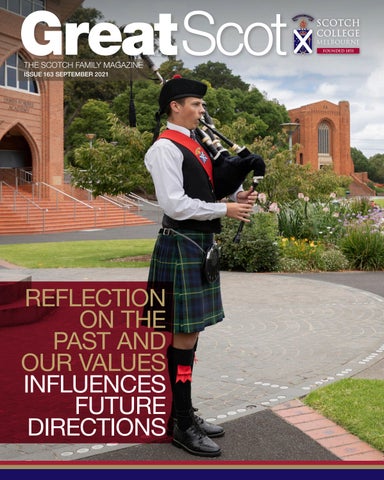
THE SCOTCH FAMILY MAGAZINE ISSUE 163 SEPTEMBER 2021
REFLECTION ON THE PAST AND OUR VALUES INFLUENCES FUTURE DIRECTIONS
CONTENTS 1 EDITOR
30 MUSIC
2 CHAIRMAN
38 DRAMA
4 PRINCIPAL
46 SPORT
6 CHAPLAIN
54 BOARDING
7 JUNIOR SCHOOL
56 FOUNDATION
14 MIDDLE SCHOOL
64 OSCA
15 UPPER SCHOOL
89 WHAT THEY’RE DOING NOW
16 FEATURES 20 SENIOR SCHOOL NEWS
2 RESPECT – A CORE VALUE Ensuring respect is a dominant force guiding us all
92 SCHOOL HISTORY
12
94 OBITUARIES
JUNIOR SCHOOL MUSICIANS PERFORM Items recorded for a ‘Virtual Years 5 to 6 Concert’
The Scotch Family Magazine Issue 163 September 2021 is the official publication of Scotch College, Melbourne. Publisher Scotch College 1 Morrison Street, Hawthorn 3122 Victoria, Australia Phone: (03) 9810 4321 Email: greatscot@scotch.vic.edu.au www.scotch.vic.edu.au ABN 86 852 826 445 Print Post Approved PP100008172
View Old Scotch Collegians' Association news and updates at: www.oscanet.com.au Like us on Facebook Scotch College and OSCA
Editorial contributors Durga Kamte, David Ashton, Paul Mishura, Scott Montgomery, Tim Shearer. Editor Durga Kamte (03) 9810 4420 email: durga.kamte@scotch.vic.edu.au
16 ‘OUR HISTORY IS SECURE’ The Tolson Centre is opened and named
Assistant Editor David Ashton (03) 9810 4489 email: david.ashton@scotch.vic.edu.au Art Direction and Production Lisa Sheard (03) 9810 4443 email: lisa.sheard@scotch.vic.edu.au Photography National Photography, James Grant, Stephen Kong, Lisa Sheard, John Ferguson, Scotch College students, staff, parents and Old Boys.
22 MATHEMATICS EXCELLENCE Scotch boys shine in mathematics competitions
EDITORIAL
In May this year, a special Assembly was convened in the Quad when Chairman of Council, Mr Alex Sloan (’71) announced Principal Tom Batty’s intention to leave Scotch at the end of Semester One 2022. I know I was not alone in sniffing back tears as I heard the news in company with boys and staff from the Senior School. In 14 years Tom has added immensely to the legacy of our School. His focus on relational learning, combining academic and pastoral care as a core principle, has led to a revitalised House-based community of connection in the Upper School, and a similar form-based approach in the Middle School. While remaining steadfast in upholding School traditions, including a strong Christian belief and rigorous academic focus, Tom has dealt with social and cultural changes in the time he has been here with characteristic vision and foresight, introducing programs such as Respectful Relationships, Growth of Scotch Boys, and a commitment to the Safeguarding Children organisation, to note just a few. There will be many tributes to Tom in the next editions of Great Scot from the School family; but as I pen these words
I am so mindful of the empathy and care Tom has offered for the emotional wellbeing of students and staff during this latest lockdown, in coordination with staff in the Senior Committee. His regular updates to staff, parents and boys offer clarity, reassurance and consistent messages of support. Additionally, regular updates on Scotch Streams reflect video messages from the Chaplain, School Captain and Principal, as well as initiatives to support WellBeing@Home and StayingFit@Home. Practical measures to reduce screen time and work pressures such as ending classes for Years 7-10 at lunchtime on Fridays, and pruning content delivery have been widely welcomed. The voices of our boys have been influential in endorsing the values of the School, and promoting positive change, with the aim of reducing prejudice and fostering wellbeing, as can be seen with the RU OK?, Denim and IDA HOBIT Days, and Charity drive. With so many events postponed or cancelled, it is nonetheless heartening to recognise innovative ways staff and boys have managed to hold virtual concerts, seminars, and art exhibitions, as well as participate in international and national conferences and competitions. Boys have shown their determination and resilience on the sports fields and in boarding. The challenges for Year 12s in particular have been immense. As they complete their final SACs and prepare for the final examinations, we look forward to celebrating with them back in Morrison Street next term. Speaking at the opening of the Tolson Centre in May, Tom Batty said that with
the completion of the centre, ‘our history is secure, and with it, our future’. At the same event, School Council Chairman Alex Sloan quoted Sir Winston Churchill: ‘We shape our buildings and afterwards our buildings shape us’. The refurbished Archives and Museum will certainly enable many of Scotch’s memories to be captured, and will ‘shape us’, as we reflect on our past and cast an eye to the future. With the Tolson Centre up and running successfully, Scotch’s thoughts have turned to the next stage of development – an exciting array of Boarding House projects, which will improve life on the Hill for our boarding community. An article in the Scotch Foundation section of this edition sets out what is involved in this exciting transformation. Cognisant of the degrees of separation caused by lockdowns, the Old Scotch Collegians’ Association is focusing strongly on ‘reasons to connect and ways to connect’, as set out in several articles in this edition. At a time when class reunions and the celebrated OSCA Annual Dinner itself have had to be cancelled or postponed, OSCA is extending a supporting hand to its community through webinars, including a webinar for parents, and through podcasts and OSCAconnect, the association’s online communications platform. Please note: all photos in this edition in which people are shown without masks were taken prior to the latest lockdowns. The photos of Tom Batty and Alex Sloan, both during Assembly in May and at the opening of the Tolson Centre, were taken when Melbourne was not in lockdown.
42
61
78
INSPIRATION IN ART Award-winning Artist-in-Residence comes to Scotch
NEXT DEVELOPMENT STAGE Exciting array of prospects for the Hill
OLD BOYS TAKE ON THE WORLD Four athletes and a coach at the Tokyo Olympics
DURGA KAMTE EDITOR GREAT SCOT
www.scotch.vic.edu.au Great Scot 1
CHAIRMAN
MR ALEX SLOAN ('71) SCHOOL COUNCIL CHAIRMAN
OPPOSITE PAGE LEFT: MR BATTY ADDRESSES BOYS AND STAFF IN THE QUADRANGLE. RIGHT: MR BATTY HANDS THE MICROPHONE BACK TO MR SLOAN AS COUNCIL DEPUTY CHAIRMAN REV DR JOHN WILSON APPLAUDS
RESPECT – THE DOMINANT FORCE GUIDING OUR COMMUNITY IT IS CRITICAL TO INSTIL THE CORE VALUE OF RESPECT IN THE MINDS OF OUR BOYS In the April 2021 edition of Great Scot I reflected with optimism that the worst of the pandemic might have been behind us. That optimism was clearly premature, but I want to resist the temptation to dwell on all the difficulties that have continued to flow, and focus instead on an undoubtedly bright future for our School. On 19 May I stood in the main Quadrangle to share with the senior boys and staff that our Principal – Tom Batty – had made the decision to return to the United Kingdom in 2022 to be closer to his family. As I addressed the boys it struck me what a significant moment this was. Tom is just the ninth Principal in the 170 years since our School was established. There are very few, if any, organisations
2 Great Scot Issue 163 – September 2021
in Australia today that could claim such longevity and stability of leadership. It now falls to School Council to identify our next leader, a task that we understand will be the most important thing we will do as school custodians, and a task made all the more momentous when we reflect on the exceptional leaders who have gone before. As our community is no doubt aware, the search for our tenth Principal is now well underway. Advertising was conducted in Australia and internationally in late June and has attracted a high quality field of candidates. Council is now conducting a series of interviews, and would hope to identify and appoint the outstanding candidate before the end of calendar 2021. Beyond the obvious educational and managerial
requirements of the role, we must identify a leader who can best prepare our boys for what they will inherit; no easy task given the pace of change and the enormity of the challenges impacting our world. To prepare ourselves to evaluate the attributes of the high calibre candidates who have offered themselves for selection, we first invested considerable time in gaining a clearer perspective on the issues they will confront as we move into and through the third decade of this century. These issues will not surprise you. They include the most challenging we confront – as a community and as a country – the changes sweeping the world in the social, environmental and technological fields and the geopolitical tensions, including those in our region, to name a few. To get a better understanding of how our broad community sees those challenges we convened sessions with parents, boys, teaching and non-teaching staff, our alumni, the Foundation and the Presbyterian Church. These sessions were immensely fruitful and gave Council some critical insights. While the scope and impact of the challenges were acknowledged, all stakeholders were clear that there were some fundamentals that did not change. The critical aspects of relational learning – so well championed by Tom – remained relevant, as did our foundational value of respect. These are at one level straightforward concepts, but they cannot be underestimated for their potential to guide how our School is led in the future.
Each one of us has been impacted by technological change – more so in this COVID age than ever before. Technology has supported our educational endeavours in many ways, but whatever advances are made (and there will be many) it cannot replace the criticality of the relationship between student and educator. We know from everything we see – in our School and beyond – that boys thrive when that relationship is strong. Perhaps the way to think about technology is how it might best be used to enable a more effective implementation of the relational approach to learning. In the same way that we will be required to adopt and adapt to technology, we will continue to confront an array of social challenges. These can be immense and many go to the heart of what our community stands for. I take great heart from the overwhelming endorsement of our stakeholders for our key value of respect, and how we must continue to ensure that this is the dominant force guiding all in our community as we go about our work. The challenge for boys today is substantial, as a deluge of competing messages hits their computer and mobile phone screens. It has never been more critical to instil the core value of respect in the mind of each of our boys, and send them into the world clearly understanding how this critical value manifests in all their relationships. These thoughts are being reflected in the conversations we are having with candidates for the role of Principal, and I look forward to updating you on Council’s progress in coming months. www.scotch.vic.edu.au Great Scot 3
PRINCIPAL
MR TOM BATTY SCHOOL PRINCIPAL
OUR VALUES, SINGULARLY AND COLLECTIVELY, DETERMINE OUR FUTURE Back in early June, Lee and I found ourselves standing on Little Collins Street straining to wave at a window on the 11th floor of a Melbourne hotel, where we could just make out the smiling face of our quarantining younger daughter as she waved back to the street below. As noted in previous Great Scot articles, I have long harboured interest in how small, often unnoticed, fluctuations at the micro level can result in significant change at the macro level, mathematically and socially. Standing, neck craned, on Little Collins, I reflected on how the many small, at times seemingly unconnected, shifts of recent months had combined to bring about this moment: the blending of personal freedom with community responsibility; the medical guidance and political decision making; the debates, concerns, legislation, isolation, fear, resolve, compassion, sacrifice, research, innovation and loss. Eighteen months prior, I wouldn’t have dreamt such circumstance even remotely likely. Staring up at that distant figure, I was moved to consider how minute change to any of the contributory factors could have brought about different outcome. I confess to similar emotion when watching the Euro Football Championship penalty shootout and here send congratulations to all of, or now claiming, Italian descent. The role of education, and thence the teacher, is to consider all existing and past constituent elements of the personal and group environment, and each 4 Great Scot Issue 163 – September 2021
young person’s sensitivity to change, and seek, with all available resources, to influence for the best outcome for individuals and the greater social good. It was in such vein, that earlier this year, the School undertook a comprehensive audit of all its programmes and curriculum coverage regarding the social development of the boys, and, under the banner Growth of Scotch Boys, committed to delivering and evolving a comprehensive, coherent, sequenced journey of growth from Prep – Year 12, built on relationships, curriculum, targeted programmes and encounters, with particular focus on consent, respectful relationships with women and intercultural competency. To drive this work, the School has appointed Ms Tremaine Pavlovski and Ms Melanie Piva as, respectively, Coordinator Growth of Scotch Boys, Junior School, and Coordinator Growth of Scotch Boys, Senior School. Tremaine and Melanie will lead small teams, both including the respective School Psychologist, that report through their school executives to the School’s Teaching and Learning Committee, thus ensuring age specific insight and whole school oversight. Intrinsic to the programme will be the professional development of our staff, support, through engagement, resources and education, for parents, and involvement with external consultants, including the Australian Childhood Foundation.
The programme is characterised by five themes: • Contact with a diverse range of people; • Reflection on a moral position; • Our Christian faith and community values, including belief in a cause bigger than oneself and a sense of other; • Challenge, including what excellence really looks like, what it takes to pursue it, and the vulnerability inherent in such pursuit; and, • Respect for self, others and community. As the School progresses this important work, Tremaine and Mel will provide regular updates of developments through Great Scot; indeed, their first piece, in which they introduce themselves and their initial steps, appears later in this edition. I thank Tremaine and Mel for their willingness to apply their talents to this task, knowing they do so with the support of us all. Consideration of constituent elements and young minds’ sensitivity to change and advancement has certainly been to the fore in our Mathematics Department, led by Dr Gareth Ainsworth. Last year saw two, then Year 11 Scotch students, Andres Buritica Monroy and Zian Shang, make the six person Australian Mathematical Olympiad team, which finished a highly creditable eighth in the world. This year, remarkably, Scotch had three team members, with Andres and Zian joined by fellow Year 12 student, Jason Chi and, as reserve, Year 7 student, William Cheah, in donning the Green and Gold to take on the world’s best school aged mathematicians. Further details of this, and other mathematical achievements, are provided by Dr Ainsworth in the coming pages. Fitting recognition of desire and talent to nurture the educational environment to best affect individual and societal cause came at the end of Semester 2, with the retirement of our wonderful seventh Head of Junior School, Jon Abbott, and the arrival of his successor, Tom Savill. With kindness and understanding of boys, how they best learn and what they most need to learn, Jon guided the Scotch learning community responsible for the boys when they are often at their most developmentally sensitive. Tom brings similar such traits, and, in building on Jon’s outstanding legacy will, of course, now make his own mark. During the July lockdown, having listened to an excellent podcast on the sinking of the Bismarck forwarded to me by Scotch teacher, Frank Maguire, I was moved to some internet searching on Midshipman (later Lt Cmdr) Joe Brooks. Joe Brooks was a member of the crew of the Dorsetshire, and involved in the final throes of the Bismarck and the rescue of members of her crew. Brooks was pulling aboard
a German sailor who was, on account of his severe injuries, holding onto the rope with his teeth, when, close to Brooks’s grasp, unable to hold any longer, he fell into the raging sea. Without thought, Brooks dived overboard to secure a line around the stricken German sailor. In the terrible conditions both men were dragged beneath the ship and the German was lost. On being hauled back aboard, Brooks was charged with desertion in the face of the enemy and confined to the brig. His story (https://www.youtube. com/watch?v=U3GHIajOGAw) speaks powerfully to elements of our condition, and how personal experiences influence our principles, the judgements we make and the actions which follow. Finding the best path in testing times requires reflection and assessment of circumstance, but pondering the past, collection of data and analysis of information can only do so much in informing the future. There are those moments of individual sensitivity to change, when judgements have lasting impact on future paths. This is particularly true for young people at key phases of developmental growth when receptiveness to influence and learning is heightened. As Brooks shows, such moments don’t cease with the casting off of the school tie. It is apt to consider what it might be that truly directs us when searching for order in ‘the chaos’. At Scotch our foundational teaching and learning question: How did the world evolve to be as it is and how might it be made to evolve for the greater good? guides consideration of all around us and directs our action, but it is given meaning, permanence and purpose by our foundational teaching and learning principle: The inherent dignity and value of each individual. In mathematics, we rely on axioms to create an algebra for proof. Amidst new challenges and tests of resolve in our lives, whilst experience, reflection and assessment of relevant information equip us with the tools for decision making, perhaps, as proved for Brooks, it is our values, singularly and collectively, that ultimately determine our future. We are conscious that whilst the restrictions of lockdowns are common, their impact is different for each family. Whilst Lee and I might be keeping fingers crossed that flights arrive, others, burdened by their particular concerns, will be hoping they don’t. The web is complex. The School greatly appreciates the support of its community and is here to assist families through these testing times. Although it is still not easy to see clearly an uninterrupted path ahead, we are seeing signs of communities attempting to live with the consequences of the pandemic. The will of people to prosper is strong. We know that at Scotch we are stronger and better prosper when working together for each other and I thank you for your continuing support. www.scotch.vic.edu.au Great Scot 5
CHAPLAIN
FREE TO PARTY HEAVEN IS LIKE GETTING TOGETHER FOR A CELEBRATION – BUT MULTIPLIED IMMEASURABLY REV DAVID ASSENDER SCHOOL CHAPLAIN
Especially these days, I really look forward to our next family get-together. In the Bible, a meal is more than an opportunity to get fed: a meal is a significant event. The idea behind every banquet is an experience of what heaven will be like. It will be a place of abundance, happiness and community. Word-pictures of heaven often include that of a great family feast that the Messiah will bring about. In the Old Testament, it was understood that just as Moses set the Israelites free and fed them in the desert for 40 years, the Messiah would also set his people free and usher in a great era of celebration and feasting in the Kingdom of God. Anticipation of this event produced great hope among God’s people through the most difficult times. In Luke 9:11-17, we read that Jesus, his disciples, and 5000+ others are out in the middle of nowhere, just like Moses and the Israelites back in the great exodus. In comparison, it wasn’t quite the number that were set free from Egypt 1400 years earlier, but it is nonetheless a very large number to host a long way from basic amenities. Just add an enormous sound system and it would be what we now call a ‘rave’. Have you ever wondered how huge weekend-long festivals logistically feed everyone? Unsurprisingly, the disciples were wondering the same thing, and late in the afternoon they ask Jesus to send the people away for food. Jesus responds, ‘Why don’t you feed them?’ They reply, ‘You want us to go into town and buy food for 5000 people?’ The situation is obvious to everyone. It isn’t going to happen. Then Jesus takes five loaves and two fish, and after he gives thanks to God for the meal, he breaks it up into so much food that there are 12 baskets left over. What’s fascinating is that not too long after this event, Jesus uses the same words at the Last Supper. It’s the final course of the Passover meal, he lifts his face to
6 Great Scot Issue 163 – September 2021
heaven, prays, blesses the food, breaks it and distributes it. At the Last Supper he makes the connection between the bread breaking and his body being broken so we could share in the great feast with him in the Kingdom of God. Meaning that the abundance of God’s Kingdom ultimately becomes ours through faith in Jesus because through him we are forgiven and gain access to God. So, what is heaven like? It’s kind of like every time we get together for a celebration over a meal with friends and family – but multiplied immeasurably. That’s what it feels like to belong to God. No wonder Jesus’ first miracle was turning 150 litres of water into the finest of wines at a wedding. All of his miracles point to some greater meaning. A great many of his miracles are signs of what the Kingdom of God will be like. So it’s good to party, but the difference between a rave and heaven is the reason why we get together. To get the party started, the reason for the party must be established. In the Bible, the reason is our freedom. What greater reason to party than that! Jesus’ miracles point us to aspects of an ultimate celebration that will ensue as a result of his death and resurrection to establish our freedom from sin and death. Together, forever, celebrating because we are free. Just as Moses led the Israelites to the Promised Land, Jesus rescues us so we are free to be with him. At Scotch we are all presently experiencing what it is like to give something up of ourselves so our liberties can return. Here, once more, we see the connection between sacrifice and freedom. For some of us it is little more than a set of inconveniences, for others it is unbearable loss and heartache. With mixed feelings, no doubt, there will come a time when our freedoms will return because of what we have given up, and we will gather in large numbers to celebrate once more. And just as it did for the Israelites under Moses, so it does for us in Christ: hope plots our bearings for navigating these times beyond the temporal horizon. Hope both calls us and empowers us, as the Apostle Paul explains: ‘I pray that the eyes of your heart may be enlightened in order that you may know the hope to which he has called you, the riches of his glorious inheritance in his holy people, and his incomparably great power for us who believe.’ Praying for you all.
JUNIOR SCHOOL
‘TWO ROADS DIVERGED IN A WOOD’ THE JOY OF TRANSITION MR TOM SAVILL HEAD OF JUNIOR SCHOOL
Having lived in Victoria for some time now, I am still surprised at how difficult it is for me to hear the word ‘football’ and need to think of a game played on a field more like a cricket ground, with a ball shaped a little like a rugby ball and with goals that are attributed to more than one scoring outcome. I consider myself in a period of transition when it comes to understanding the game of ‘footy’ or AFL. Despite confusion around the name of the game, I do have many reference points from previous experience that have developed my appreciation for the sport, to navigate this period of transition. The athleticism of the players, the tactical nuances and the ever-changing rules share similarities with soccer, rugby union and cricket. I am learning to love the game and have become an impassioned Carlton supporter, the reasons for which I shall not share in this article.
We are constantly experiencing periods of transition in our lives – dare I reflect on moving in and out of lockdown as an example? Moving through periods of transition is something we expect of the boys on a regular basis. Travelling from a state of limited understanding to a position of greater understanding is a daily challenge and the crux of learning. Wrestling with the process of transition is one of the key pillars to a good education and, as my journey to greater appreciation of Aussie Rules Football may indicate, there are many influences which impact the success of this endeavour for each individual. As I write, 13-year-old Momiji Nishiya of Japan is celebrating her gold medal in the debut Olympic skateboarding event for women. Nishiya’s journey began when a skatepark was built in her hometown of Toyoma, and she hopes that her success will encourage the creation of more opportunity for young www.scotch.vic.edu.au Great Scot 7
JUNIOR SCHOOL
skateboarders around the country. Former Junior School boys also competed in Tokyo, and we hope that some of the current cohort may be inspired to challenge themselves to represent Australia in the Brisbane Olympics in 2032. However, the transition from school student to Olympic athlete is a challenging one and will rely on relevant opportunity, reflection of one’s own journey, analysis of performance and then planning of specific goals; a step-by-step process that will require a great deal of hard work and perseverance. In a recent ‘Literature Circles’ session with a group of Year 6 boys, I challenged the boys to analyse Robert Frost’s well-known poem, A Road Not Taken. The final three lines: ‘Two roads diverged in a wood, and I – I took the one less travelled by, and that has made all the difference’ were understandably interpreted by the boys as – go in a different direction to everyone else and it will be more rewarding. However, they embarked on a deeper analysis of the poem and began to identify some of Frost’s nuances. They recognised and empathised with the challenge the traveller faced when standing at the divergence of paths through the line ‘And sorry I could not travel both’. They then unpacked the lines ‘Yet knowing that way leads on to way, I doubted if I should ever come back’. In this discussion the boys came to an agreement that the paths would eventually converge and, while one may be more interesting than the other, the traveller would likely end up in the same place. However, they then challenged their own thinking, 8 Great Scot Issue 163 – September 2021
wondering if the experience the traveller had on the more interesting and challenging path may have created a better outcome for them in the end. They finally suggested that the road less travelled most probably developed some implicit benefit that, while reaching the same end point, had an impact that was influential. Being new to the Scotch community I have had the privilege and pleasure of looking at it with fresh eyes, and learning the many influences on the boys as they make their own unique transitions during their time in the Junior School. I am delighted to learn that the wide variety of opportunities placed at the feet of the boys have been (and continue to be) carefully considered. Curricular and extracurricular development involves research and analysis of contemporary discourse, all before applying the thinking to the Scotch context and that of our cohorts of boys. The School benefits from a strong connection to faith, to its own history and to the community, all of which are integral to the aforementioned context. If challenge is provided to our boys, and a period of transition is expected, it will be one that is age appropriate, values based and foundational. The clear aim is to help the boys build a solid platform upon which any transition is possible, and to use the experiences they have had during their time at Scotch to positively influence whatever direction they wish to take in the future, be it as an Olympic skateboarder or simply to travel overseas to experience roads less travelled or strange new sports.
The boys were so pleased with their surprise, and their excitement about my upcoming wedding was magic. It was also a new experience for me, as normally I am very organised, but I had to relinquish my plans and embrace all of their ideas. It was a very special day. What is the best advice you have ever received? The importance of connecting with each student cannot be overstated. Students learn better from a teacher with whom they have a connection. What story will your colleagues tell about you at your farewell speech when you retire? This is a very tricky question. I don’t think I could pinpoint just one story. I guess everyone will just have to wait and see …
Interview:
ALEXANDRA NASH Prep Coordinator After graduating from university with a Bachelor of Education in 2011, Alexandra taught in London and on returning home, taught in several well-respected schools in Melbourne. Alexandra was a welcome addition to the Junior School when she assumed the role of Prep Teacher in 2017, becoming the Prep Coordinator several years later. Alexandra is well organised, hardworking, big-hearted and energetic. While working at Scotch she completed her Master of Learning Intervention in 2018 at the University of Melbourne. Her philosophy of developing in each child a love of learning underpins all she plans for her class. Alexandra’s classroom is always calm, respectful and friendly, and it is marvellous to see the boys’ collective confidence and enjoyment of school blossom throughout their vital first year of formal education. Apart from becoming the Prep Coordinator, Alexandra worked tirelessly for the Scotch snow teams, both on the slopes and behind the scenes, in her capacity as Junior School Snowsports Coordinator.
During all the challenges of recent years with COVID and lockdowns, she has ensured she has stayed connected to the boys in her class, their families and her colleagues, while continuing to provide an interesting and comprehensive curriculum, delivered with heart and humour. Alexandra is a remarkable teacher who deserves to be in the spotlight and acknowledged for her contribution to the Junior School. KATE IKINGER Many years from now, when you are no longer teaching, what is one of the Scotch memories you will reflect on to warm your heart? On the last day of term, just before my wedding, all the Prep Staff and boys surprised me with a unique curriculum of wedding-related activities. The lessons I had planned were abandoned: the room was full of confetti, wedding cards, wedding cakes and a wonderful veil that all of the boys had decorated.
What has been your biggest challenge during your time at Scotch? Over the past 18 months I think we have all been challenged with the new experience of home learning. On the positive side it has brought me closer to my colleagues and the parents of my students. It has challenged me to continually think outside the box and try new ideas, often entering uncharted territory. It has also allowed me to appreciate how important and wonderful face-to-face contact is with the Preps, and to value what has become known as classroom learning. What advice would you give our VCE students as they embark on a life outside Scotch? Take the time to look around you; some of the boys who are sitting next to you right now will be your lifelong friends. What is your favourite corner of the School, and why? I love the swimming pool. As a swimmer I have a soft spot for pools and time spent on pool deck. It is lovely to see the look on the faces of the Preps when they finally discover the Scotch pool, and realise that swimming is a part of the Prep program. The swimming program is greeted with great excitement, but I also enjoy the peace that descends on the class as the days pass. The boys expend so much full body effort in the pool that there is a sense of tired achievement.
www.scotch.vic.edu.au Great Scot 9
JUNIOR SCHOOL
CAMP RUMBUG – A VERY POSITIVE AND BENEFICIAL EXPERIENCE YEAR 5 BOYS GIVE THEIR FEEDBACK ON THE THREE-DAY CAMP
Scotch’s Year 5 boys recently attended Camp Rumbug, nestled in the rolling hills of the Wilson’s Promontory countryside between Foster and Dollar, about 170km south-east of Melbourne. At the three-day camp the boys developed a number of outdoor education skills, and increased their proficiency and abilities in canoeing, bush hut construction, rafting, low ropes, orienteering and archery. It was encouraging to see the boys develop their physical skills, although the true value in camping lies with the development of personal skills and traits which, hopefully, can be put to greater use as the boys grow. The camp was a very positive and beneficial experience, at which the boys developed personal skills such as teamwork, decision-making ability, responsibility, empathy, cooperation, resilience, respect and tolerance for individual differences. Here is some feedback from the boys on their Camp Rumbug experience:
KEVIN SUI AND TIMOTHY CHENG We learnt how to work together, not to blame each other, and that not always the loudest people are the best for a certain job.
10 Great Scot Issue 163 – September 2021
This was proven when a quieter participant, when leading our group, helped it achieve success. This will be helpful in life as we need to work together to succeed in life. It also tells us to never underestimate anyone because teammates can easily and often surprise you. We also learned when to come out with our voice and back down when we need to let other people speak.
experience while also learning many important life skills such as how to cope with pressure and how to be productive as a team. We learnt to be resilient, cooperative, have fast reflexes, to be productive and learned how to communicate with others. Camp Rumbug was a fun camp and we certainly learned a lot there.
AARON SHEN AND THOMAS DOAN After being at Camp Rumbug, Year 5 has learnt many lessons. We have learnt how to work together in a team, show leadership and creativity. In all our eight activities, we’ve learnt how to support and help each other. Along with this, we have used our creative skills to conquer numerous obstacles.
Camp Rumbug has made me awesome at leadership, cooperation, science, teamwork and looking out for each other. On this camp, I have been more active than ever. It inspired me to train harder and to be fit and lean. After Rumbug, camp has made me learn all the five core skills needed for the future and as well as the Olympic values. I have changed my attitude after the camp.
JEREMY LEW AND BRYAN CAO
YUSUF MOHAMMED
Something we learnt from camp was teamwork. We had to work together to do a series of different tasks in the different activities, such as pulling the black rope to do the giant swing, or supporting our partners in low ropes. This helped us learn that some things are impossible to do by ourselves. We learnt perseverance through hardship and fear. On the giant swing some boys were scared but they got on every time and did it. While my group was doing the raft-building activity, we were sailing slower than a sloth. We kept rowing and after a long and tedious ride, we made it back to shore.
Camp was a great learning experience. It taught me so much. Camp made me become more resilient and patient. Bushcraft helped me to be slow and patient and with archery I had to aim properly. When completing low ropes teamwork was vital. Teamwork and patience were required during rafting. It also made me resilient by forcing me to keep on trying until I got it. With initiatives you had to keep on thinking of a solution and keep on retrying over and over. Camp was a helpful experience and taught me so much.
JUN GARDINER AND MATTHEW DALLALANA
Every day at camp we learned something new. We learned some really important qualities including persistence, self-confidence and versatility. On every activity we learned a new quality such as the giant swing, where each student needed to give himself the confidence to get to the top. For some kids who were scared, even getting on the giant swing was an achievement. Maybe that means going out of your comfort zone. Well, during Camp Rumbug a lot of kids stepped out and gained new confidence.
We learned many useful qualities at Camp Rumbug. These qualities were teamwork, perseverance, resilience and using alternate strategies if one did not work. There were a variety of activities and it was fun, both learning about ourselves and our teamwork skills.
LUCAS LEE AND WILLIAM WANG
EDWIN SHEN
WINSTON CHEN AND WILLIAM NGUYEN
We were amazed about how much we learnt about resilience and cooperation during Camp Rumbug. We had such an amazing
www.scotch.vic.edu.au Great Scot 11
JUNIOR SCHOOL 1. EMMA MACRAE AND JUNIOR SCHOOL GLEN HOUSE CHOIR. 2. CELLOS (YEAR 3) ALSTON LIN AND OLIVER CASE.
A BUZZ IN THE AIR AS JUNIOR SCHOOL MUSICIANS PERFORM
YEARS 5 AND 6 VIRTUAL CONCERT WAS A VERY POSITIVE EXPERIENCE
1. 2.
Lockdown is challenging for most departments in a school, however for music it can be grim. Our Junior School boys have had their resilience tested with numerous activities in their busy calendar cancelled this year. One such highlight is the Years 5 to 6 Concert. Usually scheduled in Term 2, it was finally held when we were allowed back to school in the third week of Term 3. As we couldn’t have an audience, we made the decision to use our rehearsals throughout the day to practise and then record the items for a ‘Virtual Years 5 to 6 Concert’. The boys were very excited on the day of our ‘concert’, and you could definitely feel the buzz in the air. It was such a positive experience for the boys as well as the staff. Our boys had not really practised in their ensembles since the last few weeks of Term 2, and some had not even rehearsed during that term; however with plenty of excitement and positivity all ensembles rehearsed and then recorded a few items for our ‘concert’. Our main challenge was socially distancing all the boys in each group. This was particularly challenging for the 60 boys in our auditioned ‘Glen House Choir’. We used choir risers, and the boys spread themselves out in the beautiful David Yu Foyer. Our Concert Band recorded several charts under the direction of Ms Jude Hallum. Our String Orchestra under the capable direction of Ms Amberley Bremner performed several pieces. It is my first year at Scotch, and the ‘concert’ was one of my first experiences of the Drum Corps. Mr Chris Farrands led the accomplished Year 6 band as they performed a James Bond classic. Mr Glenn Bardwell accompanied all the ensembles throughout the day, and spent countless hours putting all the recordings together to make our concert. He truly provides such fantastic support. MRS EMMA MACRAE – JUNIOR SCHOOL MUSIC TEACHER PHOTOGRAPHY: JOHN FERGUSON
12 Great Scot
3. 3. CELLOS (YEAR 4) LINUS GANI, RORY MCLENNAN, LOUIS TING, BRENDAN YIP. 4. JUDE HALLUM AND JUNIOR SCHOOL BAND. 5. VIOLINIST (YEAR 4) HUGH WEBSTER. 6.DOUBLE BASS (YEAR 3): ALEXANDER RAJAN. 7.HORN SECTION.
4.
6.
5.
7. Great Scot 13
MIDDLE SCHOOL
MS KATRINA STALKER HEAD OF MIDDLE SCHOOL
YEAR 8 CAMP PROVIDES A VARIETY OF OPPORTUNITIES
MIDDLE SCHOOL BOYS STAY CONNECTED, ENGAGED AND MOTIVATED
RESILIENCE, COOPERATION AND ENERGY In this roller-coaster year, the Middle School boys rose to the difficulties with great resilience, cooperation and energy, as we went in and out of lockdowns. The lessons learned from 2020 of making and keeping connections with friends during these times stood the boys in good stead. Learning to manage their screen time and to exercise outside with a friend were strongly encouraged. To lift spirits, there were online cooking classes and Kahoots, Trivia and Strava competitions between forms, organised by the School Prefects. We were pleased that the Year 8 Camp was able to proceed early in Term 2. There was much excitement among the boys as they headed off for their week of adventure, and even the rain didn’t dampen the boys’ enjoyment of being in the great outdoors. The boys white-water rafted, cycled and hiked. Some were introduced to camping in two-man tents for the first time, while others were already old hands at this experience. They visited Toolangi near the state forest, where they tried their hand at create staking and rock climbing, and tested their nerve on the high ropes course. While at the camp, the boys spent time with the Man Cave organisation, which gave the boys the opportunity to explore how their peers had coped during the preceding year’s lockdowns, and how they handled the trials they faced. The Indigicate education company took the boys on a walk through the Chum Creek forest, where they learned to weave bracelets and baskets from plants, while listening to storytelling by the Indigenous leaders. The camp was certainly character building in the wet conditions, but on the whole the boys enjoyed it and learned much from their experiences.
14 Great Scot Issue 163 – September 2021
Our pastoral care program continues to evolve with the changing face of the world. The online world was explored through a presentation by our Police Liaison Officer to the Year 7 boys, while the Year 8s heard from Brett Lee, ex-Federal Police officer, on how to keep themselves safe in this ever increasing digital world. Parents tuned in to a webinar from Brett Lee, who gave insights on what the boys are able to access and how to help their sons manage this fast-moving environment. After some successful workshops last year led by the Elephant Ed organisation, we have expanded the number of workshops this year for Year 8, with the first workshop towards the end of Term 2. The presenters tackled the often difficult topic of pornography through an age-appropriate lens. Project Rockit, presented to the Year 7s, tackled the issues of online bullying and harassment, and encouraged the boys to stand up for their friends and peers, and to call out any poor behaviour they see. The Form Teachers share in all aspects of the pastoral care program with the boys, enabling followup throughout the year. Particularly during lockdowns, the teachers provide a caring and supportive environment, concentrating on keeping the boys engaged, motivated and connected to their school. Our inter-form competitions have continued during the year, despite interruptions. In public speaking, Austen Wayne took out the Year 8 competition, speaking about ‘An incredible discovery’, and Joshua Carter won the Year 7 competition with the topic ‘A story that matters’. Bart Leeton (Year 7) and Sam Allen (Year 8) won their respective inter-form cross country running competitions.
UPPER SCHOOL
VALUABLE INITIATIVES FOR OUR STUDENTS MR TIM RAYNER HEAD OF UPPER SCHOOL
BELOW: TO LIGHTEN THE MOOD DURING ZOOM-LEARNING, PREFECTS ORGANISE A BEANIE DAY FOR ALL STUDENTS RIGHT: YEAR 7 TAKE ON A ZOMBIE BEANIE CHALLENGE
SUPPORT THROUGH CONFERENCES, WORKSHOPS, WEBINARS AND GROUP DISCUSSIONS ‘The best laid plans of mice and men’ springs to mind when thinking about the difficulties faced for many of us during our COVID experiences. It has been challenging to plan for any events knowing that, almost at any moment, the event could be cancelled. But like a mouse having to rebuild its nest, our staff have persevered at the task, and this year we have managed to run valuable initiatives for our students. In Term 1, to support our Year 12 boys with their studies and wellbeing we ran the ‘Rising to the Challenge in Year 12’ conference and workshops. Andrew Fuller, clinical psychologist and author, opened the event and spoke to the audience on identifying and building learning strengths. Prior to this, boys had been asked to complete a quiz that identified their learning preferences, which then provided a profile for them to take to the lecture. Andrew was able to directly refer to these differing learning profiles in his lecture. Andrew also spoke to parents through a webinar on how best to support their sons through their Year 12 journey. (We had to cancel the face-to-face talk due to restrictions.) Questions were asked at the end of the talk. Available workshops to choose from included, Distancing Digital Distractions, Mindfulness, Maths Strategies and Techniques, Proven Strategies to beat Procrastination, Revise Right, and Study Skills Masterclass. Most of these activities were delivered by our staff, who gave a great deal of support to the initiative, with our Centre for Learning and psychologists taking the lead in organising the event. Feedback from the survey, conducted afterwards, was very positive, with student remarks such as ‘helpful tips and discussion’, ‘great way to handle stress in difficult times’, and ‘should definitely be held again, for me it was somewhat motivational and helped me refocus on studying.’ It was heartening to see students and staff come together at this critical time. Not only did the day support Year 12 for the final part of their
journey, it also highlighted some of the talent that exists within our own staff. Another face-to-face parent event that needed to be moved to the online world was that of Maree Crabbe’s webinar, ‘It’s Time We Talked: Pornography, young people and sexuality today’. Maree has been working with Scotch over a number of years, and helped construct the program we deliver to Year 9 through our Christian Education Department. Her talk to parents was illuminating and confronting, but gave parents an awareness of the issues facing young people today. Maree also provided Scotch parents with useful advice on how to approach this sensitive issue with their children, and how best to prepare them for the challenges the online world can sometimes bring. Later in the term, Maree returned to provide professional development to our Heads of Houses, Christian Education Department and Form Teachers. The Year 10 Respectful Relationships Day in July provided a thought-provoking and engaging program on the issues that arise in social and sexual relationships between young people. Although Methodist Ladies’ College was unable to send its students this year, the day continued regardless. Group discussions, facilitated by Year 10 volunteers, guest speakers, and staff provided an environment where voices could be heard and opinions exchanged. Later in the day Elephant Ed also ran workshops on consent. Thanks go to Jackie Cowcher for organising this successful event.
www.scotch.vic.edu.au Great Scot 15
FEATURES
THE TOLSON CENTRE IS OPENED AND NAMED
‘OUR HISTORY IS SECURE,
TOP PICTURES: THREE OF THE SPEAKERS AT THE TOLSON CENTRE OPENING: LEFT: SCHOOL COUNCIL CHAIRMAN, ALEX SLOAN (’71); RIGHT, TOP: MARK TOLSON (’73); RIGHT, BOTTOM: SCOTCH FOUNDATION PRESIDENT, ASSOC PROF DOUG LORDING AM (’64). BOTTOM PICTURE, LEFT TO RIGHT: SCHOOL PRINCIPAL TOM BATTY, SCHOOL CAPTAIN NIK TSOURVAKAS (’20), BILL MORGAN (’34), ALEX SLOAN (’71), MARK TOLSON (’73), ANDREW TOLSON (’69), OSCA CHAPLAIN GRAHAM BRADBEER.
16 Great Scot Issue 163 – September 2021
In scenes reminiscent of the opening of the Sir Zelman Cowen Centre for Science in October 2016, the Tolson Centre at Scotch was opened and named on the cool, clear evening of 6 May 2021, in front of an enthusiastic Scotch Family gathering in Morrison Street. Incorporating the Scotch Archives and Museum, OSCA House and the Scotch Shop, the Tolson Centre is named in honour of the pioneering Scotch Archivist, Geoffrey Samuel Tolson (’41). An electrical engineer, Geoff became the Managing Director of his family company, W Tolson Pty Ltd. He was a member of the OSCA Council from 1972 to 1985, and OSCA President in 1983. Geoff was elected an OSCA Honorary Life Member in 1992. As inaugural Archivist, from 1985 Geoff searched every nook and cranny, advertised in newspapers, and called on the Scotch Family to donate items that form the basis of today’s Archives and Museum. He retired as Archivist in 1992. Geoff’s links with, interest in, and devotion to Scotch continued until his death on 15 June 2019. Guests at the official opening and naming ceremony on 6 May included Tolson family members, former OSCA Executive Director, Leigh McGregor (’55) and McGregor family members; and
CLOCKWISE, FROM TOP LEFT: THE BILL AND DIANNE SIDES MUSEUM; ALEX SLOAN (’71) CUTS THE RIBBON TO OPEN THE TOLSON CENTRE; BILL MORGAN ('34) WITH TOM BATTY; JIANG YU, DIRECTOR OF DEVELOPMENT, TIM SHEARER (’85) AND BOZHONG LI
AND WITH IT, OUR FUTURE’ representatives of major donors to the Tolson Centre, including Geoff Paton (’57); members of the Sides, di Donato, and Cook families; and Scotch’s oldest known living Old Boy, Bill Morgan (’34). A large marquee covered the carpark adjacent to the Tolson Centre, and guests were piped in by Hugh Hosking (’20). Formalities began at 6.45pm, with the MC, Director of Development Tim Shearer, reminding guests that he had ‘arranged’ for fine weather to be the order of the day for the official openings of each of the recent major projects – the Sir Zelman Cowen Centre for Science, the Spencer Centre for Design and Technology, the Keon-Cohen Dining Hall, and now the Tolson Centre. Welcoming guests, Principal Tom Batty said he had recently been delighted to welcome boys and parents back to the school grounds for the first Saturday of winter sport. Memories would be made of all that, he said, and stories of such deeds may be embellished over the years, but it took the dedicated work of a large group of people to create a place where all the memories could be captured. ‘But to try to capture all that – even to hold it in one’s mind is hard enough – but to do so in physical form, and then to do so over 170
years, is an amazing achievement, but [pointing towards the Tolson Centre] that is what has been achieved …’. ‘In Geoff Tolson,’ Mr Batty said, ‘there was the spark that made all possible, and the embodiment of our quest. With the completion of the Tolson Centre,’ he said, ‘our history is secure, and with it, our future’. School Council Chairman, Alex Sloan (’71) said that as Scotch is the oldest surviving secondary school in Victoria – having been established just 14 weeks after Victoria became a separate colony in 1851 – ‘it has a place of great significance in the history of Victorian and Australian education, and we should treasure it’. ‘Thanks to the hard work, persistence, professionalism and dedication of a few, we are now all the beneficiaries,’ Mr Sloan said. ‘Geoff Tolson’s work represents the cornerstone of what we see here today, and we are indeed indebted to him. How fitting it is,’ he said, ‘that this structure bears his name’. Mr Sloan also paid tribute to the fine work of the three Archivists who have succeeded Geoff – Dick Briggs (’57), Dr Jim Mitchell (’64), and Paul Mishura, the first non-Old Boy to occupy the position.
www.scotch.vic.edu.au Great Scot 17
FEATURES
1.
2.
3.
6.
4.
8.
5.
9.
7.
10.
1. ANDREW COOK ’72 AND HIS SISTER, LOU LOCKWOOD. 2. MARK (’73), JUDY, LOUISE, CHRIS (’04), EMILY, ANDREW (’69) AND BEN TOLSON (’02). 3. CLANCY (YEAR 10), BLAKE (YEAR 8), MARK (’00), (’34) AND ALEX SLOAN (‘71) 5. PIPER HUGH HOSKING (’20). 6. BRUCE BROWN (’60), OSCA EXECUTIVE DIRECTOR SCOTT MONTGOMERY (’85). 7. BILL (’63) AND DIANNE SIDES. 8. DAMIAN (’13), PATON (’57), KEN JASPER AM (’55), GUS HAWTHORNE (’53). 10. MAX ERRINGTON (’56). 11. SCHOOL COUNCIL MEMBERS MICHAEL SIM (’78) AND FIONA PEARSE (RIGHT), WITH VIKKI O’NEILL IN THE (YEAR 8), JULIE DEBELJAK, MCGREGOR DEBELJAK (YEAR 10), SIMON MCGREGOR (’86), SIMON SPINKS, JON MCGREGOR (’92); FRONT ROW: ROS MCGREGOR, LEIGH MCGREGOR (’55), MATT ABSENT (TAKING THE PIC): ABIGAIL MCGREGOR. 13. INTERIOR OF OSCA HOUSE.
Acknowledging the presence of several members of Sir Thomas Ramsay’s family, Mr Sloan said a major event during Dick Briggs’ tenure was the acquisition of the Ramsay Collection from Sir Thomas (’24). Paul Mishura took over the Archivist’s role in 2012. Mr Sloan said: ‘Combined with the support of the Heritage Club, the dynamism of our Director of Development, Tim Shearer (’85), and the guiding influence of Principal Tom Batty, Paul’s renovated home is looking pretty good!’ ‘Through some very demanding times over recent years,’ he said, ‘Paul Mishura has exhibited no less dedication and professionalism than that shown by his predecessors, and for that we are very grateful.’ Mr Sloan said the Tolson Centre also owes a great deal to the creative solutions overseen by the School’s Property Committee, led by Mike Sim (’78), to an ever-strong influence from our previous Chairman, the Hon Dr David Kemp AC (’59), and to the generous donations of funds and time by OSCA, the OSCA Collegians, the Old Scotch Football Club, the Heritage Club and the Victorian Scottish Heritage Cultural Foundation.
18 Great Scot Issue 163 – September 2021
‘It is also wonderful,’ he said, ‘that OSCA now has a new home, and that the Scotch Shop provides a full service retail opportunity, which benefits both the School and Scotch’s Indigenous Scholarship Program.’ Quoting Sir Winston Churchill, who said ‘We shape our buildings and afterwards our buildings shape us’, Mr Sloan said: ‘The shape of the Tolson Centre owes much to those who’ve influenced its creative design and the uses to which it will be put. Those uses will shape our school community for years to come, providing a place to gather, to reflect, to be enriched, and to build on the extraordinary heritage that is Scotch College.’ Responding on behalf of the Tolson family, Mark Tolson (’73) heartily congratulated everyone instrumental in converting the three Morrison Street houses into a truly integrated facility. Mr Tolson said his father had proudly told his family in 1985 that he (Geoff) was going to start the Archives at Scotch, because it had ‘never been done’ and it was ‘something the School desperately
13.
11.
12.
DARCY (YEAR 7), TOM (’89), JAMES (’87), EWEN (’70) AND HUGH WILSON (’65). 4. BILL MORGAN CAHILL (’17), ANGELA, ENIO (’77) AND BIANCA DI DONATO, ARCHIVIST PAUL MISHURA. 9. GEOFF RAMSAY COLLECTION. 12. MCGREGOR FAMILY MEMBERS – BACK ROW: GILES DEBELJAK MCGREGOR (’87), GILL MCGREGOR, KRISTINA WILSON-MCGREGOR.
needed for all Scotch Collegians to be able to see and connect with their heritage’. Mark’s brother, Andrew (’69), had replied succinctly: ‘I hope you’re feeling fit – you’ve only got 134 years of work ahead of you’. Mr Tolson said Geoff’s archives work was the perfect mix – ‘his love for the School and his love of history’. He described his father as what the older generation would call ‘a gentleman’. ‘He was sincere, honest and dependable: valued qualities for a man who lived by the Scotch mantra “for a goodly heritage, proud traditions and cherished memories”’. The final address was by Scotch Foundation President, Associate Professor Doug Lording AM (’64), who acknowledged the significant contributions of Andrew Cook (’72), Enio (’77) and Angela Di Donato, Geoff Donaldson AO (’31), the Ferraro family, Geoff Paton (’57) and Bill (‘63) and Dianne Sides to the project, as well as supporters of the project at all Scotch Foundation membership levels. Professor Lording listed the spaces in OSCA House which have been named in recognition of the roles played for OSCA by Leigh
McGregor (’55), Frank Shew (1860-66), Keith Wilson (’27) and Frank Crawford (’25). Multigenerational families are an integral part of the Scotch community, he said, pointing out that between them these great Old Scotch Collegians had sent 10 sons, 12 grandsons and six great-grandsons to Scotch. ‘The Cardinal Thread runs strongly in all these families,’ he said. ‘The whole building is a safe repository for our priceless memories; it’s a great hub for visitors to appreciate the history of the School; it’s an accessible meeting place for our Old Boys; and it’s a working office for OSCA and our Archives … We are very grateful to those who have made this possible, and I thank all of those for their contributions to the Tolson Centre.’ Concluding the speeches, Tim Shearer paid tribute to the skill of architect Doug Pattenden, and the commitment of Property Manager Bill Sciarretta and Facilities Manager Elliot Green, Maintenance Manager, Greg McMahon, Curator Mick Smith and the Grounds Department, Jonathan and Richard Long (both ’89 – Long Contracting), Tom Beattie (Beattie Vass Design), Michael Farrugia, Melanie Whitling, Jayne Markey and Noone Imagewear (Scotch Shop), and David Johnson (Scotch uniform concepts), for their fine contributions to the Tolson Centre. Guests then moved from the marquee out onto Morrison Street for the official opening ceremony, where the ribbon-cutting was performed by Alex Sloan, to applause from the guests gathered in the street. After OSCA Chaplain, Graham Bradbeer gave the benediction and blessing, guests – equipped with a tour map – were then invited to follow a prescribed tour route through the Tolson Centre, where Archives volunteers were stationed in each space in the centre to guide visitors and answer questions. Tour completed, guests proceeded back into Morrison Street and the surrounding areas for refreshments. The event was a great success, and a highly appropriate tribute to Scotch’s pioneering Archivist, thanks to the dedicated work of the Tolson Centre Opening and Naming Ceremony Committee – Tim Shearer (’85 – Chair), Sandra Dick, Lachie Fairbairn, Julie-Anne Mayer, Greg McMahon, Paul Mishura, Scott Montgomery (’85) and Rebecca Mortimer. DAVID ASHTON (’65)
www.scotch.vic.edu.au Great Scot 19
NEWS
'SPACE: THE FRONTIER OF HUMAN ENDEAVOUR'
SCIENCE ORATION EXAMINES THE CHALLENGES OF FUTURE SPACE EXPLORATION INSET: DR MEGAN CLARK AC
Due to extended lockdowns and the uncertainty surrounding the challenges future restrictions would pose to hosting this event on campus, this year’s Scotch College Science Oration was delivered online, via webinar. The 2021 Science Oration was delivered by Dr Megan Clark AC, the Chair of the Advisory Board to the Australian Space Agency. Dr Clark obtained a Bachelor of Science, with Honours in Geology, from the University of Western Australia. She then went on to complete her PhD in Geology through the Queen’s University of Canada. As a geologist, Dr Clark began her career in mining. It should be noted that this was exploration mining, and the theme of exploration and making new discoveries underpins many aspects of Dr Clark’s career. From 2003-2008 she worked at BHP, and from 2009-2014 she was the Chief Executive of CSIRO. During that five-year leadership role Dr Clark oversaw many projects regarding space, in particular those relating to infrastructure, which included collaborations with NASA. In 2017 she led the government’s review into Australia’s space capabilities, and in 2018 was appointed the inaugural Head of the newly-formed Australian Space Agency. She is currently the Chair of the Advisory Board to that Agency. In 2014 Dr Clark was made a Companion of the Order of Australia (AC) for eminent service to scientific research and development, strategic leadership roles,
20 Great Scot Issue 163 – September 2021
fostering innovation, and developing public policy regarding technological sciences. She is a Fellow of the Australian Academy of Technology and Engineering. In 2019 she was awarded the prestigious Australian Academy of Science Medal. The Oration presentations commenced with the School Captain, Nik Tsourvakas, recounting his experience of studying Science at Scotch; in particular, the resourcefulness of his Physics teacher, who used discarded items to build a motor for remote teaching. Ryan Ahl (Year 12) went on to explain the valuable insights he gained from participating in the Biology Olympiad. Continuing with the Biology theme, Flynn Hopgood (Year 11) presented his technology project, Covidcloud, that can monitor the number of people entering and exiting a venue. While this device is of particular significance during a pandemic, where social distancing and density limits apply, it has many possible future uses. Dr Clark was here to speak about ‘Space: the frontier of human endeavour’. We use space every day, from GPS on our phones and in our vehicles, to satellite information gleaned to deliver weather forecasts. Space was once the realm of governments; now it is becoming commercial. As humans plan on returning to the Moon, and then travelling on to Mars, what challenges need to be overcome? Communication is one such challenge. Everyone wants bandwidth, and if we are to set up a base on Mars, we may need to use lasers rather than a radio frequency beam. A laser can send a signal in a timeframe of
nine days, as opposed to nine weeks for a radio signal. I laughed as Dr Clark recounted an issue with an intermittent laser signal caused by a huntsman spider blocking the receiver here on Earth. Only in Australia! Other challenges lie ahead, such as finding water, which can be used to make hydrogen gas and oxygen gas. Hence the target site for the lunar mission is at the South Pole of the Moon, specifically the Aitkin Basin. How will we extract this water once we find it? Humans will need the right space suits to overcome the radiation we will be exposed to during future space exploration. At present, there is a delay in these suits. Rockets that can cope with a bigger payload will also be required. Space exploration will involve a vast array of professionals, from doctors specialising in space medicine, to space lawyers writing the rules of how we will live and work in space. And what was Dr Clark’s advice for budding scientists here at Scotch who may wish to pursue a career in space? ‘Stick with the maths’. It seemed only fitting that on an August evening where Jupiter was clearly visible in the night sky, Dr Clark would end the Oration by telling us about future missions to Europa, one of Jupiter’s four largest moons. Below the icy surface of this moon lies an ocean world awaiting exploration for possible life. This inspired School Vice Captain, Alex Meggitt, to thank Dr Clark by showing us that he had his telescope at the ready to view Jupiter. Space: the future is out there! MS PAULINE CARDWELL – SCIENCE AMBASSADOR
TWO APPOINTMENTS: COORDINATORS, GROWTH OF SCOTCH BOYS WORKING TOGETHER TO CREATE REAL AND LASTING CHANGE ABOVE: MELANIE PIVA, TREMAINE PAVLOVSKI
Over the past few years we have witnessed progressive actions aimed at creating greater equality. Through collective activism we are changing the way we talk, think and act every day. This ripple effect will benefit everyone. In Australia this year, we have ushered in a focus on sexual violence, consent and gender equity. Now, more than ever, our schools and home environments need to accommodate the process of this cultural socialisation. The acquisition of prosocial behaviours and values is derived from adult role models and peers. Schools are the places where, in partnership with families, the foundations are laid for being good citizens. Our education systems are rapidly changing to meet the needs of the wider community. The implementation of the 'Growth of Scotch Boys Junior and Senior School Program' is a welcomed initiative. The premise of our collective action will be to align with the common goal; to create a society in which people respect one another’s fundamental rights and equality for all groups. In Phase One of the process, we are reviewing our curriculum, targeted programs and staff development that are actively in place. The focused action will continue to embed aspects of the Respectful Relationships Program, which is an initiative of the Victorian Government in our curriculum and pastoral care programs. Respectful Relationships education will support our families and community to ensure our boys understand how to interact
positively with others and to develop respectful relationships as they grow and become adults themselves. Our role as coordinators is to create the right conditions for the delivery of a sustainable and comprehensive sequenced journey of growth from Prep to Year 12. While we recognise that at Scotch our boys are fortunate to experience a wealth of opportunities, we also acknowledge the growing global discussion of current issues around sexual violence, consent and gender equity. To this end, we have a responsibility to create a school climate that promotes respectful relationships and gender equity. Our teaching staff continue to be engaged in professional development opportunities relating to respectful relationships and equality. To date, we have had staff participate in the following learning opportunities: the International Boys’ Schools Coalition’s 2021 Virtual Conference and Responsible Sexual Citizenship in Today’s World; the Challenges Facing Boys course; and the Aboriginal and Torres Strait Islander Cultural Competencies course. Most recently, pornography education expert Maree Crabbe has worked with our Junior and Senior Schools, offering evidence-informed recommendations for development of whole school programs relating to consent, appropriate online behaviour, image-based abuse, and developing heathy and respectful relationships. As coordinators we are passionate about engaging the whole School community in
this charter. The respectful relationships whole-school approach recognises that Scotch is a workplace, a community hub and a place of learning. Everyone involved in our School community deserves to be respected, valued and treated equally. We know that changes in attitudes and behaviours can be achieved when positive attitudes, behaviours and equality are lived across the School community, and when classroom learning is reinforced by what is modelled in our School community. The best relationships are respectful ones. By working together, we can create real and lasting change and help to address the issues that create inequity, disharmony and injustice in our community. We want the boys in our care to experience healthy and positive relationships and to respect others and themselves. We feel privileged to walk alongside your sons as they become agents of change. Through this commitment to the growth of Scotch boys, we anticipate that your sons will be able to identify social challenges and injustice in their community, large or small, and have the skillset to act for substantial change. MEL PIVA – COORDINATOR, GROWTH OF SCOTCH BOYS, SENIOR SCHOOL TREMAINE PAVLOVSKI – COORDINATOR, GROWTH OF SCOTCH BOYS, JUNIOR SCHOOL
www.scotch.vic.edu.au Great Scot 21
NEWS
SCOTCH BOYS SHINE IN MATHEMATICS COMPETITIONS ACCOMPLISHMENTS OPEN THE DOORS TO FURTHER OPPORTUNITIES
LEFT TO RIGHT: ANDRES BURITICA MONROY, JASON CHI (BOTH YEAR 12) AND ZIAN SHANG (YEAR 10)
Scotch boys have enjoyed tremendous success in a range of Mathematics competitions this year. For example, a record number of 13 students were invited to participate in the most selective Australia-based competition, the Australian Mathematical Olympiad. Here the medal haul consisted of three gold (including one perfect score), four silver and two bronze. However, the most impressive achievement was undoubtedly Scotch’s performance at the International Mathematical Olympiad. The IMO is the most prestigious and intellectually demanding Mathematics competition for high school students in the world. Each country sends its six finest young mathematicians to compete over two days. Each day the students tackle three fiendishly difficult problems over four and a half hours. Three of the six students chosen to represent Australia in 2021 were from Scotch College, as was the reserve team member. Moreover, this was the first time in Australia’s history that a single school has accounted for half the national team. These students were: Andres Buritica Monroy and Jason Chi (both of Year 12), and Zian Shang (Year 10), with William Cheah (Year 7) as the reserve. If circumstances had been different, they would
22 Great Scot Issue 163 – September 2021
have been flown to St Petersburg to compete against some of the finest minds in the world. This year, as in 2020, international travel was not an option, and so the competition was remotely invigilated instead. For their outstanding efforts, Andres was awarded a gold medal, Zian a silver medal, and Jason a bronze medal. This is only the second time in Scotch’s history that one of our students has achieved a gold medal in this event. Securing a medal of any grade at the IMO is a monumental achievement. Indeed, it is the pinnacle academic achievement in Mathematics for high school students, and even for the strongest students it is only feasible after years of intensive training. Such an accomplishment opens up a multitude of further opportunities, and often proves to be a passport for gaining admission to top-tier universities worldwide. For example, Old Scotch Collegians who were IMO medallists have gone on to study Mathematics at Massachusetts Institute of Technology and Stanford University. DR GARETH AINSWORTH – HEAD OF MATHEMATICS
MCWHIRTER CONFERENCE: AI – WILL IT MAKE US HAPPIER? IMPLICATIONS OF THE RISE OF ARTIFICIAL INTELLIGENCE
FROM LEFT: ZAC REID, CAMERON LOU
Zac Reid and Cameron Lou – two Year 11 boys – attended the annual McWhirter Conference online in the June/July holiday break. The conference brought together interested students from many schools in Victoria, to encourage deep thinking on current issues and opportunities for informed student voice. The 2021 McWhirter Conference topic was ‘AI (artificial intelligence) – will it make us happier?’ Here are the boys’ reflections on the conference.
ZAC REID (YEAR 11) Although we may not have reached a definitive conclusion, it is evident that artificial intelligence will drastically change how we communicate, affect our definition of privacy, the way we consume content, and even how we function as a species. There were various informative guest speakers, each concerned with a different area of AI. I especially enjoyed Dr Colin Hales’ lecture, as he spoke about very interesting new technology he is currently working on: a form of artificial brain tissue which stems from inorganic replication technology, and facilitates natural learning like a human’s experience as a biological entity. He hopes that it will one day assist individuals with neurological deficiencies and diseases, and have possible further applications. I found the entire conference to be very interesting, and I especially enjoyed being able to discuss the ideas we had been introduced to in our syndicate groups. It was an incredible conference and provided much food for thought in relation to a very current topic, which will become increasingly relevant in the future.
CAMERON LOU (YEAR 11) The recent McWhirter Conference, held over the term break, was centred around artificial intelligence and whether our increasing reliance on it indeed makes people happier. During the conference, the outlooks and viewpoints from industry professionals regarding the mechanisms, functionalities and future developments of AI gave us a point of heated discussion and debate about the ethical and societally conscious use of AI and machine learning. One of the more stimulating topics presented by Dr Colin Hales was his work in developing an artificial general intelligence, an artificial creation of the neural networks and signals found within the brain. This topic gave rise to some deep thinking and some ethical dilemmas within the group. What if artificial intelligence could develop consciousness as a first-person experience in the future? Would a conscious machine develop a sense of individuality and agency, and how would humans treat these beings? Another constant theme throughout was the idea of happiness and what makes people joyful and content. While it is hard to verbalise or even describe the emotions of happiness, we must first understand this before measuring the impact of AI on societal contentment. While still a relatively novel concept, artificial intelligence and machine learning have already blended seamlessly within our daily lives, for better or worse, which demonstrates its potential to impact our lifestyles as we know it. Questions, discussions and thoughts like these throughout the McWhirter Conference made it immensely enjoyable and challenging, opening up to us the ability to contemplate the direction of society, and imagine where we strive to be and what type of people we wish to become.
www.scotch.vic.edu.au Great Scot 23
NEWS
RESPECTFUL RELATIONSHIPS DAY – BRINGING KEY ISSUES TO LIGHT Issues discussed, strategies developed to create and maintain positive relationships
GUEST SPEAKERS JANE GILMORE (ABOVE) AND BRENT SANDERS (RIGHT, ON SCREEN) ADDRESS
Each year as part of our ongoing Respectful Relationships Program, Scotch College, working collaboratively with MLC, holds a Respectful Relationships Day for Year 10s. In the lead-up to the event, student facilitators from both schools are trained together to guide their peers on the day. To complement the day – Wednesday 14 July – a webinar was held for Year 10 parents, in which Brent Sanders, who has an extensive background in the police force and a unique understanding of the psychology of conflict, spoke about consent and healthy relationships. The aim of the Year 10 Respectful Relationships Day is to help students become more aware of issues that arise in social and sexual relationships, respect all types of relationships, and develop strategies to create and maintain positive relationships. JACKIE COWCHER – TEACHER-IN-CHARGE
Here is a report on the day by Scotch’s Student Facilitator, CAMPBELL MANNING (Year 10):
Overall, I can say with great confidence that the day and the ideas surrounding it were well presented and important. The prior training with the girls from MLC provided a valuable insight into another perspective on gender issues. The exercises we did, and the conversations we had, are something I won’t be forgetting anytime soon.
24 Great Scot Issue 163 – September 2021
YEAR 10 BOYS ABOUT IMPORTANT ASPECTS OF POSITIVE RELATIONSHIPS
The day itself went smoothly, with a great amount of participation from boys and some outstanding work from my fellow coordinators. The first few sessions of the day were about introductions to the program and a couple of initial brainstorming questions, just to get us thinking early on. We were tasked with collectively answering questions such as, 'What is a respectful relationship?' 'What values underpin respectful relationships?' and 'How do respectful relationships feel?' Shortly after, we heard the first guest speaker of the day, Jane Gilmore, on 'Gender Equality and Respect'. This talk was fascinating, as it highlighted the biases in the media in relation to women, respect, and equality. One of the most startling examples of damaging media depictions was an article title that painted a convicted murderer as a 'good bloke'. Jane Gilmore brought up some fascinating issues and biases within our society, and she wasn’t afraid to talk about controversial topics or make statements that might have made some people uncomfortable. After the amazing talk from Jane Gilmore, we returned to our smaller groups to continue the discussion she began around gender stereotypes and their role in our society. We began with writing down the different societal expectations of both men and women. We then watched a few clips of the embedded gender bias within children, which was very interesting. After a short break, we
went into our second talk, this time with Brent Sanders on 'Rights, Respect and the Law'. Whereas Jane Gilmore focused more on forming opinions on what is right and wrong, Brent Sanders was here to tell us the cold hard facts and law. He informed us on some often overlooked or misunderstood laws regarding consent, the age of consent, and what can be considered abuse of any kind. It was truly inspiring to see all of the work that Brent Sanders has done for hundreds of other schools around Victoria, as well as running his own podcast, to further spread his messages about consent and safety. After Brent Sanders, we had a session with the people from Elephant Ed, attempting to lessen the stigma around sexual topics and bring attention to normalised gender discrimination. We had one final group session discussing the topics from the day, including managing conflict. All in all, the experience was wonderful, and is absolutely something that should be built upon in years to come. Days like these are an invaluable tool to properly bring these issues to light in a natural and inclusive way.
www.scotch.vic.edu.au Great Scot 25
NEWS
‘BOYS – WE CAN MAKE A DIFFERENCE’ SCOTCH BOYS SPEAK OUT AGAINST VIOLENCE TOWARDS WOMEN Denim Day – one of the longest-running worldwide sexual violence prevention and education campaigns – asks people in all walks of life to make a statement by wearing jeans on this day, to protest against violence towards women, and the myths and misconceptions surrounding sexual violence. At Scotch, boys and staff were encouraged to wear jeans on Denim Day 2021 – Wednesday 28 April – to show their support for
26 Great Scot Issue 163 – September 2021
the campaign, and to contribute to You Matter, a local not-for-profit organisation assisting women and children fleeing from violent, abusive homes. There were two Denim Day speeches at Assemblies. The first was by Luke O’Brien (Year 12) on 26 April, bringing Denim Day powerfully to the boys’ attention, and the second was by Year 11 boys Bailey Balot and Will Hucker on the day itself, 28 April.
LUKE O’BRIEN (YEAR 12) In Italy, in 1992, an 18-year-old woman was raped by her 45-yearold driving instructor. She reported the rape, the perpetrator was convicted, and it seemed that justice had been served. Seven years later, while in prison, the perpetrator appealed the sentence. He claimed that the jeans she was wearing were so tight that he couldn’t have removed them alone. Essentially, he argued she must have helped him remove the jeans, meaning that she, somehow, had given consent. The Italian High Court overturned the case; he was free to go. The movement which inspired Denim Day began in the Italian parliament. Women wore jeans to work to protest the decision; the protests spread, women around Italy enraged at what now became known as the ‘jeans alibi’. Ever since 1999, women and their allies worldwide have worn jeans to protest not only that verdict, but the myths and narratives that justify or normalise sexual assault. And Scotch will recognise Denim Day for the first time in its history on Wednesday 28 April. All Scotch students will be asked to wear denim jeans to recognise the ‘jeans alibi’, as well as all the other myths around sexual assault. If you don’t own jeans, chinos will also be acceptable. It’s your choice whether you want to wear school clothes with the jeans or just casual clothes. The 28th of April is more than just a day: it is a time to recognise how sexual violence has impacted women, and how we can help to put an end to it. So Wednesday is a time to consider the narratives about sexual assault that we commonly hear, to consider how we treat victims of sexual violence. This won’t just be any other casual clothes day. We’ll be having discussions, at each year level, about how we think about sexual assault. Denim Day is a day to openly recognise that case in Italy, but it is also a day to recognise what we can do to stop the sexual violence impacting women daily. BAILEY BALOT AND WILL HUCKER (BOTH YEAR 11) As you are aware, today is casual clothes day – Denim Day. We stand here today to remind you of the significance of Denim Day for the Scotch College community; to recognise and raise awareness for the victims of sexual violence. We wear denim to symbolise the ongoing injustices of sexual violence, and to make a stand both individually as boys and collectively as a school. Denim Day is a campaign in honour of sexual assault awareness month. The campaign began in response to a horrific sexual assault of a young woman in Italy in 1992. We live in a society where even today there are men who still think it is acceptable to use physical and sexual violence against women. We stand here today as young men of Scotch, to reinforce that it has never been okay to use violence, it never has and will never be acceptable. Times are changing; for the first time we are discussing this issue openly and honestly. This is not a personal attack on of any of you as boys, but a call for change. We are here to remind you that treating women with respect is a must, but more importantly, to spread that it should be normal. It should be just what we do. The young Italian girl in 1992 who inspired Denim Day should have felt safe going for her first driving lesson, just the same way all the women in our lives should
THIS PAGE AND PREVIOUS PAGE: DENIM DAY, 28 APRIL – SCOTCH BOYS SHOWING THEIR SUPPORT FOR THE CAMPAIGN TO END VIOLENCE AGAINST WOMEN
feel safe. Our mothers, our sisters, our teachers, our friends, should all feel safe living their lives. In fact, we should all feel safe. Every single one of you here today should feel safe. We have to create a society where we don’t feel vulnerable, where we do not worry or fear for our safety; a society where we all feel comfortable living our lives. This idea of a cohesive safety is linked to our work in the Child and Family Immersion Service of Scotch College. We have partnered with charities that serve to provide support and protection for families all suffering various stages of domestic violence. One important organisation which Child and Family Immersion is working with is You Matter, which is a local not-for-profit organisation, committed to assisting women and children fleeing from violent, abusive homes, and providing them with the basic household materials to begin a new home, a new life. These homes are called havens – a place where children and mothers can feel safe. The immersion group has already started action to support this worthwhile organisation with an awareness campaign that highlights important statistics about domestic violence. Over the next two terms we will be asking for your support to help You Matter establish these safe havens. Today’s fundraising efforts will also contribute to our efforts to help purchase much-needed items for the havens created by You Matter. As we stated earlier, everyone should feel safe in our community. We are part of a change in attitude and behaviour towards ensuring safety for women and children that is occurring in the community. We can no longer ignore the daily reports of women and children being victims of domestic violence. We can no longer ignore the statistics of those who are vulnerable in our society who are victims of sexual and physical assault. Boys – we can make a difference.
www.scotch.vic.edu.au Great Scot 27
NEWS
‘GIVING BACK IS EXTREMELY REWARDING FOR US’ An Extension Studies Immersion enriches Scotch students and buddies alike
SCREENSHOTS OF THE WEBSITE USED IN THE SMITH FAMILY’S S2S PROGRAM
A Year 11 Extension Studies Immersion Service Learning Program has been introduced this year at Scotch, which creates learning partnerships between Scotch and less advantaged primary schools, to provide extension and enrichment opportunities to gifted and talented primary-aged students in need. Several Scotch boys in Years 7-10 expressed a strong interest in service learning opportunities for their year levels, and this led to the introduction of the highly effective Smith Family Student to Student (S2S) Reading Program: https://www. thesmithfamily.com.au/programs/literacy/ student-2-studentprogram Sixteen Scotch boys from Years 8-12 actively committed to the 18-week, two-sessions-a-week buddy reader experience. Here are the impressions of five of the program participants. JUSTIN CHAN (YEAR 9)
S2S gives the boys an extraordinary opportunity to help younger children who have less access to opportunities in their
28 Great Scot Issue 163 – September 2021
learning environment, aimed at improving their reading level. In the S2S program, I was assigned an eight-year-old buddy. Throughout the many enjoyable weeks of reading, it was such a pleasure to see that with a little bit of help, my buddy’s understanding, speed and reading techniques improved enormously. All in all, we have read over 35 books to date and continuing! This program has not only benefited our buddies – it has also benefited us. This was an opportunity for those who participated to take on the role of a leader and a teacher, to help guide our little buddies. Just like our teachers, it was very rewarding to watch our buddies’ reading progress improve every week, as they continued to achieve a deeper understanding and appreciation of each book. I strongly recommend the S2S program to all boys, as it certainly gave me a sense of fulfilment to be able to contribute back to our wider community.
‘Education is the most powerful weapon which you can use to change the world’ – Nelson Mandela RONAN AHL (YEAR 10)
Reading: it’s a skill which at first sight may be tedious for some and enthralling for others. But regardless of whether or not one enjoys reading, it is objectively one of the most useful skills which we take for granted. Whether it be expressing your opinions, exploring the vast complexities of the world around us, or even just socialising with friends, reading provides a lens through which we can dictate our world view. As a result, students who fall behind in their literacy rates have been shown to have lower self-esteem, and experience feelings of helplessness in social situations. The Smith Family’s S2S reading program aims to help young readers work towards
When asked how he learned to build rockets, future-thinker and technology entrepreneur Elon Musk said three simple words: ‘I read books.’ GEVIN KANKANAMALAGE (YEAR 8)
excelling in their reading abilities through sessions with fellow students in older year levels. Over 18 weeks the Smith Family reading program has consistently been shown to help students catch up on their reading abilities, making them well placed for their journeys through life. LACHLAN MCMURTRIE (YEAR 11)
Facilitating my reading buddy’s progress was an incredibly rewarding experience. The S2S reading program, which took place several times throughout the week, enabled me to develop a strong bond with the reader over the several months we read together. This connection granted me the opportunity to gain a perspective into another child’s life, and the struggles they experience when trying to learn. Getting to know my reader and their hardships, not only allowed me to support them, but also reinforced in my mind how fortunate I am to be attending Scotch College. Attentively fostering their growth and watching their confidence blossom was a rewarding personal adventure. It was an adventure that, while obviously benefiting my reader substantially, also taught me several valuable lessons and messages. Seeing my reader develop not only as a reader, but as a young person in this world, was fulfilling.
Ultimately, the program is not simply reading; it’s the development of a personal connection, it’s an opportunity to provide guidance to a struggling young person, and it’s a lesson in gratitude.
‘Educating the mind without educating the heart is no education at all’ – Aristotle CHRISTOPHER O’CONNELL (YEAR 10)
One of the most gratifying aspects of the Smith Family S2S Reading Program is the opportunity to witness your reader getting more confident and enthusiastic about reading. Each session one uses the teaching techniques provided by the Smith Family to encourage the reader when they reach difficult sections, and congratulate them when they navigate through it and improve. Soon the reader realises that reading lengthy books and complicated prose is doable. When they realise this, they gain significant confidence. It truly is a special experience to help other people who are in circumstances different to your own. I have found that that the program is not only highly beneficial for the readers, but giving back is also extremely rewarding for us too.
The S2S program was an extremely enjoyable and meaningful program for me. Over time, the buddy and student develop a strong relationship with each other, and they begin to see us as their friend, rather than a mentor. This connection that is made allows the student to arrive at every lesson happy and excited to read. Even some students who were at first very unwilling to read, begin to love reading books and thus improving their skills. I thought that the bond I had with my buddy allowed us to easily navigate through books in the lesson, and it made learning a more entertaining activity, rather than a burden. With the many weeks of lessons I had with my buddy, our friendship only grew stronger, and with that, I could see a notable improvement in his reading. Soon our meetings seemed like a catch-up between two friends. Overall, the Student 2 Student program is an excellent activity that allowed me to improve the reading of a younger child, who was currently well behind his friends. Boys who are interested in participating in the Year 11 Extension Studies Immersion Service Learning Program are encouraged to contact the Extension Studies Coordinator, Ms Michele Linossier, in Scotch’s Centre for Learning.
www.scotch.vic.edu.au Great Scot 29
MUSIC
1. JUN GARDINER 2. NICHOLAS JASPER 3. TRIO CON BRIO 4. CHRISTIAN AND JOEL HENG
STEINWAY RECITAL BEATS LOCKDOWN FIVE
1.
PIANO STUDENTS RELISH THE OPPORTUNITY TO PERFORM TO AN AUDIENCE
It was incredibly fortunate the 2021 Steinway Recital was able to proceed on Thursday 15 July, just a few hours before the state’s fifth lockdown. It was originally scheduled in early June, and was postponed due to previous lockdown restrictions. With the global pandemic having exerted its heavy influence into a second year, our Music School faced the continuing trials of ‘Zooming’ and its myriad of necessary adjustments. The testing of microphones, speakers and, of course, the temperamental internet connection, in addition to constant rescheduling of lessons, and scanning
30 Great Scot Issue 163 – September 2021
and emailing music scores became part of our ‘new normal’. One of the highly valued experiences for our students is the opportunity to perform to an audience, and, sadly, several of our usual scheduled concerts were unable to be held. In the Junior School, students recorded themselves performing at home, and uploaded their video via Seesaw. The Senior School boys played to each other via Zoom, and endured the risk of ‘lagging’ or dropping out altogether. Despite these challenges, boys and teachers alike
applied themselves to making the most of this new way of learning and teaching. The Steinway Recital, an annual event in the School’s concert calendar, was inaugurated in 2013 with the intention of featuring boys who, in the opinion of their teachers, have made particularly outstanding progress, irrespective of their level of attainment. A light drizzle fell on the school grounds while this select group of young musicians, their parents and teachers, gathered in Ian Roach Hall for this year’s first piano performance to be held live.
3. 4.
2.
The atmosphere was brimming with excitement and anticipation as the recital began with a polished rendition of a piece by Camille Saint-Saens requiring eight hands and two pianos. This group is collectively known as the Scotch College Two Pianos Junior Ensemble, and comprises Brendan Teoh, Christian Heng (both of Year 7), Joel Heng and Damien Tey (both of Year 6). They were also awarded the junior prize at the Musica Viva Strike a Chord Chamber Music Competition earlier this year. There was a great variety of composers represented, from Bartok to Scriabin and of course the usual favourites, Beethoven and Chopin. While nerves were present (perhaps because the Principal, Tom Batty was in the house), it was obvious the boys had put in the preparation, as everyone did their best. I was very impressed with the maturity and musicality shown in the solo performances by the Junior School boys – Linus Gani (Year 4), Kevin Sui, Jun Gardiner (both of Year 5) and James Wong (Year 6). The Senior School boys displayed great poise, particularly as performing while wearing a mask is an unusual, even uncomfortable feeling, and it was great to
see that it did not perturb them. There were sparkling and thoughtful performances from Ryan Maher, Brendan Teoh, Kane Shum, William Cheah (all of Year 7), Yup Meng Quek (Year 8), Neil Wang, Andrew Li (both of Year 9), Isaac Zhao, Nicholas Jasper (both of Year 10) and Jason Chiu (Year 11). A piano trio was included in the program to highlight the ability to play with other musicians within a chamber music setting. The members of Trio con Brio are Geoff Liu (Year 9) on violin, Duc Luu (Year 9) on cello and Edward Song (Year 10) on piano. This trio was awarded first prize at the under 16 chamber ensemble section of the Ringwood Eisteddfod in June. They performed Haydn for the competition, and gave a brave performance of the fourth movement of Shostakovich’s Trio No 2 at this recital. We were treated to another work for two pianos and eight hands for the final item. The pianists William Cheah (Year 7), Matthew Scouller (Year 8), Nicolas Nai and Nathanael Chan (both of Year 9) executed a rhythmical and toe-tapping performance of William Gillock’s Champagne Toccata. It was fabulous to see the mixture of both Junior and Senior School pianists together in the one concert, and to hear the wide range
of abilities represented. I am truly grateful the recital was able to occur, and the audience agreed by showing their appreciation before they departed into a clear, still night. After attending an enjoyable concert, I often take the opportunity to reflect on the months of preparation that has taken place to lead up to that one moment; and when I think about the constantly changing demands of the past 18 months, I am hopeful and excited for our piano students. Their continued perseverance and commitment to practising stand them in good stead to thrive and achieve whatever goals are set. My thanks go to the dedicated piano department staff: John Ferguson (also responsible for taking the accompanying action shots), Kathy Alsop (administration), Mary Ng (program design) and Glenn Bardwell (audio/visual and staging) for their support in making this event a success. ELAINE CHIN – HEAD OF KEYBOARD STUDIES PHOTOGRAPHY: JOHN FERGUSON
www.scotch.vic.edu.au Great Scot 31
MUSIC
THREE DAYS OF CHORAL COLLEGIALITY AND REPERTOIRE RENDITIONS
CHOIR CAMP – MORE THAN A QUARTER OF A CENTURY ON!
It was in February 1995 that the first Choir Camp was held at an outdoor camp in the Dandenong Ranges. Andrew Bainbridge was the new Choral Director, and willingly took on the project. I had been keen for a Choir Camp to happen for some years, but it was Andrew who agreed to run it. A few years later, another Andrew arrived to the same position, to find that Choir Camp had been
32 Great Scot Issue 163 – September 2021
booked, and that he was going to run it! This was the first year at the Old Castlemaine Gaol. The gaol was built in 1861, and was in service until 1990. It was modelled on the Pentonville system, and was very easy to supervise! We had a number of very successful Choir Camps there under Andrew Hunter’s expert direction. A few years later, the choir had grown so
large that an alternative venue was needed, and we have been at Rutherford Park near Daylesford ever since. While we celebrated our 25th anniversary of the Choir Camp, our more perceptive readers will have observed that 1995 was in fact 27 years ago; but because of the pandemic, the 2020 camp could not occur, so this was actually the 26th Choir Camp!
LEFT PAGE: TOP: RUTHERFORD PARK, THE CHOIR CAMP VENUE. BOTTOM: ANDREW HUNTER IN REHEARSAL WITH THE CHAMBER CHOIR. THIS PAGE: TOP LEFT: AMBERLEY BREMNER PLAYING THE PIANO. TOP RIGHT: JO BLANKFIELD WITH THE BOYS. BELOW: CHOIR CAMP GROUP PHOTO.
Some 171 boys boarded the buses at Scotch on 1 May, and set off for three days of choral collegiality and repertoire renditions that went from the sacred to the secular, from joyful to jovial. The autumnal weather was kind, and added to the spirit that is uniquely Choir Camp. Andrew Hunter led a staff of pianists and choral conductors, creating an environment
where excellence is expected. Jo Blankfield directed the Cambiata Choir, sectional rehearsals were taken by John Ferguson, David Brown, Emma Macrae and Sharon Hunter, accompanied by pianists Elaine Chin, Stephanie-Jane Lewendon-Lowe, Amberley Bremner and Daniel Zisin. Head of Strings, Ben Castle, came just to keep the 171 boys in order! To have this
number of boys in the choirs from Years 7-12, all of whom have auditioned for their place, is remarkable, and a testament to the dedication of the Choral Director and voice staff. JOHN FERGUSON – DIRECTOR OF MUSIC PHOTOS: JOHN FERGUSON
www.scotch.vic.edu.au Great Scot 33
MUSIC
AUTUMN CONCERT SEASON SPLITS INTO FIVE
THE SEASON INVOLVES MORE THAN 500 BOYS
With the uncertainty surrounding restrictions to audience numbers, it was decided to split the Autumn Concert Season (usually two concerts) into five. The Autumn Season (formerly known as the ‘May Concert’) features all 15 large ensembles and involves more than 500 boys. The first concert took place in Term 1, on 25 March. The Symphony Orchestra opened the concert with a beautiful performance of Glière’s Horn Concerto, performed superbly by Derek Phillips (Year 12). This was followed by a new work, St Kilda, by Melbourne-based British composer, David Keefe, who attended the performance and was delighted! The orchestra concluded with Ron Goodwin’s magnificent film music,
34 Great Scot Issue 163 – September 2021
633 Squadron. It has a notorious horn part, and our horn section acquitted themselves with aplomb! Next, the Symphonic Wind, expertly conducted by David Musk, performed Fate of the Gods by Reineke. It was a beautifully crafted performance of a work full of colour and subtle contrast. COVID restrictions meant that the audience was not as large as we’d have liked (or the boys deserved), but it was the first live performance in more than a year. The second concert of the Autumn Season, on 4 May, opened with the Intermediate Orchestra under Adam Merange playing Tchaikovsky’s Romeo and Juliet overture. The orchestra played with a huge sound. Anne Brisk led the Dreyfus
Band in a quirky and lively rendition of Murtha’s Epic Gaming Themes. A piano duet from William Cheah (Year 7) and Matthew Scouller (Year 8), playing Schubert’s Ave Maria followed, and Chris Farrands concluded the evening with the Stage Band performing works by Hefti, Taylor and Skiles. Notable solos were performed by Charles Zhang (Year 10) and Nathan Ou (Year 9) on saxophones, Joshua Qin (Year 10) on trombone, Puluna Vaea (Year 10) and Owen Skewes (Year 9) on trumpets, percussionist Rupert Simmons (Year 11) and guitarist Thomas Cronin (Year 12). Just two days later, 6 May, was Autumn Concert No 3, which opened with the Henri Touzeau Strings, conducted by Ben Castle
2.
3.
1. ADAM MERANGE WITH INTERMEDIATE ORCHESTRA. 2. CHAMBER CHOIR DIRECTED BY ANDREW HUNTER. 3. MORRISON STREET BIG BAND WITH ANNE BRISK HELPING THE SAX SECTION. 4. FROM LEFT TO RIGHT: BENDIGO CHAMBER MUSIC CONCERT WITH LEON FEI, SAM ZONG, DEREK PHILLIPS
1.
4.
and Amberley Bremner. The Basse Danse from Warlock’s Capriol Suite was followed by an arrangement of Tchaikovsky’s Serenade for Strings, and then an astonishing and spectacular arrangement of Lord of the Dance, with Adam Pai (Year 12) on drum kit. It was a thrilling performance. The Intermediate Concert Band, expertly conducted by Megan Philip, performed movie themes by John Williams, and a lovely arrangement of Mussorgsky’s Night on Bald Mountain by Michael Sweeney. A delightful interlude followed – a haunting rendition of the theme from Schindler’s List performed by a string octet comprising Richard Cheasley, Thomas Cherk, Joshua Hunter, Timothy Lew, Ivan Luk, Matthew Scouller
(all Year 8) and Neil Wang (Year 9), led by Amberley Bremner. Daniel Zisin concluded the concert, leading the Callantina Swing Band through a lively performance of Smackwater Jack. The largest concert of the season took place on 19 May. It opened with the Academy Strings performing Max Bruch’s Serenade on Swedish Themes, followed by the finale from Tchaikovsky’s Serenade for Strings. Both works were performed with precision and conviction, conducted by the Head of Strings, Ben Castle. The Show Band followed, reprising its program from the All-State Jazz Championships (see an article about the championships elsewhere in this edition),
directed by Megan Philip. Notable solos were performed by trumpeter Max Kelly (Year 11), saxophonists Will McCann, Ben Garson (both Year 12) and Zavier Tang (Year 11), Joshua Munday (Year 11) on trombone, Thomas Law (Year 12) on piano, Eddy Yang (Year 12) on guitar, and Adam Pai (Year 12) on drums. Vibrant performances all round! The rest of the concert featured our singers under the assured and insightful direction of Andrew Hunter. The College Choir, having rehearsed at Choir Camp (see an article about Choir Camp elsewhere in this edition), opened with a beautiful performance of John Rutter’s For the Beauty of the Earth, followed by Gift to be Free and
www.scotch.vic.edu.au Great Scot 35
MUSIC
1. AMBERLEY BREMNER WITH THE TOUZEAU STRINGS. 2. DEREK PHILLIPS PLAYING THE HORN 3. LEON FEI, FIRST PRIZE WINNER OF THE LISMA. 4. INTERMEDIATE BAND WITH MEGAN PHILIP
1.
3.
2.
4.
concluding their bracket with a spirited and lively performance of Ain’t Misbehavin’. The Cardinals, our close harmony vocal sextet comprising Year 12 boys Victor Jiang, Thomas Law, Kianan Lim Joon, Charlie Lines-Perrier, Justin Sheng and Eddy Yang, wowed the audience with Londonderry Air and Home. The concert concluded with the Chamber Choir performing four items: Swansea Town, And Can It Be, Fogarty’s Cave and The Seal Lullaby. The Chamber Choir performs at a very high level. Competition for places is fierce, and all boys in this choir have individual singing lessons. Our voice teachers deserve much credit for the quality of sound from
the individual voices, melded together by Andrew Hunter’s expert touch. The Autumn Season commenced with a restricted audience, but regulations were relaxed for concerts 2, 3 and 4. However, for the final concert of the season, on 25 May, there was a tightening of restrictions ahead of lockdown four, which commenced on 27 May. Fortunately, the concert could proceed, but with no audience. Our Year 7 concert band, the Ted Joyner Band, under Chris Farrands, played remarkably well, despite the lack of audience stimulation. The Cambiata Choir, under Jo Blankfield, sang a bracket of three songs with a fine quality of tone. The Cambiata
Choir is for boys whose voices are going through the ‘change’ (what we used to call ‘breaking voices’). It is designed to nurture the voices through this delicate stage, and as such, requires expert direction. We were then treated to a performance of one of Scotch’s rising stars, clarinettist Wells Duan (Year 7) who played a demanding set of variations on Il Carnivale di Venezia brilliantly, sensitively accompanied by our Head of Keyboard Studies, Elaine Chin. The Morrison Street Big Band under David Musk concluded the ‘concert’, and indeed the season, to the enthusiastic applause of the handful of staff in the audience JOHN FERGUSON – DIRECTOR OF MUSIC
IN BREAKING NEWS AS WE GO TO PRESS, LEON FEI HAS JUST WON THE FIRST PRIZE IN THE UNDER 18 YEARS OLD SECTION OF THE 15TH LISMA ( LONG ISLAND CONSERVATORY INTERNATIONAL MUSIC COMPETITION) , A MOST IMPRESSIVE ACHIEVEMENT.
36 Great Scot Issue 163 – September 2021
RELIEF AND JOY AS THE BANDS PERFORM ‘LIVE’ AGAIN
ABOVE: THE CALLANTINA SWING BAND, LED BY DANIEL ZISIN. CENTRE: THE MORRISON STREET BIG BAND, LED BY DAVID MUSK. BOTTOM: THE SHOW BAND, LED BY MEGAN PHILIP.
ON STAGE IN THE ALL-STATE JAZZ CHAMPIONSHIPS
After such a long period of nonperformance, we were delighted to have all four Scotch Big Bands (approximately 80 boys) participate in the inaugural All-State Jazz Championships. This event was organised in Victoria to provide performance opportunities for schools which would normally be heading to Generations in Jazz in Mount Gambier.
Our Morrison Street Big Band, led by David Musk, the Callantina Band (Daniel Zisin), the Stage Band (Chris Farrands) and the Show Band (Megan Philip) spent Sunday May 4 at St Leonard’s College with many other school bands, performing to an audience for the first time in over a year. It was such a great atmosphere, and everyone felt the relief and joy to be
able to perform ‘live’ again after such a disappointing 12 months. Thanks to the many parents and families who came to offer their support on the day, and congratulations to all the boys and staff for their efforts. MEGAN PHILIP – HEAD OF WOODWIND, HEAD OF BANDS PHOTOS: JOHN FERGUSON
www.scotch.vic.edu.au Great Scot 37
DRAMA
SCOTCH DRAMA BURSTS BACK INTO LIFE WITH ARTURO UI
SENIOR PLAY: A SATIRICAL ALLEGORY BASED ON HITLER’S RISE TO POWER In late May, the Senior Play, The Resistible Rise of Arturo Ui, was performed in the Geoffrey McComas Theatre at Scotch. Set in 1930s Chicago among a group of gangsters, this Brechtian satirical allegory based on the rise of Hitler, still has so much to reveal about the nature of tyranny and power. Arturo Ui is a small-time gangster with a lust for power. In a city shaken by economic crisis and undermined by corruption, Ui keeps rising until he reaches the very top. When he gets there, he won’t be breaking the law, he’ll be making it. The past two decades have seen a rise in populist modern-day strongmen and dictators being granted power across the world, and this play shows us just how easily fear and loathing win the day.
38 Great Scot Issue 162 – April 2021
In another disrupted year it was a real joy to see the house curtain rise on this year’s Senior Play. As the Geoffrey McComas Theatre burst back into life in May, many people in the Scotch community came along to support our performers and to feel, once again, the spark between actor and audience. Led by Edward Manderson (Year 11) playing Arturo Ui, an ensemble of 25 boys performed in the show, supported by a wonderful backstage crew, overseen by Tianyi Yu (Year 12 – Drama Vice Captain) who made his debut as Stage Manager this year. Many of the Year 12 student performers have been treading the Geoffrey McComas Theatre boards since Year 7 and we thank them for their incredible contribution. JJ Douglas, Connor Mason-Jones,
Ben Daley and Charlie Lines-Perrier (Drama Captain) all featured in the Senior Play’s Cauliflower Trust. Thomas Law, Samuel Start, Michael McGoldrick and Henry Wilcox (Drama Vice Captain) all shone in their final school roles. Performed in a stark epic style, this play presents many challenges to both actors and audiences alike. It was great to see all of the performers embrace the darkly comic nature of this work and the important history behind it. We congratulate all of the students involved in an excellent season. HAYLEY SANDPEARL – HEAD OF DRAMA
Great Scot 39
NEWS
SCOTCH’S BEN DALEY EXHIBITS IN TOP DESIGNS 2021 EXCELLING IN THE VISUAL ARTS ABOVE: THE TOP DESIGNS 2021 EXHIBITION. TOP RIGHT: MR NICK MILLER WITH BEN DALEY (YEAR 12). RIGHT: MS KITIYA PALASKAS
Wedged between the new and the old – the Melbourne Museum and the old Exhibition Building – the crowd gathered with growing excitement and enthusiasm. On Friday 16 April, a crisp autumn evening, Melbourne was alive with postlockdown Friday night fervour, and the entrance to the museum was crowded with proud attendees at the opening of the Top Designs 2021 exhibition. The occasion brought hundreds of strangers together in the name of excellence in design, and optimism for the next generation of designers to come. I was fortunate enough to attend the Top Designs 2021 Exhibition launch, with Ben Daley (Year 12) and his family. The exhibition was comprised of 95 works of the state’s highest achieving students across seven VCE design subjects. Of approximately 5000 students studying Visual Communication Design, around 15 students are selected. It is a great honour and a huge achievement to be a part of this exhibition. The evening was full of energy and celebration, and attendees were greeted
40 Great Scot Issue 163 – September 2021
by representatives from the Melbourne Museum and the Victorian Curriculum and Assessment Authority, as well as parliamentarians. The keynote speaker, Ms Kitiya Palaskas – designer and author – delivered an inspiring address on finding a path as a designer, developing resilience and maintaining a passion for design throughout a career. The overarching message across all speakers emphasised the integral role of design in problem-solving the challenges of the near future, as well as confidence and reassurance in the designers of tomorrow. Ben studied Visual Communication Design in 2020 as an accelerated study. Passionate about design, and diligent in his work ethic, Ben took the challenges of a folio subject and the restrictions of COVID-19 in his stride. As a teacher, it was inspiring to share my passion for design with Ben, and to be met with such receptiveness, enthusiasm and respect. Zoom after Zoom, we talked through the aesthetic and functional challenges of his designs for an environmentally-friendly
medium density apartment dwelling, as well as a brand identity design for a new eco-friendly building developer, ‘STACKS’ Melbourne. Despite the obvious challenges of working offsite, Ben pushed himself to learn new programs and technologies that would extend his skillset, and lead to the highest calibre final presentations. He managed to incorporate new technologies such as laser cutting and 3D printing in his final presentations, a huge logistical feat given the circumstances. The work speaks for itself, and is well into the standard of a university level presentation. It is was a great joy to see Ben reach the personal goal he set for the year, which was to be selected for the Top Designs 2021 Exhibition. The achievement is a testament to Ben’s hard work, perseverance and grit through the most trying of years. A sample of Ben’s work is on exhibition in the Ken Field Virtual Gallery of Art, accessible via the Scotch College website. NICK MILLER – YEAR 12 VISUAL COMMUNICATION DESIGN TEACHER
KEN FIELD VIRTUAL GALLERY OF ART
VIRTUAL GALLERY PAYS TRIBUTE TO A GREAT SUPPORTER OF SCOTCH ARTS THE KEN FIELD VIRTUAL GALLERY OF ART IS LAUNCHED
LEFT: THIS QR CODE PROVIDES DIRECT ACCESS TO THE KEN FIELD VIRTUAL GALLERY OF ART. ABOVE: YUDHA SCHOLES ‘STANDS’ IN THE VIRTUAL GALLERY.
After many months of planning we were excited to launch the Ken Field Virtual Gallery of Art earlier this year. The online gallery is unique in that it is a completely virtual gallery, not a reproduction of a physical gallery, yet it appears as if it is located on the Scotch grounds. The gallery has been created to connect the Scotch community through curated exhibitions that can be accessed at any time, even when students are separated by the new world of online learning. These exhibitions of artworks will be relevant to the Scotch community, as they will include works by Artists-in-Residence and Scotch boys, and artefacts selected from Scotch’s Archives. The exhibitions will be updated regularly and provide topics of interest to all members of the Scotch community. The gallery takes its name from Mr Ken Field, who was Scotch College Bursar from 1953-1985. Ken was a great supporter of the arts at Scotch, and the Ken Field Endowment Fund for the Arts continues to provide valuable opportunities for Scotch students across the arts subjects. The current exhibitions, including an exhibition by our Artist-inResidence, Godwin Bradbeer, can be accessed by searching for ‘Ken Field Gallery’ on the Scotch website and following the links. Alternatively, the QR code on this page can be scanned for direct access to the gallery website. YUDHA SCHOLES – HEAD OF ART
www.scotch.vic.edu.au Great Scot 41
NEWS
HEAD OF ART, YUDHA SCHOLES (RIGHT) WITH ARTIST-IN-RESIDENCE, GODWIN BRADBEER PHOTOS ON THIS PAGE AND OPPOSITE: GODWIN BRADBEER WITH SCOTCH ART STUDENTS
INSPIRATION FROM AN AWARD-WINNING ARTIST ARTIST-IN-RESIDENCE GODWIN BRADBEER CAME TO SCOTCH IN MAY Scotch was fortunate that Godwin Bradbeer, an award-winning artist with a reputation for meticulous, large-scale figurative drawing, joined us at Scotch Senior Art as our Term 2 Artist-in-Residence. Godwin’s artwork focuses on portraiture and depicting people’s character or personality from their outer appearance. He creates compelling figurative imagery that seeks to establish credible descriptions of human beauty, physical prowess and individual and collective tragedy. Godwin’s technical mastery of rendering
42 Great Scot
techniques allows him to create rich, illusionistic surfaces with chinagraph, silver oxide, graphite and pastel dust. Godwin has held more than 40 solo exhibitions since 1977, including ‘The Metaphysical Body – A Survey’. His work has been shown at the Art Gallery of NSW in the Dobell Drawing Award, the national award for drawing in Australia. Godwin won that prize in 1998 and has subsequently been included a further 11 times. He recently exhibited at La Capitale Galerie in Paris, and is currently working towards an exhibition of drawings to be held at James Makin Gallery in September. His work is held in permanent collections, including the National Gallery of Australia, the National Gallery of Victoria, the Art Gallery of NSW, the Art Gallery of South Australia, Parliament House in Canberra, Lim Lip Museum (Korea), the Korean Art Institute, the University of Western Carolina (USA) and in other public and private collections. Godwin graduated as a Bachelor of Education (Art/Craft) at the Melbourne College of Advanced Education and as a Master of Art at RMIT University. Apart from his practice, he lectured in drawing and painting at various institutions, including the Victorian College of the Arts and Monash University. From 2005 until 2010 he was Head of Drawing at the School of Art, RMIT University. Godwin was at Scotch for 10 days over a three-week period in May. During his residency he worked closely with senior students, engaging them in discussion about their own work, and introducing
new processes and practices during classes. He spoke of his inspirations in his professional career, and showed examples of his past and current work. He also guided several classes through collaborative mural projects, which were then displayed in the Lithgow Centre and the Keon-Cohen Dining Hall. A selection of Godwin’s artworks can be seen in our exhibition of his work at the Ken Field Virtual Gallery of Art. YUDHA SCHOLES – HEAD OF ART
Great Scot 43
STAFF IN PROFILE hunting the aurora borealis on a husky sled with my wife in Norway, cycling from Seattle to Chicago (via Yellowstone National Park) with my brother, and an epic road trip from Cairns to Uluru. Aside from travelling, I also enjoy playing the guitar, soccer, and walking the dog. What are your roles at Scotch? I am Deputy Head of Arthur Robinson House and a Teacher of Mathematics. I have previously been a Year 7 Form Teacher, too, and have coached soccer and badminton. What do you like most about your work at Scotch? I love the variety that comes with my roles; every day brings challenge and reward, and I am frequently inspired by boys and colleagues. The environment at Scotch College – both its impressive grounds and inclusive culture – make it a very enjoyable place to work. It is a privilege to work with the boys of Arthur Robinson House and the Hill community, an incredibly welcoming and fun place, where both individualism and camaraderie thrive. In the day school, I thoroughly enjoy discussing Mathematics (and Arsenal) with my classes.
Interview: TIM MARTIN
What experiences at Scotch have had a significant impact on you? There have been many, but a real highlight for me was spending a week with the Adnyamathanha community in Nepabunna as part of the Immersion Program in 2019. A group of altruistic and adventurous Year 11 boys spent a week working in Nantawarrina, the first Indigenous Protected Area in Australia. Some of my best memories of this trip include seeing the Scotch boys work so ably with the Nantawarrina rangers with their revegetation and ecological conservation work, a basketball match between Scotch College and Leigh Creek Area School students, and ‘swagging it’ under the brilliant stars of the South Australian outback. Matt Manning, Maggie Neelands (the other teachers on the trip) and I were very proud of how well the Scotch boys presented themselves to the Adnyamathanha community, of how supportive they were of each other, and of how enthusiastically they embraced each of the experiences on offer.
Mathematics Teacher and Deputy Head of Arthur Robinson House Please tell us about your experiences before you started at Scotch. I have been a Teacher of Mathematics for a little more than a decade. Prior to working at Scotch, I taught in three different co-educational schools in London. Some of my previous roles include Assistant Head of Year, Head of Mathematics, and Assistant Headteacher. I hold a Bachelor of Arts in Economics from the University of Leeds, a Postgraduate Certificate in Education and a Master of Arts in Mathematics Education, both from University College London. Mathematics and education have been longstanding passions of mine and, as such, becoming a Mathematics teacher was something of a welcome inevitability for me. In 2018, I married the wonderful Maggie Neelands, an English teacher. Seeking new experiences and challenges, we decided to ‘jump ship’ from London to Melbourne; we are very fortunate to have been able to work together at Scotch during the start of this new chapter in our lives Down Under. Before becoming a teacher, I did a fair bit of globetrotting at every opportunity. Some highlights from my adventures include riding the trans-Siberian (and trans-Mongolian) train from Moscow to Beijing,
44 Great Scot Issue 163 – September 2021
How have you coped with the challenges of the pandemic? I’m trying! I’ve done my best to keep my lessons interesting in ‘Zoomland’, but I can’t wait to get back to the classroom. I have a deep respect for my students for the maturity, enthusiasm and resolve with which they have approached the challenges of the pandemic, and I am always grateful to see each of them every day, albeit through several small rectangles on a larger rectangle. On a personal note, as all my family are in Europe, the pandemic has been a somewhat lonely endeavour for me. However, I am very fortunate to have the companionship and support of my wife and the Scotch community, in particular those on the Hill and Hambledon Road (and, of course, our puppy, Benji!). What advice do you have for Scotch boys as they prepare for life beyond the boundaries of Morrison Street? I’d like to pass the buck here, if I may. And, yes, I’m aware of the irony. ‘A man who does not think for himself does not think at all.’ – Oscar Wilde
This year I have also taken over the roles of Head of Morrison House and Teacher-in-Charge of Hockey. Both of these roles give me the opportunity to interact with boys in different ways. When students are struggling in the classroom, seeing them on the hockey pitch at the end of the day is a great way to build positive relationships. Further, I have enjoyed working alongside the Montgomery Club to build a positive community of parents, teachers, coaches and boys. We have a tight-knit group with Young Old Boy coaches, and we also have some Year 12 players working with our younger boys. My role as Head of Morrison House began at the start of Term 3, just as we entered Lockdown 5.0. This role is centred on relationships. Scotch is a big school, and so being able to develop a community where each boy is nurtured and encouraged to do his best is a key focus of the House system. Lockdowns and remote learning have meant that offering students and their families support and encouragement when they can feel disconnected from community has been vital this year. How have you coped with the pandemic? Online teaching and learning was a new experience for me, but over the past 15 months I have become more cognisant of the challenges faced by students in learning online, and so that has helped me in my teaching. Nonetheless, sitting at a screen and interacting virtually can be difficult.
Interview: DR ROSE HUMBERSTONE Mathematics Teacher and Head of Morrison House What inspired you to become a teacher? My journey to high school teaching was not a direct pathway. Throughout my secondary schooling I had many ideas of what I might do with my life and, admittedly, teaching was not one of them. I settled on Engineering/Commerce but within my first year I decided to change to Science/Commerce, allowing me to focus on Mathematics, Computer Science and Economics. I loved university and learning so much that I ended up completing honours and a PhD in Economics, then worked at the University of Melbourne in a teaching and research capacity. While I enjoyed the exchange of ideas involved in research, I particularly liked teaching, and realised that by switching to a school context, I could focus on this and work more closely with students. What are your different roles in the School? I have several roles at Scotch College, but first and foremost, I am a Mathematics teacher. I love being in the classroom and seeing boys develop a love for Mathematics, and also grow in their skills and confidence. At times it can be challenging to explain concepts and justify abstract ideas, but more often I am impressed and excited by how boys embrace the challenges that they face, and take pride in their achievements. I am also incredibly blessed to be part of a wonderful Mathematics Department with positive and encouraging staff.
The lockdown has also helped me clarify the importance of daily exercise and of making time for people. I have really enjoyed going for walks with friends or heading to the park with my family after school or on weekends, both to enjoy being able to get outside and to enjoy time with them. I have also enjoyed reading more and covering a wider variety of challenging books as part of an online book club. Moreover, I have also become more appreciative of the freedoms that we usually have and the benefits of living in a great city like Melbourne. What advice do you have for Scotch boys as they prepare for life beyond the boundaries of Morrison Street? First, it is okay if you do not have a clear idea of what you want to do beyond school. Follow your passions, and be open to the new ideas and experiences that will present themselves through the next phase of life. Second, keep learning. There is so much to learn and know about our world and its people. Read widely, listen often, and think critically. Third, invest in genuine friendships and make time for people. The pandemic has shown that we are social beings who need connection. It can be hard to make new friends outside of the school environment, so make the effort. By joining clubs or sports teams and by pursuing your passions, you will be able to connect with new people and form lasting bonds that will help you grow, and contribute to the world around us.
www.scotch.vic.edu.au Great Scot 45
SPORT
1.
EXCITEMENT AND ENTHUSIASM FOR THE WINTER SPORTS SEASON LOCKDOWNS NOTWITHSTANDING, THE BOYS GRASPED THEIR OPPORTUNITIES Our boys approached the 2021 winter sport season with great excitement and enthusiasm. Scotch boys have always valued sport extremely highly, but particularly so after the cancellation of last year’s winter season. For the Years 7 and 8 boys, it was their first opportunity to represent the School in winter sports, and it must be said the future looks bright, as there were some excellent performances across the board. Most importantly, all of our boys played with great sportsmanship, gave their best effort, and enjoyed the many benefits of participating in team sports. Our Firsts teams were extremely committed in the lead-up to the season, and this was clearly evident in their performances.
46 Great Scot Issue 163 – September 2021
While Term 2 allowed some much-needed continuity and a sense of normality, this was impacted in June by lockdown. A brief return to sport in July, with one full round, was again interrupted by another lockdown and inevitably the cancellation of the winter season. With more than half of fixtures played, it was pleasing the APS and the Victorian Schools’ Rugby Union awarded final placings and subsequently premierships to substantiate the validity of Firsts competitions. The best performed senior team was our Cross Country squad. It remained undefeated at the end of the season and shared the premiership with Wesley College. Unfortunately, circumstances dictated that both squads did not compete against each other, as only four of the planned six rounds took place. The cross country premiership is the first won since 2005 and provided some excellent reward for effort, with many boys working all year round over several years on their running. The depth of the team was a real strength, and was critical with breakthrough wins against St Kevin’s College and Haileybury College in the early rounds, effectively setting up the equal first place finish.
2.
4.
1. THE 1ST XVIII RUNNING OUT AT HALF TIME AGAINST CAREY GRAMMAR 2. XAVIER JOYCE STREAMING FORWARD FOR THE 1ST XI SOCCER TEAM 3. 1ST XV RUGBY PLAYER WILLIAM CRESWELL CARRYING THE BALL FORWARD 4. YIANNI DIKEOS PRACTISING HIS LINE OUT CATCHING FOR THE YEAR 7 RUGBY TEAM 5. BART LEETON WORKING ON HIS TOUCH FOR THE 7A FOOTBALL TEAM 6. JAKE PHILLIPS STEADYING TO KICK
3.
5.
The 1st XVIII Football team brought great joy to all those who followed their season. The team played the most amazing brand of high-energy football, built on defensive pressure and quick ball movement. The opening round was a comprehensive 100-point victory against Geelong College, with Sam Darcy (Year 12) standing tall to kick five goals, and Angus McLennan (Year 12) and Mackenzie Allen (Year 11) among the best players. Round two saw arguably the best win in the last decade, as our boys slowly dismantled the highly-rated Caulfield Grammar by 11 points. It was a genuine team effort, with all boys contributing and playing their roles. Sam Darcy continued to hit the scoreboard with another five goals, showcasing his immense talent. Subsequent wins again Carey Grammar and Haileybury elevated the team’s standing within the competition, as it sat with four wins and no losses. Captain Hugo Bromell, Henry Brown (both Year 12) and young guns Jagga Smith and Oliver Badr (both Year 10) were key players in these games. Unfortunately, lockdown meant our boys had a seven-week break before the resumption of a season-defining game against Xavier College. With strict restrictions in place, it was a
6.
www.scotch.vic.edu.au Great Scot 47
SPORT
2.
1. THE YEAR 8 FOOTBALLERS IN PREPARATION FOR SEASON TRIAL GAMES 2. MAX MORLEY PREPARING FOR THE RINGS 3. FENCING TRIO – BEN SUTHERLAND, JACK ROBERTSON AND LACHLAN MCDONALD 4. BENJAMIN DALLALANA IN MID ROUTINE ON THE RINGS. 5. HOCKEY CAPTAIN, OLIVER MARSHALL TAKES THE BALL FORWARD AGAINST BRIGHTON GRAMMAR 6. SAM STEELE DRIBBLING THE BALL 7. LUKE CAREY AND JORDAN SIAMOA ADDRESS THE 7A SOCCER TEAM 8. THE 1ST XVIII LINES UP FOR A MINUTE'S SILENCE FOR THE ANZAC DAY CLASH AGAINST GEELONG COLLEGE
1. 7.
5.
6.
strange feeling as boys played without parents and spectators. Windy conditions and high pressure restricted clean ball movement, and despite leading by three goals in the second quarter, our boys were overrun by a defiant Xavier College, to lose by six points. With Melbourne entering back into lockdown, no more games were played, with Scotch effectively one goal short of winning its first premiership since 2006. The 1st XI Hockey team was impressive throughout the season, with some early strong performances highlighting the talent within the group. The team played with great flair, winning the opening round against Brighton Grammar School 9-2, with Finn Hodder (Year 12) scoring four goals. A 16-0 win against Haileybury only reinforced the boys’ ability to work cohesively, and this was also on display when challenged by St Kevin’s in our 4-2 victory. Captain Oliver Marshall (Year 12) was simply outstanding in these games, as he set up teammates in attacking positions, and scored repeatedly. The team defeated Wesley 8-2 in a turnaround from recent years. Unbeknown to our squad, its final game was to be a season-defining loss to Melbourne Grammar School. After seven
48 Great Scot Issue 163 – September 2021
weeks without playing due to government restrictions, our boys struggled to find their feet, despite scoring the first goal of the match. The eventual premiers found another gear to win 9-2, effectively relegating the Scotch team to second overall in the season. The 1st XV Rugby Union team showed great improvement from previous seasons and finished fifth. The season highlight was winning back the Colin Bell Cup against Melbourne Grammar, and the final round victory against Xavier. The team worked tirelessly on basic skills and playing their specific roles in team attack and defence. The cohesion of the group stood out, with greater predictability and ball retention. With many boys returning next year and beyond, Scotch rugby is in a strong position to build on this year’s success. Both our 1st Basketball and Soccer teams tried hard but struggled to win games, finishing seventh and ninth respectively. An early win against Carey in the opening basketball round was the highlight of the season, as our boys clawed back from more than 10 points down to win by six points. The 1st Basketball team repeatedly
3.
4.
8.
came close to defeating opposing teams, but couldn’t win critical periods in the game despite their best efforts. A tough draw early in the soccer season didn’t help our boys to gather any momentum. There were two byes in the opening three fixtures, followed by games against eventual co-premiers Carey and Haileybury. Our boys showed improvement as the season progressed, highlighted by retaining the Pelman Cup with a 1-1 draw against Peninsula Grammar. The boys walked off the field in this midweek game to get the sad news that their season was effectively over. It was great to see close to 100 boys back participating in our Scotch fencing program. We were the best performed school throughout the season, and were the winners of the Junior (Years 7-9) Secondary Men’s Epee Tournament. We finished a narrow second in the Senior (Years 9-12) Secondary Men’s Competition. Daniel Fernando (Year 11) and David Zhang (Year 9) were our standout senior and junior fencers, winning several silver and bronze medals in individual events.
Unfortunately, the interschool snowsports and gymnastics competitions were called off. Many of our boys had worked extremely hard in the lead-up to these events, and were understandably disappointed with the news. Although the APS v AGS representative games did not take place, selectors still named their teams. Scotch was well represented: basketball – Lachlan Maddern; cross country – Nathan Munro; football – Sam Darcy (Vice Captain), Hamish Francis; hockey – Finn Hodder, Oliver Marshall (Captain); soccer: Xavier Joyce. Despite the frustrations, I am extremely glad that all boys were able to take to the sports fields and courts and represent the School. The current climate is far from ideal, but I encourage boys to keep fit and active, make the most of physical activity opportunities provided at school or online, and understand that we will soon get back to some further normality. I also thank the Year 12 boys for all they have contributed to the sports program. We wish them the very best for their senior sports careers and look forward to welcoming them back as Old Boys.
www.scotch.vic.edu.au Great Scot 49
SPORT
OUTSTANDING ACHIEVERS IN SPORT
SCOTCH BOYS SHINE IN ATHLETICS, FOOTBALL, HOCKEY AND GOLF Despite a challenging period, several Scotch boys have realised some significant personal achievements on the sports field in recent months. Each boy has worked tirelessly on the various skillsets and fitness required in his sport, and all have shown great determination during lockdown to keep developing their talent. Bart Leeton (Year 7) has achieved some outstanding performances over the past six months on the running track, and is making a name for himself as one of the most talented 13-year-old athletes in the country. He is a proud member of the Old Scotch Athletics Club, and represented Victoria in the National Championships in Sydney in April. Apart from breaking under 13 and under 14 club records at Old Scotch over the distances of 800m, 1500m and 3000m, Bart has
50 Great Scot Issue 163 – September 2021
also broken state records at 1500m and 3000m, and now holds the national record in the under 14 1500 metres with a time of 4.11.07. As well as winning the national title in the 1500m, he was able to back this up two days later with a bronze medal in the 800m. Sam Darcy (Year 12) has enjoyed a highly successful 2021 football season, emerging as a top round draft prospect for the upcoming National Draft in November. The likely destination will be the Western Bulldogs as his father, Luke Darcy, played 226 games and captained the club. Sam has enjoyed a breakout season with excellent performances for Scotch at 1st XVIII level, and also in the Under 19 NAB competition with the Oakleigh Chargers. Standing an impressive
LEFT TO RIGHT: BART LEETON ON HIS WAY TO BREAKING THE UNDER 14 NATIONAL 1500 METRES RECORD. SAM DARCY LINING UP FOR GOAL FOR THE UNDER 19 VIC METRO FOOTBALL TEAM. OLIVER MARSHALL IN ACTION FOR THE UNDER 18 VICTORIAN MEN'S HOCKEY TEAM.
202cm, Sam has played both in the ruck and up forward, kicking 16 goals in the five APS games this season. Sam was also selected for Vic Metro in the Under 19 National Championships, and kicked six goals in a trial game against Vic Country. Unfortunately, lockdown has delayed the championships until later in the year and we look forward to watching him showcase his talents. Sam has worked extremely hard for many years and is starting to get some reward for the countless hours of effort put in. We look forward to seeing him realise his immense potential, and hope he is able to achieve his childhood ambition of playing AFL football. Oliver Marshall (Year 12) played for the Victorian hockey team in the under 18 Australian Championships, held at Launceston,
Tasmania, during the April school holidays. The team had a strong carnival, finishing third. Oliver was one of the better performers and gained selection in the ‘Australian Futures’ squad. The squad is due to attend a camp at the Australian Institute of Sport in Canberra later in the year, and is a pathway program aimed at identifying and fostering young talent for future national representation. Oliver was also selected in the open age squad for Melbourne and was Captain of our 1st XI team. The school team finished second, with Oliver’s outstanding technical skills and attacking prowess on display each week. He has been a regular member of our senior team since Year 9, and we look forward to watching his career develop as a senior hockey player.
www.scotch.vic.edu.au Great Scot 51
SPORT
ERIC ZHUANG WINS THE JUNIOR DIVISION OF THE VICTORIAN INDEPENDENT SCHOOLS COMPETITION.
Eric Zhuang (Year 9) is a highly-talented golfer, and recently won the junior division of the Victorian Independent Schools’ Golf Championships. Interestingly, his score of 73 would have also won the senior division of the championships. Eric also shot a round of 76 in the APS/AGS Combined Golf Day at Spring Valley, and helped Scotch to record sixth place in the teams event. A member of Riversdale Golf Club, Eric is extremely keen to keep improving, and practices as much as he can. He recently gained selection in the Golf Victoria Junior High Performance Squad and is looking forward to getting back on the course and continuing to improve his game at the next opportunity. STUART POWELL – DIRECTOR OF SPORT
52 Great Scot Issue 163 – September 2021
SCOTCH WINS ITS 10TH CROSS COUNTRY PREMIERSHIP GREAT TEAM EFFORT DELIVERS FIRST CROSS COUNTRY PREMIERSHIP SINCE 2005 The 2021 cross country season delivered Scotch its 10th APS premiership in the sport. Due to government restrictions and the inevitable cancellation of the season, the team shared top position with Wesley College, after both schools remained undefeated and could not be split. The final fixture drawn between both schools was unfortunately unable to go ahead. It is the School’s first cross country premiership since 2005, and a deserved result for all boys, staff and coaches involved. The announcement of the premiership was made via a Zoom call from the Principal Mr Tom Batty to the entire
LEFT: MR. BATTY AND MR. POWELL ANNOUNCE WINNING THE CROSS COUNTRY PREMIERSHIP OVER ZOOM TO THE SQUAD. ABOVE: THE UNDER 18 AND 20 TEAM WON SILVER MEDALS AT THE STATE CROSS COUNTRY CHAMPIONSHIPS. RIGHT: THOMAS KLUCKOW IN ACTION IN THE RELAY EVENT. BELOW RIGHT: CAPTAIN JEAN-PHILIPPE SOULIE SETTING A FIERCE PACE. BOTTOM RIGHT: VICE-CAPTAIN HARRY SHAO TAKES THE RELAY MARKER.
squad, who received the news with great excitement and a huge sense of achievement. They worked tirelessly together over the course of not only this season but well beyond, with many boys involved in the Old Scotch Athletics Club summer and APS spring seasons. The addition in recent years of a Run Club, held every Monday and Wednesday morning before school, has certainly complemented the work done at training, and has been pivotal to the squad’s improvement. There were some breakout performances at the start of the season, with Scotch defeating both Haileybury College and Melbourne Grammar School at Haileybury in Berwick. Round two, held on the Geelong Grammar School course, delivered an impressive result, with Scotch defeating St Kevin’s College for the first time in over a decade. The team also easily accounted for Brighton Grammar. The rounds three and four fixtures against Carey Grammar School and Geelong Grammar at Yarra Bend also resulted in comprehensive victories, with the team achieving perfect scores in these events. This meant that the first six runners in both of these head-to-head fixtures were Scotch athletes. Unfortunately the announcement of a further lockdown in late July meant the conclusion of the season at this point. The depth of our program has been a genuine strength, with a range of runners finishing in the top six across the line for points in the senior division. Some of the better performances in the group have come from Captain Jean-Philippe Soulie, Tom Worsteling, Lachlan Stewart, Harry Shao (all Year 12), Nathan Munro, Robert Barber, Liam Kenneally (all Year 11), Thomas Kluckow (Year 10) and young gun Rory Vial (Year 9).
There were some excellent performances from Alexander Stone (Year 9), Conor Sullivan, Fletcher Douglas and Dominic Burt (all Year 8), and Luke Bodle (Year 7) in the junior secondary and intermediate age groups. Most importantly, the squad developed a great culture of best effort, and encouraging each other to keep improving. This was clearly evident as boys supported each other and continued to work away from school on long runs, ensuring they kept engaged with the sport. The depth of the squad was also highlighted by success at the Athletics Victoria All School Relays in May, where Scotch won silver medals in the under 16, under 18 and under 20 events. A special mention must go to our Teacher-in-Charge, Mr Michael Jones, and Head Coach, Mr David Lightfoot. Both led this program brilliantly and gave great leadership and structure to allow the boys to develop. Their knowledge of the sport is exceptional, and they have been actively involved with the boys throughout the year. The boys were also well supported by our Old Boy coaches, Ed Beischer (’17) and Harrison Carr (’16) and staff members Mr Brent Woodlock and Ms Janet McFarland. Finally, well done again to all boys from Years 7-12 for providing such a positive environment for their teammates. Winning a premiership in this sport comes with many challenges. The ability for the group to remain motivated and push each other through on the cold mornings and when it gets hard is critical, let alone performing on the day when it counts most. With so many boys returning next season, we look forward to seeing what 2022 has in store for the squad. STUART POWELL – DIRECTOR OF SPORT
BOARDING
THE SCOTCH FLAME BURNS BRIGHTLY ON THE HILL Writing for Great Scot usually comes easily to me, as I welcome the opportunity to give those beyond the Hill a glimpse into the boarding experience. This time, I must admit, I have found motivation hard to come by, as the Hill, like so much of what we treasure at Scotch, has been wounded by the pandemic and associated restrictions. As I type, the Hill has been reduced from over 160 boys to 55, with School House effectively closed and boarders dispersed far and wide. Each time we are forced into a lockdown we are able to adapt our procedures, as we learn from our previous experiences. This version has seen the Hill adopt a ‘bubble’ approach, limiting contact with the outside world and only allowing essential visitors. Boarding staff are doubling up duties, supervising boys in their online learning during the day and then switching to boarding mode once classes finish. There is no street leave or off site activities, no Saturday sport or socials, no visiting friends or family for the weekend. Yet, for those who remain, the Hill continues to provide a welcoming, caring and supportive environment. One of the key highlights this term was the conclusion to the Wedderburn Cup competition. Despite the lockdown being announced prior to the closed weekend, many boys stayed on the Hill and the final round of competition was completed. Boys strove for victory in events ranging from billycart races to e-sports, across
54 Great Scot Issue 163 – September 2021
A comforting home for Scotch boys from near and far the entire weekend. Handball, AFL and basketball provided some wonderful team and individual highlights and the competition was fierce across all sports. McMeckan House went into the weekend with a slight lead, with Arthur Robinson House threatening strongly. It was touch and go all weekend, with the final match of AFL, held on the Main Oval under glorious winter sunshine, proving to be the decider. McMeckan needed to defeat School House to win the cup, and despite the valiant efforts of the School House boys, McMeckan House took the title this year, by one point from Arthur Robinson House. It was a well-deserved victory for the boys of McMeckan, led by Hamish Cameron, Will MacKenzie and Austin Mauger. Diminished in number, but not in spirit, boarders continue to keep the Scotch flame burning on the campus. If you were able to visit the Hill, you would see boys playing chess in prep rooms and croquet on the dining hall lawn, impromptu games of basketball and soccer happening on the Junior School courts, boys enjoying movie nights on weekends and boarding staff running trips to the local shops for comfort food. You would see laughter, the occasional tear, some anxiety and a good dose of optimism. You would see the Hill continuing to do what it does best; providing a home for Scotch boys near and far. TIM BYRNES – DEAN OF BOARDING
‘LAUGHTER, THE OCCASIONAL TEAR, SOME ANXIETY AND A GOOD DOSE OF OPTIMISM’
www.scotch.vic.edu.au Great Scot 55
FOUNDATION
ASSOC. PROF. DOUG LORDING AM ('64) PRESIDENT OF THE SCOTCH COLLEGE FOUNDATION
THE 2021 SCOTCH COLLEGE FOUNDATION BOARD
BETWEEN LOCKDOWNS, THREE EVENTS TAKE CENTRE STAGE OPPORTUNITIES TO CELEBRATE IN A TIME OF CONTINUING UNCERTAINTY
No one is finding Victoria’s rolling lockdowns easy to deal with, and I have great sympathy for all students, families and staff as they manage their ‘fly in, fly out’ lives. We have welcomed the freedom between lockdowns; the opportunity to gather together that we normally take so much for granted. During these times the Foundation has been fortunate to be involved in three important Scotch events. On 24 March we hosted a cocktail party for the members of the Alexander Morrison Circle. The AMC, established in 2003, has 163 living members, all of whom have made commitments to Scotch College in their Wills. In doing so, all have recognised the importance of supporting Scotch’s future, ensuring the benefits we have all gained from the School will be available to future generations. This was not only a good opportunity to showcase the Keon-Cohen Dining Hall; it also gave us a chance to reflect on Alexander Morrison, who served the School as
56 Great Scot Issue 163 – September 2021
its second Principal from 1857 to 1903 – 47 years – our longest-serving Principal. Our current Principal, Tom Batty, would need to remain until 2055 to match that. Morrison’s brother, Robert, was also Vice Principal for 35 years, from 1870. The AMC is one way we have recognised Alexander Morrison’s contribution to our School. We really grasped our opportunity on 6 May. First, in the Cardinal Pavilion, with autumn sunshine streaming through the windows, we hosted a luncheon for Forbes Society members. Within the tiered structure of the Foundation, membership of the Forbes Society is offered to our most generous donors, some of whom are also individually awarded the honour of being Foundation Patrons. Established in 1996, the Forbes Society welcomed 10 new members at this lunch, including Ken Jasper AM (’55), Don Moyes (’50), Song Zhu and Li He, and Fung Lam and Cecilia Zhao. Four other new Forbes Society
LEFT: FOUNDATON PRESIDENT DOUG LORDING (’64) WELCOMES CECILIA ZHAO AND FUNG LAM AS MEMBERS OF THE FORBES SOCIETY. RIGHT, TOP: CHAIRMAN OF THE SCHOOL COUNCIL, ALEX SLOAN (’71, CENTRE), WITH OSCA PRESIDENT ANDREW WILSON (’78) AND FOUNDATION PRESIDENT DOUG LORDING (’64). RIGHT: DOUG LORDING (’64) THANKS RICHARD BALDERSTONE (’76) AND TOM O’BRIEN FOR THEIR SERVICE ON THE FOUNDATION BOARD.
members wish to remain anonymous. What struck me most was that when it came to giving back to Scotch, this group was by no means done. I received several thoughtful suggestions about further Foundation initiatives, and Roger Gillespie (’68) spoke passionately from the floor, pointing out that there was still much to be done at the School, and encouraging Forbes Society members to consider further contributions. We are fortunate to have these supporters and all the others who make up the 1863 members of our Foundation. It was another opportunity to reflect on our history, with our founder James Forbes’ picture looking over proceedings. Forbes made a significant contribution to the church and to education in Melbourne, and his untimely death aged just 38 years occurred several months before our foundation date of 6 October 1851. Then, on the mild evening of 6 May, came the much-anticipated opening of the Tolson Centre, during
which friends of the School gathered to celebrate and recognise all those who contributed to this project. We now have a safe repository for our Archives, a Scotch Shop, and a welcoming home for OSCA. In respect of that I was privileged to acknowledge Leigh McGregor (’55), Frank Shew (SC 1860-66), Keith Wilson (’27) and Frank Crawford (’25), four great Old Scotch Collegians whose names are now prominent in OSCA House. These men have contributed much to our School. As I write this Melbourne is in lockdown six, NSW is in strife, and our best-laid plans are all tinged with an overlay of uncertainty. We have postponed the Rioli Family Indigenous Scholarship Fundraising Dinner, and we were uncertain whether the Foundation President’s Dinner would proceed on 7 October. We were fervently hoping that it would take place, as there is always so much to celebrate.
www.scotch.vic.edu.au Great Scot 57
FOUNDATION
MR TIM SHEARER ('85) DIRECTOR OF DEVELOPMENT, FOUNDATION EXECUTIVE DIRECTOR
THIS PAGE: DIRECTOR OF DEVELOPMENT, TIM SHEARER (’85), CENTRE, WITH TWO MAGNIFICENT SUPPORTERS OF SCOTCH: PETER HENDERSON (’57), LEFT, AND GEOFF PATON (’57) RIGHT PAGE: SCHOOL COUNCIL CHAIRMAN ALEX SLOAN (’71) CUTS THE RIBBON AT THE OFFICIAL OPENING OF THE TOLSON CENTRE ON 6 MAY
FOR RICHER, FOR POORER, IN SICKNESS AND IN HEALTH … OUR DONORS’ RESILIENCE IS HEARTENING AND UPLIFTING In spite of the challenging times, I am in awe of our community’s willingness to support our School and its Foundation. While the interruptions to our lives haven’t been as pervasive in terms of time this year, clearly patience is running thin, and the restriction of many of our democratic liberties is taking a huge toll in terms of our wellbeing and mental health. The oppressive feeling of restraint contradicts the pioneering notions of enterprise and self-improvement that have been instilled in us through our Scottish founders, and so we comply with health orders in our quest to return to better days: days without remote learning; days where we can come and go as we please; days where we can freely commute without masks; and days where our community can come back together secure in the normal rhythms and patterns of the day. The resilience of our donors, who have invested so generously in our School through good times and bad, is both heartening and uplifting. It gives great encouragement to the School Council and the Foundation Board, as they go about their work improving the School for every boy fortunate enough to attend it. It was indeed wonderful that the community could come together this year for one special moment – the opening of the Tolson Centre on 6 May. This new home for our invaluable collections serves as a significant reminder to the School of the importance of its past as it charts its future. OSCA House signals just how important our alumni have been, and will continue to be, to the School, and the new Scotch Shop is tangible evidence of our commitment to enterprise on the campus. Our boys are the beneficiaries of a refreshed range of sports uniforms, our parents can now conveniently purchase both pre-owned and new uniforms on campus and the School – and the Scotch College Foundation – are now beneficiaries of commercial returns that will help to deliver important initiatives, such as the Scotch College Indigenous Scholarship Program. Our Bequest Program, so thoughtfully and caringly managed by Sandra Dick, continues to serve the School and the Foundation well. Old Boy Gilbert Albury (SC 1951-56) left the proceeds of his estate to endow
58 Great Scot Issue 163 – September 2021
a perpetual Indigenous scholarship in his name, and Old Boy Keith Pralle (SC 1922-27), through his wife Peg, bequeathed a considerable amount to endow a perpetual scholarship in his name, with the balance being directed to the Scotch College Foundation corpus. Regretfully, we were unable to deliver our Rioli Family Indigenous Scholarship 24 hour giving day, despite two false starts in May and August. We have determined to host the dinner and giving day in late May next year – hopefully, as mentioned earlier, a time when we are living in more certain times. I personally would like to thank and acknowledge our generous matched donors who have made the giving day possible. The Foundation is delighted to be facilitating the delivery of the Tom Batty Scholarship, to be awarded to boys with a proficiency in Mathematics. Not only will the scholarship make Scotch a reality for deserving boys, it
TOM BATT Y SCHOL ARSHIP Honouring 14 years of outstanding leadership
will also honour Tom’s outstanding commitment to the School during his principalship. I have been fortunate to have worked closely with Tom and have learnt much from him as, together, we have looked to improve the School’s facilities and educational opportunities for every boy, in both the short and long term. He has a sharp intellect and an unparalleled understanding of boys’ education and, with the support of Lee and his girls, has left an indelible mark on our School. This scholarship is a fitting tribute to Tom and his time at Scotch. With the ribbon cut on the Tolson Centre we now look to deliver two important building projects for the School. The Boarding Project will transform boarding facilities on the Hill for boys, staff and boarding families. Improved accommodation for boys and staff, enhanced dining facilities and a new Boarding Family Centre for parents will significantly enrich the lives of all who call the Hill home. Greater opportunity for boys to gather and collide will seed the interactions that form the basis of both learning and communal living, as conversations and engagements struck during the day are pursued into evenings and across weekends, and lifelong friendships forged. The Boarding Project demonstrates the School’s commitment to boarding’s place at the heart of a Scotch education. More can be read about these works in the Development section of this edition of Great Scot. Our attention is also turning to a much-needed upgrade of the Main Oval Pavilion. The current pavilion, constructed in the 1960s, has served generations well but is tired and lacks many of the modern day amenities that help to drive sporting performance. As in the past, we will look to our community to help us bring these important projects to fruition.
THE PRINCIPAL, TOM BATTY, WITH 2021 SCHOOL CAPTAIN NIK TSOURVAKAS
The School is establishing the Tom Batty Scholarship, to honour Tom Batty’s outstanding leadership of Scotch College over the past 14 years. This perpetual scholarship will be awarded to boys with a proficiency in Mathematics. The scholarship will also reflect Tom’s passion and commitment to young people, and will provide a lasting legacy of his educational leadership and achievements. The Foundation is seeking to raise $800,000 to create the Tom Batty Scholarship. To date $275,000 has been generously committed to the fund. Donations can be made by way of a one-off gift or a five-year pledge at any of the Foundation membership levels. Donations to the Scotch College Foundation Scholarship Fund are tax deductible. Please join with us by making a commitment to the Tom Batty Scholarship, and help to celebrate Tom’s commitment to Scotch, as we look to open the doors to Scotch for boys who would otherwise be unable to attend the School. For more information, or to discuss making a donation or pledge, please contact the Director of Development, Tim Shearer, via email: tim.shearer@ scotch.vic.edu.au, or mobile: +61 418 107 541.
FOUNDATION
TIM SHEARER (’85, CENTRE) WITH SHANNON RIOLI (’09) AND AMY TENNENT
SOMETHING SPECIAL IS AGAIN HAPPENING AT SCOTCH – WELL, WE HOPE SO, ANYWAY… CREATING THE RIOLI FAMILY INDIGENOUS SCHOLARSHIP IN A 24-HOUR CAMPAIGN As reported in the April edition of Great Scot, the Scotch College Foundation had hoped to deliver a 24-hour giving day in 2021, where funds to support two perpetual Indigenous scholarships in the Rioli family name were secured. Strike one was in May, and strike two was in August, as our attempts were thwarted by the coronavirus pandemic. While frustrated and inconvenienced, we will not be deterred! To give the event some surety, it has been decided to postpone it to be held during Reconciliation Week in 2022. On Thursday 26 May 2022 the Scotch Family is encouraged to rally together to raise $2M to endow the Rioli Family Indigenous Scholarship, which will endow in perpetuity three full Indigenous scholarships at Scotch. The 24-hour campaign will be launched at a dinner at Leonda on Wednesday 25 May, at which Indigenous advocate Dean Parkin will be guest speaker, and we hope Cyril (’07) and other members of the Rioli family will attend as guests of honour. For more than 15 years Scotch has awarded scholarships to Indigenous students from all around the country. Over that time, 26 Indigenous students have
60 Great Scot Issue 163 – September 2021
graduated with everything Scotch has to offer, including their VCE. During their time at the School they have touched the lives of students and staff alike. They have left Scotch to pursue a range of professions, pursuits and passions. The Rioli family’s contribution to Scotch is rich. In fact, the Scotch College Indigenous Scholarship Program started in 2004, when a young lad named Cyril packed his bags on Melville Island and made McMeckan House his new home on the Hill. Early days were challenging – as they are for many new boys – but he ‘rode the bumps with a grin’ – an infectious grin – and made his new House, his home. Cyril, or Junior as he was affectionately known, would soon be joined at Scotch by three more Riolis – Stewart (’07), Shannon (‘09) and Maurice (’20). While their journeys were different, they each made their mark and they look back at their time at Scotch with affection and gratitude. Today, 26 Indigenous students have graduated from Scotch with their VCE, thanks to the generosity of the School and the Scotch community. To honour the Riolis, and to create opportunities for future Indigenous
students, Scotch College and the Scotch College Foundation are establishing the Rioli Family Indigenous Scholarship. The Foundation is aiming to raise $2M in a single 24-hour period to endow three Indigenous scholarships in the Rioli name in perpetuity. On Thursday 26 May we have just 24 hours to open the doors to Scotch for Indigenous students in perpetuity. All donations made on the day will be tax deductible, and will be quadrupled, thanks to the extraordinary generosity of our matched givers who have made so much possible:
Will (’85) and Kristine Lempriere Jackie and Mike Haintz John and Katie Hudson John (’94) and Amy Tennent Cecilia Zhao and Fung Lam Ross (’66) and Geraldine McOmish David ('89) and Ann Knights Steven Ji and Carin Li Sam (’92) and Georgie Hunt Matthew Davison (’94) and Rachel Nickless Alex Sloan (’71) and Karen Wood Ian Wright The Shearer Family The Gillespie Family Foundation The Lording Family Foundation The estate of Bob Bulley (’42) The estate of Keith Pralle (’28) The Violet Norma Sanders Trust Cox Architects The Scotch College Foundation The Old Scotch Football Club The Senior School Swap Shop The Scotch College 2021 Community Giving Program
If you would like to support this important initiative by joining our pool of 5. givers and making a five-year tax matched deductible pledge at any of the Scotch College Foundation giving levels, Director of Development Tim Shearer would love to hear from you. If you are interested in attending the fundraising dinner at Leonda on Wednesday 25 May 2022, please contact Rebecca Mortimer via email at rebecca.mortimer@ scotch.vic.edu.au. Otherwise, we look forward to your support next year on Thursday 26 May.
DEVELOPMENT
MR TIM SHEARER ('85) DIRECTOR OF DEVELOPMENT, FOUNDATION EXECUTIVE DIRECTOR
AN INTERNAL RENDER OF THE NEW BOARDING CENTRE. BELOW: THE REFURBISHED MCMECKAN HOUSE BOARDING WING. PLEASE NOTE: PLANS ARE SUBJECT TO CHANGE.
APPROACHING THE NEXT STAGE OF DEVELOPMENT WITH CONFIDENCE AND OPTIMISM In prospect: an exciting array of projects for the Hill
www.scotch.vic.edu.au Great Scot 61
DEVELOPMENT
ABOVE: EXTERNAL RENDER OF THE BOARDING CENTRE. TOP RIGHT: GLEN HOUSE, DEMOLISHED IN 1942 – THE GLEN HOUSE LAUNDRY WILL BE TRANSITIONED INTO THE BOARDERS’ CENTRE. ABOVE RIGHT: INTERNAL RENDER OF SENIOR ACCOMMODATION FACILITIES FOR MCMECKAN AND SCHOOL HOUSES.
At the most recent meeting of the School Council it was resolved to deliver an exciting array of projects to improve life on the Hill for our boarding community. Boarding has been an integral part of Scotch College since the School’s foundation. From the first opening of our doors in 1851, to the annual welcoming of boys onto the Hill, a belief in boarding has been a key pillar in the School’s operations and plans. For more than 167 years, boys have put paid to the tyranny of distance and journeyed from rural properties, regional towns and international cities to access a Scotch education, and make the School a home away from home. In so doing, fresh opportunities have been grasped and lifelong friendships struck for boys and parents. Throughout its history, Scotch has been enriched by the presence of boarders and their families. Generations of boys who would otherwise have been unable to attend the School have embraced the Scotch experience, made their mark, and contributed much to the School’s story. In so doing, they have kept Scotch’s name and voice alive throughout rural and regional Australia. Today the Scotch name has a global reach. Boarding brings people together, demands care and adaptability, and nurtures the tenets that underpin the very best traditions of liberal independent schooling. Boys share in each other’s joys, successes and disappointments. They learn to appreciate each other’s strengths and foibles, as they establish values and aspirations for a life beyond school. Scotch boarding is characterised by enduring friendships and the opportunities and challenges implicit
62 Great Scot Issue 163 – September 2021
in life away from family. The intimacy inherent in life on the Hill establishes the primacy of relationships that are the mark of good schooling, helping teachers focus on each boy and the person he could become. Perhaps most importantly, in the traditions of our foundation, by treading on each other’s toes and celebrating each other’s talents and quirks, Scotch boarders come to respect the inherent dignity of each person. It is with such conviction that the School has committed to this next phase of development for Scotch boarding. Works include:
extensive connection, refurbishment and extension of the boarding wings behind McMeckan and School Houses; the addition of on-site staff accommodation; the transitioning of the old laundry into a Boarding Centre for use by current boys and parents; the creation of a new laundry adjacent to the Boarders' Dining Hall; and significant landscaping and roadworks, creating a village green on top of the Hill.
The School seeks the support of its community to bring these important initiatives to life. To learn more about, or to support, the Boarding Project, contact the Director of Development, Tim Shearer, via email: tim.shearer@scotch.vic.edu.au, or mobile: +61 418 107 541.
FOUNDATION
KEITH PRALLE GREATLY APPRECIATED HIS SCOTCH EDUCATION
LEFT TO RIGHT: KEITH PRALLE (’28) IN HIS EARLY DAYS AT SCOTCH; KEITH AT WONBOYN WITH HIS BELOVED WARTIME JEEP; KEITH IN OLD AGE; KEITH AS A SENIOR SCHOOL BOY IN HIS BLAZER
A DEEP LOVE OF SCOTCH, AND THE GREAT OUTDOORS Oscar Keith Pralle (SC 1922-27) – known as Keith to avoid confusion with his father, William Henry Oscar Pralle, who was known as Oscar – came to Scotch in 1922 from Hawthorn West Central School to begin in the Junior School, aged 10. He had been born at home at ‘Placida’, 4 Coppin Grove, Hawthorn on 19 May 2011. Keith arrived at Scotch at a time of great change. Scotch had begun a gradual move from East Melbourne, where it had occupied premises since 1854, to Hawthorn, beginning with the opening of the Junior School in 1916. Although the East Melbourne campus did not close until the end of 1925, Keith’s entire Scotch education was at Hawthorn. Keith was an above-average student at Scotch. He passed the 1927 Leaving Certificate examination with passes in English, British History, European History and Economics. After leaving Scotch, he worked in office jobs before receiving an inheritance from a great-uncle, who had supported Keith at Scotch. He enjoyed a round-the-world trip for several months, then began working at Ramsay and Treganowan, which imported specialised oils from the USA, as well as selling fertiliser and seeds to farmers. Keith became the firm’s sales director, travelling
around the world and working at the firm until he retired in 1976, except for a brief period when he ran his own business. Keith loved the outdoors, especially fishing, which he indulged in at Wonboyn Lake, near Eden in southern NSW. In 1952 he bought a property in the region with a cousin, whom he later bought out. He expanded and improved a cottage on the property. Keith loved good cars, and he kept a wartime Jeep at Wonboyn for driving into the countryside. After his retirement, Keith would spend six to eight weeks at a time at Wonboyn, and he happily remained in the home of his birth at 4 Coppin Grove, Hawthorn, living there until the age of 78 when he sold it to Roger (’69) and Lesley Gillespie, whose son, Aaron (’97), like Keith, lived there while attending Scotch. Keith and Peg moved to 37 Radnor Street, Camberwell, which was later sold to Andrew (’83) and Caroline Rolleston. For the last 35 years of his life, Keith’s other great happiness was his friendship with Margaret Pamela (Peg) Collins, whom he married in St Vincent’s Private Hospital, Fitzroy, on 5 December 1991, only weeks before his death. The wedding service was conducted by former Scotch Chaplain, Archie Crow (’38).
Keith died at Fitzroy on 28 December 1991, aged 80, having lived a full and happy life. He is buried at Wonboyn. Peg had a life interest in Keith’s estate. After she died on 27 March 2021, aged 95, the Scotch Foundation hosted memorial drinks in her honour at Scotch in the Tolson Centre’s Bill and Dianne Sides Museum on the evening of 20 May. Relatives, friends and former neighbours of Keith and Peg attended the event, and colourful stories were told of the couple and their lives in Melbourne and at their holiday home at Wonboyn. In appreciation of his deep love for Scotch and the excellent education it had given him, Keith Pralle left a significant bequest to the School, a portion of which will be used to endow the Keith Pralle Scholarship, to enable boys whose parents would otherwise be unable to fund a Scotch education, to attend the School. The balance of the bequest will be allocated to the Scotch Foundation corpus. DAVID ASHTON (’65)
(This article is based on biographical material about Keith Pralle which was researched and written by the Scotch College Archives staff.)
www.scotch.vic.edu.au Great Scot 63
OSCA
OSCA’S MISSION IS BOTH IMPORTANT AND URGENT Focusing on 'reasons to connect and ways to connect' MR ANDREW WILSON ('78) OSCA PRESIDENT
ANDREW WILSON (’78) WITH MEMBERS OF THE EXTENDED WILSON CLAN AT THE 2019 OSCA ANNUAL DINNER. STANDING, LEFT TO RIGHT: ALLAN WILSON (’54), WILLIAM WILSON (’12), ANDREW WILSON (’78), RICHARD LUKE (’60). SEATED: ROWAN WILSON (’81)
My grandfather didn’t talk about feelings, it was said, but my father told me otherwise. His father, a farmer, did talk about matters of emotional significance – while building a fence. Later, when my father and I worked side by side, doing any shared activity, I experienced that for myself. We would share personal thoughts and ideas, and would be open to deeper conversations. It turns out we were in good company: meaningful conversations between males commonly take place side-by-side during activity. Then I read that the Millennials are the loneliest generation ever. OSCA’s mission – to help our community with 'reasons to connect and ways to connect' – is therefore both important and urgent.
In keeping with this theme, OSCA ran a new online event for parents of the classes of 2019 and 2020. It was called ‘Life beyond Scotch – five ways to support your son after leaving Scotch’, and some of the key messages were about parents encouraging mates to reach out to their mates, and about listening without ‘fixing’. The feedback was positive so we’ll run it again next year. (See Mark Tolson’s article about this webinar elsewhere in this edition.)
64 Great Scot Issue 163 – September 2021
The recurring government restrictions have made it hard to be side-by-side. Activity by many OSCA clubs has been disrupted, as has OSCA’s program of events. Some events have proceeded, others have been cancelled, some weren’t scheduled, and many were scheduled for late in the year in the hope that vaccination would help. The 30-year and 31-year reunions went ahead, just, and those who attended were rewarded with a treat – the new Keon-Cohen Dining Hall was the venue. Less fortunate was OSCA’s Annual Dinner – disappointingly, the government imposed a lockdown the night before it was to proceed. The Treasurer of Australia the Hon. Josh Frydenberg was to be guest of honour, and the dinner had sold out a month beforehand. However, most of those bookings have now transferred over to the dinner next year. The 2022 dinner, after two years of drought, is sure to be memorable. OSCA’s ambition to help young Old Boys thrive after they leave school remains, and we are looking at ways to deliver our intended initiatives. The hopes of the Young Old Boys to run a ‘meet-up’ event at each of the major university campuses is on hold until the campuses once again have students onsite. Fortunately, Old Boys don’t wait for OSCA events. The results of this year’s survey tell us that 70 per cent of Old Boys connect with each other socially as friends that are part of their close friendship group, and 36 per cent connect socially through Old Boy activities or events that are not organised by OSCA. This is to be strongly encouraged – it is The Cardinal Thread in action. By comparison, 29 per cent connect through OSCA events or committees, and 22 per cent through clubs and societies. Extensive self-generated activity is in keeping with the idea of ‘making your own OSCA’ – that OSCA is the result of the initiatives and energies that we each bring. It works more through alignment and coordination rather than through management or service delivery. Vocational support has always been a major interest, and our 2021 survey reconfirms it. Happily, OSCA already had taken new action to support vocational development by launching the mentoring module within OSCAconnect. We encourage Old Boys to register for OSCAconnect and to make themselves available for mentoring to whatever level is appropriate.
REACHING OUT TO OUR YOUNG OLD BOYS MR SCOTT MONTGOMERY ('85) OSCA EXECUTIVE DIRECTOR
Great podcast interviews with characters from our Young Old Boys community
Do you recall the first time you watched the Olympics? It’s showing my age, but I can still recall sitting at home on the beanbag watching the Montreal Olympics back in 1976 with Nadia Comaneci getting a perfect score in the gymnastics. I’m not sure why I remember that. And where were you when Cathy Freeman won that historic 400 metres at the Sydney 2000 Olympic Games? I was fortunate enough to have a seat on the home turn at Homebush stadium, sitting with family and friends. What a buzz that was. Years on, the Games still enthral the world and it was great having a few Scotch connections to follow in Tokyo. The OSCA podcast series continues to grow in popularity, and there have been some great interviews with characters from our Young Old Boys community. The latest episode with Ben Strathmore (’13) gives a fascinating insight into life as a musician, living in America and having a go at something he is passionate about. Be sure to check them out during your next walk. It’s always great to have chats with the Young Old Boys, and never better than reaching out to Fred Strong (’20) and Jimmy Gadsden (’20) and hearing about their time at Tiwi College in the Northern Territory. They gained wonderful life experiences, and gave back to the community very commendably. Be sure to read their story in this section of Great Scot.
INTERVIEWING PODCAST GUESTS AT OSCA HOUSE SEATED BEN STRATHMORE (‘13), LACHIE STRATHMORE (’15), SCOTT MONTGOMERY (’85)
SCAN TO LISTEN
www.scotch.vic.edu.au Great Scot 65
OSCA
GERMAN LANGUAGE UNLOCKS GLOBAL PATHWAYS FOR CLASS OF 2003
LIFELONG LEARNING, CULTURAL
DAVID HEATON
JAMES MUNRO
London, UK - Studied in Oxford for two years (BCL/MPhil) - Enjoying life as a commercial/ public law barrister - Exchange to Universität zu Freiburg in 2007-08, studying law and German literature (in German)
Geneva, Switzerland - Lawyer with World Trade Organisation - Completed PhD at the University of Melbourne exploring relationships between emissions trading schemes
HAYDEN GYLES
DERWIN PARKIN
JAMES HILLIS
MICHAEL ROY
Melbourne, Australia - Lived in Germany, before returning to Australia and spent 10 years teaching German and as Deputy Head of Camberwell Girls’ Grammar School - Now a Senior Product Manager in the Edutech sector building school management systems
London, UK - PhD in Automotive Aerodynamics - Associate Director at AECOM, leading aerodynamics modelling on large infrastructure projects - Effective use of German language skills at four München Oktoberfests
Boston, USA - Spent the past decade in the UK and US - Now an attending neurologist at Massachusetts General Hospital/Harvard Medical School - Completed medical degree at the University of Melbourne followed by doctorate at Oxford
Melbourne, Australia - Completed a PhD in drug discovery - Spent two years working in Dundee, Scotland - Post-doctoral scientist at Walter and Eliza Hall Institute of Medical Research (Melbourne) - Leads research team developing new targeted cancer therapeutics alongside collaborators in Austria and Germany
66 Great Scot Issue 163 – September 2021
AWARENESS, LASTING FRIENDSHIPS, GLOBAL CONNECTIONS
PHILIP TRACY
DAVIS McCARTHY
Adelaide, Australia - Senior officer in the ADF - Manages pilot training for RAAF’s Boeing P-8A Poseidon maritime patrol fleet
Melbourne, Australia - Spent seven years in the UK with wife Isabel - Completed a DPhil at Oxford - Currently a Lab Head at St Vincent’s Institute of Medical Research
STEWART MORRISON
CHRISTOPHER CHONG
Melbourne, Australia - Orthopaedic surgeon at the Royal Children's Hospital Melbourne - Subspecialty interest in paediatric and adult limb reconstruction and paediatric sarcoma - Undertook two years of additional subspecialty training in Minneapolis, USA and Stuttgart, Germany
Melbourne, Australia - Worked and lived across the UK, Denmark, Malaysia and Australia - Worked as physiotherapist across Australia, UK and Malaysia, including management of a London private practice - Research project with the United Nations in Malaysia - Conducts osteoarthritis research through La Trobe University - Volunteer, Manningham SES
The Class of 2003 provided a high benchmark as a graduating class from Scotch College in both their achievements while at Scotch, and beyond graduation. Nearly 20 years after leaving, a small collective of Old Boys with a shared bond of German language studies reunited together via Zoom, under true pandemic lockdown conditions. Now based across three continents, and with most of these young men having spent significant periods of their professional and personal life across all corners of the world, a COVID lockdown created an ideal opportunity to reflect on their school journey together, and where their paths have since taken them. The German class of 2003, taught by Ms Elaine Tarran, provided the first opportunities for many of the boys to experience life in Germany, with Stewart Morrison, Michael Roy, David Heaton, Davis McCarthy, Hayden Gyles, Cameron Sim, James Hillis and James Munro having earned exchange scholarships. Over the years these young men have continued to maintain close ties with German-speaking countries, with Stewart Morrison undertaking further specialist surgical training in Stuttgart and Hayden Gyles having taught German for more than 10 years. James Munro lives and works in Switzerland, and David Heaton and Christopher Chong continue to use German as a language in their respective careers as barrister and physiotherapist. The achievements of this class beyond their time at Scotch are equally significant. Notable pursuits, including a DPhil at Oxford, medical research discoveries, achievements at the Royal Children’s Hospital, the United Nations, the Australian Defence Force and the RAAF, and a PhD in automotive aerodynamics highlight just how varied the experience of these young men has been across professional areas of law, engineering, medicine, education, defence and science. The shared experience of language studies at Scotch has not only cultivated linguistic talents, but provided the foundation for lifelong interests in learning, cultural awareness, lasting friendships and global connections. The Class of 2003 produced four Duces with a perfect ENTER of 99.95, one of whom was David Heaton. David and Davis McCarthy were also rewarded with National University of Melbourne Scholarships. Moreover, it was an outstanding academic year for the entire graduating class under the guidance of Head of Year 12, Mr Neil Cracknell. This recent Zoom reunion was prompted by a chance encounter by Christopher Chong, a physiotherapist, who treated former Great Scot Editor and OSCA Executive Director Leigh McGregor (’55).
www.scotch.vic.edu.au Great Scot 67
OSCA
AN OSCA WEBINAR FOR PARENTS
Supporting parents and their sons in transitioning ‘beyond the gate’
ACCESS 'LIFE BEYOND SCOTCH': HTTPS://YOUTU.BE/RXACEPMRTB8
JUM LAMONT (’06) SENIOR PARTNER, FUSION GRADUATE CONSULTANCY (LEFT), WITH SENIOR SCHOOL PSYCHOLOGIST NICK CLARK (CENTRE) AND OSCA EXECUTIVE DIRECTOR, SCOTT MONTGOMERY (’85)
In May, OSCA’s priority of supporting Young Old Boys took the form of an online event ‘for parents of boys’. It was called: ‘Life beyond Scotch – five ways to support your son after leaving Scotch’. The 40-minute webinar, which was born out of the findings of OSCA research, was ably led by Scott Montgomery (’85) and joined by Senior School Psychologist Mr Nick Clark and Jum Lamont (’06) Senior Partner, Fusion Graduate Consultancy. Over 75 parents – whose sons had departed Scotch in 2020 or 2019 – watched short presentations and then had the opportunity to ask questions of the panel. OSCA’s motivation in engaging with parents was partly to support the parents themselves (‘what should I do?’) and partly to support the boys indirectly. It takes a while, often too long, for Young Old Boys to realise that OSCA can help.
68 Great Scot Issue 163 – September 2021
A common theme is that the abrupt change from a highly structured Year 12 can be challenging. Whatever path the boys follow (whether university, apprenticeship, gap year, etc.), many struggle with the notion that their ‘new life’ requires them to manage their own time and actively find ways to maintain relationships. One of the key simple, but powerful messages was for parents to encourage their sons to engage with their mates and mutually trusted adults, and, in turn, connect their sons’ mates with their sons. Another was about encouraging their sons to become involved in club activities whether at community, university, or via the many options with OSCA. A subtle theme, often missed, was that a Young Old Boy may sail along himself but may well have one or more mates who don’t – and that can be stressful. A wide and diverse range of questions focused on mental health, relationships, alcohol, drugs, developing key employability skills and self-management of time. Practical tips were shared about fostering open communication, working side by side, the problems of direct questioning and parental worry. Feedback from parents was strongly positive. For example: ‘Thank you for an excellent and thought-provoking initiative – the tips re the ‘side by side’ discussion coupled with the key skills to focus on for his development, and the role of trusted friends as mentors etc. were really valuable’. Scott summed up by reminding everyone that OSCA’s focus lies not in providing professional services, but in providing reasons to connect and ways to connect – which is incredibly valuable as each boy seeks to transition successfully beyond ‘the gate.’ OSCA provides many avenues for Old Boys to engage with their alumni community through events, reunions, clubs and societies, and virtually through the OSCA Podcast and OSCA Live series. OSCAconnect, our Old Boy communication portal, enables our community to connect with other Old Boys all over the globe. Next year, OSCA will hold the event again – this time for the parents of the Year 12 cohort of 2021. MARK TOLSON (’73)
SCOTCH’S BEST VFL/AFL TEAM OF THE PAST 50 YEARS: A JOURNALIST’S VIEW FOURTEEN PREMIERSHIP MEDALLIONS AMONG SEVEN TEAM MEMBERS
During the 2021 football season, the Melbourne Herald Sun has included a series of articles focusing on the VFL/AFL players produced by many of the APS schools, and nominating each school’s ‘best team of the past 50 years’. In the paper’s 30 June issue it was Scotch’s turn, with journalist Chris Cavanagh describing Scotch as ‘a genuine footy factory’, and pointing out that Scotch has produced a ‘staggering’ 176 VFL/ AFL players since the VFL’s inception in 1897. (Since 30 June that number has increased to 178, with two members of the Class of 2020 debuting: Jamarra Ugle-Hagan for the Western Bulldogs against the Sydney Swans on 11 July, and Maurice Rioli Junior for Richmond against North Melbourne on 7 August.) Cavanagh said: ‘The crop of graduates who have played at the top level over the past 50 years makes for impressive reading … Scotch College’s best team of the past 50 years boasts 14 premiership medals, four of which are held by former Hawthorn forward Cyril Rioli (pictured). Rioli – who spent his last three years of school at Scotch from 2005-2007* – played 189 games across 11 seasons for the Hawks and won premierships in 2008, 2013, 2014 and 2015.’ Rioli, Cavanagh said, is just one of six Hawthorn premiership players to have come from Scotch over the past five decades. The others are John Hendrie (‘71) – premierships in 1976 and 1978; David Polkinghorne (’73) – premierships in 1976 and 1978), Richard Loveridge (’80) – premierships in 1983 and 1986; Scott Maginness (’84) – premierships in 1988 and 1989; and Campbell Brown (’01) who played in the Hawks’ 2008 premiership team with Cyril Rioli. A seventh Old Scotch Collegian AFL premiership player of the past halfcentury is Nick Smith (’06) – a member of the Swans’ 2012 premiership team. Nick played 271 games for the Swans – the most VFL/AFL games played by an Old Scotch Collegian. Selecting his best Scotch Collegeproduced team of the past 50 years,
Chris Cavanagh used these criteria: any player who played at VFL/ AFL level from 1971 onwards was considered eligible for selection. Selection was based on achievements only at VFL/AFL level and not achievements at school level or in other competitions. Full-back: Robert Elliott (St Kilda/Melbourne), Liam Jones (Western Bulldogs/Carlton), Nick Smith (Sydney) Half-back: David Polkinghorne (Hawthorn), Jake Kelly (Adelaide), Darcy Byrne-Jones (Port Adelaide) Centre: Scott Maginness (Hawthorn), Glenn Elliott (St Kilda/ Melbourne), Jy Simpkin (North Melbourne) Half-forward: Jack Billings (St Kilda), John Hendrie (Hawthorn), Campbell Brown (Hawthorn/Gold Coast) Full-forward: Cyril Rioli (Hawthorn), James Stewart (Greater Western Sydney/Essendon), Jack Sinclair (St Kilda) Rucks: David Honybun (Carlton/Richmond), Richard Loveridge (Hawthorn), Jamie Macmillan (North Melbourne) Interchange: Peter Brown (Fitzroy), Andy Preston (Geelong/Richmond/Footscray), Ed Barlow (Sydney/ Western Bulldogs), Ben Sinclair (Collingwood) Chris Cavanagh concluded his article with a list of six current AFL players who attended Scotch – Carlton’s Liam Jones (’09), Adelaide’s Jake Kelly (’13), Port Adelaide’s Darcy Byrne-Jones (’13), North Melbourne’s Jy Simpkin (’16) and St Kilda pair Jack Billings (’13) and Jack Sinclair (’13). Jamarra Ugle-Hagan (’20) and Maurice Rioli Junior ('20) can now be added to the list, along with five other Old Scotch Collegians who are current AFL-listed players and which Cavanagh’s list omitted: James Stewart (’12) – Greater Western Sydney/ Essendon; Will Brodie (’16) – Gold Coast Suns; Joel Garner (’17) – Port Adelaide; Will Kelly (’18) – Collingwood; and Finn Maginness (’19) – Hawthorn. (This excludes Old Scotch Collegians on AFL lists who have not yet debuted as senior players.) Although Chris Cavanagh did not note it, Scotch has produced more VFL/AFL players than any other school. [Footnote] *Cyril Rioli’s Scotch years were actually 2004-2007. www.scotch.vic.edu.au Great Scot 69
OSCA
TOM HOLLAND TO YUVAL HARARI
BRINGING THE CHURCH BACK TO ITS ROOTS IN JESUS CHRIST In May last year I referred to Dominion: The Making of the Western Mind by the English historian Tom Holland. Holland provides many examples of the way in which humble Christian service can morph into traditions that over time become corrupted into superstition. Yet despite this, again and again someone emerges to bring the church back to its roots in Jesus Christ. In 2018 the Centre for Public Christianity (CPX) released a movie, For the Love of God: How the Church is Better and Worse Than You Ever Imagined. This project also considers the impact of Christianity on the world, both good and bad. The movie combines on-location filming and interviews with experts, including Marilynne Robinson, Rowan Williams, Alister McGrath and Miroslav Volf. Many of these interviews
70 Great Scot Issue 163 – September 2021
are available as short clips on the CPX website. They provide a sense of Christianity’s chequered history. Earlier this year I attended the launch of a new book, Bullies and Saints. As the title suggests, John Dickson, historian and founding director of CPX, makes the same point about Christianity’s chequered past. For instance, Dickson writes that as early as 380 AD, Gregory of Nyassa in Cappadocia, preached against slavery on the grounds that all people were in the image of God. What a tragedy that it took a further 1400 years for that message to reach into the seats of power. In my recent quarantine (on return from NSW) I set myself the goal of reading all of N T Wright’s long book, The Resurrection of the Son of God. It was a gift from the Christian Ed staff when I retired in 2013! I read 74 pages a day for 10 days. What a treat! How little did I know. It is Tom Wright’s contention that only the Easter event is a sufficient basis for the existence of the Christian Church. At my suggestion a friend recently read Dominion. In response he challenged me to read the secular perspective of Yuval Noah Harari, who has written Sapiens (2014) Homo Deus (2016) and 21 Lessons for the 21st Century (2018). I watched a TED talk by Harari in which he makes clear that he sees faith as a ‘fiction’. This is a term he applies to many other things, including corporations, nations, and specifically also to money. These ‘fictions’ are social constructs which enable unprecedented human cooperation and development. In the introduction to 21 Lessons, Harari, while critical of ‘the liberal world view and the democratic system’, nevertheless concedes it to be ‘the most successful and versatile political model humans have so far developed’. This sounds a lot like Harari
BELOW LEFT: A ROMAN COIN DATING FROM THE ERA OF EMPEROR TIBERIUS
conceding that the ‘Western Mind’, with its liberal values and democratic perspectives provides the best world view currently available. If Holland is correct, this can be traced indelibly to the person of Jesus Christ. In the same vein, Christian apologist Rebecca McLaughlin notes that Harari, with respect to human rights, concedes in Sapiens: ‘Without recourse to eternal souls and a Creator God, it becomes embarrassingly difficult for liberals to explain what is so special about individual Sapiens’. In fact Harari concludes: ‘As far as we can tell, from a purely scientific viewpoint, human life has absolutely no meaning. Humans are the outcome of blind evolutionary processes that operate without goal or purpose’. If Tom Holland’s two millennia sweep of history seems large, Harari’s is immense. The New Yorker reports Sapiens is to become a multi-season TV drama covering 60,000 years. Any ‘history’ stretching from the distant past into the teleos is by nature a ‘world view’ and so becomes both philosophical and theological. Embracing this, Homo Deus is subtitled A brief history of tomorrow. The tomorrow Harari anticipates is shaped by the impact of artificial intelligence, bioengineering, unprecedented data and global warming. Harari envisages small elites emerging; human gods. Is this an echo of Friedrich Nietzsche’s Ubermensch, or even the deification of emperors? The emperor Tiberius, under whose reign Jesus was executed, had coins minted with the Latin inscription: TI CAESAR DIVI AVG F AVGVSTVS (Tiberius Caesar, Son of the Divine Augustus). ‘Well’, said Jesus, ‘Render unto Caesar the things that belong to Caesar, and to God what belongs to God.’ (Mark 12 and parallels). So is a god just a convenient fiction? Should any one god be privileged as ‘God’? As a secular and atheist Jew, Harari is committed to the premise that everything comes from nothing. I can’t believe that. I don’t have that kind of faith. I put my trust in that crucified other Jew. GRAHAM BRADBEER – OSCA CHAPLAIN
TWO MEMBERS OF THE CLASS OF 2020 DEBUT IN THE AFL
JAMARRA UGLE-HAGAN AND MAURICE RIOLI JUNIOR (BOTH ’20)
AFL careers launched – Jamarra Ugle-Hagan and Maurice Rioli
Two Old Boys from the Class of 2020 made their debuts in the AFL during the 2021 season – Jamarra Ugle-Hagan (Western Bulldogs) and Maurice Rioli Junior (Richmond). Jamarra (SC 2017-20), a key forward who was Scotch’s Vice Captain of Football in 2020, carried the expectation associated with his selection as number one draft pick in the 2020 AFL draft. He is Scotch’s first number one draft pick. After acquitting himself well in the VFL during the early part of the 2021 season, in which he kicked 13 goals, Jamarra debuted for the Western Bulldogs against the Sydney Swans at Marvel Stadium on 11 July, and by the end of the home and away season had played five games and kicked seven goals. Jamarra is only the second Indigenous player to top the AFL draft. Originally contracted to the Bulldogs until 2022, during 2021 Jamarra signed on for a further two years, reflecting the confidence the Bulldogs have in him as a long-term AFL player. Maurice Junior (SC 2018-20), a small forward, is the son of Maurice Rioli, who played 118 games for Richmond from 1982-87, and was elected posthumously to the Australian Football Hall of
Fame in 2016. Richmond took Maurice Junior as their second pick (at 51) under the AFL’s father-son rule in the 2020 national draft. Maurice is described on the Richmond website as ‘full of talent, and will bring speed, excitement, a fiery defensive intent, and innate goal sense to our group’. After several games in the VFL, during which he was in contention for the league's goal of the year award with a 90-metre sprint goal against the Northern Bullants, Maurice was selected for his first senior game, against North Melbourne at the MCG in round 21 on 7 August. He played one further senior game for the Tigers before their season concluded. The Scotch Family wishes Jamarra and Maurice success in their AFL careers. They are two of 13 current AFL-listed players who attended Scotch – see ‘Scotch’s best VFL/AFL team of the past 50 years: a journalist’s view’, elsewhere in this issue - and the 177th and 178th Old Scotch Collegians to have played VFL/AFL football. Scotch has produced more VFL/AFL players than any other school. DAVID ASHTON (’65)
www.scotch.vic.edu.au Great Scot 71
OSCA
FRED AND JIMMY'S UNFORGETTABLE TIWI ISLAND EXPERIENCE
FRED STRONG, JIMMY GADSDEN AND MAURICE RIOLI JUNIOR (ALL ‘20) ENJOYING THEMSELVES AT TIWI COLLEGE.
Having already experienced the magic of the Tiwi islands twice before – in 2018 on the footy trip, and in 2019 with the Indigenous Partnership Program – the week up at Pickataramoor in 2019 really impacted me. Having discussions with the three boys from the Class of 2018 up there at the time – Hugo Nash, Josh Smith and Oscar Kyriacou – really embedded the concept of taking on the experience at Tiwi College. They couldn’t have presented it any better, and were the greatest ambassadors for the experience. The Tiwi experience was an event I had locked in my calendar since the end of 2019, throughout isolation and the disappointing and challenging year of 2020. Having this in the back of my mind allowed positivity to remain flowing amid heartache. The six months that were a once-in-a-lifetime opportunity were so very good to me. The environmental phenomena were regular, yet never ceased to amaze me, and the simple, pure beauty of the islands and the bright, happy and smiling work environment made me feel at home from the moment I set foot in Tiwi College, and started connecting with a new ‘family’. All the staff and family group home parents made it so easy to feel as if we belonged, and when there were struggles, everyone came together to persevere and overcome it all. The kids are a handful – I won’t lie – and it does take time to break through with them. But once you do, it’s just so rewarding to spend time with them. To be there helping them and allowing them to grow and learn is so fulfilling, and knowing that I could make a difference was just purely sensational. For boys like myself not wanting to dive into university after finishing Year 12, this is definitely the way to go. To have Jimmy Gadsden (’20) and Maurice Rioli Junior (’20) – who was visiting family – up there with me just made the experience more remarkable. I don’t think Jimmy realised how spectacular it was to have him there by my side and to become even closer with a mate I can now firmly call a brother. FRED STRONG (’20)
72 Great Scot Issue 163 – September 2021
BEN STRATHMORE (’13) PERFORMING.
STRATH MAKES A NAME FOR HIMSELF ON THE MUSIC SCENE BEN STRATHMORE (’13) HAS RELEASED A DEBUT EP Soon Everything will be Perfect is the title of Ben Strathmore’s debut EP, and is the latest musical venture by Ben, a member of the Class of 2013. Ben also featured in an OSCA Podcast, now accessible through OSCAnet. Ben, known by the nickname Strath since his childhood, has been producing his own music under that nickname, as well for other artists. In the podcast, he told OSCA Executive Director, Scott Montgomery (’85) about his experiences living in Los Angeles and making music. After finishing at Scotch in 2013, Ben attended Harvard University for four years before moving to Los Angeles to pursue a career in music. While he remains in close contact with his schoolmates despite being away, Ben relished the opportunity to return to Melbourne for several months and catch up with many of his mates in person. He says to him, Melbourne is still very much home. While at home, Ben also spent time making music, watching football, and in lockdown, making up for the many family dinners with his parents he has missed while living overseas. In Melbourne, Ben performed in a show, his first ever, at the Workers’ Club in Fitzroy, and was delighted to have some of his closest friends there to cheer him on. Ben says you can find him wherever you listen to music, and @__strath on Instagram.
TARTAN DREAM BECOMES REALITY TARTAN CAN NOW BE ORDERED AND PROUDLY WORN For many years a tartan for the Scotch Family was an idea and a dream; then it became a design, and now it is both cloth and kilts. In July one of Loch Carron’s looms in Scotland wove together threads of cardinal, gold and blue. In doing so they created the very first bolts of a distinctive tartan that is now available for OSCA and the wider Scotch Family to wear. A week later two bolts of cloth arrived arrived in Brisbane and the manufacture of kilts and trews then began. The kilts and trews are being made to measure there by St Kilda Retail, which has been making kilts in Australia for several decades. A significant number of pre-orders had been received and most them were fulfilled during August. OSCA Executive Director, Scott Montgomery (’85), then became the new tartan’s first model. Ample quantities of fabric remain available – so if you would like to acquire a kilt or trews, whether for yourself or as a special gift, then please see the ordering details at www.oscanet.com.au/the-osca-tartan-project/. St Kilda Retail has also made available various accessories at considerably reduced prices to allow first-time wearers to kit themselves fully. In keeping with the Scottish origins of the School and many of its families, we now look forward to seeing the tartan being proudly worn on OSCA, Scotch Family and Scottish-related occasions. In the testing times of 2020 and 2021 it will surely bring us cheer.
www.scotch.vic.edu.au Great Scot 73
OSCA
ABOVE LEFT: ANDY INGRAM (’56), LEFT, AND WILL FIELD-PAPUGA (’11) IN VIENNA, AUSTRIA. ABOVE RIGHT: SIMON SLEE (’88) AND HIS WIFE FRIEDERIKE IN LONDON, UK.
COPING WITH THE PANDEMIC: AN INTERNATIONAL PERSPECTIVE
ABOVE: JAMES HILLIS (’03) IN BOSTON, USA. BELOW: ANDREW PENMAN (’05) AND HIS WIFE EMILY IN NEW YORK CITY, USA.
74 Great Scot
As countries around the world have tackled the COVID-19 pandemic, members of the Scotch Family living overseas have had to cope with its implications in differing ways, depending on the impact of COVID-19 on the countries where they live. Great Scot contacted several Old Boys living overseas to gauge their responses to COVID-19. Here is what they told us. NICK MALON (’07) – New York City, USA Since the start of the year, life in New York has returned to normal – the vaccine has made a huge difference. We are now back in offices and enjoying the vibrancy of New York City once again. As an Australian living in New York, I have great hopes for Australia going into the end of the year, and look forward to visitors from Australia returning soon. I feel very fortunate to have been able to travel over the summer months, including a recent trip to Alaska, and I hope to be able to visit Australia again soon. I send my best wishes to all in the Scotch community in Australia. ANDREW PENMAN (’05) – New York City, USA We moved from London in 2019, and shortly after that the pandemic put a sudden pause on our new life in New York City. It was a harrowing first few months adjusting to life in near isolation, as the city was hit particularly hard by the virus. From our window we could see the SS Comfort navy hospital ship on the Hudson River, which was sent here as an emergency hospital, and the pop-up hospital tents in Central Park. My wife, Emily, and I have both been working from our Upper West Side apartment since the escalation of the pandemic, albeit moving within the building to a bigger space which brought some reprieve for a newly married couple! Thankfully, Central Park is a close walk away and a daily destination, keeping us particularly sane in those early days of the virus when everything was closed, and it felt like the city had all but cleared out. Although there are still no signs of us returning to the office, and most of the midtown offices remain near empty, the city has
come back to life, with the vast majority of New Yorkers now vaccinated (us included), outdoor dining here to stay, and a fresh sense of optimism in the air. We hope it continues as the Delta variant evolves and we move into fall. We have enjoyed the warm summer and some domestic travel, and at the time of writing we were looking forward to getting among the crowd at the US Open tennis (with our masks on, of course!). JAMES HILLIS (’03) – Boston, USA Boston was one of the first cities in the US to be hit by COVID-19. The early months were full of many uncertainties as the world learned how the virus behaved. At the same time, I had never experienced such a sense of unity, camaraderie and purpose both at work and in the community at large. The hospital where I work reached a peak of over 350 COVID-19 patients in April 2020, including around half in ICUs. I was able to participate in the Moderna Phase 3 trial and received the first dose in August 2020. Life here has returned to a ‘new normal’, albeit that there is ongoing uncertainty about when I will next get home to Melbourne. ALAN PILKINGTON (’59) – Seattle, Washington State, USA I live in Seattle, and I spent much of the pandemic in the northern Rocky Mountains, in Montana, enjoying some great fly fishing on fabled waters like Rock Creek and the Big Hole and Madison Rivers. Not a soul to be seen! Just clean, COVID-free mountain air and plenty of willing trout. ANDREW INGRAM (’56) – Vienna, Austria Vienna has undergone several total lockdowns; Austria has very effectively rolled out its vaccination program. SIMON SLEE (’88) – London, UK We have just been getting on with our lives. COVID is something that we have all accepted is around us and won’t go away. We have returned to our workplaces and public gatherings cautiously, but now with a sense of confidence and appreciation for the speed and success of a vaccination rollout that has saved lives and enabled us to get back to our normal everyday activities. Borders have started to open up, and with a few compulsory tests we had a summer break in Denmark with the extended family. TODD KIMPTON (’93) – Singapore Singapore has weathered the COVID-19 storm better than most places. No surprises that the government was prepared for the pandemic, given they were caught on the back foot in the SARS outbreak in 2003. We underwent a harsh eight-week 'circuit breaker' lockdown in April/May 2020, including full school closure. As most people live in apartments with tight conditions, working and schooling from home was challenging, but I'm pleased to say we got through it in one piece. Since May 2020, we've had limitations on our social mobility, with face mask wearing and location tracing imposed, and when flareups have occurred these limitations have been heightened, then reduced. As Singapore approaches 70 per cent fully vaccinated, the government has started to pepper the population with hope that we'll be back to normal soon. What shape this 'new normal' takes is yet to be seen, but we're hoping it'll resemble the years before 2020. Despite the difficulties, six Old Boys got together in Singapore for a meal early this year: Andrew Starkey ('93), Caspar Schlickum ('90), Andrew Glass ('90), Norman Leung ('89), Todd Kimpton (’93), and Justin Dzau ('99).
ABOVE: NICK MALON (’07) IN NEW YORK CITY, USA. BELOW: ALAN PILKINGTON (’59) IN SEATTLE, USA.
DAVID ASHTON (’65) www.scotch.vic.edu.au Great Scot 75
OSCA
QUEEN’S BIRTHDAY HONOURS, 2021 OFFICER OF THE ORDER OF AUSTRALIA (AO) 1. Professor Stephen Misha Davis AO (’66) Professor Davis received his award for distinguished service to medical education, to stroke research, and to the management of cerebrovascular disease. 2. Mr Ian William Hicks AO (past Scotch parent) Mr Hicks received his award for distinguished service to the community through philanthropic support for the arts, education and social welfare bodies. 3. Professor Geoffrey Lionel Metz AO (’63 – past Scotch parent) Professor Metz received his award for distinguished service to medicine, to medical education both nationally and internationally, and to professional medical organisations.
7.
MEMBER OF THE ORDER OF AUSTRALIA (AM) 4. Ms Coral Ross AM Ms Ross received her award for significant service to local government, and to gender equality. 5. Mr David Ian Gibbs AM (’67) Mr Gibbs received his award for significant service to the community, and to the Chartered Accounting profession. 6. Professor Flavia Cicuttini AM (past Scotch parent) Professor Cicuttini received her award for significant service to medicine, and to musculoskeletal disease research. 7. Ms Susan Gail Carr AM (past Scotch parent) Ms Carr received her award for significant service to interior design, to education, and to women in business.
MEDAL OF THE ORDER OF AUSTRALIA (OAM) 8. Mrs Elizabeth Ann (Liz) Gosper OAM (past Scotch parent) Mrs Gosper received her award for service to people with disability through sport. 9. Professor David Linley Hare OAM (’64 – past Scotch parent) Professor Hare received his award for service to cardiology. 10. Dr Frank Peter Alford OAM (’58 – past parent) * Dr Alford received his award for service to endocrinology. 11. Mr Adrian Robert Bartak OAM (’65) Mr Bartak received his award for service to music.
76 Great Scot
* Image not shown
6.
9.
CONGRATULATIONS TO THE 11 SCOTCH FAMILY MEMBERS WHO ARE KNOWN TO HAVE RECEIVED AWARDS IN THE 2021 QUEEN’S BIRTHDAY HONOURS. HERE ARE THEIR NAMES AND THE CITATIONS FOR THEIR AWARDS.
11.
8.
1. 3.
5.
4.
2. www.scotch.vic.edu.au Great Scot 77
OSCA
FOUR OLD SCOTCH COLLEGIAN ATHLETES AND A COACH AT THE GAMES
FIVE OLD BOYS TOOK ON Four Old Scotch Collegian athletes represented Australia at the Tokyo 2020 Olympic Games, along with Crag Hilliard (’74), who continued an illustrious coaching career in the role of Targeted Athlete Campaign Lead for the Australian Athletics team. The four Old Boy competitors were: • Josh Booth (’08), who rowed in the men’s eight, which made the final and finished sixth; • Stuart Sim (’11), who coxed the men’s eight; • James Rook (’15), who coxed the women’s eight, which made the final and finished fifth; and • Denis Genreau (’17), who was a member of the Olyroos soccer team, which lost to Egypt in its final group stage fixture, and missed the quarter-finals. JOSH BOOTH (’08) participated in his third Olympic Games. At school, Josh won
78 Great Scot Issue 163 – September 2021
the Head of the River in 2007 and 2008, in 2008 as Captain of Boats. Josh was the fourth generation in his direct line to row in the 1st VIII at Scotch, but the first of the four to win a Head of the River. He was also a member of the 1st XVIII in 2008. After school, Josh debuted in the Rowing Australia national team in 2010, and has represented Australia in many different boat classes, winning two gold, four silver and one bronze medal at Rowing World Cups and Championships since 2012. In his Olympic debut in London in 2012, Josh rowed in the men’s eight, placed sixth, and in Rio (2016) he won silver as part of the men’s four with fellow Old Scotch Collegian, William Lockwood (’06). Outside of rowing, Josh is a doctor, and in 2020, with the postponement of the 2020 Tokyo Games, worked in hospitals in Melbourne as part of the COVID-19 response.
STUART SIM (’11) coxed the Scotch 1st VIII to win both the 2010 and 2011 Heads of the River, in 2011 as Vice Captain of Boats. Both Stuart's father Michael (’78) and his grandfather Bob (’41) also coxed Scotch 1st VIIIs to Head of the River victories, but Stuart is the first member of those three generations to have coxed two winning Head of the River crews. Since school, Stuart has represented Australia at the 2014 and 2015 World Under 23 Championships, in the 2016 Olympic Qualifying Regatta, and in 2021 he coxed the Victorian King’s Cup men’s eight to first place. Stuart studied for a BA, Business Administration and Finance at the University of Washington, graduating in 2017. At Washington, he coxed the university’s Varsity eight to two US national titles – the first Old Scotch Collegian to achieve this. Rowing in the Australian men’s eight with Josh Booth and Stuart Sim was Angus
CLOCKWISE, FROM TOP LEFT: DENIS GENREAU (’17) AS A SCHOOLBOY; STUART SIM (’08) AND JAMES ROOK (’15) IN TOKYO; JOSH BOOTH (’08), RIGHT, AND ALEXANDER HILL AFTER WINNING THE MEN’S PAIR AT WORLD CUP II 2019; JAMES ROOK (’15) AND THE GOLD MEDAL-WINNING AUSTRALIAN WOMEN’S EIGHT AT WORLD CUP II IN 2019
THE WORLD IN TOKYO Widdicombe, who rowed in the 1st VIII at Geelong College, and is the son of Old Scotch Collegian, David John Widdicombe (’82). JAMES ROOK (’15) was cox of the winning 3rd VIII at the Head of the River in 2015. At school, James switched from diving to rowing after a friend suggested he might enjoy coxing. This change of sport ignited his passion for rowing. After finishing school, James coxed the Australian men’s coxed pair to a silver medal at the Rowing World Championships in 2017. Having faced many challenges throughout his journey, James made history as the first male to cox the Australian women’s eight; he coxed the women’s eight to a silver medal at the 2019 World Championships. DENIS GENREAU (’17) was born in France, and started at Scotch in Year 9 in 2014. He was a member of the 1st XI Soccer team in Years 10, 11 and 12. In Year
11 in 2016, Denis was a member of the Scotch team which won the APS Soccer Premiership, breaking a drought of 22 years. While at Scotch, Denis made numerous appearances for the Melbourne City Youth Team and made his A-League debut at age 17. Denis played with the Dutch side PEC Zwolle in the 2018/19 season. Back in Australia he signed with the A-League team Macarthur FC for the 2020/21 season, and won the club’s Macarthur Medal after demonstrating Macarthur FC’s values on and off the field to the highest regard throughout the club’s inaugural season. Earlier this year, Denis debuted for the Socceroos in a World Cup qualifying match against Chinese Taipei. CRAIG HILLIARD (’74) was an excellent 110m and 400m hurdler. At Scotch, he was a member of the premiership-winning 1971, 1972, 1973 and 1974 Athletics teams, and
he was Vice Captain of Athletics in 1974. Craig was also a member of the 1973 1st XVIII and the premiership-winning 1974 1st XVIII. Although he retired from competitive athletics in 1982, Craig still holds seven Old Scotch Athletics Club records, including under 17, under 18, under 19, under 20 and open 110m hurdles, all set in the mid-1970s. He competed for Old Scotch from at least 1970 while he was in Year 8 at Scotch. Craig went to Tokyo as Athletics Australia’s Targeted Athlete Campaign Lead. His role, both before and during the games, was to help coach and mentor specific athletes with the potential for podium performances. Among many elite coaching roles over more than 30 years, Craig is a former Head Coach of Athletics Australia.
www.scotch.vic.edu.au Great Scot 79
OSCA Koomerang
KOOMERANG REMEMBERS DOUG DRAFFIN DOUG DRAFFIN (’51), A LIFE MEMBER OF KOOMERANG SKI CLUB, DIED ON 28 APRIL 2021, AGED 87.
Doug Draffin (’51) was a member and strong supporter of Koomerang from its very beginnings. In the 1970s his Koomerang peers awarded him Honorary Life Membership, and in 2009 Doug received an OSCA Merit Award, in recognition of his ‘longstanding and outstanding commitment’ to the Old Scotch community through Koomerang. Doug served in various committee roles for over 60 years, including as Secretary for many years, President from 1967-69, editor of the club newsletter, Thredbo Building Manager, as a member of social sub-committees, and as a member of the subcommittees responsible for rebuilding the Thredbo and Mt Hotham lodges in 2005 and 2015. The vision and contribution of Doug, and of our other founding members, has enabled Koomerang to grow from the idea to build a ski lodge, to a club with facilities across four mountains. In 1957 a group of schoolboys, young Old Boys and a teacher, Colin Scott, met to formally establish the Scotch College Ski Club, before commencing construction of a lodge at Mt Buller. Doug took the minutes at that meeting. Construction took place in 1957-58. Michael Wood (’51), who was a member and builder, pre-fabricated sections of the building in Melbourne. Michael and many members, including Doug, constructed the lodge under Michael’s supervision, which opened for the 1958 season. In July 1959, while guests were asleep, a fire broke out. Fortunately the guests were able to extinguish the fire and there were no injuries, but the building was badly damaged. Doug and Michael Wood, who were in the lodge, travelled to Melbourne in the early hours, borrowed a truck and drove back to Mt Buller with timber to prop up the damaged roof. With the early success of the Buller lodge, members set their sights on another mountain. Doug, along with Peter Sloane (’55), visited Thredbo in 1959 and 1961, and selected a site. The members agreed in 1964 that the club should take on the lease and build a second lodge. In order to execute the lease at Thredbo and a new lease at Buller, the club became incorporated in 1964 as Koomerang Ski Club, a company limited by guarantee.
80 Great Scot Issue 163 – September 2021
A local Thredbo builder constructed the Thredbo lodge with assistance from many member volunteers. Doug coordinated the work parties. In 1973 the club acquired two adjoining apartments at Falls Creek and, in 1981, a small family ski lodge at Mt Hotham. By 2003 the Thredbo lodge was in need of an upgrade, and a sub-committee was formed to consider options. Doug was actively involved in that sub-committee. A comprehensive proposal to renovate and extend the lodge was prepared by the subcommittee and approved by members in January 2005. The builder commenced immediately and completed the lodge for that season. In 2006 Doug joined the sub-committee formed to consider rebuilding the Mt Hotham lodge. The sub-committee came up with a joint venture proposal that was approved by the Resort Management Board (RMB) and our members, involving a multistorey building with the top floor being set up for our club. But the global financial crisis intervened, the chosen builder could not proceed, and the project lapsed. Undaunted, Doug and the sub-committee then developed a proposal for a stand-alone lodge. Doug, the late Bill Heath (’51) and Nigel Watson (’65) attended a number of difficult meetings with the RMB and its lawyers. The RMB was finally persuaded to approve our proposal and grant us a new lease. The new 16-bed lodge opened in 2015. Doug had stopped skiing by 2015, but was thrilled to be taken by his family to the new Mt Hotham lodge, and to have the opportunity to see his grandchildren enjoying the lodge and skiing on the nearby Davenport run. Doug was a wonderful friend to Koomerang and many of our members. His contribution has been outstanding. Koomerang now has lodges at Mt Buller and Mt Hotham and two apartments at Falls Creek Victoria, and Thredbo in NSW. Membership is open to all Old Boys, schoolboys and their parents. For membership enquiries please visit our website: www. koomerang.com.au, or email membership@koomerang.com.au. NIGEL WATSON (’65) – KOOMERANG SKI CLUB
MT BULLER LODGE THE LATEST TO BE UPGRADED
Koomerang
KOOMERANG’S LODGES OFFER GREAT AMENITY
ABOVE: KOOMERANG’S MT HOTHAM LODGE BELOW: KOOMERANG’S THREDBO LODGE
Koomerang Ski Club has had a long association with Scotch College since a group of intrepid old boys and teachers built the first lodge at Mount Buller in 1957-58. Koomerang now operates four lodges for its members at Mount Buller, Falls Creek, Mount Hotham and Thredbo, with the Mount Hotham lodge rebuilt in 2015 and providing modern twin rooms with en suites. Last summer the club invested to upgrade the Mount Buller lodge, where guests will notice improved amenity in the bedroom wing and completely refitted drying and ski rooms. The club holds a number of regular events and welcomes Scotch schoolboys as members, with many participating in the Interschools Championships at Mount Buller each year and our own club championships. Although COVID-19 has interrupted the ski season in 2020 and 2021, we have prepared for the changing government requirements, and our lodges are prepared as soon as restrictions ease to welcome members and their guests. While restrictions are changing constantly, at the time of writing our Victorian lodges were open to regional residents outside of metropolitan Melbourne, and we were hoping to welcome Melburnians again to take advantage of the great snow conditions. Koomerang membership is currently open to current Scotch schoolboys, Old Boys and their families. Schoolboys can join with a small annual fee, while Old Boys can join with a once-off $1500 joining fee, which can be spread over three years if required and have immediate booking rights. We also offer an associate membership option for those who enjoy hiking and mountain biking in the summer. Skiers and snowboarders, and all those generally attracted to the stunning alpine areas who are interested in joining our club, should contact Koomerang’s membership secretary, Hugh Maxwell-Davis (’87) at membership@koomerang.com.au. ROBERT BRUCE (’88) – PRESIDENT, KOOMERANG SKI CLUB
www.scotch.vic.edu.au Great Scot 81
OSCA
FIFTY YEARS A MISSIONARY IN WEST AFRICA COURAGE AND PERSEVERANCE IN A HOSTILE ENVIRONMENT
TOP: THIS ARTICLE ABOUT ROSS APPEARED ON PAGE 9 OF THE MAY 1980 EDITION OF GREAT SCOT. ABOVE: ROSS JONES (’58) AT WORK ELICITING VOCABULARY FOR THE SHANGA LANGUAGE DICTIONARY IN 2011.
From the age of 13, Ross Jones (’58) had aspired to be a pharmacist. Hailing from Maffra, Ross was a boarder in Arthur Robinson House at Scotch from 1955 to 1958, and after qualifying as a pharmaceutical chemist, he made a momentous decision – to abandon pharmacy and take up studies at the Melbourne Bible Institute. Ross really had no idea where those studies would take him, but before long he felt called by God to serve in West Africa. After two intensive linguistic courses (and later a PhD in Linguistics from Monash University), and then spending nine months in France enhancing his schoolboy French, in 1969 Ross arrived in Dahomey (now modern-day Benin, a French-speaking former colony of France). There he first lived among the Boko people, most of whom were subsistence farmers. Working with the Sudan Interior Mission, now called Serving in Mission, Ross began his ministry of evangelism, literacy and Bible translation among the Boko people. Boko is spoken by approximately 150,000 people in Benin and Nigeria, and Ross led a Boko Bible translation team. The Boko language contains short words, and so the resulting Boko Bible is one of the shortest Bible texts in the world – it is only about two-thirds the length of an English Bible. By 2020 there were more than 40 churches and 5000 Christians with an annual growth rate of 10 per cent, half biological and half conversions from the Muslim community. There are more than 40 pastors, a Bible school, bookshops, and regular radio programs. But for Ross that was only the beginning. Completing his work in Benin, Ross started to adapt the Boko Bible to two related dialects in Nigeria, at the same time supporting local governments in vernacular literacy programs. By the time he retired, Ross had spent 50 years as a missionary and a Bible translator in West Africa. In that time he remarkably analysed and wrote the grammar of six languages, translated the scriptures and compiled dictionaries for each of the languages. All of this was accomplished in the midst of an unfriendly Islamic environment. Ross now lives in Melbourne and recently published an autobiography, Aspires to Lofty Heights, which tells the story of his perseverance and steadfast determination to bring the Gospel to the people of West Africa. Ross has also written two other books resulting from his Bible translation work: The Kingdom from God – Unlocking the Secrets, and Apocalyptic Terror and Millennial Glory. These books are available from Amazon, author: Ross McCallum Jones. Ross married Mildred Joy (Joy) Horn in Murrumbeena Baptist Church on 5 February 1972. Sadly, Joy died in 2009 after much suffering from severe rheumatoid arthritis. Ross has four boys, all of whom attended Scotch – Andrew (’90), Paul (’92), Matthew (’94) and Peter (’96) and 12 grandchildren. He praises God for giving him such an interesting, adventurous, and fulfilling life. DAVID ASHTON ('65)
82 Great Scot Issue 163 – September 2021
OSMaD
VALE – RICHARD BEVERIDGE (’61) With great sadness, OSMaD acknowledges the passing of Life Member, Richard Beveridge on 1 May 2021. Richard was the co-founder of OSMaD in 2007, serving as the President until 2018, and he was instrumental in making the company what it has become today. Known to some as 'Uncle Richard' or just 'Bevo', Richard’s welcoming personality and cheerful presence at rehearsals and OSMaD events was the reason so many people loved working with the company, and returned time and time again. He was the public face of the company for many years and heart of the OSMaD family. Richard worked tirelessly behind the scenes from committee roles, producing, set construction to front of house, and was instrumental in maintaining the close relationship the company has with Scotch College. Our condolences go out to Richard’s family. His OSMaD family will miss his presence, generosity and smile, and the Melbourne theatre community has lost a true gentleman. DAMIEN CALVERT – PRESIDENT, OSMaD (A tribute to Richard appears in the obituaries section of this edition.)
RICHARD BEVERIDGE (’61) WITH PROMINENT OSMAD TEAM MEMBERS: FROM LEFT: RHONDA MCMURTRIE, JAN GOLDSMITH, ROS TURNLEY AND SUZI COSSAR INSET: RICHARD WEARING HIS 'MR PRODUCER' HAT
www.scotch.vic.edu.au Great Scot 83
OSCA Film
CELEBRATING ALL THINGS TARTAN Film Society’s very successful Tartan Festival
FROM LEFT: SCOTCH PIPERS AND DRUMMERS. PETER ENGLAND (’71), ANDREW WILSON (’78), IAN MACFARLANE (’61). BERNICE WELLER, KEITH WEYMOUTH (’44). AILSA WILSON, DAVID PURVIS (’44), GWEN ADAMS. HIGHLAND DANCERS, INTRODUCED BY MS MORAG BOUCH.
On Sunday 4 July, the Old Scotch Film Society enjoyed a spectacular afternoon in the Lithgow Centre and Fraser Smith Theatre, celebrating all things tartan. In the foyer the School’s Pipes and Drums welcomed everyone, and on the screen was the new tartan that OSCA has developed for the Scotch Family – a tartan that strongly represents the School’s colours of cardinal, gold and blue. Carol Davis, CEO of the Victorian Scottish Heritage Cultural Foundation, spoke about the
Heritage
forthcoming events of the Melbourne Tartan Festival, and showed a DVD of the program. This was followed by an enthralling performance by highland dancers representing the Victorian State Committee of Highland Dancing. The response from the audience was enthusiastic – the loudest clapping we have ever heard! The classic film Whisky Galore, introduced by the society’s Past President, David Purvis (’44) was next, and we watched as the local Scots of Toddy
HERITAGE CLUB STALWARTS GEOFF PATON (’57), KEN JASPER (’55) AND GUS HAWTHORNE (’54)
HERITAGE CLUB CELEBRATES THE SCHOOL’S HERITAGE NOW VERY WELL PROTECTED 84 Great Scot Issue 163 – September 2021
Island outmanoeuvred the authorities and celebrated, in line with the title of the film! OSCA President Andrew Wilson (’78) was not the only person wearing a kilt, and was even overheard speaking Gaelic. The program ended with afternoon tea and delicious homemade scones brought by society members, together with shortbread biscuits. Thank you and congratulations to all the many members who helped to organise this most successful event. IAN MACFARLANE (’61) – PRESIDENT, OLD SCOTCH FILM SOCIETY
The opening of the Tolson Centre in May was cause to celebrate for members of the Old Scotch Heritage Club. Since its formation in 2007 the club has campaigned for upgraded Archives and Museum facilities to protect the School’s precious records and artefacts. ‘Founding members of our club, Robin Stewardson (’54), Pam Marshall, Bob Welch (’66) and Gus Hawthorne (’54), went to great lengths to research and advocate for the importance of protecting the School’s heritage’, club Secretary Ian Kerr (’60) commented. ‘We have also appreciated the strong support from both the previous and current Chairmen of School Council, Hon Dr David Kemp AC (’59) and Mr Alex Sloan (’71) as well as the School’s Archivist Paul Mishura.’ he said. Coincidentally, the Australian Government was under pressure to upgrade the National Archives in Canberra. On 1 July it announced a funding boost to the National Archives of $67.7 million over four years in recognition of the significance of the archives to the lives of every Australian. A very welcome attendee at the Tolson Centre opening was Geoff Paton (’57) who had suggested that an open space within the centre be named ‘The Heritage Club Courtyard’. On Wednesday 6 October Scotch will celebrate its 170th birthday. The club intends to celebrate the occasion with a gathering at the School’s original site in Spring Street, before walking to Parliament House for a tour and lunch in the Members’ Dining Room hosted by club member Neil Lucas PSM (’63). BRUCE BROWN (’60)
Cricket
THE EXCITEMENT BUILDS FOR 2021/22 SEASON Plenty of optimism as the club expands to three teams
Through an exceptionally difficult year for all, the Old Scotch Cricket Club continued to be the competition benchmark and make its presence felt during a hugely exciting 2020/21 season. The young and talented OSCC 1st XI once again made the grand final, only to fall short again, as the 2nd XI did in the semi-final. Congratulations go to our award winners for the year: Sam Shearer (’10), Will Clark (’12), Nick Sparks (’16) and Noah Croes (’17) in the 1st XI, and Charlie Schilling (’17) and Ryan Higgins in the 2nd XI, Club Champion, Sam Shearer and Clubman of the Year, Tom Edney (’15). We are grateful for the School’s support during these challenging times, as well as that of the Grounds staff who maintain the pitches and grounds to a
very high standard. Huge thanks go to our wonderfully supportive sponsors, Elgin Inn, AANDI Lawyers and OSCA, and to Jeremy Bonwick (’13) for his exceptional club communications and website. This year the MCC Club XI will expand to four divisions and Old Scotch welcomes the addition of a 3rd XI, making the club even more open to cricketers of all ages and skill levels. We ask only that you get involved and have a crack. Offering very competitive 40-overs-a-side cricket on some of Melbourne’s top cricket grounds, it’s a great place both to enjoy the game and the great social aspects the club offers. Surround yourself with the excitement of the Old Scotch Cricket Club! MARK GRIFFITHS (’80) – PRESIDENT, OLD SCOTCH CRICKET CLUB
HIGH FIVES AS A WICKET FALLS DURING THE GRAND FINAL
www.scotch.vic.edu.au Great Scot 85
OSCA
Athletics
STOP-START SEASON FOR OLD SCOTCH ATHLETES
TOP PHOTO: RUNNERS SET OFF AT THE START OF THE WILLIAMSON RUN, HAILEYBURY COLLEGE, BERWICK CAMPUS. ABOVE, LEFT TO RIGHT: JANET HOLMES, PHILLIPA DANKS, MYA JONES, ALICE MAXWELL, TAMAMI HOLMES. BELOW: THE BEISCHER BROTHERS – BEN (’19) LEFT AND ED (’17)
86
Usually by late in the season most races would be complete and we would be nearing the finish line. But like so many activities, our season has been interrupted by the two lockdowns, with rescheduling and cancelling of much of the program. However, when we have been able to get on the park, the results have been outstanding. Our hugely talented group of younger athletes, under the careful tutelage of their coach, David Lightfoot, have dominated the Associated Public Schools Old Collegians (APSOC) races, taking out the two teams events on offer thus far, the Jamieson (at Scotch) and the Williamson (at Haileybury). At the time of writing we were still hopeful that there would be two more point-scoring races, and victory in either one would be enough for Old Scotch to win its first APSOC open premiership since 2002! Leading the charge of the younger brigade is a stellar collection of athletes, including Ed (’17) and Ben Beischer (’19), Tom Bowers, Fred (Year 11) and Bart Leeton (Year 7), Seb Brasington (’20), Robert Elkerton, Tom Worsteling (Year 12), Conor Sullivan (Year 8), Lachlan Stewart (Year 12), Harrison Carr (’16) and Harrison Car (not a typo!). Our performances in the scratch events have been augmented by some impressive performances in the handicap events, with Peter Dodgshun completing a rare feat in winning back-to-back handicap races.
Outstanding results in an interrupted season
Needless to say the handicapper made sure that three in a row was impossible. Tamami Holmes won the 8km handicap at the Lodge event to keep the cardinal singlets at the front of the field. One of the pleasing aspects of the season is the strength of our female numbers, with nine female athletes running at the Williamson, likely the most ever for Old Scotch. At state level, there has only been a handful of events, but APS United has shown our promotion to division one was well deserved, with some solid showings. Our M50 and W50 teams are dominating their respective competitions, with premierships in both these divisions likely if we can maintain our current form. Tom Bowers has taken out two individual titles at under 20 level, over 6km and 4km. At the time of writing there were still several events to come, if we were able to get on the track consistently, and our runners were primed to put on some terrific performances. So while the country was absorbed in the spectacle of the Olympic Games, our athletes continued to train and compete hard. Sometimes, for us, a 17th place at a muddy park in suburban Melbourne feels like a gold medal! We hope to have more good news to report by the end of the season. PETE SIMM (’93) – VICE PRESIDENT, CROSS COUNTRY, OLD SCOTCH ATHLETICS CLUB
LEFT: THE OLD SCOTCH MEN’S UNDER 19 PREMIER TEAM AT MCQUEEN PARK AFTER DEFEATING BEAUMARIS IN ROUND 12. BELOW: THE OLD SCOTCH STARS GATHER BEFORE THEIR ROUND ONE VICTORY. RIGHT: THE OLD SCOTCH MEN’S 1ST XVIII.
Football
A PARTIAL SEASON CLEARLY BEATS NO SEASON AT ALL While the Old Scotch Football Club’s centenary year has had to endure at least four COVID-19 enforced breaks, we should be grateful that we have been able to play and operate under COVID-19 normal conditions for at least part of the season. It certainly has been better than 2020 – the season that wasn’t! The Men’s 1st XVIII had a mixed year, with some outstanding performances counterbalanced by some awful ones. This probably goes with the territory, with a young playing group at the top level of the Victorian Amateur Football Association (VAFA) competition. The good news is that we finished eighth, and we will be in the Men’s Premier A section for the third year running in 2022! The club is committed to its course of recruiting and developing home-grown talent, and competing within the rules of the VAFA. We are delighted to announce that Football Director Donald McDonald and Men’s and Women’s 1st XVIII coaches, Mark Gnatt and Chris Goldstraw, have been reappointed for the 2022 season. They exemplify and deliver our club’s mission of creating an inspirational environment for the development of young people, and are strongly aligned to the club’s values. The Old Scotch Stars women’s team ended on top of the Women’s Division 1 ladder undefeated with a percentage of 492.1. At the time of writing this article, the Stars had conclusively won the second semi-final and were still hoping to play the grand final. They approach the match with justified confidence, aware that the hard work is still ahead of them. The Old Scotch Sharks, our second women’s team, well coached by Josh Richards, acquitted itself magnificently in its first year, ending in fourth place, and narrowly losing the first semi-final by four points. The Men’s 2nd XVIII finished fifth, two games out of finals action, however the team was very competitive in the top section under the experienced leadership of coach, Andrew Toop. We eagerly anticipate skipper Henry Dick’s (’09) 200th game, which will now have to happen in 2022.
The Men’s 3rd XVIII, under the tutelage of Dimi Panotis (’14), had a stellar season and finished third, confident of further success and hoping to play finals football, subject to COVID-19 lockdowns. The Men’s Under 23s, coached by Brendan White in his first year at the club, had a solid year in an ever-changing landscape for that competition, only in its second year. At the time of writing they had finished fourth and were also hoping to play finals. The Men’s Under 19 Premier team unfortunately fell out of the top four just prior to COVID-19 hitting again and missed out on finals – the first time for a few years. The team was well coached by Bryce McGain and his lieutenant, Craig Lovett. We are pleased to announce both men have been reappointed for 2022. The Men’s Under 19 Reserve team found the going hard in the Division 2 section, winning just one game; however the boys stuck at the task manfully. We are grateful to Matt Blake and Seb Fernandez for their commitment to coaching this team. The club hopes to celebrate the season by holding our Best and Fairest/Gala Ball at the Park in Albert Park on Friday 1 October, subject of course to COVID-19 lockdowns. Our Centenary Dinner is scheduled for Friday 5 November in the Members’ Dining Room at the MCG. The evening promises to be a special celebration of the club’s first 100 years, where the Team of the Century will be announced. Club legend Laurie Aghan will announce a new club medal honouring former Club Captain John Anderson (’65). Four club Life Memberships will also be presented on the night. The dinner will be the major centenary event for the year, and we hope that as many past players, officials, volunteers and supporters as possible will be in attendance. If you are interested in attending or assisting with preparations for the dinner, please contact Sandra Dick via email: sandra.dick@scotch.vic.edu.au. TIM SHEARER ('85) – PRESIDENT, OLD SCOTCH FOOTBALL CLUB
www.scotch.vic.edu.au Great Scot 87
OSCA Soccer
HIGHLY COMPETITIVE TEAMS, GREAT RIVALRY, PLENTY OF PASSION HOME DERBIES ADD SPICE TO THE OLD SCOTCH SOCCER CLUB’S SEASON This season all the Old Scotch Soccer Club teams have been highly competitive and at the time of writing we have three of our teams in the top Sunday Metro 1 league, making for six home derbies! The rivalry is fierce, with the first Thirds versus Cardinals match a 4-3 thriller involving plenty of passion. Expect the Thirds to fight back in the next ‘Affray at HA’. The Seniors sat on top of the ladder in State 2 at just over the halfway mark of the season. Jett Beale, Scotch’s Captain of Soccer in 2020, trains with the Seniors and has come off the bench for a few games, while Luke Clifford, Scotch’s 2020 Vice Captain of Soccer, is playing in the Reserves. Our Reserves squad is one of the youngest in the competition, with the main focus on player development. We hope that over the next couple of years some of the players will be challenging for senior squad spots. Game day is very competitive, but all players continue to develop well under the guidance of the coaching team, and at the time of writing the Reserves were in third place.
88 Great Scot Issue 163 – September 2021
THE ‘AFFRAY AT HA’ – OLD SCOTCH SOCCER CLUB THIRDS V CARDINALS
The Thirds train with the Reserves squad twice a week, so the focus is again on player development, aiming for promotion to the Reserves or Seniors. Playing in Metro 1 gives the team a great chance for experimentation on game day, and it sits sixth. The Blues are in Metro 1 after back-to-back promotions and a championship in the pre-COVID era. The lads have performed admirably, reaching the dizzying heights of second place before dropping to a still respectable fourth. Training numbers have been good and the team aimed to push for more positive results in the second half of the season. With a solid mix of bellies, grizzled veterans and a splash of youthful exuberance, the near future looks bright for the Blues – until we form an over 35s team next year! With an average player age of 40+, the Cardinals group has welcomed sporadic lockdowns to recover between matches. With a win-loss record of 7-2 at halfway and sitting second, the boys were happy to be in finals contention. The Golds have really come together, pulling out some fantastic performances against the top teams. A new group of players started slowly, but after a few rounds and a formation switch they began to perform well, and became a threat to any team in the league. Following a year's hiatus in 2020, the club managed to enter three junior teams in official Football Victoria competitions this season: boys’ under 9s, boys’ under 11s and girls’ under 13s. All three teams started the season well, with strong squad numbers and a huge amount of enthusiasm among players and spectators alike. Our goal is to increase our junior program year-on-year, not only to provide a pathway into senior football for all our young players, but also to give them a sense of belonging and enjoyment at a community club. For more information about the Old Scotch Soccer Club, please contact committee@ossc.com.au or Richard Snape: rgsnape@bigpond.com; 0412 450 485 JAMES KEEP (’77)
WHAT THEY'RE DOING NOW – compiled by David Ashton ('65)
LEFT TO RIGHT: GEOFF BREARLEY (’49); GRAEME DENNERSTEIN (’55); DUNCAN HARRIS, BOB COWPER AND ROSS ANDERSON (ALL ’57); MURRAY HOOPER (’66)
1960s
1940s After leaving Scotch, GEOFF BREARLEY (’49) joined his father’s textile business in Flinders Lane, later taking over the business and ultimately handing it on to his son, PETER (’78). The firm manufactured woollen textiles and supplied stores nationwide, thriving until tariffs on textiles were reduced in the 1970s and ’80s, which led to the demise of woollen mills throughout Australia. Geoff is now retired. He has always played golf, and is a life member and a former Captain and President of Victoria Golf Club. He was part of a group of volunteers who built a ski lodge at Mount Buller’s Breathtaker Point in 1956. Geoff loves Rotary, and has been a member for more than 40 years, and is a past President and Charter Member. Geoff and his wife, Diana, have three children. Their other son, RICHARD (’77) also attended Scotch, and they also have a daughter, Deirdre. Geoff and Diana’s children have provided them with eight grandchildren.
1950s DR GRAEME DENNERSTEIN (’55)
followed his father into medical practice in Essendon. Graeme’s father had won a scholarship to Scotch early in the 20th century which enabled him to study medicine and later to positively influence Graeme in his career choice. But, no sooner had Graeme’s father established his practice in Buckley Street, Essendon in 1919 than the influenza pandemic struck, ultimately killing more people worldwide than had
died in World War I. Essendon High School, also in Buckley Street became an influenza hospital, complete with mortuary. Having trained as a specialist obstetrician and gynaecologist, Graeme decided to go into private practice like his father, and in 1972 purchased a residence in Mount Alexander Road, and practised from there until 1996 when he bought his current place of practice in Rose Street, Essendon. Graeme continues in private practice in Essendon. He holds a private pilot licence, enabling him to fly to rural hospitals where he performs specialist outreach work. ROSS ANDERSON (’57) left Melbourne for Papua New Guinea in 1966 to work as a medical officer, ultimately undertaking research there with the British Medical Research Council, after which he trained in epidemiology and public health. Among many posts in a career during which he has studied and worked in Australia, Papua New Guinea and the United Kingdom, Ross was a Professor of Epidemiology and Public Health at St George's, University of London’s Medical School from 1985 to 2015, and he retired fully in 2016 as Emeritus Professor of Public Health at St George’s, University of London and at King’s College London. The photo above shows DUNCAN HARRIS (’57), BOB COWPER (’57) and Ross at the Caledonian Club in London in 2008, celebrating the 50th anniversary of the centenary re-enactment at the MCG of the 1858 football match against Melbourne Grammar School.
Former Premier, Hon JEFF KENNETT AC (’65) and Hon MARK DREYFUS QC MP (’73), the federal Member for Isaacs, were friendly rivals at the President’s Dinner before the Hawthorn v St Kilda game at Marvel Stadium on 1 May. St Kilda supporter Mark had the last laugh, after the Saints’ 69 point victory. Prolific author ROLAND PERRY OAM (’65) will launch his 37th book on 19 October. Bradman vs Bodyline, published by Allen & Unwin, looks at the turbulent summer of 1932-33, when the tactics the England cricket team used – bodyline – to try to offset the brilliance of Australia’s Don Bradman, caused an international crisis, even threatening the very fabric of the British Empire. With bodyline, England believed they had found a vulnerability in the technique of the world’s greatest-ever batsman. Roland has used new material, as well as the unparalleled access he had to Sir Donald Bradman, going behind the scenes to come up with the definitive account of this controversial series. More information: search ‘Bradman vs Bodyline’. MURRAY HOOPER (’66) has an extensive collection of fine Worcester porcelain. Together with his friend and fellow collector, Rob Robertson, Murray spoke on the subject of 18th century Worcester porcelain at the Lyceum Club in Melbourne on 5 May. Murray and his wife Di brought along items of porcelain to illustrate Murray’s talk. Several years ago, Murray and Rob produced a catalogue of their combined collection, titled Worcester Porcelain: Two Australian Collections, a copy of which they
www.scotch.vic.edu.au Great Scot 89
OSCA
LEFT TO RIGHT: COLIN YOUNG (’68); MICHAEL NICHOLSON (’72); DAVID LIPSHUT (’72); ANDREW HUGHES (’86)
presented to the Lyceum Club after the session on 5 May. Post-Scotch, COLIN YOUNG (’68) gained a Bachelor of Economics (Honours) and an MBA from Monash University, then qualified as a CPA and Tax Agent. Spending 40 years in human resources consulting, Colin ran a boutique HR firm, which solved a wide variety of difficult HR problems for government and multinational clients. Colin and his wife Ros have one son, ANDREW (’09), working at a big four consulting firm; and two daughters, Gwen and Hayley, both commercial lawyers with top-tier law firms. The couple has a farm in north-east Victoria, producing prime Dorper lambs and Angus cattle. Colin was selected in the 1988 Australian biathlon (cross-country racing and rifle shooting) team competing in Europe; and was Australian biathlon champion in his age group for several years. A keen military vehicle enthusiast, Colin has a growing collection of restored World War II and Vietnam vehicles, used on Anzac Day and at other public events. Among his other leisure activities are barefoot waterskiing (one foot, backwards, beach start/ finish), downhill skiing and French sauternes.
1970s Since the late 1990s, DAVID LIPSHUT (’72) has worked on reforming electricity and gas markets across Australia and internationally. Working for himself since 1999 (after 10 years at the consulting firm, Accenture), David has contracted to governments, regulators and industry participants. Among his interesting projects
90 Great Scot Issue 163 – September 2021
have been helping to set up a process through which electricity customers can choose their retailer; and he managed the project to reconnect gas to Victoria after the Longford explosion. He is currently helping a large utility in Asia as it prepares for a major restructuring that will see its distribution and retail businesses separated, while it simultaneously faces the challenge of meeting a government policy to greatly increase the penetration of renewable energy by 2025. David and his wife Jan have two daughters and four grandchildren, and he splits his time between an apartment in Malvern East and a house on the Thirteenth Beach Golf Course outside Barwon Heads, where he and Jan have happily spent their time during lockdowns. MICHAEL NICHOLSON (’72) is an artist and a filmmaker, who claims to be a three-time winner of the sack race in the Junior School, and was Editor of Satura in his final Scotch year. Mike, who was inspired at school by great art teachers, OSCAR HELMS (’27) and FRANK PATON (‘24), has been planning an exhibition of his artwork which has twice been thwarted by COVID restrictions. However it will now open at the Stables Space in the Meat Market, North Melbourne, on 2 December and run for 12 days. The delay has given Mike plenty of time to create new works. Exhibition details can be found on his website: Mikenicholson.com. Mike has also been active with his filmmaking, producing a film on the 2021 Australian Rowing Championships, held in Tasmania, where Victoria reasserted itself as a power on the Australian rowing landscape: https://vimeo.com/545847675.
Mike is very proud of his daughter, Melissa, who is following in his footsteps. She is currently studying for a Bachelor of Media and Filmmaking at Collarts in Melbourne.
1980s For more than 30 years, ANDREW HUGHES (’86) has worked in commercial real estate, working for a number of Australia’s leading agencies and real estate investment trusts. Andrew is currently Associate Director-Property Manager – CBD for Teska Carson Real Estate. Prior to that he was State Property Manager Victoria, for Charter Hall Limited. Andrew keeps in touch with a number of friends who go back as far as sub-primary days, who have helped him celebrate several milestones over the journey since leaving Scotch. Andrew and his wife Liz have three children – daughters Emily and Samantha and son, Angus. Pre-COVID, Andrew enjoyed rowing out of the Scotch boatshed, and he competed in a number of regattas, including the Head of the Yarra. He now enjoys mountain bike riding with Angus, in the You Yangs, Mt Buller and elsewhere. ‘The only downside of this sport is when you come off the bike,’ he says. ‘It takes a while for old bones to mend.’ The Hume brothers, CHRIS (’85), RICHARD (’86) and JONATHAN (’89) were all at Scotch on Saturday 1 May to watch Scotch’s Year 10A footballers play Caulfield Grammar School on the Main Oval. Playing for Scotch was Richard’s son, Charlie, and taking the field for Caulfield was Jonathan’s son, Ned. Scotch emerged as victors, and the brothers, together with Chris’ young son,
LEFT TO RIGHT: THE HUME BROTHERS – CHRIS (’85), RICHARD (’86) AND JONATHAN (’89); MATTHEW GURRY (’98); JONATHAN WILCOX (’07); PETER HO (’17)
Will (who will start at Scotch in 2032) were photographed after the game. Chris, who was Captain of Monash House in his final school year of 1985, now owns Champion Data, which employs 300 staff and whose activities include supplying AFL statistics and graphics to television stations, coaches, digital media and stadiums. Richard was School Captain in 1987 and Jonathan was a Prefect in 1989. The Hume brothers’ father, KEN (’57) was a Prefect in his final year and now, together with his wife Ann, has 11 grandchildren. Their grandfather, another KEN, also attended Scotch (1925-30).
1990s TV Week reported that actor JESSE SPENCER (’96) had married his long-term partner, Kali Woodruff, a research scientist from Neptune Beach, Florida, USA. While still a Scotch boy and then in his early Old Boy years, Jesse played the part of William ‘Billy’ Kennedy in Neighbours (1994 to 1999). From 2005 he starred in the NBC series House and from 2012 he appeared in the TV series Chicago Fire. MATTHEW GURRY (’98) has spent most of his post-Scotch life living overseas, including living in Paris for five years and in London for the past six years. Matt works in the music industry, touring the world with his band, Belle Roscoe, writing music for film and TV, and recently (since COVID) going back to his roots freelancing as a Creative Director. Matt has also enjoyed setting up several startups in recent years, including retail business ‘Sorry Thanks I Love You’ in Australia with former classmate ANTHONY WHITE (’98).
Last year Matt recorded a new album in Nashville, Tennessee, which he hopes to release and tour later this year. Matt met his partner Charlotte while living in Paris – they are expecting their first child later this year.
2000s After leaving Scotch, JONATHAN WILCOX (’07) completed a Bachelor of Arts (Criminology) at the University of Melbourne while resident at Ormond College and a Juris Doctor at the University of Sydney. Jonathan spent seven years as a solicitor working in criminal law in private practice, the Aboriginal Legal Service NSW, and Legal Aid NSW. As a solicitor, Jonathan worked at a number of regional locations in NSW, including New England, the Riverina, the Far West and the Central Coast. He was called to the NSW Bar in May 2021 and is reading at Sir Owen Dixon Chambers, Sydney. Jonathan’s practice predominantly consists of criminal defence, and representing defendants in high-risk offender detention and supervision order applications in relation to serious crime and terrorism. In his spare time, Jonathan enjoys swimming, skiing and cooking. PETER HO (’17) is entering the fourth year of a Bachelor of Health Sciences in Dentistry and Master of Dentistry at La Trobe University, Bendigo. Peter passionately advocates the importance of oral health and, as he told Great Scot, ‘ensuring that everyone’s dental experience is a positive and enjoyable one’. Very active in the community, he has devoted considerable energy to the work of the La Trobe University Bendigo Oral Health and Dentistry
Society (BOHDS), of which he was elected President in 2020. He is the 2020/21 Co-Convenor of the Australian Dental Students’ Association, and is also a member of the 2021 Recent Graduates and Students' Committee for the Australian Dental Association. BOHDS recently received its first nationally-recognised award from the Tertiary Access Group, a not-for-profit organisation representing university and TAFE associations across Australia. In his spare time, Peter enjoys producing and creating music for his family and friends. After gaining some traction for his music on Spotify, he decided to work on a mini-album EP, for release this year. TIAN TIAN LAN (’17) is one of three finalists chosen for the prestigious Lev Vlassenko Piano Competition, held biennially in Brisbane. It is the biggest piano competition in Australia (apart from the Sydney International) with $60,000 in prizemoney. In the final, which will probably be held in November, Tian Tian will perform Rachmaninoff’s 3rd piano concerto with the Queensland Symphony Orchestra. The many occasions he has performed this concerto with the Scotch Symphony Orchestra will stand Tian Tian in great stead in the Brisbane competition. He performed Rachmaninov’s 3rd piano concerto several times during the Symphony Orchestra’s tour of Spain three years ago. Tian Tian completed his Diploma of Music at the end of last year and is now in first year Medicine at the University of Melbourne.
www.scotch.vic.edu.au Great Scot 91
ARCHIVES
MR PAUL MISHURA SCHOOL ARCHIVIST
CANADIAN ARMY SOLDIER FREDERICK WILLIAM STEWART WAS KILLED IN ACTION IN WORLD WAR I Was he a Scotchie? At least 1362 Scotchies served in World War I, of whom 223 are known to have died. It is impossible to give definite numbers, as additional Old Boy servicemen continue to be identified. Scotch’s oldest and youngest known servicemen were born in 1849 and 1902 respectively, with the fates of 375 born between those years still unknown. On 13 February 1883 Frederick William Stewart was enrolled at Scotch by J.C. Stewart of Jolimont. Born on 8 April 1872, he was Presbyterian, won prizes for gymnastics, and left in 1886. Nothing else was known about him. On 10 August 1915, a Frederick William Stewart enlisted at Montreal in the Canadian Over-seas [sic] Expeditionary Force (CEF). Born on 23 April 1872 at Melbourne, he was Anglican, a married artist, and the son of J.C. Stewart of 46 Queen Street, Melbourne. He had Cadet Corps experience. A member of the 19th Battalion of the (Central Ontario) CEF, on 15 September 1916, Frederick was killed in action. That day, the 19th mopped up German resistance behind 4th Brigade troops leading the successful attack on Germans at Courcelette. They saw tanks used on the battlefield for the first time. Frederick was among over 250 members of the 19th killed, missing or wounded under intense German shellfire. Melbourne death notices came from his father, J.C. Stewart, solicitor, and Frederick’s wife, Ada Ellen Stewart. Were the Scotchie and the soldier the same person? Their birthdates differed by 15 days. Their names were identical, albeit common. The Scotchie was enrolled by a J.C. Cooper; the soldier was the son of a J.C. Cooper. One was Presbyterian, the other Anglican. The differences were small, but enough that they could have been different people. Scotch’s Cadets were formed in 1884,
92 Great Scot Issue 163 – September 2021
ABOVE: PART OF THE FORM SIGNED BY STEWART WHEN JOINING THE CANADIAN OVER-SEAS EXPEDITIONARY FORCE
THE ONLY KNOWN IMAGE OF STEWART, CIRCA 1886
and Frederick was old enough to have served by his final year. The soldier’s older brothers attended Wesley College – when the family lived nearby. A Melbourne birth notice for the soldier confirms his birthdate, but his birth was never registered. His marriage certificate confirmed his father was solicitor James Cooper Stewart who – if confirmed as living in Jolimont in 1883 – would help establish that the Scotchie/ soldier was his son. Sands and McDougall Directories for 1882 and 1884 did not list him in Jolimont. James Cooper Stewart was an Elder of Scots Church, Collins Street, and Law Agent for the Presbyterian Church. After an 1881 disagreement with the Church, he went to England with his family, returning in November 1882. He resigned as Law Agent after a failed 1883 reconciliation attempt. Jolimont rates records have a J.C. Stewart renting an 11-roomed brick house in Jolimont Terrace. It was a large house, and James Cooper Stewart – if he was the Scotch boy’s ‘J.C.’ – had a large family. Rates records show the owner living in it in 1882, and that it had no tenant in 1884. Hawthorn rates records for the year commencing 28 November 1883 show that James Cowper [sic, erroneous] Stewart, solicitor, was then living in Barkers Road, Hawthorn. I concluded that the birthdate in the Scotch Register was erroneous, which was not then uncommon. James Cooper Stewart (who was 1885-86 Mayor of Melbourne) returned to Melbourne and rented in Jolimont, near Scots Church, while his Hawthorn house was being built, sending Frederick to Scotch. Frederick was Presbyterian, but after his father’s disagreement with the Church, became Anglican. He was therefore the soldier who gave his life in France on 15 September 2016.
SCOTCH IN TENTS ON THE HILL IN TERM 1, 1921
SCOTCH BOYS AT DRILL ON THE JUNIOR SCHOOL OVAL IN TERM 1, 1921
SCOTCH IN TENTS IN 1921 Scotch boys coped with challenges of a different kind 100 years ago Building the Senior School was an enormous task, slowed by rain. Scotch’s best retrospective schooldays chronicler, Graham Campbell McInnes (aka Thirkell, born 18.2.1912, SC 1920-29, died 28.2.1970) recalled in The Road to Gundagai (1965) the sight of workers sullenly smoking their pipes during the spring of 1920 while they sheltered from the rain. It had been intended that the Science Building (now the site of the Lithgow Centre) would be completed at the start of 1921, when classes up to the level of Intermediate (Year 10) were to start at Hawthorn. However, those hopes were dashed. On 15 February 1921 the first boys – reportedly 180 of them – entered Scotch’s Middle School and Intermediate classes at Hawthorn. There were two problems: about 100 boys had been expected – and it was still a construction site. Five ‘tents’ on the Hill housed everyone instead. The floors comprised floorboards – due to be used in the Science Building – turned upside down to protect their good sides. Oil-stained No. 1 Tent – undoubtedly named for the East Melbourne campus’ famous No. 1 classroom-cum-assembly hall – accommodated morning assemblies. It had been an aircraft hangar at Point Cook. The wind often blew down tent poles, blackboards, cupboards and lockers, but the highlight was an afternoon storm wrecking No.4
TERM 1, 1921 VIEW TO REAR OF SCIENCE BUILDING FROM THE GYM’S (NOW KEONCOHEN DINING HALL) FOUNDATIONS
GYM AND QUADRANGLE FOUNDATIONS WITH MORRISON STREET AT BACK IN TERM 1, 1921
Tent when it was blown down on top of Form Va (a Year 8 class). Neighbouring tent-dwellers laughed at the sight of its members crawling out from under the wreckage. Some boys enjoyed crawling out of class under the tent flaps, but often found a teacher waiting for them. A large Moreton Bay fig received crowds of boys around its noticeboard. The boys recognised themselves as pioneers in the challenging but often comic conditions. From Term 2, 1921, the boys moved into the Science Building, and the tent camp was dismantled. Its only repurposed survivor was the Form VII (Year 10) tent that was re-erected south of the Science Building as a changeroom for sport. Progress on the remainder of the Senior School remained slow, as rain continued to fall. Cinder tracks laid to tackle the mud were quickly churned up by horse-drawn carts, and boys cautiously picked their way along ‘a slippery brick’ or ‘a doubtful looking plank’. Boys wrote of traversing the ‘Fordholm Bog’, and of Edward Lloyd Brooke (born 30.1.1906, SC 1916-22, fate after 1960 unknown) and ‘Johnson’ achieving the feat of reaching school with no more than an inch (2.54cm) of mud on the soles of their nice brown shoes. The Senior School would not be completed until the opening of Memorial Hall on Anzac Day 1922.
TOP: SCIENCE BUILDING NEARING COMPLETION IN TERM 1, 1921.THIS PHOTO: SCIENCE BUILDING AT LEFT, WITH QUADRANGLE TAKING SHAPE LATER IN 1921
www.scotch.vic.edu.au Great Scot 93
ARCHIVES
The 25 oldest known living Old Boys
(as at 13 September 2021)
1. Rev. William Morgan, b. 23 October 1915. Captain 1935. Aged 105
15. George Stanley Gordon, b. 27 January 1923
2. Arthur Henry Chesterman Atkins DFC, b. 5 August 1917. Aged 104
16. William Simpson Brake, b. 12 May 1923
3. John Morton Parker, b. 24 July 1918. Aged 103
17. Ross Franklin Smith, b. 24 July 1923
4. Ronald Taft, b. 3 June 1920. Aged 101
18. Bruce Acland Miles, b. 2 August 1923
5. Kenneth George Dumbrell, b. 17 January 1921. Aged 100.
19. William Grano, b. 2 October 1923
6. Graham James Carrick, b. 5 March 1921. Aged 100.
20. Maurice Smith, b. 15 November 1923
7. Peter Richard Thodey, b. 17 June 1921. Aged 100.
21. John Rollo English, b. 23 January 1924
8. Edward McLaren Holmes, b. 9 November 1921
22. Robert Wilbur Wishart, b. 7 May 1924
9. Donald Graham McDonald, b. 23 November 1921
23. Kenneth David Trood, b. 13 May 1924
10. Robert Dennis Greenslade, b. 5 December 1921
24. Rodney Rutherford Taylor, b. 7 June 1924
11. Geoffrey Martin Dalton, b. 18 December 1921
25. Dr Hugh James Melville SB StJ, b. 28 June 1924. Vice Captain 1942
12. Geoffrey Arthur Tingate, b. 30 October 1922 13. Warwick Laslett Exton, b. 20 November 1922 14. Dr James Ashton Keipert, b. 31 December 1922
The youngest boy is Christian Tuan Thanh Lu, born 22 February 2016.
OBITUARIES Deaths of Old Boys or former staff members of which Scotch is aware are listed here. Obituaries for the names in italics below appear on the following pages of this edition.
INDEX ADEY, Charles Brian (’42). Born 9 July 1925, SC 1931-32, died 1 August 2021. ALDER, Donald James (’45). Born 4 June 1928, SC 1943-46, died 1 July 2021. BALL, David Andrew (’67). Born 22 November 1949, SC 1957-67, died 15 October 2020. BAYSTON OAM, Brian Darnton (’47). Born 28 July 1930, SC 193648, died 7 May 2021. BECK, Roger Theodore (’63). Born 10 July 1946, SC 1960-63, died 5 December 2020. BEDFORD, Marten Geoffrey (’46). Born 6 November 1928, SC 1942-47, died 5 April 2021.
BEVERIDGE, Richard James (’61). Born 2 March 1944, SC 1956-62, died 1 May 2021. BICKFORD, Edric Graham. Music Staff 1985-94. Born 13 April 1929, died 25 July 2021. BIRD, David Maxwell (’41). Born 13 May 1924, SC 1937-41, died 7 May 2021. BLACK, Brian Noel (’51). Born 18 May 1934, SC 1948-51, died 16 April 2021. BLAIN, Alexander William (’10). Born 2 June 1992, SC 2002-10, died 5 January 2021. BRACK, Peter Lindsay (’71). Born 20 December 1953, SC 1961-71, died 4 January 2021.
94 Great Scot Issue 163 – September 2021
BUNTINE, Donald Graeme (’57). Born 23 April 1939, SC 1947-53, died 20 April 2021. BURNSIDE, Peter Andrew (’80). Born 9 February 1963, SC 1975-80, died 19 January 2021 at New York City, New York, USA CAMERON, William Charles (’46). Born 5 August 1928, SC 1944-46, died 22 April 2021. CANDY, Colin David (’68). Born 7 February 1951, SC 1965-68, died 4 August 2020. COLE, Bruce Hobill (’46). Born 28 December 1927, SC 1943-44, died 17 May 2021. COOKE OAM, Professor Maxwell Joseph Lorimer (Staff 1948). Born
14 February 1924, died 26 April 2021. DAVIES, Paul Kinsey (’73). Born 15 July 1956, SC 1971-73, died 7 February 2021. DRAFFIN, Douglas James (’51). Born 21 August 1934, SC 1946-50, died 28 April 2021. FAIRLEY, Derek John (’62). Born 22 January 1946, SC 1957-63, died 20 July 2021. FERGUSON, Ian Bruce (’41). Born 19 August 1925, SC 1938-41, died 14 September 2021. FERGUSON, Roderick McKenzie (’55). Born 24 October 1937, SC 1948-55, died 29 August 2020. FINN, Peter Ruthven (’72). Born 10 November 1954, SC 1970-72,
died 18 March 2021 in Thailand FYFFE, David Edward Francklin (’57). Born 11 April 1938, SC 1944-55, died 20 April 2021. GALBRAITH, John (Staff 2002-17). Born 12 November 1939, died 21 July 2021. GODDARD, Hamish Ian (’98). Born 4 July 1980, SC 1993-98, died 18 March 2021. GRAHAM, Kelvin Bruce (’65). Born 30 September 1947, SC 1962-65, died 20 August 2021. GREENWOOD, Courtney James (’95). Born 12 July 1976, SC 199194, died 8 August 2021. GRIFFITHS MBE, Rev. Maxwell John Lewis (School Council 196673). Born 2 November 1926, died 13 September 2021. HAMLEY, Alan Tregear (’56). Born 5 October 1939, SC 1953-57, died 2 September 2021. HEATH, Leslie Richard (’49). Born 4 December 1931, SC 1944-47, died 6 July 2021. HILLS, Richard George Watherston (’89). Born 16 January 1972, SC 1984-89, died 28 February 2021. HOOD, Angus Bruce St John (’14). Born 9.10.1996, SC 2009-14, died 24.6.2021. JAMES, Denzil Robert (’48). Born 21 August 1930, SC 1945-48, died 31 May 2021. KENNEDY, Bruce Campbell (’62). Born 2 September 1944, SC 1957-62, died 29 August 2020 at Canberra, ACT. KILPATRICK, Gordon Lachlan (’44). Born 3 August 1925, SC 1936-43, died 17 February 2021 in Queensland. LEE, J Carlyle (’53). Born 14 July 1935, SC 1950-52, died 3 August 2021 in the USA. LONGMUIR, Ian Gordon (’55). Born 16 April 1938, SC 1952-54, died 3 May 2021. LUCAS, James Marcus (’02). Born 17 July 1984, SC 1997-2001, died 19 June 2021. LUNN, Nicholas Frederick Owen
(’98). Born 16 May 1980, SC 1993-98, died 11 August 2021. MacLACHLAN, Alan John (’47). Born 18 February 1930, SC 1945-47, died 9 August 2021. MACMILLAN, John Thomson (’50). Born 3 July 1933, SC 1944-50, died 1 April 2021. MACQUARRIE, Alan Gibson (’41). Born 27 July 1923, SC 1936-39, died 11 June 2021. MAPPIN, Thelma Iris (Staff 1974-82). Born 21 January 1922, died 19 May 2021. MARCARD, John Heinrich Matthias (’56). Born 10 January 1940, SC 1948-57, died 13 July 2021. MARR, James Douglas (’55). Born 5 October 1938, SC 1952-55, died 30 May 2021. MASON, Robert Joseph Barr (’49). Born 25 September 1930, SC 1946-48, died 19 April 2021. McDONALD, Donald Clive (’51). Born 19 November 1933, SC 1946-48, died 6 August 2021. McKAY, Ian Malcolm (’55). Born 16 November 1937, SC 1948-54, died 11 April 2021. McQUILKIN, Dr Robin Malcolm Paterson (’59). Born 30 November 1941, SC 1952-59, died 18 May 2021. MITCHELL, James Henry (’42). Born 5 April 1924, SC 1937-41, died 27 June 2020. MUIR, Dr Robert Peter (’75). Born 17 June 1958, SC 1972-75, died 12 July 2021 at Caloundra, QLD. MURDOCH, Harry Lawson (’59). Born 7 June 1942, SC 1952-58, died 23 April 2021. MYERS, Professor Kenneth Arthur (’51). Born 14 February 1935, SC 1948-51, died 3 March 2021. PALMER, Geoffrey Cowell (’47). Born 5 December 1930, SC 1941-46, died 19 July 2021. PEACOCK AC GCL, Hon. Andrew Sharp (’56). Born 13 February 1939, SC 1949-57, died 16 April 2021. PICKFORD, Thomas Gordon (’45). Born 17 August 1928, SC 1942-45, died 11 May 2021.
PITT, John Joshua (’36). Born 31 May 1919, SC 1927-34, died 13 August 2021. POLK, Thomas Robert (’02). Born 8 December 1984, SC 1990-2002, died 9 June 2021. PURDY, Graeme Miller (’49). Born 9 February 1932, SC 1940-49, died 6 July 2021. RAY, George Wilson. Staff 1955. Born 11 November 1932, died 14 June 2021. REDMAN, Ronald Wilton (’53). Born 5 May 1937, SC 1948-53, died 17 May 2021. REED, Frederic Russell (’43). Born 22 September 1925, SC 1940-41, died 4 June 2021. REEVES, David Kenneth (’61). Born 20 July 1943, SC 1956-59, died 25 November 2020 at Salmon Arm, British Columbia, Canada REYNOLDS, George Hugh (’49). Born 3 December 1931, SC 194548, died 5 May 2021. RIDDLE, Malcolm Robertson (’37). Born 18 December 1919, SC 1935-37, died 4 August 2021. RIGLEY, David Roy (’55). Born 7 November 1938, SC 1946-55, died 29 April 2021. ROBINSON, Ian Russell (‘57). Born 15 October 1940, SC 1952-57, died 21 May 2021. SAUVARIN, Colin Andrew (’71). Born 18 March 1954, SC 1968-71, died 25 July 2021 at Davao City, Philippines. SCOTT, Michael Reid (’45). Born 21 August 1928, SC 1942-44, died 26 January 2021. SHER, Ronald Joseph ('57). Born 6 October 1940, SC 1952-57, died 10 February 2021. SINDREY, Clive Melbourne (’46). Born 1 March 1927, SC 1942-44, died 17 August 2021. SMITH, Donald Walter (’56). Born 15 August 1939, SC 1953-57, died 9 March 2021. SPENCE FRS, Professor John Charles Howorth (’63). Born 21 April 1946, SC 1954-64, died 28 June 2021 at Boston, Massachusetts, USA.
SYMINGTON, David John (’52). Born 29 December 1935, SC 1949-52, died 4 August 2021. TAYLOR, Ian McDonald (’48). Born 3 October 1930, SC 1945-49, died 23 December 2019. TAYLOR, John Newton (’43). Born 12 October 1926, SC 1938-43, died 23 April 2021. TRETHOWAN, Colin William (’50). Born 26 March 1932, SC 1948-49, died 6 May 2021. TSINDOS, George Russell (’01). Born 29 December 1983, SC 1996-2001, died 8 August 2021. TUNBRIDGE, Edward Robert Villiers (’89). Born 18 January 1972, SC 1984-86, died 19 December 2020. WALLACE, Alexander Hamilton (’49). Born 7 May 1932, SC 1946-49, died 28 March 2021. WALLACE, Frederick MacTaggart (’43). Born 20 February 1926, SC 1938-42, died 13 August 2021. WEEKS, Kenneth Jordan (’48). Born 21 March 1931, SC 1943-48, died 12 July 2021. WEISS, Horst Frederick (’44). Born 15 October 1926, SC 1937-43, died 10 August 2020. WEST, Francis George. Staff 1964-69. Born 27 March 1925, died 25 June 2021. WHITE, Ian Fairbairn (’45). Born 2 March 1928, SC 1942-44, died 5 August 2021. WILLEY, Graham John (’51). Born 19 July 1933, SC 1948-52, died 10 February 2021. WILLIAMS, Neville Richard (’43). Born 7 August 1926, SC 1941-43, died 22 March 2021 at Essex, England. WISCHER, John Martindale (’51). Born 18 June 1934, SC 1945-50, died 26 April 2021. WOLLFF, Earl Joseph (’64). Born 26 June 1947, SC 1959-64, died 21 June 2021. WOODHOUSE OAM, Lancelot Ghwelf Clarence (’42). Born 12 February 1925, SC 1931-42, died 4 June 2021.
www.scotch.vic.edu.au Great Scot 95
OBITUARIES The following obituaries have been written by family or friends; except the obituary for the Hon Andrew Sharp Peacock BALL, David Andrew (’67) Ian Goddard (’67) and other classmates wrote: David Andrew Ball was born at the Epworth Hospital, Richmond, on 22 November 1949, the son of Robert John Ball (born 7.8.1919, SC 1929-36, died 27.9.1993) and Patricia Hamilton (nee Adams) Ball. He was the brother of Robert (SC 1956-65) and Ashley Ball (SC 1975-86), and Mrs Sue Hourigan. He attended Scotch from 1957 to 1967 as a member of Monash House, and was 1962 Junior School Captain. Dave’s love of music began with a band formed at school called the Soul Survivors. His love of Latin was encouraged by Ron Bond and school friends. Passing Matriculation in 1967, Dave graduated in law from Melbourne University in 1972. At the long-established city firm of Henderson & Ball he enjoyed life as an articled clerk with old school friends. Dave’s passion was rock and roll, and, after a year or so practising law, he became a professional musician in Orpheus, a band also formed at Scotch. With classmates Richard Thomas Hogg (born 16.3.1950, SC 1958-68, died 30.9.1993), Rodger Morton (SC 1961-68), Frank Edwards (SC 1962-67), David Johnston (SC 1960-68), and Old Melburnian Ian Cumming, Orpheus became prominent in Melbourne’s vibrant 1970s pub music scene. Dave was the musical arranger and band leader. The other band members eventually resumed their professional careers, but Dave continued, performing (among others) the Beach Boys, jazz, and vocal harmony, as a singer and guitarist, and as leader of Orpheus, Early Kookas, Vocamotion and Banana Lounge Orchestra. On 17 October 1992 Dave married Rosita Daniell at the Old Melbourne Mint. Moving to Launceston in 2003, Dave became a wood craftsman, and, with Rosi, built a business selling wood product finishes and ethical cleaning products.
96 Great Scot Issue 163 – September 2021
For nearly 30 years, Dave convened an annual lunch in memory of Richard Hogg, and later also James Alexander (Jim) Bacon (born 15.5.1950, SC 1957-67, died 20.6.2004). Attendees included Thomas Franklyn Hogg (born 9.11.1925, SC 193443, died 18.10.2017), Andrew Fairley (SC 1957-67), Ian Goddard (SC 1962-67) and former band members. Dave died on 15 October 2020 at home at Invermay, Tasmania, after a long illness. He is survived by his wife and siblings. BAYSTON OAM, Brian Darnton (’47) Brian’s son, Alister (‘85), wrote: Brian was born at ‘Cooroona’, 15 Gardiner Road, Hawthorn, on 28 July 1930, opposite the future site of the Monash Gates in Glenferrie Road. He attended Scotch from 1936 to 1948 as a member of Monash House. The 1942 Dux of the Junior School, in 1947 Brian received the Lionel Robinson Scholarship. Among his predecessors at Scotch were his grandfather George Darnton Watson (born 4.6.1860, entered Scotch 1877, died 8.10.1908) and his great-great-uncle, Walter Bonwick (born 21.11.1824, died 13.9.1883), who taught music in the 1850s. On 16 July 1960 Brian married Helen Denise Laxton at Scotch. Their sons Martin (SC 1970-77), Hamish (SC 1971-79) and Alister (SC 1973-85) attended Scotch, and their daughter Julia attended PLC’s Junior School and Strathcona (until 1984 and 1990 respectively). Admitted to legal practice in 1955, Brian joined McCracken & McCracken solicitors in 1958, becoming a partner in 1959, and retiring progressively as his health demanded. He consulted until his death. Brian remained committed to legal services as a professional duty, rather than as a business. Brian loved Scotch deeply and committed a great deal of his time to its advancement. Representing the Presbyterian Church on the School Council (1980-85 and 1996-
2020) sometimes led him into conflict, albeit always with the best interests of Scotch and the Church in mind. Brian also served on the PLC Council for over 40 years until 2020. He was Law Agent for the Presbyterian Church of Victoria from 1974 to 2014, and its first lay Moderator in 1999. A wide range of inter-church organisations benefited from his unstinting voluntary service. In 2004 Brian received an OAM for service to the community through religious and educational organisations. A brief but serious illness in April 2021 was diagnosed as incurable cancer, and Brian’s family brought him home to Camberwell, where he died on 7 May 2021 in his beloved library. Brian’s life was celebrated at The Scots’ Church, Melbourne, and he was interred at Boroondara Cemetery, Kew. Principal Tom Batty and former Council Chairman Hon Dr David Kemp AC (SC 1949-59) attended the funeral. Brian is survived by his wife, children and grandchildren. BEDFORD, Marten Geoffrey ('46) Marten's son, David ('77), wrote: Marten was born on 6 November 1928 at 'Lancewood', Kew, the son of Old Boy Geoffrey Noel Bedford (born 14.11.1897, SC 1916, died 21.1.1978). Known to some as 'Cheeky', Marten attended Carey Baptist Grammar School (1935-41), and then Scotch (1942-47). He was a member of the 1946 and 1947 Athletics teams, the 1946 and 1947 (Vice Captain) 1st XIs and the 1946 and 1947 (premiership) 1st XVIIIs. He was 1946 Vice Captain and 1947 Captain of Monash House, and he was a 1947 Probationer. Also at Scotch were Marten's brother John Plasket Bedford (born 13.5.1931, SC 1944-50, died 9.11.2012), cousin Richard Guy Berry (born 20.6.1938, SC 1950-55, died 18.7.2005), uncle Guy Marten Berry (born 27.5.1895, SC 1911, died 4 October 1917 in World War I) and sons Peter (SC
AC GCL, which was written by the Scotch Archivist, Paul Mishura. 1963-71), Marten (SC 1964-74) and David (SC 1966-77). Marten continued his sporting interests as Captain of the Old Scotch Cricket Club for 10 years, and President for a further five. He played for the Old Scotch Football Club (1947-53) and was in the 1949 and 1951 Victorian Amateur Football Association’s state teams. Marten was chosen in the 1951 All Australian team. In 1953 he coached the Old Scotch Under 19 team to the finals. Marten served on the VAFA’s tribunal for 29 years and received a Certificate of Merit for his service. In 2000 Marten was named in the OSFC's Team of the Century. On 29 May 1954 Marten married Barbara Louise Moore at Scotch. A registered builder by trade, he developed a very successful company that included a joinery shop and picture framing business. He built an addition to the Scotch Scout Hall. Marten was a member of Commonwealth Golf Club for over 50 years and was instrumental in setting up, and then running, the 'Commonwealth Floggers'. This group of golfers raised thousands of dollars for charity. He embraced new technology, using his computer until his death. Marten's mind remained strong and active, but his body had worn out. Marten died at Camberwell on 5 April 2021. He is survived by his wife and sons. He had a good innings. BEVERIDGE, Richard James (’61) Richard’s wife, Robyn, wrote: Richard was born on 2 March 1944 at St George’s Hospital, Kew, the son of James Paton and Elaine Dorothy (nee Sykes) Beveridge. He attended Ashburton and Hartwell State Schools before attending Scotch from 1956 to 1962 as a member of Monash House. Richard was Form Captain of 2C and 3 French in 1957 and 1958 respectively. He was a keen competitor in athletics, a member of the Military Band, the School
Orchestra, and the Music Committee and was 1962 House Music Captain. Richard was also a Scout, and an enthusiastic contributor to the Melbourne Gang Show from 1958 to 1964. Richard’s brother, Peter Leonard Beveridge (born 21.11.1940, SC 1952-57, died 25.1.1965) attended Scotch, as did cousins, and his son, Tim (SC 1986-93). On 24 April 1971, Richard married Robyn Anne Bettles at Thames Ditton, England. He had a long and successful career in advertising and market research, becoming a Fellow of the Market Research Society in 2000. His vast market research experience led Richard to help study Old Boys’ thoughts on Scotch and OSCA to inform OSCA’s decision-making. He was a member of the OSCA Council from 2002 to 2013, becoming its 2006 Senior Vice President and, in 2007, its 65th President. In 2017 he was made an OSCA Honorary Life Member. Richard was a lifelong learner who was curious, creative, and embraced life. His creativity was expressed in his love of art, music and theatre. He had a strong desire to make theatre more accessible to the local community, and was actively involved in the local equivalent of The Gang Show, Camberwell Showtime, from 1990 to 2001, serving on the Executive Committee and helping to build scenery. In his later years Richard enjoyed painting for pleasure, and became a prolific artist with the Malvern Artists’ Society. The Scotch Family knew Richard as ‘The Producer’ and – along with Tim Shearer (’85) – founder of the Old Scotch Music and Drama Club (OSMaD). It debuted in the James Forbes Academy (JFA) with Les Misérables in 2008. OSMaD’s annual productions have provided creative opportunities, given much pleasure to hundreds of people of all ages, and have drawn OSCA’s clubs and societies together. Former Principal Gordon Donaldson said that OSMaD has ‘established a legacy which is truly substantial’. Tim Shearer remembered Richard for his ‘wise counsel, warmth, courage in the face of adversity and generous spirit’ and that he was ‘quietly confident Richard will be looking down from his front row seat, urging the show to go on. He deserves a standing ovation.’ He was a much loved and respected ‘Uncle Richard’ to many young cast and crew.
After a difficult battle with cancer, Richard died on the morning of 1 May 2021 at Cabrini Palliative Care, where, one week earlier, he and Robyn celebrated their 50th wedding anniversary with their family, Hannah, Tim and wife Bonnie, and grandsons Harrison and Thomas, and his sister Elizabeth. His funeral was held on 15 May, with refreshments fittingly held in the James Forbes Academy. CAMERON, William Charles ('46) Bill's sons, Hugh ('80) and Lachlan ('84), wrote: Bill was born at Hawthorn on 5 August 1928. Initially educated at Maffra Higher Elementary School and Sale High School, the Great Depression and rural Victorian life left an indelible impression on Bill, especially gratitude for life's simple pleasures. Fortunate that his parents believed in giving children a good education, in 1944 Bill was sent to Scotch, which he loved. Initially a day boy, in Term 2 he left Lawson House to board in School House as a member of Littlejohn House, of which he became 1946 Captain. Bill played in the premiership 1945 1st XVIII, and the 1946 1st XVIII, and competed in the 1946 Athletics team. He was a 1946 School Prefect. Also at Scotch was his brother, Donald Euan Cameron (born 19.6.1933, SC 1947-50, died 20.5.2012). Bill hoped to study Medicine, and achieved the required marks, but prioritised playing football and earning money. Working for Shell, he played football for Old Scotch, and hoped to join Carlton, where his father, Christopher Aldane Nickels Cameron, played in 1913. However, zoning rules tied him to St Kilda, which rightly refused to transfer him, as he won St Kilda's best first year player award in 1948. Bill won 'most fearless' awards in 1949 and 1950 – accolades that suited his approach to life. He played 61 games, scored two goals, and received two Brownlow medal votes before work
www.scotch.vic.edu.au Great Scot 97
OBITUARIES
commitments intervened in 1952. Returning to Old Scotch in 1953, Bill won its best and fairest award. He had a successful career in industrial relations: it was a career well suited to his people skills. On 2 October 1957 Bill married Virginia Anne Teague at St Peter's Catholic Church, Toorak. Their sons attended Scotch: Hugh (SC 1975-80) and Lachlan (SC 1979-84), followed by grandsons Will (SC 2011-14), Freddie (SC 2011-16), Rex (SC 2011-19), Jack (SC 2014-19) and Louis (Year 11). Their daughter Sarah's sons attended Xavier College. A great father, family man and grandfather, Bill enjoyed a full and active life until the end. He died peacefully on 22 April 2021 at Cabrini Hospital, Malvern, with his family by his side. COLE, Bruce Hobill ('46) Bruce's business partner, David Kramme, wrote: Bruce was born at 'Loughtane', Carlton, on 28 December 1927, the son of Old Boy Beresford Hobill Cole (born 10.9.1902, SC 1913-20, died 30.3.1963) and the grandson of Dr Frank Hobill Cole (born 2.3.1863, SC 1874-81, died 6.12.1934). Bruce left Sunshine Technical School to attend Scotch from 1943 until the end of Term 1, 1944. Among many relatives at Scotch were his brother Russell Hobill Cole (born 24.11.1930, SC 1945-47, died 7.8.1964); and the earliest was their great-great-uncle, Edward Parry New (born 1857, SC 1864-65, died April 1915). Apprenticed to H V McKay in Sunshine, Bruce’s job as a machinery expert took him around Victoria. At Bairnsdale this led him to working in about 1950 for Dahlsen’s Department Store in hardware sales, and he later sold Fords at Coates Motors. In about 1951, Bruce purchased an old bakery in Johnsonville which he developed into the Black Stump Roadhouse. My widowed mother ran a transport business.
98 Great Scot Issue 163 – September 2021
She needed a reliable driver, and Bruce needed a capable cook, so Kramme’s Black Stump Transport was formed in about 1953, operating successfully for 10 years until the sale of the roadhouse and downturn of the timber industry. Bruce and I moved to Melbourne in about 1961. We needed part-time jobs, but, after meeting Ampol Advertising Manager, Dick Harvey, who knew Bruce’s brother, we leased a Springvale service station at the railway gates on Springvale and Sandown Roads. After 30 years and four service stations (two each at Noble Park and Notting Hill) and two Springvale tyre services, Bruce retired to his Bermagui NSW holiday house. His two main businesses, Black Stump Roadhouse, and Sangate Service Company, still exist. With 10 golf carts Bruce started a golf cart sales and hire business, and travelled up and down the coast, buying and selling. He ran Bruce Cole Golf Carts and Trailers until ill health forced its sale in 2019. Increasing leg problems forced him into Opal Aged Care until his death at the Bairnsdale Hospital on 17 May 2021. Never wealthy, but comfortable, Bruce said he could sleep at night with a clear conscience. DAVIES, Paul Kinsey (’73) Paul’s brother, Martin (’67), wrote: Paul Kinsey Davies was born at Guildford, Surrey, England, on 15 July 1956, the second son of David Kinsey (Pip) and June Patricia (née Bisset) Davies. The family arrived in Melbourne in early 1958 and Paul grew up in Vermont. He attended Eastmont State School and Vermont High School before entering Scotch in 1971 in Form 4 Maths. A member of Lawson-MacFarland House, Paul was a Cadet, and was involved with the Bridge Club and the Discussion Society. He left in 1973, having been among the 3rd XI’s best players. He also played in the 1973
3rd XVIII. Paul was always proud of his time at Scotch. Paul’s career was in wholesale distribution, including management roles, and he understood what good management involved. When he encountered poor management – even when it had negative consequences for him – he did not criticise it. He always assumed that other people were doing the best they could, just as he was. A decade on from Scotch, Paul met Julie Dawn Newton. They married on 19 October 1985 at Doncaster and lived, from 1987, in Hampton Park. Paul was a kind and thoughtful person and a devoted family man. He became a father to Julie’s children, Brad and Rachel, and, in due course, father-inlaw to Daniel and grandfather to Willow. Paul enjoyed spicy food, boutique beers, red wine, and all sports, with a passion for Australian Rules football (particularly the Geelong Cats) and Test match cricket. In his leisure time, he enjoyed relaxing at home or visiting with family. Paul and Julie travelled to Paris, London and Oxford in 2012, and spent some very happy family holidays in Hawaii. Paul expected that he and Julie would have many more years together, watching Willow grow up, but it was not to be. In September 2020, he was diagnosed with pancreatic cancer. Paul showed great strength and determination to live as long as he could, and died at McCulloch House, Monash Medical Centre, Clayton, on 7 February 2021. He is deeply missed. DRAFFIN, Douglas James (’51) Doug’s daughter, Anna, wrote: Born on 21 August 1934 at Windermere Hospital, Prahran, Doug attended Camberwell South State School, before being educated at Scotch from 1946 to 1950 as a member of LawsonMacFarland House. He enjoyed being part of a large Scotch family that dated back to his first cousin twice removed, William
Smyth Draffin (born 3.3.1872, SC 1887, died 12.8.1911). Other Scotchies included his brothers Robert Campbell Draffin (born 3.10.1930, SC 1944-48, died 18.5.1991) and Bruce (SC 1952-57), and cousins Brian John Draffin (born 26.12.1931, SC 1944-48, died 4.2.2019), Don (SC 1955-59) and John Draffin (SC 1955-64). Doug’s son, Jonathan, attended Scotch, (SC 1982-88), as do his grandsons Wilson (Year 8) and Gilbert Crawford (Year 4). On 23 November 1968 Doug married Margaret Isobel (Margie) Adamson at Scotch. Early in his career, Doug worked for John Danks & Son Pty Ltd and studied industrial design at RMIT. The family’s manufacturing business was known as Draffin Bros. until its public listing in 1950 as Draffin Everhot Limited (of which Draffin Bros. Pty Ltd became a subsidiary). Doug joined the new entity as its Marketing and Design Director. In the early 1970s, Doug was appointed Chairman and Managing Director, positions he held for nearly a decade until the company’s sale in 1981 to Vulcan (now Rheem). Following Draffin Everhot’s sale, Doug made a successful career switch to become an antique dealer, opening Creswick Antiques, which specialised in English Georgian furniture. He ran the business for 22 years. A founding member of Scotch’s Koomerang Ski Club, Doug was involved for many decades in the club’s development and its significant expansion to four mountains. (See a related article in the OSCA clubs section of this issue.) Doug died on 28 April 2021 at Cabrini Palliative Care, Prahran. He leaves behind a network of family and friends, all of whom are skiing enthusiasts. FERGUSON, Roderick McKenzie (’55) Rod’s brother, Colin (’62), wrote: Roderick McKenzie Ferguson was born at Melbourne on
24 October 1937, the son of Ian McKenzie Ferguson (born 20.8.1906, SC 1922, died 4.8.1985) and Heather Helend Alicia (nee Buchanan) Ferguson. He left Ruffy State School to board at Scotch from 1948 to 1955 in McMeckan (1948-51) and Arthur Robinson Houses (1951-55). Rod was a member of the 1954 and 1955 2nd XI, and the 1955 1st XVIII. His brother Colin (SC 1955-62) attended Scotch, with the earliest of many Scotchies in their family being their great-uncle, Frederick William Dodgshun (born 14.10.1862, SC 1871-88, died 20.12.1929). Returning to the family farm, ‘Strathearn’, at Ruffy, near Euroa, Rod commenced a major rebuilding program with his father and brother. Merino sheep trials helped improve pastures with additional superphosphate, which the Victorian Department of Agriculture also trialled. Sheep and cattle interests saw Rod acquiring properties at Ivanhoe and Holbrook in New South Wales, and at Deans Marsh. He bought and sold stock throughout Australia, and was one of the first to buy store cattle and sheep in Tasmania for transport by boat to the mainland. Rod made the Melbourne Football Club’s 1958 final list, but injury spoiled his prospects. It was one of seven VFL clubs seeking his services. He played football for Euroa and Longwood, winning six Euroa premierships between 1957 and 1964. A member of the Euroa District Cricket Association Country Week team which won two Provincial Group premierships, in 1964 Rod played against South Africa for a Country XI at Benalla. The South African Vice Captain commended Rod for the best outfielding he had seen. Rod enjoyed playing competitive golf with mates at Barwon Heads. A very outgoing personality, Rod greatly appreciated the people he worked with. He loved yarning with business associates and friends at Newmarket and other saleyards. On 10 May 1961 Rod married Jennifer Ann Dobson at Scotch. Their sons Andrew (SC 1976-79) and Duncan (SC 1978-81) attended Scotch. They had a daughter, Caroline. Rod returned to Euroa in 2018, and lived at the Currie Homes, where he died suddenly on 29 August 2020.
GODDARD, Hamish Ian (’98) Hamish’s father, Ian (’67), wrote: Hamish was born at Malvern on 4 July 1980, the son of Ian Goddard (SC 1962-67). Also at Scotch were his cousin William Green (SC 1992-2001), uncle Bruce Goddard (SC 1962-68) and second cousins Andrew and David Yule (both SC 1996-2001). Following his primary schooling at St Leonard’s College in Brighton, Hamish attended Scotch from 1993 to 1998. A School Officer in 1998, he fully enjoyed his years at Scotch, where he was a rower and soccer player. He was also a keen member of the Cadet corps for four years, finishing as a Cadet Under Officer in the Engineering wing of the Support Company, a role in which he took much pride. Hamish studied information technology, and, following several industry roles, he worked as the General Manager of Yarris Technologies. He was responsible for developing customer relationships, product road maps and designing innovations for Yarris technology platforms. Cadets certainly rubbed off on him, as he became a passionate member of the Army Reserve, firstly as a sapper and then an engineering corporal, and, more recently, undertaking officer training as a Staff Cadet. Through these roles he took part in several community assistance programs, most notably flood and bushfire responses. On 1 December 2007 Hamish married Giorgia Trigila at East Malvern, and they became the proud parents of Gabriel and Isla, establishing a beautiful family home in Sassafras, surrounded by nature. Hamish died suddenly as a result of an unexpected health incident at home at Sassafras on 18 March 2021. An overflowing memorial service was held to commemorate a kind and gentle man who left such a strong impression on all those lucky enough to come into contact with him.
www.scotch.vic.edu.au Great Scot 99
OBITUARIES
HILLS, Richard George Watherston (’89) Richard’s wife, Samantha, wrote: Richard George Watherston Hills was born at Melbourne on 16 January 1972, the son of David George Watherston Hills (SC 1957-59) and his wife Patricia Louise (nee Devereux) Hills. His brother is Robert (Robbie) (SC 1982-87) and his sister is Kristin. Known as Richie, he attended Scotch from 1984 to 1989, spending three years as a boarder in McMeckan House. Richie was in Monash, Littlejohn (while a boarder) and Eggleston Houses. He coxed the 1989 1st VIII and was a member of the 1989 1st Hockey XI. He was a 1989 School Officer. Also at Scotch were his uncles Andrew (SC 1960-63) and Simon (SC 1965-70). Richie made many enduring friendships before completing a Bachelor of Engineering (Chemical Engineering) and a Bachelor of Science at Melbourne University in 1994. In 1996, Richie commenced as an engineer with WMC Resources at Kalgoorlie Nickel Smelter. He had a couple of business analyst roles with the company in Western Australia before returning to Melbourne in 2000 as a Treasury Analyst. Richie was Assistant Treasurer with WMC from 2004 to 2005. Richie married Samantha Westgarth (Sam) Kimpton on 24 April 2006 at St John’s Anglican Church, Flinders. Their son, Edward (Ed), is in Year 8 at Scotch, with Lachlan booked to attend, and Claire is their daughter. Sam’s great-great-greatgrandfather, the Rev. James Forbes, founded Scotch. From 2005 to 2016, Richie worked for Transurban in various corporate finance and treasury roles, culminating in being Corporate Treasurer. In 2017, Richie took a break to spend more time with family, and to find a role which gave a better work/life balance. He became Executive Manager, Corporate Finance, with Pacific Hydro in 2018.
100 Great Scot Issue 163 – September 2021
Richie was a dedicated hockey player, playing at the Old Scotch (now Hawthorn) Hockey Club, and then at the Kew Hockey Club. He was also a keen runner and cyclist. Diagnosed with neuroendocrine cancer in 2019, Richie tried multiple treatments before succumbing to his illness at the Peter MacCallum Cancer Centre, Parkville, on 28 February 2021, aged only 49. The grace, bravery and strength that he exhibited throughout his cancer journey were an inspiration to those around him. MACMILLAN, John Thomson (’50) John’s son, Robert (‘82), wrote: John was born at Surrey Hills on 3 July 1933. He attended Canterbury State School and then Scotch from 1944 to 1950. Also at Scotch, among others, were his brother Hamish Eager Thomson (born 1.9.1936, SC 1946-53, died 4.6.2015), sons Andrew (SC 1973-79) and Robert (SC 1977-82), nephews Jamie (SC 1976-81), Cameron (SC 1981-87) and Peter (SC 1986-91), and grandsons Jamie (SC 2004-09), Tim (SC 2007-12), Angus (SC 2014-19) and Ned (Year 9). His cousin, Donald Robertson Thomson Macmillan (born 5.1.1928, died 19.11.2004), taught at Scotch from 1959 to 1987. In 1955 John graduated from Melbourne University with a Bachelor of Laws. He had a passion for the law and advising his clients, running his own firms and practising for over 60 years until retiring in 2018. On 7 June 1958 John married Helen Mary Macgibbon at Canterbury Presbyterian Church. Their marriage ended with her death on 3 February 2021. In addition to their Scotch sons and grandsons, they had daughters Sue and Wendy, and six other grandchildren. John was involved in all parts of his family’s life. Sport and the Presbyterian and Uniting churches were central to John’s life. After Scotch he played cricket for 32 years and helped establish the St Andrew’s Cricket Club in Heathmont. He spent more than 15 years on the Ringwood and District Cricket Association Executive Council (RDCA). In 2011 it named a competition the John Macmillan Shield. Cricket Victoria formally recognised John in 2014 for more than 50 years of service to Victorian cricket. John
also played competitive tennis at High Street Road Uniting Church Tennis Club for over 40 years and was a member of its committee for 20 years. John was committed to the Presbyterian and Uniting churches, as both a parishioner and a member of the Mount Waverley Uniting Church Council for 20 years. He took great pride in volunteering his legal skills to the church and parishioners throughout his career. John died on 1 April 2021 at the Weary Dunlop Retirement Village, Wheelers Hill. He leaves a legacy of love for his family and giving back to his communities. MARCARD, John Heinrich Matthias (’56) John’s family wrote: John was born at Richmond on 10 January 1940, the son of Heinrich Matthias and Louise Marjorie (nee Vickers) Marcard. He attended Scotch College from 1948 to 1957. A member of Morrison House, he was a 1957 Probationer. John served as a Cadet and was 1957 Co-Editor of Satura. Dux of German in 1956, in 1957 John was Dux of both German and Accounting, receiving First Class Honours in Matriculation for German. John completed a Bachelor of Commerce at the University of Melbourne, graduating in 1962, during which he developed a lifelong love of billiards and snooker. He began his chartered accounting career at Wilson Bishop Bowes and Craig, later working in London and San Francisco before becoming a partner. The firm changed names to PKF and later BDO, where he consulted until quite recently. John was a Fellow of the Institute of Chartered Accountants and for many years he was the auditor of both Scotch and the Old Scotch Collegians’ Association. In 1962 John met Merilyn May (Mal) Brewster and they married at Scotch on 21 May 1966. They have two children – Jonathan (Jon) (SC 1976-87) and Sophie.
His nephew is Associate Professor Will Kemp (SC 1982-90). John was a man of many talents and interests. He loved food and wine, golf, billiards and snooker, and was a passionate Demons supporter. He was Honorary Treasurer of the Senior Golfers’ Society of Australia. An enthusiastic member of the Australian Club, John played bridge, snooker and billiards, and sang in the choir. He was President of the Australian Club from 2012 to 2014. In parallel with his accounting career, John was a Fellow of the Australian Institute of Company Directors and served as Board Director and Deputy Chairman of the RACV. He was also Chairman of State Trustees Victoria. A very proud Old Scotch Collegian, John attended many OSCA Annual Dinners, and regularly wore his OSCA tie or bow tie. John died on 13 July 2021 at the Epworth Hospital, Richmond, and is greatly missed by Mal, Jon and Sophie. MASON, Robert Joseph Barr (Bob) (’49) Bob’s son, David (’75), wrote: Robert (Bob) was born at Maffra on 25 September 1930, the son of Harold Joseph Mason (born 29.6.1898, SC 1913-16, died 8.1.1977) and the grandson of Joseph Mason (born 27.9.1871, SC 1887-88, died 31.7.1957). Other Scotch relatives included his uncles John William Noel (Noel) Mason (born 26.3.1900, SC 1915, died 23.1.1990), Lance Boreham Mason (born 9.7.1901, SC 1917-18, died 13.3.1984) and Hubert Johnston Mason (born 16.6.1905, SC 1921-22, died 25.9.1989), cousins David (SC 1962-66) and Peter Mason (SC 196468), son David (SC 1972-75) and grandson Nick (SC 2008-2010). Starting school at Nambrok West State School, and then Sale Technical School, Bob attended Scotch from 1946 to 1948 as
a boarder in School House, and a member of Littlejohn House. A member of the 1948 Athletics team, Bob ran in the 880 yards and competed against future Olympian John Landy. He played in the premiership 1947 1st XVIII and the 1948 1st XVIII. Bob had the rare pleasure of playing against Melbourne Grammar School at the MCG on 2 July 1948: the first time those schools had met there since 1938. His Scotch nickname, ‘Lofty’, which he hated, fortunately did not follow Bob when he returned to the family farm at Nambrok, in Gippsland, to work with his father in 1949. Bob played 263 games for the Sale Football Club (a record until 2013) between 1949 and 1962. He played in seven premierships and won three league best and fairest trophies, including the first two in the Latrobe Valley Football League in 1954 and 1955. He was also a Life Member and inaugural Hall of Fame inductee at the club. While at Scotch, Bob met Marjorie Grace Egan, who was a student at MLC. They married at Scotch on 21 October 1955. After 64 years of farming, they retired to Sale in 2013. Bob died at Central Gippsland Health Service, Sale, on 19 April, 2021 and is survived by his wife, children David and Susan, and four grandchildren. McQUILKIN, Robin Malcolm Paterson (’59) Rob’s wife, Liz, wrote: Robin was born at Melbourne on 30 November 1941, the son of Old Boy Malcolm Paterson McQuilkin (born 26.6.1909, SC 1922-25, died 5.1.1963). He attended Scotch from Grade 5 in 1952 until he Matriculated in 1959. A member of Morrison House, Rob excelled academically, but was also a champion athlete. He was a member of the 1957 and the premiership 1958 and 1959 Athletics teams as a short and middle-distance runner. Rob played
in the 1958 1st Hockey team, and was premiership Captain of the 1959 team. He was a 1958 Probationer and a 1959 Prefect. Rob’s cousin Ivan (SC 1962-67) and uncles Hector Paterson McQuilkin (born 6.5.1905, SC 1920-21, died June 1977) and Douglas Paterson McQuilkin (born 7.1.1919, SC 193135, died 21.4.1994) also attended Scotch. Rob attended Melbourne University, graduating with a doctorate from the School of Chemistry in 1967. At University College London he spent three years as a post-doctoral fellow, researching the-then important field of non-benzenoid aromatic molecules in annulene chemistry. On 26 April 1969 Rob married Mary Elizabeth (Liz) Hall at Forest Row, Sussex. A year later they moved to California, where Rob was a research chemist at pharmaceutical company Syntex at Stanford Industrial Park, Palo Alto. Returning to Australia in 1971, Rob joined a small team of Hobart CSIRO scientists to research chemical control of the sirex wasp. From 1974 he worked for 27 years at Diagnostic Services, a Tasmanian statewide pathology company, becoming its Chief Biochemist. Rob and Elizabeth raised their children Emma, Jenny and Andrew during this time. Simultaneously an active member of the Royal Australian Chemical Institute’s Tasmanian Branch, Rob was its President for three years. Rob was also President of OSCA’s Hobart Branch for 13 years. He retired from his work in pathology in 2001, in plenty of time to travel widely and to enjoy gardening, fishing and cycling. A life well lived, a man much loved and respected by everyone who knew him, Rob succumbed to Alzheimer’s disease at Fairway Rise, Lindisfarne, Tasmania, on 18 May 2021. He is survived by his wife, children, and five grandchildren.
www.scotch.vic.edu.au Great Scot 101
OBITUARIES
MITCHELL, James Henry (’42) Jim’s son, Colin (‘73), wrote: James Henry Mitchell was born at a private hospital at Toorak on 5 April 1924, the son of James Milne and Daisy Irene (nee Angell) Mitchell. Known as Jim, he left South Camberwell State School to attend Scotch from 1937 to 1941. For the last two terms of 1941 he was a weekly boarder in School House. Also at Scotch were Jim’s son, Colin (SC 1961-72) and grandsons Justin (SC 1989-97), Jarrod (SC 1989-2000), Richard (SC 1989-2001) and Tim Mitchell (SC 1994-2007), and Andrew (SC 1986-87) and Cameron Garnsworthy (SC 1987). Jim enlisted in the RAAF on 26 June 1942, serving on Horn Island and in New Guinea. Aged only 19, Jim was assigned ‘his’ first aeroplane, and, until his death, he was the last surviving World War II Kittyhawk pilot of 77 Squadron. While Jim always regarded flying as the most important thing he ever did, he was severely affected by the war. He lost many friends during a bloody eight months, including his best friend and cousin, Harry Lindrum Atkins, on 20 September 1944. Throughout his life, through the RSL and Legacy, Jim fought the bureaucracy for veterans and war widows. On 5 June 1948 at Scotch, Jim married Jean Patricia Kirton, of Hawthorn. Their marriage lasted until her death on 16 May 2016. They had three children: Judy, Beverley and Colin; 14 grandchildren; and 33 great-grandchildren! Jim worked at Mobil from 1947 for over 20 years, followed by work at Applied Chemicals, and Donald Don and Sons. He retired in 1972 at the ripe old age of 48, to practise his golf and to travel the world. Moving to Sorrento in 1978, Jim and Jean were great supporters of both Kingston Heath and Sorrento Golf Clubs. His handicap came down to 16, and would have been lower, but for the bunker on Sorrento’s 18th hole – or so he said!
102 Great Scot Issue 163 – September 2021
Active and fiercely independent for all but the last few months, Jim died on 27 June 2020 at The Mews Aged Care, East Camberwell. He will be greatly missed. MYERS, Professor Kenneth Arthur (’51) Ken’s son, Andrew (’84), wrote: Kenneth Arthur Myers was born at St Helen’s private hospital, Lewisham Road, Prahran, on 14 February 1935, the son of Robert James and Edith Mabel (nee Hunt) Myers. He attended Brisbane Boys’ College (1942-44), Camberwell Grammar School (1945-47) and Scotch from 1948 to 1951. Ken was Scotch’s top mathematician in 1951. He graduated in Medicine from Melbourne University in 1957, gaining his surgical fellowship in 1962. After surgical training on a Royal Melbourne Hospital internship, Ken did a two-year surgical fellowship with the renowned Professor William Talbot Irvine at St Mary’s Hospital’s academic surgical unit in London. Following a one-year fellowship at the Presbyterian St Luke’s Hospital in Chicago, Ken was appointed a surgeon to Prince Henry’s Hospital, South Melbourne, and later to the Monash Medical Centre as Head of the Department of Vascular Surgery. He was also a Consultant Surgeon at Epworth Hospital. In 1977 Ken was a guest lecturer at Oxford University, and, in 1985, returned to St Mary’s Hospital as Associate Director at the Irvine Laboratory for Cardiac and Vascular Research. While working as a general vascular surgeon, Ken had a particular interest in venous disease, working exclusively as a phlebologist in the latter part of his career. He championed minimally invasive endovenous techniques, embracing new technology with ease, and introduced ultrasound-guided sclerotherapy and endovenous laser ablation into Australia. Dr Paul Thibault, founding President
of the Australasian College of Phlebology said: ‘Ken was a giant in the field of phlebology, and a unique surgeon in his ability to adopt new techniques when he had carefully analysed them and come to the conclusion they had merit.’ He was the inaugural Chairman of the Australasian College of Phlebology, a position he held until 2017. Ken was also President of the Australian and New Zealand Societies for Vascular Surgery and Phlebology, and an Honorary Member of the American College of Phlebology. Ken was a prolific author of scientific papers and textbooks on arterial surgery, vascular ultrasound and venous and lymphatic diseases, and contributed to many medical guideline and consensus documents. He enjoyed educating students as Dean of Prince Henry’s Medical School, Lecturer of Surgery at Melbourne University, and Clinical Professor at Monash University’s Department of Surgery. On 3 March 1961 Ken married Barbara Anne Dickason at Scotch. They had four children: Susan, Kim, Andrew (SC 1976-84) and Tracey, and eight grandchildren. Ken died peacefully on 3 March 2021 at the Epworth Hospital, Richmond. His lifelong contribution as a worldrenowned vascular surgeon and luminary in Australian and international phlebology made a remarkable difference not only to his field, but to all his patients. He will be dearly missed by family, friends, and colleagues. PEACOCK AC GCL, Hon. Andrew Sharp (’56) Andrew Sharp Peacock was born on 13 February 1939 at Jessie McPherson Hospital, Melbourne. He attended Scotch from 1949 to 1957. A boarder in Arthur Robinson House and a member of Littlejohn House, Andrew was Captain of both in 1956 and 1957. Andrew played in the 1st XV (195557), rowed in the 1st VIII (1956-57), and was
1957 Cadet Guard Commander. He was a 1956 Probationer and later Prefect, and 1957 Vice Captain of Scotch. Relatives at Scotch included grandsons Andrew (SC 2013-18) and Woody Kroger (SC 2012-20). Graduating LLB from Melbourne University (1963), Andrew married Susan Rossiter (later Lady Susan Renouf) at St Andrew’s Anglican Church, Brighton, on 7 February 1963. Their children are Ann, Jane and Caroline. President of the Young Liberals (1962) and Victorian Liberal Party President (196566), Andrew became MHR for Kooyong (1966-94) following Prime Minister Robert Menzies’ resignation. He served in the Army Reserve for the same period. Sociable, good-looking, and interested in horseracing, he received the sobriquet ‘The Colt from Kooyong’ and brought the Liberals a fresh approach. The youngest to serve in a federal ministry on becoming Minister for the Army (1969-72), Andrew led numerous overseas delegations, including at least two visits to Vietnam during the war. He was Minister Assisting the Prime Minister (1969-71), Minister Assisting the Treasurer (1971-72), and Minister for External Territories (1972). On his first day in the latter role, Andrew visited Papua New Guinea (PNG) – his first of over 50 visits as a politician – paving the way for PNG’s transition to self-government in 1973. In gratitude for that, and for promoting good relations between the countries, PNG awarded him the Grand Companion of the Order of Logohu (GCL) in 2006. In the Fraser Government Andrew was Minister for the Environment (1975), Foreign Affairs (1975-80), Industrial Relations (198081) and Commerce (1982-83). Becoming Leader of the Liberal Party and Leader of the Opposition in 1983, he married Mrs Margaret Jill (nee Ingram) St George at Christ Church Anglican Church, South Yarra, on 8 September 1983. After losing the 1984 election to Bob Hawke, Andrew resigned as Leader of the Opposition in 1985. Shadow Minister for Foreign Affairs (1985-87), Deputy Leader and Shadow Treasurer (1987-89), in 1989 he resumed the leadership, but lost the 1990 election to Bob Hawke. Again resigning as Leader, Andrew was Shadow AttorneyGeneral and Minister for Justice (1990-92),
Shadow Minister for Trade (1993) and Shadow Minister for Foreign Affairs (199394). He resigned from parliament in 1994. As Australian Ambassador to the USA (1997-2000) Andrew used his considerable close contacts with influential Americans to strengthen ties between the countries. On 21 September 2002 he married Mrs Penne Ann (nee Percy) Korth at Washington DC. Andrew’s company directorships included Chairman and President of Boeing Australia (2002-07). In the 1997 Queen’s Birthday honours he was made a Companion of the Order of Australia (AC) ‘for service to the Australian Parliament, to politics and for the formation and implementation of defence and foreign policy’. Andrew died on 16 April 2021 at home at Austin, Texas, USA. Prime Minister Scott Morrison called him ‘a great Australian’ who helped shape ‘Australia and the Liberal Party over three decades’. Federal Treasurer Josh Frydenberg said that Andrew combined ‘style and substance’ and played politics ‘as he pursued life, with vigour, dignity, and the utmost decency’. SCOTT, Michael Reid (’45) Michael’s son, Rod (’78), wrote: Michael was born at Toorak on 21 August 1928, the eldest child of Arthur Reid and Lilian (nee Burbury) Scott. He attended Glamorgan (now Geelong Grammar School, Toorak) and then Scotch from 1942 to 1944. A member of Gardiner House, Michael enjoyed athletics and Scouts. Also at Scotch were his brothers Robert (SC 194447) and Alan Reid Scott (born 2.3.1936, SC 1942-51, died 28.1.2009). In 1945 Michael joined Goldsborough Mort & Co., stock and station agents, at their large bluestone wool store in Bourke Street, Melbourne. He then spent five years jackarooing on a Tasmanian farm before returning to Goldsborough Mort’s Stud Stock Department at the Newmarket
saleyards. He later worked at Goldsborough Mort branches in Yea and Benalla. In 1946 Michael joined the Ski Club of Victoria, and enjoyed skiing at Falls Creek and Mount Hotham. He also joined the Royal Yacht Club of Victoria, becoming a skilled sailor. In 1958 Michael met Jill Bryan Dufty, and they married at Scotch on 11 March 1960. Their son Rod (SC 1975-78) was followed by Alison and James (SC 1980-83). Michael and Jill farmed on properties at Euroa and Mansfield, but mostly at Tooma in the Upper Murray region of New South Wales. Michael was a ‘gentleman’ and a ‘gentle man’. A man of the people, he firmly believed in integrity, decency, patience and good manners. Hard working and resourceful, he wasted nothing. Michael was totally reliable, with a strong sense of correctness. He was generous to others with his time and was always very fair. Very proud of his Scottish ancestry, Michael liked all things Scottish. He took great delight in listening to the bagpipes, particularly when played by his grandson, Alistair Cunningham (SC 2005-14), a former member of Scotch’s Pipes and Drums. Michael had an unwavering commitment to his family, and was very proud of his children and grandchildren. He maintained close contact with his old friends from Scotch and was a member of the East Melbourne Glen Chapter. On Australia Day 2021 Michael died peacefully at Estia Health Albury, Thurgoona, New South Wales, surrounded by his loving family. SPENCE FRS, Professor John Charles Howorth (’63) John’s classmate, Jim Goding (’63), wrote: John was born on 21 April 1946 at Canberra, ACT, the son of Louis Spence and Vernon Rima Howorth (nee Swain) Spence. His father was killed in the Korean War on 9 September 1950.
www.scotch.vic.edu.au Great Scot 103
OBITUARIES
Entering Scotch as a day boy in 1954, John later boarded in McMeckan and Arthur Robinson Houses. He was taught by three legendary teachers: Issy Spivakovsky (violin), ‘Gunner’ Owen (English Literature), and ‘Okka’ Ferres, who instilled his love of physics. In 1964 John built and demonstrated a linear particle accelerator with a Van de Graaff generator and a high vacuum tube. The Geiger counter went berserk: Okka shouted ‘Stand back! It will make you useless!’ John was a 1964 Probationer, Captain of Arthur Robinson House, stroked the 4th VIII and co-led the orchestra. Singing formed a big part of John's life. A recording exists of the 12-year-old soprano singing Hear Ye Israel from Mendelssohn's Elijah, with organ accompaniment by Norman Kaye in Memorial Hall. Classmate John Williamson (SC 1960-63) taught him guitar, and together with David Skewes (SC 1961-65) they formed a folk singing group. At university John formed the Sometime Singers with Ian Renard (SC 1956-64), Rob Marks (SC 1952-63), Malcolm Alexander (SC 1959-64), Penny Derham and Angela Kellar. In Arizona he founded rock band Moondogs, and bossa nova band Who Knew. Music and his social life led John to fail first year university, but, after repeating in Brisbane, he returned to Melbourne University and achieved First Class honours and a PhD in physics. Following postdoctoral studies at Oxford University, he joined Arizona State University, becoming a Regents Professor. John married Susan Clare Somerville on 14 September 1973 at the Melbourne Registry Office. Their son Andrew was born in 1975. Divorced in 1998, on 11 August 2001 John married Margaret Ann Edquist at their home at Orinda, California, USA. John became the world’s leading electron microscopist of his generation. His greatest achievement pioneered a new way to analyse proteins; one which many thought impossible. The X-ray free electron laser (XFEL) produces radiation 10 billion times brighter than the sun, in pulses of a quadrillionth of a second. The key question was whether proteins would emit a diffraction pattern in the infinitesimal interval before they were destroyed.
104 Great Scot Issue 163 – September 2021
Ten grant applications were denied. John persisted, eventually emailing friends with two words: ‘IT WORKED!’ It became possible to make ‘molecular movies’ of proteins, initiating a revolution ranked by Science magazine among 2012’s top 10 scientific breakthroughs. John's first book, Experimental High Resolution Electron Microscopy (1981) is a classic text now in its fourth edition. In 2019, John published Lightspeed, a historical account of the search to measure the speed of light, and, in 2021, Spitfire Pilot Lou Spence: A Story of Bravery, Leadership and Love. Echoing his father, he learned to pilot a glider. John received many prizes and distinctions, including Foreign Member of the Royal Society. He shared the 2021 Swedish Academy of Sciences Gregori Aminoff Prize with Henry Chapman and Janos Hajdu. Although exceptionally distinguished, he did everything with boyish enthusiasm, a sense of fun, and did not take himself too seriously. John died on 28 June 2021 at Boston, Massachusetts, USA, survived by his wife, sister Penny, son, daughter-in-law Rebecka, grandchildren Maja and Louis Spence, and stepsons James, Daniel and Peter Stanzler, and their families. TAYLOR, Ian McDonald (’48) Ian’s son, David (‘72), wrote: Ian McDonald Taylor was born at Warrnambool on 3 October 1930, the son of John McDonald and Margaret Evelyn (nee Fraser) Taylor. He left Warrnambool High School to board at Scotch from 1945 to 1949 in School House, and as a member of Littlejohn House, of which all boarders were then members. Ian was a member of the 1948 Athletics and Basketball teams, a member of the winning 1949 Athletics team, and Vice Captain of the 1949 Basketball team. He was a 1948 School House Prefect and 1949 School House Captain, and a 1949 School Prefect.
The first of three generations of Scotch Collegians, Ian’s relatives included his brother Andrew (SC 1954-57), sons David (SC 1969-72) and Andrew (SC 1972-75), and grandson Chris (Year 11). With a father and an uncle as practising solicitors, Ian studied Law at the University of Melbourne and resided in Ormond College. Serving as a groomsman at a friend’s wedding, he met a bridesmaid, Elsie Jean Robinson, from Merrigum, who was a nurse at the Royal Melbourne Hospital (RMH). The couple frequently communicated with light signals between their respective Ormond and RMH nurses’ home bedrooms. They married at the Littlejohn Chapel on 18 February 1955. Shortly after their marriage, Ian and Elsie established their home in Warrnambool where they remained until 2019. Ian commenced work in his father’s law practice (Mackay, Taylor and Co.) and stayed until his retirement. Outside of work, his keen interests included fishing and Test cricket. Throughout his life, Ian served as a dedicated layman of St John’s Presbyterian Church in Warrnambool, and as a board member of King’s College, Warrnambool. After a full and rewarding life, Ian died peacefully on 23 December 2019 at his Warrnambool nursing home at the age of 89. He is survived by Elsie, his three children and five grandchildren. WILLEY, Graham John (’51) Graham’s friend, Gus Hawthorne (’53), wrote: Graham was born at the Ballarat Base Hospital on 19 July 1933. He boarded at Scotch in Arthur Robinson House from 1948 to 1952 as a member of Littlejohn House, and was the 1952 Captain of both of them. A top schoolboy sportsman, Graham played in the 1951 2nd XI and captained the 1952 2nd XI, but football was his forte. A member of the 1950 and 1951 1st XVIIIs, he captained the premiership 1952 1st XVIII.
Graham was a 1951 Probationer and a 1952 School Prefect. In 1952 Graham won the best and fairest and played in the Old Scotch Football Club’s inaugural Under 19 premiership (together with Terry Waites, SC 1945-52). Graham played for Redan in the Ballarat League (1953-55) winning the 1955 Ballarat League’s best and fairest. After playing one game (with two goals) for the Essendon Football Club on a permit in 1955, he played 16 games in 1956, leading Essendon’s goal-kicking with 33. Graham was simultaneously studying metallurgy at the Ballarat School of Mines. A job in North Broken Hill’s mine led to him to play football in the Broken Hill Football League. Graham kicked a record-breaking 83 goals in a season, including 15 goals in one match. He played for North Broken Hill (1957-60) and in South Broken Hill as Captain-Coach, and coached the combined Broken Hill side. Graham won the 1962 premiership with South Broken Hill, and retired from football in 1964. On 14 March 1959 Graham married Joan Frances Saggers at Scotch. They left Broken Hill in 1965 to relocate to Western Australia, where Graham worked in the beach sand industry. This led him to work in mineral, mining and treatment operations throughout the world, including positions in South America and South Africa. Graham became BHP’s Chief Metallurgist, and, in 1983, he was a consultant to BHP on its mining and treatment operations in the Northern Territory. He resigned from BHP and retired in about 2002. Graham died at Geelong on 10 February 2021. He is survived by Joan, daughters Marda, Joanne and Kirsten, and his granddaughter Ella.
Great Scot Obituaries The Great Scot obituaries column is a significant section of the magazine, recording the dates of birth, death and (where applicable) the Scotch attendance years of all current and past students, staff, School Council members, and others who have made a significant contribution to Scotch College, the Old Scotch Collegians’ Association or to the wider community. THE SCHOOL’S POLICIES FOR GREAT SCOT OBITUARIES ARE: • The names, Scotch attendance years (where applicable) and dates of birth and death of current and past students, staff, and School Council members will be listed in the Great Scot obituaries column. • Family members or friends are invited to submit obituaries for editing by the Archivist and the Great Scot editorial team. All edited obituaries will be sent to originators for approval, to help ensure that obituaries are an accurate, relevant and interesting record of Scotch Family members’ lives. • Only spouses for whom full marriage details (full maiden name and exact date and place of marriage) are supplied will be included. • Reference will be made to multi-generational Scotch connections (e.g., son, father, grandfather, great-grandfather). • Special tributes recognising Scotch Family members who have made an outstanding contribution to Scotch College, the Old Scotch Collegians’ Association, or to the wider community will be initiated by the Great Scot editorial team. In these tributes, the School will seek to include material, including reflections, quotes and photographs, from family or friends, and from other sources. • Scotch College takes no responsibility for the accuracy of information supplied by family members or friends, other than information which can be confirmed by Scotch College records. • Obituaries are limited to 350 words, with the exception of those for very noteworthy people as determined at the discretion of the Great Scot editorial committee. • Photographs of Old Boys should ideally be from their time at Scotch, and should be sent as TIF files with a resolution of 300 dpi for photographs 6 inches x 4 inches, or 600 dpi for a smaller photograph. Alternatively, original photos can be donated, delivered or mailed to the Archivist for scanning (and return, if not donated to the School). Enquiries are welcome about Great Scot obituaries. Please contact the Great Scot Editor, Mrs Durga Kamte, on 9810 4302, or durga.kamte@scotch.vic.edu.au. Tributes and photographs should be emailed to the School Archivist, Mr Paul Mishura: paul.mishura@scotch.vic.edu.au, or mailed to Great Scot Obituaries, Scotch College, 1 Morrison Street, Hawthorn 3122.
www.scotch.vic.edu.au Great Scot 105
106 Great Scot Issue 163 – September 2021