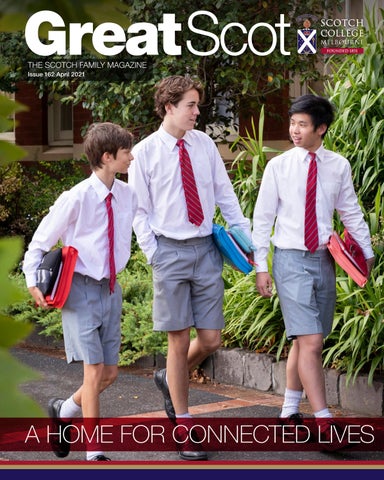
THE SCOTCH FAMILY MAGAZINE Issue 162 April 2021
A HOME FOR CONNECTED LIVES www.scotch.vic.edu.au Great Scot 1
CONTENTS 1 EDITOR
38 SPORT
2 CHAIRMAN
44 BOARDING
4 PRINCIPAL
46 FOUNDATION
7 CHAPLAIN
56 OSCA
10 JUNIOR SCHOOL
77 WHAT THEY’RE DOING NOW
18 MIDDLE SCHOOL 19 UPPER SCHOOL 20 FEATURES
8 SCHOOL COUNCIL CHAIRMAN RETIRES Hon Dr David Kemp AC (’59) retires after eight successful years; Alex Sloan (’71) takes the reins
80 SCHOOL HISTORY 81 OBITUARIES
20
23 SENIOR SCHOOL NEWS
CLASS OF 2020’S EXCELLENT RESULTS Impressive VCE outcomes amid challenging circumstances
The Scotch Family Magazine Issue 162 April 2021 is the official publication of Scotch College, Melbourne. Publisher Scotch College 1 Morrison Street, Hawthorn 3122 Victoria, Australia Phone: (03) 9810 4321 Email: greatscot@scotch.vic.edu.au www.scotch.vic.edu.au ABN 86 852 826 445 Print Post Approved PP100008172
View Old Scotch Collegians' Association news and updates at: www.oscanet.com.au Like us on Facebook Scotch College and OSCA
Editorial contributors Durga Kamte, David Ashton, Paul Mishura, Scott Montgomery, Tim Shearer, Patty Wallace-Smith. Editor Durga Kamte (03) 9810 4420 email: durga.kamte@scotch.vic.edu.au
26 NOT SIMPLY AN ENDURANCE EVENT 24 Hour Hike benefits an African children’s hospital
Assistant Editor David Ashton (03) 9810 4489 email: david.ashton@scotch.vic.edu.au Art Direction and Production Lisa Sheard (03) 9810 4443 email: lisa.sheard@scotch.vic.edu.au Photography National Photography, James Grant, Stephen Kong, Lisa Sheard, John Ferguson, Scotch College students, staff, parents and Old Boys.
38 SUMMER SPLASH Renewed appreciation of the joys of sport
2 Great Scot Number 152 – December 2017
EDITORIAL
Walking into school every morning, I am reminded just how privileged we all are to call Scotch College ‘home’. Boarders stroll down from their boarding home to their day home, well satisfied after a hearty breakfast, secure in the knowledge that their second family – mates and staff – have their backs. Already at this early hour, musicians congregate in the foyer of their home, the James Forbes Academy, and spaces in the Sir Zelman Cowen Centre for Science fill with boys ready to engage with each other on upcoming tasks, or just to catch up. Newly developed hubs for boys to interact – meeting spaces in the English Department, the Centre for Learning, St Andrew’s Square, the Keon-Cohen Dining Hall, and the Spencer Centre for Design and Technology – reveal animated faces and excited voices. Rowers complete their training on the river and prepare for the school day, and sports training is in full
swing on the ovals, tennis courts, and within the Glenn Centre. It is easy to take our surroundings for granted, but none of these developments would have been possible without the foresight, strategic planning and careful management of the many whose behind the scenes efforts have made them possible: School Council, senior management, the men and women in the Scotch Foundation and the Development Office, and many other members of the Scotch Family. Conversations in classrooms are often overlooked, as these may be dismissed merely as spaces for content delivery. However, the breadth and depth of relationships established in these learning environments testify to the relational learning model at Scotch. Few topics are off the table, as boys hotly debate, or quietly contemplate, the foundations of our society. When and why was a patriarchal model of social control established, and to what extent is this model challenged today? What constitutes success? Why should plays by dead white men still be studied today? To what extent has technological progress improved our lives – and who remains disadvantaged? Amid the big questions on what we accept, and what we need to challenge, the real connectedness emerges, as boys and teachers share their life experiences, their certainties and vulnerabilities, and their common and divergent perspectives on real world concerns. Often it is in these spaces, just as much as in tutor groups
and in formal Assemblies, that honest conversations can be held on misogyny, attitudes to gender and sexuality, and discriminatory attitudes towards minority groups. To effect change and to redress harmful social attitudes, as Mr Batty notes in his letter to parents, requires a concerted effort from parents, boys, staff and those in the wider community. The inherent dignity of the individual is a tenet of the School’s statement of intent. It is therefore heartening to note that in our shared home, boys have demonstrated their ability and willingness to reject repugnant attitudes that they recognise have no place in our society. On the theme of connectedness, the fourth and final instalment of the history of the Scotch Foundation clearly shows how Scotch has richly benefited from the close involvement of the Scotch Family with the School, and the School community’s key role in the development of Scotch. Also related to the theme of connected lives, OSCA President Andrew Wilson (’78) speaks in this edition about the Cardinal Thread, which continues to draw the Scotch Family together. Most encouragingly for the future of OSCA, Andrew says, the Cardinal Thread is being significantly strengthened between Young Old Boys by the Young Old Boys themselves. Meanwhile, OSCA is continuing to deliver its strategy of providing reasons to connect, ways to connect and opportunities to give back.
49
50
68
GILLESPIES’ DELIGHT Recognition of a longstanding commitment to Scotch
FOUNDATION HISTORY – PART 4 Into the future with confidence and optimism
A TARTAN FOR THE SCOTCH FAMILY A colourful symbol of our Scottish heritage
DURGA KAMTE EDITOR GREAT SCOT
www.scotch.vic.edu.au Great Scot 3
CHAIRMAN
MR ALEX SLOAN ('71) SCHOOL COUNCIL CHAIRMAN
SCHOOL PRINCIPAL, TOM BATTY, CHAIRMAN OF THE SCHOOL COUNCIL, ALEX SLOAN ('71), AND FORMER CHAIRMAN OF THE SCHOOL COUNCIL HON DR DAVID KEMP AC ('59)
A CONTINUING FOCUS ON BUILDING THE SCHOOL
Balancing Scotch's educational and physical development
As the 2021 school year gets underway, we rejoice in the vibrancy of boys back on campus. Across Australia and indeed the world, we can now hope that the development and distribution of COVID-19 vaccines will allow us a return to a mode of operation we once took for granted. While 2020 offered many challenges for our School, our boys, their families and the broader community, we should not miss the opportunity to reflect on, and learn from, the invaluable qualities of resilience and determination that were very much on display. Undoubtedly previous generations learned the importance of these qualities, as they confronted a common enemy in World Wars and the hardships of economic loss stemming from the 1930s Depression. 4 Great Scot Issue 162 – April 2021
Having assumed the Chairmanship of Scotch Council last December, I count myself as fortunate in having witnessed firsthand the difference strong and effective leadership can make in difficult times. With the Hon. Dr David Kemp AC (’59) at the helm of School Council and Mr Tom Batty in the Principal’s position, Scotch has been indeed blessed. Drawing on all the best of Scotch’s values and traditions, our community has emerged from the crisis in sound shape, albeit that we all have a story to tell. The central theme of the approach taken by the former Chairman and current Principal, was that we all needed to bear some pain in order for the Scotch community to emerge intact from the crisis. Four key observations bear out the success of that approach:
• First, the vast majority of the boys have returned to the Hawthorn campus in 2021, surrounded by their friends, apart from some in our international cohort with whom we are still actively pursuing a solution. • Second, our staff, both academic and nonacademic, remained employed throughout all the difficulties. • Third, as evidenced by the VCE results in 2020, Scotch’s academic results remained very strong despite all the challenges of remote learning. • Finally, the School has managed to remain in sound financial shape while returning genuine savings to parents, and having provided fees assistance where need existed. Our community is greatly indebted to David Kemp for his eight years at the helm of Council, and for his exemplary leadership through the 2020 crisis. As the Rev. Dr John Wilson, Vice Chairman of Council, has so appropriately expressed it, ‘David has been a steady hand at the helm’. Thank you, David. As we move forward into 2021, I want to assure the Scotch community that Council will remain focused on continuing to build the School, both educationally and structurally, in a way that is complementary. Developments over the last decade such as the Sir Zelman Cowen Centre for Science, the Spencer Centre for Design and Technology, and the recently completed Keon-Cohen Dining Hall are wonderful examples of developing our buildings and grounds in support of an enhanced educational approach directed to the needs of each boy. In the coming years we must ensure we strike the right balance in our educational and physical development, to continue that approach in a rapidly changing environment. As in all things, Scotch must be responsive to the challenges our society is confronting, as we grapple
with how to ensure our core value of respect carries through every aspect of life, including the inviolable requirement for consent in relationships. In recent weeks the Principal has laid out how the School has been, and is, addressing this challenge, while also being clear that we must do more. His approach and initiatives have the full support of Council. On another theme, one of Scotch’s great attributes has been the quality of its supporting bodies and their ability to work in a complementary way for the ultimate benefit of the School. The Presbyterian Church of Victoria, the Scotch Foundation, OSCA and the Scotch Parents’ Association all continue to strive to make Scotch an even better place. In that vein it is pleasing to record that the current President of OSCA, Andrew Wilson (’78), has joined the School Council, filling the vacancy created by David Kemp’s retirement. Along with membership of Council’s Risk Committee, Andrew will provide liaison with the Scotch Parents’ Association and a greater focus on sustainability. After 30 years of magnificent service, Brian Bayston OAM (’47) has stepped down from Council as a nominee from the Presbyterian Church of Victoria, and has been replaced by David Graham (’94). David comes to Council with significant expertise in transport engineering, planning and design, and his skills have been quickly embraced by Council’s Property Committee. Council thanks Brian for his many years of fine service, and warmly welcomes Andrew and David to its ranks. As 2021 unfolds we all sincerely hope that the worst effects of COVID-19 are behind us; but whatever lies ahead I am confident that the substance, character and values of the School we love will shine through.
SOME OF THE PROJECTS COMPLETED DURING HON DR DAVID KEMP'S SCHOOL COUNCIL CHAIRMANSHIP: SIR ZELMAN COWEN CENTRE FOR SCIENCE, SPENCER CENTRE FOR DESIGN AND TECHNOLOGY, KEON-COHEN DINING HALL
www.scotch.vic.edu.au Great Scot 5
PRINCIPAL
GROWTH THROUGH CONNECTION MR TOM BATTY SCHOOL PRINCIPAL
Before commencing my article, I want to pay tribute to the remarkable service of former Chairman of Council, the Hon Dr David Kemp AC. It is service steeped in wisdom, purpose and love of Scotch, and his influence on his School is meaningful and lasting. Schools are difficult institutions to label: not corporate, political or purely charitable. In essence, they are communities of learning founded on principles and values, and Dr Kemp has been ever generous with his intellect, knowledge and experience. None have learnt more than this Principal. The details of Dr Kemp’s association with his School are chronicled elsewhere in this edition. The School is most fortunate to have a person of the calibre of Alex Sloan to take up the role of Chairman. We are again in good hands.
As boys and teachers raised voices in praise in Memorial Hall, parents dusted off pads, instruments and backpacks, and those who call Scotch home joined in excited exchange for a first meal on the Hill, life came back to the School, buoyed on optimism that this would be a year of togetherness rather than separation. That such intimacy is central to communal life resounded from the ebullient conversations at the Year 7 family picnic and those that have brightened boundaries and courts of Saturday sport. That it is the currency of growth and education was evidenced by the rich diversity of journeys undertaken, as boys stepped forth from Malvern East, Colombo, Bronte, Hunters Hill, Beijing, Wodonga, Hawthorn, Alice Springs, Warrnambool, Thursday Island, St Peters, Kuala Lumpur, Kew and Cairns. All brought stories to share, to open minds to worlds beyond doorsteps, as education began its dance of crafting capacity to see the world through the eyes of others, while unearthing passions and honing mastery.
6 Great Scot Issue 162 – April 2021
Our quest for the boys who define the Scotch of 2021 is not to tell them what to think, rather that they should think; to inculcate habits of critical liberal thought that lead to self-responsibility and service; to nurture values and cognisance that seed empathy, adaptability and influence. We have some useful resources to hand: wonderful teachers and staff ready to unearth those passions and polish that mastery; facilities that give home to disciplines and activities, stimulating collision, conversation and engagement; and a sense of belonging that affords opportunity, connection and confidence. We are clear in values that respect the inherent dignity of each person and in our curiosity about how the world came to be as it is, and how it might evolve for the betterment of all. Against such canvas, we must, particularly at the start of a school year, consider what more we can do to make our environment one that is open to, and accepting of, differing views, experiences and frames of reference; one in which each boy can feel strong and sure in his step, voice and self; one which gives authority to the vulnerability necessary for originality. We must question how we might further align with changing opportunities for enterprise, social and economic. We must ask how our values might more forcibly be harnessed in preparing boys for the challenges and opportunities of their generation. Such matters find direction in our key planning themes of personalisation, diversity, enterprise and sustainability, and take form in key objectives for the year ahead. We will further consider experiences that nurture the growth of the boys, with particular reference to encounters that emphasise contact with a diverse range of people; reflection on a moral position; belief
in causes bigger than oneself; appreciation of what excellence really looks like, what it takes to pursue it, and the vulnerability inherent in such pursuit; and capacity to see actions through others’ frames of reference. Primary to such commitment is ensuring Scotch remains a safe environment for the boys. The School is in the final year of three of its accreditation as a Safe School by the Australian Childhood Foundation. Whilst the process of reaccreditation is, and has been, ongoing, it will take formal form in September and October. Building on recent developments in promoting enterprise at Scotch – including the introduction of the Year 9/10 Scotch Enterprise Programme elective, the forming of the Enterprise Club, a growing focus on coding and algorithms, and robotics, and the introduction of VCE Systems Engineering – we are giving considered thought to the development of a syllabus for a comprehensive enterprise course. Extending such entrepreneurial intent to our dayto-day craft, and drawing on our work during periods of remote instruction, we will be seeking to contrive for boys and teachers, ready and intelligent online access to live and recorded lessons and resources. Recent years have seen considerable progress made in the digitisation and intelligent storage of school records. This will continue over the months ahead, alongside a broader push to digitise practice across the School. We will take a fresh look at matters of sustainability at the School, considering how current and future practice and developments might evolve in keeping with our aspirations, good management and responsibilities, as both school and community partner. Developing our physical environment in harmony with our educational aspirations has been at the heart of our efforts this past decade. The summer vacation saw final touches put to the St Andrew’s Square plaza around the Keon-Cohen Dining Hall, the provision of two new House Rooms in the westerly corners of the Quadrangle, and the completion of preliminary works on the ground floor of the Languages and Culture Centre in preparation for the opening of the final four (of the current incarnation) House Rooms at the beginning of 2022. Planning continues for the development of accommodation facilities in School and McMeckan boarding houses and for the Michael Robinson Centre for Mathematics that current planning will, in due course, have occupy the southern flank of St Andrew’s Square. In the Junior School, as boys and staff enjoy and explore new possibilities in the refurbished Harbig Library, growth of the boys will be considered through encounters to promote respect, fairness, equity, diversity, compassion and excellence. Amidst
the broader curriculum, focus will be maintained on creativity and curiosity, competencies with digital technologies and poetry. Across the School, we will continue targeted support for boys requiring additional literacy and numeracy support as a consequence of the disruption to learning caused by COVID-19. The Teacher Action Research and Career Development Programme, which sees staff collaborate in teams on projects of personal professional interest to the benefit of the boys, returns from its 2020 COVID hiatus, with first round projects to be presented at the end of the year. The International Special Interest Group on Relational Teaching and Learning, established in partnership with the Crescent School in Toronto and with support from Dr Michael Reichert and the International Boys’ Schools Coalition, will reconvene. Twenty-eight schools across eight countries will divide into clusters to share and develop their relational practice and expertise, including use of the relational learning situational judgment test, developed by Scotch, Crescent and Michael Reichert. Similarly, the Scotch Educational Reading Group will again have staff gathering to discuss seminal articles on educational theory and how they might inform future initiatives at the School. Term 1 will see inaugural participation of all staff in our new Staff Experience and Engagement Survey, designed in partnership with Professor James Tognolini, Director Educational Measurement and Assessment Hub at the University of Sydney. The survey has been constructed to report on experience of, and engagement with, the workplace and staff wellbeing, and will be administered triennially. The Year 12 mentoring programme, developed last year to support boys learning remotely, will be offered again this year, as further support for academic subject advice, general health guidance, post-Scotch pathways and broad pastoral care. And, of course, around ovals, courts and riverbanks, the boys will be resplendent in their new sporting uniforms! All such initiatives are designed to better connect boys to each other, the world they are inheriting and those with whom they will share it; to better empower them to connect economic and social enterprise; to better enable them to see that the quality of their lives is intrinsically connected to the quality of lives all around them, near and far; to see my breath seek its rightful place with the stars, with everyone else who breathes. Sincerity, Carol Ann Duffy www.scotch.vic.edu.au Great Scot 7
PRINCIPAL The Principal, Tom Batty, sent this letter to Scotch parents and guardians on 2 March 2021, in response to recent allegations of sexual abuse by students from boys' schools.
The Principal 1 Morrison Street Hawthorn Victoria 3122 Australia Tel: +61 3 9810 4321 Fax: +61 3 9810 4141 Web: www.scotch.vic.edu.au
MR TOM BATTY SCHOOL PRINCIPAL
ABN 86 852 826 445
2nd March, 2021 Dear Parents and Guardians, Addressing inequity in society and the abuse it fosters requires strong voice. The first step is often the hero step and, with many, Scotch applauds the young women who have recently spoken out about the sexual abuse and distress they have suffered. Such frankness brings light into darkness and onto crime. Schools and other institutions must rethink steps taken. It is clear what has been done is not enough. It is also clear we are stronger when acting together. With the family unit, the school plays significant role in forming attitudes. We need to consider what more the School can do to educate boys and support families. Abuse is linked to power. While seeking equity, we must be cognisant of environments and behaviour that exacerbate existing power imbalances and put young people at risk: access to alcohol, availability of illicit drugs, online pornography, unsupervised gatherings, choosing not to see or hear. Real change, however, comes from the values established and prosecuted within and amidst our key social units: the classroom, the family home, the friendship group, the online chat group, the sports team, the workplace. The School has a number of programmes addressing respectful relationships with women. The particular issue of consent is addressed in our Year 8 Respectful Relationships programme, which includes talks by our School Psychologist, workshops with an external provider and targeted presentations as part of the Big Ideas Lecture Series. In Year 9, it is central in our Christian Education unit ‘Respect for Women’. In Year 10, it is a recurring theme of the Respectful Relationships programme run in collaboration with Methodist Ladies’ College that includes a talk by a former Police Officer, small group discussion and a parent forum. Year 12 boys assemble for a presentation by our Police Youth Liaison Officer regarding responsibility and the Law. By mandatory responsibility and through values, the School will pursue any allegation of abuse with relevant authorities. In 2019, boys, parents and staff were invited to participate in a global research project, Responsible Sexual Citizenship, sponsored by the International Boys’ Schools Coalition and led by Associate Professor Ada Sinacore of McGill University. The study sought to determine boys’ knowledge and understanding of gender and sexuality, sexual health, consent, healthy and unhealthy relationships, ethics and responsibility when online, and the School’s culture in respect to these. It also sought to learn from parents and teachers how information is provided to boys, and garner recommendations for action. Following publication of the research report last year, the School, under the leadership of our School Psychologist, has embarked on implementing the findings within the Scotch context, involving boys, teachers and parents. It is clear we must do more and we will. Respect for the inherent dignity of each person is the human challenge of our times. Your sincerely, I Tom Batty Principal
8 Great Scot Issue 162 – April 2021
CHAPLAIN
REPAIRING BROKEN CONNECTIONS REV DAVID ASSENDER SCHOOL CHAPLAIN
Using the tools of connecting behaviour to change disconnecting behaviour We are connected all around the world like never before, but how do we connect well? What makes a good connection? How do we repair broken connections? Humanly speaking, I think it is helpful to think of connections not so much as something we have with others, as much as something we do. Psychiatrist William Glasser is known for helpfully outlining connecting and disconnecting habits in relationships. He says we can choose nourishing habits of supporting, encouraging, listening, accepting, trusting, respecting and negotiating differences to repair and build healthy relationships. On the other hand, we should avoid disconnecting habits of criticising, blaming, complaining, nagging, threatening, punishing and bribing or even rewarding to control. This is a very helpful list of dos and don’ts. Understanding the context or social dynamics of disconnecting behaviour is also critical. In her very influential book, Hurt People Hurt People, Dr Sandra Wilson explains that the one thing we all need to heal our hurts is people to support and help us. However, when hurt people hurt people, they disconnect themselves from their sources of support. In other words, how can we expect to be helped by the very people we are pushing away? Is it possible for a bully to reconnect? Perhaps one of the greatest bullies in Christian history was the Apostle Paul himself. Before he put his faith in Christ, he was a proud and tenacious persecutor of Christians. Where did his change of direction come from? In his words: ‘This life that I live now, I live by faith in the Son of God, who loved me and gave his life for me’ (Galatians 2:20). What did Jesus do to change Paul’s direction? He gave his life for him. Despite all the hurt Paul had caused, forgiveness was extended to him through faith in what Jesus did on the cross. Selflessness turns us into givers when the takers are taking. Jesus once said: ‘But I tell you who hear me: Love your enemies, do good to those who hate you, bless those who curse you, and pray for those who mistreat you. If anyone hits you on one cheek, let him hit the other one too; if someone takes your coat, let him have your shirt as well. Give to everyone who
asks you for something, and when someone takes what is yours, do not ask for it back. Do for others just what you want them to do for you.’ (Luke 6:27-31) This is a very powerful list of connecting habits. The Greek word for love here is agape. It is a love that seeks nothing in return. Famously, the Rev Martin Luther King Jr explained this love in a sermon that became the rationale behind the peaceful marches of the Civil Rights Movement: ‘It is an overflowing love; it’s what theologians would call the love of God working in the lives of men. And when you rise to love on this level, you begin to love men, not because they are likeable, but because God loves them. You look at every man, and you love him because you know God loves him … ‘And this is what Jesus means … in this very passage when he says, “Love your enemy.” And it’s significant that he does not say, “Like your enemy.” Like is a sentimental something, an affectionate something. There are a lot of people that I find it difficult to like … Love is an understanding, redemptive goodwill for all men, so that you love everybody because God loves them. You refuse to do anything that will defeat an individual, because you have agape in your soul. And here you come to the point that you love the individual who does the evil deed, while hating the deed that the person does. This is what Jesus means when he says, "Love your enemy." This is the way to do it.’ Dauntingly, this is the way to do it. To change disconnecting behaviour you use the tools of connecting behaviour. You love your enemies and do good to those who hate you. You show them a better way so they can see and recognise a better way. Just as Martin Luther King Jr showed us, and just as Jesus showed us on the cross.
9
NEWS
HON DR DAVID KEMP AC (’59) RETIRES AFTER EIGHT SUCCESSFUL YEARS AS COUNCIL CHAIRMAN Chairman’s legacy is a school grounded on strong foundations with a keen eye to the future The Hon Dr David Kemp AC (’59) has retired as Chairman of the Scotch College Council, after eight highly successful years in the role. He has been succeeded as Chairman by Mr Alex Sloan (’71). David was a member of Council from 2004 until his retirement earlier this year. He was appointed as Chairman in 2012, and he presided over one of the most significant building programs since the School moved from East Melbourne to Hawthorn in the early twentieth century. The many successful projects completed during David’s chairmanship include the Sir Zelman Cowen Centre for Science, the Spencer Centre for Design and Technology, the Tolson Centre, the Keon-Cohen Dining Hall and refurbishments to the Lithgow Centre and the Language and Culture Centre, all of which have transformed the School. David was also a member of many School Council committees. David attended Scotch from 1949-59, following in the footsteps of two great-
10 Great Scot Issue 162 – April 2021
grandfathers, both grandfathers and his father. David’s own sons, William (’90), Andrew (’04) and Charles (’10) were also at Scotch, and Charles was School Captain in 2011. In his final Scotch year, David was a School Prefect, Co-Editor of The Scotch Collegian and Co-Dux of the School, gaining Exhibitions in Economics and Latin and a General Exhibition. After graduating with Law and Arts degrees from the University of Melbourne, David attended Yale University as a Fulbright Scholar, where he completed a PhD (with distinction) in Political Science. David was elected as Member for Goldstein in the Parliament of Australia in 1990, and retired at the 2004 election. He held many ministerial posts, including Minister for Schools, Vocational Education and Training from 1996 to 1997 and Minister for Employment, Education, Training and Youth Affairs from 1997 to 1998. He has also had many Liberal Party appointments, and he is an Honorary Life Member of the party.
In addition, David has held numerous board positions in a wide variety of fields. A member of the Melbourne University Council in 2014-15, David was a Professor at the university from 2005-10 and a ViceChancellor's Fellow from 2006-10. At Monash University, he was a Senior Lecturer in Political Science from 1975-79 and a Professor of Politics from 1979-90. He has published many papers and authored several books. In the 2017 Australia Day honours, David received a Companion of the Order of Australia (AC) award for his eminent service to the Parliament of Australia, notably in the areas of employment, education, training and youth affairs, to the environment, to institutional reform and public policy development, and to the community. Scotch is most grateful to David for his selfless and dedicated service to his former School, supported by his wife, Anne Marie. We look forward to their continuing involvement and interest in Scotch’s future development.
LONG-SERVING SCHOOL COUNCILLOR BRIAN BAYSTON OAM (’47) RETIRES Many years of dedicated service to Scotch Brian Bayston OAM (’47) has retired from School Council, after many years of dedicated service to the Council and to Scotch. Brian served on the Council from 1980 to 1985, and from 1996 until his retirement at the end of 2020. Brian attended Scotch from 1936-48 as a member of Monash House. He was Dux of the Junior School in 1942. In 1947 Brian was awarded the Lionel Robinson Scholarship, and in his final year of 1948, he was a member of the Library Committee, and was awarded a Government Senior Scholarship. An employee consultant and former Senior Partner at McCracken & McCracken, solicitors, among many appointments Brian has been a board member of the
Australian Institute of Archaeology, the Melbourne School of Theology, Gospel Hall Incorporated and the council of Presbyterian Ladies’ College. He is a former Moderator of the General Assembly of the Presbyterian Church of Victoria (the first non-clerical appointee to this position), and a former member of sessions at Scots’ Church. Brian has been a member of the councils of the Bible Society in Australia (past Chairman), the Bible Society in Australia (Victoria – past Chairman), the World Evangelical Alliance (past Secretary), and the Australian Evangelical Alliance (past Chairman). In the 2004 Queen’s Birthday honours, Brian received a Medal of the Order of
Australia award (OAM) for service to the community through a range of religious and educational organisations, particularly the Presbyterian Church of Victoria. Brian married Helen Denise Laxton in the Littlejohn Memorial Chapel on 16 July 1960. Their sons, Martin (’81), Hamish (’82) and Alister (’85) attended Scotch. Their grandson, Gabriel Bayston, is enrolled as a future Scotch student. Among Brian’s recreational interests are genealogy, reading, travel and films. Scotch is grateful to Brian for his long period of excellent service, and wishes Brian and Helen well for the future.
www.scotch.vic.edu.au Great Scot 11
JUNIOR SCHOOL
THE NEED TO FEEL CONNECTED MR JON ABBOTT HEAD OF JUNIOR SCHOOL
COVID-19 brought opportunities to reflect on what is important in our lives
I don’t think I will get much argument from anyone when I say that 2020 was in many ways a year we would all like to forget. For those of us living in Victoria, and particularly those in the greater Melbourne region, it was a very challenging period of our lives and one that none of us would ever wish to revisit. However, to simply try to wipe from memory all that took place in 2020 in an effort to move 12 Great Scot Issue 162 – April 2021
on would be, in my opinion, a mistake and a lost opportunity. I think 2020, for all its trials and challenges, provided us with an opportunity to learn about ourselves and what is most important to us. It would appear that the old saying ‘You don’t know what you have until you lose it,’ was never more true. We lost so much that we valued throughout the dark and harsh
months of the lockdown periods. There were so many aspects of our lives that we were not able to enjoy because of the measures imposed on us. For me, the most significant of these was our opportunity to be with each other; to be with our wider families, our friends, our work colleagues, our sporting teams and clubs, our interest groups, our neighbours. I believe that this was the hardest of all the deprivations we had to deal with. The inability to spend time with others apart from our immediate families showed us just how much our social world means to us. We all missed taking holidays to interesting places, eating out, and going to sports events, movies and the theatre, but what was truly hard was not being able to be with the people we hold dear. As I spent my days throughout the second lockdown, where there seemed to be an abundance of time to think and contemplate, I realised that our Junior School, like most schools, provides so many ways for us all to be connected. It is not just the boys who missed their classmates during remote learning. Our teachers missed being part of a team and the collegiality of the staffroom, and our parent body missed their connections with each other and with us. How much did we miss that chat along Callantina Road waiting for the boys to swarm out of the gates during the afternoon? How sad were we not to experience the wonderful sense of community that events like Family Day bring us each year? You see, schools aren’t just places of learning; they are a microcosm of the social world we all live in. A strong school community is a huge network
of connections and relationships, and the more connections there are, the stronger the community. I love to hear stories of parents helping each other to manage the busyness of the week by carpooling, sharing sports drop-offs, or volunteering to look after someone else’s boys after school for an hour or so to assist another family manage their activities. Equally, when members of our community find themselves struggling through really challenging times, the network of support automatically kicks in and people from our community are there to do whatever is required to help a family in need or in grief. I have seen this time and again in my 10 years at Scotch, and every time it warms my heart to see how generous in support our community can be. As human beings we have an innate need to feel connected, to feel part of something bigger than ourselves, and to be part of a network that values each of its many parts and seeks to ensure that everyone is looked after. COVID-19 brought us many opportunities to reflect on what is truly important in our lives; our health and wellbeing and, as we have now learned, our relationships with others. I know that the one thing the boys were looking forward to towards the end of last year, when they were allowed to return to school, above everything else was being together with their mates. It was very rewarding and uplifting to see them so joyous on that first day back, just to be with their mates once again. The need to feel connected is part of the basic human condition and long may it remain so.
www.scotch.vic.edu.au Great Scot 13
JUNIOR SCHOOL When you are no longer teaching what will be your favourite Scotch memories? I will have so many wonderful memories to reflect on, including fun times with students and staff, Family Days, walking through the beautiful Scotch grounds, and seeing the excitement of new preps on their first day of school. However, I think the best will be of helping so many boys to improve their learning outcomes, seeing the priceless look on their faces when understanding is achieved, and knowing that I’ve played a role in their educational journey and made a small difference in their lives.
Interview:
MELISSA SUTHERLAND Junior School Learning Support Assistant After being awarded Dux of her Primary Teaching course in 1987, Melissa started her teaching career with the Department of Education in 1988. Her teaching journey has taken her to schools all over Melbourne from Albanvale, Campbellfield, Williamstown to Templestowe and Beaumaris. She was a leading teacher for 10 years at Beaumaris Primary School, where she was a classroom teacher, junior primary and specialist coordinator and school management team member. Melissa started her career in the Scotch Junior School as a Teaching Assistant, working in a Prep classroom in 2013. In 2016 she joined the Junior School Learning Support Department, where she has enjoyed working with both individuals and small groups. Melissa is dedicated to caring for the needs of others, and has developed a great rapport with both the boys and her colleagues. She is organised, competent and a great team member. MELINDA WHITING
14 Great Scot Issue 162 – April 2021
What are your roles and responsibilities at Scotch? When I was first employed at Scotch, I was lucky enough to work for three years as an Assistant in the Prep Classroom. Every day in Prep was full of firsts, fun and fascination. There were giggles, tears and lots of wonderful learning. Later I was fortunate to join the Learning Support team, where I have worked with small groups of boys in spelling and reading groups, Literature Circles with Year 6s, English as a second language, and in support for boys one-on-one in the classroom. I have worked with the Learning Support team on the testing program; and a fun part of my job has been creating a wide variety of creative wall displays for the Learning Support Department. What have been your biggest challenges at Scotch? Scotch is such a wonderfully busy place, so it’s always challenging keeping abreast of what’s happening around the School. Fortunately, the supportive team at Scotch is always ready to point you in the right direction.
What story will your colleagues tell about you when you retire? I hope they would say I made valuable contributions to the Scotch team and showed passion and commitment to helping boys to reach their full potential. However, on a less serious note I think my ongoing battle with my footwear has caused a laugh on occasions, and would definitely be recalled. I think the mysterious way clocks seem to stop in the rooms where I’ve worked is another funny story to be told. After all these years of service to Scotch, what is your favourite corner of the School and why? I have so many favourite places around Scotch, including the beautiful room where I work with its gorgeous high ceiling and panelled windows, the majestic Chapel and the classrooms, where there is always such a wonderful buzz. However, being a keen gardener, I just adore the beauty of the Scotch grounds and appreciate the tranquillity they bring when I have a moment to take a stroll. What is an amusing or memorable incident in your career at Scotch? There are certainly quite a few, but one funny incident was when I was working in Prep, and for a Father’s Day activity I asked one of the boys to tell me about his dad. He said, ‘My dad is a liar’. Of course, I did a double take and asked again, and he kept repeating the same thing. I soon found out this little Prep boy was having a pronunciation problem. His dad was not a liar, but actually a lawyer. I breathed a sigh of relief and had to try hard to hide my amusement.
A Home for Connected Lives We are connected with our friends, and experience wonderful things together, and get to experience the joy with a partner to laugh, joke and have great times together. We are connected because we can learn a lot more with friends, and learn valuable life lessons. Because of our connection, we have great times and learn more, and we should enjoy that time as much as we can. We are connected to our country, our friends, family, school and achievements. We are connected because we should be loyal to our country and enjoy spending time with our friends and family. We should also be proud of our achievements, but not boast about them. Because of our connection to these things, we should enjoy them and use the time we have with them as best as we can. JAMIN HO and ETHAN BATES – YEAR 6
www.scotch.vic.edu.au Great Scot 15
JUNIOR SCHOOL
THE JUNIOR SCHOOL’S LIGHT-FILLED AND SPACIOUS NEW LIBRARY The renovated Harbig Library and ICT area is a great place to visit, and to learn
THE REFURBISHED JUNIOR SCHOOL LIBRARY AND ICT TEACHING SPACE IS AN INVITING PLACE,
The Harbig Junior School Library and the Information and Communication Technology areas were wonderfully renovated over the 2020/21 summer break. For many years the Library facilities were split between an upper and a lower area, with the Library teaching area upstairs and the fiction collection and ICT teaching space in among the non-fiction book collection on the lower floor. Several years ago plans were drawn up to consolidate all of the library resources and classroom, including both fiction and nonfiction collections onto the same level, which also involved moving the ICT teaching facilities upstairs. After many years of transporting fiction books up and down the staircase to reshelve, and also sharing the borrowing area downstairs with computer classes, it seemed a sensible and practical solution to change the layout and give the library a fresh and modern refurbishment. Unfortunately a number of factors delayed the refurbishment, until works finally started over the summer break. The final result is an amazing, light-filled and spacious new library with incredible city views, and a dynamic classroom area which includes innovative seating and visually appealing shelving. The new design makes it easy for the boys to find and borrow books from the extensive collection, all in the one space. The improvements
16 Great Scot
WHICH WILL ENHANCE THE BOYS’ LOVE OF BOOKS OVER THE COMING YEARS.
have received great reviews from boys as well as parents, as they gradually return to the campus and enjoy visiting the new space. Our library staff, Mrs Amy Rogers and Mrs Deb Parkinson, are really enjoying the flow and feel of working with the boys in the new space. Upstairs in the mezzanine area, the ICT teaching area has now been improved to include a separate green screen video production room, where boys and staff can develop their recording skills and foster their creative talents using technology and video. Junior School ICT teacher, John Croxford, has welcomed the new, modern suite which allows boys the space to work on exciting new projects. The new Junior School Library and ICT teaching space is a delightful and inviting place for the boys to visit and in which to learn, and one that will hopefully enhance their love of books even more over the coming years. The Junior School Library was named in honour of Dick Harbig (’33) a successful manufacturer who generously gave funds for the Harbig Library, which was opened in the redeveloped Junior School on 5 April 1990. For his past generosity to Scotch, Dick was appointed a Life Governor of Scotch in 1982, and the Harbig family continues to be a generous supporter of Scotch. TIM SHEARER – DIRECTOR OF DEVELOPMENT
Great Scot 17
JUNIOR SCHOOL
1.
OUR YEAR 6 BOYS’ CANBERRA EXPERIENCE Scotch’s Year 6 boys flew to Canberra near the end of Term 1, and visited many of the national capital’s well-known institutions. Here are some of the boys’ impressions of what they saw during their visit.
4.
5.
As Year 6 Scotch students and staff visiting Canberra, we would like to pay our respects to the Ngunnawal people, the traditional custodians of the land that we call Canberra, and pay our respects to their elders past, present and emerging. We extend that respect to Aboriginal and Torres Strait Islander peoples that are here today. While visiting the nation’s most important buildings and institutes in Canberra, the Year 6 boys had a renewed interest in learning the history of Australia and its federation. Highlights of the trip were visits to Questacon, the Royal Australian Mint, the Australian Institute of Sport and Parliament House. However, Canberra does not only comprise of important buildings. With many people living in the capital of Australia, it’s also a bustling city full of life. Canberra is truly a home where the past and present are fused, connecting the lives of people from across the country. MATTHEW CHEN and DANIEL CHEN
The Year 6 level of 2021 took a 45-minute flight to the ACT – the heart of Parliament for Australia. Notwithstanding the fact that we didn’t see any parliamentarians, we got to see several significant
18 Great Scot Issue 162 – April 2021
6.
Australian places. On our Canberra journey we also were taught about Canberra’s history. We also had the opportunity to view the Aboriginal Tent Embassy and the embassies of many other countries. LUCA PELOSI and HARVEY HAINTZ
At Scotch College, there is a strong connection with our School and our country. Recently, as part of our Year 6 camp to Canberra we went to the Old Parliament House and Parliament House to learn about our country and the federal government, and the rich history of our Indigenous heritage. We are connected to our country because we live for our country, abide by its laws and values, and feel inspired by our love for our country. AARYAN BERERA and NATHAN NAI
We feel connected to Scotch through the staff members at Scotch and our friends. We recently went to Canberra with the whole of Year 6 and we felt safe and cared for during the whole trip. The teachers organised for us to go to so many amazing places in Canberra. We were so lucky to be able to go on the Canberra trip and we’re so grateful. We loved spending time with our friends in
2.
3.
1. BOYS ON THE STEPS OF OLD PARLIAMENT HOUSE. 2. SAM BARLOW, HUNTER COOK, CHARLIE LEWIN, LEWIS FRANCIS AND WILL SLADEN ENJOYING THE BIKE RIDE AROUND LAKE BURLEY GRIFFIN. 3. VISITING THE AUSTRALIAN WAR MEMORIAL. 4. IN THE NEW SENATE. 5. OUTSIDE THE AUSTRALIAN WAR MEMORIAL. 6. A MOMENT TO RELAX FOR ALBERT ELSOM, NATHAN NAI AND ALEXANDER ANG. 7. VISITING THE SENATE IN OLD PARLIAMENT HOUSE: GUS KELLY, LIAM TONG, ELIAS CATTERMOLE, JOSHUA KURTZ, TOM CASHIN, EDWARD ROSS AND ARCHER BUSCOMBE. 8. QUESTION AND ANSWER TIME IN THE NEW HOUSE OF REPRESENTATIVES. 9. BEAUTIFUL VIEWS OF CANBERRA FROM THE STEPS OF NEW PARLIAMENT HOUSE. 10. AT THE NATIONAL MUSEUM, CANBERRA.
3.
7.
8.
our cabin. This Canberra trip will definitely be one of our highlights in Junior School, as we really got to experience the history of our country with all our friends. SASH YUVARAJ and LACHLAN WANG
On our recent trip to Canberra we visited Parliament House. A special place we saw was Members’ Hall. This hall is a place only for ministers. Members’ Hall is between the House of Representatives and the Senate. In the centre of the hall is a special water feature symbolising democracy. This water feature prevents anyone from standing in the centre of the building. I think that is a way of saying one individual is not the most powerful person in Australia and everyone is equal.
9.
ROHAN CALI
At Scotch we always respect all the Old Boys and staff who died and fought during the war. On our recent trip to Canberra, we visited the War Memorial, and paid our respectful tribute to all those who fought in the war. JOEL HENG and ALEXANDER ANG
10.
www.scotch.vic.edu.au Great Scot 19
MIDDLE SCHOOL
MS KATRINA STALKER HEAD OF MIDDLE SCHOOL
RECONNECTIONS AND NEW CONNECTIONS The joy at being back at school was evident with the energy levels in the Quadrangle, as the boys restarted school this year. They reconnected with mates they hadn’t seen over the long summer holidays; and for the Year 7s there was the excitement of making new connections. Although initially there were many wrong turns as they navigated our campus, the Year 7s are now experts. The trepidation of the first day of school has faded to a distant memory, and the boys of Years 7 and 8 are settling into the routines of the Senior School. After the interruptions of the 2020 school year, this has been a little more difficult in terms of organisation and the development of some social skills. Years 10, 11 and 12 boys have ably assisted the younger boys in a variety of ways, including organised sport at lunchtime, homework clubs, and Peer Support sessions. These programs not only give leadership opportunities and training to the senior boys, but the mentoring provides wonderful support to the younger members of our school community, as the older boys impart invaluable knowledge of how our school works. 20 Great Scot Issue 162 – April 2021
With great expectations, each of the Year 7 forms headed to Scotch-at-Cowes on Phillip Island. Much laughter was had as the boys started to get to know each other and their teachers. When asked about what was the favourite activity the answers they gave were varied, including the sailing, boogie boarding, mutton birds, snorkelling, and the food! I was most impressed at how well the Year 7s transitioned to remote learning for the three days of lockdown this term. Having only just been introduced to our Learning Management System they quickly adapted to following their teachers online. Thankfully we quickly returned to campus, wearing masks but at least back to our lives of personal connection. The Big Ideas Lecture series to Year 8 boys started around International Women’s Day with a topical address on the Suffragettes. The series is designed to bring a focus to ideas, people, movements and/or events that have made an indelible mark on the world as we know it. Our aim is to challenge boys to engage with these ideas, and to gain a deeper understanding of the importance of accepting difference and developing respectful relationships.
UPPER SCHOOL
MR TIM RAYNER HEAD OF UPPER SCHOOL
‘LOVE ALL. SHARE ALL’ – A STATEMENT ON THE SIDE OF A DELIVERY VAN There is much to learn from Sikh devotion to charity work It was during those dreadful bushfires of 2020 that I first became aware of a group of Sikh volunteers in regional Victoria, who were helping to provide food to those Australians evacuated from their homes. It was a brief scene on television of a group of Indian men and women standing beside a white van in Bairnsdale, giving out food to grateful recipients. Although the coverage had been very short, it did resonate. By the end of that year, when our school had returned to a semblance of normality following online learning, Mr Nick Miller and I were discussing the 2021 Year 11 Immersion program. As the program’s aim is to nurture community service and development, it seemed logical that we should invite Sikh Volunteers Australia to school to speak to our Year 11 Immersion boys about the work they do in our community. And what a story it was. Mr Jaswinder Singh explained that the charity work was started in 2014 by a group of Sikh friends in Melbourne, all of whom were on temporary visas. They wanted to give back to the community and country they had become a part of, and felt that a way to do this would be to offer their services to local community events. This led to the idea of providing free food to any person who was in need, and to do so they all chipped in $1000 so they could purchase a delivery van. From this beginning, the group now serves or gives take-away food to the homeless and needy in the south-eastern suburbs. Their website makes interesting reading. A motivating factor in this initiative is the Sikh commitment to charity work, encapsulated by the phrases written on the side of their service van: ‘Love all. Share all’. All Sikh temples across the world have a kitchen which provides free food to anyone who visits, whether Sikh or not. The Sikhs believe that by sitting side by side, eating and talking, with no special privileges, equality among all is reinforced. The boys in the Geoffrey McComas Theatre listened attentively, while Mr Singh showed a video
MR JASWINDER SINGH SPEAKS TO SCOTCH'S IMMERSION BOYS
of how the Golden Temple in Amritsar, India, feeds 100,000 people per day, which is a magnificent feat of human cooperation. The boys also heard about the many charitable events Sikh Volunteers Australia has been involved with, and how, over the years, the charity has grown. Luke O’Brien, Year 12 Prefect, finished by asking several questions, and the floor was then open for the audience also to ask questions, of which there were a few. It was one of those talks we all left thinking, ‘I never knew that.’ Surprisingly, and perhaps as a consequence of the boys’ interest and warm support, Mr Singh finished the talk by inviting Scotch boys to a Sikh temple. He would be our guide. We are keen to take up the offer, as I’m sure our boys would find such a trip valuable and interesting. We all have something to learn from our fellow Australians, as we strive to serve and help those in need. www.scotch.vic.edu.au Great Scot 21
FEATURES
CLASS OF 2020 ACHIEVES EXCELLENT RESULTS
THE WARM CONGRATULATIONS OF ALL IN THE SCOTCH COMMUNITY GO TO THE REMARKABLE YOUNG MEN OF THE CLASS OF 2020 FOR SUCH IMPRESSIVE VCE AND ATAR RESULTS, ACHIEVED AMIDST SUCH TRYING CIRCUMSTANCE.
22 Great Scot Issue 162 – April 2021
Many gave much to such end. Their care, resolve and imagination guided and encouraged throughout, and my thanks and congratulations go to all involved: boys, members of staff and parents. To the Class of 2020: your good humour, zest for life and vibrant conversation will be much missed. Your steadfastness, compassion and good grace in the face of uncertainty will be long remembered. Your deeds are now part of Scotch lore. Yours was truly a unique final year, and you rose purposefully to meet each challenge. It was a privilege to share in your optimism for your world and your belief in the inherent dignity of those with whom your share it. In thanking you for all you have given to your School, we look forward to welcoming you back to learn what you make of it all. 2020 VCE AND ATAR SUCCESS
•
Rion Ahl, Yichen Jiang, Gordon Jin, Nicholas Kluckow, Joshua Poon, and Darren Tan each received an ATAR of 99.95, and were, therefore, the Duces of Scotch College for 2020. Six boys (2.4 per cent of the cohort) obtained an ATAR of 99.90 or more (top 0.1 per cent in the population) 21 boys (8.3 per cent of the cohort) obtained an ATAR of 99.50 or more (top 0.5 per cent in the population) 32 boys (12.6 per cent of the cohort) obtained an ATAR of 99.00 or more (top 1 per cent in the population) 53 boys (20.9 per cent of the cohort) obtained an ATAR of 98 or more (top 2 per cent in the population) 92 boys (36.4 per cent of the cohort) obtained an ATAR of 95 or more (top 5 per cent in the population) 118 boys (46.6 per cent of the cohort) obtained an ATAR of 90 or more (top 10 per cent in the population) 170 boys (67.2 per cent of the cohort) obtained an ATAR of 80 or more (top 20 per cent in the population) The median ATAR was 88.6 Early measures of ‘value add’, comparing ability testing data from earlier years and ATAR scores, indicate a strong performance from this cohort (Note: the population referred to in the ATAR statistics above is the population of the Statewide Year 7 cohort from 2015, including those students who moved or left school before Year 12.) There were 21 ‘perfect’ scores of 50 across 11 subjects. Twelve Year 12 boys obtained scores of 50, including: Rion Ahl (English), Sebastian Brasington (French), Adam Champion (Literature and Chemistry), Jay Dingle (Literature), Alex Fan (English), Tommy Hill (Psychology), Yichen Jiang (Mathematical Methods and Physics), Gordon Jin (Mathematical Methods, Physics, and Specialist Mathematics), Nicholas Kluckow (Biology), Darren Tan (English), Jeff Wang (Further Mathematics) and Alexander Wood (German). Five Year 11 boys obtained scores of 50, including: Ryan Ahl (Mathematical Methods), Andres Buritica Monroy (Mathematical Methods), Edmund Fang (Mathematical Methods) and Will McCann (Mathematical Methods).
• • • • • • • THE 2020 DUCES WITH HEAD OF UPPER SCHOOL, TIM RAYNER AND PRINCIPAL TOM BATTY. FROM SECOND LEFT: RION AHL, GORDON JIN, JOSHUA POON, DARREN TAN AND YICHEN JIANG. (ABSENT: NICHOLAS KLUCKOW)
During the course of last year, we were, with some weight, reminded of the many aspects of life more important than examination rankings: the primacy of human interaction; the comfort of familiar routine; the stimulation of debate and collaboration – to note but a few. We have, however, also had cause to pin hopes on the fruits of intellectual pursuit, particularly in the field of medical research, that flow from the rigour and technique honed in examination preparation. Only those who have trod last year’s path will truly understand all that was overcome and all that was achieved. It is with such appreciation that we celebrate this accomplishment across the rich canvas of our non-selective entry. The details below summarise the boys’ results in their examinations. No table could attempt to capture all they have contributed, all they have learnt and all that they will now offer to their communities. The fields and attributes would be as varied as the personalities, talents and ambitions of the young men now stepping out to do their bit.
• •
• •
•
TOM BATTY – PRINCIPAL
www.scotch.vic.edu.au Great Scot 23
FEATURES
THOMAS CRONIN (YEAR 12) WINS THE INAUGURAL NED PARNHAM AWARD
THOMAS CRONIN - YEAR 12
24 Great Scot Issue 162 – April 2021
A great attitude to service Thomas Cronin, a boy with a great attitude towards service and a determination to promote the principles of inclusion, is the winner of the inaugural Ned Parnham Award, created in 2020 to commemorate the life of Ned Parnham from Scotch’s Class of 2015, who tragically died at the age of 22 in February 2020. Ned’s family endowed the award, to be presented annually to a boy in Years 7-11 who demonstrates true Scotch Spirit, by challenging things that need challenging and supporting things that need supporting. Ned Parnham was a Scotch student for six years and a member of the Class of 2015. After leaving Scotch he enrolled at Melbourne University, studying Environmental Science. In November 2018 Ned was diagnosed with a rare form of Acute Myeloid Leukaemia. For 15 months Ned fought with tremendous strength, dignity and determination, enduring a stem cell transplant, clinical trials and chemotherapy, but tragically lost his battle and died in February 2020. The Ned Parnham Award is perpetuated appropriately with a sculpture of southern eagle rays, which is on permanent display in the Keon-Cohen Dining Hall. As a young boy, Ned was fascinated with sea creatures, especially stingrays of all varieties. The names of all award winners will be recorded as part of the perpetual award sculpture, and a replica of the award will be presented to each year’s winner at a prize-giving Assembly. Thomas Cronin received his award as a Year 11 boy in December 2020. During his time at Scotch, Thomas has grown to reflect Scotch Spirit in its many iterations. He is readily involved in the vast opportunities the School offers, particularly showcasing his virtuosity on the electric guitar – he has played at Assembly, during school concerts and House Chorals, in the Rock Band on Family Day – and he gave up time (not to mention his Saturday night) to entertain attendees at the Year 12 Valedictory Dinner last year. This attitude of service is typical of Thomas, and it is most evident in the way he seeks to promote principles of inclusion at the School. He is working with others to architect the Gay-Straight Alliance at Scotch, acting as a supportive ally within our community and the wider world. Whether online or in person, Thomas is not afraid to call out behaviour that is likely to cause others harm, and he speaks up when something needs to be said regarding matters of discrimination and the importance of empathy. This approach is further captured in his recent documentary reflecting on issues of sexuality at Scotch, and what we – as individuals and collectively – can do to offer greater compassion in the way we see the world. In doing so, Thomas seeks to promote the inherent value of each individual to ensure Scotch is a welcoming, supportive community for all. Through word and action, therefore, it is clear that Thomas has looked to challenge things that need challenging, and to support things that need supporting.
NEWS
STAND UP FOR THE WOMEN IN YOUR LIVES
This speech by Jackie Cowcher, Year 8 Form Teacher and Respectful Relationships Program Coordinator, was delivered during Assembly in Memorial Hall prior to International Women’s Day, Monday 8 March. A couple of years ago I was travelling home from a conference in the city. It was the middle of summer and the tram was relatively full. I was sitting on one of those four-part benches on the tram where you are facing the people opposite you and your knees are almost touching. The man sitting in front of me looked like a pretty normal guy. But he was leering at me in a really strange way. After a minute or so he started saying things and leaning in and making me feel deeply uncomfortable. And eventually it got to the point where it was obvious to everyone standing or sitting anywhere near me that he was giving me a hard time – hassling me. I looked out the window and told myself to ignore it. I told myself it would go away. The thing is, as many of you know, normally I would speak up. But it was a hot day and the tram felt claustrophobic. It felt too hard, too uncomfortable. Too unsafe. And sure it crossed my mind to stand up and just walk away. But we were sitting directly opposite each other. And if I stood up I’d have to brush by him. And I just couldn’t bring myself to do it. So I sat there and I waited for someone to look over and say something or do something. I scanned the tram. But everyone looked away. Near the back of the tram there was a group of schoolkids; teenagers, 15 years old, maybe. I looked right past them and out
the window. But as I tried to slow my breathing I felt someone sit down next to me. It was one of the teenage boys. And he just sat there – he didn’t say anything or do anything. He didn’t have a go at this man. But it was enough. As soon as the kid sat down, the man’s body language totally changed. He pulled back, he looked away. Then he mumbled something about people minding their own business – staying out of it. And he left me alone. We sat there for another couple of stops and then the man got off. And I couldn’t even bring myself to say anything to this boy. I just sat there. Finally, we pulled up to my stop. As I got off the tram I turned around to him and said, ‘Hey, thanks’. And he just nodded. Smiled. Looked down. And I got off. Boys – there is a conversation happening around you right now about consent and sexuality and relationships. You are part of that conversation whether you want to be or not. You have an opportunity to use your voice and actions in an incredibly powerful way as the world shifts and moves beneath your feet. Stand up for the women in your lives – not because they are your mothers, or your sisters or your friends. But because they are your equals. Monday is International Women’s Day. How will you be an ally to the women around you?
www.scotch.vic.edu.au Great Scot 25
NEWS
EMBRACE THE OPPORTUNITIES WHOLEHEARTEDLY School Captain, Nik Tsourvakas, addressed the School in Assembly early in Term 1. This is an edited extract of Nik’s address.
SCHOOL CAPTAIN NIK TSOURVAKAS WITH JUNIOR SCHOOL CAPTAIN THOMAS FINDLAY
26 Great Scot Issue 162 – April 2021
Welcome back to what we can all only hope will be a year filled with more certainty and stability at our School than in 2020. I hope our Years 11 and 12 boys have had a restful yet productive break, and that they have come back prepared to put their heads down and work.
Boys: your VCE journey will fly by: so work hard, but also ensure that you get plenty of down time. I hope our Year 9s and 10s have also enjoyed their holidays, and have experienced some of the things they missed out on during the lockdown period last year, such as seeing family and loved ones and taking part in more outdoor activities. A special welcome to new boys and new staff who are yet to find their own places within the Scotch Family. Scotch is, I assure you, a close-knit community, and one which will support and welcome you. All of us, with our individual contributions, our own talents and passions, enrich this school. There is no ‘one size fits all’ mould to adapt to; no one ideal Scotch Family member. Just be yourself, unapologetically, and I am sure you will find your place in this welcoming family. If I were to give you one piece of advice to aid your Scotch journey, it would be to make the most of every second of your time here. My feelings are summarised in a quote I read from Sydney J. Harris, an American journalist, who said: ‘Regret for the things we did can be tempered by time; it is regret for the things we did not do that is inconsolable’. As Harris says, regret for what we did in the past is something we can always get over, but regret for opportunities we did not take up will haunt us, as we will forever be left wondering what could have been. So please, when opportunities come up at Scotch this year, whether it be a science trip, trying badminton, picking up a new musical instrument, public speaking, house chess – whatever it may be – embrace the opportunity wholeheartedly, because when your time here is over, you don't want to be the one left with regrets. Vice Captain Alex Meggitt, your Prefects and I are here not for positions or status, but to help and work with you in our shared commitment to uphold the standards of our School. We are always up for a chat. Whether you want to talk to me about a new initiative you think would enhance Scotch, or about how amazing the ‘Pies were at the weekend – or even about how everything worthwhile in this world was created by Greeks – we’re waiting to hear your views NIK TSOURVAKAS – SCHOOL CAPTAIN
SCHOOL VICE CAPTAIN ALEX MEGGITT WITH JUNIOR SCHOOL VICE CAPTAIN HARVEY HAINTZ
FOLLOWING THOSE SIMPLE ‘Bs’ School Vice Captain, Alex Meggitt, also addressed the School in Assembly early in Term 1. Below is an edited version of Alex’s address. I would like to extend my most sincere welcome to all the staff and boys here today, but especially to those beginning their Scotch journey in 2021. I hope that each of you can find Scotch the rewarding and accepting environment that I have enjoyed over the past five years. It also gives me great pleasure to welcome back our School Captain for 2021, Nik Tsourvakas,
whose decision to come back for Year 13 is emblematic of his passion for Scotch. At a Prefects’ meeting at the end of last year, the question was posed to us: what does it mean to be a Scotch Collegian in 2021? Over the summer, I have been reflecting on this question. I think we need to acknowledge how extremely fortunate we all are to be
members of the Scotch community. We are lucky to be in one of most prosperous countries in the world, attending one of its finest schools. For most of us, it is simply through the accident of birth that we find ourselves at Scotch. We have been given a great opportunity. However, with that opportunity comes great responsibility – a responsibility to our families, to our community and to ourselves, to maximise the privilege granted to us. Luke 12:48 captures this idea: ‘For unto whomsoever much is given, of him shall be much required’. Or more simply, to whom much is given, much is expected. There is no quintessential Scotch boy. We will all tread our own path, and at Scotch there are many different paths for us to follow. But whichever path we do tread, we have a responsibility to do our best, and make the most of the opportunity, while adhering to some universal values. These values are not new, and have held previous generations of Scotch Collegians in good stead. In a 1910 issue of The Scotch Collegian, adapted from Philippians is a poem known as Bs Without Stings: B truthful, B honest, B upright, B fair, B kind to a classmate or a friend; B noble, B good, and B-have as you should, Then B sure you’ll B right to the end. It is by following these simple ‘Bs’ that we can act as a force for good, recognising our opportunities and using them to the best of our ability to fulfil our belief in what it means to be Scotch Collegians. Whether it be putting pen to paper in search of academic success, chasing leather in the field playing cricket, synchronising your talents to the beat of a conductor in a musical ensemble, kicking a goal in the shadow of Littlejohn Chapel in front of hundreds in the Cordner-Eggleston Cup, challenging and orating your ideas in public speaking and debating, or pursuing the ideal 2k time down at the Cardinal Pavilion, the opportunities that await us in 2021 are many. I urge you all to take advantage of all that Scotch has to offer this year. ALEX MEGGITT – SCHOOL VICE CAPTAIN
www.scotch.vic.edu.au Great Scot 27
NEWS
NINETY THOUSAND STEPS IN 1440 MINUTES
SCENES FROM THE 24 HOUR HIKE
The 24 Hour Hike was more than just an endurance event It takes a total of 200 muscles to complete one step. There are approximately 1550 steps in just one kilometre, which means that as a Scotch collective, boys walked an average of 90,000 steps, walking constantly for 1440 minutes in the 2021 24 Hour Hike. The hike took place on 4 and 5 March at Mt Disappointment, 60km north of Melbourne. However, this barrage of statistics cannot illustrate the agony in my feet and legs which I felt trudging off the bus after what felt like an eternity – a full 24 hours of hiking in challenging terrain. The 24 Hour Hike has long been a proud facet of Scotch College; an amalgamation of qualities for which all Scotch boys and staff take pride. Boys persevere, strive to deliver their very best effort, while knowing the goal goes beyond personal satisfaction – to lend a hand to less privileged citizens in Sierra Leone. My mission to hike a century commenced at a blistering pace. My squad, commanded by Fredrik Martin (Year 11), marched our first 30km with ease. We walked with such proficiency that our minds became complacent and we allowed ourselves a cascade of confident self-congratulatory remarks. However, our conviction was stopped in its tracks when one of our men began to falter. This sudden halt to our marching rhythm left me acutely aware of the pain in my left calf, but also tested me in other more significant ways. Suddenly I had to worry about what truly meant more: the elusive century or the wellbeing of one of my Scotch brothers? Moments like these were ubiquitous throughout our hiking experiences. Who would have thought that following a track, often walking in straight lines for a whole day, would have so many dilemmas? Scotch has certainly found a winning formula; the hike has been running smoothly since 1965. This year a total of 119 hikers – 117 boys and two staff – walked an average of 58km, around the base
28 Great Scot Issue 162 – April 2021
of Mount Disappointment. This monumental task was valiantly led by Mr Oatley, with the significant contribution of 23 boys and 13 staff members who provided support, through food, first aid and administrative assistance. We commend the achievements of those who showed themselves exceptionally athletic and resolute in character. The winners of the Andrew Kelso Award (for the longest distance hiked) were Harry Shao, Charlie Lines-Perrier (both of Year 12) and Rory Vial (Year 9). Each boy walked an astonishing total of 110.2km. Rory Vial deserves particular congratulations, as he made history by being the first Year 9 boy ever to win both the Andrew Kelso Award and the Roger Slade Award (for the longest distance walked by a Year 9 boy). These winners showed courage, determination and commitment to their goals, which they each achieved in stunning fashion. However, the 24 Hour Hike is ultimately about offering aid to those less fortunate, and this year all the money raised will be donated to the Bo Children’s Hospital in Sierra Leone. The Bo Children’s Hospital website reveals that the life expectancy, for both men and women, in Sierra Leone is exactly half that of Australia. This dismaying statistic is attributed to the malnourishment and poor water quality in the country, and also is the result of Sierra Leone’s tragic maternal mortality rates. We are grateful that the efforts of the boys and staff and the donations raised will support our brothers and sisters in Sierra Leone. The 24 Hour Hike is one of many ways Scotch boys find the means to help the wider community. Whether through one of Scotch’s many charitable programs or an individual effort, boys are encouraged to seek opportunities to give back to others in our global community. EDWARD MANDERSON – YEAR 11
SCOREBOARD BECOMES A BIG SCREEN FOR A GREAT CAUSE MOVIE ON THE MAIN RAISES $4500 FOR THE INDIGENOUS LITERACY FOUNDATION Continuing the work of the boys of yesteryear, the current group of Scotch Prefects was eager to maintain the much-loved Movie on the Main. In combination with a casual clothes day for boys, on Friday 19 March the broader Scotch community supported remote Indigenous communities by viewing the film Rams, screened on the Main Oval scoreboard, where funds raised were donated to the Indigenous Literacy Foundation. The Indigenous Literacy Foundation is a not-for-profit charity that has gifted over 357,000 culturally appropriate books to more than 400 remote Indigenous communities and service organisations across Australia. The charity is currently working towards the goal of raising $350,000 to gift 35,000 books. Representing up to 26 Aboriginal languages, the Indigenous Literacy Foundation has
published more than 103 books, which helps communities lead their own literacy journeys. On a still autumn evening, assembled beneath a glittering sunset on the Main Oval, the Scotch Family made a welcome return after a difficult absence last year. Those who attended were treated to an engaging Australian tale of two estranged brothers battling to save their flock of sheep, their family, and their community. With more than 200 tickets sold, and over $4500 raised across the entire day, the events demonstrated the wonderful ability of the Scotch community to come together. It all culminated in a perfect opportunity to recline on the beautifully maintained Main Oval, and to be entertained by a presentation on our modern scoreboard, all the while raising money for a worthwhile charity. ALEX MEGGITT – YEAR 12 (SCHOOL VICE CAPTAIN)
www.scotch.vic.edu.au Great Scot 29
NEWS
SCOTCH EXTENSION STUDIES – BLUEPRINTS FOR A CONNECTED LIFE ‘Extension Studies at Scotch is a warm and welcoming community’ The extension and enrichment provided by Extension Studies activities are integral to a Scotch education for many boys. As these boys gather together with others who share their passions and interests, they find a home away from home where they belong, are affirmed, and gain the confidence and resilience to meet new challenges. Here are three boys’ reflections on their Extension Studies experiences. When I started at Scotch I would never have imagined I would be taught how to argue by university students, and meet like-minded peers from across Australia through exposure to national and international level debating. Debating has equipped me with lifelong skills, including thinking logically and analytically, public speaking and communication skills, being able to think and improvise on the spot, as well as the value of teamwork. Perhaps most importantly, to be successful at debating, one must learn to listen carefully to others, respond to their approach, and advocate one’s point of view respectfully, based on substance and logic. Additionally, one of the most rewarding aspects of the experience is the people you meet along the way. It is my firm belief we learn and improve by listening to others and working together; there is
30 Great Scot Issue 162 – April 2021
THESE PAGES: SCOTCH’S EXTENSION STUDIES STUDENTS. ABOVE, BACK ROW, LEFT TO RIGHT: MICHELE LINOSSIER – EXTENSION STUDIES COORDINATOR, JONATHAN LEE, ZAC REID (BOTH YEAR 11), JORDAN CHI, RONAN AHL (BOTH YEAR 10), SAMI SAMIEE (YEAR 9), YUP MENG QUEK (YEAR 8). FRONT ROW, LEFT TO RIGHT: RUICHENG WANG, EDWARD SONG, CHRISTOPHER O’CONNELL (ALL YEAR 10), DANIEL MCKINNON (YEAR 9), GEVIN KANKANAMALAGE, WITTER ONGGARA, SAMARTH GUPTA (ALL YEAR 8)
so much I have learned from my debating peers, at Scotch and overseas. CHRISTOPHER O’CONNELL – YEAR 10
In my time at Scotch, compared even with the beauty of the majestic Memorial Hall rising up into the sky and the vast array of immaculate ovals, it has always been the parts of Scotch that lie beyond the campus which amaze me. A world of opportunity – of debates, Model UNs, lively chess tournaments and so much more – is always to be found within the fold of the constantly expanding Scotch Extension Program. This program provides the blueprints for students to weave and foster great connections. The formation of the Extension Studies Committee, which meets to explore new opportunities for students, brought together students from across Years 7-12 to give further voice to the growing conversation around such learning. The birth of the Extension Studies Newsletter has created a map by which students can find their way to new spaces and communities they had never even considered before. Whether it be national public speaking contests triumphing over pandemics and sketchy NBN bringing together a community of incredible public speakers on Zoom, or the warm silent atmosphere of online chess tournaments around Australia bringing universally
talented and like-minded students together for a friendly battle of kings, there is, in my opinion, no better home for Scotch boys to be with each other than the world of Scotch Extension Studies. RONAN AHL – YEAR 10
Every day at school, I see boys together doing activities they love. The cadets are out marching proudly in their uniforms, Scotch athletes are having fun running around the ovals, and members of music groups are enthusiastically rehearsing. Extension Studies is no different. Through interacting with boys who possess similar interests, you establish for yourself a strong sense of belonging and enduring friendships. By participating in some of these opportunities, you are not only pursuing your interests, but also meeting other boys who share a common interest, boys who you can talk to, relate to and befriend. Extension Studies at Scotch is a warm and welcoming community, and attracts growing numbers of boys to partake in a range of activities where they engage with their peers to do the things they love. YUP MENG QUEK – YEAR 8
C
www.scotch.vic.edu.au Great Scot 31
NEWS
DEBATING: A WAY TO THE SELF Debating helps us work towards an answer to the question – ‘Who are you?’ ‘Who are you?’ That’s not an easy question for adults to answer in the 21st century, let alone for teenagers. Boys who are growing up today must grapple with their shifting identities within a society that is also grappling with its own. In the past 12 months we have witnessed racial reckonings around the world, a coup in Myanmar, an unprecedented victory for the employment security of LGBT people in America, and a global pandemic – the management of which has posed fundamental challenges to the bedrock of western democracies. Amid these seismic shifts, we boys must build our selves from the fragments of individual experience, bound together by the mortar of conviction: what we believe. For me, debating has created that mortar. It has illuminated and clarified the world, revealing its nuances, complexities and contradictions, each of which defy the bumper-sticker-length political slogan or social media hashtag. There is beauty to this view of the world and its ‘truths’, not as black and white, right and wrong, but as an ongoing series of conversations and debates which prod at a common humanity. And so, to be a debater is to be a participant in that conversation which spans millennia about how to be a human, what to value, how and what to love. So often in 2021 we view those with whom we disagree as our enemies – not even worth a second thought or a moment’s consideration. In a world where our social media feeds are filled with our opponents being ‘owned’, ‘schooled’ and ‘destroyed’, debating offers a comforting reprieve. It
32 Great Scot Issue 162 – April 2021
DEBATERS ANDRES BURITICA MONROY AND MAX FAN (BOTH YEAR 12)
is a reminder that not every hill is worth dying on, not every argument must have a clear ‘winner’ or ‘loser’, but rather that each dialogue brings us closer to a more compelling truth. This year more than 100 Scotch debaters have joined that conversation through the Debaters’ Association of Victoria’s schools competition – the largest English-speaking debating competition in the world. In it, students are asked to consider questions of how we teach controversial texts and why, whether Victoria should remain part of the Belt and Road Initiative, and whether the transgressions of public figures should result in their ‘cancelling’. On these topics, students are forced to take a side and argue their point. The competition demands of them the utmost rigour and unscrupulous attention to detail. By defending a view – especially one with which they may not agree – debaters gain understanding and empathy for the other side of an issue. It is that empathy which is the essential quality of a good debater. But debating offers more than that. It asks that debaters apply the same scalpel to their own beliefs which they use on those of others. And it is through this relentless
self-questioning that we arrive at a greater understanding of our own identity and get closer to an answer to that question – ‘Who are you?’. In 2020 debating flourished in an online format, with Scotch participating in online debates with schools across Asia. Last year we emerged national champions in the open division of the National Virtual Debating Competition and runners-up in the Year 9/10 division. Ronan Ahl and Christopher O’Connell (both of Year 10) were selected to represent Australia at the World Individual Debating and Public Speaking Competition, hosted by South Korea, while two Scotch teams were state finalists at the Evatt Model United Nations. There has been a strong start in 2021 to Scotch debating. Joshua Qin (Year 10) and I have been selected in the Victorian state team, which trains until May when the National Schools Debating Championships will be held in Tasmania. With the DAV season about to commence, the buzz of adrenaline has returned to the English classrooms on Wednesday evenings, as debaters are frantically preparing for their first rounds. We wish them the best! MAX FAN – YEAR 12
BACK, LEFT TO RIGHT: DR BRENDAN FISHER, MICHAEL FERGUSON, EMMA MCCOWAN. FRONT, LEFT TO RIGHT: MATTHIAS POI, JAY BAKER, ALICE KEMP
NEW SENIOR SCHOOL STAFF Six new permanent members of the Senior School teaching staff took up their positions at the start of the 2021 school year. JAY BAKER has joined our Physical Education department. Jay is well known to many at Scotch, as he was Head Coach of the 1st XI from 2015-19. Jay spent 2020 working at Xavier College, and before that he was at Bialik College for 13 years. In addition to teaching Physical Education, Jay is heavily involved in cricket and is also a tutor in Gilray House. MICHAEL FERGUSON joins our Mathematics Department. Michael holds a BSc (Hons) and a Master of Teaching from Monash University, and has spent the past 10 years lecturing and tutoring within the Engineering and Science faculties at Monash University. In addition to his teaching duties, Michael is a tutor in Lawson House. DR BRENDAN FISHER worked for the School during Term 4 last year, when the boys returned after the period of remote learning. Brendan is now employed full time in the Science department. Hailing from Tasmania, Brendan holds a Bachelor of Biotechnology and Medical Research degree from the University of Tasmania. Moving to the mainland in 2015, Brendan obtained a PhD and a Master of Teaching from the University of Melbourne. This is Brendan’s first teaching appointment. ALICE KEMP has joined our History/Classics Department as Teacher of Latin. Alice holds a BA (Hons), a postgraduate Diploma of Teaching (Secondary) and a Master of Teaching, all from the University of Melbourne. Alice comes to us from Fintona Girls’ School, where she has spent the previous seven years teaching Latin, having introduced the subject in 2014. Alice is highly regarded in the Latin community, and has been the Victorian Curriculum and
Assessment Authority Assistant Chief Assessor for the past three years, and a written assessor since 2016. EMMA MCCOWAN has come to our Art department from Melbourne Girls’ College, where she had spent the previous five years. Emma holds a BA in Graphic Design from Monash University, and Master of Art Curatorship, a Graduate Diploma of Teaching and a Master of Teaching from the University of Melbourne. Emma has also studied Fine Art at Goldsmiths College (University of London). She spent a number of years managing art galleries, and for the past three years has been an examiner in VCE Studio Arts. Emma has a strong knowledge of, and passion for, Aboriginal art, which will be put to good use in the Indigenous Partnership Program. In addition to her teaching duties, Emma is also a tutor in Monash House. MATTHIAS POI has joined our Christian Education department, coming to Scotch from Carey Baptist Grammar School, where he spent the past five years teaching a variety of subjects. Matthias holds a BSc, majoring in Neuroscience, and a Graduate Diploma in Teaching from the University of Melbourne. Matthias is heavily involved in the South Yarra Presbyterian Church, where he has been a youth group leader, a Bible study leader and a board member. Matthias has also spent time in the Singapore Army. In addition to his teaching duties, Matthias is a Year 8 Form Teacher. STAFF APPOINTED TO NEW POSITIONS OF RESPONSIBILITY ALICE COOK – Head of Monash House NATALKA KOSTRABY – Head of Forbes House MATT MONAGHAN – Head of Physical Education ELAINE CHIN – Head of Keyboard Studies www.scotch.vic.edu.au Great Scot 33
NEWS
HOUSE HOME ROOMS PROVIDE BOYS WITH A PLACE TO CALL HOME – AT SCHOOL
‘IT FEELS MORE WELCOMING, FRIENDLY, FOCUSED, AND CONNECTED’ The move to a new House-based pastoral care structure and tutorial program at the start of the 2011 school year made the Houses more central to Upper School life at Scotch. The change from a ‘horizontal’ to a more ‘vertical’ House system, consisting of 12 Houses with about 80 boys in each House, removed the focus on year levels, and was designed to achieve a number of studentcentric objectives: improve the level and quality of pastoral care through increased and more specialised staffing; provide parents with a consistent point of contact as their sons
• •
34 Great Scot Issue 162 – April 2021
TOP: THE NEW DAVIDSON HOUSE HOME ROOM, LOCATED IN THE QUADRANGLE. BOTTOM: GILRAY’S HOME ROOM, LOCATED IN THE OLD GENERAL SCIENCE BUILDING
journey from Year 9 to Year 12; make it easier for a Head of House to oversee the boys in his or her care, and form relationships with the boys and the boys’ families; enable Heads of House to develop a more thorough knowledge of each boy’s engagement with all aspects of the School program; and ensure that each boy is valued for what he achieves, hopes to achieve and could achieve. When the Sir Zelman Cowen Centre for Science was opened
• • •
in October 2016, teaching General Science was relocated to the new facility, freeing up the space in which it had been taught since 1976. The vacancy at this facility provided the School with a unique opportunity to trial the provision of House-specific Home Rooms. The three levels were converted into six home rooms for Gilray, Monash, Morrison, Selby Smith, Forbes and Bond Houses in 2017. The response to this initiative has been phenomenal, including: improved pastoral care; improved amenity; boys having a place to call home at school; increased connectivity between boys from different year levels (Years 9-12), and the accompanying mentoring opportunities; and closer connection facilitated between the Heads of House and the boys, with the Heads of House located in the shared space, rather than in separate offices. The success of the trial has, however, created a problem of inequity. At the end of 2020, six Senior School Houses had Home Rooms and six Senior School Houses did not. However, the School is committed to delivering Home Rooms for all 12 Houses, and a staged approach is emerging. Over the summer holidays, the former rooms 12 and 19 in the Quadrangle were converted into House Home Rooms for Lawson and Davidson Houses. Boys moved into these Home Rooms when they returned to school, and the feedback from boys and staff has been positive. Head of Lawson House, Michael Waugh, said Lawson’s new home in room 20 has revolutionised the way that boys are able to relate to each other and how he is able to work with them. ‘During House Chorals rehearsal, we were able to crowd around the lockers and practise, under the watchful eye of our chorals leader, Victor Jiang,’ he said. ‘I’ve noticed that our House Captain, William Hutchings, has almost permanently placed himself at a table facing the door so that he can greet each boy as he arrives – the boys feel like they’re coming home. ‘I’ve also noticed that boys have been able to come in more regularly to see me in my office. But it has also meant that I’m able to check in with them more as they arrive at school, while they’re studying in the room, or while they are hanging out at break times. I really feel that it has changed the culture of the House – it feels more welcoming, friendly, focused, and connected. ‘We eagerly await the toasty machines and microwave that will bring more warmth to the space as we move into the winter months.’ Head of Davidson House, Steve Holding, described the Home Room as ‘advantageous for the boys’. He said: ‘They have respected the space and it has been good coming into a calm environment at the start of the day, where boys are sitting chatting or working at a table, or organising themselves for their classes. It enables me to keep a closer eye on all the boys, and it’s easier to chat with them.’ Jordan Haratsis, Captain of Davidson House, said the new Davidson Home Room had ‘come as a breath of fresh air’ for the boys. ‘We’ve been gifted with a tremendous space that allows us to meet and interact with mates,’ he said, ‘and we have continued to strengthen our bonds as a very tight-knit group across all year levels in the House.’ According to Lawson House Captain William Hutchings, ‘the House Home Rooms have created an inviting and cohesive
• • • • •
environment for boys in different years to spend more time with one another’. Jerry Lin of Year 9 said, ‘You can talk to your friends more easily and there is a place to check notices – everything is right there,’ while William Challingsworth, also of Year 9, added: ‘There’s more space and it’s easier to be organised’. With the relocation of the English Department into the Lithgow Centre in early 2020, the Language Department is now using levels two and three in the Language and Culture Centre for their classes. The new teaching and learning spaces for languages have been well received by boys and staff. Head of Languages, Kristy Irwin, said the Language Department is fortunate to enjoy a variety of teaching and learning spaces on these levels, all of which support boys in their acquisition of languages. ‘Languages classrooms are equipped with wireless projectors which provide an interactive whiteboard display,’ she said. ‘This enables teachers to conduct language classes primarily in the target language, because students are well supported by visual cues which teachers can then annotate in real time. In addition to this, the Language Centre also includes: the Language Learning Space, which is a flexible learning space complete with moveable furniture and a Harkness table. This space has been specifically designed for differentiated, collaborative and conversational learning; the Languages Demonstration Kitchen, which is perfect for engaging students in hands-on, immersive culinary experiences, in which they apply their language skills while deepening their intercultural competencies; and the Language Tutorial Rooms, created for students to work one-on-one or in small groups with teachers and language assistants on their conversational skills.’ Freeing up the ground floor in the Language and Culture Centre has created a space to relocate another four Home Rooms to accommodate Littlejohn, Field, Fleming and Eggleston Houses. Works on these Home Rooms began during the summer holidays, and have been put on hold until the mid-semester holidays to minimise disruption in the busy St Andrew’s Square precinct. It is anticipated that all 12 Houses will have their own Home Rooms by the start of the 2022 school year . The St Andrew’s Square precinct, of which the House Home Rooms will be an integral part, will form a marketplace of engagement for Senior School boys and staff at the very heart of our School. The Keon-Cohen Dining Hall, the Home Rooms and the square itself will be a home for the boys, their aspirations, conversations and collaborations. With the Keon-Cohen Dining Hall forming the hub of this precinct and the Home Rooms facing onto the square, this will very much be a space that the boys will own; a space which will encourage meeting, collision and conversation, between boys, and between boys and teachers. They will gather to converse, and to share news and ideas, as they take time away from routines and let their minds wander to all that might be possible.
• • •
www.scotch.vic.edu.au Great Scot 35
NEWS
YEAR 10 BOYS ACT AS ROLE MODELS FOR YEAR 7s
‘THE PEER MENTORS SHINE THE LIGHT IN THE DARK’ Early adolescence is a time of change. Boys are adapting to physical, social and emotional growth, and trying to discover their place in the environments in which they find themselves. As they seek to be more independent, they tend to distance themselves from their parents and focus more on the influence of their peers. Meanwhile they are often adjusting to a new school, trying to make friends and work out the new parameters. The Peer Mentoring Program in the Scotch Senior School seeks to connect Year 7 boys with Year 10 boys, who act as role models and provide positive guidance as they work through prescribed sessions. These sessions cover practical matters; for example, helping boys find their way around the campus and directing them in how best to communicate with teachers. They also cover social issues, such as how to make friends and how to deal with conflict. Christopher O’Connell of Year 10 said: ‘The Peer Mentoring Program is a wonderful opportunity for older boys to connect with Year 7s entering Senior School, and pass on advice about studies, friendships, and how to make the most out of the Scotch experience.’ Year 10 boys volunteer to be Peer Mentors, and the recommendations from Heads of House and Tutors help in the
36 Great Scot Issue 162 – April 2021
selection. The boys then undergo some training in basic leadership, including techniques in listening and speaking, as well as considering how to be strong role models. ‘I can vividly picture my early experiences of the Peer Mentoring Program at Scotch while in Year 7, and gazing up at the older boys in admiration as they helped us settle into our new environment,’ said Mike Winneke of Year 10. ‘This year I am privileged enough to be one of those older boys, helping to guide our newest members of the School in the right direction as they begin to embark on a brilliant journey. The aim for us is to comfort them in realising that they have a broad range of people to turn to if they have any concerns, or just feel like having a chat, as my Year 10 peers and I have been in their position and are more than willing to help. ‘The program is a fantastic opportunity for all, and had a positive effect on me, which I am hoping I can give back to this great new group of Year 7s’. Year 7 boys have appreciated having an older boy who has been through what they are going through: ‘I like listening to a boy who has been at the School for a long time, and knows what to do or not to do,’ said one boy. Other boys said: ‘The Peer Mentoring Program is a good thing to have, because
XAVIER CZYDEL WITH CHRISTOPHER O’CONNELL
it’s like having an older brother or sister guide you through school,’ and ‘the Peer Mentors shine the light in the dark’. The younger boys have also found it an atmosphere in which they can be open and seek advice. One said: ‘I think the Peer Mentoring Program is a fun and enjoyable way of sharing our thoughts and feelings about how we are finding things at Scotch’. Another boy described peer mentoring as ‘fun, because you get to hang out with your friends, the Year 10s and do fun activities. You also get to express how you feel about school and your emotions’. The program has provided practical help. ‘Peer mentoring really helped me at the start of the year from navigating around the School to currently helping me with organisation,’ a Year 7 boy said. And respect and friendship has grown from the groups; a Year 7 boy described having older boys helping the Year 7s in their own time as ‘an amazing experience’, which ‘proves how kind people can be to each other and then influence that is passed on’. Another Year 7 boy said: ‘The Peer Mentoring Program is a great way to meet new people at Scotch. I see my mentors at lunch sometimes and we say hello and talk. It’s an amazing way to be introduced to a new school!’
DIRTY RIVER – A SONG WHICH TELLS A MELBOURNE STORY A casual remark by a Year 12 boy at a lunch in the Longmore Room at Scotch in 2019 was the inspiration for the first single from Michael Waugh’s fourth album, released on 12 March. At the lunch, for Lawson House boys, Michael Waugh (Head of Lawson House) heard the boy make a passing remark about rowing on the Yarra, and that was the inspiration for Michael’s song, Dirty River. The singer/songwriter’s song is about Melbourne, and acknowledges traditional land ownership. After it was shared with Scotch’s Indigenous Partnership Program students, the students asked Michael for permission to use Dirty River as Lawson’s House Chorals song in 2022. There is a further Scotch connection with Dirty River. Ethan Wischer from the Class of 2020 was the production assistant for the
Michael Waugh’s latest single was inspired by a boy’s chance remark.
song, and Michael arranged for Ethan (who is studying filmmaking at university) to have some paid work experience with the filmmakers who shot the video of Dirty River. The video can be accessed at: https://www.youtube.com/watch?v=01xX6pFFL5E Michael’s album, The Weir, received two Golden Guitar nominations in 2020 – male artist of the year and alt country album of the year – as well as a nomination at the 2020 Victorian Music Awards. Fellow singer/songwriter Eric Bogle says: ‘Michael takes all these elements of the human condition and lyrically moulds them into something that is very special indeed, the mark of a compassionate and insightful human being and a gifted songwriter.’
FUN AND FUNDRAISING
fibrosis primarily affects lungs and prohibits carriers from partaking in exercise activities, like running. The students wound their way around the campus on a course set up by the Scotch Prefects. The run began on the McKendrick Oval and continued along the levee bank and around various ovals, before concluding back at the McKendrick Oval. Students each covered just over 2km. After what was an otherwise stormy autumn day, the sun came out just in time for the students to hit the SCOTCH AND LAURISTON FUN-RUNNERS GATHER NEAR THE MCKENDRICK OVAL course, creating a cheerful atmosphere. The students thoroughly enjoyed Years 11 and 12 boys and girls from themselves, and best of all, $350 was raised Scotch and Lauriston Girls’ School came to aid research into this life-threatening together at Scotch on 25 March for a fun run disorder. in support of cystic fibrosis research. Cystic
Scotch and Lauriston runners supported cystic fibrosis research
www.scotch.vic.edu.au Great Scot 37
STAFF IN PROFILE with different students and classes. I find it rewarding when I can help people to improve their skills or I can help them with issues. I also enjoy being surrounded by such good, knowledgeable and experienced people. I am constantly learning.
Interview: DANIEL BROSCHE
What experiences at Scotch have had a big impact on you? I found my first year at Scotch, as a relatively new teacher, a little overwhelming, with the six-day timetable and various changes in school days due to sport and timetabling. As a Form Teacher, I try to be as explicit as possible and ease the Year 7s into knowing how the school runs. I have also learned to ask for help from my colleagues, who are always so generous with their time and expertise. The COVID-19 shutdown was stressful, but in some ways it was also a good experience. Olivier Marquet and I helped to upskill staff and students in a very short time to make the Learning Management System functional during lockdowns. Working with so many people and different departments and teams has been a very good learning experience. I am still learning my role as e-learning coordinator and I have enjoyed this so far. The Year 11 Immersion Program, which Michael Waugh had such a massive influence on developing, was simply fantastic. It challenged boys to think, reflect and grow. I was incredibly grateful for having such a great team in fundraising, taking boys to Cambodia to help build houses, and engaging them in conversations about being global citizens and the inherent dignity of the individual. I believe you can always learn from another person, regardless of their position or background. It is important to listen and to be open to new experiences. I believe Scotch is doing a lot to try and get boys to think about big issues and how they can learn from, and with, others. I enjoy working in the boarding house and seeing boys develop and grow. Again, I have a great team, and I’m well supported by my Head of House, Deputy Head of House and Dean of Boarding (Pino Cutinelli, Claire Van Boxel and Tim Byrnes respectively). I think it is quite a special place for boys to find lifelong friends and learn a variety of skills, including social, communication, organisation and study skills. The Scotch staff continue to amaze me. I appreciate Tom Batty’s speeches, which ask boys to question and think for themselves on big issues. The Big Ideas lectures have been fantastic. I am happy to be part of such a great team in the Mathematics Department, Boarding, and the Middle School, which have excellent leadership. Really, just being part of the community in a well-run school, being surrounded by professionals who I continually learn from is awesome.
Mathematics Teacher and e-Learning Coordinator Can you tell us about your experiences before you started at Scotch, and your current roles at the School? I lived in England and the United States before settling in Australia at the age of 13. After high school I completed a Bachelor of Science, majoring in Mathematics, and during this time I took a year off to travel across South-East Asia and Europe. I completed a Master of Teaching in 2014. I currently balance several commitments at Scotch: as an Academic Tutor in McMeckan House, a Year 8 Form Teacher, and e-Learning Coordinator. I am also involved in the activities and sports program (futsal and soccer), and I have in the past coordinated overseas trips. What do you like most about your job at Scotch? I like helping people and learning, and I get to do that in a variety of ways across my different roles. I enjoy being in the classroom: it’s always fun, and you have to adapt your style and approach
38 Great Scot Issue 162 – April 2021
How do you make your own space in the busy school week? I try to ensure I get to the gym about three or four times a week (even if they are short sessions), and I have recently started playing some social soccer again. Also, I like cooking while listening to podcasts or going out for a nice meal. What advice do you have for Scotch boys? My advice would be for boys to try new things, get involved as much as they can, and ask for help if they are struggling. They may find a lifetime passion, a lifelong friend, learn something new or build their capacity to work through something difficult. The Scotch teachers are here to help. Try your best!
– with a staff of 11 nurses. The nurses provide 24-hour medical support on a roster basis, for the boarders and the general Scotch community. I also manage a Sport First Aid team for Saturday sport and special events like the Cordner-Eggleston Cup and Family Day, and I provide offsite medical support for trips and excursions, including attending cadet camps and Years 7 and 8 camps, and arranging staff to attend all Junior School camps. I am involved in assisting OSCA for events where medical support may be required; and I coordinate and assist with flu vaccines and student immunisation programs.
Interview: KIM STEVENS Health Services and Nursing Manager Where did you work before coming to Scotch? I was a Melbourne-trained registered nurse, and spent most of my career in general areas of nursing, choosing mainly to work in oncology, high dependency and emergency departments at the Mercy Hospital for Women, Cabrini Malvern and Monash Health in Clayton. Due to family circumstances, I sought a career change to move away from shift work. The opportunity arose to work at Mount Waverley Secondary College as a school nurse. It was the most amazing and fulfilling role I had ever worked in – such a different focus to be dealing with well young people! The focus of my role became maintaining health, not curing illness. A conference for school nurses was held annually through the Victorian School Nurses Special Interest Group, and in 2010 it was held at Scotch College. The introduction to working at Scotch was made, and shortly afterwards an opportunity presented itself to work in the boarding precinct.
What have been some of the challenges you have faced due to the COVID-19 pandemic? The biggest challenge during COVID-19 was the uncertainty of the impact it would have on our community, followed closely by the difficulty in sourcing personal protective equipment such as gloves, masks and sanitiser to protect staff from this unknown challenge. Sadly, some Scotch staff lost family members to COVID-19, both in Australia and overseas, and it was a very stressful time for a lot of people. The Health Centre team was able to stay on site (on a reduced roster) to provide support to our community. Early in 2020, temperature screening provided an opportunity for a much-needed casual conversation, beginning with ‘How are you today?’ The challenges are continuing in 2021 with the threat of rolling lockdowns, students unable to travel back to school (or back home), and whether or not camps can take place. The dilemma of ‘to wear or not to wear a mask’ is constant. I am thankful to the Health Centre team members, who have remained so positive throughout the pandemic. With sadness we had to say goodbye to our casual workforce, but they found valuable roles within the ‘COVID-19 Surge Workforce’. Unfortunately the Department of Health and Human Services will not allow them to work in other areas, however I was able to see them in action while visiting the COVID-19 testing sites with students. What is your favourite corner of the School? There is a park bench near the Boarding Health Centre, surrounded by gardens and trees, which is like a secret garden. I sit in this very tranquil space to gather thoughts, take time to breathe, and relax before the next task or meeting commences. It is also a lovely spot to have lunch on a sunny spring or summer day. The Scotch Grounds staff look after so many garden areas that would rival the Royal Botanic Gardens, and there are many lovely places to relax and unwind. What do you do to relax, away from Scotch? Outside of Scotch I enjoy spending time with my three children, and visiting family in country Victoria and southern New South Wales. During school holidays there is always a bush camping adventure and a lot of cooking. Each holiday I make a plan to put my hoarded craft supplies to good use, which includes making wheat bags for the Health Centre. A long-term goal is to learn how to use a spinning wheel and to knit with my own wool.
What are your roles at Scotch? I have several primary roles. I manage the three first aid areas – in the Junior School, the Senior School and the boarding houses
www.scotch.vic.edu.au Great Scot 39
SPORT
2.
Great enthusiasm to train and play in our vibrant new sports uniforms
MAKING A SUMMER SPLASH 1.
3.
1. JONATHAN LIVANIDIS (YEAR 8) COMPETING IN THE APS DIVING FINAL. 2. GEORGE XIE (YEAR 7) SWIMMING IN THE UNDER 14 BREASTSTROKE. 3. THE DIVING TEAM AT MSAC IN PREPARATION 6. JONATHAN HARPER (YEAR 10 – COXSWAIN), JOSHUA MITCHELL (YEAR 10 – STROKE), BENJAMIN MARCHANT (YEAR 10 – 7).
Our boys took to the fields, courts and water in the summer season with a renewed appreciation of sport. The enthusiasm to train and play has been obvious, with a genuine sense of excitement evidenced by the smiles on the boys’ faces as they competed each week. Hand sanitiser, disinfectant and QR coding have been reminders of the impact of COVID-19, but despite the week of lockdown, the season mostly avoided interruption. Our new sports uniforms, with their vibrant tricolour designs in cardinal, gold and blue, made a significant splash on our sports fields. While we all consider ourselves to be lucky just to be playing at all, our boys performed exceptionally during the summer season. Although no official fixtures took place in Term 4 2020, the APS and other sporting associations in which we play did an excellent job
40 Great Scot Issue 162 – April 2021
in improvising a full set of fixtures for the boys. Examples included Friday night games of twenty20 cricket and quickfire tennis; and their success will lead to discussion about what is the best future competition format. The most significant achievement in the summer season was the 1st Tennis team delivering the second APS tennis premiership in three years, after a previous gap of 30 years. Our boys worked extremely hard throughout the season, and despite a strong challenge from Caulfield Grammar School, found a way to emerge as premiers. Jack Ganly (Year 11) won all of his singles games, while Alexander Taylor, Thomas Patton and Charlie Sinclair (all of Year 12) performed exceptionally, along with the rest of the team. The tennis
4.
5.
6.
FOR APS FINALS NIGHT. 4. THE WINNING 1ST CRICKET AND TENNIS TEAMS ON THE ROAD AGAINST GEELONG GRAMMAR. 5. THE WINNING 1ST TENNIS PREMIERSHIP TEAM.
program has benefited greatly in recent years from the leadership of our coach, Adrian Muscillo and our staff members, Scott Montgomery (’85) as Team Manager, and Tony Glover as Teacher-inCharge. The team showed great sportsmanship and camaraderie, exemplified in their respectful celebration following their final game against Carey Grammar School. Diving and swimming delivered great success on APS finals night. Diving recorded its fifth consecutive second place, with some strong performances across the squad. Best performances included Zach Hutchings (Year 11) winning the under 17 A final, Lachlan Gumley (Year 7) finishing second in the under 14 B final, Jonathan Livanidis (Year 8) coming second in the under 15 B final and Morgan Neil (Year 9) finishing second in under 16 B division. Max and Tom
Morley (both Year 8) came third, diving in higher age groups in the under 16 A and under 17 B divisions respectively. Interestingly, five Year 8 boys participated, which bodes well for future years. The swimming team also came second, with an impressive team performance. Our relays proved to be the big points-scorer on the night, with our depth on display. We broke two APS relay records – in the under 13 4 x 50m breaststroke relay, comprising Chan Charoensuk, George Xie, Nick Leeton and Kyan Lim Joon (all of Year 7); and the under 17 4 x 50m freestyle relay, comprising Max Boesley (Year 12), Dominic Tsui, Justin Tan and Toby McOmish (all of Year 11). The introduction of multi-class swimming events in the APS enabled Tom Roach (Year 7) to compete in the 50m freestyle. His performance was all the more impressive as he competed with a
www.scotch.vic.edu.au Great Scot 41
SPORT
1.
2.
3. 1. SAM DARCY AND HAMISH FURPHY (BOTH YEAR 12) ROLLING A FEW ENDS IN THE OPEN LAWN BOWLS. SUTHERLAND (YEAR 11) WICKET. 5. FRASER KAMP (YEAR 12) READY TO DEFEND SERVE IN THE 1ST 9. JOSHUA CUTCHIE (YEAR 10) SERVING IN THE 1ST VOLLEYBALL GAME. 10. HARRY BRINKLER (YEAR 10)
8.
9.
10.
42 Great Scot Issue 162 – April 2021
cast after breaking his arm only four weeks before the APS finals competition. The 1st XI Cricket team had an amazing season, finishing second. After losing the opening game in dramatic circumstances against St Kevin’s, our boys won all remaining fixtures for the season. This included some nail-biting finishes, with the victory against the highly-rated Melbourne Grammar School team standing out as the highlight. Our Captain, Hamish Francis (Year 12), was instrumental in the success, with his batting and leadership, well supported by all-rounder Will Townsend (Year 11). Tom Sutherland (Year 11) performed well with the new ball, taking many early wickets and setting the team up with early momentum. Henry Gray (Year 11) and Thomas Fish (Year 12) scored quickly and regularly during the season to help post some competitive totals. The 1st VIII Crew finished third in the Head of the River and in eighth place at the National Championships held at Lake Barrington in Tasmania. Our crew worked tirelessly, but despite some strong performances throughout the season, was not able to row consistently at the level required to win these events. A rowing report appears elsewhere in this section of Great Scot. While futsal and volleyball won important games early in the season, we fell away, with a couple of losses in the final two rounds impacting on our final placings. But both teams performed well, finishing third and fifth respectively in their competitions, and earning a great deal of respect in the manner in which our boys played. Our badminton team was certainly challenged more than in previous seasons, winning all but three games to finish fourth. There were several highlights, particularly the emergence of our younger boys, including Chauncey Yu (Year 8), William Cheah (Year 7) and Wayne Xuan (Year 4).
4.
5.
6.
7.
2. ROBBIE BECKWORTH (YEAR 12) IN THE 1ST TOUCH TEAM. 3. FUTSAL CAPTAIN JORDAN HARATSIS (YEAR 12) ON THE ATTACK. 4. THE 1ST CRICKET TEAM CELEBRATES ANOTHER TOM VOLLEYBALL TEAM. 6. THE RED ARMY IN FULL FLIGHT. 7. ANGUS SYMONS (YEAR 12) WITH A DASHING RUN IN THE 1ST TOUCH TEAM. 8. RORY VIAL (YEAR 9) RUNNING IN THE 1500 METRES. IN ACTION FOR THE 1ST TABLE TENNIS TEAM.
The Scotch sailing team performed very strongly at the Victorian State Sailing Championships, with the 1st Crew claiming a bronze medal and the seconds finishing fourth. The first team, comprising Captain Tom Warner (Year 11), Vice Captain Thomas Johnston (Year 11), Aiden Miach (Year 8), Lucas James (Year 9), Angus Robinson (Year 7), and Dhanika (Year 10) and Nikhil Nanayakkara (Year 9) qualified for the nationals in Sydney later in the year. The cycling team was consistent in the Victorian Interschool Cycling Series, finishing sixth overall. Alex Jones (Year 11) was our best performer in the male division A, winning the criterium event at Kew. Unfortunately, due to his state commitments with track cycling he was unable to participate regularly. Our best rider in this division was the Captain, Jasper Robinson (Year 12), who finished 15th overall. Our golf team participated each week at the Kew Golf Club, and finished second in the school series, defeating Trinity, drawing with St Kevin’s and losing to the overall winners, Camberwell Grammar School. Table tennis found the season tough, with a final placing of equal fifth. Wins were hard to come by, but the emergence of some younger boys holds hope for stronger performances in the seasons to come. Squash enjoyed another successful season, with the Scotch Blue team ending on top of the ladder after defeating Haileybury College narrowly in the final fixture of the season. The Schools Challenge is a four-race orienteering competition held between Scotch and Camberwell Grammar each summer season for the Roger Slade Trophy. Scotch was defeated 814 to 1164 points. The highlight was the performance of Captain Charlie Lines-Perrier (Year 12), who won the A grade 10km event, while Ben Sutherland (Year 12) was third in the B grade competition. Lawn bowls fielded three teams during the season, with all teams qualifying for the finals. Scotch 2 and 3 both won quarter-finals
but were defeated narrowly by Caulfield Grammar and St Kevin’s respectively. There was a great deal of success in the Old Scotch Athletics Club program, with many of our boys competing well at lead-up meets and in the state finals. Our middle distance runners continued to thrive, with Bart Leeton (Year 7) winning the under 14 state final in the 800m in 2.06 minutes, and the 1500 metres in 4.14 minutes. Hugh Bailey (Year 10) threw a club record of 41.96 metres in the under 16 age group in the Athletics Victoria Shield. At the conclusion of each season, the APS selects representative teams to compete against representative teams from the AGSV. The following Scotch boys were selected in APS representative teams: BADMINTON: Chauncey Yu (Year 8) CRICKET: William Townsend (Year 11) and Henry Gray (Year 11) TENNIS: Thomas Patton (Year 12) and Alexander Taylor (Year 12) VOLLEYBALL: Nicholas Chan (Year 12) and Nathan Nicolaides (Year 12). One season finishes and another begins. The Monday after the conclusion of summer sport, the football goalposts went up, along with the soccer and hockey goals, while the various pitches were marked. After last year, I know our boys will be super keen to get back into Term 2 sport and participate in our winter sport program. We look forward to welcoming the boys back and providing them with some meaningful sporting opportunities.
www.scotch.vic.edu.au Great Scot 43
SPORT
STRONG PERFORMANCE BY THE BOAT CLUB
RETURN TO NAGAMBIE – AT LAST 1.
After the cancellation of the 2020 Head of the River broke 152 years of continuous competition, racing resumed at Nagambie on Saturday 20 March for the 153rd Victorian Head of the River. On a day when racing was conducted into a difficult crosswind that increased in strength as the day wore on, the Scotch College Boat Club was able to produce some strong performances. These were headlined by the 2nd VIII, which won the A final of the second division in a time of 6.14.49. After some close racing over the first 500m, the crew fought hard to gain an advantage over the field. Over the second thousand the crew extended their lead to finish over a boat length ahead of second-placed Melbourne Grammar School, with Geelong College finishing in third place.
44
2
The crew consisted of Angus McClusky (coxswain), George Burney (stroke), Maxim Jeremijenko, Hamish Paine, Archie Abbott, Nik Tsourvakas, Joshua McLeod, Archie Clunies-Ross, and Thomas Genovese in bow. The crew was coached by Archie Gill (’20). The 3rd VIII also recorded a wonderful victory in the school eight division three. In a close race, the crew held off a fast finishing St Kevin’s College by around two-thirds of a length, with Brighton Grammar School a further half-length behind in third place. The crew was Maxwell Findlay (coxswain), Sam Pritchard (stroke), Jake Maycock, Charlie Green, Benjamin Simon, Christopher Louzis, Lachie Finster, Sebastian Kritikides and Theodore Dryden. The Coach was Harry Gill (’18).
3
4.
1. JOSHUA MCLEOD AND ARCHIE CLUNIES-ROSS. 2. THE 3RD VIII. RIGHT TO LEFT: SAM PRITCHARD (STROKE), JAKE MAYCOCK, CHARLIE GREEN, BENJAMIN SIMON, CHRISTOPHER LOUZIS, LACHIE FINSTER, SEBASTIAN KRITIKIDES, THEODORE DRYDEN (BOW), MAXWELL FINDLAY (COXSWAIN, OUT OF PICTURE). 3. THE 2ND YEAR 9 QUAD SCULL. RIGHT TO LEFT: WILL HOSKING (STROKE), SAMUEL MANDERSON, LACHLAN FORTEY, FINN MORAN (BOW), ANGUS WOOLLARD (COXSWAIN). 4. THE 2ND VIII: RIGHT TO LEFT: ANGUS MCCLUSKY (COXSWAIN), GEORGE BURNEY (STROKE), MAXIM JEREMIJENKO, HAMISH PAINE, ARCHIE ABBOTT, NIK TSOURVAKAS, JOSHUA MCLEOD, ARCHIE CLUNIES-ROSS, THOMAS GENOVESE (BOW). 5. THE 1ST VIII. RIGHT TO LEFT: LACHIE PHILLIPS (COXSWAIN), BEN STRANG (STROKE), JOSH BUFE, THOMAS HEERDING, EDWARD FINDLAY, MASSIMO MARRO, EDWARD BURNS, HENRY STRANG, TIGE RYAN (BOW). 6. THE 3RD VIII AT THE FINISH OF THE DIVISION THREE HEAD OF THE RIVER A FINAL. 7. THE 5TH YEAR 9 QUAD SCULL, FOLLOWING THEIR VICTORY IN THE DIVISION FIVE A FINAL: LEFT TO RIGHT: NICHOLAS JOEL ('19 – COACH), COHEN LANGFORD, HUGH RAYNER, MAX BOYKETT, CAMPBELL READ, AXEL GERTIS.
5
In the Head of the River, the 1st VIII was placed third behind Brighton Grammar and St Kevin’s. In gusty crosswinds, the crew dropped back early in the race and was a length ahead of fourth placed Melbourne Grammar, with Xavier fifth and Geelong Grammar School sixth. The crew was Lachie Phillips (coxswain), Ben Strang (stroke), Josh Bufe, Thomas Heerding, Edward Findlay, Massimo Marro, Edward Burns, Henry Strang and Tige Ryan (bow). The 4th VIII finished third in their final, while the 10A crew finished fifth in theirs. The 10B and 10C crews came second in their respective A finals, with the 10D crew recording a hard-fought victory in race record time in the Year 10 eight, division four A final, with the 10E eight racing hard in the same field. The 12 Year 9 crews
competed with great enthusiasm, and the 2nd, 4th, 5th, 6th and 8th Quads were able to win their respective divisions. There were many other strong performances, including the 10th Quad, which was placed fourth in the A final of the 7th Quad division. Thanks go to Principal Tom Batty for his continued support of the Boat Club, and to the academic staff for the pastoral care and academic assistance provided to student rowers. In addition, the Boat Club acknowledges the vital input of all parents who have worked to help their sons improve and compete. The Boat Club could not function without the work of the staff involved, including the many coaches, and the boatmen. The support of the Cardinal Club, led by Peter Findlay (’89), is also greatly appreciated. TOM WOODRUFF – 1ST VIII COACH AND DIRECTOR OF ROWING
6.
7.
Great Scot 45
BOARDING
CONNECTEDNESS PROVIDES A FIRM FOOTING Living on campus ensures boarders are intimately connected to their School The Hill thrives when boys know they belong. As educators we understand the importance of connection; of being part of something bigger than self. This connectedness gives boys a firm footing with which to brace themselves against the turbulence that is part of growing up. It teaches them, in our somewhat self-centred world, the joy of doing something good for someone else – for no other reason than that it is the right thing to do. It provides purpose and clarity, knowing you have a place where you are safe, supported, known and welcome, despite – or because of – your idiosyncrasies. Outside the Hill, boarders may be viewed as a homogenous community. However, each boarding house runs very much as a separate unit, with its own distinctive identity, much as each family unit is distinctive. The Heads of House and their staff set the tone and direction, with boys, especially senior boys, playing an instrumental role in shaping the identity of their houses. The Hill invests significant responsibility in our Year 12 leaders; the younger boys look up to them, and their actions and behaviours set an example. This intangible, elusive, yet vital core to each House underpins the strong house identity and connectedness of its members. Some might refer to this ‘core’ as House spirit; but it is more than just that: it is the ‘feel’ of each House. It is evident in the greetings from the boys, staff and leaders, and in the warmth they show each other; the care they demonstrate for their fellow boarders. Examples abound: recently, two boys from Arthur Robinson House chose to support their fellow boarder by accompanying him to his Saturday sports fixture, as it was his first time at this venue. A Year 12 McMeckan House boarder, witnessing one of his Year 8 boys getting into a dispute in the day school, intervened and calmed the situation. When I praised him for his good work, he simply replied: ‘We can’t have him getting into trouble; he’s one of ours’. I wrote last year how the impact of the COVID-19 crisis contributed to an improved sense of gratitude among the boys on
46 Great Scot Issue 162 – April 2021
the Hill. At the height of the pandemic, with boys trapped at home and unable to return to their boarding houses, we were made acutely aware of the importance and connection boys had to the Hill through their genuine desire to return. On one occasion I was sent a deeply affecting photograph of a boarder who had climbed to the top of the water tower on the family farm for some deep thinking. He had just been informed by his mother that we were unable to reopen boarding, and that he would have to stay at the farm for an extended period. The photo portrayed a lonely and forlorn young boy who missed his mates, his teachers, and the boarding house of which he felt so much a part. So how do we, here on the Hill, make such strong connections among the boys across the Houses? Strong leadership from staff and senior boys is essential. Traditions have evolved, and boys are encouraged to follow those that add, positively, to the experience of being a boarder. At a practical level, boys develop logos for their House, design rugby jumpers, and run House activities. Staff scaffold cross-age events and celebrate milestones, with food providing a common bridge across all ages. And of course, there is the Wedderburn Cup, a competition among the three Houses that runs over the course of the year, and is fiercely contested. It is on the closed weekends, one per term, where the level of connection a boy feels to his House is most overtly evident. House colours are worn proudly and house flags are flown with great pride. Boys, no matter their skill, give their best for their House. A closed weekend rarely occurs without a deputation to the Dean of Boarding in relation to an ambiguous rule, an unclear result or a biased umpire. The honour of being crowned Wedderburn Cup champion at the end of the year is, indeed, hotly contested. Living on campus ensures boarders are intimately connected to their School – physically, emotionally, and as members of a closeknit family. It is why the Hill remains the heartbeat of the College, and will remain so as boarders call this patch of Hawthorn ‘home’. TIM BYRNES – DEAN OF BOARDING
BOARDERS AT PLAY
www.scotch.vic.edu.au Great Scot 47
FOUNDATION
ASSOC. PROF. DOUG LORDING AM ('64) PRESIDENT OF THE SCOTCH COLLEGE FOUNDATION
BACK TOGETHER AGAIN AFTER A YEAR OF ZOOM MEETINGS The value of direct interaction cannot be overestimated Our March Foundation Board meeting was face-to-face, and that was good. We all appreciated getting together again after a year of Zoom meetings. In reality, the Foundation functioned as normal during the lockdowns, but the value of the direct interaction with each other cannot be overestimated. It is hoped that 2021 will be more ‘business as usual’, but events in February indicated we can’t take this for granted. Our best chance is that we continue to be vigilant and take whatever measures are required to protect our own health and that of the community. Another highlight of the March meeting was that it was held in the Donaldson Meeting Room, situated in the new Tolson Centre. This will be an excellent facility for meetings of the various groups that make up our School community, and is already coming to the fore in offering a venue off the main school campus, thereby helping to limit the number of visitors to that site. Who would have thought that was going to be one of the main virtues of this facility? Meeting here does demonstrate the progress that was made in 2020: the Tolson Centre (containing the Archives, OSCA House and the Scotch Shop), the KeonCohen Dining Hall and St Andrew’s Square, the English Department and further work on the Home Rooms. As well as concluding those projects, the Development Office receipted $3.8M, about 60 per cent of which is in the building fund for future projects. The generosity of our community and its commitment to the boys of the School never wanes. At this meeting our Executive Director, Tim Shearer (’85), outlined the strategy for the next five years, and while in part this will depend on the School Council determining the future building strategy, clearly a major focus for 2021 will be support for our Indigenous students, with a focus on the Indigenous Scholarship Fund. Sam Hunt chairs a Foundation sub-committee which is working towards raising funds to endow in perpetuity 10 scholarships by 2025. This is a really important project which contributes significantly to the diversity of the School community. To do this, and to fund the boys until that target is reached, requires $8.5M, of which $5.1M
48 Great Scot Issue 162 – April 2021
has already been raised, in part through the 24-hour fundraising event in Tony Briggs’ (‘85) name in 2017. Old Boy and retired AFL champion Cyril Rioli (‘07) has generously agreed to add his support to this program, and it is planned to hold another 24-hour fundraising event on 8 June, aiming to raise $1.5M. The School community will receive more information about that as we get closer to the event. On 11 March the Foundation hosted a get-together with the School Council and OSCA (the Three Councils Cocktail Party), an event which was sadly missed last year. The 41 highly committed members representing these three bodies work together to support the School and our broader Scotch community, and it was good to have this opportunity to meet, and to share the occasion with the Principal Tom Batty, and the School Executive. The event was held in the Keon-Cohen Dining Hall, and provided an opportunity for all to see firsthand the benefits of the hard work that went into the planning and funding of this magnificent facility. At this function we had an opportunity to thank the Hon Dr David Kemp AC (’59) who, in December, stepped down as Chairman of the School Council after eight years, and formally concluded his Council service in January, after serving as a Council member since 2004. David was Minister for Schools, Vocational Education and Training from 1996 to 1997, and Minister for Employment, Education, Training and Youth Affairs from 1997 to 1998 – not a bad starting point for a school chair. David gave much to this position, taking a keen interest in all aspects of the School. We are all grateful for David’s generous commitment of his time, and for his calm, steady and consultative approach. Another prominent Old Boy, Alex Sloan (’71), is now in the chair, and the Foundation looks forward to working with Alex as the School turns to the next planning phase.
MR TIM SHEARER ('85) DIRECTOR OF DEVELOPMENT, FOUNDATION EXECUTIVE DIRECTOR
CYRIL (‘JUNIOR’) RIOLI (’07)
SOMETHING SPECIAL IS HAPPENING AT SCOTCH … AGAIN Creating the Cyril Rioli Indigenous Scholarship in a 24-hour campaign
On Tuesday 8 June the Scotch Family is encouraged to rally together to raise $1.5M to create the Cyril Rioli Indigenous Scholarship, which will endow in perpetuity two full Indigenous scholarships at Scotch. The 24-hour campaign will be launched at a dinner at Leonda on Monday 7 June where Indigenous advocate Dean Parkin will be guest speaker, and we hope Cyril (’07) will attend as guest of honour. Cyril was awarded the first Scotch College Indigenous Scholarship in 2004. Today, 26 Indigenous students have graduated from Scotch with their VCE, thanks to the generosity of the School and the Scotch community. The Scotch College Indigenous Program aims to embed Indigenous and non-Indigenous students, staff and the broader school community in the foundational belief that education is both the key and hope for the future of Indigenous Australians. Our Indigenous Scholarship Program ensures that, during the most influential years of their lives, some 1880 Scotch boys have opportunity to learn from, and develop friendships with, Indigenous students. In the last 15 years, 26 Indigenous students have successfully completed Year 12, and have enriched the School’s social, academic, sporting and other co-curricular activities and programs. At Scotch these boys develop the skills and the confidence to walk in both worlds of contemporary Australia. Scotch takes an innovative approach to community partnerships, academic support and mentorship. Fundamental to this is the support, encouragement and mentoring the boys receive from Scotch staff. We measure our success not only by completion rates, but also by the positive choices that our graduates have made in their lives beyond Scotch. By having access to a Scotch education, students taking part in the program can become role models in their own communities. Cyril, or Junior as he is widely known, needs little introduction. Prior to beginning at Scotch in 2004, he attended a primary school on Melville Island and St John’s College in Darwin. He was a Scotch student from 2004 until 2007 and made the most of his time here,
making many friends, and impressing all with his warmth and his humble nature. Cyril said before arriving at Scotch he didn’t know what to expect. ‘Mum told me I would be away for six months, but it turned out to be four years!’ he said. ‘Before coming down to Melbourne I saw lots of photos of Scotch, and it reminded me of Harry Potter.’ After a difficult period settling in at Scotch, Cyril blossomed. ‘It was massive,’ he said. ‘There were so many likeable people everywhere, particularly up on the Hill. Playing footy was really good for me: it gave me something to aim for each weekend. The people were really friendly and outgoing. I became close to many boys on the Hill who were in the same position as me, being away from their families. The day boys were also really welcoming to me, and I am still close friends with many of my school friends today.’ He confesses to being challenged in the classroom. ‘I struggled in the classroom. It was a real shock, but the teachers were really helpful and supportive. The other boys were, too. It took me about a year to get comfortable, but I would strongly recommend the experience to anyone.’ Cyril went on to have a remarkable career at the Hawthorn Football Club, playing 189 games from 2008 to 2018, including four AFL premierships, and winning the Norm Smith Medal for best afield in the 2015 AFL Grand Final against the West Coast Eagles. He now resides in the Tiwi Islands with his wife, Shannyn, and other members of the wider Rioli family. On Tuesday 8 June we have just 24 hours to open the doors to Scotch for Indigenous students in perpetuity. All donations made on the day will be tax deductible, and will be quadrupled, thanks to the extraordinary generosity of our pool of matched givers. If you would like to support this important initiative by joining our pool of matched givers and making a five-year tax deductible pledge at any of the Scotch College Foundation giving levels, Director of Development Tim Shearer would love to hear from you. If you are interested in attending the fundraising dinner on Monday 7 June at Leonda, please contact Penny Nicholls via email at penny@thermovieweast.com.au. Otherwise, we look forward to your support on Tuesday 8 June.
www.scotch.vic.edu.au Great Scot 49
FOUNDATION
1.
2.
3. SCHOOL COUNCIL CHAIRMAN, ALEX SLOAN ('71)
The Scotch College Foundation hosted this year’s Three Councils Cocktail party, held in the new Keon-Cohen Dining Hall on Thursday 11 March. Foundation President, Associate Professor Doug Lording AM (’64) welcomed the assembled guests, and gave a brief overview of the Foundation’s plans for 2021. New School Council Chairman, Alex Sloan (’71) then stressed the importance to Scotch of the Councils in terms of the School’s governance and prosperity. OSCA President, Andrew Wilson (’78) shared OSCA’s plans for the year, themed around the notion of the Cardinal Thread. The event also provided opportunity for the respective School support groups to acknowledge the Hon Dr David Kemp AC (’59) for his outstanding eight-year term as Chairman of the School Council. In response, David spoke of the challenges of keeping the School functioning in 2020 during the pandemic, and acknowledged the fundamental role that Principal Tom Batty and the School Executive played in achieving this objective. David also noted the support of the three groups comprising the School Council –
50 Great Scot Issue 162 – April 2021
Group A (consisting of Presbyterian Church representatives); Group B (consisting of OSCA representatives); and Group C (consisting of members appointed by Council). He discussed the importance of integrity, and how it helps organisations to resist the tendency to be swayed by the immediate pressures of the day. ‘Institutions have pressure placed on them from the outside. Some will take delight in deriding an institution for what it is and for what it represents,’ David said. ‘But pressure can also come from within, when people try to use an institution for their own benefit – to promote themselves and to use the organisation as a forum through which they can realise their private ambitions. Institutions can be torn apart by these two forms of pressure. ‘What distinguishes Scotch from many other institutions is that neither of these pressures is evident in the way the School is administered. As Scotch has evolved into a modern institution, it has always stood on very firm foundations, and has sought to embrace the whole of humanity in its mission to work towards making the world a better place.
4.
5. 1. TOM BATTY, HON DR DAVID KEMP AC (’59), ALEX SLOAN (’71), ANDREW WILSON (’78), ASSOC PROF DOUG LORDING AM (’64). 2. RICHARD LOVERIDGE (’80), JON ABBOTT, ROB MCLAREN (’73). 3. STEPHEN WEBSTER (’73), JAMES DOUGLAS (’84), JAMES ADAMS (’05), JAMES PATERSON (’93). 4. MIKE SIM (’78), REV GRAHAM NICHOLSON, KIRSTEN MCLEOD. DUNCAN MCGREGOR. 5. DEBORAH STIRLING, DAVID YU, FIONA PEARSE.
‘That was the vision of Scotch’s founder, the Rev James Forbes, and it is Scotch’s view today.’
ENTERPRISE, SELF-BELIEF AND HARD WORK
LEFT TO RIGHT: ROGER GILLESPIE (’68), DAVID CHRISTIE, ELISE GILLESPIE, LESLEY GILLESPIE, IN FRONT OF THE PLAQUE IN THE KEON-COHEN DINING HALL
Director of Development, Tim Shearer (’85) was delighted to welcome Roger OAM (’68) and Lesley Gillespie OAM, their daughter, Elise Gillespie, and Elise’s husband, David Christie, to Scotch on 12 February to inspect the new Keon-Cohen Dining Hall. The Gillespies were exuberant in their praise of the new facility, noting how long it had taken for the School to address this much-needed amenity, as Roger recalled queuing up at the old Tuckshop (now classroom 19). In recognition of the Gillespies’ longstanding commitment to Scotch, a plaque outlining the inspirational story of the Gillespies’ Bakers Delight business has been fixed to an interior wall of the dining hall, to inspire current and future Scotch boys that anything is possible. The plaque’s inscription reads: Bakers Delight is one of Australia’s truly great business successes. It is a story built from equal parts passion and an unwavering commitment to making the most of every opportunity. Founded in 1980 by Roger Gillespie OAM and his wife, Lesley Gillespie OAM, Bakers Delight has become a household name, with more than 700 locations across Australia, Canada, the United States of America, and New Zealand. As a third generation baker, opening a bakery of his own was perhaps Roger’s destiny. After founding the Old Style Bread Centre (later to become Brumby’s) in the
1970s, Roger and Lesley opened the first Bakers Delight outlet in Glenferrie Road, Hawthorn in 1980. Roger and Lesley passionately believed in what they were doing and committed themselves to delivering delicious products and excellent service at every opportunity. Soon, the business gathered momentum. One bakery became two, then three, then more, and by 1988 there were 15 bakeries operating under the brand. By 1989, Roger, Lesley and their children (Aaron and Elise) were living in America where they were exposed to the possibilities of franchising. Franchising was still a new concept in Australia, but having seen what it could do for business growth, they returned home to apply their new-found knowledge to Bakers Delight. Creating perfect bread every day in hundreds of locations is not easy… if it were, everyone would do it. However, when dogged determination and the pursuit of excellence are combined, success generally follows. Overseas expansion eventually beckoned – initially in New Zealand (1995), then in Canada (2003) where the name is different (COBS Bread), but the promise of delight remains the same. COBS Bread is now North America’s most successful bakery franchise business. More than 40 years on, Bakers Delight is still proudly family owned. Driven by a spirit of enterprise, self-belief and hard work, the Bakers Delight story inspires everyone to follow their dreams and never give up.
www.scotch.vic.edu.au Great Scot 51
FOUNDATION
THIS IS THE FOURTH AND FINAL ARTICLE IN A SERIES TELLING THE STORY OF THE SCOTCH COLLEGE FOUNDATION. THIS INSTALMENT COVERS THE PERIOD FROM 2007-20
APPROACHING THE NEXT STAGE OF DEVELOPMENT WITH CONFIDENCE AND OPTIMISM With Principal Gordon Donaldson AM retiring after 25 years of visionary leadership which transformed curriculum, pastoral care and the physical amenities of Scotch for the students and staff, 2007 was a landmark year in the history of the School. The eighth Principal had, in the context of development and the Foundation, overseen the transformation from a small band of enthusiastic and energetic volunteers, to a highly focused and professional office, with an engaged and experienced Foundation board. The year also marked the beginning of a period during which there was little activity in fundraising for capital works, but a stronger focus on growing scholarships and the College endowment. Tom Batty was installed as the ninth Principal of Scotch on 14 July 2008. Over the next couple of years he developed his vision for Scotch, and worked closely with the School Council to create a Masterplan for the physical development of the campus. Michael Stillwell (’68) had become President of the Foundation in 2004, following Campbell McComas (’69). Michael Stillwell resigned in 2008, and Michael Robinson AO (’55), who had been President from 1993-96, once again assumed the mantle. Michael revitalised the Foundation Board and led the fundraising campaigns
52 Great Scot Issue 162 – April 2021
until his retirement through ill-health at the end of 2017. His resignation brought to an end his extraordinary period of leadership of the Foundation, OSCA and the School Council, which remains unparalleled in Scotch’s history. Associate Professor Doug Lording AM (’64) was elected President of the Foundation in November 2017, and continues to lead the board. Alan Watkinson left Scotch and moved to the University of Melbourne in mid-2007, and Astrida Cooper was appointed as Acting Director of Development, a role she fulfilled until December 2009, when John Da Cruz was appointed Director of Development. John had moved from Cranbrook School in Sydney, and stayed until December 2011, during which time he introduced the very successful Principal’s Breakfast Program for school parents. On his resignation, the Development Office was again led by an acting director, before Tim Shearer (’85), who had been Executive Director of OSCA since 2002, was appointed Director of Development and Executive Director of the Foundation in 2012. As he moved into his new role, Tim was joined by Scott Montgomery (’85) as the incoming Executive Director of OSCA, and between them they forged a
OPPOSITE PAGE: LASER LIGHT SHOW AT THE OFFICIAL OPENING OF THE SIR ZELMAN COWEN CENTRE FOR SCIENCE, 6 OCTOBER 2016. THIS PAGE, CLOCKWISE FROM TOP LEFT: BOYS AT WORK IN A CENTRE FOR SCIENCE PHYSICS LABORATORY; FAÇADE OF THE SPENCER CENTRE FOR DESIGN AND TECHNOLOGY; FOUNDATION PRESIDENT, ASSOCIATE PROFESSOR DOUG LORDING AM ('64); FORMER FOUNDATION PRESIDENT, MICHAEL ROBINSON AO ('55)
stronger and more dynamic relationship between the two arms of the Development Office, broadening the outreach to the OSCA community and school parents, and starting to strengthen the culture of philanthropy which is now underpinning so much of what Scotch is achieving. During the first years of Tom Batty’s principalship, the Council worked to develop a strategic plan based on a strong educational philosophy, which in itself revolved around conversations about the changes in teaching and learning around the globe. The result, articulated in 2013, was a series of transformational projects on the Senior School campus, which would reflect a new paradigm of learning and provide a vision of education for the next 20 years, supported by purpose-built facilities. The first of the projects was the long-awaited Sir Zelman Cowen Centre for Science. Although this project had been discussed and workshopped in 2006 and 2007, the hiatus following the retirement of Gordon Donaldson prevented any firm commitment to the much-needed project. On 20 March 2014, however, a plan to raise $20 million for the Centre for Science was launched and led by Michael Robinson, with the support of Tim Shearer and the Development Office staff. This was an incredibly ambitious program, but one suited to an ambitious vision for Science teaching and learning, which was realised by the end of 2016. The Scotch community was ready for such a challenge after a pause of more than 10 years in major capital fundraising, and did indeed rally to the call. This campaign has become an example of true community and grassroots fundraising success.
Conventional wisdom would state that about 95 per cent of the $20 million total should have been raised by about 5 per cent of the total number of donors. In fact, 6.4 per cent of the 1255 donors provided 65 per cent of the $20 million total; and it was 37 per cent of the total number of donors who provided just under 95 per cent of the total. This extraordinary result was highlighted also by the fact that the largest gift to the project was $1 million. (There were, in fact, three such transformational gifts.) This shows the incredible generosity of the Scotch Family when it is motivated by a visionary cause resonating with its own values, as well as providing substantial benefits for current and future students. A key difference in the approach of the Development Office to fundraising was immediately highlighted while the Sir Zelman Cowen Centre for Science was being completed, and formally opened on 6 October 2016 by Hon Dr David Kemp AC (’59), in the presence of Lady Anna Cowen and Australia’s Chief Scientist, Dr Alan Finkel AO. The School’s strategic plan demanded further capital developments, and so, informed by the clear educational philosophy, the next step in the fundraising program was launched – this time to build the Spencer Centre for Design and Technology. The creation of this exciting and dynamic space required an $8 million campaign, and once again the Scotch Family responded with enormous generosity, with more than 350 families making a commitment to this project. The Centre for Design and Technology is named after Lionel (SC 1908-15) and Yvonne Spencer, whose remarkably generous bequest became the cornerstone of this campaign. In just two years the fundraising target
www.scotch.vic.edu.au Great Scot 53
FOUNDATION
was reached, and the centre was opened on 2 February 2018 – less than two years after the opening of the Centre for Science. The completion of these two grand projects was part of the anticipated domino effect, and, in particular, space was freed up around the old Keon-Cohen Building, which had been used variously since its completion in 1921 as a gymnasium, IT centre, and most recently, as the Design and Technology Centre.
54 Great Scot Issue 162 – April 2021
A third grand design was presented to the Scotch community, which would not only include the redevelopment of the Keon-Cohen Building and the demolition of the Gifford Tower, but would open up the space through to the Centre for Science by demolishing the old Science Building to create a magnificent second Quadrangle, known as St Andrew’s Square, and a series of House Home Rooms to surround the redeveloped Keon-Cohen Dining Hall. This was another $8 million fundraising effort, and perhaps driven by the recognition that this facility had been needed for over 60 years, more than 250 families made a commitment to make this dream become a reality. The target was reached in 2019, and the enormous task of creating the new second Quadrangle precinct was completed in early 2020, and officially opened remotely by the Hon Dr David Kemp AC via a Zoom conference call on 15 April. While work was progressing on the educational vision for Scotch, there was a practical need for more space to house OSCA, the Museum and Archives, and the Swap Shop. A fourth capital works campaign was launched to help transform 2-4 Morrison Street from three rather rundown 1920s homes to a connected hub to house the OSCA offices, as well as meeting rooms for OSCA clubs
OPPOSITE, TOP AND BOTTOM LEFT: EXTERIOR AND INTERIOR OF THE KEON-COHEN DINING HALL. THIS PAGE, CLOCKWISE FROM TOP LEFT: THE SCOTCH SHOP IN THE TOLSON CENTRE; SCREENS SHOWING PROGRESS OF FUNDRAISING FOR THE TONY BRIGGS INDIGENOUS SCHOLARSHIP, 19 OCTOBER 2017; TONY BRIGGS ('85) WITH 2017 PREFECTS CHARLIE SCHILLING (LEFT) ARCHIE WALLIS AND SAXON BEALE
and societies; the Museum and Archives (including a brand new home for the Ramsay Collection); and a new concept, the Scotch Shop, which includes the Swap Shop and which sells all uniform and sports uniform requirements for all students at the School. This $1.8 million fundraising project reached its target at the end of 2019, with more than 200 supporters committed to creating this important new focal centre for future, current and past students and families. Named the Tolson Centre in honour of Scotch’s inaugural Archivist, Geoffrey Samuel Tolson (’41), the centre is scheduled to be formally opened on 6 May 2021. Finally, from the end of Term 1, 2020, Scotch’s English Department began a relocation from the Language and Culture Centre to aesthetically pleasing, purpose-built open zones and collaborative spaces in the lower ground floor of the Lithgow Building. This enabled the Language Department to occupy the top two floors of the Language and Culture Centre. The impetus for fundraising has not been restricted to capital works programs alone. Spearheaded by the Principal, Tim Shearer and the Foundation board, a grand strategy was developed to take over the funding of the many scholarships which are generously supported by the School itself, as opposed to individually named and endowed scholarships. In 2017 more than $1 million was raised in a single ‘Giving Day’ for the Tony Briggs Indigenous Scholarship, to support Indigenous students. In 2019, a further $1.2 million was raised in a second ‘Giving Day’ to create the General Sir John Monash Scholarship. Since 2016
almost $17 million has been committed to the total scholarship portfolio, which is well on the way to the $20 million endowment which would fund the current scholarships the School offers to its variety of recipients. The last eight years in particular have been incredibly busy in all ways. There have been major building works on the Senior School campus for almost seven years, echoing a similar building program from 1988-2005. It is now time for a period of rest on this part of the Scotch campus while attention is turned to the Hill and some much-needed works for the boarding community, and the ageing Main Oval pavilion is being reimagined. Plans for a Mathematics Centre are already being considered, which will be named in honour of former Foundation President Michael Robinson AO. Work will also continue with the growing number of supporters to complete the fundraising goals of the Scholarship Program. There is no doubt that a culture of philanthropy had become long established at Scotch. The creation of the Foundation in 1973 took fundraising to another level; it grew and developed as new people took on the mantle, and the Development Office was created and advanced in its professionalism. That culture of giving has slowly become a part of the Scotch culture, and is understood by the amazing OSCA community as well as by current parents, and staff. Philanthropy has always been a part of the DNA of Scotch Collegians, but now it is openly acknowledged, accepted and celebrated. We are all proud of our heritage and what has been achieved through the efforts and generosity of those who have gone before. And we know, with more than 300 new members joining the Foundation since 2013, we can face the next stages of the School’s development with a strong sense of achievement and optimism. DR ALAN WATKINSON – FORMER DIRECTOR OF DEVELOPMENT
www.scotch.vic.edu.au Great Scot 55
FOUNDATION
BACKGROUND: DETAIL OF ABORIGINAL ART MUTAWINTJI NATIONAL PARK, BROKEN HILL, NSW
GIL ALBURY ('61) AS A YOUNG MAN
GILBERT ALBURY
INDIGENOUS SCHOLARSHIP SCHOLARSHIP WILL ENABLE AN INDIGENOUS STUDENT TO ATTEND SCOTCH Following a generous bequest to the School by a Scotch Foundation Senior Fellow, a new perpetual scholarship has been created to enable an Indigenous student to attend Scotch. The Gilbert Albury Indigenous Scholarship was created in 2020 in honour of Gilbert Watson Albury (born 7 March 1944, SC 1951-56, died 26 February 2020). Gil attended Scotch from 1951 to 1956 in the Junior School, after which he attended Haileybury College from 1957-60. Leaving school, he trained at the Burnley College of Horticulture and worked for the Melbourne
56 Great Scot Issue 162 – April 2021
City Council in the Shrine of Remembrance gardens, and later for private nurseries. After that, Gil’s career became varied and was interspersed with lengthy periods of overseas travel. For four years he worked for G J Coles as a trainee executive, then for Ensign Dry Cleaners, travelled overseas for three years, drove for Brighton Towing, travelled again, worked as a miner for BHP at Blackwater in Queensland, and then spent more time overseas. Returning to Australia in 1980 to care for his dying father, Gil worked as a cowboy
and as a gardener at Bulloo Downs in Queensland before settling at Broken Hill. Gil became an Associate Fellow of the Foundation in August 2001 and a Senior Fellow in August 2009. He died in the Broken Hill Hospital on 26 February 2020 and was buried in the Broken Hill Cemetery on 10 March. The Scotch College Foundation is indebted to Gil for his generosity in making Scotch accessible to Indigenous students in perpetuity. DAVID ASHTON
THE CYRIL ‘JUNIOR’ RIOLI INDIGENOUS SCHOLARSHIP FUNDRAISING AND INDIGENOUS ALUMNI REUNION DINNER MONDAY 7 JUNE AT LEONDA BY THE YARRA Join Cyril ‘Junior’ Rioli family and friends at a fundraising dinner to launch the 24 hour campaign to endow the Cyril Rioli Indigenous Scholarship, opening the doors to Scotch for Indigenous students in perpetuity. Eminent Indigenous spokesperson Dean Parkin (Director, From the Heart) – right below, will address the audience on the night. Having been closely involved in the process that resulted in the historic Uluru Statement From The Heart, Dean continues to advocate for constitutional and structural reform as Director of From the Heart. Formerly an investment analyst at alternative asset investment firm Tanarra Capital, Dean also has extensive experience in Aboriginal and Torres Strait Islander affairs. Dean is from the Quandamooka peoples of Minjerribah (North Stradbroke Island) in Queensland. He has a Bachelor of Arts (Politics and Journalism) from the University of Queensland and a Graduate Certificate in Education from the University of Melbourne. He is a Senior Fellow of the Atlantic Fellowship for Social Equity and is an ex-officio member of the Business Council of Australia’s Indigenous Engagement Taskforce.
You will also hear from Principal Tom Batty and Director of the Scotch College Indigenous Program Rob Smith about Scotch’s Indigenous Scholarship program, the impact it has and their hopes for its future. We hope a number of the 26 Indigenous Scotch graduates will also be in attendance. This promises to be a very special evening and one not to be missed. We encourage you to arrange a table of 10, or book individually.
DATE:
MONDAY 7 JUNE
TIME:
7.00 for 7.30pm
VENUE:
LEONDA BY THE YARRA
TICKETS: Individual: $150 per head
Table of 10: $1250 BOOK ONLINE:
trybooking.com/BQSXM
Further information can be obtained by contacting Rebecca Mortimer: E: rebecca.mortimer@scotch.vic.edu.au P: +61 3 9810 4300
FAREWELL PATTY WALLACE-SMITH After a seven-year period working in the Development Office, Patty Wallace-Smith retired at the end of 2020. Patty made a significant contribution to the achievements of the Development Office, communicating with donors and prospective donors with friendly voice. She was instrumental in the success of the capital campaign for the Sir Zelman Cowen Centre for Science, during which, in a professional and empathetic way, she encouraged members of our Junior School community to support the project. Patty wrote countless cards of thanks and support to members of our community, and assisted with many of the office’s printed and online communications. We wish Patty all the best in retirement, to enjoy happy times with Andrew (’72), children and grandchildren, and we look forward to seeing the Wallace-Smiths at Scotch events in the not too distant future.
www.scotch.vic.edu.au Great Scot 57
OSCA
OSCA RE-ENERGISED OSCA steps enthusiastically into 2021
MR ANDREW WILSON ('78) OSCA PRESIDENT
ANDREW WILSON (’78 – PRESIDENT, OSCA), ALEX SLOAN (’71 – CHAIRMAN, SCOTCH COLLEGE COUNCIL) AND ASSOCIATE PROFESSOR DOUG LORDING AM (’64 – PRESIDENT, SCOTCH COLLEGE FOUNDATION)
The Cardinal Thread, as described in December’s Great Scot (page 75), continues timelessly in drawing the Scotch Family together. Most encouragingly, The Cardinal Thread is being significantly strengthened between Young Old Boys, by Young Old Boys. YOBs are the future of OSCA – and, as for generations before them, they will significantly influence the School’s future. For example, the YOBs are getting together for ‘meet-up’ events at the universities, to help connect last year’s Year 12 students into university life. They are also developing a series of YOB podcasts, which will provide benefits such as mentoring, career help, job application advice and help with life skills. Podcasts allow for longer in-depth conversations and complement the short and snappy captions of that other favourite medium, Instagram. More broadly, OSCA continues to deliver its strategy of providing reasons to connect, ways to connect and opportunities to give back. Delivery has been bolstered by OSCA implementing a new part-time role, to focus on digital content and communication. That the role is initially being filled by last year’s School Captain, Will Dixon (’19), is particularly energising.
58 Great Scot Issue 162 – April 2021
More traditionally, OSCA is returning tentatively but with delight to its core activity of events. This includes resurrecting last year’s reunions and hoping to dodge any further COVID restrictions. A blockbuster return of the Annual Dinner is in train for Friday 28 May. The Cardinal Thread is woven tightly in (and by) the many OSCA-affiliated clubs and societies – so OSCA Council has invested in strengthening its relationships with those groups, understanding their needs better, and where practicable, providing support. The OSCA clubs are envied across the APS. Continuing the theme of communication, and particularly of listening, OSCA Council is conducting a survey to learn more about Old Boy views, interests and needs. Such a survey is timely in 2021, given that the most recent such surveys were conducted in 2012 and 2002. Ideally, OSCA Council would like to listen purposefully to Old Boy views more often, perhaps annually. And then there is OSCA House: it’s extraordinary, and it’s already developing quite a buzz. Usage in the short term is subject to the vagaries of COVID restrictions, but make a mental note to visit it at your first opportunity.
THE OSCA PODCAST OSCA pursues a strong presence in social and digital platforms MR SCOTT MONTGOMERY ('85) OSCA EXECUTIVE DIRECTOR
During lockdowns I found myself on many a walk, and while walking I gave these things called ‘podcasts’ a go. Fortunately I have a daughter who understands technology, and she helped to set me up. With new headphones on, I found myself immersed in the stories and chats that are available, and I recommend giving it a go. OSCA also sees the value of podcasts. Lachie Strathmore (’15), Chair of OSCA’s Young Old Boys Committee, is keen to develop an OSCA podcast to include a series of interviews from a cross-section of our young alumni. The OSCA team has been buoyed by the move to a more normal set of activities, with the easing of COVID-19 restrictions. The 2021 calendar of events and engagement is in full swing, with a renewed focus on our reunions, to catch up on the ones missed last year on top of this year’s scheduled reunions. The Class of 2020 reunion at the Carlton Brewhouse was a huge success. Special thanks go to the lads’ committee (Hugo Boreham, Sam Harle, Will Roberts and Griffin Schultz) for their enthusiasm and assistance in making it happen. With the Class of 2020’s Formal and Valedictory Dinner cancelled last year, I was so pleased we were able to get the boys together and celebrate before their journey to university, gap year or work placements really got under way. OSCA continues to pursue a strong presence in social and digital platforms, and I am delighted that Will Dixon (’19), School Captain in 2020, has joined the team to help us deliver on our strategy. Together with
SCENES FROM OSCA PODCASTS
SCAN TO LISTEN
Caroline Taylor, OSCA Events and Communications Administrator, we are enjoying actually working on campus rather than virtually from home, and we look forward to continuing to grow and gel as a team. Be sure to diarise some of the events that we encourage you to attend, whether it’s a reunion, the OSCA Annual Dinner, a club activity or the APS Golf Day. Keep active!
www.scotch.vic.edu.au Great Scot 59
OSCA
CLASS OF 2020
CELEBRATION 19 February 2021
60 Great Scot
ANNUAL DINNER 2021 To book for the 2021 OSCA Annual Dinner, go to the Events page at www.oscanet.com.au
OSCA REUNIONS ARE BACK SAVE THE DATE FOR YOUR CLASS REUNION If you would like to get involved and rally support please get in touch with the OSCA office.
Class of 1960 & 1961
60 & 61 Year
Friday 12 November
Class of 1970 & 1971
50 & 51 Year
Friday 13 August
Class of 1980
41 Year
Friday 27 August
Class of 1981
40 Year
Friday 3 September
Class of 2000
21 Year
Friday 19 November
Class of 2001
20 Year
Friday 26 November
Class of 2010
11 Year
Friday 8 October
Class of 2011
10 Year
Friday 22 October
Class of 2015
6 Year
Friday 6 August
Class of 2016
5 Year
Friday 20 August
www.scotch.vic.edu.au Great Scot 61
OSCA
CLASS OF '90
31
1.
2.
3.
YEAR REUNION 12 March 2021
4.
5.
6.
1. CLASS OF 1990 GROUP ON SCHOOL TOUR. 2. WELCOME BY PRINCIPAL TOM BATTY. 3. DANIEL LUTH, ANDREW INGHAM, JOHN BROWNELL, KEN STOKES. 4. CHRISTIAN JOHNSTON, JAMES GALLACHER, JAMES GROSS, DAMIEN TURNER. 5. DEAN PULLAR, ROLAND COX, SIMON DAVIES, HAMISH LINDEMAN. 6. CLAYTON SMITH, HAMISH NELSON, MATT RODD, MARK OSBORNE.
62 Great Scot Issue 162 – April 2021
CLASS OF '91 1.
2.
30
3.
YEAR REUNION 19 March 2021
4.
5.
6.
1. ANGUS MCQUEEN, ALISTAIR DAWE, KIRK STONE, PAUL KRASSARIS, MATTHEW MARRIOTT, MARK WILLIAMS, JUSTIN BUTTERWORTH, ANDREW SPEED, CHRIS KARAGOUNIS. 2. HENRY EDGAR, JUSTIN BUTTERWORTH, NICK GRIFFIN, MATT GUTHRIDGE, DAVID OWEN. 3. STUART DUNCAN, TIM HOLT, STEPHEN RAINEY, ROHAN PRICE, BEN MORRISSEY. 4. TOBY HEMMING, ANDREW GROOM, STUART MANDERSON, DAVID YING, STUART DUNCAN. 5. JAMES BOLTON, TOM HUTCHINS, NICK CARR, ALEX ROBINSON, CHRIS LAWSON, ANDREW CROXFORD. 6. SAM NASH, RICHARD CAMERON, TONY GLOVER (CURRENT STAFF), RICHARD JONES
www.scotch.vic.edu.au Great Scot 63
OSCA
OFF THE GRID
WESTALL BEACH SA; DAVID WITH HIS DAUGHTER AMANDA AND HER FIANCÉ CHRIS
A mind-cleansing trip of 5000km in three weeks Having retired from JLL after 39 years I decided to go ‘off the grid’ for a break before turning my mind to my next venture. I grew up at Berribee, a 32,000ha sheep station in north-west Victoria on the Murray River, and I find something special and cathartic about the big sky and the space of outback Australia. So I packed a swag in my ute and headed outback on my own. I called it a ‘mind cleanser’ after a long time in the intensity of corporate life. I wanted to wake up each day and be able to say, ‘Do I want to go right or left today?’, and do whatever I wanted. I have always advocated good career breaks. Many talk about it but don’t actually do it. In 2006 I took seven months’ long service leave to focus on my four children as a 50 per cent parent when I separated. I will never regret it. I went to Balranald, Menindee, Broken Hill and the Flinders Ranges, and had a ‘turn right’ moment at Port Augusta, adding 900km by going to Streaky Bay to surprise my daughter who was there. It did! I had three nights in a swag on a remote beach with her and her friends – brilliant! After that I went to my hometown of Renmark to catch up with
ON THE ROAD BETWEEN MENINDEE LAKES AND IVANHOE. RIGHT: STOKES LOOKOUT, FLINDERS RANGES
64 Great Scot
old friends, eight of whom I had not seen since grade six. What a great night! Then I had a special time camping with my son, James, on the Murray River at Berribee Station, now part of the MurraySunset National Park. He now understands much more about my upbringing and the majesty of the Murray. Next it was on to meet old friends who have farms in the Coonawarra and western Victoria. I was like a big kid playing with his ‘toys’. I also had another ’turn right’ moment, taking me to the beautiful seaside town of Robe. I wanted a circuit breaker or mind cleanser and I got it, as I covered more than 5000km in three weeks, enjoying the big sky, the remoteness of the outback and re-engaging with old friends. I can recommend to everyone that time ‘off the grid’ is good for your attitude. Just do it! DAVID BOWDEN (’75)
(Condolences to David and the Bowden family on the death of David’s father, Geoff ('46), an OSCA stalwart who was President of the association in 1991, and a regular participant in OSCA events right up to the time of his death in March.)
A group of friends rode 400km in 24 hours to support two great causes
A GREAT ACT OF FRIENDSHIP A 24-hour sponsored bike ride raised $38,208, half of which will be donated to Kidney Health Australia, and half to support an Old Boy from the Class of 2009 who is living with kidney disease. Seb Mather and Inesh Hensman go way back – right back to Prep at Scotch in fact, where both began in 1997. They completed their Scotch education as members of the Class of 2009. Inesh was Seb’s first and best friend at Prep, and the friendship remained close right through school. But after leaving school, Inesh was diagnosed with kidney disease at the age of 20. He had a kidney transplant, but after a few years his body started to reject his kidney. For the past five years, Inesh has needed dialysis three times a week, and has been in and out of hospital for treatment and procedures. Just over a year ago, Inesh went into cardiac arrest, and remarkably was saved by his sister. He was on life support for two weeks, and since then has had to relearn how to walk and talk. He is still working hard in his rehabilitation to get back to everyday life. On 6 February, led by Seb Mather, a small group of Inesh’s close friends and family members completed a 24-hour bike ride, to benefit Kidney Health Australia and Inesh. The group had planned to ride from Sydney to Melbourne last October, but with the uncertainty caused by COVID-19 they changed to a 24-hour virtual bike ride on Zwift (a virtual cycling program connected to the group's bikes).
INESH HENSMAN AND SEB MATHER (BOTH ’09)
There were six riders in Melbourne: Luke Dowse, Ben Temby, Seb Mather (’09), Heshan Gunewardena, with Inesh's father, Chris Hensman, and another friend, Mitch Ho Tak, who relieved Chris periodically throughout the 24-hour period. In New Zealand, another rider, Tom Bywater, also participated, and the team kept in touch with Tom via Zoom on a TV screen. It was a tough gig. Each group member met or exceeded the target of riding 400km in the 24-hour period, staying on the bikes for 16 to 18 hours while being supported by family and friends throughout the ride. The excellent final total was $38,208, which included generous support from Scotch’s Class of ’09. Kidney Health Australia and Inesh Hensman will each receive half of the funds. Kidney Health Australia will devote the funds to life-changing support services, critical research and resources to support those affected by kidney disease. Inesh’s share of the funds will help towards securing his financial independence, as he has been forced to miss many work days ever since his diagnosis. It was a great act of friendship by Seb and the team, which has provided practical support to Kidney Health Australia, as well as to a much-loved school friend.
www.scotch.vic.edu.au Great Scot 65
OSCA
FINN (19), NORM AND SCOTT (’84) MAGINNESS
66 Great Scot Issue 162 – April 2021
THE MAGINNESS DYNASTY AT HAWTHORN CONTINUES FINN (’19) IS THE LATEST MAGINNESS TO PLAY FOR HAWTHORN
When Finn Maginness (‘19) ran onto Adelaide Oval for Hawthorn’s clash with the Western Bulldogs in AFL round 17, 2020, he was following in the footsteps of his great-grandfather, grandfather, father and two uncles, all of whom have played with the Hawks. Finn had been Captain of Football at Scotch in 2019 and also played for the Sandringham Dragons. He showed promise then, and during pre-season games in 2020, and in his debut game he picked up 10 disposals. Although not selected in the Hawks’ senior team for the remaining games of the season, Finn had shown his potential as a senior AFL player. With Finn’s first game, the Maginness family became only the second family to have three generations playing senior football at Hawthorn – the Kennedy family was the first. Finn Maginness’ grandfather, Norm, played 64 games with Hawthorn from 1953-58 (including playing in the Hawks’ first-ever finals appearance in 1957). Finn’s father, Scott (’84) was Vice Captain of Scotch and like Finn, Captain of Football, and he played 131 games with the Hawks between 1988 and 1996, including as a member of the 1988 and 1989 premiership teams. Other Maginness family members also played with Hawthorn without making the senior side. Norm’s father, Don, played in the reserves in 1927, and Scott’s brothers, Glenn (’79) and Paul (’88) played in the Hawks’ reserves and under 19s. Hawthorn was only in its third season in the VFL and struggling when Don Maginness was invited to play with the club. He impressed with his form in the seconds, but his work in the railways prevented him from devoting the time and energy to developing a football career. Recruited from Ashburton in 1953, Finn’ grandfather, Norm, became a regular in the Hawks’ senior team during 1954, playing at full-back. He became part of history when he played in Hawthorn’s first-ever finals appearance in 1957, when they defeated Carlton, only to go down to the eventual premiers, Melbourne, in the
preliminary final. In 1958 he played in the club’s inaugural reserves premiership. Retiring from VFL football, Norm played with VFA clubs Mordialloc and later Waverley. Scott joined Hawthorn under the father-son rule in 1985, playing his first game with the under 19s in that year, and graduating to the reserves before the end of the season. Scott then served a lengthy apprenticeship in the Hawks’ reserves, until making his senior debut in 1988, in an 85-point thrashing of Richmond. Much success followed. Playing as a defender, like his father, Scott went on to play 131 games for the Hawks, and was a premiership player in 1988 and 1989. Though the Hawks won the 1989 flag, Scott had the daunting task of playing on Geelong’s dynamic Gary Ablett senior, who kicked nine goals in a losing side and won the Norm Smith Medal for best player in the grand final. Scott had an excellent season in 1994, coming third in the Hawks’ club championship. As an experienced premiership player, in the following two seasons he took on a leadership role with the young players, and in 1996 he was awarded life membership. He retired at the end of that season. In 2004, Norm Maginness donated one of his guernseys to the Hawks’ Museum. Making the presentation, Norm said he had five grandchildren, and smiled as he speculated whether another Maginness might one day play for Hawthorn. To Norm’s great pride, that dream has now been fulfilled, and father, grandfather, the rest of the Maginness clan and the Scotch Family will watch with interest as Finn’s AFL career unfolds. Great Scot thanks the Hawthorn Football Club, and in particular its Archivist, Peter Haby, for material which was used in compiling this article.
www.scotch.vic.edu.au Great Scot 67
OSCA
AUSTRALIA DAY HONOURS, 2021 Congratulations to the Scotch Family members who are known to have received 2021 Australia Day honours. Below are their names and citations.
8.
OFFICER OF THE ORDER OF AUSTRALIA (AO) 1. Professor Susan Ruth Davis AO (past Scotch parent) Professor Davis received her award for distinguished service to medicine, to women’s health as a clinical endocrinologist and researcher, and to medical education. 2. Professor Robert Francis Westland Moulds AO (‘61) Professor Moulds received his award for distinguished service to medicine, to clinical pharmacology and medical education, and to the development of therapeutic guidelines.
MEMBER OF THE ORDER OF AUSTRALIA (AM) 3. Professor Nicholas Alexander Keks AM (past Scotch parent) Professor Keks received his award for significant service to tertiary education, to psychiatry, and to professional bodies.
1.
4. Ms Catherine Maree (Cathy) Kiss AM (past Scotch parent) Ms Kiss received her award for significant service to the parks and recreation industry, and to children’s wellbeing. 5. Mr Robert Samuel McKay AM (‘60, and past Scotch parent) Mr McKay received his award for significant service to the visual arts, and to publishing. 6. Mr Peter Stuart Marshall AM (‘75) Mr Marshall received his award for significant service to tertiary education administration, and to professional associations. 7. Mr Kerry Chisholm Dart Roxburgh AM (‘58) Mr Roxburgh received his award for significant service to the financial sector, and to women in business.
6.
MEDAL OF THE ORDER OF AUSTRALIA (OAM) 8. Mr Alistair Buxton Urquhart OAM (‘65) Mr Urquhart received his award for service to people with a disability through employment initiatives. 9. Mr Peter Mckenzie Warner OAM (‘59, and past Scotch parent) Mr Warner received his award for service to cricket, and to Australian Rules football.
68 Great Scot Issue 162 – April 2021
2.
3.
7.
4.
5.
9.
www.scotch.vic.edu.au Great Scot 69
OSCA
A TARTAN FOR THE SCOTCH FAMILY The Scotch Family now has a tartan! It’s a colourful symbol of Scotch’s Scottish heritage and values, and of how Scotch’s many threads weave together. Many from the Scotch Family have wanted to wear a tartan but have felt that this may not be appropriate. Sometimes the difficulty is about choosing between multiple strands of Scottish ancestry, but more often it’s about not having Scottish ancestry and believing, correctly, that one should not wear a tartan that belongs to another clan. The new tartan, however, may be freely worn by anyone from the Scotch Family – which is metaphorically the clan associated with Scotch College, Melbourne. The School itself will continue to use the Gordon tartan. The Cadet Unit and Pipes and Drums Band use that tartan because of the School's special link with the 5/6th Battalion, Royal Victoria Regiment, which maintains the traditions of the former Victorian Scottish Regiment, in which numerous Old Scotch Collegians enlisted. As the Principal, Tom Batty, says: ‘The many strands of the Scotch Family's tartan draw tight the rich tapestry of our community – our past, our traditions and our aspirations. Illuminating the shimmering hue of the complex weave is not least a Cardinal Thread, as uniquely entwined as each Scotch boy.’ The new tartan was professionally designed in Scotland, with several members of the Scotch Family giving keen advice. Of an initial six options three were readily disregarded and the remaining three were improved. Opinions differed, but the final option received overwhelming support. The chosen design strongly represents the School’s colours of cardinal, gold and blue. It excels in a variety of lighting, and it suits any age of wearer. The main thrust of the project has been to determine a tartan design – but that quickly leads to the question of how the design will be used. To that effect the manufacture in Scotland of two bolts of cloth has been commissioned – and a block of time has been reserved for an initial batch of kilts, or trews, to be made to order by a specialist kilt-maker in Queensland. Pre-orders have already been received for most of the first bolt, and further orders are now being accepted. Other types of item and other fabrics may also be envisioned. As Scotch Foundation Executive Director, Tim Shearer (’85), notes: ‘Our own tartan has been needed for many years, so it is terrific to see one finally designed.’ A kilt of the Scotch Family would make an excellent personal present – and, if cared for, can last a lifetime. It may add life to a wedding, special occasion, or event such as OSCA’s Annual Dinner or the Melbourne Tartan Festival’s Gala Dinner. The tartan has been developed by OSCA in a project led collaboratively by John Jeffreys (’69). A protocol will govern how the tartan may be used. If you would like to order a kit or trews, please contact the OSCA office for an order form.
70 Great Scot
OLD BOYS SELECTED IN AUSTRALIAN AND VICTORIAN ROWING TEAMS Representative selection in 2021 teams Congratulations to the Old Boys who have been selected in the 2021 Australian rowing team, and to those selected in the Victorian team for the 2021 interstate regatta. Josh Booth (’08) and Stuart Sim (’11 – coxswain) have both been selected in the Australian Olympic team in the men’s eight, while James Rook (’15) has been selected as coxswain in the women’s sweep squad, also for the upcoming Olympics. Marcus Emmett (’19) and Thomas Macky (’17) have both
been selected in the under 23 men’s eight. The crew will not travel to the under 23 World Championships, and will race at a World Cup simulation in Penrith from 11-13 June. James Scott (’19) and Fraser Miscamble (’19) have both been chosen in the under 21 men’s eight. The under 21 crews will also attend the World Cup simulation in place of the usual competition with New Zealand. At the Australian Rowing Championships, held on Lake Barrington, Tasmania, from 22-28 March, Josh Booth
and Stuart Sim were part of the winning Victorian men‘s eight in the King's Cup, while James Rook coxed the Victorian women’s eight to victory in the Queen's Cup. In the men’s youth eight, James Scott, Marcus Cameron, Marcus Emmett and Fraser Miscamble (all from the Class of 2019) were all part of the winning Victorian crew. James Isles (’20) was a reserve. Josh, Stuart and James are continuing their training, as they prepare for the Tokyo Olympics later this year.
OSMaD
WE SEEK HIM HERE: OSMAD’S THE SCARLET PIMPERNEL OSMaD is looking forward to getting back on stage in 2021
After a highly successful production of Miss Saigon in 2019, the Old Scotch Music and Drama Club was disappointed not to be able to bring another show to life in 2020. But with restrictions easing, OSMaD is now looking forward to getting back on the Scotch stage in 2021, and starting to work with the creative team on what will now be the October 2021 production of The Scarlet Pimpernel. We have an extremely talented creative team on board so far, but we are always looking for new people to join us. It takes a large team of people to produce a successful show and we’d love Scotch Family members to be part of it. There are many ways to contribute, both on and off the stage, from creative roles, to cast, orchestra, front of house and set construction. If you have time to contribute, we’ll gratefully accept it; please head to our website: https://osmad. com.au/get-involved. Throughout 2021 we also hope to continue our great masterclass series, with new events including skills development and behind-the-scenes insight into theatre production. With a new year comes a new committee. We welcome committee members Damien Calvert (President), Chris Richards (’13 – Treasurer), David Barrell (’11 – Secretary), Katherine McDonald, Amy Calvert, Tristan Lawrence, Donald McDonald (’62), Jan Goldsmith, Lucy Mason, Matthew Nutley, Richard Beveridge (’61), Ros Turnley, Suzi Cossar, Tim Minturn and Jenna Featherstone. Finally, OSMaD also welcomes the company's newest life members; Katherine McDonald, Donald McDonald, Jan Goldsmith and Suzi Cossar. They have all been an important part of the company over many years, and we thought there was no better way to recognise their exceptionally valued contributions. For more information about anything the club is doing, head to our website: https://osmand.com.au. We can’t wait to get back on stage! See you in the Geoffrey McComas Theatre soon. DAMIEN CALVERT, PRESIDENT – OSMAD
www.scotch.vic.edu.au Great Scot 71
OSCA
NO ONE IS AN ISLAND I think it was in 1967 that my brother introduced me to Kathy’s Song, with the perceptive observation that Paul Simon had rightly divined that the ‘truth is personal’. Kathy’s Song was the ‘B’ side of the hit single I am a Rock. Later I bought the album Sounds of Silence, which was a massive hit for Simon and Garfunkel. Kathy’s Song was dropped, but I am a Rock was remastered and retained. Twenty years later I was delighted when my own children, rifling through the old record collection, started playing Sounds of Silence. I thought it a great tribute to Paul Simon that the young troubadour, busking in England at the time, tapped into such deep and enduring human concerns, and gave them expression with such simple eloquence. His lyrics capture the social and emotional isolation that can so easily diminish our humanity: I am a rock/I am an island/I've built walls/A fortress deep and mighty/That none may penetrate/I have no need of friendship; friendship causes pain/It’s laughter and it's loving I disdain/… I have my books/And my poetry to protect me … and a rock feels no pain/and an island never cries. Over the years this lyrical concern has escalated to a Western epidemic. In 2018 the UK government appointed its first Minister for Loneliness. The Australian government’s Australian Institute of Health and Welfare reports that while social isolation and loneliness are difficult to monitor and assess, they have a significant negative impact on mental and physical health. The
72 Great Scot Issue 162 – April 2021
Awareness of a shared humanity
2016 Australian Census notes that one quarter of dwellings in Australia are lone person households. Arguably social media has exacerbated the problem. Paul Simon tapped into a deep well of human sentiment. In the 1620s, John Donne, Dean of St Paul’s Cathedral in London, used the ‘island’ metaphor to express our human need for connection. The most familiar part of his exquisite Divine Meditation #17, is often called For whom the bell tolls. In part it reads: ‘No man is an island, entire of itself; each is a piece of the continent, a part of the main; if a clod be washed away by the sea, Europe is the less, as well as if a promontory were, as well as if a manor of thine own or of thine friend's were; any man's death diminishes me, because I am involved in mankind, and therefore never send to know for whom the bell tolls; it tolls for thee.’ Just prior to my 1964 trip to the UK I had applied to become a candidate for Christian ministry. On board ship, in a way that I took to be quite freakish, but also preordained, I discovered fellowship with a group of Christians which coalesced from across all denominational boundaries. Each afternoon during that month while the ship was at sea, we made time to discuss, read and pray together. This was my first ecumenical encounter with Christian disciples and a comprehensive introduction for my teenage self to a new sense of connection. I shouldn’t have been surprised at this. Jesus taught his disciples to say together ‘Our Father’. This address
creates an immediate sense of family connection. But on board ship for a month is perhaps an idyllic removal from real life. How does it work under daily life pressures? For Lent 2021, the little church to which I belong invited members to share in Lenten readings from the writings of Dietrich Bonhoeffer. As a Lutheran pastor in Nazi Germany, whose family sheltered Jewish people, he lived with massive daily pressures. In his book Discipleship, he writes: ‘The community of disciples does not shake off suffering, as if they had nothing to do with it. Instead they bear it. In doing so, they give witness to their connection with the people around them.’ Living out a ‘connection with the people around them’ is part of Christian discipleship. It can be mutually beneficial and edifying, but it may also be costly. As it was for the Lord himself, so it proved for Bonhoeffer. Two weeks before the end of World War II, on the orders of Adolf Hitler, he was executed. His last known words were ‘This is the end – for me, the beginning of life’. This should come as no surprise. It is common knowledge that those who pray ‘Our Father’, have heard Jesus’ words about his Father’s house. A home at the last. He said there are many rooms, and ‘I have gone to prepare a place for you’. Let COVID renew our awareness of a shared humanity. And if your Christian faith is hanging by a thread, reconnect with fellow travellers. No one is an island! GRAHAM BRADBEER – OSCA CHAPLAIN
Bowls
BACK ON THE RINKS Bowling again, after a delayed start Old Scotch Bowls Club members are back on the rinks, bowling again after the COVID-19 pandemic delayed the start of our season by four months. The club has introduced strict COVID-safe precautions which are working well and allowing our members to enjoy the sport of bowling again. Since bowling began in January, the club has wasted no time in playing against other APS clubs, including Old Melburnians, Old Wesley and Old Caulfield, as well as Old Camberwell Grammarians and the Melbourne Cricket Club. On 3 February our bowlers travelled to the private West Brighton Club for the annual trophy tournament between our clubs, which
was followed by a long and very enjoyable lunch. It is pleasing to report that membership of our club is growing, with new male and female members joining the club at the start of this season. However we still have vacancies, and Scotch Family members are warmly invited to join our club and enjoy the sport of bowling and socialising. The Old Scotch Bowls Club plays matches against fellow APS clubs on Wednesday afternoons through a limited 11-game season, normally from September through to April. So if you’d like to play bowls in a relaxed and informal atmosphere, with the opportunity to play as many or as few games as you wish, the Old Scotch Bowls Club could be for you. It’s a great way to stay active and enjoy the friendship and fellowship of fellow Scotch Family members. The club has a first class clubhouse and green facilities on two MCC rinks at Glen Street and Swinburne Avenue, Hawthorn, and free tuition by an experienced Bowls Victoria instructor is available. There are inexpensive membership and match day fees, no bowling experience is necessary, and free beginners’ classes are available. As well, members of other bowls clubs are most welcome to join our club. For more information, or to meet with a committee member and view our excellent facilities, please contact me on 0411 253 633 or david.tennent@bigpond.com. DAVID TENNENT ('57) – SECRETARY, OLD SCOTCH BOWLS CLUB
Past Staff
CLOCKWISE, FROM TOP LEFT; CHRISTINE AND GRAHAM BRADBEER; IAN SAVAGE, CHRIS BRAITHWAITE, DAVID HOSKING, ROB PAPUGA; PHIL ANTHONY, JEFF WATSON, DON DAVENPORT; STEPHEN AND BARBARA PALLOT, JOHN JACKOWSKI, ROS NUNNS; BETTY AND NEVILLE FULLER
PAST STAFF CLUB UP AND RUNNING FOR 2021 Fifty-seven members of the Old Scotch Past Staff Club assembled at the Kooyong Lawn Tennis Club on 2 March for a brunch and the club’s 13th annual general meeting. Ken Wheat organised the function and welcomed members to Kooyong. Club President Ian Savage thanked the Scotch Foundation for the support they give the club, and conducted a short AGM. Due to the restrictions of the past 12 months this
was the first social event since March last year. The club has a further four functions arranged during the remainder of 2021. Any past Scotch staff member wanting further information about the club should email me at secretaryospsc@gmail.com. HUGH WILSON (’65) – SECRETARY, OLD SCOTCH PAST STAFF CLUB
www.scotch.vic.edu.au Great Scot 73
OSCA Athletics
THE OPEN 4X800M SILVER MEDALLISTS: LEFT TO RIGHT: NATHAN MONRO (YEAR 11), ED BEISCHER (’17), HARRISON CARR (’16), TOM BOWERS
Old Scotch Athletics Club hopes for a full winter program in 2021
THE UNDER 16 4X400M BRONZE MEDALLISTS (ALL OF WHOM WERE UNDER 15 ON THE DAY) LEFT TO RIGHT: BART LEETON (YEAR 7), SAM ALLEN (YEAR 8), NICK LEETON (YEAR 7), HARRISON CARR
HARRISON CARR (’16) RUNNING THE FIRST LEG OF THE 4X1500M RELAY. THE TEAM WON THE GOLD MEDAL FOR THIS EVENT.
74
OLD SCOTCH ATHLETES LOOK TO A SUCCESSFUL WINTER SEASON
The Old Scotch Athletics Club is back on track! The summer season eventually got underway in late November, but like an inexperienced 800m runner, had a very cautious start, some bursts of enthusiastic competition and some stutters along the way due to COVID-19 restrictions. The Victorian Relay Championships, usually held in November, were held at the end of January, which meant many young athletes had to step up an age group or two. And our athletes again rose to the occasion against the best teams in the state. Our open 4x1500m team (Harrison Carr (’16), Tom Bowers, Ben Beischer (’19), Ed Beischer (’17)) won the gold medal, and the 4x800m team won the silver medal, when Ben Beischer was replaced by 15-year-old Nathan Munro (Year 11) in a wonderful team effort. Our under 16 4x400m team (Nick Leeton, Bart Leeton (both Year 7), Harrison Carr, Sam Allen (Year 8)), took the bronze medal, and in the process set a club under 15 record. Ronghao Chen (Year 10) replaced Nick in the under 16 medley relay team which finished fourth, but established a club under 15 record. Similarly, our under 18 medley team (Mac Debeljak, Alex Shears-Jones (both Year 10), Liam Kenneally, Rob Barber (both Year 11)) also finished fourth and established a club under 17 record. Individually there have been many very impressive early season performances. Mac Debeljak has run personal best times over 100m, 200m and 400m, Alex Shears-Jones
shows enormous potential over distances from 200m to 1500m, Harrison Carr (’16) – no relation to the younger Harrison Carr – has run 3.49 over 1500m, Olivia Nigido-Scott has thrown the hammer nearly 45m, and Rob Barber has run 2 min.00 for the 800m. But the real class runs have come from Bart Leeton, who broke the Victorian under 13 record for 1500m (4.20.39) in December, and has gone very close to the 800m and 3000m Victorian records. The night before Victoria went into its five-day lockdown in February, Ben Beischer broke his own under 20 5000m club record with 14.47.59; but due to age cut-off dates, he was not eligible for the Victorian Under 20 Championships, which, in a separate title race, his training partner and clubmate Tom Bowers won in an outstanding distance running performance. With national championships still scheduled at the time of writing for April in Sydney, we are hoping we will have solid representation, with eight athletes already qualified to represent Victoria after last year’s championships were cancelled. We are also hoping for a full winter APSOC and cross country season this year, after no winter competition was offered in 2020. Anyone interested in running in any winter events, including handicap races, with distances from 4km right up to the marathon should contact Pete Simm (0407 965 560) or Mark Purvis (0407 526 622). IAN HANDASYDE, OLD SCOTCH ATHLETICS CLUB
Football
FOOTBALL CLUB’S BIG YEAR
TOP RIGHT: OLD SCOTCH FOOTBALL CLUB’S FULL SENIOR SQUAD. BOTTOM RIGHT: THE CLUB’S UNDER 23 SQUAD. ABOVE: AUTHORS OF THE FOOTBALL CLUB’S CENTENARY HISTORY – BRUCE BROWN (’60 - STANDING, LEFT); JOHN BELL (’60 - SITTING, LEFT), AND GEOFF MCCRACKEN (’65 – SITTING, RIGHT). ALSO IN THE PHOTO: JEFF KENNETT (’65) AND TIM SHEARER (’85)
Back in Premier A section and celebrating the club’s centenary in style It’s a huge year for the Old Scotch Football Club both off and on the field, in total contrast to 2020, which was definitely one to forget. Last year, the club’s 99th, COVID-19 prevented any of our teams taking the field – but that only increased the anticipation and enthusiasm for 2021, the club’s centenary year. A massive program of commemorative events is unfolding. It all began with a most successful Centenary Golf Day at Kew Golf Club on 22 February. Twenty-two corporate groups of four golfers each competed for the inaugural OSFC Corporate Golf Day Cup, with Henry Peters (’05), Hamish Dick (’03), David Jackson (’98) and Tom Carroll saluting. This was followed by an absolute red-letter day for the club – the Centenary Season Launch Breakfast at River’s Edge on Friday 26 March, which included the launch of Fighting for the Cardinal, Gold and Blue, our magnificent centenary history. The book is the culmination of fantastic work by its authors, John Bell (’60), Geoff ‘Crackers’ McCracken (’65) and Bruce Brown (’60), all of whom have put their hearts and souls into what is a comprehensive chronicle of virtually everything that has occurred at the club during its first 100 years. If you want to check who played centre half-back in the club’s first A section premiership, or who warmed the bench in the 1978 A section premiership team, this is where you’ll find that information, and much, more. Tristan Foenander (’04) superbly MCd the Centenary Season Launch Breakfast, and Jeff Kennett (’65) entertained guests in his inimitable style, with his strident views on football and life. The history book was well and truly launched with the club’s centenary video, generously produced by Henry Peters (’05). It was an ideal way to set the centenary wheels fully in motion. Still to come is the Centenary Dinner in the MCC Members’ Dining Room on a date to be announced in August, which will be
a gala event, and one that everyone connected in any way with the football club is encouraged to attend. On the field, we completed an ideal pre-season at Scotch College, and we are most grateful to Scotch for the opportunity to train in such excellent conditions. One intra-club and three practice matches preceded a memorable first round of games at McQueen Park on Saturday 10 April. The day’s events included the official opening of two pavilions, a pre-match lunch for 50 people, the unfurling of three premiership flags (won in 2019 by the men’s Under 19 Premier, men’s Premier B Reserve and Women’s Division one teams); and four round one home games – men’s Under 19 Premier, men’s Premier Reserve, Men’s Premier and women’s Division one – all of which resulted in victories for the home sides. The other three teams played away. Our 3rd XVIII came from behind to defeat University Blacks by 27 points, while the men’s Under 23 and Under 19 Division two teams narrowly lost. We are delighted to be back in VAFA A Premier section, and we’re ready to give an excellent account of ourselves in such an important year for our club. We acknowledge the generous support of our OSFC Centenary Partners – the Old Scotch Collegians’ Association, McQueen Financial Group, K2 Asset Management and United Petroleum. We encourage all our supporters – and everyone in the Scotch Family – to participate in our centenary celebrations, and also to support our teams at McQueen Park (Camberwell Sports Ground) and wherever else they play. If you have any queries, please contact our General Manager, Peter Simpson (0418 382 025) or me (0418 107 541). TIM SHEARER ('85) – PRESIDENT, OLD SCOTCH FOOTBALL CLUB
www.scotch.vic.edu.au Great Scot 75
OSCA Bushwalking
Mingling in the mangroves
WESTERN PORT WALKING
CHRISTINE COX, EVE RYDER AND CELIA CORNICK
Wine and Food
BACK IN ACTION Great functions lined-up in 2021 The Old Scotch Wine and Food Club has a thriving membership, and is back holding functions in 2021. In the last couple of years we have explored the best of Australian and international wine, with personalities such as John Duval (John Duval Wines and Penfolds), Robbie Potts (Bleasdale Wines) and Joel Pizzini (Pizzini Wines). The club holds both wine tastings and dinners, and welcomes all members of the Scotch Family and their friends. The club has a great line-up of functions this year, including a dinner and matching wines with Matt Fowles and Ben Portet (‘98) in the Cardinal Pavilion. For all enquiries about functions or membership please contact me at oswfc@outlook.com. BRENDAN HERRON (‘96) – PRESIDENT, OLD SCOTCH WINE AND FOOD CLUB
76 Great Scot Issue 162 – April 2021
PAUSING DURING THE BOARDWALK SECTION OF THE WALK, WITH MANGROVES IN THE BACKGROUND
Thirty Old Scotch Bushwalkers gathered at Hastings on 7 February for the club’s first Sunday walk for 2021. A light drizzle greeted the walkers but it quickly disappeared, and the weather became ideal for walking. The group crossed Pelican Park and followed the walking track to the marina, and then to the boardwalk track. The boardwalk covers a distance of 4km across the extensive mangrove swamps and scrubby bushland to Jack’s Beach. The Jack Family, with its 14 children, settled near what is now known as Jack’s Beach on the Bittern/Crib Point foreshore in 1908. The family members were farmers and timber-getters, and they were among the first people employed to clear land for the Flinders Naval Base. After lunch, the bushwalking club party completed a 13km walk by returning to the start point for a coffee at the very well-appointed Hastings Sports Club. For information about the Old Scotch Bushwalking Club, contact Norman McLeod on 0418 325 271 or pn.mcleod@bigpond.com. ROSLYN MORRIS – OLD SCOTCH BUSHWALKING CLUB
Cricket
PREMIER CRICKET PREMIERS
Congratulations to James Billington (’14 – left), Will Sutherland (’17 – centre) and Lachie Bangs (’17) who in April played in Prahran Cricket Club’s first District/Victorian Premier cricket premiership in 37 years. Old Scotch Football Club Under 19 Coach Bryce McGain also coaches at Prahran.
Cricket
THE OLD SCOTCH CRICKET CLUB 2ND XI, SEMI-FINALISTS IN THE MCC CLUB XI SECOND DIVISION. STANDING, LEFT TO RIGHT: WILL MEGGITT (’12), MARK GRIFFITHS (’80), JUSTIN BAUMGARTEN (’19), OLIVER MCLEISH (’17), CHARLIE HOCKING (’18), FRASER SUTHERLAND (’17), CHARLIE SCHILLING (’17), GARY BENNETT (’88), NICHOLAS BENNETT (’20). SITTING, LEFT TO RIGHT: TOM EDNEY (’15), JAMES HALSE (’16), JOHN STAVRIS (’12 - CAPTAIN), RYAN HIGGINS
THE EXCITEMENT CONTINUES FOR THE CRICKET CLUB Both cricket teams make the finals, but no silverware this year To cap off an exciting 2020/21 cricket season, both Old Scotch teams made the finals, with the young and talented 1st XI, led by Sam Shearer (’10), undefeated in the home and away matches. The semi-final against Old Trinity was washed out, earning the team automatic elevation to the grand final due to their higher ladder position. In the grand final against Old Melburnians on the Scotch Main Oval on 28 March, Old Scotch could only muster a disappointing total of 125, with Noah Croes (’17) a standout with 56 not out, and Nick Sparks (’16) contributing 29. Our boys fought tenaciously, but ultimately were defeated by four wickets. Nick Sparks took 2/27. Congratulations to Old Melburnians, who were worthy winners of the grand final. The 2nd XI, with skipper John Stavris (’12) at the helm, also made the finals in a very closely-fought season, but went down to Old Haileybury in their semi-final. This was the 2nd XI’s third semi-final loss in a row.
For the club, individual season highlights were 102 not out to Nick Shearer (’17) in the opening round, and 70s to Mitchell Sennitt (’15), Hayden Tilbrook (’13) and Nic Jamieson (’10), and 5/13 by Will Clark (’12) against Old Xaverians. Sam Shearer, Noah Croes (’17) and Charlie Schilling (’17) all made regular contributions with the bat and Ryan Higgins and William Bonwick (’16) similarly with the ball. We are grateful for the School’s support during these challenging times, as well as that of the Scotch Grounds staff who beautifully maintain the pitches and grounds. Despite the disappointing outcome of this year’s grand final, it is worth noting that in the past 14 years the club has competed in 10 grand finals, winning six premierships. Next season we are planning to field a 3rd XI. MARK GRIFFITHS (‘80) – PRESIDENT, OLD SCOTCH CRICKET CLUB
www.scotch.vic.edu.au Great Scot 77
OSCA
Soccer THE OLD SCOTCH SOCCER CLUB TEAM WHICH TOOK ON THE MELBOURNE KNIGHTS: BACK ROW, LEFT TO RIGHT: EAMONN BEAMISH (’79 – COACH), GERALD HENRISON, RYAN MARTIN, JON BEAMISH, THOMAS FALCONER, DANIEL HOGBEN, HUGH THOMAS, SASH ANCEVSKI, MICHAEL JONES, JETT BEALE (’20) FRONT ROW, LEFT TO RIGHT: ADAM CARTER, KAI JONES, JACK BRANNIGAN, JOSH PIANKO, CHRIS REILY (’09), NICK SHEARER (’17), JEVAN CEVIK
TWO ANNIVERSARIES FOR SOCCER CLUB This year marks both the 40th anniversary of the Old Scotch Soccer Club and the 50th anniversary of soccer at Scotch. It’s an extra cause for celebration, on top of actually being allowed to play again! The Saturday season started on 27 March and the Sunday season gets under way this month, but it’s not too late to be part of it all – the club has six senior Saturday and Sunday teams and new players are always welcome, no matter their standard or age. The club is open to all, not just to Old Scotch Collegians. We play at H A Smith Reserve on Saturdays and Sundays, and there are veterans’ and social teams (four teams in all). We also have junior teams playing on Sundays. Among the seniors and reserves coaches are Scotch alumni Eamonn Beamish (’79) and Rod Byrnes (’77).
78 Great Scot Issue 162 – April 2021
On Easter Saturday, 3 April, the club participated in one of the biggest games in its history, when it took on the Melbourne Knights in round four of the FFA Cup at H A Smith Reserve. On paper it was an unequal contest, as the Knights are semi-professional, competing in National Premier Leagues, while Old Scotch plays in State League East, section two. In a valiant effort, Old Scotch held the Knights scoreless in the first half. The second half was also tight, except for a 20-minute flurry of three goals by the Knights, setting up a 3-0 final scoreline. Knights’ President, Pave Jesup, described Old Scotch as ‘a great bunch of people’ and our club responded in kind, thanking the Knights and their supporters for a great day, and wishing them well for the remainder of the season. For more information about the Old Scotch Soccer Club, please contact Nick Shearer (’17) at nickshearer99@hotmail.com or Sam Shearer (’10) at samshearer21@hotmail.com. Enquiries about the junior teams should be directed to juniors@ossc.com.au. There is also an active coterie group of ex-players, sponsors and supporters which organises a couple of functions each year. We are always looking for new coterie members, so if you’re interested, please contact Club President Howard Rapke at Howard.Rapke@ holdingredlich.com. JAMES KEEP (’77)
WHAT THEY'RE DOING NOW – compiled by David Ashton ('65)
LEFT TO RIGHT: ROSS JOHNSON (’50), OLD BOYS AT BOB BONES’ CHRISTMAS LUNCH; ALLAN COOPER (’68)
1940s As HORRIE LEEK (’48) and his wife, Inge, approach their 90th birthdays this year, their lives are about to change markedly, as they prepare to move into a retirement village. ‘We have enjoyed 65 years of marriage and seen our daughter, Amanda, educated at Korowa Anglican Girls’ School and happily married,’ Horrie told Great Scot. He said that after his years at Scotch (1944-48), he worked mainly in marketing and public relations, first with an oil company and later with an employer organisation. ‘Over the years, I have been very much involved with community theatre, directing plays and musicals and receiving a few awards for my efforts along the way,’ he said. ‘Inge and I have enjoyed travel, mainly in Europe, and we have had many happy times on the Gold Coast. My best wishes go to all of the Scotch Family and, in particular, to any Old Boy who remembers me from those happy school days.’
1950s ROSS JOHNSON (’50) lives at Beecroft, NSW, with his wife Pat. Ross was at Scotch from 1945 to 1947 and had to leave Scotch to become a boarder at Newington College, Sydney, when his parents returned to New Guinea after World War II. Armed with the NSW Leaving Certificate, Ross rejoined his parents in Wau, PNG, where his father worked for New Guinea Goldfields Ltd. While working as a patrol officer in Papua and New Guinea for 20 years, Ross also gained his AASA (later CPA) qualification, enabling him to extend his career in the
PNG Public Service, where he held senior positions. In 1974 he accepted voluntary termination and returned to Sydney. Joining the Standards Association of Australia in 1974, over the next 19 years Ross was progressively promoted, retiring in 1993 as SAA’s Company Secretary. He then did a quality systems training course and became a registered quality systems auditor, setting up his own small consultancy. Now retired, Ross loves gardening and Probus, and he is Treasurer of Masonic Lodge Beecroft No. 359 (UGL of NSW & ACT) having been through the chair on two occasions. He and Pat have two children, four grandchildren and eight great-grandchildren. BOB BONES (’53) organises an annual pre-Christmas lunch at Royal South Yarra Tennis Club. Pictured above at the 2020 gettogether are (standing) DARRELL GRANT (’52), EWAN BAIRD (‘52), BOB BONES (’53), GRAHAM SELLARS-JONES (’53) and BILL TEMPLE (’53). Sitting are BRIAN HAWDON OAM (’52), ROSS BRADFIELD (‘52), BRIAN RANDALL OAM (’51), GUS HAWTHORNE (’54), GAVIN HENDERSON (’53) and BOB MCCLELLAND (’58).
Having moved to the USA with his family in the mid-1980s, ALAN PILKINGTON (’59) – co-Dux of the School in his final year – retired 20 years ago from global advertising firm DDB Worldwide, where he was Chairman of its Chicago office, after leading some of the company’s international operations. An active conservationist, Alan served as board Chair of District of Columbiabased Defenders of Wildlife, a national conservation group, participating in the
restoration of grey wolves to Yellowstone Park in the 1990s. In retirement, Alan has published novels, short stories, verse, and a memoir, all of which are available in the Scotch Library. Allan’s writing reflects his passion for the environment and the outdoors, especially fly fishing, which he enjoys in the American Rockies, and at his family’s cabin on the Big River in central Victoria. An avid bird hunter, he has bird dogs as companions, including a Labrador and an American Brittany. Allan, a widower, now lives in Seattle, Washington state; his two daughters, Emma and Amy, live in Connecticut and upstate New York respectively.
1960s ALLAN COOPER (’68) studied architecture at RMIT and began as a draftsman at A V Jennings in 1970 in Melbourne and Canberra. After working as a designer at A V Jennings Home Improvements for many years, Allan established his own business, Rhynie Drafting Service, in 1981, which continues to this day, specialising in extensions. Allan is also a design consultant for Spacemaker Home Extensions, and he has no plans to retire. Over 40 years, he says he has possibly designed more extensions than anyone else and hopefully enhanced the lives of hundreds of Melbourne families. Allan and his wife, Karen, have three children, all of whom have dual US/Australian citizenship. Blaine, an architect, worked in New York for many years and returned with his family to Melbourne at the beginning of the COVID-19 pandemic and now works www.scotch.vic.edu.au Great Scot 79
OSCA
LEFT TO RIGHT: PETER RODECK (’68), RHOSS MACKENZIE (’73), CRAIG DRUMMOND (’78), MATTHEW SNAPE (’86), JAMES MURRAY (’89)
in Melbourne. Daughter Caitlin, is in real estate in San Remo, and younger son, Jarrod, works for the Clean Energy Council. Allan said: ‘Karen has retired, and we have discovered that grandchildren are great fun. Life is good!’ After graduating as a Bachelor of Electrical Engineering in 1972 from Melbourne University, PETER RODECK (’68) worked for the next 10 years in Melbourne in various engineering companies before moving to Warwick in southern Queensland in 1982. At Warwick, he started Environdata, an electronics and software company. Peter is now the owner and sole Director of Environdata, which has 12 staff and provides professional grade weather recording equipment and services to Australian and overseas clients. In 1986, Peter married Glennis Edwards and they brought up Glennis’ two children, Ferne and Brooke. Peter and Glennis still live in Warwick, where they tend their large 1.2ha garden. He takes a keen interest in community organisations: over the years, he has been President of the local BMX and pony clubs, Chairman of Warwick Safe City, and is now President Elect of the Rotary Club of Warwick Sunrise. He also enjoys yoga.
Melbourne office, Rhoss set up his own design company – Rhomac Design – in Brighton, specialising in pharmacy and medical centre design. In 1990 Rhoss took two years off to travel the world, eventually settling in London for a year, with many visits to French Polynesia as well. ‘I retired three years ago following a heart attack – all good now!’ Rhoss told Great Scot. ‘I have now relocated full time to my house in Cape Paterson with my partner Garry, whom I have been with for 36 years,’ he said. ‘COVID has stalled our travels, but a new motorhome is waiting for extensive Oz travels in the near future’. CRAIG DRUMMOND (’78) has been appointed President of AFL club Geelong. Craig has been a club director since 2011, and is a member of the club’s finance and audit committee. In business life he is Chief Executive Officer of Medibank Private Limited, and he has had more than 30 years’ experience in the financial sector. Craig is just the third President the club has had since 1999. He takes over the role from Frank Costa, who was preceded by Colin Carter.
1970s
MATTHEW SNAPE (’86) is a member of the team of scientists at the University of Oxford which has developed the Oxford/ AstraZeneca COVID-19 vaccine. Matthew is an Associate Professor in Paediatrics and Vaccinology at the Oxford Vaccine Group. He is also a general paediatrician at the Children’s Hospital, Oxford. Matthew has spent 20 years helping to develop vaccines for some of the world’s deadliest diseases, including bird flu (2005),
After leaving Scotch, RHOSS MACKENZIE (’73) completed a four-year course in Interior Design in the School of Architecture at RMIT. After that he worked in Melbourne as an interior designer for a Sydney-based firm specialising in pharmacy design. When the company closed its
80 Great Scot Issue 162 – April 2021
1980s
swine flu (2009), ebola (2015) and now coronavirus. Interviewed on Channel 9’s 60 Minutes program in February, Matthew said: ‘We’re living through history, and a successful rollout of the vaccination would be an extraordinary achievement – one of humanity’s greatest achievements … There has not been a lot of time away from work, but I think that’s been countered by the excitement of being involved in such an important story, one that will define this age. To be a part of trying to solve this terrible challenge that we have at the moment is profoundly satisfying.’ Matthew was also interviewed on ABC TV during March. Having studied Law-Commerce at Melbourne University while a Trinity College resident, JAMES MURRAY (’89) afterwards completed a Master of Laws degree at Monash University. He is now a partner at a New York headquartered law firm, Milbank LLP, and leads the firm’s project development and finance practice for SouthEast Asia, practising both New York and English law. Together with his wife Katherine, James has four children – Sam (16), Alice (14), Philippa (12) and Angus (10). James and his family returned to Melbourne in 2019 after 13 years in Singapore and more than 20 years overseas. His boys (Sam Year 11, Angus Year 4) are enjoying Scotch and the girls are at Lauriston, including one at the Howqua campus this year.
1990s JUSTIN RODSKI (’99) is the new Chief Executive Officer of NRL club, Melbourne Storm. He began at the Storm on 15
LEFT TO RIGHT: EDWARD JENKINS (’99), HUGH ('03 - LEFT) AND HENRY PETERS (’05), EMMA HAYS AND SEB ANGUS (’05), COLIN KIEL (’06), PETER HOLMES (’07 – LEFT) AND MATT O’HALLORAN
February. Justin was formerly at AFL club Essendon in a variety of roles. In a Herald Sun report, Justin said it was ‘a great honour and privilege’ to be appointed Melbourne Storm CEO. ‘Storm is one of the most respected, successful and prominent sporting organisations in the country,’ he said. Storm Chairman Matt Tripp described Justin as ‘a standout candidate in a strong field’. After leaving school, EDWARD JENKINS (’99) completed an Economics and Marketing degree at Monash University. He entered financial services, working in a private practice, before joining Aviva Group in 2006 and MLC Wealth in 2009, where he is now a Practice Development Manager. Prior to COVID-19, Edward enjoyed travelling the world with friends and family, and hopes to do so again in post-pandemic days. Edward and his wife Nicole are the proud parents of Harry (7) and Elliott (5). The family lives in Melbourne.
2000s HENRY (’05) and HUGH PETERS (’03) have published a book about some of Victoria's most intriguing country golf courses. Ten courses are featured – Apollo Bay, Birregurra, Casterton, East Framlingham, Grampians, Halls Gap, Heywood, Peterborough, Timboon and Winchelsea Golf Clubs – all of which have one thing in common: an honesty box for visitors to deposit money for their game. Honesty Box Golf Courses of Western Victoria reveals the quirks and fascinating stories of these courses. More information: https://www.underthecard.com/productpage/honesty-box-golf-courses-of-westernvictoria.
It was fourth time lucky for SEB ANGUS (’05) and Emma Hays, daughter of PETER HAYES ('73). Seb and Emma's wedding was postponed three times during 2020 because of the COVID-19 pandemic. Finally, they were all set for Saturday 13 March – and then Victorian Premier Daniel Andrews scheduled a five-day lockdown, beginning at midnight on Friday 12 March. Thinking quickly, the couple asked if the ceremony could be brought forward to 6pm on Friday, when a wedding rehearsal had been scheduled. At very short notice, everyone involved in the wedding had to change their plans and be ready by 6pm on Friday – bride, groom, wedding party, guests, family, OSCA Chaplain Graham Bradbeer, and Scotch staff (including the Wedding Coordinator, Chapel Verger, Organist, and Events, Grounds, Maintenance and Security staff). The wedding reception at the Melbourne Club was brought forward to Friday evening, and had to conclude by 11.30pm to enable guests to be home prior to the start of the lockdown at 12 midnight. Seb said: ‘The wedding was a memorable occasion and a wonderful celebration, thanks to all those involved in making it eventually happen. Emma and I are forever grateful to the School and the Old Scotch community.’ COLIN KIEL (’06) lives at Ali Curung, an isolated Aboriginal community three and a half hours’ drive north of Alice Springs, with a population of 600. Colin has taught at Alekarenge School for the past seven years, and has been Principal for the past three years. ‘During my time as Principal we have more than doubled attendance rates, employed the first local Aboriginal woman
as the preschool teacher, and introduced Years 10, 11 and 12,’ Colin told Great Scot. ‘The Years 10/11/12 traineeship is an offsite vocational education and training program, teaching agriculture, mechanics and hospitality, to build pathways to employment within the community.’ In 2016 Colin received an award as primary teacher of the year for the Northern Territory’s Barkly region, and in 2020 he was Principal of the year for the Barkly region. The school also received awards for primary teacher of the year and Aboriginal educator of the year. ‘I continue to campaign for equal opportunity and improved outcomes for some of the most vulnerable Australians,’ he said. Congratulations to PETER HOLMES (’07) and Matt O’Halloran, who were married at the Sorrento Bowls Club on 7 March, in a surprise celebration in front of family and friends.
2010s NICK SPARKS (’16) completed a Bachelor of Science degree at Melbourne University during the 2020 semester with a major in civil systems. In the second half of 2020 he began a Master of Engineering (Civil with Business). While studying, Nick has also worked in website development for online sales company Click Frenzy, and as an orderly at Melbourne Private Hospital in Parkville. Nick plays cricket with Old Scotch Cricket Club and soccer with Old Scotch Soccer Club.
www.scotch.vic.edu.au Great Scot 81
ARCHIVES
MR PAUL MISHURA SCHOOL ARCHIVIST
SCOTCH COLLEGE, EAST MELBOURNE, CIRCA 1880
The 25 oldest known living Old Boys
As at 29 March 2021
1. Rev. William Morgan, b. 23 October 1915. Captain 1935. Aged 105
15. Warwick Laslett Exton, b. 20 November 1922
2. Arthur Henry Chesterman Atkins DFC, b. 5 August 1917. Aged 103
16. Dr James Ashton Keipert, b. 31 December 1922
3. John Morton Parker, b. 24 July 1918. Aged 102
17. George Stanley Gordon, b. 27 January 1923
4. Joshua John Pitt, b. 31 May 1919. Aged 101
18. William Simpson Brake, b. 12 May 1923
5. Malcolm Robertson Riddle, b. 18 December 1919. Aged 101
19. Ross Franklin Smith, b. 24 July 1923
6. Ronald Taft, b. 3 June 1920. Aged 100
20. Alan Gibson MacQuarrie, b. 27 July 1923
7.
21. Bruce Acland Miles b. 2 August 1923
Kenneth George Dumbrell, b. 17 January 1921. Aged 100
8. Graham James Carrick, b. 5 March 1921. Aged 100
22. William Grano b. 2 October 1923
9. Peter Richard Thodey, b. 17 June 1921
23. Maurice Smith b. 15 November 1923
10. Edward McLaren Holmes, b. 9 November 1921
24. John Rollo English b. 23 January 1924
11. Donald Graham McDonald, b. 23 November 1921
25. Robert Wilbur Wishart b. 7 May 1924
12. Robert Dennis Greenslade, b. 5 December 1921 13. Geoffrey Martin Dalton, b. 18 December 1921
The youngest boy is Christian Tuan Thanh Lu,
14. Geoffrey Arthur Tingate, b. 30 October 1922.
born 22 February 2016.
82 Great Scot Issue 162 – April 2021
OBITUARIES Deaths of Old Boys or former staff members of which Scotch is aware are listed here. Obituaries for the names in italics below appear on the following pages of this edition.
INDEX ADAMS, John William (’68). Born 3 January 1950, SC 1957-67, died 24 October 2020. BEDFORD, Marten Geoffrey (’46). Born 6 November 1928, SC 1942-47, died 5 April 2021. BLAIR, William Allison Murray (’43). Born 14 February 1925, SC 1939-43, died 1 February 2021. BOWDEN, Harold Geoffrey (’46). Born 24 May 1929, SC 1939-46, died 13 March 2021. CALDER, Stuart Ward (’44). Born 20 November 1927, SC 1940-45, died 18 January 2021. CAMERON, Brian Brewer (’48). Born 11 September 1931, SC 1945-45, died 28 February 2021. CHISHOLM (nee Wells), Anne Gwenyth. Born 10 July 1930, staff 1947-52, died 17 December 2020. CLARKE, Dr Jonathan Ernest Murray (’65). Born 5 May 1948, SC 1954-65, died 12 February 2020. CREWTHER, Dr Rodney James ('62). Born 23 September 1945, SC 1959-62, died 17 December 2020 at Adelaide, South Australia. CROFTS, Cameron Stuart (’66). Born 12 April 1949, SC 1963-67, died 20 February 2021. DAVIES, Paul Kinsey (’73). Born 15 July 1956, SC 1971-73, died 7 February 2021. EVANS OAM, David Kelman (’60). Born 4 December 1942, SC 194860, died 31 December 2020. FALCONER, Hugh Angus Chadwick (’51). Born 25 September 1933, SC 1945-51, died 3 April 2021. FEARN-WANNAN, Dr Howard James ('47). Born 30 November 1929, SC 1942-48, died 25 December 2020.
FITCHETT, Michael King (’45). Born 27 November 1927, SC 1934-45, died 1 April 2021. FLETCHER, Angus John (’62). Born 30 October 1945, SC 1951-63, died 22 January 2021. GILFILLAN OAM, Kenneth Struan (’50). Born 15.7.1933, SC 1946-51, died 20.10.2020. GODDARD, Hamish Ian (’98). Born 4 July 1980, SC 1993-98, died 18 March 2021. GUNN, Ian Douglas (’52). Born 9 December 1934, SC 1947-50, died 24 January 2021. HENSHALL, Thomas Sharland (’43). Born 25 December 1925, SC 1940-41, died 19 December 2020 at home at Milton, New South Wales. HICKS, Timothy Justin (’98). Born 8.10.1980, SC 1987-98, died 21. 9.2020. HILLS, Richard George Watherston (’89). Born 16 January 1972, SC 1984-89, died 28 February 2021. HOWLETT, William George (’48). Born 22 July 1931, SC 1944-49, died 29 March 2021. JOLLY, Austin William (’58). Born 23 September 1940, SC 1952-57, died 19 December 2020. KENNEDY JP, Raymond George (’51). Born 28 September 1933, SC 1948-51, died 27 March 2021 at Greenslopes, Queensland. LATIMER, Bruce Graham (’45). Born 27 May 1927, SC 1939-44, died 14 April 2021. LILLIE AM, Dr Peter Edgeworth (’66). Born 4 February 1949, SC 1956-58, died 21 January 2021 at Adelaide, South Australia. MACKENZIE, Craig Andrew Farmer (’85). Born 24.3.1968, SC 1980-85, died 20.11.2020.
MACMILLAN, Rev. John Nicholas (‘52). Born 4 September 1935, SC 1947-51, died 7 January 2021. MACMILLAN, John Thomson (’50). Born 3 July 1933, SC 1944-50, died 1 April 2021. MARSHALL MC, Alexander (’38). Born 18 September 1919, SC 193337, died 24 March 2021 at Benowa, Queensland McDONALD AM, Colin Campbell (’45). Born 17 November 1928, SC 1942-46, died 8 January 2021. McMEEKIN, John Allee (’43). Born 27 September 1926, SC 1940-43, died 10 February 2021. MEADEN, Alan Kenneth (’48). Born 26 June 1931, SC 1942-46, died 5 April 2021. MERRY, John Hugh William (‘54). Born 9 February 1937, SC 1953-54, died 7 January 2021. MOORE, Robert Daryl (’49). Born 2 January 1933, SC 1943-50, died 15 February 2021. MORTON, Dr Richard Cameron (’62). Born 10 May 1945, SC 1953-62, died 13 May 2020. MYERS, Professor Kenneth Arthur (’51). Born 14 February 1935, SC 1948-51, died 3 March 2021. NOONAN OAM, Trevor Humphrey (’56). Born 18 December 1938, SC 1951-55, died 12 April 2021. PEACOCK AC, Hon Andrew Sharp (’56). Born 13 February 1939, SC 1949-57, died 16 April 2021 at Austin, Texas, USA PEDLOW, Robert Allan (’50). Born 1 November 1932, SC 1939-47, died 24 December 2019 at Perth, Western Australia. PRESTON, Alan James (’43). Born 12 February 1926, SC 1940-43, died 19 January 2021.
ROBINSON, Dr Jeffrey Travers ('55). Born 24 January 1938, SC 1951-55, died 22 December 2020. RYLES, Simon Michael (’85). Born 22 December 1967, SC 1980-85, died 7 February 2021. SEARLE, Graeme Stewart (’57). Born 1 February 1940, SC 1954-57, died 20 January 2021. STEWART, Peter James ('54). Born 7 February 1937, SC 1952-53, died 22 December 2020. STRANG, Robert William Alistair (’64). Born 28 June 1946, SC 1952-64, died 7 November 2020. TANNER, James Scott ('60). Born 4 September 1942, SC 1957-60, died 29 December 2020. TINDALE, Maxwell Frederick (’58). Born 15 February 1940, SC 1954-57, died 29 March 2021. WEEKS, David Courtenay (’44). Born 29 April 1927, SC 1940-44, died 13 February 2021 in Scotland. WESTCOTT, James Bruce Campbell (’61). Born 9 May 1943, SC 1959-61, died 7 April 2021. WILLEY, Graham John (’51). Born 19 July 1933, SC 1948-52, died 10 February 2021. WILSON, James Lewis (’46). Born 18.8.1928, SC 1940-47, died 14.11.2020. WOODS, Brian William (’53). Born 4 July 1936, SC 1950-52, died 4 March 2021.
www.scotch.vic.edu.au Great Scot 83
OBITUARIES The following obituaries have been written by family or friends. CLARKE, Jonathan Ernest Murray (’65) Jonathan’s classmate, Alan Ray (’65), wrote: Dr Jonathan Ernest Murray Clarke was born on 5 May 1948 at the Epworth Hospital, Richmond, the son of Alfred Murray and Helen Gladys (nee Eggleston) Clarke. Jonathan’s schooling was done entirely at Scotch, from 1954 to 1965. He was 1960 Dux of the Junior School, played the French horn in the senior orchestra, and he was in the Military Band. Jonathan enjoyed Maths at school, seeing it as a game with the aim of finding solutions to the puzzles. Jonathan was actively involved with the Church of All Nations in Carlton, and later at the Anglican Church in Box Hill South, as well as in social justice issues. Graduating on 22 April 1970 with a Bachelor of Arts (Hons), with a double major in Mathematics and Russian at Melbourne University, Jonathan studied for his Bachelor of Literature at Oxford University, undertaking research on a rare manuscript dictionary in a Russian museum. He was under constant surveillance by the authorities and was given several warnings by the Australian Embassy. On returning to Australia, he completed his PhD at Melbourne University. Because Russian language fell out of favour during the 1980s, work in Jonathan’s chosen field was scarce. He took up teaching positions in Mathematics at Melbourne Girls’ Grammar School and Ivanhoe Girls’ Grammar School, where he met Susan Lilian Breen, whom he married on 30 August 1986 at the Church of All Nations, Carlton. They had two daughters, Anna and Eloise. Jonathan was the proud grandfather of Kai and Theodore. Jonathan subsequently became a full-time lecturer in Russian at Monash University and later taught Russian at Melbourne University, but he retired due to ill health in 2008. He continued to write articles for academic journals, with his final
84 Great Scot Issue 162 – April 2021
publication appearing in 2019 although he was very ill at the time of writing. His ability to speak fluently in Russian never left him, and indeed some of Jonathan’s Russian colleagues thought he was a native speaker. Jonathan died on 12 February 2020 at the Box Hill Hospital, Box Hill, after a lengthy battle with leukaemia. CREWTHER, Rodney James (’62) Rod’s brother, David (’67), wrote: Rodney James Crewther was born at Essendon on 23 September 1945, the eldest child of William Gordon and Dorothy Carmichael (nee James) Crewther. He attended Chatham State School, of which he was Dux, then attended Camberwell High School for two years before entering Scotch in Remove A on a full scholarship, in 1959. Rod excelled at all subjects in science and mathematics. He was co-Dux of Scotch in 1962. Rod Matriculated with four First Class Honours and a General Exhibition. He won a residential scholarship to Ormond College, where he stayed during his undergraduate and Master of Science studies in Physics at Melbourne University. A Fulbright Scholarship saw Rod sailing to Los Angeles for studies leading to a PhD at CalTech, supervised by Nobel prize-winner Murray Gell-Mann (who named ‘quarks’ – the fundamental building blocks of elementary particles). His thesis, completed in 1971, was entitled ‘Spontaneous Breakdown of Conformal and Chiral Invariance’. Rod’s post-doctoral career included a fellowship at Cornell University, New York, followed by a stint at the Fermi National Accelerator Laboratory, after which he worked at CERN in Geneva, Switzerland for six years. Further positions in Europe followed, at the University of Berne, Switzerland; Dortmund, Germany; as well as at the Max Planck Institute in Munich. On
26 August 1982 Rod married Yvonne Iris Rose at Biele, Switzerland. Returning to Australia in the early 1980s, Rod was appointed as a senior lecturer in Physics at Adelaide University, where – apart from regular trips to the United States of America and Europe – he remained for the rest of his career. He lectured in Physics, teaching Gauge Field Theory, Advanced Quantum Mechanics, and the Theory of Relativity. He was a popular academic, and played the piano during Physics lectures to explain aspects of wave motion and harmonics. He mentored many postgraduate students. A foundation member of the National Tertiary Education Union, Rod was Adelaide University’s longest-serving branch President. He was awarded life membership in 2017. He led enterprise bargaining negotiations with the university on multiple occasions. Rod spent much time in his later years listening to and performing music with local groups, as well as supporting chamber music and visiting soloists in Adelaide. He maintained a great interest in politics, and sought to understand the world in fine detail. He married Galina Podgoretsky at Adelaide on 27 September 2012. Surviving an illness in 2017, Rod returned to near-normal life until late in 2020, when he became ill again, dying on 17 December 2020 at the Mary Potter Hospice, Adelaide. He is survived by Galina, siblings Pauline and David (SC 1963-67), and his extended family. EVANS, David Kelman OAM (‘60) David’s nephew, Campbell Evans (’84), wrote: David was born at home at 10 Berkeley Court, Kew, on 4 December 1942. Also at Scotch were his brothers John (SC 1947-55) and Robert Kitson Evans (born 10.5.1936, SC 1946-51, died 8.7.2012), and nephew Campbell (SC 1979-84).
A member of Morrison House, David attended Scotch from 1948 to 1960. He was a member of the 1953 Junior School Athletics team, and the 1957-60 Athletics teams, which won in 1958 and 1959. David was an excellent athlete, unbeaten in the 100 and 220 yards from under 7 to under 17. His 1959 record of 100 yards in 10.0 secs, converted to 10.95 for 100m, remains the Scotch record. David ran for the Old Scotch Athletics Club, with injury preventing selection for the 1962 Commonwealth Games. Following an advertising career, David relocated to country New South Wales as a radio presenter at Moree radio station 2VM in the early 1980s. For 15 years from 1984 he was the newsreader at Prime TV Tamworth. David moved to ABC Local Radio, New South Wales, in 1999, presenting Saturday Breakfast until retiring in 2014. David stood for the state seat of Tamworth. He was a great contributor to the local community: participating in annual mountain bike rides to raise funds for the Westpac rescue helicopter, supporting the Black Dog Institute, regularly speaking at Toastmasters, and as a sought-after guest speaker. A passionate horseman, endurance rider and historian, David joined a Light Horse reenactment troop, regularly riding in Anzac re-enactment rides. Inspired by the story of the horses sent overseas in World War I that never returned, he launched a 2000 appeal, resulting in the Tamworth Waler Memorial being unveiled in 2005. David was awarded an OAM in 2007 for his dedicated work as the originator and chairman of the memorial to the Australian Light Horse; for work with the Australian Light Horse re-enactment riding movement; for service to the New England North-West Rescue Helicopter Service; and for service to radio and television over more than 30 years. David died at Korumburra on 31 December 2020. He is missed by his family and community.
FEARNWANNAN, Dr Howard James OAM (’47) Howard’s son, David (’76), wrote: Dr Howard James Fearn-Wannan was born at Ringwood on 30 November 1929. He attended Deepdene State School and then Scotch from 1942 to 1948, following his cousin, Allan John Fearn-Wannan (born 11.6.1923, SC 1938-39, died 8.9.2003). Howard was a member of the choir in 1944, and the 1948 Library Committee. He said Scotch instilled in him a lifelong love of learning, teaching and music. Graduating from Melbourne University (1952) with a Bachelor of Science and a Diploma of Education, Howard taught at Bairnsdale High School, Methodist Ladies’ College (where he became Head of Science), and Mercer House Teachers’ College. In 1969 Howard moved to RMIT, first as a biology lecturer, and later as Head of the Educational Research and Development Unit. Howard never stopped learning and researching, and completed Masters degrees in Science and Education. Motivated by concerns about student dissatisfaction, attrition and high tertiary failure rates, he completed a PhD researching factors affecting tertiary students’ performance. Howard was inspired in his lifelong love of music as a singer, conductor and musical theatre performer by Scotch’s inaugural Director of Music, Lionel Albert Jack ‘John’ Bishop (born 26.10.1903, staff 1937-47, died 14.12.1964). He led numerous church choirs and orchestras, and played principal parts in several Savoy Opera Company productions. With a deep faith in God motivating a passion for social justice, Howard was instrumental in establishing Habitat for Humanity in Australia, serving as a board member and founding President for 15 years. He was a member of the Baptist Union of Victoria’s Executive Council for three years, including one term as
President, and was President of Strathcona Baptist Girls’ Grammar School council for 10 years. On Australia Day 2016 he received the Medal of the Order of Australia ‘for service to social welfare organisations and to the Baptist Union of Victoria.’ Howard married Helen Margaret Terrell at the Armadale Methodist Church on 13 January 1955. Their three sons, David (SC 1971-76), Andrew (SC 1973-77) and Alan (SC 1976-81) were followed by eight grandchildren, including Anthony (SC 2002-08), and one great-grandson. Howard died on Christmas Day, 2020, at the Maroondah Hospital, Ringwood. GILFILLAN, Kenneth Struan OAM (Struan) ('51) Struan's son, Angus ('91), wrote: Kenneth Struan Gilfillan was born on 15 July 1933 at the Jessie McPherson Community Hospital, Melbourne. Known as Struan, he attended Malvern Grammar School (1943-45) and then Scotch from 1946 to 1951 as a member of Lawson-MacFarland House. Also at Scotch were his brother Jock (SC 1947-53), sons Andrew (SC 1973-82), James (SC 1977-85) and Angus (SC 1980-91), and grandson Hugo Anderson (Year 9), the son of Wes Anderson (SC 1981-87). Struan was a member of the 1950 2nd XI and 1951 1st XI, and the 1951 2nd XVIII. He was a Cadet Lieutenant in the Cadet Corps. Struan made many lifelong friends at Scotch. He attended RMIT and Melbourne University, graduating in Architecture in 1956. As a student, he met his beloved wife, Janet-Lyn Bride, and they married at Scotch on 1 November 1958. Struan enjoyed a long and distinguished career as an architect with Bates Smart in Melbourne. He was appointed an Associate in 1966 and Partner in 1970. His legacy includes some of Melbourne's most prominent buildings, including Orica
www.scotch.vic.edu.au Great Scot 85
OBITUARIES
(formerly ICI) House, David Jones, Collins Place and Melbourne Central. Throughout his career, Struan contributed broadly to the industry as a Senior Counsellor, member of the National Contracts Committee, Chair of the Practices Services Board, examiner at the Architects' Registration Board of Victoria and as an occasional lecturer in Building Technology. He became a sessional member at VCAT in 1995 and a pioneer of mediations within the tribunal. Struan's generous contribution to the community and the field of architecture was recognised when he was made a Life Fellow at the Institute of Architects, and awarded the Medal of the Order of Australia in 2014 for his services to architecture. Janet and Struan cherished their five children and 12 grandchildren. His grandchildren kept him busy in his retirement, along with his keen interests in golf and sailing, as well as his many friends derived from these interests. Struan died at East Malvern on 20 October 2020, surrounded by his family. He will be remembered as a kind and generous gentle man who will be greatly missed. HICKS, Timothy Justin (’98) Tim’s classmate, Jonathan Denby (’98), wrote: Timothy Hicks was born at Melbourne on 8 October 1980: we met six years later at Little St Margaret’s Prep. We entered Scotch together in Grade 1, 1987, graduating together as members of the Class of 1998. We were inseparable best friends for almost 30 years. A member of Davidson House, Tim found camaraderie in the Hockey team, in which he played until Year 12. He led the charge of the famous ‘Undefeated 6’ – Scotch’s talented 1998 Lawn Bowls team. Adventurous by nature, he participated in ski trips to the Falls Creek ski lodge, and in the trek to Everest Base Camp in January 1995. Tim went on exchange to Germany in
86 Great Scot Issue 162 – April 2021
Term 4 of Year 10. He was widely read, and, as a result, was a frequent contributor to the school magazine, Satura, and he was also a sub-editor of The Scotch Collegian in 1998. Tim carried himself with a serene and steely determination throughout his years at Scotch. This leadership quality was recognised when he was voted a School Officer by his peers in Year 12. After leaving school, Tim dedicated equal efforts to studying Commerce at Monash and Japanese – a lifelong passion – which he greatly improved by teaching English in Tokyo for two years. He completed his tertiary studies a few years later, with a Masters in Applied Finance at Bond University, finishing towards the top of his class. In his professional life, Tim quickly deployed his talents to various entrepreneurial endeavours, notably the opening of Little Peninsula, a bar focused on showcasing the finest of Victoria’s local wines and produce. After Little Peninsula, Tim ran the famous Doc Martins pub on Collins Street as owner/operator. Many Old Boys relied on Tim for a cold drink after work at both venues. Tim possessed vast reservoirs of intellect and a cutting wit. However, it was his innate capacity for significant generosity for which we mourn him most deeply. Tim died unexpectedly at Melbourne on 21 September 2020 and is greatly missed by all his family and friends, including his brother Paul-Thomas (SC 1981-92) and nephew Charles (Year 9). MACKENZIE, Craig Andrew Farmer (’85) Classmates Richard Clarke, George Malliaros, Matt Clarke, Dave Anstee, Jim Cowie, Simon McGregor and Craig’s brother, Alex (’88), wrote: Craig Andrew Farmer MacKenzie was born at North Sydney, New South Wales, on 24 March 1968. He attended Scotch from
1980 to 1985, along with his brother Alex (SC 1983-89). Our friendship began many years ago when we were kids, and was forged from a common love of dreaming about the adventures that we would get up to when released from the captivity of school. After finishing school and six months of hard graft to earn the money for the tickets, Craig and Richard set off for their European adventure. They went to Cannes for the film festival, Monaco for the Grand Prix, Germany, Austria, Switzerland, France … living the dream. Craig was attracted to the world of counter-cultural music and film, which fed his fierce intellect and irreverence for the more conservative life by which we were surrounded. This creative side of Craig extended to fly fishing, a pursuit that gave him a channel to focus his mind. There was an aesthetic in his passion and an ethic in his attitude to the fish that he was chasing. With a wicked sense of humour, and as sharp as a tack, we will always remember Craig smiling, eyes twinkling. He always cut straight through the nonsense, the hypocrisy, the weasel words, and told it as he saw it. He cared deeply about fairness and kindness and had the courage of his convictions. Craig had enormous empathy and felt people’s pain acutely. Craig married Emma Judith Wauchope on 27 November 2004, at Jeanneret Wines, Sevenhill, South Australia. He loved his wife Emma, and daughters Ginger and Elsie more than anything in this world, and took great joy and pride in their achievements. He left an indelible mark on all who knew him, not least on those who had the honour, like us, to call Craig a friend. Craig died at Melbourne on 20 November 2020. He was greatly loved and will be missed in equal measure. Rest in peace, our dear friend.
PEDLOW, Robert Allan (Allan) ('50) Allan's wife, Judy, wrote: Robert Allan Pedlow was born on 1 November 1932 at Alma Road, East St Kilda, and left Strathfield Kindergarten to attend Scotch from 1939 to 1947. Known as Allan, he was a member of the 1945 Junior School football team. Also at Scotch were his brothers Edward Richard Pedlow (born 5.7.1927, SC 193740, died 9.8.2007), Ian William Kenneth Pedlow (born 14.3.1930, SC 1937-48, died 6.5.1984), and Andrew (SC 1942-49). All of the brothers were known as 'Dook'. Their grandfather, George Pedlow (born 26 June 1850, died 5 November 1934), taught at Scotch from 1891. After completing Intermediate at Scotch, Allan began working in carpentry and ran an antique shop with a friend. From 1957 he worked with Don Jamieson in a shoe store that became Jamieson Shoes, with 10 stores and a warehouse in Melbourne's eastern suburbs. The business was sold, and in 1978/79 they established merchandising group Shoex, which served shoe stores nationwide. It was sold to A.R.L. in 1986, with Allan working at that company until retiring in 1996. Allan married Judith Gertrude Husband at the Ewing Memorial Presbyterian Church, Malvern, on 5 March 1960. They had a son, Ross, daughters Jane and Kathrine, and grandsons Alain, David and Joshua. Reading history, philosophy and fiction was a keen interest, as was bushwalking. Allan enjoyed hunting wild pigs, and he hunted deer during the Tasmanian deer season, with a 14 point deer head mounted in his hallway. Allan died on Christmas Eve, 2019, at Perth, Western Australia.
STRANG, Robert William Alistair (’64) Robert’s son, Alex (’90), wrote: Robert Strang was born at Melbourne on 28 June 1946, the middle of 11 children, including Peter Donald George Strang (born 10.7.1939, SC 1946-56, died 23.3.1997), John Francis Roderick Strang (born 20.7.1940, SC 1947-58, died 29.9.2016), Graeme Duncan Parfitt Strang (born 9.8.1941, SC 1948-59, died 26.8.2020), and David (SC 1949-62). Also at Scotch were Robert’s sons, Alexander (SC 1979-90), Robert (SC 1981-93), and grandsons Benjamin (Year 12), Henry (Year 11) and Sebastian (SC 2019-20). Attending Scotch as a member of Gilray House (1952-64), he boarded in Arthur Robinson House in 1961. Robert fondly remembered hitching a ride to school in the Rev. Archie Crow’s three-wheeled car. As Six-seat in the 1964 1st VIII, he developed an enduring association with Scotch rowing. The first of his brothers to break with rugby union, Robert played in the 1964 1st XVIII. He was also a member of the Cadet Quarter Guard. Many lifelong friendships began at Scotch. Robert joined his father and brothers in the family business, Tradex Transport. He moved from its road freight area to waterfront stevedoring as Managing Director of F.G. Strang in 1976, overseeing a period of growth, cultivating extensive relationships with Russian, Polish and Chinese shipping lines, and developing a presence in all major Australian ports. In 1984, Robert was elected President of the Australian Polish Chamber of Commerce. He was instrumental in the inception of the Strzelecki Monument at Jindabyne. His work to promote PolishAustralian relations was recognised in 1991, when he was awarded the Commander’s Cross and Sash of the Order of Merit, Poland’s highest honour for non-citizens. Robert maintained excellent relations with the Maritime Union of Australia: in
the early 1990s F.G. Strang became the first Australian stevedore to implement productivity-based workplace agreements. After orchestrating a merger with James Patrick & Co. to form Strang Patrick Stevedoring, Robert’s entrepreneurial spirit came to the fore, founding successful businesses based on his expertise on the docks. His work gave him purpose, while his family gave it meaning, and he was fortunately able to combine the two. Robert died at home at Port Melbourne on 7 November 2020. WILSON, James Lewis (’46) Jim’s daughter, Jill, wrote: James Lewis Wilson was born at the Foster Hospital, Foster, on 18 August 1928, the son of Percival James (PJ) Wilson, (born 27.10.1892, SC 1903-09, 1909 Dux, died 7.4.1955). Jim boarded in School House as a member of Littlejohn House from 1940 to 1947. Also at Scotch were his brother Anthony (Tony) Wilson (born 30.10.1929, SC 1945-47, died 2.7.1979) and uncle Hugh Campbell Wilson (born 12.2.1882, SC 1895-97, 1897 Dux, died 10.12.1970). Due to World War II’s austerity, Jim joked that boarders were served rabbits from Scotch’s grounds. Jim confessed he was not much of a scholar, but he relished Scotch’s sporting opportunities. He studied Law at Melbourne University, representing Ormond College in football and cricket. Graduating in 1955, and following his father’s sudden death, Jim took over the family law practice in Foster, serving the surrounding areas. On 22 February 1957 he married Gwenneth Lorna (Lorna) Hollins at Scotch. They soon had five daughters, and actively participated in the Foster community. Lorna died on 16 February 2004. Jim was involved in sporting clubs for most of his life. His skills as a cricketer were acknowledged by selection in the Foster Cricket Club Team of the Century Best XI. Such was his dedication that he returned
www.scotch.vic.edu.au Great Scot 87
OBITUARIES
early from his honeymoon to take five wickets in a local game. He was made a life member of the Foster Golf Club in the 1980s. In 2004, Jim finalised Goldfield to Golf Course, a decade-long writing project capturing the history of the club that he described as ‘one of the most difficult tasks’ he encountered. He never lost his commitment to making Foster a better place. Jim held significant roles within the community, including President of Foster High School’s council for some years. No politician was spared a deluge of letters in Jim’s trademark spidery longhand, arguing for improvements to facilities in South Gippsland. In 2020, he was recognised for more than 50 years of service as Secretary to the Foster Recreation Reserve Committee, retiring as Secretary aged 91. Jim died on 14 November 2020 in the same place where he was born.
SCOTCH COLLEGE FROM THE AIR IN 1944
Great Scot Obituaries The Great Scot obituaries column is a significant section
of the magazine, recording the dates of birth, death and (where applicable) the Scotch attendance years of all current and past students, staff, School Council members, and others who have made a significant contribution to Scotch College, the Old Scotch Collegians’ Association or to the wider community. THE SCHOOL’S POLICIES FOR GREAT SCOT OBITUARIES ARE: • The names, Scotch attendance years (where applicable) and dates of birth and death of current and past students, staff, and School Council members will be listed in the Great Scot obituaries column. • Family members or friends are invited to submit obituaries for editing by the Archivist and the Great Scot editorial team. All edited obituaries will be sent to originators for approval, to help ensure that obituaries are an accurate, relevant and interesting record of Scotch Family members’ lives. • Only spouses for whom full marriage details (full maiden name and exact date and place of marriage) are supplied will be included. • Reference will be made to multi-generational Scotch connections (e.g., son, father, grandfather, great-grandfather). • Special tributes recognising Scotch Family members who have made an outstanding contribution to Scotch College, the Old Scotch Collegians’ Association, or to the wider community will
88 Great Scot Issue 162 – April 2021
be initiated by the Great Scot editorial team. In these tributes, the School will seek to include material, including reflections, quotes and photographs, from family or friends, and from other sources. • Scotch College takes no responsibility for the accuracy of information supplied by family members or friends, other than information which can be confirmed by Scotch College records. • Obituaries are limited to 350 words, with the exception of those for very noteworthy people as determined at the discretion of the Great Scot editorial committee. • Photographs of Old Boys should ideally be from their time at Scotch, and should be sent as TIF files with a resolution of 300 dpi for photographs 6 inches x 4 inches, or 600 dpi for a smaller photograph. Alternatively, original photos can be donated, delivered or mailed to the Archivist for scanning (and return, if not donated to the School). Enquiries are welcome about Great Scot obituaries. Please contact the Great Scot Editor, Mrs Durga Kamte, on 9810 4302, or durga.kamte@scotch.vic.edu.au. Tributes and photographs should be emailed to the School Archivist, Mr Paul Mishura: paul.mishura@scotch.vic.edu.au, or mailed to Great Scot Obituaries, Scotch College, 1 Morrison Street, Hawthorn 3122.
Junior School
APPLY EARLY FOR PLACES AT SCOTCH DEMAND FOR PLACES AT SCOTCH IS VERY HIGH AND MEMBERS OF THE SCOTCH FAMILY ARE ADVISED TO SUBMIT THEIR APPLICATIONS IMMEDIATELY AFTER THEIR SON'S BIRTH.
Application forms can be downloaded from the Scotch College website, along with further information relating to the School’s admissions process, at: https://www.scotch.vic. edu.au/admissions.aspx The application fee is $100.
Senior School
90 Great Scot Issue 162 – April 2021
www.scotch.vic.edu.au Great Scot 91
92 Great Scot Number 152 – December 2017