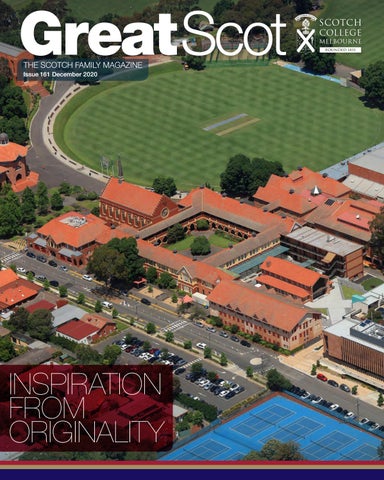
THE SCOTCH FAMILY MAGAZINE Issue 161 December 2020
INSPIRATION FROM ORIGINALITY
CONTENTS 1 EDITOR
46 MUSIC
2 CHAIRMAN
50 SPORT
4 PRINCIPAL
52 BOARDING
6 CHAPLAIN
57 FOUNDATION
8 JUNIOR SCHOOL
58 DEVELOPMENT
12 MIDDLE SCHOOL
69 OSCA
13 UPPER SCHOOL
82 WHAT THEY’RE DOING NOW
14 FEATURES 27 SENIOR SCHOOL NEWS
2 CHAIRMAN RETIRES Hon Dr David Kemp AC hands over the School Council reins
86 SCHOOL HISTORY
14
90 OBITUARIES
FAREWELLING THE CLASS OF 2020 Moving on after rising to the challenges of 2020
The Scotch Family Magazine Issue 161 December 2020 is the official publication of Scotch College, Melbourne. Publisher Scotch College 1 Morrison Street, Hawthorn 3122 Victoria, Australia Phone: (03) 9810 4321 Email: greatscot@scotch.vic.edu.au www.scotch.vic.edu.au ABN 86 852 826 445 Print Post Approved PP100008172
View Old Scotch Collegians' Association news and updates at: www.oscanet.com.au Like us on Facebook Scotch College and OSCA
Editorial contributors Durga Kamte, David Ashton, Paul Mishura, Scott Montgomery, Tim Shearer, Patty Wallace-Smith. Editor Durga Kamte (03) 9810 4420 email: durga.kamte@scotch.vic.edu.au
24 NOT WEAK TO SPEAK Mental health identified as a key focus
Assistant Editor David Ashton (03) 9810 4489 email: david.ashton@scotch.vic.edu.au Art Direction and Production Lisa Sheard (03) 9810 4443 email: lisa.sheard@scotch.vic.edu.au Photography National Photography, James Grant, Stephen Kong, Lisa Sheard, John Ferguson, Scotch College students, staff, parents and Old Boys.
33 ENTHUSIASM FOR LANGUAGES Languages are proving a popular Scotch elective
EDITORIAL
In a series of firsts, boys were farewelled in new ways. Year 12s experienced the Presentation Evening and Torch Ceremony in person, in Memorial Hall, as they gathered in House groups, while parents vicariously shared the experience via live broadcasts. Fortuitously, circumstances allowed for a new format of valedictory celebration, on the manicured grounds of the ovals (Main, Lower and Meares) with parents in attendance. Final Assemblies too, in Memorial Hall for prize-giving, and in the Quad for a school-wide announcement of 2021 school leaders, presented a fitting close to a year where gatherings via Zoom were the norm. Inspiration, as Mr Tom Batty rightly notes, is not a product of classroom teaching. Boys find inspiration through myriad routes – a passing comment overheard, a thread followed on a website, a line from a poem that strikes a nerve, a painting that beguiles and confounds, a philosophical riddle that haunts sleep, a challenging question from the Chaplain that requires careful thought to respond. As boys find inspiration from the influence of others, including thinkers that inspire their teachers’ thinking, equally teachers are immensely inspired by their students. In the pages of this edition you will find evidence of boys who have been inspired to transcend boundaries imposed by lockdown to take part in online challenges, including public speaking and debating, mathematics, science and
technology, chess, and an array of musical performances. In his article in this edition, the President of the Scotch College Foundation, Associate Professor Doug Lording AM reflects on the wisdom and inspiration which, in 1973, led the then Principal. Colin Healey and the Chairman of the School Council, Sir Laurence (Laurie) Muir ('41) to set up the Foundation. Scotch has since been blessed with a Foundation which continues to fulfil the aspirations of its founders. The third of a series of four articles outlining the history of the Foundation appears in this edition, covering the period from 1997-2009, which was time of extraordinary energy and change. For a fine example of inspiration and dedication to the development of boys in his care we need look no further than mathematician and former Scotch teacher and mentor, Ken Evans (’47), who turned 90 in July. An article about Ken appears in the OSCA section of this edition. In another article in the OSCA section, former School Captain, Lachie Strathmore (’15), Chair of OSCA’s Young Old Boys’ Committee, writes about the innovative ways his committee is devising for our youngest Old Boys to maintain connections with each other, and to engage with the wider Scotch community. For example, the committee launched a series of Zoom sessions outlining ‘what to expect from life after Scotch’. Inspired by the success of its initiatives in 2020, the committee is looking to an expanded program in 2021.
46
64
75
MAXIMUM BANDWITH! Innovation in our online band ensembles
SCOTCH BIRTHDAY ZOOM EMG members celebrate Scotch’s birthday online
THE CARDINAL THREAD OSCA helps to strengthen an invisible connection
DURGA KAMTE EDITOR GREAT SCOT
In a challenging year in which often the only certainty was uncertainty, we in the school community strived to maintain routines, and as best we could, to provide a sense of ‘normality’. By the end of Term 4, after a staggered return to school, the buoyancy and high spirits among boys and staff were palpable. In their final reflections, boys commented on what they had learned about themselves – personally and about their academic journeys during the online learning experience. Some were buoyed, as their innate motivation kicked in, while others wryly acknowledged completing homework after a full day on screen was a step too far. As one Year 11 boy noted: ‘The “aura” of the School and a return to 'normal' routines was exhilarating. There is no Scotch experience, except with Scotch boys and staff, and in Scotch grounds.’
www.scotch.vic.edu.au Great Scot 1
CHAIRMAN
HON. DR DAVID KEMP AC SCHOOL COUNCIL CHAIRMAN
MESSAGE FROM THE HON. DR DAVID KEMP AC Serving the School as Chairman of Council for the last eight years has been a great privilege and honour. Now, with the pandemic under control, and with the School in robust health and looking to the future, this is an appropriate moment to hand over to a new Chairman. I am delighted that Alex Sloan (’71) will be my successor in the Chair of Council. No-one knows Scotch better than Alex, nor loves it more, and I am delighted that he has been prepared to take on the responsibilities of Council Chairman. I am confident that Alex will provide the School with the leadership it needs to continue to thrive, and he will do so with my full support and best wishes. Mr Sloan was a member of the Council from 2007 to 2014, and returned to Council in 2019. He attended Scotch from 1965 to 1971 and was Captain of the Junior School in 1966. His grandfather, Alexander Barclay Sloan, coached 20 Scotch Head of the River crews to seven wins. Among many other relatives, Alex’s father Bruce (’32), uncles Alex (School Captain in ’24) and John (’24) and son Simon (’04) all attended Scotch. He has grandsons booked for 2028 and 2030. Alex played in the 1st XVIII and rowed in the 1st VIII in 1970 and 1971, and was a School Prefect, House Captain and Captain of Boats in 1971. 2 Great Scot Issue 161 – December 2020
At Melbourne University Alex studied Commerce, graduating in 1975. He rowed in five Kings Cup crews from 1977-81 with wins in ’79 and ’80; he also represented Australia at the World Rowing Championships in 1979. Alex was appointed President of the Old Scotch Collegians’ Association in 2011 and was made an Honorary Life Member of the association in 2014. He is a company director and has a number of philanthropic involvements. In leaving the Chair, I first thank the members of the School Council for the hundreds of hours of unpaid work they devote to supporting the School in its mission to provide the best possible education for boys, and their dedication to the continuous improvement of the School. Through their work, with the support of parents and the whole Scotch Family, we now have the Sir Zelman Cowen Centre for Science, the Spencer Centre for Design and Technology, the Keon-Cohen Dining Hall, the new English Department, and many other improvements to support teaching and learning. The Standing Committees of Council – Finance, Investment, Property and Risk – have had outstanding leadership respectively from their Chairs, respectively Hamish Tadgell ('85), Jonathan Buckley ('83), Mike
Sim ('79) and Fiona Pearse, with support from all members of Council. I particularly thank Rev. Dr John Wilson, of the Presbyterian Church of Victoria, for his never-failing wisdom and support as Vice Chairman of Council. The School Council, during the time that John and I have served in our positions, has provided Scotch with unified purpose, to the great benefit of the boys, parents and the whole Scotch Family. I am thankful to have had the opportunity to work with the Principal, Tom Batty, in his leadership of Scotch education. Tom Batty is an inspiring innovator in education who has further lifted the School’s academic excellence, while strengthening its pastoral care, and culture. His advances in educating boys are becoming internationally renowned, and he has built the School’s reputation for outstanding boys’ education through his leadership of the International Boys’ School Coalition. I thank the Bursar and Secretary to Council, Ross Congleton, for his attention to the needs of Council over many years. It has been a pleasure to work with him. The response of the School and the whole Scotch community during the pandemic has been truly inspiring, and I will never forget it. The true strength of the School’s values was there for all to see. Scotch teachers and other staff tirelessly sought to support the boys in their learning, and were magnificent. They would not have been able to do so without the support and sacrifices of parents in supporting the boys in their online learning. Throughout the year Council has worked to give confidence to staff and to the Scotch
Family, and to assist those experiencing financial hardship. The Old Scotch Collegians’ Association has acted strategically and with vision to expand its contributions to all the former students of the School, young and not-so-young. It has been a pleasure to have been able to work with such a well-led organisation whose members have such a deep love of the School. Throughout my time as Chair, the Scotch Foundation, led by Michael Robinson AO and Associate Professor Doug Lording AM, has made an irreplaceable contribution to the School, providing an unequalled vehicle to support the continuing development and improvement of the campus. The founder of our School, the Rev. James Forbes, wrote that education ‘must be regarded as the great remedy for the ills of the body politic, the basis on which must be mainly rested all hopes of its amelioration, and of its future generations being better than the present’. His vision has inspired me, and I believe will continue to inspire the School Council in its work. As a member of Council and Council Chairman I have had the wonderful support of my wife Anne Marie, and over the years have seen sons William (’90), Andrew (’04) and Charles (’10) grow into young men who will contribute to building a better world. I warmly congratulate Alex Sloan on his election as Chairman of the Scotch College Council. He knows the School exceptionally well and has already made a great contribution to its success. I am sure that under his leadership the College will continue to go from strength to strength. www.scotch.vic.edu.au Great Scot 3
PRINCIPAL
INSPIRATION FROM ORIGINALITY MR TOM BATTY SCHOOL PRINCIPAL
ILLUSTRATION OF JACK GREALISH AND PAUL GASCOIGNE
During a recent European international soccer after-match phone-in show, someone on the end of a line compared current England prospect and Aston Villa favourite Jack Grealish, to Paul Gascoigne. It was, rightly, met by stunned silence. I don’t know an Australian equivalent, so won’t try for one, but wise people don’t compare a hopeful’s soccer talent to that of Gascoigne. There have been other gifted English players, but none so impossible to predict for an opposition player, fan or referee. In the main, you were always left suspecting, because Gazza himself was never quite sure what he was about to do. Indeed, his post-match attempts to explain his genius were generally as steeped in reason as his conversations with his mate Jimmy Five Bellies. Like the truly gifted, Gazza wasn’t painting by numbers. Gazza was on my mind when, during one of the many moments of lockdown solitude, I picked up my well-thumbed copy of Ed Smith’s wonderfully insightful, What Sport tells us about Life. Ed Smith, as some may know, is a journalist/author and former England Test cricketer, who, perhaps for any past sins,
4 Great Scot Issue 161 – December 2020
is currently England's chief national cricket selector. Some may also know he’s a pretty smart cookie, which is not to suggest that’s a prerequisite for his current role. Flicking the pages, the section in which Smith reflects on inspiration caught my mood and fomented my thoughts. In it, Smith quotes T S Eliot: ‘If the word inspiration is to have any meaning it must mean that the speaker or writer is uttering something which he does not wholly understand – or which he may even misinterpret when the inspiration has departed from him’. How do we, as educators, make place for inspiration in school life, when, to use the language of my piece in the September Great Scot, the two currently dominant heads of the education dragon focus all on content and assessment? How, when so much is based on testing, can we free young minds to utter something instinctively insightful, but not fully understood, that may, subsequently, disappear from consciousness? What place do we carve for nurturing that which is meaningful, but ephemeral and not readily deconstructed, or, in the current ‘go to’ language ‘scaffolded’? How do we instil the confidence in young people to embrace a state that, though enormously fulfilling, will leave them open and vulnerable? How do we integrate such passing insight with academic rigour? Importantly, how do we, as teachers, inspire such fleeting bursts of creativity, when, as Smith notes, as we get older we get smarter and seek control over our creative impulses? Progress can flow from rigour and discipline, as generally that is how we form an appreciation of, and a language to describe and manipulate, the fruits of such insights over the course of history. But rigour and discipline are not enough; inspiration is not something that can be controlled or taught by recipe, much less assessed by grade or rank order. Smith suggests the ‘answer’ to becoming original is by living originally. If it is so, how do we sow the seeds that can blossom into an original life? I suspect it starts with values that respect individual freedom and responsibility, and takes shape in a rich and varied network of opportunities, amidst which
boys can lose themselves, explore interests and seek mastery. I am certain it requires some structure of progression to allow the acquisition of tools each boy might require as the pace quickens, but this must not dominate all: I am also fairly certain it doesn’t flow from all learning the same curriculum for the same tests, or playing the same sport or the same instrument, or making the same argument or taking the same role. For that pace to quicken, it requires a rich, vibrant mix of similarly inquisitive minds bringing their quirks and foibles to bear as the ever changing broader environment presents its own challenges and disruptions. In the final months of the year, with all imposed on us, we have seen such originality of response: • a chess team winning the state final and with it the right to represent Victoria at the Australian championship; • a Year 11 boy pitching his one minute speech as a newly elected MP to claim the Years 11 and 12 section of the Parliament Prize; • a Year 8 boy achieving a perfect score in the national CSIRO Bebras Challenge coding competition; • a Year 8 boy taking out the Paul McDermott Violin Scholarship for 2020; • a Year 9 boy earning selection to the Australian team for the World Individual Debating and Public Speaking Competition in 2021; • two teams competing in an international debating tournament against teams from Singapore and Malaysia. Our Year 12s have led the way, bearing the disappointment of a disrupted final year to adapt and think anew: • the inaugural Movie on the Main supporting victims of the summer’s bushfires; • the 3400 donated items of the Food Drive; • the monies raised for children and young adults with Down syndrome and people experiencing or at risk of homelessness; • the creation of Scotch Streams as the hub of our connectivity; • the conception and hosting of a virtual art exhibition; • the running of APS e-sports competitions; • the writing of letters to local aged care facilities; • the imagining and realisation of an extensive mental health campaign across the School. More broadly, around the School, changed circumstance spawned a surge of creative response. Our musicians and choirs led the way in synchronising remote group performances. With boys entering
Scotch next year unable to come on site, the School Captain hosted a webinar for boys and parents that included a video tour of the school campus by two Year 7 boys. A new Year 12 mentoring programme enabled boys to choose a member of staff for academic and pastoral support. And, as end of year celebrations vied against regulation, a Year 12 picnic lunch saw boys spread across the grounds in small groups joined by their invited guest members of staff. On return to campus, sensitive to varying success in coping with the demands of the remote world, new in-class academic support brought targeted literacy and numeracy support for boys in need. It is an exciting challenge to bring to bear the best of all that has been learnt on our ongoing quest to better differentiate learning and break down the rectangular restrictions of timetables and classrooms. Some weeks after putting down Smith’s book, I found myself watching the movie White Crow that tracks the early life of Rudolf Nureyev. There is a scene in which, frustrated by the routines and hierarchies of ballet, Nureyev is kicking back against the ‘system’. Noting his turmoil, his teacher, Aleksandr Pushkin, asks him, ‘What is dance?’, and, not accepting Nureyev’s response that it is ‘Entertainment’, seeks to guide him to the truth: ‘You see, all the time I’m teaching technique. That’s all I do. However, it is good to remember – technique is only a means, not an end. We spend so much time on technique, it’s all we think about.’ At which point Nureyev interrupts to ask ‘What should we think about?’ ‘Story’ Pushkin replies, before asking rhetorically, ‘Why do so few people ask themselves, "what do I wish to say?”?’ This year we have been reminded, with some force, that the future is not always that which we imagined; that it is not possible to learn our way to everything we want to achieve; and that many of life’s richest rewards flow from the inspiration of an original life. Our challenge as educators is to teach the rigour and discipline that have progressed the world, but not to have them swamp the story of each child, and to encourage each boy, lesson by lesson, interaction by interaction, passion by passion, success by success, to have something he wants to say. As this year draws to a close, I thank you for your generosity, patience and perseverance. Most of all, I thank you for adapting your unique stories to entwine with that of your School, so that, despite challenge and disruption, it might continue to flourish and sow seeds for an original life.
www.scotch.vic.edu.au Great Scot 5
CHAPLAIN
THE ONE WHO INSPIRES Christ inspires us towards beauty, truth and a satisfaction lasting to eternity REV DOUG CAMPBELL SCHOOL CHAPLAIN
While desperately seeking for an alternative to the endless cycle of reality TV shows that populate modern programming, we came across an episode of the BBC’s Antiques Roadshow. The very theme tune is enough to drive the younger members of the family to pull out their phones and update their social media. For them, Antiques Roadshow is simply old experts speaking about old heirlooms that belong to old people. Harsh, but true. However, as I had momentary control of the remote and as the program was coming from the stately home of Hopetoun House just outside of Edinburgh, we settled down to watch. When, however, an ornate antique cabinet was featured the program became personal. The resident expert explained that the cabinet had been made in the 1930s by well-known antique makers in Edinburgh. This firm, Whytock & Reid, employed my maternal grandfather as a woodcarver during that very period and then well into his retirement. This cabinet may have been made by him. Taking their inspiration from the past, my grandfather and other craftsmen created pieces inspired by the ancient styles of the master craftsmen of England and France. For a few moments, my girls raised their heads from their sterile, smart screens. Their eyebrows even expressed shock when the cabinet was valued at well over £25,000. Living in the ever-modern and technological present that constantly promotes and exalts the new and the original, I find myself coveting the simpler and less sophisticated past. Perhaps this is due to my age, my Presbyterian convictions or simply because I spent too long beside my antique-making grandfather. After all he had experienced two World Wars, Spanish Flu, the Great Depression and the rise to prominence of flawed individuals who promised political utopias. Sitting with my grandfather, I learned to appreciate the present and to actively build for the future, but not to put too much store in the new, the trendy or the cutting edge. I was bestowed a healthy dose of cynicism and taught to question the underlying presuppositions of movements of both proponents of utopia and prognosticators of doom. Cynicism, however, was never the end. I was inspired to consider and examine every aspect of life. I was encouraged to read the great works of literature by authors (Dostoyevsky, Orwell, Solzhenitsyn, et
6 Great Scot Issue 161 – December 2020
al) who wrestled with the great questions of life. We were surrounded by newspapers of various political persuasions that reported the great events and offered a range of opinion pieces. The home resounded to music of all types, and we learned to appreciate the Scottish ceilidh bands, the Rolling Stones and Grieg’s piano concerto. The family viewing included political debates and documentaries that gave us an insight into the world. At school, teachers introduced us to Plato, Cicero, Steinbeck, Shakespeare, Crick and Watson, and Pascal. At church, the Bible was expounded and great theological concepts were explained. God’s great story of redemption was applied to our daily lives so that we might follow in the footsteps of Christ. My personal journey of inspiration continued at university, as I was introduced to the great philosophers and theologians from Augustine to Calvin. We were not to fear the new, but neither were we to be beholden to it. At Scotch we are not afraid of the new. We embrace and use the best of the modern (Zoom!) and innovative technology, not as an end in itself or to idolise it, but to inspire our boys to consider afresh the world in which they live and to reflect more deeply on their part in it. We understand the truth that all originality is grounded ultimately on discoveries and insights in history. Humankind has not arrived here just recently, disconnected from the past. We have a present because we have a past and tradition. There is much in our past that continues to inspire us and we must connect our boys with the giant thinkers of their fields so they can appreciate, learn and eventually inspire the next generation to create and innovate. Our artists at Scotch create by looking at the great masters and movements in art. Our jazz musicians learn the standards of the genre so they may riff and add their own interpretations. Our scientists wonder anew at the intricacies of the cell and the works of the Nobel Laureates, then reflect on the future of genetic research and future advances. And in the Cube, boys design pieces of furniture that acknowledge in part the styles and techniques of the craftsmen of the past. As Chaplains we point to Jesus Christ. God’s Son came and challenged the anxious to consider the beauty of the natural world (the lilies of the field) in order to realise God’s superintending love for us.
KING ROBERT THE BRUCE – CARVING BY THE AUTHOR’S GRANDFATHER, MR JOHN S TODD.
At the Temple in Jerusalem, he directed his disciples’ attention beyond the stones to the God who had actually designed and directed its building. In an age fascinated by originality and the new, the old and the wise have been dismissed like an episode of
Antiques Roadshow. However, the challenge of Christ remains, as he inspires us to someone and something greater beyond ourselves that will lead us into beauty, truth and into a satisfaction that will last beyond this age and into eternity. www.scotch.vic.edu.au Great Scot 7
JUNIOR SCHOOL
NURTURING ORIGINALITY OF THINKING Fresh thought to find original solutions to the world’s problems MR JON ABBOTT HEAD OF JUNIOR SCHOOL
The word ‘why’ can be a most wonderful word, and it can equally be a most frustrating word. I am sure that all parents are only too well aware of their young 8 Great Scot Issue 161 – December 2020
children continually asking ‘Why?’ at any time and in regard to any circumstance or occasion: ‘Why do cars need petrol?’ ‘Why aren’t there dinosaurs anymore?’
‘Why do people get sick?’ ‘Why can’t dads have babies?’ ‘Why do I have to go to bed now?’ Young children are naturally curious about the world and are continually seeking to make sense of all that they experience. They are not afraid to ask any question that comes into their minds, even if we might feel their questions are inappropriate, mundane or possibly even embarrassing. I am sure that for most parents there were many times when they wished the word ‘why’ had never been invented! I like to think that we should rejoice that children are so curious about their world, and that we should strive to nurture their incredible curiosity and creativity. As adults, it is so easy for us to provide quick answers to their questions, in the belief that we are helping them to understand their world a little better – and possibly for expediency and our own sanity at times. However, by doing so we are also taking away an opportunity for their natural curiosity to be developed even more. I often recall a quote I heard in the early days of my teaching career that reminds me of the need to nurture children’s curiosity: ‘When we give a child an answer to a question we are robbing them of an opportunity to discover it for themselves.’ Now, that doesn’t mean that there aren’t times when it is entirely appropriate to answer a child’s question, more that we need to be discerning as to when we choose to do so, and how we might otherwise respond. Rather than just giving them the answer, we could choose to respond with our own question, ‘Gee, that is a good question. I’m not sure. What do you think?’ You see, not only are young children really good at asking questions, they are also very good at answering them for themselves. They may not have the ‘correct answer’, but they will usually have a theory or an idea about it. This is what we must strive to nurture and cultivate; that ability to theorise and wonder that children seem to innately have. Sadly, our practices and systems have a tendency actually to do the opposite to nurturing children’s curiosity and their ability to theorise. Every time we answer a question or correct one of their ideas, we are actually teaching them that their ideas are likely to be wrong and that adults have all the ‘right’ answers. This serves to impress on young children that it is best to wait until the adults tell you what you need to know, memorise it and be able to repeat it back to them. It can also serve to stifle their enthusiasm to have their own ideas and original thoughts. Children seem to lose their propensity to solve problems and questions through original thought, and gradually take a ‘learned approach’ to making sense of the world. That is, they start to accept that there is a ‘right way’ to learn and that there are ‘right answers’ to
questions. Many of the systems in place in our society tend to impact negatively on the originality of young children by bending their thinking to fit conventional methodologies; teaching them that there is a ‘correct’ way to do things. As an educator and a parent I know that I have also been a part of this process, and that I have been guilty of inadvertently impacting on children’s inquisitive nature, their natural curiosity, their free thinking and their originality. It is not an intentional effort by us – we are all a product of our own experiences and education – but we do contribute to it. As a civilisation we have solved all of the easy problems of the world and we like to think how clever we are. However, we haven’t solved the big questions that still remain for us; problems such as pollution, equity, disease, conflict, over-population, over-use of resources, sustainable energy, etc. Original thinking will be required to find new and original solutions to these issues, as conventional thinking doesn’t seem to have been able to do so. Now, more than ever before, we need to nurture and cultivate the originality of thought of young people, the natural curiosity they seem to have in abundance, and allow them to be free from the fear of being continually corrected, that can so easily squash their confidence and ability to come up with creative solutions to problems. We need to nurture the original thinking and abundant problem-solving abilities that our young people seem to have. They are the generation who we hope will solve the big problems of our world, and it will require them to look at such problems through a fresh set of lenses that have not been forced to work within the constraints of current conventional thinking and practices. Maybe we, as adults, need to be directing more of our energies into asking our children ‘why’ questions more than we spend on giving them our answers.
YEAR 5 BOYS (CHARLIE LEWIN, MASSIMO ZANDONA AND FERGUS CAMERON) IN SCIENCE CLASS LEARNING HOW TO OPERATE POWERED MICROSCOPES, WHILE CAPTURING PHOTOS USING AN IPAD.
www.scotch.vic.edu.au Great Scot 9
STAFF IN PROFILE
Interview: KATE IKINGER Director of Junior Primary
Kate Ikinger started her teaching journey in 1979, but chose to have some life experience before commencing her first teaching role in a Prep classroom back in 1984. How lucky were those Prep students to have such an enthusiastic, friendly and warm teacher to start their educational experience! This was the beginning of a long and distinguished career that has taken Kate into many leadership roles, including Deputy Head at Christ Church Grammar School and Head of the Junior School at the Southwick Campus of the King David School. Scotch was fortunate to obtain the services of Kate back in 2009 as Director of Junior Primary. During her time in this role she has overseen and worked with many classroom teachers, and inspired them to work as a team and develop innovative programs which have been highly successful and regarded. Kate has an innate ability to see the positive in everything, which shines through with her infectious laugh and consistent aura of happiness. She has welcomed so many Junior School boys into our Scotch Family with their Prep interviews as well as her warm and friendly welcome every morning, or farewell each afternoon, while on gate duty come rain, hail or shine! Kate certainly is a prominent and much respected teacher at Scotch who helps to weave the care, compassion and positive relationships into the fabric of our Junior School. CHERYL HARRISON
After all these years of service to Scotch, what is your favourite corner of the School and why? There are two areas of the Junior Primary that are very dear to me. The first is the top playground, which was overhauled three years ago, with the ribbon-cutting on the first day of Term 2, 2017. Two sandy slopes were reinvented with the help of multiple metal trellises which formed tunnels and caves, then softened with hardy vines and creepers. All these years later, as the vines have grown, the tunnels are a child’s paradise of
10 Great Scot Issue 161 – December 2020
secret passages and I have loved watching its metamorphosis. My other special corner is my office and bespoke teaching area. The walls are full of children’s artwork and photos, there are lamps, prints, birdcages (empty!), sculptures and books, books, books. It is the most wonderful work environment. What do you most like about your job? I relish the chance to be creative and have the opportunity to troubleshoot. I enjoy the creative aspect of my job, I enjoy tweaking our established ceremonies while
creating new traditions for the boys. I started the Year 2 Tie Ceremony during the first few years of my arrival. We started with cardboard ties in the Scotch tartan, and I stapled elastic to the ties so they could be placed around the boys’ necks. These days the boys receive a real school tie! The tie is symbolic for the boys leaving Year 2, as they will no longer be wearing the blue skivvy of their Junior Primary years. I enjoyed troubleshooting school readiness issues, trialling then modifying what we now call the Prep Workshops. The workshops are a happy collaboration between the Learning Support Team, our Prep Unit, a Paediatric Occupational Therapist and a Speech Pathologist. All prospective Prep enrolments attend the workshops, giving us valuable information about the classes we are about to welcome, and helping parents where their son would benefit from an additional year of kindergarten. Many years from now, when you are no longer teaching, what is one of the memories you will reflect on to warm your heart? The music – the individual musicians, the ensembles, the bands and the choirs, especially the choirs. I become very emotional when the boys sing with descant; it’s just so beautiful. What is an achievement of which you are most proud? In 2016 we had three boys with diabetes in the Junior Primary. When we had the opportunity to raise money for the Juvenile Diabetes Research Foundation, I was committed not only to raising funds, but raising awareness. Through interviews with Scotch families affected by diabetes published in Primary Matters, parent and medical talks at Assembly and ultimately a Walkathon, we raised a huge amount of money for research, but most importantly we developed a culture of understanding, acceptance and empathy. After hearing horror stories of how children with diabetes were being treated at some schools, I was so chuffed that our boys with diabetes became our heroes, in recognition of how they had risen above their challenges.
JUNIOR SCHOOL
YEAR 2 BOYS PREPARE FOR HOUSE SPORTS DAY
YEAR
Y A D T R O P S ' S Y O 2B
www.scotch.vic.edu.au Great Scot 11
MIDDLE SCHOOL
MS KATRINA STALKER HEAD OF MIDDLE SCHOOL
A FOCUS ON WELLBEING AS THE BOYS RETURNED TO SCHOOL
Good nature, adaptability and resilience were in evidence
It was a very special day when cheerful Year 7 voices could be heard around the central bench in the Quadrangle once again. After experiencing Term 3 and much of Term 2 in remote learning, as they returned to Scotch on Monday 12 October to resume their classes with their peers, the boys were full of excitement. The Year 8s returned two weeks later, re-establishing the vibrant ambience of the Quadrangle classrooms. Some of the boys struggled with remembering to wear a mask, but they were overwhelmingly very grateful to be back at school. While most boys coped exceedingly well with the remote learning environment, helped by the diligent care provided by their form and subject teachers, clearly this was a struggle for some, and these boys received extra in-class support in both English and Mathematics classes. The focus for the boys’ return was very much about their wellbeing, and on helping them to re-establish friendships and the rhythm and expectations of learning in a classroom. The transition, understandably, was not an easy path for some of the boys as they rejoined us at school, but, as testimony to their resilience, they soon settled happily into normal routines. Various activities were organised to help this settling-in process, including a treasure hunt organised by School Captain, Will Dixon, and an inter-form sport competition. The Man Cave organisation once again delivered its excellent program to Year 7 and Year 8 in November, which focused on helping the boys to connect (and reconnect) with each other, and to support others in their journey through adolescence to manhood. The Year 8 Big Ideas lectures resumed, aiming to broaden boys’ minds and alert them to the need to show understanding and empathy, with a powerful presentation on the deplorable effects of the Holocaust. In a slightly different format from other years, the Respectful Relationships Program was delivered in Term 4, covering features such as the dangers of 12 Great Scot Issue 161 – December 2020
stereotyping, appropriate use of the internet, and legal issues surrounding inappropriate usage. Although there were many aspects of the Middle School program which the boys could not experience because of the pandemic, we take pride in the efforts of our staff, and particularly in the goodwill and camaraderie of our boys, that important aspects of our social and pastoral program goals were beneficial in helping boys as they prepared for the end of the year. Despite the challenges of ‘real world’ competitions, many boys shone in the remote world. Christopher Lim (Year 8) achieved a perfect score in the CSIRO Bebras Challenge national coding competition. Joseph Pan and Witter Onggara (both of Year 7) were placed second in Victoria in the Years 7 to 9 division for their concept of using AI for the collection of data after a natural disaster. Gevin Kankanamalage (Year 7) was awarded a bursary in the creative writing section of the Victorian Science Talent Search. The Debaters Association of Victoria season went online in 2020, and a team of challenge debaters from Year 8 – Ned Sutherland, Sami Samiee, Geoff Liu and Tom Farrer – with Marcus Wong (Year 9) formed a team to debate at D grade level. They made it to the finals from the Wednesday evening series, which was particularly impressive given that they were largely a Year 8 team in a Year 9 competition. Our plans for next year have included a transition webinar for the boys of Year 7, 2021. Will Dixon hosted the online event with Hugh Hasker (Year 8) and Hamish Heine (Year 11) answering the wide range of questions posted by the boys we look forward to welcoming to our School next year. It has been quite a year, to say the least! We congratulate our boys on their good nature, adaptability and the resilience they have exhibited, both in remote learning and on their return to the Scotch campus.
UPPER SCHOOL
MR TIM RAYNER HEAD OF UPPER SCHOOL
WHAT WOULD BART SIMPSON HAVE SAID ABOUT LATIN?
Bart didn’t appreciate the great benefits of learning another language ‘English? Who needs that? I’m never going to England,’ said Bart Simpson, of the animated cartoon series, The Simpsons. While the irony of not knowing that he was actually a user of the American variety of English was lost on Bart, his comment does allow us to explore attitudes to language and language learning. Mastering English can be a challenge in itself, even for those of us born into an English-speaking family, but to learn another language in addition to English can be daunting, particularly when it seems so many people across the globe already speak English. However, providing the opportunity to learn a language is important. This year, at Scotch, we had a remarkable 97 boys, or 38 per cent of the cohort, studying a language in Year 12, Latin included. Compared to a national average of around 10 per cent studying a language, we are doing pretty well. We currently offer French, German, Chinese, Indonesian, and Italian at Scotch. Boys commence Year 7 learning two of these languages; in Year 8 they continue with two or study one language. In Year 9 all boys must study at least one language. It’s interesting to note that in Year 10 over 50 per cent of boys choose to continue with a language. Boys can also begin to learn Latin in Year 9, as well as pick up Indonesian. What Bart Simpson would have said of Latin, I will leave to your imagination. Arguably, with English being used around the globe by so many people, to the point where it is seen as a lingua franca, it is easy to rationalise why there is no need to learn an additional language. So, what is the attraction of learning a language? The benefits of learning another language are significant. Learning a language does provide an insight into different worlds and cultures, of which there are many around the world. Estimates vary, but there around 6000 different languages spoken around the globe today, with many of the smaller languages under threat. Communicating across cultures and stepping into the shoes of other peoples is important. Learning a language is intellectually stimulating. It aids
memory, improves the functionality of the brain, and allows students to better understand the structure of their first language. It also makes a person more employable, particularly if that person is working for an international company. Yet, studies also show that the older one gets, the more difficult it is to learn a language – not that this should put off our more senior readers. Providing opportunities for boys to practise what they have learnt is important. Teachers regularly interview and converse with boys on a one-on-one level so oral skills can be refined. Additionally, boys are encouraged to participate in external competitions like those held by Alliance Francaise, where poetry is recited by the younger participants. Students of Chinese learn to write calligraphy, itself an art form, while other boys take the opportunity to celebrate national holidays, such as Indonesian Independence Day, by visiting the consulate. With a fully-equipped kitchen located on the first floor of the Language and Culture Centre at Scotch, boys and staff also spend time cooking some of the traditional national dishes associated with their selected language. This is fun, vocabulary is practised, and boys get to taste what they have cooked – a win all round. Those Scotch boys lucky enough to travel on school exchanges to France, Germany, China, Indonesia and Italy return feeling so much more confident in communicating in their chosen language, but also comment on the benefits of seeing other world views and perspectives. Many boys will have established long-term connections and friendships with the families they have met and lived with. The exchanges vary in length from three to 10 weeks and occur over the school holidays for the most part. Scotch is fortunate to be able to offer the range of languages it does. As a result, a significant number of boys will be equipped to communicate effectively in another language when they leave school, understand and appreciate other cultural perspectives, and thereby enrich their world view. www.scotch.vic.edu.au Great Scot 13
FEATURES
BOYS STAND TOGETHER TO RECEIVE ADVICE AND AWARDS
PRESENTATION NIGHT BECOMES AN AFTERNOON EVENT IN 2020 14 Great Scot Issue 161 – December 2020
Normally held as an evening event, in 2020 COVID-19 restrictions forced Presentation Night to become Presentation Afternoon, staged in Memorial Hall at 4pm on 22 October with just the Year 12 boys, some teachers and the Chairman of the School Council, Hon Dr David Kemp AC (’59) present. The event was broadcast live on YouTube to enable staff and parents to tune in. All Year 12 boys were introduced by their Heads of House, and each received a Bible and book of poetry from the Principal, while prize winners and boys awarded Triple Colours received their prizes. There were speeches by the Chairman of the School Council, the Principal, Tom Batty and the School Captain, Will Dixon. Here is an edited version of the School Captain’s address at Presentation Afternoon.
‘YOU HAVE EMBRACED THE CHALLENGES OF 2020 HEAD-ON’ In my first address to the School this year, I spoke about how we did not know what the year would hold. It is fair to say that hindsight is a powerful thing. This year has not been an easy year for anyone. Nine months ago, there is no way that I would have predicted that I would be standing here this afternoon before an empty Memorial Hall and looking into a camera. Today we are here to celebrate the many achievements of the Class of 2020. In times of uncertainty, we often look to the past. This year, however, looking to the past was hardly an option: there has been no precedent for us to follow. So instead, we have improvised, thought creatively, and even when frustrated, have embraced the situation in which we find ourselves. As part of my role this year, I get to speak to Old Boys and members of the wider community who often tell me, ‘You will go down in the history books as the Scotch boys who lived through the pandemic’. Well in part, yes, they are right – 2020 has been, at times, a challenging journey during which we’ve all faced a rollercoaster of emotions: excitement, mixed at times with sadness, frustration and even anger. However, I am of the firm belief that we are not defined
by what happens to us, but rather how we respond – what we do. Yes, the Class of 2020 will be remembered for living through the pandemic, but really, I know the boys will be remembered for so much more than that, and for that, they can all be proud. As a Year 12 group you have pursued academic excellence despite the circumstances, embracing the Zoom classroom and the strange experience of sitting SACs through a computer screen. The Scotch 1st VIII rowed an undefeated season, with our 1st Tennis team not far behind. As we moved to the online world, you worked hard to ensure that your peers remained connected and engaged, tuning into the weekly release of Chompers’ Champions, running online chess tournaments and raising your heart rate in online sporting challenges. Boys in the Music School embraced the virtual world, producing musical masterpieces to share with the Scotch Family. You considered those in need in our community, collecting over 3000 food items to be distributed across Melbourne, writing letters to those living in aged care homes and raising close to $15,000 for charities supporting the bushfires, R U OK?, Second Bite and 300 Blankets. And you boys stood by our Not Weak to Speak message, showing that as a Year 12 group we need to start having more conversations about our mental health, which I believe has led to meaningful discussion, reflection and change within our School. Having had the honour of being part of two Year 12 groups, it has struck me that the support you have offered each other this year has been unparalleled, and that your friendships have only been strengthened by this experience which binds us all, creating relationships which will stand strong into the future. As a group we have shared many years together. But come early December, once the final ‘pens down’ has been called, that chapter ends and each of you will take a step towards a new phase of your lives. It will be a phase of greater freedom and independence, but also an exciting time of anticipation for what lies ahead. Realising that I wasn’t sure what advice I could give the Class of 2020 as it leaves
Scotch for the last time, I thought I would call the person I know with the most experience of us all, and the oldest person I know, Rev Bill Morgan (’35) Scotch’s oldest boy, who turned 105 on 23 October. Bill started by talking to me about the strong foundations on which our School is founded and the values of respect, compassion and community that this School has taught us. He cautioned, however, that there will be times in our lives when these core values are challenged, and that it is up to us to stand firm in being guided by the values and not doubt their truth. He encouraged us to use all the talents that we have to bring good to the world, and he charged me to tell you all to go out and live, not for yourselves, but for the School’s motto which binds us all: Deo Patriae Litteris – for God, for country and for learning. In closing, I want to thank all the Year 12 teachers, who through tireless work and great passion, have continued to help us learn and develop through the world of online classes, even in the times when you have begun speaking without unmuting yourself. To Mr Rayner and Mr McLaren – thank you for your diligent management of the School. To the Prefect Group, thank you for your incredible efforts this year. You have led from the front, and I am of the firm belief that you have created real and meaningful change within our School. Thank you, Mr Batty, for the way in which you have steered this ship through such a turbulent period, and for the unwavering support you have offered myself and the Year 12 group in our endeavours. Thank you to my own family for their unflagging support. And finally, to you boys. No face covering or Zoom classroom has been able to curb your spirit, enthusiasm and passion for this school, and for this I thank you. You have embraced the challenges of 2020 head-on, and have emerged from the other side as men of strength and conviction who stand strongly for what you believe in. As wise Mr Glover once told me, there’s no such thing as luck. So, all the best with your exams and life beyond Scotch, remembering that as you leave Morrison Street for the last time, there are always people to look out for you, support you and who are there ready to listen.
www.scotch.vic.edu.au Great Scot 15
FEATURES
AWARD GOES TO A LEADER OF INTERNATIONAL DEVELOPMENT PROGRAMS Dr Andrew Catford (’89) has received the 2020 Perelberg Award
DR ANDREW CATFORD (’89) MEETING THE PRESIDENT OF SENEGAL (HIS EXCELLENCY MACKY SALL) TOGETHER WITH CHILDREN FROM WORLD VISION PROJECTS, TO ADVOCATE FOR ENDING CHILD MARRIAGE IN SENEGAL.
The Perelberg Award has been presented annually since 1993. It is granted in each alternate year to a current student or to one who left in the previous year, or to an Old Scotch Collegian. This year the Perelberg Award is presented to an Old Boy. The key criterion is that the recipient has shown ‘exemplary Scotch Spirit’. The award honours the memory of Ashley Perelberg from the Class of 1992, who tragically died of a heart attack at the age of 18 in his first year of university study. Ashley exemplified Scotch Spirit throughout his full and enthusiastic involvement while a student at Scotch. Ashley’s family presented a silver sculpture depicting the penguin parade at Phillip Island, which was inspired by Ashley’s devotion to the annual Scotch-atCowes summer camps on Phillip Island. The sculpture is a perpetual memorial to
16 Great Scot Issue 161 – December 2020
Ashley and is on permanent display in the Library at Scotch, but for the Presentation Afternoon it was displayed on the Memorial Hall stage. The annual winner of the Perelberg Award receives a silver replica of this sculpture. In considering this year’s nominations, it became apparent that there was a particular Old Boy who would be a most deserving recipient of the Perelberg Award, as this Old Boy had, since leaving Scotch, acted in ways that had influenced for the greater good, without thought of reward or recognition, and had put the needs and interests of others before his own. This year’s recipient of the Perelberg Award is Dr Andrew Catford. Andrew is a member of the Class of ’89. Post VCE, Andrew undertook tertiary study in the areas of building engineering and project management. After working for a number of years delivering various construction projects in Australia, Andrew took the deliberate step of moving into the international development sector to use his skills and experience to help children, families and communities live a better life. This led Andrew to move overseas, during which time he led international development programs, including emergency responses to tsunamis in the Pacific, interventions to eradicate malnutrition in Sub-Saharan Africa, and innovative approaches to combat genderbased violence in Asia. Andrew also spent time as National Director of World Vision in Senegal and Board Chair of VisionFund Senegal. During his time in Senegal, Andrew was pivotal in advocating for the establishment
of the first Ministry of Child Protection, and to raising the legal age of marriage to better protect vulnerable girls. In 2019, Andrew was appointed CEO of Hagar International, a not-for-profit organisation working to free and heal communities from the trauma of human trafficking, modern slavery and abuse across Asia. Andrew holds a PhD focused on effective community development approaches in Vietnam. He has also been a Master’s degree lecturer at RMIT University in Melbourne on project design, monitoring, evaluation and gender, all subjects for which he has a strong passion. As can be seen from this resumé, Andrew has, over his career, sought to make a difference, both nationally and internationally, through his endeavours and actions, supporting those things that need supporting and challenging those things that need challenging. Andrew fully exemplifies Scotch Spirit and is indeed a worthy recipient of this year’s Perelberg Award.
YEAR 12 BOYS CELEBRATE ON THEIR LAST OFFICIAL DAY OF SCHOOLING WITH FRIENDS AND TEACHERS
www.scotch.vic.edu.au Great Scot 17
FEATURES
TRADITIONAL TORCH CEREMONY – WITH A DIFFERENCE YEAR 12 BOYS GATHER TO CELEBRATE THE END OF YEAR
18 Great Scot Issue 161 – December 2020
For anyone participating in it, the Torch Ceremony is an emotional experience, representing a special phase of each Scotch boy’s passage from student to Old Boy. Flaming torches are lit, and, beginning with the School Captain and Vice Captain, each departing boy has the privilege of holding one of the two torches of learning aloft as he crosses the stage to hand the torch on to a classmate. Retiring staff members also participate in the ceremony. As with the Presentation Afternoon, this year COVID-19 restrictions required that the Torch Ceremony was held as a closed event in Memorial Hall on 27 October, attended only by the Year 12 boys and teaching staff. It was broadcast live to boys from Year 9 to Year 11 in their classrooms. Four retiring staff members were farewelled at this year’s Torch Ceremony – Mr Chris Braithwaite, Mr Rob Papuga, Mr Chris Hayes and Mr Stephen Pallot (see the staff farewells article in this edition). In addition, the Year 12 Committee presented a cheque to the Principal, Mr Tom Batty, representing the Year 12 gift to the School. Forbes was announced as Cock House for 2020. This is an edited version of an address by School Vice Captain, Darren Tan, during the Torch Ceremony:
A YEAR OF UNEXPECTED EXPERIENCES
What a year it’s been of experiences which will not really sink in, until one day when everything is open and we are with a group of friends at a shopping centre. Someone will bring a memory of that time when someone forgot to mute their mic, and we will all start sharing stories about the hazy dream world that we all remember occurring in 2020. Today’s Torch Ceremony is a celebration, and a thank you, on behalf of the Class of 2020. I would like to thank Mr Batty, for continuing to be a constant and reliable presence around the boys, a presence we all appreciate. Thank you to all the teachers for just making it work this year. It is not easy to teach remotely, and I’m sure it would have been weird dealing with unnaturally quiet boys online. To the Maintenance and Grounds staff: making my way around campus these last two weeks, I realised that I will really miss the beauty of this school; the glistening green grass of the ovals in the morning, and the pristine clean and welcoming classrooms which are prepared every day for us. Some teachers in particular have had it tough this year. To Mr Woolacott – thank you for your efforts in continuing to rehash the timetable. As for Mr Evans: how many sleepless nights have you endured, waiting with bated breath about whether we’re going into lockdown again? What an amazing job you have done this year, not only giving us Year 12s the best preparation for the examinations, but also helping us to keep
mentally sane throughout the year. To Mr Brown, Will Dixon, the Prefects, the 2020 Committee: congratulations on a job well done. But most of all, I would like to thank all of you Year 12s, who are sitting in this hall right now, for the last time. To me, what’s so unforgettable about school is the diversity of the boys with whom we sit in classes, with whom we run in relays, and with whom we celebrate. For these years, we’ve been bound together tightly, but in the next few years we will have scattered to different countries, followed different professions, lived different lives. What I will miss the most are the small things about our time at school; the nods we share in the hallway, the looks we share when a teacher says something funny, the happy banter in the classroom. What I’m trying to say is that what I’ll miss most about Scotch is a feeling. A feeling of togetherness with a bunch of boys that are so incredibly different and unique, yet with whom we will have common memories of sharing these years together. A feeling I did not think we would have until this morning, of sitting in a hall together. It is a feeling which is difficult to express in words. So please, just for the next 10 seconds, I will not speak, and I invite you just to have a look around the hall, at all the boys with whom you have shared these years. Boys – good luck for your exams. I hope you all pursue your desires in the years to come, whatever they may be, and I hope, in the future, our paths will cross again.
www.scotch.vic.edu.au Great Scot 19
FEATURES
AFTER THE TORCH CEREMONY, BOYS GATHER TO FAREWELL A CHALLENGING YEAR
20 Great Scot Issue 161 – December 2020
www.scotch.vic.edu.au Great Scot 21
FEATURES
A DELAYED VALEDICTORY CELEBRATION ON THE LAST DAY OF VCE EXAMINATIONS, ON THE SCOTCH OVALS, WITH FAMILY AND STAFF
VALEDICTORY
22 Great Scot Issue 161 – December 2020
EVENT 2020
www.scotch.vic.edu.au Great Scot 23
FEATURES
K A E P S O T K A E W NOT
EYOND B D N A 0 2 0 2 Y FOCUS FOR E K A S A D IE LTH IDENTIF MENTAL HEA managing stress, dealing with setbacks, how to start a meaningful Following the return to onsite learning in Term 4, the Senior School Health and Wellbeing Prefects (Jett Beale, Hugo Boreham, Jack McCorkell, Oliver Simmons and Simon Tarrant) launched the Not Weak to Speak campaign, which ran across both the Junior and Senior Schools. Having identified mental health as a key focus for 2020, the boys led conversations about the importance of speaking openly about how we are feeling, and recognising the importance of seeking help and advice from others. In the Senior School, the campaign was launched in virtual Assemblies, live streamed to boys both learning onsite and at home. A powerful launch video was produced with the assistance of Nick Finster (Year 12), which can be viewed by scanning the QR code opposite, featuring endorsement from boys and staff of the Senior School. The Not Weak to Speak portal was also created, providing a variety of resources produced by the Year 12 leaders and School Psychologists, and made accessible to boys on the themes of
24 Great Scot Issue 161 – December 2020
conversation, and staying motivated. In the Junior School, Year 6 leaders worked hard to produce a launch video, focusing on the theme of ‘What does it mean to be a man?’. This question built on ongoing reflections surrounding the ‘Dear Junior School Me’ podcast, which featured Year 12 boys reflecting on their younger years in the Junior School and the lessons that they have learnt with the benefit of hindsight. These messages linked the Junior School to the Senior School message of Not Weak to Speak. Boys across both the Junior and Senior Schools (and online) were provided with a Not Weak to Speak wristband, which acted as a tangible way for boys to express their support for the cause and make a commitment to supporting all those within our community. Thanks go to the Health and Wellbeing Prefects, Mr David Brown (Dean of Students), Mr Nick Clark and Mrs Lara Silkoff (Senior School Psychologists) and Mr Andrew Strempel, Ms Lucy McCutcheon and Mrs Tremaine Pavlovski in the Junior School, for bringing the campaign to life. WILL DIXON – SCHOOL CAPTAIN
TOP: HEALTH AND WELLBEING PREFECTS BELOW: BOYS THROUGHOUT THE SCHOOL PROUDLY WEARING THEIR WRISTBANDS SCAN TO VIEW WEBSITE CAMPAIGN
D E H C N U A L N G I A P CAM
NOT WEAK TO SPEAK
www.scotch.vic.edu.au Great Scot 25
FEATURES
NICHOLAS BUCKLEY PLAYS THE LAMENT IN THE QUADRANGLE. BELOW: WHITE CROSSES COMMEMORATE SCOTCH COLLEGIANS' SACRIFICES
In conditions necessarily altered by COVID-19 considerations, on Wednesday 11 November Scotch remembered Old Boys and staff members who died in or as a result of World Wars I and II. Year 7 boys, class by class (rather than as a full year group as in previous years), placed crosses and three Magen Davids for the 222 Old Boys and five staff members currently known to have died as a result of World War I and 378 crosses for the 377 Old Boys and one staff member currently known to have died in or as a result of World War II. Boys met in their form/tutor rooms for the Remembrance Day Assembly, live-streamed from Memorial Hall. During the Assembly, School Principal, Tom Batty, spoke of the significance of Armistice Day, 11 November, now known as Remembrance Day: ‘This time and this day have become the occasion for us to reflect and remember the sacrifice made in all wars,’ he said. School Council Chairman, the Hon Dr David Kemp AC (’59) read the Ode to the Fallen, Max Kelly (Year 10) played The Last Post, Alex Meggitt (Year 11) read from the Book of Micah, School Chaplain, the Rev Doug Campbell, delivered the homily and prayer, and Jack Robertson (Year 11) spoke of the significance of the markers in the Quadrangle, giving brief accounts of five Old Boys who died in war. Alex Cross (Year 11) related the story of Lieutenant-Colonel John McCrae, the Canadian soldier who wrote the famous poem, In Flanders Fields. Alex then recited the poem. After the benediction, solo piper Nicholas Buckley completed the Assembly as he played the Lament in the Quadrangle. Scotch will never forget those who served and died for their country.
A different Remembrance Day Assembly COVID-19 CHANGES THE WAY SCOTCH REMEMBERS ITS WAR DEAD 26 Great Scot Issue 161 – December 2020
NEWS
THE BLAZER – BRINGING HUMOUR TO BOYS’ BUSY SCHOOL LIVES An amusing spin on the staples of Scotch life It’s 2017. The day is overcast. Two boys – visionaries of their time – enter the school grounds with a single goal in their minds. Before the day is over, they’ve consulted with school leadership, navigated countless challenges, negotiated terms, and at last, established a new magazine to be circulated. On this day, these boys – Andrew Kroger and Miche Nehme – set into being what has come to be known as The Blazer: a rejuvenation of the satirical Scotch Spirit heralded by Satura in previous decades. Student-created and student-run, The Blazer is a satirical publication which seeks to bring humour to boys among the busy schedules of school life, putting an amusing spin on our normal routines. Whether it be shocking reports about the effects of the Tuckshop on the health of the Scotch pigeon population, or delving into the discreet political discourse and alleged power plays
between the senior staff members, The Blazer has provided an avenue for students to escape the stresses of our lives for an enjoyable read. The Blazer is a publication I am honoured to have been a part of in my time at Scotch. As editor, I have watched The Blazer grow to a unique outlet of the student voice, and I have seen the power of satirical articles, not only in bringing humour to the lives of students but in encouraging critical thinking about the issues that can be satirised. The Blazer has allowed boys to immerse themselves in a new world of reading, and brought new views and perspectives to students of all year levels – all of course while poking fun at staples of Scotch life. In 2020, among the COVID-19 pandemic, The Blazer played a large part in boosting morale. Among the lockdowns in Melbourne, The Blazer coronavirus edition was a
welcome distraction for many students, and a way for countless boys to stay connected and in tune with the Scotch Spirit, even through online learning. With new articles published weekly, students from all year levels and classes were able to reconnect with the Scotch culture and lighten up their days. Boys' voice is the cornerstone of schooling at Scotch, and as one of the first student-written and edited newsletters in the School, The Blazer has been proudly one of the most open outlets of this since its founding in 2017. As we move out of these tumultuous times, I’m sure The Blazer will continue to be the pride of the Scotch satirical spirit, and a bonding force for students for years to come. RION AHL (YEAR 12) – EDITOR, THE BLAZER
www.scotch.vic.edu.au Great Scot 27
NEWS
LOCKED DOWN BUT NOT LOCKED OUT In a year that has been like no other in every aspect of our lives, we faced the complexities and significant lifestyle changes imposed by COVID-19. In a matter of days boys found themselves in the new world of remote learning, only seeing their friends online, and unable to take part in their usual activities and interactions. The situation changed the daily routines dramatically and boys faced an important decision – how will I respond to this new world? The following student reflections reveal the adaptability, determination, passion and perseverance of Scotch boys who bravely stepped into the world of online learning. While some Extension Studies Program doors closed, given the restrictions, many others opened, and some we prised open ourselves, creating new pathways of learning. Our chess community was well served by Samuel Zong’s (Year 12) dedication to making online chess work. Around 50 chess boys played an internal competition twice a week, not only with traditional chess, but exploring many variations such as Bughouse. Online debating was championed by the Debaters Association of Victoria (DAV), and boys in Years 7 to 12 benefited. Masterclasses in chess and debating brought expertise in the virtual realm to benefit our students. Although da Vinci disappeared, BrainStem adapted, and three groups worked online with scientist mentors to develop interesting innovations while dipping their toes into the world of science research. United Youth moved the National Model UN experience to a new world of negotiation chambers and resolutions, where Scotch presented its largest delegation ever of 15 teams. History research thrived in the National History Challenge and historical fiction with input from university academics. For many boys their curiosity allowed them the opportunity to choose a new learning adventure.
28 Great Scot Issue 161 – December 2020
‘I CHOOSE TO SEE THIS CHALLENGE AS AN OPPORTUNITY’ – EXTENSION STUDIES THRIVES DURING THE COVID-19 CRISIS
Boys attended online conferences such as the McWhirter Conference and the National Constitutional Conference, which connected a select group of budding politicians from each state and territory. Perhaps it was the relative quiet of home and lack of social interaction that drew so many boys into the public speaking world of the Australian Independent Debating and Public Speaking Championship (AIDPSC), the Parliament Prize, and other debating opportunities such as the National Online Debating Competition and international debating against schools from Australia and New Zealand. The Year 8 challenge debaters continued their program of DAV British Parliamentary and secret topics, debating online in ‘friendly’ debates with Strathcona Girls’ Grammar. Years 7 and 8 boys enjoyed the Tournament of Minds program, while a group of mooters prepared an internal moot, which they then enacted in the first week back of on-campus learning. Students met with UNICEF as part of the National Young Student Ambassador Consultation Conversations with young people about the pandemic. The CSIRO Bebras Challenge, a coding competition and various Zoom webinars extended beyond the curriculum for interested boys. The inaugural Scotch Postcards art extension gathered a host of artwork, with the winning entries exhibited in the Linden Postcard Show in December. I hope you enjoy reading the thoughtful reflections of our boys as they discuss what they have learned through their involvement in these activities. MICHELE LINOSSIER – EXTENSION STUDIES COORDINATOR
PUBLIC SPEAKING AND DEBATING
LEFT PAGE: RONAN AHL (YEAR 9) . ABOVE FROM LEFT: BEN GARSON (YEAR 11), ZAC REID (YEAR 10), SASHA PILLAY (YEAR 8), SAMI SAMIEE (YEAR 8)
PUBLIC SPEAKING AND DEBATING Parliament Prize – Ben Garson (Year 11) The world we live in today faces a multitude of unique challenges. Among the chorus of divisiveness and increasingly polarised opinions, it is vital for us to recognise the importance of one of the most defining gifts for positive change in our world: our voice. I didn’t know anything about the Parliament Prize until I was invited to participate. However, after reading the information I saw it as not just a public speaking competition, but also an opportunity for me to voice my opinions on a topic about which I had passionate views. The competition requires you to ‘submit a video of a 90-second statement you would make to Parliament if you were an MP. You are required to tell us about the issues you care about affecting your community’. In preparing my statement I knew that I wanted to express my thoughts on a topical concern, but not one centred around the worldwide pandemic which took so much of our focus this year. Instead I chose racism or, more specifically, the Black Lives Matter movement. For me, the Black Lives Matter movement transcends the concept of a mere ‘topic’. I appreciate my personal views cannot evoke the passionate responses of those who experience personal racial injustice, but reading many of these views on social media moved me to select this issue. I came to recognise that internalised prejudices stem from ignorance, and real change is contingent on acknowledgement and respectful conversation. I feel honoured to be the first Scotch boy to receive the prize and highly recommend this competition.
AUSTRALIAN INDIVIDUAL DEBATING AND PUBLIC SPEAKING Championship – Ronan Ahl (Year 9) A Scotch team entered this competition, which spans three days and involves four areas: interpretive reading, individual debating,
impromptu speaking and after-dinner speaking or persuasive speaking. I seized the after-dinner opportunity to put a humorous spin on the daily coronavirus press conferences from Premier Daniel Andrews, where he spoke about everything from Stage 10 restrictions to his iconic North Face jacket. This challenging competition put to the test my public speaking abilities in ways I had never previously imagined. The online format created a particular challenge: speaking to a camera with your fingers constantly crossed, hoping the NBN would be effective. All Scotch students experienced success at AIDPSC, with all boys placed in the top 18 nationally. I was placed eighth, and was selected in the top 10 students who will form the Australian team for the International WIDPSC, to be held online in 2021. UN Youth Evatt Model UN – Zac Reid (Year 10) Earlier this year I participated in the UN Youth Evatt event, an experience designed to model the events of the United Nations, held in a youth-based forum. My partner and I represented Russia and found the experience challenging yet rewarding, as we found the quality of our debating increase throughout the duration of the program. I learnt a great deal about the intricacies of the United Nations; the amending and voting on prepared and impromptu resolutions, as well as the complexity of its workings and the importance of cohesion between sitting members in order to achieve a common goal. One also engages in diplomacy, with this being a main avenue of finding success in the event. With a very specific manner of operation it was a unique experience, and I highly recommend it. National Online Debating – Ned Sutherland (Year 8) This competition, which has always been hosted virtually, provided a great environment for debaters to test and build on their debating skills. The competition operates in a similar format to that of the DAV, with three speakers against three speakers, but with the addition of a fourth member who helps with rebuttal.
www.scotch.vic.edu.au Great Scot 29
NEWS
ABOVE FROM LEFT: YUP MEN QUEK (YEAR 7), MAX FAN (YEAR 11), LUKE O’BRIEN (YEAR 11), SHANE GAN (YEAR 10)
These debates are enjoyable, as they often revolve around interesting and current topics. They also involve preparation with coaches and fellow debaters, and this in itself is an important learning experience. I recommend this forum for new and experienced debaters to gain experience and confidence. Challenge Debating – Sasha Pillay (Year 8) Challenge debating offers a different form or debating as it mimics the British parliament style. Instead of two teams of three, there are four teams of two, but still two sides of the House. This may sound confusing but once you get into it, it is so much fun! Recently, the challenge debating boys learnt about Model UN. If you thought that British parliament debating was very 'parliamentary', you have to try Model UN. Everyone gets their own country, and essentially we debate about certain topics and motions. We also get to use a program which allows different countries to talk to each other. National Online Debating Competition – Sami Samiee (Year 8) I have enjoyed debating against International schools and making it through to the semi-finals in the National Online Debating Competition. Tournament of Minds was challenging in an online environment – and our group thrived on the opportunity to explore creative ideas together in response to the 2020 problem. Our presentation consisted of a blending of mini-movies made by each boy, so teamwork took on a new perspective. International Debating Championships – Yup Meng Quek (Year 7) At the start of the year, I knew nothing about debating, but I was eager to learn. I took up my first debating program early in the year. However, as COVID-19 struck, the number of debating opportunities available started to decline, and I was not able to start debating until the latter half of the year. However, I was made aware of many online debating programs and competitions, and avidly availed of these opportunities, learning the tips and tricks of debating, while
30 Great Scot Issue 161 – December 2020
debating in many formats across different levels: locally, nationally and internationally. I particularly valued debating in the International Debating Championships, an event that includes over 20 institutions across the globe participating in each division. I was challenged to extend myself by working faster and prioritising key points. I also had the chance to talk with students from other countries, allowing me interesting insights into their culture and traditions.
HISTORY AND ESSAY WRITING National History Challenge – Max Fan (Year 11) In the 2020 National History Challenge, students were asked to produce a research piece on the theme ‘Contested histories’. For this competition, I took on the century-old question of so-called ‘judicial activism’ in the High Court of Australia. In exploring this debate, I navigated through newspaper archives and case opinions, learning as much as I could from the writings of justices who once sat on the court, and the scholars who critiqued them. This research was made all the more poignant by the death of Ruth Bader Ginsburg in the USA, and the prospect of a monumental realignment in America’s Supreme Court – once again calling into question how much power justices should have in the first place. The most valuable part of this experience, however, was not the final product, but rather the introduction of nuance. A problem which I had once thought to be cut and dried proved far more intricate than I had expected. In a world of stark binaries, this essay forced me to consider a far less tempting but more realistic middle ground. Button Essay – Luke O’Brien (Year 11) The essay required students not only to discuss current, pertinent issues in Australia – whether political, social, or economic – but to suggest how Australia could move forward from this issue. The topic was optional, with students choosing whatever they wished, so that participants could write on something which sparked
ARTHUR SUN (YEAR 9), CHRISTOPHER LIM (YEAR 8), WITTER ONGARRA (YEAR 7), GEVIN KANKANAMALAGE (YEAR 7)
genuine interest, not just something which they thought prevalent or vaguely important. The essay was, to say the least, challenging, especially given the time at which students had to submit their essays: in the middle of exams and other testing in schools. I realised that the competition demanded that students balance their schoolwork with extracurricular commitments, but given the length of the task (a 2000-word essay), it also implied that students had an authentic passion for their topic. Otherwise, they would have had neither the time nor motivation to complete a task of such academic rigour.
SCIENCE, TECHNOLOGY, INFORMATICS Australian Cancer High School Competition (masterclasses and project) – Shane Gan (Year 10) The Australian High School Cancer Masterclass Series, accompanied by the cancer competition and research project, has furthered my own personal knowledge of this terrible and devastating disease. During the lecture series, I became aware of the widespread prevalence of cancer, and its effect on the lives of our friends and families. Despite lockdowns, through numerous online interactive resources we were able to extend our scientific understanding further, and to be shown the intricate workings of this devastating disease and its ability to evade our modern day scientists. While the core of the cancer masterclasses derived biomedical knowledge from traditional lectures and textbooks, the cancer research project allowed us to delve further into a specialised area of research that has begun in an attempt to cure cancer. This project was an opportunity for students to draw inspiration from past scientists and to conduct their own investigative explorations into humanity’s race to find a solution to the rising cancer epidemic. As a consequence of this program, I have gained a new appreciation for advanced medical cancer research in Australia,
and feel inspired to follow in the footsteps of the many great Australian scientists before me. Overall, I found this program to be a very enjoyable learning experience, and I walked out of it knowing a lot more about AI and technology than I did previously. I would definitely recommend this program and will participate again next year. Informatics, Coding and Linguistics – Arthur Sun (Year 9) Informatics is the study of coding for often everyday situations. This has grown via mentor programs and maths-related electives. Recently a few Scotch boys have received invitations to the Informatics School of Excellence, which is a prestigious camp held in December by the Australian Maths Trust, where young, talented informaticians come together and share ideas. In Term 4 linguistics training has resumed. This is an activity where we study foreign languages – mostly unknown to us – and decode them by finding patterns in texts. CSIRO Bebras Challenge – Christopher Lim (Year 8) During this year’s pandemic, the CSIRO Bebras Challenge, which involves problem solving and computational thinking was a source of inspiration. The questions explored areas including algorithms, pattern recognition and modelling. Students had 45 minutes to complete the test, and this year the challenge was competed online. Microsoft Artificial Intelligence for Good – Witter Onggara (Year 7) Earlier this year, I teamed up with Joseph Pan (Year 7) to participate in this competition, which involves creating an innovative AI idea. This competition required us to dream up an idea which we then developed, considering innovations in technology as well as the ethics of AI, which included issues such as reliability and transparency. Our idea had to fall into one of four categories: AI for Earth, which focuses on the environment; AI for Accessibility, which focuses on improving conditions for people with disabilities; AI for Humanitarian Action, which focuses on disaster recovery and human rights; and AI
www.scotch.vic.edu.au Great Scot 31
NEWS
ABOVE FROM LEFT: NED SUTHERLAND (YEAR 8), AARON DO (YEAR 10), WINNING POSTCARD BY FINN BUCKETT (YEAR 9)
for Cultural Heritage, which focuses on the preservation and growth of important cultural traditions. We chose to create an idea in the AI for Humanitarian Action category. With the help of our mentors, we dreamt up an idea which involved a head-mounted module containing sensors in conjunction with an AR headset to quickly identify survivors under rubble and flag them to search and rescue teams post-natural disasters. Our idea made it to the state finals, where we were placed second. Science Talent Search and Swimming with Sandbags – the UNICEF Challenge – Gevin Kankanamalage (Year 7) This is an annual science-based competition with a theme. In 2020 the theme focused on innovations to help our ocean. I learnt an immense amount of information on the ocean. It was interesting to learn about the secrets hidden in the dark depths of the seas and the unique marine ecosystem that is rarely looked at. The Science Talent Search taught me a great deal about the unfamiliar parts of science. The UNICEF program involved an interesting discussion on the impacts of COVID-19 on the mental health of children. It was inspiring to listen to how others are coping with the pandemic and the myriad of ways to improve our mental health. I learnt about the importance of our psychological wellbeing.
SCOTCH-GENERATED OPPORTUNITIES: TRIVIA, CHESS, SCOTCH POSTCARDS Years 7 and 8 trivia – Ned Sutherland (Year 8) During lockdown, boys from Years 7 and 8 had the opportunity to participate in two trivia competitions hosted on Zoom. In teams of three, participants were challenged by a variety of questions from different areas, with the highest scoring Year 7 team and highest scoring Year 8 team both receiving prizes. These questions were presented in numerous formats. The audio and visual formats involved images and audio being shown and played, and boys responding to questions related to them. ‘Connect
32 Great Scot Issue 161 – December 2020
these words’ involved boys getting three words and trying to make the connection between them. It was great to see everyone enjoying the questions and having a great time during both competitions. Scotch Chess – Aaron Do (Year 10) The lockdown measures hit the Scotch chess community with a shock. We no longer had the opportunities to play in physical tournaments and couldn’t have weekly chess club meetings where we built a sense of camaraderie – instead, everything was moved online. With the help of this year’s Chess Captain, Samuel Zong, we were still able to play against each other virtually after school. It was good to see many players still engaging in chess club and honing their chess skills over the year, despite being unable to play in person. Interschool tournaments were also held online, and it was evident that some found this change beneficial to their chess skills, while others did not. However, Scotch still played strongly, coming first in the state semi-finals and the state grand final. The Scotch Cardinal team played in the nationals in the first weekend of December. Scotch Postcards – Finn Buckett (Year 9) This was a new Extension Studies activity that my art teacher had discussed with our class. The artwork had to be a certain size but could take the form of any medium. I chose to work within the abstract form using acrylic paint. The beauty of art is that you do not know what the final product will look like. I chose the colour range, then started with the darker colours so that the lighter colours had a chance to pop out on the canvas. My original artwork incorporates several techniques such as pouring of various colours, use of spatula, flow-tron and use of blowing and dropping of silicon to create unique patterns. Naming my artwork Sea of Dreams was important, as I hope to inspire others into believing in themselves. I am excited by the prospects of exhibiting in the Linden Postcards Show at the end of the year.
TOP: SAMARTH GUPTA (YEAR 7) AND GEOFF LIU (YEAR 8) WITH THEIR SHIELDS. BELOW: ZOOM CONVERSATION BETWEEN GERMAN TEACHER WARREN PRATT AND SAMARTH GUPTA
REMARKABLE RESULTS IN GERMAN POETRY COMPETITION Scotch boys performed outstandingly at almost every year level Although the pandemic has physically separated us all, German students at Scotch have strived to adapt to the new environment with much success. With the help of the German teachers, Scotch students performed outstandingly in the Association of German Teachers of Victoria’s poetry competition, with placegetters in nearly every year level for both the regional and state finals. For the regional competition, William Wang (Year 4) was first, followed by Noah Stamoulis (Year 4), second. Matthew Chen (Year 5) achieved third for his year level, and
the prize winners for Year 7 were all Scotch boys – Jamie Chang, first, Samarth Gupta, second, and Witter Onggara, third. Geoff Liu attained first for Year 8, and Ashwin Appu won first and Christopher O'Connell came equal third for the Year 9s. All students who won either first or second prize from Year 5 upwards were eligible to participate in the state finals – Samarth Gupta came first and Jamie Chang came fifth for the Year 7s and Geoff Liu came first for the Year 8s. I'm sure that all of the hardworking students were in no small part assisted
by their studious German teachers, who not only helped the students in their preparations, but worked tirelessly to continue to make German class enjoyable and interesting through the new online medium. Scotch's remarkable results in the poetry competition are testament to the diligent nature of Scotch students and teachers alike. Let’s hope that we will soon be reunited once again in the Language Building, eating Lebkuchen and baking Brezeln. GEOFF LIU (YEAR 8)
www.scotch.vic.edu.au Great Scot 33
NEWS
YEAR 8 BOYS MAKING PIZZAS FOLLOWING A RECIPE IN ITALIAN
ENGAGING SCOTCH BOYS IN LANGUAGES What motivates our boys to study languages beyond compulsory years? Studying a language at Scotch is a popular elective choice among our Years 10 to 12 boys, with 290 boys currently studying a language in these year levels. This is in stark contrast to the national picture, in which only 10 per cent of students study a language at Year 12; so we are very much bucking the trend, and of this we are very proud. What is it about our languages programs which is successfully engaging and motivating boys to pursue a language beyond the compulsory years? Research in second language motivation and the factors which contribute to the decision to continue with languages study
34 Great Scot Issue 161 – December 2020
in post-compulsory years indicate that for boys in Australia, the top three factors in order of significance are self-efficacy, interest and enjoyment, and teaching methodology. Essentially it is a combination of positive relationships, targeted curriculum and responsive pedagogy which enables us to create and sustain the engagement and motivation of Scotch boys in the languages classroom. Our curriculum is designed along a continuum from Years 7 to 12, under which boys consistently build their language skills and broaden the repertoire of topics with which they are familiar, while developing their
intercultural competence. In Years 7 to 9, the topics are very much focused on the boys’ personal world, thereby enabling them to understand texts and express themselves on topics which are of immediate interest to them. Lessons are highly interactive; after all, we want students to communicate confidently and effectively in the target language. After just one year of learning the language, boys are able to introduce themselves confidently and talk about their families and interests. This rapid growth builds boys’ sense of self-efficacy. They also engage in and reflect on cultural experiences: for example, Year 8 Italian
THIS PAGE (CLOCKWISE) YEAR 9 INDONESIAN STUDENTS PLAYING THE ANGKLUNG, BOYS PRACTISING THE CHINESE SCRIPT, PLAYING MONOPOLY IN INDONESIAN, REPORTING A MATCH IN GERMAN.
students making pizza from recipes in Italian, Year 9 Indonesian students playing the angklung, a traditional musical instrument, or Year 9 German students writing the match report after playing a game of soccer, refereed in German, natürlich! In Years 10 to 12 the topics become more focused on broader social issues, such as immigration, sustainability and technology, together with topics of strong cultural significance including cinema, literature and history. Boys begin to engage with the broader target-language speaking communities, whether by recording their own French podcasts published to iTunes, meeting local Italian film directors, participating in Chinese debating competitions or in the Indonesian and German Model United Nations Conferences. Add to this the annual languages exchange programs under which 40 Years 10-12 boys immerse themselves in daily life in China, France, Germany, Indonesia and Italy. Scotch families generously host their counterparts in return, and through this reciprocity all Scotch boys benefit from the opportunity to engage in the target language with native-speaking peers. Learning a language is often compared with running a marathon, as opposed to a sprint. Like running a marathon, learning a language requires time, commitment, persistence and resilience, all of which are facilitated by motivation. It is unsurprising, therefore, that success in language learning, after a natural aptitude for it, is most strongly correlated with motivation – something that Scotch boys have in spades! KRISTY IRWIN – HEAD OF LANGUAGES Great Scot 35
NEWS
MAGICAL EFFORT WITH NO MAGIC POTION FROM THE FRENCH CLASS How would Astérix and Obélix have coped with COVID-19?
Unlike Astérix and Obélix, the French class of 2020 did not have a magic potion, but they definitely showed Gaulish spirit in producing some fine work, despite the level of adversity they faced this year. Being exposed to complex issues such as immigration, integration, freedom of speech and what it means to live between
36 Great Scot Issue 161 – December 2020
two cultures and being able to discuss these issues extensively in a nuanced manner, is already challenging in a normal classroom environment let alone in a remote learning setting. It has been a pleasure and a lot of fun to teach this cohort. We congratulate our students for their passion, determination
and sheer hard work, and wish them all the best for their future endeavours. Long live French culture and enlightenment! MME HAMZA and MME ORGEOLET
PASSION TO LEARN LATIN More than 130 Scotch boys are studying Latin Latin is thriving at Scotch College. There are now 136 Latin students from Years 9 to 12, who show particular passion and eagerness to learn. Latin teaches the boys grammatical structures and vocabulary, enhancing their knowledge and use of English, as well as developing their problemsolving and lateral thinking skills. Students in Year 9 Latin chanted out their first declensions and conjugations in order to build up the fundamentals of the language. They read stories dealing with everyday life and the mythology of Ancient Rome, completing the year with thorough knowledge of the case system and an induction into the culture of the Classical world. In Year 10, boys continued their rapid accumulation of grammar and vocabulary, studying all verb tenses and a number of key constructions. Year 10s enjoyed further study of Roman culture and society, as well as key moments in Roman history, including the growth of the Roman Republic. At Year 11, students completed their study of each feature of Latin grammar,
while building up their vocabulary further. They studied Caesar’s account of his wars in Gaul, and began their first study of epic poetry, focusing on selections from Virgil’s Aeneid. The Year 12 students translated numerous passages from authors such as Cicero, Caesar, Livy, Sallust and Valerius
BOYS IN THEIR LATIN CLASS WITH DR GARLAND
Maximus in preparation for the VCE examination. This year’s focus was on the first book of Virgil’s epic poem, The Aeneid, which recounts Aeneas’ quest to found Roman civilisation. DR DAVID GARLAND AND MR TONY HENNESSY – LATIN TEACHERS
www.scotch.vic.edu.au Great Scot 37
NEWS
EMBRACING A NEW VIRTUAL CHAPTER IN PUBLIC SPEAKING ONLINE COMPETITIONS BREAK THE MONOTONY OF THE LOCKDOWNS TOP ROW: NICHOLAS KLUCKOW (VICE-CAPTAIN PUBLIC SPEAKING), RION AHL (CAPTAIN OF PUBLIC SPEAKING), SASHA PILLAY (YEAR 8) MIDDLE ROW: MS EMMIE-CLARE LECKIE (TIC PUBLIC SPEAKING), CHRISTOPHER O’CONNELL (YEAR 9), DARREN TAN (YEAR 12) BOTTOM ROW: MAX FAN (YEAR 11), MAX KAISER (YEAR 10), FINN GUTHRIE (YEAR 7)
In a 2020 that no-one saw coming – with lockdowns, curfews and a multitude of previously unimaginable restrictions – public speaking escaped the constraints of the physical world and embraced a new virtual chapter. The form and House competitions transitioned from the Chapel to online, bringing together a host of talented speakers and producing memorable, winning performances. Finn Guthrie (Year 7) presented an inspirational vision in response to ‘Dream big’. In addressing ‘From little things, big things grow’, Sasha Pillay (Year 8) pondered the potential for microscopically small things to evolve into monumentally big problems.
38 Great Scot Issue 161 – December 2020
Christopher O’Connell (Year 9) delivered an engaging performance on ‘The new normal’. Max Kaiser (Year 10), on ‘The cutting edge’, offered a touching rebuke against consumerism. On ‘Silver linings’, Max Fan (Year 11) delivered an emotive speech warning against naïve optimism. Finally, Darren Tan (Year 12) enthralled us with his adaptation of the traditional Latin phrase ‘Carpe diem’. Externally we achieved success, with Max Kaiser a semi-finalist in the PESA (Victorian Curriculum and Assessment Authority) public speaking competition, as well as with Nicholas Kluckow (Year 12)
and Richard Liu (Year 11), who were both finalists in the Debaters’ Association of Victoria public speaking competition. This year Scotch hosted the premier interschool public speaking competition between Lauriston Girls’ School, Camberwell Grammar School and Melbourne Girls’ Grammar. With over 100 students attending online, the event showcased the power of public speaking to bring people together, and provided an opportunity for students across the schools to escape the monotony of the lockdown. A prepared speech delivered by Rion Ahl (Year 12) and an impromptu speech by Nicholas Kluckow saw Scotch achieve second place. In a world filled with increasing divisiveness and opinion it is
critical that we find our voices, and it is through public speaking that many this year have pushed beyond their comfort zones and defined themselves for a lifetime to come. As my own public speaking journey at Scotch comes to an end, I implore you all to take that audacious step onto the podium and use your extraordinary gifts of speaking and persuasion for good. Sincerest thanks to Ms Leckie, Mrs Kamte and the Vice Captain of Public Speaking, Nicholas Kluckow, all of whom have been instrumental in running this year’s program. I wish next year’s participants the best of luck. RION AHL – CAPTAIN OF PUBLIC SPEAKING
www.scotch.vic.edu.au Great Scot 39
NEWS
EXCELLENCE IN MATHEMATICS Scotch has great depth in mathematical talent
40 Great Scot Issue 161 – December 2020
LEFT PAGE: ANDRES BURITICA MONROY (YEAR 11) AND ZIAN SHANG (YEAR 9). ABOVE: LUCAS TEOH, ANDREW WANG, OLIVER TAN (ALL YEAR 10.) BELOW: AARON DO AND TOM HE (BOTH YEAR 10)
This year has undoubtedly presented the educational enterprise with challenges, yet amid these challenges arise opportunities. Below I describe some examples of the resilience and tenacity of the students of Scotch College who have seized opportunities among the challenges of 2020, and have shown themselves to be nothing short of world class in the domain of mathematics. The International Mathematical Olympiad (IMO) is the most prestigious and intellectually demanding mathematics competition for high school students in the world. It sees each country send their six finest young mathematicians to compete over two days. Each day the students tackle three fiendishly difficult problems over four and a half hours. This year international travel was not an option, and so the competition proceeded at local exam centres subject to strict remote proctoring arrangements. Scotch liaised with the Australian Mathematics Trust, which was responsible for administering the competition on behalf of the IMO committee, and, in a historic first, the School hosted the competition for the Victorian contestants. Two of the six students chosen to represent Australia were from Scotch, and Scotch was the only school in the country to have multiple students selected for the team. These students were Andres Buritica Monroy (Year 11), and Zian Shang (Year 9). For their herculean efforts, Andres was awarded a silver medal and Zian was awarded a bronze medal. These accolades contributed to Australia finishing eighth in the world, in what was our second-best performance ever in the history of the competition. Scotch students have also enjoyed tremendous success in the University of Melbourne Mathematics and Statistics Research Competition. This competition presented high school students with the opportunity to work in small teams to investigate one of several open-ended mathematics problems over a period of several months. Students submitted reports to the university with their findings, and the most impressive teams were invited to present their research via videoconference to a panel of mathematicians, in order to decide the final winners. Two teams of Year 10 students from Scotch were selected for this honour, and following their brilliant presentations, they tied for first place in the senior division. Tom He and Aaron Do presented a vast generalisation of the initial problem they selected, using an isomorphism between the rational numbers and certain geometric objects known as rational tangles, to give an algorithm for performing various transformations on the set of extended rationals. Oliver Tan, Lucas Teoh and Andrew Wang gave a deep and insightful presentation on methods for detecting gaps between prime numbers, demonstrating tremendous skill in deploying Python to make progress on a computationally hard number theory problem. That these Year 10 students were deemed to have produced the most sophisticated reports of any high school students in the state speaks volumes for the depth of mathematical talent in the Scotch student body. DR GARETH AINSWORTH – HEAD OF MATHEMATICS
www.scotch.vic.edu.au Great Scot 41
STAFF IN PROFILE
made in this space by promoting better decision-making by the decision-makers themselves. That is why I think that education in the area of Environmental Science is vital, as our students will soon be those decision-makers. I am also a Year 7/8 Form Teacher, and have held this role for nine years. I love working with this age group as they have such a thirst for knowledge and learning new things. My other roles at Scotch include Teacher-in-Charge of Year 10 Outdoor Activities, which provides opportunities for students to engage in various physically-demanding pursuits. These range from scuba diving and whitewater kayaking to yoga and ice-skating. I think that pushing the boys outside their comfort zone within a safe environment is a character-building exercise that helps to develop self-confidence as well as maturity. In the Scotch sporting world, I am the Head of Cross Country as well as the Head Middle Distance Coach for the Athletics team. Being involved in the training of our young athletes brings back great memories for me of my younger days as a long distance runner; although it is much more enjoyable blowing the whistle and directing the session than completing the session myself.
Interview: MICHAEL JONES Mathematics/Science Teacher What inspired you to become a teacher? This all goes back to when I was a student and, ironically, not a very good one. However, I really loved school and the dynamic day-to-day environment involving all the things that go with being a student. Being young and carefree, I probably did not give enough thought to my future. When I finished Year 12 and was confronted with the decision about what I wanted to do next, I gravitated back to the school environment and decided to give teaching a go. I thought that I could combine it with another area of personal interest – science. I have always been an avid participant in and follower of sport. I love the outdoors and travelling and I have been lucky enough over my teaching career to combine these passions with my profession. What are your roles at Scotch and what do you most enjoy about your work in the School? I am a Maths/Science teacher and I specialise in Environmental Science at Years 11 and 12. While I am fairly passionate about our care for the environment, I think that the most progress can be
42 Great Scot Issue 161 – December 2020
Can you share some memorable moments during your time as a teacher? For me, the most memorable moments of my teaching career lie outside of the classroom. In my role as a running coach, I am frequently inspired by the efforts of young athletes. While the elite runners showcase the amazing, it is the dedication and courage displayed by the battlers that uplifts me the most. I think there are few greater measures of individuals’ character than when they are fatigued with heavy legs and shortness of breath but still find a way to dig deep and reach that finish line. Several years ago, I was lucky enough to travel to Kenya with a handful of Scotch boys to experience the local culture there that revolves around long distance running. A lasting memory from that trip was an early morning run in the still, cool air along the upper edge of the famous Great Rift Valley. Accompanied by some wide-eyed Scotch boys and a couple of primary school-aged local kids, we quietly ran through the forests blanketed by low-lying cloud with the occasional view down into the deep valley. It was truly an experience that I will never forget. How have you approached the pandemic, personally and professionally? The pandemic has obviously forced a great deal of change in all of our lives. While I initially approached these changes with a degree of trepidation, I decided to embrace it all and see it as a break from the usual routines of professional and personal life. Having to teach online while sharing a house with a two and a four year old presented some challenges. However, it soon became clear that there was no stopping the disruptive force that is my children. Therefore, I decided to incorporate my daughters into my online lessons rather than try to keep them out of the room. It made me realise how unique this year has been, in that I had the opportunity to spend so much more time with my young family while showing them a little bit of what I do at work every day. Now one of my daughters wants to be a teacher!
can find his calling and reveal his talents, every boy is a good person. In my current role as Head of Forbes House I believe I am able to actively foster these values for every single boy, every single day. As the first point of contact for boys as a mentor and supporter, I work to ground him to a connection and a sense that he is inherently valued as a person, first and foremost. The role allows me to give boys the opportunity to speak and discover their voice; their truth. They are able to discover and tell their story against the backdrop of compassion, kindness, empathy, love and forgiveness. Scotch allows me to live my truth: that if we open and develop boys' hearts first, their minds will follow.
Interview: NATALKA KOSTRABY Head of Forbes House Why did you choose to teach in a boys' school? There's something truly endearing about boys and boys' schools. I once heard a teacher say ‘the harder you hug a boys' school, the harder it will hug you back’, and without a doubt, this has been my experience. Boys have a wonderful playful energy, humour, pragmatism and above all, a deep desire to connect and form relationships. Boys care; they care deeply, and will give of themselves wholly if encouraged to and allowed to. Being immersed in this environment, from the classroom, to the sporting field to the dining hall, constantly inspires me both to model and emulate courage, compassion, vulnerability, strength and kindness. More than anything, I see the synergism and mutualism of their journeys and my own.
Can you share some memorable moments during your time at Scotch? I am passionate about my subject matter and classroom pedagogy; however it is the interactions with students that I reflect on and appreciate the most. In my day-to-day interactions with students I am constantly reminded that a true education is more than just versing students in state-mandated curriculum and exam preparation. It's the small, seemingly mundane moments that take your day from ordinary to extraordinary; that ‘a-ha’ moment in class, receiving a surprise email from a student: ‘You’ve been an incredible person, not just as our Head of House, but as an overall mentor, a guide for all us boys’; or even just a simple ‘Good morning, Ms – how was your weekend?’! Of course, I must add that winning the Cock House competition this year is (and will forever be) a career highlight: in my maiden year as Head of Forbes House and Forbes’ maiden win! I couldn’t be prouder of the boys and the collective House spirit. Go Forbes! How did you approach the lockdowns? Not surprisingly the COVID-19 lockdown compelled me to pause and become conscious of my surroundings and appreciative of my life. As weeks became months my days seemed to fill themselves with the monotony of Zoom lessons, dog walks with my two pugaliers and staring into the fridge. I rediscovered the work of Brené Brown, which reminded me that we don't have to do all of it alone. We were never meant to. Physical distancing does not mean social distancing. I have always valued community and know the importance of a strong support network. I think I not only survived, but thrived in the lockdown through virtue of my fitness community. Day after day, my coach and fellow gym members showed up for ourselves and each other. We remained connected via Zoom classes, doing body-weight squats, push-ups and burpees from our living rooms and backyards. Positive support, gratitude and a growth mindset have meant that I can now do 100 burpees in under five minutes! I am looking forward to returning to the gym and preparing for my next powerlifting competition.
What are your roles at Scotch and what do you most enjoy about working at Scotch? From day one, Scotch felt like home. I think this is due to the fact that I align with Scotch's vision: that every boy is known, every boy www.scotch.vic.edu.au Great Scot 43
NEWS
RAPID DEVELOPMENT OF SENIOR SCHOOL LIBRARY’S HOME PAGES
Closure of the Library during lockdowns had a silver lining
To many people who enjoy the peace and calm of a library environment, and enjoy browsing a book collection arranged in meticulous order, the back room work of maintaining or indeed developing these collections might be a mystery. Librarians go about their business without much noise or fanfare, and can give the impression that this work is seamless and almost invisible. This is, of course, far from the truth, as library work is as strategic as it is painstaking, particularly in times of great change. The COVID-19 lockdowns in Melbourne, as indeed around the globe, forced students and teachers to learn online. At Scotch, too, we shut down all our library spaces.
44 Great Scot Issue 161 – December 2020
Closing reading rooms, the circulation desks, lounges and the book collections to our community was a difficult experience. There was, however, a silver lining. For two decades at least, libraries have been active in the online space. Whether libraries are academic, public or school, they all now have an online presence. They offer audiobooks, e-books, online newspapers and journals, dictionaries and video collections. And like all other libraries, the Scotch Senior School Library has straddled
the virtual and the physical world for some time. Time, of course, is of the essence, as developing an online library takes as much time as developing a physical one. With the Melbourne lockdowns we took stock and planned further and faster development of our home pages. Our new library home pages had been under development since 2018, but progress had been slow. We had invested in the Libguides system and templates, which are used by key educational providers such as university
and school libraries both in Australia and the USA. We knew that boys might be unfamiliar with a number of our quality resources. Boys traditionally prefer a hard copy novel; however, with books out of reach we could offer them our Wheelers e-books and audio books. These were promoted in a visually appealing manner on our online catalogue and home pages. Moreover, we created video guides and tutorials. Here in these video guides a friendly voice accompanies
the user while he is exploring and navigating the resource. The A-Z of e-resources gives our teachers and boys streamlined access to databases for science, history, literature, academic research across disciplines, and international and local newspapers. In addition there are collections of online Australian journals in health and social sciences, and outstanding video libraries and streaming video services.
We know from the research that information seekers will choose a Google search as a first choice unless they know that authoritative resources are also easily found. Many students have no means of assessing the validity of a website, unless they can compare it to another source which is reliable and can be trusted. We are certain that embedding our more authoritative library resources in a subject guide will provide students with pertinence in their research, but will stand up well in comparison to commercial sites or blogs of enthusiasts – which is what Wikipedia is, for example. I will argue that Wikipedia has its place, but only if it can be compared with articles that can be found in JSTOR, Britannica or in an Ebsco database journal. Should a boy be unsure of how to navigate the library home pages or need specific assistance with a project, a virtual librarian is available during and after school hours. This was most useful during the lockdown period, and will be continued in the foreseeable future. This year we held our Best Books for Boys online, as our event in March was cancelled due to COVID-19 restrictions. In this we created an evolving online environment for the boys on our home pages where content was uploaded daily. Many of the boys submitted video book reviews which we showcased and for which we awarded prizes on the night, as well as written reviews from many boys. The site also contained profiles of the guest speakers – Stig Wemyss and Tristan Bancks – scavenger hunts, staff book reviews and more. Judging by the number of participants, the evening was a huge success, with over 90 families joining in for a fast-paced, action-packed evening event on Zoom. This year has been a catalyst for change, and the Scotch Library home pages will continue to provide a dynamic space for teaching and learning, as well as a welcoming supportive virtual space for our community of readers. WILMA KURVINK – HEAD OF SENIOR SCHOOL LIBRARY www.scotch.vic.edu.au Great Scot 45
MUSIC
BOYS FROM MANY ENSEMBLES JOINED TO CREATE ONLINE ENSEMBLES
MAXIMUM BANDWIDTH! This year commenced with the usual anticipation of new ensembles and excitement as we worked towards a series of recitals and concerts. But by the end of Term 1 we were all seeking inventive ways to maximise the opportunities for students during this unusual year. Staff and students have worked together to adapt and, without doubt, achieve some outstanding results. Many of the tools we have created and developed during this time will stay with us and be of future benefit. Our woodwind, brass and percussion boys have achieved some remarkable goals during remote learning. Boys have continued with individual lessons, conducted via Zoom. With the uncertainty of changing circumstances, many boys have adapted to achieve online examinations, while others have skipped grades and set their targets on higher goals for next year. Boys who commenced learning an instrument this year only had a few face-to-face lessons prior to lockdown. Several, with determination and perseverance, have achieved their first examination in lockdown with superb results.
46 Great Scot Issue 161 – December 2020
In the absence of concert bands and big bands, boys from many ensembles have come together to create online ensembles. These recordings capture the experience of this year and document this time in history for each individual involved. Boys learnt individual parts at home, and then learnt to record. This is a demanding process, requiring great rhythmic accuracy so that parts can be aligned. Sensing the need for innovation, Chris Farrands, together with David Farrands, created a new work specifically for our brass boys and the circumstances. Chris led the entire brass department in a recording of his arrangement of Sinfonietta Fanfare by Leoš Janácek. This impressive recording features all brass boys from Year 4 to Year 12. Megan Philip led the Show Band to create a recording of How Funky Can You Get by Melbourne composer Lachlan Davidson. These successes inspired us to include the Junior Concert Band which Jude Hallum brought together in a virtual recording of Midnight Madness. Although a challenging task, our young band members created an inspiring recording.
The Percussion Department is usually a very busy communal hub, with many boys sharing many instruments in a constant stream of concerts. This year, however, has been the complete opposite, with the boys isolated at home – many without any instruments at all. Therefore, we decided to make a Percussion Department video, involving as many boys as possible in a piece written by David Dower (‘08). Seventy-four boys submitted their videos, some playing snare drums, some buckets, tubs and even boxes. Campbell Phillips (‘06) then did all the video and audio editing. Most importantly, we all had fun creating a somewhat tongue-in-cheek tribute to 2020. Large group performances inspired our smaller groups. Two saxophone groups created superb virtual recordings, bringing jazz saxophone quartets to life. Our wind quintet recorded Tibetan Dance by Xlyi Ge, demonstrating mature interpretation, great rhythmic accuracy and mature ensemble skills. Such a performance demonstrates a great ability to adapt and innovate, ensuring ongoing skill development in a new context.
Our Junior School and Year 7 instrumental music classes continued online. In Years 5 and 6, woodwind boys learnt a fun piece, Samba-lele. This recording will be part of the Years 5 and 6 concert celebrating achievements of the year. Our Year 7 instrumental classes each created recordings, representing what would usually be performed in a live concert. Boys at all year levels have reflected on these achievements. They are immensely proud of their part in creating our ensembles in innovative ways, and of the new skills they have developed. Many boys have been surprised at the focus required to perform accurately for recording, but appreciate their skill development. This will enhance our ensembles as we recommence live performance. As Tianyi Yu (Year 11) reflected, this process has given great appreciation of the joy of ensemble performance. It has also given boys a common purpose, connecting community in distanced times. ANNE BRISK – MUSIC SCHOOL
www.scotch.vic.edu.au Great Scot 47
MUSIC
TERESA LAVERS (ON PIANO) WITH OTHER MUSIC STAFF IN PERFORMANCE
PIANO COMPETITION RISES Event attracts a record number of entries This has been a year of cancellations and postponements for the Scotch Music Department, as it has been for many areas of the School. Even in the few weeks we were working on campus, in between lockdowns, the James Forbes Academy seemed like a ghost town. Walking through the corridors, I missed seeing boys on their way to lessons, hurrying or dawdling according to character. I especially missed the Junior School boys, with their earnest expressions, some carrying cellos on their backs bigger than themselves, like carapaces. I missed the cheerful cacophony of different musical instruments emanating from the teaching rooms. I even missed hearing beginner oboists in Room 2.07, next to the staff room, and I never thought that would happen. It was comforting to know that lessons were still happening via Zoom, that young musicians were still developing their skills, but it was sad not to witness the fruits of their labours in quite the same way, as concert after concert had to be postponed and then cancelled. This was meant to be a Piano Festival year, but most of the event had to be cancelled along with everything else. However,
48 Great Scot Issue 161 – December 2020
I was determined that young pianists would get at least some opportunities in this rather bleak year, and, with the support of John Ferguson, my piano staff and I decided to push on with the piano competition in an online format. The Scotch College Piano Competition has been a regular part of the Piano Festival for several years, and is now known as one of the major contests for young pianists in the country. It is open to all Victorian secondary students, and attracts pianists of the highest calibre, as well as offering significant prize money. This year, Kawai Australia as usual sponsored the first prize of $1500, the Scotch College Music Auxiliary donated the third prize of $500 and the second prize of $1000 was generously sponsored by Angela Li, a Scotch parent and Head of the Music Auxillary, to whom I offer grateful thanks. Angela is a fitting sponsor for the competition, being herself an excellent pianist, while her daughter, Adoria, was the first prize winner at the inaugural Scotch College Piano Competition back in 2012. There was a record number of entries for the competition in 2020, no doubt because most other music competitions were cancelled. Competitors uploaded their performances to YouTube,
AT PIANO: JAY DINGLE, SAMUEL ZONG AND JIM ZHANG. LEFT: ANGELA LI, HEAD OF THE MUSIC AUXILIARY
ABOVE THE LOCKDOWN and the first two rounds were judged by Scotch piano staff, including Elaine Chin, who was also the competition convenor. It was a little more difficult than usual to adjudicate, as normally all competitors would be playing the same piano, whereas this year they were playing on their own instruments, some of which badly needed tuning. It was also curious to see how the young pianists presented. No one performed in their pyjamas, but one competitor did present his second-round recital wearing fluffy slippers. Six finalists were chosen and asked to submit their final performances by video. These recitals were judged by guest adjudicators Rita Reichman, Caroline Almonte and Wilma Smith. It was a joyous outcome for Scotch when our own Samuel Zong (Year 12) was chosen as the first prize winner. It is the third time Samuel has entered the competition and his last opportunity, so it was a particularly thrilling success for him. It was also thoroughly deserved. Samuel was the only competitor who performed completely different repertoire in each of the three rounds, showing his astonishing breadth and versatility. His final performance was outstandingly impressive, as he played the Liszt Piano Concerto No. 1, performing both the solo and orchestral parts himself,
demonstrating not only his commanding skills at the piano, but also a gift for recording technology and ingenuity. The Piano Competition was not the only performing event salvaged from our Piano Festival this year. In the second week of Term 4, Scotch piano staff held a recital day, where a number of performances by those same staff were recorded for uploading to the Scotch College website. A few days later, four Year 12 pianists, Jim Zhang, Jay Dingle, Yichen Jiang and Samuel Zong gave a lunchtime recital, demonstrating their advanced skills and musicality. It was wonderful to hear the sound of our exquisite Steinway in the magnificent Ian Roach Hall once again, and to listen to pieces like the Pletnev arrangement of Tchaikovky’s Nutcracker Suite, performed so superbly by Jim Zhang. These performances are also available on the website for all to enjoy Plato said, ‘Music gives a soul to the universe, wings to the mind, flight to the imagination and life to everything’. How fortunate we are at Scotch that, even in a challenging year like 2020, our boys continue to strive for excellence in music, and to leave a legacy that many will strive to emulate in the future! TERESA LAVERS – HEAD OF KEYBOARD STUDIES
www.scotch.vic.edu.au Great Scot 49
SPORT
3.
2. 1. HUGO BROMELL RUNNING THE BALL FOR OUR FIRSTS TOUCH FOOTBALL TEAM VS XAVIER COLLEGE 2. ROBERT BARBER AND FREDDIE LEETON BATTLING IT OUT IN THE 1500 METRES AT ATHLETICS TRAINING 3. HUGO SCHIFFER GETTING READY TO LAUNCH ON A SINGLE SCULL 4. SAM KNIGHTS PRACTISING HIS BREASTSTOKE SKILLS AT SWIMMING TRAINING
1.
4.
SCHOOL SPORTS NORMALITY Hopes for a bigger and better sports year in 2021 While spring sport took on a very similar scenario to our lost winter season, our Term 4 program has given strong indications that a semblance of normality is on the horizon. In the meantime, unfortunately time ran out for both the athletics and water polo seasons. Both sports were cancelled due to the COVID-19 pandemic without a single APS fixture or lead-up meet taking place. I have been privileged to work with the boys in both sports as we have endeavoured to maintain their focus and motivation throughout a season which would inevitably deliver very little. Zoom conference meetings, special guest speakers, STRAVA fitness groups, run challenges, online conditioning sessions and skill programs all played their role, and despite the early call to cancel the respective APS seasons, our boys remained committed to the end. The cancellation of Term 4 official summer fixtures did not come as a surprise. On reflection, clearly some boys have actually flourished during isolation, and in sports such as athletics, specifically middle-distance running, many boys have improved and developed their aerobic fitness. The data from our STRAVA athletics group revealed a core
50 Great Scot Issue 161 – December 2020
group of boys throughout the School who have probably never been more active. It is a credit to the boys themselves for keeping positive and engaged during this period, and I have been inspired by their approach. I also recognise many boys have struggled for motivation and have been inactive. I am sympathetic to the unique challenges these boys have faced, and I understand that it has been hard for them. Our challenge has been to try and re-engage these boys and encourage them to get back into daily routines. Each boy has a story, and all have been impacted differently. Exercise and sport play an invaluable role in bringing normality back to these boys. On return to Term 4, we worked with Independent Schools Victoria and the Education Department to provide sporting and physical activity opportunities for the boys at school. The objective of these programs was to provide important physical and mental wellbeing activities, and included swimming, general conditioning, rowing and athletics. With COVID-19 protocols in place, our boys jumped at the opportunity to take on these activities, with strong
5.
6.
5. HUNTER RIVES LEADS THE PACK IN A 400 METRES EVENT TIME TRIAL 6. CHARLIE SINCLAIR PLAYING IN A FIRSTS TENNIS PRACTICE MATCH VS XAVIER COLLEGE 7. FIRSTS VOLLEYBALLERS PRACTISING THEIR SKILLS OUTSIDE DUE TO RESTRICTIONS 8. THE YEAR 7 BOYS DISPLAYING THEIR ERGO SKILLS
7.
8.
IS ON THE HORIZON numbers in each sport. The impact was obvious, with large smiles on faces and the opportunity to mix with peers provided. Our programs continued to build, and with the easing of restrictions, we quickly found ourselves back into summer sports training for outdoor sports, closely followed by indoor sports and the resumption of internal and external fixtures. Cricket and tennis resumed, with limited unofficial fixtures against St Kevin’s College, Xavier College and Melbourne Grammar School in mid-November. This has set the scene for APS-fixtured games in Term 1, 2021. We will look to play all 10 opposing schools in both sports, which will mean cricketers will play a blend of 20/20, 50 overs and two-day cricket matches next year. Tennis will also schedule an abbreviated version to combine with its traditional format. Congratulations to Joshua Rubins (Year 12) who received the Don Davenport Award for his outstanding contribution to Scotch athletics. While a season did not take place, this award recongises a boy’s efforts and endeavours during his time in the sport. Joshua was a very deserving winner with some outstanding performances in the individual sprint events in his age group, including second
places in 200m events at the APS Athletics Sports. His journey has been anything but typical in the sport, as he struggled to make teams before a couple of key development seasons and some quiet determination put him among the team’s better performers each year. I also wish to acknowledge our Year 12 boys for their bravery this year and wish them well for the future. They have been an amazing group to work with, and we will miss their involvement at Scotch. School sport will be back bigger and better in the future, with a greater appreciation of the important role it plays. We also look forward to welcoming back our parents, friends and families who have been noticeably missing from the campus. I am sure they will find plenty to cheer about watching Scotch teams in 2021, especially as the boys will be resplendent in their brand new sports uniforms. CAPTAINS AND VICE CAPTAINS OF SPRING SPORT ATHLETICS CAPTAIN Blake McLeish CO-VICE CAPTAINS Jack McCorkell and Sebastian Brasington WATER POLO CAPTAIN Nik Tsourvakas VICE CAPTAIN Max Suttle
www.scotch.vic.edu.au Great Scot 51 7.
BOARDING
AFTER THE LOCKDOWNS THE HILL SPRANG TO LIFE AGAIN
A GENUINE SENSE OF RENEWAL The mood of the Hill follows a seasonal pattern One of the many reasons I enjoy living in Melbourne, after having spent some time living overseas, is the weather. As we cycle through the seasons I find that each one is accompanied by a genuine sense of renewal. It is normal to appreciate a spring or summer day having endured a cold, wet winter. Many readers would be familiar with the common refrain from Melburnians, ‘if you don’t like the weather, just wait for an hour’. Not unlike the weather, the mood of the Hill also follows a seasonal pattern. Term 4 is often a more relaxed term, strangely enough, with fewer weekend activities and a general feeling of nostalgia for the Year 12 boys as they face their final examinations and life beyond the Hill. Of course, this year has been very strange for all those connected to the Hill. Who would have thought, as we began 2020, that we would spend several months with boarding closed, with boys unable to return from overseas or interstate? It was not long ago that the Hill was bereft of energy and activity, with boys dispersed far and wide. Now we are pulsing with life, and it is with great pleasure that senior staff once again grapple with the many small but important challenges of keeping a community of 200 people safe and content.
52 Great Scot Issue 161 – December 2020
Gratitude for what we have returned to, albeit in a reduced format, is very strong among boys and staff. Having endured a COVID-enforced shutdown, we now embrace our opening through a new lens, one that has, at its core, appreciation of the special place the Hill is for boys and staff. Some changes forced on us have proven to have a positive impact. Parent/teacher interviews for boarding families, conducted by Zoom, were one such benefit. On one occasion I was talking with a boarding father while he was in his ute in the paddock, with mum and son simultaneously logged in from different locations. Dad was able to proudly show off his crop in the background while we discussed their son’s progress. Due to COVID restrictions the Hill continues to operate at a reduced capacity. It is unclear when such government restrictions will be lifted, allowing us to welcome back all boys to their Scotch home. We remain hopeful that, as Melbourne’s seasons march inexorably onwards, so too does the life of the Hill as we move into 2021. TIM BYRNES – DEAN OF BOARDING
STAFF FAREWELLS
STAFF FAREWELLS FAREWELL AND BEST WISHES
2020 STAFF RETIREMENTS
CHRIS HAYES
Initially employed to a short-term replacement position in 1978, Chris was appointed as a full-time teacher of Physical Education in 1979. Since then, Chris has been a stalwart leader of the Physical Education Department, introducing a generation of Scotch boys to the basic skills of swimming, gymnastics, ball sports and weights, in addition to the joys of competitive sport. That all was done with humour, a demand for excellence and an expectation that each boy would give of his best, safe in the knowledge that the necessary support and encouragement would be provided, explains why he is held in such high regard. Chris was appointed as Head of Department in 2008, and his collegial and supportive manner helped maintain a department
TO STAFF WHO HAVE LEFT SCOTCH DURING 2020
with the highest standards and an enviable reputation. Chris’s contribution in sharing his talents and interests with boys and colleagues was significant and far-reaching. A talented sportsman in his own right, Chris offered his guidance across a number of sports, but especially cricket (16 years), and his first love, football. Over the years, Chris coached almost all levels of football from the 1st XVIII to the 8As. For 10 years Chris was Teacherin-Charge of Year 9 Football, involving him in organising the annual trip to Adelaide. He was also Teacher-in-Charge of Athletics and Teacher-in-Charge of Junior Sport (15 years). Each spring saw Chris coaching shot put. Over the journey, Chris was a House Tutor in Monash House and Head of Davidson House. He welcomed boys with characteristic patience, attention to detail and compassion. Chris was also involved in the Scotch-at-Cowes Summer Camps, holding the position of Teacher-in-Charge of Scotch-at-Cowes for 18 years. Each of these 18 years also saw Chris organise the Year
7 Camp at Cowes, in addition to organising and running the annual junior and senior Scotch-at-Cowes Summer Camps. CHRIS BRAITHWAITE
Appointed to a Mathematics and Physics position in 1987, Chris, with characteristic care, good humour and even temper, taught, encouraged and cajoled boys to good effect across both disciplines and all year levels. Always open to new ideas and keen to embrace new technologies and teaching methodologies, Chris was unwaveringly positive and generous in his connection to his profession and colleagues, and in his relationships with the boys. Chris’s contribution beyond the classroom encompassed the full Scotch gamut. He coached volleyball (13 years) and soccer (16 years). Time was also spent in
www.scotch.vic.edu.au Great Scot 53
STAFF FAREWELLS Cadets and the Social Services Program. For 10 years, Chris oversaw the boys in Lawson, first as House Tutor (three years) and subsequently as Head of Lawson House (seven years). Chris was associated with life on the Hill for 22 years. Initially appointed to the position of Academic Tutor in McMeckan House, appointments as Deputy Head of McMeckan House and Head of Arthur Robinson House quickly followed. In this most challenging and rewarding of positions, Chris worked tirelessly to provide a warm and welcoming family atmosphere within the House. After 14 years of overseeing every aspect of the lives of the boys in Arthur Robinson House, Chris was appointed to the role of Dean of Boarding, a position he held for five years. Chris approached every aspect of Hill life with open mind and open heart, and a determination to provide the best possible experience for the boys. STEPHEN PALLOT
Stephen was appointed to a Science position at the start of 1990. Through subsequent years he did, with great success, inspire young minds across all levels of Science and VCE Chemistry. With grace, attention and good humour, Stephen introduced Scotch boys to the world of periodic tables and isotopes, and to the patterns which seem to govern their behaviour. Highly regarded in the wider scientific community, Stephen spent 20 years assessing VCE scripts, ensuring those in his class were best prepared to face the final examination. Stephen also spent two years as Head of Chemistry, and undertook the roles of Director of Admissions and Dean of Studies during colleagues’ periods of leave. For all but three of his years, when he was Head of Year 8, Stephen oversaw boys in Monash House, first as House Tutor (16 years) and second as Head of House (12 years). Each of the past 31 summers saw Stephen coaching tennis. Time was also spent beside hockey pitch and basketball court. A great love for the outdoors took Stephen on 27 Year 8 hikes, amid diverse
54 Great Scot Issue 161 – December 2020
locations throughout rural Victoria, and, through involvement in the Year 10 Activities Program, kayaking down many of the state’s rivers, and striding out on 14 bushwalking expeditions. Stephen was also involved in the 24 Hour Hike and cultural tours to Greece and China. ROB PAPUGA
Rob has retired after 30 years of dedicated, thoughtful service. Initially appointed to the Art Department, Rob taught all levels of Art, VCE Visual Communication and Design, Design and Technology and Multimedia with boundless energy, optimism and more than a dash of élan. With patient manner, a genuine interest in each boy and love of subject, Rob inspired boys to think anew and engage collaboratively with their work. Rob coached soccer, water polo, squash and cricket, served as a Cadet Corps Captain, and curated the School’s art collection. He organised and set up the highly successful Family Day Art Exhibition, and accompanied boys on art trips to Canberra and Bundanon, on numerous Highland Gatherings across the state, on Pipes and Drums camps at Cowes and on trips to Nepal and Cambodia. He brought artistic flair to set construction and to the photographs of The Scotch Collegian. For 19 years Rob and Caroline’s lives were entwined with the Hill and McMeckan House. Initially as Academic Tutor (one year), then Deputy Head of McMeckan House (seven years) and finally as Head of McMeckan House (11 years), supported by Caroline, Rob worked tirelessly to provide a warm and welcoming family atmosphere, approaching every aspect of Hill life with a determination to provide the boys with the best possible experience. Rob walked thoughtfully alongside each boy in his care, observing his uniqueness and potential, while wrestling, stroke by stroke, with detail and dexterity, to bring forward the person he could become, leaving boys feeling deeply valued and affirmed. Rob was also a well-respected and collegial member of the common room.
STAFF RESIGNATIONS TERESA LAVERS
Teresa inspired boys and enchanted James Forbes Academy audiences for 20 years. She came to Scotch in 2001 as an accompanist and piano teacher, and immediately impressed all to come under her spell. Appointed the inaugural Head of Keyboard Studies in 2003, Teresa set about combating the solitary nature of the instrument by forging a strong sense of belonging for piano staff. The biennial Piano Festival, with its highly prized competition, is lasting testimony to the calibre of Teresa’s work. From 2002 she ran the annual Chamber Music Dinner, a highlight of the Scotch Music calendar. Maintaining, and seeking to advance, her own professional performance standards, Teresa has given regular recitals and concerto performances, presenting as an outstanding role model to her students. A wonderfully accomplished piano teacher, Teresa inspired many students to the industry and élan that claims major competitions and earns high diplomas, while committing tirelessly to the progress of those of more mortal capacity. GEOFF DANS
Geoff was appointed in 2004 as a Teacher of Christian Education. Over the ensuing years, Geoff taught Christian Education to all levels across the Senior School. Geoff’s teaching was characterised by his passion for the subject and his desire to engage boys in debate. Beyond the schoolroom, Geoff made a substantial contribution to Scotch life. He was a passionate and diligent tutor within the House system, coach of both football and rowing, and an enthusiastic contributor to the Christian Movement. Geoff organised and ran the annual Christian Movement Camp at Cowes, and a host of other activities and events. He also spent time in the Cadet Unit, attending bivouacs
and annual camps at Puckapunyal and at other locations around the state. In addition, Geoff organised the Middle School Sports Program. TRISTAN HILL
Tristan was appointed to the History Department in 2007. With dexterity and wit, Tristan taught Philosophy, History, Geography, English, English Workshop, Psychology and Christian Education across all Senior School levels. Boys benefited greatly from his work ethic and high academic standards. Under Tristan’s leadership, Philosophy grew to be offered across Years 9 to 12. Tristan chaired the Victorian Association for Philosophy in Schools (six years), was a VCE Network officer (eight years), authored a number of articles for teachers of VCE Philosophy, and coordinated Year 7 English and History (eight years). Tristan was Teacher-in-Charge of Year 7 Tennis (seven years), he oversaw the Year 9 Hockey squad, managed the Junior Athletics team (seven years), and took fencing from a group of a dozen boys to more than 100 participants. He was also involved in Cadets and the Year 11 Immersion Program. A thoughtful, caring and encouraging Year 7 or Year 8 Form Teacher, Tristan was Acting Head of Year 7 (one term) and Academic Coordinator – Teaching and Learning (three years). He was President of the Common Room Association for the past three years.
Scott accompanied the band on four tours of Scotland. Last year the Scotch band became the first Australian school band to win a division of the European Championships. While preparing boys for the Foundation Day Concert, the Cadet Tattoo, the Anzac Day March, and many other gigs and commitments, Scott skilfully encouraged them to achieve the highest of musical standards. In 2018, Scott demonstrated that his enthusiasm for Scottish pursuits extended beyond the pipe band, when he became Teacher-in-Charge of Golf. KARIN TAEUBNER
Karin started at Scotch as a Casual Relief Teacher in 2014, having previously been a German teacher at Caulfield Grammar School, Melbourne Grammar School and Korowa Anglican Girls’ School. She moved into administrative roles in 2015, but has always maintained her interest in German education, and has remained a VCE examiner since leaving regular teaching. She will undertake a new role in 2021, writing German courses for Melbourne University. In the Music School, Karin has formed superb relationships with the boys and the staff. Some boys have enjoyed practising their German language skills with her – often with much laughter from all concerned – and she will be missed as a translator. She has very ably handled the AMEB external exams, sourcing music from around the world. Her humour and laughter will be missed.
SCOTT BIRRELL
Appointed to a teaching role within the Pipes and Drums during 2013, Scott imparted the intricacies of Scottish snare drumming to boys of all year levels and abilities. The Scotch Pipes and Drums has become Australia’s most consistently successful school pipe band, claiming five adult Grade 3 and four Juvenile Victorian Championships, and four Australian Championships.
HELEN DRAKE
Helen joined McMeckan House in 2018, where the boys know her as Matron. Her energy and obliging nature, making everything seem simple and manageable, has been wonderful. Each morning Helen would help the boys get ready for school; each afternoon she could be found in the sewing room, attending to labels for boys’ clothes and making sure each boy
had his belongings sorted. Matron listened with care and was a good problem-solver. McMeckan boys loved the enticing suppers each evening: Matron was famous for her supper treats, from scones to sausage rolls, as well as for her vegie patch, just outside the house. Helen kept the House in order and taught the boys how to care for one another. DR DAVID GARLAND
Appointed in 2018 as a teacher of Latin, David taught all levels of the subject, where his strong command of, and interest in, Latin played a significant part in the resurgence of Classics at Scotch. David also taught History. David approached each aspect of his teaching with the enthusiasm, generosity and advocacy boys crave, always willing to commit time and expertise to seeing his students further their appreciation of the classical world. Away from the Latin room, David engaged himself fully in Scotch life, coaching cycling and hockey. Time was also spent in the Year 11 Immersion Program. David was a member of The Scotch Collegian editorial team, where his literary skills played a substantial part in ensuring publications of the highest standard. EMMA MILDENHALL
Emma arrived at Scotch as a student placement in 2018. She was bright and keen to be involved in everything that Scotch could give her. That same enthusiasm has remained over the ensuing two years of her working as a teacher in the Science Department. Emma so impressed the department during her placement that she was offered a position on staff. She has since helped many less-tech savvy than herself through the travails of learning to teach in the remote environment, and to becoming expert as Canvas users. Emma is a popular member of the department and the School, as evidenced www.scotch.vic.edu.au Great Scot 55
STAFF FAREWELLS by her election as CRA Secretary after only a year on staff. Her Form group has found her firm, but fair, and always willing to go the extra kilometre to help them to navigate through Year 7. TIFFANY GOLDSMITH
Tiffany came to Scotch in November 2018 as an Administrative Assistant and quickly established herself as a capable and valued member of the team. Her bright and bubbly personality, coupled with conscientiousness and attention to detail, were all valued attributes at a time of increased compliance and regulation in the boarding environment. Tiffany’s methodical approach and willing attitude helped the Hill to navigate the changing and challenging landscape associated with COVID-19. She has been a very valued assistant to all staff on the Hill, with her firm and good humoured reminders regarding due deadlines, and the other important administrative tasks necessary to keep a residential community of over 200 people functioning smoothly.
JANE EDWARDS
The English Department struck gold in 2020 with the appointment of Jane Edwards, who effortlessly immersed herself in the rush and whirl of Scotch life, endearing herself to staff and students alike. Jane came to Scotch after teaching English, English Language and Legal Studies at MLC, also having worked with the Commonwealth government. Across Years 7, 9 and 10 Jane opened boys’ eyes to the joys of close textual analysis, the art of persuasion and the perplexing world of grammatical idiosyncrasy with passion and intellectual rigour, and they responded enthusiastically. She captured the delicate balance of intimacy, banter and genuine interest with which the very best teachers develop and sustain relational bonds with their students.
MATTHEW GROSE (’08)
Matthew returned to Scotch this year as Acting Senior Subject Teacher for Indonesian. His enthusiasm for and expertise in Indonesian specifically, and languages more broadly, was immediately apparent to all. Matthew’s engaging teaching style combined with a genuine care for each boy shone through as he quickly forged strong, positive learning relationships with his students. Although his expectations were high, he supported the boys fully to ensure these expectations remained attainable. Rising to the unexpected challenge of 2020, Matthew transitioned quickly and effectively to the online learning environment. His high level of collegiality and strong leadership skills emerged as he willingly shared innovative ideas on how to engage boys in this environment. As a former Captain of Gilray House and Captain of Cricket, Matthew quite naturally rejoined Gilray as a Year 9 Tutor and coached Year 9 Cricket. The Year 9 Gilray boys benefited enormously from Matthew’s sense of humour, strong intellect, patience and kindness.
SAVE THE DATE
SCOTCH FAMILY EASTER BREAKFAST, 2021
DATE: TIME: PLACE:
Friday 26 March 2021 6.45am for 7am Boykett Room, Cardinal Pavilion
56 Great Scot Issue 161 – December 2020
Guest speaker at the 2021 Scotch Family Easter Breakfast will be Associate Professor Alan Gijsbers (left), a specialist physician in Addiction Medicine, and an Honorary Clinical Associate Professor with the Department of Medicine at the Royal Melbourne Hospital, University of Melbourne. Alan is the first Medical Director of the hospital’s Addiction Medicine Service, and Medical Director of the Substance Withdrawal Unit at the Melbourne Clinic, Richmond. He is a Foundation Fellow in the Chapter of Addiction Medicine of the Royal Australasian College of Physicians, and National President of ISCAST, a group of Christians interested in the interaction between science and religion.
He has lectured in science and faith at Ridley College and the Bible College of Victoria. Alan has received the Royal Australian and New Zealand College of Psychiatry, Victorian Chapter’s 2020 Meritorious Award, granted to non-psychiatrists who have contributed to the mental health of the Victorian community. He is National President of HealthServe Australia, an organisation of health professionals who seek to provide health and development overseas in the name and spirit of Christ. Alan has published extensively in neuroscience and theology. We look forward to welcoming Alan to speak at the 2021 Easter Breakfast.
FOUNDATION
ASSOC. PROF. DOUG LORDING AM ('64) PRESIDENT OF THE SCOTCH COLLEGE FOUNDATION
THE WISDOM AND INSPIRATION OF THOSE WHO ESTABLISHED THE FOUNDATION SCOTCH’S STRENGTH AND RESILIENCE IS NOT A MATTER OF LUCK By the time this edition of Great Scot is published the school year will be over. No one would have predicted the impact of the COVID-19 pandemic. In this country we’ve been blessed with a minimal mortality, but to achieve that we’ve sacrificed much of our face-to-face contact, and all that ensues from that. School has been a very different experience, and all have dug deeply to deal with the twists and turns of the year. The efforts of the boys, and all of the staff and parents, are to be applauded. While 2021 might not be entirely free of COVID-19 issues, it’s likely to be close to normal. Many organisations, including some schools, have suffered greatly and have needed to make some drastic changes to their operations. Scotch has not been put in that position, but this hasn’t happened just by accident or pure luck. For example, when I reflect on the Scotch College Foundation, I am immediately drawn to recognise the wisdom and inspiration that led the then Principal, Colin Healey, and the Vice Chairman of the School Council, Sir Laurence (Laurie) Muir ('41), to establish the Foundation in 1973, which was one of the first of its type in an Australian school. Laurie Muir had already led several fundraising appeals, and with Colin Healey keen to push on with the development of the campus, it was decided to set up an ongoing means of support. The Foundation is now in its 47th year, and continues to fill that aspirational role outlined by Healey and Muir. This year we can truly appreciate the importance of this and other initiatives the School has taken over decades, all of which have helped place Scotch in a safe and secure position, able to withstand disruptions with great strength.
SIR LAURENCE (LAURIE) MUIR ('41)
Although our capital growth and income will be less in 2020 than in recent years, the Foundation will continue our support of the School, not only by direct contributions from its endowed funds, but also by assisting Scotch as it develops ongoing fundraising initiatives. One important area is in respect of scholarships, which not only bring to the School boys of exceptional ability, but also play a significant role in promoting diversity within our School community. This particularly applies to the Indigenous Scholarship Program, and our means-tested academic and boarding scholarships. The prestigious General Sir John Monash Scholarship will be awarded for the first time in 2021, and the aim is to be able to award a scholarship in Monash’s name each year. To do this we will need to have in place funds that will cover six full-time students. We will be looking to build on the success of the 2019 campaign to promote further contributions to this important fund. Similarly, we would like to build the fund supporting boarding scholarships set up in the name of much-loved Old Boy, Michael Robinson ('55), so that it too can be awarded annually. The Foundation has a committee led by Sam Hunt ('92) which has been working towards endowing up to 10 scholarships for our Indigenous students. This is a big undertaking, and with over $4.5 million already raised towards a target of $6 million, it’s pleasing to see how far we have come in reaching that goal. Our expectation is that this will be an important focus over the next year. I sincerely hope that all in our Scotch community can gain strength from the experience of 2020, and that we can all enjoy time with our families and loved ones over the Christmas and New Year break, ready to tackle 2021 with great enthusiasm.
www.scotch.vic.edu.au Great Scot 57
DEVELOPMENT
MR TIM SHEARER ('85) DIRECTOR OF DEVELOPMENT, FOUNDATION EXECUTIVE DIRECTOR
SIGNIFICANT ACHIEVEMENTS DURING A FIVE-YEAR FUNDRAISING BLOCK SCOTCH FAMILY GENEROSITY BRINGS MANY PROJECTS TO FRUITION As we approach the end of the Development Office’s 2016-2020 five-year fundraising block, I thought it opportune to reflect on the accomplishments and significant strides the School and the Foundation have made in bringing many key projects to fruition during this time. Even the most cursory glance at the Hawthorn campus reveals a landscape that has been significantly reimagined in a relatively short period. As the accompanying photographs attest, where there was once a car park, now stands the Sir Zelman Cowen Centre for Science; a vacant block has given way to the Spencer Centre for Design and Technology; the warren that was once the ICT Department in the Lithgow Building now houses the open, flexible and inviting spaces of the English Department; the School’s original gymnasium has been transformed into the refectory that is the Keon-Cohen Dining Hall; three discrete Federation homes in Morrison Street now form an interconnected suite of rooms that comprise the Tolson Centre – a complex that will change the way Scotch can engage with its community through the Archives Museum, OSCA House and the Scotch Shop when restrictions are eased. But it is not only buildings by which we measure the collective achievements of the last five years. Scotch Family generosity has also extended to the recent creation of three new scholarships, enabling boys who might not otherwise be able to attend the School, to do so. The Tony Briggs (’85) Indigenous Scholarship, the Michael Robinson AO (’55) Boarding Scholarship and the General Sir John Monash (1881) Scholarship – each in its appropriate way pays tribute to the person for whom the scholarship is named, and reflects the context of their contribution to, and association with, the School: Tony Briggs, as Scotch’s pioneering Indigenous student of renowned athletic ability and the performing arts; and Michael Robinson, passionate proponent of boarding, and a towering presence at Scotch over four decades. Sir John Monash GCMG KCB VD was a man of exceptional gifts, whose profound impact on the course
58 Great Scot Issue 161 – December 2020
WAS: ABOVE, RIGHT: SIR ZELMAN COWEN CENTRE FOR SCIENCE BELOW, RIGHT: SPENCER CENTRE FOR DESIGN AND TECHNOLOGY
WAS:
IS NOW:
IS NOW:
DEVELOPMENT
WAS: RIGHT: KEON-COHEN DINING HALL
IS NOW:
WAS: RIGHT: TOLSON CENTRE
IS NOW:
of Australian history denotes him as not only one of Scotch’s ‘finest sons’, but one of Australia’s. It seems only fitting that the scholarship named for him is awarded to boys of ‘intellect, character and ambition’. None of this could have been possible without the generous support of our community. We sincerely thank everyone who has made a contribution to the work of the Development Office and the Foundation during this time. This generosity has enabled us to take every one of these projects from a mere idea to a living reality. I take this opportunity, also, to recognise and thank the many in our community whose support of Scotch has been longstanding and exceptionally generous; and I encourage you to read the third chapter in the Foundation’s history that follows later in this edition of Great Scot.
60 Great Scot Issue 161 – December 2020
We are currently in the process of working on the next five-year fundraising plan. We look forward to sharing these plans with you, and we hope you might consider being a part of the next exciting phase of development at Scotch, as we continue to strive to make Scotch all it possibly can be for every boy fortunate enough to attend it.
CONCEPT: GENERAL SIR JOHN MONASH SCHOLARSHIP
FRUITION:
CONCEPT: RIGHT: TONY BRIGGS ('85) INDIGENOUS SCHOLARSHIP BELOW: MICHAEL ROBINSON BOARDING SCHOLARSHIP
FRUITION:
"The mind and heart were very much on the farm" Michael Robinson AO ('55)
CONCEPT: FRUITION:
www.scotch.vic.edu.au Great Scot 61
FOUNDATION
2019 EMG CHRISTMAS REVELRIES: ABOVE LEFT: DAVID MILES (’62), ARCHIVIST PAUL MISHURA AND GEOFF PATON (’57). ABOVE RIGHT: SANDRA DICK, JOHN CHRISTENSEN (’58) AND REBECCA MORTIMER. RIGHT: 2019 EMG WINTER LUNCHEON, RIGHT: BARBARA HOLDER, TIM SHEARER (’85) AND WENDY HILTON-WOOD.
EMG: ENDURING FRIENDSHIPS AND FELLOWSHIP EAST MELBOURNE GLEN CHAPTER MEMBERS HAVE AN ABIDING LOVE FOR SCOTCH The East Melbourne Glen Chapter was established in 1982 to recognise those Old Boys who had been students at East Melbourne or who were at Hawthorn while East Melbourne was in operation. Initially conceived as a reunion dinner opportunity, the EMG primarily owes its existence to the foresight and drive of Sir Thomas Meek Ramsay (’24), and former Director of Development, Peter Crook, and has since evolved to become a valued way to connect with our oldest Old Boys. Membership of the Chapter is open to every Old Scotch Collegian who is 75 or older – one’s year of birth grants automatic membership to all. We in the Foundation see the EMG, which presently numbers some 2300 members, as the School’s way of recognising our special Old Boys. The Foundation, as a general rule, hosts three EMG functions a year: an Easter Chapel Service, a Winter Lunch and a Christmas Lunch. The Chapter, which is purely a social group, has a small committee, currently led by Chairman Ken Jasper AM (’55), which helps to organise these functions, along with speakers of interest. In the invitation, members are encouraged to bring their spouse or another friend, as these lunches – always
62 Great Scot Issue 161 – December 2020
fully subscribed, buoyant and laughter filled – are most enjoyable informal occasions. Although the Chapter is not a fundraising group, and does not in any way purport to be, many of our EMG members also happen to be thoroughly generous benefactors of programs and developments undertaken by the School over many years, for which they have our sincere thanks and appreciation. The Foundation enjoys a very close affection for, and relationship with, its EMG members: without doubt, they are a genial, jovial and loyal group, and clearly the affection is reciprocated; their abiding love for Scotch runs deep. In a year where the expected and customary has been thoroughly turned on its head, all of us in the Development Office – Tim Shearer (’85), Rebecca Mortimer, Sandra Dick, David Ashton (’65), Paul Mishura, Scott Montgomery (’85), Lisa Sheard and Patty WallaceSmith – have felt very keenly the physical absence of our EMG members, but, as the following articles attest, determination and technology won out, and the EMG still found a way to keep in touch! PATTY WALLACE-SMITH
VIRTUALLY EMG ‘IF YOU CAN’T COME TO US, WE’LL COME TO YOU!’ ABOVE: OSCA EXECUTIVE DIRECTOR SCOTT MONTGOMERY (’85) ZOOMS EMG CHAIRMAN KEN JASPER AM (’55)
As we’ve come to expect of 2020, it was another ‘first’ for a Scotch event: an EMG gathering on Wednesday 9 September with – goodness – no Scotch piper out the front, no smiling Rebecca Mortimer or Sandra Dick welcoming folk from a damask-draped table dotted with name tags, no clink of glasses or click of the camera shutter, and no buzz of old friends greeting, chatting and laughing in fond fellowship. There were some familiar touches, nevertheless, including a very loyal band of regular ‘attendees’; in this instance, 71 computer-savvy EMG members joining proceedings for the very first time online. Foundation Executive Director, Tim Shearer (’85) welcomed all to this inaugural virtual ‘luncheon’, and introduced our own living treasure and oldest Old Boy, the Rev Bill Morgan (’35), now aged 105, to say grace. Tim reminded everyone that this is actually Bill’s second pandemic; as a very young lad he lived through the Spanish Flu epidemic of 1918-20. Bill gave thanks for the ‘memories and love we have for Scotch that bind us’, and the opportunity to ‘renew friendships and remember those not with us to relive the good old days’. OSCA Executive Director, Scott Montgomery (’85) smoothly transitioned into a now-familiar ‘visual’ host mode to interview guest of honour, EMG’s Chairman Ken Jasper AM (’55). At his customary, eloquent best, Ken took us through some key aspects of his fascinating life from that of a boarder in McMeckan House at Scotch (15 in each dormitory), the ’53 floods, his involvement in rowing and a loss to Geelong College in the Head of the River, ‘winning a few academic prizes along the way’, and receiving first class honours in Social Studies, which Ken believes sowed the seeds of his interest in politics. Rather than attend the University of Melbourne, Ken returned to Rutherglen to apprentice in the family’s mechanical engineering business. Ken was initially encouraged to join the Country Party in the late '60s by MLA for Murray Valley, George Moss. He won pre-selection for the National Party, winning the 1976 election, and thereafter had an absolute majority, proudly achieving positive outcomes for his constituents in that region, until he retired in 2010. Given the closeness of country Victoria to his heart, it would be fair to say Ken had something to say on the border closures facing regional Victoria at the time, especially as he does most of his business in Corowa! He was missing Melbourne, which he visits regularly, and his family is here. Scott thanked and toasted Ken’s health more-than-somewhat-fittingly with a bottle of smooth,
full-bodied, layered and fruity Campbells Bobbie Burns Shiraz; indeed, highly appropriate as Ken’s mother was a Rutherglen Campbell herself! School Captain Will Dixon was then asked to update the group on how the boys were faring. While conceding it has been a disruptive year, Will commended the School for its ‘fantastic’ handling of the pandemic, outlining a few of the things that had still managed to occur: the Indigenous flag-raising ceremony at the beginning of the year in tribute to the School scholarship program; the 100 year commemoration of the laying of the Memorial Hall foundation stone; Principal Tom Batty’s online ‘Open Office’, and even online workouts for the boys. He lamented the absence of extracurricular activity, but shared with us how excited the Year 12 boys were to be the very first to use the brand new facilities: the new KeonCohen Dining Hall, the Lithgow Centre English Department and the Scotch Shop, all of which ‘they loved’! Tim Shearer concluded by donning his Foundation Executive Director cap, saying that in a year like no other in terms of the impact on the School, everyone has risen to the challenge and done the very best they can. Tim expanded on the three developments alluded to by Will, beginning with the one that doesn’t have an academic focus but the impact of which will be huge, and ‘has only taken us 60 to 70 years to get to’ – the KeonCohen Dining Hall. He went on to explain the importance of the English Department’s relocation near to the Fraser Smith Theatre, and the transformational impact the new Tolson Centre will have for OSCA and Old Boys. Tim encouraged EMG members to consider volunteering in the new Archives Museum, which, unlike the vagaries of its notorious predecessor, will be ‘warm in winter and cool in summer’. The Scotch Shop was touted as a fitting home for the totally redesigned uniform range – ‘the colours had gone out of whack’ – the proceeds of which will go to support the Indigenous Scholarship Fund. In closing, Tim thanked all participants, most particularly Ken, for his leadership and willingness to put his hand up to chair the EMG Chapter, and the two School Captains, Bill and Will – the latter of whom Tim claims will be running the Scotch Foundation one day! He remarked that it all couldn’t have happened ‘without the Scotch Family: it’s the way it’s always been and will be.’ Thanks must go to Scott Montgomery, Caroline Taylor, Rebecca Mortimer, Sandra Dick and Tim Shearer for organising this momentous occasion, with plans afoot for a repeat performance. PATTY WALLACE-SMITH
Great Scot 63
FOUNDATION
SIXTY ‘DIGITALLY PROFICIENT’ EMG MEMBERS GATHERED ONLINE
ABOVE: GLEN HOUSE. ABOVE, TOP RIGHT: THE ORIGINAL CALLANTINA ROAD GATES. BOTTOM RIGHT: CADETS ON PARADE AT SCOTCH’S THIRD SITE ON THE CORNER OF GREY AND LANSDOWNE STREETS
A CYBER CELEBRATION OF SCOTCH’S BIRTHDAY It said much about the circumstances in which we find ourselves — and an interesting dichotomy of eras — when the EMG celebrated the School’s birthday via a cyber forum to discuss memorable aspects of Scotch’s 169-year history with School Archivist Paul Mishura. Approximately 60 digitally-proficient ‘regulars’ of EMG gathered again online to keep in touch with each other and the School, a mere 26 days after the previous virtual encounter. In welcoming members, Director of Development, Tim Shearer (’85) relayed how all at Scotch were looking forward to resuming some sort of normal routine with great anticipation, and perhaps no-one more than Tim himself as the parent of a Year 10 boy! OSCA Chaplain, Graham Bradbeer’s grace invited us to build gratitude into our daily routine, and share connectivity; and he gave thanks for the strength of our associations and for Paul’s great work as the School Archivist. OSCA Executive Director, Scott Montgomery and Paul Mishura then took the virtual stage. Paul brought us into his world as the School’s Archivist and how in doing so he had to forsake some of his, admittedly pretty strong, Geelong College allegiances. Having loved History, as a Year 12 student
64 Great Scot Issue 161 – December 2020
he saw some historic Scotch photos, and as he ‘didn’t mind Scotch too much’, he made contact with retiring Archivist Geoff Tolson (‘41) and was given a tour by then Archivist Dick Briggs (’57) in 1993. Paul’s interest led to his becoming a volunteer in 1995, his sister ‘married a Scotchie’, and in 2008 he became Assistant Archivist. Scott commended Paul’s ability to discover Scotch connections which even family members did not know themselves they possessed, including Scott’s own family, and especially those families who have moved interstate through the generations and didn’t realise there was a Scotch association at all. As we were celebrating the School’s birthday, Paul alluded to its origins: Scotch’s original name, the Melbourne Academy, ‘never really took off’, and by 1855 it was being referred to as Scotch College; the 6 October birthday, however, wasn’t really celebrated until the School turned 60 in 1911 when the inaugural Old Boys’ Dinner and the first Foundation Day Concert took place. Claiming to have ‘trawled the Archives’ (extremely unlikely given the present circumstances) Scott produced several of Scotch’s most striking historic photographs, asking Paul to expound on the context and significance of each: • Cadets on parade at Scotch’s third site on the corner of Grey and Lansdowne Streets, later to become the site of the Peter McCallum Institute; • 1917 photograph of Scotch boys and girls; • paddocks of the Glen Estate taken in 1914; • the original Callantina Road gates, one of which has survived and will take its place on permanent display outside the new Archives Museum; • Glen House itself, completed by 1875, which had not been lived in for some time before the School bought it in
ABOVE, LEFT TO RIGHT: PADDOCKS OF THE GLEN ESTATE TAKEN IN 1914; PAUL MISHURA SPEAKS DURING THE EMG EVENT; BOYS AND GIRLS AT SCOTCH’S PARKVILLE HIGH SCHOOL CAMPUS IN 1917. BELOW: INVITATION TO THE VIRTUAL EVENT
1915, and was demolished in 1942 over fears it may be targeted by the Japanese. After proclaiming ‘enough of the props’, Scott peppered Paul with a series of questions about some of the myths that have percolated through the years, commencing with, ‘Is it true that Scotch could have bought all the land up to Riversdale Road?’ The perfunctory Paul reply: ‘No.’ Along the way we learnt some interesting information: When Wesley was invited to share Scotch during World War II as its campus had been requisitioned by the Australian Army – the Wesley Principal, Neil MacNeil (SC 1903-11) had been a Scotch boy – Melbourne Grammar School was also invited, but declined. The sharing of facilities, and staggered operational arrangements (sadly now all too familiar to us as well) to allow the increased school population, led not only to the Green Grandstand on the Main Oval as a gesture of thanks from Wesley to Scotch, and to some small buildings on Morrison Street (now gone). The rivalry with Melbourne Grammar shared more than the first football match, extending to a 1868 boat race that later went on to become the Head of the River, and the first 1958 snowsports challenge. While we have perhaps an equally famous rivalry with Xavier, particularly on the football field, Paul indicated that this was not always the case, and that when Scotch Principal Alexander Morrison died, Xavier boys joined with Scotch boys, past and present, in the funeral procession in his honour. In asking Paul for his view on which of the past Principals he deems to have had the greatest impact, he said that perhaps because Morrison had ‘been around so long’ he was the one who first put Scotch in a strong position, but that it was more likely William Littlejohn, who ‘had made the School what it is today’. Littlejohn ‘gave gold to the School colours’, instituted The Scotch Collegian, introduced the Prefect system and the Foundation Day Concert, and played a key role in Scotch’s move from East Melbourne to Hawthorn. Paul claims that the ‘School is recognisable today as the School of Littlejohn’s time.’ Given our coronavirus times, comparisons with the Spanish flu of 1918-20 were perhaps an inevitable inclusion. Paul revealed there is not much about the flu on record, and that while there were some Old Boys who certainly died from it, there is nothing to suggest any boys succumbed.
Scott took the opportunity to seek a professional opinion on the two photographs that reside in his office: one taken of the Quad in 1921 by Keith Oliphant. Paul remarked that what makes this picture so special is the exquisite detail, and that we also actually still have the negatives! The other photograph is a sweeping image looking down to Memorial Hall taken from the Glen Estate in 1930, noting the so-called ‘temporary’ cricket pavilion, and the original Science Block (later J Block, or Junior Block) that was demolished to make way for the Lithgow Centre. It goes without saying that Scotch artefacts and memorabilia are very much Paul’s domain and passion – the collection includes, for example, every Collegian dating back to 1904, and original school desks with cast iron frames that were found under the Junior School. He warmly encourages all families to check ‘the box of trinkets under the bed’, especially for photos, as these are the most important records of an individual family’s association with the School, and are by their very nature unique. Of his new Archives Museum home, a place that will ‘properly protect’ Scotch’s history and will enable it to be shared in an enticing way, Paul assured the group that while there will be many months ahead of setting up the displays, there will absolutely be a ‘grand opening’ next year. School Captain Will Dixon then relayed on behalf of the boys their excitement at the Victorian Government’s announcement the previous day that students would be allowed back to school. Measures were in place to ensure Scotch was COVID-safe with a staggering of lesson times, social distancing in classrooms and a resumption of non-contact sports. Will remarked that 2020 as a ‘year of firsts’ had again played out that morning through a live broadcast of the Foundation Day Assembly. In assessing the effect of COVID-19 on the boys of Scotch, Will stressed the importance of keeping perspective and making the year a positive one; nevertheless, that ‘a lot of people have forgone much in previous generations and that many people before us have made sacrifices.’ Tim Shearer concluded proceedings by not only thanking all involved in presenting this virtual celebration of the School’s birthday; he said that no birthday would be complete without a cake, which magically appeared to be enjoyed, alas, not by EMG members, but by ‘Team Shearer’! The broadcast closed with a moving and superb rendition of Loch Lomond performed by the Chamber Choir in novel Zoom format. PATTY WALLACE-SMITH
www.scotch.vic.edu.au Great Scot 65
FOUNDATION
EXTRAORDINARY ENERGY AND CHANGE THIS IS THE THIRD OF FOUR ARTICLES TELLING THE STORY OF THE SCOTCH COLLEGE FOUNDATION. THIS INSTALMENT COVERS THE PERIOD FROM 1997-2009. ABOVE: THE RANDALL BUILDING, OPENED IN 2000. ABOVE RIGHT, TOP: ‘THE THREE SCHOOLS OF THOUGHT’, JULY 1998 – LEFT TO RIGHT: CAMPBELL MCCOMAS (’69), LEIGH MCGREGOR (’55) AND PETER CROOK. RIGHT, BOTTOM: PETER CROOK, DR GORDON DONALDSON AM, TOM CROW (’49) AND LEIGH MCGREGOR (’55)
This decade was a time of extraordinary energy and change for the Foundation. Peter Joyce (’56) had become the President of the Foundation in 1996, and in the same year, Margaret Long was appointed as Development Officer to work full time alongside Peter Crook and Leigh McGregor. This was a formidable team in every sense, and in no time at all, serious activity was taking place across the entire Scotch Family. Under the leadership of Peter Joyce and Peter Crook, the Foundation was to establish itself as the philanthropic support arm of the School, and the vehicle through which people could support Scotch in whatever way they thought fit – through donations to the building fund, by endowment of scholarships and bursaries, and by establishing other specifically-focused endowment funds, including for the arts, and enhancement of staff salaries and library services. Stage One of the Lithgow Centre had been opened in 1993, and there was an increasing need for the project to be completed. The Foundation was very active in gaining support for the second stage of construction, and in 1998 the formal opening took place. In addition
66 Great Scot Issue 161 – December 2020
to the Library and IT centre, which had been operational for almost five years, the Lithgow Centre now housed a splendid new staff centre. This allowed not only for the individual workspaces for all Senior School staff to be located in one place, but also gave them a modern, light-filled and comfortable staff dining room; and a staff common room looking over the Main Oval. The Lithgow Centre also housed a series of meeting rooms to allow far greater academic or pastoral support for students, and both the Vice Principal and Dean of Students had prominently-placed offices on the ground floor. All staff responded enthusiastically to the new Lithgow Centre, and the indoor fountain and surrounding seats (the gift of the Classes of ’95 and ’97) quickly became a central meeting place for students and staff alike. While the Lithgow Centre was nearing completion, work started on two other projects. The Boarding Houses up on the Hill were in need of upgrading, and in 1999 the ‘Link’ project was completed, offering much more modern facilities for the boarders, and greater ease of access between houses. Meanwhile, the old Longmore Library and Staff Common Room (completed
ABOVE, LEFT: THE COMPLETED JAMES FORBES ACADEMY, OPENED IN 2005. ABOVE, RIGHT: PETER JOYCE (’56)
in 1965) was demolished down to its frame, which was expanded to enable the Randall Building, named after Brain Randall OAM (’51), to be constructed on it. Opened in 2000, this building became the administration centre for the Senior School. The Principal’s office was housed upstairs (with an enviable view over the Main Oval), with the new boardroom (commemorating the original Longmore Library through its name of the Longmore Room) and the Admissions Office. On the ground floor, the School finally had a formal reception area, and offices for the Bursar and Accounts – and perhaps just as important, for the Foundation and OSCA. This was a very deliberate strategy, as it placed the Development Office at the heart of all administration around Scotch, and was a strong demonstration of the increasingly important role that the Foundation and OSCA were to play in the School’s development. Also making his presence felt was the inimitable Campbell McComas (’69), whose passion for the arts became the driving force behind the School’s most ambitious fundraising efforts to that time. Understanding that both Music and Drama were such an integral part of Scotch life both as curricular subjects and extracurricular activities, yet with each area lacking really suitable facilities, the School began the process of building the best performing arts centre for any school in Australia. The original fundraising goal was to be $7 million, which would be raised between 1998 and 2000. The Foundation and OSCA were in full swing, and with the active encouragement and participation of Principal Gordon Donaldson and the Chairman of the School Council, Michael Robinson AO (’55), Peter Crook and his team from the Foundation board organised a
memorable fundraising dinner in the Lithgow Centre’s atrium and library. The momentum was extraordinary, as was the sheer hard work undertaken by everyone involved. The fundraising goal was reached in cash and five-year pledges by the end of 2001, and the campaign for the James Forbes Academy (known typically as the JFA) ended up raising more than $10 million. The construction of the JFA was not without its challenges, the two main ones of which were the affection with which Mackie Hall (opened in 1939) was held; and some unforeseen geological issues encountered in ‘the Hill’ as excavations got under way. Although Mackie Hall was indeed demolished in 2002, the main window which looked over the Main Oval was carefully preserved and then used in the JFA itself, looking up Fordholm Road to watch over the boys coming to School each day. So the affection for Mackie Hall was transferred to a variation of the ‘keen but loving eye’ which underpins so much at Scotch. The geological issues were resolved, and in 2002 Stage One of the JFA was opened. This comprised the fully operational Music School, with eight large teaching areas, two rehearsal spaces, three classrooms and 25 individual practice rooms. While the School was somewhat overwhelmed by the scale of what had just been achieved, it was undaunted, and after a brief respite, work commenced on Stage Two. This required a further two years of construction with, in particular, the creation of the Ian Roach Hall and the Geoffrey McComas Theatre. These two purposebuilt auditoriums were – and still are – the centrepieces of the JFA, and allow concerts and theatre productions
www.scotch.vic.edu.au Great Scot 67
FOUNDATION
ABOVE: DR ALAN WATKINSON AND ABOVE RIGHT; ASTRIDA COOPER
of the highest quality to be part of the regular Scotch landscape. The formal opening of the completed James Forbes Academy by the Chairman of the School Council, Michael Robinson AO (’55) took place on 16 February 2005, with Professor Warren Bebbington, Dean of the Faculty of Music at the University of Melbourne, as the guest speaker. The opening and celebrations were on par with the street party which heralded the opening of the Language and Culture Centre in 1995. Hundreds of people crowded around the newly-named Old Scotch Square for the formalities, before joining guided tours around this amazing ‘Academy’, and to be treated to musical performances, dramatic interludes and plenty of food and drink. The one truly sad note about the opening of the JFA was the absence of Campbell McComas himself. Having driven the project since its inception in 1998, and having taken on the presidency of the Foundation in 2001, Campbell became ill in 2004, and was succeeded as President by Michael Stillwell (’68). Cam hosted the ‘soft opening’ of the Music School in 2002 and was delighted to host a very special preview of Stage Two of the JFA in December 2004. To everyone’s shock, Campbell McComas died on 8 January 2005, just one month before the JFA was officially opened. In 2001 there had been major staff changes in the Foundation. Peter Crook and Margaret Long announced their retirements, bringing to a conclusion an incredibly effective and productive partnership which had helped move the Foundation from a group of enthusiastic and energetic volunteers, to a well resourced, centrally located and sleekly efficient professional development team. Peter Joyce also retired as President of the Foundation, to be succeeded by Campbell McComas, whose infectious energy kept driving the JFA campaign. Leigh McGregor announced his forthcoming retirement as Executive Director of OSCA, and Tim Shearer (’85) was appointed to replace him in 2002. Dr Alan Watkinson, who had come to Scotch as Head of English in 1985, was appointed the new Director of Development in 2001, and was joined by Tania Castles as Operations Manager. In 2003, Tania resigned and
68 Great Scot Issue 161 – December 2020
Astrida Cooper (at that time a Vice President of the Foundation) became Operations Manager. Further changes were on the horizon for Scotch as the entire family celebrated the enormous achievements of the building program which had taken place; and internally the Foundation recognised the achievement of having created a further 14 named scholarships as well as even more prizes. In early 2007, Gordon Donaldson AM announced his forthcoming retirement, having alerted the Council to his intentions during 2006. As the eighth Principal of Scotch College, Gordon served the School for 25 years, and his imminent retirement created a transition period in which no new major capital projects would be undertaken. The boys and the whole community had been a little battered by eight years of non-stop building works, and so a small pause in capital works projects was welcomed in some quarters. This did not mean the cessation of fundraising activities, of course, and emphasis was switched in 2006 and 2007 to bolstering the School’s scholarships and general endowments. The Foundation also became much more intentional in seeking support for the future of the School through bequests. In 2003, Michael Robinson officially launched the Alexander Morrison Circle, the bequest society for the School, which would become the focal point for all those thinking of leaving a gift to Scotch in their wills. Michael and guest speaker David Copolov (‘68) made the first two public commitments to the Circle, and many more guests made similar pledges during the evening. Since then, more than 150 people have joined the Circle, an indication not only of the affection in which they hold the School, but also of their belief in the vision for the future of Scotch College. In 2007, after six years as Director of Development, and 23 years at Scotch College, Alan Watkinson resigned and moved to Trinity College at the University of Melbourne as the college’s Director of Advancement. Astrida Cooper was appointed as the Acting Director of Development and continued in that role until 2009 when she too moved to Trinity College to continue working with Alan. The legacy of this decade is clear for all to see. The JFA stands proud and has continued to produce outstanding musicians, wonderful concerts and highly professional theatrical productions. The Lithgow Centre remains the beating academic heart of the Senior School. The administration of Scotch still operates from the Randall Building (though OSCA has moved to the newly-completed OSCA House), and the work of the Foundation and OSCA continues unabated, to ensure that Scotch remains at the forefront of education across Australia. DR ALAN WATKINSON – FORMER DIRECTOR OF DEVELOPMENT
OSCA
A CHALLENGING YEAR, BUT OSCA THRIVES MR ANDREW WILSON ('78) OSCA PRESIDENT
OUTGOING OSCA PRESIDENT JAMES DOUGLAS (’84, RIGHT) HANDS THE TRADITIONAL BOTTLE OF ALEX FRASER ATHOLL BROSE OVER TO INCOMING PRESIDENT ANDREW WILSON (’78) AT THE OSCA VIRTUAL AGM
5.
OSCA looks to retaining the insights and benefits of its 2020 experience The year 2020 has been (and still is) challenging for nearly everyone – but OSCA adapted quickly and is positioned to thrive. OSCA suddenly found itself deprived of its heartbeat – the rhythm of dinners, reunions and club routines – and even of access to the School site. As everyone knows, the horizon initially seemed like a few weeks but soon became prolonged and indefinite. Few had even heard of Zoom technology, but overnight OSCA Council and its committees were meeting that way, and in many ways they became better connected. We could see each other at a much wider range of times, and with easier scheduling. In February we wondered whether we could realistically coopt Ed Meggitt (’86) from Alexandra, but within weeks such questions of geographic separation disappeared. Overall outputs increased. The prevailing community view is that we just want the pandemic to end so we can return to ‘life as normal’. OSCA is considering, however, what is practical and desirable so that we retain the insights and benefits of our 2020 experience. In that light, OSCA Council has used the hiatus in routines as an opportunity to embrace a digital future faster. This includes bedding down the OSCAconnect platform, becoming agile in running niche events online, and developing metrics about connectivity. The strategy that OSCA Council approved in 2019 included an element called ‘provide world-class digital engagement’. More recently we added a (now surprisingly) overlooked detail ‘video conferencing’, and we introduced explicit reference to cultivating a worthy sense of Scotch identity, belonging and pride. We named
the latter The Cardinal Thread, which is the subject of a separate article in this issue. OSCA’s series of live interviews, called OSCA Live, continued throughout 2020 and allowed OSCA to reach beyond the limitations of geographic distance. The recordings are available at OSCAconnect.com.au. A highlight of 2020 has been the initiative of the Young Old Boys (YOBs) in reaching into the Year 12 group and running sessions on what those boys might expect next year. Their work fits well with OSCA’s broader initiative, that of OSCA Thrive, where OSCA has mapped out a series of targeted events to address key needs within each of those first few years of leaving school. The needs have been identified by interviewing YOBs with fresh experience of those years. OSCA Council exists to support and stimulate the initiative of OSCA itself. OSCA is not its Council – it’s the myriad of informal connections and the labours of countless Old Boys. Much of Council’s work is now done by the coopted members of committees – whether it be governance, communications, events, clubs or alumni relations. The activity is both rewarding and beneficial, so if you’d like to contribute then please let us know. At our AGM in November Marty Barr (‘96) and James Douglas (‘84) retired from Council. Their service has been tremendous, and we look forward to their continued informal involvement. Marty is not least a legend in the fine art of sourcing high-profile guest speakers then (and this is the hard part) making sure that space in their busy schedules stays free until their speech is delivered. James has been an outstanding OSCA President, and his terrific blend of stability, initiative and drive has enabled OSCA to thrive throughout 2019 and 2020. In 2020 the cancelled events program meant that he was never seen in person, which is a great shame, but he was widely present the previous year and will no doubt be available for a chat at many future events. We look forward to seeing him and wish him and his family the very best. I hope we can all celebrate Christmas and the New Year in ways that acknowledge the challenges of 2020 and reset ourselves for the year ahead.
www.scotch.vic.edu.au Great Scot 69
OSCA
YOBS MAKE INROADS IN A TOUGH YEAR MR SCOTT MONTGOMERY ('85) OSCA EXECUTIVE DIRECTOR
We welcome the class of 2020
We all know that this year has been a tumultuous one which has challenged us all. Over the year OSCA Council’s strategy, and the direction for the OSCA team, has been to pursue a stronger connection with the Young Old Boys (YOBs). I sense that this year we have made some great inroads into engaging with our future alumni. Lachie Strathmore (‘16), Chair of OSCA’s Young Old Boys Committee, made mention of the year in his report to the OSCA Council in October. I think it says a lot about a Young Old Boy who cares about his fellow young alumni and the direction he is leading the YOBs Committee: This time in 2019, the YOBs were still figuring out what the group was. We were relatively unknown, and struggled to connect with the community and establish ourselves as a relevant and useful resource. We didn’t really offer anything, and whilst we knew there was something that could eventuate from the group, we didn’t know what it was. A year later, the YOBs is an established group with a wide following of over 650 boys. People know who we
70 Great Scot Issue 161 – December 2020
are, and our posts indicate what we stand for – promoting people from all industries, supporting mental health, and a platform to keep in touch. We have cracked into the Year 12 cohort with our Zoom seminars in September, which has laid the foundation for future years. We have established a logical progression from Year 12 to YOB, and this will only get stronger in future years. It has been a hugely successful year for the YOBs despite the trying circumstances. It is important that we maintain this momentum through next year with the return to live events, and transition from a just a positive community to a positive and useful community. We need to provide resources for YOBs so they are keen to engage, but also continue to promote and shout-out school leavers so that we do not become another spam page. I am incredibly happy with the development of the YOBs this year, and look forward to increasing both our live and social media presence in 2021. Please don’t hesitate to get in touch with me for any questions or suggestions: lach.strathmore@gmail.com
REV. GRAHAM BRADBEER OSCA CHAPLAIN
INSPIRATION FOR EVERYONE We hold these truths to be self-evident, that all men are created equal, that they are endowed by their creator with certain unalienable rights, that among these are life, liberty and the pursuit of happiness. Strange as it may now seem, the elevated rhetoric of the American Declaration of Independence written in 1776 by white men, only applied to white, land-owning males. Changes have been slow. Eventually, in 1948, the Universal Declaration of Human Rights, proposing equality of ‘all human beings’, was endorsed by a vote of most of the world’s nations. However, some nations abstained. This raises a question. Not all the world agrees that all people are created equal, so how ‘self-evident’ is human equality? Locked-down, I listened as Dr Sarah IrvingStonebraker of the University of Western Sydney delivered the Richard Johnson Lecture for 2020. By a series of historical vignettes, she made it clear that human rights go back beyond the Enlightenment to a Judaeo-Christian cradle. It’s there in Genesis One. Jesus viewed the Hebrew Scriptures as ‘inspired’, and this is the reason Christians read what they call the ‘Old Testament’. The New Testament pulls together the apostolic testimony to Jesus. It contains the claim that the Scriptures are ‘God-breathed’: their power comes from this ‘inspiration’. If human rights needed elaboration Galatians 3:28 pinpoints the apostolic perspective. Jesus is the lens through which the Apostles view the Holy Scriptures. ‘You are’, says St Paul, bridging the principal divisions of the ancient Jewish world, ‘all one in Christ Jesus’. Not everyone has signed up to our shared humanity, and the theory is easier than the practice. But the Bible is a good place to seek inspiration. Fifty years ago, Donald Jackson, calligrapher of renown, expressed a dream to illuminate a manuscript Bible. Jackson’s unlikely dream became a reality when the monks of St John’s Abbey in Minnesota commissioned the first handwritten Bible since the invention of printing. The Benedictine Abbey wanted to ignite spiritual imagination for the 21st century. The seven folio-sized volumes of the Bible are totally engrossing. The illuminations, one discovers, are, in their own right, a commentary on the text. Donald Jackson’s team has delivered a Bible that is a totally beautiful work of art.
AN ILLUMINATION FROM THE ST JOHN’S BIBLE BY CALLIGRAPHER DONALD JACKSON. THE ST JOHN’S IS THE FIRST HANDWRITTEN BIBLE TO BE CREATED SINCE THE INVENTION OF PRINTING.
What other creativity might the Bible inspire? Time has failed me to talk of the impact of the Bible on the lyricism of Leonard (forgive the continual stutter of the word being made into flesh) Cohen, or Nobel Prizewinning Bob Dylan; or, just watch Bono’s conversation with Eugene Peterson (Bible scholar and translator) on YouTube; to mention just three white male musicians. Or move beyond the world of the sciences. Read Francis Collins, the American physician-geneticist who discovered the genes associated with a number of diseases and led the Human Genome Project. His book is an exploration of The Language of God. Or Mathematics teaching? Speaking at a conference last year ‘Local Hero of the Year’ Eddie Woo, of WooTube fame, said he would be mentioning three key Bible passages in his educational presentation: Jeremiah 29, Colossians 3:23 and 1 Corinthians 9. Looking for creativity and seeking inspiration? Read your Bible!
www.scotch.vic.edu.au Great Scot 71
OSCA
DISTINGUISHED SERVICE MEDAL – LT COL GREGORY VIVIAN GILBERT (RETD) Congratulations to past Scotch parent, Lieutenant Colonel Gregory Vivian Gilbert DSM (retd), who recently received a Distinguished Service Medal from the Governor-General for his part in the Battle of Nui Le, in Vietnam in 1971, the last major battle fought by Australian and New Zealand forces in South Vietnam. The award was made ‘for distinguished leadership in warlike operations as Forward Observer, 12th Field Regiment attached to Delta Company, 4th Battalion, the Royal Australian Regiment, in Vietnam, 21 September 1971’. Mr Gilbert’s son, Lars, attended Scotch from 1987 to 1985. GENERAL SIR PETER COSGROVE AK CVO MC FORMER GOVERNOR-GENERAL, (RIGHT) CONGRATULATES GREG GILBERT AFTER PRESENTING GREG WITH HIS DISTINGUISHED SERVICE MEDAL AT GOVERNMENT HOUSE, CANBERRA.
LAUNCHING OSCA’S NEW
BUSINESS DIRECTORY THE BUSINESS DIRECTORY IS A NEW FEATURE OF OSCAconnect – OSCA’S ONLINE ALUMNI PORTAL
OSCA’s online Business Directory gives you an exclusive space within our alumni network to promote your business and service at no cost, and provides an opportunity to make special offers to the Old Boy community. Visit www.oscaconnect.com.au and find the Business Directory in the menu. These online business tools are supported by the Old Scotch Collegians’ Association as an immediate way for alumni to connect with each other. We welcome Old Boys to take this opportunity to promote your business or service and in turn, to support other members of your alumni community.
OSCAconnect Old Scotch Collegians’ Association Online
72 Great Scot
BUSINESS DIRECTORY
Promote your business and support your fellow alumni
PRUE AND BRIAN REDDISH ('65), JOHN REED ('65), ADELA AND DAVID ‘TITCH’ TAYLOR ('49), DAVID DYSON ('60), MARIA REED, ROBERT MORGAN ('60), JOANNA AND ALLISTAIR LINDSAY ('85)
NORTH VERSUS SOUTH CONFLICT AVOIDED Tasmania A determined group of Old Boys and their partners managed to convene an OSCA Hobart Branch reunion dinner at the Shipwright’s Arms Hotel in Hobart on 7 October. This was a great effort in the context of COVID-19. David ‘Titch’ Taylor (’49) toasted the School eloquently (much to the delight of some other diners who had unwittingly booked their special occasion in the same venue). There has been a longstanding debate whether these events should be held in the north or south of the Island. Brian Reddish (’65) rather cleverly summed this up with reference to Scottish history, as follows; ‘The reunion of the Hobart clan went well last night. A majority vote was held to make
Allistair Lindsay (‘85) the liaison Laird. ‘We discussed bringing all the clans together and calling our reunions the “Tasmanian Branch” instead of the Launceston, Hobart, Penguin, Snug, etc., branches, so as to prevent another Battle of Culloden, and we agreed to meet halfway in Launceston (at say Josef Chromy Wines) next year. That way it is central to the Northern, North Western, Central, Eastern and Southern clans. Also Launceston allows for good airline commuting for people from the mainland (the Redcoats). ‘We also agreed that the “Tasmanian clan” should meet in October next year so that all the poor people isolating in Fort William (foggy Melbourne) can attend once
SCOTCH FAMILY BRANCH 7 October 2020
they have rid themselves of the plague (COVID-19). Brian Reddish (AKA Bonnie Prince Charlie)’ A firm date will be set early next year, and we encourage all Tassie-based Old Boys to keep an eye out for it. ALLISTAIR LINDSAY (’85)
www.scotch.vic.edu.au Great Scot 73
OSCA
YOUNG OLD BOYS’ COMMITTEE LOOKS TO AN EXPANDED PROGRAM IN 2021 YOBs and OSCA – powerful platforms During this difficult year, the youngest Old Boys (the YOBs' – those who have finished school in the past 10 years) have been striving to maintain connections with each other, and to engage with the wider Scotch community. With in-person and physical events mostly impossible, the bulk of YOBs' connection has been through digital means. Our main focuses for the year have been the launch of a YOBs' Instagram page, and a series of Zoom sessions for Year 12 students with the headline ‘what to expect from life after Scotch’. The Instagram page (@OSCA_YOBS) was launched in February at the Welcome to OSCA for the Class of 2019. The page now has over 600 followers, the majority of whom are in their first five years out of school. Posts often reach 100 to 150 ‘likes,’ and are largely focused on shout-outs to YOBs who are doing something a bit different - for example, a jockey, an animation producer, a podcast host, up-andcoming musicians, and many more. As boys sought to keep busy and active during the first COVID-19 lockdown, one post by Old Boys from the Classes of 2015 and 2016 included a series of golf trick-shots around the house. A key theme on the Instagram page has been an increased focus on mental health. There have been multiple posts promoting initiatives such as R U OK and It’s Not Weak to Speak. We have also promoted the idea of ‘getting around’ your mates, which has been driven by members of the Class of 2012 through a discussion page about all things mental health. The feedback from these posts has been hugely positive. As well as focusing on the YOBs' community through Instagram, we realise the importance of supporting future YOBs as well – most immediately the Year 12 boys of 2020. Our series of Zoom sessions in September involved YOB panellists who did not try to give ‘advice’ or tell the Year 12 boys what to do, but instead recounted their post-school pathways, and offered their thoughts and experiences on staying connected, keeping healthy, and exploring life outside of Scotch. The first session acted as an introduction to the series and to what the YOBs' group is about. We talked about the hundreds of possibilities and pathways available post-school, such as university, gap years, apprenticeships and full-time work. We highlighted the extra effort required to maintain friendships and connections, and the lifestyle changes from Scotch’s heavily structured 8.30am−3.30pm timetable. Each of the next three sessions was dedicated specifically to one of three university courses (commerce/business, science/biomed, and arts), where a facilitator and panel of two discussed ‘a day in the life of a student’. In coming years, we would love to expand these
74 Great Scot Issue 161 – December 2020
sessions to more university courses, and indeed to non-university pathways such as travel, work and apprenticeships. There was a flood of questions from the Year 12 students, indicative of a high level of engagement, and eagerness to learn more about post-school life. Some questions were incredibly simple and broad, such as: • How much time do you spend at university per week and on doing homework and extra study? • What kind of work do you have to submit, what is the class structure, and how are the various subjects assessed? • What is the benefit of achieving high scores if all you really need is a pass? • Is university harder than VCE? • Is it worth doing a double degree or studying overseas? Others were specific to a course: • What are the most popular majors in Arts and Commerce? • Can a Commerce degree get you into much, or do you need to do extra study afterwards? And others were about work: • Do you have time to fit in a part-time job? Does this need to be in a field you are studying? • Are there many job opportunities above minimum wage during university? • What kind of job do you expect to do once you finish your degree? The questions were revealing, and each of them represented a piece of knowledge that the Year 12 students wanted but had not gleaned from other sources. The panellists shared their own experiences and offered a range of perspectives; and the sessions benefited from having panellists from different courses and universities. The number of boys in attendance exceeded expectations, and the positive feedback from the Year 12s assured the YOBs' committee that these sessions provided a tangible and helpful resource. Furthermore, they illustrated that YOBs and OSCA are powerful platforms that boys can use for connections, mentoring, support and advice. Given the success of this year’s pilot initiatives, the YOBs' committee is enthusiastic about providing an expanded program in 2021. The initiatives help address OSCA’s strategy and fit with The Cardinal Thread theme. LACHIE STRATHMORE (’15) – CHAIR, YOBS' COMMITTEE
The Cardinal Thread OSCA plays a crucial role in strengthening this invisible connection
There is an invisible connection that draws the Scotch Family together. It’s an idea, a feeling, a relationship and, occasionally, an obligation. Though intangible, the connection can be incredibly strong and valuable. At Scotch we call this connection ‘The Cardinal Thread’ – and even those who have become disenchanted with the School occasionally feel its tug. For most Old Boys, their lives became bound to The Cardinal Thread when they attended the School. There they experienced Scotch’s effectiveness at engendering ‘School Spirit’ through the classroom, sport, music and a myriad of extracurricular activities. Beyond the School gates, however, what sustains The Cardinal Thread is the strength of the relationships that the boys develop with each other during their time at Scotch, and afterwards. Anecdotally, it is when the boys – now Old Boys – lose touch with each other that they disconnect from the School. The Cardinal Thread may fray or even break. Strengthening The Cardinal Thread after boys leave Scotch is a crucial role for OSCA. This process starts immediately as the boys progress from the School to university and/or the workplace, and it continues throughout Old Boys’ working years and beyond. Much can be said about how OSCA delivers that role, but for now we simply share reflections from three Scotch leaders about what The Cardinal Thread evokes for them.
For Tom Batty, Scotch’s Principal, The Cardinal Thread appeals to his sense of poetry: ‘The many strands of the Scotch tartan draw tight the rich tapestry of our community – our past, our traditions and our aspirations. Illuminating the shimmering hue of the complex weave is a Cardinal Thread, as uniquely entwined as each Scotch boy.’ For Hon Dr David Kemp AC (’59), former Chairman of the School Council, The Cardinal Thread is ‘a vivid idea, one that reminds me of a similar concept used by Henry Parkes when speaking of the reasons for Australian Federation.’ David continues: ‘Parkes referred to the “crimson thread of kinship” joining the potential citizens of the new nation together. Later, Alfred Deakin, at the Constitutional Convention, returned to Parkes' metaphor and, like Parkes, seeking to articulate the reasons why one Australian nation should exist, made the following comment to the delegates: The “crimson thread of kinship”, as Sir Henry Parkes so happily and poetically termed it, running as it does through all the colonies, has not merely the strength of a thread, but is stronger than links of steel. ‘When one reflects on Monash's remarks on working with Old Scotch Collegians during the First World War, and the many stories of mutual enjoyment and support that have come down to us about relationships between former Collegians over the years, it is a happy thought that Alfred Deakin's words may well apply to us.’
However, as noted earlier, the strength of The Cardinal Thread may vary: the thread may be strengthened or indeed it may fray or break. These ideas are well illustrated in an account from a surprising source, that of Associate Professor Doug Lording AM (’64). Doug is well known to Scotch through his current involvement as a member of School Council and President of the Scotch Foundation, and from his recent role as President of OSCA. In his early days as an Old Boy he had been President of the Old Scotch Cricket Club and the Old Scotch Basketball Club, and later he had enrolled his sons at Scotch and become prominent on OSCA Council. One might assume, wrongly as it turns out, that The Cardinal Thread was always strong. ‘Years ago a circumstance arose such that my wife Liz and I sort of ‘divorced’ Scotch. I might have thought the thread which had been very strong for so long wasn’t frayed, but it was in fact severed. We stayed away for around 15 years and thought that chapter of our lives was thoroughly past. ‘However, the thread either wasn’t completely severed, or it regenerated like a cut nerve can do. As it turned out another circumstance conspired to reel me back. I say circumstance, but when I look more deeply I see I must attribute it mostly to several close friends from Scotch, and to my son-in-law Brendan Herron ('96), each of whom knew that the breakages weren’t right. 'Being reeled back in has been very rewarding, and I’m eternally grateful to those for whom The Cardinal Thread stayed strong and who eventually were able to facilitate Liz and me to reconnect. We now look forward to the next chapter, seeing our five grandsons at Scotch. In our case our threads had been well woven into the Scotch College tartan!’ As we can see, The Cardinal Thread is a natural focus for OSCA, and the language has already proved evocative. In subsequent editions of Great Scot we hope to continue the theme by including reflections from other members of the Scotch Family.' MATT GUTHRIDGE ('91) and ANDREW WILSON ('78)
www.scotch.vic.edu.au Great Scot 75
OSCA
KEN EVANS: QUIET, EMPATHETIC DIRECTION AND ENCOURAGEMENT KEN EVANS OAM (’47) IN 1993
Ken Evans OAM (‘47), loved and respected former Head of Mathematics, turned 90 in July
Ken Evans OAM (’47) is a mathematician, a teacher, a mentor, a humanitarian, an author and a positive influencer, whose impact as a leader in the field of mathematics teaching lives on, more than 30 years after his retirement. Ken turned 90 on 29 July, and now lives at Dromana on the Mornington Peninsula. Ken is a beloved figure among the Old Boys he taught. One of them, from the 1960s, said he is ‘forever grateful’ to Ken for guiding him to a new course in Mathematics and Philosophy at Monash University, opening an unanticipated career pathway; another Old Boy from the same era thanked Ken for directing him to Engineering (Chemical) at Monash University, a decision that affected his life direction. Many more examples could be cited of Ken’s quiet, empathetic direction and encouragement. Ken is an Honorary Life Member of the Mathematical Association of Victoria.
‘KEN CONTINUES TO BE REGARDED WITH GREAT AFFECTION’ This is an edited version of an article currently appearing on the Mathematical Association of Victoria’s website. Dr Michael Evans, who was Scotch’s Head of Mathematics for 18 years, prepared the summation of Ken’s career, based on information about Ken supplied by Scotch Archivist, Paul Mishura. In a 90th birthday tribute to Ken Evans, MAV board member, Dr Max Stephens, said Ken has made ‘huge contributions to mathematics education during a period
76 Great Scot Issue 161 – December 2020
of curriculum change in mathematics syllabuses and teaching in Victoria. ‘Ken contributed to conferences, through his membership of committees, and through his books to supporting young teachers in dealing with new topics and new approaches to teaching all through his career,’ Dr Stephens said. ‘When one of the early orbital satellites was launched, The Age featured Ken in class showing his senior students how a satellite could remain in orbit under its own circular motion. ‘Never one to promote himself, Ken continues to be regarded with great affection.’ Dr Michael Evans wrote: Ken graduated BA (Hons) from Melbourne University in 1952. He taught at Melbourne High School and at Northcote High School before coming to Scotch in 1961 as Senior Mathematics Master. In 1967 he was appointed Head of Mathematics, a position he retained until his retirement in 1990. Ken built the Scotch Mathematics Department into one of Australia’s strongest school mathematics departments. His quietly spoken manner and his knowledge of the subject earned the respect of staff and students. His students included several who became mathematicians. Ken had an outstanding career as a teacher and leader. He published several textbooks, including joining fellow Scotch Mathematics teacher Dr R G Rowlands as a joint author of the widely-used Leaving Mathematics books 1 and 2. Ken had a computer installed at Scotch to enable the beginning of an integration of computing into the mathematics courses of the School. His leadership in this area was remarkable. He jointly published a book in 1971 on computing for schools, and his
initiatives in this area were long-lasting. Ken also published a book with the MAV on dynamic geometry. In the late 1950s Ken was appointed to the Mathematics Standing Committee of Melbourne University’s Schools’ Board. He remained a member of the board and took leadership roles as it evolved over the years to become the Victorian Curriculum and Assessment Authority. He was at the forefront during a period of major curriculum changes in the state. In 1965 the MAV established a committee to consider the changes in the curriculum in areas which were already receiving attention in the USA and Europe. Ken was part of this, and as a result of this committee the School Mathematics Research Foundation was established. He was appointed the inaugural Secretary of this foundation, Secretary of its executive committee, and was an author of books written by it, with proceeds supporting the foundation. These books were hugely influential in the Victorian mathematics curriculum. The ideas of the new curriculum were embraced at Scotch College, and they continue to influence the curriculum of that school to this day. In 1961 Ken introduced the Thursday Social Services program to Scotch, and ran it until the 1970s. For over 30 years he helped at – and ran – Hilltops holiday home for the Victorian Society for Crippled Children and Adults, which later became the Yooralla Society of Victoria. Ken received an OAM in the 1995 Queen’s Birthday honours, ‘in recognition of service to mathematics education and to the community’.
LEFT: LORD LYON (RIGHT) WITH OLD SCOTCH LODGE WORSHIPFUL MASTER, XAVIER MURTAGH (‘04) RIGHT: LORD LYON
Lodge
LORD LYON, SCOTTISH KING OF ARMS, BECOMES LODGE PATRON Zoom ceremony proclaims Lord Lyon as Lodge patron The Old Scotch Collegians’ Lodge (OSCL 396) has had a busy and historic year with more meetings than ever before. The Lodge has supported the wellbeing of members by holding weekly catchups, forming new friendships, implementing new digital innovations and creating relationships with lodges around the world. At our October meeting, following his acceptance, OSCL 396 was honoured to proclaim Dr Joseph Morrow CBE KStJ QC DL, the Right Honourable Lord Lyon, King of Arms of Scotland, as Patron of our Lodge. Lord Lyon is ceremonially responsible for overseeing and granting all new Scottish arms and tartans to persons or organisations. He also confirms, after due diligence, proven pedigrees and claims to existing arms and tartans, in addition to recognising clan chiefs. Lord Lyon is one of the few individuals in Scotland officially permitted to fly the ‘Lion Rampant’, the Royal Banner of Scotland. The proclamation ceremony, conducted via Zoom, included the participation of many members of our Lodge, and was attended by Lord Lyon (from Scotland) and the Grand Master of Freemasons Victoria, our Lodge’s current supported charitable organisation (Wombat Housing Support Services), Freemasons Foundation
representatives, and members’ partners, friends, Freemasons from around the world, and other members of the Scotch Family. Freemasonry is a worldwide institution, which has evolved over many centuries, encompassing traditions of the stonemason craftsmen and Guild Halls of Europe. (Many Guild Halls still exist to this day in the City of London as charitable organisations.) Modern non-operative Freemasonry originated in Scotland during the late 16th century. Its core values are to practise universal charity, promote self-development, build friendships, foster moral standards, and seek excellence in all pursuits. OSCL 396 has a strong focus on charity, and this year, with the Freemasons Foundation, the Lodge has recently donated $21,000 to our charity, Wombat, to support it in these unprecedented times. Earlier this year, our members also conducted digital doorknocks for the Royal Children’s Hospital’s Good Friday Appeal, and for the Salvos' Red Shield Appeal, which we took to social media channels to ‘shake the tins’. The Lodge regularly meets on the first Wednesday of even months at the Freemasons Melbourne centre, East Melbourne, or by Zoom in adherence to local heath advice. All Freemasons are most welcome. Meetings are either ceremonial or social, depending on the month. If you are interested to learn more about Old Scotch Collegians’ Lodge, please email the Secretary, Duncan McArthur (secretary@ oscl396.org.au); the Worshipful Master, Xavier Murtagh (‘04), (wm@oscl396.org.au); or visit the website at https://oscl396.org.au. XAVIER MURTAGH (’04), WORSHIPFUL MASTER – OLD SCOTCH COLLEGIANS’ LODGE
www.scotch.vic.edu.au Great Scot 77
OSCA
Pipes and Drums OLD SCOTCH PIPERS AND DRUMMERS AT THE ACT CHAMPIONSHIPS (LEFT TO RIGHT): HUGH GRAHAM (‘18), ALASTAIR GRAHAM (‘15), LUKE HOLT (‘18), JAMES ATCHESON (’13), CAMERON WEBB (‘16), FREDDY CAMERON (‘16), GRAHAM REID (‘67), ROGER SINCLAIR (’58), KYLE BLANE-BROWN (BASS), EDDIE BUTLER (’05), STEWART WALLACE (’71), GEOFF COURTIS (’66), IAN BELL, DAVID TELFORD, JAMES KIOUSSIS (‘15), [KNEELING:] PIPE MAJOR, DAVID FORBES (’79), LEAD DRUMMER, SCOTT DIENER.
OLD SCOTCH PIPERS AND DRUMMERS AT THE WORLD PIPE BAND CHAMPIONSHIPS, HELD IN GLASGOW IN AUGUST 2019
VIRTUAL BAND SESSIONS KEEP PIPERS AND DRUMMERS IN PLAYING ORDER Band members use technology to overcome COVID-19 restrictions
78 Great Scot Issue 161 – December 2020
Despite COVID-19 restrictions, the Old Scotch Pipes and Drums have been continuing their weekly practice sessions using the Internet and the Zoom videoconference meeting application. With careful setting of the Zoom controls, our pipers and drummers have set up virtual band practice sessions, to refine our current competition tunes, while learning new tunes, and generally keeping the band in reasonable playing order. Pipe band competitions the world over have all been cancelled this year in the face of the COVID-19 pandemic. Even the Royal Edinburgh Military Tattoo 2020 and this year’s World Pipe Band Championships didn’t go ahead – and many bands are struggling to maintain their playing routine, as members wrestle with the implications of national restrictions and other impacts of the virus. The COVID-19 situation also prevented our regular public and charitable performances including Melbourne’s Anzac Day Parade, the Relay for Life cancer support event, and the Very Special Kids day. However, for the Old Scotch pipers and drummers, it has been a unique opportunity to get some invaluable one-on-one skills improvement, with our accomplished Pipe Major, David Forbes (’79) and Lead Drummer, Ben Jones undertaking detailed breakdown and review of our key tune sets, and focusing on improved synchronisation of our playing performance. To commemorate the 75th anniversary of the end of the War in the Pacific, several members got their uniforms and pipes
out for a driveway rendition of Mark Saul’s very beautiful tune, VP-75 Lest We Forget, especially commissioned for the occasion. With the influx of talented young Old Boys into the band over the last couple of years, we were looking to prove ourselves in the 2019/20 Australian summer pipe bands season, aiming for possible elevation to grade 3 level. But, after winning the ACT Championships for the third year running, and then with all remaining Australian events cancelled from late February, those aspirations were sadly scuppered. It is still not clear if, when and how the 2020/21 summer pipe bands season will convene. But Old Scotch Pipes and Drums members are working hard to ensure that we’ll be fully ready to compete, when events begin to be convened. With uncanny luck, several of our playing members also managed to coordinate a trip to the 2019 World Pipe Band Championships held in Glasgow in August last year, and listen to the very best bands from around the planet – the lucky lads are pictured enjoying the unique atmosphere. We also had two pipers selected to play in Scotland this year (Cameron Webb (’16) – previously with Scottish Power but this year with Shotts and Dykehead, and myself in the Royal Edinburgh Military Tattoo house band, Piper’s Trail) – but the pandemic unfortunately emerged to quash those plans. So, we’re now just focused on keeping up our practice routines while looking forward to next year. STEWART WALLACE (’71)
Football
THE YEAR THAT WASN’T LEADS INTO A YEAR OF CELEBRATION This year will be remembered for all the wrong reasons. The 2020 VAFA football season was not immune to the debilitating pandemic that wreaked havoc on communities worldwide, so the Old Scotch Football Club’s 99th year was the year that wasn’t. What did the cancellation of the football season mean for us? The loss of football was a huge blow for our 300 players, our coaching staff and our members and supporters. Football is what we do; it is the core of our being and it drives our thinking and planning. It was a huge loss in terms of the routine and structure that it provides for the young people in our care, and it was a huge loss in terms of the physical and mental wellbeing that it provides for them. It was a huge loss in terms of the social fabric that the club gives to us all. And it was a huge loss to the hopes and expectations of our past players and parents who thrive on the ups and downs of Saturday competition. Simply, it was a huge loss. Once the COVID-19 pandemic became a reality, we were quick to realign our priorities for the season accordingly, focusing on: • the health, safety and wellbeing of our players, coaches, staff and volunteers; • open communications with club members; and • the financial viability of the club. The creation of a special executive helped to ensure that these three aspects were front of mind in all our thinking and decision-making. I thank Angus McQueen
LEFT: THE OSFC 2021 COMMITTEE. ABOVE: SCOTT MONTGOMERY ('85, LEFT) WAS ELECTED TO OSFC HONORARY LIFE MEMBERSHIP AT THE CLUB'S ANNUAL GENERAL MEETING ON 9 DECEMBER. HE IS SHOWN WITH CLUB PRESIDENT, TIM SHEARER ('85).
Special events to celebrate the Old Scotch Football Club’s centenary in 2021
(’91), Jeff Halsall, Graeme Lavelle, Peter Simpson and Donald McDonald for their expertise and guile as we navigated the choppy waters of 2020. I believe we achieved all three outcomes to the best of our collective abilities. Our players, coaches, staff and volunteers were all meaningfully engaged throughout the lockdown period. We regularly communicated with the various sections of the club, and Drumsheet continued to keep the broader club community connected with the club. I am delighted to share that the club has recorded a modest $22,500 surplus for the year, in no small part due to the number of government grants received. I take opportunity to thank the federal, state and local governments for their empathetic financial assistance during 2020. Our attention now turns to 2021 – the centenary of the club. While 2020 wasn’t what we hoped for, we do have another 99 years to celebrate, and celebrate we will! A number of special events have been planned (see box, at right). Of course, these events will be held subject to COVID-19 restrictions at the time, and dates and times are subject to change. There is no question that the club would not be in a position to enter into its centenary year with so much hope and optimism without the outstanding support of the Scotch Family. For this I am extremely grateful.
SAVE THE DATES: Centenary Golf Day (and Dinner) at Kew Golf Club: Monday 22 February Centenary Season Launch Breakfast (incorporating centenary book launch) at River’s Edge: Thursday 26 March OSFC v Old Melburnians Super Saturday @ Scotch College: Saturday 19 June Pre-game luncheon in Boykett Room, Cardinal Pavilion, and post-match drinks in the JFA Foyer Centenary Dinner at Crown Palladium: Saturday 31 July Centenary Presentation Night Dinner at The Park: Friday 1 October
PRE-MATCH LUNCHEONS: Anzac Day Pre-game Luncheon at McQueen Park: Saturday 24 April Past Players’ Pre-game Centenary Luncheon at McQueen Park: Saturday 8 May Club Partners’ Pre-Game Luncheon at McQueen Park: Saturday 24 July Graduates’ Pre-Game Luncheon at McQueen Park: Saturday 14 August
TIM SHEARER – OSFC PRESIDENT
www.scotch.vic.edu.au Great Scot 79
OSCA
Celebrating half a century of great bowls and relaxing fellowship Bowls
Bowls Club rolls up to its 50th anniversary This month, the Old Scotch Bowls Club is celebrating its 50th anniversary. The club was founded in December 1970 by Scotch’s Vice Principal from 1935-56, H H ‘Bosh’ Bowden (SC 1901-07). Unfortunately, because of the coronavirus pandemic the club has had to put on hold its celebration of this milestone until early in the new year, when things should be back to normal again. Members and special guests will meet for an anniversary luncheon in the Cardinal Club. The bowls club is getting ready to commence bowling again. Our season restarts in January, with the first match scheduled on 20
Film
FILM SOCIETY GOES TO THE MOVIES Society adapts to the unique times
January against the APS clubs Old Melburnians, Old Wesley and Old Caulfield Grammarians. Our club provides opportunities for all members of the wider Scotch Family, men and women, to enjoy the activity of bowling and socialising in a relaxed and informal format. The Old Scotch Bowls Club plays matches against fellow APS clubs on Wednesday afternoons through a limited 11-game season from September to April. If you are looking to develop a new interest in your retirement and enjoy the friendship and fellowship of members of the Scotch Family, vacancies are now available for men and women to join the club. The Old Scotch Bowls Club offers: • a relaxed and informal atmosphere and bowling environment; • the opportunity to play as many or as few games as members wish; • a great way to stay active and enjoy the friendship and fellowship of members of the Scotch Family; • first class clubhouse and green facilities on two MCC rinks at Glen Street and Swinburne Avenue, Hawthorn; and • inexpensive membership and match day fees. No bowling experience is necessary and free beginners’ classes are available. Members of the Scotch Family who are members of other bowling clubs are most welcome to join our club. To join, obtain more information, or meet with a committee member and view our excellent facilities, please don’t hesitate to contact me on 0411 253 633 or david.tennent@bigpond.com. DAVID TENNENT – OLD SCOTCH BOWLS CLUB
OLD SCOTCH FILM SOCIETY COMMITTEE MEETING AND LUNCHEON AT KOOYONG TENNIS CLUB IN FEBRUARY 2020
In February this year, a keen Old Scotch Film Society committee met to plan an exciting year of films, convivial suppers and even a Scottish festival. But plans changed! After the February film, all movie-going ceased. Knowing how important it would be to keep members connected during the period of COVID-19 isolation, the committee quickly started an online mini-movie society. Using movies from SBS On Demand and other free sites, members viewed chosen films, shared email responses, and joined Zoom discussions. This has been a movie lifeline, producing some very animated discussion. In fact, the committee is exploring a hybrid model of film society, whereby the year’s program may include monthly movies at Scotch, as well as regular online offerings. This year has presented the film society with opportunities to plan for change. We have updated the constitution, completed a Memorandum of Understanding with OSCA, produced a safety plan, conducted an ‘electronic’ AGM, and most importantly kept our members involved and entertained. For information about joining the Old Scotch Film Society, visit https://www.oscanet.com.au/club/film-society/ IAN MACFARLANE (’61) – PRESIDENT, OLD SCOTCH FILM SOCIETY
80 Great Scot Issue 161 – December 2020
Athletics
YOUTH TO THE FORE AT OLD SCOTCH ATHLETICS CLUB Old Scotch athletes train hard to reproduce last season’s good form Last summer’s track season ended in a hurry just after the Victorian Championships and two weeks before the Australian Championships. Several young Old Scotch athletes were primed to represent Victoria before COVID-19 forced the cancellation of the national titles in Sydney. Jean-Philippe Soulie (Year 11) was set to fly in his 800m, Ronghao Chen (Year 9) had qualified for the 100m and 200m, Bart Leeton (Year 6) had won the Victorian under 14 1500m and was ready for higher honours, Olivia Nigido-Scott had again qualified in the hammer throw, and record-breaking thrower Hugh Bailey (Year 9) was ready for a big shot put. Both Benjamin Beischer (’19) and Tom Bowers were to team up for Victoria in the 5000m and Cam Mackenzie (Year 12) was to take on the two-day decathlon. Now they all need to reproduce that form again this summer to be able to represent Victoria in April. The winter cross country season was cancelled before it started, but many of the distance runners used the time under the guidance of David Lightfoot to record personal bests in time trials around the Tan before the severe restrictions were imposed. In particular Harrison Carr (’16), Sebastian Brasington (Year 12), Tom Worsteling (Year 11), Robert Barber (Year 10) and William Hutchings (Year 11) were known to be in very good form. At the club’s annual general meeting the following awards were made for performances in the 2019-20 season: • Best over 40 athlete: Andrew Jamieson (’63) • Best open athlete: Ed Beischer (’17) • Best under 18 athlete (equal): Jean-Philippe Soulie (Year 11) and Tom Bowers • Best under 16 athlete (equal): Robert Barber (Year 10) and Olivia Nigido-Scott • Best under 14 athlete: Hugh Bailey (Year 9) • Outstanding contribution to the Athletics Victoria Shield Competition: Lachie Stewart, Robert Belton (’96) and Antony van Eeten • Most impressive performance by a junior athlete: Bart Leeton (Year 6)
HARRISON CARR (CAPTAIN OF CROSS COUNTRY 2016) TRAINS WITH SEBASTIAN BRASINGTON (CAPTAIN OF CROSS COUNTRY 2020).
Although Scotch’s Family Day, and hence the annual Ewen Macdonald Memorial 800m Handicap, were cancelled, this did not deter the club from holding a phantom 800m handicap, with about 20 willing entrants, and a wonderful phantom race call from the course commentator Mark Purvis (’74). The result – a dead heat for first between perennial bridesmaids Hugh Gundlach (’02) and Pete Simm (’93). The entertaining call can be found on the Old Scotch Athletics Club’s Facebook page. Summer training has commenced at Scotch for schoolboys and at local ovals around the suburbs. Track and field competition commenced in late November, with a few changes in format to account for COVID-19 protocols, but finally we have the opportunity to hit the track and reproduce the excellent performances of last summer. In particular we will be targeting the Victorian Relay Championships, scheduled for the end of January and at which we had much success last season, winning both the under 16 and under 18 medley relays and the under 18 4 x 800m relay. Athletes of any age or ability who wish to be involved in the club are invited to contact the Rev Doug Campbell at Scotch, President Ian Handasyde (’70) on 0412 936 816, or Gregor Evans (’68) on 0439 006 493.
www.scotch.vic.edu.au Great Scot 81
OSCA
OLD SCOTCH SOCCER CLUB LEGENDS
Soccer
SILVER LINING FOR SOCCER CLUB Inactivity on the field did have some benefits Something good has to come out of every situation, and that can even be said for the disruption caused by COVID-19. This year the refreshed committee has settled in; the pitches have had sorely-needed time to recover properly; the canteen staff have renewed their training (and the wine list); the already superb facilities at H A Smith Reserve have been further upgraded with improved
toilets; new physio and gym equipment has been donated; and some long-term injured players have been recuperating. Special thanks go to our generous sponsors and to our loyal coterie group, but more support is always welcome – please contact our President, Howard Rapke, at Howard.Rapke@holdingredlich.com. Next year will mark the 40th anniversary of the formation of the club, which really ages a few of us badly. More news will follow on planned celebrations, but one thing is certain: there is sure to be another Legends game. New senior players of all levels for either Saturdays or Sundays are welcome to contact Richard Snape ('81) at rgsnape@bigpond.com or 0412 450 485 and Sam Shearer ('10) at samshearer21@hotmail.com. New juniors are invited to contact juniors@ossc.com.au . Training starts this month for the firsts squad, so dust off your boots. JIM KEEP (‘77) – OLD SCOTCH SOCCER CLUB
WHAT THEY'RE DOING NOW – compiled by David Ashton ('65) 1940s Having reached the venerable age of 95 in February, LANCE WOODHOUSE OAM (’42) finally decided it was time to retire. Until August, Lance was a director of local developers, Kavant Nominees, but as he told the Shepparton News, ‘People say, oh they (Kavant) have a director who’s 95. It’s a bit ridiculous’. Lance and his wife of 72 years, Wilma, live at Kialla (9km south of Shepparton), and Lance has been active in the Shepparton region since moving there in 1954. He has been involved in founding many local projects, including the not-for-profit aged care facility, Shepparton Villages, the Driver Education Centre of Shepparton (1973) and Goulburn Valley Grammar School (1982). In June 1993, Lance received a Medal of the Order of Australia award (OAM) for service to the community.
82 Great Scot Issue 161 – December 2020
Asked by the Shepparton News to name the project he’s most proud of, Lance said: ‘First thing is Shepparton Villages – it’s phenomenal. In 1954 when I arrived, there were absolutely no aged care facilities here.’ For the last 12 years, Anne and KEN SCOTT (’48) have lived at Sackville Grange Retirement Village, in Cotham Road, Kew, and they have enjoyed the environment and the company right through the pandemic. The couple’s elder son, JAMES (’79), works for Rowing Victoria and granddaughter Emily is a national weightlifting champion in the 50kg division. Second son, ANDREW (’81) operates Tasmanian Engineering Pty Ltd and also runs a merino farm. Andrew is very involved in the local Midland community through his daughter’s equestrian interests, and as a member of the Tasmania Fire Service. Anne and Ken greatly enjoy
following the fortunes of their grandson, Jensen Plowright, who is a member of the Team BridgeLane continental cycling team, along with ALASTAIR CHRISTIEJOHNSTON (’16). Ken has been a member of the Old Scotch Lodge for 67 years and is also a Melbourne Cricket Club and RACV Club member. Anne and Ken enjoy attending East Melbourne Glen Chapter lunches.
1950s PIETER MARSEILLE (’50) is Dutch, and lives in Leidschendam, South Holland. As a young boy at the outbreak of World War II, he was living with his family in Ambon, in the Dutch East Indies (now Indonesia). Pieter’s father, Albert, shipped the family – Pieter, his brother, ROBERT (’52), a baby brother,
ABOVE, LEFT TO RIGHT: LANCE WOODHOUSE (’42), KEN SCOTT (’48), ALASTAIR CHRISTIE-JOHNSTON (’16), STAN LACEY (’53)
and their mother, Margaretha – to Australia, where Pieter and Robert attended Scotch from 1942-46. Albert was imprisoned by the invading Japanese, but survived, and came to Australia in 1946 to repatriate Margaretha and the boys to Holland, before he returned to Indonesia. Pieter was an excellent cricketer who played in Holland’s national team, opening the batting and making 77 in a notable match at The Hague in August 1964, when Holland beat a full strength Australian team which had just retained the Ashes in England. Now retired, Pieter is currently sorting through letters and reports in his family archives, encouraged by his daughter. He says: ‘She is pretty sure that the next generations won’t be able to read these handwritten letters and reports, nor get hold of the grammar and spelling. Furthermore, many historical facts and events need some explanation.’ Pieter describes digging into the archives as ‘a hell of a job,’ which often creates more questions than it provides answers. Congratulations to STAN LACEY (’53) and his wife, Susan, who celebrated their 60th wedding anniversary in lockdown on 12 August with a home-delivered meal from their favourite restaurant. Stan was a member of the 1st XVIII at Scotch in 1953, and played in the famous ‘comeback’ match against Melbourne Grammar School. Scotch was 36 points behind at half-time, but finished strongly to win by 12 points, and went on to win the APS premiership. Stan later played 95 games from 1954-60 with Old Scotch Football Club, including 50 senior games, and he still supports Old Scotch. A mechanical engineer at GMH for 38 years, Stan received an Extraordinary Accomplishment Award for productivity and quality excellence. After retirement he built a holiday home at Safety Beach, and formed a public company to buy the Safety Beach golf course. He was Honorary Chairman of
the company for 10 years. Stan now plays at the National Golf Club at Cape Schanck at least twice a week, and currently holds the ‘Wednesday Boys’ 2019 trophy. When BARRY SNEDDON (’55) retired in 2002, he and his wife, Joan, moved from Camberwell to Mount Martha, relocating to Mornington in 2004. Barry’s career was as an importer and manufacturers’ agent for Australian and overseas companies, and he had offices and warehouses in Melbourne and Perth in the jewellery and giftware industries. Barry and Joan celebrated their diamond (60th) wedding anniversary this year: they were married by School Chaplain, Rev Alec Fraser, in the Littlejohn Memorial Chapel on 7 September 1960. They have three children, DAVID (’80), JEREMY (’83) and Diane, and seven grandchildren, of whom ANDREW (’16) has attended Scotch. Barry has taken a keen interest in the Mornington Peninsula Veterans’ Golf Association. He has been a committeeman for 16 years, and President for the past three. Barry is also a member of the Mount Martha Rural Fire Brigade, having been the brigade’s Honorary Treasurer for 14 years. After Scotch, DR JOHN FREW (’57) studied Chemical Engineering, gaining a Bachelor of Engineering and a Master of Science in Engineering from the University of Melbourne, and a PhD from Northwestern University, Evanston, Illinois, USA. John worked for the CSIRO’s Division of Chemical Engineering at Clayton until 1996 in modelling and automatic control of sugar crystallization, and then mineral flotation. After that for 10 years John was a consultant in mineral processing. Now retired, he enjoys music, cricket and chess.
1960s IAN MARCHMENT (’64) and PHIL WRIGHT (’69) co-hosted a Zoom meeting
during Melbourne’s second lockdown. Participants were DOUG LORDING AM (’64), BILL SIDES (’63), PETER WOOD (’63), COLIN THOMSON (’64), GEOFF METZ AM (’63), PETER SINGER AC (’63), JOHN ZELCER (’64), ALISTAIR GLASS (’64), JOHN LAMONT (’63), JIM WELLS (‘63), JOHN SCOTT (’64), BRUCE FAIRLIE (’63) and FRANK PATON (’63). Participants updated
the group on past, present and likely future happenings, which was followed by a general conversation among the attendees. The group plans a lunch reunion at Kooyong Tennis Club next year. When EMERITUS PROFESSOR MICHAEL KNIGHT AM (’63) received a Member of the Order of Australia (AM) award in last year’s Australia Day honours for significant service to scientific education, particularly to Hydrogeology and groundwater management, it completed a trifecta of Australian honours for Michael and his siblings – both of whom have received Medal of the Order of Australia (OAM) awards. Michael’s brother is IAN KNIGHT OAM (’53) who was honoured for service to the community of the City of Wyndham, particularly through aged care services and Rotary International, and Michael and Ian’s sister is Rosemary Brown OAM (nee Knight) a PLC old collegian, who received her award for service to international relations through voluntary education roles. Michael retired as Director of the National Centre for Groundwater Management in 2004 at the University of Technology Sydney. Internationally, he was World President of the International Association of Hydrogeologists, an organisation which helps develop the profession globally. In retirement, he designed a successful groundwater supply for a high school in Uganda. He currently researches groundwater in antiquity as well as helping
www.scotch.vic.edu.au Great Scot 83
OSCA students in the Archaeology Department of the University of Sydney, where he is an Honorary Associate. PROFESSOR JOHN SPENCE (’64), Richard Snell Professor of Physics at Arizona State University, USA, has been awarded the Royal Swedish Academy of Sciences’ 2021 Gregori Aminoff Prize (jointly, with Professor Janos Hajdu of Uppsala University, Sweden, and Professor Henry Chapman, of the University of Hamburg, Germany), ‘for their fundamental contributions to the development of X-ray free electron laser-based structural biology’. The academy awards the Gregori Aminoff Prize in crystallography every year. Crystallography is the study of atomic structures in solid materials, and is used in chemistry, biology, medicine, geology and materials science. Just after midnight on 1 March 1942 Japanese naval forces sent Australia’s renowned cruiser, HMAS Perth, to the bottom of the Sunda Strait off the Javanese coast, with the loss of 353 lives. Together with the 328 survivors was Red Lead, the ship’s cat. ROLAND PERRY (’65) first heard about Red Lead as an eight year old, and now his 35th book, Red Lead, launched in October, tells the extraordinary story of the naval cat with nine lives which first fascinated him 66 years ago. Book number 36 is hot on the paws of Red Lead. Shaman, the third in Roland’s ‘Assassin’ series, will be launched in February. Roland says Shaman is ‘essentially a true story, which must be viewed under the category “fiction”; although it has a strong fact-base’. It’s about uber-genius Australian geologist and inventor, Al Haut, whose special engine design threatens the multi-trillion dollar energy industry based on fossil fuels. More information: www.rolandperry.com.au. MARTIN DAVIES (’67) is forever grateful to Head of Mathematics Ken Evans (’48) for guiding him to a new course in Mathematics and Philosophy at Monash University, which opened up a career pathway he had not previously contemplated. From Monash, Martin went to the University of Oxford for graduate study in philosophy and remained in the UK for 27 years, with academic positions at Essex, London and Oxford. After early work in logic and language, his
84 Great Scot Issue 161 – December 2020
ABOVE, LEFT TO RIGHT: ANDREW ADAM (’78), JOHN SPENCE (64), ROLAND PERRY (’65)
research interests have been mainly at the interface of philosophy with psychology. In 2000, Martin took up a professorship at the Australian National University, returning to Oxford in 2006 as Wilde Professor of Mental Philosophy – a philosophy post in the Department of Experimental Psychology – and Fellow of Corpus Christi College (where he was also responsible for the wine cellar). Since his retirement, Martin and his wife Anne have lived in Canberra, where he continues writing, particularly about belief formation and delusions, and enjoys having more time for gardening.
1970s After finishing at Scotch, ANDREW ADAM (’78) completed a Bachelor of Arts in Fine Art and continued to paint and exhibit until the 1990s. His priorities changed with the birth of his first daughter in 1994 followed two years later by a second daughter. During the 1990s he launched a direct market book business and worked in the communications industry. Then, in 1997, Andrew and his wife Emma set up a publishing company, Brolly Books, which focuses on children’s books, and 23 years later the business is continuing to thrive. Over the years Andrew and Emma have travelled extensively, returning to Italy many times, and they look forward to being able to travel again once the pandemic subsides. Andrew also enjoys listening to music, both at home and at live venues, has started painting again and tries to keep in contact with old friends. DR ALASTAIR WOODARD (’78)
jackarooed in central Queensland and NSW after Scotch, and then worked in the Physics Department at Scotch before gaining a Bachelor of Engineering (Civil) with honours
at Swinburne University. He worked as a site engineer with Civil & Civic, and as a structural engineer with Trevor Huggard and Associates. After gaining a PhD from Monash, Alastair worked successively at the Timber Engineering Centre, Timber Promotion Council (beginning as Education Consultant, then becoming General Manager and finally CEO), and is a Director of TPC Solutions (Australia) Pty Ltd. Alastair and his wife, Sharon, have two children (SCOTT (’08) and Jacqui). They live at Mount Waverley. Alastair was a boarder in School House, and he still keeps in regular contact with a group of ex-boarders from the Class of ‘78, including HUGH COHEN, DAVE ROBERTS, MICHAEL ASHTON, RICHARD DOUGLAS and RICK PURVIS, and also CRAIG PURVIS (’80). Outside his family and work time,
Alastair likes to keep fit and enjoys travel.
1980s ANDREW SHEARER (’83) has been appointed Director-General of the Office of National Intelligence. Subject to the Governor-General’s agreement, Andrew will begin his new role this month, for a five-year term. Making the announcement of Andrew’s appointment, the Prime Minister, the Hon Scott Morrison MP, said: ‘Mr Shearer has served Australia and its national interests domestically and overseas through a long and distinguished career in national security and intelligence.’ Since 2019, Andrew has been Cabinet Secretary to the Commonwealth government. Andrew was formerly Deputy Director of the Office of National Intelligence, and earlier he was a national security adviser to former Prime Ministers John Howard and Tony Abbott. Andrew has also worked as a senior adviser in the Centre for Strategic and International Studies in Washington DC.
ABOVE, LEFT TO RIGHT: MARTIN DAVIES (’67), ALASTAIR WOODARD (’78), JUSTIN BOCK (’89), LYNDON GREEN (’11), JEFFREY ZHAO (’14)
Congratulations to DARREN KERR (’86) and ANDREW (HENRY) KISS (’85) who have each been awarded life membership of the Portsea Surf Lifesaving Club. Described by the club as ‘great lifesavers in their own right’, Darren and Henry received their awards at the club’s annual general meeting in September. At the AGM, life member and past President, STUART RAYNER (‘88) spoke about Darren’s many contributions to the club, including his key role as Event Director for the Portsea Swim Classic, while Henry has provided distinguished and sustained service to the club for more than 33 years, particularly as a key educator. Darren and Henry were part of the Portsea masters beach relay team which won gold at the 2020 masters state titles this year. The team was named Masters Team of the Year at the 2020 Life Saving Victoria Awards of Excellence. Stuart Rayner moved to Hobart about three years ago, and lives near Darren’s brother, ROHAN KERR (’88). Their children attend the same primary school. JUSTIN BOCK (’89) now lives in the country (‘if you call Red Hill “country”’, he says) with his wife, Jannicke, son Max, and Bruno the dog. He is a member of the Group Executive at Cirrus Networks, an ASX-listed IT solutions integrator, providing an independent, flexible approach to designing, building and managing IT infrastructure. Justin says his sporting life (in normal times) now consists of ‘playing some very ordinary golf, and Wednesday night tennis with the locals’.
1990s DR CHADDEN HUNTER (’90) is a wildlife
biologist and BBC TV producer and director. He has worked on such well-known natural history series as Wild Arabia, Planet Earth,
Frozen Planet and Seven Worlds, One Planet, along the way encountering armed bandits and surviving brain parasites, and filming everything from indigenous tribes in Africa to snow leopards in Pakistan. Chadden attended Scotch from 1985 to 1987, leaving the School in December 1987 to return to his birth state of Queensland. He studied zoology at the University of Queensland, then gained a PhD on gelada baboons in Ethiopia. He has spent much of his life diving in oceans around the world as a divemaster and with underwater film crews. He has worked with marine conservationists on the major environmental issue of plastics in the seas in waters from South-East Asia and the Caribbean to underneath the Antarctic ice. SHAUN GERSTMAN (‘98) is an IT consultant with Capgemini, having also worked with interesting clients previously at Ernst & Young, Lavastorm Analytics and IBM. Shaun and his wife Elena have three children; their son, Sam, is enrolled to start at Scotch in 2026. They also enjoy playing tennis at their local club where Shaun serves on the committee. Shaun is a diehard Melbourne Demons supporter and hopes for an elusive renaissance by the red and blue. They enjoy travel – Shaun visited Singapore late last year for a cycling technology conference and the family visited the Northern Territory recently to enjoy some Australian wonders. They look forward to being able to venture more in Australia and abroad post-pandemic.
2000s
College (Melbourne) Choir. Lyndon aspired to a career in opera, and this year he was cast as an Opera Australia chorus member in one of Verdi’s lesser-known operas, Attila, and also in Wagner’s Lohengrin – but, alas, the 2020 opera program became a victim of the COVID-19 pandemic. With the future as an opera singer in doubt, Lyndon’s career path has taken an unexpected turn: he is applying to join the Royal Australian Navy as a Cryptologic Linguist. Languages have been one of Lyndon’s strong suits, and his role in the RAN would be in naval intelligence. He is currently working his way through the enlistment procedures. During lockdowns this year Lyndon worked on his fitness at home with weight training and calisthenics. ‘It has helped to preserve my sanity during the lockdowns,’ he told Great Scot. After gaining a Bachelor of Arts degree from the University of Melbourne and taking a gap year to travel, JEFFREY ZHAO (’14) is now working full time in consulting at Deloitte Digital. Realising that Asian representation in mainstream media was very low, Jeff, together with his friend Isabella, launched the ‘As I Am’ podcast (@asiam.podcast), aiming, as he says, ‘to understand the Asian identity in the West’. Since its launch in April, the brand has experienced strong and steady growth, most recently with a total rebranding and the addition of several team members. Jeff hopes to expand the brand into several other mediums, while maintaining his primary aim of telling unheard stories and improving diversity and representation across all facets of society.
LYNDON GREEN (’11) graduated Bachelor of Music from Melbourne University with Honours in Music Performance, majoring in Classical Voice. At university he was a member of the Trinity www.scotch.vic.edu.au Great Scot 85
ARCHIVES
MR PAUL MISHURA SCHOOL ARCHIVIST
RIGHT: NEW MAIN COMPACTUS AREA. FAR RIGHT: NEW ENTRANCE TO OSCA HOUSE AND ARCHIVES
THE SCOTCH ARCHIVES AND Official opening scheduled for March 2021 Work commenced on renovating and extending the Scotch Archives and Museum on 1 July 2019. Previously housed in 2 and 3 Morrison Street, the latter building has been transformed into OSCA House as part of the Tolson Centre project. The existing compactus area at the rear of 2 Morrison Street has been extended westward, with a new compactus area across the back of OSCA House, followed by a new home for the Ramsay Collection behind 4 Morrison Street. A small storeroom at the end
of this houses additional Ramsay Collection material, and bulky museum items. All display and archival storage areas are protected by climate control and a gas (non-water) fire suppression system. A museum has been created by filling in the driveway between 2 and 3 Morrison Street. The Archives’ office moved back into the renovated building on 1 June 2020, but complications including COVID-19 restrictions
ABOVE, LEFT TO RIGHT: SLAB FOR NEW COMPACTUS AREA, RAMSAY COLLECTION AND STOREROOM. FLOOR REPAIRS FOR THE GEOFFREY DONALDSON MEETING ROOM IN ARCHIVES.
86 Great Scot Issue 161 – December 2020
MUSEUM NEAR COMPLETION prevented collections being moved into the buildings. The Ramsay Collection was able to be moved in on 29 and 30 September, and on 1 October 2020 the Archives and Museum collections began to be moved in. I thank Vikki O’Neill and Rebecca Mortimer for their work in helping with these moves, particularly without the Archives’ volunteers, whom COVID-19 restrictions prevented from assisting. Once everything is unpacked, work will begin on designing timelines and the Museum display that will combine to tell Scotch’s
story. It is currently hoped that the complex will be officially opened on 25 March 2021. I am especially thankful to the donors who raised more than the target figure, and who – by doing so – showed the importance of Scotch’s history to the Scotch Family.
FILLING IN THE DRIVEWAY TO CREATE THE MUSEUM SPACE. UNPACKING AND SORTING ITEMS INTO THE NEW COMPACTUSES
www.scotch.vic.edu.au Great Scot 87
ARCHIVES
BEFORE SCOTCH WAS CARDINAL, GOLD AND BLUE Did a colour clash with Geelong College give Scotch cardinal? Many assume that Scotch has always had a school uniform and school colours: neither belief is true. Scotch took longer than most schools to develop its uniform, beginning with Principal William Still Littlejohn (born 19 September 1859, died 7 October 1933), who, as Principal from 1904 to 1933, also finalised its colours. When Scotch first sported identifying colours is uncertain, but, by the 1870s, with the development of regular sporting competition between Public Schools, there was a reason to adopt unique colours. It was a confusing decade: Melbourne Grammar School – famous for its Dark Blue – wore light blue until changing in 1875. Geelong Grammar School – then, as now – wore iconic pale blue. Wesley College, which infrequently used distinctive purple and gold until 1875, and light blue and white from 1876, reverted to its original colours in 1902. Whether Scotch chose its colours first, last, or in between, it added to the confusion, choosing royal blue and white: the colours of the flag of Scotland. The four Public Schools of the 1870s all wore blue – or blue and white. Scotch’s blue evolved: the recent discovery of the 1st IV’s 1885 bow flag shows that the blue had darkened. The crew was then reported in May 1886 as wearing ‘Oxford blue and white’. While this may be an error in description, it could be correct, if the blue was identical to MGS’s (by then) Oxford blue. Past research suggested Scotch’s colours changed in about 1885 or 1887, but Trove’s scanned newspapers now confirm it was 1886. A month after describing the Scotch crew wearing Oxford
88 Great Scot Issue 161 – December 2020
ABOVE: 1885 SCOTCH BOW FLAG.
blue and white, The Argus of 26 June 1886, reporting on the football match two days earlier against Geelong College, observed that Scotch ‘instead of their [sic] old colours, wore a cardinal cap and stockings [socks]’. One wonders if Geelong College’s colours, then dark blue and white (it is argued that it gave those colours to the Geelong Football Club), gave Scotch an opportunity to introduce cardinal to prevent a clash with Geelong College, as well as with other schools. As Scotch had no magazine, nor any mention in its annual report, there is no official record of why or by whom the change was made. Despite blue remaining, cardinal quickly became the dominant colour. Surprisingly, a 1902 hatband is cardinal and white, as too is Scotch’s oldest blazer, dating from at least 1907. The introduction of gold to Scotch’s colours has been variously reported as being in 1906 or 1908. Both are – in a way – correct. The October 1906 issue of The Scotch Collegian announced Littlejohn’s decision that from 1907, Scotch’s colours would be ‘cardinal, navy blue and gold’. This was to distinguish Scotch from other schools with similar caps and hat bands. However, as the new colours did not arrive until mid-winter 1907, it was decided to introduce them in 1908. Despite the original announcement’s order, Scotch’s famous colours have ever since been cardinal, gold and blue. MAIN PHOTO: 1870s CLOTH SCOTCH BADGE. BELOW: 1902 HATBAND.
THE PRINCIPAL WHO COULD HAVE BEEN: GEORGE HENRY FREEMAN A man of ‘sterling principles’ sought to succeed Dr Alexander Morrison Applications were invited in 1903 from those who wanted to fill the very large shoes of Dr Alexander Morrison (born 3 February 1829, died 31 May 1903). Principal of Scotch from 1857 until his death, he set Scotch on a firm, stable and enduring base, and the man who would follow him was expected to build on that legacy. Dr W.S. Littlejohn: The Story of a Great Headmaster by Alexander Einar Pratt (born 11 August 1902, SC 1916-22, died 5 April 1947) tells the story of the successful candidate, whose wife pushed him to apply for the job, dictated testimonials that had to be typed, and ensured the application was sent on time. Unfortunately, what happened to this famous, Scotch-changing application, is unknown.
GEORGE HENRY FREEMAN
Another application was received from George Henry Freeman. An original duplicate of it was donated to the Archives on 25 November 2020 by his grandson, Bill Freeman, of Charlton. Both men attended Wesley College. This 1903 application is the only one of its kind known to Scotch. Born on 7 May 1865, at the time of his application, George had been Principal of St Andrew’s College, Bendigo, for 14 years, having previously taught all classes at all levels, including Classics and Scripture, at Scotch, from 1887 to 1889. Glowing references from Morrison referred to George’s students achieving high Matriculation pass rates.
He had unsuccessfully coached Scotch’s 1888 crew, and, in his application, he stated that he had coached Scotch’s cricket and football teams. As a cricketer, he organised and played in a country team against the English XI in 1902. Referees described him as being of ‘sterling principles’, ‘in the prime of his manhood’, ‘gentlemanly and correct in his manners and bearing, irreproachable in his moral and religious character’, ‘absolutely sober in his habits’, ‘a good scholar’ and a ‘judicious disciplinarian’. George later taught at Bendigo High School from 1912 until his retirement. He died at Bendigo on 30 July 1937.
The 25 oldest known living Old Boys
(as at 25 November 2020)
1. Rev. William Morgan, b. 23 October 1915. Captain 1935. Aged 105
15. Geoffrey Arthur Tingate, b. 30 October 1922
2. Arthur Henry Chesterman Atkins DFC, b. 5 August 1917. Aged 103
16. Warwick Laslett Exton, b. 20 November 1922
3. John Morton Parker, b. 24 July 1918. Aged 102
17. Dr James Ashton Keipert, b. 31 December 1922
4. Joshua John Pitt, b. 31 May 1919. Aged 101
18. George Stanley Gordon, b. 27 January 1923
5. Alexander Marshall MC, b. 18 September 1919. Aged 101
19. William Simpson Brake, b. 12 May 1923
6. Malcolm Robertson Riddle, b. 18 December 1919. Aged 100
20. Ross Franklin Smith, b. 24 July 1923
7.
Ronald Taft, b. 3 June 1920. Aged 100
8. Kenneth George Dumbrell, b. 17 January 1921
21. Alan Gibson MacQuarrie, b. 27 July 1923 22. Bruce Acland Miles, b. 2 August 1923
9. Graham James Carrick, b. 5 March 1921
23. William Grano, b. 2 October 1923
10. Peter Richard Thodey, b. 17 June 1921
24. Maurice Smith, b. 15 November 1923
11. Edward McLaren Holmes, b. 9 November 1921
25. John Rollo English b. 23 January 1924
12. Donald Graham McDonald, b. 23 November 1921 13. Robert Dennis Greenslade, b. 5 December 1921
The youngest boy is Gabriel Jamie David Berry b. 23 April 2015
14. Geoffrey Martin Dalton, b. 18 December 1921
www.scotch.vic.edu.au Great Scot 89
OBITUARIES Deaths of Old Boys or former staff members of which Scotch is aware are listed here. Obituaries for the names in italics below appear on the following pages of this edition.
INDEX ALLISON, Noel Francis (’50). Born 22.12.1933, SC 1944-50, died 14.10.2020. BAILEY, William Maxwell (’55). Born 12.5.1935, SC 1944-50, died 7.8.2020 at Dubbo, NSW. BALL, David Andrew (’67). Born 22.11.1949, SC 1957-67, died 15.10.2020 at home at Invermay, TAS. BISDEE, Robert James (’59). Born 4.9.1942, SC 1956-59, died 19.11.2020. BOYER, Dr Donald Wayne (’46). Born 16.1.1929, SC 1945-47, died 30.4.2020 in the USA. BRADBURY, John Gordon (’64). Born 11.11.1946, SC 1961-64, died 23.9.2020. BRAID, Dr Ian Charles (’60). Born 18.12.1942, SC 1954-60, died 21.6.2020 at Cambridge, England. BREARLEY, Dr Kenneth Stewart (’45). Born 3.12.1928, SC 1942-46, died 16.7.2020. BRIGGS, Kenneth Edward (’47). Born 25.2.1929, SC 1944-46, died 29.9.2020. BUCHANAN, David Mitchell (’61). Born 24.10.1944, SC 1950-61, died 25.9.2020. BURNET, David Stewart (’44). Born 7.4.1927, SC 1937-44, died 19.9.2020. CARROLL, Peter Malcolm (’69). Born 21.9.1951, SC 1959-69, died 25.9.2020. CHRISTOPHERS AM, Dr Barry Eastwood (’39). Born 6.9.1922, SC 1937-39, died 15.11.2020. CLARK, Philip Stodart (’49). Born 14.10.1932, SC 1944-49, died 12.10.2020. COILLET, Kimball Ron (’64). Born 24.8.1946, SC 1961-64, died 25.11.2020. COOK AM, Dr Robert Malcolm (’46). Born 12.11.1928, SC 1943-47, died 22.8.2020.
DIGBY, James Henry John (’03). Born 4 September 1984, SC 1998-99, died 21 October 2020. DONAGHEY, Raymond James (’50). Born 11.7.1932, SC 1947-48, died 13.10.2020. EBBELS, Rowan Munro (’48). Born 20.7.1930, SC 1943-47, died 29.10.2020. EVANS, Andrew Maxwell (’57). Born 21.10.1940, SC 1952-58, died 15.11.2020. FITZPATRICK, Malcolm Lionel (’43). Born 12.10.1926, SC 1933-44, died 21.8.2020. FLOCKART, Alan Peter (’39). Born 22.2.1922, SC 1935-39, died 2.10.2020 in NSW. FREEMANTLE, Anthony Malcolm (’52). Born 11.7.1935, SC 1946-52, died 18.7.2020. GILFILLAN OAM, Kenneth Struan (’50). Born 15.7.1933, SC 1946-51, died 20.10.2020. GREEN, Alan David Mayne (’52). Born 9.2.1934, SC 1948-52, died 21.10.2020. HATHERLEY, Richard Barkwell (’53). Born 16.7.1936, SC 1946-53, died 9.11.2020. HICKS, Timothy Justin (’98). Born 8.10.1980, SC 1987-98, died 21. 9.2020. HOPE, Barrie James (’54). Born 5.1.1937, SC 1951-52, died 25.11.2020. HUNT, Leonard Douglas McDonald (’45). Born 3.11.1927, SC 1944-45, died 18.10.2020. KIDD, Robert Brian (’54). Born 14.11.1936, SC 1949-52, died 4.6.2019. LANDELS AC, John Archibald (’46). Born 7.7.1930, SC 1945-47, died 31.8.2020. LARMOUR, Dr Ian (’64). Born 24.12.1945, SC 1960-65, died 23.7.2020.
90 Great Scot Issue 161 – December 2020
LINDSAY, Dr David Alexander (’69). Born 13.4.1954, SC 1966-70, died 20.3.2020. LING, Noel (’52). Born 25.12.1934, SC 1948-52, died 30.7.2020 at Sydney, NSW. MACDONALD, John Henderson (’53). Born 25.2.1934, SC 1950, died 8.6.2020. MACKENZIE, Craig Andrew Farmer (’85). Born 24.3.1968, SC 1980-85, died 20.11.2020. MACLEAN, Thomas Neil (’43). Born 15.7.1926, SC 1939-43, died 11.12.2020. MAKIN, Ronald James. Born 22.2.1947, staff 1987-91, died 21.4.2019. MANN, Rodney Ronald (’56). Born 18.10.1939, SC 1951-55, died 4.12.2020. McARTHUR, John George Rennie (’53). Born 12.4.1936, SC 1948-54, died 29.11.2020. McLELLAN, David Arthur (’50). Born 22.1.1934, SC 1947-49, died 8.11.2020. McNAB, Roderick John (’67). Born 7.8.1950, SC 1962-67, died 10.8.2020. NATHAN, Richard Harland (’54). Born 31.1.1936, SC 1945-51, died 1.10.2020. PARKER, John Guy (’63). Born 12.12.1945, SC 1959-64, died 5.8.2020. PATERSON, John Henning (’40). Born 24.7.1922, SC 1936-39, died 11.10.2020. RANSFORD, Geoffrey David (’40). Born 30.12.1924, SC 1936-41, died 30.9.2020 at Cornwall Community Hospital, Cornwall, Ontario, Canada. RODGERSON, David Bruce (’46). Born 10.7.1927, SC 1938-45, died 23.11.2020. ROSSITER, Dr Alexander Bruce (’64). Born 9.4.1947, SC 1961-64, died 17.9.2020.
ROWE, Brian Charles (’42). Born 4.3.1925, SC 1937-41, died 27.10.2020. SCHURMANN, Rex Carl (’46). Born 7.3.1927, SC 1941-45, died 17.9.2020. SHARP, Dr Peter Owen (’78). Born 11.11.1960, SC 1975-78, died 23.11.2020. SHEARS, John Dedrick (’43). Born 8.6.1926, SC 1938-42, died 22.9.2020. SMITH (aka FRASER-SMITH), Robert Fraser (’58). Born 21.9.1941, SC 1955-58, died 6.9.2020. STRANG, Robert William Alistair (’64). Born 28.6.1946, SC 1952-64, died 7.11.2020. TAYLOR, Ian Alistair Major (’62). Born 30.12.1944, SC 1959-61, died 16.11.2020. THORN, Ronald Harold (’40). Born 7.4.1923 SC 1936-39, died 3.10.2020. WERNER, Keith Caldwell (’47). Born 26.2.1930, SC 1938-47, died 6.3.2020. WILSON, James Lewis (’46). Born 18.8.1928, SC 1940-47, died 14.11.2020. WILSON, Kenneth Douglas (’43). Born 29.7.1924, SC 1937-39, died 4.11.2020. WOTHERSPOON, Reginald Glenn (’47). Born 27.10.1929, SC 1944-46, died 7.10.2020.
The following obituaries have been written by family or friends. BRAID, Dr Ian Charles (’60) Ian’s brother, Andrew (’62), wrote: Ian was born at Melbourne on 18 December 1942, the son of Ian Leslie Braid (born 3.2.1915, SC 1929-30, died 9.5.2007) and the grandson of Charles William Albert Augustus Candy (born 31.3.1894, SC 1908-11, died 30.12.1981), among other Scotch relations. Home schooled at ‘Woodview’, Parkes, New South Wales, Ian boarded at Scotch from 1954 to 1960 in McMeckan and School Houses as a member of Littlejohn House. Ian was joint Dux of the Junior School in 1955 and a 1957 boarding house Prefect. He won a Commonwealth Scholarship in 1960. Ian sang in the Chapel Choir under organist and choirmaster Norman Kaye, and – taught by Issy Spivakovsky – became a talented cellist in the school orchestra. His contribution to Scotch Music continues through the donation in his father’s name of the Ian L Braid Prize for Music Composition. While living at Ormond College, Ian studied mechanical engineering at Melbourne University, graduating in 1964. He joined the English Electric Company Limited as a graduate apprentice and moved to the United Kingdom. The use of computers in engineering was emerging, so Ian obtained Cambridge University’s Diploma in Computer Science (1968-69). In 1973 he completed his PhD, titled Designing with Volumes, describing pioneering software for combining solid shapes to build 3D models, starting his 30 years of contributing to solid modelling, and building Ian’s international reputation in computer aided design. Invited to join the university’s Computer Aided Design Group, Ian led research into software systems for mechanical engineering (1975-80). In 1974, Ian and three research colleagues set up Shape Data Ltd, which, in 1980, released the world’s first solid modeller software program, ‘Romulus’. In 1985 the group formed Three-Space Ltd, to
develop a new generation modeller called ACIS 3D which is still commercially available, and is used as a research and teaching tool at many universities. Ian married Judith Alison Slater at Cambridge on 23 November 1973. Their son, Alex, and daughter, Jo, were followed by five grandchildren. Ian died at the Arthur Rank Hospice, Cambridge, on 21 June 2020. BREARLEY, Dr Kenneth Stewart (’45) Ken’s daughter, Amanda Woodard, wrote: Kenneth Stewart Brearley was born on 3 December 1928 at Nedsma private hospital, Sandringham. He attended Hampton Primary and High Schools before attending Scotch from 1942 to 1946 as a member of Monash House. Also at Scotch were his brother Geoffrey (SC 1946-48), son James (SC 1972-80), nephews Richard (SC 1971-77) and Peter (SC 1973-78), and grandsons Luke (SC 1998-2006) and Sebastian Woodard (SC 2001-09). Ken played 1st Tennis (1944-46) and was in the Air Force Reserve, almost achieving his wings when World War II ended. As a first-year Melbourne University medical student, Ken was sent to the temporary post-war campus at Mildura: hangars and hot tin sheds. The exams were competitive, and a greatly reduced number of students returned to the Melbourne campus for second year. Ken graduated in 1952 with Honours and the Proxime Accessit Jamieson Prize in Clinical Medicine. His residency years were spent at the Royal Melbourne Hospital. There he met trainee nurse, Mary Henderson, of Portarlington, and they married at Scotch on 17 February 1954. In 1955 Ken and Mary sailed to England, where Ken continued his surgical training and completed the fellowship exams in Edinburgh. Ken’s full and busy career as a surgeon began with positions at Melbourne’s major hospitals, and rooms in Collins Street.
In 1960 Ken was appointed Honorary Consultant Surgeon at the new Preston and Northcote Community Hospital (PANCH), and was Head of Surgery from 1960 until his retirement in 1994. He wrote a richlyillustrated book, The History of PANCH – The Life of a Hospital, which was published in time for its closure in 1998. Retiring from the operating theatre, Ken pursued a 20-year career in medico-legal work, relishing the challenge of standing up for his patients. He reluctantly retired just before his 91st birthday. Ken was a devoted father to Mandy, Fiona, Sue and James, who captained Scotch’s Tennis team. Ken’s grandsons also played tennis for Scotch. Ken thoroughly enjoyed supporting their Scotch sporting endeavours, never missing an opportunity to cheer them on at an APS meet, or at a football match on the Main Oval. Having had a dedicated surgical career and living life to the full, Ken died peacefully at the Alfred Hospital, Prahran, on 16 July 2020. He was adored by, and is greatly missed by, his children, seven grandchildren and four great-grandchildren. COOK AM, Dr Robert Malcolm (’46) Bob’s son, Hamish (’79), wrote: Robert Malcolm Cook was born at Bluff, on the southern coast of New Zealand, on 12 November 1928, the son of Edward (Ted) and Jessie Logan (nee Walker) Cook. The family moved to the eastern suburbs of Melbourne in 1936, where he attended Mont Albert Central School and then Scotch from 1943 to 1947. An energetic and active student, Bob participated in a range of sports including cricket, football, athletics and he particularly liked team activities, where, as an only child, he thrived in the camaraderie. Bob was 1947 Vice Captain of Lawson-MacFarland House, and a 1947 Prefect. Bob studied Dentistry at Melbourne University from 1948, attending its Mildura
www.scotch.vic.edu.au Great Scot 91
OBITUARIES
and Melbourne campuses. He graduated in 1952. After serving as the first Resident Dental Officer at the Royal Melbourne Hospital in 1953, Bob undertook further surgical training in the United Kingdom, receiving Fellowship of the Faculty of Dental Surgery of the Royal College of Surgeons. In Melbourne Bob was appointed oral surgeon to four Melbourne public hospitals, for which he provided on-call services for facial trauma. Eventually Bob restricted his trauma load to the Royal Melbourne Hospital, where he was Head of Unit from 1971 to 1988. An innovative surgeon, Bob advanced the care and correction of patients with acquired or developmental facial injuries. In 1964, following a Zurich study visit, he performed Australia’s first mandibular osteotomy. This pioneering work set the scene for the rapidly developing field of orthognathic surgery. As President of the Victorian Branch of the Australian Dental Association in 1964, Bob built a relationship between the profession and government through committee work. During this period, he was also Surgeon Lieutenant Commander and Consultant Surgeon to the Royal Australian Navy. Bob was 1981 President of the Australian and New Zealand Association of Oral and Maxillofacial Surgeons. As the first Australian President of the International Association of Oral and Maxillofacial Surgeons (1992-95), Bob was a wonderful ambassador for Australia. In 1989 Bob was made a Member of the Order of Australia in recognition of his service to dentistry and maxillofacial surgery. Bob married Gillian McLean Ferguson at Scotch on 15 March 1961. Their sons Hamish (SC 1968-79), Alistair (SC 1969-80), and Matthew (SC 1973-84) attended Scotch, and Kirsten attended Lauriston until 1985. An active member of Rotary and an avid traveller, skier, golfer and tennis player, Bob also ran a successful cattle breeding stud on the Mornington Peninsula. Bob died at Brighton on 22 August 2020, survived by his wife, children and nine grandchildren. His broadly rounded life of service and commitment was well lived. He will be remembered fondly by his family, friends and colleagues.
92 Great Scot Issue 161 – December 2020
FREEMANTLE, Anthony Malcolm (’52) Tony’s family wrote: Anthony Malcolm Freemantle was born at Hawthorn on 11 July 1935, the son of Herbert Thomas Freemantle (born 18 June 1893, SC 1908, died 2 April 1939). Tony attended Scotch from 1946 to 1952 as a member of Gardiner House. Others at Scotch included his brother David Herbert Freemantle (born 25 February 1931, SC 1943-46, died 29 May 2016), cousins, uncles, nephews, great-nephew Ben Hall (Year 10) and great-uncle Edward Thomas Freemantle (born 22 January 1865, entered 1878, died 2 May 1933). Tony loved athletics, cadets and Scouts. A champion schoolboy high jumper, he was a member of the 1952 Athletics team, and, in 1956, carried the Olympic torch. Aged 20, Tony and a mate drove a T Model Ford around Australia, working as jackeroos and surveyors. He split fenceposts in Gippsland, played football in Won Wron, and attended Dookie Agricultural College, meeting fellow Scotchie, Bill Sharp (SC 1941-53), a lifelong friend. Tony rode over the Black Spur to the police station for his motorbike licence. ‘How did you get here?’ the policeman asked. ‘I rode my motorbike,’ he said. He got his licence. In 1958 Tony suffered a near-fatal car crash. He woke from a coma with head injuries, no right leg, and titanium from left ankle to knee. Leaving hospital, he worked with a landscaper, where his first task was breaking up a concrete path with a sledgehammer. A week later, with raw stump and blistered hands, he decided that he was only disabled if he thought he was, never again feeling sorry for himself. Tony married Margaret Cameron Grieve on 22 February 1964 at St Andrew’s Presbyterian Church, Hamilton. A sales representative in Hamilton, Tony then undertook livestock research at the Agriculture Department. He loved growing vegetables, barracking at his children’s
sport, singing, sailing and working for church and school. Tony built hundreds of wooden toys for children’s charities. Tony died on 18 July 2020 at University Hospital, Geelong. Independent, inclusive, optimistic, faithful and hard-working, he lived with humility and humour. Tony lives on through Margaret, children James, Fiona and David, and the seven grandchildren he adored. KIDD, Robert Brian (’54) Bob’s wife, Cecily, wrote: Robert Brian Kidd was born at Armadale on 14 November 1936, the son of Gordon Hadfield Kidd (born 24.10.1902, SC 1918-20, died 6.7.1987). Known as Brian at Scotch, and afterwards as Bob, he attended Scotch from 1949 to 1952 as a member of Lawson-MacFarland House. He was Form Captain of Vc French II (1950) and Shell (1952). A good all-round sportsman, as a 1951 Athletics team member, Bob won the under 15 100 and 200 yard sprints in 10.6 and a record 24.3 seconds respectively. His relatives at Scotch included his brother Bruce Hadfield Kidd (born 2.5.1933, SC 1945-50, died 27.5.2000), cousins, and uncles John Chapman Kidd (born 2.5.1905, SC 1918-22, died 19.8.1984) and David Alan Kidd (born 13.7.1907, SC 1920-24, died 13.11.1989). After jackerooing in Western Queensland, Bob returned to Melbourne as a sales representative for Olympic Tyres. He then became a sales representative for Shearers Farming Implements in Horsham, and sales supervisor for Hume Pipes in Melbourne. After building an Aireys Inlet holiday home, Bob moved there, and became a sales manager at Donald Don (irrigation pumps) in Geelong. On 2 April 1977 Bob married Cecily Isobel Burton at Scotch. Shortly after completion, the Aireys Inlet house lost its roof in a fierce storm. Acquiring the neighbouring block, Bob
rebuilt, but, six years later, the house was destroyed in the 1983 Ash Wednesday bushfires. Starting afresh, Bob and Cecily joined another couple to plan and build a caravan park, Woombah Woods, near Illuka in northern New South Wales. After a number of years of hard work, it was sold, and, after a brief sojourn in Brisbane, the couple moved to the Sunshine Coast, spending 14 years there in semi-retirement. Bob and Cecily moved to Rosebud in 2003. They enjoyed their retirement until Bob's death from coronary artery disease, at home at Rosebud, on 4 June 2019. Bob is survived by his wife, and children David and Joanne. LANDELS AC, John Archibald (’46) John’s children wrote: John Archibald Landels was born at Preston on 7 July 1930, the son of Archibald Copeland Landels (born 8.8.1900, SC 191317, died 4.2.1952). He attended Coburg High School and then Scotch from 1945 to 1947 as a member of Morrison House. Also at Scotch were his cousin Alan Hildebrand (SC 1954-55), and great-nephews Nicholas (SC 1995-2007) and James Malon (SC 2001-13). Living in Preston, John travelled two hours each way to attend Scotch. He played tennis and football, and was a member of the Morrison 1st XVIII. Matriculating with First Class Honours in Latin, Chemistry, Physics and Pure and Applied Mathematics, John studied Chemical Engineering at Melbourne University. In 1952, John received a management training position with Caltex Australia, beginning a long and distinguished career with Caltex. On 13 February 1958 John married Margaret Ita McCartney at St Monica’s Church, Moonee Ponds. Their great partnership produced five children. John’s Caltex career took the family to Sydney, Hobart, Melbourne, Adelaide, Brisbane,
New York and finally back to Sydney. In 1977, John became the first Australian Chairman and CEO of Caltex Australia. He established Australian public equity in Caltex in 1981, then the largest industrial float on the ASX, and, in the early 1980s, organised, with Premier Neville Wran, the first import of oil from China. John held these positions until 1992, including three years in Dallas, Texas, as Vice President of Caltex Petroleum Corporation. Following his retirement from Caltex, John’s appointments included being Chairman of the State Transit Authority NSW, the State Rail Authority NSW, the Legal Profession Advisory Council, and the National Grid Management Council. He was Governor of the Australian National Gallery Foundation, and a trustee of the Art Gallery of NSW. In 1986 John became an Officer of the Order of Australia (AO) for service to the petroleum industry, and in 1996 he was made a Companion of the Order of Australia (AC) for service in developing a competitive national electricity market, as Chairman, National Grid Management Council. In 1992 Sydney University awarded him a Doctorate of Engineering (honoris causa), which recognised his membership of the Chancellor’s Panel of the Warren Centre for Advanced Engineering, and his support of the Chancellor’s Scholarship Scheme in Engineering and the Caltex National Scholarship for Women. Although his business success was impressive, John considered his family his greatest achievement. He encouraged debate and competition, delighted in his family’s achievements, and hotly contested the weekly family online quiz. John embraced technology, and was an avid book collector and reader of biographies and history. His favourites were Somerset Maugham and Oscar Wilde. A generous man, full of humour, John enjoyed wine, good food and classical music. His thirst for travel took him to the United States of America, Europe, Japan and New Zealand. John played golf and tennis, and skied throughout his life. He followed the Fitzroy Lions, cricket and rugby. John was a very proud Old Scotch
Collegian who kept his Scotch blazer and cap, and regularly travelled to Melbourne for the OSCA Annual Dinner. He said his time at Scotch, though undistinguished, had a profound effect on his life. John died on 31 August 2020 at the Sydney Adventist Hospital, Wahroonga, New South Wales. LARMOUR, Dr Ian (’64) Ian’s wife, Laurise, and sons, Luke (’99) and Paul (’02), wrote: Ian was born at Wycheproof on 24 December 1945. Leaving Wycheproof Higher Elementary School to attend Scotch (1960-65), Ian boarded in McMeckan (1960) and School Houses (1961-65), as a member of Littlejohn House. He was a 1965 School House Prefect. Scotch relations included his brother Garry (SC 1953-55), sons Luke (SC 1994-99) and Paul (SC 1997-2002), nephews Andrew Larmour (SC 1982-84), James Fraser (SC 1974-86), and Phil (SC 1977-82) and Richard Vabre (SC 1982-87), and great-great-uncles William Winter-Irving (born 20.2.1840, entered SC 1857, died 28.6.1901) and Adam Winter (born 13.2.1854, SC 1873, died 22.4.1881). Graduating with a Bachelor of Pharmacy from the Victorian College of Pharmacy (now Monash University), Ian became a Fellow of the Society of Hospital Pharmacists of Australia by examination. In 1986 he received Monash’s Master of Science Degree (Pharmacology), and, just before he died, received a Doctor of Medical and Health Sciences from Monash. Called up for National Service, Ian joined the Royal Australian Army Medical Corps (1970) as a first lieutenant and was discharged as a captain (1973). He continued in the active reserve. Ian became Deputy Director of Pharmacy Services at Prince Henry’s Hospital, then – in 1981 – its Director of Pharmacy. From 1988 until his 2015 retirement, Ian was Group Director of Pharmacy at Monash
Great Scot 93
OBITUARIES
Medical Centre (now Monash Health), overseeing the pharmacy department on six campuses. In retirement he became its Emeritus Director of Pharmacy. Ian received the Sigma award for Pharmacology, Prince Henry’s Hospital’s Samuel Wynn Award to study Hospital Pharmacy Practice in the United States of America, the Society of Hospital Pharmacists of Australia’s Medal of Merit for outstanding contribution to hospital pharmacy, and Monash Health’s Senior Medical Staff Outstanding Service Award. Ian was 2008 John Autain Distinguished Overseas Visiting Professor, Tennessee University; and Visiting Professor, Clinical Pharmacy, Beijing Hospital of Ministry of Health (2009-11). He chaired the Melbourne Teaching Hospitals Drug Usage Group, leading the introduction of the Pharmaceutical Benefits Scheme into public hospitals. Ian married Laurise Zelle Humphreys at Scotch on 9 May 1972. He died peacefully at home at Surrey Hills on 23 July 2020, with his family. LINDSAY, Dr David Alexander (’69) David’s classmate, Professor Rob Moodie (’70), wrote: Dr David Alexander Lindsay was born on 13 April 1954 at Oxford, England. Emigrating to Australia in 1966, Dave attended Scotch from that year until 1970 as a boarder in McMeckan House. He was a member of the 1968 and 1970 Athletics teams, a member of the 1969 1st XV, and 1970 premiership captain. Dave played well above his weight as a state under 20s backrower. He played many years in first grade rugby for Melbourne University, and for Oxford’s Radcliffe Infirmary side. First Matriculating in 1969, aged only 15, Dave completed Medicine at Melbourne University in 1977, and interned at Austin Rehabilitation Hospital campuses. An adventurer, Dave was among the last to
94 Great Scot Issue 161 – December 2020
travel overland from Melbourne to the United Kingdom through Asia, the Middle East and Europe. In 1978, Dave met Sally Marigold Shelmerdine, and they married at Sorrento on 10 September 1983. Their daughter, Jess (Poppy), was followed by Tim (SC 2000-05), Jonno (SC 2002-07) and Nick (SC 2006-11). Dave trained as an anaesthetist in Melbourne and England, qualifying for his fellowship in 1984 at the Austin Hospital. Snapped up by the Melbourne Anaesthetic Group in 1987, colleague Dr Hugh Pearce stated, ‘anaesthesia was his metier’, and he ‘established himself as one of the finest, most admired and most skilful anaesthetists in Melbourne’. President of Scotch’s Scrum Club, Dave served as the doctor on one Scotch Nepal trip, and at three annual Cadet camps. As Chair of the Melbourne Anaesthetic Group, Dave engineered significant reforms that benefited all members. An avid and highly competitive sailor – on couta boats off Sorrento or racing yachts off Hamilton Island – Dave was a keen skier at Falls Creek, and a dedicated follower of the Melbourne Rebels and Wallabies rugby union teams. A skilful raconteur, Dave constructed stories in highly engaging and intricate ways. As an anaesthetist, sailor, fixer of desalination plants, planter of cypress pines, builder of beach houses, or a rebuilder of ski apartments, no details were beyond Dave. He died, peacefully, at home at Toorak on 20 March 2020, surrounded by his loving family. He is deeply, deeply missed. McNAB, Roderick John (’67) Rod’s brother, Neil (’69), wrote: Rod was born at Jessie McPherson Community Hospital, William Street, Melbourne on 7 August 1950, the son of solicitor and Old Boy Colin Edward McNab (born 24.3.1922, SC 1936-39, died 26.4.1985). Among his relatives at Scotch
were Rod’s brother Neil (SC 1962-69), nephews Hamish (SC 2006-11) and Callum (SC 2009-14), and uncles Finlay McNab (born 28.9.1914, SC 1930-32, died 8.5.2004) and Ian Robert Paul (born 21.11.1927, SC 1941-44, died 3.7.2012). Leaving Carey Baptist Grammar School to attend Scotch from 1962 to 1967, Rod was a member of Morrison House. A Cadet Corps member, he was also a keen hockey player. Very interested in Sciences, Maths, and History, Rod did well at Matriculation. He was a brilliant and thorough student, graduating BSc (Hons) from Melbourne University in 1971, having achieved honours in every subject that he studied. His first job was in Sydney at Mobil Oil as a laboratory chemist, before moving into commercial sales. During this time, he completed a Master of Commerce at the University of New South Wales in 1978, majoring in Accounting and IT. Rod transferred to Mobil’s IT department in Melbourne in 1980, and was posted to Singapore (1982-83). He became an IT project manager, and ultimately became a global IT consultant for Exxon Mobil. On 15 April 1978 Rod married Jane Catherine Margaret (Cathy) Allcock at Killara, New South Wales. They had two daughters, Caitlin and Melissa. Rod was a loving family man and a keen sportsman. He played with the Old Scotch Hockey Club for many years. He was a member of the Koomerang Ski Club for more than 40 years, including 10 years on its committee, mainly as the Membership Secretary, and was instrumental in setting up a web-based booking system which transformed the club’s existing system. He loved the beach at Fairhaven, and was a keen surfer and lifesaver. Rod developed dementia later in life. He died at Regis East Malvern on 10 August 2020, survived by his wife, daughters, and two grandchildren.
PARKER, John Guy (’63) John’s classmate, David Temple (’63), wrote: John Parker was born at East Melbourne on 12 December 1945. He attended Scotch from 1959 to 1964 as a member of Gilray House. He moved permanently from the under 14C football team to the A team after a single game. That year, he won the 100 and 220 yard sprints at the House Sports. John was a member of the 1960 and 1961 Athletics teams, the 1962 and 1964 1st XVIIIs, and the 1964 2nd Tennis team. He was a leader of Scotch’s Social Services – his work at the Lady Herring Centre with handicapped people was appreciated and
admired. A 1963 Probationer, John was a 1964 Prefect. First Matriculating in 1963, in 1964 John was awarded a Commonwealth Scholarship, gaining honours in Chemistry and Pure Mathematics. Also at Scotch were John’s son Andrew (SC 1988-95) and nephew Michael Crossland (SC 1989-94). John graduated from Melbourne University with a degree in Chemical Engineering (1969), and a Master of Environmental Science from the University of Texas (1976). On 11 February 1969 John married Susan Elizabeth Waterworth at Scotch. They had a daughter, Elizabeth. Called up for National Service, John graduated (second lieutenant) from Scheyville Officer Training Unit, then served with the Signal Corps (1970-71). In 1973, John joined his father’s business, Water Science Laboratories, taking over following his father’s death in
1981. John grew the business significantly, earning a reputation for industry leadership and innovation, and received a prestigious award for engineering design and environmental excellence. John was a much admired director who had the ability to connect with and lead his staff, which was 100 strong at his retirement in 2004. A proud family man, John exemplified values of loyalty, respect, leadership and integrity. He had a wide friendship group and was appreciated for his talents, compassion and sense of humour. He maintained his many Scotch friendships, and is remembered as a warm, talented and caring gentleman. In retirement, John and Sue travelled widely. He enjoyed golf at Riversdale and Sorrento, and playing tennis at Kooyong. John died at the Royal Melbourne Hospital, Parkville, on 5 August 2020.
Great Scot OBITUARIES The Great Scot obituaries column is a significant section of the magazine, recording the dates of birth, death and (where applicable) the Scotch attendance years of all current and past students, staff, School Council members, and others who have made a significant contribution to Scotch College, the Old Scotch Collegians’ Association or to the wider community. THE SCHOOL’S POLICIES FOR GREAT SCOT OBITUARIES ARE: • The names, Scotch attendance years (where applicable) and dates of birth and death of current and past students, staff, and School Council members will be listed in the Great Scot obituaries column. • Family members or friends are invited to submit obituaries for editing by the Archivist and the Great Scot editorial team. All edited obituaries will be sent to originators for approval, to help ensure that obituaries are an accurate, relevant and interesting record of Scotch Family members’ lives. • Only spouses for whom full marriage details (full maiden name and exact date and place of marriage) are supplied will be included. • Reference will be made to multi-generational Scotch connections (e.g., son, father, grandfather, great-grandfather). • Special tributes recognising Scotch Family members who have made an outstanding contribution to Scotch College, the Old Scotch Collegians’ Association, or to the wider community
will be initiated by the Great Scot editorial team. In these tributes, the School will seek to include material, including reflections, quotes and photographs, from family or friends, and from other sources. • Scotch College takes no responsibility for the accuracy of information supplied by family members or friends, other than information which can be confirmed by Scotch College records. • Obituaries are limited to 350 words, with the exception of those for very noteworthy people as determined at the discretion of the Great Scot editorial committee. • Photographs of Old Boys should ideally be from their time at Scotch, and should be sent as TIF files with a resolution of 300 dpi for photographs 6 inches x 4 inches, or 600 dpi for a smaller photograph. Alternatively, original photos can be donated, delivered or mailed to the Archivist for scanning (and return, if not donated to the School). Enquiries are welcome about Great Scot obituaries. Please contact the Great Scot Editor, Mrs Durga Kamte, on 9810 4302, or durga.kamte@scotch.vic.edu.au. Tributes and photographs should be emailed to the School Archivist, Mr Paul Mishura: paul.mishura@scotch.vic.edu.au, or mailed to Great Scot Obituaries, Scotch College, 1 Morrison Street, Hawthorn 3122.
Great Scot 95
APPLY EARLY FOR PLACES AT SCOTCH DEMAND FOR PLACES AT SCOTCH IS VERY HIGH AND MEMBERS OF THE SCOTCH FAMILY ARE ADVISED TO SUBMIT THEIR APPLICATIONS IMMEDIATELY AFTER THEIR SON'S BIRTH.
The application fee is $100. Application forms can be downloaded from the Scotch College website, along with further information relating to the School’s admissions process, at: https://www. scotch.vic.edu.au/ admissions.aspx
The easier way to manage school fees
Edstart makes it easy for you to manage your Scotch College fee payments. We can help you spread large upfront school fees into more manageable payments, so that school fees don’t hold back your family’s finances.
Take the stress out of your family budget Smooth out your school fee payments over your chosen timeframe. You can even extend repayments to after the kids have left school.
Full control over your payment plan Apply for Edstart at any time during the year with no lock in contracts. You can change your payment plan at any time to pay it off earlier or extend it longer.
Low costs with no hidden fees A simple fee structure that is easy to manage. You only pay for what you use, and there are no fees for changing or cancelling your plan.
Options to help you better manage your cash flow We provide two options to help you better manage your children’s education expenses. Our simple repayment plans can fit around your budget and when you get paid.
Edstart Pay
Edstart Extend
Edstart Pay is an interest-free payment plan that runs up to 12 months. You can spread your payments evenly across the school year into smaller weekly, fortnightly or monthly instalments.
Edstart Extend allows you to spread your school fee payments beyond the current school year. Better suited for high-school, you can extend your repayments for up to 5 years after your children graduate.
Payments without Edstart
Payments without Edstart
Edstart Pay
Edstart Extend
Child 1 Child 2 Child 3
$
$
School year
$
$
School year
School years
School years
Extension period
You can use Edstart to cover any education-related expenses including tuition, boarding, uniforms, textbooks, tutoring, excursions and extra-curricular activities.
It’s easy to get started Simply visit us at edstart.com.au/scotch to get an instant estimate and apply online. You can start with Edstart at any time during the year, no matter what school fees you have already paid.
1300 139 445
contact@edstart.com.au
edstart.com.au/scotch
Any fee payment estimates are indicative only and do not represent either quotes or pre-qualifications for credit. Edstart credit criteria and terms and conditions apply. Edstart Australia Pty Ltd ABN 48 611 024 205 holds Australian credit licence number 485096.
SCOTCH COLLEGE / OSCA / FOUNDATION EVENTS 2021 SCOTCH COLLEGE EVENTS Head of the River 20 March APS Swimming and Diving Finals 23 March Cadet Tattoo 4 June Cordner-Eggleston Cup 19 June Year 12 Dinner Dance 14 August Science Oration 19 August Foundation Day Concert 8 September
Family Day 11 September APS Athletics Finals 16 October Valedictory Dinner 21 October OSCA EVENTS OSCA Annual Dinner 28 May For the dates of all events, please visit the OSCA website: www.oscanet.com.au
FOUNDATION EVENTS Tolson Centre Official Opening Ceremony 25 March Scotch College Foundation AGM 19 May 24 Hour Fundraising Dinner 3 June Foundation President’s Dinner 7 October