THE SCOTCH FAMILY MAGAZINE Issue 160 September 2020
HARMONY AND ADVANCEMENT
CONTENTS 1 EDITOR
35 SPORT
2 CHAIRMAN
38 BOARDING
4 PRINCIPAL
39 DEVELOPMENT
7 CHAPLAIN
47 FOUNDATION
8 JUNIOR SCHOOL
54 OSCA
14 MIDDLE SCHOOL
73 WHAT THEY’RE DOING NOW
15 UPPER SCHOOL 16 SENIOR SCHOOL NEWS 28 MUSIC
10 RECONCILIATION WEEK Accepting people for who they are
76 SCHOOL HISTORY 83 OBITUARIES
16 CHRONICLING THE TIMES New student newspaper hits the digital newsstands
The Scotch Family Magazine Issue 160 September 2020 is the official publication of Scotch College, Melbourne. Publisher Scotch College 1 Morrison Street, Hawthorn 3122 Victoria, Australia Phone: (03) 9810 4321 Email: greatscot@scotch.vic.edu.au www.scotch.vic.edu.au ABN 86 852 826 445 Print Post Approved PP100008172
View Old Scotch Collegians' Association news and updates at: www.oscanet.com.au Like us on Facebook Scotch College and OSCA
Editorial contributors Durga Kamte, David Ashton, Dean Gregory, Paul Mishura, Scott Montgomery, Tim Shearer Editor Durga Kamte (03) 9810 4420 email: durga.kamte@scotch.vic.edu.au
20 A HELPING HAND Boys motivated to support two worthy causes
Assistant Editor David Ashton (03) 9810 4489 email: david.ashton@scotch.vic.edu.au Art Direction and Production Lisa Sheard (03) 9810 4443 email: lisa.sheard@scotch.vic.edu.au Photography National Photography, Athletics Australia, Stephen Kong, Lisa Sheard, John Ferguson, Scotch College students, staff, parents and Old Boys.
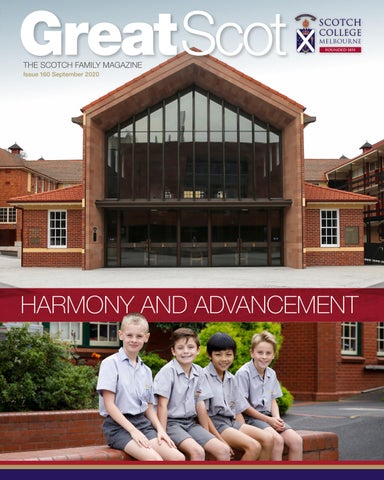
FRONT COVER: TOP: THE KEON-COHEN DINING HALL. BOTTOM: HUGO HARKNESS, WILL JONES, BRYAN CAO AND WILL HOWITT (ALL YEAR 4). INSIDE BACK COVER: BOARDERS IN THE ‘TEMPORARY’ DINING HALL (1926-71) ON THE HILL IN THE 1920S. BACK COVER: GUM TREE ON SCHOOL GROUNDS.
22 CREATIVITY DURING LOCKDOWN Artworks showcase a high skill level
EDITORIAL
After months of relative quiet the returning sounds of wildlife signal the change to longer and warmer days, and as the days grow longer and the wintry winds recede, it is natural to feel a greater sense of hope and optimism. That the past months fighting the pandemic and consequent lockdown have been challenging is indisputable – for parents, staff, and particularly, for students. Screen fatigue; the pragmatic difficulties of creating discrete work spaces for siblings and parents in a household; concern for loved ones physically distanced within Victoria, interstate or overseas; financial and job security concerns. And these are just a small number of the challenges we all face, every day. The truism that ‘crisis brings out the best and worst in humanity’ is a useful delineator in responses to the current crisis, and it is heartening to celebrate the ‘best’ responses from the Scotch
community. The Chairman of Council notes Council’s intention to alleviate difficulties for parents, while noting the School’s historic commitment to learning. Teachers have shown their commitment to adapting to the technological changes required to engage students, and this goes well beyond delivering curriculum. Engaging, fun activities are factors in both teachers and students developing relationships, even in the online environment. The Junior School showcases weekly challenges: Lego Master, Junior Master Chef and Friday Funnies. These efforts to bring light and laughter are echoed in the Senior School, with Middle School students challenged through the Strava app negotiating virtual treks. The online Zoom fora for public speaking, drama and debating, while posing undoubted challenges, demonstrate boys’ familiarity with technology as they quickly navigate camera angles and audio input. Sport, art and music faced similar challenges as opportunities for student expression of their skills were necessarily limited. However, these departments, too, responded in typical Scotch ‘can do’ fashion to provide opportunities for boys in these unprecedented times. School leaders, both boys and staff, have demonstrated a dedicated, ongoing commitment to maintain a simulacrum of ‘real’ schooling. Scotch Streams involves students in weekly conversations with the Principal, Chaplain, School Captain and, on occasion, Old Boys. Tutor groups remain
a vital mode, albeit an online mode, of keeping in touch with boys, as too are Form Teacher meetings. Nostalgia for former iterations of the ‘normal’ are evident. Sporting programs, boarding events and cock house competitions have all been required to limit offerings. Despite the difficulties of the times, there are still good reasons for optimism and celebration. Three major projects have been completed this year at Scotch – the superb Keon-Cohen Dining Hall, an outstanding learning facility in the new English Department, and the Tolson Centre, which deftly brings together OSCA House, the Museum and Archives and the Scotch Shop. In his article in this edition, Scotch Foundation President, Associate Professor Doug Lording AM (’64) gives everyone involved in these projects a virtual pat on the back, and sees them as significant achievements to lift the spirits in challenging times. Old Scotch Collegians’ Association President, James Douglas (’84) also sees reasons for spirits to be buoyant. Let’s be grateful, he says, that we are all members of such a powerful, caring community. He encourages the Scotch Family to stay connected, including through the channels of OSCAconnect, Instagram, Facebook and informal networks.
24
39
62
TOP DESIGNS Two Year 12 boys’ innovative designs exhibited
A SCOTCH MILESTONE Dining hall officially launched – via Zoom
‘MUCH LOVE TO THE WARRIORS’ Ned Parnham’s sad but inspiring story
DURGA KAMTE EDITOR GREAT SCOT
www.scotch.vic.edu.au Great Scot 1
CHAIRMAN
HON. DR DAVID KEMP AC SCHOOL COUNCIL CHAIRMAN
SUCCEEDING BY ACTING ON OUR VALUES Taking responsibility has been the key to Scotch’s success Scotch has remained purposeful and provided leadership in many of the nation’s crises: in economic depressions, wars and pandemics. Its capacity to do this has been the result of the strong community that has come into existence within and around the School, and the values of that community. In the most difficult of times, the College has provided hope, direction and a quality of education that is the surest foundation of a better future. The School’s motto Deo Patriae Litteris – for God, for Country and for Learning – encapsulates the School’s purposes. Each generation interprets these commitments in the circumstances of its time. During the pandemic the Chaplains have told how crises can teach us lessons about ourselves – who we are, and how important it is to think beyond ourselves, and to show our love for others. Scotch’s historic commitment to our country and Australians’ values of freedom, democracy, family, 2 Great Scot Issue 160 – September 2020
faith and community – written high in the Memorial Hall – have never been more important than when all are facing unprecedented restrictions. Keeping true to these values will ensure that the country we love will return to its full vitality and glorious openness. The spirit of enterprise and adventure is represented on the School’s coat of arms by the ship being rowed with furled sails against the wind. The wind at the moment is blowing a gale, but the ship still makes progress. Immense opportunities will be provided as the world opens up again – as it will. In this pandemic the torch of learning has not gone out, but has been kept alight by our dedicated teachers, and by Scotch families who deeply value education and are making sacrifices for their sons to secure their futures. Our dedicated technical staff have kept the online systems operating to keep the relationships between staff and boys strong, while our wonderful Grounds and Maintenance staff have been providing
additional security, while ensuring all is ready for a fitting welcome home. All of us are looking forward to the return to campus and to the exhilarating activities that it can offer. The Old Scotch Collegians’ Association has worked hard and well to connect with its community through its website, blog, Facebook, YouTube, OSCA Live and other programs, and it is pleasing to observe the continuing growth in support for OSCA projects and programs from former Collegians. The Scotch Foundation is planning ahead to ensure the continuing strength of the scholarships that the School provides, and to ways in which it can continue to improve its support for the teachers and boys. The School Council has been very aware of the impact of the pandemic on all members of the Scotch community. Staff have welcomed the continuity of employment that the School has offered, and have given their all to supporting the boys. Council has also recognised the great impact on all Scotch families, and it has sought, through its decisions, to recognise this in its financial decisions to give families the greatest chance to maintain their links with the School, while enabling Scotch to continue to provide the education families expect. The early announcement that there will be no fee increase for next year acknowledges the impact of the pandemic on all families. The decision to focus extra assistance on families suffering genuine hardship has
also, I believe, been well understood and appreciated, and many families are now receiving fee assistance of one kind or another. Families with VCE students, and especially Year 12 students, will have been pleased to hear the Principal’s firm belief that this year will provide unprecedented opportunities for students to move from school to university, and the School will of course be providing all the assistance necessary for them to do so. As Chairman of Council I want to take this opportunity to acknowledge the great leadership offered during this period by Principal Tom Batty and his senior executive team: the Vice Principal, Rob McLaren, the Head of Junior School, Jon Abbott and the Bursar and Secretary to Council, Ross Congleton. The quality of our leadership team has been tested to the full by the consequences of the pandemic, and they have well and truly risen to the occasion. Our founder, the Rev. James Forbes, faced with a Victoria weakened by depression and in which many did not have education, called on his fellow citizens to take responsibility for their own lives. ‘They can, I apprehend, do more for themselves than all the Rulers and Governors on earth are likely to do for them’. The value of taking responsibility has been the key to Scotch’s success, and it will be because the members of the Scotch community have been willing to do this that the future is bright.
www.scotch.vic.edu.au Great Scot 3
PRINCIPAL
MR TOM BATTY SCHOOL PRINCIPAL
SEEKING BALANCE BETWEEN HARMONY AND ADVANCEMENT
In the pre-lockdown, but number plate sensitive, days of the mid-year break, I was out for a jog in rural northwest NSW, when an image captured my mind. It was of the red dirt of the bush encroaching on the newly tarmacked road along which I was suffering. Like many small regional towns in NSW, the infrastructure of the community I was in is well maintained by state government services, and it’s just as well: the bush won’t be beaten. It can be held up by our ingenuity and toil, but it has time on its side. Later in the day, while out on a bush property, it came to my mind to question how long, in the absence of targeted individual and communal effort, it would take for the bush to completely reclaim the town: three 4 Great Scot Issue 160 – September 2020
generations? five? I suspect not long in the history of the land, nor, indeed, in that of those who have been on it longest. Returning to cross the state border in the nick of time, I took in the magnificence of the Scotch grounds and pondered the same question. So much of our efforts and progress have been directed at holding nature at bay and bending it to our desires. This has, perhaps, been the source of our greatest leaps forward, but it also, perhaps, reminds of our vulnerability. As former CEO of BP, Lord Browne, observed in a recent interview with the Cambridge Judge Business School, the coronavirus pandemic upon us is a natural disaster, in that it is a disaster from nature. The balance that we seek and accept between harmony – with each other and our world – and the advancement of our species, is as old as we are and its consideration has been, and should still be, the cornerstone of a liberal education. In current times of pandemic, such consideration takes form in debate over the balance of priority between health of people and health of economies, and how the two are entwined. It takes form in the release of pent-up anger and frustration across the world over inequities in the lives of people of colour following the death of George Floyd. In his 1965 Cambridge University Union debate with William Buckley, James Baldwin insisted that progress requires sensitivity to frames of reference other than those formed by our own experience. I would contend, perhaps with a mathematician’s love of proof, that, in turn, this requires common axiomatic values upon which questions, such as that I first saw posed by Ta-Nehisi Coates (I believe it to be attributable to sociologist, Oliver Cromwell Cox) – What came first, race or racism? – can be explored. In the absence of such framework, it is all too easy for short-term goals to dominate and disempower. History suggests, that once established, such hierarchies can take a long time to change; longer still when they are enshrined in Law. As well as taking the odd jog, I managed a bit of reading beneath the big skies and winter sun of rural NSW. I finished James M McPherson’s magnificent account of the American Civil War, Battle Cry of
Freedom, and, mind thus set alive, took up Donald L Miller’s account of Grant’s defining campaign along the Mississippi, Vicksburg. Amidst the former, I read in awe of Lincoln’s wisdom and strength in articulating such value axiom when countering secessionist claims of the ‘virtues’ of southern slavery over the wage slaves of the north and perils of free labour: ‘I want every man to have the chance . . . in which he can better his condition’. In Vicksburg, Grant’s trials and bedevilments in pursuit of victory amidst the changing course, disease and endless meanderings of the Mississippi and its bayous evoke strong image of just how complex such viruses are to contain and unpick once they have been allowed to take hold. At Scotch, our foundations are established on our Christian faith. They take educational form in our foundational teaching and learning principle: The inherent dignity and value of each person; and our foundational teaching and learning question: How did the world evolve to be as it is and how might it be made to evolve for the greater good? They are given currency in our four planning themes: Personalisation, Diversity, Enterprise (the blending of social and economic) and Sustainability. So armed, we continue to question and explore the balance of harmony and advancement, striving to meet Baldwin’s frame of reference challenge and our need for enterprise. Reflecting on that which has been learnt during periods of lockdown, matters arise across three groups: new ideas, change already in train and given acceleration by the times and practices brought strongly to mind by their absence. I offer 10 such thoughts. 1. Delivery of curriculum and qualification: I suspect the most significant impact on the education industry will be in the area of curriculum, assessment and qualification. This is essentially an acceleration of an existing journey. 2. Diversity of course/qualification providers: I suspect we are going to see the continued acceleration of online short course qualification, with all elements of the sector seeking foothold in the market. 3. Renaissance of a liberal education: I very much hope the relative inability of the online world to engage beyond the immediate will usher a renaissance of those aspects that form the foundations of a liberal education and schools of such tradition. 4. Growth of cluster groups built on interest and diversity of talent: The breaking of direct lines of oneto-one influence and the advancement of independent cluster groups around shared interest and the diverse skills necessary for its exploration will accelerate. 5. Student voice: Awareness and promotion of the increased power of, in our case, boys’ voice, is one of the great learnings of these times. Boys have had greater
independence and control over their learning and this has seen many flourish. Scotch boys have enjoyed video access to key explanations they can return to at their leisure, and being able to access the differing explanations and methods of different teachers. 6. Differentiation at point of need: Could we remotely influence and assist individual boys while they are in class? 7. Popularisation of teaching and learning: Willingly or otherwise, parents have become more involved in the education process. Could we build on this and better prepare them? Parents have, perhaps, also been reminded that a key function of schools is to get children away from the home to experience other frames of reference. 8. Quantum of solace: Amidst it all, we have been reminded that whilst Scotch thrives on its busyness, there is need for time out: boys have enjoyed opportunity to reflect, gather thoughts, discuss, refine opinions and be immersed in artistic and physical enrichment. 9. Sustainability: Being reminded of the impact of natural disasters focuses thoughts on their prevention and mitigation. 10. Our condition: To what extent is learning an individual pursuit and to what extent is it communal, and how will increased time learning alone affect our relationship with the world and those with whom we share it? Perhaps, this last point is the most significant. We have discovered, that, for much of what we have increasingly been telling ourselves is important, face to face human contact is far from necessary. Its absence, however, limits interaction, discussion, critique and consensus and starts to impact on how we see ourselves in relation to each other’s frames of reference. If we restrict, to raw form, our observation of each other and allow it to be doctored and artificially refined, we limit our understanding of each other, and that which makes us different and of unique value. It is important that the goal of the harmony/ advancement balance is kept in mind. McPherson notes, that having had Lee sign the papers of surrender, Grant introduced him to his staff and that as Lee shook hands with Grant’s military secretary Ely Parker, a Seneca Native American, he said, ‘I am glad to see one real American here’, to which Parker replied, ‘We are all Americans’. Pursuit of the balance is an ongoing quest and for the means of its best prosecution, I return to Lincoln: ‘Upon the subject of education, not presuming to dictate any plan or system respecting it, I can only say that I view it as the most important subject which we as a people can be engaged in.’
www.scotch.vic.edu.au Great Scot 5
PRINCIPAL
THE PRINCIPAL: ON EDUCATION MR TOM BATTY SCHOOL PRINCIPAL
Essentially, education is a three-headed dragon: Head 1 is named, ‘What we Teach’ and is often called ‘Curriculum’; Head 2 bears the name, ‘How we Assess’ and is inseparable from its bed mate ‘Qualification’; Head 3 is named ‘How we Teach’ and stands aloof, but not by choice. Heads 1 and 2 have dominated discourse for decades because they are readily controlled. But it is Head 3 which determines quality and improvement. The purpose of school education has never been solely, even primarily, to equip young people with the specific skills currently required by the workforce. It has been, and should remain, to equip each young person with the means to take responsibility for her/ his own life, and, in so doing, to equip each generation with the habits of mind that make for adaptable, diverse, cohesive populations that are economically and socially prosperous. Young people should challenge, rethink and advance what they find as much as serve it. As an elder on the Tiwi Islands put to me: The school is there to deliver a culture of participation. There is no Plan B. The purpose of Head 1 is to provide a framework of rigour for consideration of all that has gone before, so it can best serve further advancement. The purpose of Head 2 is to facilitate the coming together of people with interests and skills to serve this advancement, and, importantly, to hinder the evolution of counterproductive social hierarchies born of privilege and power. If there is one important lesson to learn from this pandemic, it is that Head 3 remains the most
6 Great Scot
important, if oft neglected, head of the dragon, and that: • Teaching is inherently relational; • Schools are centres of their communities and thrive on intimacy and belonging; • Involvement beyond the classroom plays an important part in developing learning relationships; • The nature of the places we gather influences relationships; • Technology can continue to play a part in better personalisation of education; • The goal for young people is the unearthing of passions and the honing of mastery so these become habits of mind and practice. Changes to curriculum and assessment are required: we need a smaller core national curriculum and an assessment regime that does not dictate how we teach. This was true before the pandemic broke. During these times, our minds have been further accelerated to realise that the assessment/qualification jigsaw would benefit from more variety of pieces, including, for some, shorter course qualifications. But such discussion should not cloud the ever more apparent truth in these days of connection: our quest remains that of improving the standard of our teachers (and hence learning) and the key ingredients are: • intellect; • the capacity to build relationships; and, • interests and talents to share, and the desire to share them. The role of the governments and education boards is to deliver such teachers in maximum number and school environments that see them flourish. Curriculum and assessment play a part, but they do not breathe the fire.
CHAPLAIN
A REFLECTION OF GOD’S LOVE Putting your time, money, talents, and actions where your heart is REV DAVID ASSENDER SCHOOL CHAPLAIN
What is kindness all about? It is asking yourself, ‘What can I do to really help?’ and then acting on it. The Apostle John, in chapter three of his first epistle, says: ‘This is how we know what love is: Jesus Christ laid down his life for us. And we ought to lay down our lives for others. If anyone has material possessions and sees someone in need but has no pity on them, then how can the love of God be in him?’ (1 John 3:16-20) Kindness is doing something for someone out of love. Kindness is being practically generous. It means you put your time, money, talents, and actions where your heart is. Thus, the opposite of kindness is stinginess, because kindness is generous. Writing on this topic, Tim Keller figures that if the Christian faith had a Hall of Fame for kindness, William Wilberforce would be in there. Wilberforce was behind the abolition of the slave trade in the British Empire in 1833. His mentor was John Newton, who before he became a Christian was a slave trader of the worst kind. It took him a long time to be convinced that God would ever want to forgive him for the horrible things he’d done – that’s why he wrote the iconic hymn Amazing Grace. Inspired by the faith of John Newton, William Wilberforce and a group of Christians worked their way into Parliament and other important places to abolish the slave trade in the British Empire, and it took years. Eventually, the way they did it was to say, ‘We’re abolishing slavery as of midnight tonight in 1833, but we will pay every slave owner for the value of the slaves so they are not materially and economically destroyed’. The British government paid out something like 30 million pounds sterling to people. Some people say it was the most righteous act a government ever did. Therefore as you can see, kindness is asking yourself, ‘What can I do?’ and then acting on it. Some people make inane statements such as ‘I believe religion is a private thing and you should keep it to yourself’. Try telling that to William Wilberforce or John Newton. Kindness is in the DNA of the Christian faith. One of the early Roman emperors, Flavius Claudius Julianus, utterly despised Christians and tried to stamp them out. His battle to do so was not with weapons
and armour, but by influencing the hearts and minds of his own people. In his words: ‘Nothing has contributed to the progress of the superstition of these Christians as much as their charity to strangers. These Galileans provide not only for their own poor, but for ours as well’. The same exhortation from the Apostle John applies as much to us today as it did to Christians in the first and second centuries: ‘… we ought to lay down our lives for others. If anyone has material possessions and sees someone in need but has no pity on them, then how can the love of God be in him?’ As I see it, if you aren’t kind, you simply aren’t reflecting God’s love. What shape will your kindness take today?
www.scotch.vic.edu.au Great Scot 7
JUNIOR SCHOOL
MR JON ABBOTT HEAD OF JUNIOR SCHOOL
STAYING CONNECTED IN A REMOTE LEARNING WORLD KEEPING BOYS AND FAMILIES IN TOUCH, 21ST CENTURY STYLE KEEPING JUNIOR SCHOOL BOYS CONNECTED AND ENTERTAINED DURING LOCKDOWNS: MR MCSCIENCE (RIGHT) PERFORMS AN EXPERIMENT IN ‘COOPERATION’ WITH THE HEAD OF JUNIOR SCHOOL
With one week to go in Term 1 this year our School and the general community were thrown into a strange new world called ‘lockdown.’ We were asked to move out of the world of face-to-face teaching and learning that had been the mode for almost two centuries, and to enter a new and daunting world of remote learning for our students. It is fair to say that the first few weeks of this style of learning were a challenge for everyone, but it was encouraging to see how quickly we were all able to respond to the new format. Term 2 saw us return to remote learning and we all became accustomed to Zoom meetings, accessing learning materials via our learning management system, Canvas, and being somewhat apart from our friends and our families. Never before have our dogs been so well walked, have our bikes had so much use, or the walking paths of Melbourne been so popular. For the boys, there was a novelty factor in being able to learn from home, and most of our Junior School boys embraced the idea. Some even found it enjoyable. The majority however, soon realised that they were missing one really important part of school life – being with their peers. We all began to experience a sense of becoming disconnected from a part of our lives that had previously been quite significant.
8 Great Scot Issue 160 – September 2020
Many of the boys were missing being with their mates, and missing camps, sporting events and fixtures, musical performances and the myriad of other activities that all add to the rich experience of boys here in the Junior School at Scotch. Equally, our parents were missing their sense of connectedness with the School, catching up with other parents at the gate, coming along to special events and Junior School Parents’ Association activities, and being part of many of the boys’ special events. The challenge for us all during these times of separation was to find ways to remain connected with our families, friends and to the various communities of which we are part. In the Junior School we recognised that the boys and their parents were missing the interactions with others that school naturally provides. The boys enjoyed their Zoom meetings, as they provided opportunity to see each other, but apart from those times many of them did feel disconnected. In an effort to keep our community feeling more connected the School set up a new section on our website called ‘Keeping Scotch Connected.’ In the Junior School we saw this as a great way to bring a bit of light into what had increasingly been a very dull period. In second term we began a weekly challenge called Junior School Lego Masters, and each week a new
challenge was set for the boys to tackle with their Lego kits. The interest in this activity was fantastic, with up to 60 boys each week spending some time at home creating amazing structures and scenes with Lego, and then photographing themselves with their creations. All of the boys’ photos were then used to make weekly slideshow movies that the Junior School families could sit down and watch. Our weekly Monday Assemblies were also posted onto this part of the website, allowing not only the boys to participate in one of our normal activities, but also enabling parents to be part of them as well. In Term 3 we switched the weekly challenge to a new pastime that boys could easily do at home – Junior School Master Chef. Once again the boys responded magnificently, and we had some wonderful meals and recipe favourites displayed by the boys each week. All of these activities were great in allowing the Junior School community to feel they were still connected in some way. However, we also wanted to find something for the boys to look forward to each week, given so many of their favourite things had been halted by the lockdown regulations. What we came up with was ‘Friday Funnies’, a weekly posted video on ‘Keeping Scotch Connected,’ consisting of a variety of fun segments for the boys and their families to sit back and have a good laugh at.
The segments included the irreverent Mr McScience, who shared his knowledge of scientific principles by performing wacky experiments on the Head of the Junior School, usually with disastrous results for the Head! Other segments involved boys sharing their favourite jokes and gags, boys and staff contributing short dance segments that were combined into a weekly dance clip, and also a segment called ‘Teacher Creatures’ where various Junior School teachers were transformed into an array of creatures, with the voice of David Attenborough narrating their particular habits and behaviours. It was all good fun, and a way to provide some light relief for the Junior School community each week. Although the Junior School boys and their families could not be connected in a physical sense throughout the lockdown periods, the various online activities and presentations have, we hope, helped to keep them connected in a 21st century fashion. It is true that we never really appreciate just what we have until we no longer have it. We have all missed that sense of connectedness and belonging, and look forward to a time, hopefully not too far into the future, when we can enjoy these simple pleasures once more.
www.scotch.vic.edu.au Great Scot 9
JUNIOR SCHOOL
YEAR 1 BOYS WROTE ABOUT THE WAYS THEY INCLUDE OTHERS AND TREAT THEM RESPECTFULLY.
‘WHEN SOMEONE RESPECTS YOU, RESPECT THEM BACK’ Year 1 boys on the right path towards respectful relationships The image of St Kilda’s Nicky Winmar lifting his jumper and pointing to his skin has become one of the most iconic images of our great game of Australian Football. It is a powerful photograph that evokes a great deal of emotion. During this year’s Reconciliation Week, the Year 1 boys looked at this image, along with an image of Brownlow Medallist Adam Goodes. Talking about such an important concept with young boys can be quite challenging, and as an educator you feel an enormous responsibility to get it right. As a junior primary teacher, I devote a lot of work to laying solid foundations which can be built on in the future. I also see it as planting seeds, which will hopefully germinate at the right time. The boys did a great job, while participating in a healthy and respectful conversation about these images. They made the important connection about accepting people for who they are as individuals, irrespective of their race. We have a wonderfully diverse mix of cultures here at Scotch, and we come together to create a harmonious community. The boys wrote about the different ways they include others and treat them respectfully both at school and in the wider community.
10 Great Scot Issue 160 – September 2020
As they grow from boys into men, we trust that they will take these ideals with them into the world and make it a better place for all. Here are some quotations from the boys’ posters: ‘We can learn from the mistakes made in the past. Be kind to others. Share things with your friends.’ CANICE ‘Be respectful of the opinions of others. Be kind to others because they will pass it on!’ FREDERICK ‘Don’t hurt others’ feelings. When someone respects you, respect them back.’ ASHER ‘Include others in my games and change my games, so he can play with me and my friends.’HARVEY ‘Do not tease people about their opinions. Be kind to others.’ NICK ‘Be kind to everyone: Share my umbrella!’ AIDAN ANTHONY TASCA – YEAR 1 CLASSROOM TEACHER
www.scotch.vic.edu.au Great Scot 11
JUNIOR SCHOOL
FORMING DEEPER HUMAN CONNECTIONS BY LEARNING A LANGUAGE
LEARNING A LANGUAGE ALLOWS STUDENTS TO THINK IN A MUCH BROADER SENSE.
Thinking, feeling, speaking, listening, reading and writing in new ways We live in a beautiful country. Australia is a nation of many colours and traditions. People have made their home here from all points of the globe, and trying to live harmoniously together seems to be at the heart of our identity. As a teacher of language, the theme of this edition (harmony and advancement) reminded me of the movie Stargate. This movie is a wonderful example of the importance of language and the value of intercultural understanding. In the movie, it is the linguist who saves the day. Through the use of the stargate, an unknown galaxy is discovered and they have a written language of complicated circular symbols. The linguist begins to learn the people’s basic vocabulary. As he becomes more proficient, he is able to communicate with and develop an empathy for the people on the other side of the gate. It is his ability to translate what they are saying, and seeking out first to understand rather than be understood, that develops a rapport and leads to a positive relationship being developed.
At school, or in this country, we are not dealing with secret codes on gates and unknown civilisations. We are dealing with people – children, adults and communities. But the concept is the same – seek first to understand, rather than to be understood. Perhaps the best quote on the subject came from Nelson Mandela, who said: 'If you talk to a man in a language he understands, that goes to his head. If you talk to him in his own language that goes to his heart'. Learning a language allows students to think in a much broader sense. It allows them to think, feel, speak, listen, read and write in new ways they never thought possible. And the best outcome is that the new things they discover lead to greater sensitivity, which in turn will benefit the wellbeing of society as a whole. I hope that many of our boys will continue to strengthen their language capabilities. It is, I believe, one way of moving forward and it is all about forming deeper and even more meaningful human connections. CORNELIA KOEHNE-DRUBE – HEAD OF JUNIOR SCHOOL LOTE
12 Great Scot Issue 160 – September 2020
School Christmas Concert and the German performance. Every year I look forward to seeing the boys in their costumes, and I love joining in the carol singing, too. The Junior School German concert has similarly never failed to entertain and amaze me. What story will your colleagues tell about you when you retire? They may bring up my run of bad luck with computers – some might say I am jinxed. My laptop was sent away for repairs and got lost for over a term, and then the new one I borrowed only lasted a few weeks and died. Luckily my original computer amazingly turned up and is still working! My most used button though is, unfortunately, ‘forgot my password’.
Interview: MELINDA WHITING Junior School Learning Support Assistant Melinda Whiting started her teaching career in Deniliquin, NSW, near her family’s farm, followed by a short stint teaching in the UK. I had the pleasure of working with Melinda when she joined the staff at Christ Church Grammar School in 1995, and again in 2013 when she started working at Scotch, although her association with our School started when her brothers boarded here during their secondary education. Melinda started as a Prep Assistant and joined the Learning Support team in 2018. Melinda is noted for her teamwork, positive, can-do attitude and professional approach to all challenges. She and her husband, Austin, have three teenage daughters. KATE IKINGER
What are your roles and responsibilities at Scotch? I have had varied roles since starting as a classroom assistant in Prep P in 2013. After nearly four years I moved to working across both Year 2 classes, and now I am in my third year in the Junior School Learning Support team.
My key role, and one I love, is to support boys with their learning throughout the Junior School. I am lucky enough to work daily with small reading and spelling groups of Prep, Year 1 and 2 boys. Seeing the boys continually change and progress each week is heartwarming and rewarding. I also enjoy supporting Prep boys starting with English as a Second Language, and I also help my colleagues with testing and support within the classroom. What has been your biggest challenge at Scotch? I think technology has been the most challenging aspect. Although taxing from time to time, I have learnt so much over the last few years and I’m very grateful for the support I have received from Tech Support and my colleagues. Particularly in this time of remote learning, the skills I have gained have been invaluable. When you are no longer teaching, what will be your favourite Scotch memories? There are two Scotch events that I will always remember fondly: the Junior
What advice would you give our VCE students as they embark on a life outside Scotch? My advice would be to live life to the fullest – take up opportunities, travel far and wide (when you can) and embrace challenges and change, because you grow so much from these experiences. Particularly this year, call on your resilience and turn your challenges into positives. I would also highly recommend using gratitude, empathy and mindfulness in your life. How have you approached the pandemic, personally and professionally? I have been staying positive, and I feel grateful for the small things, such as walking and exploring my neighbourhood. Professionally, I have gained a myriad of new skills, particularly in the tech area, and have become quite proficient on Zoom. I have taken up the meditation and yoga Annika has offered, and that has been brilliant. What is your favourite corner of the School, and why? My favourite corner of the School is actually my Learning Support classroom space. The sun shines in, particularly in winter, and always brightens and warms up the room and my day. I also love meandering though the School’s gorgeous gardens. What is on your wish list? Travel – Japan, Vietnam, Canada and Bora Bora are places I would love to visit. Greece, Italy and Fiji, I would love to head back to again! I also hope to do more travelling around Australia.
www.scotch.vic.edu.au Great Scot 13
MIDDLE SCHOOL
MS KATRINA STALKER HEAD OF MIDDLE SCHOOL
ZOOM: ONE OF A RANGE OF DIGITAL PLATFORMS USED TO HELP BOYS STAY ENGAGED WITH THEIR LEARNING.
‘IT PROVIDES OPPORTUNITY TO LEARN FROM WHAT HAS HAPPENED’
The positive attitude shown by the boys of the Middle School during this pandemic has been astounding. There is no doubt that this is, and has been, a difficult situation for everyone, but the boys, in particular, have displayed commendable resilience both as learners and in their ability to stay connected with their peers and teachers. The teachers, too, have been on a steep learning curve. Zoom, Conference, and using the so-far untapped functionality of our Learning Management System, as well as a broad range of other digital platforms, have all been explored to keep the boys engaged with their learning. We have seen pets join classes, trick shots with basketballs, and online football challenges all used to good effect to rally the boys together in these unprecedented times. We were fortunate to have our Year 7s and 8s back with us on campus for the last two weeks of Term 2. The excitement and energy levels in the Quad, on the ovals and in the classrooms were palpable. We managed to hold our inter-form cross country competition over these two weeks, although in a different format to previous years. Sam Allen easily won the Year 7 2km event in a time of six minutes 55
14 Great Scot Issue 160 – September 2020
seconds, while Harry Ward took out the Year 8 event in a slightly closer field, in a time of six minutes 59 sec. The Public Speaking competition between forms was held online for the Year 7s and in ‘real time’ for the Year 8s. The calibre of the presentations was outstanding. The Year 7 boys spoke on one of two topics: ‘Dream Big’ or ‘Think Big’. They spoke of our times, and how with perseverance and hard work they were halfway through the battle. They also discussed the importance for their year groups to dream big while expecting some failures along the way, and extolled the value of determination and imagination to reach one’s potential in order to achieve goals. A wise comment from one of our young boys still resonates: ‘It always seems impossible until it is done’. Finn Guthrie’s (Year 7) response to the question ‘how are we to live in a time of crisis?’ was followed by his inspirational response: ‘It provides opportunity to learn from what has happened’. In a closely-fought contest, Finn won the Year 7 competition with Sam Steele’s amusing speech a close second. The same calibre of speeches was witnessed from our Year 8 boys. In first place, Sasha Pillay thoughtfully navigated the COVID-19 story, to offer a clear illustration of how something so microscopically little can induce such enormous problems. In second place was Harry Ward. Confident and natural in his delivery, he presented the idea that a seed represents uncertainty, and argued for the importance of careful nurturing to ensure that little things become great things. As Term 3 was completely spent in isolation, a new competition was introduced using the Strava app. The boys competed against each other to see how far they could exercise within their 5km radius during one hour. It was also a race around Australia – at the time of writing Year 7 was in front of Year 8. They had managed this feat more readily than expected, and both were (virtually) on the North West Coastal Highway heading towards Geraldton. They passed through central Victoria, along the coast of NSW, around Queensland and across the Northern Territory. The Year 7s were at their overnight rest at Carbla, WA, and the Year 8s were just west of the Kennedy Range National Park. While they may wish they were actually at these places, the challenge of exercising has certainly been met, even though their physical worlds have shrunk. Importantly, the boys will have learnt from this experience of remote schooling. They will be more independent learners, which will hold them in good stead over the coming years. They will appreciate the importance of community and looking out for each other, and the many ways to stay connected with family, friends and school.
UPPER SCHOOL
MR TIM RAYNER HEAD OF UPPER SCHOOL
TAKING A DAY AT A TIME, KEEPING POSITIVE, AND BEING ADAPTABLE A recipe for today’s world Although the Queen, the Governor-General, and the State Premier were aware of this event, not many others in Victoria were. My next door neighbour’s 100th birthday was, by virtue of current health restrictions, a very quiet affair, although we did manage to sing happy birthday to Margaret from the safe distance of the front path. Margaret, the oldest and longest resident in my street, served in World War II and has lived through some trying times, including the Depression of the 1930s. Margaret’s cheery character and interest in people – she never forgets my children’s birthdays – is matched by her resilience. Despite the restrictions and lack of celebrations, she was very pleased to have received 55 cards and to have spoken on the telephone to so many friends and family. Taking a day at a time, keeping positive, and being adaptable does seem to be a good recipe for today’s world, where recently we have faced some very confronting circumstances. Boys were genuinely pleased to be back at school after their first spell of isolation; the consensus was that being at school was significantly better than being at home. Read into this what you will! The glass half-full approach also extended to recognising that some of the activities on offer were compromises and not quite the same as before, such as online teacher interviews, which had many positive responses from parents, and boys, depending on what was said by teachers, of course. During this time, many of us have had to navigate and adapt to new technologies. For some, the time frame to get up to speed has been short, but we have risen to the challenges and now find ourselves navigating our Learning Management System and Zoom as though we are old hands, or Year 9 boys. I would be mightily surprised if Zoom is not one of the words of 2020, at least at Scotch anyway. Boys and staff alike have taken to this medium due to its ease of use, and although not the same as a face-to-face meeting, or a class, it is a satisfactory compromise.
Our website has also seen several changes, with weekly contributions from our Principal and Chaplaincy. Support, help and advice run through many of the pages, as we think of others rather than ourselves. Through our Dean of Students and School Captain, boys have been encouraged to contribute to our website and share some of the activities in which they are involved. We can already see how such technologies will be able to improve the quality of education offered in future years, when the current crisis is finally behind us. So there are some positives. House competitions have continued, although sometimes in a modified form. Mr Keith Oatley and Heads of Houses have done a marvellous job in running a cock house competition that means so much to the School and boys. Activities like House Chess, Public Speaking and Debating, while occurring online, were little changed, but House sport and drama had to be approached more creatively because of social distancing. Team sports were out, solo efforts were in. This led to activities like golf (nearest to the pin), hockey goal shooting, penalty taking in soccer, and goal kicking in AFL. House points were awarded and boys competed with gusto, pleased that they could show off their skills, albeit to a reduced audience. I very much expect, at the end of this year, the reaction of the boys to the announcement of which House has won the trophy will not be different to any other year. www.scotch.vic.edu.au Great Scot 15
NEWS
LAUNCH ISSUE OF THE COLLEGE CHRONICLE
SCOTCH’S NEW STUDENT NEWSPAPER The College Chronicle hits the digital newsstands From Satura to The Scotch Collegian, student-driven publications have a rich tradition at Scotch. Now, our School has a new publication to complement this history – The College Chronicle – one of the first secondary school newspapers in Australia. I first developed the idea of a student newspaper while on the Symphony Orchestra’s USA tour in January. Besides being able to enjoy the hotel copy of The Wall Street Journal in printed broadsheet form, I observed that each American high school we visited had a student newspaper.
16 Great Scot Issue 160 – September 2020
While student newspapers and newspaper competitions are ubiquitous across the Pacific, such publications are relatively rare in Australia. Having learnt about student newspaper editorial processes and publication formats in conversation with writers during music workshops, I resolved to bring this idea home to my peers and teachers. And indeed the response was electric. Hence The College Chronicle was born. The College Chronicle is powered by a growing writing team of student journalists
from Years 7 to 12 who work tirelessly together to create a publication that chronicles not only news across Scotch and beyond, but also the student voice. With a desire to give writers carte blanche, the end product is a newspaper that features a diversity of content: from historical reflections and opinion pieces on current topical issues to economic analyses and forecasts – a meaningful trove of knowledge and insight, particularly relevant in an age of overwhelming spin and disinformation. Beyond fostering student opinion and serving as a record for future generations, the publication has also embraced technology, publishing its first edition digitally and managing its entire writing process on a virtual Kanban board – a visual workflow representation. We hope that in the years to come, once this coronavirus pandemic buries itself in history’s tome, The College Chronicle can continue to grow as a publication ‘by the students, for the students’ of Scotch College. RICHARD LIU – EDITOR, THE COLLEGE CHRONICLE
Scotch’s traditional commemoration of Anzac Day moves online
AN ANZAC DAY ASSEMBLY WITH A DIFFERENCE In a year of many firsts, Scotch’s traditional Assembly commemorating Anzac Day moved to an online setting, broadcast live to boys and staff. The Assembly included a reflection from the Principal and the Chaplain, The Last Post and Reveille played by Mr David Musk, and the Ode to the Fallen read by Scotch’s oldest known living Old Boy, Rev Bill Morgan (’34). As part of the Assembly, I read the story of Old Scotch Collegian, Stan Neale, School Captain in 1912, taken from The Scotch Collegian at the time, which is included below: ‘Stan Neale attended Scotch from 1906-1912. He had an outstanding sporting record, and his debut in cricket as a member of the 1st XI was in 1908 as the wicketkeeper. In 1911 he was made School Prefect and gained a place in the 1st XVIII. In 1912 he was appointed by Mr Littlejohn as School Captain and was also Captain of Cricket and Captain of Football that year. ‘Stan Neale was one of the first to join the Australian Army in August 1914 and soon gained the rank of corporal and then sergeant. He took part in the landing at Gallipoli and in July 1915 he wrote a letter which was published in the Collegian: “Scotch has given its fair share in this frightful war. Poor old Keith McIllwraith was killed on the first day. He and I were close friends all through training. Keith was a fine chap and liked by all of us. “Smithy was wounded at Cape Helles, but is getting along finely. George Carson received a hit in the foot – nothing serious. Kirkland got one through the shoulder – it could have been a
FLETCHER JOHNSTONE (PREFECT) AND WILL DIXON (SCHOOL CAPTAIN) IN FRONT OF MEMORIAL HALL.
frightful wound, but he is back with us again. Clive Brownell was also killed the first day – he was another fine chap gone from us. “Tell Mr Littlejohn his boys are doing their bit, and that we often speak of those great school days.” ‘Stan Neale survived five months at Gallipoli without a scratch or illness. He was later transferred to France and by 1916 was promoted to Captain. ‘In September 1917 he was awarded the Military Cross – the citation said he “worked unceasingly, at times under intense shell fire, setting a fine example of courage and unselfishness.” ‘On September 29th 1918, six weeks before the armistice, he died from wounds received in battle when his unit came under fire from enemy artillery and machine guns – he was 25 years of age. Stan Neale’s name is recorded on the Honour Roll of our War Dead along with the names of Keith McIllwraith and Clive Brownell.’ In a time of hardship for so many across the community, the Assembly was a timely reminder for boys of the true sacrifice made by those who have come before us in conflicts throughout history, allowing boys to pause their online studies and take time to reflect. While we were unable to commemorate the occasion physically in Memorial Hall, the legacy of Scotch boys and staff who paid the ultimate sacrifice for us to lead the lives we live today, continues to burn strongly. Lest We Forget. WILL DIXON – SCHOOL CAPTAIN
www.scotch.vic.edu.au Great Scot 17
NEWS
THE KEY TO KEEPING BOYS CONNECTED Scotch Streams has become central in keeping boys connected during periods at home STAFF AND STUDENTS CONNECT WITH EACH OTHER THROUGH ‘SCOTCH STREAMS’ EVENTS
As many of us have to come to appreciate even more during this pandemic, Scotch is so much more than the academic classes we take each day. At the end of Term 1, with remote learning looming, ‘Scotch Streams’ was born. A site for boys and run by boys, Scotch Streams became a temporary replacement for the many extracurricular pursuits at Scotch. With weekly messages from the Principal, the Chaplain and myself as well as many of the activities detailed below by eight Year 12 boys, Scotch Streams has become a central part in keeping boys connected during the period at home. The efforts of the boys, as well as the Dean of Students, Mr David
18 Great Scot Issue 160 – September 2020
Brown, have made the site a huge success with over 70,000 page views during the course of Term 2. WILL DIXON – SCHOOL CAPTAIN
INTERSCHOOL PUBLIC SPEAKING AND DEBATING – RION AHL During the remote learning period, Scotch competed in a variety of novel speaking competitions, strengthening relationships with schools across Melbourne. This series of events began with an interschool debating competition with MLC, wherein the speakers argued on whether some schools should remain same-sex. Such a competition brought together over 60 students from each
school to cheer on their respective team. This was followed by a public speaking competition developed by Scotch against Lauriston, Melbourne Girls’ Grammar and Camberwell Grammar School. Around 100 students gathered to watch both prepared and impromptu speeches, and the competition was a success in bringing together school communities through the new virtual world.
ONLINE CHESS AND SCOTCH'S ‘THE THOUGHT FORUM’ – SAMUEL ZONG Also, as a means of assisting Senior School students in their study routines and
exercising while at home. In order to do this, the ‘Staying Fit @ Home’ section of Scotch Streams was created. Workout plans for all boys and videos for each winter sport were included in this area of our online platform. The winter sport captains each made a video introducing themselves to their sporting cohort, and encouraging them to follow strength and conditioning programs attached. In order to help boys who may not be familiar with certain exercises, Jack McCorkell and I created videos running through the workouts. The ‘Staying Fit @ Home’ module encouraged boys to get active, and was successful in doing so, with all content created being used throughout the student body.
APS INTERSCHOOL FIFA COMPETITION – NIK TSOURVAKAS To fill the gap caused by the absence of Saturday sport, the APS School Captains decided to run an APS-wide FIFA 20 (popular soccer video game) tournament. Each school fielded a team of 11 aspiring video-gamers to compete against each other for the coveted first ever APS FIFA title. Scotch’s Year 12s created a team filled with poise and finesse – however lacking in finishing ability. The boys played in three matches during the group stage, losing the first two and winning their last after a few position changes, sadly not making it through to the next round. Although it was a disappointing result, the games had been live-streamed via Scotch Streams, allowing all Scotch boys to watch, and have a laugh with, and at, the players and their antics. tertiary education considerations, ‘The Thought Forum’ moved online to Zoom webinars. The lectures included a VCE study habits talk with Rupert Balfe (’19), a UCAT advice session with Joshua Meng (’19), and a chat about life and politics in the USA with former School Captain Mich Nehme (‘16). Year 11s and 12s found inspiration and motivation through these Zoom talks with Old Boys.
‘STAYING FIT @ HOME; WINTER SPORT PROGRAMS – OSCAR ROBSON While completing online schooling, it was incredibly important to keep boys
CHOMPERS’ CHAMPIONS – HUGO BOREHAM Staying at home for the quarantine period gave me the opportunity to create a podcast called ‘Chompers’ Champions’ – inspired by my interest in radio shows, and particularly the comedic work of ex-footballer Dylan Buckley. In each episode, posted weekly on Scotch Streams, I interviewed a different teacher or Year 12 student, chatting about matters such as sport, schoolwork and life experiences. My peers and staff members provided many great insights and reflections, all in good humour, highlighted by Jimmy
Gadsden’s views on being an Indigenous student at Scotch and Mr Clark’s advice on maintaining good mental health.
ART COMPETITION – WILL FORDHAM The Scotch Inside Art competition, inspired by the circumstances in which boys found themselves, encouraged boys to submit artworks in a range of forms, including photography, digital artworks, paintings and drawings. It was a very fun competition to take part in, and I was very excited and surprised when I won, considering all the other entries were so good as well. At the end of the competition all the artworks were published in a virtual art gallery for all boys to view. (See ‘Boys’ creativity flourishes in lockdown’, in this section.)
MUSIC PERFORMANCES – JAY DINGLE ‘Scotch Performs’ was an initiative aimed at providing a platform for all boys to share music, collaborations, and drama activities with the School community. Boys uploaded a variety of genres, ranging from classical duets and improvised jazz compositions to a capella vocal arrangements and piano covers. It was great to see boys continuing to pursue their interests and passions outside the school setting, given that usual rehearsals, productions and concerts were unable to take place.
HOUSE EVENTS AND MIDDLE SCHOOL ACTIVITY – GIL ROSEBY Throughout Term 2, boys were engaged in various online cock house competitions and activities. At the start of the term, House Captains established Spotify playlists for their respective houses, giving boys a soundtrack for their remote learning experience. Weekly house debates continued throughout the term, as well as Years 11 and 12 Public Speaking competitions, both using Zoom. For the Middle School, each form participated in a Kahoot quiz on Scotch history and general trivia, alongside various other online games, trick shot challenges, quizzes and art competitions, as well as posting photos with their pets. Overall, boys adapted well to different events online, all participating with great enthusiasm.
www.scotch.vic.edu.au Great Scot 19
NEWS
Scotch boys did some hard thinking on how to help those less fortunate than themselves
MORE THAN 3400 ITEMS OF NON-PERISHABLE FOOD WERE COLLECTED
A HELPING HAND DURING DIFFICULT DAYS
Their experiences during lockdowns have had quite an impact on Scotch boys. As the articles below by Year 12 boys, NEEL PAWAR and School Vice Captain DARREN TAN show, many of them were motivated to help those less fortunate than themselves during the COVID-19 pandemic. Two worthy causes attracted their attention – food for people in need, and contact with elderly people affected by the loneliness of isolation.
THE SCOTCH FOOD DRIVE – NEEL PAWAR In the last few weeks of Term 2, boys from Years 7 to 12 came together to take part in the Scotch OzHarvest Food Drive. After weeks of remote learning students were eager to get back to school, and into the rhythm of campus life. But with everything that was going on in the world and our communities due to COVID-19, boys felt that they needed to help the local community in some way. With this objective in mind, students decided that a food drive would be an excellent way to offer a helping hand to those less fortunate than ourselves. We decided to partner with OzHarvest, one of Australia’s leading food rescue organisations, which helps people in need all over Australia by distributing food through many charities. Within days the total number of goods soared through the hundreds and climbed into the thousands, shattering our initial goal of only 1000. The efforts of the boys and their families were so astonishing that School Captain Will Dixon’s office was overflowing with food. In the end we collected more than 3400 items of nonperishable food, with Bond House and 7LC contributing the most from the Upper School and Middle School, respectively. However, collecting the food was only half the challenge: many boys volunteered to stay after school one afternoon to sort and pack each item into recycled boxes in the Keon-Cohen Dining Hall. What was very evident throughout this whole school effort was that in order to tackle problems of great magnitude, it requires the combined efforts of everyone. Whether it was bringing in one can of beans, or 10, it was the culmination of these small actions that allowed us to achieve our goal.
LETTERS TO NURSING HOME RESIDENTS – DARREN TAN The danger of the current coronavirus pandemic does not solely lie in its effect on personal health, but also in its ability to isolate people. Lockdowns, social distancing, Stage 4 – these precautions have made it difficult, both physically and psychologically, to engage with other people in society. Arguably the most vulnerable group in these times is the elderly. As such, many nursing homes are under tight restrictions, which allow limited contact outside the centres. Many residents, too, may be feeling anxious and fearful – emotions which may greatly intensify due to isolation. Late in Term 2 (just after the Year 11s and 12s returned from online learning), we decided to contact two nursing homes near Scotch – Hawthorn Grange and Highgrove. These are places with which the School has worked closely in the past, whether through music immersions or other afternoon services. Limited in our options to interact with Hawthorn Grange and Highgrove, we chose to write letters to be sent to them – an initiative dubbed ‘Letters to the elderly’, and the initial goal was to write 30 letters in the second week back. In those first two weeks back at school, I felt a common sense of gratefulness within the School. We were back with our friends – in person! – after almost an entire term of online learning, and after doubts whether the year would actually continue. But
DARREN TAN WITH LETTERS TO NURSING HOME RESIDENTS
that experience at home allowed us to have some inkling as to the loneliness that comes with isolation. As the House Captains and boys around me continued to ask for letters to fill out, I felt that there existed an underlying desire to communicate with the residents of Hawthorn Grange and Highgrove, a wish to somewhat alleviate their stress, and empathise with them, because our time at home had bluntly opened our eyes to the everyday struggles that isolation brings. By the time the second week drew to a close, we had written 50 letters in total: from all Houses, and from both Year 11s and 12s. In these letters, the boys freely described their hobbies, such as gardening, basketball and fishing, and shared the ways they kept active during quarantine, like going for runs or learning an instrument. We were curious about the residents as well: which footy team did they barrack for? How were they spending leisure time in the homes? Was this lockdown anything like World War II? After weeks of at-home learning, there was undoubtedly something intimate and cathartic about physically penning a letter, which would then be read by someone with whom we deeply wished to connect. Towards the end of the term, we received a deeply appreciative letter from Highgrove. It was wonderful to learn that the residents were beginning to learn to use Skype, and that the nursing home has created a coffee club, complete with a new espresso machine. We are continuing to connect with nursing homes, in addition to Highgrove and Hawthorn Grange. Instead of letters, this time we aim to record performances of small music groups, combined with a personalised message. These videos will then be sent out to individual nursing homes, in the hope that they may find comfort in seeing students coming together for a classical musical rendition – or, at the very least, that they might enjoy some mellifluous music, enabling a few minutes of soothing respite during these difficult times.
www.scotch.vic.edu.au Great Scot 21
NEWS
BOYS’ CREATIVITY FLOURISHES IN LOCKDOWN A space for boys to share their creations with the School community
22 Great Scot Issue 160 – September 2020
OPPOSITE PAGE: FIRST PRIZE, WILL FORDHAM ‘ROOM’. LOWER LEFT: RICHARD LIU ‘OLD SCOTCH SQUARE’. RIGHT: ART ON DISPLAY. ABOVE LEFT: TOM CRONIN ‘INDUSTRIALISATION’. RIGHT: THEO DRYDEN ‘AT EASE’.
The Inside Art competition was launched in March 2020 as a result of the unique circumstances we found ourselves in during the early months of 2020. In Term 1, Victorian schools were closed to students for the first time since World War II, and all Scotch boys were subsequently moved to distance learning – a situation which was revisited during Term 3. The lockdown of the community was undeniably a unique event, and the Scotch Senior Art Department wanted to ensure students were encouraged to continue creating artworks. We wanted to provide a space for boys to share their creations with the School community, even though they were confined to home. Boys were invited to create an artwork based on the theme ‘Inside Art’, which they were invited to enter online. The artworks were then displayed in the Scotch Streams student portal on the School website. More than 50 students entered artworks that showcased a high level of skill and a thoughtful response to the topic. Deciding the winning entries proved to be a daunting task taken on by our Senior Art Department technicians – John Kuzma,
Mary Cutinelli and Saskia Pandji Sakti. As professional artists and designers, they were well qualified to decide which artwork would be declared the best entry. The winning artwork was created by Year 9 student, Will Fordham. Our judging panel unanimously praised Will’s digital artwork titled ‘Room’ as an excellent reflection of the state that many people found themselves in during the lockdown. It depicts a person lying in bed, mentally brightening the interior walls of an otherwise claustrophobic isolation. A very close second place was awarded to Theodore Dryden (Year 11) with his artwork titled ‘At Ease’, an arrestingly beautiful photographic image capturing a lone rower on the Yarra River at sunset. The two artworks in third place were popular with at least two of the judges, and were both technically very accomplished. Thomas Cronin’s (Year 11) beautifully composed collage ‘Industrialisation’, was made from classic magazine sources, and Richard Liu’s (Year 11) ‘Old Scotch Square’ was created using a unique coding sequence to give the image a very contemporary aesthetic.
Highly commended awards were given to Witter Onggara (Year 7), Matthew Padgham (Year 11), Brandon Pai (Year 10), Ryan Chen (Year 8) and Nathan Munro (Year 10), who all featured prominently in the judges’ shortlists. The competition achieved its aim of keeping the boys actively engaged in the Scotch community while at home in lockdown. It also served to showcase our young artists’ endeavours to the Scotch community. A virtual display was created to feature all the students’ artworks and to announce the winners. It is accessible at: https://www. artsteps.com/embed/5ea8262ac1a607739e 6e59b7/1280/720. A link to the virtual display is also accessible on the ‘Our Community’ page of the School website’s Keeping Scotch Connected portal. YUDHA SCHOLES – HEAD OF ART
www.scotch.vic.edu.au Great Scot 23
NEWS
TOP DESIGNS – SHOWCASING SCOTCH BOYS’ ENTRIES A glimpse into the future of Australian design Year 12 boys Alex Daley and Joshua El-Khoury were exhibitors in Melbourne Museum’s Top Designs 2020, held from 20 March to 12 July. Top Designs 2020 showcases some of the brightest VCE and VCE/Vocational Education and Training students from across Victoria. The final selection of 88 works, chosen from more than 1000 submissions across a variety of disciplines, offers a glimpse into the future of Australian design. The boys put into practice skills acquired through their study of Systems Engineering Units 3 and 4 to come up with their innovative designs. Alex Daley mixed his love for everything musical with his knowledge of physics and electronics to construct an automated guitar tuner, while Joshua put his programming and manufacturing skills to the test to develop an automated house blind system. This system can be programmed to raise and lower a blind under userdefined settings; it was inspired by his own grandmother’s need for such a device, as she is afflicted by arthritis in her wrists. Although the viewing of Top Designs was cancelled due to the pandemic, it is still possible to take a close look at the exhibition by taking a virtual tour via the following link, especially if you’re interested in cutting edge design: https://museumsvictoria. com.au/melbournemuseum/learning/topdesigns-2020/ STEVE DE DOMENICO – SYSTEMS ENGINEERING TEACHER TOP: JOSHUA EL-KHOURY’S MODEL OF AN AUTOMATED HOUSE BLIND SYSTEM. MIDDLE: ALEX DALEY IN THE EXHIBITION FOYER. BOTTOM: ALEX DALEY'S MODEL OF AN AUTOMATED GUITAR TUNER
24 Great Scot Issue 160 – September 2020
A MEANINGFUL WAY TO RAISE AWARENESS OF INDIGENOUS CULTURE Trees take on the colours of the Aboriginal flag on Close the Gap Day
Towards the end of Term 1, in recognition of National Close the Gap Day, the Indigenous Partnership Program boys decided to cover the trees along Morrison Street, Monash Drive, and in Old Scotch Square and the Quad with fabric representing the colours of the Australian Aboriginal flag. In doing this they hoped to raise further awareness and encourage discussion within the School about Indigenous culture in Australia, and issues surrounding the Close the Gap campaign. The connection between Scotch and Tiwi College has always been strong, and the School loves hosting the Tiwi students in Melbourne; but due to COVID-19, the Tiwi students were unfortunately unable to come to Scotch, which was very sad. But through thick and thin, the connection still remains strong, with both the Tiwi and Scotch boys exchanging video messages, continuing to strengthen the relationship even though they were unable to stay with us. With their planned visit coinciding with Reconciliation Week, through the web page Scotch Streams, I spoke to Scotch boys about the significance of Reconciliation Week, delivering an Acknowledgment of Country and reflecting on what Reconciliation means to me. Reconciliation here at Scotch has improved throughout my journey at the School, and as an As an Indigenous student I’ve witnessed first-hand just how much the School really appreciates Aboriginal and Torres Strait Islander culture, and how the relationship between the two is getting stronger. The addition of the Aboriginal and Torres Strait Islander flags at the beginning of this year
was an incredible achievement, as I know that previous Indigenous boys over the years were devoted to getting the flags up. Coming into my final year and seeing the flags put up really made me see just how dedicated the School is to closing the gap. Walking down from the boarding house each and every morning I pass the two flags, and I always lift my head to have a look at them. Every time I see them, it makes me feel safe and proud to be an Aboriginal student at this wonderful school that is accepting towards the traditional people of the land.
BELOW: TREES COVERED WITH THE COLOURS OF THE AUSTRALIAN ABORIGINAL FLAG RAISED AWARENESS OF INDIGENOUS CULTURE AND THE CLOSE THE GAP CAMPAIGN. BOTTOM PICTURE: TIWI COLLEGE STUDENT
FLETCHER JOHNSTONE – YEAR 12
Great Scot 25
NEWS
THERE’S NO BETTER TIME It’s an excellent time to push personal boundaries
In 2012, mathematician Peter Turchin published an article in the Journal of Peace titled ‘Dynamics of political instability in the United States, 1780–2010’. In this, Turchin posited that every 50 years, turbulent instability arises in the United States and creates shockwaves around the world: 1870, 1920, 1970 and now 2020. In the article, the battle for community equality takes great leaps forward, which has been apparent through the large backing for the Black Lives Matter movement. However, what Turchin did not predict was a worldwide pandemic, ravenous bushfires, and countless other tragedies. Predictions are one thing, as they allow us to weather the incoming storm. However, no matter how much we prepare, we will never be fully ready. But what we fail to prepare for, we can adapt and grow to. These are the two sides of the coin. Instead of fretting on what we could have done differently, we can now firmly grasp these arduous times, and bend them to our will.
26 Great Scot Issue 160 – September 2020
It may be an oversimplification to say that everyone on this spinning blue marble feels that this year has been a write-off, but I believe that as this earth continues to spin, we all still have the ability to make the most of every day. This, to me, is the greatest gift of all. As a community, we owe it to ourselves to continue to advance as much as we can. Every person in the community is a uniquely crafted cog that churns in this big machine of interlinked relationships. To grow as a community, we need to stay educated as a community. Looking at the state of America: the media may have gone quiet about the protests in cities such as Portland, but the burning soul of the people marching still burns bright. Yet we should also have the ability to educate ourselves on our own issues with race and class inequality in Australia, as these matters continue to dodge our headlines but exist in our communities. The ability to grasp this free time is truly a blessing in disguise; free time to learn that
new skill, improve on that one ability, maybe get around to reading that one dust-covered book. New skills and hobbies allow us to connect on a deeper level as a community. New skills and education extend to better mental health, greater satisfaction with day-to-day experiences, and more. These things are what allow us to live in a sense, to move away from the idea of a ‘slow burn’. To no longer become the person who wishes to lie in the river of mediocrity and float down it, into the mouth of simplified gratification. Look to challenge and educate yourself in this moment and push personal boundaries; showcase your ability to adapt and thrive in these exigent times. Because what else is the human race, if not a large collection of interlinking cells continuing to adapt and thrive in times of adversity. LACHLAN PALAMARA – SENIOR SCHOOL LIBRARIAN
WHAT IS MORE IMPORTANT – THE ENVIRONMENT OR THE ECONOMY
MELBOURNE 2020 LISTEN, DEBATE, CHANGE
ABOVE: THE UNIVERSITY OF MELBOURNE, HOST OF THE MCWHIRTER FOUNDATION’S ANNUAL MELBOURNE CONFERENCE. FAR LEFT: WILSON CHENG (YEAR 11); LEFT: RYAN AHL (YEAR 11)
ENCOURAGING STUDENT VOICE ON A GLOBAL SCALE Fruitful and invigorating ideas abound Student voice is integral to Scotch education. Providing opportunities for boys to engage in real world conversations, while developing their thinking, empathy and global understanding is crucial. The McWhirter Foundation held its inaugural annual Melbourne Conference in 2019. It aims to gather world class experts and mesh them with youth who have a strong interest in global issues, giving them an opportunity to learn, and to develop their understanding and global competencies. The conference is one of our Extension Studies Program opportunities and is held over two days in the July school holidays. It is open to Year 11 students. In 2020, we attended the conference. Following the onset of COVID-19, it has become even more important for the youth of this world to engage in fruitful and invigorating conversations to discuss and decide the future of the world. This was the focus of the McWhirter Conference, which stems from Oxford University. Over the course of two days, 90 students from across Victoria got together to discuss the question: ‘Which is more important post-COVID-19 – the environment or the economy?’ While listening to speakers from a diverse range of backgrounds who proposed differing pathways, McWhirter participants were able to pose their questions and share their opinions on the merits
of an economy-based society or an environmentally-based society, and discuss whether both extremes can coexist to provide a balanced future. Speakers included Gigi Foster, Professor at the UNSW School of Economics and co-host of Radio National's The Economists; Peter Gregory, Research Fellow at the Institute of Public Affairs and co-host of the Young IPA podcast; and Nick Cook, a former aviation journalist who is interested in using defence and aviation technology and infrastructure to combat global issues. Nick Cook opened the discussion, weighing in on varied factors such as the consequences of the Victorian lockdown and the state of the Australian Defence Force. We were extremely lucky to be able to overcome the physical restrictions stemming from the pandemic through the online conference platform, Zoom. The online format allowed us to listen to speakers not only from across Australia but from across the world, with many of them tuning in from the UK. Despite not being physically present at the conference venue, we are grateful to have had the opportunity to be involved in such meaningful and insightful discussions. The environment or the economy after COVID-19 seemed like a fairly basic question with surely a simple enough answer. Rather, we were rocketed into four wholly different viewpoints and four professional speakers adamant about where they stood on the issue. Our perspective on the importance of the economy weighed against the environment swivelled after almost every talk, so persuading was every speaker. The system of syndicate groups which we returned to throughout the two days encouraged us to connect with the others and worked really well, even over the internet. These groups, where students from across all sectors of education added their opinion to the pot, enhanced the quality of discussion. The speakers strove to make their speeches interesting, however the incredible diversity of viewpoints expanded our thinking of possibilities. It’s not every day you hear that aerospace and defence companies can single-handedly solve climate change or that someone’s life’s value should be predicated on their economic contribution. The McWhirter Conference provided an array of ideas and expert input, and proved to be an inspiring opportunity for experiencing student voice. We absolutely recommend it. RYAN AHL AND WILSON CHENG – YEAR 11
www.scotch.vic.edu.au Great Scot 27
MUSIC
THE CONCERTS HAVE ENDED, BUT THE MUSIC LINGERS ON! Despite the closure, there have been a number of projects and activities The first concert of the year was given by the Symphony Orchestra, and featured an international guest cellist, Matthias Balzat, in a complete performance of Dvorak’s Cello Concerto. It was a remarkable and thrilling performance. Sadly, that was the final performance before the COVID-19 closure. Despite the closure, there has been a number of projects and activities. The Chamber Choir, under Andrew Hunter, produced a beautiful unaccompanied performance of Loch Lomond that was used for the opening of the 2020 International Boys’ Schools Coalition virtual conference in July. Boys recorded their parts at home, and these were mixed with some socially-distanced choristers singing in the Ian Roach Hall. The String Department produced a video performance that was professionally filmed in sections, and involved boys from Year 2 to Year 12. An impressive production. In addition, masterclasses with Australian and international musicians have been held via Zoom. The Percussion, Brass and Woodwind Departments all made online recordings. Years 5-7 percussion classes had some fun with themed weeks, including a DIY drum kit and Baby Yoda!
28 Great Scot Issue 160 – September 2020
While the Piano Festival had to be cancelled, some aspects still took place, including the competition which was held by video recordings. One area that deserves a mention was the recordings made for distribution to the aged care homes where musicians perform as part of services. These were warmly received and appreciated. The Pipes and Drums managed two competitions before the pandemic – Daylesford in December and Ballarat in February. Our bands all won their respective sections. Instrumental lessons have continued via Zoom, as have rehearsals for many of the ensembles. Some parents have commented that these lessons (along with online rehearsals) have been in welcome contrast to the online academic lessons. They have provided an opportunity for individual connection and conversations about creativity, artistry and aesthetics, as well as bringing something fun, physical and expressive into their otherwise closed environment. There have been a number of significant individual achievements this year, and at the end of 2019. A list of diploma successes is given
CLOCKWISE, FROM OPPOSITE PAGE: GEOFF LIU PERFORMING AT CARNEGIE HALL; CHRISTIAN LI PERFORMING; LEON FEI PERFORMING AT CARNEGIE HALL; SAMUEL ZONG AND JAY DINGLE
below. Other achievements of note by the boys include Geoff Liu (Year 8), who performed at Carnegie Hall last year and achieved the first prize in the highest category (21 and under) of the Monash Youth Music Festival. Leon Fei (Year 10) won the Melbourne Recital Centre’s Bach competition (a major distinction), and was also one of three finalists in the National Youth Concerto Competition. Sadly, the final, due to take place in Queensland, was cancelled due to the virus. Christian Li (Year 7) was signed by Decca records in London, and released a number of recordings. He also recorded Let It Go for an album called Disney Goes Classical, backed by the London Symphony Orchestra, no less! Christian was interviewed on the BBC’s Radio 4. He was due to perform two concertos with the Melbourne Symphony Orchestra this year, as well as a number of concerts internationally. These, of course, have had to be postponed or cancelled. The following boys achieved diplomas at the end of last year or at the start of this year: 2019: Jim Zhang (Year 12) – pianoforte (AMusA); Yuki Goh
(’19) – viola (AMusA) and musicology (AMusA); Tony Tang (Year 12) – violin (AMusA); Nicholas Nolan (’19) – violin (AMusA); Jay Dingle (Year 12) – pianoforte (AMusA) and oboe (AMusA Dist.); Eric Yu (Year 12) – horn (AMusA); Gabriel Chan (Year 12) – cello (LMusA); Costa Kapouleas (’19) – guitar (DipRSL); Geoff Liu (Year 8) – violin (AMusA Dist.); Will McCann (Year 11) – clarinet (AMusA Dist.); Edward Song (Year 9) – oboe (AMusA). 2020: Alex Fan (Year 12) – piano (AMusA); Nick Wang (Year 12) – violin (LMusA); Eric Yu (Year 12) – French horn (LMusA). The number of performances cancelled in August alone makes for depressing reading (the Choirs Concert, Bands Concert, Strings Concert, Chamber Music Dinner, Piano Festival, and, for early September, Music Camp and the Foundation Day Concert). However, we live in hope that we may be able to present something for the Summer Prom and Carol Service in December. JOHN FERGUSON – DIRECTOR OF MUSIC
www.scotch.vic.edu.au Great Scot 29
MUSIC
TOUZEAU STRINGS ZOOM! OUTSTANDING DEDICATION, MOTIVATION, GOOD SPIRIT AND HUMOUR
Scotch Years 7 and 8 string players combine to create the Henri Touzeau String Orchestra, usually performing at concerts, competitions and community events. But without live concerts and the sheer joy of playing together as an ensemble, the motivation for orchestral participation can diminish. Throughout 2020, the Touzeau boys have shown outstanding dedication, motivation, good spirit and humour. They are to be congratulated on their contribution, personal growth, support of their peers and willingness to overcome challenges together. The boys have rehearsed every week, whether in person or on Zoom, creating several projects of which they are immensely proud.
PROFESSIONAL RECORDING SESSION During Term 2 Touzeau-online, students learned new repertoire in ‘breakout rooms’ with members of the string staff. They recorded
30 Great Scot Issue 160 – September 2020
their parts, and when the recordings were combined, using computer software, the boys enjoyed hearing a ‘normal’ string orchestra sound. When the boys returned to on-campus learning for two weeks, they enjoyed performing these pieces live together. They were fortunate to engage in a professional recording, where a crew filmed their performance in the Ian Roach Hall. Being part of a studio recording exposed the boys to a different version of performing. Elements of music such as rhythm and tempo assumed supreme importance, as the recordings needed to fit together with other year level string recordings. In their home practice routines, metronomes can be frustrating, however in this circumstance, the boys learned to rely on the metronome and use it as a heartbeat. In Joshua Symons’ (Year 8) words: ‘I loved the refreshing time that we were back at school. The professional recording was such fun to make’.
THE BOYS OF THE HENRI TOUZEAU STRING ORCHESTRA HAVE REHEARSED EVERY WEEK, IN PERSON OR ON ZOOM, CREATING SEVERAL GREAT PROJECTS.
String players from Years 2-12 participated in the recording experience. They are to be congratulated on their focused learning online, which allowed the recording to happen immediately on our return to school.
AGED CARE PLAYLIST During Term 3, Touzeau students participated in a month-long playlist project, focused on contributing to their communities positively through music, specifically aged care. Boys were challenged with the question ‘Am I playing musIc (music for me) or mUSic (music for the community)?’ They explored the practice of music therapy and the significant and powerful role music can play in the lives of older Australians. Boys were horrified to discover that the music you remember as you age is the music you listened to as a teenager, instantly
reflecting on their current music choices and envisioning their 90-year-old selves. The boys were then tasked with learning and recording repertoire such as Somewhere Over the Rainbow, understanding the increased capacity to evoke memories and comfort for older generations. With 262 recording submissions, recordings were combined and playlists created. Playlists were then electronically sent to aged care facilities and provided to boys’ families to share with their older relatives. Richard Cheasley (Year 9) said: ‘I really enjoyed recording songs for the people in aged care to enjoy, because it made me feel like I was helping out people in the community’. Aged care facilities members, staff and families were so grateful for the boys’ incredible contributions, as they shared their music in such a powerful way. AMBERLEY BREMNER – TOUZEAU STRINGS TEACHER www.scotch.vic.edu.au Great Scot 31
STAFF IN PROFILE
achieve a deeper respect for alternate points of view, the value of consensus based on reason, and the application of philosophical skills to living a meaningful life. Listening to the boys collaboratively, passionately and methodically turn over questions such as ‘Can we prove we exist?’, ‘What does it mean to live a good life?’ and ‘How should we discern right from wrong?’ during class discussions is an unparalleled teaching experience.
Interview: JACKIE COWCHER Year 7 Form Teacher; English and Philosophy Teacher What inspired you to become a teacher? I never planned on becoming a teacher. As a teenager, I had film-like visions of myself as a sharp-talking lawyer or as a sleek advertising executive. But once I finished my Arts degree it felt impossible for me to put aside my love of literature and philosophy. Teaching felt like the natural next step. I will never forget the first time I taught a class. I felt like I had been lit on fire. There is nothing quite like the thrill of sharing your passions with a room full of people and helping them to cultivate passions of their own. It’s a privilege to work with young people and guide their learning. What are your roles at Scotch and what do you enjoy about your work in the School? My roles at Scotch include being a Year 7 Form Teacher and teaching English and Philosophy. As a Form Teacher, I work with boys over two years from Year 7 to Year 8.
32 Great Scot Issue 160 – September 2020
This formative period is one of transition and self-discovery. Helping them navigate the vicissitudes of this important time is one of the most rewarding elements of my job. There are many joyful aspects of teaching English. I particularly relish guiding boys to grapple with the question of what it means to be human through great writing. I’ll never tire of witnessing boys discover elements of both Jack and Ralph from Lord of the Flies within themselves, of feeling their outrage at the events of 1984, or witnessing their distress as Hecuba’s wails reverberate throughout The Women of Troy. Through this authentic and personal engagement with literature, students come to better understand the multifaceted nature of their own identities and are given the opportunity to shape their moral codes. Teaching Philosophy comes with its own marvels. Through the exposure to life’s ‘big questions’ and answers great thinkers have postulated throughout history, students
Can you give some examples of memorable moments during your time as a teacher at Scotch? I have countless memories of moments I’ve shared with boys in the classrooms and hallways of Scotch. But the brightest memories are ones I formed outside the classroom. Memories of snow camps quickly spring to mind: hunting for a lost glove on a perilous cliff with a seriously inexperienced group of Year 8s; students gleefully careening off towards the treacherous side of a black run; boys racing a giant snowball off-piste. Likewise, my mind goes to moments on the water: a shared wave surfed with a bunch of freezing, grinning Year 10s; kayaking down a river accompanied by the shouts of halfremembered songs; the squealing, terrified delight of Year 7s as they capsize their sailing boat yet again. How have you approached the pandemic, personally and professionally? I have found that the best approach to the pandemic for me has been one built on routine, rest, joy, connection and kindness. It is crucial we are kind right now; being forgiving of ourselves and others enables us to focus on those things which are worthy of our attention. Personally, I have found comfort in great food, brilliant books, and time with family and pets. Professionally, I have focused on reminding myself that our primary job as educators is to connect with people and inspire them to learn through positive relationships. At a time like this it is easy to prioritise the curriculum and academic outcomes, which, of course, have their place. But alongside that I have sought to cultivate a sense of connection and warmth with my students, which they have returned twofold.
LEARNING HISTORY – HOW IT PUTS THE PANDEMIC IN PERSPECTIVE Interview: DR MARK JOHNSTON Head of History BY LARA SILKOFF, SCHOOL PSYCHOLOGIST
‘The resilience of humanity is seemingly inexhaustible’ Dr Mark Johnston, April 2020. As one of Australia’s most esteemed war historians and writers, Dr Johnston has made a career of researching, teaching and writing about the unique courage, camaraderie and resilience of Australian soldiers in the face of the horrific battlefields of World Wars I and II. In his role as the Head of History at Scotch, Dr Johnston regularly captivates the boys with tales of war, of fighting and mateship. But we are now fighting a different war, one where the enemy is invisible to the naked eye. In this war, we are asked to ‘social distance’ and ‘stay at home’. There is little doubt that this is difficult for everyone. As a school psychologist, I am particularly aware of how difficult the crisis is for adolescent boys. Adolescence is a time where peer connection, risk taking and developing agency and independence from the family form the goals of healthy psychological development. These goals run exactly counter to what we are asking from our boys in lockdown. In addition, fears about the stress on the economy, and the future and health of loved ones, permeate our news cycles and social media. I asked Dr Johnston to explain how studying history can help boys find hope during these difficult times, Somehow human beings bounce back from tragedies of all kinds – personal or social. Even slaves, people who belong to
others and apparently have nothing to live for, seem always to have strived to make some joy in their lives. People who have lost their families in war or plague somehow rise again. So do nations and entire continents. Europe lost up to one-third of its population in the Black Death of the 14th century, yet the survivors rose again, economically better off, and soon Europe entered a period known as the Renaissance: rebirth. Germany in the 17th century also lost up to one-third of its population in the Thirty Years’ War. Yet, in the century that followed, its people saw an economic and cultural resurgence. The European Jews lost six million of their number, murdered in World War II, but the survivors were determined to maintain their identity and rise again, and they did so in every field of endeavour. National groups such as the Poles, who lost their country for more than 100 years, have shown an amazing determination to hang on to their identity, a source of hope and inspiration. So have religious groups, such as Christians who have suffered persecution in many places since Roman times, but who have maintained their message of hope. ‘Hope springs eternal’, wrote Alexander Pope, and he told the profound truth that people never give up, even in times of crisis. Dr Johnston also suggested that studying history reminds us of how much humanity has achieved over time. Recognising how
much we have progressed in human history can form the basis of optimism, which is a fundamental quality of resilience and psychological health. For all the hiccups and sadness of the present time, progress is a remarkably constant theme in history. Thanks to advances in science and tolerance, people today are better educated, wealthier and – most importantly – healthier than ever before. Even with the pandemic, the life expectancy of our boys at Scotch is higher than that of any generation in previous human history. When our School was founded, in 1851, a baby boy in the United Kingdom was expected to live just 40 years. Yet that was a period of high hopes. Think of how much better the prospects of the average boy are today! Our boys, judging by the efforts of many Scotch Collegians who went before them – 'men of influence, men of weight' – also have every reason to believe they can contribute substantially to that positive future. Our School encourages them to be responsible, tolerant and caring citizens. That sounds like a recipe for a bright future, doesn’t it? In psychology, as in history, perspective is everything. I would like to thank Dr Johnston for this interview, and for showing us the hope, resilience and optimism a historical perspective offers our School community during these times of challenge. www.scotch.vic.edu.au Great Scot 33
NEWS
VIRTUAL CONFERENCE ATTRACTS 430 REGISTRANTS FROM 10 COUNTRIES Seventy-five schools represented in a shortened IBSC 2020 event This year’s IBSC conference had been scheduled to take place at the Viaro Global School, Barcelona, over three full days at the end of July. For a very obvious reason, the decision was taken to postpone this event to 2021, and instead to run a virtual conference with significantly reduced content over two two-hour sessions. In all, 430 individuals, including 20 Scotch staff, registered to participate. Collectively, these staff members represented 75 schools spread out over 10 countries. The first session commenced at 7am Melbourne time and involved a panel discussion hosted by Ross Featherston, Headmaster of Brighton Grammar School, featuring a number of principals from around the globe, including our own Tom Batty, who is also the current IBSC Chair. This discussion was wide-ranging, but there was a particular focus on the manner in which teachers and institutions had dealt with the significant challenges raised by the current pandemic, and the possible implications for boys’ schools in the future. Alongside this discussion, conference ‘delegates’ were invited to participate in the chat room, responding to ideas and concerns raised by panellists, and also offering each other reassuring messages of encouragement and support. One important facet of the IBSC is its Action Research Program, which entails educators first being trained in the specific research methodology and then guided through school-based projects relating to a particular educational theme. This year’s researchers presented via pre-recorded videos, with a focus on student agency (essentially relating to giving students greater voice and choice); this formed the basis for the second hour of the conference. Attendees were able to access these videos according to their interests, and could engage with researchers, and each other, via the live chat function. Day two of the conference began with a presentation by the keynote speaker, Professor Ada L Sinacore, who is actively involved in research, addressing issues such as gender equity education, social justice and human rights, migration and immigration, workplace harassment,
34 Great Scot Issue 160 – September 2020
bullying, gender-based violence and sexual violence. Professor Sinacore’s address focused specifically on the urgent need to both prioritise and normalise educating boys around topics relating to sex, pornography and loving relationships. This generated a great deal of response in the chat, including many recommendations for strategies that have been successfully applied in schools around the world, and suggestions for the changes that might need to be made in the future. The final session entailed a second opportunity to engage in an Action Research presentation, including one which I had conducted. My research question centred on student agency and creative writing with my Year 7 challenge classes, and culminated in them displaying their work on the English corridor. Members of the Scotch community who are interested in finding out more about the IBSC are encouraged to explore the coalition’s website at https:// www.theibsc.org/. This site includes information about the organisation and professional development opportunities it offers including courses, conferences and Action Research. Members of the IBSC who are interested in reading my report can access it there. DANIEL WIGHTMAN – ENGLISH DEPARTMENT
BOYS IN MR WIGHTMAN’S ENGLISH CLASS PARTICIPATING IN THE CREATIVE WRITING ACTION RESEARCH PROJECT
SPORT
DISAPPOINTMENT, BUT THE OPPORTUNITY TO GROW
JAMES MEGGITT (YEAR 11) SHOOTING FROM THE THREE-POINT LINE IN HOUSE COMPETITION.
Great resilience in the face of a winter season that never was This winter season will be remembered for many years to come. Questions will no doubt arise when people look through the records to see that no winter sport premierships were awarded in 2020. The impact of the coronavirus has been far-reaching, with obvious health, economics and educational impacts. When the final round of summer sport was cancelled due to the threat of the pandemic, many of us did not envisage lasting implications for the winter and, potentially, the spring sports seasons – let alone entering a second period of remote learning. The best planning of the APS to accommodate the initial period of restrictions saw the winter season extended until the end of Term 3. The School endeavored to provide some online resources, with
running and conditioning programs devised for all of the boys. The Directors of Coaching in AFL football, soccer, hockey, basketball and rugby union provided online programs, including skills drills in line with changing government guidelines. As our Years 11 and 12 boys returned to school, our Teachers-inCharge, coaches and the Directors of Coaching put in place training in small groups of 10 for sports outside, with strict protocols around social distancing, using hand sanitiser before and after sessions and having equipment disinfected. While sessions were non-compulsory, the boys voted with their feet, exemplified by well over 100 boys turning up for football training. As the weeks progressed and
www.scotch.vic.edu.au Great Scot 35
SPORT
restrictions eased, we saw numbers increase, and then contact, unlimited numbers in groups and competition were all permitted. Then, on the dawn of a return to Term 3 and planned internal and external competition, we heard the news of further restrictions. The disappointment for the boys was no more obvious than in the Soccer 1st XI squad, who after hearing the news at the end of a practice match were visibly upset. It was obvious that the further restrictions would make it almost impossible for the boys to play. Despite this, our boys continued to show great resilience. The Year 11 and 12 boys continued to make the most of training opportunities with our conditioning coaches. Through the advice of the education department, we were able to provide some important physical activity under strict conditions, which included fitness sessions at lunchtime.
36 Great Scot Issue 160 – September 2020
Mr Keith Oatley and our Heads of House were able to provide a House winter sport competition. While these activities looked very different to previous winter House sports competitions, it was obvious the boys enjoyed them. They included closest to the pin golf, soccer penalties goals, three-point basketball shots, football goal kicking, fast singles tennis, and ‘rob the nest’ in hockey. But then our boys faced a further setback with Stage 4 restrictions, meaning all boys, including Year 11 and 12 boys, resumed online learning. It was no surprise when it was announced that the APS winter season was cancelled. While it is hard to see too many positives from this experience, I feel the boys have had the opportunity to grow from the hardships they have encountered. I was very pleased to have contact with so many of our professional sportsmen, who have reached out to the
CAPTAINS AND VICE-CAPTAINS OF WINTER SPORT, 2020 BASKETBALL CROSS COUNTRY FENCING ABOVE: ARCHIE WALLIS (CAPTAIN OF ATHLETICS, 2017) SPEAKS TO THE ATHLETICS SQUAD OVER ZOOM ABOUT THE CHALLENGES OF THE CURRENT RESTRICTIONS, AND HIS EXPERIENCE IN SCOTCH SPORT. RIGHT: JAMES ISLES (YEAR 12) PUTS HIS BODY ON THE LINE FOR MORRISON IN THE HOUSE SOCCER PENALTY GOAL COMPETITION.
boys with videos of them reflecting on this period, letting them know that they were thinking of our current Scotch students. We find ourselves in a unique and highly challenging situation, and we can only hope to make what we can of it. To me, it has reinforced the importance of sport on so many levels. It provides connection and a release, and the enjoyment of shared contribution on the sports field is powerful and brings people together. While we don’t know what the immediate future holds, I do know that sport is going to be valued more highly than ever before. I would like to make mention of our Year 12 boys. I know how devastated they were not to be able to take the field, court or pitch in their final year. I can only provide my support and empathy to this group and let them know that we have been hurting for you. I hope that each one of you can find rewarding opportunities in your senior sports careers.
FOOTBALL GYMNASTICS HOCKEY RUGBY SNOWSPORTS SOCCER WINTER TABLE TENNIS WINTER TENNIS
CAPTAIN: VICE CAPTAIN: CAPTAIN: VICE CAPTAIN: CAPTAIN: VICE CAPTAIN: CAPTAIN: VICE CAPTAIN: CAPTAIN: VICE CAPTAIN: CAPTAIN: VICE CAPTAIN: CAPTAIN: VICE CAPTAIN: CAPTAIN: VICE CAPTAIN: CAPTAIN: VICE CAPTAIN:
Bill Sharp Ned Carr Sebastian Brasington Nicholas Kluckow Jason Chan Finn Rennie Reef McInnes Jamarra Ugle-Hagan Jack Harvey Warwick Jones Gil Roseby Jack Eaton Max Pendlebury Hugh Hosking Roman Whitby Tamar Stafford Jett Beale Luke Clifford
CAPTAIN: VICE CAPTAIN: CAPTAIN: VICE CAPTAIN:
Dev Panwar Jeff Wang Max Fang Shehan Amarasinghe
STUART POWELL — DIRECTOR OF SPORT
www.scotch.vic.edu.au Great Scot 37
BOARDING
OPTIMISM AS WE WORK TOWARDS A RETURN TO THE HILL Longing for the joyous sounds of the boys living on campus Adapting to change is a common experience for boarding students, and recent times have seen boys required to adapt to a new, more uncertain environment than ever before. To have done so while maintaining equilibrium has been an impressive achievement for the Hill community, and the support of families has been paramount. People often say that in challenging times the best human characteristics come to the fore. It is not surprising, to me, that the boys and families of the Hill have rallied to support each other when faced with these shared precarious circumstances. The Hill community is, by all accounts, an unusual construct. Families are thrown together from very diverse backgrounds, bound by the common purpose of seeking the best educational opportunities for their sons. Consequently, there is the potential for schisms to emerge, and fault lines to crack the metaphorical tectonic plates that hold the Hill together. The current pandemic is one potential shattering phenomenon that is challenging the very concept of living harmoniously in a residential community. Currently, our boarders are spread far and wide, isolated and dispersed; many unable to return, not just to the Hill, but even to Australia. Questions remain over the capacity of residential communities to return to anything like pre-COVID-19 arrangements. Physical distancing, single rooms, restrictions on leave, separate meal times, limited social activities, reduced staff interactions – all these challenge the essence of Hill life.
38 Great Scot Issue 160 – September 2020
Unsurprisingly, boys, families and staff remain committed to keeping the Hill alive. Recent events have instilled an even greater understanding of the purpose of boarding at Scotch; to provide a Scotch education to boys who otherwise would not have access to the School. Boys unable to return overseas have been welcomed into local Hill families, new (and initially strange) routines have been established, catering has adapted, activities modified, and traditional boundaries broken. Boys unable to return have remained connected through online means, and families continue to share and support each other, be it with information on how to access border permits or sharing tips on managing boys in isolation. As I sit in my study in Isabella Lawson Lodge, with Melbourne’s winter sun starting to warm the path outside my door, the Hill is, despite the beauty of its grounds, lonely and desolate. The dining hall bell is silenced, the chatter of boys as they walk down to classes is gone, and the shouts of excitement celebrating a winning strike from the volleyball nets on the lawn are no longer heard. Yet, optimism abounds as staff and families work towards a return. For the Hill remains the heart and soul of the School, where a strikingly diverse community has lived harmoniously together since Scotch commenced at Hawthorn. Soon we will, I am certain, welcome boys from near and far, and the joyous sound of boys living on campus will once again ring out across the Houses. TIM BYRNES – DEAN OF BOARDING
DEVELOPMENT
KEON-COHEN DINING HALL: ‘FULFILLING A LONGSTANDING PROMISE OF THE SCHOOL’ On Wednesday 15 April, the Chairman of the Scotch College Council, Hon Dr David Kemp AC (’59) officially opened this ‘magnificent and lasting contribution to Scotch and its heritage’ via a Zoom conference call.
ABOVE: BOYS ENJOYING THE CAMARADERIE OF THE DINING HALL; LEFT TO RIGHT – WILL DIXON (2020 SCHOOL CAPTAIN), OSCAR ROBSON AND HUGO BOREHAM (ALL YEAR 12). RIGHT: CARTOON FROM SATURA, 6 AUGUST 1956
‘It’s a remarkable fact that we have reached the day when we can officially declare open this remarkable dining hall. It’s regrettable that the boys and the members of the wider Scotch Family are not here to celebrate, but they’re very much in our minds and we will be seeking to organise a much more substantial occasion, perhaps not to open the building, but the square, and to officially acknowledge the whole concept of which this building and the Science building are significant parts. ‘I think this building is a symbol of the School’s belief in the provision of the best possible facilities to support the outstanding education to which we aim for all boys.
www.scotch.vic.edu.au Great Scot 39
DEVELOPMENT
INTERIOR AND EXTERIOR SHOTS OF THE KEON-COHEN DINING HALL; PLAQUE RECORDING THE OFFICIAL OPENING OF THE DINING HALL ON 15 APRIL 2020
‘Some may choose to see the building as a glorious tuckshop, and it does fulfil a longstanding promise of the School to do better than the tuckshop that we have provided for the last 70 years, or more. I remember using it myself so it’s a long time ago! ‘But it also happens to be another of the new buildings that embody the philosophy of teaching and learning at Scotch which Tom particularly has brought to the School, and I think underlies the School’s remarkable academic performance that we’re seeing at the current time, the encouragement of "conversations of learning" between the boys, and between the boys and staff. ‘This hall is going to be a focal point in many ways for those conversations of learning when they take place in an informal setting, and will provide an opportunity for them we’ve never had before at the School in this way. So this is a very significant innovation to Scotch’s total facilities, to bring the very best out of our boys intellectually, as well as in other respects. ‘This morning, I am going to limit myself to acknowledging and thanking those who have made this development possible. And, of course, as Tom has done, I acknowledge the contribution Bryan [Keon-Cohen AM QC (’63)], and the Keon-Cohen family, in particular, who both made the initial heritage building possible in its renovated form, and continue to contribute and support the School over generations.
40 Great Scot Issue 160 – September 2020
‘I wish to acknowledge all those in the Scotch Family who have made donations to get us to where we are today, and those have been brought together by the Scotch Foundation, through the leadership of Michael Robinson AO (’55) and Doug Lording AM (’64), and through the efforts, the very inventive and creative efforts, of the Development Office led by Tim Shearer (’85) and his staff. Those are the people who really have physically made it possible for us to put this building in place, and to construct it at the level of quality that indeed we have. ‘I want to thank all the members of the School Council whose vision has led to this wonderful outcome, and in particular Michael Sim ('78), the Chairman of the Council’s Property Committee, on behalf of the Council, and who has been on site almost every day. That’s contributed enormously to getting all the detail right; and we’re very fortunate to have someone associated with the School who has that eye for detail that future generations I am sure will enormously appreciate. ‘I also acknowledge Rob Phillpot (’91), Richard Loveridge (’80) and Alison Legge, and other members of the Property Committee who have contributed their time and effort, and thought and attention, to making sure that this building is the kind of building we now see.
‘I want to mention again our Principal, Tom Batty, who provided the "conversations of learning" educational principles, and the members of his executive team: Ross Congleton (’76), Chair of the Property Control group; Vice Principal Rob McLaren (’73), who was always concerned with ensuring the interests of the boys were kept foremost; Bill Sciarretta, Property Manager, who was heavily involved in the detail of the project, as was Greg McMahon, the Maintenance Manager, who provided his own unique insights along the way. ‘I should also acknowledge David Dyson-Holland, who deserves our thanks for his very close attention to detail and acute cost control of the project, which has enabled it to be brought in very close to the sort of figure that we were hoping to see. ‘I want also to thank on behalf of the School all those whose expertise, knowledge and skills have produced this remarkable place. They are not all here this morning, but I think it important for the record that we acknowledge their contributions. ‘I acknowledge Cox Architects, led by Alistair Richardson, for another magnificent and lasting contribution to the School and its heritage, and especially Brett Seakins, who took the design from concept to completion, and Geoffrey Truong. ‘And finally, we come to those whose remarkable dedication led to producing a building of the highest quality that will endure for
a century, perhaps several centuries, Hutchinson Builders, led by James Denton. James is with us this morning, director responsible, and those responsible for site management, Nick Scott, Ali AbouZeid, Philip McGourty, Cameron Slorach and Kevin Davidson. ‘A heritage project of this sophistication and quality has not been easy, and it has required enormous dedication on the part of all those in the building team and the independent contractors who assisted to raise the building. ‘I think those of us who are in other fields marvel at the skill of the builders and all the trades in raising a building like this, and I hope that all those who have worked on the Keon-Cohen Dining Hall have an enormous sense of pride in what they have achieved, knowing that it is going to be regarded as a treasure for generations to come. ‘I conclude on this thought: that our normal way of life has been disrupted by this pandemic, but Scotch has weathered depressions, two World Wars, previous pandemics and will emerge from this one still Scotch, and still able to make its contribution to the wider community of which we are an integral part. ‘It gives me great pleasure to declare the Keon-Cohen Dining Hall open. Thank you.’ HON DR DAVID KEMP AC (’59) CHAIRMAN OF THE SCOTCH COLLEGE COUNCIL, 15 APRIL 2020
www.scotch.vic.edu.au Great Scot 41
DEVELOPMENT
THE KEON-COHEN DINING HALL: ‘A TREASURE FOR GENERATIONS TO COME’ Superb dining hall up and running after a unique official opening It might not have been the foreshadowed grand, whole Senior School event, with the boys savouring their Baker’s Delight fare courtesy of the Gillespie family, but it was a true Scotch milestone for the entire School community nonetheless. While the boys have watched, navigated and lived through every step of the construction process from demolition to final product, the Keon-Cohen Dining Hall officially came into being when School Council Chairman, the Hon Dr David Kemp AC (’59) unveiled the plaque via a Zoom conference call to a virtual audience on Wednesday 15 April at 9am. It may well prove to be the most unusual opening ceremony in the history of Scotch. Along with the Chairman of Council, coronavirus social distancing rules reduced the official party on site to two key representatives: James Denton of Hutchinson Builders and School Council Property Committee Chair, Michael Sim (’78) who were both adhering to strict social distancing protocols. Dr David Kemp and members of the School Council including Foundation President, Associate Professor Doug Lording AM (’64),
42 Great Scot Issue 160 – September 2020
Principal Tom Batty and Bryan Keon-Cohen AM QC (‘63) were all interested onlookers via their computer screens. In declaring the building open, Dr Kemp paid tribute to the leadership of the Executive, the School Council and the Foundation, the architects and builders, and ‘all those in the Scotch Family who have made donations to get us to where we are today’. He commended the remarkable dedication and eye for detail that went into ‘producing a building of the highest quality that will endure for a century, perhaps several centuries’. Acknowledging that while ‘it’s regrettable that the boys and the members of the wider Scotch Family [were] not [there] to celebrate’, Dr Kemp reminded everyone that ‘Scotch has weathered depressions, two World Wars, previous pandemics, and will emerge from this one still Scotch.’ With the plaque unfurled to the right of the Dining Hall’s main entrance, also on display to its left is a corresponding plaque incorporating the six commemorative bricks relocated from the original building, including that acknowledging Chester Keon-Cohen
PLAQUES AND THE SERVERY AREA IN THE KEON-COHEN DINING HALL; AND (ABOVE) YEAR 12 BOYS PARTICIPATING IN CONVERSATIONS OF LEARNING IN THE HALL
AM (’58) who sadly died this year before seeing the dining hall completed. With its majestic vaulted ceilings, array of finely crafted textures and intricate and compelling architectural features, honour boards, historical photographs and cartoons and memorabilia, historical signage and donor recognition boards adorning the brick walls, every angle of the transformed old gym is a feast for the eyes, and a gastronomical treat as well. Together, these elements convey a strong sense of the history of dining at the School and reinforce the appropriateness of the decision to reimagine this space and honour its place at Scotch. PATTY WALLACE-SMITH
www.scotch.vic.edu.au Great Scot 43
DEVELOPMENT
A NEW HOME FOR ENGLISH – 'AN ABSOLUTELY BEAUTIFUL SPACE'
SEATING AND STUDY SPACES
Purpose-built, aesthetically pleasing open zones and collaborative spaces
The long-term plan to create 12 House Rooms around the School’s second Quadrangle, St Andrew’s Square, has begun in earnest, commencing with the relocation of the English Department to the Lithgow Centre, which has freed up six rooms in the Language Centre to, in time, convert to House Rooms. Purpose-built, aesthetically pleasing open zones and collaborative spaces have already had an impact on the delivery of the English curriculum to students in the Lithgow. The new environment well reflects the ‘conversations of learning’ philosophy which has underpinned the rationale behind all the major building works that have occurred at Scotch in recent times, and which we see play out so effectively in the Sir Zelman Cowen Centre for Science and the Spencer Centre for Design and Technology. Mr Ryan Johnstone, Head of English, anticipated that the move closer to ‘the heart of the School’ would facilitate ‘an opportunity to renew the faculty’s connection with the boys and other
44 Great Scot Issue 160 – September 2020
departments’, but the new spaces have clearly surpassed even his expectations: ‘The new English home is an absolutely beautiful space; its inviting curves and soft wood panelling contribute to a wonderful sense of serenity; a number of boys have commented on how peaceful and inviting it is. ‘The English team has been delighted to see the boys immediately gravitate to the new space: from the early morning Year 12 study groups, to the late-afternoon conference room debates and one-on-one discussions with teachers, it would seem the space is delivering in exactly the ways the department had hoped, encouraging interaction and engagement. Meanwhile, the staff are very pleased with their spacious new staff room, intimate Library, comfortable conference and meeting rooms and leafy views over the Meares.’ PATTY WALLACE-SMITH
THE SCOTCH SHOP OPENS FOR BUSINESS: OF SORTS
EXTERIOR AND INTERIOR ASPECTS OF THE SCOTCH SHOP
Response to the new Scotch Shop has been extremely positive The commencement of Term 2 heralded the opening of the new Scotch Shop. But opening celebrations were somewhat restrained due to the COVID-19 pandemic, as the shop was only accessible via online appointments so appropriate social distancing protocols could be enforced. Despite the restrictions, the response from those who visited the shop has been extremely positive. The Scotch Shop forms part of the realisation of the School’s vision to create a community hub on the School campus. Scotch has undertaken a major refurbishment of Nos 2, 3 and 4 Morrison Street to create the Tolson Centre, bringing together the Scotch College Archives and Museum, OSCA House and the new Scotch Shop. (More about the Tolson Centre appears elsewhere in this section of Great Scot.) The Scotch Shop will provide the School community with a full-service school uniform retail experience on campus, supported by a state-of-the-art online platform. During standard operating times the Scotch Shop will be open six days a week, catering for all our day boys, boarders and staff. Scotch is pleased to announce that Noone Imagewear is the operating partner of the Scotch Shop. Noone Imagewear sets the benchmark for personalised customer service and quality in the school uniform industry, and shares our vision, offering a unique on-campus or online customer service experience to our community. By purchasing items from the Scotch Shop customers are supporting the School and the Scotch College Indigenous Scholarship Fund. The Scotch Shop will offer a full retail service to our community, including: • new Junior and Senior School academic uniforms; • a full range of Junior and Senior School sports uniforms and accessories; • pre-owned Senior School academic uniforms; • academic and sporting footwear; • Scotch merchandise; • a selected range of stationery; • dry cleaning and garment alteration services; along with • a blazer pocket embroidery service for School colours.
More information about the Scotch Shop and its range of services can be found by visiting the School website.
Please note that Junior School pre-owned uniforms will only be available from the Junior School Swap Shop.
TIM SHEARER – DIRECTOR OF DEVELOPMENT AND STUART POWELL – DIRECTOR OF SPORT
NEW SPORTS UNIFORMS: NEW COLOURS AND DESIGN The new sports uniform was due to launch this winter season. While many boys have been wearing the new colours and designs at training, its official launch with external fixtures will unfortunately need to wait until either the spring or summer season. The School community is very excited about the new appearance, and has used the opportunity to look at best practice, to ensure our boys are wearing uniforms that will allow them to showcase their skills best on the field, court, river, pitch or oval. Our boys love what they have seen, and the new shop has been overwhelmed with interest. With the previous sports uniform designs dating back to 2002, the School has undertaken a significant change. It has been a five-year project that has looked at providing a better outcome for boys, parents and the School. We have endeavoured to provide a professional and contemporary appearance that balances aspects of our School tradition with innovation. The colours have changed to reflect a stronger link with our past. We have come up with a consistent look with each of the uniform items, with red being the dominant colour and with bands of gold and blue. All teams will wear the College crest on their uniform, with the exception of Firsts APS teams, which will wear the burning bush as a testament to eras before them. The streamlining of designs also allows the garments to be used across a range of sports, giving a consistent look for the School and also the benefit of reducing costs for families. While 2020 has provided its challenges, our boys are extremely excited about stepping out to represent the School in the new colours and design. Fred Leeton (Year 10) said: ‘I really like the new competition singlet. I have been wearing it everywhere!’ School Captain, Will Dixon, said: ‘The introduction of the new sports uniform has been a welcome and exciting addition for the boys. It means all of our teams look the part, in gear specifically designed to suit the sport they play.’ Let’s hope we soon see the boys wearing the new uniforms.
Great Scot 45
DEVELOPMENT
SUBSTANTIAL SCOTCH UPGRADES: LESS VISIBLE, BUT NO LESS IMPORTANT
ABOVE: UPGRADES INCLUDE FIRE PUMPS, ELECTRICAL PILLARS, CONDUITS AND TRENCHES RIGHT: NEW UNDERGROUND WATER STORAGE TANK
‘Future-proofing’ the School and allowing Scotch to grow While many of the School’s recent development projects have been highly noticeable, attractive additions to the campus, there has been a great deal of less ‘glamorous’ but necessary work proceeding behind the scenes; upgrades that will ensure the School is well placed to meet the challenges of any future development. The School was aware prior to the construction of the Sir Zelman Cowen Centre for Science that the Senior School had reached its electrical capacity, such that a new transformer was not only necessary for the Science Centre, but also for the Spencer Centre for Design and Technology and the Keon-Cohen Dining Hall as well, and, indeed, for all future projects. A new transformer has therefore been installed, together with a new Senior School main switchboard – a far-from-simple process which involved complicated excavation, disconnection of electrical feeds, redirection of cables and a total upgrade of electrical infrastructure. A more extensive review of the School’s electrical needs also revealed that, critical to all future projects undertaken at Scotch, other upgrades were essential, including an upgrade of the electrical substation and external kiosk in the upper areas of the School. This led to significant underground work connecting electrical cables of the James Forbes Academy’s two sub switchboards, each located within the basement of Music and Drama; additional cables were laid underground following the service road from the JFA to the Montgomery Building, where they were finally connected to the existing Junior School and boarding main switchboard.
46 Great Scot Issue 160 – September 2020
In addition to this, new data conduits were laid while excavators were on site trenching, again making provision for the future expansion of the School’s optical fibre network. Significant electrical work was not the only focus of upgrades at Scotch: a review of the School’s fire mains, with consideration given to the impact any recently constructed or proposed building work might have on the School’s capacity to deal with fire, resulted in extensive work being undertaken across, and underneath, much of the Hawthorn campus. These works included the creation of a new fire main, connection of this main to the existing fire hydrant line to create an extensive ring main, so that, in the event of a burst main, sections could be isolated. To ensure that adequate water pressure and flow rates are sufficient to service the needs of all current and future fullysprinklered buildings at Scotch, further extensions to the fire line were necessary. To this end, a 120,000 litre static water tank was installed in the basement of the Keon-Cohen Dining Hall. These projects are sometimes many years in the making, especially those which involve dealing with external authorities and government bodies. Scotch is fortunate indeed that we have an outstanding Property Manager in Bill Sciarretta, along with his team, to oversee these highly technical and complicated undertakings that seek to ‘future-proof’ the School and allow Scotch to grow. PATTY WALLACE-SMITH BILL SCIARRETTA
FOUNDATION
ASSOC. PROF. DOUG LORDING AM ('64) PRESIDENT OF THE SCOTCH COLLEGE FOUNDATION
SIGNIFICANT ACHIEVEMENTS TO LIFT THE SPIRIT A virtual pat on the back for bringing major projects to completion
The completion of three major projects this year is a strong reminder of the hard work by many and the good fortune with which Scotch College is blessed – a new dining hall, an outstanding learning facility in the new English Department, and the Tolson Centre. These are significant achievements to lift the spirit in these difficult times. I had an opportunity to have a look around the new Keon-Cohen Dining Hall between lockdowns, and I was amazed by the transformation of what had been a gymnasium in my school days. The honour boards and the displays are strong reminders of our School’s history. The view across to the Meares Oval from St Andrew’s Square was another highlight for me, and I really hope we can preserve that view. Then it was over to the Tolson Centre (appropriately named after our original Archivist, Geoff Tolson (‘41)). First stop was the Scotch Shop. This retail space appeared to be extraordinarily well laid out and was open for business on an appointment basis, and already much appreciated by our parents. The School, and our Indigenous Scholarship Program, will receive a financial boost from the shop. Next was OSCA House. As a past OSCA President, I was glad to catch up with Scott Montgomery (’85) as he was settling into OSCA’s new headquarters. The space for informal gatherings and the meeting rooms will be a great boost for OSCA and the affiliated clubs and societies once the pandemic passes. Then it was a short step to run into Paul Mishura in the Museum and Archives area. There was still much to be done here to get the museum set up, but it was clear how well this educational centre will work for our boys, and for other people visiting our School to learn more of our history. It is certainly timely that we have a purposebuilt area to safely display and store the treasure trove that is the Scotch Archives. It’s a great pity that we have not been able to open these buildings in our usual manner, but it doesn’t stop us acknowledging how they have come to be. Many people have contributed to the design, building and supervision. Their efforts have been exceptional, particularly in respect of the Keon-Cohen Dining Hall and St Andrew’s Square, which presented many unexpected
issues. There are too many people to name them all here, but a well-deserved ‘virtual’ pat on the back goes to all involved. I particularly want to acknowledge the contributions that the School community has made to the Tolson Centre. Andrew Cook (’72), Enio (’77) and Angela Di Donato, Geoff Donaldson (’31), Andrew and Anne-Marie Ferraro, John and Jill Kaminsky, Don Moyes (’50), Geoff Paton (’57), Brian Randall (’51), Bill (’63) and Dianne Sides and Jiang Yu and Bozhong Li all have made significant contributions to this project. We are most grateful to them, because without their generosity the Tolson Centre simply would not have been built. More ‘virtual’ pats on the back are warranted. Importantly, many other people have also contributed to the funding of the Tolson Centre, and it is gratifying to see that even in these difficult times continuing support is coming through the Annual Giving Program. This year it has been decided to keep that program running until 6 October, which, as the anniversary of the School’s foundation in 1851, is a highly significant date for Scotch. We are now entering a period of less frenetic construction activity around the School. In one sense it has been good to have a slowing down, but there is still much thought going into planning the continuing development of the campus. Improvements to boarding, the development of the Robinson Building (for mathematics) and sports facilities will come forward for funding over the years to come. I hope by the time you read this we are over the worst of the infective element of the pandemic. Clearly there will still be a lot to play out as we come to grips with the economic consequences of shutting down. Of course we all miss the face-to-face contact, and one can’t help but feel sorry for our boys, particularly those in Year 12. There are so many in our community who take great comfort from their Scotch community contacts. Let’s hope we can get together in the not too distant future. In the meantime, look after yourselves and those dear to you, and don’t forget to keep an eye out for those around you. Not all of them will be travelling as well as you may think.
www.scotch.vic.edu.au Great Scot 47
DEVELOPMENT
IT’S ALL ABOUT ADVANCING SCOTCH MR TIM SHEARER ('85) DIRECTOR OF DEVELOPMENT, FOUNDATION EXECUTIVE DIRECTOR
The Scotch Foundation is committed to perpetuating the School’s vision The theme of this edition of Great Scot – ‘harmony and advancement’ – is highly appropriate when it comes to the work of the Development Office and the Scotch College Foundation. Advancing Scotch is what we are about, and what we do. The Scotch of today is a modern and dynamic Australian school, inspired by the values of our founder, the Reverend James Forbes, and based firmly on the crucial role we believe education plays in empowering young people to take control of their lives. The Foundation, through the work of the Development Office, is committed to perpetuating, and advancing, this vision. As I, and many others, have stated before, the buildings and facilities, and the site itself – which generations of Scotch boys have enjoyed and from which they have benefited – are almost entirely the direct result of the generosity of Scotch families and Old Boys who have gone before. Income from fees cannot provide the financial basis for development, and so Scotch relies on the generosity of its community to support its aims and help bring its physical advancement goals to fruition. Through the Foundation’s various scholarship funds, philanthropy has also opened the gates to a Scotch education for many boys who would not otherwise be able to attend the School. Scotch, and its community, have been advanced by the presence of many of these boys, whether they are from inner or outer Melbourne, regional Victoria or the rest of Australia. I note the foresight of those who set the Foundation up 47 years ago. As featured in the May edition of Great Scot, their vision was ‘to try and anticipate and provide for the funding needs of the School beyond what could be provided by school fees and government support. This was both a broad and a bold objective, and it positioned Scotch in the forefront of educational institutions across Australia in the field of educational philanthropy. In fact, that term – “educational philanthropy” – had barely been heard of in Australia, let alone understood and implemented’. I am sure that part of the Foundation’s rationale was also to provide funds for the School ‘for a rainy day’. I would argue that, with the second wave of COVID-19
48 Great Scot Issue 160 – September 2020
restrictions just taking force as I write, the weather has certainly taken a turn for the worse, and if it isn’t ‘raining’ now, storm clouds are definitely gathering. The strong financial base that the Foundation provides for the School is a great tribute to Old Boys such as Laurie Muir (’41), Bib Stillwell (’45), Bruce Lithgow (’46) Brian Randall (’51), Ken Holder (’41) and Tom Hogg (’43), and we are grateful for their inspiring vision. While we live in uncertain times, it is reassuring to know that the fundamental elements which drive Scotch are still front and centre in the minds of all at the School, along with a determination to ensure the core business of teaching and learning must proceed to the very best of our collective ability. Many of the projects we have had on our drawing board have come to fruition this year, at a time when their imagined use has been hampered by a School community necessarily segregated by coronavirus social distancing imperatives, isolation and remote learning. The Keon-Cohen Dining Hall, the Tolson Centre, comprising the Scotch Archives and Museum, OSCA House and the Scotch Shop, and the new English Department in the Lithgow Centre, have all opened during this interrupted year, each providing outstanding outcomes for boys, staff and parents alike. Each of these facilities epitomises and honours advancement. I would like to share with you an email I received from current School Captain, Will Dixon (’19). The message not only says a great deal about his measure as a person and School Captain, it also reminds us why we press on with these projects and programs which are so vitally important to all of us here at Scotch, even in challenging times that redefine who we are and what we’re about: Dear TS, I hope you're well and have been keeping safe during this time. I just wanted to pass on a massive thank you, on behalf of the boys, for the endless amount of work you and your team have done in bringing the new Dining Hall, English Department, Archives Museum, OSCA House and the Scotch Shop to life. I know for many of the boys, particularly for those in Year 12, 2020 has not been the year they were
ABOVE: THE TOLSON CENTRE. FAR LEFT: SCHOOL CAPTAIN, WILL DIXON ('19). LEFT AND BELOW: EXTERIOR ASPECTS OF THE KEONCOHEN DINING HALL.
expecting. However, for those coming into School today, seeing all the new, fantastic spaces available to us was incredibly special. We are all very lucky to be able to have these facilities at Scotch, and so much of this is thanks to your work and the Foundation's work. Best wishes, Will Dixon School Captain, 2020 In turn, I would also like to thank, and pay special tribute to all those who have contributed to bringing these projects to life. In addition, it would be remiss in this context not to acknowledge the larger, enduring generosity of the many members of the Scotch Family who have supported the philanthropic work of the Development Office and the Foundation in all its forms, and have made bold ideas possible, all the while advancing Scotch. www.scotch.vic.edu.au Great Scot 49
FOUNDATION
TAKING UP RESIDENCE IN THE TOLSON CENTRE The magnificent new centre is named to honour Scotch’s inaugural Archivist The totally refurbished, modernised, interconnecting suite of buildings that comprise the Tolson Centre is nearing completion. While staff in the Scotch Shop, OSCA House and the Scotch Archives and Museum are at varying stages of taking up residence in their new facilities, all are looking forward to the time when the entire centre is open for business, flowing freely, and can be shared by the Scotch community. Of the three, meticulously and elegantly presented, the Scotch Shop is the first one to be fully outfitted and functioning, and it has already proved to be an outstanding success. The professionalism of the Noones’ staff – notwithstanding the challenges of COVID-19 – together with the wonderful new range of sports uniforms on display have completely redefined shopping for a Scotch uniform as a retail experience. Essentially operating ‘by appointment only’, the Scotch Shop has been enthusiastically received. OSCA House is quickly evolving into a space that will enable its Executive Director, Scott Montgomery (’85) and his team to engage with Old Scotch Collegians in a setting and to a degree never previously possible. The inviting new spaces will undoubtedly enhance OSCA’s capacity to explore and provide a whole new range of services and opportunities for Old Boys to connect with the School and each other. In the reconfigured Scotch Archives and Museum with literally thousands of items of memorabilia and artefacts to be rehoused, stored, filed, shelved, rearranged and displayed to their best, there may still be some time to wait before Paul Mishura and his Archives team can entirely reveal the fruits of their labour and all this purpose-built facility has to offer. There is a great deal of detailed and exacting work still to be done before they can open for business, but there is no doubt, though, that the wait will be worth it. The centre has been named in honour of the School’s inaugural Archivist, Geoff Tolson (’41) who sadly died on 15 June 2019. Geoffrey Samuel Tolson was born at Fairfield on 5 February 1924, the son of William Tolson (1887-1970) and Mary Annette Hollow (1897-1975). Geoff’s connection with Scotch dates back to at least 1887, when Herbert Stanley Hollow (1873-1938) entered Scotch at East
50 Great Scot Issue 160 – September 2020
Melbourne. He was Geoff’s first cousin twice removed. On 11 February 1930 Geoff followed his brother William Mervyn Tolson (SC 1929-36) in entering Scotch. He played cricket for the Junior School, and in 1937 transferred to the Senior School. Originally a member of Gardiner and MacFarland Houses, Geoff joined Littlejohn House when he became a boarder in School House in 1938, which was his only year in the boarding house. Geoff left in 1939 after passing Intermediate (Year 10). In 1940 Geoff commenced studying for a diploma of Electrical Engineering at the Melbourne Technical College (now RMIT), and then joined the family business, W Tolson and Co, Pty Ltd, electrical engineers. In 1954 Geoff became President of the Electrical & Radio Federation of Victoria and, in 1964, President of the Electrical Contractors’ Federation (Victoria). On 11 December 1948 Geoff married Barbara Mary Selleck at St John’s Anglican Church, Toorak. Their sons, William Andrew (Andrew) Tolson (SC 1958-69) and Geoffrey Mark Francis (Mark) Tolson (SC 1962-73) attended Scotch, as did grandsons William Benjamin (Ben) Tolson (SC 1990-2002), Christopher Mark Tolson (SC 2001-04) and David William (William) Tolson (SC 2001-06). Geoff served on the Old Scotch Collegians’ Association Council (1973-95) and was its 1983 President. On retiring from business in 1985, he was employed to establish the Scotch College Archives: a concept OSCA had urged for several years. Geoff gathered together material from Scotch’s many nooks and crannies, and advertised for more in newspapers and in Great Scot. He received an overwhelmingly positive response. Geoff enhanced his skills with a postgraduate Diploma in Museum Studies from Deakin University. When he retired from Scotch in 1992, Geoff left behind a useful and attractive archive and museum that organised and displayed Scotch’s history. It was used in the school curriculum, and was a focal point on Grandparents’ Day and Family Day. Geoff was made an Honorary Life Member of OSCA that year. The Scotch College Archives and Museum has continued to grow and improve from the collection that Geoff set on firm foundations. PATTY WALLACE-SMITH
THE FOUNDATION GROWS IN ASPIRATIONS AND PROFESSIONALISM THIS IS THE SECOND OF FOUR ARTICLES TELLING THE STORY OF THE SCOTCH COLLEGE FOUNDATION. THIS INSTALMENT COVERS THE PERIOD FROM 1985 TO 1995.
ABOVE: THE PREPS ARE PIPED INTO THE NEW JUNIOR SCHOOL BUILDINGS IN 1990. RIGHT: SCOTCH FOUNDATION PRESIDENTS – BRIAN RANDALL OAM (’51), 1990-93, AND MICHAEL ROBINSON AO (’55), 1993-96 AND 2007-2018.
This decade in the history of the Foundation heralded a time of growth – both in aspirations and in professionalism. Under the guidance of three highly accomplished Presidents – Sandy Murdoch (’58) from 1982-90, Brian Randall (’51) from 1990-93, and Michael Robinson (’55) from 1993-96 – two major building projects were undertaken, and the Scotch College Development Office was created. Peter Crook had already been appointed as the Development Officer in 1980, but despite the successes during the first years of the decade, there simply was not enough support, or even strategic planning around development at that time. In 1988, the important decision was made to create the Development Office, and Peter was appointed its first Director, as well as becoming the Executive Director of the Foundation. Soon after, Leigh McGregor (’55) was appointed Deputy Director of Development, as well as being the Executive Director of OSCA. The importance of these two roles being so closely aligned cannot be overestimated. OSCA had always
been the backbone of the School, providing support in all kinds of ways, including financial. In fact, for most of Scotch’s history until that time, it was OSCA and its members who provided almost all the philanthropic support for the School. With the creation of the Development Office, the approach to philanthropy was widened, through the establishment of programs that provided an opportunity for all members of the Scotch Family to support the School, regardless of their means. As a consequence, the Foundation began to look more seriously at seeking support from parents (as more and more boys came to the School from non-OSCA families) and friends of Scotch. The close relationship between OSCA and the Foundation in the Development Office allowed Peter Crook and his team to strengthen the School’s philanthropic outreach in a way that had never been managed before. An innovation, based on experiences from the USA, was the introduction in 1986 of a gift to the School from the leaving class. Each year the Year 12s now work together as a group to raise funds and present to Scotch a gift which is meaningful to them, and which has significance and value to the School. The first gifts (which were given in tandem by the Classes of 1986 and 1987) were the sporting honour boards located in the Glenn Centre. In subsequent years, gifts have ranged from mosaic floors to stained glass windows; and from drinking fountains to the seats surrounding ‘Topsy’, the weeping elm tree in the Quad. The class gift is a very fine and practical way to introduce
www.scotch.vic.edu.au Great Scot 51
FOUNDATION
ABOVE: STAGE ONE OF THE LITHGOW CENTRE OPENED IN 1993. RIGHT: STREET PARTY AT THE OPENING OF THE LANGUAGE AND CULTURE CENTRE IN 1995.
current students to the concept of philanthropy and giving both back to the School, and forward to future generations of boys. Capital works were also a feature of this period. In 1990 considerable refurbishment and expansion work was completed in the Junior School. The Senior School became something of a building site after demolition of the old ‘J Block’ (the original Science Building) began in September 1996 to make way for the Lithgow Centre. The first stage of this enormous undertaking was the building of the Library and Computer Centre, with the Fraser Smith Lecture Theatre and a number of teaching rooms (the ‘rear’ section when one looks from the Main Oval). These facilities were an enormous improvement on the old Carlisle Francis Longmore Library and Masters’ Common Room. The first stage of the Lithgow Centre was opened in 1993, closely followed in 1994 by the brilliantly conceived Cardinal Pavilion, to house the expanding rowing program and the Boykett Room function centre looking out over the Yarra River.
52 Great Scot Issue 160 – September 2020
While those buildings were being completed, work was under way on the Language and Culture Centre, to house the English and foreign language classrooms decanted from the Quad and J Block. The centre was opened in 1995 with a large street party to recognise the food, culture and music of the different languages taught at Scotch – though, in deference to the boys present, French and German wines were not served in public. During this decade, the Foundation raised funds to bring a Foundation Fellow to the School every two years, starting in 1985. These Fellows, experts in their own fields, and brought from around the world, spent a month working within the School and sharing their insights and expertise, helping Scotch to develop its curriculum and approach to boys’ education in all areas. The Ken Field Art Show was established during this growth period as well. The first show was held in 1989, and the shows continued roughly every two years until 2012, when they were replaced by the Foundation Australian Art Show. Beginning in 2014, this show has been held biannually and raises funds for the Scotch College Indigenous Scholarship Program. In addition to all these innovations and the expansive capital works program, a further 13 named scholarships were established during this decade, and numerous prizes as well. With the housing of the Development Office at 1 Morrison Street, the foundations were well and truly laid for a period of expansion. With the expansion came a growing professionalism, with experience gained from carefully curated visits to leading schools in the USA. The atmosphere in the Development Office was never dull, and the doors were always open. For the first time, there was a centre where Old Boys could drop in (though some became a little wary of bumping into Peter Crook rather than Leigh McGregor, since Peter was never shy of talking about supporting the School), and improved facilities and systems allowed for much better tracking and reporting of our philanthropic activities. As a result, the Foundation became more effective, and by the end of the decade it had raised more than $18 million. Philanthropy is driven by passion and commitment. This was very much in evidence through the leadership of Peter Crook, who quickly became the guru of development in Australia, providing guidance and advice to the small development offices around the country which started to spring into being during the late 1980s and 1990s. It was also shown through the strong relationship with Leigh McGregor and OSCA, and the increasingly supportive group of Old Boys and friends of the School who demonstrated their belief in the future of Scotch through their great generosity. DR ALAN WATKINSON – FORMER DIRECTOR OF DEVELOPMENT
A new bursary has its origins in country Victoria
PRACTICAL SUPPORT FOR BOARDERS IN NEED THE FORMER DARRAWEIT GUIM PRESBYTERIAN CHURCH (LATER A UNITING CHURCH), BUILT IN 1871
Back in the 1950s the ladies of the Presbyterian Guild of Darraweit Guim, 53km north of Melbourne, collected used postage stamps and sold them to raise funds to support the church’s missions in the Pacific Islands. (‘Darraweit Guim’ is an Aboriginal phrase for ‘the meeting of waters’: two creeks, Deep Creek and Boyd’s Creek, meet at Darraweit Guim and flow on to become the Maribyrnong River.) From those humble beginnings the mission became a full ministry in the 1960s, when Darraweit Guim farmer, Old Scotch Collegian James McDonell (SC 1923-26), set up a fund to trade cattle and raise funds to support the ministry. He encouraged other families in the area, including many Scotch families, to support the fundraising. The fund grew, and it continued to support the Pacific Islands ministry. Times changed; families moved out of the district and many of the trustees died. The fund became dormant. But a highly practical new purpose of the fund was to arise. With few of the trustees remaining in office, acting trustee Ian Wilson (SC 1956-60), realised it was time, as he said, for the fund to have ‘a new mission’. Ian had come from his family home at Darraweit Guim in 1956 to board at Scotch in McMeckan and School Houses. Ian understood the value of boarding, and after consultation with the School, the trustees decided
to allocate the remaining funds, boosted by two final donations, to Scotch, to set up the Darraweit Guim Boarding Bursary. ‘It is time for a new mission,’ Ian said. Funds in the bursary will be used to offset deserving Scotch boarders’ expenses for items such as books and stationery. Ian said the aim was in particular to help boarding families experiencing tragedy or financial stress due to the vagrancies of life on the land. The fund was established in 2019. The former Darraweit Guim Presbyterian Church (later a Uniting Church), built of bluestone in 1871 and still as sound today as when it was consecrated, was sold into private hands in 2014, and remains vacant to this day. Ian said: ‘It would be a beautiful thought if once again the word of God could be heard in this perfectly restored historic church, built by the pioneers of Darraweit Guim’. The Scotch College Foundation is delighted that a new boarding bursary, funded initially through the efforts of dedicated country ladies who collected used postage stamps, and supported by the generosity of Darraweit Guim district families, will provide practical support to Scotch’s boarders. Ian said: ‘The bursary will honour the memory of those who have gone before in the faith and mission of their time.’ It is anticipated that the first allocation will be made from this fund in 2021. DAVID ASHTON www.scotch.vic.edu.au Great Scot 53
OSCA
REASONS TO CELEBRATE IN DIFFICULT TIMES We are members of a powerful, caring community MR JAMES DOUGLAS ('84) OSCA PRESIDENT
As Victoria deals with Stage 4 lockdown restrictions, the School is once again capably managing a remote learning environment. At the same time, I am sure many of you are dealing with a range of difficult circumstances resulting from isolation, family and work pressure, and – in so many families – the added challenges remote learning brings. OSCA and the School are striving to do what they can to help our community manage through this difficult period. This is addressed in many articles in this edition of Great Scot, on the School’s website, and at OSCA connect. Rather than including more commentary from me on those issues, I thought I would focus on what OSCA is doing, and also share with you some things to celebrate. Arthur Atkins (’34) – our second-oldest known living Old Boy – turned 103 on 5 August. What a terrific milestone! I have to add that it is still one of the highlights of my OSCA Presidency that Arthur was not even the oldest Old Boy at the 2019 OSCA Annual Dinner – that honour went to Bill Morgan (rising 105 this year, a member, with Arthur, of the Class of 1934, and School Captain in 1935). Both were well over 100 and both were attending the dinner. That’s passion and commitment. I also want to celebrate some other wonderful things about our community. I have spoken before about the informal networks among Old Boys. Lockdown has highlighted for me the many ways our community connects. OSCA has been working with our Young Old Boys on issues relating to connectedness, and in doing that we realised that there is an amazing number of informal Old Scotch groups engaging on social media. For example, check out OSCA_YOBS on Instagram; also, take a look at the connections you can make via OSCA connect; or just do what I do and get out for a run with a couple of ‘star athletes’ from your year on Saturdays. (I’m sure I was faster in 1984 than the APS record shows!) Our Alumni Relations Committee has been doing terrific work engaging with our Old Boys on their life journeys, and thinking about when and how OSCA can connect. The committee’s work has highlighted for me how important it is to understand our community. We will focus more on this later this year, and we will look for your input on what OSCA needs to think about when we launch a new OSCA community survey. You can then
54 Great Scot Issue 160 – September 2020
OSCANET NEWS PAGE
expect to see new initiatives coming out of this early in 2021. OSCA House in the superb new Tolson Centre had a ‘soft’ opening in July – just in time for a not-so-soft closing in August. While we can’t currently visit OSCA House, I am very excited about OSCA’s new home. It has wonderful spaces for Old Boys and our clubs and societies to work in and meet together, and later this year (hopefully) we will all be able to start using it. I encourage everyone to do that. OSCA House is also intrinsically linked to the Museum and Archives, which showcase our School’s extraordinary history. This is my last Great Scot article as President of OSCA. I have had the remarkable privilege of leading the OSCA Council for two years. I would like to thank all of the Councillors and co-opted members of the committees for their hard work, passion and commitment as well as for the great support they gave me. Let’s be grateful that we are all part of the wonderful Scotch Family, which is such a powerful, caring community. Please stay connected and look after each other. Stay in touch through OSCA connect, Instagram, Facebook and informal networks, and contact Scott Montgomery and Caroline Taylor at OSCA, for help and information about all things OSCA.
‘WHAT ARE YOU MISSING NOW?’ A question to ask people who may need a lift MR SCOTT MONTGOMERY ('85) OSCA EXECUTIVE DIRECTOR
With COVID-19 lockdown, mark two, in full swing at the time of writing, OSCA is acutely aware of the impact this is having on our mental health and overall wellbeing. OSCA has always played a role in connecting and reaching out, so more than ever it’s important to try different things, engage via the traditional phone call, enquire, and make an effort to comfort someone who just may need a lift. Whether it's the loneliness of isolation or the stress of being stood down from a job due to COVID-19 restrictions, it’s important to be aware both of your own emotions and struggles and those of others around you. While it’s easy enough to ask someone ‘are you ok?’ or ‘how are you coping?’ quite often people will respond with a short or semi-positive answer to avoid giving further details. I read a great article recently which challenged these stereotype questions, and suggested an alternative question that you, too, may find helpful as
a conversation starter: ‘What are you missing now?’ This question invites more than just a single-word response, and the reply will enable you to gauge how flat or worried the person is feeling, and how he or she is coping with the implications of the pandemic. By way of an example, I have been following an old classmate who recently opened up on Facebook about a serious and life-threatening illness he is dealing with. I gave him a call, and we had a great chat and laugh about some of the simple things that we were both missing in our lives right now. I got off the phone grateful for my own good health but pleased I was able to connect. I hope he, too, received a lift and was thankful for the call. OSCA’s refreshed website, digital tools and apps are helpful for people who are struggling mentally, and they are certainly good resources for our alumni and the Scotch Family in general, who may need support during these difficult times. Do check them out.
VIRTUAL 2020 OSCA ANNUAL DINNER In the absence of this year’s OSCA Annual Dinner through COVID-19 restrictions, Charlie Veitch of the Class of 2019 designed and produced a video featuring highlights from previous Annual Dinners, bagpipes by Brian Symington (’66) and a presentation from School Principal, Tom Batty and OSCA President, James Douglas (’84). Sam Hobson (’19) performed a self-isolation version of the Address to a Haggis. To access the video, go to www.oscanet.com.au/news/
www.scotch.vic.edu.au Great Scot 55
OSCA
Staying connected with OSCA
The Old Scotch Collegians’ Association has been upgrading its digital channels to ensure the Scotch Family and the Old Boy community can more easily engage and stay connected. Last year the OSCA Council refined its strategy to focus on three key areas – providing reasons to connect, places to connect, and opportunities to give back – and the upgrade in digital platforms has been undertaken to support this. OSCA recognised it needed to do more to help the Old Boy community stay connected, and provide a single place to initiate contact with all its branches, clubs and societies online. Given how challenging this year has been for in-person events and interactions, the work done digitally has proved very timely. In the last six months, OSCA’s website (www.oscanet.com.au) has been rebuilt with the assistance of young Old Boy Sam Potter (‘19), while the new alumni communications platform, OSCAconnect. com.au, has been launched. Along with OSCA’s growing presence on Facebook, Instagram, LinkedIn and YouTube this enables multiple places to stay connected with the Scotch community.
OSCAconnect Alumni Portal
SIGN UP FOR OSCAconnect 56 Great Scot Issue 160 – September 2020
OSCAconnect is an online community platform, exclusive to Old Boys, designed to facilitate communication and connection across the 16,000 strong alumni community. The new platform is easy to use, mobile responsive, and offers some significant new features including: Community news feed – follow updates from OSCA or • individual Old Boys, including exclusive news and events. Mentoring – Seek or offer mentorship, from a quick chat • through to career advice or introductions. Careers board – Have a vacancy to fill, or looking for a new • opportunity? Explore the Old Boy network to assist with your job search or professional development. Groups – All OSCA branches, clubs and societies have their • own group page with key contacts, and the opportunities to share news and upcoming event information. Improved directory and search – Where are your classmates • now? Search the Old Boy community by year group or name, to discover their profile and what they’re up to. Mobile apps – Stay connected to the OSCA community and • your groups from your Android or iOS phone.
It’s free to join, and just takes minutes to do. Simply go to www.oscaconnect.com.au select ‘Get Started’ and follow the prompts. You can create a profile with your email address, or also sign-up using your Facebook or LinkedIn profile.
OVER 830 ALUMNI HAVE REGISTERED ON THE PLATFORM SINCE IT LAUNCHED EARLIER THIS YEAR.
There have been 9029 total page views. Biggest registered peer year groups: ON REGISTRATION, 70% OF OUR ALUMNI HAVE OFFERED:
1990, 2019, 2018, 2015, 1970
• To answer industry specific questions • To meet for a coffee • To introduce their connections • To open doors at their workplace • To mentor a young professional • To review your resume • To mentor for an internship
GLOBAL ALUMNI LOCATION OSCA ALUMNI
Connect with OSCA ALUMNI PORTAL:
www.oscaconnect.com.au www.oscanet.com.au
@oscollegians
@oldscotchboys
@osca_yobs www.scotch.vic.edu.au Great Scot 57
OSCA
OSCA Live –
DIVERSE AND WEBINAR SERIES INTERESTING HAS ATTRACTED CONVERSATIONS LARGE AUDIENCES
58 Great Scot
ABOVE: SCOTT MONTGOMERY ('85) INTERVIEWS PRINCIPAL TOM BATTY; BELOW: JAMES DOUGLAS (’84) INTERVIEWS THE HON DR DAVID KEMP AC (’59). RIGHT PAGE: SCOTT MONTGOMERY (’85) INTERVIEWS (TOP) ED ‘WOODY’ WHITELAW (’07) AND WILL MCMAHON (’07); (MIDDLE) HON DAN TEHAN; (BOTTOM LEFT) RUSSEL HOWCROFT (’83) AND (BOTTOM RIGHT) DR MILES BEENY (’95).
OSCA’s great strength is in its community connections, and as the lockdown continues we are working to keep our alumni connected through OSCA Live, a series of interesting interviews with members of the community. The webinars have been attracting audiences of more than 200 attendees, and the topics covered have been varied and interesting. The series began in May with our first guest, Russel Howcroft (‘83), Old Boy, past parent and ABC’s The Gruen Transfer panellist, interviewd by OSCA Executive Director, Scott Montgomery ('85). Russel reflected on his time at Scotch and the impact of COVID-19 on the business environment. Next, Dr Miles Beeny (’95), Old Boy, current parent, anaesthetist and COVID-19 Intensive Care Clinical Lead, discussed the influence of his Scotch education on his career, his journey into medicine and Melbourne’s early medical response to the pandemic. In a changing format, James Douglas (’84), OSCA President, interviewed the Hon. Dr David Kemp AC (’59), School Council Chairman, on his time in politics and Scotch’s resilience in managing adversity during difficult times throughout the School’s history. Dr Kemp’s interest in history and Indigenous connections was revealed. Ed ‘Woody’ Whitelaw, 2008 School Captain, and Will McMahon are two of OSCA’s Young Old Boys from the Class of 2007. The
entertaining hosts of KIIS FM’s drive radio show spoke about their time at Scotch and the ups and downs of breaking into national radio. Woody and Will revealed their journey since graduating from Scotch, and imparted some sound advice to our Young Old Boys. The Hon. Dan Tehan MP, Federal Minister for Education, joined Scott Montgomery on OSCA Live in July. Dan, an Old Xaverian who was a boarder during his schooldays, talked about his early life, growing up on the family farm in rural Victoria, the value of boarding, and his journey into federal politics. Dan has covered a number of portfolios in politics, and he shared some insights with the audience. In an enlightening interview during the series, Tom Batty, School Principal, sat down with Scott Montgomery (’85) and reflected on his early life in the UK, his love of football – the round ball game – and the journey that led him to Scotch College. Tom’s open and honest discussion around his educational views, the importance of building relationships, and encouraging boys to try many things and find a passion was insightful. OSCA Live conversations have been diverse, with personal insights exposed. Future OSCA Live events will be advertised on the OSCANet site at www.oscanet.com.au. Past OSCA Live recordings can be found on the same site, under the ‘Stay connected’ tab.
OSCA
QUEEN’S BIRTHDAY HONOURS, 2020 Congratulations to the eight Scotch Family members who are known to have received 2020 Queen’s Birthday honours. Their names and citations appear below. MEMBER OF THE ORDER OF AUSTRALIA (AM) 1. Mrs Jennifer Jane Batrouney QC AM (past parent) Mrs Batrouney received her award for significant service to the law, to the legal profession, and to women lawyers. 2. Associate Professor Douglas William Lording AM (’64) (Scotch College Council member, Scotch College Foundation President, past parent) Professor Lording received his award for significant service to medicine, to endocrinology and andrology, and to the community. 3. Mr Timothy Charles Henry Piper AM (past parent) Mr Piper received his award for significant service to industry and manufacturing, to skills training, and to multicultural youth. 4. Professor Elizabeth McIntyre Tudor AM (past parent) Professor Tudor received her award for significant service to veterinary science, to tertiary education, and to animal welfare.
2.
5. Mr Peter John Turnbull AM (’75) Mr Turnbull received his award for significant service to business administration, and to corporate governance institutes.
OFFICER OF THE ORDER OF AUSTRALIA (AO) 6. Mr David George Watherston Hills AO (’60) Mr Hills received his award for distinguished service to community health for people in rural and remote areas through aeromedical care organisations, and to business. 7. Mr Robert Lewis Milne AO (past parent) Mr Milne received his award for distinguished service to community health through contributions to, and support for, medical research, and to the construction industry.
MEDAL OF THE ORDER OF AUSTRALIA (OAM) 8. Mrs Isabella Fay (Isabel) Edgoose OAM (past parent) Mrs Edgoose received her award for service to the community, and to education.
60 Great Scot Issue 160 – September 2020
3.
8.
7.
8.
1. 4.
5.
6.
www.scotch.vic.edu.au Great Scot 61
OSCA
‘MUCH LOVE TO THE WARRIORS OUT THERE, KEEP ON FIGHTING!' Edward John (Ned) Parnham (’15) – 20 August 199719 February 2020
IN RELAXED MODE – 2017
Despite a long and arduous period of treatment, Ned Parnham, a member of Scotch’s Class of 2015, died earlier this year of a rare form of acute myeloid leukaemia (AML). Ned had just re-enrolled in his Environmental Science course at the University of Melbourne following stem cell treatment when he became unwell again. He died on 19 February – just 22 years old. This article was written for Great Scot by Ned’s aunt, GILL HUNT. As Gill’s article reveals, Ned’s story is sad, but also very inspirational.
62 Great Scot Issue 160 – September 2020
Ned Parnham was born on 20 August 1997 in Malvern to Jenny and David Parnham. He was the middle of three children, with older brother Josh and younger brother Angus. Ned was a placid, chubby baby, and from a very early age displayed passionate interest in the strange and wonderful, from roller doors to vacuum cleaners, as a toddler, and then sea creatures. He would spend hours drawing beautifully detailed pictures of sea life, and at three years old was much more interested
in watching David Attenborough’s Blue Planet rather than the usual kids’ programs. He loved the piano, writing a symphony including parts for all the instruments, and then becoming fixated on slacklining, followed by archery, at which he punctured the hot water service at the side of the house! He and his brothers had a wonderful, happy childhood, filled with games, sport, holidays with family and friends and lots of laughter. Ned always had a great sense of humour which remained with him even when
he was unwell in hospital. He loved nothing better than pranking his friends and having a joke with the nurses. He was also kind and compassionate. A deep thinker. A spiritual soul. A great friend. Someone who was able to appreciate and cherish everything he had, no matter how small. He lived life to the full, and he took a genuine interest in everyone he met and talked to. His Mum, Jenny, would say he was also occasionally vague and at times lacked common sense; however, his philosophical nature meant he approached his illness and death with maturity and wisdom, so much so that he made it easy for everyone around him, particularly in the last few weeks of his life. During this time he displayed incredible strength, dignity and humour. Ned attended Scotch College from Year 7 (2010-15) and loved his time there. He embraced the learning, the friendships, the sport, and all the opportunities presented to him. One which was particularly life-changing for Ned was a school trip to Nepal, which altered his view of the world, possessions and the environmental damage humans are engaged in. He was really inspired by his teachers, forming some lovely bonds with them over the years. He was able to be in touch with some of them in the last few weeks of his life, which he really appreciated. Ned was introduced to the sport of rock climbing, another of his passions, by a Scotch teacher whom he really admired. He went on a Year 10 climbing camp with Mr Ken James at Mount Arapiles, and went on to buddy-up with Ken to compete in the 24 Hour Hike at Scotch, as a fundraising program. They both wanted to try and achieve more than 100km, which they did. Ned was in awe of the way Ken was able to walk normally after this feat of endurance, while he struggled to move his legs at all. Ned’s love of the environment saw him undertake studies in Environmental Science at Melbourne University, after completing VCE. He had the world at his feet when at 21 he was diagnosed with a rare form of acute myeloid leukaemia. For 15 months Ned fought with tremendous strength, dignity and determination, enduring a stem cell transplant, clinical trials and chemotherapy, but tragically he lost his battle with this disease and died in February this year.
Through the experience of his own cancer treatment and a love of science, Ned developed a keen interest in leukaemia treatment and research. Just before he died he agreed to donate a vial of his blood to the team at The Alfred Hospital, and was able to spend time with his treating specialist, Associate Professor Andrew Wei, who shared with Ned how his blood would be used in research and trials. Ned’s blood will be stored indefinitely so that researchers worldwide can work towards extending the lives of people with his type of cancer, and hopefully someday developing a cure. Ned not only gave his blood, but he made the decision to donate $40,000 of his life insurance to the Alfred Foundation, specifically to Professor Wei and his team. This amazing contribution was bolstered by friends and family who donated to a GoFundMe campaign, set up in Ned’s memory, which raised a further $30,000. Ned would have been proud, gratified and humbled at this amazing support. Ned will certainly always have a place in the hearts and minds of all who knew him, but his legacy will be much more than that, as indicated by Professor Andrew Wei in an article in the winter edition of Impossible, the Alfred Foundation’s magazine. ‘All research begins with an idea. The idea is translated into a long series of experiments and clinical trials, with the hope that eventually a drug will be produced. If a drug is shown to extend life by one year and is delivered to 10,000 people, then the equivalent of 10,000 life years could be gained. This hope is what motivates cancer researchers. Ned’s generous donation will create the ideas and the means to promote future research. In this way, Ned has already made a difference.’ Ned’s courageous and inspiring words were posted on Facebook shortly before he died: ‘Hello my fellow warriors! ‘My story is I had a bone marrow transplant for a high risk Acute Myeloid Leukaemia (MLL arrangement) in feb last year, relapsed in July, had clinical trials and further induction chemo and donor leukocyte infusion which was keeping the leukaemia down, but unfortunately not anymore. The doctors have said there is
nothing more they can do, and my body is very weak. ‘The reason I’m posting this is because I just wanted to express my thoughts as I near the end of my life. Whilst I am sad, I fought a long and tough battle, but since relapsing I found the continual mental uncertainty about my future the most harrowing aspect of this battle. However I now feel relieved, having known for quite some time my chances were slim, and am very at peace just spending time with my beautiful family and friends. I’ve been reflecting on just how fortunate I’ve been to have 22 years and how good it has been being alive. ‘I guess I just wanted to share my thoughts and offer my feelings, knowing I really did give it my best shot. When I see so many people finding it so tough after cancer and a SCT, it makes me admire the human spirit so much – to keep on living and giving everything in the face of such adversity – that, I think, is the hardest part. ‘Much love to the warriors out there, keep on fighting!’ To support research into leukaemia at The Alfred Hospital, go to https://www. alfredhealth.org.au/the-alfred-foundation/ donate or search ‘The Alfred Foundation’ and click on ‘Donate’. Please choose ‘Gifts in memory of Ned Parnham’ from the dropdown menu, titled ‘Direct my donation to’, to ensure the funds go to Professor Wei and his team. Click on this link to access an Alfred Hospital Foundation newsletter article about Ned Parnham: Alfred Hospital Foundation newsletter – Ned Parnham
HAVING FUN WHILE A YEAR 11 BOY IN 2014
www.scotch.vic.edu.au Great Scot 63
OSCA
GOOD OPPORTUNITIES FOR YOUNG OLD BOYS A STEPPING STONE INTO THE BUSINESS WORLD ABOVE, RIGHT: THE WARWICKS. LEFT TO RIGHT: LEIGHTON (’89), COMPANY FOUNDER, TOM (WHO PASSED AWAY IN 2018), AND CAM (’84).SOME OF THE YOUNG OLD BOYS WORKING AT WARWICK FABRICS. LEFT: ALEX JOUBERT (’18). BELOW: (LEFT TO RIGHT) NICHOLAS PASQUINI (’18), SAMUEL HOBSON (’19) AND HAMISH MCRAE (’19). NOT SHOWN: ALEX DICKSON (’18), TOM MCPHAIL (’19) AND LUKE PAVLEVSKI (’18).
A group of young Old Boys is gaining valuable experience working at a major fabrics and textile wholesaling business, located in Melbourne. There are seven young Old Boys working in production at the company, ensuring orders are processed on time. They are learning the grass roots of the business, which could be a stepping stone into other opportunities within the company, and they are receiving a valuable grounding in business life. The current owners of the business, Warwick Fabrics, are Cam Warwick (’84) and his younger brother, Leighton (’89). Cam said: ‘We are enjoying working with OSCA to ensure that young Old Boys are given the opportunity to work and garner experience while jobs are scarce in these unusual times. These opportunities have been presented via OSCA, thanks to the good work of Scott Montgomery and Caroline Taylor.’ Leighton also said he was glad to have the young Old Boys working with the company. ‘We hope they will be inspired to launch careers in business, either in fabrics and textiles, or elsewhere in the business world. We believe the experience of working here will stand them in good stead wherever their careers take them.’
If you would like to leverage the Old Boy community to fill a role in your business, you are welcome to share it on oscaconnect.com.au, or to email: scott.montgomery@scotch.vic.edu.au.
64 Great Scot
A RICH SCOTCH HERITAGE No pressure – but a high bar to meet Year 10 boys Tom Sellars-Jones, left, and Will Buckley are more than just two Scotchies standing together. Both have a Scotch DNA spanning generations, dating back to the 19th century. Tom's father Richard (SC 1974-86) and grandfather Graham Sellars-Jones (SC 1945-53), and great-grandfather Colin Samuel McKay (SC 1921-32, 1932 School Captain) only take Tom's direct lineage back to 1921. However, Tom's Scotch connections date from at least 1896, when his first cousins thrice removed, George Herbert and William Cunningham McKay left their home at the Commercial Bank, Footscray, to attend Scotch until 1897. Their uncle was Hugh Victor McKay, of Sunshine Harvester fame. Will Buckley's father Jonathan (SC 1972-83; School Council; OSCA President 2015), grandfather Peter Buckley (SC 1951-55, former School Councillor; OSCA President 1985), great-grandfather Donald John Nairn (SC 1922-25) and great-greatgrandfather Hamilton McLeod Stobie (entered Scotch from Blackwood in 1879) are just some of his many Scotch relations. Both boys had descendants lost to war: Tom's first cousin thrice removed, Alan McKay (SC 1910-14) on 14 November 1916, and Will's second cousin twice removed, Graeme Grieve Stobie (SC 1930-40) on Australia Day 1944. With more than one School Captain, other school leaders, members of first teams, high academic achievers and men with considerable service to Scotch among their forebears, these boys have not only a rich Scotch heritage, but also a high bar to meet.
ABOVE: YEAR 10 BOYS TOM SELLARS-JONES, LEFT, AND WILL BUCKLEY. PHOTOS TAKEN AT THE OSCA GENERATIONS GATHERING AT SCOTCH IN 2017: BELOW LEFT: SELLARS-JONES FAMILY MEMBERS: RICHARD (’86), TOM (NOW IN YEAR 10) AND RICHARD’S FATHER, GRAHAM (’53). BELOW RIGHT:BUCKLEY FAMILY MEMBERS, SHOWING THE OLD BOYS’ CLASS YEARS AND THE BOYS’ CURRENT SCOTCH YEARS: BACK ROW, JONATHAN (’83), PETER (’55) AND JAMES (’88); FRONT ROW: JONATHAN BUCKLEY’S SON, WILL (YEAR 10), TIM BUCKLEY’S (’84) SON, CHARLES (YEAR 10), AND JAMES’ SONS, OLLY (YEAR 9) AND NICK (YEAR 11)
OSCA
An ancient expression, proclaimed over the children of Israel
SHALOM, SALAAM, BLESSING Tim Dixon was in Australia last year for the Richard Johnson Memorial Lecture: Crossing the Great Divide, building bridges in an age of tribalism. An Australian-born and London-based economist, he said ‘the forces that we’ve always assumed hold us together as societies – which are shared experiences, shared community, shared values, etc. – those forces are all weakening’. Dixon was a personal friend of Jo Cox, and her husband. Jo Cox was the UK Labour MP who was killed by a far-right extremist in her own constituency in 2016. In the aftermath of this, Dixon founded More in Common, described on LinkedIn as ‘an international initiative to build communities and societies that are stronger, more united and more resilient to the increasing threats of polarisation and social division’. More in Common has research and development teams in four of the larger liberal democracies, the UK, the USA, Germany and France. It appears that stories are a key element in binding people together. ‘Stories and narratives can unite or divide us, and we believe in the power of stories of a “bigger us” to counter the appeal of efforts to divide societies into “us-versus-them”’. While in lockdown I’ve been reading a little more than usual. I read Alan Gratz’s book Refugee. Wow! What a page-turner. OK, so it’s for ‘young adults’, but aren’t some
66 Great Scot Issue 160 – September 2020
of the best stories? Gratz has combined three action-packed and emotion-laden stories of young people and their families, set decades apart, but finally interrelated. I’d like all teenagers and their parents to read it. Why? It is precisely the power of story to create empathy. Especially if the story is earthed in reality. Gratz’s book is deeply earthed in real stories. In short and dramatic chapters he creates massive empathy for the three children that are the key players; Josef, Isabel and Mahmoud. Refugee generates empathy across age, race and religious divides. I’ve also read Apeirogon by Collum McCann. It is based on the real friendship of two men, Bassam and Rami, whose daughters were killed in the Middle East. It is, says Alex Pearson in The Guardian (24 February 2020), a ‘novel that buoys the heart’. He describes the friendship of Bassam and Rami as ‘a thing of great and sustaining beauty’. Could it really be, as McCann suggests, ‘the solution to the conflict lies in something as simple and easy as friendship, as the acknowledgement of a shared experience, as love’? McCann’s book ‘could have been maudlin, tawdry, exploitative, trite … Instead, it’s a masterpiece, a novel that will change the world, and you don’t hear that very often’ (Pearson).
This year, after preaching through Jesus’ Sermon on the Mount, I continued through the four other blocks of Jesus’ teaching in Matthew. Matthew presents Jesus’ ‘five books’ as a kind of new Torah. ‘Love the Lord your God and love your neighbour as yourself’. It’s that simple, and that difficult. One of the phenomena to emerge during the current pandemic is known as The Blessing. This is an expression of the ancient blessing that Aaron was told to proclaim over the children of Israel. It’s found in the Bible in the Book of Numbers (6:24-26). It is currently being shared by Christian groups in many languages all over the world on social media. The genesis of the current singing is Steven Furtick’s Elevation Church, and was written and sung by Kari Jobe and Cody Carnes. In a Zoom meeting on 30 July, Whitehorse clergy previewed a Whitehorse version of the Blessing. I screened it on our live streamed service on Sunday 2 August. Think globally, act locally. The Lord bless you and keep you. Shalom, Salaam, Blessing. GRAHAM BRADBEER – OSCA CHAPLAIN
Rugby
CAPTAIN OF RUGBY MAX PENDLEBURY IN ACTION FOR SCOTCH. BELOW: BILL MORGAN
BILL MORGAN AWARD TO MAX PENDLEBURY ‘Spirit of Scotch rugby’ award to a passionate exponent of the game The Old Scotch Rugby Club has announced Max Pendlebury (Year 12), Scotch’s 2020 Captain of Rugby, as the winner of the club’s 2019 Bill Morgan Award. Max commenced his rugby career at six with the Boroondara Redbacks as a versatile back who seemed to be more suited to the rucking game. He played both club rugby and Australian Football until high school. Max has always had a keen eye for the game and its technical rules, and post final siren has consistently been a reliable source for an insightful and confident summary of the match, its highlights and its challenges. At Scotch Max has passionately taken his rugby to the next level. His desire for Scotch to do its best on the pitch has been clear, and some of the disappointments have stoked his hunger to prepare with his teammates for the next match.
Personal achievements in recent years include playing for the 1st XV in Years 10, 11 and 12; selection in the Victorian Schools Rugby Union under 14 Tasmania tour; selection alongside two other Scotch boys for the under 16 VSRU tour of the UK; the 2018 Philippe Gyles Award for most outstanding Scotch youth player; 2019 best back for the 1st XV, the Bruce Norton Club Champion Award, and the Colin Bell Trophy for the 1st XV versus Melbourne Grammar School, awarded by MGS. In 2020 he was selected in the VSRU’s Under 18 Merit Team. The Old Scotch Rugby Club presents the Bill Morgan Award annually to a Scotch player who epitomises the spirit of Scotch rugby. The award is named after Bill Morgan (’34) who captained the 1st XV in 1935 at full-back. (He also rowed in the 1st VIII in 1933 and 1934, and played in the 1st XVIII
in 1934.) Bill went on to be selected in the Australian Universities rugby side of 1938. Max has thoroughly enjoyed his off-field training. In 2019, Max participated in the International Rugby Academy of New Zealand’s advanced players’ program. Max was honoured with the captaincy of the Scotch 1st XV this year but, sadly, didn’t have the opportunity to lead his team onto the field, owing to the impact of COVID-19. Former Scotch rugby players are encouraged to join OSRC by emailing OSRC Secretary, Martin Chesbrough on mchesbro@gmail.com. Year 12 2020 rugby players automatically become OSRC members when they register with the OSRC. BEVERLEY KNOWLES – OLD SCOTCH RUGBY CLUB
www.scotch.vic.edu.au Great Scot 67
OSCA
Rugby
ABOVE AND BELOW: PAUL TORCELLO PRODUCES ARTISTIC POSTERS TO PROMOTE SCOTCH RUGBY AND SCRUM CLUB EVENTS
TAPPING INTO THE HEARTBEAT OF SCOTCH RUGBY
An artistic contribution to Scotch and Old Scotch rugby Before embarking on a career in advertising photography, Paul Torcello studied painting, sculpture and photography under some of Australia’s finest artists, and was influenced by the greatest still life photographers of the past. Paul brought the craft of how light shapes form and his passion for rugby to Scotch when his son, Anders (’12), started Prep in 2000. After a number of year overseas, Anders – and Paul – returned to Scotch in 2007, and Paul began producing posters to promote Scotch rugby events and Scrum Club fundraisers. (The Scrum Club supports Scotch rugby.) Since 2008, Paul’s extraordinary artistic talents and enthusiasm for ‘the game they play in heaven’ has been a source of inspiration for Scotch rugby players and their families. When Anders finished at Scotch in 2012, Paul extended his genius to the Old Scotch Rugby Club, and he continues to provide artwork for the rugby club and the Scrum Club. Paul has also produced posters for OSCA and for the 150th Head of the River celebrations in 2017 BEVERLEY KNOWLES – OLD SCOTCH RUGBY CLUB
68 Great Scot Issue 160 – September 2020
Football
FOOTBALL CLUB’S FOCUS TURNS TO ITS CENTENARY YEAR
OLD SCOTCH’S UNDER 19S WELCOME THE WOMEN’S TEAM ON TO MCQUEEN PARK BEFORE A GAME IN 2019
No VAFA football in 2020 – but plenty to look forward to in 2021 For the first time in 75 years – since World War II hostilities eventually ceased – there was no VAFA football in 2020. The decision to abandon the season was made on the cusp of the second wave of coronavirus cases in Melbourne in early July. I thank everyone who has worked so hard to prepare the club this year, against such a backdrop of uncertainty, including the committee and staff, our corporate partners, members and donors, and our coaching team. I especially acknowledge the commitment of all levels of government – federal, state and local – for their financial commitment to help local sport navigate the choppy seas this year. I also note the commitment of our players, who were working harmoniously towards making us as competitive as possible in season 2020. Our focus immediately turns to season 2021 – the centenary of the club. The committee is working collaboratively to ensure we are best prepared to confront the immediate-term challenges, so that 2021 will be as special as it can be, while also keeping an eye on our long-term future. Geoff McCracken (’65), John Bell (’60) and Bruce Brown (’60) have been working hard for the past few years to compile the club’s centenary history in book form. We hope this will be launched in May 2021. Sandra Dick is putting together a centenary events plan which we expect will capture the imagination of all those involved in the club, past and present. We hope to be in upgraded facilities at McQueen Park for the 2021 season. Both pavilions are being completely refurbished
thanks to the City of Boroondara, which is a great supporter of local sport. I personally thank Gardiner Ward Councillor, Coral Ross, for the amazing support she has provided over two decades. At the recent Boroondara Sports Awards, the club was recognised for its outstanding work, winning the Inclusive Club of the Year Award. The award, given to a sports club that has delivered a program, event or project which primarily focuses on welcoming and engaging under-represented groups or communities to the club, comes after Old Scotch introduced a women’s team in 2018. The Old Scotch Stars built on a sensational first season by taking out the division one flag in 2019. The club formed an incredible partnership with Methodist Ladies’ College, and it was through that relationship Old Scotch Stars was born and continues to thrive. Off the field, the club has moved to reappoint key personnel ahead of the 2021 season, with Donald McDonald, Mark Gnatt and Chris Goldstraw recommitting. Mark Gnatt will lead the senior men’s side back into William Buck Premier after coaching the Holmesglen Under 19s to their first Premier section flag in 67 years in 2019, while Chris Goldstraw made the move to McQueen Park from Forest Hill in the Eastern Football League earlier this year. Donald McDonald is as well credentialled as they come, and has brought a wealth of knowledge and experience to the club as a former AFL player (North Melbourne), coach, and administrator. TIM SHEARER ('85) – PRESIDENT, OLD SCOTCH FOOTBALL CLUB
www.scotch.vic.edu.au Great Scot 69
OSCA Film
Honour for film society stalwart
David Purvis’ loyal, knowledgeable service recognised After more than 26 continuous years of service to the Old Scotch Film Society – most of those as Secretary or President – David Purvis (‘44) was awarded Honorary Membership of the society at the 2019 annual general meeting. This very knowledgeable, passionate film buff has guided the society through many program selections during his time on the committee – a total of more than 1364 films! David’s encyclopedic knowledge of films, actors and directors, enhanced by his frequent attendance at pre-release screenings, gives his film introductions at our screenings a special edge. The good news is that David has agreed to stay on the film society’s committee, continuing to contribute to the wonderful film diversity we offer every year. During lockdown, the society is still functioning. Members watch selected movies within a given period, on free services such as SBS on demand or ABC iview. Email discussions and star scores are shared. Membership of the Old Scotch Film Society is open to the wider Scotch Family. For more information: https://www.oscanet.com.au/club/film-society/. IAN MACFARLANE (’61) – PRESIDENT, OLD SCOTCH FILM SOCIETY
Bowls
GOOD REASONS FOR THE BOWLS CLUB TO CELEBRATE Opportunities for men and women to join a vibrant, friendly club The Old Scotch Bowls Club is looking forward to its 50th anniversary in December, which will be an excellent opportunity for club members and guests to get together and celebrate a halfcentury of enjoyable bowls and great fellowship. Our club provides an opportunity for all members of the wider Scotch Family – men and women – to enjoy the activity of bowling and socialising in a relaxed and informal format. The Old Scotch Bowls Club plays matches against fellow APS clubs on Wednesday afternoons through a limited 11-game season
70 Great Scot Issue 160 – September 2020
from September to April. Members decide how many or how few games they wish to play. If you are looking to develop a new interest in your retirement, and enjoy the friendship and fellowship of members of the Scotch Family, vacancies are available for men and women to join the club. The Old Scotch Bowls Club offers: • a relaxed and informal atmosphere and bowling environment; • the opportunity to play as many or as few games as members wish; • a great way to stay active and enjoy the friendship and fellowship of members of the Scotch Family; • first-class clubhouse and green facilities on two MCC rinks at Glen Street and Swinburne Avenue, Hawthorn; and • inexpensive membership and match day fees. No bowling experience is necessary, and free beginners classes are available. Scotch Family members who are members of other bowling clubs are most welcome to join our club. To join, for more information, or to meet with a committee member and view our excellent facilities, please don’t hesitate to contact me on 0411 253 633 or david.tennent@bigpond.com. DAVID TENNENT ('57) – SECRETARY, OLD SCOTCH BOWLS CLUB
ONG SOO KIT (’53) AS A YOUNG MAN; WITH FRIENDS; AND AS AN OLDER MAN
Badminton
ONG SOO KIT: HOW A LONG-LOST SON OF SCOTCH WAS FOUND Perseverance leads to success – an address scrawled on an envelope ‘Who is the greatest badminton player that Scotch College has ever produced?’ This is a recurring debate among reminiscing players of the Old Scotch Badminton Club. Given the difficulties of comparing players from different eras, it’s a question to which there is no satisfactory answer. However, the question of who is the highest-achieving Scotch Collegian in badminton may finally have been settled. In May 2018, School Archivist, Paul Mishura, discovered that Ong Soo Kit (’53) – a Chinese Malayan who attended Scotch from 1951-53 – had won the men’s doubles at the Australian Badminton Championships in 1960 and 1961. However, since leaving Scotch in 1953, all contact with him had been lost. With this inspiring discovery, I took on the mission to find this long-lost son of Scotch, and to reconnect him with his alma mater. However, armed with just three pieces of information – name, date of birth, and address at enrolment – and the stringent privacy protection laws of today, the improbability of finding him was not lost on me. The task was akin to looking for the proverbial needle in a haystack, with questions surrounding whether the needle was still there, in circumstances in which a search of the haystack would not be permitted! Nevertheless, while on a family trip to Malaysia a month later, I optimistically set to work. That optimism was immediately challenged at my very first stop: the National Registration Department of Malaysia (essentially the super-ministry encompassing Home Affairs,
Immigration, and Citizenship, as well as all records relating to births, deaths, and marriages). Despite explaining my mission and providing him with the only three pieces of information that I had, as I feared, the officer shook his head and stated that privacy protection laws prevented him from providing any information to me. Not to be discouraged, I persevered through other avenues of enquiry, reaching out to the Badminton Association of Malaysia and my many relatives in Malaysia over the next six months. However, these enquiries only yielded anecdotal recollections from relatives of a person with the same name. With no further leads, I found myself back at the National Registration Department of Malaysia at the end of 2018 for one last try. On this occasion, through good fortune – or pity – the officer ‘provided me with some information informally’: the last known address of a person named Ong Soo Kit scrawled onto the back of an envelope and ‘carelessly’ left on the counter top in front of me! (Unsurprisingly, this address was different to the one held by Scotch!) With that address, initial contact was made – and a pleasantly surprised Ong Soo Kit responded positively and recalled fondly his days at Scotch. Happily, a long-lost son of Scotch College had finally been found. DANNY TEE KEAT TAN (’04) – COACH OF SCOTCH’S 1ST BADMINTON TEAM; PRESIDENT, OLD SCOTCH BADMINTON CLUB
www.scotch.vic.edu.au Great Scot 71
OSCA
OLD SCOTCH 2ND XI CAPTAIN, JOHN STAVRIS (’12) WITH CLUB CAPTAINCOACH SAM SHEARER (’10)
Cricket
LOOKING FORWARD TO GOING BACK TO BACK The Old Scotch Cricket club seeks to build on a great 2019/20 season
Through it has been an exceptionally difficult year for all, the Old Scotch Cricket Club is eagerly looking forward to what promises to be a hugely exciting 2020/21 season. We hope everyone in the wider Scotch community is coping with the many challenges we currently face, and encourage any club members and anyone who may be interested in becoming involved with our club to reach out, as we look ahead to what we hope will be another great season. After managing to break a run of three consecutive grand final losses at the start of this very strange year, our young and talented 1st XI will look to build on that success and dominate the competition for years to come. Last season was also one of great growth for the 2nd XI, with skipper John Stavris (’12) and the boys showing some positive signs that they also have what it takes to be serious players in the MCC Club XI second division over the long term.
72 Great Scot Issue 160 – September 2020
While there are currently issues of far greater importance than cricket, we can’t wait to be able to get together as a club and as mates, and provide some much-needed excitement later in the year. If this sounds like something you’re keen to find out more about, please reach out to us on our Facebook page. We’re open to cricketers of all ages and skill levels, and ask only that you get involved and have a crack. Offering very competitive 40 overs a side one-day cricket on some of Melbourne’s top cricket grounds, it’s a great place to enjoy the game and the great social aspects the club offers. Once again our thoughts are with everyone in the Scotch community, and we encourage everyone to hang in there. SAM SHEARER (’10) – CAPTAIN-COACH, OLD SCOTCH CRICKET CLUB
WHAT THEY'RE DOING NOW – compiled by David Ashton ('65)
LEFT TO RIGHT: IAN BAINBRIDGE ('47), PETER SALTHOUSE (’48), PETER HALL (’55), IAN KNIGHT OAM (’53), DAVID GIBBS (’67)
In ‘What they’re doing now’ (Great Scot, May 2020), two names were given as joint Duces of Scotch College in 1966. This was incorrect: there was a single Dux of Scotch College in that year: ROGER STUART CLARKE (’66).
1940s IAN BAINBRIDGE (‘47) is one of a
dwindling number of Melbourne University educated engineers who did the first year of their degree course at the university’s Mildura branch, which was a residential campus for all staff and students. As a project engineer/manager, Ian’s career was largely spent on planning and building plants for manufacturing chemicals and plastic resins. Ian and his family lived and worked in various Australian states, as well as overseas in New Jersey, USA, and Manchester, UK. Ian married Wendy Sharpe at the Littlejohn Memorial Chapel in 1965, and they have two daughters and two grandsons. Wendy was brought up in Rutherglen, so Ian had an introduction to all the vignerons in the district, which he was able to use to advantage. Ian has been skiing for more than 50 years, regularly in Australia and also in many resorts in Europe, the USA and Japan. PETER SALTHOUSE (’48) enjoyed his time at Scotch. He was Form Captain of Remove B in 1945, he coxed the winning 5th VIII in 1946, and in his final year of 1948 he was a member of the 1st XVIII and was Captain of the Gardiner House tennis team. After leaving school and a brief foray into agriculture, Peter attained a Diploma of Industrial Management at RMIT.
In the mid-1950s Peter began the first of several ventures into manufacturing furniture, culminating in the incorporation of DYFA Productions Pty Ltd and an importing company, XIM Pty Ltd. In the early 1970s, he floated Duro Designs Pty Ltd and manufactured steel powder coated children’s cots. Peter married his beloved Margot in March 1954 at Scotch Chapel, and they have four children, KIM (’72), GUY (’73), Craig and Prue, all of whom have delightful families. Peter and Margot are now retired and living on the Mornington Peninsula, where they are members of the Blairgowrie Community Garden and the McCrae Yacht Club.
1950s IAN KNIGHT OAM (’53) has been very active in the City of Wyndham. Among many projects, he initiated Manor Court Werribee Aged Care in 1972. He was Chairman of the facility’s board for 14 years and continues on the board. He was also a long-term President of the Werribee Chamber of Commerce. Ian was a founder of the Werribee Rotary Club in 1968; he was a Rotary District Governor in 1987/88, and has led or been closely involved in Rotary projects such as polio eradication, training for midwives in Timor Leste, a bore well project in Uganda, and bringing a young Ugandan from a not-for-profit farm to Australia for training. Ian has received two of Rotary International’s highest awards – the Rotary Foundation Distinguished Service Award and the Rotary Service Above Self Award. He was Wyndham’s Citizen of the Year in 1996, and received an Order of Australia
award in 2006 ‘for service to the community of the City of Wyndham, particularly through aged care services, and Rotary International’. In October 1993, a group of Old Boys led by DOUG CALLISTER (’48) and including PETER FISHLEY (’52), BOB MORAN (’54), JOHN FINDLAY (’55), PETER HALL (’55), PETER ALLARD (’55) and DOUG JOHNSON (’56) trekked together in Nepal. Every
October since then a number of them have lunched together with their partners. In Nepal, they met the Headmaster of Paudwar Secondary School. Learning of the school’s needs, they emptied their pockets of spare coins. After returning to Australia and Doug Callister’s untimely death in December 1993, the rest of the group decided to make a modest annual donation to the school in memory of Doug and his care for the Nepali children. The project has grown exponentially over the years, with a focus on training teachers and improving education via a program called Quality Education Nepal. LEARN (‘Lifting Education, Advancing Rural Nepal’) was established as a local non-government organisation. A fund of $1.5 million is now providing income to sustain its operations. (Details can be found at www.qen.org.au.)
1960s Congratulations to DAVID GIBBS (’67), a Partner at chartered accountants MVA Bennett, who has been awarded Life Membership of Chartered Accountants Australia New Zealand (CA ANZ). This is the highest honour bestowed by CA ANZ, and recognises David’s career achievements, as well as his contribution to the accountancy profession and to the community. During a www.scotch.vic.edu.au Great Scot 73
OSCA
LEFT TO RIGHT: RICHARD PUGSLEY (’68), MICHAEL COOTE (’80), ANDREW CATFORD (’89), MICHAEL EDGOOSE (’92), CAMERON EDGOOSE (’92)
long involvement with CA ANZ, David has worked as a regional councillor, as Chair of the body’s Victorian Regional Council, and as Victorian representative on CA ANZ’s national council. In the community, David has served on the advisory boards of McKenzie Aged Care Group Pty Ltd, the Foundation for Very Special Kids and the Marcus Oldham Foundation, and also on many boards, including Cancer Council Victoria, Freemasons Foundation Victoria Limited, Family Business Consultants Network Pty Ltd, and as principal financial adviser to a range of family businesses. In normal times, David enjoys music, particularly musical theatre, boating and bay fishing, and Australian outback travel. RICHARD PUGSLEY (’68) studied architecture at Melbourne University, graduating in 1975, and worked with the Victorian Public Works Department, before heading to the UK, where he worked in a private architectural practice in London. He thoroughly enjoyed his work and the opportunities to travel in the UK and Europe. Throughout the 1990s his work was widely varied, including major construction projects at Wormwood Scrubs prison, and at Heathrow Airport. Changing direction during the 2000s, Richard spent 15 years with PwC as a project manager for office accommodation projects. In 2015 Richard married his long-term partner Patrick Persaud in England, and he is now Administrative Director in Patrick’s personal styling and image consultancy, Apogee Image Consultants, which is based in London and Melbourne. This has been ‘quite an eye-opener’, Richard told Great Scot. ‘For the future,’ he said, ‘we hope to spend more
74 Great Scot Issue 160 – September 2020
time in Australia and make the most of the privileges which dual residency allows’.
1970s After graduating with a business accounting degree from RMIT, ANTHONY HENDRY (’78) moved to the Gold Coast in 1987 where he still lives. He said, ‘Sitting on the cold red rattler train from Lilydale to Scotch every day convinced me that I was better suited to warmer climates’. Anthony has predominantly worked in chief financial officer roles in the health industry, most recently as a contract CFO for Northern Territory Health in Darwin – although it was too much of a good thing when it came to warmer climates: ‘hottest place I have ever been’. He is currently working in contract/consulting roles, including as independent financial adviser for the Alice Spring Hospital. Married to Bridgette, he has two children, Alex and Ben, from his previous marriage. He says Scotch brings back many good memories: ‘I still have a number of mates from my school days.’ WARREN REID (’78) lives at North Ringwood with his wife Wendy and children, James and Jessica, who are now young adults. Warren has worked as a defence scientist for more than 37 years and is contemplating retirement in the next few years. He told Great Scot: ‘In retirement I hope to spend a lot more time house renovating and travelling the world, although who knows what that means in the future! I’d also like to spend more time attending to my classic sports and racing car collection, and catch up with 1978 Scotch classmates ANDREW CARRA and ROSS JACKSON at car club and historic racing events.’ He also
enjoys meeting BILL WATKINS (‘78) every New Year’s Eve, and at Richmond’s games against Bill’s Western Bulldogs.
1980s PROFESSOR MICHAEL COOTE (’80), an ophthalmologist, runs an academic ophthalmology practice in Melbourne opposite the Royal Victorian Eye and Ear Hospital. Formerly Clinical Director of Ophthalmology at the hospital, he is currently Board Director at St Vincent’s Health Australia and chairs the research and education sub-committee. Michael has conducted a long-established research program into glaucoma surgery, and he co-founded a start-up in medical design. He is also a Clinical Associate Professor at the University of Melbourne and serves on the board of the International Society for Glaucoma Surgery. Michael is married, and he and his wife, Felicity, have four children. Their three sons are studying medicine and their daughter is still at school. ANDREW CATFORD (‘89) has led international development programs around the world, including emergency responses to tsunamis in the Pacific, interventions to eradicate malnutrition in Sub-Saharan Africa, and innovative approaches to combat gender-based violence in Asia. This included 16 years with World Vision as a National Director. In Senegal, he was pivotal in advocating for the establishment of the first Ministry of Child Protection and to raise the legal age of marriage to better protect vulnerable girls. He holds a PhD from RMIT and also lectured in the Masters of International Development there.
LEFT TO RIGHT: JAMES HOEY (’06), CHRIS BAKER (’07), ANTHONY JAMES (’18), WILLIAM FRANKLYN-MILLER (’22)
Andrew is currently the Global CEO of Hagar International, a not-for-profit organisation working to free and heal communities from the trauma of human trafficking, modern slavery and abuse across Asia. After 17 years living aboard, he is now based in Melbourne with his wife Louisa and three boys – Felix (in Year 8 at Scotch), Henry and Jasper.
1990s After leaving Scotch, MICHAEL EDGOOSE (’92) completed a Bachelor of Arts degree at La Trobe University before heading to Melbourne University where he completed a Postgraduate Diploma of Education in 1998, a Graduate Certificate in Specific Learning Difficulties in 2007 and a Master of Education (Educational Management) in 2013. During his time in education Michael worked in north Queensland at a remote boarding school. Following this Michael returned to Victoria and worked at several APS and AGSV independent schools while undertaking further studies. In November 2017 Michael was appointed by the federal government as a full-time member of the Administrative Appeals Tribunal. At school Michael was a School Officer, on the Scotch-at-Cowes committee and played tennis and football. In 1992 he achieved the Queen’s Scout Award. Michael’s twin brother, CAMERON EDGOOSE (’92), completed a Bachelor of Commerce degree at Deakin University before commencing a career in real estate. Cameron, who works for Jellis Craig, has worked in real estate for over 20 years, predominantly in the Boroondara area, selling many excellent homes. At Scotch
Cameron was a School Officer, and played cricket and hockey.
2000s After leaving school, JAMES HOEY (’06) studied Podiatry and worked as the National Clinical Manager for a health care company servicing residential aged care homes and correctional facilities. He also opened his own clinic in Melbourne’s eastern suburbs. He and his wife, Melody were married in the Littlejohn Memorial Chapel in 2014. In 2017, James and Melody decided on a career change. They moved to Sydney to study at the Moore Theological College. Now in their final year of study, the couple plans to move back to Melbourne and enter the ministry. DR CHRIS BAKER (’07) is a research fellow in the University of Melbourne’s School of Mathematics and Statistics, where he works with the Melbourne Centre for Data Science and the Centre of Excellence for Biosecurity Risk Analysis, which is based in the university’s School of BioSciences. Chris received his PhD from the University of Melbourne in 2017. Before rejoining the university this year, he had worked at Pennsylvania State University, at the University of Queensland and at Queensland University of Technology. His research interests primarily involve developing and using mathematics and statistics to improve decision-making in complex biological problems. His work includes using mathematics to assist Tasmanian devil recovery efforts and for conservation management on Lord Howe Island, NSW. Recently, Chris has been working on aspects of the COVID-19 virus for
the university, which has been providing technical expertise to Australia’s Pacific Ocean neighbours about transmission dynamics and outbreak potential.
2010s Young Old Boy ANTHONY JAMES (’18) has become a leading activist in the School Strike 4 Climate movement. He was an organiser of the strike on 15 March 2019, which brought 60,000 school students to the steps of the Old Treasury Building to demand climate action. Anthony was a founding member of Climate Leaders, which lent grassroots support to independent candidates at last year’s federal election. Anthony has been awarded Amnesty International’s Ambassador of Conscience award, alongside other leading activists. He also featured in a recently-released threepart documentary, Youth On Strike, and he is mentoring organisers of the School Strike 4 Climate movement. Born in England, WILLIAM FRANKLYNMILLER (’22) attended Scotch from 2013, when he was in Year 3, until 2017. Will is an actor, who has had roles in Australianproduced TV series including Neighbours and Jack Irish, the American series, Arrow and the Netflix series, Medici. Will is also a model. Will said he was lucky to have attended Scotch. ‘I have some really good friends from my time there, and it is an excellent school. They were really good helping me manage my time off, and always helped me catch up and get ahead with sport, school and acting. Acting puts you under extra pressure with auditions and learning of scripts, as well as time off for on-set work, and it is sometimes difficult to get a full balance.’ www.scotch.vic.edu.au Great Scot 75
ARCHIVES
MR PAUL MISHURA SCHOOL ARCHIVIST
WANTED! YOUR HEROIC (or not so heroic) STORIES OF SCOTCH SPORTING TRIUMPHS AND TRAGEDIES
1.
2.
3. 1. 1935: FOOTBALL V MGS. 2. 1979: APS SPORTS HURDLES. 3. 1952: CRICKET V MGS. 4. CIRCA 1925 HOUSE ATHLETICS. 5. 1950: HOUSE DIVING. 6. 1973: 1ST VIII.
4.
76 Great Scot Issue 160 – September 2020
At reunions, casual gatherings, and in stories told to family members, you have no doubt told or heard a story or two about memorable Scotch sporting moments. Whether you were the hero or villain of the story, a teammate who gazed in wonder or cried tears of laughter, or an astonished onlooker, the Archives wants your stories. Do not let them be lost to history: write in and tell your tale, and they will be safely stored in the new Archives for future generations to enjoy. Some of the best ones will be shared in Great Scot. Tell us about the goal after the siren or the dead certain game-winner that missed. Who in the boat crabbed and lost the race? Who played only one game in the Firsts yet won the premiership? What happened at the pre-season camp, or the after party? Who scored the six, who prematurely celebrated the win before being beaten across the line, which school was your greatest foe and why, who did the most amazing thing you have ever seen in school sport, and what made you change to badminton? What is the funniest or most clever thing you have said, heard, done or seen in APS sport? Please provide as much detail as you can, to make the recollections more meaningful. (Consider providing corroborating witness statements for what might otherwise seem the hairiest of tall tales!) Name schools, locations, dates, sports, places and people. If you use nicknames and know the real names, please provide both. If you have any photographs, team lists, or related memorabilia, donate them, or loan them for scanning and return to you. Send your fantastic Scotch school sports memories and/or memorabilia to: paul.mishura@scotch.vic.edu.au or mail to Scotch College Archives, 1 Morrison Street, Hawthorn, Victoria 3122.
WHAT DO YOU KNOW ABOUT THE CALLANTINA ROAD BOARDING HOUSE GATES?
pic
From at least the 1875 completion of Glen House until their removal in 1973, four gates – two vehicular and two pedestrian – stood at the entrance to the Hill on the corner of Glenferrie and Callantina Roads. Scotch’s fence and pillars were designed in 1917, and reused the 1870s gates. Only one, on display
5.
outside Archives for decades, is known to have survived. Do you remember them being taken down in 1973? What can you tell us about them coming down, or in the years after their removal? What do you know about the ultimate fate of the other three gates? Do you
have any photographs of the gates in situ, or as they were being removed? I thank boarder Scott McKay (SC 1970-75) for his initiative in contacting fellow boarders to pin down when they were removed. Those with more information should contact the Archivist: paul.mishura@scotch.vic.edu.au.
6.
www.scotch.vic.edu.au Great Scot 77
ARCHIVES
A MELVILLE FAMILY COLLECTION Valuable items from a family with a long Scotch history
8.
2.
1.
1. A.H. MELVILLE’S CAP BADGE. 2. 1911 DIAMOND JUBILEE BADGE. 3. CIGAR BOX WITH SCOTCH DECORATIONS. 4. 1941 PREMIERSHIP CRICKET STUMP. 5. DETAIL ON CRICKET STUMP. 6. A.H. MELVILLE’S 1903 ENGLISH 1ST PRIZE. BOOK. 7. MONOGRAMMED CIGARETTE CASE. 8. 1904 SCOTCH SPORTS MEDAL.
7.
3.
4.
Not all 38 Melvilles at Scotch are related, but two families have a long Scotch history. The newer family began with Dr Alexander Hugh Melville (born 5 July 1889, SC 1903-07, died 14 August 1957), and currently counts four generations of Scotchies. The eldest living member is Dr Hugh Melville (SC 1936-42), 1942 Vice Captain, now 96 years old. Over several visits to the Archives this year, Hugh’s younger son, Peter (SC 1971-76), has donated Scotch treasures from Hugh. They include unique items like a cricket stump signed by Hugh’s 1941 premiership team, and a cigar box painted with Scotch colours and coat of arms. His medical practitioner father’s monogrammed Scotch cigarette case has no counterpart in items now sold at the Scotch Shop! Other early items are Alexander’s Scotch cap badge, his 1904 Scotch sports medal, and a very well-worn 1911 Diamond Jubilee medallion that – like many others – was probably used as a keyring. Hugh’s engraved watch with a wristband in Scotch colours was previously unknown to the Archives. Just as valuable, though, were the many Scotch sport and other group photographs of Hugh’s that were donated. Most
78 Great Scot Issue 160 – September 2020
5.
6.
people assume that the Archives has all such photographs, when the truth is quite different. The Archives was not founded until 1985, which means those photographs it has now either survived at Scotch through luck, or have since been donated. There are many gaps waiting to be filled. Scotch thanks Peter for the Melville donations, and encourages other Scotch families to contact the Archives before throwing away that which the Archives may not have.
AN UNEXPECTED DELUGE OF HISTORY The most unexpected donations to the Archives are often the best When Catriona Monahan contacted me on behalf of other descendants of Principal William Still Littlejohn regarding donating a large collection of Littlejohn archives, photographs and ephemera, it was unexpected, exciting, and very welcome. Littlejohn was born at Turriff, Scotland, on 19 September 1859, and was Principal of Scotch from 1904 until his death, at Scotch, on 7 October 1933. All Principals have made their own contributions, but Littlejohn stands out as the one who gave Scotch so many of its current structures, visual identity, and traditions. From a school built on solid foundations by his predecessor, Alexander Morrison, Littlejohn turned Scotch into a school that stood the test of time in a way many other then-sound schools in Melbourne would not. From an average attendance of 272 in 1904, he turned it into one of the British Empire’s largest schools, with a peak attendance during his time of 1281 in 1930. Littlejohn added gold to the cardinal and blue, and introduced the first Scotch uniform, including personally designing the current blazer in 1932. He introduced the Prefect and Probationer (now School Officer) system, The Scotch Collegian, the House system, many sports, clubs and societies, and oversaw the change of the motto, the introduction of the coat of arms, the Foundation Day Concert, the creation of the Old Scotch Collegians’ Association, and the move from East Melbourne to Hawthorn. On 9 June 2020, Catriona visited Scotch to donate more than 80 separate items, including significant photographs, and scrapbooks with many articles never before seen in the Archives. For the first time, original photographs were supplied of Ross Robertson Littlejohn (born 1 October 1921, SC 1928-34, died 19 March 1945) and Gordon Brefny Littlejohn (born 15 July 1922, SC 1928-40, died 7 September 1942), Old Boy grandsons of Littlejohn, who both died in World War II. William Still Littlejohn’s birth certificate was donated, along with casual photographs of him at Scotch. Other photographs being retained by the family were permitted to be scanned. This truly remarkable collection is an invaluable addition to the Archives’ collected knowledge and images of Littlejohn and his family, as well as of Scotch itself. Other Principals’ descendants are encouraged to consider following the example of Catriona and her extended family.
1.
1. CATRIONA MONAHAN. 2. SMITH’S WEEKLY (NSW) TRIBUTE OF 21 OCTOBER 1933. 3. W.S. LITTLEJOHN’S HANDWRITTEN BIRTH EXTRACT. 4. WILLIAM EUAN IRONSIDE LITTLEJOHN (THIRD FROM LEFT) IN THE SUN, 7 MAY 1938.
2.
3.
4.
Great Scot 79
ARCHIVES
A SMALL DONATION FILLS BIG GAPS Three items add a lot to Scotch’s historical record
1.
1. DETAIL OF 1902 SCOTCH HATBAND. 2. 12 FEBRUARY 1903 REFERENCE BY ALEXANDER MORRISON. 3. JOHN ORR BROWN. 4. JOHN ORR BROWN AT SUEZ, 1918.
4. 2.
3.
John Orr Brown attended Scotch from 22 July 1902 to 16 December 1902. He was very proud of that, as shown by the three items he kept extremely well preserved. They were donated to the Scotch Archives by his daughter, Beth Orr Brown, on 14 July 2020. Contrary to a common misconception, Scotch did not keep copies of handwritten reports and reference letters. It relies on such donations for examples of them. John’s 1902 third term examination card is unique. The small card provides a lot of information, including how he compared against the class average. The reference letter by Principal Alexander Morrison was written only three months before Morrison’s death. The real gem is the Scotch hatband, which was worn on (or intended for) a boater. Now 118 years old, it is in perfect condition. At that time, Scotch’s only uniform items were a Scotch cap, or a boater with a Scotch hatband. There was no other uniform. The school colours were cardinal and blue. The clumsily-sewn motto is difficult to read, and in the intertwined SC within the buckled
80 Great Scot Issue 160 – September 2020
belt the ‘C’ dominates the ‘S’. When William Still Littlejohn became Principal in 1904, he introduced metal cap badges as a remedy. Beth loaned an incredible photo collection. John was born on 18 December 1886, and a photo taken with his mother and brother may have been taken at about Scotch age. His brother, Alan Duncan Gibson Brown (born 12 July 1889, died 27 September 1964) attended Scotch from 1903 to 1904. John was a warehouseman and a commercial traveller. He enlisted in the AIF in 1916 and was demobilised as a lieutenant in 1920. Embarking on 22 December 1917, he was overseas until 1920, and, with his photos, captured what he saw in a way historians usually only dream of seeing. Not only are the photos generally well-composed and captured, but they are invariably named and dated. John married Laura Elizabeth Gladys Cruickshank on 19 December 1931 at Wesley Church, Lonsdale Street, Melbourne, and died on 17 August 1948. Scotch is grateful for his careful curatorship of his Scotch memories, and for his daughter’s donation of his legacy.
REMEMBERING BRUCE MCLAREN WAR CUT SHORT THE PROMISING CAREER OF A SCOTCH MATHEMATICIAN A member of an illustrious Scotch family, and one of over 200 Old Scotch boys featured in the Australian Dictionary of Biography, Samuel Bruce McLaren’s achievements in mathematics have tended to be overshadowed by his early death in World War I. Known as Bruce, he was born at Yedo, near Tokyo, Japan, on 16 August 1876. He entered Scotch in 1889 but then spent 1891 and the start of 1892 at Brighton Grammar School before returning to Scotch. Bruce left Scotch in 1893 as Dux of Mathematics, which won him a scholarship to Ormond College, Melbourne University. Graduating with a Bachelor of Arts in 1897 with First Class Honours, Bruce took First Class Honours in Mathematics, and won the Wyselaskie (Mathematics) and Dixson (shared, for Natural Philosophy) scholarships. In 1903, a teacher wrote that in 12 years of teaching at the university, Bruce was by far the ablest student he had met, and ‘one whose ability should be sufficient to place him in a very conspicuous position as an original thinker.’ Bruce studied at Trinity College, Cambridge University, where, in his third year in 1899, he was third wrangler (the thirdplaced student with First Class Honours). In 1900 he graduated with a Bachelor of Arts with First Class Honours, and in 1901 he received the Isaac Newton studentship in astronomy and physical optics. From 1904 to 1906, Bruce was a mathematics lecturer at University College in Bristol. He stayed in Britain, as he was an active part of the ‘revolution in mathematical physics’ along with men like Einstein and Planck. Graduating with a Master of Arts in 1905, Bruce went to Birmingham University in 1906 as a mathematics lecturer. He wrote well-reasoned and original papers on fundamental concepts. Although
Bruce only published 120 pages from 1911 to 1913, his work was well regarded for 'originality and a fine boldness of conception'. With Professor John William Nicholson, Professor of Mathematics at London University, he shared the 1913 Adams Prize, for work on the theory of radiation. It is one of Cambridge University’s most prestigious prizes, for distinguished research in the mathematical sciences. Among later winners was Stephen Hawking. Nicholson eulogised that Bruce 'undoubtedly anticipated Einstein and Abraham in their suggestion of a variable velocity of light, with the consequent expressions for the energy and momentum of the gravitational field'. In 1913 Bruce moved to University College, Reading, to take up the chair in mathematics, where he worked hard to establish a solid reputation for the young institution. It became the University of Reading in 1926. Interested in philosophy, literature and art, he also played tennis and enjoyed boxing. While returning from a 1914 meeting in Australia of the British Association for the Advancement of Science, following the declaration of World War I, despite a hatred of violence, Bruce’s sense of duty triumphed, and he enlisted in the British Army. A lieutenant in the 35 Division of the Royal Engineers, he died of wounds at Abbeville, France, on 13 August 1916. Details can be found on the Scotch website at: https://www.scotch.vic.edu.au/ww1/first/ mclarenSB.htm Bruce’s loss was considered by former colleague, Nicholson, as one of the two most irreparable losses to British science caused by World War I. His latest work died with him, and what he could have achieved will never be known. Colleagues saved what they could of what he had written. His
BRUCE MCLAREN SC 1889-93
work was summarised and posthumously published as Scientific Papers in 1925. Notable among Bruce’s relatives at Scotch were his brother Charles Inglis McLaren (born 23 August 1882, SC 1892-99, died 9 October 1957), a respected medical practitioner and missionary; his nephew Bruce Morell Holmes (born 17 October 1916, SC 1931-34, died 2 April 1954), a world authority on the deterioration of timber materials in tropical climates; and his great-nephew, Professor Andrew Holmes AC (SC 1954-61), who led a team that helped discover light-emitting polymers. Andrew was made a Fellow of the Royal Society of London in 2000 and received a Companion of the Order of Australia award (AC) in 2017. Andrew is the President of the Australian Academy of Science.
www.scotch.vic.edu.au Great Scot 81
ARCHIVES
The 25 oldest known living Old Boys
As at 1 September 2020
1. Rev. William Morgan, b. 23 October 1915. Captain 1935. Aged 104
15. Alan Peter Flockart, b. 22 February 1922
2. Arthur Henry Chesterman Atkins DFC, b. 5 August 1917. Aged 103
16. John Henning Paterson, b. 24 July 1922
3. John Morton Parker, b. 24 July 1918. Aged 102
17. Barry Eastwood Christophers, b. 6 September 1922
4. Joshua John Pitt, b. 31 May 1919. Aged 101
18. Geoffrey Arthur Tingate, b. 30 October 1922.
5. Alexander Marshall, b. 18 September 1919. Aged 100
19. Warwick Laslett Exton, b. 20 November 1922
6. Malcolm Robertson Riddle, b. 18 December 1919. Aged 100
20. Dr James Ashton Keipert, b. 31 December 1922
7.
Ronald Taft, b. 3 June 1920. Aged 100
21. George Stanley Gordon, b. 27 January 1923
8. Kenneth George Dumbrell, b. 17 January 1921
22. Ronald Harold Thorn, b. 7 April 1923
9. Graham James Carrick, b. 5 March 1921
23. William Simpson Brake, b. 12 May 1923
10. Peter Richard Thodey, b. 17 June 1921
24. Ross Franklin Smith, b. 24 July 1923
11. Edward McLaren Holmes, b. 9 November 1921
25. Alan Gibson MacQuarrie, b. 27 July 1923
12. Donald Graham McDonald, b. 23 November 1921 13. Robert Dennis Greenslade, b. 5 December 1921
The youngest boy is Gabriel Jamie David Berry, b. 23 April 2015
14. Geoffrey Martin Dalton, b. 18 December 1921
The 25 oldest known Old Scotch Collegians of all time * There are seven living Old Boy centenarians, six of whom rank in this list. The six names are in italics, below.
SURNAME
GIVEN NAMES
YRS
MNTHS
DAYS
13. Baker
*As at 1 September 2020 Frederick Harry Uther
102
0
9
1. Stuckey Francis Campbell
105
4
8
14. Duncan William Alan
101
11
3
2. Chandler Alfred William Herbert
105
3
0
15. McLeod Donald Hamilton
101
10
6
3. Morgan William*
104
10
9
16. Glasser Daniel (Neil)
101
9
26
4. Howden William Balleny
103
3
18
17. Geer
Charles Keith
101
8
2
Alan George
101
7
20
5. Oxley
Harold Knights
103
3
15
18. Black
6. Atkins
Arthur Henry Chesterman* 103
0
27
19. Ponsford Robert Leslie
101
7
11
9
23
20. Pitt
Joshua John*
101
3
1
7. Durston Raymond George
102
8. Hewitt
Cyrus Lenox Simson
102
9
21
21. Robinson Harold George
100
11
8
9. Lyne
John Alexander
102
6
27
22. Marshall Alexander*
100
11
13
10. Taweel
Victor George
102
4
2
23. Nicol
John
100
9
12
11. Purton
Herbert Culvenor*
102
1
5
24. Riddle
Malcolm Robertson*
100
8
13
12. Parker
John Morton*
102
1
8
25. Glenn
Joseph Robert Archibald 100
7
11
82 Great Scot Issue 160 – September 2020
OBITUARIES Deaths of Old Boys or former staff members of which Scotch is aware are listed here. Obituaries for the names in italics below appear on the following pages of this edition.
INDEX ADAM, Hugh Michael Fox (’51). Born 28.10.1933, SC 1944-50, died 21.8.2020. ALBURY, Gilbert Watson (’61). Born 7.3.1944, SC 1951-56, died 26.2.2020 at Broken Hill, New South Wales. BAIRD (later BOUVIER-BAIRD), Dorothy Jean (later Deevina Jean). Born 21.5.1940, staff 1986-2001, died 5.5.2020. BALLANTYNE, John Stephens (’63). Born 11.2.1946, SC 1958-62, died 28.4.2020. BATTEN, David Francis (’64). Born 3.3.1947, SC 1961-64, died 7.8.2020. BERTRAM, David Ian (’55). Born 14.1.1938, SC 1949-54, died 22.5.2020. BRAID, Ian Charles (’60). Born 18.12.1942, SC 1954-60, died 21.6.2020 at Cambridge, England. BREARLEY, Dr Kenneth Stewart (’45). Born 3.12.1928, SC 1942-46, died 16.7.2020. BROOK, John Howard (’48). Born 25.1.1931, SC 1946-48, died 12.12.2019 at Canberra, Australian Capital Territory. BROWN, Denholm Bryce Douglas (’61). Born 12.10.1943, SC 1959-62, died 18.6.2019. CALDWELL, John Arthur (’53). Born 27.7.1936, SC 1948-51, died 26.4.2020. CAMERON, Alistair John Hamilton (’79). Born 24.6.1962, SC 1974-75, died 29.8.2020. CARRUTHERS, Harry (’41). Born 29.9.1925, SC 1938-40, died 8.8.2020. COOK AM, Dr Robert Malcolm (’46). Born 12.11.1928, SC 1943-47, died 22.8.2020. DIXON, David Maxwell (’50). Born 24.5.1933, SC 1947-49, died 24.4.2020 at home at Poona, Queensland.
FERGUSON, Roderick McKenzie (’55). Born 24.10.1937, SC 1948-55, died 29.8.2020. FINK, Nathan (’52). Born 21.1.1935, SC 1942-52, died 25.8.2020. FORREST, Eric Raynor (’41). Born 27.5.1924, SC 1933-39, died 18.5.2020. FRATER, Alexander Russell (’55). Born 3.1.1937, SC 1946-56, died 1.1.2020 at London, England. FREEMANTLE, Anthony Malcolm (’52). Born 11.7.1935, SC 1946-52, died 18.7.2020. GIBSON, Andrew Alexander (’65). Born 22.4.1948, SC 1959-66, died 1.5.2020. GILMOUR, William Isaac Dougal (’56). Born 10.10.1939, SC 1953-57, died 31.7.2020. GLASSER MVO, Daniel (’37). Born 28.9.1918, SC 1930-32, died 24.7.2020 at Point Piper, New South Wales. GODWIN, Douglas Bruce (’41). Born 27.9.1924, SC 1940-41, died 27.7.2020. HEATH, William Alfred (’52). Born 24.10.1935, SC 1947-51, died 7.2.2020. HOCKING, Geoffrey Peter (’61). Born 10.7.1944, SC 1958-61, died 22.1.2020. HOFFMANN, Carl William (’51). Born 22.7.1934, SC 1945-51, died 14.4.2020 on the Sunshine Coast, Queensland. HOLMES, David James (’48). Born 28.1.1931, SC 1942-48, died 6.8.2020. ISLIP, David John (’51). Born 15.3.1934, SC 1948-52, died 7.6.2020 in South Australia. JONES, John Cadwallader (’47). Born 31.12.1930, SC 1941-47, died 27.4.2020 at Palm Beach, Florida, United States of America. JOUBERT, Michael David (’72). Born 25.2.1955, SC 1967-70,
died 10.3.2020. KEMP AM, Professor Andrew Stewart (’59). Born 3.6.1942, SC 1950-60, died 3.4.2020. KEMTER (was Malcolm), Robert Campbell Malcolm (’59). Born 7.2.1942, SC 1954-59, died 15.5.2020 at Nevada City, California, United States of America. KENNON, Peter Robert (’67). Born 29.3.1950, SC 1956-67, died 25.6.2020. KENT, David John. Born 29.7.1929, staff 1958, died 30.6.2020 at Strathalbyn, South Australia. KOSTOS OAM, Gerald Nicholas (’44). Born 4.3.1926, SC 1940-44, died 6.7.2020. LANDELS AC, John Archibald (’46). Born 7.7.1930, SC 1945-47, died 31.8.2020. LARMOUR, Dr Ian (’64). Born 24.12.1945, SC 1960-65, died 23.7.2020. LEWIS, John Ormond (’42). Born 18.7.1924, SC 1939-40, died 11.6.2019 at the Inglewood Hospital, Inglewood, Queensland. LORD (nee Eager), Lorna Evelyn. Born 6.1.1925, staff 1966-73, died 7.5.2020. MARTIN AO, Emeritus Professor Raymond Leslie (’41). Born 3.2.1926, SC 1932-41, died 25.2.2020. MATTHEWS, Desmond Maurice (’58). Born 31.8.1940, SC 1947-57, died 18.7.2020. McLAREN, Stuart William (’58). Born 19.3.1941, SC 1956-57, died 25.8.2020. McLEAN, Alastair Ramsay (’48). Born 14.2.1931, SC 1942-49, died 24.4.2020 at Timaru, New Zealand McNAB, Roderick John (’67). Born 7.8.1950, SC 1962-67, died 10.8.2020. MELDRUM, Geoffrey Donald, (’45). Born 16.8.1927, SC 1939-44, died 9.5.2020
MILLER, Robert George (’43). Born 18.11.1926, SC 1940-43, died 27.4.2020. MITCHELL, James Henry (’42). Born 5.4.1924, SC 1937-41, died 27.6.2020. MORRIS OAM, Edwin George (’45). Born 13.4.1928, SC 1942-44, died 11.5.2020 at Mangrove Mountain, New South Wales. McNAUGHTON, Russell Norman (’39). Born 6.9.1922, SC 1931-38, died 27.8.2020 at Hobart, Tasmania. PARKER, John Guy (’63). Born 12.12.1945, SC 1959-64, died 5.8.2020. PARNHAM, Edward John (’15). Born 20.8.1997, SC 2010-15, died 19.2.2020. PEEL, Richard James (’51). Born 4.11.1932, SC 1946-49, died 24.7.2020. PENNEY, Allan Campbell (’40). Born 10.11.1924, SC 1937-40, died 19.5.2020. PITT, George Robinson (’69). Born 27.11.1952, SC 1958-70, died 22.3.2020. ROSCROW, Ian Bruce Norman (’44). Born 19.5.1927, SC 1938-43, died 2.9.2020. ROSS, Robert Ian (’50). Born 24.12.1933, SC 1943-50, died 23.3.2020 at Sydney, New South Wales. RUSSEL, Manson George (’47). Born 26.12.1929, SC 1943-48, died 30.6.2020. SHANNON, Hugh Ross (’52). Born 15.11.1934, SC 1946-52, died 30.7.2020. SHOWERS, Andrew Field (’57). Born 27.1.1940, SC 1950-57, died 5.9.2020. SHUGG, Alan Neil. Born 21.3.1933, Staff 1967-98, died 23.5.2020. SPENCE, John David (’41). Born 14.10.1923, SC 1937-39, died 6.7.2020.
www.scotch.vic.edu.au Great Scot 83
OBITUARIES
INDEX STRANG, Graeme Duncan Parfitt (’59). Born 9.8.1941, SC 1948-59, died 26.8.2020. TAINSH, John Swinburne (’52). Born 14.3.1935, SC 1946-50, died 12.3.2020 at Deniliquin, New South
Wales. THOMAS, Wesley Phillips. Born 4.7.1922, staff 1957-87, died 9.5.2020. THOMSON, Dr Donald Howard Peter (’51). Born 16.2.1934, SC
1946-51, died 23.4.2020. WEBSTER, Rev. David William Keith. Born 26.4.1925, staff 1963-70, died 6.7.2020 at Canberra, Australian Capital Territory. WESTAWAY, Peter Cecil Keevil (’47).
Born 30.7.1929, SC 1945, died 18.7.2020. WIGLEY, Peter Ralph Frederick (’54). Born 13.9.1937, SC 1951-54, died 3.8.2020 at home at Milan, Italy.
The following obituaries have been written by family or friends; except the obituary for Manson George Russel (’47), which was written by the Scotch Archivist, Paul Mishura. FRATER, Alexander Russell (Russ) (’55) Russ’ classmates, Harry Hearn (’55) who was Vice Captain of the School in 1956, and John McFarlane (’55), who was a Prefect in 1956, wrote: Alexander Russell (Russ) Frater was born in the New Hebrides on 3 January 1937, the son of Dr Alexander Smaill Frater MBE (born 1 September 1907, SC 1921-26, died 3 November 1972) and nephew of Alan Smith Frater (born 11 May 1909, SC 1921-25, died 4 September 1965). He attended Scotch from 1946 to 1956, boarding in McMeckan and Arthur Robinson Houses. A regular contributor to The Scotch Collegian, Russ was a 1955 Co Editor. One notable short story was ‘Shadow over Suva’ (1953). Russ was 16, but it demonstrated the literary skills that he later developed as a career journalist, author and television presenter. A 1955 Prefect, Russ was 1955 Captain of Littlejohn House. He rowed in the 1955 1st VIII and was 1956 Captain of Boats. In the 1st XV (1954-56), Russ was 1955 Vice Captain and 1956 Captain. He was a CUO, and excelled in History and English Literature (first class honours). As 1956 School Captain, Russ’ friendly, outgoing and cheerful personality made him many friends, and earned him great respect. Commencing law at Melbourne University, but deciding it was not for
84 Great Scot Issue 160 – September 2020
him, Russ moved overseas, studying at the University of Perugia in Italy, and at Durham University. He simultaneously submitted articles to the humorous/satirical magazine, Punch, eventually becoming Assistant Editor. In commenting on Russ’ contributions to Punch, a colleague described him as ‘the funniest man to write for a satirical magazine since the war.’ In 1964 Russ started contributing articles to The New Yorker. In 1966 he became Staff Writer at The Daily Telegraph Magazine; and in 1977 became the Assistant Editor of Radio Times before moving to The Observer in 1979 where, in 1984, he was appointed Chief Travel Correspondent. While with The Observer he also worked for the BBC as a freelance television presenter of travel documentaries. The British Academy of Film and Television Arts recognised his film, The Last African Flying Boat, as 1990’s best single documentary. In a stellar career, Russ was awarded British Press Awards Commendations in 1982 and 1989, thrice winning the British Press Awards prize for Travel Writer of the Year (1990-92). He was also awarded first prize in the 2000 Travelex Travel Writers’ Awards. In all, Russ wrote five books and edited a sixth. His best-known book was Chasing the Monsoon: A Modern Pilgrimage through India, a remarkable book about the annual monsoon’s impact on India and its people. In print since 1990, it was recently voted among The Guardian readers’ top 10 travel books of all time. Other books were Stopping-Train Britain: A Railway Odyssey; Great Rivers of the World (Ed.); Beyond the Blue Horizon: On the Track of Imperial Airways; Tales from the
Torrid Zone: Travels in the Deep Tropics; and The Balloon Factory: The Story of the Men Who Built Britain’s First Flying Machines. A brilliant man with a fine intellect, Russ had millions of followers in the United Kingdom. Although living there throughout his career, Russ always regarded himself as an Australian. While at Perugia, Russ met Marlis Pfund. They married at Zurich, Switzerland, on 27 April 1963. Their children are Tania (an administrator at Brunel University) and John (Professor of Medicine at Oxford University). Marlis died in London on 19 October 2011. Russ died at London, England, on 1 January 2020. GIBSON, Andrew Alexander (’65) Andrew’s brother-in-law, Robert Lloyd (‘65) wrote: Andrew Alexander Gibson was born in Melbourne on 22 April 1948, son of Old Boy Reginald Walter Alexander Gibson (born 1913, SC 1922-29, died 1995). Andrew attended Scotch from 1959 to 1966 and was a 1966 Lawson-MacFarland House Prefect. Andrew was a key member of the Cadets in the elite Assault Pioneers platoon and became a CUO in 1966. He was a member of the squad of Cadets who did the famous march from school to Puckapunyal in 1965. Andrew was also a pivotal member of the illustrious 4th XVIII, coached by our Physics
master, ‘Ocker’ Ferres – the team became known as the ‘Ironmen’. I was a mate and classmate of Andrew’s, and we daily caught the train from Essendon. On leaving school Andrew qualified and worked as a Municipal Building Inspector at Melbourne City Council, then Municipal Building Surveyor at Castlemaine and Essendon Councils. In 1993 he was appointed Building Services Manager for the Building Commission (Melbourne), where he assisted with the privatisation of the building control system in Victoria, plus other key roles. Andrew then joined Gardner Group Pty Ltd as a Director and part-owner, retiring in 2017 as Company Director and General Manager. He was a prominent and respected member of his profession. Andrew married my sister, Janis Merle (Jan) Lloyd at Scotch on 15 January 1972. They have a daughter, two sons, three grandsons and two granddaughters. Andrew lost his battle with cancer on the morning of 1 May 2020. The Australian Institute of Building Surveyors wrote of Andrew as a ‘fun-filled joker … with absolute talent in the building surveying world. A man who made no enemies and [a] ‘how can we get this done’ rather than ‘this is too hard’ attitude. He [brought] anyone on the journey to success ... and [was] the first to have our backs in times of adversity or conflict. Nothing was ever too troubling for him and his technical expertise was second to none. One of Andrew’s favourite sayings was ‘I’ve never worked a day in my life … because I love what I do’. GLASSER MVO, Daniel (Neil) (’37) Neil’s daughter, Debbie Sleigh, wrote: Daniel Glasser was born at Hobart, Tasmania, on 28 September 1918. Known as Neil, he proudly attended Scotch from 1930 until August 1932, when the family moved to Sydney.
Neil attended Randwick High School, but, unsettled, went to Hobart to help run his father’s store, Joe Glasser Men’s Wear. Still restless, aged 15, Neil ran away. He was found by police and returned to Sydney by steamship. Leaving school at 16, at 17 Neil decided to become a lawyer, but failed prerequisite Latin. In 1938 he taught in rural New South Wales. Beginning a Commerce diploma at Sydney University in 1939, he became a salesman at Prouds Jewellers and joined the militia (1939-40). In the RAAF (1940-46) Neil served overseas and was demobilised as a sergeant. Neil opened menswear shop, Neil’s, but suitable cloth was impossible to buy. He wrote to Prime Minister Ben Chifley, who met Neil and his business partner, and arranged for cloth to be supplied. The business flourished. On 2 July 1946 at the Great Synagogue, Sydney, Neil married Nina Falk. They had Debbie, Sharna, and son Jody. Neil opened Scottish Tailoring. His publicity promotions created queues around the block: an example – a tank of black snakes in the window had ‘If we had feet we would wear Holeproof Socks’ written on them. Neil and Nina toured Europe in the 1950s, then held home movie evenings, fundraising for refugees in Australia. Neil’s innovative marketing projects raised hundreds of thousands of dollars for the Spastic Centre. He founded Novelty Importers, introducing fibre-optic lights, lava lamps and light-up yoyos to Australia. Neil introduced Swarovski Crystal to Australasia. In 1956 he established Hospital TV, renting televisions to patients. He received Life Governorship of Sydney Hospital and the Royal Benevolent Society. Neil opened Strand Watchmakers and Jewellers in Sydney’s Strand Arcade. In 1983 a 99-year lease was signed for the historic Queen Victoria Building (QVB), which was then restored. In recognition of Neil’s marketing genius, he was appointed Director of Promotions. Designing a 17 metre high Royal Clock, Neil commissioned Big Ben’s makers to manufacture it and hang it from QVB’s
ceiling. Touring 23 countries in four years, Neil found a Queen Victoria statue in Ireland. She now presides in the QVB forecourt alongside the Royal Wishing Well: the Royal Institute for Deaf and Blind Children annually receives thousands of dollars in coins. Neil obtained Queen Elizabeth’s permission for Crown Jeweller, Garrard, to oversee creating replica Crown Jewels, which drew huge QVB crowds. They are now housed in Australia’s original Parliament House. Neil created the QVB Victoria Cross Memorial, honouring Australian recipients of the award. A successful meeting with Prime Minister John Howard overcame Australia Post’s refusal to create a set of Victoria Cross commemorative stamps. He had Queen Elizabeth and Prince Phillip visit the QVB in 1988 and 1992. At Buckingham Palace on 15 June 1996, Nina watched Neil being invested by the Queen as a Member of the Royal Victorian Order for distinguished personal service to the Crown. On 24 July 2020, Neil died in his sleep at home at Point Piper, New South Wales, survived by his wife, children, seven grandchildren and two great-grandchildren. HOFFMANN, Carl William (’51) Carl’s wife, Gisela Ramdohr, wrote: Carl William Hoffmann was born at Kew on 22 July 1934, the son of engineer Karl-Heinz and Rosa (nee Hauser) Hoffmann. He left East Kew Central School to attend Scotch from 1945 to 1951 as a member of Monash House. Carl was a member of the 1946 Junior School cricket team, the 1951 4th XI, and the 1947, 1948 and 1950 Swimming teams. Also at Scotch were his cousins Rudolph Werner (born 20 September 1929, SC 1937-46, died 11 November 1983) and Carl William Werner (born 24 September 1933, SC 1940-49, died 13 April 2015), and first cousins once removed, Rudolph
www.scotch.vic.edu.au Great Scot 85
OBITUARIES
Werner (SC 1966-78) and Peter Werner (SC 1968-79). Like his cousin, Carl Werner, Carl played rugby with the St Kilda Rugby Union Football Club. In 1957 Carl graduated in Metallurgical Engineering from Melbourne University. As a young engineer, he worked for 11 years for MIM at Mount Isa, Queensland. In 1962 he was granted a Rotary scholarship for postgraduate study in business at Stanford University in California. In 1969 Carl joined the head office of MIM in Brisbane, working in various senior positions worldwide. He completed Harvard University’s International Senior Managers’ Program in 1983. From 1990 to 1991 Carl was General Manager (Europe) for MIM Holdings in London before he was posted to Germany as Managing Director of a zinc smelter acquired by MIM. Returning to Brisbane in 1994, Carl worked for MIM until retiring in 1995. From then until 2011, Carl acted as a private consultant to the minerals industry as Carl W Hoffman & Associates. He was a director of the Brisbane Market Authority, and also of mining company Chambigne Garnet Pty Ltd. On 12 January 2005 Carl married Mrs Gisela (nee Klette) Ramdohr at Buderim, Queensland. They lived on the Sunshine Coast from 1997, and in Germany from 2005 until 2016, when they returned to Australia. As supporters of Scotch, they became members of the Scotch College Foundation. Carl died on the Sunshine Coast, Queensland, on 14 April 2020. He is survived by Gisela, sons Philipp and Nicolas, and stepdaughter Gabi. JONES, John Cadwallader (’47) John’s family wrote: John Cadwallader Jones was born on 31 December 1930 at home at Canterbury, the son of Llewellyn Camm Jones (born 25 February 1897, SC 1909-13, died 10 September 1956) and Amy Lucy
86 Great Scot Issue 160 – September 2020
Jones (nee Paton). John attended Scotch from 1941 to 1947 in Monash House. Also at Scotch were his cousin, Llewellyn Alexander Sandison Yule (born 26 August 1930, SC 1939-47 died 22 January 1951), uncle John Paton (born 17 July 1890, SC 1905-06, died 13 November 1976), son Michael (SC 1974-82), and grandsons Charles Austin (SC 2007-12) and Henry Gosper (SC 2007-12). John graduated with Honours in Law from Melbourne University (1951), and gained a Bachelor of Civil Law from Brasenose College, Oxford University. He sat Middle Temple exams (1954) and was called to the English Bar. In 1955 John joined Melbourne solicitors Russell Kennedy & Cook. He entered the Victorian Bar (1958) but returned to Russell Kennedy & Cook that year to accept a partnership, retiring in 1990. The firm wrote: ‘[John] is fondly remembered … for his skills as a lawyer… great wit and sense of humour … [He was] a renowned commercial property lawyer who [was] one of the pioneers in establishing public property trusts in Australia.’ At Oxford, John met Joy Etherington while travelling. They married at Mont Albert Methodist Church on 19 January 1957, enjoying a happy marriage until Joy’s death on 8 December 2009. As well as Michael, they had three daughters: Liz, Megan, and Cathy. John served on various boards, chaired Travellers Aid, and was a member of Melbourne University’s Convocation. From 1957 he attended St John’s Methodist (later Uniting) Church, Mount Waverley. John was a lay preacher, active in many committees. John and Joy enjoyed the English countryside, and their Mount Martha holiday home in summer. They devotedly attended St John’s on Sundays and supported the Magpies. They took pride in their 10 grandchildren and five great-grandchildren. On 12 June 2014 John married an American, Virginia O’Connor, on Sea Island, Georgia, USA. They lived in America and Australia. John died on 27 April 2020 at Palm Beach, Florida, after a short illness.
KEMP AM, Professor Andrew Stewart (’59) Andrew’s brother, Chris (’67), wrote: Andrew Stewart Kemp was born on 3 June 1942 at St Andrew’s Hospital, East Melbourne, the son of Old Boy Leonard Denton Kemp (born 6 June 1909, SC 1922-27, died 21 January 2009). His Scotch connections dated back to his great-grandfather, George Denton (born 15 September 1851, SC 1860, died 3 August 1913), and include his son Charles (SC 1990-95), cousins David (SC 1949-59) and Rod Kemp (SC 1952-63), uncle Charles Denton (Ref) Kemp (born 23 April 1911, SC 1924-29, died 24 June 1993) and grandfather Charles Herbert Kemp (born 4 April 1874, SC 1886-91, died 19 June 1937). Attending Scotch from 1950 to 1960, Andrew’s favourite subject was Biology, taught by the memorable ‘Auntie’ Vi Woolcock. A literary child, Andrew won the Junior School poetry prize for writing This is Everest, and he was a 1960 Satura Co Editor. He played in the 4th XI and 2nd Hockey teams. Throughout his life, Andrew maintained contact with Scotch mates Geoff Hindle, Keith Stokes and Mac Dilley. At Melbourne University in 1966 Andrew graduated second out of 152 students in his final year of Medicine. There, he met Sally Winifred Myrtle Kent, whom he married at Scotch on 7 March 1972. Their daughters are Celia and Alice. In 2002 Andrew was appointed Inaugural Professor of Paediatric Allergy and Clinical Immunology at the Children’s Hospital at Westmead, Sydney. In 2017 he was honoured with an appointment as a Member of the Order of Australia (AM) for services to children’s immunology in the clinical, research and teaching fields. He published more than 200 peer-reviewed research papers. Perhaps Andrew’s enduring professional legacy was as a demanding, but much loved, caring and humble mentor to several current leading Australian authorities in paediatric allergy.
He was a very keen and competitive golfer at Avondale (Sydney) and Kingston Heath Golf Clubs, lowering his handicap to 13. Andrew had grown up in North Balwyn, and it was there he also died, at the Eva Tilley Nursing Home, on 3 April 2020 from the effects of Parkinson’s disease and a stroke. MARTIN AO, Emeritus Professor Raymond Leslie (’41) Ray’s children wrote: Raymond Leslie Martin was born at Melbourne on 3 February 1926, the son of (eminent physicist, later Sir) Leslie and Gladys (nee Bull) Martin. He grew up at ‘Astolat’, a large property at 630 Riversdale Road, Camberwell, and attended Scotch from 1932 to 1941. Ray played football, cricket and tennis, was a cadet and achieved high grades. His parents moved to Sydney, before his final year and so Ray finished school at North Sydney Boys’ High School. He studied Science-Engineering at Melbourne University, graduating in 1946 with a double major in Chemistry. Ray continued as an MSc student, and was a Fellow of Queen’s College. He emulated his father by receiving an 1851 Exhibition Scholarship to do a doctorate at the University of Cambridge. In 1952 Ray was awarded a PhD in Chemistry. In 1954 Ray became Senior Lecturer at the University of Technology, Sydney (now the University of New South Wales). He returned to Melbourne in 1959, where he managed a Central Research Laboratories team at Imperial Chemical Industries (ICI). Ray became Professor and Head of Inorganic Chemistry at Melbourne University in 1962, pioneering studies on magnetochemistry of metal complexes. Ten years later, Ray moved to Canberra to become Australian National University’s (ANU) foundation Professor of Inorganic Chemistry, and Dean of the Research School of Chemistry. For a decade from 1977, Ray was Vice Chancellor of Monash University. He
remained Professor of Chemistry at Monash until retiring in 1991. During these last few years at Monash, Ray was Chair of the Australian Science and Technology Council (ASTEC) (1988-92) and a member of the Hawke government’s Science Council. In 1968 he was awarded a Doctor of Science (ScD) by Cambridge University for his contribution to the theory and practice of coordination chemistry. In 1978 Ray received a DSc from the ANU, as well as receiving honorary degrees from Melbourne and Monash Universities. His many academic awards included the Leighton Medal (1989), the Inorganic Chemistry Medal (1978), the Archibald Ollé Prize (1975) and the H G Smith Medal (1968). In 1987 Ray was appointed an Officer of the Order of Australia (AO) for services to science and higher education. Ray continued a passion for sports cultured at Scotch. While studying, he played tennis for Cambridge, for which he was awarded a Blue, and also for Cambridgeshire. He played social cricket, golf and was a keen skier until well into his 70s. Ray met his future wife, Rena Lillian Laman, in the UK. They married at St Edward’s Church, Cambridge on 20 February 1954. They retired to Mount Eliza in 1992, with their happy marriage lasting until her death on 20 April 2016. Their sons Leon (SC 1964-72), Antony (SC 1977-79) and Michael (SC 1977-83) attended Scotch, while their daughter, Lisa, was christened at Scotch, and became a Monash University Professor. Ray died at Benetas Corowa Court, Mornington, near his home on the Mornington Peninsula, on 25 February 2020. PARNHAM, Edward John (Ned) (’15) An article about Ned appears in the Old Scotch Collegians' Association pages of this edition.
PEEL, Richard James (Dick) (’51) Dick’s daughter-in-law, Raelene Peel, wrote: Richard James Peel was born on 4 November 1932 at Swan Hill, the son of Thomas Richard Alfred (Dick) Peel (born 2 January 1905, SC 1919-21, died 18 August 1984). Known as Dick, he attended Tresco State School and then Scotch (1946-49), as a day boy for two years in Gardiner House, before boarding in McMeckan and School Houses as a member of Littlejohn House. Admitting to being ‘not much of a scholar’, Dick participated in rowing, Cadets, the Pipes and Drums, and invaluable ballroom dancing lessons that made him a soughtafter partner. One was Thelma Olive Wall, whom he married at Scotch on 19 October 1957. Settling at Lake Boga, they raised David, Glenda and Andrew (SC 1988-89) while Dick operated a small trucking business and fuel agency for more than 50 years. Dick’s 41 years’ membership of the Lake Boga Lions Club included serving in every capacity. Dick received Lions International’s highest award, a Melvin Jones Fellowship, along with Life Membership of the Lake Boga Lions Club. Lake Boga was a secret RAAF repair depot base in World War II. Dick’s childhood fascination and love for Catalina flying boats inspired ambitious visions of rebuilding one for display. Discounted by many as pure folly, Dick and the Lions Club collected parts nationwide. People seeing piles of plane sections said they should be sold for scrap. Dick responded: ‘There’s a Catalina in there.’ Despite setbacks and challenges, Dick’s sheer determination, ability to convince others to help, and his successful fundraising events were instrumental to the project’s success. The next project was a museum and hangar. The Lake Boga Flying Boat Museum initially opened in an old underground communication bunker before the current hangar and museum
Great Scot 87
OBITUARIES
were constructed. Until his recent illness, Dick volunteered on the weekly roster and loved giving guided tours to share his love of Catalina with others. Aged 73, Dick received his restricted aviation pilots’ licence. He formed the Catalina Jazz Band, playing his washboard, complete with thimbles and cow bell. Dick died on 24 July 2020 at the Bendigo Hospice, Bendigo following a short illness. PITT, George Robinson (’69) George’s brother, Robert (’68), wrote: George Robinson Pitt was born at East Melbourne on 27 November 1952, the son of Joshua (SC 1927-34) and June, and the brother of Andrea, Joshua (SC 1954-66) and Robert (SC 1958-67). He attended Scotch from 1958 to 1970 as a member of Gilray House, of which he was a 1970 House Prefect. George’s love of music began at Scotch as a member of the School Orchestra and Symphonic Wind Ensemble, and playing the euphonium as a Cadet in the Military Band. He was a member of the Sixth Form Committee and was a Social Service Group Leader. George played in the 1970 1st Tennis team and was a keen skier. After passing Matriculation in 1969 and 1970, George graduated in Economics at Monash University in 1973, and then worked as an accountant at Coopers and Lybrand (now PricewaterhouseCoopers). In 1974 he joined Joshua Pitt Pty Ltd, as the fourth generation of the family leather manufacturing business, which was established in 1890. George completed a degree in Leather Technology from the University of Cincinnati in 1976 and did further study with the Federated Tanners of Australasia. In 1979 he became Managing Director and under his leadership for the next 35 years the company produced export standard vegetable tanned leather from cattle hides, supplying the cricket and football factories. It also provided shoe and
88 Great Scot Issue 160 – September 2020
belt leathers for manufacturing businesses around Melbourne and exported to the United Kingdom, the United States of America, and Asia. Anyone who has worn a pair of RM Williams boots or Florsheim shoes, kicked a Sherrin football or bowled a Kookaburra cricket ball has George to thank for making the leather. George played golf at Royal Melbourne, tennis at Kooyong, supported the Melbourne Football Club, and enjoyed horse racing. On 11 May 1977 George married Rosemary Flude at Scotch. They had two daughters, Sarah and Emma, and their son, Joshua, attended Scotch from 1986 to 1997. George died on 22 March 2020 after a long illness. He is survived by his wife, children, and grandchildren George and Henry Pitt, and Miles and Ada Dearmun. ROSS, Robert Ian (Bob) ('50) Bob’s daughter, Mandy Edwards, wrote: Robert Ian Ross was born at Camberwell on 24 December 1933, the son of Old Boy Francis Leslie Curtis Ross (born 30 June 1900, SC 1915-18, died 7 June 1976). Bob attended Canterbury State School for four years before attending Scotch from 1943 to 1950 as a member of Gardiner House. He was a member of the 1950 2nd XVIII, and Matriculated with Exhibitions in Latin and Greek, as well as a General Exhibition. Bob won a scholarship to Ormond College, graduating in 1954 from Melbourne University with a Bachelor of Arts (Hons), with Honours I in Classics. In 1952 Bob played every game in the premiership-winning Old Scotch Juniors’ XVIII in its inaugural season. Bob commenced teaching in 1955 at Sydney Grammar School under Colin Oswald Healey (later Scotch Principal, 1964-75). He remained there for 39 years, 31 of them as Senior Classics Master and 25 as Senior Master. Bob was Acting Headmaster on four occasions.
He was a member of various academic committees, and continued as an HSC examiner for seven years after his retirement in 1993, by which time he had steered Latin through hard times to a position of eminence in the Sydney Grammar School curriculum. In 1996 Bob had a new edition of a Latin text published in the United Kingdom. On 22 December 1956 Bob married Elaine Margaret McMaster-Smith at Scotch. They had three children and five grandchildren, all of whom live in New South Wales. In retirement, Bob played golf at the Pymble Golf Club. From 2000 he constructed archives for the club and in 2008 he published its history. Bob also twice served as President of his local Probus Club. He joined the local historical society and contributed many articles to its journal. Bob remained intellectually active until his death on 23 March 2020 at Sydney, New South Wales. RUSSEL, Manson George (’47) Manson George Russel was born at Armadale on 26 December 1929, the son of former Scotch elocution teacher Hamish Witherstone Russel (born 15 August 1881, staff 1925-36, died 6 August 1944). He attended Scotch from 1943 to 1948 as a member of Gardiner House. Manson won triple colours as a member of the 1947 and 1948 Athletics teams, the 1948 1st XI, and in the 1946-48 1st XVIIIs, winning the 1947 premiership, and captaining in 1948. Manson’s grandfather, George Malcolm Russel (born 19 September 1855, staff 1906-19, died 15 January 1937) was also an elocution teacher. Manson’s brother, Jeff (SC 1947-50), son Tim (SC 1976-82), nephew Mark (SC 1982-83) and Pointon grandsons Ben (SC 2004-09) and Samuel (SC 2011-16) were all at Scotch. After matriculating with First Class honours in Accounting and Economics, Manson was a sales clerk for Wright, Stephenson & Co (1949-51), a sales
representative for Elastrator Pty Ltd and D G Officer Pty Ltd, then a manager at chemical merchant Swift & Co (1954-57). He travelled throughout Australasia as Sales Manager of Maclaren Laboratories (1958-69). Manson was State Manager of Nufarm (Victoria, Tasmania and southern New South Wales, 1970-91), and from 1992 to 2008 was Librarian for solicitors Carroll & Dillon, and also Rundles, accountants. Best known for football, Manson played for the Old Scotch Football Club (1948-62) and was its delegate to the Victorian Amateur Football Association (VAFA, 1949-71). He played a then-club record 235 games, wearing number 4. In 1950 he won the best and fairest award in A Section, winning the club’s best and fairest that year, and best team player (1953, 1955-57). Manson kicked more than 400 goals, and was often its leading goal kicker (1949-54, 1956-59). He captained the club (1953-54, 1957-60), and coached it (1958-60, 1963). Manson was club Secretary in 1955 and 1956. In 1958 he played with other Old Boys in the re-enactment at the MCG of the 1858 match against Melbourne Grammar School. The 1961 Reserves premiership team included Manson. In 1970 he was made a life member, and was named Deputy Vice Captain and a forward pocket in the OSCFC’s team of the century in 2000. Manson was made Patron in 2015. The ‘most sacrificial acts’ annual award is named for him. He was always seen around the club on which he was so great an influence. Manson represented the Big V (1952-53, 1956, 1959), and in 2008 he was made a Legend of the Big V. He did notable and recognised service as a VAFA executive member (1963-70), Chairman (1971-77), President (1978-80), Life Member (1978), and Patron (from 1984). In 2000 Manson was awarded the Australian Sports Medal. The Russel Burnes Cup for Scotch 1st XVIII games against Xavier College was inaugurated in 2004. He received an OSCA Certificate of Merit in 2007, and in 2013 received Honorary Life Membership of OSCA. From 1996 Manson was Chairman of the bowls section of the Riversdale Golf Club. He joined the Old Scotch Bowls Club in 1985, and captivated fellow members
with his other-worldly skills. He steered his old-fashioned wide biased bowls into the tightest of spots, cleverly using the prevailing wind as he had done when kicking for goal. He was 1995 Secretary, and then a remarkable President (1996-2015). In 2015 Manson was made a Patron. Manson died on 30 June 2020. TAINSH, John Swinburne (’52) John’s son, Sam, wrote: John Swinburne Tainsh was born on 14 March 1935 at Airlie private hospital, Ivanhoe, the eldest son of Old Boy John Clark Tainsh (born 25 September 1905, SC 1920, died 13 January 1971) and Margery Wiffen (nee Symonds). John left Clifton Hill State School to attend Scotch from 1946 to 1950. He commenced in Grade IIIc. With his bright auburn hair he was usually known as ‘Redder’. John enjoyed studying Maths and Geography, playing football and cricket, and Scouts. The happy Scout experience was followed by many enjoyable years in the Old Scotch Rover Crew, under the leadership of Professor Thomas MacFarland (‘Croc’) Cherry (born 21 May 1898, SC 1908-14, died 21 November 1966). They toured many great areas of Australia. John spent his life taking fellow hikers all over Australasia, retracing some of those trips. His three rules of hiking were: pack weight, pack weight and pack weight. He amused his seven grandchildren by cutting down his toothbrush handle to reduce weight. The brother of Barbara, and of Bob (SC 1953-57), John married Elaine Elizabeth Jill (Jill) Henderson on 16 April 1963 at Holy Trinity Anglican Church, Kew. She was the daughter of Donald Stanley Henderson (born 7 April 1898, SC 1912-14, died 14 January 1965). Their sons Sam (SC 1980-81), Tim (SC 1981-83) and Mike (SC 1984-85) followed John at Scotch. Jill died on 27 July 2020. John joined Elder, Smith & Co Ltd, wool brokers, and studied at wool classing night
classes at Melbourne Technical College (now RMIT). After working with Elders, he worked for a French wool buying company at wool auctions throughout Australia. Initially in Melbourne, he spent two years in Sydney and five and a half years at Fremantle. While John loved the cut and thrust of wool buying, he left the wool trade in 1975, moving to Deniliquin, New South Wales, Jill’s hometown. Over the following 35 years he established four successful Deniliquin businesses that still run today. John was involved in many community projects including Rotary, the Men’s Shed and the Deni Ute Muster. He died at Deniliquin Hospital on 12 March 2020 after a brief battle with leukaemia.
FORMER SCOTCH COLLEGE STAFF
LORD (née Eager), Lorna Evelyn (Staff 1966-73) Lorna’s son, John (SC 1967-71) wrote: Lorna Evelyn Eager was born at Ardrossan private hospital, Dandenong Road, East Caulfield, on 6 January 1925, the daughter of Samuel John Andrews and Elsie Robina Hopetoun (née Jones) Eager. She attended Glen Huntly State School, then University High School (UHS, 1936-41), where she became a Prefect and Captain of Saltau House.
Great Scot 89
OBITUARIES
Lorna loved art and music. She was school pianist, and a violinist in the school orchestra. Although small in stature, she won athletics prizes as a sprinter, played hockey and tennis, and was pitcher and Captain of the UHS baseball team. Although Lorna wanted to follow her interests in art and music, her father insisted she qualify for a practical career. She started work as assistant to pathologist Dr Hans Bettinger at the Royal Women’s Hospital. Lorna trained as a nurse at the Royal Melbourne Hospital and was awarded equal top marks in Victoria, then worked as a theatre nurse and midwife. During lunch breaks, she learned to play the pipe organ at the Melbourne Welsh Church. Lorna married Maxwell George Lord at St Mary’s Anglican Church, Caulfield on 7 December 1949, and together they raised four children: Jennifer, Susan, John and Heather. They had 11 grandchildren and seven great-grandchildren. Max died on 2 June 2019. After a career-break for family, Lorna worked at Scotch from 1966 to 1973 as a Laboratory Assistant in the Biology Department, working with Head of Biology, Wesley Phillips Thomas. She assisted the Biology Club and after-hours activities included providing ‘animal hospital homecare’ for sick or injured wildlife rescued on Scotch’s grounds. Lorna took private art tuition to become an accomplished artist, working mostly in watercolour and ceramic painting. In 1977, the Scotch Music School Auxiliary commissioned her for a series of paintings of Scotch for its 1978 calendar. In 1982 Lorna graduated from Victoria College’s Burwood Campus, as a music teacher, specialising in the Suzuki Method. She taught piano and the harp at St Margaret’s School in Berwick. Lorna died at Cabrini Residential Care, Ashwood, on 7 May 2020. By an extraordinary coincidence, Wes Thomas died two days later.
90 Great Scot Issue 160 – September 2020
SHUGG, Alan Neil (Staff 1967-98) Alan’s wife, Susan, wrote: Alan Neil Shugg was born on 21 March 1933 at Llandyssil private hospital, Scott Street, Essendon. He was educated at Geelong Grammar School (1946-51) and Melbourne University, where his interest in languages was capped with a Master of Arts in Russian. After eight years of teaching languages at Brighton Grammar School, Alan moved to Scotch in 1967. Not the first Shugg to be associated with Scotch, his uncle Wilfred Batson Shugg (born 11 June 1903, SC 1920, killed by the Japanese as a civilian on 27 March 1943) was among others to precede Alan. Alan’s son Nick (SC 1976-81) and Fitzgerald stepsons Sean (SC 1987-89) and Damian (SC 1987-89) attended Scotch, as did his grandson Declan (SC 2012-17). He remarried on 8 May 1982 at home in Camberwell to Mrs Susan Deidre (nee Crumlin) Fitzgerald. At Scotch Alan taught French and Russian. He was Head of Languages from 1982 to 1995. Alan did considerable productive work as the leading adviser in planning for the Language Centre, and became its Director on its 1995 opening. He then established community language classes including up to seven languages, and developed computer software, resulting in a flexible multimedia 'shell'. Alan initiated popular cooking classes in the Language Centre kitchen, where distinguished multicultural chefs displayed their skills, and
staged colourful cultural events for special occasions. Alan enjoyed and appreciated his colleagues, whom he felt enhanced his knowledge and experience. He continually reviewed the latest methods, always improving himself to create a better experience for his students. An early advocate of computers for teaching languages – computer-assisted language learning (CALL) – Alan produced a software program to supplement popular CIS French text, Ça Bouge! Elio Guarnuccio, Manager of CIS Education, described Alan as a ‘visionary’, well ahead of his time in the creation of software that led to what is used today. He was a leader in state standing committees, with Language Other Than English (LOTE) coordinators, and in the Modern Language Teachers’ Association, subsequently being made a life member. Old Boys have spoken highly of Alan’s encouragement of their interest in language and culture, leading some to careers using their language skills. A highlight of teaching Russian was taking two Scotch groups to the USSR in 1978 and 1984, leaving a lasting impression on them all. His colleagues recalled Alan contributing enormously to Scotch in roles including as Gilray Housemaster, and as a committee member responsible for the present House system. Alan was Captain of C Company in Cadets, and coached cricket, football, gymnastics and table tennis. In a tribute to Alan on his 1998 retirement, The Scotch Collegian noted: ‘Alan enjoyed particularly his past three years as Director of the Language Centre, where he was able to combine his great loves – languages, food and wine – in a creative way’. He combined these with his love of travel. Alan died peacefully at home at Kew on 23 May 2020, with his wife Susan by his side. He leaves behind his wife, son, two daughters, two stepsons, 11 grandchildren, and a wide circle of other family and friends. In Alan, we have lost a loving parent and husband, a gifted linguist, an exceptional teacher and a true gentleman.
THOMAS, Wesley Phillips (Staff 1957-87) Wes’ daughter, Reitai Minogue, wrote: Wesley Phillips Thomas was born at Bendigo on American Independence Day, 1922, the son of John Rees and Fanny (nee Phillips) Thomas, a Methodist Minister, and a nurse. He attended Melbourne High School (1936-39) and enlisted in the Army in 1940. From 1942 to 1947 Wes served in the RAN as a radio operator.
Graduating from Melbourne University with a Bachelor of Science and a Diploma of Education, he did scientific research at the Fisheries and Wildlife Department, specialising in Victorian spiders and fish. He had fond memories of his early teaching experience in small rural schools. Commencing at Scotch in 1957, from 1960 until retiring in 1987, Wes was Head of Biology. His contribution to the education of his students was immense. Wes considered a boy’s education was as important outside as within the classroom, exemplified by his contribution to a wide range of school activities. Wes loved debating with his students, conducting brilliant biology classes through his technical mastery of the subject. Assisted by Lorna Evelyn Lord (see her obituary in this issue), he ran the Biology Club, which included bird observation, budgerigar breeding and hothouse experiments. Wes established a Biology Hut at Elliott Lodge, and ran a Young Farmers’ Club, popular with boarders, with experimental plots of land by Gardiners Creek. He played competition football for many years. His passion for football and athletics
drew him to coaching and umpiring at Scotch. For relaxation, Wes often joined the 1st XV to ‘let out his inhibitions’. An environmentalist with a keen interest in outdoor activities, Wes was Scoutmaster for 15 years, Commandant at Scotch-at-Cowes for seven years, and he helped at Scotch in the Alps. He oversaw the development of many facilities, including improving Elliott Lodge and Scotch-atCowes. Wes had a strong social conscience and was Scoutmaster for the Blind Scouts, providing opportunities not typically given at that time. An accomplished musician, Wes played the piano (later a keyboard) and trumpet throughout his life. In old age he maintained his fitness, followed the Stawell Gift, supported ‘South Melbourne’, and painted. His sons Peter (SC 1963-74) and Phillip Rees Thomas (born 4 December 1961, SC 1967-80, died 6 April 2016) attended Scotch. Wes ‘Wacky’ Thomas died peacefully at Liscombe House, St Helena, on 9 May 2020. He had been Scotch’s oldest known living teacher.
APPLY EARLY FOR PLACES AT SCOTCH DEMAND FOR PLACES AT SCOTCH IS VERY HIGH AND MEMBERS OF THE SCOTCH FAMILY ARE ADVISED TO SUBMIT THEIR APPLICATIONS IMMEDIATELY AFTER THEIR SON'S BIRTH.
Application forms can be downloaded from the Scotch College website, along with further information relating to the School’s admissions process, at: https://www.scotch.vic. edu.au/admissions.aspx The application fee is $100.
Great Scot Obituaries The Great Scot obituaries column is a significant section of the magazine, recording the dates of birth, death and (where applicable) the Scotch attendance years of all current and past students, staff, School Council members, and others who have made a significant contribution to Scotch College, the Old Scotch Collegians’ Association or to the wider community. THE SCHOOL’S POLICIES FOR GREAT SCOT OBITUARIES ARE: • The names, Scotch attendance years (where applicable) and dates of birth and death of current and past students, staff, and School Council members will be listed in the Great Scot obituaries column. • Family members or friends are invited to submit obituaries for editing by the Archivist and the Great Scot editorial team. All edited obituaries will be sent to originators for approval, to help ensure that obituaries are an accurate, relevant and interesting record of Scotch Family members’ lives. • Only spouses for whom full marriage details (full maiden name and exact date and place of marriage) are supplied will be included. • Reference will be made to multi-generational Scotch connections (e.g., son, father, grandfather, great-grandfather). • Special tributes recognising Scotch Family members who have made an outstanding contribution to Scotch College, the Old Scotch Collegians’ Association, or to the wider community will
be initiated by the Great Scot editorial team. In these tributes, the School will seek to include material, including reflections, quotes and photographs, from family or friends, and from other sources. • Scotch College takes no responsibility for the accuracy of information supplied by family members or friends, other than information which can be confirmed by Scotch College records. • Obituaries are limited to 350 words, with the exception of those for very noteworthy people as determined at the discretion of the Great Scot editorial committee. • Photographs of Old Boys should ideally be from their time at Scotch, and should be sent as TIF files with a resolution of 300 dpi for photographs 6 inches x 4 inches, or 600 dpi for a smaller photograph. Alternatively, original photos can be donated, delivered or mailed to the Archivist for scanning (and return, if not donated to the School). Enquiries are welcome about Great Scot obituaries. Please contact the Great Scot Editor, Mrs Durga Kamte, on 9810 4302, or durga.kamte@scotch.vic.edu.au. Tributes and photographs should be emailed to the School Archivist, Mr Paul Mishura: paul.mishura@scotch.vic.edu.au, or mailed to Great Scot Obituaries, Scotch College, 1 Morrison Street, Hawthorn 3122.
A VIEW OF SCOTCH AT THE TIME OF ITS CENTENARY IN 1951.