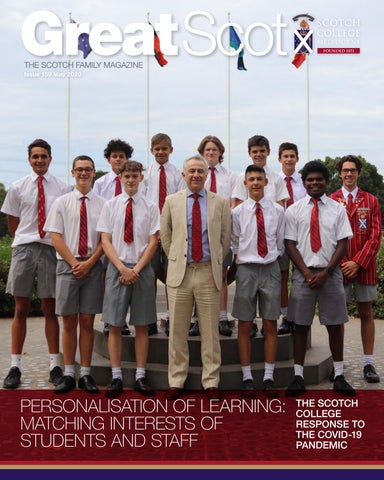
THE SCOTCH FAMILY MAGAZINE Issue 159 May 2020
SCOTCH PERSONALISATION OF LEARNING: THE COLLEGE RESPONSE TO MATCHING INTERESTS OF THE COVID-19 STUDENTS AND STAFF PANDEMIC
EDITORIAL
1 PRELUDE
42 MUSIC
2 CHAIRMAN
44 SPORT
4 PRINCIPAL
50 BOARDING
6 CHAPLAIN
51 FOUNDATION
8 JUNIOR SCHOOL
60 OSCA
12 MIDDLE SCHOOL
81 WHAT THEY’RE DOING NOW
13 UPPER SCHOOL 14 FEATURES 25 SENIOR SCHOOL NEWS
85 SCHOOL HISTORY 89 OBITUARIES
The Scotch Family Magazine Issue 159 May 2020 is the official publication of Scotch College, Melbourne. Publisher Scotch College 1 Morrison Street, Hawthorn 3122 Victoria, Australia Phone: (03) 9810 4321 Email: greatscot@scotch.vic.edu.au www.scotch.vic.edu.au ABN 86 852 826 445 Print Post Approved PP100008172
View Old Scotch Collegians' Association news and updates at: www.oscanet.com.au Like us on Facebook Scotch College and OSCA
Editorial contributors Durga Kamte, David Ashton ('65), Dean Gregory, Paul Mishura, Scott Montgomery ('85), Alan Watkinson, Tim Shearer ('85) Editor Durga Kamte (03) 9810 4420 email: durga.kamte@scotch.vic.edu.au Assistant Editor David Ashton ('65) (03) 9810 4489 email: david.ashton@scotch.vic.edu.au Art Direction and Production Lisa Sheard (03) 9810 4443 email: lisa.sheard@scotch.vic.edu.au Photography National Photography, Stephen Kong, Marcel Aucar, Scott Montgomery ('85), Lisa Sheard, Ben Ferguson, Scotch College students, staff, parents and Old Boys.
DURGA KAMTE EDITOR GREAT SCOT
This year will undoubtedly be viewed as highly significant, with the extraordinary changes wrought on us all by the COVID-19 pandemic. But over its 169-year history, our school community has met and overcome crises resulting from war, Depression and epidemic, and has emerged stronger and more resolute in upholding our characteristic values and traditions: meeting the needs of each boy, nurturing interests and inculcating values that promote society’s greater good. That these values resonate with our boys is evident in social justice initiatives, such as the Sony Camp, in which, during holiday time, boys and girls helped children with significant disabilities. Participation in the Walk for Women showed students’ commitment to equal opportunity, and the 24 Hour Hike raised funds for a charity associated with Down syndrome. Early in the year there was welcome news, including excellent VCE and ATAR results, an exhilarating tour of the US by the Scotch Symphony Orchestra, and strong results in mooting, chess and an ASEAN conference. But students and staff have since been understandably disappointed as the pandemic has forced the cancellation of sport, music and drama commitments. In the last week of Term 1, Scotch’s learning environment moved to an online platform, with the use of Zoom and the conference facility of Canvas, the Scotch Learning Management System. The Scotch teaching team, ably supported by the IT department and the E-Learning Coordinators, managed the challenges – and opportunities – of remote teaching, using a combination of video, audio and documentsharing technologies. Responses by students and parents have been overwhelmingly positive. During the Term 1 holidays, teachers refined their skills in online learning tools to prepare for what is their core commitment: to share their interests and passions to achieve the best outcomes for our boys.
MESSAGE
MR TOM BATTY SCHOOL PRINCIPAL
COVID-19 THE SCOTCH COLLEGE RESPONSE Maintaining the rhythms of Scotch life
Along with other Great Scot contributors, I penned my article back in mid-February when the world was a somewhat different place. I determined to publish my piece because I feel it important that we continue, wherever possible, to maintain the rhythms of Scotch life. I believe this because they have been honed over time and endorse the familiarity we crave, but also for pragmatic reason: the times are fluid and the landscape in which I now type on 26th March is again likely to be quite different to that in which this magazine arrives for your viewing. The School’s initial response to COVID-19 has covered three main areas: the core operations of the School; the ‘soft’ Scotch beyond its core operations; and, of course, great thought has been given to financial matters. Core operations include: the delivery of the academic curriculum; the delivery of the co-curriculum; the growth and pastoral care of the boys, including boarders; the growth and care of the staff; the care of our grounds and buildings; and ensuring compliance with regulatory requirements. The key instruments in this time of remote learning are our Learning Management System (Canvas), which provides the vehicle through which teachers and pastoral carers deliver lessons and engage with boys, and Zoom, through which the meetings of the School which turn the cogs have continued to function. Amidst Canvas resides Scotch Streams, devised by School Captain, Will Dixon, the Prefects and Dean of Students, David Brown, as a means of maintaining some of the facets of the School that make Scotch what it is for the boys: ‘Assembly’ style video posts from Principal, Chaplains and School Captain; a quiz on Scotch lore developed by Archivist, Paul Mishura; tips on maintaining routines; instructional
videos on how to scan and upload work; forums for online chess, political discussion, football chat, fitness routines, etc. The School has also (and this continues) given thought to ways in which it might return, perhaps, initially, in different form, to a more normal physical operation of core business, including life on the Hill. ‘Soft’ Scotch matters beyond the core are those which pull tight and give rich hue to the individual strands of the Scotch tartan. The formal and informal engagements that breathe life into the School beyond that which is readily reckoned: our connection and engagement with our community - the place of Scotch in the lives of others. Our key instrument here is the developing Keeping Scotch Connected zone of the website, www.scotch.vic.edu.au/keepingscotch-connected.aspx which features information and engagement across eight sections: Keeping Everyone Safe, Chaplaincy, Our Community (including OSCA), Health and Wellbeing, Boys, Teaching and Learning, Boarding and Staff. Each section has a designated member of staff responsible for propagating interest and content. The first four sections are in the public domain, while the last four sit behind the firewall. Some material will appear in more than one section. The spirit is that of a parish magazine, or perhaps a weekend magazine. As noted in my letter to parents, it will evolve with time and we beg your patience! Scotch is blessed with a remarkable community. It is the source of our strength, confidence and vitality. Amidst the current uncertainty, it is such communal attributes that will rise to see people, families and communities navigate adversity and reinforce the foundations of the life we cherish. It is clear we will be stronger together.
www.scotch.vic.edu.au Great Scot 1
CHAIRMAN
HON. DR DAVID KEMP AC SCHOOL COUNCIL CHAIRMAN
THE NEW WORLD OF SCHOOLING From classroom to remote teaching and learning Scotch is at the forefront of a historic improvement in schooling, based on a new ability to achieve a more complete understanding of the educational needs of each boy, and by organising schooling in the best way to enable teachers to respond to these needs. The advances made by the School were very evident in its instantaneous switch to online teaching and learning on Tuesday 24 March, following a case of COVID-19 in the Scotch Family. The School is doing everything possible to ensure the safety of boys, families and staff during this pandemic, and I thank parents for the strong support they have offered to assist the School’s response, as the whole teaching staff remain ready and willing to assist all boys with their learning. The goal of meeting the needs of each boy is not new. It remains the School’s top priority during the pandemic. The constitution of the School clearly states that its goal in relation to the boys is ‘to encourage each student to achieve the highest standard of which he is capable in all his activities, and the full development of the personality and sense of responsibility of each student’. Our response to COVID-19 will continue to be focused on this goal, 2 Great Scot Issue 159 – May 2020
albeit in this transformed teaching and learning environment. The developments that have given Scotch the capacity to more fully understand the needs of each student have been both technical and organisational. On the technical side, the School now brings together substantial information on boys’ various abilities and strengths across their school years, so that it is in a position to monitor aptitudes and needs. In the online environment, teachers remain alert to the responses of each student, and are able to respond to varying needs, and to develop tailored responses. Scotch teachers have been magnificent in their response to the pandemic. The quality of teaching is, of course, fundamental to successful learning, and the School is very proud of its teaching staff, and their capacity to respond to each student. This quality is supported by new methods of professional development, through which Scotch teachers are encouraged to develop their own interests and passions in ways that will further broaden the boys’ education. Our Principal, Tom Batty, has brought to Scotch a deep understanding of the educational process, and the way in which the professional development of teachers,
and all the relationships of school life, contribute to it. Respect for the dignity of each person has been explicitly identified as the foundational principle of a Scotch education today. At this time especially, it is valuable to reflect on the impact of these and other developments, which can also be illustrated from the 2019 VCE results. Scotch boys led the APS schools. At the top end, six Scotch boys achieved perfect ATAR scores, out of a total of only 29 such boys in the state. With reasonable assumptions, Scotch boys comprised some 20 per cent of all boys in Victoria with scores over 99.90. Scotch, of course, has a non-selective entry, and especially values the wide range of abilities and talents among its students, aiming to lift the performance of all boys. In 2019 the median ATAR score for all Scotch boys rose to 91.65; again with reasonable assumptions, the highest median score in the APS. Scotch also seeks an indicator of the ‘value-added’ by the School. In aptitude testing at Year 5, 37 out of 180 boys in the 2019 cohort (21 per cent) were in the top 10 per cent of the total Australian student population. At VCE level, out of these same 180 boys, 90 boys (50 per cent) were in the top 10 per cent of
the ATAR population. The contribution of families, as well as school influences, would be reflected in this statistic. Responding to the COVID-19 pandemic, Scotch is assessing future development planning. In April this year the Keon-Cohen Dining Hall will be completed as the centrepiece of the developing St Andrew’s Square. As the boys return to school, this part of the campus will give concrete expression to the House system that has strengthened the pastoral care for each boy, with further Home Rooms being completed as resources permit. This development expresses the School’s emphasis on relationships between boys and teachers, and boys and boys, that is central to the educational philosophy of the School. The objective of the School Council, working with the educational leadership of the Principal, remains to see continuing improvement in Scotch education, which is now at the leading edge of boys’ education in Australia. I convey the best wishes of the members of Council to the whole Scotch Family at this difficult time. Meeting the needs of each boy remains at the forefront of our concerns.
SCOTCH’S HEAD OF HISTORY, DR MARK JOHNSTON, WITH A YEAR 11 CLASS
www.scotch.vic.edu.au Great Scot 3
PRINCIPAL
MR TOM BATTY SCHOOL PRINCIPAL
PERSONALISATION, DIVERSITY, ENTERPRISE AND SUSTAINABILITY As the mercury rose to herald the start of a school year, boys and girls throughout Australia began the process of shifting minds from the internal and intimate to engagement with the world beyond. Such alignment demands fitting setting, and along Morrison Street, boys and staff, new and seasoned, stepped into a campus bristling with colour, life and vitality thanks to our exceptional Grounds and Maintenance teams. The Aboriginal and Torres Strait Island flags joined the Australian and School flags as expression of Scotch’s continuing commitment to the embracement of our national identity. Teachers and boys stepped jauntily into class, refreshed with new experiences and ideas, as the dance of the next generation found its starting beat. Both fruits and challenges of our connectedness (to environment, and to those with whom we share it) had been to the fore over the summer months, from time with friends and family in exploration of new horizons to the horrific fires and deeply troubling outbreak of COVID-19. Consideration of the nature and effect of our interactions, and points of balance between benefit and cost, rest at the heart of a liberal education and formed the founding premise for schools in such tradition. It was, and remains, a tradition of bringing young people together amidst those skilled in the art to share and advance passions and hone mastery, by pondering why things are as they are and how they might be made better. It is an approach to education that, in seeking to develop the whole person, requires a nurturing of learning relationships forged in the arts and crafts that connect individual thought to a social setting (the arts, reason, language and sport) and some prescribed rigour to facilitate the quest. Alas, as we have learnt more about the world, our part in it and the power of education, such prescription, now referred to as curriculum and qualification, has become dominant in the development of each child to the person he/ she could become, leading, in an ever more connected world, to the defence of learnt positions over reflection, debate and consensus.
4 Great Scot Issue 159 – May 2020
So minded, schools of the liberal tradition need to consider what it is alongside such premise that makes them different and fosters belonging. At Scotch much is defined by our faith and heritage, our beautiful single campus, our non-selective entry, our values of egalitarianism, purpose and service and the belief that we are not as good as we could be. Perhaps most importantly, it has been (and is) defined by the people of our community, and, in particular, that number, who, since our foundation, have deeply loved and cared for the School. Such schools must continually revisit how the liberal premise is reflected in that which makes them different and in their principles and practices. Such bond can be seen at Scotch through our foundational teaching and learning principle: The inherent dignity and value of each person; our foundational teaching and learning question: How did the world evolve to be as it is and how might it be made to evolve for the greater good?; our commitment to the nurturing of passions and honing of mastery; our commitment to relational learning in a conversational context; our diversity and commitment to each boy; and our confidence, desire to improve and commitment to the evidence of good research. That all must be cognisant of the times was the prominent theme as I joined 19 other participants at the Judge Business School as part of Cambridge University’s 18th Advanced Leadership Programme, to ponder the change upon us: its causes, nature and impact across sectors, societies and nations, and how we best prepare to grasp and forge opportunities in sustainable manner. Theory, case study, individual experience and wisdom, and healthy group and class debate provided the framework. Key areas of discussion included: Strategy under uncertainty – narrative and optimisation; Technology and artificial intelligence; Data is king; Usage over Ownership; Service over product; Globalisation; Risk appetite and entrepreneurship – the need for experimentation and cleverness over outcome and
continuous improvement; Changing workplace – flat hierarchy and culture, identity and routines in self managing teams; Protecting workers not jobs; Ethics (mention was made of Prof Peter Singer (’63)); Innovation; Sustainability and the circular economy; Alternative finance – block chains and asset tokenisation; Social purpose and competition; and Unknown unknowns and Black Swans. In an educational context, I suspect much can be grouped into four themes: Personalisation, Diversity, Enterprise and Sustainability. Working amongst the leadership groups of the School, over the coming year we will consider, • Personalisation: how might technology, including AI, better improve learning relationships and outcomes in a Scotch context; and how might we better match the interests and talents of individual members of staff to those of individual boys? • Diversity: how might we better engage with, learn from and serve communities and agencies beyond our immediate bounds? • Enterprise: how might we better prepare boys for the densely connected low hierarchical environment of wealth creation and the melding of social and economic enterprise? • Sustainability: does a circular economy have opportunities at Scotch? What are we planning under the theme of sustainability? In addition to these key programming themes, we will be continuing our close association with the Australian Childhood Foundation, in this, the middle year of our three year accreditation as a Safe School. In line with our master plan for campus development, we will be bringing current works to fruition in the ongoing pursuit of our educational strategic intents. The Keon-Cohen Dining Hall and St Andrew’s Square will deliver a marketplace of interaction at the heart of Scotch life surrounded by 12 House Home Rooms. English will move to its new home in the Lithgow Centre, further fuelling identity and belonging, as, similarly, the Language department occupies the top two floors of the Language and Culture Centre. Continuing the theme, the new home for OSCA and Archives, and the new Scotch (Uniform) Shop, will open along Morrison Street. The end of the year will bring the completion of the first round of projects from the Teacher Action Research and Career Development Programme launched at the start of 2019. Education will be provided for boys, staff and parents on the impacts and uses of technology, including presentations by American educational and clinical psychologist, Dr Adam Cox.
We will further advance the Scotch Educational Reading Group, established at the end of last year under the guidance of Director of Research, Teaching and Learning, Dr Peter Coutis, to discuss seminal education research articles. Partnering with the Crescent School, Toronto, and Dr Michael Reichert, and supported by the International Boys’ Schools Coalition, we will further develop the recently launched International Special Interest Group on relational teaching and learning, which connects interested schools into clusters to share expertise and advance their relational teaching practice. In the Junior School, focus on development themes of Embracing difference and An attitude of caring for others will be given structure with the introduction of a Peer Support model involving all boys from Prep to Year 6. Alongside the ongoing rolling out of the iPad programme across Years 4-6 and further development of offerings in science and technology, there will be a major literature focus on the creative power of poetry. In the Senior School, new structures and positions relating to operations (Dean of School Operations, Stephen Kong), boys (Dean of Students, David Brown) and the Middle School (Deputy Head of Middle School, Rob Blackmore, supporting Head of Middle School, Katrina Stalker) will be honed and bedded down. Elsewhere, there will be continued emphasis on boys’ voice (including the website Newsfeed facility), and respectful relationships; a Staff Experience and Engagement Survey will be developed and a new sports uniform will grace ovals, pitches, courts and rivers at home and away. Of the many seeds for thought of my time at the Judge Business School, one that continues to resonate is economist Dani Rodrik’s proposition that we can have at most two of national identity, globalisation, and democracy. I put this to the boys in an Assembly early in the year, following it up at another by suggesting that in their immediate lives they could, perhaps, see national identity as their desire to be part of a group they feel has characteristics that distinguish it from others; globalisation as their desire to move between and connect groups for mutual advancement; and democracy as their desire to protect the needs and advance the prosperity of the many, while understanding that this often necessitates doing likewise for the few or the one. The connection of the intimate, personal reflection of an imagined world, with all we observe and those with whom we observe it, rests at the heart of a liberal education, as does, perhaps, any progress with Rodrik’s conundrum.
www.scotch.vic.edu.au Great Scot 5
CHAPLAIN
REV DOUG CAMPBELL SCHOOL CHAPLAIN
RECONSIDERING THE INDIVIDUAL When I realised the theme of personalisation was central to this edition of Great Scot, I was a little stumped. I had heard of the term ‘personalisation’ but was unsure of its exact definition and origins. A little research later – isn’t the internet wonderful? – I noted that the term stems from the world of business and marketing. In this internet age, experts are urging businesses to promote their particular brand or product to the customer by adopting a more personal approach, especially in their marketing. In our increasingly anonymous and remote online world, it is argued that we, the customer, hanker for and react better to a more personal touch. Customers, the marketing gurus suggest, do not like to be seen as simply another order or invoice number. We like to see ourselves as having worth as individuals and loathe business-speak and the lazy, 6 Great Scot Issue 159 – May 2020
general emails that jam up our in-box full of fake sincerity and unrealistic promises. The advocates of personalisation urge the manufacturer to remember the customer, and to try and think of an individual when tailoring advertisements of their wares. Personalisation seems very good in theory, and appears to be a genuine attempt to bring back a little more humanity into the corporate world. Of course, like all innovations and movements, the bottom line will naturally be ‘Does it work?’ Will personalisation be superseded by the next in vogue theory just around the corner? How could personalisation be useful in education? There certainly exists a danger that in the hurly-burly of school life, we, the teachers, can be so focused on the assignments, the marking, the SACs and the curriculum that we lose sight of something rather
PERSONALISED LEARNING IN THE JUNIOR SCHOOL: BOYS RELATING TOGETHER ON THE HILL DURING TERM 1.
important. Delivery of content is tiring, but it is relatively easy to quantify. We can mark our record books and point to what we believe we actually taught. However, we need to go beyond the delivery. I marked the roll, but was I really aware of the boys present? Did I teach with sensitivity and awareness or was my delivery more in common with an impersonal email campaign? How was I understood by the individual boys sitting in my classroom? For someone who has preached in congregations for over three decades and across three continents, it is always an eye-opener to discover after the service that an individual hearer’s understanding of your sermon may differ quite markedly from what you believe you had shared. So too in the classroom; our lesson may well have been taught as we intended, but the boys may be taking away different conclusions about feudalism
in medieval society or the plot of the short story. Personalisation thus challenges us to reconsider the individual. Rather than a class, our curriculum and a lesson plan, we should focus primarily on the boys who sit in our classrooms. They are individual learners who may well learn more efficiently in different ways and styles. If marketers have rediscovered the importance of the individual, personalisation challenges educators to see each boy in our classes as unique, and worthy of the time and effort to understand and to engage as meaningfully as possible. In the Gospels, we encounter Jesus teaching large crowds of people throughout Galilee and Judea. The stories he told to illustrate and flesh out his teaching were memorable, and easily accessible to his original audience as he employed images of everyday life. These stories dealt with serious and eternal matters and always challenged his listeners’ presuppositions and the status quo. Yet Jesus’ original hearers were so engaged that they would be able to recall Jesus’ stories and reflect on his teaching months and years later. While Jesus’ model of contextualisation is worth emulating, what undergirded it all was that he understood people. This understanding of people came about, in part, by being around people. While Jesus regularly taught multitudes, it is interesting that after these times of extended teaching he regularly shared with individuals and small groups. Men and women had the opportunity to come alongside Jesus the teacher and challenge what he had said, or ask for further clarification. Jesus also spent time with his small group of close disciples, and outlined to them a way whereby they would one day carry on his work and share his message of God’s kingdom on earth. He was always accessible and was willing to spend time with the socially awkward, the moral outcast, the self-righteous and the desperate. He lived alongside people and so understood them deeply. He loved people as individuals. The marketing gurus who have proposed personalisation have helped companies to stop and think once more of the individual customer. Some companies have adopted this general approach for the benefit of their company and, of course, their bottom line. In education the bottom line is not the final ATAR mark, the school’s or even the teacher’s standing and career advancement. The boy is central. True personalisation, as beautifully manifested in Jesus Christ, helps us to recover the worth of individuals and reach out to share with them at a personal level; to be interested in them. We teachers are called to remember each boy and to seek to serve each one so that he may learn and flourish. www.scotch.vic.edu.au Great Scot 7
JUNIOR SCHOOL
MR JON ABBOTT HEAD OF JUNIOR SCHOOL
YOU NEVER KNOW IF YOU DON’T HAVE A GO Normally when I meet with new Scotch families I share with them a general description of what the School hopes to achieve for their sons. I boil it down to three main areas: helping boys to achieve the best academic outcomes that we can, guiding them to become fine young men who we can all be proud of, and helping them to find interests that can grow into passions. These three themes seem to resonate quite strongly with parents, and it hopefully confirms that they have made a good choice of school for their boys. Helping boys find things that are of interest to them and then turning these into passions is just as important as their academic outcomes and their personal development. Developing a passion, whether it be in the sporting arena, performing arts, fine arts, technology, science, debating, the environment or any other area is very important for our later wellbeing and enjoyment of life. Finding a pastime that we are genuinely passionate about can bring a great deal of meaning to our lives, and also provide us with the opportunity to experience joy. We can discover our passions in many ways as we move through our developing years. We can stumble across them by good fortune. We might be directed to them by our parents or another significant adult. Perhaps we find them by following friends or siblings. Or maybe there was always an interest from a very young age that we have been provided opportunity to allow to flourish. In our Junior School, one of the ways we help boys to find their passions is by introducing them to as many different experiences and activities as we can. The more things boys try, the more likely they will find those pastimes that really spark their interest. The old saying ‘you never know if you don’t have a go’ rings very true in this case. We explain to the boys that it is important to give everything a go at least once. It is not dissimilar to what we do with young children and food. I used to say to my daughters that they couldn’t say they didn’t like a food unless they had at least sampled it. Another factor in discovering our passions is that we are far more likely to be attracted to an activity when the persons who are sharing it with us
8 Great Scot Issue 159 – May 2020
demonstrate their passion for it. I fear that, too often in life, young people who are starting to develop an interest in an area can have it squashed or dampened by others. Parents who can’t or won’t support it, friends who want to ridicule or trivialise it, or an uninspiring coach, mentor or teacher can all be passion killers. On the other hand, having supportive and encouraging parents and friends and a mentor who is not only inspiring but also exudes a similar passion can be the sparks to light a fire in young people. I would like to think our teachers here at Scotch fall into the latter category: teachers who not only have a great passion for their field but also a great desire to share that passion with those under their tutelage. I see examples of this every day here at Scotch. I have been fortunate over my lifetime to have had all of these factors in place at important developmental stages of my life. I have had parents who would make significant sacrifices to ensure that my siblings and I could pursue sporting passions, coaches who inspired me to believe that I could become a successful sportsman, and friends who provided encouragement along the way. However, there is one particular person who played a very significant part in my life – my Year 6 teacher, Mrs Jan Mongan – who shared her passion for learning and for teaching with our class every day. She inspired us to develop a lifelong love of learning, and her care and attention for each child meant that every one of us felt as if we were the most special student in her class. As I travelled through that final year of primary school, I started to develop a desire to become a teacher like Mrs Mongan. I wanted to have a job where I could make others feel special and important, just as Mrs Mongan had done for our class. I feel very fortunate now to have had such an inspiring mentor who lit a spark in me to take up a career in teaching. As I now enjoy another year of teaching I would like to think that maybe, from all of the children I have taught or worked with these past 40-odd years, there might be a handful who may also have decided to take up the profession of teaching because of a spark that maybe, in some small way, I might have helped to kindle.
OUR PREP BOYS ENJOYED THEIR FIRST DAY AT SCHOOL, AFTER A WELCOME FROM HEAD OF THE JUNIOR SCHOOL, JON ABBOTT (TOP LEFT PICTURE)
PREPS' FIRST DAY AT SCOTCH
www.scotch.vic.edu.au Great Scot 9
STAFF IN PROFILE
Many years from now, when you are no longer teaching, what is one of the Scotch memories you will reflect on to warm your heart? There isn’t one specific memory that stands out to me; although I do enjoy seeing the sense of achievement on a boy’s face when he has completed something that he is very proud of. When a piece has been crafted over time, the sense of ownership increases and in turn the boy becomes more proud of what he finished. What is the best advice you have ever received? I’m part way through the biography of William Wilberforce, and I find it fascinating that he only reached his goal of abolishing slavery shortly before his death. Often the difference we strive to see may not happen immediately, as we would like it to.
Interview: SAM SCHRODTER Junior School Teacher
Since arriving at Scotch, via previous teaching appointments with the Education Department of Queensland and the Victorian Ministry of Education, Sam, who commenced his career at Scotch in 2019, has settled most comfortably into life as a Scotch Junior School Upper Primary teacher. In his brief time as a Year 6 teacher, he has demonstrated skill, impressive curriculum knowledge and an ability to form strong relationships and engage with his students. He has adapted to the demands of work both in and out of the classroom, demonstrating cricket, rugby and basketball skills outside of the classroom, a strong ability with technology and a great aptitude for preparing and delivering fine coffee. Along with his wife, Amy, and baby daughter, Frances, he has been a most welcome addition to the Junior School staff. DEAN GREGORY
10 Great Scot Issue 159 – May 2020
What story will your colleagues tell about you at your farewell speech when you retire? After having a flawless record of on-time flights over the years for the Year 6 Canberra trip, some of the other teachers were convinced that I was the reason that our flight was delayed five hours on the way up and cancelled on the way back. This is yet to be proven. What has been your biggest challenge over your time at Scotch? My biggest challenge over my time at Scotch so far has been table-tennis at lunchtime. What advice would you give our VCE students as they embark on a life outside Scotch? When I finished high school I still wasn’t sure what I wanted to do as a career, so I had a gap year to think about it. It was in that year I decided that I wanted to become a teacher. What is your favourite corner of the School and why? Having only been at Scotch for just over a year, I am still yet to get over the view looking back from the Green Grandstand onto the Main Oval. It’s pretty special.
JUNIOR SCHOOL THIS IMAGE: AN RMIT SCIENTIST TALKS TO THE BOYS ABOUT THE IMPACT OF LITTER ON THE ENVIRONMENT. BELOW, LEFT: THE BOYS EXAMINE THE MESSAGE IN A BOTTLE. BELOW, RIGHT: AFTER A LITTLE TREPIDATION, THE BOYS THROW THEIR BOTTLES INTO WATTS RIVER.
LITTER TRACKERS: a message in a bottle
It’s a common sight in many a Melbourne street: cigarette butts and other discarded items littering the pavement. According to the City of Melbourne, cigarette butts make up about one-third of the one billion items of litter entering Melbourne’s waterways each year, and they can take up to 15 years to break down. The other twothirds of litter includes plastic bottles, plastic wrapping, polystyrene packaging and aluminium cans. RMIT University says 95 per cent of litter transported through stormwater drains into rivers, ultimately ends up on beaches in Port Phillip Bay. An article in The Age last July revealed that an estimated 1.4 billion pieces of rubbish flow into the sea annually from the Yarra and Maribyrnong Rivers. To help reduce the volume of litter entering our bays, RMIT University has created ‘Litter Trackers’. It’s a project aiming to educate the community about the environmental impact of litter entering our waterways. Early in Term 3, 2019, some young Scotch boys were caught on camera throwing plastic bottles into Watts River, Healesville. But before any conclusions are jumped to, the bottle throwing was actually done in a good environmental cause.
It’s fair to say the boys did have some instinctive misgivings about throwing plastic items into a river, but they realised the cause was a good one. The plastic bottles each contained a GPS device, and in all, 100 bottles containing GPS devices were launched into creeks, rivers and other bodies of water throughout Victoria. In a kind of ‘message in a bottle exercise’, the bottles were tracked for a month and then collected for research. The bottles might be trapped in vegetation along creeks or rivers, or travel right through to the sea, but the project will indicate what happens to water-borne litter – how far it travels and at what speed, and where it accumulates. Before the boys launched their bottles into the river, a scientist from RMIT University and a representative of Healesville Environmental Watch spoke to them about the impact litter has on the environment; and before despatching the bottles, the boys collected litter in the Watts River vicinity. Back at school, the boys have also spent considerable time discussing the impact of rubbish on our waterways and the bay.
www.scotch.vic.edu.au Great Scot 11
MIDDLE SCHOOL
PURSUING THE INTERESTS OF YOUNG MINDS A year of great opportunities unfolds for our Year 7 boys
MS KATRINA STALKER HEAD OF MIDDLE SCHOOL
BOYS ENJOYING A BEACH GAME DURING A TRANSITION CAMP AT COWES
14 Great Scot
The academic year started with a ‘welcome’ service in Memorial Hall, introducing our Year 7 boys and other new boys and their parents to our School. Year 7 boys Sam Steele and Tom Groom spoke of what they hoped to achieve throughout Year 7, setting the scene for a year in which boys are encouraged to give new opportunities a go. The annual Scotch Parents’ Association Year 7 family barbecue was held in beautiful weather, and provided a great opportunity for parents and boys to mingle with and get to know other families. The Year 7 Transition Camps at Cowes, recognised as a significant signpost in the lives of Scotch boys, were once again highly successful in settling the boys into their form groups and helping cement new friendships, as boys participated in a range of activities designed to promote camaraderie, teamwork and a spirit of adventure. Boys could get to know their teachers outside a classroom environment, and teachers could recognise boys’ individual interests and unique personalities. During the camps, although the weather was not as hot this year as in the past, boogie boarding and sailing were just as enjoyable, as were snorkelling and mini-golf. Among the busy program of activities at camp there was opportunity for conversations between the boys, enabling them to discover those who shared similar interests and passions. All transition activities into the Senior School are specifically designed to help boys meet other like-minded individuals and forge strong and enduring relationships. This year, a further initiative in assisting boys to develop friendships and participate in activities in which they have a shared interest is the establishment of a number of clubs which operate during lunchtimes. Robotics, coding and chess are just some of the clubs which are currently thriving at Scotch.
As the Year 7s continued to find their feet the Year 8s were well settled, and many of them were contributing to the success of the new clubs. Two Year 8 boys – Joshua Symons and William Chen – have taken the initiative to introduce a new club. They are teaching other boys the ins and outs of how to solve the Rubik’s cube at speed. These speed cubes are now all the go, and advice on effective techniques is being enthusiastically shared among the boys. It’s a pleasure to witness boys solving the cube in under 30 seconds. However, the most significant aspect of the revival of the Rubik’s cube is the passion the boys have shown in sharing their knowledge with each other. The introduction of a number of peer-led clubs, run by the Year 11 Peer Leaders with the Year 7 cohort, promises to be as successful as the Rubik’s cube and chess clubs in inspiring the younger boys to pursue and share their interests. Some of the other clubs currently on offer include appreciation of music, movies, sport, maths and investment. The emphasis is on peer-led activities, with teachers taking a supporting role. The last week of Term 1 became our first week of teaching the boys online, using our Learning Management System, Canvas. It was a challenging week but we have received very positive reports from boys, teachers and parents about the lessons delivered. In this time of remote learning it is important for the boys to remain connected to their school. Form teachers have also reached out to the boys during this time, with boys responding positively. Through a new section on the School website, ‘Keeping Scotch Connected’, the School Captain, Chaplain and Principal have all been in contact with the boys to help keep them connected and active. It is reassuring to realise we have a strongly supportive Scotch community to stand with us during these challenging times.
UPPER SCHOOL
LEADING BY EXAMPLE Our staff willingly share their time so boys can experience something new MR TIM RAYNER HEAD OF UPPER SCHOOL
An overseas visitor to Melbourne would be struck by our love of the outdoors. Any green space or track seems to be filled with joggers, cyclists, triathletes, cross-fit devotees and walkers, to name but a few. We are blessed to have the space and climate that enables us to go out and do things, and many of us love it; but not all of us. The temptation to stay at home and stream shows, or have a sleep-in does tend to pull. As Oscar Wilde once said, ‘I often take exercise. Why only yesterday, I had breakfast in bed’. For some, it seems, a little gentle encouragement may be required to ensure they get out and about regularly. By the time we reach adulthood, most of us have discovered what we enjoy doing. Interests as diverse as climbing, scuba diving or surfing can stay with people for the entirety of their lives. Indeed many of my colleagues have such interests, and over the years have developed skills and knowledge in areas that make them quite special. Having staff members who are willing and keen to share what they know, makes us very fortunate in regard to the extracurricular offerings available to our boys. In learning from ‘old hands’ our boys not only see some staff in a different light, but they also get to share an enthusiasm sustained over many years. Mr Matt Manning has been running the streets and parks of Melbourne for many years, as he navigates his way from checkpoint to checkpoint. Orienteering at Scotch has a keen band of participants, and led ably by Mr Manning, the boys use their wits to navigate tricky courses; but also expend a great deal of energy running on courses that range in distance from 3km to 10km. By using ‘cunning running’ to choose the most direct route, it is not necessarily the fastest runner who wins the contest. Yoga, an activity that originated in northern India over 5000 years ago, has enjoyed a recent surge in popularity. Aiding breathing, posture, flexibility and muscle strength, many people, including elite athletes, are now catching on to the benefits of this ancient practice. Quite recently added to their choice of options, yoga is proving popular with our boys.
Yoga is ably led by Miss Jackie Cowcher, whose interest in yoga has extended to nine years, during which time she has practised in countries as diverse as Sri Lanka, Sweden and Hawaii. A practitioner of Vinyasa yoga and Yin yoga, Miss Cowcher finds that sharing yoga with her friends and family is one of her favourite ways to unwind during weekends and holidays. Mr David Brennan, one of our Grounds staff, is a passionate fly fisher with 40 years’ experience. His knowledge of Victoria’s creeks and rivers is comprehensive, but it is also matched by his dexterity with a line and fly. Heading off to Alexandra for the fly fishing camp, the boys learn to appreciate the great outdoors, while learning to be patient and resourceful. Catching fish in a flowing creek is not as easy as shooting them in a barrel, so patience really does become a virtue. Days may pass before there is a bite, so quick reactions also count for success – as does a proclivity for exaggeration. Leading by example, our staff willingly share their time and experience with boys in the hope that they will enjoy and appreciate something new. A few boys may decide to continue with their activity outside of school, or even decide to pick it up years later when they are adults. As boys choose a different activity for three terms, the chances are they will find something that resonates. Who knows, in years to come your son may be teaching others about the beauty of his own pastime.
HEAD OF DESIGN AND TECHNOLOGY, JULIA MORRISON, WITH STUDENTS
www.scotch.vic.edu.au Great Scot 15
FEATURES
CELEBRATING THE ACHIEVEMENTS OF THE CLASS OF 2019 The congratulations of all in the Scotch community go to the boys of the Class of 2019 for outstanding VCE and ATAR results, which give measure to their intellect and resolve, and confidence to their capacity to embrace the future with optimism and purpose. 16 Great Scot Issue 159 – May 2020
will take up the challenge of doing their bit, and that bit more, for the communities they will serve. Such confidence is testament to the care, craft and perseverance of many, and my thanks and congratulations go to all involved: boys, members of staff and parents. To the Class of 2019: we will miss your humour, zest for life and enthusiasm for all to come. We thank you and wish you well as you assume the mantle of responsibility. Together you have navigated the ‘ordinary’ aspects of Scotch life, but your time has also been rich in attributes which speak powerfully of your generation and our future. You have done this with openness and kindness, and it has been a privilege to share in your optimism and glimpse something of the vibrant world you will forge. In thanking you for all you have given to your School, we look forward to welcoming you back to learn where it takes you. Rupert Balfe, Tianqi Feng, Matthew Lee, Harrison Liu, William Sutherland, and Yulin (Kevin) Wu each received an ATAR of 99.95, and were, therefore, the duces of Scotch College for 2019. Eight boys (3.3 per cent of the cohort) obtained an ATAR of 99.90 or more (top 0.1 per cent in the population) 22 boys (9.0 per cent of the cohort) obtained an ATAR of 99.50 or more (top 0.5 per cent in the population) 35 boys (14.3 per cent of the cohort) obtained an ATAR of 99.00 or more (top 1 per cent in the population) 59 boys (24.1 per cent of the cohort) obtained an ATAR of 98 or more (top 2 per cent in the population) 96 boys (39.2 per cent of the cohort) obtained an ATAR of 95 or more (top 5 per cent in the population) 135 boys (55.1 per cent of the cohort) obtained an ATAR of 90 or more (top 10 per cent in the population) 181 boys (73.9 per cent of the cohort) obtained an ATAR of 80 or more (top 20 per cent in the population) The median ATAR was 91.65 Early measures of ‘value add’, comparing ability testing data from earlier years and ATAR scores, indicate a very strong performance from this cohort (Note: the population referred to in the ATAR statistics above is the population of the Statewide Year 7 cohort from 2014, including those students who moved or left school before Year 12.) There were 13 ‘perfect’ scores of 50 across seven subjects Ten Year 12 boys obtained scores of 50, including: Rupert Balfe (English Language and Legal Studies), Jiahang (Jerry) Chen (English EAL), Patrick Gerendasi (English), Matthew Lee (Specialist Mathematics), Xiang (Leo) Li (English EAL), Charles Lin (English), Daniel Qu (English), William Sutherland (Specialist Mathematics) and Andrew Wong (English). Two Year 11 boys obtained scores of 50: Samuel Harle (Ancient History) and Joshua Poon (Mathematical Methods) Eight Year 12 boys achieved the highest possible ATAR increment in their Higher Education (University) Study: six in Mathematics, one in Physics and one in Chemistry
• • • • • • •
SCOTCH DUCES, LEFT TO RIGHT: WILLIAM SUTHERLAND, YULIN (KEVIN) WU, MATTHEW LEE, HARRISON LIU AND TIANQI FENG WITH THEIR HEADS OF HOUSE – STEVE DE DOMENICO, JOSH MCNEILL, GEORGE PATOURAS AND STEPHEN PALLOT. (ABSENT: RUPERT BALFE)
We celebrate such accomplishment across the rich canvas of our non-selective entry, cognisant of a broader educational landscape that values the dignity of each person and curiosity for how the world might evolve for the greater good. The tables below summarise but one set of outcomes flowing from the resulting passions and mastery of each member of the Class of 2019. There are, and will continue to be, many more. As inaugural participants of the Year 11 Immersion Service programme and early adopters of the Year 10 Scotch Enterprise programme, the boys of the Class of 2019 explored the increasingly connected interface between social and economic enterprise defining their age. On exchange, as hosts and representatives, in strong voice in Memorial Hall and Boarders’ Chapel, as Cadets and in outreach, and amidst debate and laughter in the varying games that occupy four and six-square courts, they have explored the place of the individual in community and embraced the fruits of our hard-won freedom. That all was done with sensitivity, consideration and excitement for changing times has convinced that those of the Class of 2019
• • •
• •
• •
TOM BATTY – PRINCIPAL
www.scotch.vic.edu.au Great Scot 17
FEATURES
INDIGENOUS AND TORRES STRAIT ISLAND FLAGS FLY HIGH AT SCOTCH
18 Great Scot Issue 159 – May 2020
STANDING, LEFT TO RIGHT: FLETCHER JOHNSTONE (YEAR 12), MALIK KEEGAN (YEAR 7), MINGARA CLARK (YEAR 7), JIMMY GADSDEN (YEAR 12), AIDEN JOHNSON (YEAR 9). SITTING, LEFT TO RIGHT: MAURICE O'LEARY (YEAR 10), MAURICE RIOLI (YEAR 12), PRINCIPAL, TOM BATTY, JAMARRA UGLE-HAGAN (YEAR 12), NOAH MCCAIG (YEAR 10), SCHOOL CAPTAIN, WILL DIXON. FRONT: PRESTON JOHNSON (YEAR 10).
On Monday 3 February the flags of the Indigenous and Torres Strait Islander people of Australia were raised by Scotch’s indigenous students. They are flying permanently alongside the Australian and Scotch flags on the north-east side of the Main Oval. In the first School Assembly for 2020, Fletcher Johnstone, a Prefect and one of Scotch’s Indigenous students, performed a welcome to country and an explanation to the School community. The flags were raised beside the Main Oval, acknowledging respect to country and the traditional owners of the land. Four of the Indigenous students reflected on this experience: ‘The Indigenous and Torres Strait Islander flags are very significant to us as Indigenous people of Australia. The two flags
represent our people, who are of the oldest living cultures in the world. I stand tall and proud as a young Aboriginal man, and am welcomed when I see the Aboriginal flag, as the black represents the people of the land; the yellow circle represents the sun, the giver of life and protector; and the red represents the red earth, as red ochre is used in ceremonies to show the Aboriginal people’s spiritual relationship to the land.’ JAMARRA UGLE-HAGAN – YEAR 12
‘Having the Indigenous flag raised is a great honour. It is very special to be attending Scotch College, and to be here first hand to see the flag being raised was important to me and my community. I would like to thank Mr Batty and all the Indigenous Old Boys in the past, who have been active in making this possible.’
‘The two flags being raised at the beginning of 2020 made this, my final year at Scotch, very significant personally, as it was a hope that had finally been realised. I am proud that I have been part of this process. The two flags help make the new Indigenous boys feel welcome, safe and valued. I would like to thank Mr Batty for allowing the two flags to fly on the school grounds at all times, as it helps other students to recognise the traditional owners of the land.’ FLETCHER JOHNSTONE – YEAR 12
‘When I walk into Scotch every morning, I have the opportunity to learn and grow as a young man. I see the Aboriginal flag up there and I feel proud of my culture.’ AIDEN JOHNSON – YEAR 9
JIMMY GADSDEN – YEAR 12 www.scotch.vic.edu.au Great Scot 19
FEATURES
LEFT TO RIGHT: BILL MORGAN ('34 – SCOTCH’S OLDEST KNOWN LIVING OLD BOY), THE HON DR DAVID KEMP AC ('59 – CHAIRMAN OF THE SCHOOL COUNCIL), REV DR JOHN WILSON (DEPUTY CHAIRMAN OF THE SCHOOL COUNCIL), WILL DIXON (SCHOOL CAPTAIN), SCOTT MONTGOMERY ('85 – EXECUTIVE DIRECTOR, OSCA), ROB MCLAREN ('73 – SCHOOL VICE PRINCIPAL), JAMES DOUGLAS ('84 – PRESIDENT, OSCA), TOM BATTY (SCHOOL PRINCIPAL)
REMEMBERING 5 MARCH 1920 Described in First Hundred Years – the Scotch centenary history – as ‘the outstanding event of the year 1920’, the laying of the Memorial Hall foundation stone on Friday 5 March of that year, in ‘bright and warm’ weather drew a large crowd of the Scotch Family members of the day. Exactly 100 years later, on Thursday 5 March 2020 – in contrast, a cool, drizzly day – the School celebrated with a special Assembly, organised at OSCA’s request and attended by representatives of the School Council and OSCA Council, together with our oldest known living Old Boy, Bill Morgan (‘34). Bill was just three on the great day in 1920, so he was a little too young to have attended the stone-laying ceremony. Boys from Years 9 to 12 attended the Assembly in Memorial Hall, while the proceedings were beamed to two big screens in the
20 Great Scot Issue 159 – May 2020
Quadrangle, where Middle School boys watched, sheltering from the drizzle in the cloisters. The foundation stone laying was highly significant for Old Boys 100 years ago, less than two years after the end of the Great War during which so many Old Scotch Collegians gave their lives. It is still significant to the Old Boys of today. The Assembly was a most appropriate commemoration of an important event in the life of the School at the nascent Hawthorn site, 100 years ago. During the 5 March 2020 Assembly, School Captain Will Dixon read a narrative which accompanied a slide show presentation. Here is the text of the narrative. By 1914 it was obvious that the one hectare site at East Melbourne was too cramped, so, in 1915, the School bought 25 hectares at Hawthorn.
CLOCKWISE, FROM TOP: LAYING OF THE MEMORIAL HALL FOUNDATION STONE; CROWDS GATHERING FOR THE CEREMONY; THE HAWTHORN GLEN SITE FROM THE AIR; SENIOR BOYS WITH BILL MORGAN ('35) AFTER THE CENTENARY CELEBRATION; PRINCIPAL BILL LITTLEJOHN
Hawthorn Glen was situated at the confluence of the Yarra River and Gardiners Creek, which were lined with ancient river red gums. The former farmland was dominated by a pine tree-clad hill. The hill was surmounted by Glen House, an 1870s mansion, where the Hawthorn Junior School opened in 1916. After the new Junior School buildings opened in 1918, Glen House became a boarding house. The August 1920 edition of The Scotch Collegian published an aerial photo of the school that year. It shows Glenferrie Road on the left, leading to the railway gates at Kooyong. Pine trees surround Glen House on the hill. The Junior School and its oval have been completed and the Lower Oval has already been established near Gardiners Creek. The site of the Senior School is ready for building. The Collegian published an account of the ceremony on 5 March 1920. This is an edited version … ‘The 5th March dawned bright and warm and the grounds were alive with people inspecting with evident approval the possibilities
www.scotch.vic.edu.au Great Scot 21
FEATURES
CLOCKWISE, FROM LEFT: THE HAWTHORN GLEN SITE; THE CALLANTINA ROAD GATES, THROUGH WHICH VISITORS ARRIVED FOR THE FOUNDATION STONE LAYING CEREMONY; GARDINERS CREEK; MEMORIAL HALL FOUNDATION STONE; ARCHITECTS’ DRAWING OF THE MEMORIAL HALL
of the site. On entering the gate off Glenferrie Road, visitors were directed to the Junior School, where Principal Mr Littlejohn and Council members received them … ‘The Junior School oval was covered with marquees where refreshments were served. Here were gathered together men of all ages and all occupations. The school boy of the early 1850s rubbed shoulders with the new boy of 1920. Yet, man or boy, they were all Scotch Collegians. ‘The arrival of General Monash was the signal for a general movement down the Hill towards the site of the new buildings. A newly made drive wound down from the Junior School and the turreted Glen House. A platform had been set up. The proceedings
22 Great Scot Issue 159 – May 2020
started with the singing of “The Old Hundredth” [This hymn was also sung at the centenary Assembly.] ‘Lieutenant-Governor Sir William Irvine said the new buildings were a memorial of the War, and if Scotch College were to be transplanted from East Melbourne to Hawthorn it could be achieved solely through a strict observance of the traditions of the past. He called upon “the most distinguished son of the College” to lay the foundation stone. ‘The enthusiasm with which General Monash was received bespoke the esteem in which he was held. He said the day was the greatest in the history of the School. It marked the close of an era of 70 years. He hoped the present and future boys would live up to the
CLOCKWISE, FROM TOP: SCOTCH COLLEGE, EAST MELBOURNE IN 1922; GLEN HOUSE; BOYS UNDER THE VERANDAH COLUMNS OF GLEN HOUSE; THE HILL, WITH GLEN HOUSE AT RIGHT; THE ORIGINAL JUNIOR SCHOOL BUILDING AT HAWTHORN
example of heroism and self-sacrifice that had been set by Old Boys who had done their duty in the Great War. ‘General Monash took this silver trowel and stepped forward to the stone, which had been selected from stone of the East Melbourne school. Deftly he laid the mortar. The stone swung into place and, tapping it twice with the trowel, he declared it was well and truly laid. [The inscription on the stone reads, in part:] “Scotch College new buildings This foundation stone of the Memorial Hall erected by the Old Boys in Honour of those who served in the War 1914-1919 was laid by Lieutenant General Sir John Monash 5th March 1920 Their Name liveth for Evermore” ‘The Moderator offered a dedicatory prayer and the School Captain stepped to the flagpole and for the first time in history the Scotch flag was unfurled over the future site of the school at Hawthorn.’ This was the first time the boys of Hawthorn and East Melbourne assembled as a single unit. The foundation stone and builders’ pegs indicating the layout of the main school buildings were signs that the days of East Melbourne were drawing to a close. The plans show the architect’s vision for the Quadrangle and Memorial Hall with a science block (now the Lithgow Centre) and a gymnasium (soon to be reincarnated as the Keon-Cohen Dining Hall). The Council and Principal were determined that the new Scotch should be built as quickly as possible with the War Memorial Hall as its central feature. The Principal longed for its spacious and well-equipped classrooms and laboratories; the boys dreamed of the playing fields and river at the School’s door. Some boys about to leave Scotch had mixed feelings. Many Old Boys loved the school at East Melbourne with its ivy-covered walls and blue-grey stones. But now these time-worn buildings had grown too small. A school consists of more than historic buildings and glorious traditions. Scotch does not rely on the beautiful buildings at Hawthorn to prolong its famous name. The classrooms, the boarding houses, the sports grounds would be new; the school would be the same. DEO PATRIAE LITTERIS
www.scotch.vic.edu.au Great Scot 23
FEATURES
SONY CAMP 2019 – PROVIDING The camp was a rewarding experience for campers and companions Last December, Scotch again played host to the annual Sony Foundation Camp, allowing recently graduated boys from Scotch and girls from St Catherine’s School to care for children with special needs, thereby granting their parents some muchneeded respite. For some parents, it was the first time they had spent a night away from their child since the child was born. In a jam-packed three-day program, all those involved enjoyed many hours in the Scotch pool, expressing themselves through painting (both on the canvas and on some of us), playing games of Blowfly Cricket with the boys and girls, finding their rhythm in African drumming and a silent disco, and, in my case, spending many hours being driven around the School in the nurses’ golf cart, affectionately known as ‘Pino’s tractor’.
24 Great Scot Issue 159 – May 2020
For many of the boys on the camp, myself included, the experience of living with and caring for a child with special needs for three days was unfamiliar and initially daunting. However, throughout the weekend all those involved came to better understand the challenges faced by those caring for these children on a long-term basis. The fact that the campers and most of their teenage companions were well and truly tired and asleep by 9pm each night attests to the incredible energy invested by families in caring for these children. Seeing the smiles on the kids’ faces during the weekend’s activities as well as their reluctance to go home at the end of the camp made the experience all the more rewarding for the Scotch and St Catherine’s companions. While we all hoped that we
were able to provide each child in our care with a special Christmas gift through this camp, the perspective they have imparted on our lives, particularly after the senior students’ year fixated on the pursuit of a Year 12 ATAR, is invaluable. Thanks must be extended to the many teachers and volunteers who enabled the camp to take place, and in particular to the camp’s head doctor, Dr Madeline Price and organisers Mrs Margie McDonough and Mr Pino Cutinelli. Their tireless hard work, organisation and desire to improve the lives of others continues to be an inspiration to all of us. WILLIAM DIXON – CAPTAIN OF THE SCHOOL
PERSPECTIVE HAPPY SCENES DURING THE JAM-PACKED PROGRAM AT SONY CAMP 2019
Great Scot 25
SCHOOL CAPTAIN
CHISEL OUT YOUR OWN SCOTCH IDENTITY
This is an edited extract of School Captain William Dixon’s address at Assembly early in Term 1 In the final days of last year, I asked myself what the beginning of the new decade would hold. Looking back at the past 10 years, a lot has obviously changed. Technology has continued to change the way we live, Brexit happened (sort of), terrorism in all forms wreaked havoc across the world, climate change has increasingly become a serious threat, and the host of a reality TV show became President of the United States. I think it’s pretty safe to say that anything could happen in the new decade. Certainly the many unknowns of the future can be daunting. I know in my experience, leaving Scotch for what I thought was the last time was exciting but equally overwhelming – will the choices I make be good ones? Will I enter a course I enjoy? Will the friends I have had for six years be the same next year? And yet, returning to the School I love for Year 13, I know there are many things which will not change simply because the calendar has ticked over. Each of us enters the new decade older, and I hope wiser, than we’ve been before; each with new challenges to overcome and new ambitions to fulfil. For every single one of you, whatever 2020 holds for you will be completely different from the person sitting next to you. You are all unique, setting a different path to navigate in your time at Scotch, however rocky or smooth that may be. Without the diversity and energy that each of you brings to this place, Scotch would not exist as we know it. The boys bring the spark that allows the Scotch flame to burn strongly. Not all of you will play in every first team, neither will you all achieve top marks in every subject you take – I certainly didn’t. There is no Scotch 26 Great Scot Issue 159 – May 2020
mould, no bronze sculpture of the ideal Scotch boy – instead it is up to each of you to embrace as many opportunities as you can in your time at this School, and leave this place feeling as if you have chiselled out your own Scotch identity. However, despite all our individual quirks and differences, we share a great deal. We are all incredibly fortunate to be students at this School, with vast and varied opportunities and resources at our disposal. We all have hopes, fears and dreams for the future; and most importantly I would like to think that Scotch is a place where every single one of us feels comfortable, and knows that whatever happens there will be a supportive community for us to fall back on, to be completely open with, and most importantly one in which every person looks out for each other in the normal ups and downs of growing up. We are all part of a strong, vibrant community: we look out for each other, study together, run together, play together, row together, sing together – we do things together, which gives us our strength. But we are just a small community within a much broader one, and we do need to look beyond ourselves and the Monash Gates to understand and contribute to the wider world. Whether that involves constantly questioning the injustices, inequalities and stigmas of our society or proactively helping those in need, we have an important role in helping to shape the next decade, not only at Scotch but also in our broader society. Embrace all the time you have at Scotch, and whatever 2020 may hold, I hope it is a stimulating, healthy and exciting year for you all.
TOP: SENIOR SCHOOL CAPTAIN WILLIAM DIXON AND JUNIOR SCHOOL CAPTAIN NICK HOWITT SHARE A LAUGH. BOTTOM: LEFT TO RIGHT: VICE CAPTAIN DARREN TAN, SCHOOL CAPTAIN WILLIAM DIXON AND CAPTAIN OF THE HILL TOM CAINE
NEWS
ABOVE: HEADING OUT ALONG THE TAN AFTER LEAVING MELBOURNE GRAMMAR SCHOOL. RIGHT: THE SCOTCH WALKING CONTINGENT
FOCUSING ON EQUALITY Melbourne students combine to contribute to a worthy global cause On Friday 28 March, 45 Scotch senior boys and several staff members headed to Melbourne Grammar School for the annual Walk for Women. In the grounds of Melbourne Grammar’s city campus, we found ourselves in the company of hundreds of students from other schools. Everyone had gathered there for a single purpose: to advocate for equal rights for women across the world. The ticket entry cost of $10 for each student was to be donated to UN Women – the United Nations entity dedicated to gender equality and the empowerment of women – for two specific purposes: ‘ending violence against women and girls’ and ‘encouraging women’s leadership and political participation’. Discussions with
students from other schools focused on these goals. Paul Ronalds, CEO of Save the Children Australia, narrated a touching story of a woman he had met, and the hardships she endured caring for her elderly parents and her two young children. While the principal focus of the Walk for Women related to women and children who suffer violence and abuse, this narrative made us all aware of the range and long-lasting effects on women who suffer disproportionately, compared with their male counterparts in many parts of our world. After Mr Ronalds’ stirring speech, the students began the formal walk around the ‘Tan’. Making our way through the lush green gardens, basking in the rays of the afternoon
sun reflecting on the high rises of the CBD, we found ourselves contemplating the fortunate position in which we find ourselves, blessed with excellent educational facilities; and how as a consequence, it was more imperative for us to use our privileged position to not only seek, but to enforce, change. The event was a unique and uplifting experience, and an opportunity for Melbourne students to contribute to a highly worthy global cause. It was inspiring to be in the company of large numbers of like-minded, passionate students from many schools. DARREN TAN – SCHOOL VICE CAPTAIN
www.scotch.vic.edu.au Great Scot 27
NEWS
THE BLACK RANGE STATE FOREST ECHOED TO THE GLAD SHOUTS OF SCOTCH’S 24 HOUR HIKERS
THE 24 HOUR HIKE – rallying in support of a great cause Hikers overcame rain, fog, rugged trails and sore hamstrings
Thirty-three millimetres of rainfall. Steep, rugged trails. Thick fog. Incredibly sore hamstrings. Such conditions don’t tend to lend themselves to hiking, yet across Thursday 5 and Friday 6 March, 115 hikers braved these perilous circumstances and participated in the 24 Hour Hike at the Black Range State Forest, just south-east of Yea. Accompanied by 20 boys and 14 staff members in supporting capacities, the boys thrived in the face of this environmental adversity, battling sleep deprivation as they hiked through the night and into the next day. This year’s hike raised funds for Emotion 21, a fantastic non-profit organisation that helps to enhance the lives of individuals with Down syndrome, and change perceptions of this condition within society, through performance-based activities, like dance. As Emotion 21 is a local charity, the boys seemed to rally behind it in their sponsorship efforts, and in an inspiring show of community spirit. Despite the steep tracks, the average distance hiked was 63.7km, an impressive feat. Indeed, there were also some incredible individual achievements. Not one, not two,
28 Great Scot
but 11 hikers achieved the fabled milestone of hiking more than 100km. The Andrew Kelso Award, for the greatest distance hiked, went to Harry Shao (Year 11) who hiked 116.2 km, and the Roger Slade Award for the greatest distance by a Year 9 hiker was shared by Oliver Weir and Joshua Qin (91.9 km). This hike would not have been possible without the assistance of both boys and staff. Whether it be cooking in the kitchen under the keen eye of Ms Kurvink, or working on the administration table, making sure all hikers were safe and accounted for, or manning one of the two out-camps, these boys and teachers ensured that the hike ran smoothly. Mr Oatley, in particular, deserves a huge thank you for all of the effort he put into planning and executing such a fantastic event. The 24 Hour Hike has become an integral part of the Scotch calendar, and the success of this year’s event has continued a great tradition of charitable fundraising, setting and breaking personal goals, and Scotch collegiality and camaraderie. NICHOLAS KLUCKOW – YEAR 12
www.scotch.vic.edu.au Great Scot 29
NEWS
LEFT TO RIGHT: NOAH MCCAIG, CONNOR FERGUSON, THOMAS DEVONSHIRE, IAN MACGIBBONPARKER, CHARLES BUCKLEY, HAMISH DEVONSHIRE.
MODEL ASEAN CONFERENCE – NEW PERSPECTIVES ON THE WORLD In Term 4 2019, Ms Anna Tally briefed the Year 9 Indonesian cohort on an opportunity to participate in a Model ASEAN Conference at the Sydney Opera House, late in November. The conference was to be held with 11 schools from around Australia, to discuss and learn about ‘digital connectivity’ within the Association of Southeast Asian Nations, or ASEAN. Six boys in the class took up the challenge to construct an original, short video exploring the meaning of digital connectivity. After a few lessons creating the product, they shared it with the Asia Education Foundation. A few weeks later, the team received the exciting news that it had been selected to attend the event, along with two other Victorian schools. The six boys in the team (Hamish Devonshire, Thomas Devonshire, Charles Buckley, Ian Macgibbon-Parker, Noah McCaig and Connor Ferguson) were accompanied by two staff members, Ms Tally and Ms Michele Linossier. As is the way with Model ASEANs, each of the groups was assigned a country to represent in the model ASEAN; ours was the Republic of
30 Great Scot Issue 159 – May 2020
the Philippines. The conference included three committees that would discuss the intricacies of digital connectivity, and how they could be used to benefit the states within ASEAN. The model ASEAN began with position statements from two ‘delegates’ of each individual state on the highlighted theme of digital connectivity. After the speeches, the representatives were tasked with spontaneously answering questions provided by other delegates. Following the introduction to the conference, the representatives split off into the various committees to discuss the issues and problems with digital connectivity. These committees included discussions of innovation and infrastructure as ideas to improve the quality and efficiency of digital connectivity in ASEAN. During these conversations the representatives spoke to students from another nation via a Facetime call. These students were from one of three nations in ASEAN for each group, including Singapore, Thailand and Indonesia. The end results of these committees was to form a resolution
to be presented to the whole assembly, regarding the overall idea of each committee. Afterwards, all committees came together again to discuss the resolutions and even put forward amendments to clauses. Once it was felt enough editing was completed to the resolutions, each school voted on each clause and whether they believed it should be accepted or denied. These decisions were based on the policies of the states they were representing. Each of the states came to a finalised resolution, and the states then voted, based on the opinions of the governments of the states. By the conclusion of the Model ASEAN conference, each student took away a new idea into this new age that we live in, whether it was the manner with which we use modern technology or the way that we strive for new ways to communicate with one another. The Model ASEAN was an eyeopening experience for each of the students, and provided a new perspective on the world through the eyes of the international schools’ participation. HAMISH and THOMAS DEVONSHIRE – YEAR 10
LEFT TO RIGHT: RUICHENG WANG, SAMUEL ZONG, AARON DO, ISAAC ZHAO, LUIS CHAN, CHRISTOPHER LIM.
A GREAT WEEKEND OF CHESS IN THE NATIONAL FINAL Scotch performed excellently in the Chess National Final, coming within half a point of taking out the title. There were many fine individual performances. Our journey to the national final began at the state final, where Scotch fielded a team of 34 players. Following a win over Melbourne High School, a team of six chess players, an awesome coach and an enthusiastic teacher flew to Canberra to take part in the Australian Schools Team Chess Championships (30 November and 1 December). The team was very diverse; there was a player from each of the six year levels! The team comprised Chess Captain Isaac Zhao
(Year 12), Luis Chan (Year 10), Aaron Do (Year 9), Ruicheng Wang (Year 8), Christopher Lim (Year 7) and me, Samuel Zong (Year 11). Our team was expertly coached by World Chess Federation (FIDE) master Mr Geoff Saw in the lead-up to the event. Geoff taught us a plethora of tactics, openings and endgames which prepared us well for the big weekend. The day of the flight was also the last day of school exams. There was chess during boarding, chess in the lounge room, chess on the plane, chess at the hotel; there was even chess very late at night after Geoff and Ms Linossier had said good night to
us, although I probably should not have mentioned that! We fought hard over the weekend against many other excellent chess teams from around Australia. Luis, Chris and Isaac came first on their respective boards, and we racked up an impressive score of 15/20. However, we came second to Queensland’s Anglican Church Grammar School by an elusive half point. Nevertheless, it was a great weekend of chess. We look forward to the journey to the nationals again this year – it’s our 2020 vision! SAMUEL ZONG – YEAR 12: CHESS CO-CAPTAIN 2020
VALUABLE MOOTING EXPERIENCE Participating in the Monash High School Mooting Competition this year was a particularly immersive experience. Through this program I gained a more finessed understanding of the law and best practices for legal advocacy. Despite my team not making it to the final rounds, every mooter acquired new skills and savoured the opportunity to listen to our fellow mooters from across Victoria engage in legal advocacy. This experience not only improved our public speaking skills, but also provided a firm foundation for a career in legal advocacy. GORDON NGAN – YEAR 11 BACK ROW: ALEX STEFANOVIC, GORDON NGAN, RYAN AHL, BEN GARSON, JACK KUNARATNAM, WILL HALDANE. FRONT ROW: MAX RODA, HUDSON SCHWARZ, DAVID NAWARATNE, PERRY LEE
www.scotch.vic.edu.au Great Scot 31
NEWS
A CONVERGENCE OF MATHEMATICIANS
LEFT TO RIGHT: SIR THOMAS CHERRY (1914), PROFESSOR ERIC LOVE (’29), DR NICHOLAS SHERIDAN (’02), DR DANIEL MATHEWS (’97)
Scotch takes pride in developing exceptional mathematicians The Scotch College Mathematics department has a long and celebrated history of educating many of Australia’s most influential mathematicians, and that legacy continues to motivate the School’s pursuit of excellence in mathematical education to this day. What follows is a brief account of some of our notable alumni from the last century, to give an indication of the breadth and depth of the educational enterprise of the department, and some appreciation for the fruit of its labours. (The list is not intended to be exhaustive.) Professor Sir Thomas MacFarland Cherry (SC 1908-14) Sir Thomas Cherry is undoubtedly one of Scotch’s most illustrious sons. Graduating Dux of the School in 1914, he subsequently studied at the University of Melbourne before completing a PhD at Trinity College at the University of Cambridge. The Master of Trinity, Sir J. J. Thomson (discoverer of the electron) regarded Cherry’s work as being of ‘great merit and promise’, and noted he would ‘likely rise to great eminence’. 1
32 Great Scot Issue 159 – May 2020
Cherry returned to Melbourne in 1928, on being appointed as Professor of Mathematics at the University of Melbourne, and according to a recent history of Australian mathematics, ‘was the most highly regarded of all, before or since’. 2 Cherry saw it as his great and abiding responsibility to cultivate and develop mathematics in Australia, being involved at every level, from helping set exams with the University School Board, to being the founding President of the Australian Mathematical Society, and President of the Australian Academy of Science. ‘[For] 35 years he devoted himself without reserve to the welfare of his department, inspiring staff and students alike; and his unerring judgment, his breadth of vision, and his tremendous capacity for work soon made him the unquestioned leader of mathematics in Victoria.’ 3 Professor Eric Russell Love (SC 1923-29) Professor Love was Co-Dux of Scotch in 1928, and Dux in 1929. He studied at the
University of Melbourne before completing a PhD at Trinity College in the University of Cambridge. He returned to the University of Melbourne in 1940, and, on Cherry’s retirement, succeeded him as Head of Mathematics, remaining active in the department until 1999. Professor Ian Hugh Sloan (SC 1942-45) Professor Sloan studied at the University of Melbourne before completing a PhD at the University of London. He was appointed to an academic post at the University of New South Wales in 1965, where he works to this day. Professor Sloan has held numerous positions of leadership including President of the Australian Mathematics Society and Head of Mathematics at the University of New South Wales. Dr Neil James Alexander Sloane (SC 1952-55) Dr Sloane studied at the University of Melbourne before completing a PhD at Cornell. He worked for many years at AT&T Bell Labs, but is best known for being the founder of The On-Line Encyclopaedia
CHRONOLOGY OF SOME SCOTCH MATHEMATICIANS
of Integer Sequences, widely regarded as one of the most useful resources for mathematicians ever created. Lately, he has been creating superb expository videos on his work. They are accessible by typing ‘neil sloane numberphile’ into YouTube. Professor Edgar Roderick (Ed) Smith (SC 1955-61) Professor Smith was Co-Dux of Scotch in 1961, and subsequently studied at the University of Melbourne before completing a PhD at Imperial College, London. He returned to Australia and held numerous positions of leadership, including Head of Mathematics at Latrobe University. Professor Timothy Carlisle Brown (SC 1959-70) Professor Brown studied at Monash University before completing a PhD at the University of Cambridge. He has held numerous academic posts in Australia, including Head of Mathematics at the University of Melbourne. In 2019 he was appointed as the Director of the Australian Mathematical Sciences Institute. Professor Robert Andrzej Bartnik (SC 1968-73) Professor Bartnik studied at the University of Melbourne before completing
a PhD at Princeton. He returned to Australia and held professorships at various universities, most recently at Monash University. Dr Daniel Virgil Mathews (SC 1992-97) Dr Mathews was Co-Dux of Scotch in 1997 and achieved bronze and silver medals at the 1996 and 1997 International Mathematical Olympiads, respectively. He studied at the University of Melbourne before completing a PhD at Stanford University. Currently he is a Senior Lecturer in the School of Mathematics at Monash University. Dr Nicholas James Sheridan (SC 1997-2002) Dr Sheridan was Dux of Scotch in 2002 and achieved a silver medal at the 2002 International Mathematical Olympiad. He studied at the University of Melbourne before completing a PhD at Massachusetts Institute of Technology. Currently he holds an academic post at the University of Edinburgh. The diagram illustrates the above chronology, as well as incorporating the Heads of Department at Scotch. For those who are interested in mapping these historical lines, the Mathematics Genealogy
Project https://genealogy.math.ndsu.nodak.edu/ traces the academic lineage of any mathematician, allowing you to map their heritage back to Gauss and Newton and beyond. Scotch continues to take pride in attracting and training students of exceptional promise in mathematics. For example, to equip and extend our strongest Year 12 students, Monash University’s Extension Mathematics course has been taught at Scotch for several years, and for the last three years the dux of the state has come from Scotch. DR GARETH AINSWORTH – HEAD OF MATHEMATICS
1 E R Love, ‘Thomas MacFarland Cherry’, Journal of the Australian Mathematical Society, 1969. 2 Graeme Cohen, ‘The appointment of the first four professors of mathematics in the University of Melbourne’, Gazette of the Australian Mathematical Society, 2006. 3 E R Love, ibid.
www.scotch.vic.edu.au Great Scot 33
NEWS
A POSITIVE, INDIVIDUAL RESPONSE TO GLOBAL ISSUES
BOYS PARTICIPATING IN A TEAM-BUILDING EXERCISE. SPEAKER D’ARCY LUNN SHARES HIS EXPERIENCES
Understanding the actual needs of the global community Global citizens are aware of and understand the wider world and their place in it. As educators we hope that students will build their own understanding of the world. A recent initiative teachers have driven in partnership with students has been to create a ‘Scotch Global’ program, aiming to enable boys to gain knowledge of the world and how people from different countries interact with each other. Students are encouraged to develop an appreciation of other cultures, understand and accept the values of others, and identify and recognise the causes and consequences of a variety of current issues. They are encouraged to respond to global issues, individually and in partnership with student-led and community groups. To this end, a group of boys who expressed interest in being part of this program were invited to an inaugural event in early March, to hear guest speaker d’Arcy Lunn from Teaspoons of Change. This organisation aims to identify and address issues, challenges
34 Great Scot Issue 159 – May 2020
and opportunities, and in doing so align businesses, schools or governments with the Global Goals – to create a better world by 2030, through ending poverty, fighting inequality and addressing the urgency of climate change. Max Fan (Year 11) attended the inaugural event: ‘When I was young, and people asked me “what do you want to do when you grow up?”, I would answer with big ideas – world peace, climate change, eliminating poverty, education. With adolescence came the cynical realisation that these ideas are much bigger than us – one person cannot lift billions out of poverty, solve climate change, settle all conflicts and educate young people, all at once. ‘d’Arcy Lunn’s presentation, based on his project, Teaspoons of Change, dispelled much of this cynicism – arguing that all change is robustly rooted in individual behaviour. In effecting the change for me, there were three broad takeaways from the learning experience.
‘1. Change by individuals is meaningful. All change, regardless of how large, meaningfully occurs at a micro level – reaching global carbon neutrality means that every individual in the world must cut back on carbon usage, individual people need to change their voting patterns and individual people need to be convinced of its significance to their lives. ‘Teaspoons of Change is founded on the idea that when individual people each give a tiny bit, the effect when we engage global citizens into real action quickly adds up to be noticeable. By encouraging individuals to set small, achievable goals, we encourage a more accountable and meaningful form of engagement with these global issues. ‘2. Effective change is nuanced and difficult Every person is different – giving up petrol-driven cars for electric vehicles, for instance, is much easier for a city-dwelling family than for a rural family. Giving up coal is much easier for developed economies than for developing economies. ‘So much nuance is missing from the discussions surrounding poverty or climate change at a national or even state level, where politicians talk in dollar amounts and broad strokes about hitting carbon neutrality without suggesting plans for actually achieving it. ‘Throughout the day, d’Arcy never shied away from the difficult questions about how we, as young people, should strive for a better future, whether in relation to coal miners in Kentucky or food waste at Scotch.
‘3. Communication is the greatest barrier to change Even when change is made, too often it ignores the needs of communities. d’Arcy shared two stories which encapsulated the problematic lack of communication between the helpers and the helped. The first was of a school which had received whiteboards for every classroom from western charities and yet could not use them, because of a lack of whiteboard markers in the mountainous region where the school was situated. ‘The second was of two large $40,000 generators being donated to a psychiatric hospital in Sierra Leone, with both being unusable because they were so powerful that they shorted out the electrical grid. ‘In both instances, I was reminded of the fraught system where charities and governments create solutions for people rather than with them, choosing generic one-size-fits-none solutions rather than unique solutions for unique communities. It is so important to know and understand the global community and its actual needs, and to come up with workable solutions. ‘What was most inspiring about d’Arcy’s talk, however, was the way in which he “walks the talk” – living a waste-minimal life, using no plastic bottles for the past nine years, going into remote communities in Kyrgyzstan to climb mountains but also to teach, and printing business cards on waste cardboard. The talk was nothing short of eye-opening.’
www.scotch.vic.edu.au Great Scot 35
NEWS
IS URBANISATION MAKING A SPLASH? The problem is smaller than you think …
MATTHEW CALLAGHAN (LEFT, YEAR 9) HOLDS A 3D PRINTED FILTER HOLDER, CENTRE MAX MUDGE (YEAR 8) HOLDS A WATER PUMP AND RIGHT ASHWIN APPU (YEAR 9) HOLDS THE LAB IN A BUCKET
36 Great Scot Issue 159 – May 2020
PATRICK BAKER (TOP, YEAR 9) AND LEONARDO WANG (LEFT, YEAR 9) COLLECT MICROPLASTICS FROM A SAMPLE WHILE FELIX MACDONALD (RIGHT, YEAR 8) DETERMINES THEIR CLASSIFICATION
From the iconic Yarra River to the small creek in your local park, Melbourne certainly has a complex system of waterways. It’s common for many major new housing projects in Australia to include the central feature of a lake or wetland. These oases are scenic, and pleasant features for residents — and they frequently take centre stage in real estate advertising brochures. But the serene lake surfaces may mask a serious risk. How good is the quality of the water? Are they sinks for pollution, potentially posing risks to public health and local fauna? Or do they play a key role in removing the dross of urban life before it spills into Port Phillip Bay? A group of Scotch Years 8 and 9 boys wants to find out. The boys are participating in WATERisLIFE, a global project that calls
on young people to tackle emerging water issues around Australia and worldwide. The boys have designed a research project to survey water quality in urban Melbourne, in particular tracking chemical contaminants and microplastics from their sources in our suburbs as they flow towards the bay. If the amount of contamination in the bay were to rise – even slightly – our beautiful Port Phillip Bay could change from striking blue to bright green over the next century. In many ways the problem is very small … tiny pieces of plastic, called microplastics, that make their way from stray rubbish and commercial activity into rivers and eventually onto our beaches and into our aquatic ecosystems. At weekends, equipped with a lab in a bucket, the boys are collecting samples in
the field to answer their questions. Their findings will allow them to take a peek at Melbourne’s pollution scorecard. These will be submitted to the WATERisLIFE conference in June hosted by St Stephen’s Episcopal School in Miami, USA. Looking further ahead, the boys will be key participants in the very first WATERisLIFE conference to be hosted in the southern hemisphere, right here at Scotch. WATERisLIFE enables students to collaborate globally to achieve the aims of the United Nations Sustainable Development Goals, and ensure that clean, healthy water is available everywhere for people and the environment. SIMON GOODING – CHEMISTRY TEACHER
www.scotch.vic.edu.au Great Scot 37
NEWS
NEW PERMANENT SENIOR SCHOOL STAFF Luke Carey has rejoined our Science and PE departments, after returning to Australia following a short stint in the UK. In addition to teaching Science and Physical Education, Luke is heavily involved in rowing, taking over the role of Teacher-in-Charge, Rowing, from Tom Bowen, and he is a Year 7/8 Form Teacher. Janet Herbert is our new Head of the Centre for Learning. She comes to us from Caulfield Grammar School where she was a learning strategies teacher, a position she had held since 2008. Janet, who holds a Master of Education and a postgraduate Diploma of Education (Special and Inclusive Education) from Monash University, brings with her a wealth of knowledge and experience in managing students with a range of learning, social and emotional needs. Robert Kerins has joined our Design Technology department. Robert hails from Ireland, where most recently he was Department Manager and Teacher of Applied Technologies and Engineering at Balbriggan Community School, Dublin. Prior to teaching, Robert worked as a research and development operative in industry. Robert has coached rugby, and is a qualified indoor rock wall climbing instructor and a qualified hurling and Gaelic football coach. In addition to his teaching responsibilities, Robert is a Year 9 Tutor. Dr Scarlet Luk has joined our English department. Dr Luk is originally from Melbourne. After completing a Bachelor of Arts from the University of Melbourne, Scarlet
38 Great Scot Issue 159 – May 2020
travelled to the USA, completing a Master of Arts and a Master of Philosophy from Yale University, before being awarded a PhD in English from Yale at the end of 2019. Scarlet has recently returned to Melbourne to take up what is her first secondary teaching position. Dr Brandon Tilley has joined our English department. Dr Tilley, who is from the USA, has recently been awarded a PhD in English Literature from Harvard University, having completed an AB at the University of California, Berkeley and a Master of Arts at Harvard. Brandon moved to Australia late
last year and is taking up his first teaching position. Brent Woodlock has joined our Mathematics department from Camberwell Girls’ Grammar School, where he spent the previous two years as Head of Mathematics. Prior to this, Mr Woodlock taught at Ivanhoe Grammar School, Methodist Ladies’ College and Camberwell Grammar School. Brent has also spent time working as a project manager in the building industry both here and in the United Kingdom. In addition to his teaching role, Brent is a Year 9 Tutor.
STAFF APPOINTED TO PERMANENT FULL-TIME POSITIONS IN THE ENGLISH DEPARTMENT Levi King, Gemma Cavoli, Janelle Gallagher and Maggie Neelands STAFF APPOINTED TO NEW POSITIONS OF RESPONSIBILITY Stephen Kong – Dean of School Operations David Brown – Dean of Students Nick Miller – Coordinator Upper School Operations John Prior – Coordinator Middle School Operations Tony Glover – Coordinator of Transition Rob Blackmore – Deputy Head of Middle School Emma Gates – Head of Gilray House Natalka Kostraby – Acting Head of Forbes House, Terms 1-3 Matthew Grose – Senior Subject Teacher, Indonesian Michela Pellizon – Senior Subject Teacher, Italian Warren Pratt – Senior Subject Teacher, German Nick Clark – Teacher-in-Charge, Indigenous Partnership Program Luke Carey – Teacher-in-Charge, Rowing
TOP ROW: ROBERT KERINS, GEMMA CAVOLI, DR BRANDON TILLEY. MIDDLE ROW: MAGGIE NEELANDS, LEVI KING, BRENT WOODLOCK. BOTTOM ROW: DR SCARLET LUK, JANELLE GALLAGHER. ABSENT: LUKE CAREY, JANET HERBERT
MOVIE ON THE MAIN – entertaining, and raising funds for bushfire relief On the crisp, cool evening of Friday 21 February, the lush turf of Scotch’s Main Oval became an outdoor cinema for one night, as the Scotch Family gathered to watch a movie under the stars, beamed on the LED scoreboard. Movie on the Main was an initiative of Scotch’s Prefects, under School Captain, William Dixon, aiming to raise funds to support those affected by the tragic bushfires over the summer. Some of our boarders are from country areas, and so the decision was made to support BlazeAid, a volunteer-based organisation that works with families and individuals in rural Australia after natural disasters, such as fires and floods. BlazeAid began in response to the Black Saturday bushfires in 2009. Working alongside those in need, volunteers help to rebuild fences and other structures that have been damaged or destroyed. For example, in the East Gippsland
RELAXING COMFORTABLY ON THE MAIN OVAL AS BLINDED BY THE LIGHT IS BEAMED ON THE SCOREBOARD
area alone, more than 60,000km of fencing was destroyed. Some Scotch families have volunteered to help in this work. The movie screened on the Main was Blinded by the Light, which tells the story of a British-Pakistani teenager navigating his way through school, while trying to keep his parents happy. Set in the bleak ‘80s, the teenager finds direction for his life through the music and lyrics of Bruce Springsteen. Over 300 tickets were sold, and more than $7000 was raised. Those who attended enjoyed an evening reclining on the beautifully manicured Main Oval, watching the screening on the LED scoreboard with clear amplification, while snacking on picnics, popcorn, barbecued sausages and hot pies. It was a great opportunity for the Scotch Family to come together, be entertained, and raise money for a worthwhile cause. DAVID BROWN – DEAN OF STUDENTS www.scotch.vic.edu.au Great Scot 39
STAFF IN PROFILE
to be able to share my passion and shine a new light on whatever it may be that we are studying. Outside of the classroom I am heavily involved in the co-curricular Drama program Scotch offers. I am lucky enough to work alongside some amazingly talented colleagues, and I think Scotch produces some of the highest level of student theatre I have ever seen. The best part of my job would have to be in the classroom – when you have a student who doesn’t think he can achieve something, but with encouragement and explanation he has the ‘Aha!’ moment and everything falls into place, and it makes sense. Watching that happen is by far the best part; it is a privilege being part of shaping the young minds of tomorrow.
Interview: AMY CHRISTENSEN Academic Coordinator – Studies What inspired you to become a teacher? Ironically I always wanted to be a teacher, but as I say, life got in the way. So I ended up taking the long way around to teaching. I was inspired by the great teachers I had while I was growing up, who taught me that learning was life long – not just for 13 years. They made me want to be a better person through my pursuit of knowledge, and they inspired me. I love that I stayed in touch with some of them, as they became my strongest mentors when I finally started working in the field. What are your roles at Scotch and what do you enjoy most about your work? At Scotch I wear a lot of hats. I am the Academic Coordinator – Studies, which
40 Great Scot Issue 159 – May 2020
means I ensure that all the classes are covered when teachers are away – be it on camp, during professional development or for any other reason. I help develop the examination timetables and the staffing of them. It is a very organisational role which allows me to see how the insides of the great machine Scotch is operates. The role has been a real eye-opener in regard to the structuring and day-to-day organisation required to keep a school running. I am also a teacher of English and Drama. Currently I am teaching Year 11 English as an Additional Language, Year 12 English, and Years 7 and 8 Drama. These are two subjects I have always loved. I find it exciting
What student stories impress you? I love getting to know the hopes and dreams of the boys, and then sitting back and witnessing them achieve those goals. These stories show students are capable of anything if they want it enough. What is your favourite place at Scotch? With such beautiful grounds it is hard to pick just one spot; however I often find peace within the walls of the Geoffrey McComas Theatre. The theatre has always been home to me, so I can often be found there. What advice would you give to students as they leave Scotch? To be true to themselves, and to do something that they love. There is no need to rush into any decision, and they are allowed to make mistakes – because that is where we learn the most. What do you do to relax, away from Scotch? I am always up for spending time with my family and friends. I also enjoy getting to the gym and Pilates as regularly as possible. Last year I started running, because I decided to do something I had never been able to do before. It started as a bit of a joke, but I ended up finding something I really loved in the last place I expected. When I can’t figure something out these days I go for a run and the answer usually finds me somewhere on the journey.
Interview: TONY HENNESSY What inspired you to become a teacher? I went to school at Xavier College, where I studied Latin, Ancient Greek and French. I was greatly influenced by a very fine teacher, Mr David Murphy, who taught me all three subjects. He was an outstanding scholar and a dedicated teacher who always encouraged students in a positive way, and this helped us to gain a love of languages and the classics. At which schools have you taught Latin prior to arriving at Scotch, and were you involved in any extracurricular activities? I began my teaching career at Xavier, where I taught Latin and Greek for 15 years, as well as English and Drama. I also directed many drama productions, mainly the plays of Shakespeare, but also Oedipus the King, Twelve Angry Men and Gentle Memories. I also taught Latin at PLC and Melbourne Grammar School.
Was Latin taught at Scotch from its foundation through to the present day? There was a period of more than 20 years when Latin was not offered as a subject. Most fortunately, Mr Batty reinstated Latin in 2013 and the subject is thriving in its renaissance. The number of students choosing to study it has grown remarkably. What do students like about Latin? I think the structure of the subject appeals to them, and of course it is one of the main languages from which English is derived. Students are also inspired by the fact that after just two and a half years of studying Latin they have the ability to translate the original Latin works of Julius Caesar, Horace, Virgil and other classical authors; something that will stay with them for the rest of their lives. Many Latin students
Latin Teacher also study Ancient History, and the two subjects complement each other perfectly. What interests do you have away from school? I enjoy reading, especially historical novels. I am a keen Geelong Football Club supporter, and I also enjoy cricket and tennis. What are your favourite places at Scotch? I have to say the Latin classroom is certainly one of them. I also like the Quadrangle with its beautiful weeping elm tree surrounded by lawns and flower beds. I enjoy being by the foursquare courts where students play so energetically – it is a wonderful Scotch College institution.
www.scotch.vic.edu.au Great Scot 41
NEWS
SCOTCH VCE MEDIA FILMMAKERS CONTINUE TO INSPIRE
HENRY JOHNSTON WITH MR JAMIE KANE – AND HENRY’S AWARDS
42 Great Scot Issue 159 – May 2020
A film by Class of 2019 student Henry Johnston made the cut in this year’s Victorian Curriculum and Assessment Authority (VCAA) ‘Top Screen 2020’ exhibition. Part of the VCAA’s VCE Season of Excellence, Top Screen profiles the best screen-based works created by Unit 3/4 VCE Media students from around Victoria. Henry’s documentary film, Sallie Jones: An Australian Farmer, is the 15th film by a Scotch VCE Media student to be included in Top Screen in the 15 years that Unit 3/4 VCE Media has been offered at Scotch. His documentary also won the best film award at the MyState Film Festival, and the best director, best documentary, and Dean’s Choice award at the Bond University Film and Television Awards. Another film, by Henry’s 2019 classmate, Charlie Veitch, was also a finalist in the MyState Film Festival, as well as being selected to be a part of the ‘Lift Off’ Global Film Festival. Charlie’s short horror comedy, Deadline, joined Henry’s documentary in the short-listing of Top Screen films. Screening the Top Screen works allows students, their families, schools and the general community to celebrate the talents and achievements of young filmmakers. The exhibition’s selection panel commended Henry’s documentary for its sophisticated examination of rural mental health and farming operations run by women, as well as its flowing camera-work and well-paced editing. Scotch students undertaking VCE Media this year visited the exhibition at the Capitol Theatre, and were inspired by the screening of a dozen short films and animations, including Sallie Jones: An Australian Farmer. Seeing a documentary by a fellow Scotch filmmaker certainly challenged and motivated the students to produce work that might be worthy of screening at Top Screen in 2021. Henry Johnston’s film Sallie Jones: An Australian Farmer can be viewed here: https://www.youtube.com/ watch?v=dIDqzHJPuHY Charlie Veitch’s film Deadline, can be viewed here: https://www.youtube.com/ watch?v=VxLTbMwGwT4 JAMIE KANE – SENIOR SUBJECT TEACHER, MEDIA
RIGHT: THE BOYS AND TEACHERS WITH TREASURER AND MEMBER FOR KOOYONG, JOSH FRYDENBERG
ABOVE: THE POLITICS STUDENTS, ALONG WITH TEACHERS MRS NARELLE SHEEZEL AND MR FRANK MAGUIRE, MET PRIME MINISTER SCOTT MORRISON DURING THEIR DAY AT PARLIAMENT HOUSE
WHISTLESTOP TOUR OF THE AUSTRALIAN PARLIAMENT SEVEN BOYS GAINED VALUABLE INSIGHTS INTO AUSTRALIAN DEMOCRACY In late February, when bushfire recovery and sport rorts were still sharing the daily news with the emerging coronavirus pandemic, the six students of the 3/4 Australian Politics class were privileged to visit the Australian Parliament in Canberra. Accompanied by School Captain Will Dixon and teachers Mr Frank Maguire and Mrs Narelle Sheezel, the boys gained valuable insights into Australian democracy on this single-day excursion. Meetings with politicians formed some of the most exciting parts of the day. The first was with Deputy Prime Minister, Michael McCormack, in the Nationals’ party room, where we engaged in a discussion about the qualities needed to be an effective parliamentary representative and leader. We also met the Nationals’ Chief Whip, Damien Drum. Josh Frydenberg, Treasurer and Member for Kooyong, welcomed us to his office to discuss current policy issues and the demands of being a Cabinet minister and party deputy leader. Just back from a G20 meeting in the Middle East, Josh had opened a new Holocaust exhibit at the Australian War Memorial that morning, was about to meet with the President of Israel, and was preparing for questions that afternoon in the House about the strength of the Australian economy. Mid-discussion, the bells rang and Josh had to run to attend a vote in the House of Representatives. In a meeting with the Member for Oxley, Milton Dick, we discussed the challenges of being an effective representative while serving as an Opposition backbencher. The outer suburban Brisbane
electorate of Oxley, which Milton represents, has an interesting demography and history, being home to the largest Vietnamese community in the nation, and having previously been represented by Pauline Hanson and Bill Hayden. Milton shared with the class the goals he hopes to achieve in Parliament, to make the finance and loan industry fairer and clearer for consumers. Throughout the day we saw a few Old Scotch Collegians, including ABC journalist and Political Editor, Andrew Probyn (’88), who enhanced our tour of the press gallery with a visit to the ABC studio; and Shadow Attorney-General, Mark Dreyfus (’73), whom we witnessed being ejected from Question Time by the Speaker! After Question Time – the highlight of parliamentary sitting days, which receives the most press coverage – we met briefly with Prime Minister Scott Morrison for a quick photo opportunity in the PM’s suite. Our final meeting was with the Speaker of the House of Representatives, Tony Smith, in the Speaker’s Courtyard. Tony answered our questions about his role, particularly the challenge of maintaining impartiality. He highlighted how accusations of Speaker’s bias are somewhat unfair, as those bending the Standing Orders are often on the Opposition side of the chamber. The Speaker explained how he ensures that the interests of his constituents in the Division of Casey are represented, and also how he cooperates with the President of the Senate to run Parliament House. CLIVE CROSBY – YEAR 12
www.scotch.vic.edu.au Great Scot 43
MUSIC
FROM ALCATRAZ TO THE MET The Symphony Orchestra’s tour of America Alcatraz, even in sunshine, is a formidable and cold place – with pictures of former ‘guests’ such as Al Capone and ‘Machine Gun’ Kelly. So commenced the orchestra’s first day of what turned out to be a remarkable three-week tour of America. We landed in San Francisco, then travelled on to Washington DC, New York City, Boston, and finally Los Angeles. Our repertoire included Camille Saint-Saëns’ Danse Bacchanale, Malcolm Arnold’s Four Scottish Dances, Gabriel Fabre’s Dolly Suite, James Ledger’s Indian Pacific, and of course, our traditional tour encore: Gumtree Suite by our very own Nicholas Buc (‘99). As usual, we took a number of concerti that were ‘rotated’ through the tour. These included Dvorak’s Cello Concerto, brilliantly performed by Lincoln Poon (‘19). Leon Fei (Year 10) showcased his flawless violin skills in Sarasate’s Carmen Fantasy. Samuel Zong (Year 12) captivated the audience in Franz Liszt’s Piano Concerto. The meticulous, rhythmical stroke of the harp in Rodrigo’s Concierto de Aranjuez, performed by Yuki Goh (‘19), was outstanding, and Tom An (Year 12) and Richard Liu (Year 11) dazzled audiences with flamboyant performances of Franz Krommer’s Concerto for Two Clarinets. We performed at some public venues, as well as at high schools in each city, where our musicians had time to meet their American counterparts with music in common. People can drive in America at an earlier age than in Australia, and some of the boys were
44 Great Scot Issue 159 – May 2020
particularly delighted when a carload of young ladies drove to another city to attend our next concert. (So it wasn’t just about the music!) A tour like this gives everyone an opportunity to soak up the history and culture of the country. A visit to Alcatraz left a lasting impression. In Washington DC we visited the US Capitol Building, the White House and the Lincoln Memorial, as well as various museums. We saw the bright lights of Times Square in New York, and were immersed in the rich history of the Statue of Liberty and Ellis Island, and the Beatles’ association with Central Park. The history associated with Boston, enhanced by walking guided tours (through the snow) helped bring alive the relevance of the Boston Tea Party and other major historical events. As an orchestra of students, it was good to visit places of learning, such as Harvard and the Lincoln Centre, where the boys had a brief, but informative ballet lesson, covering basic ballet positions. America has some of the finest performing organisations in the world. We enjoyed a fabulous performance of My Fair Lady at the Kennedy Centre. We also enjoyed a jaw-dropping performance of Dvorak’s 9th Symphony, From the New World, performed by the New York Philharmonic. We saw Wicked on Broadway, and finally Puccini’s La Bohème at ‘The Met’ – it really doesn’t get any better than that!
LEFT PAGE: RICHARD LIU AND TOM AN PERFORMING THE KROMMER DOUBLE CLARINET CONCERTO. THIS PAGE: TOP LEFT: THE ORCHESTRA OUTSIDE THE DISNEY CONCERT HALL, HOME OF THE LA PHILHARMONIC. TOP RIGHT: LINCOLN POON PLAYING THE DVORAK CELLO CONCERTO. INSET: MAKING FOOD FOR THE HOMELESS. BOTTOM LEFT: LEON FEI PERFORMING SARASATE AT TESORO HIGH SCHOOL, LA. BOTTOM RIGHT: BALLET CLASS AT THE LINCOLN CENTRE.
Of particular interest was Martin Luther King Day. We were invited to perform at a special event at a university, setting the tone for the morning with some sombre music. The boys then attended workshops and also packed food for the homeless – a salutary reminder that not everyone is as privileged as we are. The morning concluded with a second performance by the orchestra, which included Dvorak’s Cello Concerto. Our last destination was Los Angeles. Not many high school musicians can boast that they have enjoyed recording Disney film
soundtracks at the Disney film studios, experiencing how the timing and the music is fitted together, with additional sound effects added later. At the conclusion, we were presented with a recording of our performances. It was an exceptional experience. Finally, the boys were released to run wild at the Disneyland Park – a whole day of fun in ‘the happiest place on Earth’. What a great way to end a fantastic trip! JOHN FERGUSON – DIRECTOR OF MUSIC, with additional material by NATHAN CHAN – CAPTAIN OF MUSIC
www.scotch.vic.edu.au Great Scot 45
NEWS SPORT
SWIMMERS TRIUMPH IN THE ALL SCHOOLS CHAMPIONSHIP
SCOTCH SWIMMERS WITH THE VICTORIAN ALL SCHOOLS CHAMPIONSHIP TROPHY
Scotch has podium finishes in 14 of the 15 events Scotch’s swimmers will be the only APS swimming squad to finish off their season with a trophy this year, after winning the Victorian All Schools Championship on a Thursday evening at the Melbourne Sports and Aquatic Centre. This is the third time Scotch has won the title since the event was reintroduced into the swimming schedule in 2012. Scotch dominated the meet, finishing on the podium in 14 out of 15 events, and on a few occasions had both ‘A’ and ‘B’ relay teams finishing in the top three. The 15 and under age group was Scotch’s strongest, winning five out of five relay events. Three Scotch swimming records were broken at this event: the under 16 4 x 50m medley relay (Max Boesley (Year 11),
46 Great Scot Issue 159 – May 2020
Harry Hay (Year 9), Dominic Tsui and Toby McOmish (both Year 10)); the under 16 4 x 50m butterfly relay (Dominic Tsui, Toby McOmish, Justin Tan and Tiernan Lim Joon (both Year 10)); and the open 4 x 50m backstroke relay (Dominic Tsui, Thomas Hay, Jack Boesley and Darren Tan (all Year 12)). The open backstroke relay was also an All Schools record. Captain of Swimming, Thomas Hay came as close as you possibly can to breaking the open 50m butterfly record, recording 26.01 seconds, to be marginally outside Benno Negri’s (‘16) record of 26.00. School Vice Captain, Darren Tan was due to break a different type of record this year when he was to become the first ever Scotch boy to swim at the APS finals
eight times. Although the cancellation of the finals took that opportunity away, he was recognised for his excellent service to Scotch swimming, becoming the first ever boy to be awarded the Swimming Perelberg Trophy more than once. The trophy is awarded each year to the swimmer who, in the opinion of the coaches, has shown that he is a devoted and keen swimmer and fierce competitor, gracious in victory and defeat, determined and enthusiastic in training and competition, hard working with a positive attitude, and best exemplifying Scotch Spirit. Darren exemplifies those qualities and is a most worthy trophy winner. RYAN NOLAN – TEACHER-IN-CHARGE, SWIMMING
SCOTCH’S 1ST TENNIS TEAM WHICH FINISHED SECOND IN THE APS SEASON. BACK, LEFT TO RIGHT: SCOTT MONTGOMERY (’85 – TEAM MANAGER), NIRVAAN MALKANI, SEBASTIAN FEILE, THOMAS PATTON, SIMON TARRANT, MAX POTTER (CAPTAIN OF TENNIS), ADRIAN MUSCILLO (COACH). FRONT: CHARLIE SINCLAIR, JACK GANLY, HARRY MCCORKELL, ALEXANDER TAYLOR. ABSENT: LACHLAN APPLETON
AN INTERRUPTED SEASON, BUT PLENTY OF PRIDE IN PERFORMANCE Our boys take great pride in wearing their school colours each week The summer season of 2019/20 was extraordinary, to say the very least. The coronavirus threat has had a significant impact on our sport program, with the cancellation of the APS Head of the River and the swimming and diving finals greatly disappointing our boys. The final two rounds of sport were cancelled for all under-age teams, and the final round for our firsts programs was also impacted, with the health and wellbeing of the boys put first. The traditional APS
and AGS representative games were not held, and we are looking at a lengthy delay to our winter sports program. The anticipation leading into the rowing, swimming and diving finals certainly indicated confidence in our ability to perform well in these events, built on many hours of hard work and sacrifice. The rowing 1st VIII had defeated all comers in lead-up events, including impressive wins in the New South Wales and Victorian State
www.scotch.vic.edu.au Great Scot 47
SPORT
SCOTCH'S SPORTSMEN IN ACTION DURING THE EXTRAORDINARY 2019/20 SUMMER SEASON BELOW: THE SCOTCH 1ST VIII ON THE PODIUM IN FIRST PLACE AS CHAMPION SCHOOLBOY EIGHT OF NSW. LEFT TO RIGHT: HARRISON FIELDING (BOW), BEN STRANG (2), BENJAMIN SYMONS (3), JAMES ISLES (4), JOSH HILL (5), LEO PRICE (6), CHARLES PERRY (7), THOMAS LEMPRIERE (STROKE), ARCHIE GILL (COXSWAIN).
Championships. We hoped that this year’s campaign would add to the recent dominance of Scotch crews at the Head of the River. Members of the swimming squad were anxious to build on their win in the All Schools Championship. The squad broke three Scotch swimming records, with Dominic Tsui and Toby McOmish (both of Year 10) each involved in two of these achievements. The diving team was again aiming for second place at the APS finals. Although defending champions St Kevin’s had showed the best form of all schools, Scotch looked to have its strongest squad in recent years and was poised to perform well again. Interestingly, we have had four consecutive second places prior to the cancellation of this year’s event. Captain Josh Palazzo (Year 12) and Year 7 boy Max Morley won our best senior and junior awards respectively. Most of our other sports programs were able to proceed for most of the season. The most successful firsts team was our tennis team. Defending last year’s title, the team was dominant before Christmas and continued this form into the new year. In the game against Haileybury College to decide the premiership, our boys started well, winning the first four doubles
48 Great Scot Issue 159 – May 2020
matches. Unfortunately, as the day progressed, Haileybury closed the gap and we went down eight sets all and by the narrowest of margins – four games. The team finished second, with Max Potter and Simon Tarrant (both of Year 12) excelling as team leaders. Badminton finished third, with the team winning all fixtures except against Haileybury and a strong Caulfield Grammar team. The emergence of Chauncey Yu (Year 7) bodes well for the team’s future prospects. Cricket enjoyed a roller-coaster of a season, with every game except one resulting in a close finish. While runs were hard to get, we bowled and fielded exceptionally, and we were constantly in the matches. We finished the season with four wins, four losses and two no-result games. An exhilarating partnership of 67 runs by our numbers nine and ten against Caulfield Grammar produced a thrilling one-wicket victory, only to be surpassed by a one-run victory against St Kevin’s in the final game. The consistent performances of James and Will Townsend (Year 12 and Year 10 respectively) stood out throughout the season.
Our table tennis team won five games and lost four, finishing fifth overall. It was the first year of increased team members in the firsts competition, and our additional team members really seemed to enjoy the opportunity to compete at this level. Volleyball had one of ‘those’ seasons. The team did a lot right but didn’t get a great deal of reward for effort. After winning the opening two rounds, it looked set to break into the top four. Unfortunately, despite winning many sets and being right in every game, we were unable to close games out. Competing hard, the team finished in seventh position. Despite a very slow start, our futsal team was able to put a winning streak of four games together to conclude the season. Unfortunately, this was not enough to make great inroads on the ladder, and we finished in sixth place. Sailing had another interrupted season but there were some positive signs, with an increased number of boys participating and some good form shown in the couple of lead-up fixtures in which we competed. Unfortunately, the state championships were cancelled. Lawn bowls had six teams competing in the APS championship. Our C team performed best in the open division, finishing third. Orienteering finished a very creditable second behind Camberwell Grammar in the Roger Slade Trophy. Scotch’s three squash teams were highly competitive, but the competition was stopped as the finals series was about to take place. The Gold and Blue teams each won three games and lost one. The cycling squad again performed strongly in the Victorian Interschool Cycling Series, finishing third, with Callum Ross (Year 12) winning several of the B grade senior events throughout the season. Away from school, Alex Jones (Year 10) continued to show his immense potential with selection for Victoria in the National Track Cycling Competition. Our boys achieved some excellent individual performances competing for Old Scotch Athletics Club in the Athletics Victoria State Championships. Scotch boys won a total of four medals, including a gold medal to Jean-Philippe Soulie (Year 11) in the under 18 1500m, in a time of 1.59; a silver medal to Ronghao Chen (Year 9) in the under 15 100 metres (11.77 seconds), and bronze medals to Hugh Bailey (Year 9) in the under 15 shot put and Joshua Rubins
(Year 12) in the under 18 100m. Unfortunately, the nationals were also cancelled which impacted on the boys’ opportunity to mix it with Australia’s best athletes. Touch football began the season positively with a big win in round one against Caulfield Grammar, but a levelling try to Trinity Grammar in the final minute and a couple of close losses impacted on the team’s finals chances. It finished mid-table, with two wins, one draw and three losses. Nick Hocking (Year 12) excelled as Captain and was also rewarded with state selection. Final positions in APS summer sport were: Badminton – third Cricket – sixth Diving – no result Futsal – sixth Rowing – no result Swimming – no result Table tennis – fifth Tennis – second Volleyball – seventh Although the traditional APS v AGS representative games did not take place, teams were named, based on performances throughout the season, and the following Scotch boys were selected: Badminton: Doric Tu, Jacky Zhang Table tennis: Nicholas Teoh, Gordon Jin Tennis: Thomas Patton Volleyball: Toby Argent I take this opportunity to thank all those involved with our summer sports program. The support and commitment of the TICs, administration staff, coaches and managers is critical to enabling us to provide a meaningful program. Our Grounds and Maintenance staff deserve thanks for the immense work they undertake to prepare such excellent facilities for the boys to use. I also thank all of our boys for their contribution to the sport program. It is clear that the boys value sport, and place great pride in wearing the school colours each week. Let’s hope we will see the boys back in action at some stage during the upcoming winter season.
• • • • • • • • • • • • •
STUART POWELL – DIRECTOR OF SPORT
www.scotch.vic.edu.au Great Scot 49 7.
SPORT
A STRONG PERFORMANCE ANOTHER EXCELLENT SEASON OF ROWING WITH MANY SUCCESSES
ABOVE: THE 2ND VIII AT THE VICTORIAN STATE CHAMPIONSHIPS. LACHIE PHILLIPS (COX), NED HARRISON (STROKE), PETER FINCH (7), THOMAS CULLEN (6), EDWARD FINDLAY (5), THOMAS HEERDING (4), TOM CAINE (3), NIK TSOURVAKAS (2), CHARLES O’HARA (BOW)
Scotch’s 1st VIII finished the 2020 season undefeated in its races in Australia, in a year where the COVID-19 pandemic led to both the Head of the River and the Australian Rowing Championships being cancelled. It was the first time in 153 years of continuous regatta competition that the Head of the River had not been held. In addition to the season being cut short, the January rowing camp held in Gippsland was cancelled following the bushfires that affected much of Australia. The 1st and 2nd VIIIs held a hastily arranged camp at Huonville in Tasmania. Rowing on the Huon River, the crews completed some solid training, and we are thankful to John Driessen and the Huon Rowing Club for hosting them. The senior and Year 10 crews held their camp at Scotch, and the boys and coaches did their best in
50 Great Scot Issue 159 – May 2020
trying circumstances created by combinations of heavy hail and rain, flooding, and air quality issues stemming from the significant bushfires. Over the course of the season the Scotch 1st VIII won both the NSW and Victorian State Championships, along with Australian Henley, the Barwon Regatta and the Melbourne Head Regatta. In addition, the crew won the school eight division one at the Head of the Yarra. For the second year, club eights were allowed to enter the schoolboy event. In a strong performance the Scotch crew beat a Sydney Rowing Club eight, as it had the year before, to win the title. At the NSW State Championships, held from 7 to 9 February, 25 schoolboy eights from around Australia raced in unrelenting, pouring rain, which resulted in flooding across Penrith and Sydney.
BY SCOTCH’S BOAT CLUB
ABOVE: THE SCOTCH 1ST VIII LEADING THE SCHOOLBOY EIGHT FINAL AT THE NSW STATE CHAMPIONSHIPS. CREWS FROM RIGHT TO LEFT: XAVIER COLLEGE, SCOTCH 2ND VIII, MELBOURNE GRAMMAR SCHOOL, SCOTCH 1ST VIII, BRIGHTON GRAMMAR SCHOOL, ST KEVIN’S COLLEGE. LEFT: THE 1ST VIII AT THE VICTORIAN STATE CHAMPIONSHIPS. ARCHIE GILL (COX), THOMAS LEMPRIERE (STROKE), CHARLES PERRY (7), LEO PRICE (6), JOSH HILL (5), JAMES ISLES (4), BEN SYMONS (3), BEN STRANG (2), HARRISON FIELDING (BOW).
Dangerous wind conditions forced the cancellation of the regatta on the Sunday, after the races described here had been completed. The Scotch College 1st VIII won the schoolboy final, clear water (3.92 seconds) ahead of Brighton Grammar School, with St Kevin’s College a further 3.37 seconds behind in third. Scots College, Sydney, eventual winners of the NSW Head of the River (held a week early) were a length behind in seventh place. St Peter’s, winner of the South Australian Head of the River was sixth in its heat and did not advance to the final. The Scotch 2nd VIII performed well, crossing the line in fifth place in the final, in a cluster of five crews separated by little more than a second. The 1st and 2nd VIIIs both also qualified for the final of the under 21 eight in the afternoon, with the 1st VIII finishing a creditable fourth behind three club eights – a West Australian Rowing Club eight taking the title. The Victorian State Championships were held at Ballarat several weeks later, and in the final of the school eight the Scotch crew was led out by the giant crew from St Kevin’s, with Brighton Grammar close behind. Racing with composure, the Scotch crew hung on to the race leaders for the first 1000m, before gradually gaining the upper hand in the second 1000m. The Scotch crew continued to move away and crossed the line nearly two lengths (5.70 seconds) ahead of St Kevin’s, with Brighton Grammar a further 2.12 seconds behind in third place. After being beaten in its heat by a length to St Kevin’s, the Scotch 2nd VIII changed its approach and won the final by a length from the same crew. The 3rd and 4th VIIIs put in strong performances to
finish second in their respective A finals. The 5th VIII, rowing in a four, was placed sixth in the under 19 four final. The Junior Victorian Championships were held at Nagambie on 29 February. In the Year 10 divisions, the 10A crew finished in third place in the Year 10 division 1 A final, while the 10B crew continued their success in the racing season, winning their Year 10 division 2 A final. The 10C crew came third in their final, and the 10D crew were second in the B final of the Year 10 division 3. Scotch had 13 Year 9 Quad sculls racing across eight divisions. The 1st, 2nd, 3rd, 4th, 5th, 7th and 8th Quads won their respective divisions. The 6th Quad was placed fifth in division 6, with the 9th Quad second. In the division 7 A final, the 10th Quad was second and the 11th Quad was fifth. In division 8, the 12th Quad was third in the B final, and the 13th Quad was first in the C final. There were many strong performances and placings across this cohort. Season 2020 produced a strong performance collectively by the entire Boat Club. Athletes, coaches, parents, boatmen and other staff all faced difficult and unusual issues, and dealt with these as best they could. Thanks to all of these people and groups, especially parents, the Cardinal Club, coaches and boatmen for their efforts in a season that was anything but conventional. The Scotch College 1st VIII consisted of Archie Gill (Coxswain, Captain of Boats), Thomas Lempriere (Stroke), Charles Perry (7), Leo Price (6), Josh Hill (5), James Isles (4), Benjamin Symons (3, Vice Captain of Boats), Ben Strang (2) and Harrison Fielding (Bow). TOM WOODRUFF – 1ST VIII COACH AND DIRECTOR OF ROWING
www.scotch.vic.edu.au Great Scot 51 7.
BOARDING
LEFT TO RIGHT: TOM CAINE (CAPTAIN OF THE HILL), SAM SMEDLEY (ARTHUR ROBINSON HOUSE CAPTAIN), BRENDAN LEE (MCMECKAN HOUSE CAPTAIN), FLETCHER JOHNSTONE (SCHOOL HOUSE CAPTAIN)
THE HILL’S WELCOMING, INCLUSIVE AND ACTIVE ENVIRONMENT Our Year 12 boys play an instrumental role in running a successful boarding house – as well as completing duties and assisting with house competitions, they set the tone and establish the culture within each House. The vertical structure of the Houses, where boys from Years 7 to 12 live in the one House, requires senior boys to provide guidance and support for the younger boys. This year we are indeed fortunate to have a wonderful group of young leaders on the Hill. Coming from diverse backgrounds, they bring their own leadership styles to their respective roles. With the support of boarding staff, this year they have quickly settled into their positions and are implementing a number of initiatives for the benefit of boys, the most important of which is the positive and inclusive tone they are setting for all on the Hill. Several Old Scotch Collegians have returned to the Hill as Resident Tutors. Having a common bond with existing students, such as sporting interests, and being closer in age to the boys than most of the staff, they are playing a vital role in helping boarders to adapt to living away from home. These younger staff members add to the staffing mix of each House and help provide a natural, homely environment. The Hill staff in general have a wide range of interests and experience, so whether it’s sport, fishing, Lego building or karate,
52 Great Scot Issue 159 – April 2020
there is opportunity for boys to share common interests and develop positive relationships with those responsible for their care. Staff are often found discussing their particular passion with boys over lunch, after prep or in the evenings before bed times, building common bonds and contributing to the unique fabric that makes the Hill a welcoming, inclusive and active environment in which boys can thrive. TIM BYRNES – DEAN OF BOARDING
FOUNDATION
ASSOC. PROF. DOUG LORDING ('64) PRESIDENT OF THE SCOTCH COLLEGE FOUNDATION
CONTINUING STRONG SUPPORT FOR THE SCHOOL It was not the start to the year we would have hoped for, as bushfires, flooding and other major weather events occurring locally merged with the global crisis related to the COVID-19 virus. We are watching daily as the infection spreads and commentators speculate about the potential suffering this may cause. Finance markets have declined, many businesses big and small are facing extreme difficulties, and people are having to curtail their activities where risk is higher. For many around us, this is a cause of major anxiety and will have significant ramifications. As we have just signed off the Scotch College Foundation’s audited accounts for 2019, and worked through the allocation of monies from the Foundation’s endowed funds for 2021, it’s noteworthy that the diligent and prudent management of the Foundation’s assets leaves us in a position to continue to give strong support to the School. Although our bottom line always looks better in times of strong growth, as happened in 2019, our philosophy is to invest for income so that a steady cashflow is always available. This positions us best in difficult times such as we are currently experiencing. At the time of writing, the Foundation Executive Director, Tim Shearer, and I have just signed off our annual letter to the Principal, Tom Batty. The Foundation has been able to provide $2,032,982 to the School this year. Of this, $1,204,405 relates to scholarships that the School can award in 2021, $392,984 is a contribution from our corpus, which is used at the School’s discretion, $300,000 goes to support the Library, and the remaining $135,593 is for prizes, staff support, the arts, and bursaries. All of these contributions, of course, are made possible by benefactors who generously donate funds to the Foundation. While on the subject of scholarships, we have had two very successful recent campaigns, one to fund the Michael Robinson Boarding Scholarship, and the other to fund the General Sir John Monash Scholarship. Late last year, the Foundation board noted that the scholarship in Michael’s name had been fully funded,
INTERIOR OF THE KEON-COHEN DINING HALL
and we were able to bring forward the opportunity for the School to award that scholarship in 2020. Michael was passionate about boarding, particularly about rural boarders, and he would have been well content knowing that the School has used the scholarship in this way. The first Monash scholarship can now be awarded in 2021. We hope to continue to build both these funds through the Annual Giving process, so that each can be awarded to a new boy every year. We have had a busy few months, with the new Keon-Cohen Dining Hall and St Andrew’s Square almost completed, and later in the year, the completion of the Archives Museum and OSCA House project, also incorporating the Scotch Shop. Many members of the Scotch Family have contributed generously to these projects, and I am grateful to all of them for helping to bring the projects to fruition. This year is one of consolidation for the Foundation. The School is exercising its collective mind regarding further developments, and this will take some time to take shape. It’s to be expected that a number of Scotch families will have been directly affected financially by the pandemic, which will impact on their ability to pay school fees. The School will do its best to help those in genuine need wherever possible through the Scotch College Student Assistance Fund. This fund will form the basis of a significantly revamped Annual Giving appeal for 2020, to be launched in mid-May. Hopefully this difficult period will soon settle, allowing us to return to our normal routines.
www.scotch.vic.edu.au Great Scot 53
FOUNDATION
THE NEW HUB OF SCOTCH TAKES SHAPE MR TIM SHEARER ('85) DIRECTOR OF DEVELOPMENT, FOUNDATION EXECUTIVE DIRECTOR
BELOW: SATURA 1956 — SADLY NUMBER 4 CAME TRUE!
NOT ‘FORTY YEARS ON’ … RATHER, SIXTY! Scotch continues to be a busy place, even in the constrained and exceptional circumstances of the effects of the coronavirus on our community, and the absence of boys and most staff from the campus. The Keon-Cohen Dining Hall is now completed, and works are continuing on the Archives Museum and OSCA House Project (incorporating the Scotch Shop), while other renovation projects are well under way or are about to commence in earnest. For more than 60 years the School has been aware of the need to provide better dining facilities for our students on the Senior School campus. The old
Tuckshop, designed in 1919 and used since the original Senior School buildings were completed in 1922, has done sterling service, and for generations of boys and staff it has been an institution – as have the staff who have served in it. This month, however, Scotch has moved into a new era, despite the regrettable postponement of the official opening of the Keon-Cohen Dining Hall to a date later in the year. In no time at all, this magnificent centre will cater for our students and staff in a spacious, light-filled environment, with ample seating and modern facilities providing healthy and nutritious options for boys and staff alike. It will also serve as a social hub for students, surrounded as it will soon be by new House Home Rooms. With both indoor and outdoor seating and eating areas, the Dining Hall and St Andrew’s Square precinct will become another major School focal point. Here at Scotch, we have been well aware that the last few years have seen extraordinary development at the School, and the boys and staff have had to withstand the noise and inconvenience of substantial building works, and the impact this has brought to bear on teaching and learning. To their credit, they have accommodated this with considerable flexibility, a practical mindset and an eye, no doubt, on the delicious fare that awaited them when tools were finally downed! One of the things we are most looking forward to is being able to open up the Keon-Cohen Dining Hall after hours to our community to share and enjoy all it has to offer. This will also enable legions of Old Boys who have gone before to finally experience a very different kind of Scotch culinary experience from the one they had while at school – albeit one which was many decades in the making. We take this opportunity to thank all those whose generosity has enabled this momentous project to come to fruition. The magnificent Hawthorn campus that we see today is essentially the result of the ongoing philanthropy and foresight of successive generations of the Scotch community. Special thanks are extended to those whose philanthropy in this instance has enabled the Keon-Cohen Dining Hall to transform a rather tired, outdated corner of the School into a vital new hub. It is a legacy from which all Scotch boys stand to benefit in perpetuity, and on behalf of the Scotch Family, we thank you most sincerely.
ABOVE: AERIAL VIEW OF ST ANDREW’S SQUARE TAKING SHAPE. BELOW LEFT: INTERIOR KEON-COHEN DINING HALL. BELOW RIGHT: SOUTHERN ASPECT OF THE DINING HALL
www.scotch.vic.edu.au Great Scot 55
FOUNDATION
COMING TO SCOTCH SPORTS FIELDS SOON!
TOP: SELECTION OF UNIFORM ITEMS FROM THE NEW SCOTCH RANGE MODELLED BY STUDENTS. ABOVE: THE NEW SCOTCH SHOP. BELOW: THE ENTRANCE TO OSCA HOUSE AND THE SCOTCH COLLEGE ARCHIVES AND MUSEUM
In the pool, on the track, in the boat, on the court, and coming soon to Morrison Street, too … The opening of the Scotch Shop on Morrison Street will happily coincide with the introduction of an entirely new range of sports uniform. The shop will transform the way in which the boys are able to be kitted out in their Scotch uniform. As we all know, Scotch has a long and proud sporting heritage, and the new range of sports uniform is designed to reflect this and assist boys in performing to their best in all their sporting endeavours. The range comprises a balance between traditional and contemporary designs, manufactured with elite performance fabrics in authentic Scotch colours. The result is both a more economical outcome for parents – as many items may be worn in a variety of sports – and a more consistent and professional appearance overall. When the Scotch Shop opens, new Junior and Senior School academic and sports uniforms, and pre-owned Senior School uniforms will be available for purchase in person or online. Parents will be able to select the click and collect, or click and deliver options. They will be encouraged, though, to have their sons try on the new sports uniforms prior to purchasing, to ensure correct sizing. The Scotch Shop will also be the new home for all Scotch merchandise, and a select range of stationery supplies. Of interest to our boys and families is that Physical Education and House uniforms will be updated in 2021. The relaunch of these uniforms is aimed at streamlining uniform quantities and ensuring our boys are wearing high quality garments at cost-effective prices.
ARCHIVES MUSEUM AND OSCA HOUSE: UNWRAPPED AT LAST The opening for business of the Scotch Shop will pave the way for the completion of its twin connecting developments just down the road at 3 and 2 Morrison Street: the Scotch College Archives Museum and OSCA House. Building works for these two developments are in the final stages of completion. From a permit and occupancy point of view, both OSCA and Archives hope to take possession of their respective new homes during May.
56 Great Scot
ABOVE LEFT AND RIGHT: ARCHITECTURAL RENDERS FOR NEW HOUSE ROOMS IN THE LANGUAGE CENTRE ADJOINING ST ANDREW’S SQUARE. CENTRE: ARCHITECTURAL PLANS FOR THE ENGLISH DEPARTMENT’S RELOCATION TO THE LITHGOW CENTRE. BELOW LEFT: BUILDING WORKS TAKING PLACE IN THE LITHGOW CENTRE. BOTTOM LEFT: INTERIOR ARCHITECTURAL IMAGES OF THE ENGLISH DEPARTMENT’S NEW HOME IN THE LITHGOW CENTRE.
HARKNESS ROOM
NORTH INT 13 m²
NOT PART OF STAGE 01 SCOPE OF WORKS
25 m²
QUIET STUDY 14 m²
ENGLISH 02
ENGLISH 03
55 m²
63 m²
ENGLISH 01 61 m²
COLLAB
8 m²
RISER
SPECIAL COLLECTION
TEA
8 m²
NOT PART OF STAGE 01 SCOPE OF WORKS
84 m²
STORE
14 m²
ENGLISH STAFF
ENGLISH 06
61 m²
9 m²
COLLAB
PA
15 m²
11 m²
SOUTH INT
18 m²
11 m²
ENGLISH 05
ENGLISH 04
55 m²
63 m²
HoD
THE DOMINO EFFECT CONTINUES
Project:
Drawing Title:
Drawing Number:
Revision:
Date:
Scale:
SCOTCH COLLEGE
PROPOSED LEVEL 1
ASK-21-02
7
09.09.2019
1 : 200 @ A3
LITHGOW REFURBISHMENT ENGLISH DEPARTMENT
ISSUED FOR SD APPROVAL
Cox Architecture
Level 2, 167 Flinders Lane, Melbourne, VIC 3000, Australia T + 61 3 9650 3288 F + 61 3 9650 2747 www.coxarchitecture.com.au
The Scotch English department’s relocation to the Lithgow Centre began at the conclusion of Term 1. Once this has occurred, it will enable works to start, during the midyear holidays, on the creation of six new House Home Rooms: four on the ground floor of the Language Centre facing St Andrew’s Square, and two at ground level in the north-west corner of the main Quadrangle. It is anticipated that the six Home Rooms will be ready for use at the start of the school year, Term 1, 2021. Head of English, Mr Ryan Johnstone, believes the English department’s relocation to the Lithgow Centre to be an excellent one academically, as it is ‘moving closer to the heart of the School’. In his view, the move
will facilitate an opportunity ‘to renew and reshape [the department’s] connection with the boys and other departments’. They are particularly looking forward to ‘the increased number of open zones: the collaboration tables, meeting rooms, a Harkness table for round-table discussions and debate, and café-style seating areas’. He says, ‘It’s a big step up from a single classroom corridor around ‘E’ rooms in the Language Centre!’ The long-term plan is to create 12 House Home Rooms around the School’s second quadrangle, St Andrew’s Square. More immediately, this will involve the construction of the initial six Home Rooms. Down the track, however, four Home Rooms will occupy the ground floor of the planned Maths Centre, and two in the west wing of the main Quadrangle but positioned facing St Andrew’s Square. In addition to the Home Rooms in the Language Centre, the Dean of Boarding, Dean of Students, the Chaplain, and the Head of Upper School will take up residency in new office spaces as part of this project. The extensive refurbishment of the existing Language Centre is premised on devising essential, up-to-date meeting areas, a functional and flexible environment aesthetically compatible with the Sir Zelman Cowen Centre for Science, and includes the welcome addition of toilet facilities available for Keon-Cohen Dining Hall functions after hours. It is no surprise that this part of the School is being referred to as a new ‘hub’ of Scotch. In a decade which perhaps rivals the intensity of the 1920s when the main Quadrangle, Memorial Hall, the School Gymnasium (now the Dining Hall) and a host of other developments came into being, momentous changes are afoot. A sincere thank you is extended to all those who have invested in these transformative projects. As a result, a whole new, vibrant nerve centre is about to emerge at Scotch! TIM SHEARER ('85) – DIRECTOR OF DEVELOPMENT, FOUNDATION EXECUTIVE DIRECTOR
www.scotch.vic.edu.au Great Scot 57
FOUNDATION
LEADERSHIP, INSPIRATION AND VISION The early years of the Scotch Foundation – 1973-1984 This is part one of a four-part history of the Scotch College Foundation, written by former Director of Development, Alan Watkinson. In this opening article, Alan looks at the period from the establishment of the Foundation in 1973, through to 1984. Three more articles will appear in subsequent editions of Great Scot.
When the Scotch College Foundation was established in 1973 it had a very clear purpose, one which still drives it today. Broadly speaking, the Foundation was created to try and anticipate and provide for the funding needs of the School beyond what could be provided by school fees and government support. This was both a broad and a bold objective, and it positioned Scotch in the forefront of educational institutions across Australia in the field of educational philanthropy. In fact, that term – ‘educational philanthropy’ – had barely been heard of in Australia, let alone understood and implemented. Of course, Scotch has always been able to appeal to its Old Boys and wider supporter network, and it was successful in raising £5000 in the early years of the 20th century to help purchase the 62 acres of grounds in Hawthorn. This fundraising would be the equivalent of between $500,000 and $1 million today! More intentional and sustained fundraising started in 1962 under Principal Richard Selby Smith, by which time the School had registered its Scotch College Building Fund with the tax department (1959) to provide some tax relief for donors. With the guidance of American consultants, the Wells Organisation, and later Donald L Chipp and Company, approximately £225,800 was raised (worth around $7.5 million today). In 1965 a further fundraising effort commenced, led by the National Fund-Raising Council and chaired by Laurence (Laurie – later Sir Laurence) Muir (’41), with an office in Mackie Hall. Although £194,072 was raised, the Scotch Family was exhausted by the effort and there came a lull in such activity. In 1973, and recovered from previous efforts, Laurie Muir agreed with then-Principal, Colin Healey, that the School should establish a Foundation. The proposal had the strong support of OSCA (which had tried its own fundraising activities in the decade between 1955 and
58 Great Scot Issue 159 – May 2020
1965, but without huge success), and prominent Old Boys Bib Stillwell (’45), Bruce Lithgow (’46) Brian Randall (’51), Ken Holder (‘41) and Tom Hogg (‘43). Run entirely by volunteers, the Foundation embarked on a campaign to raise $1.1 million to fund the construction of the Senior Science Centre (19762016), with such success that, together with intended bequests, they raised $1.38 million. The Foundation which we know today, and which is a leader in the field of school fundraising across Australia, had taken its first meaningful strides. The first full-time Foundation Development Officer, Brigadier Dick Durance, was appointed in 1977, and was accorded some part-time secretarial assistance. Peter Crook, at that time Head of Chemistry, was appointed to work part time with Dick Durance in 1979; and following Durance’s retirement late in 1979, Crook became the Foundation Development Officer, supported by a full-time secretary. Along with his Foundation duties, Crook continued to teach Senior Chemistry. Several significant fundraising strategies were put in place and developed during these years and through to 1985; but not everything was focused on just raising money. It was understood widely that if Scotch could ensure that it raised as many friends as possible among its Old Boys, parents and the wider community, then it would have greater success in building its fundraising success. One vital relationship was that between the Foundation and OSCA, a relationship which has developed and strengthened over the years. It was through OSCA that the first trial of Annual Giving took place, initially directed to just a few Old Boy year groups, and then expanded in 1978 to cover 15 year groups. The response was positive, and in 1979 all year groups from 1922-78 received a request in the program. Although it has changed over the years, Annual Giving is still going strong today. One of the early developments was the introduction of the phonathon in 1981 and the inclusion of Old Boy parents as a particular focus group, at first including only Junior School parents, and later expanded to Senior School parents. In 1982, Peter Crook introduced Grandparents’ Days for grandparents of boys in Prep and Year 7. This provided a wonderful opportunity for grandparents to visit the School to see the boys at work and play, as well
ABOVE: EAST MELBOURNE GLEN CHAPTER PIONEERS. STANDING: SIR THOMAS RAMSAY ('24), FRANK STUCKEY ('24) AND BOB TANNER ('24). SEATED: FRANK VEITCH ('26), STAN QUINN (ATTENDED 1911) AND BOB MONTGOMERY ('22). LEFT: PETER CROOK. BELOW: A 1983 VIEW OF THE GLENN CENTRE POOL IN ITS INAUGURAL YEAR.
as to hear about the developments at Scotch. For some Old Boy grandfathers, it was the first time they had been back since they left school! In another initiative, Peter Crook created the East Melbourne Chapter of Old Boys, with membership at first restricted only to Old Boys who had attended the School in East Melbourne (before it moved entirely to Hawthorn in 1926). In its early days the East Melbourne Chapter committee included Sir Thomas Ramsay (‘24), Bob Montgomery (‘22), Norman Cossar (‘26) and Alan Corr (‘23). Later, as the numbers in this historically most significant group began to dwindle, the chapter was renamed the East Melbourne Glen Chapter (fondly known as the EMG) and was expanded to include all Old Boys who had attended Scotch at Hawthorn while the East Melbourne school was still operating; and then to include all Old Boys aged 75 or older. It was also agreed that the widows of EMG members would be invited to EMG functions. This group has proved to be an invaluable resource for Scotch through its members’ knowledge of the history of the School (with many EMG members assisting in the Archives), and their love for the current and future School. During these important formative years of the Foundation, which was chaired variously during this period by Laurie Muir, Bib Stillwell, John T McIlwraith ('40) and Sandy Murdoch (‘58), a hugely significant milestone was reached. By the end of 1979, the Foundation had raised just over $1 million, the first school in Australia to do so. Not only did these funds contribute to the Senior Science Centre in 1976, but they also supported the construction of the Glenn Centre in 1983. In addition, two named endowed scholarships were established during these years, and the Foundation corpus (established in 1976) was bolstered greatly through a bequest from Colin Keon-Cohen in 1983. During this period a number of bequests were received, and supporters of the School reported that they had included Scotch in their wills. The concept of ‘endowment’ was being discussed with a very serious intent. From the early days of Scotch, the Foundation had found its place, and with firm support from both the School and from OSCA, it positioned itself to support the third great phase of building in the history of Scotch. The strong leadership within the Foundation and the inspiration and vision of those leaders made certain that the Scotch College Foundation would continue to anticipate the needs of the School, and work with the entire Scotch Family and its supporters to meet those needs, helping to move Scotch from good to great! ALAN WATKINSON – FORMER DIRECTOR OF DEVELOPMENT
www.scotch.vic.edu.au Great Scot 59
FOUNDATION
LEFT AND BELOW: THE JAMES FORBES ACADEMY’S SIGNAGE HAS BEEN MODERNISED AND UPDATED
NEW DONOR RECOGNITION SIGNAGE FOR JAMES FORBES ACADEMY When the James Forbes Academy was officially opened in February 2006, signage had been organised for all the key spaces, auditoriums and rooms, to provide a homogenous yet simple recognition of the many generous donors who had made this incredible performing arts centre become a reality. Many of the seats in the Ian Roach Hall and the Geoffrey McComas Theatre also bear the names of donors, and a limited amount of seats are still available for naming. (If you are interested in naming a seat, please contact Director of Development Tim Shearer on +61 3 9810 4301 or tim.shearer@scotch.vic.edu.au.) As we approach 15 years of full-time use of the JFA, and with new signage benchmarks set in the Sir Zelman Cowen Centre for Science and the Spencer Centre for Design and Technology, we have modernised and updated the academy’s
60 Great Scot Issue 159 – May 2020
signage to give clearer directions and to provide more information about some of our key donors. Because of the costs involved the project has been staged over a few years, but it was recently completed. We believe that not only do these signs fulfil their functional purpose, but they help us to tell our story of philanthropy in the arts. We hope they will also encourage others to think about how they too might invest in the future of our impressive performing arts curriculum, and all the extracurricular activities which take place within the James Forbes Academy. I take this opportunity to thank again the many generous people who made this outstanding facility available to the fortunate Scotch boys and staff who achieve amazing outcomes within it. TIM SHEARER (‘85) – DIRECTOR OF DEVELOPMENT
1.
2.
3.
DELICIOUS LUNCH, CAPPED BY A GREAT SPEAKER EMG Christmas lunch ticked all the boxes The date may have been Friday the 13th, but superstition was set aside and everything was festive and fun at the 2019 EMG Christmas Lunch, held in the very comfortable surroundings of the refurbished Boarders’ Dining Room on 13 December. The lunch attracted an excellent attendance of more than 250 EMG members and partners, who enjoyed a scrumptious buffet of Christmas fare, including a variety of delicious desserts. Oldest Old Boy present was the sprightly 102-year-old Arthur Atkins (‘34). The guest speaker, Lord Mayor of Melbourne, Sally Capp, was most entertaining, setting out her priorities for making Melbourne an even better city than the one that ranks as one of the world’s most liveable. Outgoing EMG President, Bill Philip (‘46) was farewelled, and received the guests’ accolades for all he has done during his term in the top job. Bill passed the presidential baton to Ken Jasper (‘55). It was yet another highly successful EMG function, which ticked all boxes for fun, friendship, great food and an excellent speaker PATTY WALLACE-SMITH
1. ROBERT ROUCH ('56), KEN JASPER ('55) AND COLIN LUTH ('54) 2. DAVID TENNENT ('57) AND JOHN CHRISTENSEN ('57) 3. TIM SHEARER ('85), KEN JASPER ('55), DOUG LORDING ('64), SALLY CAPP AND BILL PHILIP ('46) 4. LIZZIE HOWCROFT AND ANDREW SUTHERLAND ('85) 5. WILL MACTIER ('53) 6. GARY EDWARDS ('61), ANDREA AND JOHN MAYNARD ('56) WITH KAY EDWARDS 7. DAVID MILES ('62), PAUL MISHURA AND GEOFF PATON ('57) 8. JOHN BOYKETT ('48), PETER ('52) AND WENDY FISHLEY WITH ANN NEIL
4.
5.
8.
6.
7.
www.scotch.vic.edu.au Great Scot 61
OSCA
COMMUNICATING AND STAYING CONNECTED New opportunities for OSCA members to connect, and give back MR JAMES DOUGLAS ('84) OSCA PRESIDENT
The Scotch Family cares about the School and is strongly engaged in all aspects of its life – this is one of the primary reasons Scotch is a great school. OSCA also strongly believes in the importance of engagement, and during 2020 we are pursuing a number of initiatives that we hope will increase engagement throughout our community. In 2019 the OSCA Council revitalised and focused its strategy into three key areas: providing reasons to connect, providing places to connect, and providing opportunities to give back.
OSCA TEAM: ANNIKA DUSEK, SCOTT MONTGOMERY ('85) AND CAROLINE TAYLOR
We recognised that we needed to do more to help our community connect online – our existing static website and social media presence were simply not enough. As a result, in late 2019 we launched a new community platform – OSCAconnect (OSCAconnect. com.au) – which is an online and mobile community platform designed to enable Old Boys to communicate and stay connected. This new platform is playing an important role in our strategy of developing new opportunities for OSCA members to connect, as well as enabling them to give back. OSCAconnect enables Old Boys to stay in touch with the School, with OSCA and with our rich variety of branches, clubs and societies, who via this platform can share what they are doing directly with our community. It also provides an opportunity for our members to
communicate with each other and provide mentoring and other assistance. During 2020, OSCA Executive Director Scott Montgomery and the OSCA executive are promoting OSCAconnect to our branches, clubs and societies, encouraging their members to use this platform to communicate their events and news to OSCA’s 16,000-strong cohort. OSCAconnect registration is easy – simply go to https://oscaconnect.com.au/, and start using this vital communications tool. Later in 2020 the new Archives Museum and OSCA House project will be completed. As well as a museum to enable our School’s history to be displayed, and providing appropriate protection for our valuable Archives items, for the first time the OSCA community will have a real home. There will be meeting rooms and work spaces that all of our clubs, societies and individual members can use. It is very exciting to have a space that facilitates engagement between members and connection to our shared history. In 2019 we made a significant effort to help build engagement with Young Old Boys, and to focus on issues that are important to them. During the year in a number of events this group focused on mental health, particularly associated with the transition from school to university or into the workforce. We have also made this issue a key focus for 2020, and we are working with our Young Old Boys on ways of maintaining the focus. Good schools only stay strong while they are connected to their communities. We have seen examples recently where this link has broken down, and the results have been unsatisfactory for all concerned. OSCA has an important role to play in providing a conduit between Old Boys and the School, including by listening to what our members are telling us, and communicating those views to the School. I will have more to say about this as the year progresses, and in the meantime I encourage all OSCA members to talk to us.
www.oscaconnect.com.au
62 Great Scot Issue 159 – May 2020
STRONG AND UPBEAT IN CHALLENGING TIMES Support for branches, clubs, societies and the wider community MR SCOTT MONTGOMERY ('85) OSCA EXECUTIVE DIRECTOR
OSCA HOUSE AND ARCHIVES MUSEUM ENTRANCE NEARING COMPLETION
In the very different, uncertain world of 2020, in Australia we have experienced issues with fires, floods and now the coronavirus, COVID-19. I was reflecting on it all recently with my teenage children, and we all agreed that we felt as if we were part of a movie script – and yet it’s all too real. The effect COVID-19 is having on the world is very hard to fathom. I am certainly feeling for our community, with our elderly and very young people most vulnerable to the coronavirus; but we are all having to cope with the fact that we don’t yet know how to deal with this disease, apart from taking all the precautions we can to help stop its spread. Our young Old Boys are resilient, and they will need to be, with casual and part-time employment in jeopardy and universities hugely impacted by the impact of COVID-19. To remain upbeat in challenging times is tough, but as a community we will come through this crisis. And it is not all bad news; here at OSCA the reality of cancelled events has allowed us to change our focus a little, and take up opportunities to reinvigorate some projects that we may not have had time to focus on in normal circumstances.
5.
As well, our forthcoming move across Morrison Street to OSCA House and the new Archives Museum is an exciting one, and we have much to look forward to, with OSCA having its own home for the first time in its history. Engagement through our eNewsletter, online podcast and interviews with Old Boys to hear their stories is on the cards. Business will use these tools and OSCA will be looking to do the same, including through a new mobile community platform – OSCAconnect – which OSCA has launched to help Old Boys stay connected. To register for OSCAconnect, please login to: www.oscaconnect.com.au. OSCA has welcomed a new team member, with Caroline Taylor having joined us as the OSCA Events and Communications Coordinator. Caroline is a past and current Scotch parent, with sons Henry (’18), Louis (now in Year 10) and Hugo (a future student). Caroline’s daughter, Millie, is a former Lauriston student. OSCA will continue to provide strong support to our branches, clubs, societies and to the wider Scotch Family during these extraordinary times. Do keep well out there, and stay strong.
www.scotch.vic.edu.au Great Scot 63
OSCA
ABOVE LEFT − BACK: AMANDA ORGILL, MATTHEW MCHENRY (‘19), CATHY MCHENRY. SEATED: SUE BROWN AND BRUCE BROWN (‘60). ABOVE RIGHT − BACK: ANDREW KEMP (‘04), DANIELE KEMP, ROD KEMP AM (‘63), CHRISTOPHER KEMP (‘67). SEATED: THE HON DR DAVID KEMP AC (‘59) AND ANNE MARIE KEMP.
DAVID KEMP (‘59) AND BRUCE BROWN (‘60) RECEIVE OSCA’S HIGHEST AWARD THE HON DR DAVID KEMP AC ('59) AND BRUCE BROWN ('60) – THE LATEST OSCA HONORARY LIFE MEMBERS. Two Old Boys with excellent credentials for OSCA Honorary Life Membership duly received the Association’s highest award at the OSCA Presidents’ Dinner, held in the Boykett Room, Cardinal Pavilion, on 20 November 2019. Honorary Life Membership, recognising outstanding service to the Association, was awarded to the Hon Dr David Kemp AC (‘59) and Bruce Brown (‘60). They are just the 48th and 49th recipients of the award in OSCA’s 113-year history.
OSCA Merit Awards, acknowledging dedicated service to the Association’s clubs, societies and branches, went to Gwen Adams, John Christensen (‘58), Jan Goldsmith and James Robinson (‘83). The Presidents’ Dinner, once again a most enjoyable event, was preceded by OSCA’s 2019 annual general meeting, during which the Association's new constitution was approved and adopted.
2019 OSCA HONORARY LIFE MEMBERS The Hon Dr David Alistair Kemp AC (’59) attended Scotch from 1949 to 1959. In 1959 he was Co Editor of The Scotch Collegian, equal Dux of the School and a Prefect. David’s brother, cousins, an uncle, both grandfathers, a great-uncle, two great-grandfathers, three sons (Will ’90), Andrew (’04) and Charles (’10), nephews and great-great-uncles have attended Scotch,
64 Great Scot Issue 159 – May 2020
JAMES ROBINSON (‘83)-OSFC, JAN GOLDSMITH-PAST PARENT-OSMAD, GWEN ADAMS-PAST PARENT-OSFS, JOHN CHRISTENSEN (‘57)-BELLARINE BRANCH
with his family connection at Scotch dating back to 1860. David was a senior academic at Melbourne University from 1972-1990, and was elected as Member of the House of Representatives for Goldstein (1990-2004). He was Federal Minister for Schools and Vocational Education and Training (1996-97), Minister Assisting the Minister for Finance on Privatisation Matters (1996-97), Minister Assisting the Prime Minister for the Public Service (1997-2001), Federal Minister for Education, Training and Youth Affairs (19982001), and Minister for the Environment and Heritage (2001-04). He was Vice President of the Executive Council (1998-2004). Since 2005 David has been an OSCA nominee on the School Council, and has been Chairman of the Council since 2012. His term has been characterised by the passion, devotion, energy, diplomacy, direction and knowledge he has given to this role. Under David’s chairmanship, Scotch’s facilities have expanded and improved, along with a rise in academic results. The magnificent Sir Zelman Cowen Centre for Science and the Spencer Centre for Design
and Technology have been conceived and developed during David’s term as School Council Chairman. David is passionate about Scotch’s Scottish heritage, and has highlighted this in his writings in Scotch publications. As a member of the Melbourne Scots he was a founding board member of the Victorian Scottish Heritage Cultural Foundation (20102019), and was a co-author of The Pipes and Drums Scotch College Melbourne: a history (2007). David instigated the replacement of the dilapidated monument on the grave of Scotch’s founder, the Rev. James Forbes. As the head of the Council’s Archives and Museum committee, David has promoted the protection of Scotch’s heritage, helping to bring about greatly improved protection and display facilities for the Scotch Archives and Museum. Bruce Alfred Brown (’60) attended Scotch from 1955 to 1960. His uncles, grandson Michael McHenry (’19) and more distant relatives have attended Scotch. At school, Bruce was a Scout Quartermaster, Secretary of the Geography Club, a member of the Library Committee, and a football umpire.
On 15 December 1967, Bruce married Susan Mary Brunsdon in the Littlejohn Memorial Chapel at Scotch. Bruce taught History and Politics at Scotch from 1985 to 2007. He was House Master of Shew House (1986-87), Form 3 Group Master for 17 years, Teacher-inCharge of Cricket (1986-2007), under 13/ Year 7 football coach (1985-88), Editor of Two Flags (the Scotch football news-sheet (1994-2007), a foundation member in 1997 of the 1858 Club (Scotch’s football support club, of which he was Vice President from 2000); and a 2002 member of the Common Room Association executive. On his retirement in 2007 Bruce joined the OSCA Council (2007-2017). He wrote the OSCA centenary history, With a Keen but Loving Eye, and in 2013 he was OSCA President in the Association’s centenary year. Bruce has been a member of the Old Scotch Heritage Club since 2010 and its President since 2014. He has helped to drive the push for greater protection of Scotch’s history, which has culminated in improved and expanded facilities being built. Bruce
www.scotch.vic.edu.au Great Scot 65
OSCA
ABOVE: LACHLAN HEWSON ('09) PERFORMS THE HAGGIS CEREMONY. RIGHT, TOP: ANDREW CRAWFORD ('89 – OSCA IMMEDIATE PAST PRESIDENT), ANDREW WILSON ('78 – OSCA SENIOR VICE PRESIDENT), JAMES DOUGLAS ('84 – OSCA PRESIDENT), MARTIN BARR (’96 – OSCA COUNCIL MEMBER) RIGHT, MIDDLE: OSCA PRESIDENTS (THEIR PRESIDENTIAL YEARS SHOWN IN BRACKETS). STANDING, LEFT TO RIGHT: JAMES DOUGLAS (’84 – 2019/20), MICHAEL STILLWELL ('68 – 2000), ALEX SLOAN ('71 – 2011), ANDREW CRAWFORD ('89 – 2018), PETER ENGLAND (’70 – 2010), ROB WILSON ('67 – 2003), BRUCE BROWN ('60 – 2013, JOHN JEFFREYS ('69 – 2008-09) SITTING: RICHARD BEVERIDGE (’61 – 2007), ROB LOGIE-SMITH ('59 – 1998, 2001/02), BILL PHILIP ('46 – 1974), GEOFF BOWDEN ('46 – 1991), LEIGH MCGREGOR ('55 – 1988), GRAEME MCRAE ('54 – 2012). RIGHT, BOTTOM: OSCA’S 2020 COUNCILLORS, STANDING, LEFT TO RIGHT: PETER LAM ('99), ALISTAIR MACRAE ('94), PHILIP WRIGHT ('69), ANDREW COATES ('85), JAMES ADAMS ('05), MATTHEW GUTHRIDGE ('91), MARTIN BARR ('96), CHRIS KARAGOUNIS ('92 – 2019 COUNCIL), PAULINE WESTMORE (PAST SCOTCH STAFF – 2020 OSCA COUNCIL MEMBER) SITTING: SCOTT MONTGOMERY ('85), ANDREW CRAWFORD ('89), ANDREW WILSON ('78), JAMES DOUGLAS ('84), STEPHEN WEBSTER ('73), NICK STONE ('92 – 2019 COUNCIL)
66 Great Scot Issue 159 – May 2020
is also an active member of the Old Scotch Staff Club. He is the author of the forthcoming centenary history of the Old Scotch Football Club. 2019 OSCA MERIT AWARDS Gwen Adams was elected to the committee of the Old Scotch Film Society in 2010. She enthusiastically joined other committee members in the administration of the society, and quickly gained the members’ respect and affection for her warm and friendly personality, and strong work ethic. She was elected as the society’s President in 2012, and held this position with great distinction until retiring at the end of 2015. She has continued to serve as a committee member, and devotes much of her own time to vetting and reviewing DVDs of suggested film titles. Gwen’s contribution to the Film Society continues to be highly valued. During Gwen’s presidency she initiated two important measures. The first was the introduction of three Sunday afternoon screenings per year, which she dubbed ‘Winter Warmers’. The society’s older members appreciate the opportunity to attend screenings during the day instead of venturing out on cold winter evenings. The second initiative was to collaborate with the School’s Media department to show two or three films a year made by Scotch boys, with a prize awarded annually to the boy whose film is judged the best. Gwen’s husband Bruce ('44) attended Scotch, as did her sons Rob ('76) and Andrew ('86), and her grandsons James ('05), William ('12) and Hamish Hood ('17). John Michael Carlisle Christensen ('57) has been a driving force behind the ongoing success of the Scotch Family Bellarine Branch Lunch since 2001. John, known universally as ‘Alfie’, is well known and respected in OSCA ranks. Each year he has energetically and enthusiastically contacted Scotch Family members who have either attended or may be interested in coming along to this popular annual function, helping to ensure its success. There is little Alfie does not become involved with, from negotiating with the
venue, setting the menu, arranging the seating, organising transport and liaising with other OSCA branches. The inaugural gathering of this event was in 2001 when unexpectedly large numbers filled the venue, and Alfie’s energy since then has helped to ensure the lunch’s continuing success at various venues. It is now regularly held at the Queenscliff Rip View Bistro. Alfie has also been a regular attender at other branch functions such as the North-East Branch and Mornington. Alfie is a member of the Class of 1957, but he left Scotch in 1958. The Class of 1958 has for many years had tables at the OSCA Annual Dinner, largely as a result of Alfie’s coordination and contact with his former classmates. He is also one of the ‘13 Blind Mice’, a group from the Class of 1958 who help at the Very Special Kids annual fair. His brother Brian ('64) and sons Michael ('87) and David ('88) attended Scotch. Janette Kay (Jan) Goldsmith was a hard-working and very popular Secretary and later President of the Scotch Library Auxiliary for many years. During her tenure on the auxiliary, she led fundraising activities which acquired many items for the library, including a large flat screen and new furniture. Jan joined OSMaD’s Wardrobe Team in 2011 for the club’s production of Sweeney Todd – the Demon Barber of Fleet Street. She has been a hard-working member of the OSMaD committee since 2014. During her time at OSMaD, Jan’s sewing expertise has come to the fore. She can make virtually anything on a sewing machine, and is especially adept at making very quick repairs. In addition, Jan has spent hours driving around Victoria, picking up costumes from other theatre companies, and washing, ironing and returning costumes. Once showtime starts, Jan is backstage every night, helping with quick costume changes. Jan also brings considerable value to the production team as a member of OSMaD’s refreshment team, which ensures that everyone is well fed and watered throughout rehearsals and during the production. Jan encapsulates the essence of OSMaD, and adds great value to what OSMaD strives to achieve.
She is the mother of young Old Boys Sam ('06) and Josh ('11). James Bryant Robinson ('83) joined the Old Scotch Football Club in 1984, not long after leaving school. He began a succession of Team Manager appointments for OSFC in that year, serving first as Team Manager for the under 19 team from 1984 to 1986. In 1987 he became Team Manager for the OSFC Warriors, continuing in that role until 1996. In 1997 James was appointed Team Manager of the club’s Premier reserves team, and held that post for five years. James’ next appointment, in 2002, was as Team Manager of OSFC’s Premier senior team, and he served in that role for 18 years, also taking on the added responsibility of Team Manager for the reserves team in 2018. James continues as Team Manager for OSFC’s seniors and reserves. James has made a major contribution to OSFC and to community football by professionally managing teams for 35 years as a volunteer, and by liaising harmoniously with VAFA umpires at all times on match days. He quietly and efficiently goes about his work, week after week, season after season. James was made a life member of OSFC in 2017, and has received numerous awards for his outstanding service to the club, including a VAFA Certificate of Merit award in 2019. His father Ian ('57) and brothers David ('85) and Michael ('88) attended Scotch.
HONORARY LIFE MEMBERSHIP THE HON DR DAVID KEMP AC (’59) In recognition for longstanding and outstanding commitment to Scotch College and the Old Scotch Collegians’ Association Given under the Common Seal of the Association
____________________ Date
____________________ OSCA EXECUTIVE DIRECTOR
____________________ OSCA PRESIDENT
CERTIFIC
ATE OF M ERIT
JAMES RO BINSON (’83)
In
recognitio George I. Aitken n for longst
anding and outstand Scotch Co ing commi llegians’ As tment sociation the Comm on Seal of the Associ ation
to the Old
Given un der
________ ________ ____ Date ________ ________ ____ OSCA PRE SIDENT
________ ________ ____ OSCA EXE CUTIVE DIRECTOR
www.scotch.vic.edu.au Great Scot 67
OSCA
AUSTRALIA DAY HONOURS, 2020
1.
Fifteen members of the Scotch Family are known to have received awards in the 2020 Australia Day honours list. The awardees and the citations for their awards are listed below. According to the Australian honours website, our system of honours and awards enables our citizens to be recognised for excellence, achievement or meritorious service and contributions to our society. Scotch Family members who have been recognised with Australia Day awards have made a positive impact in a wide variety of spheres. Congratulations to them all.
8. Mrs Elizabeth Irwin (past parent) – Medal of the Order of Australia (OAM) Mrs Irwin received her award for service to community health.
1. Mr Robert Charles (Bob) Bulley ('42) – Medal of the Order of Australia (OAM) Mr Bulley received his award posthumously for service to the community through charitable organisations.
10. Mrs Caroline Johnston (past parent) – Medal of the Order of Australia (OAM) Mrs Johnston received her award for service to the community.
2. Dr Stephen Vincent Coles (past parent) – Member of the Order of Australia (AM) Dr Coles received his award posthumously for significant service to veterinary science, and to professional bodies.
11. The Hon Charles Roderick (Rod) Kemp ('63 and past parent) – Member of the Order of Australia (AM) Mr Kemp received his award for significant service to the Parliament of Australia, and to the people of Victoria.
3. Mr Thomas Frank Danos (past parent) – Medal of the Order of Australia (OAM) Mr Danos received his award for service to the law, and to the community.
12. Dr Michael Kwok Leung (past parent) – Member of the Order of Australia (AM) Dr Leung received his award for significant service to medicine, and to the international community.
4. Mr Frederick Gary (Gary) Edwards ('61) – Medal of the Order of Australia (OAM) Mr Edwards received his award for service to the community through a range of organisations.
13. Mrs Susan Mary Logie-Smith (past parent) – Member of the Order of Australia (AM) Mrs Logie-Smith received her award for significant service to the decorative and fine arts.
5. Mrs Kathryn Margaret (Kay) Edwards – Medal of the Order of Australia (OAM) Mrs Edwards received her award for service to the community through a range of organisations.
14. Emeritus Professor Staniforth (Sam) Ricketson ('67) – Member of the Order of Australia (AM) Professor Ricketson received his award for significant service to legal education, and to intellectual property law.
6. Dr Graham John Faichney ('55) – Member of the Order of Australia (AM) Dr Faichney received his award for significant service to science in the fields of animal nutrition and physiology.
15. Professor Jeffrey David Zajac ('71) – Officer of the Order of Australia (AO) Professor Zajac received his award for distinguished service to medical research and education, particularly in the field of endocrinology, and to professional societies.
7. Associate Professor Ian Donald Hewson ('69 and past parent) – Medal of the Order of Australia (OAM) Professor Hewson received his award for service to dentistry.
9. Dr Wesley Sidney Jame OAM ('66) – Medal of the Order of Australia (OAM) Dr Jame received his award for service to community health.
Photo credit: image 8: Sunraysia Daily
68 Great Scot Issue 159 – May 2020
11. 7. 2.
8.
4. 6.
10.
15. 9. 13.
5.
12.
3.
14.
14. Great Scot 69
OSCA
FUN AND FELLOWSHIP FOR MORE THAN 140 GUESTS AT THE FOURTH ANNUAL SCOTCH FAMILY CHINESE NEW YEAR DINNER, IN THE BOYKETT ROOM ON 27 FEBRUARY
THE YEAR OF THE RAT VERY WELL CELEBRATED Great company, unique entertainment and fine food More than 140 guests got together in the Cardinal Pavilion’s Boykett Room on the fine, cool evening of Thursday 27 February for the fourth annual Scotch Family Chinese New Year Dinner – hosted by OSCA and celebrating the Year of the Rat in the Chinese zodiac cycle. The dinner, like its predecessors, was a very successful and enjoyable event. The sounds of Scotland greeted the guests, who were piped in by Old Scotch piper Ryan Luke (’15). Then they mingled on the balcony and in the Boykett Room, enjoying each other’s company, as well as canapés and drinks, while they were entertained by a troupe of dancers performing a traditional and very colourful Lion Dance. After welcoming guests with some well-chosen Mandarin Chinese phrases, OSCA Executive Director, Scott Montgomery (‘85), handed over to the School Principal, Tom Batty, who reiterated Scott’s welcoming remarks. Guest speaker, Yelian He (‘02), spoke warmly about his education at Scotch, and his subsequent career as a classical concert cellist. Yelian, who was born in Shanghai, began studying the cello at the age of five. A delicious dinner of steamed kingfish and braised pork belly, followed by mango and coconut sago pudding and Chinese raspberry snowflake cake, preceded virtuoso performances by the Australian DunHuang Arts Academy. The hard work of the organising committee – Michelle Wang, Katrina Gu, Lin Miao, Scott Montgomery and Caroline Taylor — ensured that the event would again be memorable and very successful.
70 Great Scot
www.scotch.vic.edu.au Great Scot 71
OSCA
THE LOVERS WILL RISE UP The insight of a great artist REV. GRAHAM BRADBEER OSCA CHAPLAIN
I was greatly taken when I discovered that the US edition of Tom Holland’s Dominion: the making of the Western Mind, came with Scotland’s favourite painting on the cover; Salvador Dali’s Christ of St John of the Cross. I already had the UK edition which seemed rather bland by comparison. The Dali painting was purchased by the City of Glasgow when I was a boy there. When in Scotland I like to go to the Kelvingrove Gallery and gaze on it again. In 2009 the National Gallery of Victoria featured the work of Dali under the title Liquid Desire. I was resistant to viewing surrealist images; to me they have little appeal. But I always wondered how Dali, so renowned for the melted clocks in the promotional material, had painted the Christ with such insight. It was a conundrum for me. However, as the Liquid Desire exhibition drew to a close, like many of my fellow citizens, I rushed to the gallery. The NGV opened for extended hours to cope with the surge of public interest. Secretly I was half hoping my Dali dilemma might be resolved. Tom Holland’s book kept me rapt this summer. The very idea that the book grew out of his changing self-awareness, as the preface explained, drew me in. ‘Over the course of the last two decades my perspective has changed,’ he writes. ‘The values of Leonidis, whose people had practised a peculiarly murderous form of eugenics and trained their young to kill uppity Ubermenschen by night, were nothing I recognised as my own; nor were those of Caesar, who was reported to have killed a million Gauls, and enslaved a million more … In my morals and ethics I was not Spartan or Roman at all.’ The dawning realisation of the renowned specialist ancient historian, was that his values were not from Sparta or Rome. If not his beloved classical antiquity, whence then? His book traces what has shaped him, and, he contends, the Western World. To be sure it begins in the Roman world, but it has more to do with Paul and the message that he proclaimed as he traversed the ancient Via Egnatia, recently rediscovered when workmen were excavating the 1.5 billion euro Salonica Metro. Paul proclaimed the message of a crucified God. In Salonica they said it ‘turned the world upside down’ (Acts 17). Like Israel’s psalmist, the prophet Isaiah had written long before crucifixion had been devised as a capital way of punishing slaves with so awful a death. Read Psalm 22 or Isaiah 53. (More than 2000 years old, the Dead Sea Scroll, 1Q Isa, is displayed in the Israel Museum,
CHRIST OF ST JOHN OF THE CROSS, SALVADOR DALI, 1951
Jerusalem, and can be viewed and read online). The ancient Jewish world found this riveting poetry in its own prophetic scriptures. The Dali exhibition explained why Dali returned to the Christian faith in 1945. I don’t know if you are familiar with Dali’s Christ of St John of the Cross. Raised over the earth, high above a beach featuring Catalan fishermen mending their nets, and viewed from higher still is the cruciform Christ. The light throws shadows on the wood (as Leonard Cohen’s lyrics imagined back in the early ‘70s). There is no blood, no scarring, no crown of thorns, no nails. Dali’s Jesus was secured in this place by his loving commitment to humanity. As if sharing the divine perspective, the viewer looks down on this scene. ‘Who would have thought God’s saving power would look like this?’ The decision belongs to the viewer. Yet, ‘everything will happen if he only gives the word/the lovers will rise up and the mountains touch the ground’. (Leonard Cohen). GRAHAM BRADBEER – OSCA CHAPLAIN
72 Great Scot Issue 159 – May 2020
Cricket
ABOVE: THE OLD SCOTCH CRICKET CLUB 2019/20 PREMIERSHIP TEAM: REAR: TOM WHITELAW ('04), SEB ARMSTRONG ('12), WILL CLARK ('17), NOAH CROES ('17), NICK SHEARER ('17), GARY BENNETT ('88). FRONT: LACHIE BANGS ('17), WILL BONWICK ('16), CHARLIE LOVERIDGE ('18), TOM LOVERIDGE ('18), MATT MITCHELL ('12), TOM MURRAY ('06). RIGHT: THE SPOILS OF VICTORY. LEFT: THE SCOREBOARD TELLS THE WINNING STORY
FOURTH TIME LUCKY FOR CRICKET CLUB A CLINICAL GRAND FINAL PERFORMANCE CAPS A GREAT SEASON After a thrilling two wicket semi-final win over rivals Old Melburnians, the Old Scotch Cricket Club’s 1st XI went into the MCC Club XI grand final against Melbourne High School Old Boys full of confidence, and with the opportunity to turn around a run of three losing grand finals in a row. The two sides had finished the home and away season in first and second places, so it was a fitting decider to the 2019/20 season. Bowling first, the Scotch boys made the perfect start, with stalwart Gary Bennett ('88) making a big early breakthrough in typical fashion. Melbourne High then steadied, managing to reach the drinks break for the loss of only one wicket. With the run rate very much in check, however, the Old Scotch boys were maintaining the pressure, and broke the innings open immediately after the drinks interval. With the big partnership broken and Melbourne High knowing it was well behind where it needed to be, the innings stalled and Scotch was in control. From 1-84, Melbourne High only managed to crawl to 129 all out from its 40 overs, with the final wicket falling on the last ball of the innings. It was a highly disciplined bowling and fielding effort from the Old Scotch side, with all plans well executed and backed up with high quality fielding. Will Clark ('17) and Charlie Loveridge ('18) were the pick of the bowlers, taking three and two wickets respectively. A target of 130 looked very achievable for a talented and deep Old Scotch batting order, but finals run chases can be difficult and are
rarely straightforward. But a solid start was in order and that is exactly what was delivered by Matt Mitchell ('12) and Noah Croes ('17), with the pair putting on 76 for the first wicket and placing Scotch in a strong position at drinks. Despite the efforts of the pair, Melbourne High never gave in and applied pressure and intensity all the way through. Despite a couple of nervy moments, with Noah Croes at the crease the chase was always well in hand. Croes showed experience beyond his years and great determination, even when not at his free-flowing best, and was there when the winning runs were hit with a few overs in hand. It was a clinical grand final performance, which has been sadly lacking in the last few seasons, and a great way to cap a fantastic season for the Old Scotch Cricket Club. As the only club with both the 1st and 2nd XIs playing finals cricket in the top two divisions and an exciting young core of players, there's so much to be excited about. It was a full club effort to win the 1st XI flag, and a great reward for everyone's hard work. A big thanks to the committee for all their work and support, to Scotch and the Grounds staff for making it possible for us to play in such superb conditions each week, and to everyone who supported us on grand final Sunday and throughout the season. SAM SHEARER ('10) – CAPTAIN-COACH, OLD SCOTCH CRICKET CLUB
www.scotch.vic.edu.au Great Scot 73
OSCA
OLD BOYS IN SOCCER AND CRICKET TEAMS LEFT: ANDREW FEKETE ('03); MIDDLE, TOP: WILL SUTHERLAND ('17); MIDDLE, BOTTOM: JAMES MEREDITH ('05); RIGHT: DENIS GENREAU ('17)
In a scenario reminiscent of the battles former Scotch teammates Nick Smith (‘06) and Cyril Rioli (‘08) had when they played respectively for the Sydney Swans and Hawthorn, two Old Boys lined up for opposing teams this season in soccer’s A-League. Denis Genreau (‘17) is a midfielder for Melbourne City in the A-League, and James Meredith (‘05) is a defender for Perth Glory. Denis has also played for the Australian under 20 and under 23 teams, and has been included in two Socceroos (Australian national team) camps. Melbourne City lent him to Dutch team Eredivisie PEC Zwolle for the 2018/19 season. Perth Glory’s James Meredith played two games for the Socceroos in 2015. He was also named in Australia’s 23-man squad
for the 2018 FIFA World Cup, and he has played for a number of clubs in English soccer, including York City (131 games), Bradford City (181 games) and Millwall (82 games). In cricket, Will Sutherland (‘17) and Andrew Fekete (‘03) both played for Victoria in the Sheffield Shield during the 2019/20 season, and both also played for the Melbourne Renegades in the Big Bash League. Andrew, who formerly played first-class cricket for Tasmania, was selected in the Australian squad for the 2015 tour of Bangladesh. He also played for Australia A in India. Will was Vice Captain of the Australian under 19 team in the 2018 World Cup, and made his first-class debut for Victoria in this year’s Sheffield Shield, also playing for his state in the domestic 50-over Marsh Cup.
TOM ROBERTS AND MONASH CONNECTION
TOM ROBERTS, WINTER MORNING AFTER RAIN, GARDINER’S CREEK (1885)
When he is in Adelaide, Perth-based Chas Lane ('70) enjoys visiting the Art Gallery of South Australia, where a fine collection of Australian art includes works by Heidelberg School artists such as Tom Roberts. Among the Roberts works is a smallish oil painting, Winter Morning After Rain, Gardiner’s Creek (1885). ‘I had not really had a close look at it before,’ Chas told Great Scot, ‘but I realised that the scene is probably at Glenferrie Road, where it crosses Gardiners Creek. I was excited by this realisation, and when next in Melbourne – on a visit to the School by courtesy of OSCA Executive Director, Scott Montgomery ('85), I went down to this corner to see what it looked like now.’ He saw that the current brick arch bridge, which replaced the wooden structure, is reduced to insignificance by the Monash Freeway towering above it. ‘I was curious about the current bridge,’ Chas said, ‘and a Google search revealed another coincidence. This bridge (or rather the widening of it in 1912) was designed by none other than another Old Boy, John Monash, later General Sir John (1881).’ The 19th century brick bridge was widened to enable trams to cross it.
74 Great Scot Issue 159 – May 2020
FINN MAGINNESS ('19)
TWO OLD BOYS DRAFTED BY AFL CLUBS Two young Old Boys from Scotch’s Class of 2019 were selected by AFL clubs in last November’s AFL National Draft. Finn Maginness was selected by Hawthorn at pick number 39. A hard-working midfielder, Finn was Captain of Football and Captain of Athletics at school, and he was awarded the Don Davenport Medal for ‘outstanding contribution to Scotch athletics’. In the under 18 NAB League, Finn played for the Sandringham Dragons, and was selected in the Vic Metro team in the AFL under 18 championships. His father, Scott, was Captain of Football and School Vice Captain in his final Scotch year of 1984. He went on to play 131 games for the Hawks, and was a premiership player in his first two AFL seasons. Essendon chose Lachie Johnson at pick number 63. Lachie is a smart, long-kicking midfielder with very good defensive skills, who is also strong in contested football. Lachie played for the Oakleigh Chargers in the NAB League, and he was a member of the 1st XVIII at school. Like Finn, Lachie has an excellent football pedigree: his father, Chris, played 59 AFL games with Fitzroy, and 205 at Brisbane where he was a triple premiership player. LACHIE JOHNSON ('19)
75
OSCA Koomerang
EVACUATION FROM THREDBO A ‘surreal’ drive from Thredbo to Canberra during the summer’s bushfires Despite the ferocity of last summer’s widespread bushfires, Koomerang Ski Club’s four lodges escaped unscathed, though all the lodges were evacuated and closed for bookings between 4 and 20 January. Two of the evacuees from the Thredbo lodge were new Koomerang member, Phil Young (‘81), and his wife, Lynda. Here, Phil tells this story of the couple’s evacuation from the club’s Thredbo lodge during the bushfire emergency: ‘I enjoyed visits to Thredbo and to Buller over the 2019 ski season, so I decided to book a new year 2020 trip to Thredbo to do some hiking with Lynda, and to see out 2019 walking to the summit of Kosciuszko. A few friends asked us if we were worried about the fires, but when we arrived at the Koomerang lodge on 29 December the main concern was just the smoke and haze. ‘We had a wonderful two days’ bushwalking but then it all got too much. During our walk back from Cascade Hut the emergency services teams had driven in to ask everyone to get out: they were worried
about the fires coming up from Victoria. Those fires got progressively worse, and closer. We went in to Jindabyne on new year’s eve for a coffee, only to discover just as we arrived that the roads were being closed back to the resort. We promptly drove back, to be told at the park entrances to "stay at the lodge until informed otherwise". ‘What did that actually mean? We got back and there was no real sense of urgency or concern. I asked one couple in the village whether they planned to evacuate and they had no clue that the situation had become that bad. Having decided to wait and see, we went to the pub for dinner and I had a couple of refreshing new year’s eve beers. We sat outside only to have dirty rain fall on us, at which point concerns with fires eased somewhat. ‘Little did I know that when we got back to the lodge, and with the glorious views of Thredbo virtually blocked by smoke, Lynda had sensibly become uncomfortable staying on. Well, you’ve never seen the
Soccer
OLD SCOTCH SOCCER CLUB HITS THE FIELD RUNNING
THE OLD SCOTCH SOCCER CLUB CARDINALS TEAM, PICTURED IN 2019
lodge cleaned up as quickly as we did, and off we went to drive to Canberra. ‘The drive was surreal. We saw only three or four cars, and many fire trucks. It was quite amazing driving 150km entirely in smoke, and Canberra was a smoky hell. The next day it wasn’t until we got to Wodonga that it started to clear. ‘As a footnote, we hope to complete our walk to Kosciuszko before the ski season starts. Finally, I can’t sing the praises of the Koomerang lodges too highly, nor too often. We are looking forward to checking out the other three Koomerang lodges in the coming season.’ Koomerang President, Prudence Barker, added: ‘We were pleased to report all resorts − and our lodges − were untouched by the fires. However, we were acutely aware that the regions, and many of their traditional summer activities, were not so fortunate. When the resorts reopened, we encouraged the Koomerang community to show its support by visiting the resorts and surrounding areas or participating in the various fundraisers.’
The Old Scotch Soccer Club’s season was scheduled to begin on 21 March, until the COVID-19 pandemic caused an indefinite delay. Once the season starts, the club will field six men’s teams and eight junior teams for boys and girls. Our home games are played at H A Smith Reserve in Glenferrie Road. Training for the first and reserves teams began in January, with several new players making their presence felt with impressive training form. Among the new faces have been two young Old Boys from the Class of 2019, Callum Oblak, a member of last year’s school 1st XI Soccer team, and Declan Dumville, who played in Scotch’s 2nd XI soccer team in 2019. Both will play on Saturdays with Old Scotch. Training for the Sunday teams began in February. An enthusiastic group of young Old Boys from last year’s Scotch 3rd XI Soccer team has formed the nucleus of one of the Sunday teams. If you’re interested in playing competitive or more social soccer, you will be made most welcome at our club. Email us for more information (committee@ossc.com.au). For juniors, the email address for more information is juniors@ossc.com.au. The club warmly welcomes players, sponsors, volunteers (to help with the many tasks involved in putting 14 teams on the field each week), and of course supporters. We are a great club, enjoying excellent training and playing facilities at H A Smith Reserve, and we encourage Scotch Family members to be part of it all. JIM KEEP (‘77)
76 Great Scot Issue 159 – May 2020
Football
OLD SCOTCH TAKES EIGHT TEAMS INTO ITS 99TH SEASON The club’s eighth team is a second women’s team The Old Scotch Football Club approached its 99th year with plenty of optimism, prior to the delay to the start of the season caused by the COVID-19 pandemic. Now back in VAFA Premier ‘A’ section, for the first time in its history Old Scotch was planning to field eight teams. The addition of a second women’s team provides additional opportunities for young women to access Australian football, and further consolidates our formal partnership with MLC, the Camberwell Sharks Junior Football Club and Camberwell High School. Under Football Director, Donald McDonald, the club has assembled a strong coaching structure for season 2020. Past player Mark Gnatt will coach the men’s 1st XVIII, after taking the men’s under 19 team to its first Under 19 Premier section premiership last season. Mark will be assisted by Andrew Toop, Austin O’Connor-Stubbs and Brad Jenkinson. Donald McDonald will coach the men’s 2nd XVIII, supported by his former North Melbourne teammate, Tony Furey. The men’s 3rd XVIII will be coached by past player Brian Cain, while David Hopper returns to the club to coach the men’s under 23s with assistance from Steve Reddish and Mick Clearihan. Former Australian Test legspinner Bryce McGain, also a former coach of Waverley Blues in the Eastern Football League, and a skilful midfielder for Silvan Football Club in the Yarra Valley Mountain District Football League, will coach the men’s Under 19 Premier team with the assistance of Craig Lovett. Chris Goldstraw will coach the Old Scotch Stars 1st XVIII women’s team, after their 2019 premiership earned them promotion to
TOP: THE OLD SCOTCH STARS CELEBRATE THEIR PREMIERSHIP VICTORY IN 2019. BOTTOM: PRESEASON TRAINING AT SCOTCH
Premier B section. Former men’s Under 23 team Captain, Josh Richards (‘15), will coach the women’s 2nd XVIII. The club is committed to creating an inspirational environment for the development of young people, and relies on the support of volunteers. If you are interested in getting involved please email the club’s General Manager, Peter Simpson, at peter.simpson@scotch.vic.edu.au. The club also relies on the philanthropic support of its community, and has created a foundation which can receive tax deductible donations.
To learn about the foundation and how you can participate, don’t hesitate to contact me at tim.shearer@scotch.vic.edu.au. Preparations are well under away for the club’s centenary year in 2021. If you would like to be involved in this significant milestone please contact our Centenary Committee convenor, Sandra Dick: sandra.dick@scotch. vic.edu.au. TIM SHEARER (’85) – PRESIDENT, OLD SCOTCH FOOTBALL CLUB
www.scotch.vic.edu.au Great Scot 77
OSCA Bushwalking
TWENTY-FIVE YEARS OF BUSHWALKING WELL CELEBRATED
TOP: BUSHWALKING CLUB PAST PRESIDENTS CUT THE CAKE. THIS IMAGE: PRE-DINNER TOUR LED BY SCOTT MONTGOMERY (’85)
Sunday 15 December was warm and sunny – a perfect day to celebrate the Old Scotch Bushwalking Club’s 25th anniversary. To mark the occasion, we staged a gala dinner in the Boykett Room at Scotch for which 69 club members and past members booked to attend. We began the evening with a stroll around the school ably led by OSCA Executive Director, Scott Montgomery ('85), who regaled us with a lot of history about school buildings old and new. After the tour we met upstairs in the Boykett Room to enjoy drinks and canapes before sitting down to a delicious three-course dinner. After the main course, the club President, David Ashton ('65) spoke about the history of our club, spicing his speech with anecdotes about some of the people and places we have encountered during the past quarter-century. A cake-cutting ceremony
after dessert was shared by four of our five Presidents. Throughout the evening we were also entertained by a slide show featuring photos taken over the years by our former President, Norrie McLeod ('59). Thanks must go to Helen Hunwick for organising the beautiful table arrangements, helped by Christine and Layton Moss. The evening was voted a great success, and it was especially pleasing to see so many ‘old’ faces from previous years. At the club’s 2020 annual general meeting in March, outgoing President David Ashton became the club’s first honorary life member. David has served on the committee since the club’s inception, has had two periods as President, and edits Tracknotes, our quarterly publication. Laurine Symington succeeded David as club President. CHRISTINE MOSS – OLD SCOTCH BUSHWALKING CLUB
Bowls
GREAT BOWLS IN A FRIENDLY ATMOSPHERE
On 11 March the Old Scotch Bowls Club played a special warm-up match against Old Melburnians as the club prepared to host the major tournament of the year – the 47th APS Past Students’ Bowls Association Tournament, scheduled for 29 March,
which unfortunately had to be cancelled because of the COVID-19 pandemic. This annual tournament for the Sir James Darling Trophy is always the major highlight on the APS bowling calendar. The match is played in a friendly, relaxed atmosphere but with great determination to win the trophy and be crowned the champion APS club for the year. The Old Scotch Bowls Club offers Scotch Family members – men and women – an opportunity to enjoy bowling and socialising in a relaxed and informal atmosphere. During February we welcomed two new members to our club: Elizabeth Howcroft, a past Scotch parent, and David Ferguson (‘56), both new to bowling but both having lessons and enjoying the experience,
while socialising with fellow Scotch Family members. If you’re retired or about to retire and you’re looking to develop a new interest while enjoying the friendship of like-minded individuals, bowls with the strong and friendly Old Scotch Bowls Club could be for you. Scotch Family members who belong to other bowling clubs are also most welcome to join our club. For more information please contact me on 0411 253 633 or email: david.tennent@ bigpond.com. DAVID TENNENT (‘57) – OLD SCOTCH BOWLS CLUB MEMBERSHIP COORDINATOR
78 Great Scot Issue 159 – May 2020
OSMaD
CAST AND CREW OF THE MULTI-AWARD WINNING OSMAD PRODUCTION, MISS SAIGON
OSMaD’S MISS SAIGON EARNS 10 MUSIC THEATRE GUILD AWARDS An excellent production greatly impresses the judges Audiences at last year’s Old Scotch Music and Drama Club production of Miss Saigon acclaimed it as one of the best-ever OSMaD shows – it was superb, professional musical theatre presented by a highly talented and dedicated amateur company. And it appears our audiences were not the only ones enraptured by OSMaD’s Miss Saigon. The production won a total of 10 Music Theatre Guild of Victoria ‘Lyrebird’ Awards, including best music direction and best male performer in a leading role. The production also picked up Lyrebird Awards for best set in a musical or variety over $30,000, best ensemble in a musical, best supporting actor in a musical, best actress in a musical, best actor in a musical, best musical director in a musical, best director in a musical, and best production – musical. Miss Saigon involved an extremely talented and large cast and orchestra. To handle such a large group and harness their immense talent was a major challenge. But the outcome was magnificent, and so it’s important to acknowledge the hard work of the creative team and the committee. Amy Bryans (Director), Tim Verdon (Musical Director), Kristy Griffin (Choreographer), Curtis Mason (Assistant Director), Ned Dixon (Assistant Musical Director), Bryce Dunn (Assistant Choreographer), Richard Perdriau (Set Designer), Vanessa Burke (Lighting Designer), Louise Parson (Costume Designer), Tristan Laurence (Production Manager) and David Barrell (’11 – Stage Manager) produced a remarkable outcome for the 2019 season, and are to be commended for the remarkable production they, the cast and the backstage crew achieved. We particularly wish to thank Cherine Peck, our 2019 Patron, who among many achievements in an inspiring career was a cast member in Miss Saigon’s Australian premiere at Sydney’s Capitol Theatre. The OSMaD community was inspired and enriched by every interaction with Cherine.
We were once again strongly supported by OSCA and Scotch College, without whom we would not be able to produce the calibre of production we strive for and present. We wish to acknowledge and thank School Principal Tom Batty, along with Scott Montgomery (‘85), Annika Dusek, Julie-Anne Mayer, Hayley Sandpearl, John Ferguson, Jamie Lane, Alannah Brelis and Jude Hallum. OSMaD also congratulates Jan Goldsmith on her very well deserved OSCA Merit Award. (See page 62 of this edition.) We sincerely thank Jan for being one of the reasons so many people want to return to OSMaD. A great production of the standard we strive for requires a mammoth team effort. More than 100 people were involved in this year’s production, including Old Scotch Collegians Donald McDonald (‘63), Richard Beveridge (‘62), Ben Andrews (‘06), David Barrell (‘11), Tom Goodwin (‘11), and Chris Richards (‘13). A current Scotch boy, Marcus Cheng (Prep) played the role of Tam. Because of the effects of the COVID-19 pandemic, with great regret OSMaD has had to cancel this year’s production. Go to osmad.com.au for more information, or keep up to date on the OSMaD Facebook page. Finally, we congratulate and welcome our 2020 committee members: Katherine McDonald (President), Damien Calvert (Vice President), Tristan Lawrence (Treasurer), David Barrell (’11 – Secretary), and Amy Calvert, Ben Andrews (’06), Chris Richards (’13), Donald McDonald (’63), Jan Goldsmith, Lucy Mason, Matthew Nutley, Richard Beveridge (’62), Ros Turnley, Suzi Cossar and Tim Minturn (general committee). OSMaD is always looking for more in the community to join us: we always need extra willing hands and agile minds. So if you have experience, or want to learn a new skill, please go to our website: https://osmad.com.au/get-involved. LUCY MASON – OSMaD
www.scotch.vic.edu.au Great Scot 79
OSCA
CLASS OF 1.
10
2.
3.
09
YEAR REUNION 15 November 2019
4.
5.
6.
1. SCOTT SANSOM, JAMES SANSOM, ANTHONY SPEIGHT, SHAUN LIM, ANGUS HAMILTON, TOM MCKINLEY. 2. SAM MURRAY, FERGUS EVANS, PETER HODGES, JONATHAN O’BRIEN. 3. HARRY BORTHWICK, DION KALIVIOTIS, ANDI SANDBACH. 4. JACK FOWLES, JACK ACTON, SAM MURRAY. 5. MICHAEL COLLINS, HENRY DICK, ADRIAN TRUONG, CAMERON REES. 6. JONATHAN CHAN, MICHAEL COLLINS, MILTON BALAZS.
80 Great Scot Issue 159 – May 2020
CLASS OF 1. 2.
69
50
3.
YEAR REUNION
22 November 2019
4.
5.
6.
1. CLASS OF 1969. 2. ALEX MCKENZIE, BRIAN SYMINGTON, DAVID CLARK. 3. ANGUS KIEL, JOHN AINGER, CHRIS DON, TONY BELL, MIKE BATE, DAVID MCCRACKEN. 4. MURRAY GERSTMAN, DON PAGE-WOOD, ROBERT MCCLOSKEY. 5. MICHAEL DENHAM, PHIL WRIGHT, JOHN DIGBY. 6. ROBERT JACOBSON, JOHN JEFFREYS, ANGUS KIEL, MIKE PURNELL.
www.scotch.vic.edu.au Great Scot 81
OSCA
CLASS OF 1.
60
2.
3.
59
YEAR REUNION
29 November 2019
4.
5.
6.
1. STANDING: ANDREW EDGAR, GARY SIMMONDS, PETER TURNLEY, ROB ANDERSON, DON HUME, COL STUART, IAN DUDGEON. SEATED: DARBY MUNRO, JOHN COLLINGWOOD, JOHN VROLAND. 2. ROB SMITH, DAVID KEMP, DON HUME, NEIL ROY. 3. RUSSELL KEMP, KEN FALCONER, KIM HOLLINRAKE, DAVID SMITH. 4. JOHN BECROFT, GARY SIMMONDS, KIM HOLLINRAKE, PAUL MISHURA - SCOTCH COLLEGE ARCHIVIST, DAVID BUCKNALL. 5. PETER WARNER, NORMAN MCLEOD, ANDREW EDGAR, ROB ANDERSON, JOHN VROLAND, JOHN COLLINGWOOD. 6. GARY SIMMONDS, IAN DUDGEON, CYRIL BENJAMIN, GEOFF STEPHENS.
82 Great Scot Issue 159 – May 2020
WHAT THEY'RE DOING NOW – compiled by David Ashton ('65)
LEFT TO RIGHT: JOHN MAYNARD (’56), DARBY MUNRO (’59), COLIN NORMAN (’65), PHILIP NORMAN (’66), GREGOR EVANS (’68)
1950s JOHN MAYNARD (‘56) graduated in medicine at Melbourne University and then specialised in pathology, becoming a Fellow of the Royal College of Pathologists of Australasia, serving in Vietnam in 1970 as a specialist pathologist in the Australian Army, and afterwards as a pathologist at Dandenong Hospital. He ultimately directed seven laboratories servicing 13 hospitals, and implemented quality assurance programs in Australia and for the World Health Organisation. He was appointed as a part-time member of the Commonwealth Administrative Appeals Tribunal, and retired from pathology in 2015. John is President of the Royal Humane Society of Australasia, which he says is an extremely satisfying voluntary activity. He also enjoys painting, and he has had four exhibitions. An active member of the Old Scotch Collegians’ Lodge, John has been recognised by Freemasons Victoria and made Past Deputy Grand Master. John married Andrea Wightman in the Littlejohn Memorial Chapel in 1963 and they have two daughters and five grandchildren. As he says, ‘Life is good’. Having lived with their family in Port Macquarie, NSW, for more than 40 years, DARBY MUNRO (‘59) and his wife, Robin, relocated to Geelong three years ago, after retiring from their family residential and commercial development business in northern NSW. Although their children and grandchildren live in North Queensland, the couple also has family and many friends in Geelong from earlier years living there. Darby told Great Scot he and Robin enjoy living in
the Geelong region. ‘We also take the time to catch up with our children and grandchildren in Queensland during the cooler Melbourne months,’ he said. Darby still enjoys rowing. He was the President of the Port Macquarie Rowing Club for nine years, and he now rows with Corio Bay Rowing Club, another member of which is FERGUS MCPHERSON (‘58), Stroke of the Crew in 1958. Last year Darby rowed with Corio in the Head of the Yarra, 60 years after winning this event as a member of Scotch’s 1st VIII in 1959.
1960s Professor COLIN NORMAN (‘65), of the Space Telescope Science Institute and Johns Hopkins University in Baltimore, Maryland, USA, has been elected a Fellow of the American Association for the Advancement of Science. The association cited Colin for his Fellowship because of his distinguished contributions to an array of subjects in theoretical astrophysics, especially in the areas of the interstellar medium, galaxy dynamics, star formation, and galaxy clusters. Colin was scheduled to receive an official certificate and a gold and blue rosette pin (representing science and engineering, respectively) on 15 February, during the American Association for the Advancement of Science’s annual meeting in Seattle, Washington. Colin Norman’s brother, PHILIP NORMAN (’66) chairs a company proposing intracity high-speed rail, connecting metropolitan and inner regional locations (such as DandenongMelbourne-Werribee-Avalon-Geelong), rather
than restricting the technology’s potential to intercity and interstate travel. Philip told Great Scot that this is a leap in thinking from his own ‘unpromising beginnings’ in Scotch’s Railways Club in 1962. ‘It’s quite a different prospect to be involved with a railway company proposing travel from Geelong to Dandenong in 30 minutes at speeds up to 350km/h,’ Philip said, ‘but I believe urban high-speed rail should be considered a serious strategy to help reduce Australia’s transport emissions and congestion issues.’ Also involved in the project are ROGER CLARKE (‘66) – Dux of the School in 1966, GRAEME MUNRO (‘66) – Dux of the School in 1966 and STEWART JONES (‘02). Philip’s younger brothers WARWICK (‘69) and MURRAY (‘71) also attended Scotch, as did their father HOWARD (‘29) and stepfather RICHARD DOWNING (‘32). Colin Norman and Richard Downing were named in OSCA’s ‘100 Men of Influence, Men of Weight’ in OSCA’s centenary year (2013). GREGOR EVANS (‘68) describes himself as ‘pretty well retired now’ after working for more than 30 years in engineering education, and he is enjoying a more relaxed lifestyle. Gregor’s wife Kathy still works four days a week. Gregor and Kathy have four adult children and one grandchild. A member of the Athletics team while at Scotch, Gregor is involved with Scotch sport by coaching school athletes whose summer sports choice is to compete with the Old Scotch Athletics Club. Gregor has coached junior and senior athletes at the Old Scotch Athletics Club for more than 10 years.
www.scotch.vic.edu.au Great Scot 83
OSCA
LEFT TO RIGHT: PAUL SMITH (’75), ADAM BROADHURST (’79), CRAIG MCGILL (’79), CAMERON MACKENZIE (’87), DAVID ROLLESTON (’88)
1970s PAUL SMITH (’75) has worked as a self-employed artist for 43 years. As a young painter, Paul worked closely with Scotch’s Head of Art in the 1970s, DONALD CAMERON (‘44), and studied fine art and received a travel scholarship in 1986. Paul has taught painting and judged art awards throughout five Australian states, and he was scheduled to teach a series of workshops in Italy later this year. Paul is Past President of the Twenty Melbourne Painters’ Society Inc., Fellow of the Royal Society of Arts London, and Past President, Fellow and Honorary Life Member of the Victorian Artists’ Society. As an author and curator, Paul is well known for his representational oil paintings, which have received more than 100 major awards, and he is represented in many collections. In 2005, Paul was awarded the Medal of the Order of Australia (OAM) for service to the visual arts as a painter and lecturer, and to the Victorian Artists’ Society. While at Scotch, ADAM BROADHURST (’79) was an active member of the Radio Club, where he obtained his ham radio licence and developed a passion for electronics which ultimately was to lead him into a career in international management. After school he studied electronics, majoring in data communications, after which he took on a variety of design/project management roles deploying large data networks nationally and overseas, including nearly a decade with the Department of Foreign Affairs and Trade. As his career developed in international management, Adam worked in industries
including telecom/IT, renewable fuels and mining. It’s a career with a global perspective: Adam has worked in more than 60 countries, living in Europe, Africa, Asia and the Pacific, and he is currently living in Argentina, developing a mining exploration company. Adam, his wife and their three children maintain a healthy interest in travel and greatly enjoy encountering a variety of cultures. Although CRAIG MCGILL (‘79) moved to Canberra after school to study at the ANU, he always expected to return to Melbourne – but he ultimately made Canberra his home, and he’s still there. Craig entered the IT industry, first as a systems engineer, later as a back-up and recovery administrator, then as an IT instructor. He travelled around Australia and overseas teaching IT courses, and spent two periods in the UK, readily obtaining a work visa through his UK ancestry. Returning to Canberra in September 2018 Craig decided on an early retirement, and he says he is now ‘just enjoying life, doing whatever takes my fancy’. He recently joined the Canberra Society of Model Engineers who build and maintain miniature trains and run rides for the public. Craig has two adult sons from an earlier relationship, and he and his partner Odette have a five-year-old daughter.
1980s After leaving school, CAMERON MACKENZIE (‘87) studied Hospitality Management at RMIT, and competed for Old Scotch Athletics Club, progressing through the national ranks and winning several Victorian titles over 200m and 400m. In 1996 he represented Australia in the 4 x
400m at the Atlanta Olympic Games. Cam has always been interested in wine, and he began working at Yarra Ridge winery in the Yarra Valley while training towards the Sydney Olympics – for which he narrowly missed selection – but his pathway in the wine industry was set. Moving into winery management, Cam had senior roles at Punt Road, Giant Steps and Innocent Bystander wineries; then in 2013 he co-founded a specialist gin distillery in the Yarra Valley, Four Pillars, where he is the Master Distiller. In 2019 Four Pillars received the Best International Gin Producer trophy at the 50th annual International Wine and Spirits Competition in London. Cam married Leah in 2001 and the couple has three beautiful girls – Vivienne, Eliza and Alice. During the coronavirus pandemic, Four Pillars has turned its hand to producing small quantities of hand sanitisers, in an effort to help overcome a shortage of this commodity during the crisis. Two years ago DAVID ROLLESTON (‘88) started his own business, DASH Group, together with five other partners including two Old Boys ANDREW SUTTLE and ANDREW FORTEY from the Class of ’89. The firm offers recruitment services in both Melbourne and Sydney across blue collar labour hire within the construction sector, mid to senior construction and engineering roles, as well as business support. Life is very busy for David and his wife of 21 years, Victoria, and their two children, Angus (16) and Milly (13). There’s little downtime between the children’s school activities, sports and social life. In normal times, David plays tennis regularly at Royal South Yarra Tennis Club, and he has enjoyed
84 Great Scot Issue 159 – May 2020
LEFT TO RIGHT: LACHY REID (’89), PAUL GREENING (’98), ANDREW DANOS (’02), EDDIE BUTLER (’05), HUGO MYLECHARANE (’07)
watching the Tigers take out their two recent flags. LACHY REID (’89) began broadcasting at just three, commentating cricket, basketball and football games, and although the broadcasts never went to air, he still has the cassette tapes to prove it all. Lachy’s media career began in radio in 1995 while he was studying broadcasting at Edith Cowan University’s Academy of Performing Arts. He is now Channel Ten Perth’s senior AFL football reporter, and he has won best news and feature stories awards from the WA Football Commission and the National Basketball League. Lachy has commentated National Basketball League matches for Channel Ten and AFL football for ABC radio, Triple M, and Croc Media’s AFL live broadcasts. In 2014, Lachy was a commentator for Channel 10 at the Sochi Winter Olympics; he called swimming at the Commonwealth Games at Glasgow; and commentated at the Pan Pacific Swimming Championships. Lachy and his wife Suzanne have two sons: Ben, who attended Scotch College, Perth, and Josh, who is a current student at the school. Their daughter, Madi, attended PLC, Perth.
1990s JAI DARVALL (‘97) studied Medicine and Arts at the University of Melbourne, and completed his dual medical training as an intensive care specialist and anaesthetist in 2014. Since then, Jai has been employed at the Royal Melbourne Hospital in clinical practice and research, completing a PhD this year examining frailty in critical care and surgery. He also works at the University of Melbourne, teaching the Doctor of Medicine
course. Jai and his wife Deepa live in the inner north of Melbourne with their three boys aged eight, six and four. Since graduating from Melbourne University in 2005 with Bachelor of Laws and Bachelor of Engineering (Chemical) degrees, PAUL GREENING (‘98) has worked internationally as an energy/infrastructure lawyer in private practice. Starting his career in London with Linklaters, Paul moved to Hong Kong in 2010 and spent six years working with US firm Vinson & Elkins. Appointed a partner in the US firm Akin Gump Strauss Hauer & Feld in 2015, Paul moved to Singapore with his wife, Kate, and since then has led Akin Gump’s Asia energy practice. Kate and Paul’s son, Harrison, was born in 2018, and is booked to start at Scotch in 2030. The family enjoys travelling in the SouthEast Asia region.
2000s ANDREW DANOS (‘02) has been appointed Honorary President of the Israeli team for the Tokyo Paralympic Games, now postponed until July/August 2021. Andrew is accompanying the Israeli paralympic delegation in all events and competitions leading up to the Tokyo Paralympics. Andrew said the appointment was the greatest honour of his life. ‘Watching the incredible athletes perform in their various sports is not only a story of inspiration and passion, but also an opportunity to see world class sporting performances,’ he said. After leaving Scotch, EDDIE BUTLER (‘05) completed a Bachelor of Oral Health degree at Melbourne University, and since then he has worked in public and private
dental clinics, as well as lecturing as a clinical demonstrator at both Melbourne and Charles Sturt Universities. In 2015 Eddie returned to Melbourne University to complete an Advanced Clinical Scope Graduate Certificate in Dental Therapy. After working for 10 years in Toorak as an oral health therapist, Eddie has since opened his own dental clinic – Victorian Dental Group – in East Malvern, which provides general and cosmetic dental services. In 2019, Eddie married his partner of 10 years, Adam Bromage. At school Eddie was Pipe Major of the Pipes and Drums, and in the past few years he has returned to playing the bagpipes, this time with Old Scotch Pipes and Drums. He is the club’s Pipe Sergeant and Vice President. Last year HUGO MYLECHARANE (‘07) co-founded a craft beer label, ‘A Local Beer’, aiming to make great tasting beers while also helping to fund community programs. The launch has been most successful – the beer is now available nationally – while A Local Beer has donated more than 10,000 meals through its partnership with food charity, Second Bite. Hugo says his company’s long-term goal is to run its own sustainable ‘green’ brewery, funding community programs while respecting the environment in its production processes. The company is currently researching and developing the use of leftover bread and imperfect fruit from Coles supermarkets in their brew. ‘We are currently a few years away from achieving that,’ he says, ‘but it’s good to have something to work towards!’ There’s more information about A Local Beer at https://alocalbeer.com.au/.
www.scotch.vic.edu.au Great Scot 85
OSCA
ABOVE RIGHT: STANDING, LEFT TO RIGHT: DON MOYES ('50), NEIL LUCAS ('64), ANDREW WILSON ('78 – OSCA COLLEGIANS PRESIDENT), BOB WELCH ('66 – OSCA PRESIDENT, 2005), ANDREW WALLACE-SMITH ('72 – OSCA PRESIDENT, 2006), JOHN JEFFREYS ('69 – OSCA PRESIDENT, 2008-09), MICHAEL STILLWELL ('68 – OSCA PRESIDENT, 2000), PETER ENGLAND ('70 – OSCA PRESIDENT, 2010), JIM DERHAM ('56), DAVID ASHTON ('65), PETER JOYCE ('55), PETER ASHTON ('66). SEATED: GEOFF MCCRACKEN ('65 – OSCA PRESIDENT, 1997), GEOFF BOWDEN ('46 – OSCA PRESIDENT, 1991), JAMES DOUGLAS ('84 – OSCA PRESIDENT 2019-20), LEIGH MCGREGOR ('55 – OSCA PRESIDENT, 1988), ROBERT ROUCH ('55 – OSCA PRESIDENT, 1995), BRUCE BROWN ('60 – OSCA PRESIDENT, 2013).
OSCA PRESIDENTS HONOURED The OSCA Collegians club hosted the now-traditional OSCA Presidents’ lunch at Kooyong Lawn Tennis Club on 27 February. OSCA Presidents from past years attended the lunch, along with members of the OSCA Collegians club, including the Hon David Kemp AC ('59), Chairman of the School Council. As usual, a feature of the lunch was an address by the current OSCA President, James Douglas ('84). It was followed by intense questioning and discussion about the issues facing OSCA and the interests of Old Boys in future directions. Club President Andrew Wilson ('78) presented presidential ties to past OSCA Presidents who were able to attend the lunch. The ties are based on the current Old Scotch tie, with each tie individually embroidered in the following form: ‘46th OSCA President’. Ties will also be presented to the Presidents who were unable to attend the lunch. The ties are a gift from the OSCA Collegians, and are recognition by OSCA of the enduring importance of each President’s contribution.
ABOVE: OSCA COLLEGIANS PRESIDENT ANDREW WILSON ('78) PRESENTS BRUCE BROWN ('60 – OSCA PRESIDENT, 2013) WITH HIS TIE.
86 Great Scot Issue 159 – May 2020
ARCHIVES
MR PAUL MISHURA SCHOOL ARCHIVIST
1. CHARLES ERNEST HOWITT 2. NICK AND WILLIAM HOWITT 3. WILFRED MCCRAE HOWITT 4. GODFREY LYLE HOWITT
1.
THE DARK BLUE-BLOODED SCOTCH BOYS COME HOME Junior School boys Nick and William Howitt thought they were the first Howitts at Scotch On 13 February 2020 I gave a brief presentation on Scotch’s history to Scotch’s Year 4 boys. It included portrait photos of 15 Scotch boys in 1907 who – as those in that audience will do this year – turned nine and 10 when they were photographed. A boy named Godfrey Howitt was noted to have been one of two who left Scotch to attend Melbourne Grammar School (MGS). The audience included a new boy, William Howitt, who – with both excitement and some confusion – went home to tell his parents about Godfrey. William’s father, Charles, has Godfrey as his middle name, but he attended MGS (as did his brother, and, currently, a nephew). William’s grandfather, Godfrey Home Howitt, was a staunch Grammar boy (MGS 1943-51): so too was Godfrey’s father, Wilfred McCrae ‘Tiger’ Howitt (born 12 April 1899, MGS 1910-13, died 11 February 1948). What no-one in this Dark Blue-blooded family knew was Wilfred’s secret: he was also a Scotchie (SC 1907-09). Furthermore, the Godfrey in the 1907 photo was his brother, Godfrey Lyle Howitt (born 30 July 1897, SC 1907-09, MGS 1910-12, died 16 October 1960).
2.
3.
4.
Nick Howitt (this year’s Junior School Captain) and William were therefore not the first Scotchies in their family: in fact, the first was Charles Ernest Howitt, their great-great-great-great-uncle. He was born at Melbourne on 22 October 1846, and attended Scotch from at least 3 August 1857 until 1863. He may have started earlier, but all official records before then were taken away by the first Principal. Charles played in the 1863 1st XI, just as Nick has represented Scotch in cricket this year. Charles died at ‘Yarra Yarra’, London, England, on 27 April 1903. Although numerous Howitts attended MGS, the first one at Scotch pre-dated the 1858 opening of MGS (setting to one side the Howitts who attended the Melbourne Diocesan Grammar School of 1849-54, which, it has been argued, is the actual foundation of MGS). Apart from a cousin on their mother’s side, Charles O’Hara (Year 12), their father’s family tree has furnished at least 19 other Scotch boys, including Year 10 boy Eddie Wallis, their fourth cousin. The Howitt brothers may have Dark Blue blood, but, in coming to Scotch, they have come home.
www.scotch.vic.edu.au Great Scot 87
ARCHIVES
INTER-ARCHIVE DONATIONS FILL CRUCIAL SCOTCH HISTORY GAPS Donations from other archives add valuable information to Scotch’s collection On 16 December 2019 I visited the Presbyterian Church of Victoria’s Archives in South Yarra and met its archivist, Chris Palmer. She had produced three boxes of Scotch College material held by her archive for my inspection. Expecting to read through it and perhaps arrange to copy much of it, I was astounded and very pleasantly surprised to be told that all of it was being donated to Scotch, and that I could take it with me. From Scotch’s foundation in 1851 until its incorporation in 1980, Scotch was run by the Presbyterian Church. 1. Although Scotch remains a Presbyterian school, and Presbyterian Church members sit on the Scotch Council, the Church no longer creates and maintains Scotch’s records. The single greatest part of the generous donation to Scotch were the minute books of what was effectively Scotch’s original Council, dating from 15 Jun 1857 to 10 March 1950. Although they have been consulted by previous Scotch historians, there is no substitute for having the original records at Scotch, which pre-date the arrival of Principal Alexander Morrison (1857-1903) and cover such key periods in Scotch history as the move from East Melbourne to Hawthorn, and the decisions made in laying out the new school. A fascinating early book is the 1858 Scotch cashbook which – with a page per boy – documents the boys’ activities at Scotch through the charges they incurred that year. Original wills show how benefactors set up scholarships and other gifts for Scotch boys. A bundle of papers contains applications in 1952 for the Headmastership of Scotch: some of the unsuccessful applicants are quite well known. Title information dates back to Scotch’s property at East Melbourne. Scotch is grateful for the direction by Rev. Dr John Wilson, the Clerk of Assembly of the Presbyterian Church of Victoria and Deputy Chairman of the Scotch Council, that these precious records be donated to Scotch. On 6 February 2020 the Archives received another welcome donation, this time from the Uniting Church Archives. During a telephone call with the Uniting Church a search of its records was done, revealing that it held Scotch College marriage registers. This came as a very pleasant surprise, as Scotch has no Littlejohn
1. COUNCIL MINUTES, 7 OCTOBER 1878 2. COUNCIL MINUTE BOOK, 15 JUNE 1857 TO 6 NOVEMBER 1882
2.
Memorial Chapel registers before 1944, and these registers dated from 1928: eight years before the Chapel opened! Memorial Hall was used as Scotch’s chapel from its completion in 1922 until the Chapel was opened on 18 October 1936. Of the weddings in the Chapel from 1944 until part-way through 1963, Scotch only had the marriage registers of the Rev. William Alec Fraser (born 20 May 1902, staff 1945-67, died 18 October 1990). Weddings conducted by any other minister were only partially reported in The Scotch Collegian, leaving a significant gap in the record of weddings held at Scotch. The registers donated by the Uniting Church span from 6 October 1928 to 9 September 1950. Although they fill an enormous gap, they do not quite cover all known Scotch marriages. The registers are primarily for weddings by the Rev. Alexander Rowan Macneil (born 27 February 1894, SC 1907-11, staff 1925-34, died 14 October 1953) and the Rev. Stephen Edwin Yarnold (born 9 August 1903, staff 1935-44, died 25 September 1978). In time they will be digitised, as have those of Fraser. Scotch is grateful to the Uniting Church for its donation to Scotch of such key records in the life of the Scotch Family.
88 Great Scot Issue 159 – May 2020
3.
4. 3. SCOTCH WEDDING REGISTER, 1928-33 4. MEMORIAL HALL MARRIAGE CERTIFICATE OF WILLIAM STEWART FERGUSON, 6 OCTOBER 1928 5. EARLIEST COUNCIL MINUTES, 15 JULY 1857 6. DRAFT CERTIFICATE OF TITLE FOR HAWTHORN GLEN, 3 DECEMBER 1914
5.
6.
The 25 oldest known living Old Boys
(as at 24 April 2020)
1. Rev. William Morgan, b. 23 October 1915. Captain 1935. Aged 104
15. Geoffrey Martin Dalton, b. 18 December 1921
2. Arthur Henry Chesterman Atkins DFC, b. 5 August 1917. Aged 102
16. Alan Peter Flockart, b. 22 February 1922
3. John Morton Parker, b. 24 July 1918. Aged 101
17. John Henning Paterson, b. 24 July 1922
4. Daniel (Neil) Glasser MVO, b. 28 September 1918. Aged 101
18. Barry Eastwood Christophers, b. 6 September 1922
5. Joshua John Pitt, b. 31 May 1919. Aged 100
Russell Norman McNaughton, b. 6 September 1922
6. Alexander Marshall, b. 18 September 1919. Aged 100
19. Geoffrey Arthur Tingate, b. 30 October 1922.
7.
20. Warwick Laslett Exton, b. 20 November 1922.
Malcolm Robertson Riddle, b. 18 December 1919. Aged 100
8. Ronald Taft, b. 3 June 1920
21. Dr James Ashton Keipert, b. 31 December 1922
9. Kenneth George Dumbrell, b. 17 January 1921
22. George Stanley Gordon, b. 27 January 1923
10. Graham James Carrick, b. 5 March 1921
23. Ronald Harold Thorn, b. 7 April 1923
11. Peter Richard Thodey, b. 17 June 1921
24. William Simpson Brake, b. 12 May 1923
12. Edward McLaren Holmes, b. 9 November 1921
25. Ross Franklin Smith, b. 24 July 1923
13. Donald Graham McDonald, b. 23 November 1921 14. Robert Dennis Greenslade, b. 5 December 1921
The youngest boy is Gabriel Jamie David Berry, b. 23 April 2015
www.scotch.vic.edu.au Great Scot 89
ARCHIVES
ABOVE: ROBERT RUTHERFORD MACPHERSON FOURTH FROM RIGHT, OUTSIDE TEMPORARY WOOLSHED AT DAGWORTH STATION, 1894. RIGHT: ROBERT RUTHERFORD MACPHERSON.
THE SCOTCHIE WHO INSPIRED WALTZING MATILDA Bob Macpherson was involved in two pivotal events in Australian history Waltzing Matilda is arguably Australia’s most recognisable song, and some consider it a de facto national anthem. Despite debate about its origins, it owes something of its contents to Scotch boy Robert Rutherford Macpherson. Born at Melbourne on 23 September 1855, Bob attended Scotch from 28 May 1867 to December 1872, originally entering from Peechelba Station (he re-entered Scotch in 1871). Bob was nine when the station was held up by bushranger Dan ‘Mad Dog’ Morgan on 8 April 1865, and he was present when Morgan was shot and killed as he left the following day. Bob played in the 1872 1st XVIII and rowed in the winning 1872 Head of the River crew. By 1884 the Macpherson family owned Dagworth Station on the Diamantina River, north-west of Winton, Queensland. Dagworth was about to use non-union shearers during the violent shearers’ strike of 1894, as Australia was in economic depression, and London wool prices were down. Shortly after midnight on 2 September 1894 the Dagworth shearing shed was burnt down by 16 armed men, who fired about a dozen shots through the shed, and others into the Macpherson brothers’ cottage, waking them, and starting a shootout. The Macphersons set off in hot pursuit of the attackers. Prominent unionist, Samuel Hoffmeister, believed to be among the attackers, was found shot dead that afternoon about 12 miles (19km) from Dagworth beside Combo Waterhole (a billabong). His death was ruled a suicide.
In August 1895, the legendary Australian poet, Banjo Paterson, visited Dagworth. He spent time with Bob on and around the station, and heard Bob’s account of the extraordinary events of 1894. Accounts vary, but point to Bob introducing Paterson to the term ‘waltzing Matilda’ in relation to a passing swagman. Some suggest that Bob was (or was the inspiration for) the ‘squatter riding on his thoroughbred’ in the song that Paterson was said to have penned during an 80 mile (129km) buggy ride with Bob. Other stories explain how Bob introduced stories of the billabong and a recently drowned swagman (although Hoffmeister is generally considered to have been substituted by Paterson for the swagman in the song). As much as the exact origins of the song may be disputed, less contentious is the origin of the tune, Thou Bonnie Wood 'o Craigielea, which Bob’s sister, Christina Rutherford Macpherson (born 19 June 1864, died 27 March 1936), played on an autoharp for Paterson, exchanging several letters with him after his visit. Bob left Dagworth in 1906 when mortgagees took possession after a lengthy drought. He was station manager of Collulah Station in 1913, then spent at least the next six years managing cattle stations for Vestey in the Northern Territory. Bob’s final years were lived out in a boundary hut on Mimong Station near Kynuna, Queensland. As he walked to a car to return home from Kynuna on 27 July 1930, he gave a little gasp and dropped dead. This Scotchie, with such a fascinating history, was buried beside his brother John Rutherford Macpherson (born 26 February 1862, Scotch 1873-79, died 16 March 1903) at Dagworth Station.
90 Great Scot Issue 159 – May 2020
OBITUARIES Deaths of Old Boys or former staff members of which Scotch is aware are listed here. Obituaries for the names in italics below appear on the following pages of this edition.
INDEX AITKEN, David Angus ('45). Born 21.1.1929, SC 1941-43, died 18.1.2020. ALEXANDER (later Vanderzee), Eric Raymond ('48). Born 22.7.1930, SC 1943-46, died 22.10.2019. ANDERSON, Peter Brian Campbell ('54). Born 23.7.1936, SC 1944-54, died 1.2.2020. ANDERSON, Thomas Garfield ('60). Born 31.1.1942, SC 1955-60, died 1.4.2020. AUSTIN, William John ('55). Born 24.12.1937, SC 1943-55, died 2.3.2020. BAIN, Norman John. Born 24.8.1940, staff 1985-2009, died 9.4.2020. BELL, John Robert ('47). Born 11.3.1930, SC 1936-47, died 10.12.2019. BISSET, Philip Ashton ('75). Born 16.2.1958, SC 1970-75, died 3.4.2020. BOGLE, Brian Foster ('52). Born 15.9.1935, SC 1943-51, died 29.12.2019. BOWDEN, George Hayes ('48). Born 12.11.1930, SC 1944-49, died 18.7.2019. BROWN, Anthony Jarrold. Born 10.2.1927, staff (Librarian) 1957-58, died 14.9.2019 at Adelaide, South Australia. BROWN, Stuart Francis ('50). Born 3.3.1933, SC 1947-49, died 27.7.2019. BURNETT, Keith George ('42). Born 18.10.1925, SC 1939-41, died 7.12.2019. CAIN, John Alfred ('48). Born 26.4.1931, SC 1947-48, died 23.12.2019. CARSON, Peter Brian Danton ('51). Born 25.5.1933, SC 1945-50, died 18.6.2019. CLARKE, Professor David John ('69). Born 24.2.1952, SC 1969, died 25.1.2020.
CLARKE, Dr Jonathan Ernest Murray ('65), Born 5.5.1948, SC 1954-65, died 12.2.2020. CLAYTON, Albert Geoffrey ('49). Born 20.12.1931, SC 1940-48, died 31.3.2020. COBAIN, James Kenneth ('44). Born 15.5.1927, SC 1942-44, died 7.3.2020. COTTER, Ian Sackville ('52). Born 10.5.1935, SC 1949-51, died 1.10.2019. CROW, Thomas Leslie ('49). Born 23.8.1931, SC 1942-50, 1950 School Captain, died 18.1.2020 at Greenwich, Connecticut, United States of America. DAVIDSON, John ('56). Born 1.12.1937, SC 1947-54, died 31.3.2020. DAWSON, Andrew McGregor ('73). Born 11.4.1956, SC 1968-73, died 25.12.2019 at Brisbane, Queensland. DEAN, John Bruce Tomlin ('48). Born 18.3.1931, SC 1945-49, died 21.10.2019. DEVINE, John Stewart ('58). Born 16.11.1940, SC 1953-56, died 5.12.2019. DICKINSON, Jeremy Drakehard ('90). Born 31.1.1973, SC 1985-90, died 19.11.2019. EARLE, William John ('51). Born 8.3.1935, SC 1942-52, died 26.10.2019. FAIRLIE, Colin Mackenzie ('67). Born 27.1.1950, SC 1956-67, died 15.11.2019. FENTON, Alan John ('43). Born 22.12.1925, SC 1935-42, died 27.12.2019. FINDLAY, Clarence Alexander Richard ('53). Born 16.3.1935, SC 1949-53, died 21.3.2020. FINDLAY, Graham Thomas ('56). Born 8.7.1939, SC 1953-55, died 2.4.2020. FLOWERS, Ronald Douglas ('53). Born 4.4.1936, SC 1951-51, died
12.2.2020. FORSYTH, Alister John ('55). Born 23.1.1938, SC 1946-54, died 16.11.2019 at Sydney, New South Wales. FOYSTER, Douglas James ('63). Born 30.3.1946, SC 1958-61, died 24.1.2020 in the Northern Territory. FRATER, Alexander Russell ('55). Born 3.1.1937, SC 1946-56, 1956 School Captain, died 1.1.2020. FUSSELL, Roderick John ('67). Born 1.6.1949, SC 1961-67, died 24.11.2019 at the Bellinger River District Hospital, Bellingen, New South Wales. GEORGE, Norman Henry ('44). Born 27.6.1926, SC 1934-42, died 14.11.2019. GILCHRIST, John Eliot ('51). Born 11.4.1934, SC 1946-49, died 25.3.2020. GLANVILLE, Roger Stephen ('50). Born 26.4.1933, SC 1942, died 31.7.2019 at Santa Ana, California, United States of America. GOODE, Rev. Geoffrey Ian ('53). Born 3.8.1936, SC 1948-53, died 20.3.2020. GREAVES, William Keith ('72). Born 3.5.1955, SC 1969-71, died 10.4.2020. HABERMANN, Peter Carl ('61). Born 26.3.1944, SC 1956-61, died 15.11.2019 in Western Australia. HARPER, Robert Gibson ('57). Born 28.11.1938, SC 1948-55, died 29.3.2020. HARRISON, Donald Alexander (’46). Born 8.12.1927, SC 1942, died 5.2.2019. HEATH, William Alfred ('52). Born 24.10.1935, SC 1947-51, died 7.2.2020. HEWITT OBE, Sir Cyrus Lenox Simson ('34). Born 7.5.1917, SC 1926-33, died 28.2.2020 at Albert Court Aged Care, Edgecliff, New South Wales.
HEWITT, Geoffrey Elliott ('47). Born 30.8.1930, SC 1943-48, died 4.2.2020. HILLIARD OAM KStJ, Rev. Alexander Mackenzie ('42). Born 6.3.1925, SC 1939-41, died 29.1.2020. HODGES, Graeme William ('53). Born 27.3.1936, SC 1947-52, died 3.2.2020. HOLLOW, Joseph Maxwell ('55). Born 18.8.1938, SC 1952-55, died 17.12.2019. HOWLEY, David George ('59). Born 30.5.1941, SC 1950-58, died 26.11.2019. ISRAEL, Ian Rex ('47). Born 6.8.1930, SC 1939-46, died 19.11.2019. JOHNSTON, David Blanchard ('41). Born 4.6.1923, SC 1934-40, died 3.12.2019. KEMP, Andrew Stewart ('59). Born 3.6.1942, SC 1950-60, died 3.4.2020. KEON-COHEN AM, Chester Stewart ('58). Born 22.7.1941, SC 1947-59, died 9.3.2020. KIND, Walter William ('52). Born 8.7.1934, SC 1948, died 3.3.2020 in Washington (state), United States of America. KUDELKA, Dr Walter Raimund ('53). Born 4.11.1936, SC 1948-53, died 15.11.2019 in Tasmania. LAW, David Nicholas (’85). Born 25.1.1968, SC 1974-85, died 22.3.2020. LAWRENCE (was Zloczower), Frederick Peter ('47). Born 16.5.1929, SC 1941-45, died 5.4.2019. LAWRENCE, Peter Begg ('54). Born 15.3.1938, SC 1949-55, died 5.2.2020. LINDSAY, Dr David Alexander ('69). Born 13.4.1954, SC 1966-70, died 20.3.2020. LONG, Harcourt Hilton ('40). Born 23.9.1922, SC 1937-40, died
www.scotch.vic.edu.au Great Scot 91
OBITUARIES
7.1.2020. LUMSDEN, Brian Ross ('57). Born 23.12.1940, SC 1954-56, died 21.8.2019 in Queensland. MACDOUGAL, James Campbell ('61). Born 28.11.1944, SC 1958-60, died 8.2.2020. MACKENZIE, Gary Raymond ('59). Born 1.10.1941, SC 1954-59, died 12.12.2019. MacLEAN, Neil George Moncur ('46). Born 29.5.1929, SC 1944-46, died 15.4.2020. MACNEIL, James Michael ('49). Born 17.5.1933, SC 1943-50, died 14.3.2020. MACNEIL OAM, Dr Peter Robin ('47). Born 6.7.1929, SC 1939-47, died 19.3.2020 at Gumleigh Gardens, Wagga Wagga, New South Wales. MACOBOY, James Edwin ('55). Born 12.12.1937, SC 1947-51, died 13.2.2020. MARGETTS, Dr Barrie Noel ('50). Born 23.12.1932, SC 1939-48, died 27.11.2019. MARTIN, Kevin Michael. Born 17.2.1930, staff 1986-87, died 5.12.2019. MARTIN AO, Emeritus Professor Raymond Leslie ('41). Born 3.2.1926, SC 1932-41, died 25.2.2020. MATHEW, John Bruce (’44). Born 29.7.1927, SC 1941-45, died 30.6.2019. McCONAGHY, Michael David ('45). Born 30.4.1927, SC 1944-45, died 15.12.2019. McDONALD, Ross Alexander ('62).
Born 9.1.1945, SC 1959-62, died 16.1.2020. McNAUGHT, Alan Maxwell ('40). Born 7.2.1924, SC 1938-39, died 13.10.2019. MILLER, Bruce Ewen Malcolm ('52). Born 30.10.1934, SC 1949-42, died 2.7.2019. MILLIE, Maxwell Francis Xavier. Born 15.2.1943, staff 1975-90, died 18.3.2020. MITCHELL, Edward Embley (’62). Born 12.3.1945, SC 1951-58, died 3.12.2019. MURRAY, Malcolm Douglas Glen ('48). Born 15.11.1931, SC 1945-49, died 13.4.2020. NOTT, Robert Graeme ('45). Born 7.11.1928, SC 1943-45, died 20.4.2020. NOWACKI, Graham Theodore. Born 24.3.1938, Staff 1986-98, died 21.12.2019. OSBORNE, Michael Robert ('56). Born 13.12.1939, SC 1951-56, died 14.12.2019. OXLEY OBE SC, Pastor Harold Knights ('33). Born 22.11.1916, SC 1926-33, died 8.3.2020. PARNHAM, Edward John ('15). Born 20.8.1997, SC 2010-15, died 19.2.2020. PATRICK, Thomas Wylie ('54). Born 3.9.1937, SC 1943-51, died 12.4.2019. PEEL, Robert John de Neuville ('75). Born 5.5.1957, SC 1971-74, died 7.2.2020. PEARSON, Kenneth George ('41). Born 15.8.1924, SC 1938-41, died
8.10.2019. PEDLOW, Robert Allan ('50). Born 1.11.1932, SC 1939-47, died 24.12.2019. PERMEZEL, Rodney Amedee ('52). Born 22.7.1935, SC 1947-51, died 4.4.2020. PITMAN, John David ('53). Born 14.11.1934, SC 1947-51, died 6.8.2019. PITT, George Robinson ('69). Born 27.11.1952, SC 1958-70, died 22.3.2020. PORTER, Andrew John ('64). Born 2.5.1947, SC 1964, died 28.3.2020. PUGH, David Fyfe ('53). Born 15.12.1935, SC 1949-52, died 7.2.2020. PURTON, Dr Herbert Culvenor ('36). Born 21.11.1917, SC 1935, died 26.12.2019. RATHJEN, Adrian Ivan ('65). Born 18.1.1948, SC 1960-64, died 8.2.2020. ROFF, David Charlton ('55). Born 13.9.1937, SC 1951-55, died 18.5.2019 at BaptistCare Aged Care, Griffith, Australian Capital Territory. SMITH, John Phillips ('53). Born 6.3.1936, SC 1950-54, died 10.2.2020. SMITH, Gordon Murray ('43). Born 10.9.1925, SC 1940-42, died 15.10.2019 at Shona McFarlane Village, Lower Hutt, New Zealand. SPEED, Dr Bryan Richard ('62). Born 1.12.1944, SC 1952-62, died 26.2.2020. STAHLE, Paul Rossiter ('70). Born 3.3.1953, SC 1959-69, died
10.1.2020. TAINSH, John Swinburne ('52). Born 14.3.1935, SC 1946-50, died 12.3.2020 at Deniliquin, New South Wales. TAYLOR, Peter John ('71). Born 11.1.1955, SC 1966-71, died 29.10.2019 at Arlington, Massachusetts, United States of America. TAYLOR, Robert Grandison ('57). Born 11.10.1940, SC 1952-57, died 10.4.2019. THOMAS, David Strickland ('46). Born 23.12.1928, SC 1939-47, died 11.2.2020. TREZISE, Geoffrey Frank ('51). Born 16.8.1934, SC 1948-51, died 4.11.2019 at Westbury, Tasmania. WALKER, Donald Robert ('53). Born 20.9.1935, SC 1946-52, died 29.1.2020. WALKER, Geoffrey Joseph Alexander. Born 7.12.1930, staff 1971-90, died 10.4.2020. WALTON, Dr Dudley Frank ('44). Born 20.12.1926, SC 1937-44, died 7.3.2020. WHITEHEAD, John Middleton ('56). Born 14.11.1939, SC 1953-56, died 30.12.2019.
Please advise of any omissions from this list of 2019 and 2020 deaths, or send obituaries to the Scotch Archivist, Paul Mishura paul.mishura@scotch.vic.edu.au or 03 9810 4470
The following obituaries have been written by family or friends; except the obituaries for John Alfred Cain, Thomas Leslie Crow and Sir Cyrus Lenox Simson Hewitt. These obituaries were written by the Scotch Archivist, Paul Mishura. BURNETT, Keith George ('42) Keith’s son, Ian, wrote: Keith George Burnett was born at Prahran on 18 October 1925, and attended Scotch from 1939 to 1941. Keith was
active at Scotch in swimming, cricket and rugby for Monash House, and as a member of the Engineering Society, and the cadets. Also at Scotch were his brother, James Charles Maynard Burnett (born 9 August 1924, SC 1936-40, died 31 August 2008) and son Ian (SC 1970-75).
After leaving Scotch, Keith joined the Postmaster-General’s Department before serving in the RAAF in 1945. Keith was training as a member of the air crew when World War II ended. Keith then joined the Victorian Scottish Regiment as a piper, and played with it for many years.
92 Great Scot Issue 159 – May 2020
It was during this time that he was one of many seriously injured in a fatal military transport accident at Broadford in 1949. While Keith was recovering in the Heidelberg Repatriation Hospital he met a nurse named Shirley Jean Buckland. They were married at St John’s Presbyterian Church, Kensington, England, on 1 December 1956. The church was decorated in Scotch colours for the wedding. Keith spent many years at Amalgamated Wireless (Australasia) Ltd (AWA) as a contracted radio officer for various shipping lines, including those servicing Ocean Island and Nauru for the British Phosphate Commission. He also spent some time in the North Atlantic while living and working in England. Leaving the sea in 1961, Keith joined an electrical engineering firm in Melbourne as a production manager, remaining there until his retirement in 1987. In retirement Keith was kept busy as a volunteer reader at the Victorian Institute of the Blind. For this service he was made a Life Governor of the Institute. Keith was a lifetime passionate Hawthorn supporter, and was delighted at its many successes in recent years. He was also a proud member of the Melbourne Cricket Club for 66 years Keith died suddenly at home at Malvern on 7 December 2019. He is survived by his wife Shirley, children Ian and Winifred, and grandchildren Georgina, Sarah and Rachel. EARLE, William John (John) ('51) John’s family wrote: William John Earle, known as John, was born at Warrnambool on 8 March 1935. John’s family, who were living in Sydney at the time, returned there shortly after his birth, and moved to Elizabeth Street, Kooyong, when he was three. John attended Scotch from 1942 in Grade 1C, to 1952. Also at Scotch were his brother James Heward Earle (born 31 August 1927, SC 1941-44, died 29 September 2014), son James (SC 1976-88), and nephews David (SC 1960-72), Richard (SC 1961-72), Andrew (SC 1964-76), Simon (SC 1966-77) and Jonathan (SC 1970-81).
John was the under 8, 9 and 11 Junior School champion athlete, and will forever hold Scotch’s record for the under 9 seventy-five yard sprint (10.9 seconds). John captained the under 10, 11 and 12 cricket and football teams. He was a member of the 1950 and 1952 Athletics teams, sang in the choir, and was a Cadet. Matriculating in 1952, John graduated from Pharmacy College in 1957. After several years living and working in London, and travelling around Europe, John returned to Melbourne in 1959, working as a pharmacist at Camberwell and in Myer’s city store. From 1963, John owned and operated pharmacies in Lygon Street, Carlton, Collins Street, Melbourne (National Mutual Pharmacy) and Glenferrie Road, Hawthorn (Earle’s Amcal Pharmacy). John married Jane Christine Vickery on 27 January 1968 at the Wesley College Chapel, Sydney University. They also had two daughters – Sally and Georgina. After retirement, John and Jane lived on a small farm at Shoreham, where he became involved with the local Probus group, enjoying many years participating in the choir and various social events. He played tennis regularly and was a 50-year member of both the Kooyong Lawn Tennis Club and the Melbourne Cricket Club. John travelled overseas extensively, including regular visits to Paris to spend time with his daughter Sally and her children. John died on 26 October 2019 at the Alfred Hospital, Prahran, surrounded by his family. He is survived by his wife, three children and six grandchildren. FORSYTH, Alister John (John) ('55) John’s brother, Rob, wrote: Alister John Forsyth was born at Melbourne on 23 January 1938. Known as John, he attended Scotch from 1946 to 1954. He was a member of the 1953 and 1954 Swimming teams. Other relatives at Scotch included his brother Rob (SC 1956-66), a cousin, uncles, and his great-great-uncle, Prime Minister George Houstoun Reid, whose 1850s attendance predates Scotch’s records. John
left in 1954 in VIII Mixed as a member of the Class of 1955. His son Michael attended Shore in Sydney, and he also had two daughters, Melissa and Kara. John (known as Fizzle) was a passionate and successful surf lifesaver with Point Leo, captaining it for four years, and (later when living in Sydney) at Manly, winning many state and national titles. In 1961 John received the John Wishart Memorial Medal as Lifesaver of the Year for his outstanding contribution to Victorian surf lifesaving. John played first grade water polo and hockey. He married Sandra Joan Chapple at Camberwell on 3 June 1965. John mostly worked as a stockbroker, and was elected a member of the Sydney Stock Exchange (1977-86) and to the board of the Australian Stock Exchange (1987-2000). Moving to Sydney, John’s sporting life continued with rafting down Tasmania’s Franklin River, the Gong Ride (Sydney to Wollongong), cycling from Perth to Albany, and Sydney to Perth, the New Zealand Coast to Coast, two Pacific-Atlantic-Cycling Tours, completing the Hawaiian Iron Man and the Fremantle to Rottnest Island swim, cycling Land’s End to John O’Groats, and climbing Mount Kilimanjaro. By this time, John and his second wife, Mrs Robin Christine (Robbie) (nee Marshall) Patterson (whom he married on 18 September 2016 at Laguna, New South Wales), had moved from Manly to Laguna. He was made a life member of Laguna’s Fire Brigade and Valley Artists. They donated and constructed Laguna’s Village Green, and were named Cessnock’s 2019 Senior Citizens of the Year. Around 2016, John was diagnosed with prostate cancer, but this only accelerated his work on Laguna’s Village Green. He died at Sydney on 16 November 2019. John’s death leaves a void, but his work for many charities will live on. FUSSELL, Roderick John ('67) Rod’s son, Charlie, wrote: Roderick John Fussell was born 1 June 1949 at St George’s Hospital, Kew, the son
www.scotch.vic.edu.au Great Scot 93
OBITUARIES
of John Graham (Jock) Fussell (born 16 March 1925, SC 1937-40, died 1 September 1977). Among other relatives, Rod was the great-nephew of Robert Douglas Fussell (born 29 January 1891, SC 1906, died 19 October 1962), and the great-grandson of Scotch Council member Alfred Fussell (born 4 September 1859, died 29 April 1937). Rod left Ballarat College to attend Scotch from 1961 to 1967, initially boarding in McMeckan (1961-63) and then Arthur Robinson House (1964-67). He rowed in the 1967 2nd VIII. Rod’s career started at Australian Estates, and he then moved to AML&F, the now-defunct big pastoral house, where he began building an army of friends in the stud sector across the eastern states. He then joined Garde Wilson, stock and station agents, at Armidale, New South Wales, where he became a partner and director. Moving to The Land newspaper, Rod wrote a popular weekly column, From the Catwalk, which was filled with chatty snippets from around the saleyards and livestock marketplace. He became the newspaper’s livestock sales manager. With his business partner, Rod purchased Kilborne's First National real estate agency in 2000 in the small seaside town of Urunga, south of Coffs Harbour, NSW. Rod was a very sociable person, and a great yarnspinner with a passion for people, livestock and golf. On 15 December 1973 Rod married Jillian Margaret Webster at Scotch, and they had two sons, James William John Fussell, who attended The Armidale School and Blue Mountains Grammar School and died on 19 May 2008, and Charlie, who attended Blue Mountains Grammar School. Rod and Jillian divorced in 2001. Rod’s partner for the remainder of his life was Dianne Susan (Di) Kemp. Rod died suddenly on 24 November 2019 at the Bellinger River District Hospital, Bellingen, New South Wales. He is survived by his former wife, partner, son Charlie, Charlie’s partner, Fiona, and grandson, Jock.
HEWITT, Geoffrey Elliott ('47) Geoff’s brother, Ian, wrote: Geoffrey Elliott Hewitt was born at Koo Wee Rup on 30 August 1930, the son of Dr Alan Boswell Hewitt (born 8 March 1899, SC 1912-17, died 13 May 1967). Relatives at Scotch included his brothers Dr John Boswell Hewitt (born 28 December 1925, SC 1938-42, died 16 June 2002), Dr Ian (SC 1940-45) and Graeme Ormond Hewitt (born 2 August 1935, SC 1947-52, died 5 August 2016), uncle Joseph Eric Hewitt (born 13 April 1901, SC 1913-14, died 1 November 1985), son Christopher John Hewitt (born 25 September 1962, SC 1974-80, died 19 April 2006), nephews Peter (SC 1964-72), Michael (SC 1965-74), William (SC 1968-73) and Dougall (SC 1967-76), and great-nephews Thomas (SC 2004-09) and Mac Hewitt (SC 2006-11). Entering Scotch as a dayboy in 1943, Geoff became a boarder in School House from 1944 until leaving Scotch in 1948. He was a member of the 1945 and 1948 Athletics teams, competing in the under 15 long jump with Principal Colin Macdonald Gilray as his coach. He was a member of the 1948 1st XI, the premiership 1947 1st XVIII, and the 1948 1st XVIII. He received triple colours in 1948. Geoff was 1947 and 1948 Captain of School House, 1947 Vice Captain and 1948 Captain of Littlejohn House, and a 1947 and 1948 School Prefect. He was a cadet lieutenant and a member of The Scotch Collegian editorial committee. Geoff entered the RAAF Academy at Point Cook, becoming an Equipment Officer as his eyesight was not up to air crew standards. Graduating in 1952, his overseas postings included Malta (1954), Butterworth (Malaya, where he was Mentioned in Dispatches during the Malayan Emergency), London, and Paris, where he was an air attaché. He served in the Vietnam War from 22 April to 10 December 1969. Geoff retired as a Wing Commander in 1975 and spent several years in the private sector in Melbourne, before moving to Perth, Western Australia.
On 20 December 1958 Geoff married Elenor Malinda (Lyn) Gathercole at Hobart, Tasmania. Lyn died on 7 June 2000. He died at Perth on 4 February 2020, and is survived by his daughter, Jane, and three grandchildren. LAWRENCE, Peter Begg ('54) Peter’s daughter, Clare Lawrence, wrote: Peter Begg Lawrence was born at Elsternwick on 15 March 1938, the only child of Laurie Henry and Ella Isabel (nee Cooper) Lawrence. He attended Lakes Entrance Primary School, whose supportive Principal gave him extra classes to help prepare him for the rigours of Scotch. Peter attended Scotch from 1949 to 1955 as a member of Littlejohn House, and boarded in McMeckan and School Houses. He repeated Matriculation in 1955, as he was too young for university. Peter’s relatives at Scotch included his cousins Graeme (SC 1949-54) and Frank Lawrence (SC 1954-59). Peter graduated with a Bachelor of Commerce from the University of Melbourne, where he excelled at table tennis, having developed his skills in the boarding houses at Scotch. He earned triple Blues and won the 1958 Intervarsity Table Tennis Singles Championship. Through table tennis he met Irma (Lorraine) Wood, marrying her at Scotch on 20 January 1962. After working at Australian Paper Mills, Peter returned to university in 1965 as a student in the University of Melbourne’s first MBA course. He then began stockbroking at Roach Williams & Co in 1969. Peter was a stockbroker until retiring from Bell Potter in his 70s. Apart from selling and re-selling his business, in 1986 he executed the biggest trade in Australian stock exchange history, buying BHP stock on behalf of Elders to thwart Bell Resources' takeover bid. Perhaps Peter's greatest passion was horseracing. He loved owning horses and administering horseracing. Chairman of the Melbourne Racing Club, Peter Le Grand, said of Peter’s 31 years on the committee, 11 as Chairman: ‘He was an absolute
94 Great Scot Issue 159 – May 2020
legend of our club, an absolute legend.’ In 2011 Peter was honoured with the naming of the P B Lawrence Stakes, run annually at Caulfield in August. Peter regarded his years at Scotch as determinative. The School was his pathway to Commerce at the University of Melbourne, which was the foundation of his career. There were also lifelong Scotch friendships. Peter died on 5 February 2020 at Mercy Place, East Melbourne. He is survived by his partner, Mary Rowe, and his daughter, Clare Lawrence. MACKENZIE, Gary Raymond ('59) Gary’s classmates, Jim Poulter, David Ford, Chris Nixon, Ross Sellenger and Geoff Stephens wrote: Gary Raymond Mackenzie was born on 1 October 1941 at St George’s Hospital, Kew. He attended Scotch from 1954 to 1959. His younger brother, Neil Kenneth Mackenzie (born 21 March 1947, SC 1959-64, died 15 May 2000), also attended Scotch. Gary’s father, John, being an engineer, Gary was drawn to and excelled in maths and sciences. Despite being small, with modest physical gifts, Gary excelled in cricket and football through tactical prowess and charismatic leadership. In 1959 Gary captained Scotch’s all-conquering 4th XVIII. Gary’s leadership ability became legendary at Scotch through pranks he organised, including an unofficial world record 22 small boys crammed into the phone box outside the Masters' Common Room. In 1960 Gary commenced Chemical Engineering at Melbourne University. When the department was threatened with closure in 1963, Gary’s leadership and organisational ability shone through. He coordinated letters to the editor, questions in Parliament and protests by influential people, and the threat was defeated. His central role is appropriately recognised in the history of the Melbourne University Chemical Engineering Department.
Gary’s impish gift for populist leadership stood out at Melbourne University. He ran for election to the Student Representative Council against endorsed Liberal, Labor and Socialist candidates, achieving a landslide victory. Graduating as a chemical engineer in 1965, Gary showed leadership in establishing Mackenzie Hydrocarbons (Australia) Pty Ltd, undertaking projects in more than 20 countries. Gary became a world leader in gas treating and conditioning, electrostatic dehydration/ desalting, crude/water emulsion treaters, and heater treater, adsorption plants, and fuel gas treating facilities, among others. In Singapore Gary met Melinnda Goh, and they married on 2 October 1997 at the Athenaeum Club, Melbourne. Melinnda soon shared Gary’s passion for Test cricket and the Carlton Football Club. He was social glue. He retained school and university friendships by organising events, including an annual gathering at the MCG for the Boxing Day Test. Bay 13 became an enduring Melbourne social institution. It is a continuing testament to the life and memory of the one and only Gary Mack. Gary died on 12 December 2019 at the MannaCare Nursing Home, Doncaster, after a protracted illness. MATHEW, John Bruce (Bruce) ('44) Bruce’s cousin, John Mathew ('52), wrote: John Bruce Mathew was born at Parkville on 29 July 1927, the son of Dr Alexander Craigievar Mathew (born 4 January 1895, SC 1909-13, died 28 September 1975). Bruce won a scholarship to Scotch in 1941. His brother, cousins and uncles attended Scotch. Bruce commenced in Remove A, and left after repeating IX Maths in 1945. He was a Morrison House committee member and curator of the museum. Bruce stroked the 1945 2nd VIII which came third. He played in the 1945 1st XV and was also active in swimming, football, boxing and skiing. Bruce won a Senior Government Scholarship, and a major resident
scholarship to Ormond College. He graduated in Mechanical Engineering at Melbourne University and played in the rugby team, representing it in Adelaide. He worked at General Motors-Holden at Fisherman's Bend for six months then began a two-year student apprenticeship at C A Parsons, Newcastle-on-Tyne, England. Bruce played rugby for the Northern Football Club’s Gypsies. While at Northampton, Bruce met Jean Elizabeth Clarke on a blind date, marrying her on 10 July 1953 at the Congregational Church, Northampton. Bruce worked at Box Hill and was later transferred by APM to its Maryvale Mill in Gippsland, where the family enjoyed eight happy years. Bruce also enjoyed farming on weekends. The family moved to Balwyn, and Bruce’s daughters attended Fintona. They holidayed at Portsea, where Bruce loved surfing. Bruce permanently retired from work to care for Jean, who died of cancer on 25 April 1992. Bruce busied himself with golf and Scottish country dancing. He met and married Mon Phan Sahaschote in 2004 in ceremonies in Thailand and Melbourne. In late 2018, Bruce broke a hip in a fall. He survived surgery, but heart failure put him in the Box Hill Hospital for weeks. Mon attended him there daily, until Bruce caught his last wave on 30 June 2019. He will be greatly missed by his family, including wife Mon, daughters Anne and Helen, and grandchildren Stephanie, Tim, Julian and Gabriel. SMITH, John Phillips ('53) John’s son, Mike, wrote: John Phillips Smith was born on 6 March 1936 at Ballarat. When he was two, his family moved to Brisbane for the duration of the war. John attended Tooronga Road State School and Malvern Central School before attending Scotch from 1950 to 1954. He was a member of the premiership 1953 Athletics team and was its 1954 Vice Captain. John was a member of the premiership 1952 1st XI, was its 1953 Vice Captain, and
Great Scot 95
OBITUARIES
captained the 1954 team. He was a member of the premiership 1951 under 16A football team, and the premiership 1953 and 1954 1st XVIIIs. John was a member of Gardiner (which became Gilray) House, and was a 1953 Probationer and a 1954 Prefect. Also at Scotch were John’s brother, Frederick Charles Samuel Smith (born 26 September 1933, SC 1948-51, died 11 August 2012), sons Mike (SC 1974-79) and Andrew (SC 1975-80), and grandsons Oscar (SC 2007-13) and Kingsley Gilmour (Year 10). Other grandsons attended Wesley College and Carey Baptist Grammar School. Although John won triple colours, it was cricket in which he excelled. He was the opening bowler for the 1st XI each year, and, in his first season, John took a double hat-trick – four wickets in four balls – against Xavier College. He captained the combined APS team in a match against the Governor’s XI in 1954. As Captain of Hawthorn-East Melbourne, John led his team to the Victorian District cricket premiership in 1963, and that December he played for Victoria against South Africa, during the last South African tour before the apartheid era ban. His first class cricket career totalled one match, with family commitments preventing him from pursuing his cricket further. John studied pharmacy at the Pharmacy College, and, during his apprenticeship, he met Jillian Blenkiron, the niece of Scotch’s famous teacher, Harold Clarence Blenkiron. They married at Scotch on 17 March 1960. For 30 years John ran I F Tait’s Pharmacy in Domain Road, South Yarra. John was a devoted Old Scotch Collegian who – from at least 2007 until his death – was a volunteer in the Archives. Sometimes working two days a week, he began by meticulously handwriting names on files after correctly identifying the person from a database search. The introduction of a label printer expedited this task, and his efforts (among others) resulted in more than 29,000 files being created by the time of his death John also enjoyed the social aspect of volunteering, with several nearcontemporaries also volunteers. John died suddenly on 10 February 2020 at the Epworth Hospital, Richmond, as the
result of a stroke. He is survived by his wife, sons, and daughter Kate. TAYLOR, Peter John ('71) Peter’s Scotch classmate and friend, James Simpson, wrote: Peter John ‘PJ’ Taylor was born on 11 January 1955 at St Andrew’s Hospital, East Melbourne, the son of John Albert Taylor (born 20 October 1926, SC 1933-43, died 27 October 1996), brother of Andrew (SC 1973-78) and nephew of Geoff (SC 1941-54). Entering Scotch in Form 1C in 1966, Peter shone academically. A brilliant mathematician and gifted in humanities, Peter was 1971 Dux, topping the state in the HSC. He earned his degree in Biomathematics and Zoology in 1975 from Monash, where he co-edited its newspaper, Lot’s Wife. Activist politics, already registered at school and accentuated at university, directed most facets of Peter’s life thereafter. His scientific interests focused on the social premises and consequences of biological research. Gaining his doctorate from Harvard University (1985), a brilliant academic career followed. From 1998 as a professor at the University of Massachusetts, Boston, USA, Peter directed his distinctive graduate program, Critical & Creative Thinking. Peter’s unflagging research career produced six books, including Unruly Complexity: Ecology, Interpretation, Engagement (Chicago: University of Chicago Press, 2005), and dozens of academic papers. Deep communitarian commitments that nourished Peter’s scientific work were no less consistently expressed in his family life. Peter married Dr Ann Shelby Blum on 25 April 1986 at the Cambridge City Hall, Cambridge, Massachusetts. He nursed his beloved wife with unflagging patience and loving care until her death on 28 November 2015. Peter was a magnificent dad to his gifted son, Vann. Every inch an insatiable thinker, Peter’s thinking was not, however, coldly
abstract. On the contrary, it fed into a communitarian version of scientific research and practice, no less than into the loving daily rounds of family life. Hard thought and devoted practice were joined with singular coherence. After the relatively sudden onset of illness, Peter died on 29 October 2019 at Arlington, Massachusetts. Peter’s was a life of unfailing intellectual rigour, communitarian commitment, and devotion to family. His was a noble life, cut prematurely short. He will be missed by his son Vann, his fiancé Barbara, his students, his family, and many friends.
CAIN, the Hon. John Alfred ('48) John Alfred Cain was born at Richmond on 26 April 1931, and attended Scotch from 1947 to 1948. When he entered Scotch, his father, John Cain, was the Labor Premier of Victoria. John (junior) was a member of the Library Committee, and – unsurprisingly – a member of the Debating Society. John was noted for being a hard worker at Scotch, and for being successful in his desire to improve his results. At the 1948 Matriculation examination he won first class honours in Economics, and second class honours in British History. Graduating LLB from Melbourne University (1952), John was admitted to practice in 1954. An employee solicitor from 1954 to 1957, he managed his own Preston practice from 1957 to 1976. John
96 Great Scot Issue 159 – May 2020
was a council member (1967-76), Treasurer (1970-71) and President (1972-73) of the Law Institute of Victoria. A member of the Law Council of Australia Executive (1973-76), John was a member of the Australian Law Reform Commission (1975-77) and a member and conciliator of the Victorian Solicitors’ Board. In 1948 John joined the Australian Labor Party, and held various offices in it. A member of the advisory council following the 1970 federal intervention, he was a member of the Victorian ALP’s administrative committee (1971-78) and Junior Vice President of the Victorian branch (1973-75). John successfully campaigned against damaging left-wing elements of the ALP. Elected the inaugural MLA for Bundoora on 20 March 1976, John became Shadow Minister for Public Works (1976-77), Planning (1977-81), Attorney-General (1979-81), and Leader of the Opposition (1981-82). On 8 April 1982 John became Victoria’s first Labor Premier since his father. His efforts in reforming the ALP were a key reason for Labor’s victory. He became Attorney-General (1982-83), Minister Responsible for Women’s Affairs (1982-90) and Minister for Ethnic Affairs (1990). John oversaw reforms to education, the environment, law and public administration, and introduced extended Saturday trading hours for retailers, and extended hours for nightclubs and hotels – as well as legalising nude beaches and brothels. Sunday VFL football was permitted, but John refused to allow VFL Park upgrades, believing the grand final should remain at the MCG. His government created WorkCover, the Transport Accident Commission, the Ethnic Affairs Commission, and the Equal Opportunity Board, and gave Melbourne the National Tennis Centre and Southbank. To stimulate an economy in recession, John increased spending. In 1985 John won the state election easily, becoming the first Victorian Labor Premier to be re-elected, and in 1988 he was narrowly re-elected. Initially able to control ALP factions and the unions, in the face of economic disasters, falling support, and increased union militancy, John’s
position became untenable. He resigned as Premier on 7 August 1990. He retired from politics on 2 October 1992 before the state election in which the ALP lost government. Another Old Boy, Jeffrey Gibb Kennett (SC 1954-65), became the next Premier. John was a professorial associate of Melbourne University’s Department of Political Science and an MCG Trustee. He wrote John Cain’s Years: Power, Parties and Politics (1994), On with the Show (1998), and he co-authored Off Course From Public Place to Marketplace at Melbourne University (2004). On 6 July 1955 John married Nancye Evelyn Williams at Scotch. Their sons John (SC 1971-76) and James (SC 1979-84) attended Scotch, with James attending Scotch while his father was Labor Premier of Victoria – just as his father had done. The Cains also had a daughter, Joanne. John suffered a stroke, and died at the Royal Melbourne Hospital, Parkville, on 23 December 2019. He was Victoria’s longest-lived Premier, and was widely lauded after his death by both sides of politics for his ethics, humility, social justice, and dignity. The tennis stadium created by his government is to be renamed John Cain Arena in his honour.
CROW, Thomas Leslie ('49) Thomas Leslie Crow was born at Callantina Road, Hawthorn on 23 August 1931, the son of John Avon Crow (born 6 October 1893, SC 1914-15, died 17 August 1973). Among his many relatives at Scotch
were his brothers John Malcolm Crow (born 26 May 1924, SC 1935-41, died 9 September 1990) and Peter Douglas Crow (born 18 September 1926, SC 1937-43, died 18 May 2019), and grandsons Matthew (SC 2002-09), Will (SC 2004-09) and Charles Marvin (SC 2006-09), and Tom Crow (SC 2005-07). Tom attended Scotch from 1942 to 1950. He was a member of the 1st XI from 1947 to 1950, captaining it from 1948 to 1950. A member of the 1st XVIII (1948-50), he was acting Vice Captain in 1949 and Vice Captain in 1950. Tom was a member of the Swimming team (1944-46) and the 1950 Athletics team. He was Vice Captain of Lawson-MacFarland House (1948-49), a 1948 Probationer, a 1949 Prefect, and 1950 School Captain. As Scotch’s best all-rounder, he won the H I Cohen Trophy for cricket from 1948 to 1950. Tom played 28 matches for Collingwood’s District 1st XI (1950-51 to 1952-53) and one match for Victoria (195152), scoring 61 not out and taking 3/54. Playing golf for Victoria (1953-63), he won the Victorian Close Championship (1953) and the Victorian Amateur Championship (1956), breaking the course record for Royal Melbourne. He played golf for Australia (1959-64) and for New South Wales (1964-65). In 1961 Tom won the Australian Amateur Championship. That year, on 19 May, he married Carol-Ann Gordon (Cally) Guest at Scotch. In 1962 they had a son, James, followed in 1964 by Annabelle. After working as Manager for British Open champion Peter Thomson (1958-59), Tom joined Precision Golf Forging in 1960, becoming its National and International Marking Director (1965-73). In September 1973 Tom moved to the United States, founding Cobra Golf Inc., hoping to tap the high-end golf club market. After incorporating Cobra Golf Inc. II in 1978, the company grew rapidly. The Baffler, its first product, was introduced in 1980 and helped move balls out of difficult lies on the golf course. Aggressive marketing resulted in sales of about US$4.5m by 1985. A new line introduced in 1985 with light, graphite shafts appealed to a broad market. In 1990 Tom became Vice Chairman and Chief Designer, and his friendship with
Great Scot 97
OBITUARIES
Greg Norman gave Norman a stake in Cobra, which helped market its products. The introduction of King Cobra oversized irons in 1993, promoted by Norman, soon accounted for 75 per cent of sales. The company branched into apparel and related goods, with revenues of US$124m in 1994 and 7500 distribution shops by 1995. The company was publicly floated in September 1993. Tom was Vice President (1994-96), selling Cobra in 1996 for US$715m to American Brands Inc., a company including golfing brand Titleist. Vice Chairman of umbrella company parent Acushnet (1996-2000), Tom was a director of Gastar Exploration Ltd (2002-08) and Chairman and a member of CyberAir Technologies’ strategic planning advisory board. In 2003 Tom was awarded the PGA of America’s Ernie Sabayrac Award for Lifetime Contribution to the Golf Industry. He then retired to Jackson Hole, Wyoming. Although he lived overseas for over 40 years, Tom never forgot Scotch, to which he was a generous donor. In recognition of his generosity, Tom was welcomed as a member of the Scotch Foundation’s Forbes Society in 2001. Tom died on 18 January 2020 at Greenwich, Connecticut, United States of America.
HEWITT OBE, Sir Cyrus Lenox Simson (Lenox) ('34) Sir Cyrus Lenox Simson Hewitt was born at St Kilda on 7 May 1917. Known
as Lenox, his father was BHP’s Assistant and Acting Secretary in the 1890s. Lenox left Canterbury Girls’ Grammar School to attend Scotch from 1926 to 1933. Relatives at Scotch included his great-uncle, Hector Norman Simson (born 18 November 1843, entered SC 1852, died 24 October 1922), and first cousins twice removed Hugh Tennent (born 3 May 1841, SC 1852-55, died 22 February 1919), Hector Norman Tennent (born 6 April 1843, SC 1852-55, died 19 April 1904) and William Middleton Tennent (born 6 October 1844, SC 1852-55, died 5 July 1883). Lenox worked for BHP from 1933 to 1939 in accountancy while studying Commerce at Melbourne University. Graduating BCom (1939), he became Assistant Secretary of the Commonwealth Prices Branch (1939-46), and then an economist in the Department of Post-War Reconstruction (1946-49). In 1950 Lenox went to London as Official Secretary and Acting Deputy High Commissioner (195053). Despite his Commonwealth public service work, he found time to lecture at the Canberra University College in economics and cost accountancy (1940-49 and 1954). Returning to Australia, the position of Assistant Secretary of the Commonwealth Treasury (1953-55) was created for Lenox. He became First Assistant Secretary (Budgets and Accounting) of the Commonwealth Treasury (1955-62). During the 1950s, he was a member of many Australian delegations attending overseas trade conferences. Lenox became Deputy Secretary (Supply and General) of the Treasury (1962-66). During a period of rapid expansion of Australian universities, Lenox was Chairman of the Australian Universities Commission (1967-68). Lenox was appointed Secretary to the Department of the Prime Minister (1968-71) by John Gorton, but Prime Minister William McMahon sacked him. He became Secretary of the Department of the Vice President of the Executive Council (1971) and of the Department of the Environment, Aborigines and the Arts (1971-72). Prime Minister Gough Whitlam reinstated Lenox as a permanent secretary, and Rex Connor appointed him Secretary of the Department of Minerals and Energy (1972-75).
Due to his experience, Lenox was given an increasing number of appointments, including the Snowy Mountains Council (Chairman, 1973-75), Australian Atomic Energy Commission (member 1973-78, Deputy Chairman 1975-78), Australian Industry Development Corporation (Director, 1975), and the IATA (executive committee 1976-77). He was Chairman of the New South Wales State Rail Authority (1985-88) and a member of that state’s judicial commission (1986-89). Lenox was a director of Qantas (197380), and Prime Minister Gough Whitlam appointed him its Chairman (1975-80). Other company directorships included Jetabout Ltd (1975-80), Mary Kathleen Uranium (1975-79), Santos Ltd (1980), Aberfoyle Ltd (1980-89), Endeavour Resources Ltd (198286), Austmark International Ltd (Chairman, 1983-88), Industrial & Pastoral Holdings Ltd (1984-90) and Prop Jet Ltd (1989-2001). Awarded the OBE in 1963, Lenox was knighted in 1971. He received the international Tony Jannus Award in 1989 for outstanding achievement in scheduled commercial aviation. He also received the Centenary Medal in 2001. On 11 February 1943 Lenox married Alison (Hope) Tillyard at Scotch. Their marriage lasted until her death on 18 March 2015. Scotch was always in Lenox’s thoughts as a very special influence on his life, and it was something about which he continued to speak in his final years. Lenox died at about 8.30pm on 28 February 2020 at Albert Court Aged Care, Edgecliff, New South Wales, aged 102. He had until then been Scotch’s third-oldest known living Old Boy.
To view the Great Scot policy for submitting obituaries, please go to: https://www.scotch.vic.edu.au/ community/scotch-publications/ great-scot.aspx then click 'Great Scot Obituaries' Policies'. Tributes and photographs should be emailed to the School Archivist, Mr Paul Mishura: paul.mishura@scotch.vic.edu.au or mailed to him at Scotch College, 1 Morrison Street, Hawthorn 3122.
98 Great Scot Issue 159 – May 2020
VALE GRAHAM THEODORE NOWACKI, JUNIOR SCHOOL HEADMASTER (1986-98) Graham’s wife, Villa, wrote: Graham Theodore Nowacki was born at Coleraine on 24 March 1938, the eldest child of Leon Meynell and Jessie Isabella (nee Macvean) Nowacki. His early education was at Coleraine until the family moved to Horsham, where he attended Horsham High School. After his tertiary education, Graham became a teacher, and his first appointment was at Connewirricoo in western Victoria. He later taught at Dixons Creek Primary School, and then at Healesville High School. At this stage he had purchased land in Dixons Creek, where he ran a Merino stud. In 1968 Graham took up a position in the New Hebrides (now Vanuatu) as Education Secretary. His role was to build up the schools run by the Presbyterian Church in Australia and hand them over to the British Education Service. On 19 July 1969 Graham married Lavillia Edna (Villa) Henderson at St David’s Presbyterian Church, Haberfield, New South Wales. Returning to Australia, Graham worked in real estate for a few years before resuming
teaching, which he loved. He worked at Carey Baptist Grammar School before becoming the foundation Junior Head at the newly-formed Eltham College. He remained there for 12 years. In September 1986 Graham was appointed Headmaster of the Scotch Junior School. He made an outstanding contribution to the development of the Junior School, particularly as it was about to undergo a significant redevelopment from 1988 to 1990. His contribution to its planning and construction is reflected in the Junior School’s excellent facilities. From the outset, Graham recognised the importance of adapting the School to the changing world, and created an environment where new initiatives in curriculum and teaching practice were developed. He encouraged staff to form groups to develop new curriculum policy documents. Moving Year 7 boys from the Junior School to the Senior School, beginning in 1988, enabled closer links on curriculum matters between the Junior and Senior Schools. The reintroduction of Grade Prep in 1989 ensured greater curriculum continuity from Prep to Year 12. In 1990 Graham was appointed Chairman of the Victorian Branch of the Junior School Heads’ Association. He set up the first curriculum groups across schools. Later, he became the National Chairman, and represented the association on international study tours. In 1996 the Australian College of Educators awarded Graham a Fellowship in recognition of his 40-year contribution to education. The many changes under Graham’s leadership created strong foundations for the Junior School to grow and prosper. Through his leadership, management and educational vision, Graham positioned the Junior School to meet the challenge of the new millennium. Graham retired at the end of Term 2, 1998, and moved to Yarrawonga. He died on 21 December 2019 at Karana Nursing Home, Yarrawonga, survived by his wife, daughters and sons-in-law, Lee and Trent Evans, and Peta and Freek Wetzels, and grandchildren Billy, Jessie, Amity and Emily.
APPLY EARLY FOR PLACES AT SCOTCH DEMAND FOR PLACES AT SCOTCH IS VERY HIGH AND MEMBERS OF THE SCOTCH FAMILY ARE ADVISED TO SUBMIT THEIR APPLICATIONS IMMEDIATELY AFTER THEIR SON'S BIRTH The application fee is $100. Application forms can be downloaded from the Scotch College website, along with further information relating to the School’s admissions process, at: www.scotch.vic.edu.au/admissions.aspx