The Scotch Family Magazine Issue 158 December 2019
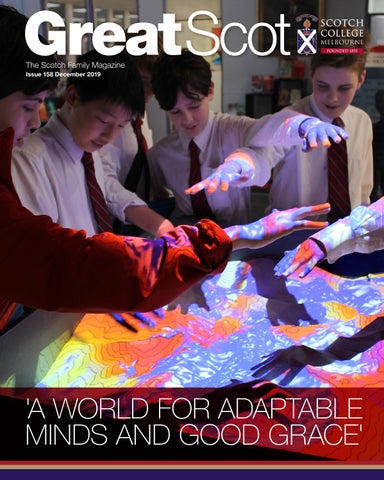
'A WORLD FOR ADAPTABLE MINDS AND GOOD GRACE'
Contents 1 EDITOR
40 MUSIC
2 CHAIRMAN
44 SPORT
4 PRINCIPAL
48 BOARDING
6 CHAPLAIN
53 FOUNDATION
8 JUNIOR SCHOOL
55 DEVELOPMENT
12 MIDDLE SCHOOL
58 OSCA
13 UPPER SCHOOL
77 WHAT THEY’RE DOING NOW
14 FEATURES 22 SENIOR SCHOOL NEWS
Publisher Scotch College 1 Morrison Street, Hawthorn 3122 Victoria, Australia Phone: (03) 9810 4321 Email: greatscot@scotch.vic.edu.au www.scotch.vic.edu.au ABN 86 852 826 445 Print Post Approved PP100008172
View Old Scotch Collegians' Association news and updates at: www.oscanet.com.au Like us on Facebook Scotch College and OSCA
SPECIAL ASSEMBLY GUEST The 2019 School Captain interviews the 1935 School Captain
80 SCHOOL HISTORY
16
84 OBITUARIES
FAMILY DAY Athletes, artists and musicians showcase their talents
The Scotch Family Magazine Issue 158 December 2019
is the official publication of Scotch College, Melbourne.
14
19 Editorial contributors Durga Kamte, David Ashton, Dean Gregory, Paul Mishura, Scott Montgomery, Alan Watkinson
PERELBERG AWARD A selfless team player takes out the award
Editor Durga Kamte (03) 9810 4420 email: durga.kamte@scotch.vic.edu.au Assistant Editor David Ashton (03) 9810 4489 email: david.ashton@scotch.vic.edu.au Art Direction and Production Lisa Sheard (03) 9810 4443 email: lisa.sheard@scotch.vic.edu.au Photography National Photography, Athletics Australia, Stephen Kong, Marcel Aucar, Lisa Sheard, Ben Ferguson, Scotch College students, staff, parents and Old Boys.
26 BROADENING HORIZONS Boys reflect on the positive impact of debating
EDITORIAL
Every generation believes itself hard done by, misunderstood or undervalued by previous ones, and this remains true today. Increasingly, however, parents and teachers also sometimes feel that they are on the back foot, as they struggle to come to terms with young people’s flexibility in switching between the prescribed expectations of their ‘outer’ worlds of school and home, and the ‘other’ world in which they increasingly spend their time. It is easy to criticise this shift in focus, blaming social media and the reliance on electronic devices for deteriorating standards in writing, reading and cultural understanding. Our boys, by contrast to these facile criticisms, show ability to see, and harness, the benefits of free communicative platforms to connect them with others, not just within narrow geographic boundaries but with those across the globe, with unprecedented ease. These platforms also facilitate ready communication with others who share
passions, interests and values. The niche nature of these interests can encompass problems as diverse as finding solutions to our reliance on plastics or measures to sustain languages which are in danger of loss. Concerns have been equally voiced, mostly by a parental generation, about the precarious future of today’s youth, focusing on a disruptive marketplace and the need to upskill to prepare for the unpredictable. In our interactions with students, however, it is evident our boys demonstrate remarkable adaptability in flicking the switch between modes of language: from an academic style required for their studies, to another that is by turn succinct, playful and irreverent. Language adaptability is but a small part of the range; skills in incorporating technology are evident in design and technology, the sciences, media and enterprise projects. However, happily, there is no reason to believe boys have discarded traditional skills that develop their intellect and reason. Boys have enthusiastically embraced the challenges of notably difficult subjects such as Latin, Philosophy, Literature and the more challenging Mathematics and Science streams. Their results, irrespective of the prizes they win, testify to their endeavours and good grace in accepting that sometimes their best is not equal to the state or national levels of competition. Boys have also shown good grace in other fields of endeavour when things have not turned out as they hoped, whether it is on the sports field, or in the performing or visual arts.
School Captains by long tradition are ‘all rounders’, humble in downplaying their own accomplishments in the service they have given to the School. It was a very special moment in Scotch history on 16 October when Bill Morgan, Scotch’s oldest known living Old Boy, School Captain in 1935, and on the cusp of his 104th birthday, came to School Assembly, to be interviewed by current School Captain, Nick Marks. Bill’s razor-sharp mind and facility for language were well to the fore as he answered Nick’s questions with wisdom and perception. He complimented the boys on the way they had sung the hymn of the day, and hoped they were not just singing the words, but meaning what they were saying. What an acute mind Bill has, to be able to relate across the generations to boys in Assembly that day, many of whom were more than 90 years his junior! As Scotch Foundation President, Associate Professor Doug Lording sets out in his article in this edition, the Foundation has shown its own adaptability over the years, taking the time to reflect on its achievements and the ways it has engaged with more and more members of the Scotch Family, as it has worked towards its next goal.
40
53
63
FOUNDATION DAY CONCERT Commitment, skill and passion create a spectacular event
CHANGING FACE OF DEVELOPMENT Maintaining Scotch’s preeminent place in boys’ education
COMMITMENT TO ATHLETICS An Old Boy is awarded Honorary Life Membership of Athletics Australia
DURGA KAMTE EDITOR GREAT SCOT
www.scotch.vic.edu.au Great Scot 3
CHAIRMAN
HON. DR DAVID KEMP AC SCHOOL COUNCIL CHAIRMAN
INDEPENDENCE MAKES POSSIBLE A SCOTCH EDUCATION The Valedictory Dinner for the Year 12 boys on 24 October this year was organised superbly, as usual, by the Old Scotch Collegians’ Association. It is a night when sadness at the end of school days is mingled with the joyful expectation of greater freedom and opportunities to be seized. Being with the boys as their school days come to an end is always moving, and their teachers must take great satisfaction in the wonderful young men the boys have become. The Principal, Tom Batty, addresses the parents and boys on these occasions with a mixture of wisdom and good humour, and once again his words were heard with rapt attention and obvious enjoyment. As Chairman of the School Council, I was impressed by the Principal’s emphasis on the importance of the independence of the School, and the way in which the freedom, which is a product of that independence, enriches the School’s educational offering. 4 Great Scot Issue 158 – December 2019
Scotch’s independence is a precious possession. Its origins trace back to the battles for religious freedom of the 1840s, and the determination of the School’s founder, Rev. James Forbes, to assert the right of parents to teach children not only knowledge but also the beliefs and principles they value without dictation by government. Scotch uses the money it receives from federal and state governments for its contribution to the public interest to keep fees lower than they would otherwise be, expanding access to the School. Today, the foundation of the School’s independence is the support of parents for the kind of education the School offers. This support is very evident, not only in day-to-day conversations with parents, but in the results of annual surveys of satisfaction by parents (and their graduating sons), and of course in the strength of the School’s waiting list.
THE CLASS OF 2019 VALEDICTORY DINNER: SADNESS MINGLED WITH JOYFUL EXPECTATION OF GREATER FREEDOM AND OPPORTUNITIES TO BE SEIZED
The right of parents to choose the education for their children is supported by the Universal Declaration of Human Rights. School independence is an assertion of freedom to decide what form that education will take, and to offer that education to all who see it as meeting the needs of their children. Scotch College has used its independence to provide a curriculum and an educational environment that has proven its exceptional worth over the years. While there are constant demands to conform to governmentimposed curricula, Mr Batty made clear to the parents and boys at the Valedictory Dinner that Scotch’s independence enables the School to adapt to externally imposed pressures in a wide variety of ways, with its own subjects and courses, pastoral and learning support, professional development of teachers, and an enormous range of co-curricular and extracurricular activities. It is worth adding here that Mr Batty’s role as Chair of the Board of Trustees of the International Boys’ Schools Coalition (with its membership of some 270 schools across 13 countries) provides him with exceptional insight into the ingredients of educational success. The School Council, too, takes advantage of this freedom by supporting the Principal’s plans for resourcing innovation in teaching and learning, and by
constructing new facilities and campus improvements that continue to lift the quality of a Scotch education, implementing the best ideas that Australian schooling can offer. In recent times, educational innovations include a focus on building teaching skills and improving boys’ outcomes through a professional development action research program, the reshaped pastoral care model for the Middle School, with teachers following their year group from Year 7 to Year 8, the program using young Old Boys as ‘learning guides’, and exploration of a Centre for Enterprise to develop boys’ ability to identify and develop solutions to difficult problems, and then to successfully take ideas to the marketplace. The new Keon-Cohen Dining Hall, to be opened next year, we hope will become a focal point not merely for boys to build friendships but for staff and boys to engage more readily in informal learning relationships. Scotch College has been fortunate that its independence, educational freedom, traditions and values, enable it to adapt readily to rapid changes in society, technology, and expectations. The School Council, Principal and staff all treasure the independence and freedom that underpin Scotch’s success.
www.scotch.vic.edu.au Great Scot 5
PRINCIPAL
ALL THE LIGHT WE CANNOT SEE
MR TOM BATTY SCHOOL PRINCIPAL
OPPOSITE PAGE: SIR PAUL MCCARTNEY AUTOGRAPHS A DRUM DURING THE SCOTCH PIPES AND DRUMS’ PERFORMANCE WITH SIR PAUL
On a gorgeous early spring morning out at Box Hill athletics track beside the Scotch legions lining up to melt the 100m track, I stopped by a sandpit to chat to former Director of Admissions and leading chemistry teacher, Dr Chris Commons. (Those interested in athletics might know Chris is a double Olympian and holds two Commonwealth Games silver medals in long jump – not that he’d ever raise the matter as he rakes the pit for aspiring jumpers.) Between Chris’s timely reminders that it is indeed hop, step and jump rather than hop, hop and jump, we entered discussion regarding the many good things he continues to offer Scotch chemists through his ongoing engagement with Melbourne University, particularly his guiding of boys in growing and analysing crystals, and, just occasionally, discovering a previously unknown structure they can then name. In the course of our conversation, Chris mentioned that a good friend of his had recently been taken sick with Dengue fever. Taking opportunity to stir, I noted that perhaps if he spent less time with his crystals and more seeking antidotes, the world might be a better place. With the wry smile of the learned and the competitive edge of the athlete, Chris quickly put me back in my box, noting that growing crystals was exactly the sort of work that pharmaceutical scientists use to inform their research for advances in such medicines, it’s just that he would most likely never know about it. Appropriately admonished, I slunk off to the shot-put. I like the idea that we might not know the end point of our life’s work. It reminds that we are connected beyond our immediate field of awareness, that the web is dense and complex and that extrapolation is fraught with danger. It pokes a finger in the nerve of the ‘measure everything, because once measured it can be controlled’ mantra. It reminds that an awful lot of clever dedicated people have brought the world to this point, and we are
6 Great Scot Issue 158 – December 2019
often ignorant of their work or take it for granted. It compels consideration of the relationship between the micro and macro in an ever increasingly connected world. But perhaps it most resonates because of the reminder it serves that a school educates young people for a life they cannot see as much as for one they can. Other stories come readily to mind; my good friend, Sir Chris Dobson (who, sadly, died recently) explaining to me with characteristic humility that his work with protein folding wasn’t really going anywhere until he, seemingly by chance, ‘ran into’ contemporary advances in treatment of Alzheimer’s and Parkinson’s diseases; and the unknown generational impact of a packet of cigarettes smuggled into the Auschwitz death camp, as told by Denis Avey in his autobiographical book, The Man Who Broke into Auschwitz. Another involves a BBC podcast a few years ago in which one of my early political heroes, the Rt Hon Shirley Williams, was being interviewed about her department’s handling of the refugee crisis from Idi Armin’s Uganda, and subsequent work with her contemporaries in India to form a solution. The tenacious articulate interviewer suddenly became silent before giving stuttering voice to her humbling realisation that Mrs Williams’s government’s actions had brought her own mother to the UK, and hence been the source of all she had known including her education. Providing dates and locations the interviewer emotionally pressed, ‘So let’s get this right. If you hadn’t acted as you did, I wouldn’t be here interviewing you now?’ To which Mrs Williams matter-of-factly replied, ‘Yes, that’s true’. I touched on the vulnerability of modelling to measurement in my third Great Scot article (April 2009) when considering Edward Norton Lorenz’s attempts to model weather patterns only to ‘discover’ that in many complex relationships, sensitive dependence of output to minor variance in input
rendered such approach redundant and required a new way of thinking. I suspect the shift from plotting future pathways along chosen flights of steps in a vertical tube to navigating them amidst the dense networks of a flat surface brings Lorenz’s observations increasingly to the fore. Some things are more readily measurable and controllable than others, and these often attract more observable reward. There is danger that these dominate our thinking. We want Scotch boys to gain such return, but also to be prepared for a contribution and legacy amidst those realms where their sight doesn’t carry, not only because this can often be where the most significant communal rewards lie, but also because the confidence, adaptability and poise that stem from preparing for such contribution are precisely the attributes increasingly required for prosperity beneath the glare. By way of summary: • it is likely to become increasingly difficult to predict the skills each boy will need; • it is likely that the pathways for boys will become more interconnected and less readily signposted with ‘qualification’; • it is likely that each boy will increasingly directly reap fewer of the rewards of his efforts; and, • the skills he will increasingly need for prosperity are increasingly likely to be those required for a contribution where the rewards sit out of sight. It is incumbent upon us as a school to continue to ponder what might be done to equip boys best to be so minded; to play to their strengths rather than ‘simply’ mould them to what we perceive to be ours; to use the best of our world to propel them to the best of theirs; to inspire them with our confidence so they might in turn impart theirs to those who will follow. We must find them interests and guide them to mastery; we must nurture an appreciation of how the world has evolved and could be made to evolve for the better; we must seek to inculcate an appreciation of the inherent value and beauty of each individual. Working at the micro level, our list of Scotch clubs has grown to include Coding, Robotics, Enterprise, Literature, Chess, Water is Life, Backstage Crew, the Maestro Club for conducting and, of course, our Christian Movement group run by the Chaplains. Plans for Year 7 clubs run by Year 11 boys are gathering pace for 2020 introduction. Programmes led by Ms Michele Linossier encompass mooting, the Ethics Olympiad, Philosophy, the BrainSTEM Innovation Challenge, Cancer Education, the Motor Grand Prix Science enrichment and Monash Forensic Science programmes; the da Vinci Decathlon; and
human rights summits and Model United Nations gatherings. Casting minds into the broader network, this year’s many visiting speakers have included Dr Charlie Teo (Science Oration); Mr Jack Nagle giving ‘The Real Drug Talk’ and Dr David Iser (’89) addressing on ‘Drugs and Dependence’, both as part of the Year 11 Big Ideas Lecture Series; Mr Simon Benjamin, CEO of the Lighthouse Foundation; Mr Jim Poulter (’59) articulating his experience and thoughts regarding ‘A Path to Reconciliation’; Mr Jack McGrath from Tiwi College; Mr James Meredith (’05) a professional footballer with Millwall Football Club in the English Championship; and, most importantly, former Captain of Boats, Captain of Rugby, Captain of Morrison House and Captain of the School from 1935, the Rev Bill Morgan, celebrating his 104th birthday.
Towards the end of Term 3, a Year 11 boy came to see me to discuss his proposal for a Live Aid style worldwide fundraiser to clean up the oceans. We chatted through some of the challenges and opportunities. I noted he might need a well-connected sponsor and he replied that he felt he might write to Sir Paul McCartney. Why did his thinking go to Sir Paul? Because he had played live on stage with him in Melbourne. How had this come about? Because Sir Paul’s band needed a pipe band for Mull of Kintyre and someone mentioned Mark Saul, TIC Pipe Band at Scotch College. Why was the boy on the stage? Because he came to Scotch and wanted to do something a bit different that connected to the School’s history, and took up the bagpipes. Why is it part of our history? Because a young man, James Forbes, sailed from Scotland with a passion for education and founded a school. Why was Sir Paul in Melbourne? I have no idea, maybe he wanted to see the penguins. Will he take up the Year 11 boy’s challenge? Probably not. Might he mention the idea to someone who will consider it further? Maybe. Would the Year 11 boy ever know it was his letter that led to a global effort to clean up the oceans? Probably not. Does that matter? I suspect that might increasingly be the question. www.scotch.vic.edu.au Great Scot 7
CHAPLAIN
THE EXTENSION OF GOD’S GOOD GRACE REV DAVID ASSENDER SCHOOL CHAPLAIN
Biblical graciousness would have to be one of the highest of all character traits, but the most difficult to undertake. Grace does not wait for someone to prove themselves before favour is shown. It does not require anything of anyone before it is offered. True grace extends itself toward its potential recipient regardless of the likely response. It is selfless, costly and risky, but by it we understand the essential nature of God’s love for us. In 1947 a Christian conference was organised that brought together young people from across the world. The Dutch participants asked to meet with German prisoners of war who had fought in the Netherlands. One such prisoner went to the meeting full of fear, guilt and shame, feelings that intensified as the Dutch Christians spoke of the pain Hitler and his allies had inflicted, of the dread the Gestapo bred in their hearts, of the family and friends they had lost, of the disruption and damage to their communities. Yet the Dutch Christians did not speak out of a spirit of vindictiveness, but of grace. They came to offer forgiveness. It was completely unexpected. These Dutch Christians embodied the love that a German soldier had recently read about in the story of Jesus that a prison chaplain had given him, and it turned his life upside down. That German soldier was Juergen Moltmann, who would go on to become one of the greatest theologians of the 20th century. Years later, with the message of the loving, crucified God still indelibly printed on his heart, he penned these words: ‘But the ultimate reason for our hope is not to be found at all in what we want, wish for and wait for; the ultimate reason is that we are wanted and wished for and waited for. What is it that awaits us? Does anything await us at all, or are we alone? Whenever we base our hope on trust in the divine mystery, we feel deep down in our hearts: there is someone who is waiting for you, who is hoping for you, who believes in you. We are waited for as the prodigal son in the parable is waited for by his father. We are accepted and received, as a mother takes her children into her arms and comforts them. God is our last hope because we are God’s first love.’ (Juergen Moltmann, The Source of Life: The Holy Spirit and the Theology of Life, Fortress Press 1997)
8 Great Scot Issue 158 – December 2019
A Christian is a Christian by the sheer grace of God alone. Salvation is something that can only be received because it is a gift. The Bible goes so far as to explain we cannot earn it because in one sense we do not even desire it. Nevertheless, as Moltmann indicates above, God waits, hopes and anticipates our need of him. This is biblical graciousness drawing us in. In Romans chapter three, the apostle Paul describes our problem like this: ‘There is no one righteous, not even one; there is no one who understands, no one who seeks God.’ Then, in chapter eight, he clarifies, ‘ ... the sinful mind is hostile to God. It does not submit to God’s law, nor can it do so.’ And then, in John chapter six, Jesus offers the solution this way: ‘No one can come to me unless the Father who sent me draws them …’ The reason we cannot earn our salvation is because we can’t even want it. God has to open our heart to it if we’re ever going to receive it. Which means it’s all of grace: he loves us even if we don’t want it. In Deuteronomy chapter seven, God comes to Israel and says, ‘Israel, I didn’t love you because you were the greatest of all nations. Because after all,’ he says, ‘you’re the least of people. But I set my love upon you and therefore I redeemed you.’ God draws us in with a love that says, ‘I love you not because you’re serviceable to me, I love you not because you’re this or that; I love you simply because I have set my love on you.’ A commitment to love keeps both arms of grace extended; waiting, hoping, anticipating and drawing us in. That’s the mark of biblical graciousness. Of course, God’s arms of transforming grace are extended to us like this through Jesus. But, as Moltmann experienced, he understood this only when followers of Jesus extended grace to him as a mark of authentic Christianity. Faith cannot just be a personal thing. The expression of our faith is needed so the world might experience God’s grace for themselves. To be a person of good grace is to reflect the love of God himself. As Jesus said, ‘By this everyone will know that you are my disciples, if you love one another.’ (John 13:36)
SAVE THE DATE
SCOTCH FAMILY EASTER BREAKFAST, 2020 Date: Time: Place: Cost:
Friday 20 March 2020 6.45am for 7am Boykett Room, Cardinal Pavilion Adults: $32, Students/Concession: $16
Guest speaker at the 2020 Scotch Family Easter Breakfast will be Associate Professor Alan Gijsbers, a specialist physician in Addiction Medicine, and an Honorary Clinical Associate Professor with the Department of Medicine at the Royal Melbourne Hospital, University of Melbourne. Alan was the first Medical Director of the hospital’s Addiction Medicine Service, and Medical Director of the Substance Withdrawal Unit at the Melbourne
Clinic, Richmond. He is a Foundation Fellow in the chapter of Addiction Medicine of the Royal Australasian College of Physicians, and National President of ISCAST, a group of Christians interested in the interaction between science and religion. He has lectured in science and faith at Ridley College and the Bible College of Victoria. Alan was the first National President of HealthServe Australia, an organisation of health professionals who seek to provide health and development overseas in the name and spirit of Christ. Alan has published extensively in neuroscience and theology. We look forward to welcoming Alan to speak at the 2020 Easter Breakfast. www.scotch.vic.edu.au Great Scot 9
JUNIOR SCHOOL
MR JON ABBOTT HEAD OF JUNIOR SCHOOL
RESPECT FOR OTHERS: THE ESSENCE OF THE CONCEPT OF GOOD GRACE Each time I turn on the television to watch a news or current affairs-type program I feel like vowing never to do so again. It seems to me that the vast majority of stories are doom and gloom and they portray a world that is in total disarray. Now I am not naïve enough to believe that our world does not have significant problems, but I also don’t feel that the popular media outlets are presenting a balanced view. I often find myself pondering what our Junior School boys must think. Are they worried about growing up in a world torn apart by war, internal conflict within countries, soaring crime, drug issues, poverty, racism, violent behaviours and impending environmental disasters? If they do find themselves worrying about such things, they must wonder what the leaders of our nations and the adults of the world are doing. Hopefully, as children down the ages have done, they still see the world through the eyes of the innocent and remain blissfully unaffected by such matters. However, the boys we are teaching in the Junior School now are going to grow up in a world of increasing change and volatility. In the past, with the exception of world wars perhaps, our world changed slowly, providing opportunity for members of society to become accustomed to the changes. At times, change took place so imperceptibly that it appeared there was no change. That is no longer the case, and the pace of change will only increase in the future. The marvels of modern technology and communication have seen a rapid increase in how quickly change occurs, both in developments and in the way society thinks, acts and manages itself. Societal expectations and behavioural norms are more and more subject to the influencers of the world, and our personal thoughts and opinions are increasingly being impacted by voices from across the globe and from all points of the political and moral compass. As well, we are becoming a far more mobile population, despite the efforts of many governments to control immigration. With international travel becoming so readily available and corporations
10 Great Scot Issue 158 – December 2019
operating more and more on a global scale, many more of us are experiencing and living among the peoples of other cultures and belief systems, and our own country, so long a predominantly white Anglo-Saxon country, is increasingly a place that people from across the globe have chosen to call home. I believe that is a positive change. As they move into adulthood, our boys will need to be adaptable in both their thinking and in their acceptance and understanding of the views, beliefs and practices of others. In their world they will find themselves continually challenged by those with differing views and beliefs, and they will need to develop the ability to listen to, reflect on and accommodate alternative attitudes and thinking. The question is – how do we best prepare our boys to be able to do this? As any Junior School boy will attest, my favourite word is ‘respect’, and I truly believe that almost all of the social problems we face in our world come down to a lack of respect. In the Junior School we talk to the boys a great deal about respect – respect for others, respect for property, respect for learning and respect for self. The concept of having an adaptable mind and good grace, I feel, is in part developed through an ability to have and show respect for others. We don’t necessarily need to agree with the beliefs and values of others, but it is vital that we are able to respect and defend their right to hold them. I feel this is the essence of the concept of good grace in an everchanging society. We work hard to impress this attitude on the Junior School boys every day. We want them to see the differences between us as a positive rather than something to rail against. We can assist these young minds to understand that, as people of the earth, we all have far more in common with each other than differences that can set us apart. In doing so, we will have started them on their journeys to becoming adaptable and gracious in their adult lives, and our world will be much the better for it.
A treasury of piratical tales The Tale of Periwinkle’s Treasure is a comical play with absurdist tendencies; a historical fiction drama with a focus on pirates. The play is a collection of three ensemble pieces inspired by the Year 6 boys. It’s a mash-up of all that is great about Junior School Drama, alive with the spirit of the boys’ collective creation, finely crafted with spontaneity and nuanced boyhood thinking. It bears the traces of a refined slapstick comedy which can be found on a vaudeville stage. The play presents an interesting and unusual take on the word ‘treasure’: a gang of unlikely pirates on the hunt for treasure, and a mother who treasures her children after the tragic loss of her pirate husband, Captain Periwinkle. How does an overworked mother defend her children’s future and manage to ward off Captain Grace O’Malley and her crew? Set sail with the Year 6 class of 2019 to find out. In the beginning of the year the boys began to investigate the myths and legends of the great pirates in history. We were engrossed by the tales of Niki na Meadhra – an Australian storyteller who was commissioned to write and perform a piece featuring Grace O’Malley, the first pirate queen. This research led us to exploring possible themes for our play. The plot was developed and characters were decided on. The rehearsal process began shortly after. The cast is to be commended on their mutual respect for, and encouragement of, one another. Their independent thinking, kindness and diligence has been clear when working with them. The harmony with which they operate is evident in their performance. The production of The Tale of Periwinkle’s Treasure is a triumphant celebration of our Drama curriculum.
BOYS PERFORMING IN THE TALE OF PERIWINKLE'S TREASURE
TREMAINE PAVLOVSKI – HEAD OF JUNIOR SCHOOL DRAMA
www.scotch.vic.edu.au Great Scot 11
STAFF IN PROFILE staff alike enjoyed seeing teachers step out of their comfort zones! Another highlight would be when I was dressed up for the German Café in traditional costume, and danced the waltz with the then Head of Junior School, Guy Mason. We had a number of rehearsals but I still felt like I had two left feet! What has been your biggest challenge over your years at Scotch?
Interview: EMILIE IRESON Emilie Ireson has been a longstanding member of the Junior School staff, having taught across Years 2, 4 and 5. Her 13 years at Scotch have also included participation in a wide variety of sports, camps and activities. One of her highlights was the class cooking book which her Year 5 class prepared and sold as a fundraising activity for UNICEF (see below). In addition to her class activities and responsibilities, Emilie has been the Junior Librarian, and a past Year 2 Coordinator and Head of Bradshaw House. An exemplary teacher, she has used her considerable skills to help each boy to achieve his best in classrooms that are always active, stimulating and educationally innovative. As the interviewee in this edition of Great Scot, she answers some keys questions about her time at Scotch, and also offers some reflections. DEAN RUSSELL Many years from now, when you are no longer teaching, what is one of the Scotch memories you will reflect on? One of my fondest memories as a teacher in the Junior School would have to be when I taught Year 5, and the boys were so inspired during a unit of procedural writing and cooking that we decided to create an authentic class cookbook. They worked with great dedication to complete their 5I Mini Chefs’ Cookbook which was professionally printed. We decided to use the cookbook to raise money for those less fortunate than ourselves. We discussed and researched a variety of charities and the decision was made to support UNICEF, because the boys were keen to aim for a goal and see specifically how the funds would be used.
12 Great Scot Issue 158 – December 2019
The students were most impressive, working as a team after school to sell their books to the Scotch community. I was amazed by their motivation and commitment to raising enough funds to buy a water well for a village. When the 5I boys were able to present the cheque to UNICEF I could not have been more proud. Their level of excitement and happiness as a result of doing something for others was very touching. I will never forget that. What story will your colleagues tell about you when you retire? I am sure my colleagues will reminisce about my time in Year 2 and as part of the study of flight, dressing up as an air hostess alongside my co-pilot for the Great Wungle Bungle. It was great fun, and the students and
On that final day in December when you close the door after dismissing your class for the very last time, I always feel nostalgic and sad to farewell that group of 26 boys who I have got to know so well. There is an attachment formed throughout the year of shared experiences of laughter, adventure, light bulb moments and, most importantly, watching their growth as learners and young men of character. In the following year and subsequent years to come, it is lovely when you see your boys in the corridors and on the playground offering a greeting and a smile, but it is never on the same level. The students change and move on, as they should, but I hope from time to time they still reflect on fond memories of their time in the Junior School. I think I have the best job in the world, inspiring, empowering and educating the boys. What advice would you give our VCE students as they embark on a life outside Scotch? I would say to the VCE students – focus and give your study everything you can for the next month. It is such a short time that will be over before you know it. Put all you can into your exams and reach for the stars. That way you will open as many doors as possible. When making your selections for tertiary places, go with your heart. Pick something you are interested in and have passion for. Your working career is a long one and you want to love what you do. What is your favourite corner of the School, and why? My favourite corner of the School is standing outside Littlejohn Chapel and looking across at the sweeping views of our beautiful grounds. While staring at our amazing ovals, I remind myself how lucky I am to teach at a place which is truly spectacular. I feel very privileged at these times.
JUNIOR SCHOOL YEAR 5 BOYS AT SOVEREIGN HILL
‘SHOWING ADAPTABILITY IS A VITAL SKILL TO HAVE’ Experiences at the Year 5 camp at Sovereign Hill, Ballarat (28-29 October) tied rather comfortably with the theme for this edition of Great Scot – ‘a world for adaptable minds and good grace’. Through a problem-solving and construction activity, the Year 5 boys noticed how adaptable and innovative the gold diggers had been. Moving water uphill or across valleys, crushing quartz ore or simply raising it, ventilating mine shafts or using a cradle to maximise gold finds were all problems that gold diggers solved using adaptable thinking. It rubbed off on the boys, who completed their own problemsolving and construction activities using observant and adaptive thinking. On all occasions the boys were reminded of the power of courtesy, manners and good grace. The role models on offer at Sovereign Hill returned boys to age old thinking when not only were good manners on display, they were expected. The boys displayed manners, courtesy and good grace while on camp. There were many examples of good grace displayed, including opening doors, using ‘please’ and ‘thank you’ and waiting patiently for a turn. The boys were good to youngsters, peers and older folk alike. Here are some of their thoughts: ‘We think that showing adaptability is a vital skill to have. It can help you grow and make you look good in the eyes of others, and make you think of solutions. It is one of the biggest parts of life and it is so simple. To show grace you have to be kind, caring and considerate. You should respect people, places and things. And, most importantly, you are courteous.’ RORY BOOTH and LACHIE ROWELL ‘Being fit to adapt to change well means you have a changeable mindset. That is helpful in life, as it changes the way people perceive about things. As people see things from other people’s perspective, it will change their mind on things, and will make people find better ways to solve problems. Showing respect and good manners is courteous and polite to others around you, which shows you are a respectful person. By implementing this into your daily routine it will improve you as a human being.’ ELLIOTT MARK and MATTHEW BLAMEY
‘Having an adaptable mind means to have a flexible mind that can solve problems and can adjust to things quickly. Showing good grace means to be respectful and to show consideration to others. Showing good grace is one of the most important aspects of life. For example, in the 1850s, gentlemen would show courtesy to ladies by tipping their hats. In the olden days, everyone would have to call ladies ma’am and gentlemen, sir.’ WELLINGTON ZHANG ‘To have an adaptable mind and showing good grace means to be able to change your perspective on things and be tolerant when things don’t go your way. Back in 1851, miners had to adapt to their surroundings. They also had to show grace to one another on the goldfields, by simple things like taking their hats off, holding the door for others and saying please and thank you. Showing good grace also means being able to encourage and help others when they are struggling. These are examples of showing good grace and having an adaptable mindset.’ AIDAN ABEYNAIKE and OLIVER LACEY ‘To have an adaptable mind when a problem faces you, you must be able to find a way around the problem without giving up. It takes problem solving and the ability to persevere when the going gets tough. You must also have a positive mindset and not give up. To show grace you must be respectful and show courtesy to your peers and elders. For example, if an elder walked behind you and you walked through the door, showing good courtesy would be opening the door and holding it for them. You must always be compassionate and show humility.’ ETHAN HILHORST and CHRISTIAN HENG ‘Good grace is helping other people when they need help and having good courtesy to everyone around you. Doing the right thing when everyone around you is doing the wrong thing. Do small kind things without thinking about it even if you won’t be noticed. Do good things not because of the rewards but because it is respectful, courteous and the right thing to do. Good grace is having a good mindset.’ JEREMY LI and TOM KELLOCK
www.scotch.vic.edu.au Great Scot 13
MIDDLE SCHOOL
DEVELOPING ADAPTABLE MINDS To learn and improve, young people need a repertoire of approaches
MS KATRINA STALKER HEAD OF MIDDLE SCHOOL
BELOW: YEAR 7 BOYS MAKING SANDWICHES FOR THE EAT UP PROGRAM
14 Great Scot
If routine or repetitive tasks are the most susceptible to automation, what skills are specific to human ingenuity, and therefore likely to be in demand in the future? How do our students prepare for their future work life? Students’ social, emotional and analytical skills will be of importance, based on qualities such as complex problem-solving, cognitive flexibility, creativity, negotiation, emotional intelligence, coordination and collaboration. While the curriculum we teach does encourage some of these skills, it is the underlying positive mindset on the part of our boys which is most important: being open to learning, facing challenges and showing resilience. These are the necessary skills to develop into adaptable young men for the future. Boys need to believe their abilities can be developed through dedication and hard work – brains and talent are just the starting point. As we approach the end of year, our programs are aimed at helping boys develop a dedicated approach
to their learning, to be ready to adopt new strategies and seek input from others when they’re stuck. They need this repertoire of approaches (not just sheer effort) to learn and improve. With this in mind, the Study Skills Program has been developed by the Centre for Learning, which offers the boys a range of strategies. There’s no one-size-fits-all model for learning. What works for one person may not work for another – it is important for the boys to try many of the strategies. It is also valuable for them to voice their understanding and opinions: the importance of casual conversations around the dinner table, or incidental conversations in the car, cannot be underestimated. To develop the boys’ mindset it is important to praise wisely – praising perseverance, the process they engage in, their hard work, their strategies and their focus. Rather than ‘running’ from difficulties they need to look at these as learning challenges, with outcomes perhaps not going as well as they would hope, but providing learning opportunities all the same. If they achieve a grade they are not happy with, instead of saying ‘I can’t do this’, they need to change their mindset to ‘I can’t do this yet’, challenging themselves to change the approach and keep working hard to achieve their goals. With a positive approach to their learning, they will be developing an adaptable mind which will help them to find their place in the ever-changing workplace. The Middle School continues its focus on Big Ideas and respectful relationships, and the boys were recently challenged by a lecture on the Suffragettes delivered by our Head of Commerce, Mr Tom Hawkins. In this lecture they were introduced to the history of the movement in England. The boys were then challenged with the following questions while looking towards their future – how do you know when to challenge the status quo, and how should we react to people who are challenging what we believe in? The success of the lectures and the program is seen in the conversations the Year 8s engage in on these topics with Peer Mentors from Upper School boys in Years 10, 11 and 12, and with their Form Teachers.
UPPER SCHOOL
MR TIM RAYNER HEAD OF UPPER SCHOOL
TURNING 18, AND MAKING INFORMED DECISIONS
Legally, children become adults at the age of 18. It is a significant milestone for young people and one many eagerly anticipate. Driving on ‘P’ plates, the right to vote, being allowed to own property and shares, and even the right to drink alcohol or gamble all become reality. It’s all very adult. And yet, as parents, we know some children mature earlier than others, that young brains continue to develop after this age, and that a specific day on a calendar is a somewhat arbitrary point to decide that a person is viewed differently and can make adult decisions. Does a person change the day after an 18th birthday? Of course not. We all worry when our son takes off for the first time on his own once he has passed his driving test. The cost of bearing the high insurance premiums pales into insignificance when we worry about possible accidents. Driver education is important, clocking up a significant number of learner hours is also, but trusting our children to be safe on the roads, often while with their peers, does seem like an act of faith. Every year, we invite our attached police liaison officer to speak to Year 12 about turning 18. Rights and responsibilities are the focus of the meeting. Warning boys about ‘hooning’, drink driving or overloading cars with friends, together with an objective legal perspective on the consequences of doing these activities, does help focus minds. There is also a discussion on relationships, parties and the responsibilities that come with being 18. It’s a talk where boys enter thinking they know all there is to know, but leave surprised about how making the wrong choices could lead to life-changing results. Healthy relationships are important to all of us, but as children become older, the decisions they make regarding relationships can be critical. The independence we give our children when they grow older is readily taken, and can promote resilience and sense of identity; however, we need to be mindful that those decisions should be informed. Those parents and Year 10 boys who attended the talk given by Brent Sanders earlier in the year, as part of the Respectful Relationships Day with MLC, were told how the law defines consent in sexual relations. Young people were
advised how to navigate and read consent, to be aware of the pressure that can be brought to bear, and to be considerate of how their partner feels. Achieving positive, successful and respectful relationships is what we want for all our children, but we have a responsibility to make sure they act wisely and sensitively before they begin to make these decisions. As boys grow older, they also have more access to money, either through a part-time job or increased allowance. Sometimes, how boys choose to spend that money is not so wise. As tech-savvy young people, accessing online entertainment and games is almost second nature – the gambling industry is well aware of this. Turning 18 allows boys who may already have been playing betting games for fun, and without money, to open accounts and try their hand at gambling proper. We all know that the odds are stacked against them, but being told that in itself does not stop someone from trying to win. By appealing to our boys’ sense of reason, by using facts and simple mathematics, together with compelling, often tragic, anecdotes and stories, two speakers from Gamblers’ Help Eastern presented their perspective of gambling to our Year 11 boys. Both speakers were well qualified – one speaker counselled adults who had gambling debts, the other had worked in the gambling industry. Our boys left the theatre more knowledgeable and, importantly, more empowered, so they could make good decisions in the future. Needless to say, the discussions on the topic that followed in Tutor Groups were lively, interesting, and informed. www.scotch.vic.edu.au Great Scot 15
FEATURES
BILL MORGAN (‘34) RETURNS TO SCOTCH TO MARK A SIGNIFICANT MILESTONE
SCOTCH’S OLDEST LIVING OLD BOY, BILL MORGAN (’34), IN SCHOOL ASSEMBLY ON 16 OCTOBER, WITH PRINCIPAL TOM BATTY AND SCHOOL CAPTIN, NICK MARKS
16 Great Scot Issue 158 – December 2019
It is cause for special celebration when the School Captains of 1935 and 2019 meet for a chat on stage in Memorial Hall – as they did during Assembly on 16 October – and even more so when one of them this year celebrates his 104th birthday, and is our oldest living Old Boy. Not only has Bill Morgan (’34) reached this remarkable milestone – faculties intact, and as eloquent as ever – but his list of leadership positions while a student, as recounted by Principal Tom Batty to the boys in Assembly, still reads as impressively as ever: ‘In his years at Scotch, he played in the 1st XVIII. He was Captain of Boats. He was Captain of Rugby. He was Captain of Morrison House. He was a boy during Dr William Littlejohn’s period as Principal of our School, and, in his final year, in 1935, he was the first School Captain appointed by Dr Littlejohn’s successor, Mr Colin Gilray.’ The task of interviewing a predecessor 84 years his senior was a relatively straightforward exercise for the current School Captain, Nick Marks (’18), for if there’s one thing Bill knows how to do, it’s engage and entertain an audience with his razor-sharp
was sold in Sweden, the first portable radio was developed in America, and King Tutankhamun’s burial chamber was opened by Howard Carter. In response to questions posed to him by Nick Marks, here are some of his responses: ‘How do you put in a few words all that you want to say. My memories of Dr Littlejohn go way back to the time when I was in the Prep School. ‘We used to see Old Bill, as we called him, wandering down from the Hill, past what used to be the groundsman’s residence and is now part of the hospital, I think, and the former Music School, down there calling, “Paper! Paper! Paper!” We little nippers would run around collecting all the papers, and Old Bill would put them in a heap, set fire to them, then go on to the next stop.’ While Littlejohn, according to Bill, might have become ‘somewhat of a grandfather figure’ for the boys, it was not so for all: ‘I think he was feared more by the masters than he was by the boys, because he would wander around the school, particularly in the lower forms, and he would wander into a classroom and just stand inside the door and listen for a
had the “privilege” of caning boys. We would have somebody report for a misconduct, we would have a prefects’ meeting, and we would decide on his punishment. Every boy had the right to appeal to the headmaster, and on several occasions, I took boys to Gilray. He would listen to both sides, send the boy outside, and say, “Morgan, I think you should go back and just hear this boy again. Be careful.”’ Bill noted that early in Gilray’s tenure, he ‘virtually transformed the whole teaching staff in Senior School. At that time education was beginning to change from an emphasis on languages, humanities to science and mathematics. And he was at the beginning of, what I saw as, a transformation in the educational approach of the School.’ Nick Marks asked of Bill, ‘If you had the chance to go back and talk to yourself in your time at Scotch, what might you say to that little boy?’ Bill admits that for much of his schooling, ‘I had no idea what I wanted to be, or what I wanted to do.’ Now though, ‘I perhaps look back on and see the way the masters of the School
mind and his facility for language. As Nick Marks noted, ‘before I could even get in my first question, he beat me to it and said that hearing the boys sing the hymn brought him such happiness, but, he warned, he hoped that they were not just singing the words, but actually meant what they said’. As the present cohort of Senior School boys discovered, Bill is in a unique position to be able to provide a rare, personal insight into two formative Scotch Principals. His memory of Scotch spans an astonishing 10 decades, for he commenced at Scotch in 1923. To put this into a historical context, this was the year the world’s first domestic refrigerator
few moments, and then say, “Excuse me, sir,” and he’d take over the lesson. Anything from Latin, physics, science, mathematics – he’d just take over, and when he’d finished, he’d just walk out of the room as if nothing had happened.’ Of Littlejohn, ‘Memories just crowd in of a man who just loved his school, and loved everybody in it.’ Bill had ‘the privilege of only really knowing Colin Gilray for about 18 months at close quarters’, and regarded him as ‘quiet, unassuming, and very judiciously kind’. ‘It’s different now, but in those days … the Captain of the School and Vice Captain
encouraged us to complete something, even at school. “You’ve got abilities. Use them here. Don’t wait until you’ve left school to start doing things. Start doing that here.” And the masters encouraged us, just not to pass examinations, not to do this or that, but to be yourself. Find out who you are, what you want to be. But find something in life that makes meaning to what you’re doing.’
www.scotch.vic.edu.au Great Scot 17
FEATURES
IT WAS A GREAT DAY FOR THE HOUSE ATHLETICS AND FOR ALL THE MANY AND VARIED FAMILY DAY ACTIVITIES
18 Great Scot Issue 158 – December 2019
WHAT A REVELATION – A SUNNY FAMILY DAY! The sun shone brightly all day on Saturday 14 September, Family Day, making it quite a contrast, weather-wise, to many past Family Days of rain squalls, cold winds and hail. As in past years, the Scotch Family came together to enable athletes, creators of the many art and design pieces, and members of the many bands that entertained the crowd to showcase their talents. The successful day was the product of the hard work of a host of people, including athletes, officials, fundraisers, announcers, parent auxiliaries, and Academic, Grounds and Maintenance staff. It was a great team effort. Morrison triumphed in the House Athletics competition, followed by Lawson, Forbes, Davidson, Bond and Littlejohn. In the Year 7 interform competition, 7MR was first, with 7TT second, 7RB third and 7PR fourth. The first four forms in the Year 8 competition were 8JE, 8DB, 8JB and 8TH.
www.scotch.vic.edu.au Great Scot 19
FAREWELL CLASS 2019
‘THE BEST YEARS OF MY YOUNG LIFE’ This is an edited version of the School Captain’s reflections at Presentation Night Scotch College means many things to many people. To me, it is not really a physical place I think of. The first associations will always be to the people I met at this School. The School represents the best years of my young life and the closest friendships I may hope to forge. With this in mind, tonight I would like to offer a small sampling of stories of the individuals who have crossed my path. Life is unpredictable: these were the final words for the school year my Science teacher offered to me a little while ago. He went on to add that in physics, one can never be exactly certain of where a particle is. Protons, electrons and all manner of other things – including you and me – can, though the chances are extremely slim, pop in and out of existence at the drop of a hat. His conclusion that life should be uncertain, therefore, seems almost to be written into the fabric of reality itself. He then told us one of the more remarkable stories I have heard in some time. In the late 1960s an Englishman named Tim Staffell founded a band named Smile with some of his school friends. Now they enjoyed a little bit of success here and there, but nothing special. One day, having missed the train on the way into the city, he asked a nearby stranger for the timetable. They eventually got talking, with both expressing their passion for music and art. A week or so later, Tim was offered a gig to work on Thomas the Tank Engine as a model maker. Now he couldn’t manage the demands of both music creation and making kids’ toys, so he passed on the lead role in the band to the acquaintance he had met the other day. That man turned out to be Freddie Mercury. The band became Queen. The rest is history. Somewhere at some point in time, Mr Staffell must have
20 Great Scot Issue 158 – December 2019
pinched himself a and asked ‘is this the real life?’ Now way back in February, I visited Cowes for some of the Year 7 camps. Having the chance to meet them and hear their thoughts on school was very interesting. There was, however, one boy who couldn’t quite grasp how I’d come to be in Year 12 for a second time. For the rest of the camp, he had this permanent look of confusion on his face until a moment of epiphany when it all seemed to click. Shortly after I got back, one of the Year 7 tutors paid me a visit and gravely asked me to have a chat with a misbehaving student. In walks Mr Confused, of all people. He sits down. I ask what he had done; I fear the worst. It turns out he had got a little bored and prank-called some people – shocking stuff, indeed. Well, we got to talking and conversation turned to what he wanted to do when he was older. He thought for a moment, made his decision – it’s either a TikTok celebrity or a lawyer. Times certainly have changed where two such completely different vocations like those are both viable options. I had a bit of a laugh. He took this a little more personally than I had intended, and replied ‘Well you failed Year 12 last year, so what would you know?’ I didn’t have much to say in reply. If anything, this experiment certainly confirmed that the stereotype of Scotch boys going into commerce/business is alive and well. It’s fair enough that there is such a focus this year on what we will do with the next one. Vocation, jobs, career, these are terms that are thrown around a lot. If you are still as unsure as I am what you want to do with yourself, I find the best place to start is here: what would I do if money were no object? If you can do that, your ship will right its course.
Exams are approaching, and in a month’s time, give or take, you will hear the words ‘pens down’ and with that cursory remark, your schooling will be done. Just like that. No fireworks, no cinematic explosions. And let me tell you, having been in that position before and awaited the end of Year 12 and the freedom it would bring, not much changes. The world you left before entering the exam hall is still the same when you return to it. They say all good things come to an end. One day, in the near future, you will all wake up, for some of you sometime around mid-afternoon, and sit up. Out of all the great things you will do on that day, there is a couple of things which you won’t. You will not button up another crispy white shirt from Dobson’s. You will not tie that gorgeous tie of cardinal, gold and blue. And you will not come back to 1 Morrison Street as a student – ever again. In the precious days that remain, I ask you only to cherish them. We are often told to live each moment as if it’s our last. As far as this school is concerned, it is. I am humbled by the opportunity to be a part of your graduation. For most of my experience as School Captain, speaking in front of so many people has been an occasion that I both cherished and dreaded. With this being my final address to you all in Memorial Hall, I cannot help but be overcome by immense sadness. This building testifies to the memories of boys who came before us. However, it is also an image, frozen in time, of your own selves. A part of you has woven itself through the red brick and wood. Thank you all for a wonderful year, and on behalf of all the boys, thank you to everyone who has made our experience all the more memorable.
‘AN ACTIVE AND ENGAGED YOUNG MAN’ TAKES THE 2019 PERELBERG AWARD
HUDSON LEVINE WITH HIS SILVER REPLICA OF THE PERELBERG AWARD’S SILVER SCULPTURE. OTHERS IN THE PHOTO ARE THE PRINCIPAL, TOM BATTY (LEFT), JUSTIN PERELBERG (’90 – REPRESENTING THE PERELBERG FAMILY), AND HUDSON’S PARENTS, MRS REGINA LEVINE AND MR ADAM LEVINE.
Hudson Levine (Year 12), a boy the Principal describes as ‘a sincere and mature young man’, who ‘exhorts others to play to their strengths for their own success, and that of the broader team’, is a worthy winner of the 2019 Perelberg Award. The award, presented annually since 1993, is granted one year to a current student or to one who left in the previous year, and the next to an Old Scotch Collegian. The key criterion for the award is that the recipient has shown ‘exemplary Scotch Spirit’. The award honours the memory of Ashley Perelberg from the Class of 1992, a boy who fully exemplified ‘Scotch Spirit’. Ashley tragically died of a heart attack at the age of 18 in his first year of university study. Ashley’s family presented a silver sculpture depicting the penguin parade at Phillip Island, which was inspired by Ashley’s devotion to the annual Scotch-atCowes summer camps on Phillip Island. The winner of the Perelberg Award receives a silver replica of this sculpture. Announcing Hudson Levine as the Perelberg Award winner, School Principal Tom Batty said throughout his Scotch
journey, which began in 2015 in Year 8, Hudson had acted in ways that had influenced for the greater good, without thought of reward or recognition, and had put the needs and interests of others before his own. Mr Batty said Hudson had proven himself to be a conscientious, interested and hardworking student, winning an Academic prize for Excellence in Design Technology in Enterprise in Year 10. ‘Beyond the classroom, Hudson has been involved in tennis, for which he was awarded Half Colours in 2018, and football, receiving Full Colours in both 2018 and 2019,’ Mr Batty said. ‘Hudson has also involved himself in the Debating programme, and he was a Peer Support Leader in Year 10, a role that saw him working closely with a group of Year 7 boys, helping them settle into their new environment. ‘This year saw Hudson appointed to the positions of Prefect and Captain of Forbes House, giving evidence to the regard in which he is held by his peers and the younger boys in his House. Hudson also spent his first year at Scotch as a member of the boarding community. ‘Hudson is a sincere and mature young man with a strong sense of his own identity. Rather than promote himself, he exhorts others to play to their strengths for their own success and that of the broader team. ‘In his role as House Captain and Prefect, Hudson has led by example, shown great integrity in all that he has done, and been prepared to give of his own time for the benefit of the individual and the House. As one teacher commented: “Hudson carries a generosity of spirit, a
concern for justice, and a willingness to engage with new ideas, listen to the views of others, and work hard for the benefit of the wider community”. As another teacher put it: “Hudson is a generous, kind and spirited companion to those around him, and can be relied upon for his ability to set a positive tone in all that he does.” ‘Hudson is proud of his Jewish heritage and is actively engaged in the Chabad House of Malvern, where he has given of his time during key festivals throughout the year. Realising sport is an important vehicle around which social cohesion and harmony can be built, Hudson, through his strong connection with the Ajax Football Club, was a participant in the recent Jolson/Houli Unity Cup match, which saw two teams from the Jewish and Muslim communities play a game of AFL at the MCG with the aim of celebrating peace. ‘As can be seen from this resume, and as expressed by one of his nominators for this award, Hudson is an extremely active and engaged young man, possessing a strong social conscience, and at all times demonstrating a willingness to get involved in community, not for any plaudits or social kudos, but rather for the benefit of those around him. ‘Hudson has, over the past five years, sought to make a difference through his endeavours and actions, supporting those things that need supporting and challenging those things that need challenging. ‘I am sure you would agree that Hudson fully exemplifies Scotch Spirit and is indeed a worthy recipient of this year’s Perelberg Award.’
www.scotch.vic.edu.au Great Scot 21
FAREWELL CLASS 2019
THE PASSING OF THE TORCH 22 Great Scot
IT WAS FAREWELL TO SCHOOLDAYS FOR THE CLASS OF 2019 DURING THE FINAL ASSEMBLY AND TORCH CEREMONY IN MEMORIAL HALL ON 22 OCTOBER. FAREWELLS WERE ALSO MADE TO DEPARTING STAFF. BOYS WHO ACHIEVED FULL SCHOOL COLOURS IN THREE OR MORE ACTIVITIES RECEIVED TROPHIES AND CONGRATULATIONS. SCHOOL SONGS WERE SUNG WITH EXCEPTIONAL GUSTO. FINN MAGINNESS AND WILL DIXON, CAPTAIN AND VICE CAPTAIN OF MORRISON HOUSE, HELD HIGH THE COCK HOUSE TROPHY. BEGINNING WITH SCHOOL CAPTAN NICK MARKS AND VICE CAPTAIN STONE KE, TORCHES WERE PASSED AMONG THE BOYS AND DEPARTING STAFF. LATER, BOYS AND STAFF MINGLED FOR AN AL FRESCO MEAL IN OLD SCOTCH SQUARE AND SOME TRADITIONAL SHIRT-WRITING, BEFORE THE BOYS LEFT TO PREPARE FOR THEIR VCE EXAMS.
www.scotch.vic.edu.au Great Scot 23
NEWS
GREAT EXPERIENCES IN FOUR COUNTRIES In 2019, Scotch’s Exchange Program sent Scotch boys to visit schools in Scotland, England, the USA and South Africa. A school exchange can be life-changing, as described by the boys who had the opportunity to participate in the experience this year. The boys listed below, with their exchange partners, travelled abroad to visit fascinating places and attend our exchange schools: ST ALBANS SCHOOL (Washington DC, USA): Liam McKeith, Leo Fu, Thomas Wildoer (all Year 11). Exchange partners: Alex Misiaszek, Nico Cantrell.
ST ALBANS SCHOOL – THOMAS WILDOER After a lengthy flight, tired but excited, I arrived at the school that was then new, but now so familiar to me. As I walked down the hall, I saw doors open either side of me with confused new boys, before eventually finding my room; it was a bunkroom with a senior boy. Over the course of the coming week I got to know so many welcoming people, not only boarders but day boys too. That Saturday was my first school event, the Varsity football game. With a roaring crowd and a sea of beach-themed attire we won convincingly. That night I went to the sister school’s homecoming, another unusual experience. At the first weekend I went to the state cross country meet with my weekend family’s child and on the Sunday went to the ‘Nats’ baseball game at Nationals Park baseball stadium. My third week was full of sightseeing – going to a new place every night after school with another exchange student, including visits to Georgetown, the Washington Monument, the Lincoln Memorial, the Capitol Building and the White House, as well as other downtown hotspots. The last weekend included my third football game, another homecoming on the Saturday, and a trip to both the Aerospace and Natural History Museums on the Sunday. It began to sink in during my last week that it was all coming to an end, and that I soon must say goodbye to all my new friends.
24 Great Scot Issue 158 – December 2019
Scotch’s exchange program provides great educational and cultural opportunities
DULWICH COLLEGE (Dulwich, London, England): Jerry X’Lingson, Oscar Robson (both Year 11) – September. Exchange partners: Ben Knowles, Henry Bichard. ETON COLLEGE (Windsor, England): Milo Walpole Walsh (Year 11) – September. GEORGE WATSON’S COLLEGE (Edinburgh, Scotland): Nicholas Kluckow (Year 11) – September. Exchange partner: Calum Hall. MICHAELHOUSE (Balgowan, KwaZulu Natal, South Africa): Hamish Heine, James Meggitt (both Year 10). Exchange partners: Connor Sesink Clee, Matthew Marx.
The final Monday, as I walked through the halls, everyone seemed to know I was leaving, and it made me so happy to know I had made friends I would stay in touch with for years to come. DULWICH COLLEGE – JERRY X’LINGSON and OSCAR ROBSON On 14 October, we left for the UK on a student exchange between Scotch and Dulwich College. It was a tiring 22-hour journey, but was undoubtedly worth it as the coming 28 days would prove. Our time at Dulwich was filled with delightful experiences, due to the welcoming attitudes of the students and teachers who made our stay so rewarding. Although we did attend school throughout the week, we did also find time to pursue other activities on the weekends. We went out to Cambridge University one Saturday, did some punting along the rivers and enjoyed a delicious cream tea at a local café. We were then also lucky enough to travel westward to Salcombe, a lovely beachside town, where many more fond memories were made on the water – paddle-boarding and trying to knock each other off into the cold water — and at the shooting range, where we had the opportunity to shoot guns at targets. I can proudly say in the latter activity that the Australians defeated the British in a final target shooting showdown during our session.
Oscar appreciated his opportunity to be immersed in the rugby and rowing programs at the school, as well as participating in art, commerce and mathematics. While there were many similarities between Scotch and Dulwich College, there were some significant differences to the daily routines. For example, there are two teachers for each subject to teach different parts of the course. As Dulwich College is so close to London, we were also able to visit the city as tourists, with the added advantage of having expert advice from our friends and teachers. I would like to thank all those at Scotch and Dulwich College who made this exchange possible, as it enabled us to have amazing experiences. ETON COLLEGE – MILO WALPOLE WALSH I arrived in the UK to see my grandad and other family for a couple of days before I headed into Eton College to get suited into the famous Eton tails and to be shown around parts of the school. I was placed into Villiers House which is predominantly run by Doctor Warnes (House Master) and Hermione Holt (Dame). I was introduced to all the boys who I would spend the next month with in my house. During my time I attended my regular classes of English, Philosophy, Theology and Art. My walk towards my Philosophy and Theology classes from my room took me past Walpole House, the boarding house which is named after Sir Robert Walpole (regarded as
the first Prime Minister of Great Britain), of whom I am a descendant. In the time I spent at Eton College I became aware of the importance of its history and traditions, evident in the many plaques, buildings and murals all around the grounds. The architecture around the school was impressive and I was particularly smitten by the school chapel with an organ covered in beautiful paintings. Throughout my stay I was welcomed into the sporting programs Eton has to offer. I was placed into the fifth school soccer team, senior league soccer and house soccer, where I was able to expand my friendships and improve my skills. As I was in Eton at the time of the Annual Fair, I was offered a position to sell chicken to the public, Eton families and Eton boys themselves, which raised a lot of money towards charity. My stay at Eton College was not only educational but was filled with experiences and people that I will never forget. GEORGE WATSON’S COLLEGE – NICHOLAS KLUCKOW Over the September break, I took part in an exchange to George Watson’s College in Edinburgh, Scotland. As an enthusiastic bagpiper, I was keen to experience Scottish culture, and I can safely say that the country did not disappoint. From haggis to the highlands, my host family and I packed a
considerable amount of activities into the three-week window I was with them. The place where most of my time was spent was, naturally, George Watson’s itself, and I attempted to maximise my time at the school by participating in a host of really rewarding activities. I sang in the house choir competition, watched several debates and played with their pipe band. In particular, playing bagpipes in the pipe band was a big highlight for me. The group was of such a high calibre, and to briefly play a part inspired me to develop a better piping work ethic. This was a unique experience, and I am very grateful to have been provided the opportunity. Furthermore, the city of Edinburgh itself is magnificent. The architectural wonders and the friendly townspeople made exploring the city a thoroughly enjoyable experience. My host family also took me up into the highlands, where we went mountain biking and clay pigeon shooting. This was a fantastic chance to appreciate the picturesque Scottish landscape. Finally, this exchange was a great opportunity to meet new people, with whom I hope to continue to stay in contact. I would thoroughly recommend this exchange to all boys in younger years, regardless of whether you have a Scottish affiliation. It is a unique experience that I will never forget. MICHAELHOUSE – JAMES MEGGITT and HAMISH HEINE At the beginning of Term 3 this year, we were lucky enough to undertake a sevenweek exchange to Michaelhouse School in South Africa. The school is located in a rural setting at the footlhills of the Drakensburg Mountains in the province of KwaZulu Natal, about two hours inland from Durban. Michaelhouse is an all-boarding school, made up of 500 boys from Year 8 to 12 from all regions of South Africa, and offers many exchanges to boys from all over the world. While on exchange we took part in the school’s academic and sporting program, played soccer and cricket and participated in immersion programs, helping out at local schools in the nearby villages. We had the thrill of going on game drives while on safari at a nearby game reserve, diving with sharks off the coast of Durban, and while spending a weekend with our host
family we even bungee jumped from an 80m high football stadium. We thoroughly enjoyed our time on exchange at Michaelhouse. The opportunity to immerse ourselves in a completely different culture and new boarding environment was unique. Our time away enabled us to form opinions and make comparisons between our schooling experiences here at Scotch and those we had at Michaelhouse. On a broader level, our travels enabled us to contrast life here in Australia with that of South Africa. We met so many people and made lasting friendships. We were very fortunate to have had the opportunity to participate in the exchange and we will look back very fondly on our time at Michaelhouse and South Africa.
www.scotch.vic.edu.au Great Scot 25
NEWS
1.
EIGHT EYEOPENING IMMERSION OPPORTUNITIES Year 11 boys took on a wide variety of service-learning roles in 2019 Led by a highly talented group of staff who share a passion for community development work and the transformative nature of service-learning, our Immersion Program at Year 11 level included eight different programs in 2019, which are outlined below. BALLARAT IMMERSION Scotch boys partnered with Ballarat Specialist School in an education project, part of the Ballarat school’s goal to develop independent living skills and social skills for young people with mild to complex intellectual disabilities. During the immersion, Scotch boys learned some of these independent living skills (including cooking and budgeting), as well as program development skills and tutoring skills. In some activities they also learned from the Ballarat Specialist School students (such as learning baking skills). In other activities, Scotch boys took on leadership roles which included running a sports program. CHILDREN AND FAMILY SERVICES IMMERSION Boys partnered with the Les Twentyman Foundation in the foundation’s project to
26 Great Scot Issue 158 – December 2019
build youth engagement in education and leadership for young people experiencing poverty in Melbourne. The goal of the immersion was for Scotch boys, working in partnership with foundation leaders, to become actively involved in a number of the foundation’s programs in and around Melbourne. This included a ‘backyard blitz’ program (providing house and yard maintenance to support families), a ‘back to school’ program (helping with providing text books and educational resources for young people), tutoring young people at a local library centre in numeracy and literacy, and a basketball training program (helping to connect and engage young people through sport). FOOD IMMERSION In this immersion, boys partnered with Fareshare, Eat Up and St Vincent de Paul, to learn about food insecurity in our community and working towards supporting people who may not always have access to the food they need. Boys learned in partnership with Fareshare, an organisation that rescues surplus, quality food from supermarkets,
farmers and other businesses, and cooks this food into nutritious meals for Victorian charities, such as soup vans, homeless shelters, food banks and school breakfast programs. Boys also worked in partnership with aged care facilities to help in their goal of promoting wellness and independence for all residents. MUSIC IMMERSION Boys partnered with aged care facilities to provide a musical experience through delivering concert performances and conversing with the residents. At the start of the year, boys were organised into chamber music and vocal groups. After pre-immersion activities, and when adequately prepared, boys visited aged care facilities and retirement homes to perform concerts and interact with residents. MY MEMOIRS IMMERSION Boys were paired with senior Old Scotch Collegians. The task was to interview the Old Boys and create and publish a memoir for each of them as a keepsake. In partnership with older members of our community, boys developed journalism and biography writing
2.
3.
4.
5.
(CLOCKWISE FROM TOP LEFT, PAGE 24) 1. NEPABUNNA IMMERSION; 2. CHILDREN AND FAMILY SERVICES IMMERSION; 3. MUSIC IMMERSION; 4. FOOD IMMERSION; 5. BALLARAT IMMERSION; 6. MY MEMOIRS IMMERSION
skills. Teachers guided them in writing, editing and publishing the biographies of each Old Boy’s life, and the books they produced were shared with the Old Boys and their families at the end of the program. NEPABUNNA IMMERSION Nepabunna was established in 1931, and in 1998 Australia’s first Indigenous Protected Area, the Nantawarrina IPA, was established, and is managed by the community at Nepabunna. Over the course of the immersion, Scotch boys assisted the community in environmental remediation of Nantawarrina IPA, such as feral weed eradication and fencing. They also participated in service activities within the community, including repair and maintenance of the cemetery. As they worked alongside community members, boys had the opportunity to learn first-hand about the Indigenous culture of the Adnyamathanha, including visits to sites of significance to the community, and a traditional meal on the last evening. SOCIAL JUSTICE DRAMA IMMERSION This year, boys partnered with Jesuit Social Services in an advocacy project, giving
voice to refugee stories. The boys created a film, Racing to Change. The aim of this service was for boys to create a theatrical response to the stories of disenfranchised people in our community, giving voice to stories which usually go unheard. The partnership aimed to provide opportunities for people to tell their stories and engage with students in a respectful space, and to provide some publicity for the charitable work the organisation is doing within the community.
6.
WORLD VISION IMMERSION This immersion at the end of Term 3 gave the boys an opportunity to learn in partnership with World Vision staff who have dedicated their lives to helping others and fighting the effects of global poverty and fragile states. Boys led and took part in the 40 Hour Challenge. The immersion included working with the World Vision Advocacy department in Burwood East, and working with refugees domestically and with local social enterprises at cafés in the eastern suburbs. KERRIE ARDLEY – TIC, YEAR 11 IMMERSION
6.
www.scotch.vic.edu.au Great Scot 27
NEWS
FROM LEFT: JASON CHAN, MAX FAN, RONAN AHL, ANDRE RAMETTA, EDWARD SONG, NICHOLAS KLUCKOW, CHRISTOPHER O’CONNELL, ALEX MEGGITT, RICHARD LIU, RYAN AHL (ABSENT NEEL PAWAR, ANDRES BURITICA MONROY)
‘BROADENING HORIZONS AND CHALLENGING MY THINKING’ Two Scotch boys reflect on the positive impact of debating 28 Great Scot Issue 158 – December 2019
‘What does debating mean to you, and how has it helped to shape you as a person?’ That was the question posed to Alex Meggitt (Year 10) and Andre Rametta (Year 11). Alex was a member of the Scotch C1 team, grand finalists in C Grade of the Debaters Association of Victoria 2019 Schools Competition. The team also comprised Year 10 boys Ryan Ahl, Andres Buritica Monroy, Max Fan and Richard Liu. Andre was a member of Scotch B1, the champion team in B grade of the DAV 2019 Schools Competition. The other members of the team were Year 11 boys Jason Chan, Nicholas Kluckow and Neel Pawar. ALEX MEGGITT said: ‘This year 130 boys from Scotch participated in the Debaters Association of Victoria (DAV) Schools Competition. Comprised of over 250 schools and 1500 teams from around the state,
ABOVE LEFT: CHRISTOPHER O’CONNELL, RONAN AHL, EDWARD SONG. (RIGHT) JASON CHAN, NICHOLAS KLUCKOW, ANDRE RAMETTA
the tournament is the largest English-language debating competition in the world. ‘As a part of the C1 team coached by William Pascoe (‘17), I enjoyed an extremely successful season; we finished runners-up in the 2019 grand final. Speaking personally, my time in Scotch debating has helped shape me by sharpening my sense of how I connect with the world. Being able to work with coaches, teachers and teammates to unearth the intricacies of complex local, national and global issues, and to formulate arguments in response to them, has deepened my understanding of world affairs. ‘Importantly, debating has exposed me to perspectives that differ from my own. This wonderful opportunity to broaden my personal horizons and challenge my thinking continues to develop my outlook on society. ‘Yet, the ultimate joy I have derived from my time with debating has come from the adrenaline-fuelled intellectual sparring alongside teammates and against our opposition teams during the competition. Working as a team to refute opposition cases and articulate why our proposals are more meaningful has been an exhilarating combination of anxiety and excitement. Being able to harness the emotions that surge through my body and explain a logical case precisely and under the pressure of the clock has increased my confidence as a young man. ‘Debating has offered me a broader perspective on world issues and given me confidence to present ideas in a public sphere. But most importantly, experiencing the camaraderie which emerges between friends uniting behind an argument has been one of my greatest joys at Scotch.’ ANDRE RAMETTA said: ‘In my third year of debating at Scotch I have relished the opportunity to undertake, once again, one of the most rewarding activities the college has to offer. I have walked away from every training session, fierce discussion and competition debate with no regrets, and a sense of exhilaration at the intensity of the intellectual journey. ‘However the really beautiful thing about the program is how it caters for those of all abilities, and throughout the course of the year, with the help of the best coaches in the state, we have all walked away with a wealth of experience and knowledge, as well as an enhanced ability to efficiently formulate and express our perspectives on a range of challenging contemporary issues. ‘This year I was lucky enough to be part of an incredibly prosperous team that has bonded, grown and achieved enormous success
together as a group, which is something that we will all look back on at the end of our time at Scotch with great fondness. ‘My experience of debating at Scotch has significantly altered the way in which I conduct myself, appreciate the opinions of others and confront the serious issues in life. I know I will be forever grateful for this, and I would encourage anyone who is yet to experience this program to consider stepping outside of their comfort zone and into something new and deeply rewarding.’
CHALLENGE DEBATING – SKILLS FOR LIFE This year I was fortunate to participate in the Challenge Debating program at Scotch – an initiative that gives Year 8 Scotch boys the opportunity to be involved in the Debaters Association of Victoria (DAV) competition at the entry level usually reserved for Year 9 students. As a member of Scotch 9, my team was gratified to reach the finals this year where we represented Scotch against Year 9 students from other schools. Debating has equipped us with lifelong skills – thinking logically and analytically, public speaking and communication skills, teamwork, and how to approach issues in new, creative ways. We learned to structure arguments and ideas clearly and concisely, while still covering all relevant required material. We discussed and clarified opinions on the pressing issues our world faces today. We had to thoroughly prepare and plan our team approach to an issue, and also be able to improvise on the spot. Most important, however, is how debating has taught us to listen carefully to others, respond to their approach, and advocate one’s point of view in a respectful manner based on substance, fact and logic. DAV debating this year has truly been a wonderful experience that has built on prior knowledge we have had through British Parliamentary Debating, Online Debating and extension opportunities. CHRISTOPHER O’CONNELL – YEAR 8
www.scotch.vic.edu.au Great Scot 29
NEWS
SCOTCH BOYS WITH MLC STUDENTS DURING RESPECTFUL RELATIONS DAY
RESPECT, MATURITY AND THE FUTURE Scotch’s Respectful Relationships Program developed further this year Scotch’s Respectful Relationships Program, launched last year, is designed to support young people as they navigate their responsibilities around consent and conflict resolution, to help maintain positive relationships with others and respect for themselves. Scotch boys have continued to develop the program this year, with Year 10 boys participating in a Respectful Relationships Day and hosting a respectful relationships student voice forum for 56 Years 9 and 10 students from nine schools. Later in the year, a program focusing on issues relevant to Year 8 students was set in place, based on an action plan developed at the student voice forum. Here are six Year 10 Scotch boys’ reflections on elements of the Respectful Relationships Program. 'This year, the Year 10 Scotch boys participated in a "Respectful Relationships Day", held on the Scotch and MLC campuses. The day was run by student facilitators from both schools who had participated in various training sessions throughout the previous term.
30 Great Scot Issue 158 – December 2019
'The content was based on the ideals of a respectful relationship and how important consent is. In small groups, around 14 students along with two facilitators (one of whom was an MLC student and the other a Scotch student) and teaching staff, discussed in detail the topics that we, as facilitators, had covered in great detail at previous training days. 'The topics centred on scenarios surrounding consent, what a respectful relationship is, and how gender stereotypes may influence career decisions. The discussions many groups had about gender stereotypes demonstrated how, as a generation, we are moving away from typical stereotypes that have been associated with career choices. 'This program was particularly successful, we believe, because of the student initiative, which created a space where students were free to state their opinions on particular situations and topics without judgment. Ground rules established early in each group allowed the conversations to remain respectful, yet also permitted students to voice their views, knowing they would be
heard. Facilitators gained valuable experience from feedback received from group members, enabling them to modify the style and structure of the activities. 'The collaboration between the two schools allowed respectful friendships to form, as well as instilling valuable knowledge and concepts that will stay with students from both schools as they enter the next stages of their lives. We thank Ms Emma Gates and Mr Nick Clark for their efforts in organising training days for facilitators from both schools, and for providing us with valuable direction and advice.' WILLIAM HUTCHINGS and EDMUND FANG 'In 2018, three Year 10 and three Year 9 boys attended a forum at Doncaster College which explored many themes underpinning respectful relationships. The outcome of this event would see the six Scotch boys devise an action plan to promote the ideals of a respectful relationship to the Year 8 students this year. 'Following the impetus created in 2018, on 30 July this year a team of four Scotch Year 10 students hosted a Department of Education and Training Respectful Relationships
SCOTCH BOYS WITH STUDENTS FROM OTHER SCHOOLS AT THE STUDENT VOICE FORUM
Student Voice Forum for 56 Years 9 and 10 students from Trinity Grammar, MLC, Ashwood High School, Salesian College Chadstone, Camberwell High School, Bialik College, Camberwell Girls’ Grammar School and Glen Waverley Secondary College. In the weeks leading to the forum, four boys – Alex Meggitt, Nicholas Chan, Mitchell Chang and John Tsironis – worked diligently to prepare for what we believed was a sustainable and worthy project. 'The creative process included gathering and synthesising information from other voice forums to create an informative yet enjoyable day. We decided the key theme was to be centred around identity, and encapsulated themes such as the role of bystanders, peer pressure, stereotypes and everyday consent. Our message quite simply was to encourage boys to ask themselves "What is your identity?" 'The day was highly successful, and as a team we gained a great deal of satisfaction. The outcome was everything we had strived for, and it was a positive and eye-opening experience from which everyone learned.' NICHOLAS CHAN and ALEX MEGGITT
'After the very successful Year 10 Scotch/ MLC Respectful Relationships Day earlier in the year, in which students from Scotch and MLC talked about respect, maturity and the future, a program focusing on issues pertaining to the Year 8 students was set in place, based on an action plan from the Student Voice Forum. 'In a comparable format to the current Big Ideas discussion, sessions emphasised the value of interaction between different year levels, including the added expectations and heightened sense of independence when transitioning to the Senior School. 'Once a week, Year 10 students, already trained as respectful relationships leaders, ran tailored sessions with the Form Groups of Year 8 boys. The boys discussed everything from the fun, friendship and future goals that can develop in every boy in the House system next year, to more serious matters such as mental health for adolescent boys, primarily concentrating on seeking help when it is needed; peer pressure, which is especially relevant throughout adolescence; current forms of discrimination; establishing a sense
of personal strength; and managing their current sources of stress. 'The program exposed the students to a variety of perspectives which encouraged them to scrutinise the ideas of the majority, allowing them to establish an informed perspective. Much emphasis was also placed on realising and cherishing the unique identity of every boy, while simultaneously promoting a community that triumphs not just over House points but over culture and harmony. 'The Year 10 and 8 respectful relationships mentoring addressed many of the concerns of the younger students, and provided them with first-hand experience of the upper year levels. 'In a world of opportunity that awaits Middle School boys, this program aims to ensure all students can start off in the Senior School ready to achieve across every aspect of school – academically as well as in sport and other activities – by building a caring support structure strengthened by the relationships and common goals we aspire for. We would like to express our sincere gratitude to Ms Gates for organising such an invaluable opportunity that is a win-win for all.' RYAN AHL and LUKE O’BRIEN
www.scotch.vic.edu.au Great Scot 31
NEWS
A GREAT WEEK OF TIWI CULTURE AND HOSPITALITY A week of adventure for 13 Year 11 boys and three staff The moment our group of 13 Year 11 boys and three staff stepped into two small Cessna aircraft outside the charter hangar at Darwin Airport, it was clear that the adventure had begun. The welcome 34 degrees and relatively light humidity was a pleasant change after leaving Melbourne’s wintry weather. It was the beginning of the 2019 Scotch Tiwi College trip (15-20 September).
After a short flight through the annual burn-off smoke haze and over the azure waters of the Arafura Sea, we arrived on the red-earth airstrip at Pickataramoor, better known as ‘Picka’. The unique ‘Picka Family’ is very inclusive and all students and staff at Tiwi College and its visitors are part of it. As always, we were warmly welcomed by College staff, Mr Jack McGrath, Mr Lenny Puruntatameri and Mr Tim Vea, and we
32 Great Scot Issue 158 – December 2019
were instantly made to feel very much part of the family. We were very excited to have arrived, and the warmth and hospitality that we received was second to none. Settling in for the week ahead, boys and staff coped well with adapting to the heat, the strength of the sun and the need to consume much more water than back in Melbourne. Minds were open from the minute we arrived, and the instant immersion into Tiwi culture alongside the experiences encountered, although only 3000km away but in many ways worlds apart, was a reminder of the privilege it was to be there and the amazing opportunity it was to be included. We were thoroughly spoilt by the college ‘Hospo’ staff, Aliti and Liti, who supplied beautifully prepared meals, the perfect way to keep Year 11 boys happy! The highlight, though, was that it was Culture Week at Tiwi College. Groups of Tiwi and Scotch boys engaged in cultural activities, learning from the elders in the classroom through to fishing at Jessie River and mud musselling at the mouth of Air Force Creek. The visit to the museum at Wurrumiyanga, on Bathurst Island, and meeting the 2017 Senior Australian of the Year, Sister Anne Gardiner, in her 66th year of service to the Northern Territory, including more than 50
years’ service to the Bathurst Island Catholic Mission (and museum), was memorable. The week culminated on Thursday night with a community dinner at the college. After a feast of Tiwi food, much of it freshly sourced directly from country, and dancing around the bonfire, all were moved by listening to Mr Marius Puruntatameri, prominent elder, culture man and founder of the Tiwi Education Board. After a wonderful week on Melville Island, it was back to the icy blast of Melbourne. On behalf of Ms Katherine Cameron, Mr Tom Hawkins and the boys, thanks to Mr Stuart Ward, Principal of Tiwi College and his team. We look forward to reciprocating in Reconciliation Week next year with Tiwi College’s annual visit to Scotch. TONY GLOVER – TIWI COLLEGE/SCOTCH COLLEGE PARTNERSHIP
TRISTAN HILL WITH SENIOR SCHOOL BOYS
BEING ADAPTABLE MEANS BEING PHILOSOPHICAL The study of Philosophy is not something often associated with change. Change implies a contemporaneousness which is at odds with the public perception of philosophy: the mere hint of ‘philosophy’ tends to bring, instead, images of balding men in tweed jackets who enjoying nit-picking the minutiae of arguments until the real substance and enjoyment of the discussion has wilted into obstinacy. Yet, quite distinct from dusty tomes if not dusty practitioners, too, I want to pose to you that the study of Philosophy offers an example and rich skill set by which we can all be more adaptable to the inevitable change we will experience, without compromising what is important. In Plato’s work Gorgias, Socrates (Plato’s teacher) famously chided another contemporary thinker, Callicles, for believing that living a good life meant cultivating the skill to persuade others to give you what you wanted; to change the world around you so that it fulfilled your desires
for power and, ultimately, self-gratification. Callicles was the quintessential ad-man of ancient Greece! Socrates, instead, argued that living well meant adopting an ‘orderly (and) self-disciplined mind’ amid the chaos of change. This, in turn, allowed one to practise the skills necessary for pursuing the greater good of the self and wider community. For Callicles, being adaptable meant a constantly changing self: when the opinions of the people changed, so did you in order to guarantee the satisfaction of your desires. For Callicles, managing change was a reflexive skill practised to mirror the swirling passions of the public, under a misguided perception that doing so will bring us true fulfilment. Clearly, as Socrates tells Callicles, such a life would involve an exhausting bondage to fickle whim, suitable only, he thought, for a ‘gully-bird’! Callicles’ understanding of adaptability would imply surrendering what is right for mere gratification. This is not the kind of life we would want to lead. Socrates had a different conception of adaptability and the kind of change this implied. For Socrates, the good of the individual and the community was our steady goal. But to achieve a goal we needed to mould ourselves into the kind of person who could differentiate between the flighty whims of our selves or the masses and the ultimate good to be achieved. This, in turn, necessitated a deep and penetrating self-knowledge and an ability to put all events and lesser goals into their proper order and context. This allows us to set goals and be adaptable in achieving them, acknowledging the broader context of inevitable change. I think we can all learn a lot from Socrates here. In a changing world we need to be adaptable, certainly, but recognise that adaptability does not mean conceding the greater good. Socrates encourages us to judge the change we witness against the good outcomes to be achieved for the true benefit of all. The study of Philosophy by Socrates’ example, I believe, offers all an opportunity to engage with some of the most important skills required to be adaptable. It requires creativity, the ability to generate new ideas, and meet the inevitable stumbling-blocks on our path with confidence and collaboration; the willingness to engage with others to achieve shared goals. Importantly, Philosophy offers the most important ingredient for being adaptable as Socrates presents it to us: critical thinking. This offers us the ability to engage with the way things really are. It offers us a standard of precision and care to pursue. It demands from us reflection and honesty. It enables us to know fact from fiction, whim from purpose and dissatisfaction from true fulfilment. TRISTAN HILL – SENIOR SCHOOL STAFF
www.scotch.vic.edu.au Great Scot 33
NEWS
EXCELLENT RESULTS FOR SCOTCH BOYS IN NATIONAL CHEMISTRY QUIZ
Fifty-two Scotch boys from Years 10, 11 and 12 Chemistry classes took up the challenge of participating in the Royal Australian Chemistry Institute’s 2019 Australian National Chemistry Quiz, and the boys’ results were outstanding. Between them, Scotch boys earned six credits, 16 distinctions and 17 high distinctions in this competition, which tested students’ general chemistry knowledge against more than 12,000 students across Australia. In addition, students who achieve a score which places them in the top one per cent in the country receive the highest award — high distinction excellence – and nine Scotch boys received this award: Edmund Fang (Year 10), Jason Chan, Nicholas Kluckow, Jim Qu,
34 Great Scot Issue 158 – December 2019
FROM LEFT: OLIVER SIMMONS, NICHOLAS KLUCKOW, JASON CHAN, FINN RENNIE, NICK WANG, JIM QU, LINCOLN POON, EDMUND FANG
Finn Rennie, Oliver Simmons and Nick Wang (all Year 11), and Timothy Keep and Lincoln Poon (both Year 12). Year 11 Chemistry students were also offered the opportunity to work with faculty members from the University of Melbourne Chemistry department to produce and catalogue crystals using an X-ray crystallography program. Two of the boys, JASON CHAN and NICK WANG, described the crystallography project as ‘an exciting and scientifically enriching experience which further fuelled our passion for the subject of chemistry’. ‘We chose to make a crystal from rubidium and THBA, as well as THBA and guanidinium’, the boys said. ‘At first, our rubidium was not successful, however after revising the ratios we were able to produce a never-seen-before compound, which was part of the excitement of this activity. ‘This taught us the skill of being able to accept a failure and to revise our initial methods in order to attain a desired outcome. During the sessions, we were also taught about the various items of equipment and the history behind crystallography, as well as the equation which allows for the analysis of crystallography data. All in all, this experience has been one of discovery and self-learning. ‘Our compounds were beautiful crystals of rubidium and THBA as well as another compound of guanidinium and THBA. The rubidium compound displayed an interesting alternating layer of water and rubidium, and surprisingly was the only compound to exhibit double deprotonation on the THBA. For the guanidinium, it showed a pattern the professors described as ‘Star Trek looking’, with the whole compound held together by only dipole bonds.’
OLYMPIAD SUMMER SCHOOL INVITATION FOR RION AHL A Year 11 boy is Scotch’s latest Olympiad Summer School invitee Congratulations to Rion Ahl (Year 11) who has received an invitation to the Australian Science Olympiad Summer School for Biology in Canberra, after being named in the top 24 students in the Olympiad’s qualifying examination. The top four students at the summer school will form the Australian team at the International Science Olympiad, arguably the most challenging Science examination program in the world, which pits teams comprising the best Science students from Australia against those of other countries. The selection process begins with students sitting a qualifying examination in any of Biology, Chemistry, Earth Science and Physics. The top 24 students in each discipline are then invited to the summer school, where they undertake a gruelling three-week preparatory course and selection assessments to determine the final four members of each team to represent Australia in Biology, Chemistry, Earth Science and Physics. Over the years, Scotch has had a number of students selected to the summer school, and since 2011, eight students have been successful in representing Australia in either Biology, Chemistry or Physics.
Canberra – not just a capital city The 2019 Year 7/8 Science Camp enabled us to see Canberra as not only the nation’s capital but also as a frontier of scientific innovation.
MR MATT MANNING, RION AHL AND MR DAVID SKELT
We visited a variety of places of scientific interest during the camp (29-31 August). This included the Canberra Deep-Space Communication Complex where they have the 42 metre-wide satellite dish which live-streamed the Apollo moon landing. It was the size of two elephants stacked on top of each other. We also spent time at Questacon. It is the ultimate experience, where science and fun are mixed in spectacular galleries and interactive experiences. The real highlight was the vertical slide, six metres in height, and as the name suggests vertical in drop. The slide allowed us to experience what astronauts feel when orbiting in space. With a brief moment of weightlessness, simulating what it would be like if you were falling through space, we all agreed it was a thrilling experience. Also in our nation’s capital we visited the Mt Stromlo Observatory where Professor Brian Schmidt conducted his research for his Nobel Prize, using supernovae to explain how the universe is expanding at an accelerating rate. We even got to see the Nobel Prize up close! During the three days, we saw scenic vistas, with impressive views over Canberra City and Parliament House from the Mount Ainslie lookout. On our final day we went to Tidbinbilla Nature Reserve, where we glimpsed platypi swimming in open ponds. It was such a contrast to the large mob of kangaroos thundering past, as they cut across the reserve. www.scotch.vic.edu.au Great Scot 35
NEWS
FRASER IS SCOTCH’S 46TH SAGSE SCHOLAR Cross-cultural opportunity Fraser Miscamble (Year 12) has become the 46th Scotch boy to be awarded a scholarship from the Scholarships for Australian-German Student Exchange (SAGSE), in the organisation’s 52nd year. This year, 12 scholarships were awarded to young Victorians studying German in either Year 11 or Year 12, who wish to broaden their horizons and contribute to cross-cultural understanding and a peaceful future. At the completion of his Year 12 exams, Fraser travelled to Germany with the 11 other Victorian scholarship recipients and recipients from other states plus New Zealand. They will spend approximately 10 weeks with German host families, attend a camp over winter and take a trip to the capital city, Berlin, at the conclusion of the stay.
36 Great Scot Issue 158 – December 2019
MAIN PICTURE: LEFT TO RIGHT: MR DAVID BROWN, JIA XIANG ZHENG (’12), NICK MARKS (YEAR 12), JOSH MCNEIL (’16), CHRISTOPHER CHAMBERLAIN (’18), FRASER MISCAMBLE (YEAR 12), DR EDWARD CLIFF (’10), TIM KAY (’14), DR RICHARD SICREE (’71) AND MR WARREN PRATT. ABOVE: FRASER MISCAMBLE WITH MR WARREN PRATT (LEFT) AND MR DAVID BROWN
Fraser’s scholarship was generously donated by Bosch, and the presentation was held at Leonda by the Yarra, attended by his German teacher, Mr Warren Pratt, and his Head of House, Mr David Brown. Also attending were several of the 45 previous Scotch College scholarship recipients, including the very first one, Dr Richard Sicree, (‘71) who went on the exchange in SAGSE’s fourth year. WARREN PRATT – SENIOR SCHOOL GERMAN TEACHER
EXCELLENCE IN MATHEMATICS Scotch’s Mathematics department aims to provide students with opportunities to engage with Mathematics to the highest level of which they are capable. This is no small task, given the considerable talent of some of our boys. A sampling of success stories from 2019 is provided in what follows. The Australian Mathematics Competition is one of the largest competitions of its kind in the world. It has had over 15 million entries since its inception in 1978, and is one of the primary mechanisms for identifying and developing mathematical talent in Australian youth. Each year the top-performing students in the competition are invited to Government House (in one of the states or territories, on a rotating basis) to receive medals from the sitting governor. This year 30 students from across Australia were awarded medals for their outstanding performance, three of whom were Scotch students: Liam Chen (Year 7), Jordan Chi (Year 8), and Matthew Lee (Year 12). No other school in the country surpassed this medal haul.
The School Maths Olympics is a mathematics outreach activity of the University of Melbourne, held annually on their Open Day in August. Schools are invited to submit teams of five students who compete in a frenetic problem-solving relay. Students work in pairs to solve problems, while the fifth member acts as a runner who ferries the questions and answers between contestants and organisers. The runner is rotated periodically. The Scotch team consisted of William Sutherland, Tianqi Feng, Kevin Wu (all of Year 12), Andres Buritica Monroy (Year 10) and Zian Shang (Year 8). After getting every question right in this event, they were subsequently invited back to compete in its undergraduate analogue, the University Maths Olympics. This operates on the same principles, except that the teams comprise university students. If the Scotch boys were intimidated by their competition, then it did not show: they defeated almost all of the university teams to be placed a very impressive second overall.
KEVIN WU, TIANQI FENG, WILLIAM SUTHERLAND, ZIAN SHANG, MATTHEW LEE. ABSENT: ANDRES BURITICA MONROY
Research in Pure Mathematics is a domain generally restricted to those few who pursue the subject at great length. Many sub-fields require years of postgraduate study before their frontiers can be understood, let alone expanded. A counter-example is provided by the recent work of one of Scotch’s finest young scholars, Andres Buritica Monroy of Year 10. Andres has written an article in which he proves an original and significant result establishing an algorithm for determining the Cartesian equation of an essentially arbitrary plane figure. The mathematical content of the article is entirely Andres’ own work. With some mild encouragement he submitted it to The Mathematical Gazette, a leading academic journal, published by Cambridge University Press. The article has subsequently been peer-reviewed and accepted for publication, and is due to appear in the journal’s July 2020 edition. DR GARETH AINSWORTH – HEAD OF MATHEMATICS
www.scotch.vic.edu.au Great Scot 37
NEWS
TOP SCOUTING AWARD TO SCOTCH VENTURER LEADER
SCOUT CAMP – PUTTING ACQUIRED SKILLS TO THE TEST Scouts enjoyed four days packed with activities Our year in 1st Hawthorn Scouts finished with our Main Camp over four nights at the end of Term 3. All the skills learned over the year were put to the test, as the boys were largely self-sufficient, camping in their patrol groups at Clifford Park. Our troop of 25 boys from Years 6 to 9 travelled to our campsite on Wednesday morning of the final week of the term. Wednesday to Friday were packed with a range of activities such as a hike, a challenge course, crate stacking, and the challenges posed by the necessity to maintain their own campsite area and prepare their own meals. On Saturday the boys’ families arrived for the highlight of every year’s Main Camp, the family day. The boys ate lunch with their families, before our main official event, a large
38 Great Scot Issue 158 – December 2019
Group Parade, held with all family members present. At this parade, William Haywood (Year 6) and William Dimitroulis (Year 8) both gave speeches about their year in Scouts, and several new Scouts were invested. More activities followed on Saturday afternoon, followed by a bonfire on Saturday evening. On Sunday morning we awoke to an early morning session of reflection, followed by a thorough clean-up of the campsite prior to our departure. Many thanks to Scout Leaders Andrew Garde (‘97), Jodie Kosky and Chris Padgham for the Scouting experiences they have provided our boys with this year, and to Scotch staff Michael Moloney and Peter Karakoussis for their wonderful support. WARREN PRATT – TEACHER-INCHARGE, SCOUTS
ROBERT EVANS (‘77 – LEFT) RECEIVES HIS SILVER KANGAROO AWARD.
Congratulations to long-serving Scotch Venturer Leader, Robert Evans (‘77), who has been recognised for his exceptional service to Scouting by being awarded the Silver Kangaroo, the highest award for adult leaders in Scouts Australia. Rob has been a Venturer leader at 1st Hawthorn, Scotch College, for 37 years and has also been involved in training leaders and running major events for Venturers throughout Victoria.
PICTURED BELOW: RYAN AHL, RONAN AHL, MR STEVE DE DEMENICO AND RION AHL
FROM SANDPIT TO SANDBOX – NEW SOFTWARE WITH GREAT POTENTIAL The Augmented Reality Sandbox, a creation of the Scotch Robotics Club in 2019, is set to transform the way we learn. The club meets every Wednesday lunchtime and welcomes all boys from Years 7 to 12. Under the guidance of Mr De Domenico, we have worked week after week over countless lunch breaks to create the sandbox. Using an Xbox Kinect Sensor, the height of the sand at every point is measured and then relayed to a powerful computer, which matches the height with the corresponding colour and contour lines. This projects a stunning landscape onto the entire sand, complete with contour lines. From flowing deltas to flood plains, snow-capped mountains and deep valleys, the sandbox instantly responds to a hand as it moves around the sand to form new landscapes with endless possibilities. Raising a hand even causes digital rain to fall onto the sand, simulating the flow of rainfall. This sandbox has huge potential to enhance learning, such as furthering our understanding of geographical landscapes, while working with our imagination. The technology involves a hands-on educational tool that fully illustrates the mechanics of topography and the formations of land structures such as spurs and saddles; it can even gauge and model risk levels in flood prone areas. As the software is developed further, other geographical features such as volcanoes will be added. While each one of us has a view on what to learn, the Augmented Reality Sandbox is set to redefine HOW we learn! RYAN AHL – YEAR 10
Great Scot 39
STAFF IN PROFILE
College (six years), then Melbourne Girls Grammar (eight years), and the last five years here at Scotch. Despite growing up in a family where my father was a mathematics teacher and school principal, I never thought I would end up in teaching. What are your roles at Scotch and what do you enjoy most about your work? My role at Scotch is Head of Psychology within the Science faculty. I love teaching the boys all aspects about the brain and how it impacts on our mental health, physical health, emotions and overall behaviour. I firmly support the fact that Psychology belongs to the Science domain, due to the importance of neurochemistry and the brain. This year I have also had the privilege to be involved as the TIC of the Year 11 Immersion Program. I found this rewarding to be part of overseeing the integral part of service-learning that the boys experience.
Interview: KERRIE ARDLEY Head of Psychology What inspired you to become a teacher? I have always loved Science as a subject and competing in any form of sport, so I was originally interested in going on to study Physiotherapy to combine the two. When I was completing my Science degree at university, with the thought to specialise after the three years in Physiotherapy, I had to pick up an extra subject during my first year – and Psychology was an option. Psychology was not a subject on offer at my secondary school, so I thought that it sounded interesting. Although I loved
40 Great Scot Issue 158 – December 2019
studying anatomy, genetics and physiology at university, I was drawn to the brain and aspects of how mental health is of utmost importance to the overall health of us all. So I ended up specialising in Neurobiology and mental illness within the Psychology field. With mental health a huge societal issue, and having personally been affected by close friends who lost their battle with mental illness, I decided that it would be an amazing opportunity to be able to educate others and combine my love for Science and Psychology in the form of teaching. I have spent a total of 19 years teaching, starting off at St Bede’s
What student stories impress you? The student stories that impress me are when I hear about how students can build on their resilience to cope and deal with life struggles, at the same time as they are expecting to learn and develop within a school environment. I love hearing about the students who find their passion in life, beyond the school gates; whether it be pursuing their sporting dreams or volunteering abroad and advocating for those who cannot advocate for themselves. What is your favourite place at Scotch? The rooftop garden on the Science building is a place for contemplation and reflection after a hard day’s work. What advice would you give to students as they leave Scotch? To find their passion and to be empathetic to others. What do you do to relax, away from Scotch? On the weekends I love spending time with family – especially my three nieces and two nephews (all aged under 10). Most weekends during the football season you will find me at an Essendon home match, cheering on the Bombers. Throughout the week I go to the gym to keep fit, and one night a week I play competitive basketball.
What inspired you to become a teacher? Like so many before me, becoming a schoolteacher happened more out of good fortune than good planning. Becoming a teacher was never really my goal or ambition but I love working in schools, with young people and other like-minded adults, and there isn’t a job I would rather be doing! I did a degree in Behavioural Science straight after finishing school, but stopped studying after my honours year in Psychology because it was all getting a bit too arduous and demanding. I thought that getting a job and working would be easier. It wasn’t! I then spent a few months travelling around Australia with a good mate from school before enrolling in a Graduate Diploma in Education (Secondary Teaching) rather than face another year in the full-time workforce. One of my teaching rounds was at Swinburne Senior Secondary College, a wonderful school where ultimately I obtained my first teaching job at the end of that year. I worked at Swinburne for almost a decade and was constantly inspired and impressed by the students I taught. During that time, I became the Student Welfare Coordinator and completed my Masters in Educational Psychology.
Interview: NICK CLARK Senior School Psychologist In 2010 I tried my hand at working as a psychologist in private practice, but compared to the school environment I found the work lonely and repetitive, and by the end of that year I had a job back in a school. This job was at St Kevin’s College, and I worked both as a teacher and school Psychologist. It was the perfect mix and I loved the job. I’m essentially doing the same job at Scotch, and now it’s at a school I love too! What are your roles at Scotch and what do you enjoy most about your work? I teach one class – Year 11 Psychology – and the rest of my work is as a Psychologist working primarily with individual boys and their families. The schools I have worked in are very different, but what I love about my work has actually not varied that much across these schools. The thing I enjoy most is learning from the boys. I hear about the hardships that so many boys and families endure, from devastating tragedies to the small stuff, and experiencing these people
grapple with what life has thrown at them and persevere and ultimately grow is deeply inspirational. In the classroom and the broader school context, I also enjoy being a role model for the boys. I hope that the behaviour I role model for them is that of being respectful and kind but also realistic, in that there is some reciprocity in how I interact with others. What is your favourite place at Scotch? My favourite place at Scotch is in the Principal’s office. These days I am rarely in trouble when I’m summoned up there, and I invariably learn a great deal when I’m in there. Tom’s chair looks as if it would be comfortable as well, but it’s too big for me. What advice would you give to boys as they leave Scotch? My advice would be to keep pursuing and doing what you enjoy, and work to be good at what you do. Luck does favour the brave and by ‘brave’ I mean people who do brave things (even if they don’t feel brave), and by ‘luck’ I mean where opportunity meets preparation.
www.scotch.vic.edu.au Great Scot 41
MUSIC
FOUNDATION DAY CONCERT 2019 This year’s Foundation Day Concert, celebrating 168 years since the founding of Scotch College, was held in Hamer Hall on 11 September. The concert began in spectacular fashion, as the Symphony Orchestra accompanied the Massed Choir to perform the National Anthem and College Anthem. The crowd participated with gusto, setting the tone for an exhilarating night of music. Samuel Zong (Year 11) played the Liszt Piano Concerto with virtuosic technique and joyous demeanour. He dazzled the audience as well as the orchestra with thrilling runs, tender chords and an infectious passion for music. Yuki Goh (Year 12) was the next soloist to take to the stage. Intensely focused and poised for his final Foundation Day Concert performance, Yuki sat majestically behind his harp and delivered a stunning performance. Rodrigo’s Concierto de Aranjuez began with playful Spanish melodies performed by Yuki and echoed by the orchestra. This dynamic and lively performance brought thunderous applause from the audience. Four Scottish Dances by Malcolm Arnold concluded a breathtaking bracket of music conducted by John Ferguson. The audience readied themselves to sing 40 Years On together with the boys. In John Ferguson’s arrangement, the Massed Choir sang over a lush accompaniment from the orchestra. Joshua Meng (Year 12)
42 Great Scot Issue 158 – December 2019
delivered a spirited vocal performance of Siyahamba as percussionists stood front and centre adding an African flavour. John Ferguson gave the audience a quick singing lesson before they merrily sang Flanders and Swan’s Hippopotamus together with the School. The Academy Strings delivered a rousing performance of Britten’s Simple Symphony that was aptly boisterous and superbly executed. Guided by the masterful conducting of James de Rozario, the ensemble went on to perform a crowd-pleasing medley of Abba songs brilliantly arranged by Old Scotch Collegian and musical prodigy, Nick Buc (‘99). The Symphonic Wind performed Van der Roost’s Flashing Winds with cinematic grandeur. Listeners enjoyed an action-packed performance filled with skilfully executed phrases over driving snare drum patterns. Belmages’ Homage to Bharat (Reflections of India) transported listeners to another land with music filled with drones, sparse percussion and Middle Eastern melodies. The second half of the concert began with the Show Band performing an arrangement paying tribute to the great Duke Ellington. The joy emanating from the performers was infectious, and the audience enjoyed the music’s lush harmonies and beautiful colours. Megan Philip stood at the helm as Joshua Munday (Year 9) played a solo over a gentle rhythm section which intensified to support solos
LEFT: SAMUEL ZONG (YEAR 11) PLAYS THE LISZT PIANO CONCERTO WITH THE SYMPHONY ORCHESTRA. CLOCKWISE FROM TOP LEFT: YUKI GOH (YEAR 12) AND THE ORCHESTRA PERFORM RODRIGO’S CONCIERTO DE ARANJUEZ; THE MILITARY BAND PLAYS HERNANDEZ’S EL CUMBANCHERO; THE COLLEGE CHOIR FILLS THE STAGE; JOSHUA MENG (YEAR 12) SINGS A SOLO.
from Yuki Goh, Alex Daley (Year 11) and Alex Paterson (Year 12). Sir Duke kicked off with thick horn melodies played in perfect unison, as the vibrant, swinging mood continued to grow. The College Choir filled the stage, and captivated the audience with the opening of Faurè’s Cantique de Jean Racine. Runestad’s Nyon Nyon followed, with the choir delivering a bold and playful performance filled with unconventional and exciting colours and textures. The College Choir dispersed and the Chamber Choir remained to sing Arnesen’s Even When He is Silent. The hauntingly beautiful melodies rang out under Andrew Hunter’s wonderfully expressive conducting. Then the mood took an exciting turn as the Chamber Choir began their spirited performance of The Lion Sleeps Tonight, which included wonderful solos from Alex Law and Oscar Ng (both Year 12), along with some choreography to deliver a bit of comic relief. Marching onto the stage with commanding prowess, the Military Band delivered an electrifying performance of Hernandez’s El Cumbanchero. The precisely executed rhythms, melodies and synchronised movements were spectacular. The Drumline impressed with a dramatic array of fast-paced rhythms and perfectly timed marching to Campbell Phillips’ (‘06) arrangement of Last Minute Madness.
A haunting drone signalled the beginning of a provocative performance from the Pipe Band. Through clouds of smoke and into a soft blue light, the performers entered the stage one by one. The audience enjoyed a thrilling performance of Mark Saul’s original piece, In the Valley of Glencoe. The bagpipes rang out in glorious splendour as mallets twirled and struck the drums with precision. The Symphony Orchestra took to the stage once again to accompany the School Choir in vigorous performances of the College Song and the Boating Song. The audience joined in with gusto as our traditional songs rang out through Hamer Hall. A Scottish medley arranged by John Ferguson included stunning orchestrations accompanying traditional songs as the School Choir performed the well-known songs. To conclude an invigorating final bracket, the Symphony Orchestra delighted us with a lively rendition of Mason Williams’ Classical Gas. Boys and staff involved in this year’s Foundation Day Concert can take pride in the commitment, skill and passion that made this spectacular event possible. DANIEL ZISIN – MUSIC STAFF
www.scotch.vic.edu.au Great Scot 43
MUSIC
MUSIC IN SPRING The Term 4 music season provided many opportunities for young musicians A comment I often hear after the Foundation Day Concert is: ‘You must all be relaxing now the concert is over!’ Well, the Foundation Day Concert does focus the mind somewhat, but we have plenty of boys and ensembles that are not in the concert, and they need to perform too! Performance is, after all, a major element in learning an instrument. Jazz Cabaret opened the Term 4 music season. It featured the Stage Band, the Show Band and the close harmony vocal ensemble, the Cardinals. As tradition dictates, we also featured a guest ensemble – Elly Poletti and her band. Elly is particularly well known in the world of music theatre, having won two Victorian Bruce Awards. A particularly important event is the annual Spring Concert. It features our intermediate ensembles, and this year we opened with the Intermediate Orchestra under the baton of Adam Merange, performing highlights of Puccini’s Madame Butterfly, followed by Leroy Anderson’s timeless humorous classic The Typewriter. Of particular note was a performance by the Henri Touzeau String Orchestra under the direction of Head of Strings, James de Rozario. This was James’ final performance with the Touzeau Strings, as he will be leaving Scotch at the end of the year to take up the role of Director of Music at Xavier College. James’ contribution to Scotch has been
44 Great Scot Issue 158 – December 2019
immense, and his legacy is a thriving string department, possibly unrivalled in the state. It is a sensible move for James, and we wish him well. The rest of the concert featured some very polished performances from the Ted Joyner Band, the Intermediate Concert Band, and the George Dreyfus Band – no shortage of bands here! The Cambiatta Choir sang superbly under Jo Blankfield’s direction, and the Morrison Street Big Band and the Callantina Swing Band brought the concert to a swinging conclusion. The final ScotchArts concert for the year was presented by Wilma and Friends. Wilma Smith (Artistic Director for Musica Viva Chamber Music Competitions and former Concertmaster of the Melbourne Symphony Orchestra) characteristically assembled a superb ensemble of outstanding professionals. Particularly notable in this concert was the classical saxophonist, Joseph Lallo. Joe teaches saxophone at Melbourne University, and has performed all over the world. Having had the privilege of conducting Joe professionally for two concertos, I can honestly attest to the brilliance of this musician – one of the very best classical saxophonists in the world. It was good to see a substantial cohort of Scotch musicians
LEFT PAGE: WILMA AND FRIENDS PERFORMING THE FINAL SCOTCHARTS CONCERT FOR 2019. THIS PAGE, CLOCKWISE FROM TOP LEFT: THE INTERMEDIATE ORCHESTRA PERFORMING THE TYPEWRITER; JAMES DE ROZARIO CONDUCTING; JAMES DE ROZARIO WITH THE HENRI TOUZEAU STRING ORCHESTRA
attending the concert. One of the reasons for the ScotchArts season is to give our boys the chance to hear, and indeed watch, professional musicians in action. One can learn so much. Pianist Samuel Zong, LMusA (Year 11), deserves special mention for entertaining the audience in the foyer prior to the concerts in this year’s season. He sets the mood beautifully.
Still to come, at the time of writing, is the Summer Prom and Carol Service – but you can read about them in the next edition of Great Scot! JOHN FERGUSON – DIRECTOR OF MUSIC
www.scotch.vic.edu.au Great Scot 45
SPORT
1.
2.
1. HENRY MCCREERY AND EDWARD CUTINELLI (BOTH YEAR 9); 2. JEAN-PHILIPPE SOULIE (YEAR 10), JACK POLKINGHORNE (YEAR 11) AND BENJAMIN BEISCHER (YEAR 12);
ATHLETICS SEASON Scotch enjoyed a very positive season of athletics, which included our fifth place finish in the APS finals and our fourth place in the All Schools Relay Championships. Most importantly we saw some significant steps forward, with significant participation and interest from within our younger age groups. While the season is relatively short, the squad achieved a great deal, with lots of development and a strong showing at the junior and senior APS finals. That our under 14 age group recorded the most points of any school on APS finals day in their age group, and the under 15s were third, suggests we have some exciting times ahead. Our athletes broke four school records, including an APS record. Ronghao Chen (Year 8) broke the under 14 school and APS records with a time of 24.22 seconds in the 200m. Cameron Mackenzie (Year 11) and Hugh Bailey (Year 8) broke discus records, with throws of 37.40m and 33.93m respectively in the open and under 14 events. Thomas Schmerl (Year 7) also set a new under 14 record in the triple jump with 10.67m. On heats day, Scotch made 14 ‘A’ finals from the 24 events, setting the team up for a strong Saturday, and our boys stood up when it counted most. Highlights of the day included Ronghao Chen winning the individual 100m and 200m sprint events, and combining with Hamish Hudson and Harrison Lodge (both Year 7) and Jagga Smith (Year 8) for second in the under 14 4x100m relay.
46 Great Scot Issue 158 – December 2019
Jean-Philippe Soulie (Year 10) won the under 17 1500m in a time of 4.11. This was an outstanding effort, as he bravely fought out the race against his gallant St Kevin’s opponent, winning by the narrowest of margins – 0.01 seconds. Hugh Bailey continued his brilliant first season in our program, finishing second in both the under 14 shot put and discus. He was awarded the Chris Commons Medal for best performed field athlete, and has a bright future ahead in the sport. Fred Leeton (Year 9) ran an amazing 1500m in the under 15 age group, taking the race right up to his opponent. He finished second after leading for most of the race, but his tenacious run turned heads as his aggressive tactics split the field. After a challenging season, Joshua Rubins (Year 11) stepped up with some remarkable performances on the track. He finished second in the under 17 100m, third in the 200m and second in the 4x100m relay, along with Robbie Beckworth, Angus Morrissey (both Year 10) and Sam Mclellan (Year 11). Joshua was recognised for his fine performances with a Wickens Medal for our best performed under 17 athlete. Joshua Juggins (Year 8) also showed a great deal in the sprints, with three ‘A’ finals in his events. This included finishing third in the under 15 100m. William McNamara (Year 8) emerged as a talent to watch, with his third, fourth and fifth in the under 15 triple jump, long jump and hurdles respectively. The middle distance team performed
3.
4.
5.
3. TIMOTHY NICOLAIDES (YEAR 10); 4. NICK MARKS (YEAR 12); 5. FRED LEETON (YEAR 9)
FINISHES ON A HIGH extremely well all day with Benjamin Beischer (Year 12) finishing third in the open 3000m and Robert Barber (Year 9) third in the under 16 800m. While several boys have been acknowledged for their top end performances, I must commend all the boys’ efforts on finals day, as we were very consistent across all 61 events. We won five ‘B’ finals and continually earned points which had seemed out of our reach in some events. The squad is already looking forward to seeing what we can do in season 2020. Many thanks to all 300 boys who selected athletics this season. While not everyone could participate in our final junior and senior teams, most boys participated with great enthusiasm in the sport, and, I hope, gained a greater understanding of how to train and compete, as well as understanding the connection between continuity of effort and performance. We had approximately 54 boys involved in the junior APS program, which provided opportunity for our well-performed Years 7 and 8 boys to compete at Lakeside Stadium. Our boys were exceptional and there were many highlights, clearly showing that there is great potential and significant depth in the ranks of our junior APS athletes. Thanks go to all our coaches and teaching staff for their efforts. A special mention must be made to our Head Coach, Mrs Leana Joyce, who put together a great program for the boys. Ms Karen
Kimber also deserves recognition for her leadership as TIC of Years 7 and 8 Athletics. Finally, our Captain of Athletics, Finn Maginness (Year 12), was a deserved winner of the Don Davenport Medal, recognising his outstanding contribution to Scotch athletics. Sincere thanks go to Finn for his commitment and dedication to the sport, for his inspiring words – and most importantly for his actions both on and off the track during his six years in the program. AWARD WINNERS Wickens Medal (awarded to the best-performed athlete in each age group) Under 14 Ronghao Chen Under 15 Fred Leeton Under 16 Robert Barber Under 17 Joshua Rubins Open Benjamin Beischer Chris Commons Medal (awarded to the best-performed field athlete) Hugh Baile Don Davenport Medal (awarded for outstanding contribution to Scotch athletics) Finn Maginness STUART POWELL — DIRECTOR OF SPORT
www.scotch.vic.edu.au Great Scot 47 7.
SPORT
SNOWSPORTS BOYS ARE CHAMPIONS AGAIN IN 2019 After a slow start the snow came thick and fast, to produce a fabulous season on the slopes this year – and this is somewhat of a metaphor for how the season was for our snowsports team, too. This year we assembled our biggest-ever team – 97 competitors – who competed in a total of 93 teams in nine disciplines in three divisions across the Senior School. After two solid weekends of training we were under way with the cross country event at Mount Buller, traditionally not our strongest event. But the boys dug deep and some solid results were achieved with a podium finish in every event. Alpine events have always been our strength, and this is where we began to claw back important results to get us in front of our long-term rivals, Melbourne Grammar School. After four days of racing, Scotch and MGS were one point apart going into the final day. Whoever won the day would win the Victorian Interschool Snowsports Championships. This year it was our boys! Scotch defeated MGS 200 points to 190. To win the championship requires depth of talent in every event, discipline and division, right from Year 7 to Year 12. This is extremely difficult to do, but we had a great team this year. Snowsports requires this significant breadth of contribution to win, and it’s so great that a boy in Year 7 contributes just as significantly as a boy in Year 12. Overall results for Scotch at the Victorian Interschools included nine teams in first place, seven teams in second place and eight teams in third place. Scotch also had three state champions – Angus Hill (Year 11), William Atwell (Year 9) and Ed Hill (Year 7) – who were
48 Great Scot Issue 158 – December 2019
placed first in moguls, division one, two and three, respectively. Tamar Stafford (Year 11) won the Bernd Greber Cup, which is awarded to the Interschools competitor who is most successful across all skiing disciplines. From our 93 teams, 43 teams qualified through to the nationals event. A number of the teams won their place by only tenths of a second. In one case it was a matter of just 0.15 seconds across six individual runs, highlighting the importance of every team member giving every last effort. We have two expert coaches in Cam Bolton (World Cup and Olympic snowboarder) and Harvey Edmanson (’17), the current Australian number one giant slalom rider, who have contributed to this fine-tuning of race-craft and strategy to strengthen both individual and team results. We would also like to acknowledge the hard work of snowsports winter sport program TIC, Mr Olivier Marquet, and Mr Peter Riley. Our winter sport program provides valuable on-snow and dryland training, preparing boys for the season. The program has enabled boys to develop to a level that they most likely would never have been able to reach, had it not been for the opportunities and coaching we can provide as a school. This, in conjunction with support from the snowsports parents’ auxiliary, the Snowsports Club, provides every Scotch boy with the opportunity to ski or snowboard. Snowsports is alive and well in our School, and with the gear dried and packed away for another year, we are already planning and preparing for 2020. CAMERON CUTCHIE – TIC, SNOWSPORTS
SCOTCH WATER POLO SQUAD IS THE STATE’S BIGGEST
MORE THAN 200 BOYS FROM YEARS 7 TO 12 MADE UP 16 TEAMS AT SCOTCH THIS WATER POLO SEASON
Would you believe that for six weeks each year Scotch runs the biggest water polo squad in Victoria? This year, more than 200 boys from Years 7 to 12 made up 16 teams. Boys from Years 9-12 in this group competed exclusively in the APS competition, where the firsts team enjoyed its most successful season out of the last three years. Special congratulations go to Captain of Water Polo, Billy Tadgell (Year 12), who was selected for the third year in the APS water polo team, which this year defeated the Associated Grammar Schools’ team. The Years 7 and 8 teams played in both the APS competition against other schools and also in an internal competition, in which they competed against other Scotch teams. For the Year 7s, the internal fixture matches were scheduled straight after school on Fridays, and for the Year 8s they took place early on Saturday mornings. At the end-of-season presentation night, 13 of the best players in Years 7 and 8 were named in an ‘All Scotch’ team, based on their performances in the internal fixtures. Once the Senior School water polo program had finished the Junior School season began, involving three Year 6 and two Year 5 teams. We hope to see water polo continue to grow at Scotch in 2020. RYAN NOLAN – TIC, WATER POLO
www.scotch.vic.edu.au Great Scot 49
BOARDING
LEFT TO RIGHT: BOARDERS LINCOLN POON, BENJAMIN BEISCHER, LUCA NEERHUT, HEMANT SMART, MARCUS CHENG, DARCY EDGERTON, HARRY PALMER, HARRY BAHR
WELL PREPARED AS THEY FAREWELL LIFE ON THE HILL The end of our boarders’ schooldays also means the end of their time on the Hill. Throughout their adolescent years, the Hill has been a welcoming refuge to which boarders have ponderously strolled at the end of the school day. It is where they have broken bread with friends from distant lands and roomed with boys of a similar age. They have shared dreams and fears, and have been supported on this journey by committed and dedicated staff. Boarders have lived their school life in close proximity to one another and have shared the trials and tribulations of their adolescent journey with their Hill family. As they leave the dining hall after their last meal, they will no longer be responding to the bell for dinner, or the morning wake-up, or the pleas from Matron to tidy their room. They will no longer have to submit a ‘boarding leave request’ to head up the street, be gently prodded to focus on their schoolwork, reminded to put their laundry in, or answer questions from duty staff about where they are going, who they are with, and what time they will return. They will no longer have their days punctuated by institutionalised meal times, or House meetings of 50 people, or communal sheetchanging days, or the dreaded kitchen duty. They will no longer have a School Chaplain to talk to about stress and grief, amazing grounds to run and play on, public transport on their doorstep, tutors on tap and mates on hand. They will no longer have closed weekends where
50 Great Scot Issue 158 – December 2019
they wrangle younger boys to get involved, where they have to design and build their infamous House billycarts, or where they strive for Hill glory in the Wedderburn Cup competition. They will no longer call the Hill home. As our graduates of 2019 leave and travel back to their place of origin, many boys will face some very real and confronting challenges. Those from the regions are encountering the omnipresent impact of drought on their farms and towns. Our overseas boys, flying back to megacities such as Hong Kong, will be confronted by protest and dissent. And our local boarders returning to Kew or Glen Waverley may be engaged in questions about the masculine toxicity that is possibly evident in independent boys’ schools. Challenges abound, and the simplicity and surety of a routine of study – eat – play – study – sleep, will, possibly, be looked back on with a fond nostalgia. Nevertheless, the boys from the Hill, who have rubbed shoulders with boys from all corners of the globe in their time here, have developed the resilience, tolerance and empathy to thrive in the world beyond the school gates. Through sharing others' life experiences, an appreciation of diversity and adaptation to change is developed, as is fortitude and grit – all traits useful in the times ahead. They are well prepared. TIM BYRNES – DEAN OF BOARDING
STAFF FAREWELLS
WISHES STAFF LEAVING STAFF FAREWELLS SCOTCH THE SCHOOL DURING 2019 MUCH
2019
STAFF RETIREMENTS TOM BOWEN Tom Bowen was
appointed to an Accounting and Commerce position in 1991, However, his experience in, and knowledge of, word processing, saw him move from teaching Commerce to teaching ICT. Tom has approached every aspect of his teaching in enthusiastic, caring manner. High standards have been set alongside the individual support and encouragement that make them attainable for each boy. Beyond the classroom Tom has been involved in football as coach of the Year 8C team and has been a tutor in both Davidson and Monash. Tom has also been involved in the Year 7 and 8 Thursday afternoon sport programme. His ICT fluency has been put to great use through his role as the School’s Webmaster.
SUCCESS AND HAPPINESS IN THEIR FUTURE ENDEAVOURS.
For many Scotch boys, Tom will always be first associated with the world of rowing. As both coach, and since 2001, Teacher-inCharge of Rowing, Tom has, with customary zeal, ensured the smooth running of our extensive rowing program. His engagement in the Middle School Thursday afternoon sport program has brought oversight of Year 8 boys putting their first tentative strokes into the Yarra. Tom’s eye for detail, strong organisational skills and comprehensive knowledge of rowing regulations and regatta requirements, have been to the fore in ensuring the many boats and boys comprising the Scotch flotilla have been correctly entered for, and transported to, the numerous and varied regattas, camps and courses across Victoria and New South Wales. Tom’s commitment to the cause and calm, patient approach have played a significant part in the success enjoyed by the club.
BARRIE BURTON Our dear friend Barrie
Burton taught with genuine humility and enormous heart. His students – knowing that they were in the safest and wisest of hands – went wherever he asked them to go, intellectually and emotionally. More often than not you would find Barrie seated alongside one of these boys, in a gesture of fraternity, engaging in the hard graft of, as he would phrase it, ‘line-by-line’ correction. He knew that this was what mattered most: connecting with each boy at his own level, on his own page, through his own trains of thought. This is why his students respected him: because he saw the value in each of them, and he valued an ongoing commitment – from both student and teacher – to the earnest craft of writing, of personal expression. Every lesson was an act of faith in each boy’s ability, and they responded with genuine affection and toil.
www.scotch.vic.edu.au Great Scot 51
STAFF FAREWELLS To have been taught by Barrie was to have been nurtured in the gentlest, most compassionate and most inspiring of ways, and to reflect on just how many students were privileged to experience this level of care from him – over 33 illustrious years at Scotch – is to appreciate both the wondrous reach of our shared vocation and the tireless commitment of a truly generous man. This passion and care for the boys was echoed, unconditionally, in Barrie’s leadership of Team English. The door was always open, and to find him with a moment to spare for himself was a rare thing indeed. To Barrie, the notion of a team meant everything; he understood that a leader is only as good as his least satisfied colleague, and he gave his absolute all to the nurturing of each member of staff’s professional aspirations and emotional wellbeing. He was ‘invested’, in the true sense of the phrase; every decision was made from a place of real and deep empathy, and he enjoyed, as a consequence, a level of equally deep admiration. Leaders like Barrie are indeed rare in their genuine selflessness, and so it seems only appropriate to turn a fragment of the great Henry V’s St Crispin’s Day speech – a personal favourite of BB’s – back on both of these great leaders, in order to offer up some sense of what Barrie’s generosity of spirit meant to all who worked alongside him: We would not die in that man’s company That fears his fellowship to die with us. We few, we happy few indeed. Thank you, Barrie, for all that you have shared with us, but especially for your friendship and kindness. MEG BEDDOE Meg Beddoe was
an integral part of developing the Health Centre into the model that exists today. When Meg was appointed in May 2007, she had to take care of 14 beds as well as act as a housekeeper and do the laundry. Since then she has held many nursing roles at Scotch. She assisted in running the Boarders’ Clinic, and she managed the health centre for a time, displaying a little extra pizazz with her bubbly character.
52 Great Scot Issue 158 – December 2019
In more recent times, Meg could be found attending to the Boarders’ Health Centre and Junior School needs. The boys enjoyed hearing of Meg’s many wildlife adventures overseas, during which she cared for chimpanzees, leopards and gorillas. MARK COLLINS (DR) Appointed in 1990 to
an English position, Mark has, for almost three decades, introduced boys to the joys of poetry, literature and film. Mark’s deep love of English, together with his expansive and detailed knowledge of literature, has been very much in evidence as he has encouraged, challenged and supported those boys under his care. Mark’s significant contribution to English spreads well beyond the classroom. As author of texts, deliverer of Big Ideas Lectures on ‘Shakespeare and our politics’, presenter at seminars, lectures and workshops across Victoria, organiser of numerous theatre production experiences for boys, Mark, who is held in high esteem among colleagues and peers, has demonstrated the qualities and attributes that are associated with masters of our craft. Mark’s contribution to Scotch outside the classroom has been significant and varied. He has coached cricket, tennis and football, accompanied trips to the Australian outback and the Mediterranean, helped organise the biennial Literature Festival, spent time as Head of Monash House (three years), and assisted with the Social Service program. All of these tasks have been undertaken with an eye for detail, and a desire to provide the best possible experience for the boys. For the past 24 years, Mark has been TIC of The Scotch Collegian. Under his editorial watch, this annual magazine has grown in both size and standing, becoming a detailed record of the School year and one of the most respected school magazines in the country. Mark’s eye for detail, his strong understanding of design and layout, and his ability to choose just the right image to capture all aspects of Scotch life, have been much in evidence during the creation of each edition. In thanking Mark for all that he has contributed to Scotch, and in wishing him well for what lies ahead, perhaps it is apt to turn to
Mark’s most beloved dramatist. As Prospero so aptly states as he gives up a life of magic to return to the ‘real world’: … graves at my command Have waked their sleepers, oped, and let ’em forth By my so potent art. But this rough magic I here abjure … ROB HORTIN Rob Hortin joined the
Scotch staff at the tender age of 24. He is retiring, aged in his 60s. In the interval he has married and had three children, including sons Victor (‘12) and Rex (‘16) who passed through the School and reflected great credit on him. Teaching at Scotch is rewarding but also exceptionally demanding, and in his 39 years at Scotch Rob did a wonderful job. One of his most significant roles was coaching the 1st Basketball team, which he did for 22 years. He also spent two stints as the Teacher-in-Charge of Basketball. He was Head of Bond House for 11 years. Rob coached the Scotch 1st VIII for two years and was involved in other aspects of rowing for many more. He coached athletics too, notably high jump for 15 years. He worked on the Hill, in McMeckan House, for three years. He was also involved in Cadets. Rob often went above and beyond what was required in those tasks, most notably in basketball, where for 25 years he edited the basketball newsletter, Great Shot, and took numerous basketball teams on interstate and overseas tours. As a teacher his experience has been diverse, as he taught Physical Education, History, Geography and especially English. It is as an English teacher that most of his colleagues and students know him and where he probably made his greatest mark – and not just in red pen. He loved the subject, and thousands of students heard and will remember his thoughtful and passionate interpretations of such works as Hamlet, Camus’ The Outsider, Catcher in the Rye, A Man for All Seasons and Lord of the Flies. Outside class, Rob often presented the classic image of a laconic Australian, but many can attest that in the classroom he came alive and loved to talk, spicing his explanations with genuine humour. Many of his former students
testify to the value of his teaching, and well may we quote back to him some lines from his beloved A Man For All Seasons: Sir Thomas More: ‘Why not be a teacher? You’d be a fine teacher; perhaps a great one.’ Richard Rich: ‘If I was, who would know it?’ Sir Thomas More: ‘You; your pupils; your friends; God. Not a bad public, that.’ Rob retains much boyish pleasure in life, especially family, travel, gardening and woodwork. NADA ROSS Nada Ross came to Scotch in March 2000 and since then has built the Publications Office into a professional and efficient area, managing hundreds of publications requests from across the School community each year. Nada brought with her a wealth of experience in print production, development and design which has been used to the benefit of the School community over the last 19 years. Nada worked with departments, staff and auxiliaries to develop and produce publications for their events. Nada’s work could be seen in posters around the School, in The Torch newsletter, and in drama play booklets and displays on Family Day. Nada’s strong work ethic, publications talent, and her rapport with staff and the wider Scotch community will be missed. We thank Nada for her dedication to her role at Scotch. CHRISTINE SHANAHAN Initially appointed to
an Academic Support Teacher position in the Centre for Learning, Christine, with selflessness we would soon recognise as trait, was subsequently appointed to the position of Head of the Centre for Learning, commencing in 2017. Christine arrived at Scotch with a wealth of experience, having previously been a teacher of Mathematics, a learning strategy support teacher and the gifted and talented coordinator at Caulfield Grammar School. At Scotch Christine, in thoughtful, considered manner, has managed the transitioning of
a department at the fore of one of the most significant recent advances in education. Equipped with the knowledge of how boys learn and can best be supported in their studies, Christine has, with meticulous attention to detail, good planning and effective testing regimes, implemented programs and routines that have better prepared teachers to manage the educational and emotional needs of each boy. Importantly, Christine’s work in assembling the data for the Nationally Consistent Collection of Data on School Students with Disability has ensured appropriate adjustments and funding have been provided for those boys whose learning is impacted by disability. Oversight and development of the after-school tutoring program has raised expectations, enhanced our commitment to academic care and delivered timely support for many suffering confusion and overload. To similar end, throughout her time at Scotch, Christine has taught Modified Mathematics to classes at Year 7. Through craft, dogged research and labour, Christine has brought greater intimacy to our learning environment. Her leadership of the Centre for Learning has advanced the School and improved the lives of Scotch boys. ROB TRELOAR Rob Treloar
commenced in the Maintenance department in April 2001, bringing with him vast experience in logistics and maintenance, gained during his previous employment as a road manager and musician. Rob maintained the school signage in recent years, in this role drawing on his experience in managing a graphic design business. Rob’s sense of humour brought much levity to the Maintenance department’s many logistics set-ups and pack-downs. His excessive exposure to noise during his musician days, leading to his unique ability to choose when and what to hear, added to his infectious and bright personality. Rob made many friends across the School as he delivered the daily mail and parcels.
ROBYN WEBSTER Robyn came to
Scotch in July 2007 after working at the Alfred Hospital. A nurse with vast experience, Robyn undertook many roles, displaying her considerable versatility. Her most treasured times were with the Junior School boys, who greatly appreciated her care when they were feeling unwell. The boys valued her kindness and patience as well as her warm demeanour, which always comforted them. The Health Centre staff have loved working alongside Robyn for the past 12 years, and sharing a cup of tea or coffee with her. Robyn was also famous for her egg and bacon sandwiches, a recipe which she luckily shared with the nursing staff.
STAFF RESIGNATIONS BYRON BENTLEY Appointed to a
full-time position at the start of 2015, Byron taught all levels of Design and Technology from introductory courses in Years 7 and 8, via Product Design and Resistant Materials electives in Years 9 and 10, to VCE Product Design. Byron’s teaching has been characterised by his ability to engage boys in identifying problems and limitations in the world about them, and the formation of innovative solutions. He was also a tutor in Eggleston House, a supportive and conscientious manager of open futsal and Year 8 soccer, and an enthusiastic contributor to the Year 9 Outdoor Expedition. KATHERINE CAMERON Katherine was
appointed to a full-time position in 2014, and taught English to all levels. She impressed with her love of literature, and guided boys to glean understanding of why the world is as it is and how it might be
www.scotch.vic.edu.au Great Scot 53
STAFF FAREWELLS better. Katherine’s commitment to the boys in her care was very much evident in her role as a Years 7/8 Form Teacher, where she helped cushion the bumps and clear the fog of early adolescence for each boy. She also coached soccer, futsal, volleyball and cross country, and was involved in the Year 9 Outdoor Expedition, the Year 10 Activities Program, and debating. Katherine helped lead the 2014 Nepal trek, and took leadership of the Indigenous Partnership Program. JAMES DE ROZARIO Appointed as Head of
Strings from Term 2, 2005, James led and nurtured a department that is greatly admired throughout Australia. An astute eye for detail, strong work ethic and ability to muster the best from a group by building relationships have developed and maintained the highest musical standards. James has conducted ensembles and orchestras of all levels and abilities, including the Academy Strings, the Symphony Orchestra, the Intermediate Symphony Orchestra, the Henri Touzeau, Junior School and Year 4 Orchestras, and many chamber groups and string quartets. James was also Musical Director of the Scotch/PLC musical, Oh! What a Lovely War, in 2015. He has accompanied numerous music tours, and was an Arthur Robinson House tutor for three years. KEITH HOY Appointed to a
temporary position in 2010, Keith was appointed to a permanent position in Design and Technology in 2011, and he has since taught Design and Technology to classes at Years 7 and 8, Years 9 and 10 electives in Resistant Materials, Product Design and Electronics and VCE Systems Engineering. Keith has also taught Art to Years 7 and 8. Keith’s teaching was characterised by his passion for the subject, his care and attention to detail and his commitment to excellence. Keith contributed substantially to Scotch life beyond the classroom. He was a tutor in the House system, coach and Teacher-in-Charge
54 Great Scot Issue 158 – December 2019
of both Hockey and Diving, and an enthusiastic contributor to the Year 10 Activities Program. BEC MARSHALL Bec Marshall began
at Scotch in 2014 in the Development Office, and then moved to OSCA, most recently taking on the role of OSCA Events and Community Administrator. Bec very capably managed the Scotch College Foundation’s Sir Zelman Cowen Centre for Science campaign launch in October 2016, before she moved across to OSCA. Bec delivered high-quality events such as the Year 12 Valedictory Dinner and the OSCA Annual Dinner, and she played a crucial role in the establishment of the Young Old Boys’ Committee, improvements in the Year 12 merchandise selections, and raising OSCA’s profile on social media. We much appreciated Bec’s smile, enthusiasm, and passion for the job, and her willingness to take a positive involvement in Scotch and OSCA activities. MARTIN MIODUSZEWSKI Martin Mioduszewski
came to Scotch in September 2009 as ICT Technician in Information and Communication Technology. For almost 10 years, Martin assisted staff and departments troubleshoot and solve their ICT technical issues, and was the technical lead responsible for establishing the countless desktop images for the Windows environment. Martin’s technical skills, calm and helpful demeanour, professionalism, his focus and desire to fully understand the problems being faced by staff, and his willingness to fully research issues, ensured a positive outcome and a long-term solution. As well as his role in ICT, Martin also enjoyed assisting with the Outdoor Activity Program, sharing his skills in Ninjitsu with the Year 10 students. Martin completed a Master of Business Administration (MBA), to enhance his skills.
MIKE STEELE Mike Steele
commenced in the role of Director of Rowing Coaches in October 2017, and held this position until August 2019. Mike’s role was to assist in employing, inducting and training the rowing coaches for each rowing season. During each season he worked closely with the coaching panel to enable each coach to provide the best possible experience for Scotch rowers. Mike’s strong organisational skills and background in coaching at school, club and national level ensured that all compliance and employment matters were well managed. MICHAEL URWIN After a distinguished
career in school leadership, Michael joined our staff in 2014 to teach Chinese and Mathematics part-time. Michael has since guided boys to greater fluency with characters and Pinyins, and to a richer understanding of the Chinese culture, all with characteristic selflessness, care, good humour and success. Michael also taught Years 8 and 9 Mathematics. He supported Junior School boys of the Chinese Language club, and was a coach and Teacher-in-Charge of Year 10 soccer. KYLE WARREN Appointed to a
teaching role with the Pipes and Drums in 2015, Kyle taught pipes to boys of all year levels and abilities, setting the highest of standards. Under his tutelage, boys have claimed Victorian championships, Australian championships (one adult and one juvenile), and a second placing in the novice juvenile division of the European championships. Kyle prepared boys for the Foundation Day Concert, the Cadet Tattoo and the Anzac Day March, and accompanied the band on three tours of Scotland, always ensuring the highest standards of music and dress.
FOUNDATION
ASSOC. PROF. DOUG LORDING ('64) PRESIDENT OF THE SCOTCH COLLEGE FOUNDATION
THE CHANGING FACE OF DEVELOPMENT AT SCOTCH When the first stage of the James Forbes Academy opened in 2002, we recognised that an enormous challenge had been met, and that a massive investment had been made by the School in helping to fulfil its educational vision. The Music School – only the first part of the JFA (as it was soon to be known) project – provided desperately needed facilities for our burgeoning music program, with the magnificent Ian Roach Hall, the Keith Humble Auditorium and more than 30 practice rooms, as well as gallery spaces and a much-needed administration centre. This project also identified Scotch as having the largest fundraising target of any school in Australia at the time: $10 million. It was another two years before the second section of the JFA was completed, and the superb drama facilities were opened with the Geoffrey McComas Theatre as its crowning glory. No other school had such a complete performing arts centre, and we were understandably the envy of our peers around the country with many tours and visits from colleagues booked in over the next year or so. The formal opening of the James Forbes Academy was in February 2006, and it was both a magnificent occasion while also a sad one. One of the key driving forces behind our fundraising target – which was exceeded by this time – was Campbell McComas (‘69), President of the Foundation from 2001-04. His commitment to the performing arts was passionate, and his networks and connections provided a strong basis from which to energise the Scotch Family, under the leadership of Directors of Development Peter Crook (1979-2001) and Alan Watkinson (2001-2007). Unfortunately, Cam died in early 2005 and was never able to see his vision brought to life, though his father, Geoff, was proudly present to witness the occasion. Scotch drew a deep breath in 2006 and felt it needed a bit of a rest from major building works after some six years of very major construction works and considerable disruption to the everyday working of the School. This did not mean the end of fundraising, however, and a number of activities were undertaken to create a stronger culture of giving across the School, to build on the success of the JFA campaign. Greater attention was given to introducing Junior School parents to the work of the Foundation, through lunches with both the Principal and the Head of the
Junior School. The Director of the Foundation was invited to attend the start-of-year cocktail parties in the Junior School, and to speak about the Foundation and the culture of giving. There was also, for a short time, the creation of the Junior School Foundation group called the Kite Club (named after one of the most popular activities of Junior School boys when Scotch first moved to Hawthorn in 1919), which raised funds to improve the playground areas with soft-landing material and shade sails. At the same time a great deal of effort was put into building the scholarship program for Scotch, and strategies were devised for enhancing the Scotch College Endowment. This work has continued ever since, and more than 30 named perpetual scholarships have been created over these years. Scotch has never stood still, of course, and while there was a lull in actual building works for a few years, and during the changeover of Principals from Gordon Donaldson AM to our current Principal, Tom Batty, fundraising and planning continued quietly in the background, including the introduction of the Principal’s Breakfasts with current parents. There had been discussions for a long time about the need to improve our Science teaching facilities, and various suggestions had been considered and workshopped during 2006-07; but much would depend upon the next Masterplan for the School, which was to be far reaching and quite visionary. A key development in our approach to fundraising took place when Tim Shearer was appointed Director of Development in 2012. His vital connection with Scotch as an Old Boy (’85), parent to two sons (one in his first year at Scotch with a younger one to follow in 2014), son of a staff member, Executive Director of OSCA, and President of the Old Scotch Football Club placed Tim in a unique position. Working closely with the Principal, Council, OSCA and the Foundation, Tim has helped create a sustainable culture of giving which had been envisioned years before. The strength of this culture is dependent on the strength of relationships developed over time, and cemented through a common sense of purpose – supporting the needs of the School and the Scotch Family in its widest sense into the foreseeable future. For many people, fundraising used to be seen as a somewhat transactional activity, but now we see it as
www.scotch.vic.edu.au Great Scot 55
FOUNDATION
much more of a partnership, built on trust and a unified vision for Scotch. There is also a momentum built into this strategic vision, with each piece fitting carefully into the whole while being respectful of the needs of the boys and staff, and aware of the dangers of ‘building fatigue’. The culture of giving, enhanced by the major developments of the Sir Zelman Cowen Centre for Science, the Spencer Centre for Design and Technology, and the two amazing Giving Days which raised more than $2 million for the Tony Briggs Indigenous Scholarship Fund and the General Sir John Monash Scholarship Fund, has resulted in almost 400 new members joining the Foundation since 2012, with a total of some 1800 members at the various levels today. This makes Scotch unique, I suspect, among other schools in Australia, and says so much about the strength of the Scotch Family. One further key development in our fundraising model has been around the commitments we make when engaged in a project. The Foundation undertook to raise a large percentage of the costs of the Centre for Science, the Spencer Centre, the Keon-Cohen Dining Hall and the Archives Museum/OSCA House Project – while building the scholarship program. These have been large figures and since 2012 more than $56 million has been raised in commitments to both capital works and scholarship endowment. The work to ensure that Scotch is at the forefront of education for boys in Australia never stops, and nor does the work of the Foundation. We no longer take a deep breath when we have completed a major fundraising effort, but we reflect on our achievements, and the ways in which we have engaged with more and more members of our truly fantastic Scotch Family, and we draw breath merely to work towards the next goal. We know that all we have here on our Hawthorn campus has been achieved through the generosity and on the shoulders of those who have gone before us, and we understand our own obligation to repay our gratitude to those visionary investors in Scotch by paying forward ourselves for the next generations of Scotch boys. Thank you all for your support this year, and for your continuing generosity in the future.
56 Great Scot Issue 158 – December 2019
DEVELOPMENT
DR ALAN WATKINSON ACTING DIRECTOR OF DEVELOPMENT, FOUNDATION EXECUTIVE DIRECTOR
ABOVE: SCHOOL COUNCILLORS INSPECTING WORK ON THE KEON-COHEN DINING HALL. BELOW: THE DINING HALL TAKES SHAPE
THREE VERY BUSY MONTHS A huge amount of work has been completed on the Keon-Cohen Dining Hall and the magnificent square which will link it with the Sir Zelman Cowen Centre for Science, while providing enviable views over the Meares Oval to the Yarra. Inside the Dining Hall, the seating areas and the focal point huge TV screen are now well defined, as is the mezzanine area. The kitchens are ready for their fit-out and both the inside and outside spaces are starting to assume their ultimate form and purpose. The square itself provides an important link to the Centre for Science, while offering various entry points to the Dining Hall itself and to the surrounding House Home Rooms. The flurry of activity will continue throughout the summer holidays to ensure that everything is ready for the formal opening of the Dining Hall next year. We extend our gratitude to everyone who has helped this vitally important facility and space become a reality some 80 years after its need was first identified. The last three months of the year have been incredibly busy as we prepare for the major transformation over at 2-6 Morrison Street. OSCA House has really taken shape with the new offices, meeting rooms and other facilities
all being carefully defined and most of the infrastructure nearing completion. The Archives Museum is also nearing its structural completion. The Ramsay Collection has been moved to storage in readiness for its new specially designed home. The museum spaces are currently being carefully worked through to provide a historic perspective of Scotch, as well as displaying interesting and sometimes very rare or unique memorabilia. Plans are well under way for the significant AV display units to provide both continuous and interactive displays, which will be a wonderful teaching and learning facility for everyone who visits, from prospective students and their parents through to our oldest Old Boys. The final stage of this tripartite project is the School Shop, incorporating the Swap Shop. Again, the infrastructure is well developed to provide this one-stop centre for all Scotch boys – including ‘click and collect’ facilities for all items of school uniform and equipment. We believe that this will be yet another demonstration of Scotch leading the way across all independent schools in Victoria, and we know that we are being carefully observed by many of our colleagues. The ‘Hub’ is due to open next April, so watch out for further updates.
FOUNDATION
ARTHUR ATKINS DFC (’34, LEFT) AND BILL MORGAN, FRONT, INSPECTING REPLACEMENT BOATS IN 1935 AFTER THE 1934 FLOODS.
A SPECIAL OCCASION, AS BILL MORGAN TURNS 104 Scotch’s oldest living Old Boy, Bill Morgan (‘34) visited Scotch on 16 October for a chat during morning Assembly with School Captain, Nick Marks. (See the Features section of this issue.) After a hearty round of applause and a rousing rendition of the College Song at the conclusion of the Assembly, it was upstairs to the Longmore Room for Bill, accompanied by his son John (’69), for the ceremonial cutting of the cake ahead of Bill’s 104th birthday (23 October). In honour of the occasion, Bill was joined by three of Scotch’s other Top 25 Oldest Old Boys: Arthur Atkins DFC (‘34), Ron Taft AM (’36), Jim Keipert (’39), as well as Bill’s close friend and fellow Kingston Heath member, Alan MacQuarrie (’41). While he may no longer actually wield his driver and putter, Bill still goes regularly to the golf club on Monday
58 Great Scot Issue 158 – December 2019
TOP RIGHT: RON TAFT AM (’36), ARTHUR ATKINS DFC (’34), BILL MORGAN (’34), JIM KEIPERT (’39) AND ALAN MACQUARRIE (‘41). ABOVE: CAKE CUTTING DUTIES FOR SCHOOL CAPTAIN NICK MARKS (YEAR 12). BELOW: SCHOOL PRINCIPAL TOM BATTY WITH BILL MORGAN (’34)
mornings to join his mates for lunch, and then watch them tee off. Notably, Arthur Atkins brought with him two photographs in mint condition from his time at Scotch in the mid-1930s. One of the photos shows both Arthur (far left) and Bill (front left) inspecting replacement boats early in 1935 after the famous floods of December 1934; while the other features Arthur, along with Ron Syme (’36)†, both Cadet Corps Corporals in the Signallers’ Platoon of 1934. As a Cadet Corps Lieutenant, Bill was also keenly involved in Cadets while at School. Importantly, Arthur would later be awarded a Distinguished Flying Cross (DFC) in 1946 by the Governor-General, with the citation reading, ‘Skill and fortitude in operations against the enemy’. This was, in every way, a very special occasion, and the tributes quite rightly flowed, initially from the Principal, ‘I reckon, that those
who’ve lived longest probably know most, and it’s certainly true of Mr Morgan.’ But the final words and sentiments belong to Bill. He said to the boys in Assembly: ‘May I say what a privilege it is to have been welcomed this morning by the Principal, and to share in your worship. To hear you sing has just been inspiring. I hope you are not only singing a tune, but that the words meant something to you. It has been a privilege, which for the rest of my days, I shall remember with great joy.’ PATTY WALLACE-SMITH
FOR T W O N IG HTS O C H R IS N LY A T T IN E H A R R IS S C OTC & H IT P H COL LEGE RODUC T IO N S PRESE NT
ABOVE: MARY-LOU PHILIP, BRIAN RANDALL OAM (‘52), BILL PHILIP AM (‘46) LIZZIE HOWCROFT AND ELIZABETH RANDALL
THE SAPPHIRES When Yorta Yorta meets Mowtown meets Scotch …
The touring version of The Sapphires landed with a burst of sequins, sparkle and plenty of sass at Scotch in mid-September. The audience was transported back to the Sixties, unmistakably of course through the music – from the sultry to pop-soul, some finely performed a cappella and more than a touch of ‘doo-wop’ and Aretha – but also through the play’s central themes reflective of the tumultuous era in which it is set – the racial divide, the Vietnam War and a confronting period of social change. Given that so many of us have seen and loved the film The Sapphires, we extend our sincere thanks to its acclaimed screenwriter and director, Scotch’s pioneering Indigenous student, Tony Briggs (’85) for bringing this stage version to the Geoffrey McComas Theatre for us all to enjoy. The Indigenous Program resonates strongly within the Scotch Family and continues to garner generous support. In light of this, we are especially pleased to report that proceeds for the two performances will be directed to the Scotch College Indigenous Scholarship Program.
WRIT T
EN AN
D DIRE CTED BY TONY BRIGG S ( ‘8 5 ) Monda y 16 & Tu e s d a y 17 S eptem a t 7.4 5 ber 20 pm G e o f fr e y McC omas T James h e a tr e F o rb e s S c o tc h Acade C o ll e g my e , M o rr is o n S tr eet , Ha w th o rn
19
CLOCKWISE FROM ABOVE: PATTY WALLACE-SMITH AND BRUCE ARMSTRONG; CARLIN, SORAYA AND AMELIE BRIGGS WITH DAMIENNE PRADIER; MARK (’79) AND KAREN SANTINI WITH KARIN TAEUBNER AND ANDREW WOOD (’79); RICHARD (’86) AND LISA BLOOM; BEN SHEARER, TIM SHEARER (’85) DAVID ASHTON (‘65) AND DENISE ARMSTRONG
PATTY WALLACE-SMITH
www.scotch.vic.edu.au Great Scot 59
OSCA
MR JAMES DOUGLAS ('84) OSCA PRESIDENT
JAMES DOUGLAS (’84, SECOND FROM RIGHT) WITH OSCA COUNCILLORS, FROM LEFT: ANDREW CRAWFORD (’89), ANDREW WILSON (’78) AND MARTIN BARR (’96)
OSCA’S VIBRANT COMMUNITY IS DRIVEN BY EXTRAORDINARY PEOPLE Two great contributors earn OSCA Honorary Life Membership What an incredible year 2019 has been. I want to thank everyone in OSCA for their contributions to the association, and for allowing me the privilege of being President of OSCA. We started the year with the Scotch Family Chinese New Year Dinner in February. This event is a wonderful celebration of the diversity of the Scotch community. Where else but Scotch could you attend a dinner where you are welcomed by a bagpiper, enjoy magnificent Chinese food, be entertained by a Wu Long dragon dance and traditional Chinese musicians, and not feel out of place wearing a kilt? We followed that dinner with more than 30 other OSCA events, from reunions to club parties and OSCA branch events around Australia and across the world. OSCA arranged networking, resume building and wellness events for our young Old Boys. We established new clubs, notably a Science Club, and we capped the year with our Annual Dinner, where nearly 450 Old Boys celebrated Scotch’s innovation and entrepreneurial spirit with an entertaining speech by Rob Phillpot (‘91), who together with 1991 classmate Leigh Jasper was one of the founders of Aconex. Grace was said superbly by our oldest living Old Boy, at 103, Bill Morgan. In October, Bill celebrated his 104th birthday with a visit to Scotch, during which he was interviewed in Assembly by School Captain Nick Marks, 84 years his junior! (See articles in Features and the Foundation sections of this edition.) Our vibrant OSCA community is driven by the extraordinary people who contribute so much to the School and to OSCA. At this year’s OSCA Presidents’ Dinner, I had the pleasure of awarding OSCA Honorary Life Memberships to Hon Dr David Kemp AC (‘59) and to Bruce Brown (‘60) – almost peers from School and both lifelong contributors to Scotch and to the broader community.
60 Great Scot Issue 158 – December 2019
David Kemp’s family connection to Scotch dates back to 1860. After a lifetime of service in academia and as a Federal Minister, he joined the Scotch College Council in 2005 and became Chairman in 2012. He has overseen a period of amazing development in the School, reflected in new buildings, the strength of our academic results, the quality of the young men we are producing, and through increasing our understanding and appreciation of our Scottish heritage and traditions. I have been fortunate to serve with him on School Council, and I have seen first-hand his leadership, grace, thoughtfulness and drive. Bruce Brown was a much-loved History and Politics teacher at Scotch from 1985 to 2007. A devotee of sport and a diehard Demons supporter, Bruce was known as ‘Mr Football’ in his teaching days. He wrote OSCA’s centenary history, With A Keen But Loving Eye, and was an OSCA Councillor for 10 years and OSCA’s President in 2013, its centenary year. He has been a leader in the OSCA community in many ways, including establishing the Old Scotch Staff Club, serving on the Heritage Club committee since 2010 and as President since 2014, and now writing a history of the Old Scotch Football Club. OSCA has been most fortunate to have Bruce as part of our community. Importantly, both David and Bruce are passionate about Scotch’s history and its links to Scottish heritage and the Scottish Enlightenment. They have both served on the board of the Victorian Scottish Heritage Cultural Foundation, and each has contributed enormously to the understanding of our School’s history and its link to the intellectual traditions of Scotland. It might not be the case that the Scots invented the modern world, but the focus on the importance of reason and the rejection of authority not justified by reason is the touchstone of Scotch’s purpose. Our constitution states in its opening paragraphs that our object is to ‘provide for the students of the College an education of a humane, scientific and general nature … and to encourage each student to achieve the highest standard of which he is capable in all his activities …’ David and Bruce exemplify this objective, and I am proud to have worked with both of them. ‘A Man’s a Man for a’that’
1.
2.
3.
COCKTAIL PARTY ON MISS SAIGON OPENING NIGHT
More than 50 VIP guests attended the OSCA cocktail party in the Keith Humble Auditorium at the James Forbes Academy on Friday 18 October, prior to the opening night of the Old Scotch Music and Drama Club’s 2019 production, Miss Saigon. Former Presidents of the Foundation, Peter Joyce (’56) and Barb, and Michael Stillwell (‘68) were delighted to mingle with the guests which also included former and current Directors of Development, Peter Crook and Janet, Alan Watkinson, and Tim Shearer (’85) and Christine. Covering a period of 30 years, three Executive Directors of OSCA were also present: Leigh McGregor (’56) and Ros, Tim Shearer (again!) and Christine, and Scott Montgomery (’85). Visiting Scotch for the first time in many years were Tyler Tingley and his wife, Marcia. Tyler is the former Principal of Exeter Academy, New Hampshire. Tyler was enormously generous in his support and advice to the Development Office in its early formative years, and was a wonderful host to visiting Principals and Directors of Development on several occasions. There was genuine warmth and friendship among all our guests, who were welcomed by Scott Montgomery, and then addressed by the incoming President of OSMaD, Katherine McDonald, and OSMaD Patron, Cherine Peck. This gathering was the perfect opportunity to prepare for the brilliant opening night performance of Miss Saigon, and it again enabled OSCA to show its gratitude to and respect for many people who have given so much to Scotch in many different ways over some 40 years. ALAN WATKINSON – ACTING DIRECTOR OF DEVELOPMENT
4.
6.
7.
1. JOHN JEFFREYS (’69), PETER (’70) AND CHARLOTTE ENGLAND, ALEX SLOAN (’71) 2. YVONNE ASHTON, DON MOYES (‘50) 3. WENDY HILTON-WOOD, MARY MCCOY, NORMA LITHGOW, BARBARA HOLDER, TIM SHEARER (’85), MERRILYN HONEY, VALERIE HILL, JUDY ROACH, JAN DIMMICK 4. ROD (’63) AND DANIELE KEMP WITH ANNE MARIE AND DAVID KEMP AC (’59) 5. BACK: LUCY MASON, CATH MCDONALD, CHERINE PECK, SUZIE COSSAR, LOUISE PARSONS; FRONT: CURTIS MASON, JAN GOLDSMITH 6. JULIE DOUGLAS, KAREN WOOD, CHARLOTTE ENGLAND, AILSA WILSON, JAMES DOUGLAS (’84) 7. IAN AND BEV SAVAGE, ALAN WATKINSON
5.
www.scotch.vic.edu.au Great Scot 61
OSCA
MR SCOTT MONTGOMERY ('85) OSCA EXECUTIVE DIRECTOR
FOLLOW THOSE PASSIONS Another year has passed, and Scotch’s Class of 2019 has passed through the Monash Gates for the last time as schoolboys. It has been great to get to know the lads, and I’m confident they will make a real contribution to the community beyond school. In my final address to this year’s class, I urged them to continue to follow the passions they developed at school. For example in sport, they could play football in any of three codes through the Old Scotch Football, Rugby or Soccer Clubs; or if they had participated in Drama or Music at school, they could continue to dazzle audiences through the Old Scotch Music and Drama Club (OSMaD) or the Old Scotch Symphony Orchestra. In all, OSCA has 27 clubs and societies, and Young Old Boys are encouraged to get involved and build connections through these amazing entities. OSCA was delighted to have Jim Murrell (’63) (wearing the red poppy scarf) as its guest at Scotch’s Remembrance Day Assembly on 11 November, during which he read the Ode to the Fallen. Jim flew from Queensland specifically to join us, and sat proudly next to the Principal, Tom Batty in Assembly. At school, Jim was a boarder in McMeckan and School Houses, and was a member of Littlejohn House. After school Jim was a National Serviceman and served in Vietnam from May to October 1968 as a private in the Royal Australian Infantry Corps. Socceroo James Meredith (’05) was a surprise visitor to Scotch during Term 3, and the School’s 1st XI Soccer team members were in awe when given the opportunity for a photo with the former Scotchie. James plays soccer as a left back for A League club Perth Glory and he has also played for the Australian national team, the Socceroos. He has also played in the English Football League for Chesterfield, Shrewsbury Town, Bradford City and Millwall.
62 Great Scot Issue 158 – December 2019
ABOVE: OSCA EXECUTIVE DIRECTOR SCOTT MONTGOMERY (’85) ON THE CHAPEL STEPS WITH BOYS FROM THE CLASS OF 2019. MIDDLE: SCOTT MONTGOMERY WITH JIM MURRELL (’63) AFTER THE REMEMBRANCE DAY ASSEMBLY. BOTTOM: SOCCEROO JAMES MEREDITH (’05) WITH MEMBERS OF SCOTCH’S 1ST XI SOCCER TEAM
REV. GRAHAM BRADBEER OSCA CHAPLAIN
ADAPTING TO THOUGHTS OF GRACE At Year 12 Presentation Night, as 200+ boys were marshalled to cross the platform one by one, I was asked ‘How do you go with name recall?’ I said ‘I need to use all the tricks in the book to come up with peoples’ names’. And it’s not just names. These days I get confused about how I received particular pieces of information. To whom was I speaking, or did I read it in print? Or was it electronically, and if so, what platform? There are too many possibilities. Not that I follow a lot of people on Twitter; just checked – it’s 113. But then there is Facebook, WhatsApp, LinkedIn and Instagram on my phone. Oh, and Messenger – why do I always forget Messenger? There is little doubt that one distinguishing mark of human beings is our ability to communicate. However, as the opportunities to communicate proliferate there is a rising clamour to be seen, heard and liked. Are we pursuing narcissism and promoting celebrity? That Presentation Night we heard from Emily Driscoll about her career trajectory; from drama – a dancing fish – to the new tech start-up, Off Grid Energy. She communicated easily and presented a persuasive case for pursuing one’s passion, service, adaptability, innovation, working hard, integrity and through it all maintaining good working relationships. The new technologies, to which oldsters are adjusting, provide data streams and information superhighways which youngsters daily inhabit; at home, on the commute, at work and at the gym. These shape our future as I type. The health of relationships, ‘relational proximity’ within institutions and corporations, can be measured. Relational proximity draws on five variables: ENCOUNTER: how direct is the relationship (face-to-face, SMS, email, phone, etc.)? STORYLINE: is there continuity and durability over time? KNOWLEDGE: does the relationship exist across diverse situations? FAIRNESS: how hierarchical is the relationship? Is there parity? Mutual respect? ALIGNMENT: is there a common purpose or motivation driving the relationship?
THE BAND U2 - ALBUM COVER OF ALL THAT YOU CAN'T LEAVE BEHIND
For Christians, the New Testament provides numerous guidelines to encourage high-quality communication. For instance, in Colossians (4:6) the believers are urged: ‘Be gracious in your speech. The goal is to bring out the best in others in a conversation, not put them down, not cut them out’. This is an astonishing call for ‘gracious speech’, and it flows from an experience of the grace of God. If God has loved us, and forgiven us, it should be seen in our relationships with others. In Christ, God came to serve us; we too should serve others. U2 has a song called Grace. Not just the name of a girl, but also a thought that changed the world. In their view, grace trumps karma every time. Karma says ‘what you give out is what you receive’. Most of us hope for more than what we give out. If we were judged by the standard we use to judge others, we know we need a better deal; we need mercy, forgiveness. Jesus prayed ‘Father forgive them’. That is where grace begins. Grace is the disposition of God in Christ to a world that has turned to idols. Intentionally or otherwise we have all played our part in harming, hurting or maligning other people, or our planet, through our devotion to idols; unworthy goals, most commonly devotion to our selves. We have contributed, as Carole King describes it in her album Tapestry, ‘to all the damage done’. In his speech as School Captain, Nick Marks referred to the Rev. Bill Morgan, who was School Captain in 1935. At almost 104 years old, Bill had spoken the previous week in School Assembly, and urged the boys to engage with the great hymns of the faith which they sing regularly (and mostly so well). The boys had just sung Horatius Bonar’s great hymn, Glory be to God the Father. In an age of where the pursuit of celebrity is so evident, it is heartening to hear the boys encouraged to consider devotion to God, Father, Son and Spirit.
www.scotch.vic.edu.au Great Scot 63
OSCA
IN MEMORY OF FINLEY When four Young Old Boys from the Class of 2016 got together as a team to run in the Melbourne Marathon on 13 October it was not just for the sake of athletic endeavour. The Old Boys had a stronger motive: to dedicate their run to one of their own – Finley Dale (‘16) – who tragically took his own life just a couple of weeks before his 21st birthday in June. In memory of Finley, Max Bernard, Ed Emmett, Jono Loveridge and Liam McLellan completed their very first marathon, and in
64 Great Scot Issue 158 – December 2019
the process raised well over $16,000 for Beyond Blue, which works to reduce the impact of depression and anxiety in the Australian community. Max Bernard said he, along with Ed, Jono and Liam, had lost an incredibly kind and loving friend with so much more to give in life. ‘He never failed to make someone laugh, bringing his cheeky vibrant mood into the room. He always had a big cheeky smile on his face.’
Max said the more people who know about Beyond Blue, the greater its impact. ‘Please spread the word by sharing our page with your friends and family,’ he said. (Go to everydayhero.com.au and search: ‘run for finley’.) ‘One conversation with a friend or family member asking if they are OK could save a life; one social media post on mental health awareness could save a life.’ LEFT TO RIGHT: ED EMMETT, MAX BERNARD, JONO LOVERIDGE AND LIAM MCLELLAN
Described as a ‘devoted servant’ of athletics at both state and national levels, Bruce Wilson (’62) has been awarded honorary life membership of Athletics Australia. The award was made at Athletics Australia’s 2019 annual general meeting, held in Melbourne on 25 October. Bruce had previously been awarded the organisation’s Gold Service Award, recognising 30 years of quality commitment to athletics. In the citation for his honorary life membership, Athletics Australia said Bruce has continued his involvement in athletics in a ‘myriad ways’, including as an enthusiastic masters athlete. The organisation said Bruce began his involvement in athletics in Western Australia in 1980. ‘The geographic isolation of his state from the rest of the national activity in athletics meant that the sport nationally relied heavily on committed individuals based in WA for several key reasons. Almost from the beginning of his involvement Bruce was prepared to take on such roles. ‘Bruce quickly came to understand the requirements for valid recognition of all competitions and what was expected in the staging of national and international competitions. He also made sure this applied to state competitions. Bruce was key to the conduct of the National Grand Prix Circuit throughout the 1990s ... [But] it was not only in event management that Bruce has made his mark – also being a highly qualified and committed technical official.’ Bruce served as a field judge at the 2000 Sydney Paralympics and as a track umpire for the International Association of Athletics Federations’ Grand Prix Final in Melbourne in 2001. While at Scotch Bruce was a leading member of the Athletics team, and was a member of Scotch’s winning 1962 APS Athletics 4 x 880 yards relay team. Bruce was also an excellent student – he was Dux of Scotch in 1962. After leaving school, Bruce ran with the Old Scotch Athletics Club, but he has spent most of the time since university living, working – and running – interstate. However, when visiting family in Melbourne he always manages to fit in a run with the Old Scotch Athletics Club.
‘DEVOTED SERVANT’ HONOURED BY ATHLETICS AUSTRALIA
BRUCE WILSON (’62) HAS CONTINUED HIS INVOLVEMENT IN ATHLETCS IN A ‘MYRIAD WAYS’
www.scotch.vic.edu.au Great Scot 65
OSCA
Sydney SCOTCH FAMILY BRANCH 15 August 2019
ATTENDEES: JAMES AGNEW (‘77), MARC ALLISON (‘95), PETER APPLEYARD (‘86), TIM AUREL-SMITH (‘01), ANTON BOBEFF (‘88), DAVID CADE (‘86), NICH CHRISTIE (‘13), FRASER CHRISTIE (‘10), MICHAEL COOPER (‘79), ROBERT DANIEL (‘76), ALEX DENNIS (‘10), SANDRA DICK – BEQUEST MANAGER, JAMES DOUGLAS (‘84) – OSCA PRESIDENT, DAVID DUNCAN (‘93), RICHARD GALVIN (‘91), TONY GRIFFITHS (‘91), MARK GRIFFITHS (‘83), HUGH GROVER (‘08), RICHARD HAMILTON (‘89), JOCK HARKNESS (‘61), LACHLAN HATTY (‘14), TALBOT HENRY (‘93), MATTHEW ISER (‘93), CHARLES JOHNSTONE (‘88), ANTHONY KASTELAN (‘04), NICK KENNEDY – CREDIT SUISSE, FERGUS KIMBER (‘19), JOHN LANDELS (‘47), RICHARD LIEBMANN (‘68), DAVID LONGMUIR (‘76), GREGORY LOVELL (‘00), TOM LUNN (‘93), RUTH AND LEX MARSHALL (‘54), MALCOLM MCCOMAS (‘72), JOHN MCKAY (‘62), RORY MCLEOD (‘64), TOM MITCHELL-TAVERNER (‘89),– SCOTT MONTGOMERY (‘85) – OSCA EXECUTIVE DIRECTOR, TIM MORRIS (‘98), JUSTINE MORTON – CREDIT SUISSE, TONY MURDOCH (‘85), KAZUMA NAITO (‘89), GEOFF PATON (‘57), TIM SHEARER (‘85) – SCOTCH COLLEGE DIRECTOR OF DEVELOPMENT, MICHAEL STENING (‘79), DEREK STYLES (‘92), PHILIP SURIANO (‘84), ANTHONY TEASDALE (‘94), PAUL THOMAS – CREDIT SUISSE, SAM WEBB (‘01), JOHN WISELY (‘65), DAVID YOUNG (‘54)
66 Great Scot Issue 158 – December 2019
Canberra SCOTCH FAMILY BRANCH 22 August 2019
ATTENDEES: HRITHIK CHAUBAL-MENON (‘18), JULIENNE AND ADRIAN CLUNIES-ROSS (‘51), IAN DUDGEON (‘59), JAMES EARLE (‘88), PAUL FITZGERALD (‘15), JOHN FITZGERALD (‘17), ANNABEL HULL, HUGO IRVING-HYMAN (‘18), GARY JOHNSON (‘71), ANNE JOHNSON, ADRIAN KELLY (‘83), MATT KENDALL (‘88), WILL MATTHIESSON (‘88), SCOTT MONTGOMERY (‘85) – OSCA EXECUTIVE DIRECTOR, JAMES MULLALY (‘11), ANDREW PROBYN (‘88), CLAIRE AND DR ROB REID (‘72), IAN ROBERTSON (‘90), JAMES SMITH (‘10), PAUL SYMON (‘78), PETER TAFT (‘82), TOBBY WARWICK (‘16), MAREE AND ANDY WEIR (‘91), AILSA AND ANDREW WILSON (‘78) – OSCA COUNCILLOR
www.scotch.vic.edu.au Great Scot 67
OSCA
01 02
Bendigo
03
SCOTCH FAMILY BRANCH 30 August 2019
04
05
06
1. ROWAN CROSBIE-GOOLD (‘84), ROSS MACTIER (‘57), GLENN WALKER (‘84), HENRY BUGGE (‘01) 2. BARRY WILLIAMS, BARBARA HYETT AND PETER HYETT (‘80), KATE HYETT, JENNIFER WILLIAMS 3. JAMES DOUGLAS (‘84) – OSCA PRESIDENT 4. EMMA BRYANT, DUNCAN WALLIS (‘83), MARK MAUGHAN (‘80), ROWAN CROSBIE-GOOLD (‘84) 5. MURRAY PURKISS (‘81), EMELITA PURKISS, TOM GLAZEBROOK (‘43) 6. PETER HYETT (‘80), ROBERT MILTON – GUEST SPEAKER, ROWAN CROSBIE-GOOLD (‘84)
68 Great Scot Issue 158 – December 2019
01 02
03
Bellarine SCOTCH FAMILY BRANCH 20 October 2019
04
05
06
1. ROB ROUCH (‘55), BARB AND PETER JOYCE (‘55), IAN PARTON (‘50), ANNE PARTON, LEIGH MCGREGOR (‘55) 2. JOHN CHRISTENSEN (‘58), KAY AND ROB MILLIS (‘57), IAN DOHERTY (‘60) 3. KRIS AND BEN HOSKING (‘56), JILL ROBINSON, LYN AND KEN WHEAT 4. RONDA AND BRUCE SYMON (‘47) 5. GUS HAWTHORNE (‘54), SANDRA DICK, ROS TURNLEY, ANDREW COATES (‘85) 6. MARG GIBBS, JILL CHRISTENSEN, JOAN AND DON MASON (‘58), PETER GIBBS (‘58)
www.scotch.vic.edu.au Great Scot 69
OSCA
01
Rutherglen
02
SCOTCH FAMILY BRANCH 10 November 2019
03
04
05
1. SCOTCH FAMILY GATHERS AT CAMPBELLS OF RUTHERGLEN WINERY 2. CLYDE RONAN (‘69), PRUE CAMPBELL, DOUG LORDING (‘64), KEN JASPER (‘55) 3. SANDRA DICK, JUDY AND DUNCAN HARRIS (‘58) 4. DAWN STEPHENS, GRAEME BLANCH (‘69), NINA SLADE, DON SLADE (‘69) 5. DOUG LORDING (‘64), KEN JASPER (‘55), DR BEN GAWNE – MURRAY DARLING BASIN AUTHORITY, ANDREW WILSON (‘78)
70 Great Scot Issue 158 – December 2019
INVITATION TO ALL SCOTCH GOLFERS Friday 8 May 2020 THE NATIONAL GOLF CLUB – LONG ISLAND The links between Scotch and Wesley go back a long way, and include the time during World War II when the schools shared Scotch’s facilities after the Army occupied Wesley’s campus. Scotch and Wesley have always maintained a
good relationship and a friendly rivalry. We are extending an invitation to members of both schools' communities to participate in the 2020 Scotch Family Golf Day. To book: www.oscanet.com
HOW ‘BOB’S BOYS’ BROUGHT HOME THE SHIELD
AT THE LAUNCH OF BOB’S BOYS. LEFT TO RIGHT: JOHN MONTGOMERY (’60), DON MOYES (’50), BOB COWPER (’58) AND PETER GIBBS (’58)
Fifty years after Bob Cowper (’58) led the Victorian team to victory in the 1969/70 Sheffield Shield, a book has been written about the team’s fairytale success that season, achieved despite six regular members of the team being absent, participating in a gruelling Test tour of Sri Lanka (then known as Ceylon), India and South Africa. The book, Bob’s Boys – How Victoria won the 1969-70 Sheffield Shield by Ken Piesse
and Mark Browning, includes details of each match the Victorians played that season, along with stories about the players and whimsical reflections on the season by the players themselves. The book was launched during an Australian Cricket Society function at the Kelvin Club in Melbourne on 25 October. Twelve members of the 1969/70 Victorian team attended, including Bob Cowper, who
in February 1966 had scored 307 in a Test against England at the MCG, still the highest score by an Australian in a Test at the ‘G. Bob spoke at the launch, along with his teammates. For Bob, the Shield win was a satisfying end to his first-class cricket career. He retired after that season at the age of 27 to concentrate on a career in business.
www.scotch.vic.edu.au Great Scot 71
OSCA
REMEMBRANCE DAY ASSEMBLY, 11 NOVEMBER 2019
YOUNG FIVE BOYS, OLD BOYS EACH SINGING OF WHOM WITH HASGREAT A RELATIVE ENTYOUNG WHO DIED OLD IN BOYS ONESINGING OF THE WORLD WITH GREAT WARS, ENTHUSIASM AND ONE BOY AT WHO THEHAS OSCA RELATIVES ANNUAL DINNEROUNG WHO DIED IN WORLD OLD BOYS WAR SINGING I AND WORLD WITH GREAT WAR II,ENTHUSIASM ARE SHOWN AT THE LEFT.
BOYS AND HONOURED GUESTS ATTENDED SCOTCH’S REMEMBRANCE DAY ASSEMBLY ON 11 NOVEMBER, WITH MIDDLE SCHOOL BOYS LAYING WHITE WOODEN CROSSES IN THE QUADRANGLE, EACH ONE CARRYING THE NAME OF AN OLD BOY OR STAFF MEMBER WHO LOST HIS LIFE IN WORLD WAR I OR WORLD WAR II. JIM MURRELL (‘63) WAS OSCA’S GUEST AT THE ASSEMBLY, AND READ THE ODE TO THE FALLEN. 72 Great Scot Issue 158 – December 2019
Football
CELEBRATING ONE OF OLD SCOTCH FOOTBALL CLUB’S BESTEVER YEARS More than 350 Old Scotch Football Club players and supporters packed into The Park at Albert Park Lake on 4 October to enjoy the club’s Gala Ball and Presentation Night, and to celebrate one of the most successful years in the club’s 98-year history. Records suggest that the club had never won more than one premiership in a calendar year – until this year when three premierships were secured (in Premier B Reserve, Under 19 Premier and Division 1 Women’s). All seven of the club’s teams played finals, four of them reaching grand finals, the club came second in the VAFA club championship, and the senior team earned promotion to Premier section. Not only did the presentation night give the club the opportunity to celebrate those who delivered on-field success; it also enabled us to thank the many people who so generously serve the club as volunteers, as we strive to create an inspirational environment for the development of young people. Particular thanks go to Sandra Dick for making the night the success it was. Our MCs, Henry Dick (’09) and Andrew Jelbart (’11), also did an excellent job. Among the major awards, Tom Downie won the men’s 1st XVIII best and fairest, from James Sansom (’09) and Charlie Cormack (’17). For the premiership-winning Old Scotch Stars, Anna Hayes was best and fairest, followed by Lily Goss and Mia Cowan. In the men’s 2nd XVIII, Sam Neil (’11) was best and fairest, from Ned Walmsley (’11) and Henry Dick (’09). The men’s 3rd XVIII best and fairest was Charlie Dixon (’12), ahead of Alex Townsend (’14), second, and Julian Beard (’13) and Will Strange (’07) who tied for third. Ben Nicholls (’15) took out the top award in the men’s under 23 team, with Sam Dawborn (’15) second and David Zeitsman third.
ABOVE: OLD SCOTCH’S VICTORIOUS UNDER 19 PREMIER TEAM WITH THE PREMIERSHIP CUP. BELOW: THE PREMIER B RESERVES CELBRATE AFER WINNING THE PREMIERSHIP
Best and fairest in the triumphant under 19 Premier team was James Tarrant (’17), ahead of Hugh Longbottom (’17) and Cooper Lean (equal second best and fairest). The under 19 (2) best and fairest was Ed Keith (’18), with Angus Manson (’17) second and Charlie Hocking (’18) third. Callum McDonough (’10) and Angus Harlock (’09) received awards for their 150 games with OSFC, and Ned Walmsley (’11), Justin Nikolovski (’11), Jordan Clarke (’11) and Sam Neil (’11) received 100-games awards. The Bryan Gibbs Distinguished Service Award went to Peter Edwards (’83), and the
Bill Pearson Most Valuable Person Award was won by Gary Jackson. In preparation for the 2020 season, the club has appointed former player Mark Gnatt as Senior Men’s Coach. Mark joined the club in 2000 from VFL club Box Hill, debuting in our men’s 1st XVIII and playing 84 games from 2000-06. In 2017 Mark was appointed coach of our under 19 reserves team, taking over the under 19 premier team during the season. In 2018 he coached our under 19 premier team to a grand final, where we were runners-up. This year Mark took the team to the VAFA Under 19 Premier section premiership, our
www.scotch.vic.edu.au Great Scot 73
OSCA
DONALD MCDONALD
first since 1952. Mark will lead a strong senior coaching team which is now being finalised. The club is also delighted to announce that Donald McDonald has been appointed as the club’s Football Director. Donald will oversee our men’s and women’s football programs, with eight teams expected to be playing in 2020. Donald comes to our club with a wealth of playing, coaching and administrative football
experience at AFL, VFL and community level. He played 155 AFL/VFL games for North Melbourne from 1982-92, and became captain-coach of Werribee in the VFL, taking the club to a premiership in 1993, and coaching them from 1993-99. From 2000-02 he was non-playing coach of the Box Hill Hawks in the VFL, taking the club to a premiership in 2001. In 2004, Donald took over as senior coach at the Hawthorn Football Club late in the season, being succeeded by Alastair Clarkson in 2005. Donald became assistant coach at North Melbourne in 2005 and has since worked in a number of key roles at the club, including as Football Manager. He has recently been the senior coach of the Avondale Heights Football Club in the premier division of the Essendon Football League. Donald will lead a strong football department. He says: ‘It is a fantastic opportunity to support our newly appointed
Senior Coach, Mark Gnatt, and help support all of the teams who represent the Old Scotch Football Club. I have been very fortunate to have been involved with some great people over my football journey, and it was a tough decision to leave Avondale Heights where my family made so many lasting friendships; however my role at North Melbourne Football Club limits my capacity to coach senior football at the premier league level. ‘The opportunity to come to Old Scotch in the role of Football Director is very compelling, and it is a terrific challenge to help guide our football teams in a very competitive environment.’ If you’re interested in playing or volunteering at the club in season 2020 please contact OSFC General Manager Peter Simpson by email at peter.simpson@scotch. vic.edu.au TIM SHEARER (’85) – PRESIDENT, OLD SCOTCH FOOTBALL CLUB
Bushwalking
WINE AND WALKING ON THE PENINSULA
ABOVE: BEE MOIGNARD WITH HER PURCHASES OF MYRTACAEA WINES, ACCOMPANIED BY IAN MARCHMENT (‘64). ABOVE RIGHT: NEIL HARTSMITH (‘60) AND DAVID (‘65) AND MICKY ASHTON AT MYRTACAEA WINERY.
74 Great Scot Issue 158 – December 2019
It was a fine, cool day – just right for any bushwalk, and certainly most suitable for the Old Scotch Bushwalking Club’s traditional winery walk on Sunday 13 October, which included visits to two Mornington Peninsula wineries and a 4.5km walk in Greens Bush. Twenty-one members boarded the bus in Glenferrie Road outside Scotch and set off for Myrtacaea Winery at Red Hill, a small winery set in beautiful and very well-kept gardens. We had been notified that our Myrtacaea hosts, John and Julie, at late notice had had to travel to a family event, so their neighbour, Lee, kindly stood in to supervise tastings and tell us very knowledgeably about the wines. Wines tasted and some purchases made, we returned to the bus for a 10-minute trip to Baldrys Crossing and our enjoyable 4.5km
stroll. Surrounded by farmland, Greens Bush is the largest area of remnant bushland on the peninsula. It’s a beautiful and peaceful island of native forest, and a wildlife haven. We reached Greens Road, then hiked about 2km to the end of the road, where the bus was waiting to take us to Blue Range Estate for more tastings and then a magnificent lunch, which included an antipasto tasting plate, arancini balls, calamari, pasta and chicken, all scrumptious. Our outdoor dining setting offered magnificent views of the bay, Bass Strait, the Otways and the distant You Yangs. After lunch we headed back to Scotch, with many of us enjoying a quiet snooze in the bus. It was an excellent day, very well organised by Micky Ashton. For information about the Old Scotch Bushwalking Club: David Ashton – ashtonwriting@bigpond.com / 0419 894 340. DAVID ASHTON (‘65) – PRESIDENT, OLD SCOTCH BUSHWALKING CLUB
Soccer
A VERY INTERESTING SEASON FOR SOCCER CLUB A big Presentation Night at Scotch in the Cardinal Pavilion’s Boykett Room on 12 October brought down the curtain on another very interesting season for the Old Scotch Soccer Club. Although the firsts struggled with major injury issues all year, they played some scintillating football at times and finished one game off fifth place on the ladder. After some early thrashings the reserves flourished from mid-year under rookie coach Lucas Morrey, to come home a strong third. The thirds battled along most of the year, but showed great improvement as they became more organised. Two big ‘Grudgement Days’ took place at our home ground, H A Smith Reserve, between the Blues and the Cardinals as they battled it out in the Sunday Metro 2 South-East competition, with the Blues pipping the Cardinals by just a point to win their division. The new
ABOVE: THE OLD SCOTCH SOCCER CLUB BLUES, WHO FINISHED TOP OF THEIR DIVISION. RIGHT: NEW LIFE MEMBERS DANIEL GIESEN-WHITE (LEFT) AND TIM WARD (RIGHT) WITH EAMONN BEAMISH (’79)
Fairview team struggled for numbers at times (more players wanted!) but battled out the year. At the Presentation Night, best and fairest winners were: Nick Shearer (‘17) (seniors), Kimon Diamantopoulos (reserves), Tao Wang (thirds), Tim Davidson (Cardinals), Nicky Barton (Blues) and Henry Ma (Fairview). Golden Boot awards went to Jevan Cevik (seniors), Mike Sparks (‘18) (reserves) Jason Choi (‘07) (thirds) Nick Jewitt (‘03) (Cardinals), Chisanga Tee (Blues) and Stefan Fabbian (Fairview). Club person of the year was shared by Julie Beamish and Lewis Parrett. Also, congratulations to the goalkeeping and ex-Presidents’ union – at the Presentation Night, Tim Ward and Daniel Giesen-White were awarded life membership after their great work for the club over more than 10 years. JIM KEEP (‘77) – OLD SCOTCH SOCCER CLUB
www.scotch.vic.edu.au Great Scot 75
OSCA
OSMaD
MISS SAIGON A POWERFUL TIMELESS TALE OF WAR, LOVE AND LOSS THRILLED AUDIENCES DURING OCTOBER
76
DRAMATIC SCENES FROM THE SUPERB OSMAD PRODUCTION OF MISS SAIGON
Great Scot 77
OSCA Bowls
A competitive and friendly bowls environment The Old Scotch Bowls Club is approaching a very significant milestone in its history – in December 2020 the club will celebrate its half-century.
Film
DAVID PASSES THE PRESIDENTIAL BATON TO IAN 78 Great Scot Issue 158 – December 2019
Our vibrant club provides an opportunity for all members of the wider Scotch Family, men and women, to enjoy the activity of bowling and socialising in a relaxed and informal bowling format. So if you’re retired or about to retire and you’re looking to develop a new interest in your retirement while enjoying the friendship and fellowship of your fellow Scotch Family members, then bowls with the strong and friendly Old Scotch Bowls Club could be for you. Right now there are vacancies at the club for men and women. No bowling experience is necessary. Our club plays matches against similar APS clubs on Wednesday afternoons through a limited 11-game season from September to April. Members can decide how many or how few games they wish to play. The Old Scotch Bowls Club offers: • a relaxed and informal atmosphere and bowling environment; • the opportunity for members to play as many or as few matches as they wish; • an outlet to stay active and enjoy the friendship and fellowship of members of the Scotch Family; • free beginners’ classes; • first class Melbourne Cricket Club shared clubhouse and green facilities in Hawthorn, courtesy of the MCC Bowling section; and • inexpensive membership and match day fees. Scotch Family members who belong to other bowling clubs are also most welcome to join our club. For more information, please contact our membership coordinator, David Tennent (‘57): 0411 253 633 or email david.tennent@bigpond.com. DAVID TENNENT – OLD SCOTCH BOWLS CLUB
OLD SCOTCH FILM SOCIETY COMMITTEE MEMBERS. BACK ROW, LEFT TO RIGHT: KAY EDWARDS, GARY EDWARDS (’60), TAHLI MASTORES; MIDDLE ROW: DAVID PURVIS (‘44), IAN MACFARLANE (‘61), CELIA CORNICK; FRONT ROW: JOAN HARDING, JUDY WOLSTENHOLME, BARRY O’REILLY. ABSENT: JENNY HEARN, MARGARET TINGATE
Long-serving President of the Old Scotch Film Society, David Purvis (‘44) passed the presidential baton to Ian Macfarlane (‘61) at the society’s annual general meeting on 19 November, and on the way, was awarded Honorary Life Membership of the society. David will continue serving on the committee, while good friends and founding committee members, Gwen Adams and Keith Weymouth (‘44) will resign but continue as society members. Among David’s many roles over 25 years has been to write more than 350 film synopses, all wonderfully researched and greatly enjoyed by our members. Looking ahead, the society’s 2020 program has something for everyone. We will screen films by directors from Hitchcock to Scorsese, and every genre in between. Do join us for a movie (we screen 11 per year), a good chat and a cuppa. To join the society, or for more information, please contact our Membership Secretary, Kay Edwards at hfca@bigpond.com or 0400 128 690; or look for us on OSCAnet. KAY EDWARDS – SECRETARY, OLD SCOTCH FILM SOCIETY
WHAT THEY'RE DOING NOW – compiled by David Ashton ('65)
LEFT TO RIGHT: GRAEME DODSON (’47), DENIS PICKWELL (’50), JOHN GIFFORD (’51), KIM KIRSNER (’58), JOHN WILLIAMSON (’63)
1940s
1950s
GRAEME DODSON (‘47) has been the organist at his local Presbyterian church in Cardinia, 48km south-east of Melbourne, for an amazing 66 years, and he is proud of his lifelong involvement with the church. Graeme says he is fit and well: ‘At 88 I can still run up a flight of stairs’. He is still farming at Officer, on part of a dairying property established by his father in the 1930s. With creeping suburbia, the property is destined to become the nearest farm to the city in Melbourne’s east. ‘I was an adopted infant – one of three,’ he told Great Scot. ‘We were sent to the best schools in Victoria. In the late 1970s we were involved in establishing Berwick Buslines, and I retired from driving buses in my 74th year.’ Graeme has a loving wife of 62 years, Audrey, five children, 13 grandchildren and seven great-grandchildren. ‘Who could ask for more?’ he says. DON GUNN (’49) joined the Royal Australian Navy immediately after leaving Scotch, and served for 10 years in the Fleet Air Arm. Don enjoyed the navy life, but after 10 years he was invalided out of the service because by then he required glasses. ‘In those days that meant my navy career was over – but I don’t think it would have the same outcome now,’ Don told Great Scot. After leaving the navy he worked for an oil company. Don has spent most of his post-navy life living in NSW, apart from two years back in Melbourne. He and his wife, Atholene, now live at Cremorne on Sydney’s Lower North Shore.
DENIS PICKWELL left Scotch at the end of 1950 after boarding in School House. He says he is now 87 years old and still ‘keeping reasonably active’. He told Great Scot: ‘My work took me from Melbourne to Sydney in 1959, and 40 years later my wife Margaret and I went touring in a motor home for three years before settling down in Ormiston on Moreton Bay, Brisbane, not far from our two children, who also lived there.’ Denis and Margaret sold their house at the beginning of this year and moved into a comfortable, much smaller, retirement villa in Renaissance at Victoria Point, a coastal locality 33km south of Brisbane. ‘Should have moved five years earlier,’ Denis said. ‘The drama of having to get rid of all the “stuff” that wouldn’t fit into the new premises was quite daunting! Good move, great place and I don’t have to look after the swimming pool.’ On a sad note, Denis and Margaret’s son, Sean, husband of Brisbane TV personality, Robin Bailey, died in September of liver cancer. JOHN GIFFORD (’51) and his wife Beth have lived at Port Macquarie, NSW, since 1998. John retired from the footwear business in 1989. From 1958 he worked in his father’s shoe manufacturing business, becoming Managing Director of the firm after his father retired. Facing severe competition from cheaply-produced imported shoes, the firm closed in 1968. John joined Clark’s Shoes, and became State Manager of the well-known Hush Puppies brand, retiring on 31 October 1989. Thirty years later, John and Beth are enjoying the warmth of the NSW north coast, and he has successfully come through three bouts of open heart surgery.
John and Beth love travel, and since John retired they have enjoyed more than 30 ocean cruises, visiting every continent except Antarctica. The couple still owns a beach house at Mount Martha, but visit the house infrequently. More frequent visitors are John’s son, MICHAEL (’83), daughter Anne, and their families. Congratulations to PAUL (KIM) KIRSNER (’58), who has been awarded the University of Western Australia academic staff association’s Philippa Maddern Award. The award recognises the positive influence exceptional academics have had on individuals, the university itself, and the wider community. Now semi-retired, Paul, who is a greatnephew of Sir John Monash, continues to publish and support his many PhD graduates. In the citation for Paul’s award, Professor Craig Speelman said Paul’s work as a scientist ‘has had a significant effect on both the community and his field of research’, and this had inspired Professor Speelman himself to follow a career in science. ‘Several of his papers are considered classics in the area of implicit memory, and his status in the field of psychology in Australia was recognised by him being elected as a Fellow in the Academy of Social Sciences in Australia,’ Professor Speelman said. ‘Kim was also instrumental, with another of his previous students, in locating the wreck of the World War II warship, HMAS Sydney.’
1960s Country music singer/songwriter JOHN WILLIAMSON (’63) was one of the headline acts during pre-match entertainment before
www.scotch.vic.edu.au Great Scot 79
OSCA
LEFT TO RIGHT: NEIL BARKER (’65), PHILIP BARTON (’69), MICHAEL EBELING (’78), TOM MITCHELL-TAVERNER (’89), JASON ANDREW (’90)
the 2019 AFL Grand Final, with his rendition of Waltzing Matilda. John told The Age that singing ‘Australia’s greatest song’ on grand final day was a career ambition, now fulfilled. ‘It is the only song that all Australians will sing from the heart,’ he told the newspaper. NEIL BARKER (’65) is assisting in the integration of his Melbourne-based fresh produce exporter, BGP International, with Fresh Solutions Group, another Australian-owned fresh produce company. Neil will become a director of the merged group, and BGP will continue to operate under its own name as a separate entity. Neil sees the move as positive for both companies. ‘The synergy between the two companies is really good – there is no duplication of what we both do,’ he said. ‘We are strong in exports and Fresh Solutions Group is strong domestically in Australia.’ Book number 34 by ROLAND PERRY (‘65), Tea and Scotch with Bradman, gives revealing insights into the life of arguably Australia’s greatest-ever sportsman, Sir Donald Bradman. Back in 1995, Roland wrote to Sir Donald, requesting an interview for a biography he was writing about ‘The Don’. To Roland’s surprise, Sir Donald agreed, and so began a series of interviews and phone calls over a six-year period, during which the great man provided Roland with insights into his thinking on a myriad of cricket-related issues – and on other issues such as his tastes in music. Roland told Great Scot: ‘Every prime minister since 1930 has said that Bradman was the greatest Australian ever. But apart from his mighty batting average of 99.94, most people couldn’t name one other feature of the man. An intimate and revealing portrait of Bradman emerged from my many conversations with him.’ Roland’s book was launched in South
80 Great Scot Issue 158 – December 2019
Melbourne on 21 November. For more information: rolandjp2@gmail.com. PHILIP BARTON (’69) was a member of the Scotch Athletics team in 1966, 1968 and 1969, and he has maintained his involvement in athletics through the Old Scotch Athletics Club, first as a sprinter from 1966-1983 and for the last decade in cross country. He believes the club is now at its best for many years. ‘We have some very good middle-aged athletes, aged from 40 to 55, dedicated female athletes, and a spate of good young athletes, encouraged by the coaching dedication of GREGOR EVANS (’68) and David Lightfoot. Philip is married, with two children. He is a barrister. As well as running, Philip’s interests include church, singing (he is a member of the Open Door Gospel Singers), Rostrum, gardening, history and literature. ‘I am now on Dickens’ Great Expectations for the fifth time, to which I was introduced by Mr Harrison in 5 Lit in 1968,’ he said.
1970s MICHAEL EBELING (’78) joined real estate firm R T Edgar in 1996 and became a Director in 1999. He is now a Director of R T Edgar Toorak, and also a Director of R T Edgar’s franchising division, the franchisor for the company’s 19 other offices. R T Edgar is a well-known name and a leader in Melbourne real estate. Last Christmas, Michael and his family enjoyed two weeks’ sailing around Pittwater in Sydney, and he sailed to Melbourne with friends in mid-January. Michael also enjoys cycling, and he rides with friends along Beach Road on weekends.
After completing Physiotherapy, playing rugby for Melbourne University and doing a bit of travelling, PAUL FARGHER (‘79) settled down with his wife Janine in Ocean Grove, where they have lived for 32 years. Paul and Janine brought up three beautiful daughters, and they now have a young granddaughter. Paul plans to keep working as a physiotherapist in Geelong and Ocean Grove, then retire to spend more time with his grandchildren, get back to surfing, and continue to hit a little white ball at Barwon Heads Golf Club.
1980s For the past eight years PETER NANCE (‘87) has worked at Myer Pty Ltd as General Manager, Supply Chain. Before that he worked at Ikea and Nike, after graduating from RMIT with a degree in Transport/Logistics Management. In October, Peter and 60 friends, including former schoolmates from the Class of ’87, LYNDON HOPKINS, DAVID TAINSH and DAVID DUFF celebrated Peter’s 50th birthday at Byron Bay. After leaving school, TOM MITCHELLTAVERNER (‘89) studied Architecture, registered as an architect, then set off to travel the world. His travels took him to both London and Abu Dhabi, where he was involved in a number of major transport infrastructure projects. Back in Australia Tom moved to Sydney and joined his family’s market research business. During the global financial crisis Tom started an insights technology company which he then ran for 10 years, and he says he is now working on disrupting the not-for-profit sector with a new digital fundraising platform (www. the-good-crowd.com).
LEFT TO RIGHT: CAMERON FORBES (’99), CHRIS KOHLER (’06), OLIVER SZYMANSKI (’10), MICHAEL FILIUS (’10), TOM JARMAN (’11)
1990s On leaving school, JASON ANDREW (’90) completed a Masters in International Studies at Sydney University, where he also played first grade rugby and was selected in various representative teams. He has now been in the financial services industry for over 20 years, and recently sold his business to an overseas listed company. He founded a financial technology start-up, developing the first block chain financial platform of its kind in Australia. In 2010 Jason completed an Executive MBA with IE Business School in Spain, and has undertaken various executive education courses at Stanford, Cambridge and Hong Kong Universities. He serves on the board of Life Education Victoria, and is the current President of Power House Junior Rugby. A huge rugby union fan, earlier this year Jason took his family to Japan for the Rugby World Cup (his sixth World Cup). He currently lives in Williamstown with his wife Katrina and three children, Maximus (aged 11, who will start in Year 7 at Scotch in 2020), and twins Austin and Celeste (nine years old). ROB ASHTON (‘97) and his wife Eliza have welcomed a son, Balthazar Charles Ashton, born on 7 September 2019; a brother to Tiger and Axel. CAMERON FORBES (‘99) is a Special Counsel at law firm Clayton Utz. Cameron has been very active in the legal profession, recently serving as Young Lawyers’ President of the Law Institute Victoria, and also serving a threeyear term as a Director of the Law Institute Victoria. Cameron and his wife Catherine were married in the Littlejohn Chapel at Scotch in November 2017, with many Old Boys in the congregation. Their son, Jacob, was born in
June 2017, and is booked to attend Scotch. Cameron also maintains his connections to Scotch College Perth and Scots College Sydney, both of which he attended prior to finishing his schooling at Scotch College Melbourne, when his father’s job changed.
2000s CHRIS KOHLER (’06) is a co-host with Shelley Craft of Your Domain, a Saturday morning real estate program on Channel 9, launched in September. Among many business-related appointments, Chris was formerly a business reporter for The Australian, and he has been business editor at Domain, a presenter on Foxtel’s Your Money and Sky News, and he is currently a property and business news reporter on Channel 9. Chris comes from a sound journalistic background: his father, Alan, is a finance presenter on ABC TV and a former Editor of The Age, and his mother, Deborah Forster, is a journalist and author. After leaving Scotch OLIVER SZYMANSKI (‘10) enrolled in a History/Criminology major at Monash University. He finished his double bachelor degrees in 2015, having twice lived in London during this period. While in London Oliver played competitive soccer, which has become an important part of his life since leaving Scotch. Travel has also figured prominently in Oliver’s post-Scotch life. As well as his two periods in London, Oliver lived in New York, where he completed 200 hours of yoga teacher training, which he describes as one of the highlights of the past few years. He followed up his History studies with a Biomedicine course at Deakin University and
also achieved Chartered Financial Analyst credentials. But none of these disciplines really captured Oliver. He told Great Scot he has now found his true love and passion in Psychology, which he is studying at Monash University, with the aim of becoming a clinical psychologist. Post-school, MICHAEL FILIUS (’10) worked as a Resident Academic Tutor in McMeckan House at Scotch while studying Arts/Commerce at Deakin University, majoring in Indonesian language. Michael’s knowledge of the Indonesian language helped while he explored Asia, and he eventually landed a job in Hong Kong, starting in the toy industry, managing sales and distribution. Frequent world travel for his work left Michael wondering – where to next? After three years in Hong Kong he was offered the opportunity of a lifetime to launch a new telco, Virgin Mobile UAE, in Dubai, and that’s where he’s now based. Michael has continued playing football since leaving school, first with Old Scotch, then with the Hong Kong Dragons and now in the AFL Middle East for the Dubai Dragons, joined by a number of Old Boys. As he says, no matter where you go in the world, you can’t escape the Scotchies. Michael married his beautiful Italian wife Giulia in Tuscany during September. Scotch has another Australian team representative: congratulations to TOM JARMAN (’11), who was a member of the Australian team which competed at the World Fly Fishing Championships in Tasmania (30 November to 8 December). Tasmania has a wild population of both rainbow and brown trout, which gave Tom and his teammates plenty of challenges as they took on the world in this major annual event.
www.scotch.vic.edu.au Great Scot 81
ARCHIVES
4.
MR PAUL MISHURA SCHOOL ARCHIVIST
2.
1. 1876 TIMETABLE 2. SCHOOL RULES ON THE TIMETABLE COVER 3. SCOTCH BELT OF ONE OF DUNCAN’S SONS 4. ONLY KNOWN IMAGE OF DUNCAN
1.
THE McDONELL FAMILY TREASURE TROVE 3.
A VERY WELCOME DONATION OF 19TH CENTURY SCOTCH MEMORABILIA The 1870s are the years that are – apart from the 1850s – the least documented in Scotch’s records. There are no accounts records for the period to establish when boys stopped attending the School, and prospectuses stopped including lists of staff, whose names are therefore largely unknown. It was therefore a very welcome donation that was made by Old Geelong Collegian Duncan McDonell of his family’s Scotch memorabilia on 19 September 2019. His grandfather, Duncan McDonell (born 7 August 1858, died 27 August 1936), entered Scotch from 'Glengarry', Darraweit Guim on 28 July 1876. McDonell was a hoarder of the type an archivist loves. His collection gives us an unprecedented look into the world of a Scotchie in the 1870s. His undated Scotch timetable (English, English Literature, Geography, Science, Bookkeeping, Chemistry, Mathematics, French, Drawing, and Bible) not only shows that Scotch had a very modern curriculum, but the number 367, written on it and most of his books, shows that Scotch numbers were being used as early as 1876. Duncan’s textbooks include Introductory Text-Book of Physical Geography (1874), New Grammar of French Grammars – Grammaire Des Grammaires (1875), Arithmetic Designed to the use of Schools: to
82 Great Scot Issue 158 – December 2019
8.
6. 5. 1871 BOOKKEEPING TEXTBOOK 6. 1870S SKETCH BOOK ALBEIT CONTAINING 20TH CENTURY ARTWORK 7. PARSING NOTES, 10 AUGUST 1876 8. SELECTION OF 1870S TEXTBOOKS
7.
5.
which is added a Chapter on Decimal Coinage (1875) and Lessons in Elementary Chemistry: Inorganic and Organic (1875). His handwritten 1876 Arithmetic and English grammar notebooks and the absence of anything from 1877 suggest that Duncan only attended Scotch for the last five months of 1876, but it left an enduring impression on him. His sons Kenneth (born 10 June 1906, SC 1919-22, died 22 October 1980) and James Tom McDonell (born 11 June 1910, SC 1923-26, died 27 July 2000) followed him at Scotch, and items of theirs are in the collection. The gems include previously unseen editions of The Bunyip Magazine – The Junior Boarders’ Paper from
May and June 1919. The cover note ‘All Funds for the New School’ shows that they helped in the mighty fundraising effort for building the Senior School at Hawthorn. A woven belt in Scotch colours is also from their time. Skipping a generation, Duncan senior’s great-grandson, Tom McDonell, attended Scotch from 1981 to 1986, and a member of the fourth generation is keenly waiting for the day when he too might take his place at Scotch, with as much excitement as his great-great grandfather so obviously did.
The 25 oldest known living Old Boys 1. Rev. William Morgan, b. 23 October 1915. Captain 1935. Aged 104
15. Edward McLaren Holmes, b. 9 November 1921
2. Harold Knights (Hal) Oxley OBE, b. 22 November 1916. Aged 103
16. Donald Graham McDonald, b. 23 November 1921
3. Sir Cyrus Lenox Simson Hewitt OBE, b. 7 May 1917. Aged 102
17. Robert Dennis Greenslade, b. 5 December 1921
4. Arthur Henry Chesterman Atkins DFC, b. 5 August 1917. Aged 102
18. Geoffrey Martin Dalton, b. 18 December 1921
5. Dr Herbert Culvenor Purton, b. 21 November 1917. Aged 102
19. Alan Peter Flockart, b. 22 February 1922
6. John Morton Parker, b. 24 July 1918. Aged 101
20. John Henning Paterson, b. 24 July 1922
7.
21. Barry Eastwood Christophers, b. 6 September 1922
Daniel (Neil) Glasser MVO, b. 28 September 1918. Aged 101
8. Joshua John Pitt, b. 31 May 1919. Aged 100
Russell Norman McNaughton, b. 6 September 1922
9. Alexander Marshall, b. 18 September 1919. Aged 100
22. Harcourt Hilton Long, b. 23 September 1922
10. Malcolm Robertson Riddle, b. 18 December 1919
23. Geoffrey Arthur Tingate, b. 30 October 1922
11. Ronald Taft, b. 3 June 1920
24. Warwick Laslett Exton, b. 20 November 1922
12. Kenneth George Dumbrell, b. 17 January 1921
25. Dr James Ashton Keipert, b. 31 December 1922
13. Graham James Carrick, b. 5 March 1921 14. Peter Richard Thodey, b. 17 June 1921
The youngest boy is Ronak Shaw, b. 21 March 2014
www.scotch.vic.edu.au Great Scot 83
ARCHIVES
COULD SHERLOCK HAVE SOLVED IT? How John McVane became Bertram William Vale Carmichael For 142 years, all Scotch had recorded in its second Register, on 11 October 1877 at entry No. 2455, was the name Bertram W Vale, enrolled by Mrs Vale, of Grey Street, East Melbourne (on which street Scotch was then located). Born on 20 April 1869, his religion was not given. Years of research failed to find anyone born or dying with this name – until now. Ongoing digitisation through the National Library of Australia’s Trove website, the growth of online genealogical resources, knowing how to use them, and getting lucky because there is something to be found, all combined to solve this very old mystery. A fresh look for information, searching for ‘Bertram Vale’ in Trove, found a death notice for a Bertram William Vale Carmichael. Was the Scotchie’s ‘W’ for William? Why the name Carmichael? Was this the same man, or someone quite different? How old was he? This man had died on 22 April 1941 in Queensland. He was buried in the Lutwyche Cemetery. Its records claimed that man was 72 years old: an exact match for the Scotchie’s age. His death certificate index entry was detailed and fascinating. His parents were named as Thomas Kelley [sic] and Margaret (nee McNicol) McVane. Why was there no mention of Vale or Carmichael in their names? The fact this couple had married in Victoria in 1868 at least established a promising connection with him to this state. However, they had only one son, John McVane, born at Dundas in 1869. This matched the Scotchie’s birth year. John McVane’s mother died in Victoria in 1869 aged 38. Perhaps following the father’s trail could fill in the missing pieces? Thomas McVane was arrested at Woodford on 16 December 1883 for misbehaving himself in a public street. A day later he was arrested at Warrnambool under the Vagrancy Act for being a rogue and a vagabond. He was then arrested for passing valueless cheques, and on 21 December 1883 was sentenced to six months’ jail. He was released on 6 June 1884 and was noted as having two prior convictions. On 19 September 1898, as Thomas McVane, the son of unknown parents, he died at Cooramook, near Woodford.
84 Great Scot Issue 158 – December 2019
His mother having died young, and his father not being a candidate for ‘Father of the Year’, perhaps Mrs Vale was a relative or a friend in whose responsible care John/Bertram was left? With his father’s uncommon and blackened surname, taking on the name Vale seems sensible. If so, how, did Carmichael become added? In some electoral rolls his surname was given as Vale-Carmichael. On 15 February 1879, two years after Mrs Vale enrolled Bertram, she married Thomas Carmichael. This record revealed her Christian names as Maria Elizabeth. When she died on 11 March 1924, her death certificate index entry named her parents as William and Martha (nee Nicholls) Meatyard. Could her Nicholls and Mrs McVane’s McNicol be misspellings of the same surname, making them related? Working backwards revealed that she had married William Vale in 1853. They had no children, and he died on 9 June 1877. She soon received William’s large estate of £18,655 and, months later, enrolled Bertram Vale at Scotch. In theory, the link from McVane to Vale to Carmichael was established, but the final piece of proof required was that John McVane was the man who became Bertram William Vale Carmichael. His birth certificate provided that proof: John McVane was born on the same day as the Scotchie. No other Scotchie’s story has been so convoluted. In 1903 Bertram was a bookkeeper at Cubbie Station, near Dirranbandi, Queensland, which is said to be the largest irrigation property in the southern hemisphere. In 1913 he was an overseer at Tambo, and in 1915 an overseer at Laidley, Queensland. On 8 July 1916 Bertram married Elsie Belle Jones, and they settled down in Brisbane, where he worked as a clerk. In his final two years he represented the Brisbane Fat Stock and Producer Brokers’ Association at the Cannon Hill saleyards. Incorrectly named as ‘D.B. Carmichael’, he was being driven from the saleyards to Brisbane when he collapsed, and was dead by the time the car stopped. Thus ended the life of a man whose name changed more than most, for reasons not of his own making.
THE SCOTCH COLLEGE AND GRAMMAR SCHOOL UNITED FOOTBALL TEAM OF 1864 When Scotch and Grammar took on the Dees With the advent of Trove, the National Library of Australia’s repository of digitised newspapers, among other things, quirky and heretofore unknown aspects of Scotch’s history are occasionally revealed. One such example is the game the Melbourne Football Club played on Richmond Paddock from 2pm on Saturday 4 June 1864 against … Scotch College and Grammar School United. Scotch and Melbourne Grammar School challenged the Dees (as they subsequently became known) to a game to be played with 20 per side, with the United team having 10 players from each of Scotch and MGS. The game drew ‘a large attendance of the public’. The ‘youngsters played with great pluck’ and it was ‘contested with a vigor [sic] that would have gladdened the heart of a Rugbeian’. However, ‘the superior weight of the club team insured them the victory’. Tait, of Melbourne, kicked two goals to the United team’s none. Melbourne was captained by Henry Colden Antill Harrison, a cousin of Tom Wills, both of whom framed the early rules of Australian Rules Football. The 10 Scotch players were named as ‘Weigall, Cumming, Barfoot, Symonds, Harrison, Wills, E. Mills, Colles, Pinnock, Maloney.’ This was a very useful discovery, as there was otherwise no record of Scotch’s 1864 footballers (nor those of 1859 or 1862-67, with only fragments known of those of 1858 and 1861). Teachers played in early Scotch teams. Albert Bythesea Weigall (born 16 February 1840, died 20 February 1912) taught at Scotch from 1863 to 1866. He was headmaster of Sydney Grammar School from 1867 to 1912. Donald Cumming (born 5 February 1847, SC 1862-64, died 24 November 1874) was Scotch’s captain in the game against Royal Park on Saturday 6 August 1864, the only other game Scotch is recorded as having played that year. Being two years older than his Scotch brother, Angus, suggests that he was the correct Cumming. The others were Wilton Barfoot (born 6 June 1845, SC 1864, died 7 February 1901), Charles Edward Symonds (born 24 February 1847, SC 1863-64, died 2 June 1934, who was the eldest Symonds at
TOP: EGBERT SPENCER WILLS. BELOW: HORACE SPENCER WILLS
Scotch by three years, making him the likely player), Horace Washington Harrison (born 3 March 1848, SC 1857-64, drowned 9 February 1869, who was H C A Harrison’s brother), Horace Spencer Wills (born 16 June 1847, SC 1863-64, died 8 October 1928, who was Tom Wills’ brother, the eldest Wills boy at Scotch that year, and later a Geelong VFA player), Thomas Francis Colles (born 5 November 1848, SC 1863-65, died 18 October 1929), Robert Denham Pinnock (born 2 January 1849, SC 1863-65, died 2 April 1902) and James Moloney (born 5 October 1847, SC 1863-69, died 2 January 1931), who played football for Carlton in 1867 and became the Member of the Legislative Assembly for Carlton South (1897-1900). ‘E Mills’ seems to be an error, as there were no Mills then at Scotch. It seems likely he was instead E Wills: the fact he was the only one with an initial to distinguish him suggests he was another Wills brother, Egbert Spencer Wills (born 11 November 1849, SC 1863-64, died 9 November 1931, another brother of Tom Wills), although this is dependent on when, during 1864 (the exact date is unknown) he returned to Geelong Grammar School. Perhaps it is time for Scotch and Grammar boys to reunite, and challenge the Dees again?
www.scotch.vic.edu.au Great Scot 85
OBITUARIES Deaths of Old Boys or former staff members of which Scotch is aware are listed here. Obituaries for the names in italics below appear on the following pages of this edition.
INDEX ABRAMOWSKI, Kenneth Edward (’44). Born 13.9.1926, SC 1938-44, died 1.10.2019. AYRE, David Randall (’94). Born 15.7.1976, SC 1983-94, died 14.8.2019. BARRETT, John Laidlaw (’50). Born 26.8.1933, SC 1945-49, died 3.9.2019. BULLEY, Robert Charles (’42). Born 13.10.1924, SC 1937-41, died 29.9.2019. CAMERON OAM, Lochiel Allan Donald (’61). Born 18.10.1943, SC 1950-59, died 9.11.2019. COVER, Allen Cansdell (’36). Born 13.7.1919, SC 1934-36, died 13.11.2019 at the Buderim Private Hospital, Buderim, Queensland. DARLING, Keith Selwyn. Born 6.11.1926, Staff 1958-89, died 29.9.2019. DASH, John Strachan (’62). Born 2.8.1944, SC 1958-60, died 4.2.2018. EARLE, William John (’51). Born 8.3.1935, SC 1942-52, died 26.10.2019 FRY, Dr David Francis (’56). Born 7.11.1939, SC 1946-56, died 6 October 2019 at Perth, Western Australia.
GUEST, John Matsen (’58). Born 25.9.1941, SC 1955-59, died 23.9.2019. HARRIS, Peter Donald (’63). Born 30.10.1945, SC 1960-63, died 3.9.2019. HAWKSLEY, Robert Terence (Terry) (’51). Born 25.12.1933, SC 1949-51, died 23.9.2019 at Benowa, Queensland. HERMISTON, Andrew Ian (’60). Born 31.8.1943, SC 1956-60, died 8.4.2019 at home at Upper Ryans Creek. HUME OAM, David Hamilton (’41). Born 14.10.1923, SC 1930-40, died 7.9.2019. IVE, Thomas Henry Beach (’52). Born 4.4.1935, SC 1946-53, died 1.10.2019. JOHNSON, Christopher Donald (’71). Born 18.7.1954, SC 1964-71, died 11.10.2019. KIDD, Robert Brian (’54). Born 14.11.1936, SC 1949-52, died 4.6.2019. KOLLOSCHE, Maxwell John Rockley (’47). Born 26.9.1929, SC 1943-46, died 5.11.2019. LAHORE, James Campbell (’51). Born 1.12.1934, SC 1946-52, died 16.9.2019.
LIDDELL, John Graham (’50). Born 14.8.1932, SC 1945-50, died 9.9.2019. MATTHEWS, Douglas Vincent (’41). Born 2.9.1923, SC 1939-40, died 22.10.2019. McLEOD, Lawrence Edward (’60). Born 4.6.1943, SC 1957-60, died 3.9.2019. MELVILLE, William Patrick (Pat) (’43). Born 18.8.1927, SC 1940-44, died 22.9.2019. MITCHELL, Alexander Scott (’82). Born 10.3.1964, SC 1972-82, died 11.11.2019. MORRIS (nee Brown), Mary Isabel. Born 4.7.1923, staff 1972-74, died 5.7.2019. MUIR, Leslie Thomas (’40). Born 5.5.1924, SC 1937-39, died 23.8.2019 at the Calvary Haydon Retirement Community, Bruce, Australian Capital Territory. NORTON, Thomas Bruce (Bruce). Born 26.9.1937, staff 1999-2012, died 30.3.2019. OGILVY, Dr James Gardiner (’50). Born 6.7.1933, SC 1939-51, died 27.11.2019. OZANNE, Kenneth William (’59). Born 12.12.1941, SC 1956-59, died 19.11.2019.
PERMEZEL, Eric Clive (Clive) (’60). Born 10.7.1943, SC 1957-60, died 11.10.2019. RICE, Barry Edward (’51). Born 6.2.1934, SC 1943-50, died 6.8.2019. ROBERTS, Kevin Gwynne (’41). Born 13.2.1924, SC 1937-39, died 14 July 2018 at Tallai Gardens Nursing Care, Mudgeeraba, Queensland. SAGRIPANTI, Maurice Anthony (’68). Born 5.2.1951, SC 1957-68, died 8.10.2019. SLOBOM, Robert Graham (’45). Born 24.2.1929, SC 1937-46, died 22.10.2019. TAYLOR, Donald Herbert (’43). Born 6.9.1924, SC 1938-39, died 9.8.2019 at Bega Hospital, Bega, New South Wales. TAYLOR, Peter John (’71). Born 11.1.1955, SC 1966-71, died 29.10.2019. TURNER, Edgar William (’41). Born 3.8.1924, SC 1932-39, died 22.9.2019. WALKLEY, Graeme Ryton (’54). Born 25.11.1936, SC 1953, died 13.5.2019. WHITE, Geoffrey Keith (’52). Born 26.7.1934, SC 1947-52, died 2.4.2019.
The following obituaries have been written by family or friends. HAWKSLEY, Robert Terence (Terry) (’51) Terry’s brother, Jim (’53), wrote: Robert Terence Hawksley was born at Milton private hospital, Chatswood, New South Wales, on Christmas Day 1933. He attended Artarmon Opportunity School for gifted children, and then from 1946 to 1949 he attended Sydney Church of
86 Great Scot Issue 158 – December 2019
England Grammar School (Shore). The family moved to Melbourne in 1949: their father, Robert Edward (Bob) Hawksley, was Chief of Staff of The Sydney Morning Herald and became its Melbourne representative. Terry attended Scotch from 1949 to 1951, along with his brothers Jim (SC 1949-53) and Denis (SC 1956-59). Terry was in the 1st XV (1950-51) and the 1951 Tennis team. He was a Cadet, and a member of the school choir. After Matriculating in the top two or
three students, Terry studied Pharmacy at the Victorian College of Pharmacy (followed by his brothers). He completed his Fellowship in one year instead of the usual two, as he was eager to go overseas. In the United Kingdom Terry worked for Boots, as well as completing a Diploma of Biochemical Analysis, which he never used. On his return to Australia, Terry briefly worked in retail pharmacy. He married Judith Ann Cooper at Scotch on 6 September 1962.
Fifty years to the day, they returned to visit Scotch and the Chapel. Terry’s army career spanned three decades, from 1952 to 1988. He was in the Army Reserve (1950 to July 1970) and retired as a full colonel in 1988. He is the only medical corps pharmacist to achieve the rank of full colonel in a non-corps post to date. During his career he had postings to Singapore, Adelaide, Melbourne and Sydney. Terry received the Reserve Forces Decoration, and the Efficiency Decoration. After retiring, Terry moved to the Gold Coast in Queensland, where he worked at the Gold Coast Hospital and later in a pharmacy in the Gold Coast Hinterland, retiring again at the age of 83. His great passions were politics and sport. His numerous letters published in The Australian will be missed by many readers. Terry died on 23 September 2019 at Benowa, Queensland. He leaves his wife, three children, and four grandchildren. MELVILLE, William Patrick (Pat) (’43) Pat’s brother, Colin, wrote: William Patrick Melville was born at ‘Merrigal’, Stradbroke Avenue, Toorak, on 18 August 1927. Pat attended Scotch from 1940 to 1944 as one of the third of five generations of Melvilles at Scotch. His grandfather, William Henry Melville (born 19 August 1859, SC 1870-79, died 8 May 1926) was a founder of the Old Scotch Collegians’ Association, and largely responsible for constructing the Lower (Melville) Oval at Scotch. Pat’s father, Henry Douglas Gordon (Harry) Melville (born 29 August 1896, SC 1913-15, died 7 September 1958) sent Pat, Ken (SC 1943-48) and Colin (SC 1945-52) to Scotch. Pat sent Andrew (SC 1967-72), Tony (SC 1969-74) and Tim (SC 1974-79) to Scotch, and enjoyed seeing grandsons Hugh (SC 1995-98), Rowland (SC 1996-99) and Cam (SC 2002-07) become Scotchies. At cadet camp during World War II, Pat challenged the dustman with his horse and cart at the camp entrance, who replied in no uncertain terms, ‘You know what you can do!’, and drove straight through.
Pat was Dux of Latin in 1943. He graduated from Melbourne University with a Bachelor and Master of Laws. Pat was a third generation lawyer. He did Articles with Melville & McConkey, worked at Shepparton with P V Feltham, and then travelled overseas, meeting Patricia Maureen Leahy, of Yorkshire. They married at St Bartholomew’s Church, Marsden, Yorkshire, on 12 June 1954. In Australia Pat contracted polio, severely weakening his left arm and legs. He recovered and played tennis for 60 years. Pat went into partnership and practised with his father in Malvern for 37 years, before joining his son, Tony, at Aitken, Walker and Strachan, as a consultant for six years. In retirement Pat joined the University of the Third Age. In the Monash University Library he researched quirks of law and lectured on interesting cases. Pat loved tennis, and being ambidextrous, confused opponents by playing cross-court forehands from both sides. He was a Kooyong member for over 50 years, and a Melbourne Cricket Club member for 85. Pat died on 22 September 2019 at Monash Palliative Care, Clayton. He is survived by his wife and sons, six grandchildren, and six great-grandchildren. NORTON, Thomas Bruce (Bruce) (Staff) Richard Bayliss, Scotch Rugby Coach, and Beverley Knowles, Old Scotch Rugby Club, wrote: Thomas Bruce Norton was born at Auckland, New Zealand, on 26 September 1937, and learned his rugby there. Before his appointment to Scotch in 1999, Bruce coached Scotch players in the Victorian Schoolboys at the Australian Championships from 1988 to 1996 and on three international tours. He also coached or managed the Australian Schools Rugby Union’s division two team six times, including its 1992 tour to Japan. Many former Scotch players were coached by Bruce at local clubs such as Harlequins and Melbourne, with Melbourne winning the premiership in 1988. With his appointment as coach of the Scotch 1st XV, Bruce began mentoring another generation of young men. From 2001 to 2012 he was Director of Rugby Coaching.
Scotch played in eight grand finals for five premierships, winning four consecutively from 2001 to 2004. Bruce mentored all his coaches. He selflessly gave his time to watch, discuss and illuminate their practice, working closely with Firsts coaches as well as many from other grades. Taking Scotch tours all over Australia, to Japan, Singapore and New Zealand gave Bruce a different dynamic to engage with players and the opportunity to share his wisdom outside rugby. He invariably surprised players with the breadth and range of his knowledge and experience. Bruce believed rugby to be a metaphor for life and its lessons, and he instilled in his players his values of winning with style and losing with grace, demanding that players respect the game, each other and the opposition. Bruce’s rugby intellect was unrivalled. He was a great analyser of the game, but was so much more than a rugby skills coach. Those he coached and mentored were privileged to see and benefit from Bruce’s wisdom, care, compassion and encouraging counsel. Rugby and life at Scotch were enriched by Bruce Norton and will be poorer without him. The enduring catch-cry, ‘Style and grace!’ will remain in the hearts of those Scotch players lucky enough to have been coached by him. Bruce died at the Royal Melbourne Hospital, Parkville, on 30 March 2019. PERMEZEL, Eric Clive (Clive) (’60) Clive’s son, Duncan, wrote: Eric Clive Permezel was born at Melbourne on 10 July 1943, and boarded at Scotch from 1957 to 1960. He was a 1960 Probationer and Captain of Arthur Robinson House. Apart from his brothers Malcolm (SC 1947-48), Donald (born 9 January 1935, SC 1948-51, died 8 January 2009) and Neil (SC 1952-54), Clive’s many Scotch relations included his grandfather, Edouard Holroyd Georges Alfred Louis Alphonse Permezel (born 21 October 1864, SC 1876-82, died 28 July 1919), son Duncan (SC 1985-89), grandsons Gus (SC 2014-19) and Lachlan (Year 10), and Scotch teacher and great-grandfather Zephirin Pierre
www.scotch.vic.edu.au Great Scot 87
OBITUARIES
Edouard Permezel (born circa 1822, staff 1878 to circa 1880, died 17 July 1891). A keen contributor to Scotch in his school years, Clive later contributed to fundraising efforts across his class year group to help fund developments for future generations. He also had the joy of attending a recent photo opportunity for current boys who were members of families with three or more generations at Scotch. Clive married Johanne Byriell at Scotch on 15 January 1968, and the couple was married for nearly 52 years. He attended Melbourne University to study Applied Science, and thereafter worked in the petrochemical industry for Diamond Shamrock and San Nopco. Over the course of his career, Clive lived in Sydney (1969-75), Melbourne (1976-79), Cleveland, Ohio, United States of America (1980-82) and Tokyo (1983-86), before returning to Melbourne, ultimately to run his own business. He retired from running Little Jumbo Ladders in 2018 after more than 30 years of successful operation in Melbourne and Sydney. Clive was an avid gardener, and took great pride in being able to grow a great many things in the garden, including some of his favourite vegetables. He also maintained a strong interest in politics and the economic outlook for Australia in the global economy. Known as a ‘true gentleman’ with strong beliefs in family, Clive died on 11 October 2019. He leaves behind his wife, daughter Susan, son, grandsons at Scotch, and grandchildren Amy, Robbie and Maisie. TAYLOR, Donald Herbert (’43) Don’s family wrote: Donald Herbert Taylor (known as Don) was born at Wagga Wagga, New South Wales, on 6 September 1924. His parents, Herbert and Ellie, farmed at a property named ‘Rockville’ in Tootool. Don was their only child. Home-schooled until the age of 13, he entered Scotch in 1938. Initially a boarder in McMeckan House, he later boarded in Arthur Robinson House and he was a member of Littlejohn House. Don left in 1939. Don returned to the farm at The Rock and worked alongside his father until he married
88 Great Scot Issue 158 – December 2019
Valerie Elizabeth Heyme on 5 February 1949. They celebrated their 70th wedding anniversary together. A very active, keen and committed sportsman, Don was involved in local cricket, tennis, golf and football, taking on various administration positions. He was one of The Rock/Yerong Creek Football Club’s most prestigious players in a career that spanned more than 25 years. From 1950 to 1961 he was named the club’s best and fairest player four times. Don clocked up 407 first-grade games and was made a life member. At the age of 44, Don was awarded the Verdon Medal as the best and fairest in the Farrer League’s reserve grade. He was known as a gentleman both on and off the field, always fair, considerate, and good to be around. Don was also a top horseman. He rode in many gymkhanas on his favourite horse, Peggy. The ribbons hanging behind a door at home were testament to his success. On retiring to Tura Beach, New South Wales, in 1988, Don continued his love of sport, joining the Merimbula Marlins Football Club as a goal umpire and timekeeper. He was a member of the Tura Beach Country Club, enjoying many games of golf. Don died peacefully on 9 August 2019 at the Bega Hospital, Bega, New South Wales. He was farewelled at a service held at the Merimbula Uniting Church. Don is survived by his wife Val, sons and daughters-in-law Robert and Lyn, and Roger and Julie. He was the adored ‘Poppy Don’ of Trent, Megan, Amanda and Scott, and a much-loved great-grandfather of 11. Don was delighted that they are involved in every sport imaginable. WHITE, Geoffrey Keith (’52) Geof’s daughter, Fiona White, wrote: Geoffrey Keith White was born at Murrumbeena on 26 July 1934. He left Gardenvale State School to attend Scotch from 1947 to 1952. Geof became a passionate Scotchie, and Matriculated in 1952. Geof graduated with a Bachelor of Arts (1958) and a Bachelor of Commerce (1967) from the University of Melbourne, majoring
in economics, then studying at the London School of Economics. He had a highly successful career as an economist and marketing manager, working in London, Melbourne and Auckland. Geof was an ACI executive in corporate planning, and became a marketing and strategic planning consultant. His book Monarchists, Royalists and Republicans, A New Strategy for Constitutional Consensus, was published in 1997. Geof served in the Australian Army as part of the 1951 national service intake in the Melbourne University Regiment, extending his service after the required service period to become an officer. He married his high school sweetheart, Jennifer Elizabeth Seward, at Scotch on 6 May 1961. They renewed their vows there in the late 1990s. Geof enjoyed attending Old Scotch Collegians’ Association events, and was extremely proud to be an Old Boy. An example of Geof’s adventurous spirit was fondly remembered by his school friend Ross Shannon (’52) recently. He and Geof spent most of their schooldays together, first at Gardenvale and then at Scotch, becoming lifelong friends. At the end of Year 11 the two young men decided to hitchhike to Brisbane. On the return trip, they travelled on the back of a sugarcane truck, attaching themselves by their Scotch Scout belts to the chassis of the truck. Luckily they made it back to Melbourne in one piece, ready to begin their final year at Scotch. Geof died at the Royal Melbourne Hospital, Parkville, on 2 April 2019. He is greatly missed by his four children and four grandchildren, and very fondly remembered for his passion for writing, studying and always ‘giving things a go’.
Great Scot OBITUARIES
The Great Scot obituaries column is a significant section of the magazine, recording the dates of birth, death and (where applicable) the Scotch attendance years of all current and past students, staff, School Council members, and others who have made a significant contribution to Scotch College, the Old Scotch Collegians’ Association or to the wider community. THE SCHOOL’S POLICIES FOR GREAT SCOT OBITUARIES ARE: • The names, Scotch attendance years (where applicable) and dates of birth and death of current and past students, staff, and School Council members will be listed in the Great Scot obituaries column. • Family members or friends are invited to submit obituaries for editing by the Archivist and the Great Scot editorial team. All edited obituaries will be sent to originators for approval, to help ensure that obituaries are an accurate, relevant and interesting record of Scotch Family members’ lives. • Only spouses for whom full marriage details (full maiden name and exact date and place of marriage) are supplied will be included. • Reference will be made to multi-generational Scotch connections (e.g., son, father, grandfather, great-grandfather). • Special tributes recognising Scotch Family members who have made an outstanding contribution to Scotch College, the Old Scotch Collegians’ Association, or to the wider community will be initiated by the Great Scot editorial team. In these tributes, the School will seek to include material, including reflections, quotes and photographs, from family or friends, and from other sources. • Scotch College takes no responsibility for the accuracy of information supplied by family members or friends, other than information which can be confirmed by Scotch College records. • Obituaries are limited to 350 words, with the exception of those for very noteworthy people as determined at the discretion of the Great Scot editorial committee. • Photographs of Old Boys should ideally be from their time at Scotch, and should be sent as TIF files with a resolution of 300 dpi for photographs 6 inches x 4 inches, or 600 dpi for a smaller photograph. Alternatively, original photos can be donated, delivered or mailed to the Archivist for scanning (and return, if not donated to the School).
SCOTCHIES ENTERING THE QUADRANGLE BESIDE MEMORIAL HALL IN 1931
Enquiries are welcome about Great Scot obituaries. Please contact the Great Scot Editor, Mrs Durga Kamte, on 9810 4302, or durga.kamte@scotch.vic.edu.au. Tributes and photographs should be emailed to the School Archivist, Mr Paul Mishura: paul.mishura@scotch.vic.edu.au, or mailed to Great Scot Obituaries, Scotch College, 1 Morrison Street, Hawthorn 3122.
Great Scot 89
APPLY EARLY FOR PLACES AT SCOTCH DEMAND FOR PLACES AT SCOTCH IS VERY HIGH AND MEMBERS OF THE SCOTCH FAMILY ARE ADVISED TO SUBMIT THEIR APPLICATIONS IMMEDIATELY AFTER THEIR SON'S BIRTH.
The application fee is $100. Application forms can be downloaded from the Scotch College website, along with further information relating to the School’s admissions process, at: https://www. scotch.vic.edu.au/ admissions.aspx
Online payment option now available Parents can now make secure online payments to either their school fee account or for trips/excursions, from their 'My Account' page. Go to https://www.scotch.vic.edu.au/accred in order to view your account and make an online payment. Please contact Jane Chen (jane.chen@scotch.vic.edu.au) in the Accounts Office if you have any queries in relation to your account.
SCOTCH COLLEGE / OSCA / FOUNDATION EVENTS 2020 SCOTCH COLLEGE EVENTS APS Swimming and Diving Finals Head of the River Cadet Tattoo Cordner-Eggleston Cup (MGS) Year 12 Formal Science Oration Family Day Foundation Day Concert APS Athletics Finals Valedictory Dinner
17 March 21 March 28 May 19 June 15 August 19 August 12 September 14 September 17 October 22 October
SCOTCH FAMILY BRANCH EVENTS Mornington Branch Perth Branch Sydney Branch Canberra Branch Bendigo Branch Adelaide Branch North East/Rutherglen Branch Bellarine
3 May May 6 August 20 August 28 August September 11 October 25 October
OSCA EVENTS
OSCA REUNIONS
26 February Scots/OSCA Golf Day - Sydney 27 February Chinese New Year Dinner 11 March Don Macmillan Head of the River Cocktails 29 March OSSO Concert 8 May OSCA/OWCA Golf Day - Melbourne 29 May OSCA Annual Dinner 19 June Cordner-Eggleston Cup Lunch (MGS) 27 September OSSO Concert November APS Golf Day Melbourne 11 November Remembrance Day 18 November OSCA AGM & Presidents’ Dinner 6 December OSSO Concert
Class of 1990 30 Year Reunion Class of 1984 - Special Reunion Class of 2000 20 Year Reunion Class of 2010 10 Year Reunion Class of 1980 40 Year Reunion Class of 1970 50 Year Reunion Class of 1960 60 Year Reunion
13 March 20 March 12 June 17 July 31 July 14 August 6 November
FOUNDATION EVENTS Easter Chapel Service Foundation AGM EMG Winter Lunch Foundation President’s Dinner EMG Christmas Lunch
24 March 20 May 10 June 12 August 11 December