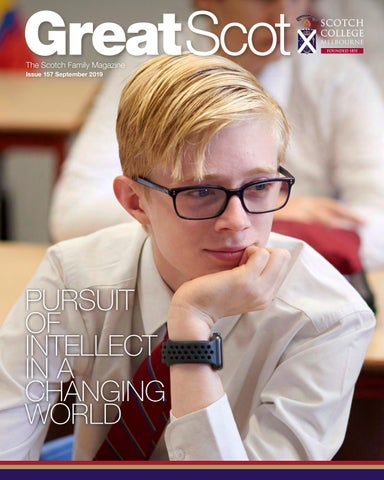
The Scotch Family Magazine Issue 157 September 2019
PURSUIT OF INTELLECT IN A CHANGING WORLD
Contents 1 EDITOR
46 MUSIC
2 CHAIRMAN
50 SPORT
4 PRINCIPAL
56 BOARDING
6 CHAPLAIN 8 FEATURES 10 JUNIOR SCHOOL 16 MIDDLE SCHOOL 17 UPPER SCHOOL 18 SENIOR SCHOOL NEWS
58 FOUNDATION
12
60 DEVELOPMENT
BECOMING MULTILINGUAL Learning a second language opens new horizons
67 OSCA 88 WHAT THEY’RE DOING NOW 91 SCHOOL HISTORY 94 OBITUARIES
38 DRAMA
Publisher Scotch College 1 Morrison Street, Hawthorn 3122 Victoria, Australia Phone: (03) 9810 4321 Email: greatscot@scotch.vic.edu.au www.scotch.vic.edu.au ABN 86 852 826 445 Print Post Approved PP100008172
View Old Scotch Collegians' Association news and updates at: www.oscanet.com.au Like us on Facebook Scotch College and OSCA
OLYMPIAD MEDALS Two boys win bronze in international events
28
The Scotch Family Magazine Issue 157 September 2019 is the official publication of Scotch College, Melbourne.
24
Editorial contributors Durga Kamte, David Ashton, Dean Gregory, Paul Mishura, Scott Montgomery, Tim Shearer
BEAUTIFUL SOUTH AMERICA Great experiences in a vast continent
Editor Durga Kamte (03) 9810 4420 email: durga.kamte@scotch.vic.edu.au Assistant Editor David Ashton (03) 9810 4489 email: david.ashton@scotch.vic.edu.au Production and Art Direction Lisa Sheard (03) 9810 4443 email: lisa.sheard@scotch.vic.edu.au Photography Rob Anderson, Marcel Aucar, Ben Ferguson, Fi Mimms, Gary Fevreu, Scott Montgomery, Scotch College students, staff, parents and Old Boys.
30 LITERATURE FESTIVAL Exciting presentations by creative people
Editorial
‘Where does happiness lie? What is the best life?’ Aristotle ponders these abiding questions in his Nicomachean Ethics – a work which has profoundly influenced Western thinking. His questions on the balance between intellect and action have been in the foreground during scholarly debate on diverse (and often opposing) educational priorities, from the ancient Greek world view to the present. Contemporary educational priorities, among others, require schools to equip students with digital and technological competencies, to be cognisant of global outreach opportunities, to develop strong interpersonal skills, to be inclusive and sensitive to the cultural values of different groups, and to be mindful of gender equality. Reassuring for Great Scot readers is an awareness that the School has embedded many of these values in its educational goals. The question posed by the theme of this edition is whether there is a place
for pursuit of intellect in a world that appears focused on measurable outcomes equating with success in discrete fields of expertise. The answer, for the direction of our School, is a resounding ‘yes’. Rev Doug Campbell notes that ‘intellect is not trivialised’; Principal Mr Tom Batty proposes the translation of ‘intellectual thought to purpose’, and Head of Junior School Mr Jon Abbott acknowledges the paradigm shift from an ‘old’ form of education that focused on imparting knowledge, to one that offers students self-direction in the passions they choose to pursue. The flame of intellectual pursuit burns brightly, as is evident when Scotch boys’ quest for ideas directs them to opportunities ranging from debating, to Enterprise Projects, language extension, international Olympiads, and studies of literature, philosophy and Latin. However, a holistic approach to boys’ development intersects nourishment of the mind with nourishment of skills in sport, music, drama, art and design. In reviewing the content of this edition, it is particularly heartening to note the number of occasions boys in their articles speak of ‘life-changing’ or ‘once in a lifetime’ experiences, while exhorting other boys to take on the challenges of trying something new and different: be it exposure to a published writer, taking a lead role in drama, venturing on a simulated trip to Mars, or boarders’ involvement in projects to benefit farming communities. Scotch values embrace more than individual achievement, and evidence of
desire to benefit the school and wider community is apparent in the 24-Hour Fundraising Day on 8 August, during which Scotch successfully endowed in perpetuity a scholarship in the name of General Sir John Monash. That the target of $750,000 was reached and exceeded quite early in the day, and the final total of $1,319,000, was testimony to the School commmunity’s determination to honour our greatest Old Boy appropriately, and enable boys who may not otherwise have the opportunity to attend Scotch to enjoy an excellent education. The School fervently hopes that these scholarship boys will be inspired by Monash’s determination to solve the challenges he faced and improve the lives of the people he served. The Old Scotch Collegians’ Association is also focused on service, and is conscious of its important role in promoting engagement among Old Boys and the wider Scotch Family. As OSCA President James Douglas (’84) points out in this edition, the association’s engagement strategy is a simple one – to ‘promote the advancement and welfare of Scotch College and its Old Boys’. As James Douglas says, service to others, as exemplified by Sir John Monash in all that he did, in times of war and in times of peace, is a common thread that runs through OSCA’s mission and the three pillars of its strategy – providing reasons to connect, ways to connect, and opportunities to give back.
35
60
68
SCIENCE WEEK A week of discovery for boys and staff
BUILDING AND SCHOLARSHIP PROGRAMS The Scotch Family’s generosity to the fore
OSCA ANNUAL DINNER Nostalgia, great fun and warm fellowship
DURGA KAMTE EDITOR GREAT SCOT
www.scotch.vic.edu.au Great Scot 1
Chairman
Scotch values give direction in a world of change HON. DR DAVID KEMP AC SCHOOL COUNCIL CHAIRMAN
TOP: MS EMMA GATES ENGAGES WITH BOYS IN A SCIENCE CLASS
In a world of startling changes, it is more important than ever to provide schooling that helps our children understand and master those changes. It is important for them personally, for their communities and for Australia. Scotch College is exceptionally well placed to provide such schooling, and with the support of the Scotch community, is working to empower its boys to embrace the opportunities of this remarkable era. The changes in our world that schools must adjust to are too many to list comprehensively, but they include information technology and social media, and the pressures on individuals and communities arising from these media. Simultaneously, governments with limited information increasingly attempt to micromanage change through ever-greater regulation, with the risk of undermining the ability of citizens – press, businesses, schools, churches and communities – to adapt effectively on their own account. Some of the changes that are occurring are very positive, especially the growing recognition in our
2 Great Scot Number 157 – September 2019
liberal culture of the common humanity of every person on this planet, and the growth of a global society, that holds out the promise of achieving a more humane world. Yet within some nations arbitrary authoritarian governments are once again provoking civil strife and causing massive humanitarian disasters, while in democracies there are always those who wish to force their own opinions on others. In one way or another, all such changes impinge on Scotch (and other schools). While increased regulation by governments adds to costs, and new technologies such as mobile phones demand appropriate handling, Scotch as an independent school is able to use its independence to define for itself the best way to handle pressures, and take advantage of exceptional opportunities now arising. The School Council is determined to restrain the growth in fees while ensuring that Scotch remains able to attract the best teachers and support them in their professional task with leading facilities and exemplary grounds.
WILL DIXON, NICK MARKS AND STONE KE RAISE FUNDS FOR THE SIR JOHN MONASH SCHOLARSHIP
Scotch’s values reflect the fact that the School is an expression of the Scottish Enlightenment, and Presbyterian Christian ideals of the inherent spiritual worth and responsibility of each person, of love and service. It is a school with egalitarian values founded in both reason and faith during a nineteenth century struggle for freedom of religion. Its values are briefly summed up in the School’s motto – Deo, Patriae, Litteris – for God, Country and Learning, and on the School crest, under the Burning Bush and arrayed in the angles around the Scottish ensign, the Cross of St Andrew. They symbolise loyalty, patriotism, learning, adventure and enterprise. The School’s Christian origins through its founder, Rev James Forbes, mean that Scotch invites every boy, whatever his faith or belief, to consider the meaning of his life and what he can give the world. Its commitment to patriotism draws the attention of every boy to the privilege he possesses of living in a liberal and democratic nation committed to the equal human dignity of all, and to the freedom of people to determine their own course in life. Only within nations can liberal democracy exist in the world as it is, and patriotism and democracy therefore properly co-exist. Through learning and reason, rejecting prejudices of all kinds, they can work for a better
world; but to do so will require a spirit of enterprise and adventure – qualities that our world can reward in so many ways. These values are reflected in many aspects of the School and its educational program, and were recently exemplified in the 24-hour project to raise money for the General Sir John Monash Scholarship. Over 700 members of the Scotch Family donated together some $1.32m to this scholarship, which remembers a great Scotch Collegian of humanity, heroism, patriotism, loyalty, learning and enterprise. These were qualities that in the Great War of 1914-18 led to success, and in peacetime helped to secure the prosperity of Victorians. Over the years the scholarship will secure opportunities for many boys who might otherwise not be able to attend Scotch. Scotch has successfully produced leaders in every walk of national life, from government and industry, to the professions, to engineering, technology and innovation, to scholarship, literature and the arts – advancing the cause of the dignity of all people. Equipped with a Scotch education, Scotch boys will continue to help build a better world.
www.scotch.vic.edu.au Great Scot 3
Principal
Life of the mind and a life in the field MR TOM BATTY SCHOOL PRINCIPAL
In the midst of a Term 2 discussion regarding considered issues of our times, a Year 12 boy expressed frustration with the behaviour of the many he encountered not sharing his views. In an attempt to ease his disappointment, and soften his landing, I noted that he shouldn’t be too hard on people, as we are all bonkers. Aware of the need to expand, I expounded: ‘You know those thoughts you keep to yourself, that are yours and yours only? Well, we all have them.’ I then put it to him, that, as social beasts, we entertain such a state while attempting to navigate the complex web of the communal world, and that it was, therefore, perhaps unsurprising that we might cause frustration to those around us. I recalled this conversation when lending my mind to the future for intellectual thought in our changing times, I suspect because of the need to establish some primary frame of reference for our condition – in this case our ongoing challenge to connect (and make sense of) all that goes on in our own heads with the world we observe and those with whom we share it. Put another way, the balance we seek, and accept, between a life of the mind and a life in the field. There is, of course, need to consider the nature of an intellect, and here I am drawn to a view of capacity and desire for adaptability in finding clarity, and pursuing truth, amidst the complexity and variety in all we sense and observe. With this, and changing times for behavioural interactions between individuals, groups and organisations in mind, a strong case forms for the presence of forces at work on the nature and place of intellectual thought. Whilst the power of advancements in communication to disrupt order amidst established agencies is nothing new – think language, the printing press, radio, television – the advent of immediate and ubiquitous communication, and the subsequent rise of social media, not only remove authority from established seats of knowledge, by their empowerment of the individual they allow those personal inner thoughts to find like minds. Thoughts once kept to oneself, perhaps out of concern of being considered an oddity, can now locate and connect the other 200 people in the world who might be interested and feel something similar. The potential is enormous – for good and ill.
4 Great Scot Number 157 – September 2019
As the world increasingly becomes more densely connected surface than defined hierarchical steps in a vertical tube, established pathways, that, though perhaps limited for many, were the source of comfort, security and a common belief in ‘truth’ linked to institutions and values bigger than oneself, are being challenged. The relational balance between the individual and that which he/she observes is changing. As individuals share inner thoughts, such views increasingly become those of a collective (however small), and are, therefore, more readily articulated than when remaining the realm of personal ponderings. I would suggest this brings consequences for intellectual thought. Where do reason and the pursuit of truth sit in such construct? How do we, now as a member of an identified group, maintain a sense of ‘the other’, particularly when ‘the other’ is often perceived, or perceives itself, as at the binary pole? The part of education in progressing intellectual thought must enter the fray here: its need to anticipate and meet the requirements of both group and individual. As I have previously proposed, in focussing on the perceived needs of the many, the significance to this of what is best for each child can be lost. Education and qualification make uneasy bedfellows and the discomfort is accentuated when curricula and testing swamp the sharing of passions and mastery. As communication increasingly connects at the micro level of the individual, education must follow suit for the benefit of the group. With the three-headed dragon of education: what we teach (curriculum), how we teach (relationships) and how we assess (qualification), the first and the last have held trumps; generally, I believe, because they allow control by those who wish to control and steer things to (at best) what they believe is in the nation’s best interest, and (at worst) their short-term gain. I would contend, it is the dragon’s second head that should always be primary in driving education planning, and particularly so in an age rich in information. The ‘how we teach’ requires us to consider how best we connect the interests and skills of our teachers and boys. Continuing with familiar theme, my view is that the most important thing an education provides
is opportunity for young people to become passionate about something. The second most important thing is to get them as good as they can be at that which now rattles their cage. I suspect, that, within reason, it doesn’t really matter what it is that grasps energies and imaginations as long as it does so sufficiently enough to be nurtured to mastery. So exposed, being interested and acquiring a degree of mastery becomes habit. Possessing interests, young people are more likely to seek them out, attract others with different passions and hone communal views. Having tasted mastery, young people are more likely to expect it of themselves, observe it, and learn from it, in those they meet and in that which they undertake. I believe such traits build a network of people and
ideas bigger than any individual and establish effective habits of reason and the pursuit of truth. In keeping with such spirit, recent weeks have seen six Scotch boys participate in a Model United Nations conference representing Belgium and Mexico, with all debates and consultations conducted in German. Thirteen rowers, in quad and eight, took to the Thames and performed magnificently at the Henley Royal Regatta, the eight making it all the way to the final where they lost to Eton. Two Year 10 boys and one Year 9 boy claimed Australian Scout Medallions, while Year 7 and Year 8 teams represented Victoria at the National da Vinci Decathlon finals in Sydney. Demonstrating strength of intellect amidst the stiffest of company, two boys earned bronze medals when representing Australia at International Olympiads, one in Physics (Tel Aviv), the other in Mathematics (Bath, UK). Over the mid-year break, 30 members of Scotch Pipes and Drums headed to Scotland, our C Band returning as European Juvenile champions at B Grade, and our B team fifth placed at the Juvenile A Grade. Thirteen boys embraced an expedition to South America, 45 a science trip to the USA, while 53 young Scotchies had minds stretched in i2 Science Camps at the School. In powerful endorsement of the times, the early weeks of Term 3 saw four Year 11 students of our Indigenous Programme head to Pontmain, France, to participate in an international youth forum themed Child Rights in Action: Children as Human Rights Defenders, organised by Change France. And, here along both sides of Morrison Street, works continued apace on projects specifically designed to bring people together in the sharing of ideas, stories, memories, ambitions and talents. Amidst the ever-expanding network of connection, opportunities to demonstrate, and give form to, an intellect multiply. The disruption of those cylindrical tubes, and growing interactions of even our innermost musings, increasingly expose thought to the messiness of our condition – its desire for belonging, affirmation and betterment. It is my view that this increasingly shifts intellectual thought to purpose, from mind to field.
www.scotch.vic.edu.au Great Scot 5
Chaplain
Developing their minds as they develop their passions REV DOUG CAMPBELL SCHOOL CHAPLAIN
During the Term 2 holidays, I visited a Tatts shop and bought copies of Time, The New Statesman and The Spectator. To be honest, I do not normally have time to read magazines, but a vacation is a time for rest and to read the things that intrigue and stimulate. The shop assistant looked approvingly at my purchases and commented: ‘You must be an intellectual’. I took it as a compliment and quickly stammered that I was most certainly no intellectual. I suppose part of this reticence is that for many in the world today, the idea of ‘intellectual’ is generally treated with suspicion or is used as a term of contempt. The lecture was ‘too intellectual’ is a phrase very often heard. The epithet can often be simply a throwaway line that both dismisses the speaker and excuses the listener’s unwillingness, or inability, to engage with the matters at hand. Yes, the concept of improving the mind seems to be passé and out of touch in this ever-changing world. Why improve your mind, master a subject or finely hone a gift or skill when Google will give you the answers and YouTube will teach you the techniques? Australians are ‘can-do’ people who live in this pragmatic age where almost everything, including the pursuit of improving the mind and gaining understanding, comes down to the bottom line. What will improving my mind get me? Will it automatically improve my ATAR? Will it allow me to gain a better job? Will I be able to buy the apartment of my dreams and fill it with more expensive stuff? Why expend the time and effort in exploring deeper into a topic if there is little or no immediate benefit? For many, intellectual pursuit seems at best trivial. Our boys are growing up in a world where ideas and understanding have never been more important, and yet are under attack. There are examples of arguments and thinkers being shouted down by critics who seek to silence their political and ideological opponents. So assured that they are correct, they refuse even to consider the opinions of others, and will do all they can to ensure no one else hears them, too. Sadly, they often seem to base their arguments not on intellectually critiquing the ideas they dislike, but on the basis of their feelings (‘I just feel like …’) or ad hominem arguments. 6 Great Scot Number 157 – September 2019
It is imperative that we pass on to the next generation the importance of engaging, improving and developing the mind. We need to have the boys explore and understand the issues that arise in the world. To be totally prepared, they should be encouraged to read the great works of literature and be aware of the themes they examine. They should learn to grapple with the essays of critics of all political views that try to understand our world. They should listen to the works of the maestros and experience the art of the great masters. Our boys need to develop not only their passions but their minds to understand their world. Life is one of continuous learning. We keep sharing this truth with the boys at Scotch. During Scotch’s Literature Festival, a famous illustrator of children’s books challenged some Year 7 boys to learn how to draw a dragon. He showed them the way to hold their pencils and how to sketch with freedom, embracing their errors and incorporating them into their vision of a dragon. The boys used their minds and imaginations, and in the process they learned new skills. In turn they shared their pictures with the illustrator, and asked him questions about the books he had illustrated and the stories he imagined. They were engaged intellectually and showed a degree of critical thinking. A couple of Year 10s dropped into my office unannounced last term and began to discuss the book 12 Rules for Life: An Antidote to Chaos (Allen Lane, 2018) by Canadian academic and psychologist, Jordan B Peterson. Professor Peterson has become an internet sensation through his internet lectures, and his book is a best seller. It would be fair to say that many have opposed Peterson’s ideas. My visitors had carefully engaged with the book and the advice the author was sharing. Prompted by Peterson’s wider reading, these boys had begun to read some of the works Peterson had mentioned. They were now embarked on a journey through some of the great works of literature by the likes of Fyodor Dostoyevsky, T S Eliot, Alexandr Solzhenitsyn, George Orwell and others. Moreover, these boys wanted to know about my take on Peterson’s use and reading of the Bible. These boys were on a pursuit for knowledge and truth.
God has given us minds and he expects us to use them. The Bible tells us that we are to love God with all our heart, our soul, our mind and our strength. Like Jesus we are to grow daily in wisdom and stature, and in favour with God and man. Mary and Joseph searched frantically for their son, only to find him in the precincts of the temple, discussing the meaning of the Scriptures with the great rabbis and teachers of his day. As Jesus grew in understanding of God and this world so we are to follow in his footsteps.
At Scotch College, intellectual pursuits are not trivial. Boys are encouraged to identify their passions and to develop an all-round interest in this, their world. In an age when the mind and the intellect are downplayed and where the emotional seems to hold sway, it is important for the boys to nurture the mind. By seeking understanding, they will prove to be wellrounded individuals who will be able to critique the world and the ideas that arise, and provide leadership and light to the next generation. www.scotch.vic.edu.au Great Scot 7
Features
THE 24-HOUR FUNDRAISING DAY Twenty-four hours that changed Scotch 3.
1. SCHOOL CAPTAIN, NICK MARKS ; 2. ALFIE HOLUIGUE (YEAR 6); SCHOOL BOYS ENJOYING A CASUAL CLOTHES DAY AS PART OF AND MR BATTY HOLD UP THE CHEQUE. 9. ‘CALL CENTRE’ STAFF
1.
2.
8 Great 8 Great ScotScot Number 156 – April 2019
We’ve seen it before at Scotch. It is undeniable that a fundraising event of the magnitude of the event that occurred on Thursday 8 August can draw a community together and achieve remarkable outcomes. The day certainly seemed to prove that it is sometimes worth diverting from the core business of classes, sport, SACs and whatnot to take a longer view of what a day like 8 August means to Scotch. This year, the Foundation President’s Dinner was delighted to tag team with the official launch of the 24-Hour Fundraising Day, to endow in perpetuity a scholarship in the name of our greatest Old Boy, General Sir John Monash GCMG KCB VD (SC 1877-1881). The dinner which launched it all was full to bursting. Guest speaker, Scotch College’s Head of History, Dr Mark Johnston, held the room spellbound with his compelling and evocative insight into Monash. He reaffirmed perceptions of Monash as a man of character, resolve and enterprise: a brilliant scholar, engineer and tactician; the forever-fond Old Scotch Collegian who dealt with equanimity and grace any prejudice that may have come his way; diplomat, skilled negotiator and post-war national hero. We also saw fascinating and rare footage of George V arriving at Bertangles to knight Monash on the battlefield, and learned of the individual and heroic stories of other notable Scotchies with whom Monash served on the frontline. All present were enthralled. For all the carnival atmosphere tinged with a single-minded focus that would follow in the next 24
hours, merit, achievement and enterprise were the recurring themes of the night. The memorial stone positioned near Scotch’s own Monash Gates proclaims Monash as ‘a man of rare genius’, and Mark’s address certainly provided a special gravitas and impetus as to why this scholarship was such a worthwhile Scotch undertaking. The target was $750, 000 and we had 24 hours in which to raise it. And so it proved to be another remarkable Scotch day – a day when the Scotch Family rallied to the call to raise an astonishing $1,319,000 in the space of a mere day. For those glued to their computer screens: the $750,000 target was achieved at 12.17pm; the next challenge was the $1 million mark (4.01pm); and then $1.25 million (attained with five minutes to go)! Watching the total rise during the day became a somewhat addictive pursuit for those within sight of a screen and the website. Donations were received from all over the globe. It’s hard not to envisage Old Boy and current London resident, Andrew Cohen (’85) following the campaign closely enough that he knew exactly when to press the donation button to ensure we achieved that final amount of $1.32 million! More than 700 families came on board in support of this cause. Many of our donors appended messages explaining why this project resonated so strongly with them. The comments range from those who paid tribute to Monash’s stature as a ‘wonderful human being’, or the merit of the undertaking itself as a ‘great initiative’.
4.
5.
6.
3. JUNIOR SCHOOL BOYS WATCH AS THE TOTAL GROWS BEFORE THEIR EYES; 4. EMMA PRATT IN THE ‘CALL CENTRE’; 5. SENIOR THE FUNDRAISING EVENT; 6. THE BIG SCREEN IN THE QUAD; 7. NICK MARKS HARD AT WORK IN THE ‘CALL CENTRE’; 8. NICK MARKS WITH SCHOOL COUNCIL CHAIRMAN, THE HON DAVID KEMP AC; 10. BOYS GATHER TO WATCH THE TALLY GROW.
Some of our donors alluded to their own deeply personal connections to war and family, among them: ‘Honouring Captain Robert Armstrong Morgan who died at Villers Bretonneux’; ‘In memory of Leonard Arthur Horsfall (1889) died Croisilles France 1917’; ‘In memory of Private Len Cockcroft 37th Battalion AIF.’ Other close associations also found their way into the narrative: ‘In memory of Philip Hudson, designer of the Shrine’; and, ‘Just returned from Amiens and the Somme – very moving and proud to be an Old Scotch Collegian.’ Previous Scotch College scholarship recipients were honoured and pleased to return the favour: ‘Thanks for the opportunity a scholarship gave me, proud to give back.’ Along the same theme from our Year 8 boys: ‘Give someone an opportunity for what we have.’ The very nature of this scholarship and what it would invariably mean to a deserving young man of ‘intellect, character and ambition’ seemed to prompt more philosophical reflections from many donors: ‘A journey into greatness begins with an opportunity’; ‘Thank you for teaching our boys to be good men’; and, ‘In support of service, courage, education and intellectual creativity.’ For all the more lofty ideals – and because boys will be boys – the odd droll comment made its way to the screens: ‘Jerilderie rocks!’ or, ‘TS blackmailed me to do this!’ This article would not be complete without mention of one very striking act of determination and sacrifice connected
to this fundraising effort. Alfie Holuigue in Year 6 decided that he wanted to shave his head for charity, and this ’John Monash thing came up’. The big question was whether it was to be a number 0, 1 or 2. Alfie says that in the end his dad, Nick Holuigue (’89) relented to a number 1. He admits to his hair now being a ‘bit patchy’ – perhaps because his friend Matthew wielded the shaver– but the very good news is he raised $661 and his usually curly locks will grow back! It is worth saying again that the day simply would not have been possible without the exceptionally generous support of our ‘quadrupling’ matching donors, in particular: Graeme Whitelaw (’52); Norman and Pauline Bloom; the Fielding Foundation; those who supported the General Sir John Monash Fund through 2019 Annual Giving; and a substantial anonymous donation. Thank you to everyone who took part to make this happen: Scotch boys, led superbly by School Captain Nick Marks and the Prefects; Old Boys; past and current parents; Penny Nicholls and the marvellous band of volunteers in the Sir David Zeidler Auditorium ‘call centre’; Scotch College staff and the Development Office staff. Congratulations to the entire Scotch Family: we now have two scholarships that will enable boys of intellect, character and ambition to call Scotch home in perpetuity.
7.
8.
9.
PATTY WALLACE-SMITH – DEVELOPMENT OFFICE 10.
www.scotch.vic.edu.au Great Scot 9
Junior School
MR JON ABBOTT HEAD OF JUNIOR SCHOOL
MR JON ABBOTT WITH YEAR 6 BOYS DURING A LITERATURE CIRCLE SESSION
PAUL LIU AND JEEVANTHA RUDOLPH (BOTH YEAR 3)
CHALLENGES AND OPPORTUNITIES IN A RAPIDLY CHANGING WORLD
10 Great Scot Number 157 – September 2019
I am often reminded of the quote attributed to the Greek philosopher, Heraclitus: ‘The only thing that remains constant is change.’ Although the quote is 2500 years old, it is even more applicable to the world today than in Heraclitus’ era. Over the past 20 or so years, since we first entered the age of the internet and the amazing developments in the world of technology and communications that have followed, the rate of change in the world has been exponential. Whereas in my younger years knowledge was critical, today you only have to reach into your pocket and pull out your smartphone to have instant access to almost all of the knowledge we have built up over the past several thousand years of human existence. Knowledge is no longer ‘king.’ Being able to access that knowledge and then understand it and use it to assist in solving problems is one of the keys to future success. The challenge facing educators is how to provide curriculum, experiences and skills development for a world that we can hardly begin to imagine. While change will continue to be the norm and the rate of change is likely to continue to accelerate, there are some things that I believe will remain constant. First, the ability to communicate with others will be critical. I expect though, that communication will probably look quite different to what we are used to now. While we are used to electronic communication through social media, email and FaceTime, we can expect a great deal more of our interactions with others to be electronic. We will still need to have the skills to converse, impart our opinions and ideas to others, listen to alternative viewpoints, and to ‘read people’s body language’ (albeit possibly via a screen). With the ease of communicating across the world set to increase, so too will the number of interactions we have across the globe, both in our working lives and our leisure time. Communication skills will continue to be vital if we are to be effective participants in tomorrow’s society. I also believe that the ability to collaborate effectively will be an essential skill in the future workplace. We will be working with people from across the world on shared projects and, to be successful, we will need to be able to tap into the expertise and skills of others in order to bring about successful outcomes for our own projects. Along with this will be the ability to synthesise various pieces of knowledge and expertise from a wide variety of fields, and then use that to find
solutions and strategies to resolve seemingly unrelated problems. Imagine the following scenario: a team of doctors from London, seeking to develop a less intrusive and more successful method of treating heart conditions, might communicate with engineers in Sydney who have developed new structural techniques that could have implications for cell therapy; while biologists in Mexico City might be able to offer some insights into the properties of plants that can assist introduced tissue from being rejected; and another team of nanotechnologists in Beijing might have developed a surgical scalpel that operates at the molecular level, allowing doctors to achieve more precise surgery and thus a better outcome for their patients. The ability for experts in different fields to tap into each other’s knowledge, expertise and experience will provide them with the opportunity to solve problems that were once thought to be too difficult to tackle. In our past it was believed that successful education entailed imparting as much knowledge into children as we could cram. However, as the ancient Greek biographer Plutarch said, ‘The mind is not a vessel to be filled but a fire to be kindled.’ It has always been the role of schools to provide those essential building blocks of being literate and numerate so that children can access all of the knowledge available to them. Now we also need to be teaching them to be discerning about the knowledge they access in regard to its validity and its usefulness to their needs. Learning should provide children with the opportunities and experiences to develop collaborative skills and mindsets in preparation for their future lives. Our schools need to be providing rich opportunities to nurture and develop creativity and curiosity. We must aim to provide children with as many experiences as possible to solve problems where there may be more than one solution, and to do so with an open but discerning attitude. It will be vital that we assist our young people to ‘know what to do when they don’t know what to do.’ The more we can challenge and provoke the thinking of the children of this generation, the better prepared they will be for the world they will enter. We must work diligently to ensure that the experiences and guidance they are given now will assist them to make the most of the amazing new world that awaits them, and help them to acquire the wisdom and values to use these qualities to achieve changes for the better.
www.scotch.vic.edu.au Great Scot 11
Junior School
LEFT TO RIGHT: EVAN BROUGH, RICHARD CHEASLEY, DONNY MCOMISH, ROHAN KINARIWALA, RIO BARRY
MR JON ABBOTT WITH YEAR 6 BOYS DURING A LITERATURE CIRCLE SESSION
Becoming multilingual: a great way to connect
The more that you read, the more things you will know. The more that you learn, the more places you’ll go. Dr Seuss 12 Great Scot Number 157 – September 2019
This has always been my favourite quote by Dr Seuss, and it is certainly pertinent to acquiring an additional language. Reading and learning, as well as the skills gained in the process of language learning, are not only the ticket to getting around the globe but they are also a way to open another path to successful, international futures. There are many experts in the field, pointing out the great advantages for speaking a variety of languages. Professor Garcia, for example, notes the need for today’s young people to be able to cope with global interactions in a technology-driven world, especially in terms of multiliteracy skills, and the need for multilinguals in international business markets where speaking English is not enough. She makes the following apt observation: ‘… It is stressed that language skills are complementary to other skills such as science, engineering and technology and are not in competition with them, nor are these skills mutually exclusive.’ My most admired experts, however, are our young Junior School boys. It seems they are intrinsically aware that being more multilingual and multicultural is not only more fun (I quote: ‘It’s OK, Frau Cornelia, we have texted each other to practise our part as waiter for the
LEFT TO RIGHT: EDWARD HILLS, NEIL DOSHI, MATHEW SCOULLER, GEORGE BABLIS, JAMIE CHANG, THOMAS CHERK, WILSON CRAWFORD
German Café.’), but the key to building and managing positive social and perhaps future business relationships. Why else would young boys commit to an early morning extension class as well as endless hours of practice in order to gain an internationally recognised certificate issued by the renowned Goethe Institut? Why else would they be prepared to sit a challenging twohour exam, demonstrating not only their growing skills in sustaining a basic conversation, but also being able to extract information and write personal messages? But no matter how well our boys perform in their test to prove their language proficiency, they have begun their linguistic journey with a true appreciation as well as insight into the special qualities of that language. I enjoy listening to them; how they tune into its unique music, and the rhythms, intonations and tones that make up its core. I appreciate how hard they try to come to terms with how language is organised, selecting from a range of possibilities for communication and problem-solving. It is amazing how they engage with the culture and history. They are so curious in gaining an insight into a world beyond their immediate experience.
These boys have done more than learning vocabulary or trying to master simple grammatical points: they are gaining an invaluable skill, an ability to read, interpret and experience the world from an additional perspective. Everything changes when you are able to use the local language. It is amazing how much more open people are when you speak their mother tongue. It also demonstrates to them a great level of respect. Our Language Captain for 2019, Jamie Chang (Year 6), expressed it this way: ‘I struggled at first, did not have a good grasp of the German vocabulary and was too scared to mispronounce words. However, I persevered and eventually overcame my fears. Subconsciously I started to tap into my hidden superhero to learn a foreign language as well as becoming someone who can inspire, lead by example, support and encourage others.’ It seems when you master a foreign language, you can exercise your new superhuman power of being able to understand what someone is saying, recall the proper vocab and grammar, put that vocab and grammar into the proper context, and reply – all on the spot and in a timely manner. You’ve connected. And that is what it’s all about. CORNELIA KOEHNE-DRUBE – HEAD OF LOTE, JUNIOR SCHOOL
www.scotch.vic.edu.au Great Scot 13
Junior School
HEAD OF JUNIOR SCHOOL STRINGS, AMBERLEY BREMNER, WITH YOUNG PERFORMERS
SO MUCH TO STRING ABOUT! Scotch’s strings program strives to support the whole boy 14 Great Scot Number 157 – September 2019
With 165 Junior School boys learning strings, the music department is constantly buzzing. Scotch boys have the opportunity to start learning a string instrument from Prep – violin, viola, cello or double bass. String instrument makers (luthiers) create small instruments specifically designed for students of this age. It’s a wonderful time to engage in music, heightening language, memory, attention, coordination and social skills while developing a lifelong love of music. The Scotch strings program is sequential, supporting and encouraging not only the musical individual, but the social, personal wellbeing and academic potential of every individual. Scotch boys are encouraged to participate in solo and ensemble music making, within school and the wider community.
In Prep, boys commence their Scotch string journey by joining the Suzuki Strings program led by Ms Sarah Ellison. This is an international music teaching method and philosophy encompassing the idea that children learn from their environment. This promotes excellent listening skills, focusing on good technique and establishing a passion for the sound that is being created. All Year 2 boys participate in a classroom strings program, trialling each string instrument and selecting their favourite. Once allocated to an instrument, the boys learn in small groups from specialist teachers and have their first ensemble experience. Following their performance, most boys enthusiastically continue with individual lessons, many continuing to learn strings throughout their school life.
The boys continuing to learn their string instruments make up the Year 3 and Year 4 String Orchestras. This is where the Suzuki and traditional methods amalgamate. The boys learn foundation orchestral skills, learn to be responsible musicians within the team, experience leadership opportunities, and work towards common goals such as recitals and concerts. The Junior School Orchestra consists of Year 5 and 6 string students. This exciting, busy program enhances and consolidates the boys’ passion for string playing. Highlights include the Strings Camp and the Victorian School Strings Festival, where the boys perform and experience workshops with international string professionals. This year the boys were extremely proud to receive a platinum award. Another highlight this year was composing for the Melbourne Symphony Orchestra’s ‘Dangerous Creatures’ composition competition. Boys from Years 3 to 6 can participate in auditioned extension chamber groups. This year there are two groups – Chamber Strings and a quartet – which focus on refining and extending musical and technical skills, while encouraging a strong social connection across year levels. The boys were excited to be awarded first place in the string orchestra section at the Boroondara Eisteddfod … or perhaps it was the celebratory hot chips! The boys are encouraged to perform as soloists. All boys from Prep to Year 6 perform at solo recitals twice per year and some perform at eisteddfods, Music Society Victoria, Melbourne Youth Music and holiday camps. Some boys set personal goals to achieve Suzuki graduations or Australian Music Examinations Board qualifications. Damon Bendschneider (Year 5 violinist) said: ‘Playing the violin has given me courage and confidence. I can now confidently perform in front of large crowds without getting really nervous. I find it really fun playing a string instrument and even more fun playing in an orchestra’. These opportunities and experiences promote a lifelong love and appreciation of music, and prepare the boys for their Senior School musical journey. The Senior School string program, led by James de Rozario (Head of Strings) and Adam Merange (Head of Lower Strings), offers string students incredible opportunities such as wonderful performances, masterclasses and international tours. The boys’ enjoyment of music is established and reinforced by the passionate music staff, who encourage them to practise regularly at home and always strive to achieve their best. It is a privilege to inspire such enthusiastic young musos who are excited about learning and challenging their musical knowledge and skills. Highlights of the Junior School strings program include observing the pure joy and excitement of the Year 2s as they learn to produce a full, rich string sound, and the ‘Giving Bach’ project. In this project, Year 6 string students independently choose a cause in which to share their music. Last year, Year 6 string boys played in aged care facilities, hospital wards and busking to donate to charities, relishing the positive effect of their music. The Scotch strings program strives to support the whole boy by providing experiences to enhance musical, physical, academic, imaginative, social and wellbeing skills. Learning an instrument during Junior School years provides a motivating platform for hard work, dedication, teamwork, leadership and a continuous desire to achieve personal bests. AMBERLEY BREMNER – HEAD OF JUNIOR SCHOOL STRINGS
www.scotch.vic.edu.au Great Scot 15
Middle School
‘I can’t’ becomes ‘that was so much fun’ MS KATRINA STALKER HEAD OF MIDDLE SCHOOL
YEAR 8 BOYS LEARNING ROCK CLIMBING SKILLS AT THE TOOLANGI CAMPSITE
The activities in which Middle School boys involve themselves, in and outside the classroom, have been many and varied over the course of the year. The aim of extracurricular activities is to challenge and extend the boys to look beyond the confines of the Victorian Curriculum. Many boys display interest in the range of diverse pursuits and self-nominate to participate, involving themselves in activities such as Challenge Classes, Poetry Slams, History Bee and Bowl, Robotics, Coding, Chess, Debating, Public Speaking, the Model United Nations and the Water is Life science group, to name just a few. The boys involved in the da Vinci Decathalon team won a place in the national final. Scotch Year 8 boys came first in general knowledge and mathematics and were placed second in codebreaking. The Year 7 team came second in engineering and third in general knowledge, cartography and science, placing them third overall. The opportunities each of these pursuits creates for our boys will prepare them for intellectual challenges in the future, broadening their perspectives and deepening their knowledge. Meeting and competing with likeminded peers from other states helps build friendships that are often pursued into later years. Within classes, boys continue to be challenged to do their best, extend their knowledge and apply their skills to a wide range of subjects. We believe that embracing diverse experiences prepares our boys well for a rapidly evolving world. Inter-form competitions, while also involving sporting events, extend well beyond sport. On
the topic of ‘Starting from Scratch’, Hugh Hasker’s (Year 7) contemplation of the first recorded AFL game between Scotch and Melbourne Grammar secured first spot in the Year 7 event. Joshua Cutchie (Year 8) emerged victorious in the Year 8 competition, after carefully reasoning that ‘The Key to Successful Leadership Today is Influence, not Authority’. In the Year 8 Play, MLC and Scotch worked together to create the very funny 30 Reasons Not to Be in a Play. (A report on the play appears in the Senior School Drama section of this edition.) The cast and crew from both schools thoroughly enjoyed the experience, as did parents and students in the audience. For the first time, all the Year 8s went to the Outdoor Learning Program (Year 8 Camp) during the same week. The logistics behind organising the camp to ensure all boys had the same experience required meticulous planning, and Mr Peter Riley (TIC) along with our providers, Bindaree, Indigicate and Man Cave, are thanked for their hard work. The camp was held at three locations, with the boys moving around between each activity. We used Scotch’s campsite at Healesville for the boys to experience their session with the Man Cave organisation, exploring identity, and learning from Indigicate about early Australian Indigenous history and the people’s connection to land. The boys visited the Toolangi campsite to learn some rock climbing skills and challenge themselves on the high ropes course. In Eildon they prepared for a hike in the surrounding bushland; they also mountainbiked and rafted down the Goulburn River, in rather chilly water. On the night of the hike, boys cooked their own meal on a Trangia stove – the best meal of the hike, more than one boy said! The Year 7 boys also visited Healesville this year to participate in activities with the Man Cave organisation. There was much praise after their visit, and many boys felt they understood their classmates better as a consequence. Project Rockit conducted sessions with the Year 7 boys about bullying, helping them to become people who will stand up for others. During the snowsports beginners’ camp, 48 Middle School boys challenged themselves on the slopes of Mount Buller. The ‘I can’t’ turned into ‘that was so much fun’ and much growth was observed in both ability and resilience among the boys.
Upper School
MR TIM RAYNER HEAD OF UPPER SCHOOL
Connected to and challenged by a changing world
Preparing boys for a world outside of Scotch College could be considered daunting, if one were to read the many publications on the topic: ‘12 ways to help students develop 21st century skills’ … ‘13 essential 21st century skills’, and so on; advice readily available on the internet, and free. And yet a little thought on the matter soon brings us back to the basics of what a rounded education should instil in young minds – the following activities being a small selection of what we currently offer at Scotch. The curriculum we offer does provide opportunity for boys to connect to the world in which they live, but also for them to be challenged. One such offering is the VCE Systems Engineering course. Systems Engineering encourages boys to problem-solve and seek solutions to technical problems. The course recognises that making mistakes is part of the learning process, and that final products are often better because of this. Boys are allowed to work independently, and are required to do much preparation before they can begin to produce final designs. They also have to present their final products to their classmates, as well as explain how they were made. The Scotch Enterprise Project is now offered to Years 9 and 10. Creativity, perseverance and application all come to play in a course that asks boys to find a problem and then work to a marketable solution. Curiosity to want to explore and delve into ideas is certainly cultivated at every opportunity. Boys are given the time and space to run with ideas and to learn from mistakes they may have made. This year an odourless toilet was constructed, while automation also eliminated the need to switch on lights when entering the bathroom. The chief engineer of Caroma, a toilet manufacturer, was invited to school to listen to the boys pitch their product to him. Another group of boys designed greywater pipes that could sense the level of soap in flowing waste water to determine if the water was clean enough to be released onto gardens. Needless to say, many skills would have been learnt from each team in designing and constructing these products. Exploring ideas, reality, and existence, VCE philosophers are challenged to think about, and understand, our lives. Philosophy cultivates curiosity and prepares boys to engage with differing world views in an open and discerning manner. Outside of class, our philosophers have attended philosothons and enrichment conferences that have enabled them to grapple with life’s big questions alongside peers from across the country. Recently boys
MR NICK MILLER WITH BOYS IN AN IDEAS GENERATION SESSION FOR VISUAL COMMUNICATION AND DESIGN
also attended an Ethics Olympiad, with Scotch hosting a senior years and middle years conference. So called soft skills, such as listening and knowing how to respond appropriately to the opinions of others, are gaining more and more currency in today’s society. The opportunity to discuss and debate current topics with boys and girls from other schools and backgrounds, on one level allows boys to sharpen their oratory skills, but also, importantly, on another level, understand others’ perspectives and word views. One such opportunity occurred when five Year 11 boys attended the inaugural McWhirter Foundation Australian Student Conference, which asked its participants, ‘Who should set the limits on free speech?’ This conference, over several days, really inspired our boys and helped prepare them for the future. Model United Nations experiences allow our boys to participate in simulations where they role play delegates from selected countries and compete against student delegates from other countries. Boys learn about international relations, but also have to use debating skills, research and critical thinking to put forward the position of their selected country. Such participation allows boys to learn about the ever-changing political and social dynamics of our world, while encouraging them to empathise with others’ positions. www.scotch.vic.edu.au Great Scot 17
News
WILLIAM SUTHERLAND, DR GARETH AINSWORTH, TOMMY WEI, TIANQI FENG, MS PAULINE CARDWELL, CHRISTOPHER SPARKS, HARRISON LIU, MISS ANNE ORGEOLET, CHRISTOPHER CHAMBERLAIN, MR WARREN PRATT, ALEX PATERSON, DR MARK JOHNSTON
PREMIER’S AWARDS TO SCOTCH’S VCE ACHIEVERS Scotch’s Class of 2018 was well represented at the Premier’s VCE Awards ceremony, which was held in the Melbourne Convention and Exhibition Centre on 3 June. The awards recognised top performing students for their outstanding academic achievements in the 2018 VCE. Two members of the class, Christopher Chamberlain and Tommy Wei, received Top All-Round VCE High Achiever Awards, which are awarded to students who have achieved study scores of 46 or higher in at least five VCE studies. Six Scotch boys received Premier’s VCE Study Awards: Christopher Chamberlain (German), Christopher Sparks (French), Alex Paterson (Ancient History), Harrison Liu (Biology), and William Sutherland and Tianqi Feng (Mathematical Methods). Students must have achieved a study score of 46 or above to be eligible for this award. Congratulating all the award recipients, Victorian Premier, the Hon Daniel Andrews MP said they should all be proud of the work they had put in and the results they had achieved. He also paid tribute to all who had supported the students – parents, brothers, sisters, teachers and mentors. The Victorian Deputy Premier and Minister for Education, the Hon James Merlino MP said the Premier’s Award recipients ‘stood tall’ among the 50,981 Victorian students who attained their VCE in 2018. He encouraged them to reflect proudly on that number, because it highlighted the ‘sheer magnitude’ of what they had achieved. ‘The Premier’s VCE Awards are about recognising both the incredible scale of your success, and the extraordinary amount of work it takes to get there,’ the Minister said. 18 Great Scot Number 157 – September 2019
LEFT TO RIGHT: BACK ROW: MARCUS PETER, FREDERICK HUGHES, NICHOLAS LAROBINA, JUSTIN CHAN
2019 National da Vinci Decathlon
FRONT ROW: LIAM CHEN, ANDREW LI, EDWARD WANG, THOMAS JOHNSTON.
Academically challenging – and a great opportunity to make new friends Sixteen Year 7 and Year 8 National da Vinci Decathlon Scotch boys gathered at Melbourne Airport on 29 June in anticipation of some big days ahead in Sydney. After winning the 2019 Victorian state finals in both Year 7 and Year 8, the Scotch teams were filled with much excitement and enthusiasm. The 2019 National da Vinci Decathlon in Sydney spanned four days. This year’s theme was ‘Heritage’. This extension activity is an academically challenging competition which encourages intellectuals from across Australia to combine their skills and abilities as a team. It covers various disciplines including Mathematics, Science, English, Creative Producers, Code Breaking, Art and Poetry, Ideation, Cartography and Engineering. During the first two days in Sydney we explored many places, including the Sydney Harbour Bridge, the Sydney Opera House
and the Rocks. We also participated in an exciting race around Sydney. Housed in a Knox Grammar boarding house, we got to know other students from different parts of the country. On 1 July at 8.45am the competition we had all been anticipating finally began. It was fierce, with teams of the highest intellectual abilities from across the country competing against each other. All activities were both challenging and fun. The Year 7 team worked cooperatively, giving their maximum effort and team spirit to achieve the best possible outcome in all activities. After being placed second or third in four disciplines they were awarded third place nationally. The Year 8 team won two disciplines and was placed second in another discipline – excellent results overall. Andrew Li (Year 7) commented: ‘My experience in the da Vinci Decathlon was
amazing. On the day of the competition, it was nerve-racking, but the feeling was mutual throughout the entire room. As soon as it had officially started, all the nervousness melted away, as everybody hurried away to begin the tasks assigned to them. Everybody had a great time and made new friends, while still strengthening the relationships between the people they already knew.’ The 2019 National da Vinci Decathlon was a once in a lifetime experience which I will fondly remember. New friendships were forged among ourselves as well as with students from other schools. Thank you to Ms Linossier and Mr Weinert for organising the trip. I would like to encourage every Scotch boy to give this Extension Studies activity a go as I guarantee you will love it! JUSTIN CHAN – YEAR 7
www.scotch.vic.edu.au Great Scot 19
News
USA SCIENCE TOUR AND NASA SPACE CAMP 2019
SCOTCH BOYS EXPERIENCING INDOOR FLYING AT IFLY
20 Great Scot Number 157 – September 2019
Over two weeks in the June-July holiday break, 45 Year 8 and 9 boys, along with five staff, visited places of interest in Orlando and San Francisco, USA, and in between spent a week living the unique Space Camp experience in Huntsville, Alabama. The tour started with a bang, visiting our busiest state, Florida. Fresh off the plane we took part in iFly (indoor skydiving) and an airboat ride, where a lucky few of us saw alligators. The next day was a trip highlight when we visited Universal Studios. This day was full of excitement and was topped off by a behind-the-scenes tour of the park. Our last day in Florida was at the Kennedy Space Centre. It was incredible to see real life rockets and learn about the space program, as well as having lunch with an astronaut. Space Camp was a great opportunity to meet people from all over the world and make long-lasting friends. The week was filled with numerous exciting activities – everything from simulators of space launch to meeting some engineers who worked on the Apollo 11 rocket. Highlights were participating in missions, where everyone took the role of a person on an actual space mission, and learned about the technical challenges of the American space programs and the intricacies of designing a spacecraft. After enjoying a packed five days at camp, we headed off to the Golden Gate city, San Francisco. With San Francisco being the technological hub of America, we toured Silicon Valley, where we got to see the headquarters of some of the biggest technological giants in the world, including Google, Facebook and Intel. We later visited the Exploratorium, a fun interactive museum in which we explored the concepts of science, art and human perception. We visited the University of California, Berkeley, touring around the campus before heading off to the legendary prison, Alcatraz, where we heard about the fascinating and rich history of the island prison. Our final stop was the USS Hornet, a decommissioned US aircraft carrier, famous for its role in the space program, most notably the recovery of the Apollo 11 astronauts after their splashdown. The trip was full of exciting and interactive activities, all the while learning about the mysteries of space. It has been one of the highlights of our time at Scotch.
ABOVE: GRAVITY TRAINING. BELOW: STAFF AND STUDENTS AT THE NASA CENTRE IN HOUSTON
SHANE GAN — YEAR 9 AND HENRY ROGERS — YEAR 8 www.scotch.vic.edu.au Great Scot 21
News
IBSC CONFERENCE 2019: BOYS AND THE ARTS ABOVE: SELWYN HOUSE SCHOOL, MONTREAL. LEFT: DELEGATES AT THE OPENING CONFERENCE
Montreal in Canada was the venue for the 2019 International Boys’ Schools Coalition Conference, hosted by Selwyn House School from 26-29 June. The conference centred on the arts and their role in helping us meet the huge responsibility we have in helping our students become more aware, respectful, open-hearted and responsible people. A key theme was the need for boys to learn to share themselves emotionally for their own mental wellbeing. Welcoming the delegates, former teacher and current Canadian Prime Minister Justin Trudeau elaborated on this concept: ‘When young people have the chance to express themselves fully and explore who they are, they grow up to be more empathetic leaders, committed change-makers and caring citizens of their countries and their world’. In his opening remarks, IBSC President Tom Batty spoke of the wonderful value of the event in bringing together 620 educators from around the world and enabling them to benefit from a concentrated period of reflection. He stressed the importance of the arts in helping us to connect.
22 Great Scot Number 157 – September 2019
Keynote speakers included clinical psychologist, consultant and author Adam Cox, and Sonia Lupien, founder and director of the Centre for Studies on Human Stress. Interspersing the wideranging presentations and workshops were artistic reflections and performances by jazz singer Molly Johnson and her band, rapper Jonathan Emile, director Jean-Mar Vallee, and a plethora of old boys and supporters of Selwyn House School. A recurring theme was the role that the arts play in solving problems and building relationships. The message was very much a positive and affirming one. One important facet of the IBSC involves training selected teachers in an action research methodology, mentoring them throughout the research block and then facilitating the presentation of their findings. Of the 40 participants in the 2018/2019 program, Scotch’s James Kearney (English department) chose a research topic in which he sought to deepen his Year 11 and 12 students’ intercultural understanding. To achieve this, he engaged boys in a theatre project exploring the theme of displacement. Participants interviewed refugees and asylum seekers from Afghanistan, Burundi, Rwanda, and Zimbabwe, and then used these stories in an ensemble play, written and performed by the boys. The project challenged existing perceptions of displaced people, cultivated empathy and respect for them, and validated the unique strength of storytelling in drama as a pathway for learning. The IBSC committee congratulated James for his outstanding work and awarded him equal first place in the 2019 IBSC Action Research Award for ‘completing highly innovative action research projects that make a valuable contribution to the IBSC Action Research community’. Congratulations to James Kearney and to all involved in the 2019 IBSC conference: Barcelona 2020 has a hard act to follow! DANIEL WIGHTMAN – ENGLISH AND ENGLISH LANGUAGE DEPARTMENT
GERMAN MODEL UN CONFERENCE Übung macht den Meister (Practice makes perfect)
A handful of Year 10 and 11 German students sacrificed the first Friday of their Term 2 holidays to participate in the 2019 German Model UN Conference at Bayview Eden Hotel in Melbourne, organised by the United Nations Association of Australia, and involving students from more than 20 schools. This turned out to be an absolutely rewarding sacrifice! The day was spent debating (in German) an overall resolution on the topic of ‘Sustainable Cities’. Tom An, Jim Zhang and I (all Year 11) represented the Kingdom of Belgium, while Alexander Wood (Year 11), Charles Heyburn and Luke O’Brien (both Year 10) represented Mexico. Both teams took advantage of their years of education in the German language to establish and expand on our countries’ opinions on a multitude of clauses within the overall resolution. With frequent use of our bilingual dictionaries, both teams managed to prepare compelling and fluent speeches, and questions for other delegates. Much to the delight of all parties, the resolution was eventually passed, concluding a convivial, challenging and beneficial day. I strongly encourage all German students to participate in this conference, when given the opportunity. It will help you to develop a greater mastery of the language, by improving your on-the-spot fluency and range of vocabulary, while simultaneously allowing you to meet and learn from girls and boys who are studying German at other schools. On behalf of all boys involved, I would like to thank Herr Dr Reifarth for helping us with our preparation and organising us on the day. Without his guidance, we would have been somewhat confused! NICHOLAS KLUCKOW – YEAR 11 RIGHT : SCOTCH BOYS REPRESENTING BELGIUM (TOP) AND MEXICO (BELOW) AT THE MODEL UN CONFERENCE IN MELBOURNE. ARGUMENTS WERE PRESENTED IN GERMAN.
www.scotch.vic.edu.au Great Scot 23
News
WILLIAM SUTHERLAND (YEAR 12) AND ANDRES BURITICA MONROY (YEAR 10): RECIPIENTS OF BRONZE MEDALS IN INTERNATIONAL PHYSICS AND MATHEMATICS OLYMPIADS.
24 Great Scot Number 157 – September 2019
SCOTCH BOYS BRING HOME THE MEDALS IN INTERNATIONAL OLYMPIADS Congratulations to William Sutherland (Year 12) and Andres Buritica Monroy (Year 10), who took to the world stage in July and did Australia proud in separate International Olympiads, coming away with bronze medals in their respective fields of physics and mathematics when ranged against international students of the highest calibre. William Sutherland wrote: ‘The 2019 International Physics Olympiad was the culmination of three different levels of competition: competing with 1700 bright Physics students for the 24 spots at the summer school, then for the eight spots for the Australian Asian Physics Olympiad team, and finally for the five spots in the Australian International Physics Olympiad Team. ‘This year’s Olympiad was held in Tel Aviv, Israel, and individual competitors within the Australian team took home one silver medal and four bronze medals. I was proud to achieve a bronze medal, earning me a placement of 119 out of the 364 participants and second in Australia. ‘The competition was held between 7 and 15 July, but only two half days were dedicated to the actual physics exams. The remainder of the time in Israel was primarily spent touring places such as the Dead Sea
and Jerusalem, and doing activities such as safecracking and rafting down the Jordan River. ‘It truly was one of the greatest experiences of my life to face the incredibly challenging problems of the competition and meet like-minded but diverse people from all over the world.’ Head of Mathematics, Dr Gareth Ainsworth, describes Andres Buritica Monroy’s brilliant performance: ‘The International Mathematical Olympiad (IMO), held this year in Bath, England during July, is the most prestigious and intellectually demanding mathematics competition for high school students in the world. It sees each country send their six finest young mathematicians to compete over two days. Each day the students tackle three fiendishly difficult problems over four and a half hours. ‘Simply receiving an invitation to compete in the IMO is an incredible achievement, as the students are selected on the basis of their outstanding performance in a range of gruelling national competitions. Andres’ superb track record at such competitions earned him a well-deserved place in the Australian team. In the IMO, Andres secured
a bronze medal for his performance, and his efforts contributed to the Australian team earning an impressive 18th place overall. (The full results and the problem sets are accessible at www.imo-official.org.) ‘The competition motivates the training and developing of mathematical talent, and allows students to connect with like-minded individuals from across the globe. In particular, the Australian team has a longstanding friendly rivalry with the UK team, culminating in the Mathematical Ashes, an annual competition between the two teams that takes place in the days leading up to the IMO. This year Andres and his teammates successfully defended the title to retain the Ashes for Australia. ‘The team also took the opportunity to visit Oxford University, where they attended a lecture on elliptic curves by Sir Andrew Wiles (who proved Fermat’s Last Theorem). ‘At Scotch we aim to “remove the ceiling” in mathematics education, to enable boys to develop their mathematical abilities to the highest level of which they are capable. It is wonderful to see students scale to the very heights and have their considerable abilities recognised on the world stage.’
www.scotch.vic.edu.au Great Scot 25
News
A FIRST AND A FIFTH IN EUROPEAN PIPE BAND CHAMPIONSHIPS The Scotch Pipes and Drums have broken new ground for Australian pipe bands by becoming the first Australian school pipe band to win a major championship in the UK.
JOURNEYING ON THE HARRY POTTER TRAIN
Here is Year 10 Pipes and Drums band member ALEX MEGGITT’S account of two Scotch bands’ achievements at the 2019 European Pipe Band Championships in July. During the June-July school holidays, 30 boys, along with Mr Saul, Mr Warren, Mr Birrell, Mr Jones and Ms Morrison embarked on the Scotch College Pipes and Drums' tour of Scotland. From lively, suburban Glasgow to the picturesque and breathtaking mountains of the Highlands and Skye, we immersed ourselves deeply in the culture and heritage of Scotland, whether that was meandering around the ancient bastions of power high atop mountains at Stirling and Edinburgh Castle, or racing to a gargantuan stone pillar known as the Old Man of Storr. We were fortunate enough to be able to play at some remarkable locations such as Stirling Castle, Dunvegan Castle, and most thrilling of all, the windswept battlefield of Culloden, where we marched out to a memorial cairn in the middle of the moor.
26 Great Scot Number 157 – September 2019
Despite the seemingly endless locations to explore and the thrill of practising together to admiring and appreciative tourists and locals alike, we remained focused on the true purpose of the trip – the European Pipe Band Championships, to be held at Inverness. Early in our tour, the two bands performed at a small competition in the picturesque town of Helensburgh. Here we played well, with each band placed fourth. Yet we refused to become complacent. As the European championships drew closer, the intensity and desire for success increased. Before we knew it, the day had arrived. We pulled on our kilts and buckled on our sporrans. The championships were held at Bught Park on the banks of the River Ness. We were greeted by the familiar cacophony of pipe bands playing, and the associated riot of colour and movement of tartan belonging to the 120 bands competing from Scotland, the USA and Australia.
As we stood on the line preparing to take that first step, play that first note, hit that first beat, our breath tightened and our hands became clammy. But before we realised what had happened our playing was over, and so began the anxious wait for the results. Finally, at 5pm, as the rain fell, the judges rose to the podium and the results were announced. A first and a fifth for the two Scotch bands! Jubilation erupted among the Scotch band ranks. Scotch had just made history, becoming the first Australian school pipe band to win a major championship in the UK. On behalf of all the boys, I would like to thank all the staff for making the trip not only possible but also so enjoyable. The access to and insights into Scotland we gained from people with local knowledge, and the contacts we made were invaluable. Our gratitude also extends to our parents, who enabled us to make the journey. ALEX MEGGITT – YEAR 10
TOP – PERFORMANCE AT STIRLING CASTLE; (MIDDLE) CELEBRATING VICTORY AT THE EUROPEAN PIPE BAND CHAMPIONSHIPS; (BOTTOM LEFT) EDINBURGH CONCERT; PIPERS AT STIRLING CASTLE
www.scotch.vic.edu.au Great Scot 27
News
VAST AND BEAUTIFUL SOUTH AMERICA
ABOVE: HIKING THE INCA TRAIL TO MACHU PICCHU. RIGHT PAGE; TOP: SCOTCH BOYS AT THE ENTRANCE TO THE CAMINO INKA-INKA TRAIL. BELOW: BOAT RIDES ON THE AMAZON RIVER
During the June-July holidays, 13 boys and two members of staff visited an array of countries throughout the vast and beautiful continent of South America, in what would become a once in a lifetime trip. For the boys fortunate enough to go on the 19-day tour, much was gained in terms of experiences and memories, which will last for a lifetime. Our journey began after a day of flying and an overnight stay in Lima, Peru, when we embarked on another flight the following day through the Andes with amazing views of the snow-capped mountains out of the window of the plane. This gave the boys our first glimpse of what was to come in the mountain trekking and sightseeing later on in
28 Great Scot Number 157 – September 2019
the tour. We soon passed the mountains and then found ourselves flying over the equally picturesque Amazon jungle, where we would land and reside for the next few days. Our two nights at the Sandoval Lake Lodge went by in what seemed like an instant, with all of the boys occupied in a host of activities including jungle exploring and playing soccer with the locals. Our trip just continued to get better, as in the days following our departure from the Amazon, we were given time in the Sacred Valley located in the Andes for sightseeing among fascinating ancient Inca ruins, to explore the beautiful street markets, and to immerse ourselves in the many highland
customs and cultural traditions. This was a great part of the trip, as boys were able to have some time to relax and acclimatise to the altitude of the mountains, while also being entrusted with a degree of freedom to go around the markets and the village of Ollantaytambo, where many bought gifts for family and friends. After acclimatisation in the Sacred Valley and further acclimatisation in the city of Cusco, also located in the Andes and at an altitude of 3400 metres above sea level, we began a much-awaited part of the trip – hiking along the Inca Trail to Machu Picchu. The hike lasted four days and proved to be both challenging and rewarding, producing
some of the most memorable moments of the tour. Some notable parts of the trail included the second day when the boys ascended 1100 metres to the highest point, known as Dead Woman’s Pass, located at 4215 metres above sea level. This was a triumphant moment for many, as the ascent was one of the more challenging yet rewarding moments of the hike. The campsites in which we stayed provided some amazing opportunities for wonderful photos to be taken of the extraordinary landscapes surrounding us throughout the duration of the trail; but none rivalled the final destination of our hike, Machu Picchu. Following the hike, the boys enjoyed a well-deserved rest overnight in Aguas Calientes before journeying back up from the town the next day by bus to enjoy a fully guided tour of Machu Picchu. After a hot day with the blazing sun shining down on the monument, we embarked on a journey back to Cusco, which involved a scenic train ride through the mountains and a short bus ride before reaching the city by nightfall, and getting up bright and early the following morning to board our flight to Iguassu. The Iguassu Falls on both the Argentinian and Brazilian side were an absolute spectacle, exceeding the expectations of many of the boys. During the two nights that we had in Iguassu, the highlight was undoubtedly the exhilarating boat ride under the falls, in which all of the boys chose to participate. Our time in Iguassu began to draw to a close and so did our trip, as we now had just one day remaining on the continent. Our final day was a great way to end the tour, as we flew to Buenos Aires in Argentina, spent a half-day sightseeing, exploring the colourful markets and visiting many landmarks, before we flew out in the evening, embarking on our 30-hour journey with three stopovers on the way back to Australia. We all thoroughly enjoyed the trip, Ied by the TIC, Mr Zannoni, assisted by Mr Murphy. The boys represented their school commendably with their respectful conduct. TOM POWELL – YEAR 11
www.scotch.vic.edu.au www.scotch.vic.edu.au Great Scot 29
News
'THE TRUTH IS IN THE TELLING': SCOTCH’S LITERATURE FESTIVAL
TOP: FORMER WESTERN BULLDOGS CAPTAIN BOB MURPHY WITH YEAR 8 BOYS. THIS IMAGE: DRAWING WORKSHOP WITH MARC MCBRIDE
30 Great Scot Number 157 – September 2019
SCOT GARDNER AWARD WINNING WRITER FOR YOUNG PEOPLE. RIGHT: BERNARD CALEO, PERFORMER AND COMIC BOOK CREATOR
The theme for the biennial Scotch College Literature Festival this year was ‘The truth is in the telling’. Our aim was to present to our boys a range of creative and outstanding people. It was important that these presenters also had published books, including biographies and fiction, and the list also included creators of podcasts, investigative journalists, columnists and book illustrators. The line-up from which boys could choose sessions featured writers of fiction, and also forensic scientists, artists, mathematicians, sportsmen, authors, lawyers, screen writers, scriptwriters, and people from a variety of cultural backgrounds. Each year level from 7 to 10 had a designated half day, and boys were able to choose two sessions to attend in the morning, which was followed later by a well-known keynote speaker. Boys responded enthusiastically to the presenters: ‘I thought
that the artists that came in were very insightful, and I have taken away some of the information and I’m sure I will use it in my own creative writing’; and ‘the literature festival gave me insight into the lives of many inspirational people that have been able to move past problems and turn them into their strengths’. The keynote speaker at Year 7 level was Danny Katz, a well-known comedian, author of teenage fiction and contributor to Good Weekend in The Age. Speaking to Year 8 was Bob Murphy, former Captain of the Western Bulldogs in the AFL, who has written autobiographical books, and who writes on topical issues for The Age sports pages. Year 9 boys were enthralled by Adam Spencer – author, comedian and Mathematics and Science Ambassador for the University of Sydney – who gave a sensational talk on the magic of numbers and AI learning. Boys
DOCHY’S AUSTRALIAN SCOUT MEDALLION Congratulations to Dochy Creek (Year 9) who has received the Australian Scout Medallion at a Scouting ceremony this month. The Australian Scout Medallion is the highest award in the Scout section, and is considered the pinnacle of Scouting at this stage. Dochy has completed several years’ work to qualify for the medallion, first achieving his Pioneer Badge, then his Explorer Badge and finally his Adventurer Badge. To earn the medallion, Scouts must also run a leadership course and conduct an activity in their district.
commented: ‘Amazing. Interesting. Fun. Funny. Good experience’; and ‘his was by far my favourite. I have some of his books, and he is very engaging and interesting to listen to’. Year 10 boys enjoyed the visit by Indigenous former Sydney Swans star, Michael O’Loughlin, who told his story of becoming a professional sportsman and remaining true to his Indigenous roots. Our goal was for boys to take memorable experiences from this event. We also wanted to engage them in stories and issues they may not have encountered before, and to widen their horizons. Last but certainly not least, we were keen for boys to read the many books that had been produced by the presenters, and all indications are that our boys have done just that. It was a most successful event! WILMA KURVINK – HEAD OF LIBRARY
News
GREAT EXPERIENCES IN i2LEARNING STEM CAMP This year 53 Scotch boys from Years 6 and 7 participated in the i2Learning STEM Camp, held in the Sir Zelman Cowen Centre for Science at Scotch during the first week of the June-July holidays. There were three courses on offer: 3D Printing, Combating Cancer and Building a Lunar Base. 3D Printing
3D PRINTING DESIGN.
STUDENTS DESIGN AND CONSTRUCT A LUNAR COLONY
This year’s 3D printing course was an eye-opening experience for boys and staff. The aim of the course was to equip the boys with the knowledge and skills to use 3D thinking, 3D modelling with TInkercad, and 3D printing, as tools to solve problems in our everyday world. The boys first learned about the current uses of 3D printing and the future of this cutting-edge technology. They were shown the components of a 3D printer, and how the printer works. Then the learning (and fun) started in earnest, as the boys tinkered with the software and the designing process began. Pop-charms, spiders, racing cars, chocolate moulds and bridges were just some of the devices the boys designed and printed over the course of the week. For the boys, the greatest joy and sense of achievement was to see their computer design coming to life in the printers; a creation developing from thought to reality. So many doors are opened and so many minds engaged, once the boys realise the endless possibilities and applications of 3D printing. Who knows where it will go in the future?
Combating Cancer In Combating Cancer, boys explored current and potential methods for the treatment of cancer through a range of hands-on activities. They grew ‘tumours’, modelled DNA, and took an in-depth look at the immune system to discover how it might be harnessed to destroy harmful cancer cells. Boys researched and presented on their
32 Great Scot Number 157 – September 2019
chosen cancer, and learned the side-effects and efficacy rates of the treatments available for the various cancers.
Building a Lunar Colony The boys enjoyed this hands-on course, with many STEM activities throughout the week. The course included two engineering challenges: one was to design and build a model air filter, using simple materials similar to the real life challenge experienced on the Apollo 13 mission; and the second challenge was to design and build a water filter to clean contaminated water on the moon. The students learned many facts about the lunar environment (atmosphere, temperature, light and gravity) and what would be needed to survive on a lunar colony. They conducted a scientific experiment to help them understand the effects of the lunar environment on plant growth. The boys loved designing and building model rockets that were then tested to see if they could travel the distance to a moon target. Finally, the boys designed and constructed their own model of a lunar colony. DR MARTA CASSIDY – HEAD OF SCIENCE
The McWhirter Conference: student voice celebrated
The McWhirter Foundation was named after twins Ross and Norris McWhirter, cofounders of The Guinness Book of Records. The foundation aims to encourage people to think about the principles and practice of good citizenship, the importance of personal initiative and leadership, the value of moral and physical courage, the balance between individual responsibility, and the role of the state and their own role in society. The McWhirter Conference has been held at Oxford University for the past 40 years, apart from 2016 and 2017 when it was held at Cambridge University. Building on the past success, the inaugural Australian McWhirter Conference was held this year at the University of Melbourne on 11 and 12 July, on the topic, ‘Who should set the limits on free speech?’
RION AHL, EMIL EDIRISINGHE, JAY DINGLE, ANDRE RAMETTA
Four Scotch Year 11 students participated in this Extension Studies opportunity. The conference provided a unique educational opportunity for the exploration of student voice in an increasingly politicised climate. The speakers at the McWhirter Conference surprised us with both the variety and complexity of their take on a topic we had assumed to be fairly straightforward. We heard from four guest speakers over the two days; each speaker aimed to provide their own, unique angle on the issue. Sami Shah addressed free speech as a culmination of two concepts derived from Athenian ideologies: isegoria or equal speech – the idea that all speech is equal in weight; and parrhesia or frank speech – expressing yourself honestly and how you want to. As a result, we were exposed to several different perspectives – such as the difficulty
of enshrining a Bill of Rights in the Australian Constitution, the importance of freedom of speech in Indigenous communities, freedom of speech as a powerful tool in abating poverty in migrant communities, and finally, what constitutes ‘free speech’, with reference to ancient Greek culture. We were left with much to ponder following the excellent addresses from wonderful speakers. We gathered into syndicate groups of 11-12 students to discuss the content offered by the speakers. This was a fantastic experience, as it was an opportunity to hear the range of views held by students of different backgrounds. This aspect of the conference also provided us with an opportunity to voice our opinions and interact with the views of others. There were also numerous social events in which students were able to engage with each other and gain invaluable connections. A formal dinner allowed us to meet students from all parts of Victoria, including those from rural areas. Lunches encouraged conversation between student groups. These social events allowed students from all walks of life to come together and share differing opinions extending beyond the conference. To conclude the conference a student panel was formed, where one student from each syndicate group was elected to represent the views of their respective group. This panel answered questions that each group had formed in regard to the central issue. One such question was whether deception – intentional or otherwise – could fall under ‘frank speech’ and therefore be ‘free speech’. There was a wide range of views which culminated in a discussion where many perspectives were challenged and carefully pondered. The mature, thoughtprovoking and stimulating insights formed over the course of the conference invigorated students’ desires to engage in the discourse. It was extremely fitting for a student panel to conclude the conference. The most empowering aspect of this experience was student voice being celebrated and encouraged – it was truly a powerful experience in which young adults gathered to discuss seemingly ‘adult’ issues that exist in present-day society. RION AHL, JAY DINGLE, EMIL EDIRISINGHE and ANDRE RAMETTA (ALL YEAR 11)
www.scotch.vic.edu.au Great Scot 33
News
TOP LEFT AND RIGHT: PROFESSOR CHARLIE TEO ADDRESSING A CAPTIVATED AUDIENCE. BOTTOM (LEFT TO RIGHT) SCHOOL CAPTAIN NICK MARKS INTRODUCES PROFESSOR TEO; ALEX DALEY AND JOSHUA EL-KHOURY PRESENT THEIR PROJECTS; WILLIAM SUTHERLAND SPEAKS OF HIS EXPERIENCES AT THE INTERNATIONAL PHYSICS OLYMPIAD; SCHOOL VICE-CAPTAIN STONE KE THANKS PROFESSOR TEO FOR HIS ILLUMINATING ORATION.
SCIENCE ORATION 2019 Professor Charlie Teo unveils the magnificence of the brain On the evening of 15 August, a sold-out Ian Roach Hall filled with students, Old Boys, current staff and distinguished guests, was the location for Scotch’s seventh annual Science Oration, this year delivered by world-famous neurosurgeon and blossoming TV personality, Professor Charlie Teo AM. Not only has Professor Teo pioneered some of the more innovative avenues of minimally invasive surgery, in doing so saving the lives of so many, his message of hope in the face of seemingly insurmountable odds has inspired people, both young and old, from all walks of life to ascend towards a better quality of life. Professor Teo has trained neurosurgeons all around the world, including at top institutions like Johns Hopkins, Harvard and the Barrow Neurological Institute. He has also received many awards, including a Member of the Order of Australia (AM) award in 2011.
34 Great Scot Number 157 – September 2019
The oration, entitled ‘The Magnificent Brain’, may have first appeared as a slightly obtuse reference to the theme of 2019’s National Science Week, ‘Destination Moon’. However, as Head of Science Dr Marta Cassidy explained in her opening remarks, the very tool we use to explore uncharted horizons is, paradoxically, the very thing we know least about. So, to uncover the secrets of the mind is to give comprehension, and thus greater power, to the human capacity for exploration. Professor Teo’s lecture unveiled many of the underlying features of cognitive function, from memory to the limbic system. Most memorable, too, were the insights provided into the practicalities of surgery, and how technology has, over time, brought drastic changes in the treatment of various, life-threatening conditions like Parkinson’s disease. This, combined with discussions
relating to his own patients and his innovations, exposed the audience to the vast complexity of the brain. Special thanks are in order for such a wonderful night: first, to Alex Daley and Joshua El-Khoury (both of Year 11) who shared their creations of a self-tuning guitar and automated blind system respectively, as well as William Sutherland (Year 12), who spoke on his recent trip to Israel to compete in the International Physics Olympiad. Of course we give due recognition to Dr Cassidy and Dr Bhargava, without whom such a worthy event would not take place. We encourage you to attend next year’s Oration, and continue to help make it one of the highlights of the Scotch calendar. NICK MARKS – SCHOOL CAPTAIN
LEFT: EXPERIENCING VIRTUAL REALITY PODS. RIGHT: CLOSE ENCOUNTERS WITH OUR ANIMAL FRIENDS.
FLYING DRONES, SHOOTING ROCKETS, EXPLODING CHEMICALS AND A TRIP TO MARS Flying drones, shooting rockets, exploding chemicals, the best of science cinema, the beauty of bad science, exploring the properties of dry ice and an enthralling talk by a potential traveller to Mars – all this and much more made Science Week 2019 at Scotch such an exciting and memorable time for boys and staff. Science Week, Monday 12 to Friday 16 August, coincided with National Science Week, and included the Science Oration on the evening of 15 August. It was a very busy week! Here are some of the highlights. Dianne McGrath came to speak to our Year 7 boys. Dianne is one of 28 Australians shortlisted in the international Mars One program (www.mars-one.com). If Dianne is picked from the remaining 100 applicants (from an initial number of more than 200,000) she will be in the first group to head to Mars to try and set up the first permanent civilisation on the planet in 2031. This mission is ‘one way’: Dianne won’t be coming back. Her goal is to prove that we can live as a united humanity in a completely sustainable world. Dianne wowed both the Year 7 audience and the teachers with her drive and commitment to hard work and exploration.
Simon Gooding showed an excited group of students the wonders of Chemistry on Monday at lunchtime in the Lithgow Centre. On Tuesday the Year 9 students were lucky enough to be entertained by Nicholas J Johnson and his ‘Bad Science Show.’ Students were led into looking at the world critically to spot fake scientific news. Growing up in a circus, Nicholas began performing at six, and by age 12 he was in demand as a professional magician performing at festivals and events around Australia. By 18, he was an award-winning science communicator, winning the ACT Science Prize and working with the CSIRO and Questacon. Nicholas combines his passion for magic and science as a science communicator, entertainer and expert in deception, working to uncover con artists. This was a highlight for many boys. Our Year 8 boys were taken through an interactive and fun wildlife show, as part of their regular Science class this week. This followed the reproduction unit studied earlier in the year, and the workshop introduced a variety of animals with very different
reproduction strategies, behaviours and life cycles. Concepts and terms such as viviparous, oviparous, marsupial, monotreme, eutherian (placental) mammal, temperature gender determination (as with crocodiles), hemimetabolism versus holometabolism, and asexual versus sexual reproduction were taught in a fun and interesting way. Animals included a sea star, a shark egg case with a baby shark, a pot-bellied sea horse, a grey-headed flying fox, a koala, an echidna, a diamond python, a green tree frog, a saltwater crocodile, a giant burrowing cockroach and phasmid species. During class times, teachers could also book their classes into interactive sessions such as watching winning entries in the science short film festival in the Sir David Zeidler Auditorium, attending the GOAT-VR virtual reality pods, experimenting with dry ice and edible cells, flying drones to the moon in the foyer, and even attempting a moon escape room! DR MARTA CASSIDY – HEAD OF SCIENCE
www.scotch.vic.edu.au Great Scot 35
Staff in profile
Do you gain inspiration from seeing what Year 12 boys achieve after leaving school? Absolutely I do. Actually, it’s delight rather than inspiration. I’ll bump into a young Old Boy while out and about and it’s always a thrill to hear about their travels, their studies and their career steps. I’m invariably with one of my own children at the time and I’m always proudly and embarrassingly making sure that my kids look and listen.
Interview: DI MCNAMARA Administrative Assistant, VCE Office What was your work background before coming to Scotch? I was a Chartered Accountant with Ernst & Young for more than 10 years before Scotch; it was an ideal start to working life. Not unlike the Scotch approach for the boys, the environment was both fostering and well ordered, and the recruitment was such that you joined the firm in groups. So before I knew it, I was part of a team of co-workers among whom I’ve found many lifelong friends and a husband!
36 Great Scot Number 157 – September 2019
What are the challenges and enjoyable moments of your job? It’s ironic but the more I contemplated this question, the more I realised that the challenges and the enjoyable moments were one and the same. The day of the General Achievement Test and the three-week VCE examination period are definitely the pressure points of this job. There are many potential mishaps to anticipate when over 400 boys are required at the same place at the same time. It’s a challenge to pre-empt and resolve eleventh hour hitches but it’s also very rewarding to do so.
What are some of the amusing or memorable moments which have occurred during your career at Scotch? Late last year I overheard Drama teacher, Ophelia Hopkins, lamenting that some of the accents used during the casting for this year’s Senior Musical, Fiddler on the Roof, were suggestive of Irish or Indian roots rather than Russian Yiddish ones. I immediately piped up and offered my Mum as a fix. ‘Ophelia,’ I said, ‘my mother, Rita, has as much of a “Jewish” accent as she has chutzpah. She will come in and sort this out for you!’ Days of accent instruction and pages of cultural advice followed. Mum delighted in the process, imploring various cast members to ‘shrug your shoulders more’, ‘eat more!’, ‘drop the pleasantries – be more abrupt’, and ‘did I mention, you should eat more?’. I’m not sure that the cast enjoyed Rita’s coaching, but I know it’s been the highlight of Mum’s year so far! What is your favourite corner of the School, and why? The Commerce corner on the upper level of the Quadrangle always draws me in. A VCE Accounting class in session is my favourite lesson to walk by. Overhearing the teaching of all things financial is like music to my ears, and I’ll take many long-cuts past these classrooms just to hear a snippet. What are your hobbies and interests, away from school life? Having lived through our family home renovation over the last 18 months, I’m fascinated with architecture at the moment; all kinds, but the 1950s style is my favourite. And I’m always interested in art and jazz; also the 1950s kind! For me, Dave Brubeck’s Take Five never gets old.
What inspired you to become a teacher? I took quite a circuitous route. After I finished high school, I wasn’t sure what I wanted to do, but I knew I liked literature and humanities, so I started an Arts degree at the University of Melbourne. At the end of my first year, I transferred into Media and Communications; and then, once I finished that, I went back again to study Law. I spent a couple of years working at a large commercial law firm and realised that it wasn’t for me, so I returned to study again to complete my Master of Teaching. Looking back on it now, it seems like a logical place for me to have ended up. I love learning (which is probably why I’ve spent so many years studying!) and education was very important in my family. My parents both studied as mature aged students when I was growing up, and both eventually became teachers after having other careers. My closest friends are also teachers, and I guess it was only a matter of time before I joined them. What are your roles at Scotch and what do you enjoy about your work? I am currently Acting Deputy Head of English and teach a combination of English and Drama. I also coordinate our Year 12 English course and assist with our Drama productions and the Drama Immersion Program. What I like most about my job is that I get to interact with people every day. When I was a lawyer, I spent a lot of time behind a desk communicating with clients over the phone or by email. In the classroom, I get to work with some wonderful young men who constantly surprise me and challenge me, and make me laugh. I also enjoy being able to work with my colleagues in the English and Drama departments, who are some of the smartest and most generous people I know. What student expressions of growth impress you? It’s always nice to look at my class lists at the start of the year and see some students who I’ve taught previously. I’ve taught about half of my current Year 12 English class before – some as far back as Year 7 – and it’s great to see how they’ve grown and changed since our paths crossed previously. I see the same thing in our school productions, where we get to watch students grow as performers from year to year. A student might have had a small role when
Interview: JAMES KEARNEY English and Drama teacher he was in Year 8 and then end up in a lead role when he is in Year 12. It’s great to see that progression, and to see the students rise to the challenge when they’re given the opportunity to show what they’re capable of. What is your favourite place at Scotch? I love the Geoffrey McComas Theatre. I’ve been around theatres all my life, and the GMT is an incredible space for the students and staff to work in. I particularly enjoy the atmosphere down in the Crucible before a performance. There’s a lovely energy in the room as the cast starts coming downstairs in costume to get their make-up done. There’s been a tradition of one of the crew boys writing a riddle up on the whiteboard and there will usually be some kind of pre-show playlist going. During our Senior Musical, Fiddler on the Roof, we had a lot of Hamilton singalongs featuring both students and staff. And then
everyone would start gradually heading back upstairs to finish getting ready for the performance. What advice would you give to Year 12 students as they leave Scotch? I would tell them that it’s OK if it takes them a while to work out what they want to do. Sometimes I worry that students feel pressured to finish high school with a clear idea of what they want to do for the rest of their lives. Sure, a lot of our students do know what they want to do when they graduate, but there are also many students like I was at their age, who don’t have a clear career path in mind, or who will find that their chosen career path isn’t what they expected. I’d encourage them to try different things and focus on what they want to do next, while they work out what their life after Scotch might look like in the longer term.
www.scotch.vic.edu.au Great Scot 37
Drama
LOTS OF REASONS TO BE IN A PLAY – DESPITE THE TITLE The 2019 Year 8 Production, 30 Reasons Not To Be in a Play by Alan Haehnel, is a very funny little play, setting out 30 very good reasons why you should not be in a play. For example, it can cause conjunctivitis, give you warts (from holding hands with the wrong cast member) and, much more dramatically, even lead to catastrophic weather conditions. The play was staged in the Geoffrey McComas Theatre from 31 March to 2 April, in conjunction with MLC. Here is a reflection by JACK ARMSTRONG of Year 8. The Year 8 play, for me, was an amazing experience. Some people ask why you’d want to do a play, and I usually say ‘simply because it’s fun’, but there is obviously much more to it than that. It’s not just about the play and the rehearsing, it’s about the experience and the process of meeting random people (of the opposite gender) and becoming and progressing as friends while the play develops. It took up so much time in my week in the best way possible. When we had a rehearsal after school, my friends and I were excited and couldn’t wait – it literally made the whole day seem so much better, therefore meaning that throughout the whole term there was something to look forward to. When I think of Term 1, I generally think ‘wow, that was short’, but when I look back at everything that happened, it was actually incredibly long and jam packed. At the start
38 Great Scot Number 157 – September 2019
of the play it was hilarious how shy and awkward everyone was with each other, but now we’re all so close it’s as if we’re family. I honestly can’t remember what it was like without the people I’ve met. Due to social media and the land known as Glenferrie Road, we all got to know each other very quickly. Because we were doing all of these things separate to the play rehearsals, Mr Waugh seemed shocked, as every time we arrived at rehearsal it was clear that we had all got to know each other so well. All of the cast and crew were so nice and genuine, and I think every boy has made some sort of a connection with many of the girls – I know that I certainly have. The play also gave me many opportunities, such as speaking in Memorial Hall. Sure, I was completely terrified doing it, but it was good to see what it’s like, and I now know that I will easily have the confidence to present the daily notices when I am in Year 12. All in all, the play was possibly the best experience I have had at Scotch so far. It made the term so much more fun, and I found some friends for life. Although the play was called 30 Reasons Not To Be In A Play, those are just a few reasons why you definitely should be in a play!
www.scotch.vic.edu.au Great Scot 39
Drama
A POETIC CELEBRATION OF OUR CONNECTION TO THE BEACH
Beach: a Theatrical Fantasia, an Australian play by Timothy Daly, was the 2019 Year 9 and 10 Play. The play explores the special affinity Australians have with the ocean; how our cities hug the coastline, and how beaches bring back childhood memories. But beaches can also harbour our greatest fears. The play is a poetic celebration of our connection to the beach over the past 150 years. At my audition for the play, I could not have foretold the impact this production would have on me. It seemed like the beginning of just another play, like those I had been part of last year and the year before. But this time I had the opportunity of playing a lead role. I was both elated and terrified, but play rehearsal quickly became the highlight of my week. The production helped me grow as a performer,
40 Great Scot Number 157 – September 2019
established new friendships and strengthened existing ones. This year’s 9/10 Play was brought to life by our talented director, Ms Christensen, and our cast and crew from Scotch and PLC. After three months and uncountable hours of rehearsal, production week began. It was all a wild fusion of pleasure, stress and pumping adrenaline which all wrapped up spectacularly on the Geoffrey McComas Theatre stage on the nights of 23 to 25 May. I speak for myself and for all the cast and crew – this has been an experience to remember and cherish. BEN DALEY – YEAR 10
www.scotch.vic.edu.au Great Scot 41
Drama
FIDDLER ON THE ROOF – three exhilarating hours of song, acting, dance and culture This year’s Senior Musical, Fiddler on the Roof, performed in the Geoffrey McComas Theatre at Scotch from 1 to 3 August, was a wonderful celebration of this classic musical. Presented in conjunction with PLC, the production was set in Anatevka, a small Russian village, at the turn of the 20th century, Tevye struggles to maintain his Jewish religious and cultural traditions, as outside influences encroach on his family’s lives. This classic, Tony Award winning musical by Jerry Brock, Sheldon Harnick and Joseph Stein, opened on Broadway in 1964 to rave reviews. The show is highly acclaimed for its beautiful music and its subtle exploration of faith and family that resonates through the ages and across cultures. An ensemble of 36 students performed in the show, supported by a wonderful orchestra and backstage crew. Many of the Year 12 student performers, including Drama Captain Charlie Veitch (playing Tevye) and Drama Vice Captain Rex Cameron (playing Lazar Wolf), have been treading the Geoffrey McComas Theatre boards since Year 7. What a joy it was to see them rise to the challenge of this show as young professionals! This show was particularly complex for our backstage crew, and it marked the fourth production stage managed by Drama Vice Captain of Production, Henry Johnston
(Year 12). We congratulate all of the students involved on an excellent season. CHARLIE VEITCH enthuses about Fiddler on the Roof: For many of the boys and girls involved in our senior musical, this was our final chance to perform on the Geoffrey McComas Theatre stage – and what a wonderful way to go out it was! From the get-go, every one of our cast and crew was ready, willing (and mildly intimidated) to conquer this incredible three-hour behemoth filled with song, acting, dance, and of course the ins and outs of Jewish culture. What I love about each production at Scotch is the opportunity it gives me to expand my skills as a performer, and how it always keeps pushing me to try new and exciting things. This year several of the boys took on the challenge of flexing our seriously lacking dance muscles, and it ended up being one of the most enjoyable aspects of the show for me! I have no doubt that when I look back on my experiences at Scotch, this year’s production of Fiddler on the Roof will stand out above the rest – it was an absolute delight to perform, and I can’t thank all those involved enough for creating such a cracking show. Mazeltov (congratulations), l’chaim (to life), and of course, nostrovia! (cheers!). OPHELIA HOPKINS – SENIOR SCHOOL DRAMA STAFF
42 Great Scot Number 157 – September 2019
www.scotch.vic.edu.au Great Scot 43
Drama
JANE EYRE – BRINGING A Jane Eyre by Charlotte Brontë was the PLC-Scotch Senior Play this year, a coming of age story set in 18th century England which explores the troubles of a tough and independent woman on a quest for love and equality. The students from the two schools performed the play in the new, state-of-the-art PLC Performing Arts Centre on 25, 26 and 27 July. We had the pleasure of working with a talented group of girls from PLC, with whom we collaborated ideas and techniques to bring this classic novel to life. Jane Eyre is based on author Charlotte Bronte’s personal experiences. In the Victorian period, the assertive character of Jane creates a sharp contrast to a male-dominated society, where women were viewed as acquiescent and powerless. Jane is dealt an unfortunate hand of fate, forced into living with her cousins, who ostracise and taunt her mercilessly. Following her several years at the austere Lowood School, she finally musters the courage to flee, and later finds work as a governess at the daunting Thornfield Hall, where she first meets her wealthy and impetuous employer, the Byronic hero, Edward Rochester. The story unfolds in a complex though ultimately doomed romance between Jane and her new employer. First published in 1847, the novel still resonates as an assertion of gender equality and empowerment.
44 Great Scot Number 157 – September 2019
CLASSIC NOVEL TO LIFE Over the course of five months under the careful guidance of PLC Drama Director, Ms Cath Garrett, formerly a drama teacher at Scotch, the cast members worked in a dedicated and creative manner to create original personas for their characters, and bring the audience a richly rewarding performance. The crew worked tirelessly on the set, recreating a gloomy Thornfield Hall complete with dusty armchairs, stuffy antiques and grand fireplaces. The lighting and sound helped embellish dramatic scenes with a house fire, thundering hooves of horses and a wild evening storm. Special acknowledgment must be given to the brilliant original musical score written, performed and recorded by PLC students. Among cast members, I played the part of Mr Rochester, Nick Finster (Year 11) played Richard Mason, Charlie McDonald (Year 11) played Mr Brocklehurst, Leo Miller (Year 12) played Sir John Rivers and Lachlan Tingate (Year 12) played Mr Woods. Our involvement in the production of Jane Eyre was an amazing journey, and an experience I’m sure everyone involved will cherish. SAM COLLINGWOOD – YEAR 11
www.scotch.vic.edu.au Great Scot 45
Music
A WIDE SPECTRUM OF SCOTCH MUSIC In preparation for the annual round of concerts, Choir Camp, with almost 200 boys, segued neatly into the Autumn Concert season where some 500 boys performed over two nights. The concerts involved the Symphony Orchestra, the Intermediate Orchestra, two string orchestras, four symphonic bands, three choirs, and four stage (jazz) bands. Both concerts attracted full houses. Our top two show bands made the annual trek to Mt Gambier for the Generations in Jazz competition. The competition involves literally thousands of performers, and gives everyone an opportunity to hear some outstanding professionals as well as other school ensembles. The orchestra’s Winter Concert opened with The Wasps Overture by Vaughan Williams, followed by Lincoln Poon (Year 12) performing Dvorak’s Cello Concerto. The second half comprised a performance of César Franck’s D Minor Symphony. It was a challenging program for the Symphony Orchestra in preparation for the tour to America in January. A popular ‘tradition’ has developed, whereby the Winter Concert is premiered to the residents of various senior citizens’ residences in the Scotch vicinity. The ladies and gentlemen are brought in by volunteers, and they love it!
46 Great Scot Number 157 – September 2019
ABOVE: MAX FOSTER AND VATCHE JAMBAZIAN TAKE A BOW AT THE PRO MUSICA CONCERT. TOP LEFT: LINCOLN POON PERFORMING AT THE WINTER CONCERT. TOP RIGHT: CHOIR AT THE WINTER CONCERT, BOTTOM LEFT: BAROQUE ENSEMBLE, CHAMBER MUSIC DINNER. BOTTOM RIGHT: SYMPHONY ORCHESTRA, WINTER CONCERT
One of the highlights of the music calendar is the annual Chamber Music Dinner and Concert. This year it opened with a harp trio, and, as well as the usual string quartets and piano trios, featured an exceptional percussion ensemble, fresh from winning a national title at the Australian Percussion Eisteddfod. Scotch has an established history at the Australian Percussion Eisteddfod, with our boys known for their collegial approach to all competitors, humility in success and grace in defeat. While awards are not the motivation for participation in this event, the boys’ achievements should nevertheless be acknowledged. Congratulations to the drumline for being placed first in division B national drumline, to Tapas ensemble for their second place in chamber ensemble (only behind a hand-picked, non-school based group), and also to Adam Pai (Year 10) for his honourable mention in the fiercely competitive senior secondary marimba section. In Term 3 there are three particularly large-scale concerts (aside from the Foundation Day Concert). The Strings, Choirs and Bands Concerts all involve boys from the Junior School through to Year 12,
and give the younger boys an opportunity to see where their musical journey leads. The Bands Concert this year involved some 350 boys. Two other concerts are worthy of mention. One was the Old Scotch Symphony Orchestra’s performance of Mahler’s Symphony No 1, the Titan. The performance sparked a well-deserved standing ovation – a rarity at Scotch! The other concert was an initiative by Adam Pai of Year 10. He organised an orchestra of 60 musicians (boys and girls) through friends and social media from five different schools. The program included Tchaikovsky’s Violin Concerto (with soloist Leon Fei, Year 9), Mozart’s Double Piano Concerto and The Merry Wives of Windsor overture, all conducted by Yuki Goh (Year 12). Yuki is a prominent member of the Maestro Club (a conducting class which I lead every Tuesday). The concert, on 24 August, raised more than $2000 for the Skyline Foundation, an education charity. A very special concert took place on 20 July. Pro Musica, our orchestra that comprises staff, other professional musicians and advanced students, performed the Poulenc Double Piano Concerto with soloists Max Foster (‘09) and Vatche Jambazian. Max won the ABC Symphony Australia Young Performer of the Year Award in 2008,
and, on leaving Scotch, won a scholarship to the Juilliard School in New York. He is now completing his doctorate in America, but was on tour in Australia with Vatche during July. The concert also featured our senior trumpet teacher, David Musk, in partnership with our oboe teacher, Anne Gilby, in a performance of Copland’s Quiet City. ScotchArts, our professional concert series, has continued, with two wonderful concerts. Wilma Smith, former Concertmaster with the MSO and our Chamber Music Artist-in-Residence presented Wilma and Friends concerts of superb and eclectic chamber music. An unusual accolade goes to Geoff Liu (Year 7). Following early rounds in Melbourne, where he came third in an international competition, he was invited by the American Protégé Committee to perform in Carnegie Hall as part of a Winners’ Recital. What an unforgettable experience, and honour. JOHN FERGUSON — DIRECTOR OF MUSIC
www.scotch.vic.edu.au Great Scot 47
Music
SENIOR STRING WORKSHOP – A BIG, RICH SOUND Nearly 100 Scotch and PLC strings players enjoyed a productive afternoon of rehearsals
48 Great Scot Number 157 – September 2019
Scotch’s senior string orchestra, Academy Strings, had the opportunity to work with PLC’s counterpart during the Senior Strings Workshop, held on 22 March. We were lucky enough to use the modern facilities of PLC’s brand-new performing arts centre, and in conjunction with girls from the Tokyo College of Music, the three groups rehearsed and performed two pieces – the first movement from Grieg’s Holberg Suite as well as Hoedown from Copland’s
LEFT AND THIS PAGE: ALAN XIONG AND JUSTIN SHENG PERFORMING WITH STUDENTS FROM PLC
Rodeo. We worked with Mr Robert John (PLC’s Head of Strings) as well as our own Mr James de Rozario (Scotch’s Head of Strings). Working with nearly 100 players helped filled the hall with a big, rich string sound that is only possible with large numbers – something that neither school can produce on its own. PLC and Scotch also performed and rehearsed their own pieces, which helped each school appreciate different approaches to rehearsal technique, phrasing and tone production. The breaks
from rehearsal provided Scotch boys with an opportunity to socialise and get to know their peers from PLC, and to watch Vice Captain of Music, Yuki Goh (Year 12), perform his spectacular magic show. After a productive afternoon of rehearsals, a small presentation was held for the parents, which was an enjoyable way to conclude this constructive workshop. NICHOLAS NOLAN – CAPTAIN OF STRINGS (YEAR 12)
www.scotch.vic.edu.au Great Scot 49
Sport
MANY FINE ACHIEVEMENTS IN A COMPETITIVE WINTER SEASON
TOP LEFT: NICK FINSTER (CROSS COUNTRY). TOP RIGHT: THE FIRST XVIII AFTER THE CORDNER-EGGLESTON CUP GAME. ABOVE LEFT: PRESENTATION OF THE VIC INTERSCHOOL SNOWSPORTS TROPHY. ABOVE RIGHT: FINN MAGINNESS (1ST XVIII FOOTBALL) KICKING ONE OF HIS FOUR 2ND QUARTER GOALS IN THE CORDNER-EGGLESTON CUP
The winter season provided some significant highlights for our firsts teams. We were highly competitive in most sports, and had two of our firsts teams go agonisingly close to winning unlikely premierships. The 1st XI Soccer team started with a 2-2 draw against Carey Grammar School and then proceeded to win the next seven games. The boys played inspired football for most of the season, and combined a strong
50 Great Scot Number 157 – September 2019
attacking game with a tight defence. We scored a total of 33 goals for the APS season, which included hat-tricks to Captain Josh Allen (Year 12) on two occasions and also to Hamish McRae (Year 12) and Luke Clifford (Year 11). The final game of the soccer season will be talked about for years. Scotch led 3-0 against Caulfield Grammar, and on the verge
ABOVE LEFT: JACOB DAVIS (1ST BASKETBALL). ABOVE MIDDLE: SAM MURDOCH (1ST HOCKEY). ABOVE RIGHT: JOSH ALLEN (1ST SOCCER)
of winning the APS premiership we conceded five consecutive goals, and were only able to salvage a 6-6 draw. Carey won their final fixture, and despite our team going through the season undefeated, we finished second. The team also retained the Pelman Cup against Peninsula Grammar and the Rose and Thistle Cup against Melbourne Grammar School. The 1st XI Hockey team finished with nine wins and two losses. This included a final round victory against eventual premiers Wesley College, 2-0. The team went from strength to strength as the season progressed, and continually found ways of scoring. Unfortunately, a loss to Carey Grammar in the second last round ruled out a chance to contend for top spot. However it was an amazing season for our boys and bodes well for the future, with Oliver Marshall and Finn Hodder (both Year 10) excelling. Captain Luke Westmore (Year 12) was an inspirational leader, and put his body on the line each week for the betterment of the team. The 1st V Basketball team won eight games and lost four, to finish fifth overall. Remarkably, our School Captain, Nick Marks, returned for his fourth consecutive season in the first team. Unfortunately we lost key moments and subsequently games, and failed to qualify for the top four redraw. However the team won its final four fixtures for the season. The cross country squad had another positive season, with Captain Benjamin Beischer (Year 12) leading the way at training and competition. Scotch finished in fifth place, and showed great depth. Despite a tough opening round loss, the 1st XVIII Football team competed well throughout the season and threatened in most games. The team finished with three wins and a draw from their 10 fixtures, and were eighth. The highlight of the season was the Cordner-Eggleston Cup win against Melbourne Grammar on the Main Oval, with Scotch emerging as eventual winners by 14 points in a low scoring affair. Captain Finn Maginness (Year 12) kicked four goals from the midfield in one quarter, and was the most influential player on the ground. The Rugby 1st XV again found it hard to compete in the Victorian Schools Rugby Union first grade. The boys tried their very best but were outclassed and outmuscled by stronger opposition. Although we were winless in the home and away season, we certainly won much admiration among those who watched the boys attack the game in each fixture. The final game of the season was against Carey Grammar from second division, and we won 50-0, highlighting the huge gap between the competitions.
The Snowsports team won the Victorian interschools competition for the third time in the last five years. It was another close contest against Melbourne Grammar, with the result determined on the final day of six days’ racing. Tamar Stafford (Year 11) won the Bernd Greber Cup, which is awarded to the interschools competitor who is the most successful across all skiing disciplines. Angus Hill (Year 11), William Atwell (Year 9) and Edward Hill (Year 7) achieved great success, each winning individual honours with first places in moguls, divisions one, two and three, respectively. The Winter Tennis and Table Tennis firsts continued to win most fixtures, while fencing continued its success with strong individual performances in the schools league competition. Daniel Fernando (Year 9) was equal first in the junior secondary competition, and many other boys performed well. Both the junior and senior teams were eventual winners in the schools competition, Scotch’s fifth season victory in a row. The gymnastics squad also had its share of success, with Jack Harvey (Year 11) winning five of six open A events in the Wesley College invitational event. Our open B grade team finished second in their competition. In the Victorian Interschool Championships, Scotch did well to finish second, with Jack Harvey second in the A grade division. Highlights at other sporting levels included undefeated seasons for our 2nd XVIII footballers, our Year 9/10 hockey players and the 7A and 10A basketball teams. The following boys were selected to represent the APS in representative games against the Associated Grammar Schools of Victoria: CROSS COUNTRY Benjamin Beischer (Year 12) and Jean-Philippe Soulie (Year 10) FOOTBALL Jesse Castan (Year 11), Todd Garner (Year 12) and Jamarra Ugle-Hagan (Year 11) SOCCER Josh Allen and Irfan Hrelja (both Year 12) HOCKEY John Kilroe-Smith, Alex Paterson and Luke Westmore – Vice Captain (all Year 12) As the curtain fell on another winter season, spring season beckoned for more than 500 boys who chose to participate in athletics and water polo. This was a credit to all these boys, who wanted to take advantage of these opportunities to challenge themselves. It was a great testament to their willingness to try all things and live full and enriching lives. STUART POWELL — DIRECTOR OF SPORT
www.scotch.vic.edu.au Great Scot 51 7.
Sport
TOP: THE SCOTCH 1ST EIGHT RACING BEDFORD SCHOOL AT THE START ON WEDNESDAY AT HENLEY ROYAL REGATTA; TEMPLE ISLAND IN THE BACKGROUND. BOTTOM: THE SCOTCH 1ST EIGHT RACING OUT OF THE STARTING BLOCKS AT HENLEY. (CREDITS FOR BOTH PHOTOS – ANDREW GUERIN)
SCOTCH RACES STRONGLY AT HENLEY ROYAL REGATTA Scotch sent two crews to compete at the 2019 Henley Royal Regatta, held from Wednesday 3 to Sunday 7 July – an eight that raced in the Princess Elizabeth Challenge Cup, and a quad scull which competed in the Fawley Challenge Cup. Henley Royal Regatta attracts the best crews from around the world, and the racing has taken place at the town of Henley-on-Thames on the River Thames in Oxfordshire, England, 37km south-east of Oxford, since 1839. On the Friday prior to the regatta, hundreds of crews time trial for the privilege of having a race in the actual regatta. Each race at the regatta consists of two crews racing one on one, with the winner advancing and the loser eliminated from further competition. The race course is unique, measuring 2112m, and flanked by wooden pilings and booms on each side. During the regatta thousands of spectators line
THE SCOTCH 1ST EIGHT WITH THE LEANDER CUP. L-R: MARCUS CAMERON, FRASER MISCAMBLE, MARCUS EMMETT, ARCHIE GILL, TOM MCPHAIL, SAM HOBSON, JAMES SCOTT, JAMES ISLES, JOSH HILL.
the banks of the river, while large numbers of riverboats of all shapes and sizes surround the course. The Scotch quad scull consisted of athletes from the 2nd and 3rd VIIIs, and was coached by Olympic champion Peter Antonie, assisted by Luke Carey. The crew was very fortunate to be coached by Peter Antonie, an Olympic and Commonwealth Games gold medallist, an expert in sculling, and a great of Australian sport. This division was coxless, meaning the crew was required to steer the boat without a coxswain – a new challenge for them, along with the focus on sculling rather than sweeping. The crew consisted of Leo Price (stroke), Jack Cameron (3), Ben Symons (2) and Gus Permezel (bow). The crew raced at Reading Town Regatta in the lead-up to Henley Royal Regatta and gained valuable experience. At Henley the quad scull beat Sir William Borlase’s Grammar School in the first round of racing on Wednesday. Gaining a narrow early advantage, the crew held this through to the finish. The following day the crew was knocked out of the competition by Henley Rowing Club. Prior to Henley Royal Regatta, the eight raced at several regattas. They attended the National Greifensee Regatta in Zurich, Switzerland, winning the open men’s eight division. They also raced in the Dutch Student Rowing Federation championships in Rotterdam, winning the men’s elite eight division from Gyas in a close race. At Henley Royal Regatta the crew beat Bedford School on Wednesday, and then
St Paul’s School, Concord, USA on Thursday. On Friday, the crew narrowly defeated Shrewsbury School after the crews were level late in the race. In the semi-final on Saturday the crew were level with St Paul’s School from the UK for most of the race before winning by one third of a length. Then the crew finished runner-up in the final on Sunday to a bigger, stronger crew from Eton. The crew performed well over the course of the regatta, representing Scotch with distinction while dealing with plenty of adversity, and without ever reaching their best. For its efforts, the crew received the Leander Cup for the best performing overseas crew. The eight consisted of Archie Gill (coxswain), Marcus Cameron (stroke), James Scott, Sam Hobson, Marcus Emmett, Josh Hill, Tom McPhail, Fraser Miscamble and James Isles (bow). Thanks go to Principal Tom Batty for his strong support of the crews, as well as to Vice Principal Rob McLaren and all of the academic staff who helped the rowers in their efforts to compete at a world class standard. The crews are thankful for the support of the Cardinal Club, led by Andrew Murchie (‘77), and also for the generous support of Philip Wright (‘69) and Robert Strang (‘64). TOM WOODRUFF — 1ST EIGHT ROWING COACH AND DIRECTOR OF ROWING
www.scotch.vic.edu.au Great Scot 53
Sport
MANY NOTABLE SWIMMING PERFORMANCES This year four Scotch boys broke an APS record in the under 16 4x50m butterfly, the first such record for Scotch since 2014. The four boys – Toby McOmish, Dominic Tsui, Justin Tan (all Year 9) and Max Boesley (Year 10) – swam a time of 1:44.67 seconds, taking almost a full second off the old record. Dominic Tsui also broke a Scotch 50 metres butterfly record which had been held by Ed Roche (‘97) since 1994. Although Ed went on to represent Australia after he finished at Scotch, Dominic can’t quite follow the same pathway as he is a Hong Kong national, but we still hope to see him racing on the international stage one day, too. The end of the APS swimming season didn’t necessarily mean swimming stopped for all of the boys. Thomas Hay (Year 11), Dominic Tsui, Max Boesley and Toby McOmish trained on to race at the Australian Age Swimming Championships, held in Adelaide in April. Dominic made several finals and Thomas came away with a silver medal in the 4x100 metre freestyle relay. Thomas Hay’s brother, Harry (Year 8) preferred the rougher waters of the Pacific Ocean and swam at the Australian Surf Lifesaving Championships, where he made the final of the under 14 surf race. This is the first year since 2011 that a Negri brother hasn’t raced in the APS finals for Scotch, but a Negri can still find his way into a Scotch swimming story. Benno Negri (‘16) swam exceptionally well at the 2019 Australian Championships, also held in Adelaide in April,
54 Great Scot Number 157 – September 2019
ABOVE LEFT: DOMINIC TSUI (YEAR 9); ABOVE: BENNO NEGRI (’16)
winning a gold medal in the 20-21 age group of the men’s 100m freestyle, posting a personal best of 49.57 seconds. Then in the open final of the men’s 200m freestyle, Benno finished sixth in an event won by Rio Olympic gold medallist, Kyle Chalmers. These two swims saw Benno selected in the Australian team for the World University Games in Italy. Held every two years, events in the games are typically close and hard-fought, with many Olympians competing in recent years. Benno started the meet with a very good swim in the 4x100m freestyle, and then unfortunately fell ill and missed the rest of the meet. Hopefully we will see Benno’s name listed for a major Australian swimming team next year! RYAN NOLAN – TIC, SWIMMING
EXCELLING IN A VARIETY OF SPORTS This year, Scotch boys have made their mark in a wide variety of sports outside the school campus, excelling in diving, track cycling, football, tennis, speed skating, sailing and hockey. Zach Hutchings (Year 9) enjoyed great success in the National Schools Diving Competition held in Melbourne in late July. He was selected as a member of the Victorian team and won gold medals in the under 16 springboard, platform, synchronised diving and knockout events. Zach’s performance backed up an impressive National Age Diving Championships performance in Perth in April, at which he won three gold medals and one bronze, and received the under 15 National Diver of the Year award. Alex Jones (Year 9) is making his mark in track cycling. In 2018 he won a total of five gold medals at the junior nationals, representing Victoria. This included winning the 2km individual pursuit, the sprint, the 10km points race, the 500m time trial and the 10km scratch race. Alex was also named Australian Track Champion of Champions for winning the most gold medals of all competitors in the country. This year he continued this success, winning the Madison and a bronze medal in the 500m time trial at the junior nationals. Once the track season is over, Alex turns his hand to road cycling, and he has been equally as impressive in that discipline. Alex was chosen for the Victorian junior road team, and travelled to Perth for the nationals. He performed exceptionally well, winning the road race and criterium event, earning the title of Road National Champions of Champions. Finn Maginness (Year 12) enjoyed a successful national championships playing for the Under 18 Vic Metro football team. He played at a range of venues, including Perth, Adelaide, and in a game at the MCG against Vic Country. Finn acquitted himself really well, playing primarily in the midfield. Henry Brown (Year 10) and Angus McLennan (Year 10) both played important roles in the winning Under 16 Vic Metro football team at the national championships, held in Queensland. The team was undefeated, with Henry and Angus performing strongly across the backline. Jamarra Ugle-Hagan (Year 11) played for the under 17 Australian AFL team against New Zealand earlier in the season on the MCG. Max Potter (Year 11), Thomas Patton (Year 10) and William Patton (Year 12) all played in the Victorian under 18 tennis team at the Pizzey Cup early in Term 2. Will was selected as Captain of the team. The national event was held in Adelaide, and although Victoria came fourth overall, it was a great experience for them and an amazing effort to have three boys all from the one school selected in the team.
ABOVE: ALEX JONES (YEAR 9) RIGHT: SCOTCH AND VICTORIAN DIVING COACH, JAMES MONTGOMERIE WITH ZACH HUTCHINGS (YEAR 9) AT THE NATIONALS. ABOVE,LEFT: ANGUS MCLENNAN (YEAR 10), JAMARRA UGLE-HAGAN (YEAR 11) AND FINN MAGINNESS (YEAR 12)
Max Solin competed for Victoria in the under 17 short track speed skating championships in July, participating in the sprint events of 500m, 1000m and 1500m. Max performed extremely well and the team finished second. Thomas Johnston (Year 9) competed earlier in this year in the International Cadet National Sailing Championships in Hobart. He finished sixth overall, and was selected in the Australian junior sailing team, competing in the world championships in Poland. The team finished 34th out of the 65 crews, and enjoyed three top 10 finishes. Oliver Marshall and Finn Hodder (both Year 10) represented Victoria in Newcastle at the under 16 National Hockey Championships. The team finished second overall, losing to Queensland in the grand final, 4-2. Finn was the highest Victorian goal scorer in the championships. STUART POWELL – DIRECTOR OF SPORT
www.scotch.vic.edu.au Great Scot 55
Sport
WILL LOVELL: A WORTHY WINNER OF THE H I COHEN TROPHY Will Lovell (Year 12), who led from the front as Captain of the 1st XI which took out the 2018/19 APS cricket premiership, has won the 2019 H I Cohen Trophy. The trophy is awarded annually to the ‘best all-rounder’ in the 1st XI. Will has added his signature to a page in a beautifully bound book which records the names of all H I Cohen Trophy winners since 1921. For the season, Will made 295 runs at an average of 33, and took 28 wickets at 13.07. His standout bowling performances were 5 for 37 against Haileybury and 6 for 50 (from 24 overs) against St Kevin’s. Will’s excellent performances led to his selection in the APS cricket team which competed against the AGS in Term 1. He captained the team. The Cohen Trophy is named in honour of a great Old Scotch Collegian, Henry Isaac Cohen, who attended Scotch from 1885 to 1889. He was a keen cricketer and excellent student, and went on to build up a very successful legal practice, and to be elected to the Victorian Legislative Council in the early 1920s. He held several ministerial portfolios. He was also a loyal and energetic supporter of Scotch all his life, a foundation member of OSCA, its President in 1921 and 1922, and a senior patron and strong supporter of the Old Scotch Football Club. Henry Cohen presented the ‘trophy’ in 1921, which is a book in which the winner’s name is inscribed each year, and which each winner signs in the presence of his team-mates.
56 Great Scot Number 157– September 2019
Boarding
OUR BOARDERS – WELL PLACED TO ADAPT TO A CHANGING WORLD Scotch boarders often have a unique perspective on the changing world. Hailing from various parts of Australia and the world, they bring not only their understanding of the physical environment from where they live, but also an appreciation of how change is affecting livelihoods and the corresponding need for adaptation. Two such examples are Will MacKenzie and Henry Wilcox, Year 10 Boarders. Will’s home is in Echuca, and Will and his brother Lachlan are boarders in McMeckan House. With the Murray River on his doorstep, Will is very conscious of the changing environment and the impact drought has had on his region. Henry, also boarding in McMeckan House, is from Mount Macedon and teamed up with Will in their Scotch Enterprise Project, where they developed a prototype for a water harvester. Their design, inspired by a growing awareness of water scarcity, involves capturing clean water from household waste water based on its level of conductivity and pH levels. One of the elements of the Scotch Enterprise Project is to make a ‘pitch’ to an industry expert. At the conclusion of the boys’ presentation, it was noted that similar
LEFT PAGE: HARRY BAHR – EMBRACING ALL THAT SCOTCH HAS TO OFFER. RIGHT PAGE: HENRY WILCOX AND WILL MACKENZIE WITH THE PROTOTYPE OF A WATER HARVESTER DEVELOPED FOR THE SCOTCH ENTERPRISE PROJECT.
attempts had been made to harvest water, but their approach was unique and had considerable potential. While it is only very early days in their design careers, it was evident that Will and Henry have a keen interest (and considerable talent) in developing technologies to help solve some of the problems faced by the changing natural environment. Another boarder who has embraced all that Scotch has to offer and is keen to give back as he embarks on life beyond the Hill gates is Harry Bahr (Year 12) from southern NSW. Since arriving at Scotch Harry has been actively involved in many areas of school life, playing football in the 2nd XVIII and in the open touch rugby team. However, it is his passion for economics, inspired by his teacher, Ms Natalka Kostraby, that has truly flourished at Scotch and has led to a congruence of interests taking shape. Coming from a cropping and livestock background, Harry is very aware of the impacts increased protectionism and reduced global trade can have on a small, open economy such as Australia’s. With family fortunes in agriculture dependent on the fickle nature of both
commodity prices and Mother Nature, an understanding of the need for open markets and reduced protectionism for Australia’s highly competitive agricultural industry is vital. Harry’s interest in economics and global trade, sparked by his teacher and enhanced by his personal experience, is driving him to further study in this field. He is keen to follow his passion to university, hoping to develop further evidence that will counter the growing protectionism and reduced global trade that is threatening Australian agriculture. Scotch boarders are distinctively placed to respond to a changing world. On their arrival they bring with them knowledge and first-hand appreciation of the challenges facing their communities, and, with guidance and inspiration from their teachers and a progressive curriculum, they are able to develop ideas and strategies to help adapt to the challenges. TIM BYRNES – DEAN OF BOARDING
www.scotch.vic.edu.au Great Scot 57
Foundation
ASSOC. PROF. DOUG LORDING ('64) PRESIDENT OF THE SCOTCH COLLEGE FOUNDATION
NEW RECOGNITION FOR OUR HIGH LEVEL CONTRIBUTORS At the Scotch College Foundation’s annual general meeting on 30 April, we adopted a revised set of rules which we had worked on during the previous 12 months. The rules do not alter the purposes of the Foundation, or its relationship with Scotch College; rather they have addressed some issues relating to how the Foundation functions, and how we recognise our major contributors. The School and the Foundation are fortunate to have so many members of the Scotch Family who are willing and able to financially support Scotch’s building and scholarship programs. With the passing of time, and the excellent response from our community over the past five or so years, we felt there was a need to introduce some new membership levels, in recognition of the increased number of high level contributors. To that end, those who have contributed $250,000 or more are recognised as Senior Trustees; Senior Trustees who have contributed $500,000 or more are offered membership of the Forbes Society; and those whose donations exceed $1 million are offered the additional recognition of Foundation Patron. In our accounts for 2018, presented at the annual general meeting, I was pleased to note that we contributed $1.9 million to the School, of which $1.3 million was directed to support the School’s scholarship program (an increase of approximately $325,000 over the previous year), and another $340,000 from the Foundation’s Endowment Fund was provided to be used at the School’s discretion. The balance was directed to support prizes, the library, arts and staff. After the business of the meeting was completed, John McLeod from JB Were Philanthropic Services provided an insightful overview of philanthropy both here and overseas, and stimulated a vibrant discussion which left those of us at the meeting with much to think about. The Foundation President’s Dinner was held on 7 August, and
58 Great Scot Number 157 – September 2019
we combined our usual format with the launch of a 24-hour campaign to fund the General Sir John Monash Scholarship. Dr Mark Johnston, Scotch’s Head of History, gave a fascinating account of the life and achievements of General Monash, and other Old Boys who served in the Great War. For those wanting to read more about Monash, one of my classmates, Roland Perry (’64) wrote Monash: The Outsider Who Won a War; and the late Tim Fischer, who campaigned vigorously for Monash to be elevated to the rank of Field Marshall, wrote Maestro John Monash: Australia’s Greatest Citizen General. Both are good reads. The generosity of our community came to the fore once again in the campaign, with 718 donors contributing a total of $1,319,000, including a contribution from the Foundation of $75,000. This was a truly marvellous result, and a tribute to the reputation Monash has within our community, so long after his peerless achievements on the battlefields and at home. It was a great effort by all involved and we look forward to the awarding of the first Monash scholarship. Things are moving on well with the redevelopment of the second Quadrangle, as the Keon-Cohen Dining Hall takes shape and the potential positive impact of the precinct becomes more obvious. It is also heartening to see the Archives Museum and OSCA House project well underway, which will include a school retail space. With great sadness we noted the passing of Astrida Cooper on 25 July after a long illness. Astrida worked in the Development Office as a Development Officer from July 2004, supporting the then Director of Development, Alan Watkinson. After Alan resigned in 2007, Astrida seamlessly took on his role in an acting capacity until leaving Scotch in early 2010. She is fondly remembered by all who worked with her. Astrida and husband Craig (‘74) have always been enthusiastic contributors to the School. Our thoughts are with Craig, Peter (’07), Axi and the extended Cooper family.
1.
3.
2.
4.
5.
1. STEPHEN BLACK (’92), ROBERT GREGORY (’92), DAVID BARNABY (’92), SAM HUNT (’92), ROBERT ELSOM (’92), PETER GAIDZKAR (’92), ED BOBEFF (’92), MARK BROWNELL (‘92). 2. NICK JOEL, WILLIAM DIXON, FRASER MISCAMBLE, MAX BLOOM, NICK MARKS, HENRY FYFE, LUCA NEERHUT, JOSH ALLEN. 3. DOUG LORDING (’64), PAUL MISHURA. 4. MICHAEL STILLWELL (’68), MICHAEL SIM (’78), ALEX SLOAN (‘71). 5. GEOFF BOWDEN (’46), PAT HOLDENSON, BARBARA HOLDER, KEN JASPER (‘55). 6. SHAREEN JOEL, ANNA CAMPBELL-FINDLAY, JODIE EMMETT. 7. DR MARK JOHNSTON. 8. TIM SHEARER (’85), KEN JASPER (’55), GUS MCQUEEN (‘91). 9. JOHN CAMUGLIA, CAROLYN CRESSWELL, PETER CRESSWELL. 10. MS CAIHUA XU, MRS MICHELLE WANG, MR HARRY WANG, MRS ANGELA LI, MRS MAGGIE WANG, MS SUSAN SHA. 11. PETER FIELDING, MARCUS FIELDING.
6.
9.
7.
10.
8.
11.
Development
MR TIM SHEARER ('85) DIRECTOR OF DEVELOPMENT, FOUNDATION EXECUTIVE DIRECTOR
MANY THANKS FOR YOUR FORESIGHT AND GENEROSITY! As the Development Office continues to raise funds to advance the School’s building and scholarship programs, I take this opportunity to thank all who have invested in the various appeals for their foresight and generosity. SOMETHING SPECIAL IS HAPPENING AT SCOTCH ON THURSDAY 8 AUGUST ‘Equip yourself for life, not solely for your own benefit but for the benefit of the whole community.’
OUR MISSION:
Sir John Monash GCMG KCB VD (SC 1877-1881)
OUR MISSION OBJECTIVE:
TO RAISE $750,000 IN 24 HOURS
TO ENDOW THE GENERAL SIR JOHN MONASH SCHOLARSHIP IN PERPETUITY
OUR MISSION RATIONALE:
TO OPEN THE DOORS TO SCOTCH FOR A BOY EXEMPLIFYING MONASH’S INTELLECT, CHARACTER AND AMBITION, WHO WOULD NOT OTHERWISE BE ABLE TO ATTEND THE SCHOOL
60 Great Scot Number 157– September 2019
THE GENERAL SIR JOHN MONASH SCHOLARSHIP I am delighted to report that, with a great team effort, the initial target of $750,000 in the 24-Hour Fundraising Day for the General Sir John Monash Scholarship was passed relatively early in the piece, and – thanks to the generosity of over 700 members of the Scotch Family – more than $1.3M was raised and two scholarships in General Sir John Monash’s name have been perpetually endowed. Particular thanks go to the matched givers who made this giving day possible. You can read more about this initiative elsewhere in this edition of Great Scot.
REACHING THE MILLION DOLLAR MARK...BALLOONS WERE FLYING... BELOW: PHONATHON
THE KEON-COHEN DINING HALL The Keon-Cohen Dining Hall project continues to evolve. The original school gym is in the process of being transformed into a much-needed dining hall for our boys. For many years boys have been demanding, and have been deserving of, improved dining facilities in the Senior School. From the first school day of 2020 our boys will have access to a magnificent dining facility and outdoor precinct, which in time will be surrounded by 12 House home rooms.
ARCHIVES MUSEUM/OSCA HOUSE/SCOTCH SHOP The conversion of numbers 2, 3 and 4 Morrison Street into a new Archives Museum, OSCA House and Scotch Shop commenced in July. These three houses are being joined and totally refurbished to provide new homes for our valuable archives, our Old Boys and our Swap Shop. The facility will include a new museum space where our School’s history can be proudly displayed and shared, a new meeting room for our community affiliates to use, improved working spaces for our Archivist, Paul Mishura, and his band of wonderful volunteers, a functional working space for the Old Scotch Collegians’ Association to help the Association deliver its range of programs, and a new retail space. It is anticipated that this facility will be completed in April 2020.
IF YOU ARE INTERESTED IN MAKING A TAX DEDUCTIBLE DONATION TO ANY OF THESE IMPORTANT INITIATIVES PLEASE CONTACT DIRECTOR OF DEVELOPMENT TIM SHEARER ON +61 39810 4301 OR tim.shearer@scotch.vic.edu.au
www.scotch.vic.edu.au Great Scot 61
Development
1.
2.
3.
4.
5.
6.
7.
8.
9.
1. BILL (’46) AND MARY-LOU PHILIP. 2. STEWART WALLACE (’71). 3. GARY EDWARDS (’60). 4. GRAHAM FIELD, IAN FIELD (47), BILL MCNAUGHTON (’55). 5. ANNE SMITH, GRAHAM MENZIES (’47). 6. GRAEME DODSON (’47), NICHOLAS COLE (’53). 7. KEN JASPER (’55), WENDY AND IAN BAINBRIDGE (’47). 8. HELEN AND KEITH WEYMOUTH (’44). 9.SANDRA DICK, WILL MACTIER (’53), REBECCA MORTIMER.
PLENTY OF NEW FACES AT EMG EASTER SERVICE A bitterly cold morning it may have been, but a hearty congregation of East Melbourne Glen Chapter members joined OSCA Chaplain Graham Bradbeer and Organist Steve Manders (’73) to celebrate the life-affirming message of Easter in the Littlejohn Chapel on Tuesday 26 March. This event is always well attended by a group of regulars, but this year it was heartening to see a whole host of new faces joining the throng. The Chapel, with its beautiful interiors and stained glass windows dedicated to the memory of Old Boys who gave their lives in World War II, is always a decorous and fitting setting for this
62 Great Scot Number 157 – September 2019
most important of commemorative occasions on the Christian calendar. Graham Bradbeer’s sermon was entitled ‘On the lookout for the kingdom of God’. Bill Philip’s (’46) and Tim Shearer’s (’85) readings touched on Jesus’ anointment at Bethany, and the Resurrection, respectively; while an array of triumphant hymns rounded out formal proceedings. Following the service, the bonhomie continued more informally as guests relocated to the recently revamped Boarders’ Dining Hall to admire the new surroundings and share conversation, hot cross buns and Easter eggs.
A link with the builder of the Littlejohn Memorial Chapel Billy Cockram MBE (’42), who died on 16 June, was the son of Lou Cockram, whose firm, T R and L Cockram built Scotch’s Littlejohn Memorial Chapel in the 1930s. The Chapel’s foundation stone was laid on 12 October 1935, and it was opened on 18 October 1936. The Chapel was one of a number of beloved Scotch buildings constructed by T R and L Cockram. As a 10-year-old boy in 1935, Billy Cockram would visit his father’s worksite. Twenty-one years later he was married in the Chapel. Fittingly, Billy’s funeral was held in the Chapel on 26 June. The tribute below was written by Billy’s daughter, FELICITY COCKRAM. COCKRAM, Donald (Bill or Billy) MBE (’42) Donald, known as Bill or Billy Cockram, was born in Melbourne on 5 August 1925. He was the only son of Louis Laurent and Dorothy Cockram. Billy, who attended Scotch from 1932 to 1942, was a Scotch boy for all his school years and loved both his time at the School and as a devoted Old Scotch Collegian. Billy attended Melbourne University, leaving after only one year of engineering studies, to join the RAAF and see service in Borneo. He became an air gunner, squeezing his six feet two inch frame into the turret of a Mitchell bomber. Proud of his own and his father’s Anzac tradition, Billy stayed friends, and always marched with, his mates from the Number 2 Squadron. Post war, Billy took up a position in the family firm T R & L Cockram. The firm was one of the founding builders of Marvellous Melbourne; Billy’s great-great-grandfather, Thomas, arrived from England by sailing ship in 1853. Billy was the last of five generations of Cockrams whose lives as builders have been woven into 166 years of the city that Billy loved so much. Cockrams built landmark buildings such as the Windsor Hotel and the Princess and Rivoli Theatres, and down the generations, hospitals, universities, factories, schools and more. On the Scotch campus, Cockrams built the Hospital, Monash Lodge and Gates, Arthur Robinson House, the boatshed, Mackie Hall, the Observatory, the Ned Shergold Building and, importantly, the Littlejohn Memorial Chapel.
Billy’s father, Lou Cockram, built the Chapel, the work won by tender in 1935. Cockrams had a proud tradition of artisan brickwork. The foreman reported that 300,000 ordinary bricks and 120,000 special bricks were used, with 46 different handmade shapes in the arch alone. A diesel engine hoisted 3000 bricks over eight kilometres of track per day. Billy was 10 years old and full of hijinks, bringing his playmates on site to wreak havoc with the workmen and use the phone in the shed. When Billy married Caroline Campbell in the Chapel in 1956, he was supervising the construction of the new Sub-Primary. When the newlyweds emerged, they were surprised to find the workmen formed in a guard of honour. In the accompanying photo, the foreman, Jack Bilton, is holding up the roll of plans, grinning at his own impromptu inspiration; two carpenters raise their saws, two bricklayers their levels and two labourers hold their shovels aloft. The men were worried their prank would not go over well, but Billy and Caroline enjoyed the joke. Billy became a highly respected leader in the building and construction industry, and in the 1970s and '80s was President of the Master Builders of Victoria at the time of its centenary, and Federal President of the Australasian Institute of Building. Billy was dedicated to seeing the standards of technical and professional education in the building industry developed, and for apprentices to be properly trained and recognised for their trade. He sat for lengthy terms on the first ever TAFE Board
and the Holmesglen Institute and RMIT Councils. He was on the Apprenticeship Commission, the State Council of Technical Education, the Victorian Industrial Training Commission, the Historic Buildings Council and the Victorian Congress of Employers’ Federation. Billy went on to become a highly sought after Fellow of the Institute of Arbitrators. Billy approached both life and work in a very collegiate way, and for that was rewarded with great respect and good friends. He was the best of family men to Caroline and his three daughters, Lulu, Felicity and Alex. He kept a house full of guests at Point Lonsdale and looked forward to his frequent boys’ trips in a light plane with him as navigator. Scouts was a huge part of his life from Rover to Area Commissioner and he was later Chairman of the State Executive. As a man of great integrity, honour and good conscience, Billy was an elder of the Presbyterian Church and a Rotarian. His tremendous ethics and generosity distinguished him, as did his one and only 40 acre paddock voice. Billy Cockram received many awards and honours, the foremost of which was an MBE for his service to both the community and the building and construction industry. Billy died on 16 June 2019. Appropriately, his funeral service was held in the Littlejohn Memorial Chapel on 26 June. ABOVE: AT THE LITTLEJOHN MEMORIAL CHAPEL WEDDING OF BILL (‘42) AND CAROLINE COCKRAM IN 1956, COMPANY WORKMEN FORMED A GUARD OF HONOUR. BILL’S FATHER AND UNCLE HAD BUILT THE CHAPEL, AND BILL WAS BUILDING WHAT IS NOW KNOWN AS THE NED SHERGOLD BUILDING.
www.scotch.vic.edu.au Great Scot 63
Foundation
Carl Hoffmann – achieving outcomes through leadership, trust and persuasion
CARL HOFFMANN IN HIS MELBOURNE UNIVERSITY DAYS; AND IN 1950, WEARING HIS SCOTCH CADET UNIFORM
Staring as a budding junior engineer at Mount Isa Mines back in the 1950s, and 40 years later becoming the managing director of a huge German smelter, Carl Hoffmann (‘51) never shirked from meeting and overcoming the many challenges he faced. In an interview in 1999, after he had retired, Carl said his biggest challenges were ‘always to do with people ... the technical challenges could always be solved’. He said: ‘You have to achieve the outcomes through leadership and persuasion. You can’t expect to achieve lasting change through force. It is always a matter of trust and explanation. You must have that bit of leadership that shows you are confident you can achieve new ways of doing things, and bring the staff, workforce and colleagues along with you.’ Carl was born on 22 July 1934, and attended Scotch from 1945 to 1951. At school he focused on science and
64 Great Scot Number 157 – September 2019
mathematics subjects – with an eye to a future engineering career – while also enjoying cricket, football, swimming, debating and music. He was a member of the Swimming team in 1947, 1948 and 1950, and a member of the Cadets’ Quarter Guard in 1949. In 1952 he began an engineering degree, and he describes his university days as ‘great and exciting times’. He studied hard, but still found time for football, rugby, playing piano and joining the Art Society of Victoria. He was called up for national service, but that gave him no hardship – he enjoyed his time in the army. With his degree completed and national service duties behind him, Carl was offered a position as a junior engineer at Mount Isa Mines, and he rapidly progressed through the company. In the early 1960s he was awarded a scholarship to study business administration at Stanford University, and from that time onwards, Carl moved into the administrative side of the business. He became general manager of the company’s joint ventures in Australia and overseas, which brought together his experience of the previous 20 years in terms of managing people and money, and understanding the technological side of the mining business. In 1983 Carl studied international business administration at Harvard University in the USA, and he was subsequently appointed General Manager, Europe, for Mount Isa Mines, based in London. Nearing the end of his career, Carl was promoted to Managing Director of a company Mount Isa Mines had acquired in Germany, a demanding position which required him to manage a business in a foreign country, in a foreign language, acting under foreign laws. In retirement, Carl became chairman of the Queensland Horticulture Institute, and also served on the board of Brisbane Markets Ltd. He and his second wife, Gisela, lived in Germany from 2005 until 2016, and then moved to Buderim on Queensland’s Sunshine Coast. Carl now lives in an aged care home at Peregian Springs, a Sunshine Coast suburb. He has two sons from his first marriage. In appreciation of the excellent education Scotch had provided for him, Carl has decided to make a bequest of $12,500 to the School.
EMG WINTER LUNCHEON: FRIENDS REUNITE A genial event in the Boykett Room More than a touch of serendipity played a role in bringing together the three Boykett brothers, Graeme (’62), Peter (’53) and John (’48), to the Boykett Room – named for their brother David Boykett OAM (’52)†, bronze medallist at the 1956 Melbourne Olympic Games – to revel in the insight and wit of Scotch Archivist Paul Mishura at the East Melbourne Group Winter Luncheon in the Cardinal Pavilion on Wednesday 5 June. The Boykett brothers found themselves in Melbourne at the same time, and they joined a full-to-capacity gathering of EMG members, who were regaled with some fascinating, individual stories about how particular artefacts have come the way of Scotch Archives, the vital role Archives plays in the history of a school as significant as Scotch, and the transformational impact the new development will have on Archives’ capacity to do its job with acuity and enhanced flair – all delivered with Paul’s own flair and drollery. Those of us who work with Paul know only too well his exceptional ability to instantaneously (no exaggeration) provide us with chapter, verse, dates, context, personal history and foibles on any obscure Scotch request we may pose of him. His reservoir of knowledge about all things Scotch is legendary. How marvellous to be able to share a glimpse of what he does day in, day out for the Scotch community with a highly receptive and appreciative audience. That Paul and his loyal team of volunteers have survived the antiquated and frigid conditions of 2 Morrison Street for so long is a credit to them all, and a testament to the passion with which they collectively approach their role as stewards of the School’s history. As is always the case when old friends are given an opportunity to reunite with ease, familiarity and a delicious spread, a genial and lively atmosphere prevailed. It is, of course, especially delightful to be able to enjoy this convivial burst of fellowship in the midst of the Melbourne winter. PATTY WALLACE-SMITH
1.
2.
3.
4.
1. GRAEME BOYKETT (’62), PETER BOYKETT (’53) AND JOHN BOYKETT (’48) UNDER THE PHOTO OF OLDER BROTHER, DAVID BOYKETT (’51) IN THE BOYKETT ROOM. 2. BILL MCNAUGHTON (’55), DAVID TENNENT (’57), KEITH WEYMOUTH (‘44). 3. BARBARA HOLDER, TIM SHEARER (’85), WENDY HILTONWOOD. 4. DON LARKIN (’62), DAVID HUGHES (‘61). 5. NAN RODD, MAURICE FARROW (‘46). 6. PAUL MISHURA ARCHIVIST, KEN JASPER (‘55).
5.
6. Great Scot 65
Foundation
2. JOHN WISELY (’65), JOHN LANDELS AC (‘47).
2.
1. 1. IN THE SUNSHINE AT ROYAL SYDNEY GOLF CLUB
4. 3. 3. GEOFF PATON (’57), CYNTHIA HARWOOD, DR ANDREW WOODHOUSE (‘74).
5.
4. ANDREW BECHER (’48), WILLIAM ETHERIDGE (’62), BRUCE MACARTHUR (’55), JAMES DOUGLAS (‘84).
SYDNEY FOUNDATION LUNCHEON, 16 AUGUST
5. RACHEL GERAGHTY, LEONIE SUTHERLAND, DR DOUG SUTHERLAND (‘51).
66 Great Scot Number 157 – September 2019
A small group of Sydney-based members of the Scotch Family met for lunch at the Royal Sydney Golf Club on Friday 16 August. Sincere thanks to Geoff Paton (‘57) for hosting this event.
OSCA
OSCA’s three-part engagement strategy Reasons to connect, ways to connect, opportunities to give back MR JAMES DOUGLAS ('84) OSCA PRESIDENT
OSCA’s engagement strategy is a simple one – to ‘promote the advancement and welfare of Scotch College and its Old Boys’. The Association strives to do this in three ways: we provide reasons to connect; we provide ways to connect; and we provide opportunities to give back. In this context I had the privilege of attending the Scotch Foundation President’s Dinner and launch of the General Sir John Monash Scholarship on the evening of 7 August. We celebrated the life of Sir John Monash (1881), and his contribution to Scotch College and to Australia. Monash was a great Australian – perhaps the greatest of all – and, in the words of our Principal, is our greatest Old Boy … so far. As the School Captain, Nick Marks, said in a video shown at the dinner: ‘Please help us create a lasting ode to our most exceptional Scotchie – and perhaps help us find the next one’. Monash’s life was one of service to Australia, and the next 12 months are important reminders of his contribution to Australia and to Scotch College, as we mark the 101st anniversary of the start of the Battle of Amiens, a successful Allied offensive which helped to bring World War I to a close. Monash’s role in the success of the campaign was critical. At the dinner, the excellent account of Monash’s life delivered by Scotch’s Head of History, Dr Mark Johnston, strongly reinforced in my mind the value of service and the importance of ensuring our history remains alive and culturally relevant today. Service – it’s the common thread that runs through OSCA’s mission and the three pillars of our strategy. I have talked a lot about the importance of the informal stories of connectivity in the Scotch Family, and these go to maintaining our sense of shared history and purpose. While OSCA celebrates the great service of Sir John Monash, it’s equally important to remember and celebrate all those who are involved in serving the Scotch Family and the broader community, no matter the level of their involvement. I’m speaking of those who undertake the less visible but incredibly important roles and tasks – for example, the club secretaries and treasurers, the parents serving breakfast to the rowers, and the many others involved in service of many kinds across the wide spectrum of our community.
Our focus for this year’s OSCA Presidents’ Dinner on 20 November is ‘service and history’, and as part of this we will celebrate all of those who are deeply engaged in serving our community. The other part of our theme, history, links strongly to the theme of service. The contribution of General Sir John Monash, and indeed everyone who has contributed to our School and to our community, are only remembered through our collective history and by those who record our history. Many of you will have seen that work is under way on the Archives Museum and OSCA House project. We are excited about this development, not only because the OSCA community will have a real home for the first time in our history, but also because it will enable our history to be properly preserved and maintained. Scotch Archivist Paul Mishura, his predecessors, and a large and dedicated group of volunteers have been extraordinary custodians of our history. The new OSCA House will be a place that can showcase this and remind us of the contributions to OSCA by so many people over more than a century since OSCA was launched in 1913. Old Boys – particularly younger Old Boys – have told us they want OSCA to look at ways to make the third pillar of our strategy, opportunities to give back, real. We are thinking a great deal about how we can do this, and I am hopeful we will be able to announce some initiatives in 2020 toward this objective, building on our theme of service. This year we have undertaken a review of the OSCA constitution. It is perhaps a less exciting part of our history, but an important one. The proposed amendments will modernise our constitution, while retaining the core principles and purpose of the current one. The updated constitution will be put to members at the OSCA annual general meeting, which will precede the Presidents’ Dinner in November. OSCA thanks everyone who has contributed so much to Scotch, enabling us to sing, ‘There’s no other school, we swear that can with “the Scotch” compare’. Finally, please don’t just talk about how you are engaging with others – let’s make sure the contribution of all our Scotch Family to the life of the School and the wider community is remembered and appropriately recognised.
www.scotch.vic.edu.au Great Scot 67
OSCA
SCENES FROM THE NIGHT CAPTION HERE QUITE GENERIC AND STILL EXCITING..
ANNUAL DINNER
A MEMORABLE NIGHT FOR 450 OLD BOYS AND GUESTS AT LEONDA
68 Great Scot Number 157 – September 2019
OSCA
MR SCOTT MONTGOMERY ('85) OSCA EXECUTIVE DIRECTOR
OSCA Annual Dinner 2019 – nostalgia, great fun and warm fellowship We are Scotch Collegians all, And we rally at the call, As our fathers and our brothers used to do … Leonda echoed loud and long to the glad shouts of more than 450 Old Boys and guests at the hugely successful 2019 OSCA Annual Dinner on 18 May. In a night of many highlights, Guest of Honour Rob Phillpot (’91) spoke graphically and amusingly about the rise of his company, Aconex Limited, which he founded in cooperation with Leigh Jasper, a fellow member of the Class of 1991. The company has been involved in
YOUNG OLD BOYS SINGING WITH GREAT ENTHUSIASM AT THE OSCA ANNUAL DINNER
major projects, such as Marina Bay Sands in Singapore, the Panama Canal expansion and the Dubai Metro. The company was sold for $1.6 billion in 2018. Rob told several anecdotes about his days on the sports field and in the boarding house, and he was delighted that Tim Scotford, Head of Arthur Robinson House in Rob’s Scotch days, had come from Gilgandra in central west NSW to attend the dinner. Earlier, OSCA President James Douglas (’84) welcomed Old Boys and guests, and introduced the
theme of ‘innovation’, which Rob Phillpot would take up, and then James proposed the toast to the School. The ‘calling of the years’ is always a highlight of the evening, but this year it took on added significance. Old Boys are invited to stand, and to sit down as the decade in which they left Scotch is called. The 1940s were represented by Jim Mitchell (’41), Fred Pearson (’44), Bill Philip (School Captain in 1946), David Purvis (’44) and Keith Weymouth (’44). Those Old Boys were acclaimed, but special applause was reserved for the two oldest Old Boys present, both members of the Class of 1935 – Arthur Atkins, 101 years old, and the oldest known living Old Boy at 103, Bill Morgan, School Captain in his final year. Bill received an emotion-charged standing ovation, and then delivered a flawless ‘word of thanks’, to more sustained applause. As Former School Captain Peter (Gus) Hawthorne (’54) remarked: ‘It was worth coming to the dinner just to hear that!’ William Wilson (’12) skilfully performed the Haggis Ceremony, sounding for all the world as if he had been born and bred in the Highlands. The Principal, Tom Batty, spoke entertainingly and engagingly, speaking of current projects at Scotch, and of recent achievements academically and on the sports field. It wouldn’t be an OSCA Annual Dinner without the school songs, and they were all sung as usual with vigour, conducted by Scotch’s Director of Music, John Ferguson. I’m most grateful to OSCA Council’s Annual Dinner committee, led by Andrew Wilson (’78) and Martin Barr (’96), who did a power of work to ensure the dinner’s success, as did then OSCA Events Coordinator, Bec Marshall, in her final event before heading off to a new life in Wentworth, NSW. Master of Ceremonies, Lachie Baird (’08) kept proceedings running smoothly in a unique laconic style.
www.scotch.vic.edu.au Great Scot 69
OSCA
QUEEN’S BIRTHDAY HONOURS — 2019 Congratulations to the eight Scotch Family members who are known to have received 2019 Queen’s Birthday honours. Their names and citations appear below.
3.
4. 1.
6.
MEMBER OF THE ORDER OF AUSTRALIA (AM) 1. Mr Clive Ranger Blazey AM (‘52) Mr Blazey received his award for significant service to horticulture, to conservation, and to the community. 2. Professor Andrew Alistair Heggie AM (‘72, past parent) Professor Heggie received his award for significant service to medicine and dentistry in the field of oral and maxillofacial surgery.
7. Mr Charles Richard Norris OAM (‘54, past parent) Mr Norris received his award for service to cricket, and to the community. 8. Mr Malcolm David Parks OAM (‘60) Mr Parks received his award for service to the community of Bayside. 5.
3. Mr David Chong Li AM (current parent) Mr Li received his award for significant service to the community through support for the performing arts. 4. Emeritus Professor Anthony James Radford AM (‘53) Professor Radford received his award for significant service to medicine, to medical education, and to global health.
MEDAL OF THE ORDER OF AUSTRALIA (OAM) 2.
5. Mrs Carolyn James Clark OAM (past parent) Mrs Clark received her award for service to women, and to the community. 6. Mr John Anthony Harwood Munckton OAM (‘67, past parent) Mr Munckton received his award for service to the community of Seymour.
7.
8.
LEFT: MARK PURVIS (’75) RUNS WITH GENE DYKES IN THE WORLD MASTERS MARATHON CHAMPIONSHIPS. RIGHT: MARK HITS THE MARATHON FINISHING LINE IN THE EXCELLENT TIME OF 2:58:48.
Treading dangerously in Toronto I have been an active member of the Old Scotch Athletics Club for more than four decades, and I have run 18 marathons in that time. It is a curious addiction, but the marathon is a seductive temptation for hardcore distance runners. In 2016, I set myself to run under three hours for the marathon after turning 60. In late 2018, I felt that I finally had the necessary fitness to attempt my goal, so I entered the World Masters Marathon Championships in Toronto, Canada. The morning of the race dawned fine and cold, but a little windy. I was feeling great. All of this is typical of the marathon’s seductive technique, which causes a runner to be filled with optimism, leaving him blind to the hazards. From the gun, I had a nice clean start. I had heard that Gene Dykes, a 70 year old from Philadelphia, was aiming to break the world M70+ record. Within a kilometre or two, I spotted a white-haired runner ahead of me, going at a very good pace: I knew that I had found Gene. I fell in beside him for a chat. We discussed our respective goals and I suggested that we might run with each other. As the race went on, however, it became clear that Gene was the principal pacemaker. He was relentless, running around 4:08 per kilometre.
A successful marathon requires being faithful to a plan, despite distractions. Many runners get carried away in the initial opening rush, while others expend too much energy early in the race. I felt strong through to halfway in 87:29, which was a minute ahead of my target pace. I told myself this was good, and I now had more leeway for a slowdown later in the race. The marathon is adept at leading runners into self-delusion. After halfway, Gene upped the pace slightly at a point when I would have preferred to back off a little. I tried to go with him, but by now I was working really hard. A significant headwind and the regular hills on the course began to take their toll. At around 34km I felt a wave of intense fatigue, and I knew at once that I had hit the dreaded wall. Hitting the wall is the point at which the marathon loses its allure, and you recognise it for the devious adversary that it is. An invisible lasso brings down the reckless and over-confident, and there is carnage all around you. A runner suddenly moves from running confidently and strongly into a state of physical and psychological meltdown. There is no warning and nothing you can do about it, except hang on for dear life. My sudden meltdown was characterised by shooting pain in both quadriceps. I blew out to 4:30 per kilometre. As I ran downhill off the last bridge, it felt as if hot pokers
were being jabbed into my quadriceps with each step. It really, really hurt. Finally the road flattened out and I ran the last kilometre swearing continuously under my breath in an effort to distract myself from the pain. But it worked – suddenly I was there; it was over. My time was 2:58.48, under three hours, thank goodness. After the race, I learned that I had won a bronze medal in my age group. The winner of my division finished just over a minute ahead of me. We had been close for the majority of the race, but neither of us knew it because there were no age groups specified on our race bibs! I was well and truly trounced by Gene Dykes. He ran 2:55.18, missing the M70+ world record by just 30 seconds. I congratulated him after the race. When I told him I was 61, he said, ‘Just imagine how good you’ll be at 70!’ I was delighted to achieve my sub threehour goal. But a fairytale ending in Toronto would have been to run under three hours, break the Victorian M60+ record (2:57) and win the world championship; and although I went close to the last two achievements, they were not to be. And therein lies the rub – I now have unfinished business with my most dangerous adversary, the marathon. MARK PURVIS (’75)
www.scotch.vic.edu.au Great Scot 71
OSCA
My Norfolk Island ocean challenge
ABOVE TOP: GLENN RONAN WITH ONE OF HIS 'NOC THE ROC' MEDALS ABOVE: ON THE START LINE FOR THE 26KM MARATHON EVENT. GLENN RONAN IS AT POSITION THREE IN THE NEAREST CANOE. TOP RIGHT: GLENN RONAN (RIGHT) AND HIS CREW.
72 Great Scot Number 157 – September 2019
In January I participated for the first time in the Norfolk Outrigger Challenge, an annual event known as ‘NOC the Rock’. I was a member of the Paddlers Without Borders Golden Masters Men’s Crew – the only Men’s Golden Masters crew in the event. NOC the Rock is a week-long festival for Australian Outrigger Canoe Racing Association paddlers at Norfolk Island, an Australian outpost of just 35 square kilometres, located in the Pacific Ocean, 1412km east of the Australian mainland. The first event in the 2019 NOC the Rock was a 28km circumnavigation of the island. The capsize of our outrigger canoe off the reef at the island’s Collins Head was a shock injection of reality to the scale of the challenge facing a new crew with no previous experience of Norfolk’s rocky coastline.
Our first capsize was followed by re-entry problems and a second capsize at the same spot, with waves moving us ominously closer to the reef. Our second capsize required us to be towed off the reef by the safety boat – and having to be towed meant that we had breached race rules. Our second breach was when our canoe passed to the west of the safety boat, when we had been directed to stay further offshore and to the east of the boat. Our third breach was evacuation of an injured paddler from our canoe, and the fourth and final breach was the substitution of a fresh paddler into the canoe. But, although we breached the race rules four times, by completing the course safely we avoided the fate of another crew unfamiliar with Norfolk waters; that of the First Fleet flagship, HMS Sirius, which was wrecked on the reef in the island’s Sydney Bay off Kingston in 1790. Pleasingly, we did receive medals for the following two events in NOC the Rock: the 12km middle-distance event at Cascade Bay and the 1.2km timed sprint, from Emily Bay to Slaughter Bay and return. NOC the Rock is an adventure tourism initiative consistent with the spirit of Norfolk’s eventful 230-year history, dating from when Captain James Cook discovered the island in 1774 and thought it could be useful to Britain. It has been a convict penal settlement, the site for relocation of the descendants of HMS Bounty mutineers from Pitcairn Island, a South Pacific missionary centre, and a World War II aerodrome/landing base. The island has a current population of about 2200 permanent residents, and it welcomes about 38,000 visitors per year. Norfolk celebrates its heritage and generously shares it with all interested visitors. So, my journey to Norfolk was brief but eventful and memorable. I discovered that Australia’s third largest external territory has an amazing coastline, well-suited to paddlers alert to its rock features. I also discovered Norfolk’s interest in preserving its heritage and providing the opportunity for adventures such as NOC the Rock. GLENN RONAN (‘66)
TARTAN FESTIVAL – a rousing celebration of all things Scottish What better way to kick off the 2019 Melbourne Tartan Festival than a five-course whisky dinner at the Westin Melbourne on 10 July? Executive Chef Matt Greenlaw created a menu matched to five premium single malt whiskies from some of the world's finest distilleries, including the Macallan, Bruichladdich, and Australia’s own Nant Distillery. Whisky Ambassador Andrew Buntine guided guests through this exquisite whisky journey. Then followed a week of history, genealogy and pop-up events in and around Melbourne’s CBD, including a performance by Scotch’s Pipes and Drums at the iconic Block Arcade in Collins Street. A high energy Ceilidh dance with music by the Melbourne Scottish Fiddle Club was a sellout, with audiences mainly drawn from the 20 to 45+ age groups. A great night was had by all, with many guests commenting that it was ‘better exercise and more fun than a workout at the gym!’. On 13 July there was an all-day genealogy seminar at the RACV City Club, while across town the Victorian Solo Piping
Championships were underway, A Hawthorn Pipe Band Concert, ‘Taking Flight’, closed out the evening with an outstanding line-up of guest artists. Traditional Scottish singer Fiona Ross performed at Kew Courthouse on 14 July with her concert ‘In the Footsteps of Jean Redpath – In the Burns Tradition’. Fiona had performed the show in Scotland in March at Culzean Castle to much acclaim, and its Australian debut did not disappoint. The premier event of the festival was the Gala Dinner and Concert at the Melbourne Town Hall, held on the evening of 20 July. Lord Mayor Sally Capp welcomed guests, and a traditional Address to a Haggis by Fiona Ross followed. Victorian Scottish Heritage Cultural Foundation Chairman, Hamish Tadgell (‘85) addressed guests, thanking them for their support. Hamish spoke of the work undertaken by the VSHCF and its key role in support of the Melbourne Tartan Festival. Hamish also spoke of the many VSHCF grants to Victorian Scottish highland gatherings, pipe bands, pipers, dancers and community events made possible by the work of the foundation and donor support.
Guests were then treated to a night of excellent food, with outstanding entertainment by the Melbourne Scottish Fiddle Club, the Hawthorn Pipe Band and Scots/Italian singer John Carlo Bellotti with Celtic rock band Claymore closing out the evening. Claymore once again had everyone up dancing and rocking to the beat, including many Scotch Family members. Sunday morning, 20 July, was a little more subdued. The final day of the festival began with a Kirkin’ ‘o the Tartan service at Scots Church in Collins Street. Tartan bearers representing a number of clans presented their tartans for blessing after being piped in. On Sunday afternoon, Melbourne was literally brought to a standstill, as the Melbourne Tartan Festival Tartan Day Massed Pipe Band paraded down Collins Street. Nine bands, many including Old Scotch Collegians, and Scotch’s Pipes and Drums took part in what is planned to be an annual event. SCOTT MONTGOMERY ('85) SECRETARY - VICTORIAN SCOTTISH HERITAGE CULTURAL FOUNDATION
www.scotch.vic.edu.au Great Scot 73
OSCA
JAMES ROOK (’15) COXED THE GOLD MEDAL-WINNING WOMEN’S EIGHT AT WORLD CUP II IN POZNAM, POLAND
SCOTCHIES’ INTERNATIONAL ROWING SUCCESS
IMAGES COURTESY OF ROWING AUSTRALIA
THE MEN’S EIGHT ROWS IN A HEAT OF THE UNDER 23 WORLD CHAMPIONSHIPS. ALEXANDER WOLF (’15) IS IN THE THREE SEAT
74 Great Scot Number 157 – September 2019
Yet again, Scotchies have had great success in the northern hemisphere regatta season. School crews made their mark at the Henley Royal Regatta, while Old Boys in the Australian rowing team stood on the dais at World Cup events, and represented Australia at the Under 23 World Championships in Sarasota, Florida, USA. There was a big turnout of Scotch family members at the Henley Royal Regatta (3 to 7 July), where the Scotch 1st VIII were gallant runners up to traditional rivals Eton in the Princess Elizabeth Challenge Cup. As well, a composite crew rowed a quad scull in the Fawley Challenge Cup. Many Scotch families cheered the boys on from the stewards’ enclosure and quite a few Old Boys with a rowing background, including Chris Gough (‘14), Charlie Dixon (‘12), Max Cooper (‘17), Andrew Rook (‘80), Andrew Murchie (‘77) and recently retired Rowing Australia Director, Andrew Guerin (‘73), made the trip to Henley to soak up the atmosphere and support their younger Collegian compadres. A big Scotch contingent also enjoyed Rowing Australia’s Kings Cup Centenary Luncheon at Australia House on 2 July, which was held in the leadup to the Royal Henley Peace Regatta centenary. At the senior elite level, this year’s World Cup series has been a big success for the Australian rowing team. The Aussies were named winners of the 2019 World Cup Series, something Australia has never been able to claim since the inception of the World Cup series in 1997. At World Cup II in Poznan, Poland, held from 21 to 23 June, gold medals went to Josh Booth (‘08) in the pair and James Rook (‘15), who coxed the women’s eight, beating long-standing champions, the USA. James and the women’s eight backed up in World Cup III in Rotterdam (12-14 July) with silver in challenging conditions to win the World Cup for their event and wear the yellow bibs on the dais. Making his debut in the green and gold zootie, Alexander Wolf (‘15) represented Australia in the Under 23 World Championships. Sitting in three seat, Alex and his crew rowed well to finish second in a fast-finishing repechage race, where the young Aussies rowed over Canada after trailing them for most of the race. This win booked the Aussies a place in the A final, where they finished sixth. The international rowing season finished on Sunday 1 September, with the World Championships, held in Linz, Austria. Josh Booth was selected in the men's sweeps squad and James Rook as the female crew's coxswain. The World Championships doubled as a Tokyo 2020 Olympic qualification regatta. The men's eight qualified, and the women's eight won a silver medal and also qualified.
JOSH BOOTH (’08, RIGHT) AND ALEXANDER HILL WHO WON THE MEN’S PAIR AT WORLD CUP II IN POZNAM, POLAND
JOSH BOOTH (’08) IN THE FIVE SEAT OF THE AUSTRALIAN CREW AT THE WORLD ROWING CHAMPIONSHIPS IN ROTTERDAM, HOLLAND
PAM KELTON-ROOK – PAST PARENT www.scotch.vic.edu.au Great Scot 75
OSCA Events
01
30
02
03
05
06
YEAR REUNION 29 March 2019
04
1. ANDREW STEVENS, WILL ROBINSON, MARK NANCE, CHARLES JOHNSTONE, TONY MOORE. 2. ROWERS: RICHIE HILLS - COX, BEN JAMES - STROKE, TOM ANGLISS, JAMES MELLOR, ANDREW FORTEY, NICK HARPER, PETER FINDLAY, KEMBLE EDELSTEN, IVAN LILEY - BOW. 3. BRUCE BROWN, PETER REARDON, BRIAN SYMINGTON, NEVILLE TAYLOR. 4. SCOTT BAILEY, GRANT APPLETON, JASON WONG, DARREN HUNG, SEAN FITZGERALD, LEONIDAS VLAHAKIS . 5. TONY WRIGHT, MICHAEL BARBER, DAVID BUNYAN, DAVID SNADDON, STEVE PHILLIPS. 6. PETER FINDLAY, TIM MORRIS, DAVID HART, BEN JAMES.
76 Great Scot Number 157 – September 2019
01 02
20
03
YEAR REUNION
14 June 2019
04
05
06
1. BEN WHEELER, ROB MCPHERSON, TIM HOSKING, JEREMY CHEN, STUART DOHERTY. 2. THOMAS GUNNERSEN, TIM HOSKING, WILL ELLIOTT, CHRIS WILKINS, ROB JOSEPHS. 3. TIM DOWNING, SAM MARASH, ADAM KYRIAKOU, CAMERON FORBES. 4. RANDLE BOND, AUSTIN LEUNG, NICK FOOTIT, BRIAN ECKERSLEY, SANDY CARMICHAEL. 5. ANDREW PANTON, ROB JOSEPHS, NICK OPIE, KINMAN CHAN, JAMIE DE CLIFFORD, BEN BURTON, HANNES ZIRKNITZER, KEVIN LEE. 6. PETER LAM, MARK STRONG, DEREK CHOY, JAMES BARNETT, JEREMY CHEN.
www.scotch.vic.edu.au Great Scot 77
OSCA Events
01
40
02
03
05
06
YEAR REUNION 26 July 2019
04
1. BRUCE WEBB, PETER WEST, STUART LOBLEY, DAVID TYRRELL, PETER COCKBURN. 2. MARK SANTINI, PETER CROOK, GRAHAM BRADBEER, KEN EVANS (’48). 3. VINCE SCOPELLITI, DIRK FIELDING, DON DAVENPORT, MARK PATTERSON. 4. CAMERON NICHOL, COLIN MORRISON, CAMPBELL NEAL, DARREN WARD, MALCOLM CAMERON. 5. GLENN MAGINNESS, MALCOLM PETER, MIKE EDWARDS, PETER STERN. 6. MARK PATTERSON, JIM RICHARDS, PAUL FARGHER.
78 Great Scot Number 157 – September 2019
The organising committee of the OSCA Mornington Branch, Mary McCoy, Jocelyn and Geoff Kidd (‘61), hosted this year’s lunch at Green Olive, Red Hill where guests enjoyed a whole farm experience. Green Olive grows its own olives, grapes, herbs and vegetables, raises sheep and chooks, and turns the farm produce into a range of delicious fare. The event began with a walk and talk about the farm’s approach to sustainable farming, and continued with lunch in Green Olive’s garden room.
Tim Jelbart (’03) hosted this year’s dinner at the Inlet Hotel, Inverloch, with Aaron Brown (’04), as guest speaker. Aaron is a former South Gippsland Shire Councillor, and manages his family property, Wattlebank. ATTENDEES: JAN AND JOHN BOX (’52), SARI AND AARON BROWN ('04), ALAN BROWN, IAIN BUCHANAN ('61), JO AND MALCOLM DICKSON ('56), DI AND MURRAY HOOPER ('66), DONALD JELBART ('73), TIM JELBART ('03), SCOTT MONTGOMERY ('85), IAN MURRAY ('56), SUE AND RICHARD NELSON ('57), PAMELA AND JOHN SHANNON ('51), CAROL AND ALFRED THORN ('54), ROGER WARR ('72), AILSA AND ANDREW WILSON ('78).
Mornington SCOTCH FAMILY BRANCH 5 May 2019
Inverloch SCOTCH FAMILY BRANCH 25 July 2019
www.scotch.vic.edu.au Great Scot 79
OSCA Events
Perth SCOTCH FAMILY BRANCH 17 May 2019
Adelaide SCOTCH FAMILY BRANCH 6 June 2019
80 Great Scot Number 157 – September 2019
John Kollosche (’55) and Will Robinson, (’89) hosted this year’s lunch at the lovely Matilda Bay. ATTENDEES: KEITH BERRY (’02), GRAEME BODEN (’67), SYLVIA AND PETER BOYKETT (’53), HELEN AND KEN CROMPTON (’68), MAX FREW (’74), KIM KIRSNER (’58), PENNY AND JOHN KOLLOSCHE (’55), JANE LATCHFORD, CON LAW, ROBYN AND JOHN LOCHORE (’62), DUNCAN MCMURTRIE (’55), SCOTT MONTGOMERY (’85), JOY NORTH, LIZ AND BOB PEACE (’57), MICHAEL PHILLIPS (’56), JIM RAYNER (’75), WILL ROBINSON (’89), ROBIN AND BRUCE ROBINSON (’71), SIMON RODWELL (’83), JAMES SAUNDERS (’71), DARRYL SMALLEY (’56), PETER WALTON (’75), COLIN WERNER (’88), ANDREW WILSON (’78).
At the Adelaide event, Ron Rule (’66) was acknowledged for his 2018 OSCA Merit Award. Ron has been the Secretary of the OSCA Adelaide Branch for about 25 years, and has been very active in that role, serving alongside current branch President Ross McOmish (’66) during Ross’s entire presidential term. ATTENDEES: GRAHAM BOWIE (’68), ANDREW BUCHANAN (’58), MARG AND GEOFF CAMPBELL (’64), STEVE FURZE (’85), GERALDINE AND ROSS MCOMISH (’66), SCOTT MONTGOMERY (’85), CATHERINE AND EWAN PARSONS (’63), JOSEPHINE AND DAVID PETCHELL (’62), JUDITH AND RON RULE (’66), GRACIE AND ANDREW SINCLAIR (’80), ERIN AND PETER SPARKES (’02), DIANA AND JOHN TODD (’62).
LEESA CROMIE, ANDREW CROMIE (’00), WES CRONIN (’04), CHARLES ROBINSON (’86), GRAEME WHITELAW (’51), ANDREW QUAIL (’00), PAUL MISHURA (ARCHIVIST), NICHOLAS MALON (’07), LEE BATTY, PRINCIPAL TOM BATTY, CLARE QUAIL.
NICHOLAS MALON (’07), PAUL MISHURA (ARCHIVIST), WES CRONIN (’04), ANDREW CROMIE (’00).
CHARLES ROBINSON (’86) AND GRAEME WHITELAW (’51)
A small but friendly group congregated in the Corner Reception Room of The Benjamin on 125 East 50th Street on a humid New York evening. The annual Scotch Family New York Branch Event attracted regular attendees including Graeme Whitelaw (’51), and Andrew Quail (’00), who came with his wife Clare. Andrew Cromie (’00) and his wife Leesa drove over from Washington DC to attend. Principal Tom Batty his and wife Lee were able to circulate around the small gathering, and ensured that everyone was updated on the latest news from the School that brought them all together.
New York SCOTCH FAMILY BRANCH 22 June 2019
www.scotch.vic.edu.au Great Scot 81
OSCA Events
THE SCOTCH FAMILY AT THE LUNCH WITH THE KING’S CUP: OLD BOYS, CURRENT PARENTS AND STAFF. BELOW LEFT: ARCHIVIST PAUL MISHURA WITH THE KING’S CUP. BELOW RIGHT: AMBER HOBSON.
BELOW LEFT: THE MAGNIFICENT DINING SETTING IN AUSTRALIA HOUSE. BOTTOM LEFT: CHARLIE O'BRYAN AND PHILIP WRIGHT (’69)
London THE KING'S CUP CENTENARY LUNCH 2 July 2019
82 Great Scot Number 157 – September 2019
The King’s Cup Centenary Lunch at Australia House, London, Australia’s magnificent diplomatic mission, commemorated Australia’s 1919 Royal Henley Peace Regatta victory, and doubled as OSCA’s 2019 Scotch Family London Branch event. At least 32 Old Boys, parents and staff attended the lunch, which was significant to Scotch as two Old Boys were involved in the victorious 1919 Australian service crew. On 5 July 1919 it won the last of a series of races at Henley against other Allied service members’ crews. Harold Clive Disher (born 15 October 1891, SC 1907-11, died 13 March 1976) stroked the crew, which was coached by Norman Marshall DSO MC and Bar (born 10 February 1886, SC 1898-1901, died 12 September 1942). Disher received the cup donated by King George V, and, after two failed requests by Australian rowing associations in 1920 for it to be given as a perpetual trophy for the interstate eight-oared championship, Clive signed a letter to the King requesting his decision on its fate. Through Winston Churchill, Secretary of State for the Colonies, the King conveyed his wish that the cup be used in that competition. The King’s Cup, Australia’s premier annual rowing race for men, has been contested since 1921. Current Scotch parent and CEO of Rowing Australia, Ian Robson, was the Master of Ceremonies. Former Australian rowing representatives in the room were acknowledged, including Andrew Guerin (’73). Younger Old Boys present were Angus Emmett (’17) and Harry Gill (’18), members of Scotch’s victorious 2017 Henley crews, while those still able to wear their Scotch blazers included Andrew Rook (’80) and Philip Wright (’69).
BACK-TO-BACK FOR OSCA IN GOLF DAY The Old Scotch-Old Wesley Golf Day, held at the National Golf Club Long Island course on 5 April, was very successful, with Scotch going back-to-back with another win to retain the trophy. Seventy-three players teed off in at times overcast weather, with each school playing for its usual trophies as well as the main trophy awarded to the winning school,
decided on the combined scores of the top 12 players from each school. Current Scotch parent Michael Lang won the prestigious individual Scotch trophy. The golf was followed by light refreshments, presentations and prizes, presented by Scotch Patron Michael Clayton (’73) and Scotch Golf ambassador Leighton Warwick (’89).
SAVE THE DATES
• APS Golf Day - 22 November 2019 at Woodlands Golf Club.
• OSCA Wesley Golf Day - 8 May 2020 at The National Golf Club Long Island
Golf DAY
5 April 2019
For more information, please contact Leighton Warwick (’89): Leighton.Warwick@warwick.com.au, or Lachlan Strathmore (’15): lach.strathmore@gmail.com
www.scotch.vic.edu.au Great Scot 83
OSCA
Heritage
BRUCE BROWN (‘60), OLD SCOTCH HERITAGE CLUB PRESIDENT (RIGHT) PRESENTS A E CLARK’S PRIZE BOOK TO GEOFF LAURENSON, GEELONG GRAMMAR‘S ARCHIVIST. IN THE PAINTING BETWEEN THEM IS MICHAEL COLLINS PERSSE, WHO TAUGHT AT GEELONG GRAMMAR FOR OVER 50 YEARS AND WAS THE SCHOOL’S FIRST CURATOR (ARCHIVIST).
PRIZE BOOK RETURNS TO GEELONG GRAMMAR AFTER 118 YEARS During an Old Scotch Heritage Club visit to Geelong Grammar School’s archives In July, club President Bruce Brown (‘60), took the opportunity to return a prize book to the school, awarded in 1901 to Geelong Grammar student, A E Clark. The bookplate on the inside front of the book is inscribed: The Public Schools of Victoria Church of England Grammar School Geelong, Founded 1857 Awarded to A E Clark Form Lower VI Subject French Presented by his Royal Highness The Duke of Cornwall & York Head Master L H Lindon May 1901 The Duke and Duchess of Cornwall and York were in Australia at the time, during which the Duke officially opened the first Commonwealth Parliament in Melbourne’s Royal Exhibition Building on 9 May 1901. The Duke went on to be become King George V in May 1910. The winner of the book was the grandfather of Helen Weymouth, wife of Keith Weymouth (‘44). Keith, who was the first Secretary of the Old Scotch Heritage Club,
84 Great Scot Number 157 – September 2019
came across the book when sorting out family history in preparation for downsizing. According to Keith, A E Clark became a doctor and had an amazing collection of books. The Duke presented prizes to students of other schools on that same day. The Geelong Advertiser of 31 October 1900 had reported that ‘an endeavour should be made to induce the Duke and Duchess of York to preside at the United “Speech Day” of the [public] schools. Steps have already been taken to secure their Royal Highnesses’ consent, about which little doubt is felt ...’ The Duke and Duchess duly gave their consent, and the ‘United Speech Day’ took place on 12 May in the grand setting of the Royal Exhibition Building, just three days after the official opening of the first Commonwealth Parliament. All five of the (then) public schools were represented. The Duke presented the academic prizes and the Duchess presented the sports prizes.
Scotch Principal Dr Alexander Morrison had the honour of delivering the address of thanks to the royal couple. He said: ‘To-day ... we welcome a Prince of the Royal House who is also Heir to the Throne, and a muchloved and gracious Princess, mother of our kings-to-be. Every boy here will remember this day as long as he lives.’ One of those boys was Great Scot Assistant Editor, David Ashton’s (‘65) maternal grandfather, John Adamson (SC 1897-1900), who was Dux of Classics at Scotch in 1900. For his achievement, Adamson received from the Duke a prize consisting of the 10-volume History of England, by Oxford University historian, Samuel R Gardiner. Volume one of Adamson’s books, which now reside on a bookshelf at David Ashton’s home, has a similar bookplate to the one inscribed for A E Clark. GRAHAM STANLEY (‘60) – OLD SCOTCH HERITAGE CLUB
Athletics
A most successful track and field season The 2018/19 track and field season was the best in recent history for Old Scotch Athletics Club, with all of our teams (open, under 20 and under 16) qualifying for the final, and the under 20 team winning the first premiership for the club in many years. But our athletes have not been resting on their laurels, with bases being built through the traditional routes of cross country and football, and also through the unconventional such as powerlifting! The Old Scotch cross country team consists of male and female athletes from their teens and early 20s, through to the amazing Col Findlay (‘53) in his 80s. The club encourages participation regardless of standard. Regular athletes in their late 60s and early 70s are Nigel Watson (‘65),
Rob Wilson (‘67) and Jonathan Holmes, Phil Barton and Peter Dodgshun from 1969. Mark Purvis (‘75) gets better with age, regularly winning the M60 at Athletics Victoria cross country and track events. He has run two sub-three hour marathons aged in his 60s. Rob Schwerkolt and David Leeton (‘85) lead our M50s, Pete Simm (‘93) our Vice President, Cross Country, leads our M40s and Hamish Watson (‘03) our M30s. There has been strong growth in participation by female athletes across all age groups, led by Heather Danks. Our young brigade led by Harrison Carr (‘16) has had great success this year. A highlight was winning the teams event at the Alex Jamieson event at Scotch in April for the first time since 2002. The average age of the
team was 17. It consisted of Fred Leeton (Year 9 – aged 14), Jean-Philippe Soulie (Year 10 – aged 16), Seb Brasington (Year 11 – aged 16), James Lightfoot (‘17 – aged 19), Tom Bowers (aged 16), Benjamin Beischer (Year 12 – aged 17) and Harrison Carr (‘16 – aged 20). Our coaches, Gregor Evans (‘68) and David Lightfoot, do a fantastic job in coaching and encouraging each athlete. Please contact the club if you wish to join. It is an exciting time to be an Old Scotch Athletics Club member, and we look forward to opening the new track and field season with another record-breaking showing at the traditional Ewen Macdonald 800m Handicap during Family Day this year TOM RUSSELL (‘12) – PRESIDENT, OLD SCOTCH ATHLETICS CLUB
Football
FIVE OLD BOYS TAKE THE FIELD FOR PORT
LEFT TO RIGHT: LACHIE WADDELL (‘13), MICHAEL WENN (‘14), DION JOHNSTONE (‘16), MACK RIVETT (‘14) AND HARVEY HOOPER (‘15)
It has been great to see Old Scotch Collegians making their mark at AFL level – and also in the VFL. Old Boys are playing at several VFL clubs, but on one occasion during the 2019 season no fewer than five Old Boys – Lachie Waddell (‘13), Michael Wenn (‘14), Dion Johnstone (‘16), Mack Rivett (‘14) and Harvey Hooper (‘15) – took the field for Port Melbourne in the round nine clash against Collingwood. After trailing for most of the day, Port Melbourne kicked nine goals in the final term to come home victors by 42 points. Each of these five players has had his own journey through football, but all are former Scotch 1st XVIII players, and all are also under 18 Oakleigh Chargers graduates. Dion Johnstone was drafted originally to Melbourne and joined Port Melbourne this year; Mack Rivett was Port Melbourne’s best and fairest winner in 2018; and he Lachie Waddell and Harvey Hooper were members of the Port Melbourne VFL premiership team in 2017. SCOTT MONTGOMERY ('85)
www.scotch.vic.edu.au Great Scot 85
OSCA
OSCA Collegians
OSCA COLLEGIANS GO BEHIND THE SCENES AT THE MCG Members of the OSCA Collegians club and their partners enjoyed a behind-thescenes visit to the MCG on 6 May, ably led by Geoff McCracken (’65), who is a volunteer MCG tour guide – and himself an OSCA Collegians member. The group went into the cricketers’ viewing area, down to the indoor nets, into the change-rooms (one of which was still festooned with Geelong Cats promotional material after the weekend’s match against the Bombers), up to the lofty heights of level four for a great view of the ground, and then on through the Long Room to the Committee Room, where the group enjoyed a sumptuous lunch, looking out onto the sunny expanse of the great ground. Geoff McCracken was a genial and knowledgeable tour guide, fully displaying his considerable knowledge of and love for the MCG, and spicing his spiel with plenty of MCG-related anecdotes. OSCA Collegians is an OSCA affiliated club, formed in 2014 to support OSCA itself. OSCA Collegians believes that a strong OSCA means a strong Scotch College. For more information, please contact the club’s Secretary, John Jeffreys (0417 007 007). JOHN JEFFREYS ('69)
86 Great Scot Number 157 – September 2019
Cricket
A NEW SEASON OF HOPE AND EXPECTATION FOR CRICKET CLUB
The 2019/20 cricket season was just around the corner at the time of writing, and Old Scotch Cricket Club was preparing for what we hope will be another year of excitement and success for the club. With both the 1st and 2nd XIs qualifying for finals last season – although falling short of going all the way – there was much to be proud of and plenty to build on for the upcoming season. There were many highlights to look back on, with several exciting new players joining the club and five players selected in the MCC Club XI Team of the Season across both divisions. One notable departure from the club has been our former club President and star batsman, Tim Hosking (‘99), who has moved to Darwin. We thank him for his great service to the club, and wish him every success in the Top End. The upcoming season for our club promises to be another one filled with on-field success and plenty of off-field action. Preseason has commenced this month, and the club is on the lookout for new players to get on board. Cricketers of all experience and talent levels are warmly encouraged to join our great club. Get in touch with us via Facebook or email at oldscotchcricket@outlook.com for more information. SAM SHEARER – CAPTAIN-COACH, OLD SCOTCH CRICKET CLUB
Rugby LEFT TO RIGHT: RICK BOYKETT (‘81), JUSTIN BOWN (‘88), STEVE HOLT, DARCY BOWN (YEAR 4), DUNCAN FRASER-SMITH (‘83), ANDY BOYKETT (‘12), DAVID ALEXANDER (‘81), PAUL TORCELLO AND ANDERS TORCELLO (‘12).
FATHERS AND SONS ENJOY A GALA RUGBY EVENT Old Scotch Rugby Club hosted its inaugural Father-Son Touch 7s Gala on 18 August on the Rugby Oval at Scotch in typical rugby weather. The constant rain and wet conditions made for a slippery ball but the players adapted superbly, playing a fast running game with plenty of switch passes and dummy runs. Justin Bown (‘88) won the award for most bombed tries after dropping the ball for the fifth time with the try line open. The boys played two energetic halves of touch rugby, led by former Scotch 1st XV players Anders Torcello and Andy Boykett (both ‘12), and were still smiling at the end. Darcy Bown (Year 4) scored the winning try. All players shared a welcome barbecue and hot drinks after the match, and the only claimed injury was Duncan Fraser-Smith’s (‘83) hamstring, which responded well to frozen peas and a few good stories. The annual Old Scotch rugby program aims to reconnect former team-mates through their love of the game. To register your interest in attending club events, please contact Rick Boykett (‘81): rickboykett1@gmail.com. BEV KNOWLES – OLD SCOTCH RUGBY CLUB
Football THE OLD SCOTCH PLAYING GROUP, PICTURED AT SCOTCH DURING PRE-SEASON TRAINING
PLENTY OF POSITIVES FOR FOOTBALL CLUB IN SEASON 2019 At the time of writing, the Old Scotch Football Club’s season was coming along well, with the club’s women’s team – the Old Scotch Stars – having taken out the premiership in just its second season in the VAFA women’s competition. Other 2019 season highlights to date include: • all seven teams making the finals – a first for the club; • the club achieving second place in the VAFA Club Championship – its highest-ever finish; • seven players selected in VAFA male and female representative teams; • playing six VAFA matches at Scotch College, all on the one day; • our own live streaming of matches, including the women’s grand final; • the launch of the OSFC Foundation, a game changer for our future; • good growth in our core membership base; and • significant growth in corporate/community partnerships and player sponsorships, enabling us to increase investment in our core business – football operations The club is grateful to Scotch College and in particular the School’s Grounds staff for allowing us to do our pre-season training on their immaculate ovals and host six matches at Scotch on 22 June. The staff’s work in preparing the grounds, the ovals and the facilities ready for these events was outstanding. What’s ahead in late 2019? As this edition went to press, we were looking forward to finals for all six of our men’s teams (and hopefully some silverware); our Best and Fairest Gala Ball at the Park, Albert Park Lake in October; our annual general meeting and annual report in November; our Football Department and list management reviews, leading into the 2020 season, and pre-season training at Scotch, beginning in November. We hope to provide an even more positive report of our 2019 year in the next edition of Great Scot. Go Cardinals!
ABOVE: THE OLD SCOTCH STARS CELEBRATE WITH THE PREMIERSHIP CUP AFTER THEIR GRAND FINAL VICTORY BELOW: OLD SCOTCH 1ST XVIII PLAYERS SING THE CLUB SONG AFTER A WIN
PETER SIMPSON – GENERAL MANAGER, OLD SCOTCH FOOTBALL CLUB
www.scotch.vic.edu.au Great Scot 87
OSCA What they're doing now – compiled by David Ashton ('65)
LEFT TO RIGHT: WILLIAM DAVIES (’57); JOHN HART-SMITH (’57); DAVID PRICE (’58); PETER MAYALL (’62); NEIL CROLL (’62); MICHAEL PHILLIPS (’69);
1950s In his schooldays, WILLIAM DAVIES (‘57) was empowered to write by legendary English teacher, Gordon ‘Gunner’ Owen. William has recently completed his second novel, Claypan, set in western Queensland. His first novel, Molly, published in 2017, was set in fictitious north-west African countries. ‘In early times,’ he says, ‘I fiddled around with short stories, plays and poetry, as one does, melodramatically driven. Now having left the farming industry, I am enjoying the challenge of writing elevated drivel without the melo part, just the dramatic’. For William, life now involves long stints at the keyboard. ‘It’s a far cry from milking a cow or straightening a bent back to fight a shorn sheep. No more the weeping when the crops fail and dust swirls all around.’ For more information, William’s website is williamdavies.com.au. After Scotch, DR JOHN HART-SMITH (‘57) graduated B. Mech. E. (Hons) at the University of Melbourne, and completed his PhD in Engineering at Monash University, where he was later awarded a Higher Doctorate in Engineering. He is a Fellow of the Australian Academy of Technology and Engineering. In 1968 he joined Douglas Aircraft in Long Beach, California, staying there when it became McDonnell Douglas, and later Boeing, and retiring in 2008. John’s specialty was aircraft structures, and he travelled widely throughout the worldwide aircraft industry, developing particularly strong ties with SAAB in Sweden. He still lives in California. Much of his work involved solving production problems with bonded and composite structures, and designing
88 Great Scot Number 157 – September 2019
and analysing aircraft structural joints, subjects on which he published many papers. In ‘retirement’ he is engaged in ‘an ongoing battle’ over published thin-shell buckling analyses, all of which, he says, are wrong. John has two daughters and four grandchildren, all in Australia, so he regularly shuttles back and forth across the Pacific. Captain of the School in 1958, DAVID PRICE OAM, retired in 2002 as General Surgeon at the Frankston Hospital. In retirement David has developed a close relationship with our near neighbour, Timor Leste, having travelled to the city of Lospalos 12 times as a community volunteer with the Mornington Peninsula Shire’s Friends of Lospalos group. Launched in 2000, the group works in conjunction with the local people to help fund projects the Lospalos community has identified as beneficial, sustainable and achievable. David was awarded the Medal of the Order of Australia (OAM) in 2000 for service to the community of Mornington, particularly through the Uniting Church in Australia and groups promoting social justice and local issues, and long-term participation in international medical missions.
1960s After leaving Scotch PETER MAYALL (‘62) attended Melbourne University Medical School and subsequently undertook training in obstetrics and gynaecology in Melbourne, London and Hong Kong. He then practised obstetrics and gynaecology in Geelong for more than 30 years. During the latter
part of this period, Peter took a completely different tack; he began studying archaeology and physical anthropology (part-time) at Melbourne University, culminating in a PhD in 2018. He was involved in the excavation of an ancient burial site in the Republic of Georgia with the Melbourne University Archaeology department over four seasons which formed the basis of his thesis titled ‘An investigation of intentionally modified crania in Georgia and Europe in the migration period (the fourth to seventh century AD)’. He is continuing his research as a Melbourne University Honorary Fellow. NEIL CROLL (’62) left Scotch after his Leaving year in 1961 and spent the next few years working as a motor mechanic. Following an injury that left him unable to work for some months, he completed his Higher School Certificate at night classes, then worked as a technician on various research projects. Finding research funding a frustratingly unreliable income, he trained as a nurse, working in a variety of clinical services. He undertook further studies: a bachelor’s degree, masters preliminary, two graduate diplomas and a masters degree, plus three vocational education and training sector courses. His PhD research was cut short by a change of government and the subsequent dropping of the policy he was studying. Neil moved from clinical nursing to academia, teaching various nursing subjects, research methods and statistics, and specialising in health policy and law. Neil and his wife Katrina now live in Tasmania, where they moved to enjoy sailing on the D’Entrecasteaux Channel. At school, Maths master KEN EVANS (‘48) directed MICHAEL PHILLIPS (‘69) to
STEWART WALLACE (’71); TOM SCOTT (’81) AND HAMISH SCOTT (’75); PROF MURRAY SCOTT (’74)
Engineering (Chemical) at Monash University, a decision that affected his life direction, both personally and in career terms. After 43 years in operations supervision/management and safety/risk consulting, where he worked in all Australian states and territories and in 15 countries across all continents, Michael retired to volunteer his risk management/ facilitation skills for Christian and community organisations. Michael continued to play basketball after school, including with Melbourne Tigers, and only stopped due to injury in 2014. He is planning a comeback when he turns 70! He says: ‘Thanks to Monash I met Penny, and 41 fantastic years later we have two children and three grandchildren (with another on the way), who take up much of our time, both in Melbourne and Darwin’. Michael’s interests include keeping fit, building model railway dioramas, gardening, attending church, supporting the Demons and enjoying red wine. Michael says: ’Thank you, Ken Evans!’.
1970s STEWART WALLACE (‘71) had the honour of performing in the Royal Edinburgh Military Tattoo in August 2018. A member of the Scotch College Pipes and Drums in his schooldays, Stewart now plays competitively with both the Old Scotch Pipes and Drums and the 5/6 Royal Victoria Regiment Pipes and Drums. Stewart and PETER FALCONER (‘61) were invited to accompany the regiment and play in its second appearance at the world-famous military tattoo, playing alongside the Royal
Regiment of Scotland in the massed pipes and drums throughout August 2018. Later, the regiment played with the Gordon Highlanders in Aberdeen, then at Fort George near Inverness (home of the Black Watch), and at a centennial evening commemorative service under the Menin Gate in Ypres (Belgium). Finally, the regiment played alongside the Lorne Scots (Canada) at the Tower of London, and for the Royal Fusiliers in London. Stewart says he thoroughly enjoyed the tour of around seven weeks of playing bagpipes every day. In ‘What they’re doing now’ in the April issue of Great Scot, we included an item about PROFESSOR MURRAY SCOTT (‘74), who is the 2019 winner of the Royal Aeronautical Society, Australian Division’s, biennial Lawrence Hargrave Award, for making a ‘significant contribution to Australian aviation’. An incorrect photo was included with this item. Apologies to Murray — his photo is included above — and congratulations once more to him for receiving this award, in recognition of his outstanding contribution to the design and manufacturing of advanced fibre-composite aerospace structures. TOM SCOTT (’81) and HAMISH SCOTT (’75) attended the Henley Royal Regatta in early July, and watched Scotch compete strongly in the Princess Elizabeth Challenge Cup for schoolboy eights, finishing a gallant second to Eton College in the final. Tom’s son and James’ nephew JAMES (Year 12) rowed for Scotch. Hamish has lived in the United Kingdom since leaving Scotch. After graduating from university with a major in Chemistry (he thanks inspirational Scotch teacher Dr Roger Slade for starting
him on that path), JOHN MCKINNON (‘79) ended up in the IT industry for what he thought would be a limited time. ‘More than 35 years later, I‘m still there,’ he says, ‘working with and supporting some of the largest mainframe-based database transactional systems in the country. At the same time I’ve had the same gorgeous wife for more than 31 years and two smart adult daughters. I still play competitive tennis, though my powers of recovery aren’t quite what they were 40 years ago.’
1980s JAMES SUTHERLAND (‘80) moved to Western Australia in 1989, was married in 1993, and started an IT consultancy called Office Solutions IT in 1996, with brother ANDREW (‘85). Today the consultancy has 55 staff. James completed his MBA in 1999. His hobbies include community service and bikes. He helped to start a charity bike ride called Ride for Youth, to help prevent teenage suicide, self harm and depression. Beginning with 24 riders in 2003, today it has 180 riders who pedal from Albany to Perth (700km), and to date it has raised more than $20 million for the charity Youth Focus. James is the only participant to have ridden every year, and he is planning to achieve his 20th ride in 2022. ANDREW SHEARER (’83) has been appointed Prime Minister Scott Morrison’s Cabinet Secretary. Andrew was formerly Deputy Director of the Office of National Intelligence, and earlier he was a national security adviser to former Prime Ministers John Howard and Tony Abbott. Andrew has also worked as a senior adviser in the Centre
www.scotch.vic.edu.au Great Scot 89
OSCA
LEFT TO RIGHT: JAMES SUTHERLAND (’80); ANDREW SHEARER (’83); JEREMY ANDREWS (’98); FIVE OLD BOYS FROM ‘09 - JACK NORTH, SEB WOODARD, BEN SINCLAIR, ROMY JACKSON AND JACOB CLARK
for Strategic and International Studies in Washington DC. JAMES BRAWN (‘87) continues to be active as a concert pianist, giving recitals in the UK, making recordings, and teaching at a specialist music school in Shanghai where he now lives. James was Captain of Music in 1987, and was a School Prefect. He taught piano at Scotch in the early 2000s.
1990s The Melbourne Cricket Club committee has appointed CHRISTIAN JOHNSTON (‘90) to the key post of Treasurer of the nation’s leading sports club. Christian joins fellow Old Scotch Collegian MICHAEL HAPPELL (‘77) – Club President – in a key MCC executive position. Christian has been an MCC member since 1988, and joined the committee in 2017. He is a very experienced corporate adviser, and has been Head of Investment Banking for Goldman Sachs Australia and New Zealand for more than 10 years. At school he was a Prefect and a member of the 1st XI in 1989 and 1990, and the 1st XVIII in 1990. After school he played for the Melbourne University Cricket Club. JEREMY ANDREWS (‘98) is currently based in Port Moresby, Papua New Guinea, where he manages foreign aid projects funded by the Australian government. Jeremy has spent extended periods living interstate and overseas, managing aid projects and performing diplomatic roles across Africa, Asia and the Pacific. Despite living overseas, Jeremy continues to follow the fortunes of the Geelong Football Club closely, and takes
90 Great Scot Number 157 – September 2019
great pride in the club’s record of premiership success since he finished school.
2000s In 2017, writer and photographer RUPERT MANN (‘03) produced Pentridge: Voices from the Other Side, a book and photo essay in which 15 former inmates and staff returned to the notorious prison to tell their stories from vastly differing points of view. Many of the interviewees were returning to Pentridge for the first time since being released, or returning as former prison staff. There are also interviews with musicians who played at Pentridge, such as Paul Kelly; and with Brian Morley, who was a legal witness to Ronald Joseph Ryan’s execution in 1967. Ryan was the last person to be legally executed in Australia. Rupert’s book received a commendation in the collaborative community award section of the 2018 Victorian Community History Awards. In June, XAVIER MURTAGH (‘04) attended a lecture on heraldry by Dr Joseph John Morrow CBE QC LLD DL, the Right Honourable the Lord Lyon King of Arms. The Lord Lyon is appointed by the Queen to oversee state ceremonial events in Scotland, to grant new arms to persons or organisations, to confirm proven pedigrees and claims to existing arms, and to recognise clan chiefs after due diligence. He also registers and records new clan tartans. The Lyon Register dates from 1672. ‘It was a wonderful inter-generational pow wow!’ Xavier says. ‘Lord Lyon gave me lots of insights into how to interpret a
coat of arms, the tradition and ceremony surrounding heraldry, and the role that he plays in Scotland. In return, I gave him insights into the latest youth trends, including social media engagement and how best to connect with younger generations, so we can involve them in more charitable and social work in the community.’ After leaving Scotch, JACOB CLARK (‘09) enrolled in a Bachelor of Commerce degree at the University of Melbourne. Throughout his time at university, Jacob (who was Captain of Swimming at Scotch in 2009), swam at a high level, going to the Olympic trials in 2012 and the World Championships trials in 2013, both held in Adelaide. Graduating in 2013, Jacob ceased competitive swimming and took up a position as a graduate at PwC in Melbourne. After two years, Jacob moved to Deloitte’s Corporate Advisory team. This work took him to Sydney, providing advice to the Commonwealth Bank in light of the Banking Royal Commission. After another few years in the financial services and property industry, Jacob moved to Dexus, also in Sydney, to take up his current position in their Developments team. He keeps in frequent contact with JACK NORTH and SEB WOODARD (both Class of ‘09, who also live in Sydney), and maintains his fitness by competing in ocean swims, running marathons and enjoying the beachside lifestyle.
Archives
MR PAUL MISHURA SCHOOL ARCHIVIST
UNEXPECTED GEMS OFTEN ARRIVE IN ARCHIVES
Recent donations to Archives are indicative of the Scotch treasures in the community Although the Archives is still seeking some past editions of The Scotch Collegian, Satura and Great Scot to complete its collections, and still wants some Scotch caps, it often receives or is offered editions or types of caps that it already has by the bushel. It is therefore a pleasant surprise when unique items are donated back to the School. Three recent examples are worthy of mention, with the hope that other unique items will inspire their custodians to consider donating them to Scotch too. On 4 April 2019 two boxes of items belonging to Gordon Duff Fisher (born 12 September 1922, SC 1929-41, died 3 September 2003) were donated by Gordon’s daughter, Gillian. He was a member of the 1940 Athletics team, the 1940 and 1941 1st XVIII, and the 1939, 1940 and 1941 1st VIII. Add to that the fact that he was the 1935 Junior School Vice Captain, 1940 and 1941 MacFarland House Captain, a 1940 Prefect, and 1941 School Captain, and kept everything, it all added up to a Scotch treasure trove. Fisher stroked the winning 1941 Head of the River crew, breaking a 14-year Scotch drought. At that time, the stroke always held the position that is now called Captain of Boats. To mark the great occasion, Lady Beverley Nelson (nee Wood) Robinson (born 1911, died 19 October 1997), the wife of the Chairman of the School Council, sewed and presented Fisher with what Archives’ textiles expert, Dr Margot Yeomans, described as a ‘hand embroidered cushion with felt Scotch pennant forming the centre area. The cushion is done in back stitch using thick wool of red, blue and yellow. It has a backing of coarsely woven fabric also in red and has thick corded border in the same colour – this is further embellished with a yellow coloured cord’. The cushion has been well used, but has earned its retirement inside the expanded and renovated Archives and Museum. Thomas Robert Claude Warburton (born 15 December 1909, SC 1926-27, died 6 July 1951) was in Hong Kong in 1933. We know this because a portrait photograph of him with that inscription was donated to the Archives. More incredible, though, was the blazer donated with it. Bought together by Matthew Douglas (SC 2006-11) at the Camberwell Market several years ago, and no doubt Warburton’s own 1920s Scotch blazer, it is unique for its incredible pocket: oars crossing
THE ARCHIVIST, PAUL MISHURA (LEFT) RECEIVES GEORGE HARVEY NICHOLSON’S TREASURE TROVE FROM HIS SON MIKE (’72). TOP: THOMAS ROBERT CLAUDE WARBURTON’S UNIQUE BLAZER
www.scotch.vic.edu.au Great Scot 91
Archives
TOP: A CLOSE-UP LOOK AT THOMAS ROBERT CLAUDE WARBURTON’S UNIQUE BLAZER POCKET. ABOVE: GORDON DUFF FISHER’S GIFT FOR STROKING THE 1941 1ST VIII TO VICTORY.
CLIVE DISHER’S MISSING MEDAL Scotch is seeking a missing gold medal from a famous race in 1919
the Cross of St Andrew, and tennis racquets squeezing out of the bottom of the-then new Scotch Coat of Arms, accompanied by school colours for an astonishing five sports: tennis, rowing, athletics, cricket and football! No Scotch blazer pocket has ever before had oars or racquets in those positions. The coat of arms at the time was considerably larger on a proper blazer pocket, and tennis was not then a full-colour sport. A quick check of the database showed that Warburton played none of his ‘colour’ sports in a first team, if any at all. It seems, therefore, that the entire pocket was a concoction of his own invention. Whether this was made for a play, or whether he paraded around Hong Kong in it as the greatest Scotch athlete to that time will never be known, as the story is likely to have died with him and his wife. On 3 June 2019, Mike Nicholson (SC 1960-72) donated several boxes of Scotch treasures that belonged to his late father, George Harvey Nicholson (born 3 June 1917, SC 1924-36, died 30 April 1997). Like Fisher, Nicholson was uniquely placed to create a fantastic hoard of Scotch material. He was a member of the 1934, 1935 (winning Captain) and 1936 (Captain) Athletics teams, the 1935 and 1936 1st XVIIIs and the 1933 (cox) and 1936 (stroke) 1st VIIIs. He was 1935 and 1936 Monash House Captain, a 1934 Probationer, 1935 Prefect, and 1936 School Captain. Nicholson coached the 1940 and 1941 (winning) 1st VIIIs, co-edited Scotch’s centenary history, and was a member of the School Council. There is much to be processed, but a gem immediately identified was the previously ‘lost’ original minute book of the Old Scotch Collegians’ Club. No doubt used in editing the centenary history, it dates from the club’s 8 February 1895 foundation at Young and Jackson’s Hotel, until the meeting of 5 October 1897. Now transcribed by former School Council member and Archives’ volunteer Pam Marshall, it documents the growth and functions of the club, and the involvement of men of current or future note, including committee member and Test cricketer, William Bruce (born 22 May 1864, SC 1879-81, died 3 August 1925) and his classmate and cub member John Monash. Foster’s Lager was the beer of choice in the club rooms, and functions included smoke concerts (puff on a cigar and listen to music) and a musical 'at home' for ladies. The club, which was less embracing than its upstart competitor, the Old Scotch Collegians’ Association, ended at a meeting on 20 September 1935 when it became the Public Schools’ Club of Victoria, now also defunct. The minute book now gives us an insight into the Victorian-era style of Old Boys’ devotion to Scotch. The Archives welcomes the donation of any of the many other such Scotch treasure troves that must exist.
The December 1962 edition of The Scotch Collegian included an article with this photograph, that announced Clive Disher’s donation to the School of the gold medal he received as a member of the winning Australian crew at the 1919 Royal Henley Peace Regatta. Unfortunately, the Scotch
The 25 oldest known living Old Boys 1. Rev. William Morgan, b. 23 October 1915. Captain 1935. Aged 103
15. Peter Richard Thodey, b. 17 June 1921
2. Harold Knights (Hal) Oxley OBE, b. 22 November 1916. Aged 102
16. Edward McLaren Holmes, b. 9 November 1921
3. Sir Cyrus Lenox Simson Hewitt OBE, b. 7 May 1917. Aged 101
17. Donald Graham McDonald, b. 23 November 1921
4. Arthur Henry Chesterman Atkins DFC, b. 5 August 1917. Aged 101
18. Robert Dennis Greenslade, b. 5 December 1921
5. Dr Herbert Culvenor Purton, b. 21 November 1917. Aged 101
19. Geoffrey Martin Dalton, b. 18 December 1921
6. John Morton Parker, b. 24 July 1918. Aged 100
20. Alan Peter Flockart, b. 22 February 1922
7.
Daniel (Neil) Glasser MVO, b. 28 September 1918. Aged 100
8. Joshua John Pitt, b. 31 May 1919. Aged 100
21. John Henning Paterson, b. 24 July 1922 22. Barry Eastwood Christophers, b. 6 September 1922
9. Allen Cansdell Cover, b. 13 July 1919. Aged 100
Russell Norman McNaughton, b. 6 September 1922
10. Alexander Marshall, b. 18 September 1919
23. Harcourt Hilton Long, b. 23 September 1922
11. Malcolm Robertson Riddle, b. 18 December 1919
24. Geoffrey Arthur Tingate, b. 30 October 1922
12. Ronald Taft, b. 3 June 1920
25. Warwick Laslett Exton, b. 20 November 1922
13. Kenneth George Dumbrell, b. 17 January 1921 14. Graham James Carrick, b. 5 March 1921
The youngest boy is Ronak Shaw, b. 21 March 2014
The 25 oldest known Old Scotch Collegians of all time * There are nine living Old Boy centenarians, seven of whom rank in this list. The seven names are in italics, below. *As at 4 September 2019
SURNAME
GIVEN NAMES
YRS
MNTHS
DAYS
13. McLeod Donald Hamilton
101
10
6
1. Stuckey Francis Campbell
105
4
8
14. Purton
Herbert Culvenor*
101
9
14
2. Chandler Alfred William Herbert
105
3
0
15. Geer
Charles Keith
101
8
2
3. Morgan William*
103
10
12
16. Black
Alan George
101
7
20
4. Howden William Balleny
103
3
18
17. Ponsford Robert Leslie
101
7
11
5. Durston Raymond George
102
9
23
18. Parker
John Morton*
101
1
11
6. Oxley
Harold Knights*
102
9
13
19. Robinson Harold George
100
11
8
7. Lyne
John Alexander
102
6
27
20. Glasser
Daniel (Neil)*
100
11
6
8. Taweel
Victor George
102
4
2
21. Nicol
John
100
9
12
9. Hewitt
Cyrus Lenox Simson*
102
3
28
22. Glenn
Joseph Robert Archibald 100
7
11
10. Atkins
Arthur Henry Chesterman* 102
0
30
23. Paton
Walter John
100
5
28
11. Baker
Frederick Harry Uther
102
0
9
24. Clayton
Melbourne Crutchfield
100
5
25
12. Duncan
William Alan
101
11
3
25. Prentice Roy Riggall
100
5
24
Museum (such as it was in that era) had been completely disbanded the previous year, and there was no logical place for the medal to be stored and displayed. The current Scotch Archives was established in 1985. The locations of all eight oars from that famous crew are known, as is the Australian flag that flew from its bow, and also the
locations of seven of the gold medals awarded to the nine crew members. Disher’s is one of the two missing medals. Anyone with information on the location of the missing medal, or where it was last seen, is requested to contact the Archivist, Paul Mishura, on 03 9810 4470 or email: paul.mishura@scotch.vic.edu.au. www.scotch.vic.edu.au Great Scot 93
Obituaries Deaths of Old Boys or former staff members of which Scotch is aware are listed here. Obituaries for the names in italics below appear on the following pages of this edition.
INDEX ALLEN, John Barry (’40). Born 3.8.1922, SC 1935-36, died 2.8.2019. BAKER AM, Clifford Aubrey (’45). Born 16.4.1928, SC 1945, died 13.8.2019. BERRIMAN, John William (’57). Born 19.6.1941, SC 1954-58, died 15.5.2019. BROWN, Rodney Alastair Bruce (’88). Born 22.4.1971, SC 1983-88, died 8.7.2019. BURNETT AM, Peter Myles (’67). Born 23.8.1950, SC 1956-67, died 18.4.2019 in Queensland. BUTLER, Noel Anthony (’40). Born 14.7.1924, SC 1935-40, died 18.6.2019. CAMPBELL OAM, Colin Bruce (’62). Born 24.9.1945, SC 1959-61, died 10.5.2019. CATHCART, Roderick Peter Sydenham (’53). Born 21.11.1935, SC 1943-49, died 29.8.2018 at Hamden, New York, United States of America. CHAPMAN, Gordon (’39). Born 24.2.1921, SC 1935, died 14.7.2019 in Queensland. COCKRAM, Donald (’43). Born 5.8.1925, SC 1932-42, died 16.6.2019. COOK, Graeme Edward (’58). Born 13.7.1941, SC 1954-57, died 23.4.2018 at Wynnum West, Queensland. COOPER (nee Petersons), Astrida Erika. Born 8.2.1958, Staff 2004-10, died 25.7.2019. CROW, Peter Douglas (’44). Born 18.9.1926, SC 1937-43, died 18.5.2019. CROW, Robert Bruce (’39). Born 5.2.1923, SC 1929-38, died 21.3.2019. DABB, Dr Stewart Charles (’51). Born 22.7.1934, SC 1946-51, died 15.6.2019.
DALE, Finley William Elrick (’16). Born 26.6.1998, SC 2011-16, died 10.6.2019. DRUMMOND, Alastair Fairbairn Marnach (’89). Born 29.9.1971, SC 1974-89, died 14.7.2019. DUMBRELL, John Allan (’67). Born 31.10.1949, SC 1958, died 9.2.2019 at Palm Cove, Queensland. ELDER, Lennard (’46). Born 5.3.1929, SC 1940-45, died 24.7.2019. FERGUSON AM, Professor Ian Stewart (’52). Born 13.12.1935, SC 1946-52, died 10.7.2019. FLY, William James Frederick (’42). Born 1.9.1925, SC 1939-40, died 7.7.2019. FRASER, Hugh Alexander Stewart (’77). Born 15.11.1958, SC 1976, died 20.8.2019. HANSEN, Colin John (’47). Born 30.8.1929, SC 1940-45, died 8.5.2019. HEROLD, Graeme John Arthur (’47). Born 12.2.1930, SC 1942-46, died 7.5.2019. HERZOG, Ian (’50). Born 26.7.1932, SC 1944-50, died 15.8.2019. HOPKINS, John Kenneth (’49). Born 9.4.1932, SC 1944-49, died 30.6.2019. HORNIDGE, Richard Graeme (’55). Born 17.9.1937, SC 1951-54, died 8.5.2019. HORSFORD, David Dennis O’Bryen (’46). Born 21.2.1929, SC 1943-45, died 19.6.2019. JOHNSON, Dr David Raynor (’53). Born 4.12.1936, SC 1946-53, died 30.5.2019. KERR, Dr Charles David (’67). Born 20.4.1950, SC 1964-67, died 19.8.2019. KIDDLE, Jeffrey Stephen (’42). Born 5.10.1925, SC 1935-41, died 12.8.2019. KNOX, Donald Edward (’46). Born 14.11.1928, SC 1943-46, died
94 Great Scot Number 157 – September 2019
18.4.2019 at Noosa Hospital, Noosa, Queensland. LAMONT, Bruce Murray (’68). Born 15.11.1950, SC 1965-67, died 3.7.2019. LEGGO, Graham Carson (‘44). Born 22.2.1927, SC 1941-43, died 15.2.2019 LESKE AM, Clemens Theodor. Born 24.9.1923, Staff 1947, died 6.7.2019. LONGMUIR, Darryl Sydney (’54). Born 9.9.1936, SC 1950-52, died 28.8.2018 at Hope Valley, South Australia. LYALL, Bruce Grant (’43). Born 30.5.1926, SC 1942, died 19.2.2019. MACAULAY, Hugh Morrison (’46). Born 18.6.1929, SC 1937-47, died 14.10.2018. MacLEOD, John Kenneth Fethers (’47). Born 5.10.1929, SC 1938-46, died 16.8.2018. MARGETTS, Eric Gordon (’42). Born 22.7.1924, SC 1937-40, died 21.6.2019. MATHEW, John Bruce (’44). Born 29.7.1927, SC 1941-45, died 30.6.2019. MAY, Greig Macmillan (’47). Born 4.4.1930, SC 1943-47, died 5.7.2019 at Yarranvale, Barham, New South Wales. McLEAN, George Ramsay (’43). Born 26.2.1926, SC 1938-44, died 18.3.2019. McMURTRIE, Ian David (’58). Born 26.2.1941, SC 1953-58, died 12.6.2019. MOULD, Jason Eric (’90). Born 3.1.1973, SC 1985-90, died 28.2.2018. NESS, Robert Ewen (’51). Born 25.1.1934, SC 1947-50, died 6.7.2019. NEWTON-JOHN, Dr Hugh Francis (’56). Born 3.7.1939, SC 1954-56, died 7.5.2019. NOTTAGE, Askam Richard (’47). Born 6.12.1928, SC 1942, died
21.9.2018. OGILVY, Christopher James (’69). Born 10.8.1952, SC 1960-70, died 1.11.2018. PATULLO, Douglas McDonald (’46). Born 1.2.1928, SC 1939-44, died 29.4.2019. PETTIGREW, Gordon Alexander (’64). Born 1.5.1947, SC 1953-64, died 10.6.2019. PLUNKET, Eric Neil (’44). Born 19.6.1926, SC 1940-41, died 22.12.2018. PRIDEAUX, Kevin William (’72). Born 11.10.1955, SC 1967-72, died 31.10.2018. QUICK, Ross Alan (’64). Born 28.3.1947, SC 1961-63, died 9.5.2019. RAINBOW, William Henry Landseer (’55). Born 7.1.1938, SC 1952-54, died 30.7.2019 at Resthaven, Malvern, South Australia. RAMSAY, Thomas Henry (’42). Born 31.7.1926, SC 1937-43, died 23.10.2018. REID, Walter James (’53). Born 14.8.1936, SC 1950-51, died 1.3.2018. RICH, Neil Grahame (’70). Born 27.5.1953, SC 1965-70, died 27.7.2019. SALTHOUSE, Robert Leslie (’44). Born 18.9.1927, SC 1941-44, died 23.6.2019 at Caboolture Hospital, Caboolture, Queensland. SHAW, Dr Peter Graeme (’66). Born 29.10.1949, SC 1961-67, died 6.6.2019. STONE, Michael Henry Lewis (’58). Born 18.12.1941, SC 1955-59, died 10.3.2019. SUMMONS AM, Dr John Hedley (’47). Born 13.8.1930, SC 1944-47, died 10.4.2019 at Princess Grace Hospital, Monaco. TOLSON, Geoffrey Samuel (’41). Born 5.2.1924, SC 1930-39, died 15.6.2019.
The following obituaries have been written by family or friends; except the obituary for Mrs Astrida Erika Cooper, which was written by the Scotch Archivist, Paul Mishura, and the obituary for Mr Ian David McMurtrie, which was written by Great Scot Assistant Editor, David Ashton. URQUHART, Donald John Campbell (’60). Born 14.9.1943, SC 1955-59, died 29.4.2019. WALKER, Peter Addenbrook (’42). Born 1.5.1926, SC 1936-43, died 13.7.2019. WARDLAW, Henry Ralph (’46). Born 15.2.1929, SC 1935-47, died 9.7.2019. WATT, Randal James (’40). Born 1.11.1920, SC 1935-38, died 13.6.2019. WEST, John Noel (’41). Born 11.12.1923, SC 1933-40, died 31.5.2019. WHITTAKER, John Wellesley (’54). Born 17.1.1937, SC 1952-53, died 28 May 2019 at the Royal Darwin Hospice, Darwin, Northern Territory. WHITE, Geoffrey Keith (’52). Born 26.7.1934, SC 1947-52, died 2.4.2019. WILSON, David (’51). Born 9.6.1934, SC 1948-50, died 26.7.2019.
VOLUNTEERS NEEDED! The Archives needs more volunteers to join its busy volunteer team, which includes Old Boys of various eras, wives, and grandmothers. Volunteers with some computer literacy are urgently required. All volunteers must accept Scotch policies and complete a Working with Children Check. The Archives are open from Monday to Friday and volunteers’ hours are flexible. Please contact Paul Mishura on 9810 4470 or email: paul.mishura@scotch.vic.edu.au for more information.
BAKER AM, Clifford Aubrey (’45) Cliff’s brother, Geoff, wrote: Clifford Aubrey Baker was born at Wonthaggi on 16 April 1928, and left Warragul High School to attend Scotch for one year, in 1945. He boarded in Arthur Robinson House in Terms 2 and 3, becoming a member of Littlejohn House, and joining his younger brother Geoffrey (SC 1945-48). A brilliant student, he was Dux in Mathematics and equal Dux of the School, with Alan Howard Boxer (born 13 December 1927, SC 1940-45, died 28 June 2014). Winning a resident scholarship, he attended Melbourne University’s Ormond College, graduating in Arts and Science in 1949. Later, through part-time study, he qualified in Civil Engineering. In 1950, Cliff commenced work at the Commonwealth Department of Works Research Laboratories. An early project was designing and supervising the installation of a cathodic protection system for Darwin’s main wharf. His achievements in applied research and laboratory testing led to 40 years of volunteer work for the National Association of Testing Authorities and the Executive Board of the Standards Association of Australia. He provided impetus and a guiding hand to improving technology and testing standards, and was made a Member of the Order of Australia in 1999. From 1957 to 1988 Cliff worked for Humes Limited. Initially in charge of concrete research and developments at their Westall laboratories, he developed the world-first high-frequency vibration process for spun concrete pipes, and the first process of lining them with plastic (for sewerage). From 1989, his consulting firm provided concrete technology advice to businesses in Asia, Saudi Arabia and the United States of America. Meanwhile, Cliff managed the annual household collection of Red Cross donations in the City of Monash, visiting the schools and encouraging the students to be collectors.
For over two decades he helped the Uniting Church of Glen Waverley run its Annual Fair, and leisure time activities for elderly citizens. On 28 January 1956 Cliff married Maisie Emily Jordan at St Saviour’s Church, Meander, Tasmania. They raised three daughters: Maree, Cheryl and Helen. Maisie died on 26 September 1996, and Cliff died at Glen Waverley on 13 August 2019. Cliff’s nephew, David Baker, attended Scotch from 1974 to 1983. CAMPBELL OAM, Colin Bruce (’62) Colin’s wife, Prue, wrote: Colin Bruce Campbell was born at Corowa, New South Wales on 24 September 1945. Following education at Rutherglen, he boarded at Scotch from 1959 to 1961 in Arthur Robinson House as a member of Littlejohn House. Also at Scotch were his brother Malcolm (SC 1957-61) and nephews Andrew Malcolm Campbell (born 4 August 1971, SC 1986-88, died 15 October 1999) and Roger (SC 1989). Colin received his Diploma of Agriculture (Dookie, 1964) and his Diploma of Oenology (winemaking) at Roseworthy, South Australia (1967). As fourth generation winemakers at Campbells Wines (established at Rutherglen in 1870), Colin, together with Malcolm, the viticulturist, brought new skills to the business. They fostered a proud tradition of family winemaking, specialising in wines reflecting Rutherglen’s distinctive character. Colin’s lifelong passion was to have Rutherglen muscat recognised worldwide as the unique wine of Australia. He led development of a classification system for these rare wines to ensure quality. His innovation and winemaking skills extended beyond great fortified wines, into redefining Rutherglen white wines, as well as the intensely complex durif. Colin crafted wines including Bobbie Burns Shiraz and Rutherglen Muscat, which many of the Scotch Family enjoyed through his special offers and generous donations.
www.scotch.vic.edu.au Great Scot 95
Obituaries
An inspirational leader, Colin worked tirelessly for the betterment of the wine industry, through Winemakers of Rutherglen and the Winemakers’ Federation of Australia. In 2018 Colin was awarded an OAM for his services to the winemaking industry. Colin married Prudence Elizabeth Cooper at Scotch on 30 January 1971. They were proud that their daughters Jane, Susie and Julie became actively involved at Campbells. Now managing the wine business, they combine their skills to continue the Campbells legacy, and honour Colin by pursuing his vision for the future of Campbells Wines. Following a short battle with cancer, Colin died at home at Rutherglen on Friday 10 May 2019, surrounded by his family. To quote a colleague, ‘Colin’s tireless and relentless pursuit of what he believed was right and good made him a giant among men, but it was his generosity and kindness, together with his genuine and grassroots nature that really set him apart’. COOPER (nee Petersons), Astrida Erika (Staff 2004-10) Scotch Archivist, Paul Mishura, wrote: I was one of many at Scotch who lost a very special friend with the death of Astrida at the Olivia Newton-John Cancer Wellness & Research Centre, Heidelberg, on 25 July 2019. Born at Melbourne to a Latvian family on 8 February 1958, Astrida attended Ivanhoe Girls’ Grammar School. She graduated as a Bachelor of Science with Honours, served in the Army Reserve, and worked as a hospital scientist. On 20 May 1983 Astrida married Craig Giffard Brassey Cooper (SC 1963-74) at Scotch. Their son Peter (SC 1995-2007) and nephews Nicholas (SC 1997-2009), Kris (SC 2000-12) and Matthew Paltoglou (SC 200315) inspired Astrida’s myriad involvements with the Scotch Family. Astrida said she had, ‘embraced Scotch in every possible way’. She was a President of the Junior School Parents’ Association, and involved in the Cardinal Club, the Scrum Club, the Music Auxiliary, and the Wine and Food Club. Astrida co-chaired the ‘Dinner on the Main’,
96 Great Scot Number 157 – September 2019
a sesquicentenary celebration held in an enormous marquee on the Main Oval on 24 March 2001 with 1851 people in attendance. Already a member of the board of the Scotch College Foundation (2001-04), Astrida commenced work in Scotch’s Development Office on 5 July 2004 as a Development Officer. She assisted the Director of Development, Alan Watkinson (2002-07), in fundraising for Scotch’s building, scholarship and other projects. With her detailed knowledge of the Scotch Family, her love of Scotch, and her perpetually friendly and cheerful disposition, Astrida attracted more friends and supporters for Scotch. In 2007 she became the Acting Director of Development, raising more friends and funds until she left on 17 January 2010 to become Associate Director of Major Gifts at Trinity College, Melbourne University, working for Alan. In 2012 Astrida became the Director of Development at Ivanhoe Grammar School, where she was held in the same regard as at Scotch. Her passion for fundraising saw her become a director of the St Catherine’s School Foundation Board (her daughter Axi attended the school), a Victorian committee member of the Yalari Foundation, and a board director at EducatePlus (Victoria and Tasmania). In 2018 Astrida suffered a seizure and was diagnosed with a cancerous brain tumour. While she fought to conquer it, others she knew battling ill-health were remembered in her prayers. She resigned from Ivanhoe earlier this year. Astrida was an exemplar of those who love and serve Scotch. She will be sadly missed. CROW, Robert Bruce (Bruce) (’39) Bruce’s brother, Murray (SC 1934-45), and eldest son, Robert (SC 1962-67), wrote: Born on 5 February 1923 at Ascot Vale, as the eldest son of an eldest son, Bruce’s Scottish family tradition decreed that he was named Robert (albeit known as Bruce). Grandpa Crow’s five sons included John Avon Crow (SC 1914-15), and they collectively had nine sons attend
Scotch: Rev Archibald Paterson Crow (SC 1934-39; staff 1965-85), John Ross Crow (SC 1935-38), Thomas James Russell Crow (SC 1935-37), Leith Kenneth Crow (SC 1930-39), John Malcolm Crow (SC 1935-41), Peter Douglas Crow (SC 1937-43), Murray Alexander Crow (SC 1934-45) and Thomas Leslie Crow (SC 1942-50, 1950 School Captain). Bruce attended Scotch from 1929 to 1938, but – aged 15 – was too young for university, so he began General Engineering at RMIT before transferring to Melbourne University. Bruce’s father, Robert, won the Military Medal in World War I, and, in World War II, all of his grandsons served, bar the youngest two. In August 1941 Bruce joined the Victorian Scottish Regiment. However, finding guarding the Rye back beach and Western Australian beaches boring, he transferred to the RAAF. Bruce finished flight training in Calgary in the top two, dooming both men to roles as instructors there until war’s end. Commencing work with the Crow and Australian Porcelain group of companies, Bruce became CEO of ARP Crow Building, and Chairman of both. ARP Crow became a major Victorian construction company, and included specialised refractory brickwork. It built hospitals, university buildings, schools and commercial buildings throughout Victoria. Unfortunately, diversification caused the company’s cessation, but for its name, in Shepparton. Bruce served on the Scotch and PLC Councils, and was a keen Freemason. He was an excellent golfer, and was 1956 club champion of Riversdale. Bruce later played at Kingston Heath. On 23 July 1948 Bruce married Lillian Joy Bawden at Scotch, enjoying a happy marriage until Joy’s death on 26 December 1983. Their children were Robert (SC 1962-67; solicitor), Geoffrey (SC 1964-70; minister and school chaplain) and Janet. His grandson Tim boarded at Scotch (SC 2006-08). After Joy’s death, he married Bonney Alma Plant at Hawthorn, South Australia, on 23 January 1985, with whom he happily finished his life. Bruce died at Maculata Place, Shepparton, on 21 March 2019.
LEGGO, Graham Carson (’44) Graham’s daughter, Julie Corridon, wrote: Graham Carson Leggo was born at Williamstown on 22 February 1927. The eldest of three brothers, he, James Russell Leggo (born 2 August 1929, SC 1941-44, died 9 March 2015) and Ray (SC 1945-50) were also lifelong friends. Graham attended Scotch from 1941 to 1943, and recalled his masters with great admiration. He was a Cadet and Air Training Corps member. Post-war, Graham became a member of the Naval Reserve. Initially at the Commonwealth Bank of Australia, he later founded Elanco Pty Ltd, electrical distributors, with Victorian and interstate branches. From 1955, Graham and Ray worked as joint Managing Directors for 30 years. Graham was later a pioneer in the Australian solar and wind generation industry. He enjoyed his home workshop, in which he was always occupied on a business, family, boat or charity project. On 28 February 1958 Graham married Judith Ethel Burchett at the Methodist Church, Burke Road, Balwyn (now known as Habitat Uniting Church, Canterbury), where they were parishioners throughout his life. Their four daughters and two granddaughters attended Methodist Ladies’ College. Four grandsons attended Scotch: Andrew Jesse (SC 1998-2001), Daniel Corridon (SC 200207), and Lawrance (SC 2005-08) and James Smith (SC 2007-10). Graham was a President and member of Richmond Rotary Club for 27 years, for which he became a Paul Harris Fellow. Later, he was a charter member of Canterbury Probus Club. He was a dedicated member of Victoria Golf Club for 64 years; however sailing was Graham’s first passion. At 23 years of age he won the inaugural Sorrento Challenge Cup, sailing from Williamstown to Sorrento, and he was a long-time member of the Blairgowrie Yacht Squadron. He sailed in the Sydney to Hobart Yacht Race in 1988. An MCC member, he was a keen Richmond supporter. Graham represented Scotch in the Public Schools’ Golf Day as chairman and committee member. Less active in his later
years, Graham enjoyed his family, Melbourne Symphony Orchestra performances with Judith, and the company of his schnauzer dogs. With Judith, Kew Gardens Aged Care was his home for his last two years. His brother, Ray, said: ‘Graham pushed the boundaries all the way along. He was a man of many talents’. Graham died at the Epworth Hospital, Richmond, on 15 February 2019. McLEAN, George Ramsay (’43) George’s daughter, Jenny Burkhalter, wrote: George Ramsay McLean was born at Berkley Private Hospital, Kooyong Road, Gardenvale, on 26 February 1926, the son of a shipping manager with Shaw Savill and Company. His childhood was enjoyable, largely unaffected by the Great Depression, and at about the age of nine or 10 he was a telegraph delivery boy. George left Gardenvale State School to attend Scotch from 1938 to 1944. Also at Scotch was his brother Alastair (SC 1942-49). In 1941, as the youngest in the race, George came second in the half mile for Morrison House. In 1943 George was a Probationer and attempted Leaving Honours, but he was ill the whole year with kidney stones, thus repeating in 1944. George was a 1944 Prefect and Morrison House Captain, and he was a Cadet Lieutenant. In 1945 George began studying Metallurgy, and then later Mechanical Engineering at RMIT. On 23 August 1951 George married Elizabeth Mary Horton at Scotch. They built their home at 109 Mountain View Road, North Balwyn, and had four children: Merran, Jenny, John (SC 1971-76) and Deborah. Their grandsons William (SC 1995-2000) and Alexander Bartley (SC 1997-2002), Timothy Burkhalter (SC 1999-2004) and James McLean (SC 2003-08) attended Scotch. George’s first job was with General Motors in the metallurgy department. He next worked at National Radiators, then as a factory manager at confectioner
MacRobertson’s (later sold to English confectioner, Cadbury), which made the famous Cherry Ripe. After working at Cadbury, George’s final job was at Bowater Scott in Ailsa Street, Box Hill, where he became Operations Director, and found his strength was in managing people. He completed the Stanford University executive program in California in 1976. In retirement from 1986, George worked in sustainable timber for the timber industry, and advised the government. Among George’s interests were sailing, golf, bridge, vegetable gardening, travelling, and barracking for both Richmond and Hawthorn! He was a member of the Athenaeum Club, Kew Golf Club, Box Hill Rotary Club, and St Aidan’s Uniting Church. George’s loving wife, Elizabeth, died on 26 February 2019. He had a wonderful and full life until the end, which came at the Box Hill Hospital, Box Hill, on 18 March 2019. MCMURTRIE, Ian David (’58) David Ashton (’65), Ian’s friend and fellow Old Scotch Bushwalking Club member, wrote: Ian was born at St Andrew’s Hospital, East Melbourne, on 26 February 1941. He entered Scotch in Form IVb in 1953. In that year Ian was a member of the premiershipwinning under 13A football team. Also at Scotch were his brother, Duncan (SC 1950-55) and son, Scott (SC 1998-2003). Ian married Denise Estella Johnston at Scotch on 23 January 1963, and they had four children: Andrew, Daryl, Simone and Brett. Ian married Rhonda Maree Wilson at the Melbourne Unitarian Peace Memorial Church, East Melbourne, on 24 December 1974, and the couple had two children: David, who died as the result of an accident at the age of 17 while the family lived in England, and Scott. Ian had six grandchildren. A keen and participating Old Scotch Collegian, Ian took a particular interest in the Old Scotch Football Club. He played 56 games with the club from 1959-1966, was Secretary of the club for nine years from 1999-2007, and was elected a life member in 2007. Ian contributed to the football club in many ways, including recently
www.scotch.vic.edu.au Great Scot 97
Obituaries
as timekeeper for its 1st XVIII matches. He was a popular figure around the club. Ian enjoyed participating in a wide range of other Old Scotch activities including the OSCA Annual Dinner, and he and Rhonda regularly attended OSCA’s Mornington branch functions. Ian, together with Rhonda, was a longstanding and participating member of the Old Scotch Bushwalking Club, serving on the club’s committee. He was President of the Old Scotch Bowls Club from 2017 until his death. A member of the Old Scotch Freemasons Lodge, Ian was a Past Master of the Lodge (2005/06) and at the time of his death he was the Lodge Almoner, looking after the interests and health of his fellow brothers. In his working life, Ian was at ICI from 1959-61, and from 1962-2001 he managed US and UK companies in the toy industry. He lived variously in Melbourne (1941-77), Sydney (1977-1986), the United Kingdom (1986-1998), back in Melbourne (1998-2014) and finally in Dromana from 2014 until his death. Ian died at Beleura Private Hospital, Mornington, on 12 June 2019. TOLSON, Geoffrey Samuel (’41) Geoff’s sons, Mark and Andrew, wrote: ‘Show me the boy and I will show you the man’. Born at Alphington on 5 February 1924, Geoffrey Samuel Tolson first walked through the gates of Scotch College in 1930 and into Miss Miller’s ‘bubs’’ class. His devotion and ‘giving back’ to Scotch would continue for the next 89 years until his death at Kew Gardens Aged Care, Kew, on 15 June 2019. A day boy in Gardiner and MacFarland Houses, Geoff boarded in School House as a member of Littlejohn House in 1938. He was a member of the 1934 Under 11 cricket team and the 1936 Junior School cricket team. Geoff completed his Intermediate Certificate (now Year 10) and left in 1939. In 1940 Geoff commenced his Diploma of Electrical Engineering at Melbourne Technical College (now RMIT), at which he later lectured on illumination engineering, which fascinated him. He joined the family business, W Tolson & Co Pty Ltd, eventually
98 Great Scot Number 157 – September 2019
becoming its Managing Director. It carried out work throughout Australia, with projects including the Westgate Bridge. In 1954 Geoff became President of the Electrical and Radio Federation of Victoria, and, in 1964, President of the Electrical Contractors Federation (Victoria). On 11 December 1948, Geoff married Barbara Mary Selleck at St John’s Anglican Church, Toorak. They were parted, after celebrating their 70th wedding anniversary, by her death on 26 December 2018. Their sons and grandsons followed Geoff at Scotch: Andrew (SC 1958-69) and Mark (SC 1962-73), and Ben (SC 1990-2002), Chris (SC 2001-04) and David (SC 2001-06). Geoff was a kind man, slow to judge, with great respect for other people. Having been in Miss Goodenough’s class in 1931, Geoff met her again when Andrew was a new boy at Scotch. She remarked: ‘Geoffy Tolson, you always had your cap pulled down over your ears’. That night he looked at some old photos, and Miss Goodenough was right: there was young Tolson with his cap pulled right down over his ears. Writing of his enduring respect and gratitude for his teachers at Scotch, such as Miss Miller and Miss Goodenough, and of Scotch itself, Geoff wrote: ‘We owe an insurmountable debt to all those who directed and nurtured us during our most formative years. You made our heart beat and never stop.’ Never a taker, Geoff was always a giver. Anything he could do to support his family, friends and ‘the School’, he would do. Andrew recalled: ‘When dad told me he was going to start the Archives at Scotch, because it had never been done and it was something the School needed for all the Scotch Collegians to be able to see and connect with their heritage, my response was “Well that’s great, I hope you’re feeling fit; you’ve only got 134 years of work ahead of you”. It was the perfect mix – his love for the School and his love of history.’ Geoff had retired, and, in 1985, set about creating the Scotch College Archives from scratch. He gathered together records and artefacts from around the School, and advertised in newspapers and Scotch publications for archival material and information. Geoff busily responded to
growing requests for information, set up and proudly took visitors through the Museum, and promoted a knowledge of Scotch’s history to its boys. Scotch owes much of what the Archives is now to Geoff. As in all aspects of his life, Geoff went about the task in a committed and professional manner, always respectful of the history of Scotch and its many Old Boys who, like him, have given so much. His approach to his responsibilities as an OSCA Councillor (1972-95) and OSCA President (1983) echoed this philosophy. Over his 95 years, hundreds of Scotch boys were stopped in the street, with Geoff remarking, ‘I like your tie. What year was Scotch founded?’ Having passed the-then mandatory retiring age, Geoff retired from Scotch at the end of 1992, but continued his archival passion at Kilvington Grammar, the Police Academy, the Baker Institute, the National Gallery of Victoria; and only in 2018 did he cease volunteering at the National Sports Museum. There was no more fitting tribute than to farewell Geoff at a memorial service in the Littlejohn Memorial Chapel, on 12 July 2019, with the familiar sounds of a piper penetrating the bitterly cold wind. The lighting and power in the Chapel were provided by Tolson Electrical, as was the lighting in Monash Drive. Geoff was a gentleman, a man who was good, gracious and decent. These old-fashioned qualities meant he was sincere, honest and dependable. Rare qualities for a man who lived by the Scotch mantra ‘for a goodly heritage, proud traditions and cherished memories’.
Great Scot Obituaries
The Great Scot obituaries column is a significant section of the magazine, recording the dates of birth, death and (where applicable) the Scotch attendance years of all current and past students, staff, School Council members, and others who have made a significant contribution to Scotch College, the Old Scotch Collegians’ Association or to the wider community. THE SCHOOL’S POLICIES FOR GREAT SCOT OBITUARIES ARE: • The names, Scotch attendance years (where applicable) and dates of birth and death of current and past students, staff, and School Council members will be listed in the Great Scot obituaries column. • Family members or friends are invited to submit obituaries for editing by the Archivist and the Great Scot editorial team. All edited obituaries will be sent to originators for approval, to help ensure that obituaries are an accurate, relevant and interesting record of Scotch Family members’ lives. • Only spouses for whom full marriage details (full maiden name and exact date and place of marriage) are supplied will be included. • Reference will be made to multi-generational Scotch connections (e.g., son, father, grandfather, great-grandfather). • Special tributes recognising Scotch Family members who have made an outstanding contribution to Scotch College, the Old Scotch Collegians’ Association, or to the wider community will be initiated by the Great Scot editorial team. In these tributes, the School will seek to include material, including reflections, quotes and photographs, from family or friends, and from other sources. • Scotch College takes no responsibility for the accuracy of information supplied by family members or friends, other than information which can be confirmed by Scotch College records. • Obituaries are limited to 350 words, with the exception of those for very noteworthy people as determined at the discretion of the Great Scot editorial committee. • Photographs of Old Boys should ideally be from their time at Scotch, and should be sent as TIF files with a resolution of 300 dpi for photographs 6 inches x 4 inches, or 600 dpi for a smaller photograph. Alternatively, original photos can be donated, delivered or mailed to the Archivist for scanning (and return, if not donated to the School). Enquiries are welcome about Great Scot obituaries. Please contact the Great Scot Editor, Mrs Durga Kamte, on 9810 4302, or durga.kamte@scotch.vic.edu.au. Tributes and photographs should be emailed to the School Archivist, Mr Paul Mishura: paul.mishura@scotch.vic.edu.au, or mailed to Great Scot Obituaries, Scotch College, 1 Morrison Street, Hawthorn 3122.
www.scotch.vic.edu.au Great Scot 99
APPLY EARLY FOR PLACES AT SCOTCH DEMAND FOR PLACES AT SCOTCH IS VERY HIGH AND MEMBERS OF THE SCOTCH FAMILY ARE ADVISED TO SUBMIT THEIR APPLICATIONS IMMEDIATELY AFTER THEIR SON'S BIRTH. The application fee is $100. Application forms can be downloaded from the Scotch College website, along with further information relating to the School’s admissions process, at: https://www.scotch.vic.edu.au/admissions.aspx 100 Great Scot Number 157 – September 2019
Online payment option now available Parents can now make secure online payments to either their school fee account or for trips/ excursions, from their 'My Account' page. Go to https://www.scotch.vic.edu.au/accred in order to view your account and make an online payment. Please contact Jane Chen (jane.chen@scotch.vic.edu.au) in the Accounts Office if you have any queries in relation to your account.
Scotch College, OSCA Scotch College, OSCA and Foundation Events and Foundation Events
SCOTCH COLLEGE EVENTS Cordner–Eggleston Cup
24 May
Cadet Tattoo
31 May
Year 12 Formal
10 August
Science Oration
15 August
Foundation Day Concert
11 September
Family Day
14 September
APS Athletics Finals
19 October
Valedictory Dinner
24 October
OSCA EVENTS Cordner–Eggleston Cup Lunch OSCA Annual Dinner OSSO Concert
24 May 24 May 25 August
Remembrance Day
11 November
OSCA AGM & Presidents’ Dinner
20 November
APS Golf Day Melbourne
22 November
SCOTCH FAMILY BRANCH EVENTS Mornington Branch
5 May
Perth Branch
17 May
Adelaide Branch
6 June
New York Branch
22 June
Brisbane Branch
30 June
London Branch
2 July
Inverloch Branch
25 July
Sydney Branch
15 August
Canberra Branch
22 August
Bendigo Branch
30 August
Bellarine Branch
20 October
North East/Rutherglen Branch
10 November
OSCA REUNIONS Class of 1999 20 Year Reunion
14 June
Class of 1979 40 Year Reunion
26 July
Class of 2009 10 Year Reunion
15 November
Class of 1969 50 Year Reunion
22 November
Class of 1959 60 Year Reunion
29 November
FOUNDATION EVENTS Foundation AGM
30 April
EMG Winter Lunch
5 June
Foundation President's Dinner and Monash Scholarship Launch EMG Christmas Lunch
7 August 13 December