The Scotch Family Magazine Issue 156 April 2019
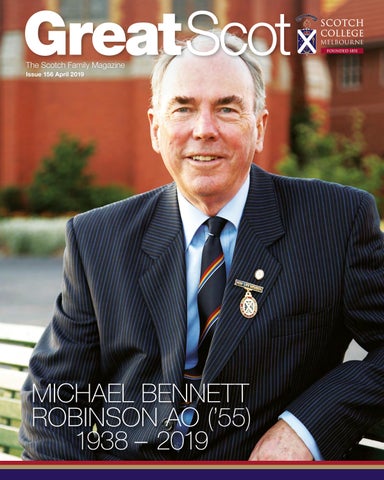
MICHAEL BENNETT ROBINSON AO (’55) 1938 – 2019
Contents 1 EDITOR 2 CHAIRMAN 4 PRINCIPAL 6 VALE – MICHAEL ROBINSON AO ('55) 10 CHAPLAIN 12 SCOTCH COMMEMORATES WWI 14 JUNIOR SCHOOL 20 MIDDLE SCHOOL 21 UPPER SCHOOL 22 FEATURES
31 SENIOR SCHOOL NEWS 40 MUSIC 44 SPORT 54 BOARDING 56 FOUNDATION
Publisher Scotch College 1 Morrison Street, Hawthorn 3122 Victoria, Australia Phone: (03) 9810 4321 Email: greatscot@scotch.vic.edu.au www.scotch.vic.edu.au ABN 86 852 826 445 Print Post Approved PP100008172
View Old Scotch Collegians' Association news and updates at: www.oscanet.com.au Like us on Facebook Scotch College and OSCA
VALE – MICHAEL ROBINSON AO Scotch mourns the loss of one of its greatest sons
58 DEVELOPMENT 64 OSCA 86 WHAT THEY’RE DOING NOW 89 SCHOOL HISTORY 92 OBITUARIES
22 CONGRATULATIONS TO THE CLASS OF 2018 Fine VCE and ATAR results
with six Duces
32
The Scotch Family Magazine Issue 156 April 2019 is the official publication of Scotch College, Melbourne.
6
YEAR 9 RETREAT Year 9 boys learn Editorial contributors Durga Kamte, David Ashton, Dean Gregory, Paul Mishura, Mark Johnston, Scott Montgomery, Tim Shearer and Patty Wallace-Smith.
more about themselves and their place in the world
Editor Durga Kamte (03) 9810 4420 email: durga.kamte@scotch.vic.edu.au Assistant Editor David Ashton (03) 9810 4489 email: david.ashton@scotch.vic.edu.au Production and Art Direction Lisa Sheard (03) 9810 4443 email: lisa.sheard@scotch.vic.edu.au Photography Rob Anderson, PhotoPlay, Stephen Kong, Scott Montgomery, Patty Wallace-Smith, Scotch College students, staff, parents and Old Boys.
40 SCOTCH MUSICAL EXCELLENCE Violinist extraordinaire plays with the MSO
Editorial
Along with the entire Scotch Family, Great Scot mourns the death of Michael Robinson AO, and it is fitting we commemorate in this edition one of the School’s most inspirational Old Boys. Michael has undoubtedly joined the ranks of the great ‘men of influence, men of weight’ who have provided exceptional leadership and unstinting service to the School. A gentleman of utmost integrity, wisdom and generosity of vision, he provides a shining example to Scotch boys. The theme of this edition, ‘the power of boys’ voices’ is coupled with one of the strategic aims of Scotch: ‘to deliver an education, which, for each boy ‘empowers him to challenge those things which need challenging and support those which need supporting in service to the greater good.’ In a world filled with loud, angry voices and increasingly polarised views, it is of paramount importance for boys to articulate their own views in a safe environment, thoughtfully, and knowing their voices are acknowledged and respected by their peers and teachers.
The art of communication can be, and is, taught from the Junior School years until Year 12. Based on Socratic principles of logos, pathos and ethos, boys practise the skills of public speaking, debating, media and communication studies to express their views with reason, logic and personal passion. The relational learning environment established across the School nurtures honest discussion and respectful debate. For boys to communicate honestly requires active, thoughtful listening on the part of their audience; and boys in Year 7 this year have formulated a set of behavioural guidelines for active listening that will be shared with all year levels. Boys’ voices translate to meaningful action as they support causes important to them. Examples of such causes can be seen in this edition, with the 24 Hour Hike raising funds for the Indigenous Scholarship Program, the marngrook game forming part of the ‘Close the Gap’ campaign, the Sony camp supporting children with disabilities, boys’ involvement in the Walk for Women promoting gender equality, and Product Design students creating nature boxes to house possums. Boys’ voices are heard, too, in harmonious song at the House Chorals, in music and in drama. Lusty voices are raised in support of our boys as they strive for success on the playing fields and in the water. In Term 1 Scotch won three premierships – once again winning the Head of the River, and taking out premierships in cricket and tennis – under the guidance of Director of Sport, Stuart Powell. Michael Robinson’s example of giving back to the School which provided him with an
excellent start in life is echoed in the gifts and service which Scotch Family members have presented in various ways to the School. For example, Gwen Head, the wife of Dr Alan Kenneth Head AO FRS (‘42), a renowned scientist, has donated to Scotch a significant collection of her husband’s certificates and awards, and she has also made a bequest to Scotch which will enable a scholarship to be established in perpetuity. And Graeme Whitelaw (’52) and Max (‘56) and Fay Errington were recently welcomed to the Forbes Society, recognising those who have given at the highest level of philanthropic support to the School or to the Scotch College Foundation. More generally, as Associate Professor Doug Lording (’64), President of the Foundation, points out in in this edition, the Foundation is continuing to support Scotch College in every way it can, including promoting the Indigenous Scholarship Program and launching the General Sir John Monash Scholarship. Also giving back to their old School are the nearly 200 Old Boys who contribute significantly to the success of the School’s sports and services programs throughout the year. Their efforts are recognised at an annual event, where an award is made – the Young Old Boys’ Coaches and Services Award – which last year went to Old Scotch Pipes and Drums member, Angus Jones (’16). The Scotch Family casts its net wide, and the affection which so many feel for the school which set them on the path to a full and satisfying life provides great motivation to give back, helping to ensure that the boys of today and of generations to come will also fully benefit from an excellent education.
44
54
74
A MOST SUCCESSFUL SPORTING SEASON Three premierships and
BON APPÉTIT!
CELEBRATING THE YEAR OF THE PIG Another successful Scotch
DURGA KAMTE EDITOR GREAT SCOT
several close seconds
The Boarders’ Dining Hall transformed
Family Chinese New Year Dinner
www.scotch.vic.edu.au Great Scot 3
VALE –
MICHAEL ROBINSON AO
Michael Robinson (’55), and Scotch seemed inseparable. His family and his life were entwined with the School in every aspect. The College has been immensely fortunate to have received his loyalty and affection as a student and leader. Michael stood above all those in recent generations of Scotch Collegians in his voluntary service to the School. He led the Old Scotch Collegians, the Foundation and the School Council, and in doing so provided leadership of a quality that has seen the School he loved move from strength to strength. Michael exemplified all the qualities of a successful leader. He had a forceful sense of purpose, he had integrity and inspired trust. He liked solving problems. He was competitive and sportsmanlike. He treated all with courtesy and led with good humour. He wanted Scotch to succeed by living by its values, and he hoped that its boys would contribute to a better Australia. Throughout his years of service to the School Michael was supported by Judith, whose wise and calm presence graced so many Scotch occasions. On behalf of Scotch I thank her for the warmth and friendship she has given, and I extend our sympathy and condolences to Judith, Charles (’86), Will (’89), Alice and Ed (’93) and their families. It is with a sense of deep sadness that we say farewell to Michael. His contribution to Scotch and to the Scotch Family will never be forgotten.
The School mourns the loss of one of its greatest sons. As day boy, boarder, parent, grandparent, President of OSCA, President of the Foundation and Chairman of School Council, Michael’s life was interwoven with Scotch. Perhaps the only Scotch role he never took up was that of teacher, but teacher he was to many, this Principal included. Michael knew, that, whilst age grants great schools wisdom and confidence, their greatest power lies in their youth. He understood the power of story, ritual and relationships in boys’ lives, and the joys of competition and communal life. He recognised Scotch’s significance to each boy, parent and Old Boy. He wanted to share all Scotch could offer, not just with those he knew, but with those he would never meet. His mind was bigger than his immediate surrounds, and so were his ambitions for his School. Scotch would not be the School it is today, but for Michael’s considerable talents, generosity of spirit and wise prodding. His was the Scotch restlessness born of both a desire never to rest on laurels, and an unstoppable will to build something better. Michael’s influence is all around us and will remain so. I struggle to think of any who has had greater influence on the Scotch Family. He lived, breathed and loved his School, and will always be part of Scotch lore. I join in extending our sympathies and love to Judith, Charles, Will, Alice and Ed.
DAVID KEMP AC (’59) — CHAIRMAN, SCOTCH COLLEGE COUNCIL
TOM BATTY — PRINCIPAL
www.scotch.vic.edu.au Great Scot 5
MICHAEL BENNETT ROBINSON AO (’55) Scotch College farewells a visionary leader
With the death of Michael Bennett Robinson on 19 March 2019, Scotch lost a beloved son. He served Scotch College as boy and man with passionate commitment and unswerving dedication. Michael was born in Richmond on 19 December 1938, son of Alan Bennett Robinson (’22) and grandson of Sir Arthur Robinson (SC 1884-87). A third generation Scotch Collegian, Michael’s lifelong connection with the School commenced when he entered as a day boy in 1945 before he boarded the following year in McMeckan House, of which he became Vice Captain in 1952. His final three years were in Arthur Robinson House, named in honour of his grandfather, who helped Scotch’s move from East Melbourne to Hawthorn, and directed fundraising for the new School. This family tradition of devotion to the School is reflected in Michael’s lifelong commitment. Michael’s life changed drastically with the death of his father in a shooting accident on the family farm in 1954. He had expected to become a grazier, but his mother urged him instead to study law. He graduated LLB (1960) from Melbourne University and was admitted to practice on 6 April 1961. Michael joined his grandfather’s firm, Arthur Robinson & Co (later Arthur Robinson & Hedderwicks and now Allens), ultimately becoming its co-Chairman and later Consultant. He married Judith Anne Skewes in Adelaide on 2 March 1968, and their sons Charles (’86), Will (’89) and Ed (’93) became fourth generation Scotch Collegians, while their daughter Alice attended Lauriston. Michael’s active re-engagement with the School commenced after Charles entered Scotch. As a member (1986-95) and Chairman (1995-2006) of the School Council, Michael oversaw a significant building program which included the Junior School redevelopment, and construction of the Cardinal Pavilion, Language Centre and James Forbes Academy.
6 Great Scot Number 156 – April 2019
He also had two very successful terms as President of the Scotch College Foundation, from 1993 to 1996, and from 2008 to 2017, during which he played a key role in the fundraising drive for the Sir Zelman Cowen Centre for Science and the Spencer Centre for Design and Technology. Buildings all around the campus stand as testimony to Michael’s selfless contributions to the School he loved. Michael joined the OSCA Council in 1981. He was appointed President in 1989, and in 2001 was awarded OSCA Honorary Life Membership. Michael was the first person to have led OSCA, the Foundation, and the School Council. On Australia Day 2002, Michael was made an Officer of the Order of Australia for his service to the law, to business and business regulation, and to the community through his support of education, medical research and private health service administration. His involvement as a company director and board member was extensive. Health was a key interest: he was President of the Bionic Ear Institute and Epworth Hospital. He was also Chairman of the Law Institute of Victoria and of the Melbourne University Law School Foundation. Michael’s interest in Scotch continued beyond his formal associations. He walked around Scotch every day, dropping into the Development Office to point out improvements that could be made to the grounds or buildings. Having had several boats named after him, Michael would always ask about the rowers’ prospects in weekend events. The Michael Robinson Boarding Scholarship was launched last year in his honour, and this year the School Council confirmed that the new Mathematics building at Scotch will bear his name for his service to Scotch. These are fitting tributes to a man who gave so much, and in so many ways, to his School.
2.
1.
5.
3.
1. MICHAEL ROBINSON WITH GRANDDAUGHTER WILLA, 2008. 2. MICHAEL ROBINSON. 3. BRIAN RANDALL AND MICHAEL ROBINSON. 4. JUDITH AND MICHAEL ROBINSON. 5. WILL HAUSER, MICHAEL AND JUDITH ROBINSON CHRISTEN THE MICHAEL ROBINSON. 6. LEFT TO RIGHT: MICHAEL SIM, TIM SHEARER, DAVID TYRRELL, ROSS CONGLETON AND JONATHAN BUCKLEY; FRONT ROW: TOM BATTY, DAVID KEMP AND MICHAEL ROBINSON.
4.
6.
www.scotch.vic.edu.au Great Scot 7
Chairman
The Hon. Dr David Kemp AC ('59) – School Council Chairman
The voices of Scotch When Scotch Council meets school leaders, the boys have valuable things to say THE HON. DR DAVID KEMP AC SCHOOL COUNCIL CHAIRMAN
A Scotch education achieves many things. Parents choose Scotch because it has a proven record of providing one of the best school educations available in Australia, and Scotch is always seeking ways to lift the quality of that education still further. Scotch recognises that in a world of rapid change, extraordinary opportunities and many challenges for its boys, it has a responsibility to provide an education that best equips its students to lead and contribute towards building a better world through every sphere of life open to them. A Scotch education is based on values that reflect the School’s foundation and that are symbolised by its traditions, especially those that come through its Scottish heritage. Scotch was founded by the Rev. James Forbes to provide schooling that embodied the most liberal and forward-looking values of the Free Presbyterian Church he led – a church based on a deep faith in the spiritual and moral capacity of the individual person in relation to God, demanding freedom and independence from the state — and Enlightenment values of human dignity, reason and the pursuit of knowledge. In recent years, through the leadership of Principal Tom Batty and his senior staff, Scotch has undertaken significant changes in its organisation and teaching practices to ensure that the School’s capacity is strengthened to realise these values in all that it does. The quality of teaching practice, and professional opportunities for teachers, are continually being enhanced; the attention to the needs of each boy is more and more possible through improved pastoral care arrangements and close monitoring of progress for each boy; expanded opportunities are being provided for boys to learn about the ideas that move our world; and new courses and relationships are developing further links between school and the world beyond. Above all, Scotch seeks to provide an environment that is stimulating, challenging and safe, in which every boy feels valued and can flourish. The Council congratulates Mr Batty and his staff for the very significant accreditation of Scotch as a Safe School by the Australian Childhood Foundation, making Scotch one of the first major 8 Great Scot Number 156 – April 2019
schools to be so recognised. Accreditation is the result of several years’ work in strengthening teaching and out-of-classroom practices. Boys are responding with their own initiatives to build a campus culture respectful of all. It is a time of significant cultural change which is assisting Scotch to achieve better than ever the values for which it has always stood as a school. Scotch continues to be a non-selective school, with boys across a wide range of academic abilities. The academic and non-academic programs of the School offer all boys opportunities to discover their unique interests and talents. This characteristic of Scotch admissions provides a highly diverse school community. The School not only has achieved outstanding academic results in the 2018 VCE once again, with the highest number of students of any Victorian school gaining perfect ATAR scores, but it has achieved outstanding, and measured, value-add in results for boys across the whole range of academic abilities. Council members have the opportunity to meet with and hear from school leaders at the start of each year. The boys have valuable things to say to the Council, and each year the Council gains a sense from the boys of how education, Scotch and the world are moving. The Council greatly values this conversation across the generations, and it is always thought-provoking. The quality of the boys is a tribute to their families and the values they have learnt from their parents and others. The influence of the School is also marked, particularly in the knowledge and awareness that the boys have of the world in which they live, their capacity to think in a reasoned way about that world, and their understanding of the place of the School within it. Our world today very much needs people who are moved by moral purpose, understanding and reasoned thought — who will oppose prejudice and affronts to human dignity. An education in such values has always been Scotch’s mission, and I believe the School has never been more effective in this mission than it is today.
www.scotch.vic.edu.au Great Scot 9
Principal
Mr Tom Batty – School Principal
Voice: our primary instrument MR TOM BATTY SCHOOL PRINCIPAL
As a young boy, I would head out to play in nearby gardens and alleys with instruction from my mum that I remain in ‘earshot’. As I would later tease, this gave a good deal of latitude to my childhood roaming. From conversation with those met on these early ramblings, to the humour of playgrounds and learning of classrooms, songs of the football terraces, heated political debates in the White Horse, wise words of pulpit sermons, quietly told history of Mãori on the marae, recess bustle of school common room and excited morning proclamations of boys eager to share ideas, I have become aware of the power of voice in connecting all that which goes on in our heads with that which we observe and those we observe it with. Never is this more evident than when friends regather after time apart enriched by the presence of new acquaintances. Carried on hot northerly winds, the start of the school year brought the excited chatter and keen embrace that accompany a return home. Good summer weather along costal paths ensured tales of long balmy days were shared amidst smiles and suntans by boys and staff alike. For all fortunate to have spent time on leave, the extensive good works of those who had not was immediately apparent. From emerging student precinct to renovated boarders’ dining room, the toil and fruits of our outstanding Maintenance and Grounds staff were evident to all. Nowhere was the place more abuzz than on the Hill, where the 99 returning boys, their families and staff, with good voice, made warm welcome for the 57 new boarders who also now call Scotch home. Bags packed in China, Singapore, Yarrawonga, the USA, Hong Kong, the Tiwi Islands, Hay, Kuwait, Mildura, Hamilton, Townsville, Orbost, Darwin, Saudi Arabia, Murtoa, the United Kingdom and the Sunshine Coast were unpacked in School, McMeckan and Arthur Robinson Houses in celebration of the proud Scotch tradition of openness and diversity. That School House is home to three brothers and five (other) boys who share the same grandfather (a sixth is a day boy), offers palpable evidence of the strong familial ties and stories which provide foundation to our Village on the Hill. In distant chambers of authority, from funding deadlocks for southern walls in Washington to heated Medevac dispute in Canberra, via circular Brexit bombast in Westminster, reminders were sent that voice remains the primary instrument of influence in our liberal democracy. That the growing presence of social media is, perhaps, shifting the emphasis of
10 Great Scot Number 156 – April 2019
‘debate’ from the rational to the popular, heightens the significance of soundbites and our corresponding need, as educators, to rally the forces of reason in both projection and interpretation of voice. Recent years have seen a number of initiatives empowering Scotch boys (and hence Scotch) through their voice. In 2016, the Diversity and Acceptance Group formed, and renewed emphasis was placed on the Respectful Relations Programme. Year 12s came together in the Geoffrey McComas Theatre to discuss homophobia: how it manifested at Scotch and what to do about it. Senior boys carried discussions through the Houses of the Upper School and Form Classes of the Middle School. Last year, similar gatherings took place on the matter of respectful relations with women and such conversations continue this year. In 2014 and 2017, respectively, the Big Ideas lecture series was launched in Years 11 and 8, to confront boys with ideas and actions that have shaped, and continue to shape, the world, and stimulate discussion for tutor and form groups and beyond. Senior School Prefects have led conversations in the Junior School, on the impact of boys’ voice, while the Student Representative Council has led with the theme, ‘See Something Do Something’, and school-wide focus has been given to ‘Don’t be a Bystander’. As a boys’ school, Scotch can reflect, plan and act with intentionality to offer boys and parents an experience crafted to best prepare each boy to find his voice in meeting the challenges and grasping the opportunities of the age. As relational learners, boys ‘learn’ their teachers before their subjects, and we develop programmes that nurture an engaged community, abuzz with activity borne on interaction and the sharing of story and passions. In such environment, boys can feel free to find their voice, ask difficult questions and offer opinions; they can take their time, listen and develop at their own pace, and act en masse with the energy and purpose of shared voice. To such end, this year, in accordance with our accreditation as a Safe School with the Australian Childhood Foundation, we will be facilitating all Scotch boys in the articulation of their own clear statements of the behaviour they expect of themselves and those around them. In Senior School tutor and form groups and Junior School classrooms, boys will form, refine and articulate their own expectations. In addition, this year will yield a number of fruits born of shared voice and our ongoing work to
of influence make the School all it can be for each boy and the community it serves. With continuing realisation of the masterplan and its place in our educational strategy, 2019 will see the completion of the new Keon-Cohen Cafeteria/Dining Hall and surrounding Student Precinct, forming a home for boys and a marketplace of conversation and engagement. To similar effect for Old Boys, new homes for Archives and OSCA will be established along Morrison Street. Forward momentum will continue with initial works to replace the ‘Back Blocks’ of School and McMeckan Houses with new boarders’ and staff accommodation, and to establish a Parent/ Welcome Centre in the heart of the Hill, while plans to surround the new Student Precinct with Home Rooms for each House take more concrete form. Under the leadership of Head of Middle School, Katrina Stalker, we will embed our new Middle School structure of Operations, Transition and 17 Form Teachers as the first point of contact for boys, parents and staff. With direction from Dr Peter Coutis (Director of Research, Teaching and Learning), we will launch the Teacher Action Research and Career Development Programme across both Senior and Junior Schools to entrench professional research, collaboration and personal development in the practice of our School. Initiatives in the Junior School include embedding the use of technology in the curriculum and classroom, and the new one-to-one iPad Programme across Years 4, 5 and 6. There will be further work around the theme, ‘Developing Curiosity and Creativity’, blending science, technology and mathematics in boys’ learning, and a review of the House and Peer Support Programmes. Seeking to break the shackles of the mandated curriculum, blunt the unwieldly instrument of age level classification and provide greater opportunity for teachers to share — and boys to explore — passions, this year sees the launch of the Cross Age Elective pilot in Years 9 and 10. Whilst across the Senior School, restructuring of the oversight and management of School Operations (those matters beyond ‘routine’ care and delivery of curricula) gathers pace, with the creation of new roles at Middle School, Upper School and Senior School levels. The year will see the implementation of a new Drugs Programme across Years 7-12 that has been developed by School Psychologists, Nick Clark and Lara Silkoff. The emphasis of the programme is to help
boys make informed and safe decisions, particularly relating to alcohol, cannabis and other drugs of dependence, gaming, gambling and other addictions associated with electronic devices, and partying. We will advance the good works of the Respectful Relations Programme, continue to develop the use of young Old Boys as academic mentors working alongside teachers, roll out a new school-wide Learning Management System (CANVAS) and host an International Boys’ Schools Coalition regional conference. In addition, in all we do, we will continue, with strong voice, to embed our foundational teaching and learning principle: The inherent dignity and value of each person; and our foundational teaching and learning question: How did the world evolve to be as it is and how might it be made to evolve for the greater good? The authority of voice, the bonds built through conversation and the far reaching implications of its absence, or regulation, were powerfully put in an observation by Paul Hasluck (later Sir Paul Meernaa Caedwalla Hasluck, KG, GCMG, GCVO, 17th Governor-General of Australia) following tours of north-west Australia in the 1930s, that not one nonIndigenous person had been found who could speak an Indigenous language. As Sir Paul suggested, shared voice and the language on which it is premised, is a necessary condition for an equality built upon respect for the value and dignity of each person. Perhaps for sufficiency in a world of instant and ubiquitous connection, where qualification, logic and experience borne of time in the field can be ransomed by modern day snake-oil sellers promising easy, quick solutions, it is wise to add Joseph Campbell’s advice, to listen when someone is speaking, not to the words, but to what is talking. That, in the absence of open-minded discourse, the lived environment contracts and in the ensuing echo chamber the only voice heard is our own. www.scotch.vic.edu.au Great Scot 11
Chaplain
Rev David Assender – School Chaplain
Not just the voice To help someone find his voice is a special undertaking REV DAVID ASSENDER SCHOOL CHAPLAIN
There is a touching scene in the seventh chapter of Mark’s Gospel, where Jesus is healing a man who is deaf and mute. In this story it isn’t the clinical result that catches our attention, it is Jesus’ sympathy and sensitivity. He takes the man aside privately, explains through gestures what he is doing, and heals him. Jesus adapts to the needs of the person he’s helping. Then, when Jesus says, ‘Be opened’, the man hears
12 Great Scot Number 156 – April 2019
and immediately finds his voice. For the few who witnessed the event, Jesus then requests they keep it to themselves. He isn’t looking for another notch on his belt of miracles, nor the publicity as a miracle worker. He’s helping the man find his voice as inconspicuously as possible. We might not be gifted with the same miraculous power as Jesus, but figuratively to help someone find
Jesus says, 'Be opened,' and the man hears and immediately finds his voice. their voice is nevertheless a special undertaking. The Bible insists we are all created for a purpose, each of us with a set of unique gifts, experiences and perspectives that are essential for the building up of one another. If you help individuals find their voice you are helping everyone with a little more clarity on reality. Yet, as we see in Jesus’ miracle, there is another precious aspect of helping people find their voice – the relationship through the process. To experience an empathetic approach of someone prepared to use all the resources at his or her disposal to help you is empowering. But a sympathetic person gives you more. In the 12th chapter of the epistle to the Romans, the Apostle Paul writes on the practical application of love in a community. In one section he explains it is as unassuming as rejoicing with those
who rejoice and mourning with those who mourn. It is not so much the outcome as the support you give along the way that makes it a real expression of love. The implications for us at Scotch are important to consider. Our motivation for helping boys find their voice should not be for our own sense of achievement or significance. We should be incensed by the obstacles preventing boys from having a voice, because we care for them. Their voice needs to be heard in the great adjustment of perceptions on how things are and should be. However, to be really heard is to be understood for who they really are. It shouldn’t be their ideas that we might rally behind as much as the person himself, lest we think the only value of a boy is his capacity to come up with ideas we wish to support. www.scotch.vic.edu.au Great Scot 13
Commemoration
LAST OF OUR FALLEN SONS Scotch College’s last casualties of the Great War
PICTURED, FROM LEFT: WILLIAM ARTHUR PETERS, JOHN SYDNEY LYON, ALEXANDER CHARLES THOMPSON, DR ALEXANDER BRUCE BENNIE, ROGER JAMES CHOLMELEY, ROBERT RAY FERGUS.
Twelve Old Scotch Collegians and staff died of war-related causes in the period 1919-1921, and are thus officially recognised as war dead. Unfortunately the many others who died of war-related causes after 1921 do not have the same official status. WILLIAM ARTHUR (known as Bill) PETERS (1912) was in the 1st XI in 1912. He enlisted in 1915, and travelled to England with an artillery brigade. After brief service in France he was hospitalised in England with tuberculosis and returned to Australia in 1916. He never recovered from his illness and died in the Austin Hospital at Heidelberg on 20 February 1919, aged 22. JOHN SYDNEY LYON (1888) enlisted in 1916 and served with the 57th Battalion at the battles of Bullecourt and Ypres in 1917. John died of influenza in France on 23 February 1919, aged 46. NORMAN MACKENZIE (also known as Norman McKenzie; known as Harry; also known as Henry) WOOD (1900) enlisted in
14 Great Scot Number 156 – April 2019
the British Army in 1915. He was discharged in January 1917 after being severely wounded. He died of war-related illness at the Randwick Military Hospital in Sydney on 30 March 1919, aged 33. ALEXANDER CHARLES THOMPSON (1903) enlisted in 1916 and was a corporal in the Australian Flying Corps. He was a skilled electrical engineer, and was Mentioned in Despatches. He was frequently in trouble for disorderly conduct. Alexander died of pneumonia on the voyage back to Australia on 3 April 1919 aged 30. His widow spent many years in a mental hospital. DR ALEXANDER BRUCE (known as Alick; also known as Kiddy) BENNIE (1881) was an outstanding scholar and footballer at Scotch in the 1870s and 1880s. He played for the Melbourne Football Club in that period when he was known as ‘Kiddy’ because of his youth. By the outbreak of war, he was a medical practitioner, and he served as a medical officer in Egypt and France. He contracted kidney
disease and had to return to Australia, where he died in South Melbourne at the age of 55 from war-related illness on 21 April 1919. ROBERT HARE (known as Bob) HAMMOND (1909) enlisted at 22 in 1915. He served briefly on Gallipoli but was plagued with ill-health throughout his service. The main concern was heart trouble, said to have originated on Gallipoli. He was discharged as permanently unfit in August 1916. He died, aged 25, at the Caulfield Military Hospital on Anzac Day 1919. His death was ascribed to pulmonary tuberculosis and emphysema. ROGER JAMES CHOLMELEY (Staff 1909-10) was the senior Classics master and a leader in Cadets at Scotch from 1909 to 1910. He enlisted in the United Kingdom in 1915. He won a Military Cross as an intelligence officer for going out on many patrols to check enemy positions. While serving with British forces against the Bolsheviks in North Russia on 16 August 1919, he was washed overboard from a
Scotch Commemorates World War I
ship at night in St Petersburg and drowned. He was 47. HAROLD RYAN (1896) was in the premiership-winning Scotch 1st XVIII in 1896. During the war he twice served in New Guinea, where he rose to the rank of warrant officer. He also contracted malaria, which proved fatal to him while living at Wellington in New Zealand on 28 September 1919. He was 42. HERBERT BUCKLEY (1892) enlisted in mid-1916 and by September 1917 was on the Western Front. Just 26 days after arrival he received a gunshot wound to the scalp. He was able to rejoin his unit and only returned to Australia in mid-1919. However, the following year, on 24 May 1920, he died of his war injuries in the Austin Hospital for Incurables. He was 42. ROBERT RAY FERGUS (1905) reached his artillery unit in France in November 1917 and served with it until the war’s end in November 1918. While on leave a few weeks after the Armistice he was hospitalised in England with influenza, possibly aggravated by the effects of
gassing at the front. He was transferred to the Pay Corps and was hospitalised again in late 1919. During the voyage back to Australia, he was so ill by the time he reached Fremantle that he could not continue. His father came from Victoria to bring him overland. Robert reached Melbourne, but died, aged 30, in the Austin Hospital in Heidelberg on 6 August 1920.w ISAAC MORRIS MOSES (1882), who in the 1890s had changed his name to Harry Morris, put his age down from 48 to 44 in order to enlist in July 1915, having disappeared to New Zealand earlier that year without letting his wife know. When he fell ill with trench fever on the Western Front in December 1916 he was found to be over-age and suffering with rheumatism. He was sent back to Australia and discharged from the army. His health problems persisted and he died of heart failure at Caulfield Military Hospital on 27 September 1920, aged 53. The last Scotch death officially attributed to war service appears to have been that of CHARLES STANLEY WHITE (1913). Though
only 20 on enlisting in 1917, he was immediately made a sergeant on the basis of his pre-war military experience. He served on the Western Front from March 1918 and was wounded in the arm and leg in June that year. He was hospitalised in England the following May with pneumonia and burns, and then invalided home in August 1919. Army doctors expressed confidence that he would make a full recovery, but he died of war-related causes at his parents’ home in Canterbury, Melbourne, on 3 May 1921, aged 24. Thus ends the catalogue, begun in these pages in 2015, of the 226 war dead (of which Scotch is currently aware) among Old Scotch Collegians and Scotch staff. Lest we forget. More details about all other Scotch Collegians killed in World War I can be found on the Scotch website, under ‘WWI Commemorative Website’ on the lower right of the home page. DR MARK JOHNSTON — HEAD OF HISTORY
www.scotch.vic.edu.au Great Scot 15
Junior School
Mr Jon Abbott – Head of Junior School
MR JON ABBOTT HEAD OF JUNIOR SCHOOL
ABOVE: BOYS IN WALLER HOUSE DRAWING THEIR HEAD OF HOUSE FOR THE HOUSE ART COMPETITION
EMPOWERING BOYS TO FIND THEIR VOICES 16 Great Scot Number 156 – April 2019
Young boys are interesting creatures. They can often be quite contradictory, saying one thing but meaning something else. They can desire to be heard, but will often not feel comfortable in speaking up. They like to push ‘the rules’, but can feel insecure when they do not know what the boundaries are. Boys can instinctively know when another boy is doing the wrong thing, but can’t always recognise this in their own actions. Maybe that is a trait in all of us, not just in young boys. They will want to try new experiences and challenges, but are often more comfortable letting others try them first.
The theme of this edition of Great Scot is ‘the power of boys’ voices’, and it is a valuable topic to consider. When given the right environment, support and encouragement, boys have some very powerful messages to share. The trick is in assisting them to know how to best do so. Having worked with primary-aged children for the past 40-odd years, it has been my experience that, like so many other factors in a child’s life, there is great capacity for them to have a say in their world, but they do not always have the tools to be able to do so effectively. Assisting young boys to have the confidence to share their thoughts, ideas and beliefs with others is a very important part of a teacher’s role. Boys need to be encouraged to feel their ideas are important, to have the courage to share them, and to develop the conviction to stand up for them. Even many adults can find this to be extremely challenging, and the idea of speaking up is quite stressful. For me it is all about providing opportunities for boys to develop their confidence and their capacity to speak in public. In the Junior School we do this by making public speaking a ‘normal’ activity. All of the boys regularly see Year 6 boys leading our assemblies. They see older boys delivering sports reports, and making announcements about fundraising or other activities, and they see these things as being normal. Equally, the boys have many opportunities in their classrooms to
present to a smaller cohort; sometimes to their whole class or to smaller groups within the class. In Drama, the boys are provided with many tools and strategies to help them feel confident when speaking in front of others, and to share their personal views. Our House structure includes a Peer Support Program, where the boys from Years 3 to 6 are placed into smaller groups within their respective Houses. These Peer Support Groups are led by a couple of Year 6 boys, and once again they provide opportunities and avenues for boys to ‘have a voice.’ We also have a Student Representative Council which meets fortnightly, a forum where each class has a representative who takes along the ideas, concerns and questions that are important to the boys in his class. The SRC is an important way for the boys to have a say in how their school operates and what the culture should be. Of course, having the confidence and capacity to be able to speak up about things that are important to a boy is only half of the equation. Unless others have the capacity to listen and to consider what is being said, it matters little how eloquent, confident or powerful a message may be, if it falls on deaf ears then it counts for little. A key aspect of this, then, is to impress on our boys the importance of, and the need to be respectful of the thoughts, ideas and views of others. I am reminded of a discussion many years ago in a Prep classroom where the topic being discussed was sharks. One little lad spoke up and said that sharks were very dangerous and we should get rid of all of them to make the water safe. Another boy strongly objected to that idea and began criticising the first boy. Among the group a third boy then spoke up, saying to the boy objecting: ‘He is allowed to have his own ideas. Let him say what he thinks’. I felt this was a powerful message coming from a six year old, and one that we can all learn from. We try to instil in the boys that they don’t have to agree with the ideas and beliefs of others, but they do need to respect their right to hold those ideas and to be able to voice them. www.scotch.vic.edu.au Great Scot 17
Staff in profile Many years from now, when you are no longer teaching, what is one of the Scotch memories you will reflect on to warm your heart? I have so many great memories of my time at Scotch, but a stand-out event for me would have to be the Year 2 Wungle Bungle. The boys always show a high level of engagement in our Flight Unit. The Wungle Bungle gives them the opportunity to apply what they have learned, spark their creativity, predict and reflect on their design, and with the help of family, produce their very own flying contraption. The day is always filled with fun and laughter, and even if their plane doesn’t fly to plan, I relish the sportsmanship and resilience the boys show. The parent involvement and having them attending the parade makes it all the more special for the boys. What is the best advice you have ever received? When you commit to something, give it your all. Take opportunities that are presented to you; music, languages, sport. You never know where it may lead.
Interview: Emma Fitz-Walter Scotch was first introduced to Emma in 2015, where she impressed colleagues with her ‘can do’ approach to her role as a casual relief teacher. Emma worked in all areas of the Junior School, and, encouraged by her enjoyment of working at Scotch, accepted a classroom teacher role in 2017 after teaching at Melbourne Grammar School. Prior to teaching, Emma worked in human resources, having completed a Bachelor of Communication and a Graduate Diploma of Career Development. Emma always had a love for teaching, and in 2015 decided to complete her Graduate Diploma in Education. Currently Emma teaches Year 2, where she continues to create a warm and caring environment for her class. Encouraging individual learning styles, Emma gives each boy an opportunity to celebrate and develop his unique gifts and talents. Emma values building strong relationships with her students and their families, and her involvement in the skiing program has further strengthened her rapport with the wider Scotch community. As an educator, Emma aims to understand and promote the development of the whole child, and naturally has become an integral member of the Junior Primary team. Emma always has a positive attitude and continues to spread this throughout the School. With excellent interpersonal skills, along with her supportive and calm approach to all challenges, Emma deserves to be placed in the spotlight. KATE IKINGER
18 Great Scot Number 156 – April 2019
What has been your biggest challenge over your years at Scotch? The reason I love my job so much is that it is always filled with new challenges. Every year is different; individual boys have their own personalities and learning styles. Building a rapport with each boy and creating fun and engaging lessons that cater for all boys is so important. Helping the boys recognise as well that they are all individuals who learn at their own pace can be a challenge. I always tell the boys never to compare with others but to try and improve on themselves. Managing the needs and behaviours of all the boys is what makes this job so enjoyable. What advice would give our VCE students as they embark on a life outside Scotch? Stay true to yourself, work hard and never give up! What do you like most about your job? The favourite part of my job is the relationships I build with the boys, and the opportunity to see them grow and mature into young men. It is so rewarding to see the boys overcome challenges and grow as independent learners. I encourage all the boys to be risk-takers, but most importantly have fun with their learning. I laugh on a daily basis because of the kind-hearted, unpredictable nature of the boys. What are a few amusing or memorable incidents in your career at Scotch? The most amusing incident for me in my career at Scotch would have to be in my first ever week here. I had forgotten Assembly was on, and when I realised, I rushed the boys into the hall just in time for Assembly to start. It wasn’t until we stood up to sing the National Anthem that I noticed one of my boys was only wearing one shoe! Needless to say, I have never forgotten an Assembly since.
OUR JUNIOR SCHOOL BOYS AT WORK AND PLAY
www.scotch.vic.edu.au Great Scot 19
News
FOUR BUSY DAYS IN CANBERRA Year 6 boys visited many locations during their tour
JUNIOR SCHOOL CAPTAIN, WILSON CRAWFORD, AND JUNIOR SCHOOL VICECAPTAIN, SAM STEELE, AT THE WREATHLAYING CEREMONY, AUSTRALIAN WAR MEMORIAL, CANBERRA
Seventy-seven Scotch Year 6 boys travelled to Canberra from 12 to 15 March, accompanied by several staff, for an exciting Year 6 Camp, as part of the boys’ Government, Parliament and Politics studies. The boys spent four busy and productive days in the nation’s capital, visiting the Royal Australian Mint, Old Parliament House and Parliament House, where they enjoyed a long question and answer session with the Federal Treasurer and Member for Kooyong, the Hon Josh Frydenberg MP. They also visited Questacon, the Australian Institute of Sport, the Australian Electoral Commission, and rode bikes around Lake Burley Griffin. Highlights of the tour also included an extended visit to the Australian War Memorial, where the Junior School Captain and Vice Captain laid a wreath, and a visit to meet the Governor-General of Australia, General the Hon Sir Peter Cosgrove, who found time in his busy schedule to speak to the boys, and make some presentations. Here are some observations on the tour by 14 of the participants: ‘It was a great pleasure to meet our Head of State, Sir Peter Cosgrove, in Government House. It was wonderful to have this once-ina-lifetime experience. Taking a tour around the vast Government House was breathtaking. Hearing about how busy the GovernorGeneral is and what he does every day really makes us respect him more. This experience is one of the best things Canberra has to offer.’ NEIL DOSHI, EDWARD HILLS and HUGO FOWLES
WILLIAM HAYWOOD AND MAXWELL FINDLAY ON LOCATION IN PARLIAMENT HOUSE
20 Great Scot Number 156 – April 2019
‘The Australian Institute of Sport visit came on the Wednesday. As we walked into the building, installations of bicycles hung from the ceiling. The walls, painted a bright green, gave a sporty sense. It was a real inspiration to see all of the professional athletes training on a daily basis to achieve amazing things.’ JOSH GAUDIN
‘Canberra affected me emotionally. I felt sympathy for the families and friends who lost someone during the horrible wars. I felt proud for the people who achieved records and amazing achievements under Australia’s name under the roof of the Australian Institute of Sport. I felt unusually satisfied looking at the Questacon experiments. I felt relieved and happy when I returned home.’ ALFIE HOLUIGUE ‘In the end, the Canberra camp was all about resilience, being patient, and learning to tolerate many obstacles. We had to be able to improvise when things didn’t go to plan.’ MATTHEW KRIESNER ‘Attending the War Memorial was a very emotional experience. Laying the wreath was a massive honour, which demonstrated our respect to the soldiers who sacrificed their lives. The experience at the War Memorial was very touching and it made me proud and grateful to be Australian. The memorial recognises the resilience the soldiers showed by never giving up the will to fight for our country. Overall the trip to Canberra was all about respect and gratitude.’ WILSON CRAWFORD, SAM STEELE AND RIO BARRY ‘Resilience, empathy, sorrow. Our trip incorporated these values, and they featured throughout the Canberra camp. Understanding the horrendous conditions the soldiers endured, then remembering family members touched all of us. It made us realise how lucky we are by being able to walk freely, having a safe place to sleep, and having food and water to consume. These were luxuries for the soldiers, but for us it is normal.’ JOSEPH PAN ‘Our trip to Canberra taught us a lot about using resilience and patience. The War Memorial gave us a better appreciation of the people who gave their lives in the hard-fought wars. Resilience and patience were shown
THE YEAR 6 TRAVEL GROUP OUTSIDE PARLIAMENT HOUSE, CANBERRA
by everyone on this camp. The activities in Canberra tested our cooperation and teamwork. The Australian Electoral Commission told us more about electorates and all the pressure the candidates must have felt during the elections. In the end, Canberra tested us in various ways, both physically and mentally.’ MATTHEW SCOULLER, JEREMY LE, ALEC GALBRAITH
YEAR 6 BOYS IN THE HOUSE OF REPRESENTATIVES RIGHT: MATTHEW KRIESNER REFLECTS AT THE WAR MEMORIAL HONOUR BOARDS
‘I felt frustrated at Questacon when the ball didn’t go through all the hoops. It took several tries and all my patience, but in the end the ball went through all the hoops. The feeling of happiness and pride that overcame me when the task was completed was refreshing and wonderful. In the end I knew that our trip to Canberra was all about resilience and patience.’ LIAM ROYSTON
Middle School
Ms Katrina Stalker – Head of Middle School
Tuned in to the voices of our Middle School boys MS KATRINA STALKER HEAD OF MIDDLE SCHOOL
Starting in Senior School is a great opportunity for boys to make a fresh start and put behind them any difficulties they may remember from primary school. With the support of the Coordinator of Transition, Scotch’s form teachers smooth the way for our Year 7s as they transition into Senior School life. Change can be difficult — at times boys need help with the transition, while others hit the ground running. The work the form teachers do with the boys on resilience and respect throughout the year develops their ability to cope confidently with new situations, and this continues through Year 8. For some boys Year 8 can be challenging, as friendships are tested and school work intensifies, as expectations are raised. The support the Year 8s receive from teachers who know them well from Year 7 helps greatly in the transition process. Although not without some hiccups, the process of splitting the Year 8s between their academic classes while maintaining their pastoral class with the form teacher overseeing their academic care, is working well. The success of this process is due in great part to the capable work of the form teachers who have stepped up to this new role enthusiastically and with great care for the boys.
At Year 7 camps, lifelong friendships are launched. This year the weather was unusually cool for the first camp, but improved during the remaining camps. Sailing was a highlight for many boys, as they ventured out past the Cowes pier, while others caught their first-ever waves on a boogie board at YCW Beach. Competition was fierce in mini-golf, with teachers striving to beat the boys — usually without success. The boys challenged themselves on the high ropes course, and one of the favourite activities was the table tennis competition held at night within form groups. With the new systems in place we have started the year listening very carefully to the voices of our Years 7 and 8 boys. School Captain, Nick Marks, has run meetings with representatives from each of the Middle School forms, seeking their ideas on school issues, particularly those affecting Middle School. These meetings will continue throughout the year with different boys representing their forms each term. Just as important as giving the young boys a forum for their voices to be heard is the opportunity these forums provide for them to gain experience in leadership. The quality of the opinions expressed in these meetings has been impressive, with constructive ideas that will shape the future decision making.
YEAR 7 BOYS AT CAMP
22 Great Scot Number 156 – April 2019
Upper School
Mr Tim Rayner – Head of Upper School
Boys are seen, and heard MR TIM RAYNER HEAD OF UPPER SCHOOL
Giving our boys the opportunity to have a voice in the School community should not be overlooked. The days of children being seen and not heard, with teachers blissfully ignoring the genuine thoughts and opinions of their charges, are well and truly past — and for good reason. Allowing boys to have a say enables us to have insight into their hopes and aspirations. Those who have opportunities to express their voices have a greater sense of belonging; but also, if the evidence is to believed, have more self-worth and engagement than those whose voices are either not heard or are immediately dismissed. Of course, boys will not want to express their voices if they feel they have no relationship with those who want to listen. Building relationships with boys is central to our teaching at Scotch, and teachers are aware of the importance of relational learning to foster an environment of cooperation, respect and learning. The willingness for teachers to strike up conversations, be interested, and listen, is crucial if boys are to engage with the adults around them. Starting every morning, as boys open their lockers, Heads of Houses will be close by. Questions can be asked and
pleasantries exchanged – relationships are built on such small talk. In tutor group time, discussions are encouraged and viewpoints heard. Daily notices are read and boys hear what is happening in their School. Regular House meetings enable boys to voice their opinions and feel involved; decisions are made and suggestions sometimes challenged, but the boys feel very much a part of where the House is heading. Heads of House meet regularly and act on valuable suggestions. Understanding the health and pulse of a large school community can be challenging, so every semester boys complete class surveys. These surveys enable boys to comment on areas such as whether their ideas and opinions are respected, or if a boy finds it easy to participate and contribute in class. Each response is anonymous and the content of each survey is fed back to teachers, Heads of Department and our Director of Research, Teaching and Learning. Such engagement enables teachers to reflect and improve. More recently, a Boys’ Voice Committee has been formed. This meets regularly with the sole purpose of listening to student ideas and input. Comprising our School Captain, Vice
Captain, Captain of the Hill and senior staff, the group puts forward issues which move our boys. Our School leaders busy themselves by speaking to as many of their peers as possible, from across all age groups, to seek out how our School may be improved. This has included feedback on external courses, suggestions for a new course for Year 10, or ideas for a charity fundraising event. As you may imagine, contributions can be diverse. In the final year of school, for Year 12, the Class of 2019 Committee consisting of House Vice Captains, Scott Montgomery, our OSCA Executive Director, and me, meets regularly to discuss matters affecting our Year 12 boys. This group puts forward ways to raise money for the Class of 2019 gift to the School, and also discusses events and programs for our Year 12 participation. But it also has a firm eye on the years beyond Scotch College. Indeed, the Old Scotch Symphony Orchestra came about because boys wished to continue playing and performing their music together, once they had left Year 12. The Music School, together with OSCA, listened to their dilemma and we now have an established orchestra playing concerts every year.
www.scotch.vic.edu.au Great Scot 23
Features
CONGRATULATIONS TO The fine VCE and ATAR achievements of the boys of the Class of 2018 speak strongly to their resolve and talents, and their capacity to embrace the future with purpose. Congratulations to them all. In celebrating such accomplishment, as seen in the points below, we are conscious, that, popular though such measures may be, the real analysis of success lies at the level of each boy across the rich canvas emanating from our non-selective entry. We are also acutely aware that whilst a life of the mind can ponder solutions to the weightiest of problems, it is by living in the field that boys bring their talents to bear. Enveloping each boy’s results is a particular Scotch story that will resonate far longer and more profoundly than any collection of scores arrayed in rank order.
24 Great Scot Number 156 – April 2019
With empathy, artful invention and no small dash of panache, those of the Class of 2018 have grasped opportunities to explore, hone and share interests and talents. They have emboldened with the ingenuity and dexterity of their generation and enlightened with the open connectivity of their age. Perhaps most importantly, from Memorial Hall addresses to post-match handshakes, via thoughts shared in Ballarat Specialist School classrooms, and steps hiked for the Tiwi College Boys’ Academy, the graduating boys have held true to our belief in the inherent dignity of each person. In so doing, they have convinced that they will pick up the baton and do their bit in building something better for those to follow. Such confidence is testament to the care, craft and perseverance of many, and my thanks
and congratulations go to all involved: boys, members of staff and parents. To the Class of 2018: you have left with our sincere thanks and best wishes for all to come. It was a privilege to share those years with you and see you revel in a freedom gained by so many, at such cost. Your best years lie ahead of you and we want to know what you make of it all. When the time is right, come back, fill in the gaps and share your stories. • Christopher Chamberlain, Jason Hu, Nick Marks, Christopher Sparks, Ziang (Tommy) Wei and Joshua Yong each received an ATAR of 99.95, and were, therefore, the duces of Scotch College for 2018 • Eight boys (3.1 per cent of the cohort) obtained an ATAR of 99.90 or more (top 0.1 per cent in the population)
THE CLASS OF 2018 • 14 boys (5.4 per cent of the cohort) obtained an ATAR of 99.50 or more (top 0.5 per cent in the population) • 25 boys (9.7 per cent of the cohort) obtained an ATAR of 99.00 or more (top 1 per cent in the population) • 38 boys (14.7 per cent of the cohort) obtained an ATAR of 98 or more (top 2 per cent in the population) • 80 boys (30.9 per cent of the cohort) obtained an ATAR of 95 or more (top 5 per cent in the population) • 120 boys (46.3 per cent of the cohort) obtained an ATAR of 90 or more (top 10 per cent in the population) • 170 boys (65.6 per cent of the cohort) obtained an ATAR of 80 or more (top 20 per cent in the population)
• The median ATAR was 88.85 • Measures of ‘value add’, comparing ability testing data from earlier years and ATAR scores, indicate a strong performance from this cohort (Note: the population referred to in the ATAR statistics above is the population of the statewide Year 7 cohort from 2013, including those students who moved or left school before Year 12.) • There were 18 ‘perfect’ scores of 50 across 12 subjects. • Eight Year 12 boys obtained scores of 50: Christopher Chamberlain (Chemistry, German and Physics), Jason Hu (Specialist Mathematics), Andrew Kroger (Further Mathematics), Tom Loveridge (English), Austin Nguyen (English), Christopher Sparks
(French and Literature), Joshua Start (English), and Joshua Yong (English) • Seven Year 11 boys obtained scores of 50: Rupert Balfe (Psychology), William Dixon (Legal Studies), Tianqi Feng (Mathematical Methods), Matthew Lee (Biology), Harrison Liu (Biology), William Sutherland (Mathematical Methods) and Yulin (Kevin) Wu (Mathematical Methods). TOM BATTY — PRINCIPAL
ABOVE FROM LEFT: STEVE HOLDING, ALICE COOK, ZIAN (TOMMY) WEI, JOSHUA YONG, CHRISTOPHER SPARKS, JASON HU, PINO CUTINELLI, TOM BATTY. ABSENT: NICK MARKS, CHRISTOPHER CHAMBERLAIN
www.scotch.vic.edu.au Great Scot 25
Features
A SCHOLARSHIP HONOURING OUR FINEST SON — A TRULY GREAT AUSTRALIAN A fitting tribute to a man so closely entwined with Scotch’s values. One hundred years after he led the Australian Corps to decisive victories in 1918, Sir John Monash’s old School, Scotch College – which he always loved and respected for the excellent education it afforded him – has commissioned a scholarship bearing his name. In so doing, the School is honouring the man who shaped the course of Australian history as no other. He is our finest Old Scotch Collegian. While palpable reminders of Monash abound at Scotch – Monash Drive, Monash House, the foundation stone of Memorial Hall, and the Monash Gates through which Scotch boys pass every school day – there is, perhaps, no more fitting tribute to a man so closely entwined with Scotch’s values than to commemorate his remarkable achievements through the General Sir John Monash Scholarship. In October 2017 the Scotch Family joined together in a live campaign to raise over $1M in 24 hours to fund Scotch’s first Indigenous perpetual scholarship — the Tony Briggs (’85) Indigenous Scholarship. Using the same 24 hour platform, we will again look to the Scotch Family to unite forces in a live campaign
to create the perpetual General Sir John Monash Scholarship. The scholarship will honour the life, service and achievements of Scotch’s greatest son, doing justice to the qualities he upheld throughout his life. Sir John Monash was a passionate believer in the power of education. This endowed scholarship recognises that belief and his love of his old School. Fittingly, it will benefit generations of Scotch boys. Scotch is seeking to raise an initial capital fund of $750,000 to endow in perpetuity one full academic scholarship. Donations to the Scotch College Foundation Scholarship Fund will be tax deductible. For just one day, on Thursday 8 August, every dollar donated by members of the Scotch Family will be quadrupled through the generous matching of supporters from the Scotch Family. Gifts of every size will make a real difference. In addition to gifts made within the 24 hour appeal, gifts can be made prior to 8 August by returning the donation form enclosed with this edition of Great Scot to the Scotch College Development Office, and we will process them as part of the 24 hour campaign. Please note that gifts must
‘Equip yourself for life, not solely for your own benefit but for the benefit of the whole community.’ Sir John Monash GCMG KCB VD (SC 1877-1881)
26 Great Scot Number 156 – April 2019
be received by 8pm on Thursday 8 August to be matched. All gifts received will be directed towards this scholarship. The equation is simple: we have only 24 hours, from 8pm on 7 August to 8pm on 8 August, to raise the full $750,000 – or the campaign comes to nothing. To achieve the targeted amount will require a full Scotch team effort! Kicking off this exciting campaign will be a dinner in the Boykett Room, Cardinal Pavilion, on Wednesday 7 August at 7pm. For tickets to this special event, please contact Rebecca Mortimer in the Scotch College Development Office, on +61 3 9810 4300. To encourage all boys to be involved and to support the appeal, there will be a full school casual clothes day on Thursday 8 August. A screen will be set up in the Senior School Quadrangle so boys and staff can watch the campaign live, and monitor progress towards the $750,000 goal. The Class of 2019 committee will host a barbecue lunch. In a letter addressed ‘To the boys of Scotch College’ from his Corps Headquarters in France in June 1918, General Sir John Monash said: ‘As the years roll on, my regard for the Old School and my pride in it have steadily grown, and the realisation of the high renown which has been achieved by so many men who were launched upon their careers from Scotch College has been for me always a stimulus and an inspiration.
I have never ceased to think of the Old School with affection.’ Please join us in acknowledging the achievements and contribution of the finest Scotch Collegian, by supporting a scholarship that bears his name and pays tribute to his outstanding life.
Information about the General Sir John Monash Scholarship is included with this edition of Great Scot. For more information, you are also most welcome to contact the Scotch College Development Office on + 61 3 98104300 or email foundation@scotch.vic.edu.au.
OPPOSITE PAGE: KING GEORGE V KNIGHTING LIEUTENANTGENERAL SIR JOHN MONASH AT THE AUSTRALIAN CORPS HEADQUARTERS IN FRANCE, 12 AUGUST 1918. ABOVE, LEFT: PORTRAIT PHOTO OF MONASH AS A STUDENT. ABOVE: PORTRAIT TAKEN DURING WORLD WAR I. RIGHT: MONASH, CIRCA 1918.
School Captain
NICK MARKS SCHOOL CAPTAIN
Rising above the tumult of an everchanging world
These are edited versions of the speeches at School Assemblies early in Term 1 by the School Captain and Vice Captain. An investiture ceremony for School Prefects also took place during the first Assembly in the Quadrangle.
I had the pleasure of spending a couple of months in the icy winter of Germany, during a season also made bleak by the recent stepping down of Chancellor Angela Merkel as leader of the centre-right Christian Democratic Union — or, more likely, by a dreary and underwhelming German 2018 World Cup campaign. One image in particular comes to mind. I had the opportunity to visit the city of Cologne many times in my stay, and if there is one thing that stirs pride in the glowing hearts of the city’s people — something that figuratively rises above all else — it would be without question Cologne Cathedral. It is among a rare group of German monuments that survived countless bombings during World War II. Chance? I don’t think so. British inaccuracy? Probably not. It turns out actually, that the building is so tall (its twin spires are 157m high) that the
cathedral generates its own winds, which cascaded down the great building’s spires and walls, blowing away any bomb that came near it during the war. Such was its poetic might that 262 air raids could not conquer it. Now I want to let that image sit in the back of your minds for a moment, as we return to the here and now. Boys: your schooling lives can be hard to navigate. There will be tough days ahead; days when you just can’t be bothered any more; days when you may even be left furiously pondering the meaning of existence. Such is the nature of life. We all are embroiled in the seething chaos of our world, caught up in a balancing act as we forge onward into the unknown. But we can rise above all that as we unshackle ourselves from the chains of routine and rules and assert our own independence. How do you respond to all of this? It is no easy feat. No one tells you how to do
28 Great Scot Number 156 – April 2019
it, at least not explicitly. But each of us must do our utmost to make sense of it all. We have all at some point no doubt met a boy who protests about the injustices of the Victorian Curriculum and Assessment Authority and feels obliged to tell his teacher how ‘the system is totally rigged, sir’. But think about it. If the system is truly against us all, then there is quite literally nothing we can to do about it – we can accept that and strive to do our very best as we work within ‘the system’, or choose to remain forever fixed in the quicksands of our own dissatisfaction. However, we can take responsibility for where we find ourselves at this moment. We may see ourselves as imperfect, but if we set our minds to becoming smarter, faster and stronger, then perhaps we can create a sense of harmony for ourselves
Vice Captain
Strongly united through the power of voice STONE KE SCHOOL VICE CAPTAIN
out of what are actually just temporary hardships. Perhaps we can begin to weave a more fortified fabric, drawn from the challenges we face every day. We need to look on each day as another gift, a further opportunity to reinforce our foundations, to lay another brick. One day, we too might become like Cologne Cathedral — defiant, resilient, and able to rise above adversity. Allow me a final reference to this metaphor. The people of Cologne say that when the cathedral is finally completed — for it is constantly being renewed — the world will end. Boys, let us never take ourselves too seriously; let us continue to build the foundations of a life in which we never stop learning, always take pleasure in turning interests into passions, and never cease from striving to work for the betterment of the world in which we live. NICK MARKS – SCHOOL CAPTAIN
The core instrument for individuals to exercise influence within a larger group is their voice. It is this expression of someone’s free will within a forum where their views can be respectfully considered that forms the basis of a democratic system — a system where each person not only has power over their own person but has the capability of stimulating change in the broader collective. At Scotch, I believe that if a boy wishes to engage in discourse over any matter there are established avenues open to him — whether on the tutor, House, or broader school level. Our School welcomes input from its students, and actively encourages boys’ voice. If boys choose not to immerse themselves in discussion of issues existing within the School and in the wider community, there is a danger that they will become ignorant of — and even worse, indifferent to — matters over which they could otherwise be passionate. Any such ignorance is tragic, but even worse is the tragedy that lies within ignorance — the surrender of the
privilege of voice, making boys’ influence as individuals irrelevant. In acknowledging these perils, I urge our boys simply to open themselves up to discussion; to be unafraid to raise their voices to communicate what they believe and, in turn, to be accepting of the opinions of others. This ongoing exchange of ideas is the vehicle by which we are able to formulate developed opinions which are truly our own. Beyond the academic and sporting spheres, this promotion of growth in the identity of each boy is the most valuable education offered by any school. While it may seem that our society’s preoccupation with performance and quantifiable achievement as a form of measurement against others is central to a modern boy’s schooling, I would contend that fostering confidence in individuality is more important. While Scotch has always found strength in its unity, it finds even greater strength as a united collection of distinctive individuals. STONE KE – SCHOOL VICE CAPTAIN
www.scotch.vic.edu.au Great Scot 29
Features
SAFEGUARDING SCOTCH BOYS Scotch aims ‘ … to deliver an education which, secure in the traditions of our past and our Christian belief, opens boys’ minds to the rich diversity of the world in which they live and challenges them to question and explore everything they find, with integrity, humour and compassion. And to do this in an exciting, intimate environment which nurtures self-expression and self-worth while promoting the uniqueness of each boy’s journey.’ As a school community, we are committed to achieve this aim with every boy who passes through our doors. Achieving this aim depends on many factors, not least of which is the dedication demonstrated by the staff of the School, who collectively seek to provide the setting, the support, the care and the guidance that will encourage each boy to realise his unique potential. It has long been acknowledged that another factor contributing to the outcome defined by our aim is creating and maintaining an environment where every boy knows that he is respected and safe. The safety of every boy entrusted to the care of the School is given the highest priority. Sadly, history informs us that despite the accent on providing sanctuary, there have been instances in the past when boys have been subject to abuse at the hands of those whom they trusted. As a community we have owned these failings of the past and sought to make just reparations. The Royal Commission into Institutional Responses to Child Sexual Abuse commenced
30 Great Scot Number 156 – April 2019
in January 2013, and over the subsequent two years helped to shed light on the extent and impact of the abuse and neglect of children. The School contracted with the Australian Childhood Foundation (ACF) in July 2015, beginning a process towards gaining the foundation’s safeguarding accreditation status. Achievement of this status would endorse actions taken to ensure that boys were as safe as possible within and beyond the School’s campus, when engaged in school-sanctioned activity. The contractual agreement with the ACF provided ready access to an experienced ACF manager, offering support and guidance as the School embarked on an intensive period of policy review and development. The agreement also provided access to a highly regarded online safeguarding training course, that all Scotch staff and volunteers must complete as an accreditation requirement. During the period from July 2015 through to January 2018 the process yielded a number of critically important policy and procedural documents, including: • Child Protection Commitment Statement • Child Safety Code of Conduct • Child Protection and Obligations of Reporting Policy/Procedure • Reportable Conduct Policy • Recruiting and Screening Guidelines During this same period, more than 1500 school-connected staff and volunteers completed the ACF online safeguarding course. Regular additional training opportunities
were provided for staff during these years, including keynote addresses and small group consideration of safeguarding scenarios. In December 2015, the recommendations of the Royal Commission prompted the Victorian government to formulate a Ministerial Order (870), outlining the minimum child safe standards required of all Victorian schools. The standards demanded by the Ministerial Order are included in the requirements of the ACF accreditation process. Having embarked on the process towards ACF accreditation, the School was well advanced in meeting the standards required of the order on its public release. At the beginning of 2018, the School was confident that the work undertaken on policy development, and the education of staff, parents and boys, had instilled a safeguarding culture throughout the community. This confidence encouraged an invitation to the ACF to conduct a comprehensive safeguarding audit. A successful audit of the progress made and the culture established would represent a major step towards safeguarding accreditation. The audit was conducted during a week in August 2018, and involved a review of all safeguarding documentation and interviews with representative samples of School staff, boys and parents. The School received the detailed audit report in early September. The report strongly affirmed the actions the School had taken, and identified specific strengths and some remaining challenges. The report endorsed the School’s application for safeguarding accreditation, and recommended
this to the independent panel that would make the ultimate judgment. The independent panel convened in early December 2018 and required the presence of the School Council Chairman (The Hon Dr David Kemp), the Principal (Tom Batty), the Administration Manager (Rebecca Imer) and the Child Protection Officer (Grant Watson). The presentations made by these Scotch representatives, together with the positive ACF audit report, elicited a favourable response from the panel. The Australian Childhood Foundation’s Safeguarding Accreditation status was granted for a period of three years. Gaining this recognition is a significant achievement by the School, epitomising the commitment to safeguarding that has become increasingly apparent among personnel and in programs across the School community. Accreditation accentuates the School’s commitment to comply with the foundation’s seven safeguarding children standards, and the child safe standards required of all Victorian schools under Ministerial Order 870. Sadly, it cannot be guaranteed that a person with intent to perpetrate abuse of a boy within our community will not succeed. However, the robust, safeguarding ‘fence’ in place will clearly communicate to any person with a mind to harm children that they should keep away from Scotch. Recruitment and screening strategies that require comprehensive background checks, and adults who are well equipped to recognise and respond to safeguarding issues, ensure an environment where safety for every boy is paramount. Continuing vigilance is a given, and as a community we remain committed to further enhancing the safeguarding culture that has become part of our fabric. The School’s contract with the ACF will continue, and will involve annual reviews and ongoing education. The safeguarding culture established and regularly reinforced means that all Scotch boys can feel safe and respected as they strive to realise their individual potential within an intimate environment nurturing self-expression and self-worth, while promoting the uniqueness of each boy’s journey. GRANT WATSON — CHILD PROTECTION OFFICER
FROM LEFT: SIMON GOODING, HAYLEY SANDPEARL, JACK EDWARDS, DANIEL WIGHTMAN, PETER KARAKOUSSIS, ED SMITHERS, NICHOLAS MILLER, TONY WILSON, DR ROSE HUMBERSTONE
NEW SENIOR SCHOOL STAFF Scotch welcomed nine new permanent members of the Senior School teaching staff at the beginning of the school year. Jack Edwards returns to Scotch to take up a permanent position in the Physical Education department, teaching both VCE PE and practical Physical Education. Jack spent 2018 as Director of Sport at Assumption College, while maintaining his connection with the AFL umpiring panel. In addition to teaching PE, Jack is a Year 8 Form teacher. Simon Gooding joins our Science department to teach senior Chemistry and Science. Simon taught at Wesley College for the past four years. He is an experienced teacher of Chemistry, an author of texts, and a Victorian Curriculum and Assessment Authority examiner and assessor. Simon
is also a decorated member of the CFA. In addition to teaching, Simon is a tutor in Selby Smith and is assisting in the Cadet Unit. Dr Rose Humberstone joins our Mathematics department. Rose holds a PhD from the University of Melbourne and has spent the last four years teaching at Trinity Grammar School, where last year she was Deputy Head of Mathematics. Prior to this, Rose worked in both the tertiary sector and for Cambridge University Press, developing curriculum material. In addition to her mathematics teaching duties, Rose is also a tutor in Bond House. Peter Karakoussis has come from St Kevin’s College to join our Mathematics
www.scotch.vic.edu.au Great Scot 31
Features
department. Peter has Bachelor of Education and Bachelor of Science degrees from Monash University, and for the past four years has taught Mathematics to all levels at St Kevin’s College. Nicholas Miller, who holds a Bachelor of Architectural Design degree, joins our Art department from St Francis Xavier College, Berwick, and is teaching Visual Communication and Design, Studio Arts and Art. Nicholas is also a tutor in Lawson House. Nicholas is a keen artist in his own right, holding a number of exhibitions and being shortlisted for the Australian Tapestry Workshop Design Prize for Architects. Hayley Sandpearl is our new Head of Drama. Educated in the United Kingdom, Hayley has most recently been Director of Drama and Acting IB Coordinator at Lauriston Girls’ School. Hayley has a breadth of experience in Drama, having been an assessor in VCE Drama and Theatre Studies and fulfilling various roles, including the presidency, within the Drama Victoria Committee of Management. Apart from a keen interest in Drama, Hayley has found time to manage the local cricket and football teams, achieve Grade 8 on the trumpet, and to sing in a local choir. Ed Smithers joins the Commerce department, where he is teaching Business Management and Year 10 Commerce. Ed’s most recent teaching experience has been at Ivanhoe Grammar School, where he was a Head of House and Head of Commerce. Prior to that, Ed worked at both Loreto Mandeville Hall and Tintern Grammar. In addition to his teaching duties, Ed is a tutor in Littlejohn House. Daniel Wightman has joined our English department. Daniel is an experienced and well-credentialled teacher, who has spent the last six years teaching English and English Language. Prior to this, he worked in a range of educational environments in Australia and the UK. Daniel has also been an assessor in VCE English Language, NAPLAN, and the General Achievement Test. In addition to teaching English and English Language, Daniel is a tutor in Gilray House.
32 Great Scot Number 156 – April 2019
Tony Wilson joins our Mathematics department. Tony hails from the UK where he has been teaching at the Whitgift School, South Croydon. In addition to his teaching duties, Tony was Head of First Form, responsible for more than 240 Year 6 and Year 7 boys, and coached cricket and hockey. As well as teaching Maths across Years 8 to 12, Tony is a Gilray House Tutor.
STAFF APPOINTED TO PERMANENT FULL-TIME POSITIONS Connie Barnes — Centre for Learning Robert Blackmore — Science department Stella Wang — Language department, teaching Chinese. Manuela Yee — Art department
STAFF APPOINTED TO NEW POSITIONS OF RESPONSIBILITY John Prior – Coordinator, Middle School Operations Tony Glover — Deputy Head of Middle School - Coordinator of Transition Gareth Ainsworth – Head of Mathematics Ellie Drayton – Deputy Head of Mathematics Ryan Johnston – Acting Head of English James Kearney – Acting Deputy Head of English Renee Hill – Senior Subject Teacher, Chemistry Rob Braidwood – Senior Subject Teacher, Physics Olivier Marquet – e-Learning Coordinator Daniel Brosche – e-Learning Coordinator Karen Kimber – Coordinator, Staff Induction Verity Scott – Head of Eggleston House Michael Waugh – Head of Lawson House Pino Cutinelli – Head of McMeckan House Yudha Scholes – Head of Art Matt Monaghan – Acting Head of Physical Education Kerrie Ardley – Teacher-in-Charge, Immersion Program Katherine Cameron – Teacher-in-Charge, Indigenous Partnership Program Dylan Coleman – Teacher-in-Charge, Year 9 Expedition Renee Hill – Acting Teacher-in-Charge, Year 10 Activities Program (Term 1) Jamie Kane – Teacher-in-Charge, Cadets
News
SCOTCH COMPANIONS WITH THEIR YOUNG CAMPERS AT THE SONY 2018 CAMP HOSTED BY SCOTCH COLLEGE
A SONY CAMP REFLECTION After completing two days of training and preparation, students of Scotch College and St Catherine’s School participated in the 2018 Sony Camp from 14 to 16 December, enabling us to act as ‘companions’ for children from across Victoria with disabilities, helped by a dedicated team of medical assistants and other volunteers. With Daniel El-Khoury (‘18), I had the opportunity to look after Jett, who was the youngest of the campers, but — as he steadfastly assured us — the fastest runner. (Daniel and I can confidently confirm this!) Perpetually keen to demonstrate this talent, Jett kept us on our toes with his unceasing energy, which definitely rivalled that of his comparatively ageing companions. Throughout the three days of the camp, whether it was heroically jumping into the pool with the goal of ‘the biggest splash EVER’, confidently giving his suggestions for lyrics to the group’s singalong, or putting us all to shame with his dance moves on disco night, Jett demonstrated his bravery in overcoming what were new, and therefore often quite daunting, experiences. Though Jett was initially most apprehensive about the live petting zoo on the second day, I imagine the ducks and chickens would undoubtedly also vouch for Jett’s kindness and enduring adventurous spirit. The courage of all the children in this year’s camp cannot be overstated, with some spending their first few nights ever away from home.
Yet it was Jett’s amazing enthusiasm and resilience that made saying goodbye on the third day of the camp so difficult for the two of us, after having made such a genuine connection with an incredible young boy. It was a connection reminiscent of the similarly powerful relationships that had been fostered between every other student companion team and their campers, despite such a short time together. A few key moments remain etched in memory – a wooden Christmas tree daubed in 12 different shades of green, a purple handprint on the fluorescent kaleidoscope that was the group’s watercolour canvas, and a parent’s warm smile as a son laughed at the sight of his companion’s absurdly enormous orange sunglasses. It was a challenging and demanding three days, yet an unforgettable experience that would have contributed to a new-found and deep respect for the parents and families, coupled with the hope that they could find some time for themselves in the frantic holiday and Christmas period. CHRISTOPHER SPARKS (‘18) www.scotch.vic.edu.au Great Scot 33
News
YEAR 9 RETREAT – CHOICE, VISION, ACTION
Stephen Covey, in his globally renowned book The 7 Habits of Highly Effective People, describes seven sequential steps that he believes we should all take if we want to become more effective in whatever space we find ourselves in. Number one is to be proactive – know that you have the capacity to choose your life; and number two is begin with the end in mind – have a vision for your life and who it is you want to be. St Paul said in his letter to the Corinthians: ‘When I was a child, I talked like a child, I thought like a child, I reasoned like a child. When I became a man, I put the ways of childhood behind me’. (1 Corinthians 13:11). Here he makes a statement of intentionality. Maturity doesn’t come by accident or simply waiting around. It requires a choice, a vision, and action! The 2019 Year 9 Retreat is over, but it is these essential ideas that we are encouraging
34 Great Scot Number 156 – April 2019
our boys to embrace as they begin the last phase of their journey through Senior School, and the next phase in their journey to adulthood. Boys are taken out of their classroom environment and placed into the bush at Healesville, where we try to block out the busyness and distraction of everyday life so that we can take a moment to consider who we are, who we want to be, and even who we can be if we dare. Over a short two days, boys undertook a range of activities designed to help them learn about themselves – their inherent value and endless potential – and their peers. Two fantastic young men – Old Boys of the School – shared their stories, allowing the boys to see that they’re not alone in whatever journey they find themselves on; Circus Oz returned to uncover hidden talents of coordination; Josh Pearse (‘17) took them through activities designed to
stretch their minds and patterns of speech; and the Christian Education staff helped the boys to value the importance of downtime and silence. Drawing all these threads together were Brenton and Kane from Mustard, who invited the boys to consider three key questions: What am I like? What am I worth? What can I do? We know that healthy manhood does not happen overnight, just as fitness does not occur because we declare it on New Year’s Day. But these moments of declaration become that first proactive step that St Paul and Stephen Covey talk about – we learn of ourselves that we have the power to choose. All we then have to do is set a vision and start to move. Imagine what these young men will become when they grasp these truths! Just watch... CAMERON CUTCHIE — HEAD OF CHRISTIAN EDUCATION
Ten days jam-packed with adventure Experience of a lifetime for seven Scotch Scouts In early January seven Scouts from the 1st Hawthorn (Scotch College) Scout Troop, along with Scout Leader Andrew Garde (’97) attended the 25th Australian Scout Jamboree, held near Tailem Bend, South Australia. A Jamboree is an experience of a lifetime — 10 days packed solid with adventure, activities, fun and lifelong friendships. It’s also a mini-city, with 12,000 participants from all over Australia and the world, which is so big that it has its own hospital, post office, police station, newspaper and even a radio station. For the 10 days, the Jamboree site was actually South Australia’s 12th largest town. The Scouts from 1st Hawthorn combined with Scouts from Bentleigh, Horsham, Narre Warren and Warracknabeal to form Troop D753. With temperatures soaring between 35 and 40 degrees the campsite was unimaginably hot, dry and dusty, with not a blade of grass in sight. Using plenty of elbow grease, ingenuity and teamwork, the Scouts soon turned what looked like an unworkable moonscape into a nine-bedroom campsite,
complete with kitchen and eating area for the entire troop. There were many activities to choose from each day. The most popular activities were ‘The Cube’, a giant cube-like structure for abseiling and rock climbing, and ‘Metromania’, in which busloads of Scouts converged on Adelaide and then had to make their own way to Port Adelaide, taking in significant landmarks along the way, before finishing up on a dolphin cruise in the Port of Adelaide. Each night there was entertainment on the main stage, featuring performances by Scouts and concerts by pop stars. Other adventure-filled activities on-site included ‘Splat!’, a very large obstacle course that involved getting very wet, and a hi-tech area, where you could learn about metal detecting, programming, amateur radio, drones and robotics. You could even take a ride in a race car or go for a flight in a glider. Badge-swapping is always a Jamboree highlight. It’s a great way to make new friends and meet people from all over the world. Enquiries about joining 1st Hawthorn Scouts can be made to the Group Leader, David King: david.king@scotch.vic.edu.au. ANDREW GARDE — SCOUT LEADER
www.scotch.vic.edu.au Great Scot 35
News
HIKERS’ GREAT SUPPORT FOR INDIGENOUS SCHOLARSHIP PROGRAM The state forest near Woodend echoed to the glad shouts of the 118 boys and two staff who participated in the 24 Hour Hike on 7 and 8 March — and through sponsorship the hikers raised approximately $30,000 for Scotch’s Indigenous Scholarship Program. Well supported by 22 boys and 13 staff, led by TIC, Mr Keith Oatley, the boys and two staff — Ms Kerrie Ardley and Mrs Emma Gates — hiked an average distance of 61.1km. Tamar Stafford (Year 11) repeated his 2018 feat as overall winner of the 2019 hike, joined this year by Harry Shao — both boys covered 112.1km and were the only hikers to top 100km this year. The boys each received the Andrew Kelso Award. The Year 9 trophy, awarded to the boys from that year who covered the furthest distance, went to twin brothers Alexi and Lorenzo Ryan, who each hiked 80.2km. From this year, the Year 9 award has been
36 Great Scot Number 156 – April 2019
named the ‘Roger Slade Award’, in honour of Dr Slade, who died earlier this year. Dr Slade completed 10 hikes in his time as a Scotch staff member, with eight of these hikes exceeding 100km. Joshua Poon of Year 11 participated in the 24 Hour Hike. Here are Joshua’s impressions of his hiking experience: ‘This year’s 24 Hour Hike, supporting our Indigenous Scholarship Program, was my first, and I would definitely call it a very worthwhile experience. From the moment I stepped onto the bus to travel to Macedon, I could feel the buzz of excitement coming from myself and my fellow hikers. ‘When we arrived there, no one wasted time getting started. My group got off to a rocky start, as we were one of the many who initially went off in the wrong direction, but we quickly reorientated ourselves and set off on our 20km starting loop.
‘The weather was perfect for hiking: mostly clear and transitioning into a starry night sky, accompanied by a light breeze. Temporarily free from the stresses of Year 11, we casually walked into the cool depths of darkness, singing along to favourites and slowly gaining kilometres. ‘After walking at a steady pace for five hours, we had returned to base camp. The motivation to set off on another loop at 1am in the middle of the night was hard to come by, but after having carbonara, freshly cooked by the wonderful chefs, our spirits were lifted and we promptly set off. ‘We continued hiking, and it became impossible not to see how amazing the support group was. After hiking up and down seemingly endless gravel roads, winding through mountains, unsure if the path was the correct one and seeing no one for hours on end, the outcampers received us like
royalty, welcoming us into camp chairs and providing a much-needed enthusiasm boost. The chefs, administrators and first aid people all encouraged a very positive atmosphere at base camp, which helped rejuvenate our hearts and our feet, and kindled a determination to begin another loop. ‘Everyone was aching and fatigued for the trip home, but the experience that we had just gained was definitely worth it. I found that hiking alone in the bush with only a few mates, a map and a compass did require a little discipline, as at times we would really feel like no longer continuing, but overall, it was a chance to just relax and take a pause from our busy lives. I would like to thank Mr Oatley and all the staff for putting so much effort into organising this activity, and I hope to be back again next year.’
www.scotch.vic.edu.au Great Scot 37
Staff in profile
Interview: Megan Philip Head of Woodwind and Head of Bands What inspired you to be a teacher? As a kid I was either hitting a tennis ball against a brick wall or playing my clarinet. I loved music so much I convinced my mum to let me go to a specialist music high school (instead of my local school), where I could play music all the time and be surrounded by other kids with the same passion. That was the Victorian College of the Arts secondary school. I then moved into tertiary life at the VCA, studying music performance. It’s common to take on a few private students to help pay the bills while studying. I found I really enjoyed sharing my love of music with other people and helping them ‘get it’ for themselves. My first real school job was at Kilvington Grammar School, where I taught clarinet and saxophone for a number of years, and I also did some emergency teaching for the Education Department. I was playing saxophone in a rock band on weekends and playing clarinet for every Gilbert and Sullivan light opera I could fit in. It was a crazy time, but lots of fun too! After university I worked in a few schools, and it was at two of those schools I met George Logie-Smith OBE, a former Director of Music at Scotch. He became a real mentor to me and encouraged me to apply for a job at Scotch. That was 30 years ago, which seems ridiculous as I am not that old (!). I started here on two to three days a week and was fortunate to be offered a salaried full-time position a year or so later, by the then new Director of Music, John Ferguson. What are your roles at Scotch and what do you enjoy about your work? I am currently Head of Woodwind and Head of Bands. This means I oversee the woodwind department, in which there are approximately 140 boys and 11 staff. I oversee the management of these boys’ individual
38 Great Scot Number 156 – April 2019
lessons and ensure they are in the most suitable ensembles. We have five concert bands, four big bands and various smaller ensembles, involving approximately 300 boys. My teaching includes instrumental classes for Years 5, 6, and 7, conducting the Intermediate Concert Band, the Show Band, various chamber ensembles and teaching individual lessons for clarinet students from Years 4-12. After three years as Head of Bands and one year as Head of Woodwind, I have loved being able to think about the bigger picture and implement new strategies. I really enjoy the interaction I have with our boys and their parents, and I’m very lucky to work with a creative and supportive team of colleagues. What student expressions of growth impress you? I have met so many incredible boys over my time. I teach a large number of my students from Year 5 right through to Year 12, and it really is such an amazing journey watching them grow into young men. In music, particularly live performance, there are so many factors at play in addition to technique and reading, including self-confidence, self-discipline, teamwork, presentation … the list goes on. Helping to guide boys through all of these can be very challenging, but also equally rewarding. What advice would you give to Year 12 students as they embark on a life outside Scotch?
Follow your dreams and passions, be brave and step outside your comfort zones to open yourself to things you might not otherwise ever know. Take your musical experiences with you, and the skills that you learn by being involved in music will help you throughout your whole life, including teamwork, cooperation, dealing with performance anxiety, perseverance and — hopefully — a lifelong passion for the arts. And, of course, be honest and kind to people.
RAISING AWARENESS OF INEQUALITY
Continuing its engagement with the event over the last few years, on 15 March Scotch participated in the United Nations Walk for Women, for which students initially congregated on the Melbourne Grammar School city campus before heading down to the Royal Botanic Gardens for the walk. Each year the walk has two main goals. The first is to raise awareness of the inequalities facing women around the globe. In Third World and developing nations, systems of authority and orthodoxy not only continue to disenfranchise females, but reinforce and perpetuate their abuse. Of course, such injustices rear their ugly heads on a much closer level, with domestic violence continuing to destroy the lives of too many people, particularly women, here in Australia. With such disconcerting thoughts in mind, organisations such as the UN have risen to the foreground in the campaign for justice and women’s rights, and things have steadily improved as these issues have increasingly come to light. This brings us to the second purpose of the walk – to raise money to support the UN Women’s Fund, which strives to improve worldwide gender equality, especially in developing countries. So it was that a group of about 30 Scotch boys spent their afternoon in the city, walking around the Tan and in the process rasing funds for the cause. Such a strong contingent of Scotch boys made a very marked impression about our willingness to do our bit in striving towards a better future for women. The event had been scheduled two weeks earlier, but was postponed until 15 March because of extreme heat. Though set against the backdrop of some rather confronting themes, the live entertainment and food stalls provided for a very engaged participant group, and an insightful and formative afternoon. Thanks go to Miss Jackie Cowcher and Mr Tim Rayner for their efforts in coordinating and supervising the boys. NICK MARKS – CAPTAIN OF THE SCHOOL www.scotch.vic.edu.au Great Scot 39
News
ABOVE: WILDLIFE BOXES CREATED BY YEAR 11 STUDENTS FOR HOUSING NATIVE POSSUMS. BOTTOM: VOLUNTEER FROM WILDLIFE AUSTRALIA HOLDING ONE OF THE HOUSING PRODUCTS.
IMAGINATIVE AND UTILITARIAN Flat-pack dog kennels and nature boxes for possums, micro-bats and other native animals are good examples of the imaginative products emanating from the fertile imaginations of boys participating in Product Design and Technology, Unit 2. The unit requires boys to work collaboratively to design and develop an item in a given product range. Over the past four years, Scotch Year 11 boys have been designing a range of products for local charities. In 2015, the class made half a dozen flat-pack dog kennels that were donated to the Lost Dogs’ Home in Melbourne. Since 2016, boys have responded to requests from Wildlife Victoria for nature boxes to house a range of native animals, including possums, micro-bats, lorikeets, king parrots and owls. In small teams, boys research, design and make batches of products for use by Wildlife Victoria volunteers across the state. The boys must address a number of key factors in manufacturing such bespoke items, including working within a set budget, determining the scale, shape and size of the boxes, incorporating
40 Great Scot Number 156 – April 2019
hinged lids for easy maintenance, attaching baffles to deter the entry of intruders, installing bee plates to prevent a hive from overrunning the box, providing drainage holes and landing posts, using suitable materials and finishes, and adopting sound construction techniques to ensure durability. Our two Year 11 Product Design and Technology classes have received deserved praise for manufacturing 36 new wildlife boxes for Wildlife Victoria. The organisation’s volunteers from locations around Melbourne, including Hoppers Crossing, Rowville, Heathmont and Hurstbridge have made good use of the soundly built boxes. For many years this project has enabled boys to work successfully within the boundaries of VCE design study while responding to a real client/end user situation, with function and purpose the key factors of the design brief — and all in a very worthwhile cause. BYRON BENTLEY — PRODUCT DESIGN AND TECHNOLOGY TEACHER
Balancing learning with ‘absolute fun’ Scotch’s delegation to The Hague International Model United Nations (THIMUN) spent five days at THIMUN enjoying what delegate Victor Jiang described as ‘an experience which is unlike any other; a perfect balance of learning and absolute fun’. There was also plenty of time for sightseeing in the Netherlands, a country only about half the size of Tasmania, but a tourist Mecca. Ten boys and two staff participated in the tour (24 January to 4 February). Model United Nations is an educational simulation and/or academic activity in which students learn about diplomacy, international relations, and the United Nations. Participants polish their speaking, debating, and writing skills, as well as sharpening their critical thinking, teamwork, and leadership abilities. In this article, three Year 10 boys — Victor Jiang, Will Haldane and Charlie Landau — describe their THIMUN and travel experiences. THIMUN — an unparalleled experience THIMUN is an experience which is unlike any other, a perfect balance of learning and absolute fun. The various committees and delegates of THIMUN made the experience one that will not be forgotten. The atmosphere when you enter your committee on the first day is like the first day of school, where no one knows anyone and everyone is both eager and nervous about meeting new people from all over the world. Lobbying is essentially the clashing of ideas to create a resolution that aims to fit every category — an unparalleled creative experience. When lobbying you find people – both allies and opposers — you will get to know well over the next five days. When the debating of the resolutions began, those with experience of Model UN led the way, and eventually those who were less experienced understood and gained confidence. The feeling of lifting your placard and hearing your country being selected
gives a rush of adrenaline and a scramble to finalise what you are going to say; but those experiences only enhanced THIMUN. As the end of THIMUN drew near everyone began to feel nostalgic, as much had happened over the week. The last day of THIMUN really was a rollercoaster of emotions. The day began like any other, with many debates, but as the end approached, delegates from every commission began devising creative ways to have fun. In my commission, we began singing karaoke near the end and there was even a joke proposal. As it ended, everyone said their final goodbyes and went to the closing ceremony, which ended with the flags of every country represented on stage, a truly unforgettable scene. In the ensuing days, you find everyone suffers from a condition called PTD, or Post THIMUN Depression, where you reminisce fondly about your time in THIMUN. Though it was only five days, it was an experience I will never forget. VICTOR JIANG Achieving and learning The Scotch College THIMUN delegation spent three days in Amsterdam sightseeing and museum visiting. After an excellent time in Amsterdam, the delegation travelled to The Hague, the home of the Netherlands Parliament and where the Model UN conference was being held. During our time at The Hague, we represented Croatia, participating across 10 different committees including the MUN General Assembly. We visited the Australian Ambassador to the Netherlands, Mr Matthew Neuhaus, at his residence not far from the Australian Embassy. The Peace Palace tour, where the International Criminal Court and the International Court of Justice proceedings are held, was amazing. The palace and its grounds are decorated with sculptures, artworks and beautiful gifts from around the world. Another
STUDENT DELEGATES AT THIMUN IN FRONT OF THE STATUE OF NELSON MANDELA AT THE HAGUE.
highlight was an escape room challenge, which we all finished successfully in due time. Everyone on the trip achieved and learned much, made new friends from all corners of the globe and returned with fun memories to cherish forever. WILL HALDANE The trip and the sights After 20-odd hours of flying, we arrived in Amsterdam excited to see this pretty city. Here we saw the Rjiks Museum with its outstanding paintings and sculptures. The design of the building itself was remarkable, with its glass ceiling, stained glass windows and high, decorated walls. We wandered through a local market where we tried ‘healthy’ Dutch food such as fries in paper cones with many sauces, and poffertjes (small pancakes) with chocolate and butter. We all admired the tall colourful buildings surrounded by canals. After strolling around the local areas we travelled up to the busier area of Dam Square, and from there we visited Anne Frank’s House. We learned much about Anne and the impact the war had on her family and on Amsterdam itself. The most moving part of the exhibition was the video at the end, in which many famous people spoke about the remarkable Anne Frank. We began the next day with a visit to the Van Gogh Museum. It was great to be able to look at the artist’s paintings and gaze out of the window at the scenery Van Gogh would have looked at while painting. The resemblance was obvious. The trip was a terrific experience for me, as I shared common interests with students from all around the world. CHARLIE LANDAU
www.scotch.vic.edu.au Great Scot 41
Music
LEON FEI AFTER HIS PERFORMANCE WITH THE MSO
SCOTCH AND THE MELBOURNE SYMPHONY ORCHESTRA It is an unusual honour to be invited to perform as a soloist with the Melbourne Symphony Orchestra – particularly when you’re a Year 9 schoolboy! That, however, is the position Leon Fei found himself in on Saturday 16 February when he played the Butterfly Lovers’ Concerto, an iconic Chinese violin concerto, to an audience of 13,600 at the Sidney Myer Music Bowl. The concert was broadcast by the ABC, and possibly millions heard it streamed on the internet! So, what does a young violinist do when waiting in his dressing room for the performance? Practise the tricky bits? Meditate? No. Someone went in to wish him well, to find him doing his homework for Monday! Leon’s performance was beautiful, and the orchestra loved him – I know, because friends of mine in the MSO told me! It was a great joy to sit in the audience and hear him. Leon is not the only Scotch boy to have played as a soloist with the MSO while still at school. Lin Jiang (‘03), now Principal Horn with the Hong Kong Philharmonic, played a concerto at the Bowl, as did Max Foster (‘09) a few years later. Max also played the Tchaikovsky Piano Concerto No 1 with the MSO at Hamer Hall in the Young Performer of the Year finals, which he won. Andrew Kawai (‘16) played the Strauss Oboe
42 Great Scot Number 156 – April 2019
Concerto with the MSO as a finalist in the Young Performers’ Awards, but this year was Leon’s turn. On 2 March there was another Scotch connection with the MSO. Winton Marsalis, jazz legend, with his Lincoln Centre ensemble, performed with the MSO at Hamer Hall. The conductor was none other than Nicholas Buc (‘99). It was another great night and I loved it. Nick was Captain of Music at Scotch, and then returned as a composition teacher and choir accompanist. He left when he won a prestigious scholarship to the USA to further his work as a film composer. Term 4 is always a bit busier than one might expect. The annual Jazz Cabaret delighted a packed audience in the Cardinal Pavilion. The special guest was the distinguished jazz guitarist, Simon Phillips. The Spring Concert, featuring the intermediate ensembles, was particularly pleasing – the progress made between the Autumn Season intermediate night and the Spring Concert was immense, reflecting encouragement from parents, diligence from boys, and excellent teaching and coaching. The year raced to its conclusion with the pipers commencing their competition season in Daylesford. The Junior School Concert was, as ever, a delight. The Concert Band, under the effervescent guidance
XAVIER TANG
of Jude Hallum, set the night off to a sparkling opening. The polished performance by the String Orchestra under the baton of the wonderful Amberley Bremner was exceptional, and the choir sounded beautiful, lovingly coached and directed by the Head of Junior School Music, Jenni Thom. As always, the year ended with the Summer Prom and the Carol Service, featuring all the senior choirs, directed by Andrew Hunter and Jo Blankfield. The Prom was a lovely night. David Musk set the night off with the Symphonic Wind playing Flourish for Wind Band by Vaughan Williams, followed by the Academy Strings under James de Rozario, Head of Strings, performing C P E Bach’s Symphony in G. The concert concluded with the Symphony Orchestra playing Schubert’s Symphony No. 8, the Unfinished, and then the star of the night (bringing this short article to a rounded finale), was Leon Fei. Leon played the Carmen Variations by Sarasate – a real violin showpiece. The orchestra accompanied superbly, and a rousing standing ovation resulted in a reprise of the last movement! It was a great night, and a joyous end to the concert calendar for 2018. On Sunday 17 March, our pipers celebrated St Patrick’s Day by gaining a stack of prizes at the Victorian State Championships in Geelong.
They won first place in grade three, novice juvenile A, and novice juvenile B, and second place in grade four marches. A grand day out. JOHN FERGUSON — DIRECTOR OF MUSIC
RAY FENG WITH SHOW BAND
www.scotch.vic.edu.au Great Scot 43
News
MARNGROOK ON THE MAIN IPP boys contributing to the Close the Gap campaign Marngrook — the Indigenous Australian football game — took centre stage at Scotch on National Close the Gap Day, 21 March, as Scotch students participating in the School’s Indigenous Partnership Program (IPP) played the game on the Main Oval at lunchtime. Marngrook (or Marn Grook), was traditionally played at Indigenous gatherings and celebrations, and sometimes involved more than 100 players. It is often seen as a predecessor of Australian Football. The game was part of Scotch’s participation in National Close the Gap Day, a campaign aiming to achieve for Indigenous people the access to healthcare that non-Indigenous Australians take for granted. According to Old Boy historian, Jim Poulter (‘59), the game at Scotch is believed to be the first game of marngrook played by official rules since 1852, and it was certainly the first official marngrook game ever played on the Main Oval. Jim, who has long maintained close friendships with Indigenous communities, advised Scotch on aspects of this game, and the students honed their skills for several weeks leading up to the game on 21 March. Throughout Term 1, students participating in the IPP worked together to shed light on the critical health issue of Indigenous health. Together, they took steps to increase an awareness of Indigenous history and culture among their fellow students, and of the importance of improving health outcomes for Indigenous Australians. Their efforts included starting conversations among boys about health, creating a marngrook mural outside the tuckshop, developing and sharing a quiz about the facts and figures behind the health gap, and speaking in Assembly about the confronting impact these statistics have on the lives of our Indigenous students, and the wider Aboriginal and Torres Strait Islander community. The IPP students will continue to contribute to the Close the Cap campaign as the year progresses. KATHERINE CAMERON – TIC, INDIGENOUS PARTNERSHIP PROGRAM
44 Great Scot Number 156 – April 2019
TOM PRIOR (YEAR 10) WITH NOVAK DJOKOVIC
EXCELLING AS A BALLKID During the Australian Open tennis in January, Tom Prior (Year 10) made an excellent impression with his work as a ballkid. He had been one of 360 boys and girls selected from more than 2500 applicants for the opportunity to act as ballkids during the Open. It was Tom’s third year as a ballkid during the tournament, In 2018 he even made mainstream media for a clash courtside with Spaniard, Roberto Bautista Agut, ranked world number 25. This year he was regarded as one of the best ballkids, earning him selection as one of the ballkids for the men’s final between Rafael Nadal and Novak Djokovic. Only a handful of boys and girls are given this opportunity, and Tom will no doubt remember his role in the men’s final for the rest of his life. Tom’s good work has been further recognised. He has been offered the opportunity to travel to China to officiate at the China Open in September, as part of a Tennis Australia program.
CRICKET LEADERSHIP ROLE FOR WILLIAM TOWNSEND WILLIAM TOWNSEND (YEAR 9)
Young cricketer William Townsend (Year 9) capped a highly successful season with selection as Captain of the under 15 Victorian Metro team. The team travelled to Brisbane and Maroochydore to participate in the national under 15 carnival from February 7-14. The carnival provided a great opportunity for William to showcase his skills against the top young talent in each state. He made a top score of 48 against New South Wales and performed well in his leadership role. The Victorian Metro team won three games and lost two, to finish third in pool A of the competition. www.scotch.vic.edu.au Great Scot 45
Sport CAPTAINS OF THE THREE PREMIERSHIP 1ST TEAMS: WILL LOVELL (CRICKET), MARCUS EMMETT (BOATS) AND MAXWELL SINCLAIR (TENNIS). BELOW: MEMBERS OF THE THREE PREMIERSHIP TEAMS WITH THEIR TROPHIES. OPPOSITE PAGE: PREMIERSHIP TEAMS: TOP TO BOTTOM: CRICKET, ROWING AND TENNIS
GREAT PARTICIPATION IN A SUCCESSFUL SUMMER SEASON
The summer season of 2018/19 will long be remembered as the most successful season in recent history, marked by a consistently high standard of performance by all senior teams, culminating in Scotch winning three APS premierships — in tennis, cricket, and rowing — achieving several close seconds, and featuring a myriad of highly competitive performances by our firsts teams. The 1st VIII Tennis premiership has ended a 30-year drought — the last time Scotch won the title was back in 1989. The team was undefeated, with eight wins and two games unfortunately abandoned through wet weather. This breakout season saw our boys go from strength to strength as the season progressed, including a critical win against St Kevin’s at home, 11 games to five. The final game against Wesley was played in challenging conditions on the Montgomery Courts, and although we won comfortably, 15 sets to one, it was very tight, mainly due to the threat of rain. Great intrigue was placed on the Caulfield Grammar School and Xavier College game. An undefeated Caulfield Grammar can consider themselves unlucky not to share the premiership, as bad weather meant that they did not get a result. Our boys were extremely humble in victory. Under the leadership of Captain Max Sinclair and Vice Captain Lachlan McAndrew (both Year 12), they have carried themselves with class all year. The 1st XI Cricket premiership will go down as one for the ages, with our boys continually finding a way to compete. In an APS season with no dominant team, Scotch won early games, giving the team valuable confidence and momentum at the start of the season. Captain Will Lovell (Year 12) led consistently with both bat and ball, and his own season sits as one of the most influential performances in recent years. As the season progressed there were several rain-affected games, and the competition became tighter. An amazing outright result against Brighton Grammar away from home proved crucial to the team’s premiership success. Will Lovell was again the star, with seven wickets across the two innings. The final round of APS cricket provided many scenarios, with five teams still in contention for the flag. While a draw against Wesley on our Main Oval was enough to deliver an unlikely flag, some assistance was provided across the creek, as a last wicket stand by St Kevin’s denied Geelong Grammar an outright result and the premiership. Our rowers set the benchmark for our sports program, and their success is second to none. This season our 1st VIII won the New South Wales and Victorian School Eight Championships and also the Head of the River for the 14th time in 16 years. Amazingly, it was our Captain, Marcus Emmett’s (Year 12) third consecutive Head of the River win, a feat not achieved since the inclusion of all 11 current schools into the APS. The crew backed up this performance with victory in the schoolboy eights at the Australian Rowing Championships at Penrith. The 2nd VIII also excelled at Penrith. The crew was split into two fours and came first and third in the schoolboys’ coxed four. Amazingly, our 3rd VIII came second in this event. (More information about Scotch rowing appears elsewhere in this edition of Great Scot.) Several of our sports fell just short of premiership glory. The futsal team was minutes away from an APS flag. The final game against Carey Grammar School seemed destined for a draw, until a late goal to the opposition in the last 90 seconds of the game proved the difference between the two teams. The team played a dynamic attacking brand of futsal all season, and should be commended on a fine season.
www.scotch.vic.edu.au Great Scot 47 7.
Sport
Our badminton team was again successful, and won all fixtures with the exception of the game against Haileybury. The team finished an admirable second, with Captain Leo Li (Year 12) and Jacky Zhang (Year 11) as the best performers. This is the 16th consecutive year that our team has finished either first or second in the APS competition. The diving squad continued its recent success, with yet another second place in APS diving. It was a tight competition but our consistency at all age groups and divisions provides a great platform for success. The team has managed four consecutive years of second places. Zach Hutchings (Year 9) was our best performer, achieving second place in the under 15 division A age group. Zach was well supported by Hugo Bernard (Year 10) and Josh Palazzo (Year 11), who each finished third in the under 16 and under 17 division A age groups respectively. Table tennis had its best year in some time, with a very creditable third place. Well led by Noah Philp and Nathan Cheng (both Year 12), the team started the season extremely well, winning its first four fixtures. The only losses were to Haileybury College and Wesley College. The swimming squad showed strong improvement from previous seasons, with a fifth placing on APS finals night, and also at the All Schools Relays. Dominic Tsui (Year 9), Max Boesley (Year 10), Darren Tan (Year 11), Sam Boesley (Year 7) and Toby McOmish (Year 9) were some of our better performers. The under 14 4x50 metres relay team broke both the Scotch College and APS records, and the team showed promise for the future. Volleyball competed well, and although the team was without luck early in the season, a strong finish led to the team finishing sixth. The School is committed to providing opportunities for our boys to participate in a range of sports, and apart from the APS competition we also field teams in a range of other competitions. Scotch continued its successful season in these sports with a dominant performance in
48 Great Scot Number 156 – April 2019
orienteering, where we retained the Roger Slade Memorial Trophy ahead of Camberwell Grammar School and Trinity Grammar School. Scotch won all divisions except D grade, with Lachlan Tingate (Year 12) finishing first in A grade. Squash fielded three teams in the first division of the schools’ competition. Our Cardinal team performed best, with five wins and one loss, coming out eventual winners. The 1st Sailing team had another standout season, with a strong performance at the Victorian School Team Sailing Championships. After winning seven of their 11 races on day one of the event, the boys backed this up by finishing an impressive third in the finals, qualifying for the nationals. Captain William Pratt and Vice Captain Henry Johnston (both Year 12) showed great skill in leading the team. The cycling team finished a creditable fourth in the Victorian Interschool Series schools competition. Our best performer was Captain Joaquin Cross (Year 12), who continually finished in the top 10 in a range of events in the senior male A division. Lawn bowls fielded five teams in the 32-team restructured firsts competition. Our A team performed best, finishing fifth in the APS competition and third in the combined APS/AGS finals competition. Our 1st Touch team started the season positively with some good performances, including an action-packed draw against Caulfield Grammar and a comprehensive 8-0 victory against Trinity Grammar, The team ultimately finished fifth. The Old Scotch athletics program went from strength to strength this year, with boys competing regularly in the Athletics Victoria Shield competition and also shining in the Junior Victorian Championships. Six boys qualified for the nationals, including Ronghao Chen (Year 8), who won the under 14 100m and was second in the 200m, and Cameron Mackenzie (Year 11) who achieved third in the under 18 pole vault. Fred Leeton (Year 9), Jean-Philippe Soulie (Year 10), Jack Polkinghorne and Sebastian Brasington (both Year 11) also qualified for the nationals in their events. All these performances bode well for the APS athletics season. Eight Scotch boys were selected in APS representative teams to compete against the AGS. This included three captains of teams, which is an amazing achievement by any school. Our APS representatives were: Badminton: Leo Li (Captain), Doric Tu (Year 11) Cricket: Will Lovell (Captain) Table Tennis: Noah Philp, Luis Chan (Year 10) Tennis: Max Sinclair (Captain), William Patton (Year 12) Volleyball: Toby Argent (Year 11) While it has certainly been a season to celebrate, it is fair to say that at Scotch we move on quickly from our successes. The boys and staff have already turned their attention to their winter pursuits. Huge thanks go to all those involved with our summer sports programs. Without the support of so many committed TICs, coaches, managers and, most importantly, our boys, we would struggle to achieve the great heights of success of 2018/19 at senior level. The reality is that most of our program is at non-firsts level, and I am proud of the engagement of our boys and the culture of best effort they display, no matter what the scoreboard reads. We certainly do not have a perfect program, but we have all worked together and showed much needed flexibility to ensure the boys have opportunities to play. Finally, our Grounds staff and Maintenance team deserve particular mention. We are extremely fortunate to have such wonderful facilities, which allow our boys to participate in such good conditions. STUART POWELL — DIRECTOR OF SPORT
www.scotch.vic.edu.au Great Scot 49 7.
Sport
SCOTCH BOAT CLUB PERFORMS (TOP PHOTO) THE 1ST VIII IN ACTION IN THE 152ND HEAD OF THE RIVER. (PAGE 49 – CLOCKWISE, FROM TOP LEFT) MARCUS EMMETT WITH THE FAIRBAIRN CUP; THE 1ST CREW WITH COACH TOM WOODRUFF
Scotch wins the Head of the River in a day
On Saturday 23 March, a day of difficult cross-wind conditions leading to crabs and broken oars in the choppy conditions, Scotch’s 1st VIII won the 152nd running of the Head of the River. The Scotch Boat Club performed strongly across the board, winning all four of the senior eight divisions, and the Year 10 division 1 category. The Year 9 crews won six out the eight quad scull divisions – divisions 1, 2, 4, 5, 6 and 8.
50 Great Scot Number 156 – April 2019
There were 10 eights and 15 quad sculls, with a total of 165 Scotch boys competing at the event. In the Head of the River, the Scotch 1st VIII crossed the line first, around a length ahead of Brighton Grammar School, who were two lengths ahead of Melbourne Grammar School The Scotch crew gained a small advantage out of the start, before steadily moving out to gain a length at the 600m mark of the race. In blustery cross-wind conditions, the crew then rowed conservatively to hold this margin for the remainder of the race. In an impressive performance earlier in the day, the Scotch crew set a new race record in their heat, with a time of 5 minutes 47.29 seconds, bettering by 2.21 seconds the record time set by the Scotch 2017 crew of 5.49.5. The 1st VIII consisted of Archie Gill (Coxswain), Marcus Cameron (Stroke), James Scott (7), Sam Hobson (6), Marcus Emmett (5), Josh Hill (4), Tom McPhail (3), Fraser Miscamble (2) and James Isles (Bow). Captain of Boats, Marcus Emmett (Year 12), competed in the 1st VIII for a third season, and won his third Head of the River. Scotch Archivist Paul Mishura noted that Marcus is the only rower in the modern (11 schools) era to be part of three winning crews at the Head of the River. He is one of only two living rowers from any school to win the Head of the River three times, and one of only three living crew members (including coxes) to win the race three times. Marcus is
WELL ACROSS THE BOARD AND THE FAIRBAIRN CUP; SCOTCH’S WINNING 10A CREW AT THE FINISH LINE OF THE A FINAL.
of broken race records and broken oars the first Scotch Collegian in 92 years to win the race three times, and the first Scotch rower since Guy Maxwell Yunghanns (1992, 1993 and 1994) to row in three 1st VIIIs. As it is extremely rare now for a Year 10 boy to make the 1st VIII, let alone be part of three winning crews, Marcus’ success is extraordinary, and he deserves full credit for his achievements. The Scotch 2nd VIII capped its dominant season with a strong victory in the second division, setting a new record of 6.00.93 in the heat, bettering the previous 2017 record of 6.01.56. The crew crossed the finish line 12.64 seconds ahead of St Kevin’s College with Brighton Grammar a further 3.75 seconds behind, third. Scotch’s 3rd VIII raced strongly to win the A final of their division, ahead of Melbourne Grammar and Brighton Grammar. The 4th VIII recorded a strong victory in the fourth division, despite their stroke man falling out of the boat prior to the race in the warm-up. Showing remarkable resilience, he got back into the boat, and stroked the boat with great composure to a resounding victory ahead of St Kevin’s and Melbourne Grammar. The crew rowed in the boat named in honour of Michael Robinson, a great supporter of Scotch College rowing over many decades, who sadly died in the week of the Head of the River. The Scotch 5th VIII had a technical issue and finished fifth, and the 6th VIII was fourth in the fourth eight division. This crew was made up
7.
half of Year 10 rowers and half of senior athletes. As the crew included senior age group rowers, it raced in the senior fourth division, and deserve credit for a strong performance. In the Year 10 eight division 1 A final, the 10A crew fell behind a powerful St Kevin’s 10A crew by around a length at the 500m mark, before steadily rowing through, gaining the lead in the last 200m of the race. The 10B crew was placed fourth in the A final of the Year 10 division 2, and the 10C crew finished third in the division 3 A final. The 10D crew was second in the A final of the Year 10 division 4. Scotch had 15 Year 9 quad sculls racing across eight divisions. The 1st, 2nd , 4th, 5th, 6th and 8th Quads won their respective divisions. The 3rd Quad was placed second and the 7th Quad came third. There were many good performances from these crews, and many Scotch crews raced against higher ranked crews from other schools and performed extremely well. It was a strong performance by the entire Boat Club, and all athletes competed to the best of their ability. Thanks must go to all parents, the Cardinal Club, coaches, staff and boatmen for their dedication, support and passion, all of which ensures the Boat Club continues to function productively. TOM WOODRUFF – 1st VIII COACH AND DIRECTOR OF ROWING
Sport
SCOTCH’S VERY SUCCESSFUL AUSTRALIAN ROWING CHAMPIONSHIPS CAMPAIGN Scotch wins the Barrington Cup for champion Australian school eight Scotch has completed a very successful campaign at the Australian Rowing Championships, with the School awarded the overall points score trophy for best performed school. Scotch rowers also won gold medals in the Australian championship schoolboy eight and schoolboy four, and completed a historic sweep of gold, silver and bronze in the schoolboy four event. The Scotch 1st VIII won the schoolboy eight final, winning the Barrington Cup by 4.39 seconds or around one and a half boat lengths. This is the fifth Australian title in the past 10 years for Scotch in this event. After winning their heat in a fast time of 5 minutes 49.03, the crew advanced to the semi-finals, which were rowed in 40km/h winds with gusts in neighbouring suburbs recorded at 70km/h. This race was very challenging, but the crew won the race in 7 minutes 00.27, a very different time to that of the heat. The regatta was called off for the day immediately after the race. The eight crews that reached the A final through the heats, repechages and semi-finals were unusually representative of Australian rowing, featuring the Head of the River winners from the five mainland states of Australia: Queensland (Nudgee College), NSW (Shore School), South Australia (St Peter’s College), Western Australia (Christ Church Grammar School) and Victoria (Scotch College). The other three crews qualifying for the A final were Geelong Grammar, Melbourne Grammar and Brighton Grammar. There was a false start, as crews jumped the start. Following a lengthy delay, the eight crews blasted out from the start, with Scotch
52 Great Scot Number 156 – April 2019
gaining about a metre on the tightly bunched field in the first 300m. By the 500m mark the crew had pushed out to a canvas on the field, with the giant Nudgee crew from Queensland in second place. By the halfway mark, the Scotch crew had three-quarters of a length on Nudgee, with Brighton Grammar School a further three-quarters of a length behind in third. The Scotch crew continued to push away and had open water by the 1500m mark, and crossed the line around a length and a half in front, with Brighton Grammar sprinting past Nudgee by 0.05 of a second to claim the silver medal. The Scotch 1st VIII which competed at the nationals was Archie Gill (Cox), Marcus Cameron (Stroke), James Scott (7), Sam Hobson (6), Marcus Emmett (5), Josh Hill (4), Tom McPhail (3), Fraser Miscamble (2), and James Isles (bow), Tom Woodruff was the Coach. The 2nd and 3rd VIIIs raced in the schoolboy four event. Scotch took the gold, silver and bronze medals; a feat that we believe is unprecedented at the national championships in this event, for which 22 crews from around Australia had entered. The stern four from the 2nd VIII won the event, with the stern four of the 3rd VIII second and the bow four of the 2nd VIII third. The stern four of the 2nd VIII took control of the race early, and rowed powerfully to be well ahead of the field. The 15 Scotch boys from the three fours on the medal dais together certainly made a favourable impression, and it was a wonderful reflection of the effort put in by the athletes and their coaches James Murray ('15 - 2nd VIII) and Dylan Richards ('16 - 3rd VIII). The 2019 school four gold
OPPOSITE PAGE: THE START OF THE A FINAL OF THE SCHOOLBOY EIGHTS. ABOVE, TOP: MEMBERS OF THE SCOTCH 1ST, 2ND AND 3RD VIIIS ON THE PODIUM. ABOVE: THE 1ST VIII IN ACTION IN THE A FINAL. LEFT, TOP: THE 1ST VIII WITH COACH TOM WOODRUFF AFTER THE FINAL. LEFT, BELOW: THE GOLD MEDAL WINNING FOUR, JUST BEFORE THE FINISH OF THE A FINAL.
medallists were Leo Miller (cox), Max Bloom (Stroke), Leo Price (3), Max Lempriere (2), and Jack Cameron (bow). In other results, the 2nd VIII raced strongly to win the silver medal in the under 19 eight division, from a club eight, with a St Peter’s composite crew third. The 10A crew missed the final of the under 19 eight, and came sixth in the final of the under 17 eight. The bow four of the 3rd VIII was eighth in the B final of the schoolboy four, and the stern four of the 3rd VIII was eighth in the final of the under 19 eight.
SEE THE RACES ONLINE You can watch the racing online at https://livestream.com/ accounts/7329366/SIRR19SUNDAY/videos/189361896. The Scotch races appear at the following timestamps through the eight hours of regatta footage: The school eight final begins at 4 hours 13.42 seconds, and runs until 4.21.50. The presentation begins at 4.39.30 and runs until 4.44.00. The points score presentation is at 6.6.50 and runs until 6.07.40. The school four final begins at 3.12.32, and runs until 3.20.00. The presentation begins at 3.30.40 and runs until 3.33.50
www.scotch.vic.edu.au Great Scot 53
Sport
SNOWSPORTS SETS ITS SIGHTS ON THE YEAR AHEAD There’s a vibrant snowsports program in place for the Scotch Family One of the great joys for a teacher and parent in a place like Scotch is that we have such a broad and vibrant community, providing a place for our boys to find what it is they are truly good at, and excel at it. These passions become part of the boy’s voice – who he is and how he interacts with the world around him. Over my years as TIC of Snowsports at Scotch I have seen numerous boys embrace a love for skiing and snowboarding. Perhaps they thought cross country skiing was too hard, only to discover it was a great way to get fit and connect with mates; or they were just social skiers who discovered a passion for racing; or racers enjoying the chance not to train but to ski the trees with mates; or perhaps they had never been to the snow before, and had now begun what would become a lifelong love of skiing or boarding. As the Scotch snowsports community has grown over recent years, we have started to see more and more boys adding this element of the outdoors to their lives. The relationships built while riding the chairlift, interacting with elite coaches, sharing a story at the bottom of a run,
54 Great Scot Number 156 – April 2019
or meeting new friends in a ski lodge – all of these things add to who we are and how we see the world. Throughout the summer some of our community have been overseas to chase even more snow, as they prepare for the year ahead and challenge themselves to new territory. Boys have competed and trained in the USA, Canada and Europe. Particular congratulations go to William Maisano (Year 9), who has been selected to compete for the Australian under 16 team at the Whistler Cup in April; and to our head snowsports coach, Cam Bolton, who recently won his first World Cup event in Germany. We have a vibrant snowsports program for boys, and for Old Boys and parents in the Scotch Family through the Koomerang Ski Club, which has lodges on four different mountains. I hope to have the opportunity to see you out there this year. CAMERON CUTCHIE – TIC, SNOWSPORTS
Scotch boys in the basketball heartland Scotch’s 2018/19 Basketball Tour (26 December to 15 January) was a major success, greatly enhancing our basketballers’ appreciation and comprehension of American culture, history, and sport. It also placed the boys right in the heartland of the world’s greatest game – basketball! – and exposed them to experiences and training methods that will not only develop individual and team skills, but do so in highly competitive and often demanding situations. We hope that our players will return to the Scotch program invigorated and ready to apply their knowledge fully to our domestic program. During the tour we visited many schools and places of historical interest. Starting at Memorial Day School in Savannah, Georgia, we enjoyed homestays and four games, fine weather and iced tea, and the best of southern hospitality with old friends. It took some time for us to shake off jetlag but we managed a breakthrough win to start our tour on the right foot. From Savannah, we travelled to Charlotte, Columbia and Raleigh in North Carolina, Richmond in Virginia, Buckeystown in Maryland, Washington DC, and New York City. We visited Jefferson’s Monticello plantation, Arlington National Cemetery, and Times Square. We watched two NBA games and attended an impressive training session
at Davidson College; enjoyed tours of the University of North Carolina, Duke, and Virginia Commonwealth University’s basketball centres; and attended a college game in New York. We stopped in Hawaii on the way home and toured Pearl Harbour and the battleship Missouri. Shopping was another highlight for some, and loud Hawaiian shirts were remarkably popular. Along the way the boys played their hearts out and managed three strong wins, dealt with sprains and jet lag, enjoyed griddles and waffles-chips, fast food of all types, and American generosity. We played at Junior Varsity level, but perhaps our best performance was against a varsity team, which had to work hard to secure the win. The boys were quite magnificent and embraced every challenge, learned a great deal about the game, and showed serious improvement within the period. It was a pleasure to be part of this great tour, and I wish to thank Anil Patel, for his commendable enthusiasm and humour, and our coach, Randy Shanklin, for giving so much to the boys as well as to the staff. What a great sporting and cultural experience it was for all of us: our view of the United States will be shaped by what we have seen and done. ROB HORTIN – TIC, BASKETBALL
www.scotch.vic.edu.au Great Scot 55
Boarding
BOYS’ VOICES RESONATE ON THE HILL It often surprises me that the wider Scotch Family is unaware of the existence of the community of boys and staff that resides on campus here in Hawthorn. ‘The Hill’, as it is affectionately known, is home to more than 200 people, with boys and staff (and their families) living on the Scotch grounds and sharing the joys and challenges of living in community. We are a self-sufficient little society up here on the Hill, with our own laundry, hospital and dining facility. Any society, in order to thrive, requires considered input from all members and an opportunity to discuss, debate and engage with the parameters under which they live. Boys of all ages and backgrounds, from Year 7 to Year 12, are encouraged to put forward ideas and suggestions on how they can improve the Hill environment. While involved in some of the decision-making processes, they are also taking responsibility for their own behaviour and interactions, and through a genuine avenue to express their voice, they feel both engaged and respected. One of many such avenues is the Boarders’ Food Committee. I am sure many a parent has found it challenging to meet the demands of feeding hungry teenage boys. When you multiply this by more than 150 boys, the challenge, as one could imagine, becomes considerable. It is here that the Food Committee plays an important role in providing an
56 Great Scot Number 156 – April 2019
avenue for boys to exercise their voice. Twice a term, boys and catering staff come together to discuss the menu and food options, with boys providing much needed insight into how they view the total culinary experience. The input of the Food Committee has led to numerous changes in the boys’ dining arrangements. Changes to menu items, the introduction of a hot morning tea in the day school, improved condiments and better serving arrangements are some of the boys’ ideas. Theme nights have been dreamt up, and in consultation with the Head Chef, new menus developed. Favourite dishes have been added, and not so favourite dishes removed. (The infamous fish taco springs to mind.) However, it is not only food where boys have a considered and valued input into their living experience. For example, boys are engaged in deciding on the nature and scope of weekend activities, and we have entertained some interesting suggestions over recent years. I am not sure the Curator would welcome turning the Rugby and McKendrick Ovals into a part-time golf driving range; nor the suggestion for a permanent elevator at the bottom of the Hill to help the daily commute to the day school. Nevertheless, other ideas and inputs have been well considered, such as the recent renovations to the Dining Hall, which included a number
of suggestions from boys that altered the design – simple but effective ideas, such as two separate drinking stations and extra sandwich machines at lunch. Within each House, boys have a vital role in setting the culture and tone of the lived experience, and so they have a major role in the decision-making process. Senior boys run House activities such as table tennis competitions, and boys have been the driving influence behind the relatively new academic tutoring arrangements, with a literacy and numeracy tutor now available weekly in each House. Boys are consulted on dorm arrangements, social activities, House routines and, more recently, have been involved in the preliminary discussions on the potential new design for McMeckan and School Houses. A flourishing residential community requires considered input from all who share the lived experience. Boys and staff, through the necessity of societal living, develop the rules, regulations and guidelines under which they live. The authenticity of our commitment to the boys’ lived experience ensures their voice is indeed alive and paramount in all we do on the Hill. TIM BYRNES – DEAN OF BOARDING
www.scotch.vic.edu.au Great Scot 57
Foundation
ASSOC. PROF. DOUG LORDING ('64) PRESIDENT OF THE SCOTCH COLLEGE FOUNDATION
ABOVE: SCHOOL PRINCIPAL TOM BATTY, WITH MICHAEL ROBINSON AO (’55), ASSOCIATE PROFESSOR DOUG LORDING (’64) AND DR DAVID KEMP AC (’59)
Foundation President – Assoc. Prof. Doug Lording ('64)
WHERE THE FOUNDATION FITS At this time the Scotch family is deeply saddened by the passing of Michael Robinson, and this issue of Great Scot pays tribute to this great Old Scotch Collegian. Michael played a major role in the Scotch Foundation and his oversight will be sorely missed. I’m indebted to Michael for handing over the baton to me and for his generous and continual support. Having spent three years — 2016 to 2018 — simultaneously as a member of the School Council, the OSCA Council and the Foundation, I have been fortunate to gain a good grasp of how the three key bodies work together, and their respective roles. I have been President of the Foundation for about 16 months, and I have come to realise that many Scotch Family members do not have a clear conception of what the Foundation actually does. While the Foundation’s role is nowhere near as complicated as the discussions relating to Brexit or Mr Trump’s Mexican wall, it does warrant an explanation. Before OSCA was established in 1913 there was a citybased Old Scotch Collegians’ Club, which in 1907 raised funds to improve the quality of a cricket ground in Yarra Park. Old Boys took on the responsibility for fundraising, and this set the scene for what was to become one of OSCA’s key roles. The Scotch College Foundation was established in 1973 under then Principal Colin Healy’s leadership, with Laurie (later Sir Laurence) Muir (’42) as Chair. It was to be a ‘permanent trust fund, a permanent fundraising body and the Treasury of the School’. Clearly the intention was to formalise the fundraising process within a separate incorporated entity, which would operate at arm’s length from the School. A few years later when Healy’s successor, Phillip Roff, was keen to establish a 10-year vision for Scotch, the School Council established a Development Committee, whose main focus was on campus development, not fundraising, and which worked hand in hand with a budget committee to execute campus developments. In 1977 the School appointed a Development Officer to support this program. In 1980, Peter Crook became part-time Foundation Development Officer and a full-time secretary was appointed. In 1988 the Development Office was established to encompass OSCA, the Foundation and the Archives, and Peter Crook was appointed as the first Director of Development and Foundation Executive Director.
58 Great Scot Number 156 – April 2019
These changes set the scene for a steady evolution towards the current model, tempered in the early days by the dispute over ownership and control of Scotch. Council’s Property Committee, chaired by Michael Sim (’78), now plays a similar role to that of the early Development Committee, and Council also has a Fundraising Committee, chaired by Jonathan Buckley (’83), which focuses on capital projects. The Finance Committee also plays an important role in campus development. The focus of the School’s Development Office, led by Director of Development, Tim Shearer (‘85), is now on fundraising, not physical development. From time to time there are major capital appeals, such as for the James Forbes Academy and more recently the Sir Zelman Cowen Centre for Science. That sets the scene — but where does the Foundation sit in all this? As well as Director of Development, Tim Shearer is also Foundation Executive Director, working in synergy with the School but with a slightly different emphasis. Over the years, substantial funds have been donated or bequeathed to the Foundation and the School for scholarships, prizes, staff support and other purposes. In addition, further funds, as non-tax deductible contributions, have been contributed to an endowment fund. The Foundation is responsible for the conservative stewardship of these funds, aiming to maintain an investment profile which provides a stable income, primarily to support the scholarship program. In addition, half of the income from the Endowment Fund is returned to Scotch each year, to be used at the School’s discretion. The Foundation relies on the School Council Investment Committee for advice on investment strategy. While not running the major capital appeals, the Foundation does fundraise. It seeks contributions for all our fundraising initiatives. Led by Sam Hunt (‘92), it has recently focused on raising funds for the Indigenous Scholarship Program. The Foundation has a Bequest Committee, chaired by Bill Sides (‘63) which works in cooperation with
Bequest Manager, Sandra Dick. It oversees the Alexander Morrison Circle, a group of Scotch Family members who have indicated their intention to make a bequest to Scotch. The Foundation is kept fully informed of Scotch’s fundraising priorities and aims to support the School in these endeavours. One of the Foundation’s most important roles is to offer Foundation membership in recognition of contributions to any Scotch entity, whether made to the School for a building project, or to the Foundation for a scholarship. Anyone who contributes $10,000 or more is offered a level of membership commensurate with the contribution that is made. The Foundation also runs events for members and the Scotch Family in general, such as the President’s Dinner and East Melbourne Glen Chapter (EMG) events. EMG is a group whose events enable Old Boys who are 75 years of age and older to keep in touch with their peers and with the School. Just as there is considerable overlap between the School’s Development Office and the Foundation, there is also overlap between the Foundation and OSCA. Both of the latter organisations are in constant contact with the School community, giving information, getting together and interacting. They are the face of the School for many Scotch Family members, particularly those who have no direct contact with the School. All of this works well. At our 2019 AGM we will put forward a new set of rules, intended to overcome a few logistical issues we identified. The rule changes will include recognition of two new levels of Foundation membership, one of which is that of Foundation Patron for those amazingly generous people who contribute a million dollars or more to Scotch. I very much look forward to inviting generous benefactors to take up that title. The Foundation has an excellent board, all of whom are fully committed to Scotch College, and make an excellent contribution to the Foundation. We know the Development Office staff well, and enjoy working with them. We’ll follow with interest the School’s planning ideas and will continue to play a leading role in bringing firmed-up plans to fruition.
TOP: ASSOCIATE PROFESSOR DOUG LORDING (’64), SUSAN ALBERTI AC, BILL PHILIP AM (’46) AND TIM SHEARER (’85). BOTTOM LEFT: BILL (’63) AND DIANNE SIDES, NICHOLAS COLE (’53), ROBYN WEBSTER (SCOTCH HEALTH SERVICES). BOTTOM RIGHT: GEORGE MACKENZIE OBE (’49), LORRAINE MACKENZIE, NEIL MUNRO (’54 – BACK), ELIZABETH AND BRIAN RANDALL OAM (’52).
EMG Christmas Luncheon — warm fellowship, delicious fare A spirited group of more than 200 members of the East Melbourne Glen Chapter and their guests assembled in the Boarders’ Dining Hall on Friday 14 December for the EMG Christmas Luncheon, always an eagerly awaited event for EMG members. Director of Development Tim Shearer (’85) welcomed guests and reflected on another busy year for the Foundation at Scotch, beginning with the opening of the Spencer Centre for Design and Technology in February, and concluding with the early stages of the exciting KeonCohen Dining Hall and the imminent Archives Museum and OSCA House projects. EMG Committee Chairman, Bill Philip (’46) introduced the guest speaker, philanthropist and businesswoman, Susan Alberti AC, who spoke passionately about the work of her Foundation and its particular focus on medical research. As always, the Christmas Luncheon provided a wonderful opportunity to enjoy warm fellowship, delicious Christmas fare, and even a bit of extra exercise for the vocal chords with some carol singing. The EMG was pleased to make a donation to the Susan Alberti Medical Research Foundation. DAVID ASHTON AND PATTY WALLACE-SMITH
www.scotch.vic.edu.au Great Scot 59
Development
Director of Development, Foundation Executive Director – Mr Tim Shearer ('85)
TIM SHEARER (’85) AND MICHAEL ROBINSON AO (’55) IN 2012, SHORTLY AFTER TIM’S APPOINTMENT AS DIRECTOR OF DEVELOPMENT
MR TIM SHEARER ('85) DIRECTOR OF DEVELOPMENT, FOUNDATION EXECUTIVE DIRECTOR
IMPROVING THE SCOTCH EXPERIENCE FOR EVERY BOY Much of the Scotch College Development Office’s attention is now focused on fundraising for the General Sir John Monash Scholarship – in particular the 24 hour campaign on Thursday 6 June, aiming to raise $750,000 to fund the scholarship in perpetuity. At the same time, exciting development activity continues around the School, with major improvements to dining facilities on the Hill and in the day school. As well, we are well on our way towards reaching our fundraising goal for the Archives Museum and OSCA House project. There is never a quiet day in the Scotch Development Office! THE GENERAL SIR JOHN MONASH SCHOLARSHIP In October 2017, the Scotch Family joined together to raise over $1 million in 24 hours to fund Scotch’s first Indigenous perpetual scholarship, the Tony Briggs (’85) Indigenous Scholarship. Using the same 24 hour platform, we are again looking to the Scotch Family to help create the General Sir John Monash Scholarship in perpetuity. The scholarship will honour the life, service and achievements of Scotch’s greatest son, doing justice to the qualities he upheld throughout his life. Sir John Monash was a passionate believer in the power of education. This endowed scholarship recognises that belief and his love of his old School.
60 Great Scot Number 156 – April 2019
Scotch is seeking to raise an initial capital fund of $750,000 to endow in perpetuity one full academic scholarship. Donations to the Scotch College Foundation Scholarship Fund are tax deductible. For just one day, on Thursday 6 June, every dollar donated by members of the Scotch Family will be quadrupled through the generous matching of supporters from the Scotch Family. Gifts of every size will make a real difference. In addition to gifts made within the 24 hour appeal period, gifts can also be made by returning the enclosed donation form to the Development Office prior to 6 June, and we will process them as part of the 24 hour campaign. Please note that gifts need to be received by 6pm on Thursday 6 June to be matched. All gifts received will be directed towards the scholarship. This is the equation: we have only 24 hours to raise the full amount of $750,000, or we get nothing. Nothing less than a full Scotch team effort is required! To become a matched donor, inspiring other members of the Scotch Family to support this cause, or to make a tax deductible donation prior to 6 June, you are most welcome to contact me on +61 3 9810 4301.
TOP LEFT: SIR JOHN MONASH GCMG KCB VD (SC 1877-1881). TOP RIGHT: AERIAL VIEW OF THE KEON-COHEN BUILDING SITE. ABOVE LEFT: ARCHITECTURAL RENDERING, KEON-COHEN DINING HALL
IMPROVING OUR DINING FACILITIES Over the summer vacation period the Boarders’ Dining Hall underwent a major transformation, creating a space with atmosphere and ambience more aligned with a restaurant than a cafeteria. At the same time, extensive works are continuing on the redeployment of the Keon-Cohen Building into a dining hall for boys and staff. This project will be the centrepiece of a new market space behind the main Senior School Quadrangle. The redeveloped Keon-Cohen Dining Hall will form the hub of this precinct. Boys and teachers will gather to meet and eat, and share news and ideas. Works on the Dining Hall commenced in earnest at the end of 2018. All excavation work is now complete, and pre-cast panels for the basement have been installed. Within the KeonCohen sub-floor, works are complete and temporary flooring will be laid to allow works to continue before the final floor is laid. Construction of the raised walkway on the east of the site is well advanced, with services rough-in continuing. The next phase will be to prepare for the basement slab to be laid. The Keon-Cohen Dining Hall is named to honour the outstanding generosity of Colin Keon-Cohen OBE CMG (’25), who left his estate as a bequest to Scotch on his death in 1982. His bequest forms a significant part of the Scotch College Foundation Endowment Fund (corpus). In a historic gathering of the Keon-Cohen clan on Wednesday 28 November, Colin Keon-Cohen’s nephews, Chester Keon-Cohen AM (’59) and Bryan Keon-Cohen AM (’63), put their cardinal, gold and blue beribboned hammers to good work in a memorable brick relocation ceremony. Chester joined other key members of the School community
– School Council Chairman, the Hon. Dr David Kemp AC (’59), Principal Tom Batty, Vice President of the Foundation and Chair of the Property Committee, Michael Sim (’78), and 2018 School Captain, Charlie Schilling. I stood in for Foundation President, Doug Lording (’64) who was unable to be present. Six bricks were excised from the old building, each of which will be inscribed with the name of one of the six people listed above. The bricks will be incorporated in a plaque to be unveiled at the opening ceremony. The Development Office is raising funds to support this project. If you would like to help bring it to fruition, please contact me on +61 3 9810 4301. ARCHIVES MUSEUM AND OSCA HOUSE The upgraded and expanded Archives Museum and OSCA House is a much anticipated project. The refurbishment of both 2 and 3 Morrison Street with purpose-built facilities will enable us simultaneously to safeguard the School’s history in a more secure and attractive environment, and allow us also to engage more closely and meaningfully with all members of the Scotch Family – current, past and future. Its impact will therefore be substantial and far reaching. Currently, the project is awaiting final approval from the Boroondara Council before an estimated commencement date of July 2019. To date we have secured $1 million of funding towards this project’s goal of $1.5 million. If you can help to bring it home, again, please contact me on +61 3 9810 4301. MICHAEL ROBINSON BOARDING SCHOLARSHIP In 2017, the Foundation announced the creation of the Michael Robinson Boarding Scholarship to honour the
www.scotch.vic.edu.au Great Scot 61
Development
ABOVE: REBURBISHED BOARDERS’ DINING HALL INTERIOR
exceptional, lifelong commitment of Michael Robinson AO (’55) to Scotch, first through his formative relationship with the School as a boarder, and then in his distinguished four decades of service to Scotch as President of OSCA (1989), Chairman of the School Council (1996-2006) and President of the Foundation (1993-1996 and 2008-2017). Boarding has always been at the heart of a Scotch education, and in Michael’s own words: ‘There must always be a place for “boys from the Bush” on the Hill.’ In establishing this scholarship in Michael Robinson’s name, the Foundation sought to raise $650,000 to fund one boarding scholarship in perpetuity, to enable boys from rural and regional Australia to attend Scotch, whose families would not otherwise have the means to fund a Scotch education. We sincerely thank all those who contributed so generously to ensure this scholarship became a reality in the space of only one year. In 2018, we were immensely proud to announce that our target had been achieved. I can assure you that this meant a great deal to Michael – he told me just before he died that he wanted this to be the first of a number of scholarships. So we will seek to continue to raise funds for the Michael Robinson Boarding Scholarship, to enable more boys from the bush to attend Scotch as boarders. ON THE SHOULDERS OF A GIANT ‘If I have seen further, it is by standing on the shoulders of Giants,’ said Sir Isaac Newton in 1675. It would be remiss of me not to add my heartfelt condolences to Judith and the Robinson family on the recent death of Michael. I will personally miss the near daily knock on my window, the (very!) brief exchange of pleasantries before we were into business, which essentially revolved around how we could improve the Scotch experience for every boy fortunate enough to enter the gates, irrespective of his background. I personally thank Michael for his sensible and discerning wisdom, for his wise and measured counsel and for his loyal and generous friendship. It’s a huge void, and it’s now up to all of us to fill the gap, to pick up the slack and get to work together. Michael wouldn’t have wanted it any other way.
62 Great Scot Number 156 – April 2019
THREE NEW MEMBERS RECOGNISED AT FORBES SOCIETY LUNCHEON Graeme Whitelaw (’52) and Max (‘56) and Fay Errington were recently welcomed as members of the Forbes Society at its annual luncheon on 20 March. Forbes Society membership recognises those who have given at the highest level of philanthropic support to the School or to the Scotch College Foundation, and the Foundation hosts a luncheon to thank members for their generosity and to update them on matters relating to the School and to the Foundation. Our founder, the Reverend James Forbes, was passionate about the importance of education to the future of Australia, and espoused the notion that each generation should be better than the one before. Scotch has always sought to live up to Forbes’ belief in the necessity for a broad, general and scientific education based on Christian principles. We take this opportunity to celebrate and acknowledge the exceptional generosity of Graeme Whitelaw, and Max and Fay Errington, and thank them for the prodigious impact their generosity will have on the School and the boys of Scotch College. Graeme Whitelaw left Scotch in 1952 and had a successful career in architecture in New York, where he still lives today. Graeme has recently made a transformational commitment to the Foundation Scholarship Fund, which will see two boys attending Scotch at any one time on the Graeme Whitelaw Scholarship, in perpetuity. It was wonderful that Graeme, and his son Daniel, flew from the States to be with us on this special day. Graeme, who was the beneficiary of some financial support when he attended Scotch, took a school tour on 20 March. He was
impressed with how his old School had progressed, and is pleased to be able to create similar scholarship opportunities for boys to attend Scotch in the future. Max Errington attended Scotch as a boarder, and the School has recently determined to name the proposed new Main Oval pavilion, the Thomas Anderson Pavilion, in memory of Max’s grandfather who attended Scotch from 1882 to 1892. A schoolboy athlete of exceptional ability, Thomas Anderson played in premiership teams in both football and cricket, where he topped the Public Schools’ batting averages. He was accorded the title, ‘Champion of the School’ at the Scotch College Athletics Day in 1891. While still at school, ‘Tommy’ went on to play football for the Essendon Football Club, which won three premierships during his time there. Tom became a farmer, but still retained a keen and active interest in sport throughout his life. One of his daughters, Vera Mary Anderson, is the mother of Max Errington, while the other, Annie Sarah Anderson, had a daughter who married Old Boy Alexander Dunbar Jones (SC 1942-43). Tom died at Traralgon on 12 August 1943. In recognition of their generosity, Max and Fay have been granted membership of the Forbes Society. On behalf of Foundation President, Doug Lording (’64), I was honoured to present them with their membership certificate at the recent luncheon, on the same day as Graeme Whitelaw received his Forbes Society membership certificate.
ABOVE: DR DAVID KEMP (’59), MAX (’56) AND FAY ERRINGTON WITH TOM BATTY. BELOW: ELIZABETH RANDALL, WENDY HILTON-WOOD, GEOFF PATON (’57) AND JUDY ROACH. BELOW CENTRE: DANIEL AND GRAEME WHITELAW (’52) BOTTOM LEFT: ROGER (’69) AND LESLEY GILLESPIE. BOTTOM RIGHT: BRIAN RANDALL (’52) AND GRAEME WHITELAW (’52)
TIM SHEARER – FOUNDATION EXECUTIVE DIRECTOR
www.scotch.vic.edu.au Great Scot 63
Development
Bon Appétit! … but it’s not just about appeasing hunger on the Hill ‘The shared meal elevates eating from a mechanical process of fuelling the body to a ritual of family and community, from the mere animal biology to an act of culture.’ Michael Pollan, In Defence of Food: An Eater’s Manifesto
A veritable feast for the eyes greeted the entire boarding community at Scotch on their return to School for the start of the 2019 academic year: a complete transformation of their social and culinary heart — their Dining Hall. Applying the principle that ‘the gentle art of gastronomy is a friendly one. It hurdles the language barrier, makes friends among civilised people and warms the heart’ ¹ — and perhaps, quite frankly, because it all needed a bit of an update — significant works were undertaken to improve the ambience and quality of dining at Scotch for our boarding fraternity. Gastronomy on the Hill? Absolutely, as the accompanying photographs attest. The substantial makeover involved creating a space with an atmosphere more aligned with a restaurant than a cafeteria. Works included a redesigned entry with retractable doors, the removal of the brick and glazed wall to the breezeway, and a totally new servery with two flat induction hot plates, along with a live cooking station and stone benchtops. The servery walls have been relined with timber panels and new joinery units. The lighting now features new uplighting and downlighting. The carpet has been replaced throughout, with new vinyl flooring to all servery areas. The interior has been entirely repainted,
64 Great Scot Number 156 – April 2019
and concrete columns rendered to be a feature within this newly completed dining space. Interestingly, as an aside, a recent study undertaken of formal dining at Cambridge Colleges ² found that ‘having had the same “authentic” experience of college dining, and in some cases having been part of the same dining societies, creates a connection and sense of identification that graduates are able to leverage strategically throughout their careers’. According to the authors of this study, ‘Dining is perhaps the most important of rituals because it is enacted so frequently and it is a ritual that all students experience.’ ³ Pleasingly for all Scotch boys, the same positive camaraderie being experienced by boarders on the Hill will soon be applied like ‘a kind of social glue that binds the network together’ 4 when the Keon-Cohen Dining Hall comes into being for the beginning of the 2020 academic year. PATTY WALLACE-SMITH – DEVELOPMENT OFFICE 1 Samuel Chamberlain 2 Tina Dacin, Kamal Munir and Paul Tracey, Formal Dining at Cambridge Colleges: Linking Ritual Performance and Institutional Maintenance, Academy of Management (December, 2010)
3 Ibid, p.1412
4 Ibid, p.1412
TOP LEFT: DINING IN THE VINES. TOP RIGHT: HUGH KING. ABOVE CENTRE: HARRY WILCOX, BAILEY DALE AND HARRY SHAO. ABOVE CENTRE RIGHT: DEAN OF BOARDING, TIM BYRNES. ABOVE RIGHT: HUGH NIXON, OSCAR NG AND CAPTAIN OF THE HILL, LUCA NEERHUT. RIGHT: HEALTHY FARE
COMMEMORATING AN OUTSTANDING SCIENTIST WITH A RARE SCOTCH PEDIGREE TIM SHEARER ('85) WITH GWEN HEAD
Dr Alan Kenneth Head AO FRS (SC 1941-42) was a theoretical physicist and Chief Research Scientist at the CSIRO. Alan had a fascinating Scotch pedigree: his great-greatgrandfather, William Head, settled on the current site of Scotch as an employee of John Gardiner in 1838. Alan was Dux of Ballarat Grammar School in 1940, and entered Scotch in 1941 on a half Senior Entrance Scholarship as a boarder in Arthur Robinson House. Quickly making his mark, he was Dux of Scotch in 1942, achieving honours in all five of his Leaving examination subjects. He was awarded the University Exhibition in Mathematics I and III, and received one of nine Government Senior Scholarships awarded to Scotch boys. He was also awarded a resident scholarship to Ormond College, graduating with a BA in Mathematics in 1945 and a BSc in Physics in 1946. Alan tutored mathematics at Trinity College in 1947 and in 1948 he became a Research Officer at CSIR’s Aeronautical Research Laboratory at Fishermans Bend. (CSIR was the predecessor of the CSIRO.) On 8 March 1951 Alan married Gwenneth Nancy (Gwen) Barlow and went to the University of Bristol in England on a Department of Supply studentship. His PhD was awarded in 1954. In 1957 he joined CSIRO’s Division of Tribophysics, and became renowned for his research into the structure of solids and their application to industry, beginning with research into fatigue cracks in aeroplanes. Melbourne University awarded him the degree of DSc in 1963, and the
Syme Medal in 1969. Alan was elected to the Australian Academy of Sciences in 1971 and the Royal Society of London in 1988. For about 22 years he was a Chief Research Scientist at the CSIRO. In the 1992 Queen’s Birthday honours, Alan was made an Officer of the Order of Australia. He died on 9 January 2010. Alan’s photograph and a biography appear on a plaque in the stairwell of the Sir Zelman Cowen Centre for Science, among a collection of plaques honouring many of Scotch’s illustrious Old Boy scientists. Alan’s wife, Gwen, has donated to Scotch a significant collection of her husband’s certificates and awards, including a certificate appointing Alan as an Officer in the General Division of the Order of Australia (AO) in June 1992, a presentation box containing Alan’s Order of Australia medal, and other significant awards and appointments accorded to Alan. The items will be displayed at Scotch to inspire Scotch boys to emulate Alan’s achievements in science. Gwen has made a bequest to Scotch which will enable a scholarship to be established in perpetuity, to be known as the Professor Alan K Head Scholarship. As Gwen has made this bequest, she has been warmly welcomed to membership of the Alexander Morrison Circle. Set up in 2003, the AMC recognises the generosity of people who have indicated they will remember Scotch in a bequest, as part of their charitable intention.
OSCA
OSCA President – Mr James Douglas ('84)
Exciting opportunities as OSCA considers bold steps OSCA’s strength allows it to think big MR JAMES DOUGLAS ('84) OSCA PRESIDENT
NEWLY - ELECTED OSCA COUNCILLOR, PAULINE WESTMORE, WHO TAUGHT AT SCOTCH FROM 1995-2016
I’m most excited about the wide range of opportunities OSCA has at its disposal to maintain and develop its engagement with the Scotch Family, and to strengthen even further the excellent relationship the Association has with the School. OSCA is constantly evolving to meet emerging challenges and opportunities, and to cater fully for the changing needs of our Old Boys. For example, our alumni are becoming much more culturally diverse, with an increasing number of Scotch boys coming from Asian backgrounds, and OSCA is acutely aware that we must cater for the interests of this growing cohort. Also, we recognise more than ever the indispensable role women play in the life of our clubs and branches. This year, for the first time, a woman (former Scotch teacher, Pauline Westmore) has been elected to OSCA Council. In practical terms, what are the issues that are making me so excited about my role as OSCA President? First there is the OSCA House development. We are all very excited about this initiative and we greatly appreciate the support we are receiving from the School and from the Scotch Foundation to help bring this major project to completion. OSCA House will provide a welcoming home for Old Boys to meet informally, as well as offering OSCA clubs and societies a great facility to hold their meetings. OSCA Council is giving a lot of thought to how we can best use OSCA House for the maximum benefit of our Old Boys. Perhaps not so exciting, but still vitally important for OSCA, is to update our constitution. The constitution had previously been reviewed in 2015 and it remains an excellent document, so we believe there is no need to change its underlying objectives – we simply wish to update it, so that it is fully relevant to the OSCA of 2019 and beyond. Our aim is to submit the revised document for endorsement at the 2019 OSCA annual general meeting. Prior to that the draft will be widely circulated and comments will be welcome. Developing a clear strategic path is vital for any organisation, and OSCA is no exception. At its February meeting, OSCA Council spent considerable time discussing
66 Great Scot Number 156 – April 2019
the Association’s strategy for 2019 and beyond, and what needs to happen to convert the strategy into action. We defined our role very simply in three statements: • we will provide reasons to connect; • we will provide places to connect; and • we will provide opportunities to give back. I think the three statements capture the core of what OSCA does and why it exists. Let’s look at the statements in a little more detail. ‘Reasons to connect’ can include continuing a passion, establishing a new one or looking to build a personal network – or even just staying in touch with classmates after schooldays are over. ‘Places’ are both physical – for example, the OSCA Annual Dinner, branch events and other events – but they are also digital: how we can best facilitate connections between Old Boys. (The facilities OSCA House will offer will play a key role in achieving this objective.) ‘Opportunities to give back’ does include recognising that engagement leads to support for the School, but we are thinking more broadly than that. We want to build on many of the activities boys are introduced to at Scotch, such as the Indigenous Program and a dedication to philanthropy and social ventures. As we strive to achieve OSCA’s objectives we will focus intently on a number of areas, including the structure of the OSCA office, our relationship with the School, and our engagement with the OSCA clubs, including opportunities to do more to help the clubs. Developing a digital strategy is also a key part of our engagement initiatives. I continue to mention engagement because it has always been one of OSCA’s primary roles. My predecessor as OSCA President, Andrew Crawford (’89) made it a key objective during his presidential term. In 2019, I want to build on Andrew’s initiatives; to enhance the formal links, but also to focus on the informal links. There are many examples of Old Boys and others who get together for sport, music, food or just to stay in touch. Many of these examples of fellowship are inspirational to others, and I want to tell their stories through 2019. OSCA’s strength allows it to think big – indeed it compels us to do so – and I want us to take bold steps in the way we work for the OSCA community; to be innovative in the way we facilitate engagement, support our clubs and branches, and communicate effectively with our alumni.
1.
3.
1.
2.
3.
4.
2.
4.
Presidents' Dinner 2018 1. PAST OSCA PRESIDENTS. 2. WILLLIAM WILSON (’12) PERFORMING ADDRESS TO THE HAGGIS. 3. COLIN BATES (’66) AND WIFE DENISE, WITH MEMBERS OF THE OLD SCOTCH PIPES AND DRUMS 4. ANDREW CRAWFORD (’89) WITH MUM, MAUREEN, DAD, DAVID CRAWFORD (’62), AND ANDREW'S WIFE, ANNA. 5. SUZI COSSAR AND SON BEN COSSAR (’11), WITH MEMBERS OF OSMAD. 6. GEOFF MCCRACKEN (’65) AND WIFE BEV, WITH MEMBERS OF GEOFF’S FAMILY
5.
5.
6.
www.scotch.vic.edu.au Great Scot 67
OSCA
NEW OSCA HONORARY LIFE MEMBERS GRAEME MCRAE (’54 – SECOND FROM LEFT) AND GEOFF MCCRACKEN (’65 – SECOND FROM RIGHT), WITH INCOMING OSCA PRESIDENT, JAMES DOUGLAS (’84 – LEFT) AND OUTGOING OSCA PRESIDENT ANDREW CRAWFORD (’89 –RIGHT)
TWO OLD BOYS RECEIVE OSCA HONORARY LIFE MEMBERSHIP Late in 2018 OSCA welcomed its 46th and 47th Honorary Life Members at a highly enjoyable OSCA Presidents’ Dinner, held on 21 November in the Boykett Room, Cardinal Pavilion after the conclusion of the 2018 OSCA annual general meeting. Honorary Life Membership — OSCA’s highest award — recognises outstanding service to the Association, which is certainly exemplified in the latest inductees, Graeme McRae (‘54) and Geoff McCracken (‘65).
Also at the Presidents’ Dinner, four devoted club members received OSCA Merit Awards in recognition of their dedicated service.
2018 OSCA Honorary Life Members Graeme Alan McRae (’54) attended Scotch from 1949 to 1954. He was a member of the Athletics team in his final year of 1954. Graeme was a member of OSCA Council from 2009 to 2015, and was OSCA President in
68 Great Scot Number 156 – April 2019
Graeme McRae (’54) and Geoff McCracken (’65) recognised for great service to OSCA
2012, in which he meticulously led preparations for the OSCA centenary celebrations in 2013, notably the organisation of major events, including the OSCA Centenary Annual Dinner in May and the Scotch Family Gala Event in October. Prior to becoming OSCA President, Graeme had served as OSCA Treasurer from the time of his election to Council in 2009, and he resumed as Treasurer after the completion of his presidential term, until he left Council in late 2015.
RIGHT PAGE: OSCA MERIT AWARD RECIPIENTS, WITH OUTGOING OSCA PRESIDENT, ANDREW CRAWFORD (’89 – RIGHT). LEFT TO RIGHT: COLIN BATES (’66), LESLEY ARMSTRONG AND SUZI COSSAR. RON RULE (’66) WAS UNABLE TO ATTEND THE DINNER.
Council benefited immensely from Graeme’s wisdom, attention to detail and knowledge of OSCA and the School. He provided great support to Scott Montgomery during Scott’s early days as OSCA Executive Director. He also helped to shape OSCA Council’s working arrangements and policy framework. Graeme is a former member of the Old Scotch Athletics Club. He is a founding committee member of the Old Scotch Symphony Orchestra, and right from the club’s launch in
2012 he has worked untiringly for OSSO. Geoffrey Charles Alan McCracken (’65) was at Scotch from 1954 to 1965, as a fourth generation McCracken family member at Scotch. He was elected to OSCA Council in 1986, and was OSCA President in 1997, serving on OSCA Council for 14 years Geoff has been a passionate Old Scotch Football Club player and committeeman since 1966. He played 133 games with OSFC, and was Treasurer of the club in 1971 and again from 1976 to 1983. He was awarded life membership of the OSFC in 1981, and later served as Vice President and VAFA delegate. After retiring from a senior auditing position at Coles Myer in 2007, Geoff became Secretary of the OSFC, a position he held for the next four years, before becoming Football Administration Manager in 2012. He finally stepped down from the OSFC committee in 2013. Together with Bruce Brown and John Bell, Geoff is currently working on a centenary history of the OSFC. Geoff served as convenor of OSCA’s Annual Giving program in 1992. He is a member and the former auditor of the Old Scotch Heritage Club and the Old Scotch Wine and Food Club, and is a former Treasurer of the OSCA Collegians. Geoff received an OSCA Merit Award in 2012 for his outstanding service to the Old Scotch Collegians’ Association.
2018 OSCA Merit Awards Lesley Rae Armstrong has helped countless Scotch Family members during her long association with the School. Coming to Scotch in 1969 to work in the Business Office, Lesley later became Secretary to the Heads of the Junior School, Graham
Nowacki and Guy Mason. Later she was Executive Assistant to the Principal, first to Dr Gordon Donaldson, then to Acting Principal, Ian Savage, and finally to Tom Batty in his early days. She retired in 2008. On retirement, Lesley became Secretary of the newly-formed Old Scotch Past Staff Club, and devoted her energy to helping set up the club, which now has 140 members. She has enthusiastically and carefully maintained the records, communicated regularly with members, welcomed new members and organised events. Although she has stepped down as Secretary, Lesley continues to serve enthusiastically on the club’s committee. Colin Brooke Bates (’66) attended Scotch from 1961 to 1967. He was a founder of the Old Scotch Pipes and Drums, and has since been an active member, serving tirelessly as Band Secretary and helping to set up the club’s governance and structure, build membership and engage with Australian pipe band organisations. Colin came to the club after a long absence from piping, and was keen to re-establish his piping skills. He now takes
his place at the band’s regular piping engagements. As Band Secretary, Colin has worked diligently, keeping records and minutes, and drafting the band’s incorporated associations rules, as well as maintaining formal links between the band and Pipe Bands Victoria. His dedication to the band’s success, and his unfailing attendance at practices, committee meetings and functions is exemplary. Susan Joan (Suzi) Cossar has been a member of the OSMaD team since the club’s first show, Les Misérables, in 2008, and she has been heavily involved in every show since that time. Suzi’s continuing involvement has mainly been with the costume and wardrobe team, but given the nature of a volunteer-run organisation, there are always other duties to perform to make sure the cast and crew and production teams are cared for in the way OSMaD likes to operate. Suzi has helped with cast costume measurements, provided sustenance to the cast and production teams, and, once the show is in performance mode, on any given night backstage she helps in the dressing rooms or in
the wings, while someone makes a rapid 10 second change of costume. OSMaD is most grateful for Suzi’s 11 years of continuous help. James Ronald (Ron) Rule (’66) was at Scotch from 1958 to 1963. He has been the Secretary of the OSCA Adelaide branch for about 25 years, and has been very active in that role. He has served alongside the current branch President, Ross McOmish (’66), during Ross’s entire presidential term. Ron ihas been the driving force behind the Adelaide branch for a quarter of a century, and is a dedicated branch member. He attends to most of the branch’s operations very efficiently, and thoroughly enjoys his role. He is meticulous and always very well organised. In the early 1970s Ron did a tour of duty in Vietnam as a National Serviceman, and has since worked devotedly for the welfare of Vietnam veterans. Now retired, Ron enjoys bike riding, public speaking with Rostrum, and travelling overseas with his wife, Judith.
www.scotch.vic.edu.au Great Scot 69
OSCA
MR SCOTT MONTGOMERY ('85) OSCA EXECUTIVE DIRECTOR
OSCA Executive Director – Mr Scott Montgomery ('85)
AN OPEN CHANNEL TO OUR YOUNG ALUMNI
1.
A vibrant group is helping OSCA engage fully with its youngest Old Boys One of the great challenges of any alumni organisation is how to engage with its youngest members as they depart the school and head off into the wider world. What keeps them connected to their old school, and why would they want to, anyway? It’s well known among school alumni organisations that people under the age of 25 have been an under-engaged community. And yet engaging with this sector is vital — this group is OSCA’s future. OSCA realises that it needs to capture this group’s interest and engage with them before they leave school, to create an early awareness of the Association and the services it provides, especially those aimed at young Old Boys — YOBs, as we call them. To that end, I’m extremely pleased that a group of YOBs has formed a vibrant committee which meets regularly at Scotch and has lively
discussions, and makes suggestions about issues relating to engagement with the young Old Boy community. This committee was set up last year. The 2018/2019 committee includes James Malon (’13 — Chairman), Mitch Bradley (’10 — Vice Chairman 1), Lachie Strathmore (’15 — Vice Chairman 2), Bec Marshall (Secretary); supported by general committee members John Stavris (’12), Tom Ryan (’09), James Zagame (’14), Sam Sherlock (’16), Tom Anderson (’15), Charlie Schilling (’17), Teddy Webster (’17), Nick Jarman (’09), Campbell Matthews (’14), Jack Slobom (’14) and Richie Goodey (’14). As Secretary, Bec Marshall provides the group with a tangible link to the OSCA office. It’s a vibrant group, which is playing an important role in helping OSCA to engage fully with our youngest Old Boys.
NUMBERED: 1. JAMES MALON ('13). 2. MITCH BRADLEY ('10). 3. LACHIE STRATHMORE ('15). 4. CAMPBELL MATTHEWS ('14). 5. CHARLIE SCHILLING ('17). 6. JAMES ZAGAME ('14). 7. NICK JARMAN ('09). 8. JACK SLOBOM ('14). 9. JOHN STAVRIS ('12). 10. TOM ANDERSON ('15). 11. TOM RYAN ('09). 12. SAM SHERLOCK ('16). 13. TEDDY WEBSTER ('17). 14. RICHIE GOODEY ('14).
70 Great Scot
2.
3.
4.
5.
6.
7.
8.
9.
10.
11.
13.
14.
12.
OSCA
1. Mr Peter Louis Cohen OAM (‘61) — Member of the Order of Australia (AM)* Mr Cohen received his award for significant service to hockey, and to the Jewish community of St Kilda.
4.
2. Mr Timothy John Coldwell (‘69) — Member of the Order of Australia (AM)* Mr Coldwell received his award for significant service to the circus arts as a performer, designer, director and administrator. 3. Dr Ian Douglas Galloway (past parent) — Member of the Order of Australia (AM) Dr Galloway received his award for significant service to the museums sector, to historical preservation, and to the environment. 4. Professor Adrian Donald Hibberd (‘64) — Member of the Order of Australia (AM) Professor Hibberd received his award for significant service to medicine, and to medical research, in the field of renal transplantation.
10.
5. Mr Geoffrey Drury Hudson (past parent) — Medal of the Order of Australia (OAM) Mr Hudson received his award for service to youth through Scouts. 6. Emeritus Professor Michael John Knight (’63) — Member of the Order of Australia (AM) Emeritus Professor Knight received his award for significant service to scientific education, particularly to hydrogeology and groundwater management. 7. Professor John Vance Langmore (‘57) — Member of the Order of Australia (AM) Professor Langmore received his award for significant service to the Parliament of Australia, to international relations and governance, and to education. 8. Professor Catriona Ann McLean (past parent) — Officer of the Order of Australia (AO) Professor McLean received her award for distinguished service to medicine in the field of academic and clinical neuropathology, and as a role model and mentor.
5.
72 Great Scot Number 156 – April 2019
9. Mrs Lyn Mary Swinburne AM (past parent) — Officer of the Order of Australia (AO) Mrs Swinburne received her award for distinguished service to women’s health through advocacy roles, to public health governance, and to the community of Melbourne.
9.
8.
7.
Congratulations to the Scotch Family members listed here who are known to have received awards in the 2019 Australia Day honours list.
3.
* 1, 2 & 11 IMAGES NOT SHOWN
10. Mrs Judy Anne Vanrenen (Prasser) (past parent) — Medal of the Order of Australia (OAM) Mrs Vanrenen received her award for service to the tourism and hospitality industry. 11. Mr Stuart John Wood QC (‘84 and current parent) — Member of the Order of Australia (AM)* Mr Wood received his award for significant service to the legal profession, particularly in the area of industrial relations.
6.
OSCA
Chris’ whirlwind trip to Hollywood fame
IT’S A WHIRLWIND TRIP TO FAME FOR CHRIS PANG (’02).
74 Great Scot Number 156 – April 2019
It is quite a career move. One day you are doing the rounds of the city trying to sell phones to businesses — and then, almost before you realise it has happened, you have become a movie star and a producer and your home is in Los Angeles. In a life which is almost as colourful as the movies in which he stars, that’s the fairytale story being lived out by Chris Pang (‘02). After leaving school, Chris majored in multimedia studies at university, but soon became dissatisfied with his studies. So he took a year off and began a job as a phone salesperson. His acting career began when he walked into a casting agency which was seeking a performer with a Chinese accent for a voice over. Fluent in Mandarin and Cantonese, Chris was a natural for dubbing the voice of the actor playing Jackie Chan’s brother in New Police Story. Suddenly enthused with the idea of becoming an actor, Chris temporarily migrated to Beijing and Hong Kong to pursue his dreams. His big break came in 2010 when he booked one of the lead roles — Lee Takkam — in a movie adaptation of the young adult dystopian novel, Tomorrow, When the War Began, starring opposite Caitlin Stasey, which was a box office success in Australia. Later he acted in the feature film Citizen Jia Li. But acting can certainly have its lean periods, and despite the success of Tomorrow, for a while he received little traction. Undaunted, in 2013 he decided to move to Hollywood to further his acting career, reuniting with his Tomorrow co-star Caitlin Stasey in I, Frankenstein, which starred Aaron Eckhart. In 2016, he appeared in the Weinstein Company’s Crouching Tiger, Hidden Dragon: Sword of Destiny, as well as in season two of Marco Polo for Netflix. In 2018 Chris appeared as Colin Khoo in the Warner Bros film adaptation, Crazy Rich Asians, directed by Jon M Chu and starring Constance Wu and Michelle Yeoh. Next he turned his hand to producing. He produced the independent film Empty by Design, set in Manila, and also played a starring role alongside Osric Chau and Filipina actress, Rhian Ramos. Empty by Design was Chris’s first feature film as a producer. In October 2018 it was announced that he would join the cast of the 2019 reboot of Charlie’s Angels, directed by Elizabeth Banks. It has all been a whirlwind trip to fame and fortune for the 34 year old, who attended Scotch from 1994 to 2002 and now lives in Los Angeles.
FULBRIGHT FUTURE SCHOLARSHIP AWARDED TO A PASSIONATE YOUNG DOCTOR EDWARD CLIFF (’10) WITH HIS PARENTS, PROFESSOR INGRID SCHEFFER AO AND GRAEME CLIFF (’76)
Studies in public health and policy at Harvard University are in prospect in the near future for Dr Edward Cliff (‘10), a medical resident at the Royal Melbourne Hospital, who has been awarded a Fulbright Future Scholarship. Edward, who graduated from Monash University with a Bachelor of Medicine and Bachelor of Surgery, with Honours, undertook his Bachelor of Medical Science honours year as a visiting student at the University of Oxford, where he studied pancreatic electrophysiology. He now hopes to further his studies in public health and policy, with a focus on nutrition and its impact on health. The Fulbright Program, the largest educational exchange scholarship program in the world, aims to ‘increase binational research collaboration, cultural understanding, and the exchange of ideas’. It was founded by US Senator J William Fulbright in the aftermath of World War II. Senator Fulbright convinced the US government to use proceeds from the sales of armaments to fund a scholarship to support bilateral exchanges between young people from other countries and the USA. This is the 70th year of the Fulbright scholarships. In 2019 the Fulbright Program has launched a new scholarship, called the Fulbright Future Scholarship, with a specific focus on projects that seek to have a positive impact on the health, livelihoods and prosperity of Australians and the world — and this is the scholarship Edward has been awarded. Edward told Great Scot that he will use the scholarship to undertake a Master of Public Health at the Harvard Chan School of Public Health, focusing on health policy, particularly nutrition, obesity and non-communicable diseases. ‘I hope to spend 18-24 months at Harvard, working with some world leaders in both nutrition and public health policy,’ he said. ‘I also hope to take units from the Kennedy School of Government, as I think that an understanding of politics and government is key to negotiating and implementing high quality health policy.’
What comes next? ‘On returning to Australia, I plan to complete physician training through the Royal Australasian College of Physicians, of which I am currently in my second year. I still have a few years to go and also a few more exams to pass ,’ Edward said. ‘After this, I hope to combine a career in clinical medicine as a physician (perhaps as an endocrinologist) with working in health policy, hopefully both at an academic and practical level.’ And even further ahead? ‘My long-term aims are threefold,’ Edward said. ‘First, I want to destigmatise obesity and other preventable so-called “lifestyle” or “non-communicable” diseases — such as diabetes, stroke, and cardiovascular diseases — so that we as a broader society realise and acknowledge that these are diseases of society and societal systems, especially the food system, rather than the “fault” of individuals. ‘Second, I want to drive the implementation of evidence-based policy to better prevent these diseases, in broad areas ranging from labelling and marketing, through to regulation and reformulation of processed foods. Third, I want to use observations from the bedside to ask questions and drive change in health and healthcare policy.’ But all study and no play is not for Edward. ‘I have continued to play the oboe and percussion, in Corpus Medicorum and the Australian Doctors’ Orchestra,’ he said, ‘as well as co-founding the Australian Medical Students’ Orchestra.’ ‘I help organise a food festival called festival21, celebrating food as a medium for social change in health, sustainability and social connectedness. I am also a passionate cook and foodie.’ This able, passionate young doctor will strive fervently to make a difference in his field of health policy and beyond, personifying Scotch’s fundamental belief, as expressed by the Principal, Tom Batty, ‘in the inherent dignity of each person, and the determination that Scotchies do their bit in building something better, and do it well’.
www.scotch.vic.edu.au Great Scot 75
OSCA
A GREAT SCOTCH FAMILY CELEBRATION OF THE YEAR OF THE PIG
76 Great Scot Number 156 – April 2019
HAPPY SCENES AT THE 2019 SCOTCH FAMILY CHINESE NEW YEAR DINNER, HELD IN THE BOYKETT ROOM
It was a beautiful evening for the Scotch Family Chinese New Year Dinner. Warm, balmy breezes greeted the 162 guests arriving at the Boykett Room, Cardinal Pavilion, on 21 February to celebrate the Year of the Pig. Guests enjoyed canapés out on the balcony, while the School’s Pipes and Drums Band played for them nearby on the Yarra bank, and then a troupe of dancers performed a traditional Lion Dance, with all its colour and flair. Master of ceremonies, OSCA Executive Director, Scott Montgomery (‘85), welcomed guests with some traditional Mandarin Chinese dialogue, to the applause of the audience: ‘祝大家 新年快乐, 猪年吉ji祥, 万事如意; which means: ‘Happy new year. May everything go well in the Year of the Pig. Wishing you all the best of everything.’ Echoing Scott’s welcome to the guests, School Principal, Tom Batty, told some amusing anecdotes about his travels in China, and spoke of the value of diversity among the School’s students. Guest speaker, Jason Ha (‘12), related his experiences as a Scotch boy, providing interesting insights into his school journey and his continuing involvement with Scotch and his fellow Old Boys as a performer with the Old Scotch Symphony Orchestra (OSSO). The Australia Dunhuang Arts Academy performed two musical pieces on very traditional instruments – a Chinese five-tone base drum and a flowerpot drum. This was followed by a piece on a very special instrument, the konghou, an ancient Chinese harp, the only one of its kind in Australia. Special thanks go to our hard-working organising committee – Michelle Wang, Joyce Meng, Katrina Gu, Lin Miao and Bec Marshall — whose efforts ensured that the event would be a resounding success.
www.scotch.vic.edu.au Great Scot 77
OSCA
GEOFF CLOSE (’83) — A MAN AND HIS MOVIE MEMORABILIA GEOFF CLOSE (‘83) IN THE SCOTCH LIBRARY WITH A DISPLAY OF HIS MOVIE MEMORABILIA.
As a very young boy, Geoff Close (‘83) had been fascinated by Disney cartoons such as Dumbo and Sleeping Beauty, but his passion for movies and animation really took off when he saw the first of the Star Wars films in 1977. He fell head over heels in love with movies and movie memorabilia, and he is still fascinated by it all. As a teenager he would head to the city to look in awe at Star Wars books and magazines in bookshops such as Moviola, Minotaur and Space Age Books. The first time he walked into Moviola, he bought the first of hundreds of posters he would acquire over the years — and not surprisingly, it was a Star Wars poster. The years passed, and Geoff’s collection of movie and movie-related memorabilia grew — and grew — particularly of original animated material created in the Disney, Warner Brothers and Hanna Barbera studios. His collection of more than 1500 VHS tapes (later converted to DVDs), pre-recorded DVDs, Blu-rays, books, toys and lobby cards also grew exponentially. (Lobby cards are colour posters of scenes from movies which are hung in cinema lobbies.) At the height of his collection Geoff had more than 800 movie posters (all different) and 200 sets of lobby cards.
78 Great Scot Number 156 – April 2019
But it occupied a lot of space at his Queenscliff home. By 2003, Geoff started to reduce his holdings, selling some of it, donating some to charity, and giving some to friends for their children to enjoy. He kept his VHS and DVD collection, but culled his posters, toys and lobby cards extensively. By 2009, Geoff had acquired some very precious items, in particular lobby cards signed by many of the animators of classic features from the 1930s, 1940s and 1950s. In 2012, he decided to bequeath the special items in his collection, along with many of his DVDs, to Scotch so the boys of today could learn from the original masters of animation. As well as his bequest, Geoff made an immediate donation of some of his collection to Scotch, and many of these items — lobby cards, books and DVDs, are now on display in the Senior School Library. Geoff’s collecting days are not over, and they probably never will be — movies and movie memorabilia are in his blood. He continues to collect items, especially movie posters created by the Pixar Company (now a branch of Disney). Geoff’s working life was in the transport industry. He began in the Accounting department of Victorian Railways in 1984, while completing his Accounting degree part
time. Over the years he worked in a number of accounting-related positions, and retired in 2006. He has always been interested in railways and trains; his grandfather worked in the railway workshops as an upholsterer on the old leather-seated trains. Geoff loves lawn bowls and has played variously for the Old Scotch Bowls Club, the Victorian Railways Institute Bowls Club, and now the Queenscliff Bowls Club. He helps to administer the Old Scotch Bowls Club web pages and in the past helped to expand the Old Scotch Film Society’s OSCAnet pages. He enjoys Old Boy reunions. Always conscious of what he can donate to Scotch for posterity, Geoff has donated to the Scotch Archives a collection of back copies of the School publication, Satura, and Scotch bulletins. A self-published author of poems and photos, Geoff has written a poem entitled What Scotch Means to Me. He has produced a series of 10 books, copies of which he has also donated to the Archives. DAVID ASHTON ('65)
Coaches and Services Award Old Scotch Pipes and Drums member Angus Jones (’16) took out the 2018 Young Old Boys’ Coaches and Services Award, after being nominated by Scotch teachers, Mark Saul and Scott Birrell. He received his award during an event at the Elgin Hotel in Hawthorn on 29 November. Angus has been part of Scotch’s Pipes and Drums teaching program for the past two years, and comes to the School two days a week to coach boys at all year levels on snare drumming. Mark Saul and Scott Birrell said Angus is a very enthusiastic tutor, guiding the boys to be musical percussionists and strong team players. He gives precise and clear tutelage, enhancing the boys’ development, and is always willing to give a hand. Angus is also very active with the School’s elementary band, both at Scotch and elsewhere on competition days. In his final school year of 2016, Angus was the Drum Sergeant of the Scotch Pipes and Drums Band which travelled to Scotland to compete in the European Pipe Band Championships, where the band achieved a commendable fourth place. In the same year Angus also led the Drum Corps when Scotch took out the Australian championships, beating other excellent bands from schools such as Scots College, Sydney,
SCOTT MONTGOMERY (’85) WITH 2018 YOUNG OLD BOYS’ COACHES AND SERVICES AWARD RECIPIENT, ANGUS JONES (’16), AND SCOTT BIRRELL, SCOTCH STAFF
and Haileybury College, as well as the New Zealand Youth Band, which includes players hand-picked from across New Zealand. Through the annual event and the Young Old Boys’ Coaches and Services Award, both initiated in 2016, the School pays tribute to the backstage army of nearly 200 Old Boys who contribute significantly to the success of the School’s sports and services programs throughout the year. Congratulations to Angus and to all the Old Boys for their contributions to the programs.
OSCA Chaplain
Who wants it darker? I’ve been reading Richard Rohr’s book, Falling Upwards. It’s described as ‘spirituality for the second half of life’. Now there’s a thought! A book especially designed to appeal to the ageing generation of baby boomers! In this interesting book, Rohr, a Franciscan priest, draws on the journey theme in classic mythology (a great introduction to Homer), as well as in other religions, and in the biblical texts. However, I find myself at odds with Rohr’s premise; that the second half of life needs a different spirituality from the first half. The following banter between two ageing poet friends, Leonard Cohen and (Emeritus Professor) Peter Dale Scott, lightly masks the challenge and bleakness of their theme: darkness. It was a theme both men were familiar with in the poetry and bloody narrative of the biblical tests. Leonard Cohen’s last album, You Want it Darker? came into the hands of his friend at Berkeley. Tucked away in the posthumous volume The Flame we find their emailed exchange in rhyming verse. Peter Dale Scott sent Cohen an inscribed copy of his recent book of poems, Walking on Darkness. His inscription: ‘If you want it darker/this book is not for you/I have always wanted it lighter/and I think God does too’. Replying, Cohen wrote: who says ‘i’ want it darker? who says the ‘you’ is ‘me’? god saved you in your harbor while millions died at sea
you and god are buddies you know his wishes now here’s broken Job all bloodied who met him brow to brow
According to Lord Jonathan Sacks, Chief Rabbi of the UK, Cohen’s You Want it Darker? is a deeply reflective rabbinic style commentary (available on YouTube) on one of the darkest and most difficult passages in the Hebrew Bible, Genesis 22, ‘The binding of Isaac’. For Christians the Scripture gets darker still. It was a dark day on Calvary. The Christ was crucified. As Leonard Cohen (circa 1970) put it, ‘the corners of the blueprint are ruined since they rolled far past the stems of thumbtacks that still throw shadows on the wood’. (Last Year’s Man). The blueprint was written in the Scriptures. He died for us. ‘The Lamb of God. The Son of God loved me and gave himself for me.’ (Psalms 110, 22, Isaiah 53, John 1, Galatians 2) In a series of wide-ranging interviews, a younger but middle-aged poet, Paul Hewson (Bono), was challenged by music journalist Michka Assayas about his faith. Rather than speak about a generic spirituality to which Assayas was pressing, Bono held his ground, affirming a distinctively Christian position. He said: ‘Grace defies reason and logic … I’m holding out for Grace. I am holding out that Jesus took my sins onto the cross, because I know who I am, and I hope I don’t have to depend on my own religiosity’. When asked by Assayas to respond to a gallery of photos of himself as an earnest teenage singer. Paul Hewson affirmed his youthful self: ‘You were right!’ The spirituality of the first half of life can illuminate the second. REV GRAHAM BRADBEER — OSCA CHAPLAIN
www.scotch.vic.edu.au Great Scot 79
OSCA
01
60
02
03
05
06
YEAR REUNION
16 November 2018
04
1. KEN INNES-IRONS, PAUL CAMPBELL, CLIVE JONES, PETER KEAST, ROB MILLIS, ARTHUR LUCAS. 2. PETER ENGEL, ANDREW EVANS, DON VALE, RICK AITCHISON. 3. ROBERT KNIGHT, GRAHAM FLETT, IAN MCMURTRIE. 4. JOHN CHRISTENSEN, JOHN CORNISH, CLIVE JONES, MICHAEL LAW. 5. MICHAEL LAW, JOHN CORNISH, GAVIN WATKINS, DUNCAN HARRIS, DON MASON. 6. DAVID CHENEY, JOHN ANSTEE, GORDON TAYLOR, RICHARD BAIRD.
80 Great Scot Number 156 – April 2019
01 02
03
Bellarine SCOTCH FAMILY BRANCH 28 October 2018
04
05
06
1. FORMER SCHOOL CAPTAINS: GUS HAWTHORNE (’54), CHARLIE SCHILLING (’17), DAVID PRICE (’58). 2. ALAN PARTON (’55). 3. ROBYN DOHERTY, JOHN CHRISTENSEN (’58), ADRIAN JONES (’62). 4. IAIN BUCHANAN (’61). 5. SCOTT MONTGOMERY (’85), IAN BOWDEN (’81), JOHN MONTGOMERY (’60). 6. CHARLIE SCHILLING (’17).
www.scotch.vic.edu.au Great Scot 81
OSCA
IS THIS OLD SCOTCH FOOTBALL CLUB’S FIRST-EVER PREMIERSHIP TEAM?
Football Club
FOOTBALL CLUB PHOTOS AND MEMORABILIA — CAN YOU HELP? Old Scotch Football Club wants to fill in the blanks in its collection of team photos. In 2021, the Old Scotch Football Club will be 100 years old, but a history of our club has never been published. This year, club President Tim Shearer (’85) has convened a history subcommittee to research and publish a history of our great club in time for our centenary. The sub-committee is headed by well-known football identity and great club supporter, Bruce Brown (’60), who wrote the centenary history of the Old Scotch Collegians’ Association, With a Keen but Loving Eye. Also on the sub-committee, supporting Bruce in the research, are John Bell (’60) and Geoff McCracken (’65). However, we need your support in furnishing us with Old Scotch Football Club history, photos or memorabilia – can you help? For example, Bob Vickers (‘63) has uncovered an Old Scotch Football Club team photo which belonged to his father, Billy Vickers, which we think shows our first premiership team (1923). We are now
82 Great Scot Number 156 – April 2019
endeavouring to name everyone in the photo – can you help fill in the blanks? We have included the names of the players, supporters and officials we can identify: BACK ROW: (supporter?), Max ‘Boof’ Wright, Ralph Empey, (supporter?), William ‘Bandy’ Trethowan, (supporter?), Charles Chapman, Bill Everard, Fred ‘Flops’ Phillips, (supporter?), Jack Petchell, (supporter?), Hubert ‘Sandy’ McLorinan, Fred Lucas (trainer), (supporter?), George Staley (Secretary). CENTRE ROW: Allan ‘Bun’ Staley, Harold Staley, Alister ‘Jim’ Shankland, Clive ‘Cocky’ Heatley (Captain and Coach), William ‘Billy’ Vickers, Harold ‘Snowy’ Francis. FRONT ROW: Gavin Paterson, Bruce Scharp, Gordon Law, Fred Lester, Bill Baird. Others who played in 1923 included Rae ‘Fizz’ Brownell, Milne ‘Midge’ Cameron, K A McColl, Hector McFadyen, A R McNeil, Alf Oldham, John Osboldstone, Roberts, Gordon
Rogerson, Eric Stephens, Norman Stephens and David Yoffa. Do you recognise any of the men in the 1923 photo? We have a project underway to scan all existing team photos. We also need photos of ‘club legends’. As well, the club is missing photographs of the following significant teams: • 1924 Seniors A Section Premiers (the club’s second premiership) 1926 Seniors A Section Premiers • (the club’s third premiership) • 1931 Seniors A Section Premiers (the club’s fourth premiership) 1946 Seniors A Section Runners-Up • 1952 Juniors Premiers • 1961 Reserves Premiers • If you can help, please contact Geoff McCracken on 0417 509 631 or at geoff.mccracken@bigpond.com. GEOFF MCCRACKEN (‘65) — OLD SCOTCH FOOTBALL CLUB
AN EXCITING SEASON UNFOLDS (LEFT) THREE GENERATIONS OF MONTGOMERYS AT THE OSFC SEASON LAUNCH – EDDIE (’18), JOHN (’60) AND SCOTT (’85). (RIGHT) MAJOR PARTNER GUS MCQUEEN (’91 - RIGHT) RECIVES A FRAMED CLUB JUMPER FROM OSFC PRESIDENT TIM SHEARER, ACKNOWLEDGING GUS’S LONG-TERM SUPPORT OF THE CLUB
There was much to be excited about as season 2019 approached for the Old Scotch Football Club. Numbers at pre-season training were very healthy, and our list looked great, training in our new pre-season apparel. One team, one dream! I take the opportunity to thank Scotch College for again allowing the club to use the School’s outstanding facilities for pre-season training. The club competed well in four practice matches and some relatively inexperienced squads performed strongly, giving the Match Committee some selection dilemmas as they picked our round one teams. I am delighted to report that the club has entered a new team in the VAFA under 23 competition, so Old Scotch is fielding seven teams in season 2019. The under 23 team will create a meaningful pathway for under 19 players to transition into the senior football program. A number of new faces have joined the Match Committee. In particular we welcome former Carlton and Sydney Swan, Barry Mitchell, who will be the new men’s 1st XVIII Senior Assistant Coach. Former Demon, Paul O’Brien joins us as Injury Rehabilitation Coordinator and as an assistant coach of the men’s 2nd XVIII. Gene van den Broek (‘10) has been named Captain of the men’s 1st XVIII, with Andrew Jelbart (‘11) as Vice Captain and Will Carrington (‘13), Tom Downie and Jack Hurley (‘11) as Deputy Vice Captains. For the women’s 1st XVIII, Ingrid Howren is Captain, Lily Goss is Vice Captain, and Rebekah Comand and Maxine Wells are Deputy Vice Captains. Callum McDonough (‘10) is Captain of the men’s 2nd XVIII, supported by Vice Captain Richard Goodey (‘14) and Deputy Vice Captains Ed Furey (‘11) and Charlie Long (‘11). For the
men’s 3rd XVIII, John Stavris (‘12) is captain, and Hamish Dennis (‘13) is Vice Captain. In under 19 Premier, Tom Clarke and Hugh Longbottom (’17) are Captains, and Will Clark (’17) and Charlie Jackson are Vice Captains. Oliver McLeish (’17) is Captain of the under 19 Reserves, and Josh Richards (’15) is Captain of the new Under 23 team. There are several new OSFC committee members in season 2019. I take this opportunity to welcome Tony Hocking (Under Age Football Coordinator), Gus McQueen (‘91 — Foundation Coordinator), Scot Nicholson (Communications), and Peter Simpson (General Manager). On 14 March the club hosted its inaugural Corporate Partners’ function at The Smith in Prahran. Our corporate partners mixed with club personnel in a very convivial environment. Thanks are extended to each of our valued Corporate Partners, who help to ensure that the show gets on the road each week. I’m grateful to Sandra Dick, Steve Bull and Peter Simpson for coordinating this important event. The club’s Season Launch Breakfast was held on 29 March at River’s Edge in Melbourne. Guests of honour Peter Hudson, Shaun Higgins and Hayden Kennedy entertained the audience in our panel session, compered by our very own Tristan Foenander (‘04). Fundraising is essential to running a successful amateur football club. In order to provide our players with first rate facilities and top quality coaching support, we rely on the generosity of our past players, current parents and supporters. I’m pleased that this year, rather than receiving another polo shirt and cap, non-playing members will receive a tax deduction! After seeking feedback from club members, the committee is delighted to
introduce a new membership structure with two distinctive membership categories: 1. OSFC Standard Membership 2. OSFC Foundation Membership Through the Australian Sports Foundation the club is creating the Old Scotch Football Club Foundation, with the aim of securing the club’s long-term viability in the lead-up to its centenary in 2021. In the short term, funds raised by the Foundation will be used to help cover operating costs associated with running the club ($600,000 per annum over five years). The introduction of paid staff has been necessary to ensure the club is best meeting and serving the needs of our members. As well, the costs of running a quality coaching program have risen significantly in recent years, as have costs associated with compliance, insurance, ground hire and administration. The club’s long-term ambition is to create an endowment fund of $1 million that will provide a reliable and growing income stream in perpetuity. To achieve these aims, the club is seeking 100 people to commit to the OSFC Foundation by making a five-year pledge at any of the OSFC Foundation membership levels. We hope to have 100 OSFC Foundation members by the club’s centenary in 2021. Foundation membership donors will be recognised with a membership certificate and will be named on a special centenary donors’ board in the clubrooms. Contributions to the OSFC Foundation made via the Australian Sports Foundation are tax deductible. The club has produced a brochure outlining all you need to know about Old Scotch Football Club Foundation membership. If you’d like a copy, please contact me: tim.shearer@scotch.vic.edu.au. TIM SHEARER ('85) — OSFC PRESIDENT
www.scotch.vic.edu.au Great Scot 83
OSCA
Cricket Club
ABOVE: OSCC TEAM OF THE YEAR MEMBERS (LEFT TO RIGHT) GARY BENNETT (’88), MARK GRIFFITHS (’80), WILL MEGGITT (’12), SAM SHEARER (’10) AND MATT MITCHELL (’12). BELOW: 1ST XI PLAYERS CELEBRATE A WICKET. RIGHT: THE 1ST XI PICTURED ON THE MAIN OVAL AT SCOTCH.
PLENTY OF HIGHLIGHTS FOR CRICKET CLUB IN 2018/19 SEASON The 2018/19 season was another one full of success and progress for the Old Scotch Cricket Club. While both teams fell short in their finals campaigns, there were plenty of highlights and reasons to be excited for the future. The 1st XI finished on top of the ladder at the end of the home and away season for the third year running, with 11 wins and just the one loss. It was a season of change, with Sam Shearer (‘10) taking over the Captain-Coach role for the first time, and many young faces joining the core group of players. There were many key fine contributors across the season, highlighted by division one Team of the Year honours for Matt Mitchell (‘12), Sam Shearer (Captain) and the evergreen Gary Bennett (‘88), as selected by the MCC Club XI hierarchy. Sam also received the division one best bowler, best batsman and most valuable player awards. Will Meggitt (‘12) and seasoned veteran Mark Griffiths (‘80) were chosen in the division two Team of the Year. After an exhilarating semi-final win from the clouds against rivals Old Xavier, the season
84 Great Scot Number 156 – April 2019
didn’t quite have the ending we were seeking. Unfortunately, in the grand final we met an extremely strong Old Melburnians side, and we came up short on the day. Full credit to the Old Melburnians, who timed their run to perfection and were too strong when it counted. Another grand final loss was certainly hard to stomach, but there are many reasons to be proud of the 2018/19 season, and to be optimistic for what is ahead. The 2nd XI, under the brilliant leadership of John Stavris (‘12), had by far their most solid and consistent season in a number of years. An influx of young talent and players being available regularly meant the boys could build on the promise shown in previous years, and put together a consistent and very competitive season. Finishing the home and away season in second place is testament to the progress made and the potential of this group. Mark Griffiths was a dominant force in the seconds competition yet again, as was hugely improved new ball bowler, Will Meggitt.
Like the 1st XI, the seconds’ season didn’t get the successful end we wanted, and the team fell short in their semi-final. But it was a season to be celebrated, with considerable progress made and plenty of potential shown. To have two sides finishing in the top two at the end of the home and away season and playing finals, with a young and exciting group shows the strength of the cricket club. I have no doubt we will be back, bigger and better, in season 2019/20, with both teams looking to go that extra step. A big thank you goes to club President Tim Hosking (‘99) and Vice President John Stavris, as well as to the rest of the committee, who have the club running seamlessly. It made my first year in the role easy and very enjoyable. As always, we are on the lookout for potential new players, so if you’re interested in joining us, please don’t hesitate to be in touch through Facebook or via oldscotchcricket@outlook.com. SAM SHEARER (‘10) — OLD SCOTCH CRICKET CLUB CAPTAIN-COACH
Athletics
(LEFT) JAMES GEORGES (’15). (CENTRE) HARRISON CARR (’16), ED BEISCHER (’17) AND JAMES LIGHTFOOT (’17) COMPETING IN THE UNDER 20 1500M. (RIGHT) CHRIS PAPAPETROU (’18).
Athletics Club: a premiership season on the track An outstanding Old Scotch under 20 premiership capped off a long but exciting day for Old Scotch Athletics Club at the 2019 Athletics Victoria State Shield Final, held at Lakeside on 23 February. The open team also performed creditably, occupying third place for most of the day before finally being nudged out to fourth. The under 16 team made the final, and finished a very creditable sixth out of 11 teams. This is the best Old Scotch Athletics Club performance for more than 10 years, and the club is delighted with the enthusiasm of the group and the obvious enjoyment they take in competing. The big performers for the day were Ed Beischer (‘17) who tackled five under 20 events (100m, 400m, 1500m, long jump and javelin); Cam Mackenzie (Year 11) who managed three personal bests (including an excellent 36.67m in the discus) among his four events; James Georges (‘15) who scored numerous points for the open team, including a personal best in the long jump; and Tom Russell (‘12) who participated in four events for the open team. Evergreen Andrew Jamieson (‘64), who holds many Victorian, Australian and world walking records, again scored the highest points in a single event in his 2km walk. During the under 16 final, all four of our 1500m runners ran personal best times — Zac Holden, Tom Worsteling (Year 10), Rob Barber (Year 9) and Fred Leeton (Year 9) — a wonderful team effort. James Rentschler (‘05) achieved personal bests in both the 100m and discus, Benjamin Beischer (Year 12) ran a personal best 1500m, and Sebastian
Brasington (Year 11) smashed his own best mark in the 2km steeplechase. In the sprint events, Chris Papapetrou (‘18) took the honours for the fastest 400m of the day by just .02 seconds from Harrison Carr (‘16), while in the 100m, Stephen Liu’s (‘17) time was only .02 seconds faster than Chris’. In speed events, those little things really count. Old Scotch team members who competed in the finals were: Open (fourth): Andrew Jamieson, James Georges, Harrison Carr, Pete Simm (‘93), Tom Russell, James Rentschler and Rob Belton (‘96) Under 20 (premiers): Cameron Mackenzie (Year 11), Ed Beischer, Ben Beischer (Year 12), James Lightfoot (‘17), Tom Bowers, Chris Papapetrou, Stephen Liu (‘17) and Jack Polkinghorne (Year 11) Under 16 (sixth): Josh Bienert (Year 9), Mari Campbell, Mac Debeljak (Year 8), Olivia Nigido-Scott, Beth Campbell, Tom Worsteling, Zac Holden, Rob Barber and Fred Leeton. Six of our athletes competed in the Australian Championships in Sydney in early April. The APS Old Collegians’ (APSOC) winter cross country season began on 13 April at Scotch and concludes in August. Anyone interested in joining us for some winter runs — and there is no such thing as a necessary standard or age — is encouraged to contact Pete Simm (‘93) on 0407 065 560 for more information. It’s a great way to get fit or build stamina and strength in a non-pressure environment, and the afternoon teas are a highlight!
Between APSOC events, our keener athletes are competing in the APS United team during the Athletics Victoria season. (More information: http://apsoc.net.au.) The supportive team spirit at Old Scotch Athletics Club is a credit to all involved. The emphasis has been on participation and earning points for the team, and good individual and team performances, as we have seen, naturally flow from this positive team environment. Gregor Evans (‘68) and David Lightfoot have spent many hours coaching and encouraging our athletes, and their efforts have undoubtedly been a catalyst in our revival. We also have a supportive group of parents, and this is also a major positive for us. The club is building an enviable reputation as an enjoyable and supportive club for male and female athletes. We have been very pleased to be able to support our athletes financially, to enable them to attend national and international events. Last year this amounted to more than $5000. To maintain this financial support, the club has launched its 2019 sponsorship fund through the Australian Sports Foundation. Three tax deductible sponsorship levels are offered: gold ($300), silver ($200) and bronze ($100). If you are willing to help our athletes achieve their goals, please visit the ASF website: https://asf. org.au/projects/old-scotch-athletic-club/ ROBERT WILSON (‘67) — PRESIDENT, AND TOM RUSSELL (‘12) — VICE PRESIDENT, TRACK AND FIELD, OLD SCOTCH ATHLETICS CLUB
www.scotch.vic.edu.au Great Scot 85
OSCA Soccer
CHANGE IN THE AIR AT OLD SCOTCH SOCCER There were lots of changes at the Old Scotch Soccer Club over the new year, with four new coaches appointed and the arrival of an entire team of young Old Boys. Tony Merakis is our Head Coach. Tony is a very well qualified coach with an ‘A’ licence, and he is assisted by Rob Spasevski (a former Young Socceroo); while injured firsts players Lucas Morrey and Jon Beamish have stepped up as Reserves coach and assistant coach. So we have a wealth of knowledge and vitality on the sidelines.
OLD SCOTCH BUSHWALKERS FRAMED IN THE SCULPTURE WALK AT WERRIBEE PARK
WALKING IN THE WERRIBEE MANSION’S GROUNDS 86 Great Scot Number 156 – April 2019
THE OLD SCOTCH SOCCER CLUB’S SENIOR TEAM AND OFFICIALS AT H A SMITH RESERVE
Summer training for the seniors began in early January and led to plenty of blisters! A new Sunday team, entirely comprised of boys from the Class of 2018 and headed by Mingus Gu-Yang, is up and running, but new players are still most welcome, whether or not they are Old Boys — especially veterans! Boys and girls are wanted for our juniors on Sundays. Please contact matt.bell1990@ gmail.com if you know of youngsters who are looking for a game.
Training is on Tuesdays and Thursdays for seniors and reserves and on Thursdays for the Sunday squads. Light meals and drinks are available every Thursday. The club plays at H A Smith Reserve, across Glenferrie Road from Scotch, and our first home seniors game was on Saturday 13 April. For more information about the club, please email president@ossc.com.au, or go to www.ossc.com.au.
It was Thursday 17 January, the Old Scotch Bushwalking Club’s first walk for the year, and the expected temperature was 37 degrees. Undaunted, 10 adults and two grandchildren duly met at the main entrance of Werribee Park and headed into the Victorian State Rose Garden, where the roses were delightful in the scented summer air. We strolled toward the grotto, passing some magnificent trees. The garden, planted during the late 1800s, was probably designed by William Robert Guilfoyle, curator of the Royal Botanic Gardens in Melbourne. The original bluestone laundry was open to explore, and a video demonstrated the methods used for washing well before the advent of the washing machine. Then we were off to the homestead, where a volunteer showed us tools and completed products manufactured by the Karen people, originally from Myanmar, who live nearby.
We were shown some fossils found on the nearby beaches, and heard a talk on pollution in Port Phillip Bay, then we strolled to the Werribee River and walked on to the orchard. Climbing a lookout, we spied giraffes and possibly elands in the nearby zoo. In the Sculpture Walk, there is a collection of sculptures selected from entries in the Helen Lempriere National Sculpture Award. Finally, we headed back to the cafe for lunch, after which some members stayed on to tour the mansion. It was a very pleasant and informative stroll – and the temperature only made it to the high 20s! For more information about the Old Scotch Bushwalking Club, please contact David Ashton on 0419 894 340 or ashtonwriting@bigpond.com.
JAMES KEEP (‘11) — OLD SCOTCH SOCCER CLUB
LAURINE SYMINGTON — VICE PRESIDENT, OLD SCOTCH BUSHWALKING CLUB
ANOTHER BIG PRODUCTION FOR OSMAD — MISS SAIGON OSMaD is excited that its run of big and challenging shows continues with the 2019 production — Miss Saigon. With auditions due to be held in May/June, the season will open on Friday 18 October in the Geoffrey McComas Theatre and will run to 26 October. OSMaD’s brilliant 2018 production, Les Misérables, recently received four Lyrebird Awards: best production, best director, best actor and best set design in a musical. We wish to thank every patron who helped make Les Misérables an award-winning sell-out season for OSMaD. Miss Saigon represents Claude-Michel Schönberg and Alain Boublil’s second major success, following Les Misérables in 1985. The storyline is based on Giacomo Puccini’s opera, Madame Butterfly, and similarly tells the tragic tale of a doomed romance involving an Asian woman abandoned by her American lover. The setting of the plot is relocated to 1970s Saigon during the Vietnam War, and Madame Butterfly’s story of marriage between an American lieutenant and a geisha is replaced by a romance between a United States Marine and a South Vietnamese bar girl. From its inception, OSMaD has been most fortunate to have had two strong leaders, helping to bring shows to life year after year. In
appreciation of this outstanding service, OSMaD has awarded the status of Patron to Richard Beveridge (‘62) and Roslyn Turnley. It is richlydeserved recognition of the great contribution of these two stalwarts to OSMaD, and to amateur theatre. OSMaD has been accepted most warmly into the amateur theatre community, and there are many opportunities for Scotch Family members to be involved with OSMaD as cast members or in production support roles. OSMaD has always maintained an open recruitment policy for cast and crew, and this has ensured we tap into Melbourne’s best – and most certainly the resource of talent in Melbourne community theatre is immense. Amateur theatre is a learning environment, and we’d love to have anyone along who is interested in live theatre. We are always looking for volunteers to become involved in helping in front-of-house, sewing costumes, ushering, moving set pieces, photography and more. If you’re interested, please contact us through www.osmad.com.au. KATHERINE MCDONALD — PRESIDENT, OSMaD
www.scotch.vic.edu.au Great Scot 87
OSCA
What they're doing now – compiled by David Ashton ('65)
LEFT TO RIGHT: DAVID MENZIES (’47), BRYAN GIBBS (’59), GRAEME THOMSON (’58), ROLAND PERRY (’65), JIM HARE (’67)
1940s After leaving school, DAVID MENZIES (‘47) studied Dentistry at the University of Melbourne, and practised in Collins Street. His enthusiasm for music was kindled at Scotch, encouraged by Director of Music, John Bishop. David became a member, and later President, of the Melbourne Symphony Orchestra Subscribers’ Committee, which forged a link between the orchestra, its subscribers and management. In this role, David met many world-famous soloists and conductors. When he retired from dentistry, David became a volunteer broadcaster at Melbourne classical music station 3MBS, where he presented Afternoon Concert weekly for 18 years. He also volunteered at Camcare, the Citizens’ Advice Bureau in Camberwell. David married Beverley in 1964. David’s twin brother, GRAHAM (‘47), also attended Scotch, as did David and Beverley’s son, ANDREW (‘85), who is now Principal of Stirling Theological College in Mulgrave.
1950s BRYAN GIBBS (‘54) lives in Melbourne and practises as a chartered accountant, assisting clients with their financial affairs. He has helped many students with their studies, including a stint as a Senior Lecturer in Accounting at RMIT from 1974 to 1979. Bryan is a life member of the Old Scotch Football Club, where he has been a loyal servant as player, President, Secretary, Treasurer and Chairman of Selectors. Bryan married Jill Miles in the Littlejohn Memorial Chapel at Scotch in 1961. Bryan and Jill have three children — Bronwyn, Christine and STUART (‘88); and six grandchildren,
88 Great Scot Number 156 – April 2019
including JACK (Year 12) and HARRY (Year 8). Bryan keenly follows Old Scotch during the winter and St Kilda during the summer. Graduating from the University of Melbourne as a chemical engineer in 1962, GRAEME THOMSON (’58) spent his entire career working for Mobil Oil Australia, mainly in corporate planning. Graeme was a Director of the company for 21 years before retiring in 2000. Graeme and his wife, Ann, have two children, a daughter, Alison and a son, ROSS (’95). In 1959, Graeme was a founding member of the Old Scotch Tennis Club, and he is the current Club Treasurer. He still plays social tennis on Saturday afternoons. As well as enjoying time with his two grandchildren, Graeme’s other interests include bushwalking, bike riding (on trails), and playing chess and bridge.
1960s The extraordinary life of the son of a country butcher is the subject of the latest book by prolific author ROLAND PERRY (‘65). Roland’s 33rd book, Anzac Sniper, uncovers the life of Lieutenant General Sir Stanley George Savige, KBE CB DSO MC ED, a hero of two world wars. Stan Savige left school at 12 to become a blacksmith’s striker. Enlisting in 1915 to fight in the Great War, Savige’s abilities as a crack marksman soon became obvious and he was put in charge of Sniper’s Ridge at Gallipoli. Succeeding and surviving, Savige also served capably on the Western Front. Post-World War I, he founded Legacy, which supports the families of deceased service men and women. In World War II he fought in five theatres, rising to the rank of Lieutenant-General, as a soldier with a remarkable combat record.
Roland has now completed his 34th book, which is set for publication in November. More information: www.rolandperry.com.au. It was a resounding celebration of four decades in many spheres for DR JIM HARE (‘67), who achieved 40 years as a GP at the Mont Albert Medical Centre, 40 years on the Box Hill Hospital staff as a GP obstetrician and GP anaesthetist, and 40 years as a Presbyterian church elder. Jim has also taken on an additional role as a tour doctor with travel company, Captain’s Choice. Jim’s parents, DR LIN HARE (‘35) and Dr Sally Hare practised at the Mont Albert Medical Centre prior to Jim’s tenure there. Reinforcing the medical centre as a Hare domain, Jim’s daughters, Dr Katie Weatherhead and Dr Jenny Neil, and a son-in-law, DR PETER NEIL (‘90) have all been GPs there. And there’s more — Jim’s brother, PROFESSOR DAVID HARE (‘65) and Jim’s nephew, DR JAMIE HARE (‘93) — both of whom are cardiologists — have worked next door! Apparently, having a Scotch connection is almost a prerequisite for a medical appointment at the Mont Albert Medical Centre, and next door: DR ALISTER NEIL (’50), a brother of Jim Hare’s brother-inlaw, MURRAY NEIL (’52), worked at the Mont Albert Medical Centre for 47 years, and Alister and Murray’s brother, DR JOHN NEIL (’60), an obstetrician, also worked next door, where John’s son-in-law, DR ANDREW TAYLOR (’84), is a gastroenterologist. DOUG SOWDEN (‘67) has retained an interest in the School partly through his association with the Old Scotch Football Club, where he played from 1968 to 1977. He still occasionally attends OSFC matches. Doug told Great Scot that he now plays and organises a lot of tennis, but admits: ‘I am not the world’s
LEFT TO RIGHT: DOUG SOWDEN (’67), JOHN MACKENZIE (’68), MURRAY SCOTT (’74), MICHAEL HAPPELL (’77), SCOTT HODDINOTT (’78)
greatest player’. He also keeps fit with other training including hard yoga, which he has enjoyed for more than 40 years; and for 20 years he has participated in weekly training with a men’s fitness group. ‘It all started out with the “Fitness for Life” government push of the early 1970s which is now in its 49th year,’ Doug says. He has never married, and says he thoroughly enjoys the bachelor life. Doug has now been retired for four years. ‘I enjoyed my work over the years (fortunately for me),’ he says, ‘but I like retirement even more!’ JOHN MACKENZIE’S (‘68) medical career has been in rural general practice. Semi-retired, he continues to do locum work in remote communities, and as an instructor in rural emergency medicine. In 2019, he is participating in a project funded by the Department of Foreign Affairs and Trade, in which six Australian doctors are helping the advanced training of Tongan doctors in a new post-graduate family medicine program. He described his wedding to Pam at Scotch in 1974 as ‘my life’s greatest achievement, followed by our two sons and grandchildren’. John now has more time to spend with Pam, the grandchildren, travelling, and playing golf, and if time ever allows, he hopes to write a book of extraordinary stories involving his past patients.
1970s PROFESSOR MURRAY SCOTT (‘74) is the 2019 winner of the Royal Aeronautical Society, Australian Division’s, biennial Lawrence Hargrave Award, for making a ‘significant contribution to Australian aviation’. Murray received his award during the 18th Australian International Aerospace Congress in Melbourne
on 25 February. The award honours Lawrence Hargrave (1850-1915), an Australian engineer, explorer, astronomer, inventor and aeronautical pioneer. Hargrave’s experiments with box kites in the 1890s proved to be one of the most significant early developments in aviation. Murray has made an outstanding contribution to the design and manufacturing of advanced fibre-composite aerospace structures, primarily as CEO of the Cooperative Research Centre for Advanced Composite Structures. The CRC underpinned the design and production of advanced composite structures for the Boeing 787 wings – a notable highlight for Australia’s aerospace manufacturing capability. Murray is an Honorary Fellow of the International Council of the Aeronautical Sciences and a World Fellow of the International Committee on Composite Materials, and he is the only Australian to have served as President of either organisation. MICHAEL HAPPELL (‘77) has been elected as the 28th President of the Melbourne Cricket Club, succeeding Steven Smith in the top role of one of the nation’s premier sports clubs. Michael, who has been an MCC member for almost 40 years, was formerly Vice President and before that Treasurer of the MCC, and has served on the club’s committee since 2011. He is also Chairman of the MCG’s National Sports Museum. In business life, Michael is the former Chair of PwC Australia and was a member of PwC’s Global Board. Michael is an excellent sportsman. He has won many Australian and international Real Tennis titles; he captained the Australian Real Tennis team for 20 years, and is the current world champion in the sport’s over 55 age category. He also played 1st XI cricket for Melbourne University in the Victorian Premier
Cricket competition and is a keen golfer. Michael and his wife Tatty have three daughters. SCOTT HODDINOTT (’78) followed his father into real estate after leaving school. He first worked in St Kilda, before moving to live with his father in Sydney at Castle Cove, and again working in real estate. Now, after almost 40 years in the business, the thought of an early retirement is certainly appealing, especially with a little prompting from his partner, Roslyn (‘of 15 years and still not married — one day?’ Scott says). Scott has one daughter from a previous marriage, Eliza, born in 1995, who is the other love of his life. After his father’s death in 2002, Scott moved back into the family home, where he and Roslyn now live. The Hoddinotts have a great Scotch tradition, with family members having attended the School since the early days, beginning with Scott’s great-grandfather, JOSEPH, who was at Scotch, East Melbourne, in 1860-61.
1980s ROSS MOLLISON’S (‘81) theatrical production company, Spiegelworld, is the producer of the successful circus variety show, Absinthe, which has played at Caesar’s Palace in Las Vegas for nearly eight years, and a new show, Opium, which opened in 2018 at The Cosmopolitan of Las Vegas. Ross is living in Brooklyn with partner Gillian and seven-year-old son, Harvey. He still travels regularly to Australia to see his mother Valerie. In August 2019 Ross will launch a brand new production at the Edinburgh Fringe Festival, which will then transfer to the USA to become Ross’s third resident show in Las Vegas.
www.scotch.vic.edu.au Great Scot 89
OSCA
LEFT TO RIGHT: SIMON MGREGOR (’85), CHESTER HART (’98), ADRIAN LI (’09), WILL TANDERS (’09), ASHLEY VIDINOPOULOS (’98)
After 21 years at the Bar, SIMON MCGREGOR (’85) has been appointed as a Coroner. He now leads a multidisciplinary legal and scientific team who look for prevention opportunities amid Victoria’s unexpected or unexplained deaths. During his time at the Bar, Simon has appeared in a range of matters, including the Royal Commission into Institutional Responses to Child Sexual Abuse, and as counsel assisting the Coroner in a number of inquests. Congratulating Simon on his appointment, the then Victorian Attorney-General, Martin Pakula said Simon was a barrister with extensive experience, who will be a valuable addition to the Coroner’s Court of Victoria. In his welcome speech at the Court, Simon paid tribute to early mentors JACK WINNEKE (‘56) and GEOFF CROXFORD (‘66). Simon and his partner, Dr Julie Debeljak, have two boys at Scotch: Giles in Year 6 and Mac in Year 8. CHRIS WINNEKE QC (‘85) is counsel assisting the Royal Commission into the Management of Police Informants. The Royal Commission is due to report its findings before December of this year. Chris’ father, JACK (‘56) was President of the Court of Appeal, his grandfather SIR HENRY (‘25) was Governor of Victoria, and his great-grandfather, HENRY (1893) was a Judge of the County Court. Chris’ wife is Supreme Court Justice Jane Dixon.
1990s CHESTER HART (‘98) has published his first book, Screwed – A Prison Story. After school and studying for a degree, Chester spent many years working in Japan, where he met
90 Great Scot Number 156 – April 2019
and married Tomomi in Kyoto and completed a Masters degree in the environment from RMIT. He returned home and started work as an Environmental Officer at Dhurringile prison. Dhurringile is 160km north of Melbourne, near Murchison. Chester’s book is fiction, based on his experiences working in Dhurringile prison, a workplace and an environment very few people get to encounter. In partnership with his school friend, NICK ROBSON (‘98), Chester has also established a website for people to practise other languages. Chester, Tomomi and their two children live in Euroa, and Chester has his own website: https://chesterhart.com. ASHLEY VIDINOPOULOS (‘98) is a chartered civil engineer with postgraduate qualifications in renewable energy. Ashley is currently based in Singapore, and is working on several infrastructure projects across SouthEast Asia. He told Great Scot ‘My principal work is as a consultant, mostly in procurement and planning major infrastructure projects, and I have worked outside Australia for about five years. In particular, I’ve had some great experiences in railway construction, maintenance and operations. I’m proud to say I’m still great friends with a number of old Scotchies.’ Ashley married Minh in 2015.
2000s ADRIAN LI was co-Dux of Scotch in 2009. He went on to study engineering at the University of Cambridge, specialising in Electrical and Information Sciences, and received his BA (Hons) and MEng in 2014. Adrian also spent a year on exchange at the
Massachusetts Institute of Technology (MIT), where he conducted award-winning robotics research as part of MIT’s Computer Science and Artificial Intelligence Laboratory (CSAIL). He now lives in San Francisco, California, where he works as a software engineer in robotics at X, the ‘moonshot factory’ of Google’s parent company, Alphabet. Adrian has co-authored several papers that have appeared in international robotics conferences and journals, and is an inventor on six unpublished patent applications. In his spare time, Adrian enjoys hiking and rock climbing around the Bay Area, as well as singing with Resound Ensemble, a chamber chorus based in San Francisco. After leaving Scotch, WILL TANDERS (‘09) returned to Singapore for two years’ military service, during which he trained as an air warfare officer and as a combat medic. He travelled in China and Indonesia, learning the languages, then he came back to Melbourne to study for a Bachelor of Science degree at the University of Melbourne. He took six months off, learning to sail, but is still working on his Yachtmaster qualification. Deciding to take up teaching, Will completed a Master of Teaching degree, also at Melbourne University, and taught Chemistry, Biology and General Science at two schools while finishing a Diploma of Education. Next he decided to study dentistry, and is now in third year DDS, back at Melbourne University. Teaching is still a longer-term prospect, and Will plans to complete a Master of Teaching degree, simply because he loves teaching. In his spare time, Will enjoys traditional rock climbing, growing herbs and playing music.
School Archivist – Mr Paul Mishura
Archives
MR PAUL MISHURA SCHOOL ARCHIVIST
IN 1939, ONE WENT AND ANOTHER CAME
Inside one month in 1939, Scotch lost one building but gained another. In 1928, Scotch parent Major General Harold Edward ‘Pompey’ Elliott (1878-1931) arranged the donation of five acres of land north of Healesville to the infant Scotch College Scout Group. Continued on page 90
www.scotch.vic.edu.au Great Scot 91
Archives
ABOVE: SCOTCH SCOUTS AT ELLIOTT LODGE IN 1935. LEFT: TWO PHOTOGRAPHS OF MACKIE HALL, TAKEN IN 1958. PREVIOUS PAGE: MACKIE HALL IN 1939.
That year, Scouts laid the foundations of Elliott Lodge, and, in February 1929 three men built the basic structure of the 20 feet x 15 feet (6.1m x 4.8m) hut. Scouts continued the building works. Accommodated in Pompey’s bush shack to the north of the property, they noticed smoke in that direction as they headed back to it for lunch one day. On arrival, they found Pompey’s shack in ashes, with its water tank boiling and letting off steam. Oblique references were made to the incident in The Scotch Collegian. It was a portent of Elliott Lodge’s fate, 10 years later. Further parental and Scout work finished the lodge, which was opened on 8 March 1930 by Pompey in the presence of guests, including a Melbourne Grammar School Scout troop. On 18 April 1938 an extended and improved version of the lodge was opened. On Friday 13 January 1939, the Black Friday bushfires devastated a large part of Victoria. At the Elliott Lodge campsite that day, a Crusader’s (interdenominational) camp was being held. Forty-three boys from schools including Scotch, Wesley College and Carey Baptist Grammar School were in attendance. Smoke was seen to the north. Ash began to fall. The boys split up into two groups, each one choosing a different escape route. The group that chose to go down Old Chum Creek Road was trapped near the post office by fire fronts bearing down from the north and the east. Considering kneeling and praying their only chance of survival, as they did so they realised that the heat and noise of the fire had abated: a westerly wind had blown both fire fronts away from them. On meeting up with the group that had safely gone down Chum Creek Road, their mates were amazed to see them alive.
92 Great Scot Number 156 – April 2019
The fire destroyed Elliott Lodge. Fortunately, the canny Scotsman Robert ‘Mopoke’ Wilson (born 2 October 1887, staff 1911-56, died 1 February 1969), known to non-Scouts as ‘Nutty’ Wilson, had visited the Lodge days before the fire. He doubled its insurance from £100 to £200. A site on higher ground was chosen for the new Elliott Lodge, which was opened on 11 May 1940, and in different configurations has served Scouts ever since. Back at Scotch, a new building, Mackie Hall, was nearly completed. Miss Helen Mackie (born 1841, died 5 August 1937) was one of the Mackie siblings who, in 1922, donated £10,000 pounds to build McMeckan House in honour of their late uncle, James McMeckan. In her will Miss Mackie left further money, and her trustees, including School Council member George Lewis Aitken (born 4 February 1864, SC 1875-82, died 27 February 1940), decided to apportion £10,000 towards the building of Mackie Hall. On 15 October 1938 Aitken laid the foundation stone of the building designed by architect John Francis Deighton Scarborough (born 5 February 1901, died 21 October 1973), whose first building at Scotch was the Chapel. Opened on 6 March 1939 by the Governor of Victoria, Lord Huntingfield, Mackie Hall had a 300 seat theatre downstairs, and a library upstairs that was twice the size of its predecessor. Adjoining the Hall was the Music School, with four soundproof rooms, a classroom, and other rooms. It was an Art Deco building with soft curves that were harmonious with Scotch’s landscape, and which made it well regarded. However, all was not as pleasing inside. Those who attempted to hold theatrical performances in it realised that it lacked the required space, and within about 30 years it ceased being used for that purpose. The library upstairs was taken over in 1965 by the flourishing Music School when the library moved into the first floor of the new and larger Longmore Building (common room and library). In 1979 the Music School completed its takeover of Mackie Hall. To the disappointment of those who admired its style, Mackie Hall was demolished in 2000 to make way for the James Forbes Academy, which was better designed to meet Scotch’s requirements for Music and Drama. Its bowed upper window was reused on the northern face of the James Forbes Academy at the bottom of Fordholm Road, and the rusty Art Deco metal letters spelling out Mackie Hall were salvaged for the Archives, which had them restored for future display.
THE REV. JAMES FORBES’ MEMORIAL IS COMPLETED – AGAIN! At the instigation of the Chairman of the School Council, Dr David Kemp, the crumbling monument in the Melbourne General Cemetery of Scotch’s founder, the Rev. James Forbes, was skilfully replaced with a copy made from similar sandstone. The monument was rededicated at a ceremony held on 12 August 2016, the 155th anniversary of Forbes’ premature death. It was subsequently realised, however, that a 1928 photograph of the monument shows it had an urn on top of it. A photograph in a publication produced in 1940 did not show it — the urn had apparently weathered and had toppled from the monument. The stonemason had dutifully copied what survived of the monument. With the 1928 photograph (above right) the only source of information for arguably the most ornate part of the monument, a lengthy process of reinventing the urn commenced.
The Chairman, the Archivist, and stonemasons James McAuley and Oli Clack met several times to settle on what the urn once looked like. The more we zoomed in on the sole image of it to see its details, the blurrier it became. Eventually, however, a magnificent recreation of the urn was crafted, and, on Monday 4 March 2019, it was placed on top of the Rev. James Forbes’ monument (left) to complete this project honouring his memory.
The 25 oldest known living Old Boys (as at 5 April 2019) 1.
Rev. William Morgan, b. 23 October 1915. Captain 1935. Aged 103
15. Gordon Chapman, b. 24 February 1921
2. Harold Knights (Hal) Oxley OBE, b. 22 November 1916. Aged 102
16. Graham James Carrick, b. 5 March 1921
3. Sir Cyrus Lenox Simson Hewitt OBE, b. 7 May 1917. Aged 101
17. Peter Richard Thodey, b. 17 June 1921
4. Arthur Henry Chesterman Atkins DFC, b. 5 August 1917. Aged 101
18. Edward McLaren Holmes, b. 9 November 1921
5. Dr Herbert Culvenor Purton, b. 21 November 1917. Aged 101
19. Donald Graham McDonald, b. 23 November 1921
6. John Morton Parker, b. 24 July 1918. Aged 100
20. Robert Dennis Greenslade, b. 5 December 1921
7.
Daniel (Neil) Glasser MVO, b. 28 September 1918. Aged 100
21. Geoffrey Martin Dalton, b. 18 December 1921
8. Joshua John Pitt, b. 31 May 1919
22. Alan Peter Flockart, b. 22 February 1922
9. Allen Cansdell Cover, b. 13 July 1919
23. John Henning Paterson, b. 24 July 1922
10. Alexander Marshall, b. 18 September 1919
24. John Barry Allen, b. 3 August 1922
11. Malcolm Robertson Riddle, b. 18 December 1919
25. Barry Eastwood Christophers, b. 6 September 1922
12. Ronald Taft, b. 3 June 1920
Russell Norman McNaughton, b. 6 September 1922
13. Randal James Watt, b. 1 November 1920 14. Kenneth George Dumbrell, b. 17 January 1921
The youngest boy is Ronak Shaw, b. 21 March 2014
www.scotch.vic.edu.au Great Scot 93
Obituaries
School Archivist – Mr Paul Mishura
Deaths of Old Boys or former staff members of which Scotch is aware are listed here. Obituaries for the names in italics below appear on the following pages of this edition.
INDEX ALEXANDER, Scott John (’93). Born 1.9.1975, SC 1988-91, died 22 October 2018 in England. ALLAN, Leigh Albert Hamilton (’61). Born 1.2.1944, SC 1958-59, died 26.12.2018 at Naracoorte, South Australia. ALLARD, James Moore (’37). Born 12.2.1920, SC 1927-37, died 19.10.2018. ANTAL, Francis (’53). Born 18.12.1935, SC 1950-53, died 1.4.2018 in Tasmania. BAIN OBE, Margaret Sterling. Born 7.6.1923, Staff 1946, died 14.3.2018 in the Northern Territory. BALDING, Stuart Farrands (’49). Born 6.1.1932, SC 1946-49, died 8.3.2019. BARCLAY, John Howard (’44). Born 22.10.1925, SC 1942-44, died 10.2.2019. BARNARD-BROWN, Julian Frederick (’49). Born 21.5.1931, SC 1946-47, died 30.9.2018 in Queensland. BEGG, Simon William (’51). Born 24.5.1934, SC 1942-51, died 23.10.2018. BISHOP, Peter Jackson (’55). Born 15.5.1938, SC 1952-55, drowned 20.12.2018 at King’s Beach, Caloundra, Queensland. BROWN, Henry McCallum Eric (’44). Born 15.6.1926, SC 1943, died 6.5.2018. BULLER, Robert Francis (’48). Born 23.12.1930, SC 1943-48, died 1.6.2018. CANN, Ian Noel (’46). Born 22.12.1927, SC 1941-44, died 22.11.2018. CHURCH, David Thomas (‘43). Born 11.2.1926, SC 1932-34, died 11.5.2018. COOPER, Donald Ledingham (’47). Born 17.10.1929, SC 1945-47, died 25.1.2019. COTTON, Dr Peter Andrew (’76).
Born 10.7.1958, SC 1971-73, died 24.11.2018. CROW, Robert Bruce (’39). Born 5.2.1923, SC 1929-38, died 21.3.2019. DARVALL, Jeremy Le Poer (’53). Born 10.11.1936, SC 1949-54, died 6.10.2018. DAWSON, Geoffrey Howard (’47). Born 13.4.1930, SC 1944-47, died 1.2.2019. DRAFFIN, Brian John (’49). Born 26.11.1931, SC 1944-48, died 4.2.2019. DRUMMOND, Ian Norman (’47). Born 7.5.1930, SC 1944-47, died 4.4.2019. DUNN, Malcolm Vivyan (’64). Born 10.5.1946, SC 1960-61, died 17.11.2018. EDWARDS, John Sutherland (’47). Born 18.8.1929, SC 1945-48, died 15.2.2019. ELLIOTT, Samuel John Lloyd (’43). Born 9.2.1926, SC 1940-43, died 21.11.2018 at Albany, Western Australia. ELLIS, Ian Henry Cornell (’49). Born 4.11.1932, SC 1946-49, died 20.2.2019. EVANS, Brian William (’43). Born 7.3.1926, SC 1935-38, died 1.3.2019. EVANS, Tyrrell Granville (’45). Born 3.7.1928, SC 1940-44, died 25.12.2018. GILLAM, Donald George (’43). Born 28.1.1927, SC 1939-43, died 5.8.2018 at Stockholm, Sweden. GOODWIN, Albert Miller (’48). Born 2.10.1930, SC 1943-47, died 3.3.2019. GRAHAM, Kenneth Frank (’41). Born 18.11.1924, SC 1938-40, died 3.7.2018 at Guildford Young Grove Aged Care, Sandy Bay, Tasmania. GRIFFITHS, Alan Brian (’54). Born 13.1.1936, SC 1946-53, died 14.11.2018. HALLIDAY, Richard Higley (’51).
94 Great Scot Number 156 – April 2019
Born 10.1.1935, SC 1948-52, died 3.2.2019. HANNA, Benjamin Pascoe (’38). Born 9.10.1920, SC 1935-37, died 30.1.2019. HAWTHORNE, Michael McColl (’57). Born 23.12.1938, SC 1951-56, died 26.1.2019. HENRY, Roger John Wilton (‘60). Born 1.10.1943, SC 1957-61, died 27.10.2018 HENSELL, Bruce Raymond (’55). Born 31.3.1938, SC 1952-55, died 4.4.2019. HOLLOWAY, Bruce Martin (’45). Born 18.9.1928, SC 1938-40, died 20.5.2018. HUNTER, Vincent Bruce (’46). Born 24.12.1928, SC 1943-44, died 19.10.2018. ISER, Thomas Henry (’36). Born 20.4.1919, SC 1932-35, died 9.12.2018. JACKSON, Andrew James (’90). Born 24.12.1972, SC 1978-90, died 7.12.2018. JONES, Robert Max (’49). Born 14.12.1930, SC 1944-47, died 8.8.2018 at Tully Nursing Home, Tully, Queensland LEGGO, Graham Carson (’44). Born 22.2.1927, SC 1941-43, died 15.2.2019. LUNT, Arthur Gaskell (’50). Born 1.5.1933, SC 1947-51, died 11.12.2018. MACKENZIE, Dr James Kenneth (’37). Born 14.6.1920, SC 1932-37, died 12.10.2018. MALMGREN, Charles Otto (’38). Born 14.8.1919, SC 1933-38, died 9.12.2018. MARKS, Antony Joseph (’46). Born 17.7.1929, SC 1935-46, died 17.5.2018. McBAIN, Euan Edward Ross (’49). Born 18.12.1932, SC 1946-49, died 15.3.2019. McCARTHY, Kathleen. Born
11.4.1933, Staff 1982, died 26.7.2018 at Mission Beach, Queensland. McDONALD, Ian Hamilton (’39). Born 28.7.1923, SC 1936-40, died 5.2.2019. McINTYRE, Ronald John (’45). Born 30.9.1927, SC 1941-45, died 14.3.2019. McKAY, Bruce Ronald (’46). Born 10.4.1929, SC 1941-45, died 1.2.2019. McLEAN, George Ramsay (’43). Born 26.2.1926, SC 1938-44, died 18.3.2019. MELTZER, Dennis (’43). Born 17.7.1925, SC 1931-40, died 7.5.2018. MERRYLEES, William Andrew (’44). Born 16.12.1925, SC 1943, died 10.3.2019 at Scalabrini Village, Griffith, New South Wales MUNRO, Ian Hamilton (’48). Born 13.6.1931, SC 1945-49, died 1.2.2019. NORTON, Thomas Bruce. Born 26.9.1937, 1st XV Rugby coach 1999-2012, died 30 March 2019. PERMEZEL, Cedric Hugh (’42). Born 26.1.1926, SC 1939-41, died 24.12.2018 at Wagga Wagga, New South Wales. PURCELL, Kevin Thomas. Born 25.2.1926, Staff 1973-84, died 19.11.2018. RASHLEIGH, Norman Horace (’37). Born 3.1.1921, SC 1935-37, died 27.1.2019. RIAL, Henry Robert (’59). Born 14.7.1941, SC 1954-59, died 4.11.2018 at home at Palm Cove, Queensland. RIMINGTON, Bruce Garnet (’41). Born 27.6.1922, SC 1934-37, died 28.7.2018. ROBINSON AO, Michael Bennett (’55). Born 19.12.1938, SC 1945-55, died 19.3.2019. An obituary for Michael begins on page 2 of this edition of Great Scot.
The following obituaries have been written by family or friends; except the obituary for Dr Roger Michael Slade, which was written by the Scotch Archivist, Paul Mishura.
ROGERS, John William (’71). Born 27.2.1954, SC 1962-71, died 6.3.2019. SCARBOROUGH, John James Deighton (’88). Born 8.1.1970, SC 1982-87, died 6.2.2019. SCOTT, Richard John (’49). Born 20.10.1931, SC 1946-48, died 9.12.2018. SEARLE, Geoffrey Kenneth (’58). Born 28.6.1941, SC 1955-58, died 23.2.2019. SHORTHOUSE, Geoffrey Norman Ellis (’48). Born 27.12.1930, SC 1945-47, died 23.11.2018. SILCOCK, George Kennon (’39). Born 25.2.1922, SC 1929-35, GC 1935-37, died 16.12.2018 at Bunbury, Western Australia. SLADE, Dr Roger Michael. Born 22.7.1945, staff 1976-2007, died 15.2.2019. SMITH, Dr William Colston (’40). Born 25.6.1922, SC 1937-39, died 6.12.2018. STENNING, Robert Raymond (’42). Born 1.10.1923, SC 1933-41, died 8.11.2018. STOKES, Eric (’48). Born 12.11.1930, SC 1942-48, died 10.3.2019. STUART, William Wallace (’39). Born 19.10.1920, SC 1936-37, died 8.2.2019. TIEDEMANN, Garry John (’87). Born 3.5.1970, SC 1984-87, died 8.5.2018. TUCKETT, David Walter (’54). Born 3.5.1937, SC 1951-53, died 13.11.2018. WELLER, Geoffrey Albert (’54). Born 21.8.1937, SC 1949-55, died 24.11.2018. WHITE, Ian Basil (’41). Born 23.1.1924, SC 1930-40, died 5.3.2019. WINNEKE AC, John Spence (’55). Born 19.3.1938, SC 1946-46, died 4.4.2019.
ALLARD, James Moore (’37) James’ son, Michael (SC 1962-73), wrote: James Moore Allard was born at Heidelberg on 12 February 1920. Entering Scotch in 1927, James was 1932 co-Dux of the Junior School with his best friend, Rex Dawborn. James was a 1937 Probationer, and a King’s Scout. Also at Scotch were his brothers Sir Gordon Laidlaw Allard (SC 1920-26) and David Macdonald Allard (SC 1925-34), half-brother John (SC 1948-60), son Michael, nephew Peter (SC 1948-56), Thorn grandsons Edward (SC 1990-98) and Nicholas (SC 1996-2001), and great-nephew Christopher (SC 1979-88). A member of the Old Scotch Hockey Club, James also led the Old Scotch Collegians’ Rover Crew. He was one of the first men to climb above the snowline on Mount Buller and the Bogong High Plains to ski these mountains before ski-tows. Joining the militia in 1939, in 1941 James transferred to the AIF. He had close shaves, as former militia comrades went to Tobruk. Two weeks before sailing for Singapore, it fell to the Japanese. He enlisted in the 39th battalion, but was transferred out before it ended up on the Kokoda Trail. James served in the 2/4th tank regiment in Bougainville, and, postwar, became President of the 2/4th Association. He joined the Citizen Military Forces in the 4th/19th Prince of Wales’ Light Horse Regiment, and became a Lieutenant Colonel and Commanding Officer of the 8/13th Victorian Mounted Rifles. On 27 November 1948 James married Shirley Kettle in the Napier Anglican Cathedral, New Zealand. As well as their son, Michael, they also had two daughters. James married Mrs Shirley Freda (nee Woodgate) Burnett at the Toorak Uniting Church on 19 January 1982. They shared 35 wonderful years until her death on 16 April 2017. In 1977 James was a founding partner of Allard & Shelton commercial real estate agents. He was a member of the Savage Club, Royal Melbourne Golf Club, the Melbourne Cricket Club, and the Frankston Golf Club.
Till James’ last day, he maintained a quick wit and a razor-sharp mind. He was a true gentleman. His final months were spent at Hawthorn Grange, Hawthorn, where he died on 19 October 2018. He had been Scotch’s 14th oldest-known living Old Boy. BEGG, Simon William (‘51) Simon’s son, James (SC 1972-83), wrote: Simon William Begg was born on 24 May 1934 at Korumburra to medical practitioner John Begg and his wife, Mollie, a pioneering landscape gardener. Simon left Preshil to attend Scotch from 1942 to 1951. He was 1946 Junior School Dux and, a Cub, and played in the 1951 Tennis team. Also at Scotch were Simon’s brothers Andrew Shannon Begg (born 25 September 1937, SC 1946-54, died 26 April 2015) and Chris (SC 1948-57), sons Tony (SC 1968-76), James and Richard (SC 1977-82), and nephew Andrew (SC 1979-88). Completing National Service and initially studying science at Melbourne University, Simon graduated with a Law degree, and met his first wife, Rosemary Ann Lumsden, whom he married at the Toorak Presbyterian Church on 5 June 1959. In addition to their sons they had three daughters, who attended Methodist Ladies' College. Simon’s distinguished legal career began as an articled clerk to eminent solicitor Vernon Manson Corr (SC 1923-27). He became a longterm partner in what became Corrs Chambers Westgarth. His wide-ranging practice focused on banking and finance. Simon was active in legal reforms through long-term committee and executive membership of the Law Institute of Victoria, co-authoring legal books, and submissions to state and federal government inquiries that included the Banking Royal Commission. Maintaining an active sporting life helped Simon meet his second wife, Mrs Marcia Norma (nee Grant) Brookes, whom he married at their Donvale property on 5 December 1977. Their union added two daughters to his family.
www.scotch.vic.edu.au Great Scot 95
Obituaries
Simon and Marcia devoted considerable effort to several residential gardens in outer eastern Melbourne, culminating with their property ‘Beechmont’ in the Dandenong Ranges, which featured in Australian Open Garden events and television gardening programs. Simon’s passion was promoting cultivation and recording rare Vireya rhododendrons. This included organising, funding and participating in expeditions to mountain-top rainforests of the Wet Tropics World Heritage Area in Far North Queensland. He was honoured with life membership of the Australian Rhododendron Society. Simon remained active in legal work, gardening, playing bridge, and his large family, which included 17 grandchildren, until his death at home in Montrose on 23 October 2018, overlooking his beloved rhododendrons. DARVALL, Jeremy Le Poer (Jem) (’53) Jeremy’s brother, Jonathan, wrote: Jeremy Le Poer Darvall was born at the Epworth Hospital, Richmond, on 10 November 1936, the son of Herbert Le Poer Darvall (SC 1919-23), nephew of Anthony Le Poer Darvall (SC 1919-28), and great-great-nephew of Edward a’Beckett (SC 1852-58, MGS 1858-62). Attending Scotch from 1949 to 1954, Jeremy (known as Jem) preceded brothers Will (SC 1950-56), Peter (SC 1952-58) and Jonathan (SC 1958-66), cousin Tony (SC 1953-58), first cousin once removed Hugh (SC 1984-95), nephews Pip (SC 1978-80), Toby (SC 1979-86), Jai (SC 1992-97), Taj (SC 1995-2000) and Dev (SC 2001-06), and great-nephew Oliver (Year 8). Jem graduated LLB (1962) and DipCrim (1973) from Melbourne University and BA (1983) from the University of Queensland. A barrister for over 40 years, a bearded Jem arriving on an old Russian motorbike, or in an MG TC, initially raised a few eyebrows. Among many other cases, he was involved with the Beach Inquiry into allegations against the Victoria Police. Jem married Margaret Mary Sullivan at St Peter’s Church, Toorak, on 24 May 1958. Their seven children, Jeremy, Penny, Peter, Chris, Rob, Jenny-Jane and Jamie enjoyed many camping holidays and visits to the family property at Flinders. Jem married Pamela
96 Great Scot Number 156 – April 2019
Susan Kimmings at the Melbourne Registry Office on 25 May 1974, and the couple moved to a rural property at Kuranda, Queensland, in January 1976 with the five older children. Overcoming devastating weather and the tragic loss of son Peter in a fatal motor cycle accident, aged 16, Jem worked with Legal Aid. He later worked for the Aboriginal and Torres Strait Islander Legal Service, with occasional circuits, and the Royal Commission into Aboriginal Deaths in Custody (1987-1991). From 1990 to 1992 Jem worked with the Jesuit Refugee Service and the UNHCR, spending time in camps in and around Hong Kong, Thailand and Port Hedland. Returning to Kuranda, Jem grew tropical fruits, raised pigs and other livestock, covering much of the family needs. Following a long battle with cancer, cared for at home by several of his dedicated children, he died at Kuranda on 6 October 2018. EVANS, Tyrrell Granville (’45) Tyrrell’s wife, Janet, wrote: Tyrrell Granville Evans was born at Melbourne on 3 July 1928 and attended Scotch from 1940 to 1944. He was a member of the 1943 and 1944 Swimming teams and captain of the Under 14A, Under 15A and Under 16A cricket and football teams. His best bowling was 6/30 for Morrison House. Tyrrell was a Form Captain for three of his five Scotch years, and the fastest under 16 swimmer. Also at Scotch was his grandfather, Tyrrell George Evans (born 20 October 1855, SC 1874-76, died 26 October 1912). Tyrrell was proud of his grandfather, who rowed in the winning 1875 and 1876 crews, was 1874 champion of athletics, played in the 1876 1st XI, and captained the 1876 1st XVIII. In 1945-46 Tyrrell went to Longerenong Agricultural College. He captained the cricket and football teams, was Vice Captain of the College and left with a Diploma of Agriculture. Tyrrell went from jackaroo, overseer and manager to finally owning his farm, 'Yeramba' (‘place of gum trees’), between Hamilton and Cavendish. He played football and cricket for the Cavendish Club. On 16 February 1961 Tyrrell married Janet Margaret Stewart at Scotch. Janet’s
great-grandfather, David Carson, was said to have started in Scotch’s first month in 1851. Janet and Tyrrell’s son, Rod, the eldest of four children, boarded at Scotch from 1977 to 1979 in McMeckan House. He played both cricket and football from the Under 16As to the Seconds, and was Captain of House Tennis. Tyrrell worked as Regional Manager for the Victorian Farmers’ Federation for 20 years. He was also President and Trustee of the Hamilton Club, Vice President of the Hamilton Pastoral and Agricultural Society, foundation member and President of the Grasslands Society, three times President of the Cavendish Liberal Party, Deputy Chairman of the Hamilton College Council, and President and Captain of the Hensley Park Fire Brigade. He retired to Hamilton in 2000 and was always interested in Scotch’s progress, and enjoyed catching up with classmates. At the age of 90 he was still playing golf, including four days before his death. Tyrrell died at home at Hamilton on the morning of Christmas Day, 2018. HENRY, Roger John Wilton (’60) Roger’s son, Talbot (SC 1984-93), wrote: Roger John Wilton Henry was born at the Mercy Hospital, East Melbourne, on 1 October 1943. He came from New Norfolk, Tasmania to board at Scotch. Roger followed his great-grandfather Ivan Henry (SC 1862-70), father Rodney Wilton Henry (SC 1923-33), uncle Gordon Allan Henry (SC 1923-30) and brother Peter James Henry (born 9 August 1949, SC 1963-67, died 7 September 1997). A talented sportsman, Roger played in the 1960 and 1961 1st XVIIIs, and the 1961 Tennis team. Popular among students and teachers alike, he was 1961 Captain of Littlejohn (now known as Captain of the Hill). A keen student, in 1961 Roger was awarded a studies and games prize. He studied Commerce at Melbourne University, while in residence at Ormond College. Roger worked in marketing at Macmillan Publishing in Melbourne and Sydney before marrying Susanna Edith (Susie) Martin at her home, ‘Talbot House’, in Beaumaris, on 3 August 1974. Roger then began working as the
Managing Director of manufacturing company, Arnos Australia, which specialised in office products, until his retirement a few years ago. Roger maintained his passion for tennis, fulfilling a childhood dream to attend every worldwide Grand Slam event, which he did with Susie. As an avid Hawthorn supporter he naturally saw many premierships, including all their most recent ones. Roger and Susie had four children. Their three sons, Talbot, Cameron (SC 1985-94) and Sebastian (1986-93) attended Scotch. Unsurprisingly, Roger and Susie purchased their family home on Glenferrie Road at the top of ‘Scotch Hill’ in 1982. Speaking at Roger’s funeral, lifelong friend David Prentice (SC 1954-61) said Roger loved life and loved people. ‘Send him into a room of strangers and he’d emerge with four new best friends and possibly a couple of long-lost relatives. He was a giver. He never saw your faults.’ Weeks before his death, Roger celebrated his 75th birthday at Glenferrie Road with family and many close school friends. Roger also managed to meet his grandson, Oliver Roger Henry – in the womb: he was born on 24 Match 2019. Roger died on 27 October 2018 after a long battle with prostate cancer. ISER, Thomas Henry (’36) Tom’s son, John, and grandson, David (SC 1984-89), wrote: Thomas Henry Iser was born at Bendigo on 20 April 1919, the grandson of German immigrant timber merchants. He attended Scotch from 1932 to 1935 as a member of School (later called Littlejohn) House, and as a boarder in McMeckan House. Tom received House colours in athletics, swimming and rowing for Littlejohn House. He was a member of the 1934 Swimming team. Also at Scotch were his brothers Leslie William Iser (born 6 April 1917, SC 1932-34, died 19 July 2012) and Harry Iser (born 11 February 1924, SC 1938-41, died 28 September 2014), grandsons David, Matthew (SC 1993) and Peter (SC 1994-99), granddaughter Kate Lindquist (Staff 2012 to present) and great-grandsons Oliver (Year 9) and twins Alexander and Jonathon (Year 7).
Tom left Scotch to work as an accountant with the family timber firm, Hume & Iser Pty Ltd, in Bendigo. He married Evelyn Mary McNaught on 7 September 1940, a marriage lasting 73 years until Mary’s death on 13 December 2013. Tom enlisted in the Citizen Military Forces in 1939 and served in the Australian Imperial Force from 1942 to 1945, including nine months in Bougainville with the 24th Australian Infantry Battalion in 1945. He was demobilised as a Captain and returned to Hume & Iser, where he served as Payroll Officer and later as a Director. Tom travelled widely with Mary and his family, including visits to Papua New Guinea, the South Pacific, and Japan. He also enjoyed a lifetime of carpentry and woodwork, producing over 90 items of furniture and toys for his many descendants. Tom was affiliated with Bendigo Legacy for 72 years from 1947, including serving as President. He also served as President of the Bendigo Swimming Club, and enjoyed long memberships of Barwon Heads Golf Club, Bendigo Golf Club, the Sandhurst Club, the Essendon Football Club, and the Melbourne Cricket Club. Ever humble, cheerful and acknowledging his fortunate life, Tom was proud to attend Scotch on Grandparents’ Day in 2017. Tom was the eighth oldest known living Old Boy at the time of his death at Bendigo on 9 December 2018. JACKSON, Andrew James (’90) Andrew wrote his own obituary: Andrew James Jackson was born at East Melbourne on 24 December 1972, the son of John (SC 1956-61). He was the brother of David (SC 1987-98) and the father of William (Year 8). Other relatives at Scotch include his great-uncles Charles Columbine Jackson (born 16 July 1886, SC 1900-03, died 21 August 1951) and Pelham Steane Jackson (born 26 November 1889, SC 1902-04, died of wounds at Gaza on 19 April 1917). A member of a trial year of Prep at Scotch in 1978 before it offered a Prep year, Andrew was a proud member of Bradshaw House in the Junior School. In the Senior School he was a member of Monash (Senior House) and Orton (Minor House), followed by Littlejohn House
after the 1989 reorganisation of the House system. Andrew was a keen rower, and he also played the lead role in the senior play with St Catherine’s. Graduating from Deakin University with a Bachelor of Commerce, Andrew entered a postgraduate diploma in Economics at the University of Melbourne. He commenced and later deferred that course, travelling to Europe in 1996, but remained in London for the next eight years. On 1 October 1999 Andrew married Victoria Lynn Newton in New York City, New York, United States of America. Andrew worked as an analyst at the Lime Street headquarters of Lloyds of London, before working as a money markets dealer at Deutsche Bank in London and Frankfurt. In 2000, Andrew joined UBS as an Equity Research Analyst in Quantitative Research, and relocated back to Melbourne with UBS in 2004. He ran his own business, importing IT and AV equipment from 2008, before returning to finance after a long illness spanning 2012 and 2013. Andrew worked at ANZ before moving to Vanguard Investments in 2015. Both at work and as a hobby, Andrew was a keen spreadsheet and software developer. He was a contributor to the Rubberduck VBA software project, and a presenter at ModelOff training camps for Excel modelling. Following a long battle with melanoma, Andrew died at Cabrini Palliative Care, Prahran, on 7 December 2018. He is survived by his wife, son, and daughter Anna. MACKENZIE, Dr James Kenneth (’37) James’ daughter, Terri, wrote: Dr James Kenneth Mackenzie (Jim, or Jock) was born at 72 Kambrook Road, Caulfield, on 14 June 1920. He was a kind brother to Margaret, Libby and Janet. He entered Malvern Grammar School in 1925, and attended Scotch from 1932 to 1937 as a member of Morrison House. Jock played in the 1937 1st XV and completed Leaving Honours (now Year 12). He loved his school work and was 1937 co-Dux of Scotch. Jock completed Science and Arts degrees at Melbourne University.
www.scotch.vic.edu.au Great Scot 97
Obituaries
After university he worked at AWA in Sydney where — at a place known as the Gunya — he met my mother, Zara Lennard. After a brief courtship he sailed to England to pursue his PhD at the University of Bristol in England. They married on 17 December 1948 at the Bristol Registry Office. Jock took 18 months to complete his PhD. He returned to Melbourne to work at the CSIRO as a research scientist, working on anything from mathematics to quantum physics to astronomy. Jock loved the CSIRO and retired in 1985 after 40 years. Based in Box Hill North, Jock’s only child, Terri Anne, was born in 1958. In the early 1960s the family went to the USA, where Jock had many guest lecturing positions. Back in Australia, Jock became involved in professional societies such as the Statistical Society, and the Australian Institute of Physics. He built a house at Fairhaven, where he could relax and chill out before the New Year. Jock loved British comedies such as Yes Minister and Fawlty Towers, period dramas, and crime dramas. Without fail he listened to the ABC’s Science Show, and even put on a census form that science was his religion! In retirement my parents enjoyed regular outings to the Melbourne Theatre Company and time at Fairhaven. In late 2017 he willingly entered permanent care, and enjoyed Faversham House and its activities. In September 2018 he fell and broke his hip, resulting in hip replacement operations. As a result of post-operative complications, Jock died on 12 October 2018. He had been Scotch’s 16th oldest known living Old Boy. MALMGREN, Charles Otto (’38) Charles’ son, David (’66), wrote: Charles Otto Malmgren was born at Northcote on 14 August 1919, the youngest of three brothers who attended Scotch: Edward Northcote Malmgren (born 2 August 1907, SC 1918-23, died 27 December 1996) and Laurence William Hinds Malmgren (born 17 October 1909, SC 1919-25, died 16 January 1961). Charles enjoyed his schooldays. He was a 1938 Probationer, played in the 1937 1st XV and was a keen member of the 1938 1st VIII.
98 Great Scot Number 156 – April 2019
Coming from a family with a strong interest in engineering, Charles attended Melbourne University and graduated in Metallurgical Engineering. He began work at the Commonwealth Defence Standards Laboratories in Maribyrnong, where he remained until retirement. On 21 December 1946 Charles married Joan Alice Brogden, who died on 3 January 2011. Their son David attended Scotch from 1965 to 1966. They had two daughters, Judith and Barbara, and two grandchildren, Laurance and Camilla. Charles was content with a simple family life, happy at home in his backyard workshop, where he pursued his practical interests. Charles’ wife’s interest in travel took them to many parts of the world through the 1970s until the early 1990s; to Europe (including Russia), India, Japan, China, Egypt and the United States of America. Until well past his 98th birthday, Charles enjoyed spending every second week at the country property of his daughter, Judy, regularly undertaking the extensive mowing and maintenance duties and associated work required to keep 500 olive trees alive and productive, and all the various bits of machinery in working order. Being able to keep physically active and meaningfully engaged was key to Charles’ longevity. When he visited Scotch on 12 September 2017, he walked around much of it, and particularly enjoyed visiting the boatsheds, and meeting the School Captain. Charles died at the Royal Melbourne Hospital, Parkville, on 9 December 2018. He had been the 11th oldest known living Old Boy, and, perhaps, briefly the tenth, as Thomas Henry Iser (eighth) died on the same day. McCARTHY, Kathleen (Staff 1982) Kathleen’s husband, Brian, wrote: Kathleen McCarthy was born at Brisbane, Queensland, on 11 April 1933. She attended Stuartholme School in Brisbane, run by the same order of nuns as Sacre Coeur in Melbourne. She thoroughly enjoyed her years there, matriculating with a number of honours, and graduated from Queensland University with an Arts Degree
with Honours. She received the University Gold Medal as the most outstanding student across all faculties. Initially employed as an assistant to the History Department’s Head, Professor Greenwood, Kathleen occasionally taught at Stuartholme and had applied for a position with the Department of Foreign Affairs when she met Brian Patrick McCarthy. They married at the Xavier College Chapel on 24 January 1956 and had five children, including two sons who attended Xavier. In 1959 they bought a house in Burke Road near the Sacre Coeur Convent and School. Kathleen renewed friendships with Sacre Coeur nuns who had come from Stuartholme, and she soon assisted teaching in the history department. Kathleen was appointed to a permanent position teaching Modern European History to Years 11 and 12. She became the Curriculum Coordinator and Head of the Department. Very involved in the administration of the subject among the schools offering it, she formed close associations with those teachers. Kathleen was appointed a State Examiner and ultimately Chief Examiner for Victoria. At Sacre Coeur she became Deputy Principal, and retired in 1984. In 1982 Kathleen retired temporarily from teaching and responded to requests to replace History teachers on long service leave at Scotch and Xavier. Both teachers were old friends and close colleagues. She taught at Scotch in Term 2, 1982. These were the only times she taught boys, and Kathleen enjoyed it very much. In retirement Kathleen continued learning. After seeing an enamel piece at the Frick Museum on a visit to the USA in 2005, she made global enquiries as to its meaning, then enrolled at the Melbourne College of Divinity for a Master’s Degree in Theology. She passed with high distinction at the age of 83. On 26 July 2018, while holidaying with Brian, Kathleen died suddenly of a stroke at Mission Beach, Queensland. MCKAY, Bruce Ronald (’46) Bruce’s son, Farrell (SC 1970-75), wrote: Bruce was born at home at Coburg on 10 April, 1929. He attended Scotch from 1941 to 1945 and was a
member of the 1944 Swimming team. Also at Scotch were his brother Kenneth Andrew McKay (SC 1944-48), and sons Farrell and Cameron David McKay (born 6 July 1965, SC 1978-83, died 21 August 2002). Bruce said little about his Scotch years, but for World War II evacuations to shelters in trenches around the Meares Oval. Despite the menace, he loved the escape from classroom rigours. To him, everything in life had a silver lining. As a young man, Bruce was a mad keen motorbike owner and successful racer at Fishermans Bend and Phillip Island. Unfortunately, his mother prohibited these activities, so, with a dash of larrikinism, he raced regardless, under the guise of his middle name ‘Bruce Ronald’. He called it thinking outside the box. On 6 February 1954 Bruce married Dorothy Elizabeth Oram at Holy Trinity Church, Coburg. For several years Bruce volunteered his time as a crisis counsellor at Lifeline, where he gave up evenings and nights to help people who were distraught or in emotional deep water. He did this purely out of kindness; to him, the act was its own reward. A serial entrepreneur and dedicated businessman, Bruce’s ventures were many and varied, but the family business, McKay’s Dairies, was his enduring passion. With his brother, Ken, Bruce successfully expanded McKay’s Dairies manyfold, acquiring competitors to become a major metropolitan milk producer and distributor operating across five Melbourne sites. Bruce proudly described himself as a dairyman. In 1969 Bruce became a full Fellow of the Australian Institute of Management. Here he regularly received awards for his long, active involvement in the institute and his exemplary public speaking skills. Looking back, Scotch was a key influence on Bruce’s life. His core character traits – generosity, integrity, selflessness, faith, and a lifelong thirst for learning – all grew and developed directly from his Scotch years. By example, he passed on these virtues to everyone around him. Bruce died peacefully at John Fawkner Private Hospital, Coburg, on 1 February, 2019.
RIAL, Robert Henry (Rob) (’59) Rob’s family wrote: Robert Henry Rial was born at Windsor on 14 July 1941. Known as Rob, he attended Scotch from 1954 to 1959 as a member of Gilray House. Rob was involved in all aspects of school life, particularly sport, where he received triple colours in 1959, having competed in the winning 1958 Athletics team, and the 1959 team, as well as the 1959 1st XI and 1st XVIII. He continued his athletics at Percy Cerutty’s Portsea training camp, receiving a Victorian state jacket, and also a Commonwealth Games jacket for his place in the 1962 Commonwealth Games team as a mile runner. Disaster struck, though, when a hammer thrower lost control of his hammer at Olympic Park early that year. There were no protective nets, and Rob was hit in the leg while on the training track, and was injured so badly that he was unable to compete. In April 1962 Rob went to England and eventually had some athletics successes, with a best run in the mile of four minutes, four seconds. He studied the carpet business while there, and returned to Melbourne in 1963. He then competed for the Old Scotch Athletics Club. On 29 November 1963 Rob married Helen Fairlie Steward at Scotch. He spent 27 years working for Brinton’s Carpets in Geelong. Rob became its export sales director, and also ran agistment farm Winbury Hill Stud in Forest Road, Moriac. It had sheep, cattle, and horses. Rob looked after successful retired racehorse Lord for 15 years. His greatest success as a racehorse owner and breeder was with Neliska, which won the 1984 South Australian Oaks. Rob retired to Palm Cove, Queensland, where he spent his last 20 years before dying peacefully at home on 4 November 2018 after a short battle with recurring prostate cancer. He is survived by his wife and children David, Tony, Anna and John, and 11 grandchildren. SMITH, Dr William Colston (Bill) (’40) Bill’s son, Russ, wrote: Dr William Colston Smith was born at Footscray on 25 June 1922. Bill attended
Yarraville West State School, Williamstown High School, and then Scotch from 1937 to 1939. Also at Scotch were his brother Charles Appleton Smith (born 10 March 1920, SC 1935-36, died 24 July 1968), sons Rob (SC 1961-64) and Russ (SC 1961-66), nephew Greg (SC 1964) and grandson Cameron (SC 1988-93). Two great-grandsons are booked to attend Scotch. In 1940 Bill worked in two office boy jobs, and in 1941 he attempted the Dental course at Melbourne University, but failed due to his lack of Intermediate science subjects. From 16 February 1942 to 16 August 1946 Bill served in the AIF in medical units. Trained in a field ambulance, he spent 18 months in New Guinea with the 2/5 Australian General Hospital, and then Brisbane military hospitals. Bill was discharged as a Staff Sergeant. At the hospital, Mary Adele Wilson pulled his name out of a hat as her dance partner. They married at the Kyogle Presbyterian Church in New South Wales on 10 November 1945. Bill resumed his Melbourne University Dental course in 1947, graduating in 1951. Joining his father in private practice at Seddon, Bill was Visiting Dental Officer to Heidelberg, Bundoora and Macleod Repatriation Hospitals. After his father’s 1954 retirement, Bill ran a sole practice until selling in 1977 and retiring from private practice. He moved to the family’s Emerald holiday house. Bill continued Repatriation work until 1993, then cared for Mary until she died on 26 March 1994. In retirement Bill discovered art – oils, water colours, pastels and pencil — and wood carving. He had many Department of Veterans’ Affairs annual competition successes. Bill’s artworks hang throughout Australia, the USA, and Germany. A keen Old Scotch Collegian, Bill inaugurated the perpetual BRRC Smith medallion and voucher for the 3rd XVIII’s best player. In 2007 Bill moved to Bacchus Marsh and was involved in the Probus Club. He died in the Sunshine Hospital on 6 December 2018, after a brief illness, surrounded by his Scotch sons and grandson, and his only granddaughter, Melissa.
www.scotch.vic.edu.au Great Scot 99
Obituaries
VALE — DR ROGER MICHAEL SLADE (Staff 1976-2007) Scotch Archivist, Paul Mishura, wrote: Dr Roger Michael Slade was born at Cobham, England, on 22 July 1945. He studied Science at Leeds University, leaving with first class honours, and a PhD, and married Maureen Valerie Lansbury at at St Botolph’s Church, Helpston, England, on 26 August 1967. After meeting a Monash University chemistry professor in England, Roger came to Australia in 1972 as a research supervisor. Roger and Maureen had expected to stay only a few years in Australia, but the births of children Cathy (1974), Andrew (SC 1990-95) and Melanie (1983) changed their minds. Roger completed a DipEd and began at Scotch as a Chemistry and General Science teacher in 1976. He became an inspirational teacher who strove to find better ways of helping students to understand Chemistry, including writing several very successful Year 11 and 12 textbooks. A passionate runner, Roger coached nine cross country premiership teams. He ran with the boys at training, with many struggling to get near him. In his 20 years of coaching athletics, Roger naturally specialised in middle distance. He coached 12 orienteering
100 Great Scot Number 156 – April 2019
teams from 1990, with a Mars Bar on offer to any boy who could beat him. In eight of the ten 24 Hour Hikes he completed, Roger exceeded 100 kilometres. Appointed Housemaster of Orton in 1979, and Head of Year 11 in 1985, Roger was made Dean of Studies in 1991. This flexible role included the significant challenge of preparing timetables, and teaching Science, IT, and Geography. Although he retired in 2007, Roger returned to Scotch to teach in Term 1, 2010, replacing Neale Peters who was on long service leave. Roger continued his passion for running, eventually competing in 1243 Park and Street Orienteering events. For exceeding 1000 events he was awarded Legend Member status. The Dr Roger M Slade Prize for Cross Country is awarded annually to the Captain of Cross Country at Scotch. Roger and Maureen enjoyed the theatre, opera, travel, and their five grandchildren. Surrounded by his family, Roger died of ampullary carcinoma at Jessie McPherson Private Hospital, Clayton, on 15 February 2019. Orienteering Victoria renamed its inter-school Park and Street Orienteering trophy the Roger Slade Cup.
Great Scot Obituaries
The Great Scot obituaries column is a significant section of the magazine, recording the dates of birth, death and (where applicable) the Scotch attendance years of all current and past students, staff, School Council members, and others who have made a significant contribution to Scotch College, the Old Scotch Collegians’ Association or to the wider community. THE SCHOOL’S POLICIES FOR GREAT SCOT OBITUARIES ARE: • The names, Scotch attendance years (where applicable) and dates of birth and death of current and past students, staff, and School Council members will be listed in the Great Scot obituaries column. • Family members or friends are invited to submit obituaries for editing by the Archivist and the Great Scot editorial team. All edited obituaries will be sent to originators for approval, to help ensure that obituaries are an accurate, relevant and interesting record of Scotch Family members’ lives. • Only spouses for whom full marriage details (full maiden name and exact date and place of marriage) are supplied will be included. • Reference will be made to multi-generational Scotch connections (e.g., son, father, grandfather, great-grandfather). • Special tributes recognising Scotch Family members who have made an outstanding contribution to Scotch College, the Old Scotch Collegians’ Association, or to the wider community will be initiated by the Great Scot editorial team. In these tributes, the School will seek to include material, including reflections, quotes and photographs, from family or friends, and from other sources. • Scotch College takes no responsibility for the accuracy of information supplied by family members or friends, other than information which can be confirmed by Scotch College records. • Obituaries are limited to 350 words, with the exception of those for very noteworthy people as determined at the discretion of the Great Scot editorial committee. • Photographs of Old Boys should ideally be from their time at Scotch, and should be sent as TIF files with a resolution of 300 dpi for photographs 6 inches x 4 inches, or 600 dpi for a smaller photograph. Alternatively, original photos can be donated, delivered or mailed to the Archivist for scanning (and return, if not donated to the School). Enquiries are welcome about Great Scot obituaries. Please contact the Great Scot Editor, Mrs Durga Kamte, on 9810 4302, or durga.kamte@scotch.vic.edu.au. Tributes and photographs should be emailed to the School Archivist, Mr Paul Mishura: paul.mishura@scotch.vic.edu.au, or mailed to Great Scot Obituaries, Scotch College, 1 Morrison Street, Hawthorn 3122.
SCOTCH’S PROGRESS – through photographs
These are some of the photographs being considered for framing and display around Scotch to show how the School has changed and developed. Many in the Scotch Family will have photographs of Scotch landscapes or of Scotchies in them. The Archives invites you to donate or share them to help create a much more complete picture of Scotch, and to broaden the selection being considered for permanent display around Scotch.
2019 SCOTCH COLLEGE SCIENCE ORATION
Professor Charlie Teo AM, MBBS, FRACS
An inspirational neurosurgeon, pushing the boundaries to the point where the medical world shunned him. But every day, he gives people hope, time & life.
Founder and Director of the Centre for Minimally Invasive Neurosurgery in Sydney, Professor Charlie Teo AM, is a controversial and charismatic brain surgeon. Globally renowned for his ability and willingness to perform complex and risky brain surgeries, he has given hope, time and life to patients all over the world. As passionate about teaching as performing surgery, Professor Teo has trained many of the world’s leading figures in neurosurgery at distinguished centres such as Johns Hopkins, Duke, Stanford and Harvard Universities, and the Barrow Neurological Institute. He has authored over 120 publications, two books on keyhole approaches to brain tumours and is the guest editor for several journals. Each year, Professor Teo devotes three months to educating surgeons and treating children pro bono in developing countries. For these efforts, he has been recognised by Rotary International with the Paul Harris Fellowship for contribution to International Health & Welfare (2007), and the Humanitarian Service Award (2008). He was a finalist in the NSW Australian of the Year awards in 2003 and 2009, and in 2011, he was
awarded a Member of the Order of Australia. In 2012, he delivered the Australia Day Address to the Nation. In keeping with his desire to find cures for recurrent brain tumours, Professor Teo has raised over $20 million through various charities, including the Charlie Teo Foundation, which has been used to fund research both in Australia and abroad. In 2012, he addressed US Congress as the first non-politician Australian on the need for more funding for brain cancer research. Charlie Teo is also a champion for the rights of young women in impoverished countries and a dedicated patron of charities committed to reducing animal cruelty. To quote Professor Teo “If I've operated on 8,000 brain tumours, if 7,999 patients were satisfied, if I'd done the right thing, if I have funded research like I have, if I've raised millions of dollars like I have, and yet there was one patient out there who was unhappy, I think it's a price that you pay. The good would overcome that one bit of bad.”
Please join us for what will be a truly inspirational evening.
Thursday 15 August 2019 Geoffrey McComas Theatre James Forbes Academy 1 Morrison Street, Hawthorn 7.15 pm for 7.30 pm Bookings are essential: from Tuesday 16 July via www.scotch.vic.edu.au Enquiries: Dr Atit Bhargava atit.bhargava@scotch.vic.edu.au
Scotch College Publications Office - N Ross - February 2019
102 Great Scot Number 156 – April 2019
MICHAEL ROBINSON AO ('55)
Scotch College, OSCA and Foundation Events
SCOTCH COLLEGE EVENTS Cordner–Eggleston Cup
24 May
Cadet Tattoo
31 May
Year 12 Formal
10 August
Science Oration
15 August
Foundation Day Concert
11 September
Family Day
14 September
APS Athletics Finals
19 October
Valedictory Dinner
24 October
OSCA EVENTS Cordner–Eggleston Cup Lunch OSCA Annual Dinner OSSO Concert
24 May 24 May 25 August
Remembrance Day
11 November
OSCA AGM & Presidents’ Dinner
20 November
APS Golf Day Melbourne
22 November
SCOTCH FAMILY BRANCH EVENTS Mornington Branch
5 May
Perth Branch
17 May
Adelaide Branch
6 June
New York Branch
22 June
Brisbane Branch
30 June
London Branch
2 July
Inverloch Branch
25 July
Sydney Branch
15 August
Canberra Branch
22 August
Bendigo Branch
30 August
Bellarine Branch
20 October
North East/Rutherglen Branch
10 November
OSCA REUNIONS Class of 1999 20 Year Reunion
14 June
Class of 1979 40 Year Reunion
26 July
Class of 2009 10 Year Reunion
15 November
Class of 1969 50 Year Reunion
22 November
Class of 1959 60 Year Reunion
29 November
FOUNDATION EVENTS Foundation AGM
30 April
EMG Winter Lunch
5 June
Foundation President's Dinner and Monash Scholarship Launch EMG Christmas Lunch
7 August 13 December