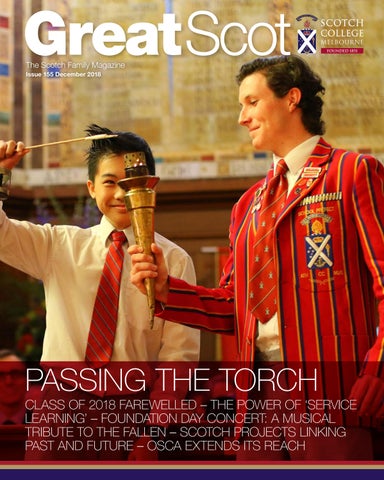
The Scotch Family Magazine Issue 155 December 2018
PASSING THE TORCH
CLASS OF 2018 FAREWELLED – THE POWER OF ‘SERVICE LEARNING’ – FOUNDATION DAY CONCERT: A MUSICAL TRIBUTE TO THE FALLEN – SCOTCH PROJECTS LINKING PAST AND FUTURE – OSCA EXTENDS ITS REACH
Contents 1 EDITOR
48 MUSIC
2 CHAIRMAN
50 SPORT
4 PRINCIPAL
55 BOARDING
6 CHAPLAIN
62 FOUNDATION
17
8 SCOTCH COMMEMORATES WWI
66 DEVELOPMENT
School boys raise big funds for drought relief
12 JUNIOR SCHOOL 18 MIDDLE SCHOOL 19 UPPER SCHOOL
69 PROPERTY 70 OSCA 92 WHAT THEY’RE DOING NOW
20 FEATURES
94 SCHOOL HISTORY
32 SENIOR SCHOOL NEWS
96 OBITUARIES
The Scotch Family Magazine Issue 155 December 2018 is the official publication of Scotch College, Melbourne. Publisher Scotch College 1 Morrison Street, Hawthorn 3122 Victoria, Australia Phone: (03) 9810 4321 Email: greatscot@scotch.vic.edu.au www.scotch.vic.edu.au ABN 86 852 826 445 Print Post Approved PP100008172
View Old Scotch Collegians' Association news and updates at: www.oscanet.com.au Like us on Facebook Scotch College and OSCA FRONT COVER: CARLVINCE TAN (YEAR 8), CHARLIE SCHILLING (SCHOOL CAPTAIN) BACK COVER: CHRISTOPHER SPARKS (SCHOOL VICE CAPTAIN). PHOTOGRAPHY: ROBERT PAPUGA FRONT COVER: ?????
WALK FOR THE DROUGHT Junior
20 PERELBERG AWARD 2018 An Old Boy’s efforts to make barren land green
31 MEMORIAL HALL WALK Recalling Editorial contributors Durga Kamte, David Ashton, Dean Gregory, Paul Mishura, Mark Johnston, Scott Montgomery and Tim Shearer.
World War I leadership, bravery and sacrifice
Editor Durga Kamte (03) 9810 4420 email: durga.kamte@scotch.vic.edu.au Assistant Editor David Ashton (03) 9810 4489 email: david.ashton@scotch.vic.edu.au Production and Art Direction Lisa Sheard (03) 9810 4443 email: lisa.sheard@scotch.vic.edu.au Photography David Assender, Stephen Kong, Scott Montgomery, Megan Heerding, Lisa Sheard, Chrissie Japp, Scotch College students, staff, parents and Old Boys.
38 ENGAGEMENT AND CHALLENGE Scotch’s community-based Immersion Service Program
Editorial
DURGA KAMTE EDITOR GREAT SCOT
To pass the torch, baton or flame — of experience, fair play and learning — schools must follow cyclical patterns since stasis is antithetical to progress. At the start of each year a new cohort of students arrives, whether at Prep, Year 7 or at other levels, to find their own niche and make the School theirs, thereby adding their own distinctive flavour and voice to a vibrant, changing learning environment. And Every year at this time, our Year 12s say their final, often emotional, farewells and wend their way beyond the Monash Gates. In the intervening years, what they have experienced through their interactions with each other and their teachers will have influence on their lives; not just the learning outcomes measured by the VCE and ATAR, but their knowledge of the world and how they can shape it, for the betterment of themselves and others. As the Class of 2018 departs, so too do valued members of staff; some for a wellearned retirement, others to seek opportunities elsewhere. Relational learning is at the core
of Scotch practice, and reflections by staff reveal the value they place on knowing boys as individuals. For progress, embracing new ways of learning that enhance boys’ experiences is key. The elective programs already on offer to boys from Years 7 to 10 will be enhanced by crossage electives, and opportunity for teachers to develop professional skills and share these with the broader educational community through the Teacher Action Research and Career Development Program that will commence in 2019. Experiences are shared not just within the confines of Morrison Street, but extend well beyond. Our growing school exchange program offers boys opportunity to experience school life, and gain different cultural perspectives from partner schools in India, South Africa, the UK and the USA. Our Year 11s immersed themselves in programs such as building houses in Cambodia, fostering strong relationships at Tiwi College, and in Nepabunna, South Australia. Closer to home, boys prepared food for the homeless, cleared backyards, tutored Maths and English, recreated through drama the stories of displacement, and assisted staff and students at a school in Ballarat. Boys recognise their privilege, and during their time at school and after, are motivated to ‘give back’. Fundraising efforts by Scotch have raised monies for the Chipapa School in Zambia and Tiwi College; this year our Year 8s, led by their teacher Katherine Cameron, raised over $10,000 for Partners in Health through a team challenge of running together to raise funds. The Junior School boys were tasked with raising a minimum of $10,000 to support victims of the
current drought; their dedication to the cause saw them offer a cheque for more than three times this sum to the Rotary Drought Appeal. As Scotch Foundation President Doug Lording (‘64) points out in this edition, the development of the Archives Museum and OSCA House at 2 and 3 Morrison Street will enable the Archives to be made more secure and our history to be properly displayed, for the benefit of Scotch Family members today and into the future. For the first time, the Old Scotch Collegians’ Association will have a home, and a great place to meet and maintain the flame of friendship in comfortable surroundings. In welcoming the latest group of young Old Boys — members of Scotch’s Class of 2018 — into the Old Scotch Collegians’ Association fold, OSCA’s Executive Director, Scott Montgomery (‘85), has encouraged the newest Old Boys to consider the wealth of networking, recreational and friendship opportunities that are opening up for them. In tune with the spirit of care they experienced at their old School, Scott assured the cohort that these nurturing qualities will continue to be available to them through OSCA. In particular, as Scott points out in this edition, the role of OSCA’s Young Old Boys’ Committee is to provide these Old Boys with opportunities to connect and maintain engagement with their former schoolmates and with the School, and to provide support and encouragement to participate in events specifically designed for them. One door may close, but another is immediately opened. To paraphrase the mighty Mufasa from The Lion King: ‘And so we are all connected in the great circle of (school) life’.
ALLEN
63
66
73
‘THE MORRISES OF MORRISON STREET’ Old Boys recall life at
DINING HALL AND ARCHIVES MUSEUM / OSCA HOUSE Exciting
AUSTRALIAN OF THE YEAR NOMINEES SecondBite pioneers carry
2 Morrison Street, now the Archives
Scotch projects link our past with our future
Victoria’s hopes
RALPH
www.scotch.vic.edu.au Great Scot 1
Chairman
The Hon. Dr David Kemp AC ('59) – School Council Chairman
The Scotch torch burns brightly THE HON. DR DAVID KEMP AC SCHOOL COUNCIL CHAIRMAN
Throughout Scotch’s 167-year history, the School’s fundamental values have not changed ‘Handing on the torch’ is a powerful symbol at Scotch, and Year 12 leavers treasure this ceremony as they hand over the flame to the younger boys following on. The Year 12s leave a legacy worth passing on: tasks completed, games won, magazines produced, technology invented, essays and poems written, problems understood and solved, relationships strengthened; courage, responsibility, and service exemplified. Their Scotch identity will remain with them throughout their lives. The torch is a main element of the School coat of arms. Almost 100 years ago the designer of the coat of arms, Sir Edward Mackenzie Mackenzie, wrote that the ‘flaring torch’ on the coat of arms indicated ‘the flowing light and clear flame of learning’. The present coat of arms replaced one that featured the scholar seated by the lamp – the light of enlightenment and learning. The centrality of learning to Scotch’s mission reflects, above all, the Scottish heritage of the School. Our founder, the Rev James Forbes, exemplified that unique Scottish combination of faith and reason, belief and science that emerged from the Reformation and the Scottish Enlightenment, which had made Scotland the best-educated nation of Europe at the time he embarked for Australia. The Scottish heritage that the young Forbes brought with him had set itself firmly against ignorance and prejudice and for the freedom and humanity of all, and the school was the essential instrument to support those aims. Scotch was founded to teach that the partnership of knowledge and principles was essential if the world was to become a better place. As Forbes himself wrote, education ‘must
2 Great Scot Number 155 – December 2018
be regarded as the great remedy for the ills of the body politic, the basis on which must be mainly rested all hopes of its amelioration, and of its future generations being better than the present’. Now more than ever it is important to value and promote the intellectual freedom of teachers and boys in a regulatory climate where it is under threat. The sixth of October this year was the 167th anniversary of the School’s foundation. Throughout years of immense technological, social and political change, of wars and depressions, the fundamental values of our School have not changed. Those associated with the School like to think that it has provided a source of purpose and leadership that has been profoundly patriotic, and which has assisted Australia to become the remarkable country that it is. Learning is, of course, a lifelong process. On a solid foundation of principle and meaning, new knowledge and new understandings of the world can be absorbed and put into perspective. And there is always new learning to acquire, as the experiences of each generation — positive and negative — become part of the legacy we pass on to our children and grandchildren. Scotch’s confident strides into the future are exemplified by the leadership of our Principal, Tom Batty, together with the campus developments supporting his vision, planned and implemented by the School Council and the School’s senior officers. Mr Batty has now completed 10 years at Scotch, and his energy and commitment to strengthening the educational offerings and to improve further the quality of every boy’s experiences have not flagged. Turning interests into passions, and premising all school life on learning relationships between teachers and boys, motivates both the
educational strategy and campus developments now being implemented. Parents will be aware of many innovations that are maintaining Scotch’s position of educational leadership. The Teaching and Learning Executive Mr Batty established soon after arrival now enables the School to closely monitor the progress of every boy. The new House system, with 12 Houses, has strengthened pastoral care. New year-level arrangements and innovative teaching and classroom practices, in which teachers work together to develop courses, have enabled the School to meet more closely the educational needs of each boy. Boys are encouraged to reflect on the ideas that have shaped their world, and to explore how invention and enterprise can solve individual and social problems. The Centre for Learning is helping many boys. The School now closely tracks its value-add, and its positioning in an increasingly competitive educational environment. The co-curricular program of music, sport, cadets, Pipes and Drums and other service activities is being continually enriched. The School Council has overall responsibility for the wellbeing of all at Scotch, and carefully guards Scotch’s financial strength to ensure that it is in a position to support the educational philosophy of the School, take advantage of opportunities as they present themselves, and effectively manage risks. The Sir Zelman Cowen Centre for Science and the Spencer Centre for Design and Technology are soon to be followed by the new student precinct with the Keon-Cohen Dining Hall and Scotch Square. This new development will provide wonderful spaces where boys and staff can come together and share ideas. Other developments will include new House rooms and new homes for English and Mathematics. In this final Great Scot for 2018 I want to record my thanks for the great efforts of the School Council members, who give tirelessly and in a voluntary capacity to caring for and improving opportunities for all staff and students. On behalf of Council, I thank Mr Batty and his wonderful staff for their dedication to the education of the boys, and Durga Kamte and all associated with Great Scot. The Council knows that the passing of the torch occurs in many ways. Council members thank all parents for their confidence in the School. I wish everyone a joyous Christmas and a fulfilling New Year. www.scotch.vic.edu.au Great Scot 3
Principal
Mr Tom Batty – School Principal
Passing on the torch with courage and purpose MR TOM BATTY SCHOOL PRINCIPAL
Whilst paying me a visit during my first stint in Australasia in the late ‘80s/early ‘90s, my mum was in awe of all the peoples of New Zealand and Australia had achieved. How ingenuity and desire in escaping the confines of the past had married with opportunity to build something better than that left behind. That such development came at significant cost to the Indigenous population perhaps speaks to less savoury aspects of our condition; however, in scale, pace and scope, as my mum observed and I continue to sense each time I look out over the city of Melbourne or cross the Sydney Harbour Bridge, the achievements are nothing short of remarkable. Opportunity to ‘start over’ and put right (or at least improve on) the errors of the past, be they personal or societal, is a powerful force, and, in Australia’s case, given extra kick by ‘the mother of invention’. I suspect it is the defining emotion directing both parenting and education. Its universality is why, with a good degree of confidence, I often observe to the boys that they are better than my generation was at their age. Of course, as torch is passed from generation to generation, whilst upward, the trajectory is far from monotonic. Not all attempted change is good: we are flawed, and, at times, the motives informing our judgement are far from altruistic. Protecting against such lapses and tempering the compelling draw of immediate need, fad and short term gain, are our values and principles. These give language and form to that, which, over the passage of time and generations, we have learnt to be beneficial for concord and prosperity. Given its primacy, with parenting, in community building, this is particularly pertinent when considering developments in education, where comfort in being swept along with prevailing rhetoric can obfuscate key questions: On what values were the current forces premised, and do they marry with those of parents and teachers? What is it we really want to achieve; i.e., what is it we see as being good education? Let me set the scene and cast light on a future increasingly seen by many as the logical progression of recent ‘progress’ in education. The trends which started in the ‘80s with central control of curricula and qualification, and gained momentum with measurement, standardised
4 Great Scot Number 155 – December 2018
reporting, national testing, accountability and league tables, are now receiving accelerant from the power of the digital age. Whilst some good has flowed from such control, not least some clear articulation of what it means for a school to be failing its pupils, there have been costs, primarily those relating to the independence of schools, the free exploring mind of the individual, the development of the whole child, and, significantly, to opportunity for teachers to develop and share their passions and talents. It could be argued with some credence that the shift has made it harder for poor schools and poor practice to continue unchecked; however, is what is being offered really the best in education we should be striving for? And now there is a new force at play, and it is a powerful one that comes with the promise of unlocking the much cherished goal of teaching, that of differentiation – the targeting of learning to specific individual need. Let me now proffer a glimpse into that future seen by many as desirable: ‘Following a week pursuing his individual learning programme, Jack sits a test designed by a computer that is informed by the standardised school data of millions of boys and girls. As a consequence of Jack’s performance in the test, the computer modifies Jack’s learning programme to best challenge and support him for the week ahead. Repeat.’ There is good here. The data is providing information that is useful, but what is its context? Who (or what) determined the criteria for ‘success’ for the test, and to what end? Who knows what sort of day Jack is having? Who actually knows Jack and those influences on his life that can be brought to the party and may well be ‘Jack specific’? Who (or what) is preparing Jack for the world beyond tests and results? What does Big Data have to say about the values that will underpin Jack’s judgements, interactions and relationships? Importantly, what is motivating Jack? Of course, data itself is not the issue, rather what we do with it and, therefore, the forces guiding its use. Recent analyses of NAPLAN results, with much justification, focus on ‘growth’ rather than ‘achievement’, and such conversation is now pervading the education debate. Growth is, of course, a good thing, and most worthy as a pursuit; but what is it
without some sense of achievement? It is good that a child learning to swim goes from one week completing one stroke to two strokes the next and four in week three, but at what point do we say she/he can swim? Or, to take aim at another potential worthy pursuit glibly tossed around — critical thinking: surely it helps to have gained mastery of a few things before pretending to think critically about them. And while I’m on a roll, how about benchmarking? Whilst being supposition to some degree, I am fairly confident that in founding our School, the Rev James Forbes did not proclaim we should, ‘go forth and benchmark’. Big Data and machine programming deliver great opportunity in diagnosing individual need and personalising programmes, but if education is premised, as I believe it is, on influencing the judgements which exist in the moments between coming to awareness and action/opinion, then we must surely ask of the values, experiences and, most importantly, people, that provide context for such discernments. What is it that parents new to the schooling process see as valuable for their children? A recent survey of parents who have boys starting in Scotch Prep in 2019 and no other son at the School, points to quality of teaching and focus on the ‘whole child’ as the most significant matters, with values such as humanity, balance, courage, respect, an embrace of difference all to the fore, alongside the hope that their sons will be encouraged and empowered to ‘dream big’. What about teachers? What is it we know (or at least can be confident of knowing) of the reasons why teachers enter, and remain committed to, the teaching profession? Well, a survey (Dinham and Scott, 2000) of 2000 secondary and primary school teachers from across Australia, New Zealand and the
United Kingdom showed the three most significant commitment scales to be (in order): Affiliation (the desire to feel part of a purposeful community), Altruism and Personal Growth; while in his seminal book Drive, Daniel Pink, with reference to numerous case studies, propounds powerfully for autonomy, purpose and mastery as the key motivating factors for people in their work and play. We will continue to premise Scotch life on learning relationships between teachers and boys; value and promote intellectual freedom; increase opportunity for teachers to hone further the sharing of interests and the passing on of passions; focus boys’ thoughts on enterprise and the need to confront the challenges of their age; and, set learning in a conversational environment that requires boys to reflect on the ideas and actions that have brought the world to its current state. Schools must harness the power of the information age, and not be dictated by it. We must continue to develop our teachers for changing times and not shackle them, for fear of what they might or might not do. We must empower teachers to continue to share their stories and talents, and thus nurture the whole child. We must enable boys to add depth and meaning to their narrative by sharing their stories with others, so the torch can again be passed with courage and purpose. Let me finish with a quote from the most gifted educator of boys I have met, Tony Jarvis, former Headmaster of the Roxbury Latin School, who died on 7th October, 2018, in Lincoln, Massachusetts: Boys do not learn subjects. Boys learn teachers. They will forget most of the stuff you teach them, but they won’t forget you – your stories and the values you convey by the way you live. www.scotch.vic.edu.au Great Scot 5
Chaplain
REV DOUG CAMPBELL SCHOOL CHAPLAIN
Rev Doug Campbell – School Chaplain
‘It is not about speed, son. It is all about taking care of the baton’ We challenge our boys to grasp opportunities and do great things
The old man leaned back on the barrier as he inspected his charges going around the track practising for the upcoming relays. As I leaned beside him, we chatted about the forthcoming relay championship and his thoughts about the main event. ‘We might not have the fastest quartet, but we have a good chance of a medal if we do the basics right!’ I did not share his optimism, as his athletes kept making mistake after mistake. They dropped the baton and swerved all over the place. They were destined for disqualification. Frustrated by their lack of cohesion, the experienced coach decided to act. Instead of worrying about actually racing the distance, John scrapped his prepared training schedule and brought his runners in for a chat. Leaving the expanse of the track he gathered them in a small corner and had them passing the baton for the rest of the evening. Time and again he would bark out his instructions: ‘Hand!’ — ‘Stretch!’ — ‘Pass!’ — ‘Go!’ It was monotonous, and yet the coach knew what had to be done in order to make his runners competitive. At the end of the night, as the floodlights illuminated the sleet, the coach was far from downhearted. Breaking into almost a smile and with a glint in his eye, John exclaimed, ‘Aye, they’re nearly ready!’ Passing the baton successfully in a race is not as easy as many think. Both runners must be running so that they do not lose time. Each member of the team has to trust and have confidence that teammates will hand the baton over cleanly and within the small space allowed. The runners receiving cannot waste precious time turning their heads to look at what is happening lest they swerve out of their lane and be disqualified. Each member of the team must know his or her own strengths and weaknesses and those of the other person. For example, the receiving runner cannot start running too early lest he runs out of reach of the baton. And you should never shout ‘Go!’ until the 6 Great Scot Number 155 – December 2018
baton is safely in the hand of the next athlete. While baton changing is not rocket science, it requires coordination and practice. Teamwork does not always come naturally to people who usually train for individual events. The idea of ‘passing the baton’ is often used in terms of passing on something important to the next generation. It can happen throughout a person’s life, but is commonly applied at those momentous times of change. The Bible narrates those epoch-changing moments when great leaders came to the end of their lives and passed on the baton to their successor. Moses to Joshua, Elijah to Elisha, Jesus to the disciples, and Paul to Timothy. The temptation for all leaders and people of influence is to hold on to the power and the glory until it is too late. However, true leaders look to pass on the work to the next generation for the benefit of all who follow. Good leaders willingly look to the future and seek to pass on their vision to others lest the work and legacy come to an end. Jesus recognised this very thing. He chose and equipped his disciples, aware from the very beginning the cross set before him. He devoted his time and energy into his close-knit group drawn from a variety of backgrounds. While he taught them through his marvellous teaching, he importantly shared intimately and openly his love and grace. The disciples were receiving the baton while sharing precious time with Jesus. It is interesting that Jesus did not ask his disciples to provide an analysis of his teaching, but they were challenged directly about his identity and purpose. ‘Who do you say that I am?’ The baton these disciples were to cherish and pass on faithfully to the next generation was not a position of power and influence in an organisation, but the life-changing good news about the person and redemptive work of Jesus Christ. They were to pass on the news of Jesus. At the time of writing, Scotch is a little quieter. The School Captain, Prefects and the Year 12 cohort have now left and are preparing for their exams. Their time of leadership at Scotch has generally come to an end. And by their example they have passed on the baton to the next generation. However, the lessons the Year 12s have learned during their time in leadership will hopefully remain. May they cherish the good traditions and values of Scotch that seek to serve the whole school community, and to advance others rather than themselves. Much will be expected from those
who have received much in life. May they remember and experience the love and grace of Christ in the future and pass that on to those whom they meet in life. That will be a tradition to pass on. The Monday after the relay championships, John was a happy man. A silver medal for a team whose individual personal bests combined would have ranked them seventh out of the eight teams competing. ‘It is not about speed, son. It is all about taking care of the baton!’
SAVE THE DATE
SCOTCH FAMILY EASTER BREAKFAST, 2019 Date: Time: Place: Cost:
Friday 29 March 2019 6.45am for 7am Boykett Room, Cardinal Pavilion Adults $32; Students/Concession $16
Infectious disease physician Steven Tong (‘92) will be the guest speaker at the 2019 Scotch Family Easter Breakfast in March. Steven works at the Royal Melbourne Hospital, where he combines an active clinical practice with a research program that aims to reduce the burden of infections in Indigenous Australian populations, and to improve the treatment of golden staph infections around the world. Steven spent 10 years working in the Northern Territory and conducted post-doctoral studies in the US and UK. He worships with his family at St Thomas’ Anglican Church in Burwood.
Commemoration
‘FAR AWAY FROM THOSE WHO LOVED THEM’ Scotch College war deaths in 1918
This article concludes our coverage of the 54 Old Scotch Collegians and staff who died as a result of the war in 1918. JOHN ILEY SNOWBALL (1907) left Australia as an officer in late 1915. He fought at Fromelles in July 1916 and by the end of the year was a Captain. His service file contains a letter from a woman praising John for ‘a beautiful letter’ he had written about her late brother. In August 1918, during the turning point battles in which the Australians played a leading role, he wrote home excitedly: ‘We have just come out of the finest stunt yet; it was on a colossal front, and everything worked like clockwork. It was what we have been waiting for, the Canadians and Australians to attack together.’ He was wounded in the knee on 13 August 1918 and died the following day while his leg was being amputated. A stretcher-bearer called Snowball ‘one of the best Captains I have ever seen.’ ROBERT STOBO WATSON (1915) enlisted at 18, with his widowed mother’s permission. He reached the Western Front as a gunner in February 1917. He was hospitalised in England with various ailments, and within a month of returning to his unit was hit and killed instantly by a stray shell fragment while bringing ammunition up to the guns near Rosieres on 14 August 1918. FRANCIS JOHN SMEDLEY (1891) was more than twice Robert’s age at his death. Francis had been commissioned a Second Lieutenant before sailing in March 1916. Six days after arriving on the Western Front in June he was wounded in the thigh. He became an instructor in England before returning to his battalion in March 1918. In July that year he won a Military Cross for leading his men in capturing and holding vital ground. He was wounded in the spine on 9 August near Lihons, and died of his wounds in England on 20 August 1918. FREDERICK CADWALLADER ALLEN (1911) was lucky to reach England on Anzac Day 1917, for the transport carrying him and
8 Great Scot Number 155 – December 2018
1751 other men was torpedoed and sunk by a German submarine off the English coast that day. Fred was rescued. He was kept at clerical work for the next year, but on 28 April 1918 reached his original battalion, the 37th, in France. The 24 year old was killed when a shell landed among a group of 10 men while they marched towards Bray on 25 August. DR WILLIAM ROGERSON (1909) qualified as a medical practitioner at Melbourne University in 1915, the same year that he became one of 100 Australian doctors sent to England to help the New Armies being raised there. After one year’s service, in 1916 he chose to continue working with the Royal Army Medical Corps on the Western Front and was promoted to Captain. He later served in Greece and Palestine, before returning to France in 1918. He was killed by shellfire near Albert while serving with the Royal Berkshire Regiment on 27 August. WILFRED LORIMER THOMAS (known as Lorimer or Lorry) COLCLOUGH (1911) had defective eyesight, leading to his enlistment applications being rejected seven times. Eventually he was accepted, and in January 1917 reached the Western Front. He was wounded in the leg at Bullecourt in May 1917. He was wounded a second time on 17 August 1918, but remained on duty. Lorimer was promoted to Lance Corporal, but on 28 August received a third wound, this time to the chest and arm while on patrol. He died the following day. The effects transferred to Lorimer’s mother after the war included ‘1 Pr Spectacles (broken)’. On enlistment, JAMES (known as Jim) BEE (1911) was allotted to the Medical Corps as a stretcher-bearer. In February 1918 he transferred to an artillery unit, and worked as their stretcher-bearer. He was recommended for a Distinguished Conduct Medal for his courage in dressing the wounded under heavy fire on 31 August 1918, but as the 26 year old was killed in the process, was ruled ineligible for this award.
His medical officer said Jim was ‘loved and relied on by every man in the battery.’ ERNEST MILTON MARTIN (1910) was initially assigned to a medical unit as a Private. In mid-1917 he undertook an officer training course, and by the end of the year was a full Lieutenant with an infantry battalion. He was killed by shellfire near Peronne on 31 August 1918. SELWYN RAY DICKSON (1909) enlisted twice. In 1915 he joined as a Private, and although he made Lieutenant by 1916, illness forced him out of the army. He re-enlisted in February 1917 and was an officer again by the time he reached England in early 1918. After surviving acute appendicitis, he reached his battalion on the Western Front on 14 July 1918. A shell which burst on his trench killed Selwyn on 1 September 1918 near Peronne. GEORGE CHRISTIAN SCHLYDER (1903) was hospitalised for various ailments during his service, including nephritis, scabies, influenza and trench fever. He had stints on the Western Front in each of 1916, 1917 and 1918. He met his death on 1 September when hit by a sniper’s bullet while grenading enemy positions at Mont St Quentin. A death notice from his mother mentioned his widow and the fact that he died ‘Far away from those who loved him.’ WILLIAM MERVYN (known as Mervyn or Merv) LECKY (1914) was a farmer at Officer when he enlisted in 1915. He served on the Western Front in the artillery, mainly as a signaller. Mervyn won a Military Medal for maintaining a line to a forward post while under heavy fire on 23 August 1918, but never learnt of the award. He was killed when a shell landed at the entrance of his dugout on 1 September. At 19, WALTER VINCENT (1916) was one of the youngest Scotch Collegians killed in the war. He reached the 23rd Battalion on the Western Front on 20 April 1918. Shortly after catching up
Scotch Commemorates World War I
ABOVE: TOP ROW: J I SNOWBALL, R S WATSON, F J SMEDLEY, F C ALLEN. BOTTOM ROW: W ROGERSON, W L T COLCLOUGH, J BEE, E M MARTIN
with one of his brothers, Walter too was killed at Mont St Quentin on 1 September. Like Walter, STANLEY ARTHUR BARRIE (1908) was killed serving with the 23rd Battalion on 1 September. He had served in a field ambulance on Gallipoli. After the campaign, he repeatedly got into trouble for going absent without leave, albeit for brief periods, and for disobedience. In August 1918 he was transferred to the 23rd, and 12 days later he was killed at Mont St Quentin. DR ROBERT ANDREW BUNTINE (1886) was not a serviceman in World War I, though in the Boer War he had served as a Surgeon Captain and been Mentioned in Despatches. After moving to South Africa, by 1915 he was a member of the Legislative Assembly there. On 12 September 1918 Robert was a passenger on the Galway Castle when it was torpedoed by German submarine U-82 southwest of Land’s
End, England. He was one of 143 people on board who died. DR JOHNSTON (also known as John or Jack) HUGHSTON (1910) completed a medical course at Melbourne University in 1915, and then joined a group of 100 young doctors who travelled to England. He served with the British army in France and Greece, where he contracted malaria. After returning to Australia for a few weeks to recover, he travelled to Macedonia, where he was Mentioned in Despatches and promoted to Major. Johnston was wounded in the chest in August 1918 and then in the back on 14 September. He died of his wounds on 14 September. His commanding officer estimated that within the ambulance unit, John ‘was the most beloved officer’. STANLEY WALTER (also known as Walter Stanley) NEALE was School Captain in 1912. He enlisted with three other Scotch Collegians
— Reg Brownell (1909), Keith McIlwraith (1912) and Percy Warren (1901) — as a Private on 17 August 1914. The other three were all killed at the Gallipoli landing on 25 April 1915. Stan survived the landing, and fighting at Cape Helles, and was appointed Corporal. Early in 1916 he was made a full Lieutenant and then, two months later, a Captain. In September 1917 he won a Military Cross in the Battle of Polygon Wood (part of the 3rd Battle of Ypres). His action — seizing and holding an important objective — was mentioned in the Australian official history of World War I. After spending time as a training officer in England, he returned to France in September 1918. On 29 September, while standing on the edge of a trench getting his men under cover during an advance at Bellicourt, Stan was hit by machine gun bullets in the left forearm and
www.scotch.vic.edu.au Great Scot 9
Commemoration
ABOVE: TOP ROW: S R DICKSON, J A LECKY, W VINCENT, S A BARRIE. BOTTOM ROW: J HUGHSTON, S W NEALE, J GOULD-TAYLOR, L N CLARK
the right chest. He died soon afterwards. In the words of one of his men, he was ‘a great soldier’. JOHN (known as Jack) GOULD-TAYLOR (1915) was one of the best athletes in the winning Scotch College Athletics team of 1915. He enlisted the following year at age 19. After serving with the artillery, he transferred to the Australian Flying Corps in England in 1917. He qualified as a pilot and in March 1918 went to the Western Front. On 28 August his reconnaissance aircraft was attacked by five German fighters, which he drove off ‘with characteristic boldness and skill’ and then completed his mission. He was consequently awarded a Distinguished Flying Cross. On 3 October Jack’s RE8 aircraft was shot down by ground fire, which killed him and his observer. Jack’s great love for the School was apparent in the fact that he carried a small Scotch flag on his aircraft, and that he once dropped a letter to a mate in the front line, with the colours cardinal, gold and blue attached. LESLIE NORMAN CLARK (1904) enlisted in 1916, and was in France by December that
10 Great Scot Number 155 – December 2018
year. On 27 April 1918 he earned a Military Medal for repulsing an enemy attack with his Lewis Gun team, despite being wounded. On 29 September, after transferring to another battalion, he won a bar to that medal – that is, a second Military Medal – for leading a ‘bombing’ party against a group of enemy attackers at Bellicourt. He was so badly wounded in this action that he died of his wounds on 5 October. At five feet four inches (163cm), JOHN LANGFORD MAXWELL (1915) was one of the shortest Old Scotch Collegians killed in the war. He reached the Western Front on 26 April 1918, where he served as a company runner. He was counted wounded and missing on 5 October at Montbrehain. Inquiries by his father and the Red Cross for more information were entirely fruitless. He was an exact Scotch contemporary of HENRY BLAKE MILLER (1915), also of 24th Battalion and also killed on 5 October. These two, Miller very tall — over six feet two inches (188cm+) — and Maxwell very short, who had travelled together on the Nestor in November 1917 and joined the 24th on the same day,
surely knew each other. Henry had been badly wounded in July 1918. Unlike John, Henry’s body was found and buried. FRANCIS DRAKE (also known as Frank) CULLEY finished in 1915 at Scotch, where he had been a boarder, and then enlisted at 19 the following year. He joined an artillery brigade, and fell ill after inhaling gas at the front in 1917. In April 1918, he was severely wounded in the leg when a premature explosion occurred in a gun he was firing. He returned from England on 11 October, just one month before the war’s end. On 17 October, a shell exploded near his gun, and a fragment struck him in the head. He was Scotch’s last recorded fatality in action in World War I. Nevertheless, this bloody war would take more lives of Old Scotch Collegians. EDWARD JOHN DAWES (1903) served in the British Army and then the Royal Navy, rising to the rank of Lieutenant, in charge of the minesweeper HMS Epsom, and winning a Distinguished Service Cross. He died of illness in England on 27 October 1918.
Scotch Commemorates World War I
ABOVE: TOP ROW: H B MILLER, F D CULLEY, E J DAWES, G G ANDERSON. BOTTOM ROW: H C CLARKSON, W R B DELBRIDGE, C K DAVIES, W A FERGUSON
DR GEORGE GRANTHAM ANDERSON (1906), who had been an outstanding athlete and a Prefect at Scotch, served as a doctor with the British Army on the Western Front. While in charge of a large hospital at Etaples, he died suddenly on 3 November. His son, Graham (‘36), would be killed in World War II. HUGH CURTIS CLARKSON (1915) joined the artillery in France in April 1918 as a signaller. He contracted influenza and died in hospital in France on 4 November. In a letter to his father he had considered the possibility of death and concluded: Dulce et decorum est pro patria mori. (‘It is sweet and honourable to die for one’s country.’) JAMES ALEXANDER (known as Jim) LECKY (1905) was a driver with the artillery in France in 1918. He was a fine horseman, winning six of eight races when his brigade held a race day. In October 1918, a month after his brother William’s death, he was struck in the chest by shell splinters. He died of his wounds on 14 November.
WILLIAM RAWLINGS BENNETTS (also known as William Rawlins Bennetts) DELBRIDGE (1913) was so desperate to enlist at 18 that he forged his parents’ signature. This was discovered, but he enlisted at 19 and reached the front in August 1918. On 22 November, he fell off an overloaded bicycle and was struck by a passing truck. He died that day. CLIFFORD KEITH (known as Keith) DAVIES (1913) was initially rejected because of an appendectomy scar. After being accepted, by March 1918 he was in France with the artillery. He reportedly saw much action. On 9 November, two days before the Armistice, Keith was hospitalised with influenza. He died on 28 November. WILLIAM AITCHISON (also known as William Aitchins or William Aitcheson; known as Bill) FERGUSON (1913) was initially rejected because of poor eyesight and malaria. On enlisting, he served as a motor driver in France in 1917 and 1918, when in November he contracted pneumonia and died on 30 November.
Even with victory won, another 11 Old Scotch Collegians died of war-related service in 1919-1921. Their stories will be told in Great Scot next year. More details about all other Scotch Collegians killed in World War I can be found on the Scotch website, under ‘Roll of Honour and Scotch in WWI’ on the lower right of the home page. DR MARK JOHNSTON – HEAD OF HISTORY
www.scotch.vic.edu.au Great Scot 11
Junior School
Mr Jon Abbott – Head of Junior School
MR JON ABBOTT HEAD OF JUNIOR SCHOOL
MR JON ABBOTT WITH YEAR 6 BOYS DURING A LITERATURE CIRCLE SESSION
YEAR 5 BOYS SUPPORTING THEIR YOUNGER PREP FRIENDS
A STRONG CULTURE IS THE WORK OF A COMMUNITY 12 Great Scot Number 155 – December 2018
Great schools have many common factors that set them apart from others. Some of these factors can include excellence in a particular area, such as music, the arts, sport or academic rigour. It might also be the quality of the teaching programs and the teachers themselves. Sometimes it is the physical environment that can set a school apart from others; the grounds and surrounds or the actual buildings and facilities. However, I think there is one factor that is a real hallmark of a truly great school: its culture. Culture is a term that is easy to use but not always as easy to define. Equally, creating, growing and
nurturing a strong culture in a school can be a challenge. Setting up a positive, respectful and welcoming culture cannot be achieved merely by the introduction of rules, procedures or policies. It cannot be achieved by one person or even by a team of leaders, although they can have a significant impact on its development. I strongly believe that a truly resilient and positive culture is created by the whole organisation — in our case, the whole school. A strong culture is not the work of the principal or the headmaster, nor can it
be achieved by the teachers alone. For me, a really strong culture is the work of a community; its leaders, teachers, parents and students all working with a similar purpose and mindset in regard to the place they wish to belong to and be part of. This edition of Great Scot has the theme of ‘passing the torch’, which is a reference to our Year 12 Torch Ceremony. The notion of ‘passing the torch’ is also a terrific illustration of how really strong cultures are created, developed, strengthened and maintained. It brings to mind the idea of one generation passing on its shared learnings, experiences, understandings and expectations to the next generation, to carry forward, build on and strengthen those qualities that are held dear. In my time at Scotch this is something I have come to realise runs very deep and very strongly through our community. This can be through the connections the Old Boys still maintain to their School and their desire to ‘give back.’ It might manifest in the way the senior boys reinforce the important traditions and values of Scotch. Often it can occur through the stories and images that fathers, once Scotchies themselves, hand down to their sons. I feel that the culture of Scotch can be seen in the traditions that pervade a good deal of what we do. Events like Family Day, the CordnerEggleston Cup matches, the Head of the River, Speech Night, Chapel Services, Foundation Day Concerts and Assemblies are all steeped in tradition built over many years and by numerous generations. In the Junior School we have our own traditions and practices that have a big impact on our culture. I like to think that one of the strongest aspects of what makes the Junior School a special place for boys to belong to is what the boys themselves do. As with many schools, we have a thriving buddies program, where older boys work in their classes with classes from the younger years. Apart from the activities in which they participate, there is also a handing down of what it means to be a good Scotchie. The older boys mentor their younger friends in how to
behave, what to look forward to and how to go about life in the Junior School. The Big Friendly Guys Program, where Year 6 boys volunteer to act as older friends and mentors to the Preps, Year 1 and Year 2 boys in their playground provides a great opportunity for them to pass on expectations and how to treat others. Our Peer Support Leaders Program, where all Year 6 boys regularly lead a small team of boys from Years 3 to 5 within their House groups, is yet another opportunity for that passing on of traditions and expectations. Each week younger boys regularly see Year 6 boys running Assemblies in front of the whole Junior School, and learn that speaking well in public is ‘just what you do at Year 6’, so they look forward to their time and opportunity to do the same. I am proud of the way our boys take responsibility for how our School works, and that they value what they have inherited from those who went before them. It brings me a great deal of satisfaction to see boys stepping up to remind others of what they should or shouldn’t be doing. I love to hear the stories of how an older boy supported a younger boy with an incident on a tram or while walking home from school. These and so many others are examples of how the boys themselves maintain and grow that strong culture in our School. In so many ways, they also play a big part in ‘passing on the torch’.
ASSISTING YOUNGER STUDENTS WITH THEIR LEARNING
www.scotch.vic.edu.au Great Scot 13
News BOYS TENDING THE PLANTS IN THE BOARDING HOUSE PRECINCT
BELOW: YEAR 3 BOYS IDENTIFYING THE ORIGIN OF FOODS COMMONLY BOUGHT IN AUSTRALIA
ABOVE: YEAR 3 BOYS PLANTING AT HEALESVILLE
Year 3 boys get right into the spirit of Schools’ Tree Day Scotch’s Year 3 boys participated enthusiastically in Planet Ark’s Schools’ Tree Day (Friday 27 July) by planting 100 clumps of a native grass, tanika lomandra, at Scotch’s Elliott Lodge property at Healesville. Year 3 Coordinator Steve Grbac and Junior School Director of Studies, Brian Sampson, did the heavy work – and gained a few blisters – by digging the holes, and each boy planted at least two grass clumps. Each year the Year 3 boys get into the spirit of Schools’ Tree Day, along with girls and boys from around 3000 preschools, kindergartens, primary and high schools across Australia. The children have fun learning how to dig for the environment, and get their hands a little dirty while planting more than 470,000 native seedlings, trees, shrubs, edible plants and flowers. The Healesville plantings have helped to beautify a vacant area in front of the Cherry Wilson Hut at Healesville, and as the teachers explained to the boys, the sturdy, drought-tolerant native grasses will help to hold the soil in place and provide a habitat for lizards and other small animals. Tanika lomandra, which is widespread throughout eastern Australia, has shiny green strap leaves which are soft to the touch, and yellow flower spikes that emerge in spring. It’s hoped that the local wallabies and wombats don’t find the abundant leaf growth too much to their liking.
14 Great Scot Number 155 – December 2018
Healthy Me, Healthy Planet
Scotch’s Year 3 boys are studying how food is grown, in an incursion which teaches them plant biology, how to reduce, reuse and recycle, and how to minimise excessive food packaging. It’s all part of a ‘Healthy Me, Healthy Planet’ incursion. This consists of fun and engaging activities in which the boys are encouraged to choose foods that are both healthy and sustainable. The idea is to reinforce the principle of healthy eating, and also how the food choices we make have a long-term impact on the environment. In the incursion, with the use of a map, the boys were shown how products we buy locally, and might assume are sourced from Australia, in fact come from overseas. They were encouraged to think about ‘food miles’ and the effects on the atmosphere of pollution resulting from long-distance food transportation. Meanwhile, more vegetable planter boxes have been added to the 15 outside the Year 3 classrooms. Up on the Hill, 10 boxes filled with a thriving crop of silver beet have now been set up in a north-facing area near the car port in the boarding house precinct. In a peer support gardening exercise, each of the four Junior School Houses takes a turn at planting the seedlings, watering and weeding, and then harvesting the crop in the boarding house precinct. The longer-established planter boxes near the Year 3 classrooms are now full of a healthy crop of broad beans, broccoli, silver beet, purple cauliflower, bok choy, companion plants and various herbs. The plants are showing strong growth, boosted by generous amounts of worm juice produced in Mrs Gillian Comport’s classroom nearby. Having done the work to bring the vegetables to maturity, the boys are harvesting the fruits of their labour and taking them home to eat and enjoy.
Staff in profile What is the best advice you have ever received? Don’t worry about anyone else. As long as you know in your head and your heart that you are doing the right thing, that is what matters. I was particularly close to my maternal grandmother and always listened to her sage advice. To me these words were about ignoring distractions, being honest with yourself and striving to be your best. What story will your colleagues tell about you at your farewell speech when you retire? I am not sure there are any particular stories that will be told, but I hope my colleagues will remember me as being thoughtful, kind, and a person of integrity.
Interview: Sophie Elliott Sophie joined the Scotch teaching staff in 2007, after gathering experience teaching in both Ballarat and Armadale. She quickly became a valued member of the Learning Support team, creating a productive, safe and supportive environment for the boys in her care. Sophie has worn many hats at Scotch. She was a Second Lieutenant in the School’s Cadets and was made Head of Campbell House, where she made a positive impact on the boys and helped form the cohesion and team spirit that is still evident today. It was during her time as a Scotch Boarding House Tutor that Sophie met her husband, Sam Elliott. Currently they are expecting their third child, an eagerly anticipated family addition for older sister, Abigail and brother, Hugo. Recently Sophie worked as an integration aide, gaining yet another perspective of our School. Currently Sophie is teaching Year 1, where her wide-ranging experience and expertise shine through. Sophie is a natural teacher; she is always kind, considered, professional and thorough. These qualities also make her a highly valued and loved colleague. KATE IKINGER
When you are no longer teaching, what are some of the Scotch memories on which you will reflect?
I have so many happy memories from Scotch. I have always felt privileged to work in a beautiful environment, with passionate, talented and supportive colleagues, and with the boys. The boys breathe life into the School and bring an energy with their enthusiasm, fascination for the world around them and eagerness to learn.
What has been your biggest challenge over your years at Scotch? I naturally seek to learn and grow professionally by challenging myself, and I am very appreciative of being afforded many opportunities at Scotch to do so. From taking on the role of Head of Campbell House and facing my fear of public speaking; to joining the Cadets and undertaking the week-long officer course; to working and living in the boarding house environment; and returning to classroom teaching this year. All these various experiences have kept me engaged, inspired, and have further developed my understanding of the relationship between teaching and learning. I am very grateful for having many mentors. What advice would you give our VCE students as they embark on a life outside Scotch? Life is about balance. Seek challenges to grow and develop and pursue your passions. Success will follow naturally. With privilege and opportunity, however, come responsibility. Consider and find ways in which you can contribute in a meaningful way to the community. It can be incredibly rewarding being selfless.. What is your favourite corner of the School? The Littlejohn Memorial Chapel is one of my favourite places in the School. I married Sam there, having met at Scotch working on the Hill in Arthur Robinson House together. Both his parents and mine also married in the Chapel. I have always enjoyed the Chapel as a special space in which I can stop and reflect on all areas of my life, both professional and personal. The Chapel also gives me a sense of connection to close and extended family who have attended the School.and the people I work with provide a positive influence every day. www.scotch.vic.edu.au Great Scot 15
News
SUCCESSFUL AND ENJOYABLE SNOWSPORTS SEASON It has been another fantastic year for the Junior School snowsports team. A total of 51 boys competed in the Victorian Interschools Snowsports Championships at Mount Buller, and 20 boys went through to compete in the Australian Interschools Snowsports Championships at Perisher, NSW. Once again our teams performed very well, with a large number of team and individual podium placings. As a result, Scotch Junior School won the Champion Boys’ School trophy for the 13th consecutive year at the Victorian Interschools, and came second in the Australian Interschools. Congratulations to all Junior School boys for their determined efforts this year. A huge thank you must also go to the parents, teachers, volunteers, and coaches for assisting boys on the mountain, and for always being willing to lend a helping hand with different events and activities throughout the season. JUNIOR SCHOOL BOYS ENJOY THE SNOW AT MOUNT BULLER.
BRENDAN FROST – TIC, JUNIOR SCHOOL SNOWSPORTS
Lewis Francis — pushing the limits in go-karting
ABOVE: LEWIS FRANCIS WITH HIS PARENTS AND BROTHER JUSTIN (CLASS OF 2013)
Lewis Francis was born for speed. At a very young age he followed older brother Justin (‘13) into the world of go-karting where he quickly showed a natural inclination to the world of high-speed racing. He was given his first motorised kart, a Bambino, at the age of four and was soon hooked on racing. Since the age of seven, Lewis has competed in local, state and national karting events and competitions. He regularly competes at the Todd Road track in Port Melbourne for Gawne Kartsport. This year has seen Lewis really excel. He competed very successfully throughout the 2018 season in the seven to nine-year-old division, Cadet 9s. Regularly hitting top speeds of over 100km per hour, Lewis has raced on tracks across the country, in New South Wales, South Australia, Tasmania, Queensland and, of course, Victoria. His fearless nature and skilful driving have earned him numerous victories during the Victorian karting season, and he carried this success into the Australian Kart Championships.
16 Great Scot Number 155 – December 2018
The national competition involved a series of five races in various states, with points being accrued for each race in the series, much like the big boys in the Formula One motor racing series. During the year Lewis was named Junior Top Guns champion in the Cadet 9 division, Victorian state champion, and in August this year, Australian champion, winning the competition with a 47 point lead over his nearest rival. Lewis rates some of his highlights as meeting his namesake and hero, F1 champion, Lewis Hamilton, as well as Australian driver, Daniel Ricciardo, being selected as a ‘grid kid’ for this year’s Australian F1 race, which involved a radio interview with 3AW’s Neil Mitchell and an appearance on the television show The Project, and having the opportunity to visit the McLaren factory in Woking, England. There is little doubt that this young speedster will continue to push the limits as he works his way through the ranks of go-karting, with his ultimate aim of one day emulating the feats of his hero, the other Lewis. GILLIAN COMPORT – LEWIS’ TEACHER
TOP LEFT: JUNIOR SCHOOL TEACHERS DRESS UP IN SUPPORT OF THE WALKING IN THEIR BOOTS APPEAL. TOP RIGHT: JUNIOR SCHOOL STUDENTS LED BY PRINCIPAL JON ABBOTT IN A CHICKEN SUIT TAKE PART IN THE WALKATHON. BOTTOM RIGHT: TOM FARRER AND NATHANAEL CHAN PRESENT A CHEQUE TO MR GURNEY.
Junior School walkathon funds a whole lot of hay On Monday 17 September, all Junior School boys participated in a ‘walkathon’ around the Scotch grounds dressed in ‘farm clobber and boots’. The aim was to raise some much-needed funds for victims of the current drought affecting so much of northern Victoria, NSW, South Australia and Queensland. Following a number of comments from boys in Year 6, who had recently viewed a news program about how bad the drought was becoming, a decision was made to support the Australia-wide appeal. Following previous success in raising funds for the Juvenile Diabetes Research Foundation in 2016 via a walkathon, it was decided that the boys would again seek sponsors for another walkathon. The aim was to try to raise sufficient money to pay for a semitrailer load of hay — roughly $5000. Scotch boarders Lachlan Day (Year 11) and Lachlan Clark (Year 7) came along to a Junior School Assembly to talk to the boys about the impact the drought was having on their parents’ farms, and to share how hard their families were working to keep their farms going. Their message was a significant factor in motivating the boys to seek out sponsors. In order to provide an extra incentive to the boys
to search for sponsors, Junior School Deputy Head, Mr Grant Phillips, said he would spend the day dressed as a cow and only say ‘moo’ if they could achieve the target of $5000. Raising the stakes, Head of Junior School, Mr Jon Abbott, followed that challenge with another — he would spend the day dressed in a chicken suit if the boys could raise $10,000, enough to pay for a B double semitrailer load of hay. As has often been the case in the Junior School, the boys smashed these targets and eventually raised a magnificent total of over $29,000 by the day of the walkathon. This was enough almost to cover the cost of three B double semitrailer loads of feed for the livestock in drought-affected areas. The most amazing aspect of this total was that it was achieved in only two weeks, from the time the boys were first set the target until the day of the walkathon. Having endured a wet and cold Family Day the previous Saturday, we were blessed with a fine blue sky afternoon as we all set off around the Scotch grounds, a course of approximately two kilometres with Mr Abbott in his chicken suit leading the procession and Mr Phillips in his cow suit bringing up the rear. A few other teachers were challenged by their classes to wear
costumes if they could raise a certain amount as a class. In the end it was an entertaining and successful afternoon for a very serious cause, with everyone getting into the spirit of the day. In a subsequent Assembly this term, Junior School Captain, Tom Farrer, and Vice Captain, Nathanael Chan, presented a cheque for $30,841.25, representing the final tally of funds raised, to Mr Russell Gurney, a District Governor for Rotary Australia, the coordinators of the Australian drought appeal. Mr Gurney spoke to the boys about how the money they had raised would be used to assist farmers in the Armidale region of NSW where he had recently visited, experiencing firsthand the effects of the drought. He thanked the boys for their amazing effort, and told them that their work to raise this amount would be a great help to many farmers in that community. This effort by the Scotch Junior School community was outstanding, and we are all very proud to have been able to do our part to support our rural neighbours in a time of great need. JON ABBOTT – HEAD OF JUNIOR SCHOOL
www.scotch.vic.edu.au Great Scot 17
Middle School
MS KATRINA STALKER HEAD OF MIDDLE SCHOOL
Ms Katrina Stalker – Head of Middle School
Well prepared for new adventures The end of the year is an exciting time, particularly for the Year 8s as their middle years of schooling draw to a close and they prepare for the new adventure of Upper School. When Year 8 boys Lewis Margetts and Carlvince Tan lit the torches at the Torch Ceremony in October to farewell the Year 12s, for them it was just as symbolic of the start of the next phase of their lives as it was for the older boys. The Year 8s are well prepared to leave the lower Quad behind them and progress into the House system, and I am sure they are also ready to experience the opportunities and challenges they will face on this journey. Similarly, when Year 7 boys Lucas Green and Charlie Jamieson extinguished the flame at the end of the Torch Ceremony, they were symbolically marking the start of their own next steps forward. In Middle School we have endeavoured to guide and counsel the boys towards being thoughtful, respectful young men who are willing to have a go and try new endeavours. The Middle School pastoral care program continued to focus on respectful relationships, with the Year 7s attending a day with the Man Cave organisation. They explored and dealt with the challenges of transition, and were encouraged to support each other. The Year 8s had a follow-up session with the Man Cave, in which they reviewed how they had progressed since their last session, and talked about the goals they were setting themselves for the remainder of the year. Healthy competition between the forms continued in the cross country and winter sports events. Thomas Kluckow (Year 7) won the Year 7 competition in a time of six minutes 24 seconds, with Fred Leeton (Year 8) taking out the Year 8 event in six minutes 13 seconds. At the time of writing there was just one point separating the Year 7 teams and three points separating the Year 8 teams, with one competition remaining. There have been many outstanding individual achievements during the semester. Arthur Sun (Year 7) won a silver medal and Zian Shang (Year 7) a bronze medal at the Australian Informatics Olympiad. This was most meritorious, as the boys were competing in the intermediate (Years 9/10) division in the absence of a junior division. Zach Hutchings (Year
18 Great Scot Number 155 – December 2018
8) excelled in diving at the School Sport Australia national championships. He won gold in synchronised diving, silver in springboard, in platform, and in an individual knockout diving competition, and bronze in a team knockout competition. In the Cycling Australia Junior Road National Championships, Alex Jones (Year 8) came 12th in the individual time trial after surviving a near miss with a car. He won a gold medal in the 38km road race and in the criterium. He was also awarded the Champion of Champions jersey — an excellent all round achievement. The boys of Form 8KC deserve congratulations for what they have achieved. During the past two terms, 8KC boys trained to take part in the Melbourne Marathon as a way to fundraise for their nominated charity, Partners in Health, Sierra Leone. Together, the boys decided that they wanted to push themselves physically, to raise money by participating in the 5km or the 10km race. The boys ran together on Wednesday mornings, braving the early starts on winter mornings, often when the mercury dropped to near zero. Their dedication to running was matched only by their willingness to fundraise, as they raised more than $10,000 between the 27 of them. Through a single activity the boys set themselves achievable goals, gave back to the community, and chose to belong to something greater than themselves. Ms Katherine Cameron is to be commended for her work with this group of young men.
BOYS FROM 8KC TAKE PART IN THE MELBOURNE MARATHON
Upper School
Mr Tim Rayner – Head of Upper School
Passing the educational torch MR TIM RAYNER HEAD OF UPPER SCHOOL
Professor John Hattie in his book, Visible Learning, investigated how teachers can help students improve their learning. By examining numerous academic studies, Hattie focused on the varying impact a teacher can have in the classroom. He found that, among those factors that contribute significantly to improved student achievement, are high expectations of students. Hattie also posited that one of the most powerful positive influences on student achievement is the action of teachers, working together, and reflecting on their craft as evaluators of their impact. The importance of teachers working together to examine their practice and reflect on what is effective, is not new to Scotch College. Over the years we have encouraged our teaching staff to work collaboratively for the benefit of our boys. Regular department meetings for subject teachers take place and, within these meetings, time is set aside to consider how we can improve educational outcomes. While curriculum is discussed and planning occurs, teachers are also encouraged to share their good practice, discuss what has worked for them, and support colleagues who may be teaching an area of study for the first time. Critically, the ‘what works for me’ discussion allows teachers to review each other’s pedagogy and leads to change in the classroom. Creating a department that is vibrant, cooperative and willing to learn from one another is important, but so too is a school that is willing to support opportunities for learning. Encouraging and providing in-house and external professional development is vital if a school is to develop and thrive. Allowing staff to build their skills in an environment surrounded by peers provides
long-term benefits and outweighs the occasional absence from class that is sometimes a consequence of a teacher being trained. As I write this, we have two staff who are currently undergoing a day’s training with the Victorian Curriculum and Assessment Authority, so they are able to assess 2018 VCE scripts. The skills and knowledge learnt DR PETER COUTIS AND MR TIM RAYNER from this professional development will flow on to subject colleagues and, consequently, to development resources for Scotch all boys who are studying that particular teachers), conducting pedagogical subject. We also have staff involved in research, or even designing new our Peer Observation Program, observing approaches to the delivery of the each other teach and engaging in followcurriculum. Teachers will be given time up meetings to offer constructive feedback to help facilitate such work over a one or and learn from each other. two year period, and will be encouraged As a member school of the to publish and share their findings with International Boys’ Schools Coalition our community and the educational (IBSC) our teachers are also fortunate community more broadly. to have professional support and advice Dr Peter Coutis, our Director of available from a network of schools similar Research, Teaching and Learning, has to our own. Online training and annual worked closely with colleagues to ensure conferences provided through the IBSC we have a program fit for purpose. This assist in keeping our staff in touch with is an exciting, innovative initiative that best practice. shows our commitment to improvement, Closer to home, next year Scotch as well as to collaborative teaching and teaching staff commence the Teacher learning. The benefits will flow through Action Research and Career Development to our boys and help ensure future Scotch Program. Many of our teachers will join boys are taught to the best of our abilities. small research teams, of two, three or In providing a snapshot of what four, and, supported by a mentor, work occurs ‘behind the scenes’ at Scotch, I together, in a structured way to improve hope to have shown the importance of their teaching through a continuous cycle professional development. In this case, of planning, implementation, observation the passing of the educational torch and reflection. allows us, as teachers, to improve our This could be developing new practice and craft. resources (including professional www.scotch.vic.edu.au Great Scot 19
Features Farewell to Class of 2018
PRESENTATION NIGHT AND PERELBERG AWARD Presentation Night, the Torch Ceremony and the Valedictory Dinner provided great opportunities for the Year 12 cohort to be farewelled.
graduation of a Scotch student, PJ Crocombe, who grew up in the group’s Northern Territory community, and Greg Munar, the leader of the dance group, presented the prizes.
At Presentation Night, Mr Justin Crawley, CEO of Thamarrur Youth Indigenous Corporation, addressed the boys, parents and staff. The corporation aims to improve the lives of the Indigenous people of the Thamarrur region in the Northern Territory by identifying and developing its future leaders. Mr Crawley encouraged the Class of 2018 to make the most of the opportunities ahead of them. 'Life is 10 per cent about what happens', he said, 'and 90 per cent how we react to it.' A performance by the Lirrga Ceremonial Dance Group particularly celebrated the
2018 PERELBERG AWARD TO TIM MORRIS (‘89)
20 Great Scot Number 155 – December 2018
Tim Morris (‘89) has received the 2018 Perelberg Award, in particular for his work as Head of Food Security and Natural Resources for World Vision. Tim worked with Tony Rinaudo, a world expert in reforestation, who led the regreening of millions of hectares of barren land, especially in Africa. Under farmer-managed natural regeneration, throughout Africa, Asia and Latin America millions of trees have been restored, resulting in reduced erosion, a more reliable supply
PERELBERG AWARD WINNER TIM MORRIS ('89) WITH TOM BATTY
of groundwater, improved crop yields and increased wood supply. Also, through the addition of fruit trees and Australian acacias (the latter generating a high protein supplement), previously barren regions have become more food secure. Highlights have included establishing energy efficient stoves in over 100,000 households and restoring a water catchment area for a further 50,000 of the world’s poorest rural families. The Perelberg Award recognises ‘exemplary Scotch spirit’. It is awarded in memory of Ashley Perelberg (’92), who died in 1993 during his first year at university. The award is granted one year to a current student, or to one who left during the previous year, and the next year to an Old Scotch Collegian. This year the award went to an Old Boy.
SCENES FROM PRESENTATION NIGHT. SCHOOL COUNCIL CHAIRMAN, HON DR DAVID KEMP, WITH PJ CROCOMBE; MEMBERS OF THE LIRRGA CEREMONIAL DANCE GROUP PICTURED WITH PJ CROCOMBE. AFTER THE FORMAL EVENTS IN MEMORIAL HALL, PARENTS, STAFF, VISITORS, GUESTS AND BOYS GATHERED IN THE DAVID YU FOYER, JAMES FORBES ACADEMY, FOR SUPPER, WHERE THESE PHOTOS WERE TAKEN.
www.scotch.vic.edu.au Great Scot 21
Features Farewell to Class of 2018
THE PASSING OF THE TORCH
22 Great Scot Number 155 – December 2018
THE SCHOOL FAREWELLED THE CLASS OF 2018 IN MEMORIAL HALL ON 23 OCTOBER DURING AN EMOTIONAL FINAL ASSEMBLY. IN THE TORCH CEREMONY, TWO TORCHES WERE PASSED ON AMONG THE BOYS AND DEPARTING STAFF. YEAR 12 BOYS ACHIEVING FULL SCHOOL COLOURS IN THREE OR MORE ACTIVITIES DURING THE YEAR RECEIVED TROPHIES AND CONGRATULATIONS, AND LAWSON WAS HAILED AS 2018 COCK HOUSE.
www.scotch.vic.edu.au Great Scot 23
Features Farewell to Class of 2018
A FITTING FAREWELL TO THE A GREAT CELEBRATION SENDS THE CLASS OF 2018 OFF IN STYLE More than 700 boys, parents and teachers celebrated in great style at the 2018 Year 12 Valedictory Dinner, held at Melbourne Park Function Centre on 23 October, and hosted as usual by the Old Scotch Collegians’ Association. Masters of Ceremonies – OSCA Executive Director, Scott Montgomery (‘85) and School Captain, Charlie Schilling – welcomed the guests, then the Principal, Tom Batty, in his address, thanked the Class of 2018 for their contribution to school life during their Scotch journey. He acknowledged parents and staff for their support and encouragement to the boys. In response, School Vice Captain Christopher Sparks spoke of the year that was, and proposed the toast to the staff and the School. Young Old Boy Thomas Sutherland (‘16) performed the Haggis Ceremony with aplomb, including the traditional Ode to a Haggis, and the
24 Great Scot Number 155 – December 2018
Pipe Band stepped out to entertain the guests. To conclude the evening, the boys took great delight in leading their mothers to the dance floor. Scenes from the 2018 Year 12 Valedictory Dinner appear on these pages.
CLASS OF 2018
www.scotch.vic.edu.au Great Scot 25
Features
Time to embrace the next chapter of the journey As I leave Scotch for the last time as a schoolboy, I’m excited, fearful, sad, and most of all, grateful. Scotch has been such a big part of my life, and dominates the memories in my mind. I came from a small primary school in Camberwell and started at Scotch as a little Year 7 boy, wideeyed and gawking at the sheer enormity of the institution I was walking into. In many ways, starting again in 2018 was like starting in Year 7 all over again; a new year group, new friendships and lots of uncertainties. The year started off, as every Scotch year does, with a great deal of anticipation. But for me it was a different type of nervous energy that I brought through the Monash Gates. It was a year of many an opportunity. I was lucky enough to revisit Cowes with the Year 7s, go hiking through the night at Mount Disappointment, travel to a world class jazz festival in Mount Gambier, dine with a future Prime Minister, and create new friendships with a new year level. It is hard to articulate precisely what comprises the School Captain’s year. Part of it is almost like being the college handyman; I come to school some days not knowing what is in store, and leave having performed some odd jobs here and there for teachers, boys and administration alike; other parts involve off-campus
activities, such as participating in forums and discussions surrounding education and our generation’s ambitions. But the most enjoyable part of the role for me were the casual conversations that I had with people throughout the year. For many, the prevailing belief surrounding the role of School Captain is that you’re a change-maker; someone who represents the boys’ aim of introducing sweeping reform and radically changing the current system into something bigger and better for both school and boy alike. To some extent that is true. This has caused me at some points through the year to question whether I was the right person for the job. I am someone who adores Scotch, and I have had such a great journey throughout my six years — I simply don’t have any radical plans for change and improvement. However I quickly realised that to be most effective in my role I would need to try and interact with as many people as I could, to try to influence and motivate them (hopefully for the better), and help them navigate their way through their Scotch experience. I knew that not everyone’s experience would be the same as mine, but I believed that in my six years I had probably faced similar situations and could use my experience to help in any way that I could.
The best parts of my days were when I got to talk to people; to take a peek behind the curtain into their lives and see how they were going. I felt really humbled that people took the time to talk to me, and in some circumstances even to confide in me that they saw me as someone they could come to for help and advice. It could be a Year 7 boy stumbling his way through his first few weeks, or a Year 12 boy grinding his way through a busy SAC period. It taught me the value of taking the time to communicate, and the impact of simply asking someone how he was going had on a person’s day. Scotch has had a big impact on me. I think it’s hard to go through this School without being influenced in some way by someone. Throughout our journeys, whether knowingly or otherwise, we pick up little traits which shape and form the people we are. I have come a long way since my Year 7 days, and I like to think that I have gone through this journey with no regrets. Scotch’s academic, sport, music and extracurricular activities all play a part in teaching us valuable life skills and qualities which we will need over the coming years. But on reflection I think the most crucial factor in moulding the people that we have become, has been the people we have
SCHOOL CAPTAIN 2018, CHARLIE SCHILLING
surrounded ourselves with, interacted with and bonded with over these six years. The relationships we have built and shared have had a greater impact on us than any classroom ever will. The opportunities we have had to share experiences, whether in classrooms, on sports fields, on stages or at camps, and the knowledge we have given each other are the influences that have brought us to this point today, ready to walk out these gates for the last time into whatever we set our minds on doing. To the class of 2018: thank you for welcoming me into your cohort with open arms. Walk away from this school as proud Scotch Collegians and embrace the next chapter of your journey. Be brave, be bold and take what comes next with an open mind and open arms.
ABOVE: ALEX DALEY, NIK TSOURVAKAS, NICHOLAS CHAN, JOHN TSIRONIS, MAX ROGERS AND MITCHELL CHANG
Respectful Relationships Day Six Scotch Years 9 and 10 boys, together with students from seven other schools, participated in a respectful relationships student voice forum at Doncaster Secondary College on 23 October. The Doncaster Secondary College students highlighted many problems involving gender stereotypes, the role of bystanders and bullying. We explored stereotypes through an ice-breaker challenge. We were tested on first impressions, where we had to make assumptions about people we had just met. This proved to be really eyeopening, as we learned a lot about our subconscious and how often we judge people. The purpose of the exercise was to dismantle conventional stereotypical thinking. We proceeded to look into gender stereotypes in the workplace, and how we are subconsciously trained to associate different professions with different genders. All of us were then shown a real-life example of how to be a positive bystander and what to do in a challenging situation. The day proved to a positive experience, and we believe that we have a better understanding of establishing respectful relationships in our school. MAX ROGERS – YEAR 10 AND NICHOLAS CHAN – YEAR 9
Great Scot 27
Features
FOUR SEASONS IN A FAMILY DAY Our boys on show in the rain and sun... Rain, rain go away — which it did, for a while on Family Day 2018 — but then it came back. It was a typical Melbourne spring day. However the inclement weather didn’t dampen the enthusiasm of Scotch Family members attending this popular annual event. The boys were on show, displaying their talents as athletes on the track, creators of the many art and design pieces on display, or as members of one of the many bands entertaining the crowd. Tents were erected, music played, works of art adorned walls and tables, athletes performed, and quiet reflection took place in Memorial Hall, where the 'Family Day Memorial Walk’ — consisting of displays and activities relating to the service of Old Scotch Collegians in World War I — attracted hundreds of visitors.
28 Great Scot Number 155 – December 2018
Out on the Main Oval, Lawson triumphed in the House Athletics competition, followed by Morrison, Gilray, Davidson, Forbes and Field. The first four placed forms in the Year 7 inter-form competition were 7JB, 7PC, 7AT and 7TH. In the Year 8 competition, the first four forms were 8CV, 8KA, 8TT and 8EG. A day of this magnitude does not happen without careful planning, and the support and hard work of many people. Congratulations to all those who contributed to making it such a successful day – athletes, staff, officials, fundraisers, announcers, parent auxiliaries, and Grounds and Maintenance staff.
....and in the rain and the sun they all had fun!
www.scotch.vic.edu.au Great Scot 29
Features
Art Display A wide array of Scotch boys' artistic talents was on display at Family Day 2018
30 Great Scot
A unique walk through World War I history On Family Day 2018 there could not have been a more appropriate venue than Memorial Hall for a unique group of displays and activities set up to commemorate Old Scotch Collegians’ service in World War I. Throughout the day a steady stream of visitors participated in the Family Day Memorial Walk, which took pride of place in the hall. Memorial Hall took on an unfamiliar appearance, with its central pews removed and temporarily replaced with boards graphically displaying photographs of every Old Scotch Collegian and staff member who died as a result of the war. Also featured were displays commemorating the service of Old Boys such as Sir John Monash, the Morrison and Brownell brothers and air ace Robert Little. Visitors could also access the war records of Scotch Collegians who were killed or decorated in the war, or listen to readings of letters written by Old Boys at the front line. Particularly eye-catching was a display of 226 poppies, one for each of the School’s World War I dead, and a beautifully restored bust of Sir John Monash. Visitors appreciated the opportunity to participate in the walk and recall the World War I leadership, bravery and sacrifice of so many Old Scotch Collegians and staff members. The display was created by Head of History, Dr Mark Johnston, in cooperation with Scotch Archivist, Paul Mishura and Publications Coordinator, Nada Ross.
Great Scot 31
News
Passing the torch of advocacy From moot to university to the law courtroom, Mooting has been an ongoing niche Extension Studies program at Scotch for the past decade, with the main focus concentrated on the Bond University High School Mooting Competition. Following Scotch’s success in 2017 at Bond and the provision by universities of new learning opportunities, the 2018 mooting program has significantly grown to include boys from Years 10 to 12. Two Year 12 teams participated at Bond University, with Anthony James and Tristan Hocking-Brown receiving advocacy awards. A Year 10 group took part in the Latrobe University Mooting Program, which included a seminar presented by university mooters, a day of competition where the boys mooted twice, presenting both sides of the case, and then the final, in which they were placed third. Monash University ran both moot and mock trial competitions, enabling Year 10s and 11s to engage in rigorous and challenging learning experiences. Nicholas Kluckow (Year 10) was awarded best advocate and best speaker certificates in the Latrobe moot and Monash mock trial days. For boys who need extension and are passionate about the law, these opportunities allow them to develop skills and gain insight into a new world outside of school. Here are reflections on the mooting and mock trial competition by three Scotch participants: Andre Rametta (Year 10), Rupert Balfe (Year 11) and Nicholas Kluckow (Year 10): Andre said: ‘In 2018 we were fortunate enough to participate in the Scotch Mooting and Mock Trial program. Throughout the process of preparing for the Latrobe University moot and trial we gained an insight into what it would be like to prepare a court case, and we learned valuable lessons about the Australian legal system. ‘On the day of the moot we were placed in a court setting, where we experienced what it
32 Great Scot Number 155 – December 2018
would be like to argue a case in front of a judge. We then progressed to the semi-finals, where we had the opportunity to present our case in the “Federal Court”. ‘In the Monash University mock trial, we participated in another trial where we questioned witnesses and delivered an overarching closing statement to solidify our case. These experiences will stay with us forever, and ANDRE RAMETTA (YEAR 10), RUPERT BALFE (YEAR 11) AND NICHOLAS KLUCKOW (YEAR 10) make our journey at Scotch more valuable and fulfilling.’ ‘Over the past three terms, we participated in Rupert said: ‘The Monash University a wide variety of mooting events, often to great Mock Trial Competition was an incredible success. From these varying experiences, we and unforgettable experience that allowed us have gained many valuable skills, particularly in to battle it out against other schools, while the field of communication. To be successful in simultaneously discovering legal principles mooting, you must be able to present a complex and procedures, such as the rules of evidence argument in both an understandable and discovery and how to avoid asking leading engaging format. We have been able to apply questions that can bias witnesses. this newfound ability of effective and efficient ‘The trial successfully mimicked a true communication to a variety of fields. Another courtroom exchange via these rules and the highlight of the mooting program included the formulaic order to the presentations that upheld opportunity for Andre Rametta, Benjamin Collie a high and unexpected (but exciting) degree of and me to progress to the final round of the Year formality. The opportunity also allowed us to 11 Latrobe Mooting Competition, where we were meet, be judged by, and receive feedback from placed third. a Supreme Court Justice. The whole experience ‘Overall, the mooting program at Scotch has also acted as a team-building exercise, as we allowed us to gain a greater understanding of could pursue our shared interest in justice and the Australian legal system and procedures, and the Australian legal system.’ to develop a wide range of communicative and Nicholas said: ‘In a nutshell, mooting is a persuasive skills.’ replica of the courtroom environment, wherein MICHELE LINOSSIER – EXTENSION solicitors passionately debate in a trial, whether STUDIES COORDINATOR it be in relation to murder, theft, or false imprisonment.
FUNDRAISING FOR CANCER RESEARCH
Fun-filled night raises big funds for cancer research The Olivia Newton-John Cancer Research Institute has benefited by the superb sum of $37,400 from the inaugural ‘Girls’ Night Out BB Fundraiser for Cancer Research’, held in the Cardinal Pavilion at Scotch on 26 October. The evening was a sell-out, with 180 guests enjoying fine food, great wine and a variety of entertainment. More than $43,000 was raised on the night, and after the bills were paid, $37,400 went to the Olivia Newton-John Cancer Research Institute, to fund breast and brain cancer research. The fun-filled evening featured guest speakers, a raffle, a silent auction, door prizes, table prizes and two special raffles for a $2000 Louis Vuitton voucher and a 0.67 carat heart-shaped diamond valued at $2130. There was a photo booth and a DJ. Almost 100 gifts were donated for the raffle and silent auction items, and all the wine was donated by Scotch families. The Cardinal Pavilion looked amazing, with its beautiful table settings and chair covers, and guests enjoyed jazz played by Scotch Music staff members, David Musk and Daniel Zisin. Congratulations to the Girls’ Night Out organising committee — Sophie Musci (from the Head of Upper School office and Community Education Program), Anna Santucci (NonTeaching Staff Administration) and Anita Haratsis (Accounts).
LEFT: SOPHIE MUSCI, ANNA SANTUCCI, SALLY CAPP (LORD MAYOR OF MELBOURNE), AND ANITA HARATSIS
Great Scot 33
News
German exchange scholarships for two Year 12 boys The boys will attend school and enjoy cultural experiences in Germany. Congratulations to Christopher Chamberlain and Nick Marks (both of Year 12) who have been awarded Student Exchange Scholarships, presented by Scholarships for Australian-German Student Exchange. The boys received their awards at a gala dinner at Leonda by the Yarra on 12 October. With their Year 12 exams completed, the boys will travel to Germany with a group of students from other parts of Australia and New Zealand. They will live with host families in different parts of Germany for 10 weeks, attending school and enjoying cultural experiences such as a European Christmas. Together with the other exchange students they will also have a winter camp and a trip to Berlin to study its amazing history. These scholarships are made possible by generous corporate sponsors; Nick received the Henkell Scholarship, and Chris the Allianz scholarship. Nick and Chris are pictured receiving their scholarships from the Honorary Consul to the Federal Republic of Germany Mr Michael Pearce SC. WARREN PRATT – TEACHER OF GERMAN LEFT: NICK MARKS. RIGHT: CHRISTOPHER CHAMBERLAIN
SCOTCH BOYS MAKE EXCITING NEW DISCOVERIES IN X-RAY CRYSTALLOGRAPHY
Over a seven-week period in Term 3, nine very keen Year 11 Chemistry students participated in an exciting research project, which resulted in the identification of substances which had never previously been identified. The boys were Matthew (Xian) Lee, Jerry Xu, Joshua Meng, Matthew Lee, Lincoln Poon, Bill Mei, Michael Chang, Harrison Liu and Kenny Yu. The group was initially briefed at Scotch on X-ray crystallography and the use of various software programs, including OLEX 2 and SHELX. Next, X-ray data was provided to the classroom from the University of Melbourne, and
the students used the data to solve a known structure. The students then embarked on growing crystals of complex chemical substances and using the crystals to collect data. The students used the programs to identify the structure and whether the crystals had ever previously been determined, by searching a database of just under a million known compounds. After analysis of the results, the exciting news came back that the crystals were mainly substances whose structures were unknown. The project culminated in each of the groups
presenting its findings to an interested audience at Scotch. Along with me, the boys’ mentors and support staff in this project were Dr Chris Commons (University of Melbourne Chemistry department and former Scotch Senior Chemistry Teacher), Associate Professor Brendan Abrahams (University of Melbourne Chemistry department), and Robin Sanchez Arlt (Masters student, University of Melbourne). DR JOHN JACKOWSKI – HEAD OF CHEMISTRY
ABOVE: JEREMY AND CONNALL WITH DON MERCER AT GEORGE WATSON’S COLLEGE, EDINBURGH
• St Alban’s School, USA. Scotch students: Cooper Eagles, Lachlan McAndrew, Trent Mackenzie (all Year 11). Exchange partners: Jack Donnellan, Nolan Musslewhite, Alex Davidson.
ABOVE: EXCHANGE PARTNERS CONNALL MILLIGAN WITH JEREMY HAND
Seven schools in five countries Scotch’s Exchange Program continues to expand its horizons The 2018 Scotch College Exchange Program enabled Scotch boys to attend seven different schools across five different countries around the world. This year, St Albans School in Washington DC, USA, and Dulwich College in London were
new to the exchange program, and provided the opportunity for Scotch boys to live in a foreign city and experience a new schooling system. Below is a summary of the Scotch boys who took part in these life changing experiences. The program continues to grow, and gives boys the opportunity to live, go to school and make networks in places across the globe. • Michaelhouse School, South Africa. Scotch students: Cameron Mackenzie, Tom Caine (both Year 10). Exchange partners: Michael Brown, Mark Grant • The Doon School, India. Scotch student: Tom Steele (Year 11). Exchange partners: Sandeep Gupta, Sanjum Dhawali • Eton College, UK. Scotch student: Joaquin Cross (Year 11) • Dulwich College, UK. Scotch students: Luke Westmore, Josh Allen (both Year 11). Exchange partners: Ben Bamert, Teigue Barrow. • George Watson’s College, Scotland. Scotch student: Jeremy Hand (Year 11). Exchange partner: Connall Milligan.
Don Mercer Exchange: George Watson’s College, Edinburgh – Jeremy Hand 'During the September holidays, a student from PLC and I travelled to the other side of the world to Edinburgh, Scotland, as part of the Don Mercer George Watson’s College Exchange. I spent three weeks there staying with my exchange partner, Connall, who had stayed with us in Australia earlier in the year, and his family. Over the three weeks, I attended classes at GWC as well as exploring the rest of the city, seeing the famous sights like Edinburgh Castle and Arthur's Seat. 'It was great to go to school in another country, and all the students were super friendly. They were intrigued by my Australian accent; however, it did take some time for me to get used to theirs. In the end though, I found myself picking up some of their phrases and words. GWC is famous for their pipes and drums program, and their band has won multiple world championship titles. I was lucky enough to have the opportunity to be involved with it, having lessons as well as playing with the band a few times. 'While in Edinburgh, I also managed to catch a rugby match, where Edinburgh beat Benetton, an international rugby team from Italy. During my stay, I also spent a weekend up in Aviemore, in the heart of the Scottish Highlands, climbing the famed Cairngorms mountain range, where despite it not being winter, we came across snow. 'The Don Mercer Exchange was a superb experience, and I left having made lifelong friends and with enduring memories.'
www.scotch.vic.edu.au Great Scot 35
News
ABOVE LEFT: COOPER EAGLES AT KROGER FIELD STADIUM, KENTUCKY. ABOVE RIGHT: ON THE STEPS OF THE CAPITOL
The Doon School, India – Tom Steele 'This year I was given the opportunity to go on exchange with the Doon School in Dehradun, India. My experience comprised attending the boys only full boarding school in Hyderabad House, attending classes and house activities, and seeing the town of Dehradun. While some of the cultural differences between India and Australia can be confronting, I found the exchange program invaluable in helping me understand the world around us. 'During my time at Doon, I attended school events and saw Dehradun. Through my chats with the boys there, I was able to learn much about how this very different way of life influenced the attitudes and behaviours of students and staff. Dehradun proved to be an intriguing host city, with an area greater than Melbourne and a population of six million people. 'When being taken around the city by our hosts, I came to have an appreciation of aspects of India few tourists would ever gain. My exchange experience taught me valuable lessons about appreciating the situation we are in and what we have, while understanding different perspectives.'
36 Great Scot Number 155 – December 2018
Michaelhouse Exchange – Cameron Mackenzie 'My time on exchange in the full boarding school, Michaelhouse in KwaZulu-Natal, South Africa, was the most enjoyable experience of my life. The school is in a very isolated area, with the closest town about 40 minutes away by car. It even has its own game reserve with zebras. 'The school’s location meant that many of the staff and boys have homes far away and stay in school for most of the term. This has resulted in the boys forming a very tight-knit community across year levels, which has created a true "brotherhood" feeling throughout the house. 'Being in an environment so different, yet quite similar to Scotch, teaches you to not take simple things, such as a Coles nearby and a quick laundry system, for granted. It forced me to be more organised, and this is a skill I have bought back with me — even the Matron at Scotch has noticed! 'The school and host families kindly took us for some amazing experiences, which we shared with students from the UK and Tennessee, outside of the school. They took us to stay at a game reserve, to snorkel with sharks around us off the coast of Durban, and
hot air ballooning. We were lucky to have such wonderful host families who took us to Cape Town, and Victoria Falls in Zambia, which was really spectacular. 'I wholeheartedly recommend the exchange experience to all Scotch boys in the future.' St Albans School, Washington DC – Trent Mackenzie 'Cooper Eagles, Lachlan McAndrew and I were fortunate enough to be given the opportunity to represent our school at St Albans School in Washington DC. The exchange began with our families each hosting a St Albans student at the beginning of Term 3, who stayed with us for the following month. At the end of Term 3, we arrived in Washington DC after a long 24 hours of flying, where we were warmly greeted by our host families. 'As part of the exchange we were fortunate to stay in the dorms at the school during the week, where we were made welcome by boys and staff. The St Albans school days seemed like they went forever, with the day starting at 8am and finishing at 2.45pm, followed by gruelling sport training, playing American football until 6pm.
'Another highlight was watching Aston Villa play Preston North End, which was the most exciting and most disappointing game of soccer I have ever watched, with Aston Villa (my team) missing a last second penalty to win the game. The experience exceeded all my expectations and I am so grateful to have this opportunity.' VILLIERS BOARDING HOUSE AT ETON COLLEGE
'In addition to the school experience, we were also shown around DC, visiting the Washington Monument, Lincoln Memorial, the F D R Memorial and of course the White House. 'Our host families offered us different opportunities. Lachlan and I were taken to watch the current champions of the NHL, the Washington Capitals, but unfortunately saw them lose 2-4 to the Toronto Maple Leafs. We went to the state fair, which is the equivalent of the Royal Melbourne Show. We also went to New York City and, as it was a four-day weekend, we also got a tour of Princeton University. 'A highlight of the exchange for Lachlan was to have been part of the St Albans football team. As Cooper reflected, even the little things, like being able to see Halloween house decorations and visiting an American college, made our cultural immersion feel real. We are most thankful to all the boys and teachers at St Albans for welcoming us into their school, and to the host families who did so much for us.' Dulwich College – Josh Allen 'Having spent three weeks hosting my exchange partner, Teague, in Melbourne, I was excited to head over to the UK to share his life experiences. On arrival, I was thrown straight in at the deep end and went to school the next day. 'The similarities between Scotch and Dulwich College were uncanny; it felt so strange being on the other side of the world yet feeling like I was at Scotch. The schooling itself was enjoyable, but the highlights of my trip came in the afternoons after school. I made the most of the opportunity to visit tourist attractions around town, and one of my favourite places was Burrough Markets for lunch.
Dulwich Exchange – Luke Westmore 'My exchange to Dulwich College in England left me with many cherished memories, and was one of the most fulfilling experiences of my life so far. Things like swimming at the beach in Torquay when it was about 10 degrees, or hanging out with friends in England, or going to see a play near Covent Garden are experiences I will never forget. 'I think that going on an exchange is one of the best opportunities offered at Scotch, and if you have the chance to go, I wholeheartedly encourage you to consider it, as it is a transformative experience.'
ABOVE: LUKE WESTMORE (SCOTCH) AND BEN BAMERT (DULWICH). BELOW: DULWICH GROUNDS
Eton College – Joaquin Cross 'Over the spring holidays I went on exchange for three weeks at Eton College, in England. This exchange first began in 2015 and was set up by Mr Batty, the former Master of the boarding house in which I stayed, Villiers. During my trip I stayed at the boarding house, on site at the school and immersed myself in the school and its culture. 'Eton College was founded in 1440 by King Henry VI, and for 578 years has remained one of the most prestigious schools in the world, educating 19 of England’s 54 prime ministers. I was able to experience incredible moments and opportunities that I will never forget, such as hearing Chris Barton, co-founder of Shazam, discuss entrepreneurism and start-ups. 'During my time in England I studied chemistry, ancient history and Spanish, as well as playing soccer and representing Villiers in the internal school competition. 'I would recommend this exchange to anyone at Scotch interested in experiencing education, sport or boarding overseas. It has helped me identify my interests in academia and learn what it’s like to live independently away from home.'
www.scotch.vic.edu.au Great Scot 37
News
Engagement and challenge: our Immersion Service Program The transformative nature of service learning In the September issue of Great Scot, Michael Waugh, TIC of Scotch’s Immersion Service Program, wrote of ‘the power of servicelearning’ and the philosophy underpinning the week-long communitybased program available to boys in Year 11. From his earliest days at Scotch, Michael had been impressed by the School’s commitment to social services, and he became intrigued by how the boys were engaged — and often challenged — when they went out into the wider community. During Immersion Week, boys are led by devoted and supportive staff who share Michael Waugh’s passion for community development work and the transformative nature of service-learning. The boys are also guided through formal reflection activities, linking their experiences with pre-taught values of respect and collaboration. Below are the reflections of Scotch boys who took part in these immersive experiences at the end of Term 3.
SOCIAL JUSTICE DRAMA IMMERSION PROGRAM 'On 20 September, the Social Justice Drama Immersion group performed Displacement, a play about displaced people escaping a traumatic past and hoping to find a safer environment. The group developed the performance based on interviews they conducted with refugees and homeless people at the start of Term 3. 'Five Year 11 boys performed the play — Alex Law, Leo Miller, Samuel Porter, Hamish Stone and Charlie Veitch — under the direction of Ms Ophelia Hopkins and Mr James Kearney. Additional writing was provided
38 Great Scot Number 155 – December 2018
HAMISH STONE IN PERFORMANCE
by Alec Greco (Year 12) and Angus Parnham (Year 11), with production support by Mr Jamie Lane and Lachlan Tingate (Year 11). 'Before the play, my understanding of refugees and homeless people was very limited. However, after hearing their stories, my knowledge was broadened as I gained insight into the circumstances leading to their current situations, including domestic violence and discrimination. 'It’s always difficult to hear stories like those we heard during the interviews. However, to me, it felt even more confronting when I actually acted as the character in the play. My character’s story became more real as I imagined myself in his position and attempted to connect my emotions to what I thought he would have felt at the time of his trauma. It took quite some time to develop my character’s physicality and mentality, and it was hard to balance the emotions behind his situation while also conveying a sense of hope. 'The person who inspired my character came to see the performance and I was anxious about what he would think if I didn’t characterise him well during the play. However, after the performance was over I walked over to see him smiling at me. It was a highlight of the program and made me feel as if I had performed his character correctly, and shown him that I had come to understand what he had been through. The main purpose of the Social Justice Drama Immersion is to give a voice to the voiceless and to raise awareness about their stories. It also broadened our knowledge about the reason why these people have become displaced and the challenges they face. Sometimes the most helpful thing we can do is simply to listen to their stories.' HAMISH STONE
ABOVE: HAMISH JOHNSTON AND THOMAS HUNT WERE WELL PREPARED FOR THE BALLARAT EXPERIENCE. BELOW: ENGAGING WITH STUDENTS AT THE BALLARAT SCHOOL.
BALLARAT IMMERSION PROGRAM 'During the last week of Term 3, 18 Year 11 boys travelled to Ballarat Specialist School as part of the Immersion Program, to work with students and teachers in the classrooms and on the farm campus. Through the four days we lived on the farm campus, we all learned a lot about ourselves, our communication opportunities and ability to combat potential challenges, while also producing a strong personal connection to the issue of providing accommodation for those with disabilities. 'We gained a wide range of experiences, from assisting senior highfunctioning students with maths and other general studies, to working with junior complex-needs children, helping them to enjoy themselves, while also developing basic skills. We took the opportunity to engage fully in this immersive experience, attempting to help out whenever we could in the classroom and beyond. I have no doubt this will be cause for reflection well into the future, and it is an interest we will pursue. 'We felt that what we were able to learn about ourselves was hugely beneficial when we were placed in this unfamiliar environment, and we will forever thank Ballarat Specialist School for welcoming us and allowing us to have this experience. We also thank the teachers who helped organise the program — Mr Maguire and Ms Ardley.' HAMISH JOHNSTON
TOP: ON THE BUILD SITE. BOTTOM: CELEBRATING THE NEW RACETRACK INITIATIVE.
NEPABUNNA IMMERSION PROGRAM 'At the end of Term 3, a group of 15 Scotchies embarked on a 12-hour trip from Melbourne to Nepabunna, South Australia. On this trip, we were immersed in cultures extremely different from home. 'Nepabunna is a small, remote community far away from phone signal, where 30 people live in the outback. During our profound week in this remote community, we spent time with wildlife rangers, who told us stories of the land and priceless stories about our beautiful country. We were also given key insights into creation stories of the Indigenous people while gazing at ancient rock paintings. Our main mission while in South Australia was to help in the construction of the new racetrack, to enable the people of this community to develop a tourism industry. In only five days, our group of boys and teachers helped this small community reach for a more connected future.' JACK AIRD
www.scotch.vic.edu.au Great Scot 39
News REWARDING PHYSICAL EFFORT IN PROVIDING SAFER LIVING CONDITIONS
RECOGNISING THE HARD WORK NEEDED FOR PROVIDING NUTRITIOUS FOOD FOR THE HOMELESS. BELOW: YEAR 8 STUDENTS PARTICIPATE IN THE ‘EAT UP’ COMMUNITY SERVICE PROGRAM.
CHILDREN AND FAMILY SERVICES IMMERSION PROGRAM 'The Children and Family Services Immersion Program worked with the Les Twentyman Foundation. The immersion camp highlighted the inequity in opportunities accessible to people in the western suburbs of Melbourne. I saw how people are affected by this inequity, and how this can easily lead to malignant cycles of drug-taking and poverty. A highlight of the experience was a panel talk towards the end of the immersion camp. Some of the members of the panel were reformed drug addicts or family members of addicts. The boys were shocked but enthralled as the speakers candidly explained the daily struggle of living with and battling their addiction, and their triumph in overcoming it. 'We assisted in a homework tutoring program in which we were able to help primary school children with mathematical problems or writing a debate. But the basketball coaching session was when the boys arguably had the most fun! The atmosphere was brilliant, as the children and the boys bonded while playing and learning the skills of basketball. Through shared activity, we gained a greater understanding of each other’s lives. The immersion camp served to remind the boys why organisations like the Les Twentyman Foundation exist, and how vital they are to our society. It taught us to look beyond the material aspects of our lives, and opened us to a deeper insight on how inequity operates in our society. We are proud to have done something, however small, to make a difference to inequality in Melbourne.' DANIEL KABIR
40 Great Scot Number 155 – December 2018
FOOD SERVICES IMMERSION PROGRAM 'During this activity, we provided basic necessities to homeless people near Bourke Street in Melbourne’s CBD, learned how to make dessert, and talked to residents in aged care facilities. We also helped out at FareShare, where we used salvaged food, reclaimed from supermarkets and other suppliers that would otherwise be wasted, and prepared meals that would later be distributed to people in need. 'I learned important lessons from this immersion program. During two days of exhausting food preparation activities, I now have some understanding of how difficult it is to prepare even one quiche. It may take only a minute or two to eat one, but the amount of time people have spent in making one may take hours. Having carried the heavy quiche containers, each individually packaged, I completely understand the value of food and the importance of not wasting it. 'The experience of working together with members of the 300 Blankets organisation enabled me to get to know homeless people. By communicating with them, I realised that it is necessary for everybody in the community to take care of each other and respect those who are less advantaged. Sometimes just a short chat can help to make a person feel a lot better, and these positive connections are essential to help maintain an optimistic attitude.' JERRY XU Some Year 8 students were also involved with food security, as reported by MAX KAISER of Year 8: 'On 29 October, form group 8SM participated in a trial session of a new community services program that will be introduced to the Year 8 group in future. The boys, along with a class from Methodist Ladies’ College, spent an hour preparing and packaging sandwiches to be distributed to schools across Melbourne’s outer northern suburbs. The food will be supplied to students who would otherwise not be able to bring lunch to school, as part of the Eat Up community service program. The boys participated enthusiastically, and have certainly gained a new-found appreciation of volunteer work for the wider community.'
SCOTCH VOLUNTEERS CELEBRATE THE RIBBON CEREMONY FOR CONSTRUCTION OF NEW HOMES. BELOW: A COLLABORATIVE BUILDING PROJECT
CAMBODIA IMMERSION PROGRAM The Cambodia Immersion Program is an annual service-learning experience, where boys and staff travel to Cambodia for 13 days, and work with Habitat for Humanity to build house outside Phnom Penh. Reflected below are the perspectives of one student on aspects of this program. 'The Cambodia Immersion trip was one that I will never forget. It offered a diverse range of learning experiences, including a cultural exchange at Samrong children’s farm, tours of ancient Cambodian temples and four days building homes for disadvantaged farmers. 'I was amazed by the drive in every local I met on the trip, despite the comparatively recent horrors of the Khmer Rouge, which only united them and brought them closer together as a community. We realised that just like us, the local people have dreams and aspirations for the future, hoping to contribute to the Cambodian community and work towards recovering from the past traumas. 'My tuk-tuk driver told me that he was working day and night to send his son to an international school, willing to wait hours on end for us at various locations. The lengths he was willing to go to for his son left a lasting impression of his hard-working ethos and willingness to sacrifice. 'At the Samrong children’s farm we engaged with students and learned a bit of Khmer. Although it was only a day, all the Scotch boys forged strong bonds and learned a lot about their culture. When the day was over, we were all reluctant to part with our new friends, and it was quite emotional for me, as I knew I would never see them again. However, the entire experience taught me about Cambodia’s rich culture and the desire of the community to strive for a better future.' BRIAN LIU
Boys participating in the Cambodian Immersion also maintained a daily blog of their experiences. Below is a reflection by HARRY BROWN and MARCUS REDMAN on day four at the building site: 'After a hot, humid and challenging past few days, today was our last construction day on our respective building sites. Upon arrival at the site, each building group had a common goal set; to construct and complete as much work as possible within the time we had. With sore backs and wrists, we began for the last time to shave the bamboo required for flooring. At our particular building site (site three), we dug out soil so that we could position and place concrete cylinders into the ground to enable toilet waste from the building to be stored there. 'After lunch, many of the boys on building site three began to hammer and nail in place the bamboo planks to the wooden skeleton of the house. Our site was surrounded by mango and coconut trees, providing great shade for us; however the clear blue skies and blistering sun shone on us, making it much harder for us to work on site. 'It was both rewarding to see the work we had done but also sad that we won’t be able to see the finished product. The house at building site one, however, is complete and we now look forward to tomorrow’s ribbon ceremony to celebrate the construction of this new home.'
www.scotch.vic.edu.au Great Scot 41
News
Tiwi College trip: ‘That was the best week of my life’
A RICH VARIETY OF EXPERIENCES WITH OUR TIWI FRIENDS
Having left Melbourne’s four degrees 3000km behind, the arrival at Darwin Airport in the midday heat, sunshine and a sniff of the build-up of the wet was an experience like no other. We had arrived on 16 September for the start of this year’s 2018 Scotch Tiwi College trip. Following a short charter flight across the azure blue Arafura Sea, in planes about as small as they can be manufactured, and including a fly-by of thick smoke from the annual burn-off below on Melville Island, our party of 10 boys and three staff safely arrived at the Pickataramoor airstrip, adjacent to Tiwi College. As always, we were very warmly welcomed by Mr Aaron Semmens, Senior Teacher, Young Men’s Class, and Mr Stuart Ward, Principal. This hospitality was further extended by the students and staff of the school throughout the week, and extended way beyond the school’s boundaries, from the communities of Wurrumiyanga on Bathurst Island, to Pirlangimpi and Milikapiti on Melville Island. Wherever we went, there were elders, friends and families to meet, all welcoming us onto their country. From art galleries to museums, rivers and beaches, beautiful crocodile-free Taracumbie Falls, to School Creek at Tiwi College, we were on Tiwi owned and managed land. Our experiences both within and outside of the school were greatly enjoyed. The range of activity included our boys assisting with reading and maths, mostly at the one-to-one level in class. At the request of Tiwi College, the boys also prepared and delivered presentations on healthy eating, exercise and healthy body, sleep and healthy minds. We met Sister Anne Gardiner AM, 2017 Senior Australian of the Year, at the Catholic Mission and Museum, and played basketball as part of the Tiwi College team against Xavier College on Bathurst Island, caught fish and rays at Jessie River, and visited sacred sites that very few are lucky enough ever to experience. Above all, the relationships between all the boys were positive, respectful and memorable. Immersion into Tiwi lifestyle is immediate and holistic. Being on Tiwi country with Tiwi people is special, and a privilege. Preservation and perpetuation of culture and the importance of family are paramount. The careful leadership and influence of the Tiwi elders is obvious, and through their care and guidance, the culture, history and traditions of the Tiwi are perpetuated. Stories and experiences are shared, relationships made and friendships forged, all without a screen. There is much for us to learn. Hearing more than one of the Scotch boys say ‘That was the best week of my life’, to me, speaks for itself. We were sad to part from our good friends at the ‘Picka’ community. Our partnership with Tiwi College continues to go from strength to strength. TONY GLOVER – TIWI COLLEGE/SCOTCH COLLEGE PARTNERSHIP
42 Great Scot Number 155 – December 2018
‘An enriching and challenging experience’ The Scotch Adventurers Program aims to equip Year 9 boys with skills, such as leadership and collaboration, to use in the wider community. It also enables boys to embrace new activities which may spark their interests and passions in their later years. This year the activities included fencing, martial arts, yoga and ultimate frisbee, along with cooking and camp skills in preparation for the three-day camp at Elliott Lodge, Healesville. Here are three Year 9 boys’ reflections on the camp they attended as part of the program. EMMA GATES — TIC, ADVENTURERS PROGRAM ‘This year, the Year 9 Adventurers participated in many enjoyable experiences. Everyone had the opportunity to engage with friends and mix with new ones. Many boys loved partaking in pencak silat (Indonesian martial arts) and fencing during Terms 1 and 3. I loved the camp in Term 1 the most. Even though we did not stay overnight anywhere, we went hiking in Werribee Gorge, completed a scavenger hunt that took place in the city and tree-surfed on the Mornington Peninsula. ‘In groups we participated in activities such as yoga, ultimate frisbee, cooking and camp preparation. Adventurers was a very pleasurable experience this year as my first service at Scotch.’ FREDERICK PETERSEN ‘Adventurers’ camp this year was an enriching and challenging experience that was loved by all of our students. The first activity we undertook was an entertaining mountain bike ride in the Silvan Reservoir
in which we learned valuable teamwork skills. Everyone showed great resilience after falling off their bikes repeatedly. After the bike ride, we headed onto the river for a fun and enjoyable paddle down the rapids of Warrandyte. ‘We learned about communicating with our partners in order to approach rocks correctly and steer through treacherous stretches of river. A few of us even fell into the river, which was still very enjoyable. We returned to the camp to set up our tents and discover how challenging it is to light a proper campfire. The next day we rose early to the task of river sledding. This was very challenging, as we had to steer the sleds with our hands instead of with paddles. The newly-melted snow on the river was very cold and led us to a loss of sensation in our fingers! ‘The last activity was caving, which was daunting at first, but after acclimatising to small spaces it became a very enjoyable experience. All of the boys found the camp a very gratifying experience.’ ANDRES BURITICA MONROY ‘Camp was gruelling. It was cold and dirty. The water froze our hands as we paddled down the river, our bodies became dirtier than a baby waddling through mud as we crawled through the cave. And it felt amazing. Adventurers’ camp had so many experiences we had never tried before. Sitting around the fire chatting about how disgusting the food we had made was, clutching our bodies with pain after our bike crashed; everything was hard, and everything was splendid.’ WILSON CHENG
www.scotch.vic.edu.au Great Scot 43
News
A great Italian soccer experience
During the Term 3 holidays, 16 students, two accompanying teachers and a coach embarked on a two-week soccer tour around Italy, venturing to Rome, Florence, Pisa, Genoa, Lake Como, the Cinque Terre, Turin, Milan and Venice. Landing in Rome, we were immediately met by an Italian tour guide who would lead us around Rome’s most famous spots: the Vatican City and the Colosseum. After a long day of tourist activities, we finally settled at our first hotel, before we then had our first taste of traditional Italian food — pasta. On the third day of our trip we set our sights on Florence. This day mostly consisted of walking around this beautiful city and observing the tall, beautiful buildings. We then set our minds on the game we had to play the next day. Our squad of 16, selected by head coach Zed Mihajlovic, was about to play one of the three exceptional teams we were set to compete against throughout the two weeks. That morning we set off for Pisa, where we climbed the Leaning Tower as a kind of pre-game warm-up. We then travelled to the game venue, where we were met with a sudden wave of anxiety: this would be our first international soccer game on Italian turf, against Signa Societa Sportiva 1914. Although we ended the game with a 3-1 win, we discovered a few fitness complications. However, we headed back to our hotel to begin our recovery before our next game. We spent the next few days in the environs of Genoa, visiting the Cinque Terre and the town of Monterosso. In Genoa the boys got the chance to catch some ‘rays’ on the sunny beach, and we also went to watch Empoli play Milan. The next day we toured Juventus Stadium
44 Great Scot Number 155 – December 2018
before heading to Turin. That night we drove to the famous San Siro Stadium, where we watched Inter Milan play Cagliari, and the next day we saw the Chievo Verona versus Torino game. Next morning we returned to San Siro Stadium for a tour, before we headed into the city of Milan. That night we were off to another game — Sampdoria v SPAL — after which we rested for our second game the next day. On game day we spent the morning on a boat on beautiful Lake Como. Attempting to stay match ready after a long week of constant bus rides and pizza, the boys bought all the bananas at a local shop to get their energy levels high enough to last the whole 80 minutes. That afternoon we played Torino Academy Club, which ended in a disappointing 2-4 loss after we had been up by two goals in the first half. The next day we had another game against a very talented under 17 Chievo Verona side. This game also ended in a loss. The rest of the trip would be spent touring the beautiful city of Venice, where we spent two entirely free days shopping and relaxing. Overall, it was a pleasure to have gone on this trip to Italy. I would like to thank Mr Zannoni, Mr Patouras, and our Coach, Zed Mihajlovic, for looking after us during this trip. I would also like to thank the boys for making the trip as good as it was. Despite just one win, the games were a terrific experience for all the boys, as we got a taste of what Italian football is like. I hope that boys who have the opportunity to participate in the next Scotch soccer tour will be able to enjoy the same cherished memories I have of this Italy tour. JERRY X’LINGSON – YEAR 10
A TASTE OF CHINA Led by Mrs Kristy Irwin and Dr Jixing Xu, 16 excited boys arrived in China on 23 September, looking forward to the adventure which lay ahead. We were greeted by our tour guides, Frank Lee and Molly, who drove drive us to our first place of accommodation, Fudan University High School. Our local tour guide in Shanghai, Dora, ignored our pleas to be able stay in our rooms and catch up on some sleep on the first day, and took us on a tour of the university’s campus, followed by a delicious meal in the school canteen. The sights we visited around Shanghai included Yuyuan Garden, the Bund (waterfront area), Nanjing Road, the Old Town, and the 468m-tall Oriental Pearl Radio and Television Tower, from where we would have been able to see all of Shanghai if not for the smog. Next day we set off for a day trip to Hangzhou, beginning with a four-hour drive
from Shanghai to Hangzhou, where we visited a place where dragon boat races are held, and cruised down the river on a tour boat, past people at work and beautiful gardens on the river bank. The day after that we went to the Qingpu campus of Fudan University High, where we made Beijing opera masks in an art class with the students. We also had the opportunity to visit Zhujiajiao Water Town, and walked around the markets, eating street food and shopping for souvenirs. A highlight was travelling at 400.7km/h to Beijing on the second fastest bullet train in the world. On arrival we were driven to our next accommodation, Beijing University High School. There we went to classes with our new buddies from the school, going to a variety of different classes and an art class, where the art teacher showed us how to draw in sand,
including creating pictures of a wave, a face and a mountain range. Visiting the Great Wall was an inspirational reminder of China’s culture and history, as was a visit to the Forbidden City. On our day tour of Xi’an, we visited the famous terracotta warriors, before transferring to Guilin, where we saw beautiful limestone formations as we cruised down the Li River on a raft. That evening we attended the Impression Liu Sanjie, a really spectacular show in the largest natural theatre in the world. Finally, we visited the Reed Flute Cave, a natural limestone cave, and Elephant Trunk Hill on the banks of the Li River. Thanks to Mrs Irwin and Dr Xu for organising this enriching experience for Scotch students. MICHAEL MCGOLDRICK – YEAR 9
www.scotch.vic.edu.au Great Scot 45
Staff in profile
Interview: Ros Greenwood ICT Administration Assistant
How long have you worked at Scotch, and what was your work background before coming to the School? I have had the pleasure of working at Scotch for 33 years. My background was in the publishing industry, and before having children I worked in the travel industry, a role I thoroughly enjoyed. While my children were young I became an active member of the local community, ensuring that a much-needed kindergarten was established for the area; this was a successful and fulfilling project. I continued my involvement with the children’s school, where I was on the parents’ association for many years, and in the classroom as an assistant in their infant years. What have been your roles at Scotch, and what do you enjoy most about your work at the School? I started in the Junior School as an administrative assistant for the first six months, when the first Master Plan was about to be launched at Scotch and the Junior School was rebuilt. I was delighted to join the Computer Centre when approached, as the department was growing fast and had a need for an administrator. It was at a time when personal computers were being introduced to Australia; the huge VAX computer was the size of a small car, and all the administrative staff were still using golf-ball typewriters at the time. It amuses me to recall the then Bursar during my interview informing me that I would be the first staff member who had used a PC. My role in ICT has been broad in scope, with interesting and new challenges along the way, to which I have responded enthusiastically, always endeavouring to find a new way to simplify processes when the opportunity arises. I also enjoyed being involved with rowing. It started at a time when the Cardinal Pavilion was being constructed, which was an exciting time
46 Great Scot Number 155 – December 2018
for the Scotch rowing community, and resulted in increased enthusiasm for rowing at Scotch. What have been the challenges and enjoyable moments of your job? There have been many enjoyable moments and changes during my time at Scotch. I enjoyed the implementation of desktop publishing in the College; changing Great Scot from the original tabloid format to the colourful magazine it is today; and producing the year book and music programs, to name a few. I particularly enjoyed assisting our parents with their first choices of hardware when laptops came into existence, and when the Scotch community needed support making choices. I have loved the camaraderie among Scotch staff, and have built some very close friendships. Being a past parent has also brought many cherished friends into my life. The ever-changing face of ICT has brought many changes and challenges as we ride the wave of the ever changing World Wide Web. Witnessing the way the internet has changed our lives especially over the last three decades has made my role in ICT an extraordinary experience. It is indeed very satisfying to see the successful outcome of dealing with technological challenges; a work in progress with a group of dedicated ICT staff. We are a service department to the School, so we have to be adaptable to the expectations and needs of everyone at Scotch at all times. What is your favourite corner of the School, and why? When I walk through the Quad I always think this is the ‘heart of the School’, and the Memorial Hall always puts a smile on my face. To me it symbolises the history and culture of the School over the decades, as it stands proudly on the site, surrounded by beautiful garden beds.
Being a keen gardener I also admire the boarding precinct, and I often think of the boys who have lived there over the years and their stories of life on the Hill. What are your plans for retirement activities? I look forward to relaxing with my family and friends, and to be there for people in times of need. I hope to do some voluntary work, to become involved again with the Open Garden Scheme, and to pursue my passion for travel.
Interview: Craig de Mamiel Gardener
How long have you worked at Scotch, and what was your work background before coming to the School? Having left school at 16 I moved straight into the workforce, and over the next five or six years I worked in a variety of positions, including as a newsagent despatch officer, in bottle shops, as an apprentice butcher, and as a grape-picker in Mildura. When I returned to Melbourne in 1991, I ran into Gavin Hall, whom I had known for many years. At the time Gavin was second-in-charge in the Scotch Grounds staff. He mentioned that a position was available on the Grounds staff, and asked if I was interested in applying. The rest, I suppose, is history. I began at Scotch on 18 March 1991 and I’m currently in my 27th year at the School. What are your roles at Scotch, and what do you enjoy most about your work at the School? My main tasks when I started were to maintain the cleanliness of the School’s hard surfaces, as well as a variety of other tasks. Then after about four years I was given the opportunity to join a small gardening crew under the leadership of Ian Jennings. We worked mainly in the Senior School, maintaining its gardens and surrounds. After another four years an opportunity arose to move up to the Hill and maintain its gardens, and also the Junior School gardens. Twenty years later, and having redesigned most of the boarding precinct — in association with others, of course — that’s where I continue to work. I have an amazing tree-lined workplace, where my job is to work passionately to improve and present an area of the School which I truly love. For me, gardening ignites two of my greatest passions — nature and the great outdoors — but my greatest hope is that the gardens I nurture bring just a little joy and peace to those
who venture into, live in, or wander through them. The beauty of these gardens reflects great credit on those who planned and created them all those years ago when the School moved from East Melbourne to Hawthorn. What are the major changes you have seen in the Scotch grounds since you started at the School in 1991? Since I started, I’ve witnessed almost half the School being rebuilt. While this has been disruptive at times, it has made Scotch an exciting place at which to work. Credit must be given to the School Council, which has shown foresight and dedication in enabling the School to evolve, and stay at the forefront of providing opportunities for the boys to excel and thrive in first class facilities. One thing is sure — Scotch is never a dull place. How do you think good sports facilities help in the all-round development of young boys? Scotch boys are very fortunate to be able to play on some of the finest sports facilities you will find anywhere. Seeing lush surfaces which are manicured and cared for by our dedicated Grounds staff should inspire the boys to strive to reach their personal best in any sport or recreational pursuit they choose to take on. During your many years at Scotch there would be few parts of the School grounds you haven’t visited. What is your favourite corner of the School, and why? You won’t be surprised that I nominate my own patch — the boarding precinct and the Junior School — as my favourite ‘corners’. I also enjoy visiting the Maintenance department, where I have many friends among the staff working there.
www.scotch.vic.edu.au Great Scot 47
Music MILITARY BAND
PIPE BAND
Foundation Day Concert, 2018
AN UPLIFTING MUSICAL TRIBUTE TO THE FALLEN IN ALL WARS A spirited performance of our National Anthem and the College Anthem set the tone for a Foundation Day Concert to mark a century since Australia’s campaign in World War I ended. Accompanied by our magnificent orchestra, the massed choir and audience sang with a thunderous display of Scotch spirit. As the massed choir took their seats and the audience applauded, the orchestra remained poised for their next item. Hugo Irving-Hyman began the Elgar Cello Concerto with equal measures of passion and pensive restraint, as the audience listened with anticipation. The romance and fervour of the work was conveyed with maturity and commanding musicality. The exuberant opening of the Brahms Violin Concerto cast a cheerful mood on the audience as soloist Dion Quach (Year 12) thrilled listeners with his joyous and virtuosic violin playing, the interplay between orchestra and soloist keeping us on the edge of our seats throughout. Shostakovich’s Festive Overture in A Major opened boldly, with its fanfare style introduction performed audaciously by the orchestra. The music echoed with a sense of triumph, spontaneity and joyful optimism as Director of Music John Ferguson guided the orchestra through a vast landscape of bold and beautiful melodies.
48 Great Scot Number 155 – December 2018
It was time again for the massed choir to join the orchestra for their performance of The Old Hundredth, Forty Years On and Loch Lomond. The music resonated with vitality and power The Academy String Orchestra took to the stage to perform two works by prolific composer and Old Scotch Collegian, Nick Buc (‘99). The enchanting melodies of Nick’s St Mark’s Scherzo and the sweeping, cinematic drama of his Rhapsody for all Seasons were executed with stunning clarity and exceptional beauty. Symphonic Wind boldly commenced Ticheli’s Blue Shades, the quirky, complex and surprising nature of the work delighting the audience. The second half of the concert opened with the Show Band’s electrifying rendition of Strayhorn’s Take the ‘A’ Train. Soloists Charlie Schilling, Henry Taylor and Dominic Bolt (all of Year 12) added their individual flare with exciting improvised solos. A daring and festive performance of Corea’s Spain followed with inspiring solos performed by Zayne Paspaliaris, Evan Searles, Jack Maughan, Matthew Usatoff and Harrison Torode (all of Year 12). The College Choir’s reflective and haunting rendition of The Banks o’ Doon began with Mingus Gu-Yang’s (Year 12) heartfelt violin introduction.
DRUMLINE
SYMPHONY ORCHESTRA SOLOIST DION QUACH
DAVID MUSK CONDUCTING SYMPHONIC WIND
The choir’s interpretation of Burns’ classic poetry enhanced the lyrics with excellent harmonies and magnificent warmth. The choir proceeded to dazzle the audience with its vibrant rendition of Christopher Tin’s Baba Yetu. Oscar Ng (Year 11) and Hugo Irving-Hyman (Year 12) delivered strident solos in this Swahili interpretation of the Lord’s Prayer. The Chamber Choir delivered a moving performance of Amor de mi Alma by de la Vega and Stroope. The religious text was treated with beautiful melodies and rich harmonies, flawlessly executed by the choir. Rardin’s arrangement of Walk in Jerusalem delivered spiritual music of a more upbeat nature. The choir approached the gospel style of this work with uplifting confidence and vigour. After a humorous introduction paying homage to the Blues Brothers, the Military Band performed an arrangement of Think /I Can’t Turn you Loose by Paul Murtha with well-oiled precision. This performance flowed seamlessly into a thrilling delivery of Blue Mountains and Wildebeast, arranged by Campbell Phillips. Both pieces featured a spectacular array of electrifying rhythms and synchronised movements. The Pipe Band began with a haunting introduction to Mark Saul’s composition, Ephemera and Paraphernalia. The contemplative mood
established in the introduction intensified as the drummers entered the stage. A riveting performance ensued as the triumphant pipe melodies and drum patterns resonated throughout the hall. A masterful Mark Saul arrangement of Loch Lomond was led off by a wistfully beautiful tin whistle introduction performed effortlessly by Jack White which preceded the band’s stirring performance. To conclude an exceptional night of music, the massed choir once again joined the orchestra for enthusiastic renditions of the College Song and the Boating Song. Old Boys, staff, family and friends added their voices to John Ferguson’s arrangements. A medley of World War I songs, For England and a rendition of Waltzing Matilda blended with The Last Post reminded us of the commemorative significance of this year’s concert. As the audience departed the 2018 Foundation Day Concert they did so knowing they had witnessed something extraordinary. It was more than just a music concert: it was a fitting tribute to the fallen. It was the culmination of countless hours of dedication and hard work; and, above all, it was a symbol of the great Scotch Spirit. DANIEL ZISIN – MUSIC SCHOOL STAFF
www.scotch.vic.edu.au Great Scot 49
Sport
1.
2.
3.
4.
A sea of cardinal, gold and blue More than 280 boys participated in athletics during the 2018 season The 2018 athletics season was again highlighted by a sea of cardinal, gold and blue at each lead-up meet. We had a total of over 280 boys record a range of times, heights and distances throughout the season, with boys challenging themselves to improve on personal bests at every opportunity. The enjoyment shown by our Year 7 boys on Saturday mornings at Box Hill athletics track was very obvious, with beaming smiles all round as they competed. The performance of our boys at the Athletics Victoria Relay Championships was a season highlight, with Scotch finishing fourth overall and recording some excellent performances. The Athletics Victoria relays always provide good experience leading into the APS finals, and our boys showed great competitiveness, winning three relay team medals and narrowly missing on podium finishes in many others. The under 16 4 x 800m relay team was our best performer, finishing second overall and showing promise of future depth for our middle distance group. The team was Angus Symons, Henry Brown, Jean-Philippe Soulie (all Year 9) and Robert Barber (Year 8). On junior APS day, held on the morning of heats day at Lakeside Stadium, Scotch fielded 72 competitors from Years 7 and 8. In what was a season finale for our younger boys, many achieved strong personal bests as they competed strongly against rival APS schools.
50 Great Scot Number 155 – December 2018
Thomas Kluckow and Jonathan Harper (both Year 7) recorded excellent times of two minutes 23 seconds in the under 14 800m. Max Searle’s (Year 7) strong technical skills were to the fore in the under 14 90m hurdles, and our under 13 age group performed extremely well, with Jagga Smith (Year 7) finishing second in the ‘A’ division 100 and 200m. There is always tough competition on APS senior finals day, and this season it was no different. The standard of individual performances at this meet borders on the quality of state finals. Our boys qualified for 12 ‘A’ finals out of the 23 qualification heats, and the depth of our team was a highlight, with seven ‘A’ finals from the nine relay races. Scotch finished a competitive seventh, and our boys are to be commended on their performances. Impressively, our open 4 x 400m relay team broke the school record on heats day and again on finals day. Captain of Athletics, Chris Papapetrou (Year 12) led with distinction, competing in five events and making three ‘A’ finals. Most boys performed personal bests on the day. The top three placings were: 1ST PLACE Under 17 high jump — Jamarra Ugle-Hagan (Year 10): 1.95m Under 16 4 x 400m relay (Sam McLellan, Angus Oliphant (both Year 10), Jean-Philippe Soulie and Henry Brown (both Year 9): 3.34
2ND PLACE Under 14 100m — Joshua Juggins (Year 7): 12.32 Under 16 200m — Joshua Rubins (Year 10): 23.63 Under 16 800m — Jean-Philippe Soulie (Year 9): 1.57.44 Open 4 x 400m relay (school record) — Howie Japp, Chris Papapetrou, Tom Polkinghorne (all Year 12), Finn Maginness (Year 11): 3.22 3RD PLACE Under 16 high jump — Sam Darcy (Year 9): 1.80m Under 15 triple jump — Marcus Von Hagt (Year 8): 11.51m Open shot put — Tom Polkinghorne (Year 12): 12.80m Under 14 4 x 100m relay — Jordan Chi, Ronghao Chen, Mac Debeljak and Joshua Juggins (all Year 7): 51.12 Thanks go to all the boys who competed for the School this season, and also to the coaches and staff who helped to provide such a positive environment in which to work. Athletics is a challenging sport, and tests boys mentally and physically. The squad is already looking forward to next season, and to finding ways to improve our performance. STUART POWELL – TIC OF ATHLETICS; DIRECTOR OF SPORT
5.
6.
7.
1. EDWARD CUTINELLI, U/15 200M. 2. JEFF BEALE, U/17 110M HURDLES. 3. FINN MAGINNESS, OPEN 4 X 4 RELAY. 4.&5. LUKE ADAMS, OPEN LONG JUMP. 6. FRED LEETON, U/15 1500M. 7. BENJAMIN BEISCHER STRIDING. 8. JOSHUA RUBINS, U/16 200M. 9. JACK MCCORKELL, U/ 17 4 X 100M. 10. HOWIE JAPP, OPEN 4 X 100M RELAY.
8.
9.
10.
www.scotch.vic.edu.au Great Scot 51 7.
Sport
A 21ST CENTURY CONNECTION TO THE ORIGINS OF AUSSIE RULES ABOVE: HOWIE (‘18) AND TONY JAPP (‘85). BACKGROUND IMAGE: THE VISCOUNT WEYMOUTH GRAMMAR SCHOOL, CARRICKMACROSS (IMAGE COURTESY OF THE NATIONAL LIBRARY OF IRELAND)
When Howie Japp (Year 12) ran onto Melbourne Grammar School’s Edwin Flack Park to play for Scotch in the 2018 CordnerEggleston Cup, he knew the story behind that famous match, but had no inkling of his personal connection to Australian Football’s ‘deep history’. Thomas Gibson Henry, a skinny 11 year old, began life as a boarder at the Grammar School in Carrickmacross, County Monaghan, Ireland.
In midsummer 1845 he met a tall schoolmate, Thomas Henry Smith. Neither boy could have dreamed that their singular life journeys would run parallel to the end. Stranger still, that Thomas Smith would be one of the men to create a national game in a foreign land, played today by tens of thousands of men, women, girls and boys, including Howie Japp, the great-great-great-grandson of his schoolmate, Thomas Gibson Henry. Howie’s father Tony (’85) was also a member of the Scotch 1st XVIII, in 1985. The Thomases already shared much. Their ages, Anglo-Irish heritage, religion and privileged social class for a start. Both enjoyed school sports (including possibly soccer-type football) and both would venture south to the same university, Trinity College Dublin. Their adventurous spirits would take them to the same distant and foreign land (Australia) where they would adopt the same town (Melbourne) and pursue the same career (education). Both men later ventured west. Henry is buried at Mount Gambier, South Australia. There is uncertainty about Smith’s final years. He was last known to be living in Adelaide Gold fever lured Thomas Henry across the seas before he had completed his degree at Trinity. Like so many, he headed straight to the diggings. Having little success as a miner he fell back on his studies. In Malvern he set up a school in his house. For two years he was chairman of the Gardiner Roads Board (forerunner to Malvern Council). Later, in Heywood and then Mumbannar in the Western District, he was again a teacher. In 1910, on letterhead of the Portland Club, he wrote home to a clergyman that he had seen his schoolmate
Thomas Smith in Australia, ‘but I have lost sight of him for many years’. A ‘Grand Football Match’ was announced in The Argus newspaper of 6 August 1858. Among the masters and students who ran onto the field against Melbourne Grammar for that match was Scotch classics master, Thomas H Smith (Scotch staff, circa 1858~59). Was Thomas Henry also at the Richmond Paddock that day to watch his schoolmate? Quite possibly he was. Nine months later Smith, with the local celebrated ‘wild sportsman’ Tom Wills and two sports journalists, wrote the very first codified rules of Australian Football. Smith would occasionally captain the new Melbourne Football Club. In 1860 he became Superintendent of the National Model School in Melbourne, and remained in that post until 1863. From May 1863 to November 1864 he was a Board of Education schools inspector in the Bendigo District. The Ancient Roman lyric poet, Horace, wrote: Caelum non animum mutant qui trans mare currunt. (‘They change their sky, not their soul, who rush across the sea.’) This quote heads the extraordinary account of his journey from Ireland to Melbourne in 1853 penned by Thomas Gibson Henry. For the Henry and Japp families the sky may have changed, but the youthful soul of his ancestors flows deep in Howie Japp. OWEN SMITH* *Owen Smith’s ancestors came from Carrickmacross, County Monaghan, Ireland, the town in which Thomas Henry and Thomas Smith were educated. Research into the lives of these men continues. Scotch, and the author, would be pleased to receive more information about them.
Three Scotch boys touring with state rugby union team
MAX PENDLEBURY, TOMMY LIVADARAS AND WILLIAM DONG
52 Great Scot Number 155 – December 2018
Three Scotch boys are members of a Victorian Schools Rugby Union under 16 state team which is currently touring Northern Ireland, Ireland, Scotland, England and Belgium. Congratulations to Max Pendlebury and William Dong (both of Year 10) and Tommy Livadaras (Year 9), who are travelling with the Victorian squad. The tour involves eight games against representative teams, and is certainly a great sporting and cultural experience for the three boys. STUART POWELL – DIRECTOR OF SPORT
ENDLESS SUMMER FOR A WINTER SPORT
There are seasons in life and it seems that for snowsports we are in an endless summer! Throughout 2018 we continued to grow, with more than 90 boys competing at the Victorian Interschools Snowsports Championships and another 100 or more in the camping programs. At interschool level we came incredibly close to winning again this year, narrowly missing out to our arch nemesis, Melbourne Grammar School, by just five points. Seven days’ racing in nine events over three disciplines all came down to the last event. Sport can be so cruel sometimes! But these are the days that will be remembered;
these are the days boys and parents alike will reflect on as they take their passion for and ability in snowsports across the world. Like most sports, snowsports would be nothing without the parent auxiliary – a passionate and motivated group of parents who endeavour to share their love of snowsports and provide opportunities for any boy at Scotch to come and ski. In the last 12 months the auxiliary invested over $15,000 to provide cross country ski gear to boys on a seasonal basis. After seeing the success of the program, they branched out this season, to offer free
snowboard lessons and hire to boys wanting to extend their capacity on snow. Through our winter sport program, boys have had the chance to be coached by Olympic snowboarder, Cam Bolton, and Old Boys Adam Brown (‘11), Nick Biggins (‘15) and Harvey Edmanson (‘17) – all of whom competed in the Australian junior team. For the first time this year we saw boys from this coaching program make it through to the national event as individuals. This season three boys were crowned as state champions: Will Maisano (Year 8) — Alpine giant slalom and skier cross. Will was also national champion in skier cross for his division. Tamar Stafford (Year 10) — Alpine giant slalom and skier cross, and Hugo Bernard (Year 9) — Moguls. These are outstanding achievements on their own, but there were also many excellent team results, with 21 podium finishes, seven of which were first place. Next year looks most promising, with an exciting camps, training and racing program ahead. Boys don’t have to be champions to race, they just need a love of adventure and the desire to try something that perhaps they’ve never tried before. It really is a great time to be a part of this sport! CAMERON CUTCHIE – TIC SNOWSPORTS
7.
Sport
BRIGHT WATER POLO FUTURE
Music, Drama and the Arts
Although success may not have translated to numbers in the wins column for the 1st Water Polo team, on the whole the season was certainly a positive one. Leo Hurley (‘13) took on the role of head coach, which was a challenging one as the pool was still empty when the usual preseason training would normally have started. The rest of the season for the firsts essentially followed a similar pattern of slow starts and large deficits by half-time. It was a credit to the perseverance and resilience of the side, however, that they very rarely lost a second half, even to the best teams in the competition. Overall, the team can take more positives than negatives from the 2018 season, and it will certainly grow and develop as the young boys in the team mature in years to come. With four Year 9 and four Year 10 boys in the team, and record numbers of boys participating in the Years 7 and 8 competitions this year, the future of Scotch water polo is bright. RYAN NOLAN — TIC, WATER POLO
54 Great Scot Number 155 – December 2018
Boarding
PASSING ON THE ESSENCE OF A FINE BOARDING EXPERIENCE
YOUNG OLD BOYS LACHLAN COOK AND CALEB SCHULZ (BOTH ‘15) WITH SCOTCH BOARDERS
‘But sir — it’s TRADITION’ is a common phrase heard on the Hill, often in an attempt to justify some behaviour or actions that appear, at least to me, to be somewhat dubious in their purpose and weak in their validation. Changing culture is one the biggest challenges of any organisation. However, a culture left unchallenged that allows (or even promotes) unscrupulous behaviour, as seen in the Royal Commission into the Financial Services Industry, can have disastrous consequences for all involved. Luckily, the Hill has had a strong culture of inclusivity and respect for many years, and this is due, in no small part, to the work of our young Old Boys who return to act as tutors and mentors. In each of the three Boarding Houses there is a former Scotch boarder living in residence, who has returned to the Hill to provide the boys with guidance and support. Each of these young men offers an exclusive insight into the boarding world. Having been boarders themselves, they help to promote those cultures and traditions we wish to see continue: a strong connection to the boys’ Houses, respect for others, a commitment to hard work, and a belief in the inherent goodness of each individual. These young men, with their ability to connect with the boys, provide an important conduit to senior staff and a sense of comfort and guidance for the boys in our care. This contributes to a more familiar and homely environment, and complements the diversity of staff living on campus. Each young Old Boy makes a unique and positive contribution to the lives of current boarders, and is yet another means by which we keep the Scotch spirit flowing and the torch passing on to the next generation of Scotchies.
At the end of Term 2, on the first weekend of the holidays, a host of new boarders began their Scotch experience by attending the Boarders’ Transition Camp. These boys will be picking up the torch at the start of 2019, and these few days provided a taste of what is to come on their Scotch journey. The backgrounds of our boarders constantly amaze me, with boys from as far afield as Hong Kong, Alexandra and Jerilderie attending the transition camp. Some were sons of Old Boys and brothers of current boarders; others were new to the Scotch experience, having sought the School out for its strong academic and cross-curricular program. Current Year 11 boarders were on hand to run activities and provide much needed support and guidance. After some initial reluctance, the boys soon made friends and by the end of the weekend, there were numerous games of cricket and soccer, and plenty of requests for roommates on their return in January. Boarding requires a huge commitment from families, and the camp helps reassure them in their choice of Scotch College for their sons’ education. Boarders add immensely to the diverse fabric that makes Scotch such an interesting and progressive place to live and work. Our new crop of boarders are certainly a promising lot, and are well placed to continue the fine contributions boarders have made to Scotch over the generations. TIM BYRNES – DEAN OF BOARDING
www.scotch.vic.edu.au Great Scot 55
Staff
Staff farewells, 2018 In 2018 Scotch has farewelled 18 teaching and non-teaching staff members. The School wishes them every success in their new pursuits. MARK MASON Appointed in 1996 as a teacher of Art, Mark Mason proved himself a master of his craft and a much valued colleague. Skill and patience have seen generations of Scotch boys overcome barriers to appreciate perspective and hone artistic flair. Dexterity and lightness of touch have seen boys achieve perfect scores in VCE Art and Visual Communication and Design, receive Premier’s Awards, and pursue dreams in advertising, design, architecture and animation and film. Others have ‘simply’ learnt to value better the beauty of the world around them. Taking up the Head of Art role in 2007, Mark set about assembling a team of committed educators and melding them to a harmonious group that continues to push the boundaries of creative experiences for the boys, so ensuring they remain equipped for the challenges and opportunities of their age.
56 Great Scot Number 155 – December 2018
Highly regarded within the Art community, Mark has been a statewide reviewer of Unit 4 folios, an assessor of Unit 4 examinations and a council member of the Visual Communication Victoria Association. Connections within the art world have brought numerous high profile artists to the school as part of an Artists-in-Residence programme. Beyond easel and potter’s wheel, Mark’s contribution to Scotch life has been comprehensive in span and outstanding in merit. Encouragement and tactical wisdom have been passed to rowers, footballers, basketballers, rugby players and, for the past 10 years as Teacher-in-Charge, volleyball players. Under Mark’s watch, volleyball has become one of the most popular and successful sports at Scotch, as his distinctive blend of care and match day nous saw a winless 2010 campaign transformed to a premiership in 2012. Time has been spent in Cadets and Sports First Aid, assisting with set construction, and curating and developing (often with the work of Scotch boys) the Scotch Art Collection. Mark has led Art tours to Canberra (more recently with students and staff
of Hume Central School) and Italy, and assisted with expeditions to Nepal and the Top End of Australia. As teacher, friend and artist, Mark has left an indelible mark on Scotch; a permanent reminder being the three bronze sculptural plaques he forged to mark the original sites of Scotch as part of our sesquicentenary celebrations. Schools such as ours thrive upon teachers such as Mark. His warmth and desire to share that which lights up his life, be it through a discussion of art or a ride down the M1 roof down in a classic sports car, sit at the heart of educational communities that seek to influence beyond that which society likes to measure. I am sure staff will want to join me in thanking Mark for an outstanding contribution to the School, and wish him and Imelda the very best for a long and happy retirement. More time will be available for his love of ceramics, but I suspect even this will come second to time on coastal roads behind the wheel of his beloved Fiat 124 Spider. Fair enough too. TOM BATTY
JOHN JACKOWSKI Progressing from basic along the pH scale, swapping navy for striking cardinal, John joined the Scotch staff in 2001 as Head of Chemistry. In the ensuing years, John has dedicated himself, as both teacher and Head of Department, to ensuring all entering Scotch Chemistry laboratories could expect a challenging, stimulating and enjoyable experience. John’s teaching has been characterised by outstanding subject knowledge, gleaned over his course of study and honed over many years of VCE marking, setting Science Teachers’ Association of Victoria trial examinations, and presenting at, and attending, conferences, both locally and internationally. That boys in his VCE classes have regularly scored the maximum possible study score and received Premier’s Awards is testament to John’s ability to set and maintain high standards and effective learning experiences for budding chemists. John’s collegial and supportive approach has helped maintain a department of the highest order. Under his watch, Scotch Chemistry has maintained its enviable reputation. Hours spent coordinating, and contributing to, the design brief for the Sir Zelman Cowen Centre for Science have ensured this reputation can be advanced amidst facilities sporting no bounds to the aspirations of boys and staff alike. John’s contribution outside the classroom has been significant. Eighteen summers (three as TIC) have been spent poolside, coaching swimming and diving, where John’s potent cocktail of detailed planning, considered organisation and thoughtful support has seen many a boy progress, from the nuclear attraction of nipperhood through the shells of development to emerge free of orbit as elite swimmer. In cooler times, soccer players have benefited from his coaching and, for the past nine years, winter tennis players from his administrative oversight. Time has been spent as both form teacher and Gilray tutor, where he has overseen the development of the Golden boys with patience, attention to detail and compassion. A broad, diverse commitment to Scotch boys has included involvement in the Scotch at Cowes summer camps, the Community Connections Programme, after school tutoring, and trips to Cairns, NASA, and Cambodia.
From laboratory, pool deck and camp to space station, Cambodian Village and the Healesville MCG, John has been a wellrespected teacher. He has also been a convivial member of the common room, happy to defend the talents and achievements of his beloved Hammers and Bombers to anyone brave enough to take up a Friday afternoon wager or pull up a Monday morning chair. John’s contribution to Scotch has been substantial and meaningful. He is thanked for all he has contributed as teacher, colleague and friend, and we wish him and Margot well for a long and happy retirement. May they forever blow pretty, high flying bubbles, home and away. TOM BATTY LUKE JIANG Originally appointed to a part-time position at the start of 2004, it soon became evident that, in Luke, the School had unearthed a teacher of Chinese on which the language’s growing influence could be harnessed. A full-time position duly followed in 2009. Luke has introduced a host of boys to the intricate, rich dance of Chinese characters and pinyins. His successes are many, and have flowed generously from a potent brew of outstanding subject knowledge, warm compassion and unrivalled patience. Those supported and advanced beyond what was once a bell are legion. Through the whispers of conversation and the burns of passion, the highest standards have been set and outcomes improved. Recognised throughout the Chinese education community for his expertise in Mandarin Chinese, Luke has spent the past 10 years as an assessor in the VCE Oral examination and the past nine as an assessor for the VCE Written examination. For the past three years, he has held the position of Assistant Chief Assessor for the VCE Second Language Chinese Oral examination. Beyond the great walls of the classroom, Luke has spent every summer coaching table tennis to a host of boys keen to learn how to impart the vast array of spins on a fast moving sphere using a penholder grip and no sandpaper. Whether as 4-4-2, 4-3-3 or 4-2-3-1, winters have brought touchline calm and gentle encouragement to get the ball in the box and regroup the line. Thursday afternoons have
been spent opening boys’ hearts and minds to that which lies in wait at aged care facilities and assisting with the more immediate as a tutor in the Centre for Learning. Flames have been rekindled and new sparks ignited on cultural tours to China, where Luke’s knowledge of, and ease amidst, Chinese culture and customs ensured edifying experiences for all. In all this, at each moment, Luke’s base for engagement has been one of care and enthusiasm. Never one for plaudits, and always prepared to do his bit (and a bit more) without question, Luke has been a paragon of humility and an educator of the highest order. Luke’s contribution to Chinese education, both within the School’s Language department and the broader education community, has been immense. In thanking Luke for all that he has achieved and given as teacher, colleague and friend, we wish him and Runing all the best for a long and happy retirement. TOM BATTY MIKE SMITH Inspired with a love of English by the likes of Baxter Holly, Gordon Owen and Ian Harrison while a Scotch boy (Class of ’70), Mike Smith has now completed a fine career in the noblest branch of this great profession both here and in the UK. Majoring in English and History at the University of Melbourne and beginning his career teaching at Scotch in 1975, Mike completed his MA on George Eliot at the University of Leicester, moving thence to a series of key teaching and leadership positions at school and county level across the UK. He returned to Australia to become Principal of Alphington Grammar in 1998 before truly returning home here to Scotch, where he has taught senior English and Literature with distinction since 2013. In this time also he has been a Senior Tutor in Forbes House, lent his footballing prowess to the fighting Fourths and Fifths, and played a key part in raising both the profile and standard of our public speaking. It might be said that only too rarely do Scotch boys heed our calling but, in Mike Smith, we spawned one of the greats. Sensitive at all times to the needs of his students and colleagues, Mike combined a deep love of subject and great pedagogical knowledge with an equal affection and respect for all he taught and for all with www.scotch.vic.edu.au Great Scot 57
Staff whom he taught. While we shall miss his wit, his insight, his graciousness, collegiality and wisdom, we wish him, Chris and their family all the best for his happy retirement. BARRIE BURTON NICK PACITTI Nick came to Scotch as Head of Mathematics in 2005 after holding a similar position at Lauriston Girls’ School. An accomplished mathematician, Nick quickly showed himself to be an outstanding teacher and an exemplary leader of his fellow practitioners of the great art. Championing the inherent beauty and intrinsic power of the subject, and its importance to an education, Nick spread the mathematical word with conviction both within and beyond the Scotch community. By astute induction, gentle contradiction and the odd counterexample, Nick has proved himself a master guide for boys overcoming doubts and embracing talents. A powerful force in mathematics education, Nick has been a VCE examination setter and an organiser of a number of professional development conferences for teachers and Heads of Department. Early exploration of probability saw Nick desert any semblance of loyalty to his native Granite City, and pledge allegiance to the Bhoys of Celtic Park, forming a lasting bond that fuelled his sporting interests in gymnastics and diving. As coach and TIC of gymnastics, Nick has supported and encouraged boys as they have grappled with the finer points of the horse, rings, parallel bars and floor exercises. The word amongst the boys is that he represented Scotland as a gymnast at a Commonwealth Games, a claim he would declare too exhausted to prove. Nick has also been involved in diving, where his dexterity with numbers has ensured results have been compiled accurately and with alacrity. A house tutor for each of his 14 years, Nick displayed a caring and nurturing disposition towards each boy under his tutelage, a trait evidenced throughout his commitment to the Community Connections Programme and after school tutoring. Nick has been an exemplary and inclusive leader of Scotch Mathematics, supporting and mentoring fellow mathematicians, providing opportunities for professional growth to members of the department, and producing
58 Great Scot Number 155 – December 2018
resources of the highest quality. He has been very much at the forefront of innovations in mathematics education, encouraging staff to investigate and implement new teaching strategies, approaches to learning, and methods of assessment. Nick leaves a department in great shape and with an enviable reputation. We thank Nick for his commitment to the School and wish him and Elizabeth the best for all the future might hold. TOM BATTY JO FRANCKEN When Jo Francken arrived from Balwyn High School in mid-2007, it was soon evident that the Senior School common room had gained a colleague of integrity and a teacher of the highest calibre. The care and high standards that underpin our great profession were there for all to see, and Jo’s enthusiasm was, and remains, infectious. Committed to the best for each boy, generous with her time and possessing a capacity for organisation that ensures things get done, Jo has embraced each moment and every opportunity to improve the lives of boys and staff alike. Loyal to subject and department, Jo has, these past 11 years, from number lines to catenaries, taught and convened all levels of Mathematics from Year 8 to VCE Mathematical Methods. In all this, whatever the complexity or rate of change, i’s have been dotted and t’s crossed, enabling differentiation and optimisation for all in her care. Integral to Jo’s impact has been her contribution beyond the classroom. As form teacher, tutor and, for the past four years, Head of House, Jo has, at all times, provided outstanding care for those in her charge. In addition to engagements around lockers, such support and guidance has been extended to Year 7 and Year 8 Camps, and Year 9 Retreats. A keen sportsperson in her own right, Jo has spent each winter pounding the pavement of the Boulevard as coach of cross country (three years as Teacher-in-Charge). Early blossoms have seen Jo swap bitumen for synthetic tartan as athletics coach. Two years were spent as TIC of Junior Athletics, where, taking their first steps into the world of middle distance running, boys were encouraged to identify the sound of the bell with the onset of pain rather than its relief. Never one for excuses, at the conclusion of the
recent cross country season at Yarra Bend Park, Jo remarked that there was a 15km race that afternoon in Ballarat. Her back was telling her she shouldn’t participate, but, of course, she did. In characteristic unassuming manner, Jo took up the challenge of working with the Mathematics department of Hume Central School, and, with customary effectiveness, students’ scores in Further Mathematics steadily improved. Jo has also been involved in the Junior Sport programme and the Children and Family Immersion. With the fortitude, if not loneliness, of the long distance runner, Jo has top and tailed her Scotch life with navigation of the Westgate traffic. All have benefited from her resolve. I know staff will want to join me in thanking Jo for all she has done for the School, and those it serves, and wish her, and Stu, every happiness as she takes on her role as Co-Director at Westbourne Grammar School. TOM BATTY JASON BROADBEAR Having spent the final quarter of 2003 in a temporary position, hard running and steadfastness under the high ball saw Jason Broadbearer assume a full-time position at Scotch at the start of the 2006 campaign. Significantly, from his earliest engagements, in addition to a commitment to hard work, it was clear that Jason built positive relationships with adolescent boys and used the fruits to good effect. In each of his 13 years, Jason has taught Physical Education to classes at all year levels, and, in so doing, introduced boys to the basic techniques of numerous sports, informed of, and guided, healthy lifestyle choices, and unravelled the complex interrelationships amidst anatomical, biomechanical, physiological and skill acquisition principles. That all has been done with enthusiasm, attention to detail and commitment to the best possible learning outcomes for each boy, has helped influence both career and lifestyle choices. Away from the immediate responsibilities of the PE teacher, Jason has made a significant contribution to both day and boarding Scotch life. Ten years have been spent as a tutor in Forbes and Field Houses, with 2010 in the chair as Acting Head of House. For the past seven years, Jason has been Deputy Head of
McMeckan House, where he has played a full part in Hill life, being ever willing to lend a helping hand and go the extra yard for the benefit of the boys who call Scotch home. For six summers, Scotch cricketers benefited from Jason’s instruction and patience, while each of his 16 winters had him, clipboard in hand, coaching football. Since 2014 it has been the budding draftees of the First XVIII who have benefited from his wisdom. Jason’s expertise, enthusiasm and strong organisational skills, combined with his ability to form strong relationships with the boys in his charge, were very much in evidence and ensured the boys played an exciting brand of team oriented football, giving their all for the cardinal, gold and blue. In addition to Saturday APS clashes, Jason has accompanied, and led, football trips to the Tiwi Islands and Adelaide. For the past eight years, as External Coach Manager, Jason has been instrumental in inducting a host of young Old Boys into the world of coaching, ensuring each had a strong understanding of the School’s expectations and procedures. Thursday afternoons have seen Jason both coaching within, and coordinating, the Middle School sport programme. Jason’s influence on Scotch has been significant and extensive. In thanking Jason for all that he has contributed to Scotch, we wish him, Andrea and their family all the best as he takes up the position of Head of Physical Education at St Ignatius College, Geelong. TOM BATTY PETER HADJI ‘Only when the happiness is past and we look back on it do we suddenly realise - sometimes with astonishment - how happy we had been.’ This nostalgic reflection from the novel, Zorba the Greek (1946), speaks to Peter Hadji. It also speaks of Peter’s most distinctive contribution to the education of Scotch boys. For it is no exaggeration to recall Peter’s happy smile when on the last day of his last Ithaca Tour in 2016, his third tour, he received spontaneous expressions of gratitude from both boys and colleagues. They were fortunate enough to travel around islands and through ruins of imaginative splendour on a marvellous journey, which his favourite Greek poet, Cavafy, describes as ‘full of adventure, full of discovery’. Peter’s passion for Hellenic culture
has attracted not only boys of Greek origin to appreciate more their Greek ‘roots’ but also prompted many boys, from Years 8 to 11, with eclectic interests, a sense of fun and curiosity, to rate his tours a trip of a lifetime. Peter believes in giving extra. He loves teaching Mathematics. Since his arrival at Scotch in 2010, Peter has taught his subject with devotion to his students’ improvement at all levels. He gave group revision sessions and was an assessor in VCE Mathematical Methods for a number of years. His strong commitment to the wider education of boys was exemplified by his keen undertaking of roles in Scouts, the Indigenous Partnership Program, and overseeing boys working in aged care facilities and the School tutoring program. Many boys shared Peter’s love of soccer. He was coach, manager and TIC of Open Soccer. In Term 2, Peter decided to resign from Scotch. We wish him well in his pursuit of family business interests. He will be remembered for shared happy times in and beyond the classroom, his friendships, his zest for life and, not least, his inimitable Greek dancing with Scotch boys on ship deck, under blue, sunny skies, journeying the mysterious isles of the Aegean sea. DR MARK COLLINS MORGANA WALKER Morgana came to us in 2013 from ‘up the road’ at Methodist Ladies’ College, and was appointed at Scotch as a Special Education Teacher. Offered the opportunity to intern as a Provisional Psychologist, she quickly got to work providing specialist care to Senior School boys in both the educational and psychological sphere. Always up for a challenge, Morgana never shied away from meeting the needs of the students at their most vulnerable and disenfranchised. With qualifications in Mathematics, Science and English, Morgana was well placed to support students, irrespective of assignment topic: Trigonometry, Chemistry and Shakespeare were all tackled with vigour. Morgana’s specialist training was meticulously applied when teaching Year 8 Modified Mathematics, where numerical appreciation and behaviour modification needed to be skilfully peppered with humour to keep the young men engaged in the language of number.
Morgana’s real passion and ambition came to the fore when she dedicated herself to achieving full registration with the Psychology Board of Australia, and undertook a two-year internship while still meeting her daily Scotch duties. As one of the first in the country to pass the National Psychology Examination, and complete a clinical placement, Morgana established herself as a truly well-rounded generalist psychologist, and Scotch will no doubt miss her wisdom and contributions. Away from her classroom and office, Morgana also managed to coach tennis and basketball, and participate in the Indigenous Partnership Program. Her speaking engagements included presentations at the International Boys’ School Coalition, and the Mental Health in Education Conference in Sydney, where she also facilitated and represented Scotch as prioritising the mental health of its students. Alongside her contributions to the Scotch student body, Morgana was instrumental in the introduction of SchoolTV, an online resource for Scotch parents on issues such as anxiety and depression and school transitions, through which they can be skilled up to manage the challenges facing their children. Morgana left us early this year to further her experience and career in a position outside the independent sector, where she will be supporting school principals dealing with Complex Matters – a role that suits both her skill set and determination to support those in the greatest need. The Scotch community wishes her well and will miss both her sense of humour and her boundless compassion. CHRISTINE SHANAHAN OLIVER DUTTON Since joining Scotch at the beginning of 2016, Oliver Dutton has made a significant contribution to the school by teaching Commerce and VCE Business Management, with some Year 8 History and Geography thrown in for good measure. Many early mornings, afternoons and Saturdays were spent during the rowing season in the pursuit of excellence which culminated in two 10A Head of the River victories and one national title. Evenings were spent in Arthur Robinson House where he was an Academic tutor, overseeing the daily routines www.scotch.vic.edu.au Great Scot 59
Staff and wellbeing of boarders. In all of these roles Oliver brought an earnest and dedicated approach which was complemented by a good dose of humour. His love of travel, and the occasional misadventure involving grizzly bears, mountain biking and local hunting trips, enriched the post-holiday debrief of many a class, form and tutor group. Oliver was tireless in his efforts to improve his craft, whether on the water or in the classroom. His commitment to students was clear, not just in the extra sessions over lunch or after school, but in striving to create engaging lessons that revealed the remarkable, unpacked the complex, jumped into the deep end and made the world of commerce a more fascinating and less mysterious place. Oliver left Scotch at the end of Term 3 to take up a position at Brighton Grammar School. We thank Oliver for his many contributions to Scotch and wish him all the best for his future endeavours. SCOTT BUCHANAN TOBY LE LACHEUR Toby arrived at Scotch fresh from the UK at the start of 2017, having taught previously at the Stowe School in the mighty county of Buckinghamshire. Over the two years that Toby has been with us, he has proven to be an outstanding teacher of mathematics, approaching each responsibility and each boy in enthusiastic and positive manner. Generous with time and effort, Toby has given fully of himself in assisting boys with their learning, supporting staff and immersing himself in the fabric of the School. The numerous ICT activities which have flowed from his mind and keyboard have been integrated into lessons and shared with colleagues throughout the department. In his recent role as Deputy Head of Mathematics, Toby has supported colleagues, offering advice and ready comradeship. I know the Head of Mathematics would want me to stress the significant support afforded him. Toby’s commitment to the boys in his care and his attention to detail were very much in evidence in his role as a Year 8 form teacher, where, with soft but steady hand, he has forged strong relationships with boys, setting firm boundaries in a supportive and caring manner. Beyond the classroom, Toby has been involved in coaching Year 7 cricket and under
60 Great Scot Number 155 – December 2018
16 rugby, tasks he has fulfilled with enthusiasm, commitment to the cause and good humour. Thursday afternoons have seen him don khaki and Sam Browne as a member of the School’s Cadet Unit. In thanking Toby for all that he has contributed to Scotch in his all too short time with us, I am sure staff will want to join me in wishing him and Sheree the very best for all to come, while sending Alfie a greeting as he spends more time with dad. TOM BATTY GUY MASON Guy left Scotch at the end of Term 3 to take up a position as National Admissions Manager with Seda Group, a provider of VET, VCAL and diploma courses. Junior and Senior School staff well acquainted with Guy will know that his and Scotch’s orbits have intersected and separated a number of times over the past three decades. Guy’s career at Scotch began in 1991 when he was employed as a Grade 6 teacher. The following year, he was appointed Deputy Head and served in that role for three years. In 1994, Guy’s talents were observed by others, and Queensland beckoned. He took up a new position as Head of Junior School at Whitsunday Anglican School, Mackay, before moving to the Gold Coast as Head of Junior School at Somerset College. In 1998, he returned to Scotch as Head of Junior School – a role he held for the next 13 years. Yet Guy’s time with Scotch was not over. In 2016 he returned to take up the role of Director of Admissions but this was hardly his only responsibility. In addition to teaching Year 7 Christian Education and coaching Years 7 and 8 Hockey, Guy was appointed TIC of Cadets and Military Band in 2017. I feel privileged to have worked with Guy in the CE Department and in Cadets. As a CE teacher, Guy imbued his classrooms with wisdom, experience and a genuine, lived, yet not blinkered, faith. As TIC of Cadets, Second Lieutenant (AAC) Mason led by example, establishing a leadership style for Cadet Under Officers and NCOs, Old Boys and staff to imitate and aspire to. He not only found time to attend all bivouacs and main camps but participated in end-of-year promotions courses, and successfully completed a nine-day staff training
course at the Simpson Barracks. On behalf of all at Scotch I thank Guy for his years of service and his contributions to the good of the School and wish him and Jo every happiness and success in their new venture. DR RICHARD BLANDFORD ROS GREENWOOD Ros has been involved in most aspects of life at Scotch, over 33 years of loyal service, from her beginnings in the Junior School, over 20 years' involvement in rowing, including the inception of the Cardinal Pavilion, to her current position in ICT, or as it was originally known, the Computer Centre. Ros has been an integral part of the ever-changing landscape, from paper and pencils, the trusted typewriter, the very first computer and now laptops, tablets and the wonderful world of the web. As ICT evolved at Scotch, so did her roles and responsibilities. Defining roles and responsibilities in ICT is never easy, but there are not many for which Ros wasn’t responsible, or in which she didn’t enthusiastically participate. Email, word processing, spreadsheets, desktop publishing and mobile technology – foreign words in the beginning – but eventually normal, everyday language, and important tools in relation to which Ros keenly spread the word and helped others to develop their skills. Her publishing background enabled the transformation of the School’s publications into what they are today. Ros can now look forward to spending more time being a devoted mother, mother-in-law, grandmother, principal gardener and ‘best friend’, and finding more places in the world to visit. We wish Ros all the best for the future and look forward to hearing about the next chapter in her life. GEOFF BROWN JAN DUNN After returning with her family from a six-year stint in the UK, Jan Dunn wrote to the Principal and Bursar enquiring about the availability of any secretarial/PA positions at Scotch. Her resume and the interview that
followed with the Bursar, Neil Roberts, was so impressive that she was appointed immediately as Secretary to the Bursar and commenced work at the start of 1998. Jan worked with Neil in the Business Office and in those early years assisted him in the negotiations with Transurban during the expansion of the Monash Freeway. She also acted as minutes secretary to various sub-committees of School Council and was always open to the variety of work in that office. Following Neil’s retirement in 2005 Jan remained in the Business Office, working with the newly appointed Bursar, Ross Congleton. When the position of Property, Maintenance and Grounds Administrator became available, Jan decided to embrace the challenge of working in that part of the School. In May 2007 she took on this diverse and interesting work with enthusiasm and greatly enjoyed the opportunity to engage with a wide range of people. She undertook the work in a professional and courteous manner, and acted as a conduit between the very practical ‘nuts and bolts’ departments and the School community. From 2013 Jan elected to reduce her work from full time to part time, thereby enabling a transition to full retirement in early 2018. Family has always been an important part of Jan’s life, so it is little wonder that time with her husband, Mark, daughters and seven (soon to be eight) grandchildren provided the main tipping point in her decision to retire. It was a sad day when Jan handed in her resignation letter, as we realised that Scotch was losing such a quality person. We wish Jan all the best for a fulfilling life of retirement and thank her for her commitment and contribution to the School over the last 20 years. GREG MCMAHON DEBORAH BURLEY Deb started at Scotch in February 2010 as OSCA Events Manager. She quickly built an excellent rapport with Old Boys and Scotch staff, which she continued to develop over her almost eight years at the School. She spent many hours ensuring that OSCA events and functions ran smoothly. Year group reunions and Scotch Family branch events, particularly the Bellarine and Mornington branch events,
were successful and enjoyable because of Deb’s patience, hard work and attention to detail. Deb was held in high regard by OSCA branches and clubs, who appreciated the contribution she made to their events. This was illustrated recently when the Old Scotch Film Society made Deb a life member. Staff, Old Boys and other Scotch Family members benefited from Deb’s cheerful and friendly nature, strong work ethic and passion for delivering successful events. We wish Deb a happy and healthy retirement as she enjoys spending more time with her husband Basil and her family. SCOTT MONTGOMERY HADRIAN PREST Joining the Scotch staff in 2015 as the Boarding Activities Coordinator, Hadrian Priest quickly established himself as a friendly and capable staff member, able to develop positive relationships with boys on the Hill. During his time at Scotch he organised a wide variety of trips for boys, catering to the diverse community living on campus. Trips and activities included the popular snow skiing adventures, but also involved nights at the Comedy Festival and attendance at some of Melbourne’s finest musicals. Organised, practical and well-versed in a wide variety of adventure pursuits, Hadrian helped ensure the Hill was an active and popular place on weekends for boys of all backgrounds. He played a vital role in connecting boys not only to Scotch but also to each other, and provided the space and opportunities for them to establish lifelong friendships that are one of the many benefits of a boarding experience. Hadrian leaves Scotch to embark on a career in the police force and we wish him well in all of his future endeavours. TIM BYRNES
listen. From the moment she arrived, she took immense pride in her work, displaying admirable attention to detail and unparalleled efficiency. Quickly mastering the skill set for her job, Suranie streamlined many of the department’s administrative processes, organising its procedures and structures into beautifully crafted documents. Her commitment and integrity are appreciated by all members of the Mathematics staff. We wish her the very best as she embarks on the next stage of her career. GARETH AINSWORTH TIM HUNT Tim joined the Scotch Grounds team in January 2011 after completing his apprenticeship in turf management at the Woodlands Golf Club. A keen sports enthusiast, he arrived with a passion to further his knowledge in sports turf management and he was particularly interested to learn the craft of turf cricket pitch preparation. It didn’t take long for Tim to make his mark. Soon after joining Scotch, he was announced as Victoria’s Sports Turf Graduate of the Year, a highly distinguished achievement within the industry as well as an asset for Scotch. Tim spent most of his time at Scotch manicuring the picturesque Meares Oval and surrounding areas. With his attention to detail, pride and thirst to learn, he soon developed the required skills necessary to prepare turf cricket wickets to the highest standard, and always ensured that the area was presented in first class condition for all to enjoy. Tim departs Scotch with an exciting opportunity to further his career in turf management and construction. We thank him for his dedication and loyalty to the School and wish him all the very best for the future. MICHAEL SMITH
SURANIE VAN LANGENBERG Suranie came to Scotch in November 2016 as the Mathematics Department Administrative Assistant. She impressed all in the department with her calm, compassionate nature and willingness to www.scotch.vic.edu.au Great Scot 61
Foundation
Foundation President – Assoc. Prof. Doug Lording ('64)
TWO EXCITING PROJECTS SOON TO BEGIN ASSOC. PROF. DOUG LORDING ('64) PRESIDENT OF THE SCOTCH COLLEGE FOUNDATION
ABOVE: SCOTT MAGINNESS ('84), DOUG LORDING ('64), RUSSEL HOWCROFT ('83), CARLIN BRIGGS (YEAR 7) AND ANDREW SUTHERLAND ('85)
STOP PRESS The Scotch College Foundation’s third President (1980-82), John Tregurtha McIlwraith (’40) died on 17 November 2018. Until the death of John's wife, Gwenyth, this year, their 73-year marriage was the longest one celebrated in the Littlejohn Memorial Chapel. A complete obituary will appear in the next edition of Great Scot.
Much has been happening behind the scenes, as the Foundation continues its work of supporting the School and the Development Office in bringing a number of key projects to fruition. In his article in this edition of Great Scot, Director of Development, Tim Shearer (‘85) has highlighted two major projects. Work will soon begin on the Keon-Cohen Dining Hall — a worthy successor to the old tuckshop — and the area surrounding it, providing new spaces for our boys to get together. This is without doubt a long overdue development. I’m sure all Scotch Family members will also be pleased to see our Archives being made more secure and our history properly displayed, with the developments planned at Numbers 2 and 3 Morrison Street. Within this development OSCA will have a home, and a great place for Old Boys to meet. Space will be freed up in the Randall Building which will benefit the Development Office, so everyone is a winner with these projects. Early this year we began a partnership with the Evonne Goolagong Foundation, culminating in a joint fundraising dinner at the Kooyong Tennis Club on 20 September, at which Evonne Goolagong AC MBE was guest of honour. It was a very special evening, with Evonne interviewed by radio personality Brett Phillips, Luke Darcy in charge as master of ceremonies, and live band Humble Mischief providing great dance music. Funds raised at the dinner were devoted to the Evonne Goolagong Foundation, Scotch’s Indigenous Scholarship Program and the Kooyong Foundation, which supports the development of tennis and nurtures young talent. Evonne Goolagong was an outstanding tennis player (ranked world number one in 1971 and 1976, and winning seven Grand Slam titles along the way); but her contribution to young Indigenous people may prove to be her greatest achievement. Since 2005, Evonne has run the Goolagong
62 Great Scot Number 155 – December 2018
National Development Camp for Indigenous girls and boys which, through tennis, promotes better health, education and employment placement. In 2018, Corey Clarke (Year 12), a student from Evonne’s tennis academy, is completing his academic studies at Scotch, thanks to the School’s Indigenous Scholarship Program and support from the Kooyong Foundation. It was a pleasure to hear Evonne speak, and to talk with her husband, Roger Cawley, who manages the Evonne Goolagong Foundation. We felt there was much common ground between the three Foundations, and we are open to opportunities to work together in the future. Thanks go to Tim Shearer, and to Penny Nicholls and her team for organising our contribution to a most successful night, and also to all those who attended the dinner and contributed so generously. Our Endowed Funds Committee, chaired by James Ho (‘88), has been reviewing the documentation around all the funds held by the Foundation for scholarships and other purposes. Our aim has been to ensure that we have appropriate documentation on file, and that we have a clear understanding of the original intent of each benefactor. This allows us to pass this information on to the Principal for him to consider when awarding scholarships or making other disbursements. Hugh Wilson (‘66) has assisted with this work, and we have appreciated his thoroughness. At the same time, our Executive and Governance committee has been looking at the Foundation rules. There were several areas that needed updating, and this provided an opportunity for a broader review. The purpose is not to totally rewrite the rules, but to ensure that they allow us to function efficiently. One area we will work on with the School is to enhance the way the Foundation recognises contributions to School and Foundation funds. With the year end in sight, I wish all our members the compliments of the season, and I thank Tim Shearer and the hard-working team in the Development Office who support the Foundation. I would also like to thank all our Foundation board members, many of whom have put in long hours of hard work throughout the year, and in particular to express my appreciation for the support of our Vice Presidents, David Yu and Michael Sim (‘78).
‘The Morrises of Morrison Street’ Before No.2 became the home of Scotch Archives The Main Oval being mown by horsedrawn mower, the ’34 floods lapping alongside Memorial Hall, and, yes, the piano stranded on the Main Oval, trenches dug in the Junior School Oval during the Second World War years, the historic Glen House sadly being demolished in 1942 (with boarders apparently snaffling a few souvenirs of the building as keepsakes), vacant blocks and a dairy farm down by the river, and listening to the announcement of the end of hostilities from the crystal set speaker still in place today at 2 Morrison Street. Such are some of the recollections of brothers Allen Morris (’51) and Ralph Morris (’52) — School Vice Captain and Captain respectively in their time at Scotch — who grew up at 2 Morrison Street, current home of the Scotch Archives, and site of its soonto-be splendid renaissance as the Archives Museum. Allen and Ralph’s father, David Morris, designed and in 1923 supervised building the 14-square 2 Morrison Street on his return from World War I, but had to add an extra bedroom when Ralph made a surprise appearance on the scene! Named ‘The Moorings’ because of their father’s love of yachting — a passion he passed on to both sons, with Ralph and his wife Yvonne having circumnavigated the world, a trip that took them more than three years to complete — the original sign (pictured) now adorns Ralph and Yvonne’s home at McCrae. A Wesley Collegian, David Morris sent his sons to Scotch because he could not contemplate seeing ‘two purple caps going against a daily tidal tsunami of Scotch caps’. There were benefits and disadvantages to living directly across the street from the-then Scotch main gates, among them, the ‘unique’ practice of going home to lunch every day, ‘the best playgrounds a kid could have’, being the beneficiary of Miss Baird’s
free pies and pints of milk after 5.30pm when the tuckshop had officially closed — and then having to pretend you were still hungry for dinner — or being asked to post Miss Atwood’s love letters to her Air Force fiancé. Inhabitants of the neighbouring homes in Morrison Street were themselves quite fascinating: the owner of Number 9 − the first house in the street built in the 1800s – and close friend of the Morris family, Charlie Nethercote, propagated daffodils and tulips, and had a gum tree branch in his living room with a resident live koala that he would take for riverside walks in Scotch’s grounds. Tragically, his grandson was the first Australian officer to be killed in World War II at the Battle of Bardia, North Africa in 1941. ‘Irascible’ Tom Collins at Number 4 survived Gallipoli reputedly because during the silent evacuation a mate knocked him unconscious to counteract his alarmingly loud, medicinal drunkenness administered after he had been severely wounded. For Morrison Street, these were the days of the Hawthorn Telephone Exchange (for the Morris family, Hawthorn, 4957), ice chests, when the baker with his basket and milkman (returnable bottles of course) would deliver, the lounge room fire was fuelled by coke from the Yallourn Power Station, and the garbage was collected manually from the back garden and then driven away by horse and cart. In the years since they left school, both Allen and Ralph have contributed significantly to the esprit de corps of Scotch as Old Boys of note: for Allen, through his role as an APS athletics official, his many years of coaching high jump, his contribution to various OSCA Council sub-committees, and as a former President and Life Member of the Old Scotch Athletics Club; while for Ralph, through his substantial commitment also to the Old Scotch Athletics Club, as an OSCA Past President, and member of School Council;
TOP: ‘THE MOORINGS’ AKA 2 MORRISON ST ABOVE LEFT: ALLEN AND RALPH MORRIS IN FRONT OF 2 MORRISON ST. ABOVE RIGHT: CRYSTAL SET SPEAKER STILL IN SITU. BELOW: THE OLD SCOTCH ATHLETICS CLUB AT KERANG IN 1956
and for both of them, as Life Members of the Old Scotch Football Club. In a philanthropic gesture from which Scotch has benefited mightily through the years, David Morris not only willed his home to Scotch circa 1983 for a relatively modest asking price, he also arranged for all the neighbours in the street to agree when the time was right to sell their homes to the School. With plans well advanced to reinvent and reinvigorate Numbers 2 and 3 Morrison Street as the Archives Museum and OSCA House, it is worth doffing our collective Scotch caps to David Morris’ foresight and allegiance to Scotch. PATTY WALLACE-SMITH — DEVELOPMENT OFFICE
ALLEN MORRIS
RALPH MORRIS
www.scotch.vic.edu.au Great Scot 63
Foundation
A TRIO OF FOUNDATIONS STAGES A GREAT FUNDRAISING EVENT
ABOVE: PJ CROCOMBE (YEAR 12), EVONNE GOOLAGONG, LACHIE JOHNSON (YEAR 11), COREY CLARKE (YEAR 12) WITH PRINCIPAL TOM BATTY
64 Great Scot Number 155 – December 2018
For 1971 Australian of the Year Evonne Goolagong Cawley AC MBE, Kooyong Lawn Tennis Club remains the spiritual home of Australian tennis. It was the scene of four of her seven Grand Slam singles titles, and Kooyong still evokes considerable nostalgic affection in the tennis legend. How fitting it was, therefore, that the Kooyong Foundation, the Scotch College Foundation and the Evonne Goolagong Foundation combined to host a fundraising dinner at Kooyong on 20 September in support of the Scotch Indigenous Scholarship Program (ISP), and that of the School’s most recent ISP inductee, one of Evonne’s mentored scholarship recipients, Corey Clarke (Year 12). One hundred and eighty guests revelled in all the evening had to offer: Luke Darcy performed MC duties with his customary Triple M ease and flair, Principal Tom Batty revealed a personal insight into how the program changes the lives of its recipients, citing the experiences of three former ISP boys, including that of Anzack Newman (’10) whose artwork now graces the walls of the Principal’s residence. Corey took the microphone with considerable aplomb to explain his transition from life in coastal NSW to the Scotch Boarding House – the Melbourne cold seems to be the biggest challenge! – how grateful he is for the opportunity, and how he has been warmly welcomed into our community and regularly enjoys a Shearer family roast dinner or two. Evonne then took centre stage to be interviewed by SEN’s tennis commentator, Brett Phillips. Not only did she charm her audience with reminiscences about her stellar career as a former number one player in the world (1971 and 1976), but in viewing videotape of her receiving Australia’s highest order, the AC medal, from Governor-General Sir Peter Cosgrove AK MC in front of a captivated Rod Laver centre court crowd at the Australian Open women’s final this year, she revealed it was the first time she had actually seen footage of the award being presented.
1.
Goolagong Cawley spoke of her Foundation’s motto, DREAM – BELIEVE – LEARN – ACHIEVE, elucidating how the program is designed to identify students of promise through her Foundation’s development camps who show enthusiasm and determination. She also stressed the Foundation’s fundamental belief in the importance of receiving a quality education. Corey Clarke is the recipient of one such Evonne Goolagong Foundation assisted scholarship, in partnership with Scotch and Kooyong. Once again, Jellis Craig’s ace auctioneer, Lachie Fraser-Smith (’85), came to the fore, volunteering his professional services to assist in helping our audience cheerfully part with their ‘moolah’ on the night, all in the name of a very good cause, of course. The bidding was good-naturedly fierce, fast and furious on all items. And what an array there was to bid for: breakfast with the Triple M team; a lunch for four with Evonne Goolagong and the Development Camp kids; a glorious landscape watercolour of Central Australia by Ben Shearer; a signed Hawthorn Football Club guernsey (drolly marked on the program, ‘Lost value last week!’ after Hawthorn’s exit from the 2018 finals); a signed Melbourne Football Club Indigenous Round Football jumper (marked, ‘Gaining value by the week’! – after Melbourne’s finals victory over Hawthorn); a Kooyong Centre Court experience for a group of friends; two 2018 AFL Grand Final tickets; and a stunning Lilly Kelly Napangardi painting depicting the sandhills of the Kintore and Coniston areas in the Northern Territory. Sincere thanks to the following: the organising committee of Penny Nicholls, Sarah Furphy, Ros Strong, Andy Suttle, Andrew Sutherland (’85), Rachael Whitelaw, Chris Brown, Roger Cawley, Tim Shearer (’85), Rebecca Mortimer and Sandra Dick, for all their meticulous planning to ensure the event’s success; Luke Darcy, Brett Phillips and Lachie Fraser-Smith (’85) for generously bringing their special talents to the evening; our unstinting auction and raffle item donors; a whole host of irrepressible, successful bidders; and, of course, four of our Indigenous students for their ever-genial but crucial assistance on the night: PJ Crocombe (Year 12), Lachlan Johnson (Year 11), Carlin Briggs (Year 7) and Corey Clarke. What a result for this inaugural event and a rather special trio of Foundations! A remarkable $45,000 was raised on the night and divided accordingly: $15,000 will be directed each to the Scotch College Foundation, the Evonne Goolagong Foundation, and the Kooyong Foundation, with the latter’s share being redirected back to Scotch to assist with Corey Clarke’s education at Scotch. Thank you to everyone involved for a vibrant, entertaining and highly successful evening, one which reminded us all how the Indigenous Scholarship Program is a much valued part of Scotch life. PATTY WALLACE-SMITH — DEVELOPMENT OFFICE
2.
4.
3.
5.
6.
7.
8.
ABOVE: 1. NICK AND PRUE BROWN. 2. IAN AND JULIETTE ROBSON. 3.DOUG AND LIZ LORDING. 4. RICHARD MCCORMACK, JOHN ZEIGLER AND BEATRICE MOIGNARD. 5. GEORGIE HUNT, TIM SHEARER AND SAM HUNT. 6. KIRSTEN MACLEOD AND SALLY CAPP. 7. COREY CLARKE AND TONY BRIGGS. 8. PATTY AND ANDREW WALLACE-SMITH. 9. SARAH AND SAM FURPHY WITH LUKE AND BEC DARCY. 10. EVONNE GOOLAGONG, LIZZIE HOWCROFT AND BARBARA HOLDER.
9. 10.
Development Director of Development, Foundation Executive Director – Mr Tim Shearer ('85)
MR TIM SHEARER ('85) DIRECTOR OF DEVELOPMENT, FOUNDATION EXECUTIVE DIRECTOR
Investing in the School’s future by preserving its past Two exciting Scotch projects are linked with our past and our future
The two projects occupying the Scotch College Development Office’s close attention are inherently intertwined with both the School’s past and its future. The transformation of the Keon-Cohen Building into a dining hall/cafeteria honours the past in a number of ways. It will see one of the original Hawthorn campus buildings restored and renewed; it reminds us of the generosity of Old Boy, Colin Henry Keon-Cohen CMG OBE (‘25); and it deals with longstanding student demands to provide improved dining facilities. The refurbishment of the Archives Museum facility also honours the School’s past. The upgraded and expanded Archives Museum will safeguard our School’s history and bring its many stories to life; and OSCA House will be a new home for the Old Scotch Collegians’ Association and a drop-in centre for Old Boys, young and old.
THE KEON-COHEN DINING HALL
ARCHITECTURAL RENDERINGS ARE ACCURATE AT THE TIME OF PRINTING AND ARE SUBJECT TO CHANGE
Works have commenced on refurbishment of the Keon-Cohen Building. The Keon-Cohen Dining Hall will sit in the centre of a precinct that will become very much the boys’ space; a space that they will own. It will be the Scotch agora: a meeting place, a marketplace, an informal collision space where boys will go for conversations that inform learning, help build confidence and self-expression, develop skills of inquiry and questioning, and create identity and belonging. Recent developments at Scotch have included the School creating
66 Great Scot Number 155 – December 2018
homes for rowing, music, drama, science, and design and technology. The Keon-Cohen Dining Hall, and the surrounding precinct, will be a home for the boys. The Keon-Cohen project is also an opportunity to celebrate Scotch’s history. The building is one of the earliest buildings on campus and was originally the Senior School gym. Over time it has been crowded out by later developments. As we clear the areas around the building, it is also an opportunity to strip the building back to reveal its former structure and aesthetics. The building is named in honour of Colin Keon-Cohen, who left his estate as a bequest to Scotch on his death in 1982. This bequest forms a significant part of the Scotch College Foundation Endowment Fund (Corpus). The Dining Hall is named in recognition of Colin’s outstanding generosity to his School. These works represent the next step in the School’s commitment to creating spaces that best allow it to fulfil its educational strategy. Scotch’s educational strategy is premised on intimacy, relationships and engagement, and based on conversations of learning among boys and staff. By knowing each boy, we are able to identify and make the most of his opportunities, developing interests that can become passions and fostering habits of mind that will continue with him for life. The new Keon-Cohen Dining Hall will play a central role in achieving these outcomes. The Dining Hall and Cafeteria and the Senior School Precinct are being purposely formed to embrace and enhance conversational learning at Scotch. The Senior School House
1.
2.
3.
Home Rooms will be located nearby to support pastoral care and the development of each boy. The Dining Hall and Cafeteria will be a modern replacement for the aged tuckshop — a place where boys can share a coffee or juice, buy from a range of nutritious foods, or eat food from home in a civilised environment that encourages interaction and conversation. The concept extends the Keon-Cohen Building to the west, allowing for a large refectory dining space. It incorporates a canteen kitchen within the existing eastern end of the building, and introduces a part mezzanine. The project also includes associated landscaping to create an open square where conversations can continue outdoors. The Dining Hall will also be a gathering area and function place for the Scotch Family during after-school hours.
THE ARCHIVES MUSEUM / OSCA HOUSE PROJECT The School’s Museum and Archives have become a treasure-house of memories: of the School’s Scottish heritage, of uniforms, trophies, prizes, magazines and journals, photographs and irreplaceable records. These enrich each of us more and more as the years go by, as each generation adds its contributions, records and achievements. OSCA House will provide facilities the OSCA community has long needed to properly service its diverse and growing membership; a place where Old Boys and current representatives can meet, take inspiration from the School’s history, and help to plan its future.
As our founder, the Rev James Forbes, believed, a sound education must combine knowledge and principle. An institution that remembers and values its past has a strong basis on which to move confidently into the future. Standing on sure ground, it develops the ability to embrace the new. Scotch has always done this, and the developments being planned here will be an embodiment of the Scotch way of doing things.
Further information relating to the Archives Museum/ OSCA House Project, and how you can help bring it to fruition, can be found in the booklet that accompanies this edition of Great Scot. So much at Scotch has been achieved through the generosity of the Scotch Family. The facilities which current boys and staff enjoy are largely the result of the generosity of generations which have invested in our boys and their School. The Scotch of today is the result of longstanding philanthropic commitment by many. The School Council, the Principal and the Scotch College Foundation – with the support of the Old Scotch Collegians’ Association – are committed to this next exciting development in Scotch’s educational facilities.
1. OSCA HOUSE (LEFT) AND ARCHIVES MUSEUM (RIGHT). 2. MEETING ROOM. 3. OSCA HOUSE RECEPTION (LEFT), MUSEUM (RIGHT) ABOVE: 1875 SUMNER CUP FOR ROWING. BELOW: DECORATED SCOTCH COLLEGIANS OF WILLIAM DUDLEY REFSHAUGE (SC 1927-31).
I hope you will join us in continuing the momentum, as we look to provide the facilities and learning environment that empowers the very best education for each generation of Scotch boys. If you are interested in supporting these projects, please contact Director of Development, Tim Shearer, on +61 3 9810 4301.
www.scotch.vic.edu.au Great Scot 67
Foundation
DERRY STEWART (‘42 - CIRCLED) PICTURED WITH HIS SCHOOLMATES DURING A SCOTCH TRIP TO CENTRAL AUSTRALIA.
Derry Stewart (‘42) — excelling as an engineer Derwent Graeme – known as Derry – Stewart (SC 1931-42) loved his days at Scotch and lived them to the full, though the end of his first year at Scotch was marred by tragedy. His father, an eminent surgeon, died on Boxing Day 1931 at 36 after complications following an operation, when Derry was just short of his seventh birthday. Derry’s first three years at Scotch coincided with the reign of the legendary Principal, Dr Bill Littlejohn, whom Derry described as ‘kind, but firm and well respected’. Derry said: ‘My friends and I used to eat our lunches among “The Pines”, and despite his exalted status, he would join us, the lowest in the school community, lighting little fires for us to tidy up our lunch papers!’ An excellent student, Derry won several class prizes, including one as Dux of Intermediate. He participated fully in school life, as a cadet, a member of the Radio Club, helping to produce Macbeth, and travelling to Central Australia on a school trip. During his schooldays he earned the Lionel Robinson Scholarship, and in his final year won scholarships to Melbourne University and Ormond College.
68 Great Scot Number 155 – December 2018
Derry excelled in his mechanical engineering studies at university, after which he joined the experimental engineering department of General Motors-Holden’s; he next worked for the Council for Scientific and Industrial Research (predecessor of the CSIRO). Derry moved to England in 1951, and was attached to the National Gas Turbine Establishment in Hampshire. In England he met and married Florence Patricia Arnell in 1953, and he and Flo returned to Australia later that year. Back home, Derry worked for the Aeronautical Research Laboratories of the Commonwealth Department of Supply; and in 1971 he returned to England with his family after he had successfully applied for a position with the Department of Supply in London. When Flo and Derry moved back to Australia, Derry worked in senior positions relating to aircraft propulsion and aerodynamics, before he retired in 1987. The couple, who had three children and eight grandchildren, celebrated their 60th wedding anniversary in 2013. Derry died on 17 June 2018, bequeathing $10,000 to Scotch in appreciation of the excellent education Scotch had provided for him, and his love of the School.
Property
MEARES OVAL – THE GIFT OF A FATHER ROBERT MEARES ('64) IN FRONT OF THE MEARES OVAL
One generous gift to Scotch may have begat another. In 1925, School Council Chairman Sir John Henry MacFarland (born 19 April 1851, Chairman 1919-35, died 22 July 1935) donated £1000 for the construction of Scotch’s first swimming pool. The boys themselves dug out the pool, led by their School Captain, Robert Leslie Meares (born 13 February 1907, SC 1920-26, died 5 August 1991), who ceremoniously started the task. Bob Meares was the son of Robert Chancellor Meares (born 21 December 1870, died 2 December 1938), who was a member of the School Council. His sporty sons had extensively used Scotch’s extant sporting facilities. The eldest, George Chancellor Meares (born 22 August 1905, SC 1919-24, died 4 May 1930) was a member of the 1924 Athletics team, the premiership 1922 1st XI, the 1923 1st XI, Vice Captain of the 1924 1st XI, and played in the 1923 and 1924 1st XVIIIs. The aforementioned School Captain played in the 1st XI (1924-26) and in the 1st XVIII (1924-26), captaining his last team. The youngest, Colin Forsyth Meares (born 26 October 1910, SC 1923-29, died 4 December 1964) was a member of the 1929 Athletics team, the 1st XI (1926-29; 1928 premiership and 1929 Captain), the 1st XVIII (1928-29; 1929 Captain) and the 1929 Tennis team. It is widely and erroneously believed that the Meares Oval was given in memory of Robert’s son George, who was killed in an aeroplane crash. However, his donation of £500 for a new oval at Scotch was announced in Term 1, 1927, three years before George’s death and – given it was months after the completion of the MacFarland Swimming Pool (commenced by Robert junior) – it was perhaps inspired by his fellow Councillor’s gift. Work got underway in 1927, with completion expected in time for the 1928 football season. The Meares Oval has served Scotch for 80 years, including two further generations of Meares – the councillor’s grandson and namesake Robert Chancellor Meares (SC 1956-63) and his son Robert (SC 1988-95). On 27 August this year, the grandson, Robert, returned to Scotch to share photographs of his generous grandfather. He is pictured by the Meares Oval, which, at 80, is in the best condition of its life following recent improvements.
COLIN DANIEL FROM SCOTCH’S MAINTENANCE DEPARTMENT AT WORK ON THE CENTRE FOR SCIENCE ROOF
NEW SOLAR PANELS ON CENTRE FOR SCIENCE ROOF It may not be visible from down below in Morrison Street, but there’s plenty happening up on the roof of Scotch’s magnificent Sir Zelman Cowen Centre for Science. When the former Senior Science Building was demolished last December, the solar panels from the roof were salvaged. The plan was for the panels to be reinstalled on the Centre for Science roof. However, the panels were found to be outdated and unsuitable for reuse, so new panels have now been fixed to the north-facing (Morrison Street) roof. Flat photovoltaic panels and a horizontal axis wind turbine are also fitted to other parts of the roof, and the panels and turbine are capable of sending between 12 and 18 kilowatts per day to the electricity grid, depending on weather conditions and sunlight hours. Separately from the solar panels, glass solar tubes for heating water are also in place on the Centre for Science’s north-facing roof, helping to supplement the gas hot water system which supplies the domestic hot water in the building, The Centre for Science is a showcase area for environmental sustainability. As well as the solar and voltaic panels and wind turbines reducing power load and energy consumption, rainwater harvesting is reducing the building’s consumption of potable water. The harvested rainwater is used on the rooftop garden beds and hothouse, and in the potting shed. The boys use the green roof in biology and other classes. As well as the panels and turbine, features include an atrium skylight for natural light, and a weather station displaying solar, wind and rain data.
www.scotch.vic.edu.au Great Scot 69
OSCA
OSCA President – Mr James Douglas ('84)
The Scotch links that bind us together OSCA's links with the School, the Foundation and the Scotch Family MR JAMES DOUGLAS ('84) OSCA PRESIDENT
I am delighted to have taken over as OSCA President for Collegians, many of whom are now also Scotch parents. We 2019, and I thank my predecessor, Andrew Crawford (‘89), for ran together at school, stayed in touch through our Scotch the excellent job he has done through 2018, ably supported and OSCA links, and came back together over a decade ago by a very capable and engaged OSCA Council. I’m also to run every Saturday, and occasionally to struggle through happy to welcome two new OSCA a marathon together. We don’t see Councillors — Alistair Macrae (‘94), our weekly runs as ‘Scotch’ or OSCA a fourth-generation Old Boy with events, but the common link we have strong Scotch Family links, and is our Scotch background and our former Scotch teacher, Pauline OSCA links. Westmore. There are many stories like this Pauline’s election to Council of Old Boys across the generations is a watershed moment for the who meet to play sport or music, Association — she is the first to enjoy a meal, to raise money for female to be elected to Council in charity or just to stay in touch. Scotch OSCA’s 105-year history. Pauline initially brought these people together, taught at Scotch from 1995 until and the friendships generated in she retired in 2016. A History and schooldays live on, to enrich lives English teacher, Pauline was also and provide inspiration. My running Head of Lawson House from 2011 group has certainly been inspiring until her retirement. In her first for me, and I want to collect stories year at Scotch, Pauline became about links of this kind which I hope Scotch’s first female football will encourage people to get back coach, and she is a keen Demons in touch, or participate in an activity supporter. which strengthens our community. JAMES DOUGLAS IN HIS SCHOOLDAYS AS CO-EDITOR Pauline is a much-loved The OSCA Events and Community OF THE SCOTCH COLLEGIAN, WITH KEITH DARLING, SCOTCH TEACHER Scotch Family member, and her Administrator, Bec Marshall, is appointment to Council is an also giving this issue of informal acknowledgment of the key role women play in OSCA’s clubs, engagement a lot of thought, and you will see more about branches and events. I look forward to working with Alistair it in our ENewsletter, on social media and in Great Scot as and Pauline, and with all OSCA Councillors, in 2019. 2019 unfolds. OSCA Council will also consider ways OSCA can play its It’s undoubtedly a most exciting time to be President part in strengthening the Scotch community beyond our focus of OSCA; so much is happening, not least the anticipated on engagement. We are thinking harder about how OSCA can commencement of the Archives Museum and OSCA House use its position to do bold things to help achieve this objective. project. More about that later in this article. Every year is a big one for OSCA, but 2019 promises to I’m happy to say that the Association’s relationships be momentous. As I mentioned earlier, work is expected to with the School, the Foundation and the broader Scotch commence soon on the new Archives Museum and OSCA community are very strong. OSCA’s role has always primarily House project. This is a really exciting initiative that will been about facilitating engagement within the Scotch Family provide a welcoming home for OSCA and a great meeting through our affiliated clubs and societies and our events, place, where our clubs and societies can hold their meetings and I wish to build on that engagement through 2019. and Old Boys can meet informally. Council has also focused But important as these formal links are, just as important, on a major update of OSCA’s constitution, with the aim of in my view, are the amazing number of informal links that exist submitting the updated document for endorsement at the between Scotch Family members of all ages. For example, I 2019 OSCA annual general meeting. run every week with a group consisting mostly of Old Scotch
70 Great Scot Number 155 – December 2018
1.
3.
OSCA Executive Director – Mr Scott Montgomery ('85)
OSCA reaches well beyond the school gates A wealth of opportunities awaits our newest Old Boys MR SCOTT MONTGOMERY ('85) OSCA EXECUTIVE DIRECTOR
YEAR 12 BOYS WITH SCOTT MONTGOMERY (’85). THE BOYS HAD PARTICIPATED IN TRADITIONAL SHIRT WRITING ON THEIR FINAL DAY AT SCOTCH: FROM LEFT; EDDIE MONTGOMERY, CHARLIE WILSON, JAMES FOX, SCOTT MONTGOMERY, NICK JOHNS, ALEX JOUBERT.
For me, in my dual role as a parent of a Year 12 Scotch boy and as a Scotch staff member, 2018 has been a whirlwind, emotion-charged year of many highlights. It was hard not to feel a tad nervous for the lads as they prepared for their end-of-year exams, with that dreaded (by some) English exam first up! But in the end they all got through it, parents rejoiced, and one chapter ended and another began for our boys. It has been a privilege for me to get to know so many of the Year 12 boys, particularly through the close bonds created by my son’s involvement and my links with the very supportive parents of the boys in the 2018 cohort. And while it was certainly sad to say goodbye to the boys on the morning of 23 October during the memorable Torch Ceremony in Memorial Hall and later that evening at the Valedictory Dinner, hosted by OSCA, it was also great to welcome them warmly as new OSCA life members. As the School farewelled the Class of 5.
2018, OSCA added 259 new Old Boys to the ranks of the 17,000-strong Old Scotch Collegians’ Association. I’m delighted to have our newest Old Boys on board, and as new OSCA life members, for them to consider the wealth of networking, recreational and friendship opportunities that are opening up for them. My role is always to ensure that the lads from the Class of 2018 know that the tradition of care they experienced at their old School will continue to be available to them through OSCA. In particular, the role of OSCA’s Young Old Boys’ Committee is to provide these Old Boys with opportunities to connect and maintain engagement with their former schoolmates and with the School, and to provide support and encouragement to participate in events specifically designed for them. Our latest Old Boys can be assured that whatever paths life may lead them along, OSCA will always be there for them.
6.
www.scotch.vic.edu.au Great Scot 71
OSCA
REMEMBRANCE DAY 2018
SCOTCH’S REMEMBRANCE DAY ASSEMBLY, HELD ON 9 NOVEMBER – THE NEAREST SCHOOL DAY TO 11 NOVEMBER – TOOK ON ADDED SIGNIFICANCE AS THE SCHOOL COMMEMORATED THE CENTENARY OF THE ARMISTICE OF 11 NOVEMBER 1918. BOYS AND HONOURED GUESTS ATTENDED THE SERVICE, WITH MIDDLE SCHOOL BOYS LAYING WHITE WOODEN CROSSES IN THE QUADRANGLE, EACH ONE CARRYING THE NAME OF AN OLD BOY OR STAFF MEMBER WHO LOST HIS LIFE IN WORLD WAR I OR II. 72 Great Scot Number 155 – December 2018
SCOTCHIES IN THE CAMBODIAN SKIES ABOVE: ZORBA PARER ('94)
With Cambodia’s aviation industry at the threshold of an era of considerable growth, two Old Scotch Collegians are helping to set the foundations for development of this fledgling industry. Three new airports are soon to be completed in Cambodia and numerous new air routes are being launched. In the emerging Cambodian aviation industry, there is an urgent need for the input of experienced aviation professionals, and for appropriate infrastructure to be built to support the projected industry expansion. This is where Zorba Parer (’94) steps in. Zorba has had 20 years’ experience in the in the public and private aerospace sectors, and last year he founded Zorba Parer Aerospace Consulting (ZPAC), an Australian-led global aerospace consulting company with headquarters in Cambodia’s capital, Phnom Penh. In early 2018, Captain Phil Butterworth, also an Old Boy from the Class of 1994, joined ZPAC as the company’s chief pilot. Phil has been operating helicopters in Cambodia since 2009, and has comprehensive knowledge of the local aviation industry and the country’s terrain. Zorba told Great Scot that ZPAC has created the Joint Educational Development Initiative (JEDI) program to support the projected industry expansion in Cambodia. Zorba said JEDI is a partnership between Cambodian and global educational institutions, aerospace corporations and supporting governments, aiming to launch a collaborative aviation education and industrial development program in Cambodia. He said the program is far-sighted, and its aims are large scale. ‘For example, as part of our aim of developing the general aviation sector in Cambodia, by 2020 we’ll begin delivery of advanced flight test training. We are also building networks of suppliers to enable the delivery of systems and services to customers around the globe,’ he said. Zorba said the plans are ambitious and the prospects for growth and development in the Cambodian aviation industry are boundless. ‘The scope of our work appears extensive; that is the impact of aerospace,’ he said.
Congratulations to Ian Carson AM (‘76) and his wife, Simone Carson AM, who have been chosen as Victoria’s nominees for Australian of the Year, 2019. The national awards will be announced in Canberra on Australia Day eve, 25 January 2019. The National Australia Day Council board selects the Australian of the Year awards from among the state and territory recipients. After discovering that Australia throws away $8 billion in food each year, Ian and Simone Carson established SecondBite, a non-profit group which has grown from three Victorian volunteers to a nationwide operation with 87 staff and hundreds of volunteers, providing more than 105 million meals to Australians in need. Ian and Simone have overseen every step of SecondBite’s growth, ensuring it stays true to its original values. Their actions demonstrate kindness, dedication, care and service to their fellow Australians. In the 2017 Queen’s Birthday awards, the Carsons each received Member of the Order of Australia (AM) awards. Ian received his award for significant service to the community through contributions and leadership in the food rescue sector, and to business. Simone received her award for significant service to the community through contributions and leadership in the food rescue sector. Ian and Simone are past Scotch parents; their son Hugo is a member of the Class of 2017.
DAVID ASHTON ('65)
DAVID ASHTON ('65)
ABOVE: IAN CARSON ('79) AND SIMONE CARSON
SecondBite founders are Australian of the Year nominees
www.scotch.vic.edu.au Great Scot 73
OSCA
A LIFELONG FRIENDSHIP
ABOVE: ON THE BEACH AT PORTSEA, 1947. FROM LEFT: MICHAEL WALLER UNDER HIS WHITE HAT, MURRAY CROW, JOCK BLAIR, FRANK WOOD, PETER GAUNT, CAMPBELL BOYD, DAVID MCPHERSON AND DONALD (SCOTTY) MACLEISH. BOB COLLIE TOOK THE PHOTO.
It was 1945 and the war had finally ended. Most of us were in our final year at Scotch, and some of the Prefects and Probationers got the bright idea of going camping together over the holidays at Portsea. Seven of us went after Christmas, with tents and cooking gear. It was great. We chose a little cove on the beach about 100 yards to the west of the Portsea pier, and went there every day. We swam, sailed in a dinghy and VJ yacht, walked around Point Nepean, and rode everywhere on our bikes. In 1946, two more boys joined us, making nine at our next camp. We went camping together for five years in a row at the same site. We were well bonded together and we remained bonded for life. We all married, and our wives all fitted in well. Our group went on to begin a variety of careers. Jock Blair (‘45) became a dentist; he later went to England and we lost contact with him. Campbell ‘Bam’ Boyd (‘45) became a pharmaceutical chemist at Ringwood. He died in 1972 at the age of 45, leaving his wife, Kay, and three children. He was greatly missed. Robert ‘Bob’ Collie (‘45) became a Christian minister in Melbourne and outback NSW. Murray Crow (‘45) became a master builder with major projects in Melbourne and elsewhere in Victoria.
74 Great Scot Number 155 – December 2018
Peter Gaunt (‘45) became an industrial chemist. His job took him to Perth. Donald ‘Scotty’ Macleish (‘46) became an innovative vascular surgeon in Melbourne. Michael Waller (‘45) became a geologist; he moved to the USA and remained there. Frank Wood (‘46) became a builder with his own company in Melbourne — he was the big boss. David McPherson (an Old Geelong Grammarian who was a friend of Frank’s) became a company director; we lost touch with him. We spent many weekends building a real log cabin in Kinglake. It was a big job. Peter and Michael would often come back to Melbourne to see parents and to see us. In 1997, Michael came over to Adelaide for the launching of a submarine named Waller in memory of his father, Captain Hec Waller, who commanded HMAS Perth. Hec Waller went down with his ship when it was sunk in 1942. It is now 2018 and only two of the nine are left, but there are still seven wives of the original marriages thriving. We meet together regularly and often thank our loving God for our time at Scotch, and that we had the privilege of being included among the boys. MURRAY CROW AND BOB COLLIE (BOTH '45)
ABOVE, LEFT: MURRAY HOOPER ('66). RIGHT: MURRAY'S WORCESTER TEAPOT
An Old Boy’s progression: from a teapot to a passion for porcelain There is plenty of porcelain in Murray's vast collection Many of us collect all sorts of things. But what is it that starts our collection? Well, it can be anything. Small boys (and later in life, big boys) love to collect cars, and for small girls it is often dolls of every shape and size. But for Old Boy, Murray Hooper (‘66) and his wife Di, it was a chance find of a teapot that started them on the long journey of collecting Worcester porcelain. It was this chance find of a Worcester teapot in a South Australian antiques shop that fired their interest in Worcester porcelain. Murray and Di now have an extensive collection of Worcester, which was manufactured well before Captain James Cook discovered Australia. Murray attended Scotch from 1961 to 1966; he won first colours in football and second colours in tennis. He also played double-bass in the School Orchestra. Murray then studied veterinary science at the University of Melbourne. Having managed to get the teapot home in one piece, Murray said for the next 20 years it
took pride of place on a shelf in their Victorian bookcase. Then seven years ago, there was another chance meeting which fired up his and Di’s fascination for 18th century porcelain. Murray tells the story: ‘I had retired from my work as a cattle veterinarian and while previewing an auction at Ainger’s in Richmond, Di and I bumped into my now good friend, fellow author and then former client, Rob Robertson. All those years I had been treating his cattle not knowing that we had another common interest. After seeing some of Rob and Carmela’s pieces, Di and I became passionately determined to add to our own collection.’ They decided to collect Worcester porcelain. In their travels in both Australia and overseas, Murray and Di have never stopped searching for more Worcester pieces, and they have marvelled at the provenance of some of those ‘finds’ that have moved around the world from one collection to another.
To preserve and document that provenance, Murray and Rob decided to produce a catalogue of their combined collection. The 200-plus page catalogue, titled Worcester Porcelain: Two Australian Collections 1753-1835, published in 2016, features Murray and Di’s first teapot on the cover and includes coloured photos of the combined collections. While Worcester porcelain still exists because of collectors like Murray and Di and Robert and Carmela, regrettably the company which manufactured Royal Worcester went into administration in November 2008 and in April 2009 the brand name and intellectual property were acquired by the Portmeirion Pottery Group. The purchase did not, however, include manufacturing facilities for Royal Worcester, and the company — which had been established in 1751, 100 years before Scotch was founded — ceased trading on 14 June 2009. GRAHAM STANLEY (‘60)
www.scotch.vic.edu.au Great Scot 75
OSCA
ANDREW MOSSMAN ('60) WITH A LIMIT BAG OF TROUT FROM THE DELEGATE RIVER, NSW.
IAN DUNN (’61), DAVID CRAWFORD (’62), ANDREW MOSSMAN (’60), DAVID DYSON (’61), ANDREW ORR (AN OLD MELBURNIAN) DURING A FISHING EXPEDITION AT PINE LODGE, CURRANGO HOMESTEAD, NSW, IN 1972.
A life in fly-fishing portrayed In a beautifully illustrated book, Andrew Mossman (’60) focuses on his fishing experiences and the people and places he has encountered along the way After a lifelong keen interest in fly-fishing, it comes as no surprise to his family and friends that Andrew Mossman (’60) late last year published a book, My Fly-Fishing Life. Ten years in the writing, Andrew’s handsomely produced book tells of Andrew’s life in fishing from the early 1950s, with his father, to the present. From the age of 18, Andrew kept a log recording details of each day’s fishing, and this proved useful in writing the book. Andrew had a more or less normal school life, playing several sports, including football as first rover in the school A teams – but in Year 12 he was not available for the final round if it clashed with the trout season opening. He was well liked in his circle of friends, got a Commerce degree and worked his way into senior sales management in APM Ltd over almost 30 years. He retired at 50. Andrew’s beautifully illustrated book focuses on the fishing experiences, the people, and the places he has encountered on a joyous journey. The book contains a wealth of information on fish, insects, equipment and fishing techniques; and there is a section on flies, several
of which Andrew has designed or modified. It has received enthusiastic reviews from the fly-fishing world and from non-fishing readers. Anecdotes in the book include the time in 1970 when Andrew joined a group of former Scotch Scouts fishing in Tasmania, despite them being novices. The group had been advised to fish at first light at Penstock Lagoon, but had no success. It was only when, on Andrew’s suggestion, they cast their lines at Little Pine Lagoon that they caught any fish. The group went on to fish together for many decades in both Tasmania and the Snowy Mountains. Andrew’s skill, passion and outgoing personality shine through in My Fly-Fishing Life. He says that if you cannot catch almost every feeding fish with a well presented fly, then there is always a better fly. Andrew’s other interests include furniture making and restoration, French polishing, and physically renovating old houses and reading. In retirement he took up amateur wine making and won some gold medals and awards. He and his wife Margot have four daughters, travel extensively and fish in New Zealand twice each year. GEOFF HINDLE (’60)
76 Great Scot Number 155 – December 2018
OSCA
01 02
03
Sydney SCOTCH FAMILY BRANCH 9 August 2018
04
05
06
1. DEREK STYLES (’92), TONY GRIFFITHS (’91), ANTHONY TEASDALE (’94), OSCA COUNCILLOR, MARTIN BARR (’96), TALBOT HENRY (’93), TIM HAIGH (’94). 2. LEIGH MCGREGOR (’55), ABIGAIL MCGREGOR, SIMON SPINKS. 3. THE THREE OSCA EXECUTIVE DIRECTORS − SCOTT MONTGOMERY (’85) LEIGH MCGREGOR (’55) TIM SHEARER (’85). 4. CHARLES JOHNSTONE (’89), CHARLES GRIFFITH, TONY MURDOCH (’85). 5. ANTHONY TEASDALE (’94), HUGH WATTERS (’66), RICHARD LEIBMANN (’68), BRUCE MILLER (’65). 6. WARD O'NEILL (’69), ANDREW MICHAELSON (’08).
www.scotch.vic.edu.au Great Scot 77
OSCA
01
Bendigo
02
03
SCOTCH FAMILY BRANCH 24 August 2018
04
05 1. ROWAN CROSBIE-GOOLD (’84), GLENN WALKER (’84), JUSTIN CARR, EDWARD HYETT (’17), JAMES HERMISTON (’16), OSCA COUNCILLOR - MARTIN BARR (’96). 2. OSCA COUNCILLOR - ANDREW WILSON (’78), BENDIGO BRANCH PRESIDENT - PETER HYETT (’80), GRAEME MANN (’60), DUNCAN WALLIS (’83), ERROLL HAY (’68). 3. IAN STEVENSON (’80), CRAIG CUMMING (’80), NICHOLAS GRIGG (’80), PETER HYETT (’80), MARK MAUGHAN (’80). 4. JEREMY LONG (’68), ERROLL HAY (’68), RICHARD PEEL (’49), MURRAY PURKISS (’81). 5. THE HYETT CLAN. 6. WEARING THE KILTS! GLENN WALKER (’84), PETER HYETT (’80), OSCA COUNCILLOR - ANDREW WILSON (’78), OSCA EXECUTIVE DIRECTOR - SCOTT MONTGOMERY (’85)
78 Great Scot Number 155 – December 2018
LEFT TO RIGHT; JAMES SMITH (’10), IAN DUDGEON (’59), LEIGHTON WARWICK (’89), TOBY WARWICK (’16), OSCA EXECUTIVE DIRECTOR - SCOTT MONTGOMERY (’85), ALISTAIR DAVEY (’85), FERGUS MACLEAN (’15), ROB REID ('72), LUCA VARLAMOS (’16), HRISHIKESH GORADIA (’16)
Canberra SCOTCH FAMILY BRANCH 23 August 2018
Tasmania SCOTCH FAMILY BRANCH 1 November 2018
ATTENDEES: DAVID
DYSON (’61), JOANNA AND ALISTAIR LINDSAY (’85), JOHN REED (’65), ROBERT WELCH (’66), MADELEINE AND ANDREW SCOTT (’81), ADELA AND DAVID TAYLOR (’50), SCOTCH SCHOOL COUNCILLOR JONATHAN BUCKLEY (’83), PHILLIP WOOD (’65), BRIAN REDDISH (’65), SUSAN AND JOHN HOGAN (’49), WILL HOGG (’65), PETER WALLACESMITH (’66)
www.scotch.vic.edu.au Great Scot 79
OSCA
10
01
02
03
05
06
YEAR REUNION 12 October 2018
04
1. LACHLAN COHEN, WILL BERNARD, JAKE SOFO, BEN HANLEY, HAYDEN WALKER, SAM EASTOE, RICH ALLEN. 2. NICK COX, JAKE SOFO, NIC POLIAKOW, NICK INGE. 3. SAM EASTOE, CHARLIE WHITE, JOSH BOOTH, CHRISTOPHER DOCKER. 4. BRENTON MORLEY, JAMES STRAUSS, CHARLIE PERMEZEL, HENRY FRIED, NICK MACDOUGALL. 5. PRINCIPAL TOM BATTY, RICHARD HANSEN, MATHEW MACDONALD, HUGH VAGG. 6. HAYDEN WALKER, JOHN FINGLETON, MATHEW MACDONALD.
80 Great Scot Number 155 – December 2018
01 02
20
03
YEAR REUNION 31 August 2018
04
05
06
1. ED POLK, TIM AUJURD, WILL HOOKE, CAMERON INGHAM, MATT FOWLES. 2. JUSTIN WIMPOLE, JONATHAN DENBY, DAVID PRYLES, SIMON DILLON, JON EVANS. 3. TOM COLLIE, LIAM ROUTLEDGE, SIMON ZAVISKA, CAMERON JOYCE. 4. STEPHEN CRAIG, JOSH CRANE, DANIEL BROOKE, SIMON TOLSTRUP, JAMES BEAUREPAIRE. 5. SIMON BARNFATHER, SIMON JOHNSTON, JAMES LORDING, DAVID NEWBY. 6. OSCA CHAPLAIN GRAHAM BRADBEER, WILL JELBART, SCOTCH COLLEGE ARCHIVIST PAUL MISHURA.
www.scotch.vic.edu.au Great Scot 81
OSCA Events
01
40
02
03
05
06
YEAR REUNION
7 September 2018
04
1. THE LADS FROM SCHOOL HOUSE: ROD SCOTT, ANDREW WILSON, RICHARD PURVIS, RICHARD DOUGLAS, ALISTAIR WOODARD, PETER HYETT, HUGH COHEN, DAVID ROBERTS, DAVID HAYS, MARK PATTERSON, GEOFFREY MAY. 2. CEMLYN MARTIN, PAUL SYMON, BRUCE ARNOLD, ANDREW MACMILLAN, JIM RICHARDS, BILL WATKINS, BILL SHATTOCK, ROBERT JAGGER. 3. CRAIG ALEXANDER, PAUL MCKENZIE, MAL PETER. 4. ANDREW WILSON, ANDREW CARRA, CHRIS MADSEN. 5. ROD SCOTT, ANDREW FAY, DAVID ROBERTS, ALISTAIR WOODARD, HUGH COHEN, GEOFFREY MAY. 6. OSCA CHAPLAIN GRAHAM BRADBEER, MICHAEL SIM, BRUCE HYAMS.
82 Great Scot Number 155 – December 2018
OSCA Clubs
SCOTCH FAMILY GOLF DAY Friday 5 April 2019
The National Golf Club – Long Island The links between Scotch and Wesley go back a long way, and include the time during World War II when the schools shared Scotch’s facilities after the Army occupied Wesley’s campus. Scotch and Wesley have always maintained a good
OSCA STEM Club
relationship and a friendly rivalry. We are extending an invitation to members of both schools' communities to participate in the 2019 Scotch Family Golf Day. To book: www.oscanet.com
Scotch Collegians have made a significant contribution to science and engineering both in Australia and internationally. The School’s commitment to science isn’t new — more than 140 years ago Scotch persuaded the University of Melbourne to include science subjects in the matriculation examination, and founded chairs in Engineering, Physics and Chemistry. Now plans are under way to establish a club for Old Scotch Collegians and the wider Scotch Family who are interested in Science, Technology, Engineering and Mathematics (STEM). Membership will be open to all in the Scotch community who have an active interest or affiliation in STEM-related matters. It is envisaged that the club will provide a forum for members to share ideas about STEM, explore
career and start-up opportunities, and make connections through networking and mentoring. For more information about the proposed OSCA STEM Club, or to be included on a STEM Club mailing list, you are invited to contact Scotch’s Science Ambassador, Dr Atit Bhargava (atit.bhargava@scotch.vic.edu.au) or OSCA’s Executive Director, Scott Montgomery (scott.montgomery@scotch.vic.edu.au).
RIGHT: SCOTCH SCIENCE AMBASSADOR DR ATIT BHARGAVA AND LIANG QU ('12)
www.scotch.vic.edu.au Great Scot 83
OSCA
OSMaD’S MAGNIFICENT A triumphant and emotionally entertaining success Since 2008, the Old Scotch Music and Drama Club has produced ambitious, challenging and entertaining musical theatre. The magnificent facilities of the Geoffrey McComas Theatre and the passion, commitment and sheer hard work of the production team, cast and support crew help to build an outcome which is always at a professional quality standard. This year’s sell-out production of Les Misérables continued and enhanced the tradition. To handle such a large group, and harness their immense talent, is a major challenge. However, the outcome was magnificent. The artistic direction was guided expertly by a team of five – Richard Perdriau (Director), Mal Fawcett (Music Director), Samantha U’Ren (Vocal Coach), Louisa Mitchell (Choreographer), together with Josh Nien (Costume Designer). This year OSMaD returned to the show which started our musical theatre journey in 2008. OSMaD is now recognised in community theatre circles as a company which consistently produces high quality, professional standard musical theatre. OSMaD received almost 300 applications for audition when audition notices were posted in May, and eventually auditioned 240 eager performers to select the 37 who appeared on stage. Among the 37 cast members were four Old Scotch Collegians: Ben Andrews (‘06), Tom Goodwin (‘11), Chris Richards (‘13) and James Watkinson (‘12). Respected Melbourne reviewer Simon Parris was extremely enthusiastic in his praise of the talent on show and of the standard of this year’s Les Misérables production. In his words: ‘OSMaD has attracted an outstanding cast and expert creative team to stage a new production of Les Misérables that is a pleasure to behold. Director Richard Perdriau helms a production that is ostensibly traditional, and yet the performance is richly coloured by myriad details that result from his carefully considered direction.’ Simon said the production ‘makes excellent use of the capacious stage at Geoffrey McComas Theatre, drawing the eye to key characters as the story flows apace. Beneath a mighty bluestone arch, furniture is whipped on and off to conjure the numerous scenes with deft simplicity.’ Theatre performance is a team sport, and a great theatre production is the result of a finely-tuned team. To reach the standard we strive for, and to produce the standard we achieve, requires a mammoth team effort. More than 100 people were involved in this year’s production – on stage, back stage, in wardrobe and costuming, in the orchestra, in set construction and in production direction. OSMaD is always looking for more in the Scotch community to join us. We always need extra willing hands and agile minds to guarantee great work. There is no need to worry that you may know very little about theatre or the demands of the task – neither did we when we started 10 years ago. Contact Scott Montgomery in the OSCA office - scott.montgomery@scotch.vic.edu.au RICHARD BEVERIDGE (‘62) – PRESIDENT, OSMaD
LES MISÉRABLES, 2018
www.scotch.vic.edu.au Great Scot 85
OSCA
Past Staff Club BRUCE BROWN (‘60), BETTY LADBURY, NEVILLE FULLER, JUDY FLYNN, BETTY FULLER, JOHN FLYNN, JEFF WATSON, DOUG GALBRAITH, PAULINE CHRISTIE, COLIN CHRISTIE, PAMELA HOMES, ROS NUNNS, ROBYN DOHERTY, VAL WATSON, DAVID HOSKING, JILL HOSKING, BEV SAVAGE, IAN SAVAGE, GRAHAM BRADBEER, MARLENE BEVAN, CHRISTINE BRADBEER, MIM BLOMQUIST, JOYCE DONALDSON, GORDON DONALDSON, LESLEY ARMSTRONG, ERIC ARMSTRONG. ATTENDING THE EVENT, BUT ABSENT FROM THE PHOTO, WERE NELL EGGLESTON, ALAN SHUGG AND HUGH WILSON (‘66).
Past Staff Club celebrates at the MCG Much loved former Scotch teacher, Bruce Brown (‘60) guided fellow members of the Past Staff Club on a tour of the MCG on 17 May, as part of the club’s 10th anniversary celebrations. Bruce is an MCG volunteer tour guide, so he was certainly on his home patch as led his charges onto the hallowed turf, up in the stands, and down into the change rooms. The tour, which was a replay of a similar event held during
Wine and Food Club
ABOVE: STEPHEN JELBART ('69), COLIN CAMPBELL ('62), ROSS BROWN ('65), DOUG GALBRAITH
the club’s first year, 2008, was followed by a most enjoyable lunch in the Melbourne Cricket Club Committee Room. The Past Staff Club is thriving, with a membership approaching 150, made up of past Junior and Senior School teaching staff, and former administrative, ancillary and Grounds staff. It’s a great way for former colleagues and partners to stay in touch with one another, and
with the School. The club produces a newsletter, and organises several cultural, social and lunch events each year, including an annual cocktail party. Past Scotch staff members are most welcome to contact me by email —secretaryospsc@gmail.com — for more information or to join the club. HUGH WILSON ('66) – SECRETARY OF THE OLD SCOTCH PAST STAFF CLUB
A great celebration of wine tradition and innovation More than 100 Old Scotch Wine and Food Club members and guests gathered in the Boykett Room, Cardinal Pavilion, on 16 August for a great celebration of tradition and innovation in wine, led by well known Old Boy wine industry personalities, Ross Brown (‘65) of Brown Brothers and Colin Campbell (‘61) of Campbells of Rutherglen. Attendees enjoyed a three-course dinner with matched wines, while listening to a couple of icons of the Australian wine industry talking about their experiences, passions and the future of wine in Australia. Everyone had a great time, and special thanks go to Ross and Colin for their major contributions to a most successful evening. For Old Scotch Wine and Food Club information or membership enquiries, please contact Brendan Herron (‘96) on b_hezza@hotmail.com. BRENDAN HERRON (‘96) – PRESIDENT, OLD SCOTCH WINE AND FOOD CLUB
86 Great Scot Number 155 – December 2018
Pipes and Drums
ED BUTLER ('05) WITH THE CHAMPIONSHIP TROPHY
Bushwalking Club
The OSCA office takes to the bush
Old Scotch Pipes and Drums win again in Canberra
The weather forecast for Wednesday 19 September could not be described as favourable: Melbourne was in for chilly winds, showers, and possible hail and thunderstorms. The 15 Old Scotch bushwalkers heading for the club’s Sherbrooke Forest midweek walk could therefore have been excused for feeling a little apprehensive – and at the very least, rugging up and making sure their wet weather gear was in their backpacks. The reality was totally different. Blue skies, scudding white clouds and fine, cool weather greeted the walkers as they set off to enjoy an 8km stroll through one of Victoria’s most beautiful and loved areas. For the first time since the earliest days of our club, an OSCA Executive Director participated in one of our club walks. Scott Montgomery (‘85) was among the walkers, and he was joined by Bec Marshall and Annika Dusek from the OSCA office. All three obviously enjoyed the walk and said they were looking forward to participating in future walks. (Annika is a signed-up bushwalking club member.) The walk was through what is described as wet sclerophyll forest, dominated by the superb mountain ash, eucalyptus regnans, the world’s tallest flowering plant. The entire walk was on well-formed tracks, and included one long downhill section, and a steep uphill climb of about 500m, which the group completed before lunch. One lyrebird was seen, scuttling across the path ahead of the leading walkers, and disappearing into the bush before cameras could focus on it. A very well fed wallaby also gazed languidly at walkers. Abundant bird life was heard and seen everywhere. Afterwards, walkers adjourned to the Grant’s Picnic Ground cafe for coffee and cakes. It was a most enjoyable day, and the club was delighted to introduce the OSCA office to the joys of Old Scotch bushwalking.
Old Scotch Pipes and Drums has again won the grade 4 ACT Pipe Band Championships this year – making it two years in a row, and confidently kicking off this year’s summer band competition season. Under a beautiful blue sky at Kambah Oval, ACT, on 5 October, the lads were a little concerned that competitors would be most reluctant to concede another win to Old Scotch. But some hard practice in the lead-up weeks and unwavering focus on the day was rewarded with another trophy. There was certainly well-deserved celebration that evening at the ceilidh (a version of Scottish country dancing) put on by the Canberra Highland Society and Burns Club. After a very successful competition season last year, including winning the Victorian grade 4 Championships alongside the previous ACT grade 4 win, a sixth placing in the Australian Championships, and the trophy for highest aggregate competition points in Victoria, the band is now recognised force in Australian piping. Band membership is also continuing to grow, including many young Old Boys, and we are working hard towards repeat performances on the field. But the band is not solely focused on competition. It also continues to play in a variety of community events along with appearances at the OSCA Annual Dinner and at other OSCA events. We also convene several annual social events to involve partners and extended families. To supplement our uniform and equipment budget, individual players are also called on to play for various commemorative events, and at weddings and funerals of Old Boys throughout the year. Anyone interested in getting back into piping and drumming is very welcome to join us. Please contact Bruce Webb (’79) on 0411 364 255.
DAVID ASHTON ('65) – PRESIDENT, OLD SCOTCH BUSHWALKING CLUB
BRIAN SYMINGTON ('66) – PRESIDENT, OLD SCOTCH PIPES AND DRUMS
THE GROUP POSES ON A PARK BENCH AFTER THE WALK
www.scotch.vic.edu.au Great Scot 87
OSCA
Football Club
ABOVE LEFT: PRESIDENT TIM SHEARER ('85) WITH NEW OSFC GENERAL MANAGER PETER SIMPSON. ABOVE RIGHT: NICK JAMIESON, JACK BULL, LACHIE BANGS AND GENE VAN DEN BROEK AT THE VAFA WOODROW MEDAL.
Back to Premier B for the Old Scotch Football Club At face value the 2018 season was one of great disappointment for the Old Scotch Football Club. The men’s 1st XVIII, despite being super competitive in 16 of their 18 matches this season, was relegated to Premier B section for season 2019 when we lost the final game of the home and away season to University Blues. Both the Old Scotch Stars and Under 19 Premier team lost their respective grand finals and the Under 19 Premier Reserve team was bundled out of the finals in straight sets. Despite these disappointing outcomes there was much to like about the year. The club fielded a women’s team for the first time in its 97-year history. The Old Scotch Stars, a joint venture between the Old Scotch Football Club and MLC, was an instant success, adding much to the club both on and off the field. The Under 19 Premier team delivered the club’s best result in this competition in many a year, with Lachie Bangs (’17) winning the competition best and fairest award by a massive 15 votes. Men’s 1st XVIII Captain Jack Bull (‘08) stormed home to win his third McGregor Medal at the Presentation Night; and how fitting it was that Leigh McGregor (‘56) and his family were there, for Leigh to present the award named in his family’s honour. Lily Goss capped an outstanding year by claiming the inaugural women’s team’s best and fairest award, polling
69 votes to pip Lucy Morley on 67 votes. The men’s 2nd and 3rd XVIII best and fairest awards were won by Charlie Long (‘11) and Jack Otter (‘14) respectively. Luke Nicholls (‘17) won the men’s under 19 2nd XVIII best and fairest award and Peter Georgiadis won the men’s under 19 3rd XVIII best and fairest award, after each enjoying excellent seasons. It was also wonderful to see Austin Harding (‘16) recognised for his three-year commitment to our men’s under 19 program with the 2018 Under 19 Premier best and fairest award; it was a terrific achievement in such a strong field from the skipper. Club legend Rick ‘Cowboy’ Western (‘80) was honoured on the night for his longstanding service to the club, when he was awarded the Bryan Gibbs Distinguished Service award. Senior men’s and women’s Coaches, Dale Bower and Ryan Duke, have each been reappointed for season 2019, and are looking forward to the challenges that lie ahead, with preseason training having commenced at Scotch College on 12 November. Anyone interested in playing for the club, or assisting in an off-field capacity, is encouraged to join in preseason training sessions on Monday and Wednesday evenings during the off-season. Former Carlton and Sydney Swans player Barry Mitchell has been appointed as an Assistant Coach for the men’s 1st XVIII. The club is delighted to announce the appointment of Peter Simpson as its first General Manager. Peter comes to the club with a wealth of experience in the sports industry. From 2004 until 2014 he was both the General Manager and a board member of the Northcote Cricket Club. In 2014 he was appointed as the Old Xaverians Football Club’s General Manager, and since that time he has delivered that club’s strategic and business plans, overseen significant growth in its corporate partnerships, provided financial surety, and developed relationships with key community stakeholders. Peter commenced in his role on 7 November. TIM SHEARER ('85) – PRESIDENT, OLD SCOTCH FOOTBALL CLUB
RIGHT: MATT MCGREGOR (’86), LEIGH MCGREGOR (’55) AND JON MCGREGOR (’92 – FAR RIGHT) PRESENT OSFC CAPTAIN JACK BULL (’08) WITH THE 2018 MCGREGOR BEST AND FAIREST AWARD.
LEFT: MLC FOOTBALLERS WITH THE OLD SCOTCH STARS
Cricket Club
Season starts well for Old Scotch Cricket Club Old Scotch Cricket Club made an excellent start to the 2018/19 season, with the 1st XI winning all of its first five matches, against Old Wesley, Melbourne High School Old Boys, Caulfield Grammarians, Old Trinity and last season’s premiers, Old Xaverians. The 1st XI dismissed Old Wesley for 92 in its first match, with Gary Bennett (‘88), John McLaughlin and Matt Grose (‘08) each taking two wickets. In reply, Captain Sam Shearer (‘10) picked up from where he left off last season, making 34 not out, and Vice Captain Matt Mitchell (‘12) contributed 31 with the bat, as we passed Old Wesley within 20 overs to claim a bonus point. The boys backed up with a narrow win against Melbourne High School Old Boys, again away. MHSOB made nine for 144, with the indefatigable Gary Bennett again collecting two wickets. Seb Armstrong (‘12) with 23 and President Tim Hosking (‘99), with 26 had us in a solid position before a middle order collapse saw us seven down with 30 required to win. Nick Shearer (‘17), 28 not out and Will Clark (‘12), 10 not out, batted sensibly to get us over the line. Against Caulfield on the Meares Oval, Old Scotch scored six for 189, Nick Shearer top-scoring with 34, and Caulfield responded with nine for 154. In round four, Old Trinity batted well on an excellent Meares Oval pitch to finish with three for 212, but Old Scotch lost just four wickets in chasing victory, skipper Matt Mitchell starring with a well-made 90 and Sam Shearer making 46. Sam continued his rich vein of form with 68 against Old Xaverians, again on the Meares, with Matt Mitchell batting well again for 64 as Old Scotch amassed seven for 193, before dismissing Old Xaverians for 138. On 2 November, the Old Boys played the Scotch 1st XI on the Main Oval in the annual
TOP: OLD SCOTCH IST XI. STANDING, LEFT TO RIGHT: CHARLIE ST QUINTON, NICK SHEARER (’17), WILL CLARK (’17), TOM POLKINGHORNE (YEAR 12), CHARLIE HOCKING (YEAR 12), TIM HOSKING (’99). KNEELING: GARY BENNETT (’88), MATT MITCHELL (’12), WILL BONWICK (’16), TOM MURRAY (‘06), SAM SHEARER (’10). MIDDLE: OLD SCOTCH AND SCOTCH 1ST XI PLAYERS PICTURED ON THE MAIN OVAL, IN FRONT OF THE NEW ELECTRONIC SCOREBOARD, AFTER THE SCHOOL TEAM NARROWLY BEAT THE OLD BOYS. BELOW: THE OLD SCOTCH 2ND XI AFTER THEIR ROUND FIVE CLASH WITH MELBOURNE UNIVERSITY.
twenty20 match. Batting first, the Old Boys managed just 120 from their allotted overs. The School 1st XI, led by Vice Captain Tom Buchanan’s (Year 11) composed innings of 61 not out, passed the total with one ball to spare. Fittingly, the two Scotch teams played on the Main Oval on the day that the excellent new Main Oval electronic scoreboard made its debut. If you’re interested in wielding the willow or rolling the arm over, please contact club President Tim Hosking on 0435 737 003. TIM HOSKING ('99) – PRESIDENT, OLD SCOTCH CRICKET CLUB
www.scotch.vic.edu.au Great Scot 89
OSCA
A big year for Old Scotch Soccer Club PARTICIPANTS IN THE OLD SCOTCH SOCCER CLUB’S LEGENDS GAME
It has been another big year for the Old Scotch Soccer Club, with a change of coach, six senior teams on the pitch, a growing junior program and an expanded coterie group. On the pitch, the firsts appeared to be heading for relegation after a series of injuries and poor form left them on the bottom of the ladder at the season’s midway point. However, from round 11 onwards the team played outstanding football to match or beat the top teams, highlighted by the Knox game away where they played 90 minutes with only 10 men, yet came back from 0-2 down to draw the game. The team eventually finished eighth. Congratulations to Club Captain, Sam Shearer (‘10), for winning the league best and fairest award for the second time in three years. A youthful seconds team had a great start to the season, and topped the table until falling away towards the end to finish sixth, but the potential is there. Having won Sunday Metro 1 division in 2016 and 2017, the thirds failed to make finals this year by a solitary point after another strong year. The fourths (the Cardinals) started to show their age with a plethora of old man injuries, but managed a very creditable
90 Great Scot Number 155 – December 2018
third. Recruits are needed, as there are several long-term outs! The fifths (the Blues) had a great season, finishing second and earning promotion, so we will have our very own local derby next year — Cardinals v Blues, or Guile v Youth — in Metro 2 division. The sixths (Golds) improved on last year to finish mid-table, and show lots of exciting potential. The team consisted mainly of 14 young Old Boys from the Class of 2016, which was great to see. The Legends game – a semi-annual event depending on recovery from the game of the previous year — was another great day. There were only two injuries of note, and, thankfully, no heart attacks, with many former players and coterie members in attendance. (Good luck to Chris Jewitt (‘05) for recovery from his knee injury.) We have an active Sunday junior program for boys and girls, which included eight boys from the Junior School this year. We wish to develop this program, and we are looking for more players, and for parents to be involved. Details can be found at juniors@ossc.com.au. The club fielded more than 100 senior players this year, including 41 Scotch alumni on the pitch and more on the committee and in
voluntary roles. We are grateful to Ben Haller for his efforts as Senior Coach this year after several seasons as Assistant Coach. Tony Merakis has been appointed as our Senior Coach for 2019. A big expansion of the coterie group, thanks to Eammon Beamish’s (‘79) efforts, culminated in a fun dinner which included an ‘interrogation’ of Tim Shearer (‘85). More coterie members are welcome as we try to expand our supporter base. Special thanks go to retiring President Howard Rapke and Treasurer Dan Giesen-White, who are stepping down but remain on hand after getting the club into good shape. Eammon Beamish is our new President, with Richard Snape (‘81) as Vice President and Will Sherlock (‘17) as Treasurer. We are very grateful to all of our supporters and sponsors, but as always we would dearly like more people involved at every level. New players will be made most welcome. The club remains the highest placed amateur men’s club in Victoria. Our home ground is H A Smith Reserve, opposite the School, and our website is www.ossc.com.au. JAMES KEEP (‘77)
Celebrations
OSMaD
CHRISTOPHER AITKEN (‘04) AND ERIN O’BRIEN, WHO WERE MARRIED IN THE LITTLEJOHN MEMORIAL CHAPEL, 7 OCTOBER 2017
ANDREW MARSHALL (‘01 ) AND LAUREN MITCHELL, WHO WERE MARRIED IN THE LITTLEJOHN MEMORIAL CHAPEL, 22 OCTOBER 2016
SAM CRUICKSHANKS (‘07) AND REBECCA SIMMONS, WHO WERE MARRIED IN THE LITTLEJOHN MEMORIAL CHAPEL, 23 MARCH 2018
JOHN TURNER (‘66) AND SIMON PEEK, WHO WERE MARRIED AT THE CERBERUS BEACH HOUSE, BLACK ROCK, 17 MARCH 2018
THE LITTLEJOHN MEMORIAL CHAPEL, SITUATED HIGH ON THE BEAUTIFUL SCOTCH GROUNDS, IS AVAILABLE AT SELECTED TIMES FROM MONDAY TO SATURDAY FOR CELEBRATING MARRIAGES OF OLD BOYS, DAUGHTERS OF OLD BOYS AND MEMBERS OF SCOTCH STAFF. Bookings can be made by contacting Christine Cox: christine.cox@scotch.vic.edu.au, or by phoning 9810 4444.
OSCA
Jarah Breese
LEFT TO RIGHT: JOHN EDDY (’78), JARAH BREESE (’03), MACK RIVETT (’14), TIM JOHNSON (’88), RICHARD BLADEN (’76), DON PORTBURY (’68), LIANG QU (’12), GLENN RONAN (’66)
1950s
ANDREW (‘83), MARTIN (‘88) and Tricia, who live in Melbourne, have eight children between them.
ANTHONY (TONY) BOWN (‘56) now lives on Queensland’s Sunshine Coast and works in the steel industry after 50 years in the insurance business: as he says, ‘I needed a ssion for training and working with athletes stemmed from being a high level athlete in the sport of mountain bike leaving Scotch, GLENN RONAN change’. In 1957, three other Old Boys fromthe WorldAfter ere he represented Australia at thewith World Championships. Following Championships, Jarah completed an Sports Sciencethe degree at Deakin University. Duringtothis time Jarah knowledge applied it to work (‘66) studiedand Rural Science and with Agricultural Class of 1956, Tony helped form the Oldhoned his es he had established through his training company - Breese High Performance. Economics, and then worked in primary industry Scotch Rugby Club; then in 1960 he moved and economic appointments for the USA and Canada, remaining in North inued to work to with individual clients, with many reaching the Australian Championships anddevelopment gaining Australian Team or mountain bike racing. for He three soon became of High Performance forthe the Victorian, Factory Honda Racing Team and South Australian and Northern America years. Director He married Pauline th their athletes to help them achieve many national podium finishes. Following his work with Honda, Jarah decided to Territory governments. He was Principal after returning to Australia, and sadly she died education and complete his Masters in High Performance Science, at Bond University. Economist in primary industry agencies for in 2013. The couple’s three sons all attended ld like to book Scotch a training—session with Jarah, please read below: the South Australian and Northern Territory ANTHONY (‘85), JUSTIN (‘88) and governments. He was also President of the MARSHALL (‘92). Grandson DARCY will start se BAppSc (Ex&SpS) MSc High Performance Science Australian Farm Management Society and at the School in 2019. h.breese@gmail.com 407 874 078 Treasurer of the Australian Agricultural1and After leaving Scotch, GREG WELLS Resource Economics Society. (‘57) graduated in Agricultural Science from Glenn played college and intervarsity football Melbourne University in 1961 and joined the and later played with the Hamilton Football Club, Victorian Department of Agriculture at the then took up rock climbing and canoeing. He Mallee Research Station at Walpeup, to study twice participated in the Murray River Canoe the agronomic control of skeleton weed, a Marathon, and competed in triathlons and open serious weed of cropping land. He completed water swimming. an external Master’s Degree at Melbourne Glenn and his wife Fran retired to Cairns University on this research work, then took up in 2015. Glenn has requalified in aquatics and an appointment at the newly established Wheat coaches with a local swim school. He is also Research Institute at Horsham. From 1971 a member of a team delivering pool lifeguard, to 1974 he completed a PhD program at the CPR and other courses. He was recently University of Reading in the UK. a member of the fastest men’s six-person For three years from 1979, Greg participated outrigger canoe (OC6) craft at the annual Dunk in an overseas aid program in the southern Island 25km event. Philippines and for four years after that he DON PORTBURY (‘68) has lived at Noosa worked in northern Thailand, on projects to on the Sunshine Coast since the late 1970s, improve agricultural research and production where he says he encounters the occasional methods in both countries. After several years Old Boy. He still runs a small legal practice of short-term consulting in Asia and southern which, he says, seems to get busier Africa, Greg managed a potato development notwithstanding his retirement expectations. program in Nepal for four years. Greg and his Don has two adult children and a late addition wife, Carol, are now retired, and moved this is now studying Law/International Relations at year from their small farm at Quantong in the Monash University. Visiting Melbourne frequently Wimmera to live at Sorrento. Their three children, to catch up with family and friends, Don bases
Personal Trainer/Sports Scientist 1960s
himself in the salubrious surroundings of the Australian Club in William Street. Don and his partner Margo enjoy plenty of travel, and earlier this year they tackled the Milford Track — until they were evacuated by helicopter after foul weather set in. Don keeps fit with cycling, running and swimming, and enjoys working his way through his cellar of reds. He told Great Scot that he still plays six musical instruments ‘all badly’.
1970s After leaving Scotch, RICHARD BLADEN (‘76) entered the insurance industry, ultimately becoming the Risk Manager for Australia’s biggest partnership at the time. Deciding to leave that position and while contemplating his next career move, Richard drove trams for six months, then worked for the Salvation Army. After that he retired and collected his super. Richard married Amanda Gibbs in December 1979, and he and Mandy have two beautiful, smart and hardworking daughters; attributes, he says, they inherited from their mother. Since the girls became old enough to fend for themselves, Richard and Mandy have indulged in travel as a hobby. They live in Macleod. CHRISTOPHER BOWEN OAM (‘74) conducted a performance of his own work, An Australian War Requiem, in the Sydney Town Hall on Remembrance Day, 11 November 2018, to commemorate the centenary of the Armistice of 11 November 1914. The work was first performed in 2014, and has since been broadcast on ABC Classic FM, Fine Music 102.5 and 3MBS FM. The libretto, written by Pamela Traynor, draws on correspondence between mothers and their sons on the battlefield, and on historical fact. Christopher attended Scotch from 1969-74. Now based in Sydney, he is one of Australia’s
most prolific composers and versatile musicians. As an orchestral/choral conductor, he has an enormous repertoire, embracing all genres of music. He is also known for his skills as an expert arranger, pianist, vocal coach and clinician. JON EDDY (‘78) works with organisations to help them build better cultures. He told Great Scot that he loves coaching leaders and helping teams become more effective, and making progress on their toughest challenges. Jon has been running his own consultancy since 2016, and says this is by far the most rewarding phase of his life and career so far. ‘I’ve spent many years in business, but have always found my work with the human dynamic of organisations the most rewarding,’ he says. Jon’s father, DOUGLAS (‘49) and brothers: ANDREW (‘77) and MATTHEW (‘81) attended Scotch. Jon and his wife Kiersten have two daughters who are now young adults. He plays weekly at Metropolitan Golf Club, and enjoys playing vinyl and posting photos on Instagram as he moves around.
1980s TIM JOHNSON (‘88), married to Amanda, with three children — Lucinda (14), Abigail (11) and Henry (7) — lives on a 3.4 hectare property at Moorooduc. He loves the Peninsula lifestyle, with its quick access to beaches, good food and wine, and thrives on his property with an assortment of animals, and a close-knit local community. Tim enjoys ocean swimming, surfing, tennis, and horse riding with his eldest daughter, Lucinda. Tim has been a teacher for 15 years; five years of which were in the Scotch Junior School, and he now teaches at Balcombe Grammar School in Mount Martha. Amanda works
part-time for Peninsula Home Hospice. Tim and Amanda plan to travel around Australia and Europe next year during his long service leave. After completing dentistry studies and working as a general dentist for a few years, IGOR LAVRIN (‘88) headed to the US to complete his orthodontic training at Harvard University. After three years of study for his Master’s degree, Igor returned to Melbourne, and is now in orthodontic practice with his wife, Sarah, in Collins Street and Templestowe. Igor lectures regularly in Australia and overseas at universities and conferences, and sits on various professional boards, all of which entail frequent travel. He is a past President of the Harvard Club of Australia in Victoria. Igor and Sarah live in Hawthorn. They have three daughters attending MLC.
1990s After finishing at Scotch, NICK BROWN (‘97) deferred a geological engineering course and worked at an iron ore mine in Tasmania, an experience which he says led him to decide to abandon his geological engineering course before it started, and discard plans for a career in either mining or engineering. He travelled and worked in the UK and Europe in pubs, wineries and on boats for a few years, before returning to Australia and moving to Adelaide to study winemaking. Nick now lives at Rutherglen in north-east Victoria, and works in his family’s wineries with his two sisters at All Saints Estate and St Leonards Vineyard. Nick is also involved in other wine interests in Milawa, the Yarra Valley and Tasmania. He and his wife Lucy have three girls and a boy. ANDREW HINSHELWOOD (‘97) and his wife Kate have welcomed a son, James Henry, born on 29 September; a brother to Lachlan.
2000s Representing Australia in the world mountain bike championships sparked JARAH BREESE’S (‘03) passion for training and working with athletes. After the world championships he completed an Exercise and Sports Science degree at Deakin University, honing the knowledge he gained and applying it to work with athletes through the training company he had set up, Breese High Performance. Many of his mountain
bike clients have participated in Australian championships and some have gained selection for Australia. Jarah was appointed Director of High Performance for the Factory Honda Racing Team, and helped the team’s athletes to gain national podium finishes. After leaving Honda, Jarah furthered his education by completing a Master’s degree in High Performance Science at Bond University. He returned to Melbourne to work as a personal trainer and sports scientist at the Royal South Yarra Lawn Tennis Club, while also establishing his own sports supplements company that produces high quality supplements for athletes. Jarah is currently running his own supplements company, Swift High Performance Supplements, which he says are free of banned substances (www.swifthighperformance. com.au). He is also continuing to work as a sports science consultant to professional and semi-professional athletes. LIANG QU (’12) completed his degree in medicine and also completed a Bachelor of Medical Science (Honours) degree in 2017 on advanced prostate cancer biomarkers. He presented his findings at an American Society of Clinical Oncology symposium, and is now conducting cancer research in various fields. Liang initiated a public health internship at the World Health Organization (WHO) cancer control unit, where he focused on investigating early diagnosis of cancer, and contributed to a publication on early diagnosis. A talented writer, Liang has made a significant contribution to a selection of papers on global health. He has continued to be a keen musician, following on from his time in the James Forbes Academy while he was at Scotch. In Term 3, Liang visited Scotch and spoke informally to Year 11 boys about life as a medical student. MACK RIVETT (‘14) won Port Melbourne Football Club’s Jack McFarlane Medal, as best and fairest player in the club’s VFL senior team for season 2018. Mack edged away late in the vote count from fellow midfielders Tom O’Sullivan and Eli Templeton to take the top award. Mack said he was delighted to accept the 144-year-old club’s highest individual honour, after an outstanding 2018 pre-season had helped him sweep aside the injury concerns that kept him out of the club’s 2017 VFL premiership team. In his final year at Scotch, Mack was a Prefect, Captain of Cricket and Co Vice Captain of Football.
Archives
School Archivist – Mr Paul Mishura
SCOTCH’S PROGRESS – through photographs MR PAUL MISHURA SCHOOL ARCHIVIST
SCOTCH NEVER STANDS STILL These are some of the photographs being considered for framing and display around Scotch to show how the School has changed and developed. Some photographs in the Archives’ collection may not win a photographic contest, but they tell the story of Scotch’s progress. For every photograph of the original boatshed (perhaps one or two, as it was swept away in the 1934 flood) there are hundreds of the Chapel. Many in the Scotch Family will have photographs of Scotch landscapes or of Scotchies in them. The Archives invites you to donate or share them to help create a much more complete picture of Scotch, and to broaden the selection being considered for permanent display around Scotch. Your are invited to send photographs to Paul Mishura, School Archivist, Scotch College, 1 Morrison Street, Hawthorn, 3122; or email: paul.mishura@scotch.vic.edu.au
Obituaries
School Archivist – Mr Paul Mishura
Deaths of Old Boys or former staff members of which Scotch is aware are listed here. Obituaries for the names in italics below appear on the following pages of this edition.
INDEX ALLARD, James Moore (’37). Born 12.2.1920, SC 1927-37, died 19.10.2018. ALTSON, Bruce Harold (’42). Born 23.3.1925, SC 1934-42, died 14.8.2018. ANDREW, Dr David John Doidge (’61). Born 27.1.1944, SC 1957-61, died 3.10.2018. ANDREWS, Bruce Robert (’57). Born 30.12.1940, SC 1948-58, died 12.11.2018. ASHER, John Henry (’35). Born 13.9.1918, SC 1933-34, died 12.8.2018. BATCHELOR, David John (’49). Born 8.9.1932, SC 1940-49, died 23.8.2018. BEGG, Simon William (’51). Born 24.5.1934, SC 1942-51, died 23.10.2018. BENNETT, John McLean (’49). Born 4.4.1932, SC 1943-48, died 10.8.2018. BIRCH, Sidney Pascoe (’35). Born 8.2.1918, SC 1927-34, died 1.8.2018. CAMERON, James Gordon (’68). Born 2.1.1951, SC 1963-67, died 10.6.2018. CRAWFORD, James Angus Clerke (’49). Born 18.10.1930, SC 1941-47, died 16.8.2018 in Queensland. CREESE AM, Nigel Arthur Holloway. Born 4.6.1927, staff 1993-94, died 29.8.2018.
DANDIE, James William (’44). Born 29.8.1926, SC 1941-43, died 30.10.2018. DARVALL, Jeremy Le Poer (’53). Born 10.11.1936, SC 1949-54, died 6.10.2018 at home at Mantaka, Kuranda, Queensland. DAVIES, James William Valentine (’57). Born 8.1.1940, SC 1945-57, died 27.7.2018. DUNN, Norris Haldane (’47). Born 13.1.1930, SC 1942-44, died 24.8.2018 at home at Warrawee, New South Wales. FINNIS, Gerard Ian (’49). Born 3.11.1931, SC 1946-48, died 3.9.2018 at Adelaide, South Australia. FRASER SMITH, Ian Donald (’63). Born 8.1.1947, SC 1952-64, died 1.10.2018. GARNSWORTHY, Russell Stanley (’35). Born 30.12.1919, SC 1933-35, died 21.9.2018. GEER, Clifford Bruce (’39). Born 9.11.1921, SC 1936-38, died 26.7.2018. GOODFELLOW, Timothy Hadley (’98). Born 16.1.1981, SC 1991-98, died 13.9.2018 at Shanghai, China. GORDON, James McGregor (’42). Born 27.1.1925, SC 1939-41, died 20.6.2018 at Christchurch Hospital, Christchurch, New Zealand.
GRAY, Andrew Harold (’40). Born 6.11.1924, SC 1939-41, died 26.10.2018 at home at Anthem Retirement Village, Bowral, New South Wales. HENRY, Roger John Wilton (’60). Born 1.10.1943, SC 1957-61, died 27.10.2018. HOLLOW, Stanley Norman (’47). Born 5.2.1931, SC 1939-46, died 5.10.2018. HOLSTOCK, John Fraser (’51). Born 19.5.1934, SC 1946-50, died 6.9.2018. JOHNS, Barrie Allan (’56). Born 1.1.1939, SC 1946-55, died 29.9.2018. LILL, Dr Michael Charles Cranston (’75). Born 3.8.1959, SC 1969-72, died 19.6.2018 at home at Sherman Oaks, California, United States of America. MACKENZIE, Dr James Kenneth (’37). Born 14.6.1920, SC 1932-37, died 12.10.2018. MALCOLM, Ian Thomas (’51). Born 19.10.1933, SC 1946-49, died 9.6.2018 at the Southeast Regional Hospital, Bega, New South Wales. MARKS, Antony Joseph (’46). Born 17.7.1929, SC 1935-46, died 17.5.2018. MATHEW AM, Dr Timothy Hamish (’54). Born 10.6.1937, SC 1952-55, died 22.7.2018.
MATTINGLEY, Timothy Vernon (’53). Born 21.11.1935, SC 1948-51, died 8.11.2018. McCLELLAND, Warrick Thomas (’61). Born 6.5.1943, SC 1957-61, died 7.10.2018. McILWRAITH, John Tregurtha (’40). Born 10.5.1923, SC 1936-41, died 17.11.2018. RUSH, Trevor John (’62). Born 1.9.1945, SC 1951-62, died 13.11.2018. SARTORI, Maxwell (’53). Born 30.8.1936, SC 1946-52, died 19.10.2018. SCOTT, Alan Thomas (’47). Born 15.9.1931, SC 1941-48, died 25.10.2017. SPEED, Geoffrey Ernest (’58). Born 27.9.1940, SC 1948-59, died 19.9.2018. THISTLETHWAITE, Ian Walter (’59). Born 23.11.1941, SC 1956-58, died 24.8.2018. WAIN, Peter Russell (’45). Born 5.9.1927, SC 1935-46, died 17.9.2018. WHITECHURCH, Peter William (’61). Born 2.5.1944, SC 1956-60, died 8.9.2018. ZERBE, Edward Lawford (’37). Born 16.12.1921, SC 1934-36, died 9.10.2018.
The following obituaries have been written by family or friends; except the obituaries for Dr Michael Charles Cranston Lill (‘75) and Geoffrey Ernest Speed (‘59), which were written by the Scotch Archivist, Paul Mishura. ALTSON, Bruce Harold (‘42) Bruce’s son, Jonathan, wrote: Bruce was born at Toorak on 23 March 1925, the son of Old Boy Josiah Shire Charles John Altson (born 17 August 1902, SC 1911-18, died 1 February 1986) and Claire Audrey Kilp. His father was the second generation of the Altson family to own and run Altson’s Tobacconists, a landmark business on the north-east corner of Elizabeth and Collins Streets, Melbourne.
96 Great Scot Number 155 – December 2018
Bruce attended Scotch from 1934 until 1942 and spoke fondly of his time at school. Also at Scotch were his brothers Richard Altson (born 14 April 1929, SC 1938-47, died 15 August 2005) and David (SC 1938-48), Others included his uncles Morris Altson (born 1 July 1888, SC 1898-1907, died 7 June 1959) and David Altson (born 12 March 1893, SC 1902-10, died 23 September 1969), and great-nephews Charles Altson (SC 2005-10), and Hamish (Year 2) and Lachlan (Year 7) Jukes. Following matriculation, Bruce joined the Royal Australian Navy as a
17 year old and served in both Townsville, and Madang in New Guinea. Discharged in 1946, Bruce joined the family business as a director, and worked in London. Marrying Fiona Mary Blair at 1 Wellington Street, Brighton on 8 December 1952, Bruce had three sons: Bruce Malcolm, Mark Robert (died 10 April 1971), and Jonathan Graeme Altson, who all attended Haileybury College; and he fostered a daughter, Lee. His true passion was sailing, spending many weekends on Port Phillip Bay out of the Royal Victoria Yacht Club in Williamstown; and after leaving the family business, in 1969 Bruce established ships’ chandlery and yachting store, Quarterdeck Marine, in Frankston. After a decade he sold the business, finishing his career working in insurance. On 6 December 1980 Bruce married Mrs Sally Grace (nee Christian) Orrock at 14 Gweno Avenue, Frankston. They spent many happy years together, enjoying numerous holidays and creating a magnificent garden around their home. Bruce went into full-time care at Carrum Downs nursing home in 2015, enjoying almost daily visits and extraordinary care from his loving wife Sally. He died there on 14 August 2018. Bruce was a very gentle, honourable, and loving man. ANDREW RFD, Dr David John Doidge (’61) David’s son, Jason, wrote: Born on 27 January 1944 at the Mercy Hospital, East Melbourne, David was – at heart – a fourth generation cattle farmer from Whittlesea. David attended Scotch from 1957 to 1961 as a boarder in McMeckan and School Houses, and as a member of Littlejohn House. He was a 1961 School House Prefect. Also at Scotch were his sons Jason (SC 1984-90), Peter (SC 1988-93), and David (SC 1993-98). His grandsons Maximus and Austin are booked to start in 2020 and 2023 respectively. David graduated from Melbourne University with a Bachelor of Medicine/Bachelor of Surgery (1968), having resided at Ormond College. He was Visiting Medical Officer at the Royal Children’s Hospital and the Royal Women’s Hospital. David was also Obstetrics and Gynaecology Registrar in Wellington and Auckland, New Zealand, (1972-73). David joined the Australian Medical Association in 1969. His outstanding executive involvement led to his 2010 admission to the AMA Roll of Fellows. In 1971 David joined the Royal Australian Navy Reserve, concluding 46 postings in a 38-year career, retiring as a Surgeon Commander in 2009. As the AMA Victoria representative for the Department of Veterans’ Affairs, he became a strong advocate for preventing veterans’ suicides. On 3 August 1974, David married Vaoese Potoi at Auckland, New Zealand. His obstetrics and gynaecology training was cut short when he returned to Australia to care for his ill father and the family farm. Completing his Fellowship of General Practice and Diploma of Obstetrics, David commenced solo practice in Epping in 1976. In 2009 he joined a group clinic where he practised until the day he died, including as Visiting Medical Officer to five aged care facilities. David became a regular locum at Cohuna Hospital and was a strong advocate for rural doctors, serving as AMA Victoria Council representative for the Rural Doctors’ Association of Victoria.
During his 49−year career, David cared for generations of families and delivered hundreds of babies. He was well loved by his patients and colleagues, and very proud of his two daughters following him into medicine. He continued actively running the family farm. David died unexpectedly at home at Kooyong on 3 October 2018. BATCHELOR, David John (’49) David’s brother, Richard, wrote: David was born at Sister Rowe’s private hospital, Adelaide, South Australia, on 8 September 1932. His father worked for the Vacuum Oil Company (later Mobil), and was based in Wellington, New Zealand with his family for several years during the 1930s, until the family returned to Melbourne on the blacked-out SS Awatea on the night World War II broke out, 3 September 1939. David attended Scotch from 1940 to 1949 with his elder brother Brian (SC 1940-47), who died on 26 April 2017. His younger brothers Richard (SC 1945-55) and Michael (SC 1951-62) also attended Scotch. David excelled in chemistry, and played football for Monash House. After leaving school, David joined Shell, where he did technical work, and studied part-time for a Diploma of Applied Chemistry at RMIT, graduating in 1958. David was respected at Shell for his expertise in the field of oils, fats and waxes, and made some lifelong friends. After school, David resumed playing football in a churches’ competition. He also played in an interdepartmental match at Shell, but was dismayed to find his opposing ruckman was a famous, and very big, VFL player! David’s other interests as a young man included horseracing, motorcycles and following his beloved Hawthorn football team. After several years at Shell, David left to work for Golden Fleece Petroleum. In 1965, he was headhunted for a position at Paykel Oils and Chemicals. David eventually took early retirement from Paykel to pursue his hobbies, which had expanded to include sculpture and researching his family tree. He never married. David suffered a bad fall in September 2016 and spent several weeks in hospital overcoming his injuries. He then moved to Mercy Place Nixon, Mordialloc, where he was well cared for. He died there on 23 August 2018. BENNETT, John McLean (’49) John wrote most of his own obituary: John McLean Bennett was born at Windermere Private Hospital, Armadale, on 4 April 1932, the son of a master builder. Growing up at Jerilderie, New South Wales, he lived in Sir John Monash’s boyhood home. John attended Scotch (1943-48) as a member of Monash House. John became a King’s Scout in 1948. He was a member of Scotch’s Engineering, Radio, Camera and Science Clubs. Also at Scotch were his brother David (SC 1947-53), cousin Graeme Prosser (SC 1946-48), nephew Clyde Ross (SC 1972-76) and greatnephew Arran Starr (SC 2014-17). Interested in wireless aged about six, John could read Morse code by eight, and by 11 could understand circuit diagrams. John studied Communication Engineering at Melbourne Technical College. In September 1949 he became Australasian Radio World‘s Technical Editor.
www.scotch.vic.edu.au Great Scot 97
Obituaries
School Archivist – Mr Paul Mishura
In June 1950 John began at Amalgamated Wireless Australasia Limited (AWA), and obtained his commercial radio and broadcast radio station operator’s licences. Commissioned into the Australian Army in 1955 as a Captain, John established the Directorate of Army Public Relations’ Technical Section in Melbourne. Serving in Malaya (1958) with 3rd Battalion, Royal Australian Regiment, John was promoted to Major. His section moved to Canberra in 1959. John served in South-East Asia, Papua New Guinea and Thailand with the US Army (1955-64). He served in Vietnam (1970-71) on the staff of Headquarters, Australian Force Vietnam. Having been promoted to Lieutenant Colonel (1964), John became Senior Public Relations Officer in Eastern Command, Sydney, with a similar position in Southern Command, Melbourne in 1966. In the Army he wrote and produced over 400 radio programs and filmed, edited and directed approximately 60 documentary films. He commanded global projects, including the military component of the search for Prime Minister Harold Holt in December 1967. On 18 June 1955 John married Janet Isabella Roy at Scots Church, Melbourne. They had three daughters, Margaret, Elizabeth and Jane, six grandchildren, and nine great-grandchildren. Leaving the Regular Army in 1976, he transferred to the Reserve, retiring as Commanding Officer of Army Reserve Recruiting in April 1987. He established a management services company with Jan. They undertook projects for many Australian top 50 public companies, and represented defence-oriented European companies. John died at Mount Martha on 10 August 2018. BIRCH, Sidney Pascoe (’35) Sid’s wife, Jenny Birch, wrote: Sidney Pascoe Birch and his twin brother Louis Charles Birch were born on 8 February 1918 at Richmond, the sons of Harry Milton and Honoria Eleanor (nee Hogan) Birch. The twins started at Scotch in 1927. Sid was an excellent and industrious student, both played hockey, and Charles was in the winning 1935 Athletics team. Both were members of the Natural History Society, Christian Union and Aeronautical Club, and both later competed for the Old Scotch Athletics Club. Sid completed Leaving (Year 11) and left in 1934; Charles left in 1935, studying Agricultural Science at Melbourne University, becoming Emeritus Professor of Biology at Sydney University, promoting sustainable society, and winning the 1990 Templeton Prize for Progress in Religion. He died on 19 December 2009. Their older brother was Hugh Milton Birch DFC (born 26 June 1916, SC 1926-32, died 3 January 1996). Hugh became a Qantas pilot and an overseas Qantas manager. Sid began at Shell Australia as an office messenger at the age of 17 in 1935, and retired from it in 1975. He joined the Melbourne University Rifles in 1940, and from 1943 to 1946 he served in the AIF. Attached to the Bulk Issue Petrol Oil Depot, Sid served in New Guinea and was demobilised as a Staff Sergeant. In 1946 Sid returned to Shell, working at its head office, and graduated with a Bachelor of Arts from Melbourne University. From 1950 until about 1956 he worked at the Geelong refinery as a project manager. He later
98 Great Scot Number 155 – December 2018
worked at Sydney’s new Clyde refinery, becoming Personnel Manager of Shell Australia until his retirement. In retirement, Sid worked for the National Trust, studied Fine Arts at Sydney University and bought a red Alfa Romeo sports car. His passions were gardening and weekly surfing at Bondi with his twin. On 2 May 1977 Sid married Jennifer Alvia Lamond at the Knox Grammar School Chapel, Wahroonga, New South Wales. A young widow with five children, she shared the last 41 years of his life with him. An astute businessman, Sid was meticulous, with an unfailing sense of humour. He died at Sydney on 1 August 2018 aged 100. DAVIES, James William Valentine (’57) Jim’s family compiled this tribute: James William Valentine Davies was born at Koonara private hospital, Geelong, on 8 January 1940. He attended Scotch from 1945 to 1957 as a day boy in Lawson-MacFarland House. Later a boarder in Arthur Robinson House, of which he was a 1957 House Prefect, Jim befriended many country boys. A member of the 1st Tennis team (1956-57; 1957 Vice-Captain), and the 1957 4th XVIII, Jim was a Form Captain in Sixth Form. Jim adored being Drum Major of the Pipe Band, and regularly recounted successfully throwing the mace over the tramlines during a youth march along Swanston Street. He graduated LLB (1962) from Melbourne University before excelling in a long career as a solicitor in several Melbourne firms. Jim practised commercial, liquor licensing and property law: he was renowned for getting things done, and active until the end. He loved helping his clients, particularly the younger generation, some of whom were his children’s friends. They benefited from his well-crafted wordsmithing, wise strategy and gentle persistence. Jim’s lengthy service on the Law Institute Council of Victoria included helping to establish the Property Law section. Jim married Janice (Jan) Ross at Scotch on 5 December 1963. They had three children: Andrew (SC 1972-83), Kate, and Simon (SC 1978-90), and six grandchildren, including Thomas (Year 4), a fourth generation Scotchie, beginning with Jan’s father William Archibald Ross (born 17 February 1912, SC 1926, died 12 April 1996). Jim was pleased when Simon broke an under-age swimming record he set in the 1950s. He maintained many school friendships through tennis and golf, and later through fly-fishing and car rallying. Jim adored older sports cars, touring with great friends through Victoria, South Australia or Tasmania each November. He regularly attended OSCA’s Annual Dinner. Jim loved overseeing the building of houses, regularly moving the family around. He had a very forward-thinking mind. His great passion in later life was the very scenic Metung house where he and Jan spent much time. Having lived an admirable life full of purpose, Jim died on 27 July 2018 after a short illness. LILL, Dr Michael Charles Cranston (’75) Scotch Archivist, Paul Mishura, wrote: Dr Michael Charles Cranston Lill was born at Adelaide, South Australia, on 3 August 1959. He entered Scotch in 1969 as a member of Grade 6B. He was awarded a Minor Entrance Scholarship in 1970, and left in 1972, along with his brother Andrew (SC 1971-72), when the family moved to Western Australia.
In 1982 Michael graduated at the University of Western Australia as a Bachelor of Medicine and Bachelor of Surgery. His early postgraduate training was in internal medicine, haematology and haematopathology at Sir Charles Gairdner and Royal Perth hospitals. Michael joined the University of California, Los Angeles (UCLA) Haematology/Oncology Program in 1989, and was invited to join UCLA’s bone marrow transplant area in 1991. Michael was also Director of the stem cell and bone marrow processing laboratory and Medical Director of the UCLA Umbilical Cord Blood Bank. Michael joined Cedars-Sinai Medical Center, Los Angeles, in 1997 as the Director of its Stem Cell/Bone Marrow Transplant Program. He brought the allogenic transplant procedure to Cedars-Sinai, and drove Cedars-Sinai to prominence in bone marrow transplants. He was active in teaching, research, and clinical care. Michael performed transplants in more than 2000 patients. Although an atheist, Michael was interested in the ethical and philosophical aspects of religion and its relevance to medical practice, and he was one of the few doctors who performed bloodless bone marrow transplants in accordance with Jehovah’s Witnesses’ beliefs. He was renowned for his engagement with and care for his patients and their families in their shared medical struggles. A keen martial artist, Michael had black belts in several disciplines, and he also completed three marathons. At his Sherman Oaks home of 25 years he created a native Californian garden. Diagnosed with cancer of the appendix in 2007, he shared his treatment experiences on a blog, and worked when he could. A relapse in 2016 ended in his death at home at Sherman Oaks on 19 June 2018. He requested donations be made to the Michael Lill Memorial Fund at UCLA’s Broad Stem Cell Research Center, to fund innovative research into immunotherapy. SPEED, Geoffrey Ernest (’58) Scotch Archivist, Paul Mishura, wrote: Geoffrey Ernest Speed was born at Richmond on 27 September 1940, the son of Old Boy Ernest Alfred Speed (born 19 February 1908, SC 1922-25, died 12 June 1976). Relations at Scotch included his brother Bryan (SC 1952-62), son Andrew (SC 1984-91), grandson, Sam (Year 7), and uncles Robert Creswell Speed (born 8 March 1914, SC 1925-30, died 26 February 1992), Keith Treacher Williams (born 31 October 1923, SC 1936-40, died 27 November 2010) and Stanley Percival Williams (born 23 July 1925, SC 1936-41, died 14 February 2007). Known as Geoff or Sammy, he attended Scotch from 1948 to 1959 with the exception of 1953, which he spent at Mamaroneck Junior High School in New York. Geoff was a member of the 1952 Junior School football team, the premiership 1958 1st XVIII, and the 1959 1st XVIII. He played in the 1958 centenary re-enactment at the MCG of the first football game against Melbourne Grammar School. Geoff stroked the 1959 1st VIII and helped Scotch win the 1959 Athletics as a winning member of the 4 x 880 yards relay team. Geoff was the inaugural Drum Major of the Cadets’ brass band (Military Band), which was formed in June 1959. He was a 1958 Probationer and a 1959 Prefect. Geoff joined the Old Scotch Football Club in 1960, playing 144 games until 1971, including the Reserves’ premierships (1961, 1967 and 1969)
and the 1971 Club 18 premiership. Geoff was the club’s 1992 and 19992003 President, was awarded Life Membership in 2003, and in recent years compiled match day statistics. Joining the Mercantile Rowing Club in its 1959-60 season, Geoff rowed in its winning senior eight at the 1961 state championships. He coached Melbourne University’s junior crew, winning the 1969 state junior title. He also coached Scotch crews, including the 1965 3rd VIII. The G.E. Speed, a scull, was named after him. A member of the Cardinal Club committee, Geoff helped furnish the change rooms with historic photographs, and advised Directors of Rowing. With rare exceptions, Geoff was a broadcaster at the Head of the River from 1963 to 2000, declining to follow it to Nagambie. An OSCA committee member (1968-93), Geoff was Vice President for four years before becoming its 52nd President in 1992. He was Annual Dinner convener from 1979-1990, with his dinners regularly attracting more than 900 attendees. Other responsibilities included being Young Old Boys’ organiser and Careers’ Night convener. Scotch’s history was a passion. Geoff oversaw compilation of the sesquicentenary history’s data CD. For many years he selected key publications and event programs that he had bound with each year’s Scotch Collegian, for Scotch. From 2009 Geoff volunteered in the Scotch Archives, identifying original photographs used in Scotch publications, and consolidating early Chapel wedding registers for binding. He was treasurer of the Old Scotch Heritage Club until 2018. Geoff supported Scotch through the Scotch College Foundation. He was also involved with the Old Scotch Athletics Club and Old Scotch Golf. After school he studied pharmacy for one year, during which he was a member of the student council, then achieved his CPA certificate in 1966, before working for Sennitt’s Ice Cream, and later for a sharebroker. He joined ICI (later Orica) in 1971, remaining with that company until his retirement in 1998. His roles included Trading Manager in the Imported Chemicals Division, and Logistics Manager. Late in 1998 Geoff worked for several months as acting deputy Bursar of Scotch. Geoff married Rossleigh Ashton (Ros) Jones at Scotch on 19 March 1971. Their daughter, Caroline, attended Ruyton. Geoff proudly saw Sam, Andrew’s son, become a fourth generation Scotch Collegian when he entered Scotch this year in Year 7. Four other grandsons are booked to follow him. Geoff died at Cabrini Hospital, Malvern, on 19 September 2018. He was a great Scotch Collegian.
VOLUNTEERS NEEDED! The Archives needs more volunteers to join its busy volunteer team, which includes Old Boys of various eras, wives, and grandmothers. Volunteers with some computer literacy are urgently required. All volunteers must accept Scotch policies and complete a Working with Children Check. The Archives are open from Monday to Friday and volunteers’ hours are flexible. Please contact Paul Mishura on 9810 4470 or email: paul.mishura@scotch.vic.edu.au for more information.
www.scotch.vic.edu.au Great Scot 99
Great Scot obituaries
The Great Scot obituaries column is a significant section of the magazine, recording the dates of birth, death and (where applicable) the Scotch attendance years of all current and past students, staff, School Council members, and others who have made a significant contribution to Scotch College, the Old Scotch Collegians’ Association or to the wider community. The School’s policies for Great Scot obituaries are: • The names, Scotch attendance years (where applicable) and dates of birth and death of current and past students, staff, and School Council members will be listed in the Great Scot obituaries column. • Family members or friends are invited to submit obituaries for editing by the Archivist and the Great Scot editorial team. All edited obituaries will be sent to originators for approval, to help ensure that obituaries are an
accurate, relevant and interesting record of Scotch Family members’ lives. • Only spouses for whom full marriage details (full maiden name and exact date and place of marriage) are supplied will be included. • Reference will be made to multigenerational Scotch connections (e.g., son, father, grandfather, great-grandfather). • Special tributes recognising Scotch Family members who have made an outstanding contribution to Scotch College, the Old Scotch Collegians’ Association, or to the wider community will be initiated by the Great Scot editorial team. In these tributes, the School will seek to include material, including reflections, quotes and photographs, from family or friends, and from other sources. • Scotch College takes no responsibility for the accuracy of information supplied by family members or friends, other than information which can be confirmed by Scotch College records.
• Obituaries are limited to 350 words, with the exception of those for very noteworthy people as determined at the discretion of the Great Scot editorial committee. • Photographs of Old Boys should ideally be from their time at Scotch, and should be sent as TIF files with a resolution of 300 dpi for photographs 6 inches x 4 inches, or 600 dpi for a smaller photograph. Alternatively, original photos can be donated, delivered or mailed to the Archivist for scanning (and return, if not donated to the School). Enquiries are welcome about Great Scot obituaries. Please contact the Great Scot Editor, Mrs Durga Kamte, on 9810 4302, or durga.kamte@scotch.vic.edu.au. Tributes and photographs should be emailed to the School Archivist, Mr Paul Mishura: paul.mishura@scotch.vic.edu.au, or mailed to Great Scot Obituaries, Scotch College, 1 Morrison Street, Hawthorn 3122.
The 25 oldest known living Old Boys 1.
Rev. William Morgan, b. 23 October 1915. Captain 1935. Aged 103
14. Ronald Taft, b. 3 June 1920
2. Harold Knights (Hal) Oxley OBE, b. 22 November 1916. Aged 102
15. Benjamin Pascoe Hanna, b. 9 October 1920
3. Sir Cyrus Lenox Simson Hewitt OBE, b. 7 May 1917. Aged 101
16. William Wallace Stuart, b. 19 October 1920
4. Arthur Henry Chesterman Atkins DFC, b. 5 August 1917. Aged 101
17. Randal James Watt, b. 1 November 1920
5.
18. Norman Horace Rashleigh, b. 3 January 1921
Dr Herbert Culvenor Purton, b. 21 November 1917. Aged 101
6. John Morton Parker, b. 24 July 1918. Aged 100
19. Kenneth George Dumbrell, b. 17 January 1921
7.
20. Gordon Chapman, b. 24 February 1921
Daniel (Neil) Glasser MVO, b. 28 September 1918. Aged 100
8. Thomas Henry Iser, b. 20 April 1919
21. Graham James Carrick, b. 5 March 1921
9. Joshua John Pitt, b. 31 May 1919
22. Peter Richard Thodey, b. 17 June 1921
10. Allen Cansdell Cover, b. 13 July 1919
23. Edward McLaren Holmes, b. 9 November 1921
11. Charles Otto Malmgren, b. 14 August 1919
24. Donald Graham McDonald, b. 23 November 1921
12. Alexander Marshall, b. 18 September 1919
25. Robert Dennis Greenslade, b. 5 December 1921
13. Malcolm Robertson Riddle, b. 18 December 1919
The youngest boy is Edisen Lau, b. 14 April 2013.
100 Great Scot Number 155 – December 2018
Online payment option now available Parents can now make secure online payments to either their school fee account or for trips/ excursions, from their 'My Account' page. Go to https://www.scotch.vic.edu.au/accred in order to view your account and make an online payment. Please contact Jane Chen (jane.chen@scotch.vic.edu.au) in the Accounts Office if you have any queries in relation to your account.
SCOTCH COLLEGE /OSCA /FOUNDATION EVENTS
SCOTCH COLLEGE EVENTS Head of the River APS Swimming and Diving Finals Cordner- Eggleston Cup Cadet Tattoo Year 12 Formal Science Oration Family Day Foundation Day Concert APS Athletics Finals Valedictory Dinner
23 March 27 March 24 May 31 May 10 August 15 August 14 September 11 September 19 October 24 October
OSCA EVENTS 21 February Chinese New Year Dinner 27 February Scots/OSCA Golf Day Sydney 13 March Don Macmillan Head of the River Cocktails 24 March OSSO Concert 5 April OSCA/OWCA Golf Day Melbourne 24 May Cordner–Eggleston Cup Lunch 24 May OSCA Annual Dinner September OSSO Concert October APS Golf Day Melbourne 11 November Remembrance Day 20 November OSCA AGM & Presidents’ Dinner
SCOTCH FAMILY BRANCH EVENTS Hong Kong Branch Mornington Branch Perth Branch Adelaide Branch London Branch New York Branch Brisbane Branch Inverloch Branch Sydney Branch Canberra Branch Bendigo Branch Bellarine Branch North East/Rutherglen Branch
5 April 5 May May June June 22 June 30 June 25 July 8 August 22 August 30 August 20 October 10 November
OSCA REUNIONS Class of 1989 30 Year Reunion Class of 1999 20 Year Reunion Class of 1979 40 Year Reunion Class of 2009 10 Year Reunion Class of 1969 50 Year Reunion Class of 1959 60 Year Reunion
29 March 14 June 26 July 15 November 22 November 29 November
FOUNDATION EVENTS Easter Chapel Service Foundation AGM EMG Winter Lunch Foundation President’s Dinner EMG Christmas Lunch
26 March 30 April 5 June 1 August 13 December