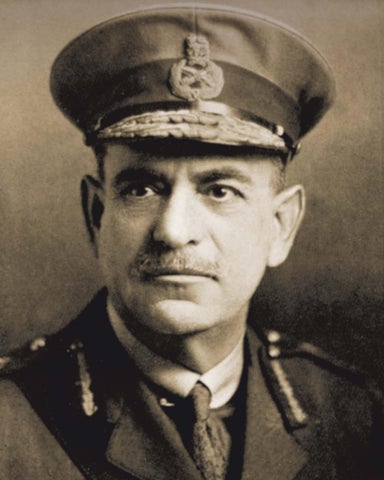
One hundred years after he led the Australian Corps to decisive victories in 1918, Sir John Monash’s old school – which he always loved and respected for the excellent education it gave him – has never forgotten him. One of our 12 Houses is named after him, and we have Monash Lodge and the Monash Gates, which many Scotch boys pass through on every schoolday. The gates, on Glenferrie Road, which were formally opened on 21 February 1936 (nearly five years after Monash’s death), are a fitting tribute to the great man: they feature 10 attributes and their symbols, as a representation of the many facets of Sir John’s life.
8 Along with the inscription on the foundation stone of Memorial Hall, laid by Sir John on 5 March 1920, these are the physical reminders of Scotch’s greatest son, not to mention the Monash Freeway, skirting the School. But, more than that, Monash’s spirit lives on strongly at Scotch. It was palpably present in the special Assembly at Scotch on 10 August, commemorating Monash’s great victories in France and his knighting on the battlefield on 12 August 1918 by King George V. It was present when, later that day – at the Principal’s suggestion – many of the boys left the School via Monash Drive and the Monash Gates, as a gesture honouring Monash; and when all boys and staff received a copy of Monash’s memoir of the Australian victories of 1918, personally signed by the Principal. The spirit was present that day, and it lives on strongly, inspiring the Scotch boys of today. Its presence will undoubtedly linger as the future unfolds, continuing to inspire the Scotch boys of generations yet to come. FRONT COVER: SIR JOHN MONASH: PORTRAIT TAKEN DURING WORLD WAR I. BACK COVER: KING GEORGE V KNIGHTING LIEUTENANT GENERAL SIR JOHN MONASH, 12 AUGUST 1918
The Scotch Family Magazine Issue 154 September 2018
DURGA KAMTE EDITOR GREAT SCOT
This edition of Great Scot is dedicated to remembering the life and achievements of Scotch’s greatest son, Sir John Monash (1881), on the centenary of his knighthood on the battlefields of Northern France on 12 August 1918 by King George V, in tribute to the leading role he played in the battle of Amiens, forerunner to the Allied defeat of the German forces.
Regulars
24
42
His love for country, school and service for the betterment of our world is a reflection of the overarching values the School endorses. The recently remodelled Service Immersion Program is explored in this edition, as are the Christian values underpinning the School’s ideals of personal responsibility and service to the wider community and the world. The School’s commitment to enable each boy to achieve his potential, with the intention to nurture and stimulate passion, is reflected in the pages of this edition, and indeed of every edition, of Great Scot. We celebrate ensemble and individual achievements in musical offerings through every season; outstanding drama performances; a Year 12 student receiving a Gold Duke of Edinburgh Award; interschool and house sporting events; scientific discoveries of new crystal formations; connections with our Tiwi friends; and a continued commitment to our World Vision partnership in Zambia. Opportunities offered to our boys to extend their
1 EDITOR 2 CHAIRMAN 4 PRINCIPAL 6 CHAPLAIN 8 FEATURE COMMEMORATING SIR JOHN MONASH 14 SCOTCH COMMEMORATES WORLD WAR I
horizons are evident in the rich offerings of tours and expeditions – to other parts of Australia, Europe and the United Kingdom. For inspiration, our current boys need look no further than this edition of Great Scot for many examples of service for the greater good provided by Old Scotch Collegians and the wider Scotch community. Eighteen members of the Scotch Family are known to have received 2018 Queen’s Birthday awards for outstanding service in a variety of fields; an Old Boy doctor has developed an innovative online educational model for doctors and other health professionals working with people with dementia; another has received the unique honour of the Key to the City of Manningham for his lifetime of service to his local community; and a young Old Boy is serving his fellow students as President of the Monash Parkville student union. As always, the flame of service for the greater good burns brightly in the Scotch Family.
16 JUNIOR SCHOOL NEWS 22 MIDDLE SCHOOL 23 UPPER SCHOOL 24 SENIOR SCHOOL NEWS 42 DRAMA 48 MUSIC 50 SPORT 55 BOARDING
56 PROPERTY 58 DEVELOPMENT 64 FOUNDATION 68 OSCA 90 WHAT THEY’RE DOING NOW 92 SCHOOL HISTORY 94 OBITUARIES
Chairman
The Hon. Dr David Kemp AC ('59) – School Council Chairman
The responsibility of service THE HON. DR DAVID KEMP AC SCHOOL COUNCIL CHAIRMAN
In 1914 Scotch College changed its motto from ‘Deo et Lit(t)eris’ – For God and Learning – to include the word ‘Patriae’ – For Country. It was a measure of the level of concern among Australians at the expansion of the German empire into Australia’s region, with German colonies being established in New Guinea, Bougainville, the Solomon Islands, the Marshall Islands, Samoa, and the build-up of Germany’s naval forces in the Pacific and Indian Oceans. It was also a signal of Scotch’s sense of responsibility to serve the new nation of Australia that had come into existence less than 15 years before, on the first day of the 20th century. The commitment to serve Australia was not, from the School’s point of view, simply an expression of national pride. As Samuel Griffith, the principal author of the Constitution, and then Chief Justice, had said, there was always the risk of patriotism being an ‘elevated form of selfishness’. From Scotch’s perspective, the new nation had a claim on its citizens because it stood for ideals that had been inherent in the School’s very foundation: ideals of freedom, personal
STAINED GLASS WINDOWS, MEMORIAL HALL
4 Great Scot Number 154 – September 2018
responsibility, self-government, the dignity of all people, and service to the wider community and the world. The School’s founder, the Rev James Forbes, had said that an education in principles was essential so that knowledge could be used for good, not evil; that education ‘must be regarded as the great remedy for the ills of the body politic, the basis on which must be mainly rested all hopes of its amelioration, and of its future generations being better than the present’, and that ‘public liberty and public virtue have almost universally been found together’. The School aimed to support that public virtue with private virtue, and the imminent threat to the nation called it to defend the ideals of its foundation. Four years later, with the Australians led by a former Scotch boy, Sir John Monash, and with the participation of some 1300 former students and staff in all military ranks and in medical as well as fighting units, the School witnessed the achievement of victory. Over 220 students and staff had lost their lives in the service of their country. The planned great hall on the new Hawthorn campus would now be a memorial to those who had fallen defending their ideals. Sir John Monash returned to the School to lay its foundation stone. The School gave much thought to how it could commemorate the students who had died in the service of their country, and within the Memorial Hall a Roll of Honour was installed, beneath which were inscribed words adapted from John Bunyan’s The Pilgrim’s Progress: ‘So they passed over, and all the trumpets sounded for them on the other side’. How did the School view those who had fallen? The stained glass windows later installed provide an answer: those who had given their lives were young warriors motivated by the highest ideals, represented by the legendary King Arthur and the Knights of the Round Table through the one who had made it his lifelong mission to see the Holy Grail, Sir Galahad. The perfect knight was flanked by the patron saints of Scotland (St Andrew) and England (St George), by St Michael the guardian of warriors, and St Martin, whose day was 11 November, the date of the Armistice. The principles of that chivalrous world were Courage, Honour and Service, and across the windows are emblazoned values that underpinned the service of
ABOVE: LITTLEJOHN MEMORIAL CHAPEL ON THE GROUNDS OF SCOTCH COLLEGE
those who had died: faithfulness, freedom, hearth and home, peace and love. The Principal who had first read the names of the fallen to the School Assemblies, and who oversaw the building and commemorative elements of the Memorial Hall, was Dr Bill Littlejohn. When he died in 1933 a superb chapel was built and named in his memory, and its eastern windows told the Christian story of Christ’s life of service and sacrifice for humanity. After World War II, the western windows were installed as a memorial to the service once again of former Scotch boys on behalf of their country and its ideals. Today, the spirit of service leadership and the personal responsibility to serve remain central to the principles of a Scotch education. While Cadets, Scouts and community outreach remain the core elements of the School’s Services Program, the School’s Immersion Program, which requires boys in Year 11 to undertake a week’s service experience, will see boys assisting at the Ballarat Specialist School, building homes in Cambodia as part of Global Village’s Habitat for Humanity,
undertaking work for the Les Twentyman Foundation, working alongside members of an Indigenous community situated in the northern Flinders Ranges, South Australia, and improving the quality of life for vulnerable members of our community by working with FareShare (an organisation that rescues surplus, quality food from supermarkets, farmers and other businesses and turns it into nutritious meals for Victorian charities). Above and beyond specifically identified ‘Service’ activities, the Council’s vision for the School is that it should continue to imbue the whole of school life with the values and principles of its foundation. Every choice that boys make about their future lives, whether in business enterprise, science, engineering, academic life, medicine, the arts and drama, philosophy, education and other fields, provides opportunities to improve human wellbeing and mutual respect. A Scotch education continues to build foundations for the better world on behalf of which so many former pupils have given all.
www.scotch.vic.edu.au Great Scot 5
Principal
Mr Tom Batty – School Principal
General Sir John Monash GCMG KCB VD
He is entwined with our story, our rituals and our values. MR TOM BATTY SCHOOL PRINCIPAL
BELOW: BUST OF SIR JOHN MONASH, DISPLAYED IN THE RANDALL BUILDING FOYER.
Soon after my appointment to Scotch, while on one of our prized five minute inter-class coffee decamps to Eton’s School Library, my great friend and mentor, Dr Colin Basey, announced his opinion that the school I would be shortly joining as Principal had produced one of the two greatest Allied generals of the First World War. I had heard of both Monash and Ferdinand Foch (Dr Basey’s other choice), but my knowledge of the First World War wasn’t that of my friend. Over subsequent Library sojourns, I was to learn of Monash’s transformational role in the battles of Hamel, Amiens, Mont St. Quentin and the St. Quentin Canal (also known as the Battle of the Hindenburg Line). These treasured moments came to me with some force earlier this year. One of the quirky Scotch rites of passage is Medieval History Day for Year 8 historians. Two chaps come to the School and entertain (and educate) the boys on the Main Oval. One, dressed in armour and equipped with wooden sword, challenges the boys to combat; the other instructs them in archery. Walking past the visiting swordsman (who had again emerged unscathed from his various duels), I overheard him informing the boys that in medieval times, anyone could be knighted on the battlefield. If the King felt a person worthy of such honour, he would lay sword to his shoulders and raise him to knightly service. I paused, went over to the group and asked if they knew who the last person was to be so knighted by the King on the field of battle. I confess to taking a degree of pleasure in informing them that it was one of their own, a boy from Scotch, who, for his vision, bravery, intellect and compassion for his fellow man, was knighted on 12th August, 1918, by King George V on the battlefields of northern France. Monash’s contributions to his country as soldier, engineer, administrator and statesman are well documented. We, at Scotch, also know his significance in affirming and further embedding the principles and values of our School. Across from my study chair, towards the French windows looking out over Old Scotch Square, sits a bronze bust of Monash. It is so angled to direct the great man’s gaze steadily upon me. It is important for a school to have values bigger than itself, and it is important that such principles have a narrative through which they can be told and passed
6 Great Scot Number 154 – September 2018
on generation to generation. Whether such things are important elsewhere is for others to decide, but at Scotch they are intrinsic to our being, and have form in the life of General Sir John Monash (1881). On a number of occasions, I have noted my view that the spaces in which we engage have significant impact on the outcomes of our collaborations; of Aristotle’s inclusion of the Agora as one of his classical influences of negotiation. It is my view that when we interact, we leave something of ourselves in the lives of each other and, perhaps, this resonates from the spaces around us. In addition to watching over the ninth Principal of his School, Monash’s presence hangs large amidst boys and staff in Memorial Hall. He is entwined with our story, our rituals and our values. Two recent engagements brought Monash’s legacy as engineer, administrator and statesman to the fore of my thinking. The first of these was a conversation with our School Captain of 2017, Michel Nehme. Miche, with customary eloquence and conviction, opined that to understand China’s strategy for influence, one must keep in mind that its leadership is dominated by engineers. Miche’s view, as I took it, was that, as engineers, China’s leaders assess the complexity of the current internal and world situations, plan for the long term and get things done. A few weeks later, in an article in The Independent, Professor Brian Cox, arguably Britain’s most celebrated particle physicist, put his view that Britain needed scientific minds to tackle an issue as complex as Brexit, because, caught amidst personal ambition and ideology, politicians ‘can’t think clearly’. He went on to express his concern regarding what he viewed as an emerging divide between those who care about evidence and reasoning, and those who are happy to abandon them altogether. Professor Cox gave his view that scientific thinking is the opposite to thinking ideologically, and that whilst in politics, rhetoric can usually get you through, current issues, such as Brexit, fall much more into the fold of scientific problems. Monash certainly demonstrated the power of rational thought, of Aristotle’s Logos, in getting things done. It is interesting to question whether the growing complexity of a world driven to a rhythm set by the instantaneous and ubiquitous flow of information
will see Professor Cox’s ‘emerging divide’ shift back in favour of those of more rational bent. But Monash wasn’t just the engineer: he cared about people, particularly those for whom he was responsible. Setting his mind in ‘the field’ rather than in the manual ensured his detailed plans and strategies were translated meaningfully to, and gained support from, all involved at each level of implementation. It would seem Monash knew the significance of how he was perceived by those around him (Aristotle’s Ethos); and how he, and those closest to him, were viewed by those he would need to rely on (Aristotle’s Pathos). Over the mid-year break, I attended a professional development programme at the Judge Business School of Cambridge University before heading to the Gold Coast for the Annual Conference of the International Boys’ Schools Coalition at Southport School. At each event, my mind was again drawn both to the continuing disruption of the clear pathways of industrial and post-industrial ages, and the values and practices that have stood the test of time and enabled institutions to grasp the opportunities of change, rather than succumb to its challenges. At both Cambridge and Southport, I observed and pondered the growing influence of ‘clustering’. As the market refines to the level of the individual, mining her/his data and using it to form profiles, so individuals are doing likewise: using networks to connect like and unlike minds, share interests, and unearth the best people to identify and solve problems. That I was the only educator on my professional development course, and, that, though the majority of my contemporaries worked in London, they hailed from Russia, Switzerland, Holland, Nigeria, Croatia, Pakistan and Italy, provided an exciting vista to all that is now possible. On the Gold Coast, I witnessed teachers of different disciplines increasingly clustering around areas of shared interest, particularly around common aspects of action research. Such clustering around research, action and reflection marks, to my mind, the future of our great profession. It is the reason why, from 2019, we have given time for Scotch teachers to be involved in our new Teacher Action Research and Career Development Programme. With our educational strategy and future plans for the Keon-Cohen Building in mind, it was particularly affirming to learn that recent work at Cambridge aimed at targeting the most significant factor in the University’s success as a dominant force in its field across the centuries, concluded that it was the manner in which its community dined. That people were sat next to those they didn’t generally come into contact
A COPY OF THE LETTER JOHN MONASH WROTE TO THE BOYS OF SCOTCH COLLEGE IN 1918
with, and came from different fields of study; and that the culture around the dining table was one of engaged conversation. Minds were expected to collide, and share views and ideas with no set directory to where their interactions might lead, other than to a better understanding of how the world came to be as it is, and how it might be improved for the benefit of the many. One hundred years on from his date with King George V at Bertangles, the values and attributes of our greatest Old Boy, General Sir John Monash, continue to be those that underpin a Scotch education: a belief in enterprise, service and self-responsibility; an appreciation of how the world came to be as it is and confidence in those principles that will make it better; a commitment to hard work and embracing challenge with fortitude, rigour and purpose. But perhaps it lives no stronger than in our fundamental belief in the inherent dignity of each person and the determination that Scotchies do their bit in building something better, and do it well. www.scotch.vic.edu.au Great Scot 7
Chaplain
Rev David Assender – School Chaplain
Strength is for service, not status We are called towards deeper levels of service, requiring selflessness REV DAVID ASSENDER SCHOOL CHAPLAIN
THE LAST SUPPER - LEONARDO DA VINCI
What would the world be like if the motto every leader aspired to was ‘Strength is for service, not status’? Imagine a scene where the media are swamping an up-and-coming candidate for an election, and the question is put: ‘What can the people expect from your party if elected?’ Imagine if the response is: ‘My government will be marked by putting the needs of the people before the comforts of the party. We aren’t about making it easy on ourselves; we aren’t about doing what is most convenient for ourselves – we’re about taking on the troubles of the troubled. We will be a government marked by using our strength for service, not status.’ That might not ever happen, but it should always have been happening in one place down through the centuries: in the Church. The apostle Paul, writing to the Church in Rome, hundreds of years before Rome 8 Great Scot Number 154 – September 2018
became Christianised, says 'if it is good enough for God to give himself up for you, then how is it that you have become so high and mighty that you cannot do it for others?' (Romans 15:1-6) Paul’s admonition runs like an Anzac Day commercial: look at how they gave themselves up for us, yet we cannot even get out of bed to say thanks at a dawn service. Seeking to achieve the greatest good or benefit for the greatest number is a common sense principle, no doubt shared by many people today. However, to give yourself freely in service for that good is to reach a different level of conviction and commitment: it obligates. It must be personal if you are to give yourself freely for others: it cannot remain an in principle only consideration. It calls us towards deeper levels of service
ABOVE: YUKI GOH (YEAR 11) ENTERTAINS SENIOR CITIZENS WITH HIS MAGIC TRICKS AS PART OF THE IMMERSION PROGRAM.
which require selflessness, and selflessness is a hard path to travel. Jesus did not mince his words when describing it: ‘If anyone would come after me, he must deny himself and take up his cross and follow me. For whoever wants to save his life will lose it, but whoever loses his life for me will find it.’ (Matthew 16:24-25) This is the path Jesus took. He does not ask us to do anything he did not do himself. He was on the path of losing his life to save ours when he spoke these words. But if our motivation is the same as his, then selflessness has a governing purpose: love. All through the Bible, love is defined as a commitment to others over self. When we look at the Gospel and we ask why God sent his Son, and why the Son went freely to the cross, the answer given is love: ‘Dear friends, let us love one another, for love comes from God. Everyone who loves has been born of God and knows God. Whoever does not love does not know God, because God is love. This is how God showed his love among us: he sent his one and only Son into the world that we might live through him. This is love: not that we loved God, but that he loved us and sent his Son as an atoning sacrifice for our sins. Dear friends, since God so loved us, we also ought to love one another.’ (1 John 4:7-11) Love feels the obligation and takes it to heart. The command to love God and your neighbour is to open your heart to the troubles of others and feel the obligation to serve them; to do something about their plight. Not to be content with the greatest good for the greatest number in principle only, but to give of yourself for the solution. This is why we educate not
just for the mind but also the heart, lest our boys get the impression the sum total of solving the world’s problems is only by having an opinion on a matter. For these reasons I am proud to say the development of the Year 11 Immersion Program, under the direction of Mr Michael Waugh, is taking us there. The program uses service-learning pedagogy to engage boys in community development projects. It explicitly teaches them about the ethics and values of service, as well as allowing them opportunity to learn about the wider community, social inequity and about themselves. At Year 11, we have been fortunate to partner with Habitat for Humanity (Cambodia), Ballarat Specialist School, e.motion 21 (dance therapy for people with Downs Syndrome), the Nepabunna Indigenous community in the Flinders Ranges, Eat Up, FareShare, St Vincent de Paul, the Les Twentyman Foundation, aged care facilities throughout Melbourne and World Vision. Community development projects include house building projects to eliminate poverty housing, education programs to engage young people with intellectual disabilities and young people living in impoverished communities in Melbourne, environmental reclamation projects, tackling food insecurity, music therapy, food therapy and yard maintenance for people living in housing commission houses. Our boys have hands-on experience in using their strength for service, not status. Experiences, no doubt, they will carry with them into many a field throughout life. Perhaps some of them will be men of church and men of state, but no doubt even more of them will be men of influence and men of weight. www.scotch.vic.edu.au Great Scot 9
Sir John Monash
ceremony. Dr Mark Johnston, Head of History, spoke to the boys about the ceremony on 12 August 1918, illustrating the talk by reference to the silent footage taken of the event on that day. The general was seen greeting the King in the drive of the chateau of Bertangles, walking with him past numerous German artillery pieces captured in the recent battle, and then kneeling on the porch of the chateau as the King tapped him on both shoulders and told him to ‘Arise, Sir John’. Then there was footage of Monash at Peronne the following month among his troops, with whom he was clearly at ease, and with Prime Minister Billy Hughes.
THE BEAUTIFULLY REFURBISHED BUST OF SIR JOHN MONASH ON STAGE DURING THE SPECIAL ASSEMBLY ON 10 AUGUST 2018. CHARLIE SCHILLING (SCHOOL CAPTAIN), FINN TSIGARAS (CADET UNIT SENIOR CUO), FINN HARTNETT (CAPTAIN OF MONASH HOUSE)
Dr Johnston pointed out that Monash often had to employ his considerable diplomatic skills to deal with politicians and military leaders. He concluded by affirming that Sir John Monash rose to his position of eminence despite prejudice against him on the basis of his German and Jewish ancestry. Monash is one of few Australians, apart from
Commemorating an event of which Scotch will always be proud On Friday 10 August 2018 a special Assembly was
Deputy Chairman of the School Council and current
held in Memorial Hall. Two days earlier the Assembly
Moderator of the Presbyterian Church of Australia,
had featured a discussion of the battle of Amiens,
Rt Rev John Wilson; and the President of OSCA Mr
fought 100 years before on 8 August 1918, and
Andrew Crawford (‘89).
described by German General, Erich Ludendorff,
Our hymn for the Assembly, during which the organ
as ‘the Black Day of the German Army’. Old Scotch
was accompanied by student brass players, was All
Collegian, General John Monash (1881), planned the
people that on earth do dwell (The Old Hundredth,
battle and his Australian Corps took a leading role.
based on Psalm 100). This hymn was sung at the
Four days later, on 12 August, King George V visited
opening of Memorial Hall on Anzac Day 1922, an
Monash at the Australian headquarters at Bertangles,
occasion on which Sir John Monash addressed
northern France, and gave him the rare honour of
the School.
knighting him in the field. The special Assembly of 10
After a homily and prayer from Reverend David
August was held to commemorate that knighting.
Assender, the Cadet Unit CUO, Finn Tsigaras
A beautiful bust of General Monash was refurbished
(Year 12), told of Sir John Monash’s military career,
for this occasion and placed on the stage, together
including his appointment as commander of the
with a large screen on which were projected moving
Australian Corps in May 1918. Finn also read a letter
images of General Monash in 1918, and especially
that Monash took time to write to the Principal, Mr
during the knighting ceremony. Another large screen
Littlejohn in June 1918, reaffirming his affection for
was erected in the Quad to project the events inside
the School and his pride in the achievements of other
the hall and the same 1918 images to the Year 7
Old Scotch Collegians who had gone overseas with
and 8 boys who were seated there, enabling the
the AIF.
whole Senior School to hear and see this impressive
Finn Hartnett (Year 12), Captain of Monash House,
ceremony.
then spoke of the ceremony in which Monash laid
Joining us for this special event were the Chairman of
the foundation stone of Memorial Hall. He showed
the Scotch Council, the Hon Dr David Kemp (‘59); the
the audience the trowel that Sir John used in the
10 Great Scot Number 154 – September 2018
sportspersons, who all can agree was a ‘great Australian’. Monash himself was conscious that he was part of a great team effort in the war, and he hoped that the AIF’s spirit of ‘mutual help, comradeship and self-sacrifice’ would help make Australia a still greater country. Dr Johnston repeated and reinforced Monash’s final words from his 1918 letter to the School, in which the current boys were said to be fortunate to be part of the great traditions established by Old Scotch Collegians in World War I. In his closing remarks, the Principal expanded on the theme of Monash’s greatness, and told the boys how Monash, a man who had made a substantial contribution to the course of history, was an inspiring figure and the greatest ever Scotch Collegian. He pointed out, too, that John Monash, Dux of our School in 1881, had at Scotch not suffered the intolerance sometimes accorded those of Jewish heritage elsewhere in the community. He informed the boys that all students and staff of the School would at the end of the day receive a copy of Monash’s memoir of the Australian victories of 1918. Mr Batty then presented the first book to Finn Hartnett, Captain of Monash House, and Finn and the other Monash boys were given the honour of leaving the Hall first. Later in the day many boys took up the suggestion that they leave the School via Monash Drive and Monash Gates, as a gesture honouring the man after whom these iconic locations within Scotch College are named. Thus concluded a special day commemorating the centenary of an event of which our School will always be proud.
DR MARK JOHNSTON — HEAD OF HISTORY
JOHN MONASH: THE AUSTRALIAN VICTORIES IN FRANCE IN 1918 Monash wrote, The Australian Victories in
Serle (’40) and Roland Perry (’64). Serle wrote
France in 1918, with extraordinary speed in
that ‘it was propaganda, but not far off the truth’,
about a month from August 1919. He intended,
which was perhaps typical of the immediate
while everything was fresh in his memory, to
critical reaction. Perry’s insightful analysis looked
set out the facts as he viewed them, aided by
at its future impact – in particular, as a blueprint
the documents he used in creating them. At a
for the critical planning by Germany of its
time when authors’ differing political agendas
entrance into World War II:
ensured that a spin was put on their own
‘This commendable volume explains how the
accounts of what had happened during the war,
1st AIF, the biggest of 20 Allied Corps on the
Monash – as the one who was there and knew
Western Front, had a huge say in the outcome
it best – no doubt wanted to get his version out
of World War I. Its detailed battle plans also had
quickly, and to have it viewed as the definitive
a big influence on World War II. In 1937 General
have endeavoured faithfully to portray. Let it not
account. It was published in 1920.
Heinz Guderian copied Monash’s battle plan for
be assumed on that account that the humble
Among the many reactions to this book, it is
Amiens into his own book, Achtung — Panzer!
part it fell to my lot to perform afforded me any
interesting to note those of the two Old Boys
He then demonstrated to Hitler Monash’s
satisfaction or prompted any enthusiasm for war.
who have written Monash’s biography: Geoffrey
successful blitzkrieg methods, which were
Quite the contrary.
adopted for the German attacks in Europe.’
‘From the far-off days of 1914, when the first call
The following three paragraphs, selected by
came, until the last shot was fired, every day
Dr Mark Johnston, contain Monash’s eloquent
was filled with loathing, horror, and distress. I
tribute to the officers under his command, many
deplored all the time the loss of precious life and
of them Old Scotch Collegians, and his reflection
the waste of human effort. Nothing could have
on war itself as being a wasteful horror, and not
been more repugnant to me than the realisation
something to be glorified for what it was:
of the dreadful inefficiency and the misspent
‘None but men of character and self-devotion
energy of war. Yet it had to be, and the thought
could have carried the burden which they had
always uppermost was the earnest prayer that
to bear during the last six months of the war. In
Australia might for ever be spared such a horror
spite of stress and difficulty, unremitting toil and
on her own soil.’
wasted effort, weary days and sleepless nights,
Scotch boys and staff who received the
fresh task piling upon the task but just begun,
reprinted book on 10 August 2018 have the
labouring even harder during periods of so-
opportunity to understand what Monash, other
called rest than when their troops were actually
Old Boys, and fellow Australians achieved in
in the line, this gallant band of leaders remained
helping hasten the conclusion of World War I.
steadfast of purpose, never faltered, never lost their faith in final victory, never failed to impress
ABOVE: COVER OF SIR JOHN MONASH’S BOOK, PRESENTED TO ALL SCHOOL STUDENTS AND STAFF ON THE DAY OF THE SPECIAL ASSEMBLY.
PAUL MISHURA — SCOTCH COLLEGE ARCHIVIST
their optimism and their unflinching fighting spirit upon the men whom they commanded. ‘It may be appropriate to end this memoir on a personal note. I have permitted myself a tone of eulogy for the triumphant achievements of ABOVE: PORTRAIT OF SIR JOHN MONASH
the Australian Army Corps in 1918, which I
www.scotch.vic.edu.au Great Scot 11
Sir John Monash LEFT: MONASH AS A YOUNG STUDENT
Sir John Monash – more than a soldier Monash's life was one of service 12 Great Scot Number 154 – September 2018
In the centenary of the end of World War I, there has naturally been a significant focus on Sir John Monash, who is Scotch’s most famous Old Boy. The focus has been on his military achievements, but he was a multidimensional man throughout his adult life. That life was one of service to many and varied parts of the community. His close connection with Scotch was not one-sided fo he undoubtedly recognised the ways in which Scotch set him up for life. Monash’s teacher in Jerilderie had taught him all he could, and urged Monash’s mother to send the talented student to a suitable Melbourne school. She visited Melbourne Grammar School, Wesley College and Scotch. He entered Scotch on 9 October 1877. Here, Monash was able to continue learning German, which had been recently reintroduced, and French and Hebrew. His knowledge of European languages helped in his war service. Monash benefited from lessons in the School's new laboratory, believed to be the first in an Australian school. His elocution lessons gave him confidence in public speaking. Earlier in 1877, Principal Alexander Morrison engaged Sergeant-Major William Alexander John Robert Whitehead to begin army cadet training. Monash attended every session, including lectures about historic battles and great leaders, and called Whitehead his ‘military father’. Interestingly, Whitehead died at Hawthorn the day after the Gallipoli landings — the same day Monash himself set foot on Gallipoli. Despite his accented speech and non-Anglo-Celtic appearance, Monash did not experience any racism at Scotch. Monash graduated in 1881 as equal Dux of the School. He did not complete his Bachelor of Civil Engineering degree until 1891. The delay was caused by family and financial difficulties. After receiving this degree, he crammed in studying Law, and finished Arts. He graduated with a Master of Engineering (1893), and Bachelors of Arts and Law (1895).
During the difficult times, Monash found engineering work through his friend, James Bannatyne Lewis (SC 1870-73), on Princes Bridge. This gave him two years’ invaluable experience that led to his 1888 appointment in charge of the construction of the Outer Circle railway line, the completion of which he capably oversaw over three years. Retrenched from his Melbourne Harbour Trust job (1891-94), he entered private practice (1894-1902) with Joshua Thomas Noble Anderson. Monash was in demand as a legal engineering expert, and, after obtaining patent rights for Monier reinforced concrete construction, the partnership’s work became popular with those wanting bridges built. The Anderson Street (Morell) Bridge (1899) was Victoria’s first reinforced concrete bridge. A bridge collapse and an extraordinary 1902 court decision ruined the business. Monash focused on building construction, and, after three impoverished years, formed the Reinforced Concrete & Monier Pipe Construction Co. Ltd. By 1913 he was a wealthy man. Dr Mark Johnston wrote in the April 2018 Great Scot about Monash’s military career, and – keeping his education in
mind — it need only be noted that Monash’s consideration of warfare as an ‘engineering problem’ contributed significantly to his planning of what was called ‘the perfect battle’, which helped turn the tide of the war. In 1918-19, he brilliantly organised the repatriation of 160,000 Australian soldiers, including overseeing the AIF Education Scheme, and he was the ‘natural spokesman for returned soldiers.’ In 1920 Monash became General Manager (later Chairman) of the State Electricity Commission of Victoria, and drove this massive project through various difficulties until, by 1930, the power grid covered the state, improving lives and industrial and economic opportunities. His leadership in identifying problems, finding solutions, and getting the best out of people was extraordinary, and paralleled what he had done at war.
ABOVE, LEFT: KING GEORGE V KNIGHTING LIEUTENANT GENERAL SIR JOHN MONASH AT THE AUSTRALIAN CORPS HEADQUARTERS AT BERTANGLES, NORTHERN FRANCE, 12 AUGUST 1918. ABOVE, RIGHT: SIR JOHN MONASH (LEFT) AND GENERAL J J T HOBBS PASSING THE SALUTING BASE OUTSIDE BUCKINGHAM PALACE DURING AN ANZAC DAY MARCH. RIGHT: SIR JOHN MONASH: PORTRAIT TAKEN DURING WORLD WAR 1
www.scotch.vic.edu.au Great Scot 13
Sir John Monash
Monash was often sought out for his advice and leadership. He was 1922 President of Melbourne Rotary. He successfully commanded the Special Constabulary Force when the Victoria Police went on strike in November 1923. Monash was 1924-26 President of the Australian Association for the Advancement of Science. From 1925 he led Melbourne’s Anzac Day march and became its chief organiser, and he was a significant driver of the Shrine of Remembrance project. As Vice-Chancellor from 1923 (and Acting Chancellor 192526) of Melbourne University, Monash had a heavy workload. In 1927 he was national President of the Australian Zionist Federation, and in 1930 he was considered as a possible Governor-General. Throughout Monash’s tireless efforts, his affection for Scotch never waned. When the Old Scotch Collegians’ Club was formed in 1895 he became a member that year, and again in 1896. Membership records also show him as a member from 1904 to 1907, and in 1906 he was a Vice President. One of Monash’s items in the Australian War Memorial’s collection is his 1911 Scotch College Diamond Jubilee medallion. When the first Scotchies set off to serve in World War I, Monash was noted as being a colonel in command of the Second Victorian Infantry Brigade, and his photograph was published in The Scotch Collegian. His progress during the war was keenly noted in its pages, and his successes and knighthood were celebrated. The August 1918 Scotch Collegian included his portrait, and a full page greeting ‘To the Boys of Scotch College’ dated 29 June 1918 (which was published on page nine of the April 2018 Great Scot and also appears on page five of this edition). Referring to the congratulations that poured in following his knighting, he wrote that ‘… none of them was more welcome, or touched me more deeply than the cablegram just received [from Mr Littlejohn
on behalf of the Scotch boys]. As the years roll on, my regard for the Old School and my pride in it have steadily grown, and the realisation of the high renown which has been achieved by so many men who were launched upon their careers by Scotch College has been for me always a stimulus and an inspiration … I have never ceased to think of the Old School with affection, and … look forward to being spared to return some day to … tell the boys something of the very fine traditions which have been created by Old Scotch Collegians in this war ...’ After the war, Monash was in demand from all quarters, and yet he found or made time for Scotch. On 16 February 1919 he telegraphed his acceptance of a place on the committee of the Scotch College War Memorial Buildings Fund, lending his name and prestige to the fundraising required to build the Senior School at Hawthorn. Although his wife died on 27 February 1920, Monash was present at the site of the new Senior School at Hawthorn to lay the foundation stone of Memorial Hall on 5 March 1920. He trowelled out the mortar, and, once the stone was swung into place, tapped it twice with the trowel, declaring the stone well and truly laid. At the end of the year he addressed Speech Night, telling the boys that none had surpassed Old Scotch Collegians in the war in giving the feeling that all they did was to uphold the honour of their school. He declared that boys honoured to attend a great Public School such as Scotch were being educated for a life of national service, and that their main aim should be to make Australia great. When the House system was reorganised in 1921, Monash House was created in his honour, and he gave it its motto: Mak siccar (Make sure). It did, by winning the Cock House competition that year. Monash was the 1927 President of the Old Scotch Collegians’ Association. He addressed Scotch at the 1928 distribution of annual prizes, and, on giving Joseph Robert Archibald Glenn (‘29) his prize, one great
14 Great Scot Number 154 – September 2018
Old Scotch Collegian created another when Monash advised Glenn to study engineering. In 1929, Monash’s grandson John Monash Bennett followed him at Scotch. Although Bennett died after less than a month at Scotch, he was followed by two brothers, and four of Monash’s greatgrandsons also later attended Scotch. Monash is remembered in numerous ways throughout Australia, but particularly at Scotch, where, apart from Monash House there are Monash Drive, Monash Gates, and Monash Lodge, while the Monash Freeway, renamed by Old Boy, Jeff Kennett (‘65), sweeps past Scotch to Monash University. Scotch’s greatest son never forgot his school, and will never be forgotten by it. PAUL MISHURA —SCOTCH COLLEGE ARCHIVIST
RIGHT: LIEUTENANT GENERAL SIR JOHN MONASH, CIRCA 1918
1.
5. 5. ABOVE: HIS MAJESTY KING GEORGE V ARRIVES AT SIR JOHN MONASH’S HEADQUARTERS, ON THE OCCASION OF THE INVESTITURE OF SIR JOHN WITH THE KCB. 6. RIGHT: MONASH AS VICE-PRESIDENT OF THE OLD SCOTCH COLLEGIANS’ CLUB, FROM THE JULY 1906 SCOTCH COLLEGIAN. 7. BOTTOM RIGHT: MONASH MOUNTED ON A DAPPLED GREY CHARGER DURING AN ANZAC DAY MARCH, 25 APRIL 1931.
2. 1. TOP: ENTRY FOR MONASH IN THE 1904-09 OLD SCOTCH COLLEGIANS’ CLUB MEMBERS’ REGISTER. 2. ABOVE: PORTRAIT OF BRIGADIER GENERAL JOHN MONASH CB, VD, OCTOBER 1915. 3. RIGHT: PORTRAIT BUST OF MONASH. 4. BELOW: MONASH, FRONT, SECOND LEFT, IN HIS 1880-81 SIXTH FORM CLASS. ALSO NOTABLE: EDMUND LA TOUCHE ARMSTRONG (FRONT LEFT, STATE LIBRARIAN), WILLIAM BRUCE (BACK, THIRD LEFT, TEST CRICKETER), GEORGE ROBERT FARLOW (BACK, SECOND LEFT, MONASH’S BEST MAN), EBENEZER SHAW (BACK, FIFTH LEFT, CIVIL ENGINEER OF FLINDERS STREET VIADUCT), AND JAMES SERVICE THOMSON (BACK, THIRD RIGHT, CO-DUX WITH MONASH, MEDICAL PRACTITIONER, 1895-96 SOUTH MELBOURNE FOOTBALL CLUB PRESIDENT WHO LED IT INTO THE NEW VFL COMPETITION IN 1897).
3.
6.
4. 7.
Commemoration
Scotch Commemorates World War I
They ‘played the game right through to the finish’ Scotch College war deaths in 1918 This article concerns the first 26 of the 54 Scotch Collegians who died as a result of war service in 1918. Serving as an artilleryman, RALPH OSWALD ELLINGWORTH (1912) had survived the great battle of Ypres in late 1917, only to be mortally wounded when a shell from his own gun exploded prematurely on 14 January. His obituary in The Scotch Collegian stated that ‘his letters frequently mentioned his meeting other old Scotch Collegians, both in France and in England. He expressed the gratitude that he felt at having had the privilege of once attending Scotch College.’ GEORGE ROBINSON JOHNSTON (1914), who enlisted at 19, was evacuated ill from Gallipoli, and wounded in the thigh and face at Pozieres. Though given a safe job in the Pay Corps in England, he sought more adventure and transferred to the Australian Flying Corps. George was killed in an air accident on 24 March. The mechanics of his unit made a cross from a propeller, for his grave. JOHN THOMAS (known as Jack) TRIM (1915) was a model Scotch Collegian: in 1915 he was a Prefect, represented the School in athletics and football (1st XVIII) and was a champion swimmer. He won a prize as ‘most popular boy in the school’. By August 1917 Jack was part of General Monash’s 3rd Division in France. On 30 March 1918 Jack’s artillery unit repelled seven waves of attackers. Eventually Jack was mortally wounded in the chest and fell across the trail of his gun. He said ‘I’m done’, but also urged his mates to ‘Fight on; there’s infantry depending on you in front.’ GEORGE RICHARD ROUSE (1902) enlisted at 30 in 1916. He was sometimes in trouble with authority before joining the 39th Battalion in France in mid-1917. On 31 March 1918 he was taking rations to the front when he was shot in the lung and died almost immediately. Lieutenant PERCIVAL FRANK NICHOLSON (1900) was 33 years old and just five feet five inches tall when a large shell fragment struck
16 Great Scot Number 154 – September 2018
him in the neck and killed him near VillersBretonneux on 5 April. A fine sportsman, Percy had represented Victoria in lacrosse. GEORGE ERIC MILNE (1910) was also short — five feet four and three-quarter inches tall – on enlistment at 22. He had a remarkable career. He fought at Gallipoli, where he rose from private to company sergeant major. In 1916 George became a lieutenant, serving through Pozieres and the battles of 1917. In April 1918, now a captain, George earned a Military Cross for ‘conspicuous gallantry and able leadership’ in repulsing an enemy attack at Albert. While moving between trenches two days later, he was struck by shell fragments and mortally wounded. FREDERICK EYTON (entered Scotch 1875) was an unusual Scotch war death. He was a munitions worker in England when he died, possibly of influenza, at age 56. His occupation, listed officially as ‘Australian Munitions Worker’, entitled him to a Commonwealth War Grave. MURRAY GLADSTONE PATTEN (1905) won prizes in senior English and History at Scotch in 1905. He excelled at Melbourne University, completing his MA at 20. He studied Philosophy in Europe, achieving a doctorate at Freiburg, Germany. After enlisting in the British Army in 1915, Murray fought in the battle of the Somme, and was afterwards promoted to captain. In 1917 he won a Military Cross and was wounded. He was killed during a German attack at Crucifix Corner on 14 April. FREDERICK GEORGE DOUGHARTY (1894) enlisted at 39 in 1916. Even at his relatively advanced age, the traditions of Scotch animated him, for he wrote to his father: ‘I think as an old public school boy, it is not quite a sporting thing to watch others.’ After long training in England, he joined the 12th Battalion in France on 11 April 1918. Just 12 days later a sniper shot him dead at Meteren. At his wife’s direction, Fred’s epitaph reads: ‘DULCE ET DECORUM EST/PRO PATRIA MORI’. DUNCAN MCHUTCHISON (1905) enlisted in July 1916, a month before his brother Ross
(1913) was killed at Pozieres. Duncan was just five feet four and three-quarter inches tall. At Millencourt on 24 April 1918 he was killed by a German shell after leaving his dugout for a few minutes. In one of his last letters, Duncan wrote: ‘I have enjoyed every moment of it, and would not have missed it for anything.’ JOSHUA ALEXANDER (known as Alexander) FORRESTER (1903) landed at Gallipoli on 25 April 1915. He was twice wounded there, in the hip in April and in the face at Lone Pine in August, but both times he soon returned. Promoted to corporal, he was wounded a third time, in the ankle at Pozieres in 1916. A fourth wound, a severe one to the right thigh, followed in April 1917. By May 1918 Alexander was a full lieutenant, but while leading a patrol on 2 May, a sniper’s bullet struck the 31 year old in the abdomen and killed him at Meteren. ROBERT BRUCE NELSON (1902) enlisted in Western Australia, aged 31. He suffered several bouts of debilitating illness before being killed in action in France on 19 May. His lieutenant wrote of him: ‘He died doing his duty as an honourable and true soldier.’ ROBERT ALEXANDER (known as Bob, Alec or Rick) LITTLE (1912) was the most eminent and famous Old Scotch Collegian killed in World War I. He was Australia’s most successful fighter ace. In 1915 he travelled to England to earn a pilot’s licence, and then join the Royal Naval Air Service. From November 1916 he flew Sopwith Pups, triplanes and Camels and by July 1917 had shot down 28 aircraft. He was aggressive and apparently fearless, and won promotions – eventually to captain — and British and foreign decorations. On 27 May 1918 while attacking enemy bombers, a bullet from one of them or from the ground, struck and mortally wounded him. At his death he was just 22, and had shot down 47 aircraft. On at least one occasion he flew with wingtip streamers in the school colours of cardinal, gold and blue. ARTHUR HILTON (known as Hilton) DIGHT (1889) was six feet four and a half inches tall and
ABOVE: FROM LEFT; ALLAN PERCY RUPERT EVANS (1904), RALPH OSWALD ELLINGWORTH (1912), WALTER BRUCE FYFE (1913), GEORGE ROBINSON JOHNSTON (1914), GEORGE RICHARD ROUSE (1902)
nearly 37 on enlistment. He served at Gallipoli, where he did so well, partly as a ‘bomb maker’, that only the fact that he contracted dysentery kept him from promotion as an officer. Illness dogged him for the rest of his life. After serving in France, in July 1917 he was sent home with colitis and discharged from the army. He continued to suffer from dysentery and from great mental anguish categorised as ‘shell shock’. On 6 June 1918 Hilton took his own life. The local RSL branch gave him a full military funeral. LORENZO JOHN LODGE (1911) served as an artilleryman on the Western Front in 1917, where he was evacuated in September with tuberculosis. This was ascribed at the time to ‘active service’, and it seems that he was exposed to enemy poison gas shell explosions at Ypres. He died at a Military Sanatorium in Melbourne on 15 June, aged 23. JOHN HOWARD CHERRY (1912) was just 20 on enlistment. He served as an infantry NCO on the Western Front in 1917 and 1918. John married a local girl in England in March 1918, but returned to the front in time to fight at VillersBretonneux in April. He was killed at Morlancourt on 4 July. ALAN MERVYN DAVIES (1910) was badly wounded at Pozieres in 1916. After rejoining the infantry in 1918, the 25 year old was killed by a shell at Villers-Bretonneux on 17 July. His brother Herbert had fallen in 1916. ALEXANDER MAXWELL ROBERTSON (1907) was a Prefect and a fine sportsman at Scotch. He won a Military Cross as a captain in 1918. A fellow officer described him as a ‘wonderful Company Commander.’ Alexander was killed
during a ‘hopover’ on 29 July. General Hobbs, Alexander’s divisional commander, called him ‘one of the finest characters I have ever met’. After enlisting at 19, WALTER BRUCE (known as Bruce) FYFE (1913) served on Gallipoli. He was killed serving with the 57th Battalion when they played a key role on 8 August 1918, ‘the Black Day of the German Army’. An Old Wesley Collegian said of Bruce: ‘He played the game right through to the finish.’ LEONARD SADLER GILL (1912), who had also enlisted at 19, died in the same battle. At Harbonnieres, a German projectile detonated a phosphorous grenade that he was carrying, causing fatal burns. His commanding officer wrote that had Leonard lived, he would have been awarded a medal for his ‘gallantry & dash during this fight.’ WILLIAM MINIFIE FIELD (1896) enlisted at age 36 in 1917. He was mortally wounded by machine-gun fire near Pozieres. CHARLES REGINALD (known as Reg) PERRIN’S (1892) military career was full of bad luck. After enlisting at 38, he was hospitalised successively with a sprained ankle, a sore throat, trench fever, a severe gunshot wound, and burns. His luck ran out entirely on 9 August, when a shell fragment killed the former schoolteacher. LORIMER JAMES (known as Laurie) VIAL (1907) first fought in 1916 at Pozieres, where he was promoted to second lieutenant. He became a full lieutenant after Ypres in 1917. Laurie was killed by a sniper on 9 August after leading a successful flanking action. A subordinate called him ‘one of the finest fellows the battalion ever had.’ ALLAN PERCY RUPERT EVANS (1904) was wounded in the head in 1917 and was later
the sole survivor of an explosion on a post in which he was sheltering. In June 1918 he was wounded in the hand. Shortly after returning to the front, the 30 year old was shot dead during an advance on 10 August. Allan’s mother wrote to the Red Cross, seeking to learn how her ‘dear boy’ died. It was, she said, ‘so simple to write but so hard to be resigned.’ HERBERT FRASER (known as Mac) MORRISON (1908) originally served as a private with other Scotch boys in the 5th Battalion’s Public Schools Company. He was in the Gallipoli landing, in which he was wounded. After returning he was made an officer in August 1915. A year later, on the Western Front, a gunshot wound necessitated the removal of his left eye. Mac applied repeatedly for permission to return to the front and did so in May 1917. At Ypres that year he earned a Military Cross. After a third wound in May 1918, on 10 August he was mortally wounded at Lihons. HARRY INNOTT NAYLOR (1890) claimed to be 36 on enlistment, but was in fact 41, and the Principal of Rosalie Primary School in Western Australia. He rose from private to lieutenant and was wounded in April 1917. On 10 August 1918 he was one of seven officers in his battalion killed in close-range fighting at Lihons. With the end of the war in sight, another 28 Scotch Collegians were to die before year’s end. More details about all other Scotch Collegians killed in World War I can be found on the Scotch website, under ‘WWI Commemorative Website’ on the lower right of the home page. DR MARK JOHNSTON — HEAD OF HISTORY
www.scotch.vic.edu.au Great Scot 17
Junior School
Mr Jon Abbott – Head of Junior School
MR JON ABBOTT HEAD OF JUNIOR SCHOOL
MR JON ABBOTT WITH YEAR 6 BOYS DURING A LITERATURE CIRCLE SESSION
ABOVE: GROUP ACTIVITIES WITH BFG FRIENDS
Developing and sustaining an attitude of service The main theme of this edition of Great Scot is focused on Scotch’s most famous son, General Sir John Monash. John Monash was a man who spent his life serving others, whether it was through his efforts in World War I or his wonderful contributions to our state of Victoria through his planning
and engineering of major projects and facilities. As a nation I would like to think we hold in high regard those who give of themselves to others. There are so many examples of ‘serving others’ throughout history; individuals who have dedicated their lives to improving the lot of others. People such as Mother Teresa and Nelson
18 Great Scot Number 154 – September 2018
Mandela, or Australians such as Fred Hollows, who spent so much of his life improving the sight of people in third world countries, and the Rev Dr John Flynn of the Royal Flying Doctor Service come easily to mind in this regard. These people have been recognised and highly regarded for their works and deeds, and deservedly so. However, I would propose that for every person whose deeds have made them household names, there are hundreds more people living in our communities who have also dedicated large parts of their lives in an effort to improve the lives of others. In my own community of Whittlesea, I know quite a number of people who spend much of their time serving others,
and they are all people I hold in the highest regard. Whenever I speak to them about the wonderful work they do, they are quite embarrassed and can’t quite understand why they are given recognition for their work. Apparently being humble is part of the make-up of such people! I would like to think that their efforts, and the examples they set, encourage others to follow their lead and also give of themselves. In today’s hectic lifestyle, where we all seem to be constantly rushed off our feet, the most precious commodity we have is our time. As a nation we are very generous in giving of our wealth — you only need to look at the amazing results the Royal Children’s Hospital Good Friday Appeal achieves each year to see that. Equally, the generosity of the nation during that horrible period of the Black Saturday fires was amazing. Living close to an area impacted by the fires, I saw firsthand how people are so willing to give when others are in need. However, giving or donating, although an act of generosity, is not the same thing as serving. For me, serving and service is when we give of ourselves; our time, our expertise, our energy, our labours. In the Junior School we do a good deal of Social Service activity and, most terms, there is some sort of fundraising for a charity or a cause that the boys in our Social Service team have selected.
It’s good that our boys begin to develop a sense of ‘giving back’, and the Social Service program is one part of that. I have been particularly proud of our boys, though, when their ‘service’ has meant more than just fiscal contributions. On several occasions Junior School boys have used their musical talents and initiative to raise funds for worthy causes by busking in the local community during holidays or weekends. They didn’t do it for acclaim or out of self-interest, but merely because they knew they had a talent they could use to help others. Equally, when we raised funds for the Juvenile Diabetes Research Foundation a few years ago, the boys had to seek out sponsors and then complete a walkathon in order to be able to collect funds. Each day a group of our Year 6 boys give up part of their own recess time to be the Big Friendly Guys (BFGs) in the Junior Primary playground, ensuring the younger boys are safe, happy and feel included in their play. I think it’s important that we seek opportunities for our boys to engage in activities that are purely for the benefit of others, where they can develop an attitude of service. Such habits are often ingrained during their formative years. Who knows when the next Scotchie will come along to rival the deeds of those who have gone before him in the service of others? www.scotch.vic.edu.au Great Scot 19
News
ABOVE LEFT: TOM FARRER, JENNI THOM, NATHANAEL CHAN, NED SUTHERLAND. ABOVE RIGHT: MAX BODON, NATHANAEL CHAN, CAMERON SWANSSON AND HARRY MARNER WITH ARTISTS FROM THE VICTORIAN STATE BALLET.
ABOVE: JAMES TALBOT, NED SUTHERLAND, MR GRANT PHILLIPS AND RONAN OZIEMSKI LEFT: TOM FARRER AND NATHANAEL CHAN
Learning a language: hard work but worth the journey It has been such a pleasure over the years to engage our boys in activities and events that evoke emotions and feelings, making it more relevant and hopefully easier to foster a passion for learning a language. This year, in anticipation and celebration of our German Day, we ‘travelled’ to Austria, opening many an eye to the fact that German is being officially spoken by more than 120 million people
and in several countries other than Germany. Our focus was on the unique town of Salzburg and its internationally acclaimed Salzburger Festspiele, a prominent festival of music, dance and drama. The impressions are best described in the boys’ own words, even in German: ‘A delightful spectacular, amazing assembly, many interesting activities, watching the Nutcracker ballet, memories to last forever.’
JUSTIN CHAN — YEAR 6 ‘Apfelstrudel, Sachertorte, Wienerwurst and pretzels, naturally we were excited.’ ANGUS MCWILLIAMS — YEAR 5 ‘I am so proud I have learnt a lot of German. I hope there will be a ballet and a German Day next year.’ SHRAY SAHNI — YEAR 1 ‘Deutschtag, Freitag 8. Juni 2018 Los geht’s! Die Reise nach Salzburg beginnt. Das Ballett Der Nussknacker ist um 1 Uhr. Die Tänzer sind sehr talentiert. Fantastisch! Ich liebe die Bretzen, so süß! Das Nussknacker Regiment ist auch wunderbar. Danke.’ JEREMY LE — YEAR 5 It is difficult at times for our boys, at a very young age, to see the relevance of acquiring an additional language and to recognise that working towards mastery takes time, and requires patience and a tremendous effort. This made me reflect on my own years as a ballerina while observing the Victorian State Ballet during our German Day visit to bring our Salzburger Festspiele to life. Not many people would be aware of the many hours of training, aching muscles, bleeding toes and personal sacrifice involved, as they observe the dancers effortlessly executing their pirouettes or grand jetés, leaping through the air. The dancers simply learn to speak their own language through years of dedication, pushing themselves beyond their limits, persevering but knowing that the end result is worth the effort. Acquiring an additional language is no different, if you embrace what you are doing and learn you can find within you the strength, the patience, passion and motivation to keep at it and to push on, even when things get tough. FRAU CORNELIA KOEHNE-DRUBE — HEAD OF LOTE, JUNIOR SCHOOL
20 Great Scot Number 154 – September 2018
Staff in profile to help me with travel costs. All in all, it was a magnificent experience, including achieving 78th place. What has been your biggest challenge over your years at Scotch? This is a tricky question! As a teacher of German, immersing the boys in as much German as possible was always my primary aim. I’m not a believer in teaching or learning a language using mostly English as a medium. It makes no sense, as I experienced once when I was trying to learn Greek at a Melbourne TAFE college. As a classroom teacher I think the hardest task in this day and age is to get children to actually listen properly and to focus on set tasks long enough to be able to do them to the best of their ability. What do you like most about your job? I enjoy the daily contact with my class; the interaction, friendliness and rapport with the boys. I have two excellent colleagues, who make my job worthwhile. We work well together with our teamwork, and we have lots of fun in our everyday school life.
Interview: Ian Clarke In 1985 while living in Hamburg, Ian Clarke was the first person from a European international school to participate in the International Teaching Fellowship teacher exchange program, organised by the Victorian Education Department. His year in Melbourne changed the life of his family and friends forever. Ian won a scholarship to spend two weeks at the Houston Space Centre in 1989 while his family was in the middle of the process of obtaining visas to emigrate to Australia. He decided to tag a couple of weeks in Melbourne onto the end of his trip, having fixed up interviews at various schools, including Scotch. This led to him being offered the opportunity to start a German program in the Scotch Junior School in 1990/1991. He left in 2002 to work in Oman and Dubai, always keeping in touch during his 10 years away. He returned in 2012 and has since worked in PE, Year 5 and Year 4.
After all these years of service to Scotch, what is your favourite corner of the School and why?
I love to be at the table tennis table at lunchtime. I went to a primary school in England where there was a couple of teachers interested in table tennis and they ran a club at lunchtimes. I began to love the game and carried on for years after that. At school it’s a great way to let off steam and have some fun with colleagues. Many years from now, when you are no longer teaching, what are some of the Scotch memories you will reflect on to warm your heart? I love that Jenni Thom and I worked together to do the Year 3 concerts in German. One year we did Rolf Zuckowski’s Die Vogelhochzeit and we also presented it to the residents of the Tabulam German nursing home in Bayswater. I had the opportunity to meet Rolf at a teacher’s weekend where he took a copy of our performance back to Germany with him. In 1994 I was selected in the Australian team of six athletes for the World 100km Challenge in Japan. We marked out a track on the oval and all the classes did a run, and brought a donation
What story will your colleagues tell about you at your farewell speech when you retire? I’m not sure if I’d trust my closer colleagues to make this speech! I think I would have to make a safe choice (which wouldn’t include my two Year 4 comrades). Whoever it may be, would of course, talk about my super professionalism, dry wit, thoroughness, creativity etc., etc. What are a few of the memorable incidents in your career at Scotch? When the Year 12s come to the Junior School at the end of the year, it is amazing to see some boys we may not have seen since they left in Year 6. I have also taken great joy in hearing of some boys who have continued with their German in the Senior School or have taken it up again later in life. I spent five weeks in Sydney as a volunteer during the 2000 Olympics, and was in the opening and closing ceremonies. As we were outside in our formation waiting to go into the stadium for the opening ceremony, I heard a couple of our boys among the thousands of people, shout over to me. They were in one of the bands, and I didn’t know they were participating. In my very first week of teaching German to Preps in 1991 I remember a teacher telling me one of his boys had gone home and told his mum he’d had his first Japanese lesson and how much he’d enjoyed it!
www.scotch.vic.edu.au Great Scot 21
News
‘We need to be considerate and not think for our own good’ Year 6 boys' views on service Seventeen Year 6 boys were asked to provide practical examples of the theme of this edition of Great Scot: service for the greater good. Their views, covering a wide spectrum of service in many spheres, show they have an excellent grasp of the concept of service, as it applies at Scotch and in the wider world. Here is what they said: ‘Service for the greater good empowers and drives humanity. It is the reason why many are alive today. A good example of this would be Fred Hollows. He pioneered his area and gave vision to countless people. Without him, many more would be legally blind today. These acts for the community are a fundamental part of humanity.
ABOVE: AT THE WAR MEMORIAL IN CANBERRA: TOM FARRER AND NATHANAEL CHAN
‘Without service for the greater good, who knows what our world would be like today. If John Monash had only thought about personal success, the country itself would be different to what it is today. It is now the next generation’s job to continue these acts. In our School, we perform acts such as helping younger peers, doing volunteer programs and helping the community through fundraising. ‘In conclusion, we cannot live as a society without service for the greater good.’ TOM FARRER and NED SUTHERLAND ‘We have recently been discussing how we can assist and serve others. Many have been contributing to the people in need of help or assistance, but they need more help. At Scotch College we have been doing our best to assist
the people in need. For example BFG (Big Friendly Guys) help in the lower primary grades during lunchtimes, to help little kids with their problems. ‘We also do a lot of fundraising at this school. We fundraise for many charities and hospitals like the Royal Children’s Hospital and the RSPCA. Everyone donates a gold coin or more. Earlier this year we went to Canberra and learnt about government. During this trip we went to the War Memorial to acknowledge the people who served our country to make it great. Now we need to focus on the next generation to make Australia even better.’ DUC LUU and OLIVER SPARKS ‘Most of the time we usually think of ourselves rather than thinking about others.
22 Great Scot Number 154 – September 2018
with older boys. It helps them build confidence and contribute more in class, and eventually, contribute to the greater good.’ SASHA PILLAY and THOMAS JOHNSTON ‘Service for others is important, and the person that makes me think of service for the greater good is John Monash. I think this because he has inspired young people to think like him, as a thinker and a planner. Also, he made a great contribution to the Anzacs at Gallipoli and throughout the rest of World War I as well. John Monash came to Scotch College and helped the people who did not understand each and every opportunity. By doing this, he
ABOVE: TAGG RYAN BELOW RIGHT: WILL WHITEHEAD
The Year 6 boys have recently travelled to Canberra and found that many people have contributed to this world. We have provided some service to the School by helping younger kids and doing Scouts and cadets. ‘Our Old Scotch Collegians are our leaders who bring service to the greater good such as an Old Scotch Boy called John Cade. He made lithium carbonate, a mood stabiliser for people diagnosed with depression or treatment of bipolar disorder. He has improved many lives in this way. Yet his name is effectively unknown to most people. This is a true contribution to service, and now this society relies on us.’ JUSTIN CHAN and CHARLIE BROWNELL ‘People who contribute to community and the world will always be remembered as an inspiration. Often, as youngsters, we only care about ourselves. However, contributing to service is far more rewarding. Take Sir John Monash for example. He was an engineer and general. Monash was providing service for the community and country and not himself. After his extraordinary efforts and achievements he is still regarded as an inspiration to humanity. Without Monash, Victoria, Australia and the world would be very different. ‘At Scotch we fundraise and help others who are in need. Our peer support system and buddy system help younger students cooperate
became an inspiration for those same people to help others, and we now have the BFG program and cross-age buddies. These peer support type activities can greatly benefit younger students in many different ways.’ HENRY STEELE and BEN DALLALANA ‘Often we think of ourselves and we don’t care about others. However, we need to acknowledge others. We need to be considerate and not think for our own good. For example, if you think about money, you will not help others but yourself, but if you think about the community, it could revolutionise the world and your own. There are many ways you can help the community. Take Douglas Bly for example, who created the first artificial leg. This revolutionised the world for the disabled. ‘To take it back to Scotch, we have many examples of being considerate to others. We have peer support, and our cross-age buddies, looking after the junior primary as BFGs. We fundraise a lot to support many organisations and Scouts. When Year 6 went to Canberra, we went to the Australian War Memorial. At the war memorial there was a place where they listed the soldiers who gave their lives to serve their country. Their sacrifice was huge and we must never forget them.’ JORDAN YU and NICOLAS NAI ‘Many people are focused on themselves. However, it is far more rewarding to help those in need. People all over the world have been working for the greater good. Working for the greater good means working for others, community and country. All over the country, people volunteer to join community service such as Scouts, Meals on Wheels and as guides through museums. Many people in the war sacrificed and volunteered for their country.
‘Service at Scotch includes being a BFG or cross-age buddy and fundraising for the RSPCA, the Red Cross, Salvation Army, etc. Service for the greater good doesn’t have to be award winning, it just has to help society and make a change.’ LACHLAN LI, BEN ANG and NATHANAEL CHAN ‘Often we are usually focused on ourselves or our very close friends, though we should be more focused on others who need more help. Throughout history there have been the selfish and the selfless. Though in this day and age they merge into each other because they might show that they are selfless for their selfish gains. ‘We have recently been discussing how we can offer to assist people with services like peer support, BFG, Scouts, fundraising and many more. Also when we do Huff ‘n’ Puff in the morning we sometimes make a little competition where we pay one dollar and do some activities that are fun, and all the money that is raised is donated to the RSPCA and the Scotch Indigenous Program. We also raise money for the Royal Children’s Hospital. Also my mum ran the Human Rights Arts and Film Festival for four years. Her goal was to raise human rights for those who didn’t have any. She got together people to raise awareness about human rights.’ ALEX BRUCE and ALEX ROBERTS
Middle School
Ms Katrina Stalker – Head of Middle School
An exciting time of transition in Middle School MS KATRINA STALKER HEAD OF MIDDLE SCHOOL
BOTTOM LEFT: YEAR 8 TEAM BUILDING EXERCISES. BOTTOM RIGHT: CELEBRATING SPORTING ACHIEVEMENTS
We conducted our annual Year 8 Outdoor Learning Program at Toolangi and Eildon during Term 2. As often happens, the weather turned rather wet and cold for this event, but the boys met the challenges of rafting on the Goulburn River in good humour and camping under canvas with resilience. They came through trust and nerve exercises very well on the high ropes and abseiling course, and were challenged to question their views on minority groups within our society. The learning program is designed to build on the core skills we cover in class, of teamwork, communication and thinking strategies in an outdoor setting. It is an experience on which the boys will reflect in years to come. The talent in each form was on display in the public speaking component of the inter-form competition. Ronan Ahl won the Year 7 competition with Tej Verma coming a close second. Max Kaiser won the Year 8 competition with Hudson Schwarz second. Congratulations to the Year 7 Da Vinci Decathlon team for qualifying for the state finals. Accolades should also go to Tom Farrer (Year 6), Thomas Kluckow, Jonathan Harper and James McGrath (all Year 7) who won a bronze medal in the under 14 teams All Schools State Cross Country Championship; and to Jagga Smith (Year 7) who was selected in the Victorian under 12 Australian Football team. There will be a new shape to the Middle School from the beginning of 2019, with the Form Teacher playing a more significant role in the academic care of each boy in Years 7 and 8. From next year, the Form Teacher will remain with the boys throughout their two-year journey through Years 7 and 8, and will be
YEAR 8 OUTDOOR LEARNING PROGRAM – RAFTING ON THE GOULBURN RIVER
the primary person charged with the responsibility of guiding each boy in the form through the academic and social challenges of the middle years of schooling. The Form Teacher will have oversight of the academic care of each boy in his or her form, ensuring he is well known and nurtured throughout the course of his time in Middle School. Most importantly, the Form Teacher will become the first point of contact with the School for boys and parents. Year 7 boys will have a team of teachers, as they do now. However, in Year 8, although the Form Teacher progresses with his or her form, so remaining the core pastoral unit, there will be far greater mixing of boys across the timetable. This will create diversity and a new dynamic within subject classes and help to ensure boys interact with a greater number of boys within their peer group. This mimics the Year 9 experience. As part of the restructure, the Heads of Years 7 and 8 have been replaced by a Coordinator of Operations (Middle School) and a Coordinator of Transition (Middle School) and Deputy Head of Middle School. We are very fortunate that Mr John Prior, Head of Year 8, and Mr Tony Glover, Head of Year 7, have enthusiastically agreed to undertake these new roles, and will bring their vast experience and knowledge to the roles to ensure the success of the change. The Head of Middle School role will also change, and will focus more on developing the boys’ voice within the Middle School; but it will also continue to promote resilience and respect within our programs. It is an exciting time of transition which I am sure the boys will embrace.
24 Great Scot Number 154 – September 2018
Upper School
Mr Tim Rayner – Head of Upper School
Sowing the seeds of service to others MR TIM RAYNER HEAD OF UPPER SCHOOL
In the Scotch College Student Record Book, under Aims of Scotch College, is the statement: ‘The School encourages students to see that a life can only be lived fully if it is lived in service to other people.’ The power and profundity of this aim is hard to overstate. It is this very concept of service that many of our Old Boys have chosen to pursue, some achieving national recognition along the way. Ensuring this tradition continues with our younger generations is a weighty responsibility, but one we see as being of prime importance. Our Christian Education program is at the core of instilling in the boys a desire to think of the greater good and to begin to learn, through Christian ideals, of the potential each has in making a positive difference by serving others. Through the teachings of Christ, boys discuss their roles as young men in our community. In Year 9, boys consider the inherent value of each individual. In Year 10, in examining social justice, they look at their role in working for the betterment of others and helping people who are less fortunate than themselves. By looking at current issues in our world, Christian Education lessons make our boys aware of the challenges facing young people, but also offer them solutions in helping to improve our society. Our now established Year 11 Immersion offers boys a range of choices, including the opportunity to work in a remote Indigenous community at Nepabunna, South Australia. Travelling in the final week of Term 3 and accompanied by three teachers, boys will spend a week on the Immersion. Working in cooperation with others for the benefit of all, boys will participate
AS PART OF THE CHILDREN AND FAMILY IMMERSION PROGRAM, YEAR 11 BOYS ENGAGE WITH TRAINEE MEDICAL PROFESSIONALS
in outdoor projects such as fencing, environmental work and the repair and maintenance of community property. Along the way, boys will learn about Indigenous culture and work closely with the Adnyamathanha community. Such programs help to improve awareness and develop respect of other Australians, but also inspire our boys in what they can do once they join the adult world. Outside of our Immersion, boys can also select to join our Amnesty International group, run by Dr Reifarth. Here boys consider pressing social issues from across the globe, and are active in protecting fundamental human rights. Networking with other schools, our boys participate in creating a voice for those who may otherwise not be heard.
Additionally, boys can also serve within their own communities. Every year, Year 12 boys assist with the running of our Middle School Sports Program, helping with training and acting as positive role models for our younger boys. This year we have more than 30 Year 12 boys giving valuable time to their younger peers. Finding time is always a challenge when it comes to delivering an effective service program, particularly when our academic curriculum remains critical. Yet, it is important that we regularly pause and take stock of what we do as a school, reflecting on our work and the seeds we have sown in the young men who leave our campus.
www.scotch.vic.edu.au Great Scot 25
News
Senior School Awards
MISS ANNE ORGEOLET, JERRY LUO, OLIVER MCLEISH, DANIEL QIN, ANGUS RITCHIE, WILLIAM M SUTHERLAND, TIAN TIAN LAN, DR MARK JOHNSTON, TONY JIANG, MR TONY HENNESSY, MS EMMIE-CLARE LECKIE, MR PATRICK HUYBERS. ABSENT: SAM CHAMPION.
EIGHT BOYS FROM THE CLASS OF 2017 RECEIVE PREMIER’S AWARDS
Eight Scotch Collegians from the Class of 2017 have been recognised for their excellent VCE work, receiving 2018 Premier’s Awards at a ceremony in Melbourne on 15 May. Four boys received Top All-Round VCE High Achiever Awards, and four received Premier’s VCE Study Awards. Top All-Round VCE High Achiever Awards — presented to students who have achieved study scores of 46 or higher in at least five VCE studies — went to Tony Jiang, Jerry Luo, Oliver McLeish and Angus Ritchie. Premier’s VCE Study Awards went to Sam Champion (Australian Politics), Tian Tian Lan (Literature), William M Sutherland (French) and Daniel Qin (Ancient History and English Language). Congratulations to all the boys, who received their awards in front of an audience of 1100. They were among 274 students who received 302 awards across 85 subjects. While congratulating the students on their excellent results, the Premier, Hon Daniel Andrews MP, acknowledged the role of parents, mentors, teachers and school leaders whose support helped the students to reach their high level of academic achievement.
26 Great Scot Number 154 – September 2018
YOUNG OLD BOYS HEAD TO THE USA
FROM THE CLASS OF 2017. TOP ROW: CHARLIE MILLER, THOMAS MACKY, WILLIAM M SUTHERLAND, DANIEL QIN, PIERRE RODGERS. BOTTOM ROW: MICHEL NEHME, PRINCIPAL MR BATTY, ANGUS EMMETT. ABSENT: KEVIN ZHANG.
An exciting time of learning is in prospect for eight young Old Boys The pathways available for boys who have left Scotch after completing Year 12 can be many and varied. This year, we have eight young Old Boys from the Class of 2017 who completed the Scholastic Aptitude Test (SAT), applied for entry to American universities and were accepted. It is exciting to think that these boys will be living overseas, studying in stimulating, well-resourced institutions, and showing
various corners of the world a little bit of Scotch College and Australia. We are pleased and proud of their achievements in gaining entry to such universities and wish them well in their future studies. These are the boys and the unversities they will attend:
Daniel Qin – Yale William M Sutherland – Yale Thomas Macky – Harvard Michel Nehme – Harvard Charlie Miller – Princeton Pierre Rogers – Columbia Angus Emmett – Dartmouth Kevin Zhang – Northwest University TIM RAYNER – HEAD OF UPPER SCHOOL
www.scotch.vic.edu.au Great Scot 27
News
THIS PAGE; TOP: DR DREW BERRY ADDRESSES AN ENTHRALLED AUDIENCE. RIGHT: SCHOOL VICE CAPTAIN CHRISTOPHER SPARKS DISCUSSES THE IMPORTANCE OF SCIENCE. BOTTOM LEFT: SCHOOL CAPTAIN CHARLIE SCHILLING AND BEN LLOYD THANK DR BERRY. DR ATTIT BHARGAVA, AMBASSADOR OF SCIENCE INTRODUCES DR BERRY.
THE FASCINATING WORLD Complex scientific processes explained through graphic visualisation was the theme Hundreds of students, parents, teachers, Old Boys and distinguished guests were present to witness Scotch’s sixth annual Science Oration, held in the Geoffrey McComas Theatre at Scotch on 15 August. The Oration, entitled ‘The Molecular Machines that Create your Flesh and Blood’, was delivered by Dr Drew Berry, who is a renowned scientist in the field of biology. Dr Berry is best known for his ability to animate and recreate the biological processes found inside and outside us. Currently, Dr Berry works as a biomedical animator at the Walter and Eliza Hall Institute of Medical Research, where he has worked since 1995. In her welcoming address, Head of Science, Dr Marta Cassidy, emphasised that science allows us to see the beauty in the world, whether
it is from a snow crystal or from the recent discovery of potassium 4-hydroxbenzoate trihydrate by the Scotch crystallography group. There was a very engaging presentation by Ben Lloyd (Year 12) on his automated, smart watering system, which incorporates smart technologies such as weather tracking and moisture levels in the soil, with the ultimate aim of reducing water wastage. Introducing Dr Berry, Scotch’s Science Ambassador, Dr Atit Bhargava, noted how Dr Berry combines his skills as an artist and animator with his great knowledge of biology and microscopy to produce fascinating and glamorous animations of some of the most complicated biological processes. Throughout Dr Berry’s presentation he exhibited some of his remarkable work, not only those which have given him the most
28 Great Scot Number 154 – September 2018
THIS PAGE; TOP: CHRISTOPHER SPARKS SHARES THE FINDINGS OF THE CRYSTALLOGRAPHY GROUP AT SCOTCH. BOTTOM: STAFF, STUDENTS AND PARENTS GATHER IN THE FOYER OF THE JAMES FORBES ACADEMY AFTER THE EVENT RIGHT: DR BERRY EXPLAINS THE PROCESS OF CREATING BIOLOGICAL ANIMATION TO THE AUDIENCE.
OF BIOLOGICAL ANIMATION of Scotch's 2018 Science Oration recognition, but also what he thinks to be his most important work. These animations included showing us how polymerase chain reaction works, how malaria is transferred, from both the human and mosquito perspectives, and how adenosine triphosphate, or ATP, is synthesised. Something special about Dr Berry’s work is his great ability to reach the masses. He said he is not for ‘dumbing down’ complicated scientific processes, but making them comprehensible through visualisation and translating the scientific language. This intersection of complicated and ground-breaking biological discoveries and ease of comprehension allows Dr Berry to educate people of all backgrounds, regardless of their scientific knowledge.
Dr Berry taught us how it is important to focus on what we enjoy doing, and to pursue our goals not in the hope of wealth, but rather for doing something great. These words of advice came straight from Dr Berry’s own life experience, especially in the early years of his career. We thank Dr Bhargava and Head of Science, Dr Cassidy, for organising this year’s inspiring Oration. The Science Oration continues to be a highlight of the school calendar, and no doubt next year’s Oration will be no exception. For more information please contact Dr Bhargava: atit.bhargava@scotch.vic.edu.au. NEEL PAWAR – YEAR 10
www.scotch.vic.edu.au Great Scot 29
News
EUROPE SCIENCE TOUR: YOUNG MINDS EXPOSED TO SCIENCE AND CULTURE
TOP: BOYS AT THE THAMES EMBANKMENT, LONDON MIDDLE: CERN LABORATORY, GENEVA BOTTOM: GENEVA, BOTANICAL GARDENS
In the Term 2 holidays a group of 13 boys spanning Years 8 to 10, accompanied by two teachers, flew from Melbourne’s winter into Europe’s surprisingly blissful summer. The tour visited four countries – England, France, Switzerland and Germany. Starting our tour in London, we visited the Science Museum, the Natural History museum, the Greenwich Observatory and the Faraday Museum, along with Buckingham Palace, the Shard, and the Thames Barrier. Our visit to the University of Cambridge was one of the highlights of the trip. As we walked along the narrow cobblestone paths of the historic city, we could only look in awe at the centuries-old buildings whose alumni include an impressive 90 Nobel prize winners, and famous scientists like Stephen Hawking, Jane Goodall, Francis Bacon, Charles Darwin, and of course, Sir Isaac Newton. The university has nine museums and collections, which are open to the public throughout the year. We visited the Zoology Museum, one of Cambridge’s major attractions. The galleries showcase the diversity of animal life, from marsupials to monkeys, mammoths to manatees. We discovered there stories of extinction, survival, evolution and exploration. Our visit to Paris was short but memorable. We visited the Eiffel Tower, the Arc de Triomphe and the Louvre. Less known to tourists, but of enormous interest to us, was the Cite de Science (the Science and Industry Museum), the largest science museum in Europe, which houses an enormous collection of exhibitions devoted to all the sciences – from space exploration and engineering to anatomy and geology. Switzerland was undoubtedly the most scenic place we visited, with its lush mountain vistas to its clear lakes, and the boys thoroughly enjoyed their time sightseeing in Geneva. Visiting the European Organization for Nuclear Research (CERN) was easily the most engaging experience. The day consisted of a classroom experiment using cloud chambers to identify different particles, which was taught by a fellow Australian scientist. Later in the day we took a tour around CERN, which included seeing the Large Hardon Collider; the world’s biggest particle accelerator and Project AMS; a co-venture between CERN and NASA in the effort to detect dark matter in space. The other main attraction in Geneva was visiting the United Nations, where we took a tour of the Palace of Nations and learned how the UN runs and how it maintains global peace and prosperity. We ended our tour in the Bavarian city of Munich, a bustling town entrenched with culture. We also visited the Dachau Concentration Camp, where we learned about the atrocities that were committed in World War II. We ended our time in Munich visiting BMW Welt, where we experienced Germany’s renowned automobile industry. Overall, this trip has exposed our young minds to the rich science and culture from across countries in Europe, and I know that we will all cherish these memories for years to come. Our thanks go to Dr Bhargava who has been planning this trip for the last year, and to Ms Cardwell and Mr Patel, for their diligent organisation and supervision during this unforgettable trip. NEEL PAWAR – YEAR 10
30 Great Scot Number 154 – September 2018
ABOVE LEFT: DELEGATES AT THE NATIONAL SCHOOLS CONSTITUTIONAL CONVENTION. ABOVE RIGHT: ANTHONY JAMES
Great young political minds get together The National Schools Constitutional Convention is a meeting place of the great young political minds of Australia. For three days, students from every state and territory meet to discuss and debate a constitutional issue. For the 2018 convention, the issue was: ‘Is Section 44 relevant in a modern Australia?’. For those who haven’t memorised their founding document, Section 44 is concerned about the qualities of individuals that would disqualify them from being nominated as members of parliament. With the Senate suddenly appearing to be a farcical meeting of the United Nations, Section 44 came out of constitutional law obscurity to make headlines in every newspaper under the sun. To get to our nation’s capital to debate a matter of such importance, I first had to make it through regional and state conventions. While I was at these conventions, other important issues such as compulsory voting and lowering the voting age to 16 were mentally jousted in the chambers of the Victorian Parliament. From the roughly 120 participants at the state convention, I was chosen to be one of the 24 delegates from Victoria. To help us better understand the intricacies of constitutional law, and the circumstances around Section 44, the convention provided us with the opportunity to hear from many professionals in the legal and political sphere. Academics such as Professor George Williams, Dean of the Law Faculty at the University of NSW, and Andrew Phelan, Chief Executive and Principal Registrar of the High Court of Australia, shared their opinions and knowledge. By the end of the convention, our group of high school
students became a knowledgeable class of individuals able to prattle off statistics and history relevant to the aforementioned clause with ease. Yet, while a highly intensive event, with days 14 hours long, there were always moments to stand back and enjoy the wonderful opportunity that had been granted to us. One was on the second night, when we attended a dinner at the High Court, its modern, brutalist architecture embodying the symbolism of the weight of the law of the land, fitting for the document we were debating at the time. During the dinner, there was a moment where, standing on the balcony looking into the foyer and out towards parliament, the true significance of where we were and what we were a part of set in. To finish the convention, all the delegates proposed amendments to the constitution and a mock referendum was held between the delegates from each state, run by the Australian Electoral Commission. Amendments were proposed, so that the disqualifying factor for would-be parliamentarians only applied when the members were sworn in, not when they nominated for the job. Dual citizens were made eligible for the parliament as long as they did not have an active ‘acknowledgement, obedience or adherence’ to a foreign power, or became a dual citizen during the course of their term. As someone who is a dual citizen, and as I discovered during the course of the convention a possible ‘tri-citizen’, these amendments were something that I was happy to see. I was also impressed by the results of the referendum, with a double majority being achieved (a majority of the national vote, and a majority of states in favour), and Victoria being the most progressive state with a vote of 83 per cent in favour. Other highlights included talking with Senator Penny Wong, attending Senate Question Time and being invited to attend a formal function at Government House with the Governor-General, Sir Peter Cosgrove. I encourage students with a passion in the civic sphere to strive to participate in this event. I’m thankful to all the friends I made, to the National Curriculum Services staff who helped run the event, and to Scotch for providing me with this fantastic extension studies opportunity. ANTHONY JAMES – YEAR 12
www.scotch.vic.edu.au Great Scot 31
News
Scotch’s relationship with Tiwi College prospers As part of Scotch’s Indigenous Partnership Program, our friends from our partner school, Tiwi College, located on Melville Island in the Northern Territory, arrived on Saturday 26 May at 6.30am, looking forward to an exciting week. Having made the long journey down to Melbourne, and finding the air temperature 25 or so degrees colder than Tiwi, 16 Year 7, 8 and 9 boys, accompanied by Mr Aaron Semmens (Senior Teacher, Young Men’s Class) Mrs Claire Semmens (with baby Bella-Mae), Mr Anthony (Lenny) Puruntatameri (Teacher’s Assistant), Mr Tim Vea (Family Group Home Parent), Mr Dion Apuatimi (Senior Student and Cultural Ambassador) and Mr Fraser Sutherland (‘17 — last year’s Perelberg Award winner) stepped off the overnight flight from Darwin. Our guests were billeted by Scotch families in pairs. Now in Year 9, six of the Tiwi boys had been to Scotch on previous trips but most had not, and many had not been to Melbourne before. Within hours, the visitors were first at Scotch and then at AFL football matches in Melbourne, with all of the group attending the Hawthorn v West Coast match at Etihad Stadium on Sunday. It was wonderful that Hawthorn star, Cyril Rioli (‘07), was able to sit with our group, in the stadium, as he was injured and unable to play.
The Tiwi visitors performed a traditional smoking ceremony at School Assembly on Monday morning, and attended many classes with Year 8 buddies through the week. In addition to their time at Scotch, our guests enjoyed visiting the Melbourne Indigenous Transition School, the Korin Gamadji Institute, the National Sports Museum at the MCG, Government House, the Richmond Football Club, the Melbourne Football Club (where they attended training and a reconciliation morning tea with the team), the Essendon Football Club, Bounce (with their hosts) and a thank you dinner on the Wednesday evening at Scotch. The week at school concluded with the annual Tiwi College v Scotch 7A football match. Thanks to the Year 8 host families for extending their hand of friendship, hospitality and respect, which are the foundations that underpin our longstanding partnership with Tiwi College. We look forward to a group of Year 10 and 11 Scotch boys visiting Tiwi College in September and welcoming the Tiwi students back to the Quad next year. Having observed the conversations and playful interactions, mostly around the flagpole at drop off and pick-up, usually involving a football and plenty of enthusiasm and laughter, it was obvious that the relationship between our two schools is very healthy. TONY GLOVER — INDIGENOUS PARTNERSHIP PROGRAM
32 Great Scot Number 154 – September 2018
FUN, LAUGHS — AND A GREAT TEAM EXPERIENCE The five-day football trip to Darwin and the Tiwi Islands (26-29 March) was a great experience and a lot of fun. It was great to have an even split of boys from Year 10 and Year 11 as well as the 1st XVIII coaches, as we were able to train and play with a team that will be similar to the 1st XVIII next year. Arriving in Darwin we were greeted by a wave of heat reaching 33 degrees and with 90 per cent humidity. Although we had to leave at 5am, going fishing on a boat offshore from Darwin was a great highlight. Despite seasickness, just about everyone caught at least one fish — however, Jem Murchie (Year 11) managed to reel in the biggest fish of all, weighing in at over 17kg. The trip to see the crocodiles on the Adelaide River was another highlight, but it wasn’t an ideal place to go swimming! Playing a night game against NT Thunder at the AFL ground in Darwin, TIO Stadium, was just magic. The stadium’s surface and facilities were exceptional, from cool rooms and ice vests on the boundary line to ice baths after the game. But most of all the game was a great way to mix the boys from Years 10 and 11, and play together as one team. The flight on the small planes out to Tiwi island was a bumpy one – but we survived! One hears about the Indigenous communities but to see them
first hand is something the boys will never forget. Our game against the Tiwi College students was very special, with all the locals coming out to watch. The trip was full of fun and laughs, and I would strongly encourage all boys in the lower years to strive to be a part of it in the future. It is a great way to further yourself as a player in the training you do leading up to the trip, and the games you play when in Darwin, and certainly makes us appreciate the little things we may take for granted here at Scotch. Many thanks to our coaches — Rayden Tallis, Jason Broadbeer, Stuart Powell, Scott Montgomery (‘85), Scott Maginness (’84) and Peter Grouse. FINN MAGINNESS — YEAR 11
www.scotch.vic.edu.au Great Scot 33
News
TOP LEFT: OLD TOILET BLOCK, CHITULIKA HIGH SCHOOL TOP RIGHT: NEW TOILET BLOCK FOR CHITULIKA HIGH SCHOOL STAFF
Scotch’s continuing partnership with World Vision in Zambia Our will to address the injustice of poverty is still very much needed.
ABOVE LEFT: OLD TOILET BLOCK FOR OVER 1000 TEENAGERS. MIDDLE: NEW TOILET BLOCK FOR MALE AND FEMALE STUDENTS. RIGHT: CUBICLES FOR STUDENTS. BOTTOM RIGHT: HAND WASH STATIONS WITH TANK WATER SUPPLY
World Vision and Scotch have worked together to improve education standards in Zambia since 2005. The concept of a wellresourced Australian school giving hope to children, and hence families, of desperately underdeveloped schools has inspired the Scotch community since that time. Leaders from within the student population — parents, teachers and Old Boys — have championed the causes. In 2016, the Scotch community came together to raise more than $100,000 to help build an ablutions block for the high school in Chitulika. This has transformed the school, particularly for the girls. The school of over 1000 students and 47 staff was struggling to cope with only two drop toilets that didn’t have enclosed structures; now they have 19 cubicles, nine for boys and 10 for girls, a septic tank and a soakaway. The Principal of Chitulika High School has said that ‘we can’t thank you enough for your kindness’, and that the school ‘wants to pass on our thanks to all the people that contributed’.
World Vision has now asked for Scotch’s help in improving the education standards in Zambia by contributing to increasing the literacy levels for children in the small village of Chipapa. Children in this village have class sizes of around 75 students, and are trying to learn to read without the necessary age appropriate reading materials. Back home, my daughter is in Year 2. She gets to read aloud with an adult one-on-one and has three readers coming home every week. Is it any wonder that less than 40 per cent of children in Chipapa finish primary school? If you struggle to read, everything is harder. This year, Scotch boys are taking the World Vision 40 Hour Challenge (also known as the 40 Hour Famine). Our aim is to raise $20,000 for producing literacy resources and teacher training in Zambia. Readers with a passion for education, a desire for a more equitable world, and empathy for the students of Chipapa are asked to consider how they might help. A small group
of creative people could make a considerable contribution; many such groups could see the target met with ease. Tax deductible contributions can be made to the World Vision 40 Hour Challenge: Cheques can be sent to: Chipapa Appeal, c/o Renee Hill, Scotch College, 1 Morrison Street, Hawthorn Vic 3122. RENEE HILL – TIC, WORLD VISION IMMERSION PHOTOS: WORLD VISION AUSTRALIA
34 Great Scot Number 154 – September 2018
LIVING ENCOUNTERS WITH THE PAST
TOP: ST CALLIXTUS CATACOMBS, ROME. ON THE GREEK ISLAND OF MYKONOS. ROMAN FORUM, ARCH OF TITUS. BOTTOM: FORUM OF POMPEY, DONKEYS TAKING VISITORS UP THE COBBLED PATHS OF SANTORINI, GREECE. PHOTOGRAPHY: DYLAN COLEMAN, TIC NEPAL EXPEDITION
Even with the benefit of hindsight, it remains hard for me to comprehend the significance of all the places that we visited this year on the biennial Journey to Ithaca Tour. In the June-July holidays, I visited what I think are the among the most incredible sites on earth. (I admit bias as an exclusively humanities student.) Aided by many knowledgeable guides, some five forms of transport — donkey, cable car, speedboat, chairlift, bus — and four passionate members of staff, we were privileged to travel around Italy and Greece. We visited places as diverse as the Sistine Chapel to the decidedly less pristine, yet still incredible, marvel that is the ancient Roman sewerage system. The main theme of our journey was to gain an appreciation of the humble physical places and their influence on contemporary western society. These spaces included the communal Agora of Ancient Athens, the egalitarian Forum of Rome, the spectacular remains of Pompeii, the resting place of many Anzacs, and the tomb of the unknown soldier memorial. Additionally, visiting these spaces provided a prominent voice to the lives of those who tend not to be recorded in the grand annals of Plato and Livy. Accordingly, the plight of everyday men and women was brought into sharp focus by the Catacombs of St Callixtus outside Rome, where the persecuted Christians secretly entombed their fellow believers. Or indeed, the experience of standing next to an ancient seaside boathouse in Herculaneum, east of Vesuvius in Italy, could not fail to induce a poignant sense of human connection with the skeletons who were clustered at the back of the shack – their seaside now 30 metres above the compacted lava, and 400 metres east.
We saw the most direct influences on our society in Greece and its islands. High above the island of Patmos lies the Cave of the Apocalypse, where St John the Evangelist wrote the Book of Revelation, and the world-renowned ancient site of Olympia, where our great unifying tradition of the Olympic Games originates. Italy also impressed, and for me as an Ancient History student, it gave me a chance to see what the Rome of Cicero and Caesar has turned into. However, as in Greece, we saw things of which we had knowledge – the ‘Curiae’ Senate or law courts, whose legal system forms the basis of our own. The journey, as well as being enlightening, was also immensely enjoyable. We had fun while exploring Ephesus in Turkey, Knossos in Crete, swimming in the hot springs, and of course touring the rest of the Greek Islands on an incredible cruise ship. Shared experiences provide an important framework for students of different year levels to build relationships with one another, and that was a highlight of our trip. The journey made us aware of how fortunate we are to be able to walk in the steps of great people, who have had such a profound impact on our world today. It was a unique experience to see the original bust of Aristotle and to walk where Cicero might have walked. These living encounters with the past can never be fully appreciated from the relative detachment of a classroom, and for these experiences we are grateful. I would like to thank the staff accompanying us — Dr Mark Collins, Rev Doug Campbell, Mr James Brown and Mr Tavish Thancanamootoo. Without their admirable patience and commitment, these trips would never go ahead. JAMES KING — YEAR 11
www.scotch.vic.edu.au Great Scot 35
News
ABOVE LEFT: OPENING EVENT OF THE IBSC CONFERENCE 2018. TOP RIGHT: PRINCIPAL TOM BATTY, APPOINTED PRESIDENT OF THE IBSC WELCOMES DELEGATES. LOWER RIGHT: DR PETER COUTIS IN DISCUSSION WITH DELEGATES FROM OTHER SCHOOLS.
IBSC Conference 2018: ‘Our Boys, their Future: Learning to Lead’ Twelve Scotch teachers gathered at the Southport School on the sunny Gold Coast from 8 to 11 July for the 2018 International Boys’ Schools Coalition Annual Conference. Built around the theme ‘Our Boys, their Future: Learning to Lead’, the conference drew 619 delegates from 163 schools in 13 countries, including Australia, New Zealand, South Africa, the United Kingdom and the United States. During the conference, Scotch Principal Tom Batty was appointed President of the IBSC. In his welcoming remarks, he emphasised the value of the conference as an opportunity for teachers of boys to come together and share their practices, so that they can better serve the boys they teach. Scotch staff offered two presentations during the conference. Mr Batty and Dr Peter Coutis spoke about the Scotch Enterprise Project and Mr Michael Waugh presented the findings from his research into transformational learning within the Scotch Services Program, which he completed as part of the IBSC Action Research Program. Other highlights included Catherine McGregor AM’s and Li Cunxin’s keynote speeches, which opened and closed the conference respectively.
Catherine McGregor eloquently wove together reflections on her careers in the military and journalism, and her experiences as a transgender woman. She emphasised the need to know yourself before you can lead, and her presentation stimulated substantial discussion over the subsequent days. Li Cunxin spoke about his career in ballet, and attributed his success to his perseverance and unflagging hard work, rather than relying on talent. He also highlighted the role that his teachers played in his journey, particularly his mentor, Teacher Xiao, who saw Li’s potential when others at the Beijing Dance Academy did not. Li’s comments were a reminder of the role we play as teachers in inspiring new passions in young people and helping them to achieve their goals. Overall, the program provoked a number of meaningful conversations among the delegates and among Scotch staff about the current state of boys’ education and directions for future work. It was a rewarding experience, and we left the Gold Coast ready to improve the education and lives of the boys at Scotch. JAMES KEARNEY — SCOTCH COLLEGE ENGLISH DEPARTMENT
36 Great Scot Number 154 – September 2018
ABOVE: YEAR 12 PARTICIPANTS IN THE MODEL UN CONFERENCE IN GERMAN. FRONT ROW: NICK MARKS, CAMPBELL RICKARD, ANTONY LAKE, JOSHUA DEVONSHIRE. BACK ROW: JOSHUA YONG, SEBASTIAN REY-FLEMING, CHRISTOPHER CHAMBERLAIN, DR REIFARTH
GERMAN LANGUAGE MODEL UN — GREAT LEARNING EXPERIENCE Seven Year 12 boys participated in the annual United Nations Association of Australia German Language Model UN Conference, held in the Old Treasury Building in Melbourne on 22 June. Schools represented different countries to strike a new resolution regarding the current international immigration crisis. As the seven of us sat around in the final weeks of term pondering what we were to make of the long, arduous holidays that loomed ahead, we were well and truly without a cause — lost and confused. And then word came from the Language Centre that there was hope on
the horizon: a day-long conference dedicated solely to discussions of politics with similarly keen-minded individuals! In German! And, as if that weren’t enough, it was said that we were to be graced with the benevolent presence of Dr Gert Reifarth. And what a truly memorable day it was. Two dozen position papers were delivered with rigorous gusto, and the delegates of each country manoeuvred through the technical details of foreign policy with an expertise that belied the challenges of communicating in a second language. The Scotchies were split up on the day between Venezuela and South Sudan – no longer friends, but unacquainted delegates, on occasion even foes – working hard for the best interests of their respective nations. After the initial speeches had been given, we moved to an unmoderated caucus, allowing representatives to pursue potential accomplices who could support their amendments. But the session after lunch was where the plot really began to thicken. Having heatedly discussed
their tactics over a wholesome meal from the mall cafeteria, both countries returned, committed and calculated. Here, countries were given the chance to speak to the entire assembly about proposed actions and motions. And, let it be known, the Venezuelans and South Sudanese were not about to take no for an answer, as they seized every opportunity to expose the tremendous flaws in policy of wealthy Western nations. In all, the day was highly rewarding, as each boy became more fluent in both political discourse and the intricacies of the German language. Our thanks go especially to Dr Reifarth for accompanying and mentoring us. Deutsch lernen macht Spaß! (Learning German is fun!) NICK MARKS — YEAR 12
www.scotch.vic.edu.au Great Scot 37
News
Gold Duke of Edinburgh Award to Kristofer Hyde, Year 12 On April 6, I had the privilege to be one of 60 young people waiting at Government House, Melbourne, to receive my Gold Duke of Edinburgh Award. The presentation was to be made by HRH Prince Edward, Earl of Wessex. My involvement in the Duke of Edinburgh program started when I was in Year 9 at Scotch. I was part of the Military Band, played tennis at a competitive level, and was a keen participant in dramatic arts. Participating in these activities over the years gained me entry to the program, and while increasing my skills, I also took part in activities such as the Cadet camp and a skiing trip to Canada. These were all activities I thoroughly enjoyed, and they fortuitously also qualified me for the Gold award. For these opportunities, I am immensely grateful to the School. The Duke of Edinburgh Award requires students to undertake a service, a physical activity, a skill set to improve, and participation in adventurous journeys. As members of the Scotch community would be aware, these opportunities
are readily available through our School’s many activities and services. The Duke of Edinburgh program promotes life skills, teaching students to take responsibility for goals and the choices they make; to learn how to connect with, actively engage with and contribute to the community. All the life skills gained through the award process are helpful for career development. During the program we were advised that the top seven characteristics for success at organisations such as Google are all soft skills — to be a good coach, to be a good communicator and listener, to appreciate different values and perspectives, to show empathy to others and to be supportive of colleagues. The skills I acquired through the program have also helped me attain cherished personal goals, such as Drum Major of the Military Band, Vice Captain of the 1st Tennis team, playing a lead role in a Scotch musical, and becoming a
ABOVE: KRISTOFER HYDE RECEIVING THE GOLD DUKE OF EDINBURGH AWARD AT GOVERNMENT HOUSE FROM HRH PRINCE EDWARD, EARL OF WESSEX. THE GOVERNOR OF VICTORIA, HON. LINDA DESSAU AC IS IN THE BACKGROUND
percussionist in the orchestra and a CUO in the Cadet corps. The Governor of Victoria, the Hon Linda Dessau AC, who hosted the awards ceremony, said the awards program had a rich history across six decades, yet remained relevant to young people. ‘The principles of self-discovery on which it is based – empowerment, responsibility, commitment, community contribution and perseverance — do not depend on the fashion of the day. They will never be outdated.’ My experiences have often been challenging, but also deeply rewarding and they have helped me consolidate enduring friendships. The program has helped me develop qualities of leadership, teamwork, dedication and commitment. I would encourage more boys at Scotch to take up this valuable challenge. I am proud to be part of the international alumni of Gold award recipients, and feel a better and stronger person from my experiences. KRISTOFER HYDE – YEAR 12
38 Great Scot Number 154 – September 2018
‘IT LET US STAND IN THE SHOES OF OUR MLC FRIENDS’ Year 10 Scotch and MLC Students got together to discuss positive relationships In the first week of Term 2 this year, Year 10 Scotch boys and MLC girls, comprising some 550 students, were brought together across the two school campuses to discuss positive social and sexual relationships, as part of the inaugural Respectful Relationships Program. This program is designed to support young people as they navigate their responsibilities around consent and conflict resolution, in order to maintain positive relationships with others and respect for themselves. Sixty-four students from both schools elected to be group leaders, and volunteered their time outside of school to be trained, as well as providing their input on the resources provided. Student leaders opened the day with their peers on topics such as gender differences and stereotyping. These sessions emphasised the importance of student voice, and were extremely well received. Students had a chance to communicate openly with the opposite sex and their peers, and it provided an opportunity for social relationships and understanding to grow. ‘It opened up the topic of “relationships” and gender, which are often stereotyped, and let us stand in the shoes of our MLC friends,’ said Student Leader, Hugh Hosking. The peer-led group sessions were interspersed with presentations from guest speakers. Michelle Mitchell, an author and founder of the charity Youth Excel, known for her breakfast television appearances, spoke about consent, perspective taking and the law. Her interactive presentation allowed our students to live poll their opinions and generated much enthusiastic and informative discussion. In addition, a panel of Old Scotch Boys and old MLC girls described their experiences regarding gender stereotyping and biases apparent in the workplace today. They shared their experiences of conflict in relationships at school, university and work, and suggested how young people might proactively deal with this.
ABOVE: YEAR 10 SCOTCH BOYS AND MLC GIRLS ENGAGED IN POSITIVE DISCUSSIONS ABOUT RELATIONSHIPS.
As educators, we know that these opportunities will challenge students’ thinking and their preconceptions, and enable them to enlighten future generations about gender equality and the rights of others. It is hoped that they will incorporate these skills and gender perspective insights as our students embark on their journey into adulthood, where they will no doubt encounter a variety of relationships. ‘The ideas that the students came up with, while sometimes funny, still had serious meaning behind them, and I found many groups beginning to chat about scenarios as the conversation flowed,’ said Student Leader, Jack Manning. ‘Even during the last session of the day, groups were still coming up with good ideas. In the help-seeking brainstorm I found that many of the smaller groups were coming up with everything, and even things that you wouldn’t automatically think of.’ The constructive feedback students proffered and the discussions that have ensued with peers, around the dinner table with family, and the wider Scotch and MLC communities have had a powerful impact. We look forward to next year’s program and our ongoing respectful relationship with MLC. EMMA GATES — SCOTCH COLLEGE TEACHER
www.scotch.vic.edu.au Great Scot 39
News
Scotch’s Immersion Program: the power of servicelearning When I first started teaching at Scotch, what most impressed me was the School’s commitment to social services. One of the first things I knew about my job was that I was expected to help facilitate students’ contribution to community service. I’d never done this type of community work with young people before, and in that first year of teaching here I became intrigued with how the boys were engaged – and often challenged – when they worked with our broader community. In 2011, as a part of that service work, I was fortunate enough to lead the Global Village trip to Vietnam, where boys participated in a house build, partnering with people who couldn’t otherwise afford safe and hygienic housing. It was there that I was most struck by the power of service-learning and how it could impact boys. I saw boys take great pride in being able to build a house for the Vietnamese community members, marvelling over their blisters and awed by their own exhaustion in the face of labouring in tropical climes. I saw tears in the eyes of home owners when the boys said goodbye at the end of their week’s work on the building site, because the boys had invested as much into forging relationships with the family in the little village as they did with the building task. I saw the boys stumped by the many cultural gaps they saw opening around them, as they walked through unfamiliar streets, and I marvelled at their capacity to adapt. I saw them embracing difference in others and saw them grow a little taller in their shoes. When many boys and their parents reflected back to me at the end of that first trip, it was a ‘life-changing moment’. Like most teachers, I wanted to be part of facilitating life-changing moments for young people, and I realised then how completely transformative service-learning could be in shaping young people’s attitudes towards others, towards themselves and towards social injustice. I have been a part of leading or collaborating on every Global Village build trip since Over the last three years, I’ve been lucky enough to be part of a change project in our School, building on this strong tradition of service
ABOVE: BOYS PREPARING FOR THE NEPABUNNA IMMERSION LISTEN TO DAVID SKELT AS HE SHARES HIS EXPERIENCES.
that has its roots in our School’s foundation. The result is the current Year 11 Immersion Program, first trialled in 2017 and expanded this year in eight new Immersion Programs. Because my training is in education, I’ve relied heavily on the practice wisdom of others to learn about how we might best engage with community partners. It is humbling to recognise the extraordinary skill of some of those community groups and non-government organisations that have agreed to work with us. They understand that there are no quick-fix solutions to social injustice, and that traditional charity models may disempower people suffering from social inequity. My aim through the Immersion Program is to disrupt binary notions of power, where boys may have perceived themselves as powerful and charitable while conceiving the community partner ‘other’ as powerless and needy. My initial investigation led me to the wisdom of Aboriginal activist Lilla Watson: ‘If you have come here to help me, you are wasting your time. But if you have come because your liberation is bound up with mine, then let us work together.’ Watson’s provocation underpinned my investigation and became my moral compass. I was supported through the International Boys’ School Coalition’s action-research program to trial pedagogical approaches that now underpin the Year 11 Immersion Program. To redress potentially problematic world views, and in an attempt to foster transformational thinking, boys take part in eleven 75-minute pre-service learning sessions with the aim of deepening their critical engagement with ideas of poverty and helping. The sessions include lessons on the core values of servicelearning. During week-long community based experiences, boys have a hands on experience of community development work. During this Immersion week, boys are also guided through formal reflection activities, linking their experiences with the pre-taught values. In preparing for their Immersion experience, boys develop knowledge and skills specific to their community partnership. They also complete occupational, health and safety training and practise some of the skills needed to work safely in the community. Led by an incredible group of staff who share my passion for community development work and the transformative nature of servicelearning, our Immersion Program at Year 11 includes the following immersions: Cambodia, Ballarat, Nepabunna, Children and Family Services, Social Justice Drama, Food, Music Therapy, and World Vision. The boys will participate in their immersion experiences during the Term 3 holidays. A report will be included in the December edition of Great Scot. MICHAEL WAUGH — TIC, YEAR 11 IMMERSION PROGRAM
40 Great Scot Number 154 – September 2018
MUSIC STUDENTS IN THE IMMERSION PROGRAM ENTERTAINING RESIDENTS IN NURSING HOMES AROUND MELBOURNE.
HAVING FUN, PERFORMING MUSIC AND MEETING PEOPLE In the 2018 Music Immersion Program, boys participated in a three-day trip to nursing homes around Melbourne, where they performed their programs and talked to the audience over biscuits and drinks. This year, the boys also learned from a chaplain about the daily life of a nursing home resident, as well as music therapy and the effects of music on the elderly from Ms Amberley Bremner. The boys were split into three main groups: string quartet, chamber choir, and wind ensemble. The groups prepared their own works throughout the course of the term, and the boys also prepared some solo acts. The pieces performed were all well known to the residents, and carefully chosen so that all the audience would thoroughly enjoy the boys’ performances. Some were even willing to sing or dance along at times! The boys also prepared speeches, which were given throughout the course of the performance to introduce themselves and allow the residents to get to know them a bit better. After each performance the boys also had the opportunity to meet some of the residents and talk about anything they wished to talk about. Some boys this year even had the experience of having lunch with a few Old Scotch Boys and to hear them reminisce about the past. Not only is this service beneficial to the boys’ communication skills, but it also helps them to promote their chamber playing skills and develop their ability to play with a small group. Learning to adapt and be flexible while playing is a skill learned by performing, which the boys had a lot of over the three days they went out. Each boy has definitely come out with much more than he came in with, and the ever appreciative audience makes the experience ever more so enjoyable for both the boys and the residents. The combination of having fun, performing music, and meeting people with rich backgrounds creates a unique experience for the boys, one which is sure to be memorable for all of them. MINGUS GU-YANG — YEAR 12
www.scotch.vic.edu.au Great Scot 41 7.
Staff in profile
Interview: Peter Mander Senior Voice Teacher, Music Department University. I still teach voice at Monash University, and voice and German Language and Diction at the University of Melbourne, and I am a voice examiner for the Australian Music Examinations Board. My students can be found in many professional productions, in opera and musical theatre in Australia, Germany, Italy and England. I have also written and self-published a practical workbook: German Phonetics for Singers, Accompanists and Students of German. What are your roles as a Scotch music teacher? At Scotch, I have been teaching singing since 2003. We started with only seven voice students, but that number has increased over the past 16 years and we have more than 70 boys learning singing now. My role as Senior Voice Teacher at Scotch is primarily to teach singing. Other duties include taking sessional rehearsals at Choir Camp, rehearsing the soloists for the musicals, and performing where required. What do you believe motivates a Scotch boy to wish to learn a musical instrument? Scotch is very supportive of music, and every boy is encouraged to learn a musical instrument. Singing has grown in popularity and acceptability over the years. The passion for singing is nurtured through involvement in the various choirs and other musical activities, and in the boys’ singing lessons. When you sing, the vibrations alter your emotional and physical landscape through the release of the feel good chemicals — the endorphins. In what ways does music help to develop the well-rounded 21st century Scotch Collegian?
Please share with us how you first developed a passion for music, and give us some background of your studies and other professional roles before you started at Scotch. I commenced my musical career as a chorister at St Paul’s Cathedral in Melbourne. After graduating from the University of Melbourne (B Mus Ed and A Mus A), I performed with the Victoria State Opera and various professional musical productions, before leaving for Germany in 1982. There, over the next 12 years, I performed as a character and lyric tenor in more than 50 roles in opera, operetta and musical theatre, as well as regularly appearing as tenor soloist in concert and lieder recitals, including all the major religious works of Bach, Haydn and Mozart, before returning to Australia in 1994. My predicament was: do I continue working in the theatre, or teach singing and perform as a concert artist? This was really decided for me, as I was invited to teach at all the then tertiary music institutions — the Melba Memorial Conservatorium of Music, the Victorian College of the Arts, the University of Melbourne, the Australian Catholic University and Monash
Singing, and music, help develop a love and respect for musical culture and culture in general. It has also been shown to improve academic pursuits and results. The confident, cultivated and academically strong student is what we desire in the well-rounded 21st century Scotch Collegian. What do you most enjoy about your work at Scotch? I most enjoy watching the boys grow in confidence and ability. Maintaining a positive relationship with my students is paramount to them achieving maximum results. Particularly with singing, which is the most complicated neuro-physiological activity there is, the personal relationship must maintain a positive, energetic and enjoyable atmosphere, if the imparting of a solid vocal technique and the development of a love of singing and expressing oneself through song is to succeed. What is your favourite corner of the Scotch campus? The James Forbes Academy is an exceptional facility, and I just love being part of an exceptional team – staff and students. I hope that my input and influence will have a lasting effect on the boys for the rest of their lives.
42 Great Scot Number 154 – September 2018
Interview: Rebecca Imer Administration Manager My role as Administration Manager is predominantly human resources. This covers recruitment and employment for non-teaching staff, and assisting in employment matters across the School. Much of my role this year has been around employment compliance. With our recent work with the Australian Childhood Foundation accreditation process, it has involved assisting in standardising processes across the School. I feel lucky to have a broad role that gives me opportunity to get involved in operational aspects of the School, and I work closely with other departments such as ICT in improving systems and processes. Scotch has a great team of staff who collaborate to bring improvement to many parts of the School. What I enjoy most is working with people; helping and supporting them in all aspects of their work life. Scotch has more than 300 permanent staff, and many issues come up both from a work perspective and in their personal lives. I always have my door open to anyone in the School. What aspects of personal and professional development do you believe are important for Scotch staff? It’s always important for staff to keep their technical skills up to date, and Scotch has a high emphasis on professional development. I also believe that it’s also important to focus on soft skills. It’s useful for all levels of staff to refresh skills such as communication, resilience, teamwork, conflict management and continuous improvement; we all get very busy in our day-to-day work and it can help to have refreshers in these areas. I believe that in the future adaptability will be a key skill for employees, as people work longer into their lives and many industries move through strong periods of change. What do you do to relax, away from Scotch? How long have you worked at Scotch, and what was your work background before coming to Scotch? I have worked at Scotch for 10 years, first working in Finance and now in Administration. My background immediately prior to Scotch was in a personnel role with Myer, which gave me a great background in employment, industrial awards and payroll; skills I have taken through with me as I have changed roles at Scotch. In earlier years I had roles across a range of industries from superannuation and IT to property. I took a number of years off paid work while raising our two girls, who are now in their early 20s. During their time at primary school, I volunteered on parent associations and loved being a classroom helper. I also assisted a locally-run support group for rare genetic conditions, which gave me an insight into not-for-profit groups. Now that our children are young adults I have time to focus back on my career and my own development. What are your roles at Scotch, and what do you enjoy most about your work at the School?
With the fantastic snow season we have had, I have enjoyed weekends away skiing with my family and friends. I have skied since in my teens and it is something I really love to do. Most years we aim to get away for a few weekends or a week. I also love spending time with friends and family. I live close to the Yarra Valley, which is a great area for exploring nature, relaxing with a glass of wine at one of the many wineries, or enjoying wonderful food at the great selection of restaurants. I know from personal experience, and from supporting staff at Scotch, that life can change at any moment. So I believe it is important to enjoy life as much as possible, and I aim to do that as often as I can. What is your favourite corner of the School, and why? I remember in my first week of working at Scotch the then Finance Manager, Hugh Wilson, took me for a walk through boarding up on the Hill. I was amazed at how wonderful the whole areas was, particularly the gardens. I still get the same feeling when I walk through that area, and I enjoy taking new staff for a walk there when I can.
www.scotch.vic.edu.au Great Scot 43
Drama
Making fun of the horror and mystery genre: Be My Ghost In the final week of Term 1, the Year 8 Play, Be My Ghost, was performed in the James Forbes Academy’s Geoffrey McComas Thetare. Presented in conjunction with Methodist Ladies’ College, the production was a mystery comedy spoof set in a haunted hotel. Written by Tim Kelly, this show was a comic take on classic horror and mystery genre plays. Be My Ghost tells the story of the talented young Mr George Travis, who writes horror fiction. Everyone is certain he’ll be the next Stephen King, except he’s been suffering from writer’s block lately. So, when he and his fiancée discover they have inherited the Black Raven Inn in New Hampshire, they decide to get away from it all … and a parade of hilarious, often creepy mishaps ensue! An ensemble of 35 students performed in the show, supported by a backstage crew of 13. The box-set, dark and stormy sound and lighting, and of course the many colourful characters, including ghosts, witches, werewolves, zombies and even a mummy, all helped to create a strong sense of mood at the Black Raven Inn. We congratulate all of the students involved on an excellent season. OPHELIA HOPKINS — SENIOR SCHOOL DRAMA STAFF
A comic take on classic horror and mystery genre plays
www.scotch.vic.edu.au Great Scot 45
Drama
Entomological drama: the Year 9 and 10 play Butterflies, moths, ants, crickets, snails. It sounds like a compendium of creatures, doesn’t it? But in May this year, 36 talented Scotch and Presbyterian Ladies’ College cast members, along with 12 crew members, brought these animals to the stage of the Geoffrey McComas Theatre at Scotch, in The Insect Play, this year’s Year 9 and 10 play. It was a three-night extravaganza of everything insectoid. From the elegant, beautiful butterflies, to the harsh dictatorial ants, this production provided a snapshot of a diverse range of human psyches, drawing the audience into an hour-long exploration into what makes humans tick. Four months of rehearsals preceded the final product, led by the incredible Ms Amy Christensen. From mini-rehearsals on the small stage of Drama Room 2, to slightly bigger rehearsals in the Cramond Studio, to the actual performances in the Geoffrey McComas Theatre, it was an amazing experience. All of the cast threw themselves into their roles with vigour, constantly attempting to adopt the physical features and behavioural attributes of their respective insects. Whether it be perfecting the ‘ant-like’ marching, or really nailing the excitable nature of the butterflies, we all were constantly striving to improve. All of this effort amalgamated into three stunning nights of performances and an extremely enjoyable experience that none of us will forget. One of the highlights of The Insect Play was the unique insight it provided into our own being and psyche. Each set of insects represented a
unique facet of the human mind. The butterflies represented the innate passion and curiosity within us, the ants, our inherent unabated desire for power, the beetles, our never-ending sense of ‘want’, and the snails (molluscs among the insects) a gentle reminder that those who stop awhile to take in the beauties of the world, often lead a happier, more fulfilling life. This litany of deep, complex characters caused not only the audience, but also the cast and crew, to consider the true motives behind their actions, in a subtle, unintentional exercise of psychoanalysis. Of course, none of these amazing psychological revelations would have been possible, if it weren’t for the incredible work of the teachers in the drama department. The cast were expertly led by Ms Christensen, and the crew by the experienced Mr Michael Waugh, two individuals to whom we are all most grateful. Their hard work and effort, combined with the talent of the crew and cast, led to a hugely successful production week, much to the relief of all involved. Overall, The Insect Play posed an expansive variety of questions which made you deeply analyse the very basis of your existence. And so, I leave you with one of these great questions, in the hopes of furthering your own personal analysis of your sense of place in the world: does the world have an inherent purpose, or do we, as the individual actors who strut and fret upon the stage, bring purpose to the world? NICHOLAS KLUCKOW — YEAR 10
‘Does the world have an inherent purpose...or do we, as the individual actors, bring purpose to the world?’
46 Great Scot Number 154 – September 2018
Drama
Almost, Maine: hilarious and thought Almost, Maine by John Cariani, this year’s Senior Play, was a series of duologues that explored the many different aspects of love and relationships. We performed the play in the Geoffrey McComas Theatre at Scotch on 26, 27 and 28 July, together with an incredibly talented group of girls from MLC. It was our first collaboration with the MLC senior girls, and we forged some great friendships and learned a great deal from working together. Almost, Maine is a tragicomedy about love, set in an American rural town that hasn’t quite organised itself well enough to be named on a map. Similar to this little town, the play contains stories about relationships which are in the midst of being established (or broken apart) – ephemeral as a snowflake falling on an icy wilderness, northern enough to see the magic of the aurora borealis and to wish on a shooting star. Within this space, love takes many forms – it is magical, absurd, comic and deeply fraught. Some of the stories were about new love, some about forgotten love, and some about the end of love. It was a challenging text for all the boys and girls involved. This was not because love was a foreign concept to us, but rather because it meant that we had to ‘be real’, revealing aspects of ourselves on stage in a believable manner. Often, in plays, we might be a little more exaggerated or stylised in our acting choices, but Mr Waugh’s directorial vision was to coach the performers to make their characters as authentic as they could be. Our process used many parts of Stanislavski’s process, which involves making the character as real as possible for the performer (and the audience). We felt that the actors should use their own accents so that they could better make the words their own. We also felt that the audience might better relate to these characters if they heard the music of our own accent reflected in the cadence of the language. Even though the play is set in
- provoking Maine, America, the over-the-top American accents and acting were thrown out the window, and instead we focused on trying to bring the most genuine performance possible. We still played the comedy in the writing in each scene, though we aimed to play our scenes as if we were actually being the character, reacting as we would if we were not acting. Though everything was scripted and we knew the outcomes of each scene, everyone needed to be in the moment. The play also used music. We had a quartet who sang a capella country songs. Country music was used because it captures something of the absurdity inherent in the play script. If you listen closely, country music creates poetry and images which make sense only to those of us in love or lovelorn. Although at first it was incredibly hard, as we got to know our partners and the rest of the cast the scenes began to develop and grow into intimate and intense vignettes. Everybody involved was so proud of what we achieved. Everyone, including the cast, the crew and all teachers, became a tight-knit group. Overall, Almost, Maine was a hilarious and thought-provoking show which everyone involved will remember for a very long time. ELTHAN FLEMMING – SCOTCH COLLEGE DRAMA CAPTAIN, 2018
A hilarious, thought provoking show which everyone involved will remember for a long time. www.scotch.vic.edu.au Great Scot 49
Music
AUTUMN CONCERT. JONATHAN ZHANG ACKNOWLEDGES APPLAUSE AT THE CONCLUSION OF RACHMANINOV’S 2ND PIANO CONCERTO
A musical semester Impressive music from large scale ensembles and brilliant individual performers Term 1 commenced in earnest with a visit by a group of young ladies from the Tokyo College of Music High School. This is the specialist music school that feeds into the Tokyo College of Music. For some reason, the 10 students were all girls – but our boys didn’t seem to mind(!), and made the ladies most welcome. Some of the girls performed at a lunchtime concert, while others were absorbed into the Steinway recital, giving that concert a little more breadth than is customary. Some of the girls also played in the orchestra for rehearsals. It was a rewarding experience for many of the boys, and we hope that it will develop into a long-term arrangement, similar to our association with the Shanghai Conservatory specialist music school. Special projects and events bring excitement and freshness to the musical environment, and this year we have enjoyed a number of these. The first ScotchArts concert of the year featured Wilma & Friends, presenting a beautiful concert of chamber music. The original concept of the ScotchArts series was to bring professional artists into the School, and for those artists to work with our boys and provide an extended role model. Wilma Smith, former Concertmaster of the Melbourne Symphony Orchestra, has embraced this concept wholeheartedly, and with great energy and imagination. This first concert featured two of our recent Old Boys in performance. Tian Tian Lan (’17) and James Bakirtzis (‘14), pianist and hornist respectively, performed the Brahms Horn Trio, with Wilma playing violin. It was a truly beautiful performance. James was also the horn player for Mozart’s Horn Quintet. He is currently completing tertiary music studies in Stuttgart, and Tian Tian is studying medicine and music at the University of Melbourne. The other ScotchArts presentation also deserves a mention. The project, Reconciliation, was Wilma Smith’s brainchild. It became a collaboration between the internationally renowned didgeridoo performer, William Barton, the distinguished pianist and composer (and former Scotch student) Ian Munro (‘80), William Barton’s mother, whose story was the main feature of the project, our own Indigenous students and Wilma’s professional string quartet. An article about the preparation of the project appeared in the April issue of Great Scot, but the actual performance was
truly remarkable – bringing together such a diverse range of experiences and talents. It was a very special night. Jude Hallum, Head of Percussion, and possibly the greatest evangelist for percussion since the late James Blades, has developed a culture whereby our boys have earned a strong reputation in percussion circles for their willingness and ability to step into nearly any musical situation. This came to the fore when Jude invited the Melbourne Conservatorium Percussion Ensemble to work with our boys and their like-minded counterparts from a number of Melbourne schools, for a workshop and performance of contemporary classical percussion repertoire. In August, Jude took our percussionists, including the Military Drumline as well as pitched percussion, to the National Percussion Eisteddfod in Queensland, where they performed music of various styles from classical through to pop. The boys continued to show their versatility and Scotch spirit in the first Australian Drumline Battle, where they improvised a hilarious performance, drawing from popular culture, such as Star Wars, Minions and even rap! They achieved all this while showing great skill and musicianship, as well as encouraging the other performers. Our boys deserve to be commended not only for their musicianship, but even more so for their conduct in representing Scotch to the wider community as balanced young men who are capable and generous of spirit. The annual Choir Camp was the first of the perennial large-scale events of the year. Almost 200 boys arrived at Rutherford Park, near Daylesford, for nearly three days of intense rehearsal. Andrew Hunter, Choral Director, is to be commended for establishing an environment where focused work is the main purpose (although there is a good deal of fun as well). The various voice staff, notably Peter Mander and Joanne Blankfield, and other musicians, work very hard to foster choral excellence at Scotch. The annual Choir Camp segues neatly into the Autumn Concert Season (formerly known as the May Concert). The night of Intermediate Ensembles featured the Ted Joyner Band, the Intermediate Concert Band, the George Dreyfus Band, the Intermediate Orchestra, the Henri Touzeau String Orchestra, the Cambiata Choir, the Morrison Street Big Band and
50 Great Scot Number 154 – September 2018
AUTUMN CONCERT. ANDREW HUNTER CONDUCTING THE CHAMBER CHOIR
the Tuesday Swing Band – a total of some 300 boys. The following evening featured the more senior ensembles. The concert opened with the first movement of Rachmaninov’s iconic Piano Concerto No 2, played beautifully and authoritatively by Jonathan Zhang, L Mus A (Year 12), ably accompanied by the Symphony Orchestra. The orchestra continued the concert with the final movement of Tchaikovsky’s mighty 5th Symphony. Polished performances followed from the Academy Strings, the Symphonic Wind, Stage Band and the choirs. Notable solos with the Show Band featured Zayne Paspaliaris (Year 12 — guitar), Alex Paterson and Nathan Ward (both Year 11— saxophones), and Jack Maughan (Year 12 — vibraphone). Some beautiful instrumental accompaniment for the choir came from Jason Hu (Year 12 — flute), Isaac Zhao A Mus A (Year 11 — oboe), Ethan Flemming (Year 12 — bass) and Harrison Torode (Year 12 — drums). Vocal soloists with the Chamber Choir were Oscar Ng and Alex Law (both Year 11), who sang solos beautifully in the classic shanty, Shenandoah. A matter of weeks later, the Symphony Orchestra presented its annual Winter Concert. The concert opened with a fiery and rumbustious Spanish piece that we encountered in Barcelona in January: La Boda de Luis Alonso by Giménez. Isaac Zhao then performed Bellini’s beautiful lyrical Oboe Concerto with great sensitivity and a sure technique. The first half of the concert concluded with the first movement of Chopin’s Piano Concerto No 2 in F minor, performed superbly with great dexterity and fluidity by Richard Liu, L Mus A (distinction) (Year 9). It is a demanding work, notoriously difficult for the pianist (and not easy for the conductor either – I might add!). The second half comprised a complete performance of Dvorak’s great Symphony No 9, From the New World. There were some truly magnificent moments from members of the orchestra, and while it is perhaps dangerous to single out individuals, Jay Dingle’s (Year 10) cor anglais solo in the second movement was sublime. Nicholas Yu (Year 12) also deserves a special mention for his sure-footed performance of the famously difficult first
horn part. The whole horn section played particularly well that night, as did the woodwind. The biennial Piano Festival opened Term 3. Teresa Lavers, Head of Keyboard Studies, planned the festival superbly, and was aided in the organisation by the piano staff, particularly Elaine Chin, as well as the office staff. The opening concert began with the Pro Musica orchestra, led by Wilma Smith (and conducted by me) performing Mendelssohn’s overture, The Hebrides. There followed three piano concertos. Guest pianist, Yasmin Rowe, performed Mozart’s Piano Concerto in A, K414, Tristan HockingBrown A Mus A (Year 12) performed the second movement of Grieg’s Piano Concerto, and this wonderful evening concluded with a most exciting performance of Mozart’s joyful concerto for two pianos K365, played by Teresa Lavers and Lachlan Redd. The featured guest artist this year was the brilliant young concert pianist, Jayson Gillham, whose recent performances of Beethoven’s 3rd Piano Concerto with the Melbourne Symphony Orchestra have delighted Melbourne’s concertgoers. His solo recital at Scotch was particularly memorable. The festival lasted a week. It featured guest lectures for teachers that ranged from teaching children with autism (delivered by Daphne Proietto) to teaching improvisation, given by Daniel Zisin. There were recitals by staff and students, a lieder recital given by Michael Smallwood (tenor) and Eidit Golder (piano). The festival concluded with the competition. Three Scotch boys reached the finals; Yuki Goh (Year 11), Richard Liu and Samuel Zong (Year 10). All three boys played superbly, with Richard and Samuel gaining places. Samuel’s performance of Schubert’s Wanderer Fantasy – a most complex work lasting more than 20 minutes – displayed musical depth and maturity well beyond his years. I would like to thank the boys and their parents for their commitment to the musical firmament at Scotch, and I would also like to thank the staff and office staff, Kathy Alsop and Karin Taeubner, for their immense dedication. JOHN FERGUSON — DIRECTOR OF MUSIC
www.scotch.vic.edu.au Great Scot 51
Sport
THE CHALLENGES OF OUR WINTER SPORT SEASON Scotch had a challenging winter sport season at the open level. While we managed to be very competitive across most sports, we struggled to win when it counted most. Our 1st V Basketball team won six games and lost five, to finish fifth overall. The season highlight was our 10 point victory against top four team, Xavier College, while a one point loss against bottom placed Brighton will go down as a missed opportunity. Our 1st XI Soccer team finished fifth with four wins, three losses and two draws. We played some strong soccer at times, with good performances early in the season, including a goalless draw against eventual premiers, Xavier College. A 2-2 draw with Melbourne Grammar School in the opening round was enough for our team to retain the Rose and Thistle Cup. We also won the Pelman Cup with a comprehensive win against Peninsula School, with Michael Sparks (Year 12) scoring an amazing four goals. A loss in the final game to St Kevin’s College cost the team dearly, and dropped our overall standing from third to fifth. The Cross Country squad had a very successful season, with the consistently highly placed Benjamin Beischer (Year 11) inspiring the boys to a commendable equal fifth place. Fred Leeton (Year 8) also won the Year 8 Junior APS Cross Country at the Tan Track in the city. Our 1st XI Hockey team finished sixth in a tight competition with what would normally be seen as an impressive five wins, three losses and three draws. Antony Lake (Year 12) excelled as Captain, and with some younger boys representing the squad, we are hopeful the next
few years will see the boys continue to take some steps forward. Our 1st XVIII Football team won some early games but failed to capitalise on a favourable draw to finish eighth with three wins and seven losses. In the Cordner–Eggleston Cup, Melbourne Grammar defeated Scotch convincingly, 7.11.53 to 3.9.27. The team’s best performance was its first win against Brighton Grammar School in six years, with an 11 point victory in the opening round of the season. Will Kelly (Year 12) enjoyed a strong and consistent season, and was rewarded with selection in the under 18 Vic Metro team, in which he played with great distinction. The 1st XV Rugby team, although only winning two games for the season, tried hard and was competitive against strong opposition. The team battled hard in the face of adversity, with strong leadership shown from Captain, Hugh Alexander and Vice Captain, Richie Malcolm (both Year 12). The season highlight was a 15-12 victory against Haileybury College on VSRU finals day. Scotch’s Sailing team capped off a stellar season with 11th place at the nationals, held at the Blairgowrie Yacht Squadron during the final week of the Term 2 holidays. The crew had finished fifth at the state finals in March, qualifying for the national titles along with 23 other school crews from around Australia. Our crew was made up of two sets of brothers — Henry (Year 11) and Thomas Johnston (Year 8) and Edward (Year 10) and Thomas Warner
(Year 8) — along with William Pratt (Year 11) and Jeremy Gray (Year 7). The boys performed brilliantly over the five days of the nationals, putting in an amazing run of six consecutive wins for a total of 11 wins from 21 races. They represented the School with great distinction and should be commended on this high performance level. Old Boy Will Llewelyn (‘11) did an excellent job with our boys, and we are indebted to him for his support of our program. Our Winter Tennis and Table Tennis teams had successful seasons, winning most of their fixtures, while our Fencing contestants continued their success by winning the junior and secondary schools titles at the All Schools Fencing Championships. Adam Zhou (Year 9) won the overall junior champion award. The Gymnastics squad worked throughout the winter to prepare for the schools invitational event held at Wesley. Scotch performed well, with Jack Harvey (Year 10) finishing second in the division A competition and Christopher Harris (Year 12) coming second in the division B competition. At the conclusion of each season teams are selected to represent the APS against teams from the Associated Grammar Schools Victoria. The following boys were selected in their respective sports: basketball: Nick Marks and Timothy Nothnagel (both Year 12); cross country: Benjamin Beischer; football: Harry Stubbings (Year 12 — Captain), Finn Maginness (Year 11) and Fraser Morrisby (Year 12); hockey: Antony Lake and Zachary Poppenbeek (Year 12); soccer: Akshat Singh (Year 12). STUART POWELL — DIRECTOR OF SPORT
52 Great Scot Number 154 – September 2018
Sport
ABOVE: PLAYERS FROM BOTH TEAMS PICTURED AFTER THE GAME
Great Adelaide experience for 23 Year 9 footballers A packed itinerary of exciting experiences for our boys in Adelaide Twenty-three excited Year 9 footballers gathered at Melbourne Airport on 12 July to begin their journey to Adelaide. The boys were set for a packed itinerary from the moment they landed in Adelaide to the moment they were scheduled to head back to Melbourne. Activities on the first day included talking to the Port Adelaide Football Club welfare manager and two Port Adelaide players — Old Scotch Boys Darcy Byrne-Jones (‘13) and Aidyn Johnson (‘15). The day also included a fun kayaking adventure and, that night, a visit to the Adelaide Oval, where the Geelong Cats took on the Adelaide Crows in a thriller. Friday came, and with it the main purpose of the trip: it was time for Year 9 Scotch College, Melbourne, to take on Year 9 and 10, Scotch College, Adelaide. It was a fair, friendly match played with great spirit by both sides, but unfortunately for the Melburnians, the team from Adelaide won. It was a great experience playing alongside our mates from Melbourne, and getting to know some of the Scotch College, Adelaide, footballers. After the game the boys returned to the Adelaide Oval to meet another Old Boy, Jake Kelly (‘13), who plays for the Adelaide Crows. Jake showed us around the facilities and answered questions, giving the boys an honest insight into what he did to get where he is today. It was another fun, insightful and interesting day for the boys and staff. The staff greeted us with an early wake-up call on Saturday for a run down to and along the beach. As expected, the boys were not all as
ABOVE: THE YEAR 9 BOYS TOURING THE PORT ADELAIDE FOOTBALL CLUB
excited as the staff about this run, but they took to it with a good attitude. Later on Saturday the party took an Adelaide Oval tour, listening and learning as they soaked it all up. Then it was time to head to the airport. But just as the boys checked their bags in and were preparing to head for the plane, a crisis occurred: the flight was cancelled. The staff frantically made calls to different airlines, but in the end there was to be no flight home on Saturday for the Scotch Collegians — we were staying another night in Adelaide. Sunday morning arrived, and now it was time to get on a flight back home — for real this time. It was a great weekend for everyone, with new experiences and thoughts filling the boys’ minds. Many thanks to our coaching staff: Scott Montgomery (‘85), Sam Elliott (‘01) and Mark Williams. HUGO BROMELL — YEAR 9
54 Great Scot Number 154 – September 2018
FROM LEFT: HENRY BROWN, REEF MCINESS, JAMARA UGLEHAGAN, MAURICE RIOLI, WILL KELLY, SCOTT BEILBY, JAGGA SMITH
SEVEN SCOTCH BOYS IN REPRESENTATIVE TEAMS Scotch has had its fair share of AFL football representation in 2018, with six boys selected in ‘Big V’ Victorian teams and one in a Northern Territory team. Jagga Smith (Year 7) was named Vice Captain of the under 12 Victorian team and will head to Canberra in the coming weeks, while Henry Brown and Scott Beilby (both Year 9) were members of the successful under 15
Victorian secondary schoolboy team which won the national title in Adelaide in late July. Reef McIness, Jamarra Ugle-Hagan and Maurice Rioli (all Year 10) all participated in the under 16 national championships, representing Vic Metro, Vic Country and the Northern Territory respectively. Will Kelly (Year 12) played with great distinction as a key defender in the Vic Metro under 18 team, often playing on the
opposition’s best player. Will’s form has certainly attracted a lot of attention from AFL clubs, and we are hopeful he will be rewarded with selection in this year’s national draft. With so many boys participating in state football representative teams, we are hopeful this bodes well for the future of Scotch football. STUART POWELL — DIRECTOR OF SPORT
A ‘passionate cricketer and dedicated sportsman’ wins the Cohen Trophy James Gray (Year 12) has won the 2018 H I Cohen Trophy, awarded annually to the ‘best all-rounder’ in the 1st XI, based on a system under which runs, catches, wickets and the like earn points for each player. James has signed his name in a beautifully bound book which records the names of all H I Cohen Trophy winners since 1921. James’ 1st XI Coach, Robert Blackmore, described James as ‘a passionate cricketer and a dedicated sportsman’, who led by example. ‘He set a high standard as Vice Captain, and always played the game hard but fair,’ Mr Blackmore said. ‘James’ positive approach to the game, along with a strong work ethic and willingness to learn, made it possible for him to grow as a cricketer and leader of the team.’ James averaged 40 runs with the bat, and played a particularly good innings against Wesley College where he scored a century.
He bowled 61 overs throughout the season, taking six wickets at an average of 28 runs per wicket, making him one of the most valuable and reliable bowlers in the team. In the field, he set himself extremely high standards and was always aware of the match situation. The H I Cohen Trophy is named in honour of a great Old Scotch Collegian, Henry Isaac Cohen, who attended Scotch from 1885 to 1889. Cohen, who was a loyal and staunch supporter of the School, and a foundation member and later twice President of OSCA, presented the ‘trophy’ in 1921. It is a book in which the winner’s name is inscribed each year, and which each winner signs in the presence of his teammates. Among those who have signed the book are three who have gone on to represent Australia – Ben Barnett (’25), Colin McDonald (‘46) and Bob Cowper (‘58).
Sport
TOP LEFT: BOYS LINE UP FOR THE ANNUAL MEMORIAL SERVICE AT DULWICH COLLEGE PRECEDING OUR GAME. ABOVE LEFT: BOYS POSE IN THE DUNES OUTSIDE DUBAI ON OUR EVENING DESERT SAFARI. ABOVE RIGHT: ETON AND SCOTCH TEAMS POSE WITH THE BATTY SHIELD, CONTESTED IN THEIR TWO-DAY MATCH
AN UNPARALLELED CRICKET AND CULTURAL EXPERIENCE During the Term 2 holidays, 26 boys and four staff travelled to England for three weeks of cricket and cultural experience. The trip began in Dubai. On the first day we were given a great tour of the vast, luxurious and in many ways strange city of Dubai by our brilliant guide, Chaminda. We visited the markets, the tallest building in the world and the largest mall in the world. The next day we trained at the International Cricket Council academy, tuning our skills before the matches. The fantastic facilities and coaching were really used to good effect, as the boys trained intensely while supporting each other as a team. That night we drove out into the desert, rolling through the dunes in the four-wheel drives, feeling that we were going to flip countless times, to eventually reach an oasis where we had a much needed rest and food. There we saw some traditional dancing, camels and an amazing sunset while sand-boarding down the dunes. On arrival in England we went straight to Windsor, which was still covered in royal memorabilia following the royal wedding only a few weeks before. Here we toured the magnificent castle and attempted to see the Queen in her residence, as well as playing against Eton College. The history of the school was extraordinary with many bizarre traditions, as we found out in our tour before the first day’s play.
Dulwich College was next, where we were fortunate to play two exhibition matches for the school’s foundation day celebrations. It was truly a fantastic experience, beginning with a ceremony, followed by the day’s play which was interrupted by one of the best lunches of the trip, in the company of Old Alleyans (former pupils of Dulwich College) such as Nigel Farage, the leader of the UK Independence Party. A tour of Oxford followed, where we learned about the third oldest university in the world and got a sneak peek into life as a student. We also travelled to Stratford-upon-Avon, enjoying a tour led by William Shakespeare himself, or at least that’s what our guide wanted us to believe. The final school game was against King Edward’s School in Birmingham, which was a fantastic day and a great opportunity to see some friends who have been made through the Scotch and King Edward’s School exchange program. Next we returned to Windsor, to be the only school for the entire year lucky enough to play against the Royal Household Cricket Club. With an amazing backdrop, we took in the history and magnitude of the experience, though I dare say it only sank in a few days later. It was truly a once in a lifetime experience. For the second part of the trip we were based in London, where we took day trips to play Wanstead and Snaresbrook Cricket Club, Esher Cricket Club, and we had a game at Arundel Castle, as well as having a training session at Lord’s, with a tour before the session. The second half of the trip also allowed us to explore London’s iconic areas such as Notting Hill and its Portobello Road, Leicester Square and Camden Markets, and to see a twenty20 match at the Oval in which Joe Denly scored 100 and took a hat-trick — the first man to do this in a twenty20 match. The results of our matches were: played 14, won nine, lost five (across two teams). Many thanks to my fellow Year 11s and Year 10s who made up the touring party, to Mr John Prior for leading the tour, plus Mr Warren Pratt, Mr John Murphy and Mr Steve Maddocks. HAMISH JOHNSTON —YEAR 11
56 Great Scot Number 154 – September 2018
Boarding
BEING A PART OF SOMETHING BIGGER THAN YOURSELF
DIGBY VIAL (YEAR 9), LACHLAN CLARK (YEAR 7), JOSHUA CHEUNG (YEAR 9), OSCAR WANG (YEAR 9), THOMAS WHITING (CAPTAIN OF THE HILL)
At the special Assembly in August at which the School honoured our greatest Old Boy, Sir John Monash, the Principal reflected on the values that underpin our School and how such values contribute to a culture of service and sacrifice. As I pondered the success of Monash, and the role Scotch played in developing his character, I considered how boarding, by necessity, requires both service and sacrifice. Whether it be the requirements of sharing a room or working together to win the Wedderburn Trophy, or giving up freedoms the day students have, when you are a boarder you are very much part of something bigger than yourself. Martin Seligman, considered the pioneer of positive psychology, writes: ‘Just as the good life is something beyond the pleasant life, the meaningful life is beyond the good life’. A successful boarding house is one where boys have a sense of belonging and, through tradition and effective leadership, a culture of inclusivity is paramount. Boarders should feel as though they are part of a community, that they are part of something bigger than themselves. Indeed, as individualism and self-interest appear to be ever-increasing phenomena in society, and the question, ‘what’s in it for me?’ occurs with frightening regularity, I ponder: how can we get boys to think beyond their immediate gratification and self-interest? Perhaps it is by living in a community where boys are, through strong bonds with peers and
an established House identity, necessarily a small cog in a much more complex organism. Hopefully, we are able to help mould the young lives in our care so they are both reflective and considerate, and leave our gates with a desire to contribute to the greater good, influencing those around them for the better, in the image of our greatest Old Boy. On a recent tram ride back from an MCG game, I happened to be sitting next to a young man from Asia who was studying computer science at Deakin University. Eager for conversation, we began talking about our day, mine spent watching sport (my daughter’s footy game in the morning, the Hawks in the afternoon) and his, spent alone catching a tram into the city and then out to Brighton to see the beach, in a desire to experience some typical ‘Australian’ culture. Our conversation reminded me of the various challenges our international students face and the huge commitment families from all backgrounds make when sending their sons to board. My new companion was, perhaps, a little lonely, as he had spent the day on his own and was clearly up for a chat. I established that he shared a house with a few friends, but they often did their own things on weekends, leaving him to explore Melbourne alone. Again, I reflected on the importance of the structures and systems we have in place here for our boarding students; the organised activities, the orientation programs and the importance of a welcoming and engaging culture. By pure coincidence, the next morning I found myself having breakfast with one of our international boarders, Joshua from Hong Kong, who was up early to ensure he got to church on time. Josh and I chatted about his weekend and how things were going in general, and he quickly volunteered he was really enjoying the term because he was, once again, sharing a room with his three best friends (a boy from USA, one from a farm in regional Victorian and the third from China). He proudly told me theirs was the best room in the best House on the Hill. He also loved Term 3 because he played soccer, even though he was not in the top team and they had only won a couple of games. He loved the game and was a bit sad that the season had ended. Evidently, Josh was not lonely or isolated, and it was clear he felt very connected to Scotch. It was a nice reminder that many of our boys, among the various challenges of living in a community of 180 people, are flourishing, and we are indeed fortunate to have been entrusted to contribute to their education and upbringing. TIM BYRNES — DEAN OF BOARDING
www.scotch.vic.edu.au Great Scot 57
Property
‘Siberia’ comes in from the cold
THE NEW ISABELLA LAWSON LODGE IS A NEW HOME FOR THE DEAN OF BOARDING
A cold building, known without affection by all on the Hill as ‘Siberia’ — the Dean of Boarding’s residence — has been completely renovated and renamed Isabella Lawson Lodge, in honour of the wife of Scotch’s inaugural Principal, Robert Lawson. The Lawsons, the original staff members of the Melbourne Academy/Scotch College, received boarders initially at their home in Stephen Street (now Exhibition Street), and then subsequently at the School’s early Spring Street and Lansdowne Street campuses. By all accounts a handsome, accomplished and rather formidable woman, Isabella Lawson — known as ‘Tommy’ to the boys — was Scotch’s first female teacher. Isabella not only ran the boarding house of 30 to 40 boys, but also managed to provide well for her charges in the Gold Rush era, when provisions were both costly and scarce. While she apparently maintained discipline with ‘a piece of whalebone extracted from a pair of stays’, she was also known to be kind and compassionate in her dealings with the boys. In its refurbishment, the existing residence was completely gutted internally, walls were demolished and a new steel support structure was installed. French doors in the turret were replaced with a new fixed window; new flooring, tiling, joinery and bathroom fit-outs were all undertaken. A new extension was added, with the ground floor comprising a new informal living and modern kitchen area
leading to a spacious deck, while upstairs now features a master bedroom, en suite and guest apartment. Clearly, the term ‘Siberia’ is thankfully no longer the appropriate epithet to describe the accommodation provided for the Dean of Boarding and his family. The revamped and renamed Isabella Lawson Lodge is a more apt reflection of the role and requirements needed by the Dean of Boarding in the 21st century oversight of the welfare of the 160 Scotch boarders in his care — and it simultaneously honours the place of Isabella Lawson in the School’s history. PATTY WALLACE-SMITH — DEVELOPMENT OFFICER with BILL SCIARRETTA — PROPERTY MANAGER and PAUL MISHURA — ARCHIVIST
58 Great Scot Number 154 – September 2018
MEMBERS OF THE EXTENDED MONTGOMERY FAMILY AT THE REOPENING OF THE NEWLY RESURFACED MONTGOMERY FIELD ON SATURDAY 21 APRIL 2018
MONTGOMERY SPORTS FIELD TRANSFORMED On the crisp autumn morning of 21 April, the Montgomery Sports Field was reopened for the 2018 winter hockey season. Opened in 1985, the Sports Field was the result of an exceedingly generous gift to the School by Old Boy Bob Montgomery, who attended Scotch from 1920 to 1922, and who died in 1996. Bob came to Scotch as a boarder at East Melbourne. In 1922 he was a Prefect and later Vice Captain of the East Melbourne boarding house, a Probationer, and later a School Prefect. Bob’s 1985 gift was transformational, and Scotch was delighted to welcome members of the extended Montgomery family to witness the reopening.
SCHOOL CAPTAIN CHARLIE SCHILLING, OSCA EXECUTIVE DIRECTOR SCOTT MONTGOMERY ('85), JOHN MONTGOMERY ('60), CHAIRMAN OF COUNCIL DAVID KEMP ('59) AND PRINCIPAL TOM BATTY AT THE CEREMONY
Principal Tom Batty spoke first, and OSCA Executive Director Scott Montgomery (’85), grandson of Bob Montgomery, responded on behalf of the family. Montgomery Club President, Lisa Galbraith, concluded proceedings by thanking the School for providing the renovation for the benefit of the Scotch hockey fraternity. (The Montgomery Club supports Scotch hockey.) These are the key components of the renovation: • The surface has been rebuilt on a new concrete base with appropriate drainage, replacing the asphalt on crushed rock that supported the previous field. The new substrate should last a minimum of 30 years. • The surface incorporates the latest developments in sports surface technology, and is approved by the International Tennis and Hockey Federations. • Markings have been reorganised to make the differentiation clearer between tennis and hockey lines. • Recessed areas off the main court have been provided for competing teams. • A new blue boundary area has been added to meet international hockey standards. • A new three-quarter basketball court, incorporating an outdoor volleyball court, has been constructed. • The pavilion has been repainted. BILL SCIARRETTA — PROPERTY MANAGER
www.scotch.vic.edu.au Great Scot 59
Development Director of Development and Foundation Executive Director – Mr Tim Shearer ('85)
MR TIM SHEARER ('85) DIRECTOR OF DEVELOPMENT, FOUNDATION EXECUTIVE DIRECTOR
Foundation President’s Dinner — a great Scotch project revealed
TOP IMAGE: FOUNDATION PRESIDENT DOUG LORDING ('64) ILLUSTRATES SOME OF THE FEATURES OF THE NEW ARCHIVES MUSEUM AND OSCA HOUSE. BELOW LEFT: FORMER STAFF MEMBER BRUCE BROWN ('60) DELIVERS A KEYNOTE ADDRESS. BELOW: ARCHIVES VOLUNTEERS LIZ HOWCROFT AND MARGOT YEOMANS WITH ARCHIVIST PAUL MISHURA.
One hundred and fifteen Scotch Family members gathered convivially in the Cardinal Pavilion’s Boykett Room on 31 July for a highly enjoyable Scotch Foundation President’s Dinner, at which plans for the Scotch Archives Museum and OSCA House were outlined. Guests of honour were Bruce Brown (‘60), former Scotch History and Politics Teacher and 2013 OSCA President, and Paul Mishura, Scotch’s Archivist. After OSCA Chaplain, Rev Graham Bradbeer had said the Grace, the Foundation President, Associate Professor Doug Lording (‘64) told guests that the Foundation was performing strongly, with over $61 million in hand. More than $1.7 million was contributed to Scotch in 2017 to fund the School’s scholarships and prizes, and for use at the School’s discretion. Strongly endorsing the new Archives Museum and OSCA House project, Doug emphasised its potential value to Scotch and the Scotch Family. Guest of honour Bruce Brown said although the tangible features of the Scotch campus have changed to meet educational imperatives, the intangible aspects of the School’s cultural heritage — its values and traditions — must be retained. ‘This makes the development of the Archives Museum and OSCA House project all the more significant,’ he said. Mentioning the importance of the School’s oral history, Bruce said: ‘There are thousands and thousands of stories which boys remember for life but don’t find their way into a written document form.’ Bruce recalled one incident which he said shaped his belief in what Scotch meant to him. He was in Year 11 and the Scotch 1st XVIII was playing Wesley on a Friday afternoon. Boys were to travel by tram from the Callantina Road corner, but as they wouldn’t arrive at the game until after quarter-time, Bruce and a mate decided to take a taxi instead of the tram and capture ‘pole’ position behind the goals. It worked out well, but on Monday they were summoned to the Principal, Mr Selby Smith’s office. Bruce said the conversation went like this: The Head: ‘Last Friday the School made provision for boys to attend the football.’ Brown and friend: ‘Y-y-y, yes, sir.’ The Head: ‘And you boys chose to make other arrangements.’ Brown and friend (highly apprehensively): ‘Y-y-y, yes, sir.’
60 Great Scot Number 154 – September 2018
The Head: ‘Well, let me compliment you on your initiative — but don’t you ever do such a thing again!’ Bruce said that although OSCA has had a home at Scotch since 1973, the Association has never had a readily identifiable presence on the campus. The idea of OSCA House, he said, would appeal to the wider Old Boy community. ‘I hope Old Boys will enjoy visiting OSCA House, either as individuals, year group reunion committees, or as OSCA club groups’. Joint guest of honour, Paul Mishura (an Old Geelong Collegian), said he first became interested in Scotch’s history when, fossicking through memorabilia in a Geelong antique shop, he came across a photograph of the 1907 Scotch prefects. Paul contacted the then Archivist, Geoff Tolson (‘39), who invited him to the School and took him on a guided tour. Paul began volunteering in the Archives in 1995, and was appointed to the specially-created position of Assistant Archivist in 2008. He became the School Archivist in 2012. Paul spoke about the work of the Archives, and the benefits to the Scotch Foundation flowing from preserving the School’s history, and how that makes Scotch Family members feel good about the School. Later in the evening Doug Lording presented Geoff Paton (‘57) with a certificate honouring his membership of the Forbes Society, and thanked Geoff for his generous contributions to the School as a major benefactor. Director of Development, Tim Shearer (‘85) was the MC for dinner, and kept the evening running smoothly. Foundation Coordinator, Rebecca Mortimer skilfully organised the event.
MORE INFORMATION ABOUT THIS IMPORTANT PROJECT, AND HOW YOU CAN HELP BRING IT TO FRUITION, CAN BE FOUND IN THE BOOKLET THAT ACCOMPANIES THIS EDITION OF GREAT SCOT.
www.scotch.vic.edu.au Great Scot 61
Development
‘Strive mightily, but eat and drink as friends.’ NEW DINING HALL
Keon-Cohen Dining Hall – exciting centrepiece of a new student precinct
1909 STUDENTS DRINKING AT THE STUDENT BAR
Mrs Luckie in the Scotch Tuckshop, circa 1969, may well have thought Scotch boys’ behaviour was ‘perfect’, even if the prefects on duty ‘were not much good’, and she was always ‘the last to know anything’ — including word on the grapevine that a new tuckshop was imminent. Rumours circulating at the time that a new tuckshop was on its way clearly proved to be wildly premature. However, nearly 50 years after Satura (3 July 1969) conducted its own survey of the state of the tuckshop, found it wanting, and concluded emphatically that ‘it appears that no real improvement can take place in the present conditions’, a new dining hall is indeed about to eventuate. With construction of the Keon-Cohen Dining Hall imminent, it is a timely reminder to us all that this building has been a long time in the making. The Scotch Tuckshop has ‘enjoyed’ three locations in its history: the first, an unofficial one with the novel address of 232.5 Bourke St East, a ‘small, dingy lolly shop’ presided over by Johanna Gleeson (born circa 1830, died 20 October 1888), previously a cook at Scotch, who was reputedly able to outmanoeuvre any flank attack with her cane, with which she ‘kept her subjects in check’. Following Mrs Gleeson’s demise, Scotch boys of the early 20th century relied on a man known only as ‘Hughie’ for their daily sustenance. Operating onsite from one of the sheds in the schoolyard, Hughie’s tuckshop — ‘a stable-like room with a counter thrown across the front of it’ — apparently led a ‘varied and precarious existence’, and was eventually closed in 1918 by Principal William Littlejohn. Littlejohn evidently found the culinary offerings deficient on both dietetic and hygienic grounds, citing ‘sausages in a bag with gravy’ as a prime offender. The tuckshop as we know it today was commissioned as the ‘Luncheon Room’ in 1919. In the 1950s, it was managed by Miss Topsy Kniebusch, who was so adept in the healthy reconciliation of her balance sheets that Principal Richard Selby Smith directed profits from the tuckshop to help finance building projects. Even in the 1950s, the room was criticised as being ‘far too small’ and, of such a configuration and situation, that it was ‘impossible to extend it’. An article penned by an ‘Anonymous 6th Former’ that appeared in Satura in 1969 under the heading, ‘Ye Olde Tuckshoppe: What’s Really Wrong?’ showed glimpses of clairvoyance, albeit with a somewhat cloudy crystal ball:
ABOVE: ACTIVITY IN THE TUCKSHOP IN 1951. BELOW: SATIRICAL SATURA CARTOONS ABOUT THE PROPOSED NEW TUCKSHOP. TOP: FROM THE 15 JUNE 1956 EDITION; BOTTOM: FROM THE 6 AUGUST 1956 EDITION
William Shakespeare
‘The authorities are perfectly aware of the inadequacies of the present tuckshop. A new tuckshop has been on the cards for some time, but higher priority items, such as the language lab, have been built instead. Thus, the funds from the 1965 building appeal do not now provide for the tuckshop, and it will probably be a couple of years at least before we get one.’ They writer even proffered a sage solution: ‘One possibility that has been envisioned is the conversion of the old gymnasium into a twostorey cafeteria. Thus, instead of just buying food at the tuckshop, it will be possible to eat there in reasonable comfort. No definite plans have yet been made, but the question is being considered, and will eventually be dealt with.’ Nearly 50 years on, the ‘eventually’ has ‘eventually’ arrived! And, as prophesied all those years ago by the astute Satura editorial staff, ‘a completely new tuckshop is the only real solution.’ The Keon-Cohen Dining Hall is named in honour of Colin Henry Keon-Cohen OBE CMG (‘25) who left his estate as a bequest to Scotch on his death in 1982. This bequest essentially seed funded the Scotch College Endowment Fund, which today is worth $11M. Vice Captain of Monash House, and a 1925 prefect, Colin graduated from the University of Melbourne with a Master of Arts and a Bachelor of Laws. A solicitor in civilian life, he served in Singapore, Malaya and New Guinea in World War II. Colin was awarded the OBE in 1969 for service to ex-servicemen, and in 1980 he received the CMG for services to returned servicemen in Victoria. Over time, the Keon-Cohen Building has served as the Senior School Gymnasium (1922-83), the first computer centre (1984-93) and, most recently, the Design and Technology Centre. The Keon-Cohen Dining Hall will be more, though, than a modern replacement for the aged tuckshop: it will form the centrepiece of a new student precinct in the Senior School, interplaying with everything that sits around it, including the square, the House Home Rooms, the main Quadrangle and the Sir Zelman Cowen Centre for Science. Satura’s prediction was spot on in many respects, even if the timeframe was out by nearly half a century. A ‘couple of years’ in the making — unfortunately not — but the Keon-Cohen Dining Hall will transform the daily lives and interactions of Scotch boys and staff, and we can hardly wait for it to happen! PATTY WALLACE-SMITH — DEVELOPMENT OFFICE
TO SUPPORT THIS IMPORTANT PROJECT CONTACT DIRECTOR OF DEVELOPMENT TIM SHEARER BY PHONE ON +61 3 9810 4301 OR EMAIL tim.shearer@scotch.vic.edu.au www.scotch.vic.edu.au Great Scot 63
Development
DETAIL FROM 1891 HEAD OF THE RIVER WINNING OAR
New Archives Museum and OSCA House: a perfect pairing
ABOVE: 1892 OLD SCOTCH COLLEGIANS’ CUP WON BY ROBERT SEYMOUR REID (SC 1888-90).
MORE INFORMATION ABOUT THIS IMPORTANT PROJECT, AND HOW YOU CAN HELP BRING IT TO FRUITION, CAN BE FOUND IN THE BOOKLET THAT ACCOMPANIES THIS EDITION OF GREAT SCOT.
Scotch College currently houses its Archives offices, working areas and storage in two near-century old houses in Morrison Street, in buildings long recognised as being incompatible with these purposes. The oldest surviving secondary school in Victoria, with possibly the best archival collection of the APS schools, Scotch is determined to preserve these aspects of its heritage in a facility that better protects, reflects and honours the quality and breadth of the collection, and that of the School’s 167 years of history. The School’s collection contains many unique items, including Scotch registers from 1857 to 1997, Scotch’s earliest surviving blazer (more than 110 years old), school reports, and thousands of photographs. The Ramsay Collection, bequeathed to Scotch by Old Boy Sir Thomas Ramsay (‘24), contains priceless items, such as a 1771 letter by Captain James Cook (and his barometer), Matthew Flinders’ personally-inscribed Observations, the prosecutor’s brief in the trial of Ned Kelly, and more than 20,000 other items collectively detailing the history of Australasia and the Pacific Rim. The upgraded and expanded Paton Family Museum, named in recognition of the exceptional generosity of Geoff Paton (‘57), to be housed in a new space between 2 and 3 Morrison Street, will safeguard the School’s precious history and bring many Scotch stories to life. The addition of a new fireproof vault will secure the entire collection. Permanent visual histories of the School, and of the Old Scotch
Collegians’ Association (OSCA) will adorn the walls of the museum, and will be complemented by displays of items that can be rotated throughout the school year, utilising a range of traditional displays and modern technology. Extended work areas for the Archivist and volunteers, a teaching space for students, and the Geoffrey Donaldson (‘31) Meeting Room are all welcome purpose-built additions to the new facility. OSCA House, adjoining the Paton Family Museum, will be a new home for the Old Scotch Collegians’ Association, and its Executive Director and his staff, and will provide support for the Victorian Scottish Heritage Cultural Foundation. The relocation of the OSCA offices from the Randall Building across the road to 3 Morrison Street will enhance OSCA’s capabilities and profile, and its capacity to engage with members of the Scotch Family. The new facility will include a reading room, small function area and library for Old Boys to drop in, conduct research, read the paper, have a coffee and enjoy a chat. In this way, more inviting spaces will better enable OSCA to deliver its mission of supporting the School and its Old Boys. An OSCA Gallery of 100 influential Old Boys will be a special feature of the building. Pending City of Boroondara planning approval, it is anticipated that these works will commence in the final quarter of 2018, to be ready for use by mid-2019.
64 Great Scot Number 154 – September 2018
2.
4.
1. 3.
5.
6.
7.
8.
1. 1914 PAINTING OF MUSIC TEACHER EVELINE PALMER LIMB. 2. CAP WITH THE CLASS CAPTAIN’S BADGE. 3. SCHOOLBAG OF FRASER WARREN DAVIDSON (SC 1976-81). 4. BLAZER OF ERIC HOLDEN EVANS (SC 1932-41). 5. DECORATED ‘SCOTCH COLLEGIANS’ OF WILLIAM DUDLEY REFSHAUGE (SC 1927-31). 6. 1875 SUMNER CUP FOR ROWING. 7. RUDDER OF SCOTCH’S WINNING BOAT 1919. 8. BROTHERS JOHN ERNEST STANLEY ULPH (SC 1915-18) AND CYRIL WILLIAM ULPH (SC 1915-21).
OSCA HOUSE (LEFT) AND ARCHIVES MUSEUM (RIGHT)
ARCHITECTURAL DESIGNS ARE ACCURATE AT THE TIME OF PRINTING AND ARE SUBJECT TO CHANGE
ORIGINAL OSCA BADGE.
OSCA HOUSE RECEPTION (LEFT) AND THE PATON FAMILY MUSEUM (RIGHT)
www.scotch.vic.edu.au Great Scot 65
Foundation
Foundation President – Assoc. Prof. Doug Lording ('64)
ASSOC. PROF. DOUG LORDING ('64) PRESIDENT OF THE SCOTCH COLLEGE FOUNDATION
A SPECIAL PARTNERSHIP While up north in April, I had the privilege of visiting Tiwi College. Our partnership with Tiwi is one of the three platforms of Scotch’s Indigenous Program, and the Foundation plays an important role in raising funds to support the annual visit by the Tiwi students, and helping them in their fundraising for their own boys’ academy. Under the leadership of the Principal, Stuart Ward, the college provides a secure and nurturing environment for the 100 or so weekday boarders. My visit strongly reinforced the importance of our partnership. While at Tiwi we were delighted to encounter Fraser Sutherland (‘17), a School Prefect, House Captain and winner of last year’s Perelberg Award for ‘exemplary Scotch spirit’. Fraser is a volunteer at Tiwi College, working closely with the students and staff. As part of our fundraising for the Tiwi visits we held an Australian Art Show, which opened on 31 May. Thanks to Kirsten McLeod and the art show committee, our sponsors, and the talented artists who contributed their works, more than $100,000 was raised to support the student visits, with some funds being allocated to our Indigenous Scholarship Fund. Our aim is to endow 10 scholarships in perpetuity, and we are well on the way to achieving that goal with over half of the $6 million target already met. The Foundation held its annual general meeting in April. Our annual report shows that the Foundation is in a strong position, with more than $61 million in hand. The Foundation contributed $1,719,354 to the School in 2017, part of which was devoted to funding the School’s scholarships and prizes, and part for the School’s use at its discretion.
66 Great Scot Number 154 – September 2018
ABOVE FROM LEFT: FRASER SUTHERLAND (‘17) , LEON MINNIECON, CLAUDE BUSH, DOUG LORDING (‘64), BRAYDEN RIOLI, RONALD KERINAUIA, MATTHEW GODENZI (SENIOR YOUNG MEN’S TEACHER, TIWI COLLEGE), LINUS LORENZO, JOHN RIOLI AND ARRON SEMMENS
The stewardship of these accumulated funds is a major responsibility of the Foundation, particularly to ensure that sufficient income is generated to support the scholarship program. At the AGM we farewelled Louise Murdoch and John Simpson (‘75) from the board and welcomed Derek Humphery-Smith and John Camuglia. We thank Louise and John for their contributions. Plans are underway to redevelop No 2 and 3 Morrison Street. This project is driven by a long overdue need to provide a means of securely storing our School’s history. A purpose-built fire and water safe facility will enable us to achieve this, and allow space within the houses to develop meeting rooms and move OSCA across from the Randall Building. Importantly, the area between the two houses will be enclosed to provide a multipurpose display area. This will include a permanent reminder of our Scottish heritage, and histories of the School and of OSCA. The School has committed $1 million to this project, and has approved a fundraising process which will seek to raise an additional $1 million to deliver it. I encourage you to join me in supporting this important initiative. I spoke about this project at the Foundation President’s dinner in July. Although it is relatively minor compared with other building projects of recent times, there is an urgent need to preserve and display our history appropriately. From the Foundation’s viewpoint, it will also free up some much needed office space in the Randall Building. We hope this redevelopment will be well underway in the latter part of 2018.
1.
2.
3.
4.
5.
6.
7.
8.
1. BOB COOK AM ('47), TONY HOLMES, AND KEN BREARLY ('46). 2. HARRIET AND PETER MOORE ('57). 3. ELIZABETH AND BRIAN RANDALL ('52). 4. BARBARA HOLDER, LOIS LOGAN AND JUDITH MELVILLE. 5. JOHN CHRISTENSEN ('58) AND TIM SHEARER ('85). 6. DR JOHN AND ANDREA MAYNARD ('55). 7. MILLICENT AND RON GOULD ('50), DON MOYES ('50). 8. KEN AND ANNE SCOTT ('48), DON MOYES ('50) AND WILL MACTIER ('53).
EAST MELBOURNE GLEN CHAPTER
EMG Winter Luncheon: successful and enjoyable This year's EMG Winter Luncheon was held on 6 June, a beautiful, sunny Melbourne day. It was another highly successful and enjoyable EMG event. Guest speaker, Professor Tony Holmes AO, a senior plastic surgeon at the Royal Children’s Hospital and Clinical Professor at the Department of Paediatrics, University of Melbourne, captivated the audience with his unique insight into the advances in paediatric cranial surgery. A renowned pioneer of complex reconstructive surgery – one which delivers life-changing outcomes to children with significant and distressing skull and facial deformities – Tony shared how new procedures and the increasingly important role of design engineers and three-dimensional imaging have revolutionised his field. His craniofacial unit, established in 1979, is now the largest in the southern hemisphere, and his techniques are used around the world.
Old Scotch Collegians have featured prominently in the transformative world of plastic and maxillofacial surgery. Tony paid tribute to the work of Old Boy, Sir Benjamin Rank (‘28), who is considered by many to be the father of plastic surgery in Australia. It was a bonus to have Tony’s mentor and widely respected oral and maxillofacial surgeon, Dr Robert (Bob) Cook AM (‘47) seated alongside him. Bob was once described by Scotch Old Boy, Associate Professor Andrew Heggie (‘72), also a leading paediatric reconstructive surgeon at the Royal Children’s Hospital, as a ‘giant upon whose shoulders the rest of us stood’. Tony Holmes and his wife Caroline are past parents of Scotch: Charlie (‘08), and twins, Barnaby and Oliver (‘14).
www.scotch.vic.edu.au Great Scot 67
Foundation
Another successful Scotch Foundation Australian Art Show The Scotch Foundation celebrated its 2018 Australian Art Show, held from 31 May to 3 June, with a drinks party on 31 May in the Foyer of the Sir Zelman Cowen Centre for Science. The Art Show was again most successful, raising more than $100,000 in support of the Indigenous Scholarship Fund and Tiwi College. The Atrium and the David Zeidler Auditorium proved to be a perfect setting for the four-day exhibition, which also included a cocktail party for all parents and friends of the Junior and Senior School community on the Saturday evening. Auntie Zeta performed the Welcome to Country, paying respect to the traditional landowners of the Kulin nation. She shared with her audience an insight into the vital role of art in Indigenous culture, which has for thousands of years relayed its stories and beliefs through a visual medium.
31 MAY - 3 JUNE 2018
World renowned didgeridoo player Will Barton’s superbly haunting performance held his audience spellbound. Although not part of her official mayoral duties, recently elected Lord Mayor of Melbourne and past parent, Sally Capp, was delighted to open the Art Show. As all proceeds are directed towards the Scotch College Indigenous Scholarship Fund and Tiwi College, it was particularly pleasing that Tiwi College students in Melbourne on exchange were present at the opening. The Tiwi students were also clearly captivated by Will Barton’s didgeridoo solo, clambering for front row positions to make sure they could absorb it all. We sincerely thank all those involved in the many months of organisation it takes to hold an event of this complexity: the organising committee, Scotch College staff, and, of course, the 53 artists from around Australia whose works were exhibited.
ABOVE: FICTION, PHIL SHAW
68 Great Scot Number 153 – April 2018
Two Scotch parents elected to Foundation board
TOP IMAGE: JAMES ORLAFF AND JUNE SUTHERLAND. ABOVE LEFT: KIRBY ROPER WITH CHARISSA AND JAMES HO. ABOVE RIGHT: TIM SHEARER ('85), AUNTIE ZETA BIGGS THOMSON, SALLY CAPP, KIRSTEN MACLEOD. BELOW: TIWI AND SCOTCH STUDENTS
ATTENDEES AT THE 2018 SCOTCH COLLEGE FOUNDATION ANNUAL GENERAL MEETING.
A small but passionate group attended the Foundation AGM on 30 April to approve the accounts for 2017 and learn about the Foundation’s plans for 2018. At the meeting, current Scotch parents Derek Humphery-Smith and John Camuglia were elected to the board. Derek’s son, James, is in Year 3 and John’s son, also named John, is in Year 8. Derek is Lead Partner, International, with Lander and Rogers Lawyers. He is a former AFL field umpire. John is a director of two companies, YOUniverse and Nu-Edge Solutions Australia. John Simpson (‘75) was farewelled and thanked for his contribution to the Foundation Board which he joined in 2015, having previously served on both the Scotch College Council and the OSCA Council.
www.scotch.vic.edu.au Great Scot 69
OSCA
OSCA President – Andrew Crawford ('89)
The OSCA alumni engine continues apace OSCA is extremely proud of its expanding levels of engagement MR ANDREW CRAWFORD ('89) OSCA PRESIDENT
OSCA’s 91st Annual Dinner, held at Leonda on 25 May, was a great success. OSCA was privileged to have the Honourable Julie Bishop MP, the then Federal Minister for Foreign Affairs, as our Guest of Honour. Julie was heartily welcomed by all, and presented to a packed house an exceptional speech on foreign policy and Australia’s important role in the international community. OSCA was also honoured to have present on the night many distinguished guests, including the Right Honourable Josh Frydenberg MP, Minister for Energy and the Environment, Mr Tim Smith MP (‘01), State Member for
The OSCA alumni engagement engine has continued apace, with the Perth branch dinner on 10 May, the New York branch dinner on 13 June, the Adelaide branch dinner on 14 June, Hong Kong branch drinks on 23 June, the North-East/ Rutherglen branch lunch on 22 July and Sydney branch drinks on 9 August. OSCA is extremely proud of its ever-expanding levels of engagement, as demonstrated by these events. OSCA continues to support the Victorian Scottish Cultural Heritage Foundation, which together with the Scots of Victoria Coordinating Group, hosted the inaugural Melbourne Tartan
ABOVE: ARCHIVES BUILDINGS AT 2 AND 3 MORRISON STREET WHICH WILL BECOME OSCA'S NEW HOME
Kew, Councillor Coral Ross, the Honourable Dr David Kemp AC (‘59), Chairman of the School Council, and Mr Tom Batty, Principal of the School. In my Annual Dinner welcome address, I had the pleasure of announcing the Archives Museum and OSCA House project. OSCA’s offices – which are currently housed within the Randall Building at Scotch – will be moving just over the road to 2 and 3 Morrison Street. The School’s Archives will be consolidated at this location in a new and fit-for-purpose storage and viewing facility, befitting the treasured and rich history of our great School. Planning and design are well underway, with renovation works expected to start in early 2019. OSCA is extremely excited at the prospect of having its own stand-alone facilities, and is grateful for the ongoing support of the School and the Development Office in this initiative.
Festival from 19 to 22 July. The Old Scotch Music and Drama Club will stage eight performances of the much-loved Les Misérables between 18 and 27 October. The Old Scotch Symphony Orchestra’s concert on 26 August celebrated OSSO’s five years as a club, in which it has provided a showcase of Scotch community talent. As always, OSCA is very proud of these events and encourages its alumni to attend them wherever possible. Related to OSCA’s ongoing theme of ‘improving engagement’, OSCA continues to work on a number of initiatives behind the scenes, including a ground-up review of its information technology platform and website, implementing a systematic process of engagement with its 25 clubs and societies, and conducting a review and update of the OSCA constitution.
70 Great Scot Number 154 – September 2018
A KILT RESURGENCE THE HON. JULIE BISHOP MP WITH MEMBERS OF THE CLANS IN THEIR KILTS
Why not add a kilt to your wardrobe? The Old Scotch Collegians’ Association has no objection to Old Boys and guests wearing kilts to the OSCA Annual Dinner — in fact the Association actively encourages it. The kilt – long established as a ‘black tie’ option – adds colour and distinctiveness. It also serves as a potent reminder of Scotch’s heritage and values. Why not add a kilt to your wardrobe? Kilts are surprisingly inexpensive, easy to buy, and can be enjoyed for years at a variety of events. OSCA and the Victorian Scottish Heritage Cultural Foundation provide several occasions each year when it is appropriate, indeed desirable, to wear a kilt. A personal connection with Scottish ancestry, or with a particular tartan, is unnecessary. There are many universal tartans available,
including Black Watch, Gordon, Royal Stewart, Scottish National and even Victorian. A Scotch College tartan may even be in the offing! On formal occasions the footy tragic may be deprived of his scarf – but he can still flaunt his beloved team’s colours … in tartan. The Richmond supporter may, for example, enjoy a tartan such as the McLeod, or the longsuffering Melbourne supporter could choose a Fraser Dress tartan. (Just Google ‘tartan finder’ to identify tartans with particular combinations of colours.) One local kilt supplier is the House of Scotland (Balwyn). Another is the kilt-maker St Kilda Retail in Queensland, and reliably ordering a kilt by phone is easy. Remember to allow for lead times, and be aware that often the person who gets it done is one’s partner or wife. OSCA looks forward to a resplendent showing at next year’s OSCA Annual Dinner on 24 May!
www.scotch.vic.edu.au Great Scot 71
OSCA
OSCA Executive Director – Mr Scott Montgomery ('85)
OSCA Annual Dinner 2018: ‘A huge success’ MR SCOTT MONTGOMERY ('85) OSCA EXECUTIVE DIRECTOR
We are Scotch Collegians all, And we rally at the call, As our fathers and our brothers used to do …
YOUNG OLD BOYS WITH THE HON. JULIE BISHOP
The 2018 OSCA Annual Dinner was a huge success, with more than 440 Old Boys and guests thoroughly enjoying the well-informed and enlightening address by our Guest of Honour, Australia’s then Foreign Minister, the Hon. Julie Bishop MP. Master of ceremonies, current Scotch parent Gareth Boreham, conducted the ‘Calling of the Years’, with the oldest Old Boy present – Geoff Tolson (’39) – eventually standing alone to sustained applause. Geoff is a former OSCA president (1983) and he warmly complimented OSCA on a most successful dinner. OSCA President Andrew Crawford (’89), officially welcomed all present and proposed the toast to the School.
72 Great Scot Number 154 – September 2018
Tom Sutherland (’17) became the youngest-ever performer of the Haggis Ceremony, his drama background shining through and earning the praise of our Guest of Honour and all present. OSCA Chaplain Graham Bradbeer’s grace was poignant and reflected on the importance of men’s health. The school songs were again a highlight, with Old Boys young and old belting out Loch Lomond and the other school songs with plenty of passion and great gusto under Scotch Director of Music, John Ferguson’s baton. School Principal Tom Batty’s address was, as always, fun, enlightening and delivered in an engaging way, much to the enjoyment of Old Boys and guests. Tom thanked the Old Boys for their continued support of the School.
Annual Dinner
FUN, FELLOWSHIP, GREAT COMPANY, GOOD FOOD 4.
www.scotch.vic.edu.au Great Scot 73
OSCA
ABOVE: ROHAN KERR ('89) WITH HIS SON HAMISH AND DAUGHTER BETHANY AT ROLLINGSTONE JUST NORTH OF INGHAM, QUEENSLAND
The facts are stark: an estimated 425,000 Australians are living with dementia, and without a medical breakthrough, that number could increase to more than a million by 2050. At present, about a third of all Australians over the age of 85 have dementia, and it has become our second-most common cause of death. Those are some of the facts, but behind the statistics is the human cost, including the distress family members suffer when a loved one is affected by dementia. As Director of Education with General Practice Training Tasmania, Dr Rohan Kerr (‘89) was the project leader of a federally funded Dementia Care Training and Education Project. It was a four-year project that resulted in the development of an online educational module for general practitioners and health professionals working with people with dementia across Australia. Rohan said the program focuses on awareness, diagnosis, management and support of patients with dementia and their carers in general practice. ‘At the moment,
An important dementia care project is up and running most diagnoses of dementia are made after referral by GPs to specialists, and this often results in a significant delay in diagnosis,’ he told Great Scot. ‘Earlier diagnosis of dementia can result in improved support for a family member with dementia, and can help put in place options needed for future care. It can also lead to general practice offering reassuring explanations and prognoses for patients, their families and carers.’ The program is being rolled out nationwide, with the module being made widely available to GPs, nursing staff and allied health professionals. ‘Because it’s available online, practitioners in remote settings will be able to upskill without needing to leave their communities,’ Rohan said. ‘With an ageing population and expected increases in people living with dementia in the coming years, it makes good sense having general practice positioned to address this health care burden.’ Having got the dementia project off the ground, Rohan and his family decided on a lifestyle change. He resigned from his position
at General Practice Training Tasmania and as a GP at the Claremont Village Medical Centre in outer metropolitan Hobart this year, and the Kerr family is now living at Ingham, 110km north of Townsville in North Queensland. ‘Our children are attending the local school in Ingham, while my wife and I are offering GP and physiotherapy services to the community,’ Rohan said. ‘After six months in Ingham we will move to the remote community of Nhulunbuy in East Arnhem Land. Our children will go to the local school and my wife and I will again offer GP and physiotherapy services through the local hospital and the local GP practice. ‘We consider ourselves lucky to have the opportunity to travel, work and help address the health inequalities that exist in remote settings around Australia, and with Aboriginal and Torres Strait Islander people. In January 2019 we plan to return to Hobart, where we can share our experiences and maybe bring new ideas back to our Tasmanian workplaces.’ DAVID ASHTON ('65)
74 Great Scot Number 154 – September 2018
GLENFERRIE PROBUS WALKERS TOUR SCOTCH Fourteen sprightly members of the Glenferrie Probus Club’s walking group thoroughly enjoyed a tour of Scotch’s Senior School on 19 July, which was well guided by OSCA Executive Director, Scott Montgomery (‘85). Meeting the group at a Kooyong coffee shop, Scott conducted the walkers on an informative tour up Glenferrie Road to the Monash Gates, and on through the School to the riverbank raingarden at the end of Hambledon Road, which filters and purifies stormwater before it is discharged into the Yarra. Features the group noted during their walk included the historic John Monash memorial stone, the John Gardiner commemorative cairn near the Monash Gates, the Glen House site, plaques honouring early settlers William and Sarah Head, the Littlejohn Memorial Chapel, the Main Oval, the James Forbes Academy, and Memorial Hall. All 14 Probus club members participating in the visit greatly enjoyed the walk, and they thanked Scott for his help and guidance. For information regarding Glenferrie Probus Club, contact Celia Cornick, Membership Secretary, on 0403 208 940.
STANDING LEFT TO RIGHT: SUE, MIKE MACROW, GARY EDWARDS (‘60), JOCK MCKINLAY (‘66), WILLIAM WINFORD, DAVID FERGUSON (‘56) AND ERIC BATES. SEATED, LEFT TO RIGHT: PAUL WRIGHT, JOHN MACROW, DAVID TENNENT (‘59), KAY EDWARDS, YVONNE CROSS, BARRY MAWBY AND CELIA CORNICK.
OSCA Chaplain
THE THAI CAVE MODEL Helping those who are 'doing it tough' A senior Old Boy – an East Melbourne Glen Chapter member — related to me how he’d seen people ‘doing it tough’ in the Great Depression. The father of a local Gippsland family, living in impoverished circumstances, had to trap and sell rabbits to eke out extra income. I used to wonder about the NRL Club with the name Rabbitohs; strange name. But then the idea of someone in the street shouting ‘Rabbit Oh!’ is curious today. It seems to go back to even earlier times when men caught and sold rabbits round the neighbourhood to provide for their families. There are still many ‘doing it tough’, from the homeless in our own streets, to the great global movement of displaced, stateless and refugee people we see on our screens. In her New York Times article on the Thai cave rescue (10 July), Hannah Beech observed the cave site, which is in the Golden Triangle, an area renowned for drugs and warring ethnic militias and into which young men are easily dragooned, is home to hundreds of thousand of stateless people. With little legal protection, undocumented workers in Thailand can be at the mercy of human traffickers or unscrupulous employers. Three of the rescued boys, and their coach, are ‘stateless’. One of those stateless boys, Adul Sam-on, is a 14 year old who has experienced tough circumstances. When he was six his ‘parents slipped him into
Thailand, and left him in the care of the Baptist church in the hope that care there, and proper schooling, would provide him with a better life than his illiterate, impoverished, family could provide’. The International Christian Charity, Compassion, supports 1.8 million children globally. Adul is one of those children. The top student in his class, Adul speaks English, Thai, Burmese, Mandarin and Wa. It was he who as Beech puts it, ‘politely communicated to the British divers his squad’s greatest needs: food and clarity on just how long they had stayed alive’. The editor of CASE Magazine posed the challenging question: ‘What would make you pack everything you could carry and flee your home?’ The Bible says the God of Israel, the God and Father of our Lord Jesus Christ, wants his people to care for ‘the widow, the orphan and the refugee’. We have made lots of progress since setting the Millennium Development Goals, as Hans Roslings’ book Factfulness makes clear, but there is still much to achieve. Can we lift our game here? The ABC’s Four Corners program on the Thai cave rescue will rate with me as the best program of the year. Massive international cooperation, no grandstanding, rescuers each applauding the specific skill and efforts of others, and all deeply happy at the outcome. We shared their joy. What is our responsibility? How can we help those doing it tough locally and internationally? Perhaps the Thai cave rescue, so well documented in Four Corners, could serve as a model. Our roles will be less dramatic but no less important, as the outcome for one Compassion child shows. GRAHAM BRADBEER — OSCA CHAPLAIN
OSCA
Queen’s Birthday honours — 2018 Congratulations to the Scotch Family members listed below who are known to have received awards in the 2018 Queen’s Birthday honours list, recognising their dedicated service in a wide variety of fields. COMPANION OF THE ORDER OF AUSTRALIA (AC) 1. Professor San Hoa Thang AC (past parent: Lachlan (‘13)) Professor Thang received his award for eminent service to science, and to higher education, particularly in the fields of polymer chemistry and materials science, through seminal contributions as a research innovator, as a mentor, and to the community. OFFICER OF THE ORDER OF AUSTRALIA (AO) 2. Associate Professor Susan Mary Baddeley AO (wife of Stephen Baddeley AM (‘67)) Associate Professor Baddeley received her award posthumously for distinguished service to child health as an academic and researcher, to neo-natal paediatric medicine, and to the Indigenous community of the Northern Territory. MEMBER OF THE ORDER OF AUSTRALIA (AM) 3. The Hon. Alan John Brown AM (past parent: Dallas (‘93), Julian (‘99) and Aaron (‘04)) Mr Brown received his award for significant service to the vocational training and education sector, to philanthropy, and to the people and Parliament of Victoria. 4. Mr Andrew Irvine Crockett AM (past parent: Nick (‘95)) Mr Crockett received his award for significant service to the law, particularly to legal aid services, to education, and to the community. 5. Mrs Christine Roslind Ferguson AM (past parent: David (‘95) and Andrew (‘00)) Mrs Ferguson received her award for significant service to the community of Gundagai, to local government, and to parliament and politics in NSW. 6. Professor Andrew Stewart Kemp AM (‘60) (past parent: Charles (‘95)) Professor Kemp received his award for significant service to medicine, and to medical education, in the field of paediatric allergy and immunology as a clinician, academic and researcher. 7. Professor Christine Faye McDonald AM (past parent: Andy (‘13)) Professor McDonald received her award for significant service to respiratory and sleep medicine as a clinician-researcher, administrator, and mentor, and to professional medical organisations.
8. Mr James Gilbert Nicol AM (‘66) Mr Nicol received his award for significant service to the community of Warrnambool, through contributions to local government, tertiary education, sport, health and social welfare. 9. Mrs Margaret Alicia Sahhar AM (past parent: Andrew (‘98)) Mrs Sahhar received her award for significant service to health education, particularly through genetic counselling, and to the community through professional health organisations.
1.
16.
MEDAL OF THE ORDER OF AUSTRALIA (OAM) 10. Mr Richard John Fuller OAM (‘77) Mr Fuller received his award for service to conservation and the environment. 11. Mr Bruce Sands Hill OAM (‘65) Mr Hill received his award for service to Australian Rules football. 12. Dr Angus Ormond McKinnon OAM (‘73) Dr McKinnon received his award for service to veterinary science, particularly to equine reproduction. 13. Mr Hugh Simpson Millar OAM (‘48) (past parent: Robert (‘75) and Tom (‘80)) Mr Miller received his award for service to medicine, particularly to otolaryngology. 14. Mr Edwin George Morris OAM (‘44) Mr Morris received his award for service to the community of Mangrove Mountain, NSW. 15. Mr Trevor Humphrey Noonan OAM (‘55) (past parent: Andrew (‘83)) Mr Noonan received his award for service to the community of Cobram. 16. Dr Roderic John Phillips OAM (past parent: Benjamin (‘03) and James (‘06)) Dr Phillips received his award for service to rogaining, and to paediatric dermatology. 17. Mr Anthony Edward Sell OAM (‘60) Mr Sell received his award for service to pipe bands. 18. Mrs Rosemary Aileen Syme OAM (past parent: Hamilton (‘87) and Toby (‘92)) Mrs Syme received her award for service to the community through a range of organisations.
76 Great Scot Number 154 – September 2018 11.
4.
18.
17.
9.
7.
2.
3.
15.
6. 14.
13.
10.
12.
5.
8.
OSCA
NICK SMITH ('06) REPRESENTING THE SYDNEY SWANS
2018
ABOVE: JOSH BOOTH (‘08), ANDREW ROOK (‘80) AND JAMES ROOK (‘15) BELOW: 1906 GRAND CHALLENGE CUP, HENLEY
DOUBLE SCOTCH GOLD AT HENLEY Congratulations to Josh Booth (‘08) and James Rook (‘15) who both won and broke records at the 2018 Henley Royal Regatta in July – Josh was part of the winning men’s eight and James was coxswain for the open women’s eight. Racing for Australia as the Georgina Hope Rinehart National Training Centre, Josh’s crew won the Grand Challenge Cup for open men’s eights, and set a new course record in a spectacular showdown with the C S Dinamo and C S Steaua (the Romanian men’s eight). The crew crossed the line in a time of five minutes 53 seconds. It’s the first time Australia has won the Grand Challenge Cup since 2000. Also racing as the Georgina Hope Rinehart National Training Centre, James’ crew won the Remenham Challenge Cup and set a new course record when they beat the Leander Club and University of London Boat Club (Great Britain’s women’s eight) in their final. The Australians clocked a time of six minutes 36 seconds, which is a new Henley record. It is the first time since 2001 that an Australian crew has won the Remenham Challenge Cup. SCOTT MONTGOMERY ('85)
A tough defender Sydney Swans defender Nick Smith (’06) played his 200th AFL match against Fremantle on Saturday 19 May and is easily one of the toughest defenders in Swans colours. At the time of writing he had played 211 games, and now holds the record for the greatest number of VFL/AFL games played by an Old Scotch Collegian, surpassing Campbell Brown (’01) who played 205 games and John Hendrie (’71), 197. Nick and Cyril Rioli ('07), who were teammates in the 1st XVIII at Scotch, lined up on each other in the 2012 AFL grand final, with Nick taking the honours in the Swans’ premiership victory after a close tussle. Nick was named as an All Australian in 2014. Chatting with OSCA Executive Director, Scott Montgomery (‘85), at a Scotch Foundation lunch at Royal Sydney Golf Club on 9 May, Nick described Cyril Rioli (‘07) as a ‘super player’, who along with Adelaide’s Eddie Betts, is one of the hardest players to play against. Nick said the Swans’ success in being able to turn rookies into stars is mainly due to the club’s positive culture, and he had some advice for players who are overlooked in the NAB AFL draft: ‘It doesn’t matter how you get on a list at a footy club, if you’re given an opportunity you have to make the most of it,’ he said. Nick joined the Swans in 2007, after being picked up at number 15 in the rookie draft. SCOTT MONTGOMERY ('85)
78 Great Scot Number 154 – September 2018
A rousing start for the Melbourne Tartan Festival
SCOTCH COLLEGE PIPES AND DRUMS PLAYING IN THE BLOCK ARCADE AS PART OF THE INAUGURAL MELBOURNE TARTAN FESTIVAL
A flash mob performance by the Scotch Pipes and Drums under the dome of Melbourne’s historic Block Arcade on Thursday 19 July set the scene most spectacularly for the inaugural Melbourne Tartan Festival, held from 19 to 22 July. Those lucky enough to be present were treated to a rousing performance which almost raised the roof and brought shoppers running from all directions, cameras at the ready. The Age was so impressed that it ran a two-page spread the following day. That evening few people stayed seated when Melbourne Scottish Fiddle Club took to the stage at the historic Abbotsford Convent’s Rubina Auditorium. Even heavy rain didn’t deter the 145 people on hand, some experiencing a Ceilidh dance for the very first time. (Ceilidh, pronounced ‘kay-lee’ is a version of Scottish country dancing.) Among the attendees were people from many cultural backgrounds, as well as those with Scottish or Celtic heritage. The four Genealogy Day sessions at the Genealogical Society of Victoria headquarters in Queen Street on Friday 20 July were fully
subscribed and very well received. The sessions introduced participants to family history research, with guidance from experienced Genealogical Society volunteer researchers. Undoubtedly the centrepiece of the festival was the Gala Dinner in the Melbourne Town Hall on Saturday 21 July. The 300 guests were piped into the red carpeted entrance, where they enjoyed drinks and canapes before entering the main hall for the dinner and concert. Victorian Scottish Heritage Cultural Foundation (VSHCF) Chairman, Hamish Tadgell (‘85), welcomed guests, which was followed by an address by guest speaker, the Hon Ted Baillieu. The Victoria Police Pipe Band, the Melbourne Scottish Fiddle Club and singer Fiona Ross entertained guests throughout the evening, and the final act performed by Celtic rock band Claymore had everyone on their feet dancing at the front of the stage. Two large screens and lighting effects contributed to the ‘concert’ feel; one guest commented that it was ‘like being at a concert with fabulous food as a bonus’.
The festival wrapped up on Sunday morning with a Kirkin’ ‘o the Tartan service, celebrating Scotland and Scottish heritage, at the Scots Church in Collins Street, attended by upwards of 800 people. Two pipers from the Presbyterian Ladies’ College Pipe Band piped in representatives carrying clan tartans. The festival’s final event was a City of Melbourne Pipe Band recital at Gordon Reserve in Spring Street. The Tartan Festival, which showcases Scottish culture to the broader Victorian community, is a joint initiative of the VSHCF and the Scots of Victoria Coordinating Group. As the festival grows, it will include arts, literary and science-based events. The VSHCF, a major supporter of the inaugural Melbourne Tartan Festival, was established through a significant bequest from Geoff Donaldson (‘31), to support Scottish culture and heritage in all its forms. The foundation is administered by stakeholders from OSCA and the Melbourne Scots. SCOTT MONTGOMERY ('85) SECRETARY - VICTORIAN SCOTTISH HERITAGE CULTURAL FOUNDATION
www.scotch.vic.edu.au Great Scot 79
OSCA Events
Perth SCOTCH FAMILY BRANCH 10 May 2018
ATTENDEES: LEE AND TOM BATTY, KEITH BERRY (’02), PETER BOYKETT (’53), SYLVIA BOYKETT, ROGER BROINOWSKI (’53), GABRIELLE BROINOWSKI, BRIAN BULT (’55), DOROTHY BULT, IAN CASHION (’89), JAMES CUTHBERTSON (’07), ARTHUR DIXON (’59), TRISH DIXON, MAX FREW (’74), JAMES GALLACHER (’90), ROHAN JAGOTA (’05), MICHAEL JAPP (’84), JOHN KOLLOSCHE (’56), PENELOPE KOLLOSCHE, JOHN LOCHORE (’62), FRANCES MALLOCH, WILL MAGINNESS (’13), DUNCAN MCMURTRIE (‘55), MARGARET MCMURTRIE, SCOTT MONTGOMERY (’85), JOHN MORTON (’89), JOY NORTH, ROBERT PEACE (’57), ELIZABETH PEACE, JOSHUA PITT (’66), PAMELA PITT, MICHAEL RICHARDS (’85), WILL ROBINSON (’89), SIMON RODWELL (’83), DARRYL SMALLEY (’56), HEATHER SMALLEY, JAMES SUTHERLAND (’80), PETER WALTON (’75), KENNY WANG (’08), RICHARD MOORE (’78), BRUCE WESTCOTT (’61), WILLIAM FORBES (’68), PETER MELVILLE (’48), BILL FORBES (’68)
80 Great Scot Number 154 – September 2018
Adelaide SCOTCH FAMILY BRANCH 14 June 2018
ATTENDEES: BEVERLEY ALLISON, ANDREW BUCHANAN (’58), PETER COCKBURN (’80), KATIE COOK, ROWAN EVANS (‘68), JOEL GARNER (’17), GARY HOOPER (’73), AIDYN JOHNSON (’15), ROSS LECKIE (’59), GEOFFREY MCLEAN (’66), ANN MCLEAN, ROBERT MCLENNAN (’67), ROSS MCOMISH (’66), GERALDINE MCOMISH, SCOTT MONTGOMERY (’85), DAVID PETCHELL (’62), JOSEPHINE PETCHELL, ANDREW ROBERTSON (’68), PHILIPPA ROBERTSON, RON RULE (’66), JUDITH RULE, GRACIE SHEPPARD, ANDREW SINCLAIR (’80), JOHN TODD (’62), DIANA TODD, STEPHEN WEBSTER (’73), JOHN WOODSIDE (’59)
www.scotch.vic.edu.au Great Scot 81
OSCA Events
New York SCOTCH FAMILY BRANCH 13 June 2018
London SCOTCH FAMILY BRANCH
ATTENDEES: ROBERT ADDISON (’00), LUCIE ADDISON, SIMON
BARNETT (’07), NICHOLAS CHONG (’02), MATTHEW DOUGLAS (’11), ANDREW EMMETT (’10), JULES FLYNN (’96), SOPHIE FLYNN (’96), PETER HAYMAN (’73), LOUISE HOCKRIDGE, ANDREW HUDSON (’95), WILLIAM KNEALE (’13), RACHEL MARTIN, JOSEPH MCKENNA (’08), ANDREW QUAIL (’00), CLARE QUAIL, MIKE SALVARIS (’96), TIM SHEARER (‘85), ANDREW SHEARER (’83), ANDREW SILAGY (’08), DI SINCLAIR, NICHOLAS SMITH (’00), BENJAMIN STRATHMORE (’13), SAMUEL TAIT (’94), GRAEME WHITELAW (’52)
13 April 2018
ATTENDEES: ROBERT BATH (’81), MATT BERNARD (’04), CRAIG BLIGH (’76), ELLIOTT BROADBENT (’05), TONY BRYANT (’61), MATTHEW CLARKE (’85), PETER ENGLAND (’70), CHARLOTTE ENGLAND, ALASTAIR
ENGLAND (’06), GABRIELLE GOLDSMITH, ALEX LITTLEJOHN (’94), DAISY MARTIN, EDWARD MONTGOMERY (’90), ANTHONY PALAZZO (’08), ANDREW PENMAN (‘05), NICK SHEARER (’17), CHRISTINE SHEARER, EDDIE SHEARER (YEAR 9), SIMON SLEE (’88), ALEXANDER STOTT (’05)
82 Great Scot Number 154 – September 2018
01 02
03
Hong Kong SCOTCH FAMILY BRANCH 23 June 2018
04
05
06
1. NICK CHAN (‘91), GUY MASON, TIM BYRNES, ABRAHAM CHAN, JO MASON, TIM SHEARER (’85) 2. ANITA WONG, WILSON LAI, TIM SHEARER 3. DAVID HO, TERRY TSANG, IRIS YIP, MARK HO, PATRICK CHAN 4. JOHN AND JILLINA KAMINSKY, CHRIS MILES (’93) 5. SANDY NG, OSCAR NG, ROSA NG, KIM YEUNG, ISAAC YEUNG 6. NICK CHAN (‘91), MRS WAN, KEN WAN
www.scotch.vic.edu.au Great Scot 83
OSCA Events
01
North East/ Rutherglen
02
03
05
06
SCOTCH FAMILY BRANCH 22 July 2018
04
1. THE NORTH EAST/RUTHERGLEN SCOTCH FAMILY BRANCH CLAN 2. LIZ AND DOUG LORDING (’64), SANDRA DICK, JENI FOUBISTER 3. WILMA AND LANCE WOODHOUSE (’42), COLIN CAMPBELL (’62), PRUE CAMPBELL 4. DAVID JAMIESON (’60), JOHN CHRISTENSEN (’58), JOHN CORNISH (’58), DOUG LORDING (’64) 5. BARBARA MELVILLE, JUSTIN COLCLOUGH (’96), NICK BROWN (’97), ANDREW MELVILLE (’72) 6. ROS MCGREGOR, JILL CHRISTENSEN, NORMA CORNISH, LEIGH MCGREGOR (’55)
84 Great Scot Number 154 – September 2018
01 02
03
Mornington SCOTCH FAMILY BRANCH 29 April 2018
04
05
06
1. JOHN CHRISTENSEN (’58), DAVID PRICE (’58), DAVID MUNROE (’54), MALCOLM MUNROE (’56) 2. ALLEN COVER (’36), ROSS SMITH (’41) 3. THE GATHERING AT THE ROYAL HOTEL, MORNINGTON 4. GUS MILLIGAN (’55), IAN MCMURTRIE (’58), JOHN CORNISH (’58) 5. JOCELYN KIDD, IAN MACFARLANE (’61), DI MILLIGAN 6. MARY MCCOY, MARNIE AND IAN CAIRNS (’50)
www.scotch.vic.edu.au Great Scot 85
OSCA Events
01
50
02
03
05
06
YEAR REUNION 20 April 2018
04
1. THE CLASS OF 1968 – STILL GOING STRONG! 2. IAN ROSENBERG, TARQUIN OEHR, RICHARD PUGSLEY, ED LEWELLIN, GORDON BERG 3. ALISTAIR FERGUSON, JEREMY LONG, ANDREW RAMSEY 4. MAX ESSEX, PETER STAHLE, PETER SIMON, DAVID POPPER 5. DEREK LEONG, BILL MAGENNIS, ERROLL HAY, DAVID COPOLOV 6. MICHAEL STILLWELL, JOHN MCDONALD, GEOFF CUMMING
86 Great Scot Number 154 – September 2018
SCOTCH takes the OSCA-Old Wesley trophy The Old Scotch-Old Wesley Golf Day, held at the National Golf Club Long Island course on Friday 18 May, was very successful, with Scotch emerging as trophy winners after a most competitive day. Eighty-eight players teed off in at times overcast weather, with each school playing for their usual trophies as well as the main trophy
to the winning school, decided on the combined scores of the top 15 players from each school. The golf was followed by light refreshments, presentations and prizes, presented by Scotch Patron Michael Clayton (’73). We are very much indebted to Michael for giving his time freely for this annual event.
The APS Golf Day is on 26 October 2018 at Commonwealth Golf Club. For more information, please contact Leighton Warwick (’86): Leighton. Warwick@warwick.com.au, or Lachlan Strathmore (’15): lach.strathmore@gmail.com
Golf DAY
18 May 2018
www.scotch.vic.edu.au Great Scot 87
OSCA Cardinal Club 14 March 2018
Cardinal Club cocktails Andrew Jelbart’s (‘11) contribution to rowing There was a strong turnout of Scotch crews from past decades at the Don Macmillan Head of the River Cocktails, held in the Boykett Room, Cardinal Pavilion, on 14 March. At the cocktail party, Andrew Jelbart (’11) was recognised for his tireless work for the Cardinal Club over many years, with a boat named in his honour. The Jelbart family has been at the heart and soul of Scotch rowing for many years, and continue to contribute meaningfully to the School’s program. Guest speaker, Angus Emmett (’17), Captain of Rowing, entertained guests with his insightful comments on last year’s Head of the River success, and the crew’s magnificent win in the Princess Elizabeth Challenge Cup for school eights at the 2017 Henley Royal Regatta. Scotch was the first Australian school since 2001 to win this event.
88 Great Scot Number 154 – September 2018
Football Club
HIGHLIGHTS AND DISAPPOINTMENTS IN A CHALLENGING YEAR The Old Scotch Football Club has had a challenging year, both on and off the field. The undoubted highlight of the year has been the introduction of the club’s women’s team. In partnership with MLC, the Old Scotch Stars have been a revelation. In their debut season they finished runners-up to Old Haileybury in the VAFA Premier B White Division, an outstanding achievement. Despite the disappointment of losing the grand final the season has been a resounding success, and we thank MLC most sincerely for backing this wonderful initiative so heartily. Ryan Duke and his coaching team did an outstanding job teaching and developing the girls across the year, and every girl who represented the club did so with distinction. To best accommodate the introduction of a women’s team, the club conducted a comprehensive review of its culture. The club determined that its vision is to create an inspirational environment for the development of young people through the adoption of the following four quality standards: continuous improvement, teamwork, care and responsibility. The men’s 1st XVIII lost its first seven games by a combined total of 83 points, but won the next three to turn its season around. Highlights of the season included wins against finalists Old Trinity and Old Brighton. The final match
of the season amounted to a relegation battle between Old Scotch and University Blues, and despite giving it all they had, Old Scotch lost by 10 points, which means our club will return to Premier B Section in season 2019. Coach Dale Bower and Captain Jack Bull (‘08) have done an amazing job maintaining a positive environment in testing times. The men’s 2nd and 3rd XVIIIs have had average seasons, losing more games than they won. A real highlight of the year has been the performance of our Under 19 Premier teams. Former player Mark Gnatt has done an excellent job creating a nourishing environment where the boys have flourished. Despite some inconsistent performances the team has played some terrific team football, and this group presents a bright future for the club. The boys finished the home and away season in second place and at the time of writing were to play Old Xaverians in the grand final. The under 19 Premier Reserve team, coached by Mick Clearihan, also played some great football to finish the home and away season in second place.
TOP: THE INAUGURAL OLD SCOTCH STARS TEAM. RIGHT: OSFC GALA BALL 21 JULY 2018
OSCA Film Society
FILM SOCIETY MEMBERS AT A RECENT SCREENING. LEFT TO RIGHT: GARY EDWARDS (’60), GRAEME MCRAE (’54), DON BADENACH (’48), IAN MACFARLANE (’59), BOB LOVE (’52), DAVID PURVIS (’44), IAN MARCHMENT (’63), KEITH WEYMOUTH (’44)
FILM SOCIETY FOLLOWS THE VOYAGE OF THE SOUTHERN SUN Old Scotch Film Society members followed 2015 Adventurer of the Year, Michael Smith’s amazing solo flight circumnavigating the globe in a tiny amphibious flying boat, graphically portrayed in his film, Voyage of the Southern Sun, produced in 2017 by Spectre Films. The film, shown on 22 July at Scotch in the Fraser Smith Theatre, was the second film in the society’s Term 3 and 4 program. This was a real ‘edge of seat’ adventure, and just one of a wonderful variety of films shown this year by the Film Society, many of which are rarely seen or often missed when screened in commercial cinemas. The society screens comedies, gripping mysteries, timeless classics, historical dramas and foreign films, followed by lively discussion and a cuppa, all in the comfort of the Fraser Smith Theatre. Membership of the society is a great way to catch up with old friends or meet new ones. Check out the Film Society’s program and membership information via the website: https://oscanet.com. au/#filmsociety, or contact Kay Edwards on 0400 128 690 or hfca@bigpond.com. KAY EDWARDS — SECRETARY, OLD SCOTCH FILM SOCIETY
Symphony Orchestra
OSSO celebrates five musical years No longer a fledgling OSCA club, the Old Scotch Symphony Orchestra (OSSO) is celebrating its fifth anniversary this year. The orchestra marked the anniversary with a concert on 26 August at OSSO’s ‘home ground’, the superb Ian Roach Theatre at Scotch, at which OSSO performed Tchaikovsky’s Symphony No. 5, Humperdinck’s Hansel and Gretel overture and Johann Strauss II’s Tales from the Vienna Woods. In this interview, Jason Ha (‘12), one of OSSO’s founders and its current President, reflects on OSSO’s progress. You have been a driving force for OSSO since its inception. What inspired you to initiate this group? It was very much a group effort from the beginning, sparked by the magical formula of the 2012 Scotch College Symphony Orchestra Europe tour, a strong graduating class of orchestral musicians, and the fervent passion in reliving those wonderful memories that brought us all together in the first place. I fondly remember playing Tchaikovsky’s 5th Symphony at our last concert on the tour in Eton College school hall, and as the very last chord faded away, it dawned on the Year 12s that it would be the last time they would play together as part of the school orchestra. In that poignant moment I think we realised that there was nothing to stop us from continuing to play together in the future, and the rest is history! Our musical director John Ferguson has been instrumental in this whole journey, and we are grateful for his time, enthusiasm and musical direction. We are especially indebted to Graeme McRae (‘54) and Scott Montgomery (‘85), who have been incredibly supportive. What are some of the most memorable moments from OSSO concerts? Some of my fondest memories of OSSO are those moments when we have featured the
musical talents of some of the wider Scotch community, and have shared our love of making music together. It never ceases to amaze me how OSSO can bring together people from all walks to life for an afternoon to share in our musicians’ passion and joy in performing to our family, friends and fans. Each of these experiences has helped OSSO to grow in our musical experience. How do OSSO concerts and rehearsals compare to your experiences in the Scotch College Symphony Orchestra? OSSO and the Scotch College Symphony Orchestra are very different. OSSO has only a few concerts each year, each with an intensive period of about five rehearsals – quality rather quantity is our primary goal. The first ever OSSO concert was primarily composed of Old Boys who had previously been in the orchestra, but in 2018 it comprises young musicians from all backgrounds. We are very proud of how OSSO packs a musical punch, and tackles masterpieces that keep musicians and audience members coming back for more. What’s in store for the next five years? OSSO has a very bright future. With the recent addition of some inspired young Old Boys who have recently been on a similar orchestral tour to ours, OSSO will grow from strength to strength. We look forward to supporting the School and the boys, to help make orchestral music an integral part of their lives. OSSO has always been an orchestra with a community vibe, and we really do have a strong OSSO family! We are always on the lookout for new members. If you are a musician or could contribute to the running of the orchestra by joining our committee, we strongly encourage you to get in touch with us at oldscotchso@gmail.com JASON HA ('12) — OLD SCOTCH SYMPHONY ORCHESTRA
90 Great Scot Number 154 – September 2018
In the spirit of rugby The Old Scotch Rugby Club’s annual match day fundraising event, held this year on 26 August at Scotch College, was once again highly successful. Included on the program were a traditional old boys’ friendly game, a father-son game of touch rugby, rugby sevens games and a traditional lunch and refreshments. Formed in 2013, the Old Scotch Rugby Club offers Old Boys and their families a social link back to ‘the game they play in heaven’. The club was launched by a group of dedicated
Old Scotch Collegians and parents to continue what they saw as a great match day tradition in the global game, and to support the presence of rugby union within the Scotch Family. We believe that the values of Scotch College and the values of rugby union are aligned. The first match day was held at Kiwi Hawthorn (former home of the original Old Scotch Rugby Club) with recent Old Boys taking on the School in a friendly game. The club decided to support the annual 1st XV Scotch versus Melbourne Grammar School
game with an award named in honour of Bill Morgan (‘35). Bill is the last surviving member and Captain of the 1935 Scotch 1st XV. He continues to take a keen interest in the Scotch teams’ progress. The annual match day was expanded in 2015 to include Melbourne Grammar old boys, renewing a fierce rivalry with a hard fought game that ended in a classic Barbarians-style draw. In 2017 the old boys’ match day expanded further to include teams from four old boy networks: Scotch, Melbourne Grammar, St Kevin’s College and Haileybury College. The club uses funds raised to help aspiring Old Scotch Collegians to further their rugby careers. In 2015 it provided funds to support Rian Olivier (‘13) who toured with the Victorian state team. Old Scotch Rugby Club thanks all the players, volunteers, parents and supporters who have contributed to the cause over the years. RICK BOYKETT ('81) — OLD SCOTCH RUGBY CLUB
Rover Crew
A centenary reflection
JAMES O’NEAL, EMMA STENT, CHRISTOPHER BRACK (‘12), NICK PIKE, NICK KAY (‘12), MICHAEL YOUNG (PHOTO: TOM HOWISON-HAWORTH)
Rovers, a Scouting section targeted at young adults aged between 18 and 26, is celebrating 100 years since the very first Rover Crew was formed. We have been reflecting on the history of our movement and our group on this significant occasion. The Old Scotch Rover Crew was itself formed in June 1931 and has been meeting continuously ever since. This year we celebrated our 87th birthday with cake in the Rover Crew’s den. Part of our rich history is found on the banks of Chum Creek in Healesville, a property which was donated to the Scout group by Major General Harold Edward ‘Pompey’ Elliott in 1928, 90 years ago this year, in appreciation of the role Scouting played in the development of his son, Neil Campbell Elliott (‘30). A year later, a hut known as Elliott Lodge, named in honour of
‘Pompey’ Elliott, was built on the property and officially opened by Harold Elliott in 1930. Late last year, the Old Scotch Rover Crew added to this history by ‘knighting’ (a full investiture) Nick Pike and Tom HowisonHaworth into our crew at Elliott Lodge. More recently, the crew has held another investiture ceremony in Melbourne to ‘squire’ (a partial investiture) two of our new members, Emma Stent and James O’Neal, into the crew. The crew recently visited Elliott Lodge for a couple of weekends, the first of which was a service-based weekend where we split firewood for the approaching winter and stacked it in the woodshed to dry. When the Scout Troop goes up there for their main camp it will make it much easier for them to start their cooking fires. During the second weekend the crew
celebrated Christmas in July. During that weekend we decorated a tree in the lodge, had a Christmas-themed feast and watched a movie, The Hogfather. Earlier, over the Australia Day long weekend, the crew enjoyed camping out with hundreds of other Rovers at Eumeralla Scout camp, located just outside Anglesea. While there we tried our hand at archery, kicked back on the beach, and danced late into the night. Prior to the ski season, the crew attended the Rover Ski Expo to make sure we had the right gear to hit the slopes. Our new online treasury system and transitioning to online banking has made keeping the books in balance that much easier. The crew has also updated our website, using a fresh new wordpress template and adding a footer to each page with all our contact information and social media links. We’re looking to update and flesh out the history of the Scout group and Rover Crew on the website, so if you have any old Scouting photos or knowledge to pass on, please don’t hesitate to get in touch with us. Our website is still at its old address: www.oldscotchrovers.org.au. CHRISTOPHER BRACK ('12) — CREW LEADER, OLD SCOTCH ROVER CREW
www.scotch.vic.edu.au Great Scot 91
OSCA
What they're doing now – compiled by Mr David Ashton
LEFT TO RIGHT: JIM POULTER (‘59); BOYCE PIZZEY (‘66); JOHN GOODWIN (‘81); BRUCE EADY (‘65); RALPH BALLARD (‘76); DAVID ARMSTRONG (‘87); STUART (‘91), JENNIFER AND ISLA SHEAHAN; SIMON ZAVISKA (‘98)
1950s CHARLES STRINGER (‘57) studied mechanical engineering at Caulfield Technical College (now Monash University) after leaving school, and subsequently worked at the Government Aircraft Factory in research and development for six years. After that he went into private enterprise for five years, before taking a different tack by purchasing John Clements Records, which expanded into three shops during the 1970s, when vinyl was king. The introduction of CDs prompted a final career change — into real estate. He retired after that for health reasons, but came out of retirement to work as a surveyor until retiring (again) after seven years as a surveyor. Charles married Suzanne Quick at Scotch in 1964, and has three married children and seven grandchildren. At a civic ceremony on 24 April, DR JIM POULTER (‘59) was honoured with the Key to the City of Manningham – the first time the city has made such an award. In a lifetime of civic contribution, Jim was a founder of the local welfare agency, Doncare and the Manningham Community Health Service as well as being a former councillor. A retired social worker, Jim has previously received life membership of his professional association. And, after 61 seasons Jim still continues the athletics career he began at Scotch. Last year he won silver in the over 75 decathlon at the World Masters Championships in Perth, and just missed a medal in his pet event, the pole vault. At the civic ceremony, the Mayor of Manningham noted Jim’s unique lifetime contribution to reconciliation. Settling in Templestowe in 1840, Jim’s family has always maintained close friendships with the Aboriginal community. Jim works with local Elders in producing, articles, books and documentaries on
our Aboriginal history and heritage. Together with the Elders, Jim conducts more than 50 guided tours and talks each year on the many significant and historical sites in Manningham.
1960s BRUCE EADY (‘65) retired in late 2017 from his part-time role in Brunswick for the Foundation for Survivors of Torture. This followed a career which first involved working for 12 years as an accountant in large companies. Then a career change, based on his love of travel and fascination with other cultures, led him to join the staff of Community Aid Abroad, and for 25 years he worked in program management for CAA and Oxfam Australia, overseas and in Australia, on community development and emergency relief and rehabilitation projects, particularly in Somalia, Sudan, Ethiopia, India and Bangladesh. Bruce and his wife Cathy have two sons, FLYNN (‘14) and TOM EADY-JENNINGS (Year 11). Bruce says life is now a little more relaxed. ‘I enjoy travel, swimming, walking, meditation and yoga,’ he told Great Scot. ‘I have enjoyed reconnecting to Scotch through my sons, and I’m very impressed with how the School operates these days.’ After completing an Arts degree, BOYCE PIZZEY (‘66) worked for Nylex and gained an MBA. 1976 saw him appointed Director of (now) Heritage Victoria. In 1986 he became a Deputy Director of the Museum of Victoria, where he led the team that conceived and delivered the world-renowned Scienceworks museum and helped to plan the new Melbourne Museum. Since then Boyce has consulted on cultural projects across Australia, and has sat on various boards and advisory councils. He has been a sessional member of VCAT and Planning Panels Victoria. In 2014, Boyce received an OAM for
service to the arts through the development of cultural institutions and heritage conservation. Most recently he was elected to the Borough of Queenscliffe Council where he is currently Deputy Mayor. Boyce’s father ALEC (‘25), his son ANDREW (‘00) and many other relatives attended Scotch. Boyce still looks forward to more time with his wife Rhonda, family, golf and royal tennis.
1970s RALPH BALLARD (‘76) worked as a specialist medical acupuncturist and a consultant medical acupuncturist at the Northern Hospital in Epping from 2007 to 2014, and now operates a private medical laser acupuncture practice, Warburton Wellbeing. He has also been a senior lecturer at the Australian Medical Acupuncture College for many years. Ralph began playing the bagpipes at Scotch in 1977 under Bill Brown then Ross Campbell, and continues to play them today. He was a member of the Hawthorn City Pipe Band from 1976 to 1985, and was a band member when Hawthorn City won the grade one Australian Pipe Band Championships in 1982. In recent years he has diversified into the great highland bagpipes and Scottish smallpipes and whistles, performing at music events in the Yarra Valley with accompanist, Morgan McKay, on guitar and vocals. In May 2016, Ralph and Morgan released a CD, Celtic Dreaming, containing traditional songs, tunes and airs from Scotland and Ireland performed with a mix of guitar, vocals, Scottish smallpipes, the great highland bagpipe and whistles, which is still available via Amazon. Virtually from day one after leaving school, JONATHAN WOOD (‘77) has worked in the construction industry. Jonathan’s father FRANK WOOD (‘46) started Koorool Constructions 57
92 Great Scot Number 154 – September 2018
years ago, and Jonathan joined the company as a teenager, working his way up to take over the business on Frank’s retirement. Now he says he’s approaching the age when it’s his own turn to take a back seat. He’s grateful that he can hand over the reins of the company to his nephew, Tim, and he plans to take on a mentoring role. Jonathan and his wife Judith are currently building a house with a lake view at Paynesville. They have three adult children — a pilot, a plumber and a carpenter. Jonathan enjoys sailing, skiing, and riding dirt bikes, sometimes competing in club bike events with his children.
1980s DR JOHN GOODWIN (‘81) is a professor of accounting at Sabanci University in Istanbul. After leaving Scotch, John spent 15 years working in various corporations in Melbourne while studying for Bachelor of Business and Master of Accounting degrees part time. After completing CPA qualification he entered academia in 1997, working at three universities in Melbourne, including teaching in Singapore and around Malaysia, while completing his PhD. John and his wife of 36 years, Cornelia, moved to Hong Kong in 2007, and he worked at a university there for five years; then they moved to Sabanci University in 2012, with the brief to build up accounting research at the university. John told Great Scot that while they lived and worked in Australia and Hong Kong, he and Cornelia travelled extensively in Asia and Oceania, and they now enjoy travelling around Europe and the Middle East. ‘Together with our three British short-hair “terrors” we spend time in our homes in Budapest and Istanbul,’ John said. ‘We enjoy travelling, going to the opera, swimming and following the Aussie cricket team.’
Throughout the nineties DAVID ARMSTRONG (‘87) worked on and managed cattle and sheep stations in Queensland, NSW, and in the USA. He moved to the Northern Territory around 2002 to run his own cattle and rural contracting business in the Katherine region. David’s next move was to Darwin in 2006, where he worked for the Aboriginal representative body, Northern Land Council. He told Great Scot: ‘My role was to work with Aboriginal people across the northern half of the NT, helping them to develop cattle stations on their own land, concentrating on business and station infrastructure development.’ In 2011 David established Terrabos Consulting, a Darwin-based consultancy focusing on oil and gas exploration, the mining and pastoral industries, and Aboriginal economic development. David lives on a small farm outside Darwin and leases a 10,000 square km area of Arnhem Land from the Aboriginal traditional owners, where he musters wild buffalo for live export. He is married, and he and his wife Lucy have two daughters. He loves fishing, but confesses: ‘Unfortunately, I talk more about fishing than actually doing it!’
1990s STUART SHEAHAN (‘91) and his wife, Jennifer, have welcomed a daughter, Isla Mary Sheahan, born on 15 July in Los Angeles. Now living in Surrey Hills with his wife Megan, daughter Hannah (10) and son Tom (8), ANDREW CROW (‘95) formerly worked as a physiotherapist for a number of years and is still in healthcare. His current role is Director of Rural and Regional Health for the Victorian Department of Health and Human Services. In 1997, Andrew was recruited from Scotch basketball and played 144 games for the Old Scotch Football Club from 1997-2005. He was the club’s best and fairest in 1999 and 2001, and was the VAFA A Section best and fairest in 2003. Andrew was also a Victorian state representative in 2005. He still loves his sport, and tries to keeps fit with basketball, surfing and scuba diving. Andrew and his family recently returned from an amazing round-Australia trip, travelling for six months in a caravan. NICK BROWN (’97) and his wife Lucy have welcomed a son, William, born on 27 July. SIMON ZAVISKA (‘98) has spent the last 15 years working in strategic project and portfolio management across the training, education and
insurance sectors, and is currently Manager, Enterprise Project Management Office, at MLC Life Insurance. Simon’s other passion, coffee, led him to establish a small batch coffee roasting business (Four Rascals Coffee) in 2011 with three mates, including Richard Askin (‘00), supplying cafes and offices with coffee solutions across the state. (See the Four Rascals Coffee website: http://fourrascals.com.au/) Simon and his wife, Danielle, have three boys: Gabriel, Ethan and Liam. Simon is currently on a career break to spend more time with his family and to roast and drink more amazing coffee.
2000s JONATHAN WILCOX (‘07), a solicitor, is commencing employment with Legal Aid NSW in Gosford, NSW, working in criminal defence law. Jonathan has spent the last two years supervising and managing Aboriginal Legal Service (NSW/ACT) Limited offices in Tamworth, Griffith and Broken Hill, appearing in local, children’s and district courts representing Aboriginal defendants. After leaving school, Jonathan completed an Arts degree at the University of Melbourne and a Law degree at the University of Sydney, and also worked in private practice in Sydney. He also completed an internship with the UN Assistance to the Khmer Rouge trials in Phnom Penh, Cambodia in 2014. He plans to practise at the criminal bar in Sydney. Now in his fourth year of study for his Bachelor of Pharmacy (Honours) degree at Monash University, CALEB LAU (‘14) is dedicated to enhancing the student experience for his peers on the Monash Parkville campus. He told Great Scot: ‘Being elected as President of the student union has allowed me to do this; and it ultimately would not be possible had I not received the nurturing and support of my high school years at Scotch’. Caleb says he still occasionally catches up with the boys he sang with in the Cardinals, ‘to reminisce of our glory days’; but he says nothing quite measures up to singing under the tutelage of Andrew Hunter at Scotch. ‘Perhaps the greatest things you miss most after leaving Scotch are sport and music.’ After graduation, Caleb plans to complete an internship with a major hospital, after which he’ll use the knowledge he gains to join his father in the forefront of the compounding pharmaceutical business.
www.scotch.vic.edu.au Great Scot 93
Archives
The 25 oldest known living Old Boys 1. Rev. William Morgan, b. 23 October 1915. Captain 1935. Aged 102
14. Russell Stanley Garnsworthy, b. 29 December 1919
2. Harold Knights (Hal) Oxley, b. 22 November 1916. Aged 101
15. James Moore Allard, b. 12 February 1920
3. Sir Cyrus Lenox Simson Hewitt OBE, b. 7 May 1917. Aged 101
16. Ronald Taft, b. 3 June 1920
4. Arthur Henry Chesterman Atkins DFC, b. 5 August 1917. Aged 101
17. Dr James Kenneth Mackenzie, b. 14 June 1920
5. Dr Herbert Culvenor Purton, b. 21 November 1917. Aged 100
18. Benjamin Pascoe Hanna, b. 9 October 1920
6. John Morton Parker, b. 24 July 1918. Aged 100
19. William Wallace Stuart, b. 19 October 1920
7. Daniel Glasser, b. 28 September 1918
20. Randal James Watt, b. 1 November 1920
8. Thomas Henry Iser, b. 20 April 1919
21. Norman Horace Rashleigh, b. 3 January 1921
9. Joshua John Pitt, b. 31 May 1919
22. Kenneth George Dumbrell, b. 17 January 1921
10. Allen Cansdell Cover, b. 13 July 1919
23. Gordon Chapman, b. 24 February 1921
11. Charles Otto Malmgren, b. 14 August 1919
24. Graham James Carrick, b. 5 March 1921
12. Alexander Marshall, b. 18 September 1919
25. Peter Richard Thodey, b. 17 June 1921
13. Malcolm Robertson Riddle, b. 18 December 1919
The youngest boy is Edisen Lau, b. 14 April 2013.
25 oldest known Old Scotch Collegians since Scotch’s inception in 1851 Including five living Old Boy centenarians*. SURNAME
GIVEN NAMES
YRS
MNTHS
DAYS
Alan George
101
7
20
1. Stuckey Francis Campbell
105
4
8
14. Ponsford Robert Leslie
101
7
11
2. Chandler Alfred William Herbert
105
3
0
15. Hewitt
Cyrus Lenox Simson*
101
2
24
3. Howden William Balleny
103
3
18
16. Atkins
Arthur Henry Chesterman* 100
11
26
4. Durston Raymond George
102
3
23
17. Robinson Harold George
100
11
8
5. Morgan
William*
102
9
8
18. Nicol
John
100
9
12
6. Lyne
John Alexander
102
6
27
19. Purton
Herbert Culvenor*
100
8
10
7. Taweel
Victor George
102
4
2
20. Glenn
Joseph Robert Archibald 100
7
11
8. Baker
Frederick Harry Uther
102
0
9
21. Paton
Walter John
100
5
28
9. Duncan
Melbourne Crutchfield
13. Black
William Alan
101
11
3
22. Clayton
100
5
25
10. McLeod Donald Hamilton
101
10
6
23. Prentice Roy Riggall
100
5
24
11. Oxley
Harold Knights*
101
8
9
24. Birch
100
5
23
12. Geer
Charles Keith
101
8
2
25. Johnston Charles Howard Rubie
100
4
24
Sidney Pascoe
*As at 1 August 2018
THE SCOTCH COLLEGE BOAT CLUB TURNS 150 On Thursday 16 April 1868 Scotch boy William Robertson Skene wrote: ‘The Scotch College have [sic] got up a boating club, this was the first night of their rowing – I am not in the club as no boy is allowed to go on to the Yarra until he has learnt to swim – Stevens saved a young boy from drowning in the Yarra this evening’. Skene (right) was born at Mount Mitchell, Ballarat, on 24 May 1850 and attended Scotch from 1863 to 1868. He kept a diary in 1868 that chronicled the beginnings of rowing at Scotch, resulting in the challenge to Melbourne Grammar School that started the Head of the River on 18 June
1868. Scotch is the only school to have rowed in every Head of the River, which has been rowed continuously since 1868, and it is also the most successful, with 45 wins. Although Skene’s diary does not state when the boat club was founded (nor does any other known source), 16 April 1868 seems as good a date as any to celebrate the 150th anniversary of the Scotch College Boat Club. Skene was a landlubber who played in the 1868 1st XVIII. He became a grazier, and died at East St Kilda on 9 January 1901. His great-grandson Donald Skene Larkin (SC 1959-62) was also at Scotch.
94 Great Scot Number 154 – September 2018
Archives
School Archivist – Mr Paul Mishura
Shooting Star —
THE DISCOVERY OF
UNKNOWN OLD BOY ARCHITECT EDWARD GEORGE KILBURN
MR PAUL MISHURA SCHOOL ARCHIVIST
ABOVE: THE FEDERAL COFFEE PALACE. BELOW: TARA HALL’S ENTRANCE HALL. BOTTOM: TARA HALL’S SITTING ROOM.
More than 36,000 boys and 91 girls have attended Scotch since 1851. The fates of many of them are unknown. For many others, it is known when they died, and often what their occupation was, but less often is it known what they achieved. A recent surprise discovery was that Edward George Kilburn was an architect, and one who had a short but spectacular career before his untimely death of typhoid fever at home at Woodlands, Yarra Street, Hawthorn, on 23 April 1894. Born at Hobart, Tasmania, on 6 February 1859, Kilburn entered Scotch on 8 February 1872 from 2 Clarendon Terrace, East Melbourne. He was the youngest of four brothers at Scotch, and the only one not to become a bank manager. As Kilburn was at Scotch during a period for which there are no surviving records that confirm when he left, we only know that he won first prize in Class 1 Arithmetic and Algebra in 1872, and is probably the Kilburn who came second in Class 2 for the same subject in 1873. Nothing survives to confirm his attendance after 1873. From 1882 to 1885, Kilburn was Henry Hunter’s chief draughtsman at his Hobart architectural practice. Kilburn entered a partnership with William Henry Ellerker in 1885. Until the practice’s end in 1890, it worked on at least 48 projects. It won the competition to design the Federal Hotel and Coffee Palace in 1885. Completed in 1888, it was a massive, ornate and magnificent landmark building at 555 Collins Street, Melbourne. With nearly 500 rooms, it was a focal point for Melbourne society gatherings and conventions. At the top of its four-storey tower was a blue star light that ships entering Port Phillip Bay used as a guide. Attempts to save it were unsuccessful, and it was demolished in 1973. As often occurs, the modern building that replaced it, Enterprise House, outlived its usefulness in less than 40 years. A greater lost treasure was Byram, designed by Kilburn in 1888 for Old Boy George Ramsden (born 1 March 1846, SC 1859-61, died 14 September 1896). A rare Australian example of the Elizabethan Revival style, it was a brick and red-tiled mansion built on Studley Park Road, Kew, and took several
years to complete. Subsequently called Coonoor and also Goathland and Tara Hall, it featured an ornate central hall with a magnificent staircase. The floor was oak parquetry, with blackwood wall panels that were often inset with stained glass. The 29-year-old Kilburn’s design impressed architectural colleagues, as it also does those who lament its demolition in 1960. The partnership designed the City of Melbourne Buildings on the corner of Elizabeth and Little Collins Streets. Built in 1888 in the Queen Anne style, it survives today in its ornate majesty. With its flamboyant boom classical style, it is considered a building of historical architectural significance to Victoria, and has been on the Victorian Heritage Register since 1979. Kilburn’s work also survives in Hawthorn with Cestria, the three-storey red brick American Romanesque house still dominating Scotch Hill at 521 Glenferrie Road. Its current owners brought to Scotch’s attention details of Kilburn’s architectural career, as they sought to learn more about him. Built in 1891 for biscuit manufacturer, Thomas Bibby Guest, it was undoubtedly inspired by Kilburn’s 1889 tour of the United States (which also resulted in the heritage-listed 1890 former Priory Ladies’ School at 61 Alma Road, St Kilda). In 2001 it was added to the Victorian Heritage Register as being of historical and architectural significance to Victoria, as it is a rare example of American Romanesque, which bucked the Italianate style in which cast iron heavily featured. Another Hawthorn survivor is the former Commercial Bank of Australia on the corner of Burwood and Glenferrie Roads, built in 1892, and now renamed The Kilburn in honour of its architect. Edward George Kilburn was an architect who was known for a wide range of styles, and his quick mastery of them. Only 35 when he died, he left a legacy of several notable buildings that show why his work was lauded in his lifetime, as well as several masterpieces destroyed during an unappreciative period that it must be hoped has passed.
www.scotch.vic.edu.au Great Scot 95
Obituaries
School Archivist – Mr Paul Mishura
Deaths of Old Boys or former staff members of which Scotch is aware are listed here. Obituaries for the names in italics below appear on the following pages of this edition.
INDEX ACOCKS, Peter Lisle (‘58). Born 9.9.1940, SC 1955-57, died 22.6.2018. ANDERSON, John Stewart Cairns (‘42). Born 17.6.1924, SC 1931-42, died 31.8.2017. BASTOW, Richard Walter (‘54). Born 28.3.1936, SC 1941-54, died 27.4.2018. BEITH, Ian Gordon (‘47). Born 11.2.1930, SC 1944-46, died 29.1.2018. BENNETT, John McLean (’49). Born 4.4.1932, SC 1943-48, died 10.8.2018. BILSBORROW, John William (‘48). Born 22.7.1931, SC 1943-48, died 15.1.2018. BIRCH, Sidney Pascoe (‘35). Born 8.2.1918, SC 1927-34, died 1 August 2018 at Sydney, New South Wales, aged 100. BLACK, Alan George (’34). Born 23.12.1916, SC 1931-32, died 12.8.2018 aged 101. Unknown until his death that he had been a living centenarian, he was actually Scotch’s third oldest known living Old Boy. BOND, Neville John (‘47). Born 5.11.1930, SC 1945-47, died 1.2.2017. BRAND, John Joseph (‘51). Born 6.10.1934, SC 1942-51, died 22.6.2018. BROWN, Robert Gibson (‘63). Born 13.1.1946, SC 1961-63, died 14.2.2018. BURSLEM, Bruce Jeffrey (‘46). Born 18.11.1928, SC 1942-45, died 16.2.2017. CALLOW, Stuart James (‘51). Born 1.10.1933, SC 1947-50, died 19.2.2017. CAMERON, Donald James Gray (‘44; also staff 1971-77). Born 4.7.1927, SC 1943, died 3.5.2018 at Westmead, New South Wales. CHOY, Dr David Siong Hin (‘94). Born 20.12.1976, SC 1983-94, died 23.7.2017.
CURTIS, Frederick Bryan (‘50). Born 31.3.1931, SC 1945-46, died 4.1.2017. DAVIDSON, Toriann. Born 12.2.1948, staff 1987-88, died 17.11.2017. DAVIES, James William Valentine (‘57). Born 8.1.1940, SC 1945-57, died 27.7.2018. DAVIS, Peter John (‘72). Born 16.10.1954, SC 1960-70, died 2.10.2017. DIETZ, Thomas Antony (‘41). Born 13.12.1923, SC 1939-41, died 6.3.2018 at Canberra, Australian Capital Territory. DORNAUF, Robert John (‘44). Born 26.10.1926, SC 1933, died 5.2.2018 at East Launceston, Tasmania. DOUGLAS, Donald Pattison (‘56). Born 13.6.1939, SC 1951-55, died 3.8.2017. ELY, Brian Fredrick Ogilvie (‘47). Born 17.6.1930, SC 1940-47, died 13.6.2018. GAIR, Geoffrey Mackay (‘65). Born 12.12.1947, SC 1962-65, died 18.4.2018. GREEN, Henry James (‘42). Born 24.2.1926, SC 1940-41, died 4.9.2017. GROUNDS, Andrew Michael (‘72). Born 27.5.1956, SC 1964-72, died 27.4.2018. HARVEY, Willson Wyatt Brett (Brett) (‘50). Born 26.12.1931, SC 1944-50, died 14.6.2018. HILLIER, Alistair Maxwell Jackson (‘65). Born 21.4.1948, SC 1954-65, died 6.6.2018. HORNIDGE, John David (David) (‘57). Born 17.8.1940, SC 1953-57, died 16.6.2018. HORTON OAM, Dr John Dennis (‘54). Born 29.7.1935, SC 1947-55, died 7.3.2018. HUSBAND, John Arthur (‘55). Born 1.3.1938, SC 1950-55, died 28.6.2018. HUTT, John Edward (‘49). Born 27.3.1932, SC 1938-42, died 20.12.2017 at Chilliwack, Canada
IIZUKA, Dr Reiichi (‘44). Born 8.8.1926, SC 1933-35, died 29 October 2017 at Las Vegas, Nevada, United States of America. IRVINE, Anthony James (‘71). Born 2.9.1954, SC 1966-69, died 23.1.2018. JANE, Peter Watson (Jack) (‘73). Born 6.5.1956, SC 1968-73, died 8.5.2018. KAYE, John Hilary (‘45). Born 24.6.1928, SC 1935-42, died 20 March 2018 at the Royal Berkshire Hospital, Reading, England. KIBALENKO, Michael Arthur (‘02). Born 4.10.1984, SC 1997-2002, died 17.9.2017. KIELY, Ian Gordon (‘45). Born 24.3.1927, SC 1938-45, died 8.4.2018. KLEIN, Dr George De Vries (‘50). Born 21.1.1933, SC 1943-46, died 30 April 2018 in the United States of America. LACEY, Edwin Graeme (‘59). Born 2.8.1942, SC 1948-59, died 23.3.2018. LAWRENCE, Jonathan Peter (‘96). Born 11.8.1978, SC 1993-96, died 31.5.2018. LESLIE, Dr David Ewen (‘77). Born 15.7.1960, SC 1972-77, died 4.7.2018. LINDSAY, David Booth (‘58). Born 27.3.1941, SC 1947-58, died 18.4.2017. LLOYD, John Frederick Maurice (‘46). Born 6.4.1929, SC 1944-45, died 22.8.2017. LYNE, Ronald Noel (‘47). Born 6.6.1929, SC 1942-45, died 13.1.2018. LYONS, Alan John (’50). Born 21.8.1932, SC 1943-48, died 21.5.2018. McCRANN, Jake Benjamin (’93). Born 14.8.1975, SC 1992-93, died 1.8.2018 in Cambodia.
McGEOCH, Robert McLaurin (‘46). Born 16.1.1928, SC 1944-45, died 17.2.2017. McLEAN, John Samuel (‘45). Born 20.10.1927, SC 1937-42, died 25.7.2017. McLEOD, Malcolm David (‘49). Born 27.3.1931, SC 1947, died 18.1.2017 at Adelaide, South Australia. McNICOL, Alister Francis Duncan (‘45). Born 31.12.1928, SC 1943-44, died 11.8.2017. McPHERSON, John Richard (‘53). Born 1.12.1935, SC 1948-50, died 26.12.2017. McWILLIAMS, Bruce William (‘54). Born 16.9.1937, SC 1952, died 20.11.2017. MORSBY, Alexander Frederick (‘41). Born 1.8.1923, SC 1935-41, died 19.9.2017. MURRAY, Donald James (‘46). Born 30.11.1929, SC 1943-46, died 26.7.2018. NICHOLLS, Peter Douglas (‘55). Born 8.3.1939, SC 1953-55, died 6.3.2018. PATTON, John Dunn (‘49). Born 7.4.1932, SC 1942-48, died 30.6.2018. PHILLIPS, Derek Roquet (’46). Born 6.10.1930, SC 1940-43, died 7.6.2017. PLOWMAN, Bruce McInnes (‘37). Born 9.5.2018, SC 1934, died 15.6.2018. PRITCHARD, Graham George (‘43). Born 30.9.1926, SC 1940-42, died 23.1.2018. PROWSE, Robert Malcolm Charles (‘62). Born 19.11.1944, SC 1957-62, School Council 1999-2008, died 10.7.2018. REYNOLDS, Peter Leslie (‘61). Born 26.2.1944, SC 1958-61, died 8 May 2018. RICHARDSON, Peter Stanley (‘40). Born 14.12.1923, SC 1936-39, died 12.7.2018.
96 Great Scot Number 154 – September 2018
The following obituaries have been written by family or friends.
RITCHIE, Graham Oughton (‘50). Born 4.5.1933, SC 1947-50, died 31.5.2018. RUSSELL, Barry Kenneth (‘57). Born 21.5.1939, SC 1951-57, died 12.1.2017. RUSSELL, Ian Charles (‘42). Born 26.9.1924, SC 1939-40, died 18.1.2018. SCOTT, Eric John (‘48). Born 17.3.1931, SC 1945-48, died 4.1.2018. SHELTON DSO MC, Jeffrey James (‘44). Born 29.6.1926, SC 1934-37, died 13.5.2018 at Canberra, Australian Capital Territory. SHELTON, John Patten (‘42). Born 15.8.1924, SC 1934-37, died 7.2.2018 at Narrabundah, Australian Capital Territory. SIMPSON, Gordon Leslie (‘47). Born 3.6.1929, SC 1943-47, died 10.5.2017 at Nambour, Queensland. SIMPSON, Richard John (‘75). Born 13.4.1958, SC 1964-73, died 22.1.2018. SMITH, Lionel Liddell (’36). Born 13.5.1919, SC 1933-34, died 26.8.2018. SPARK, John Mason (‘48). Born 12.1.1931, SC 1936-48, died 9.6.2018. SPICER (nee PHILLIPS), Marjorie Constance Mary. Born 30.3.1921, staff 1939-46, died 25 January 2018. SPILLER, Maxwell Frank (‘49). Born 6.6.1932, SC 1938-48, died 27.6.2018. STEWART, Derwent Graeme (‘42). Born 21.1.1925, SC 1931-42, died 17.6.2018. TALLENT, David James (‘55). Born 6.12.1937, SC 1943-54, died 15.4.2018 at Adelaide, South Australia.
THOMAS, Dr Bruce MacAulay (‘55). Born 24.10.1937, SC 1950-55, died 24.2.2018 at Manly, New South Wales. THOMAS, Kenneth Hugh (‘45). Born 23.3.1928, SC 1942-44, died 30.5.2018. TURNBULL, Thomas William Skene (‘44). Born 25.9.1927, SC 1941-44, died 1.6.2018 at Merimbula, New South Wales. WARD, David McLeod (‘57). Born 24.2.1940, SC 1952-57, died 7.4.2018. WARK, Graham John (‘61). Born 22.3.1943, SC 1955-61, died 8.5.2018. WILLIAMS, Bruce Russell (‘65). Born 4.12.1945, SC 1956-59, died 17.1.2018. WOODROFFE, Peter James (‘51). Born 23.8.1934, SC 1948-50, died 29.4.2018.
VOLUNTEERS NEEDED! The Archives needs more volunteers to join its busy volunteer team, which includes Old Boys of various eras, wives, and grandmothers. Volunteers with some computer literacy are urgently required. All volunteers must accept Scotch policies and complete a Working with Children Check. The Archives are open from Monday to Friday and volunteers’ hours are flexible. Please contact Paul Mishura on 9810 4470 or email: paul. mishura@scotch.vic.edu.au for more information.
DIETZ, Thomas Antony (‘41) Thomas’ friend Don Hook (SC 1947-51) wrote: Thomas Antony Dietz was born at the Women’s Hospital, Sydney, New South Wales, on 13 December 1923. He attended Melbourne High School before attending Scotch from 1939 to 1941 as a boarder in School House and as a member of Littlejohn House (which was then the House for all boarders). Also at Scotch was his nephew David Buchanan (‘76). In 1943 Tom enlisted in the army, and, subsequently, in the AIF. Tom spent most of his military career in the Signal Corps. In September 1943 he was posted to Papua New Guinea, where he served in the Kokoda campaign, fighting in and around Lae and Finschhafen. Tom was in the 19th Australian Line Section, which provided telephone lines for advancing infantry. It was a hazardous task, maintaining telephone lines linking the forward troops with their headquarters. The Japanese often cut the lines and ambushed Australian troops sent to repair them. After the war, Tom took up the scholarship offered by the Victorian Forestry Commission before he had enlisted. However, like many ex-servicemen, he found it hard to settle down, and he tried several jobs before deciding in 1952 on a career as a teacher and later headmaster in Papua New Guinea. When Tom arrived in Port Moresby, the schools catered only for Australian and other expatriate children. There were few educational opportunities for local children. However, Tom began teaching a small group of Papuan youngsters after his day’s work teaching the Australian and other expatriate children. They, in turn, helped Tom to learn the local Motu language and, over the years, he became an authority on the language and its culture. He eventually became the Chief Interpreter of the Papua New Guinea House of Assembly. Tom educated many of the country’s decision-makers, and shaped the PNG curriculum. He married Hane Igua Hila in the Poreporena Uniting Church, Metoreia, Hanuabada Village, Port Moresby, in what is now Papua New Guinea, on 14 February 1959. It was said that Tom loved to teach – and he loved to learn. He was passionate about the importance of education and literacy. Tom died at Canberra, Australian Capital Territory, on 6 March 2018. He is survived by his wife, his daughter Susan Dietz-Henderson, and by his son Tommy. HARVEY, Willson Wyatt Brett (Brett) (‘50) Brett’s wife, Margaret, wrote: Brett was born on 26 December 1931 at Kulki private hospital, Moreland, and grew up on a farm at Craigieburn. He attended Scotch as a boarder in McMeckan and Arthur Robinson Houses from 1944 to 1950 as a member of Littlejohn House. Brett was a 1950 Arthur Robinson House Prefect. After matriculating, Brett worked on various cattle properties in the Gulf Country, North Queensland, near Barrow Creek in the Northern
www.scotch.vic.edu.au Great Scot 97
Obituaries
School Archivist – Mr Paul Mishura
Territory, and, finally, on the coast near Rockhampton, where he later obtained a position with the Crown Lands Department. Sometime later, he embarked on a trip to Europe, and, while in Scotland, took a 12-month position with the Ross and Cromarty County Council, assisting in rating revaluation for the areas extending from Dingwall near Inverness, to Kyle of Lochalsh on the west coast. On his return to Melbourne, Brett completed the Institute of Valuers’ examinations, in which he excelled. Then followed 28 years’ employment at the Victorian Valuer-General’s Office, during which time he constantly travelled over the whole of Victoria, making valuations of many types of rural and urban properties. Brett’s later years were spent with the Commonwealth Valuation Office, from which he eventually retired. In 1970 he was elected a Fellow of the Commonwealth Institute of Valuers. On 21 December 1964 at the Methodist Ladies’ College chapel, Kew, Brett married Margaret Lesley Scott, an MLC Old Collegian and a secondary school teacher. They have a son, Brett, a daughter, Anne, and four grandchildren. In his final years, Brett regaled his family with many stories of his time at Scotch, and to the very end he retained many friendships with his Scotch classmates. Sadly, Brett senior suffered from leukaemia for several years and eventually died at the Cabrini Palliative Unit, Prahran, on 14 June 2018. HILLIER, Alistair Maxwell Jackson (’65) Alistair’s sister, Dr Nancy Hillier, wrote: Alistair Maxwell Jackson Hillier was born at Melbourne on 21 April 1948. He attended Scotch from 1954 (Grade 1d) to 1965 (Form 6 Mixed), following in the footsteps of his father, Maxwell Thomas Hillier (born 6 May 1911, SC 1923-26, died 8 February 1991). Alistair was a member of the Scotch Orchestra and the Military Band. He played the clarinet. Due to severe asthma he was unable to take an active part in sport. Alistair was a member of the Geography Club, the Library Committee, the ASCM, and acted as a scorer for basketball and House athletics. While at Scotch, Alistair developed what were to become lifelong friendships with Adrian Bartak (SC 1954-61), Jonathan Clarke (SC 1954-65) and Alan Ray (SC 1960-65). Alistair remained an intensely proud and devoted Old Scotch Collegian throughout his life, as had his father. In 2005 Alistair wrote the following: ‘Since 1965 I have been constantly aware of the privilege bestowed upon me by spending 12 formative years at Scotch. After leaving school, I attended the University of Melbourne where I graduated in law in 1970. Following completion of articles, I was admitted to practise as a barrister and solicitor on 1 April 1971. Since that time, I have practised as a wills and probate lawyer, including over 20 years with Corrs Chambers Westgarth and its predecessor firms. ‘I have also travelled extensively, and pursue a diversity of interests including current affairs, music, art and church associations. Blessed with a close family, I continue to live in our family home in Moonga Road within the sound of the school bell.’ Alistair suffered from poor health throughout his life, and died on 6 June 2018, having only recently moved into a new home in Malvern.
HORNIDGE, John David (David) (’57) David’s brother, Richard (SC 1951-54), wrote: Universally known as ‘Pud’ (but otherwise as David), he was born at the Epworth Hospital, Richmond, on 17 August 1940. He attended Carey Baptist Grammar School from 1945 to 1952 for his primary education before joining his brother Richard at Scotch in 1953, where he involved himself in all aspects of school life. He was an enthusiastic rower, and rowed in the 1957 6th VIII in his final year at Scotch. Also at Scotch was his nephew William (SC 1994-98). Pud commenced a cadetship with stock and station agent Dennys Lascelles, first at Newmarket, and then at Yarrawonga. Deciding that the world of commerce held more promise than the rural scene, Pud moved into packaging with Johnell Containers, before going to England and working for Bowater in the mid-1960s. Returning to Melbourne, he was lured into insurance broking, first with T P Clarke & Chapman, then establishing his own firm, David Hornidge Insurances, with an office in the city. After marrying Carolynne Margaret Cassy at Scotch on 17 November 1969, they bought their first house in Northbrook Avenue, Malvern, and welcomed two daughters — Sally and Eliza — into the family in 1970 and 1972 respectively. Both girls attended Lauriston, and Pud’s flourishing business also enabled the family to acquire a property at Flinders on the Mornington Peninsula. There, Pud was able to indulge in his first love – farming. Through acquisition, 50 acres became 150 acres, stocked with sheep and cattle. Pud and the family still had time to enjoy his other great love, boating, in a beautiful clinker-built cruiser. Other sporting interests were tennis and golf. He was a member of the Peninsula Country Golf Club for many years. Pud’s last business venture was Mayfield Insurance Agency in Mornington, after which he and Cassie retired to Dromana. Diagnosed with pancreatic cancer, Pud died at the Epworth Hospital, Richmond, on 16 June 2018. He is survived by his wife, two married daughters (Sally Simpson and Eliza Morley) and six grandchildren. KAYE, John Hilary (’45) John’s son, the Rev. Alistair Kaye, wrote: John was born at Sydney, New South Wales, on 24 June 1928. The son of a textile manager, he attended Scotch from 1935 to 1942. John completed two years of a medical degree at Melbourne University before travelling to Manchester, England, to study for a degree in textile management. John returned to Australia in 1950 to work at Bradford Cotton and Furnishing Textiles. On 5 April 1958 at Christ Church, South Yarra, John married an English girl, Anne Honoria Grover. They had two children, Jonathan (born in 1960) and Alistair (born in 1962). In 1964 their lives were changed dramatically when Jonathan was diagnosed with a newly recognised learning disability – autism. With breakthrough work being pioneered at Great Ormond Street Hospital in London in the early 1960s, the family emigrated to England in 1965 to access help and support for Jonathan’s condition.
98 Great Scot Number 154 –September 2018
Eventually settling at Radlett in Hertfordshire, John worked as an industrial engineer at the Kodak factory in Harrow. He enjoyed his time at this large red brick factory in North London, which thrived for many years prior to the advent of digital photography. He worked there for 21 years until 1986. As treatment for autism sufferers was in its infancy, groups of parents began working together to establish positive provision for their children. Joining the newly-formed National Autistic Society, John and Anne worked tirelessly with other parents for more than 30 years, helping set up schools, training centres, and residential communities for autistic people across the Home Counties of England. Ealing LEAP, Radlett Lodge School, the QEQM Autistic School in Bricket Wood, Smug Oak House and Dysons Wood owe their existence to John, Anne and other parents. Anne died on 3 June 2007, and John began building a new life in the beautiful Berkshire village of Sonning Common. John retained his love of music, and his Christian faith (nurtured in the chapel at Scotch), and his love of ‘adapting’ electrical and mechanical equipment, to ‘run better’. After a short illness, John died peacefully in the Royal Berkshire Hospital, Reading, England, on 20 March 2018. LESLIE, Dr David Ewen (’77) David’s family wrote: Dr David Ewen Leslie was born on 15 July 1960 and attended Scotch College from 1972 to 1977. He followed in a family tradition beginning with his great-uncle William Alexander Leslie (born 16 April 1885, SC 1899-1902, died 8 August 1976), and including his father Bruce Alexander Leslie (born 27 March 1928, SC 1942-45, married Josephine, died 20 November 1986), uncle Tony Martin (SC 1953-56), brothers Andrew (SC 1978-83) and Michael (SC 1980-85) and Mellor nephews Max (SC 2009-14) and Sam (SC 2011-16). At Scotch David excelled in the sciences. He was awarded a 1974 Junior Government Scholarship and was dux of Biology in 1977. His dedicated and excellent science teachers cultivated his intrigue and passion for science. This led to him to studying medicine at Melbourne University. After he qualified as a medical practitioner, David undertook pathology training, specialising in virology and microbiology, and qualified as a Medical Microbiologist with the Royal College of Pathologists of Australasia, at the age of 31. David was employed as a Medical Microbiologist at the Victorian Infectious Diseases Laboratory and was a leading authority on mycobacteria and syphilis. David was active in committee work, serving lengthy periods on Victorian advisory committees for tuberculosis, syphilis, sexuallytransmitted diseases and blood-borne viruses. He was an expert reviewer for many peer-reviewed journals, including the Journal of Clinical Microbiology, and Clinical Infectious Diseases. He was a long-standing examiner for the Royal College of Pathologists of Australasia. David married Dr Janet Mary Towns at Melbourne on 15 January 2010. He was a naturalist, particularly interested in birds and insects, leading to his environmentalism and passion for biodiversity. He loved
cars, reading and live music. In recent years he enjoyed spending time with Janet at their property on French Island. David died on 4 July 2018 after a lengthy battle with illness. He is survived by his son Cameron, and wife Janet. He leaves a legacy of work and research that have been of great benefit to humanity. PRITCHARD, Graham George (’43) Graham’s brother, Alastair, wrote: Graham George Pritchard was born at Croydon on 30 September 1926. He attended Scotch from 1940 to 1942, playing tennis and making camouflage nets in Cadets for the war effort. Also at Scotch was his brother Maurice Francis Pritchard (born 21 January 1925, SC 1939-41, died 11 September 2010). Graham’s Leaving exams were interrupted by the illness and death on 17 December 1942 of his father, Bill Pritchard, a Gallipoli veteran who later in the war was decorated with the Military Medal while fighting in Belgium. The loss profoundly affected Graham, who emulated his father’s compassionate qualities. Studying for a Diploma in Commerce at Melbourne University part-time, Graham joined his father’s old firm, Davies Coop and Co Pty Ltd, as an audit clerk and cost accountant. Graham was a Youth Hostels Association secretary, and was a youth leader and Sunday School secretary in the Deepdene Presbyterian Frank Paton Memorial Church. He joined a work party to Alice Springs to construct the forecourt of the John Flynn Memorial Church. Graham married Glynn Pamela Stephens at her Hamilton Anglican Church on 12 April 1958, beginning a union of community service as members of the Anglican Church while raising four children in Lower Plenty. A secondary teacher of humanities in several high schools until retirement, Graham’s font of knowledge earned him the family nickname ‘Professor’ or ‘Pro’. Graham’s dedication to Aboriginal wellbeing began with the Aboriginal Advancement League, working closely with Pastor Doug Nicholls. He volunteered as Secretary to the National Aborigines Day Observance Committee. He and Glynn fostered two Aboriginal teenagers from Alice Springs during their secondary years. Graham was a member and office-bearer at St Margaret’s Anglican, Eltham, and treasurer for groups including Love in the name of Christ and Community and Volunteers of Eltham. As Vice President of the Nillumbik Reconciliation Group, Graham was a representative to Reconciliation Australia. He twice received the Australia Day Volunteers’ Award from the City of Nillumbik and once from the State of Victoria. He was a quiet achiever with gentlemanly humility and graciousness in a life of service. Alert to the end, and with a great love of Scotch to his last breath, Graham died at Willandra Lodge, Eltham, on 23 January 2018. REYNOLDS, Peter Leslie (’61) Peter’s brother, Adrian (SC 1960-64), wrote: Peter was born at Melbourne on 26 February 1944. Initially educated at Ashburton State School and Burwood High School, he commenced at Scotch in 1958 in Remove A, following in the footsteps of his
www.scotch.vic.edu.au Great Scot 99
Obituaries
School Archivist – Mr Paul Mishura
father, Leslie Arthur Reynolds (born 6 March 1905, SC 1919-22, died 27 December 1988). Other relatives at Scotch included his Jelbart cousins Kerry (SC 1961-63) and Stephen (SC 1967-70) and his nephew Angus Laird (SC 1985-90). A member of Gilray House, Peter played House football, but was otherwise more academically oriented than sporting. After graduating with an electrical engineering degree from Melbourne University, Peter studied management at RMIT. Peter’s expertise was in electronics, and in the 1970s, with the advent of new advanced medical technologies such as ultrasound and CT scans, Peter moved into the field of medical electronics. It was in this field that he spent the rest of his working life, installing and maintaining medical equipment for hospitals in Melbourne and further afield. Peter died on 8 May 2018 at the Epworth Hospital, Richmond, after battling cancer for a year. He was a bachelor all his life. His only remaining family members are his two siblings, Meriel Laird, and his brother Adrian. RITCHIE, Graham Oughton (’50) Graham’s son, David Ritchie, and daughter-in-law, Kerrie Bunce, wrote: Graham Oughton Ritchie was born at Kew on 4 May 1933, the son of a finance officer. He attended Scotch from 1947 to 1950 as a member of Gardiner House. He participated in football, rowing and in the Cadet corps. In 1951 Graham entered the University of Melbourne to study Civil Engineering and graduated in 1954. Following a number of municipal appointments, he was appointed Shire Engineer to the Shire of Morwell, a position he held for 22 years. He retired in 1988, and took relieving positions at various local governments throughout Australia. Graham died at home at Yinnar on 31 May 2018. RUSSELL, Barry Kenneth (‘57) Barry’s wife, Barbara, and son, Steven, wrote: Barry Kenneth Russell was born at Melbourne on 21 May 1939 and grew up in Glen Iris and Camberwell. He attended Scotch from 1951 to 1957 as a member of Gardiner and Gilray Houses. Barry belonged to the Chess Club, participated in cadets, and enjoyed athletics, cricket (as a wicketkeeper), football, and tennis, at which he particularly excelled. Barry continued playing competition tennis with the Glen Iris Valley Club. On 28 August 1963, Barry married Barbara Lorraine Maybery at the Littlejohn Memorial Chapel. It started a lifelong union of more than 53 years. They had two sons, Steven (SC 1979-84) and Scott (SC 1981-86), and a daughter, Kirsten. Barry’s favourite Matriculation subjects at Scotch were Accounting and Economics, and in 1958 he began employment with Price Waterhouse, working towards becoming a chartered accountant. Audit was Barry’s chosen area, and some of his early experiences took him to the remote mining town of Mary Kathleen. He later became an audit manager; however, in 1975 after 17 years at Price Waterhouse, Barry joined Elders IXL as Principal Accounting Officer, Manager of Group Audit and then
Executive Director of Personnel, enjoying the challenging 1980s of mergers and takeovers. In 1990, Barry retired to follow his passion, establishing a stamps and coins business in Hawthorn for a further 14 years. He co-published The Australian Commonwealth Specialists Catalogue for collectors. Barry was very involved with local community groups, fundraising to establish a much-needed kindergarten, school working bees and Scouts. He was a keen spectator at his sons’ sport at Scotch, often umpiring cricket at short notice. In retirement, Barry and Barbara enjoyed longer breaks at Ocean Grove, watching birdlife, gardening and playing tennis, and visiting Scott and nearby family. They frequently visited Steven in Western Australia, and travelled to the United Kingdom, New Zealand and Europe. Despite several health hurdles in his last 10 years, Barry made optimistic use of every year. He died peacefully at Caritas Christi in Kew, on 12 January 2017. Barry is survived by his wife Barbara, three children and four grandchildren. THOMAS, Dr Bruce MacAulay (‘55) Bruce’s nephew, Doug Hooley (SC 1961-73), wrote: Bruce was born at Melbourne on 24 October 1937 and attended Scotch from 1950 to 1955. A proud side-drummer in the Pipe Band (1952-55), he also participated in the Applied Science Club (Radio Section), Australian Student Christian Movement, Dramatic Society and choir. Relatives at Scotch were his nephews Doug, Bruce (born 9 October 1957, SC 1963-74, died 31 May 1989) and Ross (SC 1966-78) Hooley, and Tom (SC 1969-78), Duncan (SC 1969-80) and Neil (SC 1973-85) Meyers. Bruce graduated with a Bachelor of Engineering (electrical) from the University of Melbourne, including receiving the John Monash Exhibition, followed by a Master of Engineering Science and a PhD on antennas. Bruce married Dawn Margaret Brown, a primary teacher, on 17 August 1963 at Scots Presbyterian Church, East Brighton. They moved to Sydney in 1964 when Bruce joined the CSIRO Division of Radiophysics as a research scientist. His illustrious career included antenna research for the Parkes radio telescope, research and development relating to earth station antennas for satellite communications in association with industry, project managing the upgrade of the Parkes telescope, and searching for a site for the first international radio telescope (the Square Kilometre Array). He retired as Chief Research Scientist in 2002. In 1985 the University of Melbourne awarded Bruce a Doctor of Engineering, and in 1995 he received the Clunies Ross National Science and Technology Award for outstanding scientific achievement for industry, and the Sir Ian McLennan Achievement for Industry Award. He was a Fellow of four engineering institutions. Bruce was an Elder at the Forest Kirk Uniting Church, Frenchs Forest (for 26 years) and enjoyed singing in church choirs. He was a keen family historian, visiting his origins in Cornwall and the Outer Hebrides and writing many family histories. He travelled widely, both in Australia and overseas. Bruce died peacefully at Manly, New South Wales, on 24 February 2018, survived by Dawn and their children, Stuart, Robyn and Doug.
100 Great Scot Number 154 – September 2018
He will be remembered not only for his significant contributions to satellite communications, but also as a modest and humble man with a wry sense of humour. TURNBULL, Thomas William Skene (’44) Thomas himself, with input from his son, John (SC 1959-71), wrote: Thomas William Skene Turnbull was born at St Kilda on 25 September 1927, the youngest of three siblings. Tom attended Scotch from 1941 to 1944 as a member of MacFarland House, and played in his House tennis team every year. A keen all-round sportsman, he was a member of the 1943 Swimming team, and won the open diving in 1943. A lack of size kept Tom to the 1943 2nd XI and 2nd XVIII, but, having grown after leaving school, he played for both Old Scotch Cricket and Football Clubs. After an early career in life insurance, Tom qualified as a valuer, real estate agent and auctioneer, and worked in this field until retirement. While a company director in Melbourne, poor health forced Tom to move to Queensland in 1972, where he spent 11 years in Cairns and four in Brisbane as partner and sole proprietor in real estate and valuation businesses. From 1982 until his death, Tom lived on the south coast of NSW, where he worked as a valuer until he retired in 1997, living in retirement at Merimbula. On 6 February 1952 Tom married Pamela Burr in the Littlejohn Memorial Chapel at Scotch, and they had two children, Jenny and John. Pamela died on 12 July 2014. Also at Scotch were Tom’s nephew Andrew Cruickshank (SC 1968-71) and Andrew’s three sons Nicholas (SC 1994-2002), Edward (SC 1998-2003) and Charlie (SC 2001-06). Tom achieved a single figure handicap at the Metropolitan Golf Club before leaving Melbourne. Golf provided a valuable social outlet for Tom and Pam, and he played into his late eighties. A member of the Old Scotch Collegians’ Lodge, he was Master in 1971/72 and remained a member until his death. Tom was an active Freemason in Queensland and New South Wales, celebrating 50 years’ as a member in 2009. Tom organised dinners for Old Boys in both Cairns and Merimbula. In November 2004 he became a 50 year member of the Melbourne Cricket Club, and the MCG was a regular haunt to watch his beloved Demons. Tom died at Merimbula, New South Wales on 1 June 2018 and will be missed by all who knew him. WILLIAMS, Bruce Russell (‘65) Bruce’s Junior School classmate, David Ashton (‘65), and Bruce’s sister, Margaret Philippe, wrote: Bruce was born at St Andrew’s Hospital, East Melbourne, on 4 December 1945, and attended Scotch from September 1956 to 1959. Earlier in 1956, Bruce and his family had been involved in a horrific road accident, in which Bruce’s mother and one of his younger sisters were killed, and Bruce suffered a serious head injury. He endured an unhappy relationship with his stepmother, and partly because of this he was taken away from Scotch in 1959 and sent to the Kilmany Park Farm Home for Boys in Sale. After leaving Kilmany Park, he
left Victoria and cut off most contact with his family members, except for occasional contact with one of his sisters, Margaret, in Melbourne. Bruce married his first wife, Elizabeth, in Wellington, New Zealand, on 19 February 1971. They divorced in December 1988. He had met Karen Wards in Auckland in 1987, and he and Karen lived together in Dunedin from 1987 to 1996, where Bruce worked as a freelance journalist. Their son, Andrew, was born in 1988. Karen, Bruce and Andrew came to Australia in 1994 when Andrew was six. Karen was on a teaching exchange at a school in Melbourne, and it provided an opportunity for Karen, Bruce and Andrew to meet relatives and travel around Australia during the school holidays. After Bruce and Karen separated, Bruce lived in New Zealand until 2000, then moved to America, marrying Nancy Verrill at Norway, Maine, USA, on 21 January 2001. He worked in the USA as a journalist, returning to Australia in the early 2000s. Back in Australia he again became something of a recluse, divorcing Nancy in 2004 and eventually settling in Kerang where he briefly worked for the local newspaper. After retirement, Bruce first lived at Ocean Grove and then at Echuca, where he joined the local Lions Club. Bruce read avidly and had a good general knowledge. He was a committed Christian and a regular churchgoer. Although he was not always happy at Scotch, Bruce did recognise the value of his Scotch education, and in his latter years enjoyed attending OSCA functions. Bruce died at home in Echuca on 17 January 2018. He is survived by Karen and son Andrew (both of whom still live in New Zealand), and his sisters, Margaret and Alison.
If you would like to join our passionate team of volunteers please contact the Scotch Archivist, Paul Mishura on 9810 4470 or paul.mishura@scotch.vic.edu.au.
www.scotch.vic.edu.au Great Scot 101
Obituaries PRESENT
S
uc tion A new prod and of BOUBLIL G’S R SCHÖNBE
Great Scot obituaries
The Great Scot obituaries column is a significant section of the magazine, recording the dates of birth, death and (where applicable) the Scotch attendance years of all current and past students, staff, School Council members, and others who have made a significant contribution to Scotch College, the Old Scotch Collegians’ Association or to the wider community. Enquiries are welcome about Great Scot obituaries. Please contact the Great Scot Editor, Mrs Durga Kamte, on 9810 4302, or durga.kamte@scotch.vic.edu.au. Tributes and photographs should be emailed to the School Archivist, Mr Paul Mishura: paul.mishura@scotch.vic.edu.au, or mailed to Great Scot Obituaries, Scotch College, 1 Morrison Street, Hawthorn 3122. THE MUS
ICAL
er 20C1o8 b o t c O 7 2 18 - cComas Theatre, Scotch llege
Geoffrey M
MERON lasia) and CA ional (Aus tra l Leonard Australia. at rn te In tre d by Ha Music Thea ials supplie clusively by ance mater Licensed ex All perform D. LT SH O MACKINT
After 10 years of stellar professional standard productions OSMaD is bringing back to the stage the worldwide classic of musical theatre Les Misérables.
The Scotch Family Magazine Issue 154 September 2018 is the official publication of Scotch College, Melbourne. Publisher Scotch College 1 Morrison Street, Hawthorn 3122 Victoria, Australia Phone: (03) 9810 4321 Email: greatscot@scotch.vic.edu.au www.scotch.vic.edu.au ABN 86 852 826 445 Print Post Approved PP100008172
View Old Scotch Collegians' Association news and updates at: www.oscanet.com.au Like us on Facebook Scotch College and OSCA
Editorial contributors Durga Kamte, David Ashton, Dean Gregory, Paul Mishura, Mark Johnston, Scott Montgomery and Tim Shearer. Editor Durga Kamte (03) 9810 4420 email: durga.kamte@scotch.vic.edu.au Assistant Editor David Ashton (03) 9810 4489 email: david.ashton@scotch.vic.edu.au Production and Art Direction Lisa Sheard (03) 9810 4443 email: lisa.sheard@scotch.vic.edu.au Photography Stephen Kong, Scott Montgomery, Jocelyn Pride, John Ferguson, David Assender, Lisa Sheard, Scotch College students, staff, parents and Old Boys.
Based on Victor Hugo’s novel Les Misérables reminds us that despite class, wealth and politics, we are all part of the same human family, with a desire for those great French ideals: liberty, equality and fraternity. Across the world audiences continue to be moved by Les Misérables, and with each new audience the magic and power of the show continue to grow. Les Misérables opened on London’s West End in 1985 and then on Broadway two years later. Nominated for 12 Tony Awards and winning eight, Les Misérables has since been performed in more than 40 countries and translated into 21 different languages.
VENUE
Geoffrey McComas Theatre James Forbes Academy Scotch College Campus 1 Morrison Street, Hawthorn Melway Ref: 59 C1
PERFORMANCES
Thursday 18th October [Preview] 7.45pm Friday 19th October 7.45pm Saturday 20th October 7.45pm Sunday 21st October 2.00pm Wednesday 24th October 7.45pm Thursday 25th October 7.45pm Friday 26th October 7.45pm Saturday 27th October 2pm Saturday 27th October 7.45pm HOW TO BOOK
www.osmad.com.au 0403 817 558 TICKET PRICES
Adult $50 Concession $45* Student $30 Preview performance $40 Adult and school group discounts available. Further information online. Ticket prices exclude booking fees and credit card charges. *Concession: Seniors and Scotch College staff.
102 Great Scot Number 154 – September 2018