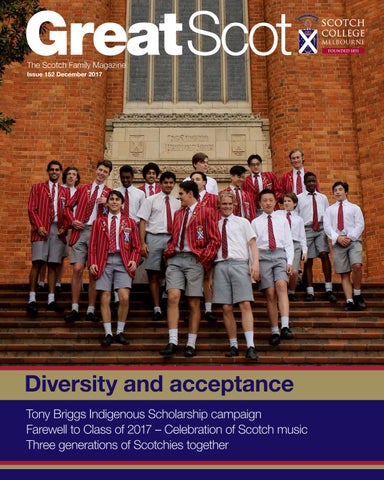
The Scotch Family Magazine Issue 152 December 2017
Diversity and acceptance Tony Briggs Indigenous Scholarship campaign Farewell to Class of 2017 – Celebration of Scotch music Three generations of Scotchies together
Regulars 1 2 4 6 8 12 18 19 22 30 44 48 52 58 62 66 89 91 93
Contents
Editor Chairman Principal Chaplain Scotch Commemorates World War I Junior School Middle School
22
Upper School Features
Perelberg Award 2017
Senior School News
Award winner 'immersed himself in all things Scotch’
Music Sport Boarding Foundation Development OSCA What They’re Doing Now School History
28
Obituaries
Tony Briggs (’85) Indigenous Scholarship The 24-hour funding campaign was an outstanding success The Scotch Family Magazine Issue 152 December 2017 is the official publication of Scotch College, Melbourne. Publisher Scotch College 1 Morrison Street, Hawthorn 3122 Victoria, Australia Phone: (03) 9810 4321 Email: greatscot@scotch.vic.edu.au www.scotch.vic.edu.au ABN 86 852 826 445 Print Post Approved PP100008172
View Old Scotch Collegians' Association news and updates at: www.oscanet.com.au Like us on Facebook Scotch College and OSCA
FRONT COVER: GARY FERREAU (PHOTOSENSE)
Editorial contributors Durga Kamte, David Ashton, Anthony Tasca, Paul Mishura, Mark Johnston, Scott Montgomery and Tim Shearer. Editor Durga Kamte (03) 9810 4420 email: durga.kamte@scotch.vic.edu.au Assistant Editor David Ashton (03) 9810 4489 email: david.ashton@scotch.vic.edu.au Production and Art Direction Lisa Sheard (03) 9810 4443 email: development.publications@scotch.vic. edu.au Photography Scott Montgomery, Jocelyn Pride, Mark Mason, Robert Papuga, John Ferguson, David Assender, Stephen Long and Scotch College students, staff, parents and Old Boys.
35 International school exchanges Rich experiences in a variety of cultures
Editorial
DURGA KAMTE EDITOR, GREAT SCOT As the Year 12s of the Class of 2017 leave the gates of Morrison Street, they carry with them memories of a school that represents enduring traditions dating back to the school’s founding fathers, who sought to provide ‘an education of a humane, scientific and general nature consistent with the teachings of Christianity’. These traditions remain unchanged, and show themselves to be consistent with those of a forward-thinking, 21st Century school that (as articulated in the Scotch Vision statement) ‘opens boys’ minds to the rich diversity of the world in which they live’ by promoting ‘a sense of responsibility and respect for others.’ Musing on the theme of diversity and acceptance, I was struck by the relevance of the paired comparative texts Year 12 boys have studied in English this year. Eastwood’s
biopic Invictus, based on the achievements of Nelson Mandela in bringing about reconciliation in South Africa, and David Malouf’s Ransom, which reimagines Homer’s Iliad, set in the final stages of the Trojan War, are both explorations of the ability of individuals to set aside personal prejudices – however difficult this may be – and accept the common humanity of those who hold differing perspectives. The elderly king of Troy, overwrought by the desecration of his son’s corpse by the mighty warrior Achilles, nonetheless seeks common ground with him, not as a king but as a common man and father to achieve a temporary truce. Mandela’s innate humility and his ability to forgive representatives of the oppressive apartheid regime, even accepting the value they placed on sport, were instrumental in uniting a ‘rainbow nation’. As the pages of this edition represent visually, and in the words of many contributors, Scotch is a school that does not just pay lip service, but genuinely values and embraces diversity. Boys from the Class of 2017 are to be congratulated on their initiative in creating an Acceptance and Diversity Committee, their frank discussions with boys about the effects of ill-considered language, and their concern in ensuring each boy is valued. Acceptance of diversity goes well beyond race, religion and ideology, but equally embraces the broad range of passions and interests of our boys. Celebrated in these pages are artistic and musical talents, skills in debating and chemistry,
interests in psychology and literature, and a strong passion for social justice. The Scotch Foundation pages of this edition include the final report of the retiring Foundation President, Michael Robinson (‘55), in which he reflects warmly on the support provided so readily by the Scotch Family, which helped to fund the purchase of the Hawthorn site for Scotch more than 100 years ago, and has ensured that the school has continued to grow and develop ever since. Endorsing Michael’s remarks, Director of Development, Tim Shearer, lists the four pillars through which the Scotch community can enable so much to happen at Scotch. Incoming President of the Old Scotch Collegians’ Association, Andrew Crawford (‘89), sees one of the key objectives of his presidential year as improving and expanding OSCA’s reach; in particular through the OSCAnet website and social media. Over the past year, four Old Boys – Hal Oxley (‘33), Sir Lenox Hewitt (‘33), Arthur Atkins (‘35) and Herbert Purton (‘35) – have joined our oldest known living Old Boy, 102-yearold Bill Morgan in the exclusive Old Scotch centenarians’ club. Bill Morgan’s 102nd birthday was well celebrated at Scotch on 26 October, when nine of our 25 oldest known living Old Boys gathered for morning tea. On 15 October, 201 men and boys from three generations gathered at Scotch for a remarkable group photo, which appears in this edition.
41
62
70
Our A grade debating champions
Scotch Family makes it happen
Three generations gather
Generous support for the school for more than a century
Boys, fathers, grandfathers gather for a unique photo opportunity
Scotch team triumphs in a major debating competition
www.scotch.vic.edu.au Great Scot 3
Chairman
THE HON. DR DAVID KEMP SCHOOL COUNCIL CHAIRMAN
The Hon. Dr David Kemp AC ('59) – School Council Chairman
Burns’ ideal of ‘the brotherhood of man’ marches on Scotch College provides an amazing diversity of opportunities and experiences for its students, not only through a broad curriculum and extracurricular activities, and through opportunities to travel with school parties to every continent, but also through the relationships formed between boys with a range of backgrounds and characters. While Scotch provides a Christian education in association with the Presbyterian Church of Victoria, it is open to students of all faiths and backgrounds. In 2015 the Scotch Council adopted a vision statement to guide its own decisions, which said in part: ‘Scotch College aims at a school community that embraces boys from families of all countries, faiths and backgrounds. Through partnership with schools and cultures, locally, nationally and internationally, Scotch seeks to equip boys with an enduring empathy for the needs and views of others, and the awareness and adaptability to meet challenge and forge lasting relationships of respect and purpose’. The original meaning of the term ‘public school’ was that the school would be open to all, and from its foundation, Scotch has sought to give reality to that commitment. Indeed, when our founder, Rev. James Forbes, earlier established a primary school in Collins Street called The Scots School – before establishing the secondary college that became Scotch – two Aboriginal students were awarded prizes in its first year. Scotch has always been non-sectarian in its admissions, and some of its most distinguished students have been Jewish, notably Sir John Monash and Sir Zelman Cowen. Today Scotch boys come from families who adhere to the whole range of Christian denominations, as well as those of Moslem, Hindu, Buddhist and other faiths. Many boys come from families who do not acknowledge any religious affiliation, but who value the education Scotch provides. International students now make a valuable contribution to the diversity on
campus. Recently, as a result of a visit by the school, a Scotch Family branch was formed in Hong Kong. As a school which traces its origins back to Scotland, with its long Presbyterian tradition of the dignity of the individual person, it is perhaps not surprising that Scotch should have taken to heart the vision of the great radical poet Robert Burns, who foresaw the day when ‘man to man, the world o’er, shall brothers be, for a’ that’. While the world has still a long way to go to realise ‘the brotherhood of man’ and the common humanity of all people, there can be no doubt that the vast expansion of communications, trade, and travel among nations, and the immense efforts to maintain international peace, have done much to advance the world towards that goal. In our own society we are living in an era when liberal ideas about the equal entitlement of all people to respect and dignity are rapidly advancing. People who have been neglected, ill-treated or discriminated against in the past for their differences, whether on grounds of race, nationality, religion, culture, gender, sexuality or mental capacity, are now being recognised and appreciated as full members of our communities, entitled to equal respect alongside all others. Prejudice is retreating before the recognition that we are all equal in our humanity. Scotch College embraces the ideal of the equal dignity of all people. One recent example has been the magnificent response of the Scotch Family to the invitation to fund the Tony Briggs (‘85) Indigenous Scholarship, with donations far exceeding the $750,000 target over a 24-hour period. A second recent example was the gathering initiated by the boys of Year 12 to confront and address the prejudice of homophobia. Scotch College has for many years recognised its obligation to help open doors of opportunity through its educational skills beyond the school grounds.
4 Great Scot Number 152 – December 2017
ABOVE: 1910 INTERIOR OF SENIOR ROOM, SCOTCH EAST MELBOURNE CAMPUS. BELOW: PORTRAIT OF ROBERT BURNS HANGS IN THE RECEPTION OF THE RANDALL BUILDING, SCOTCH COLLEGE
Examples include assisting in the development of Tiwi College on Melville Island in the Northern Territory, raising voluntary donations from the Scotch Family to assist in Zambia with schools at Kapumfi and Chitulika, and working with Hume Central College in Broadmeadows in Melbourne, in mathematics. Scotch is also an active partner in the International Boys’ Schools Coalition, which seeks to encourage continuing improvement in boys’ education in many countries. As a non-selective school, Scotch College will continue to provide an education to a wide diversity of students. The School Council takes pride in supporting with its high quality grounds, facilities and outstanding staff our Principal Tom Batty’s drive to provide the best education tailored to the needs of individuals. The Council greatly values the support of members of the Scotch Family for initiatives that continue to enhance the school’s ability to bring the best out of each boy.
www.scotch.vic.edu.au Great Scot 5
Principal
Mr Tom Batty – School Principal
The magic that lies between the ‘0’ and the ‘1’ MR TOM BATTY SCHOOL PRINCIPAL
Around the time of Family Day, I learned via national radio, that, after 40 years at the taps, Australia’s oldest publican, 93-year-old Mary Crawley, had pulled her last pint and was selling her pub, the Tattersalls Hotel in Barringun, NSW, one kilometre from the Queensland border. When asked for comment on changing times, Mrs Crawley mused that people used to have more time to bump into each other and discover that which was of interest in those they met, noting, ‘A terrible lot of people today don’t appreciate the natural beauty that God gave us. It all goes past.’ The following day, I found myself heading to Kyneton to visit the pre-Foundation Day Concert Music Camp with a telephone call to make. I announced this to my car, and after a brief engagement with a very polite voice that increasingly controls my direction, the call was made. Completing this brief trilogy, two days later, I found myself perusing all on display at the opening night of the Family Day Design and Technology exhibition. Stunning traditional pieces were surrounded by those borne of the needs and opportunities of a connected generation, as boys of the Year 10 Scotch Enterprise Project joined those engaged in VCE Product Design and Technology and Systems Engineering programmes, in taking up the challenge of solving problems through consideration of the needs of others. In addition to a lovely folding table and a beautifully crafted ukulele, on display were a water bottle top with an inbuilt filtration system to deliver clean water to people in Third World countries; a cheap, easy to assemble prosthetic leg for victims of land mines; a wheelchair driven by movements of the transportee’s eyes; a system for the retrieval of ‘men overboard’, based on a signal from a wristband launching and directing a flotation device; and a sprinkler system automated by information gleaned by a weather satellite and a sensor detecting local soil moisture content – to note but a few. The world is increasingly one of immediate, ubiquitous communication. It is dynamic, exciting and full of seemingly endless opportunity, as all are instantaneously connected to whatever and whomever they choose. We relish the challenge of tailoring an education that best prepares Scotch boys for the opportunities of
their age, but the risks posed by Mrs Crawley are real. In a world defined by communication, we want Scotch boys to help ensure connected airwaves do not deliver disconnected people. As the world shrinks, our boys must be careful not to follow suit and isolate themselves from the attributes which make each one of us different, and, hence, of interest. That such threat is increasingly likely to occur without their explicit knowledge, only heightens this generation’s vulnerability to its persuasion. As, with growing intelligence, Big Data feeds the appetite for affirmation, Scotch boys will need to challenge the desire to become encamped only with those with whom they share opinions and behaviours. It is by placing values and principles above causes that they will resist such drift to binary ‘yes/no’, ‘right/wrong’, ‘them/us’ positions, and promote our democratic traditions of consensus. In addition to empowering boys for the flow of a digital world, we must help ensure their judgement remains grounded in that which is above any law or code – the dignity of each person. Such judgement as that exhibited by Huckleberry Finn when tearing up the letter that would have met his prescribed obligations, but condemned Jim back to slavery and the hangman’s noose, and noting: ‘All right then, I’ll go to hell’. In planning such education we draw on our Christian faith and Scottish heritage, referencing a primary principle – the inherent value and beauty of each person; and a primary question – how did the world come to be as it is, and how might it be made to evolve for the greater good? Our commitment to such education can be seen through recent initiatives, including the embedding of relational learning and academic care strategies; the establishment of a Centre for Learning with increased provision for learning support; the growth in breadth and complexity of our challenge programmes and elective offering; and the Big Ideas lecture series in Years 8 and 11. It flows through the increased language choice in Years 7 and 8; the shift of focus in Year 9 and Year 10 English to creativity, individual choice and extended writing; the provision of a new coding elective; our partnership with Shore School in Sydney on the National Emerging Leaders Programme, which sees
6 Great Scot Number 152 – December 2017
our staff conduct action research projects on matters relating to our strategic intents; and our work with the International Boys’ Schools Coalition. It can be witnessed through the growing number of extension activities, exchange programmes and partnerships, including that with our dear friends at Tiwi College. It was evident at the Science Oration and Foundation Day Concert, and at the launches of the Michael Robinson Boarding Scholarship and Tony Briggs Indigenous Scholarship. It was to the fore when Year 12 boys gathered to discuss and confront issues of homophobia, misogyny, racism and discrimination against those with mental illness. It is quantified through research, analysis, survey and review, and is rooted in an embrace of opportunities beyond prescribed curricula. And, of course, it takes physical form in the nature of the learning spaces in the Sir Zelman Cowen Centre for Science and the Design and Technology Centre, which engender the coming together of minds and bodies in debate, collaboration and advancement. The coming months and years will see us continue to garner the fruits flowing from the conversations initiated when intellects collide. We will continue to progress the Scotch Enterprise Project model and the possibility of cross-age electives. We will expand our recent initiative of involving young Old Boys with particular interests in innovation to work alongside boys and teachers. Our trial of the Year 11 Immersion Programme which sets boys’ service within communities will be embedded, and we will build on the momentum established by this year’s graduating class to enhance the projection and impact of boys’ voice. We will redevelop the Keon-Cohen Building into a cafeteria/ dining room for boys, to form the hub of a precinct that will be home to their voice. We will plan for a Centre for Enterprise that will empower boys with the skills necessary to take good ideas to the marketplace, while progressing opportunities for social enterprise through outreach and innovation. In all such initiatives, we seek to unearth passions and help boys become as good they can be at that which rattles their cage, so that, in turn, they might share their God given talents, be it across a paddock fence, court of law, trading floor, operating table, design studio,
ABOVE: PRINCIPAL, TOM BATTY, WITH TONY BRIGGS (’85) AND THE ‘4’, DESIGNED BY SCOTCH’S INDIGENOUS STUDENTS, SYMBOLIC OF THE SUPPORT PROVIDED BY MATCHING GIVERS IN THE TONY BRIGGS (’85) INDIGENOUS SCHOLARSHIP CAMPAIGN.
building site, family dinner table or over a chat with a stranger in the Tattersalls Hotel in Barringun. In so doing, we seek not to tell boys what to think, but that they should think, and that the most important voice is oft that which is different to their own. Great advancement has been made, and will continue to be made, by harnessing the logical power of the two-state switch, but the risk is noted. We must ensure Scotch boys resist the trap of the facile, immediate response and opinion, and remain wary of the threat of a binary driven world making them binary of thought and company. We want them to embrace the magic that lies between the ‘0’ and the ‘1’. In pondering such traps, I leave you with a scenario of binary logic to reflect on (with due deference to British mathematician and philosopher, Bertrand Russell, and his paradox). Consider a group of chefs who only cook for those who don’t cook for themselves. Suppose Jack is such a chef and that he doesn’t cook for himself. Where does Jack fit in?
www.scotch.vic.edu.au Great Scot 7
Chaplain
Rev David Assender – School Chaplain
Diversity, not division Equal, united, different, forever: this is God's vision for mankind.
REV DAVID ASSENDER SCHOOL CHAPLAIN
When I was a teenager I loved watching The A-Team on TV: a cliché crew made up of a tech guy, a muscly guy, a good-looking guy and a master-planner. They were ex-military personnel trying to redeem themselves. Even though they were very different, their chance at freedom had them working together cleverly to accomplish spectacular outcomes. It is a very popular model repeated in countless multiplayer computer games to this day, and it is very biblical. The Bible does not fragment us into races and subcultures. From Genesis to Revelation we are one race. We are all created in the image of God and through Christ we are all one family. The Apostle Paul writes: ‘From one man God made every nation of the human race, that they should inhabit the whole earth’ (Acts 17:26). Furthermore: ‘There is neither Jew nor Gentile, neither slave nor free, nor is there
male and female, for you are all one in Christ Jesus’ (Galatians 3:28). But diversity is seen as an essential element for unity to function: ‘The body is a unit, though it is made up of many parts ... so it is with Christ’ (1 Corinthians 12:12). Diversity makes us strong when we work together. The Apostle John’s vision of a great celebration at the end of time is described as ‘a great multitude that no one could count, from every nation, tribe, people and language’ standing before the throne of God (Revelation 7:9). Equal, united, different, forever: this is God’s vision for humanity. Yet, just like an episode of The A-Team, diversity within unity isn’t an end in itself – it’s what you do with it that really matters. The purpose of diversity in the Bible is to build one another up (Ephesians 4:1-16) – each individual contributing to the other what the other doesn’t have. Diversity isn’t celebrated as much as it is necessitated. We are weaker when
8 Great Scot Number 152 – December 2017
We are weaker when ‘ we are the same. But just
as important as our diversity is our unity, otherwise we have division
’
we are the same. But just as important as our diversity is our unity, otherwise we have division, and nothing gets done when we are divided. So how do we work together when we are so different? This is where Jesus comes into the picture. In his last recorded prayer before crucifixion, Jesus prayed that we might be one, as he is one with the Father (John 17:22). This unity is a relationship. Love draws us in. Through Jesus, God invites us to have a relationship with him; to become part of his family. Whatever our identity, through faith, God is our father, Jesus is our brother and we are family. What makes us different from The A-Team, however, is that what unites us is not an opportunity to redeem ourselves, but that we have been redeemed by the work of Jesus on a cross. He has accomplished a spectacular outcome for us through the forgiveness of sin and the assurance of eternal life. This act of love draws us in. And we respond in love, finding ourselves fulfilling the greatest of commandments as we love God with all out heart, soul and mind, and our neighbour as ourselves (Matthew 22:37-40). Love helps us to work together.
Bringing the needs of the school and its community before God Every Tuesday during school term time, a group of Scotch Family members gathers in the quiet of the morning to pray. It is a precious time of peace, of fellowship, of prayerfully supporting the Chaplains, and of bringing the needs of the school and its community before God. Former Chaplain, Rev Graham Bradbeer, established the group in 1992. It began with a letter of prayer points which Graham sent out four times a year. Later a Senior School prayer group was formed, and then a Junior School prayer group, with the two groups merging after several years into what is now known as the Chaplains’ Prayer Support Group. Although the group functions informally, careful consideration is given to confidentiality, and there is no pressure, and no influx of excessive emails into members’ in-boxes. The group is simply a supportive, social gathering of people who share together in friendship the needs of the school community.
The group is an auxiliary of the Scotch Parents’ Association, and it has an activities committee which meets approximately four times a year to plan activities and initiatives. This committee comes under the school Chaplains’ direct guidance, and supports major activities such as the Easter Breakfast, Family Day, the school’s Christian Movement Group and annual camp, the Christmas carol services, Faith Week, and Scotch’s support of education in Chitulika, and now Chipapa, in Zambia. Parents, grandparents and guardians of current and past Scotch boys, as well as Scotch staff are encouraged to consider joining the Chaplains’ Prayer Support Group. You will be warmly welcomed. For more information about the group, please contact Georgie Kilroe-Smith on 0417 116 812 or georgieksmith@gmail.com; or Liz Blair on 0423 776 984 or liz.eb72@gmail.com. DAVID ASHTON
Save the date: Scotch College Prayer Breakfast – Friday 23 March 2018, 6.45am Guest speaker at the 2018 Prayer Breakfast will be gynaecologist/obstetrician, Dr John Neil (’60). Dr Neil studied Medicine at Melbourne University and specialised in obstetrics and gynaecology at the Royal Women’s Hospital, where he was a consultant for some years. He now works part time at Box Hill Hospital where he looks after high risk pregnancy patients.
THE CHAPLAINS’ PRAYER SUPPORT GROUP. BACK ROW, LEFT TO RIGHT: DIEU VU, HAILAN MENG, LIZ BLAIR, JUNE SUTHERLAND, BRUCE SUTHERLAND (’48), SOPHIE ATHAN, GEORGIE KILROE-SMITH, CAROLINE BEISCHER AND AILSA WILSON. FRONT: CHAPLAINS DAVID ASSENDER AND DOUG CAMPBELL.
www.scotch.vic.edu.au Great Scot 9
Scotch Commemorates World War I
‘How could I stay?’ This article commemorates the last 30 of the 61 Scotch Collegians who died as a result of war service in 1917. SAMUEL (known as Sammy) ROSENTHAL (1895) was 33 on enlistment, and by May 1917 was serving in France with the 58th Battalion. He performed well at the battle of Bullecourt, and was promoted to lieutenant. It was said that his platoon ‘absolutely loved him’. He was leading them through shell fire at Polygon Wood on 25 September 1917 when machine-gun fire struck him down. WILFRED NORMAN BEAVER (1897) was a magistrate in Papua New Guinea when he enlisted in late 1915. Malaria affected his health on the Western Front, but he was a lieutenant with the 60th Battalion in the battle of Polygon Wood. As Wilfred took his platoon to position on 26 September a sniper shot him in the stomach, and he died some 10 minutes later. A waterfall in New Guinea was named after him. DAVID LANDALE MAUGHAN (1898) rose from the ranks to become a lieutenant in a machine-gun company. On one occasion, he was standing outside in a dangerous location and refused an offer of taking shelter with his fellow officers. He said he would stay with his men. During the attack at Polygon Wood on 26 September 1917, David was shot through the heart by a sniper. One of his fellow officers was reportedly killed trying to retrieve David’s body, which was eventually buried at night and then reburied in a cemetery, to his aged father’s relief. A third Old Scotch Collegian to die on 26 September was Private ROBERT SMITH (1905), a tall farmer and horse breeder from Leongatha. He had won a book prize at Scotch in 1904. Robert, who left a wife and three daughters, had enlisted in November 1916. He was one of nine men killed by shelling while digging a trench at Glencorse Wood, near Ypres. He has no known grave and is commemorated at the Menin Gate, Ypres. Private RICHMOND BOYD (known as Rex) GRAHAM (1912) was killed on the night of 26 September. Since enlisting at age 21 he had been hospitalised three times with various illnesses and injuries, including a scalded foot. He was killed instantly by shellfire at Polygon Wood. An eyewitness of his death, who knew him
well, remembered Rex as ‘well-educated’, with a ‘College education’. Fellow Old Scotch Collegian THOMAS MARCH HALL (1910) was a sergeant in Rex’s battalion, the 29th, and was killed on the same day. Thomas was reportedly dux of his class for each of his four years at Scotch. He had suffered a serious knee injury after falling off a duckboard while proceeding through the mud in January 1917. His recovery took six months and in late August he returned to his battalion. Just one month later he was killed. Despite the best post-war efforts of his brother, Alec (1910), a Scotch Collegian and veteran, no one knew where Thomas was shot dead or buried, so he is commemorated at the Menin Gate. CHARLES HASELDEN STILL (1909) was a cousin of the Principal, William Still Littlejohn. At the outbreak of war, he was a farmer in New Zealand, and he joined the New Zealand Rifle Brigade. In June 1917 he was promoted to sergeant and awarded the Military Medal for ‘acts of gallantry’. Charles was killed in action at Ypres on 28 September 1917. Just two years before the outbreak of war, FREDERICK RICHARD MCINTOSH (1912) was representing Scotch at the first team level in athletics, football and rowing. Before enlisting in 1915, he had played for Essendon in VFL football. He reached France in 1917, where he was hospitalised with furunculosis (masses of boils). By 15 July he was a full lieutenant. He was leading men in an attack at Polygon Wood on 26 September when hit by machine-gun fire in the chest and shoulder. He died in hospital two days later. JAMES WHITSON AINSLIE (known as Jim) AGNEW (1913) and DAVID VALLANCE KERR ANDERSON (1910) were prize-winning boys at Scotch. Both were at university when they enlisted together in 1915. They were assigned to the 12th Field Ambulance, in which they were stretcher-bearers. Jim likened stretcher-bearing in no-man’s-land on the Western Front to ‘working over the broken surface of an active volcano.’ Dave won a Military Medal there. In 1916 the two celebrated Foundation Day in France, watched
by mates from other APS schools. Jim and Dave were felled by the same shell at Ypres on 29 September 1917 as they carried a casualty together. Jim was killed instantly, while Dave died of his wounds two days later. Both were just 24 years old. ANTHONY LESLIE PRYDE (1905), a former Scotch College Cadet, was a bank clerk in Sydney before enlisting in November 1916. By the time he arrived at the 1st Battalion on the Western Front, on 11 September 1917, he had less than a month to live. He had been trained to use mortars, and on 2 October was allotted to a trench mortar battery. The 28 year old was killed that day. Anthony left a wife, to whom he had written earlier in the day, and two sons, who later attended Scotch. LAURISTON (known as Laurie) BROWNELL (1910) left his farm in Tasmania to enlist in September 1915. By February 1917 he was a lieutenant with the 27th Battalion in France. On 3 October, at Ypres, he was mortally wounded by a shell while sheltering in a shell hole. He was popular with his men. GEOFFREY DE TALWORTH BACKHOUSE (1908) left his farm to enlist in Melbourne in 1916. He was hospitalised four times before proceeding overseas and being allotted to the 55th Siege Battery. He wrote from the front in July 1917 of being comfortable in his dugout, where he was conscious of German power but also of how wonderful Australia was. Geoffrey was killed in action on 4 October 1917, though no details seem to exist of how he came to die. GUY MARTEN BERRY (1911) was the second of four Old Scotch Collegians to die on 4 October. He was a signaller when he was struck in the chest and knee by shell fragments that day. The 22 year old died at a Canadian casualty clearing station. FREDERICK BISSET COLLINS (1897) was a 36-year-old lieutenant when he was killed that day. Though married with two children, he had enlisted in August 1915, reportedly spurred on by news of the death of his cousin at Gallipoli. He rose from the rank of private to lieutenant in the 21st Battalion, but after some months in England
10 Great Scot Number 152 – December 2017
ABOVE: S ROSENTHAL, W N BEAVER, D L MAUGHAN, R B GRAHAM, T M HALL
in 1917 was killed in action. Only in 1925 was it determined that a grave bearing his name did not belong to him and that he has no known grave. Another 21st Battalion lieutenant, HAROLD WILLIAM HARPER (1903), was an Old Boy killed on that fateful 4 October. He had been a member of the Scotch 1st XI when it won the cricket premiership in 1902. Operations on varicose veins and hammer toes prevented him from enlisting before 1916. By July 1917 he had become a lieutenant and had reached the 21st Battalion on the Western Front. On 4 October Harold led his men in the capture of an enemy position at Broodseinde Ridge, near Ypres. He was in fine spirits and sheltering in a German dugout when a shell went through its entrance, killing him and his corporal instantly. DAVID GLEN MACKAY (1905) had also played 1st XI cricket for Scotch, in 1905. After enlisting at Yarrawonga in January 1915 he
served as a sergeant with the 13th Light Horse Regiment on Gallipoli. After serving with mounted units in France in 1916, he was selected for officer training and was sent as a lieutenant to the 39th Battalion in June 1917. At Broodseinde Ridge on 4 October a shell dealt him various wounds, including a fractured jaw. This 29 year old died at a casualty clearing station the following day. ERNEST ROBERT FINDLAY (1903) also died that day. He had travelled to Egypt with a group of artillerymen under the command of fellow Old Scotch Collegian Bill Knox (1904 – see Great Scot, April 2017). Ernest served on Gallipoli until he contracted dysentery and was evacuated to England. In March 1916 Ernest joined the British Army, which gave him a commission in the Royal Field Artillery. By August 1917 he was on the Western Front, where he did brave and effective work as a forward observation officer. On one occasion he was the only man unhurt
when a shell landed among a party of six with whom he was moving positions. His luck was to run out some seven weeks later, when he was wounded on 4 October, and died the following day. He was just 28 years old. TALBOT PRESTON ROBERTSON (1915) was still a Scotch boy while Ernest was on Gallipoli. He enlisted at age 18 in October 1916. Small and youthful, Talbot was allotted as a driver to artillery reinforcements. He was punished for various minor misdemeanours before reaching France in August 1917. He had been at the front barely a month when on 29 September a shell fractured his thigh. He was operated on at a casualty clearing station before going to a hospital at Etaples, where he died on 7 October. His few possessions, sent home after his death, included a ‘College Medallion and Ribbon’. Talbot’s gravestone carries the epitaph ‘How
www.scotch.vic.edu.au Great Scot 11
ABOVE: TOP ROW: C H STILL, F R MCINTOSH, J W A AGNEW, A L PRYDE. BOTTOM ROW: L BROWNELL, G D T BACKHOUSE, G M BERRY, F B COLLINS
could I stay?’, the final line of fellow Collegian J D Burns’ poem, For England. DONALD GOLDSMITH ARMSTRONG (1911) was a tall, cheerful and optimistic young soldier who was allotted to the Lewis machinegun section of the 5th Battalion. At Pozieres a bullet struck the butt of his gun but he survived that and the great barrages that he described there. He was selected for officer training, and was a 2nd lieutenant with the 21st Battalion when he was killed by shellfire at Broodseinde Ridge, Ypres, on 9 October 1917. He was the third Old Scotch Collegian killed as a lieutenant in the 21st Battalion in this battle – after Fred Collins and Harold Harper. Donald’s body was discovered in 1924, and identified by a leather case bearing his initials and enlistment number. LANCELOT CROPLEY (known as Lance) SMITH (1913) was just 19 when he enlisted in June 1916. He was allotted to the medical corps, and was a stretcher-bearer with the 38th Battalion at Ypres in 1917. He was so dedicated to his job – tending wounded continuously for two days in the open in early October – that he
was recommended for a Military Medal. By the time his recommendation was accepted, Lance was dead. He survived an explosion which buried him on 14 October, but he died at a casualty clearing station the following day. His mates were genuinely shocked to learn of this, six weeks later in The Times newspaper. HORACE HANTON GRAHAM (1913) was just five feet three inches (160cm) tall when he enlisted at Rockhampton, Queensland in January 1916. In September that year he was severely wounded in the shoulder at Pozieres. He did not return to his battalion, the 52nd, until more than a year later. He survived at the front for just 25 days, before being killed in action at Passchendaele. A lengthy correspondence followed between his separated parents and officialdom as to the destination of the 23 year old’s possessions and war gratuity. At 43 years old, JAMES FREDERICK STEEL (1890) was one of the oldest Old Scotch Collegians killed in the war. He was a driver with the ambulance wagons of the 9th Field Ambulance when on 18 October at Ypres, enemy
‘bombing’ (probably shelling) killed and injured 24 horses and also cost him his life. According to the 9th Field Ambulance history, in this period the Germans ‘drenched the back areas and tracks over which the wounded had to be carried, with a constant stream of shells.’ ALFRED OUTTRIM GARDNER (1911) was just 19 when he enlisted. Short and slight, he reached the Western Front in September 1917. He died the following month serving with the 5th Field Artillery Brigade at Ypres on 19 October. His service file contains a 1918 letter from his mother thanking the army for returning her ‘dear son’s’ few possessions [including a wallet, photo case, metal mirror and gold ring] in good condition’. At his father’s suggestion, on Alfred’s headstone are the words ‘Love’s strength standeth in love’s sacrifice’. Like Alfred, JACK ARCHIBALD GRAY (1912) was short and young. He served on Gallipoli in the artillery, suffered considerable ill-health and in August 1917 was transferred to the 2nd Field Artillery Brigade. The latter was the most dangerous appointment he received, and
12 Great Scot Number 152 – December 2017
ABOVE: TOP ROW: H W HARPER, D G MACKAY, E R FINDLAY, T P ROBERTSON BOTTOM ROW: D G ARMSTRONG, H H GRAHAM, A O GARDNER, J A GRAY
on 22 October a shell burst shattered his arm and leg at Ypres. He died the following day. Only in October 1922 were his remains identified by means of a regimental disc, which was sent to his father. GEORGE WOOD (see Great Scot, April 2017) was a teacher at Scotch before enlisting in September 1915. He had a profound influence on the school through the songs he wrote, and his role in establishing OSCA and the Foundation Day Concert. He was also a great organiser within his military units, primarily the 58th Battalion, with which he was a lieutenant. He received a severe chest wound near Passchendaele on 12 October 1917 and died in hospital on 26 October. DOUGLAS GEORGE MORRISON (1913) was 21 on enlisting in October 1916. He became a 2nd lieutenant in the 3rd Squadron of the Australian Flying Corps, but only learned to fly in 1917. He travelled to France in September 1917. On 13 October while flying a scout plane he became detached from his patrol and was shot down by as many as four enemy aircraft.
He crashed in no-man’s-land and was thrown clear of the aircraft. Several British soldiers risked their lives to rescue Doug, who was brought to hospital. Doug’s wounds were severe and required the amputation of his right leg. He died on 29 October. SYDNEY ALLISON NEWTON (1914) left Scotch at the end of Term 1 in 1914 to become a naval cadet, preparatory to becoming a naval officer. He was just 15 years old. During the war he served in the merchant ship Aparima, and was aboard when it was torpedoed by a German submarine in the English Channel on 19 November. It sank in approximately five minutes, and Sydney was one of 56 crew – about half the complement – who died. He had undertaken five voyages with the Aparima and had refused an offer to transfer to another ship. He was aged just 17 at his death. JAMES GREER GOULD FAIRBAIRN (1902) had been a grazier and auctioneer before enlisting in 1915. His father described him as ‘an enthusiastic horseman and a good rifle shot’. James was initially a member of the Light Horse.
In 1917 he served in two camel units in Egypt, and it was while serving as a corporal with the Imperial Camel Corps that the 31 year old was killed in action in Palestine on 4 December. PERCY SYLVESTER HOBBS (1905), a prewar journalist in New Zealand, had a deformity of the arm and hand which prevented him from firing a gun. He had a desk job at Papawai camp, New Zealand, when he took his own life on 15 December, aged just 20. Wherever they were in the age range from 17 to 46, the Old Scotch Collegians and staff who died in 1917 sacrificed their remaining years for a higher cause. More details about all other Scotch Collegians killed in World War I can be found on the Scotch website, under ‘WWI Commemorative Website’ on the lower right of the home page. DR MARK JOHNSTON – HEAD OF HISTORY
www.scotch.vic.edu.au Great Scot 13
Junior School
Mr Jon Abbott – Head of Junior School
MR JON ABBOTT HEAD OF JUNIOR SCHOOL
MR JON ABBOTT WITH YEAR 6 BOYS DURING A LITERATURE CIRCLE SESSION
Building a community of acceptance and understanding When the concepts of diversity and acceptance are being discussed, the idea of tolerance is often part of the conversation. I have to admit that I am not a fan of using the term ‘tolerance’ in regards to diversity.
14 Great Scot Number 152 – December 2017
I feel uncomfortable with the idea of ‘tolerating’ other people’s beliefs, backgrounds, faiths or ethnicity. To me, it sounds as if we are saying, ‘I don’t accept your beliefs but I will put up with them.’ I much prefer to consider this topic along the lines of having ‘understanding and compassion’ for others rather than showing ‘tolerance’ towards them. Our school is very public in regards to its policy for enrolment of boys. We are an open entry school, and we accept boys from all backgrounds and walks of life equally. As long as you have placed your son’s name on the enrolment list early enough, he will be offered a place at
Scotch. I love the fact that we have such a wide range of ethnic backgrounds at Scotch, as I think it adds enormously to each boy’s education. Having taught in the primary sector for almost 40 years, I know that young children do not see differences between people the way many adults do. Young children really couldn’t care less whether their classmates are from a different culture, religion, have a different skin colour or a different language. They just care about making friends and playing together. Unfortunately, it seems that society and the influence of the media often impact on this innocence, and boys sometimes begin to use phrases and words that can be denigrating of others’ differences. It is important to allow children opportunity to think about diversity in our world and how we can embrace others, rather than use difference as a means of creating separation between people. One of my most enjoyable times each week is when I get to work with a group of nine Year 6 boys in a ‘Literature Circle’ session. These sessions are much like a student version of a book club. Earlier this year my group read a novel called Pennies for Hitler by Australian author Jackie French. In this novel, set in pre-World War II Germany, a German boy named Georg experiences persecution as a result of his father’s Jewish heritage. In the story, Georg has to be smuggled out of Germany to live with his English aunt in London, where he feels compelled to hide his German background from others. Eventually, as a result of the London blitz, he is relocated to Australia along with many hundreds of English children to escape the dangers of the war. Georg again feels compelled to hide his background
from his foster family. Along the way he is confronted with the idea that perhaps his beloved country and its leaders are not something to be proud of, and he questions his earlier belief system and the things that Hitler had done to certain groups of people. The boys in my group loved discussing these concepts of racial intolerance and persecution of others. We spent many sessions talking about other similar events in history, such as Chairman Mao Tse Tung’s reign in China, the Taliban regime in Afghanistan, and, more currently, the situation in North Korea. It is fair to say that the boys struggled to understand how such people were able to come to power and have great support from their country, when it seems so wrong to treat people in those ways. In the Junior School we talk to the boys regularly about values and how to be a good person. Most importantly, we often talk to them about respect – respect for others, respect for property and respect for themselves. The message is clear and consistent: we all need to treat everyone else with fairness and compassion. For the boys in our senior year levels, we provide opportunity to consider where, why and how oppression and discrimination occurs in the world and even in our own country. In younger years we talk about treating everyone fairly, and that the differences between us are things to celebrate and enjoy. We have a great opportunity to build a community of acceptance and understanding through our youngest members. I feel it is vital, if not crucial, that we guide these young minds to understand that respect for others means all people, not just those who are most like ourselves. www.scotch.vic.edu.au Great Scot 15
News
The perfect agent of change ‘Language learning makes me feel like a blind man seeing the world for the first time, experiencing new colours and sites.’ Ashvin Appu, Year 6 Ashvin’s quote was very insightful, inspiring me to ponder the theme of this edition of Great Scot on diversity and acceptance, as well as my own passion for language learning. When it comes to teaching languages, our classes are no longer confined to the walls of the classroom. In an instant, we are able to connect and exchange thoughts with others; and in Ashvin’s words ‘experience new colours and sites’. Exploring, investigating, discovering, respecting the views of others and tolerating differences are essential parts of this process. Acquiring an additional language is not just about pronunciation, learning vocabulary and grammatical patterns: it also assists in learning to see cultural differences as assets and
therefore fostering the creation of more caring communities. I often find myself not just teaching the planned curriculum but sharing personal insights and cultural stories with the boys. We have discussed concepts such as Pünktlichkeit (punctuality), Organisation (organisation) and Gastfreundschaft (hospitality), demonstrating that all of us are touched and altered by our cultural upbringing; shaping our personalities, the way we think, the way we solve problems, as well as the methods we use to organise ourselves. The beauty of teaching a foreign language is to create the awareness that sometimes it is necessary to step outside our cultural boundaries in order to realise the impact that our culture has
on our behaviour. It is crucial for all learners to know the cultural context of which language is a component, thus gaining greater insight into varied cultures in order to accept, recognise, tolerate and respect cultures other than our own. Gently being guided and coming to realisation of the truth of this, our boys will be well equipped in beginning negotiations, creating shared meanings and becoming better agents for social change, justice and equity. CORNELIA KOEHNE-DRUBE – HEAD OF JUNIOR SCHOOL LOTE
16 Great Scot Number 152 – December 2017
Staff in profile
Interview with
Brendan Frost Brendan Frost and his young family were welcomed to Scotch in 2016 , with Brendan undertaking the role of a Year 5 class teacher. He quickly displayed wonderful personal qualities, including keenness to take on additional responsibilities and teaching and learning skills, and knowledge of a high standard. He has since been in charge of Bradshaw House, actively involving himself in a range of sports, and ensuring the smooth running of the skiing program. Prior to joining Scotch, he had teaching roles in Sydney, New Zealand and in parts of Africa, where he had responsibilities in areas such as head of inquiry learning, specialist music teacher, eLearning coordinator, year level coordinator, boarding housemaster, head swimming coach, and master in charge of rugby. He has maintained his connections with the African communities through charity work and fundraising. Brendan has a strong belief that engagement is the most vital component of teaching, and it is something that he continuously reflects on as an educational professional. He ensures that boys in
his classroom are enthusiastic, energetic lifelong learners. He is also to be commended for his willingness to collaborate with staff and to provide professional development opportunities for his colleagues. Importantly, his students leave his class with a sense of their role in their own learning and a global perspective. BRIAN SAMPSON – DIRECTOR OF STUDIES What is the best advice you have ever received? The most memorable bit of advice came from my father when he said, ‘Kindness can go a long way.’ This has enabled me to put myself in other people’s shoes and to be as empathetic and understanding as possible towards my students and members of the school community. Where has your teaching taken you so far in your career? I commenced my teaching career in Parramatta, NSW, at the King’s Preparatory School 10 years ago, and since then I have enjoyed the travelling
opportunities that have come from teaching in different countries. One of my most memorable moments was getting involved with adult education in Moshi, Tanzania, and organising English classes and debating with local Maasai. I also helped to establish a charity called ‘Team Vista’, which raises funds for many different projects in Tanzania. I have been a director of this charity for nine years now. Most recently I spent three years in rural New Zealand, teaching at Waihi Boys’ School in Canterbury. I thoroughly enjoyed how life in New Zealand revolved around rugby union, and over my three years I coached many different rugby teams. There were many evenings and weekends spent with all of the boarding boys. What do you like most about your job? The fact that every day, every month and every year is different. It is a wonderful job that enables you to grow and develop continuously as you seek to try new things and engage the minds of students in the 21st century. I very much like and take seriously the role I have to play in encouraging and guiding boys in their education. I also enjoy those times inside or outside the classroom where I can get to know my students to a greater extent. What do you love about Scotch? Scotch is indeed unique. I love the staff camaraderie and teamwork that goes into teaching and learning across all key learning areas. Everyone is more than willing to lend a hand, including boys and parents, and to get involved with different events and activities. I really like that Scotch strives to encourage each boy to find his own passions and create his own imprint of his time at Scotch. What story will your colleagues tell about you at your farewell speech when you retire? There will probably be many stories to tell in the coming years. However, they may talk of my terrible forehand in table tennis or how I am constantly running around or speaking way too quickly. How do you make your ‘own space’ in the busy school week? Making my own space becomes a bit tricky, especially when I have a young family at home. However, it is the family times that I really enjoy. I love watching my three children grow up. Although it can be a bit full-on with a two-month-old, a four-year-old and a five-year-old, it is a blast! I also enjoy being active, doing my regular weekly jogs and playing water polo on Thursday nights.
www.scotch.vic.edu.au Great Scot 17
Snowsports
Team and individual success in Junior School snowsports This year the Junior School snowsports team comprised 46 boys, and the team represented Scotch with distinction at the Victorian Interschools Snowsports Championships and later the Australian Interschools Snowsports Championships, both held at Mt Buller this year. At the Victorian Interschools, 23 Scotch teams and 27 individuals qualified for the Australian Interschools Snowsports Championships. Of the 23 Scotch teams, an amazing 13 teams finished on the podium. There were also some individual podium placings for the following boys:
• Louis Emmett: first place in the Cross Country Classic, division five, and third place in alpine giant slalom, division five; Joe Bertalli: third place in the Cross • Country Classic, division four; • Thomas Luscombe: third place in moguls, division five; • Edward Hill: third place in moguls, division four, and third place in alpine giant slalom, division four; • Henri Lempriere: second place in skier cross, division four. This individual and team success at the nationals earned Scotch the Champion Primary Boys’ School trophy – the 12th consecutive year we have held this title. Special congratulations go to Edward Hill, who was awarded the Mt Buller Cup for the third year in a row following the Victorian Interschools, recognising outstanding
individual achievement across all of his skiing and snowboarding events. A huge thank you to the snowsports committee, staff, parents, boys and supporters throughout this snow season. Congratulations to all boys for their success on the snow this year, and best wishes for 2018. BRENDAN FROST – TIC, JUNIOR SCHOOL SNOWSPORTS
18 Great Scot Number 152 – December 2017
TOP: DIVISION 6 A TEAM (LEFT TO RIGHT) HENRY ABERDEEN, EDWARD ROSS, LACHLAN WANG, WILLIAM WOOD
www.scotch.vic.edu.au Great Scot 19
Middle School
Ms Katrina Stalker – Head of Middle School
Rewards and experiences enrich the Middle School journey MS KATRINA STALKER HEAD OF MIDDLE SCHOOL
As Term 3 came to a close, the Middle School commenced an inter-form athletics competition, which included many fine performances leading into Family Day. Although some events were rain-affected on a rather wet Family Day, there was healthy competition between all the forms, with victory on the day going to 8TL and 7TH by narrow margins. However, the most rewarding outcome of the day was the work the boys of 8PM did in running their charity stall. The boys worked together to figure out how to raise money for charity. They won a Commerce project competition, which provided them with the backing to run the stall, and they gave the money the stall raised to Chipapa Community School in Zambia. While most of us were enjoying the first rays of spring we had some boys still in the throes of winter, competing in the Australian Interschools Snowsports Championships. Thirteen Middle School boys competed extremely well at the event. William Maisano was first nationally for skier cross individually, and second in the team event with William Atwell and William Creswell (all of Year 7). The cross country team of Charles Heyburn, Frederick Peterson and Oliver McNamara (all of Year 8) also came second at the nationals. We have continued to run academic programs to challenge boys this semester. Boys were involved in coding, Informatics and debating, with many excelling in a variety of academic pursuits. Andres Buritica Monroy (Year 8) has been invited to the Australian Mathematical Olympiad Committee’s School of Excellence, a camp which trains students showing potential in mathematics. This is a great achievement for Andres. We also congratulate Luis Chan, who has been invited to play in an international chess tournament at the end of the year. Earlier in 2017, Leon Fei (Year 7) won the string section of the Music Society of Victoria’s Hephzibah Menuhin Memorial Award. The winners of the various instrumental sections (string, piano, woodwind and voice) then met on 22 October to compete for the 29th 3MBS Freemasons Victoria Performer Award. Competing against university graduate musicians nearly twice his age, Leon played with incredible
energy and focus – despite playing last and having to sit backstage for many hours. Leon’s musicality shone through, and the panel of judges deemed him the winner. He also took out the ‘audience choice’ prize. Leon travelled to Sydney in late November to vie for the title of ‘2017 National Fine Music Network Young Virtuoso of the Year’. It’s a wonderful effort by a boy of only 13! By the time this edition appears, we will have held our inaugural parent information evening on building successful relationships, aiming to support our boys in a changing social landscape. This evening informs parents of forthcoming programs run at Scotch for Year 8 and Year 10 boys, as well as assisting parents with the challenges of raising teenagers in the online world. The Year 8 program, conducted in the last few days of the school year, has been running successfully for two years. It looks at healthy relationships, staying safe and respectful online, and analyses issues such as media and social messaging. As the year draws to a close, we wish the Year 8s well for the transition to the Upper School and the opportunity this will create. It has been a privilege being a part of their journey this year, and observing their progress.
LEON FEI - PERFORMING AT THE 3MBS FREEMASONS VICTORIA PERFORMER AWARD
20 Great Scot Number 152 – December 2017
Upper School
Mr Tim Rayner – Head of Upper School
Mingle, chat, make friends MR TIM RAYNER HEAD OF UPPER SCHOOL
A walk around our campus on any given day gives some insight into the diversity of our school, but by no means gives a complete picture of our community While it is possible to see differences in physical characteristics of boys and staff at first glance, taking the time to interact is often the beginning of appreciating others’ perspectives, cultures and world views.
Classes, sport, music and services all allow boys to mingle, chat, make friends and meet people who may come from different backgrounds and have different interests and views. There is a richness in the diversity of our boys’ experience, every day. From being taught by a diverse range of teachers to the boys themselves, whose backgrounds reflect the diversity of modern day Australia, it is evident that our community is not homogenous. Outside of the school day, boys meet other children at Saturday morning sport, exchanges, trips, school socials or debating, and they come across a range of identities and backgrounds. It is here that stereotypes can be reassessed, cultures valued and acceptance occur.
But issues of such importance cannot be left to chance. Our pastoral care program teaches about respect and relationships, and our Christian Education department is central to reinforcing the message of tolerance and acceptance. More recently, the Big Ideas program has led to Year 11 boys being challenged to think about topics such as the Holocaust, feminism and the suffragettes. This year has witnessed momentum in the role our boys want to take in tackling issues of discrimination and inequality. Pleasingly, many initiatives have stemmed from the boys themselves. They were disturbed that some peers were seemingly not concerned that some boys felt they were not valued, or that peers were insensitive to their identity. In setting the tone, Oliver McLeish spoke in an Assembly led by Year 12 boys about our school culture, and what we want our community to stand for. Tolerance and acceptance were the central themes of his speech, prompted by a call for these qualities to be front and foremost in our interactions. The forming of the Acceptance and Diversity group this year, led by Year 12 boys and supported by Ms Alice Cook and Mr David Skelt, has helped to galvanise many into action. Starting with a forum for the whole of the Year 12 group, without teachers in attendance, the issue of homophobia in our school was discussed through a panel of boys and facilitators. Once the momentum grew, a series of talks occurred: Peter Ho (Year 12) spoke to a Year 7 Assembly about the issues of racism in our society; Ms Angie Greene of Stand Up Events spoke to our Year 9 boys about prejudice within sport; Mrs Morgana Walker, our School Psychologist, spoke to Year 12 about mental health issues; and the Rev. Grant Watson spoke to Year 8 about religious diversity and acceptance. It is heartening that our boys want to get involved and take leadership on confronting issues that can easily be ignored. By older boys taking the lead and setting an appropriate tone for the younger boys to adopt, we can enable all our boys to have a voice and, importantly, feel valued.
www.scotch.vic.edu.au Great Scot 21
School Captain's Report
Listening with open minds It is ironical that when some consider diversity, it often stems from a preconceived idea of what diversity represents: perhaps that diversity is dictated by ethnicity or religion, or that diversity is cultural difference. ABOVE: PETER HO AND MICHEL NEHME IN CONVERSATION
In reality, the concept of diversity is elusive and dynamic. If anything, it is a necessary acknowledgment that our common humanity manifests itself in vastly divergent ways, and that of those ways, none are superior, more credible or more esteemed. It is in this sense that our common existence is enriched by plurality and authenticity. During our time as leaders at the school, nothing has been quite so uplifting as sharing in the diversity of the community of Scotch College, and bearing witness to the manner in which that diversity is interwoven in the tapestry of the Scotch experience for everyone at the school. Within the pages of Great Scot, we have read many a time about the diverse talents, interests, passions, opinions and exploits of our students and staff. Ensconced within our school gates is a diverse ensemble of beliefs, dispositions, sexuality, ethnicities, and cultural
heritage, each of these contributing to boys’ unique identities. We recognise that to be a Scotch Collegian is to partake in an experience unique to each boy, albeit interlaced with the unifying tradition, camaraderie, and value system of our school. While politics may stir the spirit of one student, Indonesian provides the impetus for another. While one may have been born just a few kilometres down the road at Cabrini, another may hail from a far-off country. While one may envision himself with a girlfriend, another simply may not. It is these very differences which animate our lives in school, which make our conversations compelling and which kindle within us a desire to embrace and learn from each other. Our education at Scotch College lies as much in our debates and interactions with each other as it does in the daily routines of curriculum content, services, sport and the vast diversity of extracurricular programs on offer. Our education also lies in our experiences on exchange in France,
our immersion in the communities of Nepal, and in our intimate relationship with our friends at Tiwi College. It is this ability to connect with others, to listen to their subjective and diverse outlooks on our world and to share our own outlook in equal measure, which will in turn serve us immensely as we leave the confines of our school grounds to pursue new relationships and opportunities. Our willingness to embrace diversity at Scotch should remind us to broaden our horizons and actively appreciate, rather than just tolerate, the inexhaustible variety within our world. The Class of 2017 is testament to the strength and acknowledgment of diversity. It is our hope that all boys will listen with open minds and talk with open hearts: only then will the school have left the greatest impact on the community. MICHEL NEHME – SCHOOL CAPTAIN
22 Great Scot Number 152 – December 2017
Vice Captain's Report
Legacy of the Class of 2017: inclusivity and acceptance It is difficult to know whether or not the Class of 2017’s push to make Scotch a more inclusive and accepting space will be remembered in isolation, or rather as a part of a wider and more lasting cultural shift within our community. Our intention this year as leaders has aimed at creating the latter. For both Michel and me, thoughts of the legacy which the Class of 2017 would ultimately leave were major motivations, as we planned not only to work with the boys of our own year level, but across the whole student body. While we realised early on that it is incredibly difficult to effect long-term change within the confines of a single year, we believed it was crucial to try to open channels through which our successors would perhaps be able to continue similar work. Our vision into the future of Scotch is embodied in our own year level, the Class of 2017. As we move on to become Old Boys of the school, we realise we have a significant role to play within this very community. Some boys from our year level will undoubtedly go on to serve as members of the School Council, the Scotch Foundation and OSCA; and just as importantly, as parents of boys at the school. We will thus maintain an active role in the workings of the school and the values which it espouses. The power of Old Boys, both in these specific roles and simply as informed and experienced members of the Scotch community, has the capacity to guide debate and to effect large-scale change. It is our hope that the Class of 2017 will go on to represent the experiences and views of our generation at Scotch, adapting the school’s culture to a constantly evolving and increasingly diverse modern society. Through our student-led discussion
forums this year, the boys have shown the beginnings of what we hope will be lasting discussions, as they continue to interact with the school, and with each other, for many years to come. Our engagement with the younger boys in the school this year has been stimulating, and we look towards future student initiatives with great hope. The sometimes confronting and challenging responses of Year 8 boys to issues of feminism, racism and homophobia this year have highlighted the need to recognise, and thereby eliminate, insensitive and offensive language that has the capacity to create real harm. All school leaders will need to ensure that boys reach maturity with an understanding of the inherent value of each individual at the school. As a student body, we can be certain that Mr Batty will face many more engaged discussions and outlandish ideas pitched to him from boys at early morning meetings in his office. This open
forum for conversation between boys and Principal is testimony that our school is genuinely aware of, and is concerned with, what its students desire. This year there have been student-run Assemblies, weeks dedicated to change, independent charity drives and engaging speakers. We are confident that future students will have the same opportunities to be exposed to a range of diverse and challenging perspectives. Moreover, with the continuation of our fledgling Acceptance and Diversity Committee in 2018, we know we leave the school with a group of passionate boys dedicated to making positive change. It is a bitter-sweet feeling to pass on the mantle after a year of leadership at Scotch, but we do so with overwhelming optimism in the positive guiding principles of the school. WILLIAM SUTHERLAND – SCHOOL VICE CAPTAIN
ABOVE: WILLIAM SUTHERLAND AND YEAR 12 PEERS
www.scotch.vic.edu.au Great Scot 23
Features
Farewell to Class of 2017
ABOVE: MR AND MRS SUTHERLAND, FRASER SUTHERLAND, DR AND MRS PERELBERG, MR TOM BATTY
Perelberg Award to a boy who ‘fully exemplifies Scotch spirit’ Fraser Sutherland – a Year 12 boy who has immersed himself in all things Scotch, and has always made the needs of others his first priority – has received the 2017 Perelberg Award. The award, for ‘exemplary Scotch spirit’, is in memory of Ashley Perelberg (’92), who died in 1993 during his first year at university. The award is granted one year to a current student, or to one who left during the previous year, and the next year to an Old Scotch Collegian. This year the award goes to a current Scotch boy. Announcing Fraser’s award, School Principal Tom Batty said, in part: ‘Since joining Scotch in Year 7, Fraser has fully engaged with the school while seeking to involve himself beyond our immediate offering. In addition to full colours in touch rugby and rugby, Fraser has received half colours for debating.
This year he was appointed a School Prefect and House Captain of Selby Smith. ‘Fraser has undertaken a cricket exchange to King Edward School, Birmingham, participated in the 24 Hour Hike and travelled to Zambia to witness first-hand the impact of the Scotch community’s commitment to education in Kapumfi and Chitulika. ‘A passionate member of the Indigenous Partnership Programme, Fraser, has spent time on the Tiwi Islands, working closely with the students of Tiwi College. Fraser has been a member of the Scotch-at-Cowes Committee and assisted with the Year 8 Big Ideas lectures. Whilst in Year 11, Fraser volunteered to attend the Year 9 retreat. He has also committed to assisting with the Sony Disability Camp. Next year he will undertake a gap year at Tiwi College.
‘In all such engagements, Fraser has acted, not for any plaudits or social kudos, but rather for the benefit of those around him. I am sure you would agree that Fraser fully exemplifies Scotch spirit; that he is committed to challenging those things which need challenging and supporting those which need supporting; and is indeed a worthy recipient of this year’s Perelberg Award.’ Ashley Perelberg’s family presented a silver sculpture depicting the penguin parade at Phillip Island, which was inspired by Ashley’s devotion to the Cowes summer camps. Fraser Sutherland received a silver replica of this sculpture.
24 Great Scot Number 152 – December 2017
Presentation Night SCENES FROM PRESENTATION NIGHT ON 23 OCTOBER. GUEST OF HONOUR, ADRIAN LI, CO DUX OF SCOTCH COLLEGE IN 2009, IS SHOWN IN THE CENTRE OF THE GROUP OF BOYS AT TOP RIGHT. AFTER THE FORMAL EVENTS IN MEMORIAL HALL, INCLUDING THE PRESENTATION OF PRIZES, PARENTS, STAFF, VISITORS, GUESTS AND BOYS GATHERED IN THE DAVID YU FOYER, JAMES FORBES ACADEMY, FOR SUPPER, WHERE THESE PHOTOS WERE TAKEN.
ABOVE AND RIGHT: YEAR 12 FINAL ASSEMBLY AND TORCH CEREMONY, 19 OCTOBER.
www.scotch.vic.edu.au Great Scot 25
Features
1.
Farewell to Class of 2017
2.
3.
THE PASSING OF THE TORCH
5.
26 Great Scot Number 152 – December 2017
THIS PAGE - ABOVE: LAWSON HOUSE CAPTAIN AND VICE CAPTAIN CELEBRATE WINNING THE COCK HOUSE CHAMPIONSHIP TROPHY LEFT PAGE: (1 AND 2) SCHOOL CAPTAIN AND VICE CAPTAIN WITH THOMAS BISHOP (YEAR 7). (3) RETIRING STAFF PETER RICKARD, SAM BLACK AND DONNA DEL PORTO (5) SCHOOL VICE CAPTAIN HANDS OVER A CHEQUE TO THE SCHOOL FROM THE CLASS OF 2017
www.scotch.vic.edu.au Great Scot 27
Features
Farewell to Class of 2017
Valedictory Dinner Class of 2017 Boys, parents and teachers – well over 700 of them – got together in a great atmosphere of celebration for the 2017 Year 12 Valedictory Dinner, held at Melbourne Park Function Centre on 24 October. This memorable annual event was as usual hosted by the Old Scotch Collegians’ Association. Following the welcome by the Masters of Ceremonies – OSCA Executive Director, Scott Montgomery (‘85) and School Captain, Michel Nehme – the Principal, Tom Batty, praised the Class of 2107 as excellent role models who had contributed greatly throughout their journey at Scotch. He thanked the parents for entrusting their sons’ education to Scotch, and for the support they had provided for the boys during their school careers. In his response, William Sutherland, Vice Captain, said it
had been a privilege to lead the Class of 2017, and toasted the staff and school for making it so special. A highlight of the evening is always the Haggis Ceremony, during which OSCA Chaplain Rev Graham Bradbeer performed the traditional Ode to a Haggis with skill and Scottish flair. Then the Pipe Band entertained the guests. A most successful evening concluded with the boys inviting their mothers to join them on the dance floor. SCENES FROM THE 2017 YEAR 12 VALEDICTORY DINNER APPEAR ON THESE PAGES.
28 Great Scot Number 152 – December 2017
sent off in great style
www.scotch.vic.edu.au Great Scot 29
Features
Indigenous scholarship live campaign – an outstanding success ABOVE: TONY BRIGGS (’85) WITH THE SYMBOLIC ‘4’, REPRESENTING THE SUPPORT OF THE GENEROUS MATCHING GIVERS.
Thursday 19 October’s live campaign to raise funds to establish, in perpetuity, a scholarship named in recognition of Tony Briggs (’85) – Scotch’s pioneering indigenous student – proved to be game-changer in every sense. The challenge was on: our aim was to raise what seemed to be an admittedly rather daunting $750,000 in 24 hours, on the back of the support provided by our generous matching givers in the lead-up to the campaign. Not only did we reach our target by 10.30am on Thursday – and then the $1 million mark at 4.21pm – but when the final 24 hour tally came in at $1,287,985, it proved, without question, that we have a truly exceptional community which rallies to the call when the cause is a deserving one. I would like to thank the entire Scotch community, which included:
30 Great Scot Number 152 – December 2017
• our matching givers, who so generously
BOTTOM LEFT: TONY BRIGGS WITH CLASSMATES FROM 1985 - REAR: JAMES FERGUSSON, CHRIS WINNEKE, ROBERT ROSEBY, SIMON MCGREGOR, ED ALLEN, ROHAN SUTHERLAND, TONY BRIGGS, LACHIE FRASER-SMITH, ADAM SMITH AND LANG NICHOLLS. FRONT: RICHARD SELLARS-JONES, SCOTT MONTGOMERY, TIM SHEARER AND TONY JAPP. BOTTOM RIGHT: TODD GARNER (YEAR 10), LACHIE JOHNSON (YEAR 10), FLETCHER JOHNSTONE (YEAR 9), JIMMY GADSDEN (YEAR 9), JOEL GARNER (YEAR 12), DIRECTOR OF DEVELOPMENT TIM SHEARER (’85), TONY BRIGGS (’85), JAMARRA UGLE-HAGAN (YEAR 9), PHILIP ‘PJ’ CROCOMBE (YEAR 11) AND DION JOHNSTONE (2016).
invested in this concept in the lead-up to the 24 hour campaign; • all the boys of Scotch, who championed this day so enthusiastically and with true heart; • our Indigenous boys, who gave a special impetus and energy to the event; • our staff, who came on board in great numbers and in a whole variety of ways; • our wonderful parents, who supported this event and the merit of the cause through their generosity; and • in particular, our band of volunteers in the engine room who took to the phones with grace and gusto. In thanking the Scotch community, I thought I would share with you my speech to Senior School Assembly on the morning following our live campaign fundraising day: ‘Something special happened at Scotch yesterday. To me, the day demonstrated the power of looking up and aiming high, the strength of collaboration and an imposing generosity of spirit. ‘Thank you, Mr Batty, for backing this unorthodox fundraising model. It was a platform of high risk, but high reward, for it is worth noting that if we hadn’t achieved our target of $750,000, we would have been spending today refunding all donations! The fact that our community reached the target by 10.30 in the morning, and then went well beyond the original goal, speaks volumes for the Scotch Family, just as it speaks volumes for the cause. ‘I would like to thank my Scotch classmate, Tony Briggs, for allowing us the honour of naming this particular scholarship after him. It is most fitting that Tony’s name will forever be linked with our school. I looked up to Tony when I was at school, and I still look up to him today.
‘I would like to thank the staff for their generous support, and I would particularly like to thank Dr Smith, Ms Linossier and Mr Scholes for the amazing work they are doing with our program. Dr Smith is simply the most outstanding role model for our boys. ‘I would also like to thank all of you. From the boys in Prep to the boys in Year 12, you all made this the special day it was. I hope the joy of giving sticks with you. ‘My final thank you is to our indigenous lads. As Billy Joel sings in his immortal classic hit: We didn’t start the fire It was always burning since the world’s been turning We didn’t start the fire No, we didn’t light it, but we tried to fight it. ‘Thank you for adding so much to life at Scotch. Thank you, too, for enabling all Scotch boys to interact with, learn from and develop what we hope will be lifelong friendships with you, as we strive to raise sufficient funds to endow the Scotch College Indigenous Scholarship Program in perpetuity. ‘Thank you for allowing us still to make the distinction between indigenous and nonindigenous boys in order to achieve the larger goal down the track when no such distinction needs to be made. You have participated so willingly and enthusiastically in promoting this cause, and your efforts will help ensure that we can bring this ideal to reality. Thank you. ‘It now gives me great pleasure to present this cheque for $1,287,985 to the school on behalf of the Scotch College Foundation and the Scotch Family.’ Thank you, Scotch. We now have our first fully endowed indigenous scholarship. TIM SHEARER – DIRECTOR OF DEVELOPMENT
www.scotch.vic.edu.au Great Scot 31
News
Family Day fun and sport Plenty to see, enjoy and admire during a great day for our families A Friday night deluge very nearly led to Family Day 2017 (16 September) becoming a non-event; but Grounds and Maintenance staff mopped things up efficiently, fine weather eventually prevailed, and the day was as usual a great success. There was plenty to see in the parent auxiliary areas, great food of many kinds to enjoy, and much to admire in the wide range of boys’ activities and endeavours which were on display. The damp conditions caused the cancellation of field sports, but otherwise the House and form
athletics events proceeded as enthusiastically as ever. Morrison won the sports with 1089 points, from Lawson (1061), Davidson (973), Field (900), Gilray (875), Forbes (845), Monash (818), Eggleston (755), Selby Smith (749), Littlejohn (747), Bond (692) and Fleming (631). In the form events, 7TH took out the Year 7 category from 7JC and 7PC, while 8TL triumphed in the Year 8 category, from 8KA and 8AH. The Scotch Quarter was won by Harry Stubbings (Year 11), with Mihin Perera (Year 12) second and Charlie Schilling (Year 12) third.
Lachlan Bangs (Year 12) won the Scotch Flyer, from Stephen Liu (Year 12) and Thomas Marsden (Year 12). Congratulations to the school’s academic, administration, Grounds and Maintenance staff for their work in setting up and conducting a most successful Family Day. DAVID ASHTON
THE SUN SHONE, AT LAST, ON FAMILY DAY ACTIVITIES
32 Great Scot Number 152 – December 2017
www.scotch.vic.edu.au Great Scot 33
News
Core values and connectivity The hallmark of any healthy educational program is its ability to hold true to its core values while connecting meaningfully with its students. At the centre of the junior art program is the belief that boys need to maintain and exercise creative, critical and reflective thinking, while embracing new technologies to make the art program more relevant and meaningful to the contemporary student. Year 7/8 art students are encouraged to keep a visual diary in which they can freely express their ideas through regular drawing tasks. They are encouraged to perform a drawing task at the start of each period. In time their visual diary becomes a meaningful record documenting the boy’s individual creative journey, as well as a rich source of ideas that can be developed into more substantial art works. Research skills, image gathering and annotations play a key role in embellishing this journal. Traditional art media are still explored, though often in conjunction with new technology, reinforcing the concept that the idea is central to the art work and should determine the method and preferred medium of expression. Recently, art students have been using Ipads and computers to enhance their image-making. Images gathered from their visual diaries are photographed, combined and manipulated digitally, incorporating additional visual elements in the digital environment. These images produce endless possibilities for development and application, such as the lampshade projects displayed on Family Day. Having young Old Boys contributing to the art program has been stimulating for the Art department staff, and informative of new developments in the industry; their skills have set a fine example, especially for the senior boys. There is still no substitute for the sheer joy boys gain from creating three dimensional
objects such as a ceramic pot or sculpture. However when you combine their tactile skills with digital technology, and inspire them with an excursion to the Australian Centre for the Moving Image to experience the Aardman exhibition – the creators of Wallace and Gromit – you provide the perfect opportunity for collaborative learning, where boys of varying abilities and creative skills can contribute to group effort. The Year 9 and 10 Studio Arts program is solely based on photography and digital imaging. Year 9 students focus on the theme of Conflict, which reinforces their studies in other subject areas, creating the possibility of cross-curricular development. Similarly, the Year 10 program broadly develops the concept of pushing boundaries through the use of subject matter, technique and means of expression. Both these programs are designed to introduce the boys to the VCE format, and enable them to make informed choices when selecting VCE subjects. ROB PAPUGA – SENIOR SCHOOL ART DEPARTMENT
THIS PAGE: TOP, BEN CLARKE (YEAR 12). ABOVE, JAMES HARDY (YEAR 12) RIGHT PAGE: CLOCKWISE FROM TOP, MICHAEL LI (YEAR 12), FINN TSIGARAS (YEAR 12), CHARLES SOLOMON (YEAR 11) ALEX BOLTON (YEAR 11), JOHN LIM WITH MS PENNY LIM. MR MARK MASON, LUKA TAO, MR YUDHA PANDJI
34 Great Scot Number 152 – December 2017
A diverse, exciting visual feast on Family Day For the many visitors who ventured into the Family Day art display this year, a wonderfully diverse visual feast was on offer. With a large cohort of VCE boys taking classes in Studio Arts and Visual Communications and Design, the senior display was prominent for its quality and quantity. Contemporary installations by William Fairley, Thomas Willson and Sam Hooper (all of Year 12) were engaging, and captured the attention of students and parents alike. The strength of the automobile digital photography by Chris Jackson (Year 12) and the beautiful character studies by Carter Mursell (Year 12) were the culmination of several years spent developing their creative and technical skills in the digital art program. New technologies were again a strong feature in the senior artworks, with outstanding
video art pieces by Finn Hartnett (Year 11) and Edward Savage (Year 12), as well as an immersive virtual reality presentation of panoramic photography by Evan Searles (Year 11). A new initiative this year was the introduction of a People’s Choice award, where the school would purchase the artwork deemed most popular to add to its permanent collection of students’ artworks. This was a very close competition, with the incredibly intricate and detailed artworks by Luka Tao (Year 12) just edging out the emotive canvases by John Lim (Year 12). Congratulations to these two boys for producing work of such a high standard this year. YUDHA PANDJI – SENIOR SCHOOL ART DEPARTMENT
B E AK R
TH IN G S
then put them back together with design
WAR EXHIBITION
12- 24 july 2017 www.scotch.vic.edu.au Great Scot 35
News
DIPLOMATICALLY, A GLIMPSE OF GERMAN CULTURE Four Year 11 students, accompanied by Dr Reifarth, attended a Model United Nations conference in Melbourne on 23 June, to debate and achieve consensus on the very pressing issue of climate change. However, this was a conference unlike any other we’d been to before – it was entirely conducted in German! Not only were we pushed out of our comfort zones, communicating in a foreign language, but also our team was allocated to represent Germany – a major foreign power among about 20 other delegations. Armed with only a few notes about Germany and its climate change policies, one opening ‘position speech’ and our own combined wit, we tried to establish a strong stance that combating climate change required even more funding and attention from the major powers of the world. In addition, we suggested that wealthy countries such as Germany should fund the development of renewables in developing countries – something that quickly became popular among
the delegates from smaller island nations such as Fiji and Kiribati. After presenting our opening speeches, we entered a moderated caucus, in which we defended our progressive stance from the scepticism of some other countries, and began to build alliances and negotiate with the other delegates. It was a time for open-mindedness and collaboration. As in the real UN General Assembly, nations rarely got their way with everything, and compromises had to be made. Speeches were quick, and contrary to the well-rehearsed exams and orals at school, we had to think on our feet, often formulating an entire argument on the spot. Despite facing passionate opposition from the delegates of the USA, who valiantly defended their national sovereignty and right to do absolutely nothing at all, we passed several amendments to the resolution. Of course, aside from being thrown into the deep end of international relations, we also
boosted our German-speaking skills. There were lots of words to learn, especially fancy diplomatic jargon, and where our vocabulary wasn’t quite up to scratch, we had to find a simpler way of expressing ourselves. The overall atmosphere was quite relaxed – we soon learned to stop worrying about each mistake and just focus on the flow of conversation and fluency. In a world where we devote so much time to the furtherance of our own desires, and often obstinately defend our own opinions without listening to the voices of others, this Model United Nations experience was an enlightening opportunity for us all. Although we didn’t have to travel further than the Melbourne CBD, it felt as if we caught a glimpse of German culture as well as the process of international diplomacy that is so vital to the peaceful coexistence of mankind today. CHRISTOPHER CHAMBERLAIN – YEAR 11
36 Great Scot Number 152 – December 2017
TRISTAN HOCKING-BROWN PERFORMS WITH STUDENTS FROM ETON COLLEGE, ENGLAND.
Rich experiences in a variety of cultures Through international school partnerships, boys are equipped with understanding of other cultures and views. Scotch’s student exchange program involves schools across four continents, with Scotch boys this year experiencing different cultures and schools in India, South Africa, the United Kingdom and USA. Each school offered the boys a unique experience, gaining them an understanding of how schools operate in other countries. Students from our exchange partners also attended Scotch, and were hosted by Scotch families or lived on the Hill. All boys were at Scotch for at least four weeks, and
got to experience different aspects of Scotch and Australian life. Many thanks go to the Scotch host families who provided a fantastic experience for our international students. Here are the impressions of five Scotch boys who participated in the exchange program in 2017. MATT MONAGHAN – TIC, STUDENT EXCHANGE PROGRAM
Eton College, UK – Tristan Hocking-Brown (Year 11) When the opportunity arose to visit one of the best-known schools in the world, naturally I was very eager. On first arrival at Eton College, the most apparent difference when compared to Scotch, was the sheer size of the campus. This is largely due to the fact that Eton is of course a boarding school, and the town surrounds the school grounds. The driven tour around the 25 boarding houses and the central hub of the school was an eye-opening experience. I gradually adapted to life at Eton – the uniform no longer took as long to wear correctly, and I was able to navigate my way through the relevant parts of the school without assistance. I also recognised similarities between our schools. The classroom atmosphere is very similar, the daily routine of assemblies, sport, and co-curricular activities is the same, and the general attitude of the boys towards education is common to both schools. The biggest difference that I noticed was in the number of activities held after regular school hours. Societies all met at about 8.30pm and often ran until 10 o’clock. The school is constantly vivacious and busy. Although it is of course impossible to fully experience all aspects of the school in three weeks, I managed to attend a variety of different classes; from Ancient Greek and Latin, to Theology and Economics, to play in two house ‘football’ games, to attend several societies, and to give a piano concert. For the short leave weekend I was fortunate enough to sightsee in London, tour Oxford, and visit Blenheim Palace and Bladon’s church. While these were fantastic experiences, the most rewarding part of the exchange was my interactions with other boys. The boys of the house were a very close-knit group, but also incredibly welcoming and inclusive. I’m extremely grateful for the friendships, and for the unique opportunity to experience the traditional English boarding school that this exchange yielded.
www.scotch.vic.edu.au Great Scot 37
News
THIS PAGE: KEDARNATH TEMPLE, INDIA. RIGHT ABOVE: SEB LEE AND SAMUEL PORTER, MICHAELHOUSE SCHOOL, SOUTH AFRICA. RIGHT: ROXBURY LATIN SCHOOL, BOSTON.
The Doon School, India – Jonty Lupson (Year 11) From exploring the chaotic streets of New Delhi, to trekking through the stunning Indian Himalayas, the exchange trip to India was an experience like no other. It all began with three long flights which took Oscar Lund and me to the city of Dehradun, located roughly 200km north of Delhi. The Doon School, where we spent most of our time, is one of the most prestigious boys’ boarding schools in India. After a few days settling in to our new environment, we set off for Kedarnath, a small town located over 3500m above sea level, which was recently devastated by severe floods, and is also the home of the famous Kedarnath temple. However to reach this holy site, a vigorous 16km hike up a steep mountain stood in our way. An adventure that was both physically and mentally tough, it provided great rewards on reaching the top, where we were met with stunning views of the temple and surrounding snow-capped mountain ranges. The temple itself provided us with a rare insight into Indian culture. Returning to the school, we undertook classes with the senior boys. A noticeable difference to our school is the number of
students per class. Our business management class consisted of Oscar, myself and just one other boy! School days started early, and included two classes before breakfast. A result of this early start was that the school day was over before lunch, and was followed by compulsory sport training every afternoon. The campus was stunning, featuring many sporting ovals and facilities, as well as many old buildings, including six boarding houses. All 550 students of the school are full-time boarders, and living with them for three weeks gave us insight into their day-to-day lifestyle. Towards the end of our trip, we travelled to many historic locations around the country. Highlights of our travels included a day trip to Rishikesh, where we experienced a cultural celebration on the Ganges River, and a visit to Delhi and Agra, where we visited famous sites such as the Taj Mahal. During this time we also visited many restaurants, markets and alleyways, where we experienced the truly eye-opening Indian lifestyle and cuisine. We stayed with a local Indian family who followed many traditional
cultural routines, which provided us with a great insight into their vastly different culture. Michaelhouse School, South Africa – Seb Lee (Year 10) During Term 3, Samuel Porter and I were privileged to experience an exchange to Michaelhouse School, South Africa. During our seven-week stay, we experienced many of the different attractions that South Africa has to offer, as well as immersing ourselves in the school’s cultures and traditions. Some highlights of our trip include travelling to a game reserve, where we managed to see many animals unique to Africa, swimming with sharks off the coast of Durban, going zip-lining through the Drakensberg Mountain, as well as travelling to Mozambique during half-term. The experience as a whole completely changed my perspective on the world around me. South Africa itself is a complete contrast to Australia, and it took some time to adjust to the fact that I wasn’t in my comfort zone anymore. Michaelhouse is an awe-inspiring school, with rich traditions, a stunning campus and very welcoming students. I quickly made some friendships, which I will cherish for years to
38 Great Scot Number 152 – December 2017
come, and it was very hard to leave. This was a highlight of my Scotch career, and I would highly recommend any students contemplating applying for this or any other exchange. George Watson’s College, Scotland – Lachie Gall (Year 11) My exchange to George Watson’s College, Edinburgh, was my first immersive experience in Scotland. Three wonderful weeks away gave me opportunities to stay with a wonderful host family, meet interesting people, explore a culturally rich city and see parts of the beautiful Scottish Highlands. The exchange program offered by Scotch and kindly sponsored by Don Mercer is one of the best things I have done in my 11 years of school. During my first weekend away, my host family took to me to a Glasgow rugby game between Glasgow Warriors and Munster, which gave me a real insight into the sporting life of Scotland. The passion shown by the crowd through their singing and chanting compared very favourably to our AFL crowds. My first impression of George Watson’s College was through our meeting with the Principal, Mr Roffe, who highlighted the deep connection between the academic standards of the school and its history. My first rugby game in the maroon and white hoop jersey, against Herriots, was fabulous, where I felt part of the pride and passion of this renowned rugby school. A significant aspect of George Watson’s was the assemblies held every Tuesday morning, where the audience was an essential part of the conversation, and encouraged to participate in questions and mind games. Sightseeing trips included visits to the magnificent Edinburgh Castle, which dominates the city skyline with its position on Castle Rock. The impressive historic churches we saw included St Giles’ Cathedral, Holyrood Abbey, St Mary’s Cathedral, and venturing through Old Town and New Town. From the 1000-year-old chapel in Edinburgh Castle to the trendy new stores along Princess Street, Edinburgh is truly a city that has everything. During my final weekend, we travelled from Aviemore in the Scottish Highlands where we went mountain bike riding and white water rafting, to Ayrshire where we tracked down my ancestry to the Galls who farmed here before they left on a boat for Australia in 1839. One
EDINBURGH, SCOTLAND.
of the most memorable experiences of the trip was visiting Loch Lomond, and having a haggis and an iron brew on the shoreline. As Loch Lomond is one of the most popular school songs for us at Scotch, it was fitting that my first immersion into traditional Scottish food was there. Roxbury Latin School, Boston – Hrithik Chaubal-Menon (Year 11) Boston, Massachusetts: a vibrant, culturally diverse hub which boasts some of the world’s finest educational institutions. To be given the opportunity to live and study there was truly a privilege. The Roxbury Latin School is one of the USA’s oldest high schools, having been founded in 1645. However this does not reflect the state of the school in present times. With enormous playing fields, state-of-the-art facilities and a broad range of subjects to choose from, Roxbury is very comparable to Scotch. Charles Strong and I were introduced to a cohort of 50 lads, culturally very similar to us. Roxbury students take their academic studies seriously, and manage to fit in seven periods in one day, with only 20 minutes for lunch. However, Charles and I were able to pick which classes we chose to attend,
and were thus able to complete our school homework during spare periods. The relationship between teachers and students was distinguished by its friendly nature. This in part was due to the fact that class sizes were very small – they could range from four to 17 students, depending on the subject. Charles and I chose to undertake a variety of subjects, ranging from Economics to Biology, to Ancient Greek. Charles and I also had the opportunity to explore the city of Boston. A must-see was the revered Harvard University and MIT complex in Cambridge, across the gleaming teal expanse of the Charles River. The north of Boston is famous for its Italian district, and so we were able to indulge in delights ranging from wood-fired pizzas to fresh cannoli and truffle. The majority of the students had strong political views, and we enjoyed many engaging debates. This exchange was a once in a lifetime opportunity, and an experience that I will cherish in the years to come.
www.scotch.vic.edu.au Great Scot 39
News
Success in major Chemistry quiz Over 1600 schools and nearly 110,000 students across Australia, throughout Asia, the Pacific and Europe competed in the 2017 Royal Australian Chemical Institute National Chemistry Quiz, held in early August. The quiz is a one-hour, multiple choice competition. As usual, Scotch boys figured prominently in the top awards. Nine boys achieved Awards of Excellence, placing them in the top one per cent in Australia in the competition: Edward Buckland (who answered all 30 questions correctly and was awarded a tie pin), Jerry Luo, Patrick Miao, Christopher Ong, Gehan Premaratne and Justin Yang (all of Year 12); Christopher Chamberlain and Tommy Wei (both of Year 11); and Kevin Wu (Year 10). For Year 12, there were 72 Scotch entries out of a total of 1057 entries from Victoria. Six Scotch boys received high distinctions (excellence), 11 received high distinctions (placed in the top 10 per cent in the competition) and 13 received distinctions (placed in the next 15 per cent). For Year 11, there were 104 Scotch entries out of 1837 from Victoria. Two boys received high distinctions (excellence), 15 boys received high distinctions (placing them in the top 10 per cent) and nine received distinctions (next 15 per cent). For Year 10, there were 25 entries by Scotch boys out of a total of 649 from Victoria. One boy received a high distinction (excellence), nine received high distinctions (placing them in the top 10 per cent), and five received distinctions (next 15 per cent). DR JOHN JACKOWSKI – HEAD OF CHEMISTRY
A practical introduction to electron microscopy The visit to witness electron microscopes and other instruments in action at RMIT University, has now become an important annual feature of the Year 9 Science Challenge program. On 30 August, I accompanied seven boys from Year 9, along with Robyn Wood from the Science department. Laboratory Manager, Dr Peter Rummell, led the tour, and has indicated that this visit can become an annual event.
The boys learned about the principles of electron microscopy, watched the scanning electron microscope (SEM) and transmission electron microscope (TEM) in operation, and even had the opportunity to drive a SEM, collecting some amazing photos of fossils. DR ATIT BHARGAVA – SCIENCE AMBASSADOR
40 Great Scot Number 152 – December 2017
Scotch boys in national titration finals Six Scotch Year 12 boys, in two teams each of three boys, performed well in the finals of the Royal Australian Chemical Institute’s national titration competition, after qualifying for the finals earlier this year in the RACI (Victorian branch) titration competition. Scotch’s teams in the national final were Angus Currie, William Wang and Justin Yang; and Thomas Braddy, Morris Gu and Jason Zhao. Morris Gu earned a gold award (a gold tie pin) for his performances in the finals, while Thomas Braddy, Angus Currie, William Wang, Justin Yang and Jason Zhao all earned silver awards. DR JOHN JACKOWSKI – HEAD OF CHEMISTRY
ABOVE AND LEFT: YEAR 9 SCIENCE CHALLENGE BOYS TACKLING ELECTRON MICROSCOPY AT RMIT UNIVERSITY. ABOVE RIGHT: YEAR 7 AND 8 BOYS AT THE CANBERRA DEEP SPACE COMPLEX.
Exciting science experiences for young Scotch boys As Scotch boys progress through the Senior School, they are given plenty of opportunities to explore the world beyond the classroom. One of those very first opportunities is the Science Tour to Canberra, and 28 boys from Years 7 and 8 eagerly signed up for the 2017 trip (31 August-3 September). The tour was packed with unique and interesting experiences in science and also the history of Australia. We visited iconic locations around Canberra including the Australian War Memorial, Questacon, the Telstra Tower, the Australian Geoscience Education Centre, the Canberra Deep Space Complex, the CSIRO Discovery Centre and Parliament House. We saw one of the largest deep space tracking stations in the world at Tidbinbilla, used by NASA to track Apollo missions and the Mars Rover, and we learned later that the Deep Space Complex was the only station to monitor
the last stages of Cassini, the robotic spacecraft sent to study the planet Saturn and its system. We made rockets at the CSIRO Discovery Centre, learned about earthquakes, and saw precious gemstones and minerals at the Geoscience Education Centre. Questacon provided a multitude of activities including a gravity drop. The guided tours in most locations gave us a unique and entertaining view of Canberra, and we all eagerly participated in workshops that were made available to us. We thank Dr Bhargava (the TIC), Mr Prior and Ms Stevens for organising such an exciting tour, and know that given the opportunity, we would like to go again. Boys interested in science tours to Canberra, Europe or the USA, should register their interest with Dr Bhargava. SHANE GAN AND CARLVINCE TAN – YEAR 7
www.scotch.vic.edu.au Great Scot 41
News
Successful Psychology activities with Strathcona
Scotch’s Unit 3 and 4 Psychology boys enjoyed revision activities with a difference, together with girls from Strathcona Girls’ Grammar School throughout the past term and a half. It was an excellent opportunity for the Scotch boys to gain some insight into the work required to perform at an optimum level, in a subject where girls dominate the large cohort (approximately 16,000 students) in a 3:1 ratio. The activities started with an interactive trivia night in the Boykett Room on 11 August. The trivia session not only involved socialisation, but also teamwork, revision and learning strategies.
This kick-started the positive interactions they were all experiencing. On the evening of 19 September, Scotch hosted Roger Edwards, the previous Chief Assessor of the VCAA Psychology exam. Roger gave an informative lecture summary to the students, during which innovative questions were presented and issues discussed. Next, Strathcona hosted a revision session tackling difficult Psychology exam questions during the Term 3 break. This challenging, hands-on session was also well received by all students. Finally, during the first week of Term 4, the students enjoyed hearing about and experiencing
sleep brain waves from Joanne O’Kane, a sleep scientist at Epworth Sleep Centre. This made the review of Unit 4 topic of ‘Sleep and Consciousness’ very real and most relevant. Throughout these activities, the students thoroughly enjoyed and enhanced their combined approach to revision, as a joint initiative between Strathcona and Scotch in the field of Psychology. KERRIE ARDLEY – HEAD OF PSYCHOLOGY (SCIENCE DEPARTMENT)
42 Great Scot Number 152 – December 2017
Our A grade debating champions Scotch has triumphed in the Debating Association of Victoria Schools Competition, coming through as 2017 A grade champions in what is the largest English language debating competition in the world. This year, approximately 350 A grade teams from across Victoria began the season with the hope of becoming state champions. Of course, only one team was fated to triumph, and the Scotch team of five exceptional Year 12 lads – Gabriel Dartnell, William Pascoe, Pierre Rodgers, William Sutherland and James Tarrant – took out the title. The team began the Hawthorn regional rounds with high hopes. Incisive reasoning and responsiveness to the demands of different topics saw Scotch finish with a 5-0 regional record, earning it entry into the finals. In the finals, Scotch was pitted against the very best from around Victoria in a knockout
competition. Although the teams Scotch competed against were exceptional in their own right, they proved to be no match for our lads’ rhetoric. Success in the finals brought Scotch to the brink of ultimate success: the State Grand Final against Melbourne Grammar School. The grandeur of Caulfield Grammar’s Cripps Centre was an appropriate setting for a clash between two heavyweights. Although there were some understandable nerves, the lads were quietly confident that their ability to work as a team would see them prevail. After a coin toss to decide who would take the affirmative and negative cases, Scotch was given the task of preparing the negative case for the proposition, ‘That we should not encourage young people to pursue their dream jobs if it comes at the expense of their financial security’. Scotch was not only able to extol the virtues of imbuing young people with the belief that they
could attain their goals, but won the debate on its ability to argue the practical benefits of its side of the case. In a decision handed down by a panel of five adjudicators, Scotch proved victorious. The work of the coach, Manning Clifford – a former state and national debater – was integral to the team’s success. Given the quality of the team members, Scotch can expect to hear of their future success in university competitions. JAMIE MARTIN – ENGLISH TEACHER
(LEFT TO RIGHT) WILLIAM PASCOE, PIERRE RODGERS, WILLIAM SUTHERLAND, JAMES TARRANT, GABRIEL DARTNELL
www.scotch.vic.edu.au Great Scot 43
Staff in profile
Interview: Kathy Alsop Personal Assistant to the Director of Music
What was your work background before coming to Scotch? I have worked in a variety of administrative roles in offices in the UK, including a motor dealership, British Gas, and a software company. For 12 years before coming to Australia I worked for American International Group, a multinational insurance corporation. The first five years were based in Bristol and London, then an opportunity arose to be a Senior Administration Officer in the company’s South-East Asia head office, based in Hong Kong. I spent seven years there, which was an amazing work and life experience. What do you like about your role at Scotch, and what is involved in your current role? I love that there are so many varied tasks and interactions with boys, parents and staff in my role as PA to the Director of Music. My role can include anything from organising concerts, overseas tours and music camps to preparing budgets, reconciling accounts and planning scholarship auditions. Through all of these tasks, I enjoy the interaction with the greater Scotch community. I always feel enthusiastic about any of my responsibilities in the office. I believe that there are always opportunities for implementing new systems in my workload, resulting in a more effective way of completing tasks. Many of my duties require gathering information from the Music staff, and I get a lot of job satisfaction by
helping to make their administrative tasks easier, so they can focus more on their teaching.
which turned out to be valuable as my husband is a professional musician.
What aspects of personal development do you believe Scotch boys gain from music? I believe that in music, Scotch boys experience a deep and profound level of communication. I often witness the boys helping and supporting each other, thus developing stronger bonds of friendship and accomplishments.
What is your favourite corner of the school, and why? The James Forbes Academy, of course, the Chapel and the beautiful gardens between, especially when all the roses are in bloom.
Music plays an important part in your life, both at work and away from Scotch. What kinds of music do you enjoy? My parents always encouraged me to be open-minded and enjoy a broad range of interests. So perhaps classical and jazz would be my favourites, but I really do enjoy many different types of music. Music has always been a big part of my life. My father was an organist, my mother taught piano and my aunt was a concert pianist, therefore as I was growing up, many hours were spent listening to music and hearing conversations about music. I also learned and understood the focus and commitment that musicians have,
What do you do to relax, away from Scotch? I enjoy a good movie or a good book. I like to walk regularly, come rain or shine, and I enjoy horseriding, although that is not very relaxing! I love going to a variety of concerts and shows, and this year I have been to see Patti Austin perform with the Melbourne Symphony Orchestra, the Australian Ballet, Coldplay, James Taylor and Cirque du Soleil.
44 Great Scot Number 152 – December 2017
Interview: Alice Cook English and Media Studies Teacher and Head of Forbes House
ambushed me. I wasn’t expecting the experience of the very real and powerful way in which relationships are formed and learning matters. I am forever surprised by the boys. I am forever spurred on by the promise of the unknown and immeasurable marker of potential that sits within each of them. Today, I still study, and continue to discover a deeper appreciation of the power of education and the many creative pathways it might take. What inspired you to be a teacher? The truth is, it was almost by accident that I found myself enrolled in a Diploma of Education course. Initially, I wasn’t so sure it was a good idea, but I knew it had the potential to be one. There had been a couple of influential teachers in my own history who had made school fun, and they seemed to enjoy their jobs. Of course, too, I’d watched a collection of Hollywood blockbuster films which seemed to suggest that becoming a teacher was a good choice to make. That it mattered to someone or something bigger than myself promised great job satisfaction, and, in that Hollywood way, a degree of coolness. I’d also read a great book, a memoir: Teacher Man by Frank McCourt. And so, having started my professional life as a 16 year old passing canapés around on silver dishes at racecourse events, before later, in a bid to support myself as a university student, working as a cook in a pub in Port Melbourne and running a bar in Rathdowne Street, Carlton, with my own self-titled cocktail hour, I decided to move into education. It wasn’t until I stepped into the classroom that the true and deep roots of the inspiration to teach
What are your roles at Scotch and what do you most enjoy about your work in the school? I am a classroom teacher of English and Media Studies, and I am also the Head of Forbes House. I enjoy the stories the boys share; their conversations. I enjoy seeing them experience success and navigate that which challenges them. Seeing them become taller, stronger, wiser boys who will one day walk out of the school with a will to keep at it. To keep on going is important. Recently, I savoured the moment when my Year 12 boys walked out of their English examination ready to say goodbye to the formalities of VCE study, while carrying with them a little wave of a thought, a sentence or two, taken from literature, that will one day creep back into their minds and bring a smile to their faces. Tea, too, keeps my day on track and gives me time to enjoy the company of those I work with. What student expressions of growth most impress you? When boys are prepared to fail, and then to fail again, is a powerful expression of an individual’s strength. It ultimately breeds success –
it determines success. When boys recognise their mistakes and value them as an opportunity to do something better, deeper connections are made to the world around them, and their place within it grows. When that boy who would otherwise have sat alone is drawn into the constellation of other boys around him – over the years becoming more and more central to the cosmos of his social world – I am impressed by the way in which his small gestures and quietness can become a part of the music of the schoolyard. What advice would you give our VCE students as they embark on a life outside Scotch? When I was a teenager, an uncle once said to me that the best days of our lives are spent at school. They are not. The best days are there for the taking. You might just feel a little lost along the way, but that’s not necessarily a bad thing. Turn off Google Maps. Look around you. Keep going! Stop checking social media obsessively – it’s not a life skill, it’s a distraction. Lock eyes with the person sitting in front of you. Regularly. Be prepared to make new connections – free yourself up to be shaken by new experiences. If you go to university – talk. If you use public transport – talk. If you travel – talk. Life is just one big conversation. You’ll probably change your mind a bit about that which matters to you – that’s a good thing. And things that you felt sure of when you were at school might be challenged by life’s circumstance along the way. Roll with it; this is how we grow old.
www.scotch.vic.edu.au Great Scot 45
Music, Drama and the Arts
Music
Foundation Day Concert 2017
A celebration of Scotch and its musical talent Music is a powerful force. Its universal language is a catalyst, bringing together opposing peoples through various ventures such as the Middle East Peace Orchestra. Music can speak to all and unite performers in a shared experience as they immerse themselves in a cultural encounter, with emotional connection. The Scotch Foundation Day Concert (13 September), while not needing to reconcile warring factions, nevertheless is important in bringing together the boys of the Senior School (trained musicians or not) with staff, parents and Old Boys in a celebration of the school and a showcase of musical talent. This year’s concert, held to mark the 166th anniversary of the school’s foundation, began with the National Anthem and the College Anthem. Immediately all assembled were united, singing for country and school, accompanied by the Symphony Orchestra under John Ferguson. Two talented Year 12 musicians then took their moment in the spotlight. Charley Ma was soloist in the technically demanding third movement of Sibelius’ Violin Concerto. This concerto is known for its ‘fire and ice’ motifs. Charley’s decisive playing brought out fire, melting any wintry ice, which then led beautifully into a sense of spring which was found in the second orchestral work, as Philipp Eversheim (Year 12) carefully shaped the running streams of notes in Chaminade’s Concertino for Flute and Orchestra. Two movements from the popular Star Wars Suite for Orchestra by John
Williams completed the Symphony Orchestra’s bracket. Loch Lomond has now become a staple item for the massed singers, and the boys clearly enjoy it, singing the Scottish melody with confidence. Preceding this was a medley of three spirituals – The Gospel Train, By and By and Deep River. Then, together with the audience, the boys and orchestra gave a stirring rendition of Forty Years On. After some insightful performances of Shostakovich by Scotch boys at the recent Chamber Music Dinner, the Academy String Orchestra embraced two movements from his Sinfonia for String Orchestra. The first of the movements was full of biting angst, and this then led to a menacing waltz – both delivered with precision and many contrasting dynamics. Symphonic Wind were the next on stage with the rhythmic and rousing Gavorkna Fanfare followed by Whitacre’s Cloudburst, which used audience participation to imitate the effect of rain. After the interval the pace picked up, as the Show Band entertained us with the popular classic In the Mood. This provided an opportunity to hear the talented solo trumpet and saxophone players in this successful band. (The band won division 2 at the Generations in Jazz competition at Mount Gambier earlier in the year.) The confident playing and perky style of Birdland ensured everyone in the audience was happy. The large College Choir, numbering around 200 boys, gave a reflective and calm rendition of The Moon is Distant from the Sea before a spirited
and contrasting Joshua fit the Battle of Jericho. The Chamber Choir sang Clausen’s setting of Burn’s O, my Luve’s like a Red, Red, Rose with a particularly beautiful tenor line, before picking up the pace with I’m a-Rollin. Resplendent in their scarlet and tartan trousers, the Military Band played The A Team before their drummers launched into some stick acrobatics, making this a visual as well as aural experience. Despite some daring moves, no sticks were dropped! Another style of drumming heralded the Pipe Band, which having welcomed the audience outside Hamer Hall before the concert started, enthusiastically delivered Alec Duthart’s Salute to Max Rayne followed by The Anniversary Suite, written by Scotch staff member, Mark Saul. The stage was soon set for the return of the Symphony Orchestra, as they joined forces with all assembled for the singing of the College Song and Boating Song, both conducted by senior boys. The concert then concluded with some excerpts from Carmina Burana: the massed singers being put to the test with the nonsensical Latin words, while the percussionists delighted in their extensive contribution. All left feeling uplifted, conversing with satisfied chatter, reflecting on the evening they had enjoyed; and, for a moment, all was well with the world. DAVID BROWN – HEAD OF GILRAY HOUSE 1. DRUMMERS OF THE PIPES AND DRUMS BAND. 2. PHILIPP EVERSHEIM. 3. HARRISON TORODE. 4. FULL CHOIR. 5. SYMPHONIC WIND. 6. CHARLIE SCHILLING AND MATTHEW CHEAH. 7. JACK VAUGHAN AND ZAYNE PASPALIARIS. 8. SHOW BAND
46 Great Scot Number 152 – December 2017
1.
3.
2.
4.
5.
6.
www.scotch.vic.edu.au Great Scot 47 7.
8.
Music
1.
2.
3.
4.
Enduring memories as the music lingers on In music terms, we tend to think of Term 4 as the ‘coda’ (or tail). The Term 3 concerts – including the Strings Concert, the Bands Concert and the Choral Concert – are a distant memory. The Chamber Music Dinner was back in August, and the Foundation Day Concert (reviewed) is something to ‘look back and forgetfully wonder’ about (as the song goes)! Term 3 saw the annual Chamber Music Dinner display some of the most sophisticated music that Scotch produces. Highlights included Schumann’s Piano Trio No 1, Shostakovich’s String Quartet No 9, Schubert’s Octet, and Brahms’ Horn Trio. The quality of playing was exceptional, featuring 11 ensembles, and
displayed the results of some exceptionally detailed preparation by boys and staff. The Music Auxiliary plays a large part in the organisation of the night, and Mrs Paula Rae and her team deserve our gratitude and appreciation. The three concerts that feature specific areas (strings, wind and choral) are important, because they allow a significant amount of music to be performed without major set-up changes on stage. All concert bands have essentially the same seating requirements. They also allow the younger players in the Junior School to be part of a concert that involves older boys, and, importantly, gives these boys a chance to hear
the level of music that they will be playing in future years. The annual Music Camp returned to Campaspe Downs (near Kyneton) after several years at the Dookie Agricultural College near Shepparton. The work done on that camp is displayed at the Foundation Day Concert a week or so later. It allows for some really detailed rehearsal that time does not generally allow for at school. Despite the beautiful surroundings and the kangaroos, it is certainly not a holiday! At the end of Term 3, the Year 2 String Concert was presented. It included ‘guest’ contributions from the Year 3 and 4 String Orchestras. Our new Head of Junior School
48 Great Scot Number 152 – December 2017
6.
5.
7.
LEFT PAGE: 1. JAMES ROZARIO WITH THE HENRI TOUZEAU STRINGS – STRINGS CONCERT. 2. WHERE IT ALL STARTS – JUNIOR SCHOOL BOYS PRACTICE. 3. SHOW BAND. 4. CHARLIE SCHILLING AND RALEIGH WILLIAMS. THIS PAGE: 5. SHOW BAND SAXOPHONES. 6. ANDREW HUNTER WITH THE COLLEGE CHOIR – CHORAL CONCERT. 7. MUSIC CAMP AT CAMPASPE DOWNS.
Strings, Amberley Bremner, arranged the Carnival of the Animals by Saint-Saëns for strings, with the string parts cleverly written for players at different levels of their development, while still all playing simultaneously. It was an exceptional piece of work, and the boys had a wonderful musical experience. As we hurled ourselves into Term 4, and the exam season, we presented the final concert that involved the departing Year 12s. The Jazz Cabaret was a great night that featured our top Show Bands. As usual we had a guest artist, and this year we were treated to the marvellous singing of Raleigh Williams, accompanied by her own quartet. The boys also had a chance
to work with Raleigh, who clearly enjoyed her performance with the Show Band. Charlie Schilling, recipient of the Howard Belling Prize for Jazz Studies, had a particularly memorable night, performing superbly as a soloist with Raleigh. At the time of writing we still have the annual Spring Concert to go. This concert features all the large ensembles that do not play at Foundation Day, and is essentially the same as the Intermediate Concert that forms part of the Autumn Season in Term 2. It is always a great pleasure to see how far these ensembles have progressed during the year. This concert is organised by the Head of Woodwind, Peter Rickard. It will be Peter’s last
concert as he will be retiring at the end of the year after 40 years of distinguished service to the school. We will miss his diligent organisation, insight and quirky sense of humour. We wish him well. As always, we will conclude the year with the 27th Summer Prom concert, and the Carol Service. We will then get a break for Christmas, before setting off to Spain with the orchestra in January – and the music lingers on ‘like the catch of a song’! JOHN FERGUSON – DIRECTOR OF MUSIC PHOTOGRAPHY: JOHN FERGUSON
www.scotch.vic.edu.au Great Scot 49
Sport
Keen participants in spring sport
TOBY (LEFT) AND JOEL AS UNDER 16 VIC METRO PLAYERS.
Toby and Joel selected in AFL draft Congratulations to Toby Wooller, from Scotch’s Class of 2016, and Joel Garner from the Class of 2017, who have been selected by AFL clubs in the 2017 AFL draft. The Brisbane Lions chose Toby at pick number 41. He was a member of Scotch’s 1st XVIII, and played for the Oakleigh Chargers in the TAC Cup competition. Toby also played two games for Vic Metro in the AFL under 18 championships. The AFL describes Toby as ‘a tall forward or midfielder who is strong overhead and a dangerous player around goals’. Toby is a grandson of Geelong premiership captain, Fred Wooller. Port Adelaide chose Joel Garner at pick number 60. Joel was Captain of Football at Scotch this year, and played for Eastern Ranges in the TAC Cup. He captained Vic Metro to victory in the AFL under 18 competition, and was selected in the under 18 All Australian team. The AFL describes Joel as ‘composed with the ball in hand’ and that he ‘distributes it well on his preferred left foot’.
This spring season the Scotch athletics squad numbered close to 300 boys. The mass of cardinal, gold and blue athletics singlets competing each week was a clear season highlight, as we outnumbered all schools in lead-up meets to the APS Athletics Finals. The introduction of discus as an official APS event provided our boys with an exciting opportunity, one that was met with great enthusiasm, judging by the number of participants each week. The 10-week season provided opportunity for boys to develop their technical running, throwing and jumping skills, as well as their fitness. The team finished a very competitive fifth in the Victorian All Schools State Relay Championships, with the school recording an impressive win in the under 20 4 x 800 metres relay. The winning team was made up of Finn Maginness (Year 10), Callum Evans, Archie Wallis and Ed Beischer (all of Year 12). Scotch also won bronze medals in the under 16 4 x 100m relay and the under 20 medley relay. This meet helped the team tune up for the APS Finals. The Junior APS Sports were extremely successful for Scotch, with more than 50 Year 7 and 8 boys involved. Our junior squad started brilliantly, winning three of the first four events. Many personal bests were achieved, with Fred Leeton, Robert Barbour and Charles Searby (all of Year 7) performing strongly in the middle distance events, showing great promise for the future. The senior APS heats day saw Scotch record 12 A grade qualifications out of the 23 events. While not as many as we would like, this reflected the high standard of competition. APS Finals day provided its share of highs, with our boys doing their very best. Our performances were very consistent throughout the day, but we struggled for podium places. The seventh placed finish was a frustrating result, with only 20 points separating us from fifth position.
Scotch had two event winners on APS finals day – Henry Hayman, who won the under 15 shot put, and Ed Beischer who took out the open 1500 metres. Our Captain, Archie Wallis, capped off a stellar school athletics career by finishing second in the open 800 metres. In the under 15 age group, we had several second places, with Sam Darcy jumping 1.75 metres and Reef McInnes (Year 9) second in the 100 metres hurdles. Scotch’s under 16 4 x 100 metres relay team of Luke Clifford, Jack McCorkell and Blake and Tate McLeish (all of Year 9) also finished second. Our open 4 x 100 metres and 4 x 800 metres relay teams were third, as was Louis David Hanna in the open shot put. Finn Maginness showed great class in the under 17 800 metres with his third place in a time of one minute 57 seconds. Wickens Medals for best performed athletes in each age group went to Jasper Hassoun (Year 7 – under 14), Henry Hayman (Year 9 – under 15), Jack McCorkell (under 16), Finn Maginness (under 17) and Ed Beischer (open). The Don Davenport Medal for outstanding contribution to Scotch athletics was won by Saxon Beale (Year 12), and the Chris Commons Medal for best performed field event athlete went to Henry Hayman. Many thanks to our team leaders – Archie Wallis (Captain) and Saxon Beale and Charlie Schilling (Vice Captains). Thanks also to our staff, and to all boys for their effort and commitment to the sport, particularly the large number of Year 12 boys who committed fully to the season. STUART POWELL – DIRECTOR OF SPORT
CLOCKWISE, FROM TOP LEFT: ED BEISCHER WINNING THE OPEN 1500M; SAXON BEALE PARTICIPATING IN THE OPEN 4 X 100M RELAY; LACHLAN BANGS COMPETING IN THE OPEN LONG JUMP; FINN MAGINNESS WITH THE BATON IN THE UNDER 17 4 X 400M RELAY; ARCHIE WALLIS LEADS IN THE OPEN 4 X 100M RELAY.
50 Great Scot Number 152 – December 2017
www.scotch.vic.edu.au Great Scot 51
Sport
52 Great Scot Number 152 – December 2017
A highly successful year for Scotch snowsports In 2017 Scotch enjoyed one of the most successful snowsports seasons for some time. From the numbers of boys involved, to the amount of snow skied, and the development of our race team – all have seen increases! During the Term 1 holidays, 23 boys and four staff went in search of the bluebird days and softening snow that are the marker of spring skiing. Instead we found 10 days and nights in Canada that were marked by fresh snowfalls of anywhere from five to 25cm every day. The boys kicked off their time at Whistler, where they could explore the enormous amount of terrain on offer from Whistler Blackcomb mountains by day, and by night they partook in a range of activities from zip-lining to indoor rock climbing. At the end of day five, we packed up our gear and headed for Big White. Here the boys were able to explore new spaces in, often, fresh snow and enjoy a more laid-back atmosphere. Back in Australia, we once again had close to 100 boys involved in camps at Mt Buller.
Beginners and advanced skiers, day boys and boarders, all enjoyed recreational skiing opportunities with the school. With the onset of weeks and weeks of consistent snowfall, all who made it to the snow enjoyed some world class conditions, many finding their way down runs that hadn’t been open for some years. In addition to our successful recreational and camp program, more than 80 Senior School boys signed up to participate in the annual Interschool Snowsports Competition. This was our biggest team ever, and is evidence of the growing number of boys and families in our community who are involved in snowsports at some level. One of the great things we see each year is the number of boys who move from recreational skiing to having a go at racing. Once again we competed in three main events – alpine skiing, snowboarding and cross country. We fielded boys in all 27 events, and at the end of the week had stood on the podium a total of 22 times – nine times for gold, nine times for silver and four times for bronze. With such an
amazing team effort, the boys deservedly won the Victorian Interschool Championship for boys’ schools. Over 30 teams then went on to compete at the National Interschool Snowsports event, just two weeks later. Again, our boys put in a terrific effort, taking Scotch from fourth place in 2016 to third place this year – an outstanding result against some very talented schools. This year has been a highly successful year for snowsports at Scotch. Each year we look for greater opportunities to get the boys up to the snow, whether for the first time or the umpteenth, to compete or to play. It is a unique opportunity to draw boys together and create lifelong memories from truly rich experiences. CAMERON CUTCHIE – TIC, SNOWSPORTS
www.scotch.vic.edu.au Great Scot 53
Senior School
Boarding
Diversity and harmony on the Hill
Nowhere will you find greater diversity than among our students and staff residing on campus here at Scotch. Boys and staff come from all corners of the globe and live harmoniously on the Hill. A quick look at the postcodes of boys demonstrates the diversity of backgrounds. We have boys hailing from remote communities of the Northern Territory, megacities in China and Asia, parts of Europe, regional NSW and Victoria, and more locally, boys from Toorak and Hawthorn. We have boys from diverse cultural and religious backgrounds. There are indigenous boys, and boys from different faiths (Muslim,
54 Great Scot Number 152 – December 2017
MITCHELL MARKBY, MS CLAIRE VAN BOXEL, PHILIP CROCOMBE, TOBY NIXON, COREY ONG, MR TAVISH THANCANAMOOTOO
Christian, Buddhist) who all call the Hill home during term time. Diversity is not limited to religious and ethnic differences, and through the school’s scholarship program we have boys who attend Scotch from a wide range of socio-economic backgrounds. Staff, too, are a diverse lot, with a healthy mix of male and female teachers of different nationalities and ethnic backgrounds living and working among the boys. I often wonder what happens to children as they age and when they start to develop opinions on race and ethnicity. Certainly, on the Hill, my faith in the ability of human nature to judge people
according to their character is reinforced, as I observe boys interact positively across vast cultural and ethnic divides. The bonds that bind boys are through their respective Houses and then their year level; and they identify with these bonds, not through their ethnicity or nationality. This is observed throughout the Hill – at dinner, when diverse groups of boys sit and interact; at play, on the dining hall lawn after dinner; and at weekends, when boys are invited back to the farm, or to the home in Toorak. During my postgraduate studies I came across Samuel P Huntington’s work, Clash of Civilisations (1996). Huntington hypothesised that the
post-Cold War world order would be defined by cultural differences, and such distinctions would replace the ideological differences that existed in the Cold War period (democracy versus communism). He believed that new patterns of conflict would emerge along boundaries of different cultures. It was a challenging treatise, and some commentators maintain that we have seen, in the last 20 years, evidence supporting his supposition. Certainly, you could argue, recent geopolitical events and increasing calls for independence based on distinct cultural identities (such as the Kurds in Iraq and Catalonia in Spain) lend support to Huntington’s hypothesis. What relevance is this to a boarding school environment, you may ask? Well, if you consider the significant contributions Scotch’s Old Boys have made to Australia and the international community, and their capacity for influence and impact, it is pertinent to recognise that the school has a small, but important role in shaping Australia and the global community. Previously I have commented on how ‘living in community’ develops both independence and tolerance, and also a deep understanding of one’s fellow man. Boarding breaks down cultural and ethnic barriers; as a boarder you to belong to McMeckan House (or Arthur Rob, or School) and owe your allegiance to the boys of the House, first. Your ethnicity and socio-economic background are irrelevant – what’s important is whether you can swim, or debate, or act, or play a musical instrument, or play video games well: these skills will help win the Wedderburn Cup, and this is what matters most. Scotch boarders go on to achieve great things as captains of industry, political leaders, authors, actors, fathers and partners. In their lives beyond school, they take with them their memories and experiences gained living among boys of great diversity, and this stands them in good stead in helping to avoid the future portrayed by Huntington. TIM BYRNES – DEAN OF BOARDING
www.scotch.vic.edu.au Great Scot 55
SOON-TO-BE RETIREES PETER RICKARD, DONNA DEL PORTO AND SAM BLACK
Staff farewells, 2017 Scotch is farewelling 13 staff members who are leaving the school this year, including five long-serving staff who are retiring – Sam Black, Donna del Porto, Ros Nunns, John Officer and Peter Rickard. These staff members, and all who are leaving the school, depart with Scotch’s best wishes for success and good fortune in their future endeavours.
56 Great Scot Number 152 – December 2017
FRANK AUGELLO joined the Scotch Biology department as the Senior Biology Laboratory Technician in 2005. He immediately made an impression by generating creative solutions to problems during practical work development, and building strong relationships with teaching staff and boys. When planning for the Centre for Science began, Frank’s knowledge and input into the design of the labs and practical areas played an important role. Frank will be missed for his friendly approach to newcomers in the department and willingness to yarn, with a personal touch. We wish him all the best in his next challenge as a laboratory manager at Caulfield Grammar School. MATT MANNING It is hard to imagine the North Study without the timely old jokes and witty one-liners from SAM BLACK. While his lighthearted sense of humour may appear to be the essence of his collegiality, his compassion, integrity and kindness endear him to staff and students. While he is an avid believer in the strength of the staff, he is driven by an underlying stronger desire – to offer Scotch boys a better experience. Not backward in having his opinion heard, and likewise prompt to instigate resolution, Sam has great character. He is not one just to tick boxes, and this is why the boys like and respect him. Sam came to Scotch in 1990 from Chadstone High School. He joined the Mathematics department and has taught across the full gamut of year levels in the Senior School. He made time to understand and help individuals, particularly those who needed encouragement. This includes countless hours of help outside of class, tuition in the boarding house, efficient feedback (Sam prides himself on having work marked the day after it is submitted), and words of praise or frank advice when needed. Sport has played a large role in his life at Scotch. Having played professional cricket in the UK, Sam naturally coached cricket, starting with
the 8A team, and he attended the first tour to England in 1994. He subsequently organised and led the cricket tours to England in 1996 and 1998. Sam was promoted to coach the 1st XI in 1996, guiding the boys to a premiership in 1997. In 2002, Sam added the 1st Hockey team to his repertoire, coaching the first level teams of two different sports in one year. He continued with hockey, and shortly afterwards picked up the role of TIC. Sam ran hockey tours to Singapore twice, Townsville twice, Canberra twice, New Zealand three times and India once. Sam started as a Year 7/8 tutor, a role he held for his first eight years at Scotch. He initiated and established a lost property service for the school, which still runs in the same format today. While it is no secret that Sam enjoys the finer things in life, he has a strong social conscience and commitment to justice and fairness. He was head of Social Services for 15 years, which involved finding and ferrying over 300 students to community placements. Most notably, Sam ran ‘Relay for Life’ twice at Scotch, a fundraising fun run, and collected over $100,000 for charity from these two events alone. He retires from Scotch after 28 years of outstanding service. We wish Sam, Sue, James and Emma much happiness for this new phase of their lives. KELLY SHARP
ISOBEL BRAITHWAITE commenced working in the Scotch Bookroom in July 2005. In her role managing the Bookroom, Isobel was a friendly face to many staff and boys who visited the bookroom to purchase stationery or order a textbook. Isobel made sure that staff and students were well equipped for their day, and handled any request on an efficient and friendly manner. Isobel resided on the Hill for several years, supporting her husband Chris in his roles as Head of Arthur Robinson House and Dean of Boarding. We thank Isobel for her dedication to Scotch and her friendship to so many staff, and wish her all the best for life beyond Scotch. REBECCA IMER
TANIA BRENDEL joined Scotch at the end of 2009 and, with some hard work, managed Functions and Events well. The number of events managed by Tania increased in number and complexity during her time, with perhaps the most complex being the school’s hosting of the International Boys’ School Coalition. Working closely with all staff and also our caterers has been a challenging task, but Tania leaves it in a better state than when she started. Tania worked effectively with successive executives of the Scotch Parents’ Association who relied on her organisation skills, particularly for Family Day. She also made many friends at Scotch. Tania left Scotch in May for a new life in Dunedin, New Zealand. When quizzed if she was ready for the even colder climes of New Zealand’s Otago region, Tania said it would be easier than spending winter in Colorado. We bid farewell to her in the knowledge that she will assume a similar role at Dunedin University, where she will make her mark. ROSS CONGLETON After 21 years of outstanding service to our community, DONNA DEL PORTO will be retiring from Scotch at the end of the school year. Appointed in 1997 to assist in the Special Education department as a counsellor and teacher of Mathematics, Donna has overseen a department that has been at the fore of one of the most significant recent shifts in education. Knowledge of how children learn, how they can best be supported, in their studies and through the ups and downs of life, and the impact of getting appropriate testing and care in place, have opened minds, created opportunities previously deemed inaccessible and changed lives. It has been against such backdrop that Donna has managed a growing staff, and led the school in becoming more understanding and accepting of, and more skilled in managing, the inherent value of each boy. Throughout her time at Scotch, Donna has taught Modified Mathematics to classes at Year 7 and 8, providing support and encouragement for
www.scotch.vic.edu.au Great Scot 57
those boys who have found difficulty in coming to terms with the fundamental intricacies of this most beautiful of disciplines. Donna has been a tutor in Selby Smith, coached and managed basketball and tennis teams, and assisted with the Community Connections programme, where she oversaw the boys undertaking self placements. In amongst this, Donna has travelled to the USA as part of a NASA Space camp, and accompanied cricketers and tennis players to the UK. As Head of Educational Support and School Psychologist, Donna has worked tirelessly in assisting those boys who have had difficulty navigating their way through Scotch and adolescence. At all times, Donna has been a loyal, strong advocate for those boys who have struggled to manage their thoughts, feelings and behaviours. That such skill and care has been extended to Old Boys who suffered abuse while at Scotch, is a matter for which Old Boys and school will be ever grateful. On a personal note, I can think of no one with whom I would rather have shared those most trying moments. Donna’s impact on Scotch has been as meaningful as it will be enduring. Through persistence, care and a skilled hand, Donna has promoted the needs of each boy, young or old, and, in so doing, made Scotch a better place for those to come. In thanking Donna for all that she has done as teacher, colleague and friend, we wish her and Alex good health and happiness in retirement. TOM BATTY
ADAM HENWOOD joined the Development Office team in May 2016 where he assisted with the delivery of a number of publications and communications for the broader Scotch Family. Adam devoted much of his attention to Great Scot which provides members of our community with comprehensive updates of school life, and of the lives of those who have left Scotch. In the short time that Adam was with us, he maintained the high standards of this publication and the array of other communications that the Development Office delivers for Scotch. I wish him all the best as he furthers his career in the graphic design industry. TIM SHEARER
PETER KUPCIS joined the Scotch College Boat Club from Melbourne University Boat Club in May 2015 as Director of Coaches. He assisted the College to employ, retain and educate around 50 rowing coaches a season. Highly organised, Peter ensured all compliance and employment requirements were met and documented. As an experienced coach and coordinator, he helped many coaches and athletes to achieve their best. Across the Boat Club, Peter implemented uniform technique and training methodology. We wish him and his family well for the future. TOM WOODRUFF JENNY LAMBERT arrived in 2016 as the inaugural House Manager of Arthur Robinson House. As an experienced educator in Outdoor Education, her high expectations challenged the boys and enabled them to achieve levels of organisation and independence otherwise not thought possible. While applying her pastoral skills, she was calm and patient, and structured her conversations with boys so that, as far as possible, the boys solved their own problems. Most days she would ‘up tools’ and undertake various maintenance issues within the house – only relying on the on-site professionals as a last resort. Jenny implemented recycling into the house and was also instrumental in the transformation of the flower beds alongside the drive which continue to be enjoyed by many. Jenny paved the way for future House Managers on the Hill. We were fortunate to have lived and learned from her through many and varied stories. We wish her all the best in her future endeavours. CLAIRE JONES After commencing at Scotch in the 1990s, MARIAN MILLER worked in the boarding house laundry for over 10 years. She developed close contact with boarding staff through Doug Galbraith, Head of School House, and supported the Boarding House matrons during
their periods of leave and illness. Marian has taken considerable pride in servicing the needs of others and in providing pastoral care for the boys of McMeckan House. Having recently celebrated her 80th birthday, it is a remarkable achievement to be caring for the boys’ domestic needs during the day, and providing a reassuring presence late into the night for the homesick and unwell. Her demanding standards have challenged each boy to take his responsibilities seriously, such as making beds and clearing laundry, not only because it was a mark of respect for roommates and housekeepers, but because Marian believed that the boys should take pride in their presentation. My association with Marian began in 2009 when she joined McMeckan House as our newly appointed matron. I have seldom met such a hardworking and principled person. The most effective influence that distinguished her contribution was her ability to notice subtle changes in the boys’ behaviour, when the challenge of living away from home had become overwhelming. Her kind words of support reassured those in need and encouraged them to embrace their opportunities in the boarding house, and aspire to greater things. Such was the experience of one of our Year 9 boarders who later became Captain of our school. Marian has participated greatly in the service of the Scotch Family, and as she sails off into the sunset on a well-deserved Antarctic cruise, we wish her a long and happy retirement. ROB PAPUGA SYLVIA MÜHLEMANN has decided to resign from her teaching position at Scotch. Sylvia came to Scotch at the start of 2009 in what was her first teaching position and my first appointment. The enthusiasm and care demonstrated at interview have been evident in all she has subsequently taken on, as has her eclectic range of talents. Over her Scotch years, Sylvia has taught all levels of Mathematics from Year 7 to VCE and senior Psychology. A genuine commitment to both profession and colleagues has seen Sylvia give time and talent to improving outcomes and developing resources, particularly those involving information and communication technologies. As Year 7 and Year 8 Form Teacher, her commitment to those in her care has been ever evident.
58 Great Scot Number 152 – December 2017
Per mare, per terram, Sylvia engaged with boys kayaking along the Macalister River, in Christian Camps at Cowes, on bushwalks along the Great Ocean Road and up rock faces of Mount Arapilies. On tennis courts and hockey pitches, Sylvia’s attention to detail and gentle but clear instruction boosted confidence and performances. In and beyond classrooms, her predilection for seeing the best in people has encouraged boys to observe something similar in themselves. Giving evidence to the adage of fortune favouring the brave, a year’s leave in 2011 saw Sylvia return from teaching the children of aid workers in Ethiopia with a fiancé, Räto. It is with Räto and sons Oliver and Matteo that Switzerland has now become home. In thanking Sylvia for all that she has contributed to Scotch, I am sure staff will want to join me in wishing her, Räto, Oliver and Matteo all the best as they embrace life amongst the Alps. TOM BATTY ROS NUNNS commenced working at Scotch in July 1995, in a part-time capacity as a Science laboratory technician. Ros ensured that teachers and students were well equipped for their laboratory work, and last-minute requests were completed cheerfully in time for classes. Her work ethic and dedication to Science at Scotch built a strong rapport among staff across the school. Ros was a wonderful team member in Science and we wish her the very best in her retirement with her family. DR JOHN JACKOWSKI JOHN OFFICER was appointed to Scotch in 1990 as a violin teacher by the Director of Music, Dick Shirrefs. John came with a wonderful knowledge of violin technique, repertoire and the discipline required to learn a musical instrument. When his daughter came to learn the violin, John discovered the Suzuki method for the first time. He became a fan of the methodology, undertaking Suzuki teacher training with Mr Bob Wakely. John was soon instrumental in developing a thriving Suzuki program at Scotch. Over the years, John has
worked diligently to be an accredited Suzuki teacher at all levels. The accreditation process included many hours of lesson observation, writing essays and several large solo recital presentations. Performing concertos, sonatas and other concert works, the accreditation process requires fine technique, perfect memory and musical knowledge. John also undertook a Graduate Diploma in Education during his time at Scotch, and went on to teach many a Year 7 and 8 music class over the years. His principal interest has always been in teaching the violin. For many years, John conducted the Junior School String Orchestra, tutored chamber music, taught the Year 5 and 6 string classes, and conducted the Year 7 and 8 string students in the Henri Touzeau String Orchestra. Through generations of boys, John has, most importantly, coached the first violin section of the Symphony Orchestra. Insisting on fine tone production, pure intonation and correct bowings or articulations, John insisted that the boys do justice to the great works of art that they perform. John has accompanied the boys on many a musical trip to Adelaide, intrastate, and to Europe and beyond. His dedication to the development of the Suzuki method at Scotch has helped increase the numbers of boys who enjoy learning the violin, and also assisted in developing a highly successful Suzuki cello program. In recent years, John has introduced the Junior School Suzuki Twilight Concert. John will be missed by colleagues, parents and boys. He leaves a strong legacy of wonderful string teaching. I wish John and Louise every happiness as they explore the next stage of their lives. JAMES DE ROZARIO Finding that one of the school songs – Forty Years On – has, in fact, struck a chord, PETER RICKARD has decided to retire at the end of the year, some 40 years after commencing at Scotch. Peter first taught at Scotch as a temporary replacement teacher in 1977, having been told by his university clarinet teacher that ‘teaching would help develop his understanding of music’. At the end of his short tenure, he approached the Director of Music, George Logie-Smith, to say thanks and goodbye. George cut him off mid-sentence and said he ‘was still needed’ and ‘leave quickly, as I have work to do’. The same
scenario was repeated at the end of the following term. Eventually Peter stopped asking if he could leave! Appointed Head of Woodwind in 1981, Peter commenced duties in 1982, and increased woodwind student numbers across the school, while developing systems to make lessons more productive. Peter developed his own skills, completing a postgraduate Bachelor of Education and then a Master of Educational Studies. He attended various specialist conferences over many years, and has been an examiner for the Australian Music Examinations Board for 30 years. His encouragement of the AMEB music examination system nurtured the development of students in this area, leading to many students gaining performance diplomas. Peter has always been keen to broaden his outlook beyond Australia, and so he undertook a one-year teacher exchange at Oundle School, UK. Following this, Peter continued his boarding house experience and joined School House as an assistant boarding master for four years. With the arrival of the JFA in 2001, there was an opportunity to redesign the Year 7 class instrumental program. Peter has led and refined that program since then. He directed the school musical on a number of occasions, and conducted virtually all the bands at one time or another. Peter loves travel, and has been greatly valued on many orchestral tours. In addition to music tours, he has led two Nepal expeditions, raising over $25,000 for charities in that country. Having a deep passion for sailing, Peter developed the sailing program for Sea Scouts and then the Classic Sailing Program, using the school built gaff-rig, Resolve. Peter understood the importance of the individual student, and demonstrated care in nurturing many players through the challenges of learning an instrument. His attention to detail has been valued by everyone. I will miss Peter’s perceptive contributions to the weekly staff meetings, and I would like to publicly acknowledge the many decisions and refinements to the Music department that Peter has contributed to, and sometimes initiated. We will also miss his creative thinking and (with varying degrees of intensity and esteem) his quirky sense of humour. We wish Peter and Lisa a long and happy retirement, with plenty of sailing. JOHN FERGUSON
www.scotch.vic.edu.au Great Scot 59
Foundation
Foundation President – Mr Michael Robinson AO ('55)
MR MICHAEL ROBINSON AO PRESIDENT OF THE SCOTCH COLLEGE FOUNDATION
The dedication of the Scotch community to ‘their school’ This is my final report as President of the Scotch College Foundation. I retired on 29 November, and I was succeeded by Associate Professor Doug Lording (‘64), a member of the School Council who has just completed two years as President of the Old Scotch Collegians’ Association. Doug has already given great service as a Vice President on the Foundation’s Board of Trustees, and I know that the Foundation will be in good hands under his leadership. As I began thinking of what I might say in this report, I had cause to reflect on the magnificent support and generosity of the Scotch community since the school began the move to Hawthorn a century ago. At that time Scotch existed on two acres (less than one hectare) of land in East Melbourne, owned by the Presbyterian Church of Victoria. It also enjoyed a permissive occupancy of land in Yarra Park for sporting purposes. The move to Hawthorn was inspired by the then Principal, Dr W S Littlejohn, and a small group of Old Boys who arranged for the purchase of the present superb site at Hawthorn. Those Old Boys and other Scotch supporters contributed more than 5000 pounds towards the cost of the land, with the remainder required coming from school borrowings. This was an extraordinary venture, and demonstrated overwhelmingly the devotion and commitment of Old Boys to the advancement of their school. It set the scene for the
future. The Scotch community would fund the entire cost of providing new facilities at Hawthorn – the buildings, the playing fields, the tennis courts and the rowing facilities. It was this commitment which would set Scotch apart from all others – with traditional Scottish pride, determination and a sense of individual responsibility, we were doing it all ourselves. In 1919 the Scotch College War Memorial Building Fund was established, to raise the necessary funds to build the Memorial Hall and the Senior School classroom quadrangle. A fundraising committee was formed under the leadership of Sir Arthur Robinson (1887) and included notable Old Boys such as Sir John Monash (1881) and the Premier of Victoria, Sir Harry Lawson (1891). The appeal was addressed to all Old Scotch Collegians, as well as boys then at the school, to their parents and to the wide circle of friends of Scotch College. It was an enormous challenge, but the Scotch community responded magnificently, with significant contributions from those Old Boys who did return safely from the Great War, and from the families, friends and other loved ones of those who did not. In 1933, OSCA was investigating various methods of strengthening the ties between Old Boys and the school. OSCA proposed that it launch a campaign for funds to build the school Chapel and to ‘not rest until it was completed and in use’. To some, the proposal seemed premature. The world was still in the throes of the Great Depression, and the
60 Great Scot Number 152 – December 2017
tuition fees at the school were many thousands of pounds in arrears. The proposal appeared doomed to fail, but OSCA would not be deterred and the School Council agreed to proceed with the scheme, on the proviso that building could not be started until the whole of the money was in hand. A not insignificant part of the cost was raised by the boys and their families buying a brick for five shillings each! Today the Chapel sits in place majestically, seemingly overseeing all that happens at Scotch. In the last 50 years there have been various appeals for building purposes including: • (1965) for school extensions, chaired by Sir Laurence Muir (‘42); • (1979) for the Glenn Centre, chaired by Peter Buckley (‘54); • (2000) for the James Forbes Academy, led by Campbell McComas (‘69); • and finally the recently completed Sir Zelman Cowen Centre for Science. What is so striking about the fundraising for the development of this magnificent site at Hawthorn is that it has involved thousands of members of the school community, each doing their bit as an indication of their commitment and devotion to the school.
Throughout our history, with the exception of the Lionel Spencer bequest, the largest individual donation for the physical development of Scotch has not exceeded $1 million. These large individual donations have inspired the wider Scotch community, and together, without any outside help, have provided the physical facilities we now enjoy. This is what defines our community and serves as our inspiration for ‘an even greater College yet to be’. This illustrates why Scotch College is such a special institution for so many thousands of committed supporters who look at it affectionately as ‘their school’. While the school community has been extraordinarily generous in their support of physical facilities at the school, the provision of funds for scholarships and other similar purposes has not been ignored. The Scotch College Foundation is the trustee of endowed perpetual funds, the income from which assists the school and provides scholarship funding for 50 boys presently at Scotch. It has been a great honour for me to be President of the Foundation. I have worked closely with two outstanding School Principals in Gordon Donaldson and Tom Batty, and with two fine School Council Chairmen, David Crawford
(‘62) and David Kemp (‘59). The members of the Board of the Trustees of the Foundation have each contributed significantly, and special praise is due to Vice President, David Yu, who, in addition to his own financial generosity, has overseen the preparation of our annual accounts for many years. I have also worked with some outstanding Scotch people in the Development Office. The Director, Tim Shearer (‘85) consistently displays all of the best qualities and attributes which we treasure at Scotch. He is a truly remarkable person and is well assisted by Sandra Dick, Rebecca Mortimer and Patty Wallace-Smith, who at all times exhibit a high degree of professionalism and extraordinary dedication to this school. It has been my privilege and joy to have worked with them over many years, and I know that the Scotch Foundation will continue to play its part in ensuring that Scotch continues to grow from strength to strength.
Honouring Michael Robinson’s lifelong Scotch connection Scotch College is proud to launch the Michael Robinson Boarding Scholarship. In announcing the impending retirement of Michael Robinson AO (’55) as President of the Scotch College Foundation, the Foundation has decided to honour Michael’s lifelong connection with the school, and his exceptional service to Scotch, by creating this scholarship. A boarder from the age of seven for the remainder of his schooling, first in McMeckan and then in Arthur Robinson House, Michael’s understanding of the challenges facing ‘boys from the bush’ who board is a very personal one. ‘The mind and heart were very much on the farm,’ he said. ‘Boarders always felt they were the backbone of the school.
They learned to cope in a more challenging environment; they learned to be resilient and live with other people.’ In creating this scholarship in Michael’s name, not only do we seek above all to maintain Scotch’s enduring link to the bush, but there is also a larger purpose in recognising and appreciating the very real difficulties associated with life on the land in Australia. Please join with us in supporting Michael’s exceptional record of achievement at Scotch by making a contribution to the Michael Robinson Boarding Scholarship. All donations are tax deductible. A donation form accompanies this edition of Great Scot. Alternatively, gifts can be made at www.scotch.vic.edu.au.
www.scotch.vic.edu.au Great Scot 61
Foundation
ABOVE: GUESTS GATHER IN THE FOYER OF THE SIR ZELMAN COWEN CENTRE FOR SCIENCE PRIOR TO THE FOUNDATION DINNER
‘Michael’s achievements are the stuff of legend’ An enthusiastic group of nearly 200 members of the Scotch Family gathered in the Boykett Room on 20 September to pay tribute to retiring Scotch Foundation President, Michael Robinson (’55) – a man quite rightly dubbed by former Principal Dr Gordon Donaldson as ‘a giant of Scotch College’. The occasion was the 2017 Foundation President’s Dinner, and the usual format of the dinner was set aside to recognise Michael’s dedicated service to Scotch and to the school community. Guests gathered for pre-dinner drinks in the foyer of the Sir Zelman Cowen Centre for Science – an appropriate venue to begin the tribute to Michael, as he was the energetic Chairman of the Capital Campaign which raised
$20 million to enable the superb Centre for Science to be built. In true Scotch style, Michael and his family were piped into the Boykett Room, and MC, Director of Development, Tom Shearer (’85) introduced the Hon Dr David Kemp (’59) who welcomed guests. David said the name of Robinson is almost synonymous with Scotch, the Robinson family links having stretched from 1879 to the present day. ‘While Scotch today is the creation of many hundreds, indeed thousands of those who have dearly loved its name and the spirit for which it stood,’ he said, ‘Michael is in our generation ... most entitled to be called “Mr Scotch”, for he is the one who has given Scotch a priority that would be impossible to exceed.’
62 Great Scot Number 152 – December 2017
David expressed his deep appreciation of the Foundation’s role in supporting the school’s continuing development. After the main course, Michael’s school and boarding house contemporary Ken Jasper (’55) spoke amusingly and affectionately of his days at Scotch and up on the Hill with Michael. Former Foundation President David Crawford (’62) next spoke of Michael as ‘this tall, impressive figure (who) has become a patron of Scotch College, confidently voicing his views, and in the tradition of Scotch, rolling up his sleeves and getting things done’. David said Michael has continually referred to the need to maintain the momentum of growth and development, which he believes is the only way we can properly show our gratitude to those who have preceded us and provided the facilities we enjoy today. Michael, he said, has never been one to shy away from a challenge. ‘Every role that he has undertaken in the service of Scotch is characterised by unparalleled drive and a resolute determination to achieve the best outcome for the school – provided it doesn’t interfere with golf on Thursday!’ he joked. David described Michael’s leadership of the Capital Campaign for the Centre for Science as ‘one of his great legacies for Scotch. There could be no finer example of Michael’s capacity to galvanise and inspire a community than this.’ He invited guests to rise and drink Michael’s health. Norma Lithgow, wife of former Foundation President Bruce Lithgow (’46) spoke warmly of the staunch support Judith Robinson has always provided for Michael in all his endeavours. Principal Tom Batty presented gifts to Michael and Judith, and launched the Michael Robinson Boarding Scholarship, which will enable boys from rural or regional Australia, whose families would otherwise not have the resources, to attend Scotch. Responding, Michael Robinson spoke of his passion for Scotch and the motivation this has given him to strive for continual improvement, as the great schools have always done. He thanked Judith for her support, and acknowledged the contribution of Development Office staff. The dinner was a most fitting tribute to a man David Kemp said has ‘inspired and enabled the transformation of Scotch like few others’. David Crawford summed it up: ‘Michael’s achievements and influence are the stuff of legend’. DAVID ASHTON
1
2
3
4
5
1. WILL ROBINSON, ED ROBINSON, MICHAEL ROBINSON, JUDITH ROBINSON, GABRIELLE SHORE, JAMES ROBINSON 2. KEN JASPER, MICHAEL ROBINSON, PETER YUNGHANNS, BRIAN RANDALL 3. BRUCE BROWN, BRIAN BAYSTON, WILL ROBINSON 4. ANDREW WALLACE-SMITH, ROB WILSON, PATTY WALLACE-SMITH 5. GEOFF MCCRACKEN, RICHARD LOVERIDGE 6. IAN MANSON, THEA MANSON, PETER BUCKLEY 7. GEOFF BOWDEN, BRUCE BOELL, GRAHAM HARRIS 8. JOHN SIMPSON, SARAH BERNARD
6
7
8
www.scotch.vic.edu.au Great Scot 63
Development
Director of Development – Mr Tim Shearer ('85)
MR TIM SHEARER ('85) DIRECTOR OF DEVELOPMENT
Scotch Family’s generosity enables it all to happen ABOVE: THE COMPLETED CENTRE FOR DESIGN AND TECHNOLOGY WILL BE OFFICIALLY OPENED ON FRIDAY 2 FEBRUARY, 2018.
It has been another busy year for the Scotch College Development Office, as the generous contribution of the Scotch Family to our school continues to enable so much to happen at Scotch. There are four major areas, or pillars, through which this contribution is directed, to the school’s continuing benefit. Pillar 1: The Scotch College Building Fund I am delighted to report that the fundraising goal for the Centre for Design and Technology has been achieved, and we look forward to opening the doors of this superb centre on Friday 2 February, during school time. The Centre for Design and Technology will be a centre of innovation, where boys will discover new possibilities in the rapidly progressing fields of Design, Technology, and Engineering. Learning will occur through collaboration and experimentation in both traditional skills and emerging processes. In state-of-the-art workshops and design studios, our boys will
64 Great Scot Number 152 – December 2017
develop skills in design, problem solving, testing and refinement that are essential to every field of enterprise. Design and Technology is a resourceintensive subject, prohibiting many schools from offering it as a subject. Our Centre for Design and Technology is a contemporary response to both the ever-evolving discipline of design, and to the school’s commitment to creativity and progress built on sound academic principles. Supporting the iterative nature of problemsolving and development, the centre is premised on a seamless flow between studios incorporating computer-aided design facilities and spaces for creation – whether the product is electrical, mechanical, a piece of software, a traditional work of craftsmanship or, indeed a system comprising some or all of these elements. The new Centre for Design and Technology, which will be officially named at the opening ceremony in February, will set a benchmark for
buildings supporting the teaching of the design process. I sincerely thank the following families for their transformational support of this project. Spaces within the building will be named in recognition of their generosity: The Gance Family Ken (’55) and Leigh (‘91) Jasper Wilson Lai and Anita Wong The Luk Family Families who supported this project at any of the Scotch College Foundation membership levels will be recognised on a donors’ board which will be located next to the main entrance. Thank you to everyone who has helped to bring this important project to fruition. Pillar 2: The Scotch College Foundation Scholarship Fund Walter John Paton Music Scholarship Walter John Paton (born 29 November 1914, SC 1926-32, died 28 May 2015) was a
music teacher who joined the army in 1941. He served in New Guinea from 1943, joining the AIF (1944-46). Walter was a Group 1 instrument mechanic. He returned to Australia in 1944, spending the remainder of the war in Brisbane, and was demobilised as a lance corporal. Walter worked as a salesman and a newsagent. A canny investor, he bequeathed his large estate to numerous charities, with Scotch receiving over $6.1 million to date for the Walter J Paton Music Scholarship. Walter’s generosity will allow approximately 10 students to attend Scotch at any one time, on music scholarships named in his honour, in perpetuity. Many other members of the Scotch Family have supported the Scholarship Fund this year through the Annual Giving Program. Michael Robinson Boarding Scholarship Four decades of outstanding service to Scotch concluded in 2017, when Michael Robinson AO (’55) retired as President of the Scotch College Foundation. A towering presence
www.scotch.vic.edu.au Great Scot 65
Development at Scotch, Michael Robinson holds the unique distinction of having served as President of the Old Scotch Collegians’ Association (1989), President of the Scotch College Foundation (1993-96 and 2008-17) and Chairman of the School Council (1996-2006). To honour Michael’s exceptional lifelong commitment to Scotch, the Foundation is proud to announce the establishment of the Michael Robinson Boarding Scholarship. In so doing, the Scotch Family recognises the significance of Michael’s 10 years as a Scotch boarder in forming his relationship with the School. Michael was first a day boy, and then a boarder from 1946 to 1955 – initially in McMeckan House and then in Arthur Robinson House. This scholarship, endowed in Michael’s name, gives testimony to his affection for his time on the Hill, and his regard for the boarding experience. In his own words, 'Boarders always felt they were the backbone of the school!’; and there must always be a place for ‘boys from the bush.' The scholarship acknowledges Michael’s unparalleled contribution to Scotch, and the practical difficulties often associated with life on the land. Scotch is seeking to raise an initial capital fund of $650,000, to fund one boarding scholarship in perpetuity, and enable boys from rural or regional Australia, whose families would otherwise not have the resources, to attend Scotch. All donations to the Scotch College Scholarship Fund are tax deductible. To date $100,000 has been committed to this fund. Tony Briggs Indigenous Scholarship The Indigenous Scholarship Fund has been at the forefront of our fundraising endeavours over the past two years, and will continue to be a major focus until the end of 2020, as we seek to endow the school’s Indigenous Scholarship Program in perpetuity. To achieve this, we need to raise $6 million, which would enable approximately 10 indigenous students to attend Scotch at any one time. The quest to raise $750,000 in 24 hours on 19 October for the Tony Briggs (’85) Indigenous Scholarship formed part of this larger objective. You will be able to read more about this amazing feat elsewhere in this edition of Great Scot. The final total of $1,287,985 will, in time, endow two such scholarships, and provide at any one time, a Scotch education for two indigenous students. I would like to thank my Scotch classmate Tony Briggs (‘85) for allowing us the honour of naming these scholarships after him. It is most
ABOVE: FLETCHER JOHNSTONE, LACHIE JOHNSON, TODD GARNER, JOEL GARNER, JAMARRA UGLE-HAGAN, PJ CROCOMBE, JIMMY GADSDEN
fitting that Tony’s name will forever be linked with our school and our indigenous program. I looked up to Tony when I was at school, and I still look up to him today. I also take opportunity to formally thank the matching givers who made this day possible, by allowing us to use their generosity to encourage others to support this worthwhile cause: The Lording Foundation Martin and Louise Richardson Wendy Hilton-Wood Allan and Stephanie Giffard Andy Cohen (’84) Chris McNamara and Diana Will Allen (’84) and Monique Morris Tom and Kate O’Brien Wade and Catherine Ashley Bill (‘63) and Dianne Sides The Shearer Family Andrew Sutherland (’84) and Sally Capp Chris Winneke (’85) and Jane Dixon The Montgomery Family Tony Briggs (’85) and Damienne Pradier Rohan (’85) and Cath Sutherland John (’85) and Rebecca Armstrong Robert Roseby (’85) and Nicki Levy Simon McGregor (’85) and Julie Debeljak Andrew (’85) and Jackie Coates Andrew Vidor (’85) and LJ Ryan Many Scotch College staff members The Scotch College Foundation The 1858 Club The Old Scotch Football Club Kane Construction I particularly acknowledge and thank many of my classmates from the Class of 1985 who most certainly rallied to the call.
Pillar 3: The Foundation Endowment/ Future Fund The Foundation Endowment/Future Fund exists to provide a reliable income stream for the school. Donald ‘Scotty’ Macleish (’46) generously bequeathed to the Foundation a portion of his estate, which we recently received. Scotty, always a great supporter of the school, died on 22 May 2016. Other smaller gifts have been received into this fund this year through the school’s bequest program. Pillar 4: Bequests Generations of Scotch boys have benefited from the generosity of men and women who, over the years, have bequeathed gifts to the school or to the Scotch College Foundation. These gifts have had a profound impact on the lives of Scotch boys, through scholarship opportunities, by developing great teaching and learning facilities, and by supporting staff and the school’s programs. A gift in a will can be a way of saying thank you, honouring a loved and respected relative, recognising a valued member of staff, investing in the future, or providing a Scotch education for those who otherwise cannot afford it. This year, 20 members of the Scotch Family have joined the Alexander Morrison Circle, the school’s bequest society, by indicating that they are including Scotch in their Will. To learn more about including Scotch in your Will, or to arrange a confidential discussion without any obligation with our Bequest Program Manager, Sandra Dick, please phone Sandra on 61 3 9810 4163, or email sandra.dick@scotch.vic.edu.au.
66 Great Scot Number 152 – December 2017
Notable Old Boys notch their centuries Scotch’s second, third and fourth oldest known living Old Boys are now members of the centenarians’ club, with each having celebrated his 100th birthday in recent months. The newest Old Boy centenarian is Arthur Atkins, who turned 100 on 5 August 2017, while Sir Lenox Hewitt’s 100th birthday was on 7 May of this year and Hal Oxley reached the ton on 22 November 2016. At the time of wrting, Herbert Purton ('35), was not far from the magic milestone: his 100th birthday was on 21 November. Ahead of all these venerable Old Boys is the 102-year-old and very active Bill Morgan. Bill is our oldest known living Old Boy. (See ‘Eighty years on, century for 1935 School Captain’ in the December 2015 issue of Great Scot.) HAL OXLEY (‘33) was born on 22 November 1916, and was at Scotch from 1926 to 1933. After school he spent four years at the Royal Military College, Duntroon, graduating as a lieutenant. He served in World War II in the Western Desert, Greece, Syria, at the siege of Tobruk, and in New Guinea. He was awarded the military OBE for staff training during the Lae campaign in New Guinea, and was demobilised as a lieutenant colonel. After the war Hal became an industrial executive, and aged in his late thirties he became a Christian, ultimately establishing the Life Ministry Centre, Oxley College, Oxley Kids and Life Ministry Bible College, through which thousands of lives have been ministered to, hundreds of pastors trained and thousands of children educated. Hal’s grandson, Andrew Pyman was at Scotch from 2000 to 2005. SIR LENOX HEWITT OBE (‘33) was born on 7 May 1917 and attended Scotch from 1926 to 1933. Sir Lenox first worked for BHP, later becoming a public servant. In 1950 Sir Lenox went to London as Official Secretary and Deputy High Commissioner. On his return to Australia he was appointed to a succession of senior roles in the public service, and also participated in many Australian delegations at overseas trade conferences. In later
years he was appointed to many company directorships. Sir Lenox was awarded the OBE in 1963 and was knighted in 1971 for service as Secretary of the Prime Minister’s Department. In the Old Scotch Collegians’ Association’s centenary year of 2013, Sir Lenox was named as one of OSCA’s ‘100 Men of Influence, Men of Weight’, commemorating the top 100 Old Scotch Collegians of all time. Sir Lenox celebrated his 100th birthday with a party at the University and Schools Club in Sydney on 6 May, attended by many people who have been important to Sir Lenox in his life, including his family. ARTHUR ATKINS DFC (‘35) was born on 5 August 1917. Arthur attended Scotch from 1929 to 1935, where he was a cadet, rowed in the 3rd VIII, and played rugby. Arthur joined the army in 1940, and in 1942 he enlisted in the RAAF. He learned to fly in Tiger Moths at Benalla and subsequently was trained to fly Wellington bombers in the United Kingdom. Arthur’s first mission over enemy territory was flying a Wellington in March 1944. In July 1944 he transferred to flying Lancaster bombers in the RAF’s 625 Squadron. Arthur was one of very few people to survive 32 missions over enemy territory in a Lancaster. He was awarded the Distinguished Flying Cross in 1945 for ‘skill and fortitude in operations against the enemy’ and was demobilised as a flying officer that year. Arthur became a chartered accountant, and his son Roderick also attended Scotch (1968-77). Congratulations to Hal, Sir Lenox and Arthur on three most significant birthdays. DAVID ASHTON
TOP RIGHT: HAL OXLEY (‘33); MIDDLE RIGHT: SIR LENOX HEWITT (‘33) WITH SCOTT MONTGOMERY (‘85) AND JONATHAN BUCKLEY (‘83); RIGHT: ARTHUR ATKINS (‘35) WITH THE PRINCIPAL, TOM BATTY.
www.scotch.vic.edu.au Great Scot 67
OSCA
OSCA President – Andrew Crawford ('89)
Improving and expanding OSCA’s reach OSCA's continuing focus is on engagement with the Scotch Family MR ANDREW CRAWFORD ('89) OSCA PRESIDENT
I am honoured to take over the role of OSCA President for 2017/18. I would like to pay tribute to the fantastic contribution Doug Lording (‘64) has made to OSCA over his two-year presidency of OSCA. Doug relinquishes the presidential role with the association all the better for the contribution he has made, and I look forward to carrying on that tradition. For me, OSCA has a very personal connection. My grandfather, Frank Crawford (‘25) and my father, David Crawford (‘62) each served on the OSCA Council; my grandfather was OSCA President in 1968 and my father served as OSCA President in 1987. So, from a very young age, even before I knew what Scotch College was, I was able to observe the love and affection these men had for the school; their strong belief that they had been given an exceptional education which prepared them for so much more than just their professional lives; and their iron determination to ‘give something back’ in exchange for that gift. I started Scotch in Year 5, finishing Year 12 in 1989. I see those years as some of the happiest in my life. I, too, feel privileged to have attended the school and to know that it gave me life skills and a network of friends that I continue to cherish. Beyond the scholastic sphere, the school inculcated into me a strong sense of personal responsibility; to be truthful to oneself, and to treat others as I would expect to be treated. Anna and I are delighted that the first of our two sons started in Year 4 this year, with our second son due to start Year 4 in 2021. OSCA provides a key conduit for Old Boys to engage, or re-engage, with the school. With its 26 clubs and societies, 10, 20, 30, 40, 50 and 60 Year Reunions, branch events throughout Australia and overseas, the Annual Dinner, the Valedictory Dinner and countless other events that OSCA leads or assists with each year, our association is the premier alumni
organisation among APS schools. I am proud to be a part of this. Many of these events would not be possible without the hard work and dedication of the OSCA executive, ably led by Scott Montgomery (‘85) with invaluable assistance from Deb Burley and Bec Marshall. Their ongoing enthusiasm and positive energy are invaluable. I am keen to continue the drive to improve and expand OSCA’s reach. Through communication platforms such as OSCANet, Twitter, LinkedIn, Facebook and Instagram, OSCA will continue to focus on improving the quality and structure of engagement with its members, clubs and societies. OSCA remains committed to assisting its clubs and societies wherever possible, and to seeking feedback from its members, clubs and societies on how OSCA can better assist these important stakeholders. Initiatives include formalising a new Hong Kong branch and a Scotch past parents’ and friends’ club, and more formal recognition of the many Old Boys who volunteer to be coaches or mentors in the many and varied after-school activities. OSCA will continue to work closely with the school, the Scotch College Foundation and the Development Office. The association will continue to discharge its responsibility for nominating five Group B councillors to the School Council with care and diligence, and will work to build stronger and more effective communications pathways, both between OSCA and its members, and between OSCA and its nominated Group B members. OSCA plays a key role in keeping in contact with Old Boys of the school and the broader Scotch Family, and in so doing, promotes Scotch’s reputation and values. I’m excited about the coming year, and looking forward to working with the school, the OSCA Council and its stakeholders, to make a meaningful and enduring contribution for the betterment of current and future generations of the Scotch Family.
68 Great Scot Number 152 – December 2017
Bill Morgan’s 102 nd birthday well celebrated
The 25 oldest known living Old Boys 1. Rev. William Morgan, b. 23 October 1915. Captain 1935. Aged 102 2. Harold Knights (Hal) Oxley, b. 22 November 1916. Aged 101 3. Sir Cyrus Lenox Simson Hewitt OBE, b. 7 May 1917. Aged 100
A unique group of Old Boys and family members gathered in the Longmore Room at Scotch on 26 October for morning tea, to celebrate the 102nd birthday of our oldest known living Old Boy, Bill Morgan (‘35). All of our top 25 oldest known living Old Boys were invited to the event. Among those present was another of our three centenarians, Arthur Atkins (‘35 – our fourth oldest known living Old Boy), while the third centenarian, and third oldest known living Old Boy, Sir Lenox Hewitt (‘33), was unfortunately unable to be there. Other ‘top 25’ Old Boys attending the morning tea were Tom Iser (‘35 – our 10th oldest known living Old Boy), Joshua Pitt (‘34 – 13th), Allen Cover (‘36 – 14th), Charles Malmgren (‘38 – 15th), Jim Allard (‘37 – 19th), Ronald Taft (‘36 – 20th) and Ben Hanna (‘37 – 22nd). Representing the cohort of the newest Old Boys was Louis David Hanna (Year 12), Ben Hanna’s grandson. Bill Morgan blew out the candles (just three!) on his very large birthday cake, then cut the cake to applause from the guests. Bill, Arthur, and the other Old Boys then reminisced lucidly and entertainingly about their far-off days at school, expressing their wonder at the scale of the changes which had taken place at Scotch since their day. Bill stole the show with his quick wit, amusing anecdotes of his schooldays and friendly exchanges with the guests. There was plenty of laughter and great humour as this venerable group got together in what may become an annual event. DAVID ASHTON ABOVE: THE NINE MEMBERS OF SCOTCH’S TOP 25 OLDEST KNOWN LIVING OLD BOYS WHO ATTENDED BILL MORGAN’S BIRTHDAY PARTY ON 26 OCTOBER. STANDING, LEFT TO RIGHT: ALLEN COVER (‘36), TOM ISER (’35), CHARLES MALMGREN (‘‘38), JIM ALLARD (‘37). SITTING, LEFT TO RIGHT: BEN HANNA (‘37), ARTHUR ATKINS (‘35), BILL MORGAN (‘35), RONALD TAFT (‘36) AND JOSHUA PITT (’34).
4. Arthur Henry Chesterman Atkins DFC, b. 5 August 1917. Aged 100 5. Dr Herbert Culvenor Purton, b. 21 November 1917. Aged 100 6. Sidney Pascoe Birch, b. 8 February 1918 7. John Morton Parker, b. 24 July 1918 8. John Henry Asher, b. 13 September 1918 9. Daniel Glasser, b. 28 September 1918 10. Thomas Henry Iser, b. 20 April 1919 11. Bruce McInnes Plowman, b. 9 May 1919 12. Lionel Liddell Smith, b. 13 May 1919 13. Joshua John Pitt, b. 31 May 1919 14. Allen Cansdell Cover, b. 13 July 1919 15. Charles Otto Malmgren, b. 14 August 1919 16. Alexander Marshall, b. 18 September 1919 17. Malcolm Robertson Riddle, b. 18 December 1919 18. Russell Stanley Garnsworthy, b. 29 December 1919 19. James Moore Allard, b. 12 February 1920 20. Ronald Taft, b. 3 June 1920 21. Dr James Kenneth Mackenzie, b. 14 June 1920 22. Benjamin Pascoe Hanna, b. 9 October 1920 23. William Wallace Stuart, b. 19 October 1920 24. Randal James Watt, b. 1 November 1920 25. Norman Horace Rashleigh, b. 3 January 1921 The youngest boy is Louis Zhi Yi Ting, b. 16 April 2012
www.scotch.vic.edu.au Great Scot 69
OSCA
OSCA Executive Director – Mr Scott Montgomery ('85)
The OSCA tradition of care OSCA has welcomed 252 members of the Class of 2017
MR SCOTT MONTGOMERY ('85) OSCA EXECUTIVE DIRECTOR
OSCA EXECUTIVE DIRECTOR SCOTT MONTGOMERY WITH SOME OF SCOTCH’S NEWEST OLD BOYS. STANDING: TOM BLENHEIM, LOUIS LE DEUX, JACK MORLEY AND FREDDIE OSBORN; IN FRONT: JOSH EDWARDS AND HARRY SLOBOM.
Late in October the school farewelled the Class of 2017 – and at the same time, OSCA welcomed 252 new Old Boys to the ranks of the 18,000-strong Old Scotch Collegians’ Association. I’m delighted to have this large contingent of our newest Old Boys on board, and as new OSCA life members, for them to consider the wealth of networking, recreational and friendship opportunities that are opening up for them. As Executive Director of the association, it has been a privilege for me to get to know so many of these boys during their schooldays. And while it was certainly sad to say goodbye to them during the Valedictory Dinner, hosted by OSCA, and at the memorable Torch Ceremony in Memorial Hall, it was also great to welcome them warmly as new Old Scotch Collegians. Over the years I have taken on various roles around the school which have enabled me to get to know the boys very well – and for them to get to know me. These connections include coaching the famous 9B football team, trips to
Tiwi College, engagement at Careers Night, chairing the Class of 2017 Committee, organising Year 12 merchandise, and connecting boys with OSCANet and its post-school database and social media opportunities. Each year, all of this culminates in the school’s Valedictory Dinner, where I am Master of Ceremonies. Without the boys fully realising it, through all of this I am connecting them to OSCA, and using my involvement to spread a subtle and positive word about what our association can do for them. My role is always to ensure that the lads from the Class of 2017 know that the tradition of care they experienced at their old school will continue through OSCA, and to provide the Old Boys with opportunities to connect and engage with the 26 OSCA clubs and societies. The young Old Boys, and indeed all Old Boys, can be assured that whatever paths life may lead them along, OSCA is always there to provide support.
70 Great Scot Number 152 – December 2017
Remembrance Day 2017 Scotch commemorated Remembrance Day on Friday 10 November with a special Assembly in Memorial Hall, while Year 7 boys placed crosses in memory of Old Scotch Collegians and staff who are known to have died in the World Wars. CLOCKWISE, FROM TOP LEFT: YEAR 7 BOYS PLACING CROSSES IN THE QUADRANGLE’S LAWNS DURING THE ASSEMBLY, EACH ONE REPRESENTING AN OLD BOY OR STAFF MEMBER WHO IS KNOWN TO HAVE DIED IN THE WORLD WARS; SOME OF THE OLD BOYS WHO ATTENDED THE ASSEMBLY: GEORGE MACKENZIE (‘49), HUGH MELVILLE (‘42), DAVID GRIERSON (‘56), ALLAN LAWTON (‘62) AND JOHN MAYNARD (‘55); YEAR 7 BOYS WAITING TO PLACE THE CROSSES; AFTER THE ASSEMBLY - JOHN MAYNARD (‘55), IAIN BUCHANAN (‘61), DR DAVID KEMP (‘59) AND CRAIG BUCHANAN (‘57); YEAR 7 BOYS WHO ARE DESCENDANTS OF OLD BOYS WHO DIED IN WORLD WAR I OR WORLD WAR II - LEFT TO RIGHT: HENRY LONG, HENRY GRAY, WILLIAM BUCKLEY, LACHLAN WHITEHEAD AND IAN MACGIBBON-PARKER. LACHLAN HAS RELATIVES WHO DIED IN BOTH WORLD WARS.
www.scotch.vic.edu.au Great Scot 71
OSCA
Two hundred and one from three On Sunday 15 October, boys, fathers and grandfathers get together
72 Great Scot Number 152 – December 2017
generations gather at Scotch to commemorate the long and proud history of families at Scotch www.scotch.vic.edu.au Great Scot 73
OSCA
74 Great Scot Number 152 – December 2017
HERE ARE THE SURNAMES OF THE CURRENT SCOTCH BOYS WHO WERE INVITED AND FITTED THE CRITERIA OF A CURRENT BOY AT SCOTCH WITH HIS OLD BOY FATHER AND GRANDFATHERS: ABERDEEN, ALLEN, APPLETON, BAIRD, BELL, BENNETT, BLAIR, BOYKETT, BROWN, BROWNELL, BUCKLEY, BURT, CAMERON, COATES, COHEN, COLLINGWOOD, CRAWFORD, DARTNELL, DAVID HANNA, DEBELJAK, DIGBY, DONAGHEY, EDWARDS, ELLIOTT, FERGUSON, FINDLAY, FRASER-SMITH, HILLS, HOLMES, HUME, HYETT, LACEY, LONG, LONGMUIR, LUTH, MACFARLANE, MACMILLAN, MANDERSON, MANSON, MAUGHAN, MCADAM, MCLEISH, MCLELLAN, MCLEOD, MCPHERSON, MONTGOMERY, MURDOCH, O’NIANS, PATERSON, PERMEZEL, PHILIP, REDMAN, REHFISCH, SCARBOROUGH, SCOTT, SELLARS-JONES, SENNITT, SHARP, SIMPSON, SLOBOM, STEELE, STRANG, SUTHERLAND, TAYLOR, WARNER, WELLS, WENZEL, WHITAKER, WHITE, WHITEHEAD.
On the afternoon of Sunday 15 October, 201 current Scotch boys, fathers and grandfathers gathered on the steps of the James Forbes Academy for a unique three generations photo. The Old Scotch Collegians’ Association had invited Old Boys who have a son currently at Scotch, and whose living father was an Old Boy, to come to Scotch to participate in the photo. Such was the positive response to the invitation that the group was too large for the original photo location (the Chapel steps), and so it was relocated to the JFA steps. In all, 109 current Scotch boys took part, together with their Old Boy fathers and grandfathers. Individual family shots were also taken, and afternoon tea was served alfresco. Reading through the list of names accompanying the invitation was a pleasure, with many family histories extended to fourth and fifth generations, including grandfathers and greatgrandfathers on the mothers’ side as well. The oldest Old Boy present was Ben Hanna from the Class of 1937. From the personal angle, it was very special to be photographed alongside my father, John (Class of '47), and son, Henry (Year 2). We are very lucky to have so many families with such a long and proud history at our school, and it was wonderful to be able to commemorate this with a group photo. On behalf of everyone present, I would like to thank Archivist Paul Mishura for his research, as well as Richard Sellars-Jones (’86) and Scott Montgomery (‘85) for their organisation. PAUL ABERDEEN (‘86)
www.scotch.vic.edu.au Great Scot 75
OSCA
20
01 02
03
05
06
Year Reunion
1 September 2017
04
1. SCOTT KNIGHTS, EDWARD MOFFATT, DUNCAN CRAWFORD, ALEX MORRISON, DOUG GALBRAITH (PAST STAFF), BRUCE BROWN (’60/PAST STAFF), HUGH THOMAS, SIMON HOSKING 2. NICK BROWN, ALISTAIR PRESNELL, ALEX SLONEK, SIMON HOSKING, JOSHUA CRAWFORD 3. ROSS KENNETT, DAVID PEARCE, ANDREW EDWARDS 4. MICHAEL WIPFLI, JOHN MILTON, ANDREW HINSHELWOOD, MILES ARMSTRONG, EVERARD FENTON 5. JAI DARVALL, CHRIS STEVENS, KEN NGUYEN, TIM PRIDE, DAVID COMPORT, MAYUR KRISHNASWAMY, MICHAEL PATON, ANTHONY ONG, JOEL BURSTYNER 6. SIMEON MIESZKOWSKI, GAVIN ROBERTS, STUART PIRIE, NEIL CRACKNELL (PAST STAFF), PAUL DROSSINOS, JAMIE STUART, CLINTON CHIUMELLO
76 Great Scot Number 152 – December 2017
01 02
10
03
Year Reunion
13 October 2017
04
05
06
1. ANDREW LAIDLAW, JONNO LINDSAY, WILL MCMAHON, PETER HOLMES 2. SAM MILLER, SIMON BARNETT, JAMES BOWDEN 3. JONOTHAN KACHAB, TIM MITCHELL, DELAND LOVRENOVIC, DANIEL CORRIDON, JOSHUA BONNEY, CALEB RICHARDS 4. PATRICK ROWE, SEAN NG, EKTOR KOSTA, DAVID YUEN, LACHLAN SWALE 5. LACHLAN MCKENZIE, JAMES BELL, JAMES PURCELL, CALEB GRIFFITHS 6. PAUL MCCONNOCHIE, TIM MELVILLE, ANDREW CLOSE, CHRIS HEY, MICHAEL DANCE
www.scotch.vic.edu.au Great Scot 77
OSCA
Canberra Scotch Family Branch 20 July 2017
ATTENDEES: SCOTCH FAMILY AND PLC JULIENNE AND ADRIAN CLUNIES-ROSS (’51), LILY COX (’16 PLC), JAMES DAWSON-SMITH (’10), ANTHONY FIRTH (PLC), PAUL FITZGERALD (’15), IAN GILLESPIE-JONES (PLC), MARION GILLESPIE-JONES (’64, PLC), HRISHIKESH GORADIA (’16), ANN AND PETER GRATION (’48), EDWARD HOLDAWAY (’86), RICHARD HYETT (’86), JOHN LAMB (’66), CATE LE MESURIER (’06, PLC), DOUG LORDING (’64), JULIA MAYNE (’82, PLC), JOHN MCEWEN (’57), IAN MORSE (’57), SCOTT MONTGOMERY (’85), MATTHEW NG (’12), CHARLES AND JENNIE REID (’65, PLC), GUILLAUME SANCHEZ (PLC), JAMES SMITH (’10), GREG STRETTON (’65), PETER TAFT (’82), TOBY WARWICK (’16), AILSA WILSON (’78, PLC), WILLIAM WILSON (’12)
78 Great Scot Number 152 – December 2017
01 02
North East/ Rutherglen
03
Scotch Family Branch 23 July 2017
04
05
06
1. TOM BATTY (SCOTCH COLLEGE PRINCIPAL), OLIVER HENDRIKS (’15), LANCE WOODHOUSE (’42), MICHAEL ROBINSON (’55), KEN JASPER (’55), NICK STONE (’92), ROSS BROWN (’67), NICK BROWN (‘97) 2. SANDRA DICK, WILMA AND LANCE WOODHOUSE (’42) 3. GRAHAM NOWACKI (FORMER HEAD OF JUNIOR SCHOOL), LEE BATTY, VILLA NOWACKI 4. PRUE AND COLIN CAMPBELL (’62), HELEN PETERS, DAVID JAMIESON (’60), DOUG HYSLOP (’58), JOHN CHRISTENSEN (’58) 5. BILL BAXTER (’64), IAN NESBITT (’65), FRANK STEPHENS (’57), ROSS BROWN (’67) 6. NICK STONE (’92), NICK BROWN (‘97), DUNCAN CRAWFORD (‘97), MARTYN BOYLE (’97)
www.scotch.vic.edu.au Great Scot 79
OSCA
01
Sydney
02
03
05
06
Scotch Family Branch
10 August 2017
04
1. NICOLAS THOMPSON (’95), ANTHONY KASTELAN (’04), GUS SEEBECK (’95), JAMES LOGIE-SMITH (’91), ANTHONY TEASDALE (’94), OLIVER YOUNG (’94) 2. DAVID DUNCAN (‘93), JONATHAN LONG (’89), TONY MURDOCH (’85), NIGEL RENTON 3. SCOTT MONTGOMERY (‘85), SIR LENOX HEWITT (‘34), JONATHAN BUCKLEY (‘83) 4. TOM KLINGSPORN (’09), DON HOLSTOCK (’41), SAM LIU (’09) 5. SCOTT MONTGOMERY (‘85), JONATHAN BUCKLEY (‘83), JOHN KNOX (‘90), ANREW WILSON ('78), PAUL THOMAS 6. SEBASTIAN WOODARD (’09), SCOTT SHERWEN (‘06), NICK SMITH (‘06), DAVID TOLSON (‘06)
80 Great Scot Number 152 – December 2017
West Gippsland/ Inverloch
Scotch Family Branch 18 August 2017
ATTENDEES: WEST GIPPSLAND (INVERLOCH) SCOTCH FAMILY BRANCH; CAROLINE AND DAVID BEISCHER, JOHN BOX (’52), JULIAN AND AARON BROWN (’04), KATHRYN CROATTO, SANDRA DICK, JO AND MALCOLM DICKSON (’56), JAMES DOUGLAS (’84), DI AND MURRAY HOOPER (’66), SALLY AND DONALD JELBART (’73), TIM JELBART (’03), RICHARD JONES (’80), SCOTT MONTGOMERY (’85), IAN MURRAY (’56), SUSAN AND RICHARD NELSON (’57), DOUGAL SCOTT (’87), KATHRYN SMITH, JILL AND TREVOR STEER (’55), JOHN STEWART (’73)
www.scotch.vic.edu.au Great Scot 81
OSCA
01
Bendigo
02
03
05
06
Scotch Family Branch
25 August 2017
04
1. PETER HYETT (’80), BARBARA AND JOHN HYETT (’48), BARRY AND JENNY WILLIAMS, KATE HYETT 2. BILL MCAULEY (’69), PHILIP SMITH (’71), TIM BYRNES (DEAN OF BOARDING), MURRAY PURKISS (’81) 3. ANDREW CRAWFORD (’89), MICHAEL DENHAM (’69), LACHLAN COHEN (’08), PETER HYETT (’80) 4. PETER WILLIAMSON (’68), GEOFF WILLIAMSON, ANDREW CRAWFORD (’89) 5. FRONT: ROSIE LEAVER, CRAIG GADSDEN, JAN HAY BACK: EMMA BRYANT, DUNCAN WALLIS (’83), JANIE WILLIAMSON, WUFF KEEBLE, MARK MAUGHAN (’80) 6. PETER HYETT (’80 – BRANCH PRESIDENT)
82 Great Scot Number 152 – December 2017
01 02
03
Bellarine
Scotch Family Branch
29 October 2017
04
05
06
1. JOHN CHRISTENSEN (’58), JOHN NICKLESS (’69), SIMON TALLENT (’72), DOUG LORDING (’64) 2. ROWAN CROSBIE-GOOLD (’84), KERRY SCHONFELDER, LORELLE SUNDERLAND, RHONDA AND IAN MCMURTRIE (’58) 3. JIM DERHAM (’56), PETER JOYCE (’55), BARB JOYCE, CHARLOTTE AND PETER ENGLAND (’70) 4. JOHN MCCOWAN (’58), JILL CHRISTENSEN, JOHN MONTGOMERY (’60), MICHAEL ROBIN 5. RICK AITCHISON (’58) AND THE HAGGIS PARTY 6. IAN BOWDEN (’81), GEOFF BOWDEN (’46), LUDA BOWDEN
www.scotch.vic.edu.au Great Scot 83
OSCA Football Club
It’s back to Premier section in season ‘18 for Old Scotch Queen’s Birthday Football Club honour – 2017 DR NICOLAS JOHN RADFORD AM
Congratulations to Dr Nicolas John Radford AM (‘59), who received a Member of the Order of Australia award (AM) in the 2017 Queen’s Birthday honours. Nicolas’ name was accidentally omitted from the list of honours recipients published in the September edition of Great Scot. Nicolas received his award for significant service to medicine as a nephrologist, to the management of medical complications during pregnancy, and to professional standards. He has dedicated 50 years of his life to medicine and the health sector, including practising at the Royal Women’s Hospital for 30 years, before later joining the Board of Directors. Nicolas was part of the team which identified for the first time that a circulating inhibitor of coagulation called the Lupus Inhibitor increased the risk of pregnancy loss. Nicolas said he had wanted to become a doctor from the age of 10. ‘My decision never wavered,’ he told Great Scot. ‘Among my greatest challenges was becoming an obstetric physician at a time when there was no specialist training in that field. One had to train oneself in being able to manage the complications of pregnancy.’ Congratulating Nicolas on his AM award, Royal Women’s Hospital CEO, Dr Sue Matthews, said Nicolas’ passion and drive as a Board Director had been integral to the success of the hospital.
After a successful 2017 season, the Old Scotch Football Club has been promoted to the Premier section of the Victorian Amateur Football Association competition for season 2018. And next season, for the first time, the club will field two women’s teams. Although ultimate premiership success once again eluded the Seniors and the Reserves, both teams performed very well throughout the season, each finishing second. The courage our Seniors showed in their extra-time preliminary final win against St Bernard’s will live long in our collective memory. Our Thirds performed superbly throughout the season, losing only one match, and emphatically won the Premier B Third XVIII premiership. Although our Under 19 teams played very well at times, both missed the finals. The club was very well served by a new committee, a new match committee, an invested playing group and strong support off the field. Congratulations to our players and coaches for all they accomplished. Dale Bower (Club Coach), Sean Kavanagh, Will Strange (‘07), Murray Schneider and Aaron Gooden coached with class and distinction. On the field, Jack Bull (‘08) and the leadership group led from the front, and demanded the highest standards both on and off the field. The Reserves again had a terrific season, sadly bowing out in the same fashion as the year before, as runners-up. George Dick (‘05) did an
outstanding job coaching the team with Jason Previti assisting him, and Henry Dick (‘09) led the team most capably. In the Thirds, Coach Paul Gregor and OSFC legend Terry Kendell deserve great credit for the way they guided and nurtured the team throughout the season. At the 2017 Presentation Night on 20 October, Skipper Jack Bull (‘08) won his second McGregor Best and Fairest award, ahead of James Sansom (‘09); Sam Neil (‘11) won the Reserves’ best and fairest from Ben Hays (‘14); Harry McCallum (‘13) was best and fairest in the Third XVIII, from Chris Perrott (‘14) and Jack Otter (‘13), who were equal runners-up. In the Under 19 Premier team, Sam Dawborn (‘15) was best and fairest, ahead of Will Griffin; and Dom Shrimpton won the Under 19 Reserves best and fairest from James Murray (‘15). Off the field, Honorary Life Memberships went to two club legends, Steve Reddish and James Robinson (‘85), while Roman Franetic won the Bryan Gibbs Distinguished Service Award and Jenny Watts received the Bill Pearson Most Valuable Person Award. I’m most grateful for the work of the committee and our volunteers, who have given so much to the club. Grateful thanks also go to our many sponsors – particularly new major sponsor Angus McQueen (’92) from McQueen Financial Group. TIM SHEARER (’85) – PRESIDENT, OLD SCOTCH FOOTBALL CLUB
84 Great Scot Number 152 – December 2017
ABOVE: THE VICTORIOUS OSFC THIRDS. BACK ROW: NICK LINDSAY, NED WALMSLEY, PAUL GREGOR (COACH), TIM MELVILLE, DOM MCDERMOTT, MATTHEW TYLER , JOHN STAVRIS (CAPTAIN), CHRIS PERROTT, JOSH GORDON, NICK STAVRIS, COREY MACKENZIE, HARRY MCCALLUM, TERRY ‘CRACKERS KENDELL (ASSISTANT COACH). MIDDLE ROW: WILL HEWSON, BRENTON MORLEY, STEPHEN FILIPPOU, MITCH BRADLEY, JAMES PARSELL, ANDREW HAYES, BEN AHARFI (RUNNER). KNEELING: NICK SHEEHAN, LUKE DAGGIAN, JOHN MCLELLAN, JACK MCINTOSH. SITTING: RICHIE GOODEY (ACTING CAPTAIN), JACK OTTER, JACK SLOBOM, WILL MICHAEL. LEFT: JAMES ROBINSON (LEFT) AND STEVE REDDISH WITH THEIR LIFE MEMBERSHIP AWARDS. RIGHT: BEST AND FAIREST AWARD WINNERS, WITH CLUB COACH, DALE BOWER (LEFT), AND CLUB PRESIDENT, TIM SHEARER (RIGHT).
www.scotch.vic.edu.au Great Scot 85
Clubs
OSCA
Clubs
THE SCHOOL 1ST XI AND THE OLD SCOTCH CRICKET CLUB TEAM TOGETHER AFTER THE GAME ON THE MAIN OVAL ON 3 NOVEMBER.
Cricket Club
Momentum to build for cricket club
Despite a mixed start to the 2017/18 season for the Old Scotch Cricket Club, there have been some excellent individual performances. The club is optimistic that the momentum will build, and with it will come the excitement which always surrounds the Old Scotch Cricket Club. This season Old Scotch has welcomed new players Matt Mitchell (‘12), James Halse (‘16), Riley Tilbrook (‘15), Will Meggitt (‘12) and Santhush Gunawardene (‘16), as well as welcoming back former club legend Pat Butler. Competing in the top two divisions of the MCC Club XI competition, the seniors won their first match against University before losing to Old Xavier at home, with Sam Shearer (‘10) leading the way with the bat, scoring 87 and 74 respectively. So far, seasoned veteran Gary Bennett (‘88) and newcomer James Halse (‘16) have made the biggest impact with the ball. The 2nd XI beat Old Wesley in a close tussle in round one, before being well beaten by Old Trinity
in round two. The boys then lost to Old Haileybury in round three. Better performers to date include Charlie Hocking (Year 11), Hayden Tilbrook (‘13), Riley Tilbrook (‘15) and David Armstrong. The Old Boys defeated the Scotch 1st XI on 3 November on the Main Oval in a twenty20 match. Batting first, the Old Boys, led by club President Tim Hosking (‘99) who top-scored with 58, made 150 before the schoolboys fell short in the run chase, only mustering a total of 70. This was a great fixture, and one that we hope will be a regular fixture in years to come. The club trains on Thursday evenings at 6pm in the Meares Oval nets, and new players are welcome to come and surround themselves in the excitement. More information: Matt Grose (‘08), 0413 925 408. MATT GROSE (’08) – CAPTAIN/COACH
86 Great Scot Number 152 – December 2017
Chess: powerful, dramatic, entertaining
THE OSMaD CAST PERFORMS THE SHOW’S OPENING NUMBER, THE STORY OF CHESS.
OSMaD Since 2008 OSMaD has produced ambitious, challenging and entertaining musical theatre. The magnificent facilities of the Geoffrey McComas Theatre and the passion, commitment and sheer hard work of the production team, cast and support crew help build an outcome which is always at a professional quality standard. This year’s production of Chess continued the tradition. Chess involved an extremely talented large cast and orchestra. To handle such a large group, and harness their immense talent, is a major challenge. However, the outcome was magnificent. Martine Wengrow, our Musical Director this year, has received an award of excellence nomination for musical direction from the Music Theatre Guild of Victoria, for her role in bringing together the very difficult and challenging music content of Chess. Martine was part of the artistic triumvirate of Alan Burrows, Director, and Dianne Crough, Choreographer. Respected Melbourne reviewer Simon Parris was extremely enthusiastic in his praise of the talent on show, and of the standard of this year’s Chess production. In his words: ‘OSMaD serves up another pristine production. The gorgeous music of Chess is heard at its very best with a 24-piece orchestra, strong leads, large chorus
and pit singers ... There is no denying the lasting beauty of its rapturous score. Benny Anderson and Björn Ulvaeus penned sumptuously romantic ballads and duets, crossing deftly between light rock and operetta. ‘This production, which uses all the snippets of dialogue, including some tweaks by director Alan Burrows, nails the storytelling, presenting the show as the gripping drama it was always intended to be. Setting aside the fact that a professional production can cast the best available singers as leads, OSMaD’s combination of lush orchestra, exacting musical direction, superb chorus and pit singers and excellent sound design make this the best choral performance of Chess I have heard to date. ‘The choral singing is magnificent, and the amount of acting and dancing also performed by the chorus in a wide range of roles is extremely impressive”. Stage Whispers also reviewed the opening night of Chess, and had this to say: ‘Chess the musical is not unlike the game it depicts – deceptively and demandingly complex. The music is difficult, the movement requires focused and adroit choreography, and its performers need both the acting and vocal chops
to do its tension-fuelled scenes and songs justice. A lot can go wrong in this production, and it can be hard to find the people needed to get it right. OSMaD found them, and has presented what is a powerful and consistently interesting production of a very challenging piece.’ Theatre performance is a team sport and a great theatre production is the result of a finely-tuned team. To reach the standard we strive for, and to produce the standard we achieve requires a mammoth team effort. Over 100 people were involved in this year’s production – on stage, back stage, in wardrobe and costuming, in the orchestra, in set construction and in production direction. OSMaD is always looking for more in the Scotch community to join us. We always need extra willing hands and agile minds to guarantee great work. There is no need to worry that you may know very little about theatre or the demands of the task – neither did we when we started 10 years ago. Contact Scott Montgomery in the OSCA office. RICHARD BEVERIDGE (‘62) – PRODUCER, CHESS PHOTOS: JOHN SHELBOURN www.scotch.vic.edu.au Great Scot 87
OSCA
Clubs
Past Parents and Friends
Staying connected to the Scotch Family You send them off on the very first day in their shorts and white shirt – with a tie! They look so small. Suddenly you are thrown into a fabulous new life of sporting events, training, musical events, speech nights, parent-teacher interviews, Family Days, Foundation Day Concerts, and making your boys search through lost property for that lost shoe or brand new cricket uniform. You get into a routine and then – bang! It’s the last time you pay your school fees, it’s the last parent-teacher night, it’s the last Foundation Day Concert, the last time you make them clean their shoes for school. Suddenly you are a past parent – and if you were anything like me, it’s a lovely feeling for a short time. But as the new year comes around and your boy is no longer at Scotch, you start to think about all the fabulous connections you have made while being part of the Scotch Family. You loved the early morning coffees with the rowing parents or the huddling together in the cold and rain at the rugby matches – the long days in the sun watching the cricket or the wonderful exhibition of talent at the various musical events. Well, we can’t promise you a 5.30am coffee – but we can promise a lot of fun and catching up with old connections as part of Scotch’s new Past Parents’ and Friends’ Group. We, as a group, aim to keep the past parent network alive. You as past parents and friends are an extremely valuable asset to the school. You will stay connected to the school community wherever you are in the world and if in town, you’ll be able to attend school events and other functions should you wish. We also encourage your feedback and expertise. So – watch this space! Membership of this Past Parents’ and Friends’ Group is free and automatic once you become a past parent of Scotch College. For more information please feel free to contact me at gabriellegoldsmith@hotmail.com. GABRIELLE GOLDSMITH
Symphony Orchestra
Bonjour, buongiorno, and hello from OSSO The Old Scotch Symphony Orchestra (OSSO), one of OSCA’s newest clubs, has been performing musical repertoire in its last few concerts which has taken audience members on a scintillating world tour through the lush English countryside, all the way to majestic Russian landscapes, before a meander in Paris with The French Connection. On 27 August, it performed the aptly named The Italian Job, presenting a delightfully crafted program of works either by Italian composers or inspired by Italian culture, and showcasing one of the jewels of the classical music repertoire: Mendelssohn’s Symphony No.4 (‘Italian’).
But at the time of writing OSSO audiences were in for yet another series of rapturous performances, through Christmas-themed collaboration with Concordis Chamber Choir, on Saturday 9 December at 7pm, and OSSO’s first 2018 concert planned for Sunday 25 March at 3pm, exploring musical gems of the new world. OSSO is always on the lookout for passionate musicians and volunteers – please contact the OSSO committee at oldscotchso@gmail.com if you can help OSSO to achieve its vision of sharing fine music with the wider Scotch community. JASON HA (’12) – PRESIDENT, OLD SCOTCH SYMPHONY ORCHESTRA
SAVE THE DATE Friday 18 May 2018
Scotch Family Golf Day The National Golf Club – Long Island The links between Scotch and Wesley go back a long way, and include the time during World War II when the schools shared Scotch’s facilities after the Army occupied Wesley’s campus. Scotch and Wesley have always maintained a good relationship and a friendly rivalry. We are extending an invitation to members of both school’s communities to participate in the 2018 Scotch Family Golf Day. More information will be provided early in 2018.
88 Great Scot Number 152 – December 2017
Vale – Sir Ninian Martin Stephen KG AK GCMG GCVO KBE KSTJ (’40) The Right Honourable Sir Ninian Martin Stephen was born at Nuffield, England, on 15 June 1923. The last of several schools he attended was Scotch, which he entered on 13 February 1940 and attended until the end of that year. At Scotch he rowed in three-seat in the winning 3rd VIII, and was involved in skiing. In the 1940 Leaving Certificate examination, Ninian won Honours in English and French, and passed Latin, German, European History, and Economics. Although Ninian began studying law at Melbourne University and had an articled clerkship with Scotch firm Arthur Robinson, he enlisted in the AIF (1942-46), serving in New Guinea, New Britain and Borneo, receiving a commission as a lieutenant in 1945. Admitted to practice in 1949, he married Valery Mary Sinclair that year on 4 June. He graduated LLB (1950) and practised as a solicitor until joining the Bar in 1952. There, Ninian quickly became one of Australia’s leading constitutional and commercial barristers, also focusing on company law, equity and taxation. In addition to appearing in Victorian courts, Ninian also appeared before the High Court and the Privy Council. Appointed a QC in 1966, Ninian became a member of the Victorian Bar Council, was president of the Medico-Legal Society of Victoria, and was a member of Monash University’s Faculty Board. From 30 June 1970 to 29 February 1972 Ninian was a judge of the Supreme Court of Victoria, resigning to become Scotch’s third justice of the High Court of Australia. He was knighted (KBE) in 1972. He served on the High Court from 1 March 1972 until resigning as senior puisne judge on 11 May 1982. He had been sworn on the Privy Council in 1979, and was a member of the judicial committee. In 1982 Sir Ninian was appointed KStJ, GCVO, GCMG and AK. On the advice of an Old Melburnian, Prime Minister Malcolm Fraser, Sir Ninian became Scotch’s second and Australia’s 20th Governor-General (1982-89). He worked well with both sides of politics, and Bob Hawke extended his term. Sir
Ninian was the only governor-general to approve two double dissolutions of parliament. His term as Governor-General ended on 16 February 1989, and he became the inaugural Australian Ambassador for the Environment (1989-92), during which he worked on banning mining in Antarctica. In 1992 he took on the challenging task of chairing the second strand of Northern Ireland talks between the British and Irish governments. France awarded him the Legion d’Honneur in 1993, and several honorary degrees were conferred on Sir Ninian. His KG (1994) from Queen Elizabeth was – for many years – the last knighthood awarded to an Australian resident. He gave advice on the South African constitution, and from 1993 to 1997 Sir Ninian
was a judge on the International Tribunals investigating war crimes in Yugoslavia and Rwanda. He was a member of the Citizenship Council (1998-2000) and chaired the review of the Australian Blood Banking and Plasma Products (1999-2000). Among many other involvements, Sir Ninian was a member of the IOC Ethics Committee, and chairman of the Gene Technology Ethics and Consultative Committee from 2002. In 2013 he was chosen to be one of Scotch’s 100 Men of Influence, Men of Weight, for the OSCA centenary. He had been guest of honour at the 1983 OSCA Annual Dinner. Sir Ninian died at Melbourne on 29 October 2017, widely lauded as a great Australian.
www.scotch.vic.edu.au Great Scot 89
OSCA
Clubs KOOMERANG CELEBRATED ITS 60TH ANNIVERSARY AT THE MCC KEW SPORTS CLUB ON 13 OCTOBER.
Pipes and Drums Club
Big interstate competition success In its first competitive foray interstate, the Old Scotch Pipes and Drums Club has achieved a major milestone in being judged Australian Capital Territory champion grade 4 band, and winning the Jimmy Chalmers Cup, against bands from Canberra, Sydney and regional NSW. The very picturesque Kambah Oval in the ACT provided a great venue for the Canberra Burns Club Highland Gathering on Saturday 7 October, which was sponsored by the Canberra College of Piping and Drumming and the esteemed Canberra Burns Club. In front of a panel of international judges, and pipers and drummers of world renown including Jim Kilpatrick, Tyler Fry, and Nat Russell, the careful preparations all came together perfectly on the day. It was a fitting reward for tireless efforts by our Pipe Major, David Forbes (‘79). The skills of our lead drummer Scott Diener, and Cameron Webb (‘16), helped to ensure the band was perfectly tuned, and we produced an impressive sound, attracting numerous compliments. Band members on the day included Pipe Major David Forbes, Pipe Sgt Eddie Butler (‘05), Lead Drummer Scott Diener, Brian Symington (‘65), Roger Sinclair (‘58), Geoff Courtis (‘66), Stewart Wallace (‘71), David Telford, Ian Bell, Rob Adams (‘76), Peter West (‘79), Bruce Webb (‘79), Gordon Walker (‘82) and on bass, Ewen McConchie (‘76). The confidence derived from this performance no doubt further inspired the band as it prepared for the Pipe Bands Victoria competition season. The plan is to keep up the practice, bag a few more wins, and look forward to being elevated to grade 3 in the near future. We would like to sincerely thank Mark Saul, Kyle Warren, Scott Birrell and Brenton Earl for their ongoing encouragement. STEWART WALLACE (‘71)
Koomerang Ski Club
Koomerang celebrates a significant birthday Koomerang Ski Club members got together at MCC Kew Sports Club on 13 October to celebrate a significant birthday for the club – its 60th anniversary. More than 90 Koomerang members and guests celebrated this club milestone in style, and were entertained by champion Australian aerial skier, Kirstie Marshall. Koomerang’s roots extend from 1956, when a few schoolboys and a teacher developed the idea for the Scotch College Ski Club to build its own lodge at Falls Creek. The then Principal, Richard Selby Smith, supported the idea but the School Council did not consider this was the type of project in which the school should have an involvement. The idea was then taken up by some Old Boys who were enthused by the idea, but preferred the proximity of Mt Buller to Melbourne rather than Falls Creek. Plans were prepared for a lodge at Mt Buller, and in 1957 the group convened a meeting at which it was decided to expand membership of the Scotch College Ski Club to include parents and Old Boys, and to proceed with building a lodge at Mt Buller. The club relied heavily on foundation member and Old Boy, Michael Wood (‘51), who was a professional builder. Michael coordinated many volunteers in prefabricating the lodge in Melbourne. The prefabricated sections were then transported to Mt Buller in an old army surplus truck the club had acquired. More volunteers cleared the site and assembled the lodge on the mountain.
A basic building was ready for the 1957 ski season. It consisted of an unlined shell, and the only heating was a central fireplace. Funds were very tight, and an active social committee organised many fundraising activities to finish off the lodge and build a kitty for further expansion. In 1957 Thredbo Village had opened. By 1964 the club was prepared to look further afield, and decided to build a lodge at Thredbo. A professional builder constructed the lodge, with the considerable assistance of many volunteers from within our membership. In 1964 the club became an incorporated legal entity to enable it to enter formal site leases at Mt Buller and Thredbo. The Thredbo lodge opened in time for the 1965 season. By 1972 the club was ready to take on another project, and acquired two adjoining flats which were about to be constructed at Falls Creek. This was followed 10 years later with the acquisition of our old lodge at Mt Hotham. In 2017 we can look back with pride, and celebrate the vision of the small group of enthusiastic skiers and volunteers who created the club in 1956. We are grateful for the significant and ongoing contribution of many volunteers who have helped grow Koomerang into the strong club it is today, with excellent facilities across four mountains. To access interesting resource material on the club’s history, and for general information about the club, please see the our website (www. koomerang.com.au). Koomerang membership is open to all members of the Scotch Family. NIGEL WATSON (‘65)
90 Great Scot Number 152 – December 2017
What they're doing now – compiled by Mr David Ashton
LEFT TO RIGHT: LACHLAN SHACKLETON-FERGUS, ROWAN REID (CREDIT: CORMACK PHOTOGRAPHY), JOHN DE RAVIN, MATTHEW REES, RICHARD ASHTON, ADAM KORNAUSER
1940s
1950s
RUPERT BAXTER (‘42) and his wife Enid, now living at Buderim in Queensland, celebrated their 70th, or platinum, wedding anniversary on 22 November. They were married in the Littlejohn Memorial Chapel at Scotch, by the Rev. Alec Fraser, on 22 November 1947. ‘We remember a cool, blustery day with a little rain, all those years ago,’ Enid wrote to Great Scot. She said the couple has returned to the Chapel on a couple of occasions, and once visited Scotch to see Rupert’s name on a paver in Old Scotch Square. ‘Rupert’s family comes from Nagambie in Victoria, and his grandparents settled on land near the Goulburn River, over 100 years ago,’ Enid wrote. IAN SUTHERLAND (’48) who before retirement was Assistant Chief of Air Staff for Engineering (chief engineer in the RAAF) was invited recently to a senior officers’ symposium at Amberley, Queensland. ‘I was most impressed with the range of very modern equipment held by the current RAAF, and by the enthusiasm they show for the role of air power in the modern day Australian Defence Force,’ he said. Ian received an Officer of the Order of Australia award (AO) in 1984, for service to the RAAF. Ian’s wife, Mary, is now in residential care, and to gain a better understanding of Alzheimer’s disease, Ian attended an international dementia conference, and he is also taking subjects in the University of Tasmania’s Bachelor of Dementia Care. Ian is a proud grandparent of a budding commercial law barrister named Manu Jaireth, who lives in Sydney. Ian is also involved with a Calder Action Group, trying to upgrade parts of the Calder Freeway, and is a member of a friends group supporting his local cemetery in Sunbury.
At Mooloolaba, Queensland, TERRY WAITES (‘52) is enjoying a very busy life in retirement, and the company of his grandchildren and greatgrandchildren, while continuing his lifetime interest in competition pistol and rifle shooting. Terry stepped straight from Scotch into a Collingwood premiership team in 1953, a feat repeated in 2008 by CYRIL RIOLI (‘07), playing in a Hawthorn premiership team in his first year after leaving school. Terry and his wife Dawn have long been interested in travelling around Australia, dating from a round-Australia camping trip in 1960 which kindled a lifetime desire to see Australia rather than visit places overseas. They retired to Mooloolaba in 1985, and now enjoy motor-homing and four-wheel drive touring. ‘I do not follow AFL football these days with the same interest as when I was living in Victoria,’ Terry told Great Scot, ‘but I’m occasionally in touch with Collingwood.’ For the last seven years before he retired from BHP in 1998, ALAIN PURNELL (’53) headed the company’s corporate environment department as General Manager, Environmental Affairs, in which he addressed BHP’s environmental challenges worldwide, and introduced the company to the then-new concept of sustainability. In this role he was on the board of Landcare Australia Ltd, as BHP was the first corporate sponsor of that organisation. Following his retirement to Lorne, Alain served on the Surf Coast Shire’s Environment Advisory Committee, and the boards of the Corangamite Catchment Management Authority and the Western Coastal Board, in each case dealing with environmental challenges. He co-founded a conservation group in Lorne and also convenes a Community Fireguard Group and chairs a Committee for Lorne working group that aims to help the local community to be better prepared for bushfires and other emergencies. Alain contributed this item for ‘What they’re
doing now’ in support of Scotch’s environmental management program.
1960s ‘Supreme Traditional Marmalade Maker in the World’ – that accolade has gone to LACHLAN SHACKLETON-FERGUS (‘64), whose marmalades have won five gold medals over the years at the World’s Original Marmalade Awards and Festival, held this year in Cumbria in England’s north-west. At the 2017 festival, his grapefruit marmalade with honey picked up the supreme Double Gold award, entitling Lachlan to be called the ‘Supreme Traditional Marmalade Maker in the World’. Lachlan and his wife Julia travelled to the UK to receive the award, and Lachlan was also asked to be a judge at the UK/Australian Marmalashes Competition, a marmalade-making competition between England and Australian contestants, which was also held in Cumbria. Making jams and preserves is a Shackleton family tradition, dating from the eighteenth century. As well as excelling in marmalade, Lachlan works as a business development consultant helping overseas companies find partners in Australia, and he is Senior Vice President for Australasia of a major German defence company. RICHARD ASHTON (‘67) currently works part-time in the Bursar’s office at Melbourne Girls’ Grammar (MGGS), and he also volunteers one day a week at Elwood Primary School as a class assistant. After leaving Scotch, Richard’s first employment was as a scrip clerk in a sharebroker’s office, and he later worked for the Royal Australian College of General Practitioners and then the Country Roads Board. From 1987 Richard was Assistant Bursar at Strathcona Baptist Girls’ Grammar School, and in 1999 he was appointed Assistant Bursar at MGGS. He has
www.scotch.vic.edu.au Great Scot 91
OSCA been keenly involved in the two schools’ athletics and cross country programs, and still takes an active interest in both disciplines at MGGS. Richard and his wife, Joanne, have two daughters, Melissa and Katrina.
1970s The 1974 School Captain, JOHN DE RAVIN has applied his knack for numbers to compiling 100 wealth-building strategies for all ages. An actuary, John worked for insurance and reinsurance companies as well as the Australian Government Actuary’s Office. Since retiring last year, he has researched and written a book on a subject he is passionate about: personal finances. Slow and Steady is designed to help readers choose financial strategies that are right for them, providing background information and how to put strategies into place. It mentions the considerations to be taken before embarking on any financial strategy, and there are almost 500 references to helpful online sources. ‘About 80 per cent of Australians don’t use a financial planner and don’t currently intend to use one. So it isn’t easy for the great majority of Aussies to know what strategies are available, or to understand what they need to do to put strategies in place,’ John told Great Scot. More information: john@johnderavin.com or visit www. SlowandSteadybook.com.au. Skilled sailor MARTIN WHITE (‘75) has finished first in the Radial Grand Masters division of the 2017 Laser Masters World Championships, held at Split, Croatia in September He told Great Scot that he has been racing Lasers very actively over the past nine years, mainly on Sydney Harbour from Double Bay Sailing Club, but also doing the national circuit and participating in regular world championships. He has attended six masters world championships over the past nine years. ‘There were 63 competitors this year in my division, the Laser Radial Grand Masters (55 to 64 years of age). After finishing in the top 10 the previous two years, I thought I’d step up my program to see if it could make a difference. Finally I won, ahead of an Italian and a Brit.’ A forest scientist (B. For. Sci., M. For. Sci.) with a family background in agriculture, ROWAN REID (‘79) specialised in the field of agroforestry: the integration of multipurpose trees into farming systems. While a lecturer at the University of Melbourne he developed a Eureka Prize-winning farmer education course called the Australian Master TreeGrower program, accessed by more
than 2000 Australian farmers and also delivered offshore. Rowan’s own Bambra Agroforestry Farm in Western Victoria is set up as a 42-hectare outdoor classroom for farmers, scientists, students and tree lovers, and is a living laboratory for his own learning. In his new book Heartwood: The art and science of growing trees for conservation and profit, Rowan argues that felling a tree for timber can be an act of conservation. ‘Native trees were cleared from farms because they were considered worthless,’ he told Great Scot. ‘If 10 per cent of every farm was strategically replanted to productive trees, we would have a more sustainable and profitable farming sector,’ he says. Contact Rowan at rowan.reid@agroforestry.net.au or visit www.agroforestry.net.au.
1980s ROB EVANS (‘85) completed a Bachelor of Business Property, majoring in valuations at RMIT, and has worked in the property field ever since. Concentrating on apartment sales and project marketing, he managed a team at Andrews Corporation, and then created the marketing and sales structure at Caydon Property. With increasing demand from overseas investors, Rob then spent four years at Spec Property, managing their sales channels and office in Malaysia. After taking a break and spending more time with his two daughters and wife Cheree, Rob is now general manager of a retirement living and downsizing start-up, Sterling New Life, operating in Victoria, Queensland and South Australia. Rob has always been a passionate sailor, and spends most weekends at Blairgowrie Yacht Squadron helping run junior and youth training and development, and has travelled extensively around Australia with his daughters Taylor and Kate. Kate has been a leading junior sailor in her class. About 10 years ago ADAM KORNHAUSER (‘87) and his wife Kathy took their three boys, Max, Sam and Jo, around Australia for an amazing year of adventures. They have never returned to Melbourne, settling initially for a year in the small NSW town of Bellingen near Coffs Harbour – and 10 years later the family is still there. Adam operates a specialised medical light business, manufacturing and supplying small to large operating lights to hospitals in Australia and around the world. Together with his boys, Adam takes a keen interest in surfing, paragliding, and coaching the small local AFL club, the Bellingen Bulldogs.
1990s CRAIG HOSKING (‘94) and his wife Erin Simpson (from Kentucky, USA) have welcomed a daughter, Ellery Joy, born on 29 December 2016. Craig is a partner in McGuinness and Hosking Solicitors, in Rosebud, along with his brother JUSTIN (‘90). ADAM MARTIN (‘97) is married, with two children, and living in Melbourne. After leaving Scotch he embarked on a career in the oil and gas industry, initially working on oil rigs with Halliburton, then spending five years working in Scotland. Back in Melbourne, he is working for Morgan Stanley as the company’s oil and gas analyst for Australia. When time permits he enjoys playing golf, and occasionally getting back to the King Valley in north-east Victoria.
2000s After leaving Scotch, MATTHEW REES (‘07) studied for a Bachelor of Biomedicine degree at Melbourne University. After finishing his Bachelor degree with Dean’s Honours listing, Matt entered medical school at Melbourne University. He trained at St Vincent’s Hospital, and the clinical teaching at the hospital helped him to achieve the honour of dux of the 2014 Doctor of Medicine course. Since completing his degree, Matt has continued his career as a junior doctor at St Vincent’s Hospital, and he is completing his basic training in internal medicine, aiming to work in the field of nephrology. As well as his hospital-based training, Matt has completed a course in data science via correspondence with Johns Hopkins University, and a Master of Medicine (clinical epidemiology, graduated with distinction) through Sydney University. He has finished his accreditation with the medical board of the United States, and hopes to complete his fellowship training in the USA. After four years in the Scotch Cadet Unit, ANDREW THEODOSI (‘14) was the unit’s Senior CUO in 2014. He joined the Army Reserve, and was recently appointed as the Inaugural Youth Ambassador for the Defence Reserves Council. In a serendipitous twist, Andrew’s Cadet Unit Commanding Officer, Maj (AAC) Peter Reardon, who is also an Army Reserve Major, and posted as the Assistant State Manager to Defence Reserves Support Council Victoria, was the master of ceremonies at the event at which Andrew’s appointment was announced.
92 Great Scot Number 152 – December 2017
Archives
School Archivist – Mr Paul Mishura
MR PAUL MISHURA SCHOOL ARCHIVIST
Family Day and the Scotch Family Although Scotch celebrated the 100th running of Family Day this year, its roots go back to the inaugural Scotch College Athletic Sports Day, held at the MCG on 30 November 1868. The event commemorated this year was first held on 12 October 1917 at the MCG following the creation of the House system that year. For decades, though, the event was strictly a sports day. Some exceptions were harbingers of the modern concept of Family Day. They included the House Sports on 14 October 1922, on the third day of a carnival that raised funds for a pavilion (built 1923, demolished 1963), and those of 1941, held as part of Scotch’s War Effort Carnival on 11 October. Parents began to become involved in the school with the formation of auxiliaries, beginning with those for the Junior School (1935), Scouts (1956), Scotch-at-Cowes (1959), and Cadets and Music (both 1965). Principal Colin Healey wanted to increase parental and Old Boys’ involvement with Scotch. On 17 June 1966 parents were invited to mix socially with teachers in Memorial Hall, and on 8 October 1966, the day after the Foundation Day Concert, parents and Old Boys were invited to the House Sports, on what Healey called a Scotch Community Weekend. Coordinated by the (then) Cadet Ladies’ Auxiliary with the assistance of parents and Old Boys, there was a significant increase in attendance, as boys were compelled to attend as either competitors or spectators. Most events were expanded down to D grade, a barbecue was put on for 2500 people, and boats were christened, all during which the annual art show was held. In 1967 the event was repeated as ‘Scotch Community Day’. In 1968 Healey referred to it as ‘House Sports, Barbeque,
Family and Old Boys’ day’, and in 1969 and 1970 as ‘Scotch Family Day’, although in 1970 auxiliaries variously referred to it as ‘Barbeque and House Sports Day’ or ‘Barbeque Day’ (perhaps indicating where the true interest really lay!). In 1972 the School Council approved the creation of the Scotch Association (renamed the Scotch Family Association in 1987), which first met on 13 November 1972, drawing together all auxiliaries, which had called that year’s sports day the ‘Scotch College Family Day’. From 1977 to 1987 under Principal Roff and later Donaldson the program read ‘Athletics Meeting and Family Day Barbeque.’ Thereafter reference to Family Day was consigned to the back cover until 1996, when it first appeared in its own right without its barbecue companion. Great Scot, which until 1988 was subtitled ‘Newspaper of the Old Scotch Collegians’ Association’, became a magazine in 1989, subtitled ‘The Scotch Family Magazine’ – yet another example of the growing acceptance of the Scotch Family concept. Scotch Bursar from 1953 until 1985, Kenneth Frederick Field (born 3 July 1922, died 14 December 1988), the eponym of Field House, became involved in every aspect of Scotch life, with boundless enthusiasm, commitment and affection. He worked very closely with Healey, and although Healey engineered the increased community involvement with Scotch, the creation of the term ‘Scotch Family’ was attributed to Ken Field by former Principal Gordon Donaldson on Field’s retirement.
THE 1922 FAMILY DAY HOUSE ATHLETICS AND CARNIVAL RAISED FUNDS FOR A PAVILION, BUILT IN 1923 AND DEMOLISHED IN 1963.
www.scotch.vic.edu.au Great Scot 93
Archives
A pioneer Scotchie’s book comes home ABOVE: DR GEORGE WATERS WITH JOSEPH CADE’S PRIZE BOOK FROM 1855. LEFT: JOSEPH CADE
When Joseph Wright Cade entered Scotch in 1851 he was one of about half a dozen boys in attendance. Born at Melbourne on 1 April 1845, he was six when he entered Scotch, in what is presumed to have been the first month, if not the first day, of Scotch’s existence. It had opened on 6 October 1851 and was then called the Melbourne Academy. On 19 December 1855 he was awarded the prize book My Schools and Schoolmasters: The Story of my Education by Hugh Miller. It is inscribed (probably by Principal Robert Lawson): ‘Prize awarded to Master Joseph Cade for good conduct, by the votes of the pupils. Scotch College, Melbourne. 19 December 1855’. Interestingly, 1855 is the earliest that the school was known as Scotch College, although Melbourne Academy was interchangeably used as late as 1857. Joseph left Scotch the following year, becoming a chemist, and started a family that for generations has made a mark on the medical world. Although his three sons attended Melbourne Grammar School, and many great-grandsons and great-great-grandsons attended Xavier College, two Cade grandsons and three Cade great-great-grandsons (including 2000 School Captain Tom Cade) have attended Scotch, along with some McFarlands. At the 1911 Diamond Jubilee celebrations, Joseph was introduced at the Jubilee Dinner to the youngest boy of 1911 as the oldest boy of 1851. He died at home at 64 Avoca Street, South Yarra on 31 January 1917. Like many things that find their way back to Scotch, this book’s route was circuitous. It was held by Joseph’s MGS grandson, Francis Anthony Michael (Frank) Cade (1915-70), at Currimundi, Mount Macedon, where his sons were cared for by housekeeper and carer Ms Alice Waters. Frank bequeathed Currimundi to her. Many of its books went to her sister-in-law’s house in Bendigo, and when she died, her son, anaesthetist Dr George Waters, found this book. He generously donated this rare artefact of Scotch’s earliest days to the Scotch College Archives, where he says it belongs.
94 Great Scot Number 152 – December 2017
Obituaries
School Archivist – Mr Paul Mishura
Deaths of Old Boys or former staff members of which Scotch is aware are listed here. Obituaries for the names in italics below appear on the following pages of this edition.
INDEX ANDERSON, Malcolm Mitchell (’45). Born 25.9.1927, SC 1933-36, died 10.7.2017. ANDERSON, Robert James (’51). Born 5.8.1933, SC 1948-50, died 26.8.2016 BARRY, Cuthbert Beresford (’36). Born 7.4.1918, SC 1932-34, died 28.8.2017. BATCHELOR, Brian Egerton (’46). Born 17.3.1929, SC 1940-47, died 26.4.2017. BATE OAM, Professor Weston Arthur. Born 24.9.1924, SC 1934-42, died 31.10.2017. BENNETT, Ian Cameron (’45). Born 12.10.1927, SC 1942-45, died 18.7.2016 in France. BLAIR, David Graeme Murray (’50). Born 7.9.1931, SC 1940-50, died 22.7.2016. BOTHROYD, John Julian (’52). Born 30.5.1934, SC 1945-51, died 18.8.2016. BROADHURST, Kenneth Mutimer (’45). Born 10.2.1927, SC 1938-43, died 17.7.2017. BROWN, Simon Leonard McInnes (’60). Born 6.10.1942, SC 1954-60, died 9.10.2017. BUDGE, Kenneth Sutherland (’36). Born 29.3.1919, SC 1933-35, died 17.4.2017. CAMIER, Vernon Russell (’44). Born 15.2.1926, SC 1938-43, died 26.6.2017. CHARLTON, Barrie James (’50). Born 13.9.1932, SC 1946-49, died 20.2.2017. CLARKE, Ian Raleigh Edgerton (’48). Born 26.10.1930, SC 1938-48, died 27.8.2017. CLAYTON, Kenneth Reginald (’54). Born 22.2.1935, SC 1942-54, staff 1973-94, died 11.6.2017. CONDUIT, Bruce (’55). Born 25.11.1937, SC 1950-55, died 27.3.2017. CORP, Ronald Ward Alexander (’46). Born 15.7.2017, SC 1937-43, died 16.8.2017.
COURTNEY, Neil Cameron Wilson (’56). Born 31.5.1938, SC 1952-57, 1957 School Captain, died 2.9.2017. CROOK, Kenneth Maxwell (’56). Born 29.12.1939, SC 1951-54, died 1.3.2017. DAVIDSON, Toniann. Born 12.2.1948, staff 1987-88, died 17.11.2017. DENNERSTEIN, Ross Nathan (’86). Born 11.2.1969, SC 1981-86, died 16.10.2016. EASTAUGH, Kenneth Geoffrey (’43). Born 4.2.1927, SC 1940-42, died 26.8.2017. EDWARDS, John Leslie (’51). Born 25.4.1934, SC 1948-51, died 8.9.2017. FORSYTH, Dr Andrew Thomas (’63). Born 5.6.1945, SC 1957-63, died 23 November 2017 at ‘Birkbrae’, Scotland. GIDDINGS, Dr Geoffrey Julian (’59). Born 26.12.1941, SC 1955-59, died 8.11.2017. HAUGH, Gerald Hugh Everard (’65). Born 12.4.1947, SC 1962-65, died 24.8.2017. HEDGES, Malcolm James (’58). Born 24.7.1940, SC 1952-57, died 13.1.2017. HILLIARD, David McArbrea (’46). Born 20.12.1929, SC 1940-46, died 28.6.2017. HINDS, Alan John (‘37). Born 13.1.1922, SC 1936-37, died 11.9.2017. HOGG, Thomas Franklyn (’43). Born 9.11.1925, SC 1934-43, 1943 School Captain, died 18.10.2017. HORMAN, Julian James (’77). Born 22.7.1960, SC 1966-74, died 4.9.2017. HUMPHRIES, Richard Hatherley (’66). Born 22.10.1947, SC 1962-66, died 8.11.2017. LAMING, Bruce Edric (’55). Born 14.6.1938, SC 1950-54, died 11.9.2017. LATIMER, Ian Graham (’42). Born 25.6.1924, SC 1937-41, died 4.10.2017.
MAINE, Maxwell Allan (’40). Born 10.3.1923, SC 1929-32, died 31.8.2017. MANDERS, Marcus Edwin (’39). Born 1.9.1921, SC 1937, died 3.7.2017. MATHER, William Barclay (’44). Born 23.6.1926, SC 1938-44, died 5.10.2017. McCRACKEN, Kenneth Gray (’51). Born 17.9.1932, SC 1947-50, died 11.9.2017. McCONAGHY, Jeffrey Hugh (’47). Born 23.11.1928, SC 1944-45, died 30.6.2017. McKENZIE OAM, Stanley Bruce (’50). Born 8.12.1932, SC 1944-50, died 30.5.2017. McLEOD, Donald Hamilton (’33). Born 19.8.1915, SC 1930-32, died 25.6.2017. McNICOLL, Alan Guy (’57). Born 9.9.1940, SC 1948-57, died 21.10.2017. McPHATE, Dr Alan Peter (’49). Born 9.2.1929, SC 1942-46, died 19.10.2016. MITCHELL, Anthony Barclay Thomas (’63). Born 29.9.1944, SC 1957-63, died 21.10.2017. MITCHELL, Robert John Austin (’48). Born 11.10.1931, SC 1945-48, died 29.9.2017. OGILVY, Rev. Ian Mackay (’49). Born 23.5.1931, SC 1937-49, died 3.9.2017. OLDFIELD, Graeme James (’52). Born 22.6.1935, SC 1949-50, died 26.5.2017. PEACE, Ian Victor (’59). Born 29.4.1942, SC 1956-57, died 14.2.2017. PEARSON, Ronald Gray (’37). Born 29.7.1920, SC 1935-37, died 25.6.2017. PHILP, Peter Evan Michael Lyle (‘64). Born 10.9.1945, SC 1959-64, died 3.1.2017. REYMENT, Richard Arthur (’44). Born 4.12.1926, SC 1942-44, died 30.3.2016.
RIGG, Timothy John Archdale (’76). Born 2.7.1959, SC 1966-75, died 30.7.2017. SCOTT, Alan Thomas (’48). Born 15.9.1931, SC 1941-48, died 25.10.2017. SARGEANT, Anthony Leigh (Tony) (’64). Born 12.6.1945, SC 1952-62, died 19.11.2017. SCOTT, Dr Malcolm Elliston (’53). Born 11.8.1936, SC 1944-53, died 11.8.2017. SLONEK, Alexander Julius (’97). Born 6.5.1979, SC 1992-96, died 30.10.2017. SMITH (nee Bennetts), Dorothy Lois. Born 7.11.1924, staff 1947, died 11.11.2017. STANLEY, Reginald Llewellyn (’37). Born 6.11.1918, SC 1934, died 14.7.2017. STEPHEN KG AK GCMG GCVO, Sir Ninian Martin. Born 16.6.1923, SC 1940, died 29.10.2017. SUTTON, Henry Ernest (Pat) (’44). Born 12.11.1925, SC 1936-41, died 4.11.2017. TAIT, Andrew. Born 14.2.1937, staff 1970-83, died 16.11.2017. TURNLEY, Jamie Goulburn (’90). Born 30.5.1973, SC 1985-88, died 25.3.2017. WARDLAW, John (’42). Born 8.8.1925, SC 1933-42, died 12.3.2017. WARNER, Maxwell John (’50). Born 13.9.1934, SC 1947-50, died 28.7.2017. WILSON, Allan James (’78). Born 3.4.1961, SC 1975-78, died 10.1.2017. WOOD, Noel Vasey (’57). Born 18.12.1939, SC 1954-57, died 15.8.2017. YARDLEY, Nicholas Timothy (’57). Born 1.6.1939, SC 1953-56, died 1.8.2017.
www.scotch.vic.edu.au Great Scot 95
Obituaries
School Archivist – Mr Paul Mishura
The following obituaries have been written by family or friends.
BATCHELOR, Brian Egerton (’47) Brian was born at Adelaide, South Australia, on 17 March 1929. For the next 10 years the family lived in Adelaide, Brisbane, Melbourne and Wellington, New Zealand, embarking for Australia on the night World War II broke out, on the blacked-out SS Awatea. From 1940 to 1947 Brian attended Scotch. He played football and cricket for Monash House and in his final year played in the Scotch 2nd XI. His younger brothers also attended Scotch: David (SC 1940-49), Richard and Michael (SC 1951-62), as did nephews John (SC 1985-92) and Warwick (SC 198794), and his grandson, Sebastian (Bas) Owen (SC 2005-10). Brian studied engineering at Melbourne University’s Mildura campus. After two years’ full-time study, Brian elected to complete his studies part-time. He joined GMH, working on the recently launched Holden car, including sitting alongside test drivers at high speeds on back roads. On turning 21 he acquired his first car, a 1926 Chevrolet, but on a trip to Adelaide the brakes failed while descending the Mount Lofty Ranges, and he broke a collarbone in the ensuing crash. Brian qualified in mechanical engineering at Caulfield Technical College in 1952, also receiving an electrical engineering diploma. On 26 November 1953 he married Gwennyth Florence Hughes-Jones at Scotch, and they had several children. For eight years Brian worked at Industrial Engineering, leaving to join Ralph McKay, which had entered a joint venture with Dunlop and Olympic to make truck wheels. He spent several months with Dunlop
UK, learning the manufacturing process, and designing tooling for the Australian plant. Brian worked as chief engineer at McKay for a further eight years, subsequently holding senior jobs at Flexdrive, Braemar, Brownbuilt and finally Champion Compressors, where he spent 13 years, retiring in 2005. During Brian and Gwennyth’s long and happy marriage they rode their bikes daily, until he recently had heart problems. Brian also played tennis into his eighties. Brian’s children cherish the memory of weekly dinners at their parents’ Caulfield home, frequently accompanied by their own children. Brian died at home on 26 April 2017. BENNETT, Ian Cameron (’45) Ian’s sister, Barbara Harrison, wrote: Ian was born at Canterbury on 12 October 1927 and attended Mont Albert Central School until Year 8. He successfully sat for scholarships to both Scotch College and Melbourne Grammar School. As a Presbyterian, he chose the former. At Scotch from 1942 to 1945, Ian was a Cadet, and was proud to wear the uniform. He played football with a local church team, and built a crystal set to hear Test cricket from England. Ian was a Scout, and a keen cyclist who did fruit shop deliveries. He spent summer holidays trapping rabbits for fur at Kerang, selling them in Melbourne. After matriculation, Ian worked for the CSIRO at Fishermans Bend, and studied at Melbourne Technical College’s night school, earning a diploma of chemical engineering. In 1952 Ian went to England, initially working for Bowater, but deciding prospects in the chemical industry were brighter. He worked
for British Petroleum, researching possible uses for the residue from the catalytic cracking of oil in petrol production. On 11 September 1954 he married Francoise Ehkirch at Eltham, London, England. By 1955 they were at Kwinana, Western Australia, where he worked for BP. Ian moved to Abadan, Iran, in 1957, but thereafter lived in England’s milder climate. Ian’s worked mostly at BP’s research centre in Sunbury-onThames, with overseas trips to BP refineries, particularly at Martigues, France. An expert on catalytic cracking, Ian was at the forefront of developing yeast extraction from petroleum fractions for feeding livestock. In 1985 a stolen car crashed head-on into Ian’s car in London, leaving him in a coma for three weeks, and in hospital for five months with multiple fractures. He recovered enough to return to work and retired on 18 July 1986 after 32 years’ service. In 1994, Ian and Francoise moved into a flat at St Germainen-Laye, west of Paris. Ian loved nothing more than being with his family. His hobbies and passions included jazz and classical music, travelling, theatre and concerts, photography, golf, great food, wine and coffee, and, later, computing. Ian died at Marly-de-Roi, France, on 18 July 2016 after a long illness. BUDGE, Kenneth Sutherland (’36) Ken’s children wrote the following: Kenneth Sutherland Budge was born on 29 March 1919 at St Helen’s private hospital, The Avenue, Windsor, and attended
Scotch from 1933 to 1935. He was the cox of a Scotch four. The stroke, Linley Hare (SC 1926-35), became a lifelong friend and said that he knew every freckle on Ken’s face. Ken worked as a draftsman at the Weather Bureau until enlisting in the RAAF in 1943. He was trained as a navigator before being sent to England to crew Wellington Bombers. He was about to begin bombing missions when he was badly injured in a road accident in a blackout, and spent most of the rest of the war recuperating. On demobilisation Ken retrained as an architect, but in 1948 he left to become a missionary with the China Inland Mission. In Shanghai he met and married Barbara Blagdon Phillips, a Canadian, on 12 January 1951 during the Communist takeover. Their son Tim attended Scotch (SC 1969-73) and a daughter, Carol, married Philip Barton (SC 1960-69). On returning to Australia in 1951 Ken worked again as an architect. In 1954 he and his family went to Malaya, where he and Barbara worked in a Cantonese village during the Malayan Emergency. Transferred to Hong Kong in 1958, he assisted in producing Christian literature. Ken returned to Melbourne in 1969, where he worked as an architect for 10 years in the Department of Public Works. In retirement, Ken and Barbara returned to Hong Kong as missionaries for a few years before finally retiring to Melbourne. Ken was an active, adventurous man with a keen sense of humour (he went bungy jumping at age 73). Barbara died on 11 April 2009. Ken was a man of deep Christian faith and commitment who was much loved by three generations of his family. He died on 17 April 2017, having been Scotch’s 14th oldest-known living Old Boy.
96 Great Scot Number 152 – December 2017
CAMIER, Vernon Russell (’44) Vern’s daughter, Annabelle Ahearn, wrote: Vernon Russell Camier was born at Elsternwick on 15 February 1926, and attended Scotch from 1938 to 1943. Also at Scotch was his cousin Ian William Camier (born 24 April 1927, SC 1942, died 14 January 2012). Vern won colours for athletics as a member of the 1940 to 1942 Athletics teams, and rowed in the 1943 1st VIII, losing the Head of the River to Melbourne Grammar School on the Yarra. In what was the equivalent of Year 10, Vern first experienced skiing at Scotch, and it was a passion Vern retained right through to the age of 84. From 1945 to 1946 he served in the RAAF, and he was demobilised as a leading aircraftman. Vern graduated with a Bachelor of Civil Engineering from Melbourne University in 1952. His entire career was spent working as a civil engineer, including with the Country Roads Board (now VicRoads) on bridge and road construction. In 1955 he supervised the construction of an electric powerhouse at Willington, England, and he also worked on railway tunnelling for the duplication of railway lines heading north out of London. Vern returned to Australia in January 1957, working as a project manager for Thiess Brothers until 1960, primarily on irrigation channels, bridges and weirs at Tatura. He also worked on the Maltby Bypass on the Princes Highway to Geelong. Vern’s final 26 years until retiring in 1986 were with consulting firm Garlick & Stewart, supervising road and drain work around Melbourne, as well as water supply works around Victoria. He married Wendye Elizabeth Johnston at Scotch on 8 November
1958. Their grandsons attended Melbourne Grammar School and Hutchins School, Hobart, Tasmania. He was an active member of the Old Scotch Collegians’ Association and regularly attended OSCA functions until this year. Vern died peacefully at home at Kew on 26 June 2017 aged 91. CHARLTON, Barrie James (’50) Barrie’s daughter, Sally-Anne Charlton Smith, wrote: Barrie James Charlton was born at Mooroopna on 13 September 1932, the son of a newsagent. He came from Murchison to board at Scotch in Arthur Robinson House as a member of Littlejohn House from 1946 to 1949. He was an avid sportsman, a gentleman and a scholar. Barrie represented Scotch in the 1949 1st XVIII as a midfielder, and in tennis and rowing (as a cox). His passion for life and his sports was evident as he continued his sporting career playing tennis, and football with the Goulburn Valley Football League. Barrie’s knowledge and skills gained from his education at Scotch enabled him to follow a lifelong career as a stock and station agent. His life was fulfilled through his children, grandchildren and greatgrandchildren, to whom he devoted his love and life. He was very proud of his education at Scotch, and shared his stories of it with his family. Barrie died at Advanced Care Yarra Valley Nursing Home, Yarra Junction, on 20 February 2017. I had the honour and pleasure of being part of his journey in life.
CLARKE, Ian Raleigh Edgerton (’48) Ian’s wife, Heather, wrote: Ian was born at the Ballarat Base Hospital, Ballarat, on 26 October 1930, the son of medical practitioner and Old Boy Raleigh Clarke (born 12 August 1896, SC 1910-13, died 22 November 1958). Ian’s long and proud family history at Scotch included his grandfather John William Clarke (born 22 August 1857, SC 1870-73, died 21 February 1904), great-uncles George Foster Clarke (born 14 June 1850, SC 1864-66, died 23 July 1897), Michael James Clarke (born 21 December 1851, SC 1864-67, died 26 May 1928), Charles Theophilus Clarke (born 27 April 1855, SC 1870-?, died 7 March 1939) and Albert Edgerton (born 23 May 1868, SC 1882-83, died 24 June 1927), sons Campbell (SC 1970-75) and Murdoch (SC 1972-76) and grandsons Ed Whittle (SC 2001-06) and Thomas Whittle (SC 2005-10). Ian attended Clifton College (1936-37) then Scotch (1938-48). In 1953 he graduated with a Diploma of Pharmacy and was apprenticed to Howard Denny and Alan Day in Swanston Street. In 1955 Ian purchased a pharmacy in Inkerman Street, East St Kilda. On 3 March 1956 Ian married Heather Mary Murdoch at Scotch. They moved to Horsham in December 1957 to run a pharmacy. Ian helped establish the Jaycees. They travelled with their children to England by ship in 1961, returning in 1962 after travelling throughout the British Isles. In 1963 Ian opened a Kew Junction pharmacy, moving it several doors up Cotham Road in 1966. He sold the business in 1972 to join the Commonwealth
Department of Health, to administer the Pharmaceutical Benefits Scheme. In 1981 Ian joined the Drugs and Poisons Section of the Victorian Health Department as a senior poisons control officer. He retired in 1992. Ian joined the Rotary Club of Balwyn in 1977, and in 18 years of membership was president and a committee member. In the mid1970s he joined the Liberal Party’s Balwyn branch, and was active for 40 years. Ian joined the Probus Club of Balwyn in 1993 and was active until his health failed. He loved researching his family tree, and travelling overseas with Heather. Ian died on 27 August 2017. CLAYTON, Kenneth Reginald (’54) Ken’s son, Jim (SC 1977-89), wrote: Ken was born at Camberwell on 22 February 1935, attending Scotch from 1942 to 1954. He followed in the footsteps of relations including his brother Roger Martin Albert Clayton (born 28 October 1932, SC 1941-50, died 18 May 2016), cousin Geoff (SC 1940-48) uncle Rice Hopkins ‘Forty-five’ Clayton (born 19 September 1897, staff 1925-63, died 22 December 1984) and grandfather Martin Arnold Gibbs (born 28 August 1866, SC 1882-84, died 25 January 1916). Ken completed a teaching qualification and helped pioneer Scotch-at-Cowes camps. Ken began teaching at Geelong College (1959-62), where he was also a boarding house master. In 1963 Ken moved to Perth to undertake a Bachelor of Science degree at the University of Western Australia, and was simultaneously a boarding house master at Scotch College, Perth – a portent of things to come.
www.oscanet.com.au Great Scot 97
Obituaries
Completing his degree, Ken taught at Eton College, England (1968-72). On 29 August 1968 he married Helen Hilda Mary Maclean at Tayport, Fife, Scotland. In 1973 Ken began teaching science at Scotch. Living with his family in Callantina Lodge, he had boarding house duties in Arthur Robinson House. In 1977 Ken became House Master of McMeckan House, remaining there for 14 years. Ken cared for more than 70 boarders with a quiet energy, diligence and compassion. Strong professional bonds and personal friendships developed between the staff on the Hill as tutors, mentors, guardians and counsellors. Ken became Senior Boarding House Master in 1988. Ken’s particular passion was geology. Students enjoyed field trips to geologically significant locations. On holidays, Ken gathered samples for Scotch’s collection. On Thursday afternoons he was Scotch’s Scout Quartermaster. In 1989 Ken was appointed School Registrar, retiring in 1994. He remained involved with Scotch in retirement, supporting school programs and attending functions. Ken devoted his life to education, committed to ensuring that every student had the chance to fulfil their potential. The number of Old Boys and staff who spoke fondly of Ken, and would visit or correspond with him long after they left Scotch, is testament to the positive influence he had for so many years. He died on 11 June 2017. CONDUIT, Bruce (’55) Information for much of this obituary came from former colleagues: Bruce was born at Melbourne on 25 November 1937 and
School Archivist – Mr Paul Mishura
attended Scotch from 1950 to 1955. He played in the champion 1954 1st XVIII, and in the 1955 2nd XVIII. Relatives at Scotch were his nephews Stephen (SC 1977-82), Mark (SC 1978-83) and Peter Bodon (SC 1981-86), and greatnephews Angus (Year 9) and Max Bodon (Year 5). In 1956 Bruce joined the Department of Civil Aviation, followed by six years in the Postmaster General’s Department, during which he completed a Bachelor of Commerce degree at Melbourne University. In 1963 he was recruited by the Department of Trade and Industry as a trainee trade commissioner. Bruce’s first posting was to Washington DC in 1964, and then Brussels and Paris (1965-68), followed by a further six months in Washington. Returning to Australia in 1968, Bruce spent over a year in the trade commissioners’ pool before becoming trade commissioner in Taipei (1970-72). In 1972 he was reappointed to the Commonwealth Public Service and seconded to the Public Service Board. In mid-1974 he went to Beijing on a short-term placement, followed by three years as state manager (regional director) at Melbourne (1975-77). In 1978 Bruce was appointed to Tripoli, which was a tough time to be there. He had language training in Florence before becoming consul-general and senior trade commissioner in Milan (1980-83). When Austrade was established, Bruce was senior trade commissioner in Jakarta (1983-87) cultivating locals who influenced the Indonesian government’s trade reforms, with some later helping to form APEC. He was senior trade commissioner in Tokyo and Singapore, then state manager
based in Sydney (1987-90) before retiring in 1996. Colleagues remembered him as a caring man, with a deep integrity and professionalism, and a dry sense of humour. He treated foreign staff with respect and cultural sensitivity. Bruce was a fount of knowledge, and a good, confident, and decisive leader who could build teams. His enjoyment of social mingling was an important asset for a trade commissioner. Bruce suffered from emphysema for some time, and died at Canberra on 27 March 2017. DENNERSTEIN, Ross Nathan (’86) Extracted in part from an obituary by Bob Talbot in The Australian Jewish News: Ross was born on 11 February 1969, the son of gynaecologist and Old Boy Dr Graeme Dennerstein (SC 1950-55). He attended Scotch from 1981 to 1986. Ross was a 1985 Form Five Officer, a 1986 School Officer, and 1986 Minor House Vice Captain of Ingram House, in Selby Smith (Major House). A member of the 1986 4th XVIII, he was a good athlete who captained his 1986 House Athletics team. Also at Scotch were Ross’ brother Benjamin Mark Dennerstein (born 26 October 1972, SC 1983-88, died 30 March 2012) and grandfather Nathan Dennerstein (born 12 June 1894, SC 1908-11, died 21 March 1958). On 8 March 1998 Ross married Penelope Jane Barnes at Sydney, New South Wales. Ross earned his restricted pilot’s licence, setting the foundation for his career and passion. Barely old enough for a driver’s licence, Ross flew for commercial operators in several states. He became the youngest pilot ever recruited by Australian Airlines/Qantas, and by
21 was a first officer. One of the youngest ever as a captain at 28, Ross flew for Qantas for 16 years, and senior colleagues considered him ‘the complete aviation enthusiast’. To help children afraid of flying, Ross collaborated with The Wiggles on the Fly Through the Sky video, with over three million downloads internationally. When ill-health temporarily stopped him flying, Ross joined the Civil Aviation Safety Authority as a flight operations safety inspector. He led the team that introduced advanced guidance technology for safer landings at New Zealand’s Queenstown airport. It had flow-on effects across Australasia, and, as an expert on performance-based navigation, Ross represented Australia at the International Civil Aviation Organisation. Returning to flying, Ross became a captain and flying operations development manager with Jetstar, overseeing new technology rollouts and mentoring flight crews. In over 25 years of flying Ross logged more than 16,000 flight hours. An active yachtsman, windsurfer, kite surfer and snowboarder, Ross died suddenly of a heart attack on 16 October 2016, 24 hours after flying to Queenstown. The Ross Dennerstein Foundation was established to fund research into preventing sudden cardiac deaths in healthy young people. HEDGES, Malcolm James (’57) Malcolm’s wife, Janet, wrote: Malcolm was born at Perth, Western Australia, on 24 July 1940. He attended Scotch from 1952 to 1957, and was a keen rower. He was also permitted to attend sea cadets instead of school cadets.
98 Great Scot Number 152 – December 2017
This began a life-long interest in the navy, and following matriculation, he served on HMAS Melbourne during the Malayan Emergency. On his return, Malcolm resumed his career in customs before moving to the Postmaster General’s Department and then Telecom. While at Telecom he became its national freedom of information officer. During this period, Malcolm completed his Bachelor of Economics at Monash University. He continued to serve in the Naval Reserves throughout this period, from his appointment as a lieutenant in 1977 to become a senior naval officer, Reserves (Victoria), serving on numerous committees and representational roles. After Malcolm’s retirement from Telstra in 1994, he served in a range of navy roles, including staff officer training at HMAS Cerberus. He retired from the Reserves as a commander and was awarded a flag officer’s commendation for his professionalism during this period. On 5 September 1970 Malcolm married Janet Barrie McHaffie at the Totara Valley Presbyterian Church, Timaru, New Zealand. In retirement Malcolm and Janet moved to Rye and commenced a very active retirement, enjoying lawn bowls, caravanning and the local Probus club. As an active member of the Rye RSL, he served for many years on the committee as treasurer and vice president. Malcolm was an active committee member until his death, supporting veterans as the welfare and pensions officer for the club. He died peacefully at Rosebud Hospital, Rosebud on 13 January 2017. Malcolm is survived by his wife and children, including his son Ewen, who attended Scotch from 1984 to 1989.
LATIMER, Ian Graham (’42) Ian’s son, Hugh (SC 1972-77) wrote: Ian Graham Latimer was born at Lismore on 25 June 1924, the son of a manager at the Colonial Bank The family moved to Lilydale, from which he and his brothers Graham Stanley Latimer (born 1 December 1925, SC 1938-41, died 22 January 2010) and Bruce Graham Latimer (SC 1939-44) commuted to Scotch College. Apart from Hugh, Ian’s Latimer relatives at Scotch were his nephews Stephen (SC 1966-71) and Mark (SC 196874) and great-nephews James (SC 1997-2002), Tom (SC 1999-2004) and David (SC 2000-05). Ian enlisted in the RAAF on 15 July 1942 with the service number 59338. He became a radar direction finding operator, serving in Merauke and Tanah Merah in Dutch New Guinea, where he attained the ranks of corporal in 1943 and acting sergeant in 1944. He was discharged on demobilisation on 4 October 1945. On returning to Australia, Ian studied as a time and motion engineer, spending all of his working life in the clothing industry, and retiring as production director of Glo Weave in 1988. Ian was active in the Masonic Lodge, joining in 1951 and then becoming a member of the Old Scotch Collegians’ Lodge in 1954. He was its Master in 1965. On 24 October 1951 at Scotch, Ian married Rachel Theodora Black, the eldest daughter of William Moore Black (born 23 March 1874, SC 1890-91, died 27 November 1941). She died on 7 November 2016, after 65 years of marriage. Ian moved from the family home in Mont Albert at the end of 2016, to Broughton Hall, Camberwell, where, after a short illness, he died peacefully on 4 October 2017.
MANDERS, Marcus Edwin (’39) Marcus’ son, Stephen (SC 1968-73), wrote: Marcus Edwin Manders was born at Allendale private hospital, Hawthorn, on 1 September 1921, and attended Scotch in 1937, following many moves around Victoria. Also at Scotch were his uncle Jack Norton Manders (born 11 September 1901, SC 1915-21, died 11 December 1969) and son Stephen. He served in the army (1941-46), preparing and illustrating service manuals for a wide range of army equipment. Marcus gained great proficiency in photography, including studio setup, lighting, camera handling, film processing and image production, which complemented his technical writing skills. He was discharged as a staff sergeant. Marcus had commenced his banking career shortly after leaving Scotch, and completed an accountancy degree part-time at Melbourne University. He worked in banking until retirement from the ANZ Bank’s ESANDA subsidiary in 1983. His name was widely known in the 1970s and 1980s, as his legible signature was on millions of ESANDA dividend cheques. Marcus had a fine baritone voice, and sang with the National Theatre chorus and in amateur theatre. He met his future wife, June Edwards, from Launceston, Tasmania at the National Theatre chorus in 1948. They married at the Holy Trinity Anglican Church, Balaclava, on 22 March 1949 and were parted by June’s death on 1 May 2009. Marcus established a small investment advisory and service business after retiring from the ANZ Bank, with the motto, ‘I’ll never invest your money where I’m not
prepared to invest my own.’ He closed the business in 2016 after his last client died. Marcus regularly participated in and attended many Old Scotch Collegians’ Association activities and groups in his last 30 years, including Annual Dinners, the Old Scotch Bowls Club, the Old Scotch Film Society, Old Scotch Music and Drama Club performances and East Melbourne Glen Chapter Easter Chapel services. He continued to sing with various church choirs, and sang monthly at St Mary’s, West Melbourne, until a few weeks before his death. Marcus had full command of his intellect until the very end. He was engaging company, always considering how he could make others’ lives better. Marcus died at Cabrini Palliative Care, Prahran, on 3 July 2017. McKENZIE OAM, Stanley Bruce (’50) Bruce’s son, David, (SC 1968-73) wrote: Bruce (‘S.B.’ as he was called at school) was born at Armadale on 8 December 1932, the son of insurance inspector and Old Boy Kenneth James David McKenzie (born 25 June 1890, SC 1905-06, died 1 May 1955). The family moved to Melbourne around 1937 after selling its farm at Springfield. Bruce attended Mont Albert Central School and then Scotch from 1944 to 1950. He loved his years at Scotch. Bruce was a 1950 School Prefect, 1950 Captain of Morrison House, 1950 Vice-Captain of Athletics (as a hurdler), a member of the 1947 and 1948 Athletics teams, the 1949 and 1950 2nd XI, the 1949 2nd XVIII and 1950 1st XVIII, and commanding officer of the Cadet Corps. Scotch
www.oscanet.com.au Great Scot 99
Obituaries
relatives included his brother Kenneth Ian McKenzie (born 9 December 1928, SC 1942-45, died 23 September 2012), cousins, an uncle, his son David, and grandsons Fergus (SC 2004-07) and Hugh (SC 2005-08). Bruce joined the Citizen Military Forces and was fortunate to join the Australian and New Zealand Coronation Contingent that travelled through the Commonwealth countries between Australia and the United Kingdom in 1953. He was part of the Australian guard at Buckingham Palace. Highlights of his post-school sporting career were winning a boxing tournament for his weight division in the United Kingdom on the Coronation tour, being state junior (under 21) 110 yard hurdles champion in 1951, and also running the fastest recorded 440 yard hurdles that year. Bruce competed in the 120 yard hurdles trial for the 1952 Helsinki Olympics. On 10 February 1955 Bruce married Lorraine Rita Boyce at Scotch. She died on 15 May 1984. Bruce owned Tait’s Corner Store in Box Hill, and had two other stores, at Doncaster and Burwood. He gradually scaled down the business, and worked from home until the age of 79. Bruce committed much time to helping others. Active in the Box Hill Rotary Club for 60 years, he represented Rotary nationally and internationally. For as many years he contributed in various ways to the Box Hill community. Bruce died at the Box Hill Hospital, on 30 May 2017. McLEOD, Donald Hamilton (’33) Donald’s son, Ross, wrote: Don was born at Echuca on 19 August 1915, the son of farmer, grazier and Old Boy Hector John
School Archivist – Mr Paul Mishura
McLeod (born 16 August 1891, SC 1907, died 2 April 1918). Don entered Scotch in 1930, boarding in Leighwood House on Glenferrie Road (1930-31) before becoming a day boy. All his life he kept records of his time at Scotch. Don played in the 2nd XVIII, and left on 7 October 1932. Also at Scotch were his brother Edward Henderson McLeod (born 26 February 1917, SC 193233, died 18 July 2015), nephew James McLeod (SC 1952-61) and great-nephew Matthew Tusa (SC 1991-96). Don’s mother directed him to accounting, and he often came first or second in his class. He kept letters received when changing jobs, with former bosses usually writing in glowing terms of him. Working initially as a bookkeeper, Don became an accountant, and, later, company secretary of Geelong’s Federal Woollen Mills. On 4 January 1939 Don married Inez Annie Vine at the Wyclif Congregational Church, Surrey Hills. She died on 9 September 2009. Don served in the RAAF (1942-45) and was demobilised as a flying officer. He considered himself most fortunate to have had an enjoyable war, especially when based at Benalla, flying aeroplanes over pleasant countryside, and playing tennis and other sports in his spare time. His talent as a teacher led to his role as a pilot instructor, and the knowledge and skills he passed on ensured he lost none of his students. In about 1970, aged 55, Don had a remarkable career change. The oldest of a group recruited by the T&G Society (later National Mutual) for training as superannuation consultants, Don was not only the best student, but also among the top performers in generating new business.
Don was a member of the Rotary Clubs of Corio, Preston and Forest Hill (1963-84), and, in retirement, the Forest Hill Probus Club. He was president of the Blackburn Bowls Club (1984-85), among other roles. Don particularly loved tennis, lawn bowls and chess, with his greatest attributes being his competitiveness, and his ability to teach and recruit others. Donald Hamilton McLeod was Scotch’s oldest known living Old Boy – an achievement of which he was very proud. His driver’s licence was renewed in 2016, and he was still driving aged 101. Don died at Knox Private Hospital, Wantirna, on 25 June 2017. McPHATE, Dr Alan Peter (’49) Dr John Mathew (SC 1950-53) wrote: Dr Alan Peter McPhate was born at the Mordialloc Hospital, Mordialloc on 9 February 1929, the son of a pay clerk in the Department of the Interior. He attended Scotch from 1942 to 1946. Deciding against teaching, Alan graduated from Melbourne University (MBBS 1952). As a young doctor he worked at the Royal Hobart Hospital in Tasmania, then moved to Warragul, joining the Gippsland Medical Centre in 1955. Alan worked in Gippsland for the next 40 years, and particularly enjoyed midwifery and delivering the child of a mother he had also delivered. He helped establish the Mawarra Centre in Warragul for disabled people, was a member of the Good Neighbour Council, which promoted the integration of new immigrants, and was a marriage guidance counsellor. Alan was active in the Aboriginal Advancement League and had a good rapport with local elders. Alan was a long-serving council member of the Australian Medical Association (Victoria), travelling monthly from Warragul to attend
meetings. He was a life member of the Australian Labor Party, with executive positions in the Warragul and Mount Martha branches. For over 20 years he was a member (and president) of the Humanist Society of Victoria. Inspired by his father’s conscientious objector service as a World War I stretcher-bearer, Alan was a member of the Medical Association for the Prevention of War. He worked with the Social Justice Network of the Mount Martha Uniting Church, the Friends of the ABC, and the Mornington Peninsula Human Rights Group. In retirement, Alan moved to Mount Martha, taking up bowls, continuing table tennis, and becoming active in the local Uniting Church. He died at home at Mount Martha on 19 October 2016, survived by his widow, children and grandchildren. PEACE, Ian Victor (’59) Ian’s brother, Robert (SC 195457), wrote: Ian was born at 60 Lillimur Road, Ormond on 29 April 1942, the son of Old Boy Gordon Robert Bernard Peace (born 16 March 1907, SC 1921-23, died 13 January 1985). Ian attended Scotch from 1956 to 1957 and was a member of the Cadet corps. After leaving Scotch he worked in sales for a number of years across several disparate fields. On 6 August 1960 Ian married his childhood sweetheart, Elain Anne Mentha, at the Williamstown Presbyterian Church. Ian later worked at the Mobil Oil refinery in Altona until his retirement as a production foreman. He was a member of the Werribee Masonic
100 Great Scot Number 152 – December 2017
Lodge, where he served a term as its worshipful master. Following complications from a head injury, Ian died in the Royal Melbourne Hospital, Parkville, on 14 February 2017, survived by his widow, children, and grandchildren. PHILP, Peter Evan Michael Lyle (’63) Compiled from an obituary by Peter Antonie and other sources. Born at Warracknabeal on 10 September 1945, Peter attended Geelong College (1949-59) and then Scotch (1959-64), retaining an involvement with both schools. He played in the 1964 1st XVIII, but it was in rowing that he found his true calling. Peter stroked the 1st VIII in 1963 and 1964, ending an 11 year drought for Scotch by winning the 1963 Head of the River. He was a 1964 Probationer. On 19 February 1977 Peter returned to Scotch to marry Fay Lorraine Atkinson, and their son Alastair attended Scotch from 1992 to 1997. He married Annette May Olsen at ‘The Heights’, in Newtown, Geelong, on 18 April 1992. While a member of the Mercantile Rowing Club, Peter represented Australia in the men’s heavyweight coxless four. From 1973 Peter became involved at the Melbourne University Boat Club (MUBC) as a coach and rower. He coached winning MUBC lightweight fours in the Penrith Cup every year from 1973 to 1979, with the exception of 1976. In what became an Olympic event, Peter’s 1974 lightweight MUBC four won gold medals at the inaugural FISA lightweight four (world) championships. It was the highlight of a successful coaching career, with coaching being his greatest contribution to rowing, as it touched so many lives. Peter’s ‘she’ll be
right’ attitude coupled with his ‘there’s no fight too big’ mantra will long be remembered. Peter coached the Geelong College 1st VIII (1992-97), winning the 1993 Head of the River, and coaching against his son in the 1997 Scotch 1st VIII. His winning crew was subjected to the usual water and land-based training, in addition to less orthodox psychological training, all of which got it first across the line. Despite battling cancer, Peter kept training and fighting on with an infectious smile, and it was a fantastic achievement to win the 2011 Head of the Charles Regatta’s masters’ eight. He lost his final battle on 3 January 2017. REYMENT, Richard Arthur (’44) Richard Arthur Reyment was born at Coburg on 4 December 1926, the son of a clerk. He attended Scotch from 1942 to 1944, followed by his brother Albert Newton Reyment (born 3 January 1929, SC 1944, died 4 August 2007). Also at Scotch were his cousin Thomas Ritchie Congleton (born 11 May 1918, SC 1933, died 15 June 1984) and his first cousins once removed Ritchie (SC 1960-64), John (SC 1968-73) and Ross Congleton (SC 1971-76). In 1948 Richard graduated BSc from Melbourne University. From 1949 he had a geological appointment in Sweden and in 1950 received a six-year appointment as a geologist for the British Colonial Service in Nigeria. During this service he graduated M.Sc. from Melbourne University. In 1956 Richard completed his PhD thesis at Stockholm University on the palaeontology and stratigraphy of Nigeria and the Cameroons. He became a senior lecturer
at Stockholm University, and continued research on West African geology and the application of biometry to palaeontological research. In 1961 he became an associate professor at Stockholm. In 1963 Richard founded the department of geology at the University of Ibadan, Nigeria. In 1965 he returned to Stockholm as associate professor in biometry with the Natural Science Research Council. In 1967 he was awarded the D.Sc. by Melbourne University and was appointed to the chair of geology at the University of Uppsala, an appointment which he held until retiring on 31 December 1991. He was a founder of the European Union of Geosciences, a member of the UNESCO committee COGEODATA and president of the Geological Society of Sweden (1972). Richard had at least 365 publications including 11 books on much of the world’s geology. In 1980 Richard founded the journal Cretaceous Research. To promote quantitative methods and approaches, and to share research, he led the 1968 creation of the International Association for Mathematical Geology, becoming its inaugural general secretary and second president. In 1979 he received its highest award, the William Christian Krumbein Medal and, in 2002, became the only recipient of its Commendation. He was made an honorary life member in 2008. Richard was elected a fellow of the Royal Statistical Society in 1964, the Royal Swedish Academy of Sciences in 1974 and a foreign fellow of the Brazilian Academy of Sciences in 1978. In 1972 he was made a Knight of the Order of the Pole Star, received the 1974 Hadding Prize for work on continental drift, and the State Medal in Silver of Israel (1986) among many other awards.
His pioneering efforts were considered to have influenced a generation of geologists and palaeontologists. He died at home at Sollentuna, Sweden, on 30 March 2016. TURNLEY, Jamie Goulburn (’90) Jamie’s father, Brian (SC 1955-58), and cousin, Michael (SC 1988-95), wrote: Jamie Goulburn Turnley was born at St Vincent’s Private Hospital, Fitzroy, on 30 May 1973. He was a third generation Scotch Collegian, as his grandfather Neil Goulburn Turnley (born 11 March 1913, SC 1925-29, died 25 August 1999) also attended. Others at Scotch included his uncles Graeme Goulburn Turnley (born 27 December 1937, SC 1951-54, died 12 February 1960) and Peter (SC 1953-57) and great-uncle Ivan Maurice Turnley (born 4 December 1923, SC 1934-40, died 11 April 1961). Jamie attended Scotch from 1985 to 1988 and was a member of Orton Minor House in Monash House. He was involved in swimming, basketball and cadets. Jamie left after Year 10 to study barbering and hairdressing, with the intention of joining the family hairdressing and beauty supply business, Turnleys Aust. Pty Ltd, which was established in 1909. After completing those studies he obtained his Radiotelephone Radio Operators’ certificate (1994) and a certificate in Occupational Studies in Transport (1995), both from East Gippsland TAFE. These enabled him to complete a commercial fishing maritime course at Lakes Entrance. Jamie was head chef at the Sky High Restaurant on Mount Dandenong for a year, and it was a www.oscanet.com.au Great Scot 101
School Archivist – Mr Paul Mishura
Obituaries
dream come true when in 2008 he joined the family business as the logistics manager. Jamie was a fifth generation Turnley member of the family business. Jamie’s other loves in life were Mazda RX-7s, computer games and his much-loved rescue dog, aptly named Esme (‘Ere’s-me-dog’). As well as owning several RX-7s, Jamie worked for a few years at rotary specialist, SelectMaz, in Epping. This certainly honed his mechanical knowledge, which he used when tinkering on his own cars. His skills with computer games extended beyond playing: his expertise enabled him to develop significant improvements for the Operation Flashpoint game. Jamie had a magnetic personality, loved to talk, and had a lot to say about his varied and fascinating experiences, which made him a good fit with the League of Extraordinary Gentlemen,
a social group formed by blokes from the Class of 1990. In December 2016 Jamie was diagnosed with advanced stomach cancer, and died at the Olivia Newton-John Cancer Centre, Heidelberg, on 25 March 2017. WARDLAW, John (’42) John’s wife, Joan, wrote: John Wardlaw was born at Canterbury on 8 August 1925 and left Camberwell Girls’ Grammar School at the age of eight to attend Scotch from 1933 to 1942. He was a keen rower and also enjoyed rugby. While at Scotch, Scouting was one of John’s main interests. He was a Troop Leader, and later a Rover. He also assisted with the Scout Troop at the Royal Victorian Institute for the Blind.
John completed his Matriculation Certificate and commenced a medical degree at Melbourne University. In 1944 he joined the Royal Australian Air Force and was trained as a flight electrician, based at Tocumwal, where he worked on Liberator bombers. He was demobilised as a leading aircraftman in 1946 and returned to Melbourne University, later switching from medicine to a science degree. After graduation, John became a research chemist at the CSIRO, where he did research into cement and ceramics, until his retirement in 1985. John grew up in a strong Presbyterian (later Uniting Church) family, and the Paton Memorial Church in Deepdene played an integral part in his life, including introducing John to his wife, Marjorie Joan Alston, daughter of the minister, Rev W A Alston. He
married Joan in the church on 7 January 1951. As a young man in the church, John and his brother Harry ran the Boys’ Club and he was a member of the church cricket team. He was also a Sunday school teacher, (eventually Sunday School Superintendent), a member of the board of management and an elder. However, it was the church choir that was John’s passion, in which he sang as a tenor from his late teens till his 70s. John’s sons Peter (SC 1961-70), Andrew (SC 1964-74) and Michael (SC 1964-75) all attended Scotch and inherited John’s love of Scouting, as members of Scotch’s 3rd Troop. John’s other relations at Scotch were his brother Harry (SC 1935-47), cousins David (SC 1938-48) and Ian (SC 1938-51), first cousin once removed Richard (SC 1967-76) and nephews John (SC 1974-79) and James (SC 1977-82). John died on 12 March 2017.
Great Scot obituaries
The Great Scot obituaries column is a significant section of the magazine, recording the dates of birth, death and (where applicable) the Scotch attendance years of all current and past students, staff, School Council members, and others who have made a significant contribution to Scotch College, the Old Scotch Collegians’ Association or to the wider community. The school has decided to improve the process for Great Scot obituaries: • The names, Scotch attendance years (where applicable) and dates of birth and death of current and past students, staff, and School Council members will continue to be listed in the Great Scot obituaries column. • Family members or friends are invited to submit obituaries for editing by the
Archivist and the Great Scot editorial team. All edited obituaries will be sent to originators for approval, to help ensure that obituaries are an accurate, relevant and interesting record of Scotch Family members’ lives. • Only children who have attended Scotch will be named or numbered in the obituary pages (e.g., ‘had four sons’), and only spouses for whom full marriage details are supplied will be mentioned. • Reference will be made to multigenerational Scotch connections (e.g., son, father, grandfather, greatgrandfather). • Special tributes recognising Scotch Family members who have made an outstanding contribution to Scotch
College, the Old Scotch Collegians’ Association, or to the wider community will be initiated by the Great Scot editorial team. In these tributes, the school will seek to include material, including reflections, quotes and photographs, from family or friends, and from other sources. Enquiries are welcome about Great Scot obituaries. Please contact the Great Scot Editor, Mrs Durga Kamte, on 9810 4302, or durga.kamte@scotch.vic.edu.au. Tributes and photographs should be emailed to the School Archivist, Mr Paul Mishura: paul.mishura@scotch.vic.edu.au, or mailed to Great Scot Obituaries, Scotch College, 1 Morrison Street, Hawthorn 3122.
102 Great Scot Number 152 – December 2017
Online payment option now available Parents can now make secure online payments to either their school fee account or for trips/ excursions, from their 'My Account' page. Go to https://www.scotch.vic.edu.au/accred in order to view your account and make an online payment. Please contact Jane Chen (jane.chen@scotch.vic.edu.au) in the Accounts Office if you have any queries in relation to your account.
Scotch College, OSCA and Foundation Events
SCOTCH COLLEGE EVENTS APS Swimming and Diving Finals
20 March
Head of the River
24 March
Cordner–Eggleston Cup Cadet Tattoo Year 12 Formal Science Oration
27 April 1 June 11 August 15 August
Family Day
15 Sptember
Foundation Day Concert
17 September
APS Athletics Finals
13 October
Valedictory Dinner
23 October
OSCA EVENTS Scots/OSCA Golf Day Sydney
28 February
Chinese New Year Dinner
1 March
Don Macmillan Head of the River Cocktails
14 March
OSSO Concert
25 March
Cordner–Eggleston Cup Lunch
27 April
OSCA/OWCA Golf Day Melbourne
18 May
OSCA Annual Dinner OSSO Concert
25 May 26 August
APS Golf Day Melbourne
26 October
Remembrance Day
9 November
OSCA AGM & Presidents’ Dinner
21 November
SCOTCH FAMILY BRANCH EVENTS Darwin Branch
26 March
London Branch
13 April
Mornington Branch
29 April
Perth Branch
May TBA
Adelaide Branch
14 June
Hong Kong Branch
23 June
North East/Rutherglen Branch New York Branch
22 July July TBA
Sydney Branch
9 August
Bendigo Branch
24 August
Bellarine Branch
28 October
Tasmania Branch
1 November
OSCA REUNIONS Class of 1988 30 Year Reunion
2 March
Class of 1968 50 Year Reunion
20 April
Class of 1998 20 Year Reunion
31 August
Class of 1978 40 Year Reunion
7 September
Class of 2008 10 Year Reunion
12 October
Class of 1958 60 Year Reunion
16 November
FOUNDATION EVENTS EMG Easter Chapel Service Foundation AGM EMG Winter Lunch
27 March 23 May 6 June
Foundation President’s Dinner
19 September
EMG Christmas Lunch
14 December