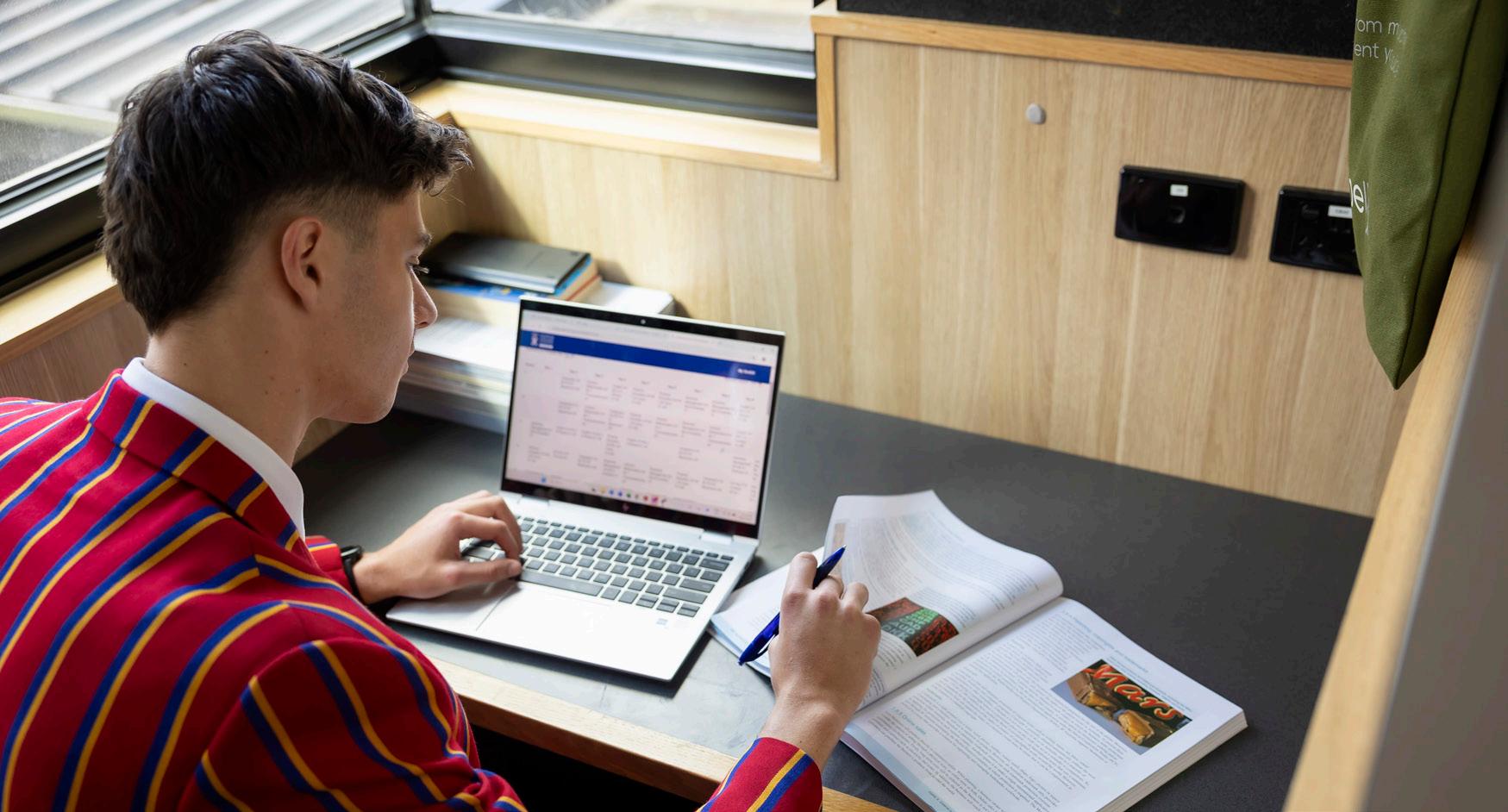
The ‘Hill’ is the boarding community within the larger Scotch Family. It is home to nearly 200 boarders, staff and their families – a thriving community where boys and staff live, work, and play within the Scotch grounds.
Key to the success of boarding is a clear understanding of the guiding principles, along with the commitment, sound judgement, and initiative of Hill staff. Every staff member plays a vital role in providing pastoral and academic support to each boarder. Hill staff must recognise the importance of helping boarders develop self-discipline, core values, and respect for one another and the Hill community.
By fostering an atmosphere of honesty, loyalty, and trust within their house, boarders are encouraged to work with both their peers and staff. Hill staff are uniquely placed to have a comprehensive understanding of each boarder’s life and development. They play a vital role in helping boarders balance the various demands of academic work, sport, music, drama, service, and social life, while growing in independence.
As a Hill staff member, you will be part of a particular house team, as well as being part of the overall Hill community. It is imperative that we work as a team to support and encourage each other.
This handbook provides supplementary information on the day-to-day running of the Hill and is intended to be used in conjunction with all Scotch policies and procedures.
Aims of the boarding community
The boarding community at Scotch College aims to provide a homely and supportive environment for all boarders. Each boarder should, as far as possible, experience the warmth, security, care, and privacy they would enjoy in their own home.
Organisation of the boarding community
While accepting the legitimate demands of community life, the individual boarder is gradually offered sufficient freedom to assist his growth in self-reliance as he moves through to Year 12.
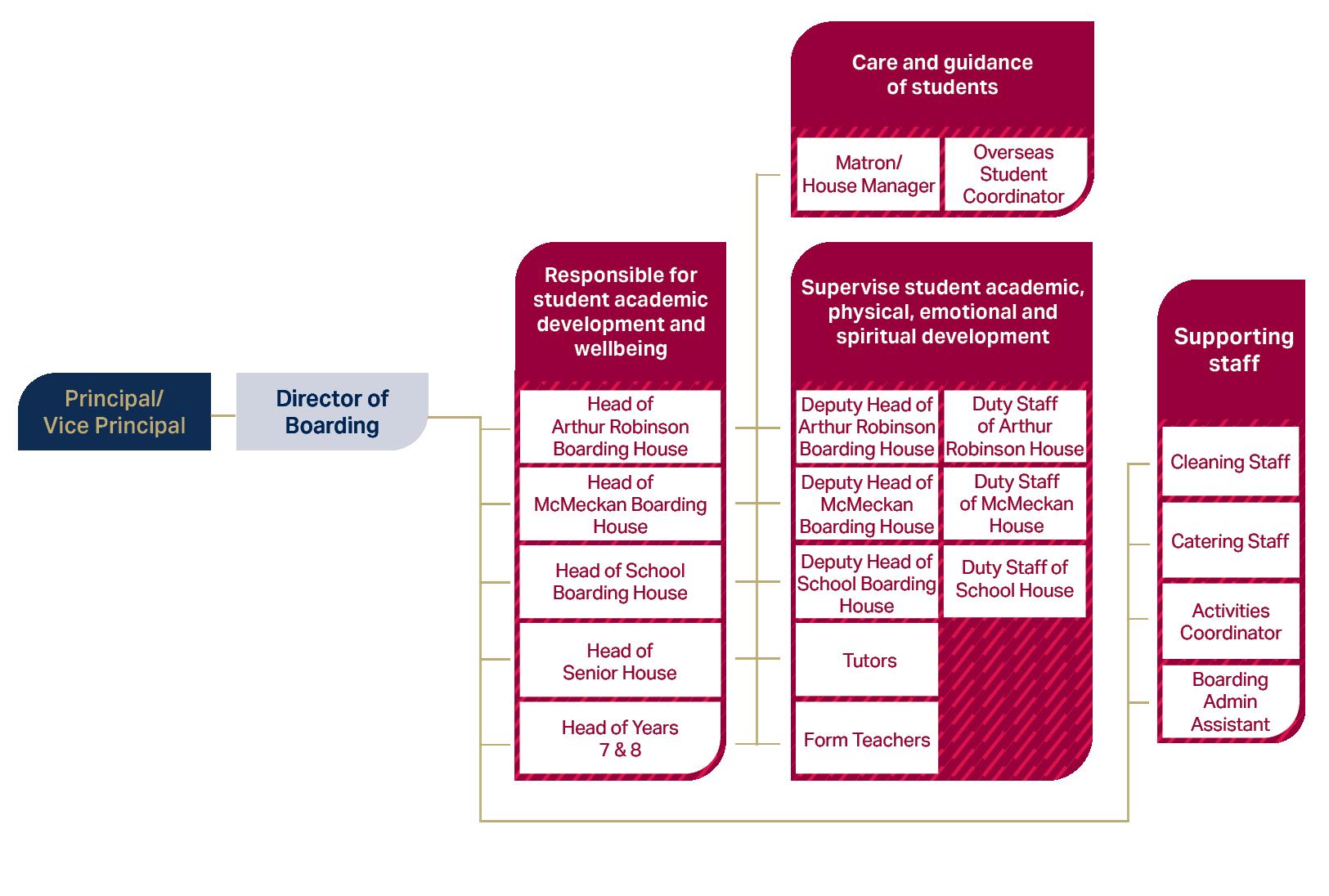
The Director of Boarding coordinates the work of the Heads of Boarding Houses and is responsible for all matters which transcend particular houses. He reports directly to the Principal and Vice-Principal on all boarding matters.
Each house is under the care of a Head of Boarding House who is aided by a Deputy Head of Boarding House, Matron/House Manager, House Chaplain, and a number of Resident Academic Tutors.
Just as, at the end of the day, the day boy returns to his home, so too does the boarder return to his ‘second home’. It follows that, in a very special way, the Head of Boarding House stands in loco parentis at all times.
The Head of Boarding House works in partnership with the Head of Day House and Tutors in Years 9-12, and Heads of Year 7 and 8 and their Form Teachers. For all boarders, their Head of Boarding House and their Head of Day
Structure of Responsibilities
House/Form Teacher hold joint responsibility for supervising the ‘whole education’ of each boy in their care.
Each of the three boarding houses operate, predominantly, as standalone houses and each has their own sense of identity. The Head of House (HOH) and Deputy Head of House (DHOH), who follow the overall strategic direction as set by the Director of Boarding (DOB), set the tone and feel of each house. At any one time, a senior staff member (HOH, DHOH or DOB) is on Active Presence in each house, in addition to the Duty Person. The Duty Person is responsible for ensuring the daily operations and procedural requirements are met.
The Head of Boarding House and their family live in accommodation attached to their house, and other staff reside within or near to the boarding houses. This helps provide a family atmosphere amongst the entire boarding community.
Staff training
The Principal, through the Director of Boarding, ensures that all procedures that involve the supervision of boarding students are consistent with procedures in the Day School to ensure that mandatory requirements of the relevant Acts are met. This also includes the screening of all nonteaching boarding staff.
The Director of Boarding is responsible for the induction of new staff regarding their roles and responsibilities, legal responsibilities related to child protection (including obligations of reporting) and other relevant school expectations. All new staff must undertake the online safeguarding children training. New staff are given a copy of the position description for their role and should be aware of the policies and procedures relevant to their position. Heads of Boarding House train and monitor their staff, reporting to the Director of Boarding.
At the start of each year, all members of staff are provided with a copy of the Scotch College Staff Handbook as well as a copy of the Boarding Staff Handbook. The information contained in these books will be covered at the first Hill staff meeting of the year. In consultation with the Principal and the Head of People, Research & Professional Growth, the Director of Boarding arranges professional development of boarding staff as required.
Important
This document is to be read in conjunction with the Scotch College Staff Handbook, Guide to Boarding, Overseas Student Handbook and Student Record Book. Staff should also be familiar with relevant school policies, all of which can be found in the Scotch College Handbook on the Scotch website: www.scotch.vic.edu.au.
It is expected that all boarding staff read and understand the contents of this handbook.
Director of Boarding
By management, manner, responsibility, and direction, the Director of Boarding sets the tone for the Hill community of boys, staff (and their families), parents, and contracted employees.
The Director of Boarding, through, and in conjunction with, the Heads of Boarding House, has responsibility for ensuring Hill life remains busy, exciting, caring, safe, and supportive.
The role carries responsibility for the effective operation of boarding at Scotch. The Director of Boarding is the lead person for safeguarding and child protection matters on the Hill and throughout the boarding community. In consultation with the Child Protection Officer, the Director of Boarding carries responsibility for ensuring all Hill staff adhere to school policies, procedures, and guidelines relevant to the Safeguarding Program.
Through membership of the Senior School Committee, the Director of Boarding provides a formal link between the boarding and day communities; communicates relevant school decisions to the boarding community; provides advocacy for the Hill; reports on boarding matters; and contributes to whole-school strategic planning.
Head of Boarding House
As the delegated leader of a boarding house at Scotch College, the Head of Boarding House is responsible to the Principal through the Director of Boarding. The Head of Boarding House is responsible for the care and welfare of up to 63 boarders, covering Years 7 to 12, with the support of other members of staff (in particular, Deputy Heads of House).
In addition to their role as a teacher at Scotch, the Head of Boarding House is expected, at all times, to act in loco parentis for each boarder.
Important
The Head of Boarding House is responsible for the wellbeing and academic progress of all boarders in their care.
The Head of House, along with the Deputy Head of House and Director of Boarding provide support to the Duty Person through the provision of Active Presence. Active Presence staff must be under 0.05.
The Head of Boarding House needs to ensure there is 24-hour coverage of the house at all times.
Deputy Head of Boarding House
The Deputy Head of Boarding House is responsible, in conjunction with the Head of House, for the wellbeing and academic progress of all boarders in their care. The primary role of the Deputy Head of House is to support the Head of House in ensuring all boys within the house receive the appropriate level of care and support. This includes deputising for the Head of House and assisting with supervision on public holidays and Exeat weekends.
The Deputy Head of House and Head of House are on duty on Saturday and Sunday mornings and are responsible for ensuring this shift is covered equitably.
Duty Person
The Head of House, Deputy Head of House (in addition to providing Active Presence), Hill Chaplain and Resident Academic Tutors will be on ‘duty’ at various stages throughout the week. As such, when on duty, they assume the role of ‘Duty Person’.
In the morning, the Duty Person will:
ዣ ensure boarders are up and/or accounted for
ዣ ensure boarders are appropriately dressed
ዣ ensure all morning duties have been performed
ዣ ensure dormitories are left tidy (liaising with the Matron/House Manager to this end)
ዣ ensure any ill or sick boarders are sent to the Health Centre
ዣ supervise breakfast and monitor attendance
ዣ return to the house and ensure that all boarders get to school on time and are appropriately attired.
During lunchtime, the Duty Person will:
ዣ assist with supervision and managing behaviour in the dining hall
ዣ be a visible presence around the house and accessible to boarders
ዣ ensure boarders are at school on time and neatly attired
ዣ ensure the houses are locked during the day.
After school, the Duty Person will:
ዣ return to the house as a matter of priority at the conclusion of Period 6
ዣ make their active presence known and assist with general supervision of boarders in the house
ዣ ensure all boarders are accounted for
ዣ monitor leave arrangements
ዣ be accessible to boarders around the house.
In the evening, the Duty Person will:
ዣ ensure all boarders are accounted for at all times
ዣ supervise homework, assisting where possible
ዣ monitor any leave arrangements
ዣ ensure an orderly transition to bed for boys
ዣ remain present and accessible, and ensure the house is settled for the night
ዣ secure the house and complete the daily report
ዣ monitor the duty mobile phone and keep overnight in case of emergencies.
Weekend Supervision
During periods of weekend supervision, the same specific responsibilities apply as on weekdays. Particular emphasis should be placed on:
ዣ accounting for all boys at roll calls
ዣ monitoring leave arrangements through Orah
ዣ confirming travel arrangements to sporting commitments
ዣ being a visible presence about the house
ዣ assisting with homework
ዣ ensuring reasonable tidiness and behaviour, both in the house and at mealtimes in the dining hall.
Hill Chaplains
The Hill Chaplains are an understanding and caring presence within the boarding community. They perform an important pastoral role across the Hill and within their house, providing support for boys and staff in times of need. They conduct Chapel on Sunday nights (on a rotational basis) and undertake weekday and weekend duties (as Duty Person) as required.
Hill Psychologist
Reporting to the Director of Boarding, the Hill Psychologist will be an understanding and caring presence within the boarding community. They will actively seek to build supportive relationships with all members of the boarding community (boys and staff) and will be available for counsel when required. To this end, regular communication with the Director of Boarding and Heads of House will be expected, and similarly with the Day School if warranted.
Resident within the boarding community, the Hill Psychologist will be an active and clearly visible presence. They will provide psychological support for boys in need, assist with the development of specific Hill initiatives (e.g. drug and alcohol training), and be available for support in times of crisis. The Hill Psychologist will be attached to a house and will undertake duties as directed by the Director of Boarding.
Staff wishing to refer boys to the Hill Psychologist must first discuss such referrals with the Director of Boarding.
Resident Academic Tutor
The primary role of staff on the Hill is to provide for the physical, emotional, and spiritual development of the boarders under their care. The Resident Academic Tutor completes a number of weekday and weekend duty commitments (Duty Person). They need to work with the Head of House and other staff to ensure the staffing roster is both fair and balanced, and that there is 24-hour supervision of boys
Matron/House Manager
This is a key residential role within the boarding team, reporting to the Head of Boarding House in providing care and guidance for boarders.
As a live-in presence in the house, this person acts as an adult listener, confidant and supervisor. It is equally important to ensure that the presentation of the boarding house and the boarding students is maintained to a high standard. This is achieved through hands-on housekeeping and by working closely with the cleaning staff, the boarding staff and the boys on a daily basis to ensure that all necessary cleaning, housekeeping and routine matters are attended to.
Care of boarders
As with other boarding staff, the Matron/ House Manager’s role is a vital one in providing an adult presence and role model in the house. It is expected that the Matron/ House Manager develops appropriate, caring relationships with the staff and boarders to enable them to be in touch with the day-to-day happenings in the house.
Active Presence
When a senior staff member (DOB, HOH, DHOH) is on Active Presence, they are expected to be a familiar presence within the house, providing support for the Duty Person as required. When on Active Presence, staff should wander through the house at various intervals, ensuring they are visible to staff and boys, and engaging with boys in a caring manner. In particular, staff on Active Presence are expected to attend the dining hall for meals, assist in settling boys into Prep (Sunday to Thursday) and provide assistance at bedtimes. They must be contactable at all times when on Active Presence.
Overseas Student Coordinator
The Overseas Student Coordinator provides support services for boys attending Scotch College on an overseas student visa, for whom a Confirmation of Appropriate Accommodation and Welfare (CAAW) letter has been issued. Some of these services will also be available to other boarders who have parents living overseas. This role requires a caring, considerate person who understands the specific challenges facing overseas students.
A key responsibility of the Overseas Student Coordinator is to promote the successful adjustment of overseas students to life and study at the school. As a CRICOS-registered school, this person, along with other senior staff, ensures the school meets all regulatory requirements as identified by relevant authorities in relation to the accommodation and welfare of overseas students. This includes coordinating overseas students’ holiday and Exeat leave arrangements in consultation with Heads of Boarding. The Overseas Student Coordinator will have regular contact with overseas boys across all three houses.
Daily routines
Monday to Friday
7.00 am - 8.15 am Wake up, breakfast and prepare for school. Take roll.
8.15 am - 3.30 pm Boarding House closed.
3.30 pm - 5.55 pm
Boarding House reopens. Afternoon tea, sport training or recreational time.
5.55pm - 6.20pm Dinner. Take roll.
6.20 pm - 6.50 pm House meetings/recreational time.
6.50 pm - 7.00 pm Prepare for Prep.
7.00 pm - 7.45 pm 1st Prep.
7.45 pm - 8.30 pm 2nd Prep.
8.30 pm - 9.00 pm Supper.
9.00 pm - 9.30 pm Preparing for bed. Take roll.
9.30 pm Years 7 & 8 in bed.
9.45 pm Year 9 in bed.
10.00 pm Year 10 in bed.
10.15 pm Year 11 in bed.
10.30 pm Year 12 in room.
11.00 pm Final bed check and lock up.
Saturday
7.00 am - 9.00 am Wake up, breakfast and prepare for Saturday sport. Take roll.
9.00 am -12.45 pm School sport, recreation time and leave. 12.45 pm - 1.15 pm Lunch. Take roll. 1.15 pm - 4.00 pm Recreation time and leave. 4.00 pm - 5.30 pm Glenn Centre in use. 5.30 pm - 6.00 pm Recreation time.
6.00 pm - 6.20 pm Dinner. Take roll.
6.20 pm - lights out Recreation time. Take roll at bedtime.
Sunday
7.00 am - 10.00 am Breakfast available. Take roll.
10.00 am -12.45 pm Recreation time and leave. 12.45 pm - 1.15 pm Lunch. Take roll.
1.15 pm - 5.30 pm Recreation time and leave. 5.30 pm - 6.00 pm Recreation time. 6.00 pm - 6.20 pm Dinner. Take roll.
6.30 pm - 7.00 pm Chapel. Take roll.
7.00 pm - 8.30 pm Prep.
8.30 pm - lights out Recreation time. Take roll at bedtime.
Timings and staff responsibilities
Morning
7.00am Unlock Duty Room.
• Read previous day’s report and note any necessary actions, check message bank on both phones and Scotch email, etc.
• Establish who are the duty students for the day. These should be written on the noticeboard and communicated to students during the wake-up process.
7.03am Lights and unlock.
• Switch on hall and stair lights, and unlock doors as appropriate to your house.
• Duty Room
• Prep Rooms
• Year 12 Lounge (ARH only)
• Reading Room
• Rec Room, Music Room and TV Room
• Computer Room
• Kitchen
• Sewing Room
7.05am Wake Years 7 & 8 Dorms.
7.10am Wake Year 9 Dorm.
7.15am Wake Year 10 Dorm.
7.20am Wake all Year 10s.
7.25am Wake Year 11s.
Continue to check rooms for sleeping in and tidiness.
7.30am Wake Year 12s.
Knock. If no response to knocking, open door, await some sign of life and, if a known over-sleeper, turn the light on.
7.35am Check and encourage.
• Check papers and milk duty are complete, rooms are tidy and everyone is up.
• Look through all the dorms and note who has left a mess, speak to them at breakfast.
7.40am Head over to breakfast.
• Mark the Wake-up Roll Column and note any late arrivals (after 7.45am).
• Speak to those who need to tidy their bedroom etc.
8.00am - 8.15am Check and encourage again.
Check that those who you spoke to at breakfast have tidied up. Encourage boarders to head down to school.
8.15am Students out and check.
Ensure that all students are out of the house. Stand near the exit, wish them well for the day, ensure excellent standard of dress, and check that they have signed out on Orah.
8.20am Daily House Report.
Enter a few notes in the Daily House Report, late out of bed, late to breakfast, tidiness.
8.25am First bell.
8.30am Period 1 starts.
Lunchtime
12.50pm Lunch (12.45pm Sat & Sun)
• Attend lunch in the dining hall and supervise boys.
• Walk through the house (corridor, outdoor area) supervising boys and attending to needs as required (i.e. open prep room for access to books, etc).
3.30pm Staff arrive back at the house.
• Matron/House Manager should also be available and circulating around the house from 2.30pm.
• The house must be supervised once the boarders return from the Day School.
• Encourage boarders to get to breakfast on time.
Evening
5.55pm Dinner.
• Take the roll.
• Near the end of dinner have the boarders tidy up and sit down for the final notices.
• Maintain a visible presence throughout the house once the bell is rung and notices are being given.
6.20pm House meetings.
• House Captain speaks.
• Possibly raise/discuss issues with the boarders.
• Remind rostered boys of their duties.
• Distribute unnamed clothing.
7.00pm-7.45pm First Prep
• Be in the Prep areas for much of First Prep, other than when checking on Year 11s and any students using the Reading Room, or other room with your permission.
• Year 12s on duty supervise the Prep Rooms, checking occasionally.
• Silent study. Absolutely no talking.
• Assist students with tasks.
• Seek to help those who are stuck, disorganised or where desk is messy.
• Computers only to be used if their use is required for homework tasks.
• No eating food in Prep Room.
7.45pm-8.30pm Second Prep.
• Quiet study.
• Some quiet assistance tolerated.
• Continue to check all students are studying.
8.30pm-9.00pm Supper.
• Encourage boarders to continue table tennis, pool and PS3 or Xbox competitions.
• Celebrate birthdays and achievements.
9.15pm-10.45pm
Bedtimes. Senior boy on duty should assist, as should person on Active Presence.
• Turn hall lights off at 9.15pm.
• Always give students ten minutes warning of their bedtime.
• Sight all Year 7-10 boarders locking computers/ phones in chargeable lockers.
• Lock Prep Rooms as students retire. Ask them to tidy as they leave.
• Remind boys who are on Rec Room clean-up, papers duty and laundry bags.
• Ensure newspapers go out to recycling and lock Reading Room.
• Ensure laundry bags and tubs upstairs have been taken to front door and are safely stacked out of the walkway (ARH only, SC and MM slightly different).
• Lock up Rec Room, TV Room and Music Room at 10.00pm (checking all downstairs external windows and doors are secure, and that cleaning has been done). All boarders should now be upstairs (10.30pm Lock-up is appropriate on Friday and Saturday night).
• Insist on relative quiet in hallways and bathrooms.
• All out of showers by 10.00pm.
• Turn off room lights and turn on bed lights at the IN BED READING TIME.
• Be a presence in the upstairs hallway.
• Use your discretion. A ’ten-minute warning’ when a room needs to be closed, or a bedtime, followed up with moving them out and locking up ten minutes later usually works very well.
Bedtime duties
Get ready for bed
Lock and clean
Lock computers/phones in chargeable lockers, boarders up to shower, clean teeth, complete laundry and toilet.
In bed reading
Lights and showers
Turn off each bedroom overhead light. Turn on bed lamps. Boarders should be in bed or doing a final tidy/getting ready for lights out. Year 11s might be finishing a last piece of homework in their pyjamas. They should not be showering or in other boarders’ rooms chatting.
ዣ Turn off bed lamps. Say goodnight. Check back five minutes later. Insist on silence.
ዣ Confiscate mobile phones and laptops being used after lights out – pass to HOH.
10.15pm
Check and lock
Check that all the Year 12s are in and there are no guests from other houses, and that all windows and external doors are secure, and fire extinguishers are in place.
10.30pm
Check Year 12 duties
Check the Year 12 room and kitchen have been cleaned by the Year 12 on duty. All Year 12s must be in their own room by 10.45pm. Knock and say goodnight at this time.
10.30pm-11.00pm
Roll, report and phone
ዣ Mark bedtime roll.
ዣ Complete House Daily Report.
ዣ All should be quiet.
ዣ Take duty phone with you overnight.
ዣ Respond to automatic SMS messages when external doors are opened overnight.
Weekend duty
Saturday
7.00am Unlock Duty Room.
Read previous day’s report and note any necessary actions, check message bank on both phones and Scotch email, etc.
Wake up Open breakfast applies
Check boarders are up in time for their sporting commitments. Ensure boarders have suitable transport arrangements to get to and from their venues.
Throughout the rest of the day you should be based in the duty room but should also move around the house. You should be aware of the location of each boy and know what they are doing.
12.45pm-1.15pm Lunch
Attend and take a roll. In the afternoon the pool and gymnasium/weights room may be open. Times will be announced by senior staff at lunch.
6.00pm-6.20pm Dinner
• Mark the roll.
• Near the end of dinner, get the boarders to tidy up and sit down for the final notices.
• Stand up as a presence in our area once the bell is rung and notices are being given.
• Throughout the evening, again be a presence around the house.
• Bedtimes are 30 minutes later than weekdays.
• As per weekly procedures, all boarders must be accounted for. If a boy has not returned by curfew, inform Head of House or Deputy Head of House.
Leave procedures
Orah
Orah is a safe and simple student leave management system.
All leave from the boarding houses must be requested and recorded through Orah. All boarders and their parents/guardians will receive an invitation to join Orah and will need to download the Orah App. Leave requests are initiated by either the boarder or their parents/ guardians, with final approval given by the Head of Boarding House or Deputy Head of Boarding House.
Glenferrie Road leave
This refers to the section of Glenferrie Road from the Kooyong Station shops to Barkers Road.
This leave is available any weekday after school up to 6.00pm (after sports training or activities), or on weekends. Boys in Years 7 and 8 must be in groups of three or more, unless approved by the Head of House or Deputy Head of House. Students must sign in and out with the staff member on duty.
On Saturdays (after sport) or Sundays, leave is available between 9.00am-12.30pm and 1.30pm5.30pm.
Tea leave (weekdays)
This leave is available for special family functions.
Requests by parents or guardians should be directed to the Head of House or Deputy Head of House via Orah.
Overnight / weekend leave
ዣ A boarder may stay overnight on a Friday or Saturday night with a person on his Visitors List, or with someone else first approved by the boy’s parents or guardians.
ዣ This list is maintained by the Head of Boarding House.
ዣ Boarders are required to be back in time for Chapel on Sunday evenings.
ዣ This type of leave may not be available on Closed Weekends.
ዣ Before leaving the house, the boy must check out with the Duty Person and then check back in with the Duty Person on his return.
Leave requests should be made by Thursday evening via Orah.
Friday / Saturday evening leave
Year 11s and 12s may also take leave on a Friday or Saturday night provided prior approval has been granted by a parent or guardian to the Head of House or Deputy Head of House. They must be back in the house and report to the Duty Person by 10.45pm.
Year 10s may take leave on a Friday or Saturday night provided prior approval has been granted by a parent or guardian. They must be back in the house and report to the Duty Person by 10.00pm.
Year 7s, 8s and 9s may only take leave with their parents or guardians, as well as persons on their Visitors List, provided prior notification has been received. Year 7s and 8s must be back and report to the Duty Person by 9.00pm. Year 9s must be back by 9.30pm.
Leave during the day on Saturday and Sunday may be approved in the same way.
Please refer to the Guide to Boarding student handbook for the full boarding house leave procedure information.
Overseas students
The Hill is home to boys from many diverse backgrounds, including many boys from overseas. As a CRICOS-registered school, Scotch enrols a number of overseas students who attend the school under a Student Visa (500).
For the majority of these students, the school maintains responsibility for the care and welfare for the duration of their stay in Australia (as outlined in their Confirmation of Enrolment). Such responsibility cannot be delegated to a third party; the school is, in effect, the guardian for these students while they are in Australia (or until they turn 18 years of age).
Students in this category will have been issued a Confirmation of Appropriate Accommodation and Welfare (CAAW) letter, and their details will be recorded, via Admissions, on the Department of Home Affairs register (known as Prisms). The Overseas Student Coordinator, who works closely with the respective Heads of House (Day and Boarding) in managing the welfare of overseas students, supports boys in this category.
It is important that all staff are aware of boys attending the school under a 500 visa and the corresponding requirements. Boys falling under this category are identified on the school’s database, SIS. Overseas students for whom a CAAW letter has been issued:
ዣ have specific conditions regarding attendance requirements
ዣ require increased vigilance around leave arrangements, especially holidays and Exeat leave (coordinated by the Overseas Student Coordinator).
Overseas students may also require:
ዣ assistance with airport transfers
ዣ intensive language support (provided by EAL staff)
ዣ assistance with understanding Australian culture
ዣ support with integration into the school and country
ዣ extra assistance with organisation (e.g. getting to sport, organising a Youth Myki card).
Whilst these responsibilities fall under the specific role of the Overseas Student Coordinator, all Hill staff hold responsibility for the care and welfare of overseas students.
It is also important that staff understand the unique cultural sensitives associated with overseas students and the impact this has on child safety. In some cultures, challenging the authority of adults is very rare. Consequently, from a child safety perspective, overseas students can be at greater risk due to their reluctance to question authority figures. Senior staff should be cognisant of this and ensure they are open and accessible for all boys, while paying particular attention to the needs of overseas students.
An Overseas Student Handbook is issued to all overseas students on enrolment. English should be spoken by boys at all times while on the Hill, and this should be explained to overseas students on their arrival.
Specific training for boarding staff in relation to the needs of overseas students will be conducted at various intervals.
Child protection obligations
The health, safety and wellbeing of all children and young people is our highest priority. The school promotes equity and respects diversity of children and young people and their families. This includes Aboriginal and Torres Strait Islander children, children from culturally and linguistically diverse backgrounds and children and young people with a disability.
The school’s commitment to ensure the safety and wellbeing of children and young people is clearly outlined in our Safeguarding policies, which are authorised by the College Council and available on the Staff Portal. Our approach to complying with Ministerial Order 1359: Implementing the Child Safe Standards – Managing the Risk of Child Abuse in Schools and School Boarding Premises, is outlined in the Safeguarding Children and Young People Policy.
Staff are required to maintain an environment where each child or young person feels a sense of belonging and trust, and all have confidence in their relationships with school personnel. Specific obligations of staff are detailed in the Child Safety and Wellbeing Code of Conduct and the Staff and Student Professional Boundaries Policy
Completion of annual Safeguarding compliance training is a requirement of all staff, as outlined in position descriptions. This training assists staff to:
ዣ Understand their obligations with regards to interactions with children and young people
ዣ Recognise types and indicators of abuse and neglect
ዣ Understand how to respond to the immediate needs of individuals involved in an incident
ዣ Understand reporting obligations, both internal and as required by legislation and regulation – including mandatory reporting and reportable conduct
ዣ Understand Victoria’s Failure to Protect and Failure to Disclose criminal offences relating to the safeguarding of children.
In addition to training, staff are guided to respond to incidents, disclosures, and suspicions of child abuse in accordance with the school’s Safeguarding Reporting Policy.
While the available training and policies are designed to inform and guide staff in their Safeguarding responsibilities, staff are encouraged to reach out to the Child Protection Officer at any time with any queries or concerns.
Application of the child safety code of conduct in the boarding context
PLEASE NOTE:
All Scotch policies, procedures, and guidelines apply to the boarding school. Hill staff must ensure they are familiar with them. These can be accessed via the MyScotch Staff Portal.
We are committed to safeguarding the boarders in our care and ensuring that they feel and are safe.
Accordingly, we wish to ensure that our staff strive for the highest possible standards with respect to safeguarding boarders from abuse.
To that end, we have developed these Boarding Staff Expectations to identify, and so prevent, behaviour that may be harmful to the boarders in our care.
All boarding staff are required to observe these boarding staff expectations. Any breach of these expectations must be logged as a Safeguarding incident via the Incident Reporting icon available on all Scotch computer desktops.
Boarding staff are defined as those who engage with our boarders including:
ዣ Contractors
ዣ Casual staff
ዣ Volunteers
ዣ Dining hall staff
ዣ Laundry staff
ዣ Cleaners in boarding
ዣ Grounds and maintenance staff who work in boarding
ዣ Matrons/House Managers
ዣ Heads of Boarding House
ዣ Deputy Heads of Boarding House
ዣ Resident Academic Tutors
ዣ Non-Residential Academic Tutors
ዣ Academic Tutors
ዣ Privately engaged Tutors
ዣ GAP students
Commitment
You should read these boarding staff expectations in conjunction with:
ዣ the specific requirements of your role as defined in your ‘position description’ statement
ዣ our relevant policy and procedure documents, including our:
• Safeguarding Children and Young People Policy
• Child Safety and Wellbeing Code of Conduct
• Staff and Student Professional Boundaries Policy
• Safeguarding Reporting Policy
ዣ all applicable laws
ዣ general community expectations in relation to appropriate behaviour between adults and children
We consider a failure to observe these guidelines as misconduct and will take appropriate disciplinary action. Such action may, depending on the seriousness of the misconduct, include suspension while matters are investigated and/or dismissal. In addition to any internal disciplinary proceedings, we will
report to the police all instances in which a breach of the law has occurred or may have occurred.
Exceptions
There may be exceptional situations where you feel compelled to act outside of these guidelines, for example, in an emergency, or due to a reasonable belief that a child’s welfare is at risk. However, it is crucial that, where possible, you seek authorisation from senior staff prior to taking action that contravenes these guidelines, or that you advise management as soon as possible after any incident in which these guidelines are breached. In the case of all breaches, a Safeguarding report must be lodged via the Incident Reporting icon on your computer desktop, and you must act within the limits of the law.
Sexual misconduct and intimate relationships
Under no circumstances is any form of ‘sexual behaviour’ to occur between, with, or in the presence of boarders.
‘Sexual behaviour’ should be interpreted broadly to encompass the full range of actions and communication that would reasonably be considered sexual in nature, including, but not limited to:
ዣ contact behaviour, such as sexual intercourse, kissing, fondling, sexual penetration, inappropriate touching or grooming behaviour or exploiting a child through prostitution
ዣ non-contact behaviour, such as flirting, sexual innuendo, inappropriate text messaging, inappropriate use of social media, inappropriate photography, or exposure to pornography or nudity.
Staff must not initiate or develop a relationship with any boarder that is, or can be perceived or misinterpreted as having a personal rather than professional element. This could be construed as grooming. It is the student’s perception of staff behaviour, not the intention of the staff member, that is important.
Positive guidance
We strive to ensure that boarders at Scotch are aware of the acceptable limits of their behaviour so that we can provide a positive experience for all participants. However, there are times when boarding staff may be required to use appropriate techniques and behaviour management strategies to ensure an effective and positive environment and the safety and/or wellbeing of boarders.
We require our staff to use strategies that are fair, respectful, and appropriate to the developmental stage of the boarders involved. Boarders need to be provided with clear directions and given an opportunity to redirect their misbehaviour in a positive manner.
Under no circumstances are our staff to take disciplinary action involving physical punishment or any form of treatment that could reasonably be considered degrading, cruel, frightening, or humiliating. Staff should familiarise themselves with the school’s Restraint of Students Policy, which outlines guidelines and boundaries around the use of physical restraint to prevent a child from injuring themselves or others.
Adhering to role boundaries
Staff must understand and adhere to the full requirements of the school’s Child Safety and Wellbeing Code of Conduct, and Staff and Student Professional Boundaries Policy. All staff are required to undertake annual training on, and agree to abide with these documents.
These documents outline limitations on matters including, undertaking activities with and communicating with boarders, and responding to social invitations from boarders or families.
In addition, boarding staff should not, of their own volition or at the request of a boarder, act outside the confines of their duties as specified in their position description. If any boarding staff become aware of a situation in which a boarder requires assistance beyond the confines of their role, or beyond the scope of our boarding pastoral care service, they should, at the earliest opportunity:
ዣ refer the matter (or refer the child directly)
to an appropriate support agency; or
ዣ contact the boarders’ parent or guardian; or
ዣ seek advice from management.
Identity card / pass / badge
Hill staff should wear their red Scotch lanyard while on duty.
Visitors, volunteers, and external tutors must sign in at the boarding house they are visiting using the QR code and wear the blue boarding visitor lanyard.
Use of language and tone of voice
Language and tone of voice used in the presence of boarders should:
ዣ provide clear direction, boost their confidence, and encourage or affirm them
ዣ not be harmful to boarders– in this respect, avoid language that is:
• discriminatory, racist or sexist
• derogatory, belittling or negative (for example, calling a boy a ‘loser’ or telling him he is ‘fat’)
• intended to threaten or frighten
• profane or sexual.
Supervision
Staff are responsible for supervising the boarders and must:
ዣ engage positively with our boys (for example, greet and acknowledge them when you see them)
ዣ behave appropriately toward one another (for example, act in a respectful, collegiate manner with all boarding staff)
ዣ ensure boarders are in a safe environment and are protected from external threats (for example, intruders).
Our boarding staff are required to avoid oneto-one unsupervised situations with boarders and, where possible, conduct all activities and/ or discussions with boarders in view of other boarding staff and/or boys.
Use of electronic communications
Staff must abide with all requirements of the school’s ICT Resources – Staff Use Policy.
Scotch-issued devices (not personal devices) must be used to communicate with boarders. Staff must not give out personal telephone numbers, e-mail addresses or social media contact details to boarders and must not be ‘friends’ with boarders on social media.
Wherever possible, electronic communications with boarders (including text messages and e-mails) should be copied to their parent or guardian.
Staff must not engage in personal communication with any boarder which is outside the requirements of the professional relationship. Communication online (including e-mail, via social media, via gaming sites, in chatrooms or using online messaging applications) or via text message must always be in a professional context.
Boarders are required to follow the ICT Resources – Student Use Policy in relation to browsing websites on our school’s computers.
Boarding staff are responsible for appropriately monitoring boarders when they use the school’s electronic communication equipment to ensure that they do not inadvertently place themselves at risk of abuse or exploitation via social networking sites, gaming sites, web searches, or inappropriate email communication.
Giving gifts
The Director of Boarding and Heads of Boarding House are to authorise any gifts to boarders or their families, including rewards, prizes, treats, or second-hand equipment.
Photographs of children and young people
Boarders may only be photographed, filmed, or recorded, in line with the school’s Photography, Filming or Recording of Students Policy. Image consent or lack of consent, as provided by parents or guardians, is recorded under the photograph displayed in each student’s profile in SIS.
Even where consent has been provided by parents or guardians, images should only be captured:
ዣ in a context directly related to participation in a boarding activity
ዣ when the boarder is appropriately dressed and posed
ዣ in the presence of other staff.
The capture, handling and storage of images must be undertaken in line with the school’s Privacy Policy and Privacy Collection Notice. Images captured on staff personal devices for legitimate educational purposes must be uploaded to school systems within one week of capture, and deleted from the personal device.
Physical contact with children and young people
As a general principle, staff should avoid engaging in unnecessary physical conduct or behaviours, including doing things of a personal nature that a boarder can do for themselves (such as toileting or changing clothes), or touching buttocks or genitals in any circumstances outside the delivery of medical or allied health services.
Any physical contact with our boarders must be:
ዣ minimal, non-lingering and nongratuitous
ዣ based on the needs of the boarder (for example, to assist or comfort a distressed young boarder or to correctly fit sporting or safety equipment) rather than the needs of boarding staff
ዣ appropriate in the education context (e.g. a handshake or congratulatory pat on the back).
Under no circumstances should boarding staff have contact with boarders that:
ዣ is overly physical, such as wrestling, horseplay, tickling, or other roughhousing
ዣ is initiated against the wishes of the boarder, except if such contact may be necessary to prevent injury to the boarder or to others, in which case:
• physical restraint should be a last resort
• the level of force used must be
appropriate to the specific circumstances and aimed solely at restraining the boarder to prevent harm to themselves or others
• the incident must be reported to the Director of Boarding or Head of Boarding House and logged as a Safeguarding incident as soon as possible.
Refer to the Restraint of Students Policy for further detail.
Boarding staff are required to report to the Director of Boarding or Head of Boarding House any physical contact initiated by a boarder that is sexual and/or inappropriate (for example, acts of physical aggression) as soon as possible, to enable the situation to be managed in the interests of the safety of the boarders, staff, and other participants.
Overnight stays and sleeping arrangements
The same physical contact guidelines as applicable to boarding apply during off-campus excursions or camps (for example, weekend trips to the snow and boarders’ camps at Cowes and Healesville).
Standards of conduct that must be observed by boarding staff during an overnight stay include:
ዣ providing children and young people with privacy when bathing and dressing
ዣ always knocking and advising of presence prior to entering a bedroom
ዣ avoiding any inappropriate behaviour including sitting on beds
ዣ observing appropriate dress standards when children or young people are present, e.g. children or young persons should not be exposed to adult nudity
ዣ taking all reasonable endeavours to ensure children or young people not be exposed to pornographic material of any nature, including but not limited to movies, television, the internet or magazines
ዣ not leaving children or young people under the supervision or protection of
unauthorised persons, e.g. hotel staff or friends
ዣ not allowing sleeping arrangements that may compromise the safety of a child or young person
ዣ ensuring both boarders and parents/ guardians are aware that boarders have the right to make contact with home should they feel unsafe, uncomfortable or distressed.
Bathrooms / toilets
At times, boarding staff are required to supervise boarders in bathrooms while balancing this requirement with a boarder’s right to privacy. In addition:
ዣ boarders must wear a robe, or at minimum a towel, when going to and from the shower
ዣ boarding staff should avoid one-to-one situations with a boarder in a bathroom area
ዣ staff and visitors are required to use the following facilities:
• Arthur Robinson House, ground level
• Errington Retreat
• Shergold Building, west end
ዣ boarding staff are not permitted to use the bathroom area, for example, to undress, while boarders are present
ዣ boarding staff need to ensure adequate supervision in ‘public’ bathrooms when they are used
ዣ boarding staff need to provide the level of supervision required to prevent abuse by members of the public or peers, or general misbehaviour by boarders, while also respecting a boarder’s privacy.
Use, possession or supply of alcohol or drugs
While acting as the Duty Person, boarding staff must not:
ዣ use, possess, or be under the influence of an illegal drug
ዣ use or be under the influence of alcohol
ዣ be incapacitated by any other legal drug, such as prescription or over-the-counter medication.
Use of legal drugs, other than alcohol, is permitted provided such use does not interfere with your ability to care for boarders.
Transporting boarders
Boarders are to be transported only in circumstances that are directly related to the delivery of our boarding program. Transportation by private vehicle is the least preferred option, but may be required in the boarding context – for example, taking a boarder to a medical appointment. Staff must obtain (or attempt to obtain, where an emergency situation exists and immediate transportation is required) express permission from parents and the Director of Boarding, prior to transporting a student in a private vehicle. Boys should travel in the back seat where possible.
For other boarding activities, boarders are to be transported only with prior authorisation from the Head of Boarding House and the child’s parent or guardian. Gaining approval involves providing information about the proposed journey, including:
ዣ the form of transport proposed, such as a private car, taxi, self-drive bus, bus with driver, train, plane, or boat
ዣ the reason for the journey
ዣ the route to be followed, including any stops or side trips
ዣ details of anyone who will be present during the journey other than boarding staff involved in delivering our boarding program.
Tutoring / coaching boarders
Staff tutoring or coaching boarders of the school for monetary gain is prohibited unless approved by the Principal.
Conclusion
As discussed in the annual Boarding Staff Update Meeting, there may be circumstances in which you, as a boarding staff member, need to act outside these guidelines (for example, in a medical emergency). To protect yourself, ensure you phone
the Head of House, Director of Boarding, or VicePrincipal as soon as possible. In addition, remember to record the incident in the House Diary and lodge a Safeguarding incident report.
Hill staff – summary of expectations
ዣ Read the Daily House Report before commencing duties.
ዣ Be punctual for all supervision duties.
ዣ Remain alert to bullying or any discriminatory behaviour and report all concerns to the Director of Boarding and Head of Boarding House.
ዣ Engage students in personal, general conversation as part of their pastoral care role.
ዣ Consider the time and location carefully when conducting a private conversation with a boarder to avoid placing yourself in a vulnerable situation.
ዣ Notify the Principal, via the Director of Boarding, if you suspect any form of reportable conduct.
ዣ When assessing an injured or unwell student, physical contact may be required; always explain your actions to the student beforehand and seek their agreement.
ዣ Treat all students with respect and without favouritism.
ዣ Communicating with students electronically only in accordance with the Scotch ICT Policy.
ዣ Exercise appropriate duty of care if restraint is required to prevent a boarder from harming themselves or others, using only reasonable force and in line with the school’s behaviour management practices.
ዣ Ensure all near misses and incidents are reported through Complispace Assurance.
PLEASE NOTE
ዣ All staff on the Hill are legally required to report to the police, as soon as practicable, any knowledge or reasonable belief that a sexual offence has been committed by an adult against a child under the age of 16.
ዣ For any clarification or enquiries regarding boarding staff practice and behaviour guidelines, staff should contact the Director of Boarding.
Boarding staff information and procedures
Absentee (students)
Health Centre staff are to email the Lithgow Centre Reception, Head of Boarding House, Heads of Middle School, Senior School, and Year 7 and 8 regarding any student absences by the end of Period 1 each day.
Alcohol
On the Hill, alcohol may only be consumed in a staff member’s private residence or at a Scotchsanctioned function. Even when boarders are not in residence, under the City of Boroondara Residential Accommodation Regulations, alcohol may not be consumed in common areas of the boarding houses.
Anaphylaxis Management Policy
All boarding staff must familiarise themselves with the school’s Anaphylaxis Management Policy available on the Scotch website.
Automatic External Defibrillators (AED)
An AED is located in the dining hall. Please refer to the campus map for other AED campus locations.
Beginning of term
Houses will be open from 8.30am in Term 1 and from 12.00pm in Terms 2-4 to welcome and settle boarders into their rooms. It is essential that all houses are clean, tidy and welcoming for the boarders and their families upon arrival at the beginning of term.
Boarder’s personal property
Staff should ensure all boarders use the lockable facilities provided.
Catering
ዣ During the week, all boarders have breakfast, lunch and dinner in the dining hall. Over the weekend, all meals are taken in the dining hall.
ዣ All Hill families are welcome to attend all meals in the dining hall.
ዣ Ordering in food (for example, Uber Eats) is discouraged and should only be used by boys under exceptional circumstances.
ዣ Duty staff must attend all meals and remain constantly vigilant, while all staff in the dining hall continue to have a supervisory role to play.
ዣ A Food Committee, comprised of boarders from each house, the Director of Boarding, the Catering Manager, and the Head Chef meets fortnightly.
ዣ The college caterers are required, as part of their contract, to meet the standards set out by the Australian Dietary Guidelines. Any issues with catering should be addressed through the boarders’ Food Committee or raised with the Director of Boarding.
ዣ Boys should order late dinners the day before, and Duty staff should ensure these are collected.
Chapel Service
ዣ Chapel Service is normally held every Sunday at 6.30pm in the Littlejohn Memorial Chapel. Families and friends are welcome to join the boarders at any time.
ዣ Chapel is compulsory for all boarders and those staff on duty. Staff not on duty are encouraged to attend.
ዣ Smart casual dress should be worn for Chapel. No thongs are permitted and closed shoes should be worn.
ዣ Boarders should attend Sunday dinner in their Chapel clothes.
Cleaning
ዣ Cleaning of boarding facilities is carried out daily, except on Sundays. On Saturday, only bathrooms and public areas are cleaned. Any emergency cleaning can be organised
by the Head of Boarding House, who will liaise with the cleaners to attend.
ዣ Any cleaning issues are reported weekly at the house staff meeting.
ዣ The Director of Boarding meets regularly with the Boarding Cleaning Supervisor to give feedback to the contractors about the standard of cleaning.
ዣ Staff are responsible for the cleanliness and tidiness of all areas of the house. Staff on duty should ensure that the House Roster is adhered to by the students. All boarders should be encouraged to clean up after themselves.
Clothing
ዣ Clean casuals, including shorts, t-shirts, and footwear, may be worn outside school hours. Out of respect for others, clothing with offensive designs is not permitted.
ዣ Boarders must ensure they are appropriately dressed at all times, even when going to the shower. For example, it is not appropriate for boarders to be attired in just their underwear.
ዣ Boarders must change out of dirty training gear when they return to the house.
ዣ Singlets are not to be worn in the dining hall or Chapel.
ዣ Closed shoes and neat casual clothes must be worn to Chapel.
Please note: As a safety issue, students must wear footwear at all times when outside their house area.
Communication
It is important that the Duty Person be in possession of the house mobile phone at all times while on duty. The phone must be handed to the next Duty Person and kept overnight by the Duty Person.
Counselling
All boarders may access the services of the school’s counsellors. Informal opportunities also
exist for boarders to seek assistance from Health Centre staff, Hill Chaplains, Heads of Day House, and boarding staff.
Daily House Report
Please note any information or unusual events in the Daily House Report to assist those coming on duty (for example: sickness, medications, visitors, late arrivals, etc.).
It is a requirement that all staff read the Daily House Report before they begin duty.
Discipline
Serious breaches of behaviour should be addressed to the Head of Boarding House, who may refer them to the Director of Boarding and, if necessary, to the Vice Principal.
Electrical equipment
All equipment brought into the boarding houses must be tested and tagged by the school prior to use.
Emergency phone numbers
Health Centre: Ext 4220 or 0418 568 331
Security: 0401 776 319
Director of Boarding: 0416 286 021
End of term
All refrigerators are to be defrosted, cleaned, and left empty.
After all boarders have left, each Head of Boarding House is responsible for collecting any lost property from their areas and ensuring that all rooms are ready for cleaning, windows are closed, and lights are extinguished.
Fire drill
Staff should be familiar with the Fire Drill procedures of their house. Procedures should be displayed in a prominent position in each house. Regular Fire/ Emergency drills will be conducted.
First aid
All staff must have current First Aid training and attend in-service training provided by Scotch to update their skills as required.
GAP students
GAP students are often resident on the Hill. The Dean of Students administers the GAP Student Program.
The GAP students will be involved in boarding activities as required by the Director of Boarding.
As they have only just transitioned from student to staff, they may require guidance and assistance in undertaking their roles.
Glenn Centre
ዣ The school provides a program of physical activity in its curriculum and requires all boarders to be involved in cocurricular sport on a regular basis.
ዣ All boarders have access to supervised sessions in the school gymnasium/sports centre each weekend.
ዣ Staff on duty must supervise students in the Glenn Centre and actively monitor the pool.
Health Centre
ዣ Boarders have 24-hour access to registered nurses in the College Health Centre. At all times, boarding house staff must ring the Health Centre prior to sending a student there and ask whether the student needs to be accompanied. Where necessary, boarders can be referred to the school doctor.
ዣ If a boarder is unwell and unable to attend school, there is an expectation that he will be admitted to the Health Centre and not remain in the boarding house without medical review or supervision.
ዣ In the event of an emergency, apply first aid and contact the Health Centre on Ext 4220. Then contact the Head of Boarding House, who will inform the Director of Boarding. The staff member on Active Presence will
normally accompany the student to the hospital.
ዣ The Health Centre has protocols regarding parent notification and incident reporting. All serious near misses and incidents must be recorded on Complispace Assurance.
ዣ Boys are expected to report all injuries to the Duty Person so swift and correct treatment can be provided, including injuries from Saturday sport or training.
ዣ Boys are not to keep medication of any sort in their room. All medication is to be dispensed at the Health Centre. Prescriptions can be obtained and medicine stored, including over-thecounter medications.
The Health Centre can assist in organising medical appointments. Appointments should not be made for Wednesday afternoons when activities are being held. Permission must be obtained from the Head of Boarding House. If the appointment is during school time, permission must also be obtained from the Health Centre or the appropriate Head of Day School House or Head of Year.
Health Centre contact details
Ext 4220 or 0418 568 331
healthcentre@scotch.vic.edu.au
Health Centre Nurses
Natalie Bale, Moya Burke, Sarah Collins, Lucy Cronan, Fiona MacMillan, Fiona McWillams, Marina Necoski, Adele O’Hehir, Katherine Phillips, Ilsa Pope
Health Services Opening Hours
Opened 24 hours a day, 7 days a week
Home sick students
It is perfectly normal for a student living in completely new surroundings, and in a necessarily institutionalised environment, to initially feel unsettled and want to go home.
ዣ To help minimise homesickness, the annual New Boarders’ Orientation Weekend in Term 4, and the Scotch Boarding House Induction Program in Term 1 aim to settle in new boarders and remind continuing
students of support services available for any boarding issues that might arise.
ዣ It is important for students to understand that they are likely to feel homesick from time to time, and that it is quite normal and nothing to be embarrassed about. Staff should emphasise the importance of full involvement both in and out of the classroom. A student who mopes around after school only compounds the situation. Involvement in sport, games, music and other activities is essential and should be encouraged whenever possible.
ዣ Each student’s designated Year 11 ‘buddy’ can provide a sounding board and offer guidance or advice on coping with life in the boarding house.
ዣ Staff should be aware of early indications of homesickness, such as crying, frequent phone calls home, and withdrawal.
ዣ A recurrence of the problem is quite common after term holidays. Usually this is overcome very quickly upon returning to school. Staff are encouraged to watch over and nurture new boarding house students. In particular, be aware of students showing signs of homesickness after term breaks, holiday outings, etc.
ዣ Understanding, patience, and a positive approach are the most important qualities necessary for a quick and relatively smooth adjustment to the new environment. Above all, please do not hesitate to contact the Head of Boarding House and the Director of Boarding if you believe a student may be having difficulty adjusting to boarding life.
House roster for boarders
The Deputy Head of Boarding House creates a roster for the boarders. Each boy has a duty, as a member of a community, to carry out some tasks that ensure the smooth running of the house. Staff on duty should ensure that the roster is followed and that boarders complete their assigned duties.
Hygiene
Personal hygiene is essential for every boarder.
Boarders must understand the importance of showering daily; changing underwear, socks and school shirts each day; using clean linen and towels; and maintaining good personal hygiene practices, including the regular use of soap, shampoo, toothpaste and deodorant.
Without this knowledge, it is possible that a boy may be ostracised by his peers, creating a very difficult situation for both himself and the boarding community in general.
Boarding staff must provide guidance and help whenever possible.
Induction of boarders
All boarding students participate in an annual induction process covering:
ዣ roles and responsibilities of staff
ዣ expectations of students in the boarding house
ዣ support services
ዣ assignment of a ‘buddy’
ዣ OH&S safety and evacuation procedures
ዣ map of school and surrounding environment.
Infection control
Spillfix kits, for the management of vomiting incidents, are stored in each house.
Insurance
ዣ Staff are advised to take out private insurance to cover their personal belongings, as these are not covered by the school.
Laundry
Boarders are to place their dirty laundry in the bags provided in each house. The laundry is usually collected each weekday. Clean washing may be collected from the sewing room.
Lost property
Boarders are expected to name all clothing and property they bring into their boarding house.
Any un-named or lost property should be given to the Duty Person.
Mail
Non-teaching boarding staff mail is delivered to the boarding houses. Private and school mail will be delivered there. Teaching staff mail is placed in the pigeonholes in the Lithgow Centre.
The correct mail address for the College is:
Scotch College Melbourne, 1 Morrison Street, Hawthorn 3122
Outgoing mail may be left with main reception before 2.30pm for posting that afternoon.
Maintenance
ዣ Each boarding house is checked on a regular basis by a member of the College Maintenance Department for obvious faults.
ዣ Head of Boarding Houses should report all maintenance needs to the Maintenance Department and copy the Director of Boarding. They must also check that the repairs are carried out, and, if not, notify the Director of Boarding. Duty Persons should report any maintenance items they notice to their Head of Boarding House via the Daily House Report.
ዣ Boarders are to be encouraged to report any maintenance items to the Head of Boarding House.
ዣ The Head of Boarding House should check the Daily House Report, and any maintenance requests should be logged via the MyMaintenance app, which can be accessed on the desktop.
ዣ At the end of each term a complete list of maintenance items is drawn up by the Head of Boarding House and emailed to the Maintenance Department.
ዣ A visual inspection is undertaken at the end
of term by the Maintenance Department, and works will be carried out during the Term break.
Occupational Health and Safety
ዣ OH&S issues are a permanent weekly agenda item at the Heads of Boarding House meeting, and concerns are referred by the Director of Boarding to the Maintenance Department and recorded on Complispace Assurance.
ዣ One of the Heads of House is a member of the Scotch OH&S Committee.
ዣ Staff may report any OH&S matters directly to the Head of Boarding House, the Director of Boarding, or any member of the Scotch College OH&S Committee.
ዣ Staff should also familiarise themselves with the Hazard Report Form and Incident Report Form on Complispace Assurance.
Overnight duty
ዣ The Head of Boarding House is normally the overnight presence in the house. If there is a variation to this, the name and location of the staff member responsible is communicated to the boys by the Head of House. The Duty Person will carry the house mobile.
Pastoral care
ዣ The Head of Boarding House is assisted by the Duty Staff in overseeing the pastoral care offered to the boarders under his or her care (i.e. paying specific attention to the physical, emotional, spiritual, and academic wellbeing of the boarders). This will require working with Health Centre staff, Chaplains, Heads of House, Year Coordinators, Counsellors and parents.
ዣ All Hill staff are required to alert the Head of Boarding House if they have any concerns for the welfare of any boy. If you believe the matter requires further attention, you must contact the Director of Boarding, Vice Principal, or Principal.
ዣ A team approach is used when dealing with boarders’ wellbeing issues; please ensure
you consult with boarding house staff and appropriate student support services.
ዣ The Head of Boarding House will contact parents to ensure they are aware of the progress of their sons and to be the main point of contact between the home and the school in relation to boarding matters.
Posters and computer images
ዣ Students are permitted to bring posters to school, but these must not be offensive or suggestive. Any offensive reading or viewing material will be returned to parents. Likewise, students are required to abide by the Scotch ICT Resources – Student Use Policy for the use of computers/technology at the school. Any pornography or inappropriate material on a student’s computer is unacceptable.
ዣ Posters may only be fixed to the pin boards or to the wall with Blu-Tack.
Professional development of boarding staff and ABSA
ዣ All staff at Scotch College are expected to undertake professional development to enhance skills and responsibilities. This includes acquiring an understanding of relevant legislation and policies including Duty of Care, Child Protection, Privacy, Occupational Health and Safety and the Boarding School’s Risk Management and Evacuation Procedures and other legislation and policies as required by the Director of Boarding.
ዣ All Boarding staff are expected to undertake the ‘Duty of Care’ external course on working in Boarding within 12 months of commencing work.
ዣ All staff must have a current First Aid certificate. This can be done through a course provided by the school.
ዣ Staff are encouraged to join professional associations such as ABSA (Australian Boarding Staff Association) to further their knowledge and to attend conferences and workshops when possible.
Property damage
Report all property damage to Maintenance, Head of Boarding House and the Director of Boarding immediately.
Residents
There is a Licence to Occupy School Accommodation between Scotch College and Residents which outlines the responsibilities of Scotch to its residents and the expectations of residents at Scotch. This document is distributed prior to staff taking up residence at Scotch.
Rosters
ዣ The Head of Boarding House will produce the House Duty Roster a Term in advance. As far as is possible requests of staff with respect to particular shifts will be accommodated however this may not always be possible.
ዣ The roster of staff for each house is lodged with the Director of Boarding each Term which indicates the coverage for the entire Term’s hours. Overnight supervision is indicated on these rosters.
Security
ዣ After Hours (6.00pm-6.00am) Monday to Friday: 0401 776 319.
ዣ The security of the boarders and the boarding houses is of the utmost importance. All external doors and windows are to be checked each evening.
ዣ Doors must not be wedged to stay open at any time.
ዣ Alarms. All external doors are alarmed between 11.15pm and 5.00am. If a door alarm is activated it is the responsibility of the Duty Person and Head of Boarding House to respond to the automatic SMS.
ዣ No boy is permitted to leave any house after hours unless he has received permission from a staff member who is on duty. The boy’s name and the details of the leave are to be recorded on the House Roll.
ዣ All boarders, except those who have received permission before leaving for school in order to attend sporting events, must return to their house immediately after school and ‘report
in’. They may then request permission for leave. No boy is to leave the school without first returning to his house unless prior permission has been granted.
ዣ Any uninvited guests or loiterers should be reported to security 0401 776 319.
Staff absence / illness
Please notify your Head of Boarding House as soon as possible if you are not able to fulfil your duty so that alterative arrangements can be made. It is expected that each house will work as a team to cover unexpected illnesses wherever possible.
Staff ID
All staff should wear their Scotch College Staff Photo Identification when on duty.
Staff training
Boarding house staff attend a variety of training programs throughout the year.
These include:
ዣ Bi-annual staff meeting for all Hill residential staff
ዣ Duty of Care workshops run by ABSA
ዣ Compulsory CPR, anaphylaxis and first aid training
ዣ ACF accredited child safety course. As a resident boarding staff member all staff receive training specific to the needs of their role. Topics covered at the bi-annual staff meeting include, but are not limited to:
ዣ Managing critical incidents and emergency procedures
ዣ Overseas students. Specifically in relation to the ESOS Act, the National Code of Practice 2018 and the VRQA Guidelines for Enrolment of Overseas Students under 18 years of age.
Child safety in a boarding precinct. This includes training that recognises the increased vulnerability of overseas students due to their cultural and linguistic backgrounds.
Should a staff member wish to undertake further training (for example Pool Lifeguard) they should discuss this with the Director of Boarding.
The school is supportive of staff increasing their skills and qualifications when they align with their role as a boarding residential staff member.
Tidiness of the houses
All Duty Persons should:
ዣ keep the Recreation Areas and public areas tidy at all times
ዣ ensure the House Roster is available in each house
ዣ check boarders have carried out their respective duties.
Tutors (external)
Scotch policy does not recommend external tutoring to students, however, should a family wish to make their own private arrangements this tutoring is to occur in the dining hall or in supervised recreation area designated by the Head of House. Tutors must report to the Duty Person on arrival to sign in using the QR code and collect a Visitor Badge.
Parents must make a request to their Head of Boarding House before engaging an external tutor. The tutor must supply the required documents before commencing.
It is the parents’ responsibility to ensure all external tutors not employed by Scotch have a current Working with Children Check or VIT Registration and that they have contacted the Administration Manager, before commencing.
All tutors are provided with a letter outlining Safeguarding requirements, Heads of Boarding Houses are to liaise with the HR Manager for updated information. The requirements include training, WWCC or VIT, completing an ID form and acceptance of policies and acceptance of the Child Safe Code of Conduct.
Ongoing child safe training and awareness of reporting obligations and processes must be provided to External Tutors.
Visitors
All visitors should report to the Duty Person in the house to sign in. Visitor Badge must be worn at all times.
Weekend activities
ዣ Permission is granted through Orah. The roll is taken before leaving, at the venue, before leaving for the return, and back at school. Where necessary boarders should pair in a buddy situation for added safety.
ዣ A Risk Assessment Form needs to be completed and submitted for each activity or excursion a week before the outing occurs. These forms are available on SIS and the Safety Officer will review all activities and assist in this procedure.
Notes
Boarding directory
4298 Director of Boarding
4284
4379
Lawson Waser
Boarding Activities Coordinator Robert Blackmore
Catering Manager (Chartwells)
Catering Administrator (Chartwells)
4392 Kitchen / Dining Hall
4305 Hill Lunch Room
4222 Laundry
4109 Visitors Flat (Siberia North)
5146
Alison Brown
Jill Sheldon-Collins
Boarding Administration Assistant Hayley Thomas
4400 Overseas Students Coordinator Stella Wang (0428 690 283)