Bright Sheng OPERAS The Song of Majnun (1992), may i feel said he (1996), The Silver River (1997), Madame Mao (2003), Dream of the Red Chamber (2016)
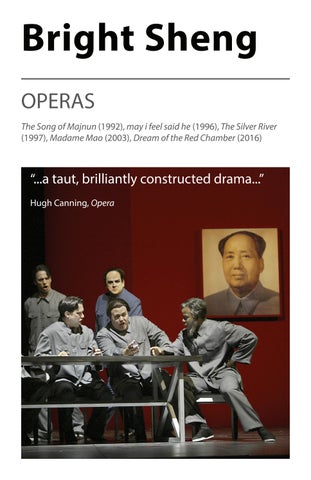
“...a taut, brilliantly constructed drama...” Hugh Canning, Opera
Dream of the Red Chamber An opera in two acts (2016) Libretto David Henry Hwang and the composer Duration: 2 hours 30 minutes Premiere: September 2016, San Francisco Opera
“...exquisite, soaring vocal writing...” Allan Ulrich, Financial Times
cast
BAO YU/DIVINE STONE: Lyric Tenor DAI YU/CRIMSON PEARL FLOWER: Lyric Coloratura Soprano BAO CHAI: Light Mezzo-soprano MME. WANG: Full Lyric Mezzo-soprano GRANNY JIA : Alto PRINCESS JIA: Full Lyric Soprano AUNT XUE: Mezzo-soprano THE MONK: Male Actor MAIDS, PRINCESS JIA’S ENTOURAGE: Female Chorus, Dancers, Extras IMPERIAL SOLDIERS, EUNUCHS: Male Chorus, Dancers, Extras
orchestra
2(2pic).2(ca).2(bcl).2(cbn)/4331/timp.3perc/hp/Qin/str
synopsis
The Dream of the Red Chamber, a masterpiece of Chinese fiction, is a detailed, episodic record of the lives of the members of the Jia Clan, whose good fortune is assured when one of its daughters becomes an imperial concubine, and then declines after her death. The story centers on a love triangle consisting of the main character, Bao Yu, his beautiful cousin Dai Yu, and his future wife, another beautiful cousin named Bao Chai. Bright Sheng and David Henry Hwang have adapted Cao Xue Qin’s epic 18th-century Qing Dynasty novel with a focus on eight central characters to tell the tale of the illustrious Jia Clan and traces the Jias’ fall from the height of their prestige. Often considered a semi-autobiographical novel, Sheng and Hwang frame the tale with a Prologue and Epilogue led by The Monk, who may be the author himself.
press
“…the score snaps into focus in a series of tautly constructed scenes that reveal the canniness of Sheng’s compositional strategy — in particular, his skill in crafting an operatic language that is a hybrid of Chinese and Western traditions.” — Joshua Kosman, SF Gate “There’s a moment in Dream of the Red Chamber that creates an unforgettable tableau. A young woman, standing alone in a small boat, floats down a gently undulating river made of azure silk. That image — poised, serene, accompanied by enchanting music — is just one of many stunning stage pictures created in Bright Sheng’s opera...” — Georgia Rowe, The Mercury News “Sheng has a terrific feel for orchestration. He uses brass (particularly trombones), winds and percussion (Western and Chinese) in original and highly imaginative ways. Pitches bend in ways that sound almost acrobatically impossible. Chinese folk tunes get transformed into rapturously expressive new music, gorgeously colored.” — Mark Swed, The Los Angeles Times “Red Chamber is rooted firmly in classical European romance, though enhanced with well-considered ventures into Asian musical motifs” — Ray Mark Rinaldi, Opera News
Madame Mao An opera in two acts (2003) Libretto by Colin Graham Duration: 2 hours Premiere: July 2003, Santa Fe Opera
cast
JIANG CHING I, Madame Mao: Dramatic Mezzo-Soprano JIANG CHINA II, Madame Mao in her 20s,: High Soprano also plays NORA (in Act I) also sings MU GUIYING (in Act II) ZHI ZHEN, Mao’s previous wife: Full Lyric Soprano also sings AN ACTRESS (in Act I) and YANG PAIFENG (in Act II) MAO ZEDONG, Chairman: Verdi Baritone THE ACTOR: High Tenor also sings EMPEROR GAO (in Act II) and ANOTHER MAN
THE ACCUSERS (8 soloists: 2 sopranos, 2 tenors, 2 baritones and 2 basses, double in many other parts, including THE COMMITTEE and VICTIMS in Act 11. They include ANOTHER MAN and THE ACTRESS) Sometimes these appear as MADAME MAO’s accusers as at the Trial, sometimes as bitter memories of her past. SATB Chorus (minimum 32) 8 Dancers (4 men 4 women)
orchestra
2(pic).2(ca).2(Ebcl,bcl).2(cbn)/4331/timp.4perc/hp/str
synopsis
As the corpse of Jiang Qing, or Madame Mao, swings in the cell where she has hanged herself, we journey retrospectively through the events of the life that came to this undignified end. Rejected by her father when she was a child, Jiang Qing sees a chance to prove herself when Mao Zedong, leader of the Communist Revolutionaries, throws his wife into an asylum and takes a fancy to Jiang. As Mao’s policies fail and he descends into a life of debauchery, Jiang Qing takes control, using the brutality of the Cultural Revolution to take revenge on those that she feels have betrayed her. In the end, Mao also rejects her and she is sent to prison where she takes her own life in the belief that posterity will eventually vindicate her name.
“Madame Mao is powerful music-theater.” Simon WIlliams, Opera News
press
“...his score is as action-packed and varied in mood as Graham’s libretto and dazzlingly orchestrated.... This is a musically and dramatically eventful opera.” — Hugh Canning, Opera “The subject is ready-made for Bright Sheng’s distinctive musical style, which mixes Chinese elements into an essentially western idiom that speaks clearly to an audience. Madame Mao demonstrates that consideration for his audience also characterizes Sheng’s approach to musical theatre. Sheng and librettist Colin Graham have created a multifaceted protagonist and they put her through the kind of stormy confrontations that opera-goers thrive on.” — George Loomis, Financial Times “Sheng and Graham have created a passionate and absorbing work that deserves wide-spread attention.” — Wes Blomster, Andante.com
The Song of Majnun An opera of lyric tragedy in one act (1992)
Libretto by Andrew Porter, based on the Islamic epic poem Layla and Majnun by Nizami Duration: 1 hour Premiere: April 1992, Lyric Opera of Chicago
cast
MAJNUN: Tenor LAYLA: Soprano FIRST GOSSIP: Mezzo-Soprano SECOND GOSSIP: Mezzo-Soprano LAYLA’S MOTHER: Mezzo-Soprano LAYLA’S FATHER: Baritone IBN SALAM: Baritone MAJNUN’S FATHER: Bass ENSEMBLE OF TOWNSPEOPLE: Chorus
orchestra
2(2pic,afl).1(ca).1(bcl).1(cbn)/2110/2[=3]perc/hp.pf/str
synopsis
The drama of the opera is rooted in Majnun’s ill-fated and unfulfilled love for Layla. After Majnun and Layla fall in love, Layla’s parents separate them. Grief drives Majnun to madness while Layla is married to the man of her parents’ choice.
press
“The lyricism is urgent, melodious, vocal...Porter’s text is poetic, as is Sheng’s treatment of it...” — Robert Commanday, San Francisco Chronicle
The Silver River An opera in two acts (1997)
Libretto by David Henry Hwang Duration: 1 hour 8 minutes Premiere: July 1997, Santa Fe Chamber Music Festival
cast
American Actress (Western style) Asian Male Singer (Chinese Opera style) Baritone (Western Opera/Music Theater style) Asian Female Dancer, 2 Dancers
ensemble
“...a music theater fable of great charm and imagination.” John von Rhein, Chicago Tribune
fl(pic,afl), cl(bcl,perc), pipa, perc, vn(perc), vc(perc); flutist appears onstage as a male cowherd pipa player appears onstage as a goddess-weaver
synopsis
According to ancient Chinese legend, Night and Day were created through the ill-fated love between a heavenly being and a mortal. The legend of the Silver River comes alive in a bewitching production populated by Jade Emperors, Goddess Weavers and other celestial beings. Bright Sheng and David Henry Hwang, author of the Tony Award-winning M. Butterfly, integrate elements from both Western and Chinese opera in a touching and timeless fable.
may i feel, said he An opera in seven minutes (1996) Libretto by Edward Estlin Cummings Duration: 7 minutes Premiere: May 1996, New York Festival of Song
cast
Soprano, Tenor
accompaniment piano 4-hands
synopsis
A conversation between two lovers.
photos Cover: Madame Mao at Santa Fe Opera
Dream of the Red Chamber at San Francisco Opera, photo by Cory Weaver Madame Mao at Santa Fe Opera
The Song of Majnun, 16th-century illustration of Nizami’s poem: Layla and Majnun faint at their final meeting The Silver River, photo by Greg Rakozy
For more information contact Peggy Monastra peggy.monastra@schirmer.com, 212-254-2100
ORDERING INFORMATION
Rental orders and fee quotations: Zinfonia.com or WiseMusicClassical.com/licensing
Sales materials:
MusicDispatch.com or MusicRoom.com or your music dealer
Publisher and Agency Representation for Wise Music Group: WiseMusicClassical.com/rental
Wise Music Group
USA: G. Schirmer, Inc. Associated Music Publishers, Inc.
UK: Chester Music Novello & Co
France: Première Music Group
Spain: Unión Musical Ediciones
schirmer@schirmer.com
promotion@wisemusic.com
classical.madrid@wisemusic.com
classical.paris@wisemusic.com
Australia: G. Schirmer Pty Ltd
ewh@ewh.dk
Germany: Bosworth Music GmbH
Denmark: Edition Wilhelm Hansen AS Iceland: Wise Music Iceland
inga.weisshappel@wisemusic.com
classical@wisemusic.com
classical.berlin@wisemusic.com
C.F. Peters GmbH & Co. KG
info.de@editionpeters.com
Photo by Wah Lui
Bright Sheng’s musical studies began in China at the age of four when his mother taught him piano. After the Cultural Revolution, he moved to New York in 1982 where his teachers included Leonard Bernstein, George Perle, Hugo Weisgall and Jack Beeson. A strong Eastern influence is evident in his music, which often uses traditional tales, folk songs and instruments from China, as well as gestures borrowed from Chinese opera; however, it is incorporated into a highly original and assured framework based on a Western tradition. He is much in demand as a composer, pianist, conductor and artistic director for major organizations throughout America and Europe.