the composer
Theodore Morrison began composing at the age of forty-two, more than twenty years after he was well established as a conductor specializing in large works for chorus, soloists and orchestra, as well as music for chamber orchestra. Over the past three decades he has composed an epic choral symphony and a number of other large works for voices and orchestra. He has created a substantial body of shorter pieces including an overture for wind ensemble, chamber works for woodwinds and strings, a sonata and a set of variations for organ, several works for chorus and organ, three songcycles, and numerous smaller choral pieces and songs. His music has been performed throughout North America, Europe, Asia, and New Zealand. Learn more about Oscar at www.musicsalesclassical.com.
For more information contact Peggy Monastra, peggy.monastra@schirmer.com, 212-254-2100.
ORDERING INFORMATION Rental orders and fee quotations: Zinfonia.com or MusicSalesClassical.com/licensing
Perusal scores: MusicaSalesClassical.com/OnDemand
Sales materials: MusicDispatch.com or MusicRoom.com or your music dealer
Publisher and Agency Representation for the Music Sales Group: MusicSalesClassical.com/rental
The Music Sales Group of Companies USA: G. Schirmer, Inc. Associated Music Publishers, Inc.
UK: Chester Music Ltd Novello & Co Ltd
France: Alphonse Leduc Chant du Monde Chester Music France Les Editions Choudens
Spain: Uniรณn Musical Ediciones
Denmark: Edition Wilhelm Hansen AS
Germany: Music Sales Classical Berlin
schirmer@schirmer.com
chesterfrance@musicsales.co.uk
ewh@ewh.dk
promotion@musicsales.co.uk
unionmusicalediciones@musicsales.co.uk
Australia: G. Schirmer Pty Ltd publishing@musicsales.com.au
classical.berlin@musicsales.co.uk
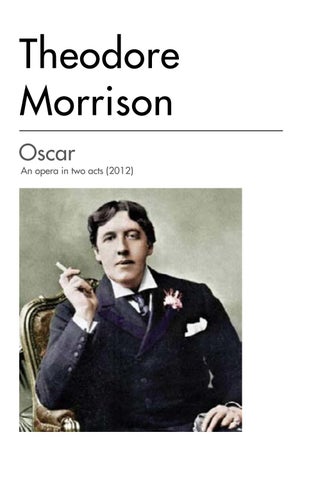
Theodore Morrison Oscar
An opera in two acts (2012)
Oscar An opera in two acts (2012) Libretto in English by John Cox and Theodore Morrison.
Duration: 2 hours 30 minutes World Premiere: July 2013, Santa Fe Opera, Santa Fe, NM Kevin Newbury, stage director; Evan Rogister, conductor
cast list ADA LEVERSON: Soprano OSCAR WILDE: Countertenor FRANK HARRIS: Tenor WALT WHITMAN: Baritone LORD ALFRED (BOSIE) DOUGLASS: Silent Role (Dancer) SATB Chorus
orchestration 3(pic).2+ca.2(Ebcl).2+cbn/4.3.2+btbn.1/timp.3perc/pf.hp/str onstage: portable reed organ
historical introduction
by John Cox
Walt Whitman met Oscar Wilde during the young Irish poet's lecture tour of the USA in 1882. Walt was at the height of his fame, whereas Oscar was merely a celebrity lecturer explaining the new Aesthetic Movement to the American public. He had at this point written nothing to hint at his enduring genius. By the time Oscar met Lord Alfred Douglas, known as Bosie, Walt was dead while Oscar was very famous. It is from his vantage point of Immortality that Walt presents our opera, revealing to us the catastrophe that Oscar's love for Bosie brought about. Bosie Douglas was the youngest son of the Marquess of Queensberry, and they despised one another. Oscar soon found himself in the crossfire of their enmity when Queensberry raised public objection to Oscar's relationship with his son, imputing a sexual basis to it. Bosie forced Oscar to sue Queensberry for libel, hoping thereby to disgrace him, but Queensberry won the case, so the disgrace fell on Oscar. He was rapidly put on trial, convicted, and jailed for "gross indecency."
SYNOPSIS ACT ONE Oscar is out on bail awaiting the verdict. Queensberry has bribed two detectives to warn hotel managers against giving him a room. Bosie, under pressure from Oscar, leaves the country, but, portrayed by a dancer, he haunts Oscar’s imagination throughout the opera. Oscar eventually finds shelter with Ada Leverson, also a writer and adored by Oscar who calls her Sphinx. She puts him up in the children’s nursery where they are joined by their friend Frank Harris. At first the innocent gaiety of their surroundings brightens the mood. Drinks are served and playful repartee prevails. Then the influential Frank reveals that he has made arrangements for Oscar to abscond bail, flee the country and escape the inevitable guilty verdict. After much agonizing, especially over his two young children, Oscar refuses to run away. The only honorable course is to face his accusers. In what essentially becomes a show trial the nursery morphs into the courtroom and the toys enact the proceedings as farce. The “guilty” verdict is handed down and Oscar is sentenced to hard labor for two years.
ACT TWO This act sees the prison warders sarcastically making their celebrity guest welcome, but a reality check is brutally provided by the sadistic governor, Isaacson, whose personal mission is to punish his charges to the furthest extreme. Oscar will be no exception. He is rapidly broken in body and spirit by the prison regime. In his feverish weakness he suffers a fall during chapel service and injures his head. In the face of rebellious protests by the other prisoners Isaacson grudgingly sends Oscar to the infirmary. In the infirmary Oscar is able to talk with other sick prisoners, discovering levels of simple humanity that restore his spirits. He realizes that there are greater degrees of suffering in life than he has ever imagined. We discover that there is soon to be an execution. During the night before it the tension inside the prison reaches a terrifying pitch as all feel the presence of Death in their midst. Oscar senses that this death prefigures his own. Nearing the end of his sentence, Oscar is visited by Frank Harris. Early release has been beyond Frank’s political influence, but at least the authorities have decided to replace the tyrannical Isaacson with a more moderate governor who will allow Oscar writing materials, more books and to work in the garden. It is here that he receives his last visitor. Ada Leverson comes to discuss plans for his return to freedom. Alas, his request to join a closed Christian community has been refused. It will be some time before society is prepared to tolerate his return. Indeed, he will have to pass over to the next life before that process can truly begin. Walt greets Oscar on the threshold of Eternity and conducts him, amidst general acclaim, to his place among the Immortals.
Oscar An opera in two acts (2012) Libretto in English by John Cox and Theodore Morrison.
Duration: 2 hours 30 minutes World Premiere: July 2013, Santa Fe Opera, Santa Fe, NM Kevin Newbury, stage director; Evan Rogister, conductor
cast list ADA LEVERSON: Soprano OSCAR WILDE: Countertenor FRANK HARRIS: Tenor WALT WHITMAN: Baritone LORD ALFRED (BOSIE) DOUGLASS: Silent Role (Dancer) SATB Chorus
orchestration 3(pic).2+ca.2(Ebcl).2+cbn/4.3.2+btbn.1/timp.3perc/pf.hp/str onstage: portable reed organ
historical introduction
by John Cox
Walt Whitman met Oscar Wilde during the young Irish poet's lecture tour of the USA in 1882. Walt was at the height of his fame, whereas Oscar was merely a celebrity lecturer explaining the new Aesthetic Movement to the American public. He had at this point written nothing to hint at his enduring genius. By the time Oscar met Lord Alfred Douglas, known as Bosie, Walt was dead while Oscar was very famous. It is from his vantage point of Immortality that Walt presents our opera, revealing to us the catastrophe that Oscar's love for Bosie brought about. Bosie Douglas was the youngest son of the Marquess of Queensberry, and they despised one another. Oscar soon found himself in the crossfire of their enmity when Queensberry raised public objection to Oscar's relationship with his son, imputing a sexual basis to it. Bosie forced Oscar to sue Queensberry for libel, hoping thereby to disgrace him, but Queensberry won the case, so the disgrace fell on Oscar. He was rapidly put on trial, convicted, and jailed for "gross indecency."
SYNOPSIS ACT ONE Oscar is out on bail awaiting the verdict. Queensberry has bribed two detectives to warn hotel managers against giving him a room. Bosie, under pressure from Oscar, leaves the country, but, portrayed by a dancer, he haunts Oscar’s imagination throughout the opera. Oscar eventually finds shelter with Ada Leverson, also a writer and adored by Oscar who calls her Sphinx. She puts him up in the children’s nursery where they are joined by their friend Frank Harris. At first the innocent gaiety of their surroundings brightens the mood. Drinks are served and playful repartee prevails. Then the influential Frank reveals that he has made arrangements for Oscar to abscond bail, flee the country and escape the inevitable guilty verdict. After much agonizing, especially over his two young children, Oscar refuses to run away. The only honorable course is to face his accusers. In what essentially becomes a show trial the nursery morphs into the courtroom and the toys enact the proceedings as farce. The “guilty” verdict is handed down and Oscar is sentenced to hard labor for two years.
ACT TWO This act sees the prison warders sarcastically making their celebrity guest welcome, but a reality check is brutally provided by the sadistic governor, Isaacson, whose personal mission is to punish his charges to the furthest extreme. Oscar will be no exception. He is rapidly broken in body and spirit by the prison regime. In his feverish weakness he suffers a fall during chapel service and injures his head. In the face of rebellious protests by the other prisoners Isaacson grudgingly sends Oscar to the infirmary. In the infirmary Oscar is able to talk with other sick prisoners, discovering levels of simple humanity that restore his spirits. He realizes that there are greater degrees of suffering in life than he has ever imagined. We discover that there is soon to be an execution. During the night before it the tension inside the prison reaches a terrifying pitch as all feel the presence of Death in their midst. Oscar senses that this death prefigures his own. Nearing the end of his sentence, Oscar is visited by Frank Harris. Early release has been beyond Frank’s political influence, but at least the authorities have decided to replace the tyrannical Isaacson with a more moderate governor who will allow Oscar writing materials, more books and to work in the garden. It is here that he receives his last visitor. Ada Leverson comes to discuss plans for his return to freedom. Alas, his request to join a closed Christian community has been refused. It will be some time before society is prepared to tolerate his return. Indeed, he will have to pass over to the next life before that process can truly begin. Walt greets Oscar on the threshold of Eternity and conducts him, amidst general acclaim, to his place among the Immortals.
the composer
Theodore Morrison began composing at the age of forty-two, more than twenty years after he was well established as a conductor specializing in large works for chorus, soloists and orchestra, as well as music for chamber orchestra. Over the past three decades he has composed an epic choral symphony and a number of other large works for voices and orchestra. He has created a substantial body of shorter pieces including an overture for wind ensemble, chamber works for woodwinds and strings, a sonata and a set of variations for organ, several works for chorus and organ, three songcycles, and numerous smaller choral pieces and songs. His music has been performed throughout North America, Europe, Asia, and New Zealand. Learn more about Oscar at www.musicsalesclassical.com.
For more information contact Peggy Monastra, peggy.monastra@schirmer.com, 212-254-2100.
ORDERING INFORMATION Rental orders and fee quotations: Zinfonia.com or MusicSalesClassical.com/licensing
Perusal scores: MusicaSalesClassical.com/OnDemand
Sales materials: MusicDispatch.com or MusicRoom.com or your music dealer
Publisher and Agency Representation for the Music Sales Group: MusicSalesClassical.com/rental
The Music Sales Group of Companies USA: G. Schirmer, Inc. Associated Music Publishers, Inc.
UK: Chester Music Ltd Novello & Co Ltd
France: Alphonse Leduc Chant du Monde Chester Music France Les Editions Choudens
Spain: Uniรณn Musical Ediciones
Denmark: Edition Wilhelm Hansen AS
Germany: Music Sales Classical Berlin
schirmer@schirmer.com
chesterfrance@musicsales.co.uk
ewh@ewh.dk
promotion@musicsales.co.uk
unionmusicalediciones@musicsales.co.uk
Australia: G. Schirmer Pty Ltd publishing@musicsales.com.au
classical.berlin@musicsales.co.uk
Theodore Morrison Oscar
An opera in two acts (2012)