IANNOTTA
Il colore dell’ombra
per Violono, Violoncello e Pianoforte
Score & Parts








per Violono, Violoncello e Pianoforte
Score & Parts
per Violono, Violoncello e Pianoforte
(2010)
POD PETERS on demand
L E I P ZI G L ONDO N NE W YOR K
Archi : || Strings : Accordatura del violino per i primi 2 movimenti || Scordatura of the violin (only for first and second movement)
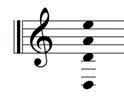
Il primo pentagramma rappresenta il risultato sonoro della IV corda del violino, il secondo pentagramma rappresenta la diteggiatura
The first staff indicates the resultant sound of the scordatura on the IV string of the violin; the second staff indicates the fingering
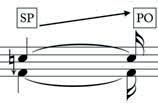
Passaggio dal ponticello alla posizione ordinaria. Ogni volta che c’è una freccia verso l’alto rappresenta l’andare verso il tasto, viceversa se la freccia è verso il basso || Ponticello (SP) to ordinary position (PO)
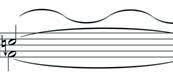
Vibrato microtonale || Microtonal vibrato
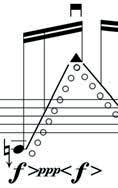
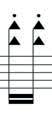
Glissato d’armonici: sfiorare la corda facendo uscire gli armonici naturali || Harmonic glissando
Il più acuto possibile, su una o due corde || As high as possible, on one or two strings
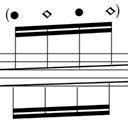
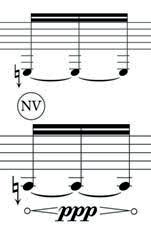
Glissare alternando la pressione ordinaria alla mezza pressione secondo il ritmo scritto
Left hand: alternating ordinary pressure and harmonic pressure (lightly touching the string, as you would when playing harmonics) following the written rhythm
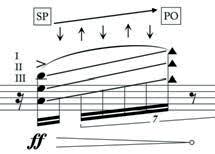
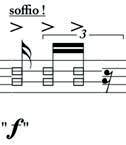
Le frecce rappresentano il movimento dell’arco sulle tre corde
Right hand: the arrows indicate the movement of the bow on the three strings (arpeggiato)
Stoppare le corde e suonare sul ponticello. Il risultato è un rumore bianco. I righi rappresentano le quattro corde vuote
Damp the indicated strings and play directly on the bridge. The resulting sound is almost white noise. The four lines represent the four open strings
t : mezza pressione || Left hand: half pressure
SP : sul ponticello
PO : posizione ordinaria
C l b : col legno battuto
NV : non vibrato
MV : Molto vibrato
Preparazione del pianoforte: || Piano preparation:
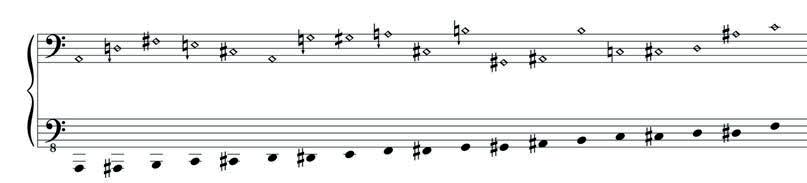
Posizionare del pata-fix sulle corde indicate, cercando di ottenere come risultante sonora l’armonico scritto Place pata-fix (or Blu-tack) on the strings indicated above in order to obtain the harmonics written as the resulting sound
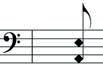
Queste due note vanno preparate con del pata-fix posto il più possibile all’attaccatura della corda || These two notes have to be prepared placing pata-fix on the corresponding strings as close as possible to the tuning pegs
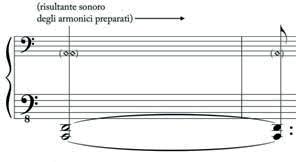

Il pentagramma superiore indica la risultante sonora degli armonici preparati || The first staff indicates the resulting sound of the prepared strings; the second staff indicates the fingering
Battuto in cordiera || Hit with the palm of the hand the indicated strings inside the piano
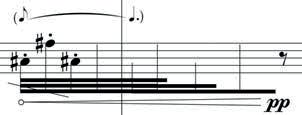
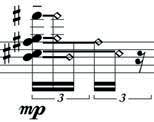
Alternare le note indicate liberamente in ritardando, secondo durata scritta || Alternate the written pitches gradually slowing down
Le note in bianco rappresentano il momento in cui i tasti devono essere sollevati, nel ritmo scritto || The white noteheads indicate the moment in which the keys have to be released, following the written rhythm
CORDIERA = Inside the piano
TASTIERA = On the keys
D urata : 10’30’’ circa
Come un velo, non meno di Sordina in legno
(risultante sonoro degli armonici preparati)


For more than 200 years, Edition Peters has been synonymous with excellence in classical music publishing. Established in 1800 with the keyboard works of J. S. Bach, by 1802 the company had acquired Beethoven’s First Symphony. In the years following, an active publishing policy enabled the company to expand its catalogue with new works by composers such as Brahms, Grieg and Liszt, followed in the twentieth century by Richard Strauss, Arnold Schoenberg and John Cage.
Die lange und wechselvolle Geschichte der Edition Peters ist geprägt vom steten Willen, an der aktuellen Musik jeder Zeit teilzuhaben und diese in hochwertigen Ausgaben zur Verfügung zu stellen. Ein bedeutendes Kapitel dieser Geschichte sind auch die Jahre des geteilten Deutschlands und der damit verbundenen Teilung des Verlages.
Die Komponisten der VEB Edition Peters in Leipzig stellen mit ihrem Schaffen einen eigenen, wertvollen Beitrag nicht nur zur Identität des Verlags, sondern auch zur Kulturhistorie Europas dar. Ihre Werke sind in kompositorischer und ästhetischer Hinsicht vielgestaltig und zeichnen sich durch einen kommunikativen Gestaltungswillen im Kontext der gegebenen Möglichkeiten aus. Seine künstlerische Eigenständigkeit macht dieses Repertoire zu einer lohnenden Wiederentdeckung.
Today, with its offices in Leipzig, London and New York publishing the work of living composers from around the world, Edition Peters maintains its role as a champion of new music. At the same time, the company’s historic and educational catalogues continue to be developed with award-winning critical and pedagogical editions.
Throughout its long and eventful history, Edition Peters has consistently sought to support contemporary music, making it accessible in high-quality scores. The years in which Germany, and the publishing house itself, were divided between East and West form an important chapter in the company’s story.
Seit über 200 Jahren steht die Edition Peters für höchste Qualität im Bereich klassischer Notenausgaben. Gegründet im Jahr 1800, begann der Verlag seine Tätigkeit mit der Herausgabe von Bachs Musik für Tasteninstrumente. Schon 1802 kamen die Rechte an Beethovens erster Sinfonie hinzu. In der Folgezeit wuchs der Katalog um neue Werke von Komponisten wie Brahms, Grieg und Liszt sowie – im 20. Jahrhundert – Richard Strauss, Arnold Schönberg und John Cage.
The output of composers from the East German firm – then known as VEB Edition Peters, Leipzig – forms a unique and valuable part of the company’s identity and, more widely, of European cultural history. Their works are compositionally and aesthetically diverse, while sharing a communicative creative drive. The artistic independence of the music created in East Germany between 1949 and 1990 makes this repertoire well worth rediscovering.
Als Verleger zahlreicher zeitgenössischer Komponisten aus aller Welt ist die Edition Peters mit ihren Standorten Leipzig, London und New York auch weiterhin Anwalt neuer Musik. Zugleich wird das Verlagsprogramm im klassischen wie im pädagogischen Bereich kontinuierlich durch vielfach preisgekrönte Ausgaben erweitert.
The Peters Contemporary Chamber Series offers the opportunity to discover new works to programme, study and play. Representing the full breadth of our library of modern chamber music, this curated series of performance materials ranges from established repertoire to pieces recently premiered.
Mit einer sorgfältigen Auswahl aus unserem breitgefächerten Katalog moderner Kammermusik lädt die Peters Contemporary Chamber Series dazu ein, neues Repertoire zu entdecken, zu erkunden und zu Gehör zu bringen. In Form von Aufführungsmaterialien umfasst sie etablierte Werke ebenso wie erst kürzlich uraufgeführte Kompositionen.