MUSIC SALES | CONTEMPORARY OPERAS
i Iain Bell: The Operas
Iain Bell
an introduction to the operas
‘A brave, emphatic statement of intent... Iain Bell’s instinct for words and vocal line is apparent’ The Guardian on In Parenthesis
‘A soul-devouring juggernaught, a decomposing, dirty battlefield. Bell shows he can create gentle, lyrical moments, tumultuous structures that build in atmosphere and action scenes which stimulate’ Der Standard on A Harlot’s Progress
‘An opera to be reckoned with. ‘A Harlot’s Progress’ together with ‘Written on Skin’ by George Benjamin are the greatest successes of contemporary opera’ Seen and Heard on A Harlot’s Progress
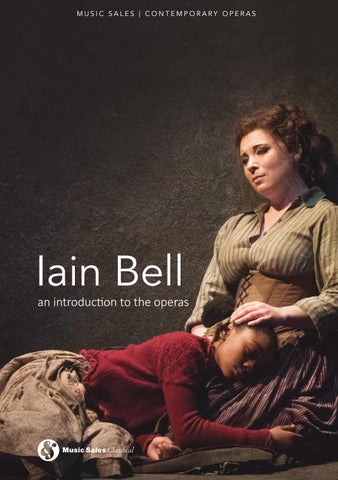
Cover Photo: Ashirah Foster Notice (Magpie) & Natalya Romaniw (Mary Kelly), from Jack the Ripper: The Women of Whitechapel © Alastair Muir, courtesy of English National Opera
1
‘A big bowl of chocolate ice-cream… sprinkled with vinegar.’ Diana Damrau on A Harlot’s Progress
Characterization is at the heart of Bell’s music. He recalls participating in primary school performances of Carnival of the Animals and Peter and the Wolf which demonstrated to him the potential of music to dramatise. He immerses himself in source material, whether a 1732 Hogarth etching or the Stonewall riots of 1969. Such an approach is perhaps a nod to his early love of reading. He was by his own admission, a bookish child, adoring ‘non-fiction. Encyclopaedias. Foreign language dictionaries.’ In 2004, Bell heard renowned operatic soprano Diana Damrau sing the role of Fiakermilli in Richard Strauss’ Arabella at the Royal Opera House and was smitten: ‘Her voice totally captivated me. The speed of her vibrato, high trills and facility at the top of her range left me speechless.’ Damrau went on to record his early song cycles, Daughters of Britannia (2007) and The Hidden Place (2009) and continues to inspire his writing. The composer always had her in mind for the leading role in his debut opera A Harlot’s Progress, tailoring lines specifically to showcase her range and coloratura register. The opera is inspired by the famous series of etchings
Iain Bell: The Operas
Introduction
Iain Bell: The Operas
2 by William Hogarth whose characters are brought vividly to life, reflecting all manner of degradation and depravity just below the surface of civilised London society. Encompassing the perennial themes of sex and death, Peter Ackroyd’s libretto paints a gloriously grimy picture of seething streets, brothels and drinking dens. As Bell affirms, ‘this was ripe for the setting’. Contrasting in scale but not in ambition, Bell’s one-act monodrama A Christmas Carol (2013, Houston Opera), based on Charles Dickens’ beloved novella and with a libretto by Simon Callow, sets the tenor soloist a unique challenge. Twenty-four roles in all, from Tiny Tim to Mrs Fezziwig, are paraded alongside a feast of chamber sonorities. It is a true tour de force, both for the vocalist and tight-knit ensemble of woodwind, brass, percussion and strings. The composer describes the music’s path as ‘leading us ultimately from darkness to light’ – a journey clearly reflecting Dickens’ original text.
Left: Scene from Act 3 of A Harlot’s Progress, Marie McLaughlin as ‘Mother’ Needham with the female chorus of the Teater an der Wien (2013) © Werner Kmetitsch. Right: Jay Hunter Morris as Scrooge in Houston Grand Opera’s 2014 premiere of A Christmas Carol. © Lynn Lane
Bell is notable for his forensic examination of a libretto, as evidenced in his orchestration for In Parenthesis (Welsh National Opera/14-18-NOW, 2016). The opera was based upon the epic narrative by poet and artist David Jones (1895-1974) which T.S. Eliot proclaimed, ‘a work of genius’. The creative team at WNO saw its dramatic potential and librettists Emma Jenkins and David Antrobus, working with artistic director David Pountney and designer Robert Innes Hopkins, delivered a text and treatment that would demand close attention by any composer. To juxtapose the political turbulence and bloodshed of World War I against otherworldly dreamscapes was a colossal challenge, but one which Bell embraced.
3
The traditional song Sosban Fach holds a special place in Welsh hearts; this was especially so during ‘The Great War’. Bell’s operatic setting is weighted with huge military and political implications, encapsulating the philosophy of a nation and presented as ‘intensely tribal in nature’. Such references are poignant, resonating with the eternal themes of conflict and resolution. In Parenthesis embroils its cast and audience in a dark landscape, lurching from the claustrophobic trenches of the Somme to the ever-shifting visions of Private Ball. We bear witness both to the stark, skewed reality of war and
Left: Scene six from Welsh National Opera’s premiere of In Parenthesis (2016), Andrew Bidlack (Private John Ball) and Marcus Farnsworth (Lieutenant Jenkins) © Bill Cooper. Right: Act 1 Scene 1 of A Harlot’s Progress - Moll arrives in London, Diana Damrau as Moll Hackabout with the chorus of the Teater an der Wien (2013) © Werner Kmetitsch.
Ball’s euphoric dreams of a goddess world. Bell’s orchestra has ragged brass locking horns with slimy strings, peppered by crazed artillery percussion and squalling woodwinds before singers are shrouded by harp and luminous glockenspiel. Finally, languid vocal lines ascend from the chaos, promising salvation. When asked how he approaches the practicalities of composition on such a large scale, Iain pauses then smiles. ‘It’s like breathing…’, he shrugs. ‘The music’s just all there, inside my head.’
Iain Bell: The Operas
Jones’s Brythonic and Welsh texts are incorporated into the fabric of the opera in addition to Latin, German and English. We hear the Chorus of Remembrance, a female ensemble of goddess figures, recite from the medieval Welsh poem Y Gododdin: Seinnyessit e gledyf, ym penn mameu (‘Swords ring in Mothers’ heads’) and from the Book of Revelation: et vidi agnum stantem tamquam occisum (‘and I saw the Lamb standing as if slain’).
Iain Bell: The Operas
4 With each new commission Bell’s confidence has grown and his orchestral palette has become more adventurous. He absorbs and processes diverse sound-worlds, from Monteverdi’s pioneering harmonic progressions, antiphony and word-painting to the colouristic writing of Mahler, Strauss and Ravel. More recently he has been captivated by the spectral sonorities of Dutilleux and Ligeti. This can certainly be heard in Jack the Ripper: The Women of Whitechapel (2019). Refreshingly, the opera focuses not on the perpetrator but rather on the community of East End women living with violence and degradation every day and highlights the brutality of Victorian society. Strong women are the beating heart of this work, their outpourings supported by characterful fragments of melody in woodwinds and brass or punctuated by tuned percussion and triangle. Bartók pizzicato brings a smarting discomfort, muted strings deaden and distance the accompaniment. Cimbalom is featured throughout, representing the ominous presence of evil (The Darkness) and crotales illuminate Mary Kelly’s much-loved daughter (Magpie). Bell draws inspiration from the human condition. He dares to portray our darkest traits, failings and flaws – yet his music glimmers, hinting at the possibility of survival, redemption, hope … Welcome to his world.
© Rose
Moore, 2019
5
Iain Bell’s love affair with the voice is evidenced by his prolific output of vocal works, earning him the attention of many of the greatest singers of our generation who have performed his music at venues including Wigmore Hall, Carnegie Hall and the Munich Opera Festival. His first opera A Harlot’s Progress received its world premiere in 2013 at Vienna’s Theater an der Wien. Based on Hogarth’s etchings to a libretto by British author Peter Ackroyd, it was performed by a stellar cast headed by German soprano Diana Damrau and US-baritone Nathan Gunn in a production by Jens-Daniel Herzog, conducted by Mikko Franck. It received tremendous critical acclaim with The New York Times praising the strength of Bell’s orchestral and vocal writing. It was described in Der Standard as a ‘A soul devouring juggernaut’ and labelled as ‘cinematic, dramatic and thrilling’ in Kurier. Given 5-stars and described by The Financial Times as ‘a brilliant new opera’ Bell’s second, based on Charles Dickens’ A Christmas Carol received its world premiere at Houston Grand Opera in December 2014. An adaptation of Dickens’ own one-man version of the story, scored for chamber orchestra &
Iain Bell: The Operas
Biography
Iain Bell: The Operas
6
Photo: Iain Bell Š Frances Marshall
7
Bell’s critically-acclaimed third opera In Parenthesis, based on David Jones’ eponymous World War One epic poem (directed by David Pountney/ conducted by Carlo Rizzi) received its world premiere at Welsh National Opera with further performances at the Royal Opera House in Summer 2016. A 5-star review in The Independent described the work as a ‘powerful act of remembrance’, with The Stage calling Bell’s score ‘technically exceptional’ and The Telegraph describing the opera as ‘gripping and moving’. It was streamed globally on Opera Platform and broadcast on BBC Radio 3. In the concert hall Bell has worked with pianists including Helmut Deutsch, Roger Vignoles, Iain Burnside, Simon Lepper and Julius Drake. Recent highlights include the world premieres of his song cycles of you at Carnegie Hall by American mezzo-soprano Jamie Barton and These Motley Fools at Wigmore Hall by counter-tenor Lawrence Zazzo. Bell’s concert ayre A Litany in Time of Plague, a commission from the Munich Opera Festival for chamber orchestra and mezzo-soprano, received its first performance in July 2015. Moll’s a’cold - the excerpted mad-scene from his opera A Harlot’s Progress was first heard at the Enescu Festival performed by Adela Zaharia in Summer 2017. Iain Bell’s music is published exclusively by Chester Music Ltd, part of the Music Sales Group.
Iain Bell: The Operas
tenor, it was performed by US-heldentenor Jay Hunter Morris in a production by Simon Callow under the baton of Warren Jones. The piece has since been nominated for the World Premiere Award at the International Opera Awards 2015 and in December 2015 was staged in a new production at Welsh National Opera, followed by a subsequent new staging at the Teatro Sociale in Trento in 2017.
Iain Bell: The Operas
8
A Harlot’s Progress (2011) an opera in four acts Libretto Commissioner Orchestration Duration
Peter Ackroyd Theater an der Wien 2+pic.2.2.2+cbn/2222/timp.2perc/hp/str 2 hrs 10 mins
Cast and characters Moll Hackabout, a harlot ‘Mother’ Needham, a procuress Kitty, Moll’s Maid James Dalton, a highwayman Coachman/Officer/Jailam Mister Loverlace, Moll’s 1st keeper
Coloratura Soprano Mezzo-soprano Mezzo-soprano Baritone Bass Tenor
SATB chorus of traders, prisoner, prostitues and unsavoury London-types
Brief Synopsis Faithfully adhering to Hogarth’s six 1732 etchings of the same name, this opera in six scenes tells the story of the precipitous downfall of Moll Hackabout. The title role was created by renowned coloratura soprano Diana Damrau in a tour-de-force role that calls upon the full vocal and dramatic resources of this astonishingly gifted performer portraying Moll’s journey from naïve to courtesan to syphilitic Drury Lane prostitute. Moll Hackabout, the titular Harlot, arrives as an innocent in London and is taken into the ‘care’ of Mother Needham. A loathsome and sly character, Needham beguiles Moll with tales of rich gentlemen and a luxurious lifestyle. Moll falls for highwayman James Dalton whilst working as mistress to the lascivious Mr Lovelace and whore for Needham. The duality of her existence leads to heartbreak and ruin when she contracts syphilis, is imprisoned in Bridewell House of Correction, descends into madness and loses everything she ever loved apart from her daughter, then dies alone. It was never going to end well. Her final moments are captured through a formidable fifteenminute aria, Moll’s a’Cold; a remarkable technical and physical undertaking for the singer.
9 Iain Bell: The Operas
Scenes from the world premiere of A Harlot’s Progress, Theater an der Wien (2013) Š Werner Kmetitsch.
A Christmas Carol (2013) a chamber opera in five staves for solo tenor Libretto Commissioner Orchestration Duration
Simon Callow Houston Grand Opera Solo tenor; 1(pic).1(ca).1(bcl).1+cbn/0110/2perc/str(11211) 2 hrs 10 mins
Brief Synopsis Ebenezer Scrooge, a callous old miser, works in his counting-house on a freezing Christmas Eve. Scrooge reacts to all visitors with seething venom, spitting out ‘Bah! Humbug!’ bitterly in response. That night, Scrooge is visited upon by the ghost of his dead partner, Jacob Marley, burdened with heavy chains as punishment for his selfish deeds in life. He informs him that he will be visited by three Spirits over the coming three nights. The first, the Ghost of Christmas Past, takes Scrooge on a journey to Christmases of his youth including his engagement to Belle, who later leaves Scrooge when his desire for wealth overshadows his love for others. On the second night, Scrooge is woken by the Ghost of Christmas Present. He watches the Cratchits joyfully prepare their meagre Christmas dinner but especailly the little crippled Tiny Tim, whose kindness and humility warms his heart. On the third night, Scrooge spies a shadowy, hooded figure approaching; the Ghost of Christmas Yet to Come. It conducts Scrooge to the home of the Cratchits who are mourning the tragic death of Tiny Tim. He is swiftly whisked to a churchyard where a grave bears his own name. He frantically vows to relinquish his uncaring ways and to honour Christmas in his heart all year round. Awaking the next morning, and overjoyed that it is yet Christmas Day, Scrooge leaps out onto the streets to impart his new-found Christmas spirit.
11
Libretto Commissioner Orchestration Duration
E. Jenkins and D. Antrobus, after David Jones Nicholas John Trust With 14-18 NOW, WW1 Centenary Art Commissions, supported by the National Lottery through Arts Council England and the Heritage Lottery Fund. Premiered by Welsh National Opera 2(afl)+pic.2(ca).2(bcl).2+cbn/2221/timp.2perc/hp/str 1 hr 50 mins
Cast and characters Private John Ball Bard of Germania / Alice the Barmaid / The Queen of the Woods Bard of Britannia / HQ Officer Lieutenant Jenkins Lance Corporal Lewis Sergeant Snell Dai Great Coat The Marne Sergeant Private Watcyn Private Wastebottom German Soldier / Runner
high tenor soprano baritone baritone high baritone tenor bass tenor tenor bass tenor
Female Chorus of Remembrance and Chorus of Dryads; Male Platoon Chorus
Brief Synopsis The action homes in on John Ball, a young Private in the Royal Welch Fusiliers; a clumsy, hapless soldier also possessed of moments of hallucinatory vision in which Celtic and mythical imagery consumes him. As his platoon marches toward the front line, his visions intensify until they take over the entire action of the opera at Mametz Wood, where he sees the Queen of the Woods and her Dryads bring death and destruction in their wake. By the end he is the sole survivor, Mametz is destroyed. In the spirit of the eternal cycle of destruction and regeneration, by dawn Ball sees the woodland beautifully regenerate and the fallen are garlanded with flowers by the Dryads.
Iain Bell: The Operas
In Parenthesis (2016)
Iain Bell: The Operas
12
Jack the Ripper: The Women of Whitechapel (2019) Libretto Commissioner Orchestration Duration
Emma Jenkins English National Opera and Opera North 2+pic.2(ca).2(bcl).2+cbn/2221/timp.perc+cimb/hp/str 2 hrs 15 mins
Cast and characters Mary Kelly Coloratura Soprano Maud Dramatic Soprano Polly Nichols Soprano Annie Chapman Mezzo-soprano Liz Stride Soprano Catherine Eddowes Soprano
The Writer Tenor Squiby Baritone The Pathologist Baritone The Coroner Bass-baritone Man in Crowd Baritone Magpie Girl (10-12
yrs old (non- singing)
Female chorus of prostitutes, women of East End of London, funeral mutes Male chorus of labourers, policemen, funeral mutes
Brief Synopsis Mary and her grandmother Maud run a doss house in Whitechapel in London’s East End, where the poor gather for rest. Mary and doss house regulars Annie (wished-for mother to Mary), Catherine and Liz (who have been earning substantial money posing for a photographer) befriend Polly, recently thrown out by her husband. Following the murder and autopsy identification of one of their own, the women seek solace and distraction in the local pub. At closing, Polly wanders off into the street by herself looking for a customer. She is consumed by the darkness of the street, prey to an unknown killer. With a faceless, depraved murderer on the loose and an apathetic, corrupt police force indifferent to the women’s’ plight, hysteria, fear and speculation grip the streets of the East End. Our band of working friends start to suspect every man they meet as they struggle to survive in this forgotten corner of industrial London.
13
Libretto Commissioner Orchestration Duration
Mark Campbell New York City Opera 1+pic.1+ca.2(bcl).1/2.2.1+btbn.0/timp.perc/str(86442) 1 hr 30 mins
Cast and characters Maggie, a butch lesbian of Irish descent Mezzo-soprano Carlos, an English teacher Baritone Andy, a teenage runaway Tenor Troy, a straight go-go boy and hustler Baritone Renata...by night; Maynard, a clerk by day Tenor Edward, a closeted financial advisor Baritone Leah, a Jewish lesbian Coloratura Soprano Sal, club manager with mafia connections Bass Sarah, a transgender hippie Mezzo-soprano/Counter-tenor Larry, the deputy police officer Tenor Named chorus roles: Valerie (Renata’s sister, a transvestite - baritone); The Principal (tenor); Police Officers: Williams (soprano) Economides (mezzosoprano), Hennessey (tenor), Romano (tenor), Andrews (baritone), Cahn (baritone), Giordano (baritone); ‘Man on Train’ (baritone) SATB chorus of patrons of the club: drag queens, street kids, lesbians, flaming queens; racially mixed and in their early 20s
Brief Synopsis Commemorating the 50th anniversary of the Stonewall riots, Iain Bell and Mark Campbell bring STONEWALL to the City Opera stage in this moving and explosive new American opera that captures the rage, grit, humor and, finally, hope of the LGBTQ community’s uprising in a Greenwich Village dance club on one hot night in June 1969. The work follows a diverse group of characters whose lives collide at that pivotal moment in history when the police push them too far and they find the courage to fight back.
Iain Bell: The Operas
Stonewall (2019)
Iain Bell: The Operas
14
For further infomation on music published by Music Sales please email promotion@musicsales.co.uk or contact your local Music Sales office. LONDON Chester Music and Novello & Co 14-15 Berners Street London W1T 3LJ United Kingdom Tel: +44 (0) 20 7612 7400 Email: promotion@musicsales.co.uk NEW YORK G. Schirmer, Inc. / Associated Music Publishers, Inc. 180 Madison Avenue, 24th Floor New York, NY 10016 Tel: +1 212 254 2100 Email: schirmer@schirmer.com
Iain Bell: The Operas Hire Material for the thousands of operatic and instrumental works in the Music Sales catalogue UNITED KINGDOM Email: hire@musicsales.co.uk Telephone: +44 (0) 1284 705705 NORTH AMERICA Email: rental@schirmer.com Telephone: +1 845 469 4699 REST OF WORLD musicsalesclassical.com/rental @msclassical
@musicsalesclassical
Š Music Sales Ltd, 2019