Daniel Catán OPERAS La Hija de Rappaccini (1983), Florencia en el Amazonas (1996), Salsipuedes (2004), Il Postino (2010)
“You can understand why singers like operas composed by Daniel Catán. They abound in real melodies — melodies with musical shapeliness, a capacity to soar and the potential to move the listener.” George Loomis, The New York Times
Florencia en el Amazonas An opera in two acts (1996) Libretto in Spanish by Marcela Fuentes-Berain Duration: 1 hour 40 minutes Premiere: October 1996, Houston Grand Opera
cast
FLORENCIA GRIMALDI: Soprano ROSALBA: soprano PAULA: Mezzo-Soprano ARCADIO: Tenor ALVARO: Baritone RIOLOBO: Baritone CAPTAIN: Bass SATB Chorus
orchestra
2(pic).22+bcl.2(cbn)/3221/timp.4perc/hp.pf/str (4.4.4.4.3)
press
“This Florencia fulfills one of opera’s highest duties: to leave the listener’s senses swooning.” — James Jorden, New York Observer “Audiences took a chance on the work and were most pleased with its lyric beauty and lush orchestration.” — Charles H. Parsons, Opera
synopsis
Act I The steamboat El Dorado is sailing down the Amazon in the early 1900s. The passengers are travelling to hear the legendary but intensely private opera singer Florencia Grimaldi sing at the reopening of the theatre in Manaus. Riolobo, a mystical character who can assume many forms, introduces the embarking passengers: Paula and Alvaro, a middle-aged couple attempting to rekindle their marriage; Rosalba, a journalist researching a biography on Grimaldi; and Florencia herself, travelling alone and incognito, harbouring a burning desire to find her long-lost lover Cristóbal, a butterfly-hunter, whose love unlocked her staggering powers of musical expression. Once en route, Rosalba accidentally drops her research notes overboard. The Captain’s nephew, Arcadio, manages to rescue them, and the pair becomes aware of a strong mutual attraction.
“... gives the singers lots of opportunities for ripe, soaring melodies.” William Albright, Opera
The evening concludes as Paula and Alvaro’s attempt at a romantic dinner dissolves into a bitter squabble. Initially unaware of her identity, the Captain tells Florencia of the fate of Cristóbal, who disappeared without trace in the jungle, thus dashing her dearest ambition. As a heated card game brings out the contrasting sexual and hostile tensions between Rosalba and Arcadio, and Paula and Alvaro, a violent storm brews outside. In saving the ship from being crushed, Alvaro is swept overboard; the Captain is knocked unconscious and despite Arcadio’s efforts at the helm, the ship runs aground.
Act II Paula mourns the loss of Alvaro, realizing that it was pride and not lack of love that stood between them. Riolobo appears again mysteriously to return Alvaro to the ship, claiming that Paula’s laments saved him from death. Rosalba, distraught that her notebook has been ruined in the storm, talks to the incognito Florencia about her research. During the ensuing discussion on Grimaldi, Florencia declares passionately that Grimaldi’s gift was a result of her love for Cristóbal. Rosalba realizes that she is talking to her heroine and, hearing her story, decides her own love for Arcadio shouldn’t be suppressed.
Il Postino An opera in three acts (2010) “...undeniably beautiful.” Joshua Kosman, San Francisco Chronicle
Libretto in Spanish by the composer, based on the novel by Antonio Skármeta and the film by Michael Radford Duration: 2 hours 5 minutes Premiere: September 2010, Los Angeles Opera
cast
MARIO RUOPPOLO: Tenor MARIO’S FATHER: Character Tenor PABLO NERUDA: Tenor MATILDE NERUDA: Soprano GIORGIO: Bass-baritone BEATRICE: Soprano DI COSIMO: Baritone PRIEST: Character Tenor DONNA ROSA: Mezzo-soprano PABLITO (son of Mario and Beatrice): Silent THUGS: 2 Tenors, 2 Baritones PATRONS: 3 Tenors, 2 Basses Chorus: TB
full orchestra
3(pic).2(obda).2+bcl.2/4.3.2+btbn.1/timp.2perc.pf.hp/str; Onstage: ssx, tpt, sous, perc, riq, acn
reduced orchestra
1(pic).1.2([ssx]:bcl).1/2.1.0+btbn([sous]).0/timp.perc/kbd/str reduction by Stefan Kozinski
synopsis
The action takes place on a small Italian island in the 1950s. Mario Ruoppolo is a gentle young man in an insular Italian fishing village where time moves slowly. Since Mario’s seasickness doesn’t allow him to fish, he takes the job of postman, delivering mail on a bicycle to only a single customer, the famous Chilean poet Pablo Neruda. Neruda has been exiled to Italy because of his communist views. After a while, the two become good friends.
In the meantime, Mario meets and becomes smitten with a beautiful young lady, Beatrice Russo, in the village’s only cafe. Mario has no idea how to pursue the longings of his heart. With the help of Neruda, Mario is able to better communicate his love to Beatrice through the use of poetic metaphors. Soon Mario is composing poetry of his own, with hopes of not only attracting Beatrice’s attention, but of winning her heart.
Mario and Beatrice are later married, and at the same time Neruda and his wife Matilde learn that they are allowed to return to Chile. Some months after Neruda’s departure and subsequent lack of contact, Mario makes a nostalgic recording of island sounds for Neruda, including the heartbeat of his unborn son. Several years later, Neruda comes back to the island and finds Beatrice and her son in the same old cafe. She tells him that Mario was killed just before the birth of their son, at a communist rally in Naples. He was selected to read his poetry (dedicated to Neruda) for the crowd, but police stormed the rally before he could reach the stage. Beatrice gives Neruda a letter that Mario left for him.
press
“You’ve got something with considerable crowd appeal, which brought the opening night audience to its feet.” — Anne Midgette, The Washington Post “Restores a small taste of the politics, sex and Skármeta’s wonderful dry humor, as well as Neruda’s poetry.” — Mark Swed, The Los Angeles Times
Salsipuedes
A Tale of Love, War, and Anchovies A comic opera in three acts (2004)
“...rhapsodic vocal writing....” Heidi Waleson, The Wall Street Journal
Libretto by Eliseo Alberto and Francisco Hinojosa English translation by Shane Gasbarra and the composer Duration: full evening
cast
LUCERO: Soprano CHUCHO: Baritone MAGALI: Mezzo-Soprano THE COLONEL: Bass-Baritone GENERAL GARCIA: Tenor SERGEANT GUZMAN: Spoken part EL CHINO: Character Tenor CAPTAIN MAGALLANES: Bass LIEUTENANT: Tenor LA CHINA and ORQUIDEA: Sopranos MADAME COLETTE (same singer as THE COLONEL): Bass-Baritone CHORUS: sopranos, mezzos and tenors (no basses)
orchestra
3(pic).2.5(bcl).2/3.4Ctpt.2+btbn.1/timp.perc/pf.hp/4vc.4db; onstage 4perc
synopsis
Set on the fictional island of Salsipuedes in 1943. When the island’s one-boat navy gears up to take on the Nazis, the husbands of two newlymarried couples are mistakenly taken aboard the ship to the consternation of their wives. The couples are finally reunited in Puerto Alegre, where they learn about love, trust and fidelity. Once reconciled, the couples unearth a treacherous plot by the captain of the ship, resulting in tragedy, sacrifice, and new beginnings.
La Hija de Rappaccini (Rappaccini’s Daughter) An opera in two acts (1983)
“...showcases his grateful writing for voices...” Lawrence A. Johnson, Chicago Classical Review
Libretto in Spanish by Juan Tovar, based on the play by Octavio Paz and short story by Nathaniel Hawthorne Duration: 1 hour 45 minutes Premiere: April 1991, Teatro del Palacio de Bellas Artes, Mexico City
cast
BEATRIZ: Soprano ISABELA: Mezzo-Soprano GIOVANNI: Tenor BAGLIONI: Tenor RAPPACCINI: Baritone Tres Voces: Femeninas
full orchestra
3(pic)+2rec.3(ca).3(bcl).3/4331/timp.3perc/pf.cel.hp/str
reduced orchestration 2perc.hp.2pf
synopsis
Set during the Italian Renaissance. A multi-layered story that deals not only with the scientific struggle of good and evil, but also with the blurring gray lines created as both good and evil merge.
Meet John Doe Incomplete at the time of the composer’s death (2011) Based on the 1941 Frank Capra film, it had been commissioned by the University of Texas at Austin and was slated for premiere in 2012. Cincinnati Opera and the University of Cincinnati College-Conservatory of Music (CCM) assembled a creative team to complete his unfinished opera and present a reading of excerpts on January 31 2015 by Opera Fusion.
photos
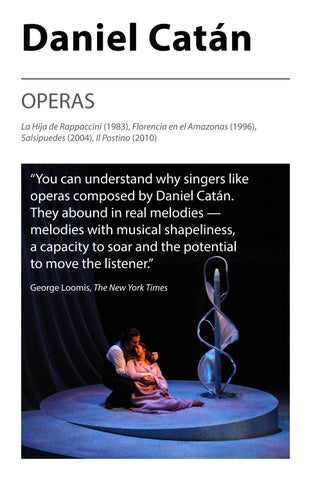
Cover: La Hija de Rappaccini at University of Cincinnati College-Conservatory of Music, photo by Mark Lyons Florencia en el Amazonas at Houston Grand Opera, photo by George Hixon Il Postino at Los Angeles Opera, photo by Robert Millard
Salsipuedes at Houston Grand Opera, photo by Brett Coomer La Hija de Rappaccini at University of Texas at Austin
For more information contact Peggy Monastra peggy.monastra@schirmer.com, 212-254-2100
ORDERING INFORMATION
Rental orders and fee quotations: Zinfonia.com or WiseMusicClassical.com/licensing
Sales materials:
MusicDispatch.com or MusicRoom.com or your music dealer
Publisher and Agency Representation for Wise Music Group: WiseMusicClassical.com/rental
Wise Music Group
USA: G. Schirmer, Inc. Associated Music Publishers, Inc.
UK: Chester Music Novello & Co
France: Première Music Group
Spain: Unión Musical Ediciones
schirmer@schirmer.com
promotion@wisemusic.com
classical.madrid@wisemusic.com
classical.paris@wisemusic.com
Australia: G. Schirmer Pty Ltd
ewh@ewh.dk
Germany: Bosworth Music GmbH
Denmark: Edition Wilhelm Hansen AS Iceland: Wise Music Iceland
inga.weisshappel@wisemusic.com
classical@wisemusic.com
classical.berlin@wisemusic.com
C.F. Peters GmbH & Co. KG
info.de@editionpeters.com
Photo by Elizabeth Beristain
Daniel Catán, whose sudden death in April 2011 shocked the opera world, composed in a lyrical, romantic style that lends itself particularly well to the human voice, which features in the majority of his works. Lush orchestrations reminiscent of Debussy and Strauss along with Latin American instruments and rhythms are regularly heard in his music. His opera Florencia en el Amazonas has the distinction of being the first opera in Spanish commissioned by a major American company. His fourth opera, Il Postino, was commissioned by Los Angeles Opera and featured Plácido Domingo in its premiere. Born in Mexico, Catán studied philosophy at the University of Sussex in England before enrolling in Princeton as a PhD student in composition under the tuition of Milton Babbitt, James Randall, and Benjamin Boretz.