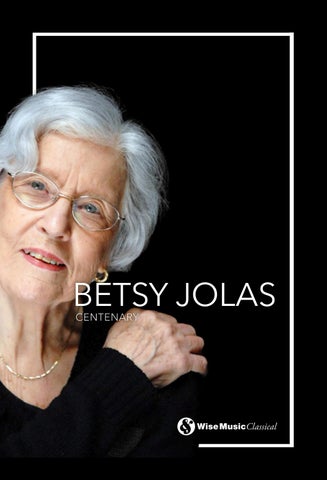
BETSY JOLAS CENTENARY
I N T R O D U CT I O N
BETSY JOLAS
Profile by Simon Rattle
When you start talking to her she talks about when Varèse came to dinner, and when she sung the Verdi Requiem conducted by Toscanini, and it’s like a walking encyclopaedia, but the music is simply wonderful. I’m thrilled in the middle of Poulenc, Ravel and Rameau to introduce a really astonishing lady.
BIOGRAPHY
I’m simply thrilled to have discovered a wonderful composer that I didn’t know about.
K E Y WO R K S K E Y R E CO R D I N G S
3
INTRODUCTION
In 1945, the young Betsy, just 19 years old, received her first commission. She was in the United States, where her family had settled during the war, and continued her musical training at Bennington University. Rocked since childhood by the voice of her mother Maria Jolas, she sang within the « Dessoff choirs » and became enthusiastic about the polyphonic repertoire of the Renaissance, which was included in concert programmes and from which she would draw her substance to write her first score, a mass created and recorded in a surge: she had discovered her vocation. Back in Paris in 1946, she knew that she was not yet a composer but would become one. It was at the cost of serious training at the Conservatoire—where she studied with Simone Plé-Caussade, Darius Milhaud and Olivier Messiaen—and thanks to fortunate opportunities—her « fairy tales », as she modestly calls them—that she managed to establish her position as a « femme-compositeur », according to the term of the time. « Horribly shy » (in Jolas’s words) and isolated in a world of men, she dared to send her flute piece to Olivier Messiaen who, charmed, analysed it in his class and, some time later, offered her the chance to become his assistant. Employed at the Radio, she obtained in 1963, through Serge Collot, violist of the Trio français, a meeting with Pierre Boulez who commissioned a string trio from her for the 1964–65 season of the Domaine Musical. The occasion was ideal for the young composer to enter the circle of the greats…
AU DAC I TY A N D D E T E R M I N AT I O N
It was not a trio that Betsy Jolas wrote but a quartet with voice (Quatuor II for coloratura soprano and string trio). The work brings onto the stage the Trio français and the coloratura Mady Mesplé, who, in a trouser suit, sits in the place of the first violin. Conceived as an instrumental line, the voice, articulated through phonemes « acting most often like bow strokes or tongue strokes », does more than simply enrich the trio: it enchants it. The composer’s career was launched.
T H E VO I C E : C E N T R E A N D A B S E N C E I N T H E J O L A S S I A N C ATA LO G U E
4
I N T R O D U CT I O N
n o ht r a m e D s e u q c aJ © BIOGRAPHY K E Y WO R K S K E Y R E CO R D I N G S
n o ht r a m e D s e u q c aJ ©
Likewise, it often resurfaces in her instrumental music, through titles that reveal her intentions. Un opéra de voyage pour 22 instruments (1967), Onze Lieder (1977) for trumpet and chamber orchestra (a commission from the Ensemble intercontemporain), Frauenliebe, ten lieder for viola and piano (2010), in memory of Schumann, are all scores that shift the voice toward the instruments. « Eight lieder for cello and piano », the composer further subtitles Femme le soir (2018), a music of mood, a wandering that stages two instrumentalist-characters.
kcnarF enit raM ©
In 1976, the American visual artist and friend Joan Mitchell (1925–1992) painted her polyptych Quatuor II for Betsy Jolas, a sublime canvas that transcends the musicality of the brushstroke. A landmark work in Betsy Jolas’s catalogue, Quartet II made her realise the importance of the voice which, with or without text, present or absent from the score, would constantly inform her writing: “The voice is a constant emanation of life, one of the proofs of our existence,” confides the composer, who employs it in all its forms, as a solo, in choral works and within opera (Schliemann, 1993).
5
INTRODUCTION
E M B R AC I N G O N E ’ S I N D E P E N D E N C E A N D D I F F E R E N C E S
« My musical thinking needs, in order to take shape, to refer constantly to a lineage », the composer essentially says. While she enjoyed, in the 1960s, frequenting the milieu of the Domaine musical for the novelty of the works on the programme and the rigor of the performances, and clearly positioned herself on the side of « that music »—a strategic decision rather than an aesthetic choice, she admits candidly—Jolas never « praised amnesia »; quite the contrary, it is from all the riches of the history of music—from Lassus to the Second Viennese School, by way of the Romantic Lied—that she likes to nourish her imagination, without, however, resorting to quotation: « I do not want it to be known how it was made », she hastens to specify. In 1970, Gilbert Amy conducted Lassus Ricercare, a recomposition of fifteen excerpts from Roland de Lassus for ten modern instruments (2 trumpets, 3 trombones, 2 percussionists, harp and 2 pianos), a mosaic work in the style of the Walloon composer—« Lassus guided my hand », she would say—which, at its premiere at the Domaine musical, disconcerted both the audience and the critics.
From Pierrot Lunaire by Schönberg, which she analyses in her class, she retains the idea of Sprechgesang and its jagged lines, often adopted by instrumental profiles (Épisode second – ohne Worte, for flute, 1977). From her discovery—« a very gentle shock »—of the Cinq Pièces op.10 by Webern, heard at the Domaine musical in 1954, perhaps originates her taste for vignettes, even musical aphorisms. Numerous, indeed, will be the short works or those taking the form of a suite of miniatures from 1989 onward, the date of her Quatuor IV in five movements with a duration of three minutes! With period instruments this time, Motet III : Hunc Igitur Terrorem (1999), based on De Rerum by Lucretius, is written for Les Arts Florissants of William Christie and brings together five solo voices, choir and baroque orchestra, which Betsy Jolas subjects to her writing, seeking in line and counterpoint that personal manner through which « she knows how to recognise herself ».
t ell oi V r e g o R ©
WRITING FOR PERFORMERS
I N T R O D U CT I O N
“Betsy Jolas – one of the most extraordinary living composers. She’s lived through everything. She is funny and wise and imaginative and slightly off the wall, and so is her music.”
6
Sir Simon Rattle
BIOGRAPHY
“Since most of my great colleagues have, alas, left this world ... I am today constantly called upon to ‘testify’ on the now historical music movements many of them represent.” Betsy Jolas
K E Y R E CO R D I N G S
Jolas then forges, with the violists Antoine Tamestit and Laurent Camatte, a long-term artistic partnership, entrusting the former with the premiere of her Frauenliebe, and the latter with Ruht Wohl (2010), in memory of Schumann and Bach. Épisode cinquième pour violoncelle (1983) comes from a series of nine solo pieces, a space of exchange between the composer and her performers; it is also the first contact with the cellist Anssi Karttunen, who performs the piece in 1998, and the beginning of an artistic friendship that is realized through two other compositions dedicated to the Finnish artist: the brief A fancy for Anssi (2010), for his fiftieth birthday, and Side roads for cello and orchestra (2017) with the Swedish Chamber Orchestra.
K E Y WO R K S
« This pianist, this violist, my dear performers. Yes, this word rightly expresses the essential part they take in setting my lived experience to music ». These warm words from Betsy Jolas are addressed to the pianist Géraldine Dutroncy and the violist Laurent Camatte, two privileged collaborators who recorded in 2012 a monographic album of the composer. Is it her encounter with Serge Collot in the 1960s that shaped her very sure taste for the viola (she herself played it), which the composer honors in around ten pieces? Masterpiece for solo viola and thirteen wind instruments, Point d’aube is premiered by Serge Collot in 1968, while Trois rencontres, in 1978, seals the reunion of the Trio français (already mentioned) with the Orchestre Philharmonique de Strasbourg.
INTRODUCTION
7
B E T SY J O L A S ’ C E N T E N A RY
Her collaboration with Nicolas Hodges is later but no less fruitful, the British artist having just recorded for bastille musique (2025) the complete works of her solo piano music. For him, she wrote in 2018 Toi x 3 and composed her second Piano Concerto B Tunes (2021), a commission from the London Proms and the BBC Symphony Orchestra.
duahciM dnanreF ©
Loving and grateful, Betsy Jolas, like György Kurtág, addresses birthday messages/greetings to her colleagues and pays tribute to her departed performers/friends: Postlude - Hommage à Claude Helffer, who died in 2004 and had premiered Stances, her piano concerto in 1978 under the direction of Marius Constant; Un post-it pour Henri (Henri Dutilleux, her « big brother ») for two cellos (2015); Calling E.C. – Hommage à Elliott Carter (1982) for his 75th birthday; Ravery pour Pierre en ce jour, celebrating Boulez’s 90th birthday...
nipasuD lacsaP ©
A N OT H E R “ FA I RY TA L E ”
Ces
belles années, for soprano and orchestra, co-commissioned by the LSO and the Aix-en-Provence Festival, was added in 2022 to the composer’s catalogue, after Latest (Dernière), the orchestral work with which the composer seemed to want to crown her career…
Text by Michele Tosi, musicologist and writer (2026)
BIOGRAPHY
This was without taking into account the gift from her grandchildren, who offered her, on the occasion of her 90th birthday, enough music manuscript paper for ten years… It is to be hoped that the supply is not yet exhausted and encourages our centenarian to continue without respite the great work of her life.
I N T R O D U CT I O N
The chance encounter with conductor Simon Rattle in 2015, during a London dinner to which Betsy Jolas had been invited, is the magic stroke that boosts, at 90 years old, the international career of the composer: « A few days later, I received an email from the conductor of the “Berliner” apologizing for not having known my music earlier and inviting me to write a piece for June 2016 », Jolas recounts. It is three prestigious concerts at the Berlin Philharmonie that honor this great lady for her 90th birthday and present, alongside Varèse, Debussy, Franck and Grainger, her Little summer suite for orchestra and Ruht Wohl, where Simon Rattle himself sits at the piano! Several commissions would then come from the British conductor after he took the helm of the London Symphony Orchestra.
8
K E Y WO R K S K E Y R E CO R D I N G S
leda R naeJ ©
9
BIOGRAPHY
t o ni t r a M y r r ei h T ©
The Franco-American composer Betsy Jolas born in Paris in 1926. She began her training in the United States, before returning to France to study with Darius Milhaud, Simone Plé-Caussade and Olivier Messiaen at the Paris Conservatory. From 1971 to 1974, she replaced Messiaen at this institution, where she was appointed professor of analysis in 1975 and of composition in 1978. She also taught at several American universities, including Yale, Harvard and Berkeley.
In 2016, Sir Simon Rattle and the Berlin Philharmonic premiered A Little Summer Suite. In 2019, Letters from Bachville received it’s world premiere by the Leipzig Gewandhaus Orchestra conducted by Andris Nelsons. The 2022-2033 season saw the premiere of The Latest by the Orchestre de Paris, conducted by Klaus Mäkelä and Ces belles années... by the London Symphony Orchestra, conducted by Sir Simon Rattle. Her award-winning discography can be heard on the EMI, Adès, Erato, Barclay and CRI labels.
t ell oi V r e g o R ©
Winner of the Besançon International Conducting Competition in 1953, she has received numerous awards, including from the Copley Foundation in Chicago (1954), the American Academy of Arts (1973) and the Koussevitzky Foundation (1974), not to mention the Grand Prix de la Ville de Paris (1981) and the Grand Prix de la SACEM (1982).
10
I N T R O D U CT I O N BIOGRAPHY
K E Y WO R K S
K E Y R E CO R D I N G S
sl u o s s a B ei h p o S ©
B E T SY J O L A S ’ C E N T E N A RY
Latest
I N T R O D U CT I O N
KEY WORKS
11
(2021) 15 MINS
Commissioned by Orchestre de Paris, Bayerischer Rundfunk, San Francisco Symphony and Royal Concertgebouw Orchestra 3(III:afl,pic).3(III:ca).3(III:bcl).3/4.3.3.1/timp.4perc/pf.hp/str
Latest is a striking testament to Betsy Jolas’s eternal creative youth. At nearly a century old,
BIOGRAPHY
Jolas delivers an orchestral score of astonishing vitality, proving that her “latest” work is never a conclusion, but a new threshold of discovery. Far from being a nostalgic retrospective, the piece functions as a musical “cabinet of curiosities,” where a century of experience is distilled into a sonic kaleidoscope. The work unfolds with a theatrical flair, characterized by a constant flow of energy, alternating between high-speed percussion, elegiac murmurs, and orchestral explosions. Jolas weaves subtle echoes of the past, from Ravelian sparkles to Mahlerian distance, into her own singular language. Latest is a celebration of musical freedom: the score features “free zones” where musicians respond to the conductor’s hand signals, creating a living, breathing dialogue. The piece culminates in a striking vocal “tutti” exclamation, a witty final flourish from a composer who continues to look toward the future with curiosity and a playful sense of wonder.
“These are, set to music, a few recent reflections on how I perceive this world, which rushes by without waiting for me, yet which I still observe from the vantage point of all these years, to the tune of my memories”
Well Met Suite
K E Y WO R K S
Betsy Jolas, 2022
(2016) 10 MINS
Premiered at the Monte-Carlo Spring Arts Festival in 2006. (4.3.2.2.1)
This new version was premiered on 15 July 2016 at the Rencontres Musicales de SaintCézaire by the Calliopée ensemble.
K E Y R E CO R D I N G S
Derived from her earlier pantomime Well Met 04, this suite for twelve strings translates the theatrical atmosphere of a concert rehearsal into a purely musical form. The title Well Met refers to the musicians' search for common ground as they "build" a work together. Jolas selects four movements that distil the humorous and intimate "ways of being" of performers, from individual tuning to collective dialogue, into a sophisticated "old-fashioned" suite. By focusing on the most musically developed sections, she captures the essence of instrumental collaboration without the need for literal stage action.
12
ORCHESTRA
A Little Summer Suite (2015) 11 MINS
Commissioned by Berliner Philharmoniker 3(afl, pic).3(ca).3(bcl).3(cbn)/4.3.3.1/timp.4perc/hp.pf/str(16.14.12.10.8)
Commissioned to celebrate her 90th birthday, A Little Summer Suite is a vibrant exploration of what Betsy Jolas calls "wandering music." The work is structured as a continuous sequence of seven short movements, directly inspired by the "promenade" concept of Mussorgsky’s Pictures at an Exhibition. Jolas invites the listener on a "journey for the ear," where the music seems to drift aimlessly, landing unexpectedly in different sonic landscapes. The suite is anchored by four "strolls"—designated as away, about, under, and home—which act as a mysterious, sinuous thread connecting three vivid, stable tableaux. These stationary moments showcase Jolas’s playful mastery of orchestral color: the rhythmic precision of Knocks and clocks, the shimmering energy of Shakes and quakes, and the celebratory spirit of Chants and cheers. Written specifically with the virtuosity of the Berlin musicians in mind, the score is filled with delicately carved solos and inventive percussion. It is a work of whimsical freshness and "smiling" intimacy, reflecting a composer who views the orchestra as a theater of perpetual discovery.
“[A Little Summer Suite] tickled the ears right from the opening twists of the rainstick…. Jolas moves between gestures and textures with the nimblest of touches and an uplifting delights in instrumental colours.” Geoff Brown, The Times, 19th February 2019
“Jolas’s ten-minute marvel showed how music can be charming without being ingratiating.” Ivan Hewett, Telegraph, 18th February 2019
I've been toying lately, in much of my work, with the notion of "wandering music"; in other words, music which seems aimless and could land anywhere at any time. Betsy Jolas, 2016
ORCHESTRA
13
I N T R O D U CT I O N BIOGRAPHY K E Y WO R K S K E Y R E CO R D I N G S
© Betsy Jolas - A Little Summer Suite, Edition Alphonse Leduc - Paris
14
ORCHESTRA
B-Day for Symphony Orchestra (2006) 14 MINS
Commissioned by the Boston Modern Orchestra Project 2.2.2.2/2.0.2.2/timp.2perc/pf/str(12.10.8.6.4)
Commissioned for her 80th birthday, B-Day is a playful orchestral fantasy built on a series of "strange variations" of the Happy Birthday melody. Jolas treats the famous theme as a musical guest, allowing it to weave through the orchestra in various guises, sometimes hidden in rhythmic fragments, other times appearing with humorous clarity. The celebration reaches its peak with a surprise theatrical finale: the entry of a soprano voice, or "Messenger Angel," who calls the ensemble to join the festivities. It is a witty, vibrant tribute to the joy of creative longevity.
Tales of a Summer Sea for Orchestra (1977) 16 MINS
Commissioned by the Fromm Foundation 3(pic).1+ca.3.3(cbn)/4.3.3.1/timp.2perc/pf.cel/str(14.12.10.8.8)
Tales of a Summer Sea is a continuous, sixteen-minute orchestral seascape inspired by the
atmosphere of Shakespeare’s The Tempest. The work originated from incidental music Jolas composed in 1962 for a television production, which she later reimagined and significantly expanded for a full symphonic orchestra. The score is structured as a seamless series of "wave trains", successive sonic sequences that flow without a single moment of silence, mimicking the perpetual motion of the ocean. To achieve this fluid architecture, Jolas employs "pivot notes" that act as transitional platforms between each orchestral swell. This approach is deeply rooted in the legacy of Claude Debussy, particularly La Mer; Jolas has long been fascinated by the "apparent lack of structural framework" in Debussy’s work, favoring instead a profound study of movement. The composer describes the piece as a "sea in the mind," aimed at making the maritime element omnipresent through sensory evocation rather than literal imitation. By transforming her original dramatic materials into an immersive, organic form, Jolas creates a work that balances Shakespearean mystery with a masterful exploration of orchestral fluidity.
“The descriptive title of this work, which clearly designates the source of my inspiration, should make further comments unnecessary. I only hope it will help listeners of my music to recall their own recollections of a rather stormy sea” Betsy Jolas, 2022
SOLOIST AND ORCHESTRA
15
Side Roads
I N T R O D U CT I O N
(2017) 17 MINS
Commissioned by the Swedish Chamber Orchestra Cello & Strings Orchestra
The origins of Side Roads date back to a ‘reverse birthday present’, when Betsy Jolas showed her initial sketches to cellist Anssi Karttunen during the celebrations for his 90th birthday. Commissioned jointly by the Swedish Chamber Orchestra and the Orchestre d’Auvergne, the work was initially conceived as a movement of a triptych. However, over the ten months of the creative process, the piece “grew longer and longer”, eventually becoming a large-scale, self-contained concerto lasting nearly twenty minutes.
BIOGRAPHY
The title serves as a metaphor for Jolas’s artistic independence; she avoids the ‘main road’ of rigid musical trends to roam freely through history. The score harmoniously blends advanced modern instrumental techniques with echoes of masters such as Bach and Lassus. Characterised by a “luxury of restraint”, the work reflects Jolas’s unique voice, which is both witty and profound. Whether performed as part of its original cycle or as a standalone piece, Side Roads showcases a composer who moves effortlessly between styles, creating a deeply human dialogue through shifting string textures.
“Side Roads is a uniquely original piece which could not have been written without a knowledge and experience of all currents from the 16th to 21st century.” Anssi Karttunen, 2017 K E Y WO R K S
Histoires Vraies (2015) 21 MINS
Commissioned by the Festival Printemps des Arts de Monte-Carlo 2(picc,afl).2(ca).2(bcl).2(cbn)/2.2.2.1/timp.3perc/hp.pf/str(12.10.8.6.6) Soloists : Trumpet ; Piano
Incorporating stylized daily noises, like a false tuning session or a slamming piano lid, into a series of rhythmic snapshots. Rather than a linear story, the suite functions as a musical scavenger hunt where instrumental virtuosity meets unpredictable mechanical structures. This approach balances poetic episodes with the raw, "disturbing potential" of the composer's sonic environment.
K E Y R E CO R D I N G S
Commissioned for her 90th anniversary, Histoires vraies is a concertante suite designed to bring together two legendary soloists: trumpeter Håkan Hardenberger and pianist Roger Muraro. The work is built on a series of concentrated, poetic episodes where the soloists shift between independent roles and merging into the orchestral texture. Jolas conceives the piece as a role-playing game: the piano often adopts a fanfare style to coax the trumpet away from its peaceful melodic lines and into a more idiomatic, rhythmic dialogue.
16
SOLOIST AND ORCHESTRA
Stances (1978) 22 MINS
Commissioned by Radio-France 3(pic).2.2+bcl.2+cbn/4.2.2.1/3perc.snare drum/hp.pf.cel/str(14.12.10.8.6.) Soloists : Piano
During a stay at Tanglewood, Betsy Jolas conceived the idea that formed the basis for Stances, a piano concerto structured in three closely interlinked movements and premiered in Paris by the pianist Claude Helffer. The work revolves around a main theme based on the note G, a pitch that has since become the central reference point for all of Jolas’s keyboard compositions. Throughout the piece, the relationship between the soloist and the orchestra is constantly evolving, with the piano alternating between the role of an imposing leader and that of a discreet observer. The score is woven with ‘ghostly reminiscences’ of the piano masterpieces Jolas loved in his youth. During the transition to the second movement, one can recognise traces of Chopin’s Étude Op. 25, No. 1, or a dreamlike reference to the ‘Raindrop’ Prelude. After a period of musical disintegration in which the main theme seems ‘underwater’, the work culminates in a dramatic recitativo accompagnato, featuring a close and intense dialogue between the piano and the orchestra.
Onze Lieder (1977) 15 MINS
Commissioned by the Ensemble intercontemporain 2.2.3(bcl).2/2.1.2.1/3perc/hp.pf/str(3.0.2.2.1.) Soloists : Trumpet
Commissioned by the then newly founded Ensemble intercontemporain, Onze Lieder (Eleven Songs) is a sophisticated ‘bilingual’ work for trumpet and chamber orchestra, presented as a cycle of wordless songs. Structured as an introduction followed by eleven short movements, the piece showcases the trumpet as a vocal soloist, demanding a wide expressive range — ranging from ‘jerky’ pedal notes and gasping funeral chants to moments of tender lyricism with jazz-like accents. The work is acclaimed for its playful and sparkling orchestration, showcasing a range of tuned and untuned percussion. Jolas utilises the full technical arsenal of the trumpet, frequently employing various mutes and registers to create unexpected sounds. Despite its modernist complexity, the score retains a playful spirit, blending virtuosity with a ‘gently melodic’ character that reflects Jolas’s refusal to break with the lyrical traditions of the past.
17
I N T R O D U CT I O N BIOGRAPHY
K E Y WO R K S
K E Y R E CO R D I N G S
t o ni t r a M y r r ei h T ©
18
LARGE ENSEMBLE
Fredons (2013) 8 MINS 0.0.0.tsx.0/0.0.0.0/perc/hp.pf/str(1.0.1.1.0) Soloists : Soprano
Composed and premiered in 2015 to celebrate the tenth anniversary of Ensemble Utopik in Nantes, Fredons is a work deeply rooted in the composer's early childhood memories. The score is built around a dramatic song from the Louisiana Bayous, which Betsy Jolas learned from her mother, Maria Jolas. In this ensemble work with voice, fragments of French and English folk songs intertwine with tenderness to accompany the central Louisiana melody. The title suggests a quiet, intimate, and fragmented humming (fredonner), where sonic memory serves as the foundation for a refined exploration of both instrumental and vocal textures.
Wanderlied (2003) 12 MINS afl.ca.1+bcl.1/1.1.1.0/perc/pf/string quintet. Soloists : Cello
Composed for cellist Sonia Wieder-Atherton and the Nouvel Ensemble Moderne, Wanderlied is a ‘song without words’ for solo cello and fifteen instruments. The title is taken from Wanderpoem, a work written in 1943 by the composer’s father, Eugène Jolas. The piece follows a continuous, linear trajectory, a “grand composed crescendo”, moving from an initial lyricism to a violent final explosion. Betsy Jolas invites the listener to imagine the cello as a “timeless storyteller” wandering through her life. As she expresses herself through her instrument “ohne Worte, ma molto espressivo”, the ensemble surrounding her represents the crowd gathering around her: “some who love her and others who do not,” as Jolas puts it. The music captures an inner monologue steeped in nostalgia, anxiety and “wild impulses”, often struggling against the dark, oppressive tones of a wind-dominated orchestration before reaching its dramatic conclusion.
SOLOIST AND LARGE ENSEMBLE
(1970) 10 MINS 0.0.0.0/0.2.3.0/2perc/hp.pf.pf[=cel]
Composed in 1970 and dedicated to Paul Boepple, this work is a tribute to Renaissance polyphony. It draws its inspiration from Betsy Jolas’s ‘encounter’ with the music of Orlando di Lassus in 1941, whilst she was a chorister with the Dessoff Choir in New York. The score was premiered in February 1971 in Paris by the Domaine Musical under the baton of Pierre Boulez.
BIOGRAPHY
The work is described as a process of ‘decomposition’ and ‘recomposition’, in which Jolas asserts that no note is foreign to Lassus. It employs an instrumental ensemble comprising brass, percussion and two pianos (one doubling as a celesta) positioned on either side of the stage. Described as a ‘diamond-like’ score with clockwork precision, it transforms Lassus’s triads into purely colouristic material. Although criticised by the French avant-garde at the time of its premiere, the work was immediately supported by her teacher, Olivier Messiaen.
I N T R O D U CT I O N
Lassus Ricercare
19
“Lassus Ricercare [...] is both solemn and joyous, music of splendour and ravishing sounds and harmony, teeming with imagination. Not every group can run to two pianos and pianists, but if programming Carmina Burana and/or Symphony of Psalms, then Lassus Ricercare would be a brilliant opener. Extraordinary that such compelling music has taken forty-six years to reach the UK.” K E Y WO R K S
Colin Anderson, The Classical Source, 2016
K E Y R E CO R D I N G S
20
I N T R O D U CT I O N BIOGRAPHY
K E Y WO R K S
K E Y R E CO R D I N G S
a r a m r a M e h p o t s i r h C- n a e J ©
21
SMALL ENSEMBLE
Quatuor VIII à cordes "Topeng" (2019) 15 MINS
Commissioned by Philharmonie de Paris, Proquartet, Southbank Centre London, Berliner Philharmoniker 2vn.va.vc
Quartuor VIII à cordes ‘Topeng’ was premiered in January 2020 by the Arditti Quartet. This work is a musical evocation of a formative journey to Bali that Jolas undertook nearly half a century earlier in the company of the composers Iannis Xenakis and Tōru Takemitsu.
The title refers to Topeng, a form of Balinese musical theatre in which a single actor embodies several legendary characters through rapid changes of masks, traditionally accompanied by a ‘frenzied gamelan’. Whilst this experience had already inspired his 1973 piano work, B for Sonata, Jolas notes that the memory of these dramas has since lost some of its intensity. In this eighth quartet, the Balinese influence is filtered through time, appearing rather ‘as if in a dream’.
Quatuor VII (Afterthoughts) (2018) 10 MINS
Commissioned by Musik i Syd for the festival Malmö Chamber Music tpt/vn.va.vc
Quartet VII ‘Afterthoughts’, premiered in 2018, was written especially for the Swedish virtuoso
Håkan Hardenberger. Written for trumpet, violin, viola and cello, the work is characterised by the composer’s quest for balance between the instruments, a process that required careful consideration of how to manage the trumpet’s naturally dominant ‘personality’ within a string trio. This creative ‘afterthought’ directly inspired the title. The resulting score is both atmospheric and theatrical. It transforms the musical narrative through the use of unconventional sounds, such as foot-stomping, tongue-clicking and the scraping of fingernails on the trumpet bell, creating a whimsical dialogue in which brass and strings strike a delicate, modern balance.
SMALL ENSEMBLE
(1994) 23 MINS String Quartet
I N T R O D U CT I O N
Quatuor V
22
Premiered in 1995 at the Amphithéâtre de l'Opéra Bastille by the Arpeggione Quartet, Quatuor V is a deeply reflective work that Jolas describes as an "adventure" rooted in both her own musical lineage and the broader History of Music. Structured as a series of nine short, fragmented movements woven together by common thematic elements, the piece functions as an exploration of continuity, drawing inspiration from forgotten genres such as the toccata and choral variations. The first movement acts as a "table of contents" for the entire work, introducing ideas that range from a five-note cello row used as a cantus firmus to the repeated dotted rhythms reminiscent of Beethoven’s Kreutzer Sonata. BIOGRAPHY
Throughout the composition, Jolas engages with the physical and historical memory of string music. She cites the "incredible energy" and wide register of Beethoven’s Grosse Fuge as a conceptual influence, alongside the "scraping" bow sounds and hoarse qualities of open strings. These elements are combined with baroque-inspired running sixteenth notes, which are intentionally "unsettled" and transformed through a process Jolas compares to becoming "mouldy or worm-eaten," allowing her initial ideas to ripen into their final, complex form.
"I had known from the start that this quartet would be fragmented in numerous (ultimately nine!) rather short movements through which I would weave common thematic elements... some of which, as in this quartet, refer to long forgotten genres such as toccata or choral variations." K E Y WO R K S
Betsy Jolas, 2022
Quatuor IV - Menus Propos (1988) 2 MINS String Quartet
K E Y R E CO R D I N G S
Composed in 1989, Quatuor IV "Menus Propos" is a miniature of extreme concision, spanning five movements in barely three minutes. This "little quartet" marks Jolas's return to multi-movement structures and explores the internal relationship between brief musical sections, reminiscent of the Webernian aphorism. To achieve this compressed form, Jolas focused on self-sufficient musical ideas, ensuring each movement consisted of a single, complete, and independent phrase.
23
SMALL ENSEMBLE
Quatuor III (1973) 17 MINS
Commissioned by Kindler Foundation of Washington String Quartet
Quatuor III was completed in September 1973 and premiered in January 1974 by the
Concord Quartet. Following her second quartet, which featured a coloratura soprano, Jolas returned here to the traditional string quartet formation to explore the "mysterious universe" of contemporary string techniques. The work is structured as nine distinct studies, each dedicated, following the example of Debussy, to a specific technical challenge such as pizzicato, vibrato, harmonics, or multiple strings. While focused on modern formal play, the piece remains rooted in musical history; notably, Study No. 7 is built upon the principle of Henry Purcell’s famous Fantasia upon one note.
Quatuor II (1964) 15 MINS Violin, viola and cello Soloists : Soprano
Considered a pivotal work in Betsy Jolas’s career, Quatuor II was premiered in 1966 at the Domaine Musical by coloratura soprano Mady Mesplé and the Trio à cordes français. Conceived as a "quartet with voice," the work treats the singer not as a soloist but as an instrumental equal, physically occupying the seat of the first violin. To avoid "superprinting" literal meaning onto the music, Jolas replaces traditional text with a flexible set of phonemes that act as vocal equivalents to instrumental bowings and tonguings. The fifteen-minute work unfolds in a single movement described as "both concentrated and airy, expressive, and never artificial." The score is famously demanding, featuring "near impossible" passages and unmetered sections that require the ensemble to breathe and pace themselves in total synchronization. This wordless, lyrical journey remains abstract until the very final note, when the singer pronounces the only intelligible word: "point" (period), to signal the end. The profound musicality of the piece famously inspired the American painter Joan Mitchell to dedicate a monumental polyptych to the composer in 1976. This artistic tribute reflects the "feeling of nature" and the luxurious vocal quality inherent in the score, bridging the gap between abstract expressionism and Jolas’s intuitive musical gestures. Today, the work stands as a testament to the composer's desire to push the boundaries of vocal technique while maintaining a deeply rooted sense of lyricism and historical lineage.
24
I N T R O D U CT I O N BIOGRAPHY
K E Y WO R K S
K E Y R E CO R D I N G S
cennapuoC kcinnaY ©
I N T R O D U CT I O N
KEY RECORDINGS
25 6 B E T SY J O L A S ’ C E N T E N A RY
BIOGRAPHY
K E Y WO R K S
K E Y R E CO R D I N G S
For more information visit our website or contact your local Wise Music Classical office
LONDON Chester Music Ltd - Novello & Co Ltd - Edition Peters 14–15 Berners Street, London W1T 3LJ promotion@wisemusic.com
NEW YORK G. Schirmer, Inc. &Associeted Music Publisher, Inc. 180 Madison Avenue, 24th Floor, New York, NY 10016 schirmer@schirmer.com
BETSY JOLAS COPENHAGEN Edition Wilhem Hansen AS Bornholmsgade 1A, 1266 Copenhagen K, Denmark ewh@ewh.dk
PARIS Wise Music Classical Paris 10, rue de la Grange-Batelière, 75009 Paris, France classical.paris@wisemusic.com
BERLIN Wise Music Classical Berlin Dorotheenstr. 3, 10117 Berlin, Germany classical.berlin@wisemusic.com
MADRID Unión Musical Ediciones C\Marques de la Ensenada 4, 28004 Madrid, Spain classical.madrid@wisemusic.com
SYDNEY G. Schirmer Pty Ltd 4th Floor, Lisgar House, 30–32 Carrington Street classical@wisemusic.com
LEIPZIG
C.F. Peters GmbH & Co. KG Talstraße 10, D 04103 Leipzig classical@wisemusic.com
wisemusicclassical.com © 2026 Wise Music Group