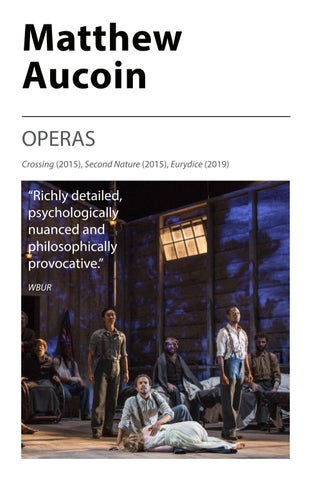
Matthew Aucoin OPERAS Crossing (2015), Second Nature (2015), Eurydice (2019)
“Richly detailed, psychologically nuanced and philosophically provocative.” WBUR
Eurydice An opera in three acts (2019) Libretto by Sarah Ruhl based on her play Duration: 2 hours 5 minutes Premiere: February 2020, Los Angeles Opera
“The sheer scale of Aucoin’s music is luxurious...” Zachary Woolfe, The New York Times
cast
EURYDICE: Soprano ORPHEUS: Baritone ORPHEUS’ DOUBLE: Countertenor FATHER: Bass-Baritone HADES: High Tenor LITTLE STONE: Soprano BIG STONE: Mezzo-Soprano or Contralto LOUD STONE: Tenor SATB chorus (with solo Soprano)
orchestra
3(2pic,afl).2.2+bcl(cbcl).2(cbn)/4.3(pictpt).2+btbn.1/timp.5perc/2hp.pf/str
reduced orchestration
commissioned by Boston Lyric Opera and Opera Grand Rapids for March 2024 premiere
synopsis
Eurydice reconceives the myth of Orpheus and Eurydice, telling the story from the heroine’s perspective. We follow Eurydice into the underworld, where she first passes through the River of Forgetfulness, then encounters her deceased father. By the time Orpheus comes to find her, Eurydice has become a different person and is not sure she wants to return to life.
recording
The Metropolitan Opera recording is available on Apple Music.
press
“Rather than pushing forward or inducing a hypnotic trance, the music of individual scenes feels swirling and circular, inviting the listener to sit with the feelings as the characters uncover them, and each scene has its own distinctive tone.” — Heidi Waleson, The Wall Street Journal “Where the opera really begins is the second scene, in the underworld (you get there by elevator). Eurydice’s father is writing her a letter, giving us a glimpse at a peculiar setting, familiar and not. Here Aucoin, as though fishing in the same Rhine as Wagner did, creates a sense of wonderment and mystification.” — Mark Swed, Los Angeles Times
composer note
The myth of Orpheus and Eurydice continues to resonate because of its brutally honest admixture of hope and despair. Music can conquer death itself — of course it can — but not for us, not for human beings. We aren’t worthy of it. We’ll always find a way to screw things up. In past pieces, I’ve explored the myth’s darker implications, the way that Orpheus seems to prefer singing elegies for Eurydice to actually living with her. But for a full-length opera, I realized that I didn’t want to wallow in Orpheus’s narcissism all evening. I wanted a fresh perspective on this most inescapable of stories.
Sarah Ruhl’s play Eurydice, which turns the myth on its head and invents a rich inner world for its heroine, provided that fresh perspective. Her work goes where no telling of the story has ever gone: we follow Eurydice into the underworld, where she loses her memory and reverts to a childlike tabula rasa state. Sarah’s work is disarming in its emotional transparency, and she helped me strive for a similar quality in my music. The opera that resulted is a meditation on memory, loss, and love (especially love: I started writing it the week I met my now-husband, and I know that the experience of being in love found its way into the piece’s music).
In the world of Eurydice, all human experiences are ultimately washed away by the River of Forgetfulness. But their ephemerality might be precisely what makes them precious. — Matthew Aucoin
Crossing An opera in two acts (2015)
“... admirable, uplifting and downright heart-rending...” James Jorden, Observer.com Libretto by the composer Duration: 1 hour 40 minutes Premiere: May 2015, American Repertory Theater and Music Theatre Group, Boston, MA
cast
WALT WHITMAN: Baritone JOHN WORMLEY: Tenor FREDDIE STOWERS: Bass-baritone A MESSENGER: Soprano ENSEMBLE OF SOLDIERS: 6 Tenors, 6 Basses
orchestra
2111/2110/3perc/pf/str
synopsis
Crossing is an operatic fantasia based on Walt Whitman’s experiences as a volunteer nurse during the American Civil War. The opera delves into Whitman’s psyche, exploring what might have led a middle-aged New Yorker to drop everything and work in brutal conditions for years on end. Was it pure generosity, pure selflessness? Or did Whitman feel some need to escape his own life — or to know himself better by putting himself through a Danteesque challenge?
Once in the hospital, Whitman strikes up a friendship with a volatile young soldier named John Wormley. As the war drags on, their relationship grows deeper and more complicated: Whitman never could have expected either the love or the betrayals that await him.
press
“... a true ensemble piece. The superb 11-voice male chorus functions both as clearly defined individual soldiers and as the collective, which is reflected in the writing: at times contrapuntal, at times a mass of individual notes, at times in perfect harmony.” — Gina Leishman, Financial Times “The music grabbed me from the start.” — Anthony Tommasini, The New York Times
composer note
What is it, then, between us?” With this resonant question at the climax of “Crossing Brooklyn Ferry,” Whitman asks many things at once: what is his relationship to his contemporaries, his fellow men and women? What is his relationship to you, the reader, whoever you may be, whenever and wherever you may be reading his poem? And what is the relationship between the contradictory elements of his own self? The phrase “between us” itself has a double meaning: what is the relationship between us, and what stands between us, keeping us apart?
In the moment that Whitman asks this question, he is in a state of unknowing: he wants to know, and needs to know. Crossing emerges out of my sense that Whitman wrote his poetry out of need — that his poetry is not, or is not exclusively, a vigorous assertion of what he is, but rather the expression of a yearning to be what he is not, or to reconcile opposing aspects of his identity. The person/persona/personality “Walt Whitman, an American, one of the roughs” is the living product of this need.
So, in Crossing, the Walt Whitman who walks the stage is not that familiar poetic persona. Rather, this is Whitman as I imagine he might have been to himself, starting from a midlife crisis which prompts his radical, heroic decision to drop everything and volunteer in war hospitals. Naturally, this Whitman is a fictional creation. Crossing is a musical fantasia which imagines and realizes the many forces — generosity, insecurity, longing, selflessness, bravery, unfulfilled sexual desire, a need to escape his own life, a boundless kindness — that caused a man named Walter Whitman, Jr. to forge an indelible embodiment of the American spirit in his poetry. — Matthew Aucoin
Second Nature A chamber opera (2015) Libretto by the composer Duration: 1 hour Premiere: August 2015, Lyric Opera of Chicago, Lincoln Park Zoo, Chicago, IL
cast
LYDIA: Mezzo-soprano JAKE: Tenor ELDER CONSTANCE: Mezzo-soprano ELIZABETH: Soprano DAVID: Baritone* BONOBO: Baritone* *doubling
ensemble
violin, clarinet, piano
synopsis
Set in a fictional future when humans have retreated from nature because of the deteriorating environment, Second Nature tells the story of two inquisitive and courageous youths who decide to leave the safety of their artificial habitat and work to heal the planet.
press
“Second Nature was my first encounter with his freely tonal musical idiom, and I found the score absorbing and inventive.… Children’s operas that adults can enjoy just as much as their kids are rare enough these days. Aucoin’s entertaining yet thoughtful environmental parable deserves to make the rounds.” — John von Rhein, Chicago Tribune “...Aucoin uses rhyming couplets to put the opera’s subversive message across. In a neat Gnostic reversal of the Garden of Eden story, a bite of this apple tastes like freedom.” — Charles Donelan, Santa Barbara Independent “The score is luscious, particularly the kids’ duo ‘The sun finds me again’ and a Mozartean vocal quintet that concludes the opera, ‘Don’t let me turn my face.’ ” — Daniel Kepl, Voice Magazine “...the music is beautiful, lush and enveloping as they taste of the real fruit. The score calls for violin, clarinet and piano, easy to fit into a smaller venue or to record in our latest pandemic requirements. In spite of this small group, Aucoin has created lush orchestra sounds and provocative colors. Sets and props requirements are minimum. However, the juicier the fruit the Bonobo offers, the better!” — LeAnn L. Overton, National Opera Association
Photo by Steven Laxton
Matthew Aucoin, a 2018 MacArthur Fellow, is an American composer, conductor, pianist, and writer. His oeuvre as a composer extends from solo piano to chamber and orchestral music to opera. Aucoin’s first opera, Crossing, premiered at the American Repertory Theater in May 2015 and had its New York premiere at BAM in October 2017. Second Nature, a one-act eco-opera for young people — commissioned by the Lyric Opera of Chicago — soon followed with a premiere in August 2015. From 2016 to 2020, Aucoin served as Artistin-Residence at Los Angeles Opera as both composer and conductor. Eurydice, a collaboration with the playright Sarah Ruhl, was a co-commission by the Los Angeles Opera and the Metropolitan Opera. It premiered February 2020 in Los Angeles and November 2021 in New York. He is a co-founder of the American Modern Opera Company (AMOC). photos
Cover: Crossing at American Repertory Theater, photo by Gretjen Helene Photography Eurydice at Los Angeles Opera, photo by Cory Weaver
Crossing at American Repertory Theater, photo by Gretjen Helene Photography Second Nature at Chicago Lyric Opera, photo by Todd Rosenberg
For more information contact Peggy Monastra peggy.monastra@schirmer.com, 212-254-2100
ORDERING INFORMATION
Rental orders and fee quotations: Zinfonia.com or WiseMusicClassical.com/licensing
Sales materials:
MusicDispatch.com or MusicRoom.com or your music dealer
Publisher and Agency Representation for Wise Music Group: WiseMusicClassical.com/rental
Wise Music Group
USA: G. Schirmer, Inc. Associated Music Publishers, Inc.
UK: Chester Music Novello & Co
France: Première Music Group
Spain: Unión Musical Ediciones
schirmer@schirmer.com
promotion@wisemusic.com
classical.madrid@wisemusic.com
classical.paris@wisemusic.com
Australia: G. Schirmer Pty Ltd
ewh@ewh.dk
Germany: Bosworth Music GmbH
Denmark: Edition Wilhelm Hansen AS Iceland: Wise Music Iceland
inga.weisshappel@wisemusic.com
classical@wisemusic.com
classical.berlin@wisemusic.com
C.F. Peters GmbH & Co. KG
info.de@editionpeters.com