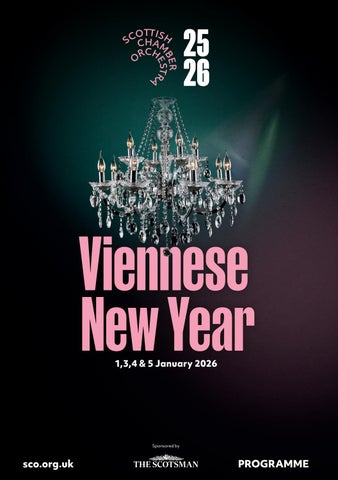
Viennese New Year 1,3,4 & 5 January 2026
Sponsored by
sco.org.uk
PROGRAMME
25/26 Concert Season
Cover image © Marco Borggreve
Viennese New Year Thursday 1 January, 3pm Usher Hall, Edinburgh Saturday 3 January, 3pm Aberdeen Music Hall Sunday 4 January, 3pm Perth Concert Hall Monday 5 January, 7.30pm Ayr Town Hall
Sponsored by
Collection in aid of
The Ayr concert is subsidised by Destination South Ayrshire and Ayr Arts Guild.
JOHANN STRAUSS II Tales from the Vienna Woods SCHUBERT Three Songs JOSEF STRAUSS Scottish Dance SIECZYNSKI Wien, Wien, nur du allein LEHÁR Gold and Silver Waltz Interval of 20 minutes
JOHANN STRAUSS II Overture, Die Fledermaus R STRAUSS Morgen! JOHANN STRAUSS II Three Polkas LEHÁR Meine Lippen, sie küssen so heiss (from Giuditta) JOHANN STRAUSS II Blue Danube Waltz Andrew Manze conductor Rachel Redmond soprano Rachel Redmond
© Chris Christodoulou
Andrew Manze
4 Royal Terrace, Edinburgh EH7 5AB +44 (0)131 557 6800 | info@sco.org.uk | sco.org.uk
The Scottish Chamber Orchestra is a charity registered in Scotland No. SC015039. Company registration No. SC075079.
3
THANK YOU
Principal Conductor's Circle Our Principal Conductor’s Circle are a special part of our musical family. Their commitment and generosity benefit us all – musicians, audiences and creative learning participants alike. Annual Fund James and Patricia Cook
American Development Fund Erik Lars Hansen and Vanessa C L Chang
Visiting Artists Fund Harry and Carol Nimmo Anne and Matthew Richards
Productions Fund Anne, Tom and Natalie Usher Bill and Celia Carman
International Touring Fund Gavin and Kate Gemmell
Scottish Touring Fund Eriadne and George Mackintosh Claire and Anthony Tait
Creative Learning Fund Sabine and Brian Thomson
CHAIR SPONSORS Conductor Emeritus Joseph Swensen Donald and Louise MacDonald
Cello Eric de Wit Jasmine Macquaker Charitable Fund
Chorus Director Gregory Batsleer Anne McFarlane
Principal Flute André Cebrián Claire and Mark Urquhart
Principal Second Violin Marcus Barcham Stevens Jo and Alison Elliot
Principal Oboe The Hedley Gordon Wright Charitable Trust
Second Violin Rachel Smith J Douglas Home Principal Viola Max Mandel Ken Barker and Martha Vail Barker Viola Brian Schiele Christine Lessels Viola Steve King Sir Ewan and Lady Brown Principal Cello Philip Higham The Thomas Family Sub-Principal Cello Su-a Lee Ronald and Stella Bowie Cello Donald Gillan Professor Sue Lightman
Sub-Principal Oboe Katherine Bryer Ulrike and Mark Wilson Principal Clarinet Maximiliano Martín Stuart and Alison Paul Principal Bassoon Cerys Ambrose-Evans Claire and Anthony Tait Sub-Principal Bassoon Alison Green George Rubienski Principal Horn Kenneth Henderson Caroline Hahn and Richard Neville-Towle Principal Timpani Louise Lewis Goodwin Geoff and Mary Ball
THANK YOU
Funding Partners Core Funder
Benefactor
Local Authority
Broadcast Partner
Media Partner
Funding Partner
Business Partners
Key Funders
Delivered by
Charity Partner
5
THANK YOU
SCO Donors Diamond
Gold
The Cockaigne Fund
Peter Armit
Malcolm and Avril Gourlay
Adam Gaines and Joanna Baker
John and Jane Griffiths
John and Maggie Bolton
James and Felicity Ivory
Elizabeth Brittin
George Ritchie
Kate Calder
Tom and Natalie Usher
James Wastle and Glenn Craig Jo and Christine Danbolt
Platinum
James and Caroline Denison-Pender
E.C. Benton
Andrew and Kirsty Desson
Michael and Simone Bird
David and Sheila Ferrier
Silvia and Andrew Brown
Chris and Claire Fletcher
David Caldwell in memory of Ann
James Friend
Dr Peter Williamson and Ms Margaret Duffy
Iain Gow
Judith and David Halkerston
Margaret Green
David and Elizabeth Hudson
Christopher and Kathleen Haddow
Helen B Jackson
Catherine Johnstone
Dr and Mrs Peter Jackson
Julie and Julian Keanie
Dr Daniel Lamont
Gordon Kirk
Graham and Elma Leisk
Janey and Barrie Lambie
Professor and Mrs Ludlam
Mike and Karen Mair
Chris and Gill Masters
Roy and Svend McEwan-Brown
Duncan and Una McGhie
John and Liz Murphy
Anne-Marie McQueen
Tom Pate
James F Muirhead
Maggie Peatfield
Robin and Catherine Parbrook
Sarah and Spiro Phanos
Patrick and Susan Prenter
Charles Platt and Jennifer Bidwell
Mr and Mrs J Reid
Alison and Stephen Rawles
Martin and Mairi Ritchie
Andrew Robinson
Hilary E Ross
Olivia Robinson
Elaine Ross
Anne McAlister and Philip Sawyer
Sir Muir and Lady Russell
Irene Smith
Jill and Brian Sandford
Dr Jonathan Smithers
Michael and Elizabeth Sudlow
Ian S Swanson
Robert and Elizabeth Turcan
Ian and Janet Szymanski
Alan and Sue Warner
John-Paul and Joanna Temperley
Anny and Bobby White
Douglas and Sandra Tweddl
Robert Mackay and Philip Whitley
Bill Welsh
Finlay and Lynn Williamson
Catherine Wilson
Ruth Woodburn
Neil and Philippa Woodcock
Silver
Ron and Evelynne Hill
Roy Alexander
Philip Holman
Fiona and Neil Ballantyne
Clephane Hume
The Batsleer Family
Tim and Anna Ingold
Jack Bogle
David and Pamela Jenkins
Jane Borland
Margaret Mortimer and Ken Jobling
Alan Borthwick
Ross D. Johnstone
Dinah Bourne
Professor Christopher and Mrs Alison Kelnar
Michael and Jane Boyle
Dr Ian Laing
Mary Brady
Geoff Lewis
John Brownlie
Dorothy A Lunt
Laura Buist
Vincent Macaulay
Robert Burns
James McClure in memory of Robert Duncan
Sheila Colvin
Ben McCorkell
Lorn and Camilla Cowie
Lucy McCorkell
Adam and Lesley Cumming
Gavin McCrone
Dr Wilma Dickson
Michael McGarvie
Seona Reid and Cordelia Ditton
Brian Miller
Sylvia Dow
Alistair Montgomerie
Colin Duncan in memory of Norma Moore
Andrew Murchison
Raymond Ellis
Pamela Andrews and Alan Norton
Dr and Mrs Alan Falconer
Gilly Ogilvy-Wedderburn
Sheila Ferguson
John Peutherer in memory of Audrey Peutherer
Dr William Irvine Fortescue
James S Potter
Dr David Grant
Timothy Barnes and Janet Sidaway
Anne Grindley
Catherine Steel
Andrew Hadden
John and Angela Swales
J Martin Haldane
Takashi and Mikako Taji
Ronnie and Ann Hanna
C S Weir
Roderick Hart
Susannah Johnston and Jamie Weir
Norman Hazelton
David and Lucy Wren
––––– We are indebted to everyone acknowledged here who gives philanthropic gifts to the SCO of £300 or greater each year, as well as those who prefer to remain anonymous. We are also incredibly thankful to the many individuals not listed who are kind enough to support the Orchestra financially on a regular or ad hoc basis. Every single donation makes a difference. Become a regular donor, from as little as £5 a month, by contacting Hannah Wilkinson on 0131 478 8364 or hannah.wilkinson@sco.org.uk. 7
“ …an orchestral sound that seemed to gleam from within.” THE SCOTSMAN
HM The King Patron Donald MacDonald CBE Life President Joanna Baker CBE Chair Gavin Reid LVO Chief Executive Maxim Emelyanychev Principal Conductor Andrew Manze Principal Guest Conductor Joseph Swensen Conductor Emeritus Gregory Batsleer Chorus Director Jay Capperauld Associate Composer
© Chris Christodoulou
Our Musicians
Your Orchestra Tonight Information correct at the time of going to print
First Violin Colin Scobie Afonso Fesch Alice Evans Cheryl Crockett Joana Rodrigues Catherine James Jess Hall Kirsty Main Second Violin Michelle Dierx Rachel Smith Brigid Leman Hilary Michael Feargus Heatherington Carole Howat Viola Francesca Gilbert Jessica Beeston Brian Schiele Steve King Cello Philip Higham Hugh Mackay Kim Vaughan Christoff Fourie
Flute Eilidh Gillespie Marta Gómez Carolina Patricio Piccolo Marta Gómez Oboe Rainer Gibbons Katherine Bryer Clarinet Yann Ghiro Calum Robertson Bass Clarinet Rebecca Whitener Bassoon Alison Green Heather Brown
Horn George Strivens Harry Johnstone Andy Saunders Ian Smith Jake Parker Trumpet Peter Franks Shaun Harrold Andy Connell Smith Trombone Duncan Wilson Nigel Cox Alan Adams Tuba Craig Anderson Timpani Louise Lewis Goodwin Percussion Iain Sandilands Tom Hunter Colin Hyson Ewan Millar
Bass Jamie Kenny Margarida Castro Harp Sharron Griffiths
9
What You Are About To Hear JOHANN STRAUSS II (1825-1899)
JOHANN STRAUSS II (1825-1899)
Tales from the Vienna Woods (1868)
Overture, Die Fledermaus (1874)
SCHUBERT (1797-1828)
R STRAUSS (1864-1949)
An die Musik 1817 An Sylvia 1826 Die Forelle 1817
Morgen! (1894) JOHANN STRAUSS II (1825-1899)
Scottish Dance (1855)
Annen-Polka 1852 Pizzicato Polka 1869 Banditen-Galopp 1877
SIECZYNSKI (1879-1952)
LEHÁR (1870-1948)
Wien, Wien, nur du allein (1914)
Meine Lippen, sie küssen so heiß (from Giuditta) (1934)
JOSEF STRAUSS (1827-1870)
LEHÁR (1870-1948) Gold and Silver Waltz (1902)
Interval of 20 minutes
10
JOHANN STRAUSS II (1825-1899) By the Beautiful Blue Danube (1866)
What better way to celebrate the arrival of the New Year than with a sparkling concert of waltzes, polkas and songs from old Vienna? A Viennese New Year concert has become a worldwide tradition, of course – though it was launched as surprisingly recently as 1939, when the Vienna Philharmonic offered its own inaugural all-Strauss-family New Year concert as a fundraiser for the Austrian war effort. Since then, however, the music of the Strausses and others from Vienna has come to epitomise that special moment when the old year gives way to the new. The music’s very mix of celebration and aching nostalgia might even sum up our own mixed feelings of wistful reflection and hopeful anticipation. Vienna, of course, was undeniably Europe’s musical capital for much of the 18th and 19th centuries (and, it has to be said, a fair bit of the 20th too). As capital of the Habsburg, Austrian and Austro-Hungarian Empires, as well as seat of the Holy Roman Emperors, it was Vienna’s very wealth and prestige that provided the setting and justification for the Strauss family’s lavish musical offerings. But – as we’ll discover in today’s concert – the city thrived as a musical melting pot more broadly, in the decades before and after the lives of the Strausses themselves.
The music’s very mix of celebration and aching nostalgia might even sum up our own mixed feelings of wistful reflection and hopeful anticipation.
Johann Strauss II, too, looked to the Wienerwald as a space of escape, rest and a simpler way of life in the grand waltz
We begin today’s concert, however, not in Vienna itself, but a few kilometres to the northwest, in the Wienerwald or Vienna Woods. It’s a popular spot with Viennese ramblers, hikers and joggers today, and it was just as frequented in the 19th century as an idyllic rural escape from the bustling city. Beethoven loved walking there: indeed, it’s not too outlandish to suggest that it was precisely the Wienerwald, its wildlife and its rustic peasants that he had in mind for the spiritual paean to nature of his ‘Pastoral’
sequence he composed in 1868. Tales from the Vienna Woods is dedicated to Prince Constantin zu Hohenlohe-Schillingsfürst, General of the Austrian cavalry, and it was premiered in the Prince’s palace in Augarten, Vienna. Its substantial slow introduction is almost a tone poem evoking the Vienna Woods themselves, complete with distant horn calls and fluttering birdsong from the flute, before the orchestra kicks off the waltz sequence itself. Though to call it a ‘waltz sequence’ isn’t quite right: its slower, more sentimental opening tune – originally conceived for zither, but now usually played by a string quartet – is actually a more rustic Austrian Ländler dance, though the more sophisticated, swirling rhythms of the waltz take over as the music beckons us back to the
Symphony.
bright lights of the city centre.
Born and resident in the city throughout his all-too-brief life, Franz Schubert was every bit as Viennese as the Strauss family,
‘Trout’ Quintet of 1819. The song that melody came from was written two years earlier, and sets a poem by Christian Friedrich Daniel
even if he came from a somewhat earlier generation: Johann Strauss II was just three when Schubert died in 1828, at the tragically young age of just 31. Schubert was a lover of the Wienerwald, too, making frequent hiking trips there with his circle of Viennese friends, and even spending time there as a composing retreat. We turn to three of the more than 600 Lieder (songs) that Schubert created for the next pieces in today’s concert.
Schubart. From the riverbank, an onlooker admires a plucky trout swimming in a stream, but is taken aback when a fisherman succeeds in catching it. Schubart included a final stanza making his metaphorical meaning clear: young women should beware of the advances of wily men. Schubert, however, leaves us with just the storyline rather than the moralising – and as a result offers far more nuance in terms of interpretation. Benjamin Britten – long an admirer of Schubert – made today’s orchestral arrangement in 1942, with a slinky clarinet adding to the song’s watery evocations, and a rich sense of drama in its final verse.
‘An die Musik’ (‘To Music’) is a warm, glowing tribute to the power of music itself, written in March 1817 to a poem by Schubert’s friend Franz von Schober. It’s one of the composer’s most popular songs, whose noble yet lyrical melody seems to evoke both wonder and contentment. Max Reger’s 1914 arrangement for orchestra adds richly Romantic colours to Schubert’s flowing harmonies. ‘An Sylvia’ (literally ‘To Sylvia’) is a kind-of love song, originally taken from Shakespeare’s The Two Gentlemen of Verona (its original title being ‘Who is Silvia?’), but set to music in a German translation by Eduard von Bauernfeld, another friend of Schubert. There’s an almost certainly apocryphal story that Schubert came across a volume of verse by Shakespeare while visiting a Viennese beer garden with some friends, and was immediately captivated by this particular lyric. Whatever its origin, the composer generates an atmosphere of quiet excitement and warm admiration for the mysterious woman, who’s wooed by three different suitors, all of whom wonder if she’s as kind as she is beautiful.
From Vienna, we travel far closer to home (in a manner of speaking) for today’s next piece. With its mists and its mystery, its rugged landscapes and its blood-soaked history, Scotland became something of an obsession for many Romantic writers, artists and composers in the 19th century. It’s hardly surprising, then, that a supposedly Scottish dance form – the ‘écossaise’ – became just as popular, even if it actually began life in Paris before spreading to Vienna, London and far beyond. Josef Strauss – younger brother of Johann Strauss II – wrote his Scottish Dance in 1856, and it was premiered on 22 July that year at the Vienna Volksgarten. It’s hard to claim that there’s anything authentically Scottish about it: if there’s a memory of Scottish traditional tunes embedded somewhere within the piece’s tripping melodies, it’s perhaps one that’s been thoroughly filtered through distinctively Viennese charm.
‘Die Forelle’ (‘The Trout’) is one of Schubert’s most famous Lieder, largely because he
We leap forward into the 20th century for
reused its tune in the fourth movement of his
today’s next two pieces. Born in Vienna of
12
Franz Lehár lived a few decades after the Strauss family – he didn’t die until 1948 – but for many, he was very much their successor in terms of his love for delicious melody and foot-tapping rhythm. Franz Lehár
Polish ancestry, Rudolf Sieczyński worked by day as a government clerk, but devoted his spare time to writing nostalgic Viennese
hall and the ballroom. It was in 1902 that Lehár was commissioned to write a waltz for Princess Pauline von Metternich's Gold and
songs. The most famous of them is his haunting ‘Vienna, City of My Dreams’ from 1914 – known to many as ‘Wien, Wien, nur du allein’ (literally ‘Vienna, Vienna, only you alone’) from its opening line – which looks back with poignant nostalgia on a time of opulence and decadence, an era that, by the first days of the First World War, was already giving way to modernity.
Silver Carnival Ball. The result captures all the luxury and opulence of the occasion, with a rousing opening that gives way to a luscious, silky-smooth melody for strings and – as with all the best Viennese music – an aching mix of celebration and nostalgia.
Franz Lehár lived a few decades after the Strauss family – he didn’t die until 1948 – but for many, he was very much their successor in terms of his love for delicious melody and foot-tapping rhythm. He’s perhaps best known for his theatre works: his operetta The Merry Widow remains enduringly popular for its wit and its sumptuous melodies. But he was
We continue with the best-loved Viennese operetta of them all. Since it opened at Vienna’s Theater an der Wien on 5 April 1874, Johann Strauss II’s effervescent Die Fledermaus (‘The Bat’) has charmed and delighted audiences right across the world with its knowingly preposterous tale of extramarital flirtations, spouses in disguise, comic revenge and – of course – a deluge of champagne. In its Overture, Strauss takes the opportunity to whet his audience’s
also a successful composer for the concert
appetite for some of the operetta’s catchiest
The Blue Danube... if there’s one work that sums up the Strauss family’s disarming blend of joy, excitement and poignant nostalgia, it’s this. Johann Strauss II
tunes, which they’ll hear sung later in the work, simply running them together in a way that sounds entirely natural. After a rushing
is the last in a set of four songs that Strauss composed in 1894, initially for voice and piano, though he orchestrated it in 1897.
introduction that must surely have silenced the chattering Viennese audience, and a couple of delicate tunes for the violins, he introduces the Overture’s rather bustling main waltz theme, first heard as a low-pitched melody in the strings before soaring higher across the full orchestra. A more melancholy, minor-key waltz for solo oboe provides contrast, but it’s the bustling waltz that reappears to drive the Overture to its dashing, colourful conclusion.
There’s a Scottish connection here, too: its text was written by John Henry Mackay, born in Greenock though raised in Germany from the age of two. Strauss created the song – in fact, the entire four-song collection – as a wedding present for his wife-to-be Pauline, who would remain his muse and confidante throughout their long marriage. ‘Morgen!’ is a quietly ecstatic song that conveys the joy, hope and optimism of Mackay’s words, and Strauss’ restrained setting pairs its vocal soloist with a solo violin from the very start. It’s such a heartfelt, tender piece that it might even sound like we’re intruding on the most intimate conversation between a deeply loving couple.
From one Strauss to – well, another. Richard Strauss, however, was a very different composer, German through and through. Although he was not at all related to the Viennese Strauss family, he had more than a soft spot for their music: he went as far as evoking it affectionately in his 1910 opera Der Rosenkavalier. ‘Morgen!’ (‘Tomorrow!’) 14
From Richard Strauss’ delicate love song, we return to music of energy, vigour and wit in three polkas by Johann Strauss II. Despite its
name (in some countries it’s actually termed as ‘polska’), the polka dance doesn’t have much to do with Poland. It’s actually a Bohemian
We return to Franz Lehár for today’s penultimate piece. His operetta Giuditta would prove to be his final stage work when he
dance (originally called a půlka in Czech), renamed ‘polka’ in honour of those fallen in the November Uprising in Poland in 1830-31, when an rebellion against Russian rule was savagely crushed. From Bohemia, the bright, lively dance quickly spread to Vienna, Paris and London, then far further afield to north and south America and beyond. Johann Strauss II wrote more than 100 polkas, in very varied styles.
unveiled it at the Vienna State Opera in 1934, and the closest he ever came to grand opera. It has undeniable parallels with Bizet’s Carmen: Giuditta is a femme fatale who, lured away from her modest life with a Mediterranean craftsman, elopes with army captain Octavio, who then abandons her when he refuses to desert his regiment. In the torch song ‘Meine Lippen, sie küssen so heiss’ (literally ‘My lips, they kiss so hot’), she’s entertaining locals and tourists with sensual songs and seductive dances in a North African nightclub.
The Annen-Polka is a polka française, slightly more elegant and refined than other varieties. Strauss was just 29 when he wrote it, and he was yet to make his name in Viennese music. He composed the piece for the public celebration of the Festival of St Anne that year, and it was first heard on 26 July in an outdoor performance at one of the bandstands in Vienna’s huge municipal park, the Prater. The more familiar Pizzicato Polka was cowritten by Johann II and his younger brother Josef, who intended to use it on a performing trip to Russia, at the Pavlovsk summer concert series in St Petersburg. It was hugely popular then and has remained so ever since, wringing plenty of gentle humour and wit from its teasing themes and fragile beauty, and in keeping with its title, its string players pluck their strings from start to finish, never once using their bows. The Banditen-Galopp is the most energetic of today’s three polkas, and Johann Strauss II arranged it from tunes in his comic operetta Prinz Methusalem, premiered in 1877, in which a bandit gang attempts to overthrow the titular Prince. With its propulsive, almost explosive energy, it’s a far cry from the piquant delicacy of the previous polka.
From a steamy seductress, we close today’s concert back in Vienna, and with one of the musical works that best defines the city. The Blue Danube began life as a vocal number, written in 1866 for the Vienna Men’s Choral Association. It was given a rather muted reception at its premiere on 15 February 1867, however, possibly because of a mismatch between Strauss’s joyful, nostalgic music and some ill-advisedly satirical lyrics by the Association’s poet, Joseph Weyl. Strauss created a purely orchestral version the following year for performances at the Paris World’s Fair, and since then it’s become Vienna’s unofficial anthem (as well as famously serving to accompany the elegant choreography of spacecraft in Stanley Kubrick’s 1968 sci-fi epic 2001: A Space Odyssey). And if there’s one work that sums up the Strauss family’s disarming blend of joy, excitement and poignant nostalgia, it’s this, from the expectation of its opening evocation of dawn light hitting the river to its quiet, unassuming melody that glides effortlessly between horns and woodwind, returning as a fleeting, distant memory in the piece’s touching conclusion. © David Kettle
Libretto SCHUBERT (1797-1828) An die Musik (1817) An Sylvia (1826) Die Forelle (1817)
An die Musik Du holde Kunst, in wieviel grauen Stunden, Wo mich des Lebens wilder Kreis umstrickt, Hast du mein Herz zu warmer Lieb entzunden, Hast mich in eine bessre Welt entrückt!
Beloved art, in how many a bleak hour, when I am enmeshed in life’s tumultuous round, have you kindled my heart to the warmth of love, and borne me away to a better world!
Oft hat ein Seufzer, deiner Harf entflossen, Ein süsser, heiliger Akkord von dir Den Himmel bessrer Zeiten mir erschlossen, Du holde Kunst, ich danke dir dafür!
Often a sigh, escaping from your harp, a sweet, celestial chord has revealed to me a heaven of happier times. Beloved art, for this I thank you!
Franz von Schober
Translation © Richard Wigmore
An Sylvia Was ist Silvia, saget an, Dass sie die weite Flur preist? Schön und zart seh’ ich sie nah’n, Auf Himmels Gunst und Spur weist, Dass ihr alles untertan.
Who is Silvia? what is she, That all our swains commend her? Holy, fair, and wise is she; The heaven such grace did lend her, That she might admirèd be.
Ist sie schön und gut dazu? Reiz labt wie milde Kindheit; Ihrem Aug’ eilt Amor zu, Dort heilt er seine Blindheit, Und verweilt in süsser Ruh’.
Is she kind as she is fair? For beauty lives with kindness. Love doth to her eyes repair, To help him of his blindness; And, being helped, inhabits there.
16
Darum Silvia, tön’, o Sang, Der holden Silvia Ehren; Jeden Reiz besiegt sie lang,
Then to Silvia let us sing, That Silvia is excelling; She excels each mortal thing
Den Erde kann gewähren: Kränze ihr und Saitenklang!
Upon the dull earth dwelling; To her let us garlands bring.
Translated by Eduard von Bauernfeld
William Shakespeare (from Two Gentlemen of Verona)
Die Forelle In einem Bächlein helle, Da schoß in froher Eil' Die launische Forelle Vorüber wie ein Pfeil. Ich stand an dem Gestade Und sah in süßer Ruh Des muntern Fischleins Bade Im klaren Bächlein zu.
In a limpid brook the capricious trout in joyous haste darted by like an arrow. I stood on the bank in blissful peace, watching the lively fish swim in the clear brook.
Ein Fischer mit der Rute Wohl an dem Ufer stand, Und sah's mit kaltem Blute,
An angler with his rod stood on the bank cold-bloodedly watching
Wie sich das Fischlein wand. So lang dem Wasser Helle, So dacht ich, nicht gebricht, So fängt er die Forelle Mit seiner Angel nicht.
the fish’s contortions. As long as the water is clear, I thought, he won’t catch the trout with his rod.
Doch endlich ward dem Diebe Die Zeit zu lang. Er macht Das Bächlein tückisch trübe, Und eh ich es gedacht, So zuckte seine Rute, Das Fischlein zappelt dran, Und ich mit regem Blute Sah die Betrogene an.
But at length the thief grew impatient. Cunningly he made the brook cloudy, and in an instant his rod quivered, and the fish struggled on it. And I, my blood boiling, looked on at the cheated creature.
Christian Schubart
Translation © Richard Wigmore
SIECZYNSKI (1879-1952) Wien, Wien, nur du allein (1914)
Mein Herz und mein Sinn Schwärmt stets nur für Wien Für Wien, wie es weint, wie es lacht! Da kenn ich mich aus Da bin i halt z'Haus Bei Tag und noch mehr bei der Nacht Und keiner bleibt kalt Ob jung oder alt Der Wien, wie es wirklich ist, kennt Müßt’ ich einmal fort Von dem schönen Ort Da nähm' meine Sehnsucht kein End Dann hört' ich aus weiter Ferne ein Lied Das klingt und singt, das lockt und zieht: Wien, Wien, nur du allein Sollst stets die Stadt meiner Träume sein! Dort, wo die alten Häuser stehn Dort, wo die lieblichen Mädchen gehn! Wien, Wien, nur du allein
I’m crazy for Vienna, Heart and soul, For Vienna as she weeps and laughs! I know my way around, That's where I'm at home By day but especially at night, And no one, young or old, Who knows the true Vienna Can be left cold. If I ever had to leave This wonderful place, I would always long to come back, And somewhere in the distance, a song Rings out and sings, enticingly calling to me: Vienna, Vienna, you alone Will forever be the city of my dreams! There where the old houses stand, There where the lovely girls walk. Vienna, Vienna you alone
Sollst stets die Stadt meiner Träume sein! Dort, wo ich glücklich und selig bin Ist Wien, ist Wien, mein Wien!
Will forever be the city of my dreams! There where I am happy, deliriously happy, Vienna, Vienna, my Vienna!
Bei jeder Gaude Na, Sie wissen’s eh Bin ich allemal gleich dabei Ich b'halt mein Hamur Bis spät in der Fruah Mir ist alles dann allerlei Und wenn ich beim Wein Dann sitze zu zwein Und sehnend ein Arm mich umschlingt Wenn heimlich und leis' Der Heimat zum Preis Ein Straußischer Walzer erklingt: Dann hört' ich aus weiter Ferne ein Lied Das klingt und singt, das lockt und zieht:
Where there is fun, You know I’ll be there for sure I’m in good spirits Into the small hours It's all the same to me then And if over a glass of wine, As I sit with my beloved, His arm comes around me And, discreet and quiet, A Strauss waltz resounds In praise of my homeland, And somewhere in the distance, a song Rings out and sings, enticingly calling to me:
Wien, Wien, nur du allein etc.
Vienna, Vienna, you alone etc.
18
Ob ich will oder net Nur hoff' ich recht spät Muß ich einmal fort von der Welt
Whether or not I want it (I hope not for a long time yet), There’ll come a time when
Geschieden muß sein Von Liebe und Wein Weil alles, wie's kommt auch vergeht Ah, das wird ganz schön Ich brauch' ja nicht z'gehn Ich flieg’ doch in’ Himmel hinauf Dort setz' ich mich hin Schau runter auf Wien Der Steffel, der grüßt ja herauf Dann hört’ ich aus weiter Ferne ein Lied Das klingt und singt, das lockt und zieht: Wien, Wien, nur du allein etc.
I will have to leave this world, Its love and wine, Because all good things must come to an end. It’ll be fine, I won't have to go far, I will fly straight up to heaven. And sit there, Looking down into Vienna, With St. Stephen' s spire to greet me. And somewhere in the distance, a song Rings out and sings, enticingly calling to me: Vienna, Vienna, you alone etc.
Rudolf Sieczyński
Translation © SCO
R STRAUSS (1864-1949) Morgen! (1894)
Und morgen wird die Sonne wieder scheinen Und auf dem Wege, den ich gehen werde, Wird uns, die Glücklichen, sie wieder einen Inmitten dieser sonnenatmenden Erde ...
And tomorrow the sun will shine again And on the path that I shall take, It will unite us, happy ones, again, Amid this same sun-breathing earth ...
Und zu dem Strand, dem weiten, wogenblauen, Werden wir still und langsam niedersteigen, Stumm werden wir uns in die Augen schauen, Und auf uns sinkt des Glückes stummes Schweigen ...
And to the shore, broad, blue-waved, We shall quietly and slowly descend, Speechless we shall gaze into each other’s eyes, And the speechless silence of bliss shall fall on us ...
John Henry Mackay
Translation © Richard Stokes
LEHÁR (1870-1948) Meine Lippen, sie küssen so heiß (1894)
Ich weiß es selber nicht, warum man gleich von Liebe spricht, wenn man in meiner Nähe ist, in meine Augen schaut und meine Hände küsst. Ich weiß es selber nicht warum man von dem Zauber spricht, dem keiner widersteht, wenn er mich sieht wenn er an mir vorüber geht. Doch wenn das rote Licht erglüht Zur mitternächt'gen Stund Und alle lauschen meinem Lied, dann wird mir klar der Grund: Meine Lippen, sie küssen so heiß, Meine Glieder sind schmiegsam und weiß, In den Sternen, da steht es geschrieben: Du sollst küssen, du sollst lieben! Meine Füße sie schweben dahin, meine Augen, sie locken und glüh'n und ich tanz' wie im Rausch, denn ich weiß,
I don't understand it When people speak of love When they are near me, Looking into my eyes and kissing my hand. I don't understand it When they talk of a magic That no man can resist when he sees Or passes by me, But when the red light glows In the middle of the night And everybody listens to my song, Then it is clear to me: A kiss from my lips is like fire, My limbs are supple and white, It is written in the stars: You must kiss, you must love! My feet glide, My eyes lure and glow, And I dance as though in a trance, as I know
meine Lippen sie küssen so heiß!
A kiss from my lips is like fire!
In meinen Adern drin, da rollt das Blut der Tänzerin Denn meine schöne Mutter war Des Tanzes Königin im gold'nen Alcazar. Sie war so wunderschön, ich hab' sie oft im Traum geseh'n. Schlug sie das Tamburin, zu wildem Tanz, dann sah man alle Augen glühn! Sie ist in mir aufs neu erwacht, ich hab' das gleiche Los. Ich tanz' wie sie um Mitternacht Und fühl das eine bloß: Meine Lippen, sie küssen so heiß, etc.
Through my veins There runs the blood of a dancer, Because my beautiful mother Was the Queen of dance in the gilded Alcazar. She was incredibly beautiful, I often saw her in my dreams, If she beat the tambourine in her wild dance You could see the glow in every eye! Her spirit is reborn in me, My lot shall be the same. I dance like her at midnight Knowing deep down that A kiss from my lips is like fire, etc.
Paul Knepler and Fritz Löhner-Beda
Translation © SCO
21
29-31 January 2026, 7.30pm Edinburgh | Glasgow | Aberdeen sco.org.uk
Maxim Emelyanychev conductor
Mozart’s Last Three Symphonies LEARN MORE Kindly supported by Anne, Tom and Natalie Usher
Company Registration Number: SC075079. A charity registered in Scotland No. SC015039.
Conductor
©xxx Benjamin Ealovega ©
Andrew Manze
Andrew Manze is widely celebrated as one of the most stimulating and inspirational conductors of his generation. His extensive and scholarly knowledge of the repertoire, together with his boundless energy and warmth, mark him out. He held the position of Chief Conductor of the NDR Radiophilharmonie in Hannover from 2014 until 2023. Since 2018, he has been Principal Guest Conductor of the Royal Liverpool Philharmonic Orchestra. Last September he was appointed Principal Guest Conductor of the Scottish Chamber Orchestra. In great demand as a guest conductor across the globe, Manze has long-standing relationships with many leading orchestras, including the Royal Concertgebouworkest, the Munich Philharmonic, Rotterdam Philharmonic, Royal Stockholm Philharmonic, Bamberg Symphoniker, Oslo Philharmonic, Finnish Radio, Mozarteum Orchester Salzburg, Chamber Orchestra of Europe, RSB Berlin, and the Dresden Philharmonic among others. In the 24/25 season, Manze will also make debuts with the Toronto Symphony Orchestra and the Orchestre Symphonique de Montréal, and return to the Hallé Orchestra, the Atlanta Symphony Orchestra, and the Salzburg Festival. From 2006 to 2014, Manze was Principal Conductor and Artistic Director of the Helsingborg Symphony Orchestra. He was also Principal Guest Conductor of the Norwegian Radio Symphony Orchestra from 2008 to 2011, and held the title of Associate Guest Conductor of the BBC Scottish Symphony Orchestra for four seasons. After reading Classics at Cambridge University, Manze studied the violin and rapidly became a leading specialist in the world of historical performance practice. He became Associate Director of the Academy of Ancient Music in 1996, and then Artistic Director of The English Concert from 2003 to 2007. As a violinist, Manze released an astonishing variety of recordings, many of them award-winning. Manze is a Fellow of the Royal Academy of Music, Visiting Professor at the Oslo Academy, and has contributed to new editions of sonatas and concerti by Bach and Mozart, published by Bärenreiter and Breitkopf & Härtel. He also teaches, writes about, and edits music, as well as broadcasting regularly on radio and television. In November 2011 Andrew Manze received the prestigious ‘Rolf Schock Prize’ in Stockholm. For full biography please visit sco.org.uk 23
16-17 January, 2pm Edinburgh | Glasgow
Matinee with
Lorenza Borrani
Haydn & Schubert Including the compelling ‘Unfinished’ Symphony.
LEARN MORE
Company Registration Number: SC075079. A charity registered in Scotland No. SC015039.
22
Soprano
© Chris xxx Wallace
Rachel Redmond
Scottish-born, Paris-based soprano Rachel Redmond is establishing herself as a soughtafter interpreter of baroque repertoire. Appearing at major venues and festivals throughout Europe, her recent Handel roles have attracted particular praise. Having started her earlier career with the young artist’s programme of Les Arts Florissants, Rachel has performed extensively with the group in programmes of the French baroque masters as well as Purcell, Handel and Bach directed by both William Christie and Paul Agnew. She made her stage début at the Opéra Comique in Lully Atys. Her other opera appearances include Second Woman in Dido & Aeneas for Aix-en-Provence Festival, Loena in La Belle Hélène at Théâtre du Châtelet, Dalinda in Ariodante for Göttingen International Handel Festival, Fortuna in L’Incoronazione di Poppea at Opéra du Rhin, Papagena in Die Zauberflöte for Edinburgh International Festival, Susanna in The Marriage of Figaro for English Touring Opera and Aminta in Vivaldi's L’Olimpiade for Irish National Opera and the Royal Opera House Linbury Theatre. In concert she has also sung the roles of Dorinda in Orlando with the Academy of Ancient Music and Laurence Cummings and Doña Isabel in The Indian Queen at the Salzburg Festival with the Utopia Orchestra and Teodor Currentzis. Concert engagements include Bach's B Minor Mass with Orchestra of the Age of Enlightenment and John Butt at the BBC Proms; Purcell and Handel with the Freiburg Baroque Orchestra and Kristian Bezuidenhout; Handel Esther and London Handel Festival and Laurence Cummings; and Bach and Handel with The English Concert and Harry Bicket. Aside from period ensembles Rachel has worked with the Northern Sinfonia, BBC Scottish Symphony, Royal Liverpool Philharmonic and Royal Concertgebouw Orchestras. She counts amongst her musical collaborators conductors Christophe Rousset, Trevor Pinnock, Leonardo Garcia Alarcón and Jordi Savall. Recently released on the Linn label is Rachel Baptist: Ireland’s Black Syren with the Irish Baroque Orchestra and Peter Whelan. For full biography please visit sco.org.uk
25
Scottish Chamber Orchestra The Scottish Chamber Orchestra (SCO) is one of Scotland’s five National Performing Companies and has been a galvanizing force in Scotland’s music scene since its inception in 1974. The SCO believes that access to world-class music is not a luxury but something that everyone should have the opportunity to participate in, helping individuals and communities everywhere to thrive. Funded by the Scottish Government, City of Edinburgh Council and a community of philanthropic supporters, the SCO has an international reputation for exceptional, idiomatic performances: from mainstream classical music to newly commissioned works, each year its wide-ranging programme of work is presented across the length and breadth of Scotland, overseas and increasingly online. Equally at home on and off the concert stage, each one of the SCO’s highly talented and creative musicians and staff is passionate about transforming and enhancing lives through the power of music. The SCO’s Creative Learning programme engages people of all ages and backgrounds with a diverse range of projects, concerts, participatory workshops and resources. The SCO’s current five-year Residency in Edinburgh’s Craigmillar builds on the area’s extraordinary history of Community Arts, connecting the local community with a national cultural resource. An exciting new chapter for the SCO began in September 2019 with the arrival of dynamic young conductor Maxim Emelyanychev as the Orchestra’s Principal Conductor. His tenure has recently been extended until 2028. The SCO and Emelyanychev released their first album together (Linn Records) in 2019 to widespread critical acclaim. Their second recording together, of Mendelssohn symphonies, was released in 2023, with Schubert Symphonies Nos 5 and 8 following in 2024. The SCO also has long-standing associations with many eminent guest conductors and directors including Principal Guest Conductor Andrew Manze, Pekka Kuusisto, François Leleux, Nicola Benedetti, Isabelle van Keulen, Anthony Marwood, Richard Egarr, Mark Wigglesworth, Lorenza Borrani and Conductor Emeritus Joseph Swensen. The Orchestra’s current Associate Composer is Jay Capperauld. The SCO enjoys close relationships with numerous leading composers and has commissioned around 200 new works, including pieces by Sir James MacMillan, Anna Clyne, Sally Beamish, Martin Suckling, Einojuhani Rautavaara, Karin Rehnqvist, Mark-Anthony Turnage, Nico Muhly and the late Peter Maxwell Davies. 26
© Christopher Bowen
Biography
Support Us Each year, the SCO must fundraise around £1.2 million to bring extraordinary musical performances to the stage and support groundbreaking education and community initiatives beyond it. If you share our passion for transforming lives through the power of music and want to be part of our ongoing success, we invite you to join our community of regular donors. Your support, no matter the size, has a profound impact on our work – and as a donor, you’ll enjoy an even closer connection to the Orchestra. To learn more and support the SCO from as little as £5 per month, please contact Hannah at hannah.wilkinson@sco.org.uk or call 0131 478 8364. The SCO is a charity registered in Scotland No SC015039. Photo: Stuart Armitt