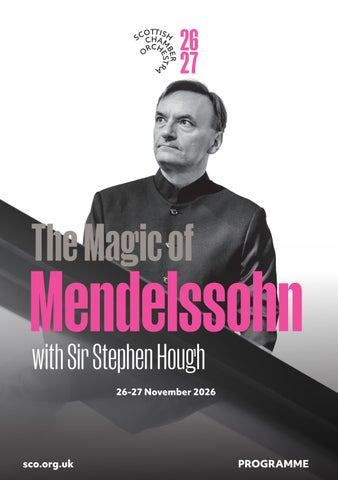
The Magic of
Mendelssohn with Sir Stephen Hough 26-27 November 2026
sco.org.uk
PROGRAMME
Cover image © Sim Canetty-Clarke
26/27 Concert Season
The Magic of Mendelssohn with Sir Stephen Hough Thursday 26 November, 7.30pm Usher Hall, Edinburgh Friday 27 November, 7.30pm City Halls, Glasgow MENDELSSOHN Piano Concerto No.1 Interval of 20 minutes
MENDELSSOHN Symphony No.2 ̒ Lobgesang’ Maxim Emelyanychev conductor Sir Stephen Hough piano Carolyn Sampson soprano Emma Morwood soprano Thomas Walker tenor SCO Chorus Gregory Batsleer chorus director
© Christopher Bowen
SCO, Maxim and SCO Chorus
4 Royal Terrace, Edinburgh EH7 5AB +44 (0)131 557 6800 | info@sco.org.uk | sco.org.uk
The Scottish Chamber Orchestra is a charity registered in Scotland No. SC015039. Company registration No. SC075079.
3
THANK YOU
Principal Conductor's Circle Our Principal Conductor’s Circle are a special part of our musical family. Their commitment and generosity benefit us all – musicians, audiences and creative learning participants alike. Annual Fund James and Patricia Cook International Touring Fund Gavin and Kate Gemmell Scottish Touring Fund Eriadne and George Mackintosh Claire and Anthony Tait Productions Fund Geoff and Mary Ball Bill and Celia Carman Anne, Tom and Natalie Usher
New Music Fund Ken Barker and Martha Vail Barker Colin and Sue Buchan David Caldwell Nick and Kate Thomas Kimie Trust William Walker Learning and Participation Fund Sabine and Brian Thomson Visiting Artists Fund Harry and Carol Nimmo Anne and Matthew Richards
CHAIR SPONSORS The Donald and Louise MacDonald Principal Conductor's Chair Maxim Emelyanychev Associate Composer Jay Capperauld Sir Ian Rankin & Ms Miranda Harvey
Cello Donald Gillan Professor Sue Lightman
Chorus Director Gregory Batsleer Anne McFarlane
Cello Eric de Wit Jasmine Macquaker Charitable Fund
Leader Stephanie Gonley Caroline Hahn and Richard Neville-Towle
Principal Double Bass Jamie Kenny Erik Lars Hansen and Vanessa C L Chang
Leader Bogdan Božović Jo and Alison Elliot
Principal Flute André Cebrián Claire and Mark Urquhart
Principal First Violin Afonso Fesch Fiona and Ian Russell
Sub-Principal Flute Marta Gómez Judith and David Halkerston
First Violin Aisling O'Dea Finlay and Lynn Williamson
Principal Oboe The Hedley Gordon Wright Charitable Trust
First Violin Kana Kawashima Chris and Claire Fletcher
Sub-Principal Oboe Katherine Bryer Ulrike and Mark Wilson
Second Violin Rachel Smith Colin Mumford
Principal Clarinet Maximiliano Martín Stuart and Alison Paul
Principal Viola Max Mandel Ken Barker and Martha Vail Barker
Principal Bassoon Cerys Ambrose-Evans Claire and Anthony Tait
Sub-Principal Viola Francesca Gilbert Christine Lessels
Sub-Principal Bassoon Alison Green George Rubienski
Viola Steve King Sir Ewan and Lady Brown
Principal Trumpet Peter Franks George Ritchie
Principal Cello Philip Higham Nick and Kate Thomas
Timpani / Percussion Louise Lewis Goodwin Silvia and Andrew Brown
Sub-Principal Cello Su-a Lee Ronald and Stella Bowie
THANK YOU
Funding Partners Core Funder
Benefactor
Local Authority
Broadcast Partner
Media Partner
Funding Partner
Business Partners
Key Funders
Delivered by
Charity Partner
5
THANK YOU
SCO Donors Diamond
Gold
The Cockaigne Fund
Christian Albuisson
Malcolm and Avril Gourlay
Peter Armit
Maureen Grant
Sir George and Lady Bain
John and Jane Griffiths
Elizabeth Brittin
Ms Miranda Harvey
Kate Calder
James and Felicity Ivory
Vito Casadio Martin Cook
Platinum
Jo and Christine Danbolt
E.C. Benton
James and Caroline Denison-Pender
Michael and Simone Bird
Andrew and Kirsty Desson
John and Maggie Bolton
David and Sheila Ferrier
Dr Margaret Duffy and Dr Peter Williamson
Iain Gow
Adam Gaines and Joanna Baker
Margaret Green
David and Elizabeth Hudson
Christopher and Kathleen Haddow
Helen B Jackson
David and Pamela Jenkins
Dr and Mrs Peter Jackson
Catherine Johnstone
Dr Daniel Lamont
Julie and Julian Keanie
Graham and Elma Leisk
Gordon Kirk
Professor and Mrs Ludlam
Janey and Barrie Lambie
Chris and Gill Masters
Mike and Karen Mair
Duncan and Una McGhie
Anne McAlister and Philip Sawyer
Anne-Marie McQueen
Gavin McEwan
David Moncur
John and Liz Murphy
Jane Peacock, in memory of Douglas Peacock
Tom Pate
Charles Platt and Jennifer Bidwell
Maggie Peatfield
Patrick and Susan Prenter
Alison and Stephen Rawles
Mr and Mrs J Reid
Andrew Robinson
The Walter and Janet Reid Charitable Trust
Olivia Robinson
Martin and Mairi Ritchie
Irene Smith
Elaine Ross
Dr Jonathan Smithers
Hilary E Ross
Ian S Swanson
Sir Muir and Lady Russell
Ian and Janet Szymanski
Jill and Brian Sandford
John-Paul and Joanna Temperley
Michael and Elizabeth Sudlow
Douglas and Sandra Tweddle
Robert and Elizabeth Turcan
James Wastle and Glenn Craig
Alan and Sue Warner
Catherine Wilson
Bill Welsh
Neil and Philippa Woodcock
Anny and Bobby White
Georgina Wright
Robert Mackay and Philip Whitley Ruth Woodburn
Silver
Alistair Hector
Roy Alexander
Ron and Evelynne Hill
John Anderson
Clephane Hume
Fiona and Neil Ballantyne
Tim and Anna Ingold
Timothy Barnes and Janet Sidaway
Susannah Johnston and Jamie Weir
The Batsleer Family
Ross D. Johnstone
Jack Bogle
James Kelly, in memory of Mairi Kelly
Jane Borland
Professor Christopher and Mrs Alison Kelnar
Alan Borthwick
Dr Ian Laing
Michael and Jane Boyle
Geoff Lewis
Mary Brady
Dorothy A Lunt
Paula and Colin Brown
Vincent Macaulay
John Brownlie
James McClure, in memory of Robert Duncan
Laura Buist
Lucy McCorkell
Robert Burns
Gavin McCrone
Mr A Campbell
Roy and Svend McEwan-Brown
Sheila Colvin
Michael McGarvie
Adam and Lesley Cumming
Brian Miller
Dr Wilma Dickson
Alistair Montgomerie
Sylvia Dow
Norma Moore
Colin Duncan, in memory of Norma Duncan
Margaret Mortimer and Ken Jobling
Raymond Ellis
Andrew Murchison
Dr and Mrs Alan Falconer
Douglas Murray
Sheila Ferguson
John Peutherer, in memory of Audrey Peutherer
Dr William Irvine Fortescue
James S Potter
Patricia Glennie
Alastair Reid
Dr David Grant
Seona Reid and Cordelia Ditton
Anne Grindley
Catherine Steel
Andrew Hadden
Takashi and Mikako Taji
J Martin Haldane
C S Weir
Ronnie and Ann Hanna
Roderick Wylie
Pamela Andrews and Alan Norton Roderick Hart Norman Hazelton
––––– We are indebted to everyone acknowledged here who gives philanthropic gifts to the SCO of £300 or greater each year, as well as those who prefer to remain anonymous. We are also incredibly thankful to the many individuals not listed who are kind enough to support the Orchestra financially on a regular or ad hoc basis. Every single donation makes a difference. Become a regular donor, from as little as £5 a month, by contacting Sadie Purves on 0131 478 8341 or sadie.purves@sco.org.uk.
“ …an orchestral sound that seemed to gleam from within.” THE SCOTSMAN
HM The King Patron Donald MacDonald CBE Life President Joanna Baker CBE Chair Gavin Reid LVO FRSE Chief Executive Maxim Emelyanychev Principal Conductor Andrew Manze Principal Guest Conductor Joseph Swensen Conductor Emeritus Gregory Batsleer Chorus Director Jay Capperauld Associate Composer
© Christopher Bowen
Our Musicians
Your Orchestra Tonight First Violin Bogdan Božović Afonso Fesch Kana Kawashima Aisling O’Dea Fiona Alexander Wen Wang Kristin Deeken Catherine James Second Violin Paula Gorbanova Gordon Bragg Hatty Haynes Felix Didier Rachel Smith Kirsty Main Viola Max Mandel Francesca Gilbert Elaine Koene Steve King Kathryn Jourdan
Information correct at the time of going to print
Flute André Cebrián Alba Vinti López
Trumpet Peter Franks Simon Bird
Oboe Sasha Calin Katherine Bryer
Trombone Duncan Wilson Nigel Cox Alan Adams
Clarinet Maximiliano Martin William Stafford Bassoon Cerys Ambrose-Evans Alison Green
Timpani Louise Lewis Goodwin Organ Tom Wilkinson
Horn Jože Rošer Nivanthi Karunaratne Gavin Edwards Martin Lawrence
Bass Jamie Kenny Maitiú Gaffney Toby Hughes Su-a Lee Sub-Principal Cello Su-a's Chair is kindly supported by Ronald and Stella Bowie.
© Christopher Bowen
Cello Andrew Skidmore Su-a Lee Donald Gillan Eric de Wit Kim Vaughan
What You Are About To Hear MENDELSSOHN (1809-1847) Piano Concerto No.1 in G minor, Op.25 (1830-31) Molto allegro con fuoco Andante Presto – Molto allegro e vivace in G major
MENDELSSOHN (1809-1847) Symphony No.2, 'Lobgesang' Op.52 (1840) Sinfonia · Maestoso con moto · Allegretto un poco agitato · Adagio religioso Alles, was Odem hat Lobe den Herrn, meine Seele Saget es, die ihr erlöst seid Sagt es, die ihr erlöset seid Ich harrete des Herrn
Felix Mendelssohn was, to put it simply, a remarkable man, and a musician of almost bewildering versatility. To listeners in 2026, he’s probably primarily a composer – and there’s nothing wrong with that appraisal. During his own lifetime, however, composing represented just one strand among his extraordinarily wide-ranging activities. He was admired as a virtuoso pianist and a fine organist, and he was one of the earliest champions of Baroque music (notably, of course, in rehabilitating the reputation of JS Bach with his 1829 performance of the earlier composer’s St Matthew Passion). As its music director for 12 years, he transformed Leipzig’s Gewandhaus Orchestra into one of Europe’s most accomplished musical ensembles. He founded that same city’s musical conservatoire, which now bears his name. He directed music festivals and concert series, and he developed close international relationships within the musical world, notably with Britain. He was an accomplished painter, a gifted writer and poet, and spoke several languages fluently.
Stricke des Todes Die Nacht ist vergangen Nun danket alle Gott Drum sing' ich mit meinem Liede Ihr Völker! bringet her dem Herrn
For all his astonishing achievements, however, it’s sometimes been tempting to regard Mendelssohn as a composer of charm rather than profundity, of effortless elegance rather than emotional depth – of fairy frolics and wedding marches, Italian sunshine and Scottish storms. Yet the two works in tonight’s concert reveal a rather different figure: a composer capable of fierce drama, searching introspection and profound spiritual conviction. The first two of those elements are more than apparent in tonight’s opening piece. Mendelssohn himself described his First Piano Concerto as ‘really quite wild’ in a letter to his father. Its drama, however, was underpinned by infatuation, possibly even burgeoning love.
10
Felix Mendelssohn was, to put it simply, a remarkable man, and a musician of almost bewildering versatility. Felix Mendelssohn
As a child, he had mingled with Europe’s cultural and intellectual elite at the family house in Berlin, developing his passions for music,
So much so, in fact, that he dreamt up a piano concerto for Delphine during his Italian sojourn, and put it down on paper during a
painting, literature and philosophy. It was only natural that he should embark on a European tour in his early 20s, with the aim of deepening his knowledge and experience. It was a threeyear, stop-start trip that began in Scotland (a journey that produced his 'Hebrides' Overture and 'Scottish' Symphony) before Mendelssohn headed south from Berlin to the more traditional destination of Italy in October 1830. He would spend ten months in the country, making his way from Venice to Naples via Bologna, Florence and Rome, then back home again through Genoa and Milan, completing his 'Italian' Symphony in 1833 as a result.
second stop-off in Munich during his return trip back up north. ‘I wrote it in but a few days and almost carelessly,’ he later remembered, but it was clearly a deeply enjoyable experience for the 22-year-old. He wrote home to his parents: ‘it is a glorious feeling to waken in the morning and to know that you are going to write the score of a grand allegro… while bright weather holds out the hope of a cheering, long walk in the afternoon… I scarcely know a place where I feel as comfortable and domesticated as here.’
On his way south, however, he met the 16-year-old pianist Delphine von Schauroth in Munich, and was clearly rather smitten, by
Ironically, however, nothing would come of Mendelssohn’s youthful passions, for reasons we can only guess. He dedicated the piece to Delphine, but gave the premiere of the new Concerto himself, in Munich on 17 October
her keyboard talents as well as her personality.
1831, and returned home alone to Berlin.
There’s no denying the passion and drama that Mendelssohn injected into his music, however. Nor his exploitation of recent innovations in
respite, the movement dashes to an exuberant conclusion.
piano design, from the rich, heavy chords that could now compete with an orchestra’s volume, to the sparkling topmost octave that adds glittering colour to his melodic decorations.
For the profound spiritual conviction we mentioned earlier, we should look no further than tonight’s second piece. Mendelssohn’s 'Lobgesang' (or ‘Hymn of Praise’) is his most ambitious symphonic work, and it was also one of his most popular during his lifetime – although it’s performed far less regularly now. Perhaps that’s at least partly down to its unconventional form: the work begins as a symphony, but ends as a sacred cantata. Even Mendelssohn himself was unsure of how to describe it, and it was only after seeking advice from a friend that he ended up with the description of a ‘symphony-cantata after words from the Holy Bible’.
It’s also a piece in which – as in his Violin Concerto more than a decade later – Mendelssohn attempted to bring a sense of unity to the concerto form’s traditionally separate movements, running them together with linking material. A brief, impetuous orchestral introduction kicks off the stormy opening movement, immediately taken up by the solo pianist, who expands the movement’s tumultuous opening theme across the extremes of the keyboard. Some rushing, dashing figurations lead into the far gentler second main theme, but the energy can’t be suppressed for long: the granitic chords of the opening soon return. After some unexpected transformations and far-flung harmonic journeys in the central development section, however, horns and trumpets sound repeatednote fanfares to lead us straight into the slower second movement, via a brief piano fantasia on those same repeated notes. Mendelssohn’s slow movement couldn’t be more different from the sometimes violent first, with a sweet, gentle, almost hymn-like melody shared between violas and cellos, later taken up in a more decorated version by the solo pianist. Those brass fanfares return to lead us into the finale, now heralding a sense of gathering energy and power. When the piano joins the drama, however, it’s with a barely repressed sense of fun, something that’s taken further in the movement’s whirling, joyful main theme. After plenty of keyboardstraddling virtuosity and a brief moment of 12
Even its designation as Mendelssohn’s Symphony No.2 isn’t entirely correct. By 1840, when he wrote the 'Lobgesang', Mendelssohn had already completed three symphonies, discounted a fourth (which became the 'Reformation', No.5), and had plans to revise what later became the 'Italian' Symphony. To put things more simply, Mendelssohn’s five numbered symphonies take their conventional numbering from their dates of publication rather than – as with virtually every other composer – composition. If the works were ordered according to their composition dates, we’d end up with the sequence No.1, No.5 ('Reformation'), No.4 ('Italian'), No.2 ('Lobgesang') and finally No.3 ('Scottish'). But let’s return to the symphony in hand. It was the Leipzig Festival that commissioned the city’s most famous musical resident to write this new symphony, for a concert in June 1840, in celebration of the 400th anniversary of the invention of movable type by Johannes Gutenberg. (It was for the same celebration, incidentally, that Mendelssohn wrote his far
Mendelssohn’s 'Lobgesang' was premiered on 25 June 1840 in Leipzig’s Thomaskirche, the very church where Bach himself had served as cantor a century earlier. And it was immediately enormously popular, prompting Mendelssohn to expand its choral movements from the original six to today’s nine.
lesser-known Festgesang, to mark the unveiling of a statue of Gutenberg – a choral work that has since been transformed into the carol
“the Lord God” be praised at the end, at the top of one’s voice, after He has assisted in bringing to life as cleverly as possible the three previous
‘Hark! the Herald Angels Sing’.)
instrumental movements?’
About a year earlier, Mendelssohn had begun work on a Symphony in B flat, and he revisited his sketches for that work, adding what eventually became a nine-movement cantata to the end of it, using appropriate texts taken from the Bible describing mankind’s progress from darkness to enlightenment.
And indeed, there are many connections between the Mendelssohn and Beethoven works. But this hybrid form wasn’t so unusual at the time: Beethoven had essentially established it in 1824 with his Ninth Symphony, but Berlioz’s idiosyncratic ‘choral symphony’ Roméo et Juliette had been completed in 1839, the year before Mendelssohn’s hymn of praise.
It’s hard not to see connections between Mendelssohn’s 'Lobgesang' and Beethoven’s Ninth Symphony – and many did, especially Mendelssohn’s detractors. In his essay Artwork of the Future, none other than Richard Wagner was particularly withering in a thinly-veiled allusion to the 'Lobgesang', writing: ‘but why shouldn’t this or that composer also be able to
And in fact, despite the similarities with Beethoven, Mendelssohn’s 'Lobgesang' takes quite a different angle on its subject matter. For a start, it is a straightforwardly pious hymn to God, rather than Beethoven’s celebration of the brotherhood of mankind. More importantly, the 'Lobgesang' specifically celebrates the
write a symphony with choruses? Why shouldn’t
achievements of the German Reformation
(which Mendelssohn had also tackled in his 'Reformation' Symphony a decade earlier). And almost as much as it is a hymn to God,
bursts in with joyful affirmation in slow-moving, chordal writing. The first soprano soloist later joins the chorus’s female voices in a gentler
Mendelssohn’s 'Lobgesang' is also a hymn to JS Bach, the earlier composer revered by Mendelssohn, Schumann and many others as the founding father of the great German musical tradition. After kicking off the 19thcentury Bach revival with his performance of the St Matthew Passion in 1829, Mendelssohn paid explicit homage to that earlier composer in the Lobgesang’s abundant counterpoint, its passion-like use of recitatives, arias and choruses, and in the great Lutheran hymn ‘Nun danket alle Gott’ (known in English as ‘Now thank we all our God’), not composed by Bach but used by him in several of his cantatas.
section, which acts as a bridge to the next movement, the tenor recitative and aria ‘Saget es, die ihr erlöst seid’. This in turn leads straight into the subsequent choral movement, and on again into ‘Ich harrete des Herrn’, which begins as duet for two sopranos, gently accompanied by a horn countermelody.
Mendelssohn’s 'Lobgesang' was premiered on 25 June 1840 in Leipzig’s Thomaskirche, the very church where Bach himself had served as cantor a century earlier. And it was immediately enormously popular, prompting Mendelssohn to expand its choral movements from the original six to today’s nine. The piece opens as an apparently straightforward symphony, with three conventional symphonic movements – a buoyant opening movement, preceded by a noble trombone fanfare; a restless, scherzolike Allegretto with a more solemn, chorale-like central section; and a prayerful, hymn-like slow movement (appropriately titled Adagio religioso) whose opening material returns in varied form. Most important of all, however, is the trombones’ distinctive, noble, fanfare-like melody that opens the piece, and which will return again and again throughout the work, eventually acquiring words of its own. In the first choral movement, ‘Alles, was Odem hat’, the brass reintroduces the trombones’ opening fanfare theme, before the chorus 14
In the stormy ‘Stricke des Todes’, the tenor soloist sings of death and resurrection in God, concluding with an even more dramatic – even operatic – recitative-like episode. This is the mid-point in Mendelssohn’s cantata, and the work’s most dissonant movement. With increasing desperation, the tenor repeatedly asks ‘watchman, will the night soon pass?’, eventually answered by one of the soprano soloists, who narrates the lifting of the darkness. The bright, exuberant chorus ‘Die Nacht ist vergangen’ rejoices in the arrival of day, before a hushed, reverential, unaccompanied account of ‘Nun danket alle Gott’, given a rich harmonisation by Mendelssohn, after which the orchestra adds a decorative accompaniment that seems to look back directly to Bach’s chorale preludes. After ‘Drum sing' ich mit meinem Liede’, a duet for soprano and tenor, the cantata’s concluding section – ‘Ihr Völker! bringet her dem Herrn’ – has an assertive opening, demanding that nations offer up their thanks to God, before breaking into a brisker, more joyful section delivering simpler gratitude. The trombones return with the work’s opening fanfare theme, taken up by the chorus’s tenors and basses, before final rejoicing from the full chorus. © David Kettle
Libretto MENDELSSOHN (1809-1847) Symphony No.2, 'Lobgesang' Op.52 (1840)
Chor Alles, was Odem hat, lobe den Herrn! Lobt den Herrn mit Saitenspiel, lobt ihn mit eurem Lieder. Und alles Fleisch lobe seinen heiligen Namen.
Chorus Let everything that has breath praise the Lord. Praise the Lord with the lyre, praise him with your song. And let all flesh bless his holy name.
Arie (Sopran) mit Chor Lobe den Herrn, meine Seele, und was in mir ist, seinen heiligen Namen. Lobe den Herrn, meine Seele, und vergiß es nicht, was er dir Gutes getan.
Aria (soprano) with Chorus Bless the Lord, O my soul, and that is within me, bless his holy name. Bless the Lord, O my soul, and do not forget the good things he has done for you.
Rezitativ und Arie (Tenor) Saget es, die ihr erlöst seid durch den
Recitative and aria (tenor) Acknowledge, you who are redeemed by
Herrn, die er aus der Not errettet hat, aus schwerer Trübsal, aus Schmach und Banden, die ihr gefangen im Dunkel waret, alle, die er erlöst hat aus der Not.
the Lord, that he has delivered you from distress, severe tribulation, shame and bondage,
Saget es! Danket ihm und rühmet seine Güte! Er zählet unsere Tränen in der Zeit der Not. Er tröstet die Betrübten mit seinem Wort.
you who were captives in the darkness, all you, whom he has redeemed out of distress. Acknowledge it! Give thanks to him and praise his goodness! He counts our tears in our time of need, he comforts the afflicted with his word.
Chor Saget es, die ihr erlöset seid von dem Herrn aus aller Trübsal. Er zählet unsere Tränen in der Zeit der Not.
Chorus Acknowledge it, you whom the Lord has redeemed out of all tribulation. He counts our tears in our time of need.
Please turn the page quietly...
Duett (Sopran I und II) mit Chor Ich harrete des Herrn,
Duet (soprano I and II) with Chorus I waited patiently for the Lord,
und er neigte sich zu mir und hörte mein Flehn. Wohl dem, der seine Hoffnung setzt auf den Herrn! Wohl dem, der seine Hoffnung setzt auf ihn!
and He inclined to me and heard my supplication. Blessed is the man whose hope is in the Lord! Blessed is the man whose hope is in him!
Aria (Tenor) Stricke des Todes hatten uns umfangen, und Angst der Hölle hatte uns getroffen, wir wandelten in Finsternis. Er aber spricht: Wache auf! Wache auf, der du schläfst, stehe auf von den Toten, ich will dich erleuchten! Wir riefen in der Finsternis: Hüter, ist die Nacht bald hin? Der Hüter aber sprach: Wenn der Morgen schon kommt, so wird es doch Nacht sein; wenn ihr schon fraget, so werdet ihr doch wiederkommen und wieder fragen: Hüter, ist die Nacht
Aria (tenor) The sorrows of death encompassed us and fear of hell had struck us, We wandered in darkness. He spoke: awake, awake! you who sleep, arise from the dead, I will enlighten you!
bald hin?
soon pass?
Sopran und Chor Die Nacht ist vergangen, der Tag aber herbei gekommen. So laßt uns ablegen die Werke der Finsternis, und anlegen die Waffen des Lichts, und ergreifen die Waffen des Lichts.
Soprano and chorus The night has passed, and day has broken.
Choral Nun danket alle Gott Mit Herzen, Mund und Händen, der sich in aller Not Will gnädig zu uns wenden, der so viel Gutes tut, Von Kindesbeinen an uns hielt in seiner Hut
Chorale Now let all thank God With hearts, voices and hands, Who in all our adversity Turns mercifully to us, Who does so much good, Who from our childhood Has kept us in his care
Und allen wohlgetan.
And done good to all.
We called in the darkness: watchman, will the night soon pass? But the watchman spoke: Just as morning will come, so will night again come to pass; Just as you ask now, so you will return and ask again: watchman, will the night
So let us cast off the works of darkness, and put on the armour of light, and take up the armour of light.
Lob, Ehr’ und Preis sei Gott, Dem Vater und dem Sohne,
Praise, honour and glory be to God, The Father and the Son,
und seinem heilgen Geist Im höchsten Himmelsthrone. Lob dem dreiein'gen Gott, Der Nacht und Dunkel schied von Licht und Morgenrot, Ihm danket unser Lied. (Martin Rinckart)
and his Holy Spirit On the highest throne of heaven. Praise to God, three in one, Who separated night and darkness From light and dawn, May our song give him thanks.
Duett (Sopran und Tenor) Drum sing ich mit meinem Liede ewig dein Lob, du treuer Gott! Und danke dir für alles Gute, das du an mir getan. Und wandl' ich in der Nacht und tiefem Dunkel und die Feinde umher stellen mir nach, so rufe ich an den Namen des Herrn, und er errettet mich nach seiner Güte.
Duet (soprano and tenor) Thus with my song do I forever sing your praise, faithful God! And thank you for all the good you have done me. Though I wander in night and deep darkness, and enemies beset me all around, I call upon the name of the Lord, and he saves me by his goodness.
Chor Ihr Völker! bringet her dem Herrn Ehre und Macht!
Chorus You people, bring unto the Lord glory and strength!
Ihr Könige! bringet her dem Herrn Ehre und Macht! Der Himmel bringe her dem Herrn Ehre und Macht! Die Erde bringe her dem Herrn Ehre und Macht! Alles danke dem Herrn! Danket dem Herrn und rühmt seinen Namen und preiset seine Herrlichkeit. Alles, was Odem hat, lobe den Herrn. Halleluja!
You kings, bring unto the Lord glory and strength! May heaven bring unto the Lord glory and strength! May the earth bring unto the Lord glory and strength! Let everything thank the Lord! Praise the Lord and exalt his name
Unless otherwise indicated, text adapted from the Bible by Mendelssohn
Translation © SCO
and praise his glory. Let everything that has breath praise the Lord. Alleluia!
Maxim Emelyanychev
© Christopher Bowen
Conductor
Maxim Emelyanychev has been Principal Conductor of the Scottish Chamber Orchestra since 2019. He is also Chief Conductor of period-instrument orchestra Il Pomo d’Oro, and became Principal Guest Conductor of the Swedish Radio Symphony Orchestra from the 2025/26 Season. Born in Nizhny Novgorod, Emelyanychev made his conducting debut at the age of 12, and later joined the class of eminent conductor Gennady Rozhdestvensky at the Moscow Conservatoire. Emelyanychev was initially appointed as the SCO’s Principal Conductor until 2022; the relationship has been extended three times, to 2025, 2028 and most recently to 2031. He has conducted the SCO at the Edinburgh International Festival and the BBC Proms, as well as on several European tours, in the USA and in concerts right across Scotland. He has also made three recordings with the SCO, of symphonies by Schubert and Mendelssohn (Linn Records). Emelyanychev has also conducted many international ensembles including the Berlin Philharmonic, Royal Concertgebouw Orchestra, Orchestra dell'Accademia Nazionale di Santa Cecilia, Deutsches Symphonie-Orchester Berlin, Rotterdam Philharmonic Orchestra, Finnish Radio Symphony Orchestra, Seattle Symphony and Orchestra of the Age of Enlightenment. In the opera house, Emelyanychev has conducted Handel’s Rinaldo at Glyndebourne, the same composer’s Agrippina as well as Mozart’s The Magic Flute at the Royal Opera House, Covent Garden, and Mozart’s Die Entführing aus dem Serail at the Opernhaus Zürich. He has also conducted Mozart’s Die Zauberflöte, Così fan tutte, La clemenza di Tito and Don Giovanni with the SCO at the Edinburgh International Festival. He has collaborated closely with US soprano Joyce DiDonato, including international touring and several recordings. Among his other recordings are keyboard sonatas by Mozart, and violin sonatas by Brahms with violinist Aylen Pritchin. He has also launched a project to record Mozart’s complete symphonies with Il Pomo d’Oro. In 2019, he won the Critics’ Circle Young Talent Award and an International Opera Award in the newcomer category. He received the 2025 Herbert von Karajan Award at the Salzburg Easter Festival. Maxim's Chair is kindly supported by Donald and Louise MacDonald 18
Piano
© Sim Canetty-Clarke
Sir Stephen Hough
Named by The Economist as one of Twenty Living Polymaths, Sir Stephen Hough combines a distinguished career of a concert pianist with those of a composer and writer. In recognition of his contribution to cultural life, he became the first classical performer to be given a MacArthur Fellowship and was awarded a Knighthood for Services to Music in the Queen’s Birthday Honours 2022. In a career spanning over 40 years, Hough has played regularly with most of the world’s leading orchestras, including televised and filmed appearances with the Berlin, London, China, Seoul and New York Philharmonic Orchestras, and the Concertgebouw, Budapest Festival and the NHK Symphony Orchestras. He has been a regular guest of recital series and festivals worldwide. including Carnegie Hall, Wigmore Hall, Salzburg, Verbier, La Roque‑d’Anthéron, Ravinia, Hollywood Bowl, Blossom, Aspen, Tanglewood, Aldeburgh and Edinburgh. He has appeared at BBC Proms over 30 times, including at the 2024 Last Night of the Proms, and has recently been appointed Artistic Director and Chair of the jury for the 2027 Leeds International Piano Competition. For his 2026/27 season, Sir Stephen Hough opens Hallé Orchestra’s season with Kahchun Wong, performing Beethoven’s Piano Concerto No.5. Over the following months, he appears with leading orchestras and conductors, including Orchestre de Paris with Klaus Mäkelä and Bavarian Radio Symphony Orchestra with Sir Simon Rattle. He makes his debut at the Bad Kissingen Festival and He will give the German premiere of his own concerto, The World of Yesterday, with Düsseldorfer Symphoniker. In October and November 2026, Sir Stephen undertakes an extensive Asia-Pacific tour, giving recitals in Australian cities, Hong Kong, and Seoul, alongside concerto appearances with orchestras including Malaysian Philharmonic Orchestra, New Zealand Symphony Orchestra, and Japan Philharmonic Orchestra. For full biography please visit sco.org.uk
Soprano
© Matthew Johnson
Carolyn Sampson
Carolyn Sampson OBE has established an international reputation for musicianship of exceptional intelligence, imagination and stylistic versatility. Equally at home in opera, concert and recital, she brings a rare combination of technical refinement, textual insight and emotional honesty to repertoire spanning four centuries. At the heart of her career are enduring collaborations with many of the world's leading conductors, orchestras, ensembles and recital partners. From the music of Bach, Handel and Purcell to Haydn, Mozart, Mendelssohn, Mahler, Strauss, Poulenc, Dutilleux and beyond, Carolyn's repertoire reflects a lifelong commitment to exploration and discovery. Her operatic career has taken her to many of Europe's leading stages and festivals, including Glyndebourne Festival, English National Opera, the Festival d’Aix-en-Provence, Staatsoper Berlin and Scottish Opera, in a wide range of leading and title roles. Her performances are distinguished by an instinctive gift for storytelling and a deep engagement with text, qualities that have fostered longstanding relationships with ensembles including Bach Collegium Japan, the Monteverdi Choir and Orchestra, the Academy of Ancient Music and The Sixteen, alongside regular invitations from many of Europe's and North America's leading symphony orchestras. She is also a frequent guest at the BBC Proms, Wigmore Hall and many of the world's leading festivals. Highlights of the 2026/27 season include returns to the Philadelphia Orchestra with Yannick Nézet-Séguin, Orchestre Philharmonique de Radio France under Maxim Emelyanychev, Orchestre Symphonique de Montréal with Kent Nagano, and a US tour of Bach's St Matthew Passion with the Monteverdi Choir under Masaaki Suzuki. She also returns to the Scottish Chamber Orchestra for several programmes, including her role debut in Poulenc's La voix humaine, and makes her debut at the Oregon Bach Festival. For full biography please visit sco.org.uk
Soprano
Emma Morwood
Born in Belfast, Emma Morwood studied at the University of Edinburgh and the Royal Northern College of Music, where she was a major award winner. Described as ‘radiant’ (The Sunday Times), ‘enchanting’ (The Times), ‘superlative’ (Opera Magazine) and ‘brilliant’ (The Telegraph), she has performed with leading orchestras and conductors across Europe. Recent concert appearances include Brahms' German Requiem with the Ulster Orchestra. Other highlights include Handel's Messiah in Halle, Germany with a 450-voice international chorus; soloist and presenter for the Royal Scottish National Orchestra Viennese Gala Concert tour around Scotland; Mozart's C Minor Mass in Malaga and Fuengirola; Schubert's Mass in A flat with the Scottish Chamber Orchestra; Haydn's Creation with the Ulster Orchestra, conducted by Daniele Rustioni; and Strauss's Vier letzte Lieder at Glasgow City Halls. Operatic roles include Claudia in Puccini's Gianni Schicchi with Opera Up Close; Italian Singer in Strauss's Capriccio with the Philharmonia at Edinburgh International Festival; Despina in Irish National Opera's production of Mozart's Così fan tutte; the lead role of Iris Robinson in Abomination: a DUP Opera by Conor Mitchell, with the Belfast Ensemble; and Musetta in Northern Ireland Opera's critically acclaimed production of La bohème. Recordings include Douglas Knehan's Concerto No. 2 with the Royal Scottish National Orchestra, and the soundtrack of Oscar-nominated film 45 Years. Emma is the inaugural Associate Opera Artist for Edinburgh International Festival and is the vocal coach for the Scottish Chamber Orchestra Chorus. Alongside her musical career, Emma has two children, Lucas and Orla, and enjoys indoor bouldering, open water swimming, and dressmaking. Emma is a contestant in Season 12 of the BBC's Great British Sewing Bee, available now on iPlayer. www.emmamorwood.com
Tenor
© Robert Workman
Thomas Walker
Thomas Walker studied brass at the Royal Scottish Academy of Music and Drama and singing at the Royal College of Music. This season’s highlights include the Orchestra of the Eighteenth Century and Daniel Reuss; Ensemble Vocal de Lausanne; Arnalta L’incoronazione di Poppea at the Berlin Staatsoper Unter den Linden and the title role in Haydn’s Orfeo with Adam Fischer at Theater an der Wien. Previous highlights include L’incoronazione di Poppea with Budapest Festival Orchestra and Iván Fischer; Evangelist St Matthew Passion; Bach at Wigmore Hall with Gabrieli Consort and Paul McCreesh; the title role in Handel Belshazzar; Haydn Die Schöpfung; Orff Carmina Burana; Berlioz L’enfance du Christ and Adam in Scarlatti Il Primo Omicidio at Opéra national de Paris and Staatsoper Berlin. Other roles include Admeto in Gluck Alceste and Rinaldo in Haydn Armida; Rameau Zoroastre at the Komische Oper Berlin; Purcell The Fairy Queen and Rameau Platée for Staatsoper Stuttgart; and Pélleas; Alessandro Il Re Pastore; Quint The Turn of the Screw; Lysander A Midsummer Night’s Dream and Lechmere Owen Wingrave for the Royal Opera House, Covent Garden; English National Opera; Scottish Opera and Innsbrucker Festwochen der Alten Musik. His recordings include Beethoven Missa Solemnis with Cappella Amsterdam; Honegger Le Roi David with Ensemble Vocal de Lausanne; and Bach Magnificats with Arcangelo and Jonathan Cohen. For full biography please visit sco.org.uk
Chorus director
© Christopher Bowen
Gregory Batsleer
Through his work as a conductor, choral director, artistic curator and executive leader with some of the UK’s pre-eminent cultural organisations, Gregory Batsleer has earned a reputation as a pioneer in his field. He has been Director of the SCO Chorus since 2009, shaping it into one of the UK’s finest choral ensembles and developing its Young Singers' Programme. Alongside preparing the Chorus for performances in the SCO Season, he has established a regular series of sell-out a cappella concerts and has conducted Chorus performances at Scottish festivals and on the SCO Summer Tour. Alongside his work with SCO, Gregory is the Co-Artistic Director and conductor of Festival Voices, a professional ensemble dedicated to cross-art form collaboration and contemporary music, which is currently Artist in Association at Kings Place. He has been Artistic and Choral Director of Huddersfield Choral Society since 2016 and was Chorus Director of the RSNO from 2015 to 2021. From 2012 to 2017 he was Artistic Director of the National Portrait Gallery’s ground-breaking Choir in Residence Programme. As guest conductor Gregory has worked with many of the UK’s leading orchestras and choirs. Recent work includes London Symphony Chorus, London Philharmonic Choir, CBSO Chorus, Royal Northern Sinfonia, RSNO, National Youth Choir of Great Britain, Orchestra of Opera North, Manchester Camerata and Royal Liverpool Philharmonic. He has prepared choirs for numerous international conductors including, for SCO, Maxim Emelyanychev, Robin Ticciati and Riccardo Minasi. In 2015 he received the first Arts Foundation Fellowship for Choral Conducting. As guest curator, Gregory has devised multi-disciplinary performances at the Southbank Centre, Wilderness Festival, Bold Tendencies, Latitude Festival and Shakespeare’s Globe, and has commissioned and premiered music by composers including Ben Nobuto, Héloïse Werner, Daniel Kidane, Cheryl Frances-Hoad, Crystalla Serghiou and Jay Capperauld. Away from the concert platform, Gregory is CEO and Festival Director of the London Handel Society and London Handel Festival. Gregory’s Chair is kindly supported by Anne McFarlane
Biography
© Christopher Bowen
SCO Chorus
The Scottish Chamber Orchestra Chorus, under the direction of Gregory Batsleer since 2009, has built a reputation as one of Scotland’s most vibrant and versatile choirs. Widely regarded as one of the finest orchestral choruses in the UK, it celebrates its 35th anniversary in 2026. Members enjoy the unique opportunity of performing with one of the world’s leading chamber orchestras, working with international conductors including Maxim Emelyanychev, Andrew Manze, Riccardo Minasi, Richard Egarr, Václav Luks and Sir James MacMillan. The Chorus appears regularly with the Orchestra in Scotland’s major cities. Recent concerts have covered a wide range of music including Bach Mass in B minor and Christmas Oratorio, Berlioz L’Enfance du Christ, Brahms Requiem, Haydn Creation, MacMillan Seven Last Words, Poulenc Gloria, a rare performance of Vaughan Williams Flos Campi and premiere performances of works by Anna Clyne, Sir James MacMillan and SCO Associate Composer Jay Capperauld. The SCO Chorus also performs a capella, both digital and live, in music ranging from Thomas Tallis to newly-composed work. Its annual Christmas concerts have established themselves as a Season highlight; the Chorus also enjoys appearing on the SCO’s Summer Tour. Other notable out-of-Season appearances have included critically-acclaimed performances with the SCO at the BBC Proms in Handel’s Jephtha in 2019 and in Mendelssohn's Elijah in 2023, and at the 2023, 2024, 2025 and 2026 Edinburgh International Festivals in semi-staged performances of Mozart’s Die Zauberflöte, Così fan tutte, La Clemenza di Tito and Don Giovanni. The SCO Chorus Young Singers' Programme was established in 2015 to nurture and develop aspiring young singers. It is designed for young people with a high level of choral experience and ambitions to further their singing with a world-class ensemble. The SCO Chorus Young Singers' Programme is kindly supported by the Baird Educational Trust. Further information at sco.org.uk
Your Chorus Tonight Information correct at the time of going to print
Gregory Batsleer Chorus Director Stuart Hope Associate Chorusmaster Emma Morwood Voice Coach Susan White Chorus Manager Norbert Meyn Language Coach * Young Singers' Programme
SOPRANO
TENOR
Emma Aitken Kirstin Anderson Naomi Black Nancy Burns Morven Chisholm Louise Cunningham Mairi Day Mairi de la Haye Joanne Dunwell Lucy Forde Emily Gifford Alice Higgins Florence Kaiser* Katie McGlew Jenny Nex Alison Williams
Magnus Bushby* Andrew Carvel Bruce Davis Colin French Anthony Mudge David Nelson Michael Scanlon Paul Vaughan David Walsh
ALTO Elizabeth Blair Dinah Bourne Sarah Campbell Gill Cloke Judith Colman Jennie Gardner Claire Goodenough Anne Grindley Caroline Hahn Lorna Htet-Khin Melissa Humphreys Hilde McKenna Charlotte Perkins Linda Ruxton Olivia Smith*
BASS Sasha Del Mar Gavin Easton Matthew Fulton-Peebles Orlando Griffiths* Richard Hyder Donald MacLeod Sandy Matheson Richard Murphy Kenneth Murray Douglas Nicholson Fraser Riddell Stephen Todd Roderick Wylie
Scottish Chamber Orchestra The Scottish Chamber Orchestra (SCO) is one of Scotland’s five National Performing Companies and has been a galvanizing force in Scotland’s music scene since its inception in 1974. The SCO believes that access to world-class music is not a luxury but something that everyone should have the opportunity to participate in, helping individuals and communities everywhere to thrive. Funded by the Scottish Government, City of Edinburgh Council and a community of philanthropic supporters, the SCO has an international reputation for exceptional, idiomatic performances: from mainstream classical music to newly commissioned works, each year its wide-ranging programme of work is presented across the length and breadth of Scotland, overseas and increasingly online. Equally at home on and off the concert stage, each one of the SCO’s highly talented and creative musicians and staff is passionate about transforming and enhancing lives through the power of music. The SCO’s Creative Learning programme engages people of all ages and backgrounds with a diverse range of projects, concerts, participatory workshops and resources. The SCO’s current fiveyear Residency in Edinburgh’s Craigmillar builds on the area’s extraordinary history of Community Arts, connecting the local community with a national cultural resource. An exciting new chapter for the SCO began in September 2019 with the arrival of dynamic young conductor Maxim Emelyanychev as the Orchestra’s Principal Conductor. His tenure has recently been extended until at least 2031. The SCO and Emelyanychev released their first album together (Linn Records) in 2019 to widespread critical acclaim. Their second recording together, of Mendelssohn symphonies, was released in 2023, with Schubert Symphonies Nos 5 and 8 following in 2024. The SCO also has long-standing associations with many eminent guest conductors and directors including Principal Guest Conductor Andrew Manze, Pekka Kuusisto, François Leleux, Nicola Benedetti, Isabelle van Keulen, Anthony Marwood, Richard Egarr, Mark Wigglesworth, Lorenza Borrani and Conductor Emeritus Joseph Swensen. The Orchestra’s current Associate Composer is Jay Capperauld. The SCO enjoys close relationships with numerous leading composers and has commissioned around 200 new works, including pieces by Sir James MacMillan, Anna Clyne, Sally Beamish, Martin Suckling, Einojuhani Rautavaara, Karin Rehnqvist, Mark-Anthony Turnage, Nico Muhly and the late Peter Maxwell Davies. 26
© Christopher Bowen
Biography
For the love of music Each year, the SCO must fundraise around £1.3 million to bring extraordinary musical performances to the stage and support groundbreaking education and community initiatives beyond it. If you share our passion for transforming lives through the power of music and want to be part of our ongoing success, we invite you to join our community of regular donors. Your support, no matter the size, has a profound impact on our work – and as a donor, you’ll enjoy an even closer connection to the Orchestra. To learn more and support the SCO from as little as £5 per month, please contact Sadie Purves on 0131 478 8341 or sadie.purves@sco.org.uk.
The SCO is a charity registered in Scotland No SC015039. Photo: Fraser Band