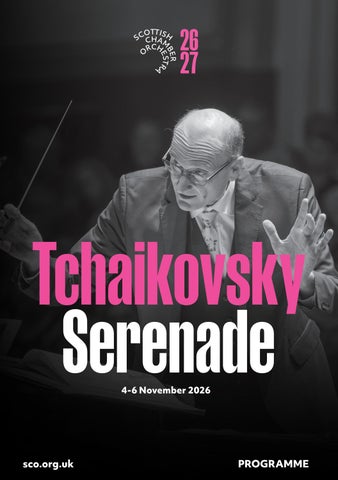
Tchaikovsky Serenade 4-6 November 2026
sco.org.uk
PROGRAMME
26/27 Concert Season
Cover image © Christopher Bowen
Tchaikovsky Serenade Wednesday 4 November, 7pm Holy Trinity Church, St Andrews Thursday 5 November, 7.30pm The Queen's Hall, Edinburgh Friday 6 November, 7.30pm City Halls, Glasgow LARSSON Lyric Fantasy ANDERS HILLBORG Cello Concerto Interval of 20 minutes
TCHAIKOVSKY Rococo Variations TCHAIKOVSKY Serenade Andrew Manze conductor Amalie Stalheim cello
© Nikolaj Lund
Amalie Stalheim
© Chris Christodoulou
Andrew Manze
4 Royal Terrace, Edinburgh EH7 5AB +44 (0)131 557 6800 | info@sco.org.uk | sco.org.uk
The Scottish Chamber Orchestra is a charity registered in Scotland No. SC015039. Company registration No. SC075079.
3
THANK YOU
Principal Conductor's Circle Our Principal Conductor’s Circle are a special part of our musical family. Their commitment and generosity benefit us all – musicians, audiences and creative learning participants alike. Annual Fund James and Patricia Cook Visiting Artists Fund Harry and Carol Nimmo Anne and Matthew Richards International Touring Fund Gavin and Kate Gemmell Learning and Participation Fund Jo and Alison Elliot Sabine and Brian Thomson
CHAIR SPONSORS
Productions Fund Geoff and Mary Ball Bill and Celia Carman Anne, Tom and Natalie Usher Scottish Touring Fund Eriadne and George Mackintosh Claire and Anthony Tait New Music Fund Ken Barker and Martha Vail Barker Colin and Sue Buchan David Caldwell Nick and Kate Thomas Kimie Trust William Walker
The Donald and Louise MacDonald Principal Conductor's Chair Maxim Emelyanychev Chorus Director Gregory Batsleer Anne McFarlane
Cello Eric de Wit Jasmine Macquaker Charitable Fund
Leader Stephanie Gonley Caroline Hahn and Richard Neville-Towle
Principal Double Bass Jamie Kenny Erik Lars Hansen and Vanessa C L Chang
Principal First Violin Afonso Fesch Fiona and Ian Russell
Principal Flute André Cebrián Claire and Mark Urquhart
First Violin Aisling O'Dea Finlay and Lynn Williamson
Sub-Principal Flute Marta Gómez Judith and David Halkerston
First Violin Kana Kawashima Chris and Claire Fletcher
Principal Oboe The Hedley Gordon Wright Charitable Trust
Second Violin Rachel Smith Colin Mumford
Sub-Principal Oboe Katherine Bryer Ulrike and Mark Wilson
Principal Viola Max Mandel Ken Barker and Martha Vail Barker
Principal Clarinet Maximiliano Martín Stuart and Alison Paul
Sub-Principal Viola Francesca Gilbert Christine Lessels
Principal Bassoon Cerys Ambrose-Evans Claire and Anthony Tait
Viola Steve King Sir Ewan and Lady Brown
Sub-Principal Bassoon Alison Green George Rubienski
Principal Cello Philip Higham Nick and Kate Thomas
Principal Trumpet Peter Franks George Ritchie
Sub-Principal Cello Su-a Lee Ronald and Stella Bowie
Timpani / Percussion Louise Lewis Goodwin Silvia and Andrew Brown
Cello Donald Gillan Professor Sue Lightman
THANK YOU
Funding Partners Core Funder
Benefactor
Local Authority
Broadcast Partner
Media Partner
Funding Partner
Business Partners
Key Funders
Delivered by
Charity Partner
5
THANK YOU
SCO Donors Diamond
Gold
The Cockaigne Fund
Christian Albuisson
Malcolm and Avril Gourlay
Peter Armit
Maureen Grant
Sir George and Lady Bain
John and Jane Griffiths
Elizabeth Brittin
James and Felicity Ivory
Kate Calder Vito Casadio
Platinum
Martin Cook
E.C. Benton
Jo and Christine Danbolt
Michael and Simone Bird
James and Caroline Denison-Pender
John and Maggie Bolton
Andrew and Kirsty Desson
Dr Peter Williamson and Ms Margaret Duffy
David and Sheila Ferrier
Adam Gaines and Joanna Baker
Iain Gow
David and Elizabeth Hudson
Margaret Green
Helen B Jackson
Christopher and Kathleen Haddow
Dr and Mrs Peter Jackson
Catherine Johnstone
Dr Daniel Lamont
Julie and Julian Keanie
Graham and Elma Leisk
Gordon Kirk
Professor and Mrs Ludlam
Janey and Barrie Lambie
Chris and Gill Masters
Mike and Karen Mair
Paul Maxwell, in loving memory of Ruth Maxwell
Anne McAlister and Philip Sawyer
Duncan and Una McGhie
John and Liz Murphy
Anne-Marie McQueen
Tom Pate
David Moncur
Maggie Peatfield
Jane Peacock, in memory of Douglas Peacock
Alison and Stephen Rawles
Charles Platt and Jennifer Bidwell
Andrew Robinson
Patrick and Susan Prenter
Olivia Robinson
Mr and Mrs J Reid
Irene Smith
The Walter and Janet Reid Charitable Trust
Dr Jonathan Smithers
Martin and Mairi Ritchie
Ian S Swanson
Elaine Ross
Ian and Janet Szymanski
Hilary E Ross
John-Paul and Joanna Temperley
Sir Muir and Lady Russell
Douglas and Sandra Tweddle
Jill and Brian Sandford
James Wastle and Glenn Craig
Michael and Elizabeth Sudlow
Catherine Wilson
Robert and Elizabeth Turcan
Neil and Philippa Woodcock
Alan and Sue Warner
Georgina Wright
Bill Welsh Anny and Bobby White Robert Mackay and Philip Whitley Ruth Woodburn
Silver
Norman Hazelton
Roy Alexander
Alistair Hector
John Anderson
Ron and Evelynne Hill
Fiona and Neil Ballantyne
Clephane Hume
Timothy Barnes and Janet Sidaway
Tim and Anna Ingold
The Batsleer Family
David and Pamela Jenkins
Jack Bogle
Susannah Johnston and Jamie Weir
Jane Borland
Ross D. Johnstone
Alan Borthwick
James Kelly, in memory of Mairi Kelly
Michael and Jane Boyle
Professor Christopher and Mrs Alison Kelnar
Mary Brady
Dr Ian Laing
Paula and Colin Brown
Geoff Lewis
John Brownlie
Dorothy A Lunt
Laura Buist
Vincent Macaulay
Robert Burns
James McClure, in memory of Robert Duncan
Mr A Campbell
Lucy McCorkell
Sheila Colvin
Gavin McCrone
Lorn and Camilla Cowie
Dr Gillean McDougall
Adam and Lesley Cumming
Roy and Svend McEwan-Brown
Dr Wilma Dickson
Michael McGarvie
Sylvia Dow
Brian Miller
Colin Duncan, in memory of Norma Duncan
Alistair Montgomerie
Raymond Ellis
Norma Moore
Dr and Mrs Alan Falconer
Margaret Mortimer and Ken Jobling
Sheila Ferguson
Andrew Murchison
Dr William Irvine Fortescue
Douglas Murray
Patricia Glennie
John Peutherer, in memory of Audrey Peutherer
Dr David Grant
James S Potter
Anne Grindley
Alastair Reid
Andrew Hadden
Seona Reid and Cordelia Ditton
J Martin Haldane
Catherine Steel
Ronnie and Ann Hanna
Takashi and Mikako Taji
Pamela Andrews and Alan Norton
C S Weir
Roderick Hart
Roderick Wylie
––––– We are indebted to everyone acknowledged here who gives philanthropic gifts to the SCO of £300 or greater each year, as well as those who prefer to remain anonymous. We are also incredibly thankful to the many individuals not listed who are kind enough to support the Orchestra financially on a regular or ad hoc basis. Every single donation makes a difference. Become a regular donor, from as little as £5 a month, by contacting Sadie Purves on 0131 478 8341 or sadie.purves@sco.org.uk.
“ …an orchestral sound that seemed to gleam from within.” THE SCOTSMAN
HM The King Patron Donald MacDonald CBE Life President Joanna Baker CBE Chair Gavin Reid LVO FRSE Chief Executive Maxim Emelyanychev Principal Conductor Andrew Manze Principal Guest Conductor Joseph Swensen Conductor Emeritus Gregory Batsleer Chorus Director Jay Capperauld Associate Composer
© Christopher Bowen
Our Musicians
Your Orchestra Tonight First Violin Stephanie Gonley Afonso Fesch David Routledge Kana Kawashima Aisling O‘Dea Tom Hankey Kristin Deeken Sarah Bevan-Baker Second Violin Hed Yaron-Meyerson Hatty Haynes Melaine Gruwez Catherine James Abigail Young Stewart Webster
Information correct at the time of going to print
Flute/Piccolo André Cebrián Marta Gómez
Horn Lauren Reeve-Rawlings Andy Saunders
Oboe Clara Schweinberger Katherine Bryer
Trumpet Peter Franks Shaun Harrold
Clarinet Maximiliano Martín William Stafford
Timpani/Percussion Simon Archer
Bassoon Cerys Ambrose-Evans Alison Green
Piano Simon Smith
Viola Max Mandel Francesca Gilbert Christine Anderson Steve King Cello Philip Higham Donald Gillan Eric De Wit Kim Vaughan Bass
Eric de Wit Cello Eric's Chair is kindly supported by the Jasmine Macquaker Charitable Fund.
© Christopher Bowen
Jamie Kenny Yehor Podkolzin
What You Are About To Hear LARSSON (1908-1986) Lyric Fantasy, Op.54 (1966) HILLBORG (b. 1954) Cello Concerto (2020) TCHAIKOVSKY (1840-1893) Variations on a Rococo Theme, Op.33 (1876–77) Introduction: Moderato assai quasi Andante Thema: Moderato semplice Variation 1: Tempo della Thema Variation 2: Tempo della Thema Variation 3: Andante sostenuto Variation 4: Andante grazioso Variation 5: Allegro moderato Variation 6: Andante Variation 7: Coda (Allegro vivo)
TCHAIKOVSKY (1840-1893) Serenade for Strings in C major, Op.48 (1880) Pezzo in forma di sonatina: Andante non troppo – Allegro moderato Valse: Moderato – Tempo di valse Élégie: Larghetto elegiaco Finale (Tema russo): Andante – Allegro con spirito
Music by two Swedish composers opens tonight’s concert – but can you name a third? Maybe you can, maybe you can’t. But either way, it’s interesting how relatively unfamiliar we are with Swedish classical music, compared with – for example – towering figures of Russian music such as Pyotr Ilyich Tchaikovsky, two of whose most lyrical works close this evening’s performance. Where might that unfamiliarity with Swedish music come from? It’s hardly because the country lacks a strong musical culture and eloquent composers – it’s more that we’re simply less aware of them that we are of their counterparts in (say) Germany, Austria, France or Italy. That’s partly historical: musical institutions have for centuries received substantial support in Germany and Austria, so that cities such as Vienna, Berlin and Leipzig became international centres for music publishing, performance and education. Indeed, the whole idea of a ‘canon’ of iconic composers and works emerged from those countries, so it’s hardly surprising that many of our most prized composers tend to be German and Austrian too. French music benefited from a similar though distinctively different set-up of support and education, developing its own composition and performance traditions as a result. In Italy, it was the Catholic Church that established early musical styles, and the country’s parallel operatic tradition became one of Europe’s most influential musical exports. Sweden, on the other hand, sit geographically quite distant from Europe’s influential musical centres, and – unlike Edvard Grieg in Norway, Carl Nielsen in Denmark or Jean Sibelius in Finland – arguably didn’t produce a
10
Lars-Erik Larsson might be a lesser-known name to UK audiences, but he was almost certainly the most respected and most widely popular figure in 20th-century Swedish music. Lars-Erik Larsson
single, internationally recognised figure who could somehow capture the nation’s musical identity.
from 2006 to 2014. His contributions to Swedish musical life were recognised in 2011 when he received the prestigious Rolf Schock Prize in Musical Arts, awarded in
That’s not to say that there are no Swedish composers of international standing – there are, very many of them. Instead, the question of our apparent ignorance of Sweden’s rich musical culture serves to demonstrate that reputations rest on considerably more than simply musical quality. Just because we don’t know about a country’s abundant and complex musical life, it doesn’t mean that it doesn’t have one. And tonight’s conductor, Andrew Manze, has long grappled with precisely these questions, during a long association with Swedish music. He lived in the country for many years, and was artist-in-residence with the Swedish Chamber Orchestra before becoming Principal Conductor and Artistic Director
Stockholm.
of the Helsingborg Symphony Orchestra
But Larsson was also a deeply influential
But let’s focus more specifically on the Swedish music in tonight’s concert. LarsErik Larsson might be a lesser-known name to UK audiences, but he was almost certainly the most respected and most widely popular figure in 20th-century Swedish music, and a genuinely admired and cherished personality in his Swedish homeland. He was a prolific composer – of symphonies, concertos, chamber music, choral works and a huge number of scores for film and theatre – across an eclectic gamut of styles, from lush, rich Romanticism to more ascerbic dissonance (no doubt influenced by his studies in Vienna with Alban Berg in the 1920s).
figure as a conductor, critic, teacher and radio producer. He worked as composerin-residence, producer and conductor/
From a Swedish composer in 1966 gazing back in time to earlier decades, we jump to another Swedish composer
bandleader at Swedish Radio between 1937 and 1954, creating music for many radio programmes, and also devising pioneering ways of integrating speech, music and broadcasting.
in 2020 peering back through musical time to far earlier eras. Anders Hillborg is probably Sweden’s most respected and accomplished contemporary composer, a free thinker, sometimes a radical, with a deeply individual (even idiosyncratic) approach to creating music that draws on influences as diverse as his own early musical experiences as teenager keyboard improviser in pop band Halv Sex, archcomplexicist Brian Ferneyhough, and musical mischief maker György Ligeti. Bringing it all together, however, is a profound sense of direct, often visceral communication with the listener – something that quickly becomes clear in the single-movement Cello Concerto that he wrote in 2020 for German-French cellist Nicolas Altstaedt.
Larsson composed tonight’s opening Lyric Fantasy in 1966, for the 75th anniversary of his German publisher, Carl Gehrmans. It was premiered on 10 November 1967 by the Swedish Radio Symphony Orchestra, conducted by Stig Westerberg. If those years in the late 1960s make you think of avant-garde radicalism and works that push hard against the frontiers of what music can even be – well, Larsson’s Lyric Fantasy couldn’t be more different. It’s a calm, thoughtful piece that unapologetically looks back with deep affection to music from decades earlier, sometimes sounding gently folk-like (and occasionally quite similar to Vaughan Williams), though with a rich and sometime piquant musical language all its own. Larsson was very fond of pastoral ideas in his music – his 1938 Pastoral Suite remains one of his most popular works – and that same adjective could equally be applied to his Lyric Fantasy.
And if it’s easy to discern themes of nature running through Larsson’s Lyric Fantasy,
The piece’s gentle opening harmonies conjure a lush, nostalgic atmosphere, before a poignant horn melody is later passed to the orchestra’s woodwind instruments. Tendrils of melody seem to spin off in different directions, before they’re brought back together by a heartfelt string theme. A brighter section sets the woodwind against pizzicato strings, before the piece returns to its richly
then listeners have also likened Hillborg’s Cello Concerto to the natural world – a particularly Nordic nature of vast, empty spaces, glacially slow movement and sudden eruptions of fiery energy. The piece also draws directly on the raw simplicity of folk song (perhaps evoked in the cello soloist’s first entry) and the ravishing intricacies of Renaissance choral music, which expands unmistakably across the strings near the Concerto’s opening. The solo cello has a particularly close relationship, too, with the orchestra’s pianist, who sits directly behind them. On a couple of occasions, sudden explosions of energy detonate through the orchestra, almost reducing the Concerto to noise, only for the music to re-coalesce around
imagined earlier sound world.
the sounds of bells. The second time that
12
Anders Hillborg is probably Sweden’s most respected and accomplished contemporary composer, a free thinker, sometimes a radical, with a deeply individual (even idiosyncratic) approach to creating music. Anders Hillborg
happens, the resulting sense of calm proves permanent as Hillborg’s music swells in great waves of sound, the ancient Renaissance references return, and the
Moscow Conservatoire, where he’d begun to resent the time that teaching sapped from his composition. He’d made some close friends at the institution, however,
cello soloist leads the piece to a luminous, even ecstatic close.
including German cello professor Wilhelm Fitzenhagen, for whom he wrote the Rococo Variations.
The cello remains very much in the spotlight in tonight’s next piece, though rather than contemplating the rugged, desolate beauty of Nordic landscapes or of sound itself, it celebrates perhaps more familiar beauties of elegance and charm.
Tchaikovsky wrote the piece while coming
In a letter to Fitzenhagen, Tchaikovsky explained his thinking behind the piece: the word ‘rococo’ he felt, meant simply ‘a carefree feeling of well-being’, a certain pure, unaffected style that had emerged around the time of Haydn and Mozart, and which had deteriorated due to the excesses of certain later composers. Tchaikovsky’s thinking is clear in the Rococo Variations’ unassuming, elegant opening theme, though whether he sticks closely to unaffected purity as he transforms that theme across seven elaborate variations is another question
to the end of a decade of teaching at the
entirely.
Tchaikovsky held a lifelong love of Wolfgang Amadeus Mozart, even referring to him at one stage as the ‘Christ of music’. And he composed his Variations on a Rococo Theme in 1876 as something of a musical tribute to that earlier composer.
No cellist himself, and self-effacing to the point of diffidence, Tchaikovsky acquiesced to a number of changes that
flute plays the theme in the fifth variation, with decorations from the cello, and a passionate, even tragic, solo cadenza
Fitzenhagen suggested for the cello line before the work’s premiere. Following that first performance, Fitzenhagen went further, adding new endings here and there, shuffling the order of Tchaikovsky’s variations, and even dropping one of them entirely. Tchaikovsky seemed not to know what to do, finally giving up resistance and accepting the cellist’s wholesale rewrite in a letter to his publishers, saying: ‘the devil take it – let it stand!’
leads into the slow, sad sixth variation, where the cello disconsolately sings a minor-mode version of its opening theme, with woodwind decorations and hushed pizzicatos from the strings. The seventh and final variation is a dashing Russian dance that breaks the mood entirely, and the work ends in joyful brilliance, the soloist pushed to ever greater heights of virtuosity.
That seven-variation incarnation of the Rococo Variations has remained largely popular among cellists and listeners, despite Tchaikovsky’s original version coming to light in the mid-20th century (it was given its first modern performance by Soviet cellist Daniil Shafran in 1941). And it’s that familiar seven-movement version we’ll hear this evening. Following a brief orchestral introduction, Tchaikovsky ushers in his refined theme on the solo cello, signed off by a distinctive woodwind tailpiece that goes through its own transformations as the piece progresses. Both the first and second variations present ornamented versions of the theme – the first as scurrying triplets, the second in more outspoken runs and flashy passagework.
Tchaikovsky’s love for Mozart continues in tonight’s final piece. In fact, Tchaikovsky consciously tried to emulate that earlier composer in the Serenade for Strings he wrote in the autumn of 1880, four years after completing the Rococo Variations. He was meant to be taking a break in what’s now Ukraine at the time, but he found it difficult to relax. He wrote to his patroness, Nadezhda von Meck, in September 1880: ‘no sooner had I begun to spend a number of days in complete idleness, than I began to experience some sort of indefinable melancholy, and even illness, ie I stopped sleeping well and felt tired and weak. Today I could endure it no longer, and I busied myself a little with designs for a future symphony. And what do you know? I immediately found myself feeling well, invigorated and content.’
After a brief cello solo, the gently lilting third variation sounds like a full-blown Romantic slow movement in which the cellist transforms the original theme into a passionate love song. The fourth variation begins gracefully, although the cellist soon gives in to virtuoso figurations
What he wrote, however, didn’t end up as a symphony, nor a string quartet (the other option he was considering), but as tonight’s Serenade for Strings. And it was music he wrote for no other reason than the pleasure and consolation that Tchaikovsky took in composing. ‘I wrote from inner compulsion,’ he later wrote to
as though they can’t hold them back. The
von Meck. ‘This is a piece from the heart,
14
Pyotr Ilyich Tchaikovsky
and so, I venture to hope that this work is not without artistic qualities.’ The opening movement’s title – ‘Pezzo in forma di sonatina’ – essentially indicates that it’s in a shortened, simplified version of the sonata form common across much 18th- and 19th-century music. After a heartfelt chordal introduction, Tchaikovsky’s main, faster music explicitly doffs its cap to his beloved earlier composer. ‘The first movement is my homage to Mozart,’ he wrote to von Meck. ‘It is intended to be an imitation of his style, and I should be delighted if I thought I had in any way approached my model.’ If Tchaikovsky intended the music as a direct imitation of Mozart, however, it’s a Mozart who’s seen very much through Tchaikovsky’s own rich, opulent harmonies. The Mozartian connections continue in the second movement, a lyrical waltz, which sounds a little more like a Mozartian
Tchaikovsky’s love for Mozart continues in tonight’s final piece. In fact, Tchaikovsky consciously tried to emulate that earlier composer in the Serenade for Strings he wrote in the autumn of 1880, four years after completing the Rococo Variations. minuet than anything from Vienna. There are hints of Tchaikovsky’s own Capriccio italien – which he’d composed just a few months earlier – in the first violins’ lilting melody. The third movement ‘Élégie’ is the most substantial and most overtly emotional of the four, as well as the closest the piece comes to a true serenade in its singing violin melody against a guitar-like pizzicato accompaniment. A slow introduction, based on a Volga folk tune, launches Tchaikovsky’s finale, which returns us to the world of Mozart or even Haydn in its scampering, sunny main theme. It might not sound like it, but that tune is actually based on the sonorous opening of the first movement – something Tchaikovsky can’t resist making explicitly clear later in the finale as it heads to its gloriously resonant conclusion. © David Kettle
Conductor
© Christopher Bowen
Andrew Manze
Andrew Manze is widely celebrated as one of the most stimulating and inspirational conductors of his generation. His extensive and scholarly knowledge of the repertoire, together with his boundless energy and warmth, mark him out. He held the position of Chief Conductor of the NDR Radiophilharmonie in Hannover from 2014 until 2023. Since 2018, he has been Principal Guest Conductor of the Royal Liverpool Philharmonic Orchestra. Last September he was appointed Principal Guest Conductor of the Scottish Chamber Orchestra. In great demand as a guest conductor across the globe, Manze has long-standing relationships with many leading orchestras, including the Royal Concertgebouworkest, the Munich Philharmonic, Rotterdam Philharmonic, Royal Stockholm Philharmonic, Bamberg Symphoniker, Oslo Philharmonic, Finnish Radio, Mozarteum Orchester Salzburg, Chamber Orchestra of Europe, RSB Berlin, and the Dresden Philharmonic among others. In the 24/25 season, Manze will also make debuts with the Toronto Symphony Orchestra and the Orchestre Symphonique de Montréal, and return to the Hallé Orchestra, the Atlanta Symphony Orchestra, and the Salzburg Festival. From 2006 to 2014, Manze was Principal Conductor and Artistic Director of the Helsingborg Symphony Orchestra. He was also Principal Guest Conductor of the Norwegian Radio Symphony Orchestra from 2008 to 2011, and held the title of Associate Guest Conductor of the BBC Scottish Symphony Orchestra for four seasons. After reading Classics at Cambridge University, Manze studied the violin and rapidly became a leading specialist in the world of historical performance practice. He became Associate Director of the Academy of Ancient Music in 1996, and then Artistic Director of The English Concert from 2003 to 2007. As a violinist, Manze released an astonishing variety of recordings, many of them award-winning. Manze is a Fellow of the Royal Academy of Music, Visiting Professor at the Oslo Academy, and has contributed to new editions of sonatas and concerti by Bach and Mozart, published by Bärenreiter and Breitkopf & Härtel. He also teaches, writes about, and edits music, as well as broadcasting regularly on radio and television. In November 2011 Andrew Manze received the prestigious ‘Rolf Schock Prize’ in Stockholm. For full biography please visit sco.org.uk 16
Cello
© Kristina Raitciz
Amalie Stalheim
Award winning cellist, Amalie Stalheim (b. 1993) has appeared as soloist with orchestras including Gulbenkian Orquestra, Oslo Philharmonic Orchestra, Bergen Philharmonic Orchestra, Stockholm Philharmonic Orchestra, Norwegian Radio Orchestra, Swedish Radio Orchestra and Gothenburg Symphony Orchestra, among others. She has recently premiered works by Missy Mazzoli and Therese Ulvo, as well as making her debut with the Presidential Symphony Orchestra of Turkey. Amalie has collaborated with conductors such as Edward Gardner, Dalia Stasevska, Patrik Ringborg, Okko Kamu, Anna Maria Helsing, James Gaffigan, Nuno Coelho and Stanislav Kochanovsky. Stalheim is the winner of the Norwegian Soloist Prize 2021, Swedish Soloist Prize 2018 and the Ljunggren Competition 2015. In addition to performing traditional cello concertos, Amalie frequently plays and commissions new music from the 21st century. In the upcoming Season, she will perform and record five newly commissioned cello concertos, dedicated to her, written by composers who are based in Scandinavia. As an enthusiastic chamber musician, Amalie has collaborated with Janine Jansen, Yo-Yo Ma, Leif Ove Andsnes, Kathryn Stott, Christian Ihle Hadland, Polina Leschenko, Benjamin Schmid and Lars Anders Tomter. She appears regularly at the Bergen International Festival, Stavanger International Chamber Music Festival, Rosendal Festival, Hemsing Festival, Copenhagen Summer Festival and Hindsgavl Festival. Amalie plays on 1783 G.B. Guadagnini cello, once owned by Mstislav Rostropovich, through a generous loan from Dextra Musica. For full biography please visit sco.org.uk
Scottish Chamber Orchestra The Scottish Chamber Orchestra (SCO) is one of Scotland’s five National Performing Companies and has been a galvanizing force in Scotland’s music scene since its inception in 1974. The SCO believes that access to world-class music is not a luxury but something that everyone should have the opportunity to participate in, helping individuals and communities everywhere to thrive. Funded by the Scottish Government, City of Edinburgh Council and a community of philanthropic supporters, the SCO has an international reputation for exceptional, idiomatic performances: from mainstream classical music to newly commissioned works, each year its wide-ranging programme of work is presented across the length and breadth of Scotland, overseas and increasingly online. Equally at home on and off the concert stage, each one of the SCO’s highly talented and creative musicians and staff is passionate about transforming and enhancing lives through the power of music. The SCO’s Creative Learning programme engages people of all ages and backgrounds with a diverse range of projects, concerts, participatory workshops and resources. The SCO’s current fiveyear Residency in Edinburgh’s Craigmillar builds on the area’s extraordinary history of Community Arts, connecting the local community with a national cultural resource. An exciting new chapter for the SCO began in September 2019 with the arrival of dynamic young conductor Maxim Emelyanychev as the Orchestra’s Principal Conductor. His tenure has recently been extended until at least 2031. The SCO and Emelyanychev released their first album together (Linn Records) in 2019 to widespread critical acclaim. Their second recording together, of Mendelssohn symphonies, was released in 2023, with Schubert Symphonies Nos 5 and 8 following in 2024. The SCO also has long-standing associations with many eminent guest conductors and directors including Principal Guest Conductor Andrew Manze, Pekka Kuusisto, François Leleux, Nicola Benedetti, Isabelle van Keulen, Anthony Marwood, Richard Egarr, Mark Wigglesworth, Lorenza Borrani and Conductor Emeritus Joseph Swensen. The Orchestra’s current Associate Composer is Jay Capperauld. The SCO enjoys close relationships with numerous leading composers and has commissioned around 200 new works, including pieces by Sir James MacMillan, Anna Clyne, Sally Beamish, Martin Suckling, Einojuhani Rautavaara, Karin Rehnqvist, Mark-Anthony Turnage, Nico Muhly and the late Peter Maxwell Davies. 18
© Christopher Bowen
Biography
Support us Each year, the SCO must fundraise around £1.3 million to bring extraordinary musical performances to the stage and support groundbreaking education and community initiatives beyond it. If you share our passion for transforming lives through the power of music and want to be part of our ongoing success, we invite you to join our community of regular donors. Your support, no matter the size, has a profound impact on our work – and as a donor, you’ll enjoy an even closer connection to the Orchestra. To learn more and support the SCO from as little as £5 per month, please contact Sadie Purves on 0131 478 8341 or sadie.purves@sco.org.uk.
The SCO is a charity registered in Scotland No SC015039. Photo: Christopher Bowen