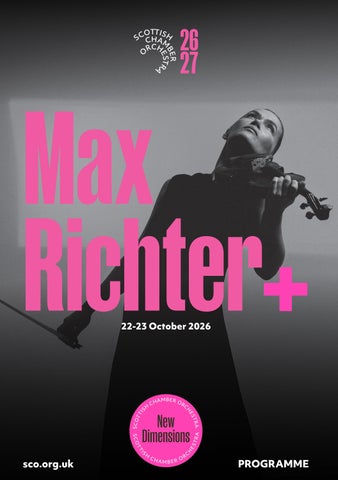
Max Richter+ 22-23 October 2026
New Dimensions sco.org.uk
PROGRAMME
26/27 Concert Season
Cover image ©Jonathan Vivaas Kise
Max Richter
New Dimensions
Thursday 22 October, 7.30pm Usher Hall, Edinburgh Friday 23 October, 7.30pm City Halls, Glasgow MAX RICHTER OPUS 2020 PHILIP GLASS Company JOHN ADAMS The Chairman Dances Interval of 20 minutes
MAX RICHTER Recomposed: Vivaldi – The Four Seasons* David Brophy conductor Mari Samuelsen violin/director* Chris Ekers sound Mari Samuelsen
© Jonathan Vivaas Kise
David Brophy
*This performance will be recorded for the BBC ‘Radio 3 In Concert’ series, due for broadcast on 6 January 2027.
4 Royal Terrace, Edinburgh EH7 5AB +44 (0)131 557 6800 | info@sco.org.uk | sco.org.uk
The Scottish Chamber Orchestra is a charity registered in Scotland No. SC015039. Company registration No. SC075079.
3
THANK YOU
Principal Conductor's Circle Our Principal Conductor’s Circle are a special part of our musical family. Their commitment and generosity benefit us all – musicians, audiences and creative learning participants alike. Annual Fund James and Patricia Cook Visiting Artists Fund Harry and Carol Nimmo Anne and Matthew Richards International Touring Fund Gavin and Kate Gemmell Learning and Participation Fund Jo and Alison Elliot Sabine and Brian Thomson
Productions Fund Geoff and Mary Ball Bill and Celia Carman Anne, Tom and Natalie Usher Scottish Touring Fund Eriadne and George Mackintosh Claire and Anthony Tait New Music Fund Ken Barker and Martha Vail Barker Colin and Sue Buchan David Caldwell Nick and Kate Thomas Kimie Trust
CHAIR SPONSORS The Donald and Louise MacDonald Principal Conductor's Chair Maxim Emelyanychev Chorus Director Gregory Batsleer Anne McFarlane
Cello Eric de Wit Jasmine Macquaker Charitable Fund
Leader Stephanie Gonley Caroline Hahn and Richard Neville-Towle
Principal Double Bass Jamie Kenny Erik Lars Hansen and Vanessa C L Chang
Principal First Violin Afonso Fesch Fiona and Ian Russell
Principal Flute André Cebrián Claire and Mark Urquhart
First Violin Aisling O'Dea Finlay and Lynn Williamson
Sub-Principal Flute Marta Gómez Judith and David Halkerston
First Violin Kana Kawashima Chris and Claire Fletcher
Principal Oboe The Hedley Gordon Wright Charitable Trust
Second Violin Rachel Smith Colin Mumford
Sub-Principal Oboe Katherine Bryer Ulrike and Mark Wilson
Principal Viola Max Mandel Ken Barker and Martha Vail Barker
Principal Clarinet Maximiliano Martín Stuart and Alison Paul
Sub-Principal Viola Francesca Gilbert Christine Lessels
Principal Bassoon Cerys Ambrose-Evans Claire and Anthony Tait
Viola Steve King Sir Ewan and Lady Brown
Sub-Principal Bassoon Alison Green George Rubienski
Principal Cello Philip Higham Nick and Kate Thomas
Principal Trumpet Peter Franks George Ritchie
Sub-Principal Cello Su-a Lee Ronald and Stella Bowie
Timpani / Percussion Louise Lewis Goodwin Silvia and Andrew Brown
Cello Donald Gillan Professor Sue Lightman
THANK YOU
Funding Partners Core Funder
Benefactor
Local Authority
Broadcast Partner
Media Partner
Funding Partner
Business Partners
Key Funders
Delivered by
Charity Partner
5
THANK YOU
SCO Donors Diamond
Gold
The Cockaigne Fund
Christian Albuisson
Malcolm and Avril Gourlay
Peter Armit
John and Jane Griffiths
Sir George and Lady Bain
James and Felicity Ivory
Elizabeth Brittin Kate Calder
Platinum
Vito Casadio
E.C. Benton
Martin Cook
Michael and Simone Bird
Jo and Christine Danbolt
John and Maggie Bolton
James and Caroline Denison-Pender
Dr Peter Williamson and Ms Margaret Duffy
Andrew and Kirsty Desson
Adam Gaines and Joanna Baker
David and Sheila Ferrier
David and Elizabeth Hudson
Iain Gow
Helen B Jackson
Margaret Green
Dr and Mrs Peter Jackson
Christopher and Kathleen Haddow
Dr Daniel Lamont
Catherine Johnstone
Graham and Elma Leisk
Julie and Julian Keanie
Professor and Mrs Ludlam
Gordon Kirk
Chris and Gill Masters
Janey and Barrie Lambie
Paul Maxwell, in loving memory of Ruth Maxwell
Mike and Karen Mair
Duncan and Una McGhie
Anne McAlister and Philip Sawyer
Anne-Marie McQueen
John and Liz Murphy
David Moncur
Tom Pate
Jane Peacock, in memory of Douglas Peacock
Maggie Peatfield
Charles Platt and Jennifer Bidwell
Alison and Stephen Rawles
Patrick and Susan Prenter
Andrew Robinson
Mr and Mrs J Reid
Olivia Robinson
The Walter and Janet Reid Charitable Trust
Irene Smith
Martin and Mairi Ritchie
Dr Jonathan Smithers
Elaine Ross
Ian S Swanson
Hilary E Ross
Ian and Janet Szymanski
Sir Muir and Lady Russell
John-Paul and Joanna Temperley
Jill and Brian Sandford
Douglas and Sandra Tweddle
Michael and Elizabeth Sudlow
James Wastle and Glenn Craig
Robert and Elizabeth Turcan
Catherine Wilson
Alan and Sue Warner
Neil and Philippa Woodcock
Bill Welsh
Georgina Wright
Anny and Bobby White Robert Mackay and Philip Whitley Ruth Woodburn
Silver
Norman Hazelton
Roy Alexander
Alistair Hector
John Anderson
Ron and Evelynne Hill
Fiona and Neil Ballantyne
Clephane Hume
Timothy Barnes and Janet Sidaway
Tim and Anna Ingold
The Batsleer Family
David and Pamela Jenkins
Jack Bogle
Susannah Johnston and Jamie Weir
Jane Borland
Ross D. Johnstone
Alan Borthwick
James Kelly, in memory of Mairi Kelly
Michael and Jane Boyle
Professor Christopher and Mrs Alison Kelnar
Mary Brady
Dr Ian Laing
Paula and Colin Brown
Geoff Lewis
John Brownlie
Dorothy A Lunt
Laura Buist
Vincent Macaulay
Robert Burns
James McClure, in memory of Robert Duncan
Mr A Campbell
Lucy McCorkell
Sheila Colvin
Gavin McCrone
Lorn and Camilla Cowie
Roy and Svend McEwan-Brown
Adam and Lesley Cumming
Michael McGarvie
Dr Wilma Dickson
Brian Miller
Sylvia Dow
Alistair Montgomerie
Colin Duncan, in memory of Norma Duncan
Norma Moore
Raymond Ellis
Margaret Mortimer and Ken Jobling
Dr and Mrs Alan Falconer
Andrew Murchison
Sheila Ferguson
Douglas Murray
Dr William Irvine Fortescue
John Peutherer, in memory of Audrey Peutherer
Patricia Glennie
James S Potter
Dr David Grant
Alastair Reid
Anne Grindley
Seona Reid and Cordelia Ditton
Andrew Hadden
Catherine Steel
J Martin Haldane
Takashi and Mikako Taji
Ronnie and Ann Hanna
C S Weir
Pamela Andrews and Alan Norton
Roderick Wylie
Roderick Hart
––––– We are indebted to everyone acknowledged here who gives philanthropic gifts to the SCO of £300 or greater each year, as well as those who prefer to remain anonymous. We are also incredibly thankful to the many individuals not listed who are kind enough to support the Orchestra financially on a regular or ad hoc basis. Every single donation makes a difference. Become a regular donor, from as little as £5 a month, by contacting Sadie Purves on 0131 478 8341 or sadie.purves@sco.org.uk.
“ …an orchestral sound that seemed to gleam from within.” THE SCOTSMAN
HM The King Patron Donald MacDonald CBE Life President Joanna Baker CBE Chair Gavin Reid LVO FRSE Chief Executive Maxim Emelyanychev Principal Conductor Andrew Manze Principal Guest Conductor Joseph Swensen Conductor Emeritus Gregory Batsleer Chorus Director Jay Capperauld Associate Composer
© Christopher Bowen
Our Musicians
Your Orchestra Tonight
Information correct at the time of going to print
This concert will be played on natural brass/timpani throughout.
Second Violin Gordon Bragg Hatty Haynes Flora Fontanelli Rachel Smith Rachel Spencer Stewart Webster Tom Hankey Abigail Young Viola Simone van der Giessen Jessica Beeston Elaine Koene Steve King Rebecca Wexler Marsailidh Groat Cello Hugh Mackay Su-a Lee Donald Gillan Eric de Wit Niamh Molloy
Bass Ciro Vigilante Ben Havinden-Williams Rupert Ring Stewart Wilson Harp Eleanor Hudson Flute/Piccolo André Cebrián Adam Richardson Oboe José Masmano Villar Fraser Kelman Clarinet Jean Johnson William Stafford
Trombone Duncan Wilson Christopher Mansfield Tuba Jonathan Gawn Timpani Louise Lewis Goodwin Percussion Tom Hunter Colin Hyson Pete Murch Andrew Murphy Piano/Harpsichord Michael Bawtree
Bass Clarinet William Stafford Bassoon Alison Green Rhiannon Carmichael Horn Lauren Reeve-Rawlings Nivanthi Karunaratne Gavin Edwards Ian Smith
Christoff Fourie Rachel Smith Second Violin Rachel's Chair is kindly supported by Colin Mumford.
© Christopher Bowen
First Violin Maia Cabeza Marie Schreer Esther Kim Kana Kawashima Aisling O’Dea Fiona Alexander Sarah Bevan-Baker Kristin Deeken
What You Are About To Hear MAX RICHTER (b.1966) OPUS 2020 (2020 ) PHILIP GLASS (b. 1937) Company (1983) I. 𝅘𝅥 = 96
II. 𝅘𝅥 = 160 III. 𝅘𝅥 = 96
IV. 𝅘𝅥 = 160
JOHN ADAMS (b. 1947) The Chairman Dances (1985) MAX RICHTER (b.1966) Recomposed: Vivaldi – The Four Seasons (2012 ) Spring 0 Spring 1 Spring 2 Spring 3 Summer 1 Summer 2 Summer 3 Autumn 1 Autumn 2 Autumn 3 Winter 1 Winter 2 Winter 3
Max Richter is a phenomenally successful musician, and a composer who’s also received wide acclaim. That’s partly because of the enormously widespread exposure of his music: he’s scored more than 50 films and TV series, as well as writing for the concert hall and the ballet stage, and for installations and catwalk fashion shows. But it’s also because of his works’ sheer emotional eloquence, conveyed using often surprisingly simple means. Richter has acknowledged early influence from US minimalists Terry Riley and Philip Glass (we’ll hear more from the latter shortly), as well as from pioneering pop artists Kraftwerk and Tangerine Dream. Could you call Richter himself a minimalist? It’s a contentious point. Certainly his music often draws on the cycling repetitions and luminous harmonies of composers including Glass and Steve Reich. But rather than to expose his pieces’ inner workings, he uses those elements to build slowly accumulating textures of immense emotional weight, in music that can sound at once fragile, intimate and grandly cinematic. Richter has long been fascinated by memory, time and reimagining the past, drawing on a sometimes bewildering collection of influences – from the richness of 19th-century classical music to drum and bass – in his explorations and reworkings, thereby establishing new connections with musical history for 21st-century listeners. The two works by Richter in tonight’s programme do just that, looking with fresh eyes at a pair of well-established composers from earlier centuries. OPUS 2020 was commissioned by the Beethoven Orchester Bonn in 2020, to celebrate the 250th anniversary of the
10
©Harald Krichel / WikiPortraits
OPUS 2020 was commissioned by the Beethoven Orchester Bonn in 2020, to celebrate the 250th anniversary of the birth of Ludwig van Beethoven.
Max Richter
birth of Ludwig van Beethoven. As we enter the current season marking the 200th anniversary of Beethoven’s death, it seems like a particularly appropriate place to
Electronic music practice has informed my writing as much as traditional notions of harmony and counterpoint. Therefore, I took as my compositional starting point a simple
begin. Richter himself writes about the piece:
and universal studio technique, that of the tape loop, something employed equally by Stockhausen, King Tubby, Brian Eno and many others.
OPUS 2020 takes its inspiration from Stockhausen’s OPUS 1970, the special ‘Beethoven Edition’ of Kurzwellen, his work for multiple radios. In the case of OPUS 1970, the music resulted not from radios tuned at random, but from tape recorders playing back a collage of Beethoven works together with Stockhausen’s own reading from the Heiligenstadt Testament.
I wondered if I could make an orchestral work made of Beethoven fragments that are treated as ‘tape loops’, but played instrumentally. This is the origin of OPUS 2020.
When I started thinking about OPUS 2020, I decided to bring some elements of Stockhausen’s practice into the present in new ways. My own work has always sought to integrate instrumental and electronic means; the studio is for me not simply a
In order to realise this idea, I have had to rethink how the orchestra works, and it has resulted in a very challenging, though seemingly simple score. The multiple temporal worlds of the differing loops means that the orchestra has to behave as a democratic community of ensembles,
recording tool, but also a sculptural one.
all playing in different meters, in order for
the overall effect to be realised. In spite of its architectural simplicity, the score relies on the finely calibrated and continuously
when he turns 90. Glass’ undulating patterns and distinctive harmonic progressions once baffled or even outraged
shifting dynamic relationships that mark the ebb and flow of the work.
listeners, but we’re now more familiar with his unmistakable musical language, and aware of his immense influence.
The Beethoven fragments I have used as raw materials for these loops are from works that mean something special to me personally, and I see OPUS 2020 as a place to reflect on them and on the extraordinary human value of Beethoven’s music more generally. For anybody wanting to avoid spoilers, move to the next paragraph now. The result of Richter’s multi-layered live ‘tape loops’ is a dream-like, constantly shifting soundscape from which distinctly Beethovenian sounds emerge, but often sound fresh and new, even alien. Richter’s final surprise, however, is a shift in both sonic environment and musical language, as he explains: ‘inspired by Beethoven’s vision, I, too, passionately believe in the uplifting impact of creative works on the individual and on society. I therefore leave the final word of OPUS2020 to Beethoven himself, as a reminder that, despite the challenges we face, the future lies in our hands; if we choose creative and positive action, that future will be brighter.’ Richter’s final passage is unadorned Beethoven, the opening of the final movement of the latter’s Piano Sonata in E, Op.109.
Company counts as Glass’s String Quartet No.2, though it was originally written in 1983 as incidental music for a stage adaptation of Samuel Beckett’s 1979 novella Company by the Mabou Mines theatre company in New York. It’s often performed, as tonight, in a version for string orchestra. Company unfolds in four brief movements, which originally interrupted and commented upon Beckett’s text. The opening movement begins hesitantly, but soon builds in grand arches of sound, including some unexpected dissonances. The second movement is more urgent, with striking contrasts, and after the delicate third movement, the quicker final movement explores contrasting textures while remaining within a familiar harmonic landscape.
From Richter looking back to Beethoven in the 18th and 19th centuries in 2020, we step back in time to a composer Richter has acknowledged as an early influence. Philip Glass is one of the founding fathers of minimalism (though that’s a term he himself detests), and he celebrates a significant
If Glass isn’t comfortable being labelled a minimalist, then his younger colleague John Adams actively describes himself as ‘a minimalist who’s bored with minimalism’. In his earliest pieces, it was just about reasonable to place him alongside Glass and Reich as a radical minimalist, creating music full of repetition, slowly changing textures, and usually consonant, lush harmonies. But very quickly, Adams started to strain against the boundaries, introducing all kinds of new, swiftly developing material into his pieces, to such an extent that some of his more recent works have even been described as
anniversary of his own in January 2027,
‘maximally minimalist’.
12
© Pasquale Salerno - Flickr
Philip Glass
John Adams
The Chairman Dances neatly encapsulates both these sides of Adams’ musical personality. He describes the piece as an ‘out-take’ from his first opera, Nixon in
as ‘the fabled “Madame Mao”, firebrand, revolutionary executioner, architect of China’s calamitous Cultural Revolution, and (a fact not universally realised) a former
China, which relates US President Richard Nixon’s 1972 visit to China, a defining moment in the thawing of US-Chinese relations. Nixon in China was enormously successful, as well as groundbreaking in its focus on very recent, real-world events, and has been staged across the world since its 1987 premiere at Houston Grand Opera (including its UK premiere at the 1988 Edinburgh International Festival).
Shanghai movie actress’ – gatecrashes a Presidential banquet, inviting her husband – present only in a gigantic, 40-foot portrait – to dance with her. He dutifully steps down from his picture, and they begin to dance a foxtrot together, remembering their youthful days on the Long March, dancing to music from a wind-up gramophone.
In the title of tonight’s piece, though, ‘Dances’ is a verb, not a noun. The Chairman in question is Mao Tse-tung (in the opera, at least – we’d now more likely call him Mao Zedong), and the piece describes a specific fantasy scenario, which Adams later reworked in the opera’s third
The Chairman Dances begins with a typically Adams minimalist texture, all chugging rhythms on strings and woodwind, a propulsive bassline and increasingly insistent ‘pings’ from woodwind, piano and percussion. After a couple of gradual buildups, the texture suddenly clears and the tempo slows for the piece’s sensuous, sultry middle section, complete with a soaring,
act. Chiang Ch’ing – whom Adams describes
Hollywood-style string melody, mirrored
in a ghostly, stratospheric theme on violin harmonics later on.
represent an inescapable element in any self-respecting violinist’s arsenal. They were phenomenally popular in Vivaldi’s own time,
When the opening music returns, it’s almost like a train slowly picking up speed, but the sensuousness of the middle section soon returns in a joyful rerun of the Hollywoodstyle melody, now combined with the chugging minimalist textures in a kind of ecstatic union. Suddenly a solo piano takes over, and as the Maos’ gramophone runs down, all that’s left is the crackle of the needle in the groove.
and established a tradition that stretched through to such later nature portraits as Beethoven’s ‘Pastoral’ Symphony, and even Messiaen’s visionary bird evocations. Since Vivaldi’s music is so colourful, so descriptive and so open to individual interpretation, it might feel like the composer is almost challenging his performers to discover their own distinctive ways of conveying it. Many have taken up that challenge: there are countless period performances inspired by what went on in the composer’s own time, as well as jazz and electronic versions, and even arrangements for Chinese and Japanese instruments.
Adams himself playfully suggests that we might associate the piece’s minimalist opening with Mao, and the more ‘seductive, swaying-hips melody’ of its central section with Chiang Ch’ing, adding: ‘you might imagine the piano part at the end being played by Richard Nixon.’ We return to Richter for tonight’s final piece, and to what must surely count as his best-known and most widely loved creation. Recomposed is a piece that exerts a profound emotional power on many listeners, partly because of the familiarity of Vivaldi’s original Four Seasons, and partly because of what Richter does with that earlier music. But before we turn to what Richter does, let’s take a look at Vivaldi’s original. As so often with music from the early 18th century, the origins of The Four Seasons are slightly sketchy, although we know the concertos were first published in Amsterdam in 1725, as the first four pieces in a collection entitled Il cimento dell’ armonia e dell’ inventione (or The Contest Between Harmony and Invention). The four seasonal concertos form one of the cornerstones of the classical repertoire, of course, and they 14
It’s that very familiarity of The Four Seasons that lies behind Richter’s ‘recomposition’ of the concertos. He writes about his version of the pieces: When I was a young child I fell in love with Vivaldi’s original, but over the years, hearing it principally in shopping centres, advertising jingles, on telephone hold systems and similar places, I stopped being able to hear it as music; it had become an irritant – much to my dismay! So I set out to try to find a new way to engage with this wonderful material, by writing through it anew – similarly to how scribes once illuminated manuscripts – and thus rediscovering it for myself. I deliberately didn’t want to give it a modernist imprint but to remain in sympathy and in keeping with Vivaldi’s own musical language. This kind of ‘recomposition’ might strike us as an intricate philosophical conundrum in 2026. After all, it poses profound questions about authorship (who’s really the composer here?), the sanctity of iconic
Though Richter is careful to retain the clarity and focus of Vivaldi’s own musical language – or at least to create a distinctively 21st-century version of it – he nonetheless introduces a sense of distance between the listener and the music, which in this new version sounds at once familiar and entirely new. artworks (is Richter even allowed to tamper with such an iconic creation?), and even cultural familiarity (what does it mean to us to encounter a ‘new’ version of something
Richter estimated that during his recomposition, he discarded around three-quarters of Vivaldi’s original music. And while there are passages that sound
we already know so well?). In Vivaldi’s own time, however, adapting and reworking another composer’s music was common practice. Even JS Bach did it to his Italian colleague: around 1713-14 he reworked several of Vivaldi’s existing violin concertos as concertos for harpsichord or organ. In the early 18th century, as now, great music was not necessarily treated as an inviolable museum object.
almost entirely untouched, there are many other sections where Vivaldi’s music is only glimpsed through Richter’s radical reworkings – in a multi-storey aviary of layered birdsong, for example, or in an energetic, EDM-style dance movement. New, almost club-like harmonies set Vivaldi’s melodies in unexpected contexts, and witty, irregular rhythms might keep you guessing as to where the music’s going next.
Though Richter is careful to retain the clarity and focus of Vivaldi’s own musical language – or at least to create a distinctively 21st-century version of it – he nonetheless introduces a sense of distance between the listener and the music, which in this new version sounds at once familiar and
Alongside the intricate details of Richter’s imaginative reworkings, however, it’s perhaps the broader question posed by Recomposed that lingers longest: how can music we think we know intimately be made strange, vivid and new again?
entirely new.
© David Kettle
Conductor
© Annika Fußwinkel
David Brophy
David Brophy, Chief Conductor of the WDR Funkhausorchester (WDR Radio Orchestra) Cologne, is widely recognised as one of the most established Irish conductors. He has held positions throughout Ireland, including Principal Conductor with the RTÉ Concert Orchestra and titular positions with both the National Symphony Orchestra Ireland and the Chamber Choir Ireland. In Europe, David has guest conducted orchestras such as Orquesta Nacional Clásica de Andorra, Orquesta Sinfónica de Galicia, Aalborg Symfoniorkester, Oulu Symphony Orchestra. American engagements have included appearances with Atlanta Symphony Orchestra, Buffalo Philharmonic, Nashville Symphony Orchestra, Naples Philharmonic, Pittsburgh Symphony Orchestra and the National Symphony Orchestra at The Kennedy Center, Washington D.C. He also performed at the Lincoln Center in New York with the RTÉ Concert Orchestra. Soloist collaborations include performances with Martin Fröst, Lang Lang, Nicola Benedetti, Maxim Vengerov, James Galway, Barry Douglas, Willard White, Lesley Garrett, Danielle de Niese, Kim Criswell, Daniel Hope, Evelyn Glennie, and Carolin Widmann. He has also worked closely with pop artists including U2, Andrea Bocelli, Father John Misty, The Chieftains, Dreamers’ Circus, Sinéad O’Connor, and with international stars of the silver screen including Brendan Gleeson, Fiona Shaw, and Kenneth Branagh. David has recorded for Silva Screen Records, Lyric FM, Tara Records, V2 Records, and Compass Records. Other recordings include Victor Herbert’s operetta Eileen and Rogers & Hart’s Dearest Enemy for New World Records, conducting the Orchestra of Ireland. In Ireland, David is a well-known figure on public TV and radio, having presented multiple award-winning programmes, extending the reach of classical music in mainstream media. He has recently been awarded an honorary doctorate from The Open University for services to music and the community in Ireland. For full biography please visit sco.org.uk 16
Violin / director
© Andrea Gjestvang
Mari Samuelsen
In Mari Samuelsen’s musical universe, there are no barriers between the music of contemporary composers like Max Richter, Caroline Shaw and Philip Glass, and that of Bach and Beethoven. With her breathtaking artistry, adventurous approach to programming, and emotionally charged style of playing, backed by immaculate technique and a drive to defy traditional expectations, she inspires a global audience. Mari’s passion for genre blurring has seen her collaborate with a range of musicians including electronic music artists Jeff Mills, Dubfire and multimedia artist Philipp Geist, and to perform with Max Richter and Hollywood actress Tilda Swinton at the Bluedot Festival. LIFE, Mari's third studio album on Deutsche Grammophon, inspired by her experience of becoming a mother, includes music by Max Richter as well as Olivia Belli, Jóhann Jóhansson, and Nils Frahm, with a track by Hania Rani being selected by Louis Vuitton for their Olympic campaign. This follows her two previous albums LYS and MARI, both of which reached top 10 in the Classical Album Charts. "When making music and putting together programs, I don't think about what's traditionally perceived to be "correct" or "expected", rather the opposite. My aim is to create innovative programmes for music lovers – regardless of genre."
Sound
© Bobby Aitken
Chris Ekers
From gaining a choral scholarship as a chorister at Wells Cathedral, Chris began his sound engineering career as an apprentice with Autograph Sound Recording in London, specialising in theatre sound for musicals. Later, as a freelancer, he became involved in contemporary classical music and dance, working with many leading composers, choreographers and ensembles. In 1988, he assisted with the opening performance of Tate Gallery Liverpool, where he met the composer Gavin Bryars. This led to a long association with him and his ensemble, both in live performance and recordings of such works as The Sinking of the Titanic and Jesus Blood Never Failed Me Yet. His collaboration with composer Max Richter started in 2004 and until recently, he had been instrumental in realising much of Richter’s chamber, orchestral, theatre and site-specific repertoire; but now he concentrates more on the global success of his scores for the ballets of Sir Wayne McGregor and the Royal Ballet. Chris is head of sound for the annual Fes Festival of World Sacred Music in Morocco and works with conductor Kristjan Jarvi’s Nordic Pulse Orchestra in Estonia on their collaborations with Brian Eno and Jon Hopkins. Chris first encountered Norwegian violinist, Mari Samuelsen, with her ground-breaking performances of Richter's Recomposed:Vivaldi, The Four Seasons in 2016. Since then, he has realized numerous performances with her around the world.
18
12-13 November, 7.30pm Edinburgh | Glasgow
Andrew Manze conductor Sheku Kanneh-Mason cello SCO Academy
Sheku Kanneh-Mason plays Haydn Featuring the young players of the SCO Academy
Tickets at sco.org.uk Company Registration Number: SC075079. A charity registered in Scotland No. SC015039.
Scottish Chamber Orchestra The Scottish Chamber Orchestra (SCO) is one of Scotland’s five National Performing Companies and has been a galvanizing force in Scotland’s music scene since its inception in 1974. The SCO believes that access to world-class music is not a luxury but something that everyone should have the opportunity to participate in, helping individuals and communities everywhere to thrive. Funded by the Scottish Government, City of Edinburgh Council and a community of philanthropic supporters, the SCO has an international reputation for exceptional, idiomatic performances: from mainstream classical music to newly commissioned works, each year its wide-ranging programme of work is presented across the length and breadth of Scotland, overseas and increasingly online. Equally at home on and off the concert stage, each one of the SCO’s highly talented and creative musicians and staff is passionate about transforming and enhancing lives through the power of music. The SCO’s Creative Learning programme engages people of all ages and backgrounds with a diverse range of projects, concerts, participatory workshops and resources. The SCO’s current fiveyear Residency in Edinburgh’s Craigmillar builds on the area’s extraordinary history of Community Arts, connecting the local community with a national cultural resource. An exciting new chapter for the SCO began in September 2019 with the arrival of dynamic young conductor Maxim Emelyanychev as the Orchestra’s Principal Conductor. His tenure has recently been extended until at least 2031. The SCO and Emelyanychev released their first album together (Linn Records) in 2019 to widespread critical acclaim. Their second recording together, of Mendelssohn symphonies, was released in 2023, with Schubert Symphonies Nos 5 and 8 following in 2024. The SCO also has long-standing associations with many eminent guest conductors and directors including Principal Guest Conductor Andrew Manze, Pekka Kuusisto, François Leleux, Nicola Benedetti, Isabelle van Keulen, Anthony Marwood, Richard Egarr, Mark Wigglesworth, Lorenza Borrani and Conductor Emeritus Joseph Swensen. The Orchestra’s current Associate Composer is Jay Capperauld. The SCO enjoys close relationships with numerous leading composers and has commissioned around 200 new works, including pieces by Sir James MacMillan, Anna Clyne, Sally Beamish, Martin Suckling, Einojuhani Rautavaara, Karin Rehnqvist, Mark-Anthony Turnage, Nico Muhly and the late Peter Maxwell Davies.
© Christopher Bowen
Biography
Thank you for joining us. We’d love to hear about your experience. The QR code below will take you to a very short survey that will help us shape future concerts.
Photo of Mari Samuelsen ©Jonathan Vivaas Kise
Support us Each year, the SCO must fundraise around £1.3 million to bring extraordinary musical performances to the stage and support groundbreaking education and community initiatives beyond it. If you share our passion for transforming lives through the power of music and want to be part of our ongoing success, we invite you to join our community of regular donors. Your support, no matter the size, has a profound impact on our work – and as a donor, you’ll enjoy an even closer connection to the Orchestra. To learn more and support the SCO from as little as £5 per month, please contact Sadie Purves on 0131 478 8341 or sadie.purves@sco.org.uk.
The SCO is a charity registered in Scotland No SC015039. Photo: Christopher Bowen