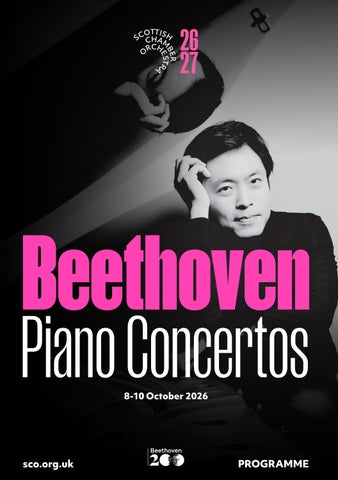
Beethoven
Piano Concertos 8-10 October 2026
sco.org.uk
PROGRAMME
26/27 Concert Season
Cover image © Marco Borgreve
Beethoven Piano Concertos To mark the 200th anniversary of Beethoven’s death, Scotland’s orchestras and national opera company unite for an extraordinary Season-long tribute to the composer.
Thursday 8 October, 7.30pm The Queen's Hall, Edinburgh Friday 9 October, 7.30pm City Halls, Glasgow Saturday 10 October, 7.30pm Aberdeen Music Hall CAROLINE SHAW Punctum † BEETHOVEN Piano Concerto No.4* Interval of 20 minutes
BEETHOVEN Piano Concerto No.5 ‘Emperor’* Sunwook Kim piano/director* Stephanie Gonley violin/director †
© Ryan Buchanan
Stephanie Gonley
©Marco Borggreve
Sunwook Kim
4 Royal Terrace, Edinburgh EH7 5AB +44 (0)131 557 6800 | info@sco.org.uk | sco.org.uk
The Scottish Chamber Orchestra is a charity registered in Scotland No. SC015039. Company registration No. SC075079.
3
THANK YOU
Principal Conductor's Circle Our Principal Conductor’s Circle are a special part of our musical family. Their commitment and generosity benefit us all – musicians, audiences and creative learning participants alike. Annual Fund James and Patricia Cook Visiting Artists Fund Harry and Carol Nimmo Anne and Matthew Richards International Touring Fund Gavin and Kate Gemmell Learning and Participation Fund Jo and Alison Elliot Sabine and Brian Thomson
Productions Fund Geoff and Mary Ball Bill and Celia Carman Anne, Tom and Natalie Usher Scottish Touring Fund Eriadne and George Mackintosh Claire and Anthony Tait New Music Fund Ken Barker and Martha Vail Barker Colin and Sue Buchan David Caldwell Nick and Kate Thomas Kimie Trust
CHAIR SPONSORS The Donald and Louise MacDonald Principal Conductor's Chair Maxim Emelyanychev Chorus Director Gregory Batsleer Anne McFarlane
Cello Eric de Wit Jasmine Macquaker Charitable Fund
Leader Stephanie Gonley Caroline Hahn and Richard Neville-Towle
Principal Double Bass Jamie Kenny Erik Lars Hansen and Vanessa C L Chang
Principal First Violin Afonso Fesch Fiona and Ian Russell
Principal Flute André Cebrián Claire and Mark Urquhart
First Violin Aisling O'Dea Finlay and Lynn Williamson
Sub-Principal Flute Marta Gómez Judith and David Halkerston
First Violin Kana Kawashima Chris and Claire Fletcher
Principal Oboe The Hedley Gordon Wright Charitable Trust
Principal Viola Max Mandel Ken Barker and Martha Vail Barker
Sub-Principal Oboe Katherine Bryer Ulrike and Mark Wilson
Sub-Principal Viola Francesca Gilbert Christine Lessels
Principal Clarinet Maximiliano Martín Stuart and Alison Paul
Viola Steve King Sir Ewan and Lady Brown
Principal Bassoon Cerys Ambrose-Evans Claire and Anthony Tait
Principal Cello Philip Higham Nick and Kate Thomas
Sub-Principal Bassoon Alison Green George Rubienski
Sub-Principal Cello Su-a Lee Ronald and Stella Bowie
Principal Trumpet Peter Franks George Ritchie
Cello Donald Gillan Professor Sue Lightman
Timpani / Percussion Louise Lewis Goodwin Silvia and Andrew Brown
THANK YOU
Funding Partners Core Funder
Benefactor
Local Authority
Broadcast Partner
Media Partner
Funding Partner
Business Partners
Key Funders
Delivered by
Charity Partner
5
THANK YOU
SCO Donors Diamond
Gold
The Cockaigne Fund
Christian Albuisson
Malcolm and Avril Gourlay
Peter Armit
John and Jane Griffiths
Sir George and Lady Bain
James and Felicity Ivory
Elizabeth Brittin
Anne, Tom and Natalie Usher
Kate Calder Vito Casadio
Platinum
Jo and Christine Danbolt
E.C. Benton
James and Caroline Denison-Pender
Michael and Simone Bird
Andrew and Kirsty Desson
John and Maggie Bolton
David and Sheila Ferrier
Dr Peter Williamson and Ms Margaret Duffy
Iain Gow
Adam Gaines and Joanna Baker
Margaret Green
David and Elizabeth Hudson
Christopher and Kathleen Haddow
Helen B Jackson
Catherine Johnstone
Dr and Mrs Peter Jackson
Julie and Julian Keanie
Dr Daniel Lamont
Gordon Kirk
Graham and Elma Leisk
Janey and Barrie Lambie
Professor and Mrs Ludlam
Mike and Karen Mair
Chris and Gill Masters
Anne McAlister and Philip Sawyer
Paul Maxwell, in loving memory of Ruth Maxwell
John and Liz Murphy
Duncan and Una McGhie
Tom Pate
Anne-Marie McQueen
Maggie Peatfield
David Moncur
Alison and Stephen Rawles
Jane Peacock, in memory of Douglas Peacock
Andrew Robinson
Charles Platt and Jennifer Bidwell
Olivia Robinson
Patrick and Susan Prenter
Irene Smith
Mr and Mrs J Reid
Dr Jonathan Smithers
The Walter and Janet Reid Charitable Trust
Ian S Swanson
Martin and Mairi Ritchie
Ian and Janet Szymanski
Elaine Ross
John-Paul and Joanna Temperley
Hilary E Ross
Douglas and Sandra Tweddle
Sir Muir and Lady Russell
James Wastle and Glenn Craig
Jill and Brian Sandford
Catherine Wilson
Michael and Elizabeth Sudlow
Neil and Philippa Woodcock
Robert and Elizabeth Turcan
Georgina Wright
Alan and Sue Warner Bill Welsh Anny and Bobby White Robert Mackay and Philip Whitley Ruth Woodburn
Silver
Norman Hazelton
Roy Alexander
Alistair Hector
John Anderson
Ron and Evelynne Hill
Fiona and Neil Ballantyne
Clephane Hume
Timothy Barnes and Janet Sidaway
Tim and Anna Ingold
The Batsleer Family
David and Pamela Jenkins
Jack Bogle
Susannah Johnston and Jamie Weir
Jane Borland
Ross D. Johnstone
Alan Borthwick
James Kelly, in memory of Mairi Kelly
Michael and Jane Boyle
Professor Christopher and Mrs Alison Kelnar
Mary Brady
Dr Ian Laing
Paula and Colin Brown
Geoff Lewis
John Brownlie
Dorothy A Lunt
Laura Buist
Vincent Macaulay
Robert Burns
James McClure, in memory of Robert Duncan
Mr A Campbell
Lucy McCorkell
Sheila Colvin
Gavin McCrone
Lorn and Camilla Cowie
Roy and Svend McEwan-Brown
Adam and Lesley Cumming
Michael McGarvie
Dr Wilma Dickson
Brian Miller
Sylvia Dow
Alistair Montgomerie
Colin Duncan, in memory of Norma Duncan
Norma Moore
Raymond Ellis
Margaret Mortimer and Ken Jobling
Dr and Mrs Alan Falconer
Andrew Murchison
Sheila Ferguson
Douglas Murray
Dr William Irvine Fortescue
John Peutherer, in memory of Audrey Peutherer
Patricia Glennie
James S Potter
Dr David Grant
Alastair Reid
Anne Grindley
Seona Reid and Cordelia Ditton
Andrew Hadden
Catherine Steel
J Martin Haldane
Takashi and Mikako Taji
Ronnie and Ann Hanna
C S Weir
Pamela Andrews and Alan Norton
Roderick Wylie
Roderick Hart
––––– We are indebted to everyone acknowledged here who gives philanthropic gifts to the SCO of £300 or greater each year, as well as those who prefer to remain anonymous. We are also incredibly thankful to the many individuals not listed who are kind enough to support the Orchestra financially on a regular or ad hoc basis. Every single donation makes a difference. Become a regular donor, from as little as £5 a month, by contacting Sadie Purves on 0131 478 8341 or sadie.purves@sco.org.uk.
“ …an orchestral sound that seemed to gleam from within.” THE SCOTSMAN
HM The King Patron Donald MacDonald CBE Life President Joanna Baker CBE Chair Gavin Reid LVO FRSE Chief Executive Maxim Emelyanychev Principal Conductor Andrew Manze Principal Guest Conductor Joseph Swensen Conductor Emeritus Gregory Batsleer Chorus Director Jay Capperauld Associate Composer
© Christopher Bowen
Our Musicians
Your Orchestra Tonight
Information correct at the time of going to print
This concert will be played on natural brass/timpani throughout.
First Violin Stephanie Gonley Afonso Fesch Alex Lomeiko Kana Kaswashima Aisling O’Dea Fiona Alexander Sarah Bevan-Baker Kristin Deeken Second Violin Hatty Haynes Gordon Bragg Ilhem Ben Khalfa Rachel Smith Rachel Spencer Kirsty Main
Flute André Cebrián Caglayan Barbaros
Horn Gavin Edwards Nivanthi Karunaratne
Oboe Steve Hudson Katherine Bryer
Trumpet Peter Franks Shaun Harrold
Clarinet Maximiliano Martín William Stafford
Timpani Stefan Beckett
Bassoon Cerys Ambrose-Evans Alison Green
Viola Francesca Gilbert Carol Ella Christine Anderson Steve King Cello Philip Higham Su-a Lee Donald Gillan Eric de Wit Bass
Steve King Viola Steve's Chair is kindly supported by Sir Ewan and Lady Brown
© Christopher Bowen
Nikita Naumov Will Priest
What You Are About To Hear CAROLINE SHAW (b.1982) Punctum (2009 ) BEETHOVEN (1770-1827) Piano Concerto No.4 in G major, Op.58 (1805–06) Allegro moderato Andante con moto Rondo (Vivace)
BEETHOVEN (1770-1827) Piano Concerto No. 5 in E major ‘Emperor’ Op.73 (1809-10) Allegro Adagio un poco moto Rondo (Allegro ma non troppo)
Ludwig van Beethoven clearly dominates tonight’s programme, with two of his profoundest and most forward-looking creations for the instrument that was closest to both his heart and his career (with a little help from an orchestra too, obviously). But before we turn to Beethoven’s deep and complex relationship with the piano, let’s begin with a composer very much of our own times, who’s nonetheless gazing back in time to a musician from more than three centuries ago. Caroline Shaw is a violinist, singer and composer whose music is almost impossible to categorise. She became the youngest ever winner of the prestigious Pulitzer Prize for music (in 2013, at the age of 30, for her choral piece Partita for 8 Voices), but she’s also collaborated with rappers Nas and Kanye West, and one of her recent works is a delicate reimagining for voices and percussion of ABBA’s ‘Lay All Your Love On Me’. She’s written for film and the theatre, and her concert works often take existing music as a starting point for delicate, witty reflections on musical history, and on the process of making music itself. She originally wrote her Punctum in 2009 for her own ensemble, the Franklin Quartet – in fact, it marks her first foray into the world of music for string quartet, which she’s returned to several times since. Shaw went on to revise the piece for string orchestra in 2022, to a commission from the Boston Symphony Orchestra. She writes about the piece: Punctum is essentially an exercise in nostalgia, inspired by Roland Barthes’ description of the ‘unexpected’ in photographs and in particular by his
10
Caroline Shaw is a violinist, singer and composer whose music is almost impossible to categorise. Caroline Shaw
extended description of the elusive ‘Winter Garden’ photo in his 1980 book Camera Lucida. Through modular sequences
to encounter Beethoven as a performer in 2026. Apart from searching out contemporary accounts, we have precious
strung together out of context, the piece explores a way of saturating the palette with Classicism while denying it form, and of disturbing the legibility of a harmonic progression in order to reinforce it later. One could also say the piece is about the sensation of a particular secondary dominant in Bach’s St Matthew Passion.
little possibility of experiencing Beethoven as a pianist. For us, now, he’s very much a composer, probably only a composer. In his own time, however – certainly in the years following his move from his birthplace of Bonn to the fiercely competitive musical world of Vienna in 1792 – he was both pianist and composer. Or even a pianist who also happened to compose. It takes quite a shift in our common perception of Beethoven to truly appreciate how central a role the piano played in his life.
What emerges is music poised between memory and recognition: fragments of familiar-sounding harmony surface and dissolve, until Bach’s world seems to briefly swim into focus. There were no YouTube videos, no Spotify, not even any old-fashioned CDs around in the early 19th century. And it’s only those
It was, in fact, the instrument that accompanied him through every stage of his career – and indeed, instrument and career are intimately interconnected. It was the instrument he wrote most music
with supernatural powers who might claim
for (five concertos and 32 sonatas, plus a
vast collection of other solo pieces, both small and large). And it was the instrument that enabled the 21-year-old Beethoven
developments – his suggestions essentially came down again and again to ‘bigger, louder, bolder’ – and he made a point of
to establish himself in Vienna, as a piano teacher, performer and improviser.
exploiting them in his music, often pushing against the limits of whichever type of piano he encountered at any particular time.
He’s known to have established a formidable reputation as a virtuoso pianist by 1793, and just two years later, he appeared publicly in Vienna playing his First Piano Concerto. It was a relatively tried-and-tested format, and one that had served Mozart well: a piano virtuoso entertains and inspires audiences with their astonishing playing, and also writes themselves showpieces to demonstrate those very talents. In this way, Beethoven’s earlier piano compositions can teach us a lot about not only his ideas and passions in terms of composition, but also what particularly interested and inspired him about playing. Similarly, we shouldn’t dismiss Beethoven’s piano improvisation as just something to show off his breathtaking abilities. He’s known to have reduced listeners to tears with the emotional intensity of his improvisations, and he used them, too, as a crucial testing-ground for new ideas and how they might be developed and expanded. The other vital factor in this relationship is the piano itself. Beethoven might have been used to smaller, lighter, clearersounding fortepianos during his early years in Vienna, but instrument makers were rapidly expanding the keyboard’s range, strengthening its construction and experimenting with new actions and pedals, dramatically enriching the instrument’s power and palette. Beethoven is known to have advised makers on these new 12
Beethoven’s pianistic relationship became still more complicated by the issue of his inexorably encroaching deafness. The Piano Concerto No.4 was his last that Beethoven premiered himself: his condition had deteriorated so much that he felt unable to be the soloist at the 1811 public premiere of his Piano Concerto No.5, even though he’s known to have given solo performances until 1814. It takes us beyond the timeframe of tonight’s concert, but even this tragedy had its impact on his relationship with the piano. Divorced from its role as the vehicle by which Beethoven would demonstrate his performing prowess, it seemed to become instead almost a laboratory for his musical ideas and experiments, a sandbox for his imagination, a place to test what the piano could achieve in terms of virtuosity, sound or even visionary insight. But we’re getting ahead of ourselves. Let’s return to Vienna at the very start of the 19th century, where Beethoven was working on his Piano Concerto No.4 in 1805 and 1806. He’d written three piano concertos already, and despite stamping his distinctive musical personality on those works, the long shadow of Haydn and Mozart still fell strongly over them, even across the rugged and more individual No.3 in Beethoven’s ‘tragic’ key of C minor. In his Piano Concertos Nos 4 and 5, however, Beethoven would approach things very differently – and in ways that would
© Steven Pisanod
Ludwig van Beethoven
Beethoven’s pianistic relationship became still more complicated by the issue of his inexorably encroaching deafness. The Piano Concerto No. 4 was his last that Beethoven premiered himself.
mean those two concertos are also very different from one another. While in No.5, the piano crashes into our consciousness
was repeated. Allowing a soloist to launch their concerto on their own was unheard-of – well, almost (Mozart had done something
with rocketing arpeggios and virtuoso filigree passages, almost challenging the orchestra to outdo it in sound or sheer ambition, in No. 4 it enters politely, quietly, and alone.
similar in his Piano Concerto No.9, the ‘Jeunehomme’, though there the pianist doesn’t actually begin the piece).
That was quite a radical departure in 1808, when the Piano Concerto No.4 received its first public performance as part of Beethoven’s four-hour, stuffed-full ‘Akademie’ concert in Vienna’s (unheated) Theater an der Wien on 22 December (which also included the premieres of his Fifth and Sixth symphonies and several other works besides). Previously, it would have been standard practice for an orchestra to launch a concerto without its soloist, who’d only get their moment to shine
And with that apparently simple decision, Beethoven managed to raise fundamental questions about what a concerto was, and what it was for. A concerto had long provided a vehicle for a soloist's virtuosity, but Mozart had already transformed it into a far richer dialogue between individual and ensemble, and Beethoven now pushed that relationship into still more radical territory. This wouldn’t be about a starry soloist and an accompanying orchestra. Instead, the concerto would become a place of conflict, competition and (hopefully) cooperation between pianist
when the first movement’s opening material
and ensemble.
Though in the Fourth Piano Concerto’s opening movement, that shifting relationship between pianist and
French forces to withdraw from Austrian territories.
orchestra is set within a deeply lyrical, even contemplative musical world that’s established by the piano’s quiet opening chords. That said, the pianist makes a surprisingly loud, even triumphant reentry when those chords return later in the movement, and the soloist is equally assertive in the fiery, complex cadenza that Beethoven wrote out himself.
The brief occupation caused considerable distress and disruption for the people of Vienna, and Beethoven partly blamed it, too, for the failure of his opera Fidelio, which was premiered exactly a week after the French troops’ arrival. Far worse was to come, however, in 1809, when the French forces returned, and this time bombarded the city.
In the second movement, Beethoven arguably makes the relationship between soloist and orchestra into the whole point of the music. It’s a deeply unusual creation, in which brusque, gruff utterances from the strings are answered by serene, hymn-like chords from the piano, before the two sides seem to reach an uneasy truce. Piano and orchestra come together more closely in the excitable, propulsive third movement, even offering their own
‘What a destructive, unruly life around me! Nothing but drums, cannons, human misery of every sort!’ That was the composer’s description of life in the war-torn city to his Leipzig publisher Gottfried Christoph Härtel in July 1809. To say that life was tough for the composer at the time he wrote his Fifth Piano Concerto – the ‘Emperor’ – would be an understatement. Napoleon’s forces had arrived in May 1809, and at one stage the fighting grew so frighteningly close that Beethoven was forced to take
complementary but slightly different versions of its eager main theme. Again, Beethoven writes out his own virtuoso solo cadenza for his pianist. And just when he seems to be heading towards a surprisingly gentle, reflective close, the pace picks up, and there’s a joyful race to the finish.
shelter in the basement of his brother Kaspar Karl’s house – where he covered his head with pillows in the hope of protecting what precious hearing he had left. And war and inflation rapidly eroded the value of the annual payment that three aristocratic patrons had promised him earlier that year.
On 13 November 1805 – while Beethoven was in the early stages of writing his Fourth Piano Concerto – Napoleon’s French forces entered Vienna, to little resistance. The Emperor, Francis II, had already fled the capital, along with many members of the aristocracy. French troops were billeted across the city, and Vienna’s cultural life came to a virtual standstill. On 26 December that year, however, the Treaty
It’s a wonder that Beethoven was able to write music at all, let alone produce his longest, grandest and most ambitious Concerto, whose nobility and virtuosity encapsulates the heroic style of his middle period. If the Fourth Concerto was about lyricism, elegance, restraint and reflection, then in his Fifth, Beethoven is out to astound and delight listeners with sheer sonic ambition, and to demonstrate just what a
of Pressburg established arrangements for
modern-day piano (for 1809) could do.
14
Napoleon’s forces had arrived in May 1809, and at one stage the fighting grew so frighteningly close that Beethoven was forced to take shelter in the basement of his brother Kaspar Karl’s house – where he covered his head with pillows in the hope of protecting what precious hearing he had left.
In that respect, the Concerto’s ‘Emperor’ nickname feels vaguely appropriate – not that it has anything to do with Beethoven.
then falls silent as the orchestra reveals the movement’s two main themes – the first on violins, the second taken up nobly on horns
In fact, it’s highly unlikely he would have approved: it’s hard to imagine Beethoven welcoming a title that inevitably invoked the invader Napoleon, who had plummeted from the composer’s esteem when he had named himself Emperor in 1804. Where the nickname came from is unclear: some say it was coined by the work’s English publisher, John Cramer, to sell more copies of the music. In any case, the word perfectly encapsulates the piece’s grand vision, which looks forward to the virtuosic pianism of later figures such as Franz Liszt.
– before returning with its own visions of the same melodies, which are developed throughout the rest of the movement.
The broad chords of the expansive first movement’s opening would have been strikingly original in Beethoven’s time, as would the cascading scales and trills with which the piano answers them. The soloist
The calm, reflective slow movement is one of Beethoven’s tenderest creations, with the piano floating filigree song melodies over a serene string chorale. It leads directly into the boisterous final movement, the soloist hesitantly trying out its dance-like main theme before suddenly bursting forth with it loudly and confidently. It makes for a poignant paradox: Beethoven's most expansive celebration of the piano’s newfound power arrived just as his own ability to demonstrate that power to audience was slipping irretrievably away. © David Kettle
Piano/director
© Marco Borggreve
Sunwook Kim
Since winning the prestigious Leeds International Piano Competition in 2006 at the age of 18, Sunwook has established a reputation as one of the finest pianists of his generation, appearing as a concerto soloist in the subscription series of some of the world’s leading orchestras including the Berliner Philharmoniker, London Symphony Orchestra, Royal Concertgebouw Orchestra, Staatskapelle Dresden, Chicago Symphony and the NHK Symphony. Alongside his career as a pianist Sunwook has a rapidly developing profile as a conductor and has built long and meaningful relationships with top orchestras as a guest conductor as well as being Music Director of the Gyeonggi Philharmonic in Korea from 2024-2025. As a soloist, Sunwook enjoys close relationships with renowned conductors including Daniel Harding, Paavo Järvi, Myung-whun Chung, Marek Janowski, Sir Mark Elder and Jakub Hrusa. Other recent highlights include soloist for the Berlin Philharmonic on their tour of Korea under Kirill Petrenko, an extensive tour of Europe and Korea play-directing Beethoven concerti with the Chamber Orchestra of Europe, with concerts at Lotte Concert Hall, Berlin Philharmonie, Salle Philharmonique de Liege, Halle Aux Grains, Toulouse and the Barbican, London. Other recent concerto highlights include concerts with the London Symphony Orchestra (Michael Tilson Thomas), Los Angeles Philharmonic (Matthias Pintscher), and Netherlands Radio Philharmonic (Karina Cannellakis). As a guest conductor, Sunwook Kim regularly appears with the Seoul Philharmonic, with whom he has conducted wide ranging repertoire including Strauss’s Tod und Verklärung and Der Rosenkavalier, as well as Beethoven’s Symphony No.9. He has also made highly successful debuts with the Israel Philharmonic and with the Iceland Symphony Orchestra. He enjoys a close relationship with the Bournemouth Symphony Orchestra, who he has conducted on numerous occasions. As a recitalist Sunwook appears on the world’s finest stages including Wigmore Hall, Philharmonie de Paris, Symphony Hall Osaka and Seoul Arts Centre, and also collaborates regularly with life partner Clara-Jumi Kang, and with Janine Jansen. Born in Seoul in 1988, Sunwook completed an MA in conducting at the Royal Academy of Music and was subsequently made a fellow (FRAM) of the Royal Academy of Music in 2019. For full biography please visit sco.org.uk 16
Stephanie Gonley
© Christina Kernohann
Violin / director
Stephanie Gonley has a wide-ranging career as concerto soloist, soloist/director of chamber orchestras, recitalist and chamber musician. She has appeared as soloist with many of UK’s foremost orchestras, including the Royal Philharmonic Orchestra, London Philharmonic Orchestra, Philharmonia and BBC Symphony Orchestra. Stephanie is leader of the English Chamber Orchestra and the Scottish Chamber Orchestra and has performed as Director/Soloist with both. Stephanie has also appeared as Director/Soloist with the Australian Chamber Orchestra, the Vancouver Symphony, and the Oriol Ensemble Berlin to name but a few. She has enjoyed overseas concerto performances with the Chamber Orchestra of Europe and Hannover Radio Symphony, to Hong Kong Philharmonic and the Norwegian Radio Symphony Orchestra, while her recordings include Dvorák Romance with the ECO and Sir Charles Mackerras for EMI, and the Sibelius Violin Concerto for BMG/Conifer. Stephanie studied with David Takeno at the Guildhall School of Music and Drama and Dorothy DeLay at the Juilliard School in New York. She holds a fellowship at the Guildhall, where she is also a violin professor.
Scottish Chamber Orchestra The Scottish Chamber Orchestra (SCO) is one of Scotland’s five National Performing Companies and has been a galvanizing force in Scotland’s music scene since its inception in 1974. The SCO believes that access to world-class music is not a luxury but something that everyone should have the opportunity to participate in, helping individuals and communities everywhere to thrive. Funded by the Scottish Government, City of Edinburgh Council and a community of philanthropic supporters, the SCO has an international reputation for exceptional, idiomatic performances: from mainstream classical music to newly commissioned works, each year its wide-ranging programme of work is presented across the length and breadth of Scotland, overseas and increasingly online. Equally at home on and off the concert stage, each one of the SCO’s highly talented and creative musicians and staff is passionate about transforming and enhancing lives through the power of music. The SCO’s Creative Learning programme engages people of all ages and backgrounds with a diverse range of projects, concerts, participatory workshops and resources. The SCO’s current fiveyear Residency in Edinburgh’s Craigmillar builds on the area’s extraordinary history of Community Arts, connecting the local community with a national cultural resource. An exciting new chapter for the SCO began in September 2019 with the arrival of dynamic young conductor Maxim Emelyanychev as the Orchestra’s Principal Conductor. His tenure has recently been extended until at least 2031. The SCO and Emelyanychev released their first album together (Linn Records) in 2019 to widespread critical acclaim. Their second recording together, of Mendelssohn symphonies, was released in 2023, with Schubert Symphonies Nos 5 and 8 following in 2024. The SCO also has long-standing associations with many eminent guest conductors and directors including Principal Guest Conductor Andrew Manze, Pekka Kuusisto, François Leleux, Nicola Benedetti, Isabelle van Keulen, Anthony Marwood, Richard Egarr, Mark Wigglesworth, Lorenza Borrani and Conductor Emeritus Joseph Swensen. The Orchestra’s current Associate Composer is Jay Capperauld. The SCO enjoys close relationships with numerous leading composers and has commissioned around 200 new works, including pieces by Sir James MacMillan, Anna Clyne, Sally Beamish, Martin Suckling, Einojuhani Rautavaara, Karin Rehnqvist, Mark-Anthony Turnage, Nico Muhly and the late Peter Maxwell Davies. 18
© Christopher Bowen
Biography
10-12 December, 2pm Edinburgh | Glasgow | Aberdeen
Rachel Podger director/violin
Classical Revolution Including music by JC Bach, Haydn and Beethoven
Matinee Tickets at sco.org.uk
Company Registration Number: SC075079. A charity registered in Scotland No. SC015039.
SEASON 26/27 Explore our new season today at sco.org.uk Gordon Bragg Sub-Principal Second Violin Photo: Christopher Bowen
FOR THE LOVE OF MUSIC Company Registration Number: SC075079. A charity registered in Scotland No. SC015039.
For the love of music Each year, the SCO must fundraise around £1.3 million to bring extraordinary musical performances to the stage and support groundbreaking education and community initiatives beyond it. If you share our passion for transforming lives through the power of music and want to be part of our ongoing success, we invite you to join our community of regular donors. Your support, no matter the size, has a profound impact on our work – and as a donor, you’ll enjoy an even closer connection to the Orchestra. To learn more and support the SCO from as little as £5 per month, please contact Sadie Purves on 0131 478 8341 or sadie.purves@sco.org.uk.
The SCO is a charity registered in Scotland No SC015039. Photo: Fraser Band