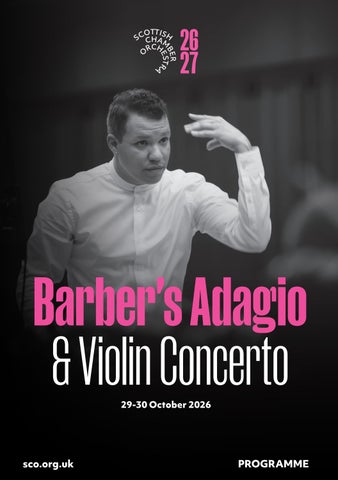
Barber's Adagio & Violin Concerto 29-30 October 2026
sco.org.uk
PROGRAMME
26/27 Concert Season
Cover image © Benjamin Eavolega
Barber's Adagio & Violin Concerto Thursday 29 October, 7.30pm The Queen's Hall, Edinburgh Friday 30 October, 7.30pm City Halls, Glasgow SCHULHOFF Suite for Chamber Orchestra BARBER Violin Concerto Interval of 20 minutes
BARBER Adagio WEILL Symphony No.2 Ryan Bancroft conductor Clara-Jumi Kang violin
© Marco Borggreve
Clara-Jumi Kang
© Ben Ealovega
Ryan Bancroft
4 Royal Terrace, Edinburgh EH7 5AB +44 (0)131 557 6800 | info@sco.org.uk | sco.org.uk
The Scottish Chamber Orchestra is a charity registered in Scotland No. SC015039. Company registration No. SC075079.
3
THANK YOU
Principal Conductor's Circle Our Principal Conductor’s Circle are a special part of our musical family. Their commitment and generosity benefit us all – musicians, audiences and creative learning participants alike. Annual Fund James and Patricia Cook Visiting Artists Fund Harry and Carol Nimmo Anne and Matthew Richards International Touring Fund Gavin and Kate Gemmell Learning and Participation Fund Jo and Alison Elliot Sabine and Brian Thomson
Productions Fund Geoff and Mary Ball Bill and Celia Carman Anne, Tom and Natalie Usher Scottish Touring Fund Eriadne and George Mackintosh Claire and Anthony Tait New Music Fund Ken Barker and Martha Vail Barker Colin and Sue Buchan David Caldwell Nick and Kate Thomas Kimie Trust
CHAIR SPONSORS The Donald and Louise MacDonald Principal Conductor's Chair Maxim Emelyanychev Chorus Director Gregory Batsleer Anne McFarlane
Cello Eric de Wit Jasmine Macquaker Charitable Fund
Leader Stephanie Gonley Caroline Hahn and Richard Neville-Towle
Principal Double Bass Jamie Kenny Erik Lars Hansen and Vanessa C L Chang
Principal First Violin Afonso Fesch Fiona and Ian Russell
Principal Flute André Cebrián Claire and Mark Urquhart
First Violin Aisling O'Dea Finlay and Lynn Williamson
Sub-Principal Flute Marta Gómez Judith and David Halkerston
First Violin Kana Kawashima Chris and Claire Fletcher
Principal Oboe The Hedley Gordon Wright Charitable Trust
Second Violin Rachel Smith Colin Mumford
Sub-Principal Oboe Katherine Bryer Ulrike and Mark Wilson
Principal Viola Max Mandel Ken Barker and Martha Vail Barker
Principal Clarinet Maximiliano Martín Stuart and Alison Paul
Sub-Principal Viola Francesca Gilbert Christine Lessels
Principal Bassoon Cerys Ambrose-Evans Claire and Anthony Tait
Viola Steve King Sir Ewan and Lady Brown
Sub-Principal Bassoon Alison Green George Rubienski
Principal Cello Philip Higham Nick and Kate Thomas
Principal Trumpet Peter Franks George Ritchie
Sub-Principal Cello Su-a Lee Ronald and Stella Bowie
Timpani / Percussion Louise Lewis Goodwin Silvia and Andrew Brown
Cello Donald Gillan Professor Sue Lightman
THANK YOU
Funding Partners Core Funder
Benefactor
Local Authority
Broadcast Partner
Media Partner
Funding Partner
Business Partners
Key Funders
Delivered by
Charity Partner
5
THANK YOU
SCO Donors Diamond
Gold
The Cockaigne Fund
Christian Albuisson
Malcolm and Avril Gourlay
Peter Armit
John and Jane Griffiths
Sir George and Lady Bain
James and Felicity Ivory
Elizabeth Brittin Kate Calder
Platinum
Vito Casadio
E.C. Benton
Martin Cook
Michael and Simone Bird
Jo and Christine Danbolt
John and Maggie Bolton
James and Caroline Denison-Pender
Dr Peter Williamson and Ms Margaret Duffy
Andrew and Kirsty Desson
Adam Gaines and Joanna Baker
David and Sheila Ferrier
David and Elizabeth Hudson
Iain Gow
Helen B Jackson
Margaret Green
Dr and Mrs Peter Jackson
Christopher and Kathleen Haddow
Dr Daniel Lamont
Catherine Johnstone
Graham and Elma Leisk
Julie and Julian Keanie
Professor and Mrs Ludlam
Gordon Kirk
Chris and Gill Masters
Janey and Barrie Lambie
Paul Maxwell, in loving memory of Ruth Maxwell
Mike and Karen Mair
Duncan and Una McGhie
Anne McAlister and Philip Sawyer
Anne-Marie McQueen
John and Liz Murphy
David Moncur
Tom Pate
Jane Peacock, in memory of Douglas Peacock
Maggie Peatfield
Charles Platt and Jennifer Bidwell
Alison and Stephen Rawles
Patrick and Susan Prenter
Andrew Robinson
Mr and Mrs J Reid
Olivia Robinson
The Walter and Janet Reid Charitable Trust
Irene Smith
Martin and Mairi Ritchie
Dr Jonathan Smithers
Elaine Ross
Ian S Swanson
Hilary E Ross
Ian and Janet Szymanski
Sir Muir and Lady Russell
John-Paul and Joanna Temperley
Jill and Brian Sandford
Douglas and Sandra Tweddle
Michael and Elizabeth Sudlow
James Wastle and Glenn Craig
Robert and Elizabeth Turcan
Catherine Wilson
Alan and Sue Warner
Neil and Philippa Woodcock
Bill Welsh
Georgina Wright
Anny and Bobby White Robert Mackay and Philip Whitley Ruth Woodburn
Silver
Norman Hazelton
Roy Alexander
Alistair Hector
John Anderson
Ron and Evelynne Hill
Fiona and Neil Ballantyne
Clephane Hume
Timothy Barnes and Janet Sidaway
Tim and Anna Ingold
The Batsleer Family
David and Pamela Jenkins
Jack Bogle
Susannah Johnston and Jamie Weir
Jane Borland
Ross D. Johnstone
Alan Borthwick
James Kelly, in memory of Mairi Kelly
Michael and Jane Boyle
Professor Christopher and Mrs Alison Kelnar
Mary Brady
Dr Ian Laing
Paula and Colin Brown
Geoff Lewis
John Brownlie
Dorothy A Lunt
Laura Buist
Vincent Macaulay
Robert Burns
James McClure, in memory of Robert Duncan
Mr A Campbell
Lucy McCorkell
Sheila Colvin
Gavin McCrone
Lorn and Camilla Cowie
Roy and Svend McEwan-Brown
Adam and Lesley Cumming
Michael McGarvie
Dr Wilma Dickson
Brian Miller
Sylvia Dow
Alistair Montgomerie
Colin Duncan, in memory of Norma Duncan
Norma Moore
Raymond Ellis
Margaret Mortimer and Ken Jobling
Dr and Mrs Alan Falconer
Andrew Murchison
Sheila Ferguson
Douglas Murray
Dr William Irvine Fortescue
John Peutherer, in memory of Audrey Peutherer
Patricia Glennie
James S Potter
Dr David Grant
Alastair Reid
Anne Grindley
Seona Reid and Cordelia Ditton
Andrew Hadden
Catherine Steel
J Martin Haldane
Takashi and Mikako Taji
Ronnie and Ann Hanna
C S Weir
Pamela Andrews and Alan Norton
Roderick Wylie
Roderick Hart
––––– We are indebted to everyone acknowledged here who gives philanthropic gifts to the SCO of £300 or greater each year, as well as those who prefer to remain anonymous. We are also incredibly thankful to the many individuals not listed who are kind enough to support the Orchestra financially on a regular or ad hoc basis. Every single donation makes a difference. Become a regular donor, from as little as £5 a month, by contacting Sadie Purves on 0131 478 8341 or sadie.purves@sco.org.uk.
“ …an orchestral sound that seemed to gleam from within.” THE SCOTSMAN
HM The King Patron Donald MacDonald CBE Life President Joanna Baker CBE Chair Gavin Reid LVO FRSE Chief Executive Maxim Emelyanychev Principal Conductor Andrew Manze Principal Guest Conductor Joseph Swensen Conductor Emeritus Gregory Batsleer Chorus Director Jay Capperauld Associate Composer
© Christopher Bowen
Our Musicians
Your Orchestra Tonight
Information correct at the time of going to print
This concert will be played on natural brass/timpani throughout.
Second Violin Gordon Bragg Wen Wang Rachel Smith Stewart Webster Kirsty Main Jess Hall Viola Max Mandel Felix Tanner Joanna Patrick Steve King Cello Philip Higham Su-a Lee Donald Gillan Eric de Wit Bass Jamie Kenny Maitiú Gaffney
Flute/Piccolo André Cebrián Adam Richardson
Trombone Duncan Wilson Nigel Cox
Oboe Clara Schweinberger Fraser Kelman
Timpani/Percussion Louise Lewis Goodwin
Cor Anglais Fraser Kelman Clarinet Maximiliano Martín William Stafford Eb Clarinet Maximiliano Martín
Percussion Simon Archer Calum Huggan Robbie Bremner Catriona Duncan Noah Chalamanda Piano Michael Bawtree
Eb/Bass Clarinet William Stafford Bassoon Cerys Ambrose-Evans Alison Green Horn Rebecca Hill Jamie Shield Andy Saunders Trumpet Peter Franks Shaun Harrold
Harp Eleanor Hudson Louise Lewis Goodwin Timpani / Percussion Louise's Chair is kindly supported by Silvia and Andrew Brown.
© Christopher Bowen
First Violin Maia Cabeza Afonso Fesch David López Ibáñez Kana Kawashima Sarah Bevan-Baker Kristin Deeken Catherine James Emily Ward
What You Are About To Hear SCHULHOFF (1894-1942) Suite for Chamber Orchestra, WV 58 (1921) Ragtime Valse Boston Tango Shimmy Step Jazz
BARBER (1910-1981) Violin Concerto, Op.14 (1939) Allegro Andante Presto in moto perpetuo
BARBER (1910-1981) Adagio for Strings (1936) KURT WEILL (1900-1950) Symphony No.2 (1933-34) Sostenuto - Allegro molto Largo Allegro vivace - Presto
Two distinct strands of music run across tonight’s programme, and they intersect – in a manner of speaking – in America, the birthplace and part-time home of Samuel Barber, but also the new home for a whole cohort of central European composers fleeing Nazi persecution in the 1930s, including Kurt Weill. Weill was successful in re-establishing his musical career in the US as an acclaimed composer of Broadway musicals, as we’ll discover later. Tonight’s first composer, however, has a far more tragic life story, and represents just one of many pioneering musical figures whose lives were cut short by the Third Reich. Born in Prague to a Germanspeaking family of Jewish ancestry, Erwin Schulhoff was initially encouraged to pursue music by none other than Antonín Dvořák. He studied at his home city’s Conservatoire from the age of just ten, proving a prodigy as a composer and pianist, and later returning to teach at the same institution. Schulhoff was a radical, pioneering figure, and a musician deeply proud of his own beliefs and tastes, no matter how idiosyncratic they were. He was one of the first composers to embrace the catchy rhythms and piquant harmonies of jazz in his music – as we’ll hear in tonight’s opening piece. But he was an equally ardent admirer of the extremities of expressionism, and of the freewheeling weirdness of Dada. He even wrote a ‘silent’ piece that predates John Cage’s infamous 4’33” by several decades: his In futurum for piano consists of nothing but intricately notated rests. Schulhoff held particularly strong and uncompromising opinions on the purpose and role of art. He wrote: ‘absolute art is revolution, it requires additional facets for development, and
10
Schulhoff was a radical, pioneering figure, and a musician deeply proud of his own beliefs and tastes, no matter how idiosyncratic they were. Erwin Schulhoff
leads to overthrow in order to open new paths.’ With that in mind, it might come as no surprise that in the hot-headed political turmoil of the interwar years, Schulhoff’s
But from the sombre end to Schulhoff’s life, let’s return to the composer amid the hotbed of new ideas and sounds in the 1920s. His love of jazz was deeply felt, as
political persuasions veered strongly to the left: he even set Marx and Engels’ Communist Manifesto to music in 1932.
he admitted in a letter to fellow composer Alban Berg in 1921: ‘I am boundlessly fond of nightclub dancing, so much so that I have periods during which I spend whole nights dancing with one hostess or another... out of pure enjoyment of the rhythm and with my subconscious filled with sensual delight. Thereby I acquire phenomenal inspiration for my work, as my conscious mind is incredibly earthly, even bestial, as it were.’
As a Jew, a communist and a lover (and creator) of dangerously ‘degenerate’ music, Schulhoff was particularly vulnerable to Nazi persecution, and following the German occupation of the Czech lands in 1939, he swiftly found he was banned from working. Exile in the Soviet Union was a possible escape, and Schulhoff was granted Soviet citizenship in 1941. It was ultimately that change in status that would lead to his death, however: Schulhoff was arrested as a national of a country with which Germany was at war, and interned at Wülzburg prison in Bavaria, where he died of tuberculosis in August 1942, aged 48.
It was in May and June of 1921 that Schulhoff composed the Suite for Chamber Orchestra that opens tonight’s concert. His aim, he explained, was to look back with affection to the dance movements of a Baroque orchestral suite, but to update those dances to modern forms from the
1920s. And, fascinated as he was by the surreal nonsensicality of Dadaism, he prefaced the entire suite with a self-written
intricate interlocking rhythms of the percussion-only ‘Step’, Schulhoff concludes with the foot-tapping, fast-paced ‘Jazz’.
Dadaist poem, which – roughly translated – goes something like this:
The composer himself conducted the Suite’s first performance – in Berlin in April 1922, with a chamber orchestra of musicians from the city’s Staatsoper. Perhaps predictably, among such lofty company, it didn’t go down well at all.
Beer house sickness is my soul and my teeth are chattering in shimmy beat Big city resonances swipe my brains and roar: Hail to thee in victor’s crown… oh my dear, you can’t go in the corridor (the cold) sleeping I am carried, to my home… to my home! Because I’m drunk as a skunk and thinking German! Do you know my colors? – ? !!! ? !! I enjoy champagne and the woman enjoys sperm. gramophones are sighing, sobbing patriotic songs – and, where there is singing, you can safely stay, – because, wicked people have no songs (you’ll see) sweet cacophonies are rippling in my guts… screaming for life, … long for manoli [cigarettes] and absinthe. Filthy gang!!! Sh…heads!!!!! – grant me unheard-ofpowers, I want to eat you all, into the sausage machine with you wretched swine!!! Then, – Then comes the cosmic moment, then I will transform myself into “BAYER Aspirin”! –
Wartime connections continue in tonight’s second piece. US composer Samuel Barber was on a trip to Europe when he began work on his Violin Concerto in 1939, first amid the Alpine splendours of Switzerland, and later in Paris. But with war looming, and US citizens being warned to depart urgently from Europe, he made his way back across the Atlantic to complete the piece. But its stop-start genesis formed only one part of the Concerto’s complicated creation. Not without reason did Barber sarcastically refer to the piece as his ‘concerto del sapone’ (or ‘soap concerto’). That disparaging nickname was a reference not only to the product that had made the piece’s commissioner – tycoon Samuel S Fels, of Fels Naptha Soap fame – his fortune. It also referred to the piece’s composition and premiere, which themselves became something of a soap opera.
The crisp, nimble ‘Ragtime’ – led by a catchy trumpet tune – sets the light-hearted, bracing tone for the whole Suite, and it’s followed by a sentimental but delicate ‘Valse Boston’, then a surprisingly restrained ‘Tango’ that merely hints at fiery passions.
Fels and his wife Jennie had acted as surrogate US parents to the remarkable Odessa-born violin prodigy Iso Briselli, who was studying at Philadelphia’s Curtis School of Music – by chance, in the same year as Barber. By 1939, both Briselli and Barber had graduated, and were establishing themselves professionally –
After the march-like ‘Shimmy’ and the
Barber had in fact returned to the school,
12
Despite the shenanigans over its creation, Barber’s Violin Concerto quickly found a secure place in the violin repertoire. Samuel Barber
as professor of composition. Fels was persuaded to ask the young composer to create a new concerto for Briselli, one that might showcase the violinist’s dazzling
lightweight, and out of kilter with the earlier movements’ tones. He requested a rewrite. Barber declined, explaining: ‘I could not destroy a movement in which
technique and profound musical insights.
I have complete confidence, out of artistic sincerity to myself.’ Briselli in turn declined to play the Concerto, and the premiere was given instead by established violinist Albert Spalding (who jumped at the opportunity) with the Philadelphia Orchestra in February 1941. Barber and Briselli remained friends, however, until the composer’s death in 1981.
At first, things went well. Briselli loved the Concerto’s first two movements when he received them. But his teacher, Albert Meiff, didn’t, and took it upon himself to write to Fels, informing the businessman that the Concerto would need a wholesale overhaul by someone who really knew the violin (in other words, himself). Even Briselli wondered, in retrospect, if the opening movements were showy enough, and requested something more virtuosic for the finale. Things got worse, however, when Barber sent Briselli the showy concluding movement he’d created. The violinist
Despite the shenanigans over its creation, Barber’s Violin Concerto quickly found a secure place in the violin repertoire. The soloist launches the richly Romantic opening movement with a deeply lyrical main melody, later contrasted by a spikier theme introduced by a solo clarinet (which the violinist manages to avoid until almost
wasn’t convinced, finding it too
the end of the movement). An oboe keens
a long, chant-like melody above a cushion of string harmonies in the serene second movement, before the soloist leads us into stormier, more dissonant music. In the brief, breathless finale (about which you may feel Briselli had a point), the violinist skitters through an almost unstoppable melodic line, navigating Shostakovichlike grotesquerie to propel the piece to its dashing close. We stay with Barber for tonight’s next piece, which must surely count as one of classical music’s all-time best-known works. Barber’s Adagio has been dubbed the ‘world’s saddest music’, and is indeed indelibly associated with moments of great emotion and upheaval. It was played at the funerals of Franklin Delano Roosevelt, Albert Einstein and Grace Kelly (among many others), and Jackie Kennedy arranged for Washington’s National Symphony Orchestra to play it to an empty hall following the assassination of her husband JFK in 1963, a recording of which became the unofficial anthem of the nation’s grief during the following weeks. It began, however, and of course still exists as the slow movement of Barber’s Op.11 String Quartet, where it separates two outer movements of great energy and complexity. It was conductor Arturo Toscanini who thought the Adagio would make a fine orchestral work, requesting one from the 28-year-old composer, and premiering it with the NBC Symphony Orchestra on a radio broadcast in November 1938. In an America still reeling from the Great Depression, and with Europe hurtling ever closer to war, the heart-on-sleeve emotion of Barber’s Adagio – which unfolds as a series of slow, winding, chant-like melodies, rising to an 14
impassioned climax – came at just the right moment to capture and console the public consciousness. We return to Europe, however, to close tonight’s concert. Kurt Weill might be a somewhat more familiar figure to us than Schulhoff, mostly through his pioneering collaborations with dramatist Bertolt Brecht – among them The Threepenny Opera, the musical Happy End and The Rise and Fall of the City of Mahagonny. There are important similarities, in fact, between Weill and Schulhoff. Both were Jewish, taking a bracingly radical approach to music (in Weill’s case, straddling classical and popular forms), and both had clear left-wing political views. Weill’s broadly left-wing sympathies, however, would ultimately put him at odds with his more hardline communist collaborator Brecht, who insisted on Weill’s music functioning to convey their works’ explicitly Marxist messages. Weill wasn’t happy, even commenting to his wife, singer Lotte Lenya, that he’d never be able to ‘set The Communist Manifesto to music’ (unlike his Czech colleague Schulhoff). For all his prominence and popularity, Weill – as a Jew, a ‘radical’, and a left-wing sympathiser – found himself persecuted in Germany even before the Nazis came to power in 1933. Nazi agitators invaded the premiere of his and Brecht’s The Rise and Fall of the City of Mahagonny in 1930, disrupting the performance with shouts of ‘degenerate art’, and Weill fled Germany in March 1933, shortly after Hitler came to power. He headed first for Paris, before continuing to America, where he later established almost an entirely new career as a successful composer of Broadway
For all his prominence and popularity, Weill – as a Jew, a ‘radical’, and a left-wing sympathiser – found himself persecuted in Germany even before the Nazis came to power in 1933. Kurt Weill
musicals (including Street Scene, Lady in the Dark and One Touch of Venus). It was just before fleeing Germany,
Almost a century later, however, it’s hard to see what all the fuss was about. It’s a Symphony that’s full of energy, colour and determination, and its musical language will
however, that Weill received a request for what would become his Symphony No.2. The commission came from Paris, specifically from the Princesse de Polignac, a renowned philanthropist and supporter of many forward-looking composers (also known as Winnaretta Singer, fabulously wealthy heiress to the US Singer sewing machine fortune). Weill wrote the piece – the very last orchestral work he’d ever compose – primarily during his brief stay in the French capital. It got its premiere in Amsterdam in 1934, with the Concertgebouw Orchestra conducted by Bruno Walter. Audiences loved it, but critics tore it to pieces – possibly one of the reasons that Weill turned his back on the concert hall and focused his talents on the
be very familiar to anyone who’s encountered any of Weill’s collaborations with Brecht. A noble trumpet tune emerges from the first movement’s slow introduction, before the mood changes entirely with rushing strings propelling the movement’s faster music along breathlessly. The slow second movement is a funeral march in all but name, beginning in declamatory mode before a more intimate, heartfelt cello solo leads us into quieter, more contemplative music. The energetic final movement scurries almost furtively into our awareness, but when it finally breaks into louder assertiveness, it’s with an adapted theme taken from the opening movement, later galloping to an exuberant, even delirious close.
theatre from that point on.
© David Kettle
Conductor
© Ben Ealovega
Ryan Bancroft
Renowned for his electric performances and generous musicianship, conductor Ryan Bancroft is highly sought after across the globe, performing with many of the world’s leading orchestras. In September 2023, he was appointed Chief Conductor of the Royal Stockholm Philharmonic Orchestra. His position in Stockholm has recently been extended and will run until spring 2030. He also holds the position of Artist-in-Association with the Tapiola Sinfonietta in Finland. Bancroft previously served as Principal Conductor of the BBC National Orchestra of Wales from 2021-summer 2026. Since beginning his tenure as Chief Conductor in Stockholm, Bancroft has led the orchestra on a major European tour in spring 2026 and given performances at the Schleswig Holstein Festival, the Elbphlharmonie in Hamburg and Lübeck. In Spring 2027, they will embark on another European tour performing in Vienna, Amsterdam, Cologne, Antwerp, and Munich. During his time as Chief Conductor, Bancroft has conducted the world premieres of a number of works by composers such as Anders Hillborg, Chrichan Larson and Đuro Živković, whilst collaborating with renowned soloists including Emmanuel Ax, Leif Ove Andsnes, Maxim Vengerov and Víkingur Ólafsson. In 26/27, Bancroft will continue to feature works by Swedish composers such as Anders Hillborg, Britta Byström and Benjamin Staern. Highlights of the 26/27 season include, in addition to concerts with the Royal Stockholm Philharmonic, debuts with the Munich Philharmonic, New York Philharmonic, Sydney Symphony and Queensland Symphony orchestras. He will also return to orchestras including San Francisco Symphony, Finnish Radio Symphony, Orchestre National du Capitole de Toulouse, Scottish Chamber and appears twice with the Philharmonia in London and on tour to Mauritius. He will also make his return to the Colorado Music Festival. Throughout the season, Bancroft collaborates with soloists including Emmanuel Ax, Seong-Jin Cho, Bruce Liu, Vilde Frang, Clara-Jumi Kang, Renaud Capuçon and Kian Soltani. In recent seasons, Bancroft has conducted leading international orchestras, such as the London Symphony, London Philharmonic, Rotterdam Philharmonic, NDR Elbphilharmonie, WDR Cologne, NHK Symphony, Swedish Radio Symphony, Los Angeles Philharmonic, Boston Symphony Orchestra and the Cleveland Orchestra. For full biography please visit sco.org.uk 16
Violin
Marco Borggreve © Andrea Gjestvang
Clara-Jumi Kang
Clara-Jumi Kang is celebrated internationally for her exceptional musicality, technical mastery and artistic depth. In demand with the world’s top orchestras and conductors, The Strad has praised her “constant poise” and her performances have been described as “nothing short of staggering, in terms of intensity, technique and passion" Seen and Heard International. Kang regularly performs with leading orchestras including the London Symphony Orchestra, Munich Philharmonic, Rotterdam Philharmonic, Accademia Nazionale di Santa Cecilia, Seoul Philharmonic, Royal Stockholm Philharmonic, the Budapest Festival Orchestra, and NHK Symphony Orchestra, and with conductors such as Daniel Harding, Lahav Shani, Myung Whun Chung, Charles Dutoit, Gianandrea Noseda, Santtu-Matias Rouvali, Ryan Bancroft, Mark Wigglesworth and Jaap van Zweden. In 2025, she was the soloist for the West-Eastern Divan Orchestra’s major tour to China and Europe with Zubin Mehta, and returned to work with the orchestra in summer 2026 with Maestro Barenboim at the Rheingau Musik Festival. Highlights of the 26/27 include debuts with the Orchestre de Paris, London Philharmonic, Frankfurt Radio Symphony, and the Estonian Festival Orchestra under Paavo Järvi. Kang also returns to the Los Angeles Philharmonic, New York Philharmonic, Singapore Symphony, Philharmonia, Vancouver Symphony, Netherlands Philharmonic, Orquesta Sinfonica de Galicia, Scottish Chamber Orchestra, and Royal Liverpool Philharmonic. Kang was selected as one of the top 100 Most promising and influential people of Korea' in 2012 by Dong-A Times and was awarded the Daewon Music Award (2012). She has made two recordings for Decca: Modern Solo, featuring works by Schubert and Ysaÿe, and a Brahms-Schumann album with Yeol Eum Son. In 2021, she released a cycle of Beethoven's Violin Sonatas with pianist Sunwook Kim. Clara-Jumi Kang plays on the "Thunis" Stradivarius from 1702, on generous loan by KIA. For full biography please visit sco.org.uk
Scottish Chamber Orchestra The Scottish Chamber Orchestra (SCO) is one of Scotland’s five National Performing Companies and has been a galvanizing force in Scotland’s music scene since its inception in 1974. The SCO believes that access to world-class music is not a luxury but something that everyone should have the opportunity to participate in, helping individuals and communities everywhere to thrive. Funded by the Scottish Government, City of Edinburgh Council and a community of philanthropic supporters, the SCO has an international reputation for exceptional, idiomatic performances: from mainstream classical music to newly commissioned works, each year its wide-ranging programme of work is presented across the length and breadth of Scotland, overseas and increasingly online. Equally at home on and off the concert stage, each one of the SCO’s highly talented and creative musicians and staff is passionate about transforming and enhancing lives through the power of music. The SCO’s Creative Learning programme engages people of all ages and backgrounds with a diverse range of projects, concerts, participatory workshops and resources. The SCO’s current fiveyear Residency in Edinburgh’s Craigmillar builds on the area’s extraordinary history of Community Arts, connecting the local community with a national cultural resource. An exciting new chapter for the SCO began in September 2019 with the arrival of dynamic young conductor Maxim Emelyanychev as the Orchestra’s Principal Conductor. His tenure has recently been extended until at least 2031. The SCO and Emelyanychev released their first album together (Linn Records) in 2019 to widespread critical acclaim. Their second recording together, of Mendelssohn symphonies, was released in 2023, with Schubert Symphonies Nos 5 and 8 following in 2024. The SCO also has long-standing associations with many eminent guest conductors and directors including Principal Guest Conductor Andrew Manze, Pekka Kuusisto, François Leleux, Nicola Benedetti, Isabelle van Keulen, Anthony Marwood, Richard Egarr, Mark Wigglesworth, Lorenza Borrani and Conductor Emeritus Joseph Swensen. The Orchestra’s current Associate Composer is Jay Capperauld. The SCO enjoys close relationships with numerous leading composers and has commissioned around 200 new works, including pieces by Sir James MacMillan, Anna Clyne, Sally Beamish, Martin Suckling, Einojuhani Rautavaara, Karin Rehnqvist, Mark-Anthony Turnage, Nico Muhly and the late Peter Maxwell Davies. 18
© Christopher Bowen
Biography
Support us Each year, the SCO must fundraise around £1.3 million to bring extraordinary musical performances to the stage and support groundbreaking education and community initiatives beyond it. If you share our passion for transforming lives through the power of music and want to be part of our ongoing success, we invite you to join our community of regular donors. Your support, no matter the size, has a profound impact on our work – and as a donor, you’ll enjoy an even closer connection to the Orchestra. To learn more and support the SCO from as little as £5 per month, please contact Sadie Purves on 0131 478 8341 or sadie.purves@sco.org.uk.
The SCO is a charity registered in Scotland No SC015039. Photo: Christopher Bowen