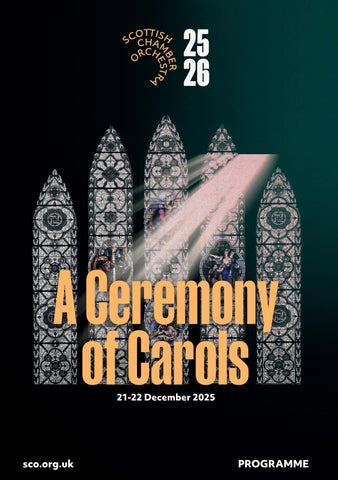
A Ceremony of Carols 21-22 December 2025
sco.org.uk
PROGRAMME
Cover image © Marco Borggreve
25/26 Concert Season
A Ceremony of Carols With the SCO Chorus
Sunday 21 and Monday 22 December, 7.30pm Greyfriars Kirk, Edinburgh BRITTEN A Ceremony of Carols RODERICK WILLIAMS O Adonai, et Dux domus Israel TALLIS Videte Miraculum JAY CAPPERAULD The Winter’s Brightening (SCO Chorus Commission, World Premiere) JS BACH (arr. GRANDJANY) Andante from Violin Sonata No.2 in A minor, BWV 1003 REBECCA DALE Stopping by Woods on a Snowy Evening ERIC WHITACRE Sleep Please note there will be no interval. We request that you save applause until the end of the performance.
Scottish Chamber Orchestra Chorus Gregory Batsleer chorus director Eleanor Hudson harp
© Christopher Bowen
SCO Chorus with Gregory Batsleer
4 Royal Terrace, Edinburgh EH7 5AB +44 (0)131 557 6800 | info@sco.org.uk | sco.org.uk
The Scottish Chamber Orchestra is a charity registered in Scotland No. SC015039. Company registration No. SC075079.
3
THANK YOU
Principal Conductor's Circle Our Principal Conductor’s Circle are a special part of our musical family. Their commitment and generosity benefit us all – musicians, audiences and creative learning participants alike. Annual Fund James and Patricia Cook
American Development Fund Erik Lars Hansen and Vanessa C L Chang
Visiting Artists Fund Harry and Carol Nimmo Anne and Matthew Richards
Productions Fund Anne, Tom and Natalie Usher Bill and Celia Carman
International Touring Fund Gavin and Kate Gemmell
Scottish Touring Fund Eriadne and George Mackintosh Claire and Anthony Tait
Creative Learning Fund Sabine and Brian Thomson
CHAIR SPONSORS Conductor Emeritus Joseph Swensen Donald and Louise MacDonald
Cello Eric de Wit Jasmine Macquaker Charitable Fund
Chorus Director Gregory Batsleer Anne McFarlane
Principal Flute André Cebrián Claire and Mark Urquhart
Principal Second Violin Marcus Barcham Stevens Jo and Alison Elliot
Principal Oboe The Hedley Gordon Wright Charitable Trust
Second Violin Rachel Smith J Douglas Home Principal Viola Max Mandel Ken Barker and Martha Vail Barker Viola Brian Schiele Christine Lessels Viola Steve King Sir Ewan and Lady Brown Principal Cello Philip Higham The Thomas Family Sub-Principal Cello Su-a Lee Ronald and Stella Bowie Cello Donald Gillan Professor Sue Lightman
Sub-Principal Oboe Katherine Bryer Ulrike and Mark Wilson Principal Clarinet Maximiliano Martín Stuart and Alison Paul Principal Bassoon Cerys Ambrose-Evans Claire and Anthony Tait Sub-Principal Bassoon Alison Green George Rubienski Principal Horn Kenneth Henderson Caroline Hahn and Richard Neville-Towle Principal Timpani Louise Lewis Goodwin Geoff and Mary Ball
THANK YOU
Funding Partners Core Funder
Benefactor
Local Authority
Broadcast Partner
Media Partner
Funding Partner
Business Partners
Key Funders
Delivered by
Charity Partner
5
THANK YOU
SCO Donors Diamond
Gold
The Cockaigne Fund
Peter Armit
Malcolm and Avril Gourlay
Adam Gaines and Joanna Baker
John and Jane Griffiths
John and Maggie Bolton
James and Felicity Ivory
Elizabeth Brittin
George Ritchie
Kate Calder
Tom and Natalie Usher
James Wastle and Glenn Craig Jo and Christine Danbolt
Platinum
James and Caroline Denison-Pender
E.C. Benton
Andrew and Kirsty Desson
Michael and Simone Bird
David and Sheila Ferrier
Silvia and Andrew Brown
Chris and Claire Fletcher
David Caldwell in memory of Ann
James Friend
Dr Peter Williamson and Ms Margaret Duffy
Iain Gow
Judith and David Halkerston
Margaret Green
David and Elizabeth Hudson
Christopher and Kathleen Haddow
Helen B Jackson
Catherine Johnstone
Dr and Mrs Peter Jackson
Julie and Julian Keanie
Dr Daniel Lamont
Gordon Kirk
Graham and Elma Leisk
Janey and Barrie Lambie
Professor and Mrs Ludlam
Mike and Karen Mair
Chris and Gill Masters
Roy and Svend McEwan-Brown
Duncan and Una McGhie
John and Liz Murphy
Anne-Marie McQueen
Tom Pate
James F Muirhead
Maggie Peatfield
Robin and Catherine Parbrook
Sarah and Spiro Phanos
Patrick and Susan Prenter
Charles Platt and Jennifer Bidwell
Mr and Mrs J Reid
Alison and Stephen Rawles
Martin and Mairi Ritchie
Andrew Robinson
Hilary E Ross
Olivia Robinson
Elaine Ross
Anne McAlister and Philip Sawyer
Sir Muir and Lady Russell
Irene Smith
Jill and Brian Sandford
Dr Jonathan Smithers
Michael and Elizabeth Sudlow
Ian S Swanson
Robert and Elizabeth Turcan
Ian and Janet Szymanski
Alan and Sue Warner
John-Paul and Joanna Temperley
Anny and Bobby White
Douglas and Sandra Tweddl
Robert Mackay and Philip Whitley
Bill Welsh
Finlay and Lynn Williamson
Catherine Wilson
Ruth Woodburn
Neil and Philippa Woodcock
Silver
Ron and Evelynne Hill
Roy Alexander
Philip Holman
Fiona and Neil Ballantyne
Clephane Hume
The Batsleer Family
Tim and Anna Ingold
Jack Bogle
David and Pamela Jenkins
Jane Borland
Margaret Mortimer and Ken Jobling
Alan Borthwick
Ross D. Johnstone
Dinah Bourne
Professor Christopher and Mrs Alison Kelnar
Michael and Jane Boyle
Dr Ian Laing
Mary Brady
Geoff Lewis
John Brownlie
Dorothy A Lunt
Laura Buist
Vincent Macaulay
Robert Burns
James McClure in memory of Robert Duncan
Sheila Colvin
Ben McCorkell
Lorn and Camilla Cowie
Lucy McCorkell
Adam and Lesley Cumming
Gavin McCrone
Dr Wilma Dickson
Michael McGarvie
Seona Reid and Cordelia Ditton
Brian Miller
Sylvia Dow
Alistair Montgomerie
Colin Duncan in memory of Norma Moore
Andrew Murchison
Raymond Ellis
Pamela Andrews and Alan Norton
Dr and Mrs Alan Falconer
Gilly Ogilvy-Wedderburn
Sheila Ferguson
John Peutherer in memory of Audrey Peutherer
Dr William Irvine Fortescue
James S Potter
Dr David Grant
Timothy Barnes and Janet Sidaway
Anne Grindley
Catherine Steel
Andrew Hadden
John and Angela Swales
J Martin Haldane
Takashi and Mikako Taji
Ronnie and Ann Hanna
C S Weir
Roderick Hart
Susannah Johnston and Jamie Weir
Norman Hazelton
David and Lucy Wren
––––– We are indebted to everyone acknowledged here who gives philanthropic gifts to the SCO of £300 or greater each year, as well as those who prefer to remain anonymous. We are also incredibly thankful to the many individuals not listed who are kind enough to support the Orchestra financially on a regular or ad hoc basis. Every single donation makes a difference. Become a regular donor, from as little as £5 a month, by contacting Hannah Wilkinson on 0131 478 8364 or hannah.wilkinson@sco.org.uk. 7
“ …an orchestral sound that seemed to gleam from within.” THE SCOTSMAN
HM The King Patron Donald MacDonald CBE Life President Joanna Baker CBE Chair Gavin Reid LVO Chief Executive Maxim Emelyanychev Principal Conductor Andrew Manze Principal Guest Conductor Joseph Swensen Conductor Emeritus Gregory Batsleer Chorus Director Jay Capperauld Associate Composer
© Chris Christodoulou
Your Chorus Tonight Information correct at the time of going to print
Gregory Batsleer Chorus Director Stuart Hope Associate Chorusmaster Emma Morwood Voice Coach Susan White Chorus Manager * Young Singers' Programme
SOPRANO
TENOR
Emma Aitken Naomi Black Nancy Burns Morven Chisholm Mairi Day Joanne Dunwell Emily Gifford Nicola Henderson Alice Higgins Lisa Johnston Florence Kaiser* Elizabeth McColl Katie McGlew Anna Morris*
Ben Evans* Colin French Peter Hanman Fraser Macdonald Keith Main Michael Scanlon Paul Vaughan
ALTO Shona Banks Sarah Campbell Gill Cloke Judith Colman Anne Grindley Fiona Haldane Lorna Htet-Khin Melissa Humphreys Rachel Kemp Elaine McAdam Hilde McKenna Linda Ruxton
BASS Mathew Brown Luke Francis Robin Hiley Richard Hyder Donald MacLeod Kenneth Murray Douglas Nicholson David Paterson Fraser Riddell Roderick Wylie
9
What You Are About To Hear BRITTEN (1913-1976)
JAY CAPPERAULD (b. 1989)
A Ceremony of Carols, Op.28 (1942)
The Winter's Brightening (2025)
Soloists: Anna Morris, Florence Kaiser, Lorna Htet-Khin
SCO Chorus Commission, World Premiere
I Procession II Wolcum Yole! III There is no Rose IVa That yongë child IVb Balulalow V As Dew in Aprille VI This little Babe
JS BACH (1685-1750) ARR GRANDJANY (1891-1975) Andante from Violin Sonata No.2 in A minor, BWV 1003 (1720)
VII Interlude (Harp) VIII In Freezing Winter Night IX Spring Carol
REBECCA DALE (b. 1985)
X Deo Gracias
Stopping by Woods on a Snowy Evening
XI Recession
(2023)
RODERICK WILLIAMS (b. 1965) O Adonai, et Dux domus Israel (1997) Soloists: Nicola Henderson, Michael Scanlon
TALLIS (c. 1505-1585) Videte Miraculum (1575)
10
ERIC WHITACRE (b. 1970) Sleep (2010)
© Hans Wild
Britten was particularly taken by the volume’s seasonal rhymes, and hit upon the idea of setting several of them for children’s choir and harp.
Benjamin Britten
From Midnight Mass to decorating the tree, from a turkey lunch to a 3pm appointment with the King, Christmas is full of cherished
life as simply a collection of interesting but somewhat disparate carol settings. Britten wrote them on board the MS Axel Johnson,
traditions and rituals. Indeed, for many those enduring customs are what the festive season is all about, connecting families and generations, and emphasising a sense of shared identity – despite the richness and variety of ways in which that’s expressed.
What ultimately became Benjamin Britten’s
the Swedish cargo boat that he and his partner Peter Pears were taking to return from their early-war sojourn in the USA to wartime Britain. They’d left in April 1939, partly to escape the threat of war (which put them, as avowed pacifists, in a particularly perilous position), and partly to escape the criticisms that Britten’s music had been eliciting in his native country. The composer quickly became disillusioned with life in America, however – he described the country as having "all the faults of Europe and none of the attractions" – and so the two men embarked on their almost month-long return, a voyage that offered ample time for composing. (For his part, Pears hated the return journey, complaining about their hot, stuffy cabin, and describing their company on board as "callow, foul-mouthed
A Ceremony of Carols, however, began
and witless".)
So it’s no surprise that composers have turned to the idea of ritual or ceremony in conjuring their own seasonal music, whether in drawing on age-old ideas or inventing entirely new ones. We’ll encounter a few of those approaches in tonight’s concert of music for contemplation, reflection and connection, beginning with what’s probably the world’s most widely cherished Christmas classical ceremony.
It was at a stop-off in Halifax, Nova Scotia, that Britten bought The English Galaxy of Shorter Poems, edited by Gerald Bullett, in a local
ethereal harmonics to glistening glissandos up and down the instrument.
bookshop, and discovered a wealth of early English verse inside it. He was particularly taken by the volume’s seasonal rhymes, and hit upon the idea of setting several of them for children’s choir and harp. It was only later that he came up with the idea of opening and closing processions, bringing the singers into the performing space while singing ancient plainchant, and thereby transforming what had been simply a collection of carol settings into a grander ceremony.
Britten brings an appropriate chill to 'In Freezing Winter Night' with an unmoving accompaniment figure and arching vocal melodies, while the 'Spring Carol' looks ahead to the end of winter and the arrival of the new season in brighter, fresher music. Britten closes his carols with the outspoken, declamatory 'Deo gracias – Adam lay i-bounden', which takes us right back to the book of Genesis and the Fall of Man, seeing original sin as a necessary evil for our redemption through Christ, and culminating in some of the piece’s most exuberant, joyful music. This leaves the closing Recession to restore calm and restore us to the real, everyday world after the ceremonial space of ancient verse and song we’ve just occupied.
And like the Festival of Nine Lessons and Carols from the Chapel of King’s College, Cambridge, Britten’s A Ceremony of Carols represents something of a modern-day ritual that manages to combine religious respect with far more secular feelings of fellowship, reflection and connection. After the opening Procession and its ancient Gregorian antiphon delivering the news of Christ’s birth, 'Wolcum Yole!' is a hearty, joyful welcome to the Christmas season and its important feast days, with bell-like peals
Though we haven’t left that space of ceremony and ritual just yet. Roderick Williams is not only one of Britain’s most respected vocal soloists, but also a prolific composer: perhaps not surprisingly, he’s created a large output of vocal
from the harp. 'There is no Rose' is a prayerful, tender tribute to the Virgin Mary using a 15thcentury text, while the solo song 'That yongë child' continues the previous song’s calmer, more serious tone. The mood picks up slightly in 'Balulalow', which imagines Mary singing a lullaby to her newborn son, while the fresh and joyful 'As Dew in Aprille' shifts the focus to a celebration of Mary herself. The urgent 'This little Babe' is the work’s darkest offering, summoning images of hell and imagining a battle between the infant Jesus and Satan himself, while employing a typical Britten trick making the music increasingly complex as the song progresses, from a single vocal line to two lines overlapping and echoing, then three doing the same. An Interlude for solo harp provides a sense of calm and serenity after the previous song’s drama, as well as showing off
and choral works, exploiting very much an insider’s expertise on sung music, and exploring widely varying musical styles. His O Adonai was a commission for Birmingham-based choir Ex Cathedra and its director Jeffrey Skidmore, and was originally intended to exploit the various performing areas of St Paul’s Church in Birmingham’s Jewellery Quarter. Accordingly, Williams divides his choir – and his music – into several distinct groups and layers. A solo soprano opens with almost birdsong-like music before being joined by the other sopranos, but the rest of the choir seem to occupy an entirely different world when they enter. Williams’ third layer – a solo celebrant – only joins once the piece is already well underway. The result is an immersive and deeply spiritual supplication for the Lord’s redemption, with a sense of ritual unfolding
the instrument’s full range of sonic wonders, from
across time and space.
12
© Theo Williams
Roderick Williams is not only one of Britain’s most respected vocal soloists, but also a prolific composer: perhaps not surprisingly, he’s created a large output of vocal and choral works.
Roderick Williams
We leap back in time around half a millennium for tonight’s next piece, written by one of England’s most illustrious and celebrated Renaissance composers. Thomas Tallis was a favourite of Elizabeth I, and gained a degree of protection from her royal patronage at a time when Catholic believers like himself were openly persecuted. He created Videte miraculum (‘Behold the miracle’) for Candlemas, one of the feast days mentioned in A Ceremony of Carols’ 'Wolcum Yole!', which traditionally falls on 2 February and remembers the presentation of the new-born Jesus at the temple in Jerusalem by Mary and Joseph. Like several of the songs in Britten’s A Ceremony of Carols, Videte miraculum again praises the Virgin Mary, and is based around ancient plainchant, heard at the very opening and returning to intersperse sections of Tallis’ rich, deeply expressive polyphony.
Brightening, by the SCO’s Associate Composer, Ayrshire-born Jay Capperauld. He writes about the work: "The Winter’s Brightening is inspired by a poem of the same name by Scottish poet Niall Campbell which evokes the warmth of a Christmas scene as rooms filled with light contrast with the cold night outside, and where the darkness of winter is expelled by the festive glow of love and welcoming. This piece attempts to capture that scene in a musical journey from darkness to light as the harmonies of the music grow and become richer as the gradually brightening winter radiates its warmth and comfort."
From the 16th century, we return very much to the
We return to the harp for today’s next piece. Paris-born harpist and composer Marcel Grandjany was a remarkable prodigy, winning the coveted Premier Prix at the Paris
present day for a brand new piece, The Winter’s
Conservatoire at the age of just 13, and later
performing with Ravel, among many other musicians. He moved to the USA in 1936, where he remained until his death in 1975. Among his substantial output of music are reimaginings for harp of many classic pieces: tonight we’ll hear his elaborate but restrained harp arrangement of the third movement Andante from JS Bach’s Sonata No. 2 for solo violin. Grandjany expands the accompaniment that’s already present in Bach’s richly imagined original, drawing purpose and resolve from the pulsing bassline that continues throughout the piece. The concert’s final two pieces share a common inspiration: the iconic 1923 poem Stopping by Woods on a Snowy Evening by US Poet Laureate Robert Frost. It’s a deceptively simple creation, describing a lone figure pausing by a forest with his horse amid the deep winter snow, but realising he must continue on his way. It nonetheless evokes profound themes of duty and resilience, the natural world and even our inevitable mortality. Perhaps not surprisingly, with its simple but evocative language and deep emotional resonances, Frost’s powerful poem has been set to music by many composers. Londonborn Rebecca Dale created her setting for vocal ensemble Voces8 in 2016, checking with Frost’s estate that they would allow her to use the poet’s verse. They agreed, but later withdrew the agreement, forcing Dale to ask a lyricist friend to create a new text to fit her rich, lavish, deeply atmospheric music. When copyright finally lapsed on the verse in 2019, however, Dale was able to reinstate Frost’s original words. US composer and choral director Eric Whitacre is one of vocal music’s most eminent and respected figures, and he too made a musical setting of Frost’s poem in 1999, for 14
The concert’s final two pieces share a common inspiration: the iconic 1923 poem Stopping By Woods on a Snowy Evening by US Poet Laureate Robert Frost.
a choir based in Austin, Texas. It was only after the piece’s premiere in 2000, however, that Whitacre realised that the Frost estate had forbidden new settings following a large number composed in the late 1990s. Like Dale, Whitacre asked a friend – poet Charles Anthony Silvestri – to create new words to the music he’d already composed, also incorporating specific words from Frost’s original (including the new work’s title, Sleep). Unlike Dale, however, when Frost’s poem became available in 2019, Whitacre realised he preferred the new text to the original – and it’s Silvestri’s new words we hear this evening. Whitacre’s hymn-like setting uses his distinctive shifting, luminous harmonies and gentle dissonances in a succession of lulling phrases that seem to lead inexorably to the state that the poem describes. © David Kettle
16-17 January, 2pm Edinburgh | Glasgow
Matinee with
Lorenza Borrani
Haydn & Schubert Including the compelling ‘Unfinished’ Symphony.
LEARN MORE
Company Registration Number: SC075079. A charity registered in Scotland No. SC015039.
TEXTS BENJAMIN BRITTEN (1913-1976) A Ceremony of Carols, Op.28 (1942)
I Procession Hodie Christus natus est: hodie Salvator apparuit: hodie in terra canunt angeli: laetantur archangeli: hodie exsultant justi dicentes: gloria in excelsis Deo. Alleluia! Today Christ is born; today the Saviour has appeared. Today the angels sing on earth; the archangels rejoice. Today the righteous exult, saying: Glory to God on high! Alleluia!
II Wolcum Yole!* Wolcum be thou hevene king, Wolcum Yole! Wolcum, born in one morning, Wolcum for whom we sall** sing! Wolcum be ye Stevene and Jon, Wolcum innocentes every one, Wolcum Thomas marter one. Wolcum be ye good Newe Yere, Wolcum, Twelfthe Day both in fere, Wolcum, seintes lefe and dere, Wolcum Yole! Candelmesse, Quene of bliss, Wolcum bothe to more and lesse. Wolcum be ye that are here, Wolcum, wolcum, make good cheer. 16
Wolcum alle another yere. Wolcum! *Welcome, Yule! **shall
III There is no Rose There is no rose of such vertu As is the rose that bare Jesu. Alleluia. For in this rose conteinèd was Heaven and earth in litel space, Res miranda. [Marvellous thing.] By that rose we may well see There be one God in persons three, Pares forma. [Equal in nature.] The aungels sungen the shepherds to: Gloria in excelsis Deo, Gaudeamus. [Let us rejoice.] Leave we all this werldly merth And follow we this joyous birth, Transeamus. [Let us pass over.]
IVa That yongë child That yongë child when it gan weep With song she lullèd him asleep:
VI This little Babe This little Babe so few days old, Is come to rifle Satan’s fold;
That was so sweet a melody It passed alle minstrelsy. The nightingalë sang also: Her song is hoarse and nought thereto: Whoso attendeth to her song and leaveth the first then doth he wrong.
All hell doth at his presence quake, Though he himself for cold do shake; For in this weak unarmèd wise, The gates of hell he will surprise.
IVb Balulalow O my deare hert, young Jesu sweit,* Prepare thy creddil in my spreit,** And I sall rock thee to my hert, And never mair from thee depart. *sweet **spirit But I sall praise thee evermoir with sanges* sweit unto thy gloir; The knees of my hert sall I bow, And sing that richt** Balulalow. *songs **right
V As dew in Aprille I sing of a maiden That is makèless:* King of all kings To her son she ches.** *matchless **chose
With tears he fights, and wins the field His naked breast stands for a shield; His battering shot, are babish cries His arrows looks of weeping eyes; His martial ensigns Cold and Need, And feeble Flesh his warrior’s steed. His camp is pitchèd in a stall, His bulwark but a broken wall, The crib his trench, haystalks his stakes; Of shepherds he his muster makes; And thus as sure his foe to wound, The angels’ trumps alarum sound. My soul with Christ join thou in fight, Stick to the tents that he hath pight*; Within his crib is surest ward, This little Babe will be thy guard; If thou will foil thy foes with joy, Then flit not from this heavenly Boy. *pitched
VII Interlude (Harp)
He came al so stille, There his moder was, As dew in Aprille That falleth on the grass. He came al so stille To his moder's bour,* As dew in Aprille That falleth on the flour.** *bower **flower Please turn the page quietly...
VIII In Freezing Winter Night Behold, a silly* tender babe, In freezing winter night,
X Deo Gracias Deo gracias! [Thanks be to God!] Adam lay i-bounden,
In homely manger trembling lies, Alas, a piteous sight! The inns are full; no man will yield This little pilgrim bed. But forced he is with silly beasts In crib to shroud his head. This stable is a Prince's court, This crib his chair of State; The beasts are parcel of his pomp, The wooden dish his plate. The persons in that poor attire His royal liveries wear; The Prince himself is come from heav'n; This pomp is prized there. With joy approach, O Christian wight,** Do homage to thy King, And highly praise his humble pomp, which he from Heav'n doth bring.
bounden in a bond Four thousand winter thought he not to* long.
*helpless, pitiable **being
IX Spring Carol Pleasure it is to hear iwis,* the Birdes sing, The deer in the dale, the sheep in the vale, the corn springing. *certainly God's purvayance For sustenance, It is for man; Then we always to give him praise, And thank him than.* *then 18
Deo gracias! And all was for an appil, an appil that he tok,** As clerkes finden written in their book. *too **took Deo gracias! Ne* had the appil take ben, The appil take ben, Ne hadde never our lady a ben hevene quene. Blessed be the time That appil take was. Therefore we moun** singen Deo gracias! *never **must
XI Recession Hodie Christus natus est. . .
RODERICK WILLIAMS (b. 1965) O Adonai, et Dux domus Israel (1997) Text: Old Testament
O Adonai, et Dux domus Israel Veni ad redimendum nos in brachio extento.
O Adonai, and Leader of the house of Israel, Come and redeem us with an outstretched arm.
THOMAS TALLIS (c. 1505-1585) Videte Miraculum (1575) Text: Responsory for Candlemas
Videte miraculum matris Domini: concepit virgo virilis ignara consortii, stans onerata nobili onere Maria; et matrem se laetam
Behold the miracle of the mother of our Lord: the virgin has conceived though she knew not a man, Mary, standing laden with
cognoscit, quae se nescit uxorem.
her noble burden; and she is glad, knowing that she is a mother, and knowing that she is not a wife.
Haec speciosum forma prae filiis hominum castis concepit visceribus,et benedicta in aeternum Deum nobis protulit et hominem.
She has conceived in her chaste womb one who is more beautiful than the sons of men, and blessed for ever, she has brought forth God and man for us.
Gloria Patri, et Filio: et Spiritui Sancto.
Glory be to the Father, and to the Son, and to the Holy Ghost.
JAY CAPPERAULD (b. 1989) The Winter's Brightening (2025) SCO Chorus Commission, World Premiere
Poem by Niall Campbell (b. 1984)
Turn up the lights of a light-filled room. Outside the winter’s closing in. The night is cold but here’s the tune: Look here! The winter’s brightening!
Love sets a plate and lays the meal. Love is the winter’s welcoming. Its snow-white door, the turning key. Look here! The winter’s brightening!
Down goes the sun like a honeycomb. Up goes the storming winds and rain. But here’s the moon, its full white bowl. Look here! The winter’s brightening!
REBECCA DALE (b. 1985) Stopping by Woods on a Snowy Evening (2023)
Poem by Robert Frost (1874-1963)
Whose woods these are I think I know. His house is in the village though; He will not see me stopping here To watch his woods fill up with snow.
He gives his harness bells a shake To ask if there is some mistake. The only other sound’s the sweep Of easy wind and downy flake.
My little horse must think it queer To stop without a farmhouse near Between the woods and frozen lake The darkest evening of the year.
The woods are lovely, dark and deep, But I have promises to keep, And miles to go before I sleep, And miles to go before I sleep.
Copyright © 1923, 1969 by Henry Holt and Company. Copyright © 1951 by Robert Frost. Used by permission of Henry Holt and Company. AII Rights Reserved. Music composed by Rebecca Dale © 2016, 2023 by Rebecca Dale. AII Rights Reserved.
20
ERIC WHITACRE (b. 1970) Sleep (2010) Poem by Charles Anthony Silvestri (b. 1965)
The evening hangs beneath the moon A silver thread of darkened dune With closing eyes and resting head I know that sleep is coming soon.
If there are noises in the night A frightening shadow, flickering light Then I surrender unto sleep Where clouds of dreams give second sight.
Upon my pillow safe in bed A thousand pictures fill my head I cannot sleep, my mind's a-flight And yet my limbs seem made of lead.
What dreams may come, Both dark and deep Of flying wings and soaring leap As I surrender unto sleep.
❅
Chorus Director
Gregory Batsleer
Gregory Batsleer is acknowledged as one of the leading choral conductors of his generation, winning widespread recognition for his creativity and vision. Since taking on the role of SCO Chorus Director in 2009 he has led the development of the Chorus, overseeing vocal coaching, the SCO Young Singers’ Programme and the emergence of regular a capella concerts. As well as preparing the Chorus for regular performances with the Orchestra, he has directed their successful appearances at the Edinburgh International Jazz, East Neuk, Glasgow Cathedral and St Andrews Voices Festivals, at Greyfriars Kirk and on the SCO Summer Tour. In 2021 Gregory took up the position of Festival Director for the London Handel Festival. He leads the programming and development of the Festival, fulfilling its mission to bring Handel’s music to the widest possible audiences. He has been Artistic Director of Huddersfield Choral Society since 2017 and was Chorus Director with the Royal Scottish National Orchestra from 2015-2021. As guest conductor, Gregory has worked with many of the UK’s leading orchestras and ensembles. Recent highlights include performances with the Royal Northern Sinfonia, RSNO, Hallé Orchestra, Black Dyke Band, National Youth Choir of Great Britain, Orchestra of Opera North, Manchester Camerata, SCO and Royal Liverpool Philharmonic. From 2012 to 2017, he was Artistic Director of the National Portrait Gallery’s Choir in Residence programme, the first ever in-house music programme of any gallery or museum in the world. He has curated and devised performances for the Southbank Centre, Wilderness Festival and Latitude and collaborated with leading cultural figures across a variety of different art forms. Gregory is the co-founder and conductor of Festival Voices, a versatile ensemble dedicated to cross-art collaboration. Gregory sits on the board of Manchester Camerata as a non-executive director. His outstanding work as a choral director was recognised with the 2015 Arts Foundation’s firstever Fellowship in Choral Conducting. Gregory’s Chair is kindly supported by Anne McFarlane 22
© Christopher Bowen
SCO Chorus
The Scottish Chamber Orchestra Chorus, under the direction of Gregory Batsleer since 2009, has built a reputation as one of Scotland’s most vibrant and versatile choirs. Widely regarded as one of the finest orchestral choruses in the UK, it celebrates its 35th anniversary in 2026. Members enjoy the unique opportunity of performing with one of the world’s leading chamber orchestras, working with international conductors including Maxim Emelyanychev, Andrew Manze, Riccardo Minasi, Richard Egarr, Václav Luks and Sir James MacMillan. The Chorus appears regularly with the Orchestra in Scotland’s major cities. Recent concerts have covered a wide range of music including Bach Mass in B minor and Christmas Oratorio, Berlioz L’Enfance du Christ, Brahms Requiem, Haydn Creation, MacMillan Seven Last Words, Poulenc Gloria, a rare performance of Vaughan Williams Flos Campi and premiere performances of works by Anna Clyne (SCO Associate Composer 2019-2022) and Sir James MacMillan. Their next concerts will feature The Language of Eden, a newly-commissioned work by SCO Associate Composer Jay Capperauld and poet Niall Campbell. The SCO Chorus also performs a capella, both digital and live, in music ranging from Thomas Tallis to newly-composed work. Its annual Christmas concerts have established themselves as a Season highlight; the Chorus also enjoys appearing on the SCO’s Summer Tour. Other notable out-of-Season appearances have included critically-acclaimed performances with the SCO at the BBC Proms in Handel’s Jephtha in 2019 and in Mendelssohn's Elijah in 2023, and at the 2023, 2024 and 2025 Edinburgh International Festivals in semi-staged performances of Mozart’s Die Zauberflöte, Così fan Tutte and La Clemenza di Tito. Our Young Singers' Programme was established in 2015 to nurture and develop aspiring young singers. It is designed for young people with a high level of choral experience and ambitions to further their singing with a world-class ensemble. Further information at sco.org.uk The SCO Chorus Young Singers' Programme is kindly supported by the Baird Educational Trust.
Harp
Eleanor Hudson
Eleanor (‘En’) Hudson trained at Chetham’s School of Music, the Royal Northern College of Music and the Royal College of Music, leaving the RCM with a distinction in harp performance. In 1994 she was appointed Principal Harp of the Royal Liverpool Philharmonic Orchestra; she has also enjoyed regular freelancing with orchestras including the Hallé, Philharmonia, Opera North, BBC Philharmonic and Symphony Orchestras, Scottish Chamber Orchestra (including concerto performances), Creative Jazz Orchestra and Malaga Symphony Orchestra, as well as the role of Principal Harp with Northern Ballet Theatre Orchestra. During her 20 years with the RLPO, Hudson toured extensively, was a founder member of Ensemble 10:10, its contemporary music chamber group, and performed concertos, solo and chamber music recitals. She was active in education and outreach, taking a PG Certificate in Music Education at Manchester Metropolitan University in 2011 and going on to devise and deliver music projects in secure mental health settings. She has been harp coach for the National Youth Orchestras of Great Britain and of Scotland, adjudicator at major harp competitions, and external examiner for the RCS and Manchester University. Hudson was harp tutor at Chetham’s School of Music from 2012-2022, leaving to take up the post of harp tutor at the Royal Conservatoire of Scotland. She continues her playing career alongside teaching, regularly appearing with the SCO and BBC Philharmonic Orchestras and working in a lighter genre with performers such as Bill Bailey, Elvis Costello and the late Tony Bennett. In 2023 she took part in the Honours of Scotland Ceremony for King Charles at St Giles Cathedral, Edinburgh. She has worked regularly with the Scottish Chamber Orchestra for over 40 years. For full biography please visit sco.org.uk
24
SCO Associate Composer
© Euan Robertson
Jay Capperauld
Born in 1989 in East Ayrshire, Jay Capperauld is one of the most distinctive voices in contemporary Scottish music. In 2022 he was appointed Associate Composer with the Scottish Chamber Orchestra; he has written a large number of new works for the SCO, as well as composing for ensembles within Scotland, the UK and internationally. He has also worked extensively with young composers and in community music-making settings, with the SCO’s Creative Learning team and others. Capperauld has worked with a huge range of ensembles and artists; his music has been performed by the National Youth Orchestra of Scotland and by almost every professional classical ensemble in Scotland, including the SCO, BBCSSO, RSNO, Hebrides Ensemble and Red Note Ensemble and has been broadcast on BBC television and radio, and on Danish and German radio. Among numerous commissions from orchestras, ensembles, soloists and festivals across the UK, Capperauld was commissioned by King Charles III for the Honours of Scotland celebrations in St Giles’ Cathedral, Edinburgh, in July 2023. The new piece for string orchestra – Schiehallion! – brought together three traditional Scottish tunes selected by His Majesty to reflect his personal connections with Scotland, and was broadcast on BBC1 and BBC Radio 3. The SCO and its Principal Conductor Maxim Emelyanychev premiered Capperauld’s Scottish reel-inspired Whisky Mouth as part of a USA tour in 2022, and his showpiece The Origin of Colour launched the Orchestra’s 50th anniversary season across no fewer than ten concerts throughout Scotland in 2023, as well as being the focus of an Immerse education project for secondary school students. For full biography please visit sco.org.uk
Scottish Chamber Orchestra The Scottish Chamber Orchestra (SCO) is one of Scotland’s five National Performing Companies and has been a galvanizing force in Scotland’s music scene since its inception in 1974. The SCO believes that access to world-class music is not a luxury but something that everyone should have the opportunity to participate in, helping individuals and communities everywhere to thrive. Funded by the Scottish Government, City of Edinburgh Council and a community of philanthropic supporters, the SCO has an international reputation for exceptional, idiomatic performances: from mainstream classical music to newly commissioned works, each year its wide-ranging programme of work is presented across the length and breadth of Scotland, overseas and increasingly online. Equally at home on and off the concert stage, each one of the SCO’s highly talented and creative musicians and staff is passionate about transforming and enhancing lives through the power of music. The SCO’s Creative Learning programme engages people of all ages and backgrounds with a diverse range of projects, concerts, participatory workshops and resources. The SCO’s current five-year Residency in Edinburgh’s Craigmillar builds on the area’s extraordinary history of Community Arts, connecting the local community with a national cultural resource. An exciting new chapter for the SCO began in September 2019 with the arrival of dynamic young conductor Maxim Emelyanychev as the Orchestra’s Principal Conductor. His tenure has recently been extended until 2028. The SCO and Emelyanychev released their first album together (Linn Records) in 2019 to widespread critical acclaim. Their second recording together, of Mendelssohn symphonies, was released in 2023, with Schubert Symphonies Nos 5 and 8 following in 2024. The SCO also has long-standing associations with many eminent guest conductors and directors including Principal Guest Conductor Andrew Manze, Pekka Kuusisto, François Leleux, Nicola Benedetti, Isabelle van Keulen, Anthony Marwood, Richard Egarr, Mark Wigglesworth, Lorenza Borrani and Conductor Emeritus Joseph Swensen. The Orchestra’s current Associate Composer is Jay Capperauld. The SCO enjoys close relationships with numerous leading composers and has commissioned around 200 new works, including pieces by Sir James MacMillan, Anna Clyne, Sally Beamish, Martin Suckling, Einojuhani Rautavaara, Karin Rehnqvist, Mark-Anthony Turnage, Nico Muhly and the late Peter Maxwell Davies. 26
© Christopher Bowen
Biography
Support Us Each year, the SCO must fundraise around £1.2 million to bring extraordinary musical performances to the stage and support groundbreaking education and community initiatives beyond it. If you share our passion for transforming lives through the power of music and want to be part of our ongoing success, we invite you to join our community of regular donors. Your support, no matter the size, has a profound impact on our work – and as a donor, you’ll enjoy an even closer connection to the Orchestra. To learn more and support the SCO from as little as £5 per month, please contact Hannah at hannah.wilkinson@sco.org.uk or call 0131 478 8364. The SCO is a charity registered in Scotland No SC015039. Photo: Stuart Armitt