SAVE THE DATES
61 Annual st
National Convention July 18-20, Atlanta
JUANITA ABERNATHY “We need people on both sides of the aisle.”
SPRING 2019 April – June sclcmagazine.com
MAINTAINING THE GLOBAL VILLAGE: Housing, Health, and Our Common Humanity
We Join the SCLC in Honoring the Memory of Dr. Martin Luther King, Jr. May His Dream Become a Reality for All People. Wishing Continued Progress and Growth to Our Minority Communities.
WPP Fully Supports Equal Opportunity for All, Regardless of Race, Religion, National Origin, Gender, Sexual Orientation, Gender Identity or Expression, Age or Disability.
Vol. 48 / No. 2
inside this issue: 06.
NATIONAL EXECUTIVE OFFICERS
08.
PRESIDENT’S CORNER A Black History Lesson for Leaders
10.
FROM THE CHAIRMAN The Last Word
12.
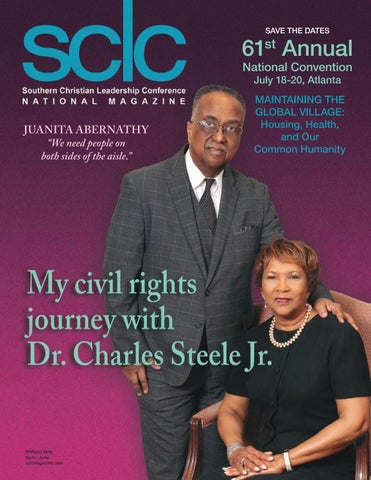
FROM THE FIRST LADY My Civil Rights Journey with Charles Steele Jr.
features: 09.
Emotional Reading of MLK Jr. Letter Brings Rare Bipartisan Bonding in Senate By Deborah Barfield Barry
14.
Juanita Jones Abernathy: “We need people on both sides of the aisle.” By J’Lyn Furby
18.
The Revolutionaries MLK Jr. and Simon Bolivar By Heather Gray
20.
Solving the Solution Maker By Chasatey Virgil
22.
The Anatomy of a Movement By Cicone Prince
24.
Rev. Dr. Gerald Durley on His New Climate Change Calling: “I’m not Retired – I’m Rewired” By Maynard Eaton
26.
Atlanta Metro RBI’s Barnstorming Humanitarian Tour Across Puerto Rico: In the Spirit of Robinson, Clemente, and King By Harold Michael Harvey
32. 34.
After Civil Rights Institute Rescinded Prestigious Award, Angela Davis Showed Up Anyway By Michael Harriot Nipsey Hussle Celebrated as a Visionary Activist at Public Memorial in Los Angeles By Dara Sharif
Southern Christian Leadership Conference N A T I O N A L M A G A Z I N E
In Print Since 1970 MAGAZINE MAILING ADDRESS P.O. Box 92544 Atlanta, GA 30314 FOR ADVERTISING INFO 800.421.0472 sclcmagazine.com info@sclcmagazine.com FOUNDER & PUBLISHER Steven Blood Sr., Ph.D. ASSOCIATE PUBLISHER Monica Blood MANAGING EDITOR Maynard Eaton EXECUTIVE MANAGER Dawn McKillop CREATIVE DIRECTOR Monica Blood SCLC Since 1957 SCLC NATIONAL HQ 320 Auburn Avenue Atlanta, GA 30303
MAYNARD EATON is an 8-time Emmy Award winning TV News reporter, who is SCLC’s National Communications Director and Managing Editor of the SCLC National Magazine. Eaton is a former TV news reporter who is now Executive Editor of Newsmakers Live/ Journal and The Maynard Report. He is also President of Eaton Media Group, and a journalism professor at Clark Atlanta University.
cover: Dr. Charles Steele Jr. and Cathelean Steele, SCLC International HQ, Atlanta Photographer: Faith Swift Cover Design and Layout: Monica Blood
Subscribe to our new “SCLC Today” YouTube Channel for news and information from SCLC President Charles Steele and others.
4
SCLC Magazine / SPRING ISSUE
www.nationalsclc.org CHIEF OF STAFF DeMark Liggins COMMUNICATIONS DIRECTOR Maynard Eaton SPECIAL PROGRAMS DIRECTOR Cathelean Steele
The Movement Continues! Your membership
with the Southern Christian Leadership Conference will help
promote the initiatives, programs, and activism of the SCLC. Visit our website to see what we have been doing and join online www.nationalsclc.org/join. Follow us on Twitter @nationalsclc.
M E M B E R S H I P S GENERAL $25
Lifetime Membership Plaque Members Newsletter Quarterly SCLC Magazine 25% SCLC Event Registration Discount
One-Year Membership Members Newsletter Quarterly SCLC Magazine 15% SCLC Event Registration Discount
One-Year Membership
FAITHFUL SERVANT $50 One Year Membership Members Newsletter
FREEDOM FIGHTERS $100
LIFE $2,000
DREAM KEEPER $250
YOUTH, STUDENT, SENIOR $10
DRUM MAJOR $500
One-Year Membership Members Newsletter Quarterly SCLC Magazine 25% SCLC Event Registration Discount
One-Year Membership Members Newsletter Quarterly SCLC Magazine
One-Year Memberships for: Youth (11-17) Student (18-24) Senior (65+)
..........................................................................................................................................................
A P P L I C A T I O N NAME ADDRESS CITY
STATE
TEL
ZIP
CHAPTER NAME (If appicable) AMOUNT ENCLOSED $
*Make checks payable to the Southern Christian Leadership Conference
Check membership that applies:
Youth (11-17) Student (18-24) Senior (65+) General Faithful Servant Freedom Fighter Dream Keeper Drum Major Life
Mail to: SCLC NATIONAL HQ, 320 AUBURN AVE NE, ATLANTA, GA 30303 (404) 522-1420 / info@nationalsclc.org / www.nationalsclc.org
$10 $10 $10 $25 $50 $100 $250 $500 $2,000
NATIONAL EXECUTIVE OFFICERS
Martin Luther King, Jr. FOUNDING PRESIDENT 1957-1968
Ralph D. Abernathy PRESIDENT EMERITUS 1968-1977
Joseph E. Lowery PRESIDENT EMERITUS 1977-1997
Dr. Charles Steele, Jr. PRESIDENT & CEO
Martin Luther King, III PAST PRESIDENT 1998-2003
Fred L. Shuttlesworth PAST PRESIDENT 2004 R.I.P. 1922-2011
Charles Steele, Jr. PAST PRESIDENT 2005-2008
Dr. Bernard LaFayette, Jr. CHAIRMAN
6
SCLC Magazine / SPRING ISSUE
Howard Creecy, Jr. PAST PRESIDENT 2011 R.I.P. 1954-2011
president’s corner
A Black History Lesson for Leaders BY DR. CHARLES STEELE JR., SCLC National President & CEO
T
hirty years ago, Communist Leader Mikhail Gorbachev was one of the most powerful and feared men in the world. As an American, I felt if anything riled him, he had the ability to create major destruction. But something changed in the last leader of the Soviet Union shortly before that nation dissolved under his reign in 1991. I had the chance to have an up close and personal meeting with the former president and General Secretary of the Soviet Union nearly 5 years ago in Germany. Leaders from around the world were in Berlin to commemorate the 25th anniversary of the fall of the Berlin wall, another historical milestone to nations in conflict around the globe that peace is possible. Dr. Martin Luther King, Jr, the first leader and cofounder of the Southern Christian Leadership Conference (SCLC), called for such peace in Germany 50 years earlier, when he said “walls divide humanity”. During my trip to Berlin, my focus was to highlight poverty around the world—a cause very dear to Dr. King—whose last mission was the Poor People’s Campaign to eradicate poverty in the U.S. and around the world. A scheduled 15-minute meeting with former President Gorbachev easily turned into an hour. Speaking through interpreters, I asked Mr. Gorbachev what inspired him to peacefully walk away from power when he could have fought to the end to hold on to it. The response of this dynamic leader, now much older, wiser and still very influential, moved me. Mr. Gorbachev, who’s now 88 years of age, shared that he adhered to Dr. King’s nonviolence conflict resolution philosophy used during some of the most turbulent moments of the Civil Rights Movement— The Montgomery Bus Boycott, the marches in Birmingham, where police used attacked dogs and high-pressured water hoses on citizens peacefully protesting discrimination in what was then the nation’s most segregated city and later demonstrations after four girls were killed in a racially motivated church bombing. There were also peaceful rallies disrupted by violence in other U.S. cities like Selma, Chicago and New York, and the tragic turn of events in Memphis, where Dr. King was assassinated on April 4, 1968. Those same tactics and teachings from what the SCLC now calls The Kingian Nonviolence Training—peaceful protest over violence, reconciliation over conflict—are widely used today by leaders who request meetings with the SCLC to help them navigate through very tensed moments. A similar request was made recently by Ralph Northam,
8
SCLC Magazine / SPRING ISSUE
the embattled governor of Virginia. He reached out to me after I called for his immediate resignation following revelations of his racist actions in the early 1980s. According to various news reports, Northam is in a medical school yearbook in 1984 dressed in blackface and next to someone in a Klu Klux Klan robe. Northam denies he is in the picture but admits he once dressed in blackface to mimic the late King of Pop Michael Jackson. I, along with Dr. Bernard LaFayette, the chairman of the SCLC and a King aide, who met with Dr. King five hours before he was fatally shot on a motel balcony in Memphis, decided to meet with Governor Northam, but I stand by my actions calling for his resignation. The decision to resign is a personal one. It is his decision and his alone. During our meeting at the Governor’s Mansion in Richmond, we did not discuss the ongoing consternation and controversy about his resignation or politics. We talked about the steps for reconciling. He vowed he is committed to taking the training necessary to reconcile. If he is committed, then I am committed to helping him with the transformation. I believe in the Chinese proverb: “Behind every crisis is an opportunity.” I believe time will take care of all of this. My role is to structure his change. By entering a conflict reconciliation training, he can use his powerful platform to transform our society has others have done in the Soviet Union, China and Germany, Israel, Nigeria and Columbia. This is at a much lesser scale, but Governor Northam can become a champion to help eradicate the racism and prejudices we have in America. He can do this whether he stays in office or leaves as it now appears he will. Either way, he would be recognized as a champion. Dr. King’s presented six principles for bringing about change and reconciliation: 1. Get the facts 2. Educate the people 3. Make the personal commitment 4. Negotiate 5. Direct Action 6. Reconciliation After the process has been completed, reconciling means Governor Northam will be a stronger person and leader if he follows the philosophy of Dr. King. Americans will also be better off if he takes the steps to reconcile and become a champion from his powerful platform to help eradicate injustices and racism in this great nation.•
Emotional Reading of MLK Jr. Letter Brings Rare Bipartisan Bonding in Senate
L-R: April 9th, Sen. Ted Cruz, (R-Texas) joins Dr. Charles Steele Jr., Sen. Doug Jones (D-Ala.), and Martin Luther King III outside the U.S. Capitol after reading excerpts of Martin Luther King Jr., “Letters from Birmingham Jail”. Photo: D. Berry
W
BY DEBORAH BARFIELD BERRY
ASHINGTON—In front of a rapt audience, including the eldest son of Martin Luther King, Jr., Democratic and Republican senators took turns Tuesday, April 9th, reading the “Letter from Birmingham Jail,’’ the slain civil rights leader’s call to action more than 50 years ago. At one point, Sen. Doug Jones, who joined a pilgrimage last year to honor King,teared up as he read excerpts of King’s letter. “To say them out loud and to listen to other people say them especially on the floor of the United States Senate was incredibly powerful, incredibly moving,” Jones, D-Ala., said later as he stood on the steps of the U.S. Capitol. “I think everybody that was in that gallery, I know everybody on the floor was really touched by this. I think the words are as important today as they were in 1963.” King wrote the letter in April from a cell in a Birmingham jail in 1963 after fellow clergymen criticized the tactics of the anti-segregation campaign. He urged them and others not to be silent while others fought for change. King was assassinated April 4, 1968 in Memphis. Jones was joined on the Senate floor by Sens. Ted Cruz, R-Texas, Lamar Alexander, R-Tenn., Kamala Harris, D-Calif., Lisa Murkowski, R-Ala. and Tim Kaine, D-Va. Reps. Karen Bass, D-Calif., chairwoman of the Congressional Black Caucus, Terri Sewell, D-Ala., and Sheila Jackson
Lee, D-Texas, sat in the back of the chamber as the senators read excerpts of the letter. Martin Luther King III, who sat in the Senate gallery during the reading, applauded the words, noting how relevant they were today. “We’re still addressing some of the struggles,” King said afterward. “We will continue to become a better nation. That’s what Dad was talking about. He was challenging us to our core to become the best of who we could become. I know we will get there at some point. We’ve got work to do obviously, but we’re going to get there.” King and others, including Charles Steele, president of the Southern Christian Leadership Conference, founded by Rev. King, and Rev. Canon Leonard L. Hamlin, Sr., of the Washington National Cathedral, met with senators on the steps of the Capitol after the reading. Cruz urged others to reread King’s letter. He said one thing that resonated with him was King’s call for the church to be more involved and to be “a thermostat and not merely a thermometer.” It was important, said Cruz, that Republicans and Democrats read the letter. “There are issues that divide us, but there are also issues that pull us powerfully together,” he said.• Deborah Barfield Berry is a writer for USA Today. SPRING ISSUE / SCLC Magazine
9
from the chairman
The Last Word BY DR. BERNARD LAFAYETTE JR., SCLC National Chairman
I
t was in Memphis, Tennessee, April 4, 1968 when Dr. Martin Luther King, Jr. spoke his last words to me. It was in his hotel room 306 at the Loraine Hotel in Memphis, Tennessee. Dr. King was scheduled to have a press conference in Washington, D.C. to announce the headquarters of the Poor Peoples Campaign at 14th and U Streets, but since the Sanitation Workers March in Memphis had broken up in violence, Dr. King decided to stay in Memphis and do the march over again. He did not want to leave a blight on the Sanitation Workers strike. His entire staff and directors of programs had flown to Memphis to continue to work on the Poor Peoples Campaign and prepare for the next march. Dr. King wanted to stay on schedule, so he asked me to go to D.C. and hold the press conference for him since he had appointed me the National Coordinator of the Poor Peoples Campaign. The morning of April 4, I was finishing the press statement that he and I had been working on the night of the 3rd of April. We were interrupted the night before, when Dr. King got a phone call from Rev. Ralph D. Abernathy who called Dr. King from Mason Temple Church to explain to him that the audience was calling for Dr. King to come and speak to them. They were insisting that Dr. King should come. Dr. King said, “Are you telling me that you want me to get out of my bed, put on my clothes and come out in the pouring down rain, and it’s raining ‘cats and dogs.’” Abernathy said, “This is your crowd, they want to hear you.” Dr. King said “Okay, if you say so.” He got dressed and left. This was the occasion when he made that famous speech, “I’ve been to the Mountain Top and I have seen the Promised Land.” I stayed at the hotel and continued to write the press statement. When Dr. King returned, he was so excited, he said “Let’s continue in the morning.” The next morning was April 4th. We finished the press statement at Dr. King’s bedside. He told me to go on to D.C. and hold the press conference and he would be along later. As I stood up ready to leave his room, he stopped me and said, “LaFayette, the next movement we are going to have is
10
SCLC Magazine / SPRING ISSUE
to institutionalize and internationalize nonviolence. I responded by saying “Yes, sir.” These were my last words with Dr. King. I took my flight out of Memphis to National Airport in D.C. When I arrived at the airport, my ride was not there. Rev. Walter Fauntroy was scheduled to meet me at the terminal. He was not there. I called the office at 14th and U and the secretary told me that Dr. King had been shot in Memphis and there was rioting in the streets. Rev. Fauntroy and Stokely Carmichael were out in the streets attempting to stop the riots. I called back to Memphis and could not get through. I then called the news services, U.P.I. and A.P. There was a battery of telephones in the airport, so I made the calls with a phone in both ears listening to the reporters read the tickertapes from Memphis. The U.P.I. reporter broke down and started crying, that’s how I knew that Dr. King had died. I took a cab to 14th and U. I was able to reach the staff in Memphis and they told me that they would meet me in Atlanta. We had to do a funeral, a successful labor movement in Memphis, and the Poor Peoples Campaign without Dr. King. Dr. King’s last words to me became my life commitment. “Institutionalize and internationalize nonviolence.” They killed Dr. King, but I was, and am, determined that they would not silence him nor his message and dream. Nonviolence based on Dr. Martin Luther King, Jr.’s teachings is being taught in institutions and curricula all over the world, in schools, universities, community centers, institutes, prisons, and churches. They continue to expand, sponsored by private industry, non-profits, and government agencies. I am convinced that the change will come. The young people are coming forth as they learn more about the principles and steps of nonviolence and the strategy that Dr. Martin Luther King, Jr. used to transform our community.•
I n Ho n o r o f
Dr. Martin Luther
King Jr. 1929 – 1968
Gray Television and our employees honor the life and legacy of Dr. Martin Luther King, Jr. May his wisdom, words and dreams continue to shape our hearts and minds for years to come.
from the first lady
My Civil Rights Journey with Charles Steele Jr.
W
BY CATHELEAN STEELE, Founder, Justice for Girls
hen I met Charles Steele, Jr he was the campaign manager for political hopefuls. After we married he soon joined the TCAC an acronym for Tuscaloosa Citizens for Action Committee. When the president of TCAC retired Charles became president and soon the organization converted to the Southern Christian Leadership Conference (SCLC). I had been a part of civil rights all of my life but not at the level that I was about to experience. Soon he was boycotting and picketing major commercial businesses because of their unfair practices. The reality of his actions soon began to impact our home life as he was jailed many times for violating retraining orders that forbid him for picketing on the business owner’s property. These actions soon changed the course of my life as co-workers and others in the community thought he was too radical. Then came the phone calls, I was called many names that I would rather not repeat. There were suggestions that I should leave him and others said that he “should go somewhere and sit down.” I was getting pounded with criticism from both sides, the Whites who were harassing me and the Blacks who thought that his actions were excessive. On one beautiful Saturday morning while Charles and five of his civil rights cohorts were sitting in at the board of education, I received a phone call from my elderly white neighbor telling me to come home. She informed me that she had called the police and the fire department. To my amazement when I arrived my front yard was on fire and the flames had reached the hedges. We were blessed that our neighbor liked me and made the phone calls that saved our home. Because of the stress, a few weeks later I gave birth prematurely to our youngest daughter. We were told that she would not live, but God had other plans. The girls were growing, Charles was still fighting for equal rights, and the harassment continued. It was extremely hurtfully to me when the girls would answer the phone and the caller would spew out mean words to them. They were young children and had no voice in their father’s activism. On one occasion, Mrs. Odessa Warrick, one of Tuscaloosa’s civil rights warriors stayed with the girls and I to protect us while Charles was in jail for protesting. The girls told me later that Mrs. Warrick who slept in the room with them slept with a gun under her pillow. In later years, Charles work on behalf civil rights brought about political gains in Tuscaloosa and surrounding counties as he was elected as one of the first Black city councilmen and eventually the first Black State Senator in his district since Reconstruction.
12
SCLC Magazine / SPRING ISSUE
Dr. Charles Steele Jr. and Cathelean Steele. Photo: Faith Swift
Becoming the national president of the Southern Christian Conference (SCLC) was not a goal in our lives. My husband and I were happy following the national leadership. Once he became president he worked tirelessly to save the organization co-founded by Dr. Martin Luther King, Jr. To my surprise I was not accepted as well as my husband. After the new headquarters was built, I was informed by a member of the board that I would not have an office in the building. It was hurtful since I have been by my husband’s side from the beginning of his journey with SCLC. n 2009, Charles chose to leave SCLC for personal reasons. He always wanted to start his own business and together we started Charles Steele and Associates. The business was very successful, but his desire for civil rights was never far from his thoughts. In 2012, Dr. Bernard LaFayette and a new board of directors called to see if he was willing to return and save the organization for a second time. After praying over his decision and having many discussions with the family, he decided to return to where his heart always was. During Charles’s second term my life at SCLC has changed. I now have an office and was appointed as the convention coordinator. I am also founder of the SCLC Justice for Girls, a sex trafficking prevention initiative. We are presently working with middle school girls, building positive sex esteem, educating them to sex trafficking, providing self defense training, taking field trips, college tours and finally a princess tea. Civil Rights has been a tour of duty for me. The learning curve has had many twists and turns but through it all I have no regrets.•
We salute the for their tireless efforts to promote equality among us all.
Visit us at www.checkers.com
©2017 Checkers Drive-In Restaurants, Inc. Checkers/Rally’s prohibits discrimination in employment because of race, color, sex, religion, age, national origin, disability, citizenship status, sexual orientation, sexual identity, participation in military service, or any other unlawful basis in accordance with all applicable federal and state laws. 20170449
S14=SCQ1_Layout 1 11/14/13 3:15 PM Page 1
Checks Unlimited pays tribute to Dr. Martin Luther King Jr.’s powerful legacy of peace and unity.
#1 for Checks Direct ®
www.ChecksUnlimited.com
1-800-565-8332\
We are an Equal Opportunity Employer. SCQ1 © 2014 Direct Checks Unlimited Sales, Inc.
SPRING ISSUE / SCLC Magazine
13
Juanita Abernathy (center), David Abernathy (second to her right), and John Lewis (third to her right) march from Selma, Ala. to the state capitol in Montgomery in 1965 with Martin Luther King Jr. and Coretta Scott King. Photo: City of Atlanta.
Juanita Jones Abernathy:
“We need people on both sides of the aisle.”
J
BY J’LYN FURBY
uanita Jones Abernathy, one of the pillars of the Civil Rights Movement, has lived an extraordinary life of community servitude and Civil Rights activism for a woman of her era. She was highly educated attending the famous Selma University Boarding School in Selma Alabama and a graduate of Tennessee State University. Her life and legacy as a Civil Rights Activist, former First Lady of the Southern Christian Leadership Conference, and Reverend Ralph David Abernathy’s courageous wife is widely revered. That’s why a recent Metropolitan Atlanta Rapid Transit Authority Board Retirement Ceremony was organized for Mrs. Abernathy by self-proclaimed Republican “Statesman” Bruce LeVell. That dignified event is at the center of this commemorative article because on that occasion Mrs. Abernathy exuberantly expressed candid moments about her effervescent life as a wife, mother, and pioneering female civil rights activist.
14
SCLC Magazine / SPRING ISSUE
“You know people don’t vote now, I tell everybody,” laments Mrs. Abernathy. “We walked 50 miles for the right to vote in loafers, not sneakers, with blisters on our feet from Selma to Montgomery. I never miss an opportunity to vote no matter how small. My husband and Martin had been to see the president; and had told him how difficult it was for Blacks to vote in this county and especially in the South.” That was after Jimmy Lee Jackson was killed in Marion Alabama. “They had a literacy test that was to prohibit blacks from voting,” continues Mrs. Abernathy during her retirement ceremony. “If you could not fill out all that information. Then you could not qualify to register to vote. My husband he was a KAPPA. He took his fraternity down to register to vote. They had all this material to fill out. When they got to him. He [Rev. Abernathy] wrote down the pledge of allegiance.”
The voter registration worker told Dr. Abernathy “I knew you would do it right.” He got to vote, and all his fraternity brothers were angry. “You got to vote, and we didn’t,” they told him. He said, “I wrote down what I knew, and I knew she [voter registration worker] didn’t know it. But it was just to keep us from voting.” Mrs. Abernathy shared little known facts surrounding the historic accomplishments of her husband and his freedom fighting brothers. Together many leaders advanced the voting right issue all the way to the White House. Mrs. Abernathy said how “President Johnson federalized the state troopers and forced them to protect us. We did all of that for the right to vote and we added no gerrymandering.” Mrs. Abernathy’s historical contributions are also cemented in history along “The U.S. Civil Rights Trail” locations and attractions that document Abernathy’s and King’s story timeline state by state. Dr. Martin Luther King and Reverend Ralph David Abernathy were each other’s right hand sharing in the social struggles and triumphs of their time. The women who held these men down have stories of their own. Former Georgia State Representative Roberta Abdul-Salaam is a self-proclaimed “Movement baby”, who much like Mrs. Abernathy does not mince words. “I’ve known Mrs. Abernathy through ‘The Movement’, she says. “I been working with SCLC since I was a 12 or 13 years-old. I went to my first National SCLC Convention in 1972.” Rep. Abdul-Salaam, spoke about Black women who have always been the backbones of the community is different capacities. “Mrs. Abernathy is such a strong pillar. She exemplifies the kind of leadership that woman have made a difference in the country for so long. I remember telling her a couple of years ago; that we were going to do a celebration on Dec 1st in commemoration of the Montgomery Bus Boycott. And she took me aside and took her time. She [Mrs. Abernathy] told me well you know I am the only one of the originals left. I kind of knew that. I was also fortunate to work with Mrs. Rosa Parks, Mrs. Coretta King, and Mrs. Evelyn Lowery. I said what is it that made you women stand out to these powerful men?” The four female pillars of Civil Rights shared more than the struggles of being progressive woman during that era. According to Rep. Abdul-Salaam, “what I had noticed is that Dr. Young, Dr. Lowery, Dr. King and Dr. Abernathy all choose their wives from that same community. That had to speak for something.” All four women came from the same Union County community in Alabama. “Mrs. Abernathy had leadership in her blood. I
Republican statesman Bruce LeVell congratulates Juanita Abernathy on her stellar and courageous civil rights career.
heard Mrs. Abernathy say, that if you want to be a good leader. Find good leadership and become a follower,” Abdul-Salaam recalls.” Attorney Michael Tyler, a former MARTA Board president, was the first to speak at the ceremony. “She knew and understand the imperative of MARTA for those who truly needed it,” Tyler said. “Mrs. Abernathy was our compass.” Tyler, hailed Mrs. Abernathy for her incredible moral compass and strengths: “You’ll see photos of Mrs. Abernathy when she was a younger woman. Back then she was team with her legendary husband, one of the icons of the 21st century, who she met back in high school.” Mrs. Abernathy interrupted Tyler, “He [Rev. Abernathy] use to brag and say the problem with you all is I raised my wife.” Tyler, after yielding to Mrs. Abernathy, said, “It’s not a mystery that Mrs. Abernathy was joined at the hip back in Selma back in the day with her husband and stuck with him all the time. It was noteworthy to me, Mrs. Abernathy, that back in 1955-56., when we had the Montgomery Bus Boycotts you were there. When I think about your service to MARTA, to me it’s been an extension of your service to ‘The Movement’. The movement after all started off on a bus. It was all about equity in terms of opportunities for African Americans.” The Hip Hop Culture today would call her a “ride or die” revolutionary activist. Mrs. Abernathy recalled that “Rosa Parks sat down on my birthday in December 1955.” SPRING ISSUE / SCLC Magazine
15
She was the ultimate volunteer and spent a great deal of time working with civic and religious organizations. Biblically speaking she was Reverend Ralph David Abernathy’s helpmate. She gave Rev. Abernathy three children, two girls Donzaleigh and Juandalynn and his son Ralph David Abernathy III. “We met when I was 16 years-old,” Mrs Abernathy revealed. “He told people he raised me and he did.” She wore many hats in addition to being a mother and educator: Board of Directors and Secretary for the Metropolitan Atlanta Rapid Transit Authority; Board of Trustees of the Morehouse School of Religion; Board of Directors for the Ralph David Abernathy Towers and Foundations; Board of Director and Treasurer of the Fulton County Development Authority; Board of Director of the Atlanta-Fulton County League of Women Voters; and Citizen Panel Review Board for the Development of Family and Children Services. The right to vote was paid for with American blood and lives of Black and White people. Mrs. Abernathy’s passionately voiced that; “people were killed but we had blisters on our feet for the right to vote. Because people died it’s a blood ballot.” Protecting others was a standard operating procedure with this noted civil rights heroine. Mrs. Abernathy identified as a Democrat but nevertheless found a way to defend Black Republicans. According to Black Republican businessman LeVell, she had a unique approach to how she influenced others. He says that Mrs. Abernathy protected him—a self-described Frederick Douglass Republican—from taunting and ridicule. In support of LeVell and other Black Republicans she told others; “we need people on both sides of the aisles.” That is a strong salient political statement from an iconic activist that resonates and remains relevant today “I fondly remember Mrs. A.”, says LeVell. “She was nice and fiery; when she put her hands on the desk and folded her arms and her eyes got big everyone knew to watch out. I was her self-proclaimed protector. I don’t know if she knew that; but everyone knew I wasn’t going to tolerate anyone disrespecting her. “It wasn’t right how she learned about her ‘retirement’ from MARTA,” LeVell continues during an interview. “I had to do something. We had to do something to honor Mrs. A. Right is Right. She was only 5’5 and mighty.” Mrs. Abernathy was instrumental in the Montgomery Bus Boycott and gaining Atlanta MARTA transportation for maids and home workers. She literally walked
16
SCLC Magazine / SPRING ISSUE
and marched for civil freedoms and access to transit systems for the working class. That was a was key to Mrs. Abernathy’s civil rights activism that now “spans decade’s across multiple cities and states—from Topeka, Kansas, to Memphis, Tennessee, from Atlanta, Georgia, to Selma and Birmingham, Alabama and all the way to Washington, D.C. charts the course of the Civil Rights Movement” as chronicled by U.S. Civil Rights Trail. Mrs. Abernathy maintained that “people really don’t know that history. People think it just happened. It happened at the action of a lot of people.” Mrs. Abernathy was a woman with great fearlessness to endure such a journey that included more than 100 locations across 15 states. Political and Civil Rights Activists suggest that our society could learn a thing or two from the former First Lady of the SCLC and the Black Republican “We worked together for what is right” says LeVell. “Civil Rights Veterans tell me that Mrs. Abernathy was brazen and outspoken about issues and events her husband and MLK captained,” says Maynard Eaton, SCLC’s National Communications Director. “She was not passive participant in ‘The Movement’. She was not a background player. Mrs. Abernathy was unafraid to unabashedly voice her strategic and savvy opinions, I’ve learned,” The Transportation Civil Rights issues that Mrs. Abernathy fought for still fosters similar sentiments from transit users around the Southeast. Mrs. Abernathy was also a successful entrepreneur who had several business endeavors in Atlanta, Georgia. She held a high position with Mary Kay for over 20 years and had to find her way to and from client homes. Just like today’s working folk Mrs. Abernathy was no stranger to hard work and perseverance. Today’s entrepreneurs, students, hourly workers and business professionals save time and money by using the same public transportation systems across the country that Mrs. Abernathy pushed for.•
J’Lyn Furby is U.S. Presidential Gold Service Medal Awardee, U.S. Air Force veteran, former USAF police officer, exercise physiologist, community activist and proud Black Republican.
Saluting the power of a dream and the courage of a voice.
Snack Foods
Dr. Martin Luther King, Jr. 1929-1968 The Herr’s name and logo are registered trademarks of Herr Holdings Inc. and are used under license. ©2011 Herr Holdings Inc. All rights reserved.
We Join SCLC in Honoring the Memory of Dr. Martin Luther King Jr.
Dillard’s proudly supports the
SOUTHERN CHRISTIAN LEADERSHIP CONFERENCE Supports equal opportunity for all, regardless of race, creed, sex, age, disability or ethnic background.
06-00032 SCLC AD.indd 1
5/28/18 2:59 PM
SPRING ISSUE / SCLC Magazine
17
The Revolutionaries MLK Jr. and Simon Bolivar The Influence of the Enlightenment BY HEATHER GRAY Introduction: We have been blessed to have leaders, in concert with the masses of the people, seeking justice and peace in the world along with a respect for humanity overall. Two of these major leaders in world history are Dr. Martin Luther King, Jr. in the United States and Simon Bolivar in Venezuela. While they lived more than a century apart from each other, some of their ideas about what was necessary to achieve justice in the world was definitely similar, which included, importantly, the philosophy of the European ‘Enlightenment.’ With Venezuela in the news in the past year, along with efforts by the US government to undermine the presidency of Nicolas Maduro, I began to look more closely at the history of Venezuela, especially the presidency of the late Hugo Chavez. Among his remarkable achievements, Chavez effectively addressed the problems of the poor in Venezuela and made sure that Venezuela would be known as the “Bolivarian Revolution,” in honor of the renowned Venezuelan liberator, Simon Bolivar (1783-1830). While I have never been fortunate to visit Venezuela, I have visited Cuba where I found that Cubans also honored Simon Bolivar, erecting a statue of him in Havana. The point is that Bolivar is acknowledged throughout the region for his leadership in freeing the people from Spanish colonial rule. Bolivar’s admirers are not unlike those in the United States who honor Martin Luther King, Jr. (1929-1968) for his leadership in the civil rights movement with statues and streets named for him and a national holiday in his name. Like Bolivar, the messages and philosophy of Dr. King resonate today - 51 years after his assassination. Upon reflection of all this, I realized it was time to study the history of Simon Bolivar and, as I did so, I found parallels with Martin Luther King. Both of these leaders were
18
SCLC Magazine / SPRING ISSUE
from privileged backgrounds who were concerned about the conditions and exploitation of less fortunate people. They began to explore ways to effect positive change to end this exploitation, both of them looked into the writings and work of past philosophers for ideas to move forward on their demands for change. The similarity between the two leaders had partly to do with their interest in and inspiration of philosophers from the ‘Age of Enlightenment.’ The Enlightenment: There are varied interpretations as to when the Age of Enlightenment started. Some will say, however, it was with the statement by the French philosopher Rene Decartes who, in 1637, said “I think therefore I am.” In other words, declaring that his humanity was not defined by an outside source, but by himself. In political and societal terms, the enlightenment was a movement in Europe in the 16th, up to the 20th century (and perhaps even now in the 21rst century) regarding a change from the controlling interests of royalty, or the elite, or the church itself over individuals in the European society. These Enlightenment sentiments for individual freedom and change in the societal hierarchy swept throughout Europe in Britain, Scotland, France, Germany, Italy, Russia and Portugal and in the American colonies. It is also noted that the American revolution in 1787 was itself inspired by the Enlightenment, which encouraged the founders of the United States to end the colonial control of Britain over its American colonies. Another interesting aspect of this Enlightenment scenario concerns the Reverend Martin Luther King, Sr. The senior King, who would become known as Daddy King, traveled to Germany in 1934 to participate in celebrations of
the 100th anniversary of the Baptist denomination. While in Europe, he learned more about the Protestant Reformation, that took place under the leadership of the German theologian, Martin Luther, who instigated a break from the Roman Catholic church in 1517. Some scholars believe this was a critical inspirational factor that led to the enlightenment in the 1600’s. Due of his knowledge of Martin Luther in the creation of the Protestant faith, Reverend King, whose name was Michael King, changed his name to Martin Luther King, Sr. and also changed his son’s name to Martin Luther King, Jr. Simon Bolivar, the Enlightenment and the Venezuelan War of Independence from Spain: Simon Bolivar was born in Venezuela to a wealthy family, but his parents died when he was very young. He was then mentored by other family members and friends. As was the case with many wealthy Venezuelans, at the age of 16 Bolivar was sent to Europe for his education. Living first in Spain, he then moved to France and traveled considerably in Europe during his visits on the continent. It was while he was in Europe that he was introduced to the ideas and concepts of the Enlightenment. In fact, it was the inspiration of the Enlightenment, along with his realization of the American revolution to free itself from British colonialism, that Bolivar began to consider freeing Venezuela from Spanish control. And he took the lead in accomplishing that goal in battles with the Spanish military from 1810 to 1823, that finally led to the Venezuelan independence. Regarding Enlightenment philosophers, Bolivar was “impressed” with Thomas Hobbes (English/1588-1679) and Baruch Spinoza (Dutch/1632-1677) and he also studied Claude Adrien Helvitus (French/1715-1771), David Hume (Scottish/1711-1776), Montesquieu (French 1689-1755), Jean-Jacques Rousseau (Swiss/1712-1778) and others. But to Bolivar, freedom from colonial rule was only part of what was necessary. He is noted for saying: ‘It is not enough that our armies be victorious and our enemies evicted, or that the whole world recognize our Independence; it is even more essential that we become free under the auspices of liberal laws, deriving from the most sacred source, namely the will of the people’. (‘Simon Bolivar and the Age of Revolution’ by John Lynch – 1983) Martin Luther King, Jr., the Civil Rights Movement and the Enlightenment: Regarding Martin Luther King and the enlightenment philosophers, King notes: It was not until 1948, when I entered Crozer Theological Seminary in Chester, Pennsylvania did I begin a serious intellectual quest for a method to eliminate social evil. I turned to a serious study of the social and ethical theories of the great philosophers, from Plato( Greek/428/427 or 424/423-348/347 BC) and Aristotle (Greek/384–322 BC) down to (Jean-Jacques) Rousseau (Swiss/1712-1778);(and other enlightenment philosophers) (Thomas) Hobbes (English/1588-1679); (Jeremy)
Bentham (English/1748-1832), (John Stuart) Mill (English/1806-1873), (John) Locke (English/1632-1704). All of these masters stimulated my thinking-such as it was-and, while finding things to question in each of them, I nevertheless learned a great deal from their study. (King PapersStanford University) Like Bolivar, Martin Luther King sought the wisdom of the classical and enlightenment to inform his ultimate mission to address the “social evils” in America and work toward the liberation of those of African descent in America. But King was also the beneficiary of other scholars and activists from the 19th and 20th centuries to assist him in the development of articulating his mission. Not the least of these was the work of theologian Howard Thurman, who was one of his mentors and author of the renowned book “Jesus and the Disinherited” (1949). Thurman describes Jesus, who was poor, and his battle against the oppressive Roman colonial rule in Palestine as comparable to the Black and other minority struggles against oppression throughout most of American history. I would describe Thurman’s book as a part of the Enlightenment philosophical scholarship. Summary: The scenario of the American revolution against British colonial rule, the Venezuelan revolution against Spanish colonial rule, and the American civil and human rights struggles against on-going racial oppression are strikingly similar. It is a desire for freedom and respect of the individual and group and, as Bolivar wisely notes, working toward a world that is defined by “the will of the people’. In his profound efforts and leadership for civil and economic justice in America, and against racial oppression, Martin Luther King clearly saw the parallels with Jesus’s struggle against Roman colonialists and American resistance to British colonialism. King wanted a similar scenario that would be respectful and empowering for the Black community in America and that would end the racial oppression in America. Similarly, Simon Bolivar was demanding freedom from Spanish colonial oppression. Both of these leaders— Martin Luther King and Simon Bolivar—have had a profound on-going impact on the lives of us all. We are blessed for their philosophical influence and for the enlightenment movement in Europe that contributed to this desire for freedom and respect for individual rights. In fact, the statement in the American ‘Declaration of Independence’ that cites the ideal of “Life, liberty and the pursuit of happiness,” is a product of the Enlightenment philosophy. Yet, we still need to make sure this declaration of universal human rights is realized for all people.• Heather Gray has a history of activism on civil and human rights for decades in the southern region of the United States as well as nationally and internationally. She expresses this background and activism in media both on the radio and in articles. She holds an undergraduate degree from Emory University and Georgia State University in Anthropology and a Masters Degree in Sociology from Georgia State University. SPRING ISSUE / SCLC Magazine
19
Juliana Njoku (in yellow) following her lecture about Workforce housing to Maynard Eaton’s Clark Atlanta University journalism students. Photo: Connor Mitchell
Solving the Solution Maker BY CHASATEY VIRGIL
A
t the age of 21, Juliana Njoku knew she would become a future solution maker when she became the first African woman to be elected as Student Government Association President at the University of Maryland, College Park. She engaged her fellow classmates with her determination for change, making her student election the highest historical election turn-out for the University. After being elected, she opened doors for other minority groups by allowing them to join her administration, which was the first to see Hispanics, Jews, and members from the LGBT community. Although Njoku felt this change would lead the University in the right direction, many disagreed. Three months into her presidency, she received numerous death threats and was even held at gunpoint in her office by a former student whom was on house arrest. Unfortunately, the issue of racism wasn’t just at the University of Maryland. That same year, the year of 2000, Syracuse and Georgetown Universities both experienced issues dealing with racial discrimination and anti-Semitism. “It seemed all over the world, that my generation, even though we were living in the millennium, were all dealing with 1963 problems. It is at that moment that I
20
SCLC Magazine / SPRING ISSUE
started to understand what my path would be” Njoku told the class at Clark Atlanta University. Many tried to persuade Njoku to transfer to a Historically Black College or University, so that she could be well protected, however she refused to leave. She felt, at that moment, that it was more important for people to see more diversity, more educated black faces at Universities, such as the University of Maryland, in an effort to bridge the divide. To her, retreating was not an option. Njoku’s quest for change did not stop after her collegiate years. In fact, she continues to work on issues facing underrepresented and disparaged people both domestically and internationally. “Every generation has a problem, more than one problem. But every generation only has a few that are going to answer the call to be a solution maker.”, said Njoku. Her most recent endeavor fights to tackle the rising housing crisis. Njoku and her partner, Douglas Suber, created a housing development company named The Suber Group. According to the organization’s website, “The Suber Group is a Georgia-based real estate development corporation; specializing in multi-family, mixed income, mixed-use developments, contractual services, and investments.” The Suber Group is working to develop and advance a new housing model that will positively change the stigma associated with housing crisis
by focusing on the true faces of affordable housing, our workforce. Together with her partner, Douglas Suber, Njoku wants to move away from the common transitional housing model by establishing transformative housing that provides their future residents with the necessities to thrive. As Chief Strategy Officer, Njoku is responsible for the development, communication, execution, and the sustainability of public and private partnerships as well as corporate strategic initiatives. “On a day to day, I spend my time working with different developers and partners to design affordable housing for our workforce.” says Njoku. Most may ask “Why Atlanta?” being that Atlanta is known for their historic neighborhoods and tradi-
options, a resource center that focuses on pathways to economic viability, training, trade & extension schools, as well as support service programs that engage resident entrepreneurs, service workers, working professionals, police officers, nurses and educators in advancing the future of many of Atlanta’s at-risk communities.” The housing crisis in Atlanta cannot be solved with just Njoku and the Suber Group, alone. Njoku explains to the class at Clark Atlanta University the importance of youth becoming solution makers. “[As future media, journalist and communications executives] you guys are in a very unique position because solutions and problems are
“It seemed all over the world, that my generation, even though we were living in the millennium, were all dealing with 1963 problems. It is at that moment that I started to understand what my path would be.” —Juliana Njoku told the class at Clark Atlanta University.
tional approaches to housing. Njoku responded “Atlanta has a model of mixed-income/mixed-use and is a HUD approved Move-to-Work city that makes it one of the best places to launch The Suber Group’s Workforce Housing Model. In addition, Atlanta is home to over 25 fortune 500/1000 corporations, whom all could benefit from having their most critical workers close by. Although, Njoku wants better housing all throughout the United States, the City of Atlanta is unique to her and where she calls home. Njoku informed students that, “According to the 2018 Brooking Institute Report, if you are born in poverty here in Atlanta, Georgia…you only have a 4% chance of making it out of poverty [within your lifetime].” This information made Juliana eager to find solutions for this problem utilizing the platform of housing. Njoku believes that the leading cause of Atlanta’s housing crisis is a combination of factors to include affordability and economic mobility. “A lot of new developments that have come to Atlanta have come at prices that are not at the income level of a lot of people that have the greatest need.”, says Njoku. She also states, “The crisis is not just about the construct of more units. It’s really about the capacity of the people within the units to be able to afford to stay in those units [and advance to homeownership].” In hopes to solve this problem, through the leadership of Njoku and her partner Douglas Suber, The Suber Group is taking an innovative and deliberate approach towards housing development. The Suber Group’s plan which can be found on their website includes, “Affordable rent
only spread and solved if the best information is carried. To every solution must be the carriers of the information.” The housing issues is something that many youths are unaware of, yet it effects their generation firsthand. Njoku is on a mission to get young adults involved and educated on the housing issue in order to generate more innovative solutions. Atlanta is the mecca for young African Americans and it is vital that they are informed on the issues going on right in their backyard. Juliana Njoku is far from the average housing developer. She acknowledges issues that hinders many communities from sustainable social development to economic viability. Ms. Njoku is working towards the betterment of the people and our communities. Not only is she fighting to redefine approaches to the housing crisis now, but she is also working to improve the narrative of housing for generations to come. She’s proactive, she’s an activist, but most of all, she’s a solution maker.•
Chasatey Virgil is a first year Sophomore at Clark Atlanta University. She is an aspiring writer, journalist, and media proprietor.
SPRING ISSUE / SCLC Magazine
21
The Anatomy of a Movement BY CICONE C.A. PRINCE Someone once posed the following question: If you had to pick one, what would it be, [1] Economic Power or [2] Political Power? What would you choose? For me, Economic Power would be my selection because with that you can control the Political Power. But what if you don’t have either, where would you start? What approach would you take to see a lasting and impactful change in the world in which we live? History has shown us that you start with a cause. A cause worth fighting for, a cause that at its very core cries out for justice, a cause that you can take on and make a significant change. From that cause, there will develop a message; a message that can be shared with simplicity and clarity. A message that’s so universal that it draws people in and they find a common thread in it; a thread that matters. “Our lives begin to end the day we become silent about things that matter.” – Dr. Martin Luther King, Jr. We have to champion that cause and take up the mantle of the message. That message then turns into a movement, which builds momentum. That momentum then leaves a mark in history that cannot be erased. The Anatomy of a Movement in Five Stanzas: The Moment The Message The Movement The Momentum The Mark
22
But one day a year later a lady by the name of Rosa Parks decided that she wasn’t going to take it any longer. She stayed on a bus seat. It was the beginning of a movement where fifty thousand black men and women refused absolutely to ride the city buses, and we walked together 381 days. “Negroes have to learn to stick together. We sent out the call. No Negroes rode the buses. It was one of the most amazing things I’ve ever seen in my life. The people of Montgomery asked me to serve as the spokesman, and as the president of the new organization. The Montgomery Improvement Association came into being to lead the boycott. I couldn’t say no. And then we started our struggle together.” – Dr. Martin Luther King, Jr., 1966 Isn’t it peculiar how at that moment, we don’t really see it at that moment? We simply see it as a decision to be made, but what I like about it is that we have those opportunities every day. How many times have you had to look back and see how one chance encounter, one wrong turn or one answered call has changed the trajectory of your life? I believe we all have had moments of reflections that help clarify those moments for us. Dr. King remembered such a moment years later and it became embedded in the campaign for justice: “Injustice anywhere is a threat to justice everywhere.” It’s in those moments that we discover what we are really made of. It’s in those moments that we show our true character, not to the world, but to ourselves. In those moments, we come face-to-face with the person that we are, not the person that we think we are. What would our life look like without defining moments?
—The Moment—
—The Message—
There will always be a defining moment in any worthwhile movement. From The Reformation to the American Revolution to the Abolitionist Movement, there has always been a sliver of time that can be categorized as “The Moment.” For the cause that Dr. Martin Luther King, Jr. championed, I believe that Moment happened in 1955 with the Montgomery Bus Boycott, 1955. “After finishing my schooling, I was called to a little church down in Montgomery, Alabama. I started preaching there, things were going well in that church, it was a marvelous experience.
Dr. King had spent countless hours studying Theology for the sake of delivering stirring messages to souls. He graduated and went out into the world to make a difference. His message, however, had to evolve based on the more pressing need for a Civil Evangelist more so than a Gospel one. Addressing injustice meant confronting it wherever it appeared, whether with the Montgomery Bus Boycott and the strike for Sanitation workers in Tennessee. He had to become a Drum Major for Justice. His message had to be clear and deliberate. He had to focus on results and not rhetoric.
SCLC Magazine / SPRING ISSUE
Dr. King’s message had to be soul-stirring and action producing in order to invoke the needed response. He couldn’t get sidetracked with nonessential talk but he had to stay on message. Often times we get pulled into the weeds on things that don’t move us closer to our stated goals. In the Civil Rights Movement, Dr. King had to learn how to properly season his messages with the right amounts of inspiration while still talking about the human equity of all individuals especially the African-American. He had to simultaneously tear down the incorrect thinking that had shackled us for so long while building the human spirit with a cause worth fighting for. A solid message will do both. It will address the problem at hand all the while giving action steps of the solution. I remember hearing someone say, “Nobody’s coming! God sent you!” This quote places the responsibility on our shoulder to be the change that we want to see in the world. If it touches you then you can touch it.
—The Movement— Some messages make you stop and ponder; others make you get up and move. Once a message has taken root in the hearts of the listener then the next step has to be Movement. The Civil Rights movement was center is the timeless message that All Men Are Created Equal, which is why it is so universal. From Sit-ins to Freedom Rides to Demonstrations, the movement was growing. The Movement started to take on a life of its own. Dr. King recognized that the movement was bigger than him. When good-hearted people heard the Message they could not stand casually by, even if they were of different races and took up the cause. When you gather and create strategies to see effective change, we find ourselves in a Movement. When people agree to collectively organize and operate as one, you have a Movement. When your enemies cannot deny the wave of resistance against them, you have yourself a Movement, one that has far-reaching implications much more than the comforts of right now that embodied timeless truths that everyone can relate to. A Movement that is driven by justice and equality cannot be stopped by the power structure of the day. The mere fact that you will put your life on the line means that the cause is worth giving your life to make change. “The ultimate measure of a man is not where he stands in moments of comfort and convenience, but where he stands at times of challenge and controversy.” – Dr. Martin Luther King, Jr. When you can see groups gathering together around a universal message then there is undeniable truth that the Moment turn into a Message and the Message turn into a Movement.
—The Momentum— Newton’s First Law states: An object at rest stays at rest and an object in motion stays in motion with the same speed and in the same direction unless acted upon by an unbalanced force. The Civil Rights Movement started with a Moment that became a Message that developed into a Movement that starts gaining Momentum. Because it was already in motion, Newton’s first Law makes it incredibly clear that it would stay in motion. And like a flywheel that had builtup inertia, the Movement was now moving faster than ever. So many well-meaning and good-hearted people could not stand idly by as they saw a television broadcast of black people being pushed to a building with a water hose and attacked by government trained police dogs. The outrage could not be contained and those who saw the venom and injustice of one American to another could not sit back while a fellow human being was denied basic inalienable rights. They have to join the cause and make their voices heard. Household-by household, community-by-community, the choir built of human spirits grew and began to sing with one unifying, “We Shall Overcome!”
—The Mark— Of all the components of the Anatomy of a Movement, I believe this one is the most important. I believe that everything else up to this point was for the sole purpose of the last piece, the Mark, because if there is no lasting impression left in the pages of time and history then what was it all for? If everything goes on as it were without change, then can you really say that you had a Movement at all? Marks are often times used to identify locations for navigation. The Civil Rights Movement has become a historical marker that changes the landscape of our country. It has provided a milestone for the advancement of people of color. It has proven to us that one woman, one man, and one people can change the direction of a nation toward a better tomorrow by standing together for something worthwhile. We can be the change that we want to see. We can influence the world around us by our collective actions. The Mark, that if left by a Movement, should be there as an inspiration for future generations to study, model and imitate whenever there is a similar Moment that turns into a Message that turns into a Movement, which creates Momentum and ultimately leaves a Mark in history.• Cicone C.A. Prince is a motivational speaker, an author and a success coach. For more info go to ciconeprince.com
SPRING ISSUE / SCLC Magazine
23
“I’m not Retired – I’m Re-Wired!” Rev. Dr. Gerald Durley on His New Climate Change Calling BY MAYNARD EATON, Managing Editor
D
r. Gerald Durley, a famed Atlanta preacher, environmentalist and social justice advocate, has coined a new phrase—“re-wired”—and crafted a new career as a climate change captain and international guru on the contentious issue. This popular and politically savvy Pastor Emeritus of the historic Providence Baptist Church has now found a new purpose and passion for his new ministry. No, he is not retired, he says, rather “I am rewired.” “I’ve always been eclectic in terms of what about the health issues; what about the economic issues; and I think all of these rest upon a moral foundation,” says the 77year old Durley during an exclusive riveting and revealing interview with this reporter. “All decisions that make any great society must be morally substantial.” Dr. Durley, now has a new career, calling and challenge. “And so now I’ve really been concentrating for 7 or 8 years now in climate change—because climate change, global warming and environmental justice deals with
24
SCLC Magazine / SPRING ISSUE
economics, it deals with health, it deals with politics and it deals with business. All of those are the four major components which constitute a society, and it must rest upon a moral foundation,” Durley opines. “So when you talk about health care, when you talk about climate change, when you talk about business, when you talk about new job creation based upon the new alternative sources - solar energy even nuclear- you’ve got to have people that make moral decisions, otherwise illnesses and total devastation will begin to occur. Right now, poor people and rural people are suffering more around the world than anything else because of this.” Dr. Durley has effectively emerged as a rare, if not lonely, Black voice and visionary on climate change and an array of global warming concerns. He, and others, argue it is the new day civil and human rights cry and a critically current crusade. “Yes, yes”, he recalls. “I had 30 young preachers with Rev. Otis Moss 3rd two years ago, and they gave me an award for talking about climate control. I was saying to them one of the most devastating things that’s killing us is the change in the climate. We’ve got just 10 to 12 years
to make a difference. Some would say that’s screaming fire in the auditorium.” Despite a chorus of cynics, Dr. Durley argues that climate change is among the world’s most troubling and pressing problems. In Atlanta, for example, he says the asthmatic rates have gone up from 7 to 28% because of what’s called The Greenhouse Effect. “That means that carbon dioxide cannot leave the area,” the former Tennessee State University basketball star laments. “The trees are gone, which used to absorb carbon dioxide, and put oxygen in the air. So now fossil burning fuel reduces it. That’s what I’ve shifted to. Even when I drive, I’m not burning any gas anymore it’s all battery right now,” he reveals during a car conversation in his
Durley adds, “You’ve got the climate coming in the food. So now one of the worst things that people don’t even know is last year 200 beekeepers went out of business because the bees are dying. Bees are the greatest insects around because they do a lot of the pollination. It is a major crisis, the devastation of the bees caused by climate change and global warming. They are dying.” Are we facing a major crisis”, I ask? “Yes, we’re in a major crisis,” he sadly says. According to the biographical profile for his new TV show, Dare to Care, Durley is a highly motivated man with an exceptional will to serve. Dr. Durley is a psychologist, who was deeply involved in the Civil Rights Move-
“It is civil rights; it is a civil right that everybody has clean energy and clean water. That’s a constitutional right.” – DR. GERALD DURLEY
new hybrid automobile where he says he is happily getting 42-miles per gallon. “We’ve got to change our entire lifestyle. I’m walking my talk.” Isn’t it hard to sell your argument, even though you travel the world preaching and teaching it, I ask? “Very difficult; very difficult,” Dr. Durley replies disappointedly. “I just finished a 10-city tour with a group of Rap music artists. We went to 10 HBCU’s, funded by The Climate Action Network out of Washington, D.C., convincing young people to get into alternative kinds of energy. Let’s get into wind, let’s go into solar and environmental engineering, I told them—you’ll be a millionaire.” Dr. Durley wonders whimsically if seasoned and savvy civil rights leaders like Ambassador Andrew Young, SCLC Chairman, Dr. Bernard LaFayette, and SCLC President, Dr. Charles Steele and premier preachers like himself were faulty in failing to recognize and rebel against this climate change menace years ago. “Are we complicit to what we’ve done to this generation,” Durley asks remorsefully. “We did not put resilience in them. We did not want them to suffer as we did. It’s got to be another civil rights movement now because this peril takes in the human dimension and all the elements that involves that. And really it ties into justice.”
ment of the 1960’s. He was a member of the first U.S. Peace Corp to go to Nigeria, and West Africa. Dr. Durley has been a university professor/administrator at Illinois University, Clark Atlanta University, and the Morehouse School of Medicine. The Wichita, Kansas native, who has a Master of Divinity degree from Howard University, is highly sought after nationwide for his insight and advocacy expertise. “So, I tie this in as a psychologist and as a pastor,” Durley says. “I spent nine years at The Morehouse School Of Medicine dealing with all kinds of diseases. So, I’m rewired now. When you are retired, I’m thru with that…I’m going to play golf. No, I’m rewired, and I see it. That gives you a new lease on life. In the Civil Rights Movement, we always said— organize, strategize and mobilize.—but you can’t get to the organization until there is an awareness. There’s an awareness when the ‘ouch’ principle hits. We’re in the awareness stage now. That’s why there are people crying wolf. We’re in the minority. But a friend of mine got me a job, his name was Jesus. He was in the minority too and now look at him. We’re starting to recognize the cross now of the climate change calamity.”•
SPRING ISSUE / SCLC Magazine
25
Atlanta Metro RBI’s Barnstorming Humanitarian Tour Across Puerto Rico: In the Spirit of Robinson, Clemente, and King BY HAROLD MICHAEL HARVEY
(PART I)
What better way to learn how to serve others than to walk in the footsteps of those who have done it? In January, a group of 13–15-year-old baseball players from Atlanta set out on a humanitarian mission to hurricane ravished Puerto Rico. They learned what it was like to barnstorm across Puerto Rico like Satchel Paige and other Negro League players who would travel to the Caribbean to play baseball during the offseason on the mainland. And they learned what it means to give back to others in the spirit of Jackie Robinson, Roberto Clemente and Dr. Martin Luther King, Jr. The spirit of Clemente looms large over the Island. He had a big heart for the less fortunate. “I love people and I love the minority people, I love people that are not big shots, the common people, the people who have suffered. I love the workers, the poor people because they have a
26
SCLC Magazine / SPRING ISSUE
different approach to life than rich people who have everything and get bored…,” Roberto Clemente once said. This explains why Clemente spent his off-season away from professional baseball helping people in the Caribbean Islands who did not have as much as baseball had given him. Clemente was born in the Carolina community in Puerto Rico, an impoverished area outside of San Juan. He dreamed of one day building a sports complex in Carolina to teach baseball skills to Puerto Rican youngsters. His dream was cut short on December 31, 1972, when the plane he was in dropped out the sky into the Atlantic Ocean during a rainstorm. The wreckage was never recovered. Clemente was on a humanitarian mission. He was taking relief supplies to Nicaragua after an earthquake hit the country on December 23, 1972. His ill-fated flight was his third relief trip to Nicaragua. When most Americans were preparing for a New Year’s Eve celebration, Clemente was preparing for a relief mission.
Clemente could have sent the aid and not gone on the trip with the supplies, but he feared that the Somoza family who had ruled Nicaragua since being installed into power by the Americans in 1912 would take the supplies from the poor and give them to the rich. He was so popular in Latin America that the military junta did not dare mistreat the poor in Clemente’s presence.
To bring the point home to his players, Hollins planned the humanitarian trip to begin 18 days after the 47-year anniversary of Clemente’s plane crash, on the first day of the King Week Celebration, which this year included what would have been Dr. King’s 90th birthday, and 13 days before the 100th birthday of Jackie Robinson. It was a powerful weekend, loaded with symbolism.
Today, Major League Baseball operates 21 RBI Academy’s (Reviving Baseball in the Inner City) on the island that is 100 miles long and 35 miles wide. Flying into San Juan you can literally see baseball diamonds etched into the landscape all over the island like they had been formed at the beginning of time by God Almighty. This January the ATLANTA METRO RBI program undertook a humanitarian mission in the spirit of Clemente and coupled it with a barnstorming trip for Black American teenagers to compete against Puerto Rican players. How do you teach middle school age Black Americans, who were born in the strongest economy in the world, the human spirit as expressed by Clemente? First, if you are John Hollins, a successful account executive for an ATL METRO RBI gather at the iconic statue of Roberto Clemente following completion Atlanta television station, you be- of their humanitarian tour to Puerto Rico. Photo: Harold Michael Harvey lieve that teaching Black teenagers A week before the January 18, 2019 date that his team to have the humanitarian spirit of Roberto Clemente, the arrived on the island, Mizuno shipped $42,000 worth of hope of Jackie Robinson and the promise of Dr. Martin baseball equipment for the RBI programs in Aguadilla Luther King, Jr. is a worthwhile goal. and Carolina, Puerto Rico to replace equipment that had been damaged by Marie. Next, you use baseball as the tool to get your message over to them and to bring cheer to Americans devastated When Hollins left the mainland with 16 teenagers, by a natural disaster. two coaches, a trainer and two journalists in tow, a quarter of the federal government was closed. The nation’s air Hollins conceived the idea after he viewed news account traffic controllers and TSA agents were asked to work of the havoc wrought by Hurricane Marie when she swept without pay. Many of these youngsters had never flown. through Puerto Rico in 2017. Hollins, not one to simply There was some concern for the safety of the youngsters toss paper towels in the aftermath of a destructive storm, on the trip, which made this voyage reminiscent of Clempartnered with Major League Baseball, The Atlanta Braves ente’s New Year Eve run. Baseball Club, and Mizuno to help the RBI program recover from the storm. The island was too unstable in 2017 and The plane pushed away from the gate, taxied down 2018 for him to make a trip, so Hollins went to work coordithe runway and left Atlanta’s Hartsfield-Jackson Internating the future relief effort. national Airport. Several of the players let out a scream, SPRING ISSUE / SCLC Magazine
27
which soon gave way to playful fun, laughter and then sleeps. Upon landing at Munoz Marin International Airport in San Juan, to underscore their relief, the entire team applauded the pilot for safely landing the plane. The ATLANTA METRO RBI had landed in the midafternoon. The players were eager to meet their Puerto Rican counterparts and compete. First up on Saturday morning, a bus ride from San Juan to Aguadilla, where the kids were able to see some of the countryside and evidence of Hurricane Marie that still lingered on the island. There were beautiful box houses on cliffs overlooking the Atlantic Ocean, smaller houses, two years later still showing the impact of Marie and roadside stands that sold everything from bananas to cars to rum and much more. Eddie Rodriguez, League Director of Puerto Rico Aguadilla RBI, and his team welcomed the Atlanta team as they got off the bus. Each Aguadilla player gave each Atlanta player a Puerto Rican flag, a handshake, and a hug as their appreciation for the baseball equipment brought from Atlanta and to show brotherhood to their peers from the mainland. Carlos Mendez, the Mayor of Aguadilla and the city’s First Lady were on hand to welcome the Atlantans. Mayor Mendez, mindful that this year marks the 400th anniversary of the enslavement of African people in the Americas, greeted each member of the Atlanta delegation with the salutation, “Welcome home.” It was an acknowledgment that the Caribbean Islands were the first stopping points where Africans were introduced to the enslaved life they would live and the services they would render in the colonies. If an African could not be broken of his desire to escape and find his or her way back to Africa, they remained on the island, rebellious and determined to be free. Ghana, the first African nation-state to gain its independence from colonial rule in 1957 in a ceremony attended by Dr. Martin Luther King, Jr., has dubbed 2019 as “The Year of Return.” Mayor Mendez’s “welcome home” greeting brought this band of African Americans full circle. They had left the mainland to render aid to their brothers in the Caribbean Sea and were greeted as the “Prodigal Son” was greeted by his father when he returned. In Aguadilla, they roasted the fattest pig and paired it with beans and rice for a festive feast after the game. The game, almost an afterthought all weekend, was won by Aguadilla RBI 10–8. (Part II start on next column)
28
SCLC Magazine / SPRING ISSUE
(PART II)
Jackie Robinson’s Enduring Spirit Jackie Robinson believed that his accomplishments were meaningless if other Black Americans did not have the same opportunities that he had been given by virtue of his contribution ushering in the modern era of major league baseball. “I’m grateful for all the breaks and honors and opportunities I’ve had, but I always believe I won’t have it made until the humblest black kid in the most remote backwoods of America has it made,” Jackie Robinson once said. Two weeks after the trip to Puerto Rico this writer was interviewed on a radio talk show that emanates out of Montgomery, Alabama, where much of 20th-century civil rights history was made. The discussion turned to Robinson’s 100th birthday. A female host on the program, who is too young to know about the hard-fought battles of Montgomery, down-played the legacy of Robinson by exclaiming, “He was treated like a dog and did not fight back.” She had to be reminded that her life would not be so grand today had Robinson not taken the bad treatment. In fact, her cavalier attitude about Robinson’s contribution to society would not exist as she would be too focused on surviving the same taunts and acts of degradation that Robinson experienced, alas, Ralph Northam. Trips like the one taken to Puerto Rico by the Atlanta Metro RBI help to educate young people without a segregation past about the pioneers who labored at great difficulty to enable today’s Black kids to play computer games in the morning and dress for a game of baseball in the afternoon, all the while chasing a future in professional baseball. Despite the horribly low numbers of Black Americans in major league baseball today — around eight percent of all players in the league — Blacks stood no chance of gaining a position on a major league roster prior to 1946, the year Jackie Robinson signed a contract to play for the Brooklyn Dodgers. Before Robinson, you would have to look back to 1905 for the last time major league baseball owners entertained the idea of allowing Blacks in the league. That year, the Boston Beaneaters sought to end the “Gentlemen Agreement” that kept Blacks out of the white major league. They wanted to sign William Clarence Matthews, who
In 1956, baseball owners had a reserve clause in all professional contracts which essentially bound a player to the ball club for the entirety of their career. The players were prohibited from seeking employment with other teams. Yet they could be traded on a whim like cows or horses or Negroes in earlier times when America was engaged in healthy Trans-Atlantic slave trade. It ran from the west coast of Africa to the Caribbean Islands to the colonies which ultimately became the United States. History often notes the impact Robinson made with his entrance into baseball, but seldom notes the fact that he refused to be traded to the Giants because a trade under the reserve clause made him feel like a slave, so he retired in the rebellious spirit of his brothers left in the islands of seas centuries ago. Robinson hoped one-day all Blacks would be free of reserve clauses, restrictive Jim Crow laws, and separate unequal facilities.
William Clarence Matthews played shortstop at Tuskegee Institute and Harvard College. He was inducted into the National College Baseball Hall of Fame in 2014.
played shortstop four years each at Tuskegee Institute in Alabama and Harvard College in Cambridge, Mass. The Beaneaters later became the Boston Braves before the franchise moved to Milwaukee (1953) and later to Atlanta (1965). The Braves were the first dynasty in professional baseball, having won six of the first eight National Association pennants. In 1906, the year after Matthews hung up his spikes and opted for law school, the Beaneaters changed their name to Braves. Jarrod Simmons, Senior Coordinator, Community Affairs for the Atlanta Braves Baseball Club, assisted Atlanta Metro RBI in the coordination for the trip. “The Braves want to help any way we can. It wasn’t a hard thing to think through, kids from Atlanta taking baseball equipment to Puerto Rico after the hurricane. How can you not get involved in a good project like this,” Simmons queried in the spirit of Roberto Clemente? Robinson played two years in the majors with Clemente, the 1955 and 1956 seasons. At age 37 (the entire breadth of Clemente’s life) Robinson was deemed too old to contribute to the Dodgers’ success and was traded to the New York Giants.
Clemente was born Roberto Enrique Clemente Walker but went by his mother’s name, Clemente. In 1954, seven years after the Brooklyn Dodgers signed Robinson to a major league contract, they signed Clemente as one of their first Latin American players. There may have been other Latin American players in the league, but Clemente was unmistakable, Black. He was a 20-year-old unprotected bonus baby ($400). He was assigned to the Montreal Royals as Robinson had been. But he seldom received any playing time and was assigned to take batting practice with the pitchers. The Pittsburgh Pirates discovered his talented arm despite efforts by the Dodgers to hide him from other teams until they were ready to introduce a Latin player into their line-up. Five years after signing with the Pirates, Clemente led them to a World Series win over the New York Yankees (1960). His stalwart play would have won him the Series MVP but for the first game seven walk-off home run in World Series history by Pirates second baseman Bill Mazeroski. Then, 11 years later he led them back to the World Series and a win over the Frank Robinson led Baltimore Orioles and their trio of 20-game winners. His professional baseball career ended abruptly in 1972 with his tragic death, two months after Jackie Robinson had given up the holy ghost, finally, teammates again. “When our days become dreary with low hovering clouds of despair, and when our nights become darker than a thousand midnights, let us remember that there is a creative force in this universe, working to pull down the gigantic mountains of evil, a power that is able to make a way out of no way and transform dark yesterdays SPRING ISSUE / SCLC Magazine
29
Alabama where he played football and South Carolina State in Orangeburg, South Carolina, where he played baseball on their national championship team in the mid-1960s. His mom worked 30 years as a social worker for Planned Parenthood. His father, the enforcer in the family worked as a certified police officer for much of his employment years with Georgia State University, where Hollins would attend school and play baseball. Like many red-blooded American boys, Hollins dreamed of playing professional baseball. A crafty right-handed hurler, he experienced some success at Georgia State University. When he did not make the jump to the big leagues, he kept his hands in the game of baseball. First teaching the game to his son Wes Hollins, now a successful Atlanta attorney and a coach on the RBI team. Then in the first decade of this century, he got involved in the RBI program. Harold Michael Harvey and John Hollins enjoying ocean breezes in Old San Juan, Puerto Rico.
into bright tomorrows. Let us realize the arc of the moral universe is long but it bends toward justice,” Dr. Martin Luther King, Jr. preached. In recent years, the emphasis of major league baseball has been focused on the development of Latin American talent. This was a dream of Clemente. In the off-season, he would host clinics for Puerto Rican boys and teach baseball. As the numbers of Latin American players have grown in the league, the number of Black Americans in the league has declined. To address this decline, Major League Baseball implemented a program to revive baseball in urban America which was adopted from an initiative begun in 1989 in South Central Los Angeles by John Young, a former major leaguer. John Hollins began volunteering in the Atlanta RBI program in the early 2000s. He took his passion for baseball and social concerns to the baseball diamond where he teaches discipline on the field and relates it to discipline off the field, in the home, and in school. Hollins was raised in a Black middle-class family in Atlanta, Georgia, the home of Dr. King and a city that chose to be “too busy to hate” during the battle for civil rights waged by King. His parents are products of two of the nation’s stalwart historical Black Colleges and Universities. His mom, a graduate of Benedict College, which was founded in 1870 by Northern Baptist in Columbia, South Carolina for the education of its Black citizens. His dad in between service in the army had stopped at Tuskegee Institute, in
30
SCLC Magazine / SPRING ISSUE
“When I saw the devastation in Puerto Rico following Hurricane Marie, I wanted to go immediately and help, but the infrastructure was not strong enough to bring kids,” Hollins said in the spirit of Clemente. “Then I thought, Martin Luther King, Jr. Weekend Celebration should be a weekend of serving others. What better time to serve our US home island of Puerto Rico? Since baseball is a religion to some on the island, it was a perfect tie-in to what we are hoping to achieve with the ATL METRO RBI program,” he said. “Our goal is to develop future leaders through positive mentoring, training and promoting excellence. What better way to do that than teaching them to live a purposeful life by serving others? Now the boys get to play the game they love and help those who love the game,” Hollins added. Prior to the trip, 14-year-old left-handed pitcher Tionne Witherspoon said that as a result of planning for the humanitarian trip he thought it would be good to give back to his community when he gets back from Puerto Rico. “I would like to help the homeless in Dekalb County,” said Witherspoon, in the spirit of Clemente. After Witherspoon pitched a perfect seventh inning to close out the last game in Roberto Clemente Stadium, a game won by Carolina RBI 10–3, he sat in the dugout and thought about how he would approach his service after he returned to the states. “I’m not sure how I am going to approach helping the homeless, but I have seen a lot of poor areas here and I am more committed to serving others when I get back home,” he averred in the spirit of King.
of the Black American players in the league, it was led by Caribbean born Clemente. Following the game in Carolina, both teams retired to a large room in the stadium where they fellowshipped over broiled chicken, beans and rice. As the players broke bread together, there was a large section next to them which was roped off. In this section, Carolinians were engaged in a religious service where communion was served. After the communion service, a drummer began to drum in the beat of drummers on the west coast of Africa. Congregants began to sway in the rhythm of the Bantu, the Igbo, and the Gambians; and they sang in African dialect a song, 400 years old, defying the authority of the enslaver over their lives. One would have thought that this service was taking place in the Gambia or the Old Gold Coast. The North American kids were spell-bound. They were reconnected to their roots in ways unimaginable when they departed Atlanta on their humanitarian mission. Each time the mainland Americans gave of themselves, the Puerto Ricans gave back to them.
Dr. Martin Luther King, Jr. displaying the “stack and rack” hitting position taught to hitters today, in a game of baseball with his daughter Yolanda. Circa 1960s
Clint Sammons at Mizuno made the effort possible by donating the baseball equipment. “After the devastation that Puerto Rico has endured, and knowing how beloved baseball is on the island, it was really a no-brainer for us. We are thrilled to be a small part of this great humanitarian mission and it fits perfectly into our corporate philosophy that we will contribute to society by making people around the world happy through the power of sports,” Sammons said in the spirit of Clemente, Robinson, and King. On February 16, 1962, Dr. King spoke in Puerto Rico ahead of the March on Washington that would be held in August the following year. While on the Island he dined with Clemente at Clemente’s restaurant EL Carretero in Carolina. Six years later, just ahead of the opening day of the 1968 baseball season, King was gunned down by an assassin. Clemente organized the Pirates’ Black American players to resist playing until after King’s funeral service. His resistance caused William Eckert, Commissioner of Baseball, to suspend the opening of the 1968 season until after King had been memorialized. This tribute to King was not led by any
Back in Aguadilla, Eddie Rodriquez, Director of their RBI program said that what he hoped to achieve during the humanitarian visit by the kids from Atlanta was to reconnect the bond that Clemente had with Dr. King. “Several years ago,” Rodriquez said, “Clemente’s youngest son was having a problem understanding who his father was. I told him the story of how his father had refused to play on the opening day when Dr. King was killed. I think learning this story gave him a greater appreciation for the type of man his father was,” Rodriquez said. “My hope is that these kids this weekend will make lifelong friends, that they will create a bond so strong that they will stand up for their friend like Roberto Clemente did when King was killed,” he said in the spirit of Clemente, Robinson, and King. It is easy to imagine that a couple of these kids will meet-up in a major league ballpark on the mainland, maybe in the same clubhouse, maybe in opposite clubhouses; or some, as social activists, coordinating relief efforts for an unknown future storm lurking out in the Atlantic.• Harold Michael Harvey is an American novelist and essayist. He is a contributor at The Hill, SCLC National Magazine, Southern Changes Magazine, Medium, and Black College Nines. He can be contacted at hmharvey@ haroldmichaelharvey.com. SPRING ISSUE / SCLC Magazine
31
Photo: Michael Harriot, The Root
After Civil Rights Institute Rescinded Prestigious Award
Angela Davis Shows Up Anyway BY MICHAEL HARRIOT
Angela Davis’ homecoming was perfect. The freedom fighter and civil rights icon was supposed to return to her beloved hometown to accept the Fred Shuttlesworth Human Rights Award, the Birmingham Civil Rights Institute’s highest honor. Then the institute rescinded the award because of Davis’ support for the rights of Palestinians. A few days later, after a public outcry, BCRI’s board changed its mind again. There were resignations, apologies, finger-pointing and finally, Davis came home to Birmingham, Ala., anyway. While that dizzying turn of events may sound too chaotic for some, controversy has always swirled around Davis so she wasn’t flustered. As a grassroots outsider, she didn’t seem to need any pomp or circumstance. Davis is a teacher and a fighter. She’s faced the death penalty and spent time in solitary confinement so she’s probably accustomed to turmoil. For Angela Davis, this was perfect. “I had no idea when I was initially informed that I was to be the recipient of the Shuttlesworth Human
32
SCLC Magazine / SPRING ISSUE
Rights Award that it would lead to a national consciousness regarding internationalism and, specifically, regarding justice for Palestine,” Davis said at a Saturday press conference at Tuggle Elementary School, the school she attended while growing up in the section of Birmingham that would become known as “Dynamite Hill,” after repeated bombings by white supremacists during the civil rights movement. The Birmingham Civil Rights Institute reneged on its initial decision to honor Davis after members of Birmingham’s Jewish community condemned her support for Palestinian human rights. Instead of a gala with champagne f lutes and perfectly enunciated platitudes, the Birmingham Committee for Truth and Reconciliation, a group of local organizers and community leaders, held a closed forum with Davis and local activists as well as a moderated discussion that was open to the public. The public event drew so much attention that it immediately sold out, forcing a change of venue to one of Birmingham’s largest concert arenas. As soon as tickets for the new venue were available, that venue sold out, too.
COBO_SCLC_FIN.pdf
1
11/25/15
1:13 PM
Even if BCRI didn’t think Davis was worthy, the people of Birmingham apparently did. Asked if she planned to accept the Shuttlesworth Award that the BCRI offered before rescinding the honor and rescinding the rescission, Davis revealed that she had not yet responded to the institute because she did not feel the decision was solely hers to make. C
“I think that should be a collective decision,” said the former Black Panther. “Particularly, a decision that is taken by activists here in Birmingham. The issues are not issues simply involving me, so I will take my lead from them.” M
Y
CM
MY
CY
When it came to the subject of solidarity with the Palestinian people, Davis did not shy away from the subject. She noted that a disproportionate number of the white men and women who were allies during the civil rights struggle were of Jewish descent. But, as an advocate for global human rights, she rejected the notion that criticism of Israel is somehow equivalent to anti-semitism.
CMY
K
“How can a nation-state present itself as not subject to criticism? Can you name another state in the world?” Davis asked. “The equation of the criticism of the policies and practices of the state of Israel with anti-semitism is wrong. It is as important to be critical of the state of Israel agenda as it is to be critical of the United States of America.”
COBOCENTER.COM
general info
general info
Building a successful workplace requires a master plan. As legal
Agents: Creating an Inclusive Workplace requirements Sitting in Bonding the school where she said she learned theand the business environment change, your HR Elizabeth Joiner blueprint must adapt. Over the past year, we have seen significant All good construction plans merge and celebrate the changes to the foundation of employment law, and even more words to “Liftdifferences EveryandVoice Sing,” Davis is stillarean un-From Executive Action, to court decisions, to strengths and of various building styles. Similarly, expected. the most functional workplaces create an environment of administrative agency developments, the area of employment to bring groups and people into one More compromisinginclusion voice forvarious freedom andtogether liberty. thanto grow and evolve. It is critical for legal counsel, law continues cohesive group. This session will explore the various changes in human resource professionals and business owners to stay law regarding issues, including sex stereotyping, abreast of the latest rules and regulations to build a master plan half a century the later, she inclusion still feels the duty and responsibilthat will take their companies into the future. Put on your hardhat gender identity and LGBT rights, and discuss policies and and join us at the Constangy, Brooks, Smith & Prophete 2016 your company an employer for the future. ity to lend herpractices voiceto make to the fight for humanity. employment law seminar for all of the latest information and
3:10–3:25 recharge: snack break
It is the tradition of Constangy, Brooks, Smith & Prophete, LLP to provide programs that meet the CLE requirements of the State Bar as well as certification credits through the Society for Human Resource Management. This program has been submitted for 6.0 general credits from HRCI. For more information, contact Bonnie Darnofall at 904.356.8900 or bdarnofall@constangy.com.
A wider lens on workplace law
much needed practical advice. This program offers 16 informative sessions designed to help you develop winning strategies for your workplace.
3:25–4:25 design optionsknow my name today if it “I don’t think anyone would The Constangy, Brooks, Smith & Prophete, LLP Labor & Construction Delays – Handling Employee Leave Employment Law Workshop is an interactive program designed Issues Heather Owen were not for theYourfact that people organized around the world for human resource professionals, corporate counsel, supervisors company’s success depends heavily on the sustained and managers, and business owners. The program includes a productivity of your employees. However, if they are not at the when I was facing the death penalty,” Davis explained. seminar manual, online access to presentations and materials, as work site consistently or if they are abusing your leave policies, the company’s buildout of its profits will suffer. This program is designed to help you improve your foundation of knowledge on how to handle the tricky interplay between the ADA, FMLA and workers’ compensation laws as they affect employee leave.
continuing education credit
well as a continental breakfast, lunch and cocktail reception at the end of the day. The seminar is a cost-effective opportunity to get answers to questions and specific practical advice from our employment lawyers. Participants in previous years’ programs have told us that this is the most valuable seminar they attend all year.
To learn more about dates and locations of workshops in other cities, visit www.constangy.com, or call your Constangy attorney.
prime osborn convention center 1000 Water Street, Jacksonville, FL 32204 904.630.4000 Wednesday, March 16, 2016
hr bl
a ma to t your
There probably could have been bells and whistles, glitter and balloons. She could have easily smiledtoat the Hard Hats Required: Dealing with Employee Tension register and Conflicts in the Workplace Damon Kitchen Register and pay online at www.constangy.com, or complete on your hard hats and safety shoes, follow usnew through plaque surflashing lightsPutas she accepted a and shiny the attached registration form and mail it with payment to the construction of an investigation. As employee entitlement Constangy, Brooks, Smith & Prophete, LLP at P.O. Box 41099, increases the number of conflicts in your workplace, rounded by a roundtable cabal of renegers and hypocrites. Jacksonville, FL 32203. Forms may also be faxed to developing strategies to assess and address employee tension is critical. This interactive session will take you through the architectural design of handling conflict, from the first complaint, through the investigation and documentation, and to the closing of the case in order to avoid construction defects.
904.356.8200 or e-mailed to bdarnofall@constangy.com.
www.constangy.com
registration fee
The cost is $225 per person for the first registrant from a But who would want to see that Angela Davis? Alabama • California • Colorado • Florida
Seal and Insulate: Protecting Privacy in the It was better thisRayway. Workplace Poole It was perfect.
Blueprints for a sound company require balancing the privacy interests of its employees against the business needs of the company. Employers must at the same time seal and insulate their service and product information from competitors and errant employees. We will discuss laws, policies, and agreements that provide employers with the tools they need for a water tight business.
It was home.•
company and $205 for each additional person from that company. The fee includes all reference materials, continental breakfast, lunch, cocktail reception and parking.
Georgia • Massachusetts • Minnesota • Missouri New Jersey • New York • North Carolina directions accommodations From I-95 South, exit 353A. Overnight accommodations are available for those attendees South Carolina • TennesseeFrom • Texas Virginia I-95 North,•exit 350A. who may need them. For reservations at the nearby Omni Jacksonville Hotel, call 904.355.6664, the room block is under the name “CONSTANGY”. Limited rooms are available at a discounted rate of $159 per night. The reservation deadline is Tuesday, March 1, 2016.
The Prime Osborn Main Parking Lot is located on West Bay Street
Annual La La
jac
Prime Osb Jac Wednes
Michael Harriot is a world-renowned wypipologist.TheGetter hiring of a lawyer is an important decision that should not be 4:25–5:30 the final walk-through: based solely upon advertisements. Before you decide, ask us to send and doer of “it.” Neverparty reneged, never will. Last real negus cocktail you free written information about our qualifications and experience. alive. Harriot is a writer for The Root, an Afrocentric progressive online magazine.
SPRING ISSUE / SCLC Magazine
33
Nipsey Hussle Celebrated as a Visionary Activist at Public Memorial in Los Angeles BY DARA SHARIF
While most folks look at the Crenshaw neighborhood where he grew up and see only gangs, bullets, and despair, Nipsey saw potential. He saw hope. He saw a community that, even through its flaws, taught him to always keep going. His choice to invest in that community rather than ignore it—to build a skills training center, and a co-working space in Crenshaw; to lift up the Eritrean-American community; to set an example for young people to follow—is a legacy worthy of celebration.
34
SCLC Magazine / SPRING ISSUE
T
ens of thousands of people packed Los Angeles’ 21,000-capacity Staples Center Thursday while many others stood outside and gathered throughout the city as fans, friends and family bid farewell to Nipsey Hussle at a public memorial. Billed as a “Celebration of Life,” the memorial brought people together from throughout Los Angeles and beyond. Scripture was read in Tigrinya, the language of Eritrea, the nation where Hussle’s father was born and in whose heritage Hussle took great pride. Tributes came from close friends and family, including Hussle’s mother, Angelique Smith, who, dressed in white and standing onstage with his father, Dawit Asghedom, called their 33-year-old son, born Ermias Asghedom, “a legacy.” “He had such beautiful energy,” she said, the AP reports.
Left page: Signage of Nipsey Hussle is seen on the side of Los Angeles’ Staples Center prior to Hussle’s memorial service there on April 11, 2019. Photo: Getty Right: Attendees at Nipsey Hussle’s memorial service hold up copies of the Nation of Islam’s Final Call newspaper with Hussle on the cover, April 11, 2019. Photo: Getty
Kameron Carter, the 9-year-old son of Hussle’s longtime life partner, Lauren London, and Lil Wayne, shared details of a dream he had about Hussle following his death, saying, according to the Los Angeles Times, “I realized Ermias told me what heaven was like; he told me it was paradise.” Various hip-hop luminaries were in attendance, including Snoop Dogg, Puff Daddy, Meek Mill, Pusha T, Big Sean and 2 Chainz. Tributes were also heard or shared from dignitaries including Nation of Islam leader Louis Farrakhan, who spoke at the service, and President Barack Obama, who sent a message that was read aloud at the memorial. The former commander-in-chief said that while he’d never met Hussle, he had learned of him through his daughters, Sasha and Malia. Obama, the Los Angeles Times reports, praised Hussle’s vision, calling his “legacy worthy of celebration”: Farrakhan called Hussle a “prophetic voice” of the community where he grew up and, later, grew businesses—businesses like the Marathon Clothing store in front of which a gunman took Hussle’s life March 31. “He lived the life of the hood, but he rose above the pull of gravity,” Farrakhan told those gathered. “Ermias was more than a hip-hop artist: He was a voice; he was a brilliant mind, and the spirit of God was in his life.”
“I’ve never cried myself to sleep over any public figure before, but Nipsey’s presence meant so much for our community,” Rae said in her message, the Associated Press reports. And then there were the fans, some of whom traveled for hours to get to the service. “We had to be here,” said Montana Corbett, 30, who drove for hours from Sacramento, Calif., to Los Angeles to be at the service. “We had to pay our respects. We all cried when we heard. We were devastated.” “I used my sick hours today,” said Andrea Wash, who drove down from Oakland, Calif. “I’ve been following Nip for almost 10 years now. I’m here for my brother. I hate that this is the reason I’m here. I just saw him perform in June at the Warfield in San Francisco and he lit it up.” “This is the Nipsey Hussle show today. This is his show,” rapper Master P said as he surveyed the crowd outside Staples. “If he were here he would be trying to figure out how to help someone. He’s up there smiling right now, looking down on us, and saying, ‘Please keep up the work.’”•
Dara Sharif is a writer for The Root, an Afrocentric progressive online magazine.
In a book of remembrances handed out to attendees, the AP reports, there were numerous photos of Hussle with London, his children, and friends like Russell Westbrook and Snoop Dogg. It also had heartfelt messages from people like the Game, LeBron James and Issa Rae. SPRING ISSUE / SCLC Magazine
35
We believe in equal opportunity for all regardless of race, creed, sex, age, disability, or ethnic background.
The Simpson Organization 1401 Peachtree St. Suite 400 Atlanta, GA 30309
Cheesco Industries, Inc. 1300 Post Road East Westport, CT 06880 D.W. McMillan Memorial Hospital P.O. Box 908 Brewton, AL 36427 Eastern Fish Company Glenpoint Center East 300 Frank W. Burr Blvd. Teaneck, NJ 07666 Enterprise Bank of South Carolina P.O. Box 8 Ehrhardt, SC 29081 Federated Investors 1001 Liberty Avenue Pittsburgh, PA 15222 Garage Management Co. 770 Lexington Avenue 11th Floor New York, NY 10065 Harley Ellis Devereaux 26913 Northwestern Hwy. Suite 200 Southfield, MI 48033
FIRST TENNESSEE a stronger community We are proud to invest in institutions like the Southern Christian Leadership Conference that carry on the vision of Dr. Martin Luther King, Jr. by promoting economic justice, civil rights and racial equality.
©2019 First Tennessee Bank National Association operating as First Tennessee Bank and Capital Bank. Member FDIC.
36
SCLC Magazine / SPRING ISSUE
Katz, Sapper & Miller, LLP 800 East 96th Suite 500 Indianapolis, IN 46240 Kent City School District 321 N. Depeyster Street Kent, OH 44240 KHCB Network 2424 South Blvd. Houston, TX 77098 Mayer Electric Supply Co. 3405 4th Avenue South Birmingham, AL 35222 Missouri Dry Dock & Repair Company P.O. Box 700 Cape Girardeau, MO 63702 Robert Byrd Attorney at Law P.O. Box 1939 Biloxi, MS 39530 WOOF AM & FM P.O. Box 1427 Dothan, AL 36302
We Join the SCLC in Honoring the Memory of Dr. Martin Luther King Jr. May his dream become a reality for all people.
Provides equal opportunity for all, regardless of race, color, religion, sex, sexual orientation, gender identity, natural origin, age, status as a protected veteran or qualified individual with a disability.
Congratulations to the SCLC for your continuing success.
Celebrating the Power of Diversity
FARM BUREAU INSURANCE
®
Southern Farm Bureau Casualty Insurance Company
Northern Virginia Electric Cooperative Manassas, VA www.novec.com
General Asphalt Company 4850 N.W. 72nd Avenue Miami, FL
Klaasmeyer Construction Co., Inc. 35 Middle Road Conway, AR 72032
(501) 327-7860
www.klaasmeyer.com
We congratulate the SCLC’s efforts to improve world peace and equality for all. www.fnf.com
JFK Medical Center 3001 Walnut Street Philadelphia, PA 19104
The Malpractice Law Firm Jack H. Olender & Associates, P.C. Washington, DC (202) 879-7777
www.olender.com
KHCB Network 2424 South Blvd. Houston, TX 77098
Compliments of Friends in Santa Clarita, CA
Compliments of Friends in Detroit, MI
SPRING ISSUE / SCLC Magazine
37
i
n c
l s
u i
o n
www.clevelandfed.org/diversity
The U.S. Secret Service is seeking qualified individuals with diverse skills and background who are interested in a challenging career with our federal law enforcement agency.
Find out more at www.secretservice.gov or call us at 888-813-USSS 202-406-5370 (Deaf and Hard of Hearing) | EOE
Follow us on social media