Marginalized Imperialist
The Global Life of Swiss Diplomat
Paul Ritter (1865–1921)
Raphael Studer
TheGlobal Life of SwissDiplomatPaul Ritter (1865–1921)
Schwabe Verlag
Open Access funding provided by Zentralbibliothek Zürich and Universitätsbibliothek Zürich.
Published with the support of the Swiss-Japanese Society.
OpenAccess:Unlessotherwisestated,thispublicationislicensedundertheCreativeCommonsAttributionNonCommercial-NoDerivatives4.0International (CCBY-NC-ND4.0) licence.
Any commercialexploitationbyothersrequiresthepriorconsentofthepublisher.Theuseofcontent forthepurposeofdevelopingortrainingAIsystemswithouttheconsentofthepublisherisprohibited.
Bibliographic informationpublishedbytheDeutscheNationalbibliothek
The DeutscheNationalbibliothekliststhispublicationintheDeutscheNationalbibliografie; detailedbibliographicdataareavailableontheInternetat http://dnb.dnb.de.
© 2026byRaphaelStuder,publishedbySchwabe VerlagBasel,Schwabe VerlagsgruppeAG,Basel,Schweiz
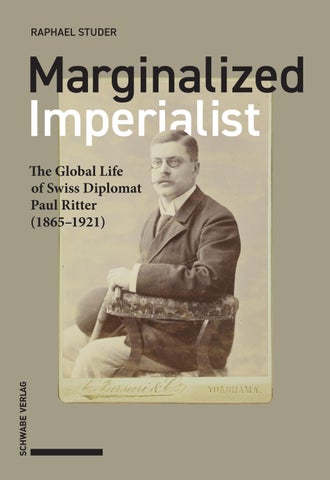
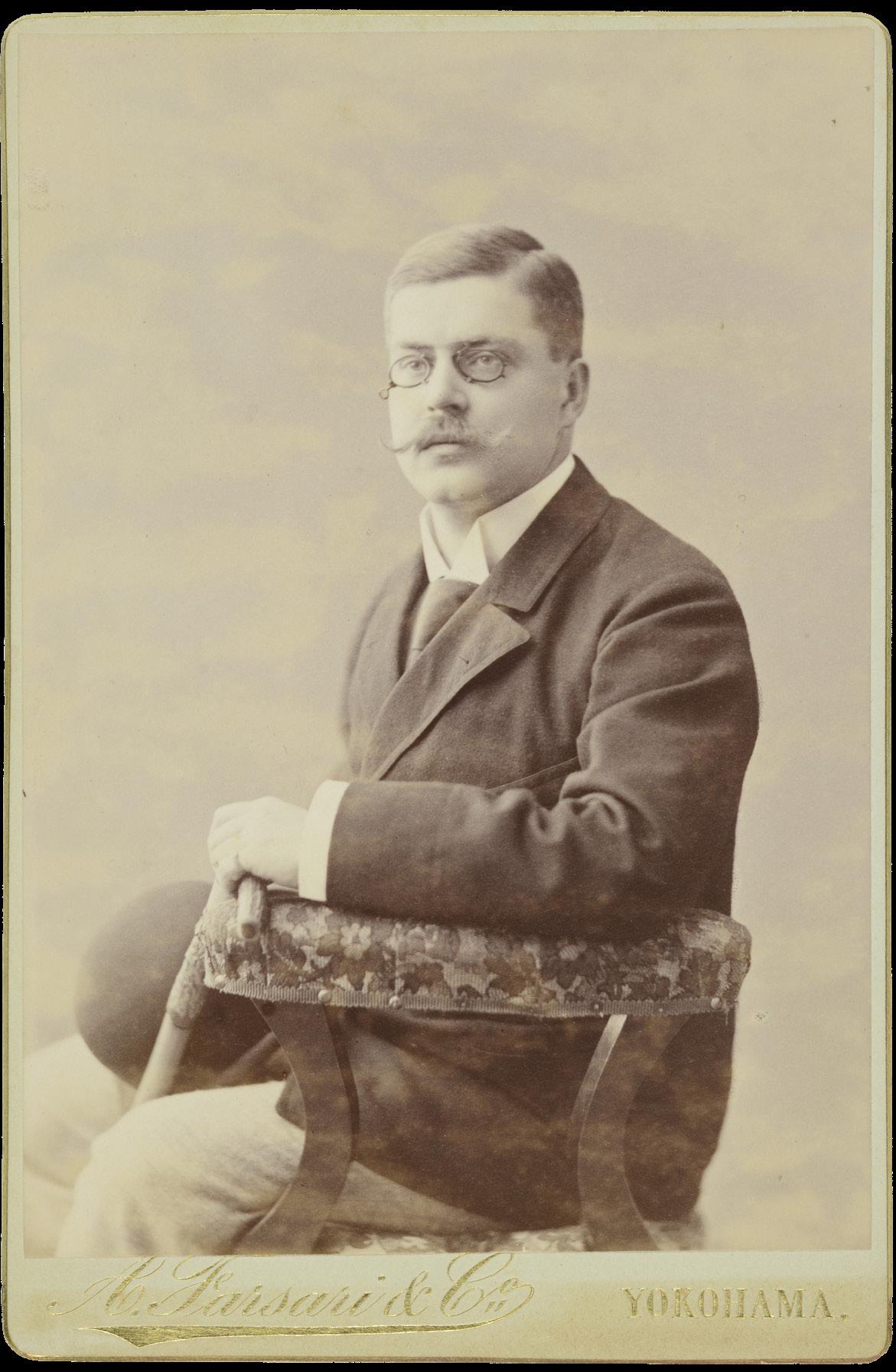
Cover illustration:PortraitphotographyofPaulRittertakenin aYokohamaphotographicstudioin1893.
Source:StaatsarchivThurgauStATG,8’685’15, 7-7,Abb.69r.
Proofreading: CeciliaTricker,London
Cover design:CaroEichstaedt,Berlin
Typesetting: 3w+p,Rimpar
Print: PrimeRateKft.,Budapest
Printed intheEU
Manufacturer information:Schwabe VerlagsgruppeAG, St.Alban-Vorstadt76,CH-4052Basel, info@schwabeverlag.ch
Responsible personunderArt. 16GPSR:Schwabe VerlagGmbH, Marienstraße28,D-10117Berlin, info@schwabeverlag.de
ISBN Print978-3-7965-5497-1
ISBN eBook (PDF)978-3-7965-5498-8
DOI 10.24894/978-3-7965-5498-8
The ebookhasidenticalpagenumberstotheprintedition (firstprinting)andsupportsfull-textsearch. Furthermore, thetableofcontentsislinkedtotheheadings.
rights@schwabe.ch www.schwabe.ch
a) Timeline of Paul Ritter’s life1865–1921
b) Ritter Family Tree
Preface
Over the years, Ihave incurred many intellectual and personal debts.My deepest gratitude goes to Professors Takao Fujikawa (Osaka University) and Martin Dusinberre(University of Zurich), who supervised my doctoral research with exceptional guidance and unwavering support.I am equally grateful to Professor Nadin Heé, who during her timeatOsaka University provided me with numerous valuable insights that significantly shaped this study. Finally, Iwould like to thank Dr. Gonzalo San Emeterio Cabañes whose seeminglyboundless knowledge of all things Japanesenever ceased toamazeme. My research was made possible through the generous financial support of the Japanese Ministry of Education, Culture, Sports, Science and Technology (MEXT), which awarded me several scholarships and enabled me to pursue my studies in Japan, where this work was ultimately completed. The publication of this book was supported by the WillyBretscher-Open-Access-Publikationsfonds, the University of Zurich’sPublikationsfonds Geistes- und Sozialwissenschaften, and theSwiss–Japanese Society, whose contributions Igratefully acknowledge.
NotesonRomanization and Names
In this book, all Japanese terms aretranscribedusing the modified Hepburn romanization system, with the exception of place names and expressions that are well establishedinEnglish usage (e.g., Tokyo, Kyoto).Japanese personal names follow standard East Asian naming conventions:the family name precedes the given name.
Introduction
Le Havre, May 14, 1892:a young man from Basel boarded the French ocean liner La Touraine destined for New York.Unlike many of his Swiss fellow passengers who wereforced to endurethe trip acrossthe Atlantic in the ship’scramped steerage (they tried to ease their suffering byintoning patriotic songs like “Heil dir, Helvetia”and “Vo Luzärn uf Wäggiszue”), he had access to aspacious first-class cabin. But this was clearly not theonly remarkable feature about him since shortly after making himself comfortable inhis new surroundings, he was paid avisit by thelocal Swiss consul Wanner and his secretary. The two introducedthe youthful traveler to thevessel’s captain and officers, making sure that he would receive their mostattentive service during the week or so La Touraine would need to reach the American East Coast.1
The name of the man in question was Paul David Ritter.2 Belonging to the small group of Switzerland’searliest career diplomats, Ritterhad rapidly secured his first post abroad after joining the foreign ministry when he was appointed vice-consul in the Japanese portcity of Yokohama in April 1892. Little did he know at this point that his sojourn in theEastAsian country would stretch over 17 years, almost athirdofhis entire lifespan. In 1906, in the wake of the Russo-Japanese War, he relocated from Yokohama to Tokyo tohead the newly established Swiss legation in the Japanesecapital. After three more years, the Swiss government, the Bundesrat,3 made Ritter transfer to the United States of America where he again worked as Swiss minister until 1917. With the US severing ties with Imperial Germany during the
1 Paul Ritter to parents, May 14,1892;May 19, 1892:Ritter family archives.
2 Henceforth simplyPaul Ritter.
3 Bundesrat (Federal Council)issince 1848 the name for Switzerland’s collective governmentcontinuously consisting of seven members.
First World War, the exceedingly pro-German Swiss diplomat became aliability for his country’srelationship with Washington and had to be removed to the politically less delicate position of official Swiss representative tothe Netherlands. However,Ritter only spent afew years in The Hague before retiring from the foreign service permanently.
During his extensive stay in Asia, the Swissdiplomat can be characterized by the paradoxical term“marginalizedimperialist.”Due to the clauses ofSwitzerland’sunequal treatywith Japan, only he had authoritytoexecute jurisdiction over his compatriots on Japanese soil. Moreover, thanks to his bourgeois habitus, Ritter was able to seamlessly integrate into theYokohama foreign settlement and consequentlyshared theanti-Japaneseview prevailing among the Western residents. For along time,helooked down onhis host country and its people whom he saw as merely “half-civilized.” The Swiss diplomat possessedverylimited Japaneselanguage skills and was barely interested in the local culture despite pretending to be an expert in Asia back home. On the other hand,precisely his pronounced dislike for ceremony—coupledwith his low rank as consul—led to Ritter becoming marginalized by Japanese officials and other Western diplomatsalike. As a matter of fact, the Japanese government bluntly refused to acknowledge his diplomatic status for the longer partofhis tenure in EastAsia. Iwill, however, refer to Ritter as adiplomat, even for the period before he was promoted to the properrank of minister in 1906, for two reasons:first, in the Swiss foreign service, where republican simplicityreigned supreme, consuls were regularly entrusted with diplomatic tasks. Second (and more importantly), Ritter’smission in Japan persistently entailed thethree basic diplomatic duties:namely, representation, information, negotiation.4 Ultimately, his close affiliation with German officials both in Japan and in neighboring countries enabled the Swiss diplomat to survive in this challenging environment. It is deeplyironic that this pan-German5 transimperial network,
4 Steller 2011,p.355
5 The term “pan-German” is used in this book in its literal sense, i.e. referring to all German speakers (Germans, Germanophone Swiss, and Austrians). It explicitly does not have any connection to the völkisch organization “Alldeutscher Verband”which in English is referred to as “Pan-German League” or its ideology.
which worked so successfully in East Asia, would later causehis downfall in America.
Because of the low political importance of Swiss–Japaneserelations in the Meiji period it makes little sense to ask traditional questions of diplomatic history witha focus on official decision-making. Besides,already back in1990 the eminentscholar of US–Japanese relations, Akira Iriye, wrotean article simply titled “Culture” in which he stressedthe need to expand analytically beyondthe traditional concepts of power and economy and to include what he called “a cultural approach to diplomatic history.”6 In line with this concept, Iwant to concentrate on Paul Ritter as an individual, his associations and ideas, and his (evolving)perceptions of the Japanese and other non-Western peoples. Iwish to examine how he was influenced by his native city of Basel, how he fit into the starkly different societies of Yokohama, Tokyo, and Washington, D.C, and in what ways he remained connected to hishome countryofSwitzerland. Given the precarious situation resulting from his contested official rank, Iamespecially interested in the questionofagency:how did Ritter fight againsthis marginalization and to what degree was he successful?
For this purpose,I makeuse of four theoretical approaches,namely “global lives,” the cultural history of diplomacy, (Swiss) postcolonialism, and transimperial history. Writing “global lives”essentially means doing global history with amicro-historical approach. While global history has undoubtedly been one of the strongest tendencies in thedevelopment of historiography in the last decades, serious criticismhas been raised as well: some historians voiced concern about it relying excessively on published monographs and therefore merely saying together what had been said separately before. Others have felt uneasy about how the usually applied macro approach tended to lose sight of individual human beings.Asa reaction, a biographically sensitive approach to global history has been developed, though it is still avery young formofwriting:the study of “transnational” or“global lives.”7 This approach aims at bringing the biographic genre back into the remit of “respectable” academia, using thetechniques of microhistory. As expressed by one prominent scholar “[i]tgleans information, nec-
6 Iriye 1990, p. 103.
7 Gamsa 2017, pp. 231–241;Cossart 2013, p. 1.
essarily partial, about individual lives from archives and letters,and places it inthe context of large historical processes. Constantlyzooming in and out, itproductivelyjoins microhistory, biography, and global history with the comparativemethod.”8 By reducing the field of study, the historian gets the opportunity to analyze aspects of the lives of individuals and communities which would otherwise be overlooked.9
One must bear in mind, however, that the rehabilitation of biography asa genre comes along with amuch-neededtheoretical renewal. Previously, biographies were only justified for celebrities, whether statesmen or movie stars, but were considered apointless exercise for “ordinary” people unless they were truly representative of alarger group. But a“global life” does not have to be typical of something wider. On the contrary, the lives of individuals who deviate from the average seem to offer abetter way of thinking about the balance between the specificity of personal destiny and society as a whole.Therefore, variety is moresignificant than typicality.10 Scholars also no longer look to reconstitute an imagined “complete” self from fragments of collected data;instead, they concede that theindividual is never whole, contains multiple “selves” (gender, nationality, social class,education level etc.) andwears disguises. To understand life as aperformance and a process of self-fashioning, historians thus cannot afford toignore their subjects’ many inner contradictions. Indeed, they mustbeespecially attentive to them. Lastly, in contrast to conventional biographies,the researcher’s point of view becomesanunavoidable part of the account. The goal is to allow the reader to become part of adialogue and to participatein the whole processofconstructing the historical argument through acandid discussionofthe sources and the techniquesused.11
The second approach, acultural history of diplomacy,reflectsthe shifting of the historiography of international affairs to thefield of acultural history of politics. Accordingly, it defines culture hermeneutically as the prism through which we see and understand the world, refusing to assume
8 Gamsa 2017, p. 240.
9 Magnússon 2017, pp. 44f.
10 Loriga 2017, p. 38.
11 Gamsa 2017. p. 236, Magnússon 2017, pp. 47, 50.
auniversal system of norms and values.12 Acultural history of diplomacy suggests that there is neither objective knowledge nor objective reality since both are socially constructedand historically conditioned. Therefore, notions such as raison d’état and the “national interest”—which for decades had been presupposedasontological givens corresponding to an objective logic—havetobeabandoned. The nation state is no longer thecentral actor. Ifwesee culture as the way in which people interpret their world and confer meanings on their actions, then this can be illustrated only by specific individuals and not by abstract states. However, acultural history of diplomacy should not turn to certain human beings in order to glorify them as great individuals. Rather, it seeks to understand them both as products and producers of asymbolically interpreted world. In the foreground we thus do not see the individual deed, but adecoding of the“structures of meaning” (Clifford Geertz)that humans create through which they expressthemselves. In addition, we should include two other important points:first, by concentrating on individual values and perceptions, acultural approach to diplomatic history would transcend the divide between theprivateand institutional sphere. In this regardithas been argued that, for instance,“sociability” can be usefully employed as aconceptual category to examine and tointellectualize informal diplomacy. Second, diplomats are committed to the policies and identitiesoftheir countryoforigin and at thesame time exposed to aforeign environment. Therefore, they embody transferand cultural interactions between states in the sphereofinternational politics.International relations should thus be understood as intercultural relations.13 While some historians have already made use of thecultural history of diplomacy for their biographiesofdiplomats,14 this does not apply to Swiss historiography.
The present study makes use of postcolonial theory, in particular as applied to the case of Switzerland. The long-lasting effectsofits “colonialism without colonies” (Switzerland at no time formally acquired any territory outside of Europe)have gained scholarly attention in the twenty-firstcentu-
12 Cf. Schattenberg 2013, pp. 168–171.
13 Shimazu 2019, p. 57;Mösslang/Riotte 2013, pp. 8, 18f.
14 Cf. for example Jörn Happel’s recent biography of the German diplomat and Russia expert Gustav Hilger:Happel 2018.
ry, powerfully enteringthe national public consciousnessthrough theBlack Lives Matter movement, ongoing since 2020.15 Ahistorical analysis of Swiss entanglements with colonialism has to consider the country’shighly heterogeneous regional character in terms of culture, class, language, and faith. Conversely, there existed astrong social and economic interconnectedness across national boundaries.16 This emphasis on internal divisions complemented by transnational cooperation with foreign colonial actors resonates well with Iriye’scall to reconceptualize the field of international relations by not classifying all behaviors and activitiesinthe world as products of nationally defined actors.17 In fact, identitiesbelow, above, or not related to the nationstate level can be as significant, even for archetypical national representatives such as diplomats. In addition, the once clearcut metropole–colony dichotomy has become increasingly challenged in recent scholarship. For example, the concept of “contingent colonialism” rejectsthe usual neat nationalization of empires as “French” or “British,” laying bare their character as complex transnational empires involving historical actors from a broad variety of backgrounds such as Switzerland. “Crypto-colonial” countries like Switzerland werepart of colonial relationshipsina myriad of ways. Their less visible forms of dominance—which were based on unequal treaties, for example—are said to constitute the new norm of today’s postcolonial forms of power.18 Despite the recent surge in historiographydevoted to Swiss complicity in imperialism and colonialism, therole of Swiss diplomacy in these processes has not yet been examined. Thisbook therefore breaks new ground by focusing on how aSwiss official engaged in direct imperialism by exercising the consular jurisdiction unilaterally granted to his country in the unequal 1864 Swiss–Japanese treaty. Based on this analysis,I will then describe the distinctive features of Switzerland’speculiar, maximally costsaving “marginalimperialism.” Furthermore, thepresent study addresses another salient gap, namely the lack of research on Swiss Radicalism
15 Cf. for examplehttps://www.swissinfo.ch/eng/switzerland-joins-debate-about-remov ing-controversial-memorials/45828950
16 Purtschert/Fischer-Tiné 2015, pp. 4f.
17 Iriye 2002, pp. 49–51.
18 Purtschert/Fischer-Tiné 2015, pp. 6f.Cf. also the comparison of consular jurisdiction with modern investor state dispute settlement provisions (ISDS)inKrumm 2015.
from apostcolonial point of view. Although the Radicals,with whom Ritter was intimately associated, formed Switzerland’sdominant political movement between 1848and 1914, scholarship on them is still surprisingly scarce.19
Finally, Irely on the newly developedconceptof transimperial history. While so-called new imperial history has managed to bring metropoles and their colonies into one analytical field, the history of empires beyond the nation has in fact remained remarkably neglected. The transimperial approach, on the other hand,deals with the movement of people, knowledge, and goods across different empires and the formations of imperial or antiimperial networks and exchanges.20 As previously mentioned, Switzerland asa state never had any colonies of its own but Swisspeople were nevertheless part of different transimperial networks.21 It has even been argued that precisely because of their status as colonial have-nots, theSwisswere forced tosettle all over the globe rather than to concentrate on just one particular geographical region.22 As Iwill demonstrate,Swissdiplomat Ritter, who regularly moved across imperial frontiers, belonged to anetwork of male bourgeoisGerman speakersunited by acommon language and ashared love for beer and Gemütlichkeit (public social conviviality) stretching from Asia to America. This particular transimperial network is described in this study for the very first time and constitutes one of its major findings.
For my attempt to shedlight on the “global life” of Paul Ritter, Iwas fortunate enough to be allowed access to the family archives now stored in the private homes of various descendants. The Ritter family archives,touse this name in want of abetter term, consist of 11 large cardboard boxes that contain documents pertaining to the Swiss diplomat,such as his correspondence with relativesback in Switzerland,multiple picture albums,and some diplomatic records. Ialso came across some highly unusual material, partic-
19 As Olivier Meuwlypoints out, there still exists no systematic study of the history of the Swiss Radical party:Meuwly2007, p. 7.
20 Hedinger/Heé 2018, pp. 429, 439;Schär 2015, pp. 20f.
21 For example, Bernhard C. Schär has outlined the existence of atransimperial network of Swiss mercenaries serving different European colonial empires in the eighteenth and nineteenth centuries:Cf. Schär 2022.
22 Zangger 2011, pp. 440–442.
ularly weaponry from the battlefields of the Russo-JapaneseWar. The family archives comprise documents and artifacts from other family members too:from Ritter’sparents, his siblings, his second wife Louise, and her parents. Interestingly, asignificant portion of the boxes are comprised of material related to the efforts of Ritter’s descendants—many of whom are still to this day closely connectedtoJapan—to find out more about their trailblazing ancestor. They collected books and articles in which his name was mentioned and contacted the museums on behalf of which he had purchased ethnographicobjects from East Asia. The special historiographic value of the Paul Ritter documents preserved in the family archives lies in thefact that there is alamentabledearth of primary sources compiled by the residents of Japan’sforeign settlements.23 Against this background, the approximately 250 letters and postcards sent by Ritter to his relatives between 1889 and 1914—coupled with the great number of photographs,invitation cards etc. originating from his tenureinJapan—form thebasis fora betterunderstanding of the(German-speaking)Western communityinJapan’streaty ports. With afew exceptions, documents from the Ritter family archives have never been published and they have certainly not been used for any kind of academic research before, further increasing their scholarly relevance.24
Another important source for the presentbook was Ritter’sprivate correspondence with his close Helvetia student fraternity friend, Carl Brenner-Senn, located in the cantonal archives of Basel-Stadt (Staatsarchiv Basel-Stadt). Although much less voluminous than theRitter family archives, the correspondence with Brenner-Senn tells us alot about male elite networks in pre-First World War Switzerland. The reason for this is that Brenner-Sennlet the letters he received from Japan circulateamong their small group of Helvetia friendswho wereall highly influential people
23 Cf. Swanson2016, p. 13.
24 In 2014,when Switzerland and Japan celebrated the 150th anniversary of the establishment of diplomatic relations, the news platform SWI swissinfo.ch published some excerpts from Ritter’sletters from Japan:cf. https://www.swissinfo.ch/ger/politik/gena uer-beobachter-der-meiji-aera_erster-schweizer-botschafter-erlebt-japan-im-umbruch/ 37959262.A number of photographs,postcards, and invitation cards pertaining to the Swiss diplomat’sstay in Japan had earlier been reproduced in the “Handbuch SchweizJapan—Manuel des relations nippo-suisses”:Hürlimann 2010, pp. 414–418.
(including members of the national government). Since internal fraternity discoursesgenerally tended to be heavily sexualized, it is unsurprising that the correspondencebetween the Swiss diplomat and his fraternity brother also revolved around atopic usually considered too delicate to writeabout: the foreigners’ personal contact with Japanese prostitutes.Inthis case too, the written sources are complementedbya number of photographs,the majority of which depictAsian females. In thecantonal archives of Basel-Stadt, I additionally gainedaccess to the general archives of the Basel section of Helvetia. This enabled me to the check who among the Swiss diplomat’s Basel associates belongedtothis powerful yet tight and secretive social circle.
The third “bulk”ofprimarysources Imade use of are theRitter’snumerous, overwhelminglyunpublishedreports to theSwiss government which are being stored in the Swiss federal archives (Schweizerisches Bundesarchiv). By their verynature, they deal for themost part with the official tasks the Swiss representative to Japan was charged with and are often very outspoken in terms of how Ritter felt toward thelocal population. Another prominent characteristic arethe Swiss diplomat’sregular pleas to hissuperiors in Berntoimprove his difficult situation by granting him amore sumptuous titleorbyraisinghis insufficient salary.Taken as awhole, the gloomy tone of these official documents starkly contrasts with the more upbeat spirit found in the private correspondences.
Besides these three main archives, Imade use of relevant documents traced in the archives of the Bern Historical Museum (Bernisches Historisches Museum), the Basel Historical Museum (Historisches Museum Basel), the Basel Museum of Cultures (Museum der Kulturen Basel), and in the cantonal archives of Thurgau (Staatsarchiv Thurgau). In addition, I have unearthed primary sources relating to Paul Ritter in several Japanese archives (Diplomatic Archivesofthe MinistryofForeign Affairs of Japan, the Imperial Household Archives,and the Yokohama Archives of History) inorder to reconstruct the Japanese perspective(s).Unfortunately, almost noadditional material could be detected.This may partially beexplained by the fact that unliketheir Swiss counterparts, Japanesearchives have been ravaged by war and natural disasters leading to the lossofa great number of records. On the other hand,previous research on the mutual perceptions of Switzerland and Japan during the Meiji period (which had focused primari-
ly on the analysisofpublic accounts)had faced asimilar issue:Swisssources about Japan turned out to be much morenumerous than vice versa. The stated reason for this imbalance—namely, that Japanese interest in the West was almost exclusively limited to the great powers while paying only scant attentiontoless mighty nations like Switzerland—probably holds in this case as well.25
Ihave been inspired by recent studies applying theconceptofa global Switzerland existing outside its own frontiers.26 Among them are Bernhard C.Schär’s Tropenliebe:Schweizer Naturforscher und niederländischer Imperialismus in Südostasien um 190027 and Andreas Zangger’s Koloniale Schweiz---Ein Stück Globalgeschichte zwischen Europa und Südostasien, 1860–1930.28 While the first study analyzes the colonial entanglementsoftwo Basel naturalists on the Indonesian island of Sulawesi, the second one deals with the history of merchants from Eastern Switzerland in SoutheastAsia (Singapore and Sumatra). Both Schär and Zangger skillfully make use of jeux d’échelles29 toswitch between the local, national, and global levels of analysis, thereby overcoming much-lamentedmethodological nationalism. Furthermore, the two works highlight the intimatelink between theSwiss and other European groups (Germans, Dutch)incolonial settings.Finally, they lay bare the importance of transimperial networks for Swiss scientific and economicexpansion.
The history of Swiss–Japanese relations during the Meiji period and of Swiss residents in Meiji Japan has so far received only scarce attention by scholars. One important exception is Roger Mottini’s unpublished PhD thesis DieSchweiz und Japan während der Meiji-Zeit(1868–1912): Begegnungen, Berichterstattung und Bilder,finished in 1998.30 It gives an overview on the Swiss presence in Meiji Japan and analyses contemporary Swiss perceptions of the countryand its people in detail. However, as theauthor admits
25 Cf. Mottini 1998,pp. 23f.
26 Cf. Eichenberger et al. 2017.
27 Schär 2015.
28 Zangger 2011.
29 Cf. Revel 1996.
30 Mottini 1998.