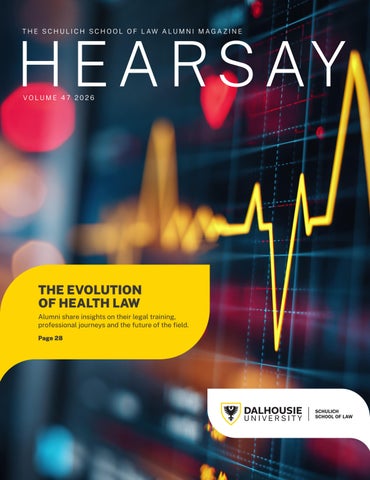
H E A RS AY T H E S C H U L I C H S C H O O L O F L AW A L U M N I M A G A Z I N E
VOLUME 47 2026
THE EVOLUTION OF HEALTH LAW Alumni share insights on their legal training, professional journeys and the future of the field. Page 28
CONTENTS WELCOME
FEATURES
04 Dean’s message
20 Mingo Scholarship recipients reflect
05 Message from the DLAA
& Alumni Relations
on how it shaped their futures 23 Law alum embrace their
entrepreneurial spirit in the
SCHOOL NEWS 06 Faculty, student and staff
accomplishments, mooting victories and more
ALUMNI RECOGNITION 08 Clint Davis named a 2026
Aurum Award recipient 09 Marissa Prosper recognized with
Emerging Leader Impact Award 10
Robbie MacKeigan receives Weldon Award for Unselfish Public Service
12
Bertha Wilson Honour Society welcomes new inductees
CONNECTIONS 14
Schulich Law faculty use their expertise to serve the classroom
16
32 New Harry Critchley Prison and
Police Justice Fund honours a beloved alumnus
INTERNSHIP SPOTLIGHT 26 Adrienne Graham reflects on her
summer internship in criminal justice
COVER STORY 28 Health law alum share where
their education has led them and what lies ahead
DONOR PROFILES 38 Find out what inspired these donors
to give to Schulich Law
and the community
DONOR REPORT
David Steeves works to right a
40 Celebrating the alumni and friends
wrongful conviction 18
premium beverage space
Jess Simm finds her calling at
who support the law school and its programs
Dalhousie Legal Aid Service 34 Joseph Chedrawe’s career has
taken him far, but home remains close to his heart
WELDON PROFESSORS 43 Learn more about our dedicated
faculty and research leaders
36 Nayha Acharya discovers her
passion at the Schulich School of Law
GRAPEVINE 47 Find out what your classmates
have been up to
IN MEMORIAM 53 Remembering the alumni and
friends we lost this year
2
|
H E A R S AY
HEARSAY · VOLUME 47 · 2026 DEAN
Sarah Harding EDITOR
Stephanie Hurley DESIGN/PRODUCTION
Sarah Orford CONTRIBUTORS
Suzanne Bowness Alison DeLory
16
Tammi Hayne Jeremy Hull Stephanie Hurley Amanda Kirby-Sheppard Allison Lawlor AnnMarie MacKinnon Stephanie Paterson
We welcome editorial contributions and ideas from alumni. Please direct your submissions to: HEARSAY EDITOR
Schulich School of Law Dalhousie University 6061 University Avenue PO Box 15000 Halifax, NS B3H 4R2 Canada
34
lawalum@dal.ca P: 902.494.5100
36 VOLUME 47 · 2026
|
3
MESSAGE FROM THE DEAN On May 29, I had the pleasure of greeting every graduate of
This past year was marked by the development of two new
the Schulich School of Law’s Class of 2026 as they crossed
experiential learning opportunities—a tax dispute pro bono clinic
the stage at the Rebecca Cohn Auditorium. This was not a new
and a community health justice partnerships practicum—the
experience — I’ve done this with every graduating class since
latter you can read about in this year’s cover story on page 30.
I became dean — but this class was different. I started with them
Both are the first of their kind in Canada and were made possible
in the fall of 2023 and it felt very much like we were a unit. I knew
by support from alumni. Students also showcased their practice-
almost every student who crossed the stage: I taught them in
ready skills by winning three national moots in 2026. That’s more
the classroom, chatted with them in the student lounge and
than a quarter of all the competitions we took part in—a stellar
met with them in my office to talk about plans or concerns.
accomplishment for our participants and their coaches!
We occasionally had coffee, lunch or dinner at student society gatherings or a beer at Domus. The Class of 2026 is not significantly different from those that came before them, but in many ways it feels like my class.
While the academic year was successful, I would be remiss not to mention its rocky start due to the four-week labour disruption. I am immensely grateful for the efforts of faculty and staff to embrace the rest of the school year with their usual commitment
As I round out three years as dean, I am at a point where I feel I
and generosity of spirit. In the pages that follow, you will see how
have a better understanding of Schulich Law students and their
our faculty continue to be engaged teachers, coaches, mentors,
motivations and challenges. I also have a deeper appreciation
presenters and community builders, both inside and outside
of their promise for our country and the world. Our students
the law school. Although there are scars from that experience, I
are exceptional. They are actively engaged in improving the
remain committed to building a strong Weldon community.
student experience, from running top-notch student societies to organizing lecture series that feature Supreme Court Justices, Federal Cabinet Ministers and business and community leaders. And they are diligently working to improve their communities and their nation through pro bono work, internships, research and legal services. The strength of our student body is due in no small part to the
I look forward to completing a number of projects before the end of my five-year term, including reaching out and spending more time with alumni across the nation. I hope you enjoy this edition of Hearsay and feel a sense of pride when reading about some of the remarkable individuals who make up our alumni family. With much gratitude and warmest regards,
continued contributions of our dedicated alumni network. Whether serving as mentors, sitting on panel discussions, teaching classes, creating new scholarships or donating to funds that support student activities, your loyalty to the law school provides the foundation for student success.
4
|
H E A R S AY
Sarah Harding (’89) Dean, Schulich School of Law
MESSAGE FROM DLAA PRESIDENT & DIRECTOR OF ALUMNI RELATIONS As another exceptional academic year comes to a close at the Schulich School of Law, we are proud to celebrate the Class of 2026. Earning your JD is no small feat — congratulations on your hard work, resilience and growth during your time at Weldon. We’re excited to see what you do next. Most importantly, welcome to the Dalhousie Law Alumni Association (DLAA) family, we are delighted to have you join this incredible community! It has been a year of celebrating excellence across our alumni network. From honouring Robbie MacKeigan (’69) with the Weldon Award for Unselfish Public Service to inducting new members into the Bertha Wilson Honour Society to recognizing an inspiring young alum with the Emerging Leader Impact Award, there have been no shortage of standout moments. We were also thrilled to see Clint Davis (’95) receive a Dalhousie Aurum Award for his leadership and impact on Indigenous communities. These accomplishments truly reflect the talent, commitment and spirit that make our alumni family so extraordinary. In September, we welcomed alum back to campus for Reunion Weekend. It was a joy to watch classmates reunite, sharing stories, laughter and a little Halifax nostalgia. For many, the celebrations carried on at Domus Legis alongside current law students. We were also happy to see that our Toast & Tribute Champagne Brunch drew a record crowd, bringing together alumni and friends for a warm and memorable occasion. Throughout the year, we had the pleasure of seeing many of you across the country at gatherings in Halifax, Charlottetown, Toronto, Calgary and Vancouver. Having the opportunity to reconnect, reunite and celebrate your achievements is truly the highlight of what we do. We are especially grateful for the many ways you give back. Whether it’s mentoring, guest lecturing, supporting scholarships, offering internships or engaging with students, your involvement makes a lasting difference and helps keep our community strong. Today, our alumni network includes more than 8,000 graduates
Tony Amoud (’09) President, Dalhousie Law Alumni Association
Ally Howard Director, Alumni Relations, Admissions and Recruitment
whose contributions continue to have an impact locally, nationally and around the world. We encourage you to stay in touch by nominating a fellow graduate for an alumni award, participating in Weldon Connects or sharing ideas for how we can celebrate and support one another. Thank you for the important role you play at the Schulich School of Law. Your continued generosity is what helps make this community so special. We look forward to another year of shared success!
VOLUME 47 · 2026
|
5
SCHOOL NEWS
PROFESSORS RECOGNIZED WITH TEACHING AWARDS
STAFF RECEIVE DALHOUSIE LEGACY AWARDS
PICTOU WINS NS HUMAN RIGHTS AWARD
people gathered at the Weldon
Exceptional teaching is central
Adam Guzkowski and Elizabeth
Pictou, professor of law and
Law Building for the premiere
to the Schulich School of Law’s
Sanford were recognized at the
management at Dalhousie, was
event of the academic
mission. This year’s recipients
8th annual Dalhousie Legacy
recognized with a 2025 Nova
calendar, the Smith Shield
of the annual Teaching Awards
Awards in a ceremony at the
Scotia Human Rights Award at
Moot. With a tradition dating
delivered an outstanding
Dalhousie Arts Centre
an event in Halifax.
back to 1927, competitors
learning experience while
in November.
are chosen from the top
fostering a supportive
participants in the compulsory
and inclusive classroom
second-year moot.
environment.
Schulich Law students argued
Instruction & Scholarly
the case of R. v. Brown from
Communications Librarian
the Nova Scotia Court of
Hannah Rosborough received
Appeal, focusing on a Mr.
the Dalhousie Law Alumni
Big operation—a Canadian
Association & Law Students’
policing technique by which
Society (LSS) Award for
a suspect is drawn into a
Excellence in Teaching Law,
fictitious criminal organization
demonstrated by enthusiasm,
to secure a confession.
commitment, dedication
Associate Professor Adelina
and outstanding service to
Iftene served as coach and
students. Nominations were
drafted the problem.
made by current law students
2025 SMITH SHIELD MOOT In November, more than 100
Mooters Shawn Courtney and Maryjane Sexton represented the appellant, the Crown; while
and alumni. Associate Professor Adelina
Tremblay represented the
Iftene was awarded the
respondent, Jerry Brown.
Hannah and Harold Barnett
named the winners and awarded the A.S. Pattillo Prize in Advocacy. The runnersup, Courtney and King Gillis, received the Leonard A. Kitz Prize in Advocacy. Lauren Marval served as the alternate.
|
by a committee of students
Sophia King Gillis and Julie
Sexton and Tremblay were
6
and the recipient was selected
H E A R S AY
Excellence in Teaching Award, given by the LSS to a professor who teaches first-year law. Each first-year section made a nomination and a winner was chosen by a committee of students. She was also recognized with this award in 2019.
In December, Dr. Sherry
The Nova Scotia Human
The event celebrated faculty
Rights Commission presents
and staff who received
the awards annually to
university-based awards for
acknowledge the courageous
their achievements over the
work of Nova Scotians who
past year.
advance human rights in
Guzkowski, Schulich Law’s
the province.
former assistant dean of
Pictou, from Bear River
Student and Academic Affairs,
First Nation, was given the
received an Early Career
Wel-lukwen Award for her
DPMG Award for Outstanding
leadership in advancing
Achievement in recognition of
Mi’kmaq rights, revitalizing
their exemplary contributions
traditional governance and
to the Weldon and Dalhousie
confronting racism and sexism.
University communities.
As a Canada Research Chair
Sanford, assistant to the
in Indigenous Governance
dean, received the inaugural
(Tier 2), she has contributed
Schulich Law Staff Award
to global discussions on food
for Excellence in Service in
security, decolonial research
recognition of her longstanding
methods and Indigenous
dedication to building a
sovereignty, reflecting her
supportive and welcoming
lifelong commitment to justice,
atmosphere at the law school.
resurgence and the strength of Mi’kmaq governance and knowledge. “I am so humbly grateful to receive this award, acknowledging the ongoing work of not only myself but all Mi’kmaw,” says Pictou.
MCGLOIN AWARDED SCHOLARSHIP
FORD NAMED CANADA RESEARCH CHAIR
Congratulations to Kelti
Associate Professor Violet Ford
SCHULICH LAW EXCELS AT COMPETITIVE MOOTS
PROFESSOR CHIRCOP RETIRES Chircop (LLM ’84, JSD ’88)
In 2026, Professor Aldo
McGloin who was named the
(’91) was named the Canada
Congratulations to the
recipient of the 2025-2026
Research Chair (CRC) in
Schulich Law teams who took
retired after 34 years of
Dalhousie-Horrocks National
Circumpolar Indigenous Marine
home top honours in three
service at Dalhousie. He joined
Leadership Fund scholarship
Governance and International
competitive moots in 2026.
the faculty in 1992 with a joint
in October.
Law (Tier 1) in October as
Jazmyne McLaughlin and
appointment as Marine Affairs
Awarded annually by the Department of Information Science, the scholarship
part of a national investment of more than $690 million in science and research funding.
Andrew Dogurga won the
Program director.
Julius Alexander Isaac Moot in
Chircop served as director
Toronto, with Dogurga taking
and associate director of the
benefits a Master of
The CRC program recognizes
home the Top Oralist prize.
Marine & Environmental Law
Information student who
scholars whose work has
The moot is named after the
Institute, taught maritime law
shows leadership potential
the potential to transform
first Black judge to sit on the
and the law of the sea, among
in information management,
understanding and improve
Federal Court of Canada.
other Marine & Environmental
specifically with libraries.
lives and whose research is
Mikaleigh Cairns and Jaden
Law Program and core law
Established in 2007 in honour
shaping a more sustainable,
Christopher were crowned the
courses, and supervised many
winners of the 28th annual
grad students.
Mathews, Dinsdale & Clark
He also served as the Canada
National Labour Arbitration
Research Chair in Maritime
Competition, which saw
Law and Policy (Tier 1) and
teams of two participate in a
the Canadian Chair in Marine
mock two-round grievance
Environmental Protection
arbitration hearing before
at the IMO-World Maritime
tripartite panels, arguing once
University in Sweden while on
For Arctic and subarctic
for the employer and once for
leave from Dalhousie. Leading
fund also supports an annual
Indigenous peoples, the ocean
the union.
numerous grant-funded
named lecture on information
is central to their survival, their culture and their way of life.
Eric Funk, Connor Knight,
projects, his publications
management.
of Dr. Norman Horrocks, O.C., PhD, FCLIP, former director of Dalhousie’s School of Information Management and dean of the Faculty of Management, for his leadership in the field of librarianship in North America, Australia and Europe, the
“The combined degree program has helped me develop a unique skill set
just and resilient future. It supports thinkers and innovators whose discoveries push the boundaries of knowledge, while preparing the next generation to do the same through teaching, mentorship and collaboration.
Yet, international marine legal frameworks still overlook their rights and laws.
Sean Landry and Austin Stein had a first-place finish at the 35th annual Davies Corporate/ Securities Law Moot, where
that allows me to think about
“This CRC provides an
students from Canadian
problems in both the legal
opportunity for reconciliation
law schools debate current
and information sectors with
by reclaiming, applying and
legal issues in corporate and
creativity and rigour that
creating ways for Inuit legal
securities law.
neither degree alone would
traditions to be recognized
grant me,” says McGloin.
and legitimized within a global legal context,” says Ford.
include books, articles and chapters, as well as 25 coedited volumes of the Ocean Yearbook. His Maritime Law opus won the Walter Owen Book Prize. He was a visiting professor at several overseas universities and a contributor to the work of UN agencies, NGOs and the Comité Maritime International.
VOLUME 47 · 2026
|
7
2026 DAL AURUM AWARD RECIPIENT, CLINT DAVIS BY STEPHANIE PATERSON
Clint Davis (’95) is a visionary Indigenous business leader dedicated to expanding Indigenous economic participation and self-determination. The 2026 Aurum Award winner was recognized with Dalhousie’s alumni award in a ceremony in May. He reflects on his journey and what drives his work today.
excited me to see what Indigenous-owned businesses were doing in this region. It also made me curious about opportunities for these businesses with greater access to financing and capital,
What was your experience growing up, and how did it
and the potential impact on the economy.
lead you to Dalhousie? I grew up in Goose Bay, Labrador, and was primarily raised by my grandparents, who really valued education. Very few people in
I was the recipient of two Indspire scholarships to pursue my
cousin Charles who influenced me to go to university. He made
Masters of Public Administration at Harvard. For many Indigenous
the prospect of going to university feel achievable.
people like me, this type of financial support is incredibly
Acadia, where one of my favourite courses was business law. My professor, who was a lawyer, told me I should consider law school. Where I grew up, speaking to a lawyer usually meant trouble, but his encouragement changed my perception of the law and I decided to apply to Dalhousie. A condition of my acceptance to Dal was participating in the
meaningful and it made me want to give back to the organization. When I had the opportunity to join the board of directors, I immediately said yes. To help fundraise and advance Inuit inclusion in the organization was an absolute honour for me. As the CEO of Cedar Leaf Capital, what is your vision for the organization?
Native Pre-Law Program at the University of Saskatchewan. We
Indigenous people, businesses and communities are significantly
were taught by some of the most significant thinkers, leaders and
underrepresented within capital markets. We wanted to build
professors in Indigenous law. That was the first time I became
something that would have an impact in a sector of Canada’s
aware of the breadth of injustice faced by Indigenous people
economy that was challenging for Indigenous people to enter.
across Canada. I decided to focus on this area of law at Dal and use my business background to make a positive impact. Though I no longer practise law, the skills I developed during law school and training as a lawyer have been invaluable. When did your interest in Indigenous banking and economic development start? My interest grew out of the practice of Indigenous law and land claims. I was closely following the Nunatsiavut Government in their land claim negotiations. I accepted a position with the federal government to gain a better understanding of policy and law as it applied to these negotiations.
|
Indspire?
our extended family went on to higher education, but it was my
I enrolled in the Bachelor of Business Administration program at
8
How did you become connected with the organization
My vision for the company is to continue to educate, support and bring to light what it means for Indigenous participation in capital markets and the benefits to the Canadian economy. I see continued growth for the company, particularly in the next five years. We are, and will continue to be, committed to hiring, developing and training young Indigenous people. What inspires or motivates you? I live and breathe support for Indigenous business. I’ve worked in this area for a significant period of my life, and it’s exciting to see that governments and companies are no longer asking “why do we have to work with Indigenous communities?” but “how can
I worked for a Cabinet minister as a senior advisor and later
we work with Indigenous communities?” Despite some of the
as a northern advisor for the Northwest Territories, Yukon and
barriers that still exist, the pathway to economic empowerment is
Nunavut, as well as for Inuit issues. In the territories, I noticed a
emerging, and I’m excited to be leading a company that is helping
real intersection between law, business and government, and it
create that path.
H E A R S AY
EMERGING LEADER IMPACT AWARD RECIPIENT, MARISSA PROSPER BY STEPHANIE HURLEY The Dalhousie Law Alumni Association Emerging Leader Impact Award was established to recognize the exceptional accomplishments of an alum who has graduated from the Schulich School of Law within the past decade. The 2025 recipient is Marissa Prosper (’20), a Crown Attorney with the Nova Scotia Public Prosecution Service and the first Indigenous Crown in the Pictou office.
“Earning my law degree and getting called to the Bar was more than just a personal goal—it was a way to empower and encourage others,” she shares, adding that becoming a first-time mother during the Bar Admissions Program only deepened that commitment. “I want my daughter to grow up knowing that our
This award reflects the law school’s commitment to fostering
voices matter and that she comes from strength as a Lnu’skw
a community of excellence and inspiration by honouring a
(Mi’kmaw woman).”
remarkable graduate who embodies the esteemed values of
Prosper also passed on that knowledge to the next generation
the Weldon Tradition of unselfish public service, seamlessly merging outstanding professional achievements with a significant commitment to the community.
interested in law last year as project coordinator for the Nova Scotia Barristers’ Society’s (NSBS) internship program, Inspiring Future Indigenous Black & Mi’kmaq Lawyers Internship
When Prosper was growing up in Pictou Landing First Nation, a
Pathways (IB&MIP). The program offers Indigenous Black and
Mi’kmaq community located on Nova Scotia’s Northumberland
Mi’kmaq students in Grades 10-12, from across the province, the
Strait, becoming a lawyer was something she could have only
opportunity to be exposed to the legal profession through a week-
dreamed of.
long intensive program.
“I have always been driven to make a meaningful difference in my
“Helping to create spaces to encourage others to see themselves
community and Nation, and I saw education as a powerful tool
reflected in law has always been a passion of mine, and my role
to achieve that,” she shares. “However, it wasn’t until I was in my
with IB&MIP was another way for me to do that.”
final year at StFX that I saw law school as an option. Up until then,
She is also an active committee member, serving on the the NSBS’
I hadn’t seen myself reflected in the legal profession, so it never felt like a space where I belonged.” Prosper says that discovering the Indigenous Blacks & Mi’kmaq
Truth and Reconciliation Committee, the Public Prosecution Service’s Equity and Diversity Committee and the Eastern Door, a committee of Mi’kmaq lawyers.
(IB&M) Initiative at the Schulich School of Law changed that. “It showed me that we belong in these spaces and our voices are needed. Before learning about the IB&M Initiative, I had never met an Indigenous lawyer.” This shift in perspective allowed her to see the value she could bring to the legal profession, and that a legal
“Marissa’s mentorship, collaborative approach to justice reform and ongoing advocacy for systemic change makes her an ideal recipient
education could be a powerful way to achieve her goals.
of the Emerging Leader Impact Award,” says
She applied to the Schulich School of Law and was accepted in
her nominator. “She is not only a rising leader
2016. As the first person from her family and her community to
in law, but within the Mi’kmaw Nation—she
pursue a law degree, she recalls the culture shock she felt when
is a force for transformational change. Her
she arrived at Weldon. “Being the first to do anything isn’t easy and the transition was harder than I expected,” she admits. “Community is such a large part of Mi’kmaq identity and I found myself further away from home, my family and supports. I often felt isolated, had an
work and spirit embody every element of the award: community impact, leadership and collaboration. She is a deep inspiration to others.”
overwhelming sense of self-doubt and questioned whether I belonged.” She was able to find her community through the IB&M Initiative and a welcoming faculty at the law school who helped her navigate the new environment.
For Prosper, the work to make a difference in her community and Nation continues. “To use my legal education and my personal background to serve the public, as well as my community, is a dream come true.”
VOLUME 47 · 2026
|
9
ROBBIE MACKEIGAN RECEIVES 2025 WELDON AWARD FOR UNSELFISH PUBLIC SERVICE The Schulich School of Law and the Dalhousie Law Alumni Association honour this year’s recipient for his contributions to the community and the legal profession. BY ALLISON LAWLOR Robbie MacKeigan, K.C. (’69) is known and respected across the
After earning an entrance scholarship to Dalhousie University,
country for his expertise in bankruptcy, insolvency and business
MacKeigan studied economics and quickly became involved in
law, as well as for his dedication to public service.
the university community. He took on leadership roles such as
“I always felt that one should, if able to, work towards bettering the community,” he says. “I also thought it was important to
“For a time while at university, the last thing I wanted to do was
encourage others to perform well in whatever position they had
practise law, partly because I did not want to follow my father,”
undertaken, whether it was on a board or in an organization.”
says MacKeigan, whose father Ian was a lawyer before becoming
This year’s Weldon Award for Unselfish Public Service honours MacKeigan’s legacy. Named for Richard Chapman Weldon, the law
Nova Scotia’s 19th Chief Justice. He considered continuing his studies in economics, with the idea of entering the banking field.
school’s founding dean, the award recognizes law school alumni
But after giving it additional thought and receiving
who have made outstanding contributions to the community and
encouragement from practising lawyers, he decided to pursue
the legal profession. The Schulich School of Law’s commitment to
a law degree. At law school, he continued to give back to his
unselfish public service, referred to as the Weldon Tradition, is a
community, as a member of the organizing committee for the
guiding principle of the faculty.
National Centennial Conference of Canadian Law Students in 1967
“Robbie has provided truly superb, articulate, energetic and
and chapter president of the Phi Delta Theta fraternity.
thoughtful leadership on behalf of the legal profession and the
In 1969, he graduated with prizes for highest academic standing in
communities it serves,” says James Musgrave, a friend and former
the graduating class and moved to England to pursue his Master
colleague. “His curriculum vitae is a testament to a life of service
of Laws degree at the University of London. After spending a
to his community, his province and country, his colleagues and the
year abroad with his wife Charlotte, who had studied nursing at
general public good.”
Dalhousie, he returned to Halifax eager to begin his legal career.
In 2025, MacKeigan stopped practising and stepped down from
“My father was my mentor, but in a quiet way,” he says. “He found
his volunteer commitments. Up until then, he worked long hours,
others who could help guide me.”
evenings and weekends throughout his illustrious legal career that spanned more than five decades. Starting as an articled clerk at the Halifax law firm now known as Cox & Palmer in 1968, he went on to become a prominent lawyer, legal educator and speaker. In 2011, MacKeigan left to serve as counsel with Stewart McKelvey. Growing up in Halifax, he didn’t dream of becoming a lawyer. In junior high school he started what would become his life-long commitment to volunteerism. He got involved in his local church and in the Hi-Y group, sponsored by the YMCA. By Grade 12, he was president of the central council which was responsible for several dozen Hi-Y clubs. “I enjoyed having the opportunity to work with others,” he says.
10 |
president of the Dalhousie Arts Society.
H E A R S AY
Early on in his career, MacKeigan handled a wide range of legal matters, accepting any work given to him by the firm’s senior lawyers. At that time, the city’s young practising lawyers were also required to take legal aid clients, and this meant being at the law courts. “I obtained experience appearing before the court and thinking on my feet,” he shares. “It would be a rare week that I wasn’t in court. I also did some prosecution and defence work in those early years.”
I always felt that one should, if able to, work towards bettering the community. ROBBIE MACKEIGAN
Later in his career, he assumed a mentorship role and
Beyond his legal achievements, he did extensive volunteer work
urged younger lawyers to gain experience in different areas.
with other charitable and non-profit organizations, including with
“I encouraged them not to just think they could come out of law
Dalhousie University and as a founding director of the Atlantic
school and become a litigator. They needed to know something
Breast Cancer Foundation. His philanthropic contributions
about the law they were going to litigate.”
included acting as a volunteer lawyer for the Girl Guides of
In the late 1970s, he was acting for several banks, financial institutions and companies in financial transactions. They started
Canada, Nova Scotia Council, when his three daughters were young.
confronting bad loans and were uncertain how to deal with them. “When I had my early cases, it was hard to find other lawyers in the city who had done a bankruptcy file.” MacKeigan discussed the relevant issues with groups of lawyers and bankruptcy trustees in various parts of the country and in the early 1980s he attended conferences on bankruptcy,
“My parents, siblings, my wife and our children always volunteered. It was important for all of us to give back and to help improve the community. The Weldon Tradition was really a
receivership and insolvency law. His knowledge grew, and soon
continuation of what I learned from my family
he was willingly sharing his expertise with others. He lectured
and the various activities I participated in.”
and presented papers at conferences held by the Canadian Bar Association and the Canadian Bankers Association, among others, and was recognized for enhancing the legal profession by also organizing conferences and seminars. Known for his leadership and commitment to establishing high standards, he served as president of the local branch of the Canadian Bar Association in 1980 and was also active with the Nova Scotia Barristers’ Society, becoming its president in 1994. At the Law Foundation of Nova Scotia, he was a key figure and helped to direct millions in grants to enhance legal access and justice administration in the province. As a member of the Canadian Law Information Council from 1978 to 1984, he worked to utilize computers to ensure legal information was more
Grateful for his distinguished legal career and volunteer work, MacKeigan, a soft-spoken, unassuming man, now looks forward to spending more time at the family cottage in Hubbards, on Nova Scotia’s South Shore. It is a peaceful place where he and his family have spent much of each summer and a favourite place for their daughters, Jill, Lesley and Heather, who died in 2025. In the words of his former colleague, retired Justice of the Supreme Court of Nova Scotia, C. Richard Coughlan, “Robbie’s service was unselfish in that he never looked for credit or selfpromotion—he just did the job. He is a person of great integrity.”
accessible to the public. VOLUME 47 · 2026
|
11
BERTHA WILSON HONOUR SOCIETY The Bertha Wilson Honour Society was established in 2012 to recognize extraordinary alumni and showcase their geographic reach and contributions to law and society. The award is named for the Honourable Madam Justice Bertha Wilson (’57)—the first woman appointed to the Ontario Court of Appeal and the first female Justice of the Supreme Court of Canada.
INTRODUCING THE 2025 BERTHA WILSON HONOUR SOCIETY INDUCTEES:
The Honourable William Brent Cotter, K.C. (LLB ’74, LLM ’79) SASKATCHEWAN
Retired Senator
Karen Oldfield, K.C. (’85) NOVA SCOTIA
Chief Executive Officer, Accelerate Nova Scotia
The Honourable Judy White, K.C. (’97) NEWFOUNDLAND AND LABRADOR
Retired General Counsel and Senator
12 |
H E A R S AY
THE WELDON TRADITION IN ACTION BY AMANDA KIRBY-SHEPPARD
Richard Chapman Weldon, founding dean of Dalhousie University’s Faculty of Law, sought to provide students with a strong foundation in the practice of law and to instill a deep sense of responsibility, inspiring them to use the law as a tool for social change.
Professor Robert Currie, K.C. Professor Robert Currie (’98) has taught at the Schulich School of Law since 2002. He was appointed Viscount Bennett Professor
He believed that every lawyer, regardless of their area of practice, had an obligation to use their legal knowledge in service to the community and the greater good. This belief became known as the Weldon Tradition of unselfish public service. More than 140 years later, that tradition continues to inspire Schulich Law alumni to uphold the highest standards of professionalism while making meaningful contributions to their communities and helping shape the broader social, cultural, economic and legal systems that influence everyday life. This commitment takes many forms—three alumni who returned to their alma mater as faculty members reflect on how they have put the Weldon Tradition into practice in their careers through public legal education, media engagement, government and community advising, law reform efforts and mentorship.
of Law in 2024, a three-year position established in 1944 by the Right Honourable RB Bennett (LLB 1893, LLD 1919) that supports great teaching and meaningful contributions to scholarship and international affairs. He holds law degrees from Dalhousie Law School (LLB) and the University of Edinburgh (LLM), as well as an MA from the Norman Paterson School of International Affairs. Currie’s scholarly work focuses on the transnational and crossborder aspects of criminal law, and his publications are regularly cited by Canadian courts including the Supreme Court of Canada. He consults on cases involving extradition, mutual legal assistance, cross-border offences and extraterritorial jurisdiction and regularly contributes to judicial education and continuing legal education programs across Canada. Inspired by the Weldon Tradition, Currie spent an academic sabbatical year in 2016-2017 working pro bono with the Criminal Appeals Office of the Nova Scotia Legal Aid Commission. He regularly donates time to support legislative drafting efforts and advocacy for meaningful causes including, most recently, Ukraine’s resistance to Russian aggression. Like many of his colleagues, he also provides informal consultation and mentorship to people and organizations seeking legal help in the community. “As a graduate of this law school, the Weldon Tradition of unselfish public service is part of my DNA. It comports with my spiritual outlook and my firm belief that the stability of our democracy depends, in part, on voluntary public service,” he says. “Many of our Schulich Law faculty, myself included, have engaged in law reform efforts—not for law’s sake, but for society’s sake. I’m happy to participate in these efforts alongside my academic colleagues and fellow alumni.”
14 |
H E A R S AY
Associate Professor Maria Dugas
Professor Emeritus A. Wayne MacKay, C.M., K.C.
Associate Professor Maria Dugas (JD ’15, LLM ’18) joined the
A respected legal scholar, teacher and advocate, Professor
faculty of law in 2018 and is a proud graduate of the Indigenous
Emeritus A. Wayne MacKay (’78) is widely recognized for his
Blacks and Mi’kmaq Initiative. She is also a recipient of the James
expertise in constitutional law and the Charter of Rights and
Robinson Johnston Graduate Studies Scholarship and was the first
Freedoms, as well as his longstanding commitment to social
African Nova Scotian to clerk at the Nova Scotia Court of Appeal.
justice.
Dugas’ work focuses on critical race legal theory, criminal justice
A graduate of Dalhousie Law School, he taught at his alma mater
and intellectual property law. She is co-editor of the Canadian
for more than 30 years, stepping away from the classroom only
Journal of Law and Technology and author of numerous articles,
briefly to serve as executive director of the Nova Scotia Human
including research centred around racism, sexism and misogyny
Rights Commission (1995-1998) and as president of Mount Allison
in sports, and race and culture assessments in the sentencing of
University (2001-2004). He was invested as a Member of the Order
African Canadian offenders.
of Canada in 2006 in recognition of his commitment and passion
Through her work, she has engaged in public and judicial
for human rights, equality and diversity in Canadian society.
education about anti-Black racism in the Canadian criminal justice
MacKay has continued to write extensively on education law,
system at local, national and international levels. She was part of
constitutional law and human rights. He has advised legislative
the United Nations fourth session of the International Independent
bodies, committees and agencies at all levels of government,
Expert Mechanism to Advance Racial Justice and Equality in
and made policy recommendations on a host of topics,
Law Enforcement in Geneva in 2025, and more recently has
including as chair of the Nova Scotia Task Force on Bullying
contributed to Canada’s Black Justice Strategy.
and Cyberbullying, authoring its final report “Respectful and
“As an African Nova Scotian, I am committed to using my legal education and position at the law school to advocate for the recognition of, and remedial responses to, anti-Black racism that is embedded in our legal institutions,” Dugas shares. “I am privileged to have received a legal education and take pride in using my position to advocate for my community.”
Responsible Relationships: There’s No App for That.” He remains actively engaged in legal matters as professor emeritus at the law school, where he is frequently invited by the media to comment on legal issues and asked to speak at conferences or at other institutions. “I had a desire to make a difference with my life and be a voice for justice and fairness for those on the margins of society; it was one of the main motivations that led me to study law, and specifically what drew me to Dalhousie Law School,” MacKay says. “I am also a firm believer that universities have a responsibility to give back to their wider community. To me, that is the essence of the Weldon Tradition, and I have attempted to use the privilege of my law degree to continue to advance those ideals.”
VOLUME 47 · 2026
| 15
IN PURSUIT OF JUSTICE Alumnus David Steeves is working to right the wrongful conviction and execution of Daniel Sampson. BY ALLISON LAWLOR David Steeves (LLB ’03, LLM ’09) remembers the first time he heard about Daniel P. Sampson, a First World War veteran from No. 2 Construction Battalion, who was executed in 1935. He was a second-year law student on a road trip from Sackville, N.B., to Halifax with poet George Elliott Clarke, who shared with him that he thought there was something wrong with the historic case. Steeves had invited Clarke to speak as part of Law Hour, a lecture series at the Schulich School of Law that hosts prominent legal, academic and political minds. The poet and professor, who has since become his close friend, received the Governor General’s
On March 7, 2025, Lance, a musician who goes by the name Aquakultre, filed an application for ministerial review on the 90th anniversary of Sampson’s death. The case is now before the federal justice minister and the Criminal Conviction Review Group. If successful, it will go before the Nova Scotia Court of Appeal where the conviction could be overturned. Born in Halifax, the son of a nurse and an orthopaedic surgeon, Steeves went to Mount Allison University with the hopes of attending medical school. By his second year, it became clear that his aptitudes were in the humanities and student politics. “I discovered that advocating for people was something I really enjoyed and I wanted to continue. That eventually led me to law school.” After earning an undergraduate degree in English literature and history, he went to Dalhousie where his passion for advocacy led him to pursue litigation. Upon graduation, he went on to article at Blake, Cassels & Graydon LLP (Blakes) in Calgary. He was later called to the Bars of Alberta, Nova Scotia and Ontario. On a visit home to Halifax, he stopped in at the law school and spoke with Philip Girard, then a professor at Dalhousie. With his encouragement, Steeves applied to Dalhousie’s Master of Laws
Literary Award for Poetry in 2001 for his collection Execution
program where he was accepted and received a full scholarship.
Poems: The Black Acadian Tragedy of George and Rue. The poems
During his graduate degree, he embraced the opportunity to
deal with African Canadian crimes in the Maritimes and one is
further develop his research skills and revisit the Sampson case.
about Sampson.
In a paper he wrote for a Canadian legal history course, he delved
Clarke was guest lecturing at Mount Allison University in Sackville
into the historic case and explored the effects of Nova Scotia’s
and the only way the talk could work was if someone drove him to and from Dalhousie. Steeves didn’t know it at the time, but that fateful drive would lead to his current work to exonerate Sampson and advance the first posthumous review of a capital case in Canadian legal history.
“You never know where life will take you,” Steeves says. “You have to follow the opportunity.”
Juries Act. His paper won him the inaugural Race and the Law Essay Prize created by the Race Relations Committee of the Nova Scotia Barristers’ Society and was subsequently published in The African Canadian Legal Odyssey: Historical Essays, the first collection of African-Canadian legal history by the Osgoode Society for Canadian Legal History. In 2009, Steeves graduated with his master’s degree and moved to Toronto where he and his wife later started a family. He found work at a boutique law firm and worked in litigation on everything from medical malpractice to a class action lawsuit with multiple long trials throughout Ontario.
He learned that Sampson, an African Nova Scotian labourer, was arrested for the murder of two white boys who were found dead along the railroad tracks on the outskirts of Halifax. Convicted, sentenced to death and hanged on March 7, 1935, Sampson was the last person executed in the city. Over the last two years, Steeves’ archival research has uncovered multiple pieces of new and significant evidence that strongly suggest that Sampson was wrongly convicted, and thereby
Over the next decade, he remained connected to Sampson through invitations to speak about the case, including to students in Schulich Law’s Advanced Legal Research Seminar. In 2022, while on a sabbatical to help raise his two sons, who are now 13 and nine, he was interviewed on a U.K. podcast about the case and his law research paper. Soon after, Lance contacted him. “You never think something like that will happen when you write a paper as a graduate student,” he admits.
unjustly executed. He has already clocked more than 1,800 pro
With Lance’s support, Steeves started digging into archival
bono hours on the case for his client, Sampson’s great-great-
documents. Late one night in his Toronto home, he discovered
grandson Lance Sampson.
Sampson’s personal documents in the Nova Scotia Archives’ online collection.
16 |
H E A R S AY
Reflecting on the moment over two decades ago when he first
“I looked at his marriage register [from 1924]
learned of Sampson’s case, he is thankful for where his
and my jaw hit the floor,” says Steeves. “I saw
legal studies and career have taken him since then.
his full signature on the document. The reason
“When I started working on the case, I knew I had to move it
that was significant is that he was convicted principally based on a confession purportedly
forward,” he says. “I don’t give up, and that often results in a lot of work, but it is meaningful work for me.”
signed by an X.” Through his extensive research, Steeves discovered that Sampson enlisted in the Canadian Army illiterate but learned how to read and write in France with No. 2 Construction Battalion. “RCMP officers at the time said that he didn’t have sufficient education and didn’t know how to read and write. But, that wasn’t the case,” says Steeves. “I believe he was wrongfully convicted.” As he continues his litigation practice, he remains committed to helping exonerate Sampson. He’s motivated in part by one of the best compliments he received from a senior partner at Blakes during his articling year: “If you put a wall in front of Dave Steeves, he’ll either find a way over it, around it, under it or through it.”
VOLUME 47 · 2026
| 17
AN UNEXPECTED PATH
She went on to article at DLAS after graduation, and the more
Jess Simm found her calling at Dalhousie Legal Aid Service as an advocate for others.
“I got a taste of how much I could do for social
time she spent there, doing the work, enjoying it and seeing reallife examples of practising lawyers, the more she came around to the idea that a legal career was for her.
justice and human rights in Nova Scotia. I’d always had an international lens, and I’m
BY ANNMARIE MACKINNON
still really interested in it, but it was shocking to me just how much work there is to do
When Jess Simm (’22) applied to the Schulich School of Law, she
in the province. It was really inspiring and
didn’t know any lawyers. Growing up, no one in her family or social
motivating.”
circles had been to law school and most of what she knew had come from fictional legal procedurals like Law and Order. “Practising law just didn’t feel like something that was me,” she admits. “I saw the aggressive lawyers on TV and thought ‘I don’t think I could do that.’” Now, not only does she practise, she serves as an example of what a career focused on social justice can look like for the next generation of lawyers. Simm took her undergraduate degree at the University of King’s College where she did a double major in law, justice and society and international development. She played varsity basketball while she was there, which equipped her with the organization and time management skills she would eventually need to take on law school. Two courses she took in her undergrad, Intro to Law and Legal Thinking, first planted the seed that pursuing law might be a good direction for her. “They inspired me and sparked the idea of going to law school. I had never done so well and loved courses so much,” Simm says. “It kind of came naturally.” Once at law school, she started to see how she could apply the skills and ways of thinking a legal education provided toward the social justice and human rights issues she was growing more and more passionate about.
and residential tenancy issues. She says it was eye opening for her because there is often little the legal system can do to help people experiencing difficulties with housing security. But the bright spot in that realization was just how much her work was connected to advocacy—at DLAS she was inspired by her colleagues, whose legal work focused on the types of social issues she really cared about. Simm left DLAS shortly after graduation for a clerkship with the Nova Scotia Court of Appeal, but returned to the Clinic when an opportunity unexpectedly arose, with her research skills honed and a refined appreciation for how the courts worked. “As much as I loved the clerkship, I knew legal aid was where I wanted to land. The judges at the Court of Appeal were extremely gracious and supportive of my decision.” Now she works primarily on cases for young people who have been charged with criminal offenses and on family law matters. Her days are busy, filled with client meetings, filings and court intakes. She also spends a significant amount of time teaching new lawyers. Simm loves seeing students who really understand and take the work seriously as she knows there can be a lot of
Between first and second year she completed a Schulich
anxiety and perfectionism around wanting to do a good job. She
Academic Internship at the People’s Legal Café, an access-to-
acknowledges that as a junior lawyer, there can be fear of making
justice project with the Canadian Rights and Freedoms Centre;
mistakes, but understands that mistakes are part of learning.
then an internship with the Human Rights Commission between
For her part, she takes a hands-on approach with the people she
her second and third year clarified her direction further. But it was when she started working at Dalhousie Legal Aid Service (DLAS) in 2021, her trajectory shifted. Simm recalls being asked to introduce herself on her first day at the Clinic and to talk about why she was there. “I remember being really firm on my answer that I was pretty sure I didn’t want to practise law, but that it was a great opportunity to give it a try. I was sure I was going to talk myself out of it.”
18 |
As a student, her case work revolved largely around homelessness
H E A R S AY
mentors, guiding them through court processes and what to say and do to advance their files step by step. “Part of the uniqueness of DLAS is the teaching aspect. One of the reasons we have such a great culture is because everybody who is there wants to teach and see the students learn and grow. We all find a lot of meaning in it.”
By working with students at the Clinic, she exemplifies how law and social work can be practised together.
“You’ve got to take care of yourself and make sure that you’re able to keep that passion, hunger and drive for a long time, because that’s the way that you’re going to be most effective in your role.” Although Simm may not have had many realistic examples of lawyers growing up, her willingness to be receptive to opportunities and try new things has served her well in her career. She says she is grateful for all the opportunities she has at DLAS. “I am confident that I have a job that I love and that motivates me,” she says. “That’s what gets me out of bed in the morning.”
VOLUME 47 · 2026
| 19
FOSTERING INTERNATIONAL SCHOLARSHIP Past recipients of the J. William E. Mingo Memorial Scholarship reflect on its impact. BY STEPHANIE HURLEY The J. William E. Mingo Memorial Scholarship recognizes
He practised for more than 50 years, first in litigation and
outstanding students and recent alumni of the Schulich School
later in corporate and commercial law. He was instrumental
of Law hoping to pursue graduate studies in law outside Canada.
in establishing the Law Foundation of Nova Scotia and was
Since 2007, this one-year scholarship has been awarded annually
nationally recognized as one of the founders of legal aid in
to students demonstrating academic excellence, leadership
Nova Scotia.
ability, outstanding character and a rigorous program of study.
in 1998, was appointed to the Order of Canada in 2004 and was
made possible by close friends and business associates of
inducted into the Nova Scotia Business Hall of Fame in 2005.
the late William Mingo (1926-2005), honouring his career and contributions to the community and world of business. Mingo graduated from Dalhousie Law School as the gold medalist in 1946, went on to complete a Master of Laws from Columbia University and was called to the Bar in Nova Scotia in 1950.
20 |
He received an honorary Doctor of Laws degree from Dalhousie
The scholarship, valued at a minimum of $25,000 a year, was
H E A R S AY
We checked in with several past recipients of the Mingo Scholarship to learn how this prestigious opportunity influenced their academic journeys and career paths.
Sarah Burton
Ravi Amarnath
Sarah Burton (’08), from New Glasgow, N.S.,
Ravi Amarnath (’13), who was born and
credits the Mingo Scholarship for opening
raised in Fort Saskatchewan, Alta., looks
doors to new opportunities. “I relied on
back at his time at the Schulich School of
student loans to get through law school,”
Law with great fondness.
she shares.
The Mingo Scholarship helped him afford
“Although I wanted to continue with an LLM after graduation, that
the opportunity to attend the University of Oxford to obtain his
wasn’t financially possible. The Mingo Scholarship changed that
Bachelor of Civil Law. “Without the financial support, I likely would
reality.”
not have gone abroad for graduate study,” he admits.
After graduating from the Schulich School of Law, she went on to study public law at the London School of Economics and Political Science (LSE) in England.
“At Oxford, I had the opportunity to cross paths
In addition to having an amazing life experience overseas,
with brilliant legal minds from across the world
her graduate studies led to her fascination with the ways that
who helped me shape my understanding of
different countries evaluate common constitutional issues, and
the law. In particular, I had the opportunity to
how constitutional ideas, both good and bad, migrate around the world—an area of interest that continues to play a significant role in her academic and professional life.
further study constitutional rights, which is the area of law I practice today.”
“I now work in law reform, and the job is
Over the past nine years, Amarnath has been working at the
honestly perfect for me. In this role, I am
Constitutional Law Branch of the Ministry of the Attorney General
regularly tasked with jurisdictional scans to figure out how different places around the
in Ontario. As counsel, he has litigated constitutional cases at all levels of court, including the Supreme Court of Canada.
world respond to common societal issues.
Teagan Markin
When I do this type of analysis, I am acting
Teagan Markin (’17), originally from Swan
as one of the paths by which legal and
River, Man., completed her Juris Doctor at the
constitutional ideas move around the world. It’s fun to be on the other side of a coin that I once studied.”
Schulich School of Law before pursuing her Master of Laws at Harvard Law School where she graduated in 2022. Markin says that the Mingo Scholarship supported her graduate studies, building on the legal education she received at Dalhousie.
Burton has also continued to sow the academic seeds of interest that were planted during her time at LSE, recently completing her PhD in the law of democracy at the University of Ottawa. “My doctoral research built on the same ideas developed during my master’s, but I’ve adapted them to focus on contemporary patterns of democratic decline. It is a truly fascinating topic,
“It’s exceptional for a Canadian law school to have a designated scholarship for international graduate studies and I’m grateful to have had this support. I focused on comparative
and I am so grateful to the Mingo Scholarship for helping me
constitutional law and wrote my thesis on
on this path.”
positive constitutional rights in Canada, an
Burton, whose research interests focus on the laws that govern
issue that is currently being litigated in courts
the democratic process, currently serves as legal research
across the country and on which I’ve had the
counsel at the Access to Justice and Law Reform Institute of Nova Scotia.
privilege to contribute as counsel using my Harvard studies as a foundation.”
VOLUME 47 · 2026
| 21
She says that an LLM degree can be a lot of different things—an
He shares that being chosen for the scholarship from a pool of
opportunity to pivot into a new practice, start an academic career
incredibly talented students and lawyers was both humbling and
or simply focus in on an area of interest. “For me, studying at
the injection of confidence he needed.
Harvard gave me the space to read widely and think deeply, which is sometimes hard to find in private litigation practice. Studying comparatively also gave me a new perspective on Canadian law that informs my approach to a broad range of public law issues.” She is also grateful for the incredible friendships she formed that she says are essential to survival in a demanding career. “All of this was made possible by the Mingo Scholarship, and for that I’m most appreciative.”
adjustment, and one that has prompted much reflection. Receiving this scholarship reaffirmed my decision to transition to a career in law, and more specifically, one in human rights.” He recalls meeting with William Mingo’s friends and learning more about his legacy which reinforced the importance of the Weldon Tradition of unselfish public service. “This program has empowered me to continue on my current trajectory. I hope to
Markin is currently a partner in the disputes group at Borden
carry on the Weldon Tradition in some small way, either through
Ladner Gervais LLP in Toronto. Her practice focuses on public law,
continued direct action or research and advocacy.”
appellate advocacy and commercial litigation.
Caleb MacDonald Caleb MacDonald (’24), who lives in Halifax with his wife and two sons, had a less traditional path to law school. He previously served as an officer with the Canadian Army, Special Forces and the RCMP for two decades, then worked with the Dallaire Institute for Children, Peace, and Security, before attending the Schulich School of Law as a mature student. After graduation, he articled with Grace Allen Immigration Law and is currently completing a Master of Science in international human rights law at the University of Oxford.
“Without the Mingo Scholarship, I would have made the pragmatic choice to work and defer my plans, putting my legal education and future career on hold. It would certainly have prevented me from volunteering for causes I care about, such as supporting civil society organizations in Ukraine to counter Russian aggression.”
MacDonald says the faculty at Oxford are world-class and, beyond being leading experts in their fields, are genuinely kind and supportive. “During my upcoming summer residency, I will have the unique opportunity to learn from current and former UN Special Rapporteurs,” he says. “The connections I have made through my program have led to my involvement in some exciting international human rights projects and to further educational opportunities.”
22 |
“As a middle-aged veteran, switching career paths has been an
H E A R S AY
EMBRACING THE ENTREPRENEURIAL SPIRIT BY ALLISON LAWLOR
During the next few months, McConnell-Gordon and her twin sister, Devon, a Master of Architecture graduate from Dalhousie, learned everything they could from their mom about running the family winery before she passed away of uterine cancer. At the time, it was a small farm-based business. Today, Benjamin Bridge employs about 50 full-time staff, with additional employees
Three law alumni took distinct paths into entrepreneurship in the premium beverage market in Atlantic Canada: Ashley McConnell-Gordon helped to build a farm winery, Sonja Mills opened a craft brewery and Josh Judah started a boutique distillery. They share one common ingredient—a legal education from Dalhousie, which helped propel their ventures to the next level. Producing high-quality products customers enjoy is more than enough reason for them to raise a glass.
joining their team during the busy summer season. McConnell-Gordon’s parents served as successful examples of law grads who had taken non-traditional career paths. In 1987, Gerry left his Halifax law practice to follow his enterprising spirit and go into the mining business. He became president and CEO of Halifax-based Etruscan Resources Inc. Dara, who was also a lawyer, became a partner with the Halifax office of McInnes Cooper. In 1999, they started Benjamin Bridge together. By the spring of 2010, McConnell-Gordon realized she couldn’t return to articling. Instead, she and her sister understood that they would need to find a way to carry the family business forward if they were to fulfill their parents’ vision. “They were such proud Maritimers,” she says. “They had a vision of contributing to the sustainable, responsible development of rural Nova Scotia in a way that would help our communities and shine a spotlight on the distinctiveness and greatness of the Maritimes.” McConnell-Gordon has since built a life that spans two provinces. She and her partner, Steven Kley (’09), senior legal counsel at ATCO, are raising their two children in Calgary, while her sister Devon lives just minutes from the winery in Nova Scotia. To stay closely connected to the business, she travels to the Gaspereau Valley each month and keeps Nova Scotia working hours from Alberta, beginning each workday at 5:15 a.m. She credits her legal education for giving her the foundation to produce and market some of Canada’s top sparkling wines.
Ashley McConnell-Gordon, Benjamin Bridge
“As law graduates, we learn how to think
More than 17 years after temporarily stepping into her
strategically about how the next step
family’s farm winery business in Nova Scotia’s Gaspereau
influences what is coming down the line. I
Valley, Ashley McConnell-Gordon (’09) can’t imagine working in any other industry. “I call the business my first born. I wake up, go to sleep and I dream it. It is something that is a part of me,” shares
think we are great at drawing connections and coming up with a variety of solutions,” she says. “We also have a willingness to do the work that
McConnell-Gordon, executive vice president of external
others find tedious. By that, I mean reading the
affairs at Benjamin Bridge.
fine print. Even to this day, I volunteer to read
She didn’t plan to run the acclaimed wine house that produces
the full contract and review it with a supplier
traditional-method sparkling wines and the iconic, semi-sweet
from all angles.”
Nova 7, but a temporary move soon became a permanent life decision. Three months into her articling at a small civil litigation boutique
Recently, Benjamin Bridge embarked on a new chapter. In March
firm in Calgary, she got a call from her mom Dara saying she had
2025, Murphy Hospitality Group, which includes 15 food and
terminal cancer. She immediately suspended her articles and went
beverage operations, two boutique hotels and the Prince Edward
home to Nova Scotia.
Island Brewing Company, became an equal equity partner in
VOLUME 47 · 2026
| 23
the company. McConnell-Gordon continues to support business
her own entrepreneurial spirit, she eventually chose to take the
growth, manage external affairs, serve on the board of Wine
joint LLB/MBA program at Dalhousie. She continues to draw on
Growers Nova Scotia and contribute to the development of
several courses from her MBA, including managerial accounting,
distinct products. Currently, Benjamin Bridge is working with
finance and marketing, to help manage her company. She also
the National Research Council of Canada to advance proprietary
regularly finds herself incorporating her legal and ethics training
biotechnology for ultra-low and alcohol-free wines.
to help with decision-making.
“There are a lot of fun pieces to figure out in a winery,” she says. “The puzzling and the mapping out are part of my legal training. It sparks things for me.”
“In law school I learned how to look at things critically. It helped me to exercise judgment,
Alex Stead Photography
mitigate risk and to see things in a logical manner.” After graduating from Dalhousie, Mills went to Toronto to article with lawyer William Sharpe, who practised maritime law. She then moved to Vancouver and worked for Giaschi and Margolis, a boutique law firm that specialized in Canadian maritime law, admiralty law and marine insurance, where she worked for three years before returning to the East Coast. In the early 2010s, she and MacDonald were living in Halifax and enjoying the emerging craft beer scene. Mills was practising law and MacDonald was working towards becoming a nurse practitioner, but both had a deep desire to own their own business.
Sonja Mills, Port Rexton Brewing Co. Long before she opened a craft brewery on Newfoundland’s East Coast, Sonja Mills (LLB/MBA ’07) had the entrepreneurial itch. She knew she couldn’t ignore it forever, but she hadn’t yet found the right outlet. “I always wanted to be my own boss,” says Mills, co-owner of Port Rexton Brewing Co. “I have ideas and I want to execute them. I want the freedom and the flexibility to create my own opportunities.” In July 2016, her entrepreneurial dream came true when she and her business partner, Alicia MacDonald, opened Port Rexton Brewing in the scenic coastal town, about a three-hour drive from St. John’s. Opening day was July 23rd, coinciding with Port Rexton Day. “A whole crowd of locals arrived all at once,” she recalls. “They were at other events that day, and then they came to check out this brewery that was opening. That was really cool.” In 2024, Mills and MacDonald were named Atlantic Canadian Entrepreneur of the Year by EY. They continue to work full-time with the brewing company. At the height of the busy summer season the business, which includes a tap room, employs up to 20 people. Year-round they have about nine full-time positions. Growing up in Clarenville, close to Port Rexton, Mills had an up-close view of what practising law entailed. Her father ran a general practice, later specializing in fisheries law. Recognizing
24 |
H E A R S AY
“It was an exciting time for craft beer in Nova Scotia. All these breweries were just starting to open. I was travelling around, checking them out and having fun, but it never occurred to me that this could be a business I could run.” MacDonald started experimenting with homebrewing and planted the idea of opening a brewery. When Mills learned that her father had amyotrophic lateral sclerosis (ALS), she wanted to be closer to her family. From there, everything quickly began to fall into place. After years of trying different things and moving around, they found a property, secured funding, purchased equipment and opened Port Rexton Brewing. Her partner continues to work as the lead brewer, while Mills takes care of the administration and business side of things. She’s now having fun developing intricate spreadsheets in Excel to automate and create efficiencies that give her quick access to data to help with forecasting and sales. These systems also allow her to work remotely—sometimes as far away as the Faroe Islands. “We always want to evolve, whether that is coming up with the latest beer styles or pushing boundaries. But we don’t necessarily need to be the biggest,” she says. “Right now, we are like a small family and we want to keep that culture and that feeling. Bigger is not always better. It’s about finding that balance.”
high school debaters compete internationally, culminating in the World Schools Debating Championships. In recent years, Canada has won two world titles and placed second several times. “The key to debating is clarity in what you are presenting and listening carefully to what the other side is presenting. Don’t assume you know. It’s a lot like trial law,” he says. Growing up in Halifax’s South End neighbourhood, the son of a doctor and nurse who emigrated from India in the 1960s, Judah joined Gorsebrook Junior High School’s debate club in Grade 7. He never looked back, continuing throughout high school and university. “In debating and in law, I like analyzing arguments and trying to come up with strategies,” he says.
Josh Judah, Compass Distillers
During his undergraduate philosophy degree at the University of
Josh Judah (’98) didn’t set out to be an entrepreneur. In fact, he
King’s College, he and a friend volunteered to run Gorsebrook’s
tried to avoid private practice when he became a lawyer, choosing a career as a prosecutor for the Halifax Regional Municipality
debate club. One lunch hour a week, they coached the students and when a tournament rolled around, Judah loaded kids into his
instead. But when two of his closest friends suggested opening a
dad’s car, driving sometimes as far away as Montreal.
craft distillery, he liked the idea.
After completing his undergraduate degree, he spent several
Nine years ago, Judah, along with Graham Collins and David
years working for Halifax Public Libraries, where he developed
LaGrand—best friends since junior high school—opened Compass Distillers in Halifax’s North End neighbourhood as a
a life-long commitment to adult learning and literacy, before deciding to attend law school.
passion project. “We approach it with the philosophy that we can’t ever let this venture get in the way of our friendship,” says Judah, who is a
“In law school, I really started to think like a
co-owner.
lawyer. I remember in a contracts class we
It all began with a shared belief in the joy of making high-quality
were asked to do a chamber application.
local products. For their spirits, they use Nova Scotian grain
I learned how to string ideas together to
and locally foraged and farmed plants. Their popular Gin Royal
make a legal argument and to represent
contains local honey products, with a portion of all the proceeds donated to the Nova Scotia Beekeeping Association. “We are
my position.”
producing products we are proud of,” he adds. To get started, the friends, two lawyers and a mechanical engineer, transformed a former bike shop into a cylindricalshaped tower that houses a rounded bar, tasting room and a two-storey Airbnb above the distillery. They bought a still from Kentucky and started by making vodka. Not long after, they were recognized with the 2018 Nova Scotia Distillery of the Year award.
He articled with the Nova Scotia Department of Justice after graduating from law school in 1998, and then worked in private practice for two years doing criminal defence and immigration cases with David J. Cook and Associates. During that time, he also started working with the Halifax Refugee Clinic, providing advice and conducting hearings for people seeking refugee status in
In his current position, as team lead for the prosecution division
Canada. He now serves on the board.
of legal services for the Halifax Regional Municipality, Judah’s
Judah has maintained his keen sense of social responsibility to the
primary role is to prosecute regulatory offenses, with a focus on building code, fire code and land use bylaws. His status as one of the founding owners of Compass Distillers now takes up a tiny fraction of his working hours, as they hired staff and Collins, who
community where he grew up and continues to call home. “I think people need to be given real opportunities,” he says. “I’ve had a million terrific opportunities and a really blessed life.”
recently retired from his engineering job, acts as general manager. Outside of work, Judah is one of the country’s most successful debate coaches, working with students at Halifax Grammar School and managing the national team. Every year, Canada’s best
VOLUME 47 · 2026
| 25
This internship was truly invaluable, shaping the kind of advocate I aspire to be. ADRIENNE GRAHAM
26 |
H E A R S AY
FROM AMBITION TO ACTION
appearances and each time I felt more comfortable thinking on my
Adrienne Graham’s drive to secure an internship in criminal defence helped lay the foundation for her future.
career!”
BY STEPHANIE HURLEY
the emotional support she offered to the community partners she
When Adrienne Graham began her search for a Schulich School of Law summer internship, she was determined to gain handson experience in criminal defence. Her goal was to deepen her understanding of what makes a criminal defence practice successful, while applying and further developing the legal skills and knowledge she had acquired through her studies. With internship opportunities typically reserved for students working at not-for-profit organizations, she knew it could be challenging to find this specific type of position. As a result, she spent her second year of law school reaching out to as many
feet. While they were all brief, it was an important milestone in my The internship also taught her how to approach each file with the utmost care. She watched Ms. Black tailor her meetings for each client—from the complexity of the explanation she provided to recommended. “I learned that clients appreciate being told the hard truths, no matter how difficult they are to hear, and it often made a difference in how they engaged with the rehabilitative steps they were taking.” Participating in Crown pre-trial meetings also taught her about the art of negotiation: how to be firm yet fair, how to advocate without compromising ethics and how to highlight the meaningful steps clients have taken to turn their lives around. Graham also gained firsthand experience navigating the profession as a woman and managing the difficult situations and cases often prevalent in criminal law.
lawyers as possible, including in her hometown of Kingston, Ont.,
“I learned from two amazing female lawyers who were invested
in hopes of finding someone interested in hiring her.
in my development and valued my contributions. They were so
Graham’s persistence paid off when she connected with Sarah Black, founder and lead lawyer of the small, all-female team at Kingston-based Black Criminal Law. She discovered that the firm focused exclusively on criminal defence and assisted many
dedicated to their clients and to achieving the best outcome.” She felt support from the criminal Bar in Kingston as well, with other lawyers making time to speak with her and inviting her to watch proceedings.
marginalized clients trying to navigate the criminal justice system,
Through her experience at Black Criminal Law, she deepened her
particularly those struggling with mental health and addiction.
understanding of what it means to be an effective, ethical and
She quickly realized she could make a pitch to the law school
compassionate defence advocate.
for internship funding and met with Schulich Law Dean Sarah
“This internship was truly invaluable, shaping the kind of advocate
Harding (’89) to share her idea. “She was fully on board and
I aspire to be,” she shares.
recommended that I propose a specific project I could work on during my internship that would benefit the community. I am very grateful for Dean Harding’s support and that my internship proposal was accepted.” Graham started at Black Criminal Law in late April 2025. From her very first day she was immersed in every aspect of the firm’s practice. “My involvement spanned the full spectrum of criminal
“I had an idea going into law school that I wanted to pursue criminal law, but this experience confirmed that it is the right fit for me. Seeing people in this field who enjoy
defence work, from client meetings to reviewing disclosure to
and feel passionate about their work, even on
Crown pre-trial meetings.”
challenging days, was truly inspiring.”
She also worked on a research project focused on the deteriorating conditions in provincial jails including overcrowding, excessive lockdowns due to staffing shortages and access to justice issues. Researching and writing the report helped inform her of some of the ongoing challenges that defence lawyers and clients are experiencing. Graham shares that the most memorable moment of her internship experience was going on the record for the first time. “I sat in on many case management court proceedings where Ms. Black, and her associate Ms. Pollard, helped encourage and
Graham graduated in May 2026 and will be clerking at the Federal Court in Ottawa for a year, after which she hopes to move into a career in criminal defence. The Schulich School of Law’s Internship Program has awarded $3.3 million in support and placed over 557 students with 295 organizations since launching in 2009, making it the largest paid summer law internship program in the country.
prepare me for this next step,” she recalls. “I made a total of five
VOLUME 47 · 2026
| 27
THE EVOLUTION OF HEALTH LAW Alumni share insights on their legal training, professional journeys and the future of the field. BY ALISON DELORY
The Schulich School of Law at Dalhousie is known across the country for its rich expertise in health law. In fact, Dalhousie is the only university in Canada that offers a combined Juris Doctor/ Master of Health Administration (JD/MHA) degree. In 1999, the Dalhousie Health Justice Institute (DHJI) introduced a Health Law & Policy specialization at the law school, preparing students to excel in one of the fastest-growing areas of practice. Since its inception, there have been 184 graduates.
“The work that Nova Scotia Health has been doing on broader ways of thinking and opportunities for delivering care, better care, more care, while also managing a very challenging physical situation and an aging and unhealthy population, has been great.” She references the lung clinic that opened at Dalhousie last year in collaboration with Nova Scotia Health, the Lung Association of Nova Scotia and Prince Edward Island and global biopharma company GSK, as an example. It has already reduced Nova Scotians’ wait times for spirometry while more spirometrists, spirometry technicians and respiratory technicians are being trained. Woodland borrows the phrase ‘coalitions of the willing’ to describe such alignments between government, philanthropic partners, post-secondary institutions and industry, and credits studying law
We spoke to alumni who work in this field about what drew them to study health law, where it has taken them and what they see on the horizon.
as giving her the background to conceive of, analyze and evaluate opportunities. “Law is such good, foundational training for critical thinking. With how fast things move in innovation, the ability to think critically is going to be a massively differentiated skill in the workforce.”
Mandy Woodland It has been two decades since Mandy Woodland (’06) graduated with her Bachelor of Laws degree and a Health Law & Policy Certificate. With a background in science and medical research, law school was not in Woodland’s sights until a friend nudged her to consider it. She says that studying health law gave her the opportunity to do amazing things, including a placement at the Nova Scotia Court of Appeal and a research assistant position with Professor Michael Hadskis (’89).
Living with diabetes and serving as a volunteer educator and national advocate for diabetes patients also gives her a personal reference point with respect to health equity and what is possible. “Everyone interacts with health care in some way as a human. But having a complex chronic disease completely shifts your understanding of where the challenges and the opportunities lie,” Woodland says. She recalls noticing the absence of a sharps disposal container in staff washrooms when she began a new job, taking it upon herself to point that out to her employer. She continues to ask questions around accessibility and to explore what efforts can be made to improve systems.
One of her earliest legal assignments in 2007 was working on the Cameron Inquiry, a public judicial inquiry into missed and incorrect breast cancer diagnoses in Newfoundland and Labrador.
Nick Hooper It has been nine years since Nick Hooper (JD ’17, LLM ’18) first graduated from
“Because of what I had done and experienced at law school, I had the once-in-a-career
Schulich Law with his Juris Doctor, and eight years since earning his Master of Laws. He is now a partner at Wagners Law
opportunity to work directly for the Inquiry’s
Firm, where he did his articles, leading its plaintiff-side medical
commissioner. That experience was life
negligence practice group for all four Atlantic provinces.
changing and ties into everything I do
His interest in health law was piqued when his coursework in law
right now.”
school touched on medical malpractice, and he saw how it would incorporate his interests in tort law and litigation while allowing him to help others. It is also an area of practice that requires
In her current job as Director of Business Development with
constant learning, which appeals to Hooper. He shares that with
the Nova Scotia Health Innovation Hub, Woodland is creating
medical negligence claims there is an opportunity to constantly
strategies and partnerships that close the gap between what
engage with experts as well as shifting standards of care.
health technology can do and what patients can access. The
While the work can be heavy—with clients often having suffered
path forward, she says, will be found at the intersection of commercial strategy, digital health and the practical realities of health-care delivery.
catastrophic injuries—he enjoys the challenge of determining what principles to apply in any given case. “Every case is different,
VOLUME 47 · 2026
| 29
and the clinical context is always different in a way that I find
“Every day, I have the privilege of doing health law work,” says
interesting. There really are no legal presumptions,” he explains.
Webster, who is now a senior associate at BLG. A typical day at
Hooper has also been an assistant professor at the Schulich School of Law since 2024, teaching Advanced Negligence: Medical Malpractice. “It’s nice to go to the law school once a week and to hear perspectives from students. It reminds me why I got into it. Teaching has made me a much better lawyer,” he says.
the office could include representing healthcare organizations in medical malpractice litigation, medical leaders in physician credentialing matters and hospitals in administrative proceedings, such as coroner’s inquests. She also gives advice to healthcare providers on a range of matters, from regulatory college proceedings to end-of-life issues, like those related to medical assistance in dying.
“Many times, in my day-to-day job I’ve thought
Questions regarding the use of AI in healthcare are also regularly
of something, or been able to raise a legal
on Webster’s mind. She says, as one example, hospitals are
argument, that would not have been available to me without the immersion that’s required to teach the course.”
currently piloting AI software that could review triage data and anticipate next steps, like ordering blood work or tests. “We’re thinking a lot about AI in the delivery of healthcare, along with how to manage the risk issues that may arise from its use.” Reflecting on what she values most about her education, she
Though he has many years of practice ahead of him, Hooper believes he’ll continue working within medical malpractice, especially after honing his skills and building collegial
highlights the mentoring and networking opportunities she had in the health law community at Dalhousie, which continue to serve her today.
relationships in this sub-specialty. “I don’t see myself doing anything else,” he adds. “I would encourage anyone who has an interest, the way I did as a student, to consider pursuing a career in this area.”
Heather Webster It has been seven years since Heather Webster (JD/MHA ’19) graduated from the Schulich School of Law at Dalhousie. “The courses I took at Dal in the JD/MHA program set me up well to practice health
“I made so many connections in the healthcare sector. I have mentors I met almost 10 years ago, whom I still go to for guidance.” She makes a point to return that kindness as she’s able, sharing that she always enjoys picking up the phone if a Dal student calls. “There’s a real sense of community among people who practise health law.”
law,” Webster says. “I had extra exposure to hospital operations and health-system governance issues, which has really enabled me to understand the issues our clients are facing and the context in which they are operating.” She had barely begun her career with one of Canada’s pre-eminent health law firms, Borden Ladner Gervais (BLG) in Toronto, when the COVID-19 pandemic struck. With no other choice but to dive right in, visitor restrictions and the credentialing of healthcare workers who were not complying with COVID-related policies were top among the issues she was tasked with helping hospitals address. “Representing and advising hospitals on issues related to the pandemic was particularly interesting,” she says. “The pandemic presented novel issues, and clients were forced to rapidly adapt to constantly evolving circumstances. It was meaningful to be part of a team assisting healthcare organizations with navigating an incredibly difficult time.” While COVID-related legal issues may have waned in more recent years, her interest in health law has not.
30 |
H E A R S AY
Webster shares that she has also experienced firsthand some of the issues she faces at work, both as a new parent and a child of aging parents. “Practising in this space does change your experience, as a patient and as a family member, in part because you see what’s happening behind the scenes.” She says her deep knowledge of health law makes her more empathetic. “I think it’s fair to say I’m more understanding of the pressures individual care providers are facing, as well as the system pressures. I’ve come to see how challenging it is and how much providers, as well as the system, need to carry.”
Lauren Rogers Only a few months have passed since Lauren Rogers (JD/MHA ’26) graduated from Dalhousie University with a combined Juris Doctor and Master of Health Administration.
Rogers chose to come to Halifax specifically for the combined degree program without ever having been and says she has zero regrets. “It’s intriguing to learn about the breadth of health law at Schulich Law,” she says. “There’s no comparator. I have had the chance to learn from so many experts in their fields, like Professor Matthew Herder.”
Community Health Justice Partnerships Practicum Going forward, that wide-angle lens will be the focus of the Schulich School of Law’s new Community Health Justice Partnerships Practicum, which will launch in September 2026. The practicum will bring together law and social work students for interprofessional engagement in the classroom
She was a member of the Dalhousie Health Law Students
and critically reflexive service learning at three partnered
Association throughout law school and also became involved with
sites, focused on Indigenous Health Justice (at the Mi’kmaw
the DHJI, whose members’ research focuses on the advancement
Native Friendship Centre), Prison Health Justice (at East
of health law and policy and the improvement of healthcare
Coast Prison Justice/PATH Legal) and Disability Justice (at
practices and health systems.
Progress Place/Prescott Group).
She received the University Medal in Law upon graduation for
Through the course, community justice workers, health
earning the highest GPA in her class and is now articling with
professionals, lawyers and students will work together to
Lerners LLP in her hometown of London, Ont. Having recently
advance equitable access to the social determinants of
written the Ontario Bar exam, she will rotate through various
health and to challenge denials of rights in health, justice
types of practice with the firm and hopes to get involved in its
and community services.
work representing health professionals.
“The DHJI’s Community Health Justice Partnerships
Before law school, Rogers had trained as a registered nurse,
Practicum offers law and social work students a rare
following in her mother’s footsteps, and practised with University
opportunity to reflect critically and holistically on the
Hospital at the London Health Sciences Centre. There, she noticed
conditions of sustainable social justice lawyering,” says
law and policy matters kept coming up. As a nurse working the
Professor and DHJI Director Sheila Wildeman (’99), who
frontline during COVID, she says it became obvious to her how the
was a driving force behind the creation of the practicum.
social determinants of health, such as income, employment and housing, impact patient outcomes. It also drove home the ways that health and justice need to work together.
“Each of the sites will build on the deep community connections DHJI faculty have developed over the years through research, teaching and service relating to healthharming injustices—such as colonialism, criminalization,
“I realized I wanted to make a more upstream impact. With nursing, you’re focused on making a difference in that moment. Even something as simple as getting a warm
institutionalization and poverty.” A new Community Chair, Laura Blythe, joined the law school on July 1 to lead the practicum. She brings to the role both clinical social justice lawyering experience, including leading high-profile challenges to British Columbia’s
blanket for a patient can greatly increase
psychiatric detention and adult protection systems, as well
their comfort.” And while she found that work
as insights on systemic advocacy acquired as co-founder
rewarding, she began to realize she wanted to
and legal director of the non-profit Health Justice BC.
proactively affect systemic change. “I couldn’t
Growing area of practice
shift that overall trajectory as a nurse and
The Schulich School of Law provides JD and graduate
I wanted to make a positive impact more broadly. Practising health law gives me that opportunity.”
students with one of the largest collections of health law and policy classes in Canada. In addition to the specialization, the DHJI offers lectures and classes to students in the faculties of medicine, dentistry and health at the undergraduate, graduate and continuing education levels.
As she’s just beginning her legal career, Rogers is staying open to what may come her way. She believes factors including AI, climate change’s impact on health, strained health-care human resources and an aging population with more chronic needs, will play into her work. “All these combined elements of law and policy reinforce the
Through its robust and ever-expanding academic, extracurricular and experiential learning offerings, Dalhousie is taking the lead when it comes to training a new generation of students in health law — one of the profession’s fastest-growing areas of practice and a field that alumni say is deeply rewarding.
importance of health and justice working together.”
VOLUME 47 · 2026
| 31
CARRYING ON A LEGACY New Harry Critchley Prison and Police Justice Fund honours a beloved alumnus by creating opportunities for future graduates. BY AMANDA KIRBY-SHEPPARD
Some legacies are measured in years. Others are measured in lives changed.
“Beyond his incredible energy, Harry was an
Harry Critchley (’22), who passed away on February 21, 2025, had
extraordinary legal analyst and strategist—
a profound impact on the people around him. He was a passionate
equal parts creative and exact,” shares
advocate, community builder, husband, father and lawyer, who devoted his life to advancing justice for people often overlooked by society. Now, a new opportunity named in his memory will
Wildeman. “Most impressive to me was how he did not let his formidable intellect obscure
ensure that his commitment to prison and police justice will
his kind, curious, grounded sensibility, which
continue for generations to come.
quickly warmed people to him, even at some of
Launched in October 2025, the Harry Critchley Prison and Police
the most difficult times of their lives.”
Justice Fund was created to support a full-time articling position for a Schulich Law graduate in a highly specialized area of publicinterest law. The successful applicant will work at PATH Legal, a Halifax-based social justice law firm focused on prison law, police
advocacy communities, not only because of what he had achieved
accountability, constitutional litigation and systemic advocacy.
but because of the promise he represented.
The role will contribute to the mandates of two other local
For the organizations he helped build, this placement is unique
organizations closely connected to Harry, the East Coast Prison
as it is about more than developing legal skills; it is also about
Justice Society (ECPJS) and the Elizabeth Fry Society of Mainland
building a living legacy of Schulich School of Law alumni
Nova Scotia (EFMNS), reflecting his belief in connecting law
committed to the same ethos Harry embodied: patient, principled,
graduates with meaningful, justice-centred articling opportunities
community-first advocacy that challenges inequality and insists
that might not otherwise exist.
on dignity for all. By creating an articling position in prison and
Long before becoming a lawyer, Harry was working alongside
police law—an opportunity that rarely exists for new graduates—
incarcerated people, where he introduced a community-based
the fund helps remove barriers for aspiring advocates to
humanities curriculum at the Burnside jail while studying at the
safeguard the work he cared about most.
University of King’s College. In 2017, before he had even enrolled
Emma Halpern (LLB ’06, LLM ’24), co-founder of PATH Legal and
at the Schulich School of Law, he was part of a group of lawyers,
EFMNS executive director, first met Harry at a talk she gave about
academics and advocates who co-founded ECPJS, which he
prison justice in 2015. She credits his work as a volunteer and
co-chaired from 2020 on with his future Schulich Law Professor,
summer student for the organization’s expanded services in Truro
Sheila Wildeman (’99). Together, with Wildeman and fellow alumna
and programs addressing gender-based violence.
Hanna Garson (’17), Harry introduced the ECPJS toll-free jail line providing legal information, referrals and advocacy to provincially incarcerated people. Over the next few years, his leadership on civil oversight of jail conditions and police accountability were instrumental in shaping policy and public discourse.
32 |
His sudden passing last year was deeply felt across the legal and
H E A R S AY
“Harry’s incredible dedication to mentoring and supporting law students, advocating for vulnerable and marginalized people in the legal system and fighting for the human rights of all people through essential prison and policing reforms, lives on through this fund in his memory,” says Halpern.
Fittingly, the first recipient of funding for the PATH Legal articling
“Because of the generosity of Harry’s large and supportive
clerk position is Schulich School of Law grad Anna McAlpine (’26),
community, his tireless commitment to social change will continue
whose experiences and values closely align with the work Harry
through the vision and hard work of the students who follow in
championed.
his footsteps and learn from his courageous and inspiring life,”
Originally from Toronto, McAlpine developed a strong interest in
Halpern adds.
human rights and equity while studying at Queen’s University and
Cydney Kane (’22), president of the EFMNS Board of Directors,
volunteering as a crisis responder at the Kingston Sexual Assault
shares that she thinks Harry would have loved this initiative and
Centre. When she arrived at Schulich Law, she quickly became
the fact that it is geared towards articling students.
involved with the organizations Harry helped create. During her first month of law school, she attended an ECPJS annual general meeting and heard him speak about prison and policing justice.
“Not only will this mean more legal services available to those who are incarcerated, criminalized or harmed by the justice system, but it will equip future lawyers to continue practicing police and
“Although I never properly met Harry, he was, and still is, a
prison law once called to the Bar,” says Kane. “This initiative has
role model for me, standing as an example of what passionate
the power to exponentially expand legal services to vulnerable
law students and lawyers can do if they work hard and think
populations in our region.”
creatively,” she explains.
By supporting future advocates and strengthening the
McAlpine later joined PATH Legal as a volunteer and legal intern,
organizations Harry was passionate about, the Harry Critchley
contributing to parole files and advocacy initiatives. She also
Prison and Police Justice Fund will ensure that one remarkable
worked at the Restorative Research, Innovation and Education
alumnus’ commitment to dignity, compassion and systemic
Lab at the law school and conducted research related to sexual
change will continue to shape the legal profession for years
violence prevention and response. Her commitment to addressing
to come.
systemic injustice, combined with her experience and dedication to community-centred advocacy, made her a natural choice as the fund’s first articling student. “It is a huge honour to be selected as the first Harry Critchley Fund articled clerk. I hope to be one of many doing my part to carry his vision forward.”
To learn more or to donate to the Harry Critchley Prison and
At PATH, she will work directly with clients, contribute to
Police Justice Fund, please visit the EFMNS’s website
constitutional and systemic litigation and support police
efrymns.ca
accountability initiatives—work that embodies the spirit of Harry’s legacy.
VOLUME 47 · 2026
| 33
GROUNDED BY HIS ROOTS
He has also been teaching the International Commercial
Joseph Chedrawe’s career has taken him far, but home remains close to his heart.
“They didn’t speak English and had modest beginnings,”
BY JEREMY HULL
decades. We lived in the apartment upstairs for most of it, and we
At first glance, Joseph Chedrawe’s K.C. (’05) career might appear to be ahead of schedule. He shares that just as lawyers typically become judges a bit later in their careers, they usually become full-time international arbitrators later, often in their 60s. Chedrawe reached the milestone at 43. “My parents still have my second grade class project where we were asked what we wanted to be when we grew up. I drew myself wearing a suit and holding a briefcase, and underneath it, I wrote l-o-y-e-r. How does a seven-year-old even know the word ‘lawyer?’” He says it started with his family. “In Lebanese families, there’s a tradition of identifying strengths in children early on.” In addition to talking and reading at a young age, he loved asking questions and admits he was probably argumentative enough for his family to decide he should become a lawyer. Curiosity did the rest. “Law is a fascinating form of structured problem solving,” he says. “You work within an existing framework, which is the law,
Arbitration intensive at the Schulich School of Law since 2017. Travelling from Dubai to Halifax every year allows him to spend more time with family. His grandparents immigrated to Nova Scotia in 1962. Chedrawe says. “In 1972, they opened a convenience store in North End Dartmouth called JC’s that stayed in our family for four all worked in the store.” He says his achievements are shared with his family because his life was built on a foundation of sacrifice by earlier generations. “Growing up in a close Lebanese Canadian community in Halifax instilled in me a strong sense of family, gratitude, ambition and responsibility from a very early age. Those are all values I carry with me today.” After graduating from law school, where he was the recipient of the faculty’s premier scholarship, he became the first lawyer in his family. He later went to Oxford on a fellowship where he obtained his Master of Philosophy in Law and became a college lecturer. Chedrawe says he found new meaning in legal practice when he worked with the late George Bizos SC, Nelson Mandela’s lawyer of 50 years. “My time in South Africa working at the constitutional litigation unit reinforced that, at its best, law is an instrument for the realization of human dignity.” Working alongside one of South Africa’s most celebrated legal figures confirmed that he wanted to build an international practice. He was drawn to Dubai because he speaks Arabic, knows the Middle East and was intrigued by the opportunity to work in an emerging legal frontier in international
to achieve a solution to a problem.”
arbitration.
That puzzle has taken him from Canada to the United Kingdom,
Chedrawe has since practised law all around the world, focusing
South Africa, and in 2012, the United Arab Emirates, where he built
on construction, energy and commercial disputes involving
an international practice at global law firms as counsel in over 50
multinational corporations and state entities.
international arbitrations across more than 50 countries. In 2024,
“The arbitral landscape evolves so rapidly,” he says. “We have a
he was appointed King’s Counsel. The following year, he launched Chedrawe Arbitration.
real opportunity to help navigate and shape emerging procedural, jurisdictional and institutional questions.” After nearly two decades of practice, and with a growing demand
“My Dalhousie Law School education gave
after his daughter was born. “My success is now measured by the
me the confidence to quickly adapt, stay
amount of meaningful time I’m able to share with my family,” he
grounded and thrive in different professional
says, indicating that independence allows him to structure work
environments, both in Canada and on the international stage. Even today, more than 20 years later, I’m still grateful for that foundation.”
34 |
for him to sit as an arbitrator, he decided to go independent soon
H E A R S AY
around life and prioritize his time intentionally. Although he has a community among other arbitrators, his legal roots are at the Schulich School of Law. He says Dalhousie complemented his values and fed the intellectual curiosity that helped drive his career. It’s part of why he returns every year.
He owes part of his teaching career to a chance encounter at Oxford with colleague and former Schulich Law Dean Camille Cameron. He sent her a congratulatory email when she became dean, and she replied inviting him to meet when he was next in Halifax. “We chatted about my practice in international arbitration and she quickly flagged potential student interest and asked whether I’d be interested in originating and teaching an upper-year intensive.” That conversation led to him paying forward the support he received in university.
“Teaching is one of the most meaningful privileges of my life. Students ask incisive questions, challenge assumptions and force you to revisit ideas that you might otherwise take as a given.”
He aims to teach his students to cultivate intellectual curiosity as seriously as technical competence and reminds them not to be anxious about mapping an entire career. “The smartest people I know, and the best lawyers I know, are deeply curious people.” When reflecting on his career, he says it has gone far beyond what his grandparents could have imagined. He hopes to inspire even greater possibilities for his daughter’s generation, sharing that she has taught him to experience life with awe and wonder again. “The ordinary things that we as adults stop noticing suddenly become extraordinary again through a child’s eyes,” he says. “Even when I’m not with my daughter, I consciously try to recover some of that awe and wonder.” For Chedrawe, that thoughtful perspective on the world has become as important to his work as it has to his life.
VOLUME 47 · 2026
| 35
LAW PROFESSOR FINDS HER PLACE AT SCHULICH LAW BY SUZANNE BOWNESS In starting her career as a civil litigation lawyer in Edmonton, Alta., Nayha Acharya (LLM ’12, PhD ’17) felt like she was in the right profession but the wrong area. Her decision to take a chance on grad school changed everything. Now she’s completed two graduate degrees at the Schulich School of Law, and is a professor in the same faculty that helped shape her. Acharya credits her former academic supervisor Ronalda Murphy (’87) as central to her success. “Ronalda was, and still is, one of the most important people in my life. She encouraged me to do a PhD and as we started focusing on research areas, she recognized a certain theoretical orientation in my thinking.” Attracted to Schulich Law for its focus on health law, she focused her LLM on expert witness testimony. “It was about how science and the law interact, particularly in the trial process. Then it
norms,” says Acharya. “That expansiveness in thinking is what attracted my attention and continues to do so, because it is about people, as opposed to just an application of legal norms to a person’s circumstances.” In her ADR class, she grounds the learning in theory but helps students understand the application by practicing simulations followed by debriefs, working through situations like salary negotiations or workplace harassment. She also invites students to engage with their own interests with an assignment where they develop an online learning module related to dispute resolution.
went into a more theoretical direction, which got deeper when I started my PhD,” she says. Her doctoral dissertation looked at the legitimacy of the legal process particularly in terms of judicial fact finding, using thinkers such as Habermas as a foundation. “There’s a lot of uncertainty in the facts that give rise to a legal claim, but the legal system demands certainty. So, the basic
“My basic philosophy for teaching is that students should have as much freedom as possible to explore a topic in a way that resonates with them personally,” says Acharya,
question was how do we legitimately move from a position of
adding that sharing their learning means the
uncertainty to certainty?,” she explains. Murphy’s care in walking
whole class gets to benefit, herself included.
her through challenging theory made all the difference to her
“Sometimes I’ll forget that I’m observing a
scholarly development. “It felt like a traditional education system where you are sitting somewhere—on a sofa or under a tree— with your teacher and they’re showing you, sentence by sentence,
student presentation or grading it. I’m just watching it and becoming informed myself.”
what some of the biggest thinkers in legal philosophy are saying, and then asking you what you think about it, which was awesome.” Based on her thesis work, Acharya published her first book in March 2026, Managing the Unknown: Why Fact-Finding Procedures Matter to Civil Justice. “The book offers highlights of contemporary legal thinking in the Western world. So, if you’re a grad student and you want to have a road map to what people say about the legal system and its legitimacy, this gives you that and then applies it in a context, fact finding, that is specific to legal practice,” she says. She transitioned to full-time faculty in 2019, where she started
mediation based on Habermas. She also plans to expand her focus to incorporate Eastern philosophy, incorporating thinking from the Hindu, Sikh, Taoist and other Eastern traditions. “These are things that are missing from the Western repertoire, but exploring them is important to gain a more complete understanding of what conflict resolution can achieve.” With her graduate education at Schulich Law as a foundation, Acharya says she’s ready to give back.
out teaching the civil procedure course. Then, another career-
“The Schulich School of Law has been a great place to grow up.
changing moment took place when Professor Diana Ginn asked
I first came here when I was 25 and now I’m 40. I’ve spent my
her to cover her Alternative Dispute Resolution (ADR) course when
formative years here and started a family here. People have seen
she went on sabbatical. While she’s also taken up teaching Torts,
me go from being a kid to stepping into leadership roles and
ADR has become her academic passion and new research focus.
finding my footing. I feel a sense of ownership over the law school,
“Alternative dispute resolution gives you this avenue for spontaneous, unique resolution that takes into account norms, emotions, feelings and realities that go far beyond just legal
36 |
In her research on ADR, she is developing her own theory on
H E A R S AY
the directions that we take and what we offer our students. As I enter a new stage of my career, I’m beginning to think more broadly about the responsibility I now hold.”
Weldon Connects Help inspire the next generation of law students through flexible networking and mentorship opportunities.
Why join? Your experience matters!
Join our network: dal.ca/law/weldon-connects
DONOR PROFILE
ALUMNA PLANS LEGACY WITH SCHOLARSHIP GIFT Martha Deacon establishes meaningful funding for Indigenous and Black female students. BY SUZANNE BOWNESS When you make a donation, you want your gift to support causes
Deacon says she saw the need firsthand when she visited South
you believe in and to reflect your values. Martha Deacon (’77) has
Africa on her way to Zimbabwe. At the time, the country was only
done just that by endowing two $250,000 scholarships in her will,
four years into democracy following apartheid. “I went to Soweto
boosting education for women at the Schulich School of Law.
outside Johannesburg, to Khayelitsha outside Cape Town and to
The Dalhousie Law School grad’s generous donation will fund a scholarship for an African Nova Scotian woman and one for an Indigenous Canadian woman, honouring role models from their communities. These gifts are an extension of Deacon’s ongoing efforts to help women succeed. Following a career in corporate law in Toronto, she started The Townships Project, a non-governmental organization to help women in South African township communities develop small businesses through micro-lending
was very little industry or commerce in the township areas where the majority of the country’s population live.” The inspiration for micro-lending had come from Muhammad Yunus, the Bangladeshi economist who won the Nobel Prize in 2006 for pioneering those concepts. “If you give women a small loan and the opportunity to make their own money, feed their children and send them to school, you have a much better chance of creating prosperity,” she says.
and community development. Nearly 30 years later, the
Now, the same spirit that inspired The Townships Project has
organization is still vital.
inspired Deacon’s donation to the Schulich School of Law. “I’ve
She was inspired to found it while attending the World Council of Churches Assembly in Harare, Zimbabwe in 1998 as an observer. There she heard Nelson Mandela speak: “He came dancing up
always strongly believed that if we can have a more equitable world, it is of great benefit to the planet and to us all,” she says when explaining her drive to support equity-deserving groups.
onto the stage and asked all of us, ‘What are you going to do
Choosing her alma mater was an easy decision to make.
about the poverty in my country?’”
“I have wonderful memories of Dal, and friendships that I carry
The Townships Project was her response. Deacon and her team
on to this day. We just had a heck of a lot of fun. I had great
began by extending repayable micro-loans starting at $100 to
professors, and certainly an unparalleled education,” she shares,
fund woman-led businesses where participants used skills from
recalling regularly connecting with the law school’s dean, Ronald
cooking to selling used clothing to setting up daycares. Later, the
St. John McDonald, even after graduation. “He was a wonderful
organization expanded to micro-franchising and worked with the
guy, and a great friend.”
Rotary Club. Today, the operation focuses on training women for
Donating through her will was also easier than she imagined.
even more stable sectors.
“I was amazed by Dean Sarah Harding’s reaction to this
“We have gradually shifted to training female plumbers,
opportunity, as it didn’t feel like it was a huge amount of money
electricians and mechanics, in all these non-traditional trades,
to me, but it makes a big difference in perpetuity,” adding it is
which allow them entry into some well-paying jobs where they
also an effective tax strategy.
can build their own businesses. That’s been very exciting,” she
Knowing her gift will have an impact is also important to Deacon.
explains. “We’ve been focused on ways the community can build itself up,” noting that the organization has always been run locally in South Africa, with a donor network in Canada.
38 |
KwaMashu outside Durban. I was stunned by the fact that there
H E A R S AY
“What a fantastic opportunity to make a meaningful change in somebody’s life,” she says.
DONOR PROFILE
CELEBRATING 50 YEARS OF THE LFNS The Law Foundation of Nova Scotia supports Schulich Law students through scholarships. BY STEPHANIE HURLEY As the Law Foundation of Nova Scotia (LFNS) marks their 50th
Maintaining a highly-regarded law school and academic
anniversary this year, the Schulich School of Law would like to
curriculum requires top-notch graduate programs alongside the
congratulate them on five decades of strengthening access to
core JD program. As with the Law Foundation JD scholarships, the
justice and enriching the legal landscape of the province.
two annual scholarships that are designated for LLM students
Since its establishment in 1976, the LFNS has been dedicated to advancing legal education, supporting public understanding of the law and improving the administration of justice. The impact
help to build and maintain the graduate program at Schulich Law. Recent changes and cutbacks in university funding make these scholarships more important than ever.
of their funded initiatives can be seen and felt throughout
Many graduate scholarship recipients go on to do PhD level
communities in Nova Scotia.
work or return to legal practice with a newly acquired focus
While the law school is fortunate to have a deep and broad pool of scholarships for Juris Doctor (JD) students, the most significant and prestigious scholarship is provided by the LFNS. Since
and expertise. The Law Foundation Scholarships help these students become the next generation of highly specialized legal professionals.
1992, the Law Foundation of Nova Scotia Scholarship Fund has
Just this past year, the fund that has supported the JD and
contributed more than $5.8 million in financial support, resulting
graduate level scholarships has been extended to include
in 475 student scholarships.
need-based awards, helping eight more students.
The value of these scholarships begins at the admissions and
These scholarships fundamentally impact the law school for the
enrolment stage. As one of the most generous scholarships across
better, attracting some of the very best applicants from across
all Canadian law schools, they have helped Schulich Law attract
Canada, supporting graduate programs and serving a range of
the very best applicants from across the nation.
law students in need of financial support.
The Law Foundation Scholarship Fund guarantees newly-admitted
“On behalf of the entire Schulich School of Law faculty and
recipients full-tuition coverage for their entire time in law school,
in my personal capacity as dean, I would like to thank the Law
provided they remain in good standing. These core entry and
Foundation of Nova Scotia for many years of support. The funding
renewable scholarships help make it affordable for many, and also
provided has truly made a difference in the lives of countless law
free up valuable time and energy so students can focus on their
students,” says law dean Sarah Harding (’89).
studies, clinical programs, experiential opportunities and research projects, rather than searching for part-time work. “Receiving this scholarship put me in the best position possible
“I would also like to congratulate them on reaching this impressive milestone and on 50 years of successfully sustaining access to justice in Nova Scotia.”
to enjoy my years in law school and donate my time to the community,” says Alanah Ellsworth, a 2026 scholarship recipient. “The Law Foundation of Nova Scotia’s earnest investment in my future will not be forgotten. I would like to thank them for their generous and thoughtful gift.”
VOLUME 47 · 2026
| 39
S C H U L I C H S C H O O L O F L AW · D A L H O U S I E U N I V E R S I T Y
DONOR REPORT
This report is a recognition of gifts received between January 1 and December 31, 2025. 1953 Class Participation Participating Donors: Hon. Hiram Carver, K.C.
1964 25%
Class Participation Participating Donors: Hon. William Fitzgerald W. Donald Goodfellow, K.C.
13%
1965
1954 Class Participation Participating Donors: Joel Matheson, K.C.
1956 Class Participation Participating Donors: Sir Graham Day* Hon. Peter Power
20%
10%
1958 Class Participation Participating Donors: June Nudelman Karlin
12%
1959 Class Participation Participating Donors: Shirley Rayes Justice David Riche
4%
1960 Class Participation Participating Donors: Stuart MacKinnon
11%
15%
1962 Total Class Giving Class Participation Participating Donors: Alan V. M. Beattie, K.C. Hon. Robert Ferguson Charles Haliburton Hon. Eugene A. Scheibel Hon. Clyde Wells, K.C.
$2,600 26%
40 |
H E A R S AY
6%
1968 Total Class Giving $10,864 Class Participation 29% Participating Donors: Patrick Furlong James Gould, K.C. Heather Grant Richard Henderson Hon. D. William MacDonald, K.C. Douglas MacEachern William McColm William E. Wells
Total Class Giving Class Participation Participating Donors: Brian D. Bruce Edward Chase, K.C. Morris J. Haugg, K.C. Steve Konchalski Paull Leamen Robbie G. MacKeigan, K.C. John McFarlane, K.C. David A. Milner Robert B. Waind
$4,645 19%
1970
1963 Class Participation Participating Donors: Leonard Compton, K.C. Harold MacKay, K.C., O.C.
11%
1967 Class Participation Participating Donors: Kenneth H. Glube David Ritcey, K.C.
20%
Total Class Giving Class Participation Participating Donors: Kathleen Marrie Dennis Y. Perlin John M. White
Total Class Giving Class Participation Participating Donors: Hon. M. A. Cameron Donald Gibson Leroy Lenethen, K.C. Roderick MacKinnon Derry Millar Douglas Moores, K.C.
$6,591 7%
$829 8%
Total Class Giving Class Participation Participating Donors: Daniel M. Campbell, K.C. Cherry G. Ferguson Hon. J. Vernon MacDonald Hon. George Macintosh, K.C. Hon. Thomas Marshall, K.C. Avon Mersey J. Fraser B. Mills Hon. Janet Sinclair Prowse Hon. Greg Warner Hon. Jim Wilson
$11,669 14%
Total Class Giving Class Participation Participating Donors: David Feindel Gregory S. Hildebrand Hon. Paul J. Pearlman, K.C. F. T. Mark Pujolas Wendell Sanford Michael Schelew
$5,350 7%
1976
1973 Total Class Giving Class Participation Participating Donors: Michael Bird Larry Freeman, K.C. Hon. Robert B. Hyslop John Kelly John McLeish Thomas W. Patience
Martin J. Pink, K.C. John Plowman, K.C. Hon. Elizabeth Roscoe Alison Scott Butler, K.C. Paul Stokes, K.C.
1975
1972
1969
1961 Class Participation Participating Donors: George Caines, K.C. Hon. Paul Creaghan, K.C.
9%
1966 Class Participation Participating Donors: David D. Archibald
1957 Class Participation Participating Donors: Justine O’Brien
Class Participation Participating Donors: Arthur Donahoe, K.C. Hon. Theodore E. Margeson
1971 13%
$4,270 9%
1974 Total Class Giving $62,874 Class Participation 19% Participating Donors: Bruce Archibald, K.C. Mel F. Belich, K.C. John W. Chandler, K.C. James Coleman Hon. Brent Cotter, K.C. Hon. Tamarin Dunnet Hon. Deborah Gass James Gregg, K.C. Hon. M. Jill Hamilton Forrest Hume Paul D. Jardine Mark Johnson Hon. Beryl MacDonald, K.C. Hon. Justice James MacPherson Hon. A. Anne McLellan David Meadows, K.C. Connie Munro
Total Class Giving Class Participation Participating Donors: Hon. Jean-Louis Batiot James Burgess, K.C. Roberta J. Clarke, K.C. David G. Fredricksen Linda M. Gaudet Gerry Goneau Peter W. Gurnham, K.C. Mary A. Kimball Andrew Love Hon. M. Clare MacLellan Timothy Matthews, K.C. Hon. Linda Oland Robert M. Purdy, K.C. Lynne Redden Gerry Roy John Stringer, K.C. Anthony L. Sweet
$8,350 13%
1977 Total Class Giving Class Participation Participating Donors: Dr. Harold Barnett, M.D. Hon. Nancy Bateman, K.C. Steven Enman Hon. Justice Kenneth Haley Alison Taylor Love, K.C. Colin Patrick MacDonald, K.C. Robert G. McNeil William Moreira Dr. Elizabeth J. Shilton Hon. Justice Frans Slatter T. Ann Smiley Robert Stewart, K.C. Michael Sullivan
$8,231 9%
1978 Total Class Giving Class Participation Participating Donors: Robert D. Annett Frank Archibald Elizabeth Callaghan Joseph A. Cameron Elizabeth Ellis Anne Emery David S. Green Valerie Macdonald Hon. Judge Peter Ross Claude Samson Hon. Margaret J. Stewart Shirley Strutt, K.C. Tom Strutt
$3,156 10%
1979 Total Class Giving $67,924 Class Participation 12% Participating Donors: Mary Ann Burke-Matheson Hon. Judge Marc Chisholm John Cuthbertson, K.C. Hon. Patrick Duncan Keith R. Evans, K.C. Randall Fleming D. Suzan Frazer Hon. M. David Gates David J. MacDonald Brian Maltman Marian McGrath Hon. Justice Rosemary Nation (LLM) David N. Ross Donald G. Sword Hon. Judge Alan Tufts Ray Wagner Judith Wouk
1980 Total Class Giving $7,725 Class Participation 8% Participating Donors: Valerie Dyer Robert Grant, K.C. Peter Hames Brian G. Johnston Stuart Koskie J. Brian Medjuck Anthony Pylypuk Hon. Justice Sheila Ray (Ava Ray Memorial Foundation) Randy Smith
1981 Total Class Giving $130,261 Class Participation 12% Participating Donors: Hon. Justice Leslie J. Dellapinna, K.C. Margaret Dickson Michael Lynk Bill Nearing John V. O’Dea Arthur Oliphant Curtis C. Palmer Barry Ryan Clifford J. Shaw, K.C. Philip J. Star, K.C.
1987
Paul L. Walter Vance Wirth
1982 Total Class Giving $8,400 Class Participation 9% Participating Donors: Jay Abbass Scott P. Gray Kerry M. Harnish Hon. Justice Lois Hoegg Ian MacKay Toshimi Sembo Prof. David VanderZwaag (LLM) Adrian Wright
1983 Total Class Giving $5,938 Class Participation 5% Participating Donors: Brian W. Derrah Guy Desmarais Hon. Daryl Fridhandler, K.C. Hon. Justice Scott Norton, K.C. Geoff Regan
1984 Total Class Giving $48,775 Class Participation 10% Participating Donors: Janet Chisholm John S. Fitzpatrick, K.C. Andrea D. Gillis Peter Gorgopa Mark A. Greenberg Shirley Lee, K.C. William MacNeil Hon. Chris Manning Hon. Justice Gillian Marriott, K.C. Douglas McLean Maureen Reid Phillip Saunders Penelope Tham Jeremy A. Thomas (LLM) Hon. Judge Pam Williams
1985 Total Class Giving Class Participation Participating Donors: Hon. Justice Mona M. Lynch Kevin MacLean Francine McIntyre Hon. Valerie A. Miller Dean Pietrantonio
$4,430 7%
1986 Total Class Giving $2,590 Class Participation 6% Participating Donors: Christine Carter Hon. Judge Michelle Christopher, K.C. Carol Ann Foley Clara Greco Donald B. Jarvis Alex MacFarlane Ronald M. Snyder Ian Wallace
Total Class Giving Class Participation Participating Donors: Robert A. Balcom Charlotte Davis John Kulik, K.C. Mary E. Murphy
$650 3%
1988 Total Class Giving Class Participation Participating Donors: Donald J. Dow David MacDougall Mark Schmidt Ann G. Wilkie Caroline Zayid
$5,500 5%
1989 Total Class Giving $19,748 Class Participation 6% Participating Donors: R. Glen Boswall Hon. Peter Chisholm Hon. Judge Stephanie A. Cleary, K.C. Hon. Chief Justice Jim Gormley, K.C. Hon. Justice Nathalie Goyette Sarah Harding John R. Manning Janice Spencer
1990 Total Class Giving Class Participation Participating Donors: John Hovland Hon. Justice Andrew Little Donald K. MacKenzie, K.C. Roxanne MacLaurin Diane L. McInnis Hon. Justice Francis O’Brien Philip Sheppard David H. Taylor Mitch Williams James D. H. Wood
$29,873 7%
1993 Total Class Giving Class Participation Participating Donors: Brian Beck Subrata Bhattacharjee Eric Bremermann Matthew Certosimo Patricia E. Doyle-Bedwell Joan Hatch Erin Iles Roger Lee Peter MacKenzie Carla Swansburg Scott Warwick
$9,975 7%
1994 Total Class Giving Class Participation Participating Donors: Timothy Costigan Daphne C. Loukidelis Garry A. McCay Patricia Neild Scott Quendack Robert K. Smithson Eric Taylor Mary Ann Winterhalt
$2,865 6%
1995
1991 Total Class Giving $4,365 Class Participation 8% Participating Donors: Simon Barker Myrna Gillis Hon. Justice Jeffrey Hunt Sean F. Layden, K.C. Celine Levesque Hon. Justice Diane MacDonald Susan MacKay Peter Nathanson Barbara E. Smith Hon. Justice Richard Southcott Andrew C. Staples
1992 Total Class Giving Class Participation Participating Donors: Mike Brady Sheila J. Cameron, K.C. Peter Crowther
Dale E. Ives John T. Kalm Geoffrey Litherland Hon. LeeAnne MacLeod-Archer Toby D. Mendel Dr. Stephen G. A. Pitel T. A. Pratt Darren Stratton Samira G. Zayid Rodney J. Zdebiak, K.C.
$5,812 10%
Total Class Giving $2,150 Class Participation 5% Participating Donors: Jennifer G. Carmichael Anneke Driessen van der Lieck Christopher Jones Jay Maw Patricia Thiel Candace Thomas, K.C.
1996 Total Class Giving Class Participation Participating Donors: R. Max Collett Ken Dekker Samiran P. Lakshman Zarah E. Walpole D. Scott Worsfold
$1,660 3%
1997 Total Class Giving Class Participation Participating Donors: Cheryl Canning, K.C. Susan E. Carruthers Vincent C. Kazmierski Robert F. MacDonald Lisa C. Osoba Duaine W. Simms
$1,560 4%
VOLUME 47 · 2026
| 41
1998 Total Class Giving Class Participation Participating Donors: Arnold T. Ceballos Paul Falvo Sean Foreman, K.C. Julienne Hills
2010 $404 3%
Class Participation Participating Donors: Teresa-Anne Martin $3,796 3%
1%
2001 Class Participation Participating Donors: Erin Skinner Andrew Wilson
2%
1%
2%
1%
2006 Class Participation Participating Donors: Michelle Kellam Julien Ranger
1%
2007 Total Class Giving Class Participation Participating Donors: Rhianydd Bellis Peter Dostal, K.C. Aaron Hirschorn Jennifer Ko
$439 3%
2008 Class Participation Participating Donors: Jarvis Googoo Mark Watton
42 |
H E A R S AY
2%
2%
2015 1%
2016 Class Participation Participating Donors: Lauren Mills Taylor
1%
Class Participation Participating Donors: Christina Macdonald Regan Murphy Mary Rolf
2%
2018
2005 Class Participation Participating Donors: Annie Kaderly
Class Participation Participating Donors: Cameron L. Foster Jalana Lewis
1%
Class Participation Participating Donors: Amanda Brousseau Patrick Brousseau Kathryn Scallion
LEGACY SOCIETY (formerly Heritage Society) The Dalhousie Legacy Society was established to recognize and thank those who have remembered the faculty in their estate plans. Mike Brady Keith R. Evans, K.C. Cherry G. Ferguson Heather Grant Dale E. Ives Hon. George Macintosh, K.C. Harold MacKay, K.C., O.C. John McLeish Hon. A. Anne McLellan Dr. Stephen G. A. Pitel T. Ann Smiley Penelope Tham
ORGANIZATIONS
Estate of R. B. Viscount Bennett Estate of Reginal Cluney Estate of Douglas Coombes Estate of Alex Ross Estate of Sarah Wolff Estate of Carol Davey Young
Aqueduct Foundation Ava Ray Memorial Foundation Black Female Lawyers Network Blake Cassels & Graydon LLP BMO Financial Group Borden Ladner Gervais LLP BOYNECLARKE LLP Canadian Bar Association (NS Branch) Canadian Energy Law Foundation Canerector Foundation Cole Law Offices Dale E. Ives and Stephen G. A. Pitel Giving Foundation Dalhousie Law Students’ Society Davies Ward Phillips & Vineberg LLP Eastern Admiralty Law Association Empire Company Limited Fasken Gowlings LLP Kevin West SkyLaw Professional Corporation Law Foundation of Nova Scotia Lenczner Slaght LLP Lenehan Musgrave LLP McCarthy Tetrault LLP McInnes Cooper MDW Family Law Incorporated Metcalf & Company New Brunswick Law Foundation NOVA Injury Law Patterson Law RBC Foundation Scotia Investments Limited Scotiabank The Calgary Foundation The Catherine Donnelly Foundation Toronto Foundation Torys LLP
LAW SCHOOL
2017
2003 Class Participation Participating Donors: Danielle MacLean Chris Peddigrew, K.C. Donald Zarow
Class Participation Participating Donors: Laura Neals Joshua Nodelman Duncan Taylor
ESTATES
FRIENDS OF THE
2012
Class Participation Participating Donors: Peter Keyes
2002 Class Participation Participating Donors: Level Chan, K.C. Darlene M. Lamey
1%
2013
2000 Class Participation
1%
2011
1999 Total Class Giving Class Participation Participating Donors: Sunny Ho Harry Korosis Pierre-Yves Leduc Sheila Wildeman
Class Participation Participating Donors: Mike Bowlin
2%
Colin R. Arnold Marcia Aronson Thomas Barwell Hon. Justice Keith Boswell Lydia Bugden Dorine Charles Jared Chen Dr. George Clarke Hon. Thomas Cromwell Pat Curran Gordon S. Earle Jo-Anne Embree Dick Evans Jeanne Fay Laura Formusa W. Fowler Dr. Anne Archibald Fraser Sue Gass Dr. Philip Girard Margaret Grant Paton Dr. Sylvia D. Hamilton Carl Hartigan Anne Henderson David Henley Kelly Hiltz Nya Irwin Wendy Jardine Roderick Kerr Wendy Kinley Andree Klassen Marie MacFarlane Christine MacInnes Audrey Maklin John MacLatchy Wade MacLauchlan Alison MacLennan Mark McCracken Cynthia McKeen Dr. Robert Merritt Cecilia Pascoe Malcolm Pitman Susan Pitman Joan A. Pugsley Amy Pugsley Fraser Gillian Pullen Carrie Ricker Linda Roberts Dr. Henry Roper Jeremy Smith Sandy Smith Diana Thomas Amanda Walker Karen Walker Warren Weeks Eve Wickwire Michelle Williams Patricia Wilson Carolyn Withrow
While every effort was made to ensure the accuracy of this report, we apologize if your name has been misspelled, omitted or incorrectly listed. Please let us know so that we can correct our records. Total Class Giving amounts are excluded for those classes with three or fewer donations, to protect confidentiality. The names of those who wish to be anonymous are also excluded. *Deceased
WELDON PROFESSORS Professor NAYHA ACHARYA began teaching Tort
Rita Trichur, columnist for The Globe and Mail. He also
Law this year, in addition to Alternative Dispute
enjoyed teaching the first-year Criminal Law course
Resolution (ADR). She continued her work on
for the first time in several years.
assessing judicial mediation programs in Nova Scotia, joining an advisory panel for the ADR Institute of Canada to facilitate ADR education and practice across the country. She is planning several talks in Western Canada to share the findings of her empirical work on judicial mediation. Her new book, Managing the Unknown: Why Fact-Finding Procedures Matter to Civil Justice, was recently published by University of Toronto Press. Professor Emerita CAMILLE CAMERON, K.C., officially retired in September but remains active in the law school in various ways. In April 2026, a book she co-edited, Climate Change Litigation Cases in Context, was published. She feels privileged to have worked with many talented scholars throughout the world to bring the project to fruition. She will continue some research projects and graduate student supervision, along with other community and professional commitments including as a member of the Law Commission of Canada Advisory Council. Professor ALDO CHIRCOP was a distinguished visiting professor at the National University of Singapore in April 2026 with support from the Maritime and Port Authority of Singapore and the Centre for International Law’s Oceans Governance Research Programme. After 34 years of service at Dalhousie, he retired as Professor Emeritus on July 1, 2026, and expects to remain active in maritime law
Professor Emeritus RICHARD DEVLIN still struggles with work/life balance despite his retirement. He has spent a significant amount of the year editing the forthcoming 5th edition of Lawyers’ Ethics and Professional Regulation with Amy Salyzyn and Pooja Parmar, as well as contributing to several judicial education programmes across the country. Professor MARIA DUGAS has enjoyed a productive sabbatical year. She wrote a paper for Canada’s Black Justice Strategy on considering anti-Black racism and Black social context evidence in the criminal justice system. In May, she presented her work alongside Professor Robert Wright in a virtual forum. She continues to work with the African Nova Scotian Justice Institute on a study tracing how Impact of Race and Culture Assessments are being used at sentencing. Professor SUZIE DUNN taught Privacy Law, Contracts and Judicial Decision-Making, Torts and Introduction to Legal Ethics. She is currently the acting director of the Law & Technology Institute. She is a coinvestigator on a SSHRC Insight Grant working with scholars from Western University and Saint Mary’s University to examine the experiences of, and responses to, technology-facilitated sexual violence among Canadian youth (diydigitalsafety.ca). This team has been working on a SSHRC Partnership Engage
and the law of the sea in Canada and internationally.
Grant with the Canadian Centre for Child Protection on
Professor STEVE COUGHLAN enjoyed teaching his
She co-edited a special edition of the Canadian Journal
usual selection of courses this year, despite the fall’s
of Law and Technology featuring papers from the We
shortened semester and decreased classroom time
Robot 2025 conference.
due to the lockout. He continued his judicial education work, both as editor-in-chief of the National Judicial Institute’s Criminal Law eLetter and by presenting at
young people’s exposure to authentic violence online.
Professor MATTHEW DYLAG taught two sections of Civil Procedure and Legal Profession this year. In
judicial education conferences.
fall 2025, he was called to the Nova Scotia Bar and
Professor ROB CURRIE, K.C., Viscount Bennett
Board of Trustees. He continues to advance his
Professor of Law, convened another instalment of
research on access to justice and has been invited to
“The Halifax Colloquium,” an occasional series on
speak at the 2026 Conference on Advancing People-
transnational organized crime and corruption. This
Centred Justice in Canada. The highlight of his year
year’s session “Money Laundering—Canada’s Back
was playing the role of Doctor Victor Frankenstein in
Office of Organized Crime” was held in October 2025
the 15th annual Weldon Literary Moot.
now sits as a trustee on Dalhousie Legal Aid Service’s
and featured Dr. Peter German, Jeffrey Simser and
VOLUME 47 · 2026
| 43
Professor Emerita DIANA GINN and Lisa Teryl
The Policy Trade-offs of Digital Age Verification” that
(’94) published Common Law Rules of Procedure for
launched this summer. He also organized the inaugural
Tribunals in Canada: Rules, Commentary, and Practice
Canadian Technology Law Conference featuring the
Tips (LexisNexis 2026) in January, with a foreword by
Honourable Sean Fraser (’09), Minister of Justice and
former Chief Justice Beverley McLachlin. The book,
Attorney General of Canada, and is currently planning
the first of its kind in Canada, is aimed at tribunal
the next conference for August 2026.
members, lawyers and parties to make the common law on procedural fairness accessible by distilling and explaining tribunals’ procedural powers and parties’
2025, after teaching at the law school in various
Professor LUCIE GUIBAULT returned to teaching
year, she continued teaching Tort Law and Damage
courses in Intellectual Property, Law and Technology
Compensation and the international law module
and Public Law. She continued the work in Public
of the first-year intensive, Law in its National and
Law that started the previous year to create an
International Context. She also had a rewarding
Open Educational Resource tailored to the needs of
experience teaching Family Law I for the first time.
students. Apart from teaching, she co-organized a
She published an article in the McGill Law Journal
workshop on the protection of Indigenous Knowledge,
exploring the reception of international human rights
with the hope to pursue future research and
law in Charter litigation, which was a fascinating
community outreach on the topic.
research side quest stemming from her ongoing
Evidence and Imprisonment and Prison Policy during the last academic year, and was honoured to be the recipient of the Hannah and Harold Barnett Excellence in Teaching First Year Law award. She continued her
roles over the past several years. This academic
doctoral research on the international human right to health. She is currently co-authoring a chapter on the right to health in the context of armed conflicts for an edited collection on global health that will be published later this year.
research focused on the sentencing of older and
MEGAN LONGLEY, K.C., continued in her role as
disabled individuals and published two related pieces
executive director of Dalhousie Legal Aid Service,
in the Osgoode Hall Law Journal and the Ottawa Law
which had another busy and successful year including
Review. She is also a co-author of the Annual Review of
the launch of a new position focused on mental health
Criminal Law (Thomson Reuters) with colleagues Steve
and incarceration. She was part of two panels focused
Coughlan and Rob Currie.
on the challenges and impacts of clinical legal aid at
Professor ARCHIE KAISER continued to enjoy teaching Criminal Law, Mental Disability Law and Global Corruption for the Faculty of Law, and Legal Issues in Psychiatry for the Department of Psychiatry. His community work included serving as co-chair of the Disability Equity Committee of the Nova Scotia
the Global Alliance for Justice Education conference in Warsaw, Poland. She also continues to serve as a board and executive member of the Canadian Institute for the Administration of Justice, where she was on the planning committee for its national Conference on Addiction, Mental Health and the Law.
Bar and as a provincial advisor for People First Nova
Professor CONSTANCE MACINTOSH had the
Scotia, a self-advocacy organization for people
pleasure of joining Dean Sarah Harding as the
labelled with an intellectual disability. As the faculty
new team of co-editors-in-chief for the Dalhousie
advisor to Pro Bono Dalhousie, he has contributed to
Law Journal, a role which was both rewarding and
the evolution of this very successful program which
challenging. Together, they successfully obtained
involves approximately 200 student volunteers. The
a significant grant to support the Journal’s work. In
law school is always seeking lawyers who are willing
the classroom, she enjoyed another fulfilling year
to volunteer as student supervisors.
teaching extraordinary students the foundations
Professor MICHAEL KARANICOLAS, Palmer Chair in Public Policy and Law, had an exciting year piloting his new class, the Information Policy Lab, which gave students a chance to connect with prominent journalists, politicians and tech executives to develop a policy white paper titled “Think of the Children:
H E A R S AY
track appointment as an assistant professor in July
procedural entitlements.
Professor ADELINA IFTENE taught Criminal Justice,
44 |
Professor KARINNE LANTZ started a tenure-
of contract law, along with the more complex legal issues surrounding immigration and refugee matters. Her year also included ongoing community-based advocacy work, exciting publications and research on intersectional health governance challenges, including those related to the Convention on the Rights of Persons with Disabilities and the United Nations
Declaration on the Rights of Indigenous Peoples.
Professor SARA ROSS was named the new Yogis
She continued her work with the International Law
and Keddy Chair in Human Rights Law in the
Association’s Committee on Protection of People at
summer of 2025. She also received a multi-year
Sea. She is looking forward to a busy, meaningful and
SSHRC Insight Development Grant for her legal
engaging year ahead.
anthropology research on Acadian language, property
Professor Emeritus WAYNE MACKAY, C.M., K.C., had another busy year as a legal commentator for a variety of local, national and international media on a wide range of legal topics. He continues to serve as the legal columnist for CBC in Nova Scotia presenting on Information Morning, a role he started in 2017. He was one of two featured speakers at CBC’s Stanfield Conversation lecture, which was held at the Dalhousie Arts Centre in October 2025 on the topic of “The Decline of Democracy and the Erosion of the Rule of Law in the USA and Beyond.” It had the largest audience since the Stanfield event’s inception, with the episode available on YouTube, and an edited version that aired in October on the CBC’s radio program Ideas. He also produced a revised version of “Chapter 5: The Changing Canadian Constitutional Landscape” in the 6th edition of the Canadian Charter of Rights and
and cultural rights. As the elected program chair for the Association of Law, Property, and Society, she helped plan their international conference in New Orleans, Louisiana, in the summer of 2026, where she also presented her early SSHRC grant research findings. She travelled to San Francisco in May as an invited speaker for the Law & Society Association conference panel titled “History and Origins of Global Law and Society: Perspectives from Africa and the Americas” alongside a global selection of scholars, and presented separately on her Acadian research. This summer she will transition out of her role as coeditor-in-chief of the Canadian Legal Education Annual Review, a position she has held since 2020, while retaining her position on the Board of Directors for the Canadian Association of Law Teachers, which she has held since 2015.
Freedoms (Errol Mendes & Stephane Beaulac, 2025),
Professor LIAM MCHUGH-RUSSELL was appointed
completed in collaboration with Kristen Stallard (’18).
the inaugural Innis Christie Chair in Labour and
Professor ANDREW FLAVELLE MARTIN enjoyed a fulfilling sabbatical. He gave four presentations across Canada in the fall, including at the annual meeting of the International Bar Association and at the National Judicial Institute. When he was not travelling, he continued his long-term research on legal ethics for the Attorney General and government lawyers and completed the Faculty Certificate in Teaching and Learning at Dalhousie’s Centre for Learning and Teaching. Professor NAIOMI METALLIC, K.C., would like to highlight the release of a new chapter in Constitutional Law of Canada by Peter Hogg and Wade Wright, “Indigenous Peoples and the Constitution of Canada.” She served as lead author of the 300+ page chapter, working closely with Wright and several prominent Indigenous law scholars. The project grew out of discussions in 2023, when it became clear that the former chapter on Aboriginal Peoples was overdue for substantial revision and that the work would be more meaningful if led by those with deep expertise in the field. The new chapter updates terminology, incorporates discussions of Indigenous law and international law, identifies areas where current
Employment Law in July 2025. In this position, he has taken on co-authorship of the looseleaf publication, Trade Union Law in Canada, co-hosted a workshop on employment standards with the Halifax Workers Action Centre, hosted a roundtable with the Canadian Centre for Policy Alternatives on student work, activism and organizing and begun work on a Canadian Labour Law Observatory that will serialize Canadian labour and employment law news. He is currently doing research addressing the shift of Canadian pension savings toward foreign investments. Professor ANTHONY ROSBOROUGH organized the 2026 Canadian Repair Convention at the Schulich School of Law in May, bringing together academics, policymakers, community repair leaders, advocates and industry participants from across Canada and creating space for thoughtful, practical conversations about the economic, social, community and national resilience aspects of repair. The Convention, which was supported by the Law & Technology Institute and the MacEachen Institute for Public Policy & Governance, reflected his interdisciplinary academic research and ongoing commitment to public engagement (canadianrepairconvention.ca).
doctrine has been criticized and introduces new sections on history and context, constitutional sources and constitutional principles.
VOLUME 47 · 2026
| 45
Professor SARA SECK continued in her role as
disability and wellbeing, University of Technology
director of the Marine & Environmental Law Institute
Sydney, for the keynote panel “Accountability,
this past year. She taught Environmental Law,
resistance and disruption: The future of disability
coached an enthusiastic team for the Willms & Shier
policy” at the inaugural Research Conference of the
Environmental Law Moot and supervised an inspiring
Disability Law Society Network in Sydney, Australia.
cohort of JD students writing Business & Environment research papers. In March, she gave a special lecture at Macquarie University’s Environmental Law Research Centre, titled “Towards an Intersectional Feminist Understanding of the Human for Planetary Justice.” She enjoyed teaching Graduate Seminar this year for the first time and continues to supervise many excellent graduate students and post-doctoral
Execution of Daniel Sampson” in support of work led by David Steeves (LLB ’03, LLM ’09) and Lance Sampson to advance the first posthumous review of a capital case in Canada. She also participated in a consultation with the United Nations Permanent Forum on People of African Descent to highlight
Professor Emeritus ROLLIE THOMPSON, K.C.,
Nova Scotians as a distinct people. In her role as
continued to travel the country, engaging in numerous
Dalhousie’s African Nova Scotian Strategy co-chair,
family law education programs for lawyers and judges
she was involved in the Community Day Health
from British Columbia to Newfoundland and Labrador.
Symposium, Taking Care of Us, and the African Nova
The best part was seeing his former students, some of
Scotian Archival Gathering, which began as a way to
whom are now judges. A highlight for him was serving
envision what an African Nova Scotian community
as a judge at the Walsh Family Law Moot in March,
archive could look like. The latter event is connected to
where Schulich Law’s first-time team of four students
the African Nova Scotian Research Ethics project that
had an impressive showing, earning several awards
she co-leads.
In March, Professor Emeritus DAVID VANDERZWAAG gave an invited talk at the South China Sea SubForum of the BFA Annual Conference in Boao, China, where he emphasized state duties to cooperate in managing transboundary fisheries even in the face of jurisdictional disputes over marine waters and islands. With Professor Sara Seck and Postdoctoral Fellow Cecilia Engler, he co-authored “Oceans and climate change adaptation: tracking international law and policy developments and challenges” in Volume 12, Frontiers in Marine Science. Professor SHEILA WILDEMAN was appointed the director of the Dalhousie Health Justice Institute, which is launching a new Community Health Justice Partnerships Practicum this year. In May 2025, she and Professor Naiomi Metallic co-hosted an outreach event, Indigenous Community-Led Disability Support on Wabanaki Lands; in June, she and arts-based research collective My Home, My Rights co-hosted a workshop in Dublin, Ireland, on monitoring disability rights and presented on arts-based methods in York, England; in December, she joined Rosemary Kayess, Chair of UN Committee on the Rights of Persons with Disabilities, and Scott Avery, professor of Indigenous
H E A R S AY
join the panel “Righting the Wrongful Conviction and
research fellows.
and prizes. He is also counsel at Epstein Cole LLP.
46 |
Professor MICHELLE WILLIAMS was honoured to
reparations and other issues of concern to African
THE GRAPEVINE 1954
1976
KENNETH LUND, K.C., practised in Toronto from 1954 to 1995 with Daly, Thistle, Judson and Harvey and its successor firms, specializing in government financing for provinces and Crown corporations, including acting for the City of Halifax on a U.S. financing matter. He also served for a decade in municipal office in North York and Metro Toronto.
ANN E. JANEGA was awarded the King Charles III Coronation Medal. She is the outgoing chair of the Dartmouth General Hospital Foundation. This year, both the Class of 1976 and Dartmouth General Hospital are celebrating their 50th anniversaries.
TERRY ROANE received a Master of Arts in Theology and Religion from the Atlantic School of Theology in May 2025.
1981 THE HONOURABLE LESLIE J. DELLAPINNA retired from the Supreme Court of Nova Scotia, Family Division, after more than 24 years on the Bench.
1977 1972 GORDON D. HEBB, K.C., received the Nova Scotia Barristers’ Society’s 2025 Distinguished Service Award. He was recognized for his decades of service to the statutory law of Nova Scotia, including his long tenure as chief legislative counsel and his work modernizing legislative drafting and public access to legislation.
1974 THE HONOURABLE BRENT
DOUGLAS RUCK, K.C., will receive an honorary doctorate in civil law from the University of King’s College at its 236th Encaenia, in recognition of his distinguished career as a lawyer, adjudicator, community leader and human rights advocate.
GASS was recognized by Mount Allison University with the Grace Annie Lockhart Pin, named for the first woman in the British Empire to receive a bachelor’s degree. In May 2025, she also received an honorary doctorate from Saint Mary’s University. Gass retired as a justice of the Supreme Court of Nova Scotia in 2018 and subsequently served as a deputy judge of the Nunavut Court of Justice until 2025.
1975 D. FRASER MACFADYEN, K.C., was appointed King’s Counsel. He practises with Stewart McKelvey.
TIMOTHY LEMAY retired as deputy director of the United Nations Commission on International Trade Law in Vienna.
1978 ANNE EMERY is celebrating her 20th year as a published author. Known for her Collins-Burke mystery series, her books have won Crime Writers of Canada awards for Best Novel and Best First Novel, the Dartmouth Book Award for Fiction and an Independent Publishers Silver Medal. Her 15th novel, Declan, will launch in June 2026.
COTTER, K.C., was appointed interim chairperson of the Civilian Review and Complaints Commission for the RCMP for a six-month term effective April 15, 2026. The Commission’s mandate is being expanded to include review of public complaints involving the Canada Border Services Agency. THE HONOURABLE DEBORAH
SARA FILBEE published Managing in Complexity: How Our Fears of Uncertainty Can Hurt Us and What to Do About It with Taylor & Francis/ Routledge in 2024. Inspired by complexity science, the book explores how people get things done in complex workplaces, offering a management perspective grounded in social theory, pragmatic philosophy, group dynamics and group sociology.
JAMES (JIM) O’NEIL, K.C., was appointed King’s Counsel. He practises with O’Neil Law Offices.
PATRICK J. MURRAY, K.C., retired from the Supreme Court of Nova Scotia after 15 years on the Bench. DR. BRUCE RAWDING received his doctorate in education from the University of Redlands School of Education in California. His dissertation explored student learning outcomes assessment in higher education.
1979 KEITH R. EVANS, K.C., is serving as a non-executive director of Gazelle Book Services Limited, a book distribution business based in Lancaster, U.K. He took on the role after retiring as vice-president, Legal, at STEP Oiltools. THE HONOURABLE J. MICHAEL MACDONALD, C.M., O.N.S., was appointed a Member of the Order of Canada. The former Chief Justice of Nova Scotia was recognized for his contributions to access to justice, judicial outreach and public service, including as chair of the Mass Casualty Commission.
1982 KERRY HARNISH published Bench Strength: Judging a Century of Tax Avoidance in Canada through Sutherland House Books in 2025. Backed by statistical analysis, the book examines how the Supreme Court of Canada has decided tax avoidance disputes before and after the enactment of the Canadian Charter of Rights and Freedoms in 1982. Harnish has presented his findings to tax professionals and law students.
VOLUME 47 · 2026
| 47
1983
1987 THE HONOURABLE DARRELL
BRUCE PARDY was appointed
SIMMONS retired from the Provincial Court of Nova Scotia after a nearly 40-year legal career. She will continue to preside as a part-time judge.
DEXTER, E.C.N.S., K.C., was appointed to the Order of Nova Scotia.
a senior fellow with the Frontier Centre for Public Policy. A professor of law at Queen’s University, his work focuses on environmental governance, property theory, constitutional law and civil liberties.
BARB HOWARD will publish her sixth book of fiction, Doris Day and the Hammerheads, in early 2027 with Brave and Brilliant, an imprint of University of Calgary Press.
1984 DONALD MURRAY, K.C., released Howie Morenz: The Greatest Season in the Life of Hockey’s First Legend, a biography of the hockey player and cultural phenomenon, through Sutherland House Books.
RICHARD PAYNE was sworn in as the first Canadian president of the Commercial Law League of America at its 131st National Convention in Chicago on May 16, 2025.
1992 THE HONOURABLE ANITA
ALEX NEVE, O.C., was selected
ANAND, M.P., was appointed Minister of Foreign Affairs in Prime Minister Mark Carney’s federal cabinet. She represents Oakville East in the House of Commons.
to deliver the 2025 CBC Massey Lectures. His series titled “Universal: Renewing Human Rights in a Fractured World” explored the promise of universal human rights and the urgent need to strengthen that commitment in Canada and around the world.
THE HONOURABLE KIM PATE was inducted into the Comox Valley Walk of Achievement in recognition of her lifelong advocacy for marginalized women, prisoners and human rights.
THE HONOURABLE LEE ANNE MACLEOD-ARCHER, K.C., retired from the Supreme Court of Nova Scotia, Family Division, after 11 years on the Bench.
1988 JACK GRAHAM, K.C., was appointed chancellor of Cape Breton University, effective May 1, 2026.
NAZEER T. MITHA, K.C., joined Mathews Dinsdale as a partner in the firm’s Vancouver office.
THE HONOURABLE DARLENE
KEN PIKE was recognized by Inclusive Education Canada as a 2026 Distinguished Leader in Inclusive Education, an honour that reflects more than four decades of advocacy on behalf of people with intellectual disabilities and their families in New Brunswick.
RODNEY J. ZDEBIAK, K.C., served as president of the Law Society of Newfoundland and Labrador for a one-year term that began on June 6, 2025.
JAMIESON, K.C., was appointed associate chief justice of the Supreme Court of Nova Scotia. JOHN S. OSLER, K.C., has been named the 16th chancellor-elect of the University of Calgary.
1993 MAUREEN MCTEER, O.C., was appointed an Officer of the Order of Canada. She is a lawyer and author recognized for her work on gender equality, women’s health, fertility rights and end-of-life care policy.
1989
1985
MICHAEL DETURBIDE, K.C.,
SONYA BRANDER has retired from the World Health Organization and is now with the European Patent Office. KAREN KINLEY, K.C., retired in June 2026 after 17 years of legislative drafting and 23 years in private practice. She is completing the ‘swan song’ of her drafting career on the Swan River in Perth, Australia, before returning to Lunenburg, N.S., to enjoy life as grandmother to five grandsons. THE HONOURABLE PETER ROSINSKI retired from the Supreme Court of Nova Scotia after more than 15 years on the Bench.
48 |
1991
THE HONOURABLE ANN MARIE
H E A R S AY
Schulich Law professor emeritus, was reappointed to the Nova Scotia Securities Commission. He spent much of April 2026 in the U.K., where his son, Stephen Deturbide (’22), is studying music at the University of Manchester.
1990 THE HONOURABLE LENA METLEGE DIAB, M.P., K.C., was appointed Minister of Immigration, Refugees and Citizenship in Prime Minister Mark Carney’s federal cabinet. She represents Halifax West in the House of Commons.
1994 JENNIFER COX, K.C., received the Nova Scotia Barristers’ Society’s 2025 Award for Mi’kmaq & Indigenous Peoples Excellence in the Legal Profession. She is a Mi’kmaq lawyer recognized for her leadership, advocacy, mentorship and commitment to advancing justice for Indigenous Peoples. ELAINE GIBNEY, K.C., was appointed King’s Counsel. She practises with Elaine Gibney Law.
THE HONOURABLE JENNIFER a judge of the Provincial Court of Nova Scotia.
biking in Arizona and Utah, climbing Mt. Meru in Tanzania, going on safari in East Africa and kitesurfing along the Kenyan coast.
SHAWNA PARIS-HOYTE, O.N.S.,
DAVID G. HUTT, K.C., was
K.C., was appointed chair of
appointed King’s Counsel. He is a managing partner with Burchell Wickwire Bryson LLP.
MACLELLAN, K.C., was appointed
the Nova Scotia Human Rights Commission. She is a lawyer, social worker and educator whose work has focused on human rights, restorative justice and the African Nova Scotian community.
ALEX IKEJIANI was appointed Deputy Attorney General and Deputy Minister of Justice for Nova Scotia. A certified specialist in environmental law, he previously practised with the Department of Justice Canada in Ottawa, focusing on environmental law, regulatory prosecutions and oceans and resource management.
1995 DEMETRI KACHAFANAS, K.C., was officially appointed chief administrative officer of the Cape Breton Regional Municipality. CLAYTON J.D. PECKNOLD retired after 38 years of public service across all three levels of government. He completed a five-year term as British Columbia’s fourth Police Complaint Commissioner in 2024, following eight years as assistant deputy minister for policing and security and a 25-year career in policing and law enforcement.
DANIELLE JOEL joined Miller Thomson as a partner in its estates and trusts litigation group.
DR. STUART KAYE, O.A.M., received the Medal of the Order of Australia in the 2024 King’s Birthday Honours for service to international law and tertiary education. He is director of the Australian National Centre for Ocean Resources and Security at the University of Wollongong.
2000 VANITA GOELA is bilingual Crown Counsel with the Public Prosecution Service of Canada and serves on its Official Languages Committee and the newly-formed working group to promote Indigenous languages. THE HONOURABLE ROSEMARIE A. JUGINOVIC was appointed a judge of the Superior Court of Justice of Ontario in Brampton.
2001 THE HONOURABLE ERIC M.
JENNIFER LEITCH is executive director of the National SelfRepresented Litigants Project and associate director of the Ethics, Society & Law Program at Trinity College, University of Toronto.
ADAMS was appointed a justice of the Court of King’s Bench of Alberta in Edmonton. TINA PIPER was appointed dean of McGill University’s Faculty of Law. A member of the faculty since 2006, she previously served as interim dean and becomes the first woman appointed to the role.
1998
1996
SEAN FOREMAN, K.C., rejoined the Nova Scotia Department of Justice as senior counsel. He brings 27 years of public- and privatesector experience advising on complex legal, governance and public policy matters, including Crown and administrative law, constitutional law, class actions and Aboriginal and treaty rights litigation.
THE HONOURABLE ROBERT DYSART, K.C., was appointed a judge of the Court of Appeal of New Brunswick in Fredericton. He previously served as a judge of the Court of King’s Bench of New Brunswick, Trial Division, in Moncton. DENISE MCCABE, K.C., was appointed King’s Counsel in British Columbia. She is a senior partner at Fulton & Company LLP and a leading local government and privacy lawyer.
THE HONOURABLE ELISSA A.B. NEVILLE was appointed a judge of the Court of King’s Bench of Manitoba in Winnipeg. RICK WOODBURN, K.C., was appointed director of the Nova Scotia Public Prosecution Service.
1997 TYRONE A. DUERR retired from practising law in October 2025 after 27 years, including 26 years with Boyle and Company in Penticton, B.C. Since retiring, he has embraced travel and outdoor adventure, including mountain
ERIN SKINNER is an executive director with Alberta Justice’s Legal Services Division, where she helps provide legal and strategic services to government ministry clients. She is responsible for government retainers with outside counsel, support services teams of paralegal professionals and legal teams representing Child and Family Services.
2002 LEVEL CHAN, K.C., was appointed King’s Counsel. He practises with Stewart McKelvey. THE HONOURABLE CAMERON
1999 ANNA COOK, K.C., has been named chair of the St. John’s Board of Trade.
MACKEEN was appointed a judge of the Provincial Court of Nova Scotia in Pictou.
VOLUME 47 · 2026
| 49
2004
2007 THE HONOURABLE SCOTT R. a judge of the Supreme Court of Nova Scotia in Sydney.
PETER DOSTAL, K.C., was appointed King’s Counsel. He practises with the Nova Scotia Public Prosecution Service.
MALCOLM KEMPT is the author
THE HONOURABLE BRYNA D.
CAMPBELL, K.C., was appointed
of A Gift Before Dying, a debut thriller set in Nunavut and inspired by his 17-year career as a criminal lawyer in the High Arctic. The novel, published by Crown Publishing in January 2026, has received praise from bestselling author Lee Child who called it “hypnotically good.” Now based in Newfoundland, he is working on his second thriller.
THE HONOURABLE SEAN FRASER, M.P., was appointed Minister of Justice and Attorney General of Canada and Minister responsible for the Atlantic Canada Opportunities Agency. He represents Central Nova in the House of Commons.
HATT was appointed a judge of the Supreme Court of Nova Scotia in Pictou. THE HONOURABLE CLARISSA V. PEARCE, K.C., was appointed a justice of the Alberta Court of Justice, Calgary Criminal Division and Calgary Region. She previously served as executive legal counsel to the Chief Justice of the Alberta Court of Justice.
LAURA KANAAN was named one of Atlantic Business Magazine’s Top 50 CEOs for 2025. She is CEO of MDW Law and managing partner of Tandem Family Law.
2008
2005
ROB KENNEDY, K.C., was named second vice-president of the Nova Scotia Barristers’ Society for the 2026–2027 term. He is senior Crown Counsel with the Nova Scotia Public Prosecution Service.
LYNDSAY C. JARDINE, K.C., was appointed King’s Counsel. She practises with Wagners. NAIOMI METALLIC, K.C., was named the 2026 Indspire Award Laureate in the Law & Justice category.
ANDREW KIRK joined Phillips Barristers as counsel to lead the firm’s Atlantic Canada practice from its new Charlottetown office. He will also lead the firm’s Atlantic Canada Indigenous Economic Reconciliation and Land Claims practice.
DANIEL WALLACE, K.C., was appointed King’s Counsel. He practises with McInnes Cooper and teaches Class Actions and Civil Trial Practice as a part-time faculty member at Schulich Law.
2006 LISA DELONG was named to an expert panel conducting a review of the University of Prince Edward Island’s Equity, Diversity, Inclusion and Human Rights department. As director of Human Rights and Equity Services at Dalhousie University, her work focuses on university policies regarding discrimination, harassment and sexualized violence. JENNIFER HAMILTON UPHAM, K.C., was appointed King’s Counsel. She is a co-managing partner with Patterson Law.
H E A R S AY
COLLIN MAY was appointed a senior fellow with the Frontier Centre for Public Policy. He is a Calgary-based lawyer and academic who contributes essays, commentary and research on issues including free expression, human rights and institutional reform. THE HONOURABLE STACEY D. O’NEILL was appointed a judge of the Supreme Court of Nova Scotia, Family Division, in Halifax. ADAM PICOTTE was reappointed to the income security section of the Social Security Tribunal of Canada for a two-year term beginning February 1, 2026. This marks his seventh appointment to the Tribunal, where he continues to adjudicate Canada Pension Plan and Old Age Security appeals.
CHANTELLE RAJOTTE, K.C., was appointed King’s Counsel in British Columbia. She is senior litigation counsel with the Ministry of Attorney General’s Legal Services Branch, specializing in complex constitutional and administrative law.
THE HONOURABLE CATHERINE V. WEILER was appointed a judge of the Superior Court of Justice of Ontario in Toronto.
50 |
RYAN BROTHERS, K.C., was appointed King’s Counsel. He practises with the Nova Scotia Department of Justice.
DIANNA RIEVAJ marked the 10th anniversary of Highlander Law Group, which she founded in January 2016. The firm offers services in litigation, family law, real estate, probate and estates, and celebrated the milestone with a firm trip to Antigua.
2009 THE HONOURABLE EMILY BEATON was appointed a judge of the Ontario Court of Justice in Thunder Bay, Ont.
2010 MADELEINE CARTER was named Best Lawyers’ 2026 Lawyer of the Year for class action litigation in Halifax. She practises with Wagners. YEE HTUN has dedicated her career to advancing international human rights and justice. A former government-sponsored refugee from Myanmar, she has worked in conflict and post-conflict settings around the world, taught at Harvard Law School and now serves with the Office of the Prosecutor at the
WILLIAM MCLENNAN joined Affleck Greene McMurtry LLP as an associate in its litigation group.
International Criminal Court in The Hague. FRÉDÉRIC PERRON-WELCH joined Dalhousie in February 2026 as a research fellow in infectious disease innovation governance. BRADLEY ZANDER is associate general counsel at James Richardson & Sons, Limited in Winnipeg.
MARY ROLF joined the partnership at Pink Larkin, effective January 1, 2026. Her practice focuses on labour and employment matters.
2012 MARY ANNE VALLIANATOS joined the University of Victoria Faculty of Law as an assistant professor. Her research focuses on Canadian legal history, Asian Canadian history and critical race studies.
CHEYENNE PARSONS joined Crawley MacKewn Brush LLP as an associate.
MAX ROTHSCHILD was welcomed as a new partner at Stohn Hay Cafazzo Heim Finlay LLP.
NICK HOOPER became a partner with Wagners, effective January 1, 2026.
based Ogletree Deakins as an associate.
2021 CASSIE CHALOUX joined Lenczner Slaght as an associate. EMILY MACDONALD is legal counsel with Mara Renewables Corporation.
KENDAL STEELE joined Loopstra Nixon LLP as a partner, where he leads the firm’s tax litigation and dispute resolution group.
2014
GEORGE FRANKLIN joined the partnership at Pink Larkin, effective January 1, 2026. His practice focuses on complex appeals, public law and constitutional litigation.
PERRY YUNG joined Toronto-
KRISTEN STALLARD will clerk at the Supreme Court of Canada in 2027–2028 as the successor to retired Justice the Honourable Sheilah L. Martin.
2013
2017
STEPHEN DETURBIDE is a Halifax-based composer and performer. He recently completed a residency at the highSCORE New Music Festival in Belluno, Italy and a semester abroad studying composition at the University of Manchester, U.K.
MATTHEW CHIPPIN successfully defended his doctoral thesis at the University of Leeds School of Law. His PhD thesis titled “The Anti-Deprivation Rule in Practice – Examples from comparative law and legal history” examines insolvency transactions avoidance laws in Canada, England and the United States.
THE HONOURABLE THOMAS. J. O’LEARY was appointed a justice of the Alberta Court of Justice, Edmonton Criminal Division, effective November 26, 2025.
PAUL NEVILLE joined Miller Thomson as a partner.
TAMARA WATSON was promoted to partner with Loopstra Nixon.
2020
2018
2011
ALEX BRUVELS joined Miller Thomson as a partner in the firm’s corporate, mergers & acquisitions and securities group.
FABIAN SUÁREZ-AMAYA was promoted to partner with Loopstra Nixon. His practice focuses on litigation.
ELIZABETH TAYLOR received the Canadian Association of Black Lawyers’ Young Lawyer of the Year Award, recognizing her accomplishments and contributions as an emerging member of the legal profession.
2019 SOHAIB M. HABIB is a partner with Delex LLP, where he focuses on litigation involving digital assets, blockchain technology and cryptocurrency disputes. NEALA J. KIELLEY is a partner with Cox & Palmer in St. John’s, where she practises administrative law, human rights law and litigation. BRENDAN PETERS is a partner with Delex LLP. His practice includes complex commercial litigation, cryptocurrency disputes and emerging technology matters. JIMMY PETERSON joined Harper Grey as an associate in the firm’s health and insurance law groups.
2022 KASIA DONOVAN joined Tyr LLP as an associate. Her practice focuses on intellectual property litigation and complex commercial disputes. SONJA GASHUS joined Loopstra Nixon as an associate in the firm’s corporate and commercial practice group. MORRIS ODEH joined Gowling WLG’s Toronto office as an associate in the firm’s advocacy department.
VOLUME 47 · 2026
| 51
EMILY RAYMOND joined Mathews Dinsdale’s Vancouver office as an associate.
2023 ZAINAB ADEJUMOBI continues her commitment to public service through volunteer work with the Canadian Bar Association’s Voice of the Profession and Equity, Diversity and Inclusion committees. GRACE BRYSON joined Paliare Roland as an associate. Her practice focuses on public and commercial litigation. KAELYN BURNS joined Mathews Dinsdale as an associate in the firm’s Vancouver office. DAVID LAIRD is an associate with Burrison Hudani Doris LLP.
2024 MICHAEL CORMIER joined Cox & Palmer’s Halifax office as an associate. LAUREN HENDERSON joined Pink Larkin as an associate in 2025 after articling with the firm. ROSE KLUG joined Cox & Palmer’s Halifax office as an associate in the firm’s business law group. JAMIE L. LEPARD joined Mathews Dinsdale’s Vancouver office as an associate in labour and employment law. BLAIR MILLER joined Cox & Palmer’s Halifax office as an associate, practising in labour and employment, immigration, commercial litigation and insurance law.
52 |
H E A R S AY
LOVETH OVEDJE was named one of Dalhousie’s 2025 OpenThinkers – PhD students selected to receive training, support and a public platform to share their research with broader audiences through blogs, social media, public speaking, media interviews, articles and op-eds. PRIYA SZYMANSKI joined Gowling WLG’s Ottawa office as an associate. REBECCA WAXMAN joined Lax O’Sullivan Lisus Gottlieb LLP as an associate. She is developing a broad litigation practice after clerking with the Federal Court.
IN MEMORIAM SIR GRAHAM DAY (’56) died
equally committed to public and
to Canada to begin a legal career
and with organizations such as
on July 31, 2025, at the age of
community service, with decades
that spanned more than 60 years
the Legal Information Society of
92. A graduate of Dalhousie Law
of involvement in the sailing
with what is now known as Guild
Nova Scotia, EPIC (Cape Breton)
School, he built an extraordinary
community and the Rotary Club,
Yule LLP. Alongside his practice
and MOCEAN. He also loved
career in law, business and
as well as many local boards
he gave generously of his time,
spending time working in his
public service, earning national
and civic initiatives across Cape
serving as a Bencher and Life
vegetable garden. Other than
and international distinction
Breton.
Bencher of the Law Society of
being with his family, he enjoyed
British Columbia as well as a
nothing more than operating his
member (and sometimes chair) of
tractor.
for his leadership, including a knighthood conferred by Queen Elizabeth II in 1989. Even with his many remarkable achievements, he remained deeply grateful to the mentors, colleagues and friendships that shaped his path, while continuing to encourage and uplift others. He maintained a lifelong connection to Dalhousie University, serving as chancellor from 1994 to 2001 and supporting future generations of
HARRY (DENNIS) MADDEN (’57) died on January 11, 2026, at the age of 93. A graduate of Dalhousie University where he earned both his commerce and law degrees, Dennis was admitted to the Bar of Nova Scotia before completing an MBA at Western University and building an illustrious international career in banking and finance. Over the years, he
for two decades in the University of British Columbia’s Faculty of Medicine, authoring several articles and book chapters on law and medical ethics. At the age of 83, he earned a master’s degree in fine arts in creative nonfiction from the University of King’s College, an achievement that reflected his enduring
KEITH JOBSON (’62) died on September 23, 2025, at the age of 95. Raised on a farm near Gronlid, Sask., Keith was known for his warmth, humility and resilience. After earning degrees in arts and education from the University of Saskatchewan, he moved to Halifax to study law at Dalhousie University. He later
curiosity and love of learning.
completed both an LLM and
of Montreal and Royal Trust,
ROBERT STREET (’61) died on
He returned to Dalhousie Law
and later founded three
December 30, 2025, at the age
School to teach criminal law
financial consulting firms.
of 87. A three-time graduate of
and criminology while also
for Nova Scotia.
He also founded the local
Dalhousie University (BComm
assisting the federal government
chapter of PROBUS, receiving
’58, LLB ’61, LLM ’82) with an
by serving on the Law Reform
FRANK L. ELMAN, K.C. (’57)
one of the highest awards
MBA from Western University,
Commission. He went on to
died on May 5, 2026, at the age
from Probus Canada, and held
Robert combined a deep
play a foundational role in the
of 90. Frank began practising law
volunteer leadership roles with
knowledge of the law with a
development of the Faculty of
in Whitney Pier before building
organizations including the
gift for teaching and public
Law at the University of Victoria.
a long and distinguished legal
Toronto United Way, the Society
service. After early work in
He remained committed to law
career in Cape Breton. He served
for International Development,
industrial relations and legal
reform, legal education, dispute
as president of the Cape Breton
the Nature Conservancy of
practice, he joined Dalhousie
resolution and Indigenous rights
Barristers’ Society, director
Canada (BC Region) and the
University’s School of Business
throughout his career. He is
of the Nova Scotia Barristers’
Victoria Symphony. He will be
where he taught commercial
remembered as an unassuming
Society and as a board member
remembered for his passion for
law, labour relations and
and kind man who enjoyed
with the Law Foundation of Nova
knowledge and impact on his
negotiations, earning multiple
walks with friends and family in
Scotia for more than a decade.
community.
teaching honours including
nature, including Glencoe Cove-
Professor of the Year and an
Kwatsech Park, which he helped
Award of Excellence in Teaching.
establish.
students through scholarships. He is remembered for his professional accomplishments, generosity, sharp intellect, deep sense of duty and enduring love
He was appointed Queen’s Counsel in 1973. Over the course of his career, he appeared in every court in the province, federal and provincial, served as the assistant Crown Prosecutor for Cape Breton County and the Crown Prosecutor for the County of Victoria and was widely respected for his work in labour law, arbitration and licensing matters, including serving as solicitor for the Sydney Tar Ponds cleanup. Frank was
served with the Inter-American
its ethics committee. He taught
Development Bank, the Bank
WILLIAM (BILL) SULLIVAN (’59) died on September 5, 2025, at the age of 91. After what he described as an “academic wandering” through his early education, Bill found his calling at Dalhousie Law School where he discovered a lifelong love of the law. Awarded a full fellowship to Southern Methodist University, he went on to complete a master’s degree in comparative law before returning
He also remained active in legal practice and negotiation work, including serving as negotiator for the Nova Scotia School Boards Association and practising law at Crowe Dillon Robinson. Robert was a generous supporter of public legal education and access to justice, sharing his time and expertise regularly with the people who are often overlooked
JSD at Columbia Law School.
LAURENCE (LARRY) DINGMAN HEBB (’62) died on April 4, 2026, at the age of 89. Larry earned his BA in political science and economics from the University of Toronto (Victoria College) before completing his law degree at Dalhousie Law School. He was a distinguished lawyer and respected community leader whose work reflected
VOLUME 47 · 2026
| 53
a lifelong commitment to
remembered as a devoted father,
back to his community through
and successfully advocated
principled leadership and ethics
a thoughtful mentor and a man
volunteer work with a range
for provincial motor vehicle
in business. He spent much of
of quiet strength, integrity and
of charitable organizations
inspection legislation as
his legal career at Osler, Hoskin
generosity. His legacy will live on
and political campaigns, while
president of the NS Gas Dealers
& Harcourt where he became
through his family, work and the
also supporting his daughters’
Association. He practised law
a partner in 1971 and later
lives he touched.
interests as their ringette coach
in Antigonish, with a focus
and a chaperone for school
on hospital law and labour
camping trips.
arbitration before being
served as managing partner from 1986 to 1996. His practice focused on corporate and
OLIVER (’64) died on September
appointed to the Trial Division
17, 2025, at the age of 86. A
JOHN MERRICK (’67) died on
James Dunn Scholar at Dalhousie
June 27, 2025, at the age of 81.
Law School, Don went on to
John first obtained a Bachelor
have a remarkable career as a
of Arts from Acadia University,
lawyer, businessman, civil rights
before earning his Bachelor
activist, teacher and senator. As
of Laws from Dalhousie Law
a law student, he helped draft
School and a Certificate in
early human rights legislation in
Mediation from the Harvard Law
Nova Scotia, beginning a lifelong
School Program of Instruction
commitment to equity, diversity
for Lawyers. A prominent Nova
and inclusion. He became the
Scotia lawyer and long-time
first Black man appointed to
adjunct professor at Dalhousie
Canada’s Senate, where he
Law School, he was widely
served from 1990 to 2013. His
respected for his skill as counsel,
JOHN DAVID (DAVE)
many honours included the
his commitment to fairness
MACDONALD (’68) died on
Order of Nova Scotia and the
and his devotion to the legal
March 7, 2024, at the age of 80.
Order of Canada. Even after a
profession. He began his practice
Dave was a lawyer, entrepreneur,
serious health diagnosis later
in Wolfville, N.S., but spent the
arbitrator, gifted athlete and
in life, he continued to live with
majority of his legal career in
musician. As a basketball player,
purpose, generosity and spirit.
Halifax. Over the course of his
he helped lead championship
His memoir, A Matter of Equality
career he served in several high-
teams in Nova Scotia. He
community.
(Nimbus Publishing, 2021),
profile roles, including counsel
captained the Dalhousie
helped countless people gain a
to the commissioner of the
Tigers, played with the Halifax
GORDON (BRIAN) PURDY
better understanding of his life’s
Public Inquiry into the Westray
Schooners and was inducted
(’63) died on April 14, 2026, at
work. He is remembered as a
Mine Disaster and as consumer
into the New Waterford Sports
the age of 87. Brian first studied
trailblazing leader whose vision,
advocate in power rate hearings.
Hall of Fame in 2023. Music was
science and played varsity
courage and dedication helped
He also shared his knowledge
another lifelong passion of his;
football at Acadia University
shape a more just and inclusive
with generations of law students,
some of his fondest memories
before earning his law degree
Canada.
teaching courses such as Torts
included jam sessions with his
and Judicial Remedies. A gifted
older brothers and friend and
orator and profound thinker with
father-figure, Rudy Pace. After
a keen intellect, his wisdom and
graduating from Dalhousie Law
quiet strength were evident to all
School, he was called to the Bar
who knew him.
at Osgoode Hall Law School
business law. In later years, he became a thoughtful voice on corporate governance, ethics and organizational responsibility, helping to advance best practices in the legal profession. He gave his time to numerous organizations, including volunteering with the United Nations Association in Canada, reflecting a longstanding interest in global affairs and public service. Larry was happiest among family, particularly out on the water at his second home in Chester Basin and Marriott’s Cove, N.S., or playing croquet and apple-picking in Huron County. He is remembered for his integrity, intellect, generosity and devotion to family and
at Dalhousie Law School. He began his legal career in Calgary and moved to Yellowknife in 1966 where he built a respected practice and argued cases up to the Supreme Court of Canada, including Regina v. Drybones. Several of his cases continue to be cited in law programs across the country. Brian later moved to Vancouver where he served as a federal Crown Prosecutor for 17 years and was known for his integrity and professionalism. In 2016, he was inducted into the law school’s Bertha Wilson Honour Society. He is
54 |
THE HONOURABLE DONALD
H E A R S AY
PETER HAYDEN, K.C. (’64) died on November 15, 2025, at the age of 87. After earning a Bachelor of Commerce from Queen’s University, a Bachelor of
of the Supreme Court of Nova Scotia in 1978. He served on the Bench for 29 years and is perhaps best remembered for his role as commissioner of the Westray Mine Public Inquiry, whose landmark report “A Predictable Path to Disaster” prompted major reforms in workplace safety as well as an amendment to the Criminal Code, referred to as the “Westray Bill.”
before returning to Cape Breton
Laws from Dalhousie Law School
THE HONOURABLE KENNETH
and a Master of International
PETER (PETE) RICHARD (’67)
Law from Harvard, Peter built
died on December 14, 2025, at
a distinguished corporate law
the age of 93. A graduate of St.
career in Toronto spanning more
Francis Xavier University and
than 50 years. He specialized
Dalhousie Law School, Pete
in foreign investment in Canada
built a distinguished career
HUGH COWAN (’69) died on
and was widely respected for his
in law and public service in
July 21, 2025, at the age of 80.
expertise, entrepreneurial spirit
Nova Scotia. Before entering
After graduating from Dalhousie
and longstanding professional
the legal profession, he
Law School, he went on to earn
contributions. He also gave
served as a Halifax alderman
a Master of Laws from Southern
in 1971 where he went on to build a successful legal career before he and his wife moved across the country to retire in Richmond, B.C. in 2013.
Methodist University in 1970.
for 50 years. He served for more
graduate of St. Francis Xavier
Toronto, he taught at Eastdale
Hugh built a distinguished legal
than two decades as solicitor
University and Dalhousie Law
Collegiate and Vocational
career that spanned nearly 40
for the Town of Middleton and
School, Bob practised law
Institute for two years before
years, including working with
the County of Annapolis. He was
in Lower Sackville for many
pursuing law at Dalhousie.
Stewart MacKeen & Covert
also an adjudicator for Small
decades, helping generations of
Following his call to the Bar
in Halifax, the Royal Bank
Claims Court. In 2022, he was
Nova Scotians with real estate
through the Osgoode Hall
of Canada in Montreal and
awarded the King Charles III
matters and estate planning. He
program, he briefly practised
Gowlings in Ottawa, where
Coronation Medal in recognition
was respected by colleagues
with Greer Allore in Oshawa
he later served as managing
of his lifetime of exceptional
and loved by clients, many of
before establishing his own
partner. A passionate and
community service and volunteer
whom valued not only his legal
firm focusing on civil law. He
accomplished sailor, he raced
work. A man of many talents,
guidance but also his warmth
was known for successfully
widely and remained connected
accomplishments and stories, he
and generosity of spirit. Outside
negotiating more favourable
to the water throughout his
leaves behind a legacy that his
the office, he loved country
terms and compensation with
life. He shared that love with
family will proudly carry forward.
music, taking naps with his dogs
the City of Oshawa during
and martial arts. His true joy was
the expropriation of his office
his family.
property. He then used the
his family over many summers sailing out of the Trident Yacht Club and then later, from his
DAVID CERI HUGILL (’70) died on November 29, 2025,
proceeds of the sale of the
at the age of 81. A graduate of
WILLIAM (BILL) LESLIE, K.C.
Trinity College School, McGill
(’72) died on August 15, 2025,
until 2024.
University and Dalhousie Law
at the age of 79. Bill earned his
School, Ceri practised law
undergraduate degree from
CLEMENT YOUNG (’69) died on
in the Niagara Region for 53
the University of Guelph before
November 19, 2025, at the age
years and was known for his
attending Dalhousie Law School.
of 80. Born in Sydney, N.S., he
professional leadership and
He later settled in Barrie, Ont.,
CLYDE A. PAUL, K.C. (’73) died
attended Saint Mary’s University
community service. Over the
where he built a distinguished
on April 3, 2026, at the age of
and Dalhousie Law School,
course of his career, he served as
legal career spanning more
78. Clyde earned his commerce
before starting his legal career
president of the Welland County
than 50 years, with most of it
degree before completing his
in Calgary. He eventually settled
Bar Association, Big Brothers
spent with Stewart Esten LLP.
Bachelor of Laws at Dalhousie
in Toronto, where he worked for
Niagara and the St. Catharines
A litigator in the truest sense,
University. He joined the late
Carling O’Keefe and later for
Chamber of Commerce,
he frequently appeared before
Premier John Buchanan’s law
Rothmans where he was able to
reflecting his commitment to the
the Ontario Superior Court, the
firm and became his successor,
indulge his love of art through his
community he called home.
Federal Court and the Ontario
eventually establishing Clyde
Court of Appeal. He was certified
A. Paul & Associates, where he
as a specialist in civil litigation in
would have marked 53 years in
1991, appointed Queen’s Counsel
practice in June 2026. Known for
in 1992 and named a Fellow of
his leadership, professionalism
the Litigation Counsel of America
and generosity, he gave tirelessly
in 2014. He was a man of many
to his community through
talents, accomplishments and
decades of volunteer service in
interests who was committed to
executive roles with the Lions
giving back to his community.
Club. He was also a founder of
Nothing was more important to
Lions Foundation of Canada Dog
him than his family. He brought
Guides, a member of the Halifax
a sense of fun wherever he went
Natal Day Committee for more
and by doing so, enriched the
than 40 years and a long-term
lives of many.
member of the Progressive
cottage on Wolfe Island where he retired to in 2009, residing there
contributions to the development of the Rothmans Art Collection. He would go on to leave the legal world behind, pursuing entrepreneurial ventures, such as his companies Pacific & Western Corporation and Allegro Capital Group. What brought him the most joy was spending time with family and friends.
THE HONOURABLE MICHAEL (MIKE) FRANCIS HARRINGTON, K.C. (’72) died on November 6, 2025, at the age of 77. A highly-respected member of Newfoundland and Labrador’s legal community, Mike built a career over several decades as a partner at Stirling Ryan and then Stewart
building to buy his beloved farm east of Crooked Creek near Newtonville, until declining health and vision loss forced him to leave that chapter behind.
WILLIAM BRUCE GILLIS, K.C.
McKelvey, mentoring generations
(’70) died on April 21, 2026, at
of young lawyers before his
the age of 79. Bruce attended
appointment to the Bench in
McGill University on a full
2007. He served with distinction
scholarship, earning a Bachelor
as a justice of the Supreme Court
FRIEDHELM (FRED) ROTH
of Science before completing
of Newfoundland and Labrador
(’72) died on May 16, 2025, at
his law degree at Dalhousie
and the Court of Appeal, and was
the age of 80. Born in Germany,
Law School and a Master of
known for his fairness, integrity
Fred immigrated to Canada with
R. GARY FALOON, K.C. (’75)
Laws at the London School of
and compassion.
his family as a child and grew
died on March 24, 2026, at the
up in Ontario. After completing
age of 75. After earning his
an Honours Bachelor of Arts
commerce and law degrees at
in English at the University of
Dalhousie University, he went
Economics and Political Science. He maintained a private general law practice in Middleton, N.S.,
ROBERT (BOB) CARTER HINES (’72) died on May 19, 2025, at the age of 81. A proud
Conservative Party of Nova Scotia, in which he held many positions.
VOLUME 47 · 2026
| 55
on to build a legal career in
workers of the University Health
Royal Canadian Legion, Ortona
into municipal government where
New Brunswick as a partner
Network who provided excellent
Branch No. 69. In retirement, he
he served as chief administrative
with Marquis and Faloon, Cox
care and compassion during
maintained a familiar presence
officer and solicitor for the
& Palmer and Gilbert McGloan
his last few years of health
around town, enjoying walks and
Towns of Westville and New
Gillis. He was recognized by Best
challenges. Larry appreciated
conversations with friends.
Glasgow. For the past 19 years,
Lawyers in Canada in 2010 as a
that the healthcare he received
leading practitioner. Gary served
was available to all.
ROGER B. LANGILLE, K.C. (’78)
RONALD WILLIAM BURTON
of 69. He was a loving, honest,
(’76) died on February 26, 2025.
loyal and curious person with a
Ron left school at 15 after the
brilliant mind and an unmatched
death of his father and began
sense of humour. He never lost
working as a cabin boy on a
his childhood enthusiasm. A
Merchant Navy cable ship. He
tremendous lawyer who fought
later served in the Air Force and
fiercely for fairness in both his
then worked as a technician with
work and life, he faced illness
the CBC. While employed full-
with courage and remained fully
time, he attended night school
himself to the end, wishing that
success.
at Saint Mary’s University and
all who cared for him would raise
went on to earn his law degree
a glass of rye in celebration of
DONALD CLIFFORD FRASER
from Dalhousie Law School as
their many shared memories.
(’75) died on September 13,
a mature student thanks to his
2025, at the age of 74. He
exemplary LSAT score. He then
earned a Bachelor of Arts and a
co-founded his own firm which
Bachelor of Laws from Dalhousie
quickly grew into Burton, Lynch,
University. After articling with,
Armsworthy, Ward and O’Neil,
and then working for, Nova
a large regional practice that
Scotia Legal Aid in Kentville,
operated until the early 2000s.
Donald was admitted to the
In his 60s, Ron grew restless
Nova Scotia Barristers’ Society
and pursued a new professional
in 1976. He continued with
chapter as a licensed financial
Legal Aid until 1982, when he
advisor. He remained active
began a private practice that he
well into his 90s, continuing to
maintained for nearly 40 years,
manage a portfolio of residential
until his retirement in January
properties in the Halifax area.
Ron was always ready to lend
ROBERT (BOB) CLARK
was a longtime member of the
STEWART, K.C. (’77) died on
Lions Club, volunteered with
April 16, 2026, at the age of 76.
the Canadian Cancer Society
Bob attended Acadia University
for more than 30 years and
and then Dalhousie Law School.
donated blood more than 100
He spent most of his life in his
times, beginning in his teens. He
family cottage on Zwicker’s Lake.
home community of Berwick,
also loved golf, summer games
N.S., where he was proud to
and time spent with friends and
CHERYL PAYNE (’81) died on
LAWRENCE (LARRY)
practise law, first with Donald
family, including badminton with
September 20, 2025, at the
STEINBERG (’75) died on
Hall and later with Greg Turner.
his grandsons.
age of 69. Cheryl graduated
May 9, 2026, at the age of 76,
He was known as a thoughtful
in Toronto. Larry built a career
lawyer who valued his work
in labour law, practising on
and the people he served,
the union side before serving
practising with kindness and
as an arbitrator where he was
care for 40 years. Committed
committed to workplace fairness
to his community, he was a
and justice. He and his family
longtime member of the Berwick
were grateful to the doctors,
Curling Club, the Berwick &
nurses and other health care
District Lions Club and the
in numerous leadership roles for more than a dozen organizations, from the New Brunswick Museum to the Carleton Curling Club. He was known for his warmth, humour and gift for storytelling. He loved sailing, fine food and wine and breeding Labrador retrievers under his Driftwood kennel name, a pursuit that brought him great joy and
2022. He was also a committed supporter of the New Democratic Party (NDP) and was honoured with a life membership in the Nova Scotia NDP. He was deeply rooted in the Annapolis Valley and enjoyed spending time at the
56 |
H E A R S AY
died on May 13, 2025, at the age
RONALD VICTOR PENNY (’79) died on December 21, 2025, at the age of 69. After obtaining his law degree at Dalhousie, he practised with several law firms before becoming a founding member of Casey Rodgers Chisholm Penny Duggan LLP, where he specialized in real estate law. Known for his generosity, warmth and community spirit, a helping hand to others. He
GARY ROBERT RANKIN (’79) died on April 8, 2026, at the age of 71. Gary earned a Bachelor of Business Administration from St. Francis Xavier University before completing his law degree at Dalhousie. He practised law for more than 40 years, starting in private practice before moving
he worked with the Health Association of Nova Scotia, representing clients across the province in all aspects of labour law. In 2024, he was appointed an adjudicator for the Nova Scotia Small Claims Court, a role he greatly enjoyed. A beloved father, colleague, neighbour and friend to many, he was active in his church, served with several charitable and service organizations and was awarded the Queen’s Jubilee Medal in recognition of his contributions. GERALD “RED” BLANCHARD HOGANSON (’80) died on November 17, 2025, at the age of 90. Gerald built a diverse career, beginning as a machinist before expanding his education to include business administration and law. He went on to work in those fields and later retired from the University of Prince Edward Island. He was engaged in the communities around him and gave his time in support of many organizations. He loved to play hockey with the Bedford Barons, where he formed lifelong friendships with his teammates. He was an active downhill skier, curler and an avid golfer, always finding camaraderie in the sports he enjoyed.
from Dalhousie Law School, a testament to her sharp intellect, determination and commitment to justice. She was known for the way she celebrated and encouraged others, especially women, and for her gift of seeing the best in everyone. Music was one of her greatest joys—she
shared her love of singing with
he obtained a Master of
MICHELLE PAMELA MORGAN-
GERRIT W. VERBEEK (’93)
her chosen family in The Women
Laws focusing on corporate
COOLE (’90) died on August 14,
died on March 23, 2026, at the
Next Door, a cherished lesbian
commercial law. He began his
2025, at the age of 59. Michelle
age of 62. Gerrit obtained his
choral group that brought her
career with McInnes Cooper
studied at Cape Breton
law degree from Dalhousie
friendship and happiness. While
in Halifax, then practised with
University before earning her
Law School and served as an
those who knew her mourn her
Ferrier Fownes on the South
law degree at Dalhousie Law
assistant Crown Attorney with
absence, they also celebrate the
Shore before transitioning into
School. She went on to establish
the Ministry of the Attorney
light she brought into every room
his family’s business, Harry
her own disability law practice,
General in Timmins, Ont. His
and the joy she poured into her
Freeman & Son Limited, the
work that was deeply personal
family described him as a man of
relationships.
Greenfield sawmill operated by
and inspired by her daughter
deep faith, integrity, compassion,
the Freeman family since 1832.
Jessica. She was also a tireless
humility and quiet strength,
Well known in Nova Scotia’s
advocate for accessibility,
whose kindness and generous
forest products sector, he
disability rights and inclusion,
heart left a lasting impression on
served in numerous volunteer
and supported awareness efforts
those who knew him.
leadership roles, including as
such as Purple Day for epilepsy.
founding director of the Atlantic
She left a lasting impact on
Lumber Board. He made many
countless lives. Michelle brought
community contributions,
light and laughter wherever she
including helping to create the
went, believed in celebrating
Greenfield Community Park, the
life’s journeys and encouraged
Greenfield Community Resource
her children to embrace every
Centre Society and the new
possibility.
before attending Dalhousie
AUDREY KATHRYN (KATHY)
Master of Laws in health law.
KENDALL (’92) died on
His lifelong commitment to
day before his passing.
December 13, 2025, at the age
learning led him to earn an MBA
of 59. Kathy earned a Bachelor
in pharmaceuticals management
MOOSA JIWAJI (’90) died on
of Commerce from Queen’s
from Rutgers University and a
April 21, 2025, at the age of 75.
University and went on to obtain
PhD in pharmaceutics law and
Moosa was born in Mombasa,
her law degree at Dalhousie Law
drug regulatory affairs from
Kenya, and immigrated to
School. After several early career
Northeastern University. He
Canada more than 50 years ago.
roles, she found her footing at
built an international career in
He earned his law degree from
the Nuance Group, and then
pharmaceutical and regulatory
Dalhousie Law School and went
later discovered her professional
affairs, working with Pfizer,
on to clerk at the Alberta Court
home at Celestica in Toronto
GlaxoSmithKline, Bristol-
of Appeal for Justice Harradence
where she served as corporate
Myers Squibb, Novartis, Shire
and articled with Molstad Gilbert
counsel for more than 20 years.
Pharmaceuticals and Aspire
LLP. Over the years, he built a
She was known for her quiet
Pharmaceuticals. His work
career as a lawyer, mediator and
competence, sound judgment
helped guide new medicines
educator, and was appointed a
and strong relationships with
through clinical trials and
commissioner with the Alberta
colleagues. While Kathy faced
regulatory approval processes
Human Rights Commission. He
some challenging chapters in
in jurisdictions around the world.
remained committed to learning,
life, she was steadily supported
He also shared his expertise
most recently pursuing a Master
by her friends and son, Sam,
as a professor at George
of Laws in alternative dispute
and with clarity and renewed
Washington University, where
resolution at Osgoode Hall Law
strength, she reclaimed pieces
he mentored future healthcare
School. He lived a life grounded
of her life that had long been
and regulatory professionals. He
in love, integrity and purpose,
out of reach. She found peace
strongly believed that his gifts
raising his children to speak
paddleboarding across Toronto
and knowledge were not for self-
boldly, act with compassion and
Harbour at sunrise, the joy of
promotion, but for service—to
stand firmly in their values—
new friendships and the quiet
bless others, to open doors for
lessons they carry with them
pride of healing.
future generations and to honour
GERALD KENNETH QUINN, K.C. (’85) died on January 5, 2024. He attended Dalhousie University where he earned his Bachelor of Arts and Bachelor of Laws degrees. He was a dedicated Crown Attorney based in Charlottetown for 13+ years. SALLY HILL (’88) died on June 21, 2025, at the age of 70. Sally spent much of her childhood in Toronto and later moved to Halifax, where she worked as a flight attendant for Air Canada while pursuing her studies. She earned a commerce degree and then a law degree from Dalhousie, balancing studies with weekend flight schedules in what became a seven-year academic journey. After articling in Air Canada’s law department in Toronto, she was called to the Bar and joined the firm Woolgar VanWiechen, where she practised “in association” for 16 years while continuing her career with the airline. After retiring from Air Canada with 35 years of service, she gradually reduced her legal practice. RICHARD JAMES FREEMAN (’89) died on May 10, 2025, at the age of 60. As a lifelong learner, Richard lived with curiosity, generosity and unwavering devotion to family, friends and the community. At Dalhousie, he earned a Bachelor of Arts in history and a law degree. He later attended the
Greenfield Elementary School. He was awarded the King Charles III Coronation Medal the
every day.
DR. AARON TETTEH AHINAKWA (LLM ’97) died on April 22, 2025. Born in Accra, Ghana, Aaron pursued a bachelor’s degree in health law at the University of Ghana Law School to complete a
God in all things.
London School of Economics and Political Science where
VOLUME 47 · 2026
| 57
SARAH MARIE ALMON (’12)
VICTORIA (TORI) SKOT (’17)
died on June 30, 2025, at the
died on March 4, 2026, at the age
age of 39. Sarah earned a
of 34. Tori grew up in Sudbury
bachelor’s degree in history
and Barrie, Ont., attending
and philosophy with first-class
Wilfried Laurier University
honours from St. Francis Xavier
for her Honours Bachelor of
University, a master’s degree
Business Administration before
in international affairs from
completing her Juris Doctor at
Carleton University’s Norman
the Schulich School of Law.
Paterson School of International
She began her legal career at
Affairs and a law degree from
Blake, Cassels & Graydon LLP
the Schulich School of Law. She
in Toronto in the competition,
built her career with Stewart
antitrust and foreign investment
McKelvey in Saint John, N.B.,
group before moving back to
and Halifax, where she practised
Barrie to join Barriston LLP.
as an estate and trust lawyer
She found joy in life through
and found deep satisfaction in
travel, remarkable food—
helping her clients. She was an
both cooking it herself and
avid reader and enthusiastic
discovering new dishes around
volunteer. She was also a
the world—and most of all in the
dedicated outdoorswoman who
time and memories she shared
loved being on the water in and
with family and friends at her
around Mahone Bay on Laveer,
absolute favourite place, the
the sailboat she and her sister
“Skottage” near Parry Sound.
owned. She enjoyed camping,
Her resilience, sense of humour
travelling and spending time
and wit were some of her most
with family, friends and her dog,
defining characteristics, traits
Angus.
that remained strong through her final days after a hard-fought battle with brain cancer. Her jokes and determination were a beacon to her family, friends and care team.
58 |
H E A R S AY
The Legacy Effect
JUDGE CORRINE SPARKS
“
Law school opened doors for me and gave me the opportunity to build a successful career. With my legacy gift, I hope to provide support to deserving students and inspire them to reach their
We Can Help
goals in life.
Please contact Terri Mann at legacy@dal.ca
”
JUDGE CORRINE SPARKS (LLB’79, LLM’01)
If you’re thinking of including Dal in your estate plans, we can help you match your gift to your wishes. Explore the possibilities at dal.ca/plannedgiving Or get in touch, we’re here to answer your questions. or 902.877.6589.