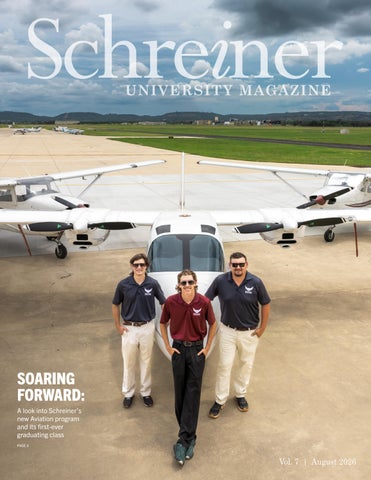
UNIVERSITY MAGAZINE
SOARING FORWARD: A look into Schreiner’s new Aviation program and its first-ever graduating class PAGE 4
Vol. 7 | August 2026
04
20
28
22
10
IN THIS ISSUE 04 Soaring High Schreiner’s Aviation Studies program takes off with its first graduates.
10 A Convergence in Faith and Global Education Schreiner visits partnering schools in South Korea to strengthen ties across the world.
12 Nurturing Hope, Learning Journey A Schreiner student’s trip to Ireland provides an enriching experience.
14 A Promise Fulfilled A new partnership between Alamo Colleges and Schreiner University with the Promise-toPromise program.
20 Returning to the River The Jane Ragsdale Memorial Polo Celebration brought the community out to the Guadalupe for a day of remembrance and connection.
22 LSS to CEALS The Learning Support Services program evolves to provide a stronger foundation for student success at Schreiner.
28 Ask Darlene An interview with a retiring Schreiner legend.
34 Cadet Caylor Jones Schreiner Institute’s first ROTC Cadet to earn a U.S. Air Force Commission.
38 Campaign Success: Over $50 Million Raised Vice President for Advancement Mark Tuschak speaks to the success of the Cornerstone Campaign.
VOL. 7 | AUGUST 2026 MARKETING DIRECTOR Michael Bennett
EDITORS
Megan Bruhn Mai Felty
DESIGN
17
Amanda White
LEAD PHOTOGRAPHER Armando Medina
12
CONTRIBUTING PHOTOGRAPHER Colby McCoy
UNIVERSITY PRESIDENT Dr. Charlie McCormick
CHAIRMAN, BOARD OF TRUSTEES Robert Parker, Jr.
SCHREINER FORMER STUDENTS ASSOCIATION PRESIDENT Manuel A. “Tony” Cappella ‘68
14
34
02 LETTER FROM THE PRESIDENT 17 FACULTY HIGHLIGHT: SUSAN KLINEDINST 18 NURSING PROGRAM SPOTLIGHT 26 DISTINGUISHED ALUMNI & SERVICE AWARDS 30 MORE THAN WINS: ATHLETICS UPDATE 35 THE TEXAS INSTITUTE FOR HAZARD RISK & READINESS 36 UPCOMING EVENTS 40 HOW YOU CAN GIVE BACK
PRODUCTION & PUBLISHING The Watermark Group
Schreiner University Magazine is a publication of the Office of Marketing & Communications and is distributed once a year free of charge to Schreiner alumni, current students, faculty, parents and friends. Would you like to be included on the Schreiner University mailing list or do you have a change of address? Call the Office of Advancement at (830) 792-7201 or send your name and address to Schreiner University, CMB 6229, 2100 Memorial Blvd., Kerrville, TX 78028 or you can e-mail giving@schreiner.edu. Schreiner University is an independent liberal arts institution related by covenant and choice to the Presbyterian Church (U.S.A.). Schreiner University does not discriminate in admissions, educational programs, extra-curricular programs or employment against any individual on the basis of that individual’s race, color, or sexual orientation. Inquiries or complaints should be forwarded to the Director of Human Resources at (830) 792-7375.
SCHREINER.EDU @schreineruniversity
SchreinerUniversity
schreiner-university
4
The sculpture “Cypress Sentinel,” a tribute to the beauty of the Hill Country and the Guadalupe River, was installed on October 6, 2025. The sculpture was designed and built by celebrated public artist Tim Mispagel and is located at the trailhead near the Trailhead Beer Garden on campus. SCHREINER UNIVERSITY MAGAZINE | VOL. 7 | AUGUST 2026
Letter from the
President This academic year has been a roller coaster of ups and downs and challenges giving way to momentum. And it has reminded me, time and again, what a great privilege and delight it is to be part of Schreiner University.
The year began in the shadow of the July 4 flood that so deeply impacted Kerrville and the Hill Country. In those early hours and days as the floodwaters began to recede, Schreiner became more than a campus—it became a sanctuary for refuge, coordination, and care. I could not have been more proud of the ways in which Schreiner’s faculty, staff, and students mobilized to support Kerr County, and I continue to be humbled by their commitment to continue showing up for the community. Dr. Jason Boswell, assistant professor of criminal justice, has taken on the extraordinary responsibility of launching a new Texas Institute for Hazard Risk & Readiness that will help the Hill Country – and communities around the state and nation that are located in river basins – prepare for floods and other hazards that may strike. Despite the devastation of the flood, the fall semester was witness to a number of significant milestones: the largest class of first-year students
in Schreiner’s history, the highest retention rate in the school’s history, and our largest overall enrollment. And there was a renewed energy across campus that accompanied the return of Schreiner football to campus. From its early morning practices to serving as a catalyst for campus-wide and community engagement, football is already contributing to the spirit and visibility of the university in powerful ways. This spring we launched the Center of Excellence for Achievement and Learning Support (CEALS) – a program that has evolved from what many of you will remember as Learning Support Services. What began, some 50 years ago, as a commitment to serve students with learning differences has grown into one of the most respected programs of its kind in the nation. We intend CEALS to enhance the University’s reputation further still through its expanding levels of academic support, faculty training in universal design, new partnerships in dyslexia research, and summer programs designed to help students and families navigate the transition to college. It is, in every sense, a reaffirmation of Schreiner’s belief that students thrive when they are known, supported, and challenged within a fully integrated college experience. We also
expanded the main campus footprint by purchasing a lot and building adjacent to campus. This will be the new home of our growing engineering program, and it provides us the space we need to move beyond mechanical and civil engineering and into new engineering spaces. None of this happens without the support of those who believe in Schreiner University. The generosity of our alumni and friends plays a critical role in expanding programs, enhancing academic facilities, and creating opportunities that directly impact our students’ lives. Your investment in this university is an investment in these students and in the communities they will one day serve and lead. There is even more exciting work ahead of us. Higher education continues to evolve, and Schreiner is well positioned, not only to respond to change, but to lead in ways that are authentic to who we are. Thank you for your continued support, your belief in our mission, and your commitment to our remarkable community of Mountaineers. U
DR. CHARLIE MCCORMICK President of Schreiner University
SCHREINER UNIVERSITY MAGAZINE | VOL. 7 | AUGUST 2026
5
SOARIN SCHREINER UNIVERSITY'S AVIATION STUDIES PROGRAM
W
hen Schreiner University launched its Aviation Studies program in 2022, it did so with a clear purpose: to build a pathway for Hill Country students to enter one of the most dynamic, essential, and opportunity-rich professions in the United States. In
6
SCHREINER UNIVERSITY MAGAZINE | VOL. 7 | AUGUST 2026
2027, the program will celebrate its first graduating class. This inaugural cohort—Connor Kennedy, Hayden Schmidt, and Zane Fry—represents not only the future of Schreiner aviation, but the future of an industry that urgently needs skilled, well-trained pilots. By the time
NG HIGH PREPARES ITS FIRST GRADUATES FOR A CHANGING SKY BY CARL DAVIS
they cross the stage in 2027, each will have earned the FAA Commercial Pilot Certificate, with Instrument and Multi-Engine ratings, as well as the coveted Certified Flight Instructor (CFI) certificate. These credentials place them among the most employable
young aviators in the country. Their achievements also mark a new chapter in the long, often overlooked story of aviation in Kerrville—a story that stretches back nearly a century.
SCHREINER UNIVERSITY MAGAZINE | VOL. 7 | AUGUST 2026
7
A
viation in Kerrville began long before Schreiner University ever imagined offering a degree in it. In the early 20th century, the Hill Country’s wide-open spaces and favorable weather made it an ideal location for flying. By the 1930s, local aviators were using makeshift landing strips carved out of ranchland. The region’s aviation identity solidified in 1943, when the U.S. Army Air Forces activated Louis Schreiner Field as a World War II pilot-training site. For two years, young cadets trained in primary flight skills before heading off to advanced bases across the country.
8
After the war, the airfield returned to civilian use and eventually became the Kerrville Municipal Airport—a hub for general aviation, business travel, and the birthplace of several aviation-related enterprises. The airport’s long partnership with the community laid the groundwork for what would eventually become Schreiner University’s modern flight-training program. Today, Schreiner's students train at that same airport, flying from the very runways once used by wartime cadets. It is a powerful reminder that aviation in Kerrville has always been about service, opportunity, and the courage to take flight.
Schreiner recently acquired a lease for a new hangar, where planes can be stored during bad weather and overnight. With an aviation mechanics program in development, the Aviation Studies program plans to expand to prepare for the addition of additional aircraft and instructors beyond the capacity of the current facilities. SCHREINER UNIVERSITY MAGAZINE | VOL. 7 | AUGUST 2026
T
he decision to establish the Aviation Studies program in 2022 was driven by a national need. The United States is experiencing one of the most significant pilot shortages in its history. According to industry forecasts, airlines will need tens of thousands of new pilots over the next decade to replace retiring aviators and meet growing demand for air travel. This shortage is not theoretical—it is already reshaping the industry. Regional airlines have raised starting salaries dramatically. Major carriers are expanding their pilot-development pipelines. Flight schools
nationwide are operating at capacity. For students willing to commit to the discipline and rigor of flight training, the career outlook is exceptionally strong. Schreiner University recognized that the Hill Country was uniquely positioned to contribute to this national effort. With a supportive community, a historic airport, and a university culture rooted in service and leadership, the foundation was already in place. What it needed was a program that combined academic excellence with professional-grade flight training.
SCHREINER UNIVERSITY MAGAZINE | VOL. 7 | AUGUST 2026
9
One of the defining strengths of Schreiner’s program is its FAA Part 141 structure. Under Part 141, flight training follows a highly organized, FAA-approved syllabus designed to ensure consistency, efficiency, and safety. This model is particularly beneficial for university students, as it allows for structured progression through each certificate and rating and reduced flight-hour requirements for certain certificates. It also includes integrated academic coursework in aerodynamics, weather safety, and human factors, and employs standardized evaluation through stage checks and proficiency assessments. Part 141 programs are held to a higher standard of oversight than traditional Part 61 flight schools. For Schreiner's students, this means graduation not only with the required FAA credentials but with the discipline, professionalism, and safety mindset expected of airline-bound pilots.
10
SCHREINER UNIVERSITY MAGAZINE | VOL. 7 | AUGUST 2026
As the aviation industry evolves, Schreiner’s program is designed to evolve with it. Its curriculum emphasizes safety management and risk assessment, advanced weather interpretation, crew resource management (CRM), human factors and decision-making, and advanced aircraft systems. These skills are essential not only for airline pilots but for corporate aviation, cargo operations, flight instruction, and emerging fields such as unmanned aircraft systems. The program’s long-term vision includes expanding simulator capabilities, strengthening partnerships with regional airlines, and developing pathways for students to transition directly into professional flying roles after graduation.
Zane, Hayden, and Connor hang out in the Schreiner Pilot's Lounge, a place for students to relax between classes and flights. The program will have over 50 students next year.
Meet the First Graduating Class of Schreiner Aviation
The Class of 2027 will always hold a special place in the history of Schreiner University. Connor Kennedy, Hayden Schmidt, and Zane Fry joined the program when it was little more than a vision and a runway. They embraced the challenge of building something new, and in doing so, they helped shape the culture of the program for every student who will follow. Together, these three students represent the best of Schreiner University: curiosity, discipline, service, and a willingness to take on new horizons.
Pictured from left to right: Zane Fry, Hayden Schmidt, Connor Kennedy
ZANE FRY
HAYDEN SCHMIDT
CONNOR KENNEDY
Zane, like Connor, has spent much of his life around airplanes. Zane’s journey through the program has been defined by determination and resilience. He embraced every challenge—from crosswind landings to advanced navigation—with a quiet confidence that inspired his peers. His commitment to excellence will serve him well as he begins his career as a flight instructor.
Hayden’s father is a pilot for a major US airline. He wants to follow in his father’s footsteps in pursuing an airline career. Hayden brought a cerebral focus to the program. Whether mastering complex aerodynamics or flight-planning techniques, he was ready to help his classmates. His dedication to safety and precision made him a natural fit for the CFI certificate.
Connor’s passion for aviation began long before he arrived at Schreiner. He has worked around airplanes for a big portion of his life. Known for his calm demeanor and analytical approach to flying, he excelled in instrument procedures and multiengine operations. His instructors consistently praise his professionalism and leadership in the cockpit.
The students and instructors from the Aim High Flight Academy pose in their flight jumpsuits. The summer program brings in promising high school students for a three-week introductory flight program, where students can earn up to 15 flight hours through the United States Air Force.
As Schreiner University prepares to send its first aviators into the world, it does so with gratitude for the community that made this program possible. Kerrville’s aviation heritage—shaped by wartime training, local pilots, and decades of commitment to general aviation—has created an environment where students can thrive. Connor, Hayden, and Zane are the first to take flight from this new chapter in Sch-
reiner’s history, but they will not be the last. Their success is a testament to what is possible when a university, a community, and a group of determined students come together with a shared vision. The sky over Kerrville has always been wide. Now, thanks to Schreiner’s Aviation Studies program, it is filled with possibilities. U
SCHREINER UNIVERSITY MAGAZINE | VOL. 7 | AUGUST 2026
11
1
2
In March 2026, a Schreiner University delegation embarked on an eight-day journey to South Korea, marking a pivotal step toward integrating faith, global education, and the future of artificial intelligence in higher education.
A CONVERGENCE
OF FAITH AND GLOBAL
EDUCATION The Schreiner University Delegation to South Korea 12
SCHREINER UNIVERSITY MAGAZINE | VOL. 7 | AUGUST 2026
Led by President Dr. Charlie McCormick, the group including university leadership, faculty, a trustee, and an alumna focused on a singular mission: to strengthen international partnerships and prepare students for a rapidly evolving, interconnected world. The historic trip paved the way for finalized memorandums of understanding (MOUs) and exchange agreements with premier Presbyterian and partner universities in South Korea, establishing new pathways for Schreiner students to study abroad, immerse themselves in a new culture, and broaden their academic horizons.
NEW PARTNERSHIPS IN SEOUL AND DAEGU In Seoul, the delegation finalized a five year partnership with Soongsil University, a top tier institution deeply rooted in a shared Presbyterian heritage. The official signing ceremony for the agreement took place in July 2026, anchoring a long term collaboration in IT, engineering, and business. “This partnership offers immense opportunities for our campus,” said Rev. Dr. Dongwoo Lee, University Minister and Director of International Relations, who played a central role in shaping the trip. “We look forward to exploring the ethical dimensions of technological advancements and leading educational innovation
3
4
grounded firmly in Christian values.” The delegation then traveled to Daegu to connect with Keimyung University. Through this new bond, Schreiner students will soon gain access to immersive cultural programs, including a Korean Culture Summer Camp and intensive language studies designed to foster global understanding.
EXPANDING THE GLOBAL FOOTPRINT Schreiner also established a crucial new agreement with Seoul Women’s University, creating distinctive avenues for leadership development and cross cultural empowerment. This partnership ensures that students can participate in collaborative projects that redefine global leadership in diverse societal contexts. In tandem, the university renewed its long-standing ties with Hannam University in Daejeon. Built on years of mutual trust and shared academic milestones, this renewal secures continuous semester-long and year-long study-abroad opportunities, allowing students to remain fully enrolled at Schreiner while gaining invaluable international experience.
A SHARED TRADITION OF PURPOSE What sets these international ties apart is their grounding in a shared spiritual history because each institution maintains deep connections to the Presbyterian Church. This shared foundation was beautifully realized when the delegation attended worship at Saemoonan Presbyterian Church in Seoul, the first Presbyterian church established in Korea, reflecting the deep historical roots that continue to shape these institutions today.
Moving forward, Schreiner University is currently engaged in highly promising discussions to expand its academic and theological network with the Presbyterian University and Theological Seminary (PUTS). This alignment reinforces Schreiner’s mission to cultivate graduates who are not only academically prepared, but also grounded in character and service.
LOOKING AHEAD: AI AND THE HUMANITIES Beyond the formal signing ceremonies, a recurring theme across every campus was the rapid integration of artificial intelligence in higher education. South Korean universities are actively embedding AI into their core curricula, blending technological innovation with the humanities. This model teaches students to think critically, ethically, and globally. For Schreiner’s leadership, the takeaway was clear: the future of education relies on fusing cutting-edge technology with enduring human values. The delegation returned to Kerrville with a renewed commitment to ensuring Schreiner students possess both advanced technical skills and the core principles that define the university’s mission. This moment represents what Schreiner does best: preparing students for lives of true purpose, leadership, and global impact. U 1. The Schreiner delegation stands in front of the White Horse statue on Soongsil’s campus, which represents the university’s unique history and integrity of faith. 2. Dr. Charlie McCormick shakes hands with Dr.Ilhi Synn, the President of Keimyung University. 3. The Schreiner delegation meets with Hannam University Executive Leadership in an effort to renew and strengthen the long standing partnership between the two universities. 4. Rev. Dr. Dongwoo Lee stands with Rev. Dr. Jongtai Lee, the Dean of the Chaplain’s Office of Seoul Women’s University.
SCHREINER UNIVERSITY MAGAZINE | VOL. 7 | AUGUST 2026
13
BALLYCASTLE, NORTHERN IRELAND SEAN DANSBY CLASS OF 2027 MARKETING MAJOR ENGLISH MINOR
This international opportunity was made possible by the Schreiner University Changing Global Society program and with support from Rotary Club of Kerrville.
Nurturing Hope, Learning Journey Sean’s trip to Corrymeela in Northern Ireland was a rewarding and enlightening experience. I am beyond grateful to be given the opportunity to experience something like this. It was a time that allowed me to really alter the structure of how I perceive not only the things I see but also what I don’t see or fully understand. What I mean by this is that being able to hear the life stories of those who live so differently from me, simply put, expanded my brain. This trip was all aligned with a special group called Corrymeela. My understanding of this group is that they strive for harmony, collaboration, and understanding. It is important to note where they reside, 14
SCHREINER UNIVERSITY MAGAZINE | VOL. 7 | AUGUST 2026
since it is a major part of their identity: Ballycastle, Northern Ireland (not to be confused with the Republic of Ireland). Northern Ireland had a period of extreme violence and discrimination from the late 1960s to 1998, called “The Troubles,” between two religious groups, the Catholics and the Protestants. In those times, Corrymeela was a place where people were invited to speak without fear of reprimands, where someone willingly lent a hand, and where a constructive and collaborative future was sought. They still do that today; they teach and offer learning opportunities to all who are willing.
It was very easy to tell how passionate not only the members were for their work but also the attendees, like myself. We stayed in their center in Ballycastle for a week, and each day we would have two seminar-like meetings where we would discuss a certain topic, led by Ulster University professor Duncan Morrow, Dr. Dong Jin Kim, and Jean Horstman, usually picking up from where we left off last time. A major topic we discussed was, “What does peace look like to you?” I believe this was used to hint at how we should think while there. We should be open-minded and understand that not everyone will have the same answer. Going forward, we had to consider and accept another’s culture, lifestyle, and experiences. Many people imagined a utopia where everyone aligns perfectly and is in complete agreement. Others described a place where agreeing to disagree and creating workaround solutions is ideal. We never fully moved on from that topic; it was always in the back of our minds, but we then transitioned to discussing the root of conflict. That discussion revolved around the word “mimesis.” This is used to describe imitation and, in a way, put a label on the feeling of spite brewing within the people. The argument our leaders made was that one factor of the Troubles’ duration was that both parties kept imitating each other’s violence. It became a cycle with no apparent end, so how was it resolved? Well, both parties started to recognize each other, and they are nearly living happily ever after. My peers were from all over the world, from Lithuania, to Sri Lanka, South Korea, and of course Texas as well. The diversity of their insights and personalities shaped the tone of many of our discussions. It was inspiring to see
people the same age as me be so passionate about the world around them and wanting to make an impact as soon as possible. They challenged many ideas, swaying people to see their point of view and what they intend to do in their future. But during our downtime, they were just another young person trying to enjoy life and all it had to offer. As I got to spend more time with them, I learned that regardless of their career choice or ideas they may have, they never brought those concerns into the daily activities. When it was time to have fun, we went out and explored like we were best friends, and when it was time to be serious, we sat down and got serious. I don’t believe I would have gained so much from the trip if it hadn’t been for them. This trip was my first time traveling outside the United States, and it may be one of the most beneficial things I’ve done in my life. As a marketing major, I need to build life experiences to better prepare myself for that sort of career, which is highly involved with people. I’ve always wanted a career where I help people, either directly or by making resources visible and accessible, and Corrymeela is exactly the kind of place I want more people to know about. These kinds of groups should be known to everyone, especially when we consider how overwhelming and suffocating times could sometimes be. So, I owe them big time for showing me places like Black Mountain Shared Space, Shankill Women’s Centre, and of course, themselves. I’ll always remember their passion and goals and do my best to share stories like theirs moving forward in my career and any community I’m in. U
SCHREINER UNIVERSITY MAGAZINE | VOL. 7 | AUGUST 2026
15
A PROMISE FULFILLED A New Partnership Between Alamo Colleges and Schreiner University with the Promise-to-Promise Program In a region where access to higher education can shape the trajectory of entire families, a new partnership is redefining what’s possible. The collaboration between the Alamo Colleges District and Schreiner University introduces a seamless, debt-free pathway from high school to a bachelor’s degree. At the heart of the partnership is a simple but powerful idea: students should not have to choose between opportunity and affordability. Through the newly established “Promise-to-Promise” pathway, eligible students can 16
SCHREINER UNIVERSITY MAGAZINE | VOL. 7 | AUGUST 2026
begin their academic journey at any of the Alamo Colleges and transfer to Schreiner University to complete their four-year degree—with tuition covered at both institutions. The program builds on two existing initiatives: •
AlamoPROMISE, which provides tuitionfree community college education for eligible Bexar County high school graduates
•
Schreiner University Promise Program, which offers last-dollar tuition coverage for qualifying transfer students
Together, these programs eliminate one of the most significant barriers to higher education: cost.
“
When I found out I would be able to attend Schreiner without the burden of debt, I was in shock. Truly, it felt like my prayers were being answered.
A FIRST-OF-ITS-KIND PARTNERSHIP This collaboration marks a milestone in Texas higher education. Schreiner has now become the first private university to join the South Central Texas Transfer Compact through a Promise-to-Promise model— aligning alongside major public institutions while offering a distinctly personal, residential college experience. Students who begin at a community college—often for financial or geographic reasons—now have a clear, supported path to a private university education. And for Schreiner, it opens doors to a broader, more diverse pool of students who may not have previously considered a private institution within reach. For students like Danielle Chavarria, the impact is immediate and deeply personal. After completing her associate degree at St. Philip’s College, she will be among the first to transfer under the new partnership, pursuing her goal of becoming a registered nurse.
DANIELLE CHAVARRIA ALAMOPROMISE RECIPIENT
”
AN EASIER TRANSFER Roughly 75% of Alamo Colleges students transfer to four-year institutions to complete their degrees. The Promise-to-Promise pathway strengthens that pipeline by removing friction points that often derail students during the transition. Instead of navigating complex financial aid gaps or uncertain transfer credits, students benefit from a clearly defined academic pathway, coordinated advising and support services, and financial continuity from associate to bachelor’s degree.
COMMUNITY IMPACT Programs like AlamoPROMISE have already demonstrated their broader value. In just five years, the initiative has served more than 30,000 students and generated over $1.1 billion in economic impact across the region.
Schreiner University president Dr. Charlie McCormick and Alamo Colleges District Chancellor Dr. Mike Flores shake hands at the Promise-toPromise partnership announcement. A special ceremony was held in January to commemorate the new partnership.
“When I found out I would be able to attend Schreiner tuition-free – to attend a private university – without the burden of debt, I was in shock. It felt like such a relief. Such a blessing. Truly, it felt like my prayers were being answered. I’m so grateful for the Alamo Colleges District and for programs like AlamoPROMISE. I don’t think people always realize just how powerful these programs are,” said Chavarria.
SCHREINER UNIVERSITY MAGAZINE | VOL. 7 | AUGUST 2026
17
“
By partnering with Alamo Colleges, we are opening new doors for students across South Central Texas and the Hill Country. DR. CHARLIE MCCORMICK President of Schreiner University
Danielle Chavarria, a recipient of the AlamoPROMISE program, speaks at the partnership ceremony. Danielle earned an Associate of Science at St. Phillips College, and will be among the first eligible students admitted to Schreiner University under the new Promoise-toPromise program. She hopes to become a registered nurse through Schreiner.
18
By extending that model into a full four-year pathway, the Schreiner partnership amplifies those outcomes by expanding the skilled workforce in fields high in demand across the area and supporting long-term economic growth across South Central Texas.
A SHARED VISION For both institutions, the partnership reflects a shared commitment to meeting students where they are—and walking alongside them to where they want to go. “From its founding, Schreiner University has believed in educating the whole person and preparing students for meaningful work and purposeful lives,” said Charlie McCormick, President of Schreiner University. “We also know that no single educational pathway fits every student. By partnering with Alamo Colleges, we are opening new doors for students across South Central Texas and the Hill Country, including those who may begin their journey elsewhere and discover that a small, residential university in Kerrville is the right next step. This partnership honors our shared commitment to access, affordability,
SCHREINER UNIVERSITY MAGAZINE | VOL. 7 | AUGUST 2026
and opportunity, and to walking alongside students as they continue their educational journey.” The new Promise-to-Promise partnership strengthens the collaborative student support system across the partnering institutions. This partnership is the third such partnership for the Alamo Colleges. In 2022, the Alamo Colleges established a partnership with UT San Antonio’s Bold Promise Program. In 2024, the Alamo Colleges established a Promise-to-Promise partnership with Texas A&M University-San Antonio. As higher education continues to evolve, partnerships like this one offer a blueprint for the future. They challenge traditional boundaries between institutions, prioritize student outcomes over institutional silos, and reimagine what collaboration can achieve. For students across South Central Texas, the message is clear: a college degree—once out of reach for many—is now within grasp. And for the region, the impact will be felt for generations. U
Susan Klinedinst, associate professor of biology, recently completed her first year as the Demmie G. Mayfield Endowed Chair in Science and Undergraduate Research at Schreiner. In this role, she works to expand opportunities for students across disciplines to engage in meaningful research and scholarly activity, helping them develop the skills, confidence, and curiosity that come from tackling realworld questions.
SUSAN KLINEDINST DEMMIE G. MAYFIELD ENDOWED CHAIR IN SCIENCE AND UNDERGRADUATE RESEARCH
For Susan, undergraduate research is one of the most transformative experiences students can have during their college careers. Research challenges students to think critically, solve problems, communicate their ideas, and contribute new knowledge to their fields. She is passionate about creating opportunities for students to experience that growth, regardless of their discipline. During her first year as chair, Susan helped support student research projects and secured the funding for students to present their work at national conferences, providing opportunities for them to engage with professional communities beyond campus. She also coordinated one of the university’s largest student achievement showcases to date, featuring more than 150 student presenters representing 22 disciplines, including Engineering, Education, Public Health, English, Biology, and Theater. In addition to supporting students directly, Susan facilitates workshops on poster presentations, oral presentations, and finding summer research opportunities, while also working with faculty to expand course-based undergraduate research experiences across the curriculum. One of the most rewarding aspects of the position has been watching students grow from learners into scholars who are confident in sharing their work with others. Students presenting their research and creative work to audiences both on campus and across the country reinforces the value of undergraduate research and its ability to shape students’ academic and professional futures. U
SCHREINER UNIVERSITY MAGAZINE | VOL. 7 | AUGUST 2026
19
NURSING PROGRAM SPOTLIGHT The Schreiner University Graduate Nursing Programs continue to experience significant growth and development as we expand opportunities for advanced practice nursing education while addressing healthcare workforce needs across Texas and beyond. The Family Nurse Practitioner (FNP) program was developed to prepare highly competent, evidence-based primary care providers capable of serving diverse populations across the lifespan, with a particular emphasis on rural and underserved communities. Schreiner University has established relationships with numerous clinical agencies, healthcare systems, private practices, and community clinics to provide students with diverse and meaningful clinical learning experiences. These partnerships support student education and help address provider shortages in medically underserved areas. A major milestone for the program was achieving initial accreditation through the Commission on Collegiate Nursing Education, demonstrating the program’s commitment to academic quality, student success, and continuous improvement. The program has successfully graduated its inaugural cohort of Family Nurse Practitioner (FNP) students, each completing over 750 supervised clinical hours across a variety of primary care settings. Graduates have demonstrated strong clinical competency and are prepared to enter practice as advanced practice registered nurses serving critical healthcare needs throughout the region.
20
DR. ANNA JESSUP DIRECTOR OF MSN PROGRAMS
Building upon the success of the Family Nurse Practitioner program, Schreiner University has completed development of a Psychiatric Mental Health Nurse Practitioner (PMHNP) program designed to address the growing behavioral health crisis and the shortage of psychiatric providers throughout Texas and rural America. The PMHNP curriculum was developed in alignment with national standards, AACN Essentials, and NONPF competencies, emphasizing integrated behavioral health, evidence-based psychiatric care, and treatment of mental health conditions across the lifespan. The addition of the PMHNP track represents a significant expansion of graduate nursing education at Schreiner and further supports the university’s mission of preparing healthcare professionals to meet evolving community needs. In addition to the new programs, the nursing program continues to integrate simulation, competency-based assessements, clinical performance evaluations, and evidence-based learning strategies throughout the curriculum. It has expanded its graduate nursing faculty and increased faculty engagement in curriculum development, assessment, and accreditation activities. Looking ahead, Schreiner University is well-positioned for continued growth in graduate nursing education. The addition of the PMHNP program, ongoing development of clinical partnerships, and commitment to academic excellence will further strengthen the university’s role in preparing advanced practice nurses who are equipped to improve healthcare access and outcomes in Texas, our community, and beyond. U
JENNIFER GUADALUPE CLASS OF 2026 | MSN-FNP
As an MSN-FNP student at Schreiner University, I have built a strong foundation in advanced practice nursing through evidence-based education and hands-on clinical training. These experiences have deepened my passion for providing compassionate, patient-centered care and have inspired me to continue growing as a future Family Nurse Practitioner dedicated to improving the health and well-being of individuals and families.
HAILEY HUSER
CLASS OF 2026 | MSN-FNP The MSN-FNP program at Schreiner University prepared me to provide quality healthcare in the Hill County while also helping me grow as a confident leader. Serving as a student representative gave me a voice to advocate for my peers and strengthened my commitment to meaningful community connection. This experience, combined with strong academic and clinical preparation, helped me secure a position as a Family Nurse Practitioner in my final semester of the program.
ERICA RESENDEZ CLASS OF 2026 | LVN
As a working mom and one of the oldest students in my class, I’ve learned that it’s never too late to change your life. I like to keep things fun and bring lots of personality, but the Schreiner LVN program has pushed me, opened doors I never thought were possible and showed me that it’s never too late to go after what you want.
MEET THE NEW PSYCHIATRIC MENTAL HEALTH NURSE PRACTITIONER COORDINATOR DR. TRACY HICKS
DNP, MBA, APRN, FNP-BC, PMHNP-BC, CARN-AP, FIAAN, FAANP Dr. Tracy Hicks is a dual-certified Family and Psychiatric Mental Health Nurse Practicioner, healthcare entrepreneur, educator, and national nursing leader dedicated to advancing mental health, addiction care, integrated healthcare, and nursing leadership. She is the founder and owner of C-Trilogy Comprehensive Clinical Care and founder of C-Trilogy Outreach, a nonprofit organization established to expand access to behavioral health services for underserved communities. She also serves as president of Texas Nurse Practitioners, and brings years of expertise and advocacy with her.
21
Returning to the River
THE JANE RAGSDALE MEMORIAL POLO CELEBRATION On a cool April afternoon along the banks of the Guadalupe River, the spirit of community and remembrance came together for a meaningful new chapter in a growing Schreiner University tradition. What began four years ago as a small student-centered polo match has evolved into something far more significant. This year, the event was officially renamed the Jane Ragsdale Memorial Polo Celebration, honoring the life and legacy of a woman whose impact on the Hill Country continues to resonate. Hosted at Camp Stewart on April 18, the celebration brought together Schreiner students, families, alumni, and community members in a shared moment of reflection and connection, with the goal of raising money for the Schreiner Equestrian team. The setting, familiar and deeply personal to many in attendance, carried added weight. This day marked one of the first major gatherings along the Guadalupe River since the devastating July 4, 2025 flood that claimed Jane Ragsdale’s life.
Heart O’ The Hills Camp, she shaped generations of young lives while remaining deeply engaged in the broader Kerrville community. Her brother, Silas B. “Jeepers” Ragsdale III, reflected on what made the tribute so fitting. “She always showed up,” he shared. “Whether it was a big event or something small, she was there. She loved this community, she supported Schreiner, and she loved camp life. This just felt natural.” That sense of presence carried through the entire day. From the opening moments to the final chukker, the event felt less like a competition and more like a gathering rooted in shared memory and gratitude.
The René Lalique finch bowl in the new trophy was passed down by Janie Cooper, with the intention of eventually being inherited by Jane Ragsdale. The final product was a joint effort: Robert Feuge carved a black-cherry wooden base, and Clint Orms Engravers & Silversmiths created a silver plate that will record the match winners for the next 18 years.
For those who knew her, Jane Ragsdale was a constant presence. As longtime director of 22
SCHREINER UNIVERSITY MAGAZINE | VOL. 7 | AUGUST 2026
Pictured here: Jeepers Ragsdale and Schreiner Board member Becky Ferguson
“
She always showed up. Whether it was a big event or something small, she was there. She loved this community, she supported Schreiner, and she loved camp life. This just felt natural. “JEEPERS” RAGSDALE BROTHER OF JANE RAGSDALE
The match itself featured a team representing Schreiner University facing off against a Camp Stewart team, both composed of Ragsdale’s friends and family, as well as Schreiner equestrian students. Led by Jeepers Ragsdale, the Camp Stewart team ultimately claimed the trophy, but the outcome felt secondary to the purpose of the day.
”
moment. Despite forecasts predicting rain, conditions held steady throughout the match. Jane’s mother, Kathy Ragsdale, offered a simple explanation that many quietly shared: Jane was there.
While polo remained the centerpiece of the day, the focus extended far beyond the field. Guests watched as riders guided their horses across the expansive pitch, striking the ball with precision and speed in a sport that blends athleticism with tradition. Yet for many, the most meaningful moments happened between plays, in conversations, shared memories, and quiet reflection. The setting itself was one of the most powerful elements of the day. The Guadalupe River, central to so many Hill Country memories, has taken on new meaning in the wake of last summer’s tragedy. President McCormick reflected on that shift, noting that while the river’s power has changed perspectives, it also invited a renewed relationship rooted in appreciation and care. The gathering served as a step toward healing, allowing the community to return not just physically, but emotionally. Even the weather seemed to align with the
The Jane Ragsdale Memorial Polo Celebration now stands as more than an annual event. It is a reflection of what makes the Schreiner community distinct: a deep connection to place, a commitment to honoring those who shape it, and a belief that even in loss, there is opportunity to gather, remember, and move forward together.
Rachel Mittman and Tanner Kneese represented the Schreiner University polo team with a “paws up, claws out!”
As the final chukker came to a close and the sun dipped behind the Hill Country horizon, one thing was clear. Our polo tradition will endure, not just because of the sport, but because of the life it now honors. U SCHREINER UNIVERSITY MAGAZINE | VOL. 7 | AUGUST 2026
23
LSS TO CEALS
The Learning Support Services program evolves to provide a stronger foundation for student success at Schreiner. If you find your way to Dickey Hall, tucked away beneath one of the large oak trees on campus next to the library, you’ll more than likely run into a student receiving the personalized instruction that Schreiner is known for from a tutor, diligently answering questions and meeting the student on their level. You get a sense of how much these tutors care for the students, and it’s easy to understand how the students benefit from the one-onone learning experience that they are able to receive, often through Schreiner’s Learning Support Services, or LSS program. This program has been a hallmark of Schreiner education for many years, and its success is obvious even outside the campus: Schreiner has been ranked #1 in Texas colleges where students with learning differences succeed. In 2023, it was ranked #3 in Texas for disability-friendly colleges, and #29 nationally. 24
SCHREINER UNIVERSITY MAGAZINE | VOL. 7 | AUGUST 2026
It’s no surprise, then, that this program would evolve into something even greater: The Center of Excellence for Achievement and Learning Support.
A HISTORY OF SUPPORT
Micah Wrase (left), Director of Learning Support Services, is pictured in front of Dickey Hall with some of the students in the program.
The definitive date for the beginning of the LSS program is unclear, as is the impetus for its creation at Schreiner. But some records indicate that the program has been around
Cici Courtney (left), a history tutor, pictured here with a student.
“
In high school, the only accommodation I had ever been given was extra time, which wasn’t very helpful. What I really needed was the ability to type essays and assignments so I could spend less effort on legibility and more on improving my work and test performance.
MATTHEW KENNEDY, RN Class of 2025 Nursing Major
The LSS program at Schreiner was very different. Instead of telling me what they could do, they asked how they could best support me. They explained available accommodations and listened carefully as I shared how I had learned to adapt to my learning difference. The program pushed me to strive for A’s while also helping me understand material on a deeper level. Rather than just memorizing for tests, I was able to discuss concepts confidently with others. I thrived in my classes, and I felt confident other students in the program would have similar success.
for almost 50 years, and in that time, it has served more than a thousand students with dyslexia, dyscalculia, dysgraphia, and attention deficit disorder. The program serves a limited number of students, usually 70-80 each year with a projection of 90-95 in the coming year. Every student who is admitted into the LSS program is evaluated primarily by the program director who determines that, given the student’s documentation and in the director’s evaluation, the student will be able to attend regular college-level courses, be held to the same standards to which all students are held, and complete the same curriculum requirements as all other degree candidates—if they have the appropriate support. Through the LSS program, students can receive services like course notes taken through an innovative lecture capture system called Echo360, digital books for students to listen to, individualized mentoring and advising and, most importantly, dedicated time with a professional tutor who will walk alongside a student until they no longer need the services provided by LSS.
IDENTIFYING A WINNING PROGRAM As Schreiner University Trustees developed the strategic vision for 2030, there was a discussion regarding an investment in signature programs and experiences that helped differ-
entiate Schreiner from its peers in the marketplace. With its extensive history of helping students—students that included some of the board members in that discussion—and the recognition it has received, both in Texas and nationwide, for its ability to help students succeed, the LSS program was identified as one of these signature programs—something unique and uniquely good that elevated the Schreiner brand amidst all of the noise and chatter surrounding higher education.
Ellen Bolton (left) tutors a Schreiner student. Ellen is a tutor of math, business, and Spanish.
As Charlie McCormick, Schreiner’s president, explains: the LSS program has always “been a program of excellence here—though we have never called it that in such explicit terms. We realize now that we should have been using that language for years.” SCHREINER UNIVERSITY MAGAZINE | VOL. 7 | AUGUST 2026
25
“
As a non-traditional student, I came to college without the stable educational foundation many of my peers had. Because of that, I initially struggled to find confidence in my academic abilities. The LSS department not only strengthened my skills, but also completely reshaped how I view education. Through consistent tutoring, encouragement, and genuine care, LSS helped me grow from simply trying to keep up to truly flourishing academically and personally. After just one year of classes and six months of tutoring with LSS, I moved from the Dean’s List to the JUDE MOORE President’s List. I found the confidence to step into leadership roles: founding an arts and crafts club Class of 2027 and serving as president of two honor societies. Later, I became a mentor within the LSS program and Graphic Design and assisted with the Summer Bridge Program. LSS has not only helped me succeed academically; the English Major people that are LSS have helped me believe in myself.
The LSS program still exists, though now, it lives under the umbrella of a broader new initiative aptly named the Center for Excellence in Achievement and Learning Support, or CEALS. This new initiative allows for a better integration with other wrap-around services like advising and tutoring, and it will provide students not enrolled in LSS access to levels of support that currently only LSS students can access. When you hear about and read about CEALS at Schreiner, you’re hearing about and reading about the LSS program, too.
GROWING SUPPORT There’s more than just a name change involved in this evolution—CEALS will enhance the LSS program by providing new forms of support for students. First, there’s the new Focus Lab: a structured academic support space where students work on coursework with guidance from trained CEALS staff and faculty in a calm, focused environment. It is not tutoring, but supported academic engagement that builds confi-
Richard Soler (left) tutors a Schreiner student. Richard is a tutor of Spanish and art.
26
SCHREINER UNIVERSITY MAGAZINE | VOL. 7 | AUGUST 2026
LSS students are pictured with Sifu Mike Deegan (center) for one of the new lowto-no-impact martial arts courses. Mike is also the owner of the Behavior Resource Center, an organization serving students with developmental disabilities. The BRC provides many Schreiner students with extensive internships.
pus-wide. Faculty members are instructed and encourage to on engage students by presenting information in multiple ways, and having students demonstrate what they’ve learned in ways beyond just memorization and testing. UDL doesn’t just support those with learning differences—it’s been demonstrated to help all students engage with course material in more meaningful ways.
dence and independence in the students that take advantage of it. In addition, there will be two new workshop-style courses introduced for LSS students. First-year students will be able to participate in a low-impact, martial artsbased course designed to improve focus and self-control. Juniors and seniors will enroll in a College-to-Career course focused on résumé development, interviewing skills, networking, and job searching.
Schreiner is also building a partnership with Neuhaus Education Center in Houston, which may provide trainings and certification work for our tutors and other professional LSS staff, as well as workshops for faculty. The program is also looking into the possibility of certifying some CEALS staff as Certified Academic Language Therapists. And looking into the future, Schreiner intends to roll out what is believed to be the first set of dyslexia-informed online co-enrollment and dual enrollment courses in the nation. U
Ralph Real, a math tutor, is pictured below staffing the new Focus Lab.
CEALS will also grow Schreiner’s summer offerings, including the Summer Bridge Experience for incoming LSS freshmen (launched in the summer of 2025) and a new on-campus experience, Enter with Hope, for high school juniors and seniors with dyslexia, attention deficit disorder, or a specific learning disability in reading, mathematics, or written expression. The work of CEALS is strengthened by LSS Faculty Fellow, Dr. Chanelle Maynard, who leads campus efforts in Universal Design for Learning. UDL is an innovative instructional approach that supports students with learning differences while enhancing the learning experience for all Schreiner students camSCHREINER UNIVERSITY MAGAZINE | VOL. 7 | AUGUST 2026
27
DISTINGUISHED
ALUMNI & SERVICE AWARDS KARL RANSLEBEN ‘60
Volunteer of the Year and Distinguished Alumnus Karl Ransleben’s sheepish grin gives fair warning of the mischievous humor for which he is known. Beyond his playfulness, he is wise, generous, and deeply thoughtful. True to form, Karl is humble and does not seek the spotlight. In fact, there was some concern he might quietly decline this recognition, but with a little encouragement from his wife, Beverly, he agreed to be honored by his alma mater. A fifth-generation Texan, Karl was born in Fredericksburg in 1940 to Harvey and Ruby Klett Ransleben. His great-great-grandfather was among the city’s original founders, arriving from Germany in 1846. Raised in Kerrville alongside his sister, Carol, and brother, Randy, Karl developed a strong work ethic early, shining shoes at age five, mowing lawns, delivering a paper route, and later working at Schreiner Department Store. After graduating from Tivy High School in 1958, Karl briefly attended Texas A&M before returning to Kerrville to enroll at Schreiner Institute. His time at Schreiner proved formative, instilling discipline and sparking leadership skills he says he had previously avoided. He later earned his Bachelor of Accounting from Texas Tech University in 1962 while working at an accounting firm in Lubbock. Karl built a distinguished career as a Certified Public Accountant, becoming a partner in firms in Corpus Christi and Houston, including Harper and Pearson. He later joined Barbours Cut Import Services, where he became sole owner and led the company for more than 25 years, commuting from Fredericksburg until his retirement. Deeply committed to his community, Karl helped establish the Hill Country Boys and Girls Clubs, expanding
28
SCHREINER UNIVERSITY MAGAZINE | VOL. 7 | AUGUST 2026
Karl Ransleben ‘60
their reach across Fredericksburg, Comfort, and Boerne. He co-founded the design store red, supported numerous civic and conservation organizations, and developed the Crabapple Grove subdivision.
“
I don’t know anyone who cares as much about Schreiner or has done as much for Schreiner as Karl. He is a true treasure. MICHAEL PATE ‘71 BOARD OF TRUSTEES MEMBER
”
Karl’s connection to Schreiner University has been especially meaningful. He has served on the Board of Trustees and remains a generous and visionary supporter. His philanthropy has strengthened scholarships, nursing education, the performing arts, and key campus initiatives. His matching gift challenges have provided critical support for students, reflecting both gratitude for his Schreiner experience and a deep belief in its future. Guided by his personal philosophy to “pass it on,” Karl has spent a lifetime giving back.
RICK CREE ‘67
Volunteer of the Year Richard E. “Rick” Cree grew up in the Panhandle town of Pampa, Texas. He attended Schreiner Institute and graduated in 1967 before attending Southern Methodist University
where he earned a BBA in Economics. Rick lives in Dallas with his wife Anne and spends much of his time at his grandchildren’s athletic games. He has built and managed both private and public companies involved in banking, commercial real estate, automotive, oil and gas, and telecommunications. Rick’s business résumé includes seving as founder of American Republic Bancshares, a New Mexico bank holding company which is now a part of Wells Fargo; founder of Gateway Technologies, a telecommunications company; Chief Executive Officer of T-NETIX, Inc,; and president and CEO of C-Five, also a telecommunications company.
Susan Carver
Susan attended high school in Delaware, and then Manatee Community College in Florida, Idaho State University, and finally Schreiner University. Although life’s responsibilities kept her from completing her bachelor’s degree, her lifelong love of learning and personal growth never wavered.
Rick Cree ‘67
Rick began his time on the Schreiner University Board of Trustees in 1999 as an advisory trustee and is in his third full term as Trustee. He has chaired three successful fund-raising campaigns at Schreiner over the past 24 years. He also served on the board of the Cowboy Artists of America Museum, and the Mid-Cities Chapter of the Texas Association of Business.
SUSAN CARVER
Distinguished Service Award Born in Elkton, Maryland, during World War II, Susan Carver spent her early years on family farms in Delaware and Virginia, experiences that helped shape her strong work ethic, warm spirit, and deep appreciation for faith, family, and community. Her childhood was shaped by a spirit of adventure, including family travels across the country that first introduced her to Texas in 1951.
Over the years, Susan lived in many states across the country, each contributing to the caring and resilient person she became. After moving permanently to Texas in 1988, she found that the Texas Hill Country truly captured her heart. She worked for the Peterson Foundation before joining Schreiner University in 2003 in the Advancement Office under Alumni Director Allen Boatright. What began as a temporary position soon became her calling. For more than two decades, Susan faithfully served Schreiner University and the Schreiner Former Students Association by building meaningful relationships with alumni, spouses, families, students and staff. Her kindness, servant heart, and genuine love for people made her a treasured friend to generations of Schreiner alumni. Susan treasures time with her daughter, Pam, her grandchildren Abby, Ryan, and Robbie, and her three great-grandchildren Brooks, Ensley, and Maverick. She is also active at First Presbyterian Church and enjoys reading, walking, and spending time with friends. Her favorite Bible verse, Numbers 6:24–26, reflects the faith and grace by which she lives her life: “The Lord bless you and keep you; the Lord make His face shine upon you and be gracious to you; the Lord lift up His countenance upon you and give you peace.” After her retirement this summer, the Schreiner Former Students Association proudly honored her with the SFSA Distinguished Service Award for her many years of faithful service, dedication, and lasting impact on the Schreiner family. U SCHREINER UNIVERSITY MAGAZINE | VOL. 7 | AUGUST 2026
29
Ask Darlene An interview with a retiring Schreiner legend by Phil Houseal
“Go see Darlene, and ask her.” That simple yet wise advice has guided generations of students and staff who have crossed the campus of Schreiner University. “Darlene” is Darlene Bannister. Named to the position of registrar in 1982 after teaching history for three semesters, Darlene saw helping others not only as her job, but as her calling. “I had enough knowledge of how things work, that I felt I was in just the right place to help make things
30
SCHREINER UNIVERSITY MAGAZINE | VOL. 7 | AUGUST 2026
happen,” said Darlene, who officially retired on May 29, 2026. Technically, her job description as Registrar included registering students, keeping academic records, ensuring grades are recorded accurately, and making sure the correct courses are taken for a degree plan. She also oversaw creating schedules, helping decide what classes were taught and when they were taught. But the most satisfying aspect of her job was working directly with the students.
“I loved helping them navigate the system, making decisions about what they wanted to major in, and helping them find their path,” she said. “It was definitely about the relationships that got built over the years, and so there was always that feeling like you made a difference just visiting with them, guiding them, and advising them. Sometimes it took two or three stabs to get them to figure out what they wanted to do, but that was definitely the fulfilling part. It was the relationships you built with them, and then seeing them finish a degree.”
One of the significant changes Darlene witnessed over the years was the growing reliance on computer software.
The other aspect of her position involved coordination between faculty, administration, and her office, serving as the unofficial “memory” of the institution. During her 45-year tenure, Darlene had a front-row seat at the changes occurring in society, education, and the school itself. The most memorable was the shift from a two-year college to a four-year baccalaureate institution, which brought expanded degree areas, graduate programs, and innovative online learning options. There were also changes in personnel and programming to navigate.
A more profound change has been in society overall.
“I think face-to-face relationships have changed,” she noted. “That’s not a bad thing, because you can use computers in so many good ways, as they can streamline a lot of processes. But one of the most rewarding parts of my work is when you deal with people face-toface, and you get to know them, you look them in the eye, and you can see their reactions.”
“These days, educators have to be a lot of things to the students, and I’m not talking just college students; I’m talking about kindergarten all the way up. I think society just changed, that’s all.” Even with the rise of remote learning and growth of new career options, Darlene still believes in the value of a basic Schreiner University education.
“I became sort of the continuity for everything,” she recalled. “When you are there for a while, because you’ve got the history, I could say, well, this was the way we were doing it, this is what needed to be done, and let’s figure out how we can manage it.”
“I totally believe that a well-educated person with a good liberal arts degree is still going to be a leader in our society, so I hope that doesn’t go away,” she said. “I can’t even address what AI is going to be doing next year or next week. I feel like we as human beings are so important, I hope we never take that personal element out of it.”
She acknowledged that dealing with change was a team sport, and she loved being part of that team.
Darlene is married to Dewayne Bannister, who served as Assistant to the President.
“I liked working with the faculty and colleagues in the various offices to make necessary changes. I felt I could make a difference in these trends and changes we went through.”
In retirement, she plans to keep contributing to the community, assuming more volunteer duties at First Presbyterian Church, and spending more time outdoors in her garden, feeding the birds, reading, and enjoying her backyard.
One aspect did not change. “We always had high expectations, that when people left Schreiner University or graduated, they would be well-rounded with a liberal arts background, along with all the skills required for the profession they were going to go into.” All these years on, Darlene can recall countless stories of success. Former students regularly came back to check in with her, and several are now working at Schreiner University.
“I’m old enough that I don’t have to really plan on doing anything,” she said. Whatever she ends up doing, she leaves with no regrets. “I really think the most fulfilling part about the job that I had was helping students finish a degree if that’s what they needed. And if they didn’t finish a degree, to just help them be successful. I feel like I made a difference in their lives. I think that’s what I was meant to do.” U
SCHREINER UNIVERSITY MAGAZINE | VOL. 7 | AUGUST 2026
31
MORE THAN
WINS Schreiner Athletics Builds Momentum During a Transformative Year by Michael Bennett 32
SCHREINER UNIVERSITY MAGAZINE | VOL. 7 | AUGUST 2026
Success in collegiate athletics is often measured in wins and championships. At Schreiner University, the 202526 academic year proved that success is also measured by something deeper: building programs, creating opportunities, and establishing a culture that will shape Mountaineer Athletics for years to come. From the return of football to historic postseason volleyball and championship performances on the wrestling mat, Schreiner continued to demonstrate that its investment in student-athletes is producing meaningful results across every corner of the athletic department.
A FOUNDATION YEARS IN THE MAKING Few stories captured the excitement surrounding Schreiner Athletics more than the return of Mountaineer football. Although the developmental season did not count toward conference standings, it accomplished exactly what it was designed to do: establish a culture, develop young talent, and prepare the program for its official NCAA Division III debut. The Mountaineers finished the developmental campaign with an impressive 5-1 record, giving players valuable collegiate experience while energizing alumni, students, and the Kerrville community. Every practice, road trip, and snap became another building block for a program making its long-awaited return after nearly seven decades.
VOLLEYBALL REACHES NEW HEIGHTS If football represented the future, volleyball represented what happens when years of investment begin to mature. The Mountaineers enjoyed one of the finest seasons in program history, finishing 24-7 overall and 13-3 in Southern Collegiate Athletic Conference play. Throughout the fall, Schreiner consistently demonstrated resilience, balanced offensive play, and disciplined defense while emerging as one of the conference’s premier teams, culminating in one of the most memorable postseason runs in school history. Hosting the SCAC Championship Tournament in Kerrville, the Mountaineers advanced to the conference championship match for the first time ever after defeating second-seeded Hendrix in the semifinals. The accomplishment marked another significant milestone for a program that has steadily climbed into conference contention while showcasing Schreiner as a championship-caliber host institution. Beyond the wins, volleyball showcased the culture Schreiner continues to build: competitive excellence paired with exceptional teamwork, leadership, and student-athlete development.
Players who arrived as pioneers now become the experienced leaders who will guide Schreiner into its inaugural varsity season in the American Southwest Conference. Coaches had the opportunity to evaluate talent, install systems, and establish expectations, while fans once again rallied around Mountaineer football. This year, football will enter full varsity competition. The Schreiner volleyball team celebrates a 25-22 victory over LeTourneau University. Domynik Vasquez, a freshman from Kerrville, plays during a game against Texas Community Christian College. SCHREINER UNIVERSITY MAGAZINE | VOL. 7 | AUGUST 2026
33
CHAMPIONS IN COMPETITION AND THE CLASSROOM While football and volleyball captured many of the headlines, they were far from the only bright spots. Women’s wrestling once again proved why it has become one of Schreiner’s flagship programs, capturing its third consecutive St. Louis Intercollegiate Athletic Conference (SLIAC) Championship. The dynasty continued through a combination of experienced leadership, relentless work ethic, and a culture that has made winning an expectation rather than an aspiration. Individual excellence also shone on the international stage. Jania Dunigan earned the right to represent Puerto Rico in international competition after winning the Puerto Rico National Team Trials, a remarkable achievement that reflects not only her individual talent but also the caliber of coaching and development taking place within the Schreiner wrestling program.
34
SCHREINER UNIVERSITY MAGAZINE | VOL. 7 | AUGUST 2026
Seventy-nine Mountaineer student-athletes competing during the winter and spring seasons earned recognition on the SCAC Academic Honor Roll, an award reserved for student-athletes who maintain a grade point average of 3.25 or higher. Their accomplishments reinforce one of Schreiner Athletics’ defining characteristics: excellence in competition is matched by excellence in the classroom. Baseball continued its transition into an increasingly competitive conference landscape while softball demonstrated continued improvement throughout the spring season. Basketball programs remained competitive while developing young talent that will form the foundation for future success. Across every sport, coaches emphasized growth, accountability, and the holistic development of student-athletes. The department itself has continued to expand with several new programs. Schreiner announced additional women’s athletic opportunities, including beach volleyball and
The Women’s wrestling team after winning their third straight SLIAC Team Conference Championship in February this year.
Jania Dunigan, pictured here, was nominated within Schreiner’s conference as Most Outstanding Wrestler of the Year, in addition to representing Puerto Rico in international competition after winning the Puerto Rico National Team Trials.
This year, the women's tennis team finished the season among the top four teams in the conference. Individually, McKinley Jamison, Maya Jackson, and Kimberly Ibarra were named to the All-Tournament Team. Mackenzie Griffin earned Second Team All-Conference honors, while the doubles team of Kimberly Ibarra and McKinley Jamison received Second Team All-Conference recognition. Seven female student-athletes and five male studentathletes were named ITA Scholar-Athletes. In addition, the women's team earned ITA All-Academic Team honors by posting an impressive 3.43 team GPA. Pictured center: Logan Sifford
women’s flag football, reinforcing the University’s commitment to creating new competitive opportunities while strengthening NCAA Division III athletics. The expansion reflects a broader institutional vision focused on growth, opportunity, and providing more students with the chance to compete while earning a Schreiner education. This year also marked Schreiner’s final season competing in the Southern Collegiate Athletic Conference before transitioning into the American Southwest Conference, positioning the University for exciting new rivalries and expanded regional competition. Athletics has become an increasingly visible extension of Schreiner University’s mission, serving as a gateway for prospective students, a point of pride for alumni, and a rallying point for the Hill Country community. While championships will always remain the goal, during the 2025–26 academic year, Schreiner Athletics accomplished something equally important—building a tradition that will continue to benefit our students for years to come. U
SCHREINER UNIVERSITY MAGAZINE | VOL. 7 | AUGUST 2026
35
CADET
CAYLOR Schreiner Institute’s first ROTC Cadet to Earn a U.S. Air Force Commission
Schreiner Institute proudly marks a historic achievement as Cadet Caylor Jones becomes the first cadet in the Institute’s ROTC program to receive a commission in the United States Air Force. Jones was officially commissioned as a Second Lieutenant during a ceremony held on May 22, 2026, representing a milestone for both the cadet and the continued growth of Schreiner Institute’s ROTC program. “This is a defining moment for Schreiner Institute,” said Chastity Howard, Schreiner Institute ROTC Coordinator. “Second Lieutenant Jones has demonstrated exceptional 36
SCHREINER UNIVERSITY MAGAZINE | VOL. 7 | AUGUST 2026
JONES
dedication, leadership, and perseverance. This achievement sets a new precedent for our program and future cadets.” The commissioning reflects years of intensive academic rigor, leadership development, and military training. Throughout his time in the Schreiner Institute ROTC program, Jones served as the Cadet Commander and did so with a commitment to excellence and service. The Schreiner Institute ROTC program continues to expand its impact by preparing students for leadership roles in military service. This first Air Force commission highlights the strength of the program and its
mission to develop capable and disciplined officers. “This accomplishment reflects the dedication of our cadets and the vision of our program,” added Mark Miller, Director of Schreiner Institute. “We look forward to building on this success and continuing to produce future leaders for our nation.” Schreiner Institute remains committed to fostering leadership, service, and academic excellence, preparing students to make meaningful contributions both in military and civilian life. U
THE TEXAS INSTITUTE FOR HAZARD RISK & READINESS A new endeavor for disaster mitigation in the Hill Country. As Texas continues to face increasingly complex natural hazards from catastrophic flooding and severe storms, to wildfire threats and infrastructure strain, the need for coordinated preparedness, operational readiness, and data-driven decision-making has never been greater. In response to these growing challenges, Schreiner University has launched the Texas Institute for Hazard Risk & Readiness (TIHRR), a multidisciplinary initiative designed to strengthen disaster resilience across Texas, with a particular focus on the Texas Hill Country. Headquartered in Kerrville, Texas, the TIHRR serves as a hub for hazard risk analysis, operational coordination, applied research, training, and decision support. The Institute brings together emergency management professionals, researchers, public safety agencies, GIS specialists, public health leaders, and academic partners to develop practical solutions for real-world emergencies. “The goal of TIHRR is not simply to study disasters,” says Dr. Jason Boswell, Director of the Institute. “It is to improve readiness before disasters occur, strengthen response coordination during crises, and support long-term recovery and resilience efforts afterward.” At the core of the Institute’s mission is the belief that preparedness must be collaborative, intelligence-driven, and operationally focused. TIHRR aims to bridge the gap between academia and frontline practitioners by transforming research
into actionable tools, training, and policy recommendations that local jurisdictions can immediately apply. One of the Institute’s major priorities is the development of the Flood Risk, Response, and Intelligence Lab, a capability designed to integrate GIS mapping, flood modeling, LiDAR-informed analysis, and operational decision-support systems. The lab will support emergency managers and public safety officials by providing enhanced situational awareness and improved planning capabilities for floodprone regions across Texas. The Institute also plans to conduct regional tabletop exercises, emergency simulations, and multi-agency training programs involving law enforcement, fire services, EMS, emergency management, healthcare systems, and public officials. These exercises are intended to identify operational gaps, improve interagency communication, and strengthen emergency operations plans before real-world disasters occur. In addition to operational readiness, TIHRR emphasizes public education and community resilience. Future initiatives include hazard-risk literacy programs, practitioner certification opportunities, regional workshops, and online training platforms designed to expand access to preparedness resources across urban and rural communities alike. The Institute’s leadership has also assembled an advisory council consisting of
DR. JASON BOSWELL TIHRR DIRECTOR
emergency management professionals, researchers, flood experts, healthcare leaders, public safety officials, and policy specialists from across Texas. The council will provide strategic guidance while helping ensure the Institute remains grounded in the practical realities faced by local communities and emergency responders. Institute officials envision TIHRR becoming a statewide leader in hazard readiness and resilience innovation. Future goals include expanding statewide partnerships, supporting FEMA-related initiatives, developing regional intelligence-sharing capabilities, and advancing Texas’ overall disaster preparedness infrastructure. For Schreiner University, the Institute also represents an opportunity to connect higher education directly to public service and community impact. “Preparedness is no longer optional,” says Boswell. “Communities need practical solutions, operational partnerships, and actionable intelligence. The TIHRR was created to help provide those capabilities and strengthen resilience throughout Texas.” As hazard risks continue to evolve, the Texas Institute for Hazard Risk & Readiness is positioning itself at the intersection of research, operational coordination, and community preparedness, working to ensure Texas communities are better equipped for the challenges ahead. U SCHREINER UNIVERSITY MAGAZINE | VOL. 7 | AUGUST 2026
37
WHAT’S HAPPENING AUGUST AUGUST 28, 2026
Welcome Back Weekend and Concert featuring SM6
SEPTEMBER SEPTEMBER 9, 2026
Distinguished Lecture Series: Thomas R. Fox, Book Reading and Signing of Deluge Before Dawn
OCTOBER OCTOBER 1–4, 2026
Performing Arts Series: Twelfth Night
OCTOBER 3, 2026
SU Homecoming and Concert featuring Justin Gallegos
OCTOBER 7, 2026
Labatt Lecture Series: David Cummings, USAA
SEPTEMBER 15, 2026
Distinguished Lecture Series: Col. Mindy Kimball, Ret.
SEPTEMBER 18–19, 2026
Family Weekend featuring Gracie Yates and the Jared Stout Band
SEPTEMBER 28, 2026
Monday Night Fiction: Stoner by John Williams
OCTOBER 26, 2026
Monday Night Fiction: We Burn Daylight by Bret Anthony Johnston
OCTOBER 27, 2026
Concert Band: String Orchestra & Choir Concert
OCTOBER 30, 2026 Fall Festival
38
SCHREINER UNIVERSITY MAGAZINE | VOL. 7 | AUGUST 2026
NOVEMBER NOVEMBER 3–4, 2026
Summerlin Visiting Artist Series: Sonya Casillas, Flamenco Dance
NOVEMBER 19–22, 2026
Performing Arts Series: This is Our Youth
NOVEMBER 23, 2026
Monday Night Fiction: Love Medicine by Louise Erdich
NOVEMBER 30, 2026 Christmas Tea
NOVEMBER 30, 2026
Performing Arts Series: Old Campus Spirits
DECEMBER DECEMBER 6, 2026
Department of Music Fall Showcase
ON CAMPUS JANUARY
MARCH
JANUARY 25, 2027
MARCH 12, 2027
Monday Night Fiction: The American Girl by Rachael English
FEBRUARY FEBRUARY 18, 2027 Recognition Dinner
FEBRUARY 19–21, 2027
Performing Arts Series: A Cry of Players
FEBRUARY 22, 2027
Monday Night Fiction: Swift River by Essie Chambers
FEBRUARY 24, 2027
TexS Talks: The Future of the Alamo
Syers Lecture Series: Dr. HoulikRitchey
APRIL 16, 2027
Academic Achievement Showcase
APRIL 22, 2027
Texas Water Symposium
MARCH 29, 2027
APRIL 23–25, 2027
APRIL
APRIL 26, 2027
Monday Night Fiction: The Gambler by Fyodor Dostoevsky
APRIL 8–11, 2027
Performing Arts Series: The 25th Annual Putnam County Spelling Bee
APRIL 9, 2027
Women’s Leadership Conference featuring Elizabeth McCormick
RECALL and Spring Concert featuring the Maplewood Brothers, Danny Joseph, and Dawson Hollow
Monday Night Fiction: Isaac’s Storm by Erik Larson
APRIL 30–MAY 4, 2027
Performing Arts Series: Silent Sky
MAY MAY 3, 2027
APRIL 10, 2027
The Jane Ragsdale Memorial Polo Celebration
Department of Music Spring Showcase Events and dates are subject to change: follow @SchreinerUniversity on Facebook and Instagram to keep up to date with the latest events.
SCHREINER UNIVERSITY MAGAZINE | VOL. 7 | AUGUST 2026
39
CAMPAIGN SUCCESS: OVER $50 MILLION RAISED
I
t is time to celebrate! At the time of publication, $53,343,419 has been raised, 100 new endowments have been created, and Schreiner’s endowment has surpassed $100 million in 2026 for the first time in her history. When the Cornerstone Campaign for Schreiner University’s Second Century was launched, the vision was bold: to complete a transformational $50 million endowment campaign in time for Schreiner’s Centennial Celebration in September 2023. Then the world changed, and so did the timeline. A global pandemic disrupted lives, economies, and institutions everywhere. Yet, true to the character that defines Schreiner, alumni, donors, and friends responded with grit, resilience, and unwavering belief in the University’s mission. Together, they not only sustained the campaign through uncertainty, but they also propelled it to a successful conclusion, securing a stronger future for generations of Schreiner students. The case for the Cornerstone Campaign stated: In celebration of the centennial of Schreiner University and to forge our journey toward excellence in innovative programs, instruction, and student learning, Schreiner University has embarked on a campaign uniquely designed to set a rock-solid cornerstone for our second century. Our goal is big and bold. Our commitment is to our students, and as such, our priority for this campaign will be endowment funds for student scholarships and programs that support and create undergraduate research opportunities. We will raise $50 million and establish 100 new endowments. The campaign was chaired by two alumni, Karl Rans-
40
SCHREINER UNIVERSITY MAGAZINE | VOL. 7 | AUGUST 2026
MARK TUSCHAK VICE PRESIDENT FOR ADVANCEMENT
leben ’60 and Rick Cree ’67. The committee included members of the Board of Trustees, donors, members of the Schreiner family, community leaders, and individuals passionate about the Texas Center at Schreiner University and Schreiner Institute military programs. Campaign leadership met more than 130 times over five years, while the broader committee convened 20 times during the same period. This was Rick Cree’s fourth campaign at Schreiner and the third he chaired or co-chaired. When asked at what point service becomes habit, Rick responded, “It’s not a habit, it’s a virus, the Schreiner virus. Once you get it, you can’t get rid of it.” In his words, he captured what so many experience: a deep love for Schreiner and an enduring passion for her students. Our primary goal was to create new endowments that would make a Schreiner University education more accessible and affordable. With 100 new endowments created, we achieved that goal. Sixty-seven percent of all gifts and new endowments supported student scholarships. While the national narrative often centers on rising costs and student debt, Schreiner is helping write a different story. With the support of our donors, we have built a strong foundation of scholarship support. Today, Schreiner students graduate with significantly less debt than students at comparable Texas universities. According to College Scorecard, Schreiner graduates who borrow leave with an average debt of approximately $23,000, evidence that Schreiner’s commitment to scholarships, endowment support, and affordability is helping students earn a life-changing education while building a stronger financial future.
We also sought to establish endowments that enrich transformational student experiences and strengthen distinctive Schreiner programs. Both objectives were realized. Thirty percent of campaign gifts supported academic and co-curricular programming, including new endowments for football, significant investment in the Learning Support Services Program to transform it into a Center for Excellence, and funding for experiential learning opportunities such as travel and service experiences, including a wilderness volunteer program in partnership with the Absaroka-Beartooth Wilderness Foundation in Montana. In addition, more than $4.7 million was raised for the Texas Center at Schreiner University, and nearly $1.2 million was directed to Schreiner Institute military programs.
Lynnashia Brooks, pictured right, is a recipient of the David Ford Endowed Scholarship for Engineering. She will graduate in 2028 as a mechanical engineering major with a minor in mathematics.
The breadth of support was matched by its depth. The campaign generated 10,282 gifts from 3,825 donors. The average gift was $5,137, and the average giving per donor was $13,809. According to Mark Tuschak, Vice President for Advancement, “The average gift size far exceeded expectations and far exceeded what has been given in the past to Schreiner.” He added, “Our donor support is a clear reflection of deep love for the University and its students, thoughtful giving, and a desire for Schreiner to succeed over the next 100 years. I am humbled and grateful for the extraordinary backing of so many generous friends.” At the Recognition Dinner in May, the impact of donor support was eloquently expressed
by two Schreiner students. Elena Foulks, an Honors Program student, equestrian team member, and political science major with double minors in public health and religion and philosophy, said, “I cannot express in words how positively this university is shaping its students. Your donations are felt, cherished, and appreciated by every Schreiner student.” She added, “I am grateful to Michael Pate, President McCormick, the Cabinet, Dr. Elliston, the Clyburns, and each and every person who makes Schreiner University the special place it is.” Elena will attend law school after graduation. Lynnashia Brooks, an engineering major, student-athlete, and recipient of the David Ford Endowed Scholarship for Engineering, shared, “What drew me to Schreiner was the sense of community. From the beginning, I could tell this was a place where people genuinely care, not just about your success, but about who you’re becoming.” She continued, “Thank you for your generosity, your belief, and your investment in students like me. And especially to Ms. Lynne Cannady, thank you for turning legacy into opportunity. Your gift is not just supporting my education; it is shaping my future.” In 2026, Schreiner’s endowment surpassed $100 million for the first time in the University’s history. However, the successful completion of the Cornerstone Campaign for Schreiner University marks far more than the achievement of a financial goal. Behind every gift is a story of belief, trustees who challenged Schreiner to think boldly, campaign leaders who gave tirelessly of their time and resources, and alumni and friends who said “yes” to investing in students they may never meet but whose lives they will forever change. Together, they have done more than complete a campaign; they have strengthened the foundation for Schreiner’s second century and ensured that generations of future Mountaineers will learn, lead, and serve because of their generosity. U SCHREINER UNIVERSITY MAGAZINE | VOL. 7 | AUGUST 2026
41
HOW YOU CAN GIVE BACK Make an immediate impact with
Annual Giving
Schreiner’s Annual Giving Program fuels everyday excellence for our students, faculty, and programming. Your yearly support provides scholarships including the Hill Country College fund, enhances learning experiences, and strengthens campus life, assuring that every student has the resources they need to thrive and make college affordable. Every gift, no matter the size, helps shape the future of Schreiner University. Give today and be part of something transformational.
Invest in Schreiner’s future with
Endowment Gifts An endowment reflects your values and commitment while ensuring opportunities remain available for future students seeking a transformative, values-centered education grounded in leadership, service, and lifelong learning and discovery. Creating an endowment at Schreiner University underpins Schreiner’s financial stability and is a lasting investment in students, faculty, and Schreiner’s future. By creating or adding to an existing endowment, you provide dependable support for scholarships, academic programs, and campus initiatives that strengthen Schreiner’s mission for generations to come.
Leave a lasting legacy through
Planned Gifts
A planned gift to Schreiner University is an opportunity to leave a legacy while making a thoughtful financial decision. Through wills, trusts, or beneficiary designations, donors can shape future generations of Schreiner students, strengthen programs they value, and often realize significant tax and estate planning advantages. It is a meaningful way to support tomorrow’s leaders while stewarding the assets you have worked hard to build. When you include Schreiner in your estate plans, you become a member of the Schreiner Oak Society. For more information or to discuss any of the above giving options further, contact:
42
SCHREINER UNIVERSITY MAGAZINE | VOL. 7 | AUGUST 2026
SAGE WALTERS Development and Stewardship Officer swalters@schreiner.edu 830.792.7208
MARK TUSCHAK Vice President for Advancement mctuschak@schreiner.edu 830.792.7215
WE ARE
our motto
ENTER WITH HOPE, LEAVE WITH ACHIEVEMENT our color
SCHREINER MAROON C15 M100 Y39 K69
our legacy SCHREINER INSTITUTE
our mascot
1923
MOUNTAINEERS
SCHREINER COLLEGE 1973
our spirit animal
SCHREINER UNIVERSITY 2001
MOUNTAIN LION
our tartan our home
KERRVILLE, TX
in the heart of the Texas Hill Country
Our thread count is W1 W9 K23 DR95 W1 W9 K23, representing the 1923 founding of the university. The maroon 95 count represents the university’s 95th anniversary, when the tartan was created. The sequence returns to 1923, linking Schreiner’s founding year to its future while honoring 95 years of educational excellence.
Non-Profit Org. U.S. Postage
PA I D Permit No. 79 Kerrville, TX
2100 Memorial Blvd, Kerrville, TX 78028
For schedules, scores, and all of our Athletic Programs, visit:
SCHREINERMOUNTAINEERS.COM