ECLECTIC
INCIMNATI
«EV“YORK
r
K
f-
1 .
I
'1 ,
f
y •<r
.¥>
ECLECTIC EDUCATIONAL SERIES.
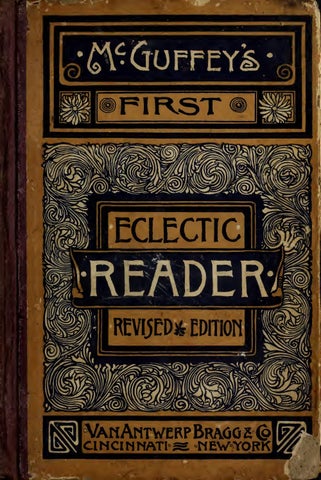
MCGUFFEY’S
FIRST
ECLECTIC READER
^ j
\
REVISED EDITION.
VAN ANTWERP, BRAGG & CO. CINCINNATI AND NEW YORK.
Suggestions to Teachees This First Reader may be used in teaching reading by any of the methods in common use; but it is especially adapted to the Phonic Method, the Word Method, or a combination of the two.
Phonic Method.
I.
— First teach the elementary sounds and
marked with diacriticals, as they then, the formation of words by the combi-
their representatives, the letters
occur in the lessons
;
For instance, teach the pupil to identify the characters a, 6, n, d, g, r, and th, in Lesson I, as the representatives of certain elementary sounds then, teach him to form words by their combination, and to identify them at sight. Use first the words at the head of the lesson, then other words, as, Pursue a similar course in teaching the succeednag, on, and, etc. ing lessons. Having read a few lessons in this manner, begin to teach the names of the letters and the spelling of words, and require the groups, “ a man,” “ the man,” “ a pen,” “ the pen,” to be read as a good reader would pronounce single words. nation of these sounds.
;
II.
When one of the letters in the combinations ou or ow, is
marked
in the words at the head of the reading exercises, the
marked, the two letters represent a diphthong. All other unmarked vowels in the vocabularies, when In slate or blackboard work, in combination, are silent letters. other is silent.
the
silent
III.
letters
If
neither
may be
is
canceled.
Word Method. — Teach the pupil to identify at sight the
words placed at the head of the reading exercises, and to read these exercises without hesitation. Having read a few lessons, begin to teach the names of the letters and the spelling of words.
—
IV. Word Method and Phonic Method Combined. Teach the Having pupil to identify words and read sentences, as above. read a few lessons in this manner, begin to use the Phonic Method, combining it with the Word Method, by first teaching the words in each lesson as words; then, the elementary sounds, the names of the letters, and spelling.
V. Teach the pupil to use script letters in writing, when teaching the names of the letters and the spelling of words. Copyright, 1879, by Van Antwerp, Bragg & Ca (ii)
:
1-0
McGuffey’s Eevised First Reader
In presenting attention
public, 1.
Words
is
invited to the
only two or three
of
Longer and more
lessons.
to
the
are used in the
first
following features letters
difficult
ones
are
gradually intro-
duced as the pupil gains aptness in the mastery of words. 2.
A jmoper gradation has been carefully preserved.
All new
words are placed at the head of each lesson, to be learned before the
lesson is
number
Their
read.
in the early lessons
very small, thus making the first steps easy. vocabularies are used 3.
engraved
Carefully
double purpose. script; 4.
and
The
script exercises
may also serve
All words in these
text immediately following.
the
These should be used as
copies
are introduced
to
for
a
teach the reading of
in slate work.
been designed
and engraved spe-
in which they occur.
Many of these en-
have
illustrations
for the lessons
cially
in
is
gravings will serve admirably as the basis for oral lessons in language. 5.
The type
The
credit
is
large,
strong,
and
distinct.
for
this
revision
is
almost wholly due
—
to
the
many friends of McGuffey’s Readers, eminent teachers and scholars, who have contributed suggestions and criticisms gained from their daily work in the school-room. Cincinnati^ June, 1879.
(iii)
THE ALPHABET.
A
a
1ST
B
b
0
c
D E E G
d
0 P Q
e
E
r
f
S
s
g
T
t
h
JJ
u
T
Y
H
•
I
J
K E
1 •
J
k 1
M m
W X T Z
n 0
P d
W X y z ( 4)
Script Alphabets
Script Figures, -/
S3 d6 J S
<J
0 (V)
1
I
a
ran
the
dog 0
n
d
The
dog.
The dog
g
r
tla
•
ran. (7)
ECLECTIC SERIES.
8
LESSON II.
mat
€at
€
The Is
t
m
i
The
cat
§
The mat.
cat.
the
on
i§
cat
on
the
mat?
is
on
the
mat.
FIRST READER.
LESSON
it
hi§
a
in
9
III.
pen^
hand
lia§
man
\J
h
P
e
A pen.
The man. The man has a Is
the
It
is
pen in
his
in
pen.
his
hand.
hand ?
10
ECLECTIC SERIES.
LESSON
run
IV.
from
X
A fat hen.
can
u
A big rat.
The fat hen is on the box The rat ran from the box. Can the hen run?
>'• •Sic
'
\
FIRST READER.
LESSON
Rab
V.
Ann
hat
catch
e
ch
s
See Rab!
See Ann!
Rab has the hat. Can Ann catch Rab? See
!
see
12
ECLECTIC SERIES.
LESSON VI.
pat
too
00
ow
catch
Rah.
She
has
the
hat.
Now Ann
can
pat
Rah.
sh.0
sll
Ann See
Let
!
can
me
pat
Rah,
now
1
too.
LESSON VII,
Ned
eggs
black
left
fed
n&t
them
^et O
!
FIBST READER,
13
a black ben
Will
the
w
ck
Ned has
fed
the
She She
is
black
has
left
the
nest.
See
the
eggs
in
the
Will the
a
the
eggs ?
hen
nest
hen. hen.
let
nest
Ned
get
ECLECTIC SEBIES.
14
LESSON VIII,
head
he
Nat
come
with
and
o
me
get
Now Ned
has
Let
the
black
hat.
on his head, big man. it
and he is a Come, Nat, see the with his black hat.
big
man
FIRST READER.
LESSON
IX.
15
Review.
pat
catch
has
left
hat
can
black
eggs
Rab
Ann
fed
get
Ned
is
on the box.
in
the
Can
box.
has
A big rat
a pen in his hand. is
He the
dog
cateh the rat?
Come with me. Ann, and see the man with a black hat on his head.
The fat hen has left the nest. Run, Nat, and get
SliATE
WORK.
tlie
eggs.
ECLECTIC SEBIES.
16
LESSON X.
Do you see Nell? Yes; she lias a pan with some eggs in it. Let me have the pan and the
wiU you, Nell? Has the black hen
,
eggs,
left
the
nest ? I will
now run to catch Rab.
Will you run, too?
i
!
FIRST READER,
LESSON
Ben!
XI.
wh
6
O
17
let
me
get
in,
you
wdll
sit
still.
will
you? Yes,
if
Stand get
still,
Jip,
and
let
Ann
in.
Now, Ben, hand me the whip. Get
up,
Jip
ECLECTIC SERIES.
18
LESSON XII.
Kit'ty ni9e
sweet
eage then
ng
u
Kitty has a nice pet.
It
k
g
9
a
y
can
sing a sweet song.
She has just fed it. She will now put it in the cage, and hang the cage up.
Then the
cat
can not catch
it.
FIRST READER.
LESSON
19
XIII.
Look at Tom and liis dog. The dog has a black spot on his back. Do you think he is a good
dog ? Tom has a big top, too. It is on the box with Kitty’s doll.
I
ECLECTIC SERIES.
20
LESSON XIV.
sun
Ave
how
pond
stop
for
go
swim
her
us
hot
duck
e
The fat
The man the black hen and the
sun
has fed
A
o
duck.
Now the the pond.
her nest.
is
up.
•
•
duck will swim in The hen has run to
!
FIRST READER.
21
Let us not stop at the pond
now, for it is hot. See how still it is! We will go to see Tom and his top. LESSON XV.
John
rock
set
jump
fun
must
may
iin'^der
skip
bank
but
touch
0 John
sun has just It is not hot, now. set. Let us run and jump. I think it is tun to run, and skip, and jump. See the duck on the pond Her nest is up on the bank, under the rock. We must not touch the nest, but
!
the
we may look
at
it.
!
ECLECTIC SERIES.
22
LESSON XVI. Review.
The sun has set, and the pond is still.
John,
Ned,
stand
Nell
Ben,
Tom,
the
bank,
on
and and
look at the duck.
The
with a black spot on his back, is with Tom. See Tom has his hat in his hand. He has left his big top on the dog;
box. Kitty’s doll is
has
Nell cage.
on the rock.
put her pet in the
It will
sing a sweet song.
The duck has her
nest'
under
the rock. It
run,
bank.
fun?
is
not hot
and
skip,
Ho you
now.
Let
us
and jump on the not think
it
is
FIBST READER,
23
LESSON XVII.
are
ink
moss
tliis
tub
up set'
••
a
LESSON XVIII.
nut
did
shut
shall
lost
men met
step
in'tp
hunt miid
S1<ATE
WORK.
fox
! f
ECLECTIC SEBIES.
24
LESSON XIX.
Kate
old
no
gr^s
dear
likes
be
drink
milk
eow
out
giveg
.
a
i
O Kate! the old cow is in the pond: see her drink!
Will she
not come ont to get some grass? John,
she
hkes
in the pond.
See
how
he still she
old
cow
gives
No,
to
stands
The
dear
sweet milk to drink.
us
;l
FIRST READER,
25
LESSON XX.
mam ma'
large
a§
pa pa
arm§
ride
far
barn
both
Prince O
trot
your
Papa,
you
let
me
ride
I
will
are
both
on Prince ? in your arms.
you
with sit
will
still
See,
mamma!
We
on Prince. How large he is Get up. Prince! You are not 1
too barn.
fat
to
trot
as
far
as
the
26
ECLECTIC SERIES.
LESSON XXI.
of (ov)
well
wa§
that
Fan'ny pret'ty (prit-)
toss
fall
ball
wall
done
what
• •
• •
•
•
0 Fanny, what a pretty ball! Yes; can you catch it, Ann? Toss it to me, and see. I will not let it fall.
That was well done.
FIRST READER,
Now,
Fanny,
top of the wall,
LESSON
toss if
27
it
you
to
the
can.
XXII.
had
went
call
might
flag
near
swam
swing
us,
mamma?
Did
you
• •
call
!
ECLECTIC SEMIES.
28
I I
went with Tom to the pond. had my doll, and Tom had
his flag.
The
bank, and
think
duck
fat
swam
we fed her.
we might
faU
to
the
Did you uito
the
pond?
We did not go too near, did Tom? May we go to the swing, now.
we,
mamma ? LESSON XXIII.
here
band
hear
horse
play
they
pass
where
front
fine
hope
edme§
A
e
e
Shall Here comes the band we call mamma and Fanny
to see it?
FIRST READER.
Let ns stand the I
still,
29
and hear
men play as they pass. hope
and play
they
will
stop
here
for ns.
See the large man in front of the band, with his big hat. What has he his hand? How fine he looks!
m
Look, too, at the
man on that
fine horse.
If the
go
with they go.
men do not stop, let ns them
and
see
where
30
ECLECTIC SERIES.
LESSON XXIV.
make
eart
wdbd§
lit'tle
ver y
RoRert
gone
draw
Bess
hap'^py
tent
bed
/ V-/
Bess and Robert are very happy; papa and mamma have gone to the woods with them. Robert has a big tent and a
FIRST READER, flag,
and Bess has a
81
little
bed
for her doll.
Jip
make
with them. Robert will h im draw Bess and her
is
doU in the
cart.
LESSON XXV.
“Kate, will you play with me?”
ECLECTIO SERIES.
32
said
James.
“We
the sand with
will
this
little
dig
in
spade.
That wdll he fine sport.” “Not now, James,” said Kate; “for I must make my doll’s bed. Get Mary to play with you.” James went to get Mary to play with him. Then Kate
made the
doU’s bed.
She sang a song to her doll, and the doU lay very stfil in her lap. Did the doU hear Kate sing?
LESSON XXVI.
shade
brook
all
help
stoneg
soft
• •
Kate has left her doll in its Mttle bed, and has gone to play
33
FIRST REARER.
with are
Mary
and
in
the
all
They now, by
James. shade,
the brook.
James digs
in
the
soft
sand
with his spade, and Mary picks up little stones and puts them in her lap. James and Mary are glad to see Kate. She will help them pick up stones and dig, by the little
brook.
ECLECTIC SEBIES.
34
LESSON XXVII. Review.
“What
shall
we
do?”
said
Fanny to John.
“I do not like Shall we hunt for to sit still. eggs in the barn?” “No,” said John; “I hke to play on the grass. Will not papa let us catch Prince, and go to the big woods? “We can put the tent in the cart, and go to some nice spot
where
the
grass
is
soft
and
sweet.”
“That will be fine,” said Fanny. “I will get my doll, and give her a ride with us.” “Yes,” said John, “and we will get mamma to go, too.
She will
hang up a swing for us in the shade.”
FIRST READER.
LESSON
chick
XXVIII.
oh
safe
tiick
can’t
Peep, peep!
36
.
wet
feel§
feet
wing
Where have you
Are you lost? Can’t you get back to the hen? Oh, here you are! I will take
gone, little chick?
A 'ou
little
back.
Here, hen, take this
chick under your wing.
Now,
chick,
tuck
your
little,
ECLECTIC SERIES.
36
wet
feet
under you, and go to
sleep for a while.
Peep, peep! tle
How safe the lit-
chick feels now! LESSON XXIX.
;
This
is
FIRST READER.
37
a fine day.
The sun
shines bright.
wind, I
and
my
There
is
kite
flies
can just see it. The sun shines in
I will
a good high.
my eyes
stand in the shade of this
high fence. Why, here comes my dog! He was under the cart. Did you see
him there?
What
good time we have had! Are you not glad that we did not go to the woods with John? a
SLATE WORK.
yi4/€y^c^i/n/^L^yi^n/ yt'^eyA^u-dey.
ECLECTIC SERIES.
38
LESSON XXX.
wish
float
tie
know
r5pe
boat
try
shore
give
pole
don’t
push
drag
won’t
oar
fun'ny
we had a boat Do n’t you ? ” to put the dolls in. “I know what we can do. We “Kate, I wish
can get the
little
tub,
and tie a
.
FIRST READER.
rope to
\
\
and drag
This will
pond. dolls
it,
in
it,
39
it
to
the
with the can get a
float
and we
push it ft*om the shore.” “What a funny boat, Kate! A tub for a boat, and a pole for an oar! Won’t it upset?” “We can try it, Nell, and see.” “Well, you get the tub, and I will get a pole and a rope. We pole to
put both dolls in the tub, and give them a ride.” will
SliATE
WORK.
i
'rzd/vtd
'Uy'
A'Cur ^ayn^d
40
ECLECTIC SERIES.
LESSON XXXI.
Pon'to
jumped
mouth
a round'
brought
wa'ter
“Here, Ponto! Here, Ponto!” Kate called to her dog. “Come,
j
and get the
J
pond.”
dolls
out
of
the
|
I
FIRST READER.
41
Rose went under, but she did not drown. Bess was still on the top of the water.
Ponto came with a bound, and jumped into the pond. He swam around, and got Bess in his mouth, and brought her to the shore.
Ponto then found Rose, and brought her out, too. Kate said, “Good, old Ponto! Brave, old dog!” What do you think of Ponto?
LESSON XXXII. A •
kind
June
Lu'9j’§
air
tree§
sing'^ing
blue
when
pure
say§ (sez)
sky
pie'nie
u
a
ECLECTIC SERIES.
42
What
a
bright
air
is
pure.
blue
as
it
The as
can
June day! The sky is be.
Lucy and her mamma are in the woods. They have found a nice spot, where there is some grass.
They sit in the shade of the trees, and Lucy is singing.
FIRST READER.
43
The trees are not large, but they make a good shade,
I I
mamma says that
Lucy’s kind
r
they Avill have a picnic her papa can get a tent.
ji
F
when
i r,
LESSON
f
XXXIII. Review.
V
James and Eobert have gone
.
I
I
I
f
'
into the shade of a high wall to
play
ball.'-. .
up from the pond near by, with brave old Ponto, to see them play.
When
they toss the
ball
up
^
to
catch
Ponto runs to get mouth.
it
in his
lost.
They
in
r
it,
^
.
rt
and
try
:
the
Now all
look
air,
the for
ball it
is
under the trees
ECLECTIC SERIES.
44
and in the grass; but they can not see it. Where can it be? See! Ponto has found it. Here he conies mth it. He will lay Lucy’s
it
at
it
in her hand.
little
feet,
or put
LESSON XXXIV.
boy
our
spoil
hur rah'
own
coil
noi§e
fourth
such
join
thank
a bout'
hoist
pay
Julf
play'ing
••
u
“Papa, flag?”
may we hare the big
said James.
“What can my little boy do with such a big flag?” “Hoist it on our tent, papa. We are playing Fourth of July.” “Is that what aU this noise
FTBST READER
about?
is
45
Why not hoist your
own flags?” “Oh! they are too little.” “ You might spoil my flag.” “ Then we will all join to But we will not pay for it. spoil
papa.”
it,
“ Take coil
of
it,
then, and take the
rope with
“Oh! thank the
flag,
you.
boys!”
it.”
Hurrah for
46
ECLECTIC SERIES.
LESSON XXXV. fin'^islied
work
bon'net \
gar'den
seam'^per
saved
I’ve I
away'
white
read'y
les'son
THE WHITE KITTEH.
FIRST READER.
47
LESSON XXXVI.
€are
aFAvayg
line
Frank
row
been (bin)
keeps
home
is
Frank has a pretty
boat.
white, with a black
line
It
near
the Avater.
He keeps it in the pond, near his home. He always takes good care of it.
Frank has been at work in the garden, and will now row a while.
48
ECLECTIC SERIES.
FIBST READER.
49
LESSON XXXVII.
much
one (wun)
yet
hun'^gry
seen
grancKma
corn
would
o
“What
said
Lucy,
came out on the
steps.
is
that?”
\
as
she
“Oh,
is
it
a
a pretty one
it
“I will give it. is.
boat!
little
What
is!” it
to
you when
finished,” said John, kindly.
“Would you like to have it?” “Yes, very much, thank you, John.
Has grandma seen
it?”
“Not yet; we will take it to her by and by. What have you in your pan, Lucy?”
“Some
corn
for
my
hens,
John; they must be very hungry by this time.”
ECLECTIC SERIES,
50
LESSON XXXVIII.
bread
bought
meat tea try'^iiig
tell
which
James has
been
to
market
with his mamma. She has bought some bread, some meat, and some tea, which are in the basket on her arm.
James
mamma
is
trying
what he
the market.
to
tell
his
has
seen
in
FIRST READER,
51
LESSON XXXIX.
read§
so
wearg
pleage
my dear, old grandma in How gray her easy-chair!
See
her
hair is!
She wears glasses when
she reads.
She is always kind, and takes such good care of me that I like to do what she tells me.
ECLECTIC SEBIES.
52
When she says, “Eobert, will you get me a drink?” I run as
fast
as
can to get
I
her.
Then
you,
my hoy.”
she
says,
I
I
for
|
“Thank
I
it
|
Would you not love a dear, good grandma, who is so kind?
And would you
not do
all
you
could to please her?
LESSON XL.
doe§
won'^der
m6tli''er
6th''er
bee
hon'ey
list'en
flow'^er
“Come h.ere. Lucy, and listen What is in this flower?”
“O
mother!
it
is
a
bee.
1
I
wonder how it came to be shut up in the flower ” “It went into the flower for !
i
FIRST READER.
53
some honey, and it may be it went to sleep. Then the flower shut
in.
it
“The bee likes honey as well as
we
to
be shut up in the flower.
do,
“Shall
but
we let
it
it
does not hke out,
Lucy?”
“Yes; then it can go to other flowers, and get honey.”
54
ECLECTIC SERIES.
LESSON XLI.
hitched
thmr
should
or
rid'^inff
live
hold§
hay
driv'ing
tight
ear'ly
best A
O
•
Here come Frank and James Do you know where White. they Mve? Frank is riding a horse, and James is driving one hitched to
!
FIRST READER.
a cart. in the
55
They are out very early How happy they day.
are!
how well Frank rides, and how tight Janies holds the See
lines
The boys should be kind their
horses.
It
is
to
not best to
whip them.
When they have done riding, they will give the horses some
hay or
corn.
1
i
ECLECTIC SEBIES.
66
LESSON
Xtll.
tL ought
Idok^ing
pick'ing
heard
were search
young
1 fi.
loved ]
children
besideg'
A little girl went in of
flowers
was
for
early in
search
her mother.
It
the day, and the
grass was wet.
Sweet little birds were singing all around her. And what do you think she
found
besides
flowers?
A nest
with young birds in it. While she was looking
at
FIEST EEADEE.
bird
heard
she
them,
as
chirp,
mother-
the
she
if
57
said,
“Do
not touch my children, little girl, for
I
The
how
them
love
dearly.”
little
girl
dearly
her
now thought own mother
loved her.
So she picking
left
some
the birds. flowers,
Then,
she went
home, and told her mother what she had seen and heard. LESSON XLIII.
eight
ask
aft’er
town
past
ah
tick'^et
right
half
two
train
ding
• •
light'’ ning
“Mamma, will you go to town?” “What do you ask for a ticket on your train?”
ECLECTIC SERIES.
58
“Oh! we will give you a ticket,
mamma.” “About what time will you get hack?” “At half past eight.” “Ah! that is after bed-time. Is this the fast train?” “ Yes, this is the lightning train.”
“Oh! that is too fast for me.” “What shall we get for you in town, mamma?”
FIRST READER.
59
“A big basket, with two good little
children in
Time is up!
“All right! duig!
it.”
Ding,
” LESSON XLIV.
school
eVen (e'^vn)
three
book
teach'er
noon
rude
readying
poor
It out.
is
noon, and the school is
Do you
see
the
children
ECLECTIC SERIES.
60
at
Some run and jump,
play?
some play
and three little girls play school under a tree. What a big room for such a ball,
small school
|
|
]
'
!
Mary is the teacher.
They all
j i
have books in then* hands, and
Faimy is reading. They are all good
;
•
j
and
girls,
)
would not be rude even m playing school. |
Kate and Mary listen to Fanny as she reads from her book. What do you think she is reading about? It
is
about
a
I
will
poor
who was lost in the
tell
you.
little
boy
\
|
^
woods. J
When Fanny has finished, the three girls will go home. |
In a little while, will give
too,
the boys
up their playing.
I
FIRST READER.
61
LESSON XLV.
ap^’ple
mew
tea§e
erack'er
down
new
siPly
a sleep'
wants
eall§
knew
friendg
flew
Poll
PoPly
Lucy has a new pet. Do you know what kind of bird it is? Lucy calls her Polly. Polly can say, “ Poor Poll
!
Poor
ECLECTIC SERIES.
62
” PoU! Polly wants a cracker and she can mew like a cat. But Polly and the cat are not good friends. One day Polly flew down, and lit upon the cat’s hack when she- was asleep. ;
think
I
she
knew
the
cat
like
that,
and
she
would
not
did
to tease her.
it
When Lucy pets the cat, Polly flies
up
and
will
into
calls her.
a
silly
the old apple-tree,
come when she Then Lucy says, “What not
bird!”
LESSON XLVI. Review.
“Well, children, did you have a nice time in the woods?” “Oh yes, mother, such a good
time
!
See
what sweet flowers
FTRST EEADER.
63
we
foimd,
The
best flowei^
ma.
Won't they please
and what ai’e
soft
moss.
for
g'rand-
her?’’
‘Wes; and it will please grand-
ma to know that yon thought of her."
“Eab was such a good
dog*,
mother.
We left hmi under the big tree by the brook, to take care of the dolls and the basket. ‘•'SMien we came back, they were all safe. Xo one coidd get them while Eab was there.
ECLECTIC SERIES.
64
We gave him some of the crack-
:
ers from, the basket.
“O mother, how the birds did sing in the woods!
“Fanny said she would hke to be a bird, and .have a nest in a But I think she would tree.
want
to
come home
to
sleep.”
“If she were a bird, her nest would be her home. But what would mother do, I wonder, without her httle Fanny?”
LESSON XLVIl.
seat
beach
shelly
thege
wave§
go'ing
ev er
/
sea
watch
e'^ven ing
la'^zy
side
^
•
These boys and girls live near They have been to the the sea.
'
FmST BEADER.
i
beach.
It
is
now
~ and
eyeninff,
f.
\
[
^
s
f
they are going home. John, who sits on the front shells. seat, found some pretty They are in the basket by his side.
He drhdng. holds the lines in one hand, and Ben
TSTdte
is
I
i
i
his
whip in the 1 * 5.
other.
ECLECTIC SERIES.
66
Eobert has hand, and is horses.
hat
in
his
looking
at
the
his
He thinks they are very
lazy; they do not trot fast.
The children are not far from In a little while the sun will set, and it will be bed-time. Have yon ever been at the sea-side? Is it not good sport to watch the big waves, and to play on the wet sand?
home.
LESSON XLVIll.
log
qui et
proud
pulled
ftsh
stump
riv^ er
fa'^ther
One
evening Frank’s father said to him, “Frank, would you like to go with me to catch
some
fish?
FIRST READER.
67
“Yes; can I go? and with you, father?”
“Yes, Frank, with me.”
“Oh, how glad I am!” Here they are, on the bank of a river. Frank has just pulled a fine fish out of the water.
proud he See
How
feels!
what a
nice,
quiet
spot
Frank has have found. the stump of a big tree for his they
ECLECTIC SERIES.
68
seat,
and his father sits on a log
near by.
They like the sport. LESSON XLIX.
rain
out'^side
oft'^en
pit'^ter
say
win'dow
sound
pat'^ter
drops
some'^timeg
Ol
mu'^gio
SI<ATE
WORK.
FIRST READER.
69
y
LESSON L.
sled
throw
win'ter
hurt
ige
eov'er
Hen'ry
next
skate
ground
mer'ry
snow
sis' ter
laugh'ing (laf'ing)
pair
when snow and What fun ice cover the ground. I like winter,
it
is to
throw snow-halls, and to
skate on the ice!
See the hoys and ‘girls!
merry they are! sled, and draws There they go!
How
Henry has his his
little
sister.
70
ECLECTIC SERIES.
I think
Henry is kind, for his
sister is too small to
skate.
Look! Did you see that hoy fall down? But I see he is not hurt, for he is laughing. Some other boys have just come to join in the sport. See them put on then* skates. Henry says, that he hopes his father will get a pair of skates for
his sister next winter.
i
i
I
1
i
\
i
1
4
FIRST READER.
LESSON
paw
po lite'
mean§
i§ n’t
speak
sir
shake
Fi'd5
tricks
teach
71
LI.
din' ner
Erien
bow-wow
sits
Fido He up in a chair, with my hat
on.
He looks like a little boy;
but
it
do look
Ellen,
is
at
!
only Fido.
Now see him shake hands. Give me your paw, Fido. How do you do, sir? dinner with us,
Will you take Speak! Fido?
ECLECTIC SERIES.
72
Fido says, “Bow-wow,” which means, “Thank you, I will.” Isn’t Fido a good dog, Ellen? He is always so polite.
When school is out, I will try teach
to
him some other tricks. LESSON
Lll.
stole
hid
Hat' tie siif'fer
sor ry
some'thing
eaught
“0 Hattie!
tried
Ne'ro
I just saw a large
FIRST READER.
rat
in the shed ;
tried to catch
73
and old Nero
it.”
“Did he catch it, Frank?” “No, Nero did not; but the old cat did.”
“My cat?” “No,
it
was the other one.”
“Do teU me how she Frank.
Did she run
got
after
it,
it?”
“No, that was not the way. Puss was hid on a big box.
The rat stole out, and she jumped at it and caught it.” “Poor rat! It must have been very hungry; it came out to get something to eat.”
“Why, Hattie, you are not sorry puss got the rat, are you?”
“No, I can not say I am sorry she got it; but I do not like to see even a rat suffer pain.”
ECLECTIC SERIES.
74
LESSON Llll. r5ll
build
grand'pa
hard
foam
ships
hou§'e§
long
sail
break
wobd'en
blow
Mary and Lucy have come down to the beach with their They live in a town grandpa. near the
sea.
Their grandpa likes to sit on the large rock, and watch the big ships as they sail far away
on the blue sits
there
The
sea.
all
little
Sometimes he
day long.
girls like to dig
in
up pretty shells. They watch the waves as they roll up on the beach, and break into white foam. They sometimes make little the
sand,
and
pick
FIB ST BEADEB.
/D
houses of saud. and l»iiild ’^alls aroimd them and thev disr vrells Tvith their small Tvooden spades. They hare been pi eking up :
shells for their httle sister. is
too
vouncr •
<
to
come
She
to
the
hke
to
beach. I‘
Ijlay
think
all
by the
chilch’en
sea-side
'uhen the
sim is liright, and the 's^ind does not blow too hard.
ECLECTIC SERIES.
76
LESSON
LIV.
asked
want'^ed
four
Wilkie’s
night
rab'bits
• •
ear ried §ents
telking
fifty
mas'^ter
One day, Willie’s father saw a boy at the market with four litwhite rabbits in a basket. He thought these would be
tle
nice pets for Willie ; so he asked
the
lad
for
his
how much he wanted rabbits.
The boy said, “ Only fifty cents, sir.
FIRST READFR.
77
bought and carried them home. father
Willie’s
them,
Here you see the rabbits and their
little
master.
He
has
a
pen for them, and always shuts them in it at night to keep them safe.
He gives them bread and grass to eat.
They like grass, and will
take
from his hand.
called
it
in
a
little
friend
He has to
see
them.
Wilhe is telling their funny ways. SI.ATE
him
about
WORK.
'.'tzd/
/
/
78
ECLECTIC SERIES.
LESSON LV.
bush •
find
cun'^nino;
O
plage
shoAV
bro'^ken
o'ver
brinff O
again' (a gen')
fast'en (fas'n)
“Come here, Eose. Look down into this bush.”
“O Willie! a bird’s nest! What
FIRST READER.
cunning,
eggs
little
!
79
May we
and show it to mother?” “What would the old bird do, Kose, if she should come back and not find her nest?” “Oh, we would bring it right
take
it,
back, Willie!”
“Yes; but we could not fasten it
in
its
place
again.
If
the
wind should blow it over, the eggs would get broken.”
LESSON
LVI.
strong
round
dry
bill
worked
send§
elawg
flit
God
spring
“How does the bird make the nest so strong, Willie?”
“The mother-bird has her bill and her claws to work with, but
ECLECTIC SEBIES.
80
she
would
make
the nest
teach her. is
not
know how to if God did not
j
Do you see what it
made of?” “Yes, Willie, I see some horse-
and some dry grass. The old bird must have worked hard to find all the hairs, and make them into such a pretty, round hairs
nest.”
“ Shall we take the nest, Eose ? ”
“Oh no, Willie! take
it;
look at
hut it
we
again,
We must not come and
will
some
i
s
time.”
i
FIRST READER.
LESSON
81
LVIl.
feath'er§
ago^
fly
worm
eriimb
feed'ing
ug'ly
off*
feed
brow'n
“Willie,
when
I
birds
just
now,
the
was feeding a
little
brown bird flew away with a crumb in its bill.” 1, 6.
ECLECTIC SERIES.
82
“Where
did
it
go,
Rose?”
“I don’t know; away off, somewhere.” “I can gness where, Rose. Don’t you know the nest we saw some days ago? What do you think is in it now?” “O WiUie, I know! Some httle brown birds. Let us go and see them.” “All right; but we must not go too near. There I just saw !
the old bird fly out of the bush.
Stand here. Rose. Can you see ? ” “Why, WiUie, what ugly Uttle things! What big mouths they have, and no feathers!”
“Keep stUl, Rose.
Here comes
the old bird with a worm in her bUl.
How hard she must work
to feed
them aU!”
FIBST EEADEE,
LESSON
83
LVIll.
falKinff O
€0 lints
woe§
nigh
be gtii/
griefs
starg
tear
m6rn''ing
Lord
each
joy§
••
ECLECTIC SERIES.
«4
LESSON
LIX.
note
filled
dead
sick
walk
eV" er y
blew
lane
lame
tak'^ing
cane
took
when Mary was taking a walk down the lane, tryOne
ing
to
day,
sing
her doll to
sleep,
FIBST HEADER.
she met Frank,
85
his
basket
and cane. Frank was a j^oor, httle, lame His father and mother boT. were dead. His dear, old sTandma took care of lihn, and tried €
J
to
c_;
make him happy.
Every dav, Marv’s mother filled Frank\s basket with bread and meat, and a httle tea for his granchna.
“How do von do. Frank?’’ said Marv. “Don’t make a noise; mv C
^
doU is going to sleej).
V
It is just
a httle sick to-dav.”
“Weh, to sleep.”
then, let ns whistle
it
And Frank, taking a
villow whistle out of his pocket,
blew a long note. “Oh, how sweet!” cried Marv.
“Do let me try.”
ECLECTIC SEBIES.
86
SON
LX.
turned
fa§e
cried
low
al'mest
soon
more
ery
onge (wiins)
be eau§e'
“Yes, Mary, I will give you, because
it
to
you are so good
to
my grandma.” “Oh! thank you very much.” Mary blew and blew a long time. “I can’t make it whistle,” said she, almost ready to cry. “Sometimes they will whistle, and sometimes they won’t,” said Frank. “Try again, Mary.” She tried once more, and the whistle made a low, sweet sound. “It whistles!” she cried. In her joy, she had turned the doll’s face down, and its eyes
FIRST READER.
shut tight, as
if
it
87
had gone to
sleep.
‘•There!” cried Frank, “I told
you the T^ay to put a
doll
to
sleep, is to v\*histle to it.”
‘•So little
it is,”
thing;
said Mary. it
must he
“Dear, i)ut
in
bed now.” So they went into the house. Frank’s basket Avas soon filled, and he Avent home happy. its
%
88
ECLECTIC SERIES.
LESSON
LXI.
stood
him self'
flap'ping
first
twelve
flapped
walked
flap
obey'
bet' ter
Chip'py
food
stone
be fore'
chick'eng
kept
• •
There was once a big, white hen that had twelve little chickThey were very small, and ens.
FIB ST READEB.
the old hen took
89
good care of
them. She found food for them in the day-time, and at night kept them under her wings.
One
this
day,
chickens
her
old
down
hen
took
a
small
to
She thought the air from the water would do them brook. good.
When they got to the brook, they walked on the bank a tle
while.
It
lit-
was very pretty
on the other side of the brook, and the old hen thought she would take her children over there.
There was a large stone in the brook she thought it would :
be that
easy for them stone,
other side.
to
and from
jump
to
to
the
it
ECLECTIC SERIES.
90
So she jumped to the stone, and told the children to come after her. For the first time, she found that they would not obey her. She flapped her wings, and cried,
“Come
here,
all
of
you!
Jump upon this stone, as I did.
We can then jump to the other side.
“O
Come, now!” mother! we
we
can’t, little
said
all
we the
chickens.
“Yes said
can’t!”
can’t,
the
you old
can,
hen.
if
you
try,”
“Just
flap
your wings, as I did, and you can jump over.” “I am flapping my wings,” said Chippy, who stood hy himself; “hut I can’t jump any better
than I could before.”
FIRST READER.
LESSON
chirped nev'^er slow''ly
re''al ly
brood
be gai/
91
LXII.
in deed''
rlirl
“I never saw such children,” said
the
try at
old
“You
hen.
don’t
all.”
“We can’t jump so far, mother.
Indeed we can’t,
chirped the
little
we can’t!”
chickens.
“Well,” said the
old
hen, “I
So she jumped back to the bank, and walked slowly home with her brood.
must give it up.”
ECLECTIC SERIES.
92
“I
mother asked too much of us,” said one little chicken to the others. think
“Well, I tried,” said Chippy. “We didn’t,” said the others; “it
was
of
no use
to try.”
When they got home, the old hen began to something to found,
near
look
about
for
She soon back door, a
eat.
the
piece of bread.
So she called the chickens, and they all ran up to her, each one trying to get a bite at the piece
of bread.
“No, no!” said the old hen. “This bread is for Chippy. He is the only one of my children that really tried to stone.”
jump to the
FIBST READER.
93
LESSON LXIII.
last
slates
write
waste
neat
tak'en
elean
learn
read'^er
par''ents
see'end
We have come to the last lesson in this book. Wo have finished the First Reader.
ECLECTIC SERIES.
94
You can now read all the lessons in
it,
and can write them
on your slates.
Have you 'taken good
care of
your book? Children should always keep their books neat and clean.
Are you not glad to be ready for a new book? Your parents are very kind to send you to school. If you are good, and if you try to learn, your teacher will love you, and you will please your parents. Be kind to all, and do not waste your time in school. When you go home, you may ask your parents to get you a Second Reader.
FIRST READER.
95
PHONIC CHART. LONG VOCALS. a, A
a,
a, a, a,
as in ate. u care. u U
u
e,
as in eve.
e,
arm.
b
Jast.
0,
all. ••
ib
'
bo,
u u u
u
err. ige.
ode. use.
as in fool.
SHORT VOCALS. a, e,
b
as in am. u end. u in.
as in odd. u up. u look do. 0,
DIPHTHONGS. oi,
oy, as in
oil,
boy. on, ow, as in out, now. |
ASPIRATES. as in fife. u h, him.
f,
k,
ii
u P. s,
u
as in tat. u she. sh. t,
kite.
ch.
pipe.
th.
same.
wh,
u
chat.
u
thick.
u
why.
,
'
FIBST READER,
96
SUBVOCALS. as in bib. , a did.
b, d,
u
u
jdg.
u
nine.
ng,
u
hang. 1,
rare.
u
w,
,
u
as in
/
we. yet.
y.
.
^
azure.
u
r,
-
^
zine.
u
z,
^
this.
u
z,
.
maim.
in,
u
th,
gig-^
8^
n,
V, as in valve.
^
lull.
SUBSTITUTES. a, A
e,
for 6, as in what. A u u there. a, u u feint. •
y, for 1 , as in
U U
a,
h h d,
u u
u u u
9i A
0,
d,
a u u
A
u u
u y.
d, e, w
do,
do. a. •• e,
do. e,
do.
b
u u
u u u
U
police. sir.
eh. U
son.
gr
U
to.
U
wolf.
u u
fork.
s,
U
U
work. gh,
u
burn.
ph, U
u
rude.
qu, U U qu,
u
fly-
sh. k,
ng, z,
sh, gz,
U
full. •
• •
s,
U
•
u
k,
f,
u u u it
can. gite.
ghai§e
chaos.
u
gem.
u
ink.
u
a§.
u
sure.
u
e^aet.
u
laugh.
u
phlox.
u
pique.
f,
k,
myth.
kw. u
quit.
r
c
^
VN
’)
k 6
\
>
i
V 'f
r<T
,