Proposed Schools (Residential Outdoor Education) (Scotland) Bill
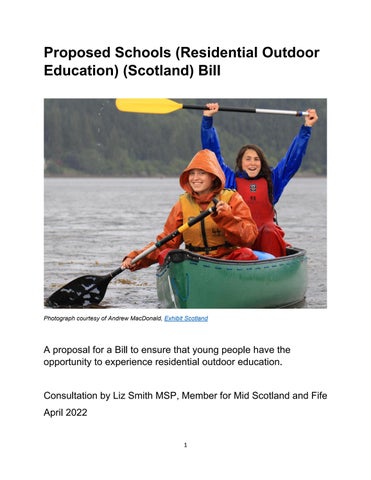
Photograph courtesy of Andrew MacDonald, Exhibit Scotland
A proposal for a Bill to ensure that young people have the opportunity to experience residential outdoor education.
Consultation by Liz Smith MSP, Member for Mid Scotland and Fife April 2022
1
Contents
Page 3
Foreword by Liz Smith MSP
Page 4
How the consultation process works
Page 5
Aims of the proposed Bill
Page 5
Background
Page 7
Definitions
Page 8
A model of outdoor and residential education
Page 10
Typical residential programmes
Page 11
An example of residential outdoor education provision
Page 12
International perspective
Page 13
Why an entitlement to residential outdoor education is important
Page 17
Details and implications of the proposed Bill
Page 22
Financial implications and funding
Page 23
Sustainability
Page 24
Equalities
Page 25
Questions
Page 32
How to respond to this consultation
Page 35
Annex
2
Foreword Outdoor education is one of the most valuable and rewarding learning experiences that any young person can have throughout their whole school career. In particular, residential outdoor education, when young people can be away for a week in an environment very far removed from their own, can be life-changing. In bringing forward this draft proposal for a Bill to Parliament I want to ensure that the outdoor education opportunities I was fortunate enough to enjoy will still be there for generations to come. I would argue that adventurous new experiences in the outdoors develop young people with a lifelong connection and concern for the natural environment, self-esteem, selfreliance, confidence, resilience and an understanding of how to deal with new challenges and manage risk. It also helps young people to know what it means to be part of a team, to learn leadership skills and the importance of valuing friendship. The evidence about these benefits of residential outdoor education is both widespread and compelling, and, in the age of COVID-19, when there is growing national concern about young people’s health and lifestyles and the fact that many children from some of the more deprived areas do not get the same opportunities as their counterparts elsewhere, residential outdoor education should be a key part of the curriculum. There is also the understandable concern that some local authorities are currently feeling the need to cut back on this kind of activity because of the stringent financial circumstances they face – in other words, they are finding it more difficult to meet the spirit of the Education (Scotland) Act 1980, which under section 1(3), imposes a duty to secure the provision of adequate facilities for social, cultural and recreative activities and for physical education and training, which can include under section 6, establishing and maintaining outdoor centres and organising expeditions. These days, we are all too accustomed to debating the progress of education in numbers of teachers, the number of SQA passes, the percentage increase in literacy and numeracy skills, class sizes when, more often, we should be turning our attention to the qualitative aspects of education – aspects that can’t be reduced to numbers but which I would argue, are intrinsic to what can be defined as good quality education. That is why my proposed Member’s Bill is important and why this formal consultation is a key part of the process. I look forward to receiving your replies.
Liz Smith MSP 3
How the Consultation Process works This consultation relates to a draft proposal I have lodged as the first stage in the process of introducing a Member’s Bill in the Scottish Parliament. The process is governed by Chapter 9, Rule 9.14, of the Parliament’s Standing Orders which can be found on the Parliament’s website at: Standing Orders | Scottish Parliament Website At the end of the consultation period, all the responses will be analysed. I then expect to lodge a final proposal in the Parliament along with a summary of those responses. If that final proposal secures the support of at least 18 other MSPs from at least half of the political parties or groups represented in the Parliamentary Bureau, and the Scottish Government does not indicate that it intends to legislate in the area in question, I will then have the right to introduce a Member’s Bill. A number of months may be required to finalise the Bill and related documentation. Once introduced, a Member’s Bill follows a 3-stage scrutiny process, during which it may be amended or rejected outright. If it is passed at the end of the process, it becomes an Act. At this stage, therefore, there is no Bill, only a draft proposal for the legislation. The purpose of this consultation is to provide a range of views on the subject matter of the proposed Bill, highlighting potential problems, suggesting improvements, and generally refining and developing the policy. Consultation, when well done, can play an important part in ensuring that legislation is fit for purpose. The consultation process is being supported by the Scottish Parliament’s NonGovernment Bills Unit (NGBU) and will therefore comply with the Unit’s good practice criteria. NGBU will also analyse and provide an impartial summary of the responses received. Details on how to respond to this consultation are provided at the end of the document. Additional copies of this paper can be requested by contacting me at Liz Smith MSP, The Scottish Parliament, Edinburgh, EH99 1SP; Telephone: 0131 348 6762; elizabeth.smith.msp@parliament.scot British Sign Language (BSL) and Gaelic versions of this document have also been produced and can be accessed at: www.schoolsresidentialbill.org Enquiries about obtaining the consultation document in any language other than English or in further alternative formats should also be sent to me. An online copy is available on the Scottish Parliament’s website (www.parliament.scot) at Proposals for Bills – Scottish Parliament | Scottish Parliament Website
4
Aims of the Proposed Bill The aim of the proposed Bill is to provide a statutory obligation to ensure that young people aged 12 - 16 in local authority-run and grant aided schools in Scotland are provided with the opportunity to experience residential outdoor education. The proposed Bill would seek to make it a statutory obligation for funding to be provided and ensure the opportunity for at least one week (four nights and five days) of residential outdoor education for young people at some stage in their school career. The intention is that the obligation to ensure that residential outdoor education is provided would fall on those who are responsible for arranging the provision, e.g. education authority and managers of grant-aided schools. (The centres to be used would vary depending on circumstances e.g. local authority centres, those owned by the private sector or other bodies.)
Background Residential outdoor education provision in Scotland, as we see it today, has a long and complex history. Political and social change in the early part of the 20th century gave large parts of the population the means and freedom to access the countryside. Getting out into the “fresh air” was encouraged by government and the pursuit of leisure in the great outdoors was popular. At the same time new charitable organisations aimed at the young were established to promote the outdoors, adventure, expeditions and camping; the Youth Hostel Association (1930), Outward Bound (1941), the Duke of Edinburgh Award (1956), the Scouts (1908) and Guides (1910) In Scotland from the 1960s onwards, influenced by the Education Scotland Acts of 1945 and 1980, local authorities established numerous outdoor education centres. Some of these were permanent, others were not. The range of provision and geographical distribution was wide. These were the golden years of residential outdoor education in Scotland.1 This expansion peaked in the 1980s (see Figure 1.) with around 70 local authority-owned residential outdoor education centres and 126 in total, if we include third- and private sector centres 2. However, the 1980s and 1990s brought a changing political and fiscal landscape, one that altered the trajectory of residential outdoor centres until the present day.
1
Cheesmond, J (1979) A research report of the outdoor education programmes: Lothian region and Dunfermline College of Education 2 Davis, R (2018) Residential Outdoor Education in Scotland: change over time and the impacts of socioeconomic deprivation on access’ (updated data 2020, Thompson P.)
5
Fig 1. A key event was the local government reorganisation of 1996 and the subsequent formation of 32 local authorities or councils from the larger regional authorities. The smaller councils, with reduced budgets, subsequently closed around thirty percent of outdoor centres in local authority control.3 This set a trend for the coming decades. The outlook for residential outdoor education centres has changed little since the 1990s, the central narrative being one of steady decline. The current, post-pandemic, situation could best be described as fragile. In Scotland, we now have a total of 51 residential outdoor centres (see Figure 2.) of all kinds; local authority, third sector and private.2
3
Nichol R, (1999) ‘A Scottish Decline- A survey of Scottish Outdoor Centres’ Horizons no. 6
6
Fig 2.
Definitions A generic, all encompassing, definition of residential outdoor education is not readily available or agreed. The meaning differs from group to group; students, outdoor professionals, academics, teachers and the public all understand it to mean different things. Often the meaning is linked to the purpose of the visit or expedition or field trip and is described as such. In many cases, though mostly with school groups, an effective description of the aims or purpose is given, increasing resilience, developing confidence, etc. As this proposed bill relates to young people, most of whom will be in full-time education, as a starting point for the purpose of this consultation, the definition given by Education Scotland will be used: “…residential experiences refer to educational visits where outdoor learning is the main focus of the experience and which include one or more overnight stays. Residential experiences include using outdoor centres or youth hostels, camping, bivouacking, snow-holing or sailing boats. This contrasts with residential 7
experiences which have a different focus, such as a school orchestra exchange in Europe.” 4 Additionally, Education Scotland defines Outdoor Learning as: “Outdoor learning encompasses the entire range of learning experiences undertaken outside…”5 Another, more pragmatic definition is from recent consultation work by the Institute of Outdoor Learning, which is a UK-wide organisation that represents outdoor professionals: “Outdoor learning is an umbrella term for actively inclusive facilitated approaches that predominately use activities and experiences in the outdoors which lead to learning, increased health and wellbeing, and environmental awareness” 6 The term “provider” when used in the outdoor industry is taken to mean: “A person, organisation or business responsible for the delivery of a service or activity to a group of young people.”7 These definitions change over time and may well change in the future; they are not exact, and a more precise definition for the context of the proposed bill may be clarified as the consultation process progresses.
A model of residential outdoor education in Scotland Figure 3. below has been adapted from the commonly used model of outdoor education developed by Professor Pete Higgins at the University of Edinburgh.8 This new model represents the current residential outdoor education sector in Scotland, where the focus is mainly school groups, by including elements of the Curriculum for Excellence, Learning for Sustainability and quality assurance:
4
Education Scotland the curriculum for excellence through outdoor learning (2010). Outdoor learning: Practical guidance, ideas and support for teachers and practitioners in Scotland (Education Scotland, 2009). 6 Anderson N, Harvey D, Crosbie J (2021) Professional matters describing outdoor learning. 7 Going Out There, Scottish framework for safe practice in Off-site visits, V 3.0 (2021) 8 Higgins, P (1995), Outdoor education provision at Moray House Institute of Education, Scottish Journal of Physical Education, 23(3), 4–11. 5
8
Fig 3. Adapted from Higgins, P. (1995)9 , by Harvey, M. (2021) To what extent individual outdoor centres include some, or all of the above model, and what quality assurance takes place in relation to this, varies enormously. Although all centres that provide licensable activities for young people will be familiar with external inspection regimes, few will have been audited regularly in relation to educational provision. However, the quality of educational provision is important (see section below).
9
Higgins, P (1995), Outdoor education provision at Moray House Institute of Education, Scottish Journal of Physical Education, 23(3), 4–11.
9
Typical residential programmes
Fig 4. The Field Study Council centre at Millport on Cumbrae, five-day school programme (Reproduced with Permission: T Foster, FSC, 2021) (More information about the programmes and activities offered is available on The Field Study Council’s website.)
10
Fig 5. Outward Bound Trust, Scotland, 5-day school programme (Reproduced with Permission: M Davidson, OBT, 2021) (More information about the Outward Bound Trust’s 5-day school programme is available on their website.)
An example of residential outdoor education provision An excellent example of progressive residential outdoor education is one undertaken by Calderglen High School in East Kilbride as part of the Learning Away initiative, “Brilliant Residentials”. During this, the school, with cluster primaries and a nearby special school, worked on an agreed programme with residential centres, focusing on the skills and abilities of the students in a more intensive manner than the planned curriculum allowed. Four programme areas were agreed for the residentials: 1. 2. 3. 4.
Subject specific residentials Leadership opportunities Transitions to support primary to secondary transition Residentials to support the study skills of students in S2 11
The programme became established in the school and, after five years of development, it included transitions from P7 to S1, supported by the residential outdoor centres and partners, pupils from S3 and above being offered Duke of Edinburgh Award expeditions, voyages with the Ocean Youth Trust, John Muir Awards and subject-specific revision classes. The Learning Away summary of this study quotes the then Head Teacher, Tony McDaid, on how this project affected the pupils, staff and school: “...this programme has not only affected students and staff, it has also integrated with and impacted on the ethos of the school. Its partners and the wider community. Brilliant residentials have played a significant part in raising attainment and aspiration, encouraging cohesion within and beyond the school, and transforming teaching and learning in and outside the classroom.” 10
International Perspective The reach of residential outdoor education is world-wide. The following examples are from countries where the entitlement to outdoor residential education has a statutory basis. However, cultural variation, differing meanings and traditions can lead to misunderstanding between countries in the transfer of programmes or ideas or practices.11 Therefore, a cautious approach should be adopted when considering the following examples, which offer residential outdoor education as part of the curriculum to all young people. Singapore In Singapore, the approach to residential outdoor education is well-planned, comprehensive and outcome-based. Since 2014, outdoor education has been a compulsory part of the curriculum in both primary and secondary schools. Children attend three different camps, one in upper primary, one in secondary and a five-day Outward Bound Singapore (OBS) expedition camp, which was introduced in 2020. This last camp mixes students from different schools around Singapore.
All secondary 3 students (14+) complete the five-day challenge programme, which targets resilience, leadership, teamwork and citizenship as the agreed outcomes. If higher education students are included, then 45,000 students will participate each year. 10
https://learningaway.org.uk/case-studies/how-residentials-are-changing-our-school/.
11
Waite S. 2020 Where Are We Going? International Views on Purposes, Practices and Barriers in School-Based Outdoor Learning.
12
After completion of the programme, students can take part in further leadership and community service awards.12 Slovenia After Slovenia gained independence in 1991 from the former Yugoslavia, a special government department repurposed disused military bases into “outdoor schools” around the country. A government organisation, CŠOD (Centre for Schools and Outdoor Education), is responsible for the “outdoor school” infrastructure, staffing and programmes. The provision at the “outdoor schools” while initially sports-based, is now linked to the curriculum. All programmes involve “experience-based learning” in nature to “facilitate the education process and promote sustainable development…” 13 The funding to visit and take part in the outdoor education programme is from the national education budget, since it forms part of the curriculum. However, subsequent visits, must be funded by the parents (transport and accommodation) at a nominal cost. This cost, for a five-day residential, is approximately £60 and for those, whose parents cannot afford this, a “general fund” covers the cost. The courses on offer are diverse in choice, well-liked and managed through a central booking system. Each year around 45,000 students attend five-day courses and 32,000 visit on a day basis.
Why an entitlement to Residential Outdoor Education is important In recent years an impressive and growing body of academic literature has emerged that supports getting young people outdoors as a means of improving a wide range of educational, social and health and well-being outcomes14. The message could hardly be clearer: “Hundreds of studies now bear on this question, and converging evidence strongly suggests that experiences of nature boost academic learning, personal development, and environmental stewardship…a thorough review reveals an evidence base stronger, deeper, and broader than this first impression might suggest: weak research designs are supplemented with strong ones; striking findings are replicated in multiple contexts; the research on nature and learning now includes evidence of mechanisms; and findings from entirely outside the study of nature and learning point to the same conclusions.”11
12
(Ng Thian Choon, PowerPoint, 2020, OAE Masterplan, a vision for youth development). Dimec D., Kokalj I., The development and role of outdoor education in the Slovenian Education System. The changing world of outdoor learning in Europe, 2020, Routledge. 14 Kuo M., Barnes M. & Jordan C. (2019). Do experiences with nature promote learning? Converging evidence of a cause-and-effect relationship. Frontiers in Psychology. 13
13
These statements are based on a current review of evidence from a wide range of academic sources. The summary diagram from the above paper is a useful and succinct guide to current research findings:
Fig 6. Nature-based learning: exposures, probable mechanisms, and outcomes (* Relationships with a cause-and effect evidence are indicated with an asterisk) A detailed and comprehensive literature review on Learning for Sustainability (this includes outdoor learning) was completed by Dr Beth Christie and Professor Pete Higgins for the Scottish Government15. These findings can be further complemented with evidence specifically from the residential outdoor education sector. The Paul Hamlyn Foundation16, as part of the “Learning Away” initiative, conducted research into residential outdoor experiences with 60 schools and involving thousands of children from across the UK. The results showed major improvements, in a wide variety of metrics:
15
Christie, B & Higgins P. (2020). Educational outcomes of Learning for Sustainability: A Brief Review of Literature. Scottish Government 16
Learning Away Final Evaluation Report, York Consulting 2015
14
•
Relationships: Relationships between pupils and between pupils and accompanying staff (Post-residential, more than 80% of secondary students felt the residential had helped their relationship with peers and teachers and 71% of secondary students felt the teachers better understood, after the residential, how they best liked to learn).
•
Increased pupil confidence: 87% of secondary pupils post-residential felt more confident to try new things after the residential experience.
•
Improved resilience: Post-residential, 75% of staff reported students were already achieving aims in resilience and well-being.
•
Increased engagement (particularly in secondary pupils): Both staff and students identified impacts on students’ behaviour and attendance. It was noted during the study “that the residential experience had helped re-engage those students in danger of exclusion”. . Improved transition: Both primary and secondary pupils showed increased confidence in making new friends and trying new things after residentials. This increase was greatest in secondary school students (85% happier at working with someone who was not a close friend; 64% were happier about changing class, after the residential, something they were least positive about prior to the residential).
•
Further details of the “Brilliant residentials” initiative can be found here.17 The outcomes above are striking and clearly contribute to personal development, health and well-being and attainment. Considering the recent report by Audit Scotland18 in 2021 this is welcome news: “The poverty-related attainment gap remains wide and inequalities have been exacerbated by Covid-19. Progress on closing the gap has been limited and falls short of the Scottish Government’s aims. Improvement needs to happen more quickly and there needs to be greater consistency across the country. The government and councils recognise that addressing inequalities must be at the 17
https://learningaway.org.uk/the-campaign/what-makes-a-brilliant-residential/
18
Audit Scotland, 2021, Report: Improving outcomes for young people through school education
15
heart of the response to Covid-19, longer-term recovery and improving education.” In a wider European context, the OECD PISA19 report compares the well-being of the 15-year-olds in the UK with 23 other European countries. The results paint a concerning picture of young people’s well-being. In the UK the young people in question were least satisfied with their lives, rank the lowest in sense of purpose and had the second highest levels of sadness. This is before the impact of pandemic are included - the school closures, restrictions on seeing friends and family, increasing screen-time and reduced physical activity and is further exacerbated in view of its harsher effect on young people from poorer backgrounds, being more likely to have low levels of wellbeing and experience poor mental health20 A decade of debate and little has changed in the health of our young people - the attainment gap is proving stubborn and difficult to close, the pace of change is frustratingly slow and governmental reforms have had limited success. What can be done? I agree with the ambitious words of the COVID-19 Education Recovery Group: “All were keen to turn the narrative from the negative ‘lost learning’ towards positivity and aspiration. This includes not necessarily talking about ‘catching up’ or focusing on classroom-based learning, but focusing more on what young people feel they need to support their well-being and reconnect with peers and with education in general” .21 Over the last two years outdoor learning has become routine in schools- a threshold has been crossed. Now is the time to extend this to residential experiences and leverage its unique power to engage young people with the school community and learning. This will give young people authentic real-world experiences, where the academic pressure is off, and they have the space to thrive in the amazing natural environment that is Scotland. In Scottish schools, stewardship of the natural environment is fostered through Learning for Sustainability. It’s importance in Scotland’s future success and relevance to our discussion can be found in the words of Dr Beth Christie and Professor Pete Higgins, University of Edinburgh: ‘What persists as unique within Scottish education is our commitment to outdoor learning as a core and central part of teaching and learning, and more recently as a facet of Learning for Sustainability. This commitment to learning beyond the classroom – within local communities, urban and wild spaces…, offers young people the opportunity to see and experience the processes that sustain life at first-hand; not only to hear, learn and talk about democracy and change, but to step outside into the places 19
OECD (2019). PISA 2018 Insights and Interpretations. Inchley, J.et al. Health behaviour in school-aged children (HBSC) 2018 Survey in Scotland: National Report. 21 Scottish Government. (2021). COVID-19 Education Recovery Group minutes: 18 March 20
16
in which they live as active citizens and critically engage in issues that they and their families experience… many other aspects of the curriculum can be woven into short, day-long or residential experiences. Such essential experiences afford huge potential for interdisciplinary learning; enriching and cultivating skills for life and work that impact far beyond formal educational settings’ 22 I agree with the central narrative of these words, the “Learner Journey”, an educational progression that each child in Scotland undertakes from early years, through mainstream schooling and into the world of work. What we propose, is that by linking the learner journey into a coherent, relevant and progressive residential experience, the accumulated skills and knowledge of that journey can start to make sense, becoming educationally, socially, sustainably and economically productive.
Details and Implications of the proposed bill Proposed Change The proposed bill will put in place a statutory obligation to provide young people aged 12 – 16 in Scotland with a residential outdoor experience. It is proposed that only young people attending schools under the management of an education authority (local council) and grant aided schools, which receive funding from the Scottish Government, will have access to this entitlement. The intention is that the obligation to ensure that residential outdoor education is provided would fall on those who are responsible for arranging the provision, e.g. education authority and managers of grant-aided schools. (The centres to be used would vary depending on circumstances e.g. local authority centres, those owned by the private sector or other bodies.) Number of young people affected by the proposed bill and the duration of the residential experience Around 58,00023 young people in Scotland will attend or take part in a residential experience at least once during their schooling under this proposed change. A five-day minimum is the proposed duration of the residential experience.
22 23
See footnote 13 https://www.gov.scot/publications/summary-statistics-schools-scotland-2020/
17
Residential sector capacity The current Scotland-wide capacity to cope with the proposed legislation has been confirmed through consultation with representatives from the residential outdoor sector. Providers from the sector are confident that sufficient capacity exists to meet any demand arising from the proposed bill. Since the 1980’s many smaller and local authority centres have closed resulting in fewer but larger centres. Consequently, the bed capacity available across Scotland has remained relatively high: current bedspace capacity is approximately 4,35124. Table 1. The number of residential centres in Scotland 1982-2022 Year 1982 2018 2022
Charity
Company
Local Authority
Total
21 17
72 11 9
126 64 51
54 32 25
Table 2. The number of bed spaces in outdoor centres in Scotland 1982-2022 Year 1982 2018 2022
Charity
Company
Local Authority
Total
1679 1608
2063 725 540
5718 5086 4351
3655 2682 2203
Proposed quality improvement framework for educational provision at residential centres I am interested in what can be done, including through the proposed Bill, to seek to ensure that the education provision of outdoor education residential experiences forms part of a quality assurance framework. A suggested option, which may not need to be statutory, is that the provision is considered by HMIE (Her Majesty’s Inspectorate of Education) as part of their inspections of schools which take place under the Education (Scotland) Act), for example by inclusion in the relevant quality framework. This would aim to ensure that the education provision of outdoor residential courses that schools are providing to students meet certain approved standards – it would not involve inspection of outdoor centres. Currently, HMIE audits a wide range of educational provision: early years, schools, colleges, community learning and development, prison education and educational
24
Davies, R. (2018) Residential Outdoor Education in Scotland: change over time and the impacts of socio-economic deprivation on access. University of Stirling (updated data 2020, Thompson P.)
18
authorities. These audits are collaborative endeavours, involve a wide range of partner agencies and are managed through agreed inspection frameworks. A similar approach is suggested for outdoor residential provision to schools. Education Scotland, HMIE and the outdoor sector could collaborate and agree how residential outdoor education provision be incorporated into a quality framework with related quality indicators. This could be complemented by a “self-evaluation” framework and “collaborative audits” which might initially be conducted in which outdoor professionals work alongside HMIE inspectors. This proven and tested approach, familiar to education professionals, would increase audit capacity, spread good practice, improve the credibility of the inspections, increase the sector knowledge and give HMIE inspectors a better understanding of residential outdoor education in Scotland. Separate to the proposed inspection of the education provision of outdoor residential experiences through schools, the majority of outdoor residential centres are subject to the UK wide licensing of adventure activities under the Adventure Activities Licensing Regulations 2004, carried out by the Health and Safety Executive. I would welcome views on how best to ensure the quality of the education provision of outdoor residential experience, and whether this should be done by HMIE using a quality framework as part of the inspection of schools.
The current law There is currently no statutory obligation in Scotland for provision of a residential outdoor education experience at any point in a young person’s school career. Rather local authorities are under a wider statutory obligation to secure adequate and efficient provision of school education and further education, which includes social, cultural and recreational activities and physical education and training; and to secure facilities for social, cultural and recreative activities and physical education and training. As part of this they have the power to establish, maintain and manage outdoor centres. In the 1980s, when the Education (Scotland) Act 1980 came into force, large numbers of secondary schools had a full-time outdoor education teacher, more than one hundred outdoor centres could be found around Scotland and large numbers of pupils went, as matter of course, on residential visits. The Education (Scotland) Act 1980, in section 1(3) places every education authority under a duty to secure for pupils at schools in their area, the provision of adequate facilities for social, cultural and recreative activities and for physical education and training. For the purpose of securing this provision, under section 6 of the Education (Scotland) Act 198025: “…an education authority may-
25
Education (Scotland) Act 1980: Education (Scotland) Act 1980 (legislation.gov.uk)
19
Establish, maintain and manageCamps, outdoor centres, playing fields and swimming pools; … organise…expeditions and other activities”. What this means Effectively, the single word, “may”, within section 6(1) of the Education (Scotland) Act, places outdoor centres in the “non-statutory” column when “the books are being balanced” and core budgets allocated by local authorities. Often, this label is viewed as unspoken justification to reduce, or more normally, close local authority residential provision with the minimum of fuss or debate. Thus this proposal is to make it a statutory requirement to provide the opportunity of residential outdoor education, whether at a local authority centre or otherwise. I am of the view that no amount of research on the benefits of residential outdoor education26 27 28 29 can counter the force and sway of its current “non-statutory” designation, when it comes to funding allocation within local authorities. The practical result of this in Scotland is a patchwork of diminishing provision across all 32 local authorities, with only a handful of outdoor residential centres now under local authority control. Of the 70 local authority centres in the 1980s, only nine remain30. Many of these are under constant review or threat of closure on an annual basis, a recent example being Glasgow City Council’s Blairvadach centre in Argyll. The very latest closure is a little closer to home, a mere 25 minutes by train from the Scottish Parliament, West Lothian Council’s Low Port outdoor centre in Linlithgow, which closed in June 2021. This closure highlights how a nationally inconsistent provision by local authorities and a lack of coherent policy can reinforce inequality, even if done unintentionally: as local authorities close outdoor residential centres, disadvantaged young people in these authorities can no longer access the subsidised rate available to residents from that area. This subsidised rate significantly reduced the cost of an outdoor residential for
26
Amos, R., Reiss, M., (2012) The Benefits of Residential Fieldwork for School Science: Insights from a five-year initiative for inner-city students in the UK, International Journal of Science Education 27 Kendall, S., Rodger, J., (2015) Evaluation of Learning Away: Final Report 28 Scrutton, R. (2014) Outdoor Adventure Education for Children in Scotland: quantifying the benefits. Journal of Adventure Education & Outdoor Learning 29 Dudman, J., Hedges, C., Loynes, C. (2019) The Impact of Residential Experiences on Pupil Progress and Attainment in Year Six (10-11 year olds) in England 30 Davies, R. (2018) Residential Outdoor Education in Scotland: change over time and the impacts of socio-economic deprivation on access. University of Stirling
20
disadvantaged young people on free school meals or school clothing grants. The parents, carers or, more often, the school, have to find other funding. It is difficult to determine the number of young people, disadvantaged or otherwise, taking part in residential outdoor education. However, an estimate can be made using HMIE reports (note: as outdoor learning is not routinely reported, this result should be treated with care) from 2011 to 2018, which record that two-thirds of secondary school pupils had no residential experience31. Evidence from the same study highlights the impact on disadvantaged young people. The study shows that residential attendance decreases, as the percentage of free school meals increases; more research that confirms and adds weight to this finding is available32 With one in four children living in poverty in Scotland33 this disproportionately affects disadvantaged young people, whom research shows, benefit most from an outdoor residential visit34 35 36 The current Post-COVID Residential Outdoor Sector Overall, the number of outdoor centres in Scotland has reduced dramatically from the 1980’s high point of 126 to around 51 today37. Not surprisingly, given the financial constraints placed on local authorities over the years, many smaller centres closed and the current figure is now made up almost entirely of larger private and third-sector organisations. The turmoil of the COVID-19 pandemic put even these larger organisations at risk of closure and many feared the sector, already on its knees, would be devastated and lost forever. This led staff, many on temporary contracts and facing redundancy, to leave the sector. It is too early to say whether this is a short-term measure or if they will return. Replacing these highly-qualified staff is proving difficult, if not impossible, in the short term. Equally, the overnight collapse in residential bookings, across an entire sector, will have a substantial impact on the wider rural economy38. The only comparable event of this 31
Beames, S., Polack, N., (2019) School Inspection Reports and the Status of Outdoor Learning, Residential Experiences and Adventurous Activities in Scottish Schools 32 Mannion, G., Mattu, L. & Wilson, M. 2015. Teaching, learning, and play in the outdoors: a survey of school and pre-school provision in Scotland. Scottish Natural Heritage Commissioned Report No. 779. 33 Poverty and Income Inequality in Scotland 2017-2020, Scottish Government, 2021 34 Amos, R., Reiss, M., (2012) The Benefits of Residential Fieldwork for School Science: Insights from a five-year initiative for inner-city students in the UK, International Journal of Science Education 35 Education Endowment Foundation (2018) Outdoor Adventure Learning Teaching & Learning Toolkit 36 Fuller, C. (2016) Making Gains: the impact of outdoor residential experiences on students’ examination grades and self-efficacy 37 Davies, R. (2018) Residential Outdoor Education in Scotland: change over time and the impacts of socio-economic deprivation on access. University of Stirling (updated 2022 P. Thompson) 38 Higgins, P. (2001) The Economic Contribution of Outdoor Recreation, Outdoor Education and Highland Sporting Estates to the Economy of Scotland
21
scale was the foot-and-mouth disease outbreak in 2001, which devastated many rural businesses. The final repercussions of the COVID-19 pandemic on the residential outdoor education sector, and if it will ever fully recover, are yet to be determined. What we do know, is the pandemic did not cause this crisis in the outdoor sector, it exposed it. The problem has grown steadily worse for years. Yet a sustainable and resilient future for the residential outdoor education sector is possible, but only within a more balanced and coherent policy framework - one built on partnership working between local authorities, government and the entire residential sector. One where the clear intent and impact of legislation is more regular and frequent outdoor residential experiences for young people across Scotland, not less. Otherwise, Scotland, where formal outdoor education began, will lose the uniquely positive contribution that residential outdoor centres can make to the current educational recovery and the future lives of generations of young people.
Financial implications and funding Funding for residential outdoor education, where it currently exists, in the relevant schools comes from local authorities and from the Scottish Government for grant-aided schools. Shortfalls in funding is often covered by parents/guardians contributing towards fees and charges for, for example, instruction, activities, catering, etc. Indeed, currently, parents/guardians often pay in full for their child’s residential outdoor education (approximately £400 for four nights). Outdoor centres estimate that residential outdoor education for one school year cohort (approx. 60,000 pupils)37 would be £24 million per year (the current Scottish education budget is £3.57 billion)38. It is recognised that identifying pupils who might require financial support to attend centres is difficult and the indicators to be used can be problematic. For example, the Education and Skills Committee (July 201839) observed that “measures of deprivation are imperfect and that designing a system that could adequately identify the different impacts of deprivation is complex.” The Committee noted “the reliance on two indicators of deprivation [SIMD data and free school meals registration figures] as the basis for the allocation of substantial amounts of targeted Scottish Government funding, both of which may under-report rural poverty”.
39
https://sp-bpr-en-prod-cdnep.azureedge.net/published/ES/2018/7/12/What-support-works--Inquiry-intoattainment-and-achievement-of-school-children-experiencing-poverty/ESS052018R04.pdf
22
The Education Secretary advised the Committee that SIMD data “is a good measure for identifying substantive groupings and areas of poverty, it is not good at identifying individual instances of poverty”, and that “in smaller schools, families might be reluctant to come forward and say that their children are eligible for free school meals because such eligibility is slightly more obvious in a school of 20 pupils than it is in a school of 200 or 300 pupils”. There is a range of different measures which might be used to identify where additional financial support would be beneficial. In 2020, at the start of the COVID-19 pandemic, the Scottish Government provided an additional £2m to help outdoor centres stay in business at a time when demand for their services was completely reduced. This helped to maintain some centres that were facing closure but there is no doubt that there remain significant challenges about the sustainability of the sector because of the understandable reluctance of local authorities and schools to book places. These funding constraints are serious and could potentially mean that even fewer young people would be able to experience any form of outdoor education, including of a residential nature. It would also mean that the extensive experience and expertise of some staff would be lost, further diminishing the opportunities available. So, together with the proven educational and wellbeing advantages set out above, there is a pressing need to fund residential outdoor education properly. I would welcome views on how the provision of residential outdoor recreation should be funded.
Sustainability In making an initial assessment of the sustainable development elements of the draft proposal, a number of relevant principles have been considered, including: • • • • •
living within environmental limits ensuring a strong, healthy and just society achieving a sustainable economy promoting effective, participative systems of governance ensuring policy is developed on the basis of strong scientific evidence.
As discussed throughout this document, it has been demonstrated that the proposed bill would support sustainable development in a number of ways, including: •
A greater appreciation and understanding of the outdoors and the environment in general among young people, including from urban and less affluent backgrounds. 23
•
More pro-environmental behaviour and values and a stronger connection to the natural world.
•
Improving the health and wellbeing of participants, and future generations, developing their self-confidence, self-esteem, communication, critical thinking and problem-solving skills and raising attainment.
•
Outdoor learning in the local community or further afield engages young people to learn, they like being active, enjoy learning outdoors and it can improve attendance in young people not engaged with school.
Overall, it is considered at this stage, that the positive effects of these measures on sustainability are likely to outweigh any negative impacts by, for example, an increase in development of skills for life, learning and work versus the emissions in travel to a residential outdoor centre. The skills developed by this proposed bill will prepare young people for an active role in the complex world beyond the classroom where they take responsibility for their own welfare, work in teams to solve problems and think creatively. It will also allow young people to manage real risks and develop resilience.
Equalities From an initial assessment, it does not appear that the proposed bill would have a disproportionately positive or negative impact on the protected characteristics groups set out in the Equality Act 2010. The proposed bill may increase equality in certain areas in terms of having a positive impact, for example by opening up outdoor education to young people from less affluent backgrounds who may otherwise be unable to access the facilities. However, the proposal only applies to pupils in state and grant aided schools, and not those in the private/independent sector. In terms of other actions that might be required to ensure equality of provision for all: • •
•
The programme and facilities would need to be appropriate for the age of those participating The programme and facilities would have to be sufficiently accessible to ensure that children and young people with a disability or any additional support needs can actively participate; and The programme and facilities should meet and respect any specific religious/ethnic/cultural requirements children and young people participating.
24
I would welcome views on the impact of the proposed Bill on any other issues in connection with protected characteristics and equality.
25
Questions About you (Note: Information entered in this “About You” section may be published with your response (unless it is “not for publication”), except where indicated in bold.) 1.
Are you responding as: an individual – in which case go to Q2A on behalf of an organisation? – in which case go to Q2B
2A.
Which of the following best describes you? (If you are a professional or academic, but not in a subject relevant to the consultation, please choose “Member of the public”.) Politician (MSP/MP/peer/MEP/Councillor) Professional with experience in a relevant subject Academic with expertise in a relevant subject Member of the public Pupil/student Parent/carer Teacher/school employee Residential outdoor third-sector provider Residential outdoor private-sector provider Residential outdoor local authority provider Other council employee Optional: You may wish to explain briefly what expertise or experience you have that is relevant to the subject-matter of the consultation
2B.
Please select the category which best describes your organisation: Public sector body (Scottish/UK Government or agency, local authority, NDPB) Commercial organisation (company, business) Representative organisation (trade union, professional association) Third sector (charitable, campaigning, social enterprise, voluntary, non-profit) Other (e.g. clubs, local groups, groups of individuals, etc.) Optional: You may wish to explain briefly what the organisation does, its experience and expertise in the subject-matter of the consultation, and how the view expressed in the response was arrived at (e.g. whether it is the view of particular office-holders or has been approved by the membership as a whole). 26
3. Please choose one of the following: I am content for this response to be published and attributed to me or my organisation I would like this response to be published anonymously I would like this response to be considered, but not published (“not for publication”) If you have requested anonymity or asked for your response not to be published, please give a reason. (Note: your reason will not be published.) Reason for anonymity:
4.
Please provide your name or the name of your organisation. (Note: The name will not be published if you have asked for the response to be anonymous or “not for publication”.) Name:
Please provide a way in which we can contact you if there are queries regarding your response. Email is preferred but you can also provide a postal address or phone number. (Note: We will not publish these contact details.) Contact details:
27
5. Data protection declaration (This is a compulsory question) I confirm that I have read and understood the Privacy Notice to this consultation which explains how my personal data will be used. If you are under 12 and making a submission, we will need to contact you to ask your parent or guardian to confirm to us that they are happy for you to send us your views. Please ONLY tick this box if you are UNDER 12 years of age.
Your views on the proposal Note: All answers to the questions in this section may be published (unless your response is “not for publication”).
Aim and approach 1.
Which of the following best expresses your view of the proposed Bill? (Please note that this question is compulsory.) Fully supportive Partially supportive Neutral (neither support nor oppose) Partially opposed Fully opposed Do not wish to express a view Please explain the reasons for your response.
2.
Do you think legislation is required, or are there are other ways in which the Bill’s aims could be achieved more effectively? Please explain the reasons for your response.
28
3.
The proposed Bill will cover residential outdoor education provision for local authority and grant-aided schools only. Which of the following best expresses your view that independent schools or any other education establishments should not be covered by this obligation. Fully supportive Partially supportive Neutral (neither support nor oppose) Partially opposed Fully opposed Unsure Please give reasons for your response.
4.
The intention is that the obligation to ensure that residential outdoor education is provided would fall on those who are responsible for arranging the provision, e.g. education authorities and managers of grant-aided schools. Which of the following best expresses your view of this proposal? Fully supportive Partially supportive Neutral (neither support nor oppose) Partially opposed Fully opposed Unsure Please explain the reasons for your response.
Funding 5.
Which of the following best expresses your view of how residential outdoor education experiences should be funded? In full by the Scottish Government In full by local authorities (for local authority-run schools) 29
By parents/carers, with costs being covered by public funding where children meet criteria for financial support (e.g entitlement to free school meals) By parents/carers meeting food and accommodation costs, and all other costs being met from public funds In some other way Please explain the reasons for your response. (If you consider Scottish Government funding should be provided to local authorities, please set out the mechanism for such funding, for example through block grant, ring fenced funding etc.)
6.
Any new law can have a financial impact which could affect individuals, businesses, the public sector, or others. What financial impact do you think this proposal could have if it became law? a significant increase in costs some increase in costs no overall change in costs some reduction in costs a significant reduction in costs skip to next question Please explain the reasons for your response, including who you would expect to feel the financial impact of the proposal, and if there are any ways you think the proposal could be delivered more cost-effectively.
Standard/ Quality of provision 7.
Which of the following best expresses your view on the proposal for a quality framework to ensure the quality of the education provision of outdoor centres? Fully supportive Partially supportive Neutral (neither support nor oppose) Partially opposed Fully opposed 30
Unsure Please give reasons for your response, including whether this should be done by HMIE using a quality framework as part of their inspection of schools and the extent to which, if any, it should be statutory.
8.
Which of the following best expresses your view that the age range of 12 – 16 is appropriate for participation in the residential outdoor education experience?
Fully supportive Partially supportive Neutral (neither support nor oppose) Partially opposed Fully opposed Unsure
Please give reasons for your response, including whether you think other age ranges would be more appropriate.
Equality 9.
Any new law can have an impact on different individuals in society, for example as a result of their age, disability, gender re-assignment, marriage and civil partnership status, pregnancy and maternity, race, religion or belief, sex or sexual orientation. What impact could this proposal have on particular people if it became law? [If you do not have a view skip to next question] Please explain the reasons for your answer and if there are any ways you think the proposal could avoid negative impacts on particular people.
31
10.
How might equity of provision for all be ensured, regardless of socio- economic status? Please give reasons for your response.
Sustainability 11.
Any new law can impact on work to protect and enhance the environment, achieve a sustainable economy, and create a strong, healthy, and just society for future generations. Do you think the proposal could impact in any of these areas? [If you do not have a view then skip to next question] Please explain the reasons for your answer, including what you think the impact of the proposal could be, and if there are any ways you think the proposal could avoid negative impacts?
General 12.
Do you have any other additional comments or suggestions on the proposed Bill (which have not already been covered in any of your responses to earlier questions)?
32
How to respond to this consultation You are invited to respond to this consultation by answering the questions in the consultation and by adding any other comments that you consider appropriate.
Format of responses You are encouraged to submit your response via an online survey (Smart Survey) if possible, as this is quicker and more efficient both for you and the Parliament. However, if you do not have online access, or prefer not to use Smart Survey, you may also respond by e-mail or in hard copy. Online survey To respond via online survey, please follow this link: https://www.smartsurvey.co.uk/s/OutdoorEducation/ The platform for the online survey is Smart Survey, a third party online survey system enabling the SPCB to collect responses to MSP consultations. Smart Survey is based in the UK and is subject to the requirements of the General Data Protection Regulation (GDPR) and any other applicable data protection legislation. Any information you send in response to this consultation (including personal data) will be seen by the MSP progressing the Bill and by staff in NGBU. Further information on the handling of your data can be found in the Privacy Notice, which is available either via the Smart Survey link above or here Privacy Notice Smart Survey’s privacy policy is available here: https://www.smartsurvey.co.uk/privacy-policy
Electronic or hard copy submissions Responses not made via Smart Survey should, if possible, be prepared electronically (preferably in MS Word). Please keep formatting of this document to a minimum. Please send the document by e-mail (as an attachment, rather than in the body of the e-mail) to: Elizabeth.Smith.msp@parliament.scot
33
Responses prepared in hard copy should either be scanned and sent as an attachment to the above e-mail address or sent by post to: Liz Smith MSP Room M12.16 Scottish Parliament Edinburgh EH99 1SP Responses submitted by e-mail or hard copy may be entered into Smart Survey by my office or by NGBU. If submitting a response by e-mail or hard copy, please include written confirmation that you have read and understood the Privacy Notice. You may also contact my office by telephone on (0131) 348 6762.
Deadline for responses All responses should be received no later than 22 July 2022. Please let me know in advance of this deadline if you anticipate difficulties meeting it. Responses received after the consultation has closed will not be included in any summary of responses that is prepared.
How responses are handled To help inform debate on the matters covered by this consultation and in the interests of openness, please be aware that I would normally expect to publish all responses received (other than “not for publication” responses) on my website: http://schoolsresidentialbill.org/ Published responses (other than anonymous responses) will include the name of the respondent, but other personal data sent with the response (including signatures, addresses and contact details) will not be published. Where responses include content considered to be offensive, defamatory or irrelevant, my office may contact you to agree changes to the content, or may edit the content itself and publish a redacted version. Copies of all responses will be provided to the Scottish Parliament’s Non-Government Bills Unit (NGBU), so it can prepare a summary that I may then lodge with a final proposal (the next stage in the process of securing the right to introduce a Member’s
34
Bill). The Privacy Notice explains more about how the Parliament will handle your response. If I lodge a final proposal, I will be obliged to provide copies of responses (other than “not for publication” responses) to the Scottish Parliament’s Information Centre (SPICe). SPICe may make responses available to MSPs or staff on request.
Requests for anonymity or for responses not to be published If you wish your response to be treated as anonymous or “not for publication”, please indicate this clearly. The Privacy Notice explains how such responses will be handled.
Other exceptions to publication Where a large number of submissions is received, particularly if they are in very similar terms, it may not be practical or appropriate to publish them all individually. One option may be to publish the text only once, together with a list of the names of those making that response. There may also be legal reasons for not publishing some or all of a response – for example, if it contains irrelevant, offensive or defamatory content. If I think your response contains such content, it may be returned to you with an invitation to provide a justification for the content or to edit or remove it. Alternatively, I may publish it with the content edited or removed, or I may disregard the response and destroy it.
Data Protection As an MSP, I must comply with the requirements of the General Data Protection Regulation (GDPR) and other data protection legislation which places certain obligations on me when I process personal data. As stated above, I will normally publish your response in full, together with your name, unless you request anonymity or ask for it not to be published. I will not publish your signature or personal contact information. The Privacy Notice sets out in more detail what this means. I may also edit any part of your response which I think could identify a third party, unless that person has provided consent for me to publish it. If you wish me to publish information that could identify a third party, you should obtain that person’s consent in writing and include it with your submission. If you consider that your response may raise any other issues under the GDPR or other data protection legislation and wish to discuss this further, please contact me before you submit your response. Further information about data protection can be found at: https://ico.org.uk/. 35
Freedom of Information (Scotland) Act 2002 As indicated above, NGBU may have access to information included in, or provided with, your response that I would not normally publish (such as confidential content, or your contact details). Any such information held by the Parliament is subject to the requirements of the FOISA. So if the information is requested by third parties the Scottish Parliament must consider the request and may have to provide the information unless the information falls within one of the exemptions set out in the Act. I cannot therefore guarantee that any such information you send me will not be made public should it be requested under FOISA. Further information about Freedom of Information can be found at: www.itspublicknowledge.info.
ANNEX Studies to assist with background reading: Outdoor Education in Scotland – Peter Higgins: http://www.docs.hss.ed.ac.uk/education/outdoored/higgins_oe_in_scotland.pdf The Scottish Advisory Panel on Outdoor Education (SAPOE): https://www.sapoe.org.uk/ https://www.sapoe.org.uk/wp-content/uploads/2020/08/OEC-Fit-for-the-Future-FinalVersion-1.1.pdf Education Endowment Foundation (EEF): https://educationendowmentfoundation.org.uk/evidence-summaries/teaching-learningtoolkit/outdoor-adventure-learning/ https://educationendowmentfoundation.org.uk/evidence-summaries/teaching-learningtoolkit/outdoor-adventure-learning/technical-appendix/ Education Scotland: https://education.gov.scot/improvement/learning-resources/a-summary-of-outdoorlearning-resources/curriculum for excellence through outdoor learning. The National Network for Outdoor Learning: :https://nnolscotland.blogspot.com/p/research-to-support-outdoor-learning.html They also have slides from a number of academics, for example: https://nnolscotland.blogspot.com/p/strategic-seminar-20th-november-2019.html
36
Scottish Outdoor Education Centres: https://www.soec.org.uk/resources/downloadlibrary/
37