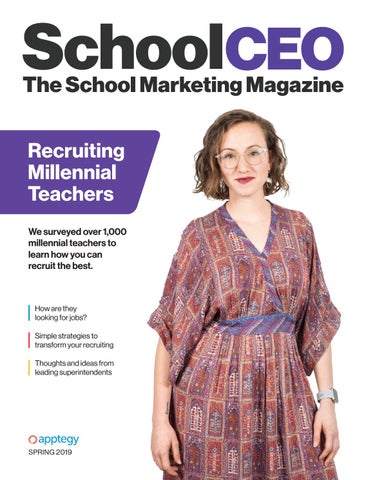
SchoolCEO The School Marketing Magazine Recruiting Millennial Teachers We surveyed over 1,000 millennial teachers to learn how you can recruit the best.
How are they looking for jobs? Simple strategies to transform your recruiting Thoughts and ideas from leading superintendents
SPRING 2019
Teachers are searching for your district online. What are they finding?
OUR STAFF: Executive Editor: David Allan Art Director: Sebastian Andrei Copy Writers/Researchers: Joy Spence, Rheannon Burnside, Melissa Hite, Barrett Goodwin, Corey Whaley Graphic Designers/Illustrators: Corbin Lawrence, Blake Organ Video Producer: Ryan McDonald Social Media Manager: Jacob Neeley Apptegy CEO: Jeston George
PUBLISHED BY:
Based in Little Rock, Arkansas, Apptegy is an education technology company dedicated to helping school leaders build a powerful identity for their schools. Learn more at apptegy.com
Table of Contents 4
Good News in Public Schools All over the country, great things are happening in schools. We’ll share just a few.
6
Conductor of Dreams
Superintendent Francisco Escobedo is revolutionizing his district through community, collaboration, and the arts.
16
Super Support
How can superintendents better support one another? Here’s what school leaders at AASA NCE told us.
20 Recruiting Millennial Teachers:
An Introduction
Millennials are now the largest generation in the workforce—and they’re changing the way teacher recruitment works.
28
SchoolCEO Study: What Do Millennial Teachers Want?
We surveyed more than 1,000 millennial educators, asking how they make career decisions. Here’s what we learned.
36
Ramp Up Your Recruitment
Now that you know what millennial teachers are looking for, you can apply that knowledge to your recruiting process.
50
Superintendent Q&A: Dr. Betsy Webb What makes a great leader? This Maine superintendent shares how she finds, builds, and encourages aspiring leaders in her district.
58
Not Standing Still
In our first Superintendent Perspective, Dr. Todd Dugan shares Illinois’ long, uphill battle for more equitable school funding.
Vol. 1, No 3 © 2019 by Apptegy, Inc. All rights reserved. Permission to reprint or quote excerpts granted by written request only. SchoolCEO™ is published 4 times a year (November, February, May, and August) by Apptegy, Inc., 425 W Capitol Ave. Suite 800 Little Rock, AR 72201. Send address changed to SchoolCEO™, 425 W Capitol Ave. Suite 800 Little Rock, AR 72201. Views and opinions expressed in this publication are not necessarily those of the magazine or Apptegy, Inc. Accordingly, no liability is assumed by the publisher thereof.
SPRING 2019 / SchoolCEO
1
Letter from the Editor In this edition of SchoolCEO, we focus on an issue that is perplexing many school leaders: how to better recruit a new generation of teachers. Millennials aren’t a bunch of kids anymore. The youngest are 23 and have just graduated from college. The oldest, at 38, could already be veterans in education. We’ll share a survey we conducted of over 1,000 millennial teachers, asking what they’re looking for in a job and how districts can improve the way they market themselves as employers. We also have some exciting news! A few weeks ago, we added a new member to our writing staff, John Corey Whaley. Corey is the author of three young adult fiction books, a National Book Award finalist, and the winner of the 2012 Michael L. Printz Award for his debut, Where Things Come Back. I’ll leave the rest of my space for him!
David Allan Executive Editor, SchoolCEO
I’ll be frank with you—I never thought I’d end up back in the business of education. After majoring in English Literature in college, I somehow found myself teaching in my former high school, just four years after leaving it. My second year in, I was transferred to a rural high school nearby, where I served as the entire English department. Needless to say, it was quite the immersive learning experience. My teaching career came to a peaceful close after only five years, but I was still in the classroom when my debut published in 2011. So, are you wondering why, eight years, three novels, and four national book tours later, I’m in Little Rock, Arkansas, working at an education technology company? I’ll tell you why: because American education is changing at breakneck speed, and I want to be a positive part of that change. American students are incredible. They deserve the absolute best from the community at large. When I learned what SchoolCEO is doing to help superintendents identify and market their school brands, I jumped at the chance to play some small role in it. At SchoolCEO, we have an important obligation. It’s our job to listen first—to your concerns, thoughts, ideas, and perspectives. Then, using your expertise and our research on policy and schools, we hope to share information that helps educators create better, more equitable places of learning for our kids. In this stressful time of school choice and competition, it’s our duty not only to make your job easier, but also to help you share the stories that make your schools so amazing and inspiring. It’s an honor to have a second chance to help make sure kids of all backgrounds are given equal opportunities to get the education they deserve. Now, let’s get to work.
Corey Whaley Writer, SchoolCEO
WE LIVE IN A WORLD in which we need to share responsibility.
IT’S EASY TO SAY it’s not my child, not my community, not my world,
NOT MY PROBLEM. THEN THERE ARE THOSE WHO
SEE THE NEED
& RESPOND. I consider those people my heroes. Mister Rogers
SchoolCEO SPRING 2019 / SchoolCEO
3
4
SchoolCEO
/
SPRING 2019
Good News in Public Schools SPRING 2019
Slidell, LA
Colmesneil, TX
Students at Northshore High School in Louisiana are using 3D printers to create prosthetic hands. The project, made possible by the nonprofit Addie’s Angels, helps children from other countries who are in need of prosthetics. (Associated Press)
Elysabeth, a fifth grade student at Colmesneil Elementary in Texas, has been collecting clothing items from her community and donating them to military veterans in need. “If it’s something that could help the world, I’ll just do it,” she told reporters from the county paper. (Tyler County Booster)
Coeur d’Alene, ID
Valdosta, GA
Morgan, a student at Coeur d’Alene High School in Idaho, created an app that helps people who have trouble reading. The app, called Outloud Reader, takes a photo of an article of text, digitizes it, and then reads it aloud. (Spokane Public Radio)
An assistant teacher caught video of Georgia P.E. Coach Jonathan Oliver helping Kristen, a kindergarten student, put her hair in a ponytail during gym class. The touching moment garnered over three million views on Facebook. (Good Morning America)
Brookville, PA
Jim Thorpe, PA
Ellie, a junior at Brookville Area High School in Pennsylvania, helped create the Peer Connections Club, which meets every Monday to “help special education students in the district make friends.” Around 20 general education students volunteer to help run activities, and four special education students currently participate in the club. They’re hoping to expand the club next year to reach more elementary students. (Jeffersonian Democrat)
Matt, a freshman at Jim Thorpe High School in Pennsylvania, helped a bus driver who was incapacitated at his bus stop. After realizing the bus driver’s foot was stuck on the gas pedal, Matt took the keys out of the ignition, directed passengers to gather in a group outside, and called 911. “I wasn’t really thinking,” Matt said when asked about the incident. “I was just acting, just doing what I thought was right.” (ABC7 News)
SPRING 2019 / SchoolCEO
5
6
SchoolCEO
/
SPRING 2019
Conductor of Superintendent Francisco Escobedo is changing the lives of students through community, collaboration, and the arts. When Francisco Escobedo first stepped into his superintendency at Chula Vista Elementary School District (CVESD), the CEO of the San Diego Youth Symphony (SDYS) confronted him about the district’s representation in the organization. Of all of the musicians in the youth symphony, only 3% of students were from Chula Vista. Meanwhile, more affluent districts were seeing participation rates of almost 27%. At the time, Chula Vista had gone without in-school music programs for over a decade. When violins are pitted against calculators, most administrators are forced to choose programming that will improve the district’s test scores. But to Escobedo, students miss a critical piece of their education—and their lives—when the arts are neglected. “A life void of the arts is not much of a life,” he tells SchoolCEO. “I think it’s my duty as a superintendent to ensure that the arts are not only alive, but thriving in my district.” He committed to making a change. In 2010, Chula Vista partnered with SDYS to create the Community Opus Project. At Otay Elementary and Lauderbach Elementary, 65 third graders were greeted on campus with new instruments. The next year, the program expanded to include more schools and more students. Eight years later in 2018, SDYS’s CEO showed Escobedo the symphony’s new demographics. Chula Vista’s representation had jumped from 3% to 33%. After almost three decades in education, Escobedo notes this memory as one of the sweetest in his career.
SPRING 2019 / SchoolCEO
7
Superintendent of Chula Vista Elementary School District
We recently sat down with this California superintendent at AASA NCE to discuss the fine art of creating new opportunities for his students.
E
scobedo is a gentle man, rolling through his words with quiet confidence. His parents, both immigrants, met in New York City; his father was raised in Mexico, his mother in Puerto Rico. “The East Coast was tough,” he told The Star News, describing his neighborhood just outside of Hell’s Kitchen, Manhattan. His parents taught Escobedo to value education as a changemaker. As a student, Escobedo cherished his teachers, even describing them as “surrogate parents.” He went on to graduate from Yale University, majoring in biology with an interest in forensics. From there, he moved to California to become a police officer. Once on the job, however, the future educator had a hard time stomaching the violence against children that he often witnessed. As an officer, he was known to counsel youth in the back of his squad car. It wasn’t long before his partner on the force brought up Escobedo’s aptitude for teaching, leaving him shaken. “Those words really hit my heart hard,” Escobedo says. He took the next week off work, enrolling at the University of California San Diego (UCSD) to become a teacher. From there, he followed a somewhat standard progression, from teacher to principal to assistant superintendent to superintendent. All the while, he took his passion to educate the whole child—or “the whole human,” as he says—with him. Chula Vista has kept him as their superintendent for nine years (around 120 in superintendent years, he jokes). “It’s been an amazing experience at my district,” he says. “Just a tremendous community.”
8
SchoolCEO
/
SPRING 2019
C
hula Vista Elementary School District is the largest elementary district in California, serving a little over 30,000 students. More than half of students in the district qualify for free and reduced lunch, and about a third—30.6%—are English learners (ELs). The district has a high percentage of minority students, with high Latino or Hispanic (70%) and Filipino populations (9%). Because of the district’s proximity to San Diego’s naval base, it also welcomes a large number of military families.
Chula Vista Elementary School District 2017-2018 Data
52.6%
When Escobedo talks about the diversity in his district, he smiles a little, proud. He describes the 20 languages spoken, the biculturalism and binationalism, the diversity of thinking and backgrounds, as he would talk about family. “It’s just a beautiful community,” he says. “Chula Vista is beautiful.” Talking with Escobedo, it’s clear that his expectations for CVESD are sky-high. His belief in the power of education—of building up the whole human—is palpable, allowing him to accomplish the seemingly impossible. Take the issue of arts programming, for example, which is often tied to equity. “If you look at many of the more privileged schools, they more than likely offer some sort of arts program,” says Escobedo. “You definitely don’t see that in more needy areas.”
Qualify for free and reduced lunch 0
100
30.6% English learners
0
To Escobedo, the arts hit on the very core of learning. “In education, we have the false premise that it’s all about arithmetic or reading,” he tells us. “We forget the humanities. We focus so much on being human doers, but we don’t focus enough on being human beings. And I think when you bring in the arts, you really hit the spirit and the soul of the human.”
100
Of course, this doesn’t mean that reading and math aren’t important. But Escobedo views learning how to play an instrument, how to paint, or how to sculpt as equally important.
30,120 70%
Latino or Hispanic
Students
0
46 Latino or Hispanic
White
Filipino
Schools
100
Black or African American
Asian
Other
This passion for arts education comes from Escobedo’s own life. “Everyday, I’m hearing music. I love to dance. It’s ingrained. It’s part of my life. It fulfills me as a human,” he says. “I think it’s really critical that we do the same with our children.” When asked if arts programming is a tool to stay competitive, he pauses. “It can be,” he says. “But I see it more as a moral duty.”
SPRING 2019 / SchoolCEO
9
“When you bring in the arts, you really hit the spirit and the soul of the human.” —Francisco Escobedo—
10
SchoolCEO
/
SPRING 2019
I
t’s not just the arts that are thriving. Chula Vista was named a California Exemplary District in 2018. Three of its schools were also honored as California Distinguished Schools; more than a third made the Education Results Partnership’s Honor Roll in the 2017-2018 school year. While Escobedo is quick to give credit to administrators, teachers, staff, and students, his leadership is paramount to the district’s success. Chula Vista’s superintendent is a master relationship builder—with his board, with parents, with his cabinet, with the community. His strength isn’t in simply connecting with others, but in building systems that encourage collaboration. After connecting teachers, leveraging business leaders, and engaging parents, Escobedo ultimately steps back to play conductor of his own symphony. Almost as soon as Escobedo came to the district, he focused on shifting the culture to encourage collaboration. His goal was to create “interdependency.” Chula Vista split professional development days in half to allow teachers time to collaborate with others in their grade level. However, the administration soon realized that teachers needed more training in collaboration. There needed to be a change not only in process, but in culture. At the time, many teachers were focused on obstacles—parents weren’t involved, or the community wasn’t supportive. Now, teachers’ vernacular focuses on solutions. “The amount of ideas exchanged is remarkable,” Escobedo explained in a speech to the National Center for Educational Literacy. “It’s amazing. But it didn’t happen overnight.” Building strong relationships amongst the board encourages high-level collaboration. “I try to create a real family environment with my board, and I think that’s really critical,” he says. Escobedo takes time to connect with each member individually. “Understand what their interests are—their aspirations, their needs,” he says. “Like you would do with family, right? Every person in the family is different.” While everyone has their unique passions and interests, “as a family, you have to work as one.”
Escobedo also makes sure his team stays well connected in the business community. “My relationship with the community, especially with the business community, is critical,” he tells us. While serving as superintendent, Escobedo has also served as the 2018 President of the Chula Vista Chamber of Commerce, an adjunct professor at San Diego State University, and a chairperson at the local YMCA—just to name a few. “You have to make sure you interconnect yourself to the businesses around you,” he says. Escobedo’s team of administrators are a community force as well. Beyond their roles at Chula Vista, administrators serve on nonprofit boards or volunteer in the community. With every connection administrators build, CVESD’s web of support grows stronger. The district’s makerspaces show the value of community connections. One makerspace, for example, is a set of classrooms built into an estuary in Chula Vista’s bay, where fifth graders pull on rubber boots to learn more about oceanography. In another, students trek to the public library’s basement to learn coding and robotics. In creating makerspaces, the district partnered with the wireless telecommunications company QualComm, San Diego Gas and Electric, the nearby water authorities, and, of course, the local library. “We’re utilizing our business assets in order to reinvent our classrooms,” Escobedo says. Often, the relationships are symbiotic. Circulation at the local library has increased by 80% since installing a makerspace. The best part about makerspaces, of course, is their impact on students. In learning how to program or build a robot, students find their strengths and discover new passions and interests. Chula Vista provides students with opportunities, even outside the classroom, to explore their potential.
SPRING 2019 / SchoolCEO
11
T
his spirit of unity and collaboration also trickles down to students and families. To Escobedo, that means knowing each of his students and their complexities. “You can’t really stereotype a child with a label,” he says. Many EL students in the district are also part of Gifted and Talented Education (GATE), or they live in poverty, or they don’t. “If you really want to help a child, you have to know their complexities,” he says. “We really know the individual as an individual.”
He’s also made a point to increase communication with parents districtwide. At the beginning of his superintendency, Chula Vista was losing students due to California’s statewide housing crisis. This changed the way they thought about communication. “We can’t think the kids will come to us,” he says. “We have to present ourselves in a great light.” The district partnered with a marketing firm to discover that 80% of Chula Vista’s residents regularly checked Facebook and tuned into Magic 92.5.
Language programs aren’t just beneficial for EL students; they bring everyone together. “We have in our district the largest percentage of dual language immersion programs,” he says. The programs teach more than language alone. “When you bring kids from different ethnicities, from different language experiences, together to learn not only the language, but the culture connected to the language—it’s powerful stuff.” Instead of isolating one group, “you’re bringing everyone together.”
Without missing a beat, Escobedo joined radio hosts Jagger and Kristi on the air to play trivia games like “Minute to Win It.” The duo asked Chula Vista’s superintendent ten trivia questions such as “What does ‘SMH’ mean?” Escobedo was dumbfounded, shaking his head when he learned the text lingo—but he’s obviously a team player when it comes to building community connections.
“When you bring kids from different ethnicities, from different language experiences, together to learn not only the language, but the culture connected to the language—it’s powerful stuff.”
Despite having 46 schools and over 30,000 students, Escobedo visits each classroom twice a year to stay connected. When he visits, he focuses on the most at-risk students, listening to their teachers’ concerns.
“Every time I go to a school, I spend the first 30 minutes at the principal’s office and we look at our homeless kids, we look at our English learners, we look at our foster kids, and see how they’re progressing,” he says. “Very, very critical that we look at the whole child.” Of course, engaging students means getting parents on campus. “It’s not just parent participation that I strive for, but parent engagement,” he says. Escobedo even created a parent cabinet. Taking the parent leaders of GATE, the PTA, and other Chula Vista programs, he formed a group that provides critical feedback from parents’ perspectives.
12
SchoolCEO
/
SPRING 2019
And of course, one of the best ways to engage families in the magic of Chula Vista is through excellent programming, like the district’s music initiative. “When students perform, mother, father, sister, brother, and the abuelitos are in the audience,” reads a news article published by the district. “Families are on our campuses, and, for schools, that’s the opening act.” In building up the district’s music program, Escobedo has created what marketing guru Seth Godin calls a “purple cow” for the district. The program is one of Chula Vista’s unique strengths, making it stand out on its own, without added marketing.
To learn more about how to create a purple cow for your own district, visit: www.schoolceo.com/purplecow
S
ince the Community OPUS program began in 2010, the arts have blossomed in the district. In 2013, CVESD committed to providing in-school music instruction to all students. The district now employs 92 visual and performing arts instructors, freeing up time for classroom teachers to collaborate with other grade level teachers. It’s paying off, too. In 2018, the NAMM Foundation designated Chula Vista as one of the Best Communities for Music Education. Escobedo himself was the 2019 recipient of the VH1 Save the Music Foundation’s annual Administrator Award for Distinguished Support of Music Education. The benefits of arts education stretch into every classroom, especially when it comes to students’ language acquisition. “We’ve found some strong effects on language skills,” UCSD cognitive scientist Terry Iversen, Ph.D, reported to Chula
Vista’s communications team. Neuroscientists at the University of California, San Diego are specifically studying students at SDYS, including Chula Vista students. When students develop their ear for music, they improve their ability to process pitch, timing, and timbre, reports NPR Education. These three elements are key in language acquisition. Now, you’ve probably heard of the word gap—the statistic that students in poverty hear about four million fewer words than their peers before the age of four. When students’ language acquisition is improved, it may help solve some of the setbacks created by the word gap. Perhaps most exciting is hearing about the impact firsthand. “The first day I ever got to hold my violin was the best day of my life,” Luna, a third grader with braided pigtails, told the youth symphony’s media team. “I knew it would change everything, and I would see everything a different kind of way.”
Photo courtesy of the San Diego Youth Symphony
SPRING 2019 / SchoolCEO
13
14
SchoolCEO
/
SPRING 2019
SPRING 2019 / SchoolCEO
15
!
R E S U P E NT D N E T IN
16
SchoolCEO
/
SPRING 2019
Super Support The superintendency can be isolating. Make sure you’re getting—and giving—the support school leaders need to succeed. When we interviewed more than a dozen school leaders at AASA’s National Conference on Education this January, one theme came up over and over again: being a superintendent is hard. You execute the vision of the school board. You make tough calls in emergency situations. You’re the face of your district. You manage hundreds, sometimes thousands, of employees: teachers, principals, bus drivers, food service directors, tech staff, safety and security staff. You head up bond campaigns, call snow days, and field the questions and criticisms of the public. Are you getting tired just reading this? Unless you’re superhuman (which, I mean, we’re not ruling out), you might find yourself feeling isolated in the superintendency. After all, no one else in your schools can really understand the unique difficulties of your role, and as the leader, you may not have a place in your district to ask for help or vent frustrations.
Some leaders in the business world feel this sense of isolation, too. In 2016, Tim Cook told the Washington Post that being Apple’s CEO is “sort of a lonely job.” A study by global management consulting firm RHR International revealed that half of all CEOs (and nearly 70% of first-time CEOs) say they experience loneliness. Of that group, 61% say this keeps them from working at top capacity. “The superintendency is a very lonely job,” Sarah Jerome, a retired superintendent with more than 40 years of experience in education, tells SchoolCEO. “I think that superintendents often burn out or wear out because they’re trying to do it alone.” In our conversations with superintendents, the necessity of support came up again and again. How are school leaders finding and building support networks, and how can they better support one another? Here’s what they told us.
SPRING 2019 / SchoolCEO
17
How are you finding and building networks with other school leaders? Hollis Milton
Dr. Cheryl Logan
Superintendent of West Feliciana Parish Schools
Superintendent of Omaha Public Schools
Hollis Milton, superintendent of West Feliciana Parish Schools, found strong working relationships through the Louisiana Association of School Superintendents, which he led as president for two years. “I learned so much from my fellow superintendents,” he tells SchoolCEO. “I know that I could call them on any day, and ask, ‘Hey, how did you handle this?’”
Dr. Cheryl Logan, who began her first superintendency last year at Omaha Public Schools, has built a local network of school leaders in Nebraska through a regional problem-solving group. “But it’s still very formalized,” she says. “I think that superintendents need more opportunities to have some downtime together.” When she can, she takes colleagues out for “lunch or an adult beverage,” just to talk. “Those are the opportunities I find very helpful,” she says.
During his term as president of the association, Milton worked to build those strong networks for future school leaders. “I felt like there’s not always a natural role that leads directly from principal to superintendent, or district supervisor to superintendent,” Milton tells SchoolCEO. So the association created the Superintendents Academy, a place where aspiring and first-year school leaders could learn the ropes of the superintendency. Participants learn leadership best practices—how to work with a board, how to facilitate positive relationships with the community—but more than that, they build a network. “We knew if we created a cohort of aspiring and first-year superintendents in this program, in a short time, there would be a new network,” Milton says. “If I’ve been through this program with you, I know you and have a relationship with you. I’m going to call you.” Milton says participants who have moved into their own superintendencies maintain strong relationships with one another. “I find that we’ve created more connectivity between superintendents,” he says. “I think the future is very bright for superintendents in Louisiana.”
18
SchoolCEO
/
SPRING 2019
Sarah Jerome Retired Superintendent and Former AASA President
“AASA was one of my support networks,” says Sarah Jerome, who served as the association’s second female president. Like many supers, she also found solace and support in monthly regional groups during both of her superintendencies. “In fact, I still do that now,” she says, even four years after her retirement. “You love education for a life, so interacting with those people who also have a similar bent, I find very rejuvenating.”
How have other school leaders supported you?
How can superintendents better support one another?
Dr. Julie Glazer
Dr. William Wright
Superintendent of Nutley Public Schools
Superintendent of Hertford County Public Schools
Last February, Dr. Julie Glazer got the call you hope you’ll never get: news of a potential security threat in her New Jersey district, Nutley Public Schools. Just one day after the devastating school shooting in Parkland, Florida, a Nutley student allegedly posted a threatening video on Instagram, flaunting guns alongside a picture of the high school. Over the footage played Foster the People’s song “Pumped Up Kicks”: “You better run, better run, outrun my gun.”
Dr. William Wright, superintendent of North Carolina’s Hertford County Public Schools, calls for more “unfiltered communication.” So many factors keep superintendents from giving genuine help, he says, whether it’s the pressure of political positioning or the shame that sometimes comes with facing difficulties. “Sometimes we are not as forthcoming with the challenges in our districts because of the political stances we need to take,” he told us. “Sometimes you get the political answer, but often that’s not what you need. Somehow or another, superintendents need to be free to have those kinds of conversations, just to be able to say, ‘Here’s what I’ve got going on,’ and not worry about it.”
But when she first got the news, Glazer was at an AASA event, literally surrounded by support. “I was actually with superintendents,” Glazer says, “and I will tell you that the immediate level of empathy, of support, of care… was tremendous.” Glazer and her team, including local law enforcement, decided to cancel school for the following day. The threat turned out to be just a scare, but Glazer told us the support of her colleagues meant everything. “All of that truly made me feel confident that whatever decision we made was the right decision,” she says.
Dr. Susan Enfield Superintendent of Highline Public Schools
“We all need to be there for one another, whether we know one another personally or not,” says Dr. Susan Enfield, superintendent of Highline Public Schools in Burien, Washington. Enfield herself often reaches out to fellow school leaders, offering support for those dealing with tough situations. “Take the time to send a note or a message to a colleague who’s going through a rough time,” she suggests. “Don’t expect a response—just do it.” When it comes to support, Enfield says, what goes around comes around. “The time will come when you’re in a tough place, and you will appreciate opening that note,” she told us. “Somebody you don’t even know, but who sits in your chair somewhere else, to say, ‘I admire you. I believe in you. I’m so sorry for what you’re going through. Just know that you’re not alone.’” SPRING 2019 / SchoolCEO
19
Maria Garcia Elementary Education Student Teacher
20
SchoolCEO
/
SPRING 2019
Recruiting Millennial Teachers A N INTR OD UCTIO N Teacher recruitment is changing, creating new challenges—and opportunities—for schools.
Photography of real millennial teachers in Little Rock, Arkansas, by John David Pittman SPRING 2019 / SchoolCEO
21
T
he foundation of learning is the relationship between teachers and students, but it’s hard to build those relationships when half of the equation is missing. While substitute teachers can temporarily fill gaps caused by prevalent teacher shortages, public schools and the kids they serve need qualified, full-time teachers. But across the country, school leaders are having trouble finding them. According to an Education Week analysis, all 50 states experienced statewide teacher shortages in at least one subject area in 2018, and 61% of superintendents indicated that they were having trouble finding and retaining great educators. Mum Martens, Executive Director of Human Resources at Arizona’s Higley Unified School District, knows this challenge all too well. “It’s really been a struggle out here,” she tells SchoolCEO. “Not only is there a shortage of teachers across the U.S. and in Arizona, but we’re also very competitive with our surrounding districts.”
What’s so different about this new batch of teachers? And how are they fundamentally changing the way schools look at recruitment?
Millennials: The New Workforce Born between 1981 and 1996, the millennial graduates that once filled many school leaders’ classrooms are now flooding the workforce. While the oldest of these may be veteran teachers in your district by now, even the youngest, at 23, are entering the teaching profession. Millennials have overtaken Baby Boomers and Generation X as the largest segment of the workforce. If school leaders were stumped by millennial students, they’re just as perplexed by millennial teachers. According to a 2016 Gallup survey, only 6% of superintendents feel that their districts understand these new teachers’ needs.
Old recruiting tactics don’t work as well on this generation because of a fundamental shift in the way they think about work. According to a Gallup analysis, the top elements millennials are looking for in a job (regardless of sector) are growth opportunities, great management, and interesting work. Salary doesn’t even make the top five. “The emphasis for this generation has switched from paycheck to purpose,” said Gallup’s CEO, Jim Clifton. Where previous generations found fulfillment in their lives outside of work, millennials want the work itself to be fulfilling.
Millennials have overtaken Baby Boomers and Generation X as the largest segment of the workforce.
Traditionally, the teacher recruitment process started with a job posting and ended with a conversation about the district’s benefits package. A prospective teacher’s first impression of the district was often face-to-face, usually during their interview. But now, the process starts online, long before a candidate submits an application. If a teacher isn’t impressed scrolling through your social media or browsing your website, they could reject your job before they even apply.
It’s not just the digital landscape that’s throwing school leaders for a loop. It’s the candidates themselves. According to Martens, perks that once interested applicants at Higley Unified, like medical benefits and retirement pensions, have lost their bargaining power in the last several years. Now, teachers are asking how the district will support their growth as educational leaders.
22
SchoolCEO
/
SPRING 2019
But it seems they’re having trouble finding that fulfillment in the workplace. Millennials have the highest unemployment and underemployment rates in the U.S., and of those that have jobs, only 29% are engaged in their work. Across the country, millennial teachers are having trouble finding fulfilling work, and districts are struggling to find teachers. Clearly, somewhere, there’s a disconnect.
Ivey Kelly English Teacher
SPRING 2019 / SchoolCEO
23
Britynn Davis Art Teacher
24
SchoolCEO
/
SPRING 2019
Recruiting is Marketing, Marketing is Recruiting You might not think of marketing as an aspect of your recruitment, but it is. Your candidates—especially millennials—are monitoring your online presence more than ever before. Does this district value their teachers? Are they doing innovative work in the classroom? Would I enjoy working there? To prospective teachers, your marketing matters. You should also start thinking about how your recruitment process markets the district to teaching candidates. What do they care about? How does the way you do recruitment prove that your district would meet teachers’ needs? At Illinois’ Ball-Chatham School District, Director of Human Resources Ashley Romadka and her team have begun to take these questions very seriously. “We realized that our recruitment was a one-size-fits-all model—posting online and expecting candidates to come to us. But that’s not how recruitment works in this day and age,” she tells SchoolCEO. “There are so many touchpoints before the person actually completes the application.” As a response, the district took a hard look at their website, fleshing out their careers page. The team made a recruitment video titled “Why Ball-Chatham?” and built a blog of employee testimonies that lets candidates find information for themselves. They’ve even revamped their job postings, outlining a day in the life of a teacher at their schools and the qualities that make candidates a perfect fit for the district. “Looking at [it] from the candidate’s perspective has made a huge impact on the way we recruit,” Romadka says. In the pages that follow, we’ll highlight our own research on millennial teachers: what they’re looking for in a job, how they find employment opportunities, and what advice they’d give school leaders on recruitment. Then, we’ll take a look at what this research means for you. Many of the factors fueling teacher shortages are beyond school leaders’ control, but there’s one important aspect you can control: your recruitment strategies. Through our research, we hope to help you bridge the gap between your schools and the new workforce: millennial teachers.
Millennial Facts
38%
of the workforce is made up of millennials.
7%
of millennials are unemployed, and 10% are employed part-time, giving millennials the highest rates of both unemployment and underemployment of the working population.
85%
of millennials browse the internet on their smartphones rather than desktops.
21%
of millennials have changed jobs within the last year—more than three times the percentage of non-millennials who did so.
47%
of millennial job seekers report that opportunities to learn and grow are extremely important to them when applying for a job. DATA FROM GALLUP
SPRING 2019 / SchoolCEO
25
SAY HELLO TO
CrowdShift:
marketing strategies from the private sector, brought together in one easy-to-use tool.
26
SchoolCEO
/
SPRING 2019
Accepting only 200 districts this year. Get on the waitlist today.
crowdshift.com
SPRING 2019 / SchoolCEO
27
SchoolCEO Study
What Do Millennial Teachers Want? Roy Vaughn Art Teacher
In the largest study of its kind, we reached out to 30,000 randomly selected K-12 teachers born between the years 1981 and 1996. More than 1,000 teachers submitted a response—a statistically significant sample of the estimated 1.2 million millennial teachers nationwide.
M
illennials are the largest generation in the workforce, so we wanted to learn more about the new hiring pool as a market. Hiring isn’t just about vetting applicants; part of the process is selling the job to great talent. And in any sales effort, marketers need to figure out more about their audience. What features do consumers care about in a product or service? What is their process for making purchasing decisions? Nike, for example, knows what marathoners want in a running shoe, whether it be support, lift, or style. But more than creating a great product, they also figure out where the average marathoner looks for information. Are runners shopping online or in stores? Do they ask other runners before buying their shoes? Once Nike understands their market’s purchasing process, they can create a strategy that speaks directly to runners’ needs, putting their brand in front of consumers at key moments. In the same vein, we wanted to know more about millennial teachers’ job searches. Our research sought to answer two questions: What are millennial teachers looking for in a job, and what is their decision-making process? We know that teacher recruitment is fundamentally changing. A peek into our research shows us that millennial teachers are researching districts online before applying. And just like millennial employees in the private sector, millennial teachers’ focus in the job has shifted.
Survey Demographics FIGURE 1. WHAT WOULD BEST DESCRIBE YOUR EDUCATION BACKGROUND? (Multiple Responses Allowed) MASTER’S IN EDUCATION OR RELATED FIELD
54%
BACHELOR’S IN EDUCATION
45%
BACHELOR’S IN NON-EDUCATION FIELD
14%
TEACHING CERTIFICATION
13%
ALTERNATIVE TEACHING CERTIFICATION
6%
FIGURE 2. HOW WOULD YOU DESCRIBE YOUR CURRENT DISTRICT? (Multiple Responses Allowed) SUBURBAN
54%
URBAN
25%
RURAL
11%
SMALL TOWN
10%
We’ll show you what teachers are looking for in a job, then break down their decision-making process. With this information in hand, school leaders can target teachers on the channels they use most. SPRING 2019 / SchoolCEO
29
What are millennial teachers looking for in a job? Research into millennials across all sectors indicates that they tend to care about impact, sometimes even more than salary. We wanted to see whether this held true for millennial teachers—especially considering that educators, historically, aren’t particularly driven by their paychecks. We asked respondents to rate the following statement on its validity using a scale of 1-7: “My decision of where to work was largely shaped by salary and benefits” (see Figure 3). The numbers suggest that while salary and benefits factor into decision-making for millennial teachers, they aren’t dealbreakers. Only 26% of those surveyed answered 6 or 7, indicating that salary was critical in their decision-making. More than half responded moderately with 3, 4, or 5, and about a fifth indicated that salary didn’t really matter by selecting 1 or 2. While salary is certainly important, our research suggests that other factors weigh just as heavily in millennial teachers’ decision-making. What are those other factors? Given a list of school characteristics, we asked those surveyed to select up to three factors that were very important when determining where they would teach. The most common answer was school culture, followed by location, school leadership, and flexibility, respectively (see Figure 4).
hire chief culture officers. It makes sense—if millennials are finding their sense of purpose and impact at work instead of at home, they’ll want to work in a fantastic environment. Location, on the other hand, poses a unique issue for schools. Research shows that millennials are more comfortable with urban life than previous generations. However, many districts struggling to recruit teachers are categorized as rural. Whether or not you feel like your district matches millennials’ desires, the numbers show that location needs to be taken into account. From a marketing perspective, there are a couple of ways to go about this. One strategy is to draw attention to the benefits of your location—the community feel, the low cost of living, the opportunity to reconnect with nature. Another option is to build up other factors that make your district ideal for millennials: a great school environment, supportive leadership, or flexibility in the classroom. Create messaging that brands your district as the best in the area for one core feature. We’ll talk more about marketing your location on page 38.
“Don’t market the position that needs to be filled; market the school and the culture.”
This ranking held true in teachers’ open responses as well. As part of the survey, teachers were given the option to answer the question, “What advice would you give school leaders on marketing to teachers?” When we broke down teachers’ responses, words like “culture” and “support” were in the top six most frequently used words besides neutral words like “teacher” or “job” (see Figure 5). “Culture” even ranked higher than “salary.” One teacher’s tip for administrators was, “Don’t market the position that needs to be filled; market the school and the culture.” These results are consistent with millennial behavior across all sectors. In the private sector, creating great culture has become an executive level position; many companies now 30
SchoolCEO
/
SPRING 2019
In considering leadership, we noticed that teachers’ open responses often paired the word “leadership” with “support” and “honesty.” One teacher asked for “better support during the first year... less promises and more honesty.” Another said, “It is important for me as a teacher to know the administration is there to support me, and that they care not only about student welfare, but about me being successful and happy as an educator.” One respondent even suggested that creating a teacher-focused district would allow teachers to better support students. Fostering a great culture, building support for new teachers, providing flexibility in the classroom—these are issues that school leaders know best. Beyond discovering what teachers are looking for in a job, however, we also wanted to figure out how they’re evaluating these factors in a prospective district—how are they researching future employers? As you might have guessed, the process seems to be moving online.
FIGURE 3. ON A SCALE OF 1-7, HOW MUCH DO YOU AGREE WITH THE FOLLOWING STATEMENT? “MY DECISION OF WHERE TO WORK WAS LARGELY SHAPED BY SALARY AND BENEFITS.”
Strongly Disagree
Strongly Agree
1 OUT OF 7
2 OUT OF 7
3 OUT OF 7
4 OUT OF 7
5 OUT OF 7
6 OUT OF 7
7 OUT OF 7
11%
9%
8%
22%
24%
15%
11%
FIGURE 4. ASIDE FROM SALARY AND BENEFITS, WHICH OF THE FOLLOWING FACTORS ARE VERY IMPORTANT IN DETERMINING WHERE YOU TEACH? (Multiple Responses Allowed)
72%
SCHOOL CULTURE
18%
CAREER ADVANCEMENT OPPORTUNITIES
64%
LOCATION
40%
GREATER FLEXIBILITY IN CURRICULUM/TEACHING SCHOOL SIZE STUDENT PERFORMANCE
10% 14% 47%
SCHOOL LEADERSHIP
Other represented <1% of total responses
FIGURE 5. WORDS THAT APPEAR MOST FREQUENTLY IN OPEN RESPONSES TO “WHAT ADVICE WOULD YOU GIVE SCHOOL LEADERS ON MARKETING TO TEACHERS?”
CULTURE
10%
HONEST
7%
SALARY
8%
PAY
6%
SUPPORT
7%
BENEFITS
6% SPRING 2019 / SchoolCEO
31
What is their decision-making process? When consumers can scroll through online reviews, watch testimonial videos, and dig around a brand’s website, they take the sales process into their own hands. Today, the buyer, not the seller, is in control.
see how teachers did additional research when making a career decision. We asked a series of true or false questions about their process for learning more about a district (see Figure 7).
When looking for a new car, for example, millennials might ask car dealers for their best offer. But that’s usually after looking at online reviews, researching the car’s value and pricing on discount sites, and consulting with friends and family.
True to the stereotype, most millennials start their job explorations online. A whopping 81% reviewed a district’s website before accepting a position there. Of that number, almost half (44%) looked at these sites on a mobile device. If a district’s website doesn’t work on smartphones, it risks locking applicants out altogether.
Forming relationships with consumers is still critical; the difference is that those relationships often begin online. Successful marketers have adapted to this change by creating a multi-channel approach—a marketing strategy that meets their audiences both on the web as well as in person. The same is true for recruitment. Today’s teachers are pulling out their phones to Google the district, comparing districts’ compensation packages, and checking regional housing prices before sending in an application. Our research shows that over half of millennial teachers first found their current position on the internet (see Figure 6). About a quarter of millennial teachers looked at online job boards, and an additional 25% found their positions on district websites. In-person relationships haven’t lost their value—over a third of teachers found out about the position from a colleague in the district—but that doesn’t override the shift taking place. Popular forms of in-person recruitment like careers fairs (9%), university connections (8%), and direct recruitment (11%) are dwarfed by virtual options. “I believe school leaders should consider having an online presence that explains a bit about the school and the students,” one teacher advised. Others suggested posting projects students are working on, creating user-friendly websites, and focusing on school culture. Across the board, the call for digital platforms—online job boards, updated websites—was loud and clear. Since online channels are playing such a significant role in finding jobs, we wanted to
32
SchoolCEO
/
SPRING 2019
After the website, teachers are turning to search engines to learn more about a district. About 57% of teachers searched for more information about a district, and 46% specifically conducted online research on a school’s town or area. Only about 22% of teachers checked districts’ social media, which could be driven by the lack of school social accounts. Teachers are eager to hear, firsthand, what it’s like to work in a district; testimonials are key to teachers’ decision-making process. Over half of millennial teachers surveyed reached out to current or former employees of the district where they applied—whether online or in person. Formal job review sites, however, haven’t yet picked up steam; only about 10% of teachers surveyed visited job review sites like Glassdoor. No matter how you look at it, millennials are finding information on a variety of channels. Before they fill out an application, they’ve already started to form a relationship with your district—whether online or in person. School districts have the opportunity to take control of their online identities, but are they doing so? We asked teachers to indicate, on a scale of 1 to 7, how much their district’s online presence attracted them to their current position (see Figure 8). Of the answers we received, a staggering 85% were negative or neutral. For every teacher who chose a 7, indicating that their district’s online presence was a major pull factor, more than ten chose a 1, indicating that their district’s online presence was not a key recruitment tool.
FIGURE 6. HOW DID YOU FIND OUT ABOUT YOUR FIRST JOB IN YOUR CURRENT DISTRICT? (Multiple Responses Allowed)
36%
SOMEONE WHO WORKS IN THE DISTRICT
9%
CAREER FAIR
25%
DISTRICT WEBSITE
1%
SOCIAL MEDIA
11%
I WAS RECRUITED BY THE DISTRICT ADMINISTRATION
8%
MY COLLEGE OR UNIVERSITY
25%
ONLINE JOB BOARD
16%
A STUDENT TEACHING PROGRAM
7%
OTHER
FIGURE 7. HOW TEACHERS ARE RESEARCHING EMPLOYERS I looked at job review sites, like Glassdoor.
10%
I looked at the school’s social media posts.
22%
I reached out to current or former employees of the district.
56%
I did an online search on the town or area where the school is located.
46%
I looked through the school/district’s website.
81%
I searched for information about the school on Google or other search engines.
57%
If yes I looked through the site on my mobile device.
44%
FIGURE 8. ON A SCALE OF 1-7, HOW MUCH DO YOU AGREE WITH THE FOLLOWING STATEMENT? “MY SCHOOL’S ONLINE PRESENCE ATTRACTED ME TO MY POSITION.”
Strongly Disagree
Strongly Agree
1 OUT OF 7
2 OUT OF 7
3 OUT OF 7
4 OUT OF 7
5 OUT OF 7
25%
17%
9%
34%
9%
6 OUT OF 7 7 OUT OF 7
4%
2%
SPRING 2019 / SchoolCEO
33
The technology gap in school recruitment As you’ve probably already realized, there’s a disconnect between the channels schools are using to recruit and the ways millennial teachers are researching prospective districts. In addition to our survey of millennial teachers, we examined the online presence of a statistically significant sample of 800 U.S. schools in 2018. Only 8% of the districts sampled had dedicated space on their websites—beyond job postings alone—for recruitment (see Figure 9). These districts had at least one or two compelling pieces of content on the subject, like a page describing the district’s location, a teacher testimonial, or a video showcasing the district. Nearly 82% of districts provided job postings alone, without any reasoning as to why teachers should apply. Most only posted job opportunities, sometimes without a description of the work at all. About 5% didn’t even have job postings—only an interest form for candidates to fill out or an administrator’s contact information. The remaining 5% had no careers information whatsoever. Data on districts’ social media presence tells a similar story. In the private sector, LinkedIn and Instagram are popular recruiting tools. LinkedIn is essentially built for recruitment, and Instagram gives recruits a window into a company’s culture. Recruiters post photos of staff meetings and team-building initiatives on Instagram to give recruits insight into an employee’s day-to-day experiences. FIGURE 9. CAREERS INFORMATION AVAILABLE ON DISTRICT WEBSITES
82%
JOB POSTINGS ALONE
CAREERS PAGE *
8%
ONLINE FORMS / ADMINISTRATOR’S CONTACT INFORMATION
5%
NO INFORMATION
5% 20
40
60
80
*A separate page making the argument for why teachers should work in the district.
34
SchoolCEO
/
SPRING 2019
100
For the teaching community, Instagram is especially critical: teachers have formed a community on the app, noted NPR. They share curriculum ideas, post photos of student work, and share teacherly outfits. A few teachers’ accounts have even gone viral. Buzzfeed recently shared the story of a teacher making quadruple her salary through the app. Most districts, however, aren’t taking the opportunity to tap into this community. Around 9% of districts have a presence on Instagram, and a meager 2% are on LinkedIn (see Figure 10). In the following article, we’ll dig into three ways school leaders can begin to bridge the recruitment gap, creating strategies to reach millennial teachers.
While 81% of teachers are checking district websites, only 8% of districts have a dedicated careers page.
FIGURE 10. DISTRICTS’ PRESENCE ON SOCIAL MEDIA CHANNELS
68%
53%
9%
2%
More thoughts from teachers across the nation What advice would you give school leaders on marketing to teachers?
Teachers’ responses have been edited for grammar and clarity.
First Grade Teacher, MA
High School English Teacher, LA
“Invite prospective teachers to come and
“Schools need to have a reputation for
observe a typical school day.”
empowering and supporting their teachers.”
High School Chemistry Teacher, UT
Second GradeTeacher, IA
“Teachers talk! Make your current teachers hap-
“Make sure there is a visible presence on social
py, and they will get you more! We teach the next
media and online that shows the great things our
generations of teachers as well.”
district is doing.”
Sixth Grade Teacher, MN
Special Education Teacher, NV
The great teachers and staff you have—sell
“Teachers want to work in a school with great
them. That’s the reason, besides my students, I
leadership and school culture. We want that family
get up day after day to do what I do.
feel. Salary and benefits are a huge factor, but if we are unhappy in a school, we will not want to stay. Leadership and culture are key.”
Juliana Reynolds
Carli Sasser
Reading Interventionist
Elementary Music Teacher
Ramp Up Your Recruitment Three recruiting strategies any district can implement In the midst of teacher shortages, competition from other districts, and changing expectations from new teachers, recruitment can be daunting. But now, you have a leg-up: you know what millennial teachers want and how districts are marketing for recruitment. Of course, no silver bullet strategy will magically end a teacher shortage or guarantee dozens of applicants. But by implementing these three simple tactics, you can take a step toward reeling in more great candidates.
#1: Build a captivating careers page. Our research revealed that the vast majority of prospective teachers are scoping out district websites before applying, but only 8% of those websites have a dedicated careers page. Before anyone enters the interview room, your website is making a digital first impression, and if candidates can’t find your employment options easily, they may move on. So, you need a careers page—but more than that, you need a good one. This is the cornerstone of your recruitment strategy. Throughout the recruiting process, you’re leaving enticing breadcrumbs and showing potential recruits how great your district is as a workplace. On your careers page, you’re laying it all out on the line: Here’s why you should choose our district.
We found that culture is a highly important factor in millennial teachers’ decision-making. Start with culture. In our research, we found that culture is a highly important factor in millennial teachers’ decision-making. To convince your applicants they’d love working for you, your careers page should highlight the most positive aspects of your district’s culture. In the private sector, recruiters infuse every piece of the recruitment process, website included, with the company’s culture. The careers page for You Need a Budget (YNAB), for example, includes a link to the startup’s “culture manifesto,” which highlights values like helpfulness, kindness, listening, and determination. “If you’re nodding emphatically while reading it,” they say, “you’ll probably fit right in.” Zapier, another startup, includes a “How We Work” section, hitting the high points of their work culture: “diversity and inclusion focus,” “opportunity to grow,” and the challenge to “solve interesting problems.”
38
SchoolCEO
/
SPRING 2019
Both companies use more than just words to get their points across: they feature photos and videos of smiling employees in action. Neither focuses on perks or salary—instead, they emphasize how working for their company feels.If you’re not sure which values to highlight on your own careers page, ask your most enthusiastic employees. If your current teachers appreciate your district’s commitment to inclusiveness or your high expectations for students, odds are your candidates will, too. But don’t just tell prospective teachers about your great culture—show them. When we asked the teachers we surveyed how they’d like to be recruited, several wanted to see the district, not just read about it. “Pictures of current students and activities caught my attention,” one teacher told us. “Photos and videos from things happening in your district are great!” You don’t have to go so far as hiring a professional photographer to get great quality photos. A team of students from a photography or journalism class could do the trick. Either way, photos give your prospective teachers a sense of everyday life in your district.
Sell your community. When they decide to join a school district, teachers are also deciding to join a new community—whether that means relocating or commuting from the next town over. Since location is such an important decision-making factor for your candidates, you need to make sure you’re selling your area and its culture along with your schools. Issaquah School District, just outside of Seattle, Washington, markets the beauty of the city on their careers page. In a recruitment video of community members hiking, shopping, and paragliding, they say, “From arts and culture to shopping and nightlife, you have it all at your fingertips.” In Texas, San Angelo ISD features a “Discover San Angelo” promotional video on their recruitment page, including shots of the arts and history in the area. They include the “Top Ten Reasons to Choose San Angelo,” citing a low cost of living and a “mild, sunny climate.”
What makes a great careers page?
PURPOSE/MISSION Feature your purpose front and center.
CORE VALUES Highlight the pillars of your district’s culture “above the fold,” so your candidates don’t have to scroll down to find them.
PHOTOS Photos of your district in action give teachers a sense of their potential day-to-day life in your schools.
SPRING 2019 / SchoolCEO
39
Washington’s Ridgefield School District lets community members speak for themselves. Ridgefield residents Tim and Kathy Roth explain their love for the district from the comfort of their own couch, answering questions like, “How long have you lived in Ridgefield?” and “What was it like to raise a family here?” Even if your district isn’t in the nation’s most exciting locale, it surely has a few selling points. If you don’t have big city amenities, play up your small-town feel and close-knit community. Mention your short commute to a major city or the beautiful national park just down the road. If you’re worried your location will really detract from your appeal, you can’t ignore the issue. Instead, you’ll need to work on making your district itself a selling point. For example, adding a new training program to offer young teachers opportunities for advancement could make your district “the best place to launch a career in education.” No matter where your district is, find something good to say about your location—or create something worth talking about. Then, shout it from the mountaintops (or swamps).
Spotlight your teachers.
In the education sector, districts like Oregon’s Medford Public Schools are following suit, giving the mic to teachers in one of their recruitment videos. “You get all the support you need from the staff, from the coaches, from the administration,” says one Medford teacher. “But at the same time, it has a sense of ‘family.’” In the first 30 seconds of Higley Unified’s recruitment video, a teacher recommends the district “because their leadership is supportive... they are ready to listen to teachers.” Recruitment is like any other marketing effort—what you say about yourself matters less than what others say about you. Your prospects won’t necessarily believe what you say about your schools, but they’ll trust the recommendations of their fellow teachers.
#2: Make the most of your social media. It’s no secret that millennials practically live on social media. Last year, eMarketer found that 58.5 million millennials are on Facebook, and 43.3 million are on Instagram. And they aren’t alone. Pew Research shows that around 57% of Baby Boomers on are social media as well.
Like every employee on the job market, teachers want to be valued. “Make sure that teachers feel like they’re wanted,” said one respondent. “If they feel like they are wanted at the school or district and are going to be taken care of, then they are going to want to come and will do their job well.” Including the voices of enthusiastic educators on your careers page shows prospects, right from the get-go, that your district will value them.
So why aren’t more millennial teachers surfing district social media as they research schools? Only 22% of the teachers we surveyed indicated that they’d checked social media when researching jobs, but open responses told a different story. “Social media is key,” one teacher told us. “I love being involved on campus and seeing exciting things happening at the school.” Another said they specifically look for school leaders on social media.
Featuring employee testimonials in your recruiting materials convinces prospective teachers of your supportive leadership. Businesses in the private sector know this; they fill their careers pages with employee referrals. On the front page of YNAB’s website, a current employee explains how working there is so vastly different from his previous jobs. Whole Foods’ corporate careers page features pictures of smiling employees, gushing about their great experiences with the company.
But here’s the kicker: according to our research, 22% of districts aren’t even present on social media. Less than half are on both Facebook and Twitter. Therefore, it seems likely that candidates aren’t checking district social media accounts because there isn’t much to check.
Including the voices of enthusiastic teachers on your careers page shows prospects that your district will value them.
40
SchoolCEO
/
SPRING 2019
What makes a great careers page?
LOCATION Location is a priority for millennial teachers, so no matter where your district is, find something good to say about your community.
TESTIMONIALS Testimonials from your district’s current teachers will build trust with your prospects.
JOB OPENINGS Keep job postings clear, up-to-date, and easy to find.
SPRING 2019 / SchoolCEO
41
Like your careers page, your social media should be hitting the high points your recruits care about: your culture, your location, and your support for teachers. (This is also a great place to use those awesome photos you got for your careers page.) Your posts on Facebook, Twitter, and Instagram should give your prospective candidates a window into what it’s like to work in your district.
Show your teachers some love. Your teachers should be a major focal point of your district’s social media presence. Promoting the great work your faculty does every day builds trust with your community, makes your current teachers feel valued, and shows prospective teachers that you’re a supportive school leader. As you decide what to post on social media, gather stories about your teachers and their classrooms. If the high school AP government teacher is holding a mock election, or first grade students are putting on a play, post about it. When in doubt, follow your social media-savvy teachers and watch what they post from the classroom. Sharing or retweeting current teachers’ content not only boosts your faculty’s credibility, but proves to prospective hires that you value your teachers’ innovative ideas.
Actively engage teachers on social media. You may already be involved in a few education Twitter chats—public Twitter conversations bound together by a unique hashtag. These chats can also be a great place to find and engage with prospective teachers. If there are hashtags for teachers in your state or region (#CAedchat in California, for example), jump in on those conversations. If you can tweet, retweet, and like from a personal account, rather than the official district account, even better. “I find that leaders who leverage Twitter (or similar media) to grow their [Personal Learning Networks] or connect with other educators and leaders are most effective,” one survey respondent told us. “I want to work with school leaders who are forward-thinking and part of the conversation.” Staying active in your region’s Twitter chats gives you the chance to build personal connections with prospects before they even apply—and those relationships will help you stand out in the job search.
42
SchoolCEO
/
SPRING 2019
Go beyond the data with personal stories from real teachers: schoolceo.com/teachers
#3: Turn your hiring process into a hiring experience. Believe it or not, even your hiring process itself is a form of marketing. Once you’ve convinced candidates to apply, the pressure’s on to sell your school. Hiring, after all, is a two-way street. You’re not just evaluating your applicants; they’re evaluating you. And, more likely than not, your dream candidate is considering several options. The good news is that you have an opportunity here to really wow your candidates. Adding a few creative touches at this stage can elevate your hiring process to a hiring experience.
Treat the job posting as your first touchpoint. Any touchpoint with a potential recruit is an opportunity to share the district’s brand, and in many cases, the job posting itself is the very first touch: your initial chance to impress a potential candidate. It’s not enough to post an opening without including a job description (as many districts we researched did), but even a run-of-the-mill list of roles and responsibilities won’t separate you from the competition. The best descriptions don’t just explain what teachers will be doing on a day-to-day basis. They describe the district’s unique culture, including the particular traits a recruit should possess in order to thrive in that environment.
Instead of focusing purely on their resumes, leave space in your application to let candidates show their personalities. In our applications, we ask questions like, “How have you become a better version of yourself in the past year?” or “In 150 words or less, tell us what makes you unique.” You could even include a creative assignment. Ask candidates to submit a mock lesson plan, or record themselves presenting a lecture. Your application should do more than show you your favorite candidates. It should make your prospects remember you—and want to work for you.
Give interviews a personal touch. Interviews are an opportunity for applicants to experience your school’s culture. During this process, your candidates should understand, instinctively, that this is a district that will value their contributions. This realization has changed the way interviews work in Medford Public Schools. “We used to do it in batches, and principals would sit on those committees. Now it’s personalized interviews,” Medford Superintendent Brian Shumate tells SchoolCEO. “We want them to feel more of a personal touch when they interview with our district.”
Your application should make your prospects remember you—and want to work for you.
Lever, a leading software recruiting company, recommends writing “impact descriptions.” Along with a list of the ins and outs of the position, they detail the impact employees will make on the job. These impact descriptions not only provide a more concrete breakdown of the job, but also set expectations for employees’ success and provide a sense of purpose—which is key for millennial candidates. They’re also a great place to outline support potential teachers will receive in their roles or the professional growth opportunities available to them.
Get creative with the application process. Your prospective teachers are more than likely filling out several applications at a time—most of which look more or less the same. That uniformity gives your district a great chance to stand out from the crowd.
Building that personal touch goes beyond one-on-one interviews. Michelle Hart, former VP of People Operations at media company Whisper, recommends giving candidates a short tour as part of a first interview. Walking through the halls of their potential school will help teachers “envision what their day-to-day would look like,” Hart says. It would also give them a chance to interact with other teachers in their potential departments. Some districts even bring actual students into the hiring process, giving candidates a feel for the real, everyday work. Kelly Middleton, superintendent of Kentucky’s Newport Independent Schools, recommends recruiting students to simulate a class period, or even walk around campus with the prospective teacher. “Generally, when students are
SPRING 2019 / SchoolCEO
43
excited about the candidate, they end up being a great hire,” Middleton writes in his book Competing for Kids. After all, your students have a better sense of your district’s culture than just about anyone else.
Takeaways
If a candidate really seems like a winner, set up time for them to meet informally with their potential boss, suggests Melissa Trahan, Head of Talent atThread, a style brand. “This is a great time for them to surface questions and build rapport,” she adds. “Often, it can be the turning point meeting that drives your candidate to say yes.”
Make the job offer a celebration. When you find the perfect candidate, the way you offer a position can mean the difference between acceptance or rejection. Remember, it’s likely your dream teacher is getting other offers—so how can you set yours apart? Little touches here can make a huge difference. Lever suggests mailing your would-be hire branded gear—a T-shirt emblazoned with your mascot or a pennant in your school colors. If you want to add a more personal touch, send a jersey with the teacher’s last name on the back. By doing this, “you’re relaying the message that you really want them to be a team member,” Lever says. “In fact, you clearly already see them as one.” Hart recommends sending a personalized video to any candidate who receives an offer, featuring their new team excited to welcome them. “First of all, this makes them feel special,” Hart says, “and secondly, you can increase acceptance rates—and promote your brand even if the candidate turns down your offer.” The more personal details you can include, the better. Hiring a new choir teacher? Have your current employees sing a welcome song! Ramping up your recruitment strategy doesn’t have to be overwhelming. Like any marketing strategy, it just means prioritizing the needs of your customers—in this case, your prospective teachers. Both through your marketing and the experiences you create, you can send teachers (especially millennials) exactly the message they want to hear— and recruit great talent for your district.
44
SchoolCEO
/
SPRING 2019
Millennials are now the largest generation in the workforce. We estimate that there are 1.2 million millennial teachers working today. Most millennials see salary as moderately, but not extremely, important.
School culture, location, and leadership also have a significant impact on teachers’ career decisions.
While over 80% of millennial teachers are looking for hiring information online, only 8% of the school websites we researched had dedicated careers pages. Knowing what your prospective teachers want and where they’re looking for information lets you tailor your recruitment marketing to the specific needs of millennials.
Careers pages, social media, and the recruitment experience can help you draw in better candidates.
J. Tyler Lewis Theatre Arts Teacher
SPRING 2019 / SchoolCEO
45
Stealing Recruitment Ideas From the Private Sector Using social media to attract the best candidates The most successful private sector companies don’t just explain their rich cultures, opportunities for growth, and supportive leadership—they show examples. By featuring life in the office (or off-site), they give potential recruits a better idea of how it might feel to work for their companies. Social media becomes a platform to share their culture as well as to show off their employees’ growth and success. When companies build up their employees, they simultaneously increase their own credibility.
Show the people behind your brand.
What interests your employees outside of work? What is their favorite part of the job?
46
SchoolCEO
/
SPRING 2019
Paypal does a great job of highlighting employees’ impact in their roles.
Teachers are learners. Show opportunities for professional growth.
SPRING 2019 / SchoolCEO
47
A In Case You Missed It Highlights from Issues 1 and 2
Marketing has become an essential part of district
To freshen up your social media, sweep through “The
administrators’ jobs. Whether your goal is attracting
Disconnect.” SchoolCEO’s research clarifies three key
and retaining students, improving your relationship
ways school districts’ social media is lagging behind
with the community, or recruiting teachers, marketing
the private sector’s, and offers ideas for how schools
helps create a healthy district. Think of it as part of
can improve. “Stealing Social Media Ideas from the
your work as an educator: teaching your community
Private Sector” shows off top social media tactics
how to think about your schools.
from private sector companies like Nike and Airbnb, retooled for schools.
Our goal is to help you learn the basics of marketing so that it doesn’t get in the way of your work in the
Finally, “The Cyber School Marketing Playbook”
district. The following articles are a starter pack for
dissects a complete marketing strategy, from start
school marketing.
to finish. Cyber schools have some of the lowest performance ratings nationwide, yet they’re pulling in
If you’re confused about school marketing as a whole,
students. Looking at each aspect of their marketing,
check out “What is Marketing, Anyway?” We’ll take
we’ll show you what they’re doing well, where they’re
you through basic but common questions, like: What’s
lacking, and which ideas school leaders can steal.
a brand? What’s a marketing campaign? How do I get people to stop saying negative things about my district on social media?
Catch up on all of the previous SchoolCEO articles online at: www.schoolceo.com/articles
48
SchoolCEO
/
SPRING 2019
Z
The Disconnect: Schools aren’t getting results from social media, which could be an opportunity for you.
Stealing Social Media Ideas From The Private Sector Simple strategies to get results for your schools on social
S
ocial media is often described as a silver bullet for community engagement. The narrative painted for school administrators in conferences, news articles, blog posts, and professional development sessions is that social media can build a school’s brand and transform their relationship with the community. The reality is that school leaders were hired to run schools, not social media accounts. Making the transition onto Twitter and Facebook can be awkward at best, especially when running a Facebook page pulls administrators away from time in schools. As marketers from the private sector, we see how businesses across industries are using social media to win and retain customers. New companies that scale quickly often do so by leveraging social media platforms to their advantage; it’s one of the most affordable ways to engage with a large audience. It seemed obvious that schools that are savvy enough to be on social would also be good at marketing themselves to parents. We set out to see just how big of an impact social media is making in school districts.
The Disconnect Schools have the opportunity to excel on social media. Our research shows the disconnect between marketing best practices and schools’ social media—with ideas for closing the gap.
The Cyber School Marketing Playbook Professional marketers are spending millions in the education space. Find out their strategy— from start to finish.
S
ocial media has changed the way people consume information. People choose products partially based off of the company’s reputation online, making social platforms valuable tools in sales and marketing. The platforms provide companies the ability to connect with their audience in ways that were impossible twenty years ago; the fact that marketers have tracked their audiences onto the platforms is no surprise. As a result, many small companies have grown exponentially in the past decade by figuring out the mechanics of marketing online. Let’s take a look at what strategies schools can steal from these companies that will drive results in your school’s marketing practice.
Stealing Social Media Ideas From The Private Sector Successful private sector companies are acing social media. We’ve pulled their best strategies and ideas, redesigned for schools.
What is Marketing, Anyway? Ten questions about marketing school leaders might be too embarrassed to ask
The private sector holds ideas and strategies that have been battle-tested for decades. With experience building brands and engaging audiences, professional marketers have developed ways to improve any marketing initiative. Private sector strategies are geared towards selling goods and services that will make a profit. However, an education is not a consumer product; it’s an experience, a public good. The marketing of cyber schools, especially that of K12 Inc. and Connections Academy, offers unique insights into marketing an educational experience. They have seasoned digital marketing teams spending millions of dollars to attract students, and they are directly competing with public school leaders. To show you how they do it, we’ve conducted a variety of studies to understand their playbook, with insights into their best ideas. Whether or not you're competing for students, there's something to be learned from the strategies employed by cyber management companies.
WINTER 2019
SchoolCEO
SchoolCEO
CAMPAIGNS
MESSAGING
SOCIAL MEDIA
BRANDING
$ 200
$ 200
$ 200
$ 200
$ 400
$ 400
$ 400
$ 400
$ 600
$ 600
$ 600
$ 600
schoolceo.com
The Cyber School Marketing Playbook
What is Marketing, Anyway?
Cyber schools are expert marketers. We’ll dissect their marketing strategy from start to finish, giving you tips and ideas along the way.
Have a few marketing questions you’re too embarrassed to ask? We’ve built an introduction to school marketing.
SPRING 2019 / SchoolCEO
49
Superintendent Q&A: Dr. Betsy Webb How one superintendent is transforming teachers into leaders
F
rom the outside looking in, it seems like Dr. Betsy Webb, superintendent of Maine’s Bangor School Department, is doing the impossible. Even with a comparatively low per-pupil cost and more than half the student body qualifying for free or reduced lunch, the district is thriving. This year, one of Bangor’s 11 schools was nominated to become a National Blue Ribbon School of Excellence. It would be the district’s fourth. “Five years ago, that school was scoring just above state average,” Webb tells SchoolCEO, beaming. “They are now the top-performing school in the entire state for mathematics.” Webb’s 18 years of accomplishments as a superintendent speak for themselves—from establishing six high school academies to being named Maine’s 2013 Superintendent of the Year. We spoke to her about her experiences in the role, the changes she’s made in Bangor, and the ways she affords opportunities to her district’s aspiring leaders—both staff and students.
Can you tell us about your path to the superintendency? I come from a long line of educators. I started as a teacher and then was encouraged by my principal and superintendent to think about leadership roles. I then became a director of technology in a K-12 school system, then moved into a principalship. After five years as a principal, I was encouraged again by community members to really look at the superintendency role.
I have been in central office administration for 18 years now, and I enjoy it immensely. I thoroughly enjoyed being in the classroom, but as you go into leadership roles, you have a greater impact. At times, I certainly miss the day-to-day relationships with students, but I really work hard to find ways to stay connected to them out in the schools. 50
SchoolCEO
/
SPRING 2019
How would you compare the principalship to the superintendency? I believe that great educators have a skill set that will fulfill each role, but the biggest difference is that you have to multitask. You have to think about systems that work for the whole district. When you’re in a school, you’re very focused on that population, but now, for example, I’m thinking about how to move 11 different schools in the direction we want to go. I have to work with the principals, leaders, and teachers in all of those schools. Sometimes when mentoring other superintendents that are new to the career, I find that they want to get down to the building-level details. You can do some of that, but just as working with students, you’re really trying to make sure your principals are learning how to be independent in their work. You’re trying to be that mentor that helps them think of different perspectives, helps them problem-solve, rather than just giving them an answer.
Lower cost-perpupil than 75% of Maine’s schools 54% of students qualify for free or reduced lunch
6 high school academies
I’m quite proud of the work that we’ve done in the greater Bangor region to start up leadership academies in partnership with the local university. We’ve really modeled this almost after a teaching hospital. Cohorts of teachers are learning the theory about leadership from university members, but then practicing what they’re learning in the Bangor School Department. It’s really allowing them to try on leadership. If you look at the reasons that people don’t go into the superintendency, it’s usually fears about the time commitment, the political aspect of the job, the loneliness of the position. When teachers see that there are other parts of the job that are quite satisfying, I think it might encourage them to take that next step.
3,800 students Third-largest district in Maine
Bangor School Department
r
I was on a committee helping a doctoral student with her research, and she looked at this exact issue: why were females not going into the superintendency? One of the things that she shared is that when females look at job descriptions, they will not apply unless they have every single one of the qualifications advertised—while males, if they have at least 50% of the characteristics, feel that they are qualified. I know for myself, I’ve always made sure I had every single characteristic when applying for a job. She also found that males often seek out leadership roles without anyone telling them they’d be good in that role, but females that have sought out leadership responsibilities in education almost always point to a mentor who encouraged them. That was certainly the situation for me.
What are you doing to change this in Bangor?
ve
School leadership is overwhelmingly male, even though teachers are primarily female. Why do you think that is?
o Pen
b
tR o sc
SPRING 2019 / SchoolCEO
i
51
What do you do as a superintendent to find and develop leaders?
What qualities do you look for when choosing people for leadership positions?
In this cohort model, I’ve tried to encourage teachers to ask themselves: Is there something in the district we should think about differently? We’re encouraging them to do research and put together a proposal of how they—and the whole district—could study that factor more deeply.
You need so many characteristics, but number one, for me, is a passion about inspiring students to learn at the highest level. I want someone who’s a deep thinker, who’s a problem solver, not somebody who just checks off the boxes. You need an effective communicator, someone who can work with their faculty and staff and inspire them.
For example, two of our teachers were concerned about “summer slide.” At-risk students weren’t reading when they were on summer break and were losing the gains that we made over the academic year. So these teachers did a pilot study. They were able to get enough books donated that every student in the school went home with 10 different books for the summer. They trained parents to engage with students about their reading. These teachers even walked through the neighborhoods with wagons full of books so students could come and exchange theirs. When they made their proposal, I talked with them about the research aspects. How are you going to make sure that you include a cohort analysis? How are you going to have a pre- and post-analysis to measure that you’ve made a difference? They not only did grade-to-grade comparisons, but cohort comparisons. Now, they’ve found that through that pilot, they have absolutely closed the summer gap. The whole experience just expanded their ideas. They’re already working to get donations for next year. That’s just one simple example of how you help someone grow their leadership—how you help them not only try to solve a problem, but also use research and measurement to prove that their solution works. 52
SchoolCEO
/
SPRING 2019
Over the course of my career, I’ve been fortunate to have so many excellent leaders. It gave me a hunger to be better and to think about things differently. A good leader makes it feel safe to take risks, to not follow the rules right to the T. We can’t have rulebreakers, but how do we bend without breaking? How do we look at things differently but hold onto our values? That is so important in the day of school choice. When you see that there are charter schools and private schools providing innovative ways to educate, I believe we can do it even better. So how do we be a school system of choice? It has to be that you have dedicated people in all positions, but if I don’t hear that passion in a leader, if they’re not someone who believes they can truly make a difference, we’re not even going to be able to get out of the gate. I’m looking for someone who is committed. I can help them with school law, I can help them with budgeting, but I can’t help someone who doesn’t have that passion. And I expect that same passion of myself. If I don’t, then the whole organization is in trouble. But I’m somebody who enjoys the challenge of problem-solving. I’m most energized when we are creating new opportunities for students.
Speaking of opportunities, can you tell us about the different high school academies you’ve created? In the last decade, I’ve developed this sense of urgency. How can we make sure that all students have opportunities to go to the highest level possible while they’re with us, so that we improve the number of college graduates? We’re partnering with universities and community colleges, as well as businesses, to gain the support we need to provide those opportunities.
Take our STEM Academy, for example. A few students were doing scientific research that was gaining them a little attention, so I went to my faculty in the science department and I challenged them. How do we do this for all students, not just the few that are super driven? So now, through our partnership with the university, students in our STEM Academy are getting dual credit. If they graduate with a STEM Academy endorsement, they can enter the honors program in the College of Engineering or the College of Natural Sciences as sophomores. It’s not just a few students anymore—right now, we have more than 40 students taking the highest level of mathematics that the university offers, while they’re still seniors in high school. Isn’t that amazing? Other STEM careers don’t need an engineering degree, so we also created an academy that allows students to earn an associate’s degree from our local community college one year after they graduate high school. Then they can to go out into the workforce in a STEM-related industry, or they can apply their degree to a bachelor’s and go on to the university level.
What has the STEM Academy taught you about implementing new programs? For me, it’s thinking about how to create pathways. Working with young people, they often will say to me, “I don’t know what I want to do.” We have to do a better job of giving them options. With No Child Left Behind and some of the federal and state mandates, there were fewer and fewer electives that we could offer to students. But young people want choices. There’s tons of research on this.
Now at Bangor, if you want to study U.S. History through theatre and art, you can. You can study the Industrial Revolution and the rise of business. You can study pop culture. Students flock to those different courses. We’re trying to find those pathways that inspire, engage, and motivate students to work at the highest level possible.
How do you change perceptions of what’s possible in a public school system? We really have to be student-focused, with everybody believing that high expectations make a difference. Then we need the students themselves to be hardworking. In our student code of conduct, one of the characteristics we look for is ambition. Sometimes students are afraid to take risks, but I think when you’re learning, you have to take risks. Just like a scientist, you fail more often than you succeed, but usually, you learn more when you fail. We do a lot of acceleration. We don’t want students sitting in classes feeling bored. I remember when I first started as a superintendent, and teachers would say to me, “I have a student reading at three grade levels higher—what do I do?” I said, “Well, get books from three grade levels higher!” I think about all that we’ve learned with brain research. We used to believe that there was this proximal zone of development: that if the work was too hard, students would shut down, or if it was too easy, they would be bored. With brain research, what we’re finding is that the sweet spot is actually just above that proximal zone. Think of things that you’ve learned on your own. The ones that you’ve worked the hardest for are the ones that you’re most proud of.
So how do you inspire all students to take on these challenges and stay engaged? If you take the STEM Academy, we have them working on problems like the lack of clean water across the nation. They are coming up with amazing solutions. They’re not going to remember Question 15 at the end of Chapter 10, but they’ll remember that forever. I want students to be hungry to learn, to try to solve a problem, to experiment, and I think the more we can think that way, the higher engagement we’ll have. That’s how you sell the benefits of public education.
So we tried to look at things like U.S. History. It’s a mandated course, but how could we give options for that? SPRING 2019 / SchoolCEO
53
54
SchoolCEO
/
SPRING 2019
In bringing about all these changes to the district, what have you learned about how to get buy-in from the community?
If you were going to teach a lesson to every superintendent in the country, what would you teach?
It’s really important that you involve all stakeholders; that you repeatedly communicate how you make decisions; that you really think about the core experience for all students, no matter what.
Don’t let the negative aspects of the job pull you down. When I was ten years old, I desperately wanted a unicycle for my birthday. I have no idea why—I didn’t have any friends who had a unicycle—but I just wanted to figure it out.
One thing I’ve found is that it can’t be one mode of communication. I mean, I desperately wish I could have conversations with everybody face-to-face, but that’s not always the way. I don’t always love conversations over Twitter, but I have to realize that’s the way some of my parents communicate. They expect communication to come to them. They don’t always want to make an appointment with me.
So when I finally got one, I tried, I fell down, I skinned my knees, I scratched my hands, I scratched my new unicycle. I finally got so angry that I looked to where I wanted to go—and in doing that, I figured it out. I had been spending all my time looking down, trying to avoid getting hurt, but when I focused on where I wanted to go, I found my balance.
Although at times it pushes me out of my comfort zone, it keeps me energized. It keeps me learning. Really, I think it has taught me that there isn’t one form of communication that is successful. You have to remember that you have a variety of people.
I think of that all the time, even on those toughest days. What’s my focus? Where are we going? Where do we need to go?
You can follow Dr. Webb on Twitter at @BetsyMWebb.
If you’re keeping yourself on the edge, staying a little uncomfortable all the time, how do you prevent burnout as a superintendent? I wouldn’t be able to say I’m a perfect role model or anything. I have a hard time shutting it off, and I really feel like being a superintendent is part of me each and every day. But I certainly do a great job talking to my administrators and teachers about taking care of themselves. It’s important to make sure you are learning, because there isn’t an educator out there that didn’t go into this field without loving to learn. So make sure that’s part of your routine. Make sure that you have a safe network of people that you can brainstorm with. I think when I first started, I didn’t realize that. I made the mistake of sometimes being very isolated. I didn’t realize that until I was talking to some of my friends who were lawyers or doctors, and they said, “Are you networking with people to problem-solve?” Having that network has made it so much healthier for me—understanding that we all go through challenges, but I have people out there to support me.
SPRING 2019 / SchoolCEO
55
Powering Your School’s Identity
www.apptegy.com
A simple tool to define your identity Thrillshare brings everything you need for school branding and school communications together into a single mobile app. Write a story once and send it across your website, mobile app, Facebook, Twitter, text messages, and voice calls. By making it easy to share stories, you can control the conversation around your brand.
Superintendent Perspectives
Bringing you ideas from leading superintendents
Guest Writer: Dr. Todd Dugan Superintendent of Bunker Hill CUSD #8
Not Standing Still How political, educational, and community leaders made school funding in Illinois more equitable
Is change possible in public education? Critics of the system, jaded by years of bureaucracy, inefficiency, and inequity, might say no. But over the last decade, I’ve watched as my home state of Illinois made a landmark change, one that made education more adequate and equitable for hundreds of districts and millions of kids. I know, firsthand, that change for the better can happen. That’s not to say that it comes easily. In Illinois, change took decades of pent-up frustration brought on by inequitable funding. It took dozens of shot-down solutions and long stretches of political infighting in the Illinois General Assembly. It took the dedication of a leader and the strength of a grassroots movement. It took time—but it happened.
58
SchoolCEO
/
SPRING 2019
The Problem Picture this: a place where two million public school students rely on funding from a system ranked dead-last in the nation for equity. Where for every dollar spent on their peers, only $0.81 is spent on students from low income households. Where some districts are forced to slash transportation routes, doubling travel time for kids, while others add orchestra classes and build STEM labs. Where savage inequalities are exacerbated by a decades-old, broken funding system. That was Illinois, the fifth-largest economy in the country, in the years leading up to its landmark funding reform. How did we find ourselves in such a state of inequity? The truth is that we’d been there a long time. Years of chronic disinvestment in public education had resulted in years of prorated funding. Until 2017, Illinois’ foundation formula distributed a set amount of funding per pupil to each district, but over time, fiscal issues in Springfield resulted in less and less funding toward this foundation amount. As a result, districts were increasingly forced to rely on local funding to make up the difference. For districts in affluent areas, this was fine; they could raise the money they needed via property taxes. For others, however, it wasn’t so easy. The result was a very unequal distribution of school funding across the state. For many districts, these inequities led to devastating day-to-day consequences. Thousands of teachers and teacher aides across the state lost their jobs, schools in the poorest communities shut their doors, and the achievement gap grew ever wider. In my own district, we felt the effects of the outdated formula, cutting our transportation by 60% and completely eliminating bussing for extracurriculars.
Two million Illinois public school students relied on an inequitable funding formula. For every $1 spent on their peers, only $0.81 was spent on students in low-income households. Illinois ranked dead-last in the nation for equity. a daunting and controversial task would be no small feat. It wasn’t the need to address education funding that was in dispute, but the details. In the beginning, there was no shortage of proposals aimed at addressing the school funding crisis. Most never made it to bill status due to opposition from, of all people, educators. Ideas for reform varied from lowering funding for all districts to ceasing funding for districts with plentiful reserves. But across the board, they only achieved division among the 800+ independent school districts which stood either to gain or lose under the various proposed models. I witnessed this division myself at a leadership summit at the State Capitol in the spring of 2013. A board member from an affluent suburban district said his community expected orchestra and early bird foreign language classes and could not fathom any more cuts. A visible ripple coursed through the room; many downstate rural school leaders had long ago slashed art, music, and even some athletics simply to keep their doors open.
It was clear that the Land of Lincoln needed to secure a path forward to a more progressive funding formula. But at a time when the state of Illinois had been operating without a budget for two consecutive fiscal years, accomplishing such
SPRING 2019 / SchoolCEO
59
The Solution
The Team
Enter the Evidence-Based Funding for Student Success Act, the solution Illinois education needed. The Evidence-Based Funding (EBF) model establishes “adequacy targets” for each district by calculating the cost of educating the students in that district, taking into account 27 elements proven to significantly affect achievement. These factors range from staffing needs to subsets of students that cost more to educate, such as English learners and students from low-income households. After accounting for a district’s ability to meet this cost with local funding, the state fills in the rest.
Even at the outset, the EBF model looked promising. But if it was going to have a chance at becoming law, the idea needed both a leader and a strong support base. The cause found its champion in State Senator Andy Manar, a Democrat from the small, working-class town of Bunker Hill in downstate Illinois.
Under this plan, no district loses funding; instead, there are provisions in place to ensure that future budget issues won’t disrupt education funding. There are no “winners and losers”—only “winners and greater winners.”
Evidence-Based Funding for Student Success Act There are no “winners and losers”—only “winners and greater winners.”
Illinois State Senator Andy Manar 60
SchoolCEO
/
SPRING 2019
For years, Manar went to the mat for evidence-based funding. He traveled the state rallying support at town hall meetings, chaired a bipartisan Education Funding Advisory Committee, and saw the EBF bill through its many iterations. Leading the way for reform in Illinois’ political climate demanded will, determination, and courage. Despite the five-year, uphill battle he faced, Manar pressed on. But leadership alone would not be enough to solve the problems facing public education in arguably the most turbulent financial times in Illinois history. The crisis of inequity and inadequacy facing the Prairie State was not created, nor could it be solved, by one person alone. Rather, it would take a collective effort, a grassroots public campaign with a single objective: ensuring adequate funding to effectively educate every child in the state, regardless of ZIP code. Many Illinois education proponents—the Illinois Association of School Administrators, the Illinois Principals Association, the Illinois Association of School Boards, just to name a few—publicly backed the bill. And across the state, communities followed suit, from organizations like Advance Illinois to Citizens for Education to the League of Women Voters to churches and chambers of commerce.
The Struggle
The Results
Even with Senator Manar at the helm and the growing rallying cry from the community, the journey leading up to Governor Bruce Rauner signing the EBF model into law was long and winding. Initially, there was great disagreement over the details of the plan as laid out in the first proposed EBF bill, Senate Bill 1. Early concerns centered around some districts losing out while others saw increased funding. Over time, tempers flared over the long-running Illinois political tension between Chicago and “downstate.”
Since it was passed, the EBF model has funneled an additional $650 million into Illinois’ public schools. Across the state, that extra funding is making real change. Districts that once struggled are now reinstating their shuttered arts programs, investing in innovative early childhood education techniques, and instating brand new after-school STEM programs. My own district, Bunker Hill CUSD #8—Senator Manar’s alma mater, in fact—is feeling the love, too. We’ve reduced our class sizes and increased the rollout of technology in our classrooms, and we’re planning on hiring a new special education teacher for the coming school year.
At issue was a shift in state money toward Chicago Public Schools’ pension system, as this was the only district in the state up to that point not to have its pension obligations managed by the state. Critics saw this as a “bailout” and opposed other measures as disproportionately benefiting the state’s largest school district. This tension resulted in Governor Rauner vetoing Senate Bill 1. It took a lot for lawmakers to eventually agree with both the governor and with one another. Senator Manar came back to the table with a revised version of the same idea: Senate Bill 1947. Democratic lawmakers had to make concessions to Republicans, primarily by agreeing to a pilot program for a new voucher system, increased charter school funding, and provisions allowing school districts to pursue property tax relief. Even so, the measure was hard to pass. It took two attempts for the House to pass an amended form of Senate Bill 1947, but they finally reached a consensus that both parties and Governor Rauner were able to accept. The drama wasn’t over, however, as a subsequent bill to actually fund the new system was vetoed by the governor over technicalities. Both chambers instead overrode his veto and finally made evidence-based district funding a reality in Illinois. The bill was signed into law on August 31, 2017, taking a huge step toward the end of state-perpetuated inequity.
Of course, there’s still a long way to go. But under the new formula, no school is operating at less than 45% of its adequacy target—a substantial step up from the days before the change. It’s our hope that by 2027, pending continued investments from the state, all our districts will have met their targets. We may be on a slow road to our goal, but we’re not standing still anymore. We’re moving forward. Change isn’t easy. It takes grit, commitment, and leadership. It takes strong community buy-in. It takes political courage and compromise. It takes patience. But when people tell me public schools are too caught up in red tape, that they’re too set in their ways, that nothing will ever change, I know that they’re wrong. In Illinois, change is coming. It’s already here. And two million kids are reaping the benefits.
Be a Guest Writer Want to share your story, idea, or breakthrough in SchoolCEO? Email: editor@schoolceo.com
SPRING 2019 / SchoolCEO
61
What’s the health of your district’s brand? Head to schoolceo.com/brand for a free brand analysis. Your custom brand packet will include: Social media analysis Accessibility level Mobile strategy analysis Logo consistency score Competitive analysis SWOT analysis 62
SchoolCEO
/
SPRING 2019
Subscribe today to receive our August edition. It’s free for school leaders.
Join the SchoolCEO movement! schoolceo.com/subscribe SPRING 2019 / SchoolCEO
63
Thanks for reading our third issue.
OUR VISION: To provide school leaders with free, practical information that helps them run better schools and market their district.
WHAT WE’RE WORKING ON NEXT: Future printed SchoolCEO editions Original research projects SchoolCEO.com - the digital home for our content Video interviews with leading superintendents
You don’t have to wait for the next issue! Follow us: School_CEO Twitter: Facebook: SchoolCEO LinkedIn: SchoolCEO 64
SchoolCEO
/
SPRING 2019
Save Teachers and Parents Time
“As a superintendent, I am always looking
We put the resources you need, where you need them, when you need them.
resources. Our district has been using
Restore Order We vet and organize the millions of free and open educational resources and tools.
for ways to save money and find quality the many benefits of OERs for the past few years. Now, with ZUNI, we are able to do so more efficiently.�
Dr. Steve Ritter
Make It Easy We make it simple for teachers, students, and parents to learn about new tools, acquire new skills, be inspired with new ideas, and gain confidence in their ability to learn, grow, and do.
LEARN MORE AT ZUNILEARNINGTREE.COM
SAY HELLO TO
CrowdShift:
marketing strategies from the private sector, brought together in one easy-to-use tool.
Accepting only 200 districts this year. Get on the waitlist today.
66
SchoolCEO
/
SPRING 2019
crowdshift.com