BEST PRACTICES FOR INDUSTRY LEADERS www.manufacturing-today-europe.com
Issue 160 - 2019
today
Your partner in
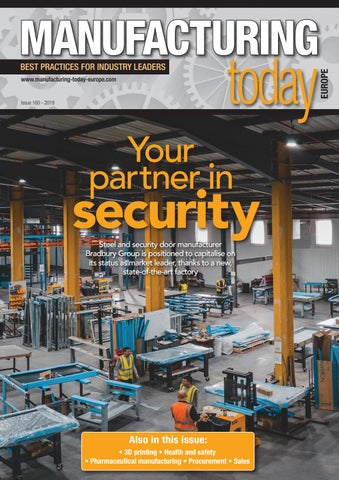
security Steel and security door manufacturer Bradbury Group is positioned to capitalise on its status as market leader, thanks to a new, state-of-the-art factory
Also in this issue: • 3D printing • Health and safety • Pharmaceutical manufacturing • Procurement • Sales
EUROPE
MANUFACTURING
Quiet. Dry.
Comfort through quality.
NORDEL™ Next
The next generation of EPDM Addressing the industries’ needs: Manufacturing efficiency due to faster curing & faster mixing EPDMs. Sensory appeal thanks to an EPDM sponge for superior surface finish & sealing properties. Lightweighting with the help of an EPDM designed for high performing TPV production.
For more information visit www.dow.com/elastomers/products/nordel.htm ®™ Trademark of The Dow Chemical Company (“Dow”) or an affiliated company of Dow
DOW3008_Nordel_Ad_Final.indd 2
04/09/2018 09:49
EDITOR’S COMMENT
Chairman Andrew Schofield Managing Director Joe Woolsgrove
BEST PRACTICES FOR INDUSTRY LEADERS
Assistant Editor Will Daynes
www.manufacturing-today-europe.com
Issue 160 - 2019
today
Your partner in
Staff Writer Vladi Nikolov
security
Production Manager Fleur Daniels
Steel and security door manufacturer Bradbury Group is positioned to capitalise on its status as market leader, thanks to a new, state-of-the-art factory
Art Editor/Design David Howard Advertising Design Fiona Jolliffe Production studio@schofieldpublishing.co.uk Advertising Administrator Tracy Chynoweth studio@schofieldpublishing.co.uk Operations Director Philip Monument Operations Manager Natalie Griffiths Editorial Researchers Mark Cowles Anna Davies Tarj D’Silva Jeff Goldenberg Ben Richell Richard Saunders Kieran Shukri Advertising Sales Joe Balfour Natalie Brett Mark Cawston Theresa McDonald Gary Silk Web Sales Tim Eakins teakins@schofieldpublishing.co.uk Independent Sales Dave King Exclusive Features Darren Jolliffe Subscriptions ikidd@schofieldpublishing.co.uk
Also in this issue:
Mitigate the
T
s $ PRINTING s (EALTH AND SAFETY s 0HARMACEUTICAL MANUFACTURING s 0ROCUREMENT s 3ALES
risk
he first editor’s page of MTE for 2019, and Brexit uncertainty still reigns supreme. And while I could discuss all the doom-laden scenarios that could be in the future, truth be told, I think we all know what they are. So instead, I am going to focus on the comments from Simon Gallimore, Manufacturing Industry Group Lead of AIG, who was quoted regarding the results of the EEF/AIG Annual Senior Executive Survey released earlier in January. He believes UK manufacturers remain [mostly] optimistic about the prospects for the global economy, despite the challenges of Brexit and other trade tensions expected in 2019. And while the survey shows that companies are less confident than a year ago (understandably I would say!) it also revealed that they are taking a range of options to mitigate the risks they may face to their business plans. The figures from the survey are from the UK, but I am of course aware that the ramifications spread a lot further than our shores. Are you a European manufacturer? If so, what preparations are you making for Brexit? As we head towards whatever the conclusion may be, I’m interested to hear a European perspective.
Follow us at: @MTE_magazine
libbie@schofieldpublishing.co.uk
Schofield Publishing
Cringleford Business Centre, 10 Intwood Road, Cringleford, Norwich, NR4 6AU, U.K. Tel: 044 (0)1603 274130 Fax: 044 (0)1603 274131
PS: I also wanted to highlight that if you have a story to tell, or require help with marketing materials, or have an email blast that you’d like sent out, the team at MTE is very keen to hear from you. We have a dedicated Exclusive Feature team who would be delighted to assist you in sharing your message with a wider audience. Do get in touch!
www.manufacturing-today-europe.com ©2019 Schofield Publishing Ltd
Please note: The opinions expressed by contributors and adver tisers within this publication do not necessarily coincide with those of the editor and publisher. Every reasonable effor t is made to ensure that the information published is accurate, and correct at time of writing, but no legal responsibility for loss occasioned by the use of such information can be accepted by the publisher. All rights reserved. The contents of the magazine are strictly copyright, the proper ty of Schofield Publishing, and may not be copied, stored in a retrieval system, or reproduced without the prior written permission of the publisher.
www.manufacturing-today-europe.com 1
EUROPE
MANUFACTURING
Editor Libbie Hammond
Features
4
4 3D printing Manufacturing organisations need to start considering the implications the Fourth Industrial Revolution – lead by AI, 3D printing and robotics
6 Health and safety It is imperative that those who operate within the manufacturing sector are appropriately protected from all health and safety risks
8 Pharmaceutical manufacturing In the future, we will see more pharmaceutical and nutrition companies working together to produce new probiotic brands
6
10 Procurement A combination of challenges and opportunities have become the catalyst in creating a shift towards how procurement can add value
12 Sales Lead velocity – why you need to focus on improving the conversion rate for leads as they move through the sales pipeline
14 Manufacturing news Updates and announcements from the manufacturing arena
8
2 www.manufacturing-today-europe.com
10
CONTENTS
Profiles 17 Cyden
26
20 Bradbury Group 26 Origin Global 30 Protolabs 32 Grass Valley 36 Interfloor 38 Roundel Manufacturing Limited
38
41 Encocam 44 ICW Powermode 47 Bodycote 50 Gurit 53 Loadhog 56 Laser Wire Solutions
44
58 Chanelle Pharma
20
53
www.manufacturing-today-europe.com 3
3D Printing
Seize the Siert Wijnia explains the way in which organisations can leverage 3D printing to maximise the potential of the light bulb moment
Siert Wijnia
4 www.manufacturing-today-europe.com
moment U
K manufacturing has come under the spotlight. While the industry can point to record order books, companies are being lambasted for a lack of investment and an over-reliance on a favourable exchange rate and cheap labour when compared to European competitors. The head of Siemens UK has called on UK companies to prepare for the fourth industrial revolution, (also known as Industry 4.0) led by AI, 3D printing and robotics, citing a report that says the technologies could boost manufacturing in the UK by ÂŁ445bn and create 175,000 jobs over the next decade. And while the government now appears committed to increasing its investment in the sector, the new technologies, from AI to Robotics,
can appear daunting. Given the innovation occurring globally, however, organisations need to start considering the implications of this next industrial revolution – but in small steps, not business risking, technological upheaval. Rather than look to revamp the entire production line, just consider the way individuals and companies can collaborate on new ideas when prototype files are shipped around the world and then 3D printed on demand, rather than waiting days, even weeks, for a physical product to arrive. Firstly, individuals retain the momentum; with no delay in the process, the physical and mental connection to the new concept or idea is retained. Secondly, with the price point of each iteration significantly reduced by the use of low cost 3D
printing, organisations can be far more confident about pushing for multiple iterations to fine tune the concept. Prototypes can be tried more quickly, even in parallel, maximising the knowledge of the collaborative team to quickly and effectively green or red light the concept. Essentially, the business has a chance to grab that light bulb moment and bring it to realisation faster than ever before. In addition, the use of 3D printing makes it far easier to gain feedback and useful response from potential users – individuals who may either struggle to visualise product pros and cons when presented with an on-screen diagram, or indeed those who don’t have access to the tools they have to work with.
Innovation in practice Indeed, the entire prototyping process can be reconsidered, enabling new business processes, even opening up new markets. For example, with the cost of 3D printers there is now no need for organisations to outsource prototype creation as many have in the past. Rather than spending hundreds, even thousands of pounds on a prototype, it can be created in house for just tens of pounds – including the cost of printer depreciation. The economics are fundamentally different. Indeed, new companies are springing up producing not for the masses but creating specialist products that have a production run in just the hundreds – using 3D printing only to cost effectively meet the demands of a specific niche market. Price is, in fact, a very small component of the overall benefit; it is the way organisations can bring new ideas to market that is truly compelling. For example, one firm is using 3D printing to test new ideas for internal parts and mechanisms. Experimenting with multiple iterations is speeding up the process of refinement and making it easier for the company to take the tough ‘go to market’ decisions. From the initial spark of an idea to a 3D printed model can take a matter of hours – it can be tested, tweaked, and tested again, all based on an accurate representation of the final product or part. The process can also be used to confirm a product’s manufacturability without needing to invest in expensive tooling. Traditionally, design engineers have been unable to fully test the functionality of designs without expensive and often time consuming changes to the manufacturing process – changes that have to be repeated each time a design modification is introduced. Integrated 3D printing solutions fundamentally change this process – enabling organisations to confidently offer customers a chance to rejig designs without incurring an
untenable cost. The result is a more flexible, interactive customer relationship as well as faster and lower cost time to market.
Conclusion One of the most compelling aspects of this prototyping model is its accessibility – in a world of disruptive technology, 3D printing can be embraced without affecting any aspect of the traditional manufacturing production line. Organisations can take a small, but significant, step towards digitisation and Industry 4.0 without a massive investment and without the huge and potentially risky upheaval associated with AI robotics. And this is key: Industry 4.0 is about streamlining manufacturing and 3D printing has a significant role to play in this process. It is an accessible and affordable way of better streamlining the production life cycle - from concept to manufacturing. Moreover, it is enabling inspired individuals to grasp the moment – to leverage digitisation and transformative technologies to turn a fantastic idea into a viable product within an incredibly short time frame, strengthening the concepts that underpin Industry 4.0. Plus, while AI robotics remains theoretical, with new graduates emerging from university familiar with 3D printing technology and its application, companies have fast access to the skills required: embrace their expertise.
With the renewed government commitment to UK manufacturing it is time to seize the moment. Organisations cannot rely on favourable exchange rates to boost the order books for ever – especially as the rest of the world fervently embraces Industry 4.0. But in the rush to get involved it is important to avoid over-strategising. Don’t get lost in ‘what Industry 4.0 should mean for the business’ task forces. When a young engineer can create a functional prototype in a couple of hours, a new product idea can be realised during the time it takes to run an Industry 4.0 strategy meeting. That, surely, provides the business case for taking the first step towards a totally digitised and connected manufacturing environment. v
Siert Wijnia Siert Wijnia is co-founder of Ultimaker. Ultimaker has been in operation since 2011, and over the years has grown to become a market leader; creating powerful, professional, and accessible desktop 3D printers with offices in the Netherlands, New York, Boston and Singapore, plus production facilities in Europe and the US. Ultimaker’s team of over 350 employees continually strives to offer the highest-quality 3D printers, software, and materials on the market to accelerate the world’s transition to local digital manufacturing. www.ultimaker.com
www.manufacturing-today-europe.com 5
Health and safety
Education
needed COSHH Management: How to protect workers within the UK
W
ith 13,000 fatalities every year linked to prolonged exposure to dangerous substances at work, primarily chemicals or dust (according to the HSE) the correct management of hazardous substances is vital. However, according to a recent survey, commissioned by the UK’s leading technology enabled risk assessment solution company, Alcumus, 54 per cent of UK companies reported only having ‘some’ level of awareness of COSHH (Control of Substance Hazardous to Health). These findings highlight the need for better internal training for both employers and employees about the importance of protecting themselves against hazardous substances, which includes everything from cleaning products to sophisticated chemicals and the by-products of engineering processes. This applies especially to the manufacturing sector, as it’s one of the UK’s economic success stories, contributing 25 per cent of the country’s GDP and employing more than 2.7 million people across the UK. Given the complex and varied nature of work involved, it is imperative that those who operate within the sector are appropriately protected from all health and safety risks. The survey, which questioned 120 UK companies across a variety of industries including manufacturing, found that a lack of perceived threat was the biggest barrier to increasing COSHH awareness. The second largest barrier at 28 per cent was a lack of awareness among staff members. What’s more, 45 per cent of manufacturing organisations admit that they require more support and training on COSHH. Moyna Merrison, Director of COSHH Management at Alcumus Sypol said: “The findings highlight that more training needs to be carried out internally to ensure employees understand the reasoning behind certain processes and the risks they face from harmful workplace hazards. It’s quite troubling to read that companies readily admit that they are not fully COSHH compliant and are well aware of their non-compliance, especially in a complex industry like manufacturing. “Training on external systems, including Alcumus Sypol’s CMS software, which enables businesses to create and deliver fully compliant, task based COSHH assessments, is vital to streamlining processes and ensuring a safe working environment.” As well as training on software, employers need to ensure they are educating their workers on the health implications they could face from exposure to the chemicals they use day to day. Eight per cent of manufacturing staff aren’t aware of the health risks of the hazardous substances they could be exposed to. Employers need to take charge and raise awareness amongst workers to ensure they know the risks associated
6 www.manufacturing-today-europe.com
with insufficient protection. Although the statistics show that a concerted effort has been made to educate workers, eight per cent of the working population is still too high a number to not understand the dangers of common chemicals, especially given how many people work within the sector. What’s more, employers need a better understanding of what managing their COSHH entails and how often they should be doing it; simply creating a one-off list of chemicals within a business and how to use them isn’t sufficient.
Proactive rather than reactive The Alcumus’ Sypol survey also found that one of the key drivers for companies investing in a COSHH strategy is the threat posed by near misses and incidents. This illustrates that UK businesses need to be far more proactive when investing in COSHH management rather than waiting
for accidents to occur. As general health and safety awareness increases among industries including working at height, mental health, hearing and eye protection, clearly COSHH management is still an area that needs improving in terms of education and prevention. “The problem we have with awareness surrounding COSHH management is that the effects of exposure, unless the chemical is flammable or erosive, won’t be detected until much later. Occupational lung disease kills 12,000 people every year. However, as it’s a long latency disease it’s not until years later that people feel the impact, meaning the consequences of hazardous working conditions aren’t always considered at the time. This needs to change in order to keep our workers safe. Our research clearly highlights that education is the main challenge that requires attention, for both employees and employers. Gathered from both the survey findings and our own research into COSHH management in the manufacturing sector,
it certainly appears that there is a lot more that needs to be done before the industry can be considered compliant across most aspects of COSHH management,” concludes Moyna. v
Alcumus Alcumus is a market-leading provider of technology-enabled compliance risk management, certification and accreditation services. Alcumus Sypol has launched a whitepaper exploring how the manufacturing sector can help safeguard the health of its employers from hazardous substances. https://www.alcumusgroup.com/coshh-manufacturingwhitepaper#DownloadWhitepaper www.alcumusgroup.com
www.manufacturing-today-europe.com 7
Pharmaceutical manufacturing
Field of
Probiotics: an accelerating opportunity for pharmaceutical manufacturers. By Per Rehné
Per Rehné
8 www.manufacturing-today-europe.com
growth T
he pharmaceutical sector is currently witnessing major changes as its boundaries are beginning to blur in to the food and nutrition sectors. Current markets are diversifying, and new fields of growth are opening up – in particular, involving the development of probiotics and the human microbiome. With growing interest in self-care and integrative medicine, coupled with a globally ageing and health-conscious population, recognition of the connection between diet and health has never been stronger. As a result, the market for functional food supplements that promote health benefits beyond basic nutrition is thriving and converging into existing sectors including the pharmaceutical industry. This movement is based on a rapidly expanding arena of probiotics and microbiome activity
modulation; live microbial food supplements that beneficially affect an individual by improving intestinal microbial balance and creating a new and exciting market opportunity for pharmaceutical manufacturers. The human microbiome, considered by scientists ‘as a newly discovered and largely unexplored organ’, has the power to change the way we diagnose and treat the most critical diseases of our time. Microbes defend against disease and can strengthen the immune system, so disease prevention is a natural fit for microbiome innovation. As a result, focus on the microbiome can be seen as a reappearing trend that cuts across pharmaceutical, food, wellness and nutrition sectors. Developments in personalised medicine and the unique nature of the human microbiome offer an opportunity for pharmaceutical companies to
develop products that no adjacent industry has the expertise to develop. One emerging option for pharmaceutical manufacturers is to engage in ‘Pharma Foods’. This sector is a new blurred frontier which is vastly untouched but offers the prospect of higher profit margins due to the unique and low regulatory landscape of the sector to date.
The current market The global probiotics market is currently experiencing unprecedented year on year growth and is now estimated to be worth a total €42.5 billion, according to the International Probiotics Association, and will likely exceed more than $60 billion by 2022. Because of growing health concerns such as obesity, cardiovascular health and diabetes, companies operating in this market are in the process of creating probiotic products that help them to assist in the management of such types of diseases. The impact of these health concerns is expected to increase in the near future, thus driving further attention on the development of probiotic products. In fact, probiotic products alone are expected to surpass a market value of $50bn by 2020 (an increase of 47 per cent since 2015). Looking at the present and predicted scenario of the global probiotic market, it is more important than ever for the pharmaceutical industry to capitalise on this new market opportunity, provide treatments that move away from the more traditionally chemically synthesised formulations, and recognise that probiotics have a place within the pharmaceutical and medical world - not just the food supplement market.
Industry opportunity At present, the growing trend for the pharmaceutical industry to enter the probiotics and food sector is by using strains that have been scientifically researched and tested with a known mechanism of action, and specific health benefits that have been proven in human trials. As the industry aims to enable modulation of the human microbiome, companies have two strategic options available to utilise the power of probiotics quickly. They can acquire or partner with food supplement companies to operate at the industry standard. Alternatively, they can leverage pharmaceutical brands and quality standards to produce a probiotic strain under Good Manufacturing Practice (GMP) conditions, with the finished supplement created in-house or contracted out to qualified manufacturers. The second significant area for the industry is in the biotherapeutic approach. This term
refers to any treatment that is produced by living cells rather than synthesised chemicals. Several products are currently in development and going through legal approval. However, due to the emergent nature of the market, there is not a clear legal framework in place to manage FDA approval, positioning and commercialisation. The US FDA has recently released a guidance document on the market sector and legal developments are anticipated due to the fastmoving nature of this part of the pharmaceutical industry. Despite the large volume of publications, patents and clinical trials that surround probiotics, there are still a lot of products in the market place with little to no evidence based on human trials. Developing products that deliver concrete results is a challenge that both food and pharmaceutical companies must resolve through evidence based probiotics. Pharmaceutical companies must learn to compete with competitors already well established in the field of consumer supplementation and self-medication and develop strategic relationships with the big retailers; an unknown territory compared with their usual pharmaceutical retail and distribution channels.
The future In the future, we will undoubtedly witness more pharmaceutical and nutrition companies working together to produce new probiotic brands aimed at the accelerating consumer market. Consumers’ overwhelming interest in functional foods, including probiotics, make it imperative for pharmaceutical manufacturers to stay abreast of the latest research findings. Human microbiome
research is already paving the way to a new approach toward disease management and prevention, and consumers are already making nutritionally based remedies the treatment of choice. As the global population continues to age, preventive and curative nutritional products will continue to gain market share. Pharma companies with the forethought to position themselves accordingly will be poised for healthy growth. It is also likely that we see new regulatory bodies established to cover the products created by both industries that sit along the aforementioned blurred lines. v
Per Rehné Per Rehné is Commercial Director at OptiBiotix. The aim of OptiBiotix is to discover and develop microbial strains, compounds and formulations, which modulate the human microbiome and can be used as food ingredients and supplements or active compounds for the prevention and management of human metabolic diseases, examples of which include obesity, cholesterol and lipid distribution and diabetes. http://optibiotix.com
www.manufacturing-today-europe.com 9
Procurement
A look at the
landscape
Artificial intelligence, global connectivity, resource scarcity, environmental degradation, wealth and health inequalities, rising populations, and political shifts are positioned to transform societies, test our values, and frame the decisions we make as procurement and supply chain professionals. By Malcolm Harrison
10 www.manufacturing-today-europe.com
T
hese are exciting times for procurement. The demands on today’s professionals are much broader and more complex than in the early days of my procurement career a few decades ago. More challenges and more opportunities combined have become the catalyst in creating a shift towards how procurement can add more value. Because the technical skills of procurement are well understood. The functional, back office activities of decades past speak of cost savings
and improved processes. But, the procurement professional of the future, is more akin to those of a successful business unit leader; and I see that happening now. A range of major developments are already affecting business such as artificial intelligence, environmental degradation and political shifts - all of which are set to transform society. All these megatrends as they are called, are transformative and disruptive as the pace of change accelerates in our fourth industrial revolution. These technologies are blurring the lines between the physical, digital and biological spheres as nanotechnology and the Internet of Things demonstrate. These developments are already impacting our organisations, both directly and indirectly and we must become agile and resilient to cope. The companies that respond and thrive in this new future landscape will become the sustainable and surviving businesses in the coming decades but it is anyone’s guess how that landscape will be created. Our research in the paper Future of Procurement and Supply Management, a study into the procurement landscape of the next 15 years has culminated in the development of two possible futures – the Networked and the Titans.
The Titans The Titans are the ‘tech giants’ such as Facebook and Google but also those companies that use digital transformation to manage networks and create mass efficiencies. This future will result in a few, large organisations across all sectors, but especially IT and they will be characterised by close integration of processes and high levels of trust and collaboration. These organisations will have access to big data, and vast amounts of it, but this use of data will not be without its problems. Just as data will encourage collaboration and integration between business groups, it will also become divisive and increase rivalry. Competing groups will shun suppliers working for the other side and more processes will become armslength and automated, further creating broken communication. These integrated processes will not only be highly-efficient, but also highly vulnerable from shocks such as cyber-attacks. Data security will be a huge risk, with supplier and internal breaches having the potential to destroy businesses. The major contribution from procurement professionals will be their ability to contribute to risk management and strategic decision-making. They will need to react with swift decisionmaking and understand the impact of volatility and predictability on their businesses. Without major infrastructure developments to enable the management of big data such as essential IT
systems, and have trained, skilled professionals in place, they will be slow to respond to these highlydynamic markets.
The Networked This scenario offers a future less polarised by the size of the different organisations that make up its whole comprised of small firms and with a more even distribution of market power and stronger connections between organisations. There will be a greater focus on sustainability supported by technological advances, and decentralisation. The circular and sharing economies will grow, fuelled by protectionism and more regulation, resulting in a stronger regional focus for business with fewer large corporations and smaller, micro businesses. Companies will be judged on their impact on social, environmental and economic activities and not financial metrics alone as stakeholders keep an eagle eye on developments and will keep a tighter control on what businesses can do. A wider range of business models will mean the procurement professional of the future will have to become more adaptable, more agile, as organisations pool their resources, and develop more co-operatives to increase their buying power. Professional buyers will have to become adept at managing their networks and strategising rather than just reacting. Rivalry will become more collective and reduced and stakeholders will be consulted over key procurement decisions.
Procurement and supply chain professionals have a huge part to play in whatever scenario comes to pass. Today’s sourcing decisions will shape tomorrow’s markets and companies, and working the way we always have will not get us far. This new world needs foresight, insight, integrity and highly-developed strategic skills. Whether it’s modern slavery, Brexit strategies or cyber security, business leaders are increasingly turning to procurement for answers. These complex questions make it all the more important for the profession to take a holistic supply chain view rather than just procurement and lead their organisations into the future. v
Malcolm Harrison Malcolm Harrison is Group CEO at CIPS. The Chartered Institute of Procurement & Supply (CIPS) is the world’s largest procurement and supply professional organisation. It is the worldwide centre of excellence on procurement and supply management issues. CIPS has a global community of over 200,000 in 180 different countries, including senior business people, high-ranking civil servants and leading academics. The activities of procurement and supply chain professionals have a major impact on the profitability and efficiency of all types of organisation and CIPS offers corporate solutions packages to improve business profitability. www.cips.org; @CIPSNews
www.manufacturing-today-europe.com 11
Sales
Improving
prospects Nina Church-Adams discusses how to grow manufacturing sales effectiveness with lead velocity Nina Church-Adams
12 www.manufacturing-today-europe.com
M
any manufacturing marketers have traditionally focused on the number of leads as a key metric. It’s easy to work under the theory that the more leads that flow into the top of the sales funnel, the more that will convert to a completed sale. Yet, more isn’t always better. A laser focus on lead velocity, that is, improving the conversion rate for leads as they move through the sales pipeline, translates into greater revenue returns while increasing sales confidence. When Marketing focuses on volume, Sales ends up kissing a lot of frogs in the hopes of finding the hot leads included in the mix. While there is a finite number of customers in the market for a product at any given time, there is a point of diminishing returns. When Marketing sends Sales too many frogs, they risk losing the Sales department’s trust and with it, the value of any leads they pass on. Velocity, the rate at which
leads convert as they travel through the sales funnel, is the answer. Here are four clear reasons why:
Increase in Lead Generation ROI Whether a direct lead, or a lead through the channel, manufacturing marketers today have to maximise their use of time and resources to prioritise prospective customer interest. Organisations that nurture leads experience an increase in lead generation ROI. After all, the velocity with which leads are converted to sales-qualified leads increases efficiency while ensuring Sales spends its time having high quality conversations. For example, Bisco Industries, a manufacturer of electronic components and fasteners, implemented lead nurturing and benefited from a 1400 per cent lead generation ROI, winning the 2017 Nucleus Research ROI Award.
Segmentation, tailored content and lead nurturing
Increased sales efficiency increases sales impact
While over half of manufacturing marketers don’t currently segment prospects at all, tailoring content to individual buyers increases lead conversion significantly. Velocity-centric marketing encourages segmentation, nurturing each lead based on things like product interest, position, industry, and more. According to Wakefield Research, 77 per cent of manufacturing organisations conduct more than ten promotions a year with 46 per cent running more than 21. Case in point: Last year Bisco Industries began delivering near real-time content to prospects, tailored to how those prospects liked to engage with the company. In doing so, they nurtured prospects through the buying journey from initial engagement to quote request, to placing an order and setting up a Bisco credit account. These customers were then further nurtured, adding new product lines to their account. With this approach, tailoring content to different prospects at different times in the buying process, Bisco increased its conversion rate by 1285 per cent. While Bisco only grew new opportunities by four per cent its enhanced conversions resulted in an average annual benefit of $301,388.
Even small, incremental increases in conversion rates can result in significant sales impact. When marketers focus on lead volume, a huge amount of effort is wasted with clearly unqualified leads - effort that could be used on leads that have a higher likelihood of conversion and ROI. In addition, a bonus side effect to an increase in velocity is that Sales can reinvest previously wasted effort in upsell and cross-sell activities, making them even more productive.
Sales marketing alignment In order to affect positive change in conversion across the sales funnel, it’s important for the Sales and Marketing teams of a business to work together, and to make sure they have common definitions for the sales and marketing process. For example, both departments need to ensure that they agree on what counts as a lead, an MQL, SQL, Opportunity, etc. With these definitions in hand, they should then measure the lead conversion rate from each stage to the next. Key questions to ask are: • What is the current velocity of prospects in the pipeline?
• Are there any bottlenecks in the process? • Which prospects move faster today and why? The more effective the funnel, the more efficient it is at converting at all levels, which can have an important impact on marketing and sales productivity - and most importantly, on sales outcomes. Segmentation and personalised nurturing campaigns will speed up the rate of conversion velocity and increase the quality of leads that are sent to the sales organisation. This will in turn grow Sales’ productivity, help them win more customers and make more sales, and increase Sales’ confidence in the marketing process and the marketing team. v
Nina Church-Adams Nina Church-Adams is Senior VP, Marketing at Act-On where she manages the company’s global marketing function, bringing more than 14 years of marketing leadership experience building teams, products, and brands at industry leading companies such as Nike and American Express. www.act-on.com
www.manufacturing-today-europe.com 13
News in brief Class A company Oliver Wight has announced that its customer, Gilbert Gilkes & Gordon Ltd., has been awarded Oliver Wight’s globally recognised ‘Class A for Planning & Control’ certification. From an organisation held back by a lack of integration and short-term firefighting, Gilkes is now driving forward with its plans, linked strategic objectives, and a clear view of the business over a 24 -month horizon. “Class A is excellence through people! The drive and passion for change that Class A has engendered amongst our employees has been incredible; it has united our business,” says Andy Poole, CEO of Gilbert Gilkes & Gordon Ltd. “Achieving Class A is the start of our ongoing drive to create a highperformance workplace.”
€200 billion opportunity Arthur D. Little (ADL) has published a new research report highlighting the need for greater digitalisation in the global telecoms industry. The TIME 2018 Flagship Report outlines the scale of the digital opportunity, with analysis estimating that a ‘digital dividend’ of over €200 billion free cash flow awaits telcos that can successfully transform. Jonathan Rowan, Partner at Arthur D. Little and lead author of the report explains: “Telcos are self-acknowledged digital laggards, despite our survey highlighting an overwhelming awareness of the benefits of digital transformation. Until now there was little quantitative evidence of these benefits, but our extensive financial analysis highlights that it can deliver up to an additional ten percentage points of EBIT. To enjoy this dividend, telcos must balance technology and organisational/cultural change, as well as adopting an agile and holistic approach.”
Global innovators The £60m Masdar Building which houses the Graphene Engineering and Innovation Centre (GEIC) has officially opened for business, providing a worldwide focus for the commercialisation of ‘wonder material’ graphene and other 2D materials. Part of a £300m+ investment in 2D materials infrastructure in the UK city of Manchester - where graphene was first isolated in 2004 - the GEIC’s launch to global innovators included a showcase of existing and future technology, and workshops to demonstrate the incredible potential for products enabled by 2D materials.
14 www.manufacturing-today-europe.com
German expansion
DuPont Transportation & Advanced Polymers (T&AP), a global business unit of the DowDuPont Specialty Products Division, intends to extend its High Temperature Nylon (DuPont™ Zytel® HTN PPA) polymerization capacity at Uentrop facility in Hamm, Germany. With this new investment, DuPont confirms its strong commitment to the European market, to address customers’ needs for specialty products and technology services to grow in highly dynamic markets such as automotive, electrical and electronics, consumer and health care. Adding capacity to the Uentrop line opened in 2016 is a further step on DuPont’s long-term investment strategy to enhance its polymerization and compounding capabilities. Back in 2015, the nylon businesses already announced a ten per cent capacity increase for Zytel® HTN polymer at its Richmond, Virginia, site. In 2017, DuPont T&AP also increased compounding capacity for its hightemperature nylon grades at its Mechelen site in Belgium. “With manufacturing assets in all regions including world-scale production and compounding sites for its specialty nylons, DuPont T&AP is a reliable global supplier with a strong and balanced regional footprint,” said Thomas Philipon, Global Product Line Manager, DuPont™ Zytel® HTN. “In Europe, our Uentrop site – which celebrated its 50th anniversary in 2018 – stands as a flagship example of the business’ commitment to high-quality and consistent product supply for our Zytel® HTN PPA products.”
Totally modern manufacturing
High-tech production plants that ‘think for themselves’, that plan things automatically and that optimise maintenance work through artificial intelligence, might sound like a futuristic sci-fi film, but are fast becoming a reality at Rittal’s manufacturing plant in Rittershausen, Germany. To produce its new VX25 large enclosure system, Rittal is transforming its production plant ‘on the fly’ into a highlyadvanced enclosures factory, populated by welding and handling robots. Half the conversion work has already been completed and the Industry 4.0 manufacturing unit is expected to be finished by 2020. The total investment involved has reached €120 million. What is happening in Rittershausen is the start of a fully networked factory. “Much of this automation is based on intelligent and networked systems that think ahead, plan automatically and trigger maintenance scenarios,” explains Norbert Peter, Plant Director at Rittershausen. He added: “This way, we can avoid any manual errors and, at the same time, speed things up even more.” In its ultimate configuration, the new enclosure will ‘grow’ on several profiling systems, each 70 metres long. These profiles form the ‘skeleton’ of the new system and they contain a huge amount of Rittal expertise. Of the 70 new welding and handling robots, 30 have been moved into the production buildings and are already in operation. The machines to communicate with each other via hundreds of sensors which monitor the fully automatic production processes.
manufacturing news New capability
The University of Strathclyde’s Advanced Forming Research Centre (AFRC) is exploring innovative ways to reduce materials wastage and production time across UK manufacturing, using rotary friction welding. Two rotary friction welding machines, the biggest of their kind in any UK research centre, are bringing a new capability to the centre. Originally housed in the Manufacturing Technology Centre (MTC) in Coventry; also part of the HVM Catapult network, the 125 and 300 tonne machines, represent an investment in the region of £500K. They will provide efficient, low cost solutions for firms requiring high integrity manufacturing processes in sectors, such as aerospace, automotive and oil and gas. The centre has already received significant interest in its new rotary friction welding capability from within its network. One of the initial projects using the new equipment will see rotary friction welding used alongside other capabilities at the centre to develop a high performance, high integrity component for aerospace applications. This combination of highly efficient manufacturing techniques will significantly reduce materials wastage and production time. Dr Laurie da Silva, Research Associate at the AFRC, who is leading the development of this new capability, explains: “Welding is often regarded in the manufacturing industry as an easy place for a material to fail. This, however, isn’t the case for rotary friction welding, instead it generates a very strong, high integrity joint for metallic materials. We’re working with our members and partners on an industrial research programme that will demonstrate the considerable potential of this technology. “Combining it with manufacturing techniques, such as flow forming, rotary forging and radial forging, we’re aiming to create new hybrid near net shape manufacturing processes for similar and dissimilar alloys. The process is generating lots of interest among our members and partners and presents significant opportunities for our customers.”
Investment for the future
Wednesbury-based manufacturer, Star Precision Tools Ltd, has received a £100k investment to produce new tooling for components needed for Jaguar Land Rover’s (JLR) recently revealed second-generation Range Rover Evoque. The investment, provided by the National Tooling Loan Fund and introduced by Frontier Development Capital, will support a contract to provide a component supplier with the tooling needed for the new Evoque, set to be launched to market in 2019. The project will deliver ten specialist press tools for manufacturing components to fit in the vehicle’s glass sunroof, as well as the main plastic surround - crucial in reducing damage when the vehicle is crash tested or involved in a collision. Jayne Bates, Director at Star Precision Tools, said: “Our track record and commitment to delivering bespoke products places us well to serve new tooling requirements. This investment from Frontier Development Capital will help us to support JLR now and in the future, driving the short and long-term growth of the company.”
Boots on the ground
For anyone looking for warm, dry and safe feet this winter, the latest addition to the Scruffs collection - mid-ankle safety boots - offer composite toe and midplate for lightweight flexibility and protection from sole penetration – whatever the weather. A reliable pair of boots for any time of year, Rapid Safety Boots incorporate Scruffs Dri4Work technology, making them fully waterproof come rain or shine. These boots take the stress of site use without compromise, with Poron socks plus a padded tongue and collar providing extra underfoot cushioning for maximum comfort. Rapid Safety Boots have a high spec safety rating, providing protection against heat, slips and fuel oil. Keep on the right side of your work mates too with MicroFresh technology, which prevents the build-up of bacteria to reduce unwanted odours. With underfoot shock absorption as standard, the Rapid Safety Boot minimises stress on the feet and ankles, so that you can get on with the job at hand without distraction.
www.manufacturing-today-europe.com 15
www.manufacturing-today-europe.com
FOCUS ON: 17 Cyden 20 Bradbury Group 26 Origin Global 30 Protolabs 32 Grass Valley 36 Interfloor
38 Roundel Manufacturing Limited 41 Encocam 44 ICW Powermode 47 Bodycote 50 Gurit 53 Loadhog 56 Laser Wire Solutions 58 Chanelle Pharma
y EUROPE
BEST PRACTICES FOR INDUSTRY LEADERS
EUROPE
MANUFACTURING MANUFACTURING toda y toda
Cyden
Light
fantastic
Boasting a new manufacturing facility that enables full in-house production, Cyden is looking to expand its portfolio of intense pulsed light hair removal products, as demand is growing from all over the world
W
hen Cyden was established in 2002, the business’ original aim was to design and manufacture intense pulsed light (IPL) hair removal products for professional beauty salons and replace the laser technology that was prevalent in the category up to that point. “Light has been used as an energy source to apply to the skin and interrupt the cycle of hair growth since the 1960s,” states Cyden’s CEO, Giles Davies. “The original hair removal lasers used to be very large in size, weighing hundreds of kilograms, and retailing for £100,000 or more. As a less developed early
technology, they were only capable of producing a small treatment spot and had a very weak pulse repetition rate, which made the treatment of a large area very slow. “From its inception, Cyden invested substantially in both product technology and a better clinical understanding of the interaction between light and skin. This resulted in products, which were rapidly becoming cheaper and smaller to the extent that the prospect of bringing an IPL-based hair removal device to the home became a reality,” Giles recalls Cyden’s early highlights. What provided the catalyst for the creation of a home-based product was the sale of the company’s professional devices division to Energist Ltd in 2008. A year later, Cyden began a strategic partnership with Boots to deliver the outcome of its efforts to the UK market – the first home use IPL hair removal product called Boots SmoothSkin. Giles continues: “The product was an instant
www.manufacturing-today-europe.com 17
Sony UK Technology Centre is celebrating an “extraordinary” 25 years in Pencoed The award-winning manufacturing facility, which creates thousands of Sony HD broadcast cameras, has seen manufacturing output soar to over six million units, charitable fundraising significantly surpass expectations, and created hundreds of skilled jobs during that time. Its state-of-the-art facility has consistently pushed the boundaries of innovation and transcended manufacturing industry expectations. Thanks to this, Sony in Pencoed is the sole European manufacturer of the brand’s 4K next generation broadcast technology; is constantly called upon to provide HD cameras to renowned international sporting tournaments, including the World Cup; and is dedicated to championing the future of manufacturing standards. Alongside this, its specialist Contract Manufacturing operation has grown significantly and now manufactures world-leading products for clients, including the Raspberry Pi and Cyden. On its success director of professional services Gerald Kelly states: “We’ve enjoyed an extraordinary 25 years at Pencoed, and we look forward to seeing what the future holds.”
18 www.manufacturing-today-europe.com
success with sales exceeding our expectations. “In 2014, we developed the latest version of the SmoothSkin technology and undertook an aggressive exporting strategy, which has included distribution to a number of territories, such as Germany, France, Australia, Japan, China, Middle East, and the US,” he moves on to discuss Cyden’s overseas activities. “We have now built a significant presence in Asia-Pacific and we even opened an office in Japan to support our growth in this market. More impressively still, the company managed to grow its market share in China from less than two per cent to over 30 per cent in l8 months, owing to our proposition of beautifullydesigned, clinically-proven, UK-manufactured products that have resonated with China’s growing middle class population.” A similar proportion of the market share has also been achieved in Australia, while in Europe, Cyden has created fruitful partnerships with renowned names in Germany, France, Belgium, and the Netherlands. “In addition, we have extended our reach into Eastern Europe, having established a retail presence in Russia, Hungary, Czechia, Slovakia,
Slovenia, Latvia, and Lithuania. We have also launched trials with retailers in Portugal, Sweden, Denmark, Norway, and Italy. Outside of Europe, we are experiencing strong demand in the Middle East, from countries like Saudi Arabia, the UAE, and Iran.” Preceding the company’s intensified exporting business, was the introduction of the SmoothSkin Gold and Bare products, both variations of the already-familiar Cyden technology platform. “The items hold a number of unique and innovative features. For example, they offer the highest average power output in the market, achieved through advanced electronics, optics, and cooling design. This has improved the machines’ efficiency and contributed to the enhancement of user experience by offering significantly shorter treatment times. “SmoothSkin Gold is the only device on the market to feature integrated skin tone sensors that continuously monitor the users’ skin tone during treatment and automatically select the optimal treatment setting to safely deliver maximum efficacy and safety. This also allows the user
Cyden
interface to be simplified to a level comparable with other home-use hair removal devices, such as epilators or shavers,” Giles presents to us Cyden’s latest achievements in product development. It is often challenging for fast growing companies to carry their entrepreneurial spirit along, as they progress to the higher echelons of their chosen business sphere. Embodying the counterexample of this trend is Cyden, which has succeeded in preserving its boldness and drive for innovation over time. “It is one of the core strengths that defines us,” confirms Giles. “Whilst we have become more systems and process-driven, we still continue to actively explore the potential of our technology.” To facilitate the continuation of its growth, the company relocated to a new facility in July 2018 that is expected to increase Cyden’s production capacity by an ample 300 per cent. “We moved from an outsourced production model to full in-house production, in order to ensure the presence of a focused, flexible, and scalable supply chain that would best enable us to service our customers on a global scale. To this end, we secured and transformed 26,000 square feet of space in our local Swansea area into a clinical standard manufacturing operation with staff and canteen facilities, office space, and meeting rooms,” Giles reveals. “The production space conforms to the Current Good Manufacturing Practice (CGMP) standards and can accommodate between four and six production and assembly lines with additional capacity for up to 15 packaging stations, plus a warehouse with room for over 1000 pallets. A semi-automated assembly line has been introduced, alongside cutting-edge laser etch and soldering technology. We have also made a significant investment in a new production line, which will allow us to deliver over half a million units annually,” he adds. In mapping out Cyden’s future development, the CEO takes into account the necessity of ongoing infrastructure investment that will cater for the long-term efficiency of its manufacturing processes. “Moreover, we are planning to continually diversify our product offering and build on our global distribution network – these represent the main ingredients we need to put together to guarantee the company’s successful operation in the years to come,” Giles concludes.
Cyden
Services: Intense pulsed light (IPL) hair removal products
www.cyden.com
www.manufacturing-today-europe.com 19
Your partner in
security
By investing in automation, Bradbury Group has stolen the march on its competitors in the manufacturing of steel doors. Having just opened a new stateof-the-art factory, the company is looking to double in size over the next five years
20 www.manufacturing-today-europe.com
I
ts mentality of continuous improvement has been the engine that has powered Bradbury Group into the front ranks of the steel and security door manufacturing industry. Since 1992, the Scunthorpe-based manufacturer has designed and produced a wide range of steel doors, personnel doors, certified doors, and communal entrance doors, as well as security grilles, window bars, and cages, putting in practice its core values of being best, fair, and efficient day in and day out. The last five years, in particular, brought such a speedy growth that even the company itself was taken by surprise to a certain extent. Bradbury Group’s Technical and Export Director, Paul Sweeting comments: “Our ability to adapt
to an ever-changing marketplace has been key. My view is that a lot of our competitors in the last 15 years fell behind, because they failed to invest in new products. We, on the other hand, have not only developed our product range, but have also invested heavily in automation, purchasing new machinery to make our manufacturing process as lean as possible.” As a result of the experienced growth, a pressing need for capacity extension occurred, and Bradbury Group moved into its brandnew, state-of-the-art factory in the autumn of 2018. “This was a major effort on our part and represented a significant investment for the company. It was a much-needed step, though, as we are now aiming to capitalise on the position
Bradbury Group
of market leaders we have reached in the past few years,” Paul maintains. “The type of methodology we were able to apply across the factory is something unseen in the world of steel door manufacturers, which takes us streets ahead of the competition,” he continues. “Our investment in automation allows us to shift away from the traditional means of production, which has historically involved handcrafting the doors. The building of the new facility is a way to future-proof the business and we have even started considering our opportunities to extend it further when we get to the point we want to be.” Bradbury Security is the founding part and the main division of the four that make up the
Bradbury Group. Accounting for approximately 60 per cent of the company turnover, it is predominantly engaged with the manufacturing of fire-rated and security-rated general purpose steel door sets. “Martin Roberts is another division of ours and it used to be a competitor, which we acquired a few years ago. What distinguishes Martin Roberts from Bradbury Security, is the marketplace into which the former delivers its door sets – namely, the architectural sector. It produces very high-end products that have been used on pretty much anything you can think of on the London skyline – from The Shard and The Cheesegrater, to numerous historic buildings. “Then, Newton Security Doors is our
‘‘
The Government spends a lot of money on upgrading the security of various infrastructure assets and, due to us launching a range of government securityrated products, we were able to win a few large contracts
www.manufacturing-today-europe.com 21
22 www.manufacturing-today-europe.com
Bradbury Group
AE Industrial AE Industrial has been established for over 45 years providing quality products and reliable service. Our aim is to meet the increasingly exacting demands of the manufacturing industry in a constantly changing market. With a total of 25 factory-trained air compressor and dryer service engineers, we have the experience and capability to provide the highest standard of after-sales service on all makes of air compressor and associated equipment. This commitment to service has enabled AE Industrial to become one of the largest distributors of compressed air equipment in the UK. We have had a working relationship with the Bradbury Group for 11 years and are proud of our association with them. Mark Sissons, Technical Sales Manager at AE Industrial, said: “We’ve been supporting Bradbury Group since 2007 and it is always rewarding working with an existing customer providing the right solution – it’s a great endorsement for our products and aftersales service.” Wayne Lewis, Facilities Manager at Bradbury Group, said: “The original Air Compressor installed 11 years ago is still going strong, which is why we continue to return to the company whenever we require new compressed air equipment. They are extremely reliable and provide great service and technical support, which is important to the Bradbury Group.”
communal entrance doors division and Extendor represents our grilles and cages business. In fact, Bradbury Group started as a grille company, but our owner and Managing Director, Tim Strawson, quickly realised that the door segment was going to be the area of growth in the market,” Paul remembers. “We acquired Extendor about seven years ago to complement our range of security-rated doors with security-rated grilles and bar sets, which are now mainly being sold overseas – in British Commonwealth offices and embassies around the world. “Owing to our innovative practices and designs, we managed to shape the market in the past decade or so. Formerly, we would concentrate on producing large volumes of non-rated doors, but at one point, we decided to prepare a range of higher-end, accredited products by applying our value engineering and volume manufacturing techniques that allowed us to make our name as an innovative solutions provider. We continue to spend hundreds of thousands of pounds every year on R&D and getting these accreditations to maintain the high standards we ourselves have set,” he adds. Paul has also registered the customers’ inclination to seek a total solution package. “It was becoming more and more clear that if somebody wanted to buy a door, they were
interested in purchasing a window grille, too. I think we succeeded in diversifying our reach as a company with the acquisitions of both Extendor and Martin Roberts, which eliminated the need to rely only on one or two sectors, and that has been crucial for our growth. We have now developed a product range that enables us to offer solutions to a wide range of markets – we do a lot of work in the utilities sector, in construction and retail, and we have also worked on a number of government infrastructure projects,” he analyses. Speaking of the major growth areas for the business in recent times, Paul singles out the utilities sector as Bradbury Group’s primary field of action. “The Government spends a lot of money on upgrading the security of various infrastructure assets and, due to us launching a range of government security-rated products, we were able to win a few large contracts, for example, in the energy market. We have recently developed a new range of flood-rated door sets, because our big customers in the utilities sector wanted us to secure certain electrical substations. Furthermore, we are also trying to dig deeper into rail now, which is a big step away from the core marketplace we have been targeting in the past 15 years.” 2018 will also be remembered for Bradbury Group’s early efforts to establish a firmer
www.manufacturing-today-europe.com 23
24 www.manufacturing-today-europe.com
Bradbury Group
BAPP Formed in 1972, BAPP has grown to become the largest independent fastener distributor in the UK, supplying job sites all over the world, from Barnsley to Dubai. With a knowledgeable management team with over 300 years of industry experience, combined with a fleet of 50 delivery vehicles that provide a world class service, BAPP carries stock in excess of £5 million over 18,000 product lines, and its 12 UK service centres offer same or next day service on most items. Whilst quality of product has always been its number one priority, it is the service that BAPP offers that is the backbone of its business, meaning that it has never lost its focus on its client’s requirements, no matter how small.
presence abroad, chiefly in the Middle East. “We have set up a partnership with a company based in Dubai, as we are trying to get involved in some of the many major ongoing construction projects in this part of the world. Right now, we are tendering for work we can do on the new stadia that are being built in Qatar for the 2022 World Cup. It will be a real feather in the cap if we get the chance to prove our capabilities within some of these projects,” Paul eyes international expansion for the company. “The outlook for 2019 is incredibly positive,” he enthuses. “This year, we will start reaping the fruits of having our new factory in full operation, which, in turn, will increase our profits and allow us to be more aggressive in certain market areas. Currently, we are in the process of installing a new ERP system to ensure the efficient functioning of the plant. In addition, we are working on improving our digital presence significantly. This will involve the launch of a brand-new website and ecommerce platform. In a way, our top clients will be able to buy from Bradbury Group the way they do from
Amazon,” Paul smiles. “We have realised the need to invest in the front end of the business, in order to boost our chances of winning new contracts by deploying new marketing techniques. “It is also quite important to mention that we are working closely with local institutions, here in Scunthorpe, to open new jobs in the factory. We are enthusiastic about supporting the community and creating opportunities for the town’s people. Aside from that, our goal is to strengthen our position as a market leader, remain at the forefront of innovation, and continue setting new standards and precedents for the ways in which our industry works,” he concludes.
Bradbury Group
Products: Steel doors, certified doors, communal doors, security grilles, window bars, and cages
https://bradburyuk.com
Bradbury Group’s Technical and Export Director, Paul Sweeting
ZEROplus At ZEROplus we can cater for all your door hardware requirements; in fact we supply everything except the door! Including amongst others; Zero door seals, Anemostat vision frames, Slimport port holes, FBLS fire rated louvres, Finprotect finger protection strips, friction stays, flush bolts and many other items of door hardware. Zero are pleased to be associated with BRADBURY GROUP and congratulate them on their continued growth and success.
www.manufacturing-today-europe.com 25
The doorway to
success
Combining high grade aluminium with precision engineering, Origin Global has established itself as the UK’s leading specialist manufacturer of aluminium bi-folding doors and windows
26 www.manufacturing-today-europe.com
Origin Global
I
n a way, as Sales and Marketing Director Ben Brocklesby explains, Origin Global (Origin) was something of an accidental business when it comes to how it came to be formed in 2002. “It was my father-in-law and his brother, who at the time owned a swimming pool company, who were first introduced to the concept of aluminium folding sliding doors. After discussing the technology with their respective children, Victoria Brocklesby and Neil Ginger, they concluded that there was a noticeable gap in the UK market that they could fill by designing and manufacturing the highest quality bi-folding doors and supporting this with unrivalled levels of customer service.� Since then, Origin has continued to work tirelessly to create products that offer flawless design and functionality, and has subsequently expanded into the manufacture of stylish aluminium windows.
www.manufacturing-today-europe.com 27
“Everything we have achieved as a business to date has been as a result of retaining our family ethos of looking to do the best job possible in all that we undertake,” Ben continues. “As anyone familiar with doors and windows will know, they are rather ubiquitous in their nature, so what we have chosen to do to differentiate ourselves is to focus on designing products that are desirable and that are manufactured to each of our customers’ bespoke specifications.” In responding to the demands of its customers, Origin has actively looked to include innovative nuances into its products. Examples include the introduction of a finger safety gasket to its newest bi-folding doors, providing an added layer of protection for young children who may be opening said doors, and the company’s unique utilisation of Aerogel, considered to be the world’s best insulator and used by NASA to insulate its space suits, in the manufacture of its windows. By using Aerogel in the thermal break of an Origin window, it considerably limits the heat transfer from one side to the other, delivering a A++ Energy Rating in the process. As well as putting the customer and their wishes at the top of its list of priorities during the design stage, Origin applies the same approach during the manufacturing process. “One of the trends we have seen growing in importance over the years amongst our customers is their desire to have what they want, when they want it,” Ben states. “Traditionally, the average lead time within the aluminium door and window industry is between four and eight weeks, but by embracing a Lean Manufacturing model we are able to offer the quickest lead times on bi-folding doors, delivered under our ‘Your lead time, not ours’ promise. “Under this promise, if a customer chooses a product in one of our 13 most popular colours they can specify its delivery date, be it a day, a week or a month after its order. Once selected, we fast track the product to the head of our manufacturing line and our customers receive the bespoke doors or windows they want in the timeframe they need. This capability, and the increased degree of flexibility it provides our customers, has helped us to grow rapidly and afforded us the enviable opportunity to possess a wholly unique manufacturing offering that few others would be able to replicate without a vast amount of capital investment and industry know-how.” Having established a commanding presence within the UK, Origin has also made considerable strides when it comes to increasing its export business. One of the big markets being targeted today in the United States, where it first introduced its products approximately four
28 www.manufacturing-today-europe.com
Origin Global
years ago. “Upon entering the US market, we wanted to go into one of the most challenging environments possible in order to test the durability of our products, and that was South West Florida, which regularly experiences the effects of hurricanes and tropical storms,” Ben says. “By putting our UK manufactured products through stringent hurricane testing, we not only confirmed their ability to pass the highest levels of testing around but also identified any key areas of improvement that would benefit our customers.” Buoyed by these test results, and benefiting from the respect and kudos that the ‘manufactured in Britain’ tag continues to carry with it, Origin has been able to establish a solid foothold in the United States, with it now also offering a fabrication service for its products on that side of the Atlantic. “Today, we remain one of a very select few manufacturing houses in our industry to offer European systems and solutions in the US,” Ben adds. “It is truly a fascinating market to be active in, but our approach remains the same, and that is do our best by our partners, customers and home owners.”
our inception and we see no reason to think that 2019 will be any different. Over the course of the next year we will be working hard to solidify our existing partnerships, increase our footprint and customer base, and develop our e-commerce offering as we further encourage home owners, builders and architects to engage with Origin. “We are not ashamed to say that we have some pretty audacious goals, and among the biggest is the desire to see Origin regarded as one of the marquee brands within the door and window industry. From a personal perspective, I would love to get the point where, when people decide they want to purchase a bi-folding aluminium door or quality aluminium window that they say, ‘I want an Origin’, and I see no reason why that can’t be realised!”
Origin Global
Products: High quality aluminium bi-folding doors and windows
www.origin-global.com
Plans for 2019 Elsewhere throughout the world, Origin products have long been present in the Middle East, where the company continues to experience strong demand particularly in places such as Dubai, where new money coming into the area is being used to bring the quality and standards of housing up to European equivalent levels. Speaking of which, demand across continental Europe also remains high, with parties from different countries regularly approaching Origin to determine the appetite for launching its products into these locations. Turning back to Origin’s products, the last 12-18 months have seen the company make a move into the front door market and launch its second window system. In the case of the former, the Origin Front Door boasts advanced security, tasteful aesthetics and thermal efficiency, comes available in a range of panel choices, colours and styles, is completely bespoke, and has become one of the fastest growing areas of the business. Meanwhile, The Origin Slimline Window’, or ‘OW-70’, was launched earlier in 2018 to great excitement. The company’s slimmest window to date, with sightlines of just 65mm wide, the OW-70 is ideal for spaces where maximising glass size and light is essential, and comes with a guarantee of up to 20 years. “We have always been both an optimistic and ambitious business, and as such we are predicting further growth for Origin during 2019,” Ben goes on to reveal. “We have grown year-on-year since
www.manufacturing-today-europe.com 29
Fast and
precise
Offering an extraordinary capacity for the production of prototypes and parts through various digital manufacturing technologies, Protolabs is striving to complement its service proposition, which will allow the company to meet its ambitious year-on-year growth objectives
A
s the 20th century was drawing to a close, one American entrepreneur and inventor by the name of Larry Lukis took upon himself the task to transform the traditional process of manufacturing injection-moulded prototype parts. Well ahead of his time, in 1999, Mr Lukis was finding it hard to get hold of quality parts produced in a speedy manner. This is why he decided to develop complex software and automate the manufacturing process, in order to drastically reduce the time it took to make these parts. Thus, Protolabs was born and today, 20 years on, the company is famous for being the world’s fastest manufacturer of custom prototypes and ondemand production parts. Over time, the business has developed capabilities that allow it to perform the entire production planning and sequencing not only for injection-moulded, but also for CNC and 3Dprinted parts. “Our major USP is that we are fast,” comments Vice President and Managing Director of Protolabs’ European operations, Bjoern Klaas. “We have established automated and scalable processes placing strong emphasis on utilising advanced technologies to be able to take on more and more customers without running out of capacity. To give you a more lucid notion of our speed, we can produce a CNC part and injectionmoulded parts in as fast as one day. In comparison,
30 www.manufacturing-today-europe.com
it would take you a couple of months, if you were to apply older and more conventional methods.” Bjoern also stresses the need for keeping an excess machine capacity across the company’s manufacturing plants. “Because everything we produce is made-to-order and we have to handle incoming orders within a couple of days, it is vital to maintain high levels of flexibility with regards to our capacity. We are investing continually in all of
our technologies, be it in machines or in training our employees to develop their skillset. The target for our UK facility in Telford is to grow by about 20 to 30 per cent yearly, while the highlight at the German plant is the ongoing investment we are placing in new 3D printing technologies. We have launched Multi Jet Fusion – an industrial 3D printing process that produces functional nylon prototypes and end-use production parts in just a day; as well as PolyJet and 3D-printed silicone. Moreover, we are releasing other unique technologies – for example, such that can deal with very fine parts in micro resolution, but that can still be printed and used despite being only a couple of millimetres in size,” he discusses. 3D printing has certainly been universally accepted as the hot trend in manufacturing, but, although Bjoern asserts that this service has attracted more interest from Protolabs’ clients in recent times, it has not necessarily resulted in more sales compared to CNC machining and injection moulding. “All of these types of services are growing at a double-digit pace, so it is hard to single out one that is performing better than the others. In fact, these processes do not compete with each other, but rather create a nice succession in which a prototype might first be 3Dprinted or CNC-machined and then, if the client wants to go ahead with production of a larger scale, injection moulding comes into play.
Protolabs
“3D printing presents the industry with a lot of new opportunities to produce parts, which were once inconceivable. This is precisely what makes the process so attractive, but my opinion is that engineers have just realised the possibilities offered by 3D printing and it will take some time before it spreads across the entire industry,” he analyses. Its capabilities have enabled Protolabs to dip its toes into multiple industries. Time and again, the company has proven its proficiency in the automotive, E&E (electrical and electronic), industrial and commercial machinery, aerospace, and medical sectors, to name but a few. “In order to explain our working process better, we can take as an example the injection moulded parts we make for certain British car manufacturers for their sports cars,” Bjoern proposes. “First, the customer uploads a CAD file for design for manufacturability (DFM) analysis by our automated software. It may also be evaluated by our designers who appraise whether the part is manufacturable. If it is not, we offer a design service to get it right, which not only makes the design feasible, but also aims to reduce cost wherever possible. With that, if the customer decides to go ahead with production, the aluminium or steel block is put into a CNC machine to produce a mould tool, which is then taken to an injection moulding machine, which leads to the manufacturing of a larger quantity of parts. It is a fairly straightforward and automated process, and normally only one person is in charge of an array of machines, which adds to the efficiency and speed of our operation.” Since starting in the US in 1999, Protolabs has gone on to open its first manufacturing facility in Europe in 2006 – the aforementioned site in Telford. Two plants in Germany followed up and in 2008, the company extended its footprint to Asia, when it established a location in Japan. “We are now present in these locations we have deemed strategically important for the business,” claims Bjoern. “This will allow us to concentrate on developing them by investing in their capabilities. We would like to see growth of at least 15 per cent year-on-year over the next five years and, for the time being, we are on track, thanks to this continual investment and the uncompromising delivery of our promises. “Right now, we are in a sort of a transactional relationship with our customers, but we are eager to get closer to them and invest time and resources in strengthening our business partnerships. We plan on introducing new, more secondary services that will complement the main role we play in our clients’ operations,” he outlines. “Expanding our technical capacity is another ‘must’. As it became
clear, we are always open for the possibility of adding new technologies to enrich our portfolio. Having recognised the growth of ecommerce, in 2019, we will also focus on enhancing our online presence,” Bjoern concludes, disclosing some of his ideas for the future development of Protolabs.
Protolabs
Services: Injection moulding, CNC machining, 3D printing, sheet metal processing
www.protolabs.co.uk
www.manufacturing-today-europe.com 31
Media
darlings
With its industry’s largest R&D engine at its disposal, Grass Valley, a Belden Brand, has become the trusted long-term technology partner to a who’s who of the world’s leading broadcasters, news organisations, content/rights owners and media service providers
I
f you are one of the many millions of people to have had the pleasure of watching some of the biggest sporting or cultural events in recent memory, from the UEFA Champions League Football Final and the British Formula 1 Grand Prix, to a Royal Wedding or a large outdoor concert, you are probably also blissfully unaware that specialist kit created by Grass Valley (GV) is being used as part of the systems that record,
32 www.manufacturing-today-europe.com
process, convert and playout the TV signals back to your home. “We manufacture a full-suite of televisionenabling technology, such as the high definition cameras and the control desks in TV studios that are covered in flashing buttons and sliders, and also the really clever kit sitting in air conditioned server rooms and in Outside Broadcast Trucks,” explains GV’s Head of Newbury, UK Operations, Paul Lucas. “We also provide the systems that effectively automate TV stations, loading and running an entire day’s output, automatically checking that everything is in sync.” Itself a part of Belden, a $2.5 billion US manufacturer of networking, connectivity and cable products, GV is one of the world’s largest producers of systems for the Broadcast Media industry. A high-tech player of great repute, it has a worldwide workforce that includes more than 600 engineers and a total of 360 patented innovations at its disposal. “We design, manufacture, distribute
and support in-house, which is a strategy driven by the very specialist and complex nature of our products,” Paul continues. “In the UK, our lineage can be traced back to a series of well-regarded brands like Omnibus, Snell Advanced Media (SAM), Snell & Wilcox, Probel and Quantel, and today GV UK represents a sizable portion of the GV workforce, with sites in Newbury – where manufacturing activities take place, Cambridge, Havant and Castle Donnington.” In an ever-changing media landscape, where content remains the most important element, GV’s customers are faced with the need to create and support new workflows, while continuing to operate their legacy workflows, simultaneously broadcasting through traditional channels, OverThe-Top platforms, and Video-On-Demand, as well as to PCs, tablets and mobile devices. For its part, GV provides the innovative tools and expertise to help improve the efficiency of its customers’ operations. With GV’s integrated
Grass Valley
solutions enabling flexibility, cost-effectiveness, quality and scalability, broadcasters and content creators have at their disposal what they need to sustain their businesses. GV’s customer base is truly global, and includes all of the major national broadcasters such as the BBC, ESPN and Sky, as well as the many providers to said broadcasters, for example Outside Broadcast specialists. GV also supplies postproduction editing hardware and software to film production companies. The company is focused on empowering its customers to create, control and connect content wherever, however and whenever it is consumed. The most recent stage of GV’s evolution came in February 2018, when parent company Belden confirmed its acquisition of SAM and its plan to merge GV and SAM into a single operation under the GV brand, with its headquarters in Montreal. “Belden recognised the benefits of scale in leveraging the significant R&D investment needed in this industry, and had already successfully merged Miranda and Grass Valley prior to its purchase of SAM,” Paul details. “Prior to this, SAM was roughly half the size of GV, but boasted just as wide a product range to develop and support.
SAM and GV had very complementary product portfolios and had differing geographical strengths. Altogether, this made for a very good match.” From the first day of the acquisition and onwards, Belden has shown itself to be a parent company more than prepared to invest the
capital its businesses require to grow and succeed. Amongst countless examples of such investment that one could pinpoint, one of particular note has been the complete re-configuration of GV’s Newbury factory, which is now 90 per cent complete. “Belden is dedicated to applying
www.manufacturing-today-europe.com 33
© Image courtesy of Asia-Pacific Broadcasting
M-TEK M-TEK is a global electronics manufacturing service partner (EMS) with 24 years of expertise in high mix, high value PCB and full product assemblies. Through design, fast prototyping and full turnkey volume production and supply, M-TEK’s footprint has expanded over the years from a 50-miles radius in Berkshire to cover APAC, Mainland Europe, the UK and the Americas. M-TEK’s accreditations, standards and continuous quality improvement strategy, sustained by a commitment and solid investment policy in people and machinery, has acquired the group a reputation for consistently delivering quality and reliability with the capacity to grow with customer needs and requirements. M-TEK’s high commitment to manufacturing excellence, with its on-going investments in innovation and talent, and its competitive pricing with fast turnaround manufacturing services has culminated in its nomination for the Electronics Industry UK Manufacturer of the Year Award, for which it has been recognised and proudly brought back home in September 2018. Needless to say, this unique approach to contract electronic manufacturing has allowed M-TEK to develop a business model in which capturing and securing customers’ most sensitive specifications and requirements is a pre-requisite to delivering quality assemblies and products on time and as per the set expectations. This has ensured M-TEK has been able to successfully assist SAM and Grass Valley with their most stringent electronics manufacturing requirements since 1994.
34 www.manufacturing-today-europe.com
Lean Manufacturing techniques, and the new factory layout is a result of a large, cross functional Kaizen project,” Paul states. “The factory flow is now far simpler, enabling us to see bottlenecks and inventory excess or shortages, and we can more accurately identify where and when to move our resources to respond to a massively varying day-to-day sales mix.
Grass Valley
Kahuna family
“We were already in possession of stateof-the-ar t SMT equipment, but we have more recently invested in the ancillary kit needed to reduce change-over and kitting times, thus maximising run time. At the same time, we have refreshed our Automated Optical Inspection and Flying Probe kit to further improve PCB quality, essential when we are producing relatively small batches of highly complex Multi-Layer PCBs. We are also joining the rest of the group in rolling out new Factory Management and ERP systems, enabling us to leverage our inventory, spend and capacity across our Montreal and Newbury plants, and indeed the rest of Belden.” Firmly established as a leader in its field of exper tise, GV now intends on leveraging the combined product portfolio and sales reach of GV and SAM in order to continue growing its revenue and profitability. Paul adds. “We continue to be at the forefront of IP technology, which places us nicely alongside the next investments that will be made by the big players in our industry, and in our plants in Newbury and Montreal we have the expertise and capabilities to provide the solutions our customers demand.”
Grass Valley
Products: Content and media technology
www.grassvalley.com
www.manufacturing-today-europe.com 35
A sense of
style tredaire FR6
Duralay-LVT-Dry-Back
Duralay-LVT-Low-Grab
With luxurious interiors and quality finishes remaining a priority for the residential and contract markets, Interfloor has used its considerable experience and knowledge to develop new products and add to its already extensive range of flooring accessories
Duralay LVT Roomset
36 www.manufacturing-today-europe.com
W
ell-known for its Duralay range, in 2018, Interfloor developed a specialist collection of high-end underlays to make luxury vinyl tile (LVT) floors more comfortable underfoot, ensure the longevity of the tiles, and improve noise reduction. CEO John Cooper describes in greater detail the advantages of the new range: “The underlays provide an excellent subfloor, masking any minor imperfections and helping to prevent the overstraining of joints, thus benefitting the fitter. We offer three types of LVT underlays – multi-fit, dry-back, and low-grab. The former is ideal for double-sticking, with high-temperature adhesive in problem areas where heat and/or humidity have historically caused installation issues with LVT. Then, the dry-back underlay has a unique highgrab backing, being quick to fit and easy to work with, therefore, it considerably reduces installation times and costs. Last but not least, the low-grab underlay is used to install ‘click fit’ LVT and, thanks to its low-grab backing, the new floor can easily be pressed onto it to fit in place.” Taking into account consumers’ growing demand for higher-quality finishing touches for their interior projects, as well as the desire to co-ordinate their ironmongery, Interfloor also introduced a high-end addition to its existing Gripperrods range to give retailers and installers an opportunity to provide the perfect detailed finish. “The new Premier floor edgings are available in modern finishes that will complement the current trends in luxury home accessories,” John discusses. “The range includes a fashionable brushed steel nickel and an elegant bright chrome, which co-ordinate well with other home accessories, light switches, and door handles to ensure a seamless finish. In addition, both are available in five specialist trims designed to provide the perfect solution for all types of materials.” Due to the market requiring firmer and more luxurious products suitable for use in all areas of the home, as well as for contract installations, Interfloor released its highest density PU underlay range. One of the three products in the Premium High Density (PHD) collection – Tredaire Palladium, was named a winner in the underlay category of the inaugural National Flooring Innovation Awards, and was recently relaunched in response to overwhelmingly positive customer feedback. “Tredaire Palladium has a highperformance Textron backing that gives it more dimensional stability and cleaner cutting during installation. This is then coupled with exceptional ‘shock absorber’ properties to prolong its life, as well as superior heat insulation capabilities and high acoustic ratings to reduce noise. On
Interfloor
top of that, Palladium is made of 100 per cent recycled foam, which highlights its strong ‘green’ credentials,” John reviews the product. When Interfloor last appeared in Manufacturing Today Europe in April 2018, John hinted at the company’s aspirations to actively develop a range of flame retardant products. At that point in time, the business had already started offering Duralay Counterflame and Tredaire Flamecheck, and as the year was drawing to a close, it also launched Tredaire FR6 – a hard-wearing, highdensity flame retardant underlay that can be used where a thinner, but still highly-functional underlay is required. Presently, Interfloor and one of its key Scandinavian customers are working in unison to develop products that find an application in sound insulation during the actual construction phase of new builds. John comments: “The range is called Decibel Soundseal and is a wellproven acoustic solution that is fitted within the subfloor construction during the build process and, as such, the acoustic property of the installation is maintained regardless of what further flooring is used on top of the subfloor. It is a fantastic product for apartments, hotels, and offices where both in-room and betweenroom sound reduction is required. This acoustic sound reduction is particularly useful when linked to the increasing use of hard flooring in the aforementioned types of properties, which now lack the inherent sound dampening effect of traditional underlays and carpets.” Showcasing its unrivalled expertise, another major milestone for Interfloor last year was the setting up of a CPD seminar approved by the Royal Institute of British Architects (RIBA) and the British Institute of Interior Design (BIID), whose goal is to support specifiers in the selection of the correct underlay for their projects. “Called ‘A Specifiers’ Guide to Underlay and More’, the seminar comes with a handbook with a useful pull-out flowchart to help specifiers with their decision-making. Furthermore, it contains details of products that have been installed at prestigious buildings including the five-star Atlantis Hotel in Dubai, Singapore’s Changi Airport, and London’s Royal Festival Hall,” John points out. Throughout 2018, the manufacturer also took on several capital investment projects that saw it improve its rubber underlay production efficiency via the purchase of a high-capacity Banbury mixer and mills, as well as expand its PU underlay production capacity by creating additional peeling capacity. “Another £3 million is projected to be spent in the new year, aimed at automation and at reducing the impact of rising raw material costs,” John reveals. “What is more, we are keen on investing further in our internal
training programme. We have added eight new members to our Lean Improvement team over the course of the last 12 months, with all our Lean graduates having been part of project teams delivering 5S and solving problems on the shop floor. “For this year, our intention is to continue the drive for productivity improvement, maintaining our excellent quality and service performance. At the same time, we have to ensure that we successfully navigate Brexit, whilst outperforming our shareholders’ expectations. In the long-term, we want to cement our position as Europe’s largest manufacturer of carpet underlay and remain the supplier of choice with all of our key retail and wholesale partners in the UK,” John concludes.
Interfloor
Products: Carpet underlays and flooring accessories
www.interfloor.com
www.manufacturing-today-europe.com 37
Kitchens that
inspire
It’s important to stay a leader of kitchen design trends, which is why Roundel was kept busy perfecting its product offering in 2018, whilst also upscaling its manufacturing capabilities by investing in new machinery
Jim Bebbington
38 www.manufacturing-today-europe.com
L
ong gone are the days when the home was associated just with comfort. Today more than ever, people are gripped by the idea to create a vibrant living space of their abode that follows the latest trends in interior design and that will provide an inspiration for them to work, play, and, inevitably, rest. For half a century, Roundel Manufacturing Limited has aimed (quite successfully, we shall say) to remain at the forefront of the kitchen furniture manufacturing industry, specialising in the design, production, supply, and installation of both affordable and luxury fitted kitchens. At the beginning of the new year, we got in touch with the company’s Managing Director, Jim Bebbington, to hear his opinion on what 2018 was like for the business, and to find out more about Roundel’s plans for the years to come. “First of all, despite the concerns everyone in the industry and indeed the country has with regards to Brexit, we are pleased to report that we have seen no downturn in sales. Quite the contrary, we continue to experience good growth, but we will continue to monitor closely.
We are pleased to confirm we are enjoying a five per cent growth in volumes with existing clients, as well as an impressive 30 per cent increase in business generated from our newest clients. “Last year, we decided to change the colour palette we offer to the marketplace. We have taken the opportunity to launch with the more fashionable grey and earthy colours, trends we expect to be very successful in the industry in the next couple of years, these colours are reflected in all of our new kitchen ranges,” Jim discusses the recent additions to Roundel’s product portfolio. “One of the milestones of the year was the launch of our new kitchen cabinet which we call fusion, this represents a mix of our previously two best-selling cabinet colours stone grey and Kashmir (around 93 per cent of our total sales in cabinets). We were looking for a unique tone that would work well with all our 150 doors in the new Roundel collection. What is more, we also took the opportunity to update the drawer box to the more fashionable colour, orion grey, as opposed to the lighter shade of grey we used previously. Again, we wanted the
Roundel Manufacturing Limited Top right: Manufacturing in progress Below top: Remo Silver Grey Gloss and Broadoak Rye Bottom: A Cam kitchen Bottom right: The new Fusion cabinet
product to be more aesthetically pleasing and to more accurately reflect the trends of the day in our industry.” Driven by its firmly established principle that it should offer not only the standard products clients would expect it to, but also a selection of unique items, Roundel took the marketplace by surprise with the introduction of a special three-piece door range last year. Customarily, the collection was named after British rivers, in this case Cam – the main river flowing through Cambridge in eastern England. “Four finishes are available for this door and we can proudly say that it is a completely new product that none of our UK competitors currently offer,” Jim glows. “I should also mention that we have been quite active in improving the specification of some of our existing components. For instance, we have changed the edging on some of our doors
from 0.8 mm to 2mm.” Roundel’s intention to extend the control it has over the manufacturing of doors is clearly identifiable from the targeted investment the company placed in 2018. Both of its brands – Roundel Kitchens and Nixons Kitchens – had their facilities upgraded with Airtech machines from Homag. This will enable Roundel to increase in-house door manufacturing to 85 per cent of all their requirements. Currently, the business has the capacity to produce some 65 per cent of its doors, with the rest being outsourced, but it will not be long before the vast majority of the door production will take place in the company’s plants near Newcastle. “On top of that investment, we also spent more than £1 million on machinery that will increase our worktop manufacturing capacity by 500 per cent. It is fully operational now and we are beginning to experience the benefits. We had originally scheduled to commission in August but
were delayed due to a serious cyberattack the company suffered in August,” Jim reveals. Speaking incredibly calmly about the challenge Roundel faced, he praises his team for their tenacity and composure during the critical period. “Our systems were down for nine days, but we still managed not to miss a single customer delivery. This is a tremendous testament to the ability and efforts of our staff. In fact, there was very little knowledge outside of Roundel that we had experienced such a challenge. True, it required a massive effort on our part to keep the business functioning, but it also reaffirmed our confidence in the structure of the company, as we came out the other side.” Having repelled the cyberattack and taken delivery of the new worktop manufacturing facility, Roundel now awaits to complete the final part of the machinery investment it had planned and budgeted for. “We are planning now for the arrival of a new angle saw in March which will increase our cutting capacity by, yes again, 500 per cent. This will not only allow us to manufacture significantly faster but will also allow us to be so much more efficient. With it, we will be able to cut all current weekly demand in just one working day. It will optimise the way in which the business operates and reduce our costs, currently we work five days per week plus additional hours to service our clients demands. This will change, however, once the saw comes into play,” Jim reasons.
www.manufacturing-today-europe.com 39
Roundel Manufacturing Limited The new super gloss and super matt Coe (left) & Forrs (right) kitchen ranges
As the Managing Director turns his attention to prevalent market trends, he ventures to predict that it will be their new super gloss and super matt Coe & Forrs kitchen ranges that will generate the greatest sales in 2019 with matt likely to be growing at the same rate gloss reduces.This aside, the keyword for the company in 2019 is poised to be ‘stabilisation’. Jim clarifies: “We have experienced incredible growth over a relatively short period of time.The business doubled in size over a three-year
40 www.manufacturing-today-europe.com
period just a few years back, we now need a little bit of time to take stock and to understand what future investment and strategic steps need to be made to support our further heavy growth plans. Right now, our senior managers are working on our stabilisation plans, aiming to ensure that the company remains a strong service provider with a solid infrastructure for future growth. In 2020, we aim to start our ambitious growth plans. At this point in time, our turnover is about £25 million, but
our overarching ambition is to reach the £50 million mark over the course of the next seven years,” he wraps up, sharing with us Roundel’s aspirations for the coming decade.
Roundel Manufacturing Limited
Products: Luxury fitted furniture
www.roundelkitchens.co.uk
Encocam
The Brute 500
On to the next
level T
Insight sits securely on the window of the car to give other drivers and road-users a highly visible indication
Enjoying a time of steady growth across all of its eight divisions, Encocam marked its 30th anniversary with the development of multiple new products, including its first British-designed and built motorcycle that will be launched in 2019
he past year has seen a growing trend in UK manufacturing that emphasises complete local production. More and more companies are launching British-designed and built products, but this is nothing new for Encocam, which has been flying the flag for British manufacturing for three decades now. Nevertheless, the company is getting closer to a very significant milestone in this regard, as one of its eight brands – Herald Motor Co, is launching the business’ very first UK-designed and built motorcycle – the Brute 500. “It has been a long-term ambition of mine,” enthuses
Encocam’s Founder and Chairman, Dr Mike Ashmead. “Our ability to design and produce parts in-house, together with the extensive facilities we have at our disposal, have enabled us to develop and manufacture the product, which is now entering the stage of final testing and development,” Mike clarifies. “Brute 500 has been inspired by the racetrack, but built for the road, and is our modern take on the street tracker. Featuring a single four-stroke 449cc engine, the bike also has adjustable Racetek front and rear suspension with our own unique floating-shock linkage system,” he continues.
www.manufacturing-today-europe.com 41
“Historically, Herald has focused on 125 and 250 motorcycles, but earlier in 2018, we launched the Herald Classic 400 with another 400 model also released by the end of the year. Furthermore, we have developed the Brat 125 bike together with some trusted partners, so this is another model that will play a central role in our exciting 2019 range.” Herald has certainly not been Encocam’s only successful division in the 12 months since the organisation last appeared on the pages of Manufacturing Today Europe. “In fact, all of
42 www.manufacturing-today-europe.com
our brands have done extremely well in their respective fields,” Mike remarks. “For example, BCP continues to lead the field in vacuum tables and specialist composite structures, having recently developed two tables for displaying products at the new Paul Smith flagship store in London’s Coal Drops Yard. “Corex Honeycomb launched Superflex – a flexible aluminium honeycomb, which opens up the product to those wanting more flexibility of shape without compromising on strength. Also, Euro Road Safety, which
specialises in the creation of innovative road safety products, released a new vehicle sign system called Insight. Its key advantage is that it allows an L or P plate to be displayed prominently on the side of the car, increasing its visibility to other road users,” he says of Encocam’s latest exciting product developments. What could perhaps be considered the company’s flagship brand – Cellbond - has also had its significant highlights over the past 12 months. Mike details: “We showcased our THOR dummy prototype, which is currently undergoing rigorous testing. THOR stands for Test device for Human Occupant Restraint and is used to test vehicles in frontal impacts along with the MPDB barrier, which is also manufactured by Cellbond. Representing a 50th percentile adult male, the device is the most biofidelic crash test dummy developed to date, which Cellbond’s design engineers have further enhanced with improved usability features to position it more effectively. “More good news is the approval Cellbond was granted by the European New Car Assessment Programme (Euro NCAP) for its proposals to improve the Q10 dummy. The
Encocam Cellbond Barrier plus Q10 and Q6 Dummy 2
upgrades concern the shoulder and hip belt stability, as well as delivering more consistent repeatability during testing and we are exceptionally pleased that we were given the green light to go ahead with these,” he adds. Committed to investing continuously in its manufacturing capabilities, Encocam has further invested in equipping its precision tools and anthropomorphic test devices (ATD) parts division – Stonehill Engineering, with more new 5-axis machining centres. “The investment was necessary, because we had to ensure that the team can deliver both prototype and one-off requirements as well as full-batch production to tight tolerances,” Mike comments. Encocam has built a reputation as a wellknown exporter and over the past year, the company has reinforced its position in a number of key international markets, predominantly in Asia. “We continue to export 80 per cent of our UK production and we have recently grown our team in Japan to support increasing sales in that region,” Mike reveals. “We have also expanded the range of products available to our Korean customers, while it is easily observable that China is continuously growing in demand, too. Admittedly, the situation with Brexit is a bit challenging for our activities in Europe, but
we are working hard to ensure the continuous smooth provision of products and support to our customers on the continent.” April 2018 marked Encocam’s 30th anniversary, which was celebrated with a twoday technical conference for the automotive safety sectors where leaders in the field talked about the industry’s progress. Recognised as a global market leader in automotive, the company is also experiencing significant growth in the rail and architectural sectors – a welcome progress that sits well with its long-term ambitions. Mike concludes: “Our aim is to be the partner of choice in all the sectors in which we are present. We have developed a reputation for working with customers and providing them with solutions to their challenges, and we would like to build on that and grow the business for the next 30 years.”
Encocam
Products: Crash test dummies, automotive crash test barriers, energy absorbers, composite panels, motorcycles and more
Founder and Chairman, Dr Mike Ashmead
www.encocam.com
www.manufacturing-today-europe.com 43
Powering
forward
With a track record of 5000 completed projects and installed power solutions worth nearly half a billion pounds, ICW Powermode’s heritage of delivering added value turnkey power solutions began in 1974
F
ounded by the current Chairman and CEO Ian Charles Wright, today ICW’s operations comprise the design, manufacture, installation and commissioning of switchboards and datacentre power distribution equipment. This includes 11kV MV switchgear, packaged sub-stations, interlinking busbar, generator synchronisation equipment, UPS input/output switchgear and final power distribution to ICW Powermode’s intelligent LV power distribution equipment. The scale of the solutions offered by ICW is what sets the company apart and to start off with an introduction to the business, Ian Charles Wright described the business in layman’s terms for MTE: “To put it simply, we make what every household has in the form of a ‘fuse’ or ‘circuit breaker’ box, but in our case, it is hundreds of times larger, and would typically power iconic buildings such as the Shard or Canary Wharf Tower, or data centres, hospitals, transport infrastructure projects and financial services buildings.” Indeed, as recently as December 2018 ICW was a major part of the computer controlled lighting display at the Shard, which was formally switched on to celebrate the festive season. “ICW provided this service from basement to spire, from switchboards to LED fittings installed by abseiling electricians,” noted Ian. “We are also in the process of finishing a complete power refit in the iconic Lloyds of London building whilst the insurance world carries on around us.”
44 www.manufacturing-today-europe.com
ICW Powermode
Data centres are also a growing area of focus for ICW and Ian pointed out that this trend is set to continue. “During the next eight years, the amount of digital data produced will exceed 40 zettabytes, which is the equivalent of 5200 GB of data for every man, woman and child on Earth, according to an updated Digital Universe study,” he said. “Cloud Computing and the Internet of Things are of paramount importance in today’s high tech world. All companies and indeed individuals, rely on data centres somewhere. “ICW have been powering these centres since the 1970s and have the knowledge and experience to deliver quality and flexibility that can meet the demands of these data centres both today and in the future.” ICW’s latest turnkey project in this sector was to power London’s biggest new Co-Location Datacentre in the City of London for the past ten years – Volta Great Sutton Street. The company provided the MV/LV/generator switchboards, busbar and SCADA control systems for this state-of-the-art 9.4MW high resilience, low latency and high connectivity facility targeted to meet the latest demands of London’s established financial and emerging AVM and ISP communities. Given the high-profile and individual nature of many of the projects upon which ICW works, there is no ‘one size fits all’ solution, and this is where the company’s knowledgeable team adds so much value. They can draw on over 600 years of accumulated experience in the custom design and manufacture of intelligent final power distribution units and panel boards, with engineers planning both products and installations using the very latest computer software, 3D printers, highly sophisticated machinery and a proactive approach based on partnership and close knowledge sharing. Ian agreed that the quality and adaptability of its bespoke systems are two of the company’s biggest strengths. “Our tailor-made switchboards and systems are built to the client’s requirements for use in both new and existing builds,” he said, before going on to explain how the retrofit market is becoming a sector of importance for the business. “There are numerous established companies that are working in iconic buildings constructed in the last 50 years. Most systems and equipment have a life of 20-25 years, but with the correct experience and knowledge many of these buildings can be refurbished without the need to vacate, saving a huge amount of capital outlay.” Alongside this need to renovate systems that are at the end of their life, Ian also highlighted that health and safety has become a higher priority for clients and their advisors. “Following the recommendation regarding the dangers of internal arc faults issued by the International
www.manufacturing-today-europe.com 45
ICW Powermode
Electrotechnical Commission in 2014, reducing the risks associated with these has been something we’ve needed to address,” he noted. The recommendation details arcing classes A, B, C & I, where Classes A, B & C focus on dealing with a possible life threatening situation
once it has occurred, whereas Class I seeks to reduce the risk of an arcing fault being initiated, by individually enclosing, as far as practical, each conductor in solid insulation. ICW is one of very few companies who offer this powder coating product, and its products also fulfil a range of
other important accreditations including BSEN 61439 – 2 and ASTA type test approvals. As the need for more sophisticated solutions expands into new sectors, so too will ICW continue to create new products to deal with the demand. “Electricity touches everything we do from aviation to healthcare, from defence to logistics,” agreed Ian. “The market is growing stronger and that means there’s a need for more products.” To ensure it is ready to respond to customer requirements, ICW has plans in the pipeline to expand into new premises, with the overall ambition to double in size over the next three to five years. “Our experienced engineers will continue to offer only the best solutions,” Ian concluded. By delivering tried and trusted products to its clientele across the globe through its own unique business philosophy called ‘The ICW Powermode Way’, ICW remains a step ahead of the competition and on course for a powerful performance for years to come.
ICW Powermode
Products: Major manufacturer of switchgear, and an installer of complex power and control systems
www.icwpowermode.com
46 www.manufacturing-today-europe.com
Bodycote Ceramic coating booth-coating inspection of mud rotor for oil and gas
Hot isostatic pressing vessel
Too hot to Bodycote is the world’s largest and most respected provider of heat treatment and specialist thermal processing services. Serving some of the biggest names in the aerospace and automotive industries, the company runs 187 facilities, spread across 24 countries worldwide
Classical heat treatment
handle T
hermal processing is an essential part of any manufacturing process and includes a variety of techniques and specialised engineering processes, which improve the properties of metals and alloys, such as their strength, durability, and corrosion resistance. This being said, it is crucial for manufacturers to work with a reliable provider of thermal processing services, and there is no better choice than Bodycote. Founded by the Bodycote family in 1923, the organisation has developed through organic growth and a number of strategic acquisitions to become
the international leader in thermal processing, employing about 5500 staff across its 187 facilities worldwide. The large network allows customers to take advantage of economies of scale, with local technology being made available globally. “At the time I joined the business in 2009, it was oriented towards what we call classical heat treatment, but today, although we still provide this type of service, a large percentage of our work is in specialist thermal processing technologies,” begins Bodycote’s CEO, Stephen Harris. “We define these as ‘specialist’, because these are processes that are largely unique to the
www.manufacturing-today-europe.com 47
Seco/Warwick For many years SECO/WARWICK has been revolutionising the global metallurgical industry by providing equipment and technology to leading companies in the aerospace, automotive and power industries. With over 4000 of our solutions, our customers in 70 countries produce, among others, control systems components, gears, landing systems for aircrafts, turbines, aircraft engine elements, heat exchangers in aircrafts and automobiles, surgical instruments and coins. With complete solutions, our partners gain a competitive advantage in the industry. It’s all thanks to our modern technology and equipment in the field of metal heat treatment. This knowledge and experience enables us to meet the strictest requirements, passion and drive for innovation – individual and optimal solutions.
48 www.manufacturing-today-europe.com
company, used to enable product manufacturing techniques that cannot be achieved in any other way. Undoubtedly, our capability of delivering advanced services of this kind has been one of the biggest drivers of growth for the business.” It would not be an exaggeration if we say that Bodycote is streets ahead of the competition in the discipline of heat treatment, and this is confirmed by the fact that the company is five times bigger than its nearest competitor. “It is a vital technology. Every metal has to be heattreated and we are in the strong position of being the world’s largest provider of thermal processing services. “In recent times, we have seen an increased demand for our hot isostatic pressing (HIP) service, which combines very high temperatures, very high pressures, and inert gas to eliminate porosity in castings and consolidate powder into dense materials. The pressures can be up to 30,000 psi – equivalent to that at the bottom of the Mariana Trench,” Stephen explains. “This allows us to transform the metal in innumerable ways and we can also produce alloys that simply cannot be made through a different method.
Through HIP, we can bond dissimilar materials together to manufacture unique, cost-effective components. Every week, a typical HIP plant processes many tonnes of titanium, aluminium, steel, and super-alloy castings, removing porosity and improving the performance of parts, such as turbine blades and oilfield components. We have the largest HIP operational capacity in the world and are the undisputed market leader in this sphere.” Due to the vast array of options Bodycote’s processes offer, the company has been the preferred partner for multiple industries. While it has been engaged in sectors such as oil and gas, renewables, construction and civil engineering, mining, and others, historically, the two most buoyant markets for Bodycote have been aerospace and automotive. “Everybody keeps saying that the latter is going to get weaker over time, but this does not seem to be the case with us, as it remains a very prominent source of work for us,” Stephen remarks. “As to the aerospace industry, I would highlight the support we offer to Rolls-Royce and Safran on their Trent and LEAP engine series, respectively.”
Bodycote Low pressure carburising heat treatment
Honeycomb brazing for aerospace applications
Hot isostatic pressing
Bodycote is currently serving a 15-year agreement with Rolls-Royce to provide specialist heat treatment services to the manufacturing giant. “As it is a sole source contract we are operating under, meaning that we are RollsRoyce’s only supplier for thermal processing on particular components, we have to meet certain standards, in terms of capacity. In order to achieve that, we opened our latest UK facility in July 2018, in the Advanced Manufacturing Park, in Rotherham, where we offer numerous heat treatment processes, the principal ones being HIP and vacuum heat treatment,” Stephen reveals. “The good news is that we have already started expanding the new site, shortly after we built it. Rolls-Royce is not the only customer available to us; we are looking to support other clients, too, but at the moment, Rolls-Royce is especially demanding for our services, which is helping the Rotherham factory grow very fast.” Up until the summer of 2018, Bodycote had been registering growth across every geography the company operates within. The US trade wars, however, have had an impact on the industry, causing shifts in the way the working process is organised. “Even if we are not directly affected, there certainly is a disruption to our customers’ supply chains. What we are seeing now, is our clients moving the sourcing of their components
to different parts of the world. This is not a trend that upsets our normal service, because we are based in 23 countries worldwide that cover the strategically important regions for us; nevertheless, the shift is there. For example, bits of work that used to be done for China from Europe have now been moved inside the country. It is becoming quite parochial, in a way, with companies bringing their supply chains back to their home countries,” Stephen discusses. “Compared with where we have come from, I think the business is in very good shape. We have got very strong management teams that ensure the strength and depth of the company, so I feel that everybody is ready to take on something bigger,” he hints at Bodycote’s future intentions. “We are looking to enter a period of very aggressive growth, both organically and through targeted acquisitions. Our ambition is to grow the specialist technologies division further, as well as the classical heat treatment side of the business, and these two tasks are high up on the agenda for the next 18 months.”
Bodycote
Services: Thermal processing services
www.bodycote.com
www.manufacturing-today-europe.com 49
Photograph by Tim Wright
Ahead of the
game
By adopting an active acquisition policy to help it stay on top of technological advancements, Gurit has established a lean process of making composite materials Recycled PET
F
or more than 30 years, Gurit has been involved in the practical application of composite materials across various market sectors, during which time the company and the industry have grown hand in hand. As composites technology now represents a desirable opportunity for manufacturers of any kind looking to find component weight reduction or enable more complex component geometry, Gurit is among the leading experts providing comprehensive solutions to specific customer requirements, focusing predominantly on the wind
50 www.manufacturing-today-europe.com
energy, aerospace, and marine sectors. “As a material supplier, you have to differentiate yourself, because the composites industry is becoming more commodity-based, especially for markets like wind energy,� says Damian Bannister, Director Innovation Composite Materials at Gurit. “Therefore, it is crucial that you can offer additional technical services like structural engineering and manufacturing process design to provide composite technology solutions. In addition to maintaining an innovative edge it has also been critical to reduce the product cost and this has been achieved by
Gurit
New materials solutions have been developed by Gurit, with the aim to keep the weight of wind turbine blades as light as possible
focusing on lean manufacturing and consolidating the supply chain by appropriate acquisitions. By focusing on the total value proposition for the customer, Gurit has built the current business around our strong technical composite know-how and a targeted acquisition strategy.” Two of the latest acquisitions made by Gurit involved the purchase of BASF’s PET structural foam business and JSB, a company that specialises in the transformation of core blocks into detailed core kits required for wind turbine blades. “The acquisition of BASF’s PET business was aimed at boosting our extrusion know-how in PET in preparation for the predicted technology shift in wind energy from using conventional PVC foams to the lower cost and more sustainable PET materials.
The latest PET foam materials are manufactured using consumer grade recycled PET in a continuous extrusion process to provide an optimum raw material and manufacturing cost base. “Related to this acquisition was the move we made to buy JSB in late 2018. As the market leader for core material kits for wind turbine blades, JSB possesses key competencies in designing and creating the complex shapes required for blade manufacturing. It is a highly-automated process, which is capable of converting the different core materials that are currently used in blade construction such as Balsa wood, PVC, PET and SAN foam.Therefore, the core kitter plays a key role in reducing the complexity of material supply chain management for the OEM and provides essential know-how for the successful manufacture of high quality wind blades. In the medium term the objective is to look at further opportunities to optimise the supply chain by integrating foam manufacturing and the kitting process. In this scenario, the PET waste from the process can be readily recycled and shipping costs in the supply chain will be reduced significantly,” Damian discusses, adding that Gurit also operates balsa plants in
Ecuador and Indonesia, manufactures SAN foam in Canada and also has a distributor agreement with a PVC manufacturer to cover all bases with regards to access to core materials for the wind energy market. Damian outlines the progress the wind energy industry has made and where Gurit sees its future in this large volume market for composite materials: “Wind energy has become competitive in recent years with conventional fossil fuel energy sources and no longer relies on government subsidies.This has been achieved in part by the relentless drive for larger more efficient turbines, commoditisation of the supply chain and economies of scale from consolidation of the OEM’s. Gurit has been well positioned as a supplier of materials and technology to the wind market for over 25 years and has managed to adapt its offering as the industry has matured to maintain a leading position in the supply chain. Gurit will continue to develop technology and the product offering as the market demands and continue to build the business for the future.” In addition to the wind market, Gurit is also a composite material supplier to the aerospace, marine and automotive sectors. Damian explains some of the different challenges these markets present: “Gurit supplies prepreg materials (glass and carbon fibre fabrics pre-impregnated with thermoset resins) to the aerospace market primarily for the manufacture of the interiors of the aircraft. In additional to the mechanical requirements there are stringent requirements for fire
Gurit’s experience in the automotive market has led to the development of a range of composite materials for the industry and its suppliers
www.manufacturing-today-europe.com 51
Gurit Gurit’s core materials
performance properties and as you would expect very light weight structures. Whilst the qualification entry requirements are technically and procedurally challenging the reward is a stable and predictable sales income with long product lifecycles. “In contrast the marine market is less risk adverse, and to produce a competitive racing yacht you need to be on the limits of the design. This requires a very different approach where the yacht designer, structural engineer, boat builder and material supplier need to work closely together. Gurit developed a structural engineering capability over 30 years ago as a key enabler for materials sales in the race boat market and has designed many famous yachts in the Americas Cup and other prestigious ocean races.This engineering capability has been invaluable for Gurit to gain insight into the requirements for composite materials not only in their structural properties but also in manufacturing and processing characteristics. As composites by their nature are a mixture of fibres, resins and core materials their processing can be complex and therefore a deep understanding of material science is required to successfully manufacture high performance structures at the first attempt (most racing yachts or super yachts are one-offs).
Therefore, to complete Gurit’s capability to offer a complete technology solution a technical support function exists to provide highly skilled material processing support to the boat builders.” Damian goes on to explain how the technical skills developed for the Marine market have been used to introduce composite materials to new markets: “The technical skills of material science, engineering and composite processing gave us
the capability to design and build composite components for industries that conventionally used metal.The automotive industry is a good example of a mature metal based industry that has many specialist engineers and scientists but with limited composites know-how or experience. As a result, there were many examples of composite materials being used in a metal design, which largely eliminated the potential benefits of the composite or produced prohibitive manufacturing costs.To bridge this know-how gap Gurit began to prototype composite body panels as demonstrators for automotive OEM’s and then as a natural progression became a tier 1 supplier of high performance carbon body panels. However, many challenges still remain for composites to penetrate the automotive sector more broadly. Although light weighting is becoming a key topic with the move to reduce emissions and electric vehicles, the raw material and processing costs are still too high for high volume production vehicles, e.g. greater than 20,000 upa.” Summing up, Damian suggests that for Gurit to continue its success in its chosen markets it will have to continually focus on its cost base, innovation and to focus resources appropriately: “Gurit is a supplier of multiple product categories in the composite industry including cores, prepregs, adhesives, tooling, laminating systems and finished components. In addition, we also serve four vertical markets which can produce many good technical and commercial synergies but at the same time increases complexity. Therefore, Gurit has to stay focused on its key product ranges and chosen markets so that five years from now we will have strengthened our position as both a cost and innovation leader.”
Gurit
Products: Composite materials
www.gurit.com
52 www.manufacturing-today-europe.com
Loadhog
Under the
spotlight
Carrying a reputation for a wide range of reusable packaging products, varying from standard Attached Lid Containers to one-of-a-kind supply chain solutions such as the Pallet Lid, manufacturer Loadhog is experiencing significant growth in demand for its innovative and environmentally-friendly solutions due to a growing interest in achieving a circular economy
L
oadhog takes pride in developing not simply products, but entire solutions that efficiently tackle its customers’ supply chain issues. “Because we are specialists in manufacturing returnable transit packaging, a lot of companies are turning to us, as they are looking to replace their old packaging methods with our reusable solutions,” remarks Loadhog’s General Manager, Shaun Khan. “Some 70 per cent of the plastic we use in our products is recycled, which certainly attracts customers to us, because
they are gradually beginning to recognise the importance of reducing their environmental impact. I think that Greenpeace’s recent announcement that every minute a truckload of plastic enters our oceans has also had an effect on the companies’ perception of the matter. The fact that through clever design we can produce highly economic containers using recycled material and still maintain high performance makes it a win-win, with both the customer and the wider environment benefitting from these solutions.”
www.manufacturing-today-europe.com 53
Loadhog’s largest customers include leading retailers such as Decathlon. This global sports retailer has truly embraced this new approach by switching to recycled packaging alternatives. Decathlon utilised Loadhog’s swap-out scheme, in which the manufacturer takes a company’s old containers, recycles them in-house, and then moulds a new design. The global sports retailer needed a new collapsible container design, with features and benefits to suit its multi-faceted operation. “We have invested over £500,000 in this project. The collapsible container offers
54 www.manufacturing-today-europe.com
fantastic return efficiencies, boasting an impressive 5:1 stacking ratio,” Shaun explains. Along with investing in new products, Loadhog has also spent over £1.5 million on two new injection moulding machines, which will be installed at its Sheffield facility early in 2019. “Our aggressive growth provides us with resources to make such investments, these are imperative, as we have to grow in capacity,” Shaun reasons. “In a growing market it is important that we retain our ability to offer outstanding customer service. Unlike many of our competitors who offer long
lead times to their clients, we are fortunate in being able to handle customer requirements very quickly, largely due to us being present in multiple locations worldwide. We are making the necessary investments to ensure that we can continue to fulfil our customer’s needs.” Fast growth in each geographical market has been the order of the day for Loadhog in the past few years. No wonder it was ranked as one of the fastest growing export businesses in the UK in the annual Sunday Times SME Export Track 100 league table in 2017 and this year Loadhog’s trading performance overseas has grown by 94 per cent. “The numbers certainly look very good. Take Central Europe, for example. Our sales are up by more than 100 per cent, which is an excellent justification of the earnest investment we have placed in that region in recent times. We have promoted a Sales Director for the area from within the organisation and assembled sales and admin teams that are helping us strengthen our position there. Together with this we are in the process of establishing a subsidiary business in France that will further reinforce our coverage of this important strategic area for the company,” Shaun points out. “Eastern and Southern Europe are another two regions, where we are looking to enlarge our footprint. To this end, we are currently recruiting
Loadhog
additional sales people, who will help us penetrate these markets better. America and Australia are also showing positive signs of growth and we are working with some major customers to support their supply chains.” Loadhog’s domestic UK Market is certainly not lagging behind either, “It is an area that is enjoying a 70 per cent growth in comparison to 2017, which is an encouraging figure when taking into account the lack of clarity around Brexit. The fact that we are well-positioned in the UK and Europe gives us confidence that we will continue to serve our customers on both sides of the Channel without interruption, regardless of the negotiations’ outcome.” Analysing the current state of the market, he states that despite its challenges, the business environment has created opportunities that suit Loadhog’s capabilities. “While more and more retailers declare their interest in our products, another industry we do a lot of work for – automotive, is also beginning to recognise our solutions as viable for their supply chain needs.” In a timely confirmation to his words, Airbag
Disposal UK has just announced that it has placed orders for Loadhog’s 63-litre, 69-litre, and 190-litre UN-certified containers to transport and recycle airbags and associated components in a safe, legal, and environmentally-compliant manner. “As we were looking to finish 2018 with a turnover of around £12.5 million, we have set ourselves a target to be a £17.5 million business by 2020,” Shaun opens up on Loadhog’s future objectives. He also cites innovation and new product development as critical drivers of future growth. “We are known as an innovative company and as such, we are compelled to add new products to our range, especially when it comes to solutions designed to support the battle with waste, offering more environmentally-friendly options to our clients.”
Loadhog
Products: Returnable transit packaging solutions
https://loadhog.com
Forward Forward support Loadhog by supplying various fasteners and fabricated products for use in the production of their returnable transit packaging. Forward’s experienced team can manage everything from single bag, pallet, complete container, direct line feed, inventory management or scheduled deliveries. They specialise in manufacturing and supplying safety critical fasteners and turned parts to the customer’s drawing. Forward’s customers range from one-site UK operations to some of the largest multi-site manufacturing companies in the world. If you require parts to be manufactured, existing parts to be sourced, or production line integration on the shop floor, Forward is your ideal partner.
SOURCE | SUPPLY | INTEGRATE
Low cost inventory,
with maximum productivity. YOUR PARTNER FOR: Inventory Management Lineside Supply Kanban Systems
WHY WORK WITH US? Turned Parts ‘C’ Class Items Fasteners
An established global supply chain A leading UK manufacturing site Operating multiple UK sites
Contact us now for manufacturing, importing and distributing safety-critical special fasteners and turned parts. SOURCE
SUPPLY
INTEGRATE
+44 (0)121 708 3080
forwardindustrial.com
www.manufacturing-today-europe.com 55
Wondrous precision Constantly challenging the conventional, Laser Wire Solutions willingly takes on its customers’ problems, employing its ingenuity to create exceptional cable and wire stripping machines
Dr Paul Taylor, CEO & Founder of Laser Wire Solutions, sitting before an Odyssey-4 unit
Pic: Huw John Photography
The Laser Wire laboratory showing Odyssey-4 units
Laser Wire exhibits at the Electrical Wire Processing Expo earlier this year in Milwaukee, USA
56 www.manufacturing-today-europe.com
T
he story of Laser Wire Solutions is one that can inspire any fledging entrepreneur.Through hard work, perseverance, and thinking outside the box, the designer and manufacturer of state-of-the-art laser products for the precise removal of insulation from specialist high-value wires and cables, has succeeded in becoming a leader in its field only six years after its inception. “Innovation is our buzzword,” states the company’s founder and Managing Director, Paul Taylor. “The commercial acumen, which enables us to recognise gaps in the market, together with our deep understanding of laser physics, as well as our willingness to work flexibly and in close collaboration with our customers to creatively solve their specific problems, have been the biggest drivers of our success. We consider ourselves to be responsive and proactive in our approach to dealing with customers and we also have a reputation for not shying away from challenging projects. Our vision is to help clients create products that take their respective industry a step further into the future.” Today, Laser Wire Solutions supplies its cable and wire stripping machines to the medical, data communications, automotive, and aerospace sectors, having built a strong customer base.To get to this prominent position, however, Paul had to overcome multiple challenges when he started the business, being a small player with limited financial resources. Bags of experience in applied laser technology, gained while working on diverse projects such as DVD manufacture and the building of optical atomic clocks for over 20 years, as well as commitment to delivering solutions to complex problems allowed him to find a space in a sphere where large blue-chip medical device companies were struggling to find suppliers who could develop their required solution. Paul continues: “Supported by a SMARTCymru grant, we developed and sold the company’s first high-tech laser wire cutting machine to a French company in 2012.The first of its kind, this machine strips microscopic wires used in a range of technologically advanced products, such as pacemaker coils, medical devices, and mobile phones.This initial success gave the business credibility and helped us raise £275,000 of investment from Finance Wales and the Xenos Business Angel network, which provided the much-needed cash injection to enable bigger orders to be fulfilled. “Having secured the additional funding, we were able to develop our Odyssey technology, which has secured us the lucrative account of Biosense Webster – the medical device manufacturing arm of Johnson & Johnson, an American multinational medical devices, pharmaceutical and consumer packaged goods manufacturing company,” he adds. A range of enamel wire strippers, the Odyssey products are capable of the highest quality removal of thin polyimide like coatings from medical catheter wiring and precision coils. “The Odyssey-4, in particular, launched in 2017, is a clear example of innovation meeting customer needs. It helped us generate over £1 million in business in 2017 with demand having stayed strong throughout 2018, too. Another example of innovation is the Mercury-6 that is used for stripping
Laser Wire Solutions
Queens Award presentation by Lord Lieutenant for Mid Glamorgan, Dame Kate Thomas, presented in July 2018. Pic: Huw John Photography
multi-layer automotive battery cables. Its creation was instrumental in us winning first one, and then several more orders from Tesla,” Paul points out. Doubling the sales volume of its Mercury machines could largely be put down to Laser Wire Solutions receiving the support of Schleuniger AG – a multinational manufacturer of precision mechanical wire processing equipment. “By being a niche player, we were spotted by Schleuniger who took a 20 per cent share in our business. In turn, we have leveraged their international network of agents and distributors. We are currently training and supporting them to sell our entire laser range to their large international customer base and in doing so, we anticipate to broaden our geographical reach,” Paul discusses. In 2018, Laser Wire Solutions won another major grant, this time from Innovate UK, for the development of robotic cutting-edge laser soldering at a sub 0.1mm pitch capability. Paul comments: “Nowadays, small medical devices are hand-soldered, using a microscope and a very steady hand.The next generation of devices, like ultra-sound cables, calls for a connection pitch of only 0.1mm, but this is beyond the skill of all but the most experienced operators and, hence, is a major bottleneck for production.” As a result of its rapid development, between 2014 and 2017, the company’s turnover rose dramatically from just £250,000 to over £5 million, with Paul aiming the business to hit the £15 million mark by 2021. In addition, the staff headcount also increased in the said period – from four to 26 employees, who filled the newly-opened highly skilled design and engineering positions at Laser Wire Solutions.
Mercury-4
Further evidence of the company’s success can be found in the recognition it has received from a number of renowned institutions that have placed it on their lists of best-performing businesses. Laser Wire Solutions was named the fifth fastest growing manufacturing company in Europe on 2018’s FT1000 Fastest Growing Companies list, also finding a place in the prestigious Deloitte 2018 UK Technology Fast 50 ranking and on the ST Hiscox Tech Track 100 league table. More impressive still was the Queen’s Award for Enterprise (for International Trade) it was presented with in July, 2018 highlighting its 176 per cent compound annual growth in revenue over the last three years. Holding a 100 per cent export record, Laser Wire Solutions places continuing to build close connections with its overseas customers on top of its priorities for the future. Paul explains: “We need to keep delivering value-added solutions and offering critical technical support when our clients need it. As technology evolves and wires and cables become more complex in composition and configuration, lasers often prove to be the only viable stripping solution, which, in turn, creates a sustained need for our capabilities and services. Looking ahead, the challenge for us is to remain innovative, flexible, and responsive to market needs, whilst managing our direct and indirect costs.”
Laser Wire Solutions Products: Laser wire strippers
www.laserwiresolutions.com
The Mercury-6 with barcode reader
www.manufacturing-today-europe.com 57
Creature
comforts
Recently named Ireland’s Pharma Industry Company of the Year, Chanelle Pharma ranks amongst the best generic pharmaceutical companies in the pharma sector in Europe
R
emaining privately owned and still run by its founder and managing director Michael Burke, Chanelle Pharma began life in 1985 as Chanelle Pharmaceuticals Manufacturing Ltd (CPML). This business was established in the pursuit of developing and manufacturing a range of quality veterinary products that were no longer under patent. Chanelle may have begun with just two staff, but the business was built on an adherence to strong ethical principles and core values, a strategy that still remains true today. Thanks to this approach, Chanelle was extremely successful and just seven years after its launch, in 1992, Chanelle Animal Health UK was set up to market veterinary pharmaceuticals to the UK market. The establishment of Chanelle Medical and Chanelle Vet UK followed, and today Chanelle Pharma is Ireland’s largest manufacturer of generic
58 www.manufacturing-today-europe.com
medicines for human and animal health, achieving sales of over €111 million in 2017. Its staff number has grown to 500, and as the employee count grows, so too does Chanelle’s dedication to its people, and it ensures that both time and money are invested into their development and training (each of them receives a minimum of four hours training a month for example). Chanelle is also very proud of its employment ratio of almost 50-50 female to male employees, even at senior management and director level. Headquartered in Loughrea, Co Galway, Ireland, on a 17.5-acre site, Chanelle Pharma provides a spectrum of services to its customers including research and development, registration and production of generic pharmaceuticals for both human and veterinary applications. The Loughrea site includes three manufacturing plants, four research and development centres,
warehousing and offices, plus Chanelle has sales offices in the UK and India, and a fifth research and development laboratory in Amman, Jordan, which employs 50 people. The most recent addition to Chanelle’s facilities occurred in September 2018, with the official opening of its new Spot On factory at Loughrea. The new €10 million, 30,000 sq. ft. plant is Europe’s first dedicated Spot On manufacturing facility built to European and US quality standards. This location will enable Chanelle Pharma to grow its share of the global market in antiparasitic health products for small animals, a market which is expected to reach a value of $2.28 billion by 2026. Chanelle has agreed Spot On manufacturing contracts in excess of €20 million, with animal health companies in the EU, Asia, the Middle East and the United States. At the launch of the new factory, Michael Burke also shared details of the next phase of
Chanelle Pharma
of any company in the EU; with 500 licences outside the EU, as well as over 2020 product licences for human health products worldwide. Overall, Chanelle supplies ten of the top 12 multinationals in the world with both human and veterinary products. Production wise, it manufactures three billion tablets and 1.6 billion capsules a year, alongside 50 tons of powder and granules, two billion coatings and millions of aqueous litres. In terms of packaging, it creates 13 million strip packs, 300 automatic liquid filling packs, and ten million containers (among others). These statistics speak for themselves, but this level of accomplishment has not gone unnoticed by a variety of Award judging panels, with recent years seeing Michael Burke crowned Visionary CEO of the Year by Animal Pharm, and the group named as Ireland’s Exporter of the Year 2016 by the Irish Exporters Association. Even more recently, in November 2018, Chanelle Pharma was named Ireland’s Pharma Industry Company of the Year at an awards ceremony in Dublin. The Pharma Industry Awards recognise and celebrate the most original and innovative individuals and
the company’s capital investment programme. Speaking at the event, he said: “Since 2016 we have invested over €55 million and created 175 new jobs in our global headquarters in Loughrea. Over the next five years we will increase the pace of our investment programme, investing €86 million in our operations and creating 350 new jobs, bringing total employment to over 850 people. “As part of this programme we will invest €11 million in a new facility for the manufacture of liquid products, which will also be designed and built to European and US quality standards. Construction will begin in October 2019 and the products manufactured will be for the US market.” He added: “Research and development is critical to our success. We’ve doubled turnover in the last five years, and expect to double turnover again within the next five years. This growth has been driven by our focus on R&D and I remain firmly committed to innovation. We will invest more than €45 million in R&D over the next five years in our five research laboratories operating in Ireland and the Middle East. We develop 15 to 20 new products every year; this level of innovation is unheard of in many larger multinational companies.” The results of Chanelle’s dedication to R&D mean that it now has over 2000 animal health licenses registered in the EU – the largest number of registered veterinary licenses
www.manufacturing-today-europe.com 59
Chanelle Pharma L:R: Irish Deputy Prime Minister and Minister for Foreign Affairs and Trade, Simon Coveney and Chanelle Pharma Owner and Managing Director Michael Burke at the official opening of the company’s €10 million manufacturing plant in September 2018 at the company’s headquarters in Loughrea, Co Galway, Ireland
among the industry leaders. Having risen to the position of the largest Irish-owned manufacturer of generic pharmaceutical products in Ireland, Chanelle has no intention of resting on its laurels. Set on a course of continuous improvement, and with ambitious investment plans already in place, and further expansion on the agenda, Chanelle is on a journey towards operational excellence. Given its past performance, it will create many more ground-breaking products that will continue to change the lives of both humans and animals for the better.
Chanelle Pharma
companies that demonstrate excellence in the Irish Pharma sector. Chanelle was the only Irish indigenous Pharma company shortlisted for the prestigious award and was selected ahead of multinational companies including AbbVie, GE Healthcare, MSD and Perrigo Company. It is the first Irish company
60 www.manufacturing-today-europe.com
to win the overall award, which has previously been awarded to global companies. Chanelle also won the Pharma Company of the Year (Large) category at the awards. Over the course of its long and fruitful history, Chanelle has grown organically through numerous strategic marketing shifts, to achieve its position
Product/Services: Chanelle Pharma provides a spectrum of services to its customers including research and product development, registration and production of generic pharmaceuticals for both Human and Veterinary Pharmaceuticals
http://www.chanellegroup.ie/ http://www.chanellemedical.com/
Evo XD – The right choice for high profits in flexo
The Evo XD generation flexo presses developed by Koenig & Bauer Flexotecnica up to 10 colours embodies the essence of strategic principles of eciency and sustainability thanks to a number of innovative solutions aimed at assuring added productivity even with the shortest of print runs, excellent print quality and the eco-friendliness of the converting process. Koenig & Bauer Flexotecnica S.p.A. koenig-bauer.com